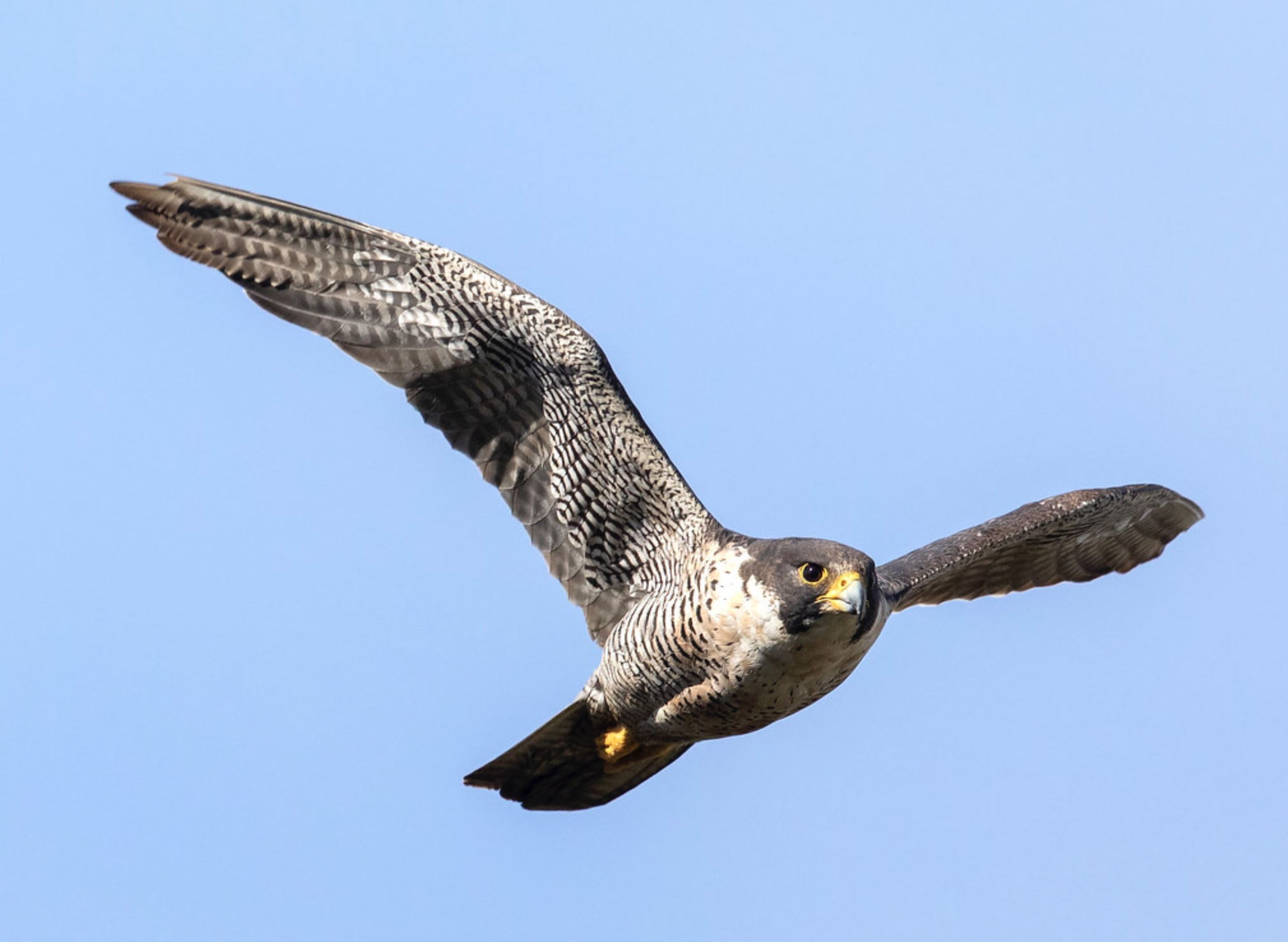
Celebrate World Migratory Bird Day (WMBD) with us in 2026! This year’s theme is “Every Bird Counts – Your Observations Matter”. Have fun learning about a new migratory bird every day. We have coloring pages, interesting facts, activities, and more. Download for free and enjoy nature with your family at home.
Migratory Bird of the Day: Purple Martin
Attention, Caribbean birdwatchers! Each fall, our skies welcome an elegant, streamlined traveler: the Purple Martin. Between August and October, look up for flocks of these large, social swallows perched on wires or sweeping through the air in pursuit of insects. Their passage can be one of our region’s most striking migration spectacles!
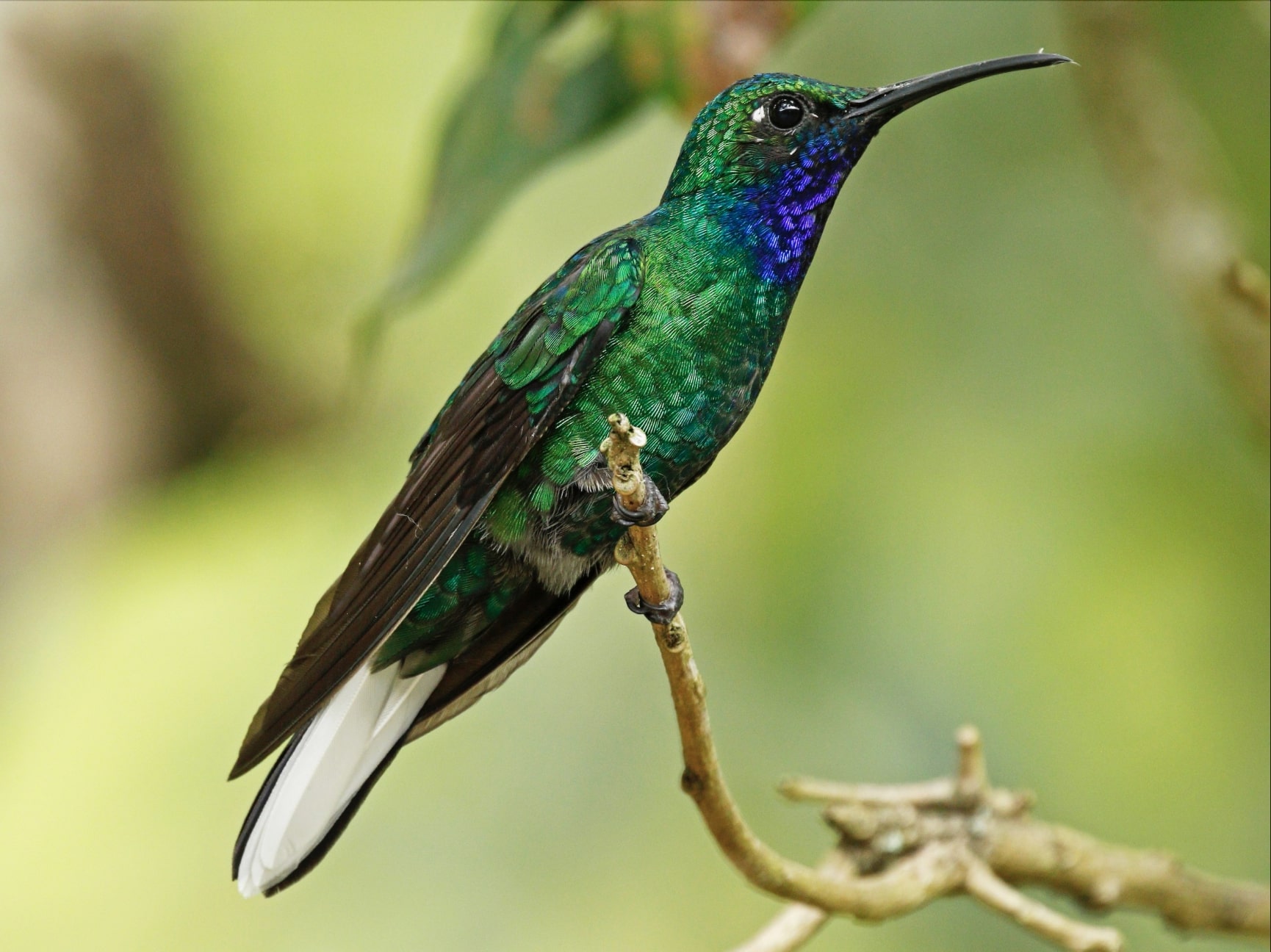
An adult male is dark all over, with a glossy purple-blue sheen that catches the light. But identification can be tricky in the Caribbean: male Cuban Martins and Caribbean Martins can look very similar. Females and young birds offer more clues.
Female Purple Martins have a grayish breast and pale belly, often with faint streaks below. Female Cuban Martins tend to show a cleaner white belly with a sharper boundary between the dark breast and white underparts. Young Purple Martins are brownish above and pale below, often with streaking. A photo can help you study these details and compare similar species.
Purple Martins breed in North America. In the eastern United States, they nest almost entirely in houses and artificial gourds provided by people, though they also use natural cavities in other parts of their range. At the end of summer, they head south to spend the nonbreeding season in South America. Many pass through the Caribbean along the way, making our islands an important part of their long journey.
Their song is a rich, liquid, bubbling warble, and their calls can fill the air when they gather at communal roosts. Purple Martins are expert aerial insect hunters, catching flying insects on the wing. Watching a flock turn and swoop together is a wonderful reminder of how much is happening above us—even when we are not looking up.
Purple Martins depend on abundant flying insects throughout their journey and on safe places to rest during migration. Reducing pesticide use helps protect their food supply. If you find a flock resting on wires or gathering in trees, enjoy the spectacle from a distance and avoid disturbing the birds.
You can also help by recording your sightings in eBird. Note when and where you saw the martins, how many there were, and whether they were feeding, flying, or roosting. These observations help build a clearer picture of their migration through the Caribbean.
The next time you see a group of large swallows gathered on a wire, take a moment to watch. You could be witnessing a stop on a journey of thousands of kilometers. Let’s care for these incredible travelers together! Learn more about this species, including its range, photos, and calls here. Great news! If you’re in the Caribbean, thanks to BirdsCaribbean, you have free access to Birds of the World and you can find out even more in the full species account of this bird!
Thanks to Adrián Yanes Domínguez for the text and Eden Garrod for the lovely illustration!
Color in the Purple Martin
Download the Migratory Birds of the Day Coloring Page! Use the picture above and the photos on this page as your guide, or look up pictures of the bird online or in a bird field guide if you have one. Share your colored-in page with us by posting it online and tagging us @BirdsCaribbean #WMBD2026Carib
Listen to the calls of the Purple Martin
One of the most common flight calls of the Purple Martin is a flight is a rich descending “cheur“.
Enjoy these photos of Purple Martins
A Male Purple Martin in flight. The blue traveler that shares our skies. (Photo by Ryan Sanderson, Macaulay Library-ML634611794)A female or immature Purple Martin feeding on a dragonfly.Male Purple Martin perched. (Photo by Jack Belleghem, Macaulay Library- ML656301549)
Activity of the Day
FOR KIDS: The main area used by Purple Martins does not cover the whole Caribbean, which means that in some places it is a bird that is hard to see, or will not be around at all. But don’t worry, there are lots of beautiful migrant birds to look out for at this time of the year. From long-billed shorebirds flocking on the beaches, to the colorful gems of warblers flitting amongst the trees, there is so much to see!
When it comes to knowing who is who when out looking for birds, field guides and webpages with colorful illustrations, helpful maps and detailed descriptions of each bird are really useful. But these are not the only tools available to you!
Have you heard of the Merlin Bird ID app? When you see a bird, you just answer some simple questions about it, and the app helps you work out what bird you have spotted! Merlin Bird ID can also help you ID a bird from a photo you have taken or a recording of the birds song! Why not head out and look for some migratory birds and then use the Merlin Bird ID app to lend a helping hand?
We have handy instructions what to look for and how to use the app here. So grab you phone, binocular and camera and see what you can find!
FOR KIDS AND ADULTS: Enjoy this video of a Purple Martins in the wild!
Celebrate World Migratory Bird Day (WMBD) with us in 2026! This year’s theme is “Every Bird Counts – Your Observations Matter”. Have fun learning about a new migratory bird every day. We have coloring pages, interesting facts, activities, and more. Download for free and enjoy nature with your family at home.
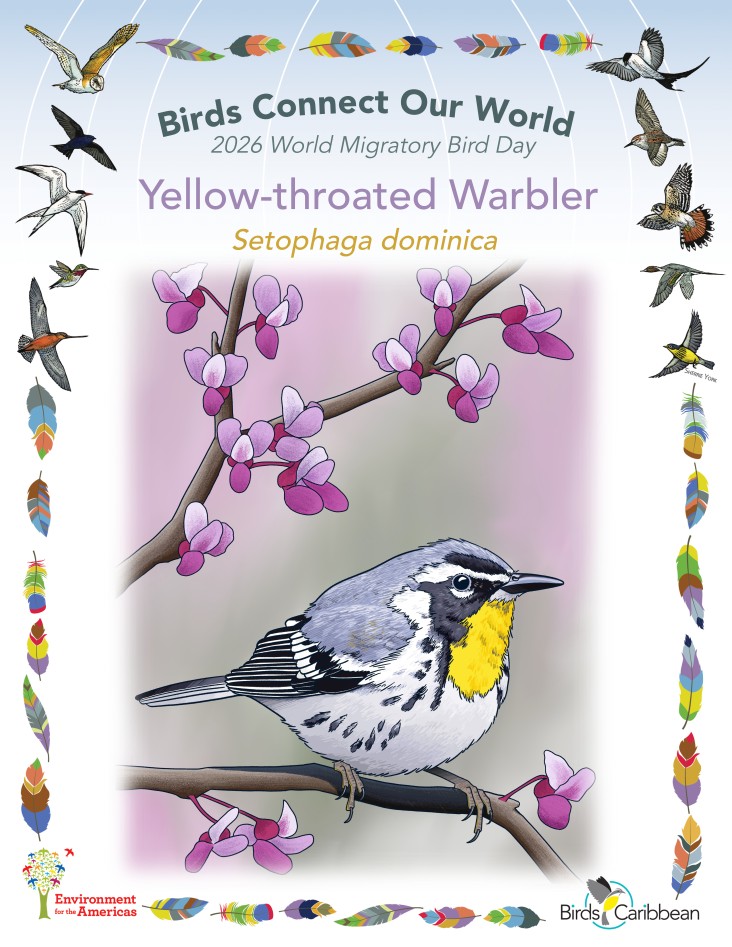
Migratory Bird of the Day: Yellow-throated Warbler
I can feel it—the seasons are shifting. Fall is gearing up for its big debut, which means it’s time for me to head south.
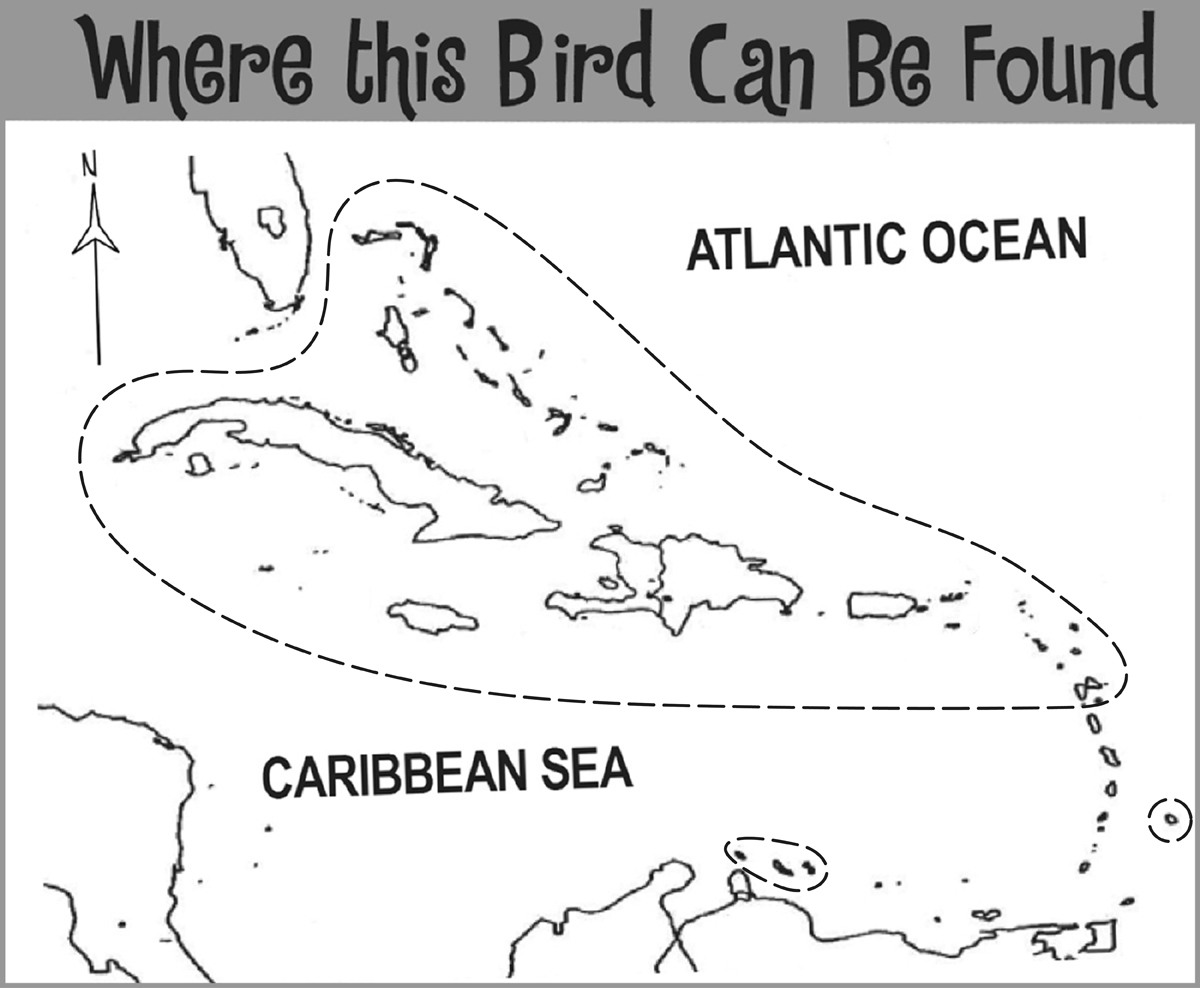
Up north, you’ll find me raising my family in all sorts of habitats—pine and deciduous forests, cypress swamps, pine woodlands, and streamside forests. My nest? Practically impossible to spot. Good luck finding it! Once my chicks are strong enough to fly, I’m off to warmer skies, trading in cooler forests for the bright colours and tropical vibes of the West Indies and Central America.
Of course, migration isn’t easy: I dodge storms, skyscrapers, windows, cars, and the deadliest predators of all: free-roaming cats.
One of my favourite getaway spots is The Bahamas. People there start spotting me as early as July, darting around palm trees (my personal favourites). Honestly, I should’ve been called the Palm Warbler—funny enough, the real Palm Warbler mostly hangs out on the ground! But hey, my actual name, Yellow-throated Warbler, works too. After all, my bright yellow throat, black mask, bluish-grey back, and streaked sides make me one flashy little bird. I stand out among the warbler crowd.
Special shout-out to naturalist Mark Catesby for my original common name (Yellow-throated Creeper). That was a pretty spot-on description.
Sometimes, just before I head back north in spring, Bahamians hear me singing. Folks describe my song as sweet and lilting, ending with a sharper twist.
As for food? Bugs, bugs, and more bugs. I scour trunks and branches for tasty arthropods, but I won’t say no to nectar or juicy fruit when I find it.
If you’re in The Bahamas, especially in Abaco, you might even run into my cousin, the Bahama Warbler. From a distance, we look alike, but he’s got a yellow belly and throat, an even longer bill (the longest of any warbler, actually), and he’s a bit of a homebody, never straying far from Abaco’s pine forests. I, on the other hand, like to get around.
Now, here’s the tough part: even though my range is pretty wide, stretching from North America down through Central America and the West Indies, my future isn’t guaranteed. Habitat loss and dwindling food supplies on both my breeding and wintering grounds are making survival harder. Since I spend so much time on my wintering grounds, things like droughts, deforestation, or food shortages can leave me in poor condition for the long trip back north to breed.
But here’s where you can help. Plant native trees and skip the pesticides. The more insects around for me to munch on, the better! You can also add a bird bath—I enjoy a clean drink and quick dip too. Volunteering with local environmental organizations for habitat cleanups or tree planting is another great way to show your love to me and other wildlife. And please keep your pet cats indoors. It’s one of the best things you can do for their wellbeing and for birds!
Every little step makes a huge difference. Do that, and you’ll help keep my song alive in forests and swamps for generations to come.
Thanks to Scott Johnson for the text and Eden Garrod for the lovely illustration!
Color in the Yellow-throated Warbler
Download the Migratory Birds of the Day Coloring Page! Use the picture above and the photos on this page as your guide, or look up pictures of the bird online or in a bird field guide if you have one. Share your colored-in page with us by posting it online and tagging us @BirdsCaribbean #WMBD2026
Listen to the song of the Yellow-throated Warbler
The song of the Yellow-throated Warbler is a series of sweet descending notes, followed by sharper notes at the end.
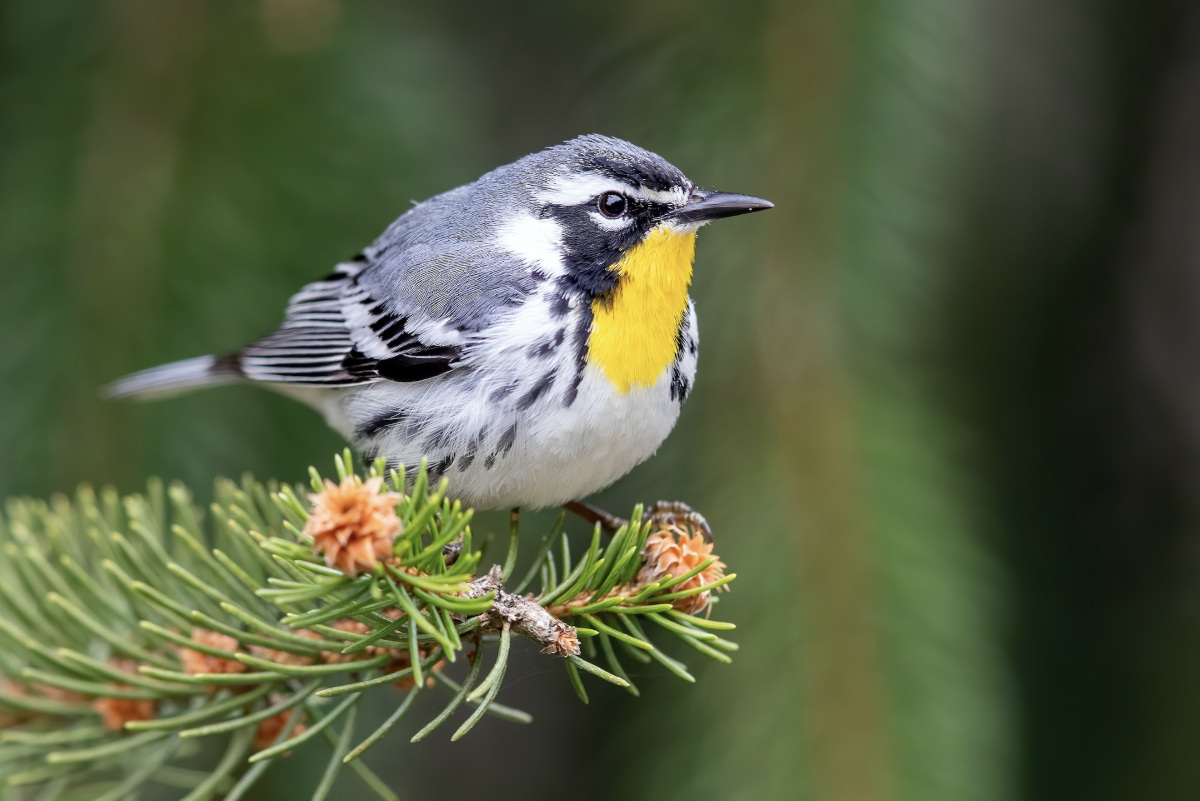
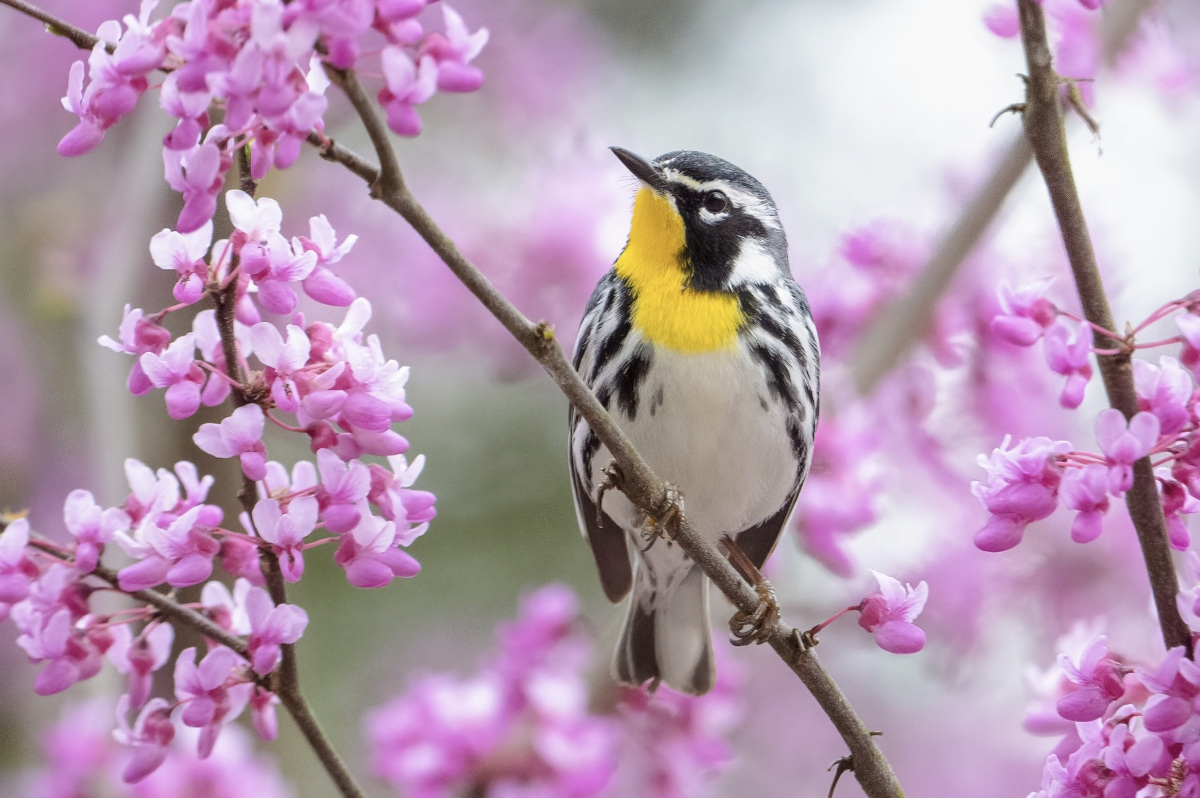
Enjoy these photos of Yellow-throated Warblers
Yellow-throated Warblers keep their bright plumage throughout the year. (Photo by Brad Imhoff, Macaulay Library- ML224374621)A Yellow-throated Warbler perched on a blossom-covered branch in spring-time. (Photo by Tyler Ficker, Macaulay Library-ML440234181)
Activity of the Day
FOR KIDS: Use your observation skills and go on a scavenger hunt! Print the cards on sturdy paper or pieces of cardboard.
Talk about this with your kids and then go outside to investigate your habitat and get looking! Instead of collecting the items, this is an observational scavenger hunt. If you have a camera or a phone you can take pictures of interesting things you see.
When your hunt is over you could come back together to chat about what was seen and where they were located. How many different bird did you see? Which habitat had the most insects? What else did you discover?
FOR KIDS AND ADULTS: Enjoy this video of a Yellow-throated Warbler in the wild!
Nestled in the eastern Caribbean, St. Vincent and the Grenadines is more than a multi-island travel destination offering stunning coastlines. The lush peaks and valleys of mainland St. Vincent are home to rare wildlife, including two species of profound importance: the vibrant St. Vincent Amazon, localled called ‘Vincy Parrot,’ and the elusive Whistling Warbler. These birds, found nowhere else on Earth, are fundamental to the island’s natural heritage and national identity.
St. Vincent Amazon. (Photo by Faraaz Abdool ML572563461)
However, their habitats face significant threats. The catastrophic eruption of La Soufrière volcano in 2021, after 40 years of low activity, followed by the devastating impact of Hurricane Beryl in 2024, underscored the urgent need for focused conservation efforts. These events brought attention to the uniqueness of the island’s biodiversity and led to a renewed commitment to safeguarding its threatened species.
Dense and steep mountains in Silver Spoon, a well-known Whistling Warbler habitat. (Photo by Kaitlyn Okrusch)
Following the 2021 eruption, a conservation emergency group led by BirdsCaribbean quickly raised funds to assist the St. Vincent and the Grenadines Forestry Department (SVGFD). On-the-ground efforts included providing supplemental food to parrots, searching for injured parrots and administering first-aid, and repairing park infrastructure like observation decks and signs. The SVGFD also conducted a census of the St. Vincent Amazon at watch points across the parrot’s range.
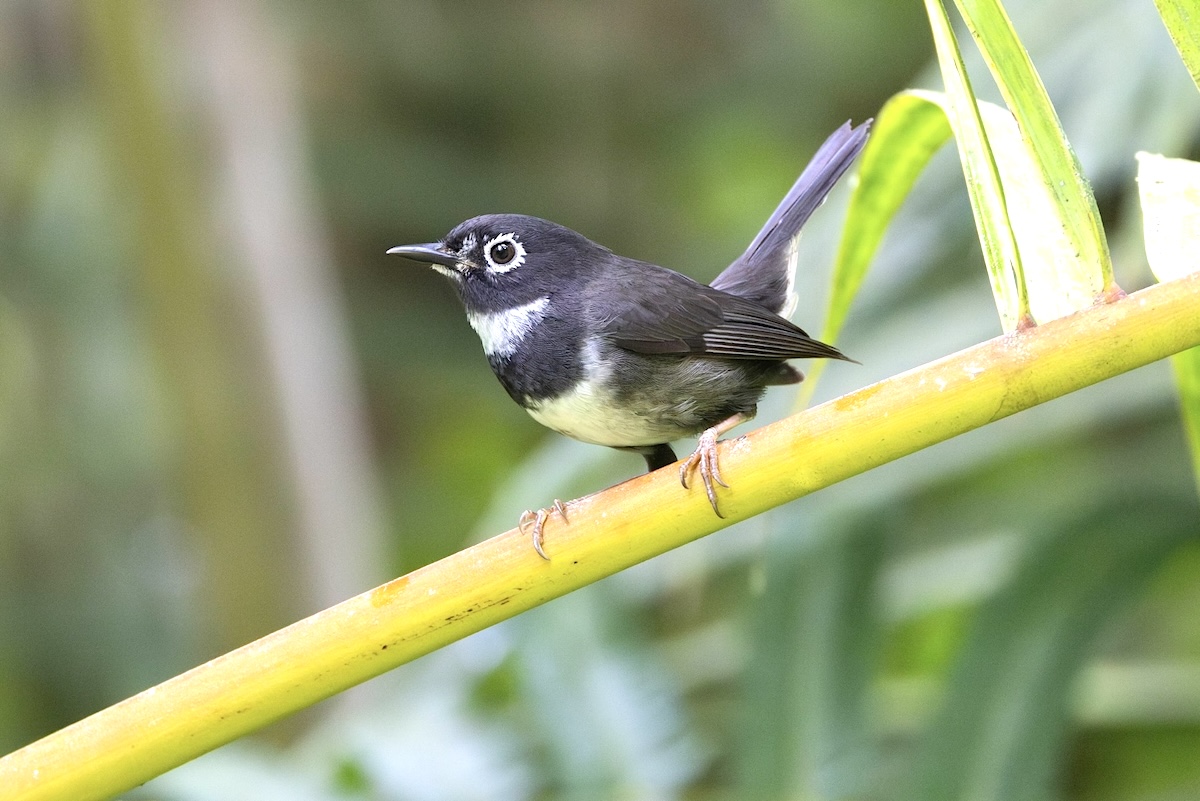
Whistling Warbler spotted on La Soufriere Windward Trail. (Photo by Jonathan Slifkin ML621602299)
Over the last several years, projects funded by CEPF and UNDP were launched to research the ecology of the St. Vincent Amazon and Whistling Warbler, build local landbird monitoring capacity, and prepare Conservation Action Plans.
The primary goal of this workshop was to unite species experts, natural resource managers, environmental advocates, and other stakeholders to create strategic Conservation Action Plans for the Whistling Warbler and the St. Vincent Amazon. A wide coalition of partners, including BirdsCaribbean, Re:wild, the SVGFD, Science Initiative for Environmental Conservation and Education (SCIENCE), St. Vincent and the Grenadines Environment Fund (SVGEF), Ministry of Tourism, Civil Aviation, Sustainable Development and Culture, National Parks, Rivers and Beaches Authority, Amazona Nest, Sustainable Grenadines Inc., Wild Dominique, and researchers from Florida International University and Antioch University, convened in St. Vincent.
This collaborative effort is a pivotal milestone, leveraging existing partnerships and scientific insights to forge a unified strategy for the conservation of these birds. As Cuthbert Knights, Permanent Secretary of the Ministry of Agriculture, Forestry, Fisheries, Rural Transformation, Industry, and Labour stated in his opening remarks, “This workshop is a demonstration of our shared purpose to protect the St. Vincent Amazon and Whistling Warbler. These birds are more than national treasures, they are living symbols of our natural heritage…there is an urgent need to understand and better protect the island’s rich biodiversity. ”
So what exactly is a Conservation Action Plan?
Each Conservation Action Plan is a unique roadmap tailored to conserve a species or habitat within specific ecological and social contexts. It provides a structured approach, outlining specific, measurable goals and objectives along with the actions, timelines, and resources required to achieve them. The plan guides all stakeholders, helping them work together to safeguard the future of the species or habitat.
Before we begin…
To set the stage for discussions during the workshop, BirdsCaribbean and partners from Florida International University, Cornell Lab of Ornithology and Antioch University hosted two webinars to equip registered participants with the latest research and findings on the Whistling Warbler and St. Vincent Amazon.
Post-Eruption Assessment and Habitat Associations of the Whistling Warbler: Insights for Conservation Action (Dr. Lisa Sorenson and Dr. Mike Akresh)
Spatial and Temporal Distribution of the St. Vincent Amazon (Amazona guildingii) Using Passive Acoustic Monitoring (Dr. Cristina Gomes and Dr. Vijay Ramesh):
]
Three Days of Focused Conservation
The three-day workshop, held at the Anglican Pastoral Centre in Kingstown, explored the multitude of interconnected reasons to conserve both species, identified key challenges to their protection, and developed practical solutions to overcome these hurdles.
While most people agree that protecting threatened species secures healthy ecosystems and a better future for everyone, the reasons for conserving the St. Vincent Amazon are deeply personal.
Justin Springer welcomes participants to the workshop. (Photo by Lisa Sorenson)
Day 1 of the workshop: Collaboration is in session!
When workshop facilitator and Re:wild’s Caribbean Program Officer, Justin Springer, asked the group why we should conserve the parrot, the response was immediate and unanimous: the parrot is an essential element of their national identity, heritage, and culture. The discussion also expanded to the parrot’s role as a plant mutualist, acting as a seed disperser, and its importance for avitourism. Participants agreed the parrot holds an inherent value independent of its use to humans, celebrated simply for its beauty.
SVG Forestry Officer Samuel Harry writes down his reason for conserving the St. Vincent Amazon. (Photo by Lisa Sorenson)
The ecological, cultural, and economic importance of the St. Vincent Amazon highlighted by participants. (Photo by Lisa Sorenson)
Adding a moral dimension, U.S. Fish and Wildlife Service (USFWS) Wildlife BiologistDr. Thomas White offered a powerful call to action, sharing: “Humans are the main drivers of extinction. We have the ability to recognize the damage we have done and it is morally incumbent upon us to right that wrong.”
While the reasons for conserving the St. Vincent Amazon were rooted in identity and heritage, the discussion around the Whistling Warbler focused a bit more on its ecological role. Participants highlighted the need to protect the species because of its importance in controlling insect pest populations. They also noted the uniqueness of he warbler, being endemic to the island, and that it deserved to be similarly celebrated and conserved. The group also noted the lack of ecological information about the Whistling Warbler, with Forestry Officer III Leon Matthews noting, “We don’t know a lot about the Whistling Warbler.”
Forestry Officer Felicia Baptiste adds her reason for conserving the Whistling Warbler.
The ecological, cultural, and economic importance of the Whistling Warbler highlighted by participants. (Photo by Lisa Sorenson)
Peril in Paradise
The workshop then shifted its focus to the challenges faced in protecting the St. Vincent Amazon and Whistling Warbler.
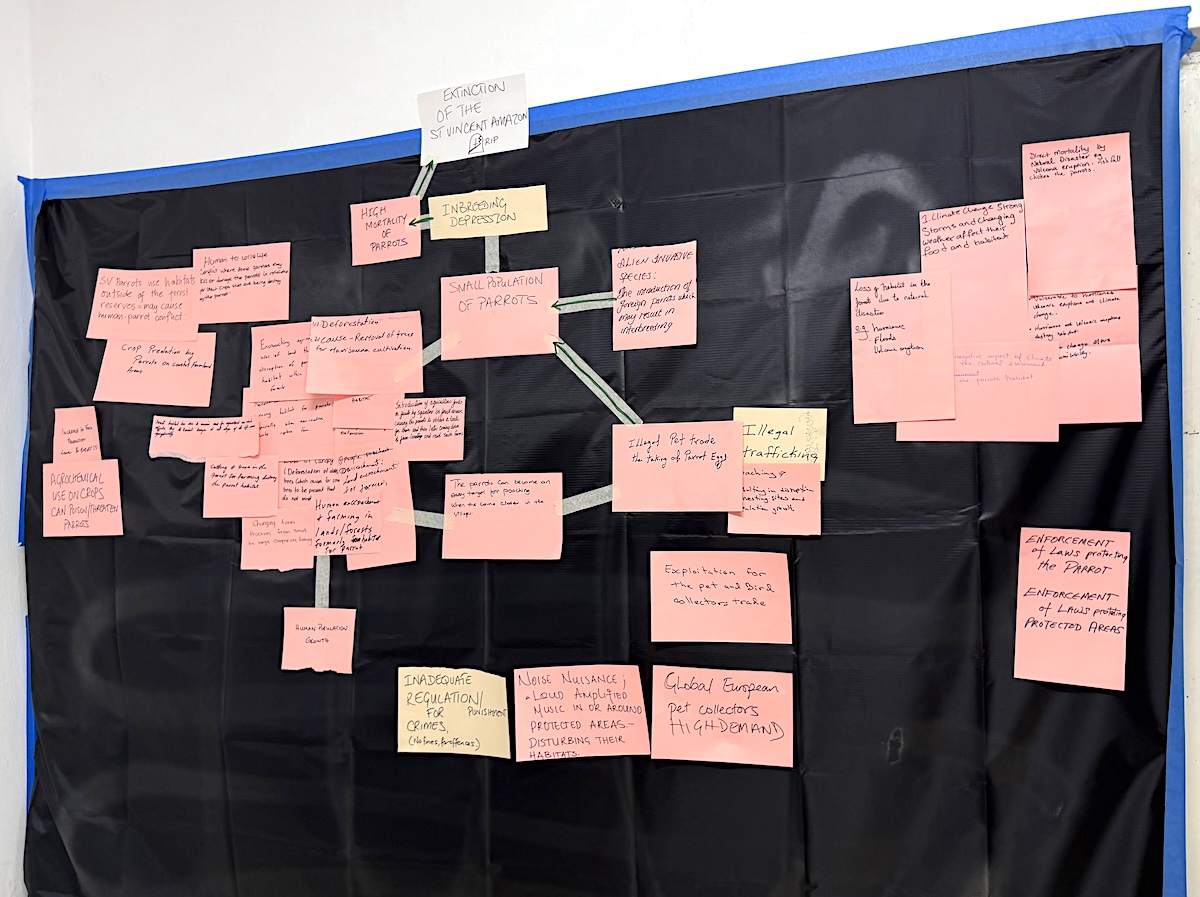
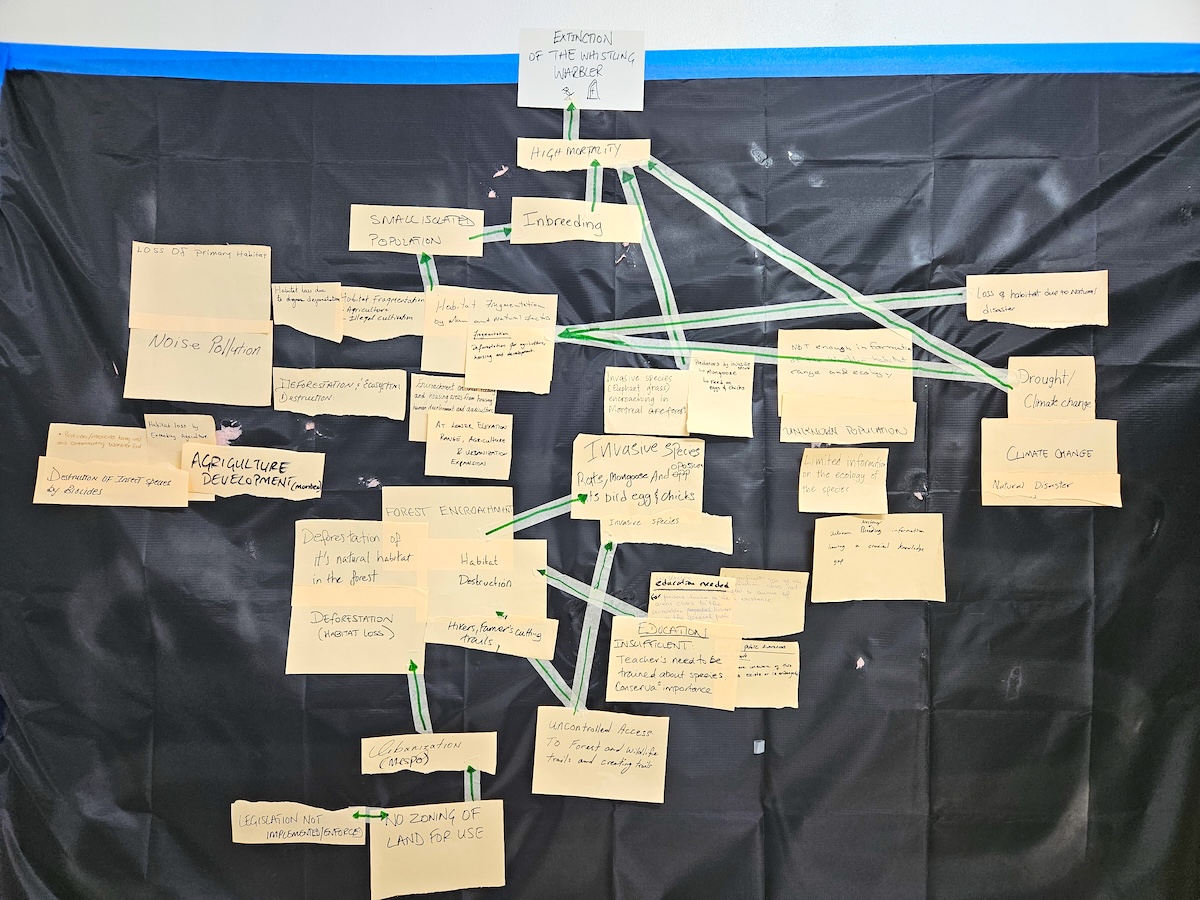
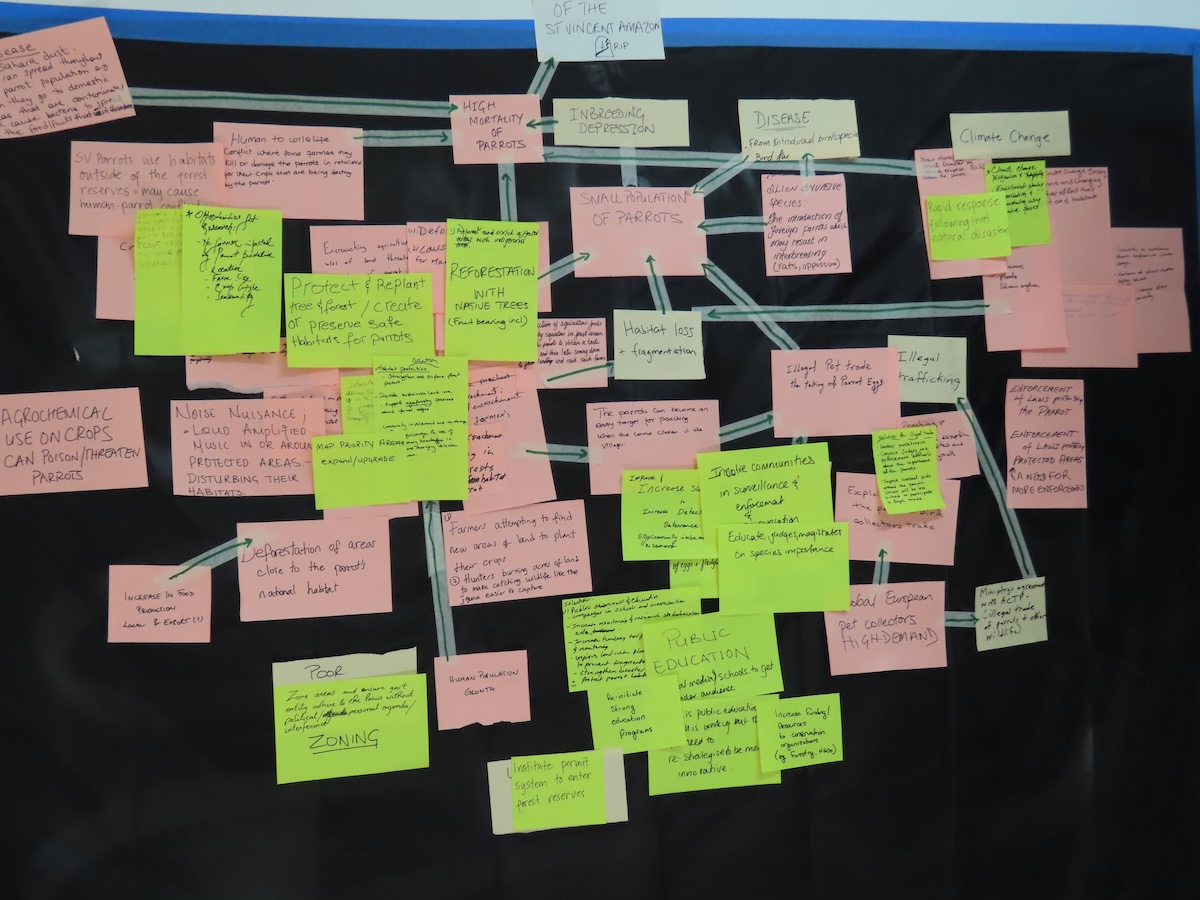
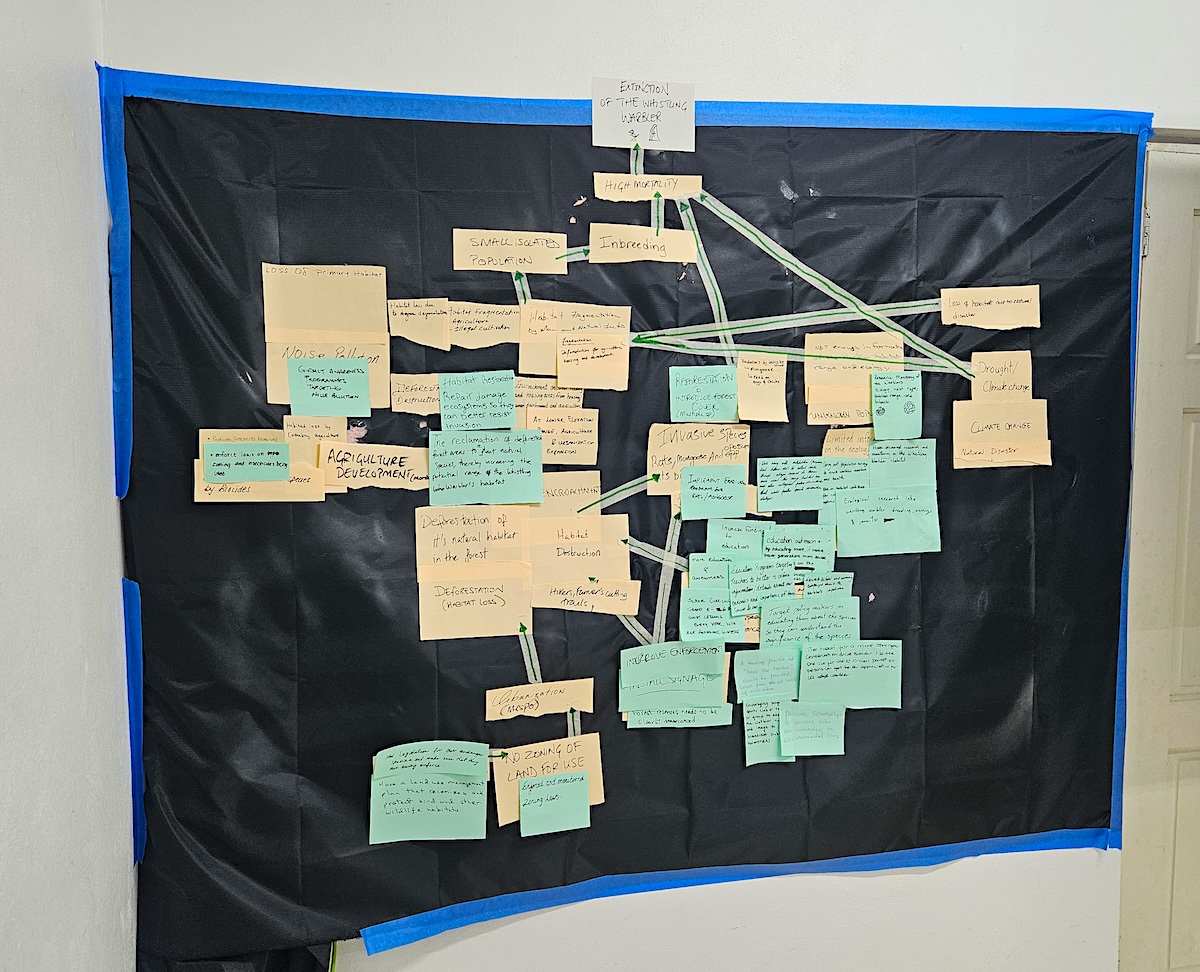
To tackle these complex challenges, Justin introduced a structured approach. He asked everyone to write down the various threats they had identified on individual sheets of paper. These were then used to construct a “problem tree” on a wall, with the core issue “extinction of the Whistling Warbler/ St. Vincent Amazon” at the crown of the tree and the various challenges forming the branches. This visual method offered several key benefits. It allowed the group to see the interconnectedness of the challenges, prioritize issues that need urgent attention, identify root causes of the problems, and build understanding and consensus among the diverse group.
Justin explains what is a Problem Tree before asking participants to list threats to the survival of the St. Vincent Amazon. (Photo by Lisa Sorenson)
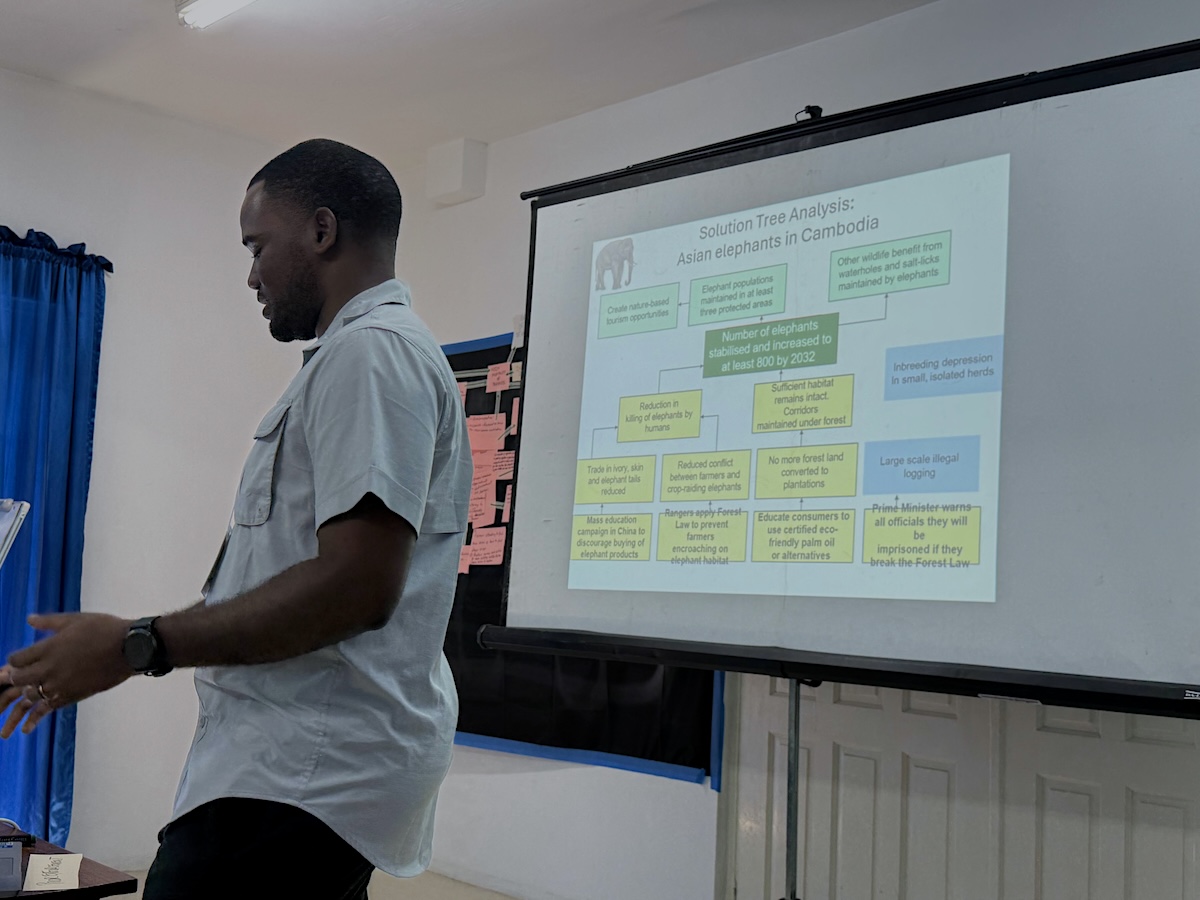
Justin uses the Asian Elephant extinction crisis to explain how a problem tree is created and then analyzed. (Photo by Lisa Sorenson)
The threats to the St. Vincent Amazon are numerous and complex. They include weak legislation and enforcement—first-time offenders caught possessing, harming, or killing a parrot often face minimal fines of only $2,000–$5,000 ECD, though penalties of up to $10,000 ECD are allowed by law. Other challenges include human–wildlife conflict, as parrots sometimes feed on crops such as passion fruit, an important export for small farmers. Poaching of eggs and chicks also persists, with birds occasionally trafficked overseas. Limited customs capacity and training make it difficult to detect and prevent illegal exports.
Adding to these concerns is a long history of controversy surrounding the Association for the Conservation of Threatened Parrots (ACTP), a private organization based in Germany. Over the past decade, investigative reports have raised serious questions about transparency, accountability, and financial motives behind international parrot transfers carried out in the name of conservation. Recent exposés by German journalists on ACTP’s expanded trade in rare and endangered wildlife highlight how protected species (including the St Vincent Amazon) are exploited for profit, renewing calls for stronger oversight, transparent permitting, and a genuine focus on in-country conservation to keep this iconic parrot safe in its natural habitat. Read more here.
The St Vincent Amazon Problem Tree created by workshop participants. (Photo by Lisa Sorenson)
Habitat encroachment through agriculture and housing developments also emerged as a major threat, compounded by the escalating impacts of climate change. In a reflection on his 40-year career, recently retired Director of Forestry Fitzgerald Providence noted that while the threats have remained consistent, the intensity and frequency of storms and droughts impacting the island have increased, leaving little time for recovery between events. Interestingly, the group also agreed that many locals lacked knowledge about the parrot: where it lives, what it eats, the threats it faces, and actions that can be taken to protect it, suggesting that the parrot, whilst being the national bird, may be a symbol of the nation rather than a symbol for the nation.
With the threats to the St. Vincent Amazon laid out, the workshop turned its attention to the equally pressing challenges facing the Whistling Warbler.
The group identified several key issues, including deforestation from both legal and illegal agriculture. They also extensively discussed the lack of dedicated zoning for farming and housing, which contributes to loss of primary forest and healthy habitats for both species. Invasive species like rats and mongoose were noted as a potential threat, likely preying on the warbler’s eggs and chicks. A major concern raised by Dr. Joanne Justo-Gaymes (wildlife veterinarian and SCIENCE education officer) and Fitzgerald Providence was the rapid spread of elephant grass, which is already outcompeting native plants in the warbler’s montane habitats in places like Montreal.
The Whistling Warbler Problem Tree created by workshop participants.
Illegal entry and trail cutting by farmers and community members makes the problem worse, as it gives invasive species easier access to warbler nests. According to Bradford Latham of the Forest Law and Compliance Unit, a key reason for this is that local communities are unaware that entering protected areas without permission from the St. Vincent and the Grenadines Forestry Department (SVGFD) is illegal. Furthermore, even with a permit, people are not allowed to cut vegetation, clear new trails, or remove any plants or wildlife.
Climate change was cited as a serious threat, with both droughts and hurricanes impacting the warbler’s habitats. A crucial challenge underlying all of these issues is a lack of information about the species. As one Forestry Officer in the Forest Mapping Inventory Unit, Samuel Harry, succinctly explained, “We can’t protect what we don’t understand.”
Crafting solutions for St. Vincent’s birds
With the problems clearly defined and visually organized, the group tackled the development of solutions. Using their local knowledge and diverse expertise, participants worked together to propose practical and effective remedies for each challenge. Their ideas were then added to the “problem tree” to transform it into a “solution tree.” This exercise helped turn their collective concerns into strategies to safeguard St. Vincent’s endemic birds.
Justin explains how to develop a solutions tree using the conservation of Asian elephants as an example. (Photo by Lisa Sorenson)
Drawing on their on-the-ground experience, participants then refined their suite of practical solutions, overlapping in some areas, for both the St. Vincent Amazon and Whistling Warbler. These included reforesting areas with native plants that provide food and shelter for wildlife. This includes thinning plantations of non-native Blue Mahoe and Mahogany, which were planted primarily for soil management. Participants also underscored the need for more research to better understand the parrot’s population size and seasonal movements, as well as the nature of crop damage to support farmers in mitigating any loss.
St. Vincent Amazon Solutions Tree created by participants.
Similarly for the warbler, it was highly recommended that more research be carried out on its habitat use, distribution, and nesting behaviour. Local environmentalist Marlon Mills stressed the importance of accurate data for proper resource management, emphasizing, “We need to take care of our own. If we don’t, we won’t be able to depend on them in the future. But first—we need to understand the needs of the species.“
Whistling Warbler Solutions Tree created by participants.
Other key strategies focused on improving land use planning to better protect the birds’ habitats, and fostering greater collaboration among various sectors, such as tourism and law enforcement.
The power of public education
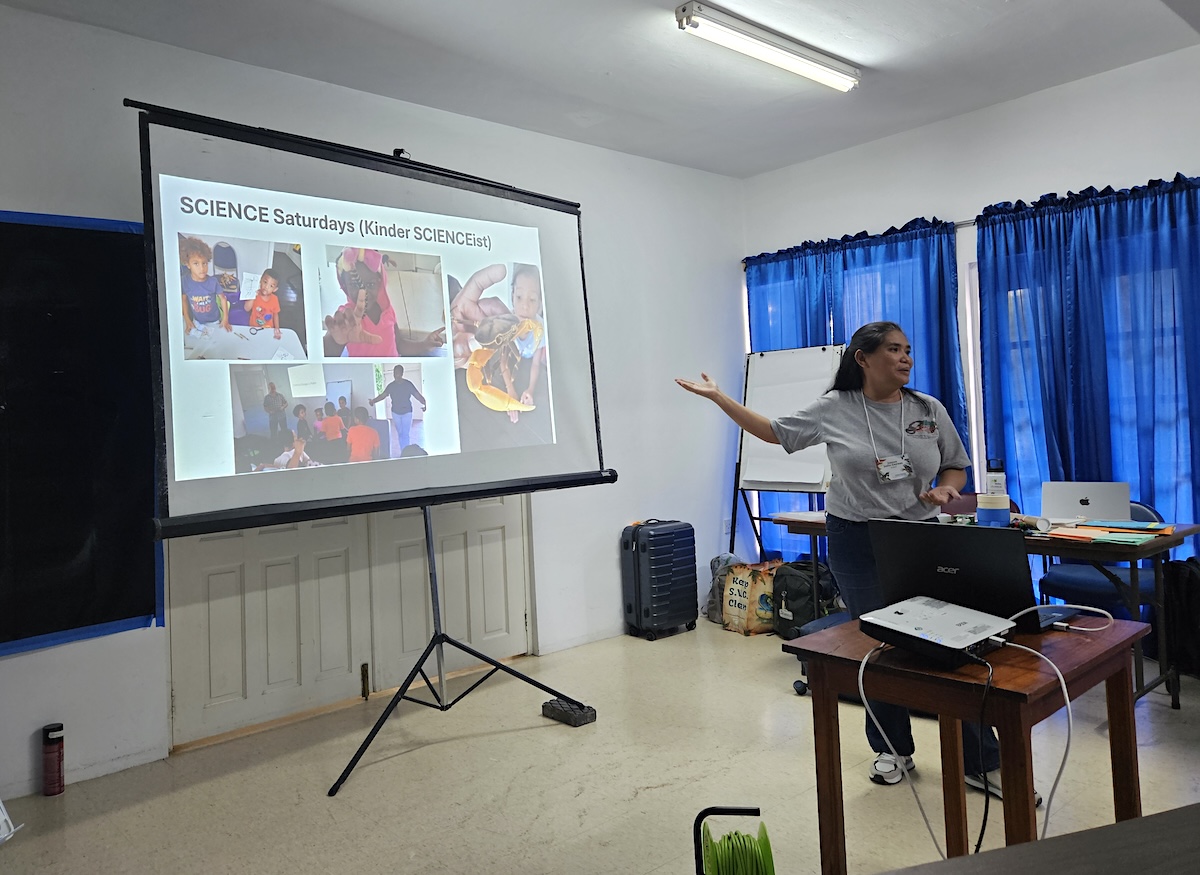
While local NGO SCIENCE and the SVGFD have already done substantial work in educating the public about the St. Vincent Amazon and Whistling Warbler, the group agreed that this message now needs to be built into the national science curriculum. In support of this solution, Dr. Joanne Gusto-Gaymes delivered a powerful presentation on the impactful public education and outreach programs currently run by SCIENCE. The organization’s science camps, which were originally created for primary school students, were so popular that they had to expand their age limit to include secondary school students as well.
Dr Joanne Gusto-Gaymes speaks about SCIENCE’S education and outreach initiatives.
The success of these programs is evident: teachers now volunteer as activity leaders at the science camps to better connect with the national science curriculum, and a former student is even pursuing a degree in Conservation Biology at the university level. Through immersive field trips with visiting researchers and public wildlife exhibitions, SCIENCE instills in its students the core belief that “in order to preserve our heritage, we need to do the research to learn more about our species.” This dedication to hands-on learning and scientific inquiry should be a key component of the island’s long-term conservation strategy.
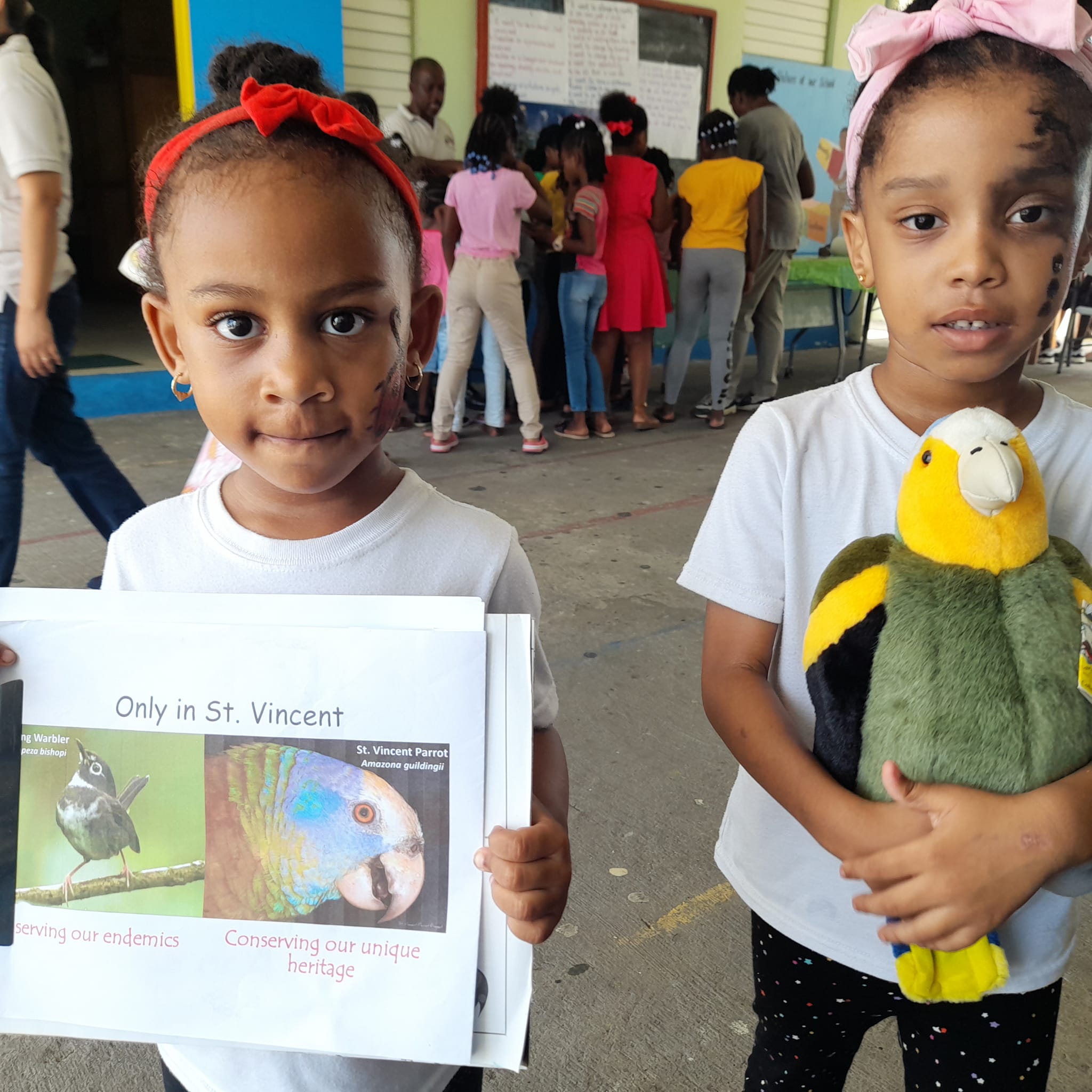
Students at Sandy Bay Primary School with a St Vincent Parrot plushie during CEBF celebrations. (Photo by Science SVG)
A Collaborative Effort
Following the identification of problems and solutions, the group moved on to setting clear goals for the action plans. Participants were asked to draft their own 10-year goals for both the St. Vincent Amazon and the Whistling Warbler. The facilitators then synthesized these ideas into a single, cohesive goal and several objectives for each bird. This draft was presented to the entire group, for their comments and revisions to ensure the final goals and objectives reflected the group’s shared vision.
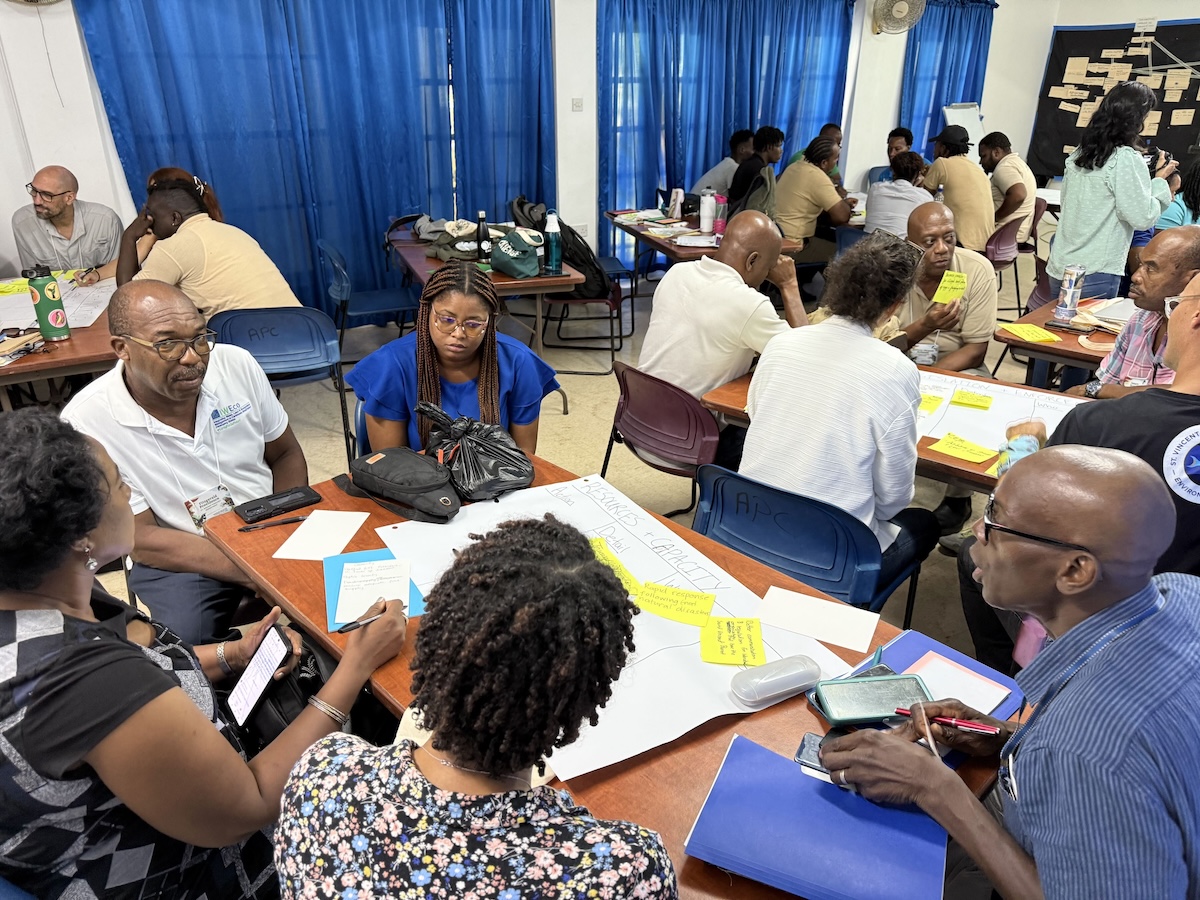
Participants defining actionable steps to help them achieve their objectives.
After the goals and objectives were finalized, the group divided into break-out groups to outline specific actions to achieve the objectives, rating each action’s priority from low to high. This approach ensured that each objective had a clear pathway to being achieved.
Research and Monitoring group.
Legislation group.
The information gathered from the workshop is currently being compiled into a comprehensive draft Conservation Action Plan for each bird. These drafts will be shared with all stakeholders for an iterative editing process. Both the St. Vincent Amazon Conservation Action Plan and Whistling Warbler Conservation Action Plan are to be completed by fall 2025.
Habitat Restoration and Protection group.
Education and Outreach Group.
A Splash of Color and Creativity
The workshop also had a fun side that sparked creativity and connection among participants. They eagerly dove into a coloring competition, bringing to life St. Vincent’s spectacular endemic birds—the St. Vincent Amazon, the St. Vincent Wren, and the Whistling Warbler, beautifully drawn by Cuban artist, Arnaldo Toledo. This hands-on activity kept minds sharp and creativity flowing, helping everyone to stay engaged and contribute meaningfully. Of course, the atmosphere was also fueled by delicious coffee breaks and lunches, where lively conversations spilled over, allowing people to build relationships, and lay the groundwork for future partnerships.
St. Vincent Amazon colored artwork and line drawing are by Cuban ornithologist and scientific illustrator Arnaldo Toledo.
FIU Graduate student Kaylin shows off her colored in St. Vincent Amazon art. (Photo by Lisa Sorenson)
Forestry Officer flex their creative muscles during the workshop.
FIU Graduate student Alyssa shows off her colored in St. Vincent Wren art. (Photo by Lisa Sorenson)
Kisha McFarlene, Project and Community Officer for SusGren, with her colored in St. Vincent Amazon art. (Photo by Lisa Sorenson)
Local environmental advocate Marlon Mills shows off her colored in St. Vincent Amazon art. (Photo by Lisa Sorenson)
In-person meetings are an excellent chance to share resources, and this workshop was no exception. We seized the opportunity to distribute more custom stickers created for use by NGOs and government partners during their outreach events carrying the message to “Protect & Love our Endemic Birds” and helping to inspire the next generation of conservationists. We also provided Fact Sheets for both the parrot and warbler, as well as notecards about St Vincent’s three endemics.
Conservation chat over coffee.
Delicious food catered and served by Snagg Cuisine.
Garry Auguiste (Wild Dominique) and Jodelia Simmons (SVGFD Forestry Officer) also received monitoring equipment and field guides. They will use these to continue monitoring of the parrot and warbler populations on the island.
A Heartfelt Thank You
We extend our deepest gratitude to the Critical Ecosystems Partnership Fund (CEPF), the United Nations Development Programme (UNDP), and BirdsCaribbean members and donors for their generous support which made this workshop possible. Special thanks to Re:wild, particularly Justin Springer, for support with workshop planning and facilitation, and to our project partners, including the St. Vincent and the Grenadines Forestry Department, SCIENCE, SVG Environmental Fund, Florida International University, Antioch University, and the Cornell Lab of Ornithology.
We also want to express our sincere appreciation to all the participants for their invaluable contributions and enthusiastic engagement. A special thank you goes to the staff at the Anglican Pastoral Centre for their exceptional support in fulfilling all our venue requests and for their quick assistance with any issues that arose. We are also grateful to the caterers, Snagg Cuisine, for providing delicious meals that fueled our discussions. Finally, a huge thank you to Arnaldo Toledo for providing the beautiful artwork.
Building on the momentum and collaborative spirit of the workshop, the future of bird conservation on the island looks brighter than ever. We are proud to be a part of this journey and BirdsCaribbean looks forward to the successful completion and application of these conservation plans!
For all the latest news on this and other BirdsCaribbean programs, be sure to join our mailing list. We’ll deliver just the right amount of exciting Caribbean bird conservation news straight to your inbox. No spam. We promise. Click here to sign up!
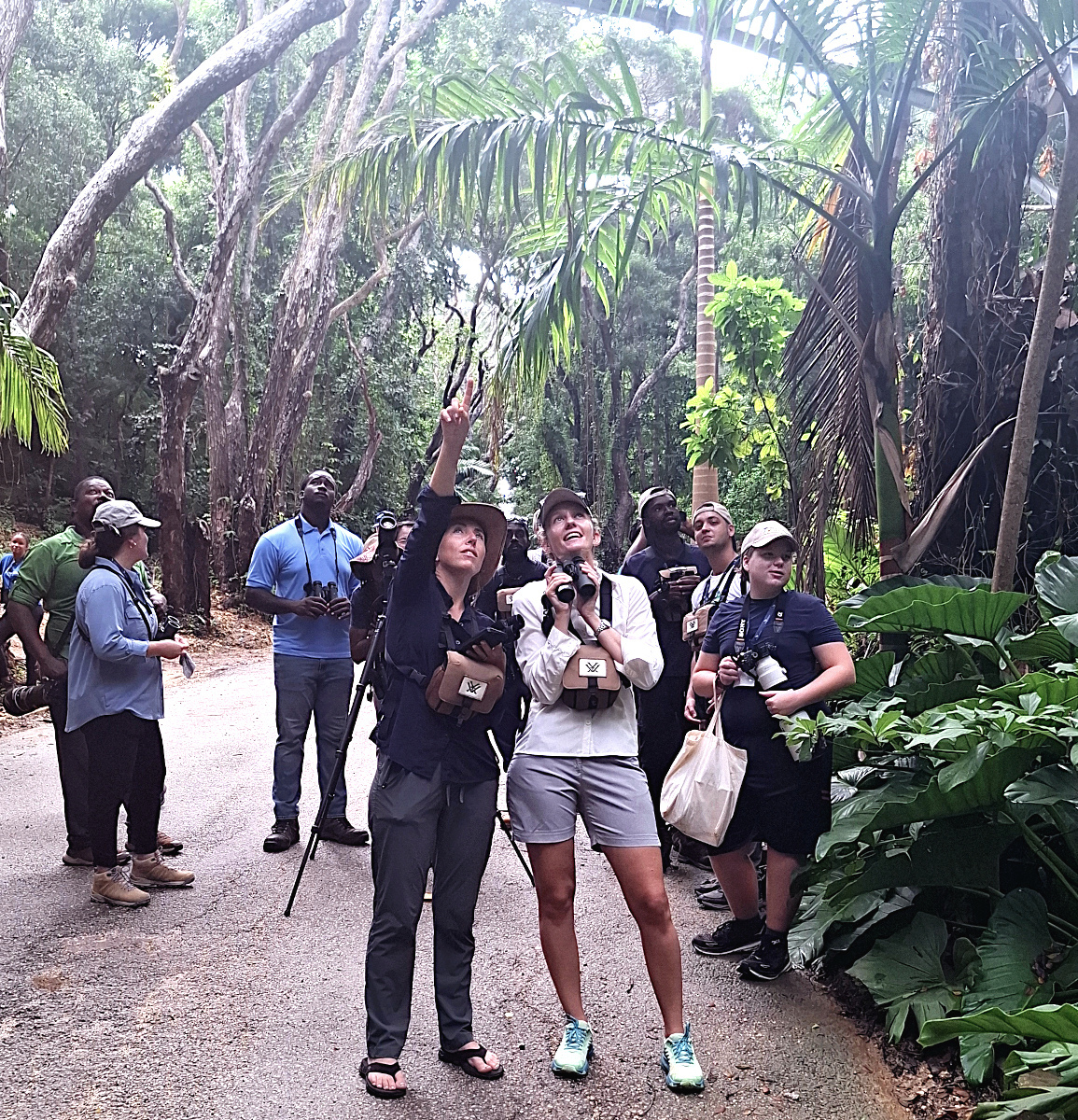
Birding at Cherry Tree Hill, Barbados. (Photo by Alex Sansom)
Imagine helping scientists make amazing discoveries, all from the comfort of your own home or backyard. That’s the power of citizen science! You don’t need a white lab coat to contribute to real research, just a curious mind and a willingness to observe the world around you. We’ve got all the details in this blog to help you take simple yet concrete actions to protect our planet.
Ever wanted to make a real difference in your community—no, make that in the world? With citizen science you actually can! Citizen science is all about scientists teaming up with everyday people who are curious, concerned, and motivated to tackle real-world problems. These people are called citizen scientists. Science needs more eyes, ears, and perspectives than any single scientist possesses to protect threatened species, safeguard natural resources, and prevent the spread of diseases. Think about it—thousands of citizen scientists, each doing a small amount of work, focused on a single goal, can collect more data in a shorter period and for less money than can any researcher or research group. Additionally, citizen scientists can collect data from places like backyards or schoolyards that may be difficult for researchers to access.
Many names with the same aim
“Community science,” “participatory science,” “crowdsourced science,” “volunteer monitoring,” and “public participation in scientific research” are common aliases for citizen science. But whatever it’s called in your neck of the woods, all citizen science projects share these four key characteristics:
Anyone can participate no matter occupation, age, background, gender, or location. Seriously, if you’re curious and willing to help, you’re in!
Everyone uses the same method. This ensures the data collected is top-notch.
Your data makes a difference. It can help scientists make amazing breakthroughs.
It’s a two-way street. Scientists and volunteers openly share data and results so everyone, including the public, can see what’s happening.
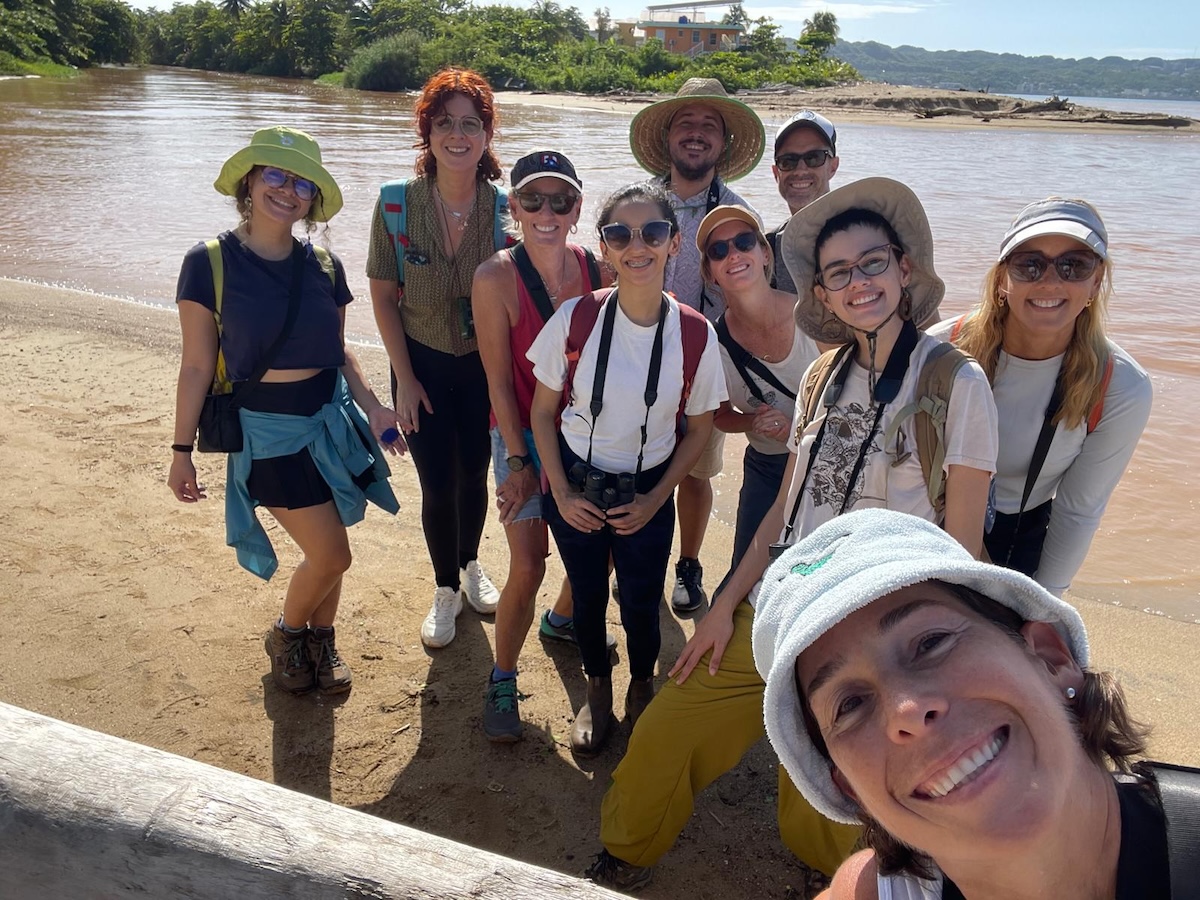
Surfrider Foundation Puerto Rico’s small but dedicated birding group at Playa Table Rock for the Caribbean Endemic Bird Festival (CEBF) and Global Big Day (GBD) 2024. (Photo by Surfrider Foundation Puerto Rico)
Citizen scientists commonly collect data. But they can also be involved in other phases of the scientific process like defining the research question, analysis, reporting, and sharing results. The work itself is also incredibly varied. Citizen scientists may be asked to watch and record birds, take photos of local streams and rivers, test water samples for pollutants, or survey marine debris on local beaches. Some projects are even as fun as playing online games to help advance health research. Whatever your interest, we’re certain there’s a project out there for you to make a difference!
The value of citizen science to YOU
Now, you’re probably wondering, “What’s in it for me?” Well, loads.
It’s a fantastic way to connect with a global community who shares your passions. Whether you’re tracking local wildlife with neighbors or collaborating on a global research project online, you’ll be part of a supportive community of volunteers and scientists. This shared purpose and teamwork can turn a solo activity into a meaningful and less daunting experience. Within this community, you’re encouraged to ask questions, share your unique viewpoint, and by doing so enrich a body of knowledge with your input.
BirdLife Jamaica members and guests take a bird walk at Source Farm. (Photo by Source Farm)
Becoming a citizen scientist also offers opportunities for hands-on learning. You’ll gain practical skills in data collection, observation, and critical thinking. You might learn how to identify different bird species, use scientific instruments to test water quality, or build your scientific literacy.
Painted Buntings, a gorgeous migrant to the Caribbean, feast at a backyard feeder in Grand Bahama, The Bahamas. (Photo by Erika Gates)
For example, you join a citizen science project like the Great Backyard Bird Count and notice a bird you’ve never seen before in your backyard. You snap a picture and share with your local birding group or through an online search or field guide to learn how to identify it. This bird now has a name! You’ve come this far, can’t stop now. You then learn what it eats, where it builds its nest, and that your backyard is providing it with food and shelter. Just like that, your backyard goes from being a small green patch to an important part of a local ecosystem—and now you’re actively participating in understanding and protecting it.
You’ve also unlocked the art of noticing your world deeply—increasing your sense of presence, and helping you be more connected to the everyday wonder that surrounds you.
Ultimately, citizen science is all about you. It’s a chance to put your curiosity to work on your own terms. You can choose a project that aligns with your interests, and set your own schedule—contributing as much or as little as you like, from your house, backyard, neighbourhood park, or nature reserve. This self-directed approach empowers you to be a part of something bigger while feeling a sense of ownership and pride in the work you do.
What a difference your data makes!
Entering data into eBird. (Photo by Holly Garrod)
It may sound implausible that simple actions like recording the birds you see or taking photos of rivers and streams can lead to big changes. But your data is a real-game changer in how we think about and conserve our natural resources.
When conservation efforts are steered by sound data, the results can be truly magnificent for birds, habitats and people!
Thanks to the collective power of citizen scientists—heading out, recording the birds they saw, then submitting those sightings to eBird—researchers were able to complete the first-ever Caribbean-wide assessment of shorebird use in the region, via the Caribbean Waterbird Census, now in its sixteenth year.
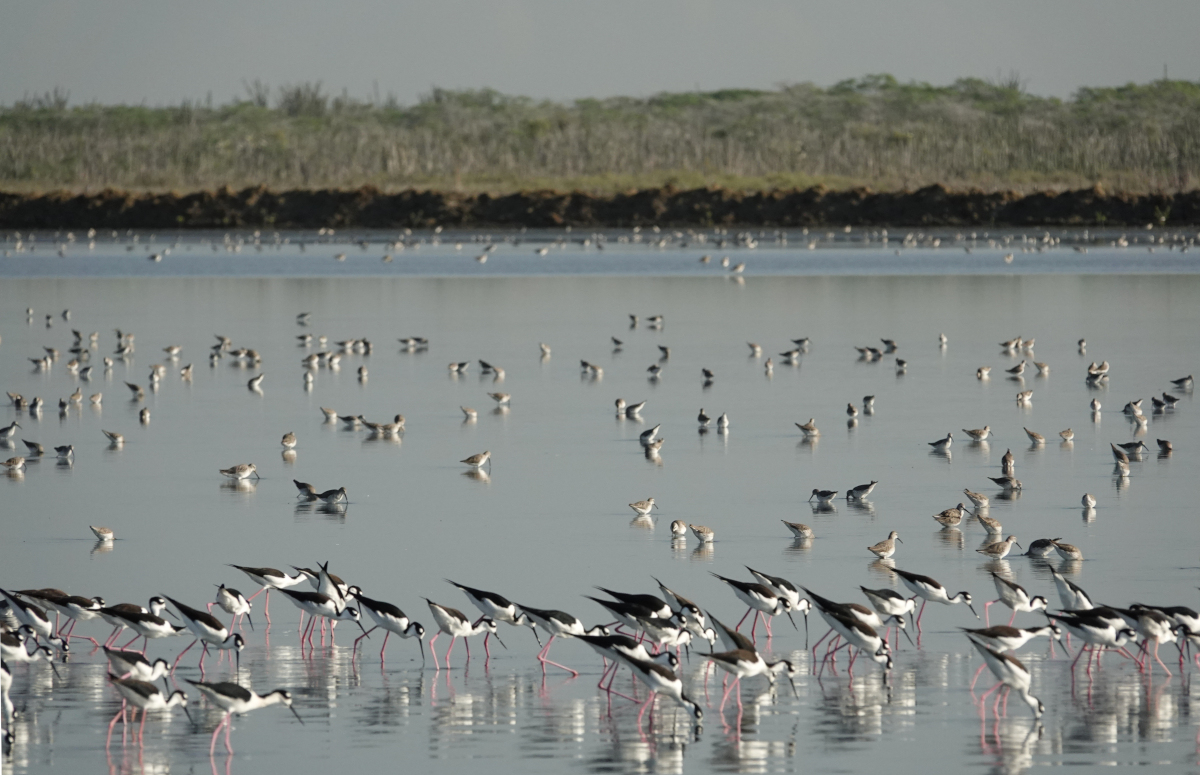
For ten years, volunteers continuously contributed more than 211,000 shorebird observations through more than 78,000 eBird checklists. This immense pool of data allowed the researchers to identify critical conservation hotspots that were previously unknown. This breakthrough is a huge deal, finally giving the Caribbean the recognition it deserves as a crucial region for North American shorebirds, so important given alarming declines in shorebirds in our region. The study highlighted that Humedal Sur de Pinar del Río in Cuba and Monte Cristi in the Dominican Republic should be priority areas for shorebird conservation. As these sites each support over 20,000 shorebirds annually like Short-billed Dowitchers, Black-bellied Plovers, Wilson’s Plovers, and Black-necked Stilts they are also candidates to be designated as WHSRN (Western Hemisphere Shorebird Reserve Network) sites of regional importance.
Over 20,000 shorebirds rely on the wetlands at Monte Cristi in the Dominican Republic during migration every year – making this a regionally important site and a critical lifeline for shorebirds. (Photo by GAE)
This study also pinpointed at least 15 additional sites that are crucial for shorebird populations and may now qualify for international designations. This massive effort by thousands of volunteers has provided the evidence needed to protect these habitats and ensure a safer future for migratory shorebirds. You can read the full article here!
With countless opportunities available, it’s easy to find and join a citizen science project. But before you begin your new adventure in science, here are some tips to get you started on the right foot.
Your first step should be to find a project that genuinely interests you. Do you love to hike? There are projects for tracking wildlife. Are you interested in birds? You can help monitor populations. Do you want to help your local community? You can help monitor water quality or noise pollution. It’s important to choose a project that aligns with your interests. This will make the experience more fun and rewarding.
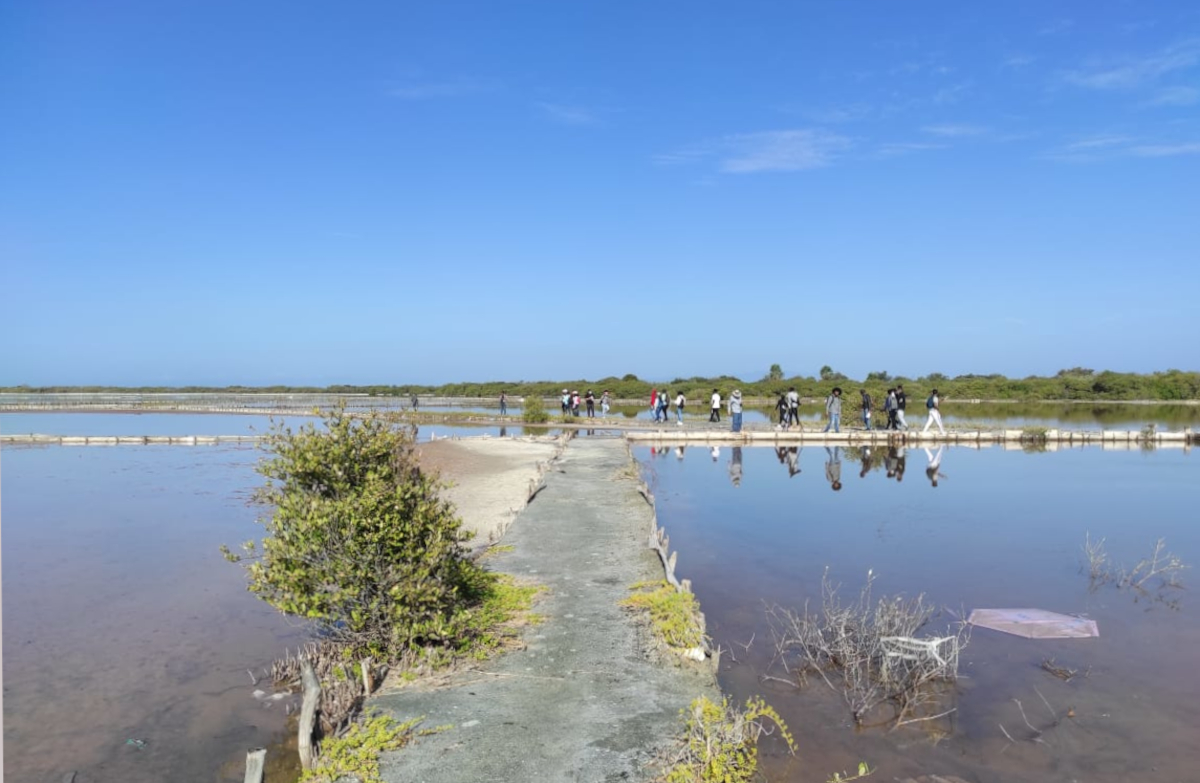
Participants at bird walk led by Miguel A Landestoy and Grupo Jaragua team at Las Salinas, DR. (Photo by Grupo Jaragua)
Once you’ve zoned in on the type of project you’d like to join, ‘google it!’ A quick search will connect you with platforms that host thousands of projects. If you’re a bird lover, eBird is our absolute favorite. eBird offers projects, courses and news to help you get started and stay up-to-date with everything citizen science. We’ve also got some great longstanding citizen science projects in the Caribbean too, more on this below.
After selecting a citizen science project you’ll typically have to download a free app or visit a website, sign up, and follow the simple instructions to collect and submit your data.
If you’re completely new to the citizen science scene, here are some additional tips:
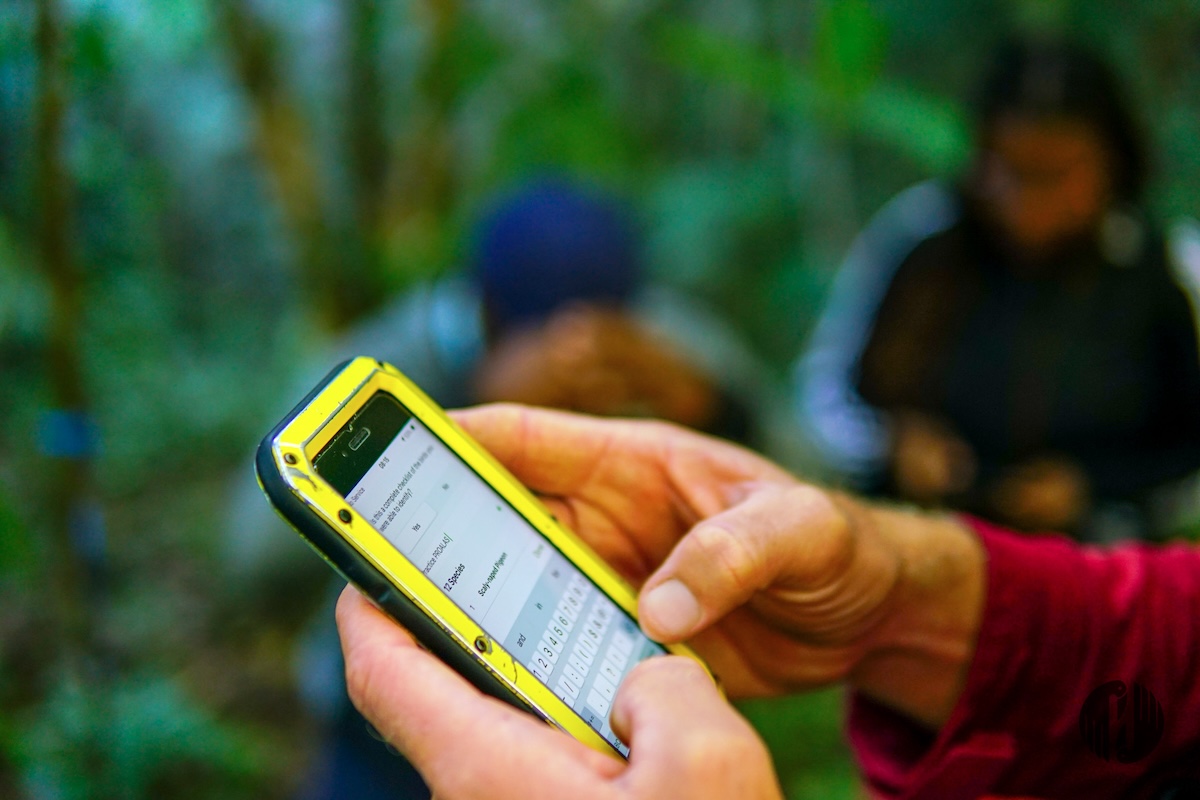
Start small and local. The good news is that you don’t have to be an expert or commit a lot of time. Many projects can be done in as little as 15 minutes, and every single observation helps. (There’s no bad news!) Also, follow the instructions. Each project has a specific set of instructions to ensure the data is high-quality. Reading and carefully following the instructions will make your contribution even more valuable. And of course, when in doubt, ask questions! The community is here to support everyone, from beginners to experts.
Looking for shorebirds for a CWC Count at Old Harbour mudflats, Jamaica. (Photo by BirdLife Jamaica)
Shanna explains bird ID at McKinnons Pond, Antigua, during the 2025 CWC Count. (Photo by Sherrel Charles)
Finally, and most importantly—have fun! You are helping to make ripples of impact while having an adventure of a lifetime so give yourself the space and time to enjoy the process of discovery, learning, and contributing.
Bonus tip: Citizen science is all about community. Invite a friend to be your fellow explorer!
A few members of Statia’s Golden Warblers in St. Eustatius, Global Big Day 2025. (Photo by Jethro van’t Hul)
Members of the team BirdersSKN birdwatching on Global Big Day.
Brendan Burns and Skyler Bol of Gavilán Guardians in Puerto Rico, Global Big Day 2025. (Photo by Brendan Burns)
Mirielle and Kathleen surveying birds at Anasco, Puerto Rico, 2025 Global Big Day. (Photo by Marisol Villanueva Mendez)
Ready to start your Citizen Science adventure with BirdsCaribbean?
If you’re ready to start your citizen science adventure, here are some great projects to join throughout the year:
Global Shorebird Count (September 2025): If you love plump adorable animals, then we think you’re going to love this project! Learn more about the Global Shorebird Count here and get the resources (for FREE) to help with your count here.
Shorebirds like the Short-billed Dowitcher and Stilt Sandpiper are long distance migrants that spend part of their year in the Caribbean. (Photo by Mark Yokoyama)
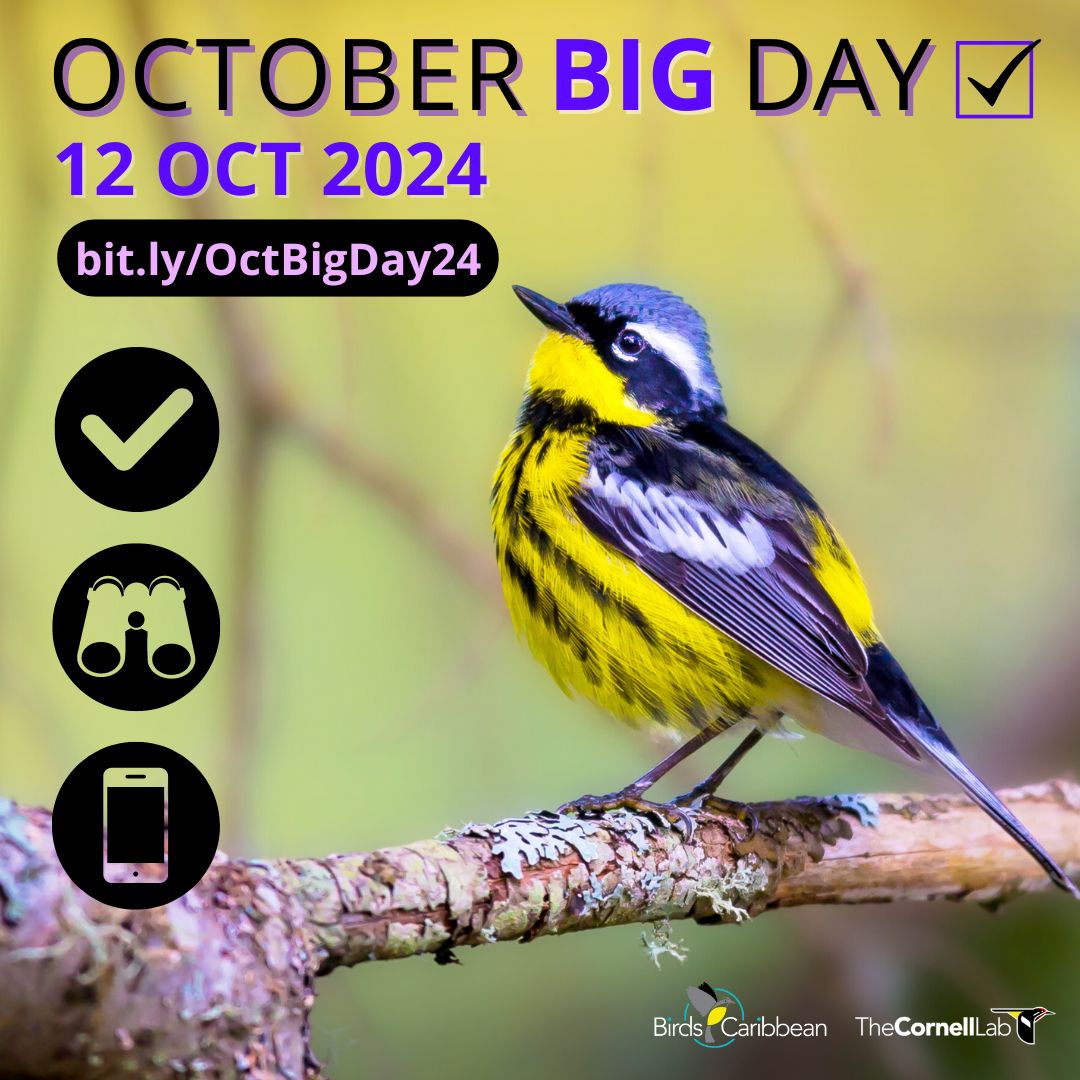
October Big Day (October 2025): A global event where you can join thousands of birders to find and report as many bird species as possible in a single day. And get this, you can watch birds right from the comfort of your backyard or balcony! However, if your feet are itching to cover more ground, birders also head to botanical gardens, wetlands, and nature reserves. Learn more here.
Caribbean Waterbird Census (January- February 2026): For over 16 years, BirdsCaribbean has been monitoring waterbird populations thanks to the efforts of a region-wide network of amazing birders and bird lovers! While the official count happens in January, you can submit waterbird observations throughout the year to this important program. Click here to learn more about this incredible citizen scientist project and access free resources like webinars, bird ID guides and more.
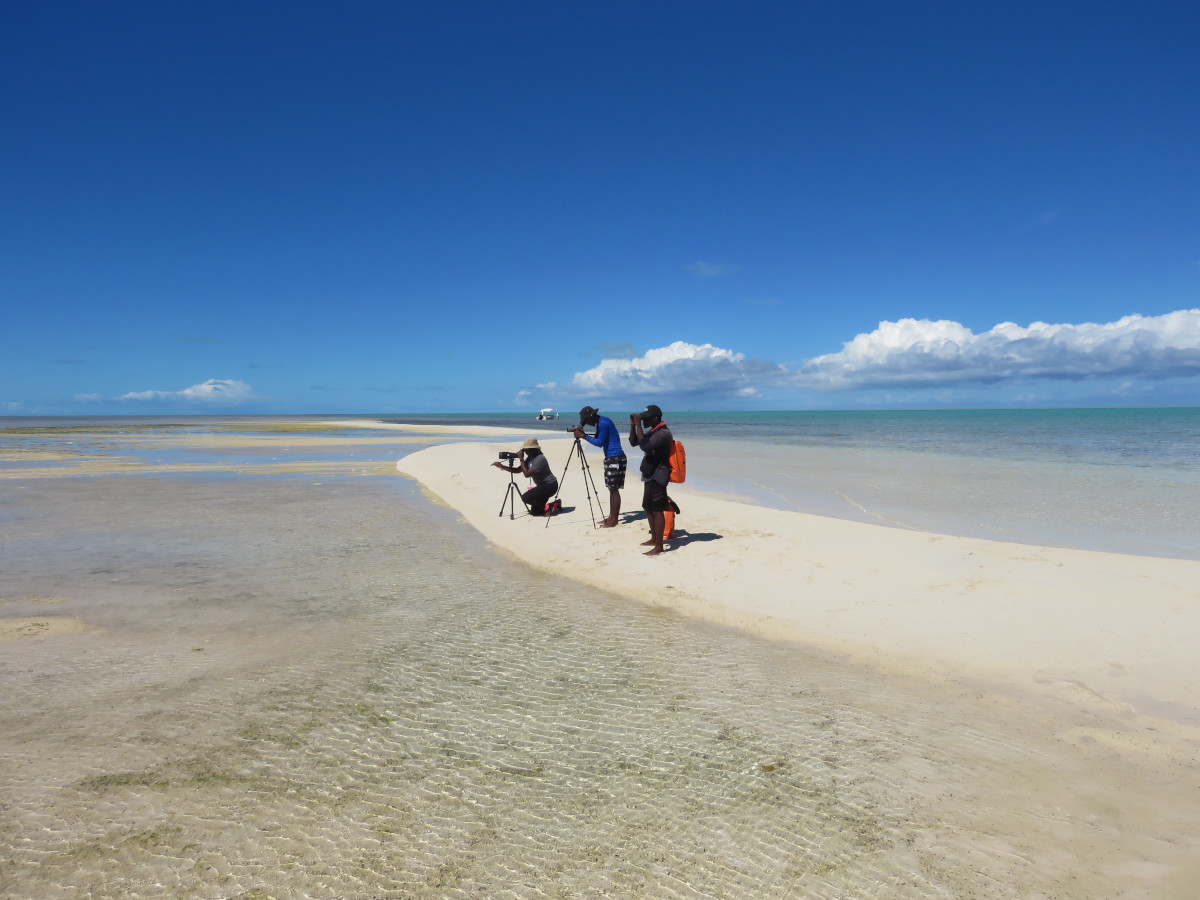
Counting shorebirds on Turks and Caicos. (Photo by Simon Busuttil)
Global Big Day (May 2026): Join birders from around the world to find and count birds on a single day in May. Be sure to check out this year’s recap of the event and get ready to participate, wave your country flag high, win fabulous prizes, show off your best shots and raise funds to protect Caribbean birds and build local conservation capacity, next year!
You’ve got the tools. You’ve got the drive. Now go make history! Your observations are the building blocks of a better world. The projects are waiting for you, and so are we. The only thing missing is you!
For birdwatchers in Cuba, October isn’t just a month; it’s a celebration of nature, science, and the unbeatable spirit of the birdwatching community. Despite the blackouts and shortages of essential items that come with life on the largest island in the Caribbean, birders across the country united for two magnificent birding extravaganzas—October Big Day and Garrido Biggest Week.
In 2023, Cuban conservationists Yaro Rodríguez and Nils Navarro received a Betty Petersen Conservation Fund grant to expand Cuba’s emerging birdwatching movement. The goal was to improve the understanding of Cuba’s birdlife through citizen science.
Their project provided community leaders with binoculars and training to identify and monitor local bird populations and report data through eBird Caribbean. These trained leaders then establish birdwatching clubs in their communities, raising awareness across Cuba about the importance of protecting birds and their habitats. Yaro and Nils’ project continues to grow, with birdwatching clubs across the country now actively engaging in ongoing bird monitoring and conservation efforts.
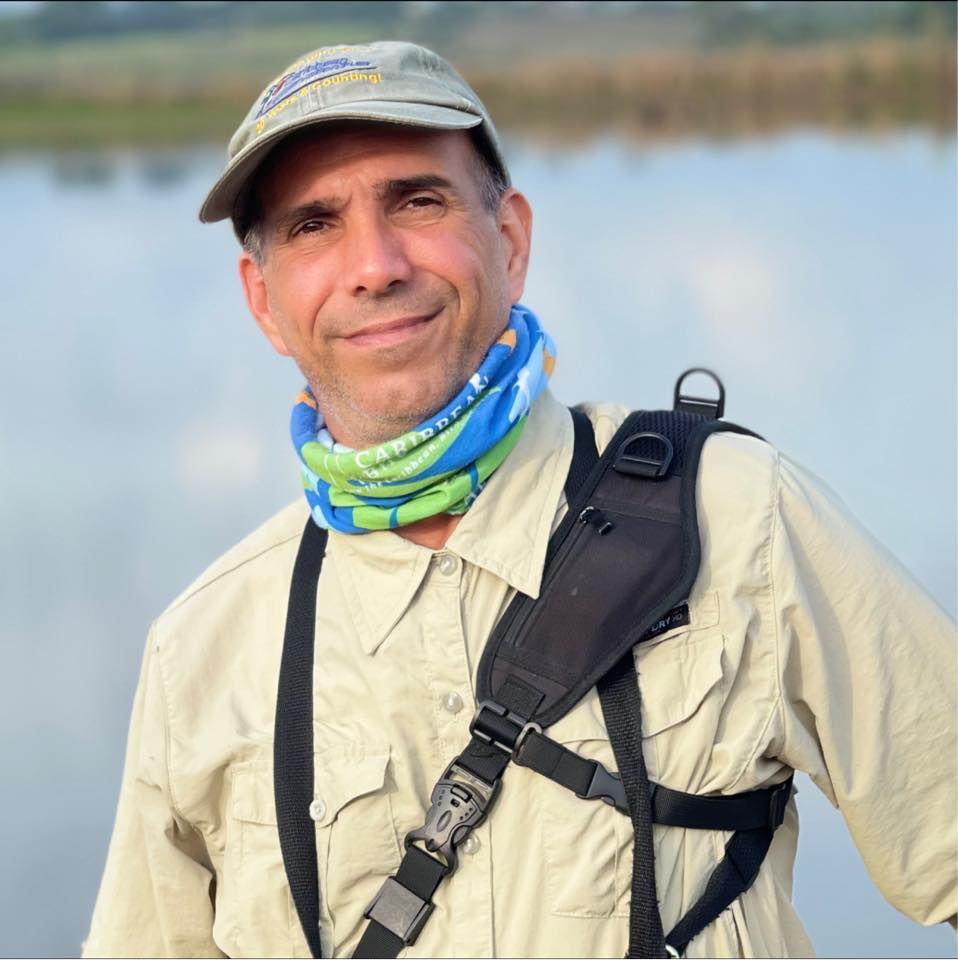
Yaro Rodríguez.
Nils Navarro.
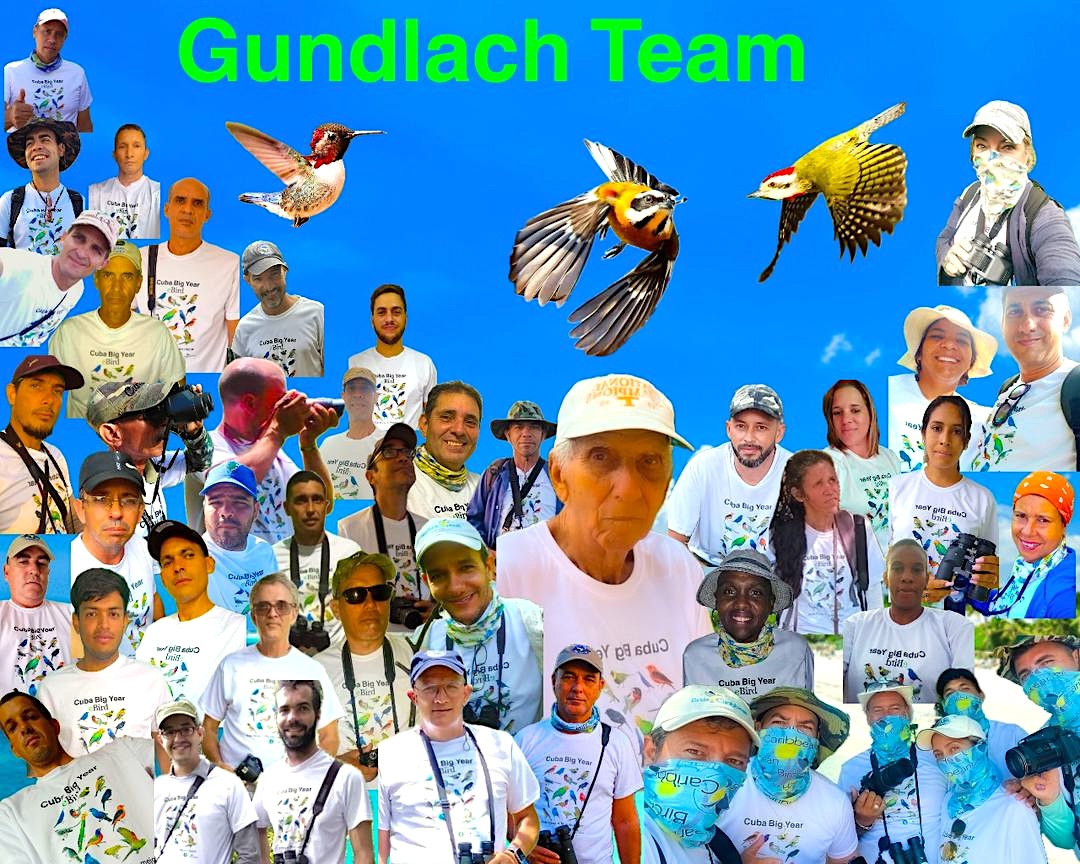
In addition to several locally initiated birding celebrations throughout the year, birders across the island also participate in two major global citizen science programs: Global Big Day in May and October Big Day in October. Team Cuba is proudly known as the Gundlach Team, in honor of the German-Cuban naturalist and taxonomist Johannes Christoph Gundlach. Yaro details the how the Cuban birding community came together in October to celebrate and protect Cuba’s incredible birdlife.
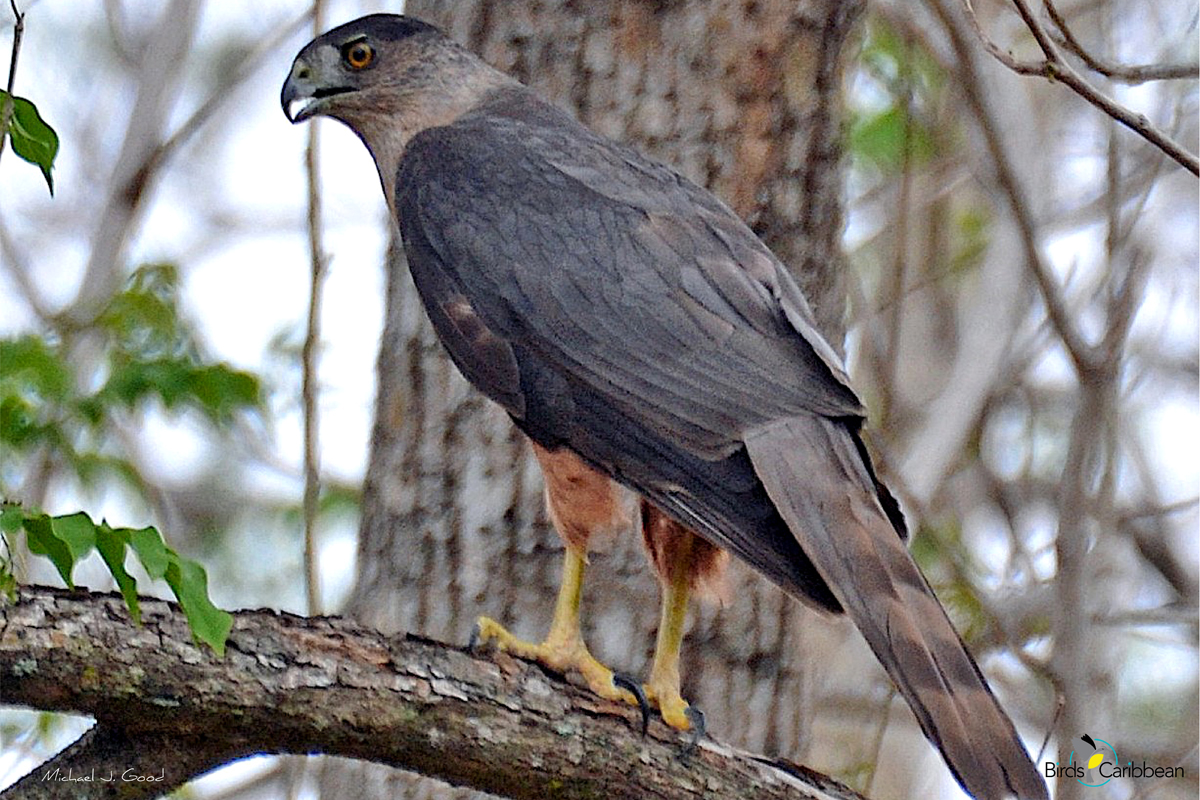
Gundlach’s Hawk (Photo by Michael J. Good)
Passion and perseverance in Cuba’s birdwatching community
October saw the Gundlach Team remaining steadfast in their exemplary efforts. From dawn onward, birdwatchers from across Cuba ventured into the field, ready to discover and record the country’s rich avian diversity. Notable participants included Yanosky, Manuel Aroche, Ricardo Concepción, Nicolás Díaz, and Marleny Roque, who started their day at first light!
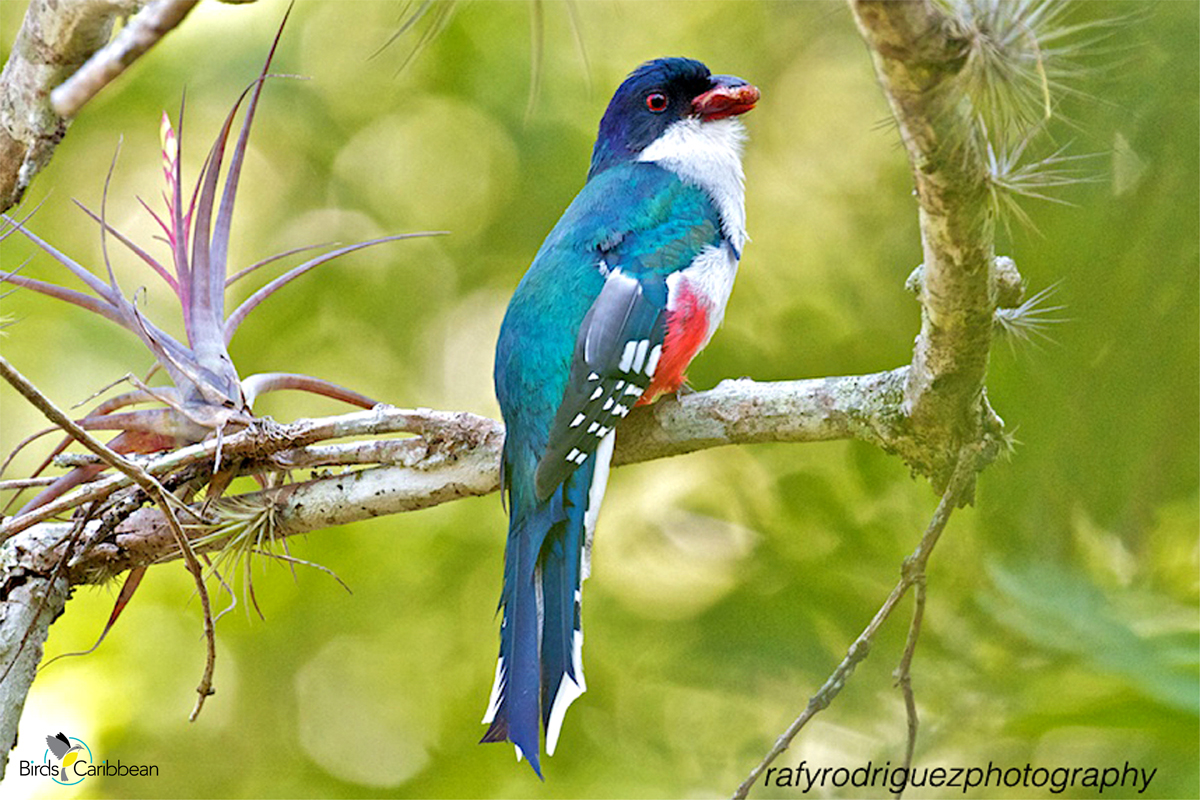
The national bird of Cuba – the Cuban Trogon. (Photo by Rafy Rodriguez)
What makes these events special is not only the number of birds recorded—but the personal stories behind each effort. For some, it was a day of surprises as they encountered new “lifers” to add to their personal lists, while for others, it was an opportunity to improve their standing in the Cuba Big Year 2024. Every list submitted to eBird helped to build a more comprehensive picture of the biodiversity on our island.
Omar Labrada, from Las Tunas, birdwatched with his daughters during October Big Day.
Yusneyda Alarcon and Manuel Lopez from Gramma crossing a mangrove channel during October Big Day.
The community’s dedication was particularly inspiring. Birdwatchers like Edwin Ruiz and Maite Cordoví, despite facing personal challenges, joined in from their windows, showing that a love for birds knows no bounds. Others, like Homar Labrada and his son Marcos, used the occasion to spend the day together, passing down a respect and fascination for birds to the next generation.
Against the odds: The Cuban reality
Birdwatching in Cuba presents unique challenges. One of the biggest challenge our birdwatching community faces is transportation, both to easily accessible areas and to new regions we want to explore. Compounded by fuel shortages, this significantly limits our ability to travel, making each trip a major logistical challenge. On top of that, we deal with frequent power outages and the ongoing stress of meeting our families’ basic needs. Despite these daily struggles and economic difficulties affecting everything from transportation to food, our birdwatching community remains determined, active, and enthusiastic.
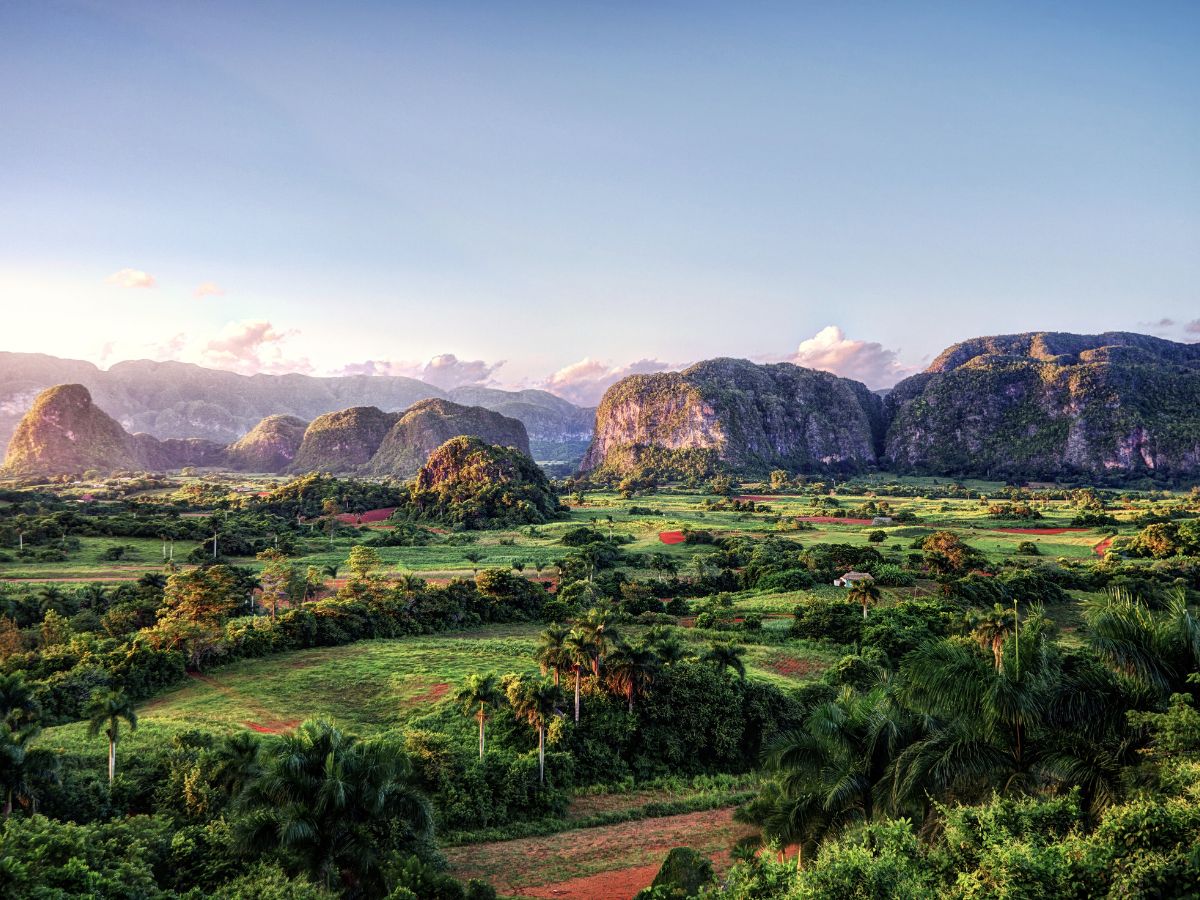
Viñales Valley, Cuba.
Every activity we promote and every event in which birdwatchers participate is a meaningful achievement, reflecting the love and commitment we have for Cuban birds and future generations.
October Big Day in Cuba: An unmatched success
On October 12, 63 eBirders, across 15 provinces, with the exception of the Isle of Youth, recorded 186 bird species within just 24 hours. This resulted in 140 eBird checklists, enriched with 96 photos and 31 song recordings. These data not only strengthen the global knowledge base on birds but also underscore Cuba’s commitment to conservation and citizen science.
Among notable individual achievements, Manuel López Salcedo from Las Tunas led the count with 96 species observed across 11 lists. On the women’s side, Yuzaima Ortiz from Ciego de Ávila secured the title of top female lister with a total of 87 species observed.
Members of the formidable Gundlach Team.
This local success was part of a larger global achievement. Over 750,000 birdwatchers from 201 countries participated in this historic day of citizen science, documenting over 7,800 species in just 24 hours. This global initiative highlights the importance of birdwatching as a conservation tool. Each checklist, photo, and recording contributes essential data for science and biodiversity protection.
Garrido Biggest Week: A tribute to a legend
Despite the devastation caused by Hurricane Oscar and ongoing power outages, the Cuban birdwatching community honored Orlando H. Garrido, the country’s most influential ornithologist, who passed away in June 2024. In a fitting tribute to Cuba’s jewel of Caribbean ornithology, the first edition of Garrido’s Biggest Week was held from October 21 to 27. Created to honor Garrido’s legacy and encourage birdwatching during the autumn migration, the event coincided with the dates when Garrido himself would go into the field to record new species.
Orlando Garrido was a tireless explorer of the Cuban archipelago. Garrido has to his credit the discovery of four mammalian taxa and the description of: 58 insects, 21 birds, 37 reptiles. 78 new records among birds, reptiles, and fish, and 23 taxa have been dedicated to him, and in total he has 298 publications. (Photo by Susan Jacobson)
Orlando Garrido regales our group with stories of his Cuban adventures as a biologist and tennis pro! BirdsCaribean Cuba Bird Tour (Photo by Lisa Sorenson)
Orlando Garrido, Nils Navarro and Herb Raffaele at the 21st International Conference of BirdsCaribbean, in Topes de Collantes, Cuba, July, 2017. Orlando was awarded a BirdsCaribbean Lifetime Achievement Award.
Birdwatchers from all provinces participated enthusiastically, recording 183 species and capturing a total of 76 photographs. José Alberto Pérez Echavarría was the winner in this friendly competition, observing 108 species throughout the event.
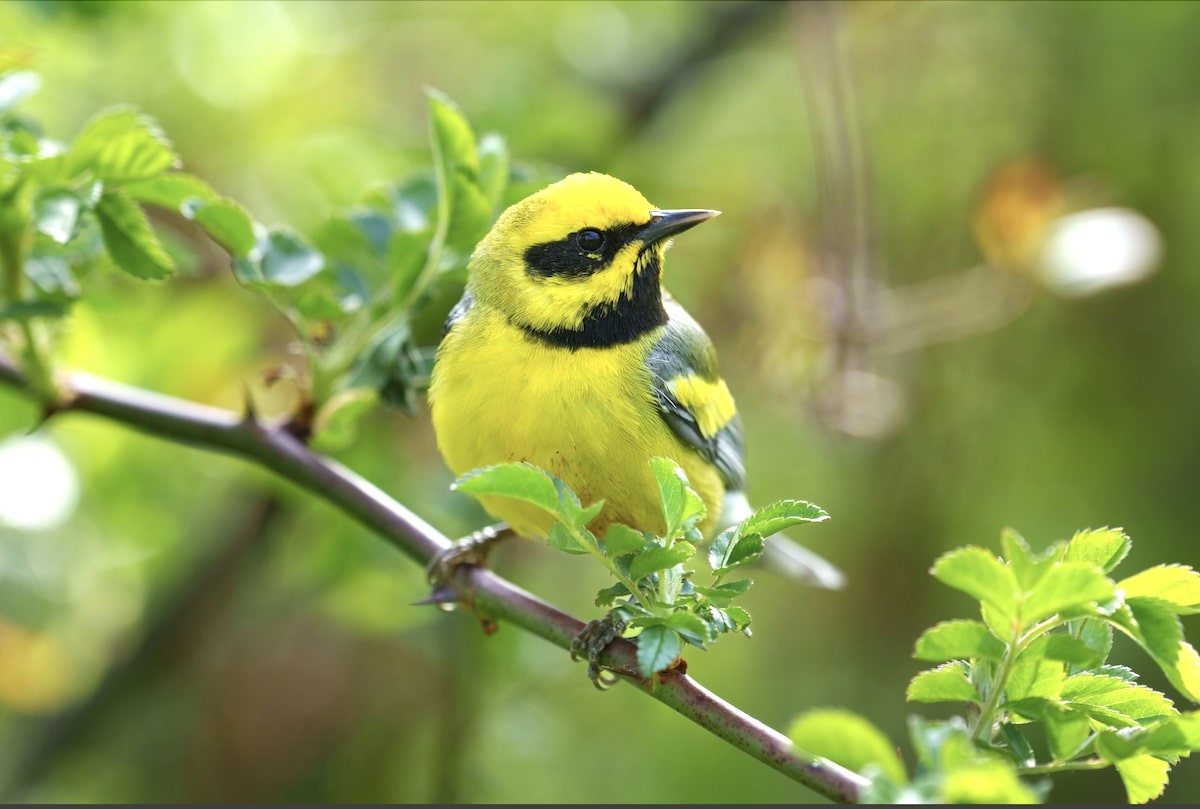
This week featured some serendipitous sightings, among them was the first record in Cuba of a Lawrence’s Warbler, an important discovery for the island’s avifauna!
An adult male Lawrence’s Warbler. (Photo by Jeff Hapeman ML604876071)
Additionally, the first documented case of xanthochroism in a member of the Todidae family, the Cuban Tody, was observed—this rare phenomenon gives affected birds an unusual yellow coloration. Both discoveries will be part of an upcoming article, expanding on these unique observations in the region.
The Garrido Biggest Week will become an annual tradition. The community also organizes other thematic weeks to honor prominent figures in Cuban ornithology, such as Charles Ramsden Week in December, José H. Bauzá Week in April, and Juan Gundlach Week in August.
These activities are essential for keeping the birdwatching community active year-round, beyond major events like October Big Day and Global Big Day, while also enriching eBird during periods of lower tourist activity in the country. Through these efforts, the Cuban birdwatching community continues to advance the exploration and conservation of the island’s biodiversity, even in the face of adversity.
The power of citizen science
October Big Day and Garrido Biggest Week are also reminders of the value of our birds and the challenges they face. Cuban birdlife, like that around the world, faces constant pressures from habitat loss, climate change, and human activity. In addition, illegal trapping is a huge threat to endemic, resident and migratory birds in Cuba. Through citizen science and unwavering commitment, each Cuban birdwatcher has the opportunity to contribute to conservation and make a difference.
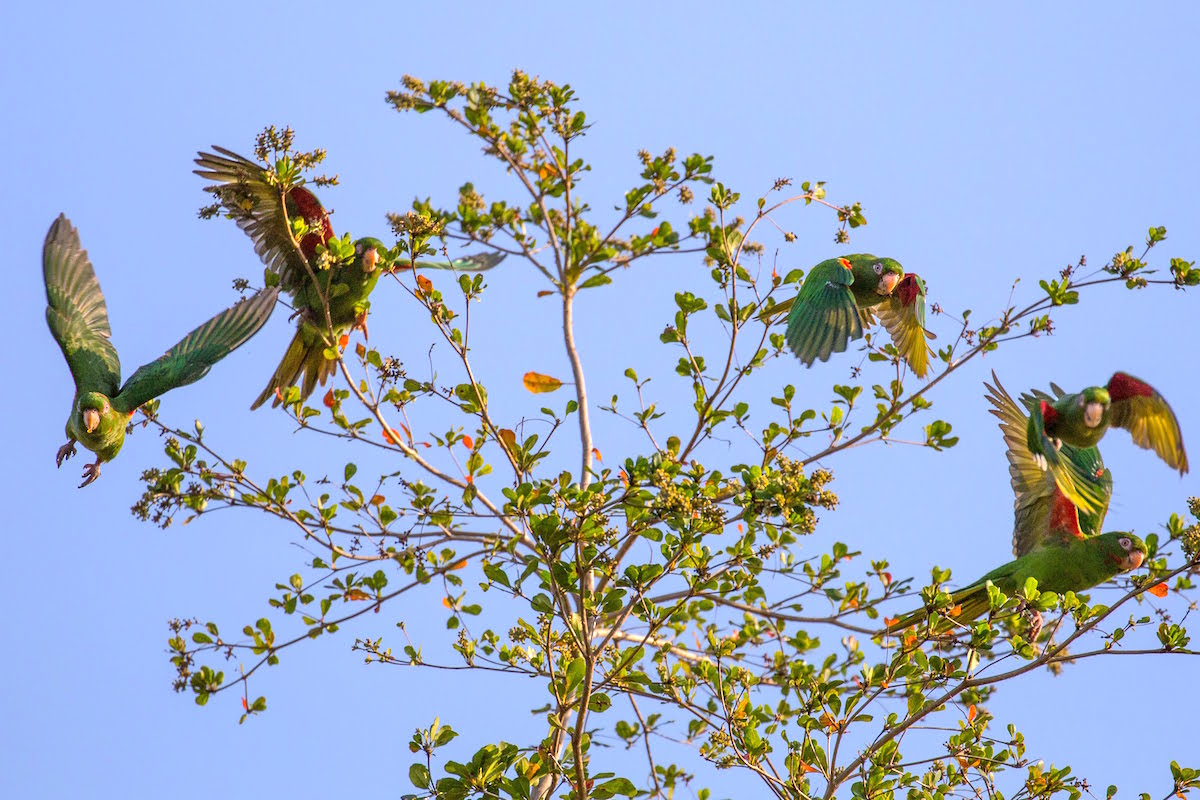
Cuban Parakeets in flight (Photo by Garry Donaldson)
Cuban voices from the field
To conclude, here are some stories that capture the passion and challenges of these unforgettable days:
“When I arrived, the battery pack I’d prepared for my camera failed, so I used my binoculars to do digiscoping and identify birds in tricky situations. Later, in the forest, as we returned to the reservoir embankment, Wency played a mix of bird calls, and we saw several warbler species. Surprise! Among them was a Worm-eating Warbler, a lifer for me. The excitement was indescribable; everyone pointed their cameras and managed to capture the moment.” – Freddy Ricardo, Holguín Birdwatching Club
“I had a lifer: White-eyed Vireo, though without a photo. But I managed to photograph an Osprey for the first time—81 shots as I got closer with digiscoping! I was thrilled to capture this species.” – Manuel Aroche, Granma Birdwatching Club
“A friend and I shared a lifer, a Philadelphia Vireo! The second record of this species in Ciego de Ávila, and during the week we honor Garrido! It couldn’t be better.” – Nicolás Díaz, Ciego de Ávila Birdwatching Club
“I want to dedicate my participation in the October Global Big Day to my dad, who recently passed away. I owe him my love and respect for nature.” – Ricardo Sánchez, Artemisa Birdwatching Club
These anecdotes reflect the dedication and love for birds that motivate our community to keep moving forward. In every field outing, every photo, and every checklist submitted, there lies a collective commitment to preserving Cuba’s rich biodiversity for future generations.
Special Thanks
We would like to extend our heartfelt gratitude to the Betty Petersen Conservation Fund, managed by BirdsCaribbean, for their generous support, and to the team at BirdsCaribbean, especially Lisa Sorenson and Adrianne Tossas, for their unwavering dedication to the birdwatching community in Cuba.
Yaroddys Rodríguez, known as Yaro, is a self-taught ornithologist dedicated to the study and conservation of Cuban birds. Mentored by experts like Orlando H. Garrido and James Wiley, he began publishing scientific articles at a young age. Yaro founded the Cuban Birdwatchers Facebook group, now with over 30,000 members, and promotes the use of eBird for citizen science. He is also a member of the Cuban Zoological Society, BirdsCaribbean, and the Ariguanabo Foundation.
Los Observadores de Aves Cubanos Vuelan alto en Octubre: Aves, Ciencia y el Espíritu de Comunidad
Para los observadores de aves en Cuba, octubre no es solo un mes, es una celebración de la naturaleza, la ciencia y el inquebrantable espíritu de la comunidad de observación de aves. A pesar de los apagones y la escasez de productos esenciales que acompañan la vida en la isla más grande del Caribe, los observadores de aves de todo el país se unieron para dos magníficas extravagancias ornitológicas: el Gran Día de Aves de Octubre y la Semana Más Grande de Garrido.
En 2023, los conservacionistas cubanos Yaro Rodríguez y Nils Navarro recibieron una beca del Fondo de Conservación Betty Petersen para expandir el emergente movimiento de observación de aves en Cuba. El objetivo era mejorar la comprensión de la fauna aviar cubana a través de la ciencia ciudadana.
Su proyecto proporcionó binoculares y capacitación a los líderes comunitarios para identificar y monitorear las poblaciones locales de aves, reportando los datos a través de eBird Caribe. Estos líderes capacitados establecieron clubes de observación de aves en sus comunidades, generando conciencia en toda Cuba sobre la importancia de proteger a las aves y sus hábitats. El proyecto de Yaro y Nils sigue creciendo, con clubes de observadores de aves en todo el país que participan activamente en esfuerzos de monitoreo y conservación de aves.
Yaro Rodríguez.
Nils Navarro.
Además de varias celebraciones locales de observación de aves a lo largo del año, los observadores de aves de la isla también se reúnen para participar en dos grandes programas globales de ciencia ciudadana: Global Big Day en mayo y Gran Día de Aves de Octubre en octubre. El equipo de Cuba es conocido con orgullo como el Equipo Gundlach, en honor al naturalista y taxónomo germano-cubano Johannes Christoph Gundlach. Yaro detalla cómo la comunidad de observadores de aves cubanos se unió en octubre para celebrar y proteger la increíble fauna aviar de Cuba.
Gundlach’s Hawk (Foto de Michael J. Good)
Pasión y perseverancia en la comunidad de observadores de aves de Cuba
En octubre, el Equipo Gundlach se mantuvo firme en sus esfuerzos ejemplares. Desde el amanecer, los observadores de aves de toda Cuba se aventuraron al campo, listos para descubrir y registrar la rica diversidad aviar del país. Entre los participantes más destacados se encontraban Yanosky, Manuel Aroche, Ricardo Concepción, Nicolás Díaz y Marleny Roque, ¡quienes comenzaron su jornada al primer rayo de luz!
El ave nacional de Cuba conocida localmente como ‘tocororo.’ (Foto de Rafy Rodriguez)
Lo que hace especiales estos eventos no es solo la cantidad de aves registradas, sino las historias personales detrás de cada esfuerzo. Para algunos, fue un día lleno de sorpresas al encontrar nuevas especies “lifers” para agregar a sus listas personales, mientras que para otros, fue una oportunidad para mejorar su posición en el Cuba Big Year 2024. Cada lista enviada a eBird ayudó a construir una imagen más completa de la biodiversidad en nuestra isla.
Omar Labrada de Las Tunas observando aves con sus hijas.
Yusneyda Alarcón y Manuel López, de Gramma, cruzando un canal de manglares durante el Big Day de octubre.
La dedicación de la comunidad fue particularmente inspiradora. Observadores de aves como Edwin Ruiz y Maite Cordoví, a pesar de enfrentar desafíos personales, se unieron desde sus ventanas, demostrando que el amor por las aves no tiene límites. Otros, como Homar Labrada y su hijo Marcos, aprovecharon la ocasión para pasar el día juntos, transmitiendo el respeto y la fascinación por las aves a la próxima generación.
Contra viento y marea: La realidad cubana
La observación de aves en Cuba presenta desafíos únicos, centrados principalmente en el transporte. El mayor reto que enfrenta nuestra comunidad de observadores de aves es el transporte, tanto hacia áreas de fácil acceso como hacia nuevas regiones que queremos explorar. Aumentado por la escasez de combustible, esto limita significativamente nuestra capacidad para viajar, haciendo de cada viaje un gran desafío logístico. Además, lidiamos con frecuentes apagones y el estrés constante de satisfacer las necesidades básicas de nuestras familias. A pesar de estas luchas diarias y dificultades económicas que afectan desde el transporte hasta la comida, nuestra comunidad de observadores de aves sigue siendo determinada, activa y entusiasta.
Viñales Valley, Cuba.
Cada actividad que promovemos y cada evento en el que los observadores de aves participan es un logro significativo, reflejando el amor y compromiso que tenemos por las aves cubanas y las generaciones futuras.
Gran Día de Aves de Octubre en Cuba: Un éxito inigualable
El 12 de octubre, 63 eBirders de 15 provincias, con excepción de la Isla de la Juventud, registraron 186 especies de aves en tan solo 24 horas. Esto resultó en 140 listas de eBird, enriquecidas con 96 fotos y 31 grabaciones de cantos. Estos datos no solo fortalecen la base de conocimiento global sobre las aves, sino que también subrayan el compromiso de Cuba con la conservación y la ciencia ciudadana.
Miembros del formidable Equipo Gundlach.
Entre los logros individuales más destacados, Manuel López Salcedo de Las Tunas lideró el conteo con 96 especies observadas en 11 listas. Por parte de las mujeres, Yuzaima Ortiz de Ciego de Ávila se coronó como la mejor observadora femenina con un total de 87 especies observadas.
Este éxito local fue parte de un logro global mayor. Más de 750,000 observadores de aves de 201 países participaron en este histórico día de ciencia ciudadana, documentando más de 7,800 especies en solo 24 horas. Esta iniciativa global resalta la importancia de la observación de aves como una herramienta de conservación. Cada lista, foto y grabación contribuye con datos esenciales para la ciencia y la protección de la biodiversidad.
Semana Más Grande de Garrido: Un tributo a una leyenda
A pesar de la devastación causada por el huracán Oscar y los continuos apagones, la comunidad de observadores de aves de Cuba rindió homenaje a Orlando H. Garrido, el ornitólogo más influyente del país, quien falleció en junio de 2024. En un merecido tributo a la joya de la ornitología caribeña de Cuba, se celebró la primera edición de la Semana Más Grande de Garrido del 21 al 27 de octubre. Creada para honrar el legado de Garrido y fomentar la observación de aves durante la migración de otoño, el evento coincidió con las fechas en las que Garrido mismo salía al campo a reportar nuevas especies.
Orlando Garrido fue un incansable explorador del archipiélago cubano. Garrido tiene en su haber el descubrimiento de cuatro taxones de mamíferos y la descripción de: 58 insectos, 21 aves, 37 reptiles. Se le han dedicado 78 nuevos registros entre aves, reptiles y peces, y 23 taxones, y en total tiene 298 publicaciones. (Foto de Susan Jacobson)
Orlando Garrido deleita a nuestro grupo con historias de sus aventuras cubanas como biólogo y tenista profesional. BirdsCaribean Cuba Bird Tour (Foto de Lisa Sorenson)
Orlando Garrido, Nils Navarro y Herb Raffaele en la 21 Conferencia Internacional de BirdsCaribbean, en Topes de Collantes, Cuba, julio, 2017. Orlando recibió el premio BirdsCaribbean Lifetime Achievement Award.
Los observadores de aves de todas las provincias participaron con entusiasmo, registrando 183 especies y capturando un total de 76 fotografías. José Alberto Pérez Echavarría fue el ganador de esta competencia amistosa, observando 108 especies a lo largo del evento.
Esta semana presentó algunas observaciones afortunadas, entre ellas el primer registro en Cuba de un Bijirita de Lawrence, ¡un descubrimiento importante para la avifauna de la isla!
Un macho adulto de Bijirita de Lawrence. (Foto de Jeff Hapeman ML604876071)
Además, se observó el primer caso documentado de xantocromismo en un miembro de la familia Todidae, el Cuban Tody (Cartacuba o Pedorrera), un fenómeno raro que da a los aves afectadas una coloración amarilla inusual. Ambos descubrimientos formarán parte de un artículo próximo, ampliando estas observaciones únicas en la región.
La Semana Más Grande de Garrido se convertirá en una tradición anual. La comunidad también organiza otras semanas temáticas para honrar figuras prominentes de la ornitología cubana, como la Semana Charles Ramsden en diciembre, la Semana José H. Bauzá en abril y la Semana Juan Gundlach en agosto.
Estas actividades son esenciales para mantener activa a la comunidad de observadores de aves durante todo el año, más allá de grandes eventos como el Gran Día de Aves de Octubre y el Global Big Day, mientras enriquecen a eBird durante períodos de menor actividad turística en el país. A través de estos esfuerzos, la comunidad de observadores de aves de Cuba sigue avanzando en la exploración y conservación de la biodiversidad de la isla, incluso ante la adversidad.
El poder de la ciencia ciudadana
El Gran Día de Aves de Octubre y la Semana Más Grande de Garrido también son recordatorios del valor de nuestras aves y los desafíos que enfrentan. La fauna aviar cubana, al igual que la del resto del mundo, enfrenta presiones constantes por la pérdida de hábitats, el cambio climático y la actividad humana. Además, la captura ilegal es una gran amenaza para las aves endémicas, residentes y migratorias en Cuba. A través de la ciencia ciudadana y un compromiso inquebrantable, cada observador de aves cubano tiene la oportunidad de contribuir a la conservación y marcar la diferencia.
Catey en vuelo. (Foto de Garry Donaldson)
Voces cubanas desde el campo
Para concluir, aquí hay algunas historias que capturan la pasión y los desafíos de estos días inolvidables:
“Cuando llegué, el pack de baterías que había preparado para mi cámara falló, así que usé mis binoculares para hacer digiscoping e identificar aves en situaciones difíciles. Más tarde, en el bosque, mientras regresábamos al dique del embalse, Wency puso una mezcla de cantos de aves y vimos varias especies de warblers. ¡Sorpresa! Entre ellas estaba un Worm-eating Warbler (Bijirita gusanera), un lifer para mí. ¡La emoción fue indescriptible! Todos apuntaron sus cámaras y lograron capturar el momento.” – Freddy Ricardo, Club de Observación de Aves Holguín
“Tuve un lifer: Vireo de ojos blancos, aunque sin foto. Pero logré fotografiar un Águila pescadora por primera vez—¡81 fotos mientras me acercaba con digiscoping! Estaba emocionado de capturar esta especie.” – Manuel Aroche, Club de Observación de Aves Granma
“Un amigo y yo compartimos un lifer, ¡un Vireo de Filadelfia! ¡El segundo registro de esta especie en Ciego de Ávila, y durante la semana que honramos a Garrido! ¡No podría ser mejor!” – Nicolás Díaz, Club de Observación de Aves Ciego de Ávila
“Quiero dedicar mi participación en el Global Big Day de Octubre a mi papá, quien falleció recientemente. Le debo mi amor y respeto por la naturaleza.” – Ricardo Sánchez, Club de Observación de Aves Artemisa
Estas anécdotas reflejan la dedicación y el amor por las aves que motiva a nuestra comunidad a seguir adelante. En cada salida al campo, cada foto y cada lista enviada, hay un compromiso colectivo para preservar la rica biodiversidad de Cuba para las futuras generaciones.
Agradecimientos especiales
Queremos extender nuestro más sincero agradecimiento al Fondo de Conservación Betty Petersen, gestionado por BirdsCaribbean, por su generoso apoyo, y al equipo de BirdsCaribbean, especialmente a Lisa Sorenson y Adrianne Tossas, por su dedicación incansable a la comunidad de observadores de aves en Cuba.
Yaroddys Rodríguez, conocido como Yaro, es un ornitólogo autodidacta dedicado al estudio y conservación de las aves cubanas. Mentoreado por expertos como Orlando H. Garrido y James Wiley, comenzó a publicar artículos científicos desde joven. Yaro fundó el grupo de Observadores de Aves de Cuba en Facebook, ahora con más de 30,000 miembros, y promueve el uso de eBird para la ciencia ciudadana. También es miembro de la Sociedad Zoológica de Cuba, BirdsCaribbean y la Fundación Ariguanabo.
I wanted to get to know the elusive Whistling Warbler on the island of Saint Vincent — which meant that we needed to go up. Straight up some very steep slopes!
Whistling Warbler spotted on La Soufriere Windward Trail. (Photo by Jonathan Slifkin ML621602299)
The Whistling Warbler (Cathoropeza bishopi) is an endangered, endemic species of bird that lives on the Lesser Antillean island of Saint Vincent. When we say a species is endemic, it means that the species exists nowhere else on the planet other than at a discrete location. This is a common designation for many island species. When a species is endemic and endangered, that can be a ‘code red’ for conservationists — because the species has nowhere else to go to disperse from threats! In the case of the Whistling Warbler, those threats come mainly from deforestation, land use change, hurricanes (exacerbated by climate-change), and the recent explosive eruption of Saint Vincent’s La Soufrière volcano in 2021, the largest to occur in the Caribbean in the last 250 years.
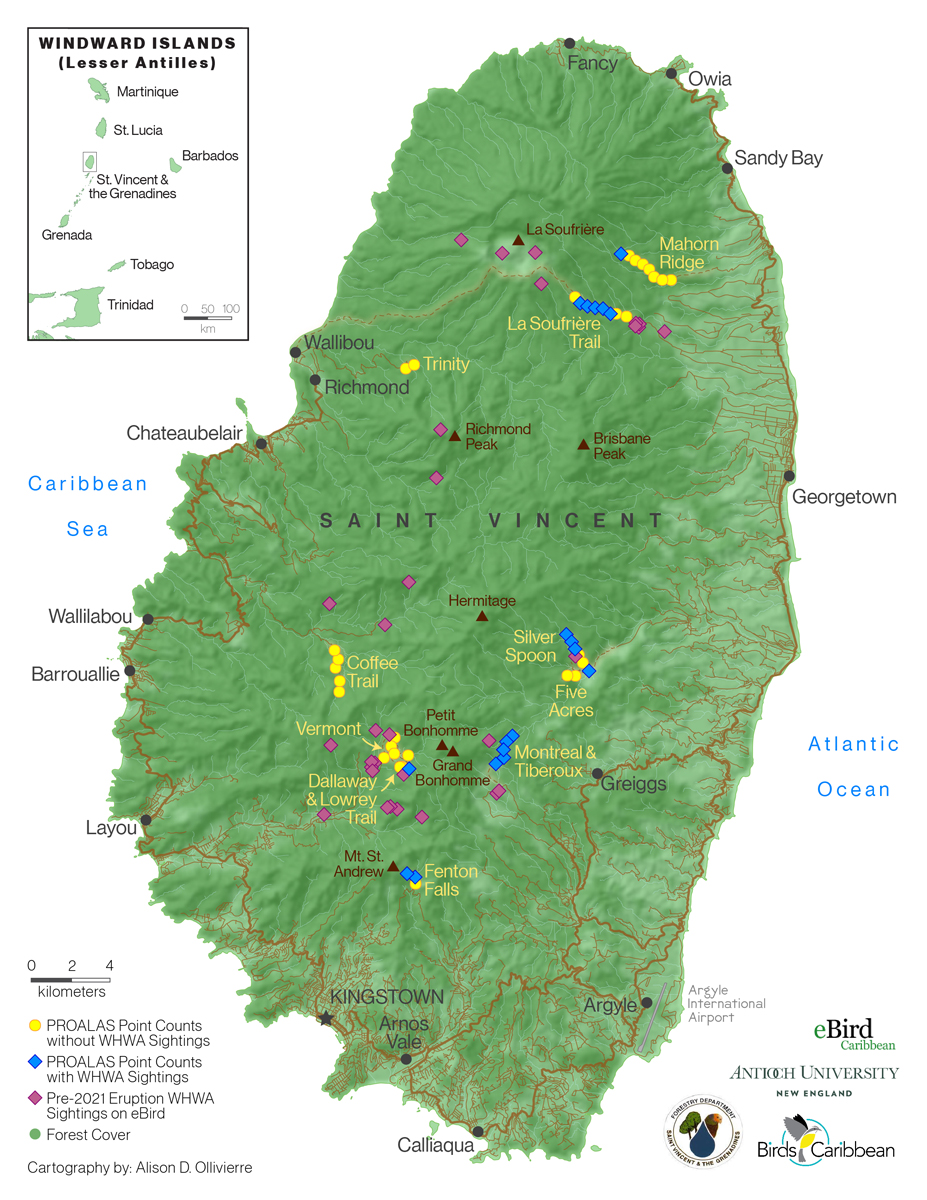
Figure 1. Map of St Vincent showing locations of our PROALAS Point Counts without Whistling Warbler (WHWA) sightings, with warbler sightings, and eBird Caribbean sightings prior to the April 2021 eruption of La Soufriére Volcano.
So where is the Whistling Warbler to be found? Well, this charming bird (whose plumage delightfully brings to mind an Oreo cookie!) appears to require a specific kind of natural forest for habitat: forests growing in steep, wet, montane environments. These mostly grow on the windward (east) side of the island. However, these forests have been experiencing a great deal of “wear and tear” in recent years. Some have been cut to grow non-native tree plantations, or terraced to provide farmland, in some cases for the illegal cultivation of Cannabis. Many of the northern areas were decimated by wind and volcanic ash from the 2021 volcanic eruption. The windward forests also take the brunt of hurricanes moving west across the Atlantic, which can wreak havoc on the essential habitat of the warbler. Hurricane Beryl just recently tore through St. Vincent and the Grenadines (SVG); the extent of the damage to the mainland forests (and the warbler) is currently unknown, though nearby Union Island has been devastated. These growing and more frequent impacts of climate change cannot be overlooked.
And yet, the Whistling Warbler has so far been able to hold on in small numbers, in the face of these daunting challenges to its habitat. Much of its success is thanks to conservation efforts that protect and restore their habitat. Now, it is absolutely vital that the warbler population is actively monitored to ensure its survival, and to inform future conservation efforts aimed at protecting its habitat. Part of the challenge here is that there is still so little known about this bird. We don’t know much about their habitat requirements; their nest construction; and when and where they breed. It is critical to understand these aspects of the warbler’s life cycle to make effective management decisions. We can only find this information by getting people out into the forest to make these discoveries and to monitor the population.
Preparing for the trip: some homework required
I am a graduate student at Antioch University New England studying Conservation Biology. Antioch Professor Dr. Mike Akresh has been working with Caribbean birds for over a decade, and when he asked if I would like to accompany him on a two-week field study trip in March 2024 to Saint Vincent, I was initially apprehensive. Leaving my young child and a pile of school work at home for two weeks sounded daunting, but I knew there was important work to be done on Saint Vincent as there is not an overabundance of researchers working on the Whistling Warbler. I made the decision to go.
The Vulnerable St Vincent Parrot. (Photo by Mike Akresh)
A pair of Rufous-throated Solitaire in St. Vincent (Photo by Frantz Delcroix)
Lesser Antillean Tanager on St. Vincent. (Photo by Steven Hunter ML200625941)
Firstly, I went into an intense learning period focussed on the birds of Saint Vincent; it was especially important to learn their calls. With the help of eBird, the Merlin App, and a handy field guide to the “Birds of the West Indies,” I familiarized myself with most of the birds we could expect to encounter on the trip. How were we going to monitor for the Whistling Warbler? Well, we were planning to work with the PROALAS landbird monitoring protocol, which requires us to document every bird seen and heard during a specific period of time at a point or transect. Every bird has a story to tell about the environment; birds are regarded as indicator species. This means that the presence of certain species or lack thereof provides critical insights about the impacts of land use change, climate change, and volcanic activity; in other words, the obstacles and challenges that the Whistling Warbler faces.
The song of the Whistling Warbler consists of an ascending trill of loudly whistled notes.
Our enthusiastic team on Saint Vincent
Our collaborators on the island were the talented and professional members of the SVG Forestry Department. Our point of contact and monitoring collaborator was the energetic Glenroy Gaymes, who has been working closely with the Whistling Warbler conservation efforts. Glenroy is an expert birder and naturalist, whose passion for conservation on Saint Vincent is infectious. With invaluable help from Glenroy and other Forestry staff such as Felicia Baptiste, Romano Pierre, Caswin Caine, and Kishbert Richards, we reached the steep and remote areas where the warbler lives. Glenroy and the Forestry Department have also been monitoring the endemic and endangered Saint Vincent Parrot (Amazona guildingii) and many other non-bird species.
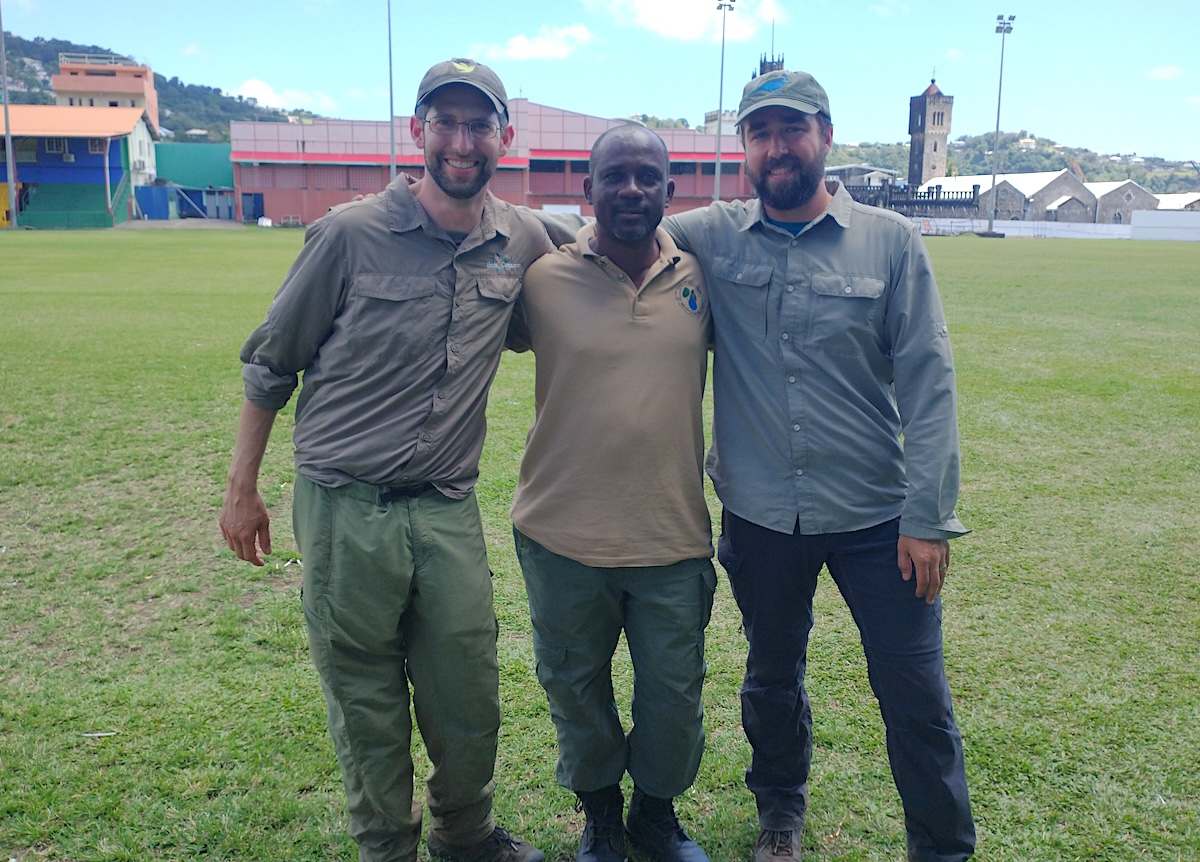
Mike Akresh, Glenroy Gaymes and Christian Carson in Kingstown, St. Vincent.
Our days on Saint Vincent were demanding, but rewarding. We did find the Whistling Warbler!
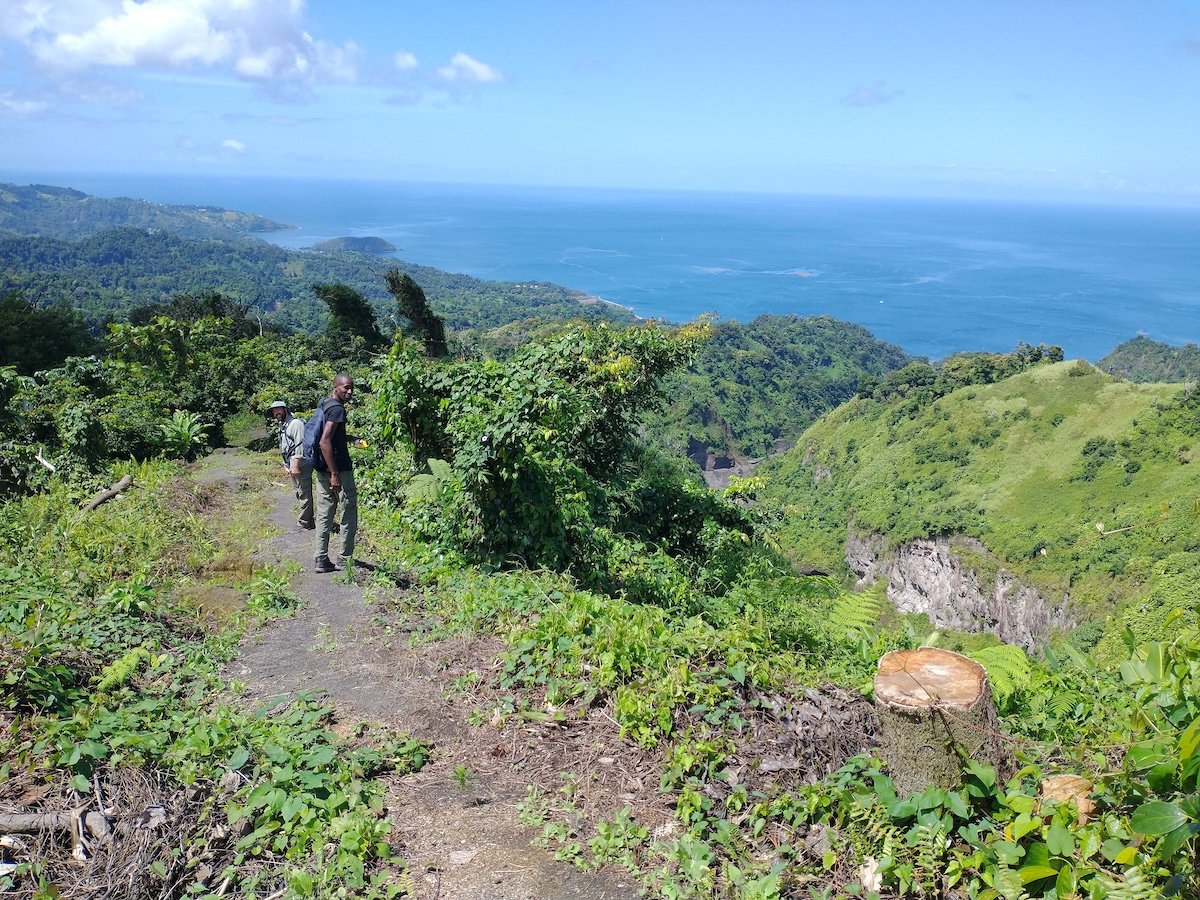
Mike hiking nearly straight uphill. Accessing the Whistling Warbler’s habitat is not easy. (Photo by Christian Carson)
Primary Forest in St. Vincent. (Photo by Christian Carson)
Every morning we would wake up before sunrise, and head up into the sawtooth-like mountains, shrouded in mist. You may have seen these impressive mountains before if you have seen the Pirates of the Caribbean movies, which were largely filmed on Saint Vincent. Fortunately, we encountered the Whistling Warbler several times at various locations. In keeping with previous observations, most or all of our encounters with the Whistling Warbler took place over 300 meters and in steep, wet forests. Did I mention that we had to go up high? The slopes of the misty mountains of Saint Vincent were steep and slippery.
Notes from the field
When studying where Whistling Warblers like to live, we found that they prefer primary forests with lots of moss. Younger and older secondary forests had fewer warblers. Interestingly, palm brakes were about the same as primary forests for warbler sightings, especially near certain trails. Detection was low in elfin woods, which seem to be unsuitable habitat for them. The drier, western side of the island has less of the wet montane forest they prefer.
We noticed that Whistling Warblers really like wetter forests, especially where there’s a lot of moss. For example, at one site – Silver Spoon, where the forest is very wet, we found lots of warblers. However, on the leeward side of the island, the forests were dry and grassy, and we didn’t find any warblers there.
We didn’t look for warblers in the northern part of the island because it’s too dry and no warblers have ever been found there. Tree plantations were the least likely place to find Whistling Warblers because these areas have trees, like Blue Mahoe and Big-leaf Mahogany, that are all the same age and don’t provide enough food or shelter for the birds. Overall, we also noticed that there were fewer other forest birds around areas affected by the volcano. Birds like Bananaquits and House Wrens were common near the volcano, but other species like Cocoa Thrush and Ruddy Quail-Doves were missing. The ash from the volcano may have made it harder for some birds to find food. However, some of these birds are starting to come back now, so we’ll keep studying and monitoring the area to learn more.
Christian and Kishbert surveying for the Whistling Warbler on La Soufrière. (Photo by Mike Akresh)
We still need more information on the mysterious Whistling Warbler!
Over the past few years and during this current trip, we have come across several nests that might possibly be those of the Whistling Warbler, but without a positive ID of a warbler using the nest, we cannot say for sure. Finding a nest is particularly important for conservation efforts because it allows us to better understand the warbler’s breeding ecology and habitat requirements. We also do not know how successful the warbler is in breeding; invasive mongoose or black rat populations may prey on eggs or fledglings. But it must be acknowledged that without more research, we cannot know for sure. There are limited resources available to protect the Whistling Warbler, so the more specifics we have about this species, the better those resources can be utilized to have the greatest conservation impact. We need to know more, so that we can do a better job at protecting this species, which is listed as Endangered on the IUCN Red List.
With the data we have been able to collect while on Saint Vincent, we aim to create a conservation action plan (CAP) specifically for the Whistling Warbler. Without the dedicated work of the Saint Vincent Forestry Department, BirdsCaribbean, and donors small and large, this work would not be possible, and the Whistling Warbler would likely be added to the alarming (and growing) number of species lost forever.
We owe it to the Whistling Warbler, up there in the remote rainforest and beautiful mountains of Saint Vincent.
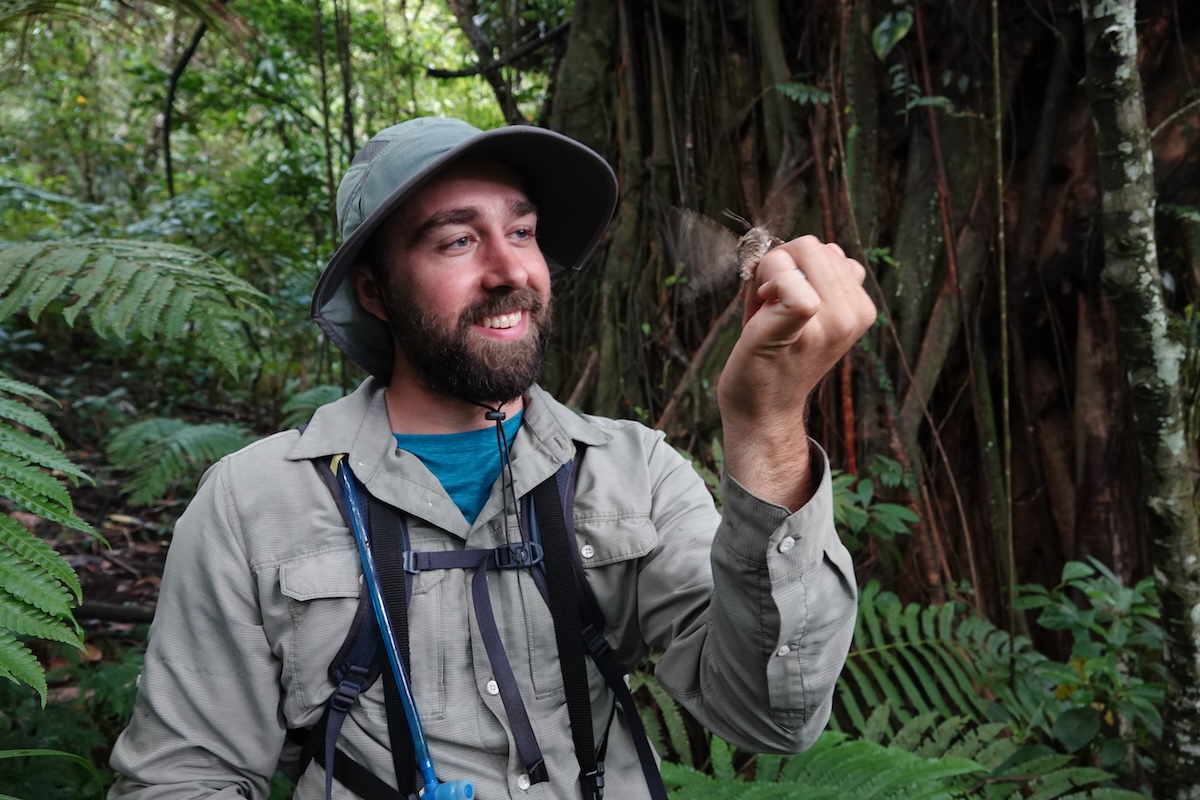
Christian holding a Sphinx Moth. (Photo by Mike Akresh)
Christian Carson is a graduate student at Antioch University New England studying conservation biology. He is interested in ways people seek and find meaning in the living world, and how this meaning (or lack thereof) shapes global environmental issues. He lives with his partner and three-year-old son in Western Massachusetts. He enjoys quiet walks in the woods, flying kites, and sitting zazen. You can reach him at [email protected].
Acknowledgements: BirdsCaribbean is grateful to the Critical Ecosystems Partnership Fund (CEPF) and the United Nations Development Programme (UNDP) for funding our Conservation of the Endangered Whistling Warbler Project, launched in 2022. We are also deeply grateful to Mr. Fitzgerald Providence and his staff at the St. Vincent Forestry Department for their help and support. Special thanks Glenroy Gaymes, who has been working closely with us on the warbler project. Finally, we thank BirdsCaribbean members, partners, and donors for your support, which made this work possible.
If you like Caribbean birds, maybe you want to learn to put a ring (or band) on them!
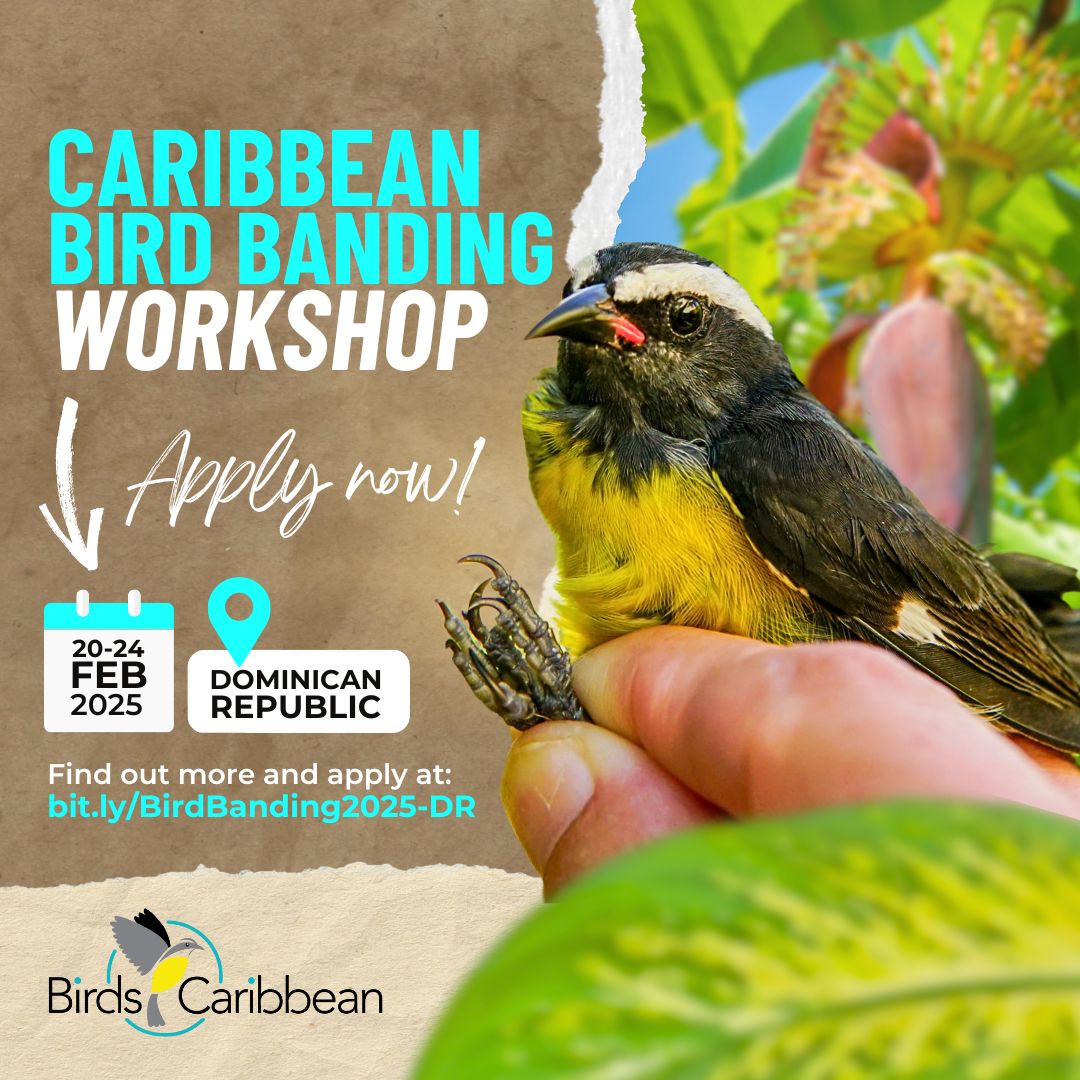
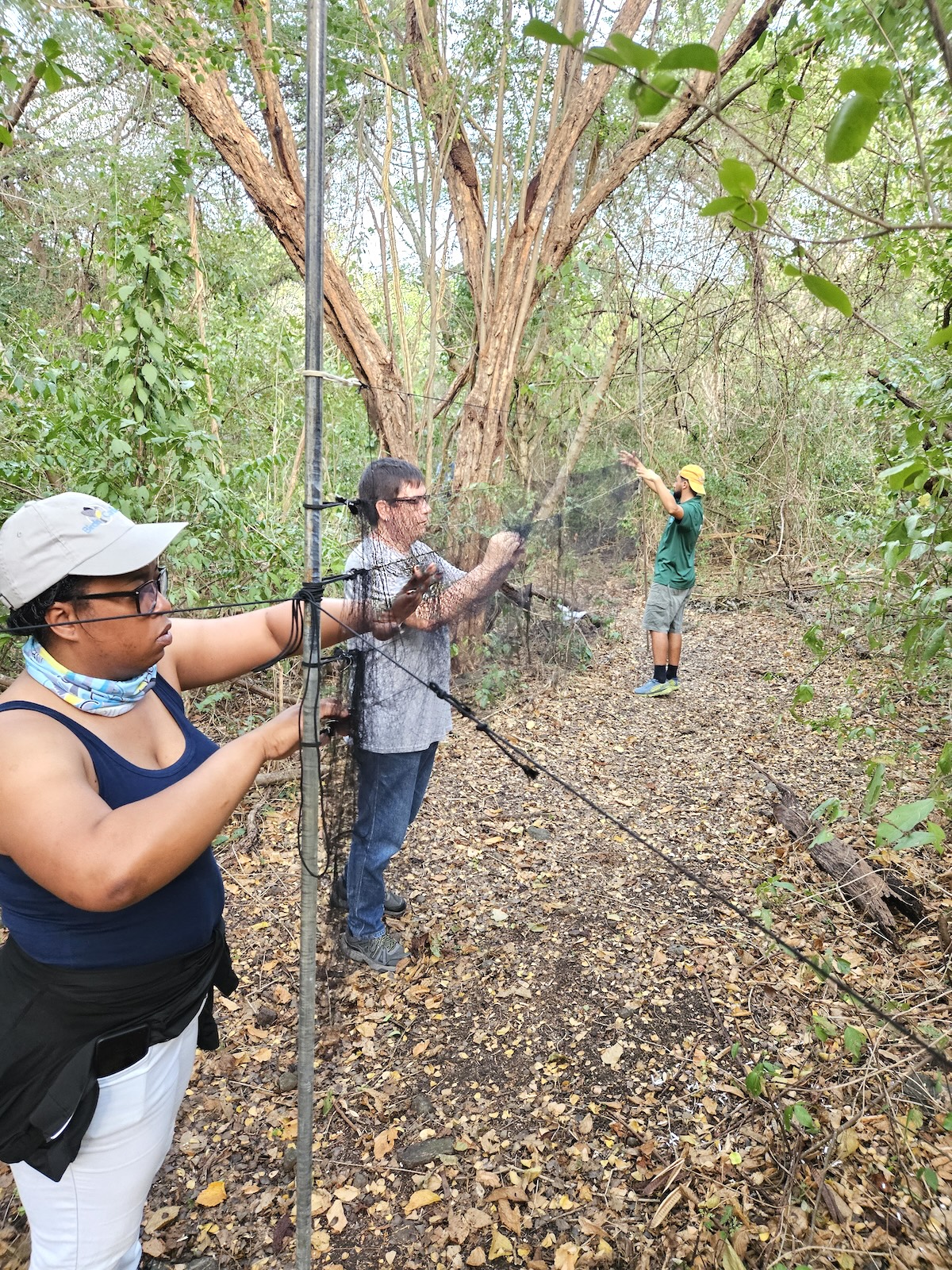
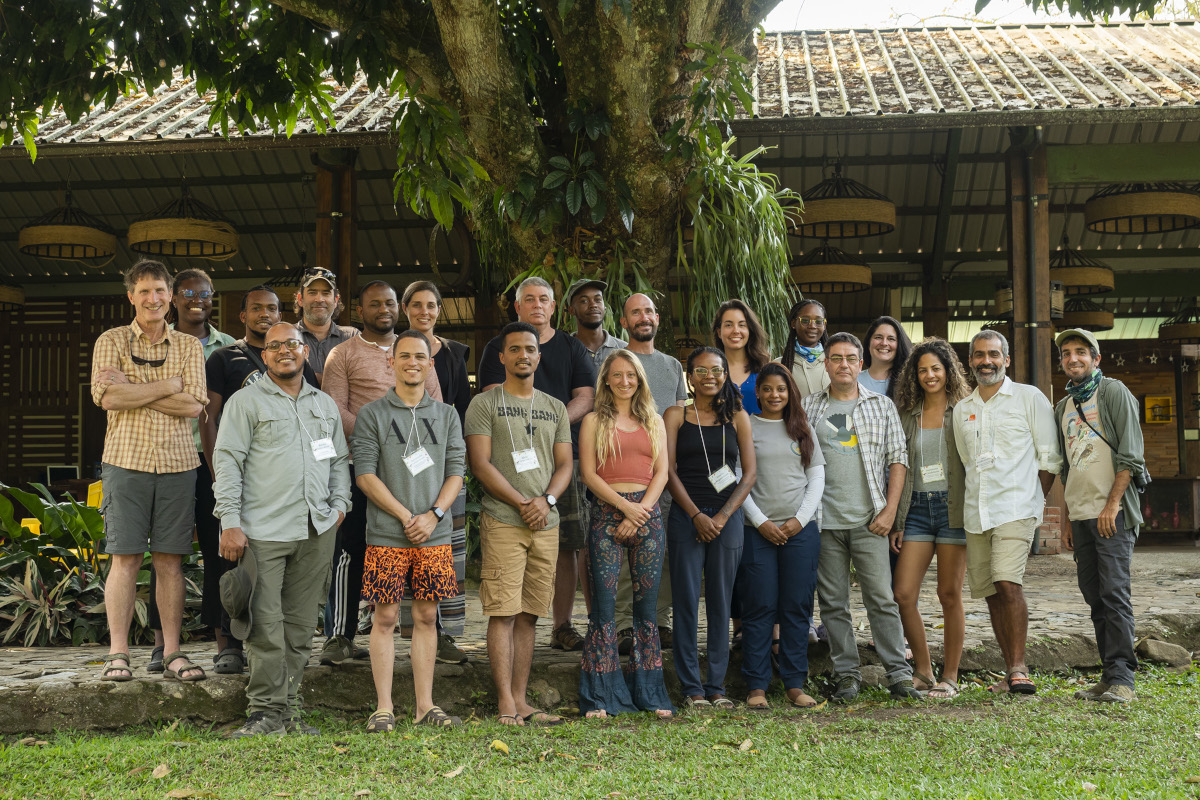
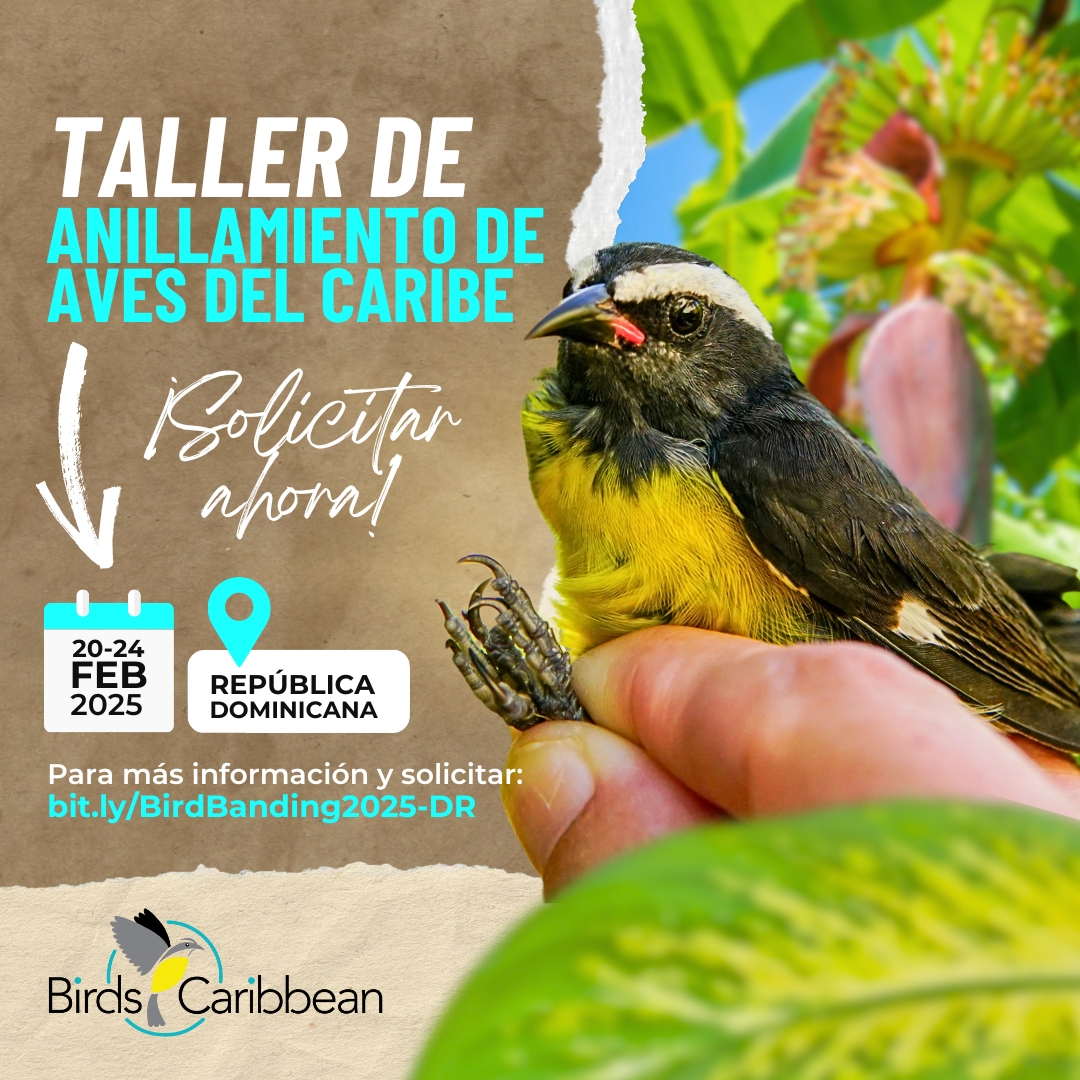
BirdsCaribbean is excited to invite applications to participate in a 5-day training workshop focused on bird banding, an important tool for research and monitoring! Participants will learn about the basics of bird banding, from setting up a mist-net to examining molt patterns, through a blend of classroom and field based activities. We’ll also discuss and demonstrate some of the benefits of joining our new Caribbean Bird Banding Network. We’re very excited to return to the Dominican Republic to one of our favorite workshop sites, Baiguate Ecolodge in Jarabacoa. Mark your calendars — this year’s workshop will take place from 20-24 February, 2025.
Why do we need to band birds?
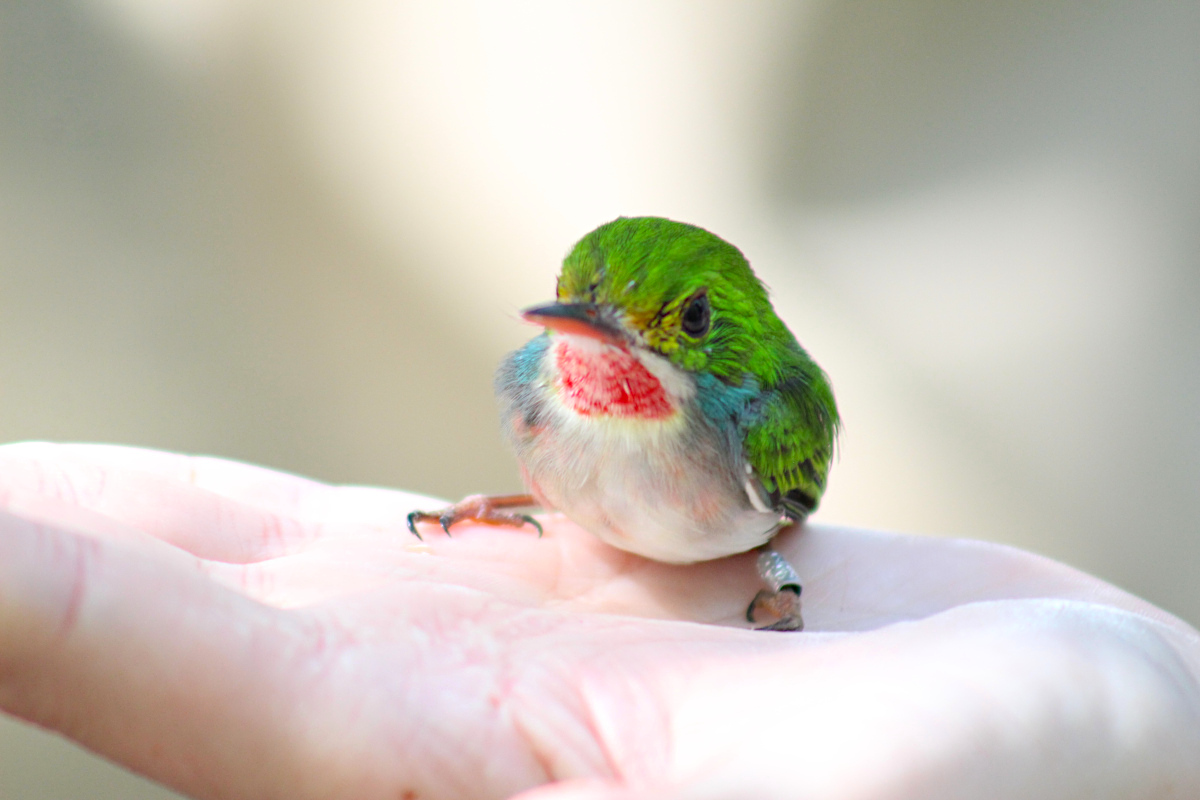
A Cuban Tody wearing a BirdsCaribbean band about to be released. (Photo by Daniela Ventura)
Bird surveys, like those covered in our Caribbean Landbird Monitoring Training Workshops, provide valuable information about abundance and species presence. But bird banding is a different methodology that takes a deeper dive into how bird populations are doing by assessing the condition of individual birds. By marking and assessing birds in the hand, we can collect data that can tell us about their demography and health, including:
Looking at fat scores and weights to assess the body condition of birds in different habitats and at different times of the year, which in turn sheds light on the quality of the habitats these birds are using.
Aging birds using plumage to investigate demographic patterns.
Using recapture records to learn about survivorship and longevity.
Assessing the presence or absence of breeding characteristics to better understand the timing of breeding and life history for many of our understudied Caribbean endemics.
Finding out which migratory routes our shared birds are taking and gaining a better understanding of factors influencing survival and longevity of species.
Over the long-term, bird banding data can also help us understand patterns and trends in bird populations, to aid in their management and conservation.
About the workshop
This workshop is the fourth annual Caribbean Bird Banding (CBB) Training Workshop. It will cover many of the same topics explored in our previous CBB Training workshops held in The Bahamas (March 2022) and the Dominican Republic (March 2023) and Grenada (March 2024). This bilingual (English and Spanish) workshop is designed for Caribbean wildlife professionals and volunteers who are interested in gaining more experience with bird banding. Prior banding experience is not required. However, priority will be given to applicants who are likely to continue training to gain the knowledge, skills, and experience needed to contribute to or initiate avian research and/or banding programs on their home islands.This workshop will focus on banding landbirds, with an emphasis on Passerines. We hope to provide banding training opportunities for other bird groups in the future.
Daniela Ventura del Puerto (Cuba) provides instruction on bird molt to workshop participants Giselle Raganoonan (Trinidad) and Elvin Manual Vargas Estevez (Dominican Republic).
Zoya Buckmire instructs a participant on how to correctly hold a bird to take measurement. (Photo by Maya Wilson)
The purpose of the workshop is to:
Provide participants with a basic understanding of bird banding techniques and best practices.
Discuss what it takes to set-up and run a bird banding station.
Prepare participants for additional bird banding training and potential North American Banding Council (NABC) certifications (assistant, bander, trainer) in the future.
Share information about the other training opportunities, resources, and community available through the CBB Network.
Several NABC-certified trainers will share their knowledge in the classroom, at the mist-net, and at the banding table, covering topics including:
Juan Carlos Fernández Ordóñez shows participants how to correctly set up mist nets in Grenada. (Photo by Maya Wilson)
Proper set-up and placement of a mist-net
Proper techniques for extracting birds from mist-nets
Starting a banding station
Bird first-aid and safety
Bird banding ethics and basics
Using bird banding for education and public demonstrations
Aging birds using both WRP and Howell-Pyle terminology
Molt patterns
Bird banding is a complex skill to learn. This workshop is intended to be a starting point, and participants should not expect to leave the workshop with the necessary qualifications to band birds independently. To become fully immersed and practice what was learned at the workshop, participants will have the opportunity to be considered for bird banding internships following the workshop.
In an effort to decrease the amount of time spent in the classroom, some materials will be shared virtually prior to the in-person workshop. These virtual sessions will also be made available to a wider audience. Stay tuned for more information!
Funding and Logistics
We aim to include approximately 15 participants in this workshop. BirdsCaribbean has funding for a limited number of need and merit-based scholarships to cover the costs of travel and participation. Participants who are able to contribute all or part of their costs can allow us to include additional participants. We encourage applications from all candidates who are well-suited to make use of this training, regardless of their financial ability. Participants should plan to arrive in the Dominican Republic by February 18 and depart on February 25.
Participants at our Caribbean Bird Banding Workshop held in the Dominican Republic in March 2023. (Photo by Joshua Covill)
Applications
If you are interested in participating in this workshop, please fill out this form by 8 December 2024.
Oportunidad de formación: Taller de anillamiento de aves caribeñas
Si te gustan las aves del Caribe, ¡Quizás quieras aprender a ponerles un anillo (o una anilla)! BirdsCaribbean se complace en invitarte a participar en un taller de formación de 5 días centrado en el anillamiento de aves, ¡Una importante herramienta para la investigación y el monitoreo! Los participantes aprenderán los fundamentos del anillamiento de aves, desde la instalación de una red de niebla hasta la revisión de los patrones de muda, a través de una mezcla de actividades en el aula y sobre el terreno. También discutiremos y demostraremos algunos de los beneficios de unirse a nuestra nuevaRed de Anillamiento de Aves del Caribe. Estamos muy contentos de volver a República Dominicana, a uno de nuestros lugares favoritos para los talleres: Baiguate Ecolodge, en Jarabacoa. Márcalo en tu calendario: el taller de este año tendrá lugar del 20 al 24 de febrero de 2025.
¿Por qué necesitamos anillar aves?
Los censos de aves, como los que se tratan en nuestrosTalleres de Formación para el Monitoreo de Aves Terrestres del Caribe, proporcionan información valiosa sobre la abundancia y la presencia de especies. Pero el anillamiento de aves es una metodología diferente que profundiza en la situación de las poblaciones de aves mediante la evaluación del estado de cada individuo. Marcando y estudiando a las aves en la mano, podemos recopilar datos que nos informen sobre su demografía y salud, entre otros:
Observar la acumulación de grasa y el peso para evaluar la condición corporal de las aves en diferentes hábitats y en diferentes épocas del año, lo que a su vez arroja luz sobre la calidad de los hábitats que estas aves están utilizando.
Determinación de la edad de las aves mediante el plumaje para investigar patrones demográficos.
Utilizar los registros de recapturas para conocer la supervivencia y la longevidad.
Evaluar la presencia o ausencia de características reproductivas para comprender mejor el momento de la reproducción y el ciclo biológico de muchas de nuestras poco estudiadas endémicas caribeñas.
Averiguar cuáles rutas migratorias siguen nuestras aves compartidas y comprender mejor los factores que influyen en la supervivencia y longevidad de las especies.
A largo plazo, los datos provenientes del anillamiento también pueden ayudarnos a comprender los patrones y tendencias de las poblaciones de aves, para contribuir a su gestión y conservación.
Sobre el taller
Este taller es el cuarto taller anual de formación sobre anillamiento de aves en el Caribe (CBB). Cubrirá muchos de los temas ya explorados en nuestros talleres anteriores de capacitación sobre la CBBN celebrados enBahamas (marzo de 2022), República Dominicana (marzo de 2023) y Granada (marzo de 2024). El taller bilingüe (inglés y español) está diseñado para profesionales y voluntarios que trabajan con vida silvestre en el Caribe y que estén interesados en adquirir más experiencia en el anillamiento de aves. No se requiere experiencia previa en anillamiento. Sin embargo, se dará prioridad a los solicitantes que tengan posibilidades de seguir formándose para adquirir los conocimientos, habilidades y experiencia necesarios para contribuir o iniciar programas de investigación y/o anillamiento de aves en sus islas de origen. Este taller se centrará en el anillamiento de aves terrestres, con énfasis en los paseriformes. Esperamos ofrecer oportunidades de formación en anillamiento para otros grupos de aves en el futuro.
Los objetivos del taller son:
Proporcionar a los participantes una comprensión básica de las técnicas de anillamiento de aves y las mejores prácticas.
Discutir lo que se necesita para montar y dirigir una estación de anillamiento de aves.
Preparar a los participantes para formación adicional en anillamiento de aves y posibles certificaciones del Consejo Norteamericano de Anillamiento (NABC) (asistente, anillador, entrenador) en el futuro.
Compartir información sobre otras oportunidades de formación, recursos y comunidades disponibles a través de la Red CBB.
Varios formadores certificados por el NABC compartirán sus conocimientos en el aula, en las redes de niebla y en la mesa de anillamiento, cubriendo temas como:
Montaje y colocación adecuados de una red de niebla
Técnicas adecuadas para extraer aves de las redes de niebla
Puesta en marcha de una estación de anillamiento
Primeros auxilios y seguridad
Ética y fundamentos del anillamiento de aves
Uso del anillamiento de aves para educación y demostraciones públicas
Determinación de la edad de las aves utilizando terminología WRP y Howell-Pyle
Patrones de muda
El anillamiento de aves es una habilidad compleja de aprender. Este taller pretende ser un punto de partida, y los participantes no deben esperar salir del taller con las calificaciones necesarias para anillar aves de forma independiente. Para sumergirse completamente y practicar lo aprendido en el taller, los participantes tendrán la oportunidad de ser considerados para prácticas o pasantías de anillamiento de aves tras el taller.
En un esfuerzo por reducir la cantidad de tiempo que se pasa en el aula, algunos materiales se compartirán virtualmente antes del taller presencial. Estas sesiones virtuales también se pondrán a disposición de un público más amplio. Mantente atento para más información.
Financiación y logística
Nuestro objetivo es contar con aproximadamente 15 participantes en este taller. BirdsCaribbean cuenta con financiación para un número limitado de becas basadas en la necesidad y el mérito para cubrir los costes de viaje y participación. Los participantes que puedan contribuir con la totalidad o parte de sus costes pueden permitirnos incluir participantes adicionales. Animamos a presentar solicitudes a todos los candidatos que reúnan las condiciones necesarias para aprovechar esta formación, independientemente de su capacidad financiera. Los participantes deben planificar su llegada a la República Dominicana para el 18 de febrero y su salida para el 25 de febrero.
Solicitudes
Si estás interesado en participar en este taller, llena este formulario antes del 8 de diciembre de 2024.
John Fletcher holds his gift book prepared by his birding family at his 90th birthday celebrations in April, 2019. (Photo by BirdLife Jamaica)
We are saddened to share the recent passing of John Fletcher, a true pioneer of birdwatching in Jamaica. Emma Lewis—an influential blogger, environmental advocate, and longtime BirdsCaribbean member—has written a heartfelt tribute to John, honoring his remarkable legacy of inspiring Jamaicans to appreciate and protect their island’s birds. Emma, also a valued member of our Media Working Group, originally posted this tribute on her blog, Petchary, on November 3, 2024. We extend our gratitude to her for allowing us to share it here.
The birdwatching community has become quite close-knit over the past few years. It is small, but growing. Last month was a sad one, however, as we lost a beloved member of the older generation of birders. I penned this obituary; please feel free to share. As you can tell from the tributes at the end of this piece, we all miss John very much – but we are reflecting on the many good times we shared with him.
He was a teacher. He was a mentor. He was an expert bird guide. He was a friend. And he was never happier than when he had a pair of binoculars slung round his neck.
John was all about business and birds
Former President of BirdLife Jamaica (BLJ) and revered “elder statesman” of the island’s birding world, John Oliver Fletcher passed away in Kingston, Jamaica on October 11, 2024 at the age of 95, after a short illness. He leaves behind his two sons, Andrew and Mark, three grandchildren, and three great-grandchildren.
Lisa Sorenson, Executive Director of BirdsCaribbean, shared her condolences with Jamaican birders: “John was amazing, such a huge and positive influence on the birding community in Jamaica and a mentor and friend to so many. A life well-lived for sure and he will be missed. His spirit lives on in our memories—and in every joyful moment spent with binoculars in hand. Our condolences to all of you.”
President of BLJ Justin Saunders shared: “The significance of John to BLJ was evident from my first day as a BirdLife member over two years ago. The outpouring of love since his passing only confirms the beautiful stories I’ve heard about him since. I was not fortunate enough to have met and gone birding with John, something I expected would have been a memorable and fun experience; but I’m inspired every time I see one more picture and hear one more person speak about their favorite ‘John moment’. Even though John’s passing is a sad moment I think it’s also a beautiful reminder of the family we have here in BirdLife Jamaica.”
In a Facebook post, the Environmental Foundation of Jamaica conveyed its sincere condolences, noting that John was a dedicated member for many years.
Born in Balham, south London on April 5, 1929, John arrived in Jamaica in 1948 as a nineteen year-old, to do his second year of required National Service in Jamaica. He worked in the Army Ordnance Depot on Princess Street, downtown Kingston. He fell in love with Jamaica, met and married a Kingstonian (Kitty Paxton), and started work with the Citrus Company of Jamaica as an assistant chemist. John worked in a management position in Stann Creek, Belize (then British Honduras) for a short while; however, Belize did not suit the Fletchers, and they returned to Jamaica. They lived in Bog Walk for twelve years, where John was Managing Director of Jamaica Citrus Growers. In 1970, he formed his own company, Fletcher Bowman Ltd., in Yallahs, St. Thomas. John was elected President of the Jamaica Exporters Association (JEA) in 1980. Following an illness, he sold the company in 1984. After serving as Managing Director of Salada Foods from 1986 for nine years, he retired at 65 and decided to join his son Mark’s company, Country Traders, where he started his own roastery – Coffee Roasters of Jamaica – an enterprise he enjoyed.
Somehow, despite all his responsibilities, John balanced his business career with his love for the environment – and birds in particular.
John Fletcher walking along the beach during a visit to Yallahs Salt Ponds, a place where he was always very happy. (Photo by Emma Lewis)
While living in Yallahs in the 1970s, John had started bird watching in the fascinating wetland area of the nearby Salt Ponds in the evenings; it remained one of his most beloved birding spots. He became a member of the Gosse Bird Club (now BirdLife Jamaica) where he served as Treasurer from 2005 to 2010 and then as President, until 2014. Besides his birding activities, he was Honorary Consul for Sweden from 1983, for 17 years; and wrote a fortnightly column in the Daily News on business and environmental issues from 1978. In 1990 he was appointed to the Appeals Tribunal of the National Resources Conservation Authority and became Chairman, resigning in 1996 from this and other posts.
John threw himself into his activities as an expert bird guide for locals and overseas visitors, conducting tours all over the island from 2001 onwards. Birding with inner city children, as part of a project with Jamaica Environment Trust, and talking to groups of schoolchildren about birds were among his most rewarding experiences – besides, of course, numerous field trips with BLJ.
Indeed, John loved life, laughed readily and easily, and “connected” with people of all ages and backgrounds. He even got on well with bird hunters. It was noticeable that birdwatchers would gather round him during field trips, to gather up his wisdom.
John adjusting the scope for young birders. (Photo by Doris Gross)
John helping a new birder identify a bird by using a field guide. (Doris Gross)
John helping a group of birders identify a bird. (Doris Gross)
John lived life to the fullest, and was very much a family man. His ninetieth birthday was celebrated in style with friends, family and birders at the Pages Restaurant in Hope Gardens, where he was presented with a book created by BLJ members in celebration of his life with birds, among other gifts. It was a joyous and at times emotional occasion.
John on his 90th, after a birding session at Hope Gardens, with the BirdLife “crew.”
While staying at Silver Sands in late July this year, John “really enjoyed his early morning swims,” according to his son Andrew. He had celebrated his 95th birthday with a party at a restaurant in Golden Spring, St. Andrew.
John gave so much to Jamaica’s birding family. He was much loved and appreciated as a colleague and teacher, and he will be greatly missed.
Other BLJ members and birders shared their fond memories:
“John Fletcher will live on in the hearts of birders in Jamaica. He has taught many about the birds of Jamaica and also how to be a superb bird guide…You have taught and shared so much information about birds to so many people, including me. On behalf of the birding community in Jamaica, we would like to send condolences to your family at this time. You were such a birder and you will live on in our hearts – even in our binoculars.” ImmediatePast President/BLJ Executive and Biologist Damion Whyte
“John and I have shared many birding moments, especially at Parrottee Ponds, St. Elizabeth. I chant that JAH grants all those who are connected to him extra strength in this time of bereavement. May his soul rest in the arms of the Ancestors. John, you have stepped into the next realm and the JAH of the birds are with you all the way. Live on Birding Brother.” – Wolde Kristos, BLJ Executive and Bird Guide
“John was serious about birds. He was always ready to share his knowledge with us all. His enthusiasm was truly infectious. He was a very kind and thoughtful man. I will always remember the steaming hot coffee that he would bring on bird trips and share with us; for example, at the top of a cliff in Hector’s River, as we watched White-tailed Tropicbirds sailing by.” – Emma Lewis, BLJ Executive and blogger
“It was so easy to take beautiful photos of John Fletcher. Because he was a beautiful soul and that showed on the outside…I always told him he is our inspiration for aging gracefully. Fly high with the birds John!” – Doris Gross, BLJ member
“I was honoured to have John Fletcher as a friend for over 30 years. John was remarkable not only for his extensive knowledge of birds, but for his amazing memory of people, places and events in Jamaica over the past seven decades. John was not only a birder, but a ‘hasher’ – a member of the running club, Jamaica Hash House Harriers (‘JAH3’) – and because he was an Englishman with a lifelong interest in birds, he earned himself the cheeky Hash name of ‘Tit Pincher’. It was always a pleasure having John on a birding trip: he brought his bird expertise, his stories of bygone times in Jamaica, and his delicious coffee. Farewell, John – fly with the birds you loved so much.” – Wendy Lee, Conservationist and Bird Guide
“I met John about 2002 through the late Dr. Peter Vogel when I was first introduced to BirdLife Jamaica.
I affectionately look back at the fact that John has always been an old man, even seeing pictures of him from years before he always looked the same…sort of how no one can conjure up a picture of a young Santa Claus. He automatically and effortlessly commanded the room as he immediately got the respect and undivided attention whenever he opened his mouth. He always spoke calmly, never overly excited – but still able to convey his passion for the subject at hand…birds.
Since I was studying birds at the time, John immediately knew I needed his help without me ever asking. So he became my unofficial mentor, keeping me grounded in the local and cultural aspects of birding while I was otherwise building up my technical knowledge. He guided me in how to be a bird guide, which is much more difficult than it seems. The one takeaway I always held on to is that he told me to remain calm and not get too excited when I find the bird, thus not robbing the birders I’m guiding of that experience. In that way he taught me how to let the other birders “discover” the birds themselves, even if it meant I should pretend that I’m not sure of what I am looking at. I understood the assignment.
From there he encouraged me to help train other guides and got me into the commercial aspect of birding to the point where I formed Arrowhead Birding Tours in 2012.
In my eyes, John lived the perfect life. We all knew this day would come when we bid him farewell, but we would never be sad about it.” – Ricardo Miller, Past President of BLJ and Bird Guide.
We’re still buzzing from our fantastic BirdsCaribbean 24th International Conference in Santo Domingo! Our week-long Dominican Republic adventure was packed full of insightful learnings, spectacular birding, and experiencing the rich culture of our gracious hosts — but there’s one feature of the conference that most stands out to us — our incredible community! The opportunity to connect with the passionate trailblazers advancing the work of bird conservation across the region was unforgettable. Thanks to our generous sponsors, we were able to offer scholarships to Caribbean conservation leaders from around the region to join us in sharing knowledge and planning interventions to tackle the Caribbean’s most pressing conservation challenges. One superstar conservationist that we were thrilled to host at the conference was Trinidad and Tobago’s Giselle Ragoonanan.
Giselle Ragoonanan, Co-founder of the Trinidad and Tobago Bird Observatory and Research Centre.
An indigenous naturalist and dedicated educator, Giselle is the co-founder of the Trinidad and Tobago Bird Observatory and Research Centre (TTBO) which works towards advancing avian research, conservation, and education through bird banding, habitat management, and community engagement spanning across both islands. As a sponsored delegate, Giselle Ragoonanan had the privilege of diving deep into workshops and discussions that nurtured her passion for preserving Caribbean birds. From hands-on training in advanced monitoring techniques to dynamic sessions led by conservation leaders, each moment was a step toward impactful change. Join Giselle as she shares insights from inspiring keynotes, innovative collaborations, and the personal connections that transformed this conference into a pivotal experience for her work at the TTBO.
Bird Nerds Unite! Workshops and Learning: Diving into Conservation
July was a whirlwind month, and the highlight was undoubtedly the BirdsCaribbean International Conference in Santo Domingo, Dominican Republic. This event brought together hundreds of bird enthusiasts, conservationists, and researchers from across the world, all with a shared passion for avian life. For me, it was more than just a conference—it was an unforgettable experience filled with learning, laughter, and connections that I’ll carry with me for years to come.
The pre-conference workshops were a true highlight of the event, setting the stage for the deeper discussions that would unfold during the conference itself. These sessions were intense but incredibly rewarding, covering everything from advanced bird monitoring techniques to community-based conservation strategies diving into the nitty-gritty of bird conservation across the region. Each session offered valuable insights that were immediately applicable to our work on the ground. It was a chance to deepen my knowledge, share experiences, and learn from some of the brightest minds in bird conservation.
Giselle completes an activity during the Create Your Own Coloring and Activity Book workshop hosted by Les Fruits de Mer. (Photo by Christel Mohammed)
What made these workshops particularly effective was their interactive nature. Instead of passively absorbing information, we were actively engaged in problem-solving exercises, hands-on work, and group discussions that fostered collaboration and idea-sharing. This approach deepened our understanding of the topics and equipped us with new tools and techniques that could be adapted to our unique challenges back home.
Giselle explaining the conservation challenges she faces in Trinidad and Tobago during the BirdsCaribbean’s Capacity Building Assessment session at the conference. (Photo by Christel Mohammed)
These workshops laid a solid foundation for the conference’s breakout sessions. The knowledge and skills we gained beforehand allowed us to engage more meaningfully in discussions, ask more targeted questions, and contribute to the collective learning experience. The seamless integration of these pre-conference workshops with the broader conference agenda made the entire event cohesive and impactful, ensuring that we left with actionable takeaways and a clearer sense of direction for our conservation efforts.
The Urban Birder: David Lindo’s Inspiring Keynote
One of the most anticipated sessions of the conference was the keynote address by David Lindo, famously known as “The Urban Birder.” David’s talk was nothing short of inspiring. He’s well known for his mission to connect urban populations with nature, particularly birds. He talked about his fascinating journey to to get the nation involved in changing Britain’s national bird from the robin to a species that truly represented the country. What struck me most was his genuine passion for getting people to simply look up and appreciate the birds around them, regardless of where they are. His energy was contagious, and it left everyone in the room buzzing with ideas on how to engage more people in birding, whether in bustling cities or rural landscapes.
David Lindo, The Urban Birder, inspired delegates with his keynote on connecting with nature in urban spaces. (Photo by Christel Mohammed)
Shaping the Future of TTBO: Insights and Innovations from the BirdsCaribbean Conference
The BirdsCaribbean International Conference was a turning point for the Trinidad and Tobago Bird Observatory and Research Centre (TTBO). The insights and connections we gained during the event will undoubtedly shape our organization’s future. One of the most significant takeaways was the potential to integrate cutting-edge technologies and collaborative networks into our conservation efforts with the MOTUS project. This stood out as a particularly promising initiative. I think by joining this network, TTBO can contribute to and benefit from a global effort to better understand bird migration patterns, which is crucial for developing effective conservation strategies.
The Near Threatened White-tailed Sabrewing is one of TTBO’s target species for enhanced conservation initiatives on Tobago. (Photo by Adam Bowley ML 205389221)
Additionally, the conference highlighted the importance of rigorous, standardized monitoring techniques, such as Landbird Monitoring through point counts and transect points. Applying these methods will allow us to gather consistent, high-quality data on bird populations in Trinidad and Tobago, providing a solid foundation for our research and conservation initiatives.
The connections made at the conference were just as impactful. Engaging with other conservationists who are implementing similar projects across the region offered valuable insights into best practices, potential challenges, and innovative solutions. These interactions have already begun to shape our approach to future projects, ensuring that TTBO’s efforts are aligned with global conservation standards, and are part of a broader, collaborative network.
Building Connections and Sharing Our Work
One of the most rewarding aspects of the conference was the opportunity to share the work we’ve been doing in Trinidad and Tobago with a broader audience. Presenting our initiatives and progress at the Trinidad and Tobago Bird Observatory and Research Centre sparked insightful conversations and constructive feedback from peers across the region. It was incredibly validating to hear seasoned professionals express admiration for our efforts, and even more so to engage in dialogues where we could exchange ideas and strategies.
Giselle discussing her research project with Jamaican ornithologist Dr Ann Sutton. (Photo by Christel Mohammed)
Northern Waterthrush. (Photo by Jesse Gordon)
Che Ragoonanan’s presentation on community engagement in Trinidad. (Photo by Christel Mohammed)
Children and ARC Conservation members wear their hand crafted masks.
Kelvin Kirk discussing his study on the avifauna of Tobago with Cuban ornithologist and scientific illustrator Arnaldo Toledo. (Photo by Holly Garrod)
Daveka Boodram speaking about efforts to conserve the Near Threatened White-tailed Sabrewing in Tobago.
Shivam Mahadeo and Jennifer Wheeler reviewing the data obtained from his seabird research in Tobago. (Photo by Christel Mohammed)
The connections we made were not just professional; they were deeply personal. It was fascinating to see how scientists and conservationists from different corners of the Caribbean and the world, each working in distinct ecosystems, were tackling similar challenges. The sessions became a melting pot of ideas, where everyone was eager to share their successes, failures, and lessons learned. We were all trying to piece together similar puzzles in our respective environments, and this collective brainstorming inspired me.
The genuine interest people showed in our work was both humbling and motivating. There was a strong sense of camaraderie as we realized that, despite the geographical distances, we were all part of a larger, interconnected community. These interactions reinforced the idea that conservation is not a solitary pursuit but a collaborative effort that thrives on shared knowledge and mutual support. For me, the conference drove us beyond networking; it was about building lasting partnerships and fostering a regional network of allies who are all striving towards the same goal: the preservation of our unique Caribbean biodiversity.
The Grand Silent Auction: Beautiful Chaos
The Grand Silent Auction was, in true Caribbean style, anything but silent. It was a delightful, chaotic spectacle where the usual calm and composed demeanor of scientists gave way to competitive zeal. Picture this: conservationists and researchers, who are usually discussing bird migration patterns and habitat restoration, suddenly turn into stealthy bidders, eyeing each other’s movements with laser focus. The air was thick with a beautiful and disruptive chaos as everyone tried to silently undermine their competitors by upping the bid by just 50 cents (AKA ME LOL). The room was filled with furtive glances, whispered strategies, and the occasional playful smirk as someone outbid their colleague at the last second. It was one of the funniest yet most rewarding human interactions I’ve ever observed—who knew that scientists could be so cutthroat when there’s a field guide or a rare bird print on the line? The auction was a hilarious reminder that, underneath the serious commitment to conservation, we all have a playful, competitive side just waiting for the right moment to emerge. And yes, ah win the map I alone bid on! Success!
Bidders placing their last, and hopefully winning bids during the Silent Auction. (Photo by Holly Garrod)
The Infamous Field Trip: From Punta Cana to “Poola Cana”
Giselle enjoying sightseeing on her ‘Poola Cana’ trip.
Ah, the field trip—what should have been a serene journey to the stunning hotspot of Punta Cana turned into an adventure all its own. In a classic case of “missing the bus,” what actually happened was the bus was scheduled to leave at 3:30am and I snoozed my alarm. Instead of Punta Cana, we jokingly dubbed our unexpected destination “Poola Cana.” We may not have reached our intended location, but the pool, pizza, and spontaneous birding we enjoyed made it one of the trip’s highlights. Sometimes, the best memories are the ones you don’t wake up on time for!
A Journey of Inspiration and Growth
Attending the BirdsCaribbean International Conference was not just an opportunity for professional development—it was a journey of inspiration and growth. My primary purpose for attending was to deepen my understanding of regional conservation efforts, to learn from others, and to find ways to enhance the work we’re doing in Trinidad and Tobago. BirdsCaribbean delivered on all these fronts and went far beyond my expectations.
The collective energy of the conference was palpable. Even those who have been in the field for over 20 years were visibly inspired by the new ideas and fresh perspectives brought by the younger generation of conservationists. There was a sense of renewal, as seasoned professionals shared their wisdom while also eagerly embracing the innovative approaches presented by up-and-coming researchers and activists. It was a powerful reminder that conservation is a dynamic field, one that benefits immensely from intergenerational collaboration.
Members of the TTBO at the poster session.
For me, the conference reaffirmed the importance of our work and provided a renewed sense of purpose. I left Santo Domingo with a deeper commitment to the birds and ecosystems we strive to protect, fueled by the knowledge that we are part of a vibrant and supportive community. The experience was a reminder that no matter how challenging our work may be, we are not alone in this journey. We are all connected by our shared passion for the natural world and our determination to ensure that future generations can continue to marvel at the beauty of Caribbean birdlife.
The BirdsCaribbean International Conference was more than just an event; it was a transformative experience. It strengthened my resolve, expanded my horizons, and connected me with a network of incredible individuals who are all making a difference in their own unique ways. As I return to Trinidad and Tobago, I carry with me not only new knowledge and ideas, but also the inspiration and support of a community that I am proud to be a part of.
Giselle Ragoonanan is an Indigenous naturalist and wildlife conservationist with a deep passion for preserving biodiversity. A certified NABC bird bander and nature soundscape recordist, Giselle is honing expertise in avian research and conservation. As the co-founder of the Trinidad and Tobago Bird Observatory and Research Centre (TTBO), she has been working towards advancing bird conservation in the Caribbean. Giselle is also a committed educator, sharing her knowledge and fostering a deeper connection between people and the natural world. Through her work, she continues to inspire and engage communities in the protection of wildlife and their habitats.
Acknowledgements
We extend our sincerest gratitude to everyone who contributed to the overwhelming success of this conference! Travel and Attendance scholarships were made possible through the generosity of our conference sponsors, donors, and local partners. These include The Rufford Foundation, Audubon, US Forest Service, Teleuniverso, American Bird Conservancy, Banco Popular, Caribbean Biodiversity Fund, Fondo Nacional para el Medio Ambiente y Recursos Naturales (Fondo MARENA) Dominican Republic, Naturalist Journeys, Vermont Center for Ecostudies, Mass Audubon, Cúa Conservation Agency, Vortex Optics, Rare Species Conservatory Foundation, and the FUPAROCA Foundation.
The deadline for the 2025 award applications is Sunday, November 10, 2024, 11:59 pm EDT.
Review and announcements of awardees will be announced by mid-December, 2024.
We have provided a brief summary of the grants available for each award here:
Questions or inquiries can be sent to: [email protected] (Grants Committee), copied to[email protected]. Please include the name of the fund you are inquiring about in the subject line.
Note that the same proposal cannot be submitted for more than one award in a given year.
BirdsCaribbean’s general Grant Application Guidelines are available here.
Learn more about the eligibility criteria of each program by visiting their respective websites.
Seeking Donors
BirdsCaribbean encourages others to consider endowments or other large awards to ensure that our grants programs continue indefinitely. You may also make a donation to support our work. BirdsCaribbean is a tax-deductible organization in the United States.
Students at Sandy Bay Primary School with a St Vincent Parrot plushie during CEBF celebrations organized by the local NGO SCIENCE. (Photo by Science SVG)
BirdsCaribbean is thrilled to lead the charge for the annual Caribbean Endemic Bird Festival (CEBF), collaborating with a vibrant network of environmental and community organizations throughout the region! Join us as we reflect on the fantastic celebrations of our beloved Caribbean birds, being in nature, and the joy of discovering the fascinating world of insects. Together, we’re making bird conservation an exciting and essential part of daily life in the Caribbean!
This year, the Caribbean Endemic Bird Festival (CEBF) celebrated the theme “Protect Insects, Protect Birds.” This theme highlighted the vital connection between birds and insects, emphasizing the crucial role insects play in sustaining bird populations and ensuring the overall health of ecosystems. The festival ran from April to May, with some organizations continuing the festivities well into summer. Our partners were instrumental in uniting bird enthusiasts, nature lovers, conservation organizations, and communities across the region to raise awareness and foster a deeper appreciation for endemic birds and the environmental balance that supports them.
A hive of activity across the Caribbean
This year’s CEBF saw vibrant participation from more than 20islands. CEBF island coordinators organized engaging activities, including birdwatching tours, habitat cleanups, parades, educational talks, art exhibitions, and so much more, all focused on endemic bird species and the critical role insects play in their survival.
Insects provide a rich source of protein essential for birds’ energy needs and overall health. Unfortunately, insect populations worldwide are declining, making this festival theme a timely call to action for insect conservation. “This year’s theme serves as a friendly reminder that every bee, butterfly and bug play a vital role in keeping nature thriving,” said Eduardo Llegus, co-regional coordinator of the CEBF. “Unsung heroes, insects are key players in our ecosystems. Without them, many birds – and the very balance of nature – would face serious problems, including the forests and wetlands that are essential for their survival. Protecting insects is about ensuring that all life, including birds, in the Caribbean can flourish together.”
A Martinique Oriole searches for food. They eat both insects and fruits. (Photo by Bussier Romain-Macaulay Library-ML136544221)
Trinidad and Tobago
The Trinidad and Tobago Bird Observatory and Research Centre (TTBO) held a fun-filled event hosting more than double the previous year’s participants — from 30 in 2023 to over 70 in 2024! Activities like the “Save the Soil for Cicadas” parade and interactive displays on birdwatching and insect identification captivated participants. The day culminated with habitat model constructions of nests and hives.
Are you Team Insects or Team Birds — or both?! (Photo by TTBO)
Handmade nests with paper birds. (Photo by TTBO)
Green-backed Trogon spotted during the TTBO Bird Harvest festival. (Photo by TTBO)
Youth learning about beekeeping. (Photo by TTBO)
Proud to be on Team Insects! (Photo by TTBO)
Beekeepers demonstrating how to handle bees safely. (Photo by TTBO)
Happy to be on Team Birds! (Photo by TTBO)
Youth birdwatching during the Bird Harvest festival. (Photo by TTBO)
Youth wearing an insect face mask. (Photo by TTBO)
St Vincent and the Grenadines
The team at Science Initiative for Environmental Conservation and Education (SCIENCE SVG) brought the excitement of bird festivities to Sandy Bay Primary School. Students were thrilled to dig deep into the world of their unique endemic birds, such as the majestic St. Vincent Parrot and the charming Whistling Warbler. For many, it was their first-time observing the beautiful birds in their schoolyard through a spotting scope, sparking awe and a deeper appreciation for local wildlife.
The event was not just about birdwatching; it also featured a variety of fun activities, including face painting, coloring, and mask-making. These creative endeavors allowed students to explore self-expression while learning about birds and insects.
Student displays his colored in drawing of the Whistling Warbler. (Photo by SCIENCE SVG)
Students coloring endemic bird coloring pages and decorating their insect and bird masks at Sandy Bay Primary School. (Photo by SCIENCE SVG)
Youth wearing a bird mask that she colored. (Photo by SCIENCE SVG)
Guadeloupe
AMAZONAhosted a birdfair for the community of Petit-Bourg. The event was a delightful celebration of nature, with birdwatching taking center stage. Enthusiastic participants ventured into the lush surroundings, where they were thrilled to spot an impressive 19 species of birds, including the striking Guadeloupe Woodpecker and the adorable Plumbeous Warbler.
The Guadeloupe Woodpecker is endemic to Guadeloupe. (Photo by Frantz Delcroix)
Plumbeous Warbler. (Photo by Frantz Delcroix)
St Eustatius
The St. Eustatius National Parks Foundation (STENAPA) hosted a booth at the monthly Taste of the Cultures event, allowing them to engage with and educate the public and visitors, especially children, on the importance of birds and insects through fun games. A major hit was the “I spy” bird game where children used binoculars to spot small bird photos that were set up around the booth. They shared with us that teenagers especially enjoyed the game, one of whom exclaimed “You should have more of these games! Seriously, I was looking for all the hidden birds around the booth with the binoculars for a while!” They also provided Endemic Birds of the West Indies coloring books, Statia bird ID guides, activity guides, stickers and other materials to fuel their interest in birds and nature.
STENAPA staff setting up their bird booth for the event. (Photo by STENAPA)
Posters about insect types and functions, created by STENAPA staff. (Photo by STENAPA)
STENAPA’s bird booth at the Taste of Cultures event with books, stickers and other materials on display. (Photo by STENAPA)
Antigua and Barbuda
barbudanGO hosted a variety of activities aimed at enhancing understanding and appreciating the Barbuda Warbler, the only endemic bird to Antigua and Barbuda, currently listed as Vulnerable by the IUCN. Participants engaged in artistic events that provided insights into the warbler’s habitat and conservation needs, fostering awareness and advocacy for its protection. Key highlights included the “Sip and Paint” event, which combined relaxation with artistic expression and education, and the “Puzzle Master” challenge designed for adults.
For children, they offered a “Birdhouse Construction” workshop where 11 to 16 year olds built and decorated birdhouses for a garden that was specifically planted to attract the Barbuda Warbler!
Completed birdhouses. (Photo by BarbudanGO)
Over in Antigua, the Environmental Awareness Group hosted bird fairs at two Important Bird Areas on the island: McKinnon’s Saltpond and Fitches Creek/Parham Harbour (Byams Wharf) and a habitat cleanup. Participants enjoyed seeing regional endemics like the Lesser Antillean Bullfinch, Caribbean Elaenia, and Green-throated Carib. Of course, no CEBF bird fair would be complete without games from our BirdSleuth Caribbean curriculum such as “Bird Spy Bingo” and the “Bird Survival Game.” Find out more about BirdSleuth Caribbean here.
Habitat cleanup crew consisting of members of both Environmental Awareness Group and The Rotaract Club. (Photo by EAG)
St. Martin
Les Fruits de Mer integrated birds into their larger Endemic Animal Festival, which included challenging scavenger hunts, free book giveaways, and lots of art and craft activities for over 100 attendees. Their coloring and activity books are free to download here.
A young girl decorating her pouch using bird stencils during the Endemic Animal Festival. (Photo by Mark Yokoyama)
Les Fruits de Mer founders Mark Yokoyama and Jennifer Yerkes with volunteers.
Both children and adults attended the Endemic Animal Festival. (Photo by Mark Yokoyama)
Young girls learning about the endemic animals of St. Martin. (Photo by Mark Yokoyama)
Puerto Rico
Conservation Opportunity headed to Playa Buje, Cabo Rojo for a bird census — which we were told was a hit among participants! They rounded out the day with a beach cleanup, an educational talk that emphasized the integral role insects play in bird conservation, and installed an interpretive sign at the beach reminding beach goers to keep their environment clean.
Participants of the morning bird census led by Carla Montalvo of Roots and Shoots Puerto Rico.
Bird ID cards used by participants of the morning bird census. (Photo by Conservation Opportunity)
Fabiola Torres, Conservation Opportunity Founder, giving a presentation on endemic birds and insects. (Photo by Conservation Opportunity)
And at El Yunque National Forest, over 1,000 enthusiastic participants came together for what could be the biggest CEBF one-day event of the year! The Fundación Amigos de El Yunque joined forces with Para La Naturaleza, Fundación Alma de Bahía, Sociedad Ornitológica Puertorriqueña (SOPI), Hacienda El Portal, and the US Fish and Wildlife Service to create a spectacular celebration of birds and bugs! From bird tours to inspiring presentations and nature-based activities, this event was a whirlwind of energy, creativity, and a shared commitment to protecting our birds!
Opening remarks from Yaritza Bobonis. (Photo by Amigos de El Yunque)
Iguaco (Puerto Rican Parrot mascot) from USFWS with Amigos de El Yunque. (Photo by Amigos de El Yunque)
Families having fun at the festival. (Photo by Amigos de El Yunque)
Youth learning how birds eat and build their nests through sensory play. (Photo by Amigos de El Yunque)
Presentation by Jessica Ilse from Forest Service. (Photo by Amigos de El Yunque)
USFWS exhibit at the festival. (Photo by Amigos de El Yunque)
Coriecis, Inc. invited adults and children to learn about the endemic birds of Puerto Rico through a webinar, after which they took the learning into nature at the Piñones State Forest — where they documented 34 species! Check out their eBird checklist here.Surfrider Foundation Puerto Rico and Pajareo Virtual superbly integrated their CEBF celebrations into Global Big Day bird counts. They formed a small but determined team to spread the message that insects are important to birds and people and conducted a bird count at Playa Table Rock. Here is their checklist from Global Big Day. Along their route they spotted some insect munching birds like the Gray Kingbird and Puerto Rican Flycatcher. This activity was repeated at Caño Madre Vieja Reserve where 33 species were recorded.
Coriecis’ virtual presentation on the endemic birds of Puerto Rico. (Photo by Coriecis)
Birding group at Bosque Estatal de Pinones. (Photo by Coriecis)
Surfrider Foundation Puerto Rico’s small but dedicated birding group at Playa Table Rock for CEBF and GBD 2024. (Photo by Surfrider Foundation Puerto Rico)
Gray Kingbird feeding, Puerto Rico. (Photo by Edgardo Cruz)
At the University High School, Miguel Sabatier (OREC) gave a riveting presentation highlighting the importance of insects for both endemic and migratory birds. Miguel shared with us that “the students, teachers, and graduate students’ faces lit up when they heard the bird calls and recognized some they were familiar with.”
Birding is truly for every body and we are proud to share that the Department of Natural and Environmental Resources’ CEBF activities involved leading an interpretive tour through La Plata Reservoir Natural Reserve for a group of blind birders.
The staff of the US Fish and Wildlife Service led a massive 580 participants on exhilarating birdwatching tours through Laguna Cartagena and Cabo Rojo NWR. They also organized an epic movie night under the stars that brought people together in celebration of birds and community.
Movie night at Cabo Rojo. (Photo by USFWS)
The staff at the Estuario de la Bahía de San Juan concentrated on recruiting more citizen scientists from nearby communities for their bird monitoring initiatives. To engage various community groups, they offered informative webinars and exciting birdwatching trips to local natural reserves.
Eliezer Nieves giving a presentation on the birds of Estuario de la Bahia de San Juan.
Despite the rainy weather which impacted attendance, Para La Naturaleza made a meaningful impact by introducing a dedicated participant to the fascinating world of birds. Together, they identified 15 species, including six that are endemic to Puerto Rico.
Eduardo Llegus, CEBF Coordinator based in Puerto Rico, along with his students got their hands dirty for the birdies and completed an early morning habitat cleanup at Punta Cucharas Nature Reserve in Ponce.
Eduardo with is students at Punta Cucharas.
Dominican Republic
Grupo Jaragua created an exciting roster of events for Dominicans to discover and celebrate their iconic birds. Throughout May, they hosted a variety of engaging activities, including an interpretative walk and bird count celebration for Global Big Day on May 11. They also held a recycling workshop and a short talk on the connections between pollution, insects, and birds on May 25. Their vibrant social media campaign featured nine informative posts, while a live webinar on May 16 brought in a wider audience. Additionally, influencer, nature advocate, and entomologist Yohan Nunez (@YohanNature) produced a captivating reel, and bird conservation outreach took place in the preschool program Natura Avventura throughout the month.
The CEBF celebrations in Cuba were a huge success. We owe a huge thank you to our amazing partners at Club de observadores de aves Granma, Club de Observadores de Aves de Guisa, Club de Observadores de Aves en Libertad (Holguín), Grupo Ecologia de Aves (University of Havana) and Jardín Botánico Nacional Cuba, Empresa Flora y Fauna, Museo de Historia Natural Joaquín Fernández de la Vara, Museo Nacional de Historia Natural de Cuba, and independent coordinator Yorniel Martínez Cruz! Their enthusiasm and expertise were truly invaluable in making the events both memorable and impactful for Cuban bird conservation.
People of all ages and abilities enjoyed bird-themed puzzles, cartoons, and games, while also taking part in habitat clean-ups and tree planting. They were especially excited to see the birds in their neighborhoods, school yards, and nature reserves. Local media, and a podcast for kids by kids, Amiguitos de Las Aves, helped spread the word about the important relationship between birds and insects.
Youth enjoying bird games offered by the University of Havana Bird Ecology Group. (Photo by University of Havana Bird Ecology Group)
A young Cuban birder’s one-stop bird station set up by Club de Observadores de Aves de Guisa.
How long is your wingspan? A young girl measures her arm length against a banner with various bird wing lengths printed on it. (Photo by University of Havana Bird Ecology Group)
University of Havana Bird Ecology Group brought the wonders of birds and birdwatching to differently abled students. (Photo by University of Havana Bird Ecology Group)
University of Havana Bird Ecology Group member shows a younger birder where to locate the bird. (Photo by University of Havana Bird Ecology Group)
Protect Cuban birds posters designed by Yorniel for the Proyecto Amiguitos de la Naturaleza.
Youth birdwatching in Laguna de Maya Wildlife Refuge in Matanzas, Cuba.
Youth with their bird masks and participation certificates. (Photo by University of Havana Bird Ecology Group)
Jamaica
BirdLife Jamaica joined forces with Hope Gardens once again to host not just one, but two captivating bird walks at the beautiful Hope Botanical Gardens. This engaging event allowed participants to spot some of Jamaica’s unique endemic birds right in the heart of the city of Kingston! To cap off the experience, attendees also had the chance to plant bird-friendly trees, contributing to the preservation of these remarkable species. It was a wonderful blend of education, appreciation, and action for our feathered friends!
Group birdwatching at Hope Botanical Gardens. (Photo by BirdLife Jamaica)
Common Gallinule at Hope Botanical Gardens. (Photo by BirdLife Jamaica)
Insect mounts on display at Hope Botanical Gardens. (Photo by BirdLife Jamaica)
The Yellow-billed Parrot is one of two endemic parrots on Jamaica.(Photo by BirdLife Jamaica)
Two young birders using our Landbirds of the Caribbean bird ID card while birdwatching. (Photo by BirdLife Jamaica)
You’re never too young to start birdwatching! (Photo by BirdLife Jamaica)
Over in Clarendon, our partner Caribbean Coastal Area Management Foundation hosted a poster competition for primary and secondary schools. They also provided delightful activities at the Portland Bight Discovery Centre such as Pin the Beak on the Bird, a Scavenger Hunt, and a Guess That Bird Sound activity for staff, students, and teachers. After an engaging presentation by guest speaker Michelle Roberts (BirdLife Jamaica) on Caribbean birds, participants were led on a birdwatching trip around the Centre.
Michelle Roberts speaks to attentive students during CCAM’s CEBF event at the Portland Bight Discovery Centre
CCAM staff member and Michelle Roberts teaching students how to use binoculars. (Photo by CCAM)
Students in CCAM’s bird hide using binoculars to watch birds. (Photo by CCAM)
Poster from the Pin the Beak on The Bird game. (Photo by CCAM)
The Bahamas
On Grand Bahama Island, EARTHCARE Bahamas was kept busy with tree planting (over 1500 mangrove seedlings!) and habitat clean-up at Water Cay; a magnificent birdfair and thrilling bird count at Rand Nature Centre; and a presentation at Bishop Michael Eldon School introducing students to the wonderful world of birds.
Gail Woon of EARTHCARE Bahamas explaining how to complete the scavenger hunt. (Photo by EARTHCARE Bahamas)
Gail and Dr Ancilleno Davis speaking to attendees about Bahamian birds during their CEBF 2024 event. (Photo by EARTHCARE Bahamas)
A Legacy of Advocacy for Urban Wildlife and Inclusivity in Conservation
We remember an extraordinary environmental educator, Simón Guerrero, who passed away earlier this year. His research on urban ecology focused on making cities more habitable for wildlife, including birds. Simón had a remarkable ability to bring the wonder of birds into classrooms, captivating both students and teachers. A passionate advocate for inclusivity, he founded a birding group for blind Dominicans and emphasized the importance of ensuring that birds “know” our actions are in their favor.
His bird festivals always included the planting of native trees around schools and the university he worked at. Through the CEBF Small Grants and with the support of the Autonomous University of Santo Domingo, he was able to install nests for Hispaniolan Woodpeckers and Hispaniolan Parakeets. The Hispaniolan Parakeet is one of two endemic but threatened parrot species on the island. While there is a breeding population on the university campus, there are not enough nest cavities. During World Migratory Bird Day celebrations last year, Simón shared, “I always plant some trees to be sure birds will know we are doing something real for them, not just talking.”
Simón Guerrero was a founding member of the Society for the Conservation and Study of Caribbean Birds. An engaging teacher and speaker with a great sense of humor, he influenced many to become fans and defenders of nature for many decades.
Students plant the Hamelia patens shrub, AKA ‘firebush’ in their school’s garden. (Photo by Simón Guerrero)
Artificial nest boxes built by Simón and his team. (Photo by Simón Guerrero)
Simon leading a birdtour in the DR. (Photo by Grupo Jaragua)
We believe that his vision for greener urban spaces will continue to inspire future generations of conservationists.
Conservation champions honored at #BCDR24
In July, we were grateful for the opportunity to connect with our amazing community of Caribbean conservationists at the BirdsCaribbean 24th International Conference in the Dominican Republic. We took the opportunity to honor organizations and educators too. They were awarded for their exceptional efforts in celebrating the CEBF over the past two years in consistently organizing creative and enjoyable activities for youth and local communities, and submitting their event reports and photos. Recipients of the 2024 Educator Awards will be shared in an upcoming blog highlighting all of BirdsCaribbean’s 2024 awardees.
We also distributed CEBF materials, featuring the artwork of Arnaldo Toledo, to participating organizations for their bird conservation outreach activities.
Feathery facts and free resources for classrooms and homes
Each day, we featured a new Endemic Bird of the Day on our website and across BirdsCaribbean’s socials, sharing 27 new species in 2024. The species were carefully selected to include truly unique birds, like the Vitelline Warbler; species which keep birders’ ID skills in check, like the Antillean Palm Swift; and endemic crooners, like the Greater Antillean Elaenia. You can find the complete library of 131 endemic birds covered thus far here.
Each endemic bird profile was accompanied by a beautifully drawn image by award-winning Cuban artist Arnaldo Toledo, stunning high quality photos and videos, online puzzles tailored for different levels (between six and 1,024 pieces), and bird calls. Fun, free and engaging activities were also provided for both kids and adults, including downloadable coloring pages, experiments, up-cycle crafts, and more. If you’re looking for more insect activities to do with children, inside and outdoors, to have fun together and be creative, download our ‘Incredible Insects’ activity booklet today.
This year’s CEBF is over — but don’t worry, we still have plenty of bird content for you to enjoy! Make sure you are following us on Facebook, Instagram, Twitter, and LinkedIn; and have joined the BirdsCaribbean mailing list to keep up to date with our latest news via our monthly newsletter.
The Caribbean Endemic Bird Festival will return next April 2025 — but we need your support to help ensure that bird education remains accessible to all in the Caribbean.
Your donation is an invaluable investment in the future of Caribbean bird conservation and will help us provide materials and access to capacity-building programs to early-career Caribbean conservationists. These passionate individuals are committed to advancing bird conservation on their islands through engaging outreach events, like those listed above, that inspire communities to embrace bird-friendly practices. Your support will help amplify their efforts, fostering a deeper connection between people and the incredible wildlife that surrounds them.
Acknowledgements: A massive THANK YOU to the island coordinators for your enthusiasm and dedication to making this another memorable CEBF! Each year we see a growing number of participants committed to increasing their knowledge of Caribbean birds and actively working to protect their habitats. We also extend our gratitude to our donors and members who help us provide the coordinators with the support and resources they need to educate and inspire future generations of bird and nature loving communities. Special thanks to the US Forest Service, International Programs and the United Nations Development Program Ridge to Reef and IWEco Project for funding for our education and conservation programs.
The White-breasted Thrasher has been split into two species! (Photo by Hank Tseng and Adams Toussaint)
Exciting news is in from the American Ornithological Society (AOS) — the Caribbean can now boast six newly recognized endemic bird species! The 65th Supplement to the AOS Checklist of North American Birds has recently been released, bringing the total number of Caribbean endemics to an impressive 185 species.
Rather than discovering completely unknown birds, these new species typically emerge from deeper research into the unique geographical and biological features of the Caribbean. Islands are hotspots for endemism because isolated bird populations tend to evolve into distinct forms over time. As these differences accumulate, some populations eventually diverge enough to be classified as separate species!
These taxonomic updates often come in the form of “splits,” where what was once considered a single species is divided into multiple species due to significant differences in traits such as appearance, genetics, or behavior. In contrast, “lumps” occur when distinct populations are found to be similar enough to merge into a single species. Ornithologists use a combination of genetic analysis, morphology (shape and size), plumage, and vocalizations to determine whether a bird population deserves species status.
This year, we’re thrilled to introduce six newly recognized bird species in the Caribbean, thanks to two exciting splits!
Presenting the Caribbean’s Newest Endemic Birds:
The Wrenaissance is Here!
The bird formerly known as the House Wren (Troglodytes aedon) has undergone a major revision and is now split into seven different species — four of which are newly recognized as Caribbean endemics! Say hello to the Grenada Wren(Troglodytes grenadensis), St. Lucia Wren (Troglodytes mesoleucus), St. Vincent Wren (Troglodytes musicus), and Kalinago Wren (Troglodytes martinicensis), which is native to Dominica. The Kalinago Wren, named in honor of the island’s Indigenous Kalinago people, was also historically found on Guadeloupe and Martinique, though it has since disappeared from those islands.
Additionally, the Cozumel Wren (Troglodytes beani) has been recognized as a distinct species for Cozumel, Mexico; and Trinidad and Tobago now has the Southern House Wren (Troglodytes musculus), whose range extends into Central and South America. Further research may even reveal that Trinidad and Tobago harbors its own distinct wren species, so stay tuned!
So, what makes these wrens distinct enough to be classified as separate species? One of the biggest factors is habitat. As the name House Wren implies, these birds are typically found around houses and neighborhoods, and often thrive around human settlement. However, this is not the case for Caribbean House Wrens — these birds much prefer forested and more natural habitats. While continental House Wrens have continued to thrive with expanding urbanization, many island populations have been declining, possibly due to loss of habitat.
This taxonomic split also highlights the need for more targeted conservation efforts, which can now be advanced as these birds have been given species-level recognition. Initially, the American Ornithological Society (AOS) proposed grouping all Caribbean House Wrens under a single species called the Antillean Wren. However, further genetic studies revealed that the wrens from the Lesser Antilles were more genetically distinct than previously thought, leading to the decision to split them into multiple species.
Meet the Caribbean’s New Wrens
Here’s a quick overview of our newly recognized Caribbean wrens, compared to the continental House Wren found in North America, which is small, brownish-gray, with a slightly curved bill, barred wings, and a barred, rusty-colored tail.
Grenada Wren: This species is larger and shorter-tailed with dark, richly colored plumage, and a whitish throat. It has one of the longest bills among House Wrens, giving it a distinctive, almost hammer-headed appearance. Interestingly, it behaves more similarly to the mainland House Wrens than the other Caribbean wrens, even adapting its song to urban environments.
The Grenada House Wren has dark, richly colored plumage, and a whitish throat. It also had one of the longest bills of the House Wrens. (Photo by David Hollie ML602671511)
St. Lucia Wren. The St. Lucia Wren is relatively rare and restricted to drier forest habitats in the southwestern and far northern parts of the island. Its plumage is overall paler than the Grenada Wren’s, and its song is quite different from that of its mainland relatives.
The St Lucia Wren’s plumage is paler than the Grenada Wren overall. (Photo by Charlie Bostwick ML 549893181)
St. Vincent Wren: This wren sports a lot of white and buff in its plumage, and it has a notably long wing chord, which suggests a larger overall size. Its song, too, is quite different from that of other House Wrens, making it one of the most distinctive of the new species.
The St Vincent Wren has more white and buff in its plumage. (Photo by David Hollie ML598496181)
The St Vincent Wren has a notably long wing chord. (Photo by David Hollie ML600921241)
Kalinago Wren: Unfortunately, this species has disappeared from Martinique and Guadeloupe. The remaining population on Dominica stands out with its rich rufous coloration and a long, mostly yellow bill. Its song has been described as loud and ebullient, distinctly different from that of mainland House Wrens, adding to its unique charm.
The Kalinago Wren has a distinct rufous coloration and a mostly yellow bill. (Photo by Holger Teichmann ML616854679)
Thrash Talk: The White-breasted Thrasher Split!
In more exciting news from the Lesser Antilles, we now have two new thrasher species! Say hello to the Martinique Thrasher (Ramphocinclus brachyurus) and St. Lucia Thrasher (Ramphocinclus sanctaeluciae), previously classified together as the White-breasted Thrasher (Ramphocinclus brachyurus). Genetic studies have shown that these two populations have been evolving separately for quite some time, with no evidence of gene flow or interbreeding between them. Additionally, there has been no observed movement of thrashers between Martinique and St. Lucia, further confirming that these birds are isolated and distinct species.
The Martinique Thrasher is considered Critically Endangered, while the St. Lucia Thrasher is listed as Endangered. With their elevation to official species status, there is hope this recognition will help drive more conservation efforts to protect these unique birds, such as this study of the St Lucia Thrasher.
Let’s take a closer look at these birds:
The St. Lucia Thrasher is the larger of the two. It has darker brown overall plumage, darker black lores and ear coverts, and brighter white underparts. The markings on its flanks are more neatly organized, and it lacks the scalloping on the wing coverts seen in its Martinique counterpart. Interestingly, the St. Lucia Thrasher also tends to build its nests much lower in the vegetation.
The St Lucia Thrasher has dark brown plumage overall and white underparts. (Photo by Blake Matheson ML214222511)
The Martinique Thrasher, by contrast, is smaller, with grayer plumage and muddier white underparts. Its flank markings are more irregular, and it has scalloping on the wing coverts. Both species also have distinct calls, which further supports their classification as separate species.
The Martinique Thrasher has gray brown plumage overall and muddy white underparts. (Photo by Pam Rasmussen ML 619242216)
Listen to the differences between the calls of the Martinique Thrasher and St. Lucia Thrasher.
Shearing of a Shearwater
And finally, seabird aficionados rejoice — Cory’s Shearwater has been split! This wide-ranging seabird is now recognized as two distinct species: one breeding in the Mediterranean, and the other on islands in the East Atlantic. For those worried about having even more bird names to remember, rest assured — the species observed in the Caribbean will still be known as Cory’s Shearwater (Calonectris borealis), while the Mediterranean breeders have been reclassified as Scopoli’s Shearwater (Calonectris diomedea). Both species have been recorded in the West Indies, so keep an eye out and try to photograph any Cory’s-type shearwaters you see (especially the underwing — Cory’s has less white in the underwing)!
Cory’s Shearwater feeding on fish in open water off the coast of Bermuda. (Photo by Richard Brewer ML620511968)
Scopoli’s Shearwater soaring at sea. (Photo by Brian Sullivan ML104100491)
Note that while this reclassification is exciting for our region, the shearwater’s range is not limited to the West Indies — so this does not add to our endemic checklist.
New Species Highlight the Need for More Research and Conservation
We’re thrilled to welcome these new endemics to the Caribbean! These new species underscore the ongoing potential for further bird research in the region. With new species being identified every year, it’s clear there is still much to learn about the incredible birdlife right here in our backyards, parks, forests, wetlands, and coastal habitats. It’s also imperative that we take care of these unique birds by reducing the threats they face. It’s up to all of us to protect their habitats to ensure they thrive long into the future, for the benefit and enjoyment of all.
So — did these recent splits add any new species to your life list? Or have they just given you six more reasons to start planning your next Caribbean birding adventure?
Ready, set—BIRD! It’s time to flock together for the season’s biggest day of birding!
A male Magnolia Warbler in breeding plumage, with his bright yellow underparts and heavy black streaking, forming a necklace band on its upper breast.
Get ready for a spectacular October Big Day! This annual event, falling on Saturday, October 12, 2024, coincides with World Migratory Bird Day (WMBD) and is a thrilling celebration of our feathered friends and the vibrant birding community.
At BirdsCaribbean, we eagerly anticipate October Big Day. It’s a wonderful opportunity for us to unite with fellow bird lovers to share in the joy of birdwatching and the beauty of Caribbean wetlands, forests, botanical gardens, and neighborhoods. This is our chance to celebrate our passion for birds, support science, and strengthen our conservation efforts. Whether you’re enjoying a quiet morning from your balcony or heading to a prime birding hotspot with your birding crew, October 12 is your moment to puff out your chest and rack up those eBird checklists!
And there’s more! Global Bird Weekend runs from October 11 to 13, offering even more opportunities to engage and possibly set new world records. Last year, we saw record-breaking participation during Global Bird Weekend—36,332 people from 191 countries submitted 83,735 checklists with eBird, and we’re aiming to surpass that achievement this year. Let’s make birdwatching history together!
Where are the birds, and what are they doing?
Dive into the excitement—track the birds, observe their behaviors, and discover their favorite spots. Early mornings are perfect for spotting warblers, while raptors soar as the day heats up. Seagulls and shorebirds are ever-present, and you might catch tanagers and bullfinches at their most active.
Make your birding count—submit & share your data!
Participating is easy with the essential tool, eBird, where you should record all the birds you see (and even hear) on Saturday 14th October via the eBird website or mobile app. If you’re in the Caribbean, be sure to choose the eBird Caribbean portal in your eBird app settings on mobile. If you do not already have one, it’s easy to sign up for a free eBird account—here’s a quick guide on how to use eBird.
Birders should aim to spot as many birds as they can from midnight to midnight in their local time zone on October 12; or bird anytime during the weekend of October 11-13 for the Global Bird Weekend. The handy mobile app allows you to keep and submit lists while you’re still out birding, perhaps exploring nearby hotspots. It will even track how far you have walked while watching birds. Remember to submit eBird checklists before October 15, 2024 to be included in the initial results announcement!
Make connections: Birdwatching can be a peaceful solo activity, like a serene stroll through the forest punctuated by bird sightings. But it’s also a fantastic social experience, and there’s so much to learn from fellow birders. They can help with spotting and identifying birds. Connect with your local environmental or birding club—there’s a good chance someone is organizing a birding event for October Big Day on your island, and they’d be thrilled to have you join in!
Don’t wing it: Make a to-pack list and use a backpack. Remember to pack your field guide, stylish and functional BC buff, medicine, water, and food too! If you’re birding in an unfamiliar place, make a trip plan. Be sure to consider where you might park your car, the amount of time you plan to spend birdwatching, how far you want to walk, and tell your friends and family about your plans and where you will be.
Embrace being a beginner birder: If you’re a newbie don’t let anxiety keep you from discovering the wonderful world of birds. Birding groups love it when new members join their flock; they will share their scopes and field guides and work with you to identify the birds you see. They’ll even help you navigate the eBird app and submit your very first eBird checklist!
Find your flock! Birding in a group can be rewarding and fun. (Photo by Edward Hernandez Lara)
Show off your bird sightings and let us in on the birding blast!
Don’t forget to share your birding stories and photos with us on social media. Follow us on Facebook, X (formerly Twitter), and Instagram @birdscaribbean and tag us in your posts. If social media isn’t your thing, join our discussion group with over 950 members to share your October Big Day experiences.
May we remind you that BirdsCaribbean membership has so many benefits; you will receive discounts on our products, workshops, and conferences; meet and network with fellow birders, scientists, educators and conservationists across the region; and keep in touch with birding trends and news through our monthly newsletters (free sign-up here). Join us today to help protect Caribbean birds and their habitats!
Let’s make October Big Day 2024 unforgettable. Have a blast, remember to stay hydrated, and tag @BirdsCaribbean in all your birding adventures. We can’t wait to see the incredible migratory birds that have arrived in the Caribbean!
Jennifer Wheeler weaves through the buzzing crowd at the Dominican Fiesta Hotel’s Convention Centre, raises the BC conch shell to her lips, and blows with all her might. The booming sound of the conch fills the air, instantly silencing conversations and commanding everyone’s attention. This spirited signal marks the official start of the BirdsCaribbean 24th International Conference—five exhilarating days of non-stop science, birding, and forging lasting conservation connections! Here we dive into the standout moments that made the conference truly unforgettable.
The BirdsCaribbean conch shell. (Photo by Martin Rodriguez)
Conservation thrives on the strength of community. This belief in the power of community is why every two years, BirdsCaribbean joins forces with our partners to host our International Conference—a transformative event where collaboration and learning drive real, impactful change. Conservationists from all walks of life come together on a beautiful Caribbean island, united by a shared passion: protecting the incredible birds that define our region.
This year’s conference, held at the Dominican Fiesta Hotel in Santo Domingo, Dominican Republic, in partnership with local NGO Grupo Jaragua, invigorated this mission. Centered on the theme “From Mangroves to Mountains: Safeguarding Our Avian Treasures,” the conference brought together a diverse group of conservationists—including representatives from international and regional higher education institutions, research centers, government agencies, NGOs, the ecotourism industry, and the media. The event provided the platform for delegates to share their knowledge, ideas, science, and resources—strengthening the conservation community and re-energizing the fight to save our precious Caribbean birds.
Spanning five exciting days, the conference featured expert-led presentations, roundtable discussions, training sessions, networking opportunities, fundraising initiatives, and birding trips to observe Hispaniola’s diverse bird species, including its unique endemics.
United for Birds: A Community-Driven Mission
The conference began on July 18th with opening remarks by Sixto J. Incháustegui, President of Grupo Jaragua, who emphasized the importance of collaborative efforts to protect nature and wildlife. “Participation must come from all sectors of society to conserve biodiversity,” he stated.Frederico Franco, Vice Minister of Protected Areas at the Ministry of Environment and Natural Resources, echoed this sentiment, stressing the need to work together to ensure a sustainable environment for our birds. He highlighted the significance of conferences like the BirdsCaribbean, noting that “they play a crucial role in sharing scientific knowledge and promoting sustainability as a national culture.”
Sixto J. Incháustegui, President of Grupo Jaragua. (Photo by Martin Rodriguez)
Frederico Franco, Vice Minister of Protected Areas at the Ministry of Environment and Natural Resources
BirdsCaribbean President Adrianne Tossas and Executive Director Lisa Sorenson warmly welcomed the record-breaking 338 delegates from 32 countries and islands. “I am elated to see so many young people here,” Sorenson remarked, “Your interest in birds and environmental stewardship bodes well for the long-term conservation of our biodiversity, which is vital to our health and well-being.”
Keynotes that Ignite: Wisdom, Vision, and Passion for Birds
Each morning, delegates gathered to hear phenomenal keynote speakersshowcase the diversity of thought, culture, knowledge, and work within our community (scroll down to see videos). On the first day, Dr. Yolanda León, a Dominican biologist and immediate past president of Grupo Jaragua, emphasized the importance of effective conservation action for birds and habitats. She honored Simón Guerrero, a beloved member of BirdsCaribbean and Dominican conservation stalwart who passed away earlier this year, by posing the question he always asked: “Does the species know?” She underscored the significance of ensuring species know we are working to protect them and their habitats, as reflected in populations thriving in healthy ecosystems.
Dr. Yolanda León, a Dominican biologist and immediate past president of Grupo Jaragua, addresses the delegates during the opening ceremony.
Yolanda answers the question “Does the species know?” during her talk.
David Lindo, also known as The Urban Birder, captivated the audience with his keynote address “Conservation at Your Doorstep.” He inspired delegates with his passion for learning about birds in urban spaces and his dedication to encouraging city dwellers to connect with their environment. His speech was a captivating blend of humor, insight, and inspiration, leaving a lasting impression on all attendees.
David Lindo, also known as The Urban Birder.
Delegates listening to David’s inspirational talk.
Chris Rimmer shared insights from 30 years of research in his talk “Bicknell’s Thrush: Conserving a Vulnerable Songbird in the Caribbean and Across the Hemisphere”. He outlined the necessary conservation actions to safeguard this migratory songbird in the Dominican Republic and Greater Antilles. Dr Steve Latta, in his talk “The Synergies of Advancing Conservation: Using Field Research and Avian Monitoring to Build Capacity and Conservation Awareness” emphasized that conservation research should also facilitate field training and capacity building, raise awareness, and demonstrate the interdependence of healthy communities and healthy ecosystems.
Chris Rimmer, Emeritus Executive Director of Vermont Center for Ecostudies, speaks to delegates about conservation priorities for the Bicknell’s Thrush.
Dr Steve Latta speaks to the crowd of delegates about creating nurturing relationships, and advancing conservation through training opportunities and awareness raising campaigns.
Other keynote presentations reinforced delegates’ belief in their ability to achieve their own bird conservation goals and become successful conservation leaders. Award-winning Antiguan conservationist Shanna Challenger delivered an inspiring, instructive talk “From Passion to Purpose: The Journey of a Caribbean Wildlife Conservationist.” She shared how the knowledge and skills acquired from various projects, trainings, partnerships, and mentorships transformed her approach to conservation and helped her to achieve remarkable successes, including the restoration of Redonda through the Rewilding Redonda project.
Shanna Challenger retelling the hard work it took for her team to restore Redonda Island.
Eric Carey reflected on his 20-year tenure as Executive Director of the Bahamas National Trust, during which he significantly expanded the organization from a 10-person staff to 90, and developed a 32-park system covering 2.2 million acres, a substantial increase from the initial handful of national parks. In his presentation, “20 Years Protecting Habitat and Species through the Stewardship of Conservation Opportunities in The Bahamas—Success Stories and Lessons Learned,” Carey highlighted the challenges and triumphs of conservation in The Bahamas, and how he and his team overcame obstacles to protect habitats and wildlife while gaining the support of local Bahamians.
Keynote speaker Eric Carey. (Photo by Lisa Sorenson)
Finally, Dr. Terry Root addressed the pressing issue of climate change in her presentation, “Climate Change Impacts in the Caribbean.”Shedetailed the sobering realities of the ecological consequences for birds and emphasized the role of science in developing effective mitigation policies. Dr. Root concluded with a hopeful message, urging attendees to come together, take action, and pressure governments to shift the societal approach to combating climate change, much like the successful campaigns to reduce smoking.
Dr Terry Root addresses climate change and discusses the social marketing approach needed to combat it.
A good conference day starts with birdwatching
Each day of the conference, many of our delegates were up before dawn, eager to connect with nature and discover the incredible birdlife at the Jardín Botánico Nacional (Dr. Rafael María Moscoso Botanic Garden). Guided walks through the 400-acre nature preserve were led by members of Grupo Jaragua and Grupo Acción Ecológica. The Garden, known for its extensive variety of native trees, palm species, over 300 types of orchids, and diverse bird species, provided an ideal setting for these early morning explorations.
Group of early morning birding delegates at the National Botanical Garden in Santo Domingo. (Photo by Stefan Gleissberg)
Birders in action! (Photo by Bryan Naqqi Manco)
During the 2-3 hour walks, delegates explored wooded areas, stream-side habitats, and open palm savannas, offering excellent birdwatching opportunities, including the chance to spot endemic species. Participants were thrilled to observe endemic “lifers” like the Vervain Hummingbird, Broad-billed Tody, Hispaniolan Woodpecker, Black-crowned Palm-Tanager, and Yellow-faced Grassquit, all commonly found in the garden. Some were also fortunate enough to spot elusive species like the Limpkin, as well as threatened birds such as the West Indian Whistling-Duck and Hispaniolan Parakeet. Observing these birds in the tranquil garden setting was a refreshing way to start the day before diving into the conference’s stimulating presentations and discussions!
Water lilies at the garden. (Photo by Aaliyah Cunningham)
West Indian Whistling-Duck. (Photo by Rondell Smith)
The national bird of the Dominican Republic, the Palmchat. (Photo by Rondel Smith).
Collaborative Learning and Dialogue for Conservation Success
338 delegates from 31 countries gathered for workshops, presentations, discussions and to connect with fellow Caribbean conservationists.
Workshops
This year’s conference featured a wide range of workshops tailored to the diverse bird conservation and research needs of our delegates. In the “Adaptive Project Management using Conservation Standards” workshop, participants enhanced their project management and implementation skills. The “Introduction to Data Analysis using R” workshop provided essential training on cleaning and analyzing data effectively for publications and reports. “Motus in the Caribbean” focused on the regional use of the Motus wildlife tracking system, offering critical guidance on designing, installing, and maintaining functional and robust Motus receiver stations, as well as planning collaborative projects. Additionally, “Navigating Diversity, Equity, Inclusion, and Accessibility in Ornithology” addressed the cultural differences across Caribbean islands and emphasized the importance of ensuring that all stakeholders feel respected, accepted, and recognized for their contributions to bird conservation.
Jody Daniel (Gaea Conservation Network) explains to participants how to code and analyse their data using R.
Participants discuss threats and solutions among themselves during the Adaptive Management breakout sessions.
Todd Alleger speaks about the utility of Motus tracking stations in the Caribbean.
Participants engaged in interactive learning activities led by Marta Curti and Gabriela Diaz, utilizing “Environmental Education Guide: Raptors of the Caribbean” from The Peregrine Fund. These activities aimed to deepen participants’ understanding of the vital role of raptors in their ecosystems while enhancing their ability to educate others about birds of prey using the guide’s materials and strategies. Mark Yokoyama and Jennifer Yerkes of Les Fruits de Mer led a creative workshop titled “Make Your Own Coloring Activity Book,” which received high praise from participants for its innovative approach to teaching children about the natural world.
Dominican delegates with their raptor made with recyclable materials.
Jennifer Yerkes (Les Fruits de Mer) shares how the workbook ‘Booktastic’ will be used as an ideation and planning tool during the workshop.
Damany Calder reads the guidelines given in the ‘Booktastic’ workbook.
Mark Yokoyama (Les Fruits de Mer) shares insightful tips for creating engaging educational materials.
The “Connecting Birds and People: Environmental Interpretation as a Key Tool in Bird Conservation and Appreciation,” workshop highlighted the importance of interpretation in fostering bird conservation awareness among the general public. In “How to Publish Your Research and Conservation Reports with the Journal of Caribbean Ornithology,” participants received valuable insights into effective publication practices.
The workshop “Protect Insects, Protect Birds: Educational Tools to Celebrate WMBD,” presented by Environment for the Americas, addressed the current threats facing migratory birds and insects and the actions needed to slow their decline. Participants also learned how to organize and execute a successful bird festival. Finally, “Conservation Photography for Biologists, Artists, and Stakeholders” presented by Jerry Bauer, USFS International Programs, equipped attendees with skills to enhance their visual communication and inspire conservation action.
During the conference, we took the opportunity to assess BirdsCaribbean’s capacity-building initiatives and identify future priorities. Participants were asked to provide feedback via an online survey on how resources, training, equipment, and grants from BirdsCaribbean have helped them achieve their conservation goals. The conference also featured a collaborative session where participants worked together to create a comprehensive theory of change, or results tree. This involved identifying necessary intermediate results, specific actions, and SMART indicators to measure the impact of those actions. The group then reviewed and validated the problem tree and engaged in a hands-on activity to further develop the results tree by identifying specific actions, indicators, and implementers.
Christel Mohammed, BirdsCaribbean Communications Manager, and workshop facilitator, Jim Goetz.
Participants break into groups for the problem identification exercise.
Jethro van’t Hul shares the problems he faces as a conservationist working in the Caribbean.
Shanna Challenger adds a problem to her group’s results tree.
Problem tree being analysed and turned into a results tree by participants.
Group of participants discussing capacity building opportunities in the Caribbean.
Symposia
As is customary at each BirdsCaribbean conference, local ornithological work was highlighted during the first symposium, ‘Hispaniola Day.’ Rosanna Guzmán-Pérez from the Ministerio de Medio Ambiente y Recursos Naturales shared findings from her study on plant-frugivore mutualism in the Casabito cloud forest at the Ebano Verde Scientific Reserve, identifying the Hispaniolan Spindalis as one of the main seed dispersers in the forest. Pedro Genero Rodríguez from the Asociación Dominicana Fotógrafos de la Naturaleza discussed the critical role of Reserva Privada el Zorzal as a refuge for both rare migratory birds with specific habitat requirements and common bird species.
Pedro Genero Rodriguez, Dominican photographer, speaks to delegates about the use of wildlife photography in conservation.
Male Hispaniolan Spindalis feeding on berries. (Photo by Jose Miguel Pantaleon)
Andrea Thomen answers a question from a delegate on the domestic parrot trade in the Dominican Republic, during the Hispaniola Day symposium.
Hispaniolan Parrot eating. (Photo by Dax Roman)
Anne-Isabelle Bonifassi, Executive Director of Haiti National Trust, speaks about ecosystem restoration in Haiti, during the Hispaniola Day symposium.
Jennifer Wheeler presented “Mountain Top Strongholds: The Story of Haiti’s Black-capped Petrel” on behalf of Haitian researchers who could not attend. Delegates were deeply moved by a short film, The Diablotin Festival, which tells the heartwarming story of how the community of Boukan Chat, alongside a team of conservationists, humanitarians, and storytellers, has united to protect the endangered Black-capped Petrel.
Other pivotal symposia addressed key issues in Caribbean bird conservation. “Conserving Caribbean Threatened and Endemic Birds” focused on the impacts of natural threats like hurricanes and the illegal bird trade on island endemics and discussed strategies for protecting the region’s unique avifauna. “Ecology of Migrants and Importance of Stopover Sites in the Caribbean” highlighted crucial research on migratory patterns of Near Threatened species like the Kirtland’s Warbler, and the role of stopover habitats which are often targeted for development on islands.
The “Waterbirds, Wetlands, and CWC” symposium examined the interconnections between waterbirds and wetland ecosystems, the severe threats they face, and the outreach, advocacy, and actions needed to protect these critical habitats. “On the Ground Bird and Habitat Conservation: New Approaches, Success Stories and Lessons Learned” shared practical conservation methods and outcomes aimed at strengthening the management of green spaces including protected areas and urban parks like botanical gardens in the Caribbean for birds and other wildlife.
Simon Busutill shares the triumphs and challenges of protecting a nature reserve in the Turks and Caicos Islands.
Grenada Dove. With fewer than 190 individuals left in the wild, we must act NOW to secure its survival. (Photo by Greg Homel)
Lourdes Mugica, co-author of the field guide “Birds of the National Botanical Garden of Cuba.”
Caribbean conservationists are also leading social transformation through art, social media, and environmental education to gain support for protecting our feathered friends. In the symposium “Outreach and Education: Raising Awareness and Engaging Diverse Audiences,” they shared what strategies have been successful (and what hasn’t) in involving local communities and stakeholders in bird conservation efforts.
Discussions on “Habitat Restoration and Best Management Practices” provided insights into effective restoration techniques, while talks from “Landbird and Endemic Monitoring– Challenges, Solutions, Needs, and Results” addressed various monitoring methods, results from current projects, and the emerging issues and challenges encountered at different stages of a monitoring project.
Miguel Landestoy shares the findings from his study on the distribution of the Bay-breasted Cuckoo in the Dominican Republic.
Bay-breasted Cuckoo. (Photo by Carlos Pedro, Macaulay Library- ML393609811)
Dr Mark Hulme, reports on the behaviour of the range restricted Trinidad Piping-Guan and pressures affecting the population.
The large turkey-like Trinidad Piping-Guan is only found in Trinidad’s mountainous Northern Range. (Photo by Wendell SJ Reyes (ML66246621))
Demonica Brown, of The Bahamas National Trust, explains how bird monitoring is carried out at the Lucayan National Park.
Mangroves at Lucayan National Park. (photo by Lisa Sorenson)
Claudia Mantilla shares the findings from her Oriente Warbler research in Cuba.
Oriente Warbler. (Photo by Ian Burgess, Macaulay Library- ML558957951)
Finally, the symposia “From Mountains to Mangroves…and the Sea: Challenges and Opportunities for Caribbean Seabird Conservation, Research, and Monitoring” and “Invasive Alien Species From Mangroves to Mountains” tackled the multifaceted challenges of seabird conservation across the region, especially those faced by researchers and citizen scientists during the 2023-24 Caribbean Seabird Census, and the impact of invasive species on Caribbean bird populations and ecosystems.
The abstracts for the BirdsCaribbean 24th International Conference can be viewed by session here.
Roundtables
The Caribbean Motus Collaboration’s “Let’s Talk Motus!” roundtable brought together Motus leaders from across the Caribbean and beyond to discuss their experiences using and managing Motus as a whole, from building and maintaining receiver stations, to deploying transmitter tags on birds, all with the goal of advancing partners’ Motus efforts and facilitating potential collaborations.
Maya Wilson, BC’s Landbird Monitoring Program Manager, provides an update on new Motus stations in the Caribbean.
Motus audience listens attentiviely.
“Advancing Bird Conservation and the 30×30 Initiative through new Caribbean subnational Protected Areas” introduced the Conserva Aves initiative to the Caribbean bird conservation and ornithological communities. Delegates discussed the potential, opportunities, challenges, and geographic priorities for the implementation of a Caribbean-wide initiative that would preserve essential habitat for birds and biodiversity over the next 5-6 years by catalyzing local leadership in the creation and sustainable management of new local protected areas. Teams worked together to develop recommendations for the expansion of the Conserva Aves initiative to the unique context of the Caribbean.
Sebastion Herzog leads a discussion on advancing bird conservation and the 30×30 initiative through new subnational protected areas in the Caribbean.
The Caribbean Bird Banding Program’s roundtable discussion explored “Landbird Monitoring in the Caribbean”. Participants discussed ideas to continue developing the Caribbean Bird Banding Network by investigating the needs of bird banders in the Caribbean.
Working Group Meetings
Caribbean Parrots
The BirdsCaribbean Parrots Working Group meeting was attended by 10 members from the Dominican Republic, St. Vincent and the Grenadines, Dominica, Cuba, Puerto Rico, and Trinidad and Tobago. Andrea Thomen chaired the meeting. Members reached a consensus that more effort should be directed towards fostering collaboration and sharing information among parrot biologists in the region. Additionally, members requested the creation of an online library for parrot research papers, technical reports, articles, and books.
Bird Educators Working Group
Caribbean Endemic Bird Festival Coordinators Aliya Hosein and Eduardo Llegus, along with World Migratory Bird Coordinators Laura Baboolal and Miguel Matta, presented our bird educators with a fantastic set of CEBF and WMBD branded materials for their bird conservation outreach activities. The materials included t-shirts, bookmarks, buttons, bird masks, bird bands, and stickers. The stickers feature the artwork of Arnaldo Toledo and Anna Rose, showcasing a variety of Caribbean birds, including endemics, residents, waterbirds, shorebirds, migrants, and the seven selected migratory species for WMBD 2024.
Miguel, Aliya, Laura, and Eduardo with CEBF and WMBD materials for Caribbean coordinators and educators.
Organizations and educators were honored for their exceptional efforts in celebrating CEBF and WMBD over the past two years, consistently organizing creative and enjoyable activities for youth and local communities, and submitting their reports and photos.
We asked our delegates to Sing Like A Bird!
Our delegates have dedicated countless hours to studying our beloved Caribbean birds. They’ve uncovered critical nesting and feeding sites, as well as behaviors that enable these incredible birds to survive and thrive in the wild. But wait, can they sing like a bird? Hit play on the videos below to find out! It’s going to be amazing!
Exquisite artwork, rare first-edition books signed by the authors, heirloom-quality jewelry, premium Caribbean chocolates and rum, apparel that allows you to wear your love for nature and birds, and so much more, the Silent Auction always draws in a lively crowd at our conferences. Mix these irresistible auction items with highly competitive personalities and you’ve got a recipe for fundraising success!
Ancilleno explaining the rules of the auction.
A delegate places her bid during the coffee break.
Auctioneers Ancilleno and Andrew stirred the crowd into a bidding frenzy!
Caribbean ornithological books for auction.
A massive thank you to our generous delegates who donated handmade auction items from their home countries, and to our enthusiastic bidders who helped us raise US$4,700 for Caribbean bird conservation.
“It’s about this big.” Delegates browse the selection of items for auction.
“Hmm, how do I out-bid my competition?”
Stunning bird inspired jewelry were hotly contested at the aution!
Delegates try to decide which items they should place bids for.
A huge round of applause goes to Jennifer Wheeler, Linda Fuller and Natasha Atkins, for organizing the auction and all the volunteers who worked tirelessly to collect, categorize, and display the items, as well as our auctioneers Andrew Dobson and Dr Ancilleno Davis for keeping up the excitement and energy. Their hard work made this event a huge success, and we couldn’t be more grateful!
In search of Hispaniola’s beautiful birds
From mangroves to mountains, birding adventures were not in short supply in the Dominican Republic. Delegates explored vast mountain landscapes, enchanted forests, calm rivers, lagoons, and even rolling sand dunes, all in search of the country’s phenomenal endemic birds. Conference field trips to Sierra de Bahoruco, Reserva Privada Zorzal, Los Haitises and Cotubanamá, Ebano Verde Scientific Reserve, Cayo Arena, Punta Cana and Cordillera Central were led by local tour companies: Explora Ecotours, La Cua Birding Tours, Ova Trails, and independent guide Holly Garrod.
Ebano Verde Scientific Reserve.
Delegates birding at Ebano Verde.
A Hispaniolan Trogon perched quietly at Ebano Verde.
Andrew Dobson takes a photo of the Hispaniolan Trogon.
Some of our delegates are eagerly working on blogs about their incredible conference field trips. Stay tuned for their firsthand experiences!
Acknowledgements
We extend our sincerest gratitude to everyone who contributed to the overwhelming success of this conference! Working alongside our co-host and local partner, Grupo Jaragua, was a true pleasure. We must express our deepest appreciation to all the conference sponsors and donors, including The Rufford Foundation, Audubon, US Forest Service, Teleuniverso, American Bird Conservancy, Banco Popular, Caribbean Biodiversity Fund, Fondo Nacional para el Medio Ambiente y Recursos Naturales (Fondo MARENA) Dominican Republic, Naturalist Journeys, Vermont Center for Ecostudies, Mass Audubon, Cúa Conservation Agency, Vortex Optics, Rare Species Conservatory Foundation, and the FUPAROCA Foundation. Your generous support was instrumental in making this conference a resounding success!
We are truly thankful to everyone who provided funding and donated to help us provide travel scholarships to 93 Caribbean wildlife professionals and students, including those who participated in and donated to our 2024 Global Big Day fundraising event in May.
The conference provided an invaluable platform for Caribbean conservationists to connect with and learn from a diverse array of international and regional professionals, thereby enhancing their professional visibility and honing their skills. The exchange of ideas and perspectives has equipped them with fresh insights and innovative strategies to drive bird conservation efforts in the Caribbean.
We also thank American naturalist and painter Alex Warnick for making her stunning artwork available for us to use for the conference. Her gorgeous work adorned our conference t-shirt and buff, and was used across our merch and promotional material.
Special shoutout to our delegates who volunteered with conference related activities like taking photos, assisting with sales at the merch table, and being rapporteurs. A special thank you goes to Egido Sanz, Juan Carlos (JC) Hernández Ordoñez and Mario Merrero. We appreciate your willingness to give your time and talents!
Mario takes a break from conference tasks to have his photo taken in front of the wingspan banner.
JC helps a delegate from St Vincent and the Grenadines with registration at the conference.
Egido helped with many conference tasks, and here she is helping delegates register for the conference.
We are incredibly proud of what we have achieved in collaboration with our sponsors, donors, and delegates and eagerly anticipate the next conference!
Relive the fun moments through the #BirdsCaribDR24 Photo Gallery
This year, we went paperless for the conference program and used the Whova app!
It wouldn’t be a BirdsCaribbean Conference without dancing!
Howard gave us his best smile, while Ellie an Stefan continue chatting.
Alondra next to her poster on the use of social media to raise bird conservation awareness.
Dominican dancers in traditional dress at the opening reception.
Arnaldo and Lillian at the BC Merch table.
Audience at the Caribbean Birding Trail symposium
The Diablotín Team. (Photo by Yolanda Leon)
Caribbean Birding Trail symposium speakers: Dave, Holly, David, Ivan, and Manny, with Lisa.
Chocolate and honey for sale at the conference.
JC at the BC Merch table.
Laughs over cocktails at the opening reception.
Chit chat during the coffee break.
Damany and Jeanelle with their Spirit Mountain coffee.
Daniela, Maya, Todd, and Saul at the poster session.
Daveka and Giselle selling t-shirts at the BC Merch table.
Ellie and Sue at the opening reception.
Traditional Dominican dancers at the opening reception.
Geronimo and Elvin at the poster session.
Hand-knitted Black-capped Petrel chick by Jennifer Wheeler.
Hispaniolan birds in a row.
More honey for sale at the conference.
Birdlife Jamaica representatives having fun with our selfie board and Hispaniolan Parrot prop.
Laura and Todd enjoying the local Dominican music at the opening reception.
Joshua and Steve at the opening reception.
Kah Kow chocolates on display at the conference.
Lisa Sorenson with some of our Caribbean delegates.
Mark wins the bid! (Photo by Daniela Ventura)
Matthew at the poster session.
Puerto Rico en la casa! (Photo by Christina Rodriguez)
PROALAS Girls at the closing gala. (Photo by Gail Woon)
Shanna and Devon catching up during the coffee break.
First time BC Conference attendee Soraya proudly stands next to her poster.
A coffee lover’s dream come true!
St Martin and Anguilla delegates at the opening reception.
Representatives of the Trinidad and Tobago Bird Observatory at the poster session.
For more memorable moments captured at the conference, by our delegates, check out our photo album on Google Photos!
Whether you’re passionate about landscapes, birds, or wildlife in general—our photo contest is your chance to gain recognition and inspire others to protect Caribbean biodiversity. Plus, it’s a great opportunity to win incredible prizes. See below for more details.
BirdsCaribbean is excited to announce our 5th Digital Photography Contest at the BC Conference in the Dominican Republic—we invite you to participate!
BirdsCaribbean se complace en anunciar que celebraremos nuestro 5º Concurso Anual de Fotografía Digital en la Conferencia de República Dominicana – ¡Te invitamos a participar!
BirdsCaribbean est heureux d’annoncer son cinquième Concours Annuel de Photographie Numérique à la conférence BC en République dominicaine et vous invite à y participer !
The Vortex Viper HD spotting scope is a high-end scope with incredible optical performance bringing even the finest distant details in for a closer look. It is built to withstand rugged terrain and harsh weather.
Adjusting a spotting scope for participants during a Bird Guide Training workshop in Turks and Caicos. (Photo by Christel Mohammed)
Students learn to use binoculars and a spotting scope to look at birds at Hope Gardens, Jamaica.(Photo by Natural History Museum of Jamaica)
Participants learned about spotting scope set up and management – especially when dealing with the needs of a large group!
In addition to the Grand Prize, the following prizes will be awarded in each category:
First Place: $100 Amazon Gift card
Second Place: $50 Amazon Gift card
Third Place: $25 Amazon Gift card
Photos must be taken during the time of the conference, including the pre- and post-conference field trips and workshops, in the Dominican Republic between the 15th and 25th of July 2024. Photos can be submitted online starting July 16. (See the full contest rules and submission details below)
The deadline for submitting entries is 11:59 pm EDT on Sunday, August 25th, 2024.
Winners will be announced by Thursday September 12th, 2024.
The BirdsCaribbean 2024 Photography Contest is open to ALLphotographers (aged 18 and over), except board members of BirdsCaribbean and the judges of this contest and their immediate families. The contest is open to all participants of the conference regardless of residence or citizenship, so long as the laws of their jurisdiction allow participation. Review the rules for entering below.
Contest Categories
Our Conference Photography Competition is all about showcasing the beauty of Caribbean birds, ecosystems, and people. That’s why we have included a variety of submission categories that provide a wide range of opportunities to capture rare endemic species and vibrant habitats. We are also excited to see passionate individuals dedicated to preserving our unique biodiversity. Our ultimate goal is to find compelling digital photos that embody our 2024 theme, From Mountains to Mangroves: Safeguarding Our Avian Treasures.
Here are the photo contest categories that you can enter:
“THE ENDEMICS”: Hispaniolan and regional (West Indies) endemic birds found in the Dominican Republic
“FUN WITH BIRDS AND PEOPLE”: Fun with birds, nature, and human interaction* (including photographs of people during conference activities, people experiencing and enjoying nature)
“BIRDS AND NATURE”: Natural habitats and landscapes in the Dominican Republic, including close-up photography, and birds that are not endemic to Hispaniola
Please do not include photographs of pets or domestic animals, nor images of captive animals.
*If you choose to include people in your submission, you are responsible for obtaining the necessary (verbal) releases from the individuals depicted. Entrants must not submit images that involve human nudity, or the willful harassment of wildlife.
All photos must be submitted via the photo-sharing site Flickr. Here’s how:
Log on: To submit your photos via Flickr, use your Yahoo! ID, Google, or Facebook account to login to http://www.flickr.com. If you do not have an account, you can sign-up for FREE.
Join the BirdsCaribbean Flickr group: go to the home page for the group and click the button that says “+ Join Group”
Upload your images: Click “Upload” in the top near the search bar and upload your entries.
VERY IMPORTANT – Tag your photos: Browse to the image you wish to submit for the contest and add tags (there is a tags section below the image in the right column). Please add the following tags: BCPhotoContest2024, and the category you are entering (Endemics, FunwithBirdsandPeople OR BirdsandNature), so each photo should have two tags total. Type the tags exactly as you see them here (or copy and paste). Please include your name, the location where the photo was taken, and the subject or title of the photo. Adding a descriptive caption in the title or comments about your photo is also helpful also!
Submit the image: Use the “Send to Group” function above the image to add your photograph to the BirdsCaribbean group.
The deadline for submitting entries is 11:59 pm EDT on Sunday August 25th, 2024.
You can check to see that your photos are uploaded and properly tagged by making sure they are there when you type in the overall contest tag BCPhotoContest2024 in the search bar at the upper right. Check that they are in the proper category by typing in two tags for each category, for example:
BCPhotoContest2024 Endemics
BCPhotoContest2024 FunwithBirdsandPeople
BCPhotoContest2024 BirdsandNature
Rules, Eligibility, and Judging:
This competition is open to all registered participants (full time and part time) of the conference.
All submissions must have been taken during the time of the conference, including the pre- and post-conference field trips and travel between 15th and 25th July, 2024 inclusive.
To ensure eligibility for the contest all entries must have a resolution of 2MB or greater.
Color, black & white, and edited formats are accepted.
SIX entries are allowed per participant for EACH CATEGORY, thus you can submit as many as 18 photos total.
The welfare of the bird always takes priority. Please keep your distance and do not disturb birds!
No audio playback.
No flash or other artificial lights may be used.
Any still photography method is acceptable, including digiscoping, SLR, point-and-shoot, mobile phone, etc.
BirdsCaribbean reserves the right to adjust any deadline(s) as the result of causes beyond its immediate control.
Winning Photos and Prizes
First, second, and third prize winners will be selected in each category and there will be one grand prize winner. Photos will be judged on originality, technical excellence, composition, overall impact, and artistic merit. All decisions made by the judges are final.
The judges are a selected panel of birders, photographers and scientists. Winning photos will be featured online on the BirdsCaribbean website, social media and Flickr site.
Read the Fine Print—Rules, Terms, and Legal Conditions
By entering, participants agree to indemnify BIRDSCARIBBEAN and its representatives, from any and all third party liability for any injuries, loss, claim, action, demand or damage of any kind arising from or in connection with the competition .
Each entrant in the Contest is responsible for ensuring that he or she has the right to submit the photos that he or she submits to the Contest per these rules.
BIRDSCARIBBEAN is not responsible for any incorrect or inaccurate information.
BIRDSCARIBBEAN assumes no responsibility for any error, omission, interruption, deletion, defect, of entries.
If, for any reason, the photo competition is not capable of completion as planned, BIRDSCARIBBEAN reserves the right at its sole discretion to cancel, terminate, modify, or suspend the photo competition.
By entering, participants agree for BIRDSCARIBBEAN to use all submitted images for their purpose online and in printed matter. The participants do retain the ownership of the photos submitted, and when used, all photographs will be credited to the photographer.
Questions and inquiries about contest rules or issues with submitting your photos can be emailed to Lisa Sorenson: [email protected]. You must read the following rules, terms, and legal conditions before submitting any photos!
Your photographs help BirdsCaribbean raise awareness of how important it is to protect the Caribbean’s amazing diversity of wildlife, plants and habitats. Thank you for helping to further our mission through your photography.
We wish you the best of luck and look forward to seeing the best of Caribbean nature photography!
A look back at past winners
2022 Grand Prize Winner – Red-legged Thrush by Edward Hernández-Lara
Back in May 2019, BirdsCaribbean joined other guests to celebrate the opening of the lovely office of Sustainable Grenadines (SusGren), perched on the edge of Ashton Lagoon on Union Island in the Grenadines. It was a joyful occasion—the result of 13 years of planning and sheer hard work which transformed an old, abandoned, and failed marina development into a beautiful place for local residents to enjoy—as well as the birds and other wildlife nestling in its restored mangroves and lagoon waters. Read more here. On July 1, 2024, this brilliantly successful project was dealt a catastrophic blow by the major Hurricane Beryl, sweeping away the SusGren office building and most of Ashton Lagoon’s infrastructure, and causing widespread devastation.
Here SusGren’s Executive Director Orisha Joseph talks about her devotion to the project and her determination to “build back stronger.”
Sustainable Grenadines office was completely destroyed when Hurricane Beryl passed through Union Island on July 1, 2024. (Photo by Orisha Joseph)
If you would like to assist, please donate at the link below, and help Ashton Lagoon, Union Island and its residents—both human and animal—get back on their feet! Your generosity will be greatly appreciated.
I first visited Union Island as a young reporter in 2009, on a trip to the world famous Tobago Cays Marine Park. Instantly, I fell in love with this small beautiful island. Soon after, I was introduced to the non-governmental organization Sustainable Grenadines Inc (SusGren).
Who knew that this introduction would lead me to migrate from Grenada to Union Island in 2012, where I began work as Administrative Officer with this amazing organization!
At SusGren, I used my communications skills to further reach audiences across the Transboundary Grenadines, in the region and further afield, sharing the impactful work we do in conservation, sustainable livelihoods, youth engagement and policy development.
Orisha Joseph speaking at the opening ceremony for the successfully restored Ashton Lagoon.
Fast forward to 2024. As Executive Director of SusGren, looking back at our journey, I wouldn’t change a thing—no regrets, at all!
However, on July 1st, 2024, Hurricane Beryl “changed everything.”
In 2019 we completed restoration work in the largest mangrove ecosystem on Union Island: the “Ashton Lagoon Restoration Project”. It was one of our flagship projects, to rehabilitate a failed marina area, which had caused significant ecological and socio-economic impacts with both long-term and short-term consequences for Union Island.
Twin suspension bridges over breached gaps in failed marina causeway in the Ashton Lagoon. (Photo by Sustainable Grenadines Inc.)
Birdwatching tower in Ashton Lagoon. (Photo by Sustainable Grenadines Inc.)
Ashton Lagoon trail. (Photo by Sustainable Grenadines Inc.)
Our achievements after restoration saw the construction of a two-storey office space and welcome centre, twin bridges at Ashton Lagoon to provide access—which became the main attraction on Union Island—restoration of red mangroves, construction of wildlife viewing towers, trails and interpretive signage, and a swale system for water exchange in the mangrove forest.
Sadly, since Hurricane Beryl visited us on that fateful day, we have lost everything.
Ashton Lagoon trail destroyed by Hurricane Beryl, the earliest hurricane to reach Category 5 intensity. (Photo by Orisha Joseph)
I was with one of my team members, her partner, my landlord, and 10-year-old grandson. As Hurricane Beryl displayed her strength, hurled broken glass at us, and lifted our roof, we held a mattress in front of us for protection. As the roof began to cave in, we realized we were not safe and needed to get to another house on the property.
Once I thought it was “safe,” I ran across the yard to the next house, then called for the others to do the same. We made it! We were alive! We are all together!
We stayed there until Hurricane Beryl decided she had done enough, and it was calm enough to go outside. I looked around in total shock, I could not believe this was the second time I am experiencing a devastating hurricane—my first being Hurricane Ivan, which destroyed Grenada in 2004. I cried….
Hurricane Beryl damaged or destroyed more than 90% of homes on Union Island. (Photo by Orisha Joseph)
My mind went to my two other team members. Were they OK? Were their families OK? Was the office OK? Was the bridge OK? What about other infrastructure? My heart sank as I started to walk through the island, witnessing the utter devastation, people with bewildered looks on their faces, homes destroyed.
SusGren employee Kisha McFarlen and other residents of Union Island survey the damage around them. (Photo by Orisha Joseph)
Then it all sank in, as I got to the office. It was completely gone, except for the stairs and two walls on the first floor. The mangrove was littered with chairs, desks, filing cabinets, papers. Birds were just hanging around and fiddler crabs were trying to find shelter.
The charming SusGren office before it was destroyed by Hurricane Beryl. (Photo by Sustainable Grenadines Inc.)
Sustainable Grenadines office was completely destroyed when Hurricane Beryl passed through Union Island on July 1, 2024. (Photo by Orisha Joseph)
Ashton Lagoon mangrove littered with littered with chairs, desks, filing cabinets, papers. (Photo by Orisha Joseph)
Despite the devastation, there was an overwhelming sense of relief. We had survived. Hurricane Beryl tested our resilience and reminded us of the power of Mother Nature.
But more importantly, Hurricane Beryl showed us the strength of our community and the unyielding spirit of Union Island. In the face of such adversity, we discovered that together, we could weather any storm.
As we pick up the pieces from here, to build back better and stronger, we welcome your support! If you are able to help, please go to our fundraising page here. Any gift, no matter how small, will be gratefully received!
Global Big Day 2024 was an electrifying celebration of birding, fundraising, and phenomenal photography! We extend our heartfelt thanks to all who participated and shared their incredible photos with us. We are thrilled to announce the winners of our annual Global Big Day Photography Awards. This year’s photos beautifully capture the splendor of Caribbean birds and the unifying spirit of our community.
If you missed our Global Big Day 2024 report—click hereto catch up on the teams’ performances and find out who the new reigning champ is!
When great people, birds, and art converge, extraordinary achievements are within reach! A massive thank you to everyone, especially our exceptional team leaders and generous donors, for propelling Global Big Day 2024 to unparalleled success. With a record-breaking 29 teams participating, we soared past our $25,000 fundraising goal to support Caribbean nationals attending our 24th International Conference this July—absolutely amazing! We’re stretching our ambitions and raising our goal to $30,000 to support as many dedicated Caribbean conservationists as possible! If you’d like to contribute to these travel scholarships, please visit: https://givebutter.com/BCGBD2024
Photography Award Winners 2024
We especially congratulate this year’s First Place Best Bird Photo winner, Northern Mockingbird by Jose Alberto (Cuba).
The Second Place Best Bird Photo goes to Rufescent Tiger-Heron by Jerome Foster (Trinidad and Tobago).
The Third Place Best Bird Photo goes to White-cheeked Pintail by Rondel Smith (British Virgin Islands).
The photos we received were outstanding and we couldn’t not share more stunning photos from the competition. Along with the winning photos, the judges selected the three honorable mentions below.
Puerto Rican Tody. (Photo by Edgardo-Cruz)
Semipalmated Plover, St Lucy, Barbados. (Photo by Julian Moore)
Snowy Plover, Anegada, BVI. (Photo by Rondel Smith)
Photographers from almost every team and corner of the world are recognized for their stunning photos in the following categories.
Best Endemic Bird
There were teams named after warblers, ducks, and even cuckoos. The Trinidad and Tobago team decided to mix it up a bit by adding a guan. But not just any guan—one that is endemic to the island and quite restricted in its range, the Trinidad Piping-Guan, locally known as the “Pawi.” Josh Bajnath, a member of the reigning GBD 2024 team—the Piping Pawis—submitted this photo of the Pawi and secured another victory for his team. We imagine that the moment Josh snapped this photo and exquisitely captured the rare and elusive Pawi must have felt like magic—his stunning shot certainly looks like it!
Trinidad Piping-Guan, locally known as the “Pawi”, Bajnath’s Estate, Trinidad. (Photo by Josh Bajnath)
Best Camouflage
Rondel Smith, a member of the BVI Birders team, didn’t just come to play; he came to hide, and he did so well, ultimately helping him to capture some amazing shots of birdlife in the British Virgin Islands.
Rondel Smith decked out in camo gear for GBD 2024.
A well hidden Killdeer. (Photo by Ancilleno Davis)Red Knots resting on Playa del Chivo, Havana, Cuba. (Photo by Samuel Núñez)
When Watchers Become the Watched
Sometimes you do the bird watching, other times you’re being watched!
Click the arrows to scroll through the images.
Youngest Global Big Day-er 2024
We love to see when young people connect with the incredible bird communities in their home countries and we hope to see more young naturalists participating in next year’s GBD! Perhaps, we should add a ‘Junior Birderwatchers’ team to the competition next year?!
Marjel Morales Jr., member of Club de Observacion de Aves Holguin, in Mayabe, Cuba.
The Calming Effect
Science suggests that viewing pictures of nature and seascapes can induce relaxation. Take a look at the photos below and let us know if the science holds true.
St. James Farm. (Photo by Steve Constantelos)Freshwater Lake, Dominica. (Photo by Derzan Peltier)
Sublime Silhouettes
Silhouettes are a beautiful way to play with light and add variety and drama to your photos.
Double-crested Cormorants, Tommy Thompson Park, Canada. (Photo by Nicole Gutierrez)
Worst Camouflage
This bird needs to figure out if it wants to be seen or not!
Killdeer, The Bahamas. (Photo by Ancilleno Davis)
Spectacular Shorebirds
Spotting these great travelers might be easy, but getting great photos of shorebirds is a real challenge! However the following photographers have captured their beauty almost effortlessly!
Killdeer, Bayamón, Puerto Rico. (Photo by Edward-Hernández Lara)Least Semipalmated and White-rumped Sandpipers, Playa del Chivo, Havana, Cuba. (Photo by Samuel Núñez)
Maritime Masterpiece
While some of our teams birded by land, other birders took to the seas and left the shore behind—far behind! Backyard birds, forest birds, waterbirds, and even seabirds were all accounted for during the Global Big Day count in the Caribbean. We certainly have the most dedicated and thorough community of birders!
South Polar Skua off the coast of Guadeloupe. (Photo by Frantz Delcroix)
Photographer spotlight: Jose Alberto
Cuban photographer and our First Place Best Bird Photo winner Jose Alberto knows how to perfectly frame a moment, an especially impressive feat when dealing with erratic and challenging subjects—birds! Our judges were awed by Jose’s keen eye for “the little things”—the subtlest movements, changes in posture, and the way light gracefully illuminates the colorful feathers of the birds. Enjoy more of his photos below.
Click the arrows to scroll through the images.
Best Selfie
We couldn’t just choose one! See who you can spot.
Members of Flying Pintails birding in the Chicago suburbs. (Photo by Steve Costantelos)
Grand Bahama Island Birders team. (Photo by Charmaine Francis)
Members of Havana’s Bird Watchers Club, Cuba. (Photo by Samuel Núñez)
Members of Havana’s Bird Watchers Club at Playa del Chivo, Cuba. (Photo by Samuel Núñez)
Marjel Morales and Marjel Morales Jr.. members of Club de Observacion de Aves Holguin, in Mayabe, Cuba.
Noelia Nieves Colón and José Colón López birding in Puerto Rico.
Cuban photographer-Samuel Núñez getting a photo of a Stilt Sandpiper.
A member of Team Gundlach, in Santiago de Cuba. (Photo by Alexander Coronado Torné)
Members of Imperial Seekers in Dominica stop to take a selfie before beginning their GBD count. (Photo by Jeanelle Brisbane)
LGBT team members en route to count birds on La Désirade, Guadeloupe. (Photo by Anthony Levesque)
Members of The Palmchatters taking a break from birding in the Dominican Republic.
Members of Wadadli Warblers in Antigua got in on the early birding action for GBD 2024. Photo by Shanna Challenger
One Love Jamaica Birders team leader Justin with his team at Hope Botanical Gardens, Jamaica. (Photo by Justin Saunders)
Subgroup of the Whistling Warblers taking a break from birding at the Botanical Gardens in Kingstown St Vincent. (Photo by Glenroy Gaymes)
A young member of the Piping Pawis team birdwatching in Brasso Seco, Trinidad for Global Big Day. (Photo by Giselle Ragoonanan)
A subgroup of the Gundlach Team in Cuba ready to dominate the competition on the morning of GBD 2024.
Members of Gundlach Team in matching birding kit. (Photo by Yaro Rodriguez)
Members of The Palmchatters. (Photo by Andrea Thomen)
Our President, Adrianne Tossas, in her favorite birding spot in Puerto Rico.
Members of President’s Perch birding in Bermuda. (Photo by Andrew Dobson)
Flying Pintails leaders Mike and Lisa Sorenson birding in Boston. (Photo by Mike Sorenson)
Our eBird guru Jeff Gerbracht.
Xavier Ragbir birding in Trinidad.
ENJOY THIS GALLERY OF BIRD AND SCENERY PHOTOS TAKEN ON GLOBAL BIG DAY BY VARIOUS TEAM MEMBERS IN THE CARIBBEAN, US, AND MORE!
Black-bellied Plover, Puerto Rico. (Photo by Maria Irizarry González)
White-beared Manakin, Trinidad. (Photo by Jerome Foster)
Loubiere, Dominica. (Photo by Derzan Peltier)
Gray Kingbird feeding, Puerto Rico. (Photo by Edgardo Cruz)
Montana, USA. (Photo by Holly Garrod)
Roseate Tern, Bonaire. (Photo by Steve Schnoll)
Cuban Tody, Holguín, Cuba. (Photo by Freddy Cobas Agilera)
Eastern Meadowlark, Santiago de Cuba, Cuba. (Photo by Alexander Coronado Torné)
A rare spring visitor to Barbados- a White-rumped Sandpiper. (Photo by Julian Moore)
Tundra Swan, Corey Marsh, Lansing, Michigan. (Photo by Jamie Jacob and Dave Ewert)
Pinnated Bittern, Trinidad. (Photo by Jerome Foster)
Yellow-faced Grassquit building a nest, Holguin-Cuba. (Photo by Marjel Morales)
Adrianne’s favorite birding spot in Puerto Rico.
Mangrove Warbler, Cuba. (Photo by Jesus Molina and Alejendro Sautié)
Horse Back Ridge, Kalinago Territory, Dominica. (Photo by Derzan Peltier)
Hagerman NWR underwater, Texas. (Photo by John Thomlinson)
Juvenile Little Blue Heron, McKinnons Pond, Antigua. (Photo by Nick Hollands)
Semipalmated Plover feeding with peeps, Fosters, St. Lucy, Barbados. (Photo by Julian Moore)
Puerto Rican Woodpecker. (Photo by Noelia Nieves Colón)
Grasshopper Sparrow, Bonaire. (Photo by Steve Schnoll)
Tundra Swan landing, Corey Marsh, Lansing, Michigan. (Photo by Jamie Jacob and Dave Ewert)
Female Hooded Merganser with chicks, Huntley Meadows, Virginia. (Photo by Ducky Nguyen)
Northern Lights, Montana. (Photo by Holly Garrod)
Ruddy Turnstone, Puerto Rico. (Photo by Dimaris Colón Molina)
Streak-headed Woodcreeper, Trinidad. (Photo by Jerome Foster)
Caribbean Martin, Layou, Dominica. (Photo by Garry Auguiste)
Trumpeter-Swan, Tommy Thompson Park, Canada. (Photo by Nicole Gutierrez)
Loggerhead Kingbird, Puerto Rico. (Photo by Edgardo Cruz)
Kalinago Territory, Dominica. (Photo by Derzan Peltier)
American Oystercatcher, Cataño, Puerto Rico. (Photo by Edward Hernández Lara)
Caribbean Elaenia in nest, Puerto Rico. (Photo by Noelia Nieves Colón)
Black-necked Stilts, Holguín, Cuba. (Photo by Freddy Cobas Agilera)
Purple Gallinule, Puerto Rico. (Photo by Noelia Nieves Colón)
Scotts Head, Dominica. (Photo by Derzan Peltier)
Kalinago Barana Aute, Dominica. (Photo by Derzan Peltier)
Green Heron, Arecibo, Puerto Rico. (Photo by Edward Hernández Lara)
Burrowing Owl nest, Grand Bahama Island, The Bahamas. (Photo by Charmaine Francis)
Black-necked Stilt, Puerto Rico. (Photo by Noelia Nieves-Colón)
Greater Roadrunner, Hagerman NWR, Texas. (Photo by John Thomlinson)
Cattle Egret, Anegada, BVI. (Photo by Rondel Smith)
Short-billed Dowitcher, Puerto Rico. (Photo by Noelia Nieves Colón)
Long-tailed Hawk, Havana, Cuba. (Photo by Jesús Molina and Alejendro Sautié)
Common Gallinule chick, Trinidad. (Photo by Jerome Foster)
Bahama Woodstar, male. The Bahama Woodstar can only be found on the Turks and Caicos Islands and The Bahamas! (Photo by Keith Salveson)
In 2023, Martha Cartwright of Grand Bahama Island Birding (GBIB, a local birding club) accepted the challenge of restarting Grand Bahama’s famous “Introduction to Birding” classes—the brainchild of the legendary Erika Gates. Erika’s Beginner Birding course had been a fixture of Bahamian birding for decades and had ushered many a new birder into the flock. In this blog, Martha shares just how much brain-racking work involved in planning and running a successful birding course—and gives some tips on how others can take up the mantle and grow the community through their own courses!
Birding is awesome! The vibrant colors, entertaining behaviors, and unique songs and calls of birds provide us with the incentive to get outside and reconnect with nature. However, birding isn’t always an easy hobby! It can be challenging and unpredictable. Beginners often struggle with spotting and identifying birds, especially in poor lighting or when obstructed by leaves and branches. Additionally, learning to use equipment like binoculars can be frustrating. These challenges can make the hobby seem daunting at first, but with patience and practice, the rewards are well worth the effort.
Minutes of Grand Bahama Island Birding (GBIB) Annual Meeting, 31 March 2023:
Birding classes can provide the resources and community to help new birders get started. These courses can be highly rewarding to both instructors and participants. They are also a crucial part of GBIB’s remit and it was decided at the club’s annual meeting in 2023 that they should be revived. Members shared that “They (the classes) are important for recruitment (over half of them joined as a result), as a community service, and as a legacy to Erika.”
I agree to take the lead on this with the aim of running a course in November 2023.I cracked my egg-head skull for seven months because of that one small hold-your-hand-up moment volunteering for this job. In retrospect, despite said cracks-in-head, I’m glad I did. The actual teaching part was great fun—I love teaching. But as any teacher will tell you, hours and hours of planning and preparation are needed before that “fun” begins.
I thought this would be easy. Our beloved mentor, Erika Gates who passed away in December 2021 had taught the class for years. I figured I’d find her notes and teach from them. Unfortunately, Erika’s notes were nowhere to be found. The irony was not lost on me that I was practically the only local resident who, because of teaching yoga on Saturday, had not been able to attend Erika’s classes. However, Erika had generously taught me about birds and birding at her elbow, I had old student binders to review, and I had thousands of bird and habitat photos on file. I could do this.
Erika doing some lock-down birding on Global Big Day, May 2020.
Erika birding with a young participant during the Grand Bahama West Indian Whistling Duck & Wetlands Conservation Workshop, March 2007.
Martha Cartwright, Marilyn Laing & Erika at Garden of the Groves in 2018. (Photo by Linda Huber)
Erika received a Lifetime Achievement Award from BirdsCaribbean (Lisa Sorenson presenting) for her outstanding contributions to bird conservation, BirdsCaribbean Conference in Freeport, Grand Bahama, July 2011. (Photo by Bruce Purdy)
Erika at a Tainos Trail bird sign, a birding trail she created in Grand Bahama. (Photo by Linda Huber)
My hope is that by sharing our process for creating this class, your skull will have fewer cracks when you design your own program. Out of 10 students, nine gave us a 10/10 review. One student gave us a 9/10 review with a comment, “Maybe more classes so that it is not too jam-packed.” Tough criticism, that.
Did you notice? I’ve switched from writing as an “I” to a “we.” I may have put my name on the job, and I have put my name on this blog, but this has been a group effort! Delores Kellman, GBIB President, was with me every step of the way both in preparing for the class and as co-instructor. She too is an educator, and an organized and reliable one at that. She delivered on every commitment she made. She is the best—thank you, Delores.
Martha and Delores at Owl’s Hole. (Photo by Lisa Sorenson)
Many other GBIB members generously helped with ideas and suggestions when asked—and I asked often. Thanks to Bridget Davis and Charmain Hall for leading the group out in the field. Thanks to Deana Williamson for donating classroom materials. Thanks to GBIB members who came to audit the class and assist if needed. Special thanks to another educator, Mark Milkovich, who critiqued the syllabus time and time again, and was instrumental in getting us to clearly define our objectives and then pack them into four half-day classes—classes which included time outside birding! Jam-packed indeed.
Antillean Nighthawk, Grand Bahama. (Photo by Steven Oxley)
Cape May Warbler male in Erika Gates’ garden, Grand Bahama. (Photo by Erika Gates)
Black-necked Stilt, Grand Bahama. (Photo by Steven Oxley)
Bahama Warbler (Photo by Larry Therrien)
It takes a village to raise a child—and it takes a flock to organize a birding class. It takes good sponsors too. Ed Gates’ Grand Bahama Nature Tours made a generous donation that we used to buy Vortex binoculars from BirdsCaribbean (BC) at a discounted price. We sold those as needed and our expenses were covered. Our second sponsor was, you guessed it, the fabulously supportive and generous BirdsCaribbean. BC shared their professional PowerPoint presentations. Their awesome Bird Sleuth program,available for download in English and Spanish here, also has many great ideas that can be tailored for adults. They provided Raffaele’s “Birds of the West Indies” field guides, which we sold to cover costs. They shipped down posters and gifts of buffs, hats, and tote bags. Little gifts always make for fun classes. Lisa encouraged and reviewed and suggested and encouraged some more. Thank you, Lisa; thank you, BirdsCaribbean! Our final sponsor was Garden of the Groves who donated the beautiful venue for the classes and gave entrance to students free of charge. Thanks to Ed Gates and Marilyn Laing for their support.
For four Saturdays in November, from 8:30am -12.00pm, we charged $20.00 for the course, accepting students from a minimum age of 16 years and older. Students were required to have the Raffaele field guide and a pair of binoculars. We had both available for purchase. We also provided loaner binoculars. Membership in GBIB was encouraged but not required. We distributed homework every week and reviewed it in class, but—no grades ever!
Course participants got hands-on training in Bird ID and using binoculars. (Photo by Triston Gibson)
The survey consensus was “more time out birding.” Our outings were rained out twice, I talked too much once (what, only once?). After that first class Delores and I put time constraints for teaching each concept. To have more time for birding would mean more classes, longer classes, or teaching fewer birding skills. Well? I suppose we could leave off the eBird section of the course, but there is so much information on eBird for continued learning—bar charts, range maps, hot spots, Birds of the World—there’s a lifetime of learning! Besides, I believe strongly in citizen science. Submit an eBird checklist—what a simple way to give back to the birds for the pleasure we receive when observing their intriguing lives! No, eBird stayed in the course.
Martha speaking about the variety of birds at Reef Golf Course, Freeport, The Bahamas. ( Photo by Tristan Gibson)
Martha helps a participant use eBird during the classroom session. (Photo by Tristan Gibson)
GBIB President, Delores Kellman, was also a course facilitator. (Photo by Triston Gibson)
Martha explaining the basics of birdwatching to participants. (Photo by Tristan Gibson)
Course facilitators teaching participants how to use the field guide to ID birds. (Photo by Tristan Gibson)
Below are our “10 Objectives” and our “To-Do List” from start to finish. I hope it helps and encourages you to develop your island’s Basic Birding Class. If you want a copy of the final version of our syllabus, please send me an email at [email protected] and I’ll be happy to share with you. This has been a totally rewarding experience, and we plan to make it an annual event. As you can see from the comments below, Erika was very much a part of our class, and we know she’d be proud to see her tradition carried on.
Here are some edited notes from Tristan Gibson’s article on the class. Photographs are by him as well. Our thanks to Tristan for covering the event in the local news.
For novice birder, Gemma Hudson, this class was a way to reconnect with Erika.
“I was working for her [at Kayak Nature Tours] from 2010. Even outside of work, she made an impact on me,” she said. Gemma jokingly added, “When I trained to be a tour guide, Erika would come along. She’d often ask, ‘Okay, what [bird] is that?’ Just to keep you on your toes.”
“I remember going out to Lucayan National Park for a kayaking tour where there were many shorebirds. One time she asked me if I knew what they were. I said, ‘baby birds,’ and she was like, ‘No, Gemma. We need to get it together,” she chuckled. Despite her position, Gemma admitted that this was her first formal birding class. “It was actually fun to finally understand the theory behind birding. And I guess it’s been rubbing off of me because I now have a son, and he wants to go birding too. He gets upset when I go without him.”
Mangroves at Lucayan National Park. (Photo by Lisa Sorenson)
As a long-time friend to Erika, Eugena Granger was happy to see the class being offered once more. “I’ve known Erika for many, many years—probably 40 or more at this point. She was the type of person who mastered what she took on. She did her best and just wanted you to reach your best.”
She continued, “This class is a tremendous tribute to her legacy. She was not only a birder; she was an environmentalist at heart. She used to walk on the beach, pick up distressed bees she noticed near the water, and take them to a dry spot. She was always one to promote protecting the environment and witnessing all it had to offer.”
Gemma and Eugena both noted that birding has become a competitive, yet relaxing activity that bolsters a supportive community they’ve grown to love. “The excitement of getting up in the morning to see what else you’ll find, comparing what you’ve found with others, it’s exhilarating,” Eugena enthused.
Delores Kellman noted that as interest in birding grows on the island, more classes will be offered in the future. “We are very blessed here in Grand Bahama. There are many birds to discover, including five Bahamian endemics that can be found on the island. Considering the 10,000 species of birds worldwide, how can you get bored of birding!” she exclaimed. “Erika was always concerned with making yourself better, becoming more knowledgeable, especially in this field. Birding was her gift we wanted to pass on.”
Goals and Objectives
By completing the course, student should be able to:
Properly use and care for binoculars and birding scopes.
Know birding etiquette (in group & alone.)
Know how to observe and describe a bird in the field: Size & shape, Color Pattern / Topography, Behavior, and Habitat. “Notice 3 things about a bird.”
Understand the organization of a field guide and the information contained in the Guide.
Know how to find a bird in the Guide. Have highlighted in the Guide the birds likely to be seen on Grand Bahama.
Know how to find when you’ll see a bird on the island (using field guide status and eBird bar charts.)
Know basic habitat classifications on GBI. Understand the importance of habitat to the bird, and how habitat affects behavior.
Know how to submit a bird record on eBird and eBird Mobile app. Understand the importance of eBird data for scientists and for maintaining your personal birding data / journal. Know how to navigate eBird for information.
Build a list of additional resources to continue learning after the course is completed.
Identify ways you can contribute to bird conservation in your yard, locally, nationally, and globally.
A Bahama Mockingbird with nesting material, spotted on Abaco, the Bahamas, during Global Big Day 2022. (Photo by Elijah Sands)
“To do” list for our home-grown class:
Determine course objectives and goals for class. Create a four-week syllabus.
Find sponsors to assist with costs, materials, and hand-outs.
Determine course requirements, dates & time, class size, age limits, location.
Update the Grand Bahama Island bird checklist for distribution.
Organize sign-up procedures. Create an e-mail group (or chat group) for class notices and updates. Have students create an eBird account before starting the class.
Advertise to the community.
Create PowerPoint and Keynote presentations for use during class.
Prepare materials for distribution and homework assignments.
Determine locations for weekly field trips and ask GBIB members to lead the outings.
Create a survey for end of class feedback and suggestions.
Have printed Certificates of Completion for distribution to “graduates.”
Group photo of course facilitators and participants. (Photo by Tristan Gibson)
This course came full circle for me. I started off as a student of Erika’s, barely able to identify birds on my own. And now, working with a network of dedicated bird conservationists, I have helped new birders to identify birds by sight and birdsong. They understand the importance of habitat not only as a place to live, but as a place birds need to survive and raise their young. Birding is a lifelong hobby that can provide you with many benefits if properly nurtured. So, if you’ve been telling yourself that you want to start birding—don’t wait. Start now.
Considering starting a beginners birding course on your island? (We hope you are!) We have loads of FREE educational resources that can help. Explore the links below, and feel free to reach out to us at [email protected].
For Global Big Day 2024, we will be raising funds to help Caribbean delegates attend our conference in the Dominican Republic. (Hispaniolan Woodpecker pictured in graphic, photo by Jose M Pantaleon)
Every year, on Global Big Day (GBD), bird enthusiasts and nature lovers head to the great outdoors to observe and record the incredible diversity of birds in their corners of the world. The observations help scientists and researchers monitor bird populations, track migration patterns, and identify habitats that require conservation attention. This event, organized by the Cornell Lab of Ornithology and eBird, encourages participation by individuals of all ages and skill levels.
We are thrilled to be hosting our exciting and popular teams competition this year on Saturday 11th May 2024. This year we are raising funds to provide support to Caribbean students and wildlife professionals to attend our 24th International Conference in the Dominican Republic. Having the opportunity to attend our conference can be a life-changing experience!
Rep your flag!
There will be national (individual islands) and multinational teams for birders of all backgrounds to join. We would love to have a national team for each Caribbean island so if you don’t see your island listed here, this is your opportunity to take up the mantle, create a team (we are here to help if needed), and showcase your island’s amazing birding community, ecosystems, and birdlife! You and your team have the power to make a significant impact on our understanding of Caribbean birds and their habitats!
Last year we had 17 teams compete with members spanning across 35 countries and raised over $20,000US for our Caribbean Bird Banding program. This year let’s go bigger—more islands, more vibes, more data—and show the world how passionate and serious we are about bird conservation!
24 joyous hours of watching birds, exploring new habitats, and making friends
During peak migration time in the spring, birders around the world head out to their favorite birding spots, or venture into new areas, to see, hear, and record as many bird species as they can in a 24-hr timeframe. Global Big Day runs from midnight to midnight in your local time zone. The data is entered into eBird (or eBird Caribbean specifically if you’re birding in the Caribbean).
No matter where you are—at home, a botanical garden, beach, river, or nature reserve—you can contribute important data, via eBird checklists, about the birds around you. You don’t need to be an expert birder or spend the entire day looking for birds. Just 10 minutes of birding in your backyard or from your balcony will count too.
A wetland in Puerto Rico. (Photo by Eric Torres Rivera)
For some of us, birding is more enjoyable when done with a friend or a group. Pairs or groups can carpool, help out with tricky bird IDs, share equipment like spotting scopes …and possibly snacks!
St Vincent crew at the end of Global Big Day, tired but happy! Mike and Lisa Sorenson, Glenroy, Joanne and Maeson Gaymes, and Jeff Gerbracht.
Youth spotting birds for Global Big Day, Puerto Rico.
Flock of flamingoes at Margarita Island, Venezuela. (Photo by Josmar Marquez)
Birding along L’Anse Aux Epines road, Grenada. (Photo by Gaea Conservation Network)
We are calling on our community to bird together in virtual teams during Global Big Day and engage in friendly competition to see which team can:
1) collectively see the most species of birds, and
2) raise the most funds.
Funds raised by BirdsCaribbean GBD participating teams will be used to fund travel scholarships for Caribbean students and wildlife professionals to attend our conference this July!
Prizes/ bragging rights will be awarded to
Bee Hummingbird (Photo by Aslam Ibrahim)
the team with the most creative name!
the “country/island team” that sees the highest proportion of their birds on Global Big Day (to control for differences in the number of species on each island!)
the team with the best “find” of the day (unusual, rare, plumage aberration, etc.)
the team with the best bird photo of the day (must be posted on eBird along with your list)
Last year the Bee Hummers Dream Team from Cuba and the multinational Flying Pintails swept the competition. Will your team be the one to dethrone these champs?
Preparing for a memorable Global Big Day is easy!
Participating in our teams competition on Global Big Day involves a few simple steps we’re here to help you so you can make the most of this exciting day!
First things first, if you don’t already have one, download the eBird app and set up your account. You will need it to submit your checklist/s. It’s FREE and you can sign up here! Assemble your birdwatching gear: binoculars, field guide, pencil and notebook, camera, comfortable shoes, and a hat. Decide on the birding hotspots you want to visit during the day. Local parks, nature reserves, and wetlands are excellent locations to find a diverse range of bird species.
Click the ‘JOIN A TEAM’ button on the campaign page. You can choose to join an existing team OR create your own team.
If you choose to create a team, personalize it with a fun name, photo, and your own lingo. NOTE: if you need assistance creating your own team, email [email protected] and/or [email protected] and they’ll will get you set up pronto!
Once set up, you should then invite family, friends, colleagues, and members of your birding community to join your team and/or donate to your team. It helps to set your own personal fundraising goal to help your team reach its overall goal!
By inviting people to your team, you are:
(1) raising awareness for BirdsCaribbean and the critical bird research and conservation work we do in the region,
(2) helping to raise funds for travel scholarships, and
(3) promoting Global Big Day, citizen science, and the importance of conserving birds and their habitats.
and/or . . .
2. Make a donation to one of the birding and fundraising teams.
By doing so, you will have helped Caribbean students and conservationists access mentorship, knowledge building fora, and networking opportunities that nurture and advance the future of Caribbean conservation; and encouraged that team to give it their all on Global Big Day.
and/or . . .
3. Commit to spending some time (or the entire day!) birding on Global Big Day (May 11), being sure to keep track of what you see and enter that information into eBird. We hope everyone will do this, whether or not they join a team or fundraise.
This will be a fun event to fundraise for and get excited about birds! Be ready to visit lots of birding hotspots, or set yourself up in a familiar spot and bird for as much of the day as possible, knowing that all of your teammates, friends, and BirdsCaribbean community members are doing the same!
If birding from the Caribbean, you should plan to submit your observations to eBird Caribbean. Then we’ll tally them up and see how we all did! We will send out more information about this as the event draws closer.
Why we need your support
The insular Caribbean is a critical region for birds. There are 180 species that occur here and nowhere else in the world! In addition, the islands provide a winter home for numerous migrants—many stay 6 months or longer—while others rely on the islands as stopover sites to rest and refuel during their long journeys north and south.
The Jamaican Blackbird lives in the forests of Cockpit Country and the Blue and John Crow Mountains. Its feeding style is similar to woodpeckers. It is threatened by destruction of its habitat (bauxite mining, illegal cultivation, etc.). (Photo by Judd Patterson)
Lesser Yellowlegs are a common migratory shorebird in the Caribbean; they are also one of the most hunted shorebirds in the Atlantic Flyway. (Photo by Hemant Kishan)
The elusive Endangered Whistling Warbler, an endemic bird to Saint Vincent. (Photo by Judd Patterson)
The development of a strong regional conservation community, through capacity-building training and career development opportunities at the island level for local people, is critical to ensure the preservation of island birds and their habitats.
How your gift will be Used
This Global Big Day fundraiser will fund travel scholarships for Caribbean students and wildlife professionals to attend our upcoming International Conference, 18th – 22nd July, 2024, in Santo Domingo, Dominican Republic. These are dedicated persons who are on the ground, doing the working everyday to secure a future for birds and their habitats. Attending the conference is an invaluable opportunity for them to 1) build upon or gain new skills to address threats to bird conservation on their respective islands, and 2) network with the wider conservation community, share their work, and learn from others. For Caribbean students, this experience will help to kickstart their introduction into the ornithological and conservation community and they will benefit from mentorship opportunities.
Puerto Rican conservationist, Laura Fidalgo, presenting on her research on the post hurricane habitat structure of the Elfin Woods Warbler, at the BirdsCaribbean Conference in Guadeloupe.
Workshop Facilitator, Elijah Sands, from the Bahamas National Trust, uses videos from his portfolio to explain key concepts to the group. (Photo by Tahira Carter)
Participants in the Landbird Monitoring Workshop engage in classroom sessions before going out into the field. (Photo by Holly Garrod)
Gabriel Diaz speaks about her work to protect the Critically Endangered Ridgway’s Hawk in the Dominican Republic.
Participants in the Raptors of the Caribbean Workshop show off their bird of prey, a Secretary Bird, made from recycled materials. (Photo by Tahira Carter)
One group plans the activity they will teach to the rest of the workshop participants. (Photo by Gabriela Diaz)
BirdSleuth Caribbean Workshop group photo.
Participants sketch birds at the BirdSleuth workshop. (Photo by Lisa Sorenson)
Bahamian conservationist, Dr Ancilleno Davis, explains how he converted eBird data into a dubstep track using analytical computer programmes R and Python, at the BirdsCaribbean Conference in Guadeloupe.
Our plan is to raise funds to help cover travel costs that will allow deserving participants to attend—including covering registration, airfare and/or hotel costs as necessary.
As with everything in the Caribbean, we will be successful when our whole community pitches in, so let’s do it together! We need your help to do this!
Aliya Hosein, Co-Regional Coordinator of the Caribbean Endemic Bird Festival.
One of the issues that the birding community has been working on for the last several years is how we can be more welcoming and inclusive of all birders—beginner birders and future potential birders—to join us and share the joy of birding. It’s an issue to which passionate birders, Hannah Buschert, and her husband Erik, have given a great deal of thought, and which led to the creation of Women Birders (Happy Hour) podcast.
Their ‘happy hour’ podcast is dedicated to broadcasting the lived experiences of women, from diverse backgrounds, who love birds. And of course, it’s not happy hour without cocktails! For each episode, Hannah delights us with a unique, bird-inspired alcoholic concoction based on a species mentioned in the interview.
BirdsCaribbean’s Caribbean Endemic Bird Festival Co-Regional Coordinator, Aliya Hosein chats with Hannah about fond memories of watching backyard birds with her father, growing and nurturing a bird watching community, how bird watching provides moments of wonder and encourages mindfulness, and the achievements that can be made when local and international conservationists join forces to reintroduce an extirpated native macaw in Trinidad in this insightful episode!
Blue-and-yellow Macaw in flight. (Photo by Luc Viator)
Aliya graduated from the University of the West Indies, St Augustine Campus with a B.Sc. in Biology and M.Sc. in Sustainable Development and Conservation in the Caribbean (with Distinction). Her master’s thesis focused on the abundance of Red-bellied Macaws in relation to fruiting Moriche Palms in an edaphic savanna ecosystem. She is an alumna of the Conservation Leadership in the Caribbean (CLiC) Program. In 2017, Aliya attended our International Conference in Cuba and presented her research studying patterns of interaction between humans and Blue and Gold Macaws within farming and urban communities. Before joining BirdsCaribbean she worked on multiple projects applying social science tools to influence behavior towards more environmentally-friendly practices, including a behavior-change project to reduce the illegal buying and keeping of wild parrots in Trinidad and Tobago.
Red-bellied Macaws feeding on Moriche Palm fruits. (Photo by Neil Bowman)
Moriche Palms in the Aripo Savannas. (Photo by Nandani Bridglal)
Red-bellied Macaws in flight.
Aliya now works full-time for BirdsCaribbean on our Communications Team, writing, editing, and developing exciting content to educate and engage people year-round in learning about birds, and as Co-Regional Coordinator of the Caribbean Endemic Bird Festival (CEBF). Here Aliya works with a team of bird educators and coordinators across the region to raise awareness about our endemic birds and the actions that can be taken to reduce threats to their survival and habitats.
Grab yourself a drink (might we suggest Hannah’s Blue and Gold Macaw cocktail below?), kick back, and settle into happy hour with Hannah and Aliya! It’s an inspiring podchat about the mentors and experiences that helped shape Aliya’s career in bird conservation and communicating science to motivate action to protect birds and their habitats.
Enjoy!
Listen
Choose your preferred podcast platform to listen to Aliya’s interview by clicking the image above or this Buzzsprout link.
Delight your taste buds with this tropical Blue and Gold Macaw cocktail
Hannah Buschert, host of the Women Birders (Happy Hour) Podcast.
In case you missed Hannah’s podcasts with our President, Dr Adrianne Tossas, and Caribbean Bird banding Program Coordinator, Holly Garrod, check them out here:
BirdsCaribbean brings you highlights from the Journal of Caribbean Ornithology in our feature “Just Published in JCO.” Here, Zoya Buckmire, the Lead Copy Editor for the Journal of Caribbean Ornithology, explores the innovative methods Caribbean researchers are using to overcome the challenges of monitoring bird populations.
Roseate Tern adult on its nest incubating an egg and panting in the heat. Shark Cay, St. Thomas, U.S. Virgin Islands. (Photo by Daniel Nellis)
Long-term monitoring of bird populations would be a breeze if scientists had unlimited time and money. In the real world, however, monitoring efforts are limited by funding, access, trained personnel, and time. This is the case throughout the Caribbean, especially on the more remote islands and cays. So how do we navigate these many challenges to collect the critical information we need to manage and conserve our bird populations? In three papers recently published inVolume 36 of the Journal of Caribbean Ornithology, researchers across the region explore our options—from synthesizing historical data to exploring new technologies, to maximizing the power of citizen science!
The value in historical surveys
Quality bird survey data is worth its weight in gold, but surveys conducted over different periods with different objectives and priorities can be difficult to compare. Nevertheless, these comparisons are necessary to identify trends in populations. Where consistent long-term monitoring data are lacking, it is possible to compare even a single season’s worth of historical data with current surveys to approximate trends.
This is precisely what Dr. Paige Byerly and her colleagues did with seabird data from the Virgin Islands, a region which is critical for breeding seabirds in the Caribbean. In their article “Current status and 21st century population trends of breeding seabirds in the U.S. and British Virgin Islands,” the researchers focused on seven species of seabirds (boobies, terns, and pelicans) known to breed in the archipelago, and compared data from the early 2000s with their own surveys conducted in 2016-2018. Whilst the population trends they found were dismaying, they were incredibly timely and necessary for the effective management of these birds and their breeding sites. Paige and colleagues demonstrate here that it is not impossible to form a cohesive picture from various disparate surveys over time—thus highlighting one way to make the most of the limited data available in the Caribbean.
The light morph of the Red-footed Booby. (Photo by Andrew Wright)
A pair of breeding Brown pelicans and their hungry chick. (Photo by Nelson Biffar)
Extent of study region in the U.S. and British Virgin Islands with locations of important seabird nesting islands.
New technologies for monitoring
The logistical problems of access and funding for surveys are compounded on the remote cays that are preferred by seabirds. A few miles east of the Virgin Islands, in Anguilla, the National Trust has been exploring their options to increase the efficiency of their monitoring efforts. Passive acoustic monitoring (PAM) is an emerging tool that uses recording units and automated species recognition software to identify the birds present at a site. In 2020, Dr. Louise Soanes and her former colleagues at the Anguilla National Trust launched a pilot project to test the utility of this tool in the Caribbean context. By deploying recording units at several study sites and ground-truthing with regular point counts, they were able to compare the accuracy and effectiveness of PAM to more traditional point counting.
PAM is not without its kinks, of course, as species recognition software is not yet well developed for Caribbean birds (and their many dialects), which leads to many misidentifications. However, with time and additions to the database (which you can contribute to!), these automated identifications will improve. In their paper “Passive acoustic monitoring of birds in the Lesser Antilles—a useful tool for monitoring remote sites?”, Louise and colleagues describe these results and present recommendations for the best use of PAM throughout the region. With further testing and more widespread implementation, this tool has the potential to significantly increase the efficiency of monitoring, especially in remote and hard-to-access areas, and can support the establishment of more long-term monitoring programs in the region.
The SwiftOne Autonomous Recording Unit enhances research and conservation efforts by offering better energy efficiency, a more precise clock, greater customization for frequency settings, voice memos, and greater microphone sensitivity. (Photo by Cornell Lab of Ornithology)
A few species of birds, like the Pied-billed Grebe, were not detected by the ARUs possibly because they were too far from the unit for vocalizations to be recorded. (Photo by Becky Matsubara)
Some common birds on Anguilla, like the Mangrove Cuckoo, were only detected by ARUs during the survey. (Photo by Mark Yokoyama)
Small wading birds that are rarely recorded on Anguilla, like the Wilson’s Plover, were detected by the ARUs but not point counts. (Photo by Andy Morffew)
Dr. Soanes is also the Seabird Census Coordinator for the BirdsCaribbean Seabird Working Group, which recently shared preliminary results from thefirst-ever Caribbean Seabird Census in a webinar you can watchhere!
Making the most of citizen science
Citizen science data, like eBird records and community-mobilized surveys, provide a seemingly obvious solution to the various logistical and resource challenges of data collection in the Caribbean, but using these data comes with its own challenges. Because survey methods are unstandardized and user experience can vary greatly, from novice and casual birders to trained ornithologists, citizen science data must be taken—and analyzed—with a grain of salt. Some questions to consider are: how does observer experience affect detectability of birds in the field? And do observers perform differently depending on survey design (single- or double-observer) and who they are paired with? To answer these questions and more, graduate student Nicholas Bergen conducted his thesis research in Grenada using a citizen science experiment.
Detailed in their article “Effects of observer skill and survey method on forest bird abundance data: recommendations for citizen science conservation monitoring in the Caribbean,” Nicholas and colleagues involved 34 different observers (myself included!) in over 400 surveys across the island. By pairing observers of different skill levels and conducting both point-count and transect surveys, they were able to identify the most efficient survey type for citizen scientists (spoiler alert: it was point counts) and draw correlations between observer skill level and the detectability of different species. The authors provide several practical recommendations for the design and implementation of citizen science-based monitoring programs in the region including ideal timing, protocols, and observer pairings for the surveys.
Birding along L’Anse Aux Epines road, Grenada. (Photo by Gaea Conservation Network)
However, you do not have to create your own citizen science programs from scratch! eBirdis an incredible but underutilized resource in the Caribbean. Millions of observations from around the world and thousands of checklists from the Caribbean have been verified by Cornell Lab and uploaded to the database. The Cornell Lab of Ornithology, creator and maintainer of the eBird database, has produced acomprehensive guide to the use of eBird data, including accounting for its various biases. With these challenges in mind, it is a goldmine of observations that can tell us lots about understudied areas and islands in the region, from “recording” new (previously unreported) species to identifying trends of decline. A few years ago, in our Volume 33,Ruby Bagwyn et al. used eBird data from The Bahamas to identify over 40 bird populations that had not been recorded over an 8-year period, highlighting the areas and species most in need of updated surveys. They suggested that we should use eBird to harness “the observational power of birdwatchers…to provide timely notice of declining or missing populations,” and spur us into action to prevent their extinction or extirpation.
These three examples from Volume 36 are just a sample of the incredible and innovative work being done across the Caribbean by researchers invested in our birds and their wellbeing. BirdsCaribbean is continually supporting monitoring in the region by adding to the skill sets and knowledge of Caribbean researchers through our capacity building efforts, including through our Seabird Working Group,Caribbean Waterbird Census program, Landbird Monitoring Network, and Caribbean Bird Banding Network. You can support our efforts to equip Caribbean nationals with the skills and resources they need to protect the region’s endemic, resident, and migratory birds here.
The Journal of Caribbean Ornithology is a peer-reviewed journal covering all aspects of ornithology within the Caribbean region, publishing in English, Spanish, and French. We welcome manuscripts covering the biology, ecology, behavior, life history, and conservation of Caribbean birds and their habitats. The JCO also publishes conservation reports and mentors inexperienced authors to help them develop their manuscript for publication. The JCO relies on donations to keep all of our publications free and open-access. Support our non-profit mission and give a voice to Caribbean ornithologists and their work by becoming a supporter of JCO.
BirdsCaribbean brings you highlights from the Journal of Caribbean Ornithology in our feature “Just Published in JCO.” Here, Zoya Buckmire, the Lead Copy Editor for the Journal of Caribbean Ornithology, gives us a behind-the-scenes look at various research on birds and their conservation in Grenada.
Ramon Williams and John Holas conducting bird surveys on Hog Island.
Our feathered friends do not have it easy in today’s world. They face a myriad of threats from hunting, to habitat loss and land-use change, to climate change and all its related impacts. These challenges are especially felt by bird communities on Small Island Developing States (SIDS) like those in the Caribbean. These small islands are subject to unique economic, social, and ecological pressures, which translate to a unique set of challenges for resident fauna, and puzzling questions for those of us involved in their conservation. How are birds using and responding to natural and anthropogenic habitats on these islands? In what ways does this use differ from the well-studied continental regions? And critically, how should this inform conservation and management measures here in the Caribbean?
Using Grenada as a case study for his master’s thesis research, Ramon Williams, a local biologist, sought to explore some of these questions. In their recently published article “Avian use of anthropogenic and natural habitats in a Small Island Developing State,” Ramon and his advisors present some of their critical findings, including habitat preferences for some of the regionally endemic and range-restricted species we know and love. Ramon recently shared his findings in a webinar hosted by Gaea Conservation Network, which you can viewhere. We wanted to learn even more about his behind-the-scenes process, so Zoya Buckmire, Lead Copy Editor of the Journal of Caribbean Ornithology (JCO) and fellow Grenadian, reached out to the author with the following questions (responses have been edited for flow).
How did you first conceive of this study, and what motivated you to conduct this research?
We conceived this study because Grenada was lacking a comprehensive scientific survey to shed light on how anthropogenic disturbance affects the terrestrial bird community. As Grenada is a SIDS that has been undergoing rapid developmental changes, we found it important to understand the effects of these environmental changes on birds so that adequate conservation strategies could be implemented to help conserve both avian species and their habitats.
Comprehensive surveys for Grenada are few and far between, but Ramon’s work built upon the Ellie Devenish-Nelson and Howard Nelson’s “Abundance and density estimates of landbirds on Grenada,” published just two years prior in the JCO.
Tell us about a memorable moment during field research or data analysis.
My best memory during field research was when I had an incidental observation of the endemic Grenada Hook-billed Kite (Chondrohierax uncinatus mirus). Although we did not observe any Hook-billed Kites during our scheduled surveys, the incidental observation was spectacular! On 2 August 2017, we had to cancel our data collection due to rainy weather. At about noon, it was raining heavily, and as I stood on the balcony of my residence in La Fortune, Saint Patrick—I noticed a Hook-billed Kite up in the secondary forest canopy! I grabbed my binoculars and my phone and went out into the pouring rain to capture some low-quality photos and video of the kite.
Grenada’s endemic subspecies of the Hook-billed Kite is considered to be Endangered. (Photo by Andrea Easter-Pilcher)
A Grenada Hook-billed Kite chick. Female and male Hook-billed Kites work together to build their nests, which are shallow and cup-shaped and built from small twigs and sticks.
Male Hook-billed Kites tend to be a solid bluish-gray color on their heads and backs, while their breasts are grayish and adorned with pale streaking in horizontal bars. (Photo by Andrea Easter-Pilcher)
Tell us about a challenge you had to overcome during fieldwork or data analysis.
Our biggest challenge was navigating the unpredictable weather during fieldwork. On 1 August 2017, we went to Hog Island (one of Grenada’s many cays) to conduct one of our field surveys. While the survey was successful, the rain started pouring around 9 am and we had nowhere to shelter our field equipment on the uninhabited island. We resorted to using a trash bag to shelter our equipment from water damage.
Ramon and his team had to navigate unpredictable weather on Hog Island but they persevered and completed the bird surveys.
Run for cover! Ramon had to quickly use a trash bag to protect his equipment from the sudden rain.
Quincy Augustine, one of Ramon’s field assistants, attempting to navigate a flooded trail.
One of the key findings from Ramon’s research was that the birds in Grenada used a variety of habitats, including anthropogenic ones like agricultural and rural areas. While these human-altered landscapes supported higher densities of birds than natural cloud and secondary forests, the latter hosted more habitat specialists and species of conservation concern. Regional endemics like the Grenada Flycatcher (restricted to the Grenada Bank) rely on secondary forest and mature lowlands including mangroves. This demonstrates that while “natural” habitats are critical for birds, human-altered landscapes are also an important part of the available habitat mosaic—and they should all be maintained for our feathered friends.
What are your hopes for what your research will lead to?
We hope that our research can serve as a baseline for further research and help inform conservation decisions. As anthropogenic development continues in Grenada and other Caribbean islands with similar species and habitat requirements, further research is needed to monitor how the avian community is responding to the changing environment.
Will this work impact your own research agenda going forward?
Yes, we are continuing to conduct research on Grenada’s birds, and are currently working on research with Bananaquits—of which we have a melanistic subspecies in Grenada (Coereba flaveola aterrima).
Bananaquits are found throughout the Caribbean. They have a sharp, curved bill, black head and upperparts with a white eyestripe, gray throat, and yellow underparts. (Photo by Dominic Sherony)
The majority of Bananaquits in Grenada are of the black morph. (Photo by Paulson Des Brisay)
Is there anything else you would like to share?
We conducted a field outreach exercise on the island of Carriacou with both elementary and high school students. The primary goal of the exercise was to help the children with bird identification and hopefully inspire future ornithologists. The exercise had two phases: the first phase was a presentation on the defining identification characteristics of terrestrial birds; and the second phase involved a brief birdwatching exercise.
Ramon with primary school students in Carriacou after his bird identification presentation.
School students in Carriacou were led, by Ramon, through a short birdwatching activity around the school’s grounds.
Other recent work from Grenada
A heartening amount of important bird research has been published about Grenada’s birds in the last few years, most of which emerged from the former Koper Lab at the University of Manitoba (now at the University of Northern British Columbia). As a Koper Lab alum myself, I actually got my first exposure to the lab and their work through assisting with Nicholas Bergen’scitizen science experiment in 2016. From the lab’s bird banding activities, Alexandra Heathcote et al. publishedmorphological comparisons of a few resident landbird species, and Christopher De Ruyck did his dissertation onlandbird diets and the importance of agroecosystems as habitat. Those same banding activities led to the recognition of thesong variation of Grenada’s House Wrens and documentation of theirmorphological differences, contributing to Grenada’s population being declared its own subspecies (Troglodytes aedon grenadensis)!
Grenada House Wren singing. (Photo by Kim Wetten)
Ezra Campbell, another local biologist and Koper Lab alum, researched native raptors for her thesis, and her findings on theBroad-winged Hawk population were also published in the JCO in 2022. That same year, Arnaud Lenoble and colleagues published their research on theHook-billed Kite’s diet on the island. Ezra’s study found that Broad-winged Hawks are doing well in Grenada, where they are widely distributed and adapting well to changing environments, possibly to the detriment of the more specialized Hook-billed Kites. The hawks were even observed using old kite nesting trees and exhibiting aggressive behavior towards them, possibly pushing the endemic raptor out of its optimal habitat. A case of mistaken identity—where kites are often prosecuted for the chicken-stealing activities of the hawk (aptly nicknamed “chicken hawk” on the island)—further puts the kites at risk. Combined with Arnaud’s findings of the kite’s preference for medium-sized snails, which vary with the seasons and site and restrict the availability of suitable habitat, this endemic subspecies seems to have the odds stacked against it. Both of these studies emphasize the importance of further research to identify and protect suitable habitat for both species.
Broad-winged Hawk. (Photo by Ezra Campbell)
And a lot remains yet unpublished. For instance,eBird records indicate the presence/occurrence of 171 species in Grenada, a significant increase over the last record of 153 species from the 2019Complete Checklist of the Birds of the West Indies. Many of these “new” species have been recorded in the last 5 years by avid birders on the island, and if/when these records get published, they will contribute to our knowledge of the biodiversity, species distributions and population statuses across the region. Grenada is also part of the Caribbean Landbird Monitoring Network, with several local biologists being trained over the last few years in bird banding and landbird surveys using the PROALAS protocol. In fact, our next Bird Banding Workshop is being hosted in Grenada in early March, so stay tuned for updates on this! Together, these advances reassure me that for Grenada, the future of ornithology—and of the birds we are working to preserve—is bright.
The Journal of Caribbean Ornithology is a peer-reviewed journal covering all aspects of ornithology within the Caribbean region. We welcome manuscripts covering the biology, ecology, behavior, life history, and conservation of Caribbean birds and their habitats. The JCO also publishes conservation reports and mentors inexperienced authors to help them develop their manuscript for publication. The JCO relies on donations to keep all of our publications free and open-access. Support our non-profit mission and give a voice to Caribbean ornithologists and their work by becoming a supporter of JCO.
We are pleased to share with you the new edition of the Annotated Checklist of the Birds of Cuba, number 7, 2024, by Nils Navarro Pacheco.
The Annotated Checklist of the Birds of Cuba is an annual publication that constitutes the most complete and updated official list of Cuban avifauna. It is the result of a deep and thorough bibliographic review and updating from the field. It serves as a basis for generating regional and global listings and is standardized for use with eBird.
The main objective is to provide up-to-date annual listings of Cuban birds, including reference information on each new report and general statistics about Cuban birdlife, and to serve as a reference platform for ornithological studies in the country. The increasing number of bird-watching tourists on the island as well as more bird monitoring by Cuban biologists and the rapidly-growing Cuban birding community are contributing to an increase in the number of previously unrecorded species entering the list every year. Furthermore, the influence of climate change is producing altered patterns of migratory movements in many species.
The new list has been enriched with 6 new records—3 of these were added to Cuba’s main list to bring the new Cuban total to 404 species. The other three records comprised two exotic species, and another which is currently classified as ‘dubious.’ Beyond the numbers though, splits announced in the American Ornithological Society 64th Supplement to the Checklist of North American Birds means that Cuba now boasts 3 more Cuban, rather than West Indian, endemic species! Cuba welcomes the Cuban Nightjar ( Greater Antillean Nightjar split to Cuban Nightjar and Hispaniolan Nightjar), the Cuban Palm-Crow (Palm Crow split to Cuban Palm-Crow and Hispaniolan Palm-Crow) and the Cuban Bullfinch (split from the Cuban Bullfinch into the Grand Cayman and Cuban Bullfinches, making the Cuban Bullfinch a true Cuban endemic!).
This year’s cover features a captivating photo of the beautifully plumaged Western Spindalis, Cuban subspecies (Spindalis zena pretrei), taken by Yadiel Veunes, in the Parque Nacional Alejandro de Humboldt. The Western Spindalis belongs to the Spindalidae family which is a recognized family of songbirds endemic to the Caribbean. Spindalises were formerly classified as members of Thraupidae (or “tanagers”) but have since been reclassified as a separate family based on genetic studies. There are five subspecies of Western Spindalis one of which is the Cuban subspecies!
The 2024 checklist is now available in PDF for free download from the BirdsCaribbean website (see below). The printed version is available on Amazon at a good price. It is not intended to be a field identification guide but is a checklist, updated in accordance with the 64th supplement of AOS. Nils and the publisher, Ediciones Nuevos Mundos, hope this publication fulfills its role and is useful to all persons interested in Cuban birds and ornithology. Nils welcomes questions or suggestions about the checklist (Nils Navarro).
This checklist edition is dedicated to the memory of Jim Wiley, a great friend, extraordinary person and scientist, a guiding light of Caribbean ornithology. He crossed many troubled waters in pursuit of expanding our knowledge of Cuban birds.
If you are looking for a Field Guide to the Birds of Cuba, you can purchase it here or on Amazon.
Past checklists are all available for download, click on the images below to download a pdf of each.
We’re buzzing with excitement! The Caribbean Endemic Bird Festival (CEBF) returns this spring to offer an immersive experience that combines the region’s iconic birds and mesmerizing ecosystems with the vibrant energy of our diverse cultures.
The festival begins on April 22nd (Earth Day) and runs through May 22nd (International Biodiversity Day). This annual regional event highlights the amazing birds that live only in the Caribbean—their natural history, the threats to their survival, and how we can help reduce these threats. This year’s theme is “Protect Insects, Protect Birds.”
Yummy! Bugs for breakfast, lunch, dinner, and growing baby birds
While some people may shriek at the sight of these tiny creatures (and rightfully so because our brains confuse fear with disgust, and some insects are actually harmful to us), they are an important delicacy for birds. For our dazzling hummingbirds, our captivating todies, swooping swifts and swallows, darting flycatchers, pewees and potoos, drilling woodpeckers, and many other birds—insects are an essential protein source. They keep up birds’ energy and body mass, and are also critical for nurturing healthy baby birds.
Black-crowned Palm Tanager with chick. (Photo by Dax Roman)
The Cuban Oriole will feed on soft fruits, nectar, and insects too. (Photo by Aslam Ibrahim)
Guadeloupe Woodpecker. (Photo by Frantz Delcroix)
A female Vervain Hummingbird feeds her chicks. (Photo by Eladio Fernandez)
The Bahama Swallow feeds mainly on flies and beetles. (Photo by Elijah Sands)
Insects are on the decline… But what can we do?
Unfortunately, a study published in the Journal of Biological Conservation reported that 40% of all insect species are declining globally. Loss of natural areas like forests and grasslands that have been converted or degraded by intensive agriculture as well as urban development and pesticide use have all contributed to this downward population trend. The decline of insects has led to a worldwide population decrease among birds, especially insectivorous birds. A scarcity of this protein-rich food source can reduce reproductive success, lead to weakened immune systems, and increased mortality rates for both adult birds and their offspring. In addition, scientific literature points to climate change and its stressors as posing a growing global threat to insect and bird diversity. This decline in insect populations adversely affects the ecosystem services that they provide to us all.
A male Carmine Skimmer. (Photo by Charles J Sharp)
This CEBF, we would love for you to join us in taking proactive conservation measures for insects: for example, by reducing your use of pesticides and herbicides, growing native plants, and limiting the use of exterior lighting around your house at night. And please, do also use your voice to counter the negative perceptions of insects, that they are “scary” and “gross.” Insects are pollinators, prey, physical decomposers, they advance progress in science and technology, and they provide pleasure. Writing blogs, newspaper articles, essays for school, taking interesting photos, and posting informative videos about insects on social media are ways to change these perceptions, and to increase appreciation within your community. Writing about, for example, their incredible adaptations, is one way of getting the message across about how important insects are to our ecosystems—and how fascinating!
Cuban subspecies of the bird grasshopper. (Photo by geosesarma)
Female Monarch Butterfly. Monarch Butterflies feed on poisonous milkweed. The toxins accumulate in the butterfly without harming it but are effective at deterring predators. (Photo by Kenneth Dwain Harrelson)
Ladybirds provide a natural way to control insect pests like aphids. (Photo by Charlotte Descamps)
Art for conservation: Supporting the protection of Caribbean birds and nature
The CEBF team has been busy preparing another stellar line-up for Endemic Bird of the Day! Our lips are sealed when it comes to this year’s selected species! But we are more than thrilled to share that Cuban ornithologist, photographer and scientific illustrator, Arnaldo Toledo, is currently busy sketching birds and mixing colors to create this year’s endemic bird coloring pages!
Artist Arnaldo Toledo at work.
Phase 1: Sketches of the Puerto Rican Tody begin the design by Arnaldo Toledo.
Phase 2: Painting begins with inspiration from the initial sketches.
Phase 3: Finishing touches are added to the bird and its surroundings.
Arnaldo skillfully captures the beauty of our natural world. His drawings bring a sense of wonder, joy, and appreciation for nature to children and adults. He was the artist behind our popular AOS-BC Conference t-shirt in 2022 and the grand prize winner of our first-ever Zine Competition for our Caribbean Endemic Bird Festival in 2021.
Alongside Arnaldo’s drawings, we will provide natural history information, range maps, puzzles, photos, videos, and activities, all designed to stimulate curiosity, creativity, and enjoyment for both adults and children.
Celebrating birds, biodiversity, and beautiful Caribbean people
For over 22 years our amazing CEBF island coordinators and educators have been celebrating with festivities on their respective islands through in-person and online events. Thousands of people, of all backgrounds and abilities, flock to these events to explore nature, share knowledge about birds, and strengthen their commitment to environmental stewardship. Birdwatching trips, presentations, arts and crafts, bird fairs, habitat clean-ups, and birdscaping of home gardens, schools, and parks with native plants are just a handful of the events that will take place across the region this year. You don’t want to miss this feathered fiesta!
Find a CEBF event and celebrate!
We encourage you to get in touch with your local conservation organizations to find out what events are taking place near you—and this includes forestry departments too!
Looking for a CEBF event on your island? Check our map below for what is going on near you!
If you are a CEBF event organizer and would like to add your in-person, virtual or hybrid event(s) to this map please use this Google form to register your event with us. The information you provide will then be used to populate the map above. If your event is a presentation being held at a school or university and is not open to the public you can still fill out the form, but state that it is closed to the public.
You can also get together with your friends and family, or community groups, and plan your own event. We have lots of activities on our website and on our YouTube page: quizzes, ‘Learn to Sketch’ and origami tutorials, bug hunts, upcycled crafts, outdoor games, and many more that you can do in small or large groups.
How long are your ‘wings’? A member of Conservation Opportunity measures her arm length against a bird wingspan poster. (Photo by Conservation Opportunity)
Justin Saunders of Birdlife Jamaica helps with bird identification at Hope Gardens. (Photo by Stuart Reeves)
Bird nests on display at CEBF event at El Yunque Forest. (Photo by Fundación Amigos De El Yunque)
Cadets plant bird-friendly trees at Battle of Las Carreras Military Academy in the Dominican Republic.
Winning submission by Scarlett Evans for the Kids Art Contest (8-12 years) titled “Yellow Belly.” (Image courtesy Cayman Birding)
We did it! Students display the results of their BirdSleuth Caribbean Scavenger Hunt in Salt River, Jamaica. (photo by Emma Lewis)
Children and ARC Conservation members wear their hand crafted masks.
Birding along L’Anse Aux Epines road, Grenada. (Photo by Gaea Conservation Network)
The Conservation Opportunity cleanup crew. (Photo by Conservation Opportunity)
Yaritza Bobonis with Lola the Puerto Rican Parrot mascot. (Photo by Fundación Amigos De El Yunque)
Student bird poster on display at the Botanical Gardens, Dominican Republic. (Photo by Grupo Acción Ecológica)
Students from St. Martin Primary School in Dominica planted native plants for CEBF 2018.
Don’t forget to tag us in your photos and videos @birdscaribbean on social media with #CEBF #FromTheNest #ProtectInsectsProtectBirds
CEBF Small Grants—Apply Now
Thanks to our generous donors, BirdsCaribbean is able to offer small grants to help cover some CEBF expenses! To apply, send a short proposal via this form, no later than Friday, March, 8th, 2024: bit.ly/CEBF-Grant-2024
Here are some CEBF events we funded in 2023 and 2022. All projects submitted for consideration must be relevant to this year’s theme, “Protect Insects, Protect Birds,” and BirdsCaribbean’s mission to protect birds and their habitats through science and education. All registered non-profit, civil society, or community-based organizations operating within local communities across the Caribbean are eligible for funding. Organizations directly funded from state budgets such as environmental departments or agencies within government ministries are also eligible for funding. Remember to include in your budget any in-kind funding you can offer such as volunteer staff time, materials, etc.
Dr. Lourdes Mugica and the Bird Ecology Group share educational materials on birds with the local community and children in Cuba for the Caribbean Endemic Bird Festival.
If you are unable to submit your application for a small grant via the google form (see link above), you may send your proposal to CEBF Co-Coordinators: Eduardo Llegus ([email protected]) & Aliya Hosein ([email protected]), and Lisa Sorenson ([email protected]) with the subject line: CEBF Small Grant Proposal 2024.Please contact Eduardo Llegus if you have any questions about submitting an application. We are looking forward to hearing about the many exciting activities you will be organizing this year.
The Caribbean Endemic Bird Festival is a great way to learn more about birds and connect with nature. Your support ensures that our resources, which help both adults and children learn about how to protect birds, remain free and accessible. If you would like to make a contribution, please click here.
BirdsCaribbean is pleased to announce the 2024 cohort of grantees under two prestigious named awards, the David S. Lee Fund for the Conservation of Caribbean Birds, and the James A. Kushlan Research and Conservation Fund.
These twelve projects aim to advance the study and conservation of avifauna in seven different Caribbean countries: Cuba, Jamaica, Puerto Rico, Dominican Republic, Mexico (offshore islands in the Caribbean Sea), St. Eustatius, and The Bahamas.
In this article you can read about the exciting plans proposed by each awardee. Stay tuned for results and accomplishments featured in future issues of the Journal of Caribbean Ornithology, blog articles, and presentations at our upcoming 24th BirdsCaribbean International Conference in Dominican Republic this summer.
Congratulations to these outstanding researchers and conservationists from our BirdsCaribbean community!
Establishing baselines in research, data and science for birds (BiRDS for birds) in The Bahamas
Dr Ancilleno Davis, Science and Perspective & University of The Bahamas
Baselines in Research, Data, and Science for birds (BiRDS for birds) is a program to establish baseline data for bird diversity, population estimates, and research or scientific standards that can be applied to research and conservation activities throughout The Bahamas. The program will provide training in the use of bird monitoring protocols and access to optical equipment to local students along with opportunities to participate in wildlife assessments. It is expected that this project will improve local biodiversity knowledge, and ultimately, will help trainees to have better opportunities for obtaining jobs in conservation in The Bahamas and insular Caribbean.
Distribution shifts of the Oriente Warbler: species assessment in Villa Clara province, Cuba
Claudia Mantilla, Center for Environmental Studies and Services of Villa Clara, Cuba
The Oriente Warbler (Teretistris fornsi) is endemic to central-eastern Cuba. In recent years, occasional sightings have been recorded in provinces outside its known range, such as south of Cienfuegos and north of Villa Clara. In this project, Claudia will conduct population surveys and bird banding to understand the species’ distribution in the westernmost part of the central region of the country (Matanzas, Cienfuegos, and Villa Clara), where it also overlaps with the congeneric Yellow-headed Warbler (T. fernandinae). The goal of this study is to determine the ecological requirements of the Oriente Warbler in order to promote the conservation of its habitat, since only 16% of its distribution is within protected areas.
Understanding the importance of a small urban park for conserving migratory and resident bird species in Havana
Daniela Ventura, University of Havana, Cuba
Havana is home for 47% of the bird species of Cuba, and is an important stopover and wintering site for migratory birds. Research efforts have been conducted in green spaces located in the less densely populated municipalities of the capital. Thus, to obtain a better understanding of urban bird communities within Havana, Daniela plans to expand a banding scheme initiated as part of BirdsCaribbean’s Caribbean Bird Banding Network to the Quinta de Los Molinos Park. Specifically, she intends to evaluate the migration phenology of Neotropical migratory birds that use the site as a stopover or wintering area, and determine the survival and overall physical conditions of migrant and resident bird species. The project will provide an indirect measure of the importance of urban forest fragments for supporting biodiversity, and will increase the awareness of park visitors about the need to protect wild birds.
Raising awareness and education on the endangered Jamaican Blackbird in a National Park
Justin Saunders, BirdLife Jamaica
In this project, Justin and a team of collaborators from BirdLife Jamaica, aim to create an innovative public education campaign to raise awareness about the endangered Jamaican Blackbird (Nesopsar nigerrimus) and its habitat in the Blue and John Crow Mountains National Park. The project includes the development of educational signs within the park and the creation of a basic virtual tour to engage a broader audience. The educational outcomes will be evaluated at educational events at the park. The plan will be implemented in partnership with the Jamaica Conservation Development Trust, Jamaica Environment Trust, and the National Environment Planning Agency.
Conservation ecology of the Puerto Rican Oriole
Michael Ocasio, University of Maryland, Baltimore County
Conserving Caribbean island endemics, like the Puerto Rican Oriole (Icterus portoricensis), requires an increased and specific understanding of the threats faced by these species. Notably, the Puerto Rican Oriole has shown worrying signs of reproductive challenges, including high rates of brood parasitism and low reproductive success. In this project, Michael aims to assess the oriole’s population dynamics through point counts, banding, radio tracking, and nest monitoring across different habitats and elevations. His results on the species abundance, survival, and reproductive success will contribute to the Puerto Rico State Wildlife Action Plan, the USGS list of Species of Greatest Conservation Need, and the IUCN Red List of Threatened Species, while also fostering collaborative and effective conservation efforts in the Caribbean.
Investigating male and female vocalizations of an understudied endemic Caribbean songbird in Puerto Rico
Michelle Moyer, University of Maryland, Baltimore County
The Puerto Rican Oriole (Icterus portoricensis), one of 18 endemic species on the island of Puerto Rico, remains significantly understudied. Improving our understanding of how the orioles use sex-specific songs is necessary to develop effective conservation management plans. Preliminary work in 2023 indicated that male and female orioles may sing different songs, but at similar rates. Increasing the sample size by recording additional individuals is crucial for gaining an accurate understanding of the singing behavior of this species. Through this project, Michelle will engage undergraduate students from the University of Puerto Rico in point counts and mist-netting, and intends to co-develop management strategies in collaboration with Para La Naturaleza.
Understanding the social and spatial organization of the Palmchat in the Dominican Republic
Qwahn Kent, Princeton University
In this project, Qwahn aims to investigate the social and spatial organization of the Palmchat (Dulus dominicus), a communally breeding bird endemic to Hispaniola. The Palmchat plays a crucial role in the ecosystem—it disperses seeds and provides nesting sites for several species, including the critically endangered Ridgway’s Hawk, which nests on top of Palmchat nests. Qwahn will band individual Palmchats and will use a social network analysis to understand their complex organizations. Morphological features of nesting trees will be measured, and a machine learning algorithm will be developed to predict Palmchat nest locations. This research has conservation implications, since the spatial organization of Palmchat nests and their movement patterns influence both patterns of seed dispersal, as well as nest site availability for the hawks.
Help the Bridled Tern return to Isla Contoy National Park, Quintana Roo, Mexico
Jonathan Nochebuena, Mexican Association for the Conservation of Birds and their Habitats (AMCAH)
The Bridled Tern (Onychoprion anaethetus) breeds on Isla Contoy, a small Island off the Caribbean coast of Yucatan, Mexico, which is considered a site of international importance for the conservation of seabirds. In 2019, AMCAH started a project to protect the terns’ nesting areas, with the support of park managers and the local group Friends of Isla Contoy. This new project intends to continue the monitoring and banding efforts with community participation, and to develop measures to help increase the species’ population. This initiative will also help raise community awareness about threats to seabirds in general.
Avifauna of Las Balsas wetland, Gibara, Holguín, Cuba
Ailen Anido, Museo de Historia Natural Joaquín Fernández de la Vara, Gibara
The wetland Balsas de Gibara in Holguin consists of a large area of mangroves, coastal lagoons, mudflats, and salt marshes located between two rivers that flow into Gibara Bay. High concentrations of waterfowl have been reported in this site, including new bird species for Cuba. Ailen and her team will carry out an inventory of the birdlife of this important site using BirdsCaribbean’s Caribbean Waterbird Census protocols. They will train local residents in bird identification and survey techniques to engage them in the field work throughout the year. She also intends to increase awareness of the high ecological value of this protected area by promoting sustainable practices, such as the creation of a birdwatching club and bolstering bird and nature tourism.
Update of the status and trends of American Flamingos in Cuba
Susana Aguilar, University of Havana
The Cuban population of the American Flamingo (Phoenicopterus ruber), the only flamingo distributed through the Caribbean, is one of the most important in the region. The species depends on estuaries and saline lagoons, making it vulnerable to climate change. In this project, Susana seeks to update the information about the status of the American Flamingo in the island by assessing its current distribution, and estimating its abundance and number of nests in the breeding sites. She and her team will carry out field expeditions to verify new potential nesting sites in remote coastal wetlands of central Cuba, using drones in their surveys. Results are expected to contribute to the improvement of management decisions for the species in Cuba.
Characterization of the community of aquatic birds associated with the wetland of the San Miguel de Parada Fauna Refuge
Yanelis Sánchez, Empresa Flora y Fauna, Santiago de Cuba
Cuban wetlands are important stopover and wintering areas for numerous species of migratory waterbirds. However, they are increasingly being polluted by industrial discharge of solid and liquid waste, like the case of San Miguel de Parada Wildlife Refuge in the province of Santiago, Cuba. Yanelis will be conducting monthly surveys in this wetland throughout the year to determine the composition and structure of the waterfowl community. Moreover, she intends to identify and monitor nesting colonies from May to June, describe their habitat characteristics, and assess the breeding success for different species. As part of the project, she also wants to promote the recovery and conservation of the Santiago de Cuba Bay by implementing effective management actions and educational campaigns.
Enhancing conservation initiatives for Red-billed Tropicbirds in Boven National Park, St. Eustatius
Jethro van’t Hul, St. Eustatius National Parks (STENAPA)
The Red-Billed Tropicbird (Phaethon aethereus), an iconic seabird species with striking red bills and long tail streamers, faces imminent threats to its population on the Caribbean island of St. Eustatius. Previous research estimated only 300-500 breeding pairs. Through this study, Jethro aims to reassess the population on Pilot Hill, and compare counts with a second study site on the cliffside area of Boven National Park where no data has been collected previously. Monthly surveys will be conducted in both locations, and video recordings will be taken to estimate the number of potential nesting pairs in a section of the Boven cliffs. His goal is to obtain a more accurate population estimate of nesting pairs to support further conservation efforts in Boven National Park.
Are you working on, or planning a research or conservation project with Caribbean birds?
Jennifer Mortensen, from the University of Arkansas, retrieving camera trap data with a team of conservationists from the Saint Lucia Forestry Department, including Stephen Lesmond, Therence Eugene, Jeannette Victor, and Jonathan Cornibert (from right to left).
Our next call for proposals will be advertised in the fall of 2024. Members of BirdsCaribbean conducting research and conservation work are eligible to apply. Stay informed and don’t miss our announcements by subscribing to our monthly newsletter,joining our Listserv, and following us on social media (@BirdsCaribbean on Instagram, Facebook, Twitter, Youtube, and Linked In).
BirdsCaribbean thanks our generous donors for supporting these awards, and encourages others to donate to these programs, as well as to consider endowments or other large awards to ensure that our vital grants programs can continue indefinitely. You can help us to continue supporting these invaluable projects by making a donation here.
If you prefer to donate via check, please make this out to “BirdsCaribbean” and in the memo section, note the fund you are donating to. If you have questions, or would like to make other arrangements for donating, feel free to contact Alexia Morales, BirdsCaribbean Operations Manager ([email protected]). Checks can be mailed to: BirdsCaribbean, 841 Worcester St. #130, Natick, MA 01760-2076
BirdsCaribbean switched into top gear for 2023. With a lot of ground to cover, we were quickly up and running! Here are some of the highlights of the year…
Focus on one adorable but elusive waterbird…
Our Caribbean Waterbird Census (CWC) region-wide count, from January 14 to February 3 2023, included an ‘added’ Caribbean-wide Piping Plover survey. This species is listed as “Near Threatened” by the IUCN with an estimated global breeding population of just 8,400 birds. The search was enhanced by beautiful graphics and merchandise by Josmar Esteban Marquez. Sightings were tracked live and plotted on a map. During the survey, these attractive but vulnerable birds were spotted in The Bahamas (a great success!), the British Virgin Islands, and Puerto Rico. Word of our search spread far and wide and we also received sightings from the Caribbean coast of Mexico! Please continue to keep a sharp eye open for these small, round birds, which are often seen in small flocks on sand flats and might also be found in mangroves, mudflats, and other shoreline areas.
A Piping Plover in winter plumage with an all-black bill.
A Piping Plover chick. Piping Plovers breed in restricted areas of North America.
A small flock of Piping Plovers in winter plumage. (Photo by Walker Golden)
click to download as a pdf
During CWC 2023, an abundance of waterbirds were spotted across the region by diligent birders, young and old, as they kept their eyes peeled for the elusive Plover! Some of the wonderful waterbirds seen on our 2023 census included a white-morph Great Blue Heron on Bonaire (a rare sight outside Florida and Cuba); a diverse gathering of shorebirds on Cuba (including Dunlins, Sanderlings, Short-billed Dowitchers, Least and Western Sandpipers, Semipalmated and Wilson’s Plovers and many others); and and some ducks enjoying some winter sun on Jamaica (including Green-winged Teals, Ring-necked Ducks, and Lesser Scaups).
Survey team in Cuba searching for Piping Plovers during CWC2023. (Photo by Daniela Ventura)
Looking for landbirds…
After the volcanic eruption of April, 2021, St. Vincent’s landbirds, especially two vulnerable endemic species, the threatened St. Vincent Parrot, and endangered Whistling Warbler, faced new dangers—both in the short and long term. We thought it fitting to continue building the capacity of Caribbean conservationists to identify and monitor landbirds using standardized survey protocols.
Thanks to funding from theCritical Ecosystems Partnership Fund (CEPF), the United Nations Development Programme (UNDP), and BirdsCaribbean members, partners and donors, we organized a Landbird Monitoring Workshop on St. Vincent with 24 participants, including from neighboring islands(Grenada, St. Lucia, and Montserrat).
Participants and facilitators of the Caribbean Landbird Monitoring Workshop at Montreal Gardens, St Vincent.
Maya and Todd checking cables. (Photo by Lisa Sorenson)
Bob and Maya constructing the base frame. (Photo by Demonica Brown)
Demonica Brown and Maya Wilson assemble the Motus antenna. (photo by Lisa Sorenson)
Grand Bahama Motus Installation team: Lisa Sorenson, Todd Alleger, Bradley Pinder, Cesar Montero, Maya Wilson, Demonica Brown and, David Cooper. (photo by Lisa Sorenson)
Demonica and Bob Davies digging the hole for the base of the tower at the Lucayan National Park. (Photo by Maya Wilson)
Cesar and Todd attaching the antenna to the Motus tower at the Lucayan National Park. (Photo by Maya Wilson)
We were out and about again! Celebrating our beautiful endemics
Did you know we now have 180 endemic birds in the Caribbean region? And we celebrated these one-of-a-kind birds during our Caribbean Endemic Bird Festival (CEBF) from April 22 to May 22, 2023—with a special emphasis on water conservation. What would our birds (and we humans) do without water? With the increased heat (it was a very hot summer) we may have seen our birds drinking at bird baths—they get thirsty like we do! With the climate change crisis pressing on us, this was a very important theme to emphasize, and our partners across the region took it on enthusiastically.
Students help plant native trees for birds and other wildlife at the National Botanical Garden.
Ashy-faced Owl, Dominican Republic. (Photo by Jay McGowan- Macaulay Library-ML162362421)
Felix Raul Figueroa, photographer and member of Grupo Ecología de Aves, looks on as students from Ciénaga de Zapata color the Cuban Parrot. (Photo by Grupo de Ecología de Aves)
Birding along L’Anse Aux Epines road, Grenada. (Photo by Gaea Conservation Network)
Information about the festival and endemic birds of Cuba was shared via radio interviews.
A Conservation Opportunity member sensitises participants about the threats posed by marine pollution. (Photo by Conservation Opportunity)
Children and ARC Conservation members wear their hand crafted masks.
Jamaican Mango, perched. (Photo by Clive Daelman)
A young girl plays a bird game during the CEBF festivities as a member of the Luis-Munos Marin Foundation looks on. (Photo by Eliezer Nieves Rodriguez)
Yaritza Bobonis with Lola the Puerto Rican Parrot mascot. (Photo by Fundación Amigos De El Yunque)
In 2023, the CEBF once again hosted in-person events and the response was tremendous—over 10,000 persons participated from The Bahamas down to Trinidad and Tobago! Our citizen scientists of all ages were out in numbers, with mangrove explorations, BirdSleuth Caribbean’s learning activities, school visits, habitat cleanups, art workshops, a birding for kids excursion, and even a floating classroom field trip!
On the Caribbean Birding Trail in Turks and Caicos
As the year-end drew closer, discovery, learning, and empowerment were words that came to mind during the Caribbean Birding Trail (CBT) Interpretive Guide Training Workshop in Turks and Caicos Islands, which took place from October 23 to 27, 2023. Twenty-four participants were trained in the Islands’ beautifully unique environment during an intensive five-day workshop. The trail now includes 138 birding sites and ten hotels and eco-lodges in 24 countries—all combining amazing birding experiences with learning and information on ecosystems, cultural and natural heritage, and more.
Beny leads the group along the Bird Rock Point Trail. Several field trips throughout the week allowed participants to get acquainted with TCI’s best birding sites! (Photo by Christel Mohammed)
Tangles of red mangrove prop roots at Wheeland Pond. This extensive wetland is a haven for birdlife and a true shorebirder’s delight!
Flamingo Pond is a must-visit spot for American Flamingo lovers! Depending on the time of the year, flocks at this wetland on North Caicos can number in the thousands!
Class is in session! 24 participants from a range of backgrounds formed our CBT TCI cohort.
Ecotour guide and participant Geneile Robinson thumbs through her Birds of the West Indies field guide while distinguishing between waterbirds!
Lisa gives the class one of the toughest pop quizzes of all! How many different species of shorebirds are in the picture?
Participant and Biology teacher Amanda Brittain consults her Seabirds of the Caribbean card for gull ID support.
Rick’s demonstration of an interpretive talk where he played the role of a hammock salesman was so transportive that the class was convinced that he really was trying to hawk them hammocks for a while!
This was our seventh CBT training. We are deeply thankful to our Turks and Caicos sponsors—the Sandals Foundation, the Turks and Caicos National Trust, Darwin Plus Initiative, the Turks and Caicos Department of Environment and Coastal Resources, the Royal Society for the Protection of Birds, Marshall Reynolds Foundation, Shika Shika, and Vortex Optics.
Bonding over Bird Banding! Workshop #2 in the Dominican Republic
Bird banding is an essential component of birding science worldwide. It is a complex and technical issue that requires longer training sessions. We returned to the Dominican Republic again in March of last year (the location of this year’s International Conference), continuing our work of nurturing a committed community of trained banders. The response from our highly intelligent group of trainees was enthusiastic.
Participants learned to set up and close mist nets during the workshop. (Photo by Josh Covill)
Participants at the banding workshop, earlier this year, in the Dominican Republic. (Photo by Joshua Covill)
Daniela Ventura del Puerto (Cuba) provides instruction on bird molt to workshop participants Giselle Raganoonan (Trinidad) and Elvin Manual Vargas Estevez (Dominican Republic).
Caribbean bird banders have gone abroad!
We sent some of our bird banders off to the United States and Brazil for immersive banding experiences. The interns reported back to us (Grenadian Zoya Buckmire at Klamath Bird Observatory in Oregon, Puerto Rican Dayamiris Candelario at Willistown Conservation Trust in Pennsylvania) on their exploration of new landscapes, new ecosystems—and, of course, new birds! We would like to thank all our partner organizations and generous donors who supported these internships. Once again, we were happy to add new dimensions to our young trainees’ experiences, so they may return to their countries to establish new programs and projects. Empowerment is key!
Seabirds under pressure
Despite a range of challenges, our dynamic Seabird Working Group has been addressing the critical state of Caribbean seabirds for some time now. The first-ever Caribbean-wide Seabird Census is ongoing, for 2023 and 2024. Over 300,000 pairs of breeding seabirds have already been counted at over 58 sites! Caribbean seabirds, like those in other areas of the world, are threatened by human activities—including pollution (especially plastics), climate change, invasive species, and unsustainable fishing practices. The Census continues! Please contribute your thoughts and findings, watch the webinar updates, and follow the admirable work of our Seabird Working Group this year!
Map 1: Countries participating in the Caribbean Seabird Census. Note that for large countries, the whole country is colored even though only a few localized sites may be censused.
Juliana Coffey identifying seabirds with seabird patrol volunteers, Union Island. (Alison DeGraff Ollivierre)
Grenadines Guardians seabird survey. (Photo by Juliana Coffey)
Magnificent Frigatebird nesting colony. (Photo: Jeff Gerbracht)
Masked Booby adult and chick. (Photo by Ann Sutton)
More direct funding for research and conservation work!
From combating the illegal bird trade in Cuba, to surveys of our most endangered endemic Caribbean hawk in Haiti, thanks to our grant awards, 10 innovative new projects are helping us to protect and learn more about the region’s understudied birds and habitats! Stay tuned for our upcoming blogs sharing exciting project results and accomplishments.
The 2023 cohort of grantees under our three named awards, the David S. Lee Fund for the Conservation of Caribbean Birds, the Betty Petersen Conservation Fund, and the new James A. Kushlan Research and Conservation Fund.
Have we forgotten something? Oh, yes…
Last but by no means least, Global Big Day 2023 was another huge success, with increased numbers of Caribbean birders participating. Our region saw more birds (a total of 515 species) and more humans (511 posting on eBird) than on any other Global Big Day. Once again, competition among our teams was heated—and once again, our Executive Director Lisa Sorenson’s multinational “Flying Pintails” dominated! Hmmm…
NOTE: Please remember to record ALL your bird sightings, whether in your backyard or out on a birding excursion, on eBird Caribbeanvia their website or phone app. Your bird notes make a difference in helping scientists identify the “what, when, how many, and where” of our region’s birds!
Networking is key…
As you can see, building and strengthening networks across the region has always been a significant part of our work, and it was the same in 2023. Our network of scientists (including citizen scientists), students, educators, non-governmental and community organizations, as well as nature-friendly companies and government entities, continues to grow.
Talking birds: Justin Saunders lends a listening ear to a young birder. (Photo by Stuart Reeves)
Daniela and Elvin take a closer look at a bird’s wing while another participant John Holas looks on. (Photo by Josh Covill)
Yvan Satge discusses birds at sea with fishermen. (Photo by Jacob Gonzalez-Solis)
María Paulino hosts a group discussion with students at the National Botanical Garden.
Levardo, Estefania, and Junel discuss the finer points of binocular adjustment.
In addition to the Caribbean Bird Banding Network, the Caribbean Motus Collaboration, and the Caribbean Landbird Monitoring Network, we are also building a vibrant group of trained interpretive guides through the Caribbean Birding Trail. This person-to-person aspect of our work is important for knowledge-sharing, interaction, and “comparing notes” with each other. A great deal of teamwork goes into all these endeavors, as you can see from our reports. All of this creates a positive and nurturing environment. We have great faith in our newly-trained Caribbean citizens, who are both enthusiastic and action-oriented. They want to see progress and improvements for our wonderful birds and their habitats.
We look forward to keeping in touch with you all! Here’s to 2024!
A huge thank you to all of our members, partners, and donors. This work would not be possible without your dedication, passion, hard work, and financial support.
The Journal of Caribbean Ornithology publishes peer-reviewed science on Caribbean birds and their environment that is critical to informing conservation work. In this annual blog feature, JCO’s staff is proud to show off the amazing research from scientific teams around the Caribbean. Volume 36 demonstrates the wide range of research conducted by our authors; from population and habitat use studies, to documentations of behavior, to methods-centered papers on bird monitoring. About ten articles focus on land birds, while three concentrate on waterbirds.
The JCO is immensely grateful for its dedicated team of editors, reviewers, copyeditors, translators, proofreaders, and production specialists that have worked together so well again this past year to produce high-quality publications. We also thank the 57 authors behind the 16 Research Articles and Notes for their trust in the JCO to publish their open-source work in the best form. The JCO and our non-profit publisher, BirdsCaribbean, continue to emphasize support for early-career researchers, trilingual content, open access, and a comprehensive archive going back to the very first volume from 1988.
Map depicting research locations of studies published in Volume 36.
A few glimpses behind the scenes of JCO’s operations in 2023:
JCO has welcomed Dr. Susana Aguilar, our Birds of the World (BOW) Coordinator for Cuba. Susana has an intimate knowledge of Cuban ornithology and we are very happy that we could recruit her to facilitate the revision of BOW accounts from the largest Caribbean island. Our Production Assistant and Designer since 2019, Diane Tessaglia-Hymes is pursuing another professional opportunity. She has tremendously helped with typesetting and, being an Adobe InDesign wizard, has optimized several “under the hood” features. Our Associate Editor team expanded with Yvan Satgé of Clemson University and Dr. Kathryn Peiman, from Ontario, Canada joining the team. Sadly, we learned that one of our Associate Editors, Dr. Virginia Sanz D’Angelo (Centro de Ecología, IVIC, Caracas, Venezuela) has passed away. Her dedication to JCO leaves a big gap.
It took a little longer than hoped, but our (all part-time!) staff finally pulled together a voluminous (94 pages) Special Issue with Caribbean-themed conference contributions from the AOS-BC conference in San Juan in 2022. Because it sometimes takes authors a while to fully publish research, these conference presentations and poster abstracts provide a more timely glimpse into what’s happening in Caribbean bird research and conservation.
We hope to see many of our readers, authors, editors, and team members in July at the BirdsCaribbean 2024 Conference in the Dominican Republic!
— Joseph M. Wunderle, Jr., JCO Editor-in-Chief,
— Stefan Gleissberg, JCO Managing Editor
— Zoya Buckmire, JCO Lead Copyeditor
The Journal of Caribbean Ornithology relies on donations to keep all of our publications free and open-access. Support our non-profit mission and give a voice to Caribbean ornithologists and their work by becoming a supporter of JCO. Consider being a sustainer with a monthly contribution of $5 or more!
Like humans, birds are susceptible to parasitic infections, including avian malaria, and similarly, variations in hemoglobin structure may influence their susceptibility to these infections. Using one of the most widespread West Indian species, the Bananaquit (Coereba flaveola), Humphries and Ricklefs aimed to relate variation in hemoglobin structure and avian malaria infection across several islands. In this paper, they present the results of this fascinating study, with suggestions for appropriate markers for further biogeographic analyses.
In the midst of the central Bahamas archipelago lies the tiny Conception Island National Park. This multi-island park is designated as an Important Bird Area, but until now, its bird diversity was poorly documented. In this paper, Reynolds and Buckner present the first avifaunal list for this park in over a century, with a whopping 68 species, 3 of which are Bahamian endemics.
As human influence over the environment increases, so too does the distribution of artificial materials in natural spaces. More and more birds are encountering human debris in their habitat and interacting with these materials in various ways—whether mistaking them for food or becoming entangled in them. In this research note, Madden and Danielson-Owczynsky document landbirds in St. Eustatius using human debris in an interesting but dangerous way, a fascinating discovery that hints at the pervasiveness of our impact on the world around us.
Anderson Jean, Maxon Fildor, Marta Curti, Eladio Fernandez, Christine D. Hayes, and Thomas I. Hayes
Few things are more exciting than the rediscovery of a once-extirpated species, and the case of the Ridgway’s Hawk (Buteo ridgwayi) is no exception. This Hispaniolan endemic was once well-distributed across the island, but had not been recorded in Haiti since 1962. A chance encounter in 2019 prompted hope and follow-up studies in subsequent years as the authors sought to confirm sightings of the species. In this research note, Jean et al. document their rediscovery of this unique hawk in Haiti.
Joshua LaPergola, C. Justin Proctor, Hodali Almonte, and Kate J. Wallace
Birds eat bugs—or at least, that is how it’s supposed to go. The roles are sometimes reversed in the natural world, with one noteworthy example being parasitism. Philornis sp. larvae are a well-known parasite for birds, but we are still figuring out which species are affected by these parasites. In this paper, LaPergola et al. document the first record of Philornis sp. larvae parasitizing a swift, in this case an Antillean Palm-Swift (Tachornis phoenicobia) in the Dominican Republic. This expands our understanding of parasitism by this genus and adds to the ever-growing list of threats to Caribbean birds, especially aerial insectivores like swifts.
Nicholas Bergen, Christopher C. De Ruyck, and Nicola Koper
Citizen science provides a seemingly obvious solution to the various logistical and resource challenges of data collection in the Caribbean, but it is not without its own challenges. How does observer experience affect detectability of birds in the field? And do observers perform differently depending on who they are paired with? Bergen et al. conducted an experiment in Grenada to answer these questions and more, involving 34 different observers in over 400 surveys across the island. In this paper, the authors present the results of their study, along with several practical recommendations for the design and implementation of citizen science-based monitoring programs in the region.
Louise M. Soanes, Devon Carter, Laurel B. Symes, Jennifer C. Daltry, Holger Klinck, Clarissa Lloyd, and Farah Mukhida
If we as scientists had unlimited time and money, then long-term monitoring of bird populations would be a breeze. In the real world, however, monitoring efforts are limited by funding, access, and personnel, especially on remote islands and cays. Passive acoustic monitoring (PAM) is an emerging tool with the potential to significantly increase the efficiency of monitoring efforts, and a recent pilot project in Anguilla aimed to test the utility of this tool in the Caribbean context. In this paper, Soanes et al. describe the results of their pilot, with recommendations for the best use of PAM throughout the region.
Samantha J. Hagler, Kara Abbott, Christine D. Hayes, Thomas I. Hayes, and André A. Dhondt
The Critically Endangered Ridgway’s Hawk (Buteo ridgwayi) is a charismatic species that has received lots of conservation attention in recent years, but there still remain major gaps in knowledge about this species’ life history and behavior, especially pre-breeding. In this research article, Hagler et al. present their results from tracking 3 established breeding pairs of Ridgway’s Hawks in the Dominican Republic, adding critical information to the body of knowledge about this endangered and endemic species.
Yaroddys Rodríguez Castaneda y Nils Navarro Pacheco
The wild bird trade is a growing threat to Caribbean birds, with species targeted for their bright plumages and/or beautiful songs. This industry is especially prevalent in Cuba, with over 3,000 birds trapped in one month (October 2021). Dozens of species are trapped and sold, including species that may not have been previously recorded for the island. In this Spanish-language paper, Rodríguez Castaneda and Navarro Pacheco document a new species for Cuba, discovered through the ongoing bird trade, suggesting that Cuba’s true avian diversity may be even higher than estimated.
El tráfico de aves silvestres es una amenaza creciente a las aves del Caribe, con las aves elegidas para sus plumajes brillantes y/o sus bonitos cantos. Esta industria es especialmente frecuente en Cuba, con más que 3000 aves capturadas en un mes (octubre 2021). Docenas de especies son capturadas y vendidas, incluyendo unas especies que quizás no eran reportadas para la isla. En este artículo español, Rodríguez Castaneda y Navarro Pacheco documentan una especie nueva para Cuba, descubierta por el tráfico continuado de aves, sugiriendo que la verdadera diversidad de aves de Cuba puede ser aún más alta que la estimada anteriormente.
Ramon J.T. Williams, Miyako H. Warrington, and Nicola Koper
Small Island Developing States (SIDS) are subject to unique ecological pressures, and the bird populations on these islands are no different. How are birds using and responding to natural and anthropogenic habitats on these islands? In what ways does this use differ from the well-studied continental regions? And importantly, how does this inform conservation and management measures here, in the Caribbean? In this paper, Williams et al. explore all these questions and more using resident landbird species in Grenada.
Kara L. Lefevre, Elizabeth Forys, Adam DiNuovo, and Adam D. Smith
Black Skimmers (Rynchops niger) are a charismatic—and admittedly odd-looking—colonial seabird distributed throughout the coastal Americas. Populations in Florida (R. niger niger) are under threat, and to inform conservation measures, Lefevre et al. set out to track the dispersal and movements of skimmer chicks from breeding colonies in Florida. In this paper, the authors describe their use of various tracking methods, some more successful than others, and present important recommendations on how to design future studies.
Parrots and parakeets (Psittaciformes) are some of the most widely introduced species in the Caribbean, and Puerto Rico is no exception. There, the White-winged Parakeet (Brotogeris versicolurus) was introduced in the late 1960s and has since become “the most successful invasive psittacine species on the island”. However, until now, not much was known about their life history or population status in Puerto Rico. In this article, Falcón and Tremblay report on the status of two breeding populations with estimates of their growth rates, as well as other critical information including the species’ diet and nesting habits on the island.
Paige A. Byerly, Susan Zaluski, Daniel Nellis, Judy Pierce, and Paul L. Leberg
Effective management of bird populations requires quality data, but quality data is often difficult to come by. Where studies do exist, methods may vary greatly based on differing research questions, objectives, and priorities, but as Byerly et al. demonstrate here, it is not impossible to form a cohesive picture from various disparate surveys. Comparing data from surveys in the early 2000s with their own in 2016-2018, the authors produce up-to-date trends on the populations of 7 seabirds in the Virgin Islands—and none of them are good. In this paper, Byerly et al. present these timely population status updates, a call for action, and a great example of how to make the best of the limited data we have in the Caribbean to conserve and manage our birds.
Nils Navarro Pacheco, Roberto Jovel Lara, Wisdenilde Navarro Méndez, Juan Carlos Lobaina Montero, Noel Coutín Lobaina, and Carlos Hernández
The Cuban subspecies of the Sharp-shinned Hawk (Accipiter striatus fringilloides) is relatively understudied, with no documented nesting records for Cuba—until now. In this Spanish-language article, Navarro Pacheco et al. present the first record of a nest found in Guantanamo, Cuba, with detailed descriptions of the nest, eggs, breeding behavior, and other aspects of the reproductive biology of this endemic subspecies.
El Gavilancito Cubano (Accipiter striatus fringilloides) es relativamente poco estudiado, con ningunos registros de nidificación documentados para Cuba—hasta ahora. En este artículo español, Navarro Pacheco y otros presentan el primer registro de un nido encontrado en Guantánamo, Cuba, con descripciones detalladas del nido, los huevos, el comportamiento de reproducción, y otros aspectos de la biología reproductiva de esta subespecie endémica.
Avery Young, David Aborn, Steven C. Latta, and Jennifer Nagel Boyd
The way wildlife interacts with food systems is an increasingly important topic as food production expands and encroaches upon habitat. In the Dominican Republic, a major driver of habitat loss is the conversion of forests to avocado farms to meet demand. How does habitat differ between the natural forests and these farm systems? How are birds responding to these differences? And does avian response vary depending on whether the birds are endemic, resident, or migratory? In this research article, Young et al. answer these questions and more, and offer recommendations to balance habitat preservation with our food production needs.
Malo Braquier, Anthony Levesque, Jérémy Delolme, and Charlotte Francesiaz
How long do birds live in the wild? Lifespan of course differs by family and species, and even within species as birds face varying threats within their habitats, migration routes, and from the humans they encounter. Shorebirds like plovers can live into their teens, and for the Wilson’s Plover (Charadrius wilsonia), the previous longevity record was 10 years. In this research note, Braquier et al. report a new longevity record for this species from their resightings of a previously banded Wilson’s Plover in Guadeloupe.
The annual compilation of the most important articles that appeared elsewhere, annotated by Steve Latta.
Article by
Zoya Buckmire – Lead Copy Editor for the Journal of Caribbean Ornithology;
Stefan Gleissberg – Managing Editor JCO
TheJournal of Caribbean Ornithology relies on donations to keep all of our publications free and open-access. Support our non-profit mission and give a voice to Caribbean ornithologists and their work by becoming a supporter of JCO.
BirdsCaribbean brings you highlights from the Journal of Caribbean Ornithology in our feature “Just Published in JCO”. Here, Zoya Buckmire, the Lead Copy Editor for the Journal of Caribbean Ornithology, gives us a behind-the-scenes look at various research on the Critically Endangered and endemic Ridgway’s Hawk.
The Ridgway’s Hawk is one of the most critically endangered raptors in the world with fewer than 400 individuals remaining. It is endemic to Hispaniola. (Photo by Dax Román)
Few things are more exciting than the rediscovery of a once-extirpated species, and the case of the Ridgway’s Hawk (Buteo ridgwayi) is no exception! This Critically Endangered raptor is endemic to Hispaniola (Haiti and the Dominican Republic), but despite its historically widespread distribution, it had not been spotted in Haiti since 1962. A chance encounter on one of Haiti’s satellite islands prompted hope and a follow-up study as Anderson Jean and colleagues sought to confirm their suspected sighting of the species. Thus began an epic scavenger hunt to rediscover this unique hawk on the Haitian side of Hispaniola! The authors shared a behind-the-scenes look at their discovery and their ongoing work to conserve the Ridgway’s Hawk.
Map showing current known Ridgway’s Hawk distribution on Hispaniola. (Map by Leah Dunn of The Peregrine Fund)
The first sighting in 2019 was entirely by chance—or rather, by fate. Anderson Jean andMaxon Fildorwere conducting a rapid ornithological assessment of Les Cayemites, two islands off the southwestern coast of Haiti, as part of a baseline study for the recently declared Baradères-Cayemites protected area. They were compiling information on the terrestrial vertebrates present to inform the management plan for the region. It was then that they spotted two raptors in flight—rushing to document what they could, they speedily took pictures, videos, and audio recordings to aid in identification. One of those two birds was later identified as a juvenile Ridgway’s Hawk, the first sighting of the species in Haiti in over 50 years, and the first sighting for Les Cayemites in over a century.
Juvenile Ridgway’s Hawk spotted by Anderson Jean and colleagues on Petite Cayemite. (Photo by Anderson Jean)
Adult female Ridgway’s Hawk with a green vine snake on Petite Cayemite. (Photo by Thomas Hayes)
With this confirmation, the authors returned the following year with a purpose, partnering with The Peregrine Fund to conduct systematic surveys on the Baradères Peninsula and both Petite and Grande Cayemite. Between 2020 and 2021, the group detected as many as 19 Ridgway’s Hawks in the region—a veritable population! And not only is a population present, it also has the potential to persist as the birds are breeding.
The authors describe their most memorable moment as the instance, in 2021, when they found two nests on Grande Cayemite for the first time. Whilst the nest was located high in a tree on a weak branch too high and risky to climb, the evidence of breeding was enough. On the smaller cay, Petite Cayemite, they have only observed one breeding pair to date, but that pair has nested every single year since they were spotted in 2019. Another exciting development is that the authors banded their first Ridgway’s Hawk chick in 2023, which will surely provide more insights to this ongoing research.
Ridgway’s Hawk nest in a gumbo limbo tree with a juvenile hawk perched above. (Photo by Anderson Jean)
Ultimately, Jean and colleagues hope that their research will contribute to the body of knowledge on this charismatic species, and help conservationists understand the causes of population decline and to increase the population size in Les Cayemites. They are continuing their search in nearby areas like Pestel, Grand Boukan, and Gonâve Island. Although White et al. did not find any sign of the species in their 2012 raptor survey of Gonave Island, it is possible that Ridgway’s Hawk have recolonized the island in the decade that has since passed. Anderson Jean and his colleagues hope to eventually witness the reintroduction of the species throughout its historical range.
La Gonâve Island, Haiti. (Photo by Justin White)
Amidst this exciting rediscovery in Haiti, on the other side of the island of Hispaniola, another fascinating investigation was underway! Samantha Hagler and colleagues studied the breeding behavior of the species—looking particularly at pre-breeding behavior—observing and recording the birds to gain insights into how they form and strengthen pair bonds. This research supports ongoing conservation efforts to restore the Ridgway’s Hawk population, including a past project by The Peregrine Fund that translocated hawks to create a new population in Punta Cana. Translocating the hawks was a challenge within itself, with initial successes limited by high mortality rates due to power poles near the sites. Dwyer et al. document the creative solutions that had to be used to minimize hawk mortality, leading to eventual success of the program.
Ridgway’s Hawks hatched in Punta Cana, Dominican Republic thanks to The Peregrine Fund’s Assisted Dispersal Program. (Photo by The Peregrine Fund)
Ridgway’s Hawk parent feeding its chick in the nest. (Photo by Dax Román)
At the newly established population in Punta Cana, Hagler et al. tracked three established breeding pairs to compare them (and their behaviors) to the source population in the Los Haitises National Park. Interestingly, pre-breeding behaviors actually differed between the two groups. This could be a function of the populations’ size, density, or different levels of development—and raises even more questions that will be critical to better understanding and conserving the species.
Between these two populations in the Dominican Republic and the newly found population in southwestern Haiti, the future of the Ridgway’s Hawk looks brighter than in previous years. Thanks to the award of a BirdsCaribbean Betty Petersen Conservation Fund grant, Anderson Jean is continuing his urgent work to map and protect Ridgway’s Hawk populations in Haiti. His surveys will be further extended to the larger island of Grand Cayemite. To additionally address anthropogenic threats, the team will initiate an educational campaign directed at local communities, especially schoolchildren and farmers. Outreach materials will be distributed in the communities and a special curriculum will be presented in local schools.
We look forward to further research and reports on this important endangered and endemic raptor, as it provides hope for the conservation of other raptors throughout the Caribbean.
The Journal of Caribbean Ornithology publishes the peer-reviewed science on Caribbean birds and their environment that is so important to inform conservation work. All of the publications are free and open-access.
MORE FEATURED ARTICLES FROM “JUST PUBLISHED IN THE JCO”
The Purple-throated Carib is endemic to a handful of islands in the Lesser Antilles. (Photo by Barbara and Frank Lilievre)
Being one of only two Eulampis species (a genus endemic to the Caribbean), the Purple-throated Carib adds endemic sparkle to the rainforest and cloud forest habitats of the Lesser Antilles. This large (it’s the largest hummingbird in the Caribbean!), brilliantly plumaged hummingbird is also closely associated with two species of native heliconia.
The Purple-throated Carib will visit feeders and cultivated landscape plants for a sweet drink of nectar, making it a familiar and quite spectacular sight for many in the Lesser Antilles. However, the Carib’s Birds of the World (BOW) account, which was previously just a short article last revised in 2018, provided only basic information which did not reflect the present state of scholarship and knowledge of the species.
Enter Dr. Ethan Temeles
A biology professor at Amherst College (MA, USA), Dr. Temeles has spent 8 field seasons in St. Lucia, and 17 field seasons in Dominica researching the Purple-throated Carib, making him the perfect candidate to revise and update its species account for Birds of the World. He connected with BirdsCaribbean staff at the American Ornithological Society/BirdsCaribbean conference held in Puerto Rico in 2022, and learned of the opportunity to contribute as an author for Birds of the World.
Purple-throated Carib drinking nectar from a banana flower in Guadeloupe. (Photo by Brian Sullivan ML 89366011)
Professor Temeles measures the length of a hummingbird’s beak using a caliper. (Photo by Amherst College)
Female Purple-throated Carib. (Photo by Tadas Jucys)
Dr Temeles eagerly took on the work of updating the species account with the latest science—including much of his own original research from 20 years of field work! He used the opportunity of lighter academic duties in the summer to synthesize his own and others’ work on the species.
Plumage Particulars, Population Data…and Partitioning of Flower Resources!
Thanks to the passionate work of Dr Temeles and his collaborators, the account has been greatly enriched in this 2024 update. It now includes detailed information about plumages, diet, and intriguingly, the sexual partitioning of flower resources. Dr Temeles also discusses the impact of Hurricane Maria (a deadly Category 5 hurricane that devastated 17 Caribbean islands in 2017) and other conservation concerns for the species. If you are from the Caribbean, learn how you can access all the scholarly resources on Birds of the World for FREE here.
The Birds of the World species account for the Purple-throated Carib has been significantly expanded in this update.
Editors at Birds of the World worked with Dr. Temeles and Macaulay Library resources to add a wide variety of photographs to the account—including many that will help with field identification. Even at a sizable five inches long, without perfect lighting the species often appears completely black except for its dazzling emerald green wings. Photographs of the Carib’s microhabitats, as well as videos and photographs showing its foraging behavior, are now also newly linked to the species account, demonstrating the powerful nature of integrating the Cornell Lab of Ornithology’s online resources.
Dr. Temeles is still teaching biology and environmental studies classes at Amherst, and took a break from grading Intro Biology exams to finalize the publication. He enthused, ”I’m delighted to share my 20+ years of field work on this species with readers of Birds of the World, and hope that others will be inspired to study and answer some of the questions for future research presented in this account of a truly spectacular hummingbird.”
Of his experience as an author he added, “Working with the Birds of the World and BirdsCaribbean staff was great and their editorial expertise was amazing.”
Visit this page to access our free Purple-throated Carib coloring page and other educational activities.
Do you work with a Caribbean bird species, or are you interested in contributing to a Caribbean species account? We are always on the lookout for authors! Find out more or contact Caroline Pott (carolinepott@birdscaribbean.org) for more information regarding a species of interest.
The BirdsCaribbean-Cornell Lab of Ornithology partnership that produced this updated account also provides Birds of the World access for FREE to Caribbean-based IP addresses!
The Peregrine Falcon is famously known as the fastest animal on Earth, reaching speeds of up to 240mph when in a dive. (Beth Hamel)
Birds of prey are magnificent, powerful creatures, with a mystique all their own. They play an essential role in Caribbean ecosystems. Sadly, however, their significance as the only native terrestrial predators in the region is often underestimated and misunderstood.
Hispaniola Program Director at The Peregrine Fund, Marta Curti, is one of those conservationists who believe that raptors don’t get the attention they deserve. To inspire others with her own personal passion for the birds, she has written a remarkable new 200-page publication entitled “Raptors of the Caribbean: Education and Conservation Resource Guide.” It is available in Haitian Creole, Spanish and English, and divided into four chapters, each including fun and enlightening educational activities and a learning evaluation. The guide covers identification of raptor species, conservation techniques, and—most importantly—explains “Why Raptors Matter.”
Cover of the new Raptors of the Caribbean Education & Conservation Resource Guide.
“I believe the completion of this guide is a major milestone for raptor conservation throughout the Caribbean,” says Marta. “I hope this guide will help in fostering passion and compassion for the region’s birds of prey and will inspire students, teachers, biologists, and others to work to conserve these amazing birds.”
The workshop includes hands-on, dynamic activities including constructing life-sized hawks using recyclable materials, participating in “raptor Olympics,” a “food chain relay race,” and putting on a play. Marta’s goal is to extend these workshops across the region—while at the same time “training the trainers” to continue teaching students, community members, and educators about the importance of our amazing hawks, falcons, and kites.
Nature sketching and bird observation. (Marta Curti)
Training Workshop practicing bird observation skills. (Marta Curti)
Building a life sized Ridgway’s Hawk out of recyclable materials (Marta Curti)
Caribbean birds of prey vary greatly in size, behavior, and their preferred habitats. Some are migratory or passage migrants, transiting through the region, such as the Peregrine Falcon itself, which may be becoming more common in urban areas. Another speedy and powerful hawk, the Merlin, also migrates from north to south in the winter. Others such as the American Kestrel and the Red-tailed Hawk are seen more often. While some raptors are quite adaptable to new environments, several endemic species and subspecies are in need of help: for example, the Ridgway’s Hawk, Cuban Kite, Grenada Hook-billed Kite, and Puerto Rican Sharp-shinned Hawk. Climate change, deforestation, hunting, and persecution are among the dangers they face.
The Ridgway’s Hawk is one of the most critically endangered raptors in the world, with fewer than 500 individuals remaining. (Dax Roman)
Merlin Female taking off. (Phoo Chan)
The American Kestrel is a more frequently seen migrant to the region. (Photo by Imran Ashraf)
Since the printing of the new guide, Marta has completed two training workshops for a total of 39 people, including teachers, field technicians with the Ministry of the Environment, biology students, and women from rural communities who she hopes to involve more in our conservation efforts through a Women’s Conservation Fellowship. One of the best comments we received from participants were: “These activities really show how much we know about the Ridgway’s Hawk,” and “I am so surprised about how much we have learned in just two days.” Another great comment was short and sweet, “I haven’t laughed this hard in a long time as I have during this workshop.”
If you’re interested in learning more about the workshops and/or how to access a copy of the Raptor Education Guide, please contact: Marta Curti
BirdsCaribbean is proud to support this groundbreaking initiative, through the Betty Petersen Conservation Fund; along with the VanTienhoven Foundation, ACSEH, and National Aviary and partners in the Dominican Republic: Fundación Propagas, Fundación Grupo Puntacana, the Dominican Republic Ministry of the Environment and Natural Resources, and ZOODOM (National Zoo of Santo Domingo).

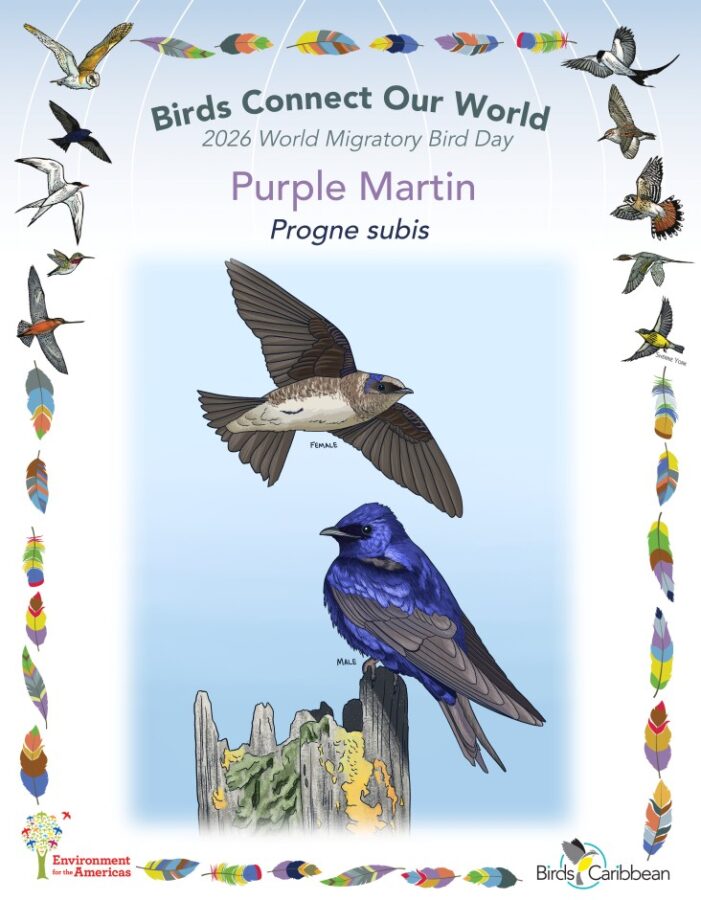
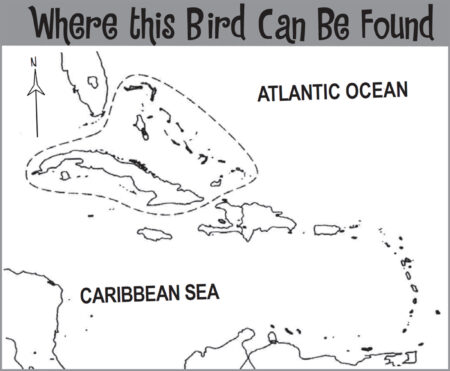 Attention, Caribbean birdwatchers! Each fall, our skies welcome an elegant, streamlined traveler: the Purple Martin. Between August and October, look up for flocks of these large, social swallows perched on wires or sweeping through the air in pursuit of insects. Their passage can be one of our region’s most striking migration spectacles!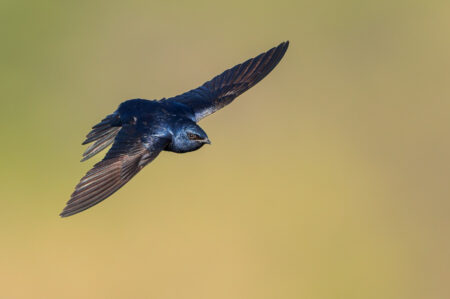
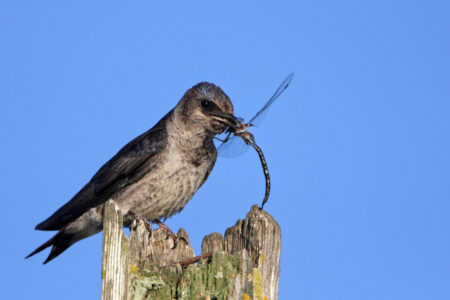
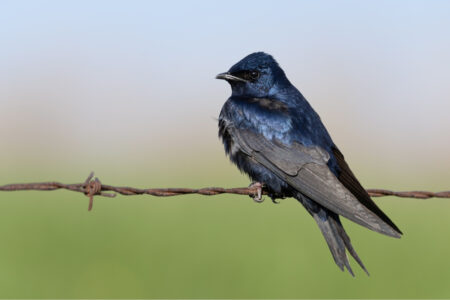
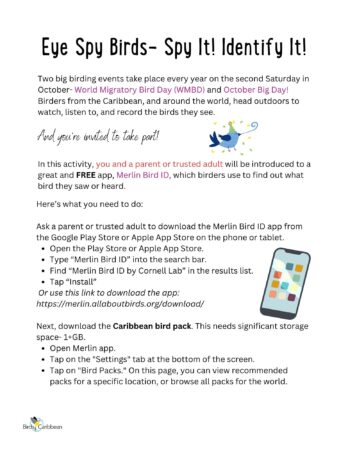 FOR KIDS: The main area used by Purple Martins does not cover the whole Caribbean, which means that in some places it is a bird that is hard to see, or will not be around at all. But don’t worry, there are lots of beautiful migrant birds to look out for at this time of the year. From long-billed shorebirds flocking on the beaches, to the colorful gems of warblers flitting amongst the trees, there is so much to see!