Andrys Gómez works for the Ministry of Environment and Natural Resources as a Wildlife Technician in the Dominican Republic. Training for wildlife techniques like bird banding are essential to her job both to help with monitoring the Dominican Republic’s unique wildlife and distribute permits to other people proposing wildlife monitoring projects. Our annual international Caribbean Bird Banding Workshops teaches Caribbean biologists like Andrys the basics of bird banding, including ethics, essential handling techniques, how to evaluate body condition and breeding status, and how to determine the age of birds in the hand. Data collected during bird banding can help biologists looking at survivorship, demography, phenology, and habitat quality. Learn more about the Caribbean Bird Banding Network here.
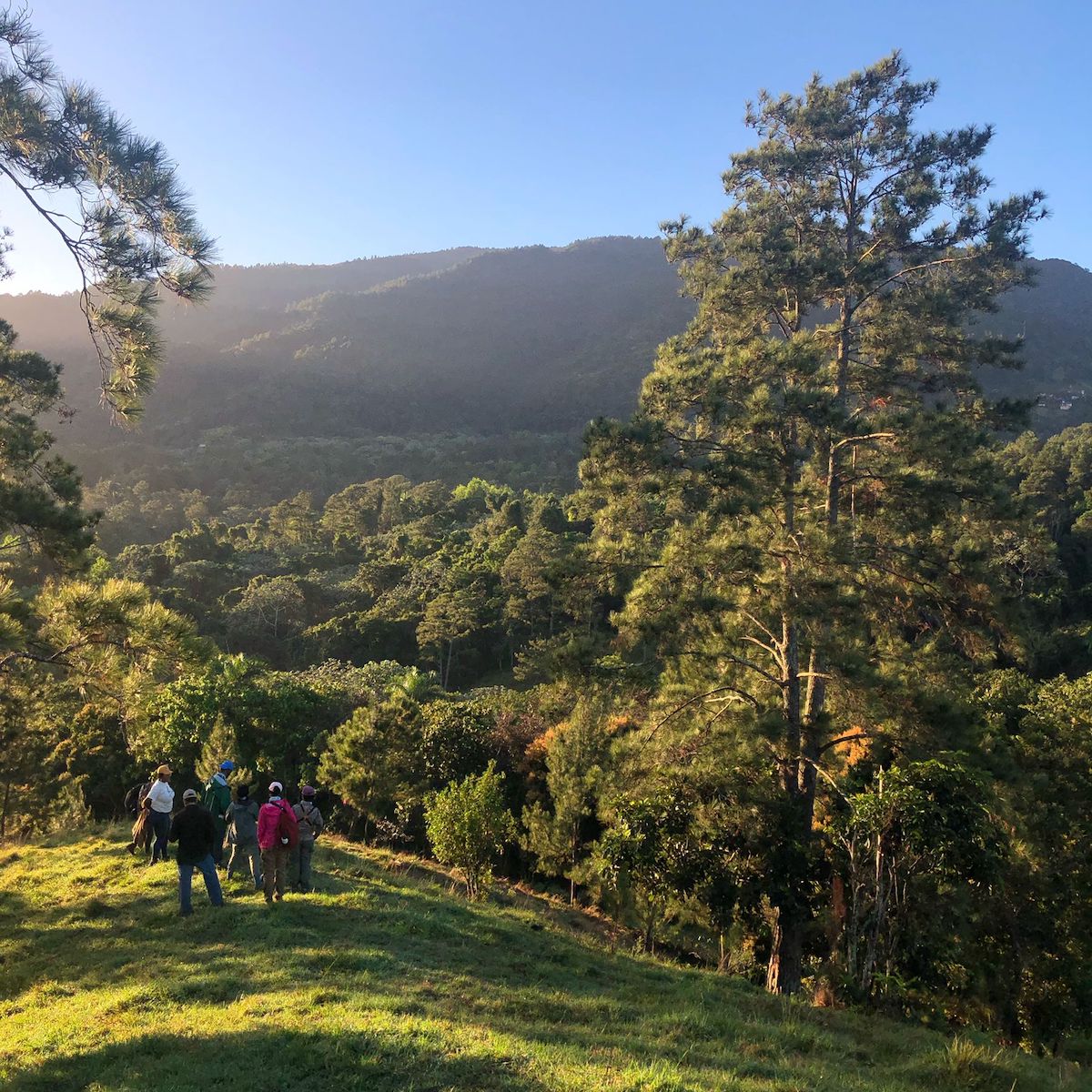
In February 2025, I spent a week in Jarabacoa, surrounded by mountains, morning mist, and, most importantly, birds! I was fortunate to attend the fourth annual Bird Banding Workshop in the Dominican Republic. This skills-building workshop is organized by BirdsCaribbean and facilitated by an incredible team of people from different parts of the Caribbean who live, breathe, and make bird conservation possible.
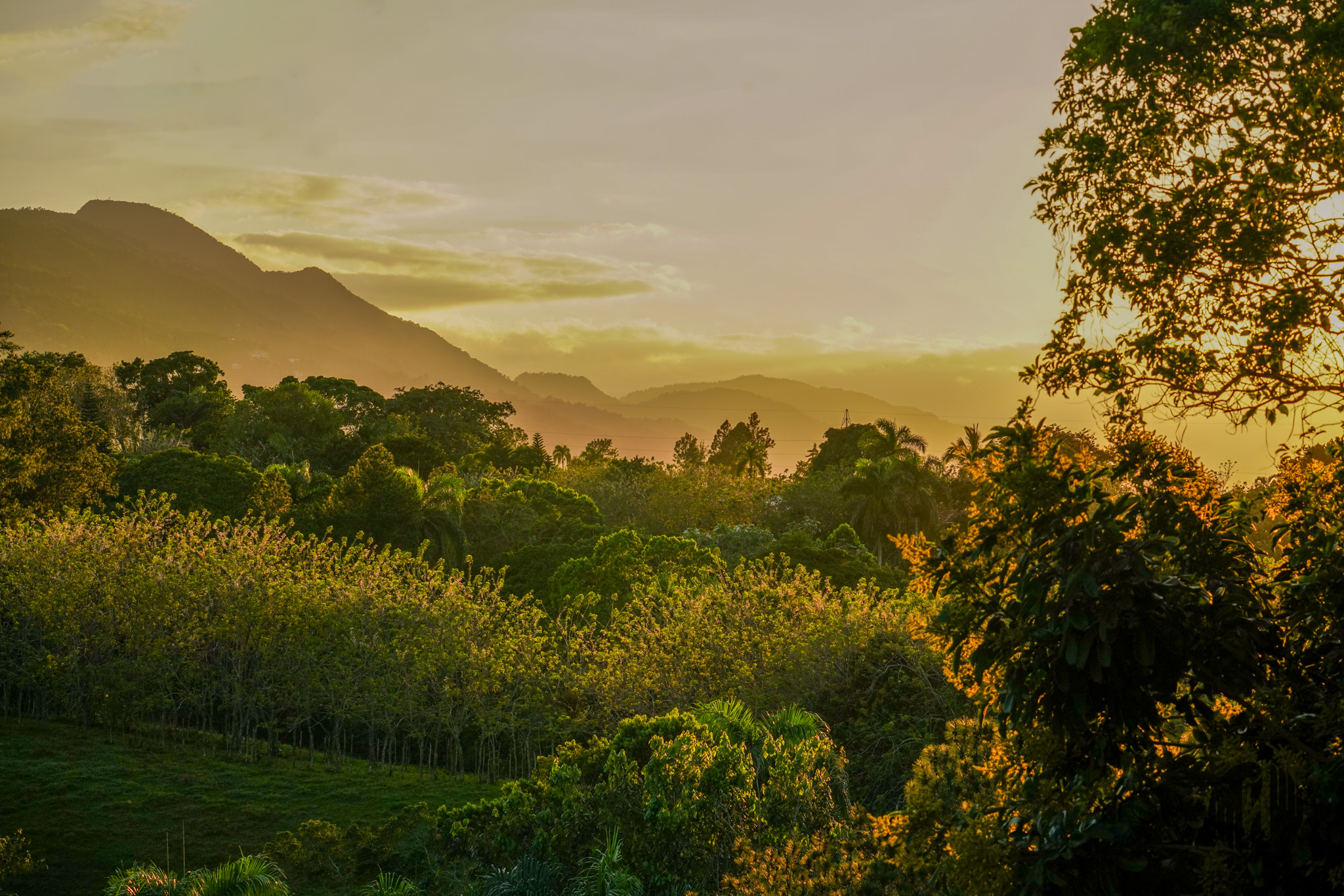
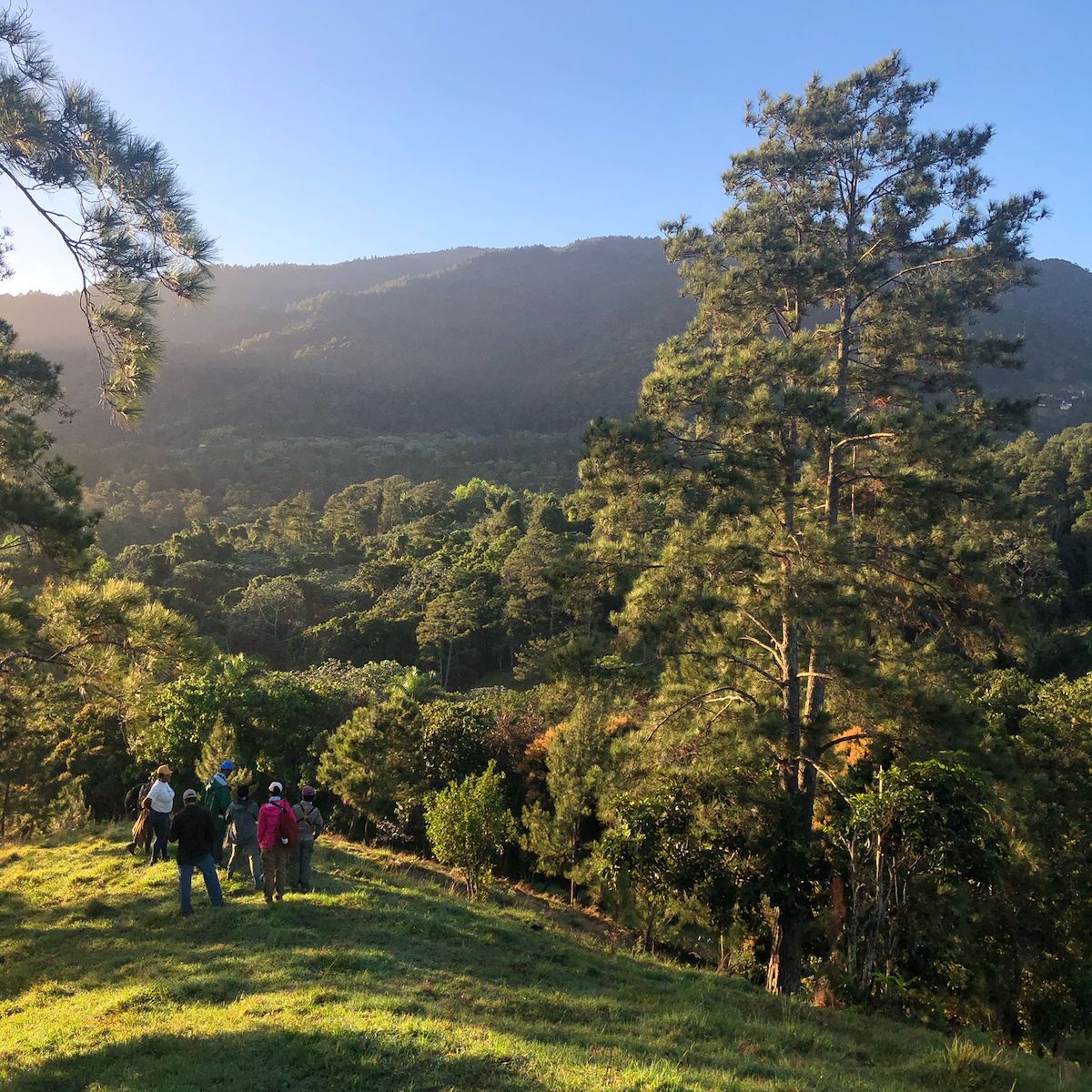
Sunrises are always magical in the misty mountains of Jarabacoa, Dominican Republic. (photo by Holly Garrod)
Which bird will it be??
From the first day, I knew this wasn’t going to be a simple course. Every day involved waking up before sunrise, wading through the dew to open mist nets, and waiting with excitement to see who would we find in the nets first: a Broad-billed Tody (Todus subulatus)? A Bananaquit (Coereba flaveola)? A Black-crowned Palm-Tanager (Phaenicophilus palmarum)?
But beyond seeing birds up close—which is already a wonder in itself—what truly left its mark on me was everything we learned. The techniques we practiced are not only useful, they’re necessary! In a country like ours, where there are still so many information gaps about our birds, knowing how to band them, how to read their molt, take their measurements, and record the data correctly is a giant step toward real, science-based conservation.
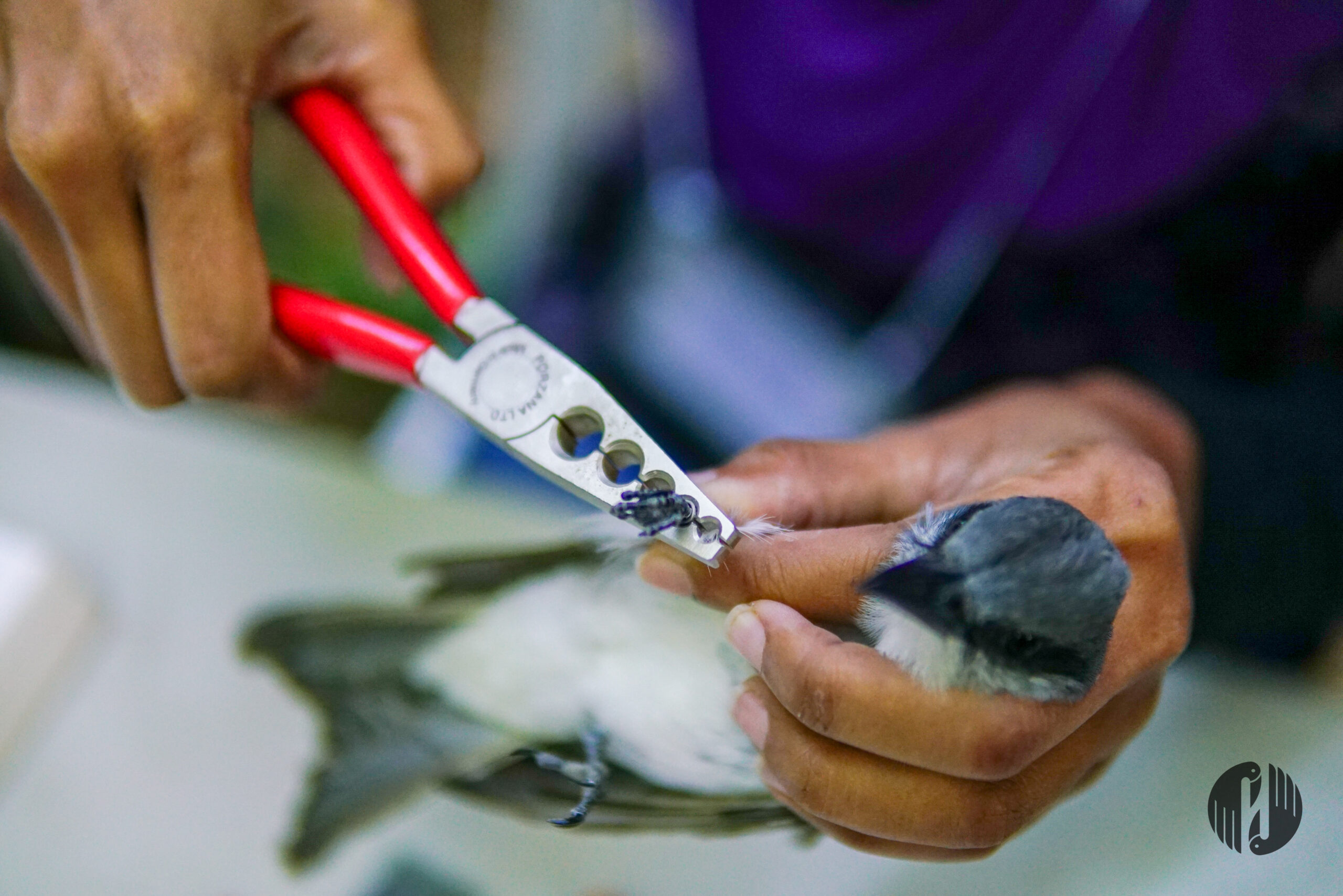
Biologist bands a Gray Kingbird using BirdsCaribbean bands. (photo by Holly Garrod)
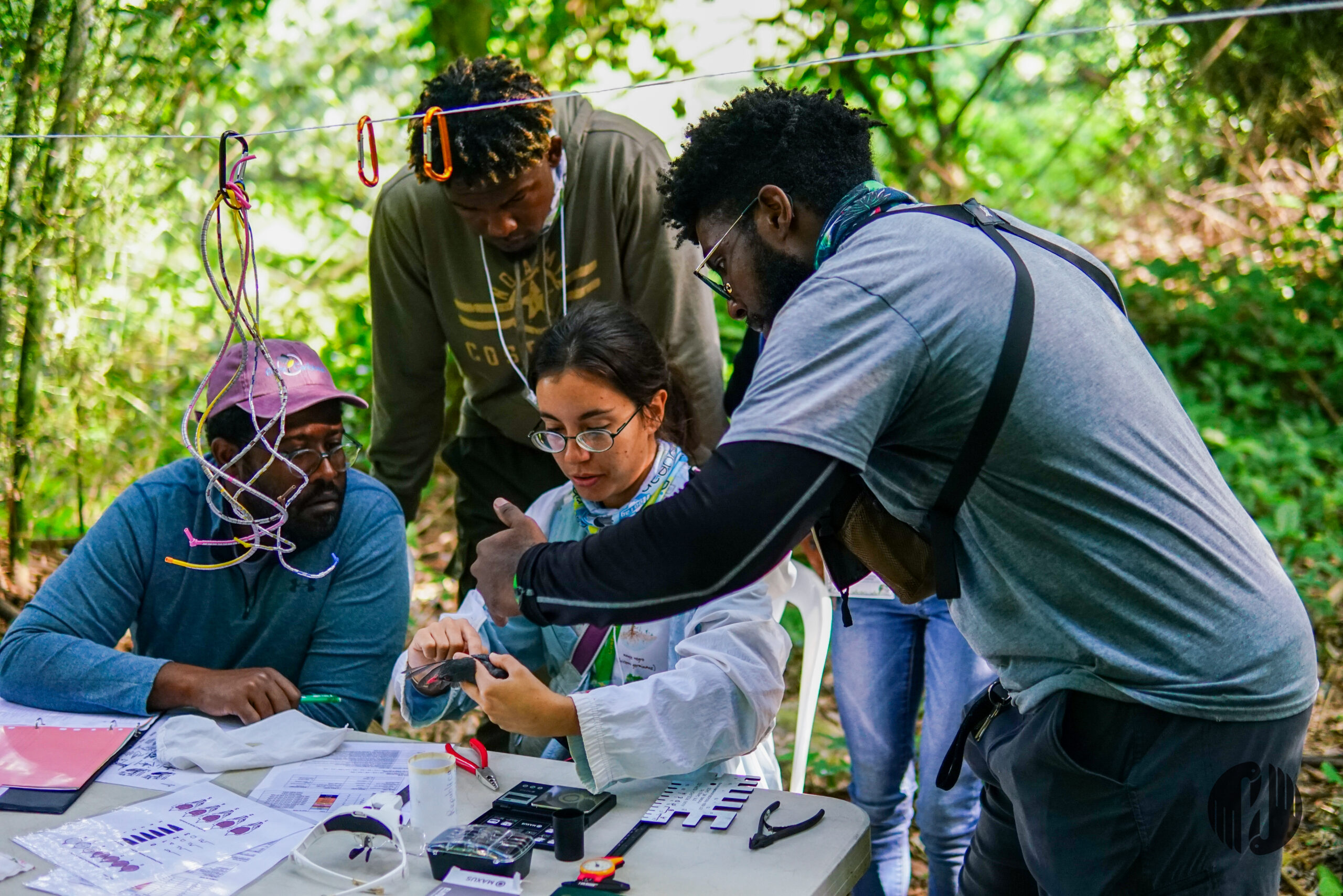
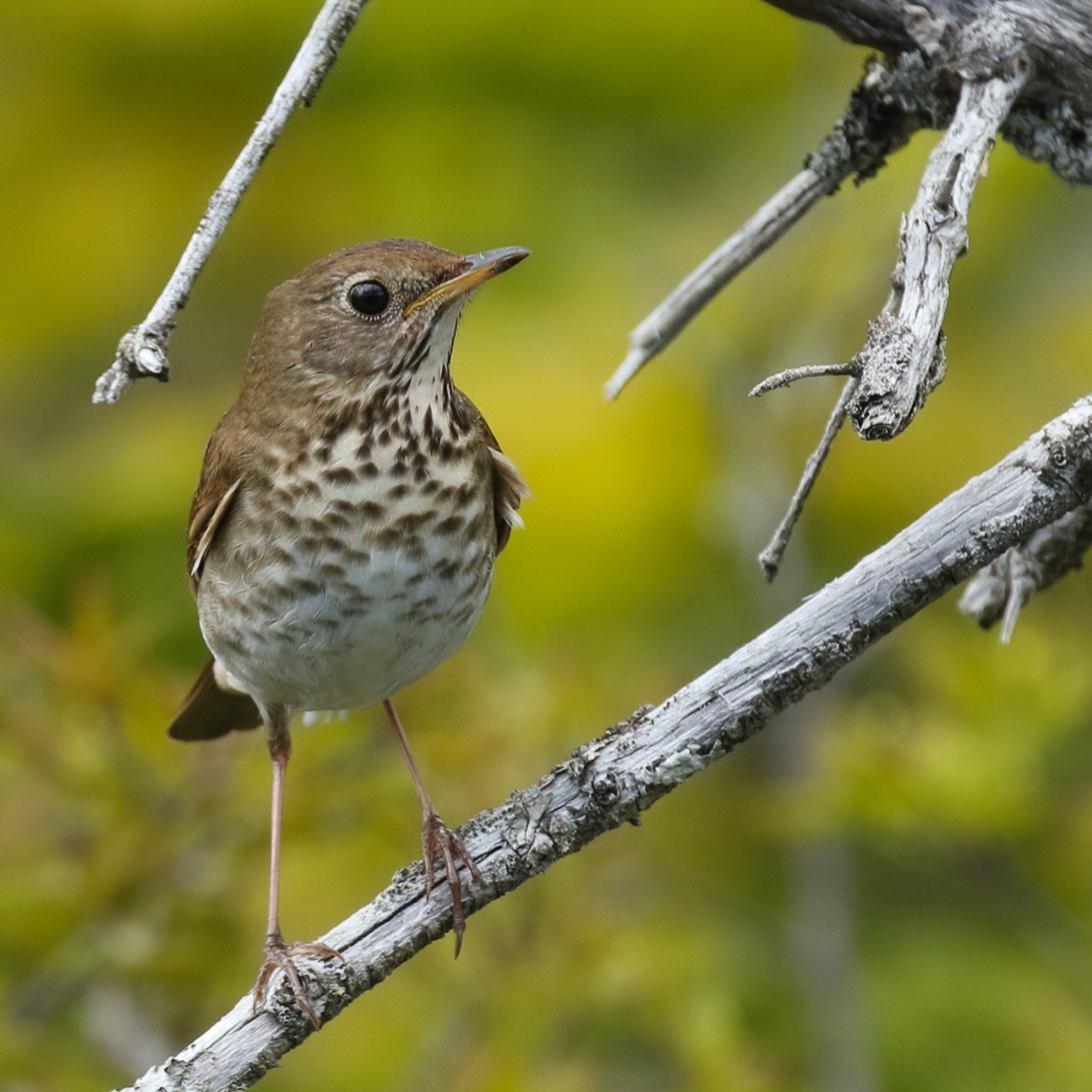
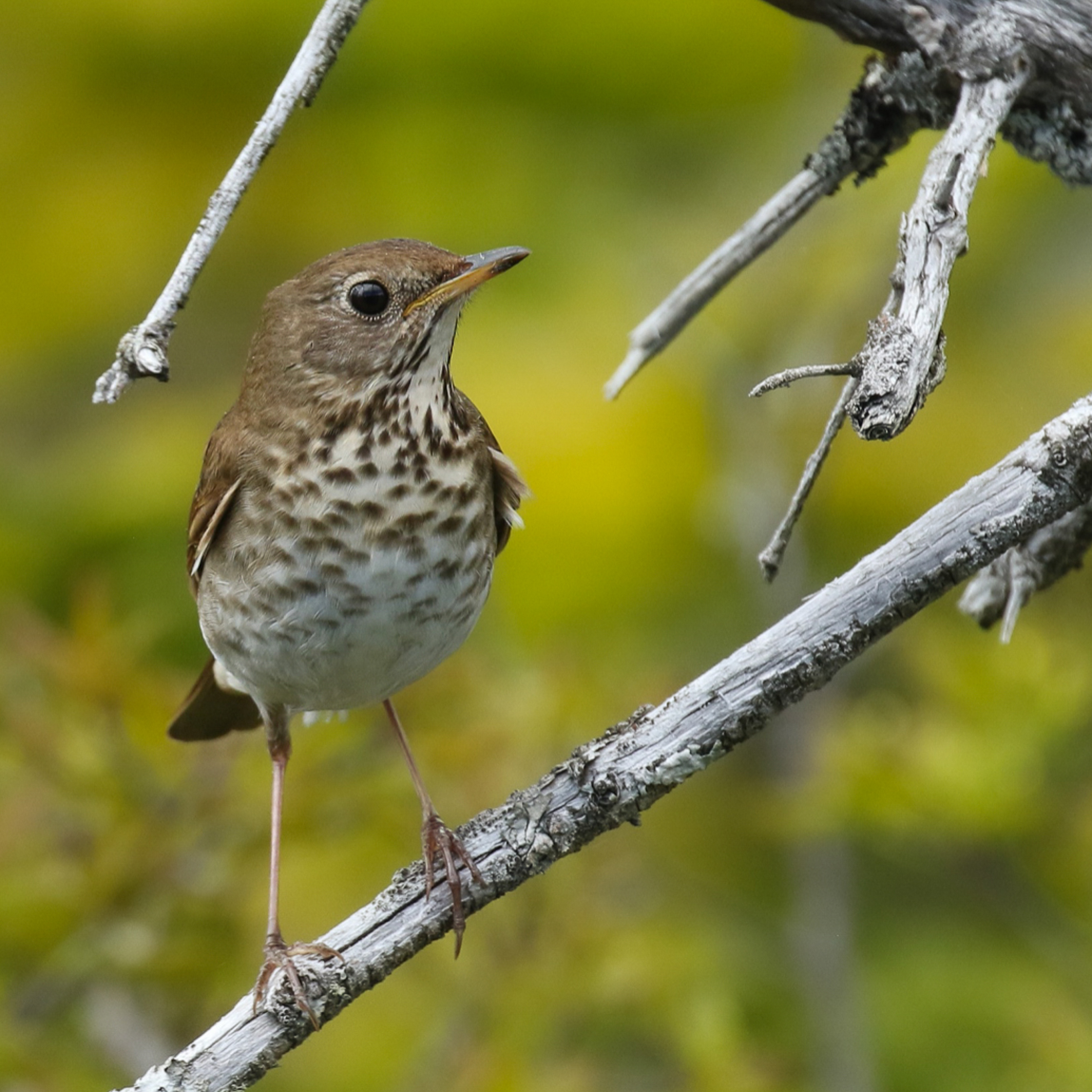
Trainer Daniela Ventura walks participants Justin Saunders, Kenrith Carter, and Bradley Watson through some of the bird banding basics with a Red-legged Thrush. (photo by Holly Garrod)
One of the things I’m most grateful for was the exceptional work of our team of instructors. Each and every one of them—Holly, Juan Carlos (JC), Daniela, and Zoya—knew how to handle a super diverse group, from people who had never handled a bird to others with extensive field experience, making us all feel comfortable and valued.
Holly’s support was especially outstanding. She translated everything incredibly well, ensuring that no one missed anything that was said, and always had an answer, no matter the difficulty of our questions. Her patience, clarity, and passion made every session a learning opportunity.
Even when we didn’t have birds in our hands, it felt like we were learning all the time. Rather than let the waits between net rounds become downtime, Zoya and Daniela used those moments to ask us questions, challenge us to reflect, and review key concepts. Each pause became another opportunity to reinforce what we had learned.
Learning alongside participants with varying levels of banding experience was incredibly valuable. We learned a lot by observing the techniques of the more experienced banders. Alejandro from Cuba shared some of his tips for aging Red-legged Thrushes, while JC showed us different methods for tying knots and collecting nets, including some techniques used in Europe.
This exchange of knowledge and styles was a great reminder that, on this path, there is always something new to learn—and that growing as a community makes the experience even more enriching and special.
Trainer Zoya Buckmire talks to attentive participants about how to use the Pyle guide otherwsie known as the bander’s bible. (photo by Holly Garrod)
Andrys Gomez bands a Bananaquit. (photo by Holly Garrod)
Portrait of a Broad-billed Tody in the hand.
Garry Auguiste bands an Ovenbird while Andrys Gomez scribes. (photo by Holly Garrod)
What a bird in the hand tells us
Among the most important things I took away from this workshop were:
How to use molt to interpret age and condition in birds. Who knew you could tell so much about a bird’s life just by looking at its feathers?
How to use Pyle—the bird bander’s bible, a thick book full of initially intimidating walls of text that are an invaluable tool for any bander.
How to apply Wolfe-Ryder-Pyle, or WRP, system to age birds based on their plumage rather than using the traditional calendar-year method.
Why all the data collected during banding matters. These records help us study migration, estimate survival and site fidelity, assess reproductive success, and gain many other valuable insights.
And something I’d never considered: how to work with the public while banding, sharing knowledge in a responsible and educational way. Because yes, teaching is also part of the job! A bird in the hand gives us a chance to show people a side of wildlife they don’t normally get to see.
Ani, are you okay?
One of the experiences I will remember most was processing a Smooth-billed Ani (Crotophaga ani). No one else wanted to do it because, to be honest, the bird smelled pretty bad—like overripened fruit!
Although we couldn’t band it because we didn’t have bands large enough, I had the opportunity to take its measurements and apply what we had learned about molt. Using Pyle’s book and the WRP system, we determined its age with a fair degree of confidence. The bill shape turned out to be very useful, indicating it was likely an adult female.
It was like solving a puzzle in real time, connecting what I could see in front of me with everything we had learned in the workshop. I never imagined that reading feathers could be so powerful—or so exciting.
Portrait of a Smooth-billed Ani. (photo by Holly Garrod)
A Smooth-billed Ani is held up to the drawings in the Pyle guide to determine age and sex (photo by Holly Garrod)
Andrys Gomez places a Smooth-billed Ani in a cup in order to weigh it. (photo by Holly Garrod)
Andrys Gomez bands a Smooth-billed Ani while Jennifer Valiulis scribes (photo by Holly Garrod)
More than a band on a bird
I left the workshop not only with new skills, but also with a different perspective. Beyond technical knowledge, the workshop offered us the opportunity to become part of a regional network of people committed to bird conservation and research. We strengthened ties, shared experiences, and, most importantly, took away a responsibility: to apply what we learned to help close information gaps in our own countries.
I also made new friends, shared stories, and gained a sense of community that still stays with me. I connected with passionate people, all eager to learn and protect what we have. Jarabacoa was the perfect setting for all of this, with its chilly mornings and the constant feeling of being surrounded by life.
If anything became clear to me, it’s that bird banding isn’t just about putting a little band on a bird. It’s about learning how to capture and handle birds with care, respect, and ethics. It’s about committing to caring for them, protecting them, improving our own understanding of them, and helping others do the same.
And I, happily, sign up to continue on that path.
Help Us Train the Next Generation of Caribbean Bird Banders
Workshops like this one are helping build a growing network of skilled Caribbean bird banders who can collect the high-quality data we need to better understand—and conserve—our region’s birds. Your support helps BirdsCaribbean provide hands-on training, equipment, mentorship, and opportunities for conservationists across the region. Support the Caribbean Bird Banding Network and help us keep this important work growing.
Thanks to funding from the USFWS and support from Institute of Bird Populations to make this workshop possible.
Andrys Gómez is a Dominican biologist specializing in wetland conservation, wildlife monitoring, and biodiversity management. She currently works as a Wildlife Technician at the Ministry of Environment and Natural Resources of the Dominican Republic, where she contributes to the monitoring and management of wetlands, protected areas, and species of conservation concern. Her work combines field research, biodiversity monitoring, technical assessments, and environmental education, with a particular interest in wetland ecosystems and their conservation
Jennifer Wheeler weaves through the buzzing crowd at the Dominican Fiesta Hotel’s Convention Centre, raises the BC conch shell to her lips, and blows with all her might. The booming sound of the conch fills the air, instantly silencing conversations and commanding everyone’s attention. This spirited signal marks the official start of the BirdsCaribbean 24th International Conference—five exhilarating days of non-stop science, birding, and forging lasting conservation connections! Here we dive into the standout moments that made the conference truly unforgettable.
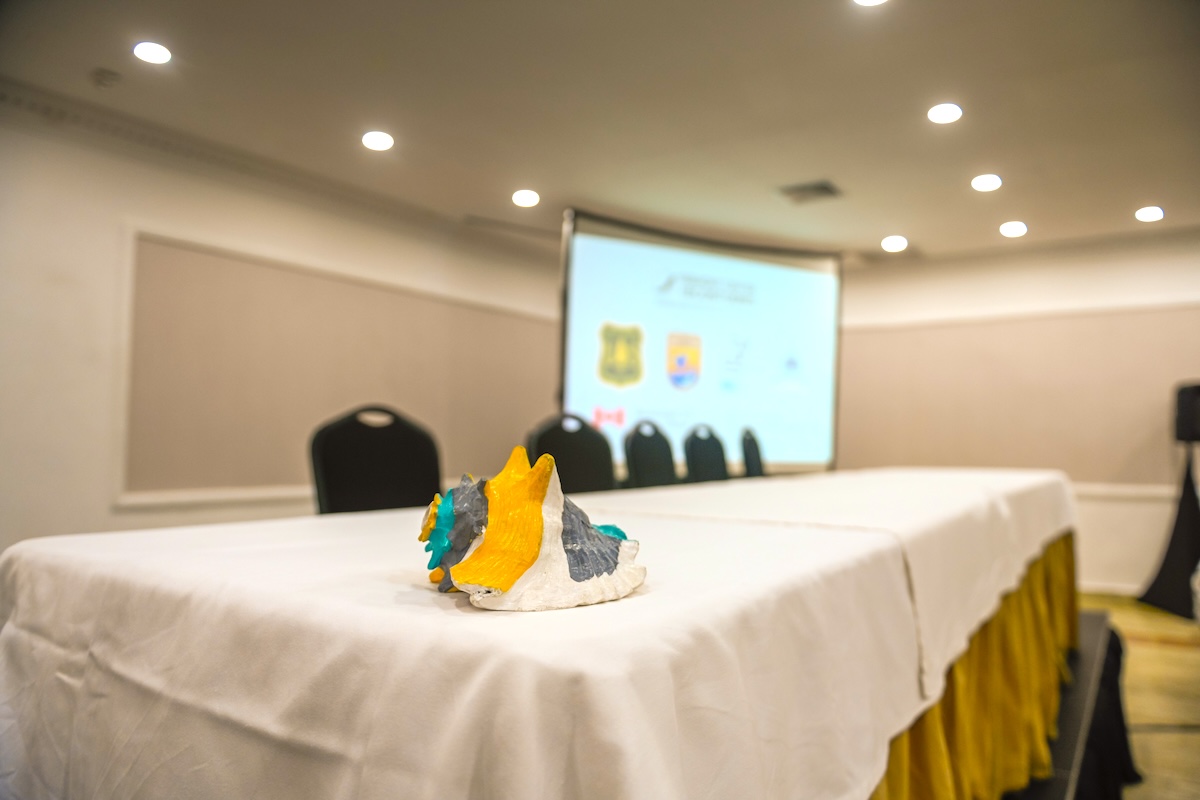
The BirdsCaribbean conch shell. (Photo by Martin Rodriguez)
Conservation thrives on the strength of community. This belief in the power of community is why every two years, BirdsCaribbean joins forces with our partners to host our International Conference—a transformative event where collaboration and learning drive real, impactful change. Conservationists from all walks of life come together on a beautiful Caribbean island, united by a shared passion: protecting the incredible birds that define our region.
This year’s conference, held at the Dominican Fiesta Hotel in Santo Domingo, Dominican Republic, in partnership with local NGO Grupo Jaragua, invigorated this mission. Centered on the theme “From Mangroves to Mountains: Safeguarding Our Avian Treasures,” the conference brought together a diverse group of conservationists—including representatives from international and regional higher education institutions, research centers, government agencies, NGOs, the ecotourism industry, and the media. The event provided the platform for delegates to share their knowledge, ideas, science, and resources—strengthening the conservation community and re-energizing the fight to save our precious Caribbean birds.
Spanning five exciting days, the conference featured expert-led presentations, roundtable discussions, training sessions, networking opportunities, fundraising initiatives, and birding trips to observe Hispaniola’s diverse bird species, including its unique endemics.
United for Birds: A Community-Driven Mission
The conference began on July 18th with opening remarks by Sixto J. Incháustegui, President of Grupo Jaragua, who emphasized the importance of collaborative efforts to protect nature and wildlife. “Participation must come from all sectors of society to conserve biodiversity,” he stated.Frederico Franco, Vice Minister of Protected Areas at the Ministry of Environment and Natural Resources, echoed this sentiment, stressing the need to work together to ensure a sustainable environment for our birds. He highlighted the significance of conferences like the BirdsCaribbean, noting that “they play a crucial role in sharing scientific knowledge and promoting sustainability as a national culture.”
Sixto J. Incháustegui, President of Grupo Jaragua. (Photo by Martin Rodriguez)
Frederico Franco, Vice Minister of Protected Areas at the Ministry of Environment and Natural Resources
BirdsCaribbean President Adrianne Tossas and Executive Director Lisa Sorenson warmly welcomed the record-breaking 338 delegates from 32 countries and islands. “I am elated to see so many young people here,” Sorenson remarked, “Your interest in birds and environmental stewardship bodes well for the long-term conservation of our biodiversity, which is vital to our health and well-being.”
Keynotes that Ignite: Wisdom, Vision, and Passion for Birds
Each morning, delegates gathered to hear phenomenal keynote speakersshowcase the diversity of thought, culture, knowledge, and work within our community (scroll down to see videos). On the first day, Dr. Yolanda León, a Dominican biologist and immediate past president of Grupo Jaragua, emphasized the importance of effective conservation action for birds and habitats. She honored Simón Guerrero, a beloved member of BirdsCaribbean and Dominican conservation stalwart who passed away earlier this year, by posing the question he always asked: “Does the species know?” She underscored the significance of ensuring species know we are working to protect them and their habitats, as reflected in populations thriving in healthy ecosystems.
Dr. Yolanda León, a Dominican biologist and immediate past president of Grupo Jaragua, addresses the delegates during the opening ceremony.
Yolanda answers the question “Does the species know?” during her talk.
David Lindo, also known as The Urban Birder, captivated the audience with his keynote address “Conservation at Your Doorstep.” He inspired delegates with his passion for learning about birds in urban spaces and his dedication to encouraging city dwellers to connect with their environment. His speech was a captivating blend of humor, insight, and inspiration, leaving a lasting impression on all attendees.
David Lindo, also known as The Urban Birder.
Delegates listening to David’s inspirational talk.
Chris Rimmer shared insights from 30 years of research in his talk “Bicknell’s Thrush: Conserving a Vulnerable Songbird in the Caribbean and Across the Hemisphere”. He outlined the necessary conservation actions to safeguard this migratory songbird in the Dominican Republic and Greater Antilles. Dr Steve Latta, in his talk “The Synergies of Advancing Conservation: Using Field Research and Avian Monitoring to Build Capacity and Conservation Awareness” emphasized that conservation research should also facilitate field training and capacity building, raise awareness, and demonstrate the interdependence of healthy communities and healthy ecosystems.
Chris Rimmer, Emeritus Executive Director of Vermont Center for Ecostudies, speaks to delegates about conservation priorities for the Bicknell’s Thrush.
Dr Steve Latta speaks to the crowd of delegates about creating nurturing relationships, and advancing conservation through training opportunities and awareness raising campaigns.
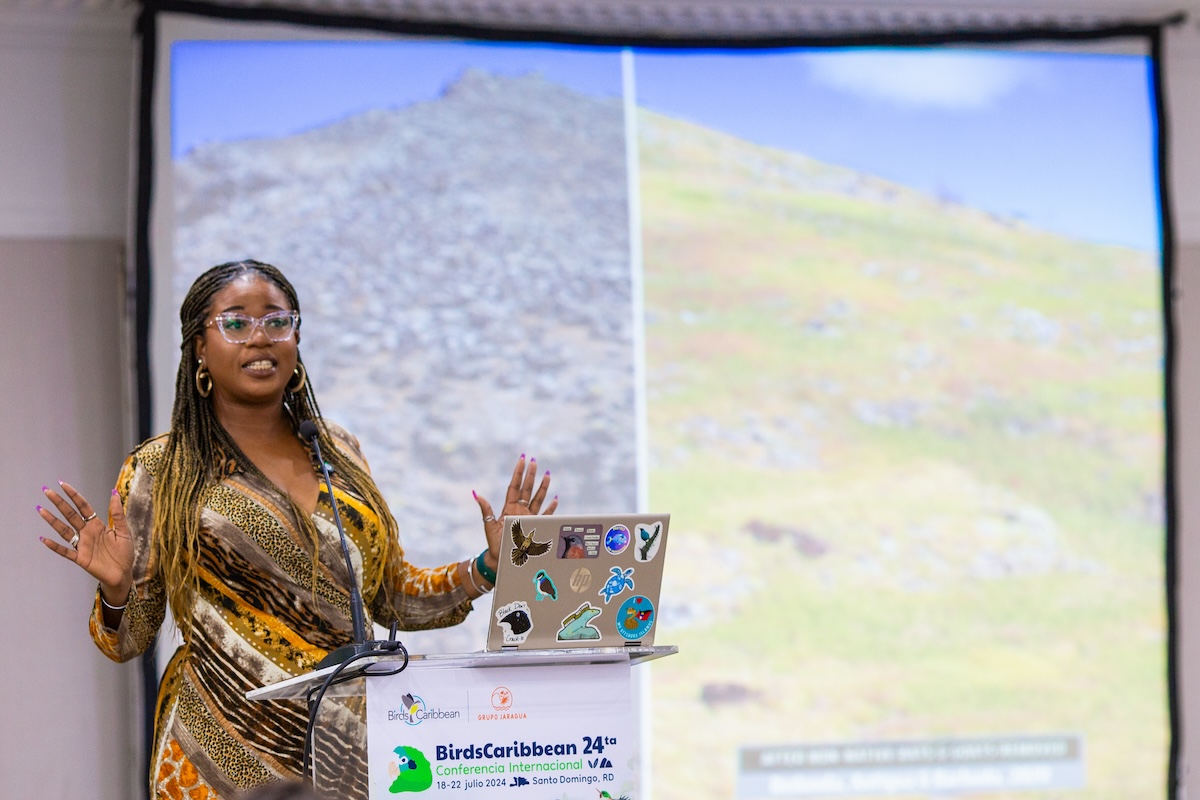
Other keynote presentations reinforced delegates’ belief in their ability to achieve their own bird conservation goals and become successful conservation leaders. Award-winning Antiguan conservationist Shanna Challenger delivered an inspiring, instructive talk “From Passion to Purpose: The Journey of a Caribbean Wildlife Conservationist.” She shared how the knowledge and skills acquired from various projects, trainings, partnerships, and mentorships transformed her approach to conservation and helped her to achieve remarkable successes, including the restoration of Redonda through the Rewilding Redonda project.
Shanna Challenger retelling the hard work it took for her team to restore Redonda Island.
Eric Carey reflected on his 20-year tenure as Executive Director of the Bahamas National Trust, during which he significantly expanded the organization from a 10-person staff to 90, and developed a 32-park system covering 2.2 million acres, a substantial increase from the initial handful of national parks. In his presentation, “20 Years Protecting Habitat and Species through the Stewardship of Conservation Opportunities in The Bahamas—Success Stories and Lessons Learned,” Carey highlighted the challenges and triumphs of conservation in The Bahamas, and how he and his team overcame obstacles to protect habitats and wildlife while gaining the support of local Bahamians.
Keynote speaker Eric Carey. (Photo by Lisa Sorenson)
Finally, Dr. Terry Root addressed the pressing issue of climate change in her presentation, “Climate Change Impacts in the Caribbean.”Shedetailed the sobering realities of the ecological consequences for birds and emphasized the role of science in developing effective mitigation policies. Dr. Root concluded with a hopeful message, urging attendees to come together, take action, and pressure governments to shift the societal approach to combating climate change, much like the successful campaigns to reduce smoking.
Dr Terry Root addresses climate change and discusses the social marketing approach needed to combat it.
A good conference day starts with birdwatching
Each day of the conference, many of our delegates were up before dawn, eager to connect with nature and discover the incredible birdlife at the Jardín Botánico Nacional (Dr. Rafael María Moscoso Botanic Garden). Guided walks through the 400-acre nature preserve were led by members of Grupo Jaragua and Grupo Acción Ecológica. The Garden, known for its extensive variety of native trees, palm species, over 300 types of orchids, and diverse bird species, provided an ideal setting for these early morning explorations.
Group of early morning birding delegates at the National Botanical Garden in Santo Domingo. (Photo by Stefan Gleissberg)
Birders in action! (Photo by Bryan Naqqi Manco)
During the 2-3 hour walks, delegates explored wooded areas, stream-side habitats, and open palm savannas, offering excellent birdwatching opportunities, including the chance to spot endemic species. Participants were thrilled to observe endemic “lifers” like the Vervain Hummingbird, Broad-billed Tody, Hispaniolan Woodpecker, Black-crowned Palm-Tanager, and Yellow-faced Grassquit, all commonly found in the garden. Some were also fortunate enough to spot elusive species like the Limpkin, as well as threatened birds such as the West Indian Whistling-Duck and Hispaniolan Parakeet. Observing these birds in the tranquil garden setting was a refreshing way to start the day before diving into the conference’s stimulating presentations and discussions!
Water lilies at the garden. (Photo by Aaliyah Cunningham)
West Indian Whistling-Duck. (Photo by Rondell Smith)
The national bird of the Dominican Republic, the Palmchat. (Photo by Rondel Smith).
Collaborative Learning and Dialogue for Conservation Success
338 delegates from 31 countries gathered for workshops, presentations, discussions and to connect with fellow Caribbean conservationists.
Workshops
This year’s conference featured a wide range of workshops tailored to the diverse bird conservation and research needs of our delegates. In the “Adaptive Project Management using Conservation Standards” workshop, participants enhanced their project management and implementation skills. The “Introduction to Data Analysis using R” workshop provided essential training on cleaning and analyzing data effectively for publications and reports. “Motus in the Caribbean” focused on the regional use of the Motus wildlife tracking system, offering critical guidance on designing, installing, and maintaining functional and robust Motus receiver stations, as well as planning collaborative projects. Additionally, “Navigating Diversity, Equity, Inclusion, and Accessibility in Ornithology” addressed the cultural differences across Caribbean islands and emphasized the importance of ensuring that all stakeholders feel respected, accepted, and recognized for their contributions to bird conservation.
Jody Daniel (Gaea Conservation Network) explains to participants how to code and analyse their data using R.
Participants discuss threats and solutions among themselves during the Adaptive Management breakout sessions.
Todd Alleger speaks about the utility of Motus tracking stations in the Caribbean.
Participants engaged in interactive learning activities led by Marta Curti and Gabriela Diaz, utilizing “Environmental Education Guide: Raptors of the Caribbean” from The Peregrine Fund. These activities aimed to deepen participants’ understanding of the vital role of raptors in their ecosystems while enhancing their ability to educate others about birds of prey using the guide’s materials and strategies. Mark Yokoyama and Jennifer Yerkes of Les Fruits de Mer led a creative workshop titled “Make Your Own Coloring Activity Book,” which received high praise from participants for its innovative approach to teaching children about the natural world.
Dominican delegates with their raptor made with recyclable materials.
Jennifer Yerkes (Les Fruits de Mer) shares how the workbook ‘Booktastic’ will be used as an ideation and planning tool during the workshop.
Damany Calder reads the guidelines given in the ‘Booktastic’ workbook.
Mark Yokoyama (Les Fruits de Mer) shares insightful tips for creating engaging educational materials.
The “Connecting Birds and People: Environmental Interpretation as a Key Tool in Bird Conservation and Appreciation,” workshop highlighted the importance of interpretation in fostering bird conservation awareness among the general public. In “How to Publish Your Research and Conservation Reports with the Journal of Caribbean Ornithology,” participants received valuable insights into effective publication practices.
The workshop “Protect Insects, Protect Birds: Educational Tools to Celebrate WMBD,” presented by Environment for the Americas, addressed the current threats facing migratory birds and insects and the actions needed to slow their decline. Participants also learned how to organize and execute a successful bird festival. Finally, “Conservation Photography for Biologists, Artists, and Stakeholders” presented by Jerry Bauer, USFS International Programs, equipped attendees with skills to enhance their visual communication and inspire conservation action.
During the conference, we took the opportunity to assess BirdsCaribbean’s capacity-building initiatives and identify future priorities. Participants were asked to provide feedback via an online survey on how resources, training, equipment, and grants from BirdsCaribbean have helped them achieve their conservation goals. The conference also featured a collaborative session where participants worked together to create a comprehensive theory of change, or results tree. This involved identifying necessary intermediate results, specific actions, and SMART indicators to measure the impact of those actions. The group then reviewed and validated the problem tree and engaged in a hands-on activity to further develop the results tree by identifying specific actions, indicators, and implementers.
Christel Mohammed, BirdsCaribbean Communications Manager, and workshop facilitator, Jim Goetz.
Participants break into groups for the problem identification exercise.
Jethro van’t Hul shares the problems he faces as a conservationist working in the Caribbean.
Shanna Challenger adds a problem to her group’s results tree.
Problem tree being analysed and turned into a results tree by participants.
Group of participants discussing capacity building opportunities in the Caribbean.
Symposia
As is customary at each BirdsCaribbean conference, local ornithological work was highlighted during the first symposium, ‘Hispaniola Day.’ Rosanna Guzmán-Pérez from the Ministerio de Medio Ambiente y Recursos Naturales shared findings from her study on plant-frugivore mutualism in the Casabito cloud forest at the Ebano Verde Scientific Reserve, identifying the Hispaniolan Spindalis as one of the main seed dispersers in the forest. Pedro Genero Rodríguez from the Asociación Dominicana Fotógrafos de la Naturaleza discussed the critical role of Reserva Privada el Zorzal as a refuge for both rare migratory birds with specific habitat requirements and common bird species.
Pedro Genero Rodriguez, Dominican photographer, speaks to delegates about the use of wildlife photography in conservation.
Male Hispaniolan Spindalis feeding on berries. (Photo by Jose Miguel Pantaleon)
Andrea Thomen answers a question from a delegate on the domestic parrot trade in the Dominican Republic, during the Hispaniola Day symposium.
Hispaniolan Parrot eating. (Photo by Dax Roman)
Anne-Isabelle Bonifassi, Executive Director of Haiti National Trust, speaks about ecosystem restoration in Haiti, during the Hispaniola Day symposium.
Jennifer Wheeler presented “Mountain Top Strongholds: The Story of Haiti’s Black-capped Petrel” on behalf of Haitian researchers who could not attend. Delegates were deeply moved by a short film, The Diablotin Festival, which tells the heartwarming story of how the community of Boukan Chat, alongside a team of conservationists, humanitarians, and storytellers, has united to protect the endangered Black-capped Petrel.
Other pivotal symposia addressed key issues in Caribbean bird conservation. “Conserving Caribbean Threatened and Endemic Birds” focused on the impacts of natural threats like hurricanes and the illegal bird trade on island endemics and discussed strategies for protecting the region’s unique avifauna. “Ecology of Migrants and Importance of Stopover Sites in the Caribbean” highlighted crucial research on migratory patterns of Near Threatened species like the Kirtland’s Warbler, and the role of stopover habitats which are often targeted for development on islands.
The “Waterbirds, Wetlands, and CWC” symposium examined the interconnections between waterbirds and wetland ecosystems, the severe threats they face, and the outreach, advocacy, and actions needed to protect these critical habitats. “On the Ground Bird and Habitat Conservation: New Approaches, Success Stories and Lessons Learned” shared practical conservation methods and outcomes aimed at strengthening the management of green spaces including protected areas and urban parks like botanical gardens in the Caribbean for birds and other wildlife.
Simon Busutill shares the triumphs and challenges of protecting a nature reserve in the Turks and Caicos Islands.
Grenada Dove. With fewer than 190 individuals left in the wild, we must act NOW to secure its survival. (Photo by Greg Homel)
Lourdes Mugica, co-author of the field guide “Birds of the National Botanical Garden of Cuba.”
Caribbean conservationists are also leading social transformation through art, social media, and environmental education to gain support for protecting our feathered friends. In the symposium “Outreach and Education: Raising Awareness and Engaging Diverse Audiences,” they shared what strategies have been successful (and what hasn’t) in involving local communities and stakeholders in bird conservation efforts.
Discussions on “Habitat Restoration and Best Management Practices” provided insights into effective restoration techniques, while talks from “Landbird and Endemic Monitoring– Challenges, Solutions, Needs, and Results” addressed various monitoring methods, results from current projects, and the emerging issues and challenges encountered at different stages of a monitoring project.
Miguel Landestoy shares the findings from his study on the distribution of the Bay-breasted Cuckoo in the Dominican Republic.
Bay-breasted Cuckoo. (Photo by Carlos Pedro, Macaulay Library- ML393609811)
Dr Mark Hulme, reports on the behaviour of the range restricted Trinidad Piping-Guan and pressures affecting the population.
The large turkey-like Trinidad Piping-Guan is only found in Trinidad’s mountainous Northern Range. (Photo by Wendell SJ Reyes (ML66246621))
Demonica Brown, of The Bahamas National Trust, explains how bird monitoring is carried out at the Lucayan National Park.
Mangroves at Lucayan National Park. (photo by Lisa Sorenson)
Claudia Mantilla shares the findings from her Oriente Warbler research in Cuba.
Oriente Warbler. (Photo by Ian Burgess, Macaulay Library- ML558957951)
Finally, the symposia “From Mountains to Mangroves…and the Sea: Challenges and Opportunities for Caribbean Seabird Conservation, Research, and Monitoring” and “Invasive Alien Species From Mangroves to Mountains” tackled the multifaceted challenges of seabird conservation across the region, especially those faced by researchers and citizen scientists during the 2023-24 Caribbean Seabird Census, and the impact of invasive species on Caribbean bird populations and ecosystems.
The abstracts for the BirdsCaribbean 24th International Conference can be viewed by session here.
Roundtables
The Caribbean Motus Collaboration’s “Let’s Talk Motus!” roundtable brought together Motus leaders from across the Caribbean and beyond to discuss their experiences using and managing Motus as a whole, from building and maintaining receiver stations, to deploying transmitter tags on birds, all with the goal of advancing partners’ Motus efforts and facilitating potential collaborations.
Maya Wilson, BC’s Landbird Monitoring Program Manager, provides an update on new Motus stations in the Caribbean.
Motus audience listens attentiviely.
“Advancing Bird Conservation and the 30×30 Initiative through new Caribbean subnational Protected Areas” introduced the Conserva Aves initiative to the Caribbean bird conservation and ornithological communities. Delegates discussed the potential, opportunities, challenges, and geographic priorities for the implementation of a Caribbean-wide initiative that would preserve essential habitat for birds and biodiversity over the next 5-6 years by catalyzing local leadership in the creation and sustainable management of new local protected areas. Teams worked together to develop recommendations for the expansion of the Conserva Aves initiative to the unique context of the Caribbean.
Sebastion Herzog leads a discussion on advancing bird conservation and the 30×30 initiative through new subnational protected areas in the Caribbean.
The Caribbean Bird Banding Program’s roundtable discussion explored “Landbird Monitoring in the Caribbean”. Participants discussed ideas to continue developing the Caribbean Bird Banding Network by investigating the needs of bird banders in the Caribbean.
Working Group Meetings
Caribbean Parrots
The BirdsCaribbean Parrots Working Group meeting was attended by 10 members from the Dominican Republic, St. Vincent and the Grenadines, Dominica, Cuba, Puerto Rico, and Trinidad and Tobago. Andrea Thomen chaired the meeting. Members reached a consensus that more effort should be directed towards fostering collaboration and sharing information among parrot biologists in the region. Additionally, members requested the creation of an online library for parrot research papers, technical reports, articles, and books.
Bird Educators Working Group
Caribbean Endemic Bird Festival Coordinators Aliya Hosein and Eduardo Llegus, along with World Migratory Bird Coordinators Laura Baboolal and Miguel Matta, presented our bird educators with a fantastic set of CEBF and WMBD branded materials for their bird conservation outreach activities. The materials included t-shirts, bookmarks, buttons, bird masks, bird bands, and stickers. The stickers feature the artwork of Arnaldo Toledo and Anna Rose, showcasing a variety of Caribbean birds, including endemics, residents, waterbirds, shorebirds, migrants, and the seven selected migratory species for WMBD 2024.
Miguel, Aliya, Laura, and Eduardo with CEBF and WMBD materials for Caribbean coordinators and educators.
Organizations and educators were honored for their exceptional efforts in celebrating CEBF and WMBD over the past two years, consistently organizing creative and enjoyable activities for youth and local communities, and submitting their reports and photos.
We asked our delegates to Sing Like A Bird!
Our delegates have dedicated countless hours to studying our beloved Caribbean birds. They’ve uncovered critical nesting and feeding sites, as well as behaviors that enable these incredible birds to survive and thrive in the wild. But wait, can they sing like a bird? Hit play on the videos below to find out! It’s going to be amazing!
Exquisite artwork, rare first-edition books signed by the authors, heirloom-quality jewelry, premium Caribbean chocolates and rum, apparel that allows you to wear your love for nature and birds, and so much more, the Silent Auction always draws in a lively crowd at our conferences. Mix these irresistible auction items with highly competitive personalities and you’ve got a recipe for fundraising success!
Ancilleno explaining the rules of the auction.
A delegate places her bid during the coffee break.
Auctioneers Ancilleno and Andrew stirred the crowd into a bidding frenzy!
Caribbean ornithological books for auction.
A massive thank you to our generous delegates who donated handmade auction items from their home countries, and to our enthusiastic bidders who helped us raise US$4,700 for Caribbean bird conservation.
“It’s about this big.” Delegates browse the selection of items for auction.
“Hmm, how do I out-bid my competition?”
Stunning bird inspired jewelry were hotly contested at the aution!
Delegates try to decide which items they should place bids for.
A huge round of applause goes to Jennifer Wheeler, Linda Fuller and Natasha Atkins, for organizing the auction and all the volunteers who worked tirelessly to collect, categorize, and display the items, as well as our auctioneers Andrew Dobson and Dr Ancilleno Davis for keeping up the excitement and energy. Their hard work made this event a huge success, and we couldn’t be more grateful!
In search of Hispaniola’s beautiful birds
From mangroves to mountains, birding adventures were not in short supply in the Dominican Republic. Delegates explored vast mountain landscapes, enchanted forests, calm rivers, lagoons, and even rolling sand dunes, all in search of the country’s phenomenal endemic birds. Conference field trips to Sierra de Bahoruco, Reserva Privada Zorzal, Los Haitises and Cotubanamá, Ebano Verde Scientific Reserve, Cayo Arena, Punta Cana and Cordillera Central were led by local tour companies: Explora Ecotours, La Cua Birding Tours, Ova Trails, and independent guide Holly Garrod.
Ebano Verde Scientific Reserve.
Delegates birding at Ebano Verde.
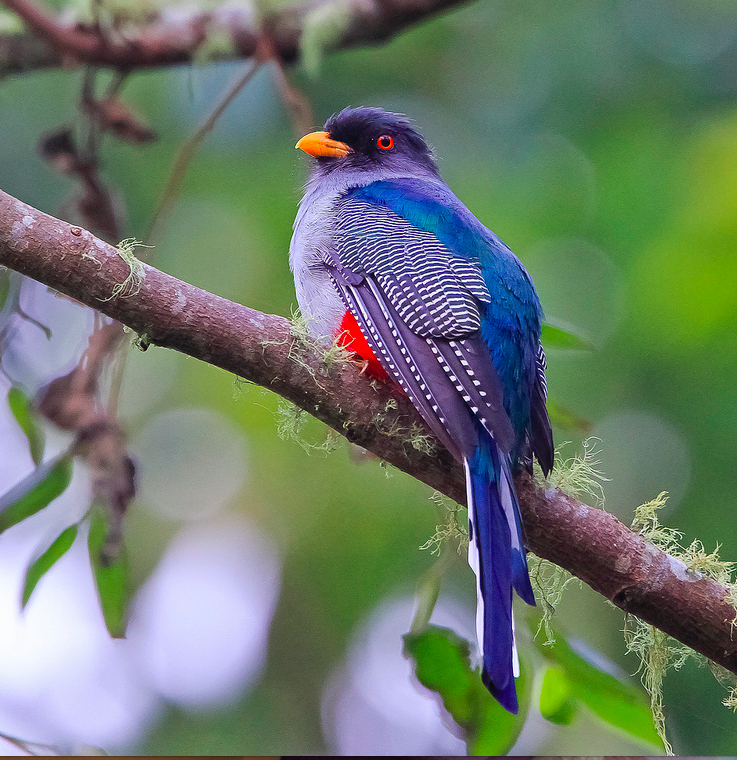
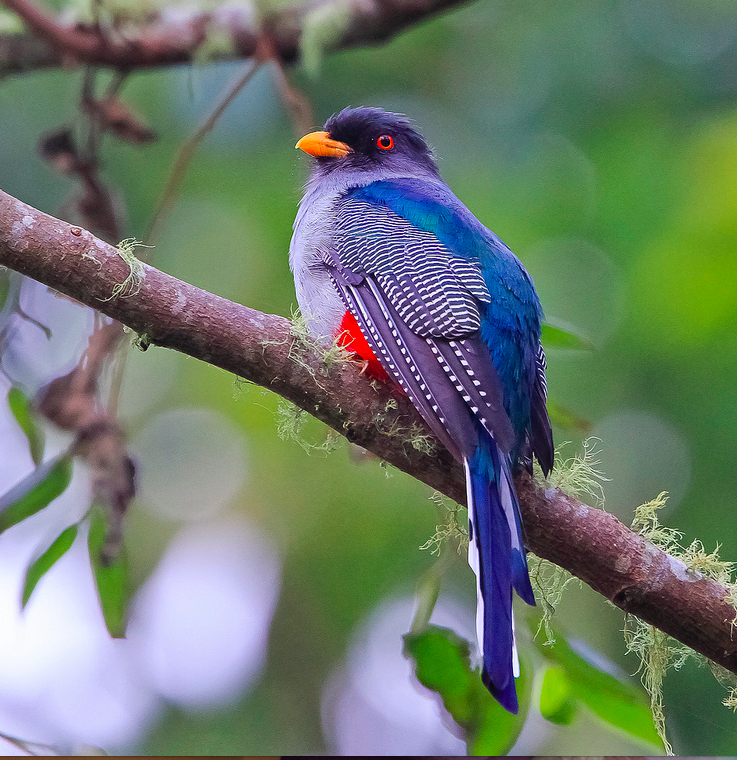
A Hispaniolan Trogon perched quietly at Ebano Verde.
Andrew Dobson takes a photo of the Hispaniolan Trogon.
Some of our delegates are eagerly working on blogs about their incredible conference field trips. Stay tuned for their firsthand experiences!
Acknowledgements
We extend our sincerest gratitude to everyone who contributed to the overwhelming success of this conference! Working alongside our co-host and local partner, Grupo Jaragua, was a true pleasure. We must express our deepest appreciation to all the conference sponsors and donors, including The Rufford Foundation, Audubon, US Forest Service, Teleuniverso, American Bird Conservancy, Banco Popular, Caribbean Biodiversity Fund, Fondo Nacional para el Medio Ambiente y Recursos Naturales (Fondo MARENA) Dominican Republic, Naturalist Journeys, Vermont Center for Ecostudies, Mass Audubon, Cúa Conservation Agency, Vortex Optics, Rare Species Conservatory Foundation, and the FUPAROCA Foundation. Your generous support was instrumental in making this conference a resounding success!
We are truly thankful to everyone who provided funding and donated to help us provide travel scholarships to 93 Caribbean wildlife professionals and students, including those who participated in and donated to our 2024 Global Big Day fundraising event in May.
The conference provided an invaluable platform for Caribbean conservationists to connect with and learn from a diverse array of international and regional professionals, thereby enhancing their professional visibility and honing their skills. The exchange of ideas and perspectives has equipped them with fresh insights and innovative strategies to drive bird conservation efforts in the Caribbean.
We also thank American naturalist and painter Alex Warnick for making her stunning artwork available for us to use for the conference. Her gorgeous work adorned our conference t-shirt and buff, and was used across our merch and promotional material.
Special shoutout to our delegates who volunteered with conference related activities like taking photos, assisting with sales at the merch table, and being rapporteurs. A special thank you goes to Egido Sanz, Juan Carlos (JC) Hernández Ordoñez and Mario Merrero. We appreciate your willingness to give your time and talents!
Mario takes a break from conference tasks to have his photo taken in front of the wingspan banner.
JC helps a delegate from St Vincent and the Grenadines with registration at the conference.
Egido helped with many conference tasks, and here she is helping delegates register for the conference.
We are incredibly proud of what we have achieved in collaboration with our sponsors, donors, and delegates and eagerly anticipate the next conference!
Relive the fun moments through the #BirdsCaribDR24 Photo Gallery
This year, we went paperless for the conference program and used the Whova app!
It wouldn’t be a BirdsCaribbean Conference without dancing!
Howard gave us his best smile, while Ellie an Stefan continue chatting.
Alondra next to her poster on the use of social media to raise bird conservation awareness.
Dominican dancers in traditional dress at the opening reception.
Arnaldo and Lillian at the BC Merch table.
Audience at the Caribbean Birding Trail symposium
The Diablotín Team. (Photo by Yolanda Leon)
Caribbean Birding Trail symposium speakers: Dave, Holly, David, Ivan, and Manny, with Lisa.
Chocolate and honey for sale at the conference.
JC at the BC Merch table.
Laughs over cocktails at the opening reception.
Chit chat during the coffee break.
Damany and Jeanelle with their Spirit Mountain coffee.
Daniela, Maya, Todd, and Saul at the poster session.
Daveka and Giselle selling t-shirts at the BC Merch table.
Ellie and Sue at the opening reception.
Traditional Dominican dancers at the opening reception.
Geronimo and Elvin at the poster session.
Hand-knitted Black-capped Petrel chick by Jennifer Wheeler.
Hispaniolan birds in a row.
More honey for sale at the conference.
Birdlife Jamaica representatives having fun with our selfie board and Hispaniolan Parrot prop.
Laura and Todd enjoying the local Dominican music at the opening reception.
Joshua and Steve at the opening reception.
Kah Kow chocolates on display at the conference.
Lisa Sorenson with some of our Caribbean delegates.
Mark wins the bid! (Photo by Daniela Ventura)
Matthew at the poster session.
Puerto Rico en la casa! (Photo by Christina Rodriguez)
PROALAS Girls at the closing gala. (Photo by Gail Woon)
Shanna and Devon catching up during the coffee break.
First time BC Conference attendee Soraya proudly stands next to her poster.
A coffee lover’s dream come true!
St Martin and Anguilla delegates at the opening reception.
Representatives of the Trinidad and Tobago Bird Observatory at the poster session.
For more memorable moments captured at the conference, by our delegates, check out our photo album on Google Photos!
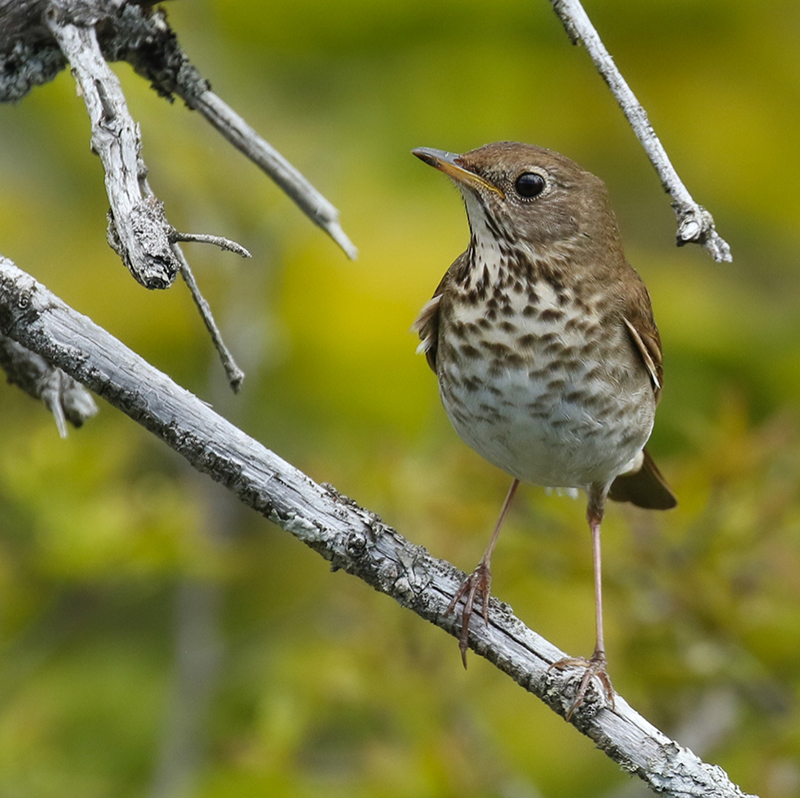
Bicknell’s Thrush is classified as Vulnerable by the IUCN. (Photo by Alex Berryman, ML165158591)
BirdsCaribbean brings you highlights from the Journal of Caribbean Ornithology in our feature “Recently Published in JCO.” Here, Zoya Buckmire, the Lead Copy Editor for the Journal of Caribbean Ornithology, explores how researchers are using data that spans decades to examine the overwinter status of Bicknell’s Thrush.
Birds connect our world—as the 2020 World Migratory Bird Day theme so succinctly asserts. The Nearctic-Neotropical migrants that breed up north “belong” as much to the Caribbean as they do to North America. This is true even for range-restricted species. The Bicknell’s Thrush (Catharusbicknelli), an unassuming and elusive thrush found only in a narrow corridor along the eastern US and Canada, overwinters exclusively in the Greater Antilles. The Dominican Republic boasts the majority of this species’ suitable overwintering habitat, with Cuba a distant second, followed by Jamaica, Haiti, and Puerto Rico. Unfortunately, Bicknell’s Thrush is considered Vulnerable by the IUCN, and the threats faced by this species are multiple and varied across both its northern breeding ground and Caribbean overwintering ground. Full annual cycle conservation means identifying—and conserving—habitat across its range.
In this paper by Christopher Rimmer and colleagues, we learn a bit more about the Bicknell’s Thrush’s distribution and status in Cuba, from surveys as far back as 1998. This study compared data from two different sampling seasons conducted by different teams, a method we discussed in our recent blog, to make the most of available data. To get a bit more insight into how this collaborative and multi-decadal paper came to be, we reached out to Chris and his co-authors with some questions.
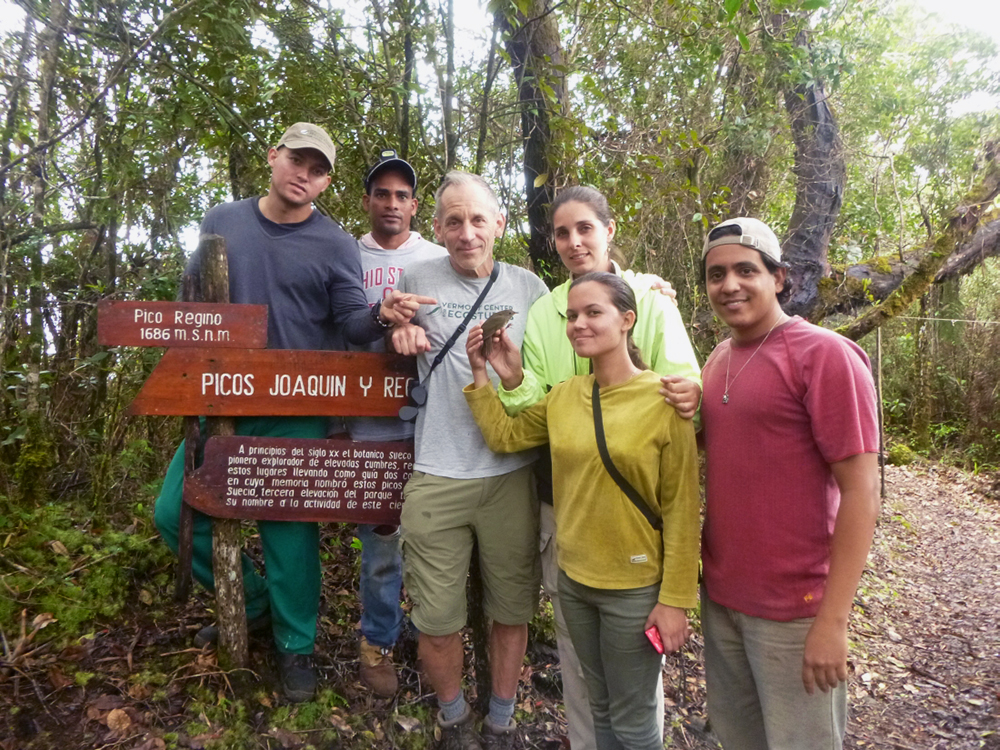
VCE-BIOECO field team with the first Bicknell’s Thrush ever to receive a Cuban bird band, #TA0242, 29 January 2018. From left: Jose Ramon Fuentes, Amauris Rapado Cruzata, Chris Rimmer, Carmen Placencia Leon, Leydis Sanchez Zaldivar, Allan Mendez Hernandez. (Photo courtesy the Vermont Center for Ecostudies)
We first delved, of course, into the conception and motivation for this research; why Cuba?
As part of an international effort to understand the full life cycle ecology and conservation needs of Bicknell’s Thrush (BITH), it became clear that we needed to know the species’ overwinter status on Cuba. Both phases of this study (1998-2005 and 2017-2020) aimed to clarify the distribution and habitat use of BITH on Cuba. Prior to the Canadian Wildlife Service (CWS) surveys in 1998-2005, we had no direct evidence that BITH overwintered on the island—but eastern Cuba’s extensive and largely intact montane forests begged for focused surveys. The exploratory CWS surveys confirmed the species’ presence at high elevations in Sierra Maestra and established a reference to guide future efforts. The 2017 Conservation Action Plan for BITH articulated an explicit goal to clarify the species’ status in Cuba, and that motivated our 2017-2020 follow-up surveys.
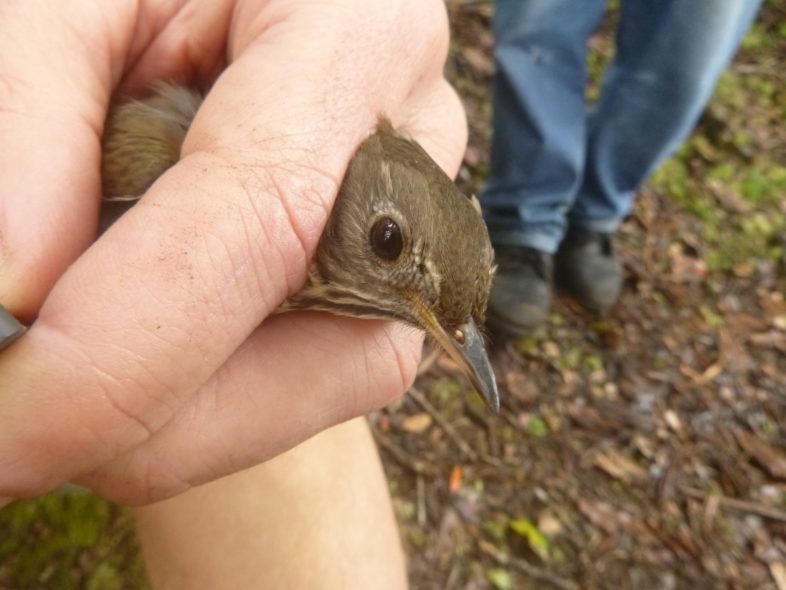
BITH #TA0242, the first Bickell’s Thrush to ever receive a Cuban band. (Photo courtesy the Vermont Center for Ecostudies)
We were not surprised to learn that field surveys in the remote mountains of Cuba were… adventurous to say the least. But with great effort comes great reward:
It is nearly impossible to highlight a single moment or experience that stands out above the rest. For me, one is hiking up the absurdly steep trail from our base camp at 1365 m elevation in pre-dawn darkness and covering 11 km to reach the summit of Pico Turquino at dawn. Being the only humans on Cuba’s highest peak as the sun rose and dawn chorus unfolded was a magical moment.
A second stand-out memory involves our 2019 expedition to Pico Bayamesa, a remote section of Sierra Maestra that required a grueling hike with backpacks into terrain that may never before have been visited by humans! The combination of genuine adventure, camaraderie with my Cuban colleagues in the face of physical challenges, and hard-won encounters with both BITH and endemics was unforgettable.
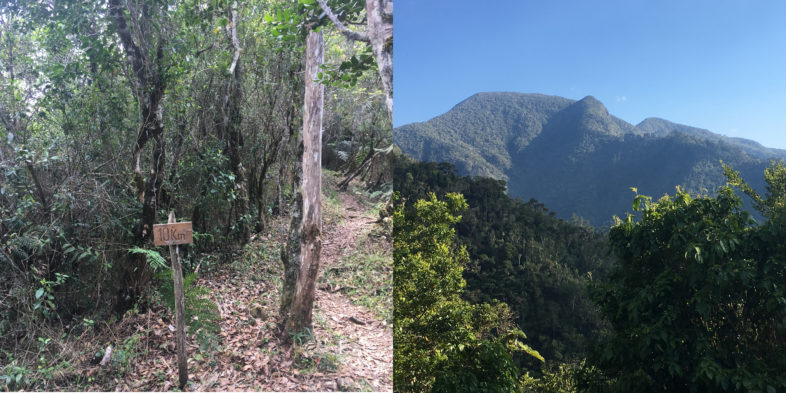
Right: dense cloud forest at km 10 on the 13-km trail to Pico Turquino; left: Pico Turquino at 1,974 m elevation. (Photos courtesy the Vermont Center for Ecostudies)
The data collection was also not without its challenges.
Co-author Yves Aubry chimed in to say: After discussion with Chris and colleagues from Vermont, the Canadian Wildlife Service took the lead during the 1998-2005 period because it was easier for Canadians to go and work in Cuba in that time. There was at that time no official winter record of BITH, so we found the species at the top of the Sierra Maestra after visiting many other lowland localities looking mostly for pine stands (habitat used in Dominican Republic). The first BITH call heard from a distance in the western steep slopes of Pico Cuba was an exciting moment for the whole team in 1998. The organization of such an expedition was a challenge—just to get the proper authorizations and all paperwork that involved the defense, protected areas, and sciences departments (national, provincial, and regional levels) was a serious task for our Cuban colleagues, at least for the first period. After those bureaucratic steps were done, the collaboration was really an asset for the success of the expedition.
Chris: as Yves mentioned, permitting and logistics were a perpetual challenge, one that we managed to overcome each winter thanks to the persistence and negotiating tact of our Cuban colleagues at BIOECO (Centro Oriental de Ecosistemas y Biodiversidad). The primary other challenge had to be the physical hardships of backpacking to our high-elevation study sites. None of Sierra Maestra’s high peaks are accessible by road, and this project was the most physically taxing of any during my 30+ years studying BITH in the Greater Antilles.
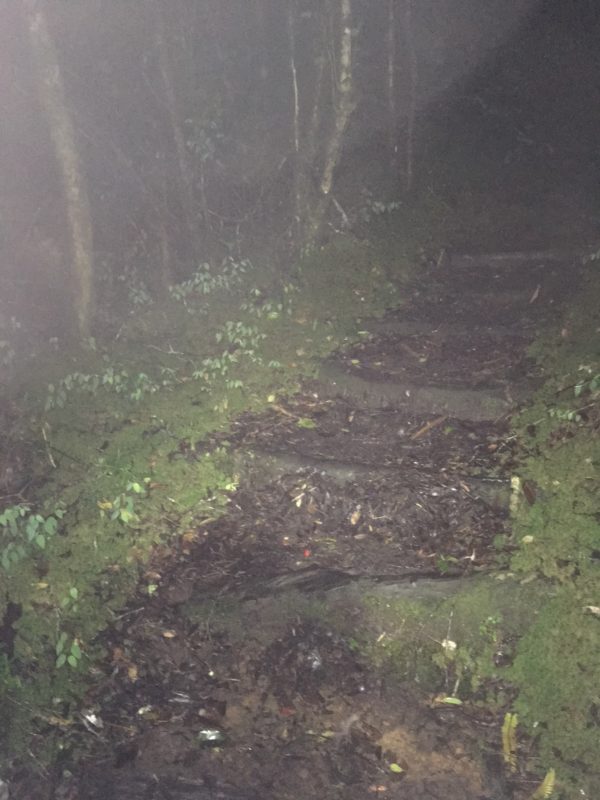
The daily headlamp-illuminated, pre-dawn ascent to Pico Joaquin. (Photo courtesy the Vermont Center for Ecostudies)
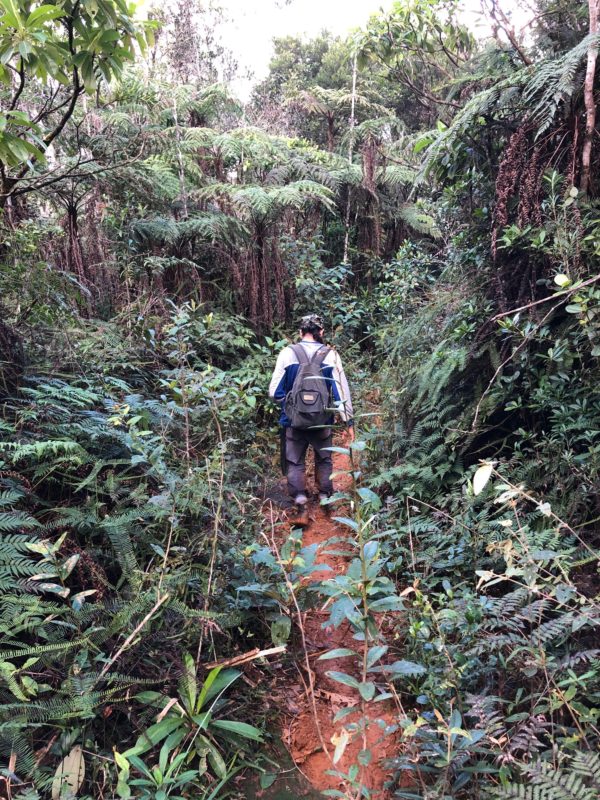
The dense, wet pluvisilva forest on the El Toldo plateau of Parque Nacional Humboldt seemed suitable for Bicknell’s Thrush, but the VCE-BIOECO team found none during a week of intensive surveying. (Photo courtesy the Vermont Center for Ecostudies)
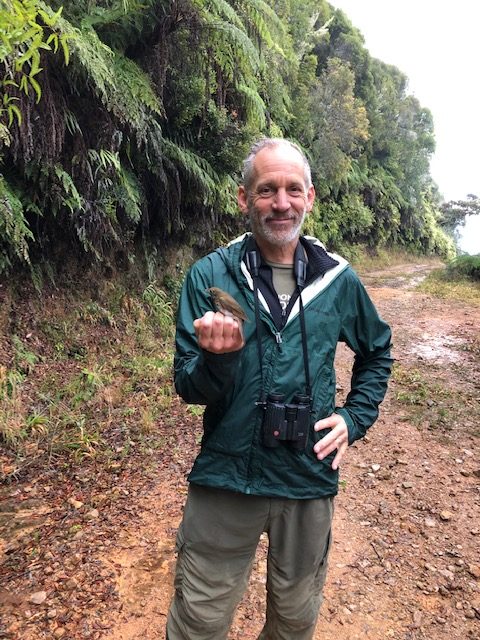
A hard-earned Bicknell’s Thrush banded at Pico Botella in Cuba’s Sierra Maestra. (Photo courtesy the Vermont Center for Ecostudies)
The authors have high hopes for what this research will lead to, and the future of conservation planning for this species.
Our work confirms the importance of eastern Cuba’s high-elevation forests as a secure wintering area for BITH. We now know that the species is effectively limited to cloud forests in Sierra Maestra and that it occurs in these at fairly low densities, such that there appears to be a smaller overall population than we’d anticipated, given how much seemingly suitable habitat exists. I believe our most significant result is that these findings confirm the strategic importance of Hispaniola—and specifically the Dominican Republic—as the primary target for conservation efforts directed at BITH (the paper’s final paragraph sums that up well). So, in the sense that the international BITH conservation research agenda is now doubled down on the DR, this work definitely impacted priority setting for the species.
In closing, Chris expressed his awe and gratitude to the team that came together to make this study happen: If anything, the pulling together of this paper required much collaboration and choreography! With 9 coauthors from 3 countries and two disparate sampling periods, it was in many respects the most challenging (and time-consuming!) paper I have led over my career. I’m proud of how everyone contributed and worked together to ensure that the paper was JCO-worthy.
This work was made possible by the dedicated commitment of researchers and scientists across countries and decades, and various organizations from the Vermont Center for Ecostudies and Environment and Climate Change Canada/Canadian Wildlife Service to on-the-ground partners BIOECO, UNEP Corredor Biológico en el Caribe, and Instituto de Ecología y Sistemática de Ciudad de la Habana. It just goes to show what is possible when we come together across borders to study and protect our common species.
An estimated 90% of the Bicknell’s Thrush population individuals overwinters in Hispaniola’s dense, humid broadleaf forests. (Photo by BirdsCaribbean)
You can learn more about (and visit!) the Bicknell’s Thrush’s major overwinter habitat if you join us in the Dominican Republic this summer! Head over to our conference website to learn all about our incredible keynotes (including Chris’s!), skills-building workshops, insightful symposia, thrilling pre, mid, and post-conference field trips, and to get registered! You don’t want to miss this!
The Journal of Caribbean Ornithology is a peer-reviewed journal covering all aspects of ornithology within the Caribbean region, publishing in English, Spanish, and French. We welcome manuscripts covering the biology, ecology, behavior, life history, and conservation of Caribbean birds and their habitats. The JCO also publishes conservation reports and mentors inexperienced authors to help them develop their manuscript for publication. The JCO relies on donations to keep all of our publications free and open-access. Support our non-profit mission and give a voice to Caribbean ornithologists and their work by becoming a supporter of JCO.
Celebrate the Caribbean Endemic Bird Festival (CEBF) with us! Our theme in 2024 is “Protect Insects, Protect Birds”—highlighting the importance of protecting insects for birds and our environment. Have fun learning about a new endemic bird every day. We have colouring pages, puzzles, activities, and more. Download for free and enjoy learning about and celebrating nature!
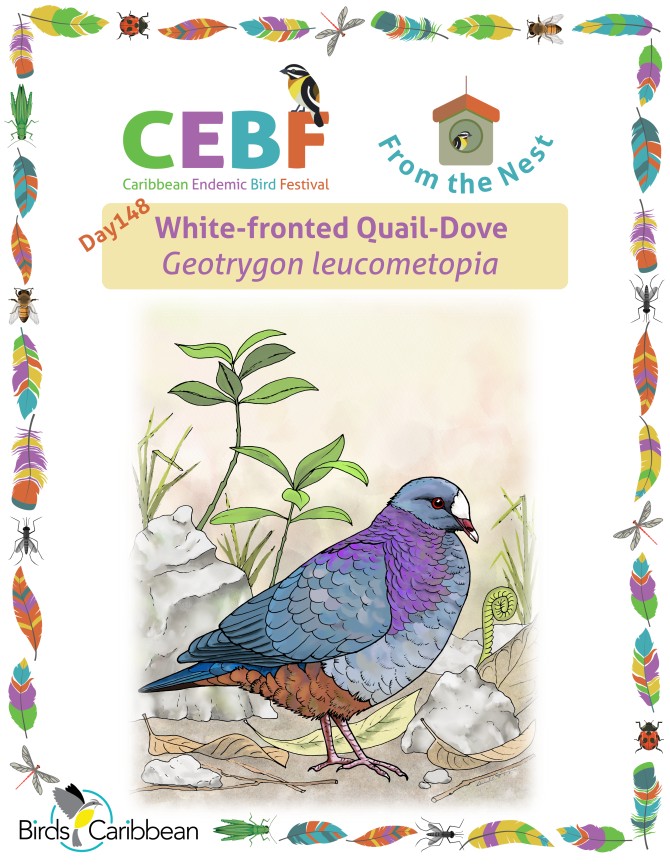
Endemic Bird of the Day: White-fronted Quail-Dove
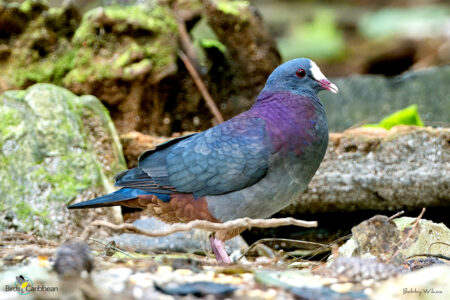
If you listen extra carefully while walking along remote, dense, humid forests on the central and southwest mountains of the Dominican Republic, you will hear a very hushed, low frequency “coo-o-o” call coming from the thick vegetation of the forest floor. So soft is this call that it can be quite hard to pinpoint where it’s coming from. But we can tell you who’s making that gentle sound—it’s the White-fronted Quail-Dove! This beautiful, plump, but also terribly shy bird, spends most of its time out of sight. Spotting this bird always presents a challenge to birdwatchers and nature photographers in the Dominican Republic where it is locally known as ‘azulona’! The White-fronted Quail-Dove belongs to the Columbidae family, which comprises doves and pigeons—including the bold ones you see around your homes and schools.
White-fronted Quail doves are medium-sized birds that measure 27-28 cm. The crown, nape, and sides of the head are slate gray; sides of the neck suffused with beautiful reddish purple or violet, sometimes extending onto the breast. Underparts are mostly gray, becoming rufous on the lower belly and under the tail. Its contrasting white forehead gives this dove its name and is a great field mark for identification. Its eyes are red and it has a reddish bill that is paler towards the tip. The legs are pink. Males and females look alike. Young birds are browner and lack the metallic sheen on the back and neck. This is the only quail-dove that lacks facial stripes.
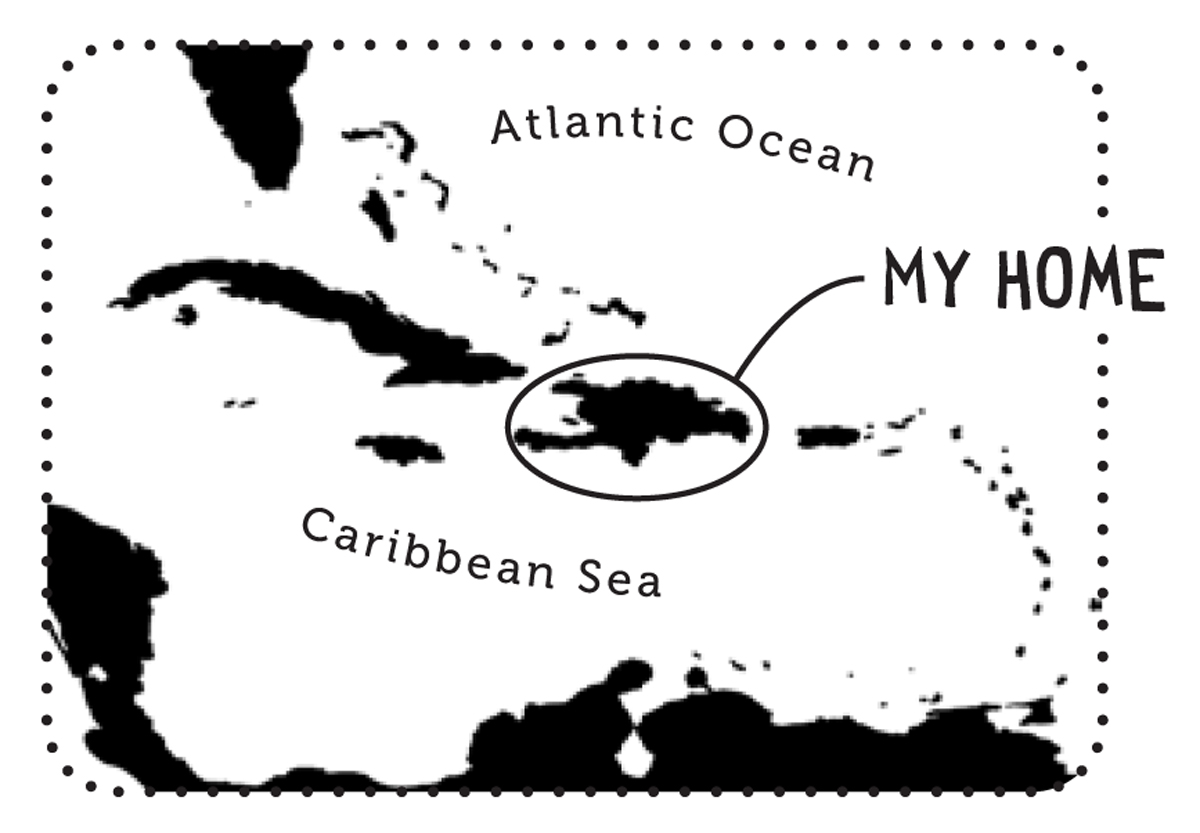
The White-fronted Quail-Dove is endemic to Hispaniola, restricted to the isolated, dense, moist montane forests on Sierra de Bahoruco and the Central Mountains of the Dominican Republic. It likely can no longer be found in Haiti due to high levels of deforestation. It’s found at elevations from 745 to 1,685 m. This quail-dove has also been reported in shade grown coffee plantations. Little is known about its breeding ecology however, except that it lays 1-2 beige eggs on a nest of twigs and leaves placed low in the undergrowth.
This bird spends most of the time on the ground where it looks for seeds and small invertebrates to eat. The easiest way to try to observe this stunning quail-dove is when it ventures out of the dense forest to forage in a semi-open clearing or along a forest trail. While it is usually very shy and hard to spot, if you are in the right habitat, and are very patient, it can show itself very well.
The White-fronted Quail-Dove is classified as Endangered by the IUCN because it has a single, very small population of fewer than 2,500 individuals, which has suffered a continuing decline due to on-going fragmentation, loss of habitat, hunting pressure, and the effects of introduced predators like the mongoose and feral cats. Cats are prolific predators—even if you don’t see your cuddly, well-fed cat catching wildlife, they may still be hunting. Keeping your cats indoors can protect birds and other wildlife from being killed. Keeping cats indoors isn’t just great for wildlife, it’s good for the cats—it keeps them safe from being attacked, getting lost, or being poisoned.
Thanks to Arnaldo Toledo for the illustration and Ivan Mota for the text!
Colour in the White-fronted Quail-Dove
Download our West Indies Endemic Bird colouring page. Use the photos below as your guide, or you can look up pictures of the bird online or in a bird field guide if you have one. Share your coloured-in page with us by posting it online and tagging us @BirdsCaribbean #CEBFfromthenest
Listen to the song of the White-fronted Quail-Dove
The song of White-fronted Quail-Dove is a repeated “oop-oop…”
Puzzle of the Day
Click on the image below to do the puzzle. You can make the puzzle as easy or as hard as you like – for example, 6, 8, or 12 pieces for young children, all the way up to 1,024 pieces for those that are up for a challenge!
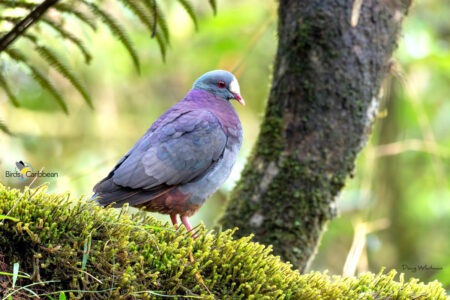
The White-fronted Quail-Dove is a shy bird that spends most of its time out of sight. This beautiful dove is one of the hardest species of birds to see in the Dominican Republic! It presents quite a challenge to bird watchers and photographers. (Photo by Doug Whitman, Macaulay Library-ML613246991)White-fronted Quail-Doves are endemic to the island of Hispaniola, restricted to remote dense humid montane forests on Sierra de Bahoruco and the Central Mountains of the Dominican Republic. It’s likely that this bird is no longer found in Haiti. (Photo by Bobby Wilcox. Macaulay Library-ML615097922)
Activity of the Day
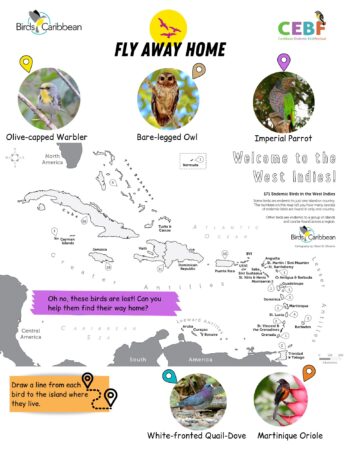
FOR KIDS : Test your knowledge of where Caribbean endemic birds live with our ‘Fly away home’ Map Matching Activity!
Draw lines from the picture of each Caribbean endemic bird to match each one with its home. You can find out more about Caribbean endemic birds by reading our posts each day or you can go back and find all the endemic birds that we have featured in previous years here. You can also find out all about our Endemic Birds of the West Indies Colouring Book with even more birds to colour in!
Here is the Answer Key – don’t look until you have completed the activity!!!
FOR KIDS AND ADULTS : Enjoy this video of a White-fronted Quail-Dove in the wild!
Celebrate the Caribbean Endemic Bird Festival (CEBF) with us! Our theme in 2024 is “Protect Insects, Protect Birds”—highlighting the importance of protecting insects for birds and our environment. Have fun learning about a new endemic bird every day. We have colouring pages, puzzles, activities, and more. Download for free and enjoy learning about and celebrating nature!
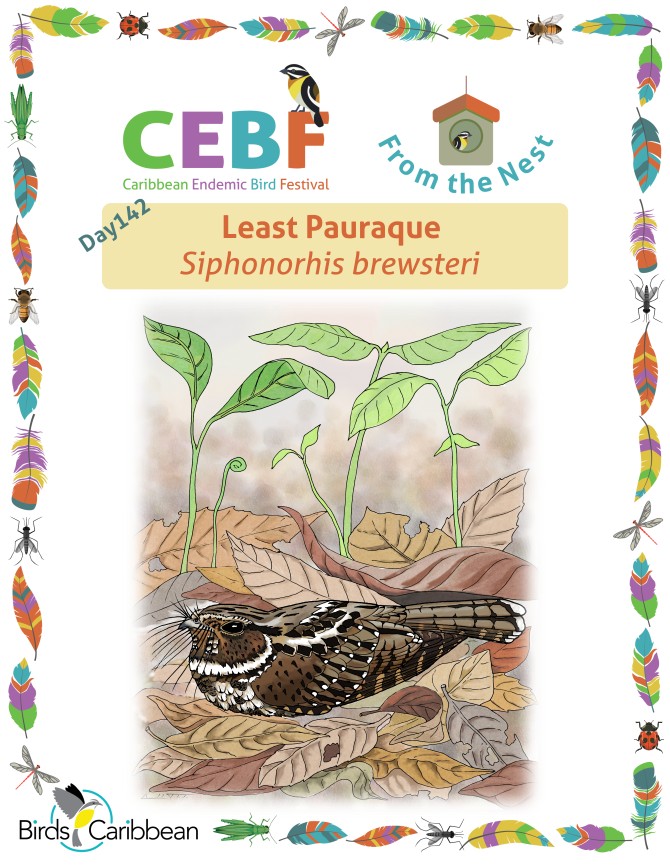
Endemic Bird of the Day: Least Pauraque
You’re enjoying a nice relaxing night in the southwestern dry forests of the Dominican Republic when you hear an eerie “twooorii” from the forest. Is it a ghost?? Or even worse—the fabled Chupacabra!?
Although the avian family name Caprimulgidae does actually hail from myths purporting that these birds suckled (chupa) on goats’ (cabra) udders, the Least Pauraque couldn’t be more of an adorable toasted marshmallow of a bird with no interest whatsoever in drinking goat milk. They are actually far more interested in eating nocturnal flying insects—which is great news for all of us who don’t fancy nights filled with mosquitos!
These birds are locally known as ‘Torico’. Their local names come from their guttural repeated “torico, torico” call.
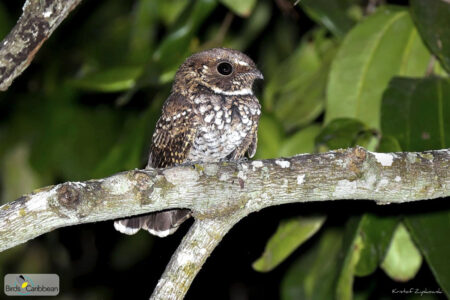
And while you might wander into the woods seeking to find the source of these spooky calls—you’ll be looking for a long time as these birds are masters of disguise! They are cryptically colored with streaked blackish-brown upper parts and a creamy white belly with feathers laced in blacks and browns. They wear a pearly white collar and search for insects with their huge, dark eyes—all the better for nocturnal foraging! You can tell them apart from Hispaniola’s other nightjar (the endemic Hispaniolan Nightjar) by the band across the end of their tail feathers which is white in males and buffy-cream in females. They also lack the white wing crescents of Antillean Nighthawk and much prefer perching and sallying to actively soaring like the nighthawks tend to do. While it might look like they can’t catch much in their tiny beaks, their mouths actually open very wide to catch unsuspecting insects.
Whilst they do share Hispaniola with several other nightjars, the Least Pauraque is unique in their genus! They used to share their genus with the Jamaican Pauraque, which although discovered first in 1758, has not been seen or detected since 1860. The Least Pauraque on the other hand is newer to science, having been described in 1917 and was later assigned to the same unique genus in 1928 by the notable James Bond.
You can find them in arid or semi-arid lowlands of Hispaniola. They are big fans of scrubby limestone woodlands filled with prickly cactus and thorn scrub, though they have also been recorded in deciduous, coniferous, and other mixed forests spanning from sea level up to 800m in elevation. The best spot to find the Least Pauraque is the Sierra de Bahoruco mountain range in the southwest of the Dominican Republic.
While not globally threatened, these adorable bug-eaters are considered near-threatened. Since they are hard to find and thus hard to count, we can only roughly estimate their population which is believed to be between 6,000-15,000 individuals. This population is suspected to be in a slow decline. Their current status in Haiti is not well known, wide-scale deforestation for agriculture and charcoal production mean they have lost much of their preferred habitat. In fact, there were no records of Least Pauraque in Haiti between 1928 and 1969! They are known at 16 widespread locales in the Dominican Republic—however, their cryptic plumage keeps them well hidden and it is believed that they likely occupy more areas than these. Continued threats include predation from introduced rats and mongoose, and continued forest loss for agriculture.
While decisions about protecting habitats from unsustainable development that can threaten the Least Pauraque are often in the hands of policy makers, you can still help your backyard birds thrive! Just like the Least Pauraque there are other birds, like the Gray Kingbird and Greater Antillean Bullfinch, that like to feed on crunchy and gooey insects. Avoid using insecticides so that these birds will have enough insects to munch on and keep coming back to your garden.
Thanks to Arnaldo Toledo for the illustration and Holly Garrodfor the text!
Colour in the Least Pauraque
Download our West Indies Endemic Bird colouring page. Use the photos below as your guide, or you can look up pictures of the bird online or in a bird field guide if you have one. Share your coloured-in page with us by posting it online and tagging us @BirdsCaribbean #CEBFfromthenest
Listen to the calls of the Least Pauraque
The calls of the Least Pauraque include a rising whistle “tooooooeeeeeee,” and a three syllable trilled “oo-weee-oo.”
Puzzle of the Day
Click on the image below to do the puzzle. You can make the puzzle as easy or as hard as you like – for example, 6, 8, or 12 pieces for young children, all the way up to 1,024 pieces for those that are up for a challenge!
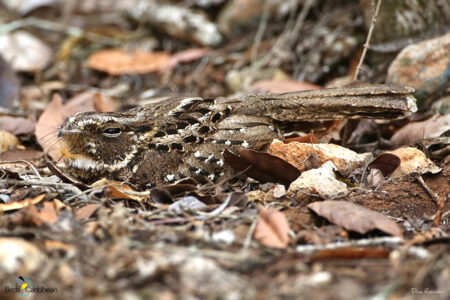
Least Pauraque perched. These birds specialize in catching and feeding on flying insects. While it might look like they can’t catch much in their tiny beak, their mouths actually open very wide! (Photo by Kristof Zyskowski, Macaulay Library-ML174412081)Least Pauraque camouflaged in leaf litter. These birds are masters of disguise. The best habitats to look for them in are the arid or semi-arid lowlands of Hispaniola. They are big fans of scrubby limestone woodlands filled with cactus and thorn scrub. (Photo by Dax Roman)
Activity of the Day
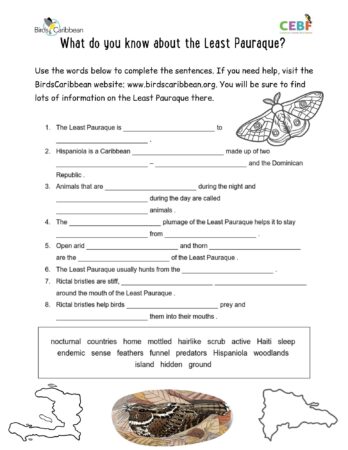
FOR KIDS : What facts can you remember about today’s endemic bird – the Least Pauraque? Test your knowledge by filling in the missing words in our Least Pauraque facts! We have given you all the correct words to use but can you put them into the right fact?
You can re-read the information all about this bird above, or search on the BirdsCaribbean webpages or online for more information about the Least Pauraque! Then, when you have completed all the sentences, you can check your answers here.
FOR KIDS AND ADULTS : Enjoy this video of a Least Pauraque in the wild!
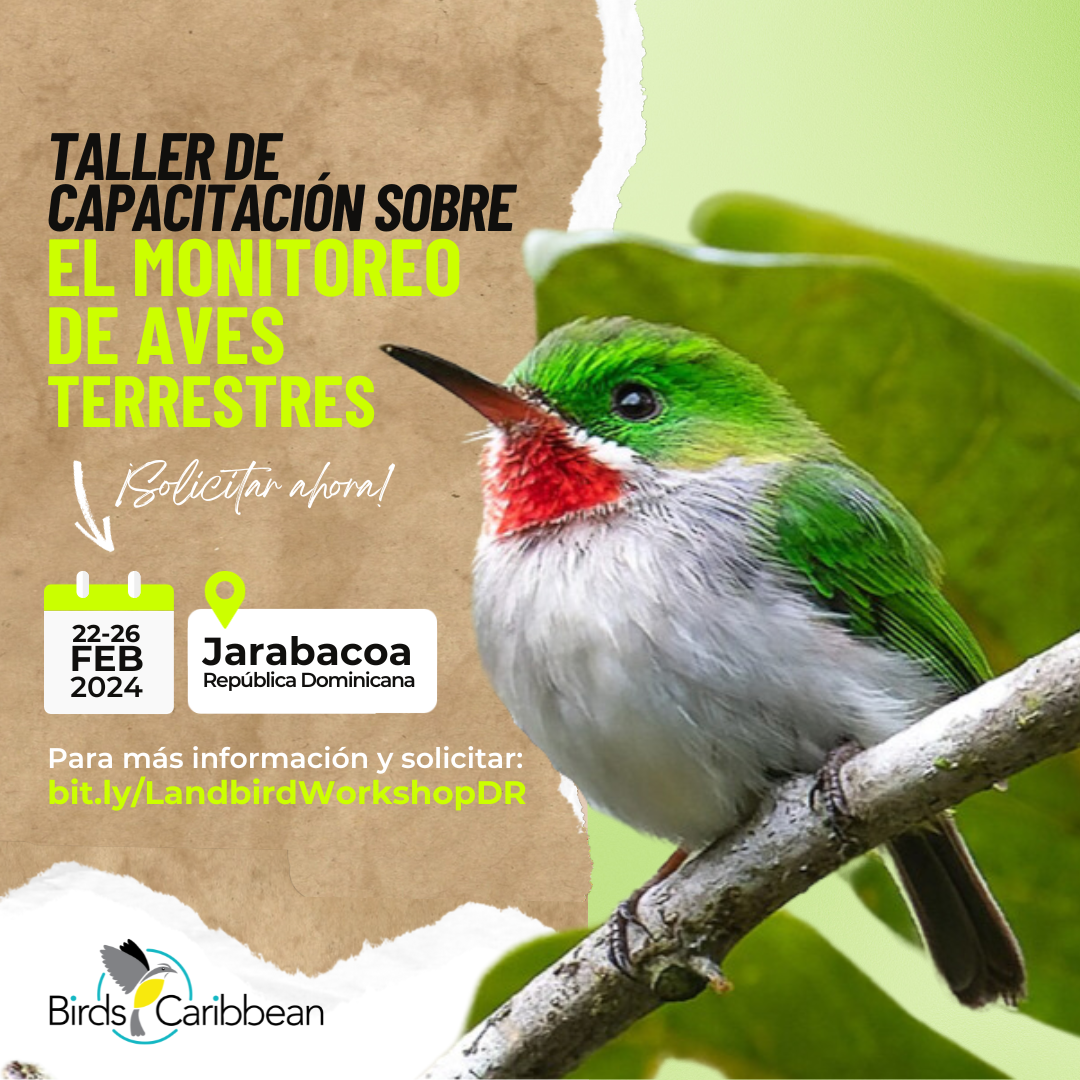
BirdsCaribbean is excited to invite applications to participate in a 5-day training workshop focused on the monitoring and conservation of landbirds in the Caribbean. Through a blend of classroom and field-based activities, this comprehensive workshop will cover landbird identification, monitoring techniques, eBird data entry, and more. The workshop will take place at Rancho Baiguate in Jarabacoa, Dominican Republic from February 22-26, 2024.
Why do we need to monitor landbirds?
Our landbird species are declining, including many resident and endemic birds, as well as over 100 migratory species. Monitoring is essential to fill gaps in our knowledge about the status, trends, and habitat use of their populations.
This training workshop is part of BirdsCaribbean’s Landbird Monitoring Program that aims to build capacity to monitor and conserve landbirds in the Caribbean. The long-term goal of this program is to enhance full life cycle (i.e. year-round) conservation of Caribbean landbirds. Working with our many partners, we are building regional networks to increase landbird monitoring and research, raise awareness and appreciation of our landbirds, and enable on-the-ground conservation actions.
About the workshop
This “train the trainer” workshop is designed for Caribbean wildlife professionals and volunteers who are interested in expanding or establishing a landbird monitoring program.
The purpose of the workshop is to:
Share information on landbirds in the Caribbean and the threats that they face
Provide participants with the knowledge and skills to train a monitoring team and institute a sustainable, local landbird monitoring program
Inspire and facilitate landbird monitoring and conservation efforts, including raising public awareness, alleviating threats, and managing and restoring habitats
Build a regional network of people involved in standardized monitoring and conservation of our shared landbirds
Workshop participants will learn about the Programa de América Latina para las Aves Silvestres (PROALAS) bird survey protocols. Developed in Latin America to target tropical habitats, the manual for these protocols includes detailed guidance on designing and implementing multi-level survey methods. The manual also incorporates the use of eBird as a user-friendly data entry and storage platform, and outlines occupancy-based analysis of monitoring data.
During daily field trips, we will practice landbird identification and survey techniques. After the workshop, participants will have the opportunity to apply for a small grant to implement or expand their own landbird monitoring and conservation projects, ideally including training of others in their organizaton or community.
Bicknell’s Thrush. Classified as Vulnerable by the IUCN, 80-90% of the total population winters on Hispaniola. (Alex Berryman – ML165158591)
Fieldwork in the beautiful countryside of Jarabacoa, Dominican Republic.
Hispaniolan Trogon perched in a tree. (Photo by Jose M. Pantaleon)
Topics to be covered in the 5-day workshop include:
Overview of the PROALAS Manual survey protocols
Guidance on how to design and implement a monitoring program
Field training to identify and count landbirds
Threats to landbirds and their habitats, and strategies to conserve and manage them
Case studies for successful landbird monitoring and conservation
Data entry and use of e-bird as a data storage platform
This workshop is the third in our series aimed at increasing Caribbean capacity to monitor and conserve our region’s landbirds. It will cover many of the same topics explored in our previous Caribbean Landbird Monitoring Training workshops held in the Dominican Republic (February 2022) and St. Vincent (January 2023).
Funding and logistics
We are aiming to include approximately 24 participants in this workshop. BirdsCaribbean has funding for a limited number of need and merit-based scholarships to cover the costs of travel and participation. Participants who are able to contribute all or part of their costs can help us enhance the workshop content and allow us to include additional participants/trainers. We encourage applications from all candidates who are well suited to use this training to implement landbird monitoring programs on their home islands, regardless of their financial ability. Participants should plan to arrive in the Dominican Republic on February 21st and depart on February 27th.
Applications
If you are interested in participating in this workshop, please fill out this form by December 1, 2023.
Rancho Baiguate is an eco-lodge in the Jarabacoa valley of the Cordillera Central of the Dominican Republic. At 500m elevation, Jarabacoa is known as the “city of eternal spring,” with warm sunny days and cool refreshing evenings. Rancho Baiguate is located on the Rio Baiguate, where participants can walk through restored riparian tropical forest and mixed edge habitat within sustainable agriculture. Birds abound in these varied habitats, and participants will easily see many of Hispaniola’s charismatic endemic bird species, including the two beloved todies (Broad-billed Tody and Narrow-billed Tody) and the national bird, the Palmchat. The town of Jarabacoa is an easy 5 minute drive from the lodge, and participants can visit any of the three stunning waterfalls nearby. Field trips may include visits to nearby reserves such as Ebano Verde. After the workshop, participants are welcome to extend their stay and try any of Rancho Baiguate’s adventurous activities including white water rafting, canyoning, or horse back riding. Come learn more about landbird monitoring with some of the Dominican Republic’s finest birds!
If you have any questions, please send an email to Maya Wilson ([email protected]).
BirdsCaribbean would like to thank J.C. Fernández-Ordóñez for Spanish translation.
Oportunidad de adiestramiento: Taller de capacitación para el monitoreo de aves terrestres en el Caribe
BirdsCaribbean se complace en invitar solicitudes para participar en un taller de capacitación de 5 días centrado en el monitoreo y la conservación de las aves terrestres en el Caribe. A través de una mezcla de actividades en el aula y en el campo, este taller cubrirá la identificación de aves terrestres, técnicas de monitoreo, entrada de datos a eBird, y mucho más. El taller tendrá lugar en Rancho Baiguate en Jarabacoa, República Dominicana, del 22 al 26 de febrero de 2024.
¿Por qué necesitamos monitorear las aves terrestres?
Nuestras especies de aves terrestres están disminuyendo, incluidas muchas aves residentes y endémicas, así como más de 100 especies migratorias. El seguimiento es esencial para colmar las lagunas de nuestros conocimientos sobre el estado, las tendencias y el uso del hábitat de sus poblaciones.
Este taller de capacitación forma parte del Programa de Seguimiento de Aves Terrestres de BirdsCaribbean, cuyo objetivo es desarrollar la capacidad de seguimiento y conservación de las aves terrestres en el Caribe. El objetivo a largo plazo de este programa es mejorar la conservación del ciclo vital completo (es decir, durante todo el año) de las aves terrestres del Caribe. Trabajando con nuestros numerosos socios, estamos creando redes regionales para aumentar el seguimiento y la investigación de las aves terrestres, aumentar la concienciación y la apreciación de nuestras aves terrestres, y permitir acciones de conservación sobre el terreno.
Acerca del taller
Este taller de “formación de formadores” está dirigido a profesionales y voluntarios de la vida silvestre del Caribe interesados en ampliar o establecer un programa de seguimiento de aves terrestres.
Los objetivos del taller son:
Compartir información sobre las aves terrestres en el Caribe y las amenazas a las que se enfrentan.
Proporcionar a los participantes los conocimientos y habilidades para formar un equipo de monitoreo e instituir un programa local sostenible de monitoreo de aves terrestres.
Inspirar y facilitar los esfuerzos de monitoreo y conservación de las aves terrestres, incluyendo la sensibilización del público, la mitigación de las amenazas, y la gestión y restauración de los hábitats.
Crear una red regional de personas implicadas en el seguimiento normalizado y la conservación de las aves terrestres que compartimos.
Los participantes en el taller conocerán los protocolos de estudio de aves del Programa de América Latina para las Aves Silvestres (PROALAS). El manual de estos protocolos, desarrollado en América Latina para los hábitats tropicales, incluye orientaciones detalladas sobre el diseño y la aplicación de métodos de estudio multinivel. El manual también incorpora el uso de eBird como una plataforma de entrada y almacenamiento de datos fácil de usar, y esboza el análisis basado en la ocupación de los datos de seguimiento.
Durante las salidas diarias al campo, practicaremos técnicas de identificación y estudio de aves terrestres. Tras el taller, los participantes tendrán la oportunidad de solicitar una pequeña subvención para poner en marcha o ampliar sus propios proyectos de seguimiento y conservación de aves terrestres, incluyendo idealmente la formación de otras personas de su organización o comunidad.
Zorzal de Bicknell. Clasificado como Vulnerable por la UICN, el 80-90% de la población total pasa el invierno en La Española.
Trabajo de campo en la hermosa campiña de Jarabacoa, República Dominicana.
Trogón de La Española perchado en un árbol.
Los temas que se tratarán en el taller de 5 días incluyen:
Descripción general de los protocolos de estudio del Manual PROALAS.
Orientación sobre cómo diseñar e implementar un programa de monitoreo.
Formación sobre el terreno para identificar y contar aves terrestres.
Amenazas para las aves terrestres y sus hábitats, y estrategias para conservarlas y gestionarlas.
Casos prácticos de éxito en el seguimiento y la conservación de las aves terrestres.
Introducción de datos y uso de eBird como plataforma de almacenamiento de datos.
Este taller es el tercero de nuestra serie destinada a aumentar la capacidad del Caribe para monitorear y conservar las aves terrestres de nuestra región. Cubrirá muchos de los mismos temas explorados en nuestros anteriores talleres de capacitación en monitoreo de aves terrestres del Caribe celebrados en la República Dominicana (febrero de 2022) y San Vicente (enero de 2023).
Financiación y logística
Nuestro objetivo es contar con aproximadamente 24 participantes en este taller. BirdsCaribbean cuenta con financiación para un número limitado de becas basadas en la necesidad y el mérito para cubrir los costes de viaje y participación. Los participantes que puedan contribuir con la totalidad o parte de sus costes pueden ayudarnos a mejorar el contenido del taller y permitirnos incluir más participantes/formadores. Animamos a presentar solicitudes a todos los candidatos que estén en condiciones de aprovechar esta formación para poner en marcha programas de seguimiento de aves terrestres en sus islas de origen, independientemente de su capacidad financiera. Los participantes deberán llegar a la República Dominicana el 21 de febrero y partir el 27 de febrero.
Solicitudes
Si está interesado en participar en este taller, complete este formulario antes del 1 de diciembre de 2023.
Rancho Baiguate es un eco-lodge en el valle de Jarabacoa de la Cordillera Central de la República Dominicana. A 500 metros de altitud, Jarabacoa es conocida como la “ciudad de la eterna primavera”, con días cálidos y soleados y tardes refrescantes. Rancho Baiguate está situado en el Río Baiguate, donde los participantes pueden caminar por el bosque tropical ribereño restaurado y el hábitat de borde mixto dentro de una agricultura sostenible. Las aves abundan en estos variados hábitats, y los participantes verán fácilmente muchas de las carismáticas especies de aves endémicas de La Española, incluidos los dos queridos todies (Broad-billed Tody y Narrow-billed Tody) y el ave nacional, el Palmchat. La ciudad de Jarabacoa está a 5 minutos en coche del lodge, y los participantes pueden visitar cualquiera de las tres impresionantes cascadas cercanas. Las excursiones pueden incluir visitas a reservas cercanas como la de Ebano Verde. Después del taller, los participantes pueden prolongar su estancia y probar cualquiera de las actividades de aventura de Rancho Baiguate, como rafting, barranquismo o equitación. ¡Venga a aprender más sobre el monitoreo de aves terrestres con algunas de las mejores aves de la República Dominicana!
Si tiene alguna pregunta, envíe un correo electrónico a Maya Wilson ([email protected]).
BirdsCaribbean agradece a J.C. Fernández-Ordóñez por la traducción al español.
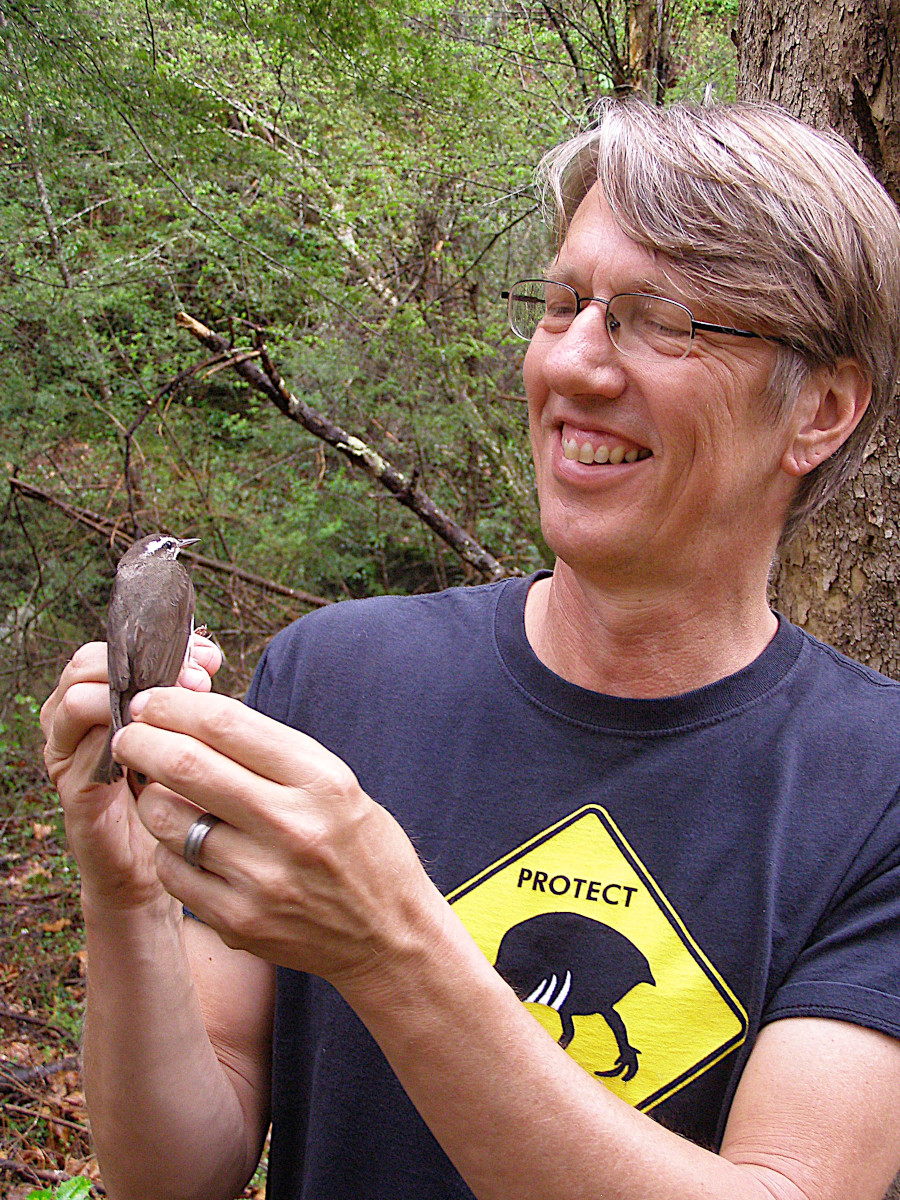
Steven Latta assessing the condition of a banded Louisiana Waterthrush. Photo by Bob Mulvihill.
The Louisiana Waterthrush is a neotropical migratory warbler that links North America, where it breeds, to the Caribbean, where is spends the winter. Steven Latta PhD has worked on this species for more than a decade. Here he shares some fascinating insights into how water quality impacts the health and survival of this small bird, and what this means for people as well as birds.
Clean water is something that is essential to each and every one of us. There is, however, a rising tide of water quality threats facing Neotropical migratory birds – both in their North American breeding grounds and their Caribbean wintering spots. Water pollution and water diversions can wreak havoc on the quality of the water that supports plant, animal and aquatic life. This also negatively impacts the health and welfare of humans who also depend on that water resource.
I have used a migratory songbird, the Louisiana Waterthrush, for more than a decade to monitor changes in water quality, and to understand the impacts of water quality on birds and other life that depend on riparian ecosystems – that is, rivers, streams and wetlands.
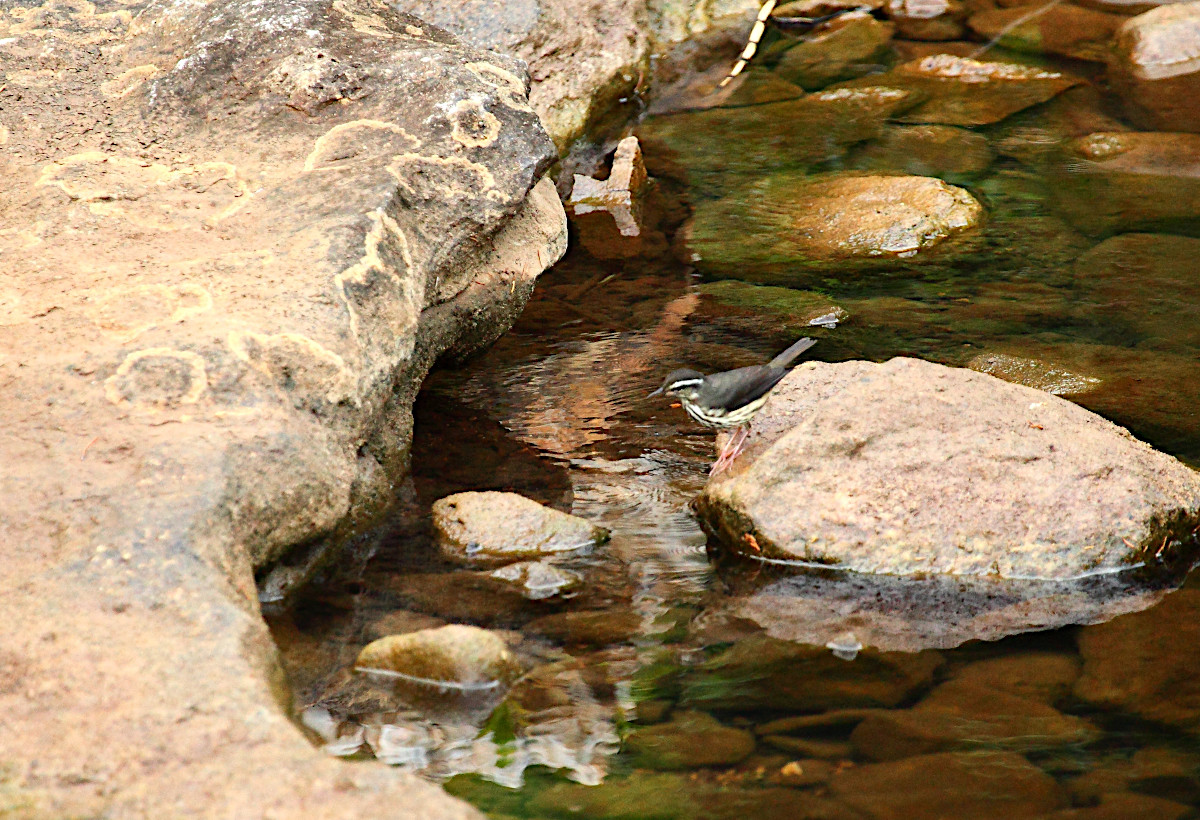
Although somewhat reminiscent of a thrush, the Louisiana Waterthrush is actually a large, mostly terrestrial warbler. It is uniformly dark olive-brown above and white below, with dark brown streaks on its breast and sides, and flanks washed buffy. Distinctive field marks include a white supercilium (eyebrow stripe) which flares and broadens behind the eye, and an unspotted white throat. In both its breeding and wintering grounds, the waterthrush inhabits freshwater streams and associated riparian vegetation in forested hills and mountains. The Louisiana Waterthrush is considered a Species of Conservation Concern in several Bird Conservation Regions. Its dependence on a specialized habitat, now threatened by a number of environmental stressors, makes the species more vulnerable.
The Louisiana Waterthrush, Parkesia motacilla, a bioindicator of water quality and ecosystem integrity in forested headwater streams. Photo by Mike Doughtery.
Waterthrush Warnings
Long-term studies in Pennsylvania and the Dominican Republic have sought to understand the role of water quality and other factors in determining the population size of the Louisiana Waterthrush
In the Caribbean, Louisiana Waterthrush are solitary and territorial. They forage mostly on the ground by walking in a deliberate manner along the water’s edge, jumping over obstacles, characteristically bobbing and teetering, as they capture aquatic insects and similar prey.
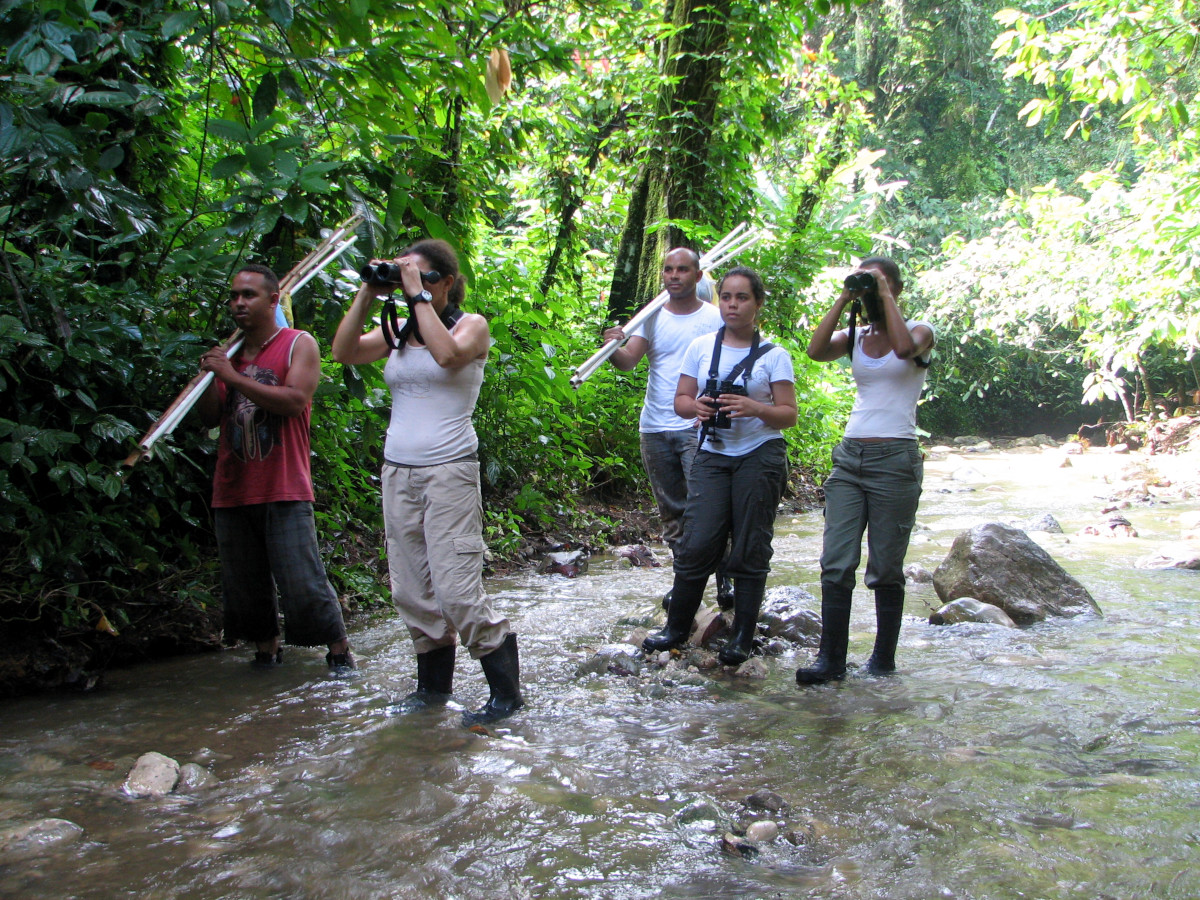
I have worked closely with my colleagues, Danilo Mejía and Maria Paulino, from the Dominican environmental organization, Grupo Acción Ecológica, in a long-term study of this charismatic species. Every year, our work has taken us from studies in wintering areas in the Cordillera Septentrional of the Dominican Republic, to research in the breeding grounds in the Laurel Highlands of Pennsylvania.
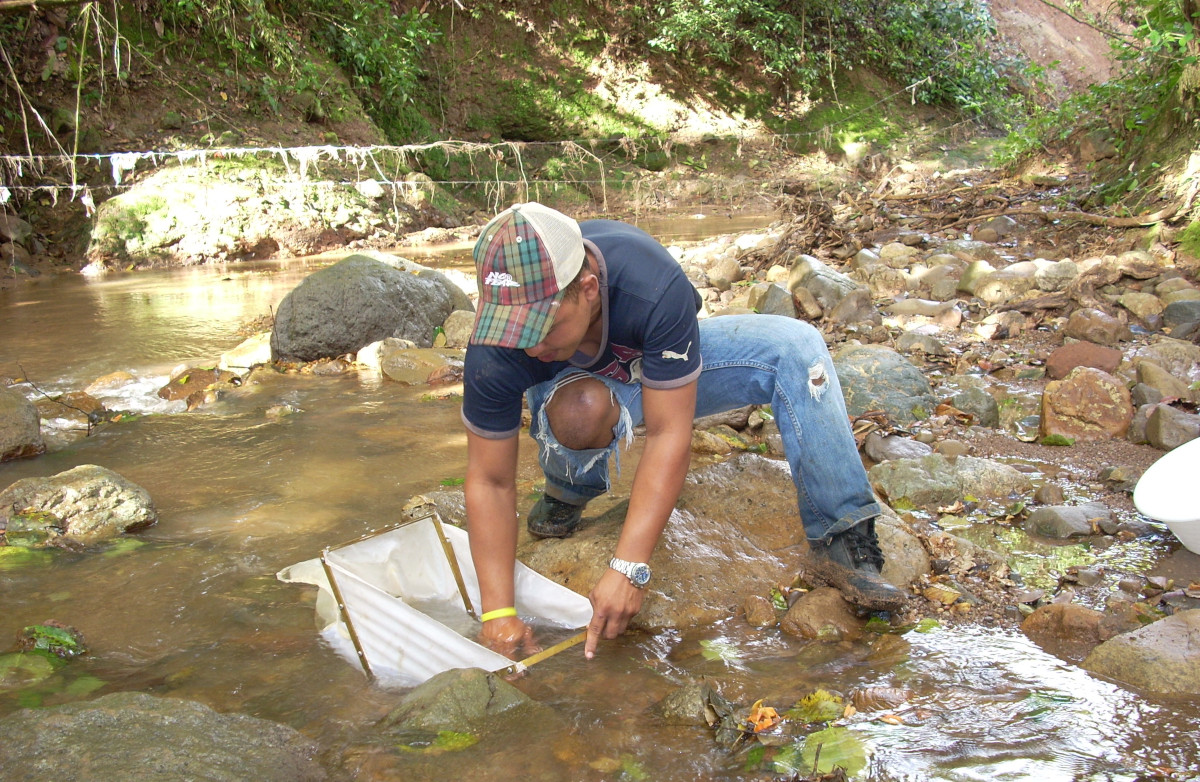
At both ends of the annual cycle, we have shown how the waterthrush can serve as a warning sign, pointing to the deteriorating condition of waterways, and the presence of toxins and harmful chemicals. In areas where the bird breeds such as Pennsylvania, water quality is affected by acid precipitation, acid mine drainage from abandoned coal mines and agricultural run-off. Most recently. metals associated with hydraulic fracturing for natural gas deposits have impacted the condition of the fresh water. On the wintering grounds, the sites we visit suffer adverse effects from sedimentation and run-off from agriculture and human settlements.
Water Quality: A Critical But Deteriorating Factor
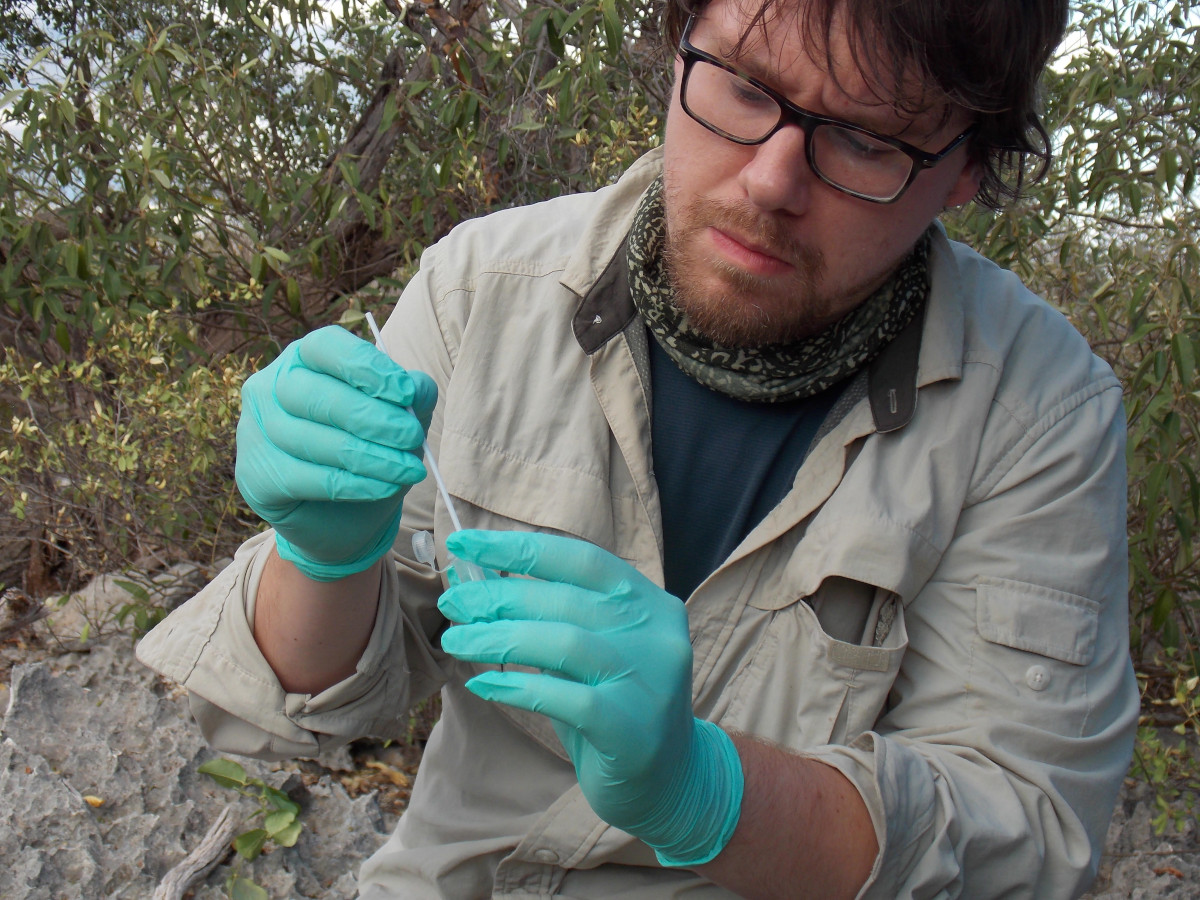
By tracking nesting, breeding success, and survival of individual birds, we have been able to quantify the impacts of reduced water quality. Contamination may directly impact the Louisiana Waterthrush. For example, we have shown that because of its position at the top of the food chain along rivers and streams, the waterthrush will accumulate within its body the metals associated with hydraulic fracturing of deep shale layers for natural gas. Studies with our collaborator, Mack Frantz, have further suggested that this shale gas development may even result in epigenetic effects on gene expression in waterthrush. This means there may be changes in the genetic structure itself that may affect long‐term population survival and fitness.
Dominican field crew sets out to survey and capture Louisiana Waterthrush returning to overwinter territories in the Cordillera Septentrional. Photo by Steve Latta.
But reduced water quality can also have more subtle effects on birds. For example, Louisiana Waterthrush that nest on acidified streams are fewer in number and hold larger territories, presumably because they need more space to find enough food. Notably, the birds in contaminated areas delay nesting, producing fewer, smaller chicks, and fewer of these nesting adults return to the same stream the following year. These results suggest that waterthrush suffer pronounced declines in populations as the result of poor water quality.
A similar situation exists on the Caribbean wintering grounds. Louisiana Waterthrush on lower quality streams require longer territories, and pass the winter in poorer body condition. Fewer birds from low quality territories return the following year as compared to high quality territories. This suggests that reduced water quality in wintering grounds also reduces the birds’ survival rates.
How Does Poor Water Quality Affect the Birds?
Collaborating with two graduate students, we have been able to show why water quality affects Louisiana Waterthrush so dramatically. Brian Trevelline and Brandon Hoenig have combined traditional habitat sampling with advanced molecular techniques such as DNA metabarcoding of feces to analyze diets. They have demonstrated that when water quality declines with increased acidity or other contamination, the availability of preferred aquatic insect prey, such as mayflies, declines. The waterthrush compensate for this by altering their typical aquatic foraging behavior and diet. They venture further away from the stream to consume more terrestrial prey such as crickets, moths and spiders.
While these findings suggest that migrants may be able to adapt to environmental degradation, such behavioral changes may carry additional costs. Alternative food sources may have less nutritive value, resulting in physiological impacts on nestlings or adults. The breeding season is one of the most energetically demanding periods for birds; flying further away from the nest in search of alternative food in unfamiliar places could incur physiological costs. Moreover, it makes the predation of eggs, nestlings, or even adult birds more likely.
Aquatic stream insects are collected in the Cordillera Septentrional of the Dominican Republic to assess availability of food resources. Photo by Steven Latta.
“You Are What You Eat:” The Waterthrush’s Evolving Diet
On the Dominican wintering grounds we also found shifts in diet among the streams that form the birds’ habitat. The diet of Louisiana Waterthrush in the Caribbean consists of fewer aquatic prey species and more terrestrial beetles, flies, and caterpillars. While the wintering waterthrush appears to feed on a wider range of species, these data suggest that on the wintering grounds, it is more of a dietary generalist. This highlights the importance of studying birds across their entire annual cycle to better understand their ecology and conservation needs.
These changes in the birds’ diet, which depend on the quality of habitat and the seasons, have vitally important consequences. On the breeding grounds, we have shown that nestlings from high quality streams that feed largely on mayflies grow faster and larger, and this has survival consequences. On the wintering grounds, variation in diet is also thought to impact survival. We showed that birds occupying higher quality territories with better food resources achieve a better body condition (i.e., they gain more muscle and fat) during the overwinter period. Body condition, in turn, was important in determining whether birds return the following winter, with the healthier birds returning at higher rates.
Brian Trevelline from Duquesne University collects Waterthrush fecal samples to analyze diet. Photo by Danilo Mejía
Good Quality Fresh Water: Important for the Birds, and Humans Too
This body of work links water quality to availability of preferred food resources. Our findings provide linkages among events during the breeding season and the overwintering period that affect the birds’ physiological condition, reproductive success, and annual survival. These studies show that changes in water quality from human activities, impacting the aquatic creatures that form the birds’ diet, can carry over across seasons. These changes accumulate over more than one life-history period, before manifesting themselves in a pattern of reduced survival.
The community of La Joya comes together to clean up trash from streams near their homes. Photo by Danilo Mejía.
Taken together, these studies emphasize the critical importance of water quality as it affects aquatic insect prey and as a result, impacts Louisiana Waterthrush at both ends of its annual migratory cycle. However, water quality also affects human communities. This is a message we have communicated through annual summer fairs and other activities in rural communities near our Dominican stream sites. Clean water is something that is essential to each and every one of us; we are pleased to be using birds as a tool, helping to protect watersheds and water quality across the range of the Louisiana Waterthrush.
Dr. Steven C. Latta is the Director of Conservation and Field Research at the National Aviary in Pittsburgh. He obtained his Ph.D. in Avian Ecology from the University of Missouri-Columbia. He has worked in the Caribbean islands and Latin America for more than 25 years where his research has focused on the winter ecology of migratory birds, and understanding how migrant and resident species respond to natural and anthropogenic changes to their habitat. Dr. Latta has authored several books on the birds of Hispaniola, has published over 125 articles and book chapters, and is dedicated to training young biologists in developing countries in field research and monitoring techniques, and to educating the general public on the importance of conservation.
SELECTED PUBLICATIONS from Steven Latta:
Almonte-Espinosa, H. and S. C. Latta. 2011. Aspectos del comportamiento de forrajeo de la cigüita del río Parkesia motacilla (Aves: Passeriformes: Parulidae) en época no reproductiva. Novitates Caribaea 4:100-108.
Frantz, M. W., P. B. Wood, S. C. Latta, and A. Welsh. 2020. Epigenetic response of Louisiana Waterthrush (Parkesia motacilla) related to shale gas development. Ibis 162(4):1211-1224. https://doi.org/10.1111/ibi.12833
Latta, S. C. and R. S. Mulvihill. 2010. The Louisiana Waterthrush as an indicator of headwater stream quality in Pennsylvania. Pp. 246-258 in S. K. Majumdar, T. L. Master, M. C. Brittingham, R. M. Ross, R. S. Mulvihill, and J. E. Huffman (eds.), inAvian ecology and conservation: A Pennsylvania focus with national implications. The Pennsylvania Academy of Science, Easton, PA.
Latta, S. C., L. C. Marshall, M. W. Frantz, and J. D. Toms. 2015. Evidence from two shale regions that a riparian songbird accumulates metals associated with hydraulic fracturing. Ecosphere 6 (9):1-10. http://www.esajournals.org/doi/pdf/10.1890/ES14-00406.1
Latta, S. C., S. Cabezas, D. A. Mejia, M. M. Paulino, H. Almonte, C. Miller-Butterworth, and G. R. Bortolotti. 2016. Carry-over effects provide linkages across the annual cycle of a Neotropical migratory bird, the Louisiana Waterthrush. Ibis 158:395-406
Mattsson, B. J., S. C. Latta, R. J. Cooper, and R. J. Mulvihill. 2011. Latitudinal variation in reproductive strategies by the migratory Louisiana Waterthrush. Condor 113:412-418
Mulvihill, R. S., S. C. Latta, and F. L. Newell. 2009. Temporal constraints on the incidence of double brooding in the Louisiana Waterthrush (Seiurus motacilla). The Condor 111:341-348
Mulvihill, R. S., F. L. Newell, and S. C. Latta. 2008. Effects of acidification on the breeding ecology of a stream-dependent songbird, the Louisiana Waterthrush (Seiurus motacilla). Freshwater Biology 53: 2158-2169.
Trevelline, B., T. Nuttle, B. A. Porter, N. L. Brouwer, B. D. Hoenig, Z. D. Steffensmeier, and S. C. Latta. 2018a. Stream acidification and reduced aquatic prey availability are associated with dietary shifts in an obligate riparian Neotropical migratory songbird. PeerJ 6:e5141; DOI 10.7717/peerj.5141
Trevelline, B. K., T. Nuttle, B. D. Hoenig, N. L. Brouwer, B. A. Porter, and S. C. Latta. 2018b. DNA metabarcoding of nestling feces reveals provisioning of aquatic prey and resource partitioning among Neotropical migratory songbirds in a riparian habitat. Oecologia 187:85-98
Trevelline, B. K., S. C. Latta, L. C. Marshall, T. J. Nuttle, and B. A. Porter. 2016. Molecular analysis of nestling diet in a long-distance Neotropical migrant, the Louisiana Waterthrush (Parkesia motacilla). Auk 133:415-428.