
David S. Lee Fund for the Conservation of Caribbean Birds
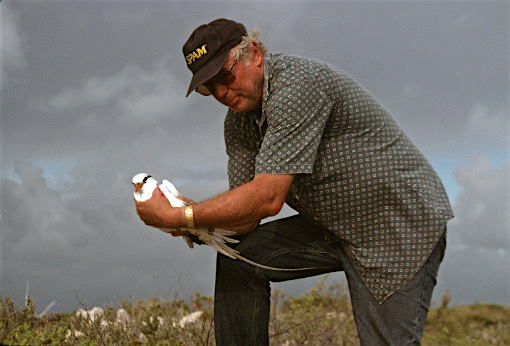
Inspiration: David S. Lee (1943–2014) was a naturalist and conservation biologist and an important early member of BirdsCaribbean (then the Society of Caribbean Ornithology). David was perhaps best known for his studies of seabirds of the Gulf Stream, yet he published hundreds of scientific papers and articles in the popular press on natural history, and he spearheaded conservation projects for birds, crocodiles, bats, turtles, and tortoises worldwide. Donations from Dave’s wife, Mary Kay Clark and his mother, June Bash, allowed the establishment of the award. Since 2016 this fund has been managed by BirdsCaribbean to continue David’s passion for protecting wildlife.
Goal of the Award: The fund supports applied and innovative projects with direct conservation effects on Caribbean birds and/or their habitats. Applicants should also demonstrate how their project will involve local conservation groups and communities in the Caribbean.
Eligibility: Scientists/naturalists working in the Caribbean, in conservation organizations or academic programs, may apply. Applicants should be students or early career ornithologists, conservationists, or wildlife professionals (i.e., not established faculty or senior staff of a conservation organization, less than 10 years post-graduation). A student must be enrolled in an accredited university program (advanced undergraduate level, or Masters or doctoral degrees) in ecology, biology, conservation, or related fields to be eligible.
Use of Funds: The funds can be used to cover travel to field sites, living expenses in the field, or costs for equipment and supplies to conduct conservation projects. Examples of equipment and supplies include traps, cameras, automated recording units, nest boxes, etc. Funds cannot be used for salaries, other wages, or overhead fees.
Award Amount: Seven awards of up to $1,000.
Awardees will be required to submit a report to the BirdsCaribbean’s Grant Committee one year from the project start date, and a blog article about this work for our broader community. We also encourage award recipients to present the results at the biennial International Conference of BirdsCaribbean, and publish in the Journal of Caribbean Ornithology. Presentations and publications are expected to acknowledge both David S. Lee Fund for the Conservation of Caribbean Birds and BirdsCaribbean for support.
Check our pages, blog post and social media for announcements of when the fund is open for grant applications & for details of how to apply.
BirdsCaribbean’s general Grant Application Guidelines and Proposal Submission Form are available here.
Questions or inquiries may be directed to [email protected] (Grants Committee), and copied to [email protected] and [email protected].
Please consider making a tax deductible contribution to The David S. Lee Fund for Conservation.
Thank you for your participation and support!
Past David S. Lee Fund award winners:
| Project Year/s | Awardee | Project |
| 2026 | Abel Luis Simeón | Comprehensive Study and Assessment of the Status of Cuba’s Endemic Quail-Dove Populations in Zapata Swamp |
| 2026 | Katja Kochvar | Exploring the Persistence and Prevalence of Micro-dialects in Vervain Hummingbird Song |
| 2026 | Jean Michel De Jongh | Ecology of Bare-legged Owl (Margarobyas lawrencii), an endemic strigid in Cuba |
| 2026 | Laura Arañaburo Acosta | Migratory connectivity of passerines in two key green areas in Havana, Cuba: Unraveling their journeys |
| 2026 | Miguel J. Costas Sabatier | Functional composition changes across an island urbanization gradient after 20 years |
| 2025 | Giselle Ragoonanan | Establishing Year-Round Bird Banding stations to Monitor Resident and Migratory Species in Trinidad and Tobago |
| 2025 | Michael Ocasio | Conservation Ecology of the Puerto Rican Oriole |
| 2025 | Ernesto Vergara Llano | Study of the Reproductive and Trophic Ecology of Gundlach’s Hawk (Astur gundlachi), an Endemic and Threatened Bird of Cuba |
| 2025 | Matthew Southgate and Simone Williams | A Comparison of Avian Species Richness between Protected and Disturbed Areas in Grand Cayman, using Passive Avian Acoustic Monitoring |
| 2025 | Inés Lourdes Fernández Rodríguez | Action Plan for the Conservation of Psittacidae in the Pico Cristal National Park, Cuba |
| 2025 | Retsel Gonzalez | Impact of Nest Temperatures on Mortality Rates of the Endangered Yellow-shouldered Blackbird (Agelaius xanthomus) in Southwestern Puerto Rico |
| 2025 | Jean Michel De Jongh González | Ecology of Bare-legged Owl (Margarobyas lawrencii) an endemic strigid in Cuba |
| 2024 | Dr Ancilleno Davis | Establishing baselines in research, data and science for birds (BiRDS for birds) in The Bahamas |
| 2024 | Claudia Mantilla | Distribution shifts of the Oriente Warbler: species assessment in Villa Clara province, Cuba |
| 2024 | Daniela Ventura | Understanding the importance of a small urban park for conserving migratory and resident bird species in Havana |
| 2024 | Justin Saunders | Raising awareness and education on the endangered Jamaican Blackbird in a National Park |
| 2024 | Michael Ocasio | Conservation ecology of the Puerto Rican Oriole |
| 2024 | Michelle Moyer | Investigating male and female vocalizations of an understudied endemic Caribbean songbird in Puerto Rico |
| 2024 | Qwahn Kent | Understanding the social and spatial organization of the Palmchat in the Dominican Republic |
| 2024 | Jonathan Nochebuena | Help the Bridled Tern return to Isla Contoy National Park, Quintana Roo, Mexico |
| 2023 | Michelle Moyer | Investigating Male and Female Vocalizations of an Understudied Endemic Caribbean Songbird |
| 2023 | Daniela Ventura del Puerto | Establishing a long-term bird banding station in the National Botanical Garden in Havana, Cuba. |
| 2021/2022 | Julissa I. Irizarry | Evaluating the effects of greening actions on avian diversity on tropical urban landscapes |
| 2021/2022 | Michelle Moyer | Territory use of the critically endangered Bahama Oriole across the annual cycle |
| 2021/2022 | Jonathan Ruben Nochebuena Jaramillo | Establishing a long-term banding program for migratory birds in Isla Contoy National Park, Mexico |
| 2021/2022 | Luis A. Ramos Vázquez | Understanding nestling diet composition of Roseate Terns (Sterna dougallii) through fecal DNA Metabarcoding. |
| 2021/2022 | Amber Wendler | Investigating variation in cooperative breeding behavior between bird populations |
| 2021/2022 | Damion Laren Whyte | Caribbean psittacines as indirect controllers of ecosystem dynamics through commensal feeding associations and ecosystem engineering |
| 2021/2022 | Jean P. González Crespo | Pre-reproductive survival, movements, and habitat use of the Yellow-shouldered Blackbird in Southwestern Puerto Rico. |
| 2021/2022 | Josmar Marquez | Current status of the breeding colonies of Sula leucogaster, Sula sula, Sula dyctalatra in Los Roques Archipelago, Venezuela |
| 2021/2022 | Anahy Marcano | Monitoring flamingos on Margarita Island, Venezuela |
| 2021/2022 | Avery Young | Avian winter habitat selection in avocado farms in the Bahoruco region of the Dominican Republic |
| 2020 | Michelle Moyer | Habitat Use of the critically endangered Bahama Oriole across the annual cycle: The importance of the non-breeding season |
| 2020 | Walter Espindola | Comparing methods in order to assess the population size of Red footed-booby colonies in the Caribbean. |
| 2020 | Josmar Marquez | Population assessment of the Snowy Plover (Charadrius nivosus tenuirostris) in Coche Island, Nueva Esparta, Venezuela |
| 2019 | Janine Antalffy | Conservation biology of the Bahama Oriole, a critically endangered island endemic |
| 2019 | Josmar Marquez | Population evaluation of the Snowy Plover (Charadrius nivosus tenuirostris) on the island of Coche, Nueva Esparta, Bolivarian Republic of Venezuela. |
| 2019 | Juan Carlos Fernandez Ordonez | Updating information about Audubon’s Shearwater (Puffinus lherminieri loyemilleri) at Los Roques archipelago (Venezuela) (continuation) |
| 2019 | Laura Fidalgo | Hurricane effects on birds in the Luquillo mountains and Elfin-woods Warbler post-hurricane habitat use. |
| 2019 | Spencer Schubert | The effect of soundscapes on habitat restoration: Do call broadcasts attract avian seed dispersers to deforested sites? |
| 2019 | Anderson Jean | Inventaire d’oiseaux et de recherche sur les menaces que confronte l’avifaune du Complexe des Lacs des Cayes et de Camp-Perrin |
| 2018 | Yvan G. Satgé | Foraging choices of the Diablotin Black-capped Petrel: using spatial ecology and diet to inform conservation |
| 2018 | Janine Antallfy | Conservation biology of the Bahamas Oriole, a critically endangered island endemic |
| 2018 | Juan Carlos Fernandez Ordoñez | Updating information about Audubon’s Shearwater (Puffinus lherminieri loyemilleri) at Los Roques archipelago (Venezuela) |
| 2018 | Eduardo Llegus | Post-Hurricane landscape restoration as bird sanctuary in Natural Reserve Punta Cucharas, Ponce, Puerto Rico. |
| 2018 | Holly Garrod | A tale of two todies: understanding how vocalizations mediate hybridization between two sympatric species |
| 2017 | Holly Garrod | Nest response of Broad-billed Todies (Todus subulatus) to an invasive nest predator, the small Asian mongoose |
| 2017 | Maya Wilson | Population biology, life history and ecology of the Bahama Swallow (Tachycineta cyaneoviridis): informing conservation of an endangered species |
| 2017 | Paige Byerly | Conservation Genetics of the Caribbean Roseate Tern |
| 2017 | Ramon Williams | Distribution, diversity, and abundance of Grenadian birds, including endemic and restricted-range species |
| 2017 | Spencer Schubert | Artificial perch installation as a method for enhancing avian seed dispersal and accelerating early-stage forest recovery in the central Dominican Republic. |
| 2017 | Wayne Smart | Seabird nesting performance, colony declines and invasive predators, in the Southern Grenadines. |