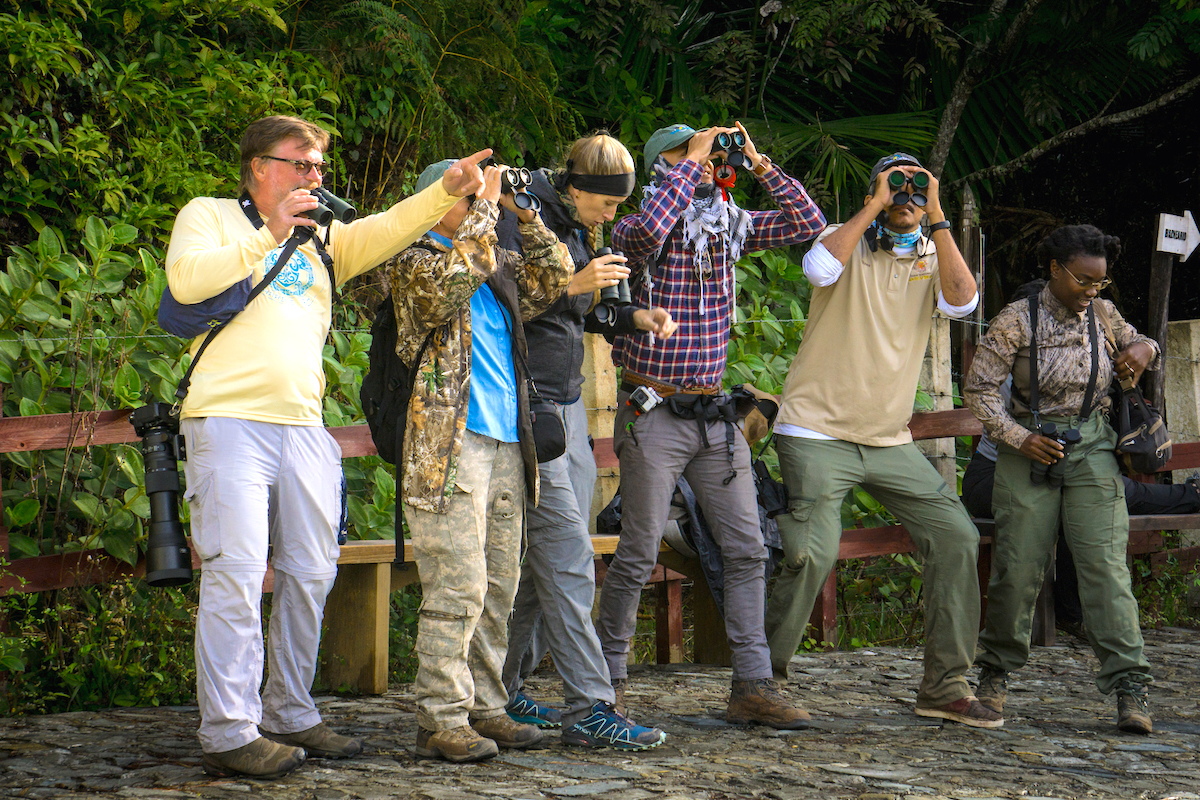
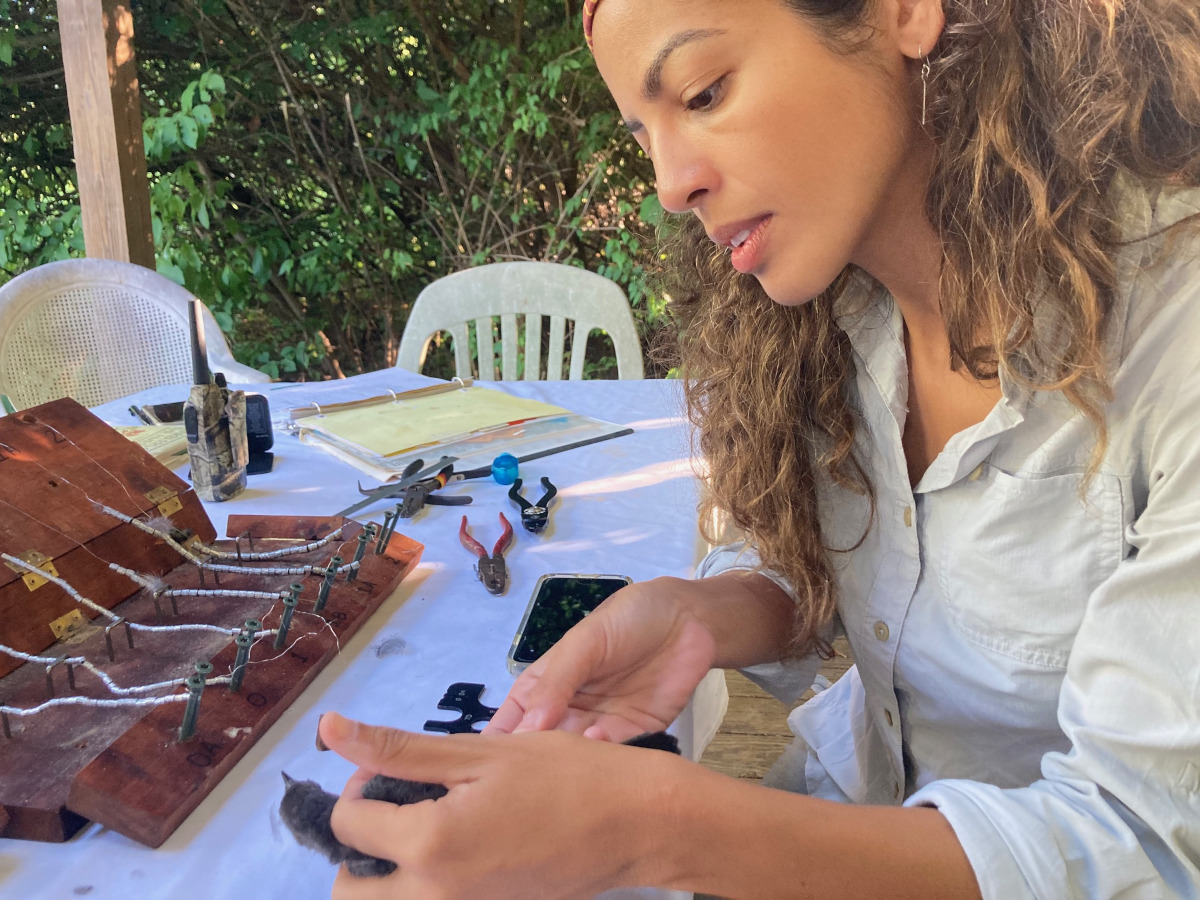
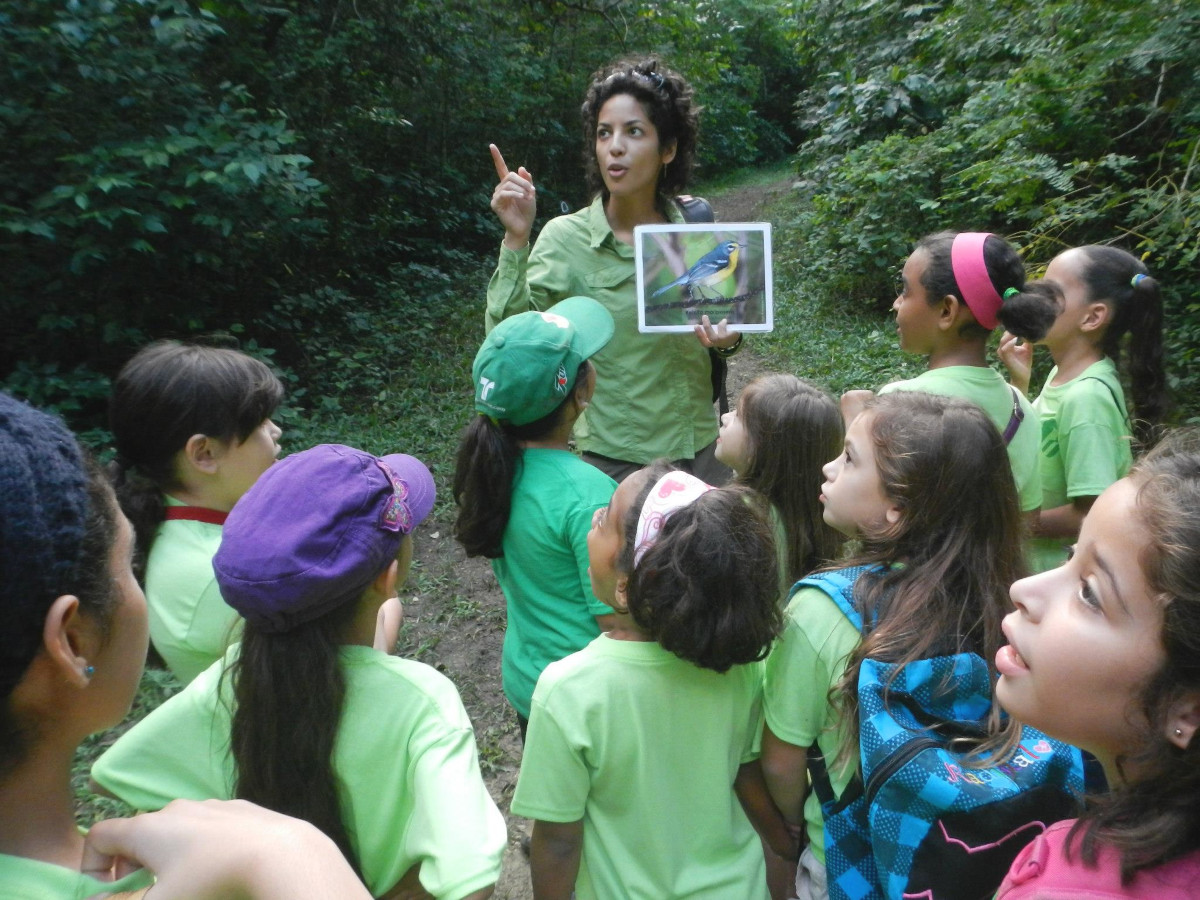
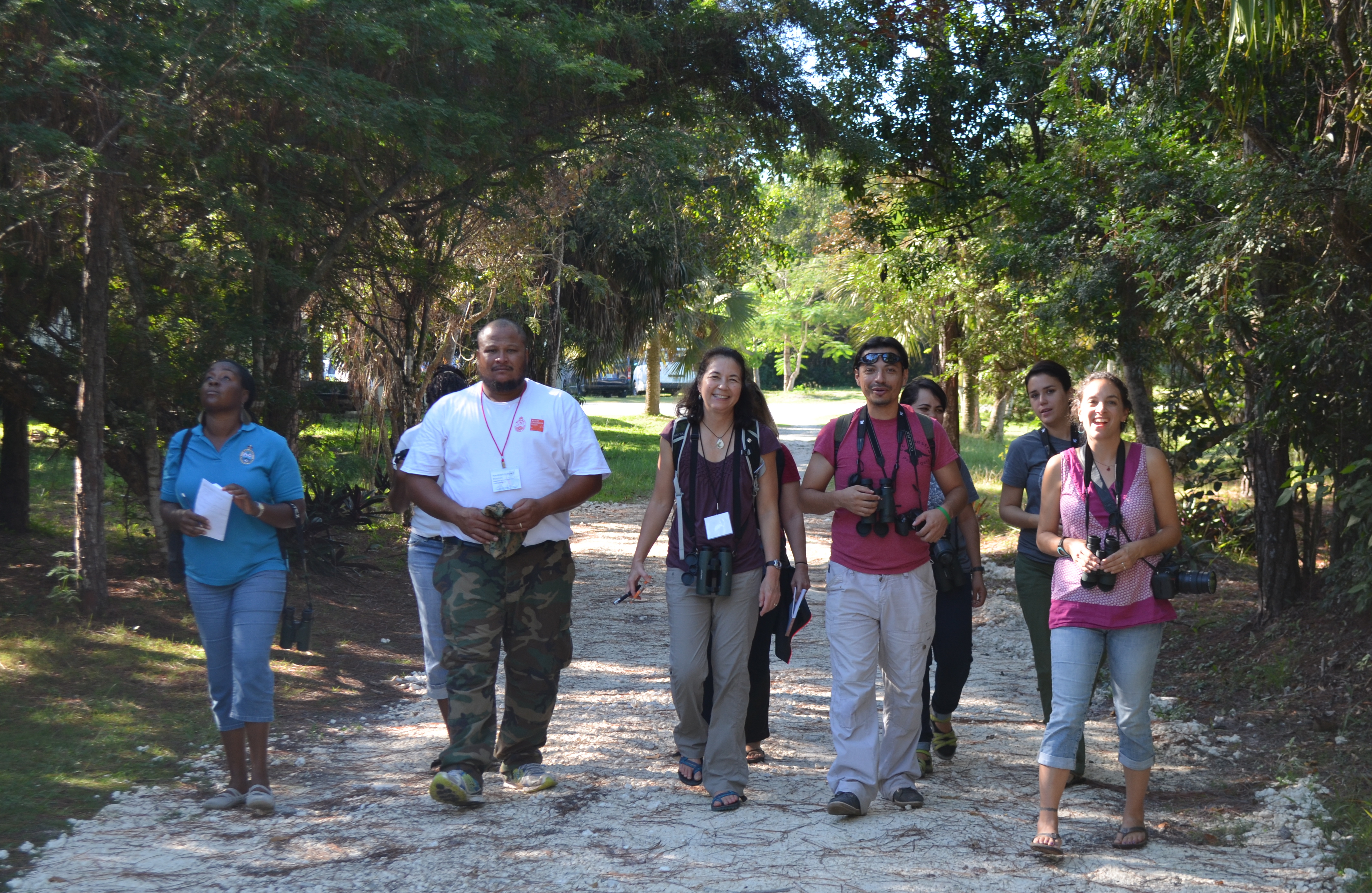
Joshel Wilson, a wildlife biologist with the Environmental Awareness Group, has dedicated himself to protecting the biodiversity of both land and sea in Antigua and Barbuda, from tagging endangered sea turtles and sharks to conserving threatened island wildlife. In 2024, he decided to expand his impressive skill set by adding bird banding to his repertoire. In this piece, Joshel reflects on his experience returning to his homeland to join the third cohort of the Caribbean Bird Banding Training Workshop.
Back to my roots
In early March 2024, I embarked on a journey back to my roots in Grenada, a place that holds a special place in my heart. This time, it wasn’t my typical visit for family or familiar landscapes—I was there for the third Caribbean Bird Banding Training Workshop, hosted by BirdsCaribbean in collaboration with the Grenada Fund for Conservation, Gaea Conservation, and Klamath Bird Observatory. It was a unique opportunity to combine my passion for birds with the chance to reconnect with my homeland. I did not expect that this experience would be so much more than a technical workshop; it would be a journey into the heart of Grenada’s natural beauty, culture, and community!
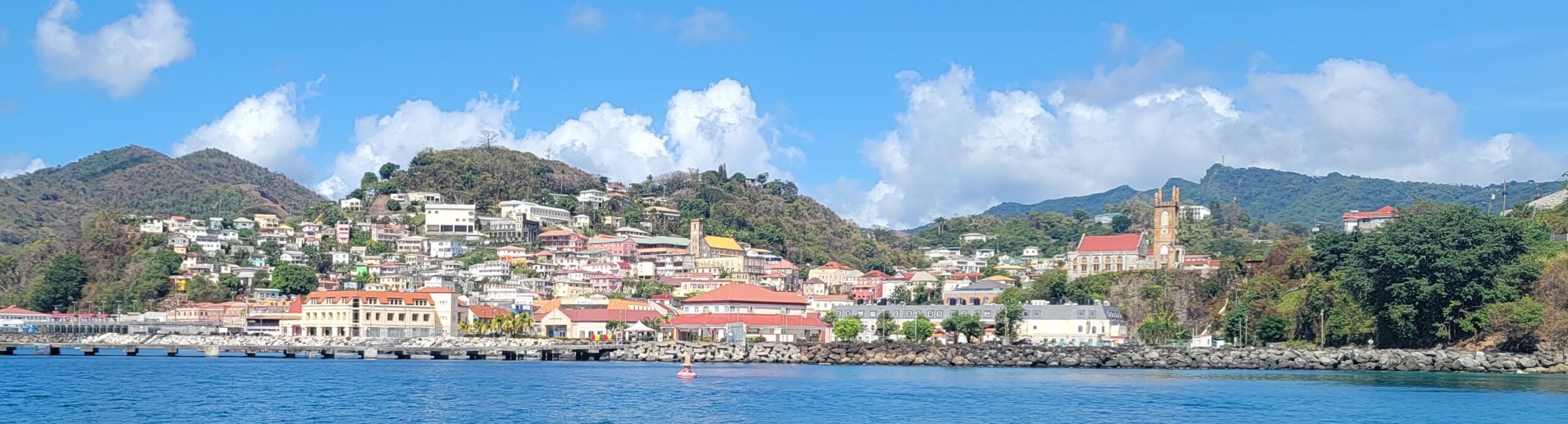
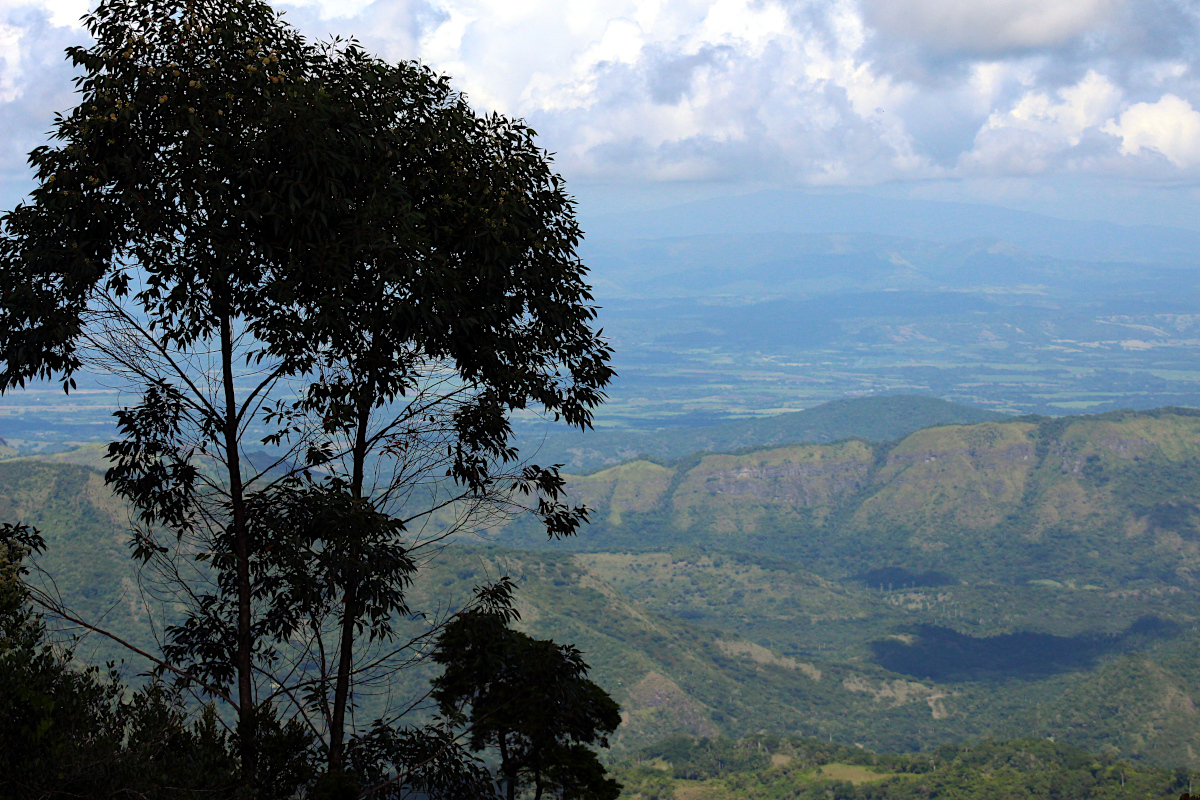
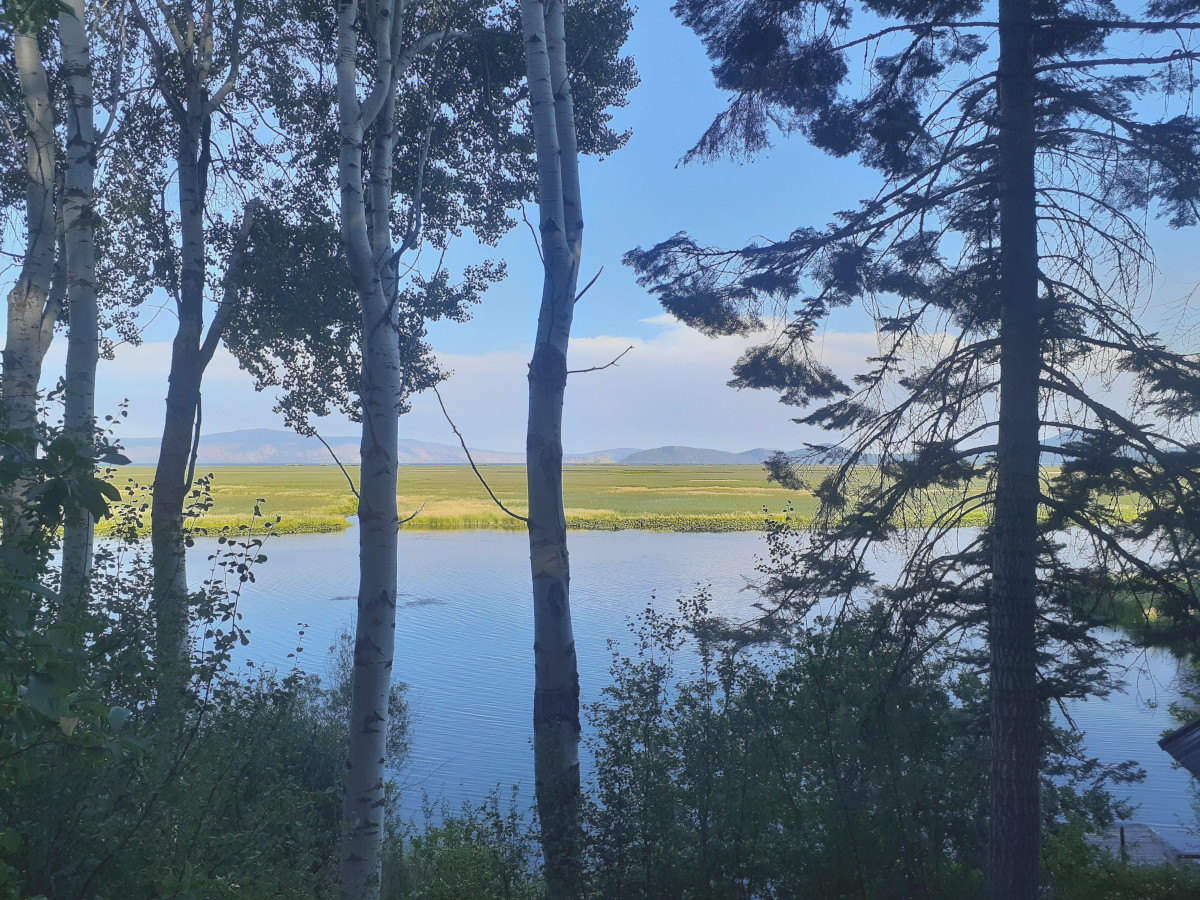
Landscape photo of St. George’s, Grenada. (photo by John Alexander)
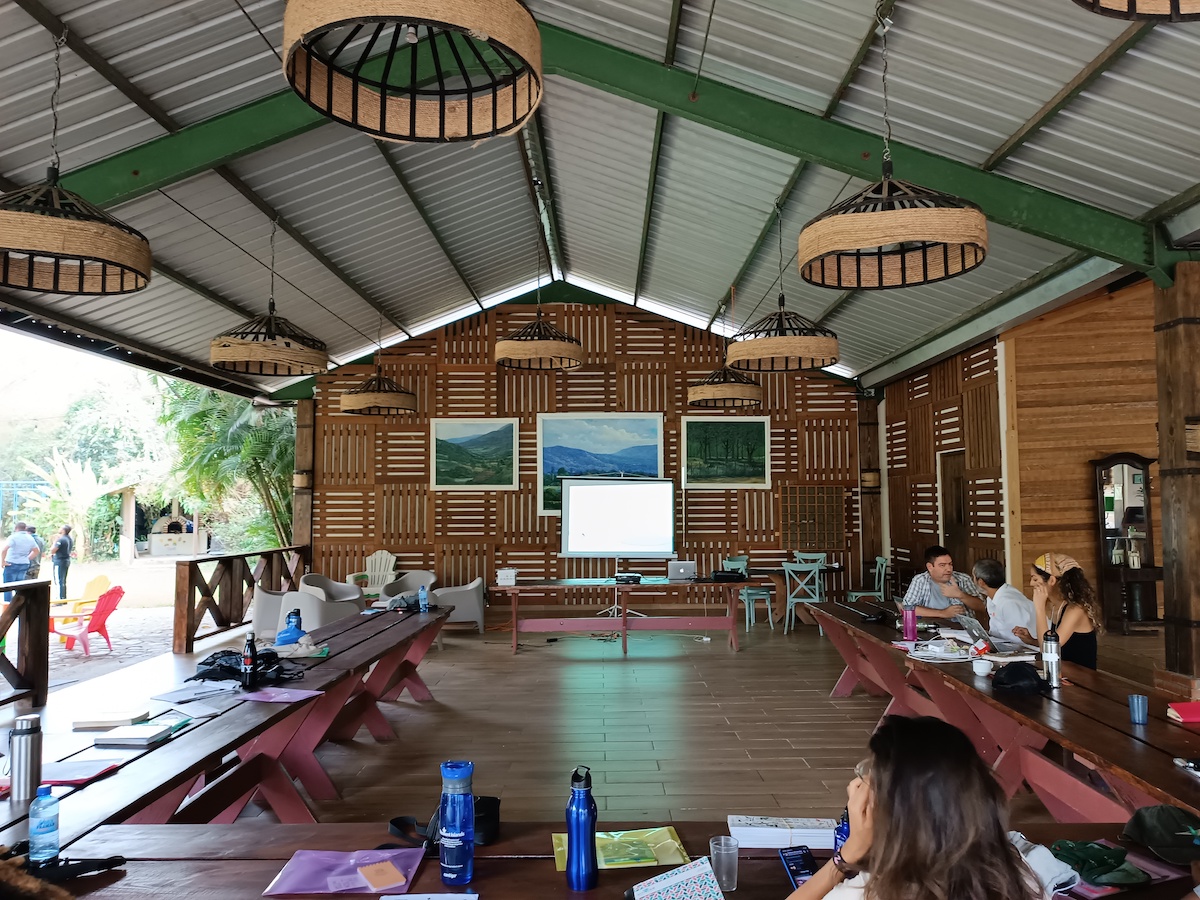
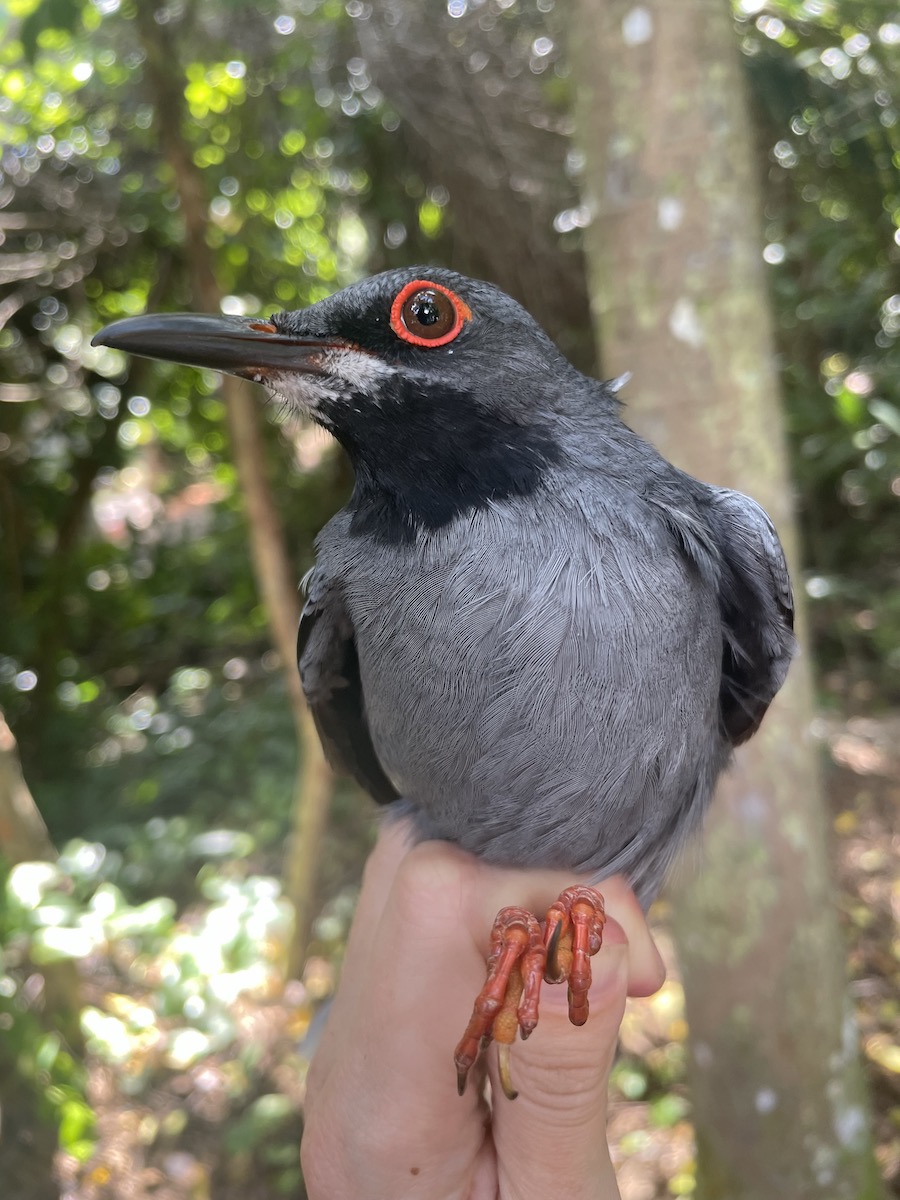
The workshop took place over five unforgettable days, blending hands-on bird banding with the theory behind this important conservation practice. The learning, discovery, and networking began promptly at the crack of dawn, whether we were venturing into the lush Grenada Dove Sanctuary at the Mt. Hartman Estate or exploring the grounds of the Blue Horizons Garden Hotel–the headquarters for the workshop. Located close to beautiful Grand Anse Beach and nestled in the vibrant Grenadian landscape, Blue Horizons was a haven for a variety of bird species. As the sun rose over the island, the air was filled with the songs of of landbirds such as Bananaquits and Grenada Wrens—the very species we aimed to study and band. It was a powerful reminder of why I fell in love with ornithology in the first place.
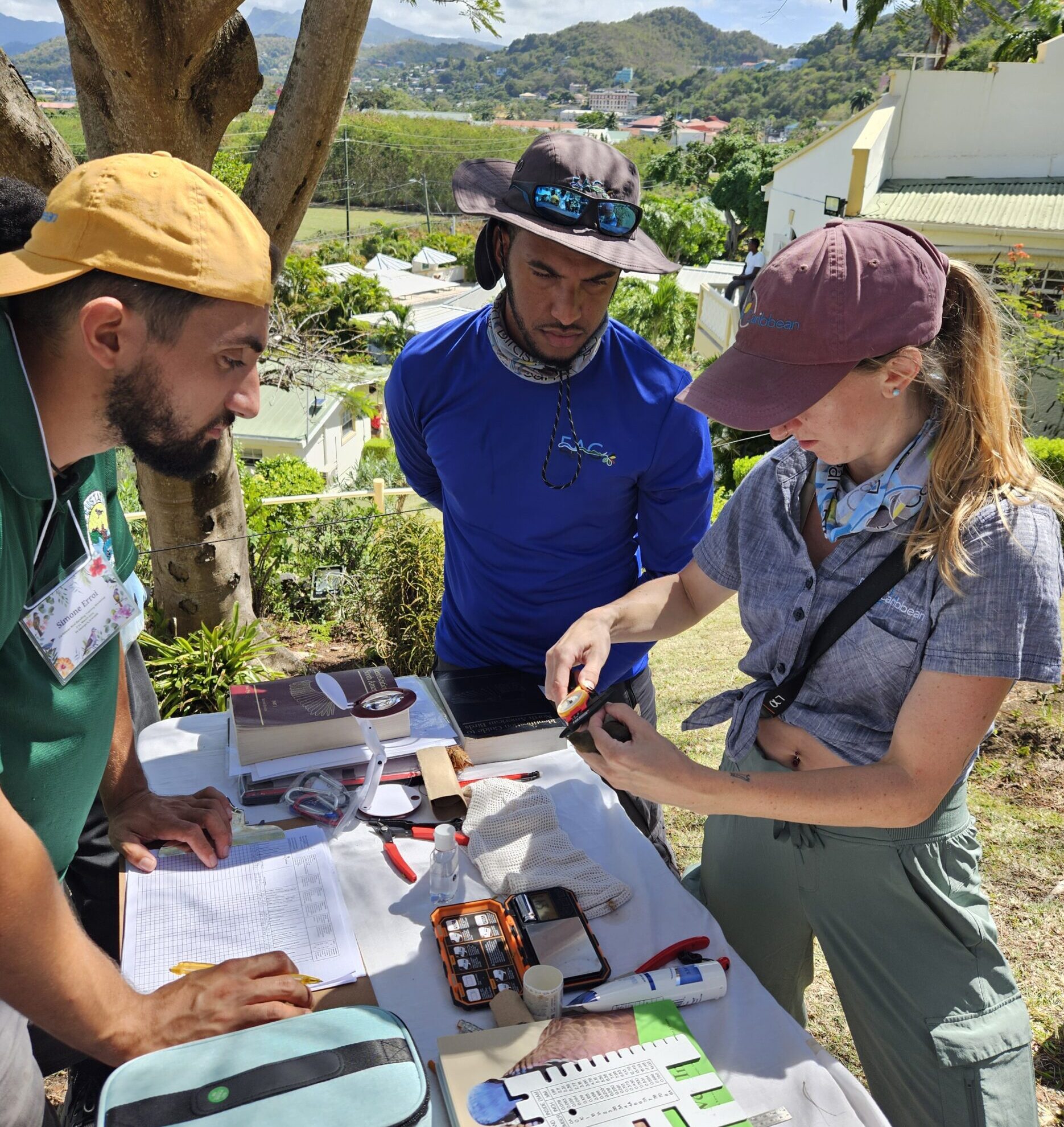
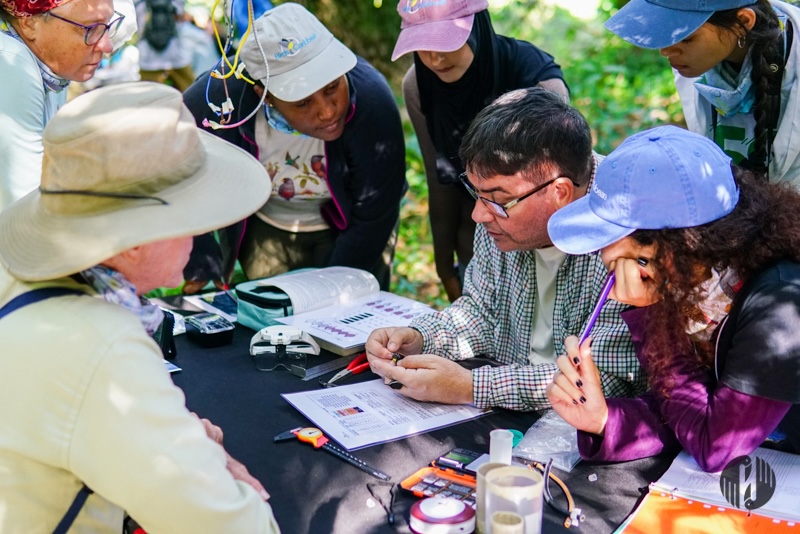
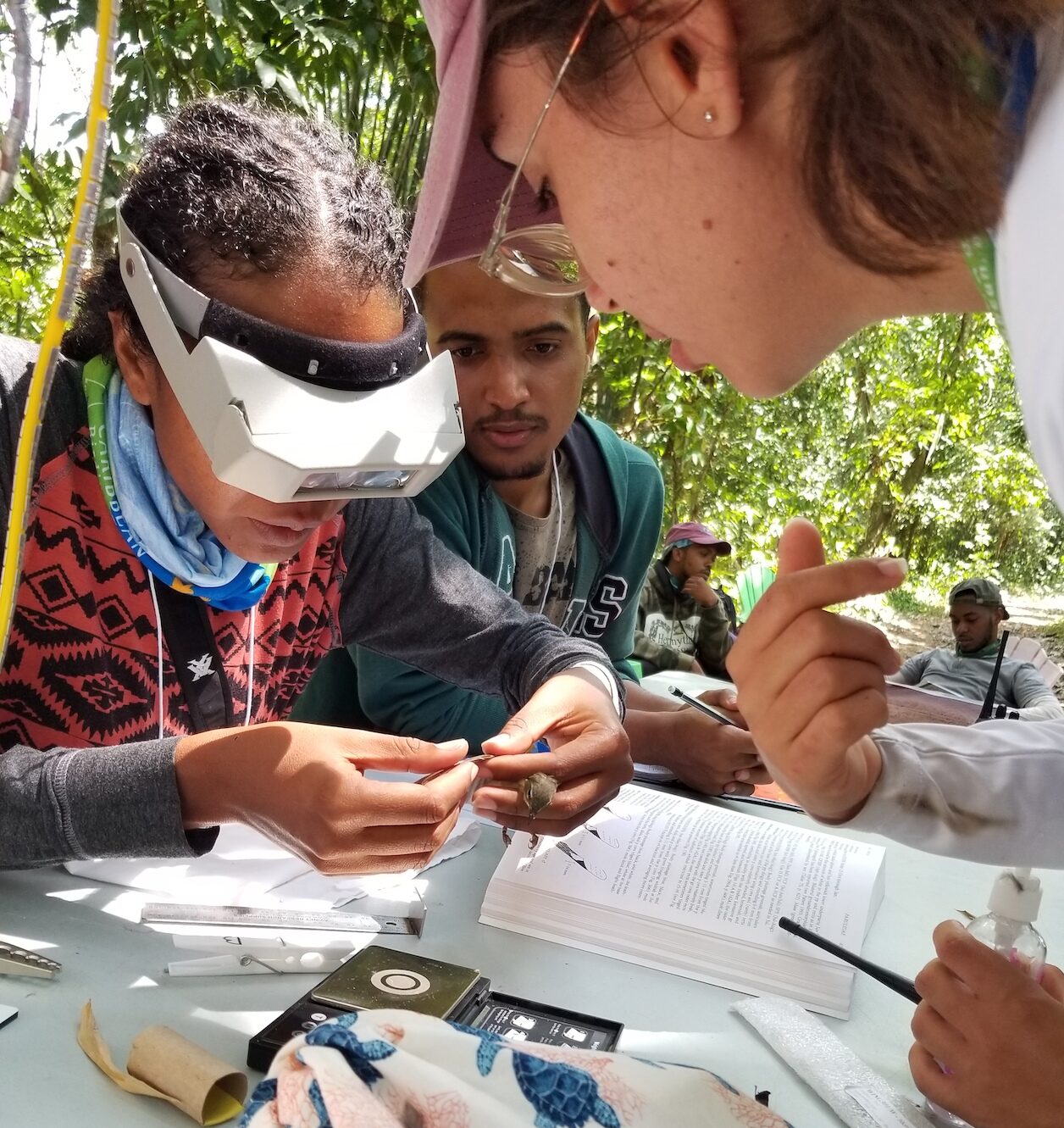
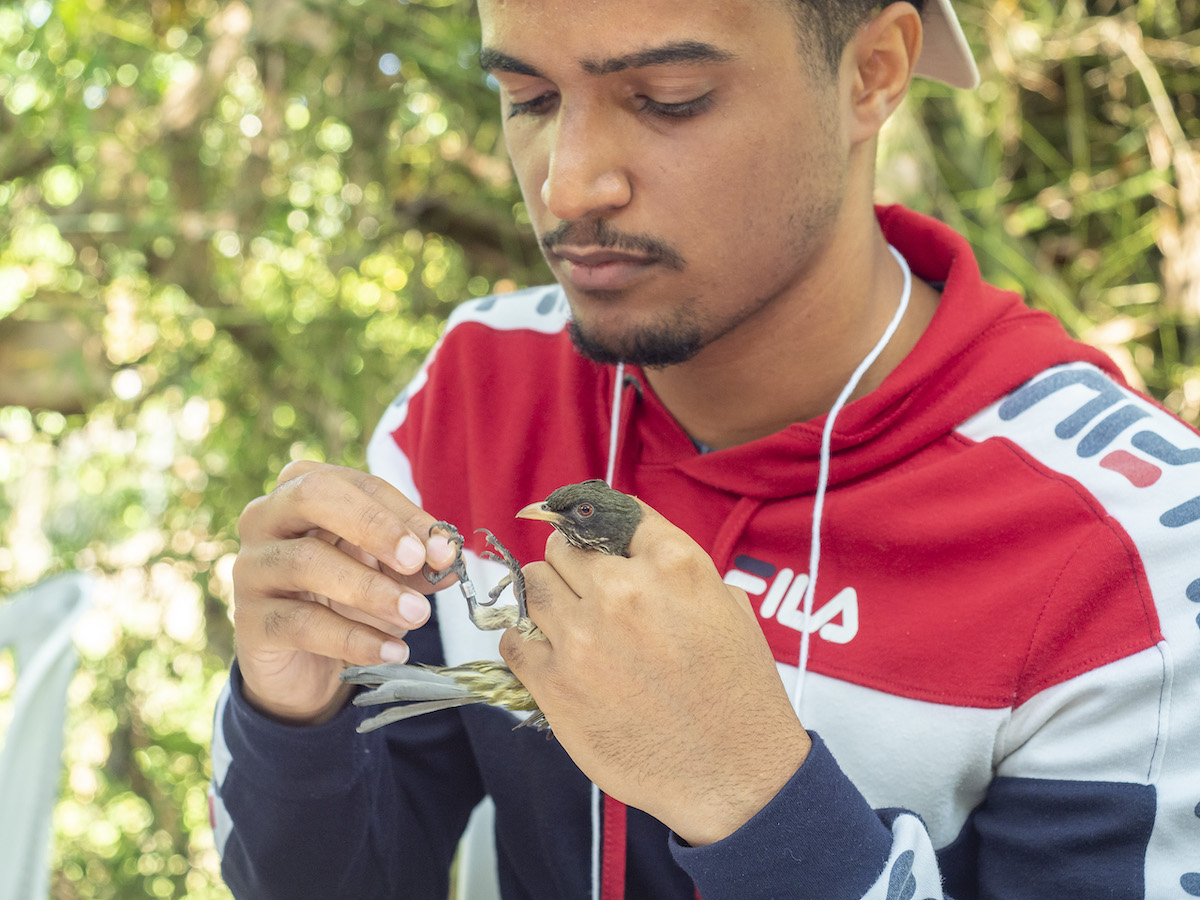
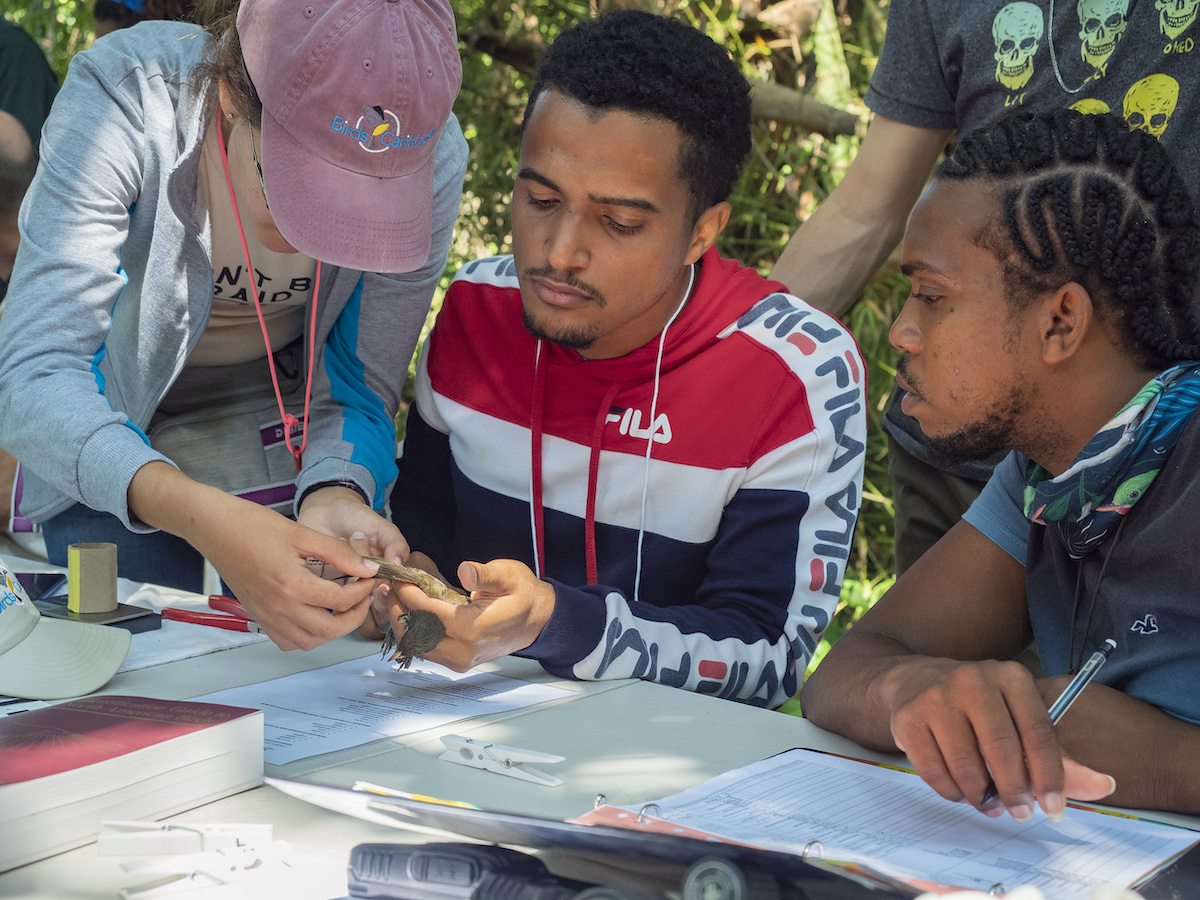
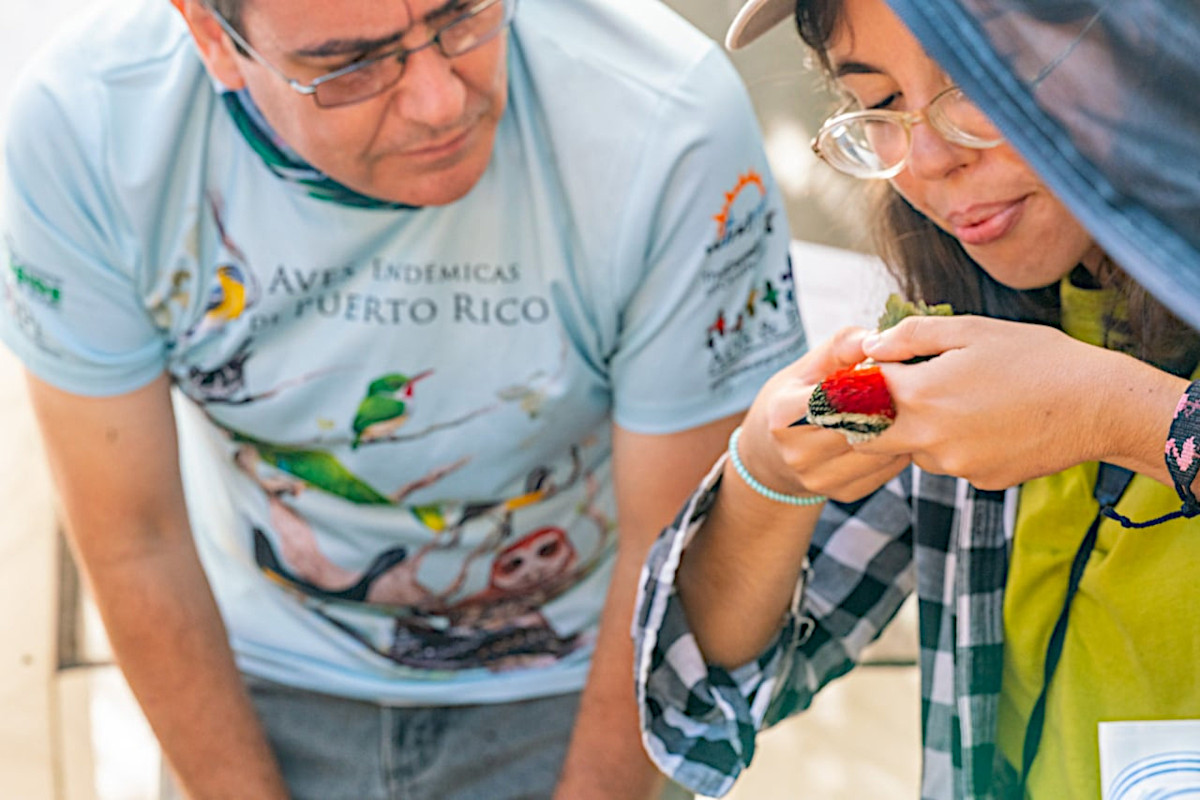
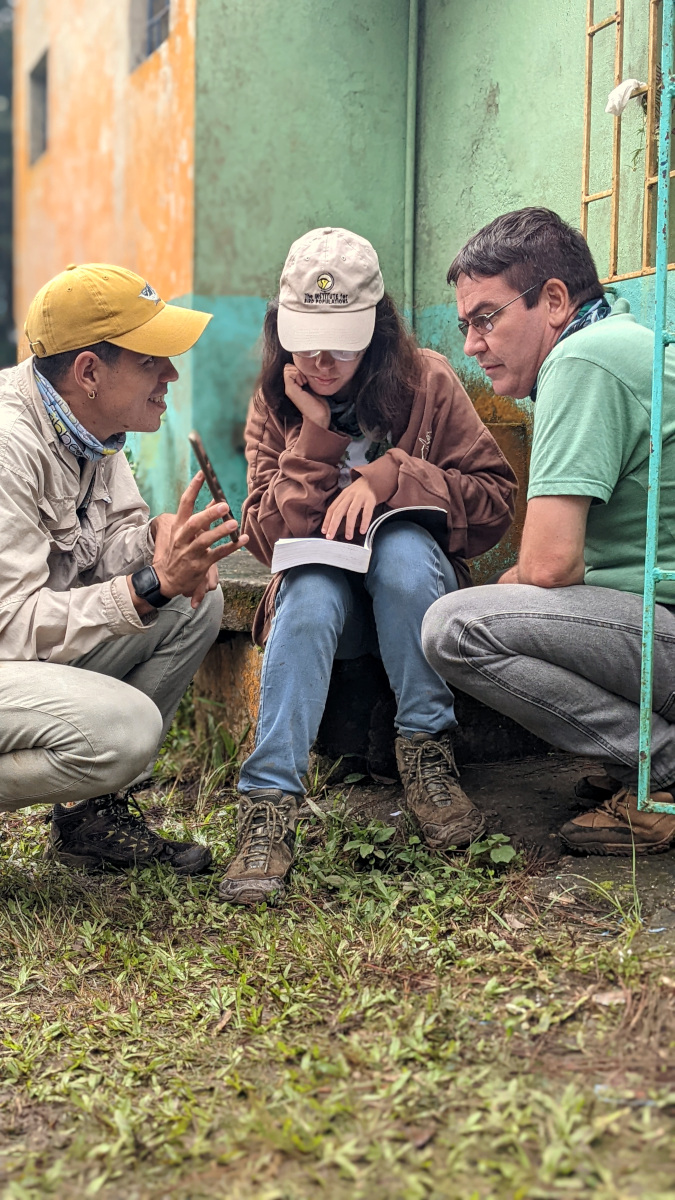
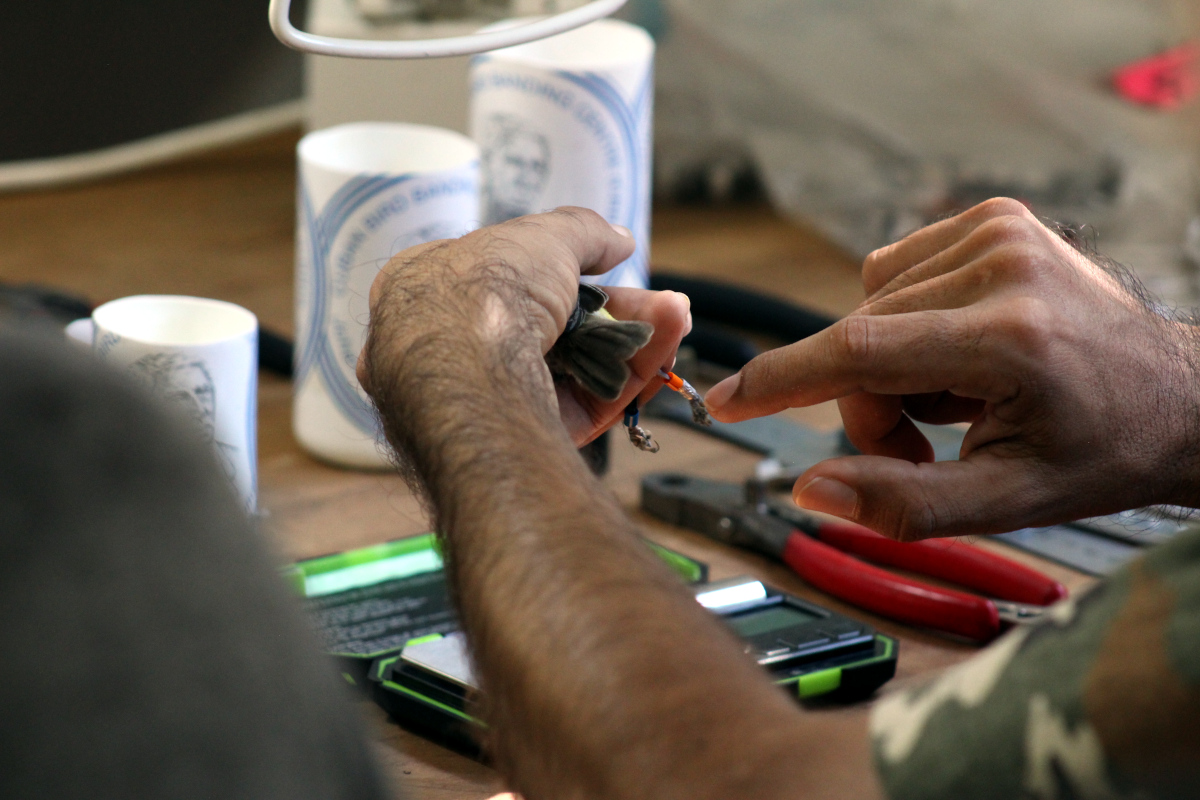
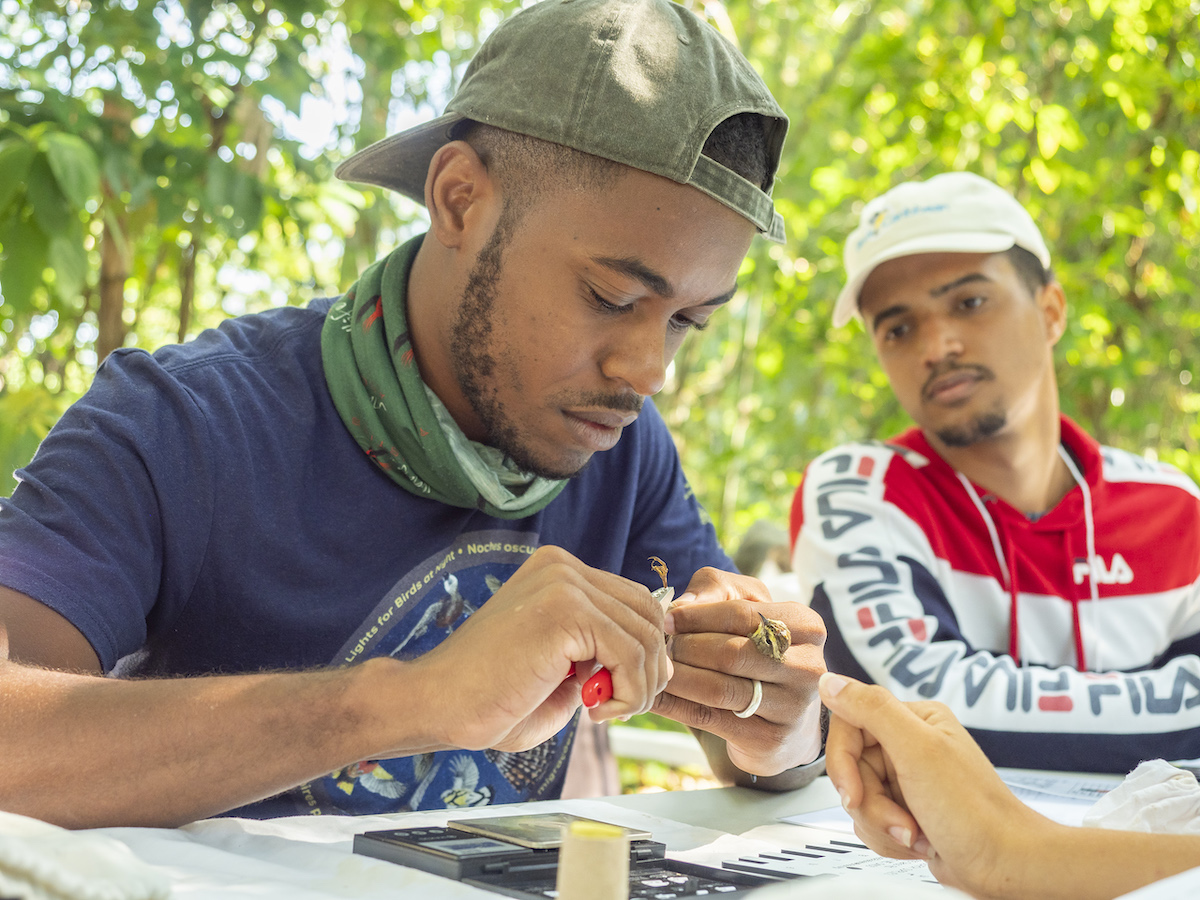
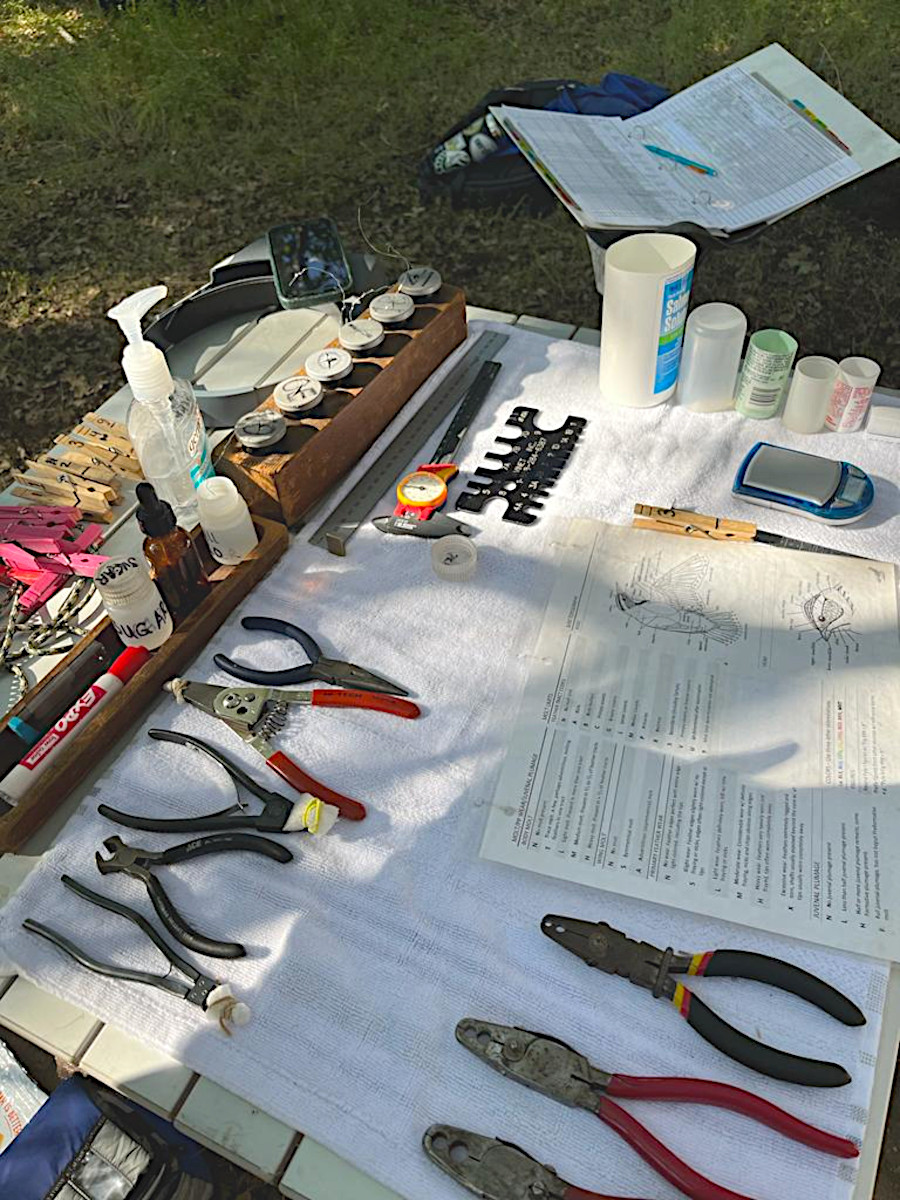
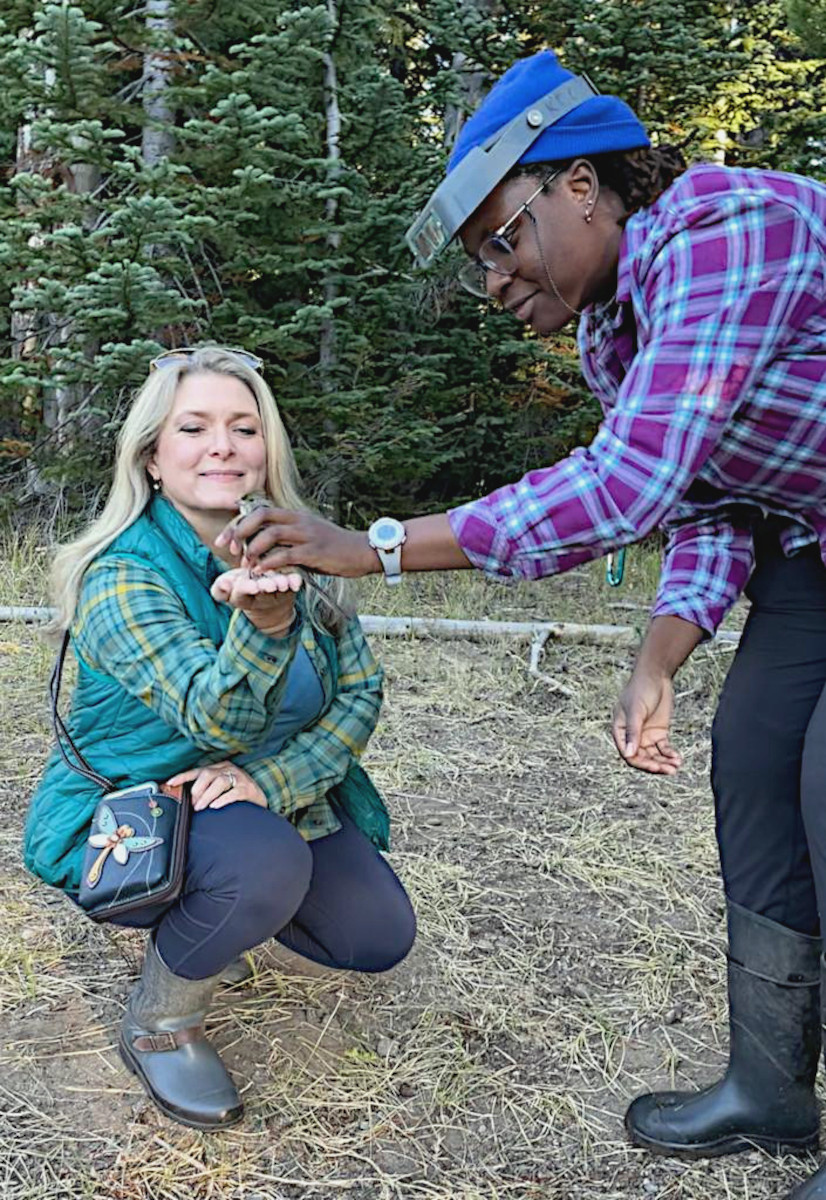
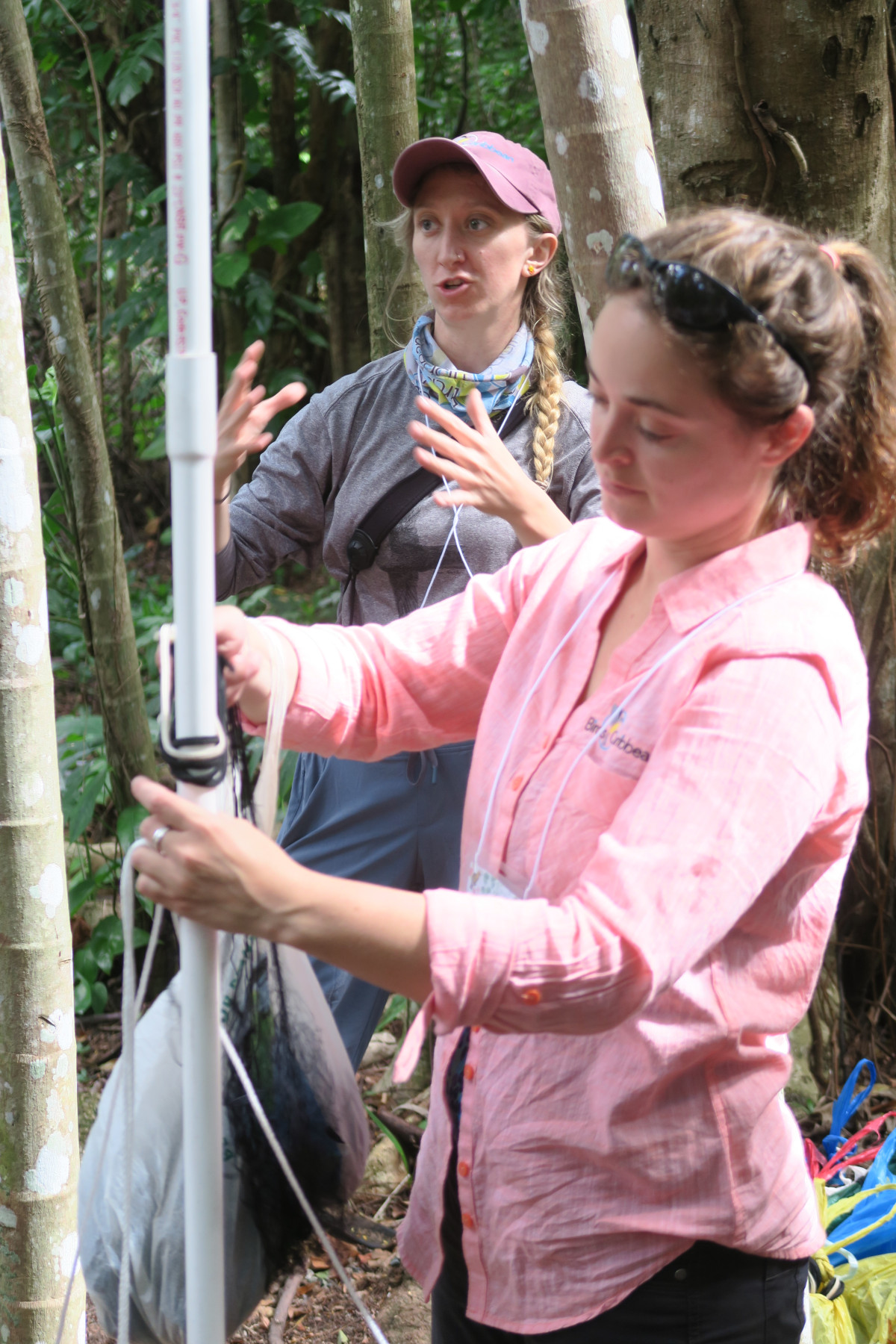
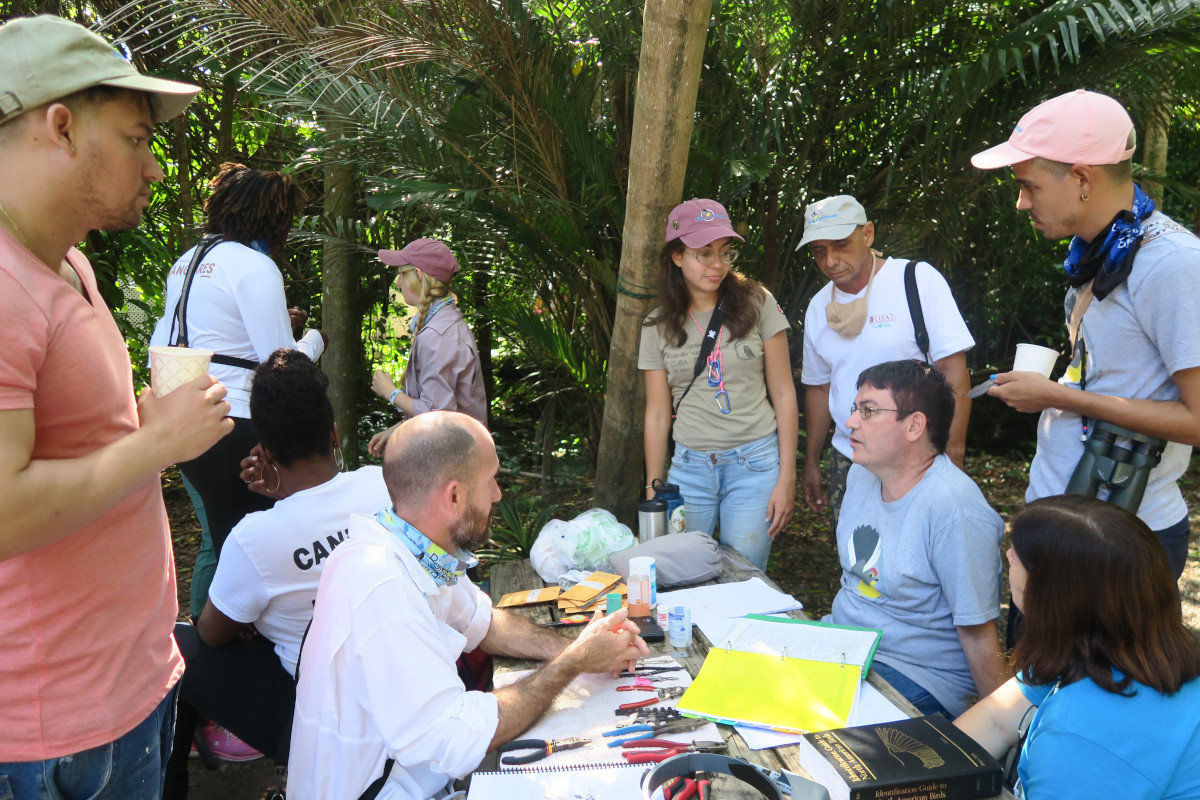
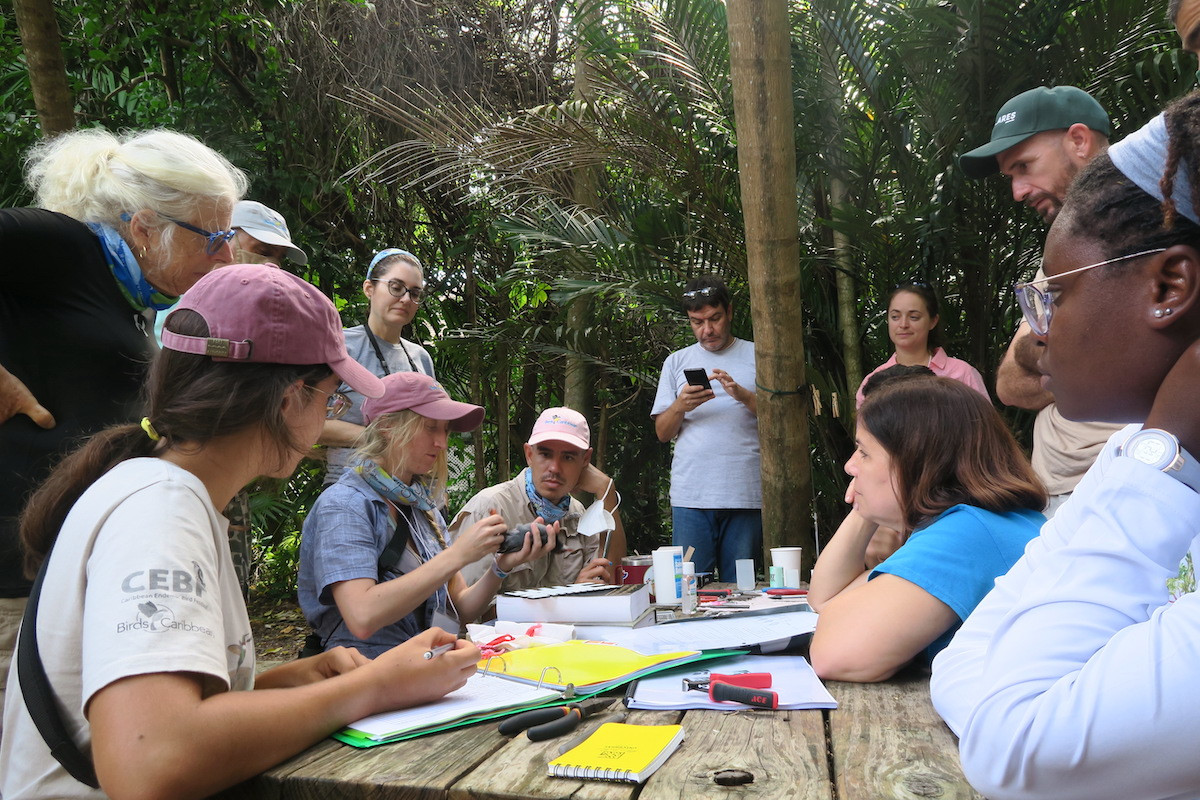
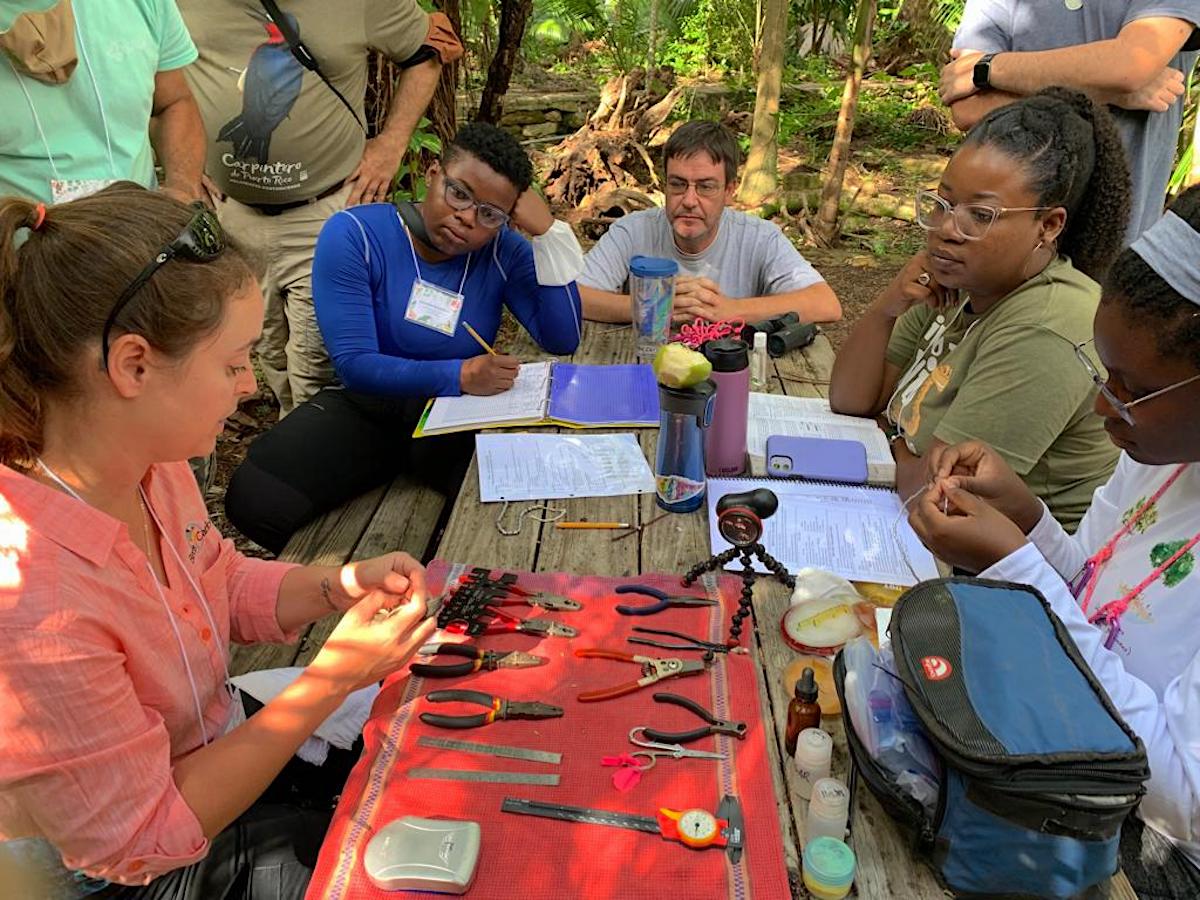
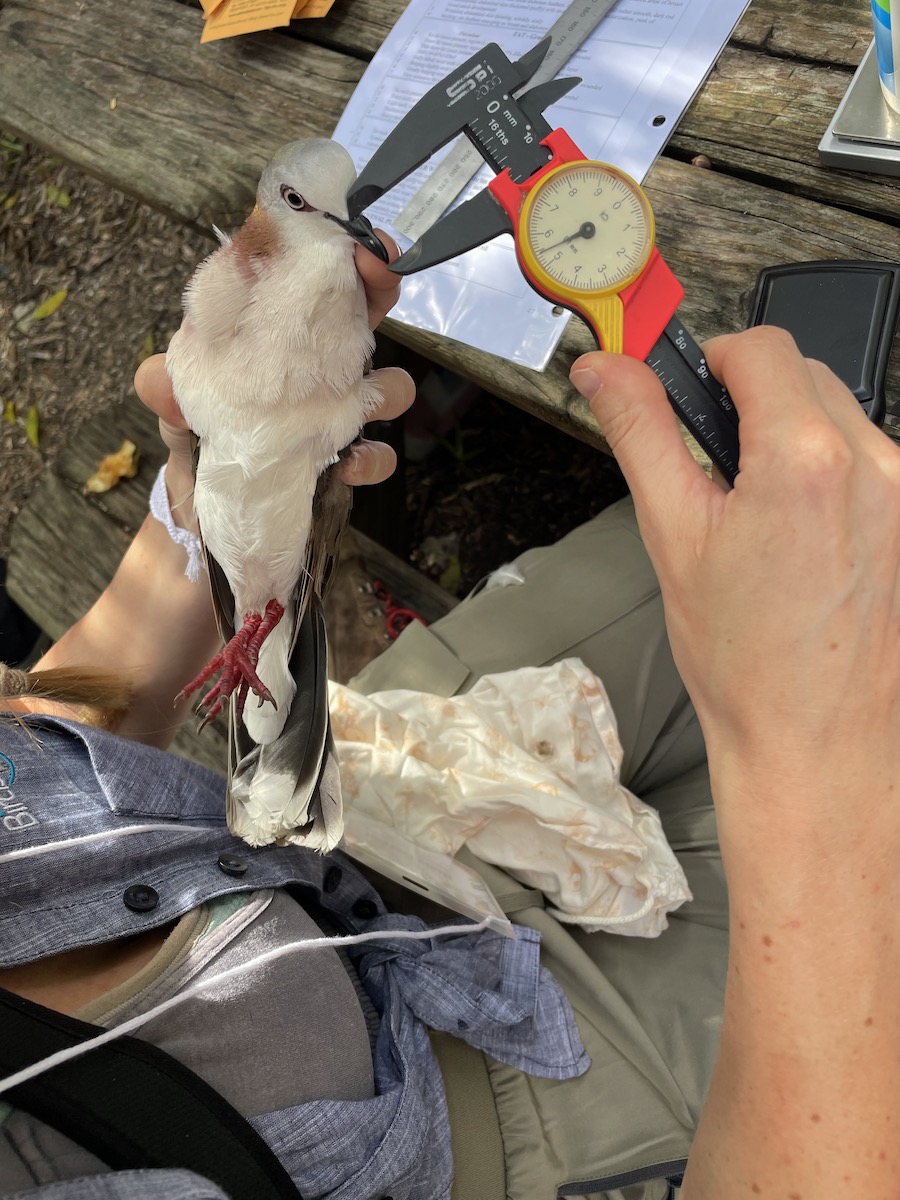
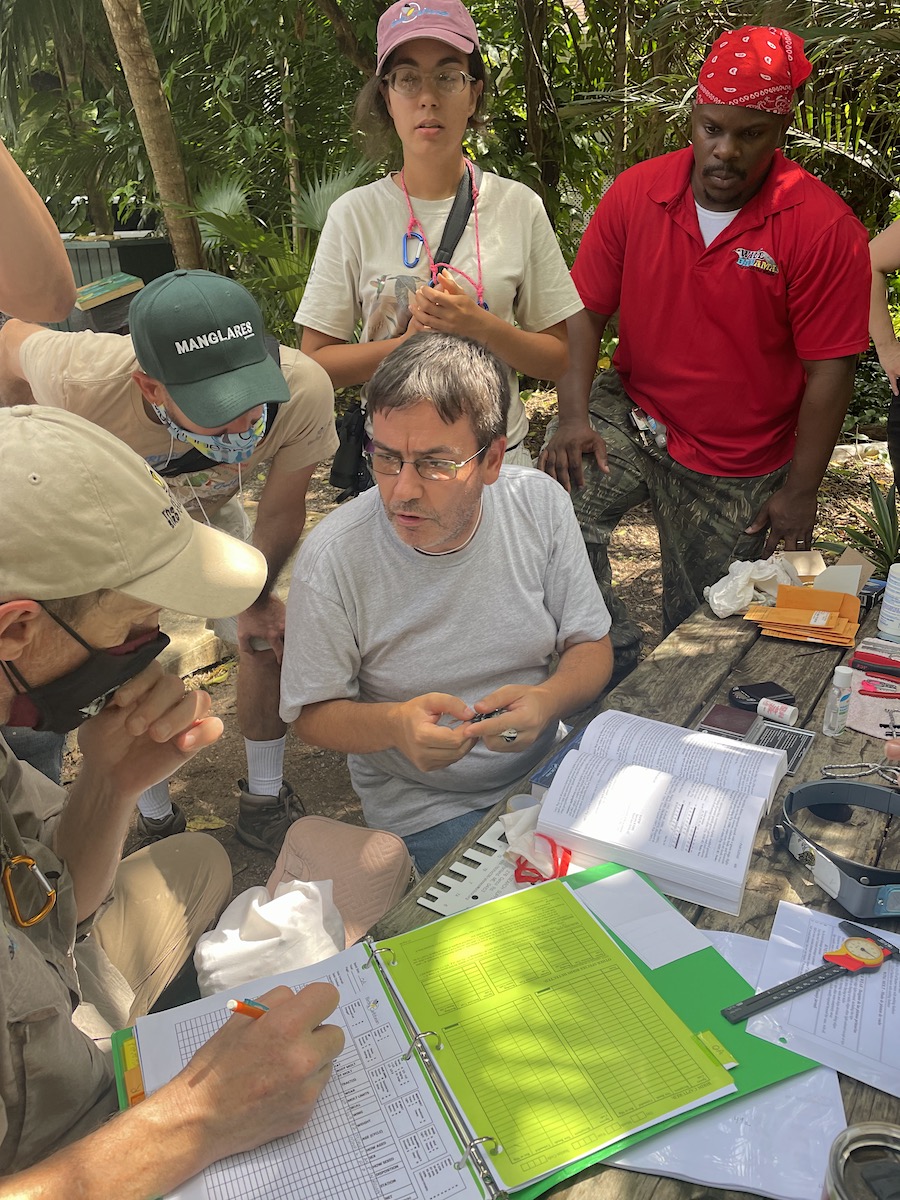
Trainer Holly Garrod shows Joshel Wilson and Simone Erroi how to measure morphometrics on a Bananaquit. (photo: Maya Wilson)
Birds, banding, and Caribbean camaraderie
While the birds and the scenery were spectacular, it was the people that truly made this workshop special. I met fellow conservationists from across the Caribbean, each bringing their own unique backgrounds and stories. There were Cubans, Puerto Ricans, Trinidadians, Saint Lucians, Saint-Martinois, Caymanians, and Grenadians like myself, all united by our shared passion for bird conservation.
The classroom sessions, led by experienced trainers and facilitators, were filled with lively discussions and bursts of laughter, especially when our Cuban colleagues, with their distinct accents, would jokingly plead, “¡Inglés, por favor!”(English, please!), hinting that the diverse Caribbean variations of English, combined with our unique accents, sometimes made conversations hard to follow.
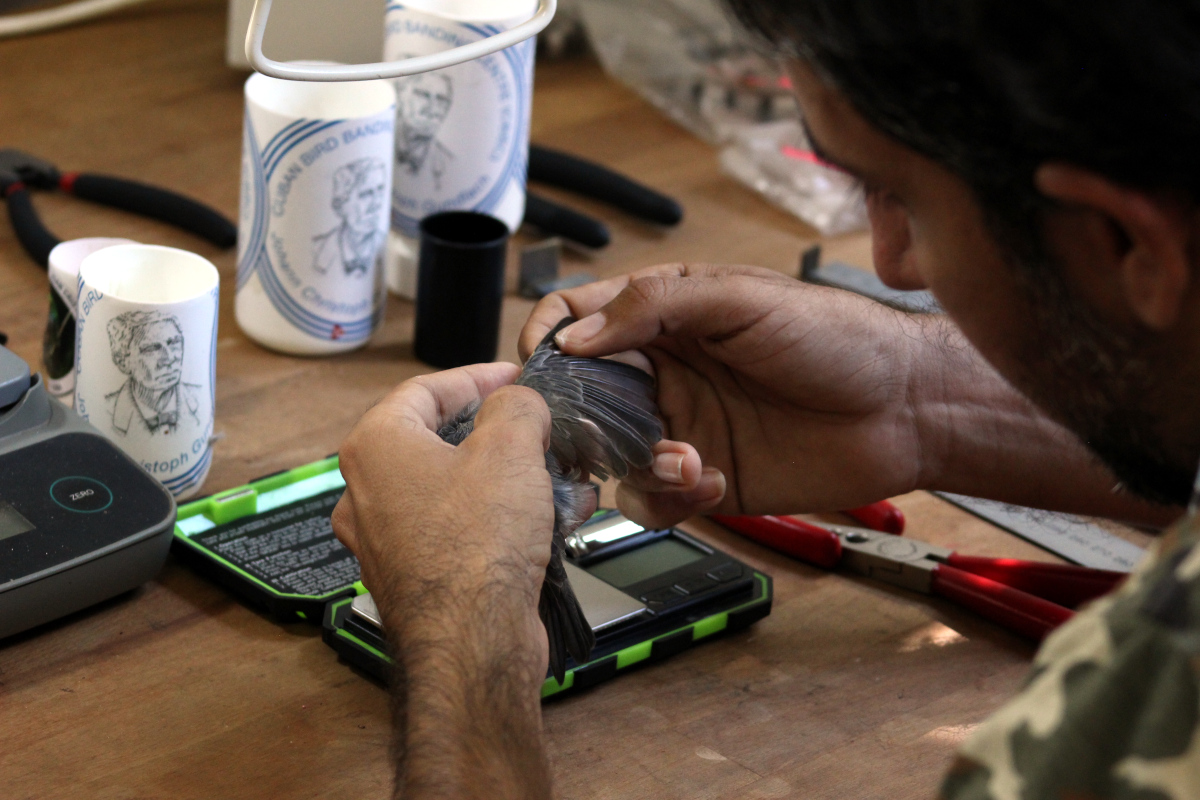
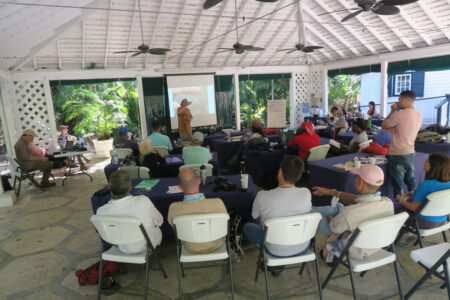
While learning new techniques for removing birds from mist nets and mastering data recording was invaluable, the real magic happened in the connections we made. We swapped stories, compared conservation techniques, shared cultural traditions, and exchanged ideas on how to promote bird conservation in our respective countries. The mix of languages, positive energy, and camaraderie made each session feel more like a shared experience than a formal workshop.
Building Caribbean expertise
The role of BirdsCaribbean in ensuring the success of this workshop cannot be understated. The organisation’s dedication to fostering excellence in bird conservation was evident in every detail, from the well-organised, informative sessions to experiencing more of Grenada, including aboat trip arranged by the Grenada Fund for Conservation (GFC), where we enjoyed the famous Carenage and Underwater Sculpture Park.
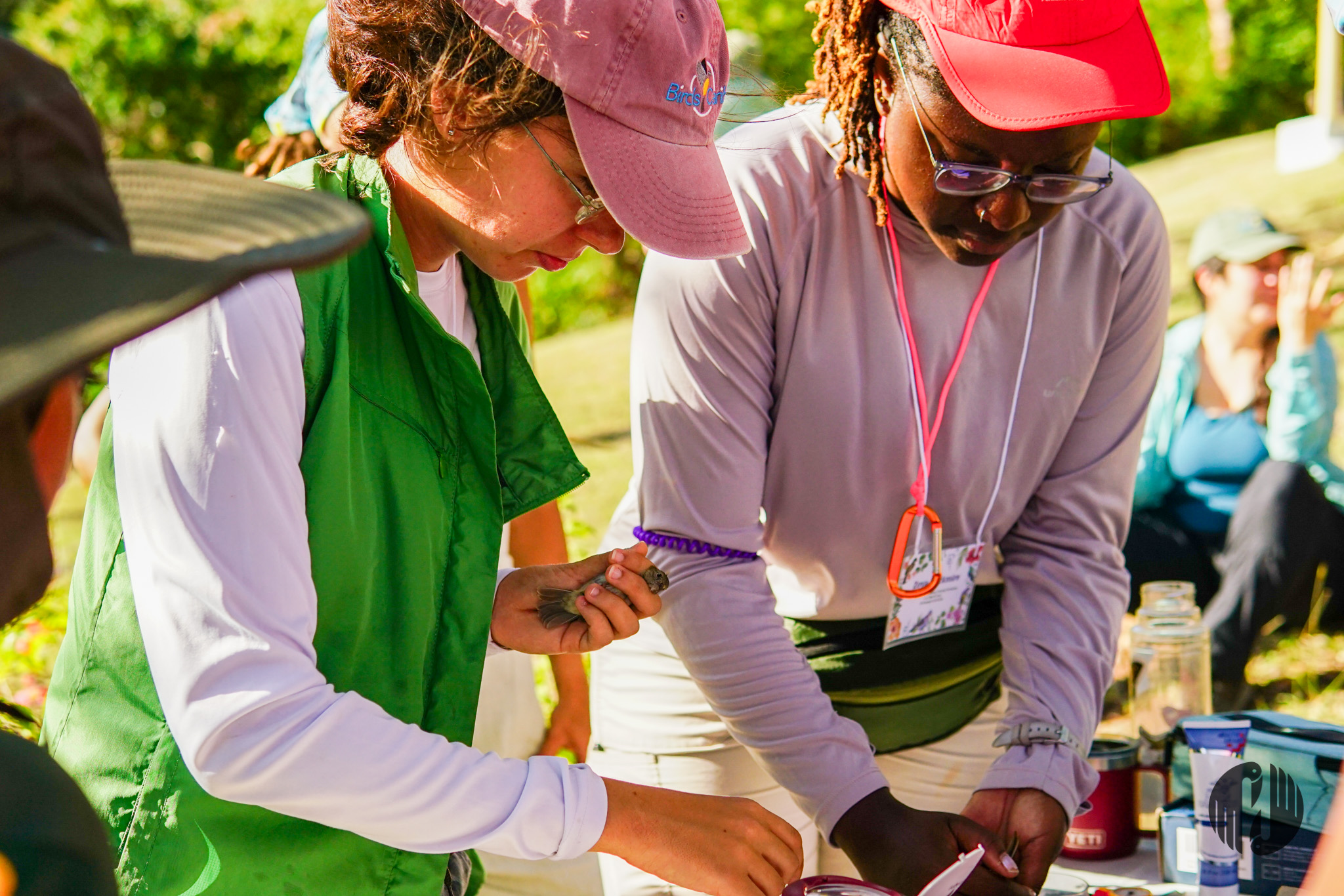
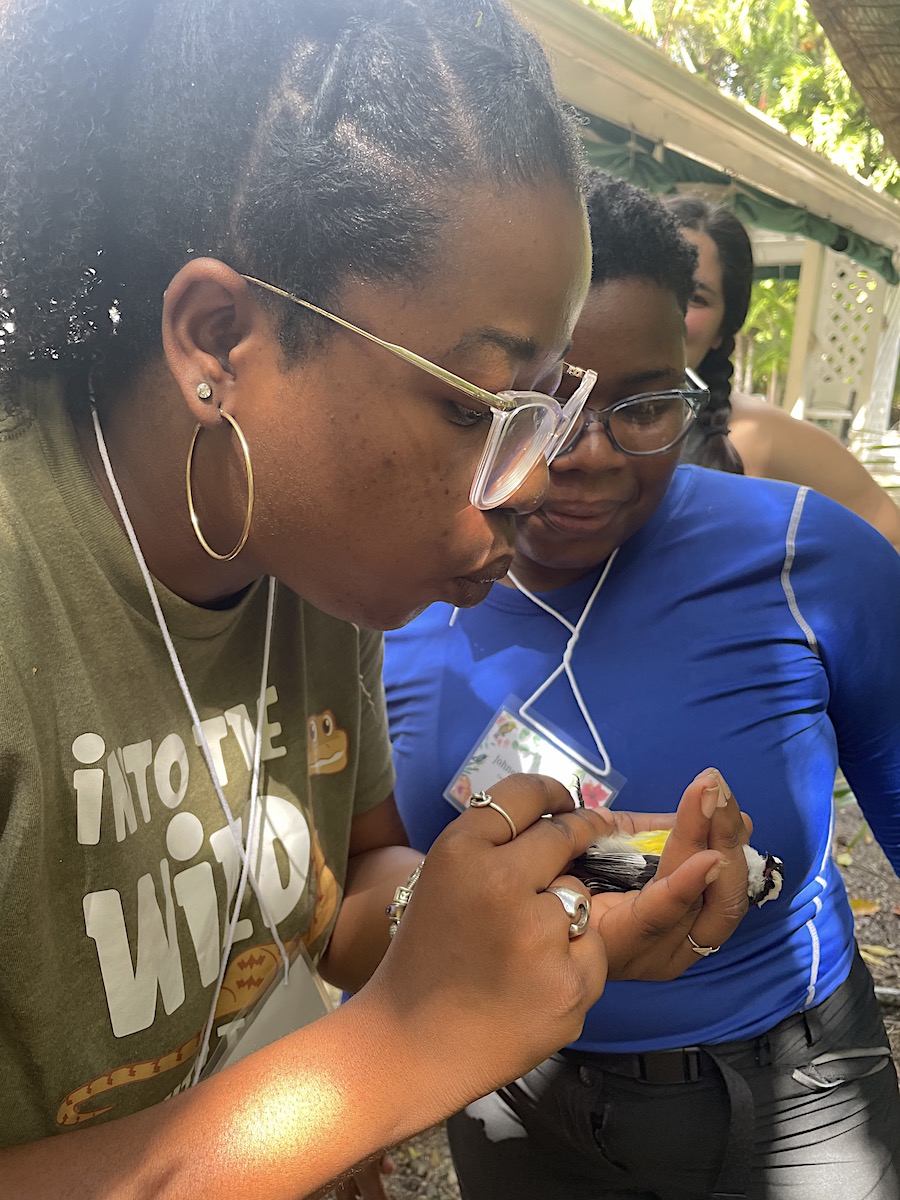
Recently certified NABC trainers Daniela Ventura (left) and Zoya Buckmire (right) band a Bananaquit together. (photo by Holly Garrod)
It was incredibly meaningful to watch the certification of two new Caribbean Bird Banding trainers, Daniela Ventura (Cuba) and Zoya Buckmire, who is also from my homeland of Grenada – what a sense of pride! This certification symbolized not only the success of the workshop but also BirdsCaribbean’s long-term goal of fostering Caribbean expertise in ornithology.
Coming home with more than new skills
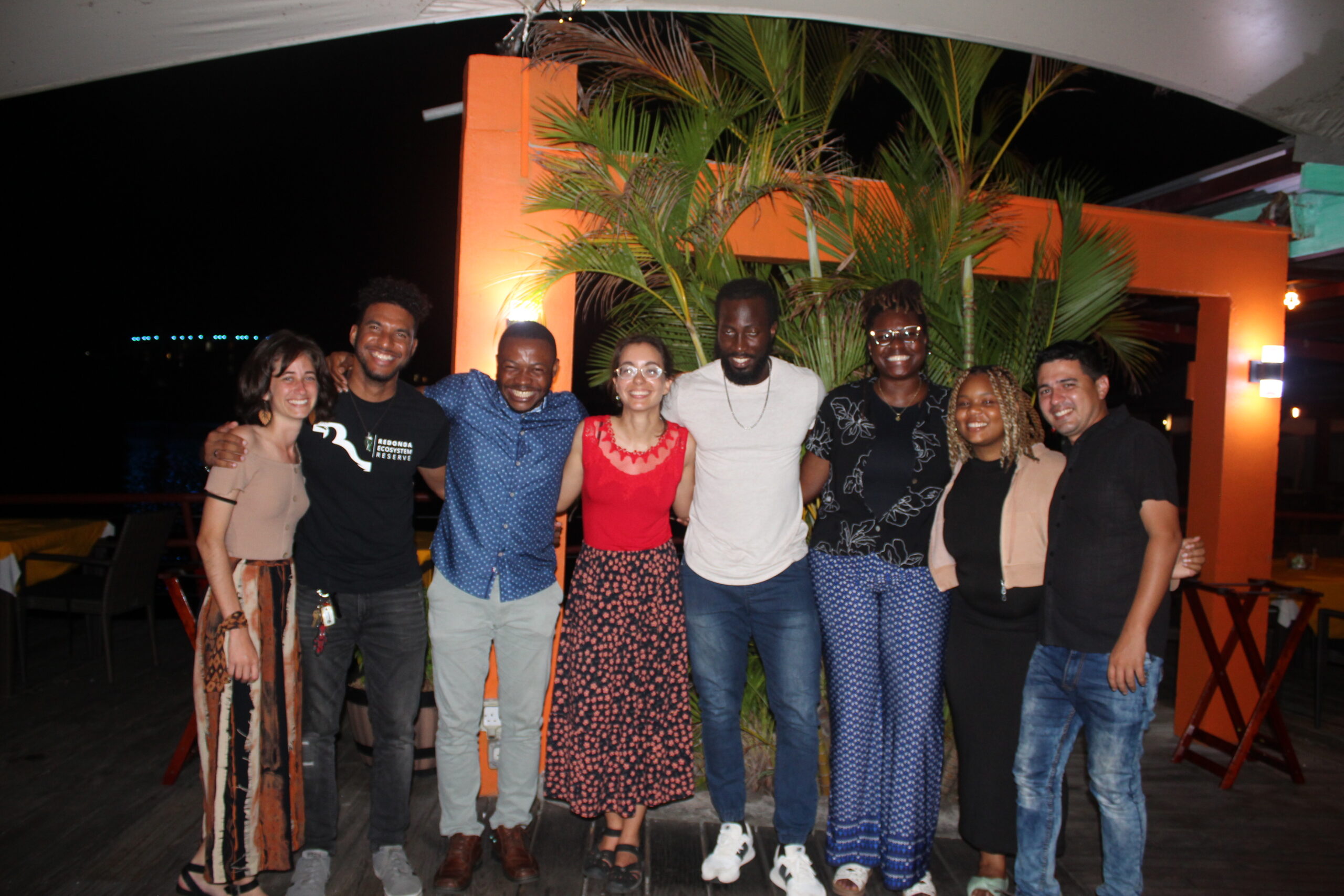
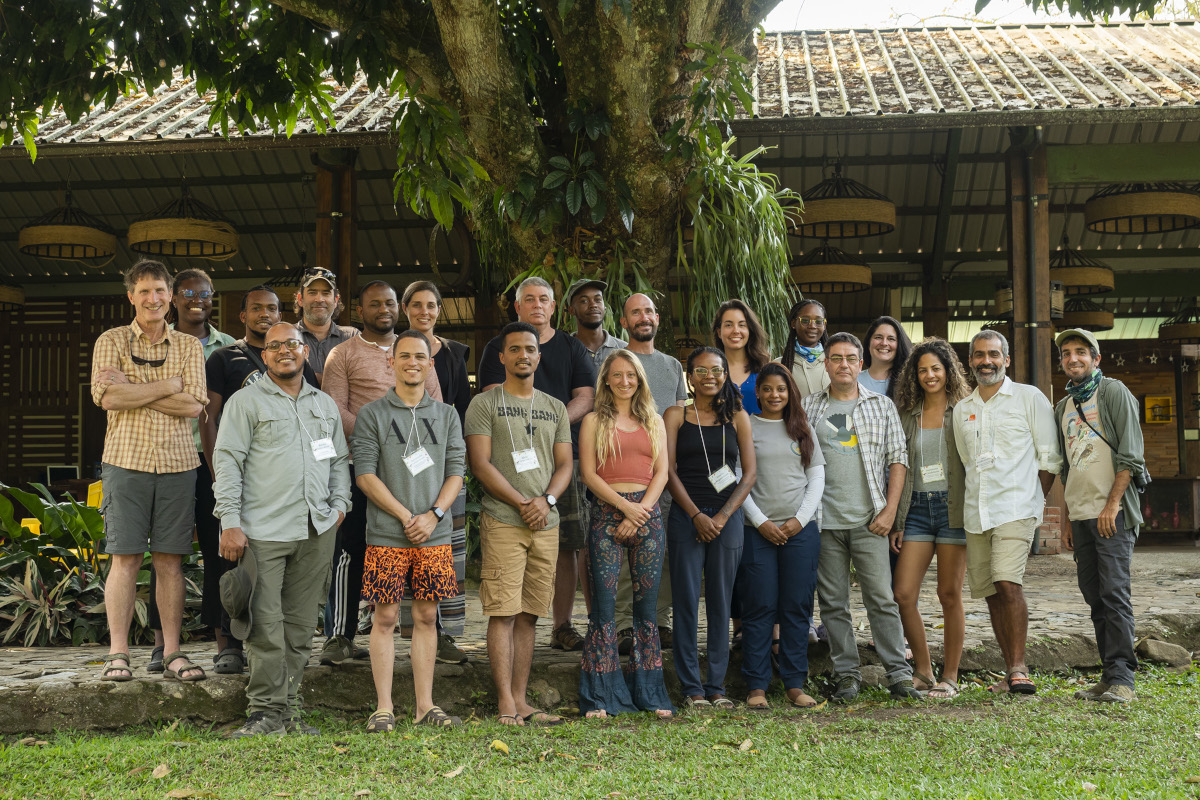
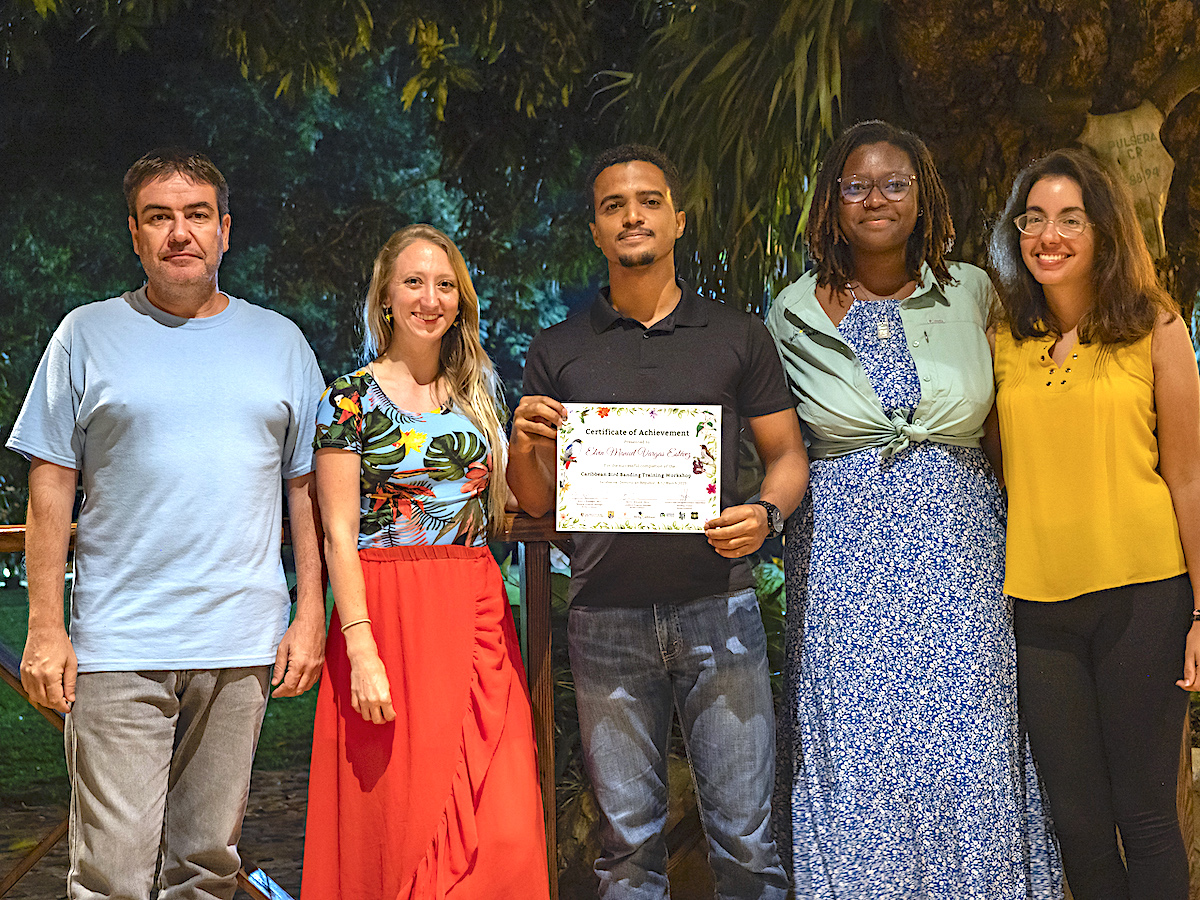
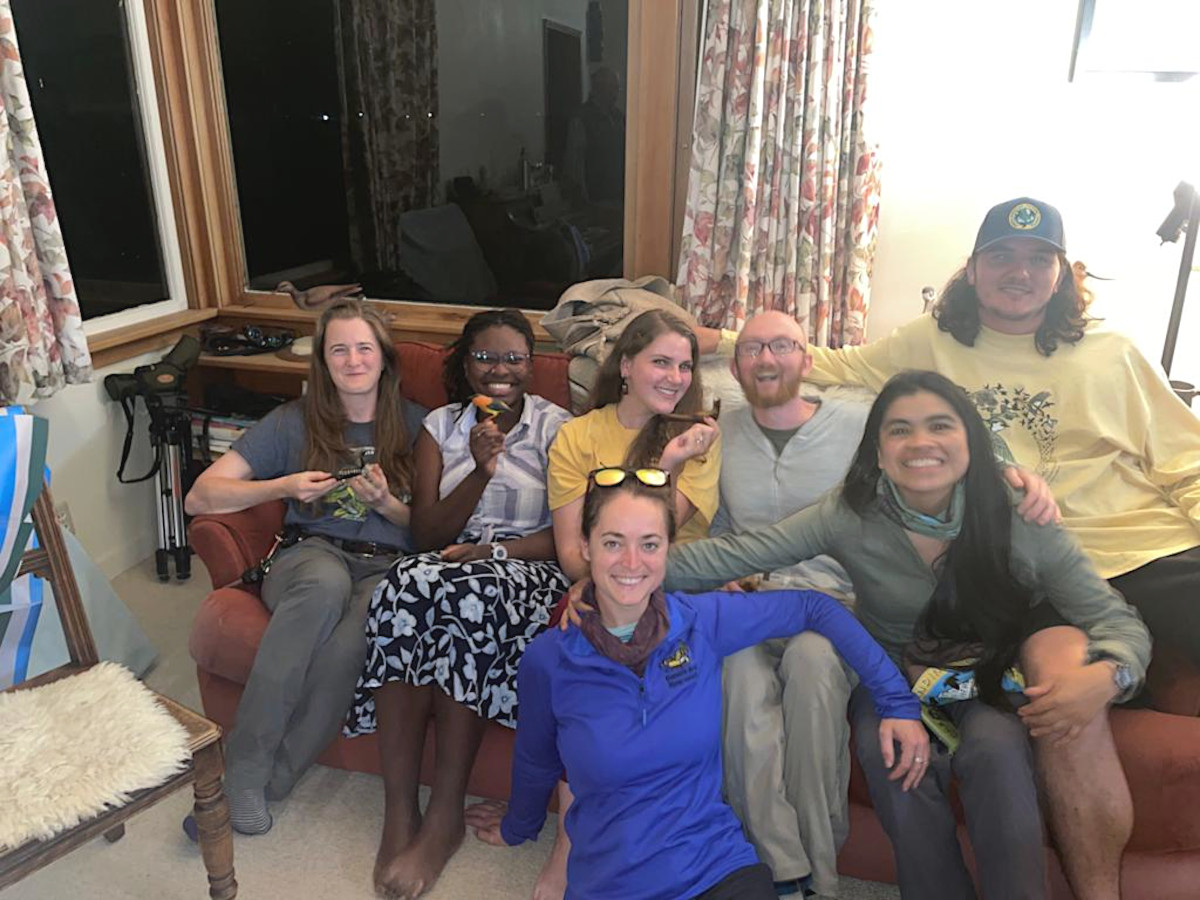
Participants (left to right) at the end of workshop banquet: Laura Arañaburo Acosta, Joshel Wilson, Kendon James, Daniela Ventura, Shawn Allard, Zoya Buckmire, Jadie Allard, Elien Domínguez Tan
As I received my Certificate of Achievement, I felt a mix of emotions. There was a sense of accomplishment for the skills I’d acquired, but also a profound sense of reconnection with my homeland. This workshop wasn’t just about learning bird banding techniques; it was about returning to Grenada, reconnecting with its people, and rediscovering the beauty of its natural world.
As I said goodbye to the friends I made and the birds I came to know, I knew this wouldn’t be the last time I would see them. This journey had reignited my passion for bird conservation and deepened my commitment to supporting the Caribbean’s ornithological community.
If you’re considering participating in a similar workshop, I can’t recommend it enough. The experience will not only enrich your knowledge but also connect you to a vibrant and welcoming community of biologists from across the Caribbean.
Trainer Daniela Ventura show other bird banding workshop participants how to check a bird for breeding characteristics
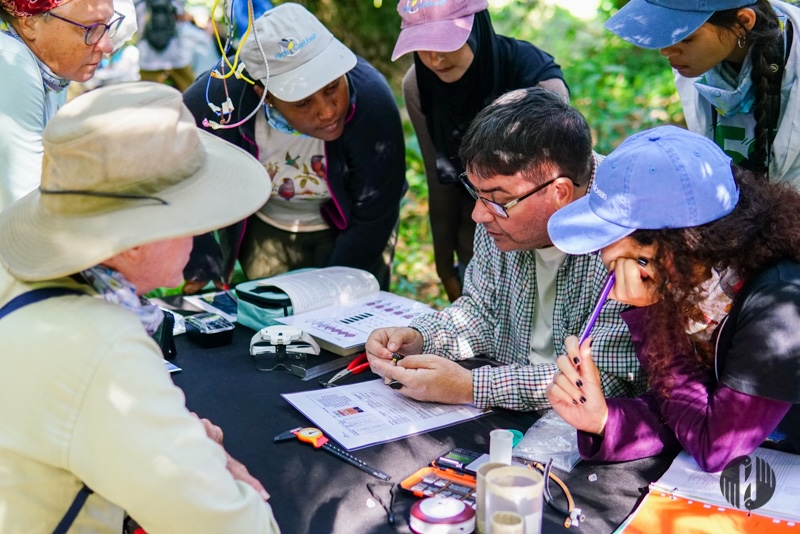
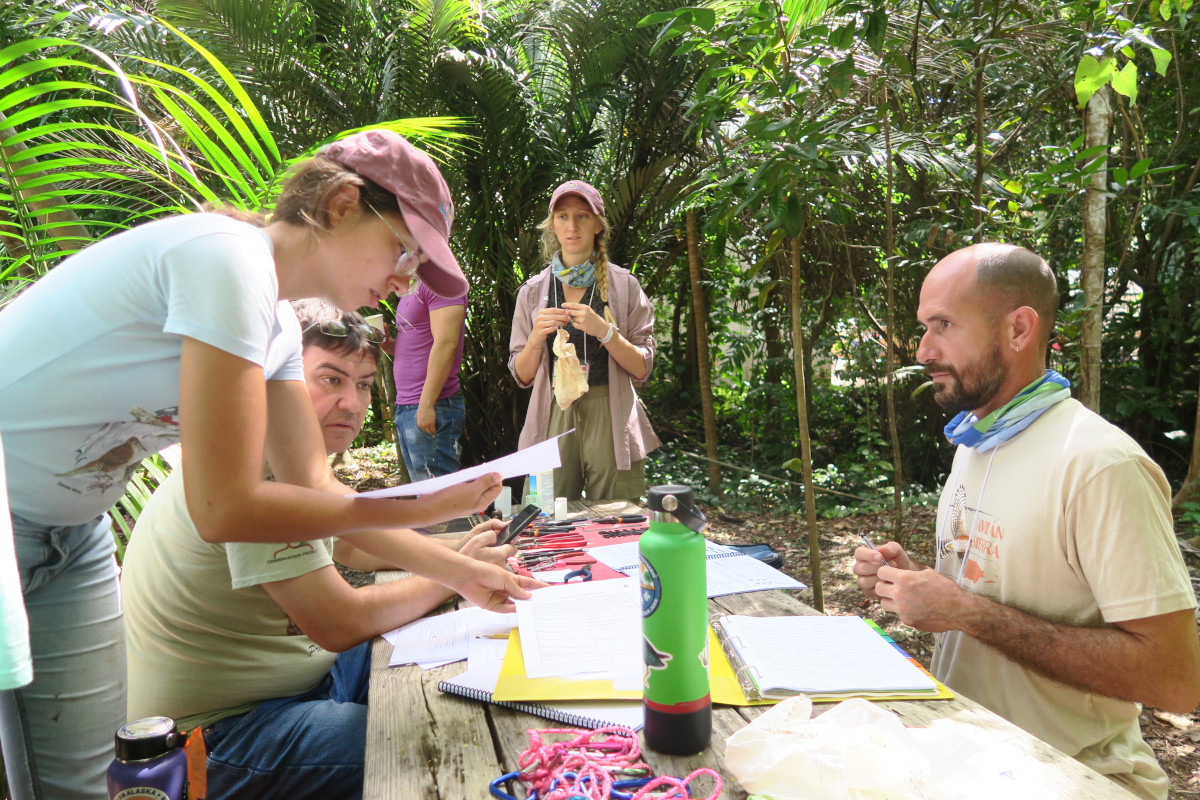
The first step to banding a bird is first identifying the species, as shown here comparing this Yellow-bellied Elaenia to drawings in the field guide
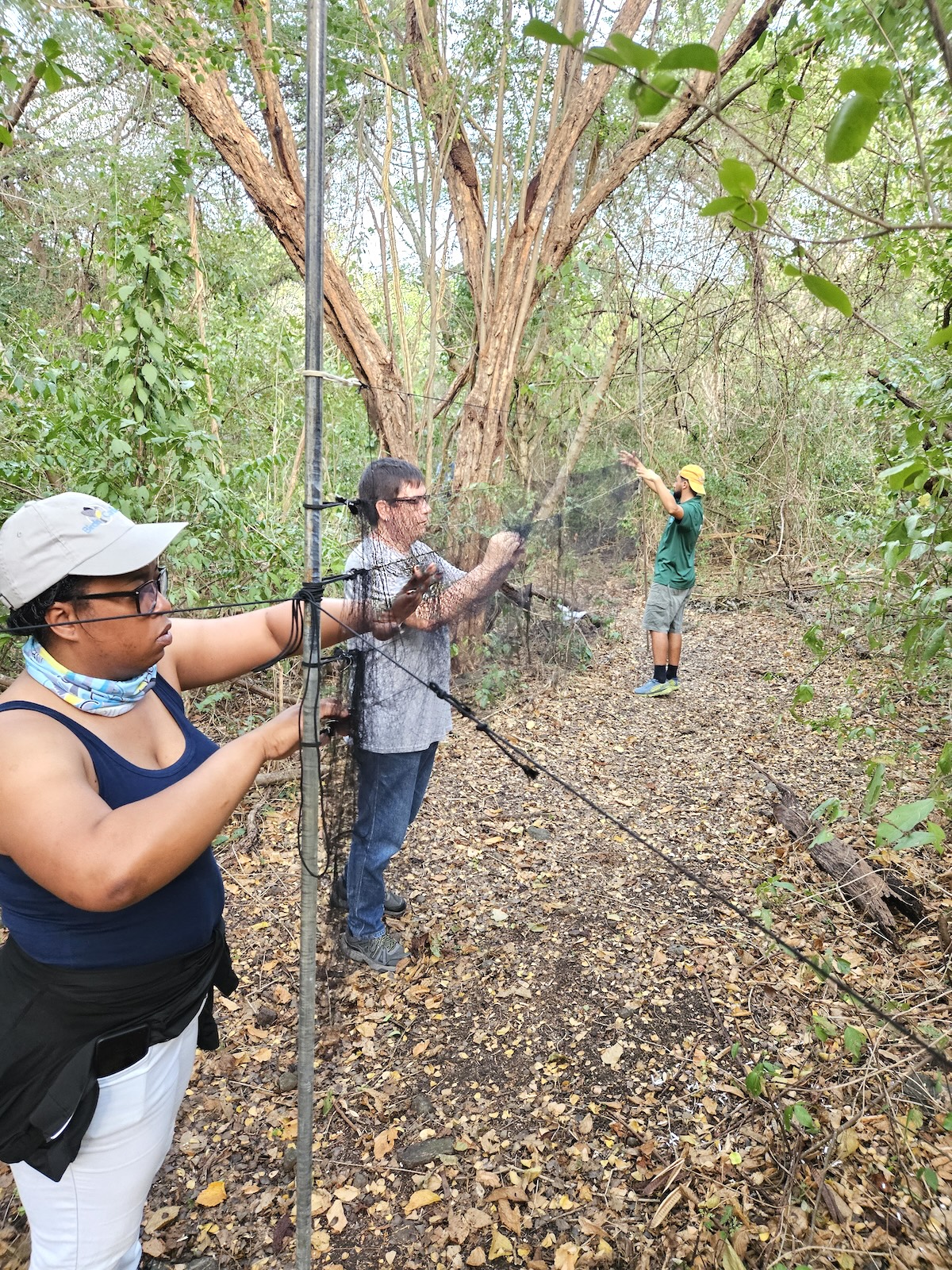
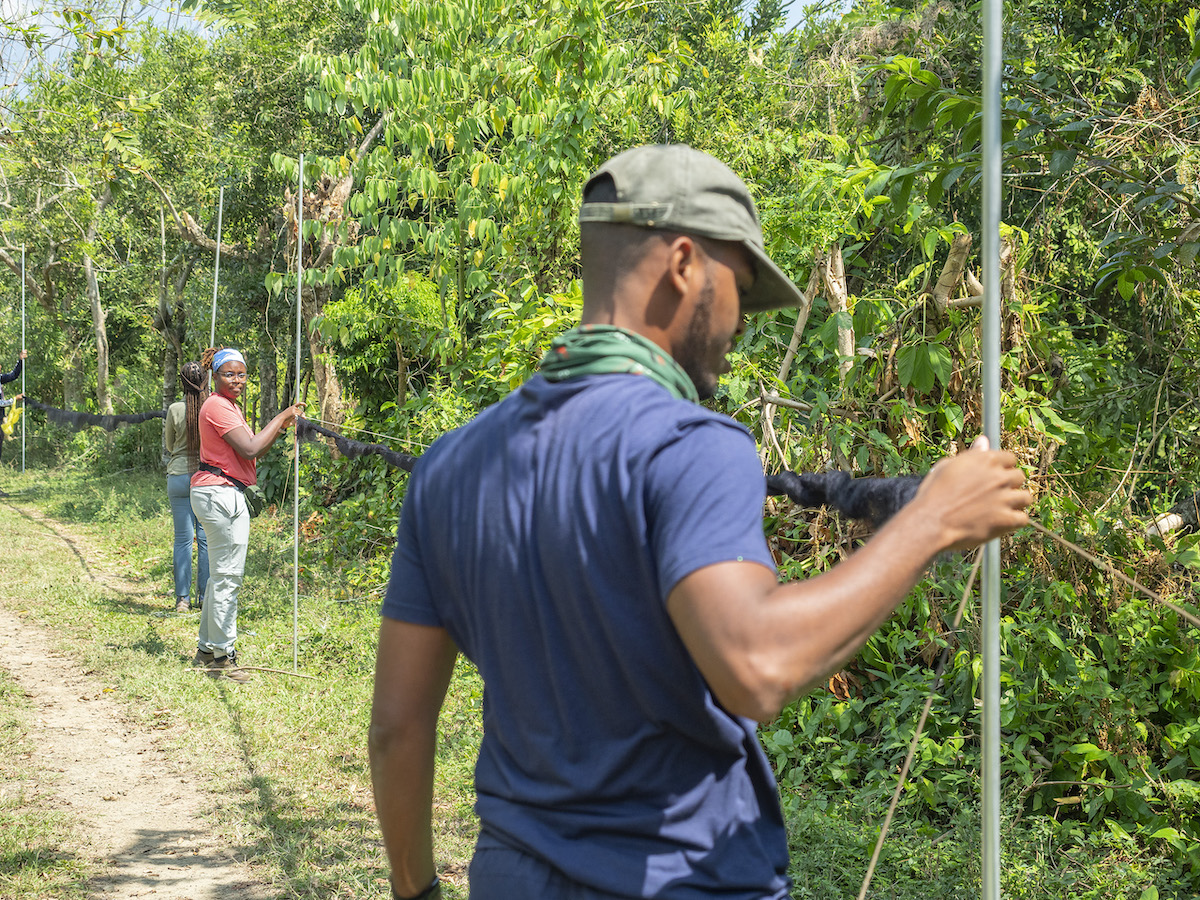
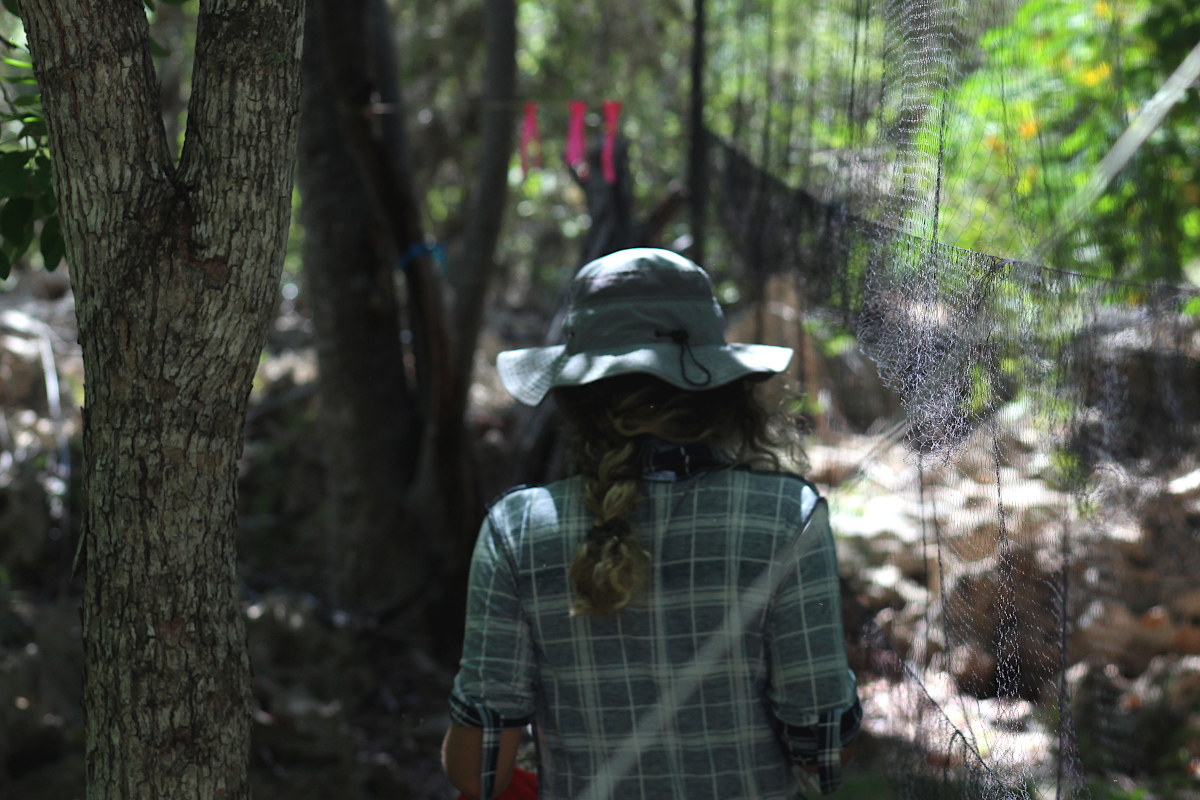
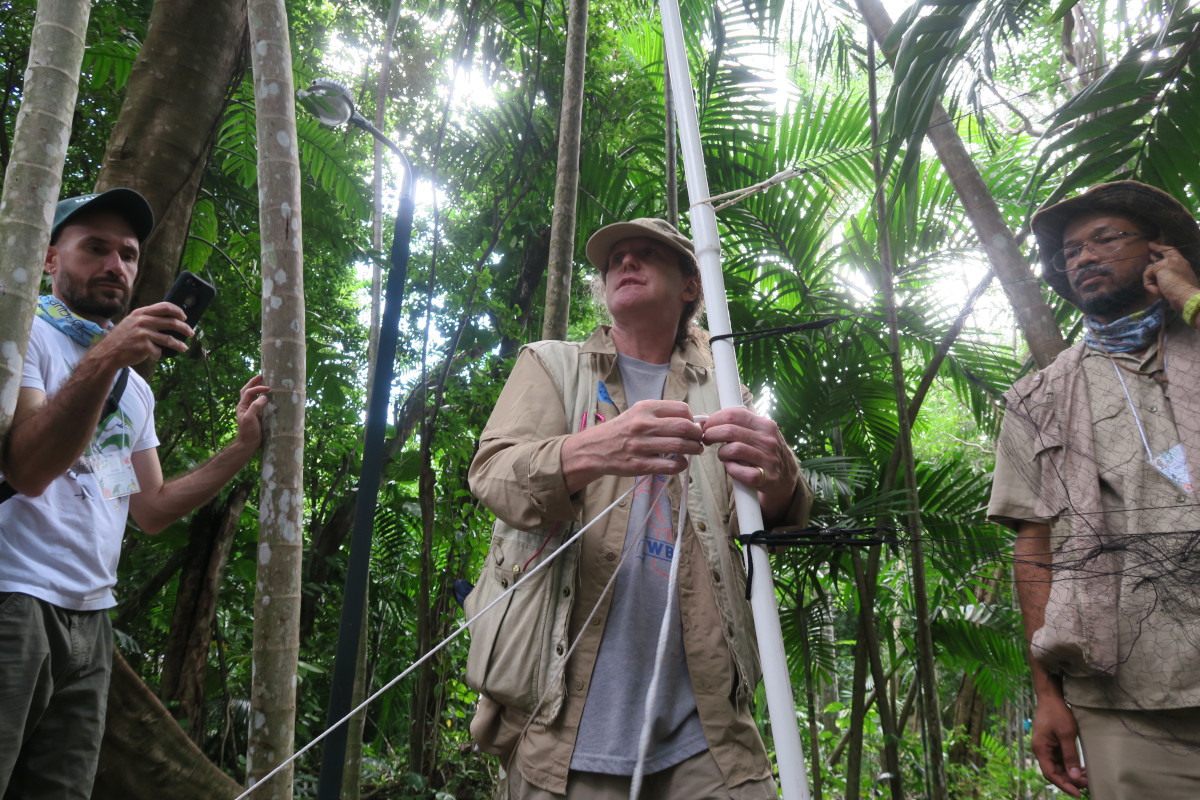
Trainer Juan Carlos instructs participants on how to properly set up a mist net. (photo by Holly Garrod)
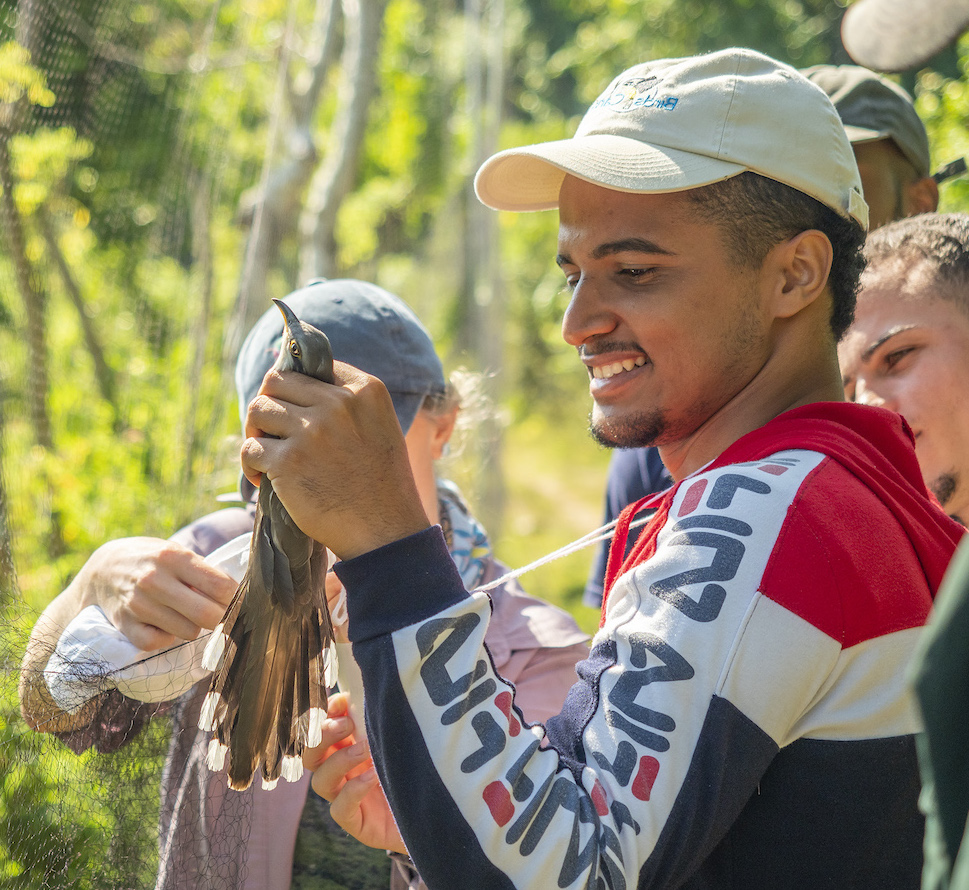
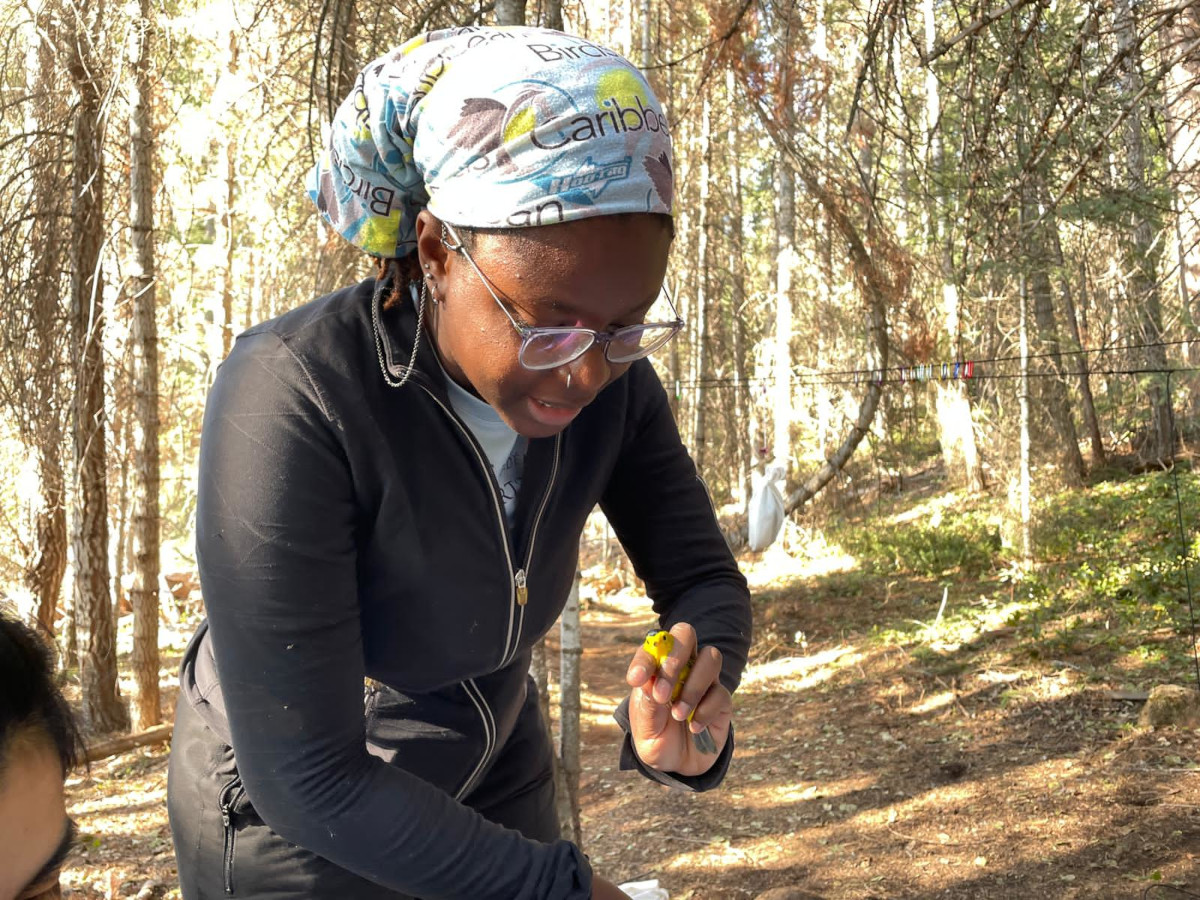
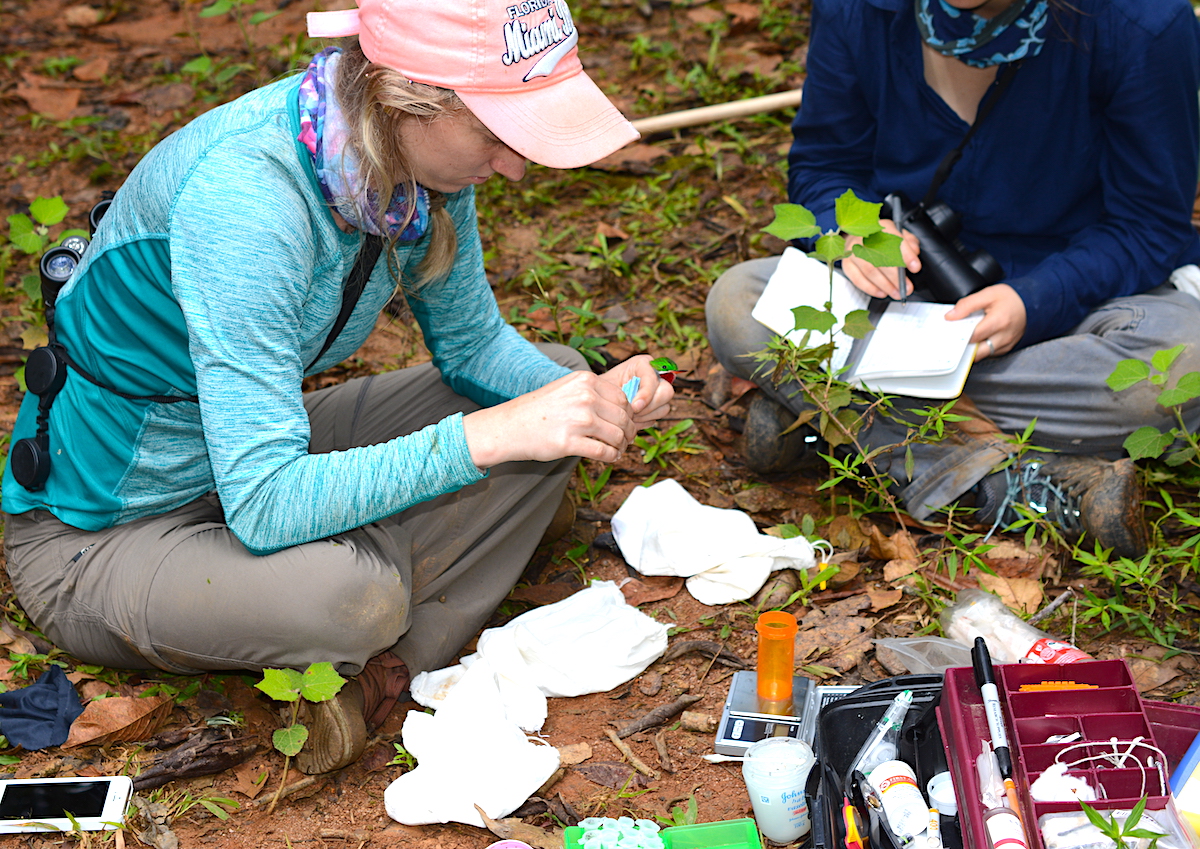
Shawn Allard extracts a Bananaquit from a mist net
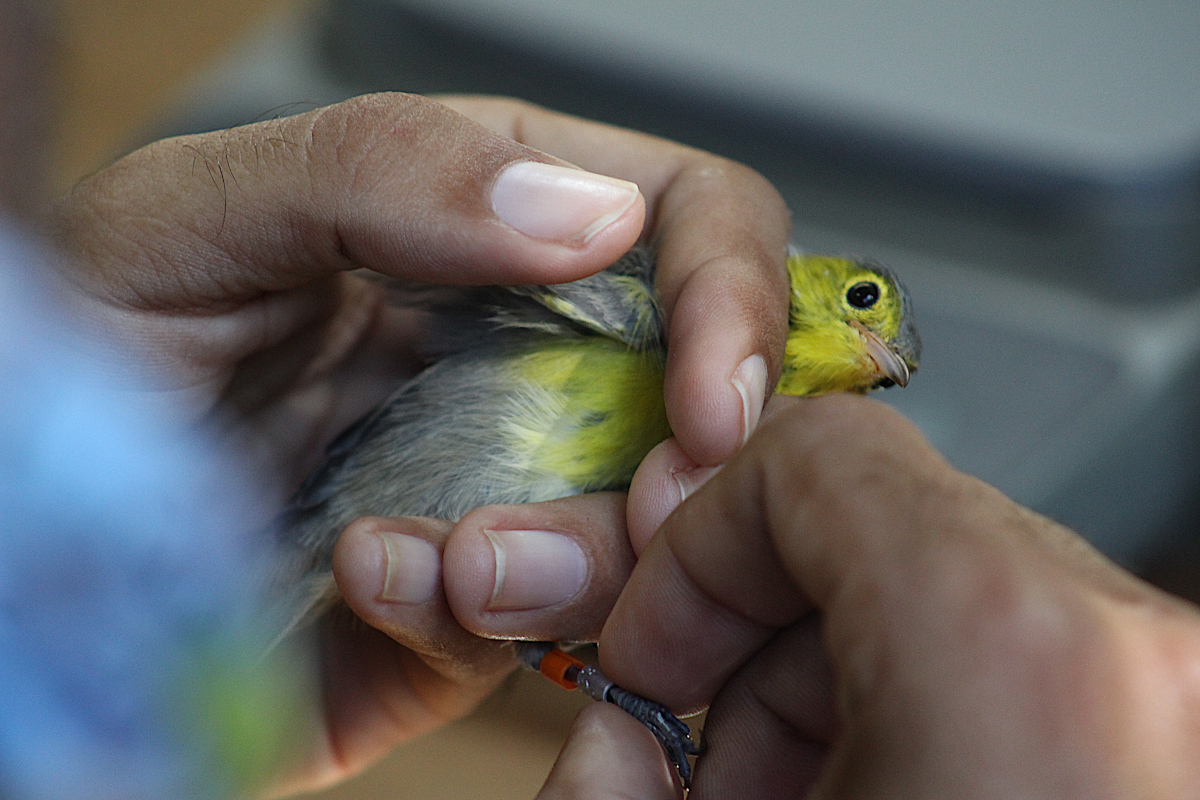
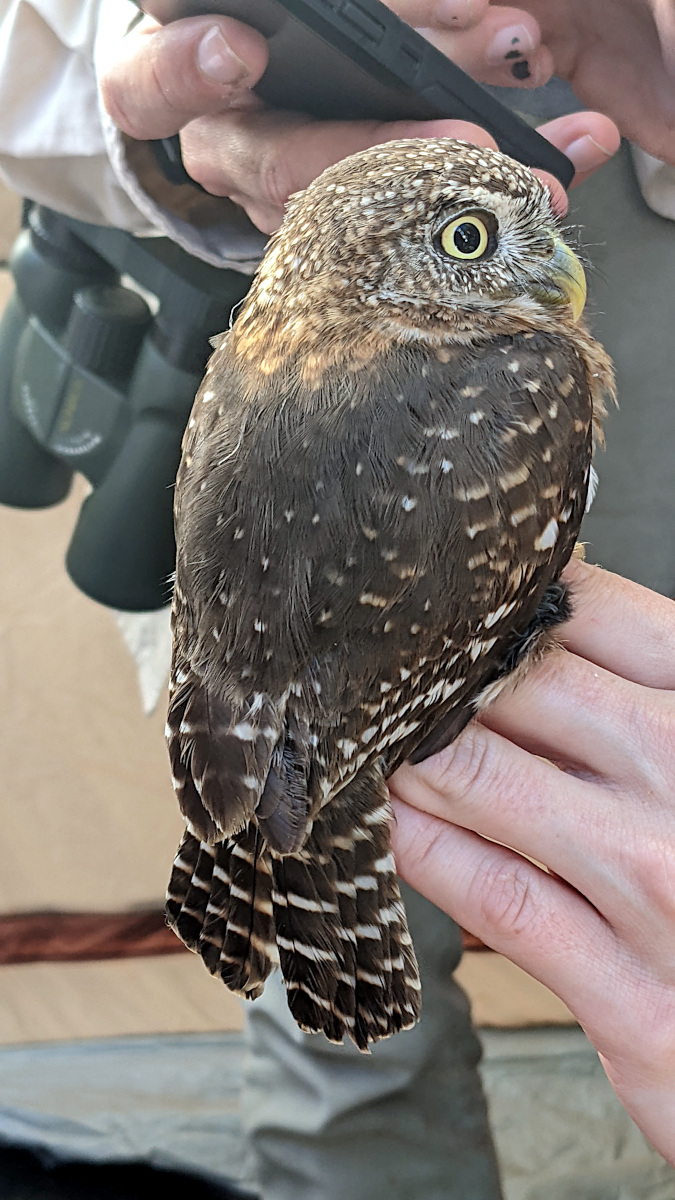
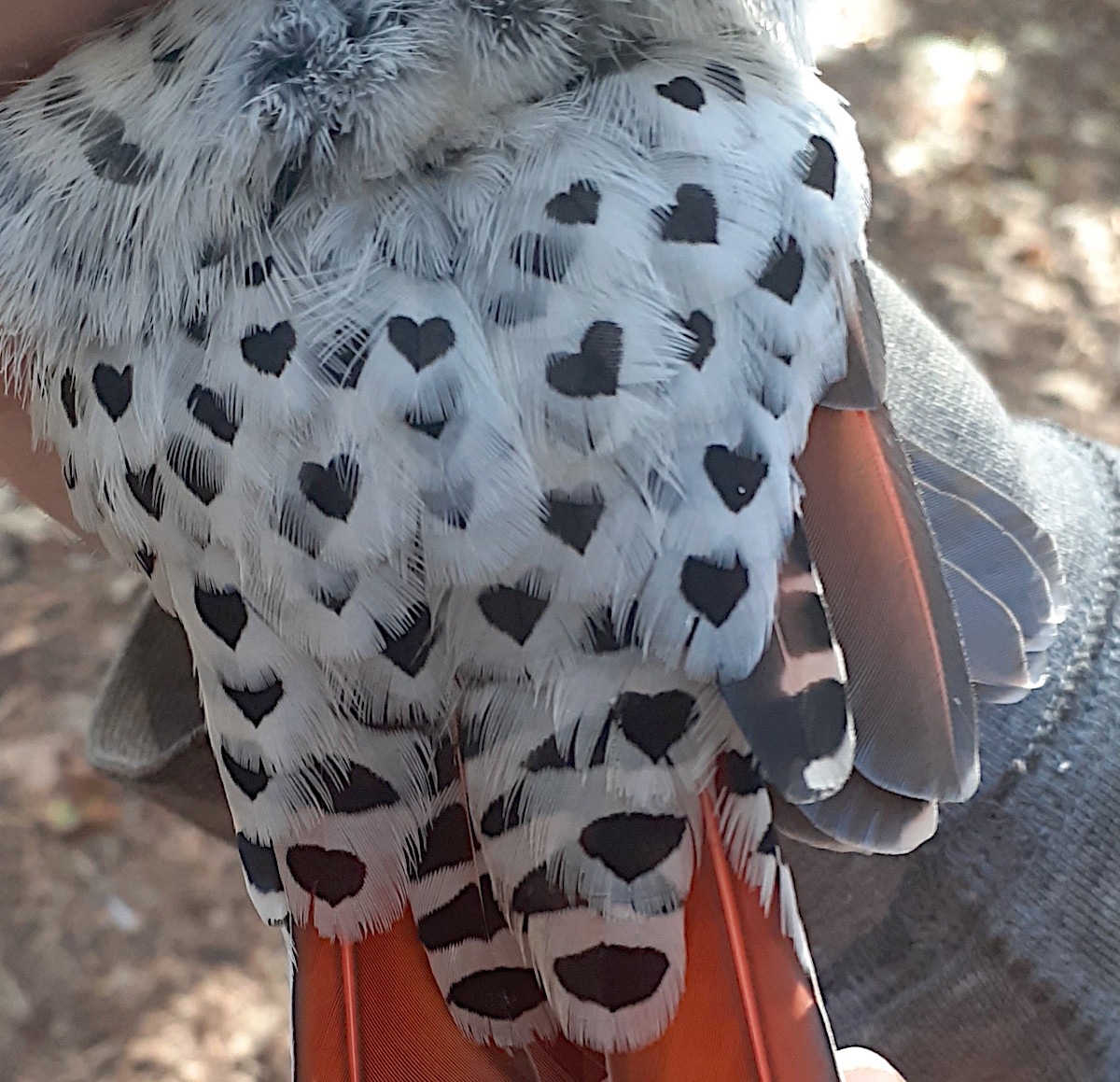
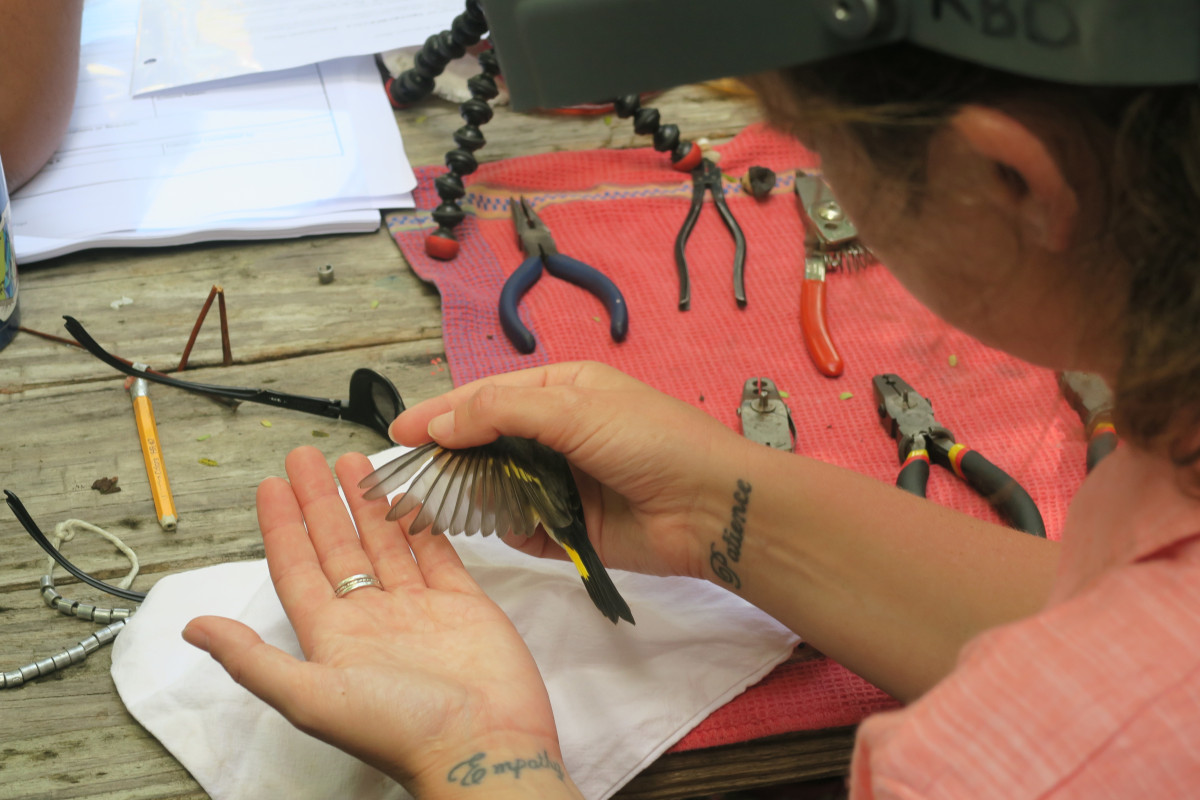
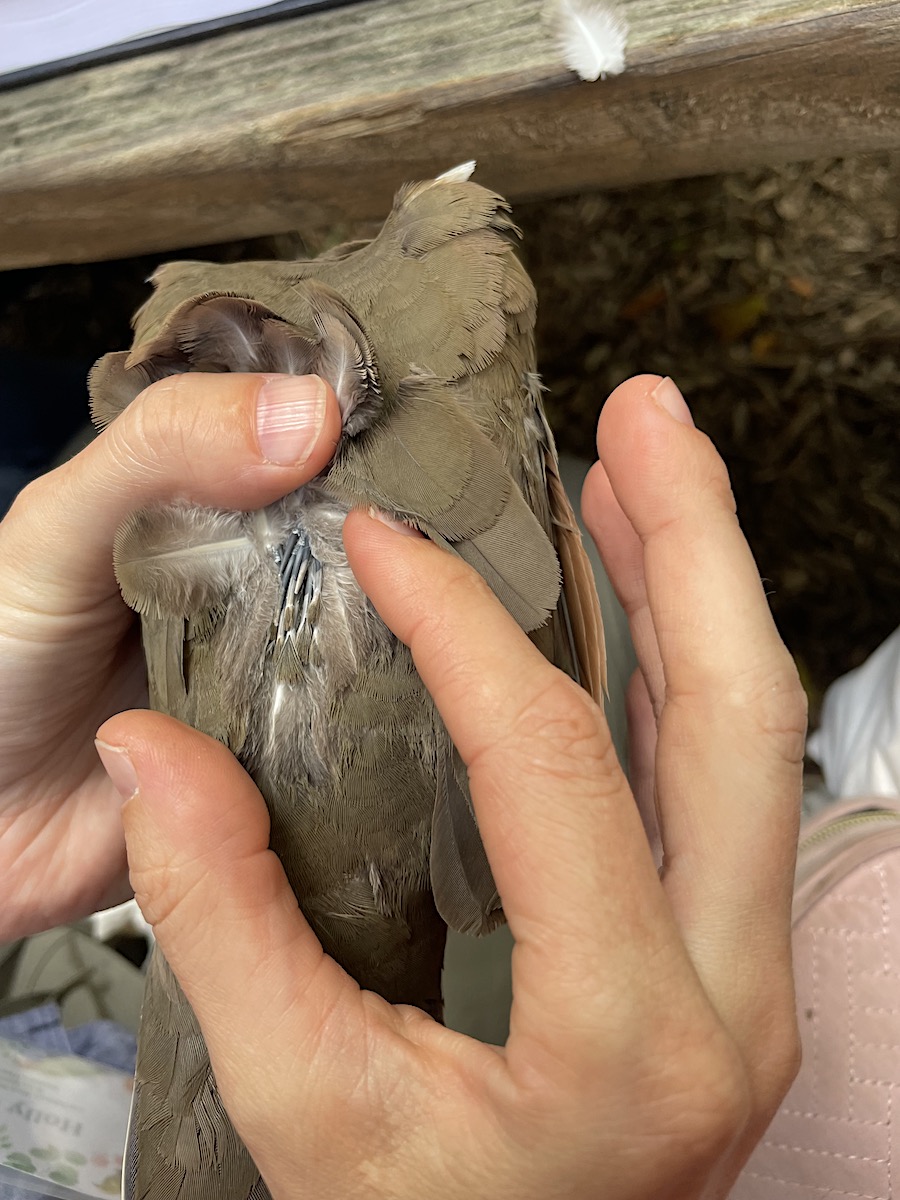
Bananaquit being held in photographer’s grip. Photo: Holly Garrod
The endangered and endemic Grenada Dove spotted at the banding site of Mount Hartman
Acknowledgements: The Caribbean Bird Banding Training Workshop was made possible through the generous support of our donors and funders, including the U.S. Fish and Wildlife Service and Zoo New England. We would also like to thank our local and international partners, including the Grenada Fund for Conservation, Gaea Conservation Network, Grenada Forestry, Klamath Bird Observatory, and Institute for Bird Populations.
Joshel Wilson is a Wildlife Biologist with a B.Sc. in Marine, Wildlife, & Conservation Biology from St. George’s University and an MSc candidate at the University of Leeds. With expertise in biodiversity conservation, endangered species management, and research methodologies, including UAS and tagging techniques, he has contributed to projects across the Caribbean. Currently a Wildlife Officer with the Environmental Awareness Group, Joshel oversees conservation efforts in Antigua, Barbuda, and Redonda. He also serves as Principal Investigator for the Antiguan Racer Census and holds certifications in marine conservation and climate resilience.
The arrival of brightly colored, migratory warblers is a glorious time on the Caribbean birding calendar—but have you ever wondered about the lives of our vibrant guests?? Like: do they come back to the same spots in the Caribbean every year? How long do they live? And how are they faring when they visit our islands? Some of these warblers, like the delightful Prairie Warbler, have been shown to live for 8-10 years, returning faithfully to the same spots in the Caribbean! These valuable insights—the kinds that tell us about the health of our birds and how we can help them—are gained from bird banding. If you love Caribbean birds, and want to increase your ability to protect them—maybe you want to learn to put a ring (or band) on them!
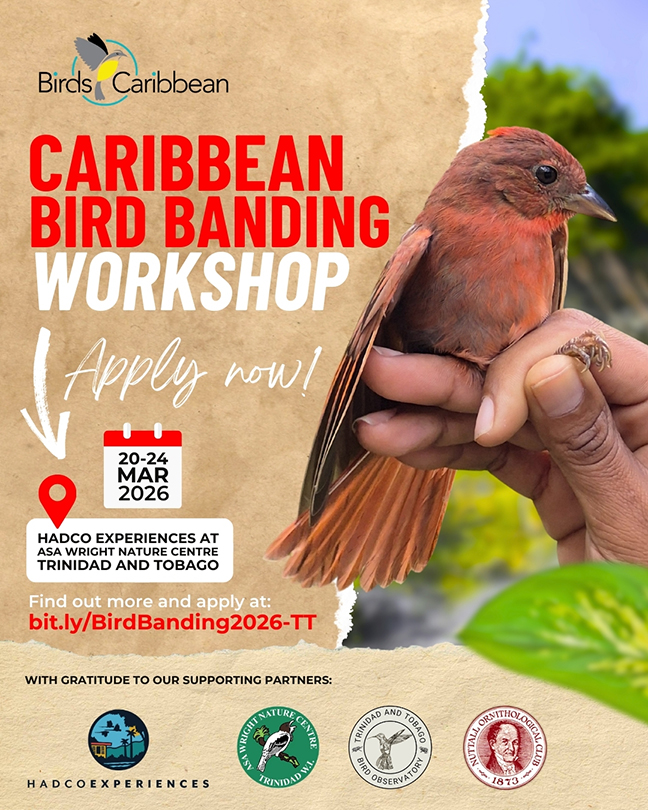
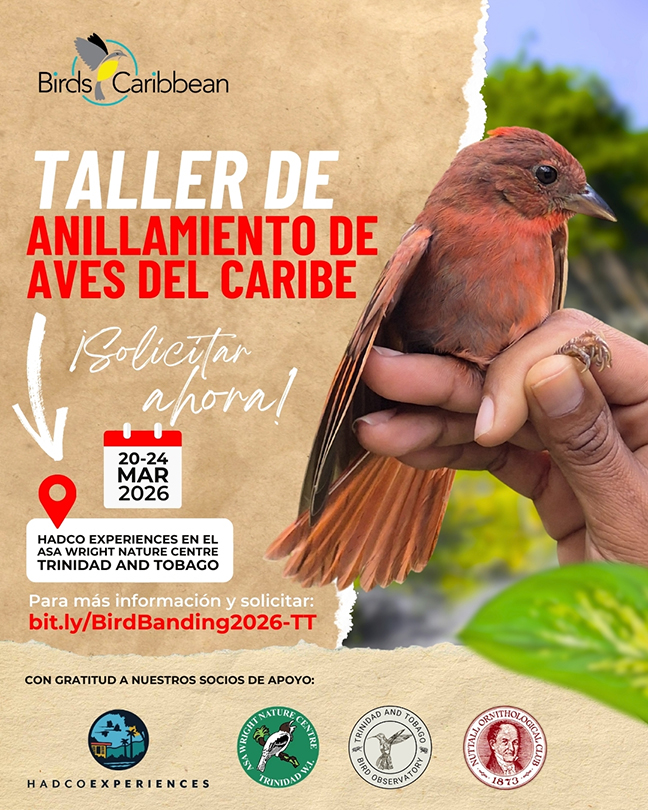
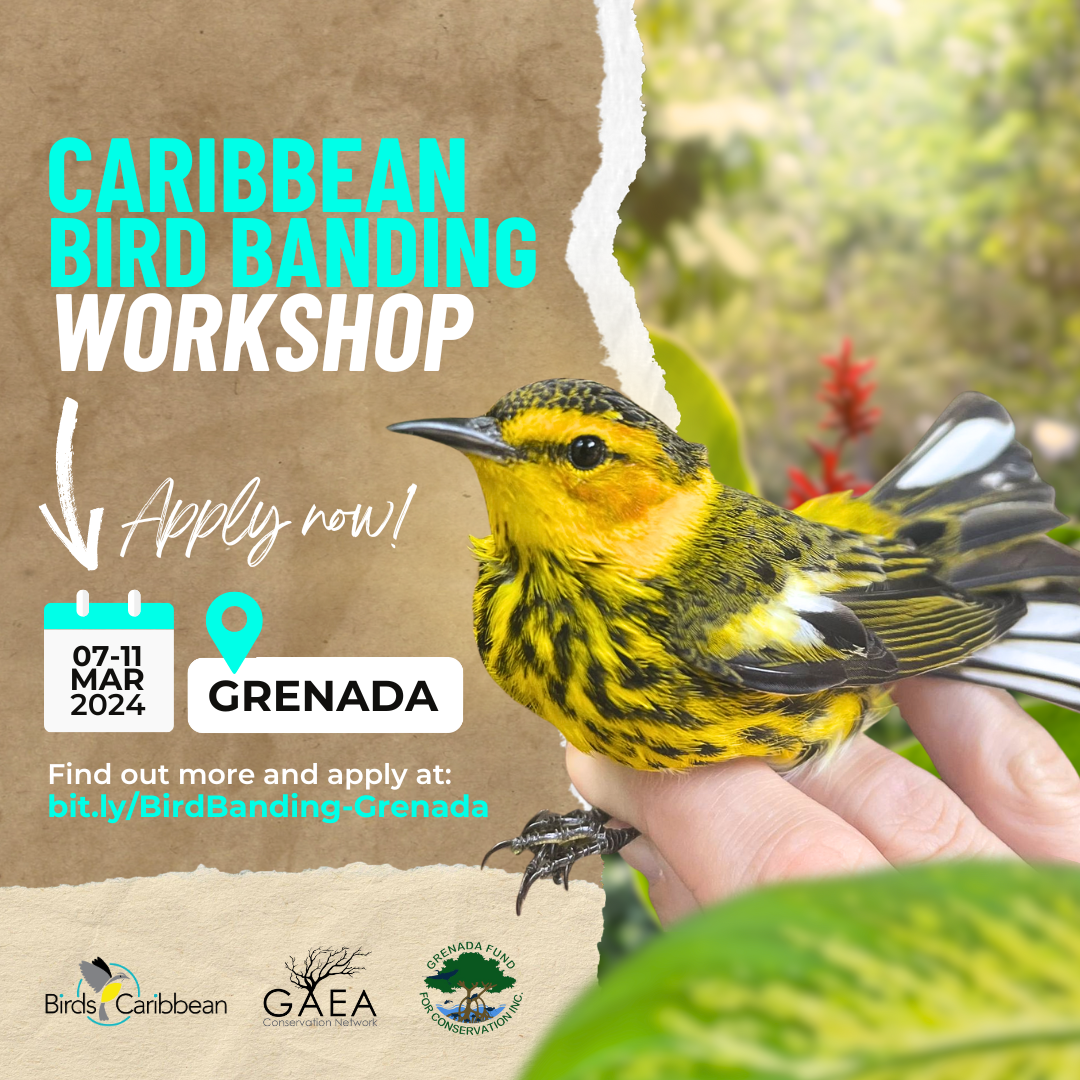
BirdsCaribbean is excited to invite applications to participate in a 5-day Caribbean Bird Banding Training Workshop! Participants will learn the basics of bird banding, from setting up a mist-net to examining molt patterns, through a blend of classroom and field based activities. We’ll also discuss and demonstrate the benefits of joining the Caribbean Bird Banding Network. We’re very excited to work with our local partner, the Trinidad and Tobago Bird Observatory, to provide this training opportunity at the internationally renowned HADCO Experiences at Asa Wright Nature Centre from 20-24 March, 2026.
Why do we band birds?
Bird surveys, like those covered in our Caribbean Landbird Monitoring Training Workshops, provide valuable information about abundance and species presence. But bird banding is a different methodology that takes a deeper dive into how bird populations are doing by assessing the condition of individual birds.
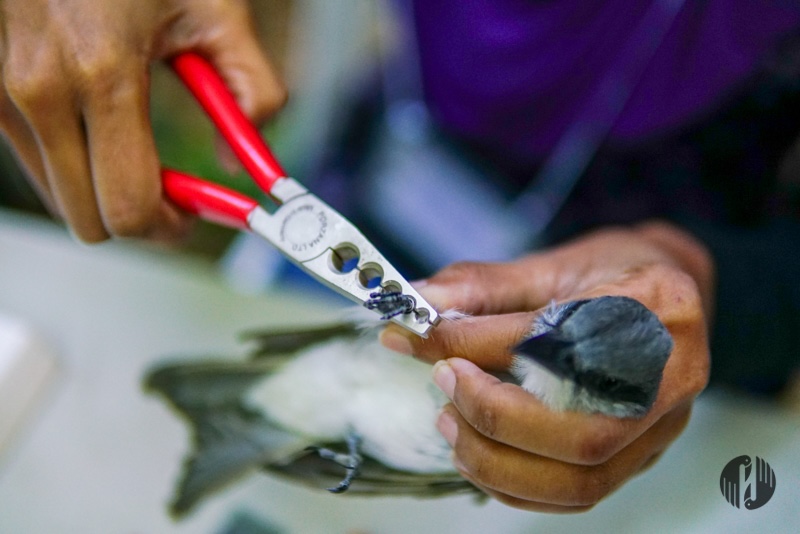
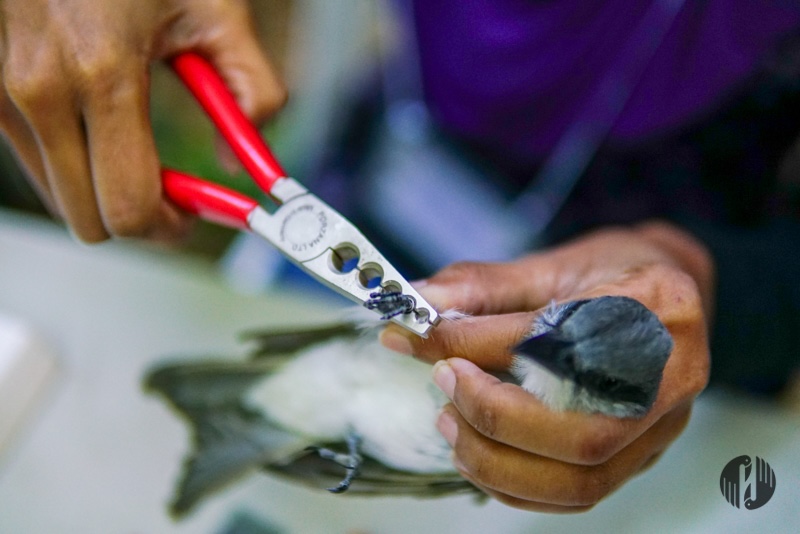
Banding a Gray Kingbird Tyrannus dominicensus with BirdsCaribbean bands. Photo by Holly Garrod
By individually marking birds with a band and assessing them in the hand, we can collect data that tell us about their demography and health, including:
Their fat scores and weights, to assess the body condition of birds in different habitats and at different times of the year, shedding light on the quality of the habitats the birds are using.
Aging birds using plumage to investigate demographic patterns.
Using recapture records to learn about survivorship and longevity.
Assessing the presence or absence of breeding characteristics to better understand the timing of breeding and life history for many of our understudied Caribbean endemics.
Finding out which migratory routes our shared birds are taking, and gaining a better understanding of the factors influencing survival and longevity of various species.
Over the long-term, bird banding data can also help us understand patterns and trends in bird populations, to aid in their management and conservation.
About the workshop
This workshop is the fifth annual Caribbean Bird Banding (CBB) Training Workshop. It will cover many of the same topics explored in our previous CBB Training workshops held in The Bahamas (March 2022) and the Dominican Republic (March 2023, February 2025) and Grenada (March 2024). This workshop will focus on banding landbirds, with an emphasis on Passerines. We hope to provide banding training opportunities for other bird groups in the future.
The purpose of the workshop is to:
Provide participants with a basic understanding of bird banding techniques and best practices.
Discuss what it takes to set-up and run a bird banding station.
Prepare participants for additional bird banding training and potential North American Banding Council (NABC) certifications (assistant, bander, trainer) in the future.
Share information about the other training opportunities, resources, and community available through the CBB Network.
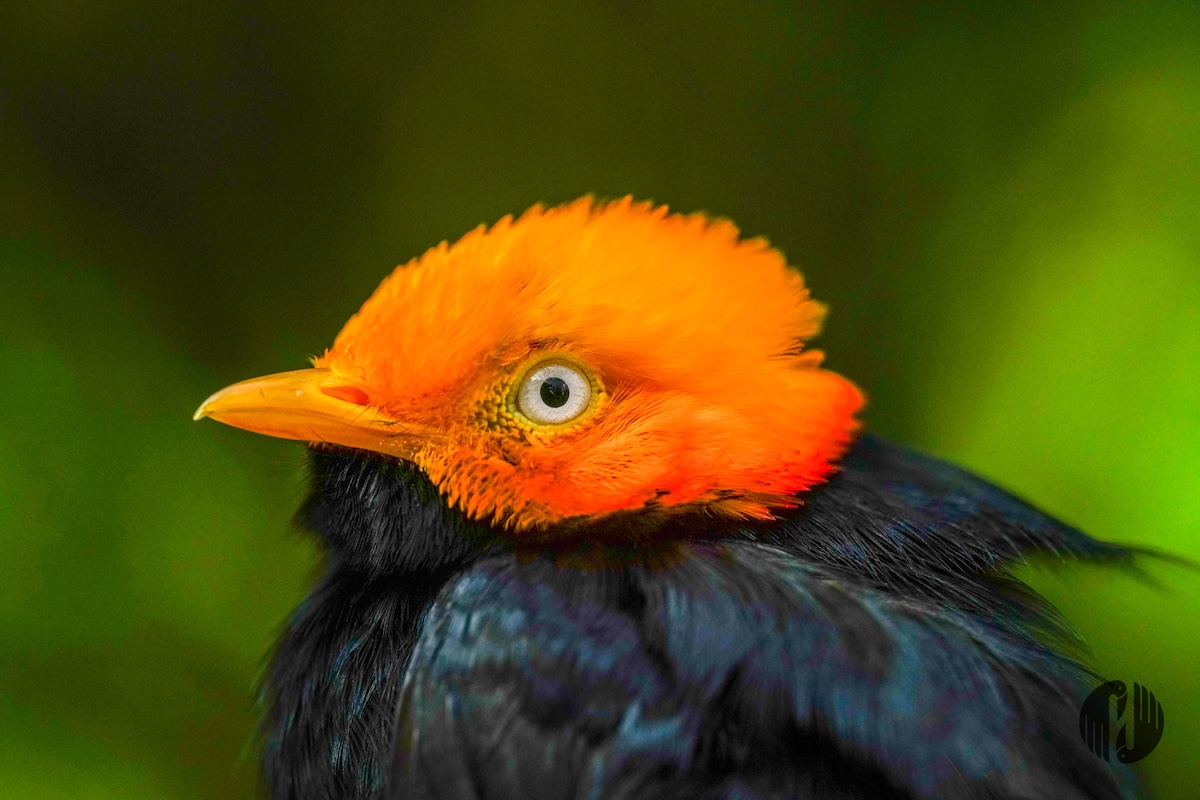
NABC certified banders from TTBO, Giselle and Che Ragoonanan compare the ages of two Golden-headed Manakins looking at plumage pattern or molt limits in the wing. (Photo by Holly Garrod)
Snapshot from the field from our 2025 CBB Workshop in the Dominican Republic. Andrys Gomez (from Dominican Republic) bands a Smooth-billed ani (Crotophaga ani) while Jennifer Valiulis (U.S. Virgin Islands) scribes the data. Other participants gather to watch. (Photo by Holly Garrod)
Several NABC-certified trainers will share their knowledge in the classroom, at the mist-net, and at the banding table, covering topics including:
Proper set-up and placement of a mist-net
Proper techniques for extracting birds from mist-nets
Starting a banding station
Bird first-aid and safety
Bird banding ethics and basics
Using bird banding for education and public demonstrations
Aging birds using both WRP and Howell-Pyle terminology
Molt patterns
In an effort to decrease the amount of time spent in the classroom, some content will be shared virtually prior to the in-person workshop. These virtual sessions will also be made available to a wider audience. Announcements will be made via our discussion group on the groups.io platform, which you can join here. Stay tuned for more information!
Is this Workshop for you?
This bilingual (English and Spanish) workshop is designed for Caribbean wildlife professionals and volunteers who are interested in gaining more experience with bird banding. Prior banding experience is not required. However, priority will be given to applicants who are likely to continue training to gain the knowledge, skills, and experience needed to contribute to or initiate avian research and/or banding programs on their home islands.
Snapshot from the field from our 2025 CBB Workshop in the Dominican Republic. NABC trainer, Juan Carlos Fernandez Ordoñez, explains to CBB participants how we can age a Bananaquit (Coereba flaveola) using molt limits. (Photo by Holly Garrod.)
Bird banding is a complex skill to learn. This workshop is intended to be a starting point, and participants should not expect to leave the workshop with the necessary qualifications to band birds independently. To become fully immersed and practice what was learned at the workshop, participants will have the opportunity to be considered for bird banding internships following the workshop.
Funding and logistics
We aim to include approximately 15 participants in this workshop. BirdsCaribbean has funding for a limited number of need and merit-based scholarships to cover the costs of travel and participation. Participants who are able to contribute all or part of their costs can allow us to include additional participants. We encourage applications from all candidates who are well-suited to make use of this training, regardless of their financial ability. Participants should plan to arrive in Trinidad by 19 March and depart on 25 March.
Applications
If you are interested in participating in this workshop, please fill out this form by 7 January 2026.
Oportunidad de formación: Taller de anillamiento de aves caribeñas
La llegada de las coloridas reinitas migratorias es un momento glorioso en el calendario de observación de aves del Caribe, pero ¿alguna vez te has preguntado cómo es la vida de nuestros vibrantes invitados? Por ejemplo: ¿regresan cada año a los mismos lugares del Caribe? ¿Cuánto tiempo viven? ¿Y cómo les va cuando visitan nuestras islas? Se ha demostrado que algunas de estas reinitas, como la encantadora reinita galana, viven entre 8 y 10 años y regresan fielmente a los mismos lugares del Caribe. Estos valiosos datos, que nos informan sobre la salud de nuestras aves y cómo podemos ayudarlas, se obtienen gracias al anillamiento de aves. Si te encantan las aves del Caribe y quieres aumentar tu capacidad para protegerlas, ¡quizás te interese aprender a ponerles un anillo!
¡BirdsCaribbean se complace en invitarte a presentar una solicitud para participar en un taller de formación sobre el anillamiento de aves en el Caribe, de 5 días de duración! Los participantes aprenderán los fundamentos del anillamiento de aves, desde la instalación de una red de niebla hasta el examen de los patrones de muda, mediante una combinación de actividades en el aula y sobre el terreno. También discutiremos y demostraremos los beneficios de unirse a la Red de Anillamiento de Aves del Caribe (CBBN, por sus siglas en inglés). Estamos muy emocionados de trabajar con nuestro socio local, el Observatorio de Aves de Trinidad y Tobago, para ofrecer esta oportunidad de formación en el internacionalmente reconocido HADCO Experiences en el Centro de Naturaleza Asa Wright, del 20 al 24 de marzo de 2026.
¿Por qué anillamos aves?
Los censos de aves, como los que se tratan en nuestros talleres de formación sobre seguimiento de aves terrestres en el Caribe, proporcionan información valiosa sobre la abundancia y la presencia de especies. Sin embargo, el anillamiento de aves es una metodología diferente que permite profundizar en el estado de las poblaciones de aves mediante la evaluación del estado de cada ejemplar.
Anillando un pitirre Tyrannus dominicensis con anillas de BirdsCaribbean. Foto de Holly Garrod.
Al marcar individualmente a las aves con un anillo y evaluarlas en la mano, podemos recopilar datos que nos informan sobre su demografía y salud, entre los que se incluyen:
Sus índices de grasa y peso, para evaluar el estado físico de las aves en diferentes hábitats y en diferentes épocas del año, lo que arroja luz sobre la calidad de los hábitats que utilizan las aves.
Determinación de la edad de las aves utilizando el plumaje para investigar patrones demográficos.
Utilización de registros de recaptura para obtener información sobre la supervivencia y la longevidad.
Evaluación de la presencia o ausencia de características reproductivas para comprender mejor el momento de la reproducción y el ciclo vital de muchas de nuestras especies endémicas del Caribe, sobre las que se dispone de poca información.
Descubrir cuáles rutas migratorias siguen nuestras aves comunes y comprender mejor los factores que influyen en la supervivencia y la longevidad de diversas especies.
A largo plazo, los datos obtenidos mediante el anillamiento de aves también pueden ayudarnos a comprender los patrones y tendencias de las poblaciones de aves, lo que contribuye a su manejo y conservación.
Acerca del taller
Este taller es el quinto taller anual de capacitación en anillamiento de aves en el Caribe (CBB). Abarcará muchos de los mismos temas tratados en nuestros anteriores talleres de capacitación de la CBBN celebrados en las Bahamas (marzo de 2022), la República Dominicana (marzo de 2023, febrero de 2025) y Granada (marzo de 2024). Este taller se centrará en el anillamiento de aves terrestres, con especial atención a los paseriformes. Esperamos poder ofrecer en el futuro oportunidades de capacitación en anillamiento para otros grupos de aves.
Los objetivos del taller son:
Proporcionar a los participantes conocimientos básicos sobre las técnicas y mejores prácticas en anillamiento de aves.
Debatir qué se necesita para montar y manejar una estación de anillamiento de aves.
Preparar a los participantes para recibir formación adicional sobre anillamiento de aves y obtener posibles certificaciones del Consejo Norteamericano de Anillamiento (NABC, por sus siglas en inglés) (asistente, anillador, entrenador) en el futuro.
Compartir información sobre otras oportunidades de capacitación, recursos y comunidades disponibles a través de la red CBBN.
Los anilladores certificados por la NABC de TTBO, Giselle y Che Ragoonanan, comparan las edades de dos Saltarínes Cabecidorados (Ceratopipra erythrocephala) observando el patrón del plumaje o los límites de muda en el ala. (Foto de Holly Garrod)
Instantánea de campo de nuestro Taller CBB 2025 en la República Dominicana. Andrys Gómez (de República Dominicana) anilla un Judío (Crotophaga ani) mientras Jennifer Valiulis (Islas Vírgenes de EE. UU.) registra los datos. Otros participantes se acercan para observar. (Foto de Holly Garrod)
Varios entrenadores certificados por el NABC compartirán sus conocimientos en el aula, en las redes de niebla y en la mesa de anillamiento, cubriendo temas como:
Instalación y manejo adecuado de una red de niebla.
Técnicas apropiadas para extraer aves de las redes de niebla.
Puesta en marcha de una estación de anillamiento.
Primeros auxilios y seguridad para las aves.
Ética y conceptos básicos del anillamiento de aves.
Uso del anillamiento de aves con fines educativos y para demostraciones públicas.
Determinación de la edad de las aves utilizando la terminología W-R-P y Howell-Pyle.
Patrones de muda.
Con el fin de reducir el tiempo que se pasa en el aula, parte del contenido se compartirá virtualmente antes del taller presencial. Estas sesiones virtuales también estarán disponibles para un público más amplio. Los anuncios se realizarán a través de nuestro grupo de debate en la plataforma groups.io, al que puedes unirte aquí. ¡Estad atentos para más información!
¿Este taller es para ti?
Este taller bilingüe (inglés y español) está diseñado para profesionales y voluntarios dedicados a la fauna silvestre del Caribe que estén interesados en adquirir más experiencia en el anillamiento de aves. No se requiere experiencia previa en anillamiento. Sin embargo, se dará prioridad a los solicitantes que probablemente continúen su formación para adquirir los conocimientos, las habilidades y la experiencia necesarios para contribuir o iniciar programas de investigación y/o anillamiento de aves en sus islas de origen.
Instantánea de campo de nuestro Taller CBB 2025 en la República Dominicana. El entrenador de la NABC, Juan Carlos Fernández Ordóñez, explica a los participantes del CBB cómo podemos determinar la edad de un reinita común (Coereba flaveola) usando los límites de muda. (Foto de Holly Garrod.)
El anillamiento de aves es una habilidad compleja de aprender. Este taller pretende ser un punto de partida, y los participantes no deben esperar salir del taller con las cualificaciones necesarias para anillar aves de forma independiente. Para sumergirse por completo y practicar lo aprendido en el taller, los participantes tendrán la oportunidad de ser considerados para realizar prácticas de anillamiento de aves después del taller.
Financiación y logística
Nuestro objetivo es incluir aproximadamente a 15 participantes en este taller. BirdsCaribbean dispone de fondos para un número limitado de becas basadas en las necesidades y los méritos, que cubrirán los gastos de viaje y participación. Los participantes que puedan contribuir con la totalidad o parte de los gastos nos permitirán incluir a más participantes. Animamos a todos aquellos candidatos que reúnan los requisitos a aprovechar esta formación y a que presenten su solicitud, independientemente de su capacidad económica. Los participantes deben planificar su llegada a Trinidad para el 19 de marzo y su salida para el 25 de marzo.
Solicitudes
Si estás interesado en participar en este taller, llena este formulario antes del 7 de enero de 206.
Each year, thousands of migratory birds embark on epic journeys south—some fly non-stop to Central and South America, while others stopover or even spend the winter along the Caribbean’s sunny coastlines, wetlands, and forests. Throughout fall 2024, we celebrated these incredible travelers for World Migratory Bird Day (WMBD), and explored the surprising link between their survival and the health of insect populations. Read on to discover the creative ways Caribbean conservation organizations joined the celebration and why protecting insects is vital for the survival of migratory birds!
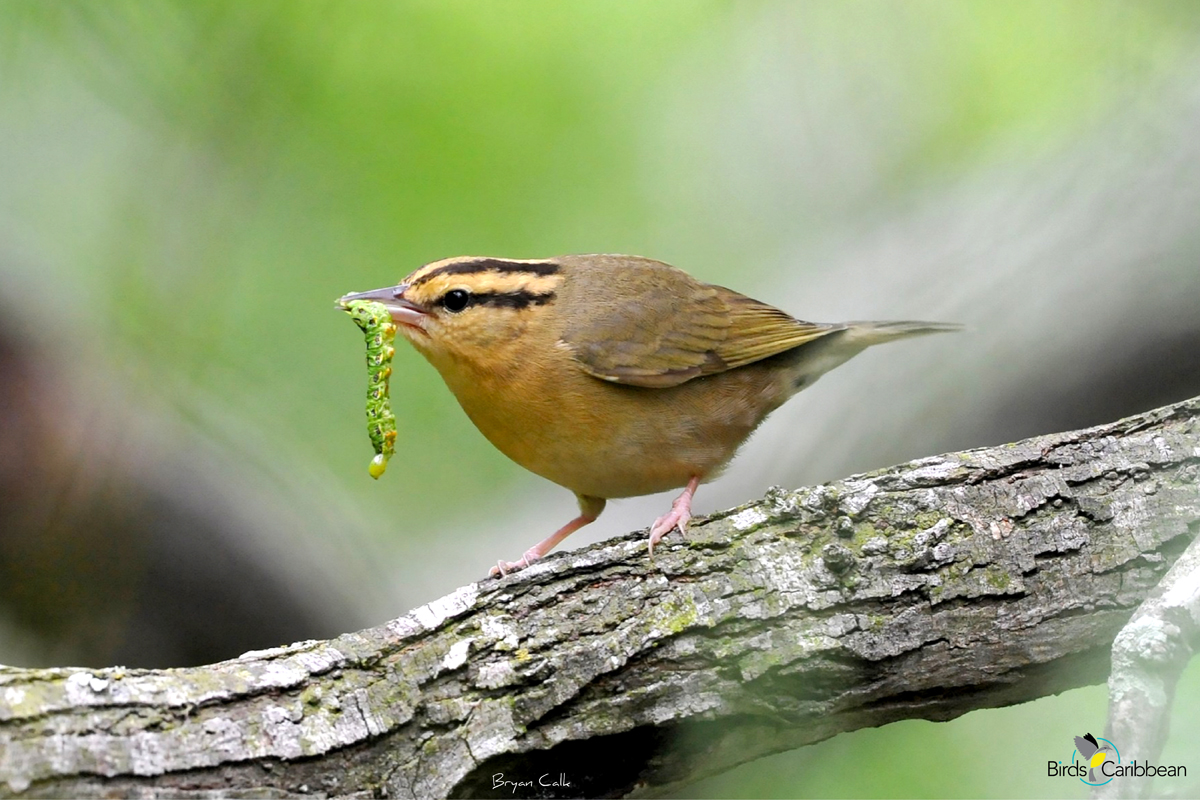
Worm-eating Warbler with a caterpillar in its beak. (Photo by Bryan Calk ML54410741)
Welcoming Our Winged Travelers
WMBD in the Caribbean officially took place on October 12th, 2024, but migratory birds don’t all move at once. Some begin their journey south as early as August, leaving their nesting sites in Canada and the U.S. for wintering grounds in the Caribbean, Central, and South America. Every year, we eagerly await their arrival as they flock to our shores, wetlands, forests—and even our backyards! Across the Caribbean, celebrations often begin in September and extend through December.
This year’s theme, Protect Insects, Protect Birds, was especially timely, highlighting the urgent need to address the global decline in insect populations. In Spanish: Proteger a los insectos, proteger a las aves, and in French: Protégeons les insectes, protégeons les oiseaux.
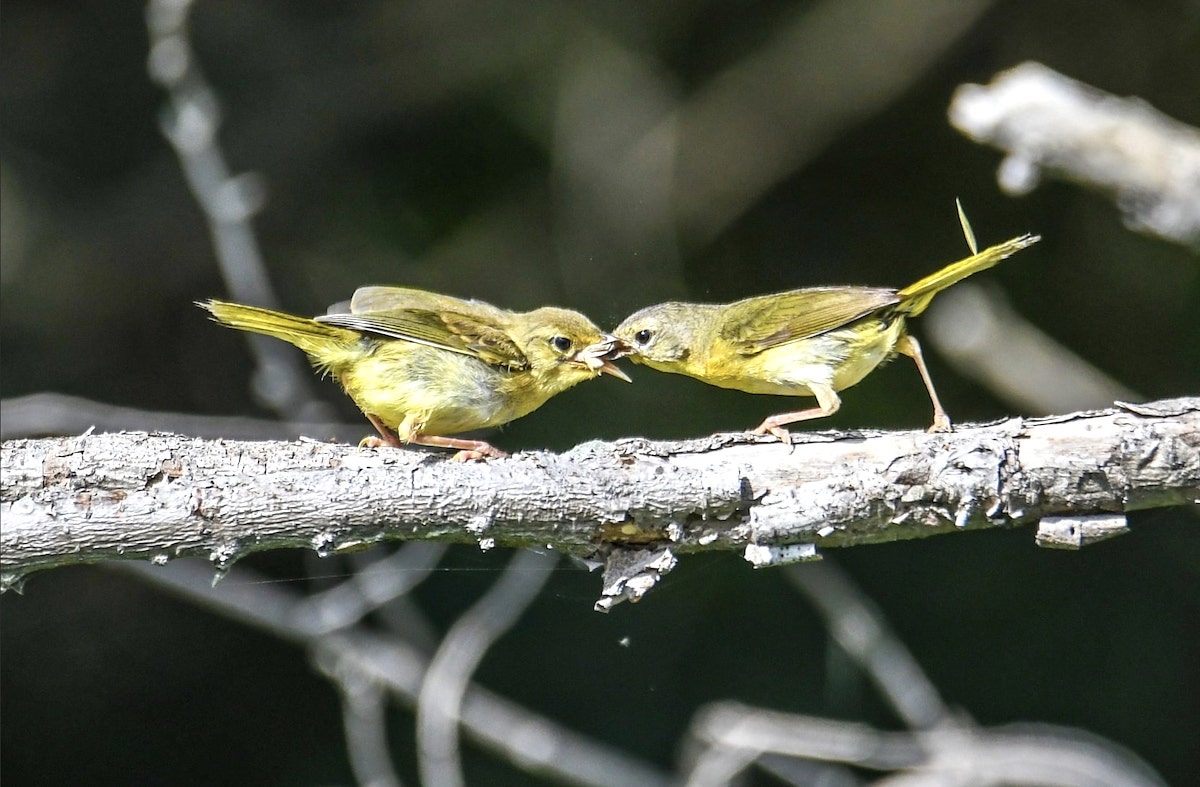
Insects are an important protein source for growing birds too. A female Common Yellowthroat feeds its offspring. (Photo by Dawn Gunderson ML621947269)
Unfortunately, insects face numerous threats, including habitat loss, pesticides, climate change, and bright artificial lights at night. For instance, artificial lighting disrupts fireflies’ mating behavior and caterpillars’ feeding patterns, while swarming around outdoor lights leaves insects exhausted and vulnerable to predators. This is bad news for migratory birds—without enough insects to fuel their journeys, birds can struggle to migrate, reproduce, and survive.
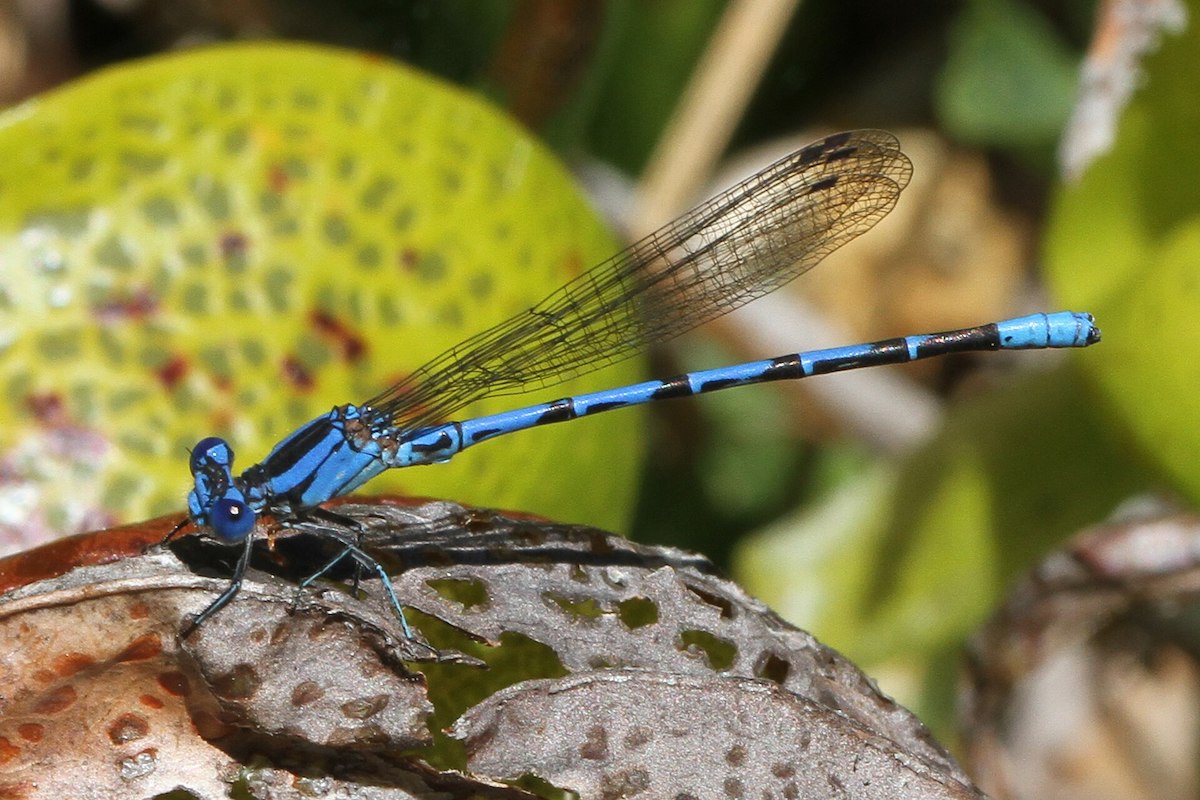
One of the WMBD 2024 Insect Ambassadors– a Vivid Dancer (blue morph)– on a pitcher plant. (Photo by Judy Gallagher)
Simple Actions, Big Impact
The decline in insect populations is a significant threat to bird health, but the good news is we can all take simple steps to make a difference. Actions like planting native flowers, trees, and shrubs; supporting organic farming; preserving natural habitats; and leaving fallen leaves for insects can create healthier ecosystems for both bugs and birds.
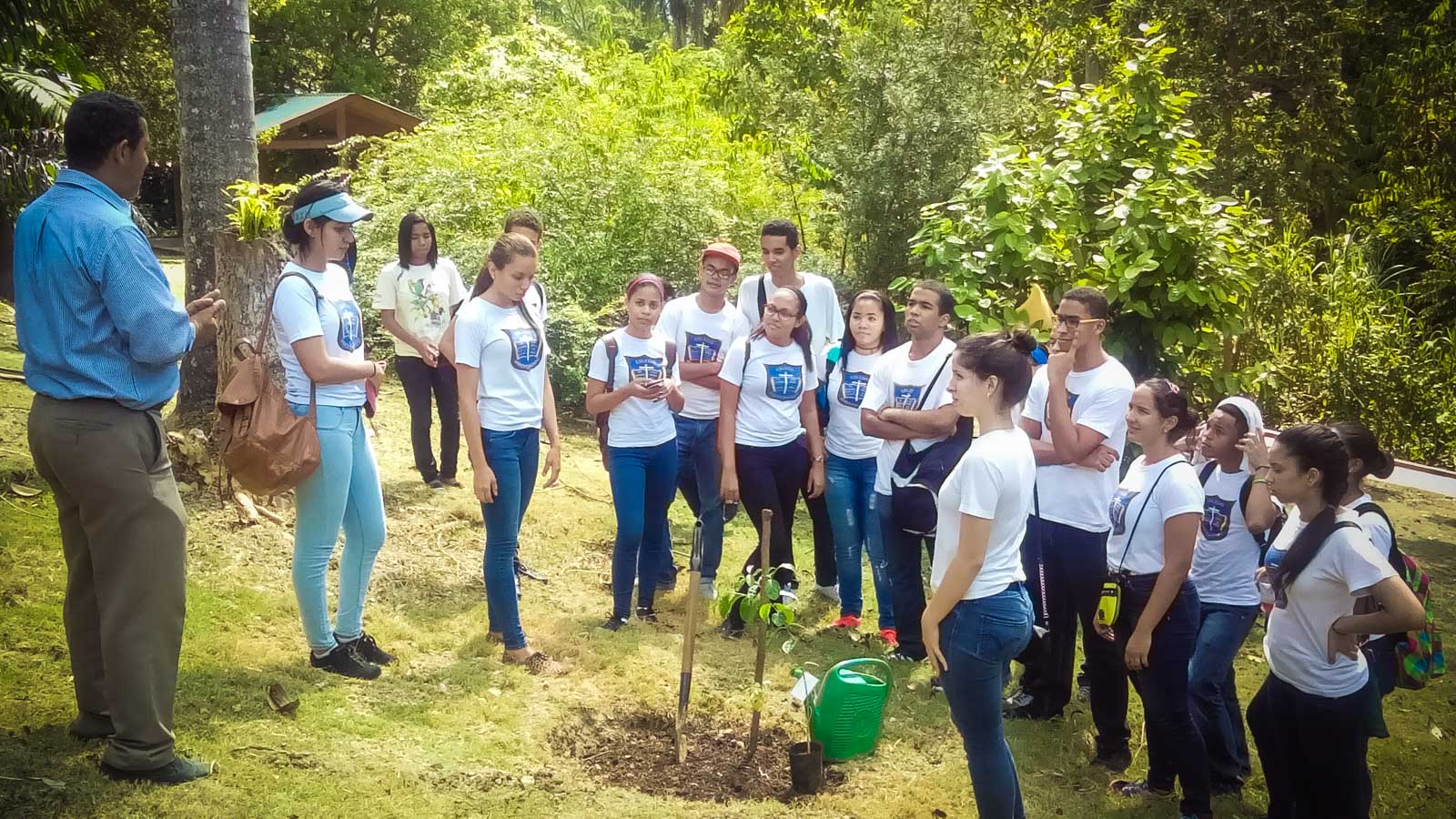
Tree-planting Grupo Acción Ecológica for a past WMBD celebration in the Dominican Republic.
Caribbean Communities in Action
Communities across the Caribbean came together to raise awareness about the critical role insects play in the survival of migratory birds and to inspire actions that make their environments more insect-friendly. Here are some highlights from this year’s WMBD events held in The Bahamas, Jamaica, US Virgin Islands, Dominican Republic, Puerto Rico, and Antigua and Barbuda.
The Bahamas
To celebrate WMBD, several educational events were held on Grand Bahama Island throughout October and November, engaging students in hands-on learning about birds, their migratory patterns, and the importance of protecting insects to protect birds.
Deana Williamson, a Social Studies teacher at Eight Mile Rock High School, led her students in exploring the connection between insects and birds. Students participated in an interactive activity, matching migratory birds with the insects they typically feed on, while discussing the variety of insects found on the island.
The celebration continued with EARTHCARE’s Bird Educator, Bridget Davis, and members, Jill Cooper and Gail Woon, visiting Bishop Michael Eldon School. Students learned about migratory bird species in The Bahamas and practiced birdwatching techniques using binoculars. Fun prizes like bird-themed bracelets and masks boosted engagement.
Later, Davis and Woon joined Mrs. Rochelle Manchester’s class at Martin Town Primary School for a birdwatching excursion. The students identified 13 bird species, including two rare American Oystercatchers spotted along the shoreline! Reflecting on the experience, Mrs Manchester shared, “The lesson has been the catalyst for a few of them doing their own research on migratory birds. It has truly sparked an interest for the students. I’d love to teach this again next year.”
Two striking American-Oystercatchers, seen by the Martin Town Primary School students in The Bahamas. (Photo by EARTHCARE Bahamas)
Primary School students of the Bishop Michael Eldon School learning how to use binoculars for the first time. (Photo by EARTHCARE Bahamas)
Gail Woon handing out fun bird-themed WMBD materials to students. (Photo by EARTHCARE Bahamas)
Jamaica
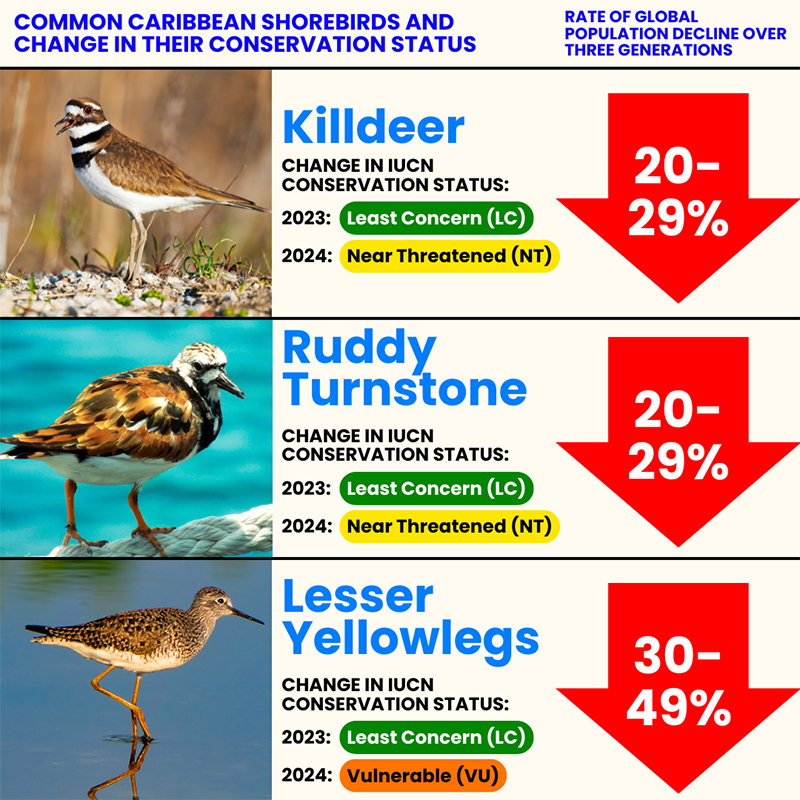
BirdLife Jamaica marked WMBD with a muddy but exciting birdwatching event at the Old Harbour Mud Flats in St. Catherine—the third in a series focused on raising public awareness of shorebirds in Jamaica. The first two events were webinars on identifying shorebirds and where to find them, aptly titled ‘Shorebirds: The Beach Bums of the Bird World’ and ‘Birds of the Beach: A Beginner’s Guide to Shore Birding’, respectively.
Twenty enthusiastic birders braved the heat and muddy terrain to put their new shorebird ID skills to the test! The group recorded an impressive 37 species, with the Killdeer and Reddish Egret stealing the spotlight. The real surprise came with the sighting of a lone Black Swift—an uncommon find, as it prefers montane forested habitats, and a lifer for many of the newer birders!
Looking for shorebirds for a CWC Count at Old Harbour mudflats, Jamaica. (Photo by BirdLife Jamaica)
Reddish Egret, dark morph. (Photo by Alan D Wilson)
When in doubt always consult field guides, Old Harbour, Jamaica. (Photo by BirdLife Jamaica)
Black Swift. (Photo by Frank Lin ML459370211)
US Virgin Islands
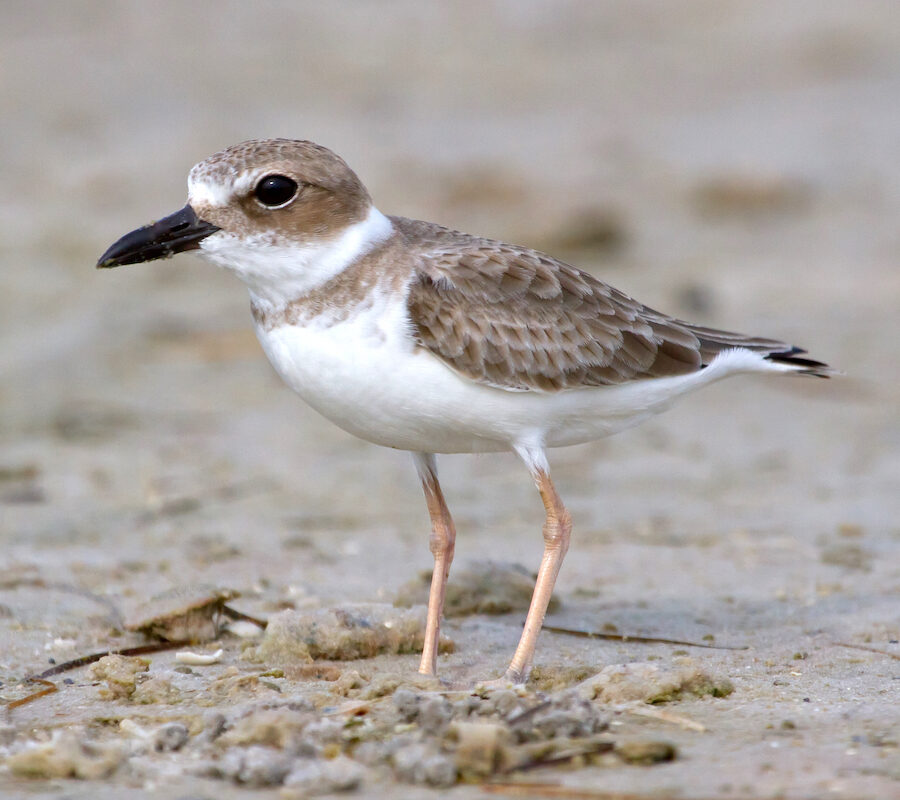
On WMBD, the St. Croix Sea Turtle Project and Sandy Point National Wildlife Refuge team led a 2-hour, 2-mile birdwatching hike at the refuge, spotting long-distance migrants like Ruddy Turnstones and small wading birds like Wilson’s Plovers. Ellie Sherman, Education and Outreach Officer for the Sea Turtle Project, shared that the small but enthusiastic group enjoyed exploring Sandy Point’s rich ecology and spotting birds in the refuge’s bird blind and along the beach. Fun fact: Sandy Point is where the rare White Tern was spotted in August 2024!
The team after a fun two hour birdwatching tour at Sandy Point National Wildlife Refuge, St. Croix.
The Ruddy Turnstone travels amazing distances each year. (Photo by Anthony Levesque)
The White Tern following Jennifer along the southwest shore of St Croix at Sandy Point National Wildlife Refuge (Photo by Jennifer Valuilis)
Wilson’s Plover. (Photo by Andy Morffew)
Dominican Republic
Maria Paulino and her team from Grupo Acción Ecológica (GAE) celebrated WMBD with classroom lessons and outdoor activities. Preschoolers were excited to learn about the migratory birds that travel thousands of miles every year to spend the winter in the Dominican Republic. Bursting with new inspiration, students then got creative, making bird masks and coloring migratory birds from the Migratory Birds of the West Indies book (free download available!).
Preschoolers coloring migratory birds from the Migratory Birds of the West Indies coloring book. (Photo by Grupo Acción Ecológica)
Students birdwatching with Maria Paulino. (Photo by Grupo Acción Ecológica)
Older students ventured outdoors for an introduction to bird banding. Maria took them through the process of setting up mist nets, collecting data on bird size and weight, and explaining how this information adds to our growing knowledge of what birds require to thrive. The highlight? Using binoculars and field guides to identify local birds!
Students look on as Maria explains how a mist net works to safely trap birds. (Photo by Grupo Acción Ecológica)
Two students learn about the importance insects to healthy bird populations using the WMBD poster. (Photo by Grupo Acción Ecológica)
A winter migrant–an Ovenbird, on the hunt for insects. (Photo by Hemant Kishan)
Students identifying and recording birds seen with Maria. (Photo by Grupo Acción Ecológica)
Puerto Rico
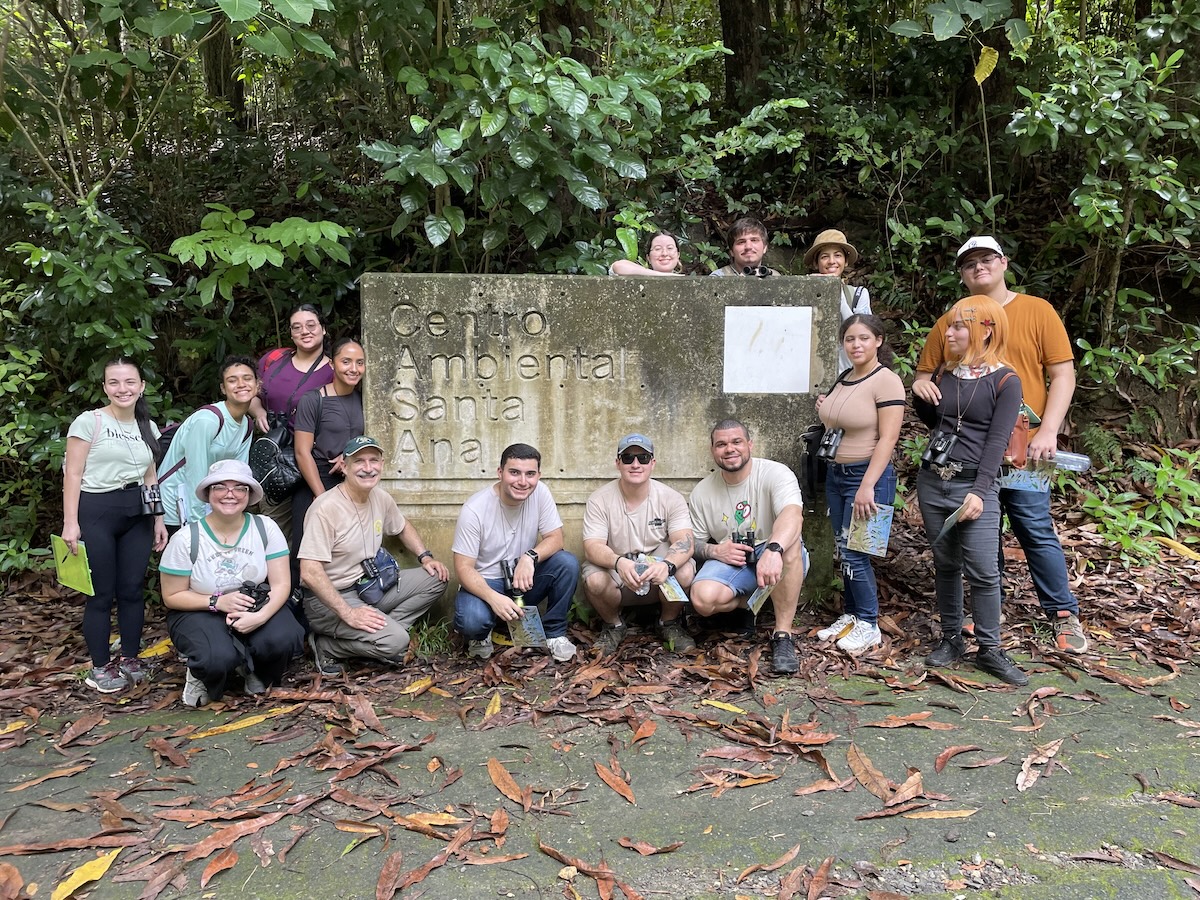
The team at Centro Ambiental Santa Ana (CASA) embarked on an exciting adventure into Puerto Rico’s urban forest, joining students from the Universidad Interamericana – Recinto Metro for a hands-on research project: Exploring the Winged Diversity of Puerto Rico in an Urban Forest. This ongoing research aims to monitor both resident and migratory bird species through monthly counts, along with other activities in the vibrant Santa Ana Forest, located in the Julio Enrique Monagas National Park in Bayamón.
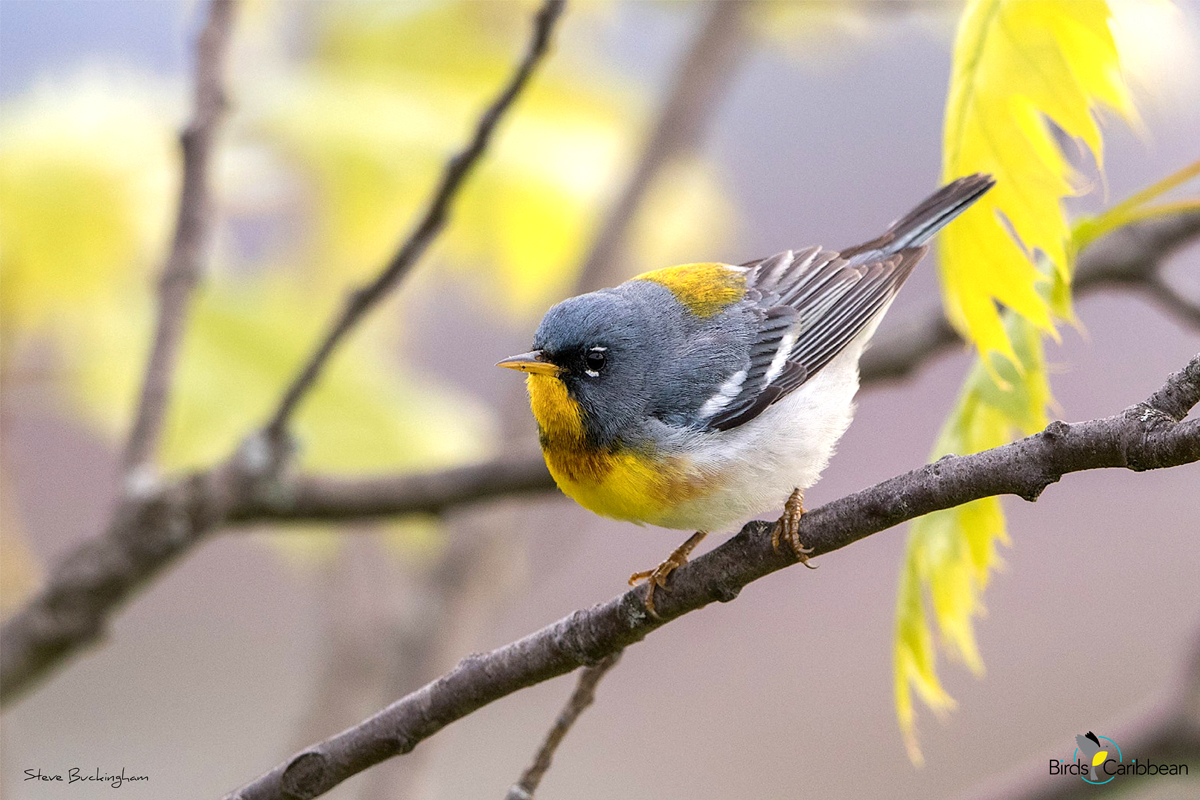
On WMBD, college students with no prior birding experience, but a strong passion for wildlife, kicked off their training to join the research team as bird monitors. After an introduction to the essentials of birdwatching led by Dayamiris Candelario, the group headed to the forest to hone their newly acquired skills . Among the species spotted, a thrilling moment came when they identified their first migratory bird—a male Northern Parula sporting the iconic chestnut “collar”.
Male Northern Parula. (Photo by Steve Buckingham)
The students continued their journey into the world of birding with training and fieldwork, beginning their official bird monitoring on October 24th and 26th. Their hard work paid off as they identified several fascinating species, including the Blackpoll Warbler and Black-and-white Warbler. They were delighted to spot more Northern Parulas foraging in the trees, perhaps hunting for their next bug meal.
A male Blackpoll Warbler in fall migration and winter plumage. Males in breeding plumage in spring look very different—they have a black cap and white cheek patch. (Photo by Anthony Levesque)
Male Black-and-White Warbler (Photo by Hemant Kishan)
“The project is just getting started, and with each field session, these budding birders are gaining valuable skills and contributing to the growing understanding of Puerto Rico’s dynamic bird population. We are incredibly grateful for the support and materials provided by Environment for the Americas and Departamento de Recursos Naturales y Ambientales (Department of Natural and Environmental Resources),” says Dayamiris.
Dayamiris Candelario and her group of budding researchers.
Antigua and Barbuda
The Environmental Awareness Group (EAG), led field trips to explore wetlands and welcome migratory birds settling in for the winter. EAG staff journeyed to Darkwood Mangrove with students from Jennings Secondary and St. Mary’s Secondary, Parham Mangrove with Sir Novelle Richards Academy and Pares Secondary, and McKinnon’s Salt Pond with Antigua Girls’ High School and Antigua Grammar School.
The thrill of spotting birds in the wild was heightened as participants learned to use binoculars for the first time, with the stunning wetland setting providing the perfect backdrop. A fun game of Bird Spy Bingo added a competitive edge as attendees raced to identify as many species as possible.
St. Mary’s Secondary School students receive their binoculars before heading into Darkwood Mangrove to spot migratory birds. (Photo by Sherrel Charles/EAG)
Jennings Secondary School students with Bird Spy Bingo card. (Photo by Sherrel Charles/EAG)
Shanna Challenger, EAG Antigua, teaches the group of first-time birders how to use binoculars.(Photo by Andrew Bowen/EAG)
EAG also brought bird-themed lessons to the classrooms at Antigua State College and St. Nicholas Primary School, sparking curiosity about migratory birds and their conservation. Students learned how actions like using organic pesticides and reducing waste can help protect birds and their habitats for future generations.
Joshel Wilson presenting to students of Antigua State College. (Photo by Auriel Horseford Hunte/EAG)
WMBD presentation to St Nicholas Primary school students. (Photo by Sherrel Charles/EAG)
Bird stickers for everyone! (Photo by Sherrel Charles/EAG)
WMBD 2024’s Outstanding Educators
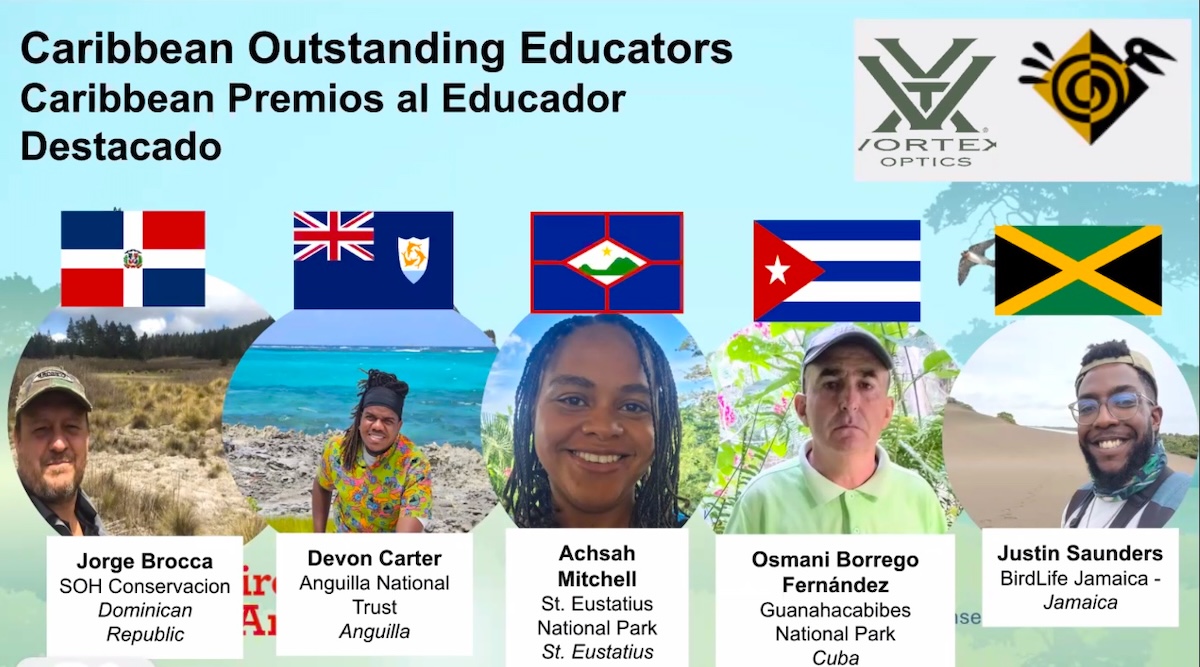
We applaud the tremendous efforts of all educators who plan and execute educational and fun activities to ensure an unforgettable WMBD and inspire a love for birds and birdwatching. For WMBD 2024, Environment for the Americas recognized the dedication of the following Caribbean educators: Justin Saunders (BirdLife Jamaica), Osmani Borrego Fernandez (Guanahacabibes National Park, Cuba), Jorge Brocca (SOH Conservacion, Dominican Republic), Achsah Mitchell (St. Eustatius National Park) and Devon Carter (Anguilla National Trust). We are also deeply grateful for the ambassadors, who selflessly deliver WMBD educational materials called ‘Happy Kits’ to Caribbean coordinators.
Environment for the Americas and BirdsCaribbean extend our greatest thanks to all of you and we look forward to seeing what you have planned for WMBD 2025!
Interested in supporting bird festivals across the Caribbean? Your contribution will help expand these invaluable efforts and inspire future generations of bird enthusiasts. Show your support here!
Birds Continue to Connect our world
BirdsCaribbean celebrated WMBD by showcasing new migratory birds in our virtual campaign– Birds Connect Our World. Each bird profile was accompanied by a beautifully drawn image by Arnaldo Toledo, along with stunning high-quality photos, engaging videos, online puzzles tailored for different levels (between six and 1,024 pieces), and bird calls. Fun, free and engaging activities were also provided for both kids and adults, including downloadable coloring pages, experiments, up-cycle crafts, and more.
Migratory Birds in Focus
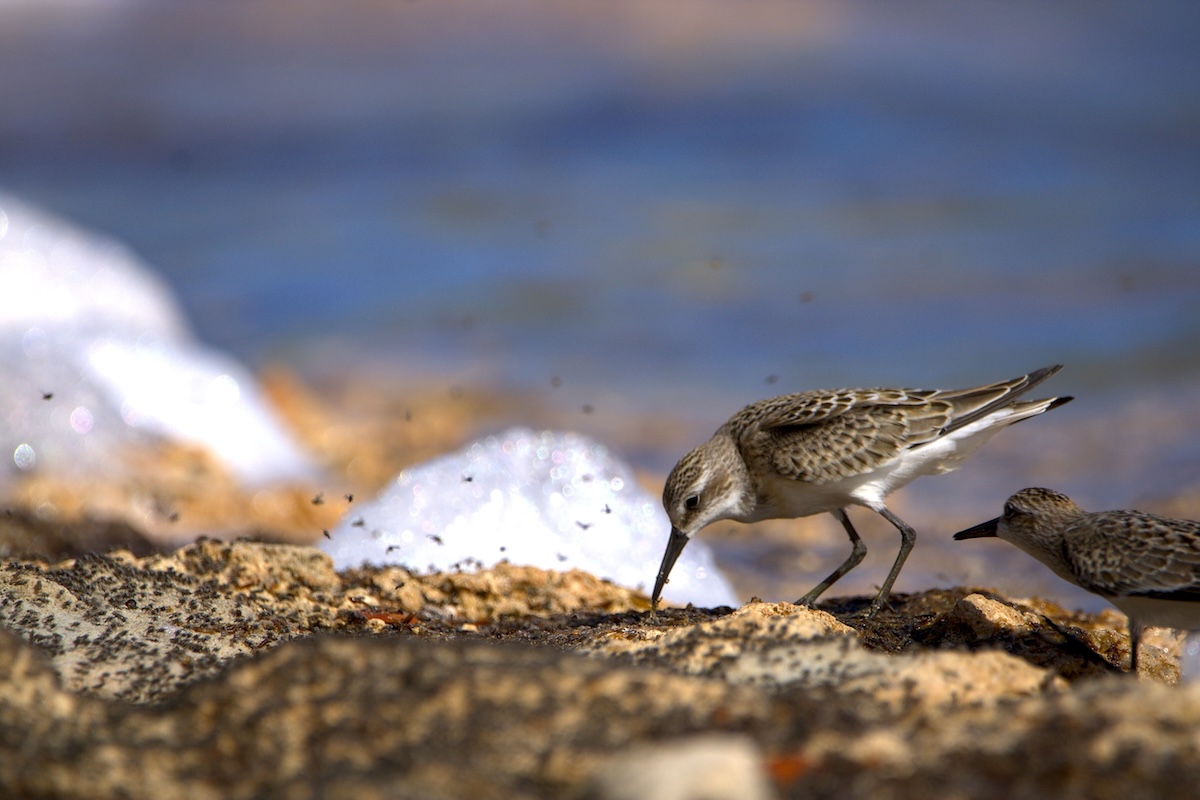
We’re excited to announce the winning photo for the Caribbean region – Youth category in the 2024 World Migratory Bird Day Photo Contest! Captured by Mattéo Antoine, this striking image of a Semipalmated Sandpiper feeding on Ephydra flies at Pointe des Châteaux, Saint-François, Guadeloupe highlights the critical importance of healthy insect populations for migratory birds, especially those traveling thousands of miles nonstop.
Looking Ahead to 2025: Shared Spaces
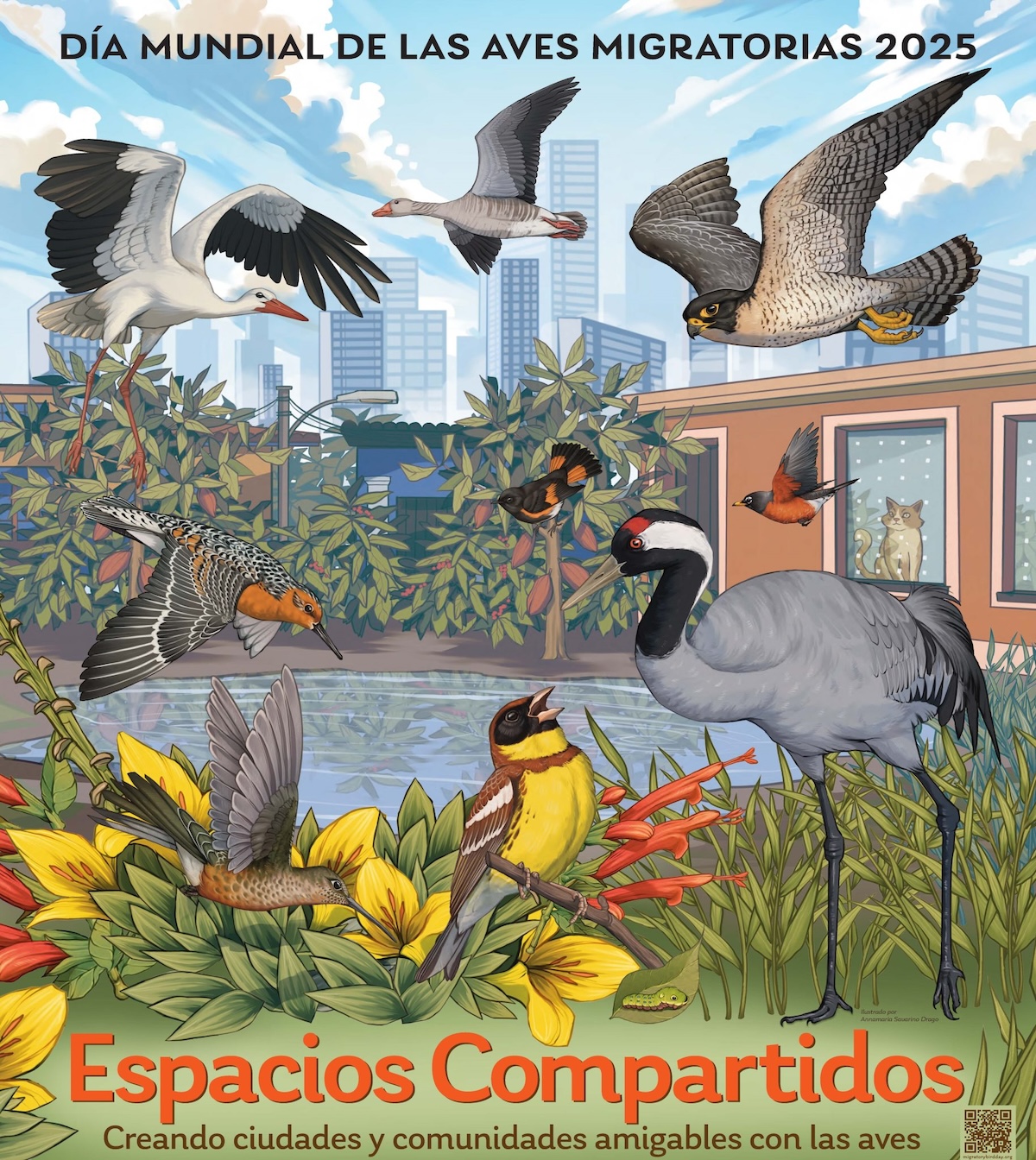
The theme for WMBD 2025, Shared Spaces: Creating Bird-Friendly Cities and Communities, will focus on the importance of building urban environments that support both people and wildlife. As cities continue to grow, it’s crucial that we create spaces where birds can thrive—whether through green rooftops, bird-friendly architecture, or protected green areas. By incorporating bird-friendly practices into our daily lives and communities, we can help ensure that migratory birds have safe spaces to rest, feed, and thrive as they journey across the islands.
WMBD 2025 campaign poster, beautifully crafted by artist Annamaria Savrino, showcases the interconnectedness of humans and migratory birds.
If you are interested in celebrating WMBD in your country, or if you can deliver materials to a Caribbean country, we encourage you to visit the WMBD website for more information; or contact the Caribbean Regional Coordinator, Laura Baboolal, at lbaboolal@environmentamericas.org.
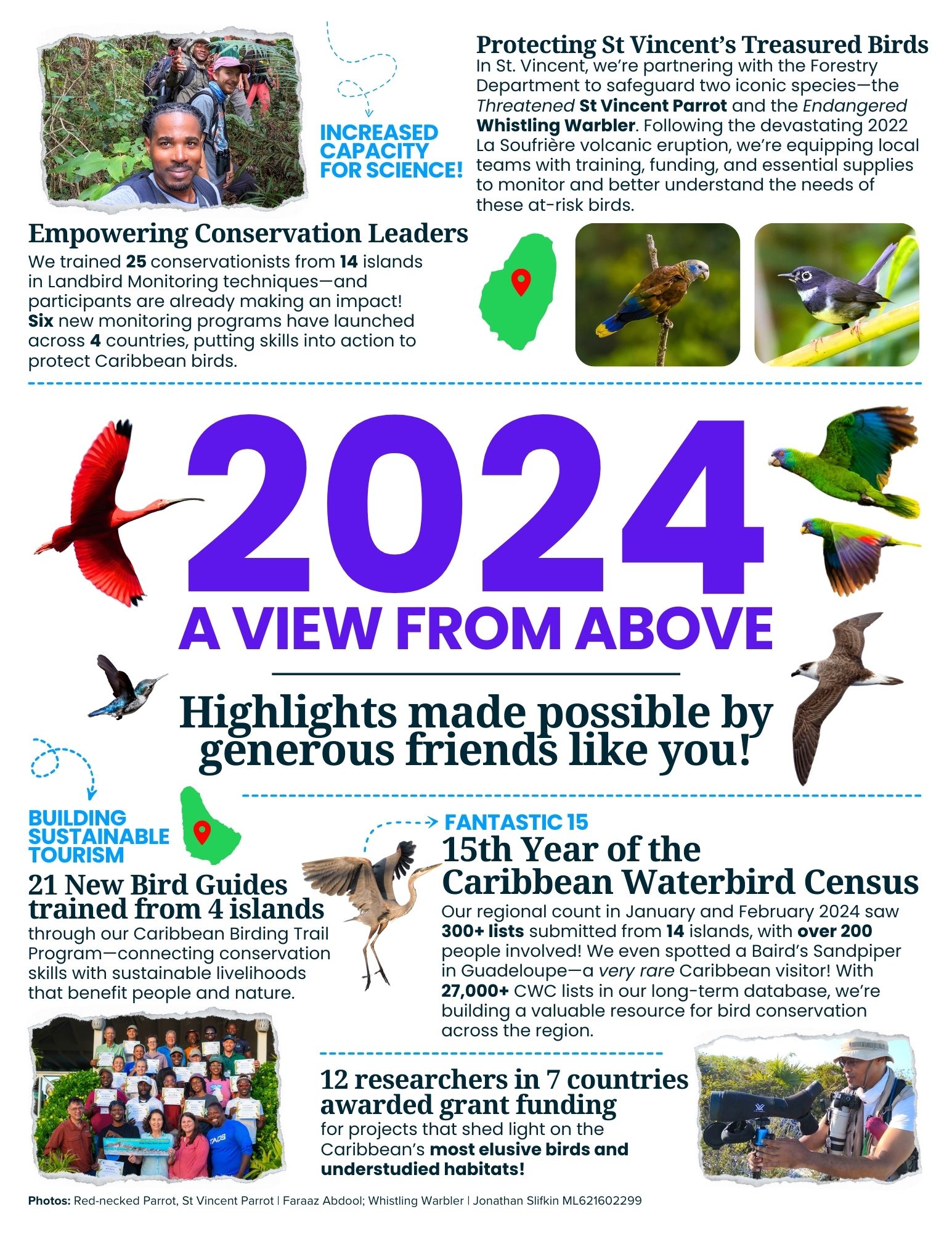
What a year it’s been! 2024 was a whirlwind of excitement, challenges, and growth, and we’re thrilled to share some of the highlights with you. From record-breaking events to building new partnerships, we’ve had quite the ride—and we couldn’t have done it without the support of our amazing community. Here’s a round-up of our most unforgettable moments from the year. Thank you to all our volunteers, members, donors, and everyone who believes in the future of Caribbean birds!
Fantastic fifteen for the Caribbean Waterbird Census
2024 started with us celebrating an amazing 15 years of the Caribbean Waterbird Census. From January 14th to February 3rd, over 200 birders across 14 islands helped us document over 300 CWC checklists! Highlights from this year’s count included a Baird’s Sandpiper spotted in Guadeloupe—a very rare Caribbean visitor!
A volunteer uses a Shorebird ID card at a Caribbean Waterbird Census count. (Photo by Dayamiris Candelario OPAS)
A group of Lesser Scaups at East End Pond. (Photo by Jacqueline A Cestero)
Carrying out CWC surveys on St. Eustatius. (Photo by Jethro van’t Hul)
Sanderling – X19 stopped on another winter visit to Jamaica. (Photo by Damany Calder)
Baird’s Sandpiper (Photo by Caio Osoegawa ML628469580)
Big Day got even BIGGER!
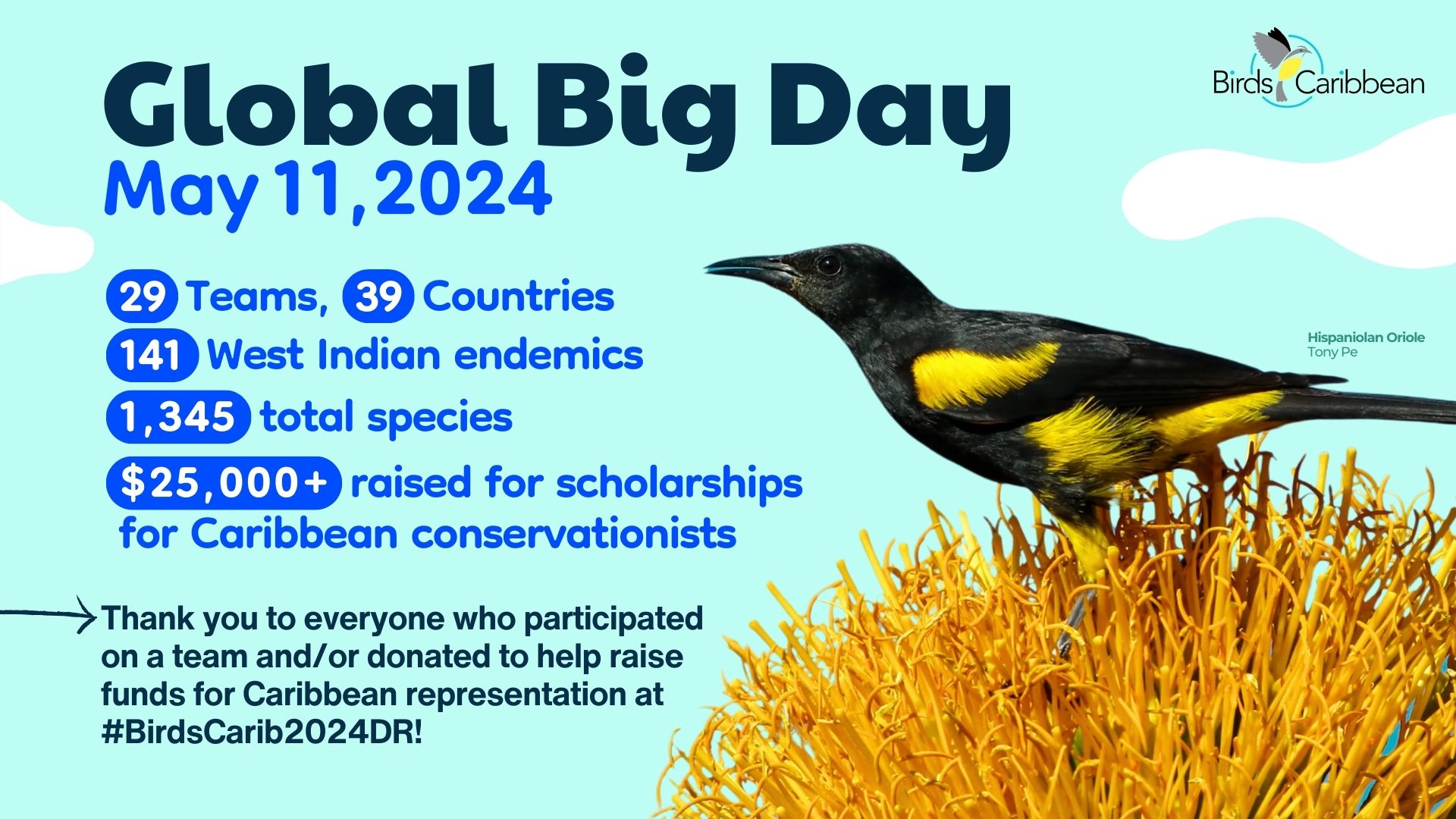
On Global Big Day, May 11, birders around the world got out and about to join in the fun. In the West Indies, we shattered our records for both participation and bird sightings! Big Day birders in the region saw 551 West Indian species, thanks to the amazing efforts of 710 eBird observers—up from 511 last year! But wait there’s more: there were more species sighted (1,354 total, 208 more than last year) and a huge leap in the number of checklists submitted—2,755 total, nearly 1,000 more than last year—phenomenal!! We’re proud of this fantastic win for citizen science in the West Indies!
Dominica’s Imperial Seekers seeking out the magnificent Imperial Amazon for Global Big Day 2024. (Photo by Garry Auguiste)
Members of Wadadli Warblers in Antigua got in on the early birding action for GBD 2024. Photo by Shanna Challenger
A subgroup of the Gundlach Team in Cuba ready to dominate the competition on the morning of GBD 2024.
Big Day wasn’t just about ticking off the birds though, our fun ‘Teams competition’ and annual fundraising efforts were back—this time to enable Caribbean conservationists to come together and strategize to protect our birdlife. We raised over $25,000, an amazing effort that helped bring many deserving Caribbean nationals to our 24th International Conference in the DR! Speaking of which…
We made BirdsCaribbean history in the Dominican Republic!
A record-breaking 338 delegates from 32 countries and islands flocked to Santo Domingo, Dominican Republic, making our 24th International Conference our largest gathering ever! Conservationists from all walks of life came together, united by a shared mission: protecting the incredible birds that define our region. Centred on the theme: “From Mangroves to Mountains: Safeguarding our Avian Treasures,” the conference featured expert-led presentations, roundtable discussions, training sessions, networking opportunities, fundraising initiatives, and birding trips to observe Hispaniola’s diverse bird species, including its unique endemics. From mangrove conservation to Hispaniola’s endemics to habitat restoration—the conference was a hub of knowledge sharing, networking, collaboration, and inspiration.
Anne-Isabelle Bonifassi, Executive Director of Haiti National Trust, speaks about ecosystem restoration in Haiti, during the Hispaniola Day symposium.
Problem tree being analysed and turned into a results tree by participants.
First time BC Conference attendee Soraya proudly stands next to her poster.
Delegates birding at Ebano Verde.
Palmchat. (Photo by Dax Roman)
Traditional Dominican dancers at the opening reception.
In collaboration with researchers from Virginia Tech, BirdsCaribbean learned more about one of these threats—human disturbance. Early in 2024 we published a report based on a survey of those who do CWC counts, which showed that they perceive human disturbance to be the most significant threat to shorebirds in our region. The report highlighted the need for more social and biological research on human disturbance, and how to tackle this threat.
As we get ready for the 2025 CWC regional count we hope Caribbean birders head for the coast to observe and record shorebird sightings! If you would like to support shorebirds and their threatened habitats, please click here.
Birds and bugs: A perfect pairing for conservation!
Are you Team Insects or Team Birds — or both?! (Photo by TTBO)
Male Puerto Rican Mango. (Photo by Rafy Rodrguez)
Posters about insect types and functions, created by STENAPA staff. (Photo by STENAPA)
Youth enjoying bird games offered by the University of Havana Bird Ecology Group. (Photo by University of Havana Bird Ecology Group)
Completed birdhouses. (Photo by BarbudanGO)
Group birdwatching at Hope Botanical Gardens. (Photo by BirdLife Jamaica)
Six more reasons to celebrate Caribbean endemic birds
This year, we welcomed six newly-recognized Caribbean endemics, bringing the total to an impressive 185! Meet the latest members of our avian family: Grenada Wren, St. Vincent Wren, St. Lucia Wren, Kalinago Wren, Martinique Thrasher, and the St. Lucia Thrasher. More birds to celebrate, more species to protect!
The St Vincent Wren has a notably long wing chord. (Photo by David Hollie ML600921241)
The St Lucia Thrasher has dark brown plumage overall and white underparts. (Photo by Blake Matheson ML214222511)
New resources to keep you informed and inspired
We’ve been busy behind the scenes, launching new resources to keep you in the loop on all things bird conservation. Our first-ever Endemic and Threatened Species Working Group (ETSWG) newsletter debuted this month, packed with the latest research and happenings in the field. Click here for an insightful and enjoyable read! For the latest news and research about our birds farther from shore, dive into our Seabird Working Group newsletter. Both are available in English, Spanish, and French. As always, we welcome your feedback.
And by the way, have you checked out the latest edition (#37) of the Journal of Caribbean Ornithology? It includes research articles and notes, as well as conservation reports, book reviews, perspectives, and opinions. Even more exciting? Volume #37 is a JCO Special Issue!—featuring the contributions from the 24th International BirdsCaribbean Conference! Check out this amazing compendium to rediscover all the fantastic insights shared at the conference!
Always released in English, Spanish, and French, the annual Seabird Working Group is the perfect resource to stay up-to-date on the latest in Caribbean seabird conservation.
From Mangroves to Mountains – Explore JCO Special Issue Vol. 37!
It’s a first edition! Dive right into the newly launched Endemic and Threatened Species WG Newsletter – in English, Spanish, or French, of course!
Training champions for birds and conservation
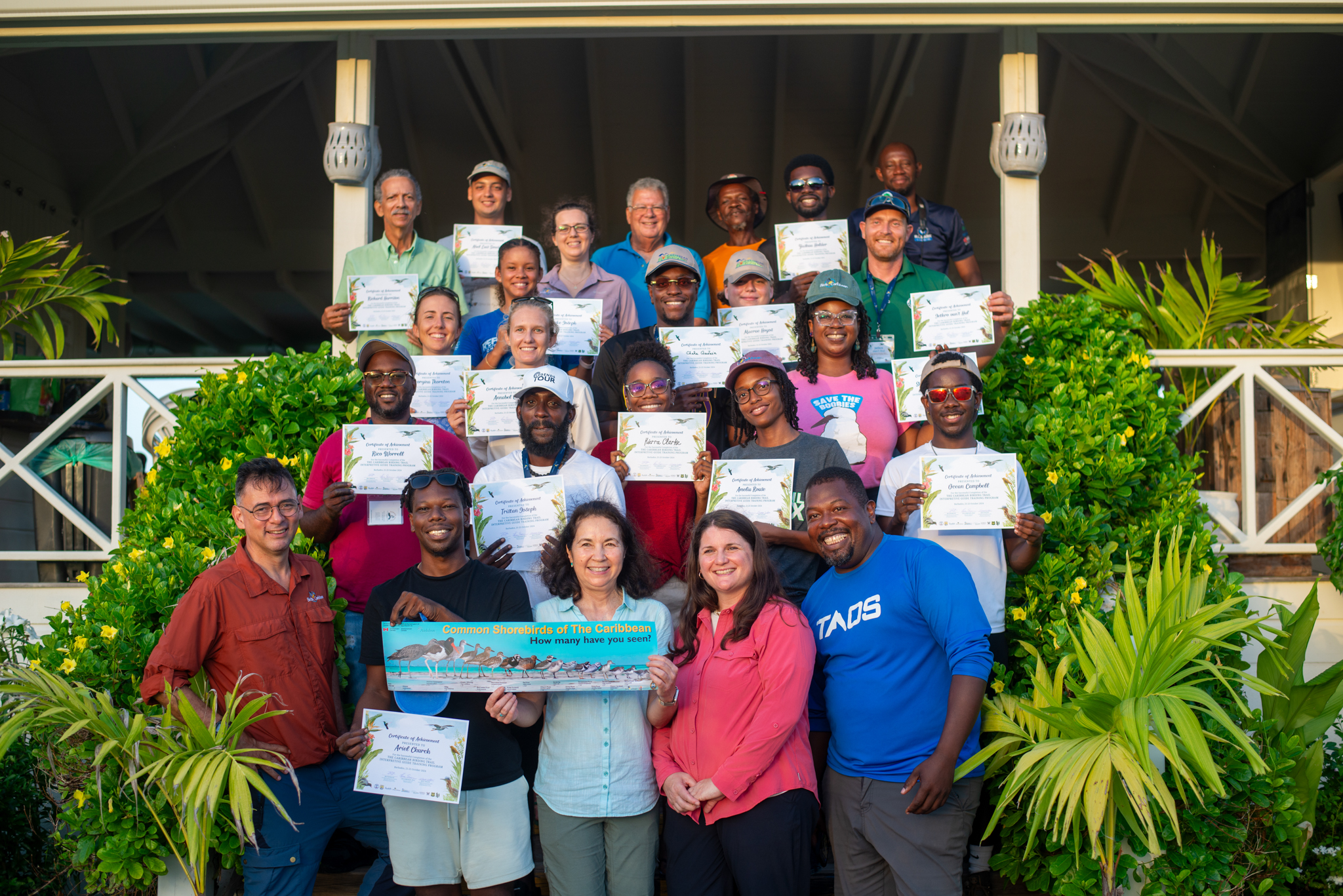
In October, BirdsCaribbean collaborated with a local NGO, WIRRED (Walkers Institute for Regenerative Research and Design) to conduct a week-long Caribbean Birding Trail Guide Training Workshop on the island of Barbados. Home to the endemic Barbados Bullfinch, the island’s wetlands and coastline harbour critical stopover sites and wintering habitat for migratory species. The training covered not only bird identification and guiding techniques, but also how to tell stories and make connections to the island’s rich cultural, historical, and ecological heritage through the art of environmental interpretation. Congratulations to the 21 newly trained bird guides and conservation champions from Barbados, Antigua, Sint Eustatius, and Cuba!
BirdsCaribbean is pleased to present our Caribbean Birding Trail 2024 cohort! (Photo by WIRRED)
In the US Virgin Islands, 22 educators from three islands learned to engage students with nature and science through birds! Two BirdSleuth Caribbean workshops were held in June, in partnership with SEA (St Croix Environmental Association), the USVI Dept of Environment and Natural Resources, and Horsley Witten Sustainable Environmental Solutions. Over two days, each group explored the BirdSleuth Caribbean curriculum and discovered how to bring birds into the classroom. Birds are excellent for teaching scientific skills as well as gaining appreciation of the islands’ wonderful bird life.
Our Caribbean Landbird Monitoring Program continues to build regional conservation capacity!
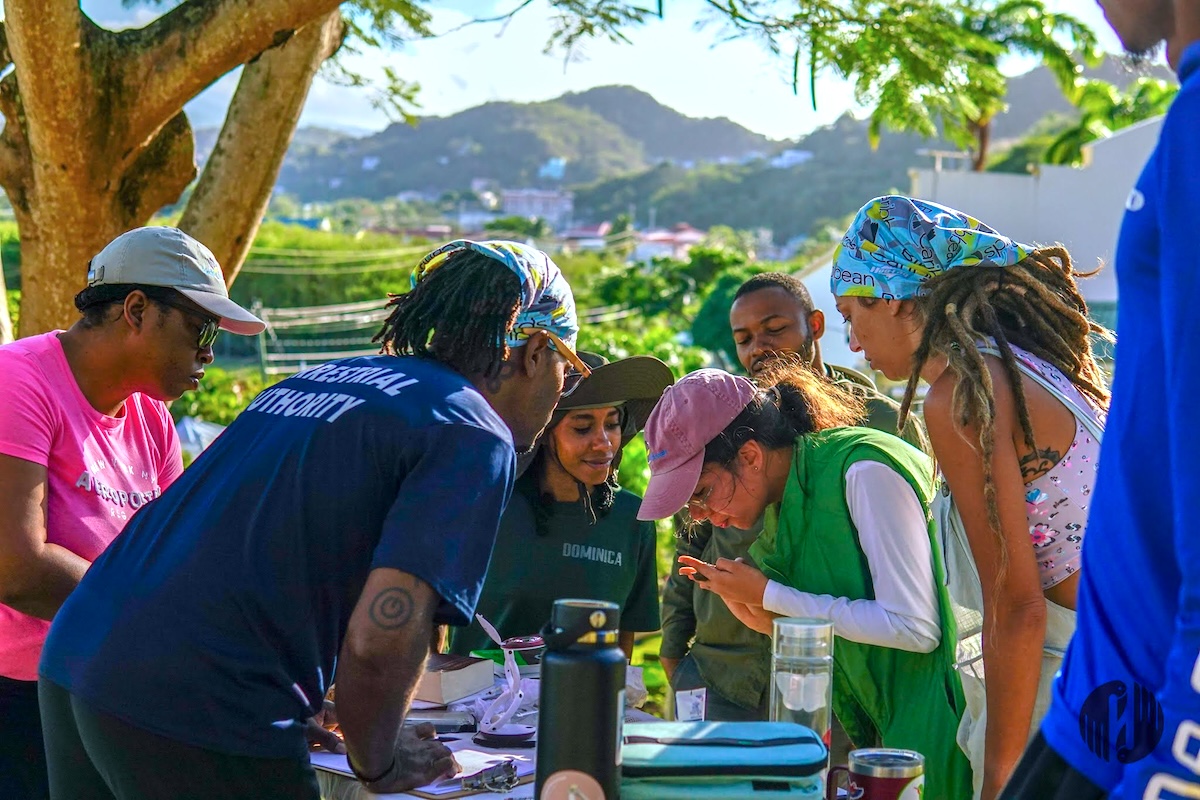
This year our 3rd annual bird banding workshop (as part of the Caribbean Landbird Monitoring Program) migrated down to the Lesser Antilles in St. George, Grenada. From March 7 – 11 participants learned all about songbird banding at scenic locations like the Blue Horizons Resort (featuring views of the white sand Grand Anse Beach) and in the dry forests of Mount Hartman National Park (featuring views of the critically endangered Grenada Dove). With collaboration from Klamath Bird Observatory, participants received training from internationally recognized and North American Banding Council (NABC) certified trainers on all the banding basics from how to properly handle birds, how to extract birds from mist nets, and an introduction to the topic on every bander’s mind, molt. We welcomed 18 participants from 9 different islands and at the end celebrated the certification of two more Caribbean NABC trainers: Daniela Ventura of Cuba, and Zoya Buckmire of Grenada. Congratulations!!
Daniela Ventura instructing participants during the CBB workshop in Grenada. (Photo by Holly Garrod)
We returned to the scenic mountains of Jarabacoa, Dominican Republic for our third annual Landbird monitoring Workshop from 22-26 February, 2024. This year we were ecstatic to welcome 25 participants from 14 different islands. Participants learned the ins and outs of how to set up PROALAS landbird monitoring on their islands, how to enter data using eBird, and how to train people on basic bird identification, featuring some endemic birds of Hispaniola! No workshop would be complete without excursions into the field to practice these monitoring techniques, and participants got to wander the rolling hills around Jarabacoa, finishing with a field trip to the Scientific Reserve, Ebano Verde for chances at finding a Hispaniolan Trogon! Thanks to our Caribbean Landbird Monitoring Small Grant initiative, participants are already making an impact! Six new monitoring programs have launched in The Bahamas, Dominican Republic, Grenada, and Cuba, putting skills into action to protect Caribbean birds.
Weathering the Storm: Resilience in the Face of Climate Change
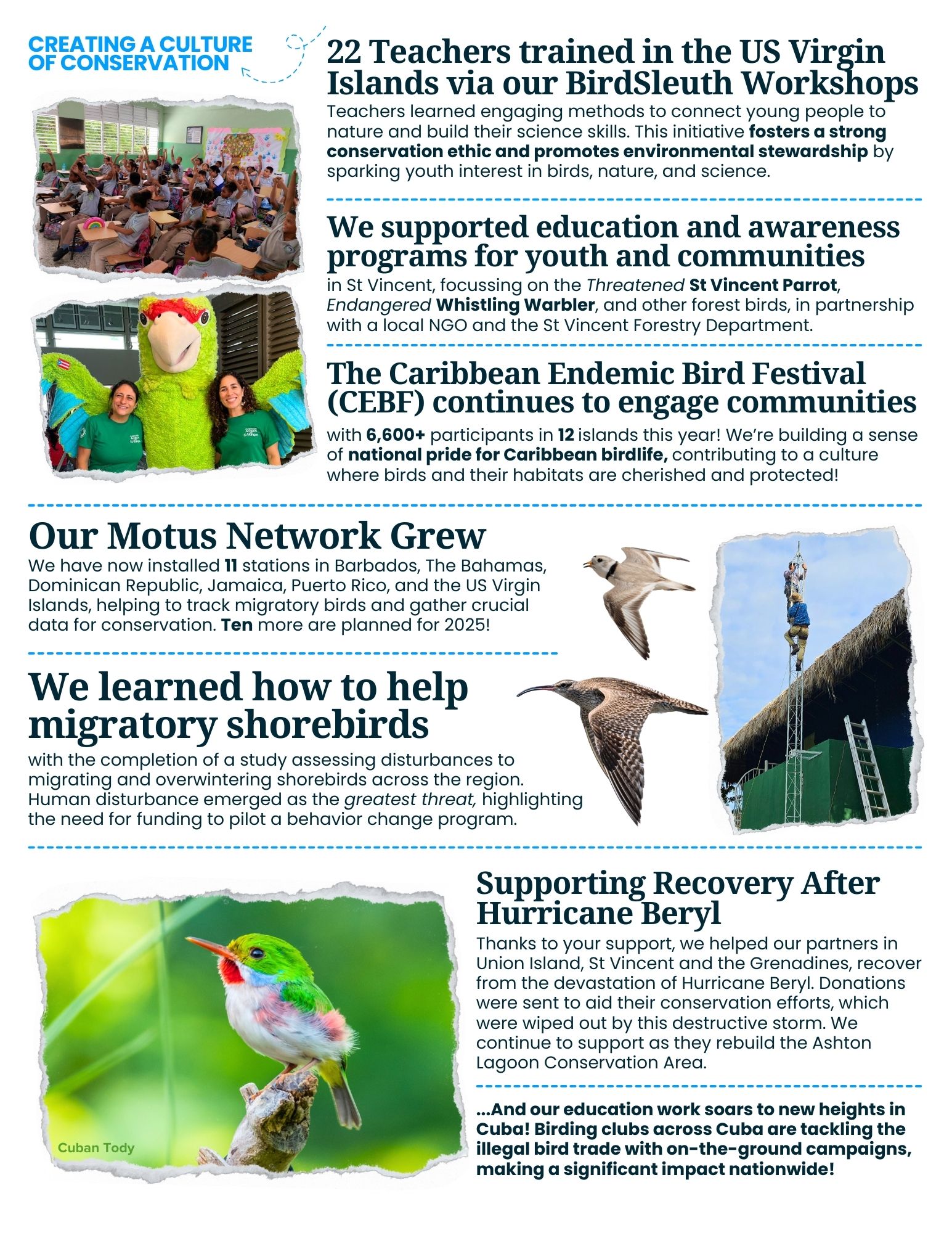
2024’s hurricane season started early, impacting several of our islands to varying degrees. Climate change fueled extreme weather is no doubt becoming the “order of the day.” Hurricane Beryl (the earliest hurricane ever to reach Category 5 intensity) arrived in early July, and wreaked havoc on Union Island, destroying the 13 year-long Ashton Lagoon project, where the office of Sustainable Grenadines (SusGren) is located. Fortunately there were no casualties, but the entire island was devastated. Now, SusGren’s Executive Director Orisha Joseph is determined to “build back better and stronger.” If you would like to contribute to the restoration of Ashton Lagoon, click here. Beryl also devastated the small sister islands of Carriacou and Petite Martinique, near Grenada, and went on to cause destruction and flooding in parts of Jamaica.
The charming SusGren office before it was destroyed by Hurricane Beryl. (Photo by Sustainable Grenadines Inc.)
Sustainable Grenadines office was completely destroyed when Hurricane Beryl passed through Union Island on July 1, 2024. (Photo by Orisha Joseph)
Ashton Lagoon mangrove littered with littered with chairs, desks, filing cabinets, papers. (Photo by Orisha Joseph)
We recognized and celebrated our committed conservation community!
The BirdsCaribbean Awards were celebrated with rousing applause on the final night of our conference in the Dominican Republic.
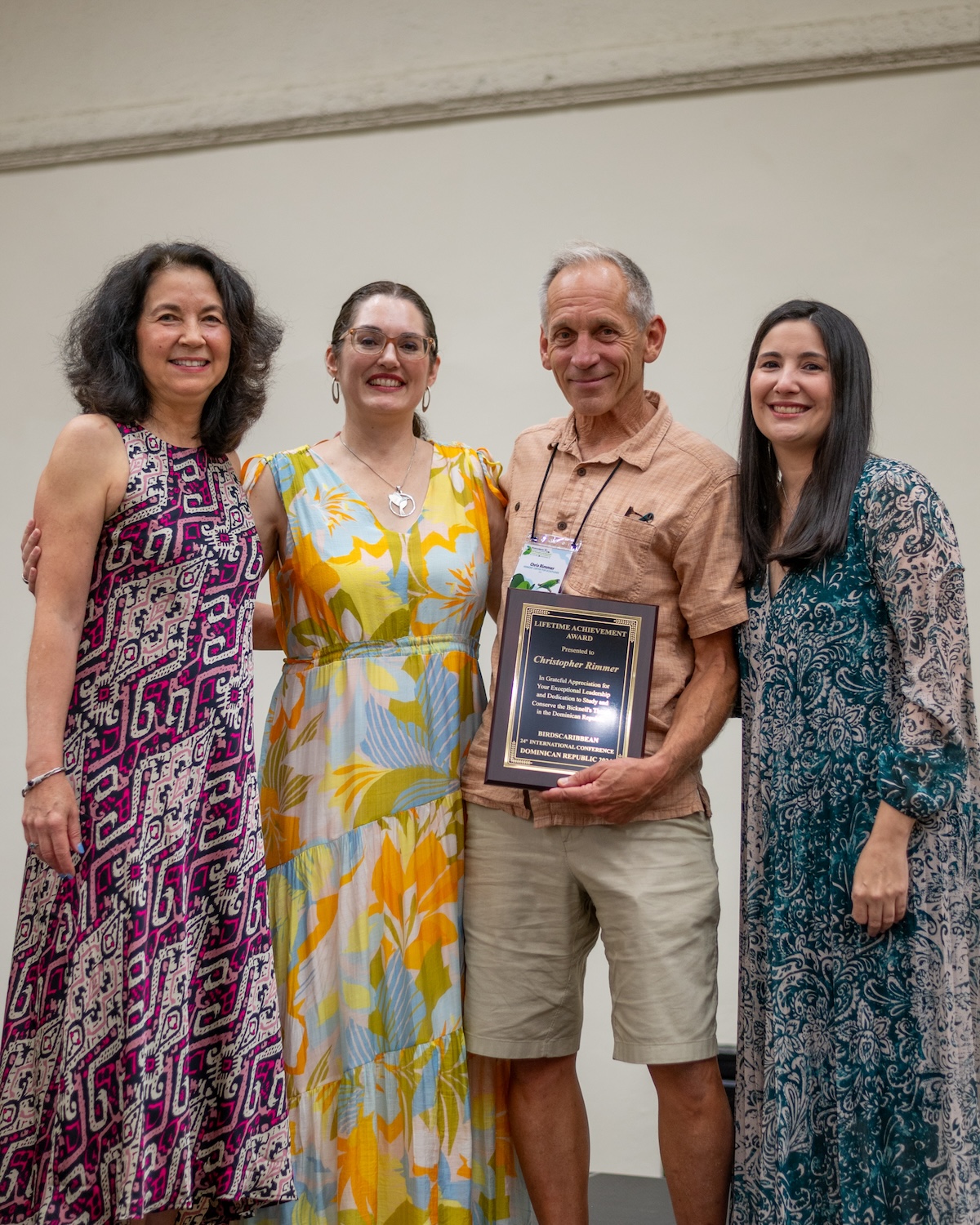
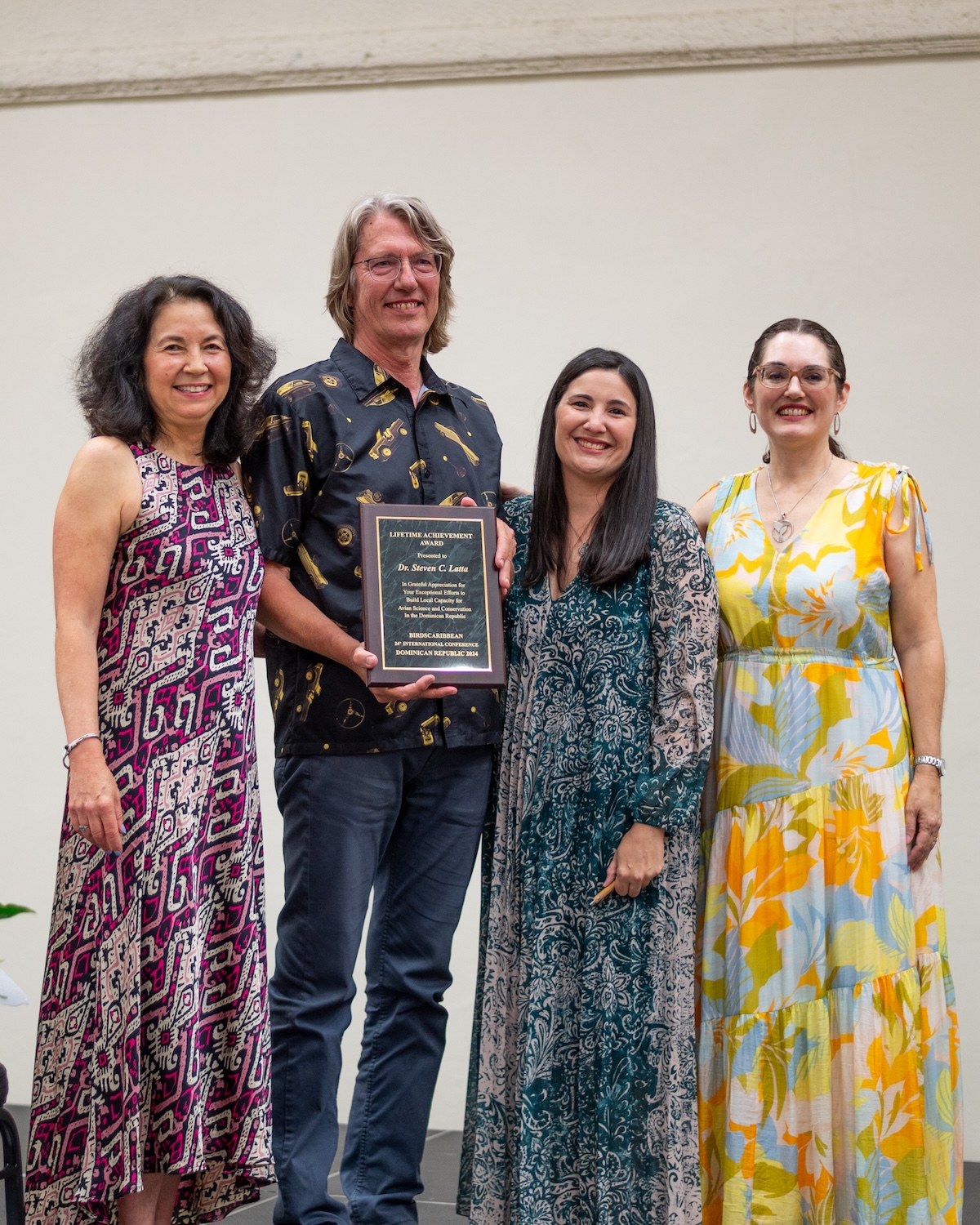
Winners of the prestigious Lifetime Achievement Award were Christopher Rimmer, Emeritus Executive Director of Vermont Center for Ecostudies (VCE)—the “Bicknell’s Thrush man”; and Dr. Steven C. Latta, Director of Conservation and Field Research at the National Aviary of the Dominican Republic.
Lifetime Achievement Award recipient Christopher Rimmer with BirdsCaribbean Executive Director Lisa Sorenson, BirdsCaribbean President Adrianne Tossas and Andrea Thomen.
Lifetime Achievement Award recipient Dr Steve Latta with BirdsCaribbean Executive Director Lisa Sorenson, BirdsCaribbean President Adrianne Tossas and Andrea Thomen.
President Dr. Adrianne Tossas handed out the coveted President’s Awards to four exemplary organisations on the island of Hispaniola: The Peregrine Fund Dominican Republic, Grupo Jaragua, Grupo Acción Ecológica and Action pour la Sauvegarde de l’Écologie en Haïti. Meet our full roster of awardees here! Congratulations to all—you inspire us to keep pushing harder everyday!
We proudly supported 12 projects through the David S. Lee Fund for Caribbean Birds and the James A. Kushlan Research and Conservation Fund. These projects advanced avian research and conservation in seven Caribbean countries: Cuba, Jamaica, Puerto Rico, the Dominican Republic, Mexico (offshore islands), St. Eustatius, and The Bahamas. Projects ranged from establishing bird diversity data in The Bahamas, to evaluating education campaigns for the Endangered Jamaican Blackbird, studying the role of urban parks for birds in Cuba, tracking Puerto Rican Orioles, and enhancing Red-billed Tropic Bird conservation in St. Eustatius. We are thrilled to support the dedicated researchers and conservationists in our BirdsCaribbean community.
Without a doubt, we are #StrongerTogether
Giving Tuesday was a huge success, exceeding our $15,000 target! With the theme “Stronger Together: Empowering People, Saving Birds” we are continuing our fundraising efforts with a new target of $60,000! Our team members have raised just over $51,000 so far—we’ve got 18% to go and it’s not too late to help us reach our goal! View our fundraising page here—where a generous match from the BirdsCaribbean board means that any help you give is doubled to continue our work with the people and birds of the Caribbean!
Farewell to some true bird conservation legends
This year we said sad farewells to beloved champions of Caribbean birds. They will be missed…
Wayne Burke at Woodbourne Shorebird Refuge. (Photo by Yves Aubrey)
Wayne “Doc” Burke of Barbados who passed away on November 19, tackled the issue of hunting shorebirds, establishing the Woodbourne Shorebird Refuge, a former shooting swamp that became a haven for shorebirds. His pioneering efforts spurred a change in attitudes and practices among Barbadian hunters, and led to the establishment of more shorebird refuges. Read more here.
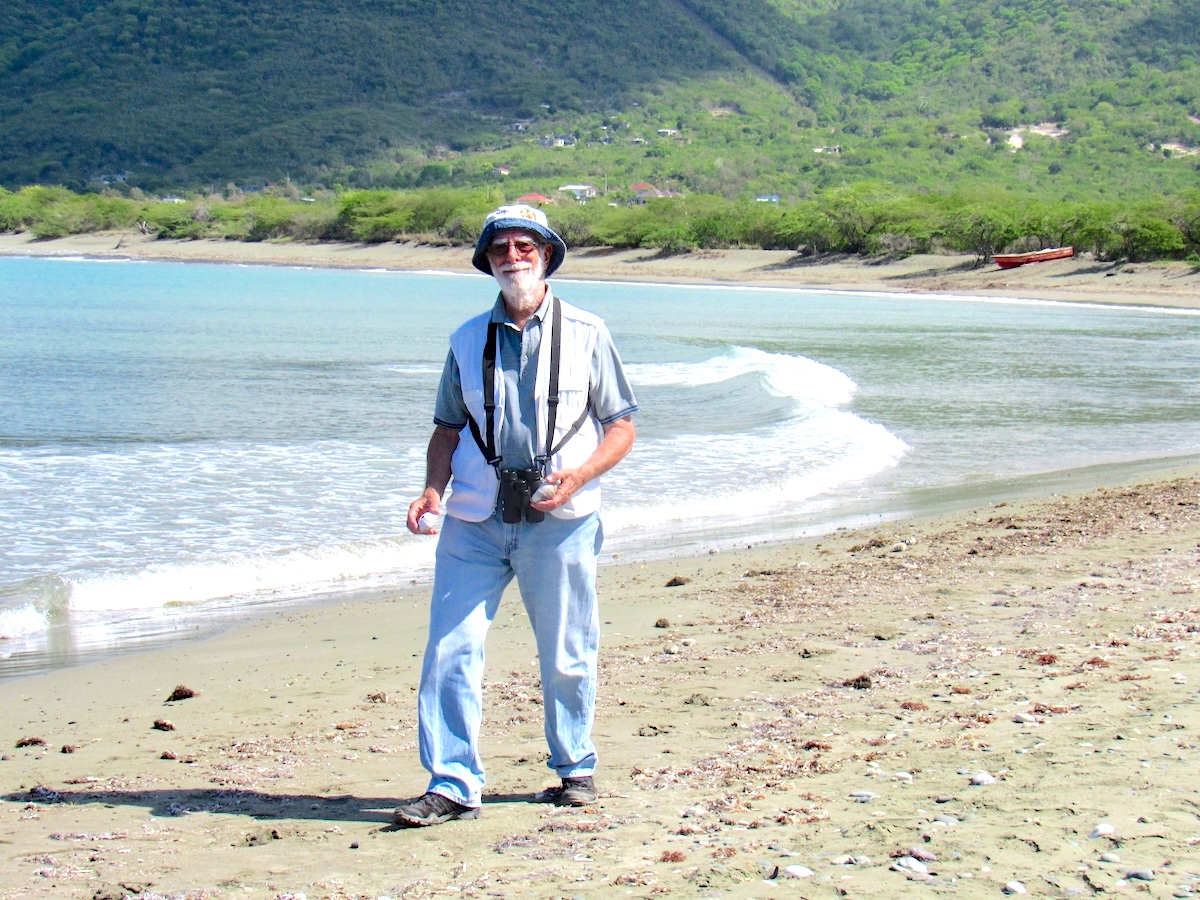
John Fletcher walking along the beach during a visit to Yallahs Salt Ponds, a place where he was always very happy. (Photo by Emma Lewis)
London-born John Fletcher, who died at the age of 95 in Kingston and adopted Jamaica as his home at a young age, became a successful businessman, a coffee producer—and most of all an avid birder and a President of BirdLife Jamaica. He was a revered and loved “guru” for bird watchers of all ages, conducting countless bird tours across the island. Read more here.
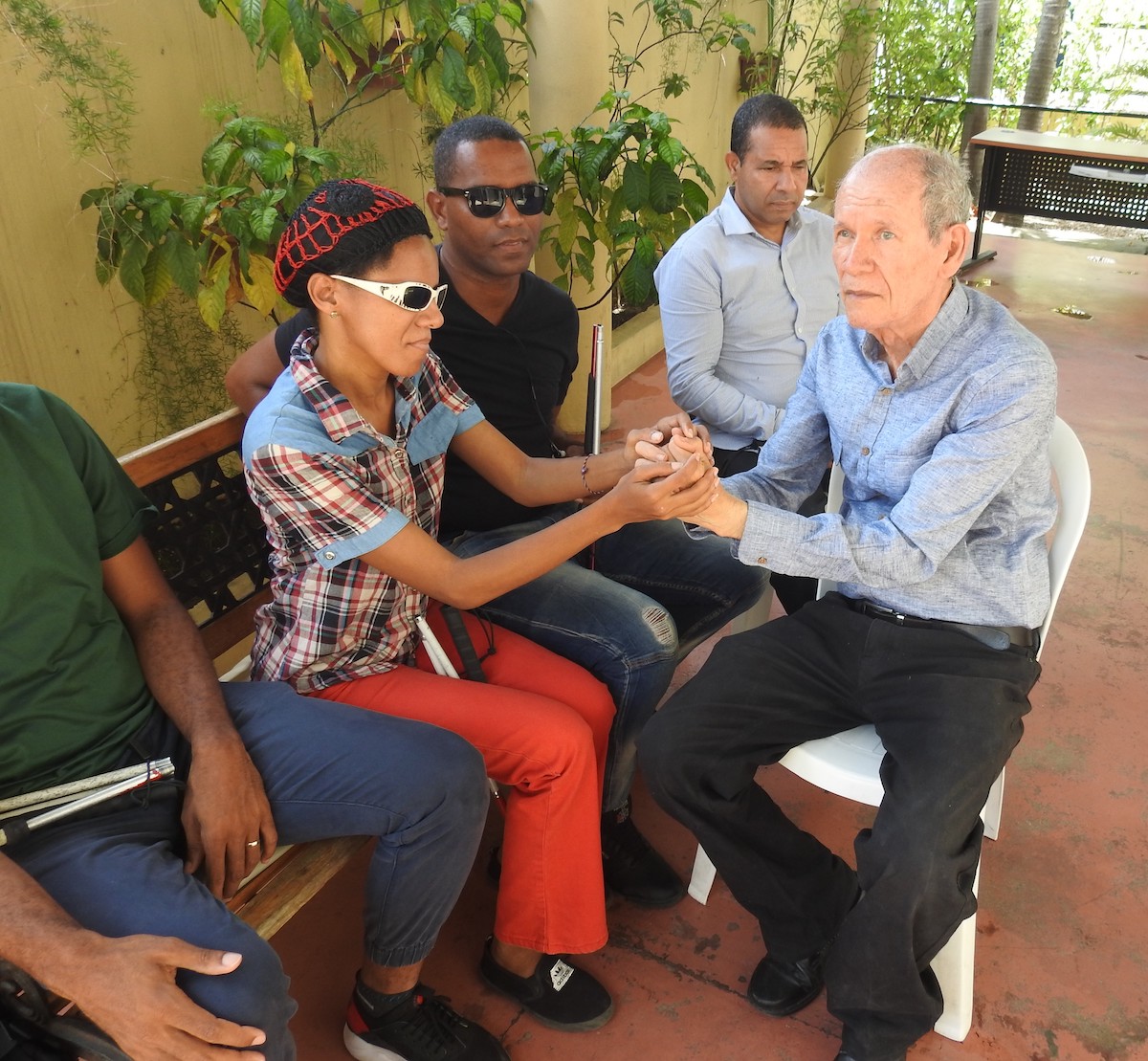
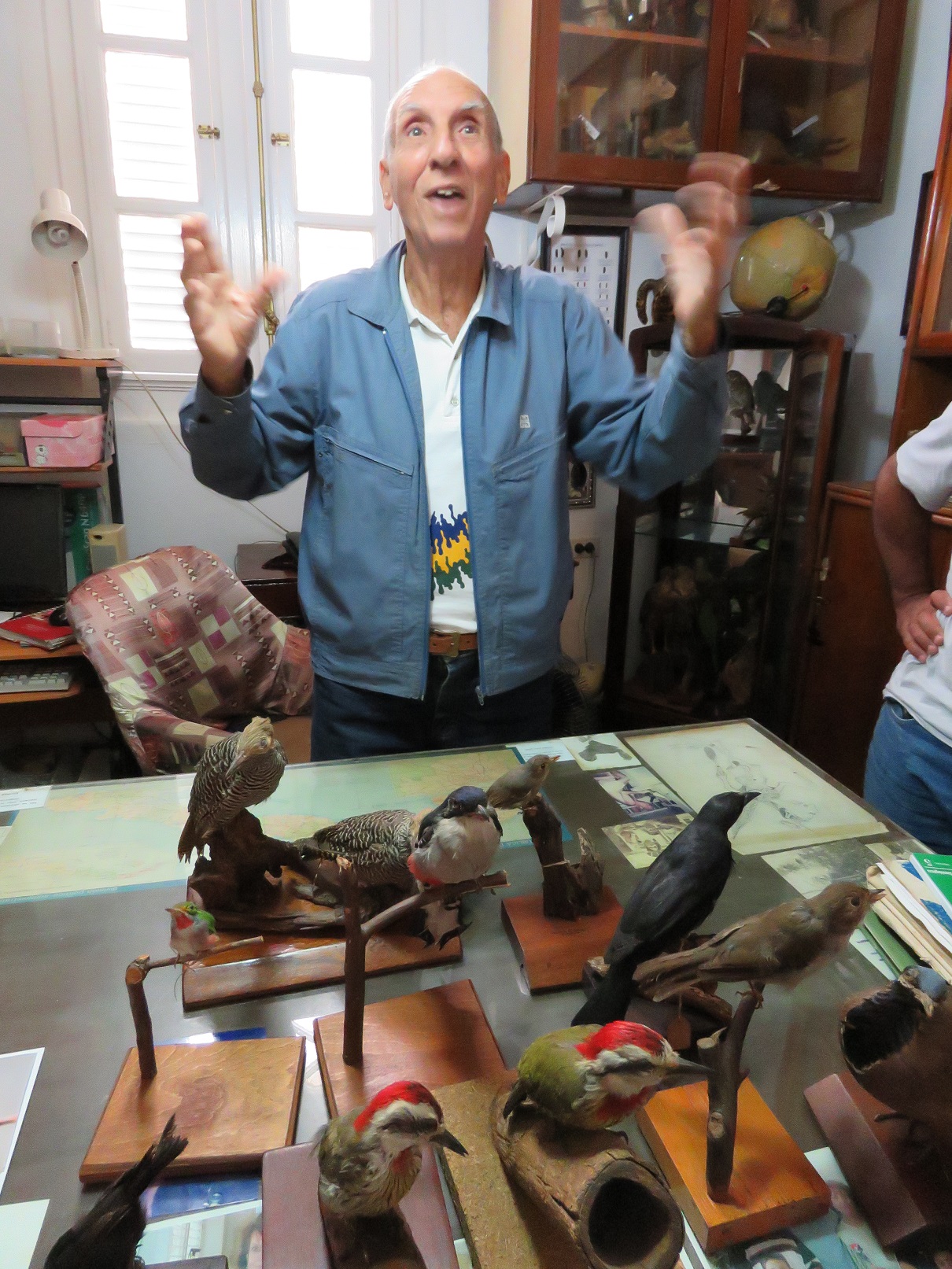
Simón Guerrero was a founding member of the Society for the Conservation and Study of Caribbean Birds. An engaging teacher and speaker with a great sense of humor, he influenced many to become fans and defenders of nature over several decades.
We remember an extraordinary environmental educator, Simón Guerrero, who passed away earlier this year. His research on urban ecology focused on making cities more habitable for wildlife, including birds. Simón had a remarkable ability to bring the wonder of birds into classrooms, captivating both students and teachers. A passionate advocate for inclusivity, he founded a birding group for blind Dominicans and emphasized the importance of ensuring that birds “know” our actions are in their favor.
Orlando Garrido was a tireless explorer of the Cuban archipelago. Garrido has to his credit the discovery of four mammalian taxa and the description of: 58 insects, 21 birds, 37 reptiles. 78 new records among birds, reptiles, and fish, and 23 taxa have been dedicated to him, and in total he has 298 publications. (Photo by Susan Jacobson)
We also said goodbye to a giant in Cuban ornithology on June 24, Orlando Garrido—an exceptional scientist, naturalist, colleague, teacher, mentor, and friend to so many. Orlando was dedicated to his work until the very end, discussing ornithology and measuring birds for another publication the evening before his passing! We are grateful to have celebrated Orlando’s numerous accomplishments with a Lifetime Achievement Award at our International Conference in Cuba in 2017 and a wonderful article with many photos on the occasion of his 90th birthday.
Looking ahead: Big things are coming in 2025!
With our focus remaining on our threatened shorebirds, we are looking forward to the 16th annual Caribbean Waterbird Census regional count (January 14 to February 3, 2025), which includes the global World Wetlands Day (February 2, 2025). With a long-term database of over 27,000 CWC lists, your participation will add to a valuable resource for bird conservation across the region. Don’t forget that we have a wealth of handy bird ID materials on our YouTube channel to help you in your quest—and you can conduct waterbird censuses at any time of the year, of course.
Speaking of shorebirds, in 2025 we will be working to have Monte Cristi in the Dominican Republic designated as a key site in the Western Hemisphere Shorebird Reserve Network. Some 20,000 birds stop off at Monte Cristi annually during their migration.
Building our banding network will also be a 2025 priority, as we seek to equip conservationists with those important skills. Applications for our upcoming workshop in the DR are now closed but keep an eye out for future opportunities!
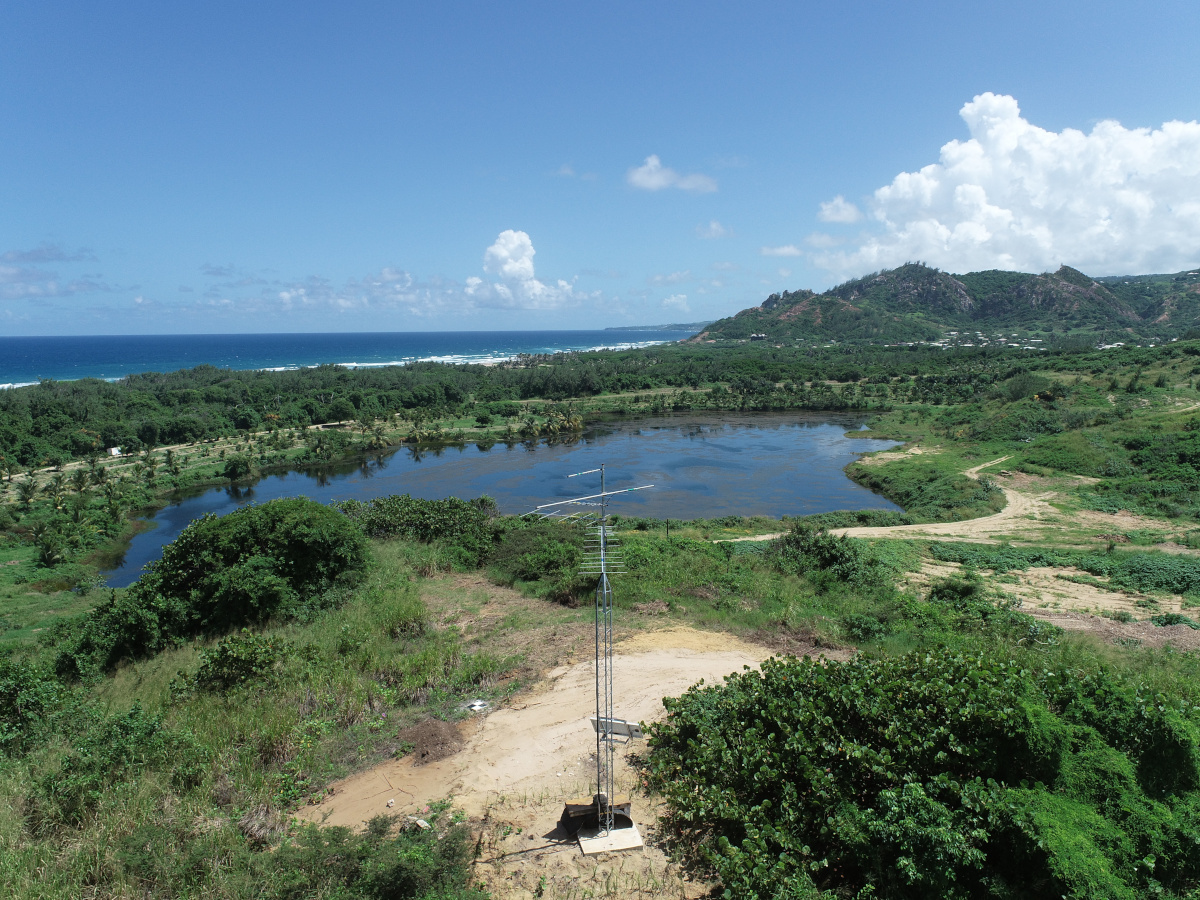
Aerial view of the Motus station installed at Walkers Reserve Barbados. (Photo by Shae Warren)
More Motus! We hope to install more Motus stations across the region, to track our precious migratory species.
We’re off to the bird haven that is the beautiful island of Cuba for what promises to be two amazing bird tours! (January 23 – 31 and March 19 – 30, 2025). Both tours are fully booked, but you can still browse the itineraries and join the waiting list for 2026 by clicking here.
Thank You for an Incredible Year!
2024 was a year to remember, and it was made possible by you—our dedicated members, partners, and supporters.
Stay up to date with us in 2025 with the latest news from the field, BirdsCaribbean programs and events, and opportunities to get involved—free to your inbox, by signing up for our monthly newsletter. Cheers to a fantastic 2025!
If you like Caribbean birds, maybe you want to learn to put a ring (or band) on them!
BirdsCaribbean is excited to invite applications to participate in a 5-day training workshop focused on bird banding, an important tool for research and monitoring! Participants will learn about the basics of bird banding, from setting up a mist-net to examining molt patterns, through a blend of classroom and field based activities. We’ll also discuss and demonstrate some of the benefits of joining our new Caribbean Bird Banding Network. We’re very excited to return to the Dominican Republic to one of our favorite workshop sites, Baiguate Ecolodge in Jarabacoa. Mark your calendars — this year’s workshop will take place from 20-24 February, 2025.
Why do we need to band birds?
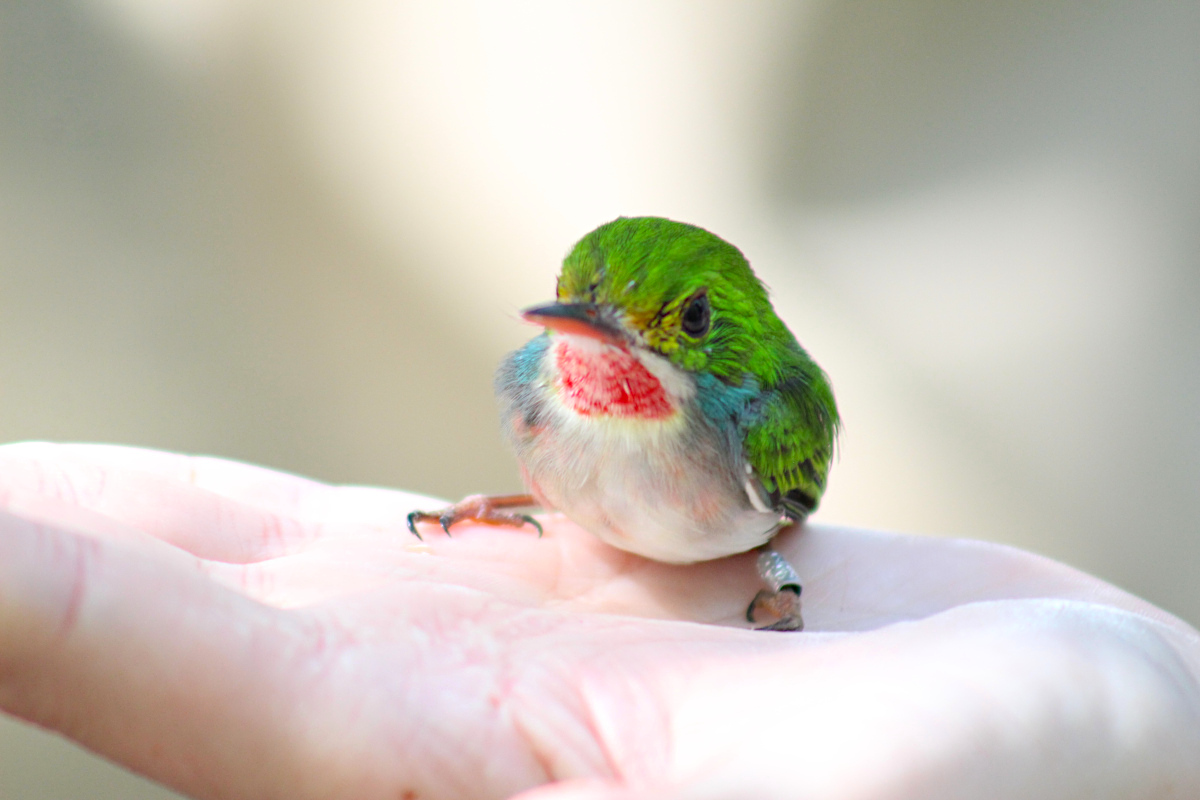
A Cuban Tody wearing a BirdsCaribbean band about to be released. (Photo by Daniela Ventura)
Bird surveys, like those covered in our Caribbean Landbird Monitoring Training Workshops, provide valuable information about abundance and species presence. But bird banding is a different methodology that takes a deeper dive into how bird populations are doing by assessing the condition of individual birds. By marking and assessing birds in the hand, we can collect data that can tell us about their demography and health, including:
Looking at fat scores and weights to assess the body condition of birds in different habitats and at different times of the year, which in turn sheds light on the quality of the habitats these birds are using.
Aging birds using plumage to investigate demographic patterns.
Using recapture records to learn about survivorship and longevity.
Assessing the presence or absence of breeding characteristics to better understand the timing of breeding and life history for many of our understudied Caribbean endemics.
Finding out which migratory routes our shared birds are taking and gaining a better understanding of factors influencing survival and longevity of species.
Over the long-term, bird banding data can also help us understand patterns and trends in bird populations, to aid in their management and conservation.
About the workshop
This workshop is the fourth annual Caribbean Bird Banding (CBB) Training Workshop. It will cover many of the same topics explored in our previous CBB Training workshops held in The Bahamas (March 2022) and the Dominican Republic (March 2023) and Grenada (March 2024). This bilingual (English and Spanish) workshop is designed for Caribbean wildlife professionals and volunteers who are interested in gaining more experience with bird banding. Prior banding experience is not required. However, priority will be given to applicants who are likely to continue training to gain the knowledge, skills, and experience needed to contribute to or initiate avian research and/or banding programs on their home islands.This workshop will focus on banding landbirds, with an emphasis on Passerines. We hope to provide banding training opportunities for other bird groups in the future.
Daniela Ventura del Puerto (Cuba) provides instruction on bird molt to workshop participants Giselle Raganoonan (Trinidad) and Elvin Manual Vargas Estevez (Dominican Republic).
Zoya Buckmire instructs a participant on how to correctly hold a bird to take measurement. (Photo by Maya Wilson)
The purpose of the workshop is to:
Provide participants with a basic understanding of bird banding techniques and best practices.
Discuss what it takes to set-up and run a bird banding station.
Prepare participants for additional bird banding training and potential North American Banding Council (NABC) certifications (assistant, bander, trainer) in the future.
Share information about the other training opportunities, resources, and community available through the CBB Network.
Several NABC-certified trainers will share their knowledge in the classroom, at the mist-net, and at the banding table, covering topics including:
Juan Carlos Fernández Ordóñez shows participants how to correctly set up mist nets in Grenada. (Photo by Maya Wilson)
Proper set-up and placement of a mist-net
Proper techniques for extracting birds from mist-nets
Starting a banding station
Bird first-aid and safety
Bird banding ethics and basics
Using bird banding for education and public demonstrations
Aging birds using both WRP and Howell-Pyle terminology
Molt patterns
Bird banding is a complex skill to learn. This workshop is intended to be a starting point, and participants should not expect to leave the workshop with the necessary qualifications to band birds independently. To become fully immersed and practice what was learned at the workshop, participants will have the opportunity to be considered for bird banding internships following the workshop.
In an effort to decrease the amount of time spent in the classroom, some materials will be shared virtually prior to the in-person workshop. These virtual sessions will also be made available to a wider audience. Stay tuned for more information!
Funding and Logistics
We aim to include approximately 15 participants in this workshop. BirdsCaribbean has funding for a limited number of need and merit-based scholarships to cover the costs of travel and participation. Participants who are able to contribute all or part of their costs can allow us to include additional participants. We encourage applications from all candidates who are well-suited to make use of this training, regardless of their financial ability. Participants should plan to arrive in the Dominican Republic by February 18 and depart on February 25.
Participants at our Caribbean Bird Banding Workshop held in the Dominican Republic in March 2023. (Photo by Joshua Covill)
Applications
If you are interested in participating in this workshop, please fill out this form by 8 December 2024.
Oportunidad de formación: Taller de anillamiento de aves caribeñas
Si te gustan las aves del Caribe, ¡Quizás quieras aprender a ponerles un anillo (o una anilla)! BirdsCaribbean se complace en invitarte a participar en un taller de formación de 5 días centrado en el anillamiento de aves, ¡Una importante herramienta para la investigación y el monitoreo! Los participantes aprenderán los fundamentos del anillamiento de aves, desde la instalación de una red de niebla hasta la revisión de los patrones de muda, a través de una mezcla de actividades en el aula y sobre el terreno. También discutiremos y demostraremos algunos de los beneficios de unirse a nuestra nuevaRed de Anillamiento de Aves del Caribe. Estamos muy contentos de volver a República Dominicana, a uno de nuestros lugares favoritos para los talleres: Baiguate Ecolodge, en Jarabacoa. Márcalo en tu calendario: el taller de este año tendrá lugar del 20 al 24 de febrero de 2025.
¿Por qué necesitamos anillar aves?
Los censos de aves, como los que se tratan en nuestrosTalleres de Formación para el Monitoreo de Aves Terrestres del Caribe, proporcionan información valiosa sobre la abundancia y la presencia de especies. Pero el anillamiento de aves es una metodología diferente que profundiza en la situación de las poblaciones de aves mediante la evaluación del estado de cada individuo. Marcando y estudiando a las aves en la mano, podemos recopilar datos que nos informen sobre su demografía y salud, entre otros:
Observar la acumulación de grasa y el peso para evaluar la condición corporal de las aves en diferentes hábitats y en diferentes épocas del año, lo que a su vez arroja luz sobre la calidad de los hábitats que estas aves están utilizando.
Determinación de la edad de las aves mediante el plumaje para investigar patrones demográficos.
Utilizar los registros de recapturas para conocer la supervivencia y la longevidad.
Evaluar la presencia o ausencia de características reproductivas para comprender mejor el momento de la reproducción y el ciclo biológico de muchas de nuestras poco estudiadas endémicas caribeñas.
Averiguar cuáles rutas migratorias siguen nuestras aves compartidas y comprender mejor los factores que influyen en la supervivencia y longevidad de las especies.
A largo plazo, los datos provenientes del anillamiento también pueden ayudarnos a comprender los patrones y tendencias de las poblaciones de aves, para contribuir a su gestión y conservación.
Sobre el taller
Este taller es el cuarto taller anual de formación sobre anillamiento de aves en el Caribe (CBB). Cubrirá muchos de los temas ya explorados en nuestros talleres anteriores de capacitación sobre la CBBN celebrados enBahamas (marzo de 2022), República Dominicana (marzo de 2023) y Granada (marzo de 2024). El taller bilingüe (inglés y español) está diseñado para profesionales y voluntarios que trabajan con vida silvestre en el Caribe y que estén interesados en adquirir más experiencia en el anillamiento de aves. No se requiere experiencia previa en anillamiento. Sin embargo, se dará prioridad a los solicitantes que tengan posibilidades de seguir formándose para adquirir los conocimientos, habilidades y experiencia necesarios para contribuir o iniciar programas de investigación y/o anillamiento de aves en sus islas de origen. Este taller se centrará en el anillamiento de aves terrestres, con énfasis en los paseriformes. Esperamos ofrecer oportunidades de formación en anillamiento para otros grupos de aves en el futuro.
Los objetivos del taller son:
Proporcionar a los participantes una comprensión básica de las técnicas de anillamiento de aves y las mejores prácticas.
Discutir lo que se necesita para montar y dirigir una estación de anillamiento de aves.
Preparar a los participantes para formación adicional en anillamiento de aves y posibles certificaciones del Consejo Norteamericano de Anillamiento (NABC) (asistente, anillador, entrenador) en el futuro.
Compartir información sobre otras oportunidades de formación, recursos y comunidades disponibles a través de la Red CBB.
Varios formadores certificados por el NABC compartirán sus conocimientos en el aula, en las redes de niebla y en la mesa de anillamiento, cubriendo temas como:
Montaje y colocación adecuados de una red de niebla
Técnicas adecuadas para extraer aves de las redes de niebla
Puesta en marcha de una estación de anillamiento
Primeros auxilios y seguridad
Ética y fundamentos del anillamiento de aves
Uso del anillamiento de aves para educación y demostraciones públicas
Determinación de la edad de las aves utilizando terminología WRP y Howell-Pyle
Patrones de muda
El anillamiento de aves es una habilidad compleja de aprender. Este taller pretende ser un punto de partida, y los participantes no deben esperar salir del taller con las calificaciones necesarias para anillar aves de forma independiente. Para sumergirse completamente y practicar lo aprendido en el taller, los participantes tendrán la oportunidad de ser considerados para prácticas o pasantías de anillamiento de aves tras el taller.
En un esfuerzo por reducir la cantidad de tiempo que se pasa en el aula, algunos materiales se compartirán virtualmente antes del taller presencial. Estas sesiones virtuales también se pondrán a disposición de un público más amplio. Mantente atento para más información.
Financiación y logística
Nuestro objetivo es contar con aproximadamente 15 participantes en este taller. BirdsCaribbean cuenta con financiación para un número limitado de becas basadas en la necesidad y el mérito para cubrir los costes de viaje y participación. Los participantes que puedan contribuir con la totalidad o parte de sus costes pueden permitirnos incluir participantes adicionales. Animamos a presentar solicitudes a todos los candidatos que reúnan las condiciones necesarias para aprovechar esta formación, independientemente de su capacidad financiera. Los participantes deben planificar su llegada a la República Dominicana para el 18 de febrero y su salida para el 25 de febrero.
Solicitudes
Si estás interesado en participar en este taller, llena este formulario antes del 8 de diciembre de 2024.
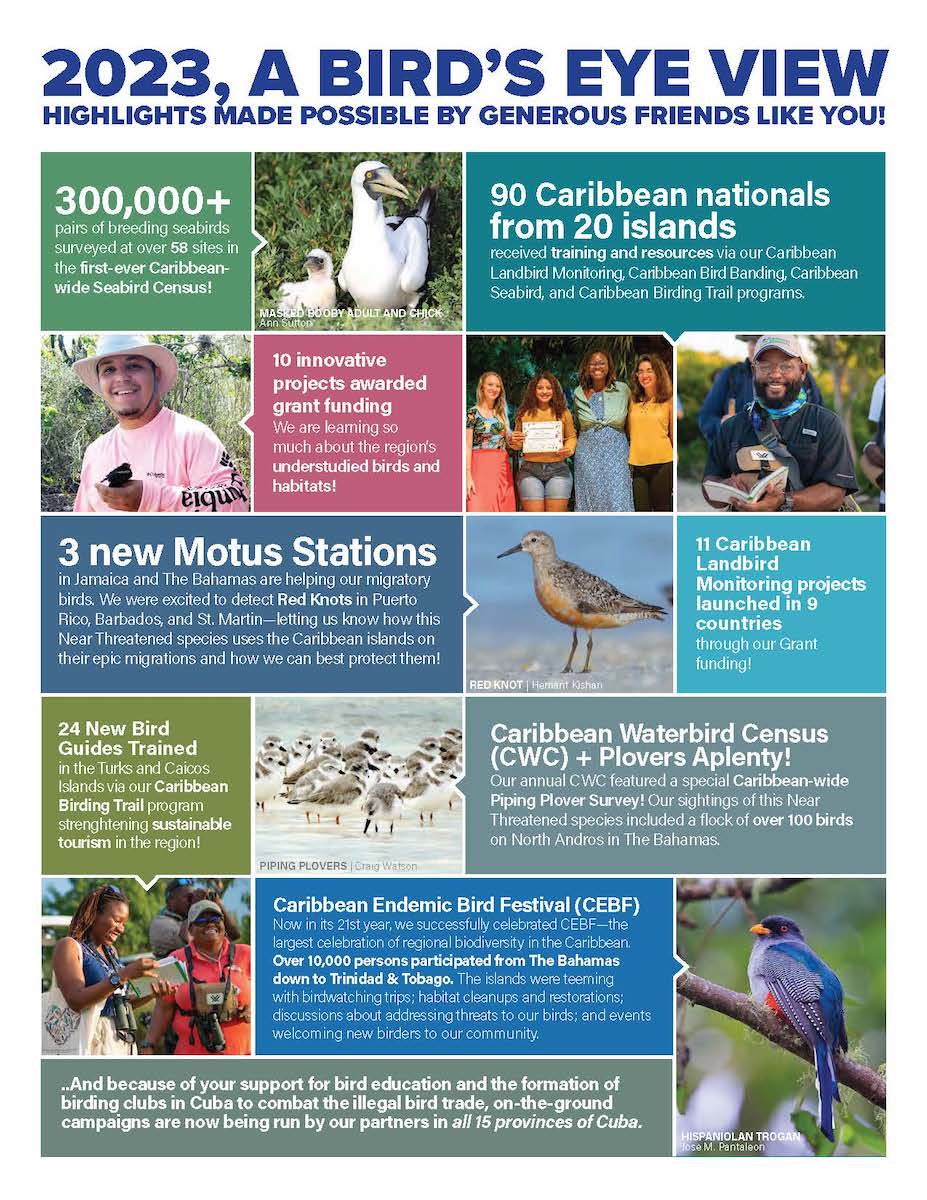
BirdsCaribbean switched into top gear for 2023. With a lot of ground to cover, we were quickly up and running! Here are some of the highlights of the year…
Focus on one adorable but elusive waterbird…
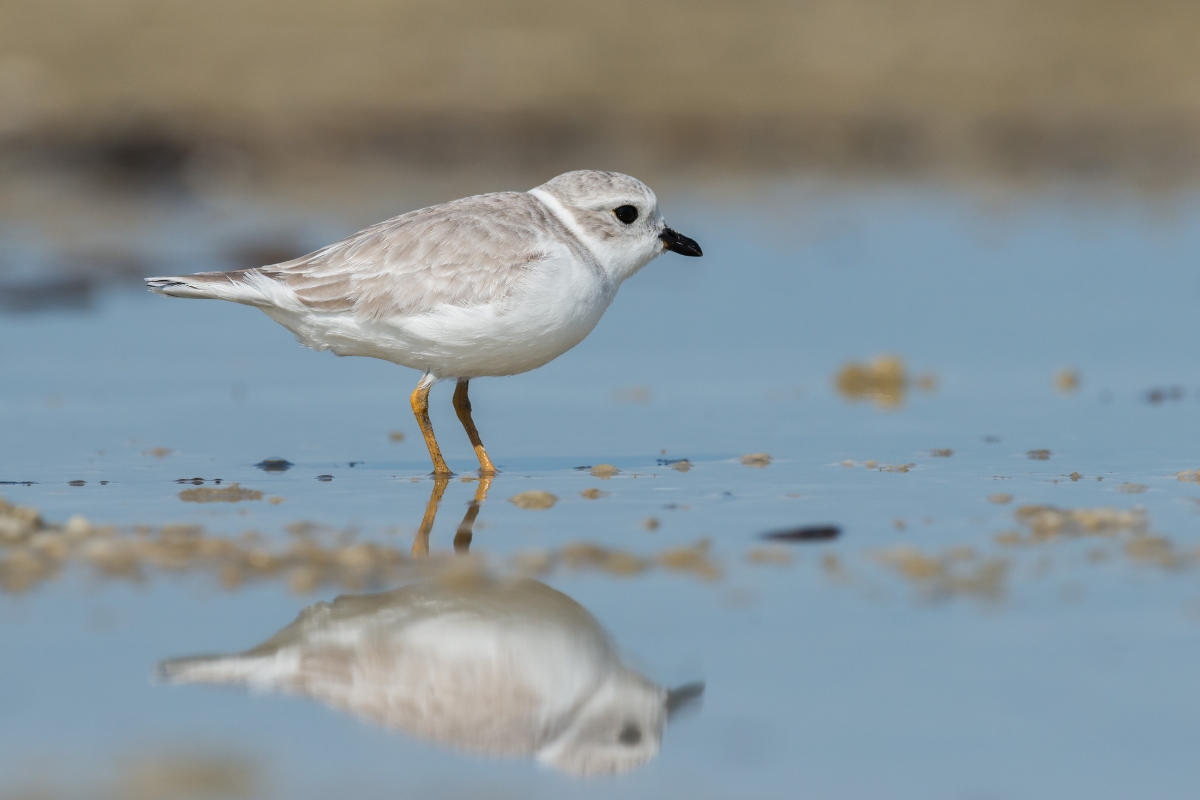
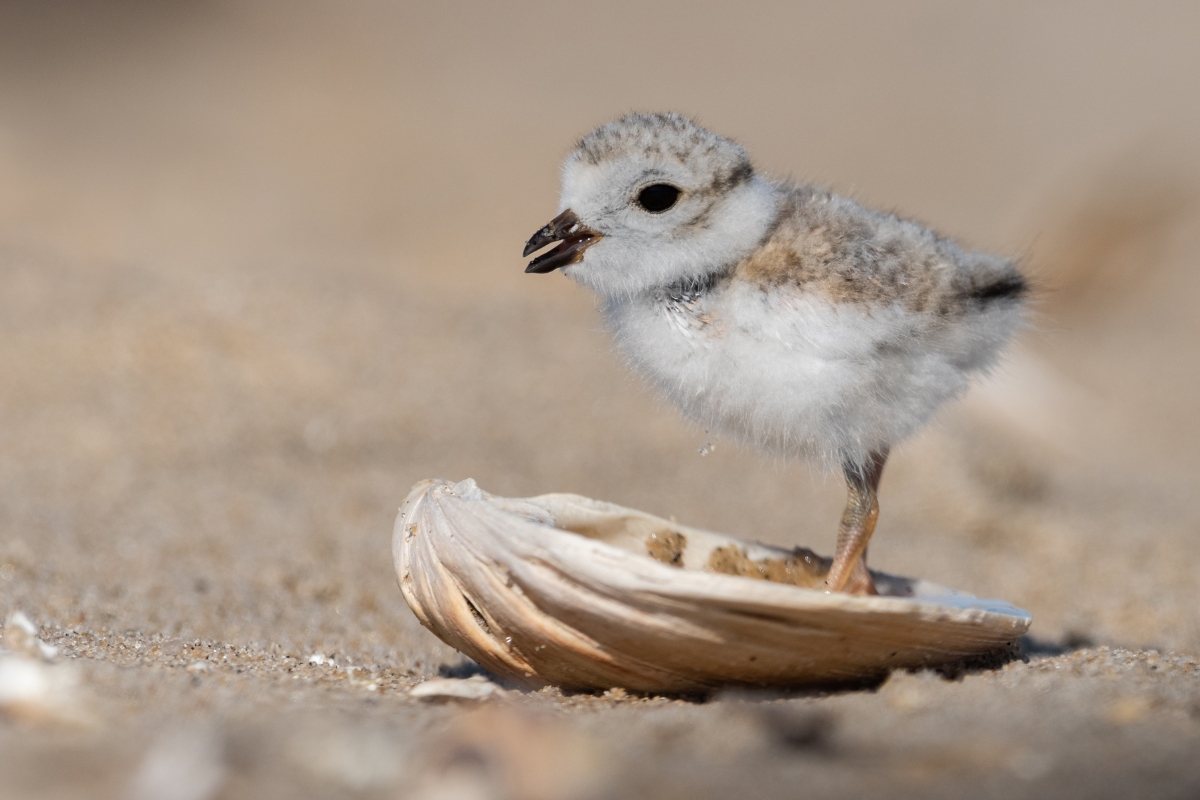
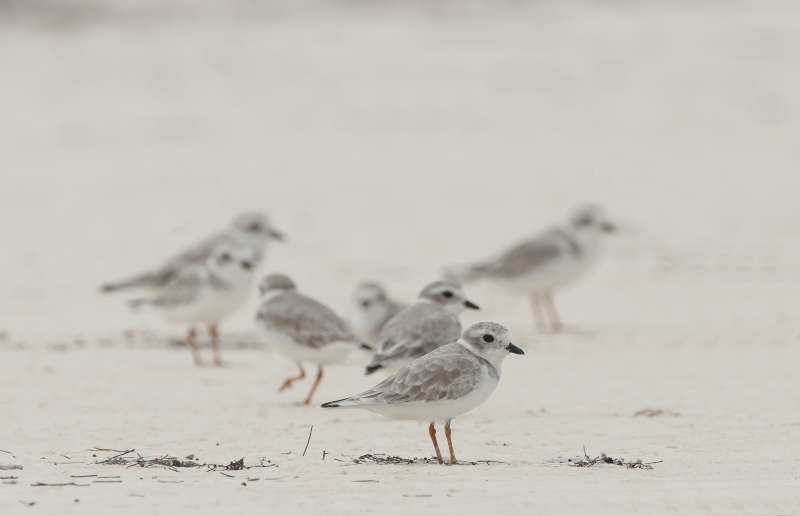
Our Caribbean Waterbird Census (CWC) region-wide count, from January 14 to February 3 2023, included an ‘added’ Caribbean-wide Piping Plover survey. This species is listed as “Near Threatened” by the IUCN with an estimated global breeding population of just 8,400 birds. The search was enhanced by beautiful graphics and merchandise by Josmar Esteban Marquez. Sightings were tracked live and plotted on a map. During the survey, these attractive but vulnerable birds were spotted in The Bahamas (a great success!), the British Virgin Islands, and Puerto Rico. Word of our search spread far and wide and we also received sightings from the Caribbean coast of Mexico! Please continue to keep a sharp eye open for these small, round birds, which are often seen in small flocks on sand flats and might also be found in mangroves, mudflats, and other shoreline areas.
A Piping Plover in winter plumage with an all-black bill.
A Piping Plover chick. Piping Plovers breed in restricted areas of North America.
A small flock of Piping Plovers in winter plumage. (Photo by Walker Golden)
click to download as a pdf
During CWC 2023, an abundance of waterbirds were spotted across the region by diligent birders, young and old, as they kept their eyes peeled for the elusive Plover! Some of the wonderful waterbirds seen on our 2023 census included a white-morph Great Blue Heron on Bonaire (a rare sight outside Florida and Cuba); a diverse gathering of shorebirds on Cuba (including Dunlins, Sanderlings, Short-billed Dowitchers, Least and Western Sandpipers, Semipalmated and Wilson’s Plovers and many others); and and some ducks enjoying some winter sun on Jamaica (including Green-winged Teals, Ring-necked Ducks, and Lesser Scaups).
Survey team in Cuba searching for Piping Plovers during CWC2023. (Photo by Daniela Ventura)
Looking for landbirds…
After the volcanic eruption of April, 2021, St. Vincent’s landbirds, especially two vulnerable endemic species, the threatened St. Vincent Parrot, and endangered Whistling Warbler, faced new dangers—both in the short and long term. We thought it fitting to continue building the capacity of Caribbean conservationists to identify and monitor landbirds using standardized survey protocols.
Thanks to funding from theCritical Ecosystems Partnership Fund (CEPF), the United Nations Development Programme (UNDP), and BirdsCaribbean members, partners and donors, we organized a Landbird Monitoring Workshop on St. Vincent with 24 participants, including from neighboring islands(Grenada, St. Lucia, and Montserrat).
Participants and facilitators of the Caribbean Landbird Monitoring Workshop at Montreal Gardens, St Vincent.
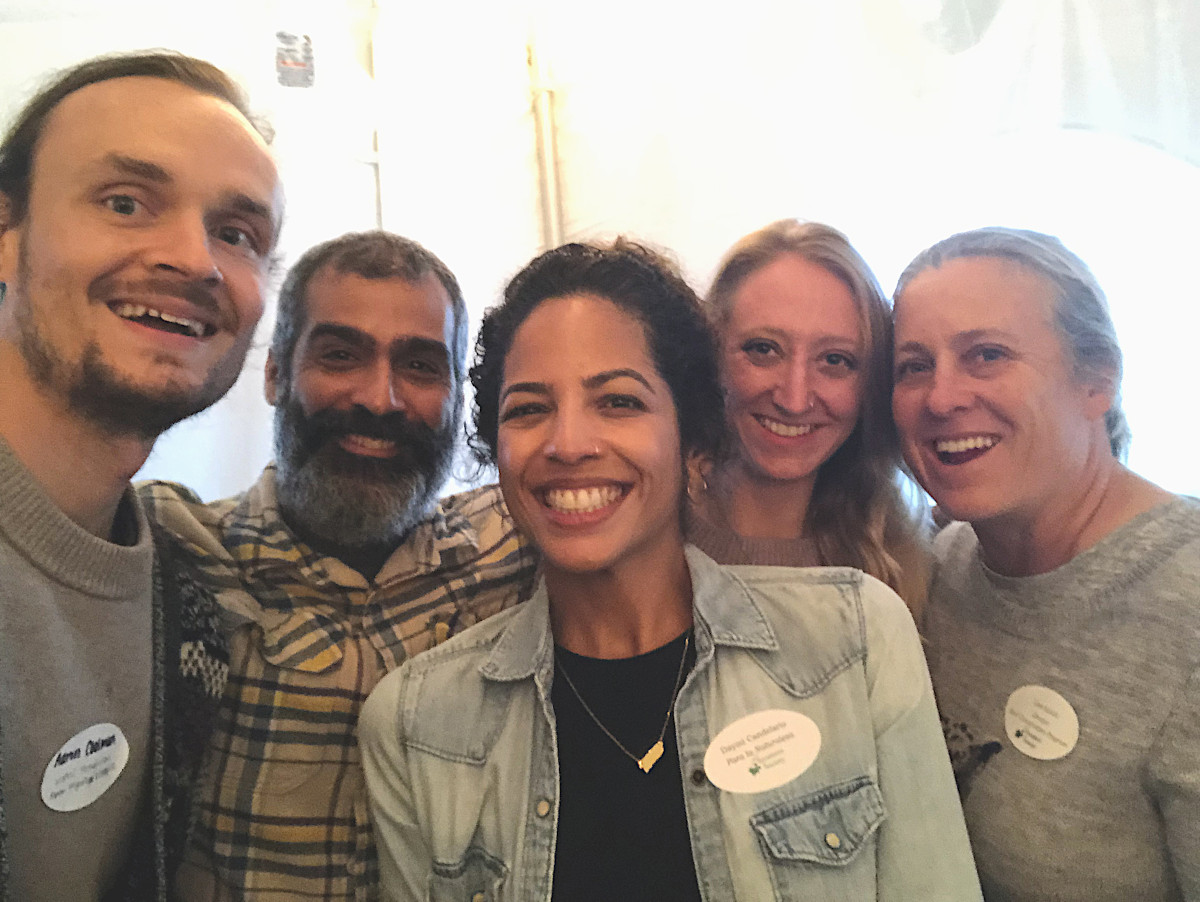
Grand Bahama Motus Installation team: Lisa Sorenson, Todd Alleger, Bradley Pinder, Cesar Montero, Maya Wilson, Demonica Brown and, David Cooper. (photo by Lisa Sorenson)
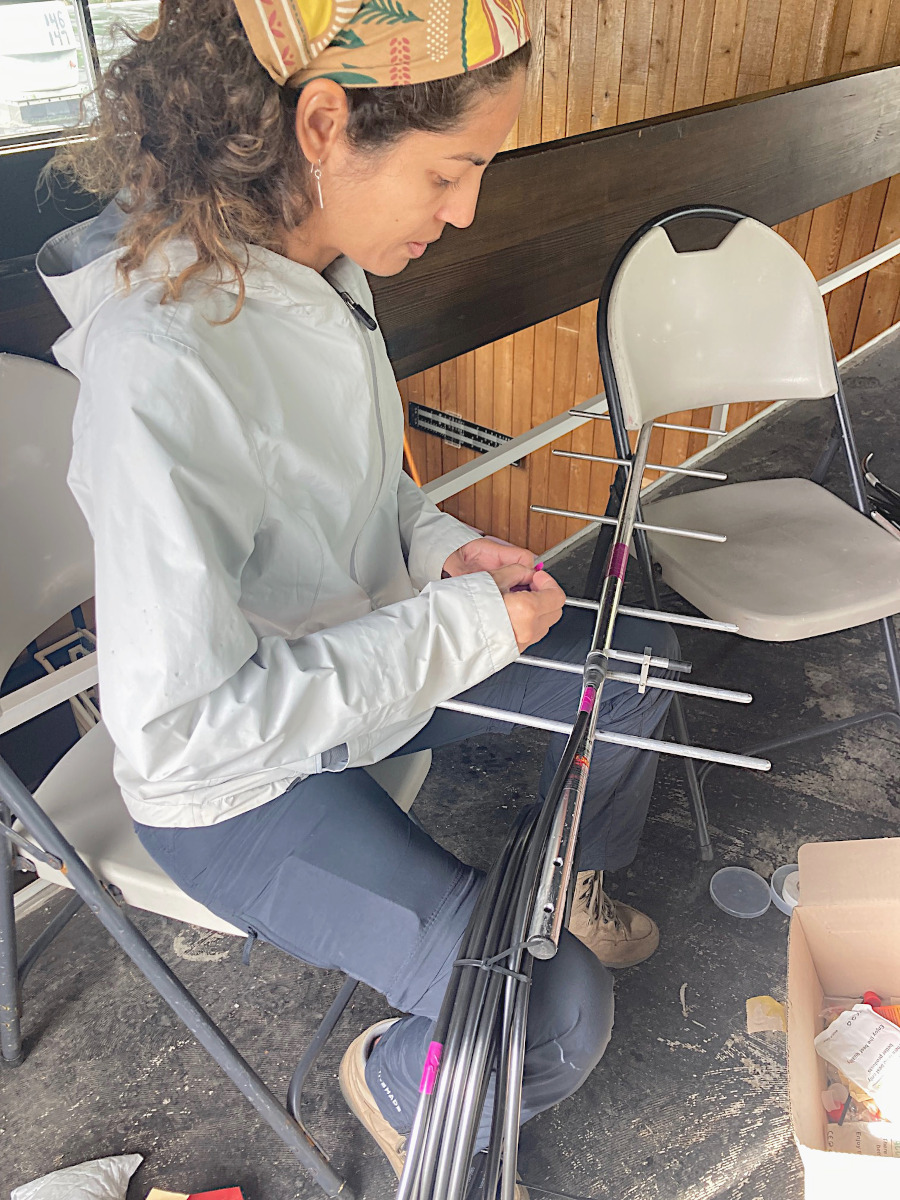
Demonica Brown and Maya Wilson assemble the Motus antenna. (photo by Lisa Sorenson)
Maya and Todd checking cables. (Photo by Lisa Sorenson)
Bob and Maya constructing the base frame. (Photo by Demonica Brown)
Cesar and Todd attaching the antenna to the Motus tower at the Lucayan National Park. (Photo by Maya Wilson)
Demonica and Bob Davies digging the hole for the base of the tower at the Lucayan National Park. (Photo by Maya Wilson)
We were out and about again! Celebrating our beautiful endemics
Did you know we now have 180 endemic birds in the Caribbean region? And we celebrated these one-of-a-kind birds during our Caribbean Endemic Bird Festival (CEBF) from April 22 to May 22, 2023—with a special emphasis on water conservation. What would our birds (and we humans) do without water? With the increased heat (it was a very hot summer) we may have seen our birds drinking at bird baths—they get thirsty like we do! With the climate change crisis pressing on us, this was a very important theme to emphasize, and our partners across the region took it on enthusiastically.
Birding along L’Anse Aux Epines road, Grenada. (Photo by Gaea Conservation Network)
A Conservation Opportunity member sensitises participants about the threats posed by marine pollution. (Photo by Conservation Opportunity)
Children and ARC Conservation members wear their hand crafted masks.
Students help plant native trees for birds and other wildlife at the National Botanical Garden.
Jamaican Mango, perched. (Photo by Clive Daelman)
Felix Raul Figueroa, photographer and member of Grupo Ecología de Aves, looks on as students from Ciénaga de Zapata color the Cuban Parrot. (Photo by Grupo de Ecología de Aves)
A young girl plays a bird game during the CEBF festivities as a member of the Luis-Munos Marin Foundation looks on. (Photo by Eliezer Nieves Rodriguez)
Yaritza Bobonis with Lola the Puerto Rican Parrot mascot. (Photo by Fundación Amigos De El Yunque)
Ashy-faced Owl, Dominican Republic. (Photo by Jay McGowan- Macaulay Library-ML162362421)
Information about the festival and endemic birds of Cuba was shared via radio interviews.
In 2023, the CEBF once again hosted in-person events and the response was tremendous—over 10,000 persons participated from The Bahamas down to Trinidad and Tobago! Our citizen scientists of all ages were out in numbers, with mangrove explorations, BirdSleuth Caribbean’s learning activities, school visits, habitat cleanups, art workshops, a birding for kids excursion, and even a floating classroom field trip!
On the Caribbean Birding Trail in Turks and Caicos
As the year-end drew closer, discovery, learning, and empowerment were words that came to mind during the Caribbean Birding Trail (CBT) Interpretive Guide Training Workshop in Turks and Caicos Islands, which took place from October 23 to 27, 2023. Twenty-four participants were trained in the Islands’ beautifully unique environment during an intensive five-day workshop. The trail now includes 138 birding sites and ten hotels and eco-lodges in 24 countries—all combining amazing birding experiences with learning and information on ecosystems, cultural and natural heritage, and more.
Beny leads the group along the Bird Rock Point Trail. Several field trips throughout the week allowed participants to get acquainted with TCI’s best birding sites! (Photo by Christel Mohammed)
Tangles of red mangrove prop roots at Wheeland Pond. This extensive wetland is a haven for birdlife and a true shorebirder’s delight!
Flamingo Pond is a must-visit spot for American Flamingo lovers! Depending on the time of the year, flocks at this wetland on North Caicos can number in the thousands!
Class is in session! 24 participants from a range of backgrounds formed our CBT TCI cohort.
Ecotour guide and participant Geneile Robinson thumbs through her Birds of the West Indies field guide while distinguishing between waterbirds!
Lisa gives the class one of the toughest pop quizzes of all! How many different species of shorebirds are in the picture?
Participant and Biology teacher Amanda Brittain consults her Seabirds of the Caribbean card for gull ID support.
Rick’s demonstration of an interpretive talk where he played the role of a hammock salesman was so transportive that the class was convinced that he really was trying to hawk them hammocks for a while!
This was our seventh CBT training. We are deeply thankful to our Turks and Caicos sponsors—the Sandals Foundation, the Turks and Caicos National Trust, Darwin Plus Initiative, the Turks and Caicos Department of Environment and Coastal Resources, the Royal Society for the Protection of Birds, Marshall Reynolds Foundation, Shika Shika, and Vortex Optics.
Bonding over Bird Banding! Workshop #2 in the Dominican Republic
Bird banding is an essential component of birding science worldwide. It is a complex and technical issue that requires longer training sessions. We returned to the Dominican Republic again in March of last year (the location of this year’s International Conference), continuing our work of nurturing a committed community of trained banders. The response from our highly intelligent group of trainees was enthusiastic.
Participants learned to set up and close mist nets during the workshop. (Photo by Josh Covill)
Participants at the banding workshop, earlier this year, in the Dominican Republic. (Photo by Joshua Covill)
Daniela Ventura del Puerto (Cuba) provides instruction on bird molt to workshop participants Giselle Raganoonan (Trinidad) and Elvin Manual Vargas Estevez (Dominican Republic).
Caribbean bird banders have gone abroad!
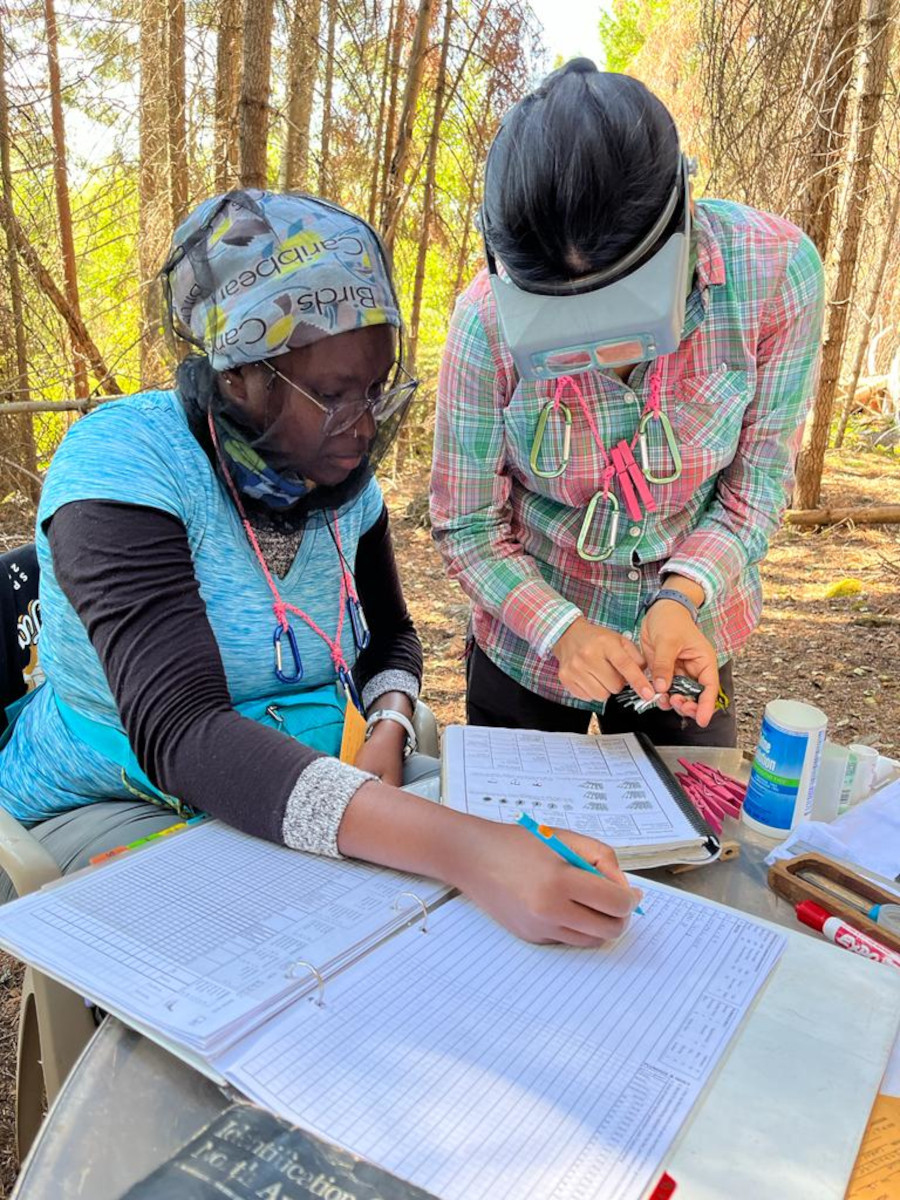
We sent some of our bird banders off to the United States and Brazil for immersive banding experiences. The interns reported back to us (Grenadian Zoya Buckmire at Klamath Bird Observatory in Oregon, Puerto Rican Dayamiris Candelario at Willistown Conservation Trust in Pennsylvania) on their exploration of new landscapes, new ecosystems—and, of course, new birds! We would like to thank all our partner organizations and generous donors who supported these internships. Once again, we were happy to add new dimensions to our young trainees’ experiences, so they may return to their countries to establish new programs and projects. Empowerment is key!
Seabirds under pressure
Despite a range of challenges, our dynamic Seabird Working Group has been addressing the critical state of Caribbean seabirds for some time now. The first-ever Caribbean-wide Seabird Census is ongoing, for 2023 and 2024. Over 300,000 pairs of breeding seabirds have already been counted at over 58 sites! Caribbean seabirds, like those in other areas of the world, are threatened by human activities—including pollution (especially plastics), climate change, invasive species, and unsustainable fishing practices. The Census continues! Please contribute your thoughts and findings, watch the webinar updates, and follow the admirable work of our Seabird Working Group this year!
Map 1: Countries participating in the Caribbean Seabird Census. Note that for large countries, the whole country is colored even though only a few localized sites may be censused.
Juliana Coffey identifying seabirds with seabird patrol volunteers, Union Island. (Alison DeGraff Ollivierre)
Grenadines Guardians seabird survey. (Photo by Juliana Coffey)
Magnificent Frigatebird nesting colony. (Photo: Jeff Gerbracht)
Masked Booby adult and chick. (Photo by Ann Sutton)
More direct funding for research and conservation work!
From combating the illegal bird trade in Cuba, to surveys of our most endangered endemic Caribbean hawk in Haiti, thanks to our grant awards, 10 innovative new projects are helping us to protect and learn more about the region’s understudied birds and habitats! Stay tuned for our upcoming blogs sharing exciting project results and accomplishments.
The 2023 cohort of grantees under our three named awards, the David S. Lee Fund for the Conservation of Caribbean Birds, the Betty Petersen Conservation Fund, and the new James A. Kushlan Research and Conservation Fund.
Have we forgotten something? Oh, yes…
Last but by no means least, Global Big Day 2023 was another huge success, with increased numbers of Caribbean birders participating. Our region saw more birds (a total of 515 species) and more humans (511 posting on eBird) than on any other Global Big Day. Once again, competition among our teams was heated—and once again, our Executive Director Lisa Sorenson’s multinational “Flying Pintails” dominated! Hmmm…
NOTE: Please remember to record ALL your bird sightings, whether in your backyard or out on a birding excursion, on eBird Caribbeanvia their website or phone app. Your bird notes make a difference in helping scientists identify the “what, when, how many, and where” of our region’s birds!
Networking is key…
As you can see, building and strengthening networks across the region has always been a significant part of our work, and it was the same in 2023. Our network of scientists (including citizen scientists), students, educators, non-governmental and community organizations, as well as nature-friendly companies and government entities, continues to grow.
Talking birds: Justin Saunders lends a listening ear to a young birder. (Photo by Stuart Reeves)
Daniela and Elvin take a closer look at a bird’s wing while another participant John Holas looks on. (Photo by Josh Covill)
Yvan Satge discusses birds at sea with fishermen. (Photo by Jacob Gonzalez-Solis)
María Paulino hosts a group discussion with students at the National Botanical Garden.
Levardo, Estefania, and Junel discuss the finer points of binocular adjustment.
In addition to the Caribbean Bird Banding Network, the Caribbean Motus Collaboration, and the Caribbean Landbird Monitoring Network, we are also building a vibrant group of trained interpretive guides through the Caribbean Birding Trail. This person-to-person aspect of our work is important for knowledge-sharing, interaction, and “comparing notes” with each other. A great deal of teamwork goes into all these endeavors, as you can see from our reports. All of this creates a positive and nurturing environment. We have great faith in our newly-trained Caribbean citizens, who are both enthusiastic and action-oriented. They want to see progress and improvements for our wonderful birds and their habitats.
We look forward to keeping in touch with you all! Here’s to 2024!
A huge thank you to all of our members, partners, and donors. This work would not be possible without your dedication, passion, hard work, and financial support.
Holly Garrod, BirdsCaribbean’s Caribbean Bird Banding Program Coordinator
One of the issues that the birding community has been working on for the last several years is how we can be more welcoming and inclusive of all birders—beginner birders and future potential birders—to join us and share the joy of birding. It’s an issue to which passionate birders, Hannah Buschert, and her husband Erik, have given a great deal of thought, and which led to the creation of Women Birders (Happy Hour) podcast.
Their ‘happy hour’ podcast is dedicated to broadcasting the lived experiences of women, from diverse backgrounds, who love birds. And of course, it’s not happy hour without cocktails! For each episode, Hannah delights us with a unique, bird-inspired alcoholic concoction based on a species mentioned in the interview!
BirdsCaribbean’s Caribbean Bird Banding Coordinator, and everyone’s favorite certified bird banding trainer, Holly Garrod, chats with Hannah about everything from her early birding days, advice for budding conservationists, exploring new birding locations, connecting to people through birds and fighting female stereotypes in conservation in this insightful episode! Holly has a B.Sc. in Applied Vertebrate Ecology and Zoology with a minor in Business from Humboldt State University and an M.Sc. in Biology from Villanova. Her master’s research focused on the two todies of Hispaniola, which is how Holly got her start in the Caribbean.
The Narrow-billed Tody, showing its bright pink sides. (Photo by Alberto Rojas)
Holly Garrod bands a Broad-billed Tody in the Dominican Republic for her M.Sc. thesis research.
The Broad-billed Tody (locally known as the Barrancoli for its habit of nesting in burrows) earned its name by having the broadest bill of all 5 tody species. (Photo by Dax Roman E.)
After her studies, Holly spent one year running the Jama Coaque Bird Observatory in Ecuador, and two and a half years running the Costa Rica Bird Observatories banding program. Holly was certified as a North American Banding Council (NABC) trainer in 2011 following her training at Humboldt Bay Bird Observatory. Since then, Holly has worked on banding projects throughout the US and Latin America. She has led multiple workshops throughout Latin America and helped with NABC certification sessions in both English and Spanish. As Caribbean Bird Banding Coordinator, Holly is working with our Caribbean partners to create a unified bird banding program for the region called the Caribbean Bird Banding Network.
Holly Garrod bands a Cuban Pygmy-Owl. (Photo by Daniela Ventura)
Coming together to learn. Holly teaches the group about molt. (Photo by Maya Wilson)
At the banding table, Daniela Ventura studies banding data sheets with Juan Carlos Fernández and Alcides Morales-Pérez. In the background, Holly holds a bird bag carrying the next-to-be-processed bird.
Grab yourself a drink (might we suggest Hannah’s Hybrid Tody cocktail below?), kick back, and settle into happy hour with Hannah and Holly! It’s an inspiring podchat about the mentors and experiences that helped shape her career in bird conservation, documenting the Hybrid Tody in the Dominican Republic, communicating science to motivate conservation action, and issues of blondeness in the birding community.
Enjoy!
Listen
Choose your preferred podcast platform to listen to Holly’s interview by clicking this Buzzsprout link.
Delight your taste buds with this Hybrid Tody (not toddy!) cocktail
Ingredients
1 ½ oz Brugal Anejo
4 fresh raspberries
4 fresh strawberries
½ oz lime juice
½ oz simple syrup
Ice
Directions
1. Fill cocktail shaker with ice 2. Add rum, raspberries and strawberries 3. Pour in lime juice and simple syrup 4. Shake shake shake 5. Strain into glass
BirdsCaribbean is excited to invite applications to participate in a 5-day training workshop focused on bird banding, an important tool for research and monitoring! Through a blend of classroom and field-based activities, participants will learn about the basics of bird banding—from setting up a mist-net to examining molt patterns. We’ll also discuss and demonstrate some of the benefits of joining our new Caribbean Bird Banding Network. We’re very excited to take our bird banding workshop to the Lesser Antilles this year! In partnership with Gaea Conservation Network and the Grenada Fund for Conservation, the workshop will take place in Grenada, from March 7-11, 2024.
Why do we need to band birds?
A Cuban Tody wearing a BirdsCaribbean band about to be released. (Photo by Daniela Ventura)
Bird surveys, like those we will cover in our upcoming Landbird Monitoring Training Workshop, provide valuable information about bird communities. Bird banding is another tool that can give us deeper insight into how our birds are doing. By individually marking and assessing birds in the hand, we can collect data that can tell us about their demography and health, including:
Looking at fat scores and weights to assess the body condition of birds in different habitats and at different times of the year, which in turn sheds light on the quality of the habitats these birds are using;
Aging birds using plumage to investigate demographic patterns;
Using recapture records to learn about survivorship and longevity;
Assessing the presence or absence of breeding characteristics to better understand the timing of breeding and life history for many of our understudied Caribbean endemics; and
Finding out which migratory routes our shared birds are taking, and gaining a better understanding of factors influencing survival and longevity of species.
Over the long-term, banding can also help us understand patterns and trends in bird populations, to aid in their management and conservation.
About the workshop
This workshop is the third annual Caribbean Bird Banding (CBB) Training Workshop. It will cover many of the same topics explored in our previous CBB Training workshops held in The Bahamas (March 2022) and the Dominican Republic (March 2023). The workshop is designed for Caribbean wildlife professionals and volunteers who are interested in gaining more experience with bird banding. Prior banding experience is not required. However, priority will be given to applicants who are likely to continue training to gain the knowledge, skills, and experience needed to initiate avian research and/or banding programs on their home islands.This workshop will focus on banding landbirds. We hope to provide banding training opportunities for other bird groups in the future.
The purpose of the workshop is to:
Provide participants with a basic understanding of bird banding techniques and best practices.
Discuss what it takes to set-up and run a bird banding station.
Prepare participants for additional bird banding training and potential North American Banding Council (NABC) certifications (bander, trainer) in the future.
Share information about the other training opportunities, resources, and community available through the CBB Network.
Daniela Ventura del Puerto (Cuba) provides instruction on bird molt to workshop participants Giselle Ragoonanan (Trinidad) and Elvin Manual Vargas Estevez (Dominican Republic).
Several NABC-certified trainers will share their knowledge in the classroom, at the mist-net, and at the banding table, covering topics like:
Proper set-up and placement of a mist-net
Extracting birds from mist-nets using the body-grasp technique
Starting a banding station
Bird first-aid and safety
Bird banding ethics and basics
Using bird banding for education and public demonstrations
Aging birds using both WRP and Howell-Pyle terminology
Molt patterns
Bird banding is a complex skill to learn. This workshop is intended to be a starting point, and participants should not expect to leave the workshop with the necessary qualifications to band birds independently. To become fully immersed and practice what was learned at the workshop, participants will have the opportunity to be considered for a bird banding internship at one of several partner bird observatories.
In an effort to decrease the amount of time spent in the classroom, some workshop sessions will be held virtually prior to the in-person workshop. These virtual sessions will also be made available to a wider audience. Stay tuned for more information!
Funding and Logistics
We aim to include approximately 15 participants in this workshop. BirdsCaribbean has funding for a limited number of need and merit-based scholarships to cover the costs of travel and participation. Participants who are able to contribute all or part of their costs can help us enhance the workshop content and allow us to include additional participants/trainers. We encourage applications from all candidates who are well-suited to make use of this training, regardless of their financial ability. Participants should plan to arrive in Grenada on March 6th and depart on March 12th.
Participants at our Caribbean Bird Banding Workshop held in the Dominican Republic earlier this year. (Photo by Joshua Covill)
Applications
If you are interested in participating in this workshop, please fill out this form by 22 December 2023.
BirdsCaribbean would like to thank J.C. Fernández-Ordóñez for the Spanish translation.
Oportunidad de Capacitación: Taller de Anillamiento de Aves en el Caribe
BirdsCaribbean se complace en invitarle a participar de un taller de capacitación de 5 días centrado en el anillamiento de aves, una importante herramienta para la investigación y el seguimiento. A través de una combinación de actividades de aula y de campo, los participantes aprenderán los fundamentos del anillamiento de aves, desde la instalación de una red de niebla hasta el examen de los patrones de muda. También discutiremos y demostraremos algunos de los beneficios de unirse a nuestra nueva Red de Anillamiento de Aves del Caribe. Estamos muy contentos de llevar nuestro taller de anillamiento de aves a las Antillas Menores este año. En colaboración con Gaea Conservation Network y el Fondo de Granada para la Conservación, el taller tendrá lugar en Granada del 7 al 11 de marzo de 2024.
¿Por qué necesitamos anillar aves?
Los estudios sobre aves, como los que trataremos en nuestro próximo taller de capacitación sobre seguimiento de aves terrestres, proporcionan información valiosa sobre las comunidades de aves. El anillamiento de aves es otra herramienta que puede darnos una visión más profunda de cómo están nuestras aves. Marcando y evaluando individualmente a las aves en la mano, podemos recopilar datos que nos informen sobre su demografía y salud, entre otros:
Observar las puntuaciones de grasa y los pesos para evaluar la condición corporal de las aves en diferentes hábitats y en diferentes épocas del año, lo que a su vez arroja luz sobre la calidad de los hábitats que estas aves están utilizando;
Envejecimiento de las aves mediante el plumaje para investigar patrones demográficos;
Utilización de registros de recaptura para conocer la supervivencia y la longevidad;
Evaluar la presencia o ausencia de características reproductoras para comprender mejor el momento de la reproducción y el ciclo biológico de muchas de nuestras endémicas caribeñas poco estudiadas; y
Averiguar qué rutas migratorias siguen nuestras aves compartidas y comprender mejor los factores que influyen en la supervivencia y longevidad de las especies.
A largo plazo, el anillamiento también puede ayudarnos a comprender las pautas y tendencias de las poblaciones de aves para contribuir a su gestión y conservación.
Sobre el taller
Este taller es el tercer Taller Anual de Capacitación en Anillamiento de Aves en el Caribe (CBB). Cubrirá muchos de los mismos temas explorados en nuestros talleres previos de Entrenamiento en CBB llevados a cabo en Las Bahamas (marzo 2022) y República Dominicana (marzo 2023). El taller está diseñado para profesionales y voluntarios de la vida silvestre del Caribe que estén interesados en adquirir más experiencia en el anillamiento de aves. No se requiere experiencia previa en anillamiento. Sin embargo, se dará prioridad a los solicitantes que tengan posibilidades de seguir formándose para adquirir los conocimientos, habilidades y experiencia necesarios para iniciar programas de investigación y/o anillamiento de aves en sus islas de origen. Este taller se centrará en el anillamiento de aves terrestres. Esperamos ofrecer oportunidades de formación en anillamiento para otros grupos de aves en el futuro.
El propósito del taller es:
Proporcionar a los participantes una comprensión básica de las técnicas de anillamiento de aves y las mejores prácticas.
Discutir lo que se necesita para montar y dirigir una estación de anillamiento de aves.
Preparar a los participantes para formación adicional en anillamiento de aves y posibles certificaciones del Consejo Norteamericano de Anillamiento (NABC) (anillador, formador) en el futuro.
Compartir información sobre otras oportunidades de formación, recursos y comunidad disponibles a través de la Red CBB.
Varios formadores certificados por la NABC compartirán sus conocimientos en el aula, en la red de niebla y en la mesa de anillamiento, abordando temas como:
Montaje y colocación correctos de una red de niebla
Extracción de aves de las redes de niebla mediante la técnica de agarre del cuerpo
Puesta en marcha de una estación de anillamiento
Primeros auxilios y seguridad de las aves
Ética y fundamentos del anillamiento de aves
Uso del anillado de aves para educación y demostraciones públicas
Envejecimiento de aves utilizando terminología WRP y Howell-Pyle
Patrones de muda
El anillamiento de aves es una habilidad compleja de aprender. Este taller pretende ser un punto de partida, y los participantes no deben esperar salir del taller con las calificaciones necesarias para anillar aves de manera independiente. Para sumergirse por completo y poner en práctica lo aprendido en el taller, los participantes tendrán la oportunidad de ser tenidos en cuenta para unas prácticas de anillamiento de aves en uno de los varios observatorios de aves asociados.
En un esfuerzo por reducir el tiempo de permanencia en el aula, algunas sesiones del taller se celebrarán virtualmente antes del taller presencial. Estas sesiones virtuales también se pondrán a disposición de un público más amplio. Esté atento para más información.
Financiación y logística
Nuestro objetivo es contar con aproximadamente 15 participantes en este taller. BirdsCaribbean cuenta con financiación para un número limitado de becas basadas en la necesidad y el mérito para cubrir los costes de viaje y participación. Los participantes que puedan contribuir con la totalidad o parte de sus costes pueden ayudarnos a mejorar el contenido del taller y permitirnos incluir más participantes/formadores. Animamos a presentar solicitudes a todos los candidatos que estén en condiciones de aprovechar esta formación, independientemente de su capacidad financiera. Los participantes deberán prever su llegada a Granada el 6 de marzo y su salida el 12 de marzo.
Solicitudes
Si está interesado en participar en este taller, complete este formulario antes del 22 de diciembre de 2023.
Elvin removing a cuckoo from a mist net. (Photo by Josh Covill)
BirdsCaribbean’s Caribbean Bird Banding Network recently held their second bird banding training workshop in the beautiful Dominican Republic. Read on for a delightful personal account of this workshop from local high-school teacher and dedicated Dominican biologist Elvin Manuel Vargas Estévez.
On the fresh morning of March 8th, 2023, in Jarabacoa, Dominican Republic, one of the most rewarding experiences of my life as a biologist would begin. I was participating in a Bird Banding Workshop organized by BirdsCaribbean. It sounds beautiful just to say it, but the true beauty lies in how and what happened there to consider it so valuable.
I must admit—I have always been a wildlife lover since I was a child. But my four-year-old self could never have imagined that I would have a bird in my hands, measuring its anatomical proportions, carefully observing the arrangement of its feathers, and eagerly looking for molt limits. However, today I feel immense excitement knowing that it is now part of my life, allowing me to continue to educate myself and contribute knowledge to avian conservation and society.
Setting up mist nets and sowing euphoria
On the first day of the workshop, my colleague Gerónimo Abreu and I were so excited to start the activities. We talked about what we wanted to do that day from the moment we woke up until we left our room. Once everything was ready, we headed to the main hall and dining room of the Ranch, where lead banding trainer Holly Garrod explained to us with great enthusiasm what we were going to do that day. With clear instructions, we took the necessary equipment and set off to explore the area that would be our morning workplace for the next four days.
The non-traditional, open-air classroom where learning, sharing and discussions took place during the workshop. (Photo by Elvin Estévez)
The process of setting up mist nets is an art that is not as boring as it may seem. Well, it’s true that it’s probably not the most exciting part of a bird bander’s day, but there is a certain magic in the process. The first time I saw a mist net was during a bird banding demonstration that Holly did at the Botanical Garden in Santiago. There I learned that setting up and taking down nets is like a climbing sport. We drive stakes firmly or look for a stable attachment, and “climb with the net” to maintain tension at all times. How interesting! Something as methodical and procedural as setting up a mist net can become fun if you look at it with different eyes.
I remember how the other participants were attentive to everything that moved, what the trainers said, and what more experienced banders did. Throughout that first day, I kept learning about the nets, observing how the more experienced bird banders worked, and learned how to enter banding data while eagerly waiting to hold and band a bird for the first time.
Participants learned to set up and close mist nets during the workshop. (Photo by Josh Covill)
“Don’t be afraid, you are in control, not the bird”
As a child, I used to watch many programs on channels like Animal Planet and Discovery Channel with deep curiosity, as I have always found wildlife fascinating. However, animals did not captivate me solely for their majesty, such as lions and other big cats, or for their incredible sizes, like hippos and rhinos. For me, the greatest treasure in observing an animal is being able to understand its unique behavior and social interactions, at both inter- and intraspecific levels. That’s why I was so amazed when I started focusing more on birds as my birdwatching hobby developed. As fellow ornithologists and birders know, there is nothing more unique than a bird’s behavior.
The first time I held a bird in the context of bird banding was at the Santiago Botanical Garden. I was given the opportunity to release a freshly banded bird and it was a beautiful experience. However, it pales in comparison to the moment when I released a bird from its bag, held it properly, and took the necessary measurements before banding it and then releasing it. This whole process was so exciting for me that it came with a mix of nervousness.
When I was about to process my first bird, Juan Carlos (JC) Hernández Ordoñez was the one supervising my work. I am infinitely grateful to JC as he helped me learn the proper technique and gain confidence to safely handle a bird. I remember very clearly how at the beginning my nervousness caused my hands to shake a little when taking measurements and analyzing the bird. It was then that I heard JC say, “Don’t be afraid, you are in control, not the bird.”
Elvin banding a Palmchat. (Photo by Josh Covill)
That is when I realized that my nervousness, perhaps driven by the fear of hurting the bird, was only adding stress that was being transmitted to the animal. If you are nervous and stressed, the bird you are holding will be too. But if you control the situation and remain calm, the bird you are processing will eventually calm down as well.
By the end of the course, about five birds had passed through my hands, and all but one showed no signs of stress that would warrant a premature release. It is amazing to have an animal in your hands for the right purpose, and then release it knowing that someone, another bird bander or even a birdwatcher, may encounter it some day in the future. The banded bird connects us to a shared conservation goal and binds us to it in an intimate way.
Molt, molt, molt!
Wait, who said that it was only about knowing how to handle a bird, taking it out of the net, and banding it for release? That’s excellent, but I’m sure you’ll be interested in knowing the age of the individual you’re holding, or at least an approximation. Why is it useful for us to know the age of the bird we’re banding? Well, among many things, it allows us to understand the ecological role that the individual is playing, or will play in the near future. If it has already gone through a reproductive stage, if it will seek to reproduce soon, if it has recently left the nest. Or if it is simply a fully mature individual that has been interacting with the surrounding ecosystem for more than two years. Of course, in addition to age, there are other things we can learn with greater accuracy with a bird in the hand, such as its sex or health status, which, of course, will help us quantify and infer more aspects of the bird’s life cycle.
A bird in the hand allows us to learn about the age and health of the bird. (Photo by Josh Covill)
Molt, also known in birds as the replacement of feathers, is key to bird banders. These patterns of feather replacement, or molt patterns, can help us determine the age of a bird. When I first learned about molt, I was amazed by the beauty of this natural process in all birds. I admit that at first my “operating system” almost failed due to so much information to process. At that moment, I realized how we were all connected by another common interest throughout the workshop: molt! It was incredible. If we were at the banding table, we talked about molt. During and after lunch: more conversation about molt. Before sleeping: a study session on molt. We were obsessed with learning more and more about molt, practicing the Wolfe-Ryder-Pyle (WRP) method (a system for aging birds based on their different plumages) countless times, and even immersing ourselves in Peter Pyle’s book “The Identification Guide to North American Birds” as if it were our “bible.” How much I enjoyed all of that! As my friend Daniela Ventura said, we were becoming “molt nerds” and we were enjoying it.
Daniela and Elvin take a closer look at a bird’s wing while another participant Amonie Holas looks on. (Photo by Josh Covill)
The best part is realizing that we never really stop learning, because Pyle’s book does not have all data about all birds. In fact there are birds for which we have little or no data. Those occasions when we encountered individuals with unique molting strategies, challenging molt limits, and deceptive alternate (breeding) plumages were the perfect setting for creating a session where trainers discussed what the correct code would be to describe the age of the bird, and the rest of us watched attentively as these interesting analyses unfolded. The fact that you can always come across these unique and challenging situations is, for me, part of the magic that birds hold in their molt strategies.
Birds Connecting the Americas
Undoubtedly, one of the most beautiful things about the workshop is the opportunity to meet people with similar interests and visions. Since we arrived at Rancho Baiguate in Jarabacoa on the afternoon of March 7th (a day before the official start of the workshop), we realized this benefit. After dropping off our luggage in the assigned room, we immediately went to dinner and sat at a table with Holly, Maya, Steve, and Zoya. From that moment on, we got to know each other and had many conversations about various topics, and it was very enjoyable. But if there’s one thing that stands out above all else, it’s how birds were the center of many of those conversations. Yes, I understand it may seem obvious, but even though we knew we would meet people who shared the same love for birds and conservation as we do, it’s always an indescribable pleasure to be able to talk and connect in person. Throughout the workshop, we met and interacted with incredible people, and we expressed our desire to work together on different approaches, always revolving around birds.
Coming together to learn. Holly teaches the group about molt. (Photo by Maya Wilson)
Making lasting connections at the bird banding training workshop. From left to right: Daniela, Gerónimo, Elvin and Zoya.
Participants at the banding workshop, earlier this year, in the Dominican Republic. (Photo by Joshua Covill)
Examining a Hispaniolan Woodpecker wing for signs of molt. (photo by Josh Covill)
Elvin banding a Black-throated Blue Warbler (photo by Maya-Wilson)
Finding common ground with people who share similar research and conservation interests is great because valuable knowledge is shared in those encounters. However, this would not amount to much if genuine connections are not formed—concrete connections that allow for efficient and organized collaboration. That’s why we were all very excited with the presentation of the BirdsCaribbean Caribbean Bird Banding (CBB) network and the Institute of Bird Population’s monitoring program for overwintering migratory birds, otherwise known as MoSI (monitoreo sobrevivencia invernal). It’s fascinating!
I want to express how thrilled and engaged we all were when the CBB network was introduced. The fact that we are being presented with a way to stay connected is more valuable than it may seem because it encourages more organized efforts: joint research proposals, shared databases, and fundraising for future projects. Similarly, I find the MoSI program incredible as it specifically focuses on connecting different bird banding stations where data on molt and plumage condition of banded species are provided. What does this do for us? It helps us primarily to understand how birds are changing their molt strategies, which, in addition to updating our records, helps us understand how species are being affected by various factors such as habitat loss and climate change.
My Plus/Delta
The Plus/Delta dynamic was key to the performance and experience we had in the workshop. Every afternoon, we took a moment to discuss the positives of the day (the “Plus”) and what we wanted to improve on in the next day’s work session (the “Delta”). It was very productive, as we listened to each other’s daily experiences, had the opportunity to share our achievements, and set goals for the next day. It is very gratifying to remember how, thanks to Plus/Delta, Gerónimo and I reflected on something that filled me with particular joy and satisfaction.
At the beginning of the article, I mentioned how after each morning’s banding session, we would casually talk about the things we were able to accomplish and say, “But tomorrow I want to be able to do this.” And that’s how, thanks to our trainers and fellow workshop participants, we were able to accomplish each and every one of those things we said we wanted to do.
My Plus, as some of us would say at the end, was the entire workshop. I am infinitely grateful for the opportunity to connect with so many incredible people through birds, and at the same time, learn so much alongside them. My experience was invaluable, and I am satisfied with everything I was able to achieve in those five days. The fact that I was able to band birds for the first time and know that I had the opportunity to contribute useful knowledge through it is amazing. The mini-courses on molt were amazing, our shared obsession made us connect so much that there was not a moment during the workshop when we were not making references to WRP codes or molt limits. Even during the farewell dinner, while we talked about everything, references to aspects of molt in birds would occasionally arise, and it was fascinating.
Elvin receiving his Certificate of Achievement from Holly and Juan Carlos (JC).
And what about my Delta? My Delta is a collection of things. It is clear that I want to continue to educate myself to grow this newly created wonderful network of bird banders in the Caribbean. In addition to that, I want to fight to make my country, the Dominican Republic, a place where ornithology, conservation, and science in general receive their deserved recognition and support from society and authorities. The love or curiosity for nature is in some way part of all human beings, but it is clear that not everyone can be expected to understand the complex ecological processes behind the beauty of the natural world.
Beyond that, I understand that in every nation, there must be a solid system where anyone willing to serve through scientific knowledge can find support and guidance. For this reason, one of my long-term goals (a goal that is shared by many of us attending the workshop) is to advocate for the reinforcement of the importance of avian conservation and government support for research related to it, both in the Dominican Republic and throughout the entire Caribbean.
About Elvin:Elvin Manuel Vargas Estévez, is biologist interested in bird behavior and avian conservation, from the Dominican Republic. He is a high-school science teacher at O&M Hostos School in Santiago and also volunteers with the Santiago Botanical Garden to survey and monitor the bird population in the Garden. Elvin is incredibly passionate about inspiring and educating the next generation of nature enthusiasts. He hopes to continue learning about birds and acquiring new skills that will help him make a positive impact in bird and wildlife conservation.
Acknowledgements: BirdsCaribbean thanks the US Fish and Wildlife Service, US Forest Service International Programs, and all of our members and donors whose support helped make this workshop and our Caribbean Bird Banding Network possible.
To learn more about our Banding Workshops and Caribbean Bird Banding Network, check out the links below:
In 2022, Cuba held its first ever bird banding workshop, part of BirdsCaribbean’s ongoing efforts to build a banding community in the Caribbean. Find out more about bird banding in Cuba and about how the workshop went from Cuban bird bander and ornithologist Daniela Ventura.
Daniela Ventura banding a Cuban Green Woodpecker supervised by banding trainer Juan Carlos Fernández Ordóñez (Photo by Holly Garrod)
The year 2022 was pivotal for bird banding in the Caribbean. Earlier in March, the first Caribbean Bird Banding Workshop was held in The Bahamas. Bird researchers and conservationists from several islands, attended with the goal of learning about ethical and scientific banding protocols and acquiring the skills to successfully run their own banding stations. The long-term dream is to develop a network of collaborators, spread across the region, that can contribute with insights into bird movements and population status of migratory and resident species. This event alone would have sufficed to call the year a landmark. But we Caribbeans like to think BIG.
Therefore, the Caribbean Biological Corridor (CBC) partnered with BirdsCaribbean to host the first ever Banding Workshop in Cuba, which took place from November 4th to the 18th in Santiago de Cuba. Cuba being the largest island in the region with the longest banding tradition, is an essential part of this network. The goal of this workshop was ambitious: gather people and institutions with current banding protocols in the island to organize them into a National and Regional Banding Network and host a North America Banding Council (NABC) certification. NABC certification is widely accepted as the banding standard throughout the Americas. This is the certification that BirdsCaribbean is aiming to use as part of the Caribbean Bird Banding Network.
This workshop represented a milestone in my bird banding career. Back in March, I would not have imagined that my banding skills were going to be tested that soon. The NABC certification is a rigorous process of theoretic and practical exams that evaluates your abilities and knowledge in bird banding, according to the standards and practice of that institution. I accepted the challenge. It meant a great incentive to boost my skills, and if I became certified, I would be confident enough to pursue my long-cherished dream of starting my own banding station in Havana. With those motivational thoughts in mind, and the prospects of seeing some eastern endemic birds that I don’t get to see often, I embarked on the wearisome 12-hours bus trip to Santiago. It would prove to be worth it.
A very long and thin island
Havana, the capital city and my hometown, is 868 km away from Santiago de Cuba, the second most important city in the country, which is famous for its carnival and its scorching sun all year round. The tiresome road trip was endurable thanks to the best company I could possibly have: my friends Esteban Márquez and Juan Carlos Fernández (JC). Their good humor guaranteed the trip was joyful. Actually, sometimes I was just about to doze off and JC interrupted it with a joke. During the long journey to Santiago, we were picking up participants from other provinces.
Arnaldo Toledo checking the molt on an Oriente Warbler at the banding station. (Photo By Daniela Ventura)
The ride took us all night and so we arrived at our destination at the same time the first dawn chorus of birds began singing. The Ecological Reserve Siboney Juticí is a karstic landscape of marine terraces—ancient ocean floor now elevated gazing at the Caribbean Sea. The typical coastal shrubby and thorny vegetation is a paradise for migratory warblers and plenty of Cuban endemics, like the Oriente Warbler, Cuban Gnatcatcher, and Cuban Bullfinch. It was a perfect location for the longest running banding station in Cuba, named after the German scientist that was a pioneer of Cuban ornithology: Juan Cristóbal Gundlach. The first four days of the workshop were scheduled to be spent here, coinciding with the monthly period of banding sessions occurring at the station.
We arrived yawning and with sleepy eyes, only to meet an incredible welcoming committee. Freddy Rodríguez Santana, the leader of the station and the most dedicated and diligent workshop organizer, received us with a beaming smile. The station and protected area staff were also cheerful and active, almost as if it wasn’t 5 am in the morning! They seemed ready to start working and I, honestly, was only longing for a bed.
We didn’t have to wait for long for coffee and breakfast. Behind that magic brew that stirred us all a little, was the heart and soul of the banding station: Emelina. She is the keystone that holds the station and everyone together. Eme (as colleagues called her lovingly) is more than the excellent cook that prepares the delicious food and drinks that keeps you sane in the melting hot weather. She is also a kind and caring woman so all of us, workers and visitors alike, become instantly her spoiled children.
When the introductions were over, Freddy quickly rushed us to the rooms, so we could settle in and rest a few hours before the work started. The objective of the day was setting up the mist nests for the upcoming banding session, and to officially inaugurate the workshop.
Learning about Cuba’s longest running banding station
Mariam Curbelo checks mist nets during a net run. (Photo by Daniela Ventura)
The workflow of a constant-effort banding station has a unique flavor. For twelve years, researchers of BIOECO and the staff of the protected area (some of whom have banding training and certification from Germany) have conducted monthly banding sessions at the reserve. Not even hurricanes nor a pandemic have stopped their committed work. We witnessed its smooth organization from the moment we arrived. Each person plays an invaluable role, from the field technicians that know the exact location of every single net, to the researchers that band the birds and take the data. Setting up the nets is an essential process of every banding protocol. A total of 22 nets are placed along three different trails. The park’s staff kindly took their time to show us and guide us through the process step by step. Left alone they would have done the job in less than half an hour. That is how well they do their job!
With the nets ready to start banding the next day, we headed to the classroom to receive the official welcoming. Thirteen participants from all around Cuba, and my friend Esteban from Venezuela, were going to receive training in the nitty-gritties of banding birds for scientific endeavors. Esteban’s main motivation, along with another three of us, was taking the NABC exam that would allow us to be the first Caribbean certified banders. Even though the stakes were high, we had the best teachers: Holly Garrod and JC Fernández, NABC trainers, and of course, the staff at the JCG station with their gathered experience of 12 years of nonstop field work.
A season of Blackpoll Warblers
A male Blackpoll Warbler in fall migration and winter plumage. Males in breeding plumage in spring look very different—they have a black cap and white cheek patch. (Photo by Anthony Levesque)
I was expecting to meet and get a closer look at birds that I can’t find so easily at mist-nets in western Cuba. But Blackpoll Warblers were a treat beyond my wildest daydreams. I had the privilege to band a few of the dozens of individuals we caught during these three days. Blackpolls are world champions in the bird migration contest. Some individuals are known to fly up to 8,000 km from their breeding grounds in Alaska to their wintering areas in Brazil. They also take a route that leads them to fly out over the Atlantic Ocean sometimes three-days long without making any stop. That easterly path is the reason why they are more commonly found in places like Santiago, and very rare in the western side of Cuba.
Uncommon birds for me, but the daily bread for our banding colleagues in Santiago, were Cape May Warblers and Black-throated Blue Warblers. Cape-Mays can be very tricky to age and sex, because there are a lot of individual variability and overlap, but Black-throated proved easier for me. These challenges of new species were just exactly what we needed to get ready for the NABC exam. A bander must also be prepared to deal with species that he or she has never encountered before. That is why learning the theory behind molt strategies and molt extents in bird families in general is a requirement for getting a better understanding on the topic. And why we not only had the morning sessions at the banding table, but presentations about these subjects in the afternoons. Luckily, we had Emelina´s miraculous coffee to keep our brains working!!
Butter butts in the cloud mountains
La Gran Piedra Biological Station sign. (Photo by Daniela Ventura)
Packing jackets and scarves are not something you would expect for a banding trip to Santiago, which is known as the “tierra caliente” or “hot land” to Cubans. But precisely because I am a daughter of the tropics, temperatures below 20 degrees Celsius already make me shiver. The second part of our banding training was going to take place in the cloud evergreen forest of Santiago’s mountains. From the melting sun and heat of Siboney, we moved to the chilly weather of Gran Piedra biological station. The landscape was surreal. We got up before dawn every day, only to walk into a never-ending cloud. We felt the moisture dampening our clothes and boots, and chilling our bones to the core… Ok ok, you might think I am exaggerating. But if you do not believe me, ask Holly, who knows the winter in cold Montana and was as frozen as me. Luckily, even the sun warms up there, so as the day grew old, the temperature got mildly cozy, neither too cold nor too hot—the perfect weather for banding.
Female Yellow-rumped Warbler, showing off her “butter butt.” (Photo by Karen Gallo)
And the perfect weather too for some northern warblers that do not usually migrate far south, it seemed. I had never seen a Yellow-rumped Warbler before, and for that week at Gran Piedra, I must confess I almost got tired of them. There were just too many, an incredible and rare event not only in Santiago, but in Cuba. These birds are known to be facultative migrants, which means there are years when most of the population ventures farther south, and there are others when they mostly stay close to their breeding areas. Scientists do not yet understand well the mechanisms regulating these cycles, but they believe it has something to do with their favorite food, caterpillars, which also have complicated population cycles. Imagine our bewilderment when during one net check there were 15 “butter butts” in just a single net, waiting for us to band them. They proved a “hard pill to swallow” because of the variation in their winter plumage.
Esteban and I were actually quite worried we that we might end up with a somewhat tricky Yellow-rumped during our NABC exam. And if you know Murphy´s Law, well as a matter of fact, that was just what happened. But it allowed us to practice our skills before the exam. An important lesson we learned during that week was that in this banding business, accuracy is better than precision. If we are not certain of a bird’s age or sex, it is better to be less precise by saying “I honestly don’t know”. Bander’s ethics are important not only regarding bird safety, but also to ensure the quality of the data we are gathering.
Uncovering the mysteries of Cuba’s iconic endemics
We also had the chance to band some of the more stunning and iconic endemics, like the Cuban Tody, Cuban Pygmy-Owl, and Cuban Trogon. The study of our resident birds has for a long-time been a pending subject of Caribbean ornithology. There are mysteries waiting to be unraveled and bird banding can allow us to unearth some of them. For example, it can help us decipher the reason behind todies having both blue and brown eyes. Or if there might be size or plumage differences among the sexes in trogons where males and females appear to look identical. I was lucky to band one of the two Cuban Trogons we caught at the nets. These were also the first Trogons ever banded in the Gran Piedra station!! This was a great opportunity for me to practice the cone-shape or “ice cream” grip, the handling method used for birds with short tarsus (the lower part of a bird’s leg) like trogons. Using the appropriate handling technique for each bird is one of the first lessons for a bander to master. Our aim is to always improve and update our knowledge and practice to ensure bird safety.
Testing Times
Daniela and Josmar consult Pyle the bird bander’s “bible” and discuss molt with JC. (Photo by Mariam Curbelo)
The days passed in a blur of banding practice in the morning, molt theory during the afternoons, and night outings to marvel at the pair of Stygian Owls that lived in the pine trees surrounding the banding station. But for the four of us who had a rapidly approaching and demanding exam, our days also included a lot of study of Pyle, the bird bander’s “bible,” looking through wing pictures, and reading of the bander’s study guide. Eventually, the first day of the certification arrived. The examiners put to test our abilities at extracting birds from the nets, and also our handling and banding skills. The practical exam also included the setting up of mist nets.
That afternoon, we had the most dreaded and unnerving part of the certification: the four-hour long written exam that comprised questions ranging from bird safety to molt theory. We needed a minimum of 80% of correct answers to be qualified as banders. I remember the feeling of relief when I handed my exam sheet to Holly. Evaluations were not finished yet, so I went to bed tired but at least more relaxed knowing that the toughest part was over. During the remaining sessions we were going to be examined in the use and understanding of the Pyle guide, and a test where we were expected to accurately identify species, age, and sex from 10 bird photos.
Supporting Success
As we were drawing near the end of the certification, exhaustion and tension were high. I must acknowledge the supportive spirit of the workshop participants, the station’s staff, and our examiners alike. They all put up their best smiles, and constantly cheered us on. Emelina almost fed us too much and made us drink nearly too much coffee. But I don’t have enough “thank you” words for every person that tolerated my stressful humor or made me laugh those days. I know that I owe them a huge debt that I can now call myself a NABC certified bander!!
For in the end, thanks to our trainers and all the support I received, I achieved my goal – I left the workshop as a NABC certified bander, as did Josmar! Later, two of my Cuban colleagues Carmen Plasencia Leon and Arnaldo Toledo, would finish the final portion of the exam and leave the second BirdsCaribbean Banding Workshop in the Dominican Republic (February 2023) as NABC banders. Back in Fall 2022, Zoya Buckmire from Grenada received her NABC certification whilst interning at Klamath Bird Observatory (KBO) in Oregon. This means that in the last year the Caribbean Bird Banding Network has now helped the first five Caribbean banders get their NABC bander certification. This lays the foundation for the future growth of the network.
Processing a recaptured Oriente Warbler, a Cuban endemic and a focal bird at Santiago´s banding scheme. (Photo by Daniela Ventura)
Partipants heading to-open mist nests placed alongside the road at La Gran Piedra Biological Station. (Photo by Daniela Ventura)
Arnaldo Toledo reads a combination of metal and color bands on an Oriente Warbler. (Photo by Daniela Ventura)
An endemic Cuban Pygmy Owl in the hand.
I said earlier that the Cuba Banding Workshop was a milestone. But it wasn´t because I proved myself in a challenging exam. It was the invaluable lesson that if we as a country want to have a broad understanding of our bird population dynamics, we have to work with a team spirit. We have to go for independence and self-sufficiency and develop our own research objectives, and training opportunities. This workshop was the first step towards that ambitious goal.
About Daniela:I have a Bachelor’s degree in Biology and I am part of the Bird Ecology Group of the University of Havana. As a professor trainee I give lectures and seminars in Ecology and Vertebrate Zoology. I am also a graduate student. My research interests include bird population dynamics, movements, and migration. I am a passionate bird bander and molt nerd, and recently created a banding station at the National Botanical Garden in Havana, a dream project of mine. I believe that long-term monitoring of bird populations will greatly increase our knowledge about the ecology of our resident and understudied species, and will highlight the importance of Cuba and the Caribbean as a wintering and stopover site for Neotropical migrants.
Science communication and public outreach are also very close to my heart. Organizing activities for the Caribbean Bird Endemic Festival and World Migratory Bird Day, and managing the social media accounts of the Bird Ecology Group on Instagram and Facebook, perfectly combine my interests in bird conservation and public outreach. I am a fervent advocate of the idea that research needs to be shared in every step of the process, and that science must be taken out of the ivory tower of academia and be made by and for all people. Empowering locals and creating community alongside building conservation networks should be the goal of all Caribbean islands. As a proud member of BirdsCaribbean, my dream is to keep contributing to the development and success of bird research projects in the region, as well as educating the next generation of conservationists.
Acknowledgements: BirdsCaribbean thanks all of our members and donors whose support helped make this workshop and our Caribbean Bird Banding network possible.
We’ll be participating in this year’s Global Big Day (GBD)—the biggest birding day of the year—on Saturday, May 13, 2023, and raising funds to grow our Caribbean Bird Banding Network.
We are bringing back our popular teams competition, and celebrating together the bird diversity, excitement, and camaraderie that’s associated with Global Big Day.
Last year, Global Big Day virtually brought together more than 51,000 birders from 201 countries and submitted 132,000 checklists with eBird. This is the current world record for a single day of birding.
For BirdsCaribbean, the event was also successful—15 teams with members from 29 countries reported a total of 1,078 species and raised $13 734. We had so much fun doing this. Together we can make this year even better! Learn more below and on our Global Big Day GiveButter Teams page – join the fun here!
24 hours of learning, counting and sharing
During peak migration time in the spring, birders around the world head out to their favorite birding spots, or venture into new areas, to see, hear and record as many bird species as they can in a 24-hr period of time. This event helps scientists understand global bird populations and raises awareness of issues affecting them—and we need your help to do it!
No matter where you are, you can submit important data, via eBird checklists, about the birds around you. You don’t need to be an expert birder or spend the entire day looking for birds. Just 10 minutes of birding in your backyard or from your balcony will count too.
But birding is more enjoyable when done with a friend or a group. We are again calling on our community to bird together in virtual teams (you can decide if you want to join your national team or not) during Global Big Day. And engage in friendly competition to see which team can:
1) collectively see the most species of birds, and
2) raise the most funds.
Funds raised by BirdsCaribbean GBD participating teams will be used to grow our Caribbean Bird Banding Network by providing bands and other resources to Caribbean banders, providing more training opportunities and supporting bird banding projects across the islands.
The ‘Join a Team’ button is located just below the header graphic.
If you choose to create a team, personalize it with a fun name, photos and your own lingo. NOTE: if you are outside the US or Canada, we will need to assist you with the first step of creating your own team; after this you will be able to manage the team (email Lisa.Sorenson@BirdsCaribbean.org and she will get you set up pronto!)
All team leaders and members should then invite family, friends, colleagues, and members of your birding community to join your team and/or donate to your team. It helps to set your own personal fundraising goal to help your team reach its overall goal!
By inviting people to your team, you are
(1) raising awareness for BirdsCaribbean and the Caribbean Bird Banding Network,
(2) helping to raise funds for Caribbean bird research and conservation, and
(3) promoting Global Big Day, citizen science, and the importance of conserving birds and their habitats.
By doing so, you will have (1) helped advance knowledge of Caribbean birds through bird banding which gives us a more detailed look at birds’ life histories, and (2) encouraged that team to give it their all on Global Big Day.
and/or . . .
3. Committing to spending some time (or the entire day!) birding on Global Big Day (May 13), being sure to keep track of what you see and then entering that information into eBird. We hope everyone will do this, whether or not they join a team or fundraise.
Group of birders in the Dominican Republic. Photo by Zara Palmer.
This will be a fun event to fundraise for and get excited about birds! Be ready to visit birding hotspots or set yourself up in a safe place* and bird for as much of the day as possible, knowing that all of your teammates, friends, and BirdsCaribbean community members are doing the same!
If birding from the Caribbean, you should plan to submit your observations to eBird Caribbean. Then we’ll tally them up and see how we all did! We will send out more information about this as the event draws closer.
Why this is Important
The insular Caribbean is a critical region for birds. There are 176 species that occur here and nowhere else in the world! In addition, the islands provide a winter home for numerous migrants—many stay 6 months or longer while others rely on the islands as stopover sites to rest and refuel during their long journeys north and south.
The development of a strong regional conservation community, through capacity-building training and career development opportunities at the island level for local people, is critical to ensure the sustainable preservation of island birds and their habitats.
How your Donation Will be Used
This Global Big Day fundraiser will support the Caribbean Bird Banding (CBB) Network, allowing us to continue providing bands and other resources to Caribbean banders, host more international training workshops , support Caribbean banders to attend internships (read about Zoya’s incredible internship at Klamath Bird Observatory) or other opportunities to practice and develop their skills, and grow and expand this network to more Caribbean islands.
Bird Banding Training Workshop participant David Walters placing a band on the leg of a Palm Warbler. Photo by Josh Covill.
The first webinar, ‘Banding Together – Creating the Caribbean Bird Banding Network, Part 1’ will be held on Friday, April 21 at 2 PM EDT. Join the BirdsCaribbean Caribbean Bird Banding (CBB) Network live and learn what bird banding is, its applications and how it can change the future of Caribbean bird conservation.
The second webinar “Banding Together—Creating the Caribbean Bird Banding Network, Part 2” will be held on Thursday, May 4th at 4 pm EDT. Several Caribbean Bird Banding (CBB) Network members, including Daniela Ventura del Puerto (Cuba), Zoya Buckmire (Grenada), Hector Andujar (Dominican Republic), and Dayamiris Candelario (Puerto Rico), will share what they have gained from being part of this initiative, and exciting plans for expanding bird banding in the Caribbean.
As with everything in the Caribbean, we will be successful when our whole community pitches in, so let’s do this together! We need your help to do this!
Team Up to WIN
Prizes will be awarded to
the team that raises the most funds
the team with the most creative name and stylish fundraising page
the team that sees the most bird species on Global Big Day
the “country/island team” that sees the highest proportion of their birds on Global Big Day (to control for differences in the number of species on each island!)
the team with the best “find” of the day (unusual, rare, plumage aberration, etc.)
the team with the best bird photo of the day (must be posted on eBird along with your list)
Dayamiris holding a bird during a banding session. (Photo by Omar Monzón)
Dayamiris Candelario and her husband Omar traveled from their home island of Puerto Rico to the Willistown Conservation Trust in Pennsylvania for a one-month bird banding internship. As someone new to bird banding it was a steep but rewarding learning curve for Dayamiris. Find out more about her experiences in her blog post below.
“In my hand I held the most remarkable of all living things, a creature of astounding abilities that eludes our understanding, of extraordinary, even bizarre senses, of stamina and endurance far surpassing anything else in the animal world. Yet my captive measured a mere five inches in length and weighed less than half of an ounce, about the weight of a fifty-cent piece. I held that truly awesome enigma, a bird.” (A. C. Fisher Jr.)
My work as an environmental educator at Centro Ambiental Santa Ana, a nature center located in an urban forest in Puerto Rico, involves many activities in bird education. As a member of staff for more than twelve years, I have presented many Endemic and Migratory Birds Festivals and birdwatching workshops for urban residents of the island.
Dayamiris offering a guided hike to Girl Scouts about Puerto Rican birds. (Photo by Yaritza Bobonis)
It is here, while preparing for these activities, that my interest in birds peaked. I was often in awe at how these tiny and fragile beings could face so many perils throughout their lives. My daily tasks as an interpretive guide emphasize birds as a key to get my audiences hooked in our Puerto Rican nature. But before the experience that I’m about to narrate, a question always lingered in my mind: “How many secrets do birds hold to overcome their life’s obstacles and still live amazing lives?”
A beautiful setting for bird banding
A Gray Catbird, well known for its catlike “meow” calls and “orange underpants” (cinnamon undertail coverts).(photo by Alan D Wilson)
It was a serendipitous invitation that brought me closer to getting answers to my questions about birds. I was invited to release a live Gray Catbird (Dumetella carolinensis) on September 1st of 2022, just after arriving at the Rushton Woods Preserve Bird Banding Station in beautiful Pennsylvania, a natural protected area managed by the Willistown Conservation Trust (WCT).
I was beginning my one-month bird banding training internship with my husband, Omar, hosted by the Willistown Conservation Trust (WCT), in collaboration with BirdsCaribbean, the Powdermill Avian Research Center of the Carnegie Museum of Natural History, and the Northeast Motus Collaboration.
We stayed at the beautiful historic house located next to the Rushton Farm, part of the Preserve. We felt the chilly autumnal breeze in the grasslands, bushes, and meadows. I let the sweet scent of the goldenrod flowers fill my lungs, while listening to the soft rocking of tree branches as the wind commanded their movement. Whenever we walked towards the bird banding station at dawn, we heard the lively chirping and tweeting of the birds. We wanted to learn as much as we could. After participating in the bird banding training activities, which started very early in the morning until almost midday, we would work remotely in our respective jobs. And in the evenings, we would devour all the literature that the Bird Band Station uses for their activities.
The farmhouse at Rushton Woods Preserve, Willistown Conservation Trust
From a beloved pet bird to a wild bird
I still remember what I felt when Blake from WCT put the bird in my hand to let me release it after it was banded. I have held a live bird before: my dear Chuqui, a Cockatiel (Nymphicus hollandicus) that taught me that her dearest person EVER was my husband. He died at fifteen years of age in the hands of her beloved. I learned about Chuqui’s juvenile and preformative plumage; how to correctly sex her (we thought she was a male until she started laying eggs!); her molt once per year (and the mess of feathers that would follow); and how to not expose her to artificial light to avoid her laying eggs. I remember feeling her tiny bones and observing carefully the differences of her body feathers from the wings and tail.
Dayamiris at Powdermill. (Photo by Omar Monzón)
Our experience at WCT was different, however, because I was touching for the first time a bird that faces the daily challenges of being wild and free—the “Green Fire,” as described by Aldo Leopold in the film, “A Land Ethic Of Our Time.” I remember feeling the vibration of the Gray Catbird’s body, the warmth of its belly, and how it grabbed my fingers tightly with its toes. That was my first encounter with the daily work of education, research and conservation of this bird banding station, which has been operating for 14 years, as part of the WCT’s Bird Conservation Program.
How (or how not) to extract a bird
In the following weeks, Lisa Kiziuk, Director of the Bird Conservation Program, and her staff introduced me to the station’s inner workings as well. I learned the proper timing and setting up of mists nets and their location; how to extract birds from nets ;the different bird banders’ grips to ensure birds are handled safely ;the most common species banded; species that are selected for radio tags to detect migration patterns; and the different sizes of bands used. Measurements were taken to determine population health, habitat preferences, and to detect changes that could signal a threat. Some of these measurements are: the wing chord, weight, fat deposits, molt, and aging, which was the most challenging for a novice like me.
Dayamiris and her husband Omar band birds at WTC. (Photo by Blake Goll)
I remember how frustrated I was the first time I tried to extract birds because I was fearful that I might hurt them. I later realized that bird extraction is a puzzle with a time limit—you need to figure out in a short time how to free wings, head, legs, and feet from the thin and entangled fibers of the nets. In particular, I had some delightful moments of laughter from my encounters with the House Wren (Troglodytes aedon). After several failed attempts at the net to extract them, they escaped and looked at me triumphantly from a nearby branch! In the end I did extract one, but it still got away when I was about to band it! Thanks to the patient training, supervision, and guidance of Lisa and her staff, my final bird banding tally was 41 birds from at least eleven different species – most en route to their southern journey, and some not commonly seen wintering in Puerto Rico.
The meow of the Gray Catbird and the blue of the Blue Jay…
One of the most common species at the station, the Gray Catbird, was very memorable because it is not as common in Puerto Rico. Therefore, whenever this bird is spotted in the island, a generalized buzz from birders would follow in order to watch and hopefully listen to this bird’s peculiar “meowing” while wintering in the Caribbean. I proudly banded 16 of them (comprising 40% of my first bird banding training batch) – which created envy among my local fellow birders!
The Northern Cardinal also left a memory and some bite marks in my fingers too!! I was told this species was a “biter” and I can proudly declare that I survived its powerful beak. Also, I was in awe when I had the pleasure of banding a Blue Jay (Cyanocitta cristata) – a beautiful and HUGE bird that stayed calmly in my grip while I banded it. I did observe its exceptionally long feathers (resembling silky hair) as I blew on its head, breast and belly looking for molt and fat deposits. I have never seen a blue so magnificently blue!!
A stunning male Northern Cardinal – not a bird seen in the Caribbean!
A gorgeous Blue Jay – a treat for Daymi to see and hold up close!
…And a very special bird
But I have a special place in my “bird bander’s” heart for the Wood Thrush (Hylocichla mustelina). I will never forget how I often peeked at the bird bag to take hold of it. I always found a beautiful large eye looking at me. Next, I would feel the warmth of its round belly, while its bright brown and streaked plumage seemed as if it was painted on the bird. Some other species that I banded included: Swainson’s Thrush (Catahrus ustulatus), Ovenbird (Seiurus aurocapilla), Gray-cheeked Thrush (Catharus minimus), American Redstart (Setophaga ruticilla), Hairy Woodpecker (Dryobates villosus), and Downy Woodpecker (Dryobates pubescens).
“A very special bird” the Wood Thrush
A striking black and white, female Hairy Woodpecker
Motus installations and wild apples: A great learning opportunity in Vermont
Dayamiris helping to assemble the Motus station. (Photo by Omar Monzón)
We also learned from WTC about efforts through the Northeast Motus Collaboration to promote bird conservation through research, especially by installing antennas to track the movements of birds in the northeast of the U.S. We accompanied the antenna installation team in their task of installing three antennas in the beautiful state of Vermont: one at Bennington College, another at Wolcott Research Station at the University of Vermont, and the last one in Smugglers’ Notch Resort in Jeffersonville. Assisting them in installing these antennas with their metal tubes, cables and bolts served as a reminder of the amount of background work involved in installing all this infrastructure, all to aid ornithologists and researchers as they seek to understand bird movements.
On a funny note, I also discovered that you could easily find wild apples to eat in many places in Vermont!
Thanks to WTC, we had the once-in-a-lifetime opportunity to stay for a few days at the Powdermill Nature Reserve to learn about the operation of its Avian Research Center, part of the Carnegie Museum of Natural History of Pittsburgh (CMNH). We observed a major bird banding operation at one of the oldest bird banding stations in the U.S., 60 years in operation. We were amazed at the number of mist nests they could operate with a small staff. We also learned about the research being carried out onsite to determine the best glass window materials to prevent bird collisions. We got to know many of the staff from the station and some other personnel from the Museum, who invited us to visit their avian specimen collection. We took a good look, and asked a million questions.
Kindness and support for a “newbie” bird bander
For me, a newcomer in bird banding, I have to say that I was very fortunate to be able to answer my existential question about birds because of all the kind, patient, and warm people that offered us their best skills, knowledge, guidance, food, coats, places to stay, opportunities to meet new people, jokes and laughter, making us feel at home and ready to learn while being away from Puerto Rico. From the WTC there was Lisa, Fred, Allison, Blake, Aaron, Shelly, Kirsten, Todd, Phyllis, and Holly; and at CNMNH Cheyenne, Cullen, Annie, Lucas, Loren, Mallory, Rose, and Serina.
Birds inspired me, and brought us together
Our farewell to WCT’s staff. Dayamiris (center) with Aaron Coolman (Northeast Motus Collaboration crew), her husband Omar Monzon (Para la Naturaleza), Holly Garrod (Caribbean Bird Banding Network Coordinator, BirdsCaribbean), and Lisa Kizuik (Director, Willistown Conservation Trust).
As I write this article, I am in the middle of my second opportunity to train in bird banding – this time in my home island, learning with resident species and Holly Garrod, Project Manager of BirdsCaribbean’s Bird Banding Program, which is working hard to build capacity for banding in the region through workshops, providing bird bands, and banding internship opportunities, like this one.
I thank all of the people who inspired me to want to become better at this new skill. Fingers crossed that in the near future I will become a certified bander. This will help me amplify my capabilities and skills as an Environmental Scientist and Educator, furthering the conservation of birds as a gateway to the conservation of all Nature.
The birds’ wings, molts, beaks, songs and amazing journeys did much more than just existing. The birds succeeded in uniting people from different backgrounds, languages and cultures, who continue to work, in awe of their amazing superpowers.
Rushton Woods Preserve garden and barn, Willistown Conservation Trust, Pennsylvania
Dayamiris Candelario is an Environmental Manager that works currently as an Environmental Educator for Centro Ambiental Santa Ana, a nature center located in an urban forest in the island of Puerto Rico; and as a Coordinator for the Blue Flag Program for Organización Pro Ambiente Sustentable. Daymi is also a Certified Interpretive Guide from the National Association for Interpretation (NAI), and uses these skills to provide meaningful experiences to Puerto Rican children about their local nature. Her experience involves environmental education initiatives, many focusing on endemic and migratory birds, in outdoor informal settings, community projects, and research on air pollution and karst ecosystems. In her free time, she enjoys birdwatching, drawing and painting nature, traveling, writing, and hiking in natural areas.
What would entice a small-island girl from Grenada to fly all the way to southern Oregon to live in a cabin in the woods for 3 months? Birds, of course! Seeing birds, hearing birds, and the coolest opportunity of all: getting up close and personal and banding birds. Here is how it all went down:
Last summer, at the end of July, I ventured out to Oregon to join the Klamath Bird Observatory (KBO) for a 3-month long bird banding internship. This internship was a follow-up to BirdsCaribbean’s Bird Banding Workshop in The Bahamas, which I was fortunate to attend.
Zoya checking the tail pattern of a Townsend’s Warbler. (Photo by Claire Stuyck)
This was where I finally—after years of being interested in banding and having witnessed several banding operations—finally began to understand the fundamentals of molt (the process by which birds replace their feathers in a predictable pattern). The Bahamas was great, but needless to say, one does not become a proficient bird bander in 5 days. At the end of that workshop, molt was only just beginning to click for me, and I was eager to learn more and get more hands-on practice with birds.
From Tropical Heat to…Oregon Heat!
So off I went. After a 24-hour-long journey, of which about 12 hours were spent in the air, I arrived in Medford, Oregon, in the midst of a massive heatwave. I definitely did not expect it to be hotter in high-elevation, high-latitude Medford than it was in my tropical home I’d left the day before, but temperatures were indeed over 40°C. The drive to my home for the next few months—a literal cabin in the Upper Klamath woods—was scenic, with sprawling ranches and beautiful forests along the mountain roads. Along the way, I also got glimpses of the Klamath Lake, a small aquatic consolation for this island girl. I settled in quickly, getting to know my housemates and new colleagues over the weekend as we prepared for banding in the coming week.
Views of the Upper Klamath Lake.
Banding, Day One: A Quiet Start
August 2nd was my very first day of banding, and we were off to a busy start. In some ways, I was thrown into the deep end—immediately incorporated into the crew and put to work as we set up nets and ran the station each morning. However, in other ways, it was a slow burn before I started to get the hands-on practice I craved. My first few weeks consisted of mostly scribing as others banded, observing the operation and flow of the station carefully, and assisting with tasks like set-up and takedown. I flipped a lot of pages looking for reference material in Pyle, the “Bird Bander’s Bible”, and was always ready to shine the spotlight when needed to skull a bird (“skulling” is the process of checking how well-grown a bird’s skull is to figure out its age).
Ready for the banding day. Table with all the tools neatly arranged. (Photo by Claire Stuyck)
Hands on banding! Holding is Believing…
On August 17th, I banded my first bird at KBO, a Nashville Warbler, and from then, the pace certainly picked up. By October 14th, our last official day of banding, I had been privileged to handle just under 280 birds, whether I extracted them from the net or banded them myself. These 280 birds were of 45 different species, many of which I had never even seen before going to Oregon. I had previously visited the west coast when I briefly lived in Vancouver, B.C., during the pandemic (summer 2020) and did some socially-distanced birding where I saw the usual suspects like Bushtits, Steller’s Jays, and House Finches.
But still, observing the strange behavior of a Northern Flicker on a lawn is very different from holding one in the hand and noticing amazing details like their heart-shaped belly pattern. Nor does seeing a majestic Cooper’s Hawk soar overhead compare to holding it like an ice-cream cone and launching it (safely) into the air after banding it. I feel truly honored to have been so “up close and personal” with so many different birds – and to learn something new and interesting about each of them during my time there.
A bit of love from a Red-shafted Flicker.
The many skills I learned
Before going to KBO, I had handled and processed a few dozen birds (< 50 total), of tropical species like the Bananaquit, Lesser Antillean Bullfinch, Spectacled Thrush, and Caribbean Dove. These opportunities were primarily in Grenada with the Koper Lab of the University of Manitoba, and more recently, in the Bahamas at the March 2022 workshop. However, I had applied bands to very few of those birds (less than 10) and was only vaguely familiar with proper application technique and the process of aging and sexing.
Throughout my 3-month internship, I learned so much about mist net setup, extraction, proper handling technique and modifications for various sizes of birds, band sizing and application, assessment of molt limits, aging and sexing of birds in the hand, and data management. Since I plan to establish my own banding station in Grenada, these skills are invaluable for me to have as primary bander. KBO also filled the knowledge gaps I had about aging birds, particularly molt, molt limits, and the use of WRP—an updated system of terminology for aging birds based on cycles. The most valuable skill I learned, in my opinion, is skulling, which will be incredibly useful in aging my resident birds in Grenada that potentially have year-round breeding seasons. I am very excited to put that skill into practice at home.
Checking crown patch of a Wilson’s Warbler. (Photo by Claire Stuyck)
A wooden canoe, and nerdy indoor games
The internship was not all work, thankfully. My crew mates and I had a few opportunities for fun, including making the most of our grocery runs to the nearest town 30 minutes away by thrifting to our hearts’ content—my field wardrobe has nearly doubled, and everything was secondhand! We were granted the use of a nearby cabin on the Klamath Lake, affectionately called “Boathouse,” where we could go kayaking and canoeing through the marsh. Regrettably we only went once before the weather got too cold for unnecessary outdoor adventures, but my first time in a real-life wooden canoe was magical, even though I failed in my quest to see beavers. More often, we huddled up at home in the cabin and played games; one of my crew mates brought quite the collection with him, and nearly every week we had a new board or card game to try out.
Zoya out canoeing on the lake. (Photo by Yuly Caicedo Ortiz)
“Wingspan” was an instant favorite, to no one’s surprise, and we adapted the game to double as study time. Each time we drew a bird card of a species that we caught at KBO, we went around the table giving “fun facts” about the species including its band size, molt strategy, and aging/sexing criteria (nerdy, I know!). All of these moments of downtime went a long way in helping the crew to bond and breaking up the monotony of fieldwork with a bit of fun.
An International Flavor, and Some Language Learning
Our crew was also quite diverse. The three Americans—from Illinois, Texas, and South Carolina—were joined by Colombian, Mexican, British, and Grenadian interns, making us one, big, happy international family. For me, the coolest part was hearing all about everyone’s banding adventures in their home countries and states, and all the other places they had worked, from Alaska to Ontario to New York to Costa Rica. It was amazing to know that, even with these varied backgrounds, we had all come to KBO with the common purpose of learning more about birds and banding, and hopefully, getting certified to do what we love.
I grew especially close to the two Latin American interns, who taught me not only about molt in tropical birds—which differs in important and fascinating ways from temperate, migratory birds—but also, so much Spanish. We spoke often as we tried to learn each other’s languages, and while I would not claim to be fluent in Spanish (yet), I do definitely know a lot more about “la muda y la vida ahora.”
Smoke, Bears, Rattlesnakes, Oh My!
Of course, the internship was not without its challenges. Southern Oregon is fire country, and we often had to adjust our plans around fires in the area, and sometimes, work through some degree of smoke. One of the sites is located atop a mountain, and the mile-long hike to get there did not always agree with my arthritic knees. We had to be mindful of bears everywhere—and the crew did have a few close encounters—and keep an eye out for rattlesnakes at one site. I took more than one fall in the field and I have the scars to show for it.
Banding continues, even in mild smoke.
The hours were long, mornings were often cold (sometimes with 0°C starts), and the work was exhausting at times, but the good always outweighed the bad. Not only did we get to work with birds and collect important data for their conservation, but we also got to share that with the public. We had several outreach opportunities, most of which were at the Crater Lake National Park in partnership with the National Park Service, and people of all ages were excited to see us in action and especially excited to help release a bird. I remember my own first time releasing a bird in 2017 with the Koper Lab, and that obviously sparked an interest in me that has brought me here all these years later..
Zoya helping a visitor release a bird. (Photo by Claire Stuyck)
Plus-Delta-Plus: Assessing Our Day
One KBO tradition that I grew quite fond of was our daily check-in of Plus-Delta-Plus (or High-Low-High as our British crewmate sometimes called it). At the end of each banding day, after summarizing our effort and captures, each of us had to identify two things that went well (our pluses); and one thing that maybe did not go so well or an area for improvement(our delta).
Pluses often included progressing in or mastering a certain technique (skulling, anyone?), noteworthy team dynamics and communication, good banding flow and keeping up with the pace of the day. Extra-cool captures of birds, such as the one day we caught and banded a Pileated Woodpecker, were definitely Pluses! Deltas were equally varied, from breakdowns in communication or teamwork to physical stresses or injuries. Deltas often included areas for improvement, such as realizing that we didn’t understand an aspect of molt quite as well as we thought we did. Having a space to reflect on the day, and sandwiching the “bad” with the “good”, was a great way to not only check in with ourselves but also with our teammates. This is definitely a ritual that I would like to incorporate into my own banding station going forward.
Testing, Testing…Certification!
I gained so much knowledge over my 3 months in Oregon, but knowledge is often intangible. One of the few tangible and recognized measures of banding competency (in this Hemisphere) is a certification from the North American Banding Council (NABC). At the end of October, our entire crew got certified as either Banders or Trainers! In full transparency, I did not expect to be able to pass the certification when I started my internship in July, as the big end-of-season evaluation was daunting. I thought I would be at a disadvantage since I was the least familiar with the birds in the area.
The NABC certification process typically includes a written exam, specimen exam, and an intense field session, where you are observed banding-in-action. This system has worked for years, but is prone to inducing nerves and failure, as a lot of pressure rests on just one day in the field. Thankfully, KBO recently implemented a programmatic certification process, which changes the traditional model of testing everything at the end to testing bits and pieces as you go. We used the “Bander’s merit badge checklist” to evaluate important knowledge and skills throughout the fall. Individual skills—like ability to measure a wing formula or correct application of a band—were checked off by demonstrating competence in the field.
These practical tests were spaced over several weeks, and allowed us time to improve and incorporate feedback if we did not succeed on the first try. We still had to complete the written exam, but having continuous evaluation rather than one field test really took the pressure off. Our performance was then independently reviewed by Trainers at the Humboldt Bay Bird Observatory during our visit, and voila, everyone passed! I am very proud to be one of the first NABC-certified Banders from Grenada, and also one of the first under this BirdsCaribbean Landbird Monitoring Program – which is sure to build a lot of capacity throughout the region.
Zoya after receiving her bird banding certification at HBBO. (Photo by Axel Rutter)
A Weekend in Humboldt Bay
The weekend at Humboldt Bay was the perfect end to the season. It is the banding station of field ornithology legend Dr. CJ Ralph, and our visit coincided with his famed end-of-year party. We arrived on Thursday 20th October after a five-hour drive from southern Oregon to northern California. We spent the day on Friday banding at their station, followed by a bonfire barbeque. The next day there was a mini-conference, where we all presented on various topics related to banding; the keynote was a fascinating presentation on the results of a long-term banding dataset in Brazil. We ended the day with an award ceremony of sorts, and the much-anticipated end-of-year party where we mingled with banders from both observatories.
Zoya and her crew mates at the end of year party. (Photo by Victoria Langham)
On Sunday, we drove back to the Upper Klamath, but not before stopping to sightsee along the way. Several stops at the redwood forests and the Pacific Ocean later, we got back home to several inches of snow on the ground. Our last week at the cabin was cozy; we kept the fire roaring out of necessity, but were also incredibly busy as we scrambled to pack up our things, pack up the cabin, complete data entry, and overall wrap up the banding season.
Goodbyes…And Appreciation
We began saying goodbye to various crew members, starting in California and ending at the airport where I bid adios to my Colombian friend and started the equally long journey home. All in all, my time at KBO was an incredible learning experience where I learned about myself as much as I did about banding; made lasting bonds with people I may have never encountered otherwise; and gained amazing insight into the world of banding and bird conservation.
KBO, a human logo. (Photo by Claire Stuyck)
KBO was so welcoming, both the place and the people, and I look forward to going back someday; as they say, we are all KBO “famigos” now. Our trainer, Claire, was exactly the tough but compassionate teacher I needed. She has really helped me to be the best bander I can be. I’m especially excited to be home and to start applying everything I’ve learned to the study and conservation of my local birds. I have BirdsCaribbean to thank for this opportunity. Words can hardly express how grateful I am for the chance to intern at KBO last year, and I am so excited to see what comes next with this evolving Caribbean Bird Banding Network. Thank you, BirdsCaribbean and KBO!
Zoya is a conservation biologist with varied passions, including birds, the beach, and writing/editing. She recently completed her Master’s in natural resource management and has a love for coastal ecosystems, especially mangroves. Zoya is excited to use her bird banding experiences at KBO and elsewhere in the Caribbean to learn more about the understudied resident and endemic species in her home country, Grenada.
We are very proud of Zoya for successfully passing the rigorous NABC (North American Banding Council) exam and becoming a certified Bander. She is just one of three persons in the Caribbean who are now certified. All three received certification in 2022, as part of our new Landbird Monitoring Program which aims to build capacity for bird monitoring, banding, and MOTUS in the Caribbean. We thank the US Fish and Wildlife Service, Neotropical Migratory Bird Conservation Act Fund for support for this project.
Workshop Group photo (with: Eliézer Nieves-Rodriguez, Ancilleno Davis, Gisselle Deane, Shanna Challenger, Esteban Márquez, Maya Wilson, Anne Sutton, Alcides Morales, Juan Carlos Fernández Ordóñez, Johnella Bradshaw, Adrianne Tossas, Daniela Ventura, Omar Monzón, Holly Garrod)
In 2022 BirdsCaribbean ran its first Caribbean Bird Banding workshop in the Bahamas. Get a first-hand account of the highlights of this workshop from Cuban participant Daniela Ventura. Want to know what a ‘Molt Nerd’ is? Read on to find out!
No, surely not! Not in my wildest dreams would I have imagined that in 2022 I was going to have the good fortune to visit not one, but two Caribbean other islands. As if that wasn’t unbelievable enough, the trips were scheduled with less than a month apart. But that’s exactly how things went: from learning to monitor landbirds using PROALAS point counts in the rainforest of the Dominican Republic’s misty mountains, I moved to the sunny beaches of Nassau in The Bahamas.
No need to tell you that birds were again the main driver and motivation. This time, I would receive training on banding techniques during the first Caribbean Bird Banding Workshop organized by BirdsCaribbean. The Retreat Garden of the Bahamas National Trust was our training oasis from 8 to 12 March.
Jewelry for birds?
Putting bracelets on birds? Have ornithologists gone mad? No, ornithologists are not crazy; and we do this for very specific and important reasons. It’s not about bird fashion either, though for me they look pretty fashionable.
Scientific banding has been a powerful tool for assessing bird populations for centuries. Nonetheless, I must admit that the first time I heard about banding I also was a bit lost. That happened at the 2017 BirdsCaribbean conference in Cuba. I was a sophomore student of Biology during the first and largest scientific event so far in my career. My mind was swirling! I wanted to absorb everything.
Claire explains how to account for feather wear in an American Redstart
One day I entered the conference room and met Alina Pérez. She was giving a talk about her project monitoring migration in the Guanahacabibes Peninsula. I was amazed that such fabulous research was done in Cuba. At that time, I only knew they captured birds with mist nets, put tiny metal rings on their legs and let them go unharmed afterwards. I could not think of anything but the privilege it must be to hold a bird in your hand – and that I wanted to have that experience. After the conference I looked for Alina, introduced myself as an eager and inexperienced bird enthusiast, and told her I would love to volunteer with her project and learn from her. Alina gave me the warmest of her smiles and said “yes” right away.
I cannot thank Alina enough for the mentorship I received. Not only did she give me the opportunity to start learning the skills required to band birds safely and for scientific purposes, but she taught me so much more. During the three seasons I have spent volunteering on her project I still haven’t got used to the wonder of holding a bird in my hands. Most importantly, though, I discovered my obsession. Soon, I knew that I wanted to become a trained bander and to design research that incorporated this technique.
And so it was that, five years after the conference that changed my life, I was in a plane heading to Nassau, with my banding mentor sitting by my side, ready to walk the next steps of my path to become a certified bander. As I expected, the reality would surpass my expectations by far.
Breaking the bias
Trainer Claire Stuyck demonstrates best practices for mist net setup. In the background, trainer Holly Garrod explains the procedure.
The first day of the workshop coincided with the celebrations of International Women’s Day. We had plenty of reasons to be joyful. This year’s theme, Break the Bias, highlighted the importance of addressing how our own social and cultural biases influence gender inequalities. The conservation industry in particular has a long history of being mainly male-driven. BirdsCaribbean is proudly breaking the bias as an organization led and carried by strong, committed, enthusiastic, and proficient women in science.
The main workshop organizers and trainers were women: Maya Wilson, Holly Garrod, and Claire Stuyck. Besides, among the participants we had the pleasure of having Anne Haynes-Sutton, one of the most influential conservationists in the Caribbean for her work with seabirds, and one of the pioneers of bird banding in the region. Nearly half of the attendees were also female, many of them young but already with important leadership positions and success stories in conservation to share. Alina Pérez, Adrianne Tossas, Shana Challenger, Zoya Buckmire, Johnella Bradshaw, and Giselle Deane were there to prove that women’s contribution to science and conservation should not be neglected and overlooked anymore.
Eating apples, admiring doves, and tying knots on Day One
Trainer John Alexander shows participants some knots for setting up mists nets
Sessions were held at The Retreat Garden, a former private botanical garden and currently a National Park managed by The Bahamas National Trust. The park’s staff are world-class event organizers. They took good care of us by having a steady supply of coffee and snacks. This helped us to keep focus during the intense classroom and field sessions. If it wasn’t for the apples, I wouldn’t have made it! I must acknowledge that I have a serious addiction to apples and I was nicknamed the “Apple Terror” by my Puerto Rican friends. They had no choice but to head first thing in the morning to the snacks table, to grab and put aside an apple if they wanted to have a chance of eating one – before I went to the table and magically made them disappear. Sorry, pals!
The first lesson hadn’t started yet and I already had a lifer to add to my list. A pair of Caribbean Doves, walking unaware of our presence around the classroom facilities made such a pleasant view. Aside from the Cuban endemics, they are the most beautiful doves I have ever seen.
At the banding table, Daniela Ventura studies banding data sheets with Juan Carlos Fernández Ordóñez and Alcides Morales-Pérez. In the background, Holly holds a bird bag carrying the next-to-be-processed bird.
I was lucky to get good views of other notable Bahamian birds, like the stunning male Bahama Woodstar, the Bahama Mockingbird, and of course the ubiquitous White-crowned Pigeon. Definitely, the doves were the dearest to my heart.
Activities began when the trainers, Claire Stuyck and John Alexander from Klamath Bird Observatory, Steve Albert from the Institute for Bird Populations (IBP), and Holly Garrod from BirdsCaribbean, greeted and welcomed us to the five-day intense banding schedule. They had barely finished introductions when we were already getting hands-on learning about setting up mist nets, security guidelines, and tying knots. Making knots can be fun as well as stressful, at least for a person like me who doesn’t have a good spatial memory. But it speaks highly of our instructors’ teaching skills that I soon forgot my insecurities and became immersed in tying knots – and even had a lot of fun!
Getting to know (and love) the Birder’s Bible
Lessons comprised a blend of field practice in the mornings and theory talks in the afternoon. These sessions covered the nitty-gritty of setting up an organized and well-planned banding table, with all the tools and the equipment properly set up to meet our needs. There were talks about the Bander’s Code of Ethics; bird and human safety at banding operations; the use of molt strategies to identify ages; education and public outreach; the use of banding for scientific research; and other related topics.
We split our time between banding demonstrations given by the experts Claire and Holly and conducting regular net runs. We had the luck of getting a closer look at resident birds like the Red-legged Thrush, La Sagra’s Flycatcher, Bananaquit, Thick-billed Vireo, Caribbean Doves, and Common Ground Doves, but also common winter migrants like Cape May Warblers, Black-and-White Warblers, and the American Redstart. Although the birds we captured were never enough to please us, everyone had their chance to learn how to extract birds safely out of the nets, and even handle and band them.
Juan Carlos Fernández Ordóñez in a presentation aboout the Bander´s Bible: Pyle´s Identification Guide to North American Birds
John Alexander explain some molt terminology to the workshop participants gathered at the retreat facilities.
During the low-activity periods, time was well spent learning how to use the Bander’s Bible: The Identification Guide to North American Birds, known simply as “the Pyle”. Diving through the Pyle can be a hard pill to swallow for every amateur bander, but once you realize you can’t have a stronger ally at your banding operations, it becomes as dear to you as an old friend. Helping to make that connection even stronger was the fact that we knew the actual Pyle (yes, Pyle – the “Bander’s God”) knew about us, through his colleague from the Institute for Bird Populations (IBP), Steve Albert. We could feel his presence while we struggled to study molt patterns.
The molt obsession
Now – talking about molt. You can’t be a skilled bander without being a molt nerd. No doubt about that. In the beginning, we thought Holly was nuts when she started talking in a weird fashion about three-letter codes. Wolfe-Ryder-Pyle (WPR) codes for aging birds are another jaw-dropper for anyone new to the secrets of bird identification.
At the banding table, more molt talk by Juan Carlos Fernández Ordóñez. Listening attentively: Alina Pérez, Esteban Márquez, Carlos Peña, Daniela Ventura, Alcides Morales, Jose Ramón Fuentes.
But of course, Holly is far from being nuts. She infused us with so much excitement while talking about molt strategies, that we all got enthusiastic about it. Pretty soon, our days became molt-centered – not only during the sessions, but at dinners, night gatherings at the hotel terrace, and even during the short but necessary break at the Orange Hill Beach. Everyone was truly proud at the end to be called a molt nerd.
I know some of you may already be asking, what’s all this for? Are we actually helping birds by showing off our knowledge of fancy letters and metal and colored rings? In fact, we are helping both birds and humans alike. You probably already know that birds are powerful sentinels of change. Studying how their populations respond to and cope with changes to their habitats, and other threats such as climate change, are useful tools for planning conservation strategies. The Caribbean region is home to more than 700 species, 176 are unique to these islands. The region is also one of those places on Earth that are suffering from rapid transformation by humans.
Banding connects us with nature
But we have another problem, and it is that plenty of our birds’ natural history is still unknown, or at least inadequately studied. Banding can be a powerful tool to begin filling those gaps. Birds in the hand provide us with loads of data about population estimates and trends, survival rates, movement routes and timing, disease prevalence, overall health and condition, molt strategies, physiology, breeding phenology, and much more basic data for ornithological studies. Besides, holding banding demonstrations for the public offers a gateway that helps humans connect with nature, an invaluable resource to educate people about wildlife and conservation. I believe that holding a bird in the hand and then watching it fly away can have a profound effect on someone’s life. And I say this from my personal experience! Banding not only helped me discover my passions, but connected me with nature and conservation like nothing else had before.
Red-legged Thrush is examined before being banded. (Photo by Holly Garrod)
The whole aim of the workshop was to create a network of banders across the Caribbean that could employ a series of standardized protocols to begin answering questions still unaddressed about our birds’ basic ecology. The Caribbean is a crucial stopover and wintering area for many declining North American songbirds. For this reason, the workshop also included talks about the collaboration with the MoSI (Spanish for monitoring winter survival) program from IBP and the installation of MOTUS towers. By combining traditional banding and modern tracking technologies we could boost our understanding of the movements of Neotropical birds throughout the Caribbean region and beyond.
But the main step, besides establishing these connections, is training and capacity-building. We need to end the traditional model of “parachute science” and train our next Caribbean generation of banders and trainers. I am so happy that I can brag about being a friend of the brand-new certified North American Banding Council (NABC) trainer: Juan Carlos (JC) Fernández Ordóñez (yes, the humorous Latin team “influencer”). You can tell when JC is talking about bird stuff because it is the only time you will see him with a serious look on his face. And that does not necessarily mean he is not making jokes. JC has been banding for 25 years. He is knowledgeable about molt strategies and bird ID, not only of Neotropical but also European, African, and Asian species. Most importantly, he enjoys teaching and sharing all he knows with everybody. I am sure that with JC’s example and Holly’s magnetism, most of the participants left with the ingrained desire to continue mastering our banding skills and obtain NABC certification in the near future. That will help lift the banding movement in the Caribbean.
Real Bahamian hospitality!
Welcome to The Bahamas street mural
“Welcome to The Bahamas” are not only the letters of a beautiful mural painted on Bay Street, but the greeting me and my friends received everywhere we went: at the hotel, restaurants, and from people driving a car late at night through the Downtown area. If nothing else, I will never forget from this trip the beautiful aquamarine, gold, and black Bahamian flags waving from almost every building, and the kind hospitality of the people. The Bahamians I met during that week were courteous, smiling, spicy-food lovers, and proud of their history and traditions. Our Bahamas National Trust colleague and fellow trainee, Giselle Dean’s organizational skills made the workshop run smoothly, and she would humbly say it was nothing. Bahamian Scott Johnson not only was kind enough to give us a ride every day from the hotel to The Retreat in his car, but entertained and amazed us with his tremendous knowledge of Bahamian natural history and culture. Chris Johnson was quiet much of the time, but surprised us by generously giving each of us a beautiful calendar with his bird photos! Many of the species are shared by Cuba and the Bahamas, so it is nice to flip through the months of the year and recollect the memories from the trip. Ancilleno Davis was a model host, giving us a tour around Downtown Nassau during the last day of our stay, and providing us with a taste of Bahamian arts, architecture, and history.
The “Plus/Delta” of it all
Participants gather at the banding table, while Holly Garrod explains how to take the data (in the photo, right to left Zoya Buckmire, Alina Perez, Alcides Morales, Claire Stuyck, Juan Carlos Órdoñez, Esteban Márquez, Adrianne Tossas, Holly Garrod, Carlos Peña, Ann Sutton, Daniela Ventura)
The “Plus/Delta” was a daily exercise for us at the end of the sessions. We highlighted the most significant aspect of the day for each of us and reflected on the areas where we needed more study or practice. It’s really difficult for me to decide on the overall Plus/Delta of my Bahamian experience. I have many of them. My Plus was the chance to bond with old and new friends; strengthen collaboration networks that will aid in my future professional development; improve my banding and molt ID skills; and widen my understanding and appreciation for other cultures.
And the Deltas? I also have plenty: I am determined to continue growing my expertise in all subjects regarding banding, bird ID, molt strategies, and overall bird ecology. A key step for achieving that goal is to become a certified NABC trainer. With this qualification, I do not want to only band and contribute to the understanding of Cuban resident species. I would also like to share and hopefully instill enthusiasm for these studies in the new generations of Cuban ornithologists. In the long run they will accomplish the visions we dreamed of on the beaches of the Bahamas. My biggest Delta is the hope that soon a large and powerful network of Caribbean banders will be the authors of a new round of success stories in regional bird conservation.
BirdsCaribbean Acknowledgments
This workshop would not have been possible without our dedicated trainers, enthusiastic participants, and funders, including the US Fish and Wildlife Service and US Forest Service and BirdsCaribbean generous donors and members.
Chris holding a male Western Tanager. (Photo by Zach Hutchinson)
Chris Johnson is a 21-year-old birder, photographer, and conservationist from The Bahamas, and a student at Holland College in Prince Edward Island, Canada. In March 2022, he attended BirdsCaribbean’s first Caribbean Bird Banding Training Workshop in Nassau, The Bahamas, where he had his first experiences learning about bird banding as a tool for research and monitoring. After the workshop BirdsCaribbean selected Chris for a Bird Banding Internship, so that he could continue to train and hone his banding skills. Here, Chris shares his experiences banding birds this summer with Audubon Rockies in Casper, Wyoming.
The well-known phrase “A bird in the hand is worth two in the bush” is true even in the literal sense. The movements of birds during migration, their age, body condition, reproductive status, population trends, and more can all be discovered with birds in the hand. Banding is an important tool for understanding how wild bird populations are faring. I was thrilled at the opportunity to further my knowledge of bird banding in Casper, Wyoming, and especially excited to travel to one of my bucket list locations, the magnificent Rocky Mountains!
My first impression: My mind was blown!
Upon arriving in Casper, I was blown away by the incredible landscapes that I’d never seen before. The sweeping grasslands with picturesque hills and mountains were something I had always dreamt of seeing. I experienced new habitats such as riparian wetlands, grasslands, and subalpine forests, along with the birds that inhabit them, such as Black-billed Magpies, Western Tanagers, and Black-Headed Grosbeaks. This was just the start of an unforgettable experience to come.
The picturesque plains and mountains that greeted Chris on his way to Casper, Wyoming. (Photo by Thomas hawk).A male Black-headed Grosbeak. (Photo by Alan D Wilson).
A busy banding day
As I woke up on the first day of bird banding, I was excited to begin banding and handling some amazing new birds in a new location. Upon arrival at Edness K. Wilkins State Park, the temperature was 36 degrees Fahrenheit (2.2 degrees Celsius); a wee bit chilly for this Bahamian. While we ended up having to wait an hour or two for the temperature to warm up a bit, our total number of extracted and processed birds at the end of the day was close to 60 individuals! In previous banding experiences back at home, more than 20 birds made for an extraordinary day. While it was the busiest banding day I’ve ever had, it was a great way to kick off the start of the banding season in Casper and set the tone for what was shaping up to be a great summer.
View of verdant hills and plains in Wyoming, from Casper Mountain. (Photo by Rich Hermann)
As I had very little experience in extracting, processing, and banding birds, the first few banding sessions helped to refresh my memory on handling birds safely and bird banding ethics. I had the pleasure, during my internship, of working closely with Zach Hutchinson (Community Science Coordinator of Audubon Rockies). I learned how to run an effective banding station and the “ins and outs” of processing the data collected from migratory and resident songbirds.
More local banders needed in the Bahamas
I am currently studying wildlife conservation at Holland College in Prince Edward Island, Canada. I hope to return home to The Bahamas to start a banding station and begin collecting data on our resident and migratory bird species. The Bahamas does not currently have any active bird banding stations run by a local person. . While some birds have been studied in The Bahamas by US and Canadian scientists, it is crucial to have more Bahamians with intimate knowledge of the local birds and their behavior to lead this research and advance Bahamian bird conservation.
Zach has had many years of experience operating the bird banding stations in Casper. He has a thorough, comprehensive knowledge of how to run an effective bird banding station, extract and process various bird species, and train volunteers.. As the Casper stations are quite small, it was easy for Zach to share his knowledge with me. I learned more about bird banding in the past three months from Zach and the folks at Audubon Rockies than I would have learned in a year back at home!
A giant leap in banding experience
I had the opportunity to band at Keyhole State Park and at a site on Casper Mountain, besides Edness K. Wilkins State Park. The primary training I received was in banding songbirds but I also got great practice with hummingbirds and Mourning Doves. Before this internship, I had only extracted a total of two birds from mist nets and banded one. After this internship, I can say that I have extracted approximately 105 birds and banded approximately 99! While I’m just starting my bird banding training journey, this internship has given me knowledge in extracting birds from mist nets, identifying molt stages of different birds, sexing and understanding the health of birds in hand, and using the new Wolfe, Ryder, Pyle (WRP) codes to accurately determine the age of a bird.
Hummingbirds were banded too, like this tiny Rufous Hummingbird. (Photo by Chris Johnson).
A Mountain Chickadee. (Photo by Alan D Wilson)
While we extracted and banded many common Wyoming birds like Yellow Warblers, Common Grackles, and American Robins, some of my favorites for practicing extractions and processing were House Wrens, Black-capped and Mountain Chickadees, Bullock’s Orioles, and Black-headed Grosbeaks.
Not all banding stations are the same
While the BirdsCaribbean Banding Workshop back home served as an incredible introduction to the world of bird banding, every station operates a bit differently. Each will use slightly differing methods for station setup, net setup and extraction, and for processing birds, to operate at the highest efficiency. Banding equipment in The Bahamas differs quite a lot from the banding equipment that we used in Casper. The methodology for setting up an effective bird banding station was also quite different. Nevertheless,I cannot wait to utilize some of these new methods and tricks to enhance bird banding when I return to The Bahamas.
Although the training was the main purpose of my internship, I also grabbed the opportunity to see much of Wyoming on days off! A personal favorite would have to be the jaw-dropping Yellowstone and Grand Teton National Parks. I also truly enjoyed attending my first ever BioBlitz in Guernsey State Park, documenting the incredible fauna that Wyoming has to offer. A BioBlitz is a fun but intense event where students, teachers, volunteers, and scientists collaborate to survey as many species of flora and fauna in a particular area over the span of 24 hours.
Chris stops for a photo in front of the Grand Teton National Park sign, during the bioblitz. (Photo by Chris Johnson)
After attending this internship, my appreciation of bird banding has grown exponentially. I hope to continue practicing my bird banding skills before returning home to The Bahamas. My goal is to eventually start my own MoSI (Monitoreo de Sobrevivencia Invernal/Monitoring Neotropical Migrants on their Wintering Grounds) stations, while studying migratory, endemic, and range-restricted Bahamian bird species.
I know I still have a lot to learn when it comes to bird banding. But now I am inspired, and eager to see what the future holds for bird research in The Bahamas. I want to contribute to it back home, in some way.
I’d like to thank Zach Hutchinson and all the folks at Audubon Rockies for all of their support and training over the summer, and Nate and Jenny Edwards for their incredible hospitality and welcoming me into their home for 3 months. I’d also like to thank Ellis Hein and Stacey Scott for their efforts during the banding season and showing me around Casper, and getting some new lifers along the way. Lastly, I’d like to thank Holly Garrod, Maya Wilson, and everyone at BirdsCaribbean for making this summer possible. Without their support I wouldn’t have had this incredible opportunity and experience to band birds in this remarkable location.
BirdsCaribbean would also like to thank Zack Hutchinson and others with Audubon Rockies for supporting this training. Chris’ internship was funded in part by the US Fish and Wildlife Service, Neotropical Migratory Bird Conservation Act (NMBCA) Fund.
Susan, a certified bird guide from Bonaire, was out birding when she spotted a newly arrived Osprey perched on a post. Only when she looked back at her photos did she spot something different about this bird. Read on to find out more about this bird and its amazing migration from Susan.
Fall migration is an exciting time of year in the Caribbean! This is when those of us birding on Bonaire begin to see the arrival of many migratory species, and one of those is the majestic Osprey. Although we do observe Ospreys year-round, the population greatly increases during fall migration and over the winter months.
Many of the Ospreys that spend winter on Bonaire have a highly refined site fidelity. They actually return to the same tree limb, or other favorite perch, each and every winter. For other arriving Ospreys, Bonaire is quite likely to be the first land they encounter on their southern journey. They will rest and recover from a long flight across the Caribbean Sea, before continuing southward to overwintering grounds in South America.
Two bands are better than one…
The ‘mystery’ banded Osprey photographed on Bonaire. (Photo by Bonaire Bird Tours)
On September 12, 2022, I was birding down in the southern salt flats of Bonaire. Along the way to the southern point, I noticed that one Osprey had just arrived and was perched on its favorite hunting tree. As I continued birding, I spotted a second Osprey perched on a post. Here was a great photo opportunity, I thought, as I snapped off several images. However, it wasn’t until I looked at the images the following day, that I noticed this Osprey wore two bands.
One was a color band and was mostly readable. The number 54 was clearly discernible, but a toe partially obscured the initial letter on the band; it appeared to be an F. Unfortunately, the second band was not readable in my images. Finding a banded bird makes it an individual – it is no longer an anonymous bird among many other anonymous birds. I was curious about this special bird, and so I began my Internet search for registries of banded Osprey to try to find out more, with what little information I had.
But my efforts fell flat- I came away empty handed!
The BirdsCaribbean network: a fountain of knowledge
Every birder needs to be part of a bird network. Since there is just so much to learn about our feathered friends, it’s impossible to know everything. A birder needs a support network–somewhere he or she may go with questions, and, for me, there is no better bird network than BirdsCaribbean. It’s an incredible resource that delivers again and again!
When my initial Internet searches didn’t help, I turned instead to my trusty bird network. And, hey presto! Within just two hours, I learned that Dr. Scott Rush, Associate Professor of Wildlife Ecology and Management, Mississippi State University, was mentoring a Ph.D. research assistant, Natasha Murphy, who was banding Ospreys as part of her doctorate program. Now in touch with the person in the know, I learned the backstory of Osprey F54.
Osprey F54: a long-distance traveler who makes it look easy
F54 gets his band as a chick. (Photo by the Rush Lab)
Natasha was able to provide me with the who-what-where-when details I sought! Natasha and her technician, Sage Dale, with help from the Tennessee Valley Authority (TVA) and USDA personnel, banded Osprey F54 and his sister, F55, on June 20, 2022. Their nest was at Guntersville Lake (lat/long: 34.659337, – 85.944116) in Alabama, on a structure that acts as a navigational marker in Jones Bar, on Guntersville Reservoir. When banding took place blood was also drawn for research purposes, which also provided DNA-sexing: Osprey F54 was a male. On that same day, Natasha and Sage banded 30 Osprey chicks in the area!
Based upon measurements taken when banded, it was estimated that Osprey F54 was 36 days old at that time. Along with his color band, he was also outfitted with a U.S.G.S. band with the number 1218-10018.
Less than three months later, this Osprey was sighted here on Bonaire. This means that F54 had covered a distance of over 3,000 kilometers, or about 1,900 miles! It would take nearly seven hours in a plane to make that trip. We humans might consider it a long flight, yet this young Osprey made an equivalent trip and arrived in Bonaire looking healthy and fit after his long flight. Zero jet lag!
Only time will tell if Osprey F54 will join the ranks of the many human “snowbirds” who fly to Bonaire to spend the winter (I am talking about the tourists escaping the chilly weather up north, of course). Or, will Osprey F54 be a short-stay “stopover visitor” as tourism officials say, who visits for a week or two for some rest and relaxation, before moving onward? It’s his first migration, and perhaps he will decide he likes Bonaire. Like many other overwintering Ospreys, we are likely to see him back year after year. And he will find his favorite branch or perch, too.
Now all F54 needs is a name!
Bird banding tells a story
The group observes a bird banding demonstration at a BirdsCaribbean workshop.
With the information I received from Dr. Rush and Natasha Murphy, I was able to report banded Osprey F54 to the Bird Banding Laboratory at the U.S. Geological Survey, Eastern Ecological Science Center. Each reported sighting adds a data point to this individual’s history and will provide further insight as to his movements and migrations.
The world’s birds need us now more than ever. Recent studies have shown that an alarming number of birds have declining populations. Research projects, such as Natasha Murphy’s, provide insight and knowledge, allowing for better-managed conservation and preservation efforts.
Making the most of banded birds
How can we maximize the value of banded birds, and learn more from them?
A BirdsCaribbean group enjoying birds and photography in Viñales Valley, Cuba (photo by Lora Leschner).
Get photos if you possibly can. It really doesn’t matter if you are using a point-and-shoot camera, as I do, or if you have the fanciest camera that today’s technology can provide. The point is to document your observations with images. Sometimes we only get a brief glimpse of a bird, and we don’t have time to take in all the details, such as bands. Even if we identify the bands, we might not have the luxury of time with the bird to be able to read them. By taking images, you have a record and can review them for additional details you might not have discerned in the field.
I would also suggest that you become part of a birding network! Knowledge and information can only add to the enjoyment of your birding experiences. In the case of Osprey F54, I would never have been able to find out the bird’s history without my birding network. It added so much to the pleasure of seeing this splendid bird; it is now a unique individual to me. If you can find birders in your area with similar interests, you can discuss your observations. Learning from each other is so rewarding!
Susan has lived on Bonaire for 30 years, she is a graduate of the Caribbean Birding Trail Interpretive Guide Course run by BirdsCaribbean. Susan is a bird guide and a wildlife photographer. You can read more of her Bird Blog posts on her webpages here and get some useful photography tips here.
If you spot a banded bird, do your best to record the band colors and any numbers or letters, paying special attention to the location of the band or bands on the bird’s legs. Binoculars or zoom photography may allow you to clearly see the band colors and the numbers engraved onto the band. Scientists use this information to track bird populations and migrations. Report your sightings of to the USGS Bird Banding Labwhich oversee all banding in the United States, and you can report sightings of color banded shorebirds to BandedBirds.org.
You can find out more about Ospreys as a migratory bird in the Caribbean on our ‘Migratory Bird of the Day’ page all about Osprey! This contains interesting facts, puzzles, videos and photos and more!
Holly Garrod, one of the BirdsCaribbean’s trainers at this year’s bird banding workshop in The Bahamas, describes some highlights of the event. Wildlife professionals and students from 7 Caribbean countries had the opportunity to get together in person for hands-on learning in the science and skill of banding birds.
Our first Caribbean Bird Banding Training Workshop took place in The Retreat Garden in Nassau, The Bahamas, from March 8-12, 2022. The workshop was part of our newly launched Caribbean Landbird Monitoring Project and was organized in collaboration with The Bahamas National Trust. Wildlife professionals from all skill levels arrived from across the region for non-stop learning on the many ways bird banding serves as a valuable tool for monitoring birds. Some participants came to the workshop having already banded thousands of birds, while others had never even held a wild bird before. Our skilled facilitators ensured, however, that everyone left learning something new about birds in the hand. In the perfect green oasis of The Retreat Garden, participants went directly from the field to the classroom to learn all about what it takes to band birds.
The group observes a bird banding demonstration. Workshop Facilitator, Claire Stuyck, bands a Cape May Warbler.
Bird banding is a complex field technique that involves catching birds passively (no lures or bait to attract them) by using thin nets set up throughout vegetation. Bird banders check the nets every half hour (much like fishing), untangle any birds and place them in small bird bags to help them keep calm. The bird bags are then carried to the banding table.
At the banding table, birds are given unique, numbered bands that identify each individual for the rest of their life. Banders then proceed to take a variety of measurements; they look at bird fat scores and reproductive characteristics, they measure different bird body parts like bill and wing length, and they open up the wing to look at molt patterns, which is used to help determine age. These differences between young and old feathers are called molt limits, and there’s still a lot we’re learning about molt patterns in Caribbean birds! After this short inconvenience, birds are safely released to go about their business. But how can catching and banding these birds help us to understand bird populations?
Examining the molt on a Caribbean Dove. (Photo by Holly Garrod)
Measuring the bill length on a Caribbean Dove. (Photo by Holly Garrod)
Weighing a Caribbean Dove. (Photo by Holly Garrod)
A bird in the hand is worth two in the bush
Bird banding gives us the opportunity to learn first-hand how birds are doing. We can use molt patterns and plumage characteristics to age birds, allowing us to better understand demographic patterns. Older birds and younger birds may take different migratory routes or have access to different resources. Banding also gives us insights into the lives of birds.
Recoveries of bands have allowed us to understand just how long some of these birds live – some migratory warblers can live 10-11 years! Most importantly, birds are indicator species—their presence, absence, or abundance reflects environmental conditions. Using bird banding data, we can look at the health of birds using metrics like fat scores and weight, allowing us to better assess habitat quality, especially for breeding residents and migratory birds.
Red-legged Thrush is examined. (Photo by Holly Garrod)
Bird banding data sheet. (Photo by Holly Garrod)
Within the Caribbean, there are very few active banding operations. Through the Caribbean Bird Banding (CBB) Network, we are aiming to expand and unite banding programs in the region. Workshops like this one provide the opportunity to learn about this valuable monitoring tool and can contribute toward gaining the necessary experience to safely band birds.
A truly international collaboration
Workshop Facilitator, Juan Carlos Fernández Ordóñez, explains bird banding basics.
Our first CBB Training Workshop was truly an international affair! Participants came from 7 different countries/islands — Antigua and Barbuda, Cuba, Grenada, Jamaica, Puerto Rico, The Bahamas, and Venezuela. Trainers came from highly reputable organizations in the U.S. with stellar training programs, including Klamath Bird Observatory and the Institute for Bird Populations.
Following this workshop, we are very proud to announce that the CBB Network has our very own North American Banding Council (NABC) certified banding trainer, Juan Carlos Fernández Ordóñez! The NABC certification has three levels: assistant (qualified to assist a banding operation), bander (qualified to band independently), and trainer (qualified to train people how to band birds). This certification is a rigorous process where banders are tested on a full suite of bird banding knowledge. The NABC certification helps ensure that everyone banding birds upholds the highest quality bird banding technique—prioritizing people safety, bird safety, and ethical data collection. As part of our goals for the CBB Network, we hope to certify more Caribbean residents so that we can continue to build capacity in the Caribbean! Congratulations JC!
What are the next steps?
Workshop participant from Antigua and Barbuda, Shanna Challenger, checks the fat on a Bananaquit. (Photo by Holly Garrod)
Everyone came away learning something from this workshop, whether it was a new molt pattern of a Caribbean resident bird or banding their very first bird. These workshops provide a great jump-start into the world of banding, but they always leave participants wanting more.
To quench their thirst for molt limits, we are facilitating bird banding internships to select participants that are able to migrate northwards for a bit. Participants will be spending time at long-standing, internationally renowned programs to continue honing their banding skills. They will need to pack their sweaters, as these programs include Long Point Bird Observatory and Prince Edward Point Bird Observatory in Canada, Klamath Bird Observatory in Oregon, Audubon Rockies in Wyoming, and the Willistown Conservation Trust in Pennsylvania. And once the winter really starts to hit, they’ll migrate back south to work with NABC certified trainers and practice banding birds on their home islands.
Then, get ready because we have another upcoming Bird Banding Workshop! We’ll be returning to the beautiful ecolodge of Rancho Baiguate in Jarabacoa, Dominican Republic (the same place we held our Landbird Monitoring Training Workshop, if it sounds familiar) in early 2023.
We’re also getting ready to share our brand new bird banding database and Caribbean bird bands. Stay tuned!
Acknowledgments: Special thanks to our Workshop Facilitators John Alexander, Claire Stuyck, Holly Garrod, and Steve Albert. Huge thanks also to The Bahamas National Trust for their support in making this workshop a success.
Testimonials
Participants shared their thoughts on the workshop and how the practical knowledge shared will augment their conservation efforts.
Carlos Peña, Center of Investigation and Environmental Services, Holguín, Cuba
This workshop exceeded my expectations and allowed me to incorporate knowledge related to the techniques of the whole process of bird banding: set up of mist nets, safe extraction of birds from the nets, and biometric measurements.
One of the most valuable experiences was related to the learning of molt cycles and plumage sequences, this experience has encouraged me to get involved in their knowledge, to use it as another tool for the study of bird communities and particular species. The workshop has given me the opportunity to broaden my knowledge, it has encouraged me to improve it and to participate and contribute to bird banding.
Daniela Ventura del Puerto, Student at Havana University, Cuba
Muchas gracias a BirdsCaribbean and The BahamasNational Trust for organizing and hosting this fantastic workshop! I’m so happy and honored to be part of the Caribbean Banding Network with so many enthusiastic and well-prepared people! Looking forward to more enjoyable days in the field at the beautiful Retreat Garden in Nassau, more molt talks and fabulous discussions among participants. Can’t wait to see how this effort will translate into more knowledge and conservation actions of our Caribbean birds.
Scott Johnson, Environmental Officer at BRON Ltd, The Bahamas
Spent the week with BirdsCaribbean, The Bahamas National Trust, and an amazing group of people from across the Caribbean, learning about bird molts and proper bird banding etiquette. BirdsCaribbean continues to shape Caribbean bird conservation through stellar workshops, conferences, and materials to foster a greater appreciation for our bird fauna. Thanks to the BNT for hosting such an amazing event. Now to put what I learned to good use.
Shanna Challenger, Offshore Islands Conservation Program Coordinator, Environmental Awareness Group, Antigua and Barbuda
Just came back from BirdsCaribbean’s regional capacity-building workshop on bird banding and was able to use my new skills to rescue this sweet little Lesser Antillean Bullfinch who got stuck in our museum! I couldn’t resist checking his plumage for molt limits (my new obsession thanks to Workshop Facilitator Holly Garrod).
Gallery
Enjoy more photos from the Bird banding Workshop below. Click the images to enlarge and see their captions.
Group photo after certificate ceremony.
Tools used to band birds. (Photo by Holly Garrod)
Participant selfie at Bird Banding Workshop. (Photo by Scott Johnson)
Workshop participants Josmar Marquez, Adrianne Tossas, and JC-Fernandez Ordonez.
Looking for molt limits on a Caribbean Dove. (Photo by Holly Garrod)
Thick-billed Vireo is observed in the hand. (Photo by Holly Garrod)
Participant Josmar Marquez in the process of examining and banding a bird. (Photo by Holly Garrod)
A juvenile Bananaquit is observed before banding. (Photo by Holly Garrod)
Red-legged Thrush is examined before being banded. (Photo by Holly Garrod)
Workshop participant from Grenada, Zoya Buckmire, checks the fat on a Red-legged Thrush. (Photo by Holly Garrod)
Workshop facilitators. From left to right: Claire Stuyck, John Alexander, Holly Garrod, and Steve Albert.
Classroom session. (Photo by Holly Garrod)
Mist net set-up activity with the group. (Photo by Holly Garrod)
Red-legged Thrush is examined before being banded. (Photo by Holly Garrod)
BirdsCaribbean is excited to invite applications to participate in a 5-day training workshop focused on bird banding, an important tool for research and monitoring! Through a blend of classroom and field-based activities, participants will learn about the basics of bird banding, from setting up a mist net to examining molt patterns.
We’ll also discuss and demonstrate some of the benefits of joining our new Caribbean Bird Banding Network. In partnership with the Bahamas National Trust, the workshop will take place at The Retreat Garden in Nassau, The Bahamas from March 8-12, 2022.
Why do we need to band birds?
Bird surveys, like those we will cover in our upcoming Landbird Monitoring Training Workshop, provide valuable information about bird communities. Bird banding is another tool that can give us deeper insight into how our birds are doing. By individually marking and assessing birds in the hand, we can collect data that can tell us about their demography and health, including: looking at fat scores and weights to assess the body condition of birds in different habitats and at different times of the year; aging birds using plumage to investigate demographic patterns; using recapture records to learn about survivorship and longevity; using the presence of breeding characteristics to understand phenology. Over the long-term, banding can also help us understand patterns and trends of bird populations.
Launching the Caribbean Bird Banding (CBB) Network
As part of BirdsCaribbean’s new Landbird Monitoring Project, we are excited to work with our partners to initiate the Caribbean Bird Banding (CBB) Network, which aims to grow and unify bird banding activities in the Caribbean. In addition to training opportunities, the CBB Network will provide:
Caribbean Bird Bands. We are creating our own bird bands to distribute to qualified banders throughout the Caribbean. Our system will be similar to the USGS system, which no longer distributes bands outside of the U.S. The bands will be stamped with contact information so that anyone who finds a band can report it and find out where it came from!
Bird Banding Database. We want to make it easy for banding data to be collected consistently across the islands, and compiled to find recaptured birds. To do so, we are developing a user-friendly bird banding database that can be used by CBB banders.
Connection. We also want to facilitate communication and collaboration among bird banders throughout the Caribbean. We will work with members of the CBB to set up chats (e.g., WhatsApp) where banders can share information and ask questions, whether it be about molt patterns for resident species or sex and age of a rare migratory bird captured We will also include our banding partners on the CBB website (coming soon!) so that those looking to collaborate or volunteer with banders in the Caribbean can easily find this information.
About the workshop
This workshop is designed for Caribbean wildlife professionals and volunteers who are interested in gaining more experience with bird banding. The workshop also officially launches our Caribbean Bird Banding (CBB) Network! This workshop will focus on banding landbirds, although we hope to provide banding training opportunities for other bird groups in the future.
The purpose of the workshop is to:
Provide participants with a basic understanding of bird banding techniques and best practices.
Discuss what it takes to set-up and run a bird banding station.
Prepare participants for additional bird banding training and potential North American Banding Council (NABC) certifications.
Share information about the resources that will be available through the CBB Network.
Our banding trainer, Holly Garrod, banding a Tody in the Dominican Republic for her M.S. thesis research.
Several NABC-certified trainers will share their knowledge in the classroom, at the mist net, and at the banding table, covering topics like:
Proper set-up and placement of a mist-net
Extracting birds from mist-nets using the body-grasp technique
Starting a banding station
Bird first-aid and safety
Bird banding ethics and basics
Using bird banding for education and public demonstrations
Aging birds using both WRP and Howell-Pyle terminology
Molt patterns
Bird banding is a complex skill to learn. This workshop is intended to be a starting point, and participants should not expect to leave the workshop with the necessary qualifications to band birds independently. To become fully immersed and practice what was learned at the workshop, participants will have the opportunity to be considered for a bird banding internship at one of several bird observatories in the U.S. and Canada. Following this, we are aiming for interns to continue working with a trainer in the Caribbean, providing the opportunity to band Caribbean species and include additional local professionals and volunteers in bird banding activities.
In an effort to decrease the amount of time spent in the classroom, some workshop sessions will be held virtually prior to the in-person workshop. These virtual sessions will also be made available to a wider audience. Stay tuned for more information!
Funding and logistics
We are aiming to include approximately 12 participants in this workshop. BirdsCaribbean has limited funding to cover the cost of travel, meals, accommodation, and workshop materials. Participants who are able to contribute all or part of their costs can help us enhance the workshop content and allow us to include additional participants/trainers. Participants should plan to arrive in The Bahamas on March 7 and depart on March 13.
COVID-19 Policy: BirdsCaribbean is committed to the safety of all workshop participants, trainers, and local communities. Proof of full vaccination will be required to participate in this workshop. Additional guidelines (e.g., negative tests, masks) will be provided to participants prior to the start of the workshop based on the most updated information.
Applications
If you are interested in participating in this workshop, please fill out this form by 5 PM EST on January 13th, 2022. (note: this workshop opportunity was posted on our BirdsCaribbean listserve in December; if you are not on this groups.io listserve, please consider signing up to receive announcements about workshops and other opportunities and bird news. Thanks!)
Participants and facilitators enjoying a birding walk at The Retreat, Bahamas National Trust, Nassau, Bahamas.
The Retreat Garden is a national park located in Nassau, The Bahamas. The 11-acre botanical garden was the previous headquarters for the Bahamas National Trust, showcasing a mix of rare native and exotic plants. Resident and migratory birds are drawn to this oasis, making it the most popular birding spot on the island. In particular, participants can expect to see many migratory warbler species (hopefully, in the hand!), such as the Prairie Warbler, Black-throated Blue Warbler, and Worm-eating Warbler.
If you have any questions, please send an email to: