For as long as we have been here, human activity has fundamentally altered our environment. In this blog, forensic scientist and ornithologist, Dr Jessica Oswald, and archaeologist and curator, Dr Michelle LeFebvre, discuss their latest research into changes in parrot diversity after human arrival to the Caribbean. Their study analyzed ancient DNA from fossils and archaeological specimens to show how even cultures and peoples that are largely lost, have shaped the diversity and distributions of species, and changed ecosystems.
Dr LeFebvre elaborates, “As we enter what many are calling the “Age of Humans” (or the Anthropocene), it is more and more apparent that conservation must consider how species can survive in a human-dominated world. In the Caribbean, parrot conservation is exemplary of this need! This study provides a long-term blueprint, or baseline, of past human impacts on parrots from which to think about the future of extant parrot species distribution, vulnerability to loss, and hopefully persistence across Caribbean landscapes increasingly impacted by people.” Dr Oswald adds, “Only through deep time perspectives of diversity with paleontological (pre-human), archaeological (human associated) and modern samples from museum specimens, can we begin to reveal the complexity of our role in shaping our natural world.”
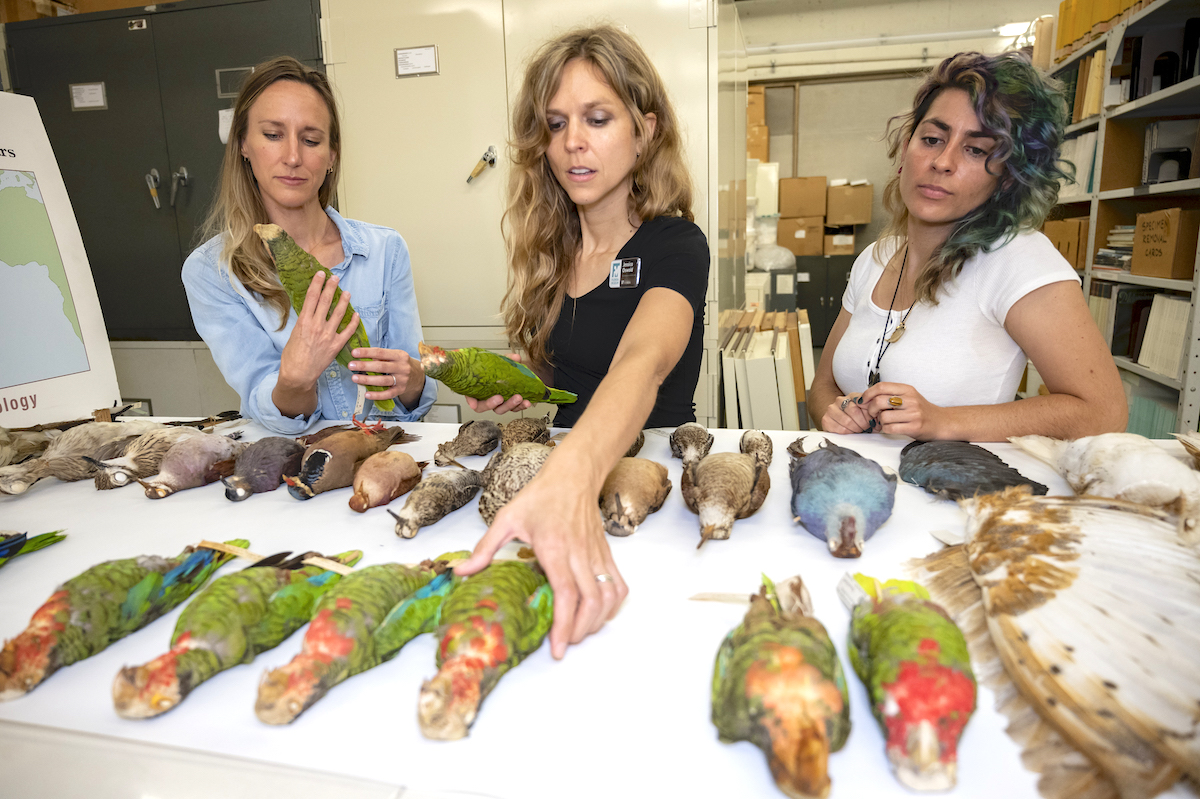
Co-authors Michelle LeFebvre (left) and Jessica Oswald (middle), pictured with graduate student Cristina Oliveira (right), combined DNA from modern museum specimens with ancient DNA from fossils and archaeological specimens to find out how humans altered the distribution of parrots. (Photo by Kristen Grace/Florida Museum)
Understanding the long-term impact of humans on biodiversity is critical for sound conservation. Parrots are one of the most enigmatic and beloved animals worldwide. For thousands of years, they have been valued as pets, for their feathers, and as a source of food. They are also among some of the most endangered birds today as they face extinction due to habitat loss and the pet trade. Parrot conservation efforts include reintroduction to places previously occupied by parrots and breeding programs. However, knowing the natural (pre- human) distributions of parrots is nearly impossible with modern day distributions because of thousands of years of trade and habitat loss. The conservation of parrot species thus greatly benefits from knowledge about past parrot diversity and distributions prior to encountering people for the first time. We can obtain this information through fossils and bones from paleontological (pre-human) and archaeological (human associated) sites.
Humans have been altering the natural world for longer than we thought
The Caribbean is a well-known biodiversity hotspot. Yet, the region has lost more than half of its native parrot diversity since the arrival of humans around 6,000 years ago, including macaws, parakeets, and even a tiny sparrow-sized parrot called a parrotlet that once inhabited the islands. Today, there are only 12 remaining parrots native to the Caribbean, which compete for space and resources with 12 non-native parrot species that have been recently introduced to the islands. Fossil and archaeological records and historical documents, all suggest that the remaining species were once far more abundant than they are today. For example, while exploring The Bahamas over 500 years ago, Columbus wrote that flocks of parrots were so abundant that they “obscure[d] the sun.”
All species of Amazona parrots are in decline and their pre-human, native distributions are not well understood. Through our work recently published in the Proceedings of the National Academy of Sciences, we aimed to understand how diversity and distribution of Amazona parrots changed before and after humans arrived in the Caribbean. Our primary focus was on the Cuban Parrot (A. leucocephala) and the Hispaniolan Parrot (A. ventralis), which have excellent archaeological and paleontological records. These records allowed us to reconstruct historical distributions and diversity over ~10,000 years—a period called the Holocene—through the ancient DNA found in these remains. Through this effort we also investigated the genetic relationships of living or recently lost (in the 20th century) Cuban Parrot populations and the relationships of all Amazona species using modern specimens curated in natural history museum collections. We combined this molecular data with carbon dating and evolutionary analysis to produce a comprehensive baseline of Caribbean parrot diversity through time.
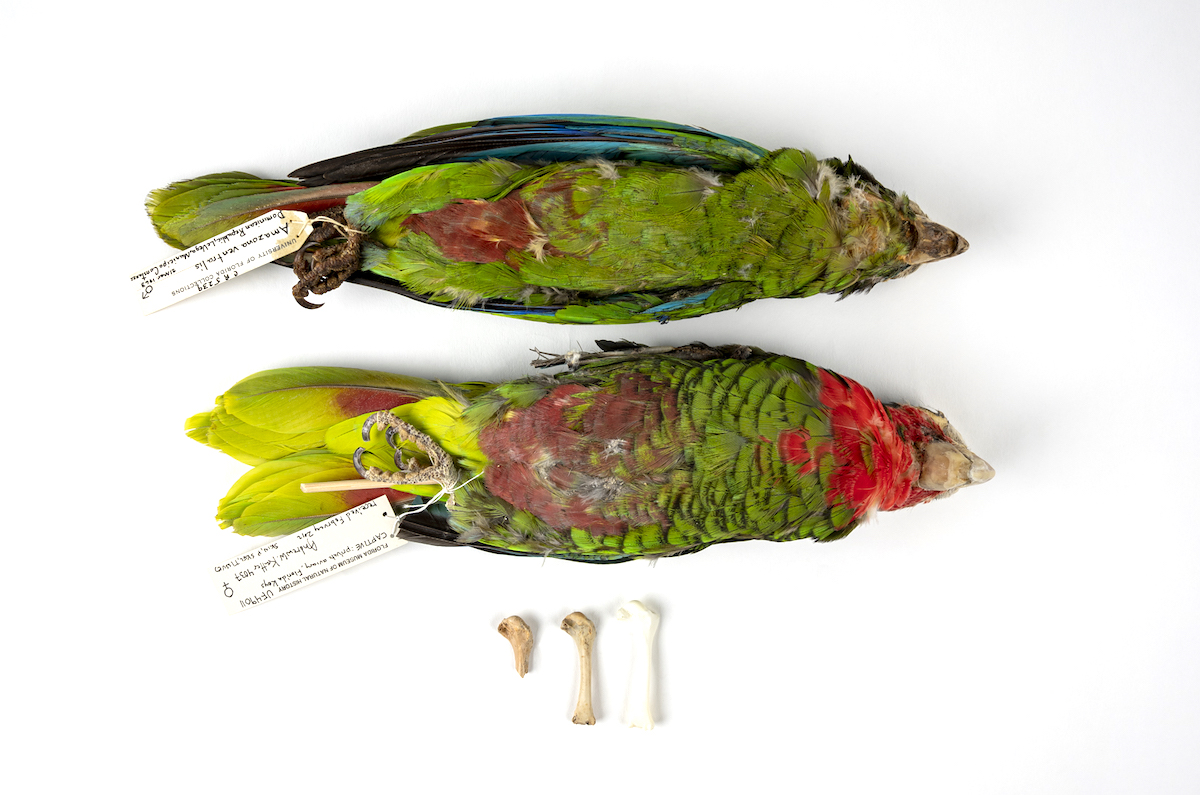
DNA from Hispaniolan Parrot Amazona ventralis (top) and Cuban Parrot A. leucocephala (middle) specimens, and their bones (bottom) were sampled for this project. The left two (humeri) bones are from fossil sites while the rightmost is from a modern specimen. (Photo by Kristen Grace/Florida Museum)
The endemic Hispaniolan Parrot was once native . . . to The Bahamas!
In our study, we found that Caribbean parrots were much more diverse earlier in the Holocene and prior to human arrival to the region. Parrot extinctions started upon the arrival of Indigenous peoples ~6,000 years ago, accelerated through colonization by European settlers at the end of the 15th century, and they continue today. Within Amazona parrots, we found evidence that a population of Cuban Parrots in the Turks and Caicos was genetically distinct and is now extinct. The Hispaniolan Parrot, now endemic to Hispaniola, was once also native to The Bahamas prior to human settlement. Our results also suggest that the Hispaniolan Parrot was transported to islands beyond their native ranges, including Montserrat in the Lesser Antilles. From the perspective of Caribbean parrot conservation, our results suggest that many species have been lost due to human impacts and there is evidence of long-term human introductions of species beyond their native ranges.
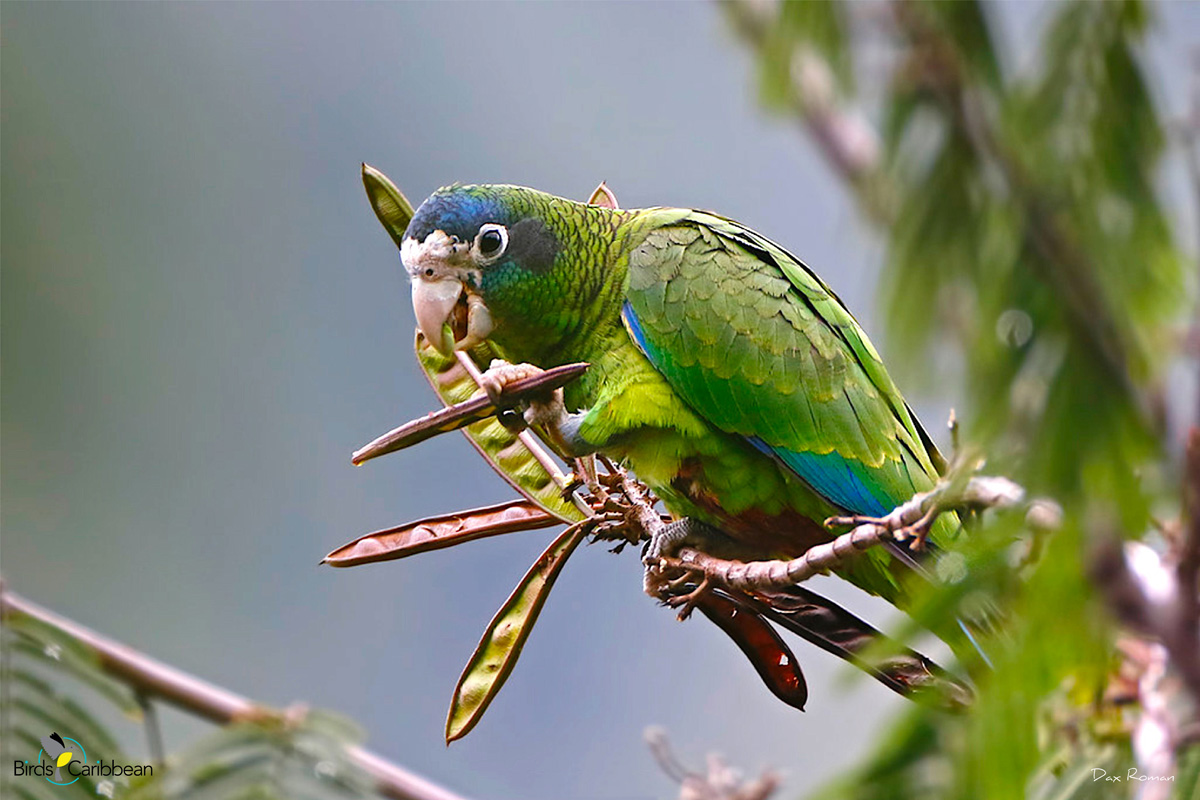
Hispaniolan Parrot eating. (Photo by Dax Roman)
The findings from our study provide the most detailed view of Caribbean parrot diversity and distribution across the Holocene and show that the shifts in parrot diversity and distributions were strongly influenced by people across millennia. The results clarify that notions about whether a species is native or restricted to a region or island requires data across long time scales, rather than relying purely on the lens of the present. Deep-time historical sciences and perspectives are key to conservation as we navigate biodiversity loss and conservation in the present and future.
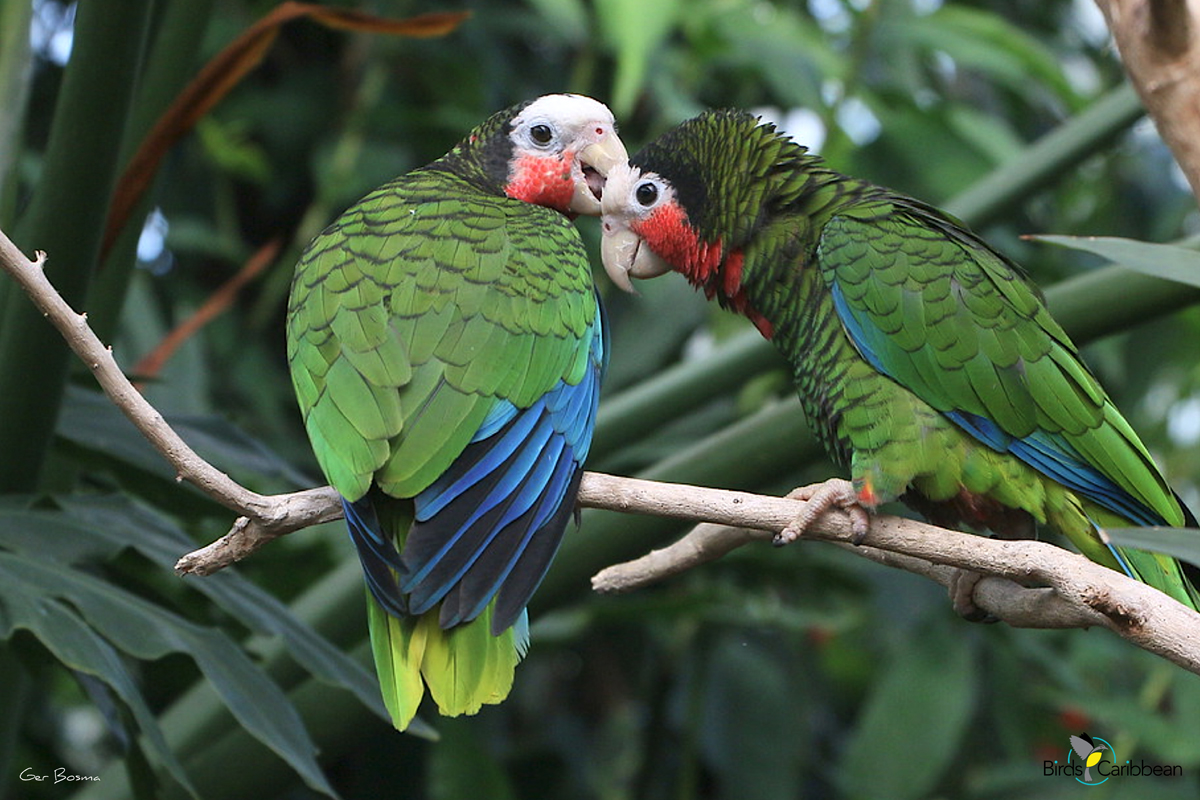
Pair of Cuban Parrots. (Photo by Ger Bosma)
Jessica A. Oswald is a Michigan native who earned her PhD from the University of Florida. She has spent her career building a research program that uses a variety of data, like fossils and genomic data, to understand the diversity and distributions of birds. Her hope is that these data can be used for conservation applications and will provide insight into the importance of paleontological data in biogeographic, phylogenetic, and ecological studies.
Michelle J. LeFebvre is an archaeologist and a curator of archaeology at the Florida Museum of Natural History, University of Florida. With a focus on how interactions between people and animals in the past have impacted animal diversity and distribution in the present, she collaborates with paleontologists, biologists, Indigenous peoples, and local resource managers to support the conservation of biological and cultural diversity in the Anthropocene. Her passion lies in exploring the ways in which human culture and nature are linked and shape the world around us.
Celebrate World Migratory Bird Day (WMBD) with us in 2023! This year’s theme is “Water: Sustaining Bird Life”. Have fun learning about a new migratory bird every day. We have coloring pages, puzzles, activities, and more. Download for free and enjoy nature with your family at home.
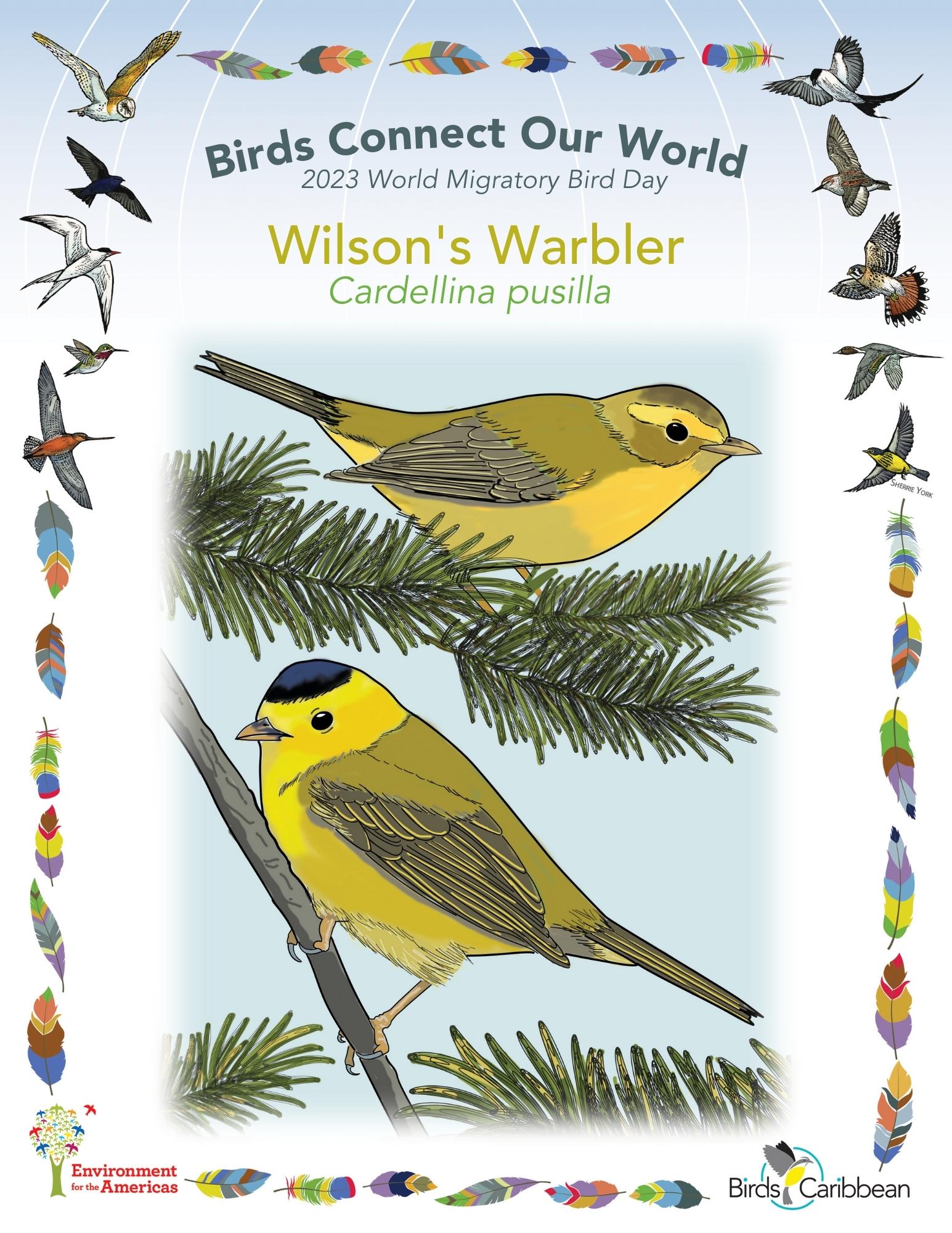
Migratory Bird of the Day: Wilson’s Warbler
This spritely migratory bird with the bad toupée is the Wilson’s Warbler. It is one of the smallest warblers at around 10-12cm long and weighing 5-10g.
Its plumage is mainly yellowish-olive, with a golden yellow throat and belly. It has beady black eyes and a small, thin beak. Adult males have a glossy black cap on their heads; the cap on females and juvenile males is highly variable but usually duller and more olive colored. These little birds are insectivorous, feeding on various arthropods on tree leaves and branches. They often hover in front of leaves as they try to capture a tasty insect morsel!
Wilson’s Warblers breed in the western United States, across Canada, and also in Alaska. It is a ground-nesting species that loves scrubby habitats and thickets near streams. Their clutch size ranges from 2-7 eggs and they are capable of breeding twice in a season. Only females incubate the eggs and brood nestlings (chicks), but males help feed nestlings and fledglings (chicks that have grown feathers and are learning to fly).
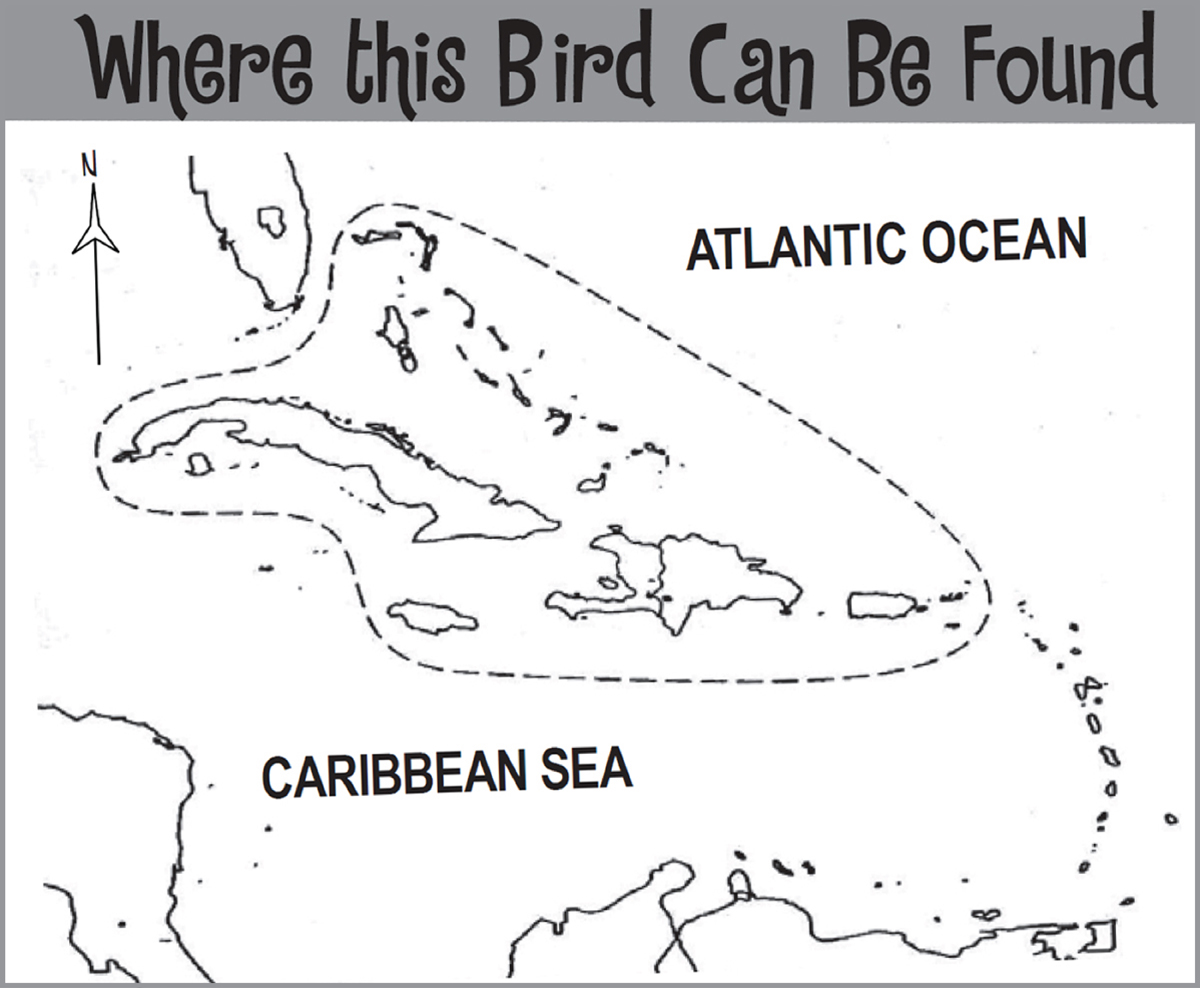
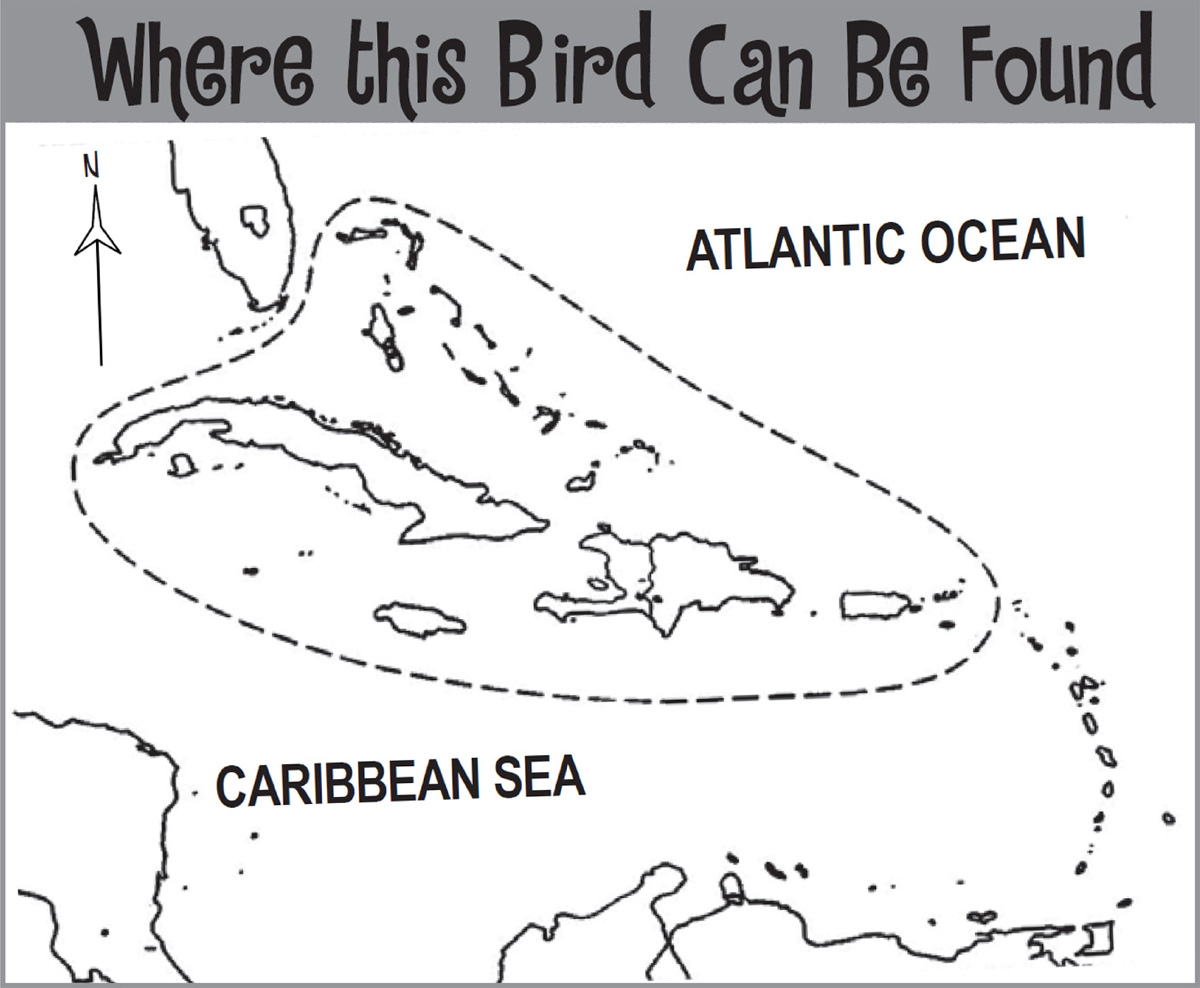
By August they leave their breeding grounds and begin their fall migration to Central America and islands in the northern Caribbean—The Bahamas, Jamaica, Cuba, Puerto Rico and Dominican Republic. During migration they use many types of habitats, from lowland thickets near streams to high-elevation cloud forests. On their wintering grounds they supplement their diet of squirmy, slimy, crunchy insects with “honeydew”—a sugary liquid secreted by some insects as they feed on plant sap.
The Wilson’s Warbler is not threatened but is listed as a “Common bird in steep decline” by the Partners in Flight organization. This is because of habitat loss on both their breeding and wintering grounds, predation from invasive species like domesticated cats, and nest parasitism. Helping Wilson’s Warblers, and other birds, can be as simple as keeping pet cats indoors and using a leash and harness when outdoors; and supporting the efforts of bird advocacy groups and NGOs that are working to restore and protect habitats across the Wilson’s Warbler’s range.Learn more about this species, including its range, photos, and calls here.
The Wilson’s Warbler
‘I’m a tiny warbler,
With beady black eyes,
A black cap on my head,
And energetic for my size,
I breed in mountain meadows,
And thickets near streams,
I winter in Central America,
A vagrant in the West Indies,
Because of habitat loss,
My species is in decline,
Please protect my forest home,
Before I run out of time”
Thanks to Scott Johnson for the text and poem, and Christine Elder for the lovely illustration!
Color in the Wilson’s Warbler
Download the Migratory Birds of the Day Coloring Page! Use the picture above and the photos on this page as your guide, or look up pictures of the bird online or in a bird field guide if you have one. Share your colored-in page with us by posting it online and tagging us @BirdsCaribbean #WMBD2023Carib
Listen to the calls of the Wilson’s Warbler
The call of the Wilson’s Warbler is a husky chip. You may also hear the male as they start to sing on their wintering grounds. The song is a rapid string of similar notes, dropping in pitch toward the end.
Puzzles of the Day
Click on the images below to do the puzzle. You can make the puzzle as easy or as hard as you like—for example, 6, 8, or 12 pieces for young children, all the way up to 1,024 pieces for those that are up for a challenge!
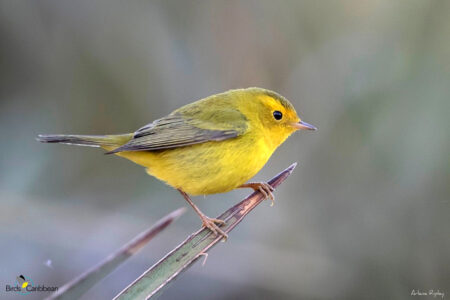
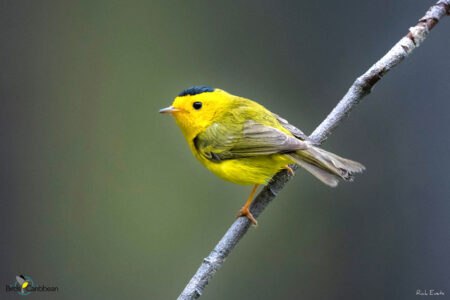
Female Wilson’s Warbler. Look for this bird in tangles of vegetation along streams or ponds or even forested edges. (Photo by Arlene Ripley Macaulay Library-ML176994031)Male Wilson’s Warbler. Wilson’s Warblers tend to be brighter yellow in the West and paler yellow in the East. Pacific Coast populations have the brightest yellow, almost orange, foreheads and faces. (Photo by Rick Evets)
Activity of the Day
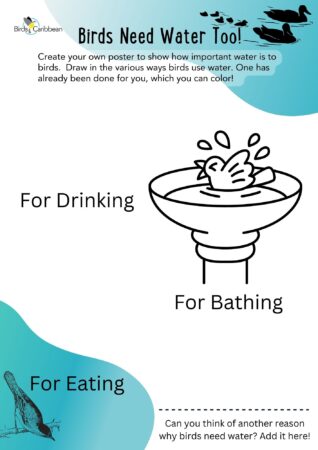
FOR KIDS: This year the theme for World Migratory Bird Day is “Water: Sustaining Bird Life.” We want to highlight the importance of water conservation to both humans and birds.
We often see birds flying, preening, bathing and feeding. You might not have ever seen a bird taking a drink of water but they do!
Birds need water just as much as we do. Drinking water helps them regulate bodily processes like digestion. Water also keeps birds clean and cool on hot days when they take a splish-splash in a puddle, gutter, or backyard bird bath. Many birds also rely on wetland habitats, such as our ponds, salinas, marshes, mangroves, rivers, and coastal waters.
In our activity you can create your own poster to show how important water is to birds. Draw in the various ways birds use water!
FOR KIDS AND ADULTS: Enjoy these videos of Wilson’s Warblers in the wild! In the first, you can see a lovely, brightly colored male. In the second, a Wilson’s Warbler takes a bath—one of the many things birds need water for as they migrate!
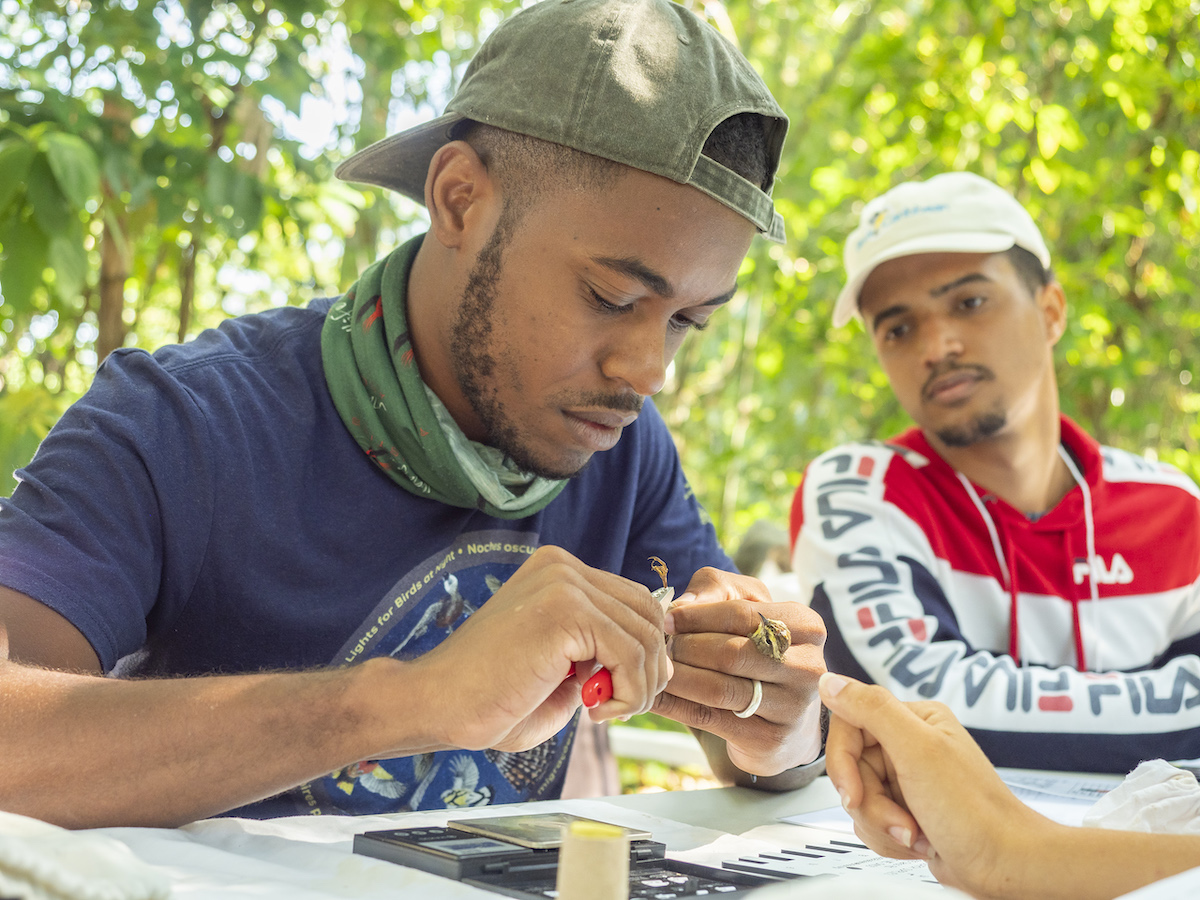
Read all about a bird banding adventure in Oregon! Caribbean biologist Zoya travelled all the way from Grenada to the US to learn more about studying birds using bird banding. Wilson’s Warbler was one of many bird species that Zoya was able to get up close to on her way to passing her NABC (North American Banding Council) exam and becoming a certified Bander. Find out all about her experiences in the blog below.
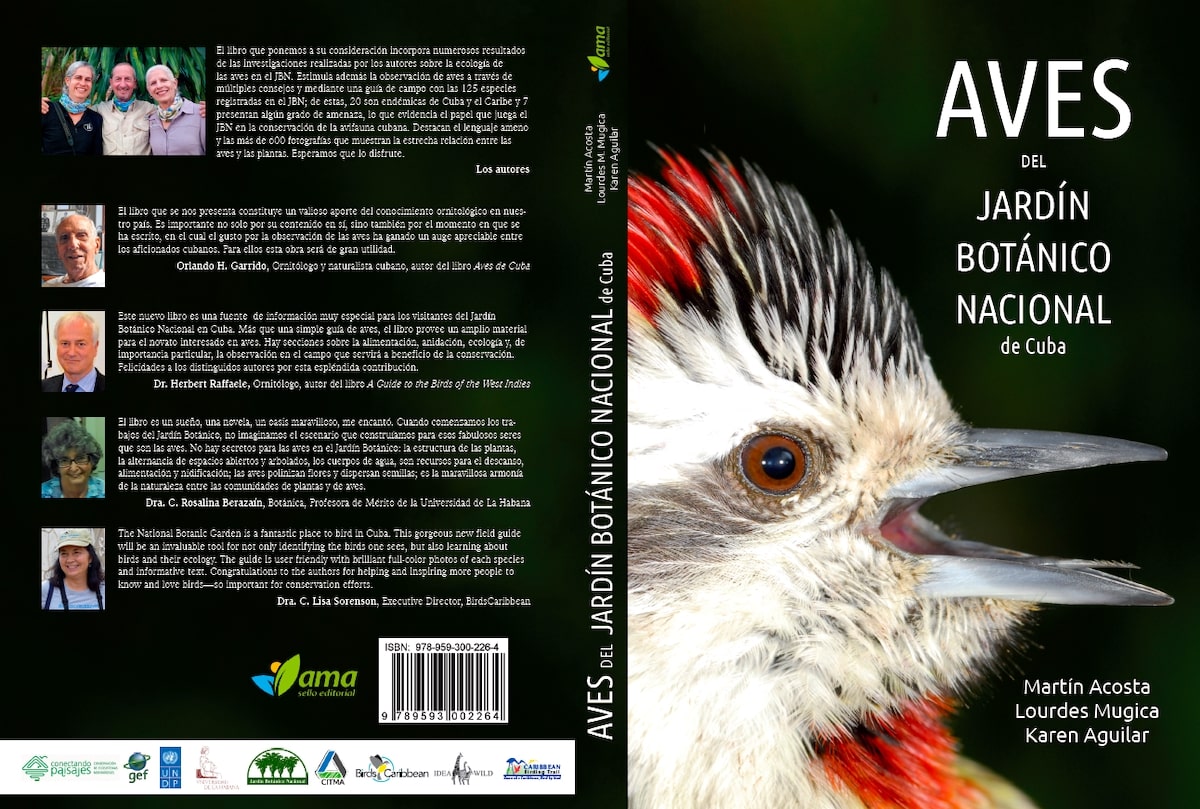
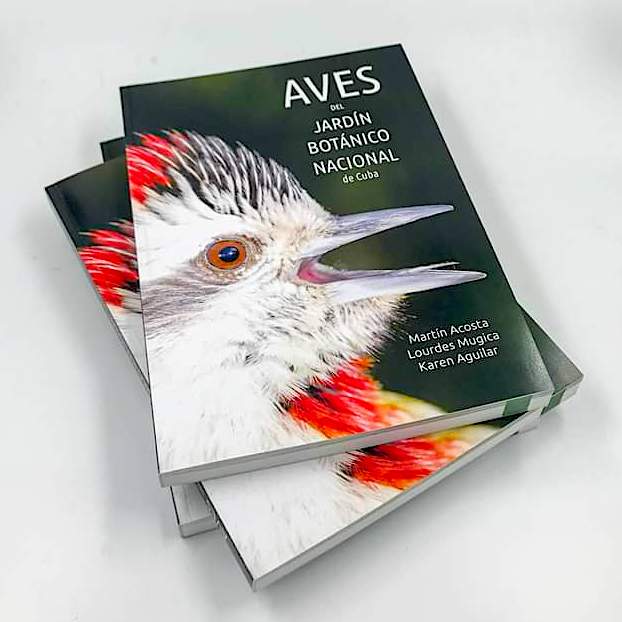
Front and back covers of Birds of the National Botanic Garden of Cuba. The Cuban Green Woodpecker, on the front cover, is the only representative of the Cuban endemic genera living in the garden.
At almost 500 hectares, the National Botanical Garden of Cuba offers a green oasis to birds, other wildlife, and people, in the capital city of Havana. It is well known for its extensive collection of palm trees, ethno-botanical displays, greenhouses, and serene Japanese Garden. From November to February it is an ideal place to see migratory birds, while some of Cuba’s iconic endemic and native birds can be seen year-round.
The new field guide “Birds of the National Botanical Garden of Cuba” (Aves del Jardín Botánico Nacional de Cuba) is the most comprehensive, authoritative, and up-to-date work of its kind. We speak with the dedicated authors Dr. Martin Acosta, Dr. Lourdes Mugica, and MSc. Karen Aguilar, about the field guide. They share the extensive research that went into its creation, how the team persevered through numerous setbacks, their surprising finds and fond memories at the garden, and advice for aspiring field guide authors.
What inspired you to create a field guide to Birds of the National Botanical Garden of Cuba?
It is a long love story between our group and the birds of the National Botanical Garden. In 1982, Dr. Martin Acosta began tutoring an undergraduate’s thesis on the garden’s birds. Since then, he realized that, with its almost 500 hectares and varied vegetation, it was a privileged place, despite the fact that at that time less than 40 species were detected. From there we carried out and published several studies on the ecology of the species that inhabited the different areas that make up the garden.
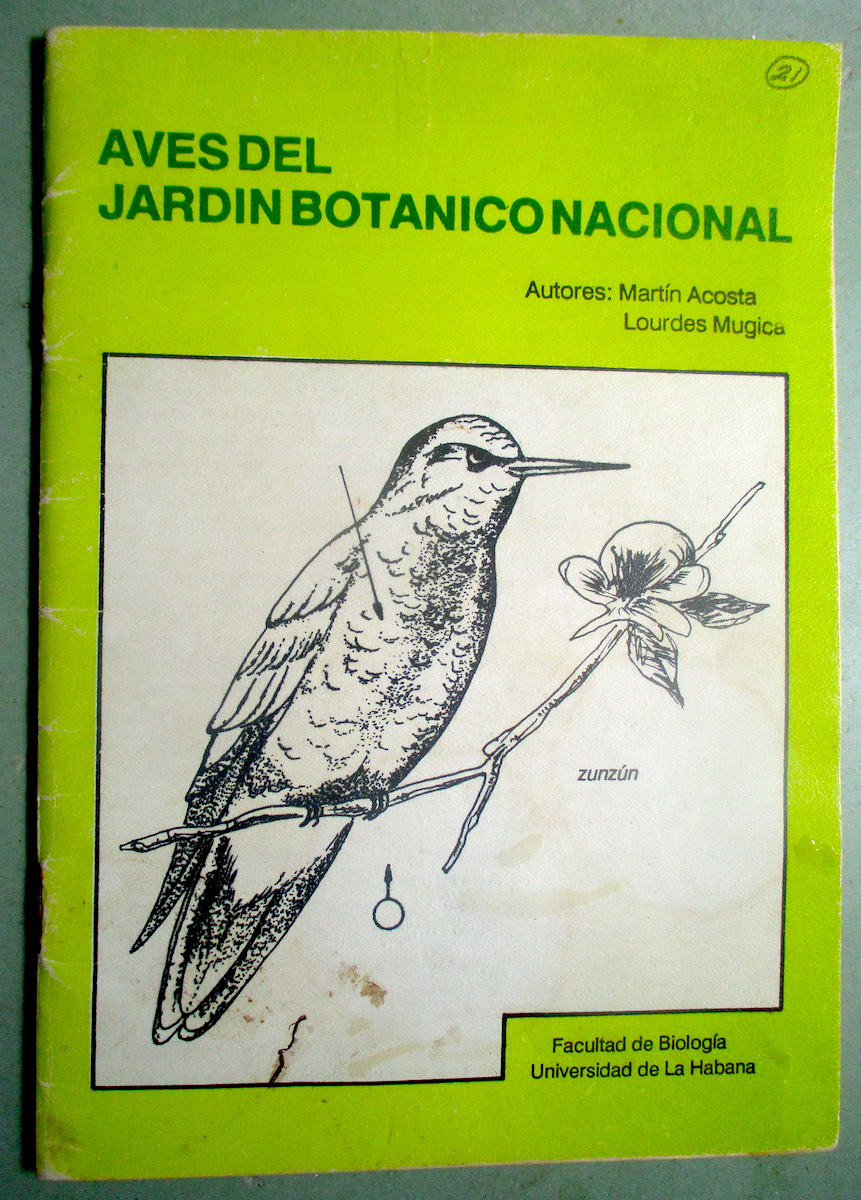
Cover of the first field guide to the Birds of the National Botanical Garden of Cuba, published in 1990.
Later, in 1990, we published a short rustic guide to identify the 41 birds we had recorded at the garden. As we had no camera or way to obtain the illustrations, Dr. Vicente Berovides, Professor at the University of Havana, drew each of the birds by hand with pencil. Incredibly, his drawings were good enough to identify the birds! That simple guide sold out quickly, so very early we could appreciate that the public was eager to get this kind of information.
From the year 1990, the well-known Special Period arrived in Cuba, with a deep economic crisis that did not allow us to travel to the field and investigate the waterfowl of the rice fields and natural wetlands that were the main focus of our research in that period. That fact resulted in all our energy and time being focused on the birds of the garden, where we traveled by bicycle from before dawn to monitor their bird populations and assemblages, to do several ecological studies, and to assist our students in their undergraduate theses.
Over time our knowledge of the place and commitment to sharing our results were increasing. Both Martin and Lourdes thought that we were going to retire without fulfilling the dream of having a book for the general public. At the time we did not have any funds to guarantee writing, editing, design, and printing. Even without the funds, but with all the accumulated knowledge of more than 30 years, in 2019 we got the final push when Dr. Banessa Falcón, Director of Teaching and Research of the National Botanical Garden, insisted on the importance of achieving this book. Karen joined the authors to contribute voluntarily with the design, photography, and anything else that was needed.
Similarly, Neyda Izquierdo, winner of the National Publishing Award in Cuba, edited the book free of charge. Additionally, Dr. Banessa Falcón, supported us in working on the book from its inception and was our scientific editor for the botanical topics.
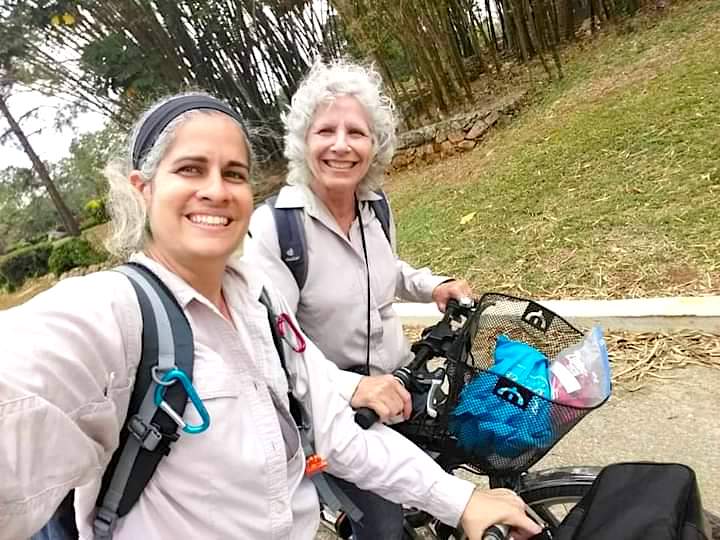
Karen and Lourdes traveled by bike to the garden almost every day until the book was completed.
In this way, we managed to assemble a fantastic team, with whom the work became a constant exchange of ideas between wonderful people, who dedicated many hours to ensure the quality of the text in the pandemic times. In the end, it was a collective work, full of love, commitment, science, and fun!
Today, within 55 years, the garden has an assemblage of birds that has tripled in diversity in response to the vegetation development. So far 128 species, (three of them after publishing the book) have been registered, so this group of vertebrates is among its greatest attractions.
Undoubtedly, this was the great moment to bring to light the work that seemed to be just a dream for so long. Our research shows the importance that a well-managed anthropogenic (man-made) site can have for the conservation of birds. In addition, we hope that this field guide may be a useful model to other botanical gardens in Cuba and the world.
How is this field guide different from other Cuban bird guides?
It differs in several aspects:
It is the first Cuban bird guide made entirely with photographs of birds; the guides that currently exist in Cuba are based on illustrations.
The biggest difference is that it includes closeup images of the heads of most bird species (85%), which allow you to appreciate important details that are not visible in general photos or drawings.
In Chapter Four of the field guide, each family has a general picture with the main characteristics of the family and then, all the species within the family are presented. Each species has between two to six pictures; icons and text complete the descriptions.
It is the first guide that dedicates a chapter to the interdependence between the development of plant communities and the assemblages of birds that use them, in addition to revealing different aspects of the ecology of some notable populations. The guide also includes a chapter that encourages bird watching in Cuban society and offers strategies for its development.
In Chapter Three, the authors promote birdwatching and give advice on how to attract birds to your garden. In this page several vegetation structures are highlighted because of the impact they may have on birds and the resources they can offer.
It is a field guide based on the original scientific results obtained by the authors from more than 30 years of research, not on a bibliographic compilation, and it includes a chapter where many of these results are shared.
In Chapter Two, the published ecological results collected by the authors for over 30 years at the garden are presented.
The incorporation of informational boxes within the text of the general chapters is also new in Cuban bird guides. They offer a deeper understanding of the scientific elements, and were obtained by the authors in this botanical garden.
The book focuses on an ex situ conservation institution, dedicated primarily to the conservation of plants, which now joins a small group of botanical gardens around the world that have their own bird guide.
In the Field Guide chapter, 125 species are presented with 473 photos. Although the authors provided 70% of the pictures, the rest are from the selfless collaboration of 52 Cuban and foreign photographers, so this guide is a result of solidarity for the good of conservation.
Soon after the guide was published, we received a national award from the Cuban Book Institute (First Prize for Technical Scientific Criticism 2022) and the Prize for Best Scientific Book of Natural Sciences from the University of Havana. It is the first Cuban bird guide to achieve these recognitions within the country.
Tell us about your team of authors—how did each contribute?
Taking photos of moving subjects is not easy but Karen persevered.
Martin and Lourdes had the general idea of writing a bird guide since 1990, when we first published a much simpler version. Both of us contributed with our long experience, field data, and results from published studies. We wrote most of the text, and did the exhaustive revision of each version. Martin also contributed numerous photographs that are used in the field guide.
But it was Karen who designed the book and supplied most of the photos. She spent many hours doing fieldwork during the book’s development, and processed the images for the guide. She also wrote some informational boxes.
The three authors worked closely and intensively during the two and a half years it took to complete the book. We also actively participated in the final revision of the text, together with the general and scientific editors.
How much research did you need to do for this field guide?
That’s a good question, because we never worked to make a field guide, we worked to contribute to the knowledge of the natural history of the birds that live in the garden, and the more we learned, the more questions arose. So we carried out research on reproduction, territoriality, feeding, seed dispersal, and composition and structure of the assembly of birds associated with some types of vegetation. The findings have all been very useful in writing the book.
The birds used the water from the garden to maintain their feathers and meet daily demands, as well as the annual molting behavior in different bird species.
After extensive research, the authors found that the garden can meet the birds’ diverse needs: food, shelter and security.
What we can say is that it is not enough to know the list of birds that have been recorded in a site. It takes years of observations, and countless hours of fieldwork, to study essential aspects of the ecology of the species of birds that live there to contribute to their knowledge more effectively.
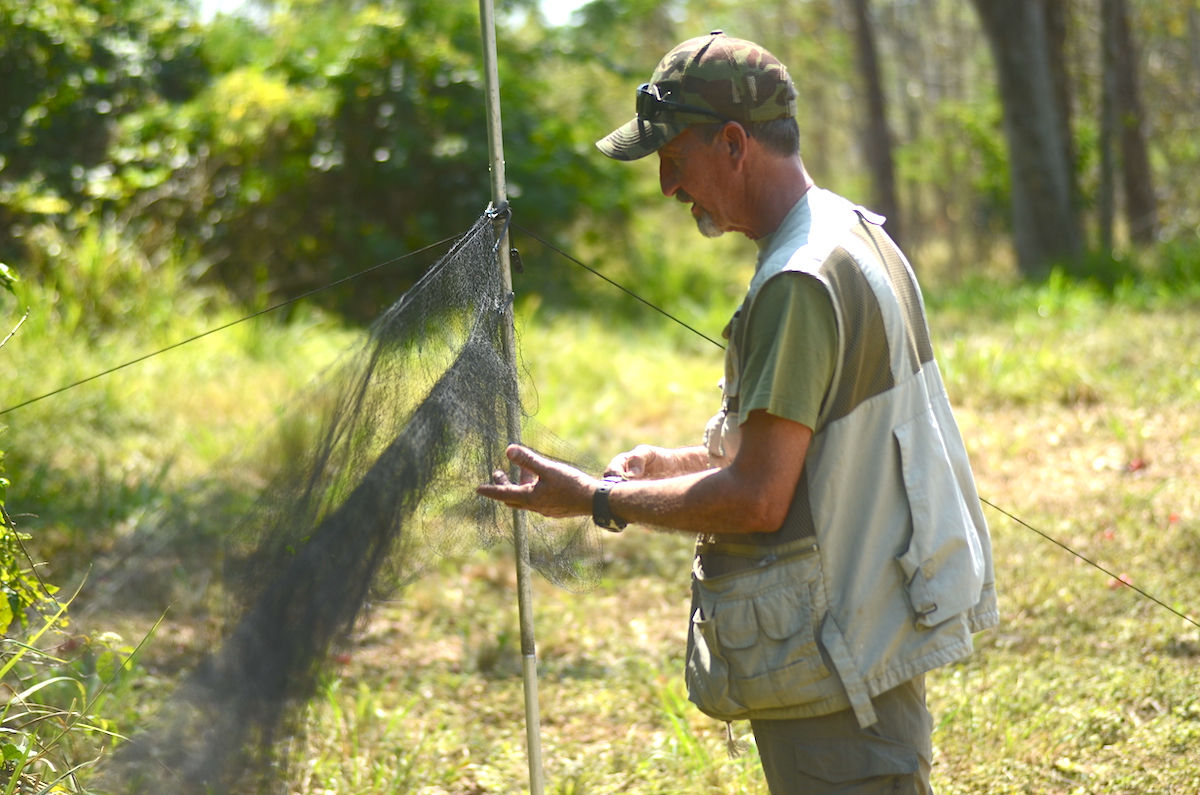
Martin closing a mist net at the garden. Mist netting is an essential tool for species inventory, provides useful indices of relative abundance, and can be used to track temporal trends in abundance.
What part of creating this field guide—writing, photographing, designing and editing—did you have the hardest time with or find most challenging?
Photography and design were the biggest challenges of this book. Photography, because we set out to create a guide based entirely on photos, and getting good-quality photos of 125 species, many of which are rare or difficult to photograph because of their behavior, such as aerial insectivores, was really a major challenge. At the end all species have photos and each species identification page has between 2 to 6 photos.
Martin and Karen taking photos in the garden.
Martin and Karen talk about camera models and techniques to get the best photos.
The design was challenging because it was Karen’s first design job, so taking on that task involved long hours of intense work. Both challenges were successfully overcome.
In general, it was challenging to achieve our goal that both the writing and the design were attractive to a very wide audience, including children, young people, adults, birdwatchers, and specialists in the subject.
What helped you to stay focused on such a large project?
First of all, the love of birds. Knowing that a book like this can have a great impact on Cubans and contribute to bird conservation also motivated us. Little by little, we realized that the garden can contribute a lot to local knowledge and the appreciation of birds, helping people to value not only their beauty, but also all the ecological services they provide.
Secondly, it is not easy to visit our protected areas because they are located in isolated areas that are difficult to access and transportation is scarce. However, the National Botanical Garden is situated close to Havana (only about 30 km or 18 miles) and can be easily visited by the population of the city.
Finally the teamwork, which was fabulous and exhilarating. It kept us together and working hard from start to finish. Every photo achieved, every chapter completed, every species completed, was an achievement we thoroughly enjoyed and it kept us excited to reach the next goal.
What was one of the most surprising things you learned while creating this field guide?
We learned important things related both to the birds, as well as to perseverance and the strength we have to achieve our goals.
As for the birds, we were impressed by the beauty and complexity of the birds’ heads—the close-up photos highlighted details that are not captured with binoculars or full-body photography.
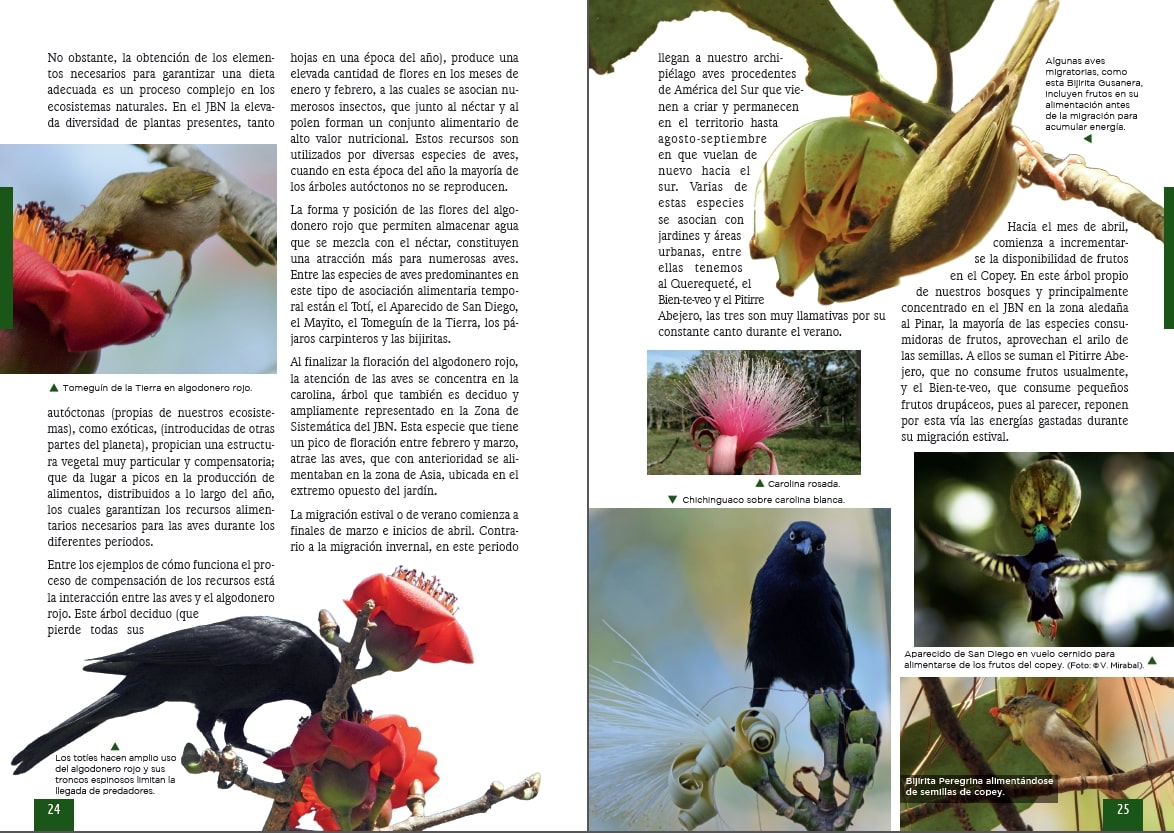
Another thing that surprised us was the important role played by the Red Silk Cotton Tree (Bombax ceiba) in the early months of the year, when very few plants bloom in the garden. In January and February, this tree is covered with beautiful red flowers and numerous birds are attracted to them, but not only in search of insects, nectar and pollen. The most surprising thing is that the flowers accumulate a lot of water, and the birds use them as natural sources, to quench their thirst, in these months of intense dryness.
At the top of the left-hand page you can see a Yellow-faced Grassquit looking for water in a Red Silk Cotton tree flower; at the bottom, in the same tree, a Cuban Blackbird looks for water or insects in the flowers.
For Martin and Lourdes, it was not difficult to write the text, they knew the site and the birds well and already had the experience of working on other books. But for Karen the challenge was immense, she did not know about design, nor photography, nor was she able to recognize the bird species. All this knowledge was necessary to complete the book.
That involved numerous hours of self-study to learn how to work CorelDraw, Photoshop, and InDesign programs. So Karen took photography courses, studied the content of the main bird guides that have been published in America, and learned the particular style of providing the information in the field guides. At the same time, she made frequent visits to the field to take photographs, and learn to recognize the birds, and she kept working on the book every single day during those years.
Any fun stories to share during the process of writing, photographing, design, and editing?
There were many stories. At first Karen said she wanted the guide to be with photos, so that it would bring something different from other Cuban guides. When she tried to take her first photos, a mockingbird and a sparrow, after much effort, she did not achieve anything with her lens—at that moment she realized that the road was going to be long, difficult, and that she had a lot to learn.
I remember when we went to the zoo to take close-up pictures of the herons. They were asleep with their heads lowered and eyes closed. Yelling at them was the only way to wake them up. We shouted wildly and the moment they woke up Karen took the photo very fast. People passing by looked at us as we were screaming at the herons and by the looks on their faces, they thought we were crazy. We really laughed a lot.
Another day, Karen went alone on a motorcycle to the garden to take photos. When entering the garden, she saw a group of puppies crossing the fence and stopped the motorcycle to play with them. But the puppies ran after her which gave her a good scare. She had to run so they wouldn’t bite her.
How long did it take to complete the field guide?
We started in June 2019, the book was ready to print in January 2022. During Covid we had an interruption of about six months in which we were totally isolated without communication, (not all in the team had a good cellular phone to use the internet), and without the possibility to visit each other as we were not able to meet. So we would say that it took approximately two intense years to complete the book.
When the lockdown restrictions were lifted, we established a method of working that allowed us to advance relatively quickly, because at the same time that we were advancing in the text, we worked on the design. We made constant visits to the garden, looking for photographs that helped us explain the text, and with those visits we were constantly updating the information.
In fact, up to 2019, when we started working, 105 species had been registered; in 2022 that number had already risen to 125.
How did you celebrate when the field guide was completed?
The five of us, three authors and two editors, were so happy, we could not believe that we had finished the book. When we saw the first print proof the emotion was immense! We celebrated it by spending time together and sharing each of our experiences.
How many endemic birds live in the garden?
Of the 27 living endemic species in Cuba, 10 are found in the garden; and also 12 of the 20 species reported as endemic for the West Indies—making a total of 22 species in this category.
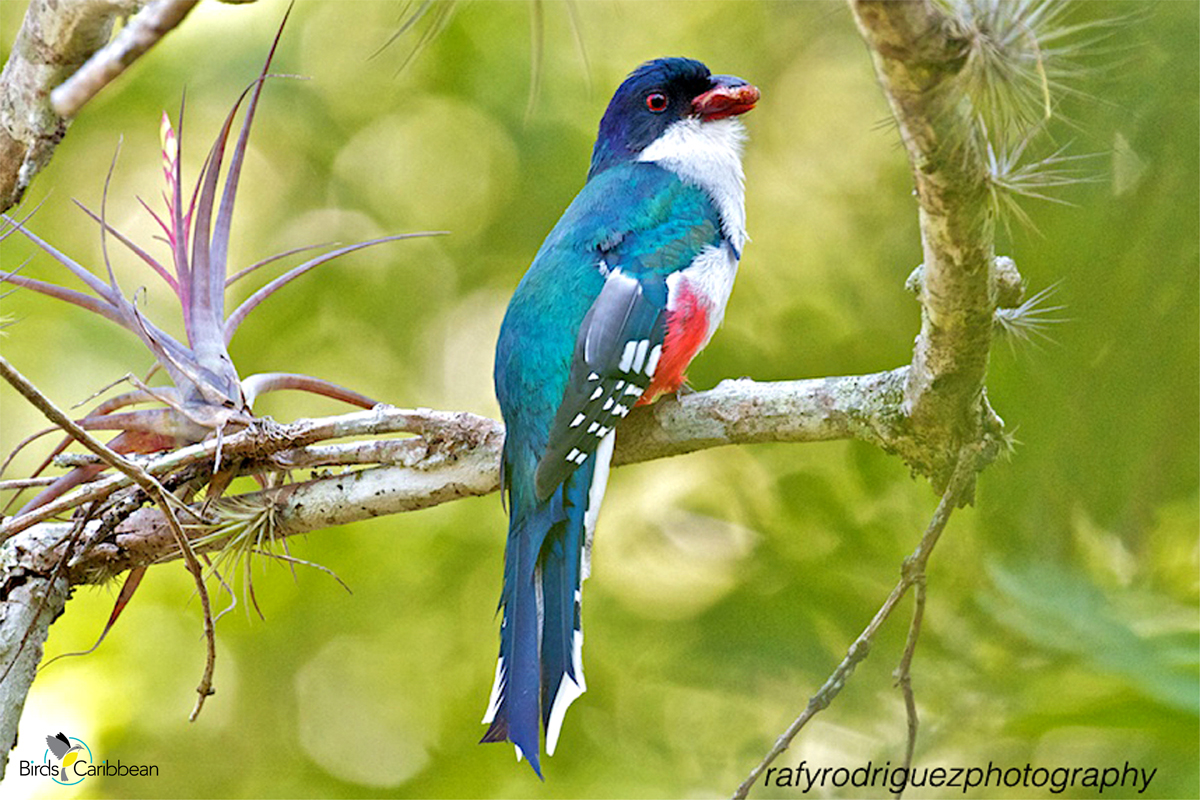
In the book we report on nine Cuban endemics, but recently the Cuban Trogon was recorded for the first time at the garden!
What is one of your fondest memories of birding in the Botanical Garden?
Every time we visit the garden we enjoy it so much and we learn something new about the behavior of the birds so it is difficult to say. For example, seeing the sunrise and the awakening of the birds, seeing for the first time the Cuban Tody, a typical bird of our well-preserved forests, seemed incredible to us, and recently, we just observed the Cuban Trogon for the first time!
The national bird of Cuba- the Cuban Trogon. (Photo by Rafy Rodriguez)
I remember one time when it started to rain, and we had to place the camera under the umbrella to take the photos. That day we registered two new species and got several quality photos for the book, it was unforgettable!
Recording a new species and getting a quality photo that we needed, of a bird doing an activity that we mentioned in the text, was always exciting to us. I can say that the three of us thoroughly enjoyed each visit, which in those last two years amounted to more than 60.
Where in Cuba can someone purchase this field guide?
Right now it is not for sale. We have a small first batch of just 300 printed books and very high demand. The first copies have been used to promote the book and they have been given as a prizes in competitions and festivals, as well as gifted to outstanding nature photographers, decision-makers, and some libraries.
The second printing will be made this year, thanks to a grant from the Betty Peterson Conservation Fund from BirdsCaribbean. We are thinking of selling copies from this second batch at the National Botanical Garden or in the Library of the University of Havana, Alma Mater, in the City of Havana.
How can someone outside of Cuba get their own copy?
We hope to eventually sell the book through BirdsCaribbean’s website.
Do you plan on providing an English translated version of this field guide?
We would love to have an English version and the idea is to seek funding in the future for translation, design, and proofreading.
What would you say to a birder who is thinking of publishing his own field guide?
Keep going, never stop, work hard, visit the site as many times as you can, and record species, behaviors, dates and places. When you gather enough information, find a good team and work together. A good field guide is a collective work, which can help birds and people.
We have always lived in a poor country under a strong blockade, with few resources, little transportation, lots of communication problems, and high migration of young personnel. If we could succeed, then anyone who proposes a project like this and puts in the effort, perseverance, and love will succeed too.
Our small Caribbean countries need to know their natural heritage, and be aware first of what we have, so that later they become aware of the responsibility of each one in taking care of it. We all can contribute in some way to conservation. Books like this are the first step to take—knowledge brings appreciation, appreciation is an important step for conservation.
You can, you should.
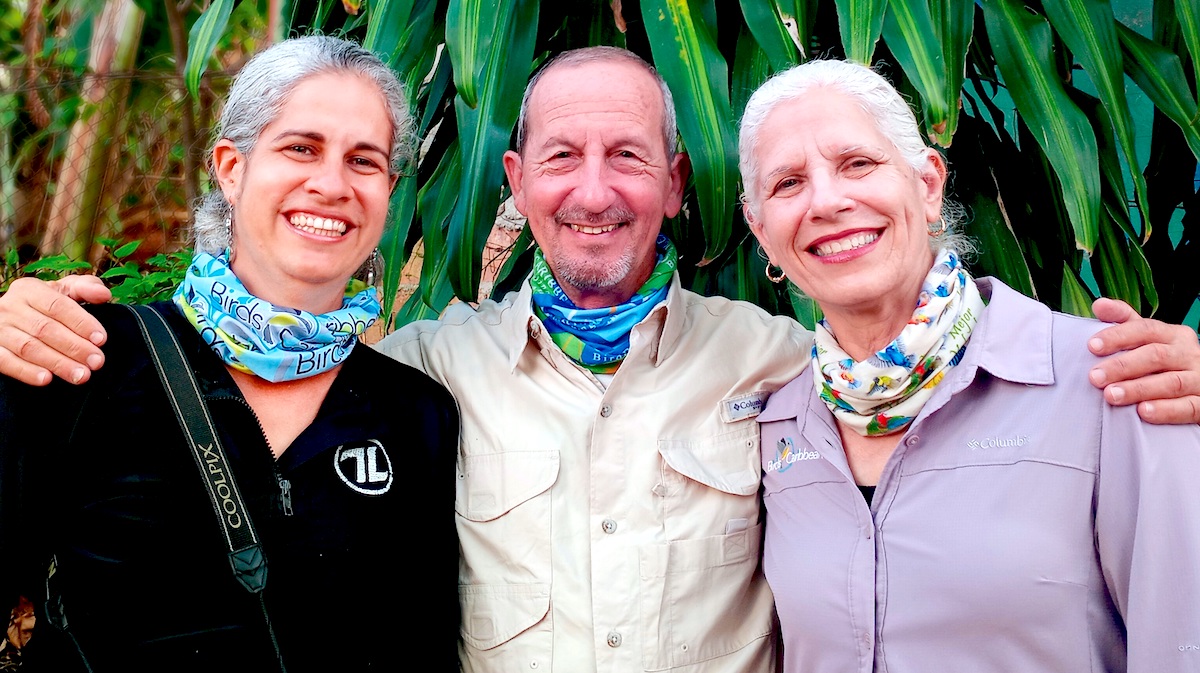
The three authors of the book, from left to right, Karen Aguilar Mugica, MSc in Geography, Martin Acosta Cruz PhD. and Lourdes Mugica Valdés PhD, both ornithologists from the Bird Ecology Group of the University of Havana. Karen has been a volunteer with the group for several years.
Drs. Lourdes Mugica Valdés and Martin Acosta Cruz are Professors at the University of Havana’s Faculty of Biology in Cuba. They teach both formal ecology courses and in the faculty’s research and environmental education programs. They, along with Karen Aguilar Mugica, are members of the University of Havana’s award-winning Bird Ecology Group (BEG). The BEG is widely recognised for its contribution to our knowledge of Cuban waterbird ecology. They are, moreover, long-standing members and friends of BirdsCaribbean.
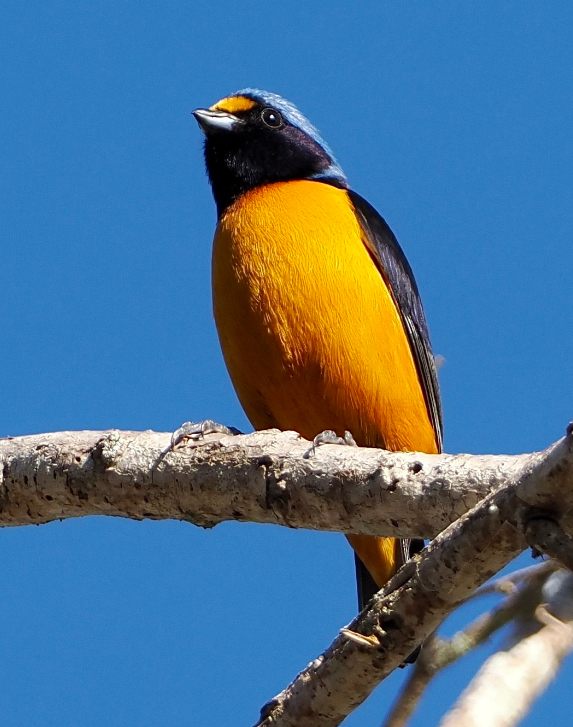
The former Antillean Euphonia has been split into three new Euphonia species! (Photo by Bobby Wilcox-ML532706381)
Get out your binoculars and plan a Caribbean birding adventure because we’ve got five new species of birds for you!
The American Ornithological Society has just announced their 64th Supplement to the Checklist of North American Birds. Every year, ornithologists and birders alike eagerly peruse their current bird lists and wait for the announcement of new bird species! Usually, these new species don’t arise from a remote jungle expedition, but by re-examining the differences and similarities within our current species lists.
Species can either be “lumped” or “split.” Lumps occur when two similar species are lumped back together and considered one species again. This is usually the case for very similar birds that have overlapping ranges. “Splits” are when one species is divided into two or more different species. These splits usually include birds that may look alike but evidence suggests have diverged sufficiently that their populations would no longer interbreed.
We are very excited to welcome these new bird species to the Caribbean—bringing us now to a total of 180 endemic bird species. Our Caribbean birding hotspot just got even hotter, giving you all the more reason to plan your next Caribbean birding adventure!
The joys of isolation…
Within the Caribbean, we have many species that occur across multiple islands, but don’t island hop–making these isolated populations. Over time, as these bird populations continue to breed in isolation from one another, they can develop differences, and even evolve into distinct species! By reviewing evidence, including genetics, morphology, plumage, vocalizations, and behaviors; ornithologists can determine if the populations are in fact distinct enough to be considered different species.
This year we are very excited to announce that we have five new species for the Caribbean! These species all fall under the category of splits (there were 4), meaning they were formerly considered one species and are now considered two or more! Let’s review the newest members of the flock.
*Drum roll*…welcoming five new Caribbean species!
Grand Cayman Bullfinch and Cuban Bullfinch
Let’s give a warm welcome to a new bullfinch species in the Caribbean, the Grand Cayman Bullfinch (Melopyrrha taylori)! This species was split from the Cuban Bullfinch(Melopyrrha nigra) due to vocal and morphological differences. The Cuban Bullfinch can now proudly boast that it is a true Cuban endemic, and the Grand Cayman islands have their second endemic bird species. Interestingly, the research supporting the split came from a birdwatcher’s observations of song differences between birds on Cuba and Grand Cayman! This show the value of citizen scientist birders being observant and uploading their information to apps like eBird (sightings, photos, and recordings of songs and calls).
Cuban Bullfinch, female. Females and juveniles are duller black and have a less prominent wing patch (Photo by Mario Olteanu)
Grand Cayman Bullfinch, female. Her color is dull slate-black tinged with olive. (Photo by Ray Robles)
The male Cuban Bullfinch is glossy black with white wing patches. It’s bill is a little smaller than the Grand Cayman Bullfinch. (Photo by Greg Lavaty)
The male Grand Cayman Bullfinch is black with a greenish gloss and has white wing patches on shoulders; its bill is slightly larger and heavier than the Cuban Bullfinch. (Photo by Aaron-Boone, ML151327701)
Hispaniolan Nightjar and Cuban Nightjar
Let’s give a warm welcome to two new species of nightjar! The bird formerly known as the Greater Antillean Nightjar (Antrostomus cubanensis) has now been split into the Hispaniolan Nightjar(Antrostomus ekmani) and Cuban Nightjar (Antrostomus cubanensis), based on convincing vocal differences between the two populations. The Hispaniolan Nightjar is found in the western third of the Dominican Republic and the western part of the Tiburon Peninsula of Haiti. The Cuban Nightjar is found throughout the island of Cuba.
Hispaniolan Nightjar. (Photo by Dax Román)
Cuban Nightjar. (Photo by Greg Griffith, ML204321841)
Listen to the difference in the songs of the Hispaniolan Nightjar and Cuban Nightjar!
From one to three new Euphonias! Puerto Rican, Hispaniolan, and Lesser Antillean
Let’s give a warm welcome to not two but three new Euphonia species! The former Antillean Euphonia (Chlorophonia musica) has now been differentiated as the Puerto Rican Euphonia (Chlorophonia sclateri), the Hispaniolan Euphonia (Chlorophonia musica), and the Lesser Antillean Euphonia (Chlorophonia flavifrons). This long awaited split is based on considerable plumage differences between the three new species.
Males of the Hispaniolan Euphonia and Puerto Rican Euphonia have a turquoise blue crown and nape, blackish-violet face, back and wings, a small band of tawny-yellow to orange on the forehead. However, the male Puerto Rican Euphonia boasts a sunny yellow throat, underside, and rump, while the male Hispaniolan Euphonia has a dark blue throat and orange underside and rump. The male Lesser Antillean Euphonia has an olive-green body, sky-blue crown and nape, and yellow forehead; his plumage is fairly similar to the females of all three species but he is a little brighter.
The females of all three species are lighter overall, with yellow-greenish body and wings, turquoise crown and nape, and the forehead nicely adorned with a spot of gold.
The male Puerto Rican Euphonia has a yellow throat, underside, and rump. (Photo by Alfred Irizarry)
The male Hispaniolan Euphonia has a dark blue throat and an orange underside and rump. (Photo by Joshua Covill, ML548852851)
Female Hispaniolan Euphonia; yellow-greenish body and wings, turqoise cfrown and nape and yellow-orange spot on the forehead. The plumage of females of all three Euphonia species is similar. (Photo by Hemant Kishan)
The male Lesser Antillean Euphonia has an olive-green body, blue head cap, and yellow forehead. (Photo by Anthony Levesque)
Hispaniolan Palm-Crow and Cuban Palm-Crow
Let’s give a warm welcome to two new species of palm crow! The bird formerly known as the Palm Crow (Corvus palmarum) is now recognized as the Hispaniolan Palm-Crow (Corvus palmarum) and the Cuban Palm-Crow (Corvus minutus). The vocalizations between the two are quite distinct, enough that ornithologists can tell the two apart, so it’s likely that the crows can too! They also show genetic and behavioral differences, including a curious tail-flicking behavior exhibited only by the Hispaniolan Palm-Crow!
A Cuban Palm-Crow. (Photo by Arturo Kirkconnell Jr.)
Hispaniolan Palm-Crow. (Photo by Jay McGowan, ML162378241)
Listen to the differences between the calls of the Hispaniolan Palm-Crow and Cuban Palm-Crow.
We are very excited to welcome these new bird species to the Caribbean—bringing us now to a total of 180 endemic bird species. Our Caribbean birding hotspot just got even hotter, giving you all the more reason to plan your next Caribbean birding adventure!
We’re curious: Did you get an “armchair lifer” or two? (i.e., a new bird on your life list without actually having seen a new bird due to splits like this) Which of these new species would you like to see the most? Comment below!
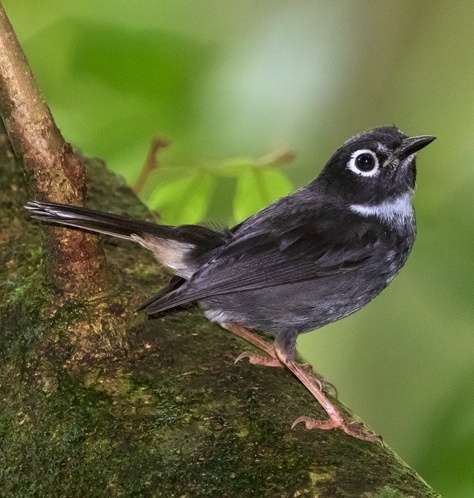
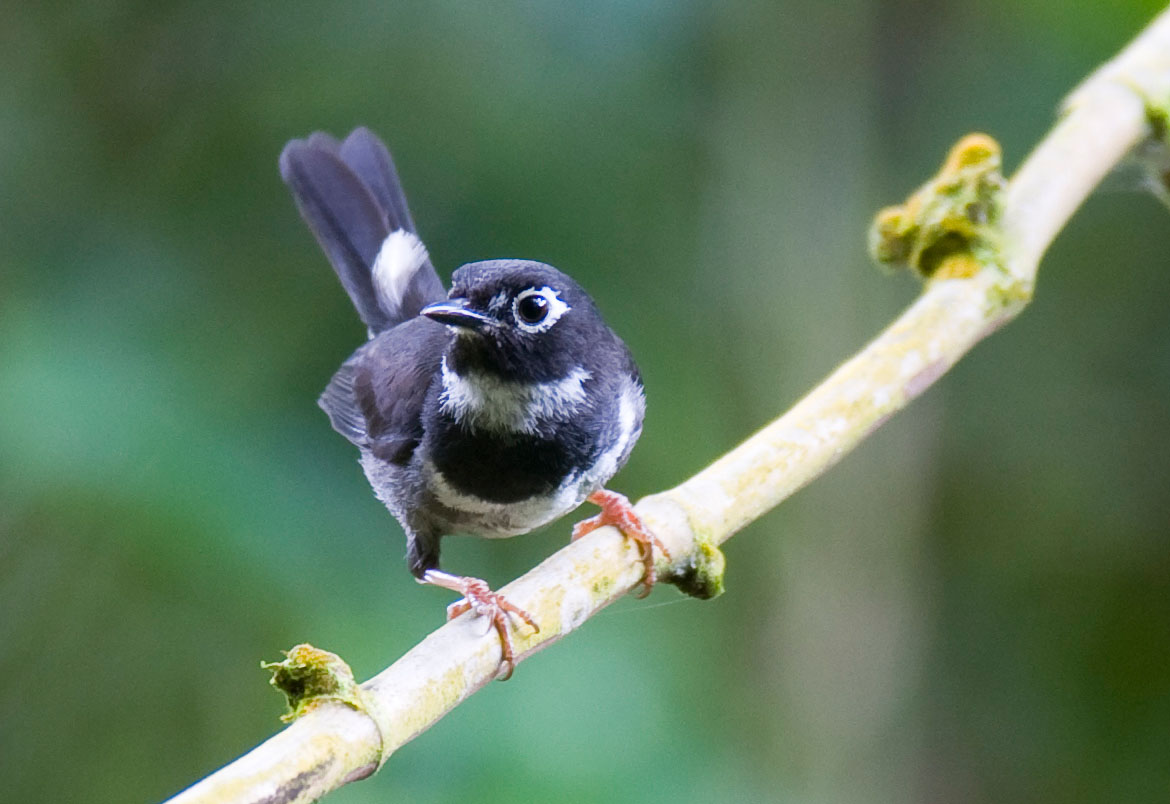
The endangered Whistling Warbler, an endemic bird to St. Vincent in need of more monitoring (Photo by Judd Patterson).
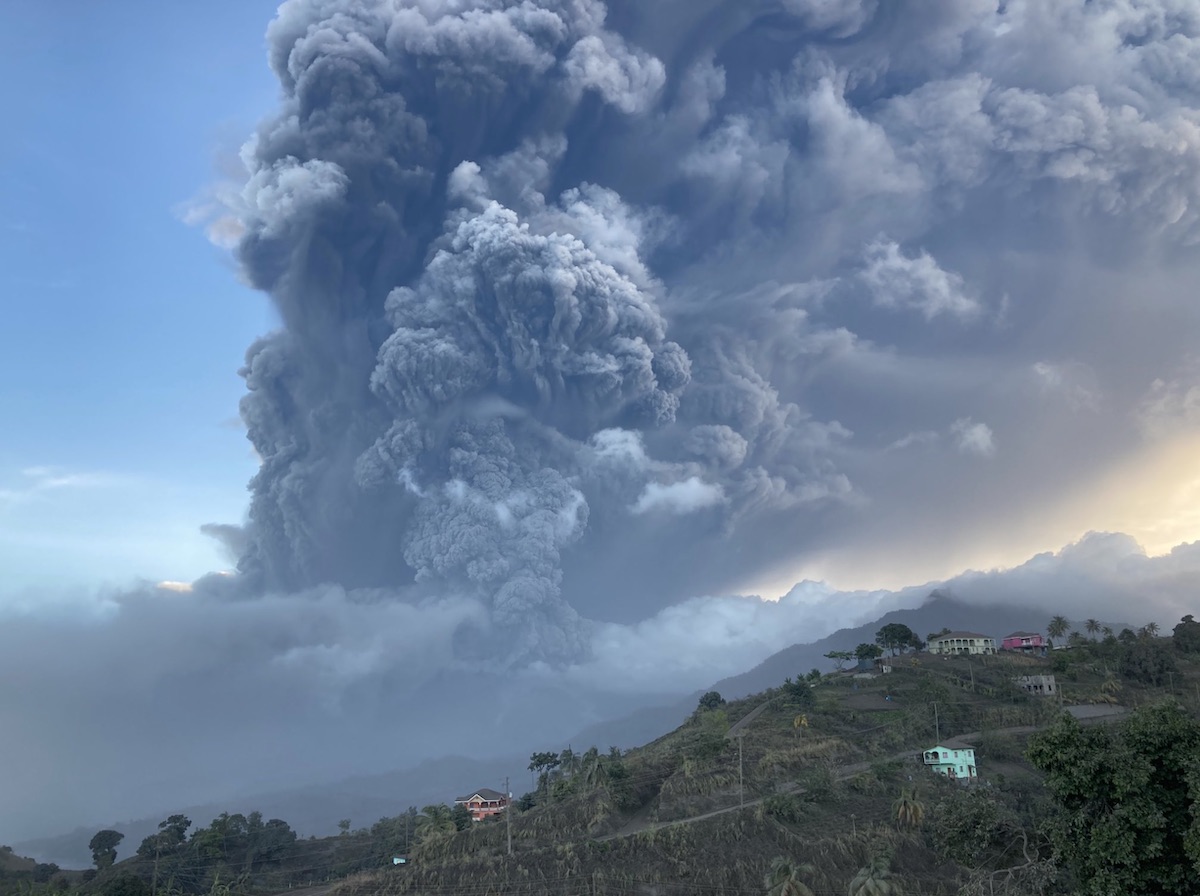
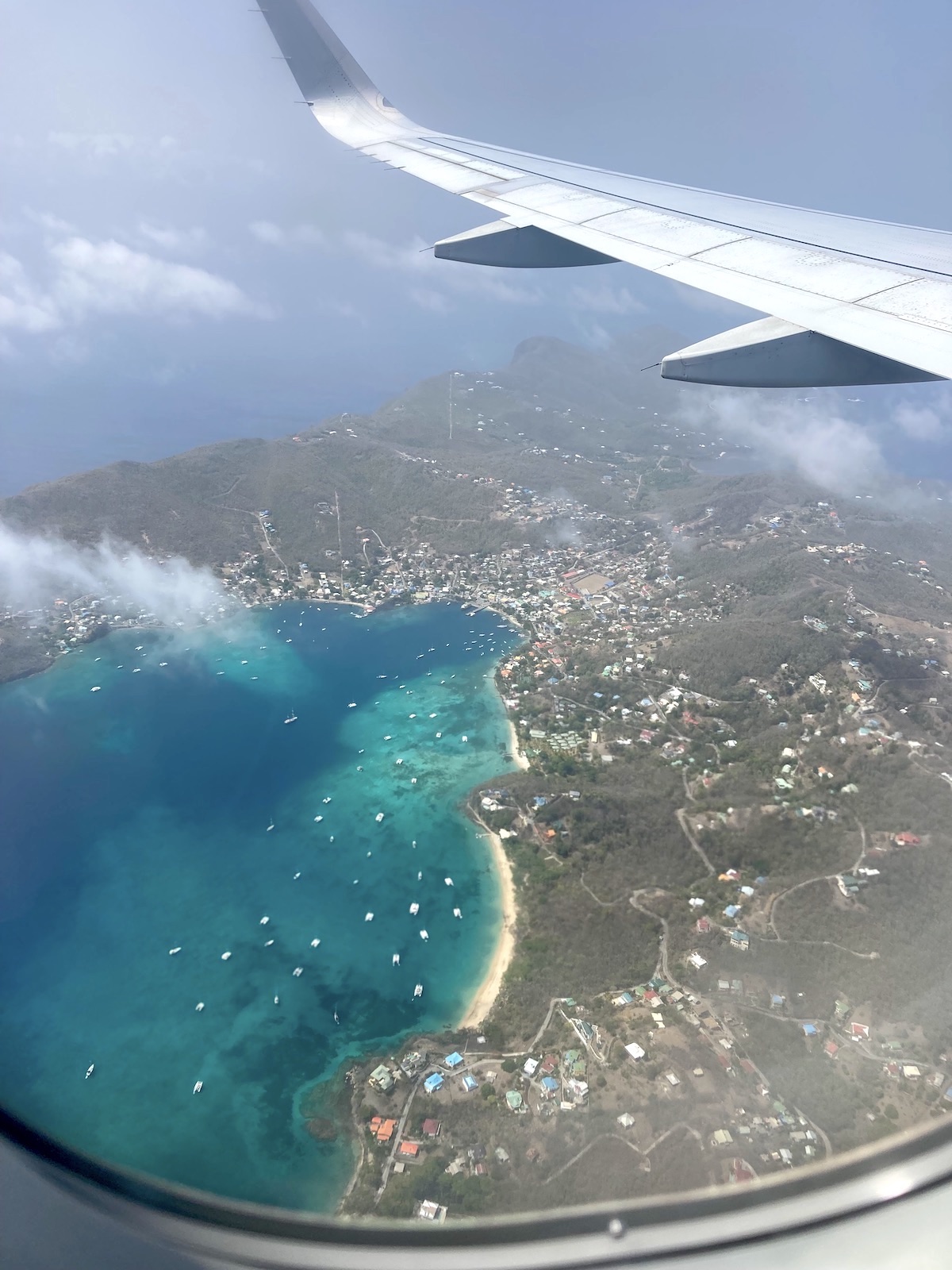
In April 2021, La Soufrière Volcano, on the Caribbean island of St. Vincent, erupted for the first time in 42 years. Explosive eruptions and heavy ash fall devastated ecosystems, leaving many species without homes and unable to forage in the wild. St. Vincent’s wildlife, especially endemic landbird species like the threatened St. Vincent Parrot and endangered Whistling Warbler, faced grave peril. The conservation community swiftly formed an emergency group, raising funds and providing much-needed assistance to the Forestry Department working on-the-ground in St. Vincent.
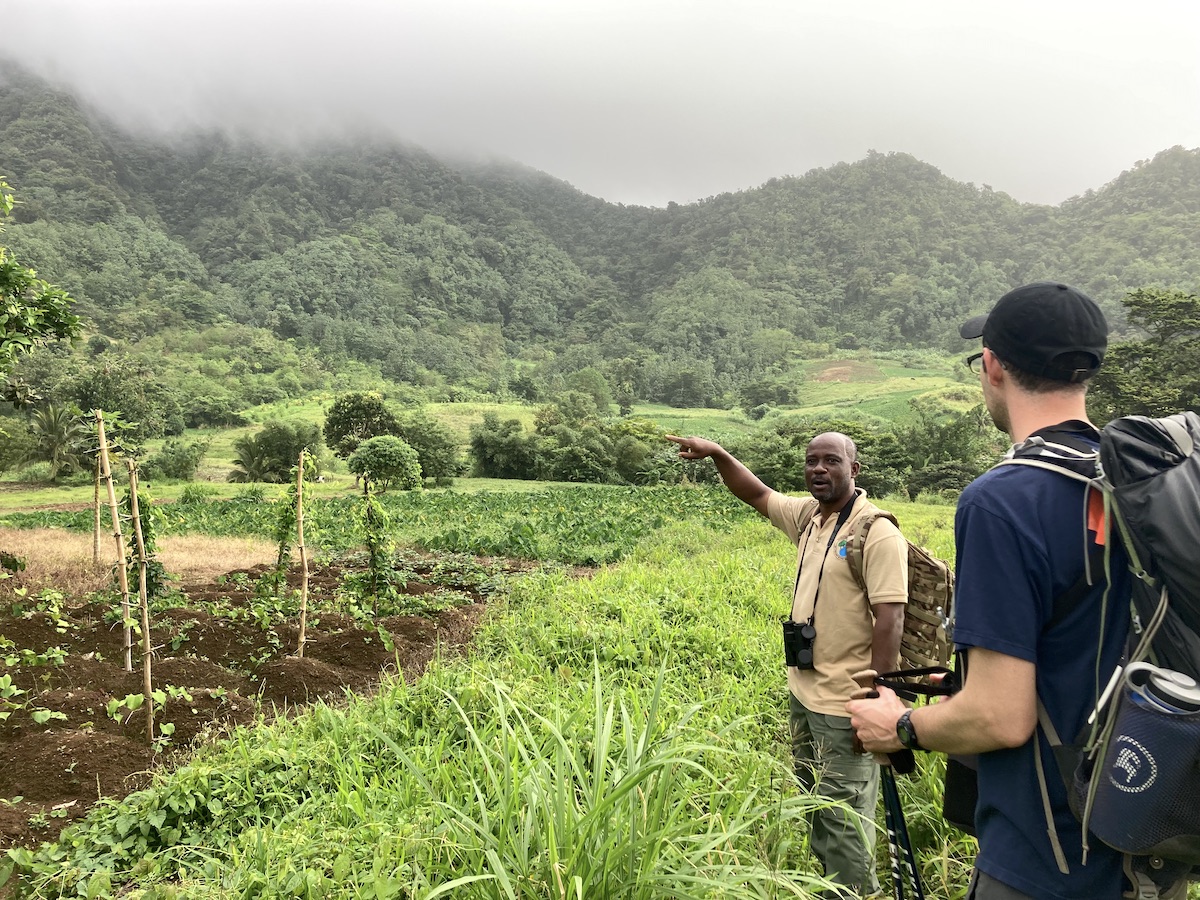
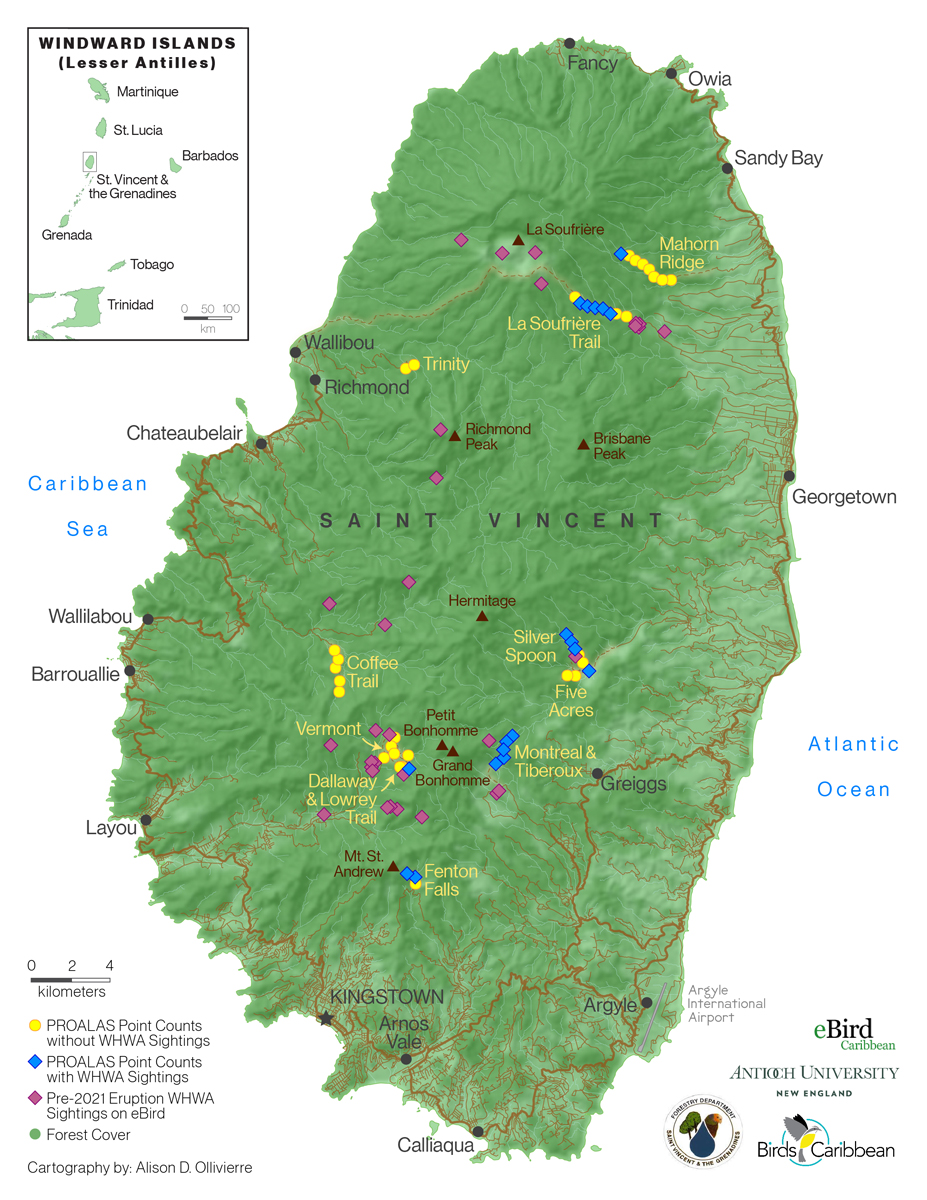
As St. Vincent’s forest regenerates, there is still work to be done to assess the impact of the volcanic eruptions on wildlife populations. A historic lack of research and funding means that there is limited baseline knowledge about the ecology and population status for most of the forest birds on the island. Thanks to funding from theCritical Ecosystems Partnership Fund (CEPF), the United Nations Development Programme (UNDP), and BirdsCaribbean members, partners and donors, we have launched a project to build capacity and provide the data needed for long-term landbird species protection. Read on for a second update on this vital work to study and conserve St. Vincent’s unique birds!
Human activities are a threat to the landbirds—and then came the volcano…
Landbirds, as their name implies, spend the majority of their lives on land, and include birds like hummingbirds, raptors, doves, flycatchers, and songbirds. They forage and breed in a variety of habitats in the Caribbean, from gardens, parks, open savannas, and cultivated areas, to scrub and many different types of forests at varying elevations. Many habitats have already been lost, and those remaining are constantly threatened by destruction and degradation from land-based development, cutting of trees for charcoal and timber, and also pollution, invasive species, and climate change. These factors mean that landbird populations, already at risk, experienced another blow to their survival with the eruption of La Soufriére in 2021.
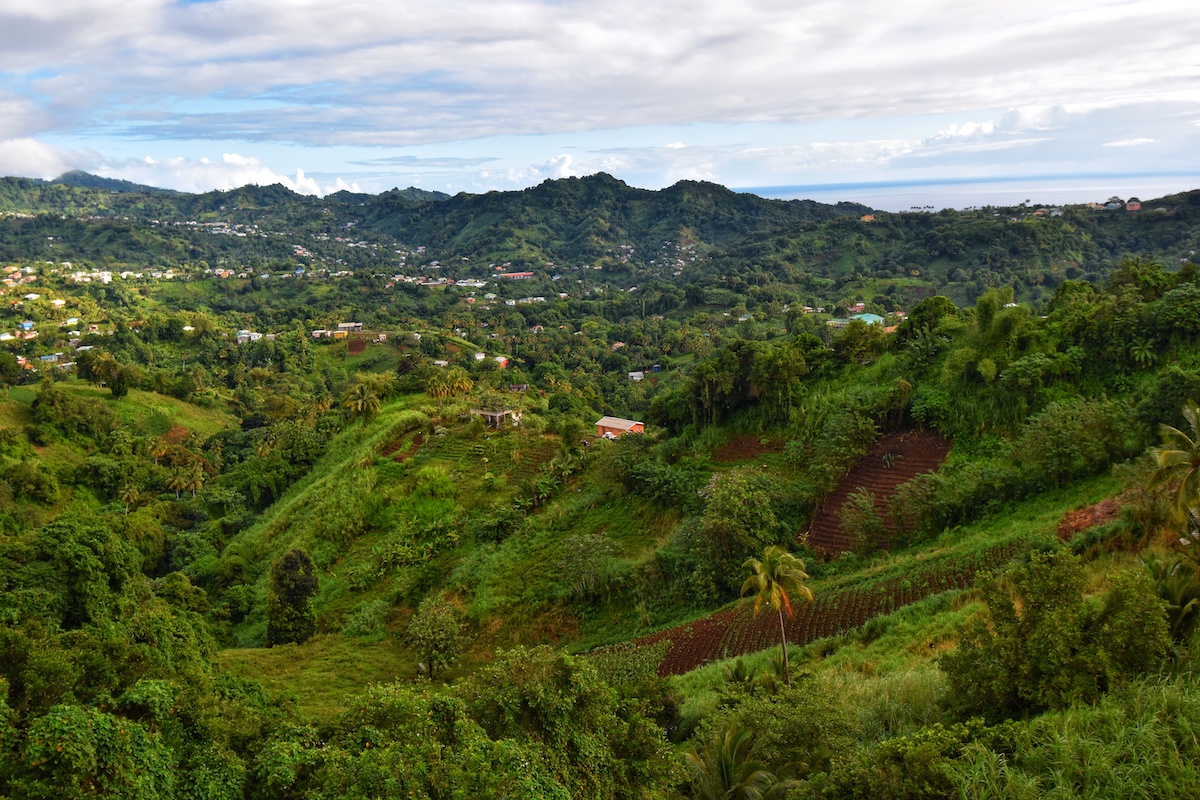
Mesopotamia Valley, one of the most cultivated areas on St Vincent. (Photo by Nandani Bridglal)
How are the landbirds doing now? Enter the CLM Network!
Assessing the status and recovery of endangered wildlife populations is now an urgent priority. In collaboration with the St. Vincent Forestry Department and other partners, we launched the “Conservation of the Endangered Whistling Warbler Project” in April 2022 to monitor the Whistling Warbler and other forest birds, build local landbird monitoring capacity, prepare a Conservation Action Plan for the Whistling Warbler, and raise awareness for landbird species. In January 2023, we held a Caribbean Landbird Monitoring Training Workshop to 1) build local capacity to monitor forest birds using standardized protocols, and 2) establish a long-term monitoring program on St Vincent.
This project is held under the banner of the Caribbean Landbird Monitoring (CLM) Network, through which BirdsCaribbean has been building the capacity of Caribbean conservationists to identify and monitor landbirds. Using these data, we can expand our knowledge of how birds use different habitats in space and time, and enable researchers to assess the status and trends of their populations in relation to habitat, climate, and natural and anthropogenic activities and threats.
Post-eruption clean-up exercise in Hermitage, St. Vincent, on April 2, 2021. (Photo by the SVG Forestry Department)
The elusive and endangered Whistling Warbler. (Photo by Mike Akresh)
The Vulnerable St Vincent Parrot. (Photo by Mike Akresh)
Ash plume on April 9th at 4 PM, the first day of eruptions (photo by Richard Robertson, UWI Seismic Research Centre)
Valley on the Leeward side of St. Vincent showing severe damage to trees and vegetation. (photo by Richard Robertson, UWI Seismic Research Centre)
Under the Caribbean Landbird Monitoring (CLM) Network, BirdsCaribbean has been building the capacity of Caribbean conservationists to identify and monitor landbirds using standardized survey protocols. Using these data, we can expand our knowledge of how birds use different habitats in space and time, and enable researchers to assess the status and trends of their populations in relation to habitat and climate variables. The first CLM Training Workshop was held in the Dominican Republic in February 2022, followed by an introductory workshop in Puerto Rico in July 2022 in conjunction with the AOS-BC meeting. For this workshop, we head to another enchanting Caribbean island, this time in the Lesser Antilles.
Landbird Monitoring takes wing in the Lesser Antilles
St. Vincent (St. Vincent and the Grenadines) is brimming with bird life and is home to legendary species found nowhere else in the world like the St. Vincent Parrot, Whistling Warbler, and the Grenada Flycatcher (also endemic to Grenada). Other beautiful regional endemics include the Antillean Crested Hummingbird, Purple-throated Carib, Lesser Antillean Tanager, Lesser Antillean Euphonia, Brown Trembler, and Rufous-throated Solitaire.
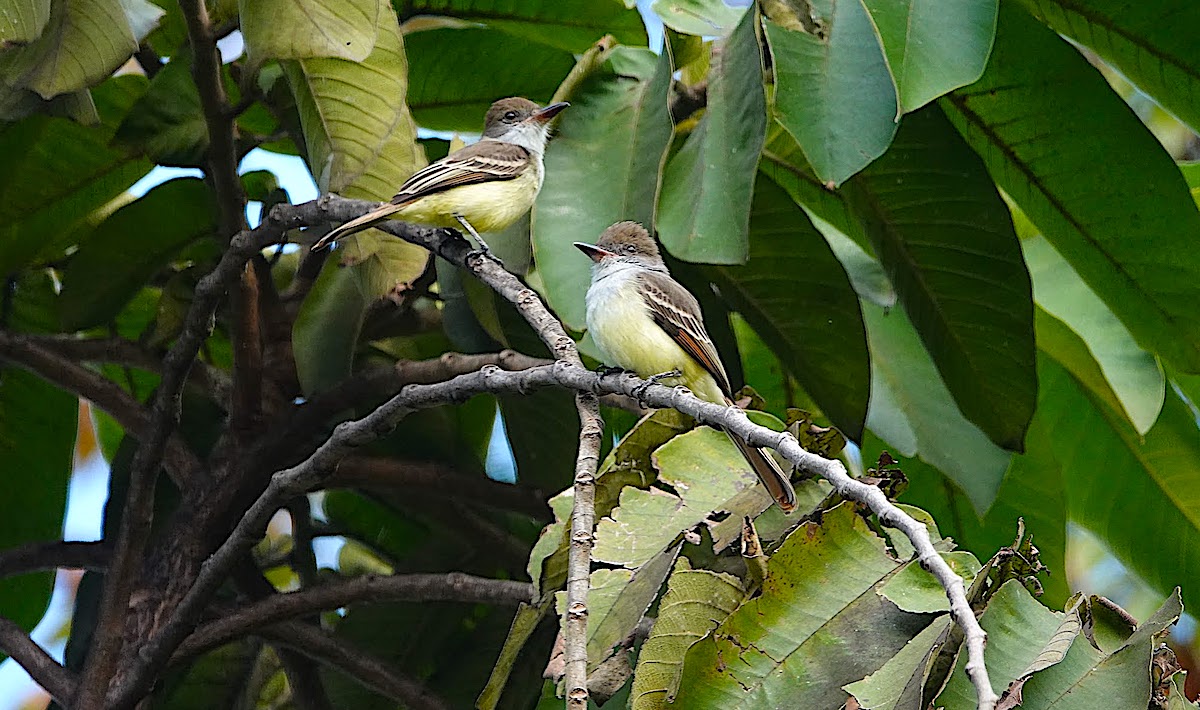
The Grenada Flycatcher is a landbird that is endemic to both St Vincent and Grenada. These two were spotted at the Botanical Gardens of St Vincent and the Grenadines. (Mike Akresh)
The workshop’s content and sessions were facilitated by: Jeff Gerbracht and Ingrid Molina (both from the Cornell Lab of Ornithology), Lystra Culzac-Wilson (Science Initiative for Environmental Conservation and Education – SCIENCE), Glenroy Gaymes (Wildlife Unit, St. Vincent and the Grenadines Forestry Department), Dr. Mike Akresh (Antioch University), Dr. Maya Wilson (BirdsCaribbean), and Dr. Lisa Sorenson (BirdsCaribbean).
During the workshop, 24 Caribbean wildlife professionals representing NGOs and government agencies in St. Vincent and the Grenadines, St. Lucia, Montserrat, and Grenada learned how to use the Programa de América Latina para las Aves Silvestres (PROALAS) landbird monitoring protocols. These protocols were originally developed in Latin America to survey birds in tropical habitats. We have adopted the methodology (PROALAS Manual, Caribbean version) for our Caribbean Landbird Monitoring Program and are training our local partners in its use.
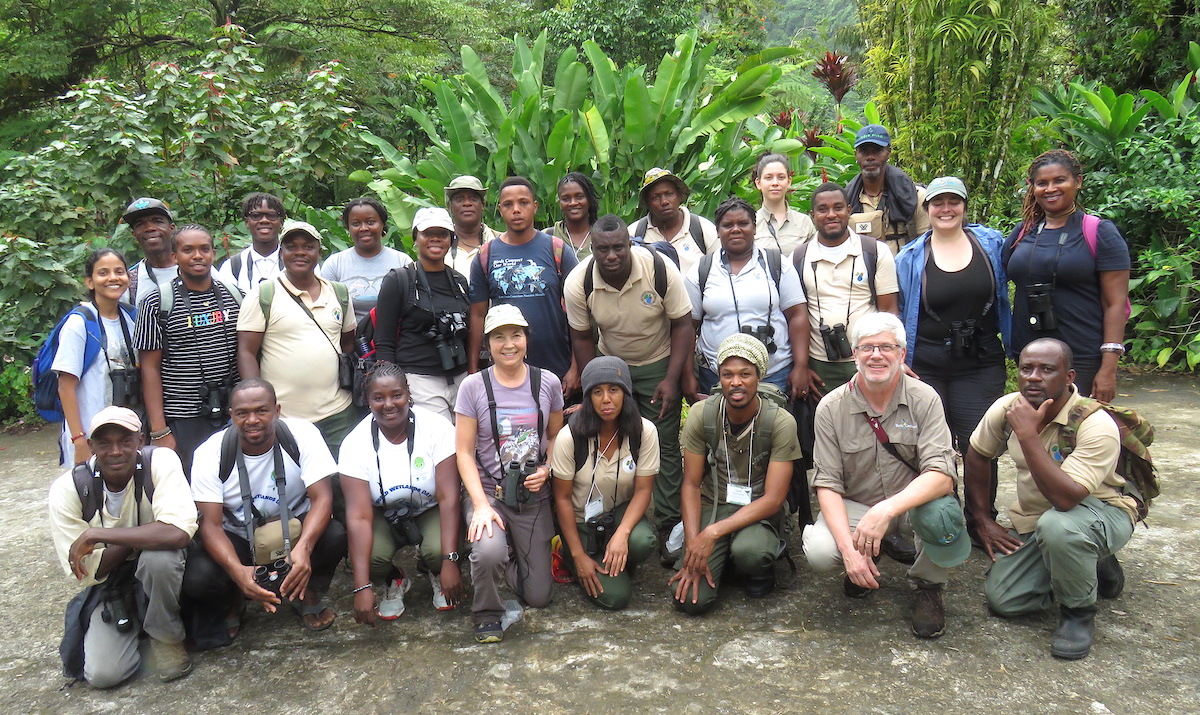
Group photo of workshop participants and facilitators at Montreal Gardens, St Vincent. (Photo by Timothy Vaughn)
Bountiful Birds at the Botanical Gardens
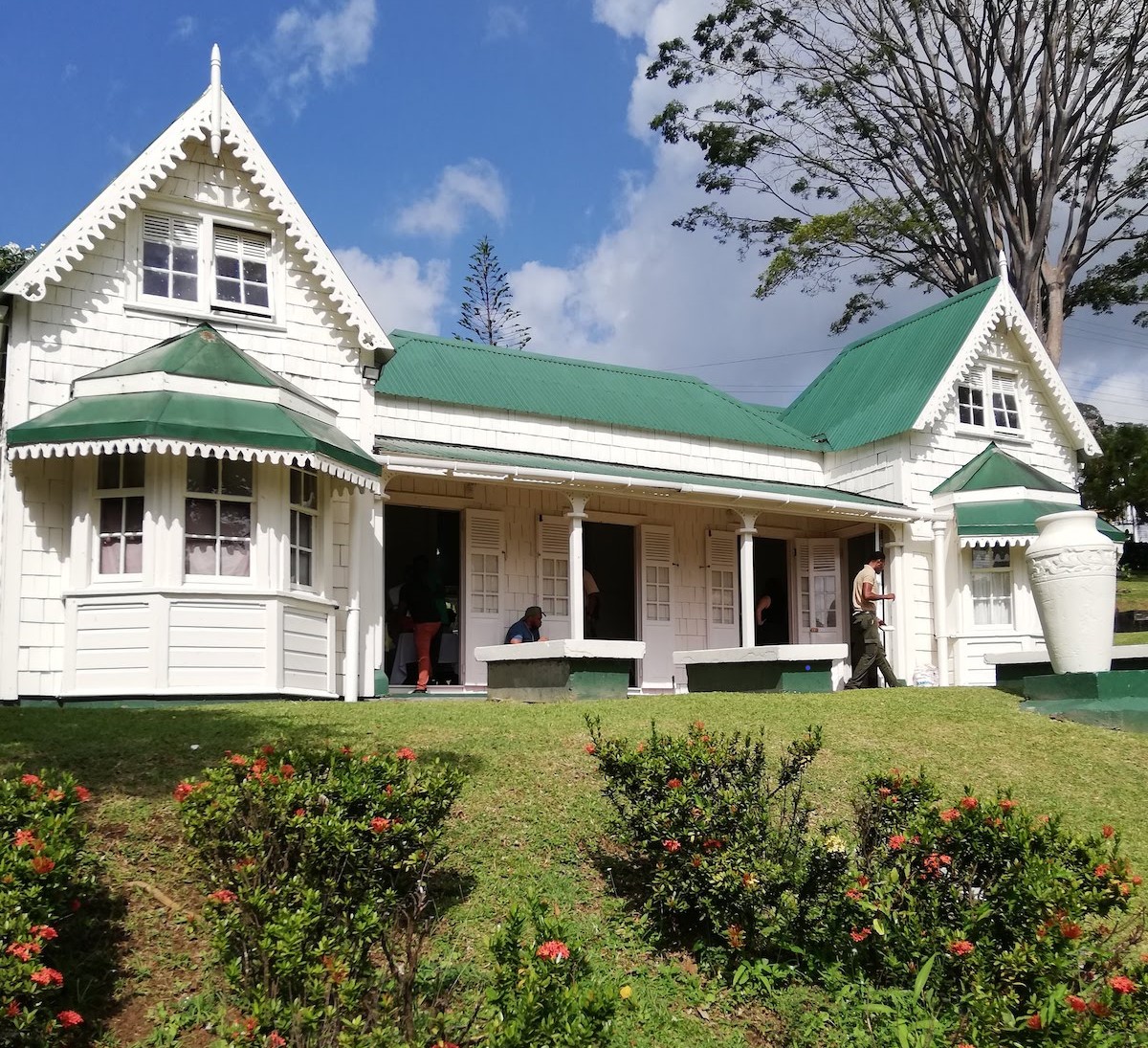
Curator’s House at the Botanical Gardens of St Vincent and the Grenadines.
The workshop was held in the Curator’s House at the Botanical Gardens, just outside the capital city of Kingstown. At over 250 years old, it is the oldest botanical garden in the Western Hemisphere, and an important conservation site. This is also the location of the Nicholas Wildlife Aviary Complex, which maintains a captive population of the vulnerable St. Vincent Parrot.
This location was perfect for learning, discovery, and practice. The Botanical Gardens and nearby Anglican Pastoral Centre’s small forest patch support a variety of bird species, allowing participants to quickly step out of the classroom to practice carrying out PROALAS point counts and transect surveys. The lessons entailed estimating distance using both stride lengths and range finders, marking survey areas, and recording count data in the eBird app (Caribbean pack). But perhaps the most intense and highly rewarding process for participants was learning to identify the birds around them.
Landbirds are often small busy birds that perch briefly, usually hidden by leaves, before darting off to another tree. Fortunately, participants were guided by local birding veterans Lystra Culzac (Director of local NGO SCIENCE) and Glenroy Gaymes (Chief Wildlife Officer, St Vincent Forestry Department) for these bird identification sessions. They reiterated the importance of using field marks, with help from the Merlin app and the Birds of the West Indies field guide, as well as songs and calls, to correctly identify the birds they spotted.
Dr Maya Wilson presenting on the importance of monitoring landbirds.
Ingrid Molina explaining monitoring methods to participants.
Forestry Officers (St Vincent and the Grenadines) conducting transect surveys behind Anglican Pastoral Centre.
Kayroy Baptiste (Union Island Environmental Alliance) entering data into PROALAS survey sheet during transect survey behind Anglican-Pastoral Centre.
Practice makes perfect
Following several preparatory sessions, including “Bird ID 101,” “Landbirds of St Vincent and the Grenadines,” and “How to Use Binoculars,” the participants headed out to the Botanical Gardens to practice identifying birds. The group’s concentration and determination were palpable! Those working in small groups whispered to each other about the nuances of colors, bill shapes, tail lengths, and other field marks. Others pointed out the different bird calls, another important means to ID forest birds. Some of the more experienced birders in the group even used the opportunity to take their bird knowledge and identification skills to the next level, mentoring less experienced birders and adding “lifer birds” to their personal lists!
Lystra Culzac-Wilson introduces participants to the landbirds found in St Vincent.
Dr Mike Akresh helping participants identify birds at the Botanical Gardens.
Jeff explaining binocular specs to participants.
Participants practicing using their Vortex binoculars. (Photo by Mike Akresh)
Lystra Culzac-Wilson highlighting the differences among species of doves found in St Vincent.
Lystra and participants practice identifying birds in the Botanical Gardens.
Conquering wild terrain and rough weather to master PROALAS in the field
Botanical gardens and reserves in urban landscapes provide refuge for birds and other wildlife. But realistically, most of our poorly studied and threatened species, including the Whistling Warbler, inhabit rugged forested areas. All of the participants are normally tasked in their jobs with traversing rivers and climbing steep hills—often in unpredictable weather. The workshop’s trajectory naturally shifted from practice to on-the-ground application.
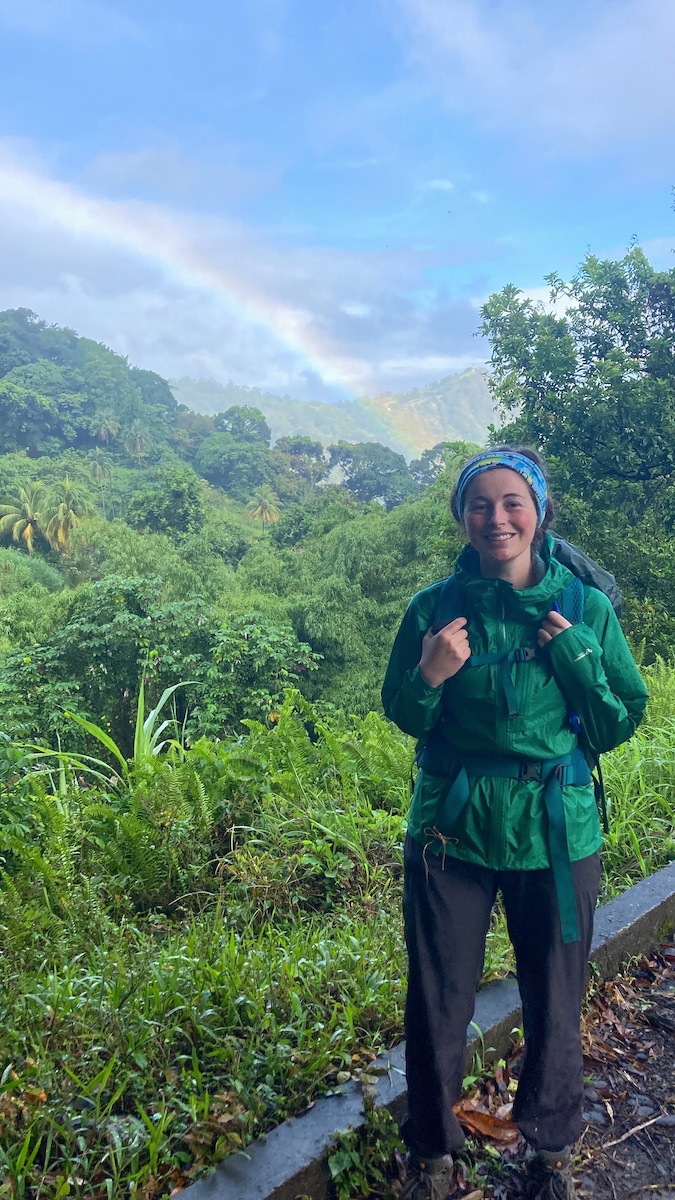
Fieldwork over the next several days began with 5 am wake-up calls to catch the bus to the Vermont Nature Trail or Montreal (part of the Central Mountain Range Forest Reserve). Early risers were rewarded with “gram worthy” views of pristine moist forests and lush undulating ridges. At Vermont Nature Trail we were delighted to see and hear St. Vincent Parrots! Here, on narrow slippery trails with dense vegetation on either side, participants had to rely upon their knowledge of the PROALAS protocols and bird identification by sound to yield the best data for their surveys. Participants displayed sheer professionalism and dedication, working together to improve their skills while braving the less than ideal environmental conditions (yes, we had some downpours!). The team discussed survey methods, assigned tasks, and helped each other with bird identification and equipment use.
Stream along the Vermont Nature Trail. (Photo by Mike Akresh)
Amonie Holas (Gaea Conservation Network) using a rangefinder to calculate distance during the survey on Vermont Nature Trail.
Ansaki Roberts (SVD Forestry Department) marking a point count station with flagging tape on the Vermont Nature Trail.
Participants conducting a point count survey at Vermont Nature Trail. (Photo by Maya-Wilson)
View from the parrot observation deck at Vermont Nature Trail. (Photo by Lisa Sorenson)
Participants identifying and recording birds along the Vermont Nature Trail.
St Vincent Parrot quietly perched on a tree, Vermont Nature Trail. (Photo by Lisa Sorenson)
Briefing before start of surveys at Montreal Gardens.
Participants identifying birds with Lystra Culzac-Wilson at Montreal Gardens.
A Purple-throated Carib sitting in her nest was spotted by Lisa at Montreal Gardens. (Photo by Lisa Sorenson).
On the last day we headed to the dry forest on the leeward side of the island at Zion Hill. Along the way we stopped at Buccament and Layou to survey waterbirds for the annual, regional Caribbean Waterbird Census, which was ongoing at the time. Bird identification reached a crescendo when Jeff set up the spotting scope for everyone to get a closer look at the shorebirds. The most popular among the group was an American Oystercatcher! We were all jumping back in line to catch a second look at this snazzy bird with its carrot-like beak.
Buccament Bay, St Vincent.
Jeanette (St Lucia National Trust) and Aloysius (St Lucia Forestry Department) looking for waterbirds at Buccament Bay.
Identifying waterbirds for CWC2023, St-Vincent. (Photo by Maya Wilson)
The Layou River in St. Vincent is an important freshwater site. (Photo by Lisa Sorenson)
Caribbean Waterbird Survey at Layou Bay. (Photo by Maya Wilson)
American Oystercatcher using its unmistakeable red-orange beak to forage.
And the CLM Network grows
After a non-stop week of birding and learning, participants returned to their home countries to start the next phase—designing and implementing their own landbird monitoring programs, educating their communities about local landbirds, and contributing information to an accessible online Caribbean landbird monitoring database. This mass Caribbean capacity building is ultimately what these workshops are about. This type of training enables participants to develop sustainable and homegrown programs in their own countries, laying the groundwork for a future where our endemics can be known and protected through deeper appreciation, ongoing monitoring, comprehensive Conservation Action Plans and policy interventions.
In particular, we are excited to see the St. Vincent Forestry Department lead their own landbird monitoring programs to understand and conserve the St. Vincent Parrot, Whistling Warbler, and other forest birds. In addition, both Forestry and SCIENCE are raising awareness with children and communities about St Vincent’s special endemic birds and how important it is to protect their forest habitats. Stay tuned for further updates reporting on the results of our monitoring and education programs!
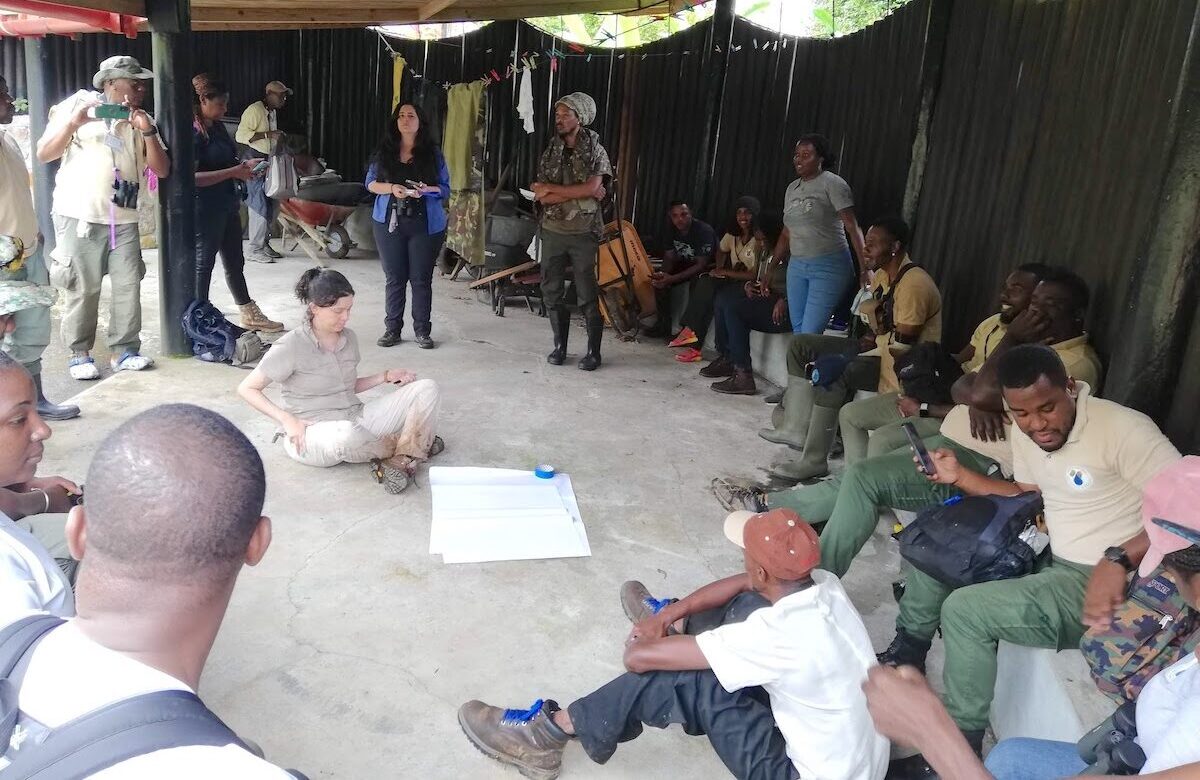
Forestry staff and workshop facilitators during a brainstorming session for a landbird monitoring plan for St Vincent, at Montreal Gardens.
Participants shared how their workshop experience would support their own conservation work:
“I am now able to organize a [landbird] monitoring program for my island and use the eBird app.”
“The workshop deepened my understanding of landbird ecology and how to efficiently monitor these birds.”
“I really appreciated being able to connect with other Caribbean conservationists and build my network.”
“The workshop gave us the tools, equipment and knowledge to collect data about landbirds.”
The workshop “provided me with the necessary skills to properly survey a [bird] population.”
“It has increased my understanding of what should and should not be done when monitoring landbirds.”
Acknowledgements: BirdsCaribbean is grateful to the Critical Ecosystems Partnership Fund (CEPF) and the United Nations Development Programme (UNDP) for funding this Caribbean Landbird Monitoring Training Workshop. We also want to express our deepest appreciation to Mr. Fitzgerald Providence and his staff at the St. Vincent Forestry Department for their help and support, and to Vortex Optics for assistance with binoculars for all participants. Special thanks to our workshop trainers and to all of the participants for an incredible workshop. Finally, we thank BirdsCaribbean members, partners, and donors for your support, which made this work possible.
Behind-the-scenes
BirdsCaribbean has years of experience organizing and executing workshops and each one comes with its own unique challenges and opportunities. Here are some of the behind-the-scenes preparations for this CLM Training Workshop.
Getting there
Even though in some cases islands are miles apart, inter-Caribbean travel is rough. Economy flights are expensive between islands because airlines have to pay high taxes at each airport and each airline has fixed flight schedules. This meant some participants had to overnight on another island before flying to St. Vincent or leave St. Vincent a day later. Maya had to be methodical in selecting flights so that everyone got to St. Vincent on time for the start of the workshop. We suggest that Maya add ‘travel agent’ to her CV.
Field Reconnaissance
Workshop facilitators also have to scout for suitable locations for the field sessions. This entails selecting the site, visiting the site, collecting sample data and vetting for safety. During the recon mission at the Anglican Pastoral Centre, our very own member of the Media Working Group, Aliya, slipped and fell down one especially steep part of the trail. Although Glenroy told us “what happens in the forest stays in the forest,” we think it’s too funny not to share. Aliya admits that she is prone to falling but that this event stood out to her because it was “not an abrupt fall I am used to. I slowly slid down the trail and it felt like I was never going to stop!” We hope that Aliya and her legs have since worked out their differences.
Workshop and outreach materials
Flights are expensive and so is shipping to the Caribbean! Every opportunity to meet in-person is an opportunity to share printed materials and equipment. It really would not be a gathering of Caribbean people if suitcases of goods other than clothes were not brought to the event! We used this opportunity to share field guides, binoculars (again, massive thanks to our donors), rolls of flagging tapes, stacks of waterproof notebooks, nest cameras, Endemic Birds of the West Indies coloring books, and stickers.
Rolls of stickers of birds endemic to the Lesser Antilles. Each roll contains 1000 stickers. (Photo by Lisa Sorenson)
Close-up of the Whistling Warbler sticker with the call to “Protect & Love Our Endemic Birds.”
The beautiful stickers were designed by Josmar Esteban Márquez featuring 11 Lesser Antillean gems; Green-throated Carib, Antillean Crested Hummingbird, Bananaquit, Rufous-throated Solitaire, Whistling Warbler, Scaly-breasted Thrasher, Lesser Antillean Tanager, Grenada Flycatcher, Mangrove Cuckoo, and St Vincent Parrot. They were custom-made for use by the various NGOs and government agencies partners during their conservation outreach and education activities at schools and thus bear the name of the bird with a call to “Protect & Love (heart symbol) our endemic birds.”
We underestimated the time it would take to divide and distribute stickers (1000 per roll per species). Since the workshop was coming to an end, we needed all hands-on-deck to cut and package the stickers for each of the NGOs and government agency representatives. Indeed, teamwork makes the dream work! But next time we’ll get a head start.
Workshop facilitators sorting, tearing and packaging stickers for our partners during the workshop.
Stephon and Antwone (Montserrat National Trust) receiving outreach materials from Lisa.
Kristy Shortte (Sustainable Grenadines) receiving outreach materials from Lisa.
Forestry staff receiving outreach materials from Lisa.
Aloysius Charles St. Lucia Forestry Department receiving outreach materials from Lisa.
Ajhermae White Montserrat Department of Environment receiving outreach materials from Lisa.
Kayroy Baptiste and Roxanne Froget (Union-Island Environmental Alliance) receive outreach materials from Lisa.
Children are natural explorers – some of whom are curious about birds. And why wouldn’t they be? Birds come in all colors, shapes and sizes. They sing sweet melodies, give funny chirps and whistles, and even make eerie sounds. But perhaps best of all, like superheroes and fairies, they can fly!
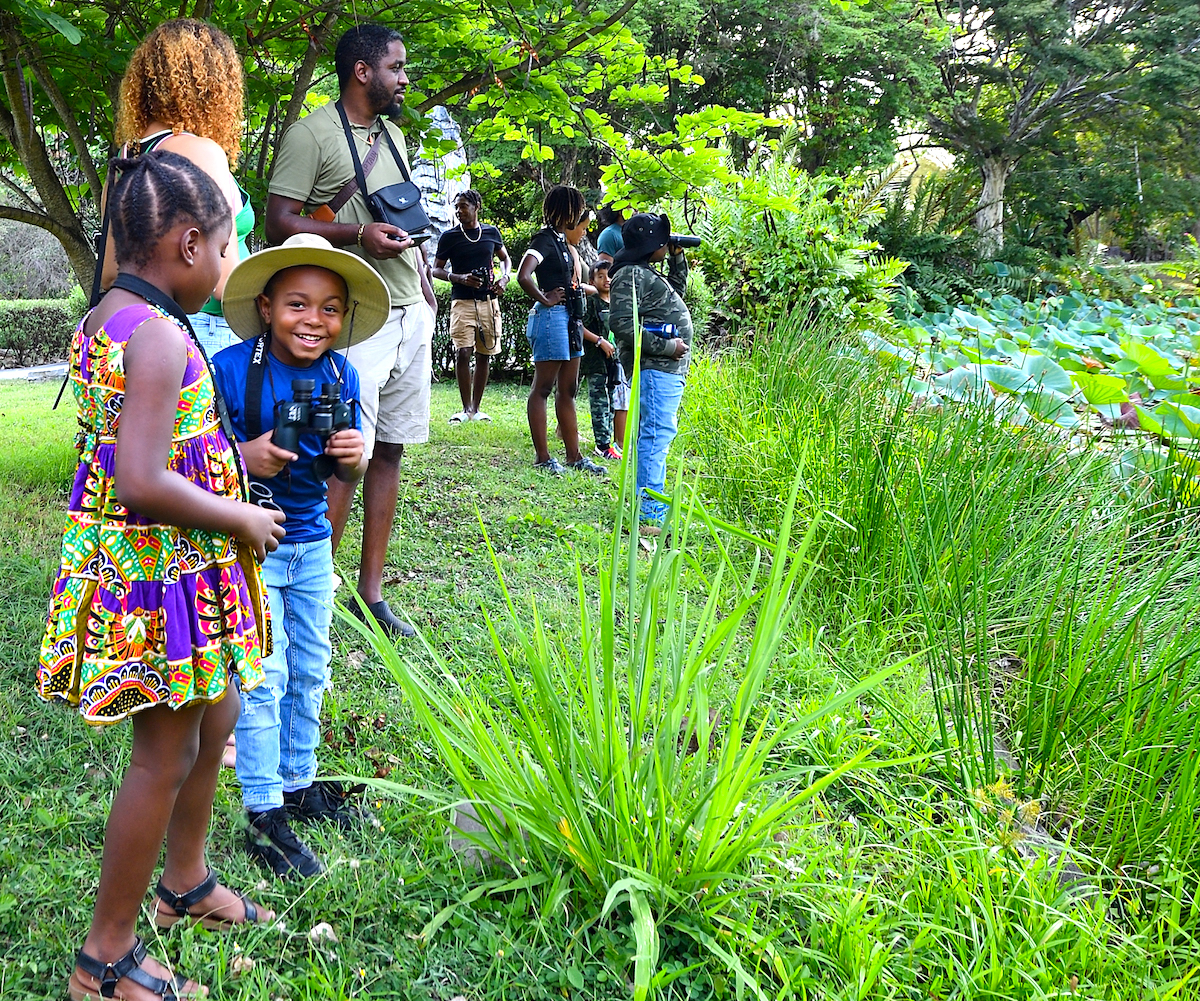
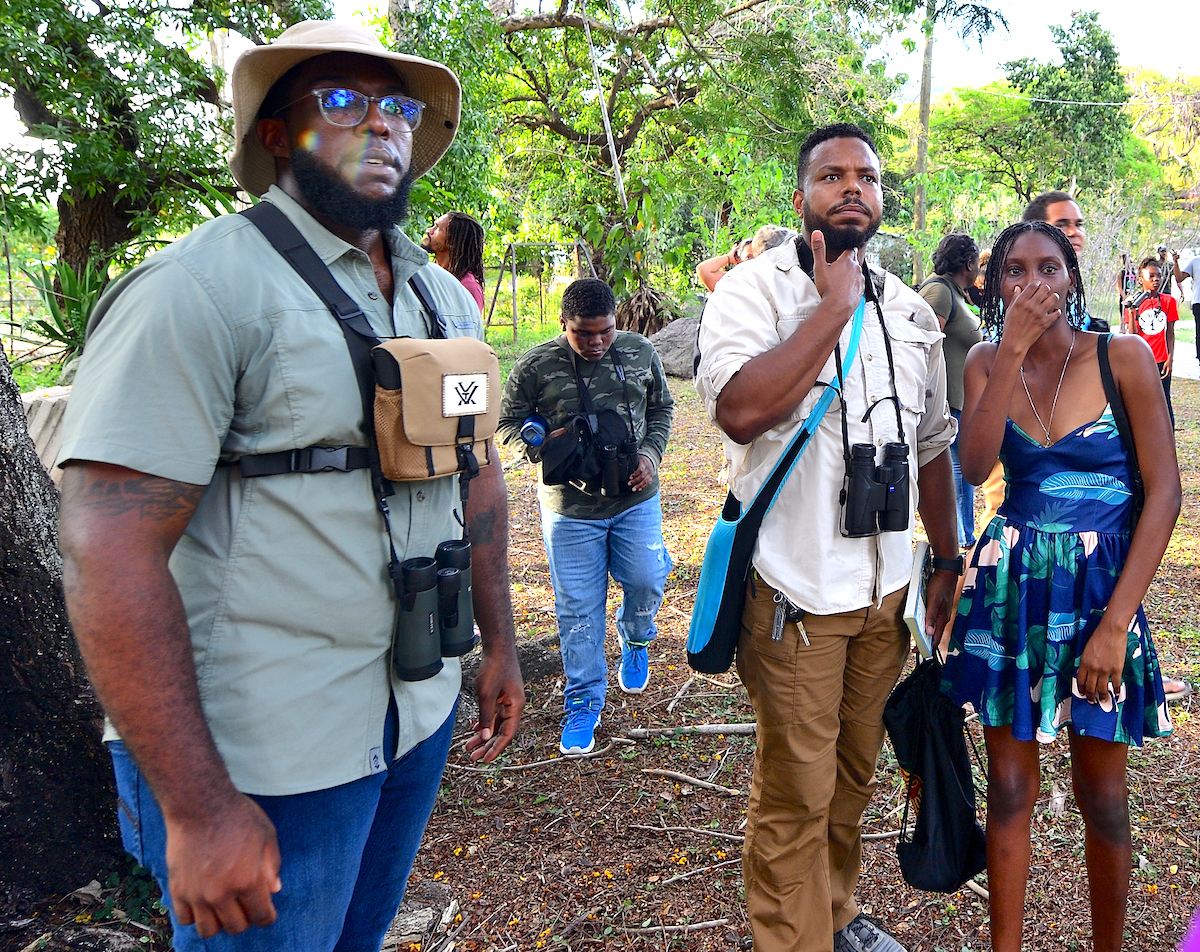
Birdwatching is a great way to nurture children’s innate scientific interests through the study of nature. This is what BirdLife Jamaica set out to achieve with their “Bring A Child Birding” event in May, which coincided with Jamaica’s observation of Child Month and the Caribbean Endemic Bird Festival. Emma Lewis, our Media Working Group Chair and member of BirdLife Jamaica, shared this lively retelling of the young birders’ first experience birdwatching at Hope Gardens, Jamaica.
One small girl found the binoculars weighed her down too much, so her father took them over.
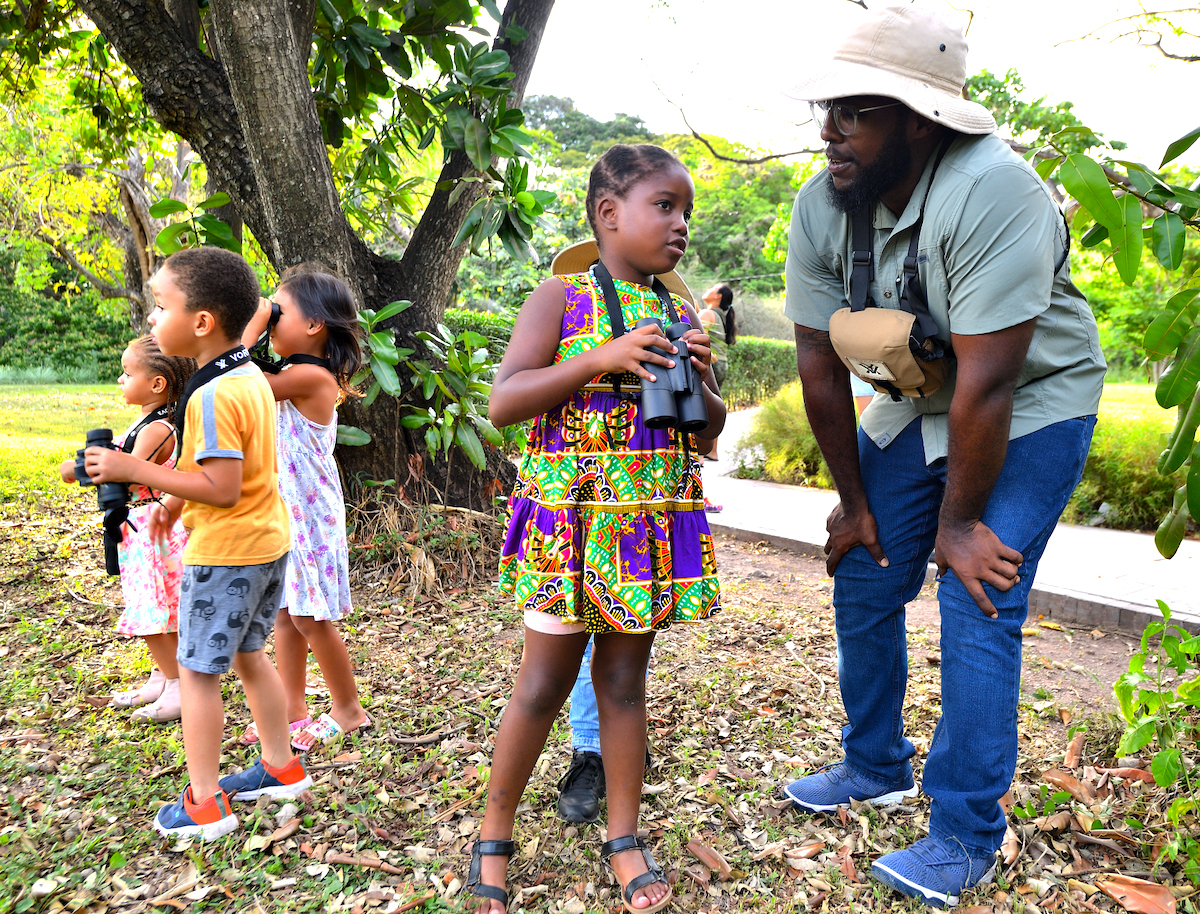
Talking birds: Justin Saunders lends a listening ear to a young birder. (Photo by Stuart Reeves)
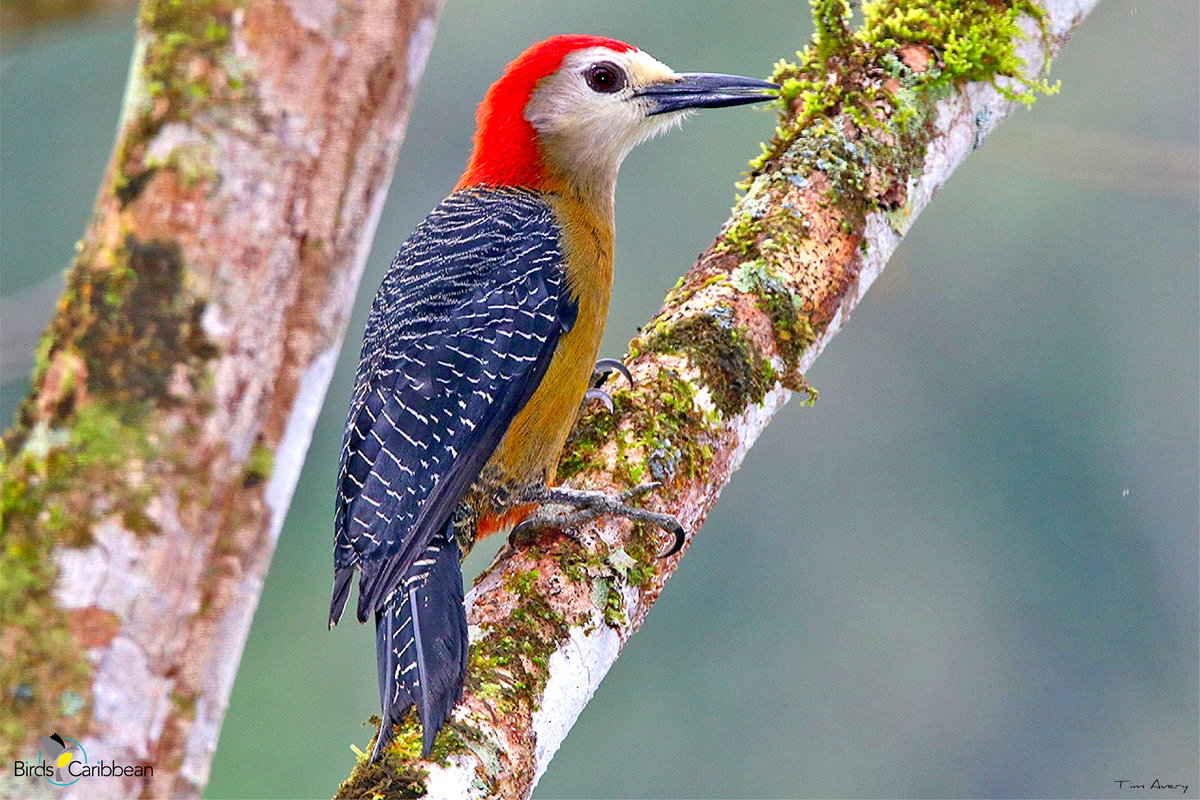
Another girl (pre-teen age) was convinced that there were woodpeckers in the clump of bamboo; in fact, bamboo often makes all kinds of knocking and rattling noises when the wind blows. But we did see a real endemic Jamaican Woodpecker, with his blazing red head, a little later.
Male Jamaican Woodpecker. (Photo by Tim Avery- Macaulay Library- ML87028941)
Several Common Moorhens tripped as fast as they could along the pond side to avoid the children’s cries–but were duly admired, anyway.
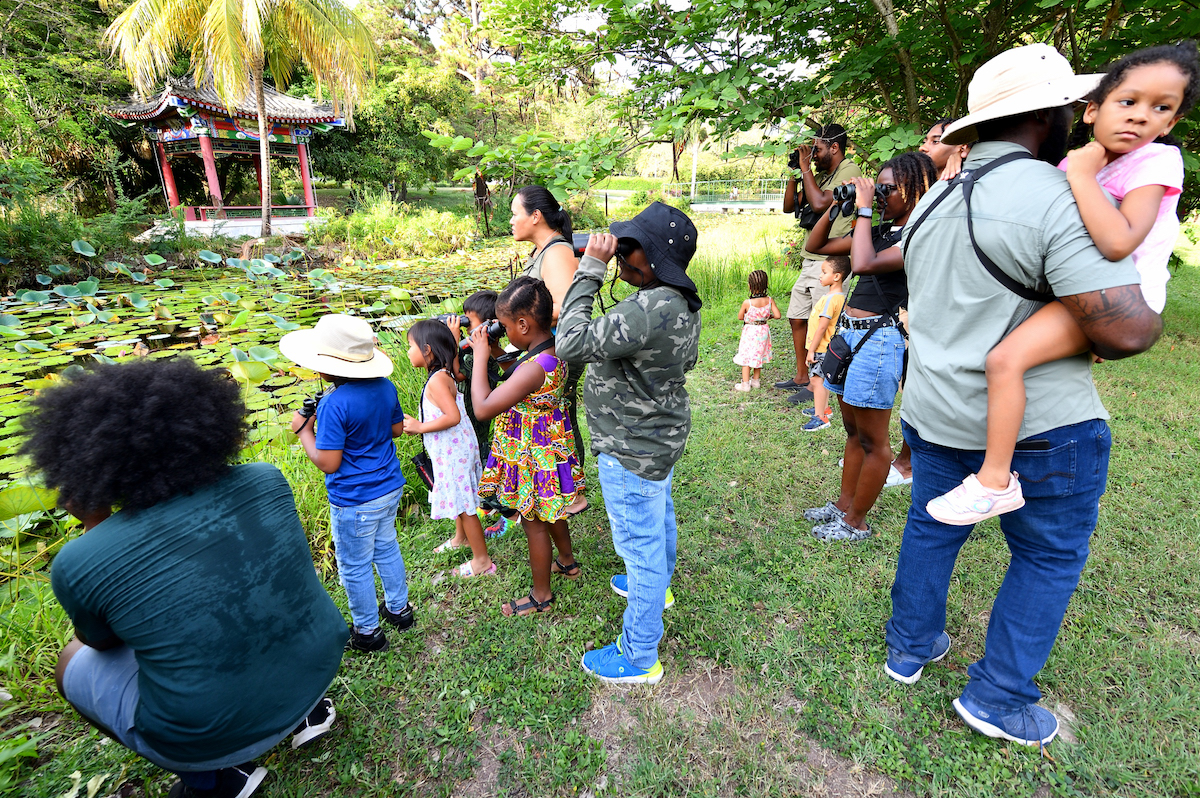
Hey! Are you taking a photo of us? Adults and children birdwatch by the pond. (Photo by Stuart Reeves)
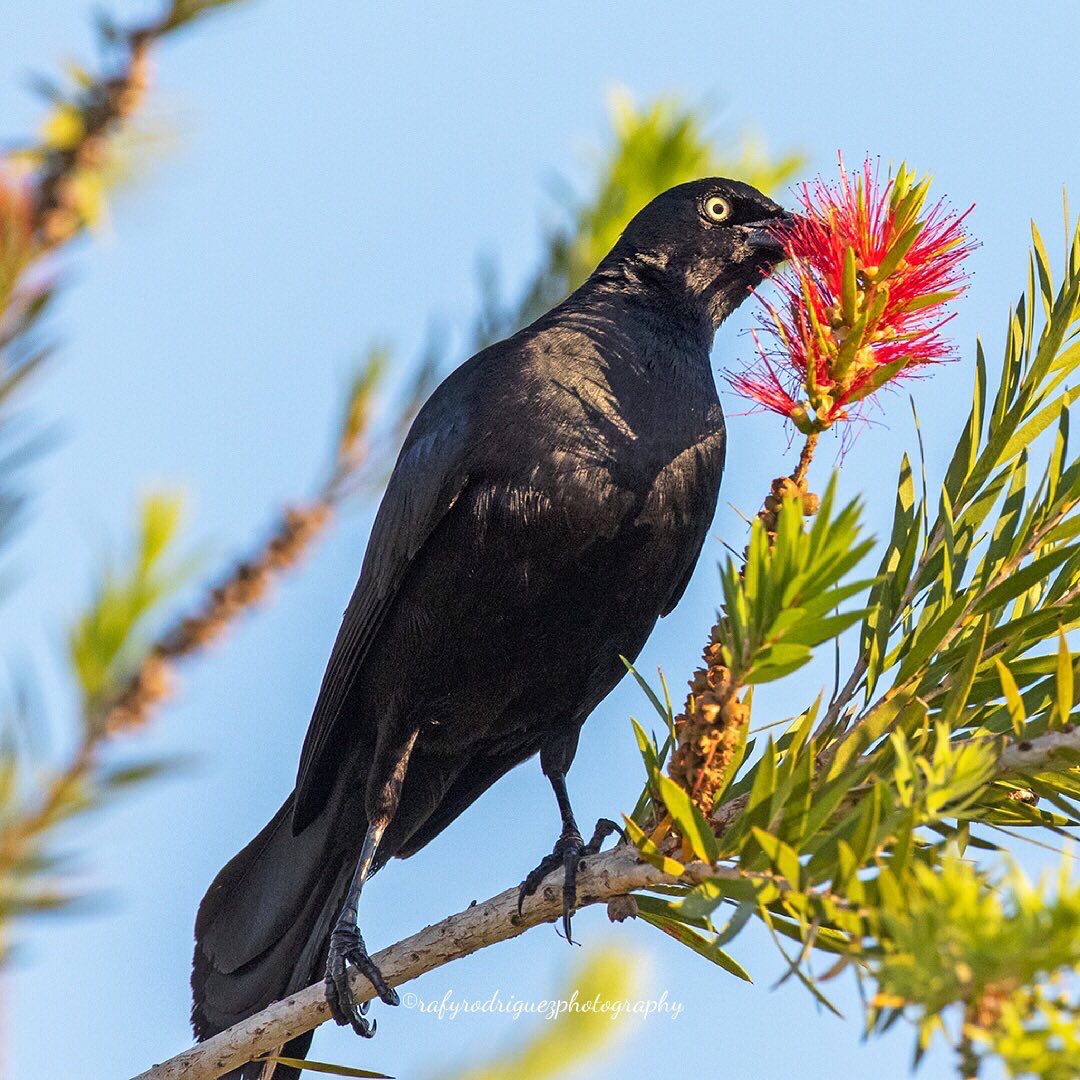
Two boys, guided by their father (a brilliant bird photographer), were busy counting Greater Antillean Grackles, who were making their usual “cling cling clii-ing” racket in a bush.
Greater Antillean Grackle. (Photo by Rafy Rodriguez)
BirdLife Jamaica’s concept of staging a children’s birding session in Kingston’s beloved Hope Gardens was an absolute winner, straight out of the starting block. Since it was the first attempt, perhaps we could call it a “pilot project.”
The gardens themselves were remarkably busy, with what seemed to be a major picnic going on. Literally hundreds of children were spread across the grass, with the occasional lady and gentleman dressed up in wedding attire, for photo-ops. The noise level was terrific. I was disturbed to see how many cars were allowed in the gardens, however. There is quite a large parking lot. It should be a place to walk (or run).
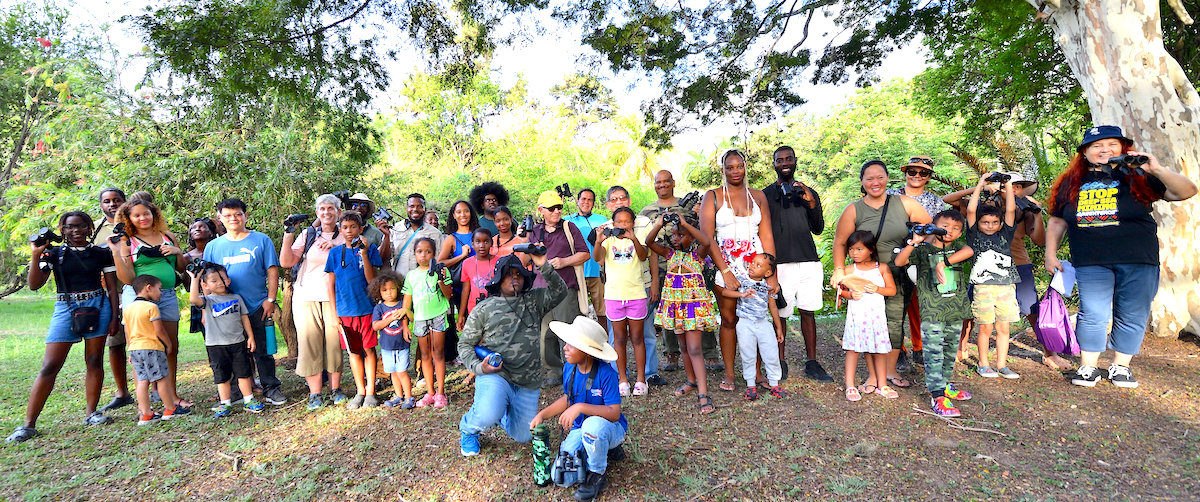
We gathered in the shadiest spot we could find in the Chinese Garden, which was a little more sedate. We handed out binoculars and signed adults and children up. I think we had a total count of around fifty. The parents were protective, supportive and seemed to enjoy themselves. The children were kept so busy that only one or two had “meltdowns” towards the end of two hours or so of hard birding–quite understandable!
Binoculars are a birder’s best tool! (Photo by Stuart Reeves)
Splitting up into groups, each with an adult leader, we walked off in different directions, with our necks adjusted at different angles, to find birds. The children’s necks needed adjusting, too; it is not just about spotting a bird, but also training one’s binoculars in the right direction–the right tree, the right branch–to see it in spectacular detail. Also, one usually needs to fiddle with the binoculars so that it’s not all a blur, but actually matches your eyesight and fits your eyes comfortably.
Justin Saunders and Damany Calder help a participant identify a bird at Hope Gardens. (Photo by Stuart Reeves)
The children soon became adept at spotting the birds when they weren’t too busy interacting with each other in various ways. Spotting them wasn’t a problem. Several children shouted, pointed, and jumped up and down each time they saw a bird! The objects of their interest were not very impressed with this behavior, often flying away from the shouting, gesticulating young humans. We had to explain to them that when birding you have to speak quietly, step lightly, and refrain from sudden movements. This is something, of course, that children are not naturally prone to do. We had to remind them to use their binoculars, too. This brings the whole birding experience to life.
Frequently heard comments were:
“I see it!”
“Where?”
“Oh, it’s gone!”
“Give me your binoculars!”
“I don’t see it.”
“Look, look, look!” (crescendo)
“My binoculars aren’t working!”
And more.
Below are some more photos, courtesy of Stuart Reeves, Kahlil Francis, and myself. We did not photograph the birds this time since we were focused on the kids watching the birds! However, apart from the more common residents such as Greater Antillean Grackle, White-winged Dove, Smooth-billed Anis and Zenaida Dove (plus a whole host of Cattle Egrets, pecking away at some freshly watered grass), we did spot some endemic species that live nowhere else in the world but Jamaica–the children found this fact surprising. There was the aforementioned Jamaican Woodpecker, Jamaican Parakeet, Yellow-billed Parrots, Jamaican Oriole (endemic sub-species), and the Red-billed Streamertail. A pair of much less common Black-billed Parrots (conservation status: Vulnerable) posed for a while on a bare branch.
Birdwatching in the Chinese Garden at Hope Gardens. (Photo by Stuart Reeves)
Practicing the birding on one knee technique. (Photo by Stuart Reeves)
Some participants could not contain their excitement. (Photo by Keisha-Miller)
Pop quiz time with Keisha Miller. (Photo by Stuart Reeves)
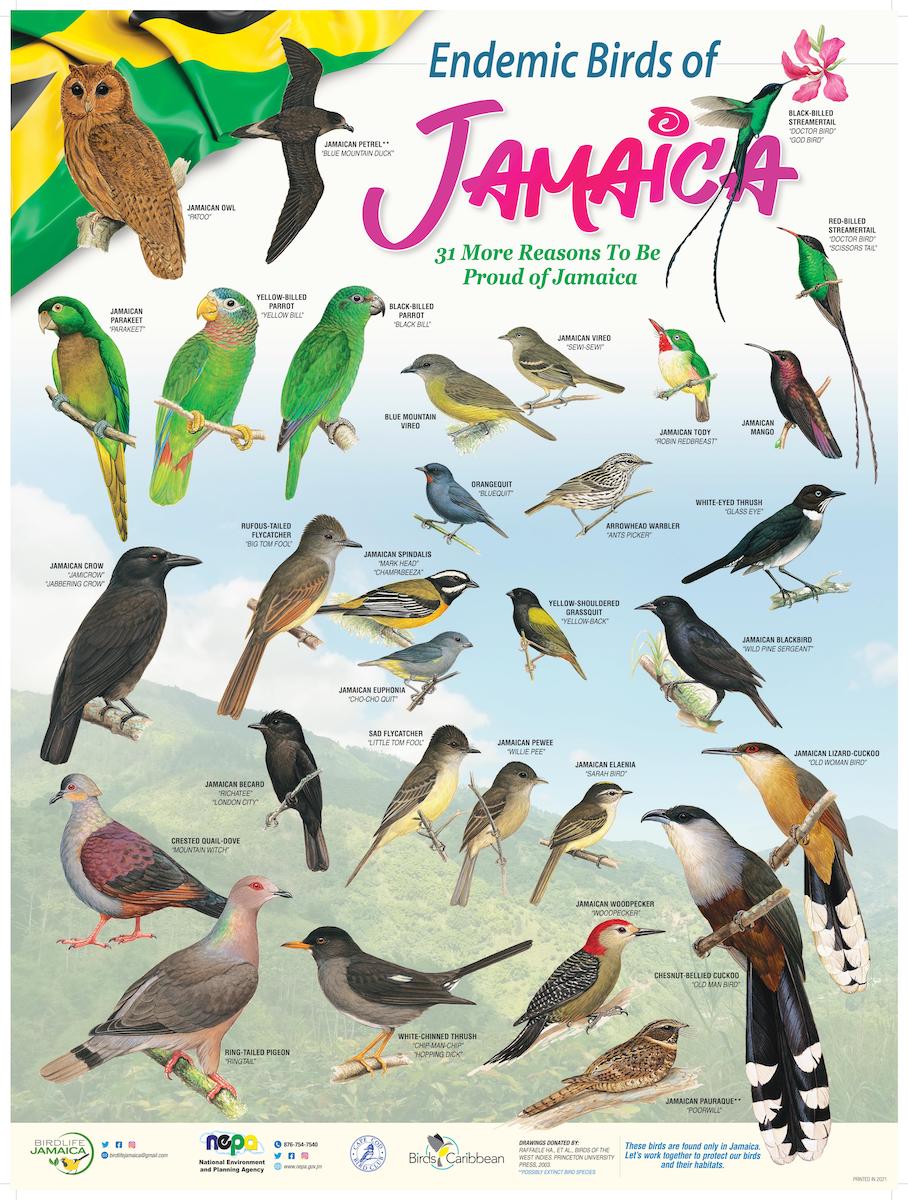
Winding down in the warm late afternoon sun, we handed out posters of Jamaican endemic birds to each young participant. Copies of my personal little “Bible,” A Photographic Guide to the Birds of Jamaica, by Ann Haynes-Sutton, Audrey Downer, and Robert Downer, were on sale. All went home quite satisfied as there was just no time to be bored. I think we have “converted” a few children to birding (and perhaps one or two adults, too). Moreover, I believe that the children enjoyed themselves, being away from their tablets, iPads and phones and appreciating nature.
The poster entitled “The Endemic Birds of Jamaica – 31 More Reasons to be Proud of Jamaica.”
I think it’s safe to say that BirdLife Jamaica pulled off a coup (the non-violent kind, of course). Many congratulations to Justin, Michelle, Keisha, Damany, Treya, Kahlil, Stuart and all the others that got involved to make it a roaring success! With special, special thanks to Jamaica Environment Trust (JET) and the Caribbean Coastal Area Management Foundation (C-CAM) for their support.
Happy adults and children after a lovely evening spent watching birds. (Photo by Stuart Reeves)
BirdsCaribbean is proud to work alongside BirdLife Jamaica and we salute their efforts to protect the birds of Jamaica and their habitats. We were thrilled to learn of the positive experiences and hope that other NGOs in the region will also be inspired to make bird watching more accessible and enjoyable to the youth.
Hope Gardens, formally known as the Royal Botanical Gardens, comprises 200 acres of endemic and exotic botanical collections located in Kingston. It is the largest public green space in the capital and is often used for picnics, weddings, band concerts, poetry readings and birdwatching! The Gardens offer a variety of habitats for birds and other wildlife. Among the habitats are the Cassia Cassia siamea grove by the main entrance; a Palm Avenue, where sago palms are among the oldest living trees in the garden; a cacti garden with rare varieties; the annual gardens with numerous species of exotic flowers; a bougainvillea walk; an orchid house; a maze; a forest; the sunken gardens; and the lily pond.
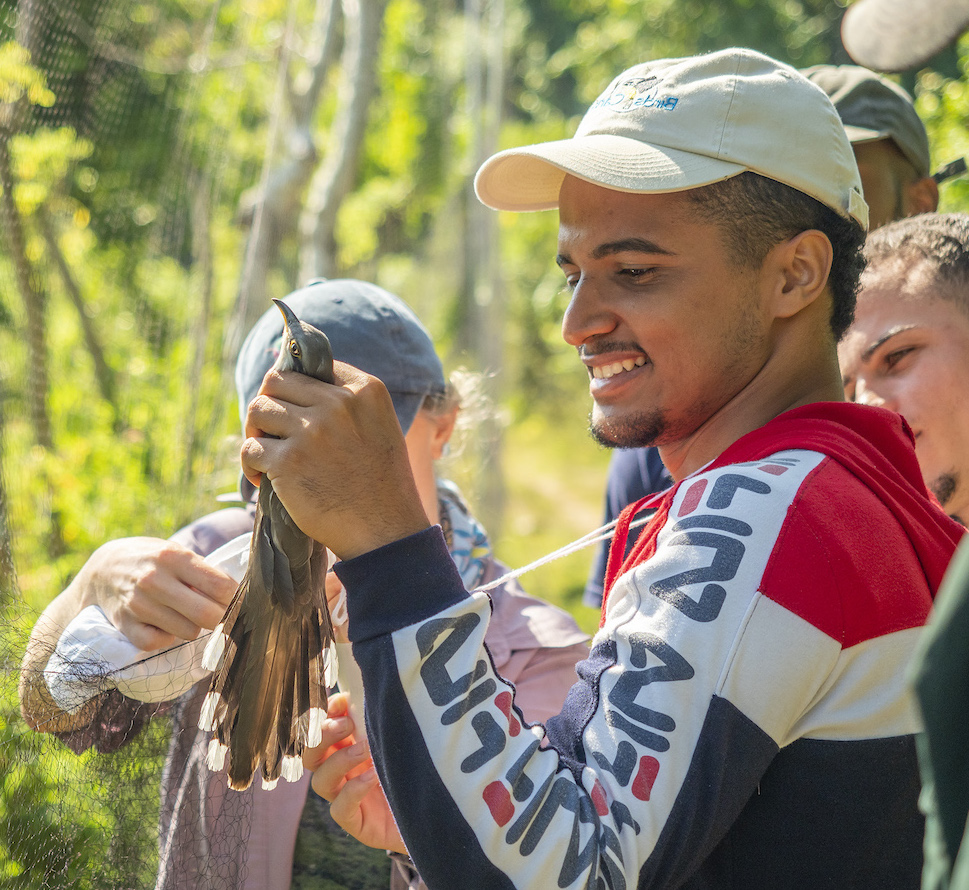
Elvin removing a cuckoo from a mist net. (Photo by Josh Covill)
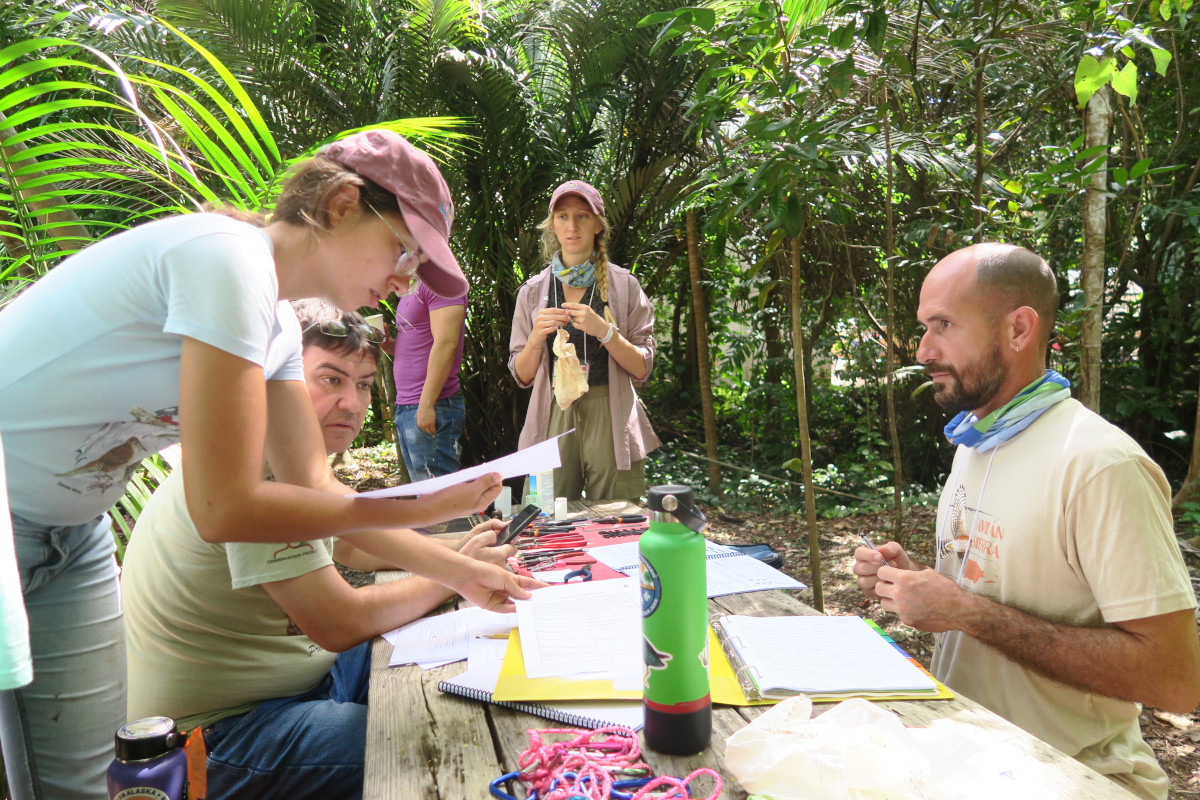
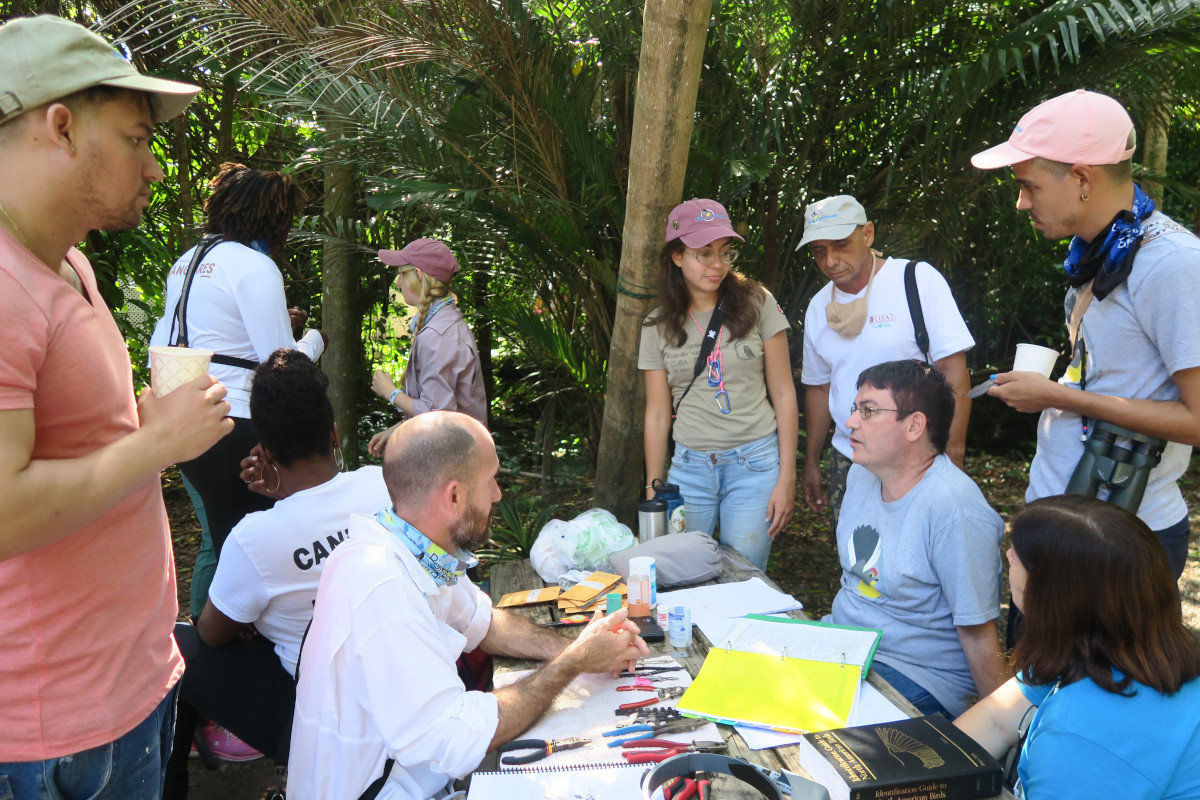
BirdsCaribbean’s Caribbean Bird Banding Network recently held their second bird banding training workshop in the beautiful Dominican Republic. Read on for a delightful personal account of this workshop from local high-school teacher and dedicated Dominican biologist Elvin Manuel Vargas Estévez.
On the fresh morning of March 8th, 2023, in Jarabacoa, Dominican Republic, one of the most rewarding experiences of my life as a biologist would begin. I was participating in a Bird Banding Workshop organized by BirdsCaribbean. It sounds beautiful just to say it, but the true beauty lies in how and what happened there to consider it so valuable.
I must admit—I have always been a wildlife lover since I was a child. But my four-year-old self could never have imagined that I would have a bird in my hands, measuring its anatomical proportions, carefully observing the arrangement of its feathers, and eagerly looking for molt limits. However, today I feel immense excitement knowing that it is now part of my life, allowing me to continue to educate myself and contribute knowledge to avian conservation and society.
Setting up mist nets and sowing euphoria
On the first day of the workshop, my colleague Gerónimo Abreu and I were so excited to start the activities. We talked about what we wanted to do that day from the moment we woke up until we left our room. Once everything was ready, we headed to the main hall and dining room of the Ranch, where lead banding trainer Holly Garrod explained to us with great enthusiasm what we were going to do that day. With clear instructions, we took the necessary equipment and set off to explore the area that would be our morning workplace for the next four days.
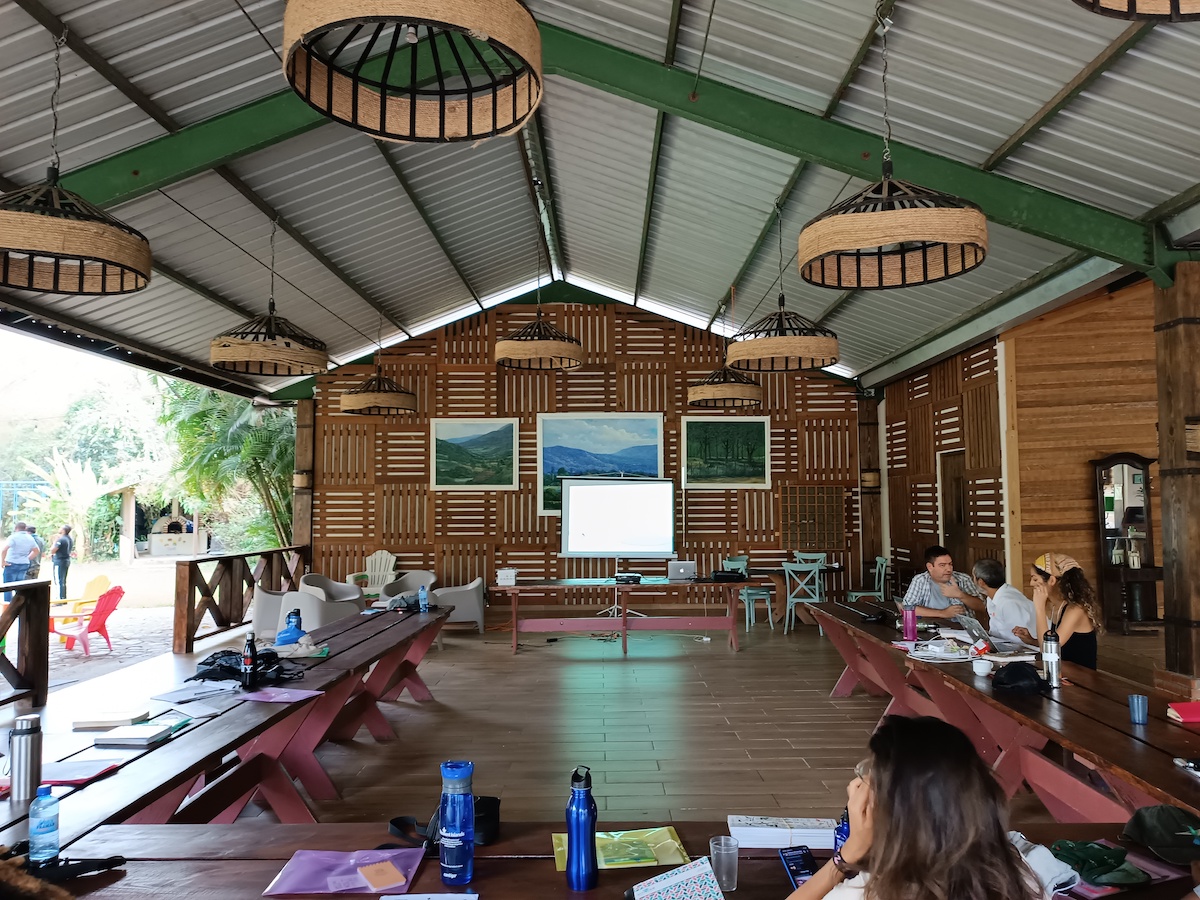
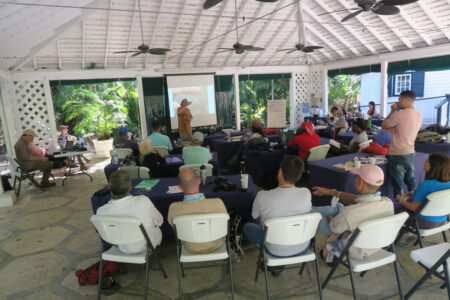
The non-traditional, open-air classroom where learning, sharing and discussions took place during the workshop. (Photo by Elvin Estévez)
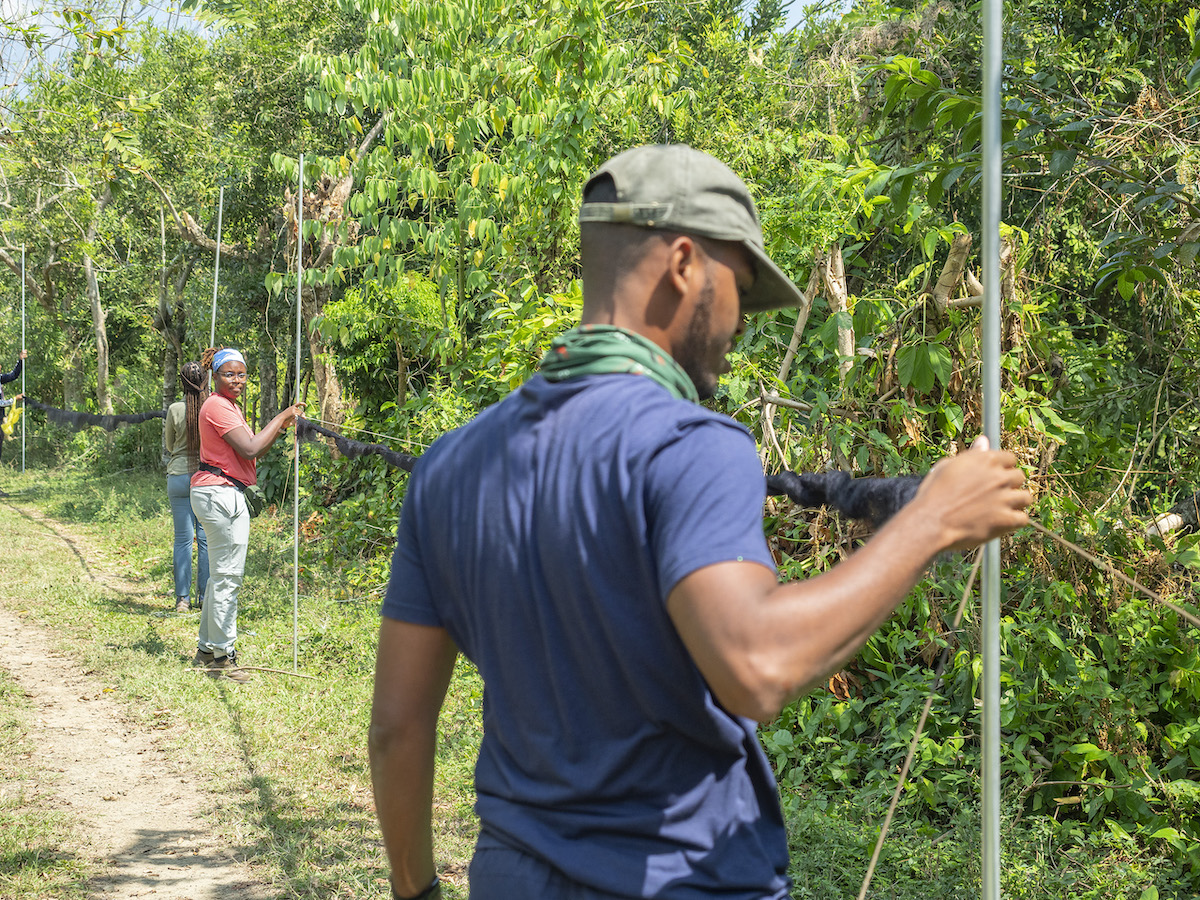
The process of setting up mist nets is an art that is not as boring as it may seem. Well, it’s true that it’s probably not the most exciting part of a bird bander’s day, but there is a certain magic in the process. The first time I saw a mist net was during a bird banding demonstration that Holly did at the Botanical Garden in Santiago. There I learned that setting up and taking down nets is like a climbing sport. We drive stakes firmly or look for a stable attachment, and “climb with the net” to maintain tension at all times. How interesting! Something as methodical and procedural as setting up a mist net can become fun if you look at it with different eyes.
I remember how the other participants were attentive to everything that moved, what the trainers said, and what more experienced banders did. Throughout that first day, I kept learning about the nets, observing how the more experienced bird banders worked, and learned how to enter banding data while eagerly waiting to hold and band a bird for the first time.
Participants learned to set up and close mist nets during the workshop. (Photo by Josh Covill)
“Don’t be afraid, you are in control, not the bird”
As a child, I used to watch many programs on channels like Animal Planet and Discovery Channel with deep curiosity, as I have always found wildlife fascinating. However, animals did not captivate me solely for their majesty, such as lions and other big cats, or for their incredible sizes, like hippos and rhinos. For me, the greatest treasure in observing an animal is being able to understand its unique behavior and social interactions, at both inter- and intraspecific levels. That’s why I was so amazed when I started focusing more on birds as my birdwatching hobby developed. As fellow ornithologists and birders know, there is nothing more unique than a bird’s behavior.
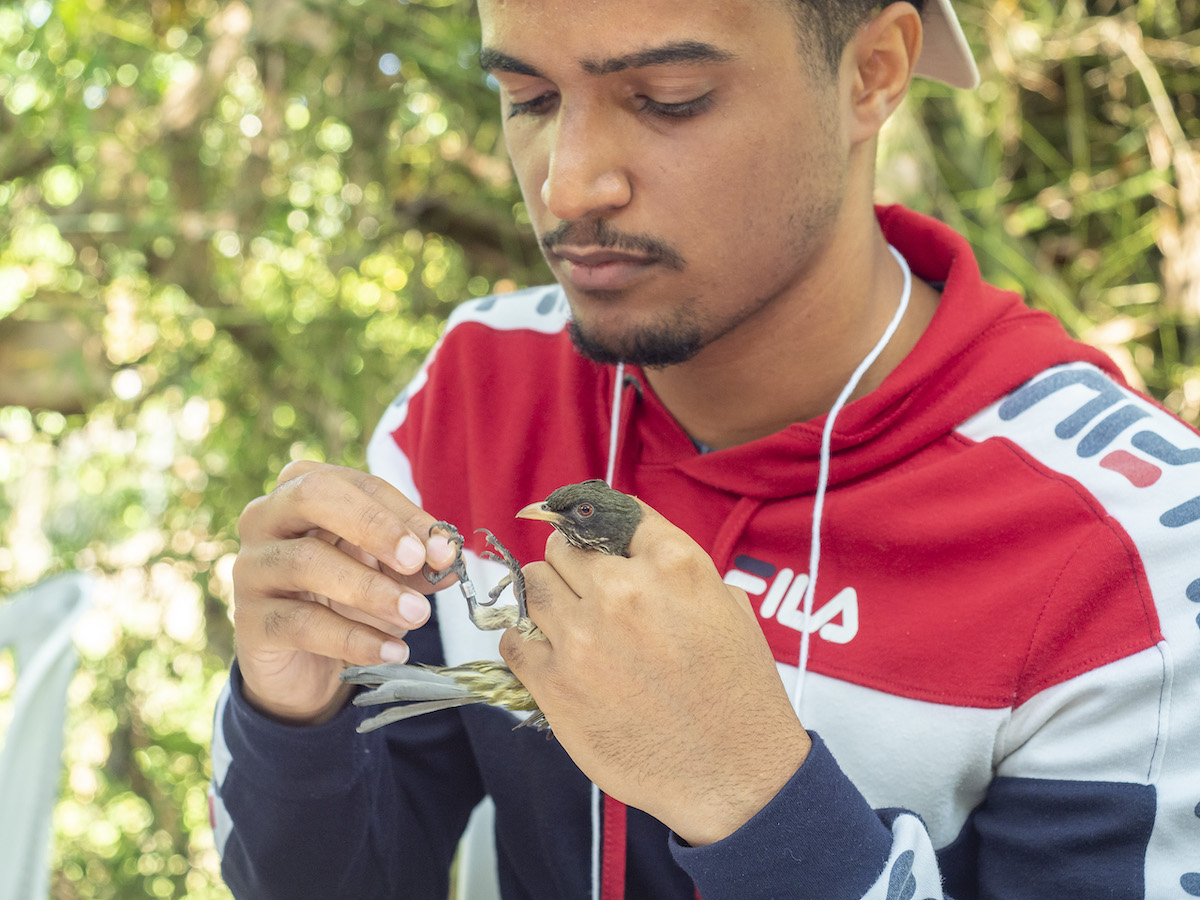
The first time I held a bird in the context of bird banding was at the Santiago Botanical Garden. I was given the opportunity to release a freshly banded bird and it was a beautiful experience. However, it pales in comparison to the moment when I released a bird from its bag, held it properly, and took the necessary measurements before banding it and then releasing it. This whole process was so exciting for me that it came with a mix of nervousness.
When I was about to process my first bird, Juan Carlos (JC) Hernández Ordoñez was the one supervising my work. I am infinitely grateful to JC as he helped me learn the proper technique and gain confidence to safely handle a bird. I remember very clearly how at the beginning my nervousness caused my hands to shake a little when taking measurements and analyzing the bird. It was then that I heard JC say, “Don’t be afraid, you are in control, not the bird.”
Elvin banding a Palmchat. (Photo by Josh Covill)
That is when I realized that my nervousness, perhaps driven by the fear of hurting the bird, was only adding stress that was being transmitted to the animal. If you are nervous and stressed, the bird you are holding will be too. But if you control the situation and remain calm, the bird you are processing will eventually calm down as well.
By the end of the course, about five birds had passed through my hands, and all but one showed no signs of stress that would warrant a premature release. It is amazing to have an animal in your hands for the right purpose, and then release it knowing that someone, another bird bander or even a birdwatcher, may encounter it some day in the future. The banded bird connects us to a shared conservation goal and binds us to it in an intimate way.
Molt, molt, molt!
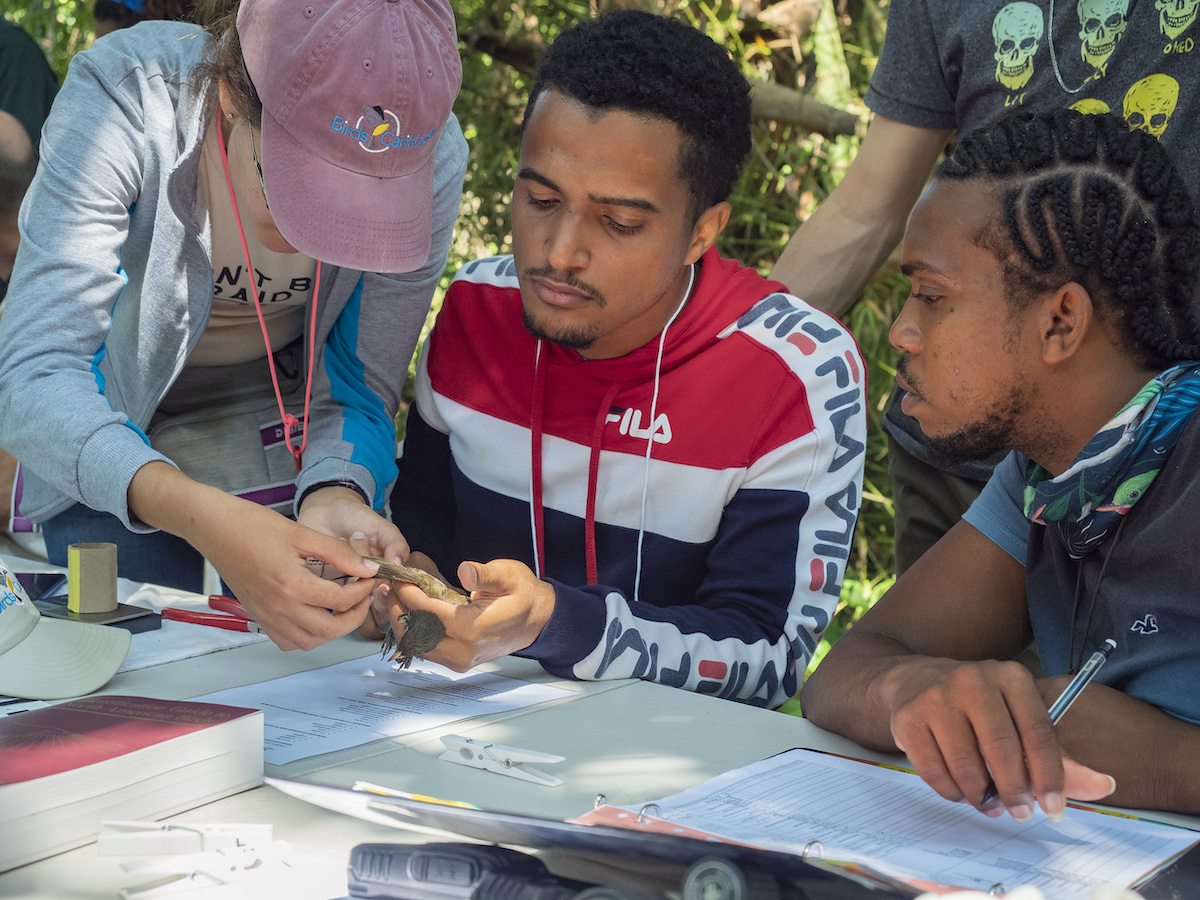
Wait, who said that it was only about knowing how to handle a bird, taking it out of the net, and banding it for release? That’s excellent, but I’m sure you’ll be interested in knowing the age of the individual you’re holding, or at least an approximation. Why is it useful for us to know the age of the bird we’re banding? Well, among many things, it allows us to understand the ecological role that the individual is playing, or will play in the near future. If it has already gone through a reproductive stage, if it will seek to reproduce soon, if it has recently left the nest. Or if it is simply a fully mature individual that has been interacting with the surrounding ecosystem for more than two years. Of course, in addition to age, there are other things we can learn with greater accuracy with a bird in the hand, such as its sex or health status, which, of course, will help us quantify and infer more aspects of the bird’s life cycle.
A bird in the hand allows us to learn about the age and health of the bird. (Photo by Josh Covill)
Molt, also known in birds as the replacement of feathers, is key to bird banders. These patterns of feather replacement, or molt patterns, can help us determine the age of a bird. When I first learned about molt, I was amazed by the beauty of this natural process in all birds. I admit that at first my “operating system” almost failed due to so much information to process. At that moment, I realized how we were all connected by another common interest throughout the workshop: molt! It was incredible. If we were at the banding table, we talked about molt. During and after lunch: more conversation about molt. Before sleeping: a study session on molt. We were obsessed with learning more and more about molt, practicing the Wolfe-Ryder-Pyle (WRP) method (a system for aging birds based on their different plumages) countless times, and even immersing ourselves in Peter Pyle’s book “The Identification Guide to North American Birds” as if it were our “bible.” How much I enjoyed all of that! As my friend Daniela Ventura said, we were becoming “molt nerds” and we were enjoying it.
Daniela and Elvin take a closer look at a bird’s wing while another participant Amonie Holas looks on. (Photo by Josh Covill)
The best part is realizing that we never really stop learning, because Pyle’s book does not have all data about all birds. In fact there are birds for which we have little or no data. Those occasions when we encountered individuals with unique molting strategies, challenging molt limits, and deceptive alternate (breeding) plumages were the perfect setting for creating a session where trainers discussed what the correct code would be to describe the age of the bird, and the rest of us watched attentively as these interesting analyses unfolded. The fact that you can always come across these unique and challenging situations is, for me, part of the magic that birds hold in their molt strategies.
Birds Connecting the Americas
Undoubtedly, one of the most beautiful things about the workshop is the opportunity to meet people with similar interests and visions. Since we arrived at Rancho Baiguate in Jarabacoa on the afternoon of March 7th (a day before the official start of the workshop), we realized this benefit. After dropping off our luggage in the assigned room, we immediately went to dinner and sat at a table with Holly, Maya, Steve, and Zoya. From that moment on, we got to know each other and had many conversations about various topics, and it was very enjoyable. But if there’s one thing that stands out above all else, it’s how birds were the center of many of those conversations. Yes, I understand it may seem obvious, but even though we knew we would meet people who shared the same love for birds and conservation as we do, it’s always an indescribable pleasure to be able to talk and connect in person. Throughout the workshop, we met and interacted with incredible people, and we expressed our desire to work together on different approaches, always revolving around birds.
Coming together to learn. Holly teaches the group about molt. (Photo by Maya Wilson)
Making lasting connections at the bird banding training workshop. From left to right: Daniela, Gerónimo, Elvin and Zoya.
Participants at the banding workshop, earlier this year, in the Dominican Republic. (Photo by Joshua Covill)
Examining a Hispaniolan Woodpecker wing for signs of molt. (photo by Josh Covill)
Elvin banding a Black-throated Blue Warbler (photo by Maya-Wilson)
Finding common ground with people who share similar research and conservation interests is great because valuable knowledge is shared in those encounters. However, this would not amount to much if genuine connections are not formed—concrete connections that allow for efficient and organized collaboration. That’s why we were all very excited with the presentation of the BirdsCaribbean Caribbean Bird Banding (CBB) network and the Institute of Bird Population’s monitoring program for overwintering migratory birds, otherwise known as MoSI (monitoreo sobrevivencia invernal). It’s fascinating!
I want to express how thrilled and engaged we all were when the CBB network was introduced. The fact that we are being presented with a way to stay connected is more valuable than it may seem because it encourages more organized efforts: joint research proposals, shared databases, and fundraising for future projects. Similarly, I find the MoSI program incredible as it specifically focuses on connecting different bird banding stations where data on molt and plumage condition of banded species are provided. What does this do for us? It helps us primarily to understand how birds are changing their molt strategies, which, in addition to updating our records, helps us understand how species are being affected by various factors such as habitat loss and climate change.
My Plus/Delta
The Plus/Delta dynamic was key to the performance and experience we had in the workshop. Every afternoon, we took a moment to discuss the positives of the day (the “Plus”) and what we wanted to improve on in the next day’s work session (the “Delta”). It was very productive, as we listened to each other’s daily experiences, had the opportunity to share our achievements, and set goals for the next day. It is very gratifying to remember how, thanks to Plus/Delta, Gerónimo and I reflected on something that filled me with particular joy and satisfaction.
At the beginning of the article, I mentioned how after each morning’s banding session, we would casually talk about the things we were able to accomplish and say, “But tomorrow I want to be able to do this.” And that’s how, thanks to our trainers and fellow workshop participants, we were able to accomplish each and every one of those things we said we wanted to do.
My Plus, as some of us would say at the end, was the entire workshop. I am infinitely grateful for the opportunity to connect with so many incredible people through birds, and at the same time, learn so much alongside them. My experience was invaluable, and I am satisfied with everything I was able to achieve in those five days. The fact that I was able to band birds for the first time and know that I had the opportunity to contribute useful knowledge through it is amazing. The mini-courses on molt were amazing, our shared obsession made us connect so much that there was not a moment during the workshop when we were not making references to WRP codes or molt limits. Even during the farewell dinner, while we talked about everything, references to aspects of molt in birds would occasionally arise, and it was fascinating.
Elvin receiving his Certificate of Achievement from Holly and Juan Carlos (JC).
And what about my Delta? My Delta is a collection of things. It is clear that I want to continue to educate myself to grow this newly created wonderful network of bird banders in the Caribbean. In addition to that, I want to fight to make my country, the Dominican Republic, a place where ornithology, conservation, and science in general receive their deserved recognition and support from society and authorities. The love or curiosity for nature is in some way part of all human beings, but it is clear that not everyone can be expected to understand the complex ecological processes behind the beauty of the natural world.
Beyond that, I understand that in every nation, there must be a solid system where anyone willing to serve through scientific knowledge can find support and guidance. For this reason, one of my long-term goals (a goal that is shared by many of us attending the workshop) is to advocate for the reinforcement of the importance of avian conservation and government support for research related to it, both in the Dominican Republic and throughout the entire Caribbean.
About Elvin:Elvin Manuel Vargas Estévez, is biologist interested in bird behavior and avian conservation, from the Dominican Republic. He is a high-school science teacher at O&M Hostos School in Santiago and also volunteers with the Santiago Botanical Garden to survey and monitor the bird population in the Garden. Elvin is incredibly passionate about inspiring and educating the next generation of nature enthusiasts. He hopes to continue learning about birds and acquiring new skills that will help him make a positive impact in bird and wildlife conservation.
Acknowledgements: BirdsCaribbean thanks the US Fish and Wildlife Service, US Forest Service International Programs, and all of our members and donors whose support helped make this workshop and our Caribbean Bird Banding Network possible.
To learn more about our Banding Workshops and Caribbean Bird Banding Network, check out the links below:
In 2022, Cuba held its first ever bird banding workshop, part of BirdsCaribbean’s ongoing efforts to build a banding community in the Caribbean. Find out more about bird banding in Cuba and about how the workshop went from Cuban bird bander and ornithologist Daniela Ventura.
Daniela Ventura banding a Cuban Green Woodpecker supervised by banding trainer Juan Carlos Fernández Ordóñez (Photo by Holly Garrod)
The year 2022 was pivotal for bird banding in the Caribbean. Earlier in March, the first Caribbean Bird Banding Workshop was held in The Bahamas. Bird researchers and conservationists from several islands, attended with the goal of learning about ethical and scientific banding protocols and acquiring the skills to successfully run their own banding stations. The long-term dream is to develop a network of collaborators, spread across the region, that can contribute with insights into bird movements and population status of migratory and resident species. This event alone would have sufficed to call the year a landmark. But we Caribbeans like to think BIG.
Therefore, the Caribbean Biological Corridor (CBC) partnered with BirdsCaribbean to host the first ever Banding Workshop in Cuba, which took place from November 4th to the 18th in Santiago de Cuba. Cuba being the largest island in the region with the longest banding tradition, is an essential part of this network. The goal of this workshop was ambitious: gather people and institutions with current banding protocols in the island to organize them into a National and Regional Banding Network and host a North America Banding Council (NABC) certification. NABC certification is widely accepted as the banding standard throughout the Americas. This is the certification that BirdsCaribbean is aiming to use as part of the Caribbean Bird Banding Network.
This workshop represented a milestone in my bird banding career. Back in March, I would not have imagined that my banding skills were going to be tested that soon. The NABC certification is a rigorous process of theoretic and practical exams that evaluates your abilities and knowledge in bird banding, according to the standards and practice of that institution. I accepted the challenge. It meant a great incentive to boost my skills, and if I became certified, I would be confident enough to pursue my long-cherished dream of starting my own banding station in Havana. With those motivational thoughts in mind, and the prospects of seeing some eastern endemic birds that I don’t get to see often, I embarked on the wearisome 12-hours bus trip to Santiago. It would prove to be worth it.
A very long and thin island
Havana, the capital city and my hometown, is 868 km away from Santiago de Cuba, the second most important city in the country, which is famous for its carnival and its scorching sun all year round. The tiresome road trip was endurable thanks to the best company I could possibly have: my friends Esteban Márquez and Juan Carlos Fernández (JC). Their good humor guaranteed the trip was joyful. Actually, sometimes I was just about to doze off and JC interrupted it with a joke. During the long journey to Santiago, we were picking up participants from other provinces.
Arnaldo Toledo checking the molt on an Oriente Warbler at the banding station. (Photo By Daniela Ventura)
The ride took us all night and so we arrived at our destination at the same time the first dawn chorus of birds began singing. The Ecological Reserve Siboney Juticí is a karstic landscape of marine terraces—ancient ocean floor now elevated gazing at the Caribbean Sea. The typical coastal shrubby and thorny vegetation is a paradise for migratory warblers and plenty of Cuban endemics, like the Oriente Warbler, Cuban Gnatcatcher, and Cuban Bullfinch. It was a perfect location for the longest running banding station in Cuba, named after the German scientist that was a pioneer of Cuban ornithology: Juan Cristóbal Gundlach. The first four days of the workshop were scheduled to be spent here, coinciding with the monthly period of banding sessions occurring at the station.
We arrived yawning and with sleepy eyes, only to meet an incredible welcoming committee. Freddy Rodríguez Santana, the leader of the station and the most dedicated and diligent workshop organizer, received us with a beaming smile. The station and protected area staff were also cheerful and active, almost as if it wasn’t 5 am in the morning! They seemed ready to start working and I, honestly, was only longing for a bed.
We didn’t have to wait for long for coffee and breakfast. Behind that magic brew that stirred us all a little, was the heart and soul of the banding station: Emelina. She is the keystone that holds the station and everyone together. Eme (as colleagues called her lovingly) is more than the excellent cook that prepares the delicious food and drinks that keeps you sane in the melting hot weather. She is also a kind and caring woman so all of us, workers and visitors alike, become instantly her spoiled children.
When the introductions were over, Freddy quickly rushed us to the rooms, so we could settle in and rest a few hours before the work started. The objective of the day was setting up the mist nests for the upcoming banding session, and to officially inaugurate the workshop.
Learning about Cuba’s longest running banding station
Mariam Curbelo checks mist nets during a net run. (Photo by Daniela Ventura)
The workflow of a constant-effort banding station has a unique flavor. For twelve years, researchers of BIOECO and the staff of the protected area (some of whom have banding training and certification from Germany) have conducted monthly banding sessions at the reserve. Not even hurricanes nor a pandemic have stopped their committed work. We witnessed its smooth organization from the moment we arrived. Each person plays an invaluable role, from the field technicians that know the exact location of every single net, to the researchers that band the birds and take the data. Setting up the nets is an essential process of every banding protocol. A total of 22 nets are placed along three different trails. The park’s staff kindly took their time to show us and guide us through the process step by step. Left alone they would have done the job in less than half an hour. That is how well they do their job!
With the nets ready to start banding the next day, we headed to the classroom to receive the official welcoming. Thirteen participants from all around Cuba, and my friend Esteban from Venezuela, were going to receive training in the nitty-gritties of banding birds for scientific endeavors. Esteban’s main motivation, along with another three of us, was taking the NABC exam that would allow us to be the first Caribbean certified banders. Even though the stakes were high, we had the best teachers: Holly Garrod and JC Fernández, NABC trainers, and of course, the staff at the JCG station with their gathered experience of 12 years of nonstop field work.
A season of Blackpoll Warblers
A male Blackpoll Warbler in fall migration and winter plumage. Males in breeding plumage in spring look very different—they have a black cap and white cheek patch. (Photo by Anthony Levesque)
I was expecting to meet and get a closer look at birds that I can’t find so easily at mist-nets in western Cuba. But Blackpoll Warblers were a treat beyond my wildest daydreams. I had the privilege to band a few of the dozens of individuals we caught during these three days. Blackpolls are world champions in the bird migration contest. Some individuals are known to fly up to 8,000 km from their breeding grounds in Alaska to their wintering areas in Brazil. They also take a route that leads them to fly out over the Atlantic Ocean sometimes three-days long without making any stop. That easterly path is the reason why they are more commonly found in places like Santiago, and very rare in the western side of Cuba.
Uncommon birds for me, but the daily bread for our banding colleagues in Santiago, were Cape May Warblers and Black-throated Blue Warblers. Cape-Mays can be very tricky to age and sex, because there are a lot of individual variability and overlap, but Black-throated proved easier for me. These challenges of new species were just exactly what we needed to get ready for the NABC exam. A bander must also be prepared to deal with species that he or she has never encountered before. That is why learning the theory behind molt strategies and molt extents in bird families in general is a requirement for getting a better understanding on the topic. And why we not only had the morning sessions at the banding table, but presentations about these subjects in the afternoons. Luckily, we had Emelina´s miraculous coffee to keep our brains working!!
Butter butts in the cloud mountains
La Gran Piedra Biological Station sign. (Photo by Daniela Ventura)
Packing jackets and scarves are not something you would expect for a banding trip to Santiago, which is known as the “tierra caliente” or “hot land” to Cubans. But precisely because I am a daughter of the tropics, temperatures below 20 degrees Celsius already make me shiver. The second part of our banding training was going to take place in the cloud evergreen forest of Santiago’s mountains. From the melting sun and heat of Siboney, we moved to the chilly weather of Gran Piedra biological station. The landscape was surreal. We got up before dawn every day, only to walk into a never-ending cloud. We felt the moisture dampening our clothes and boots, and chilling our bones to the core… Ok ok, you might think I am exaggerating. But if you do not believe me, ask Holly, who knows the winter in cold Montana and was as frozen as me. Luckily, even the sun warms up there, so as the day grew old, the temperature got mildly cozy, neither too cold nor too hot—the perfect weather for banding.
Female Yellow-rumped Warbler, showing off her “butter butt.” (Photo by Karen Gallo)
And the perfect weather too for some northern warblers that do not usually migrate far south, it seemed. I had never seen a Yellow-rumped Warbler before, and for that week at Gran Piedra, I must confess I almost got tired of them. There were just too many, an incredible and rare event not only in Santiago, but in Cuba. These birds are known to be facultative migrants, which means there are years when most of the population ventures farther south, and there are others when they mostly stay close to their breeding areas. Scientists do not yet understand well the mechanisms regulating these cycles, but they believe it has something to do with their favorite food, caterpillars, which also have complicated population cycles. Imagine our bewilderment when during one net check there were 15 “butter butts” in just a single net, waiting for us to band them. They proved a “hard pill to swallow” because of the variation in their winter plumage.
Esteban and I were actually quite worried we that we might end up with a somewhat tricky Yellow-rumped during our NABC exam. And if you know Murphy´s Law, well as a matter of fact, that was just what happened. But it allowed us to practice our skills before the exam. An important lesson we learned during that week was that in this banding business, accuracy is better than precision. If we are not certain of a bird’s age or sex, it is better to be less precise by saying “I honestly don’t know”. Bander’s ethics are important not only regarding bird safety, but also to ensure the quality of the data we are gathering.
Uncovering the mysteries of Cuba’s iconic endemics
We also had the chance to band some of the more stunning and iconic endemics, like the Cuban Tody, Cuban Pygmy-Owl, and Cuban Trogon. The study of our resident birds has for a long-time been a pending subject of Caribbean ornithology. There are mysteries waiting to be unraveled and bird banding can allow us to unearth some of them. For example, it can help us decipher the reason behind todies having both blue and brown eyes. Or if there might be size or plumage differences among the sexes in trogons where males and females appear to look identical. I was lucky to band one of the two Cuban Trogons we caught at the nets. These were also the first Trogons ever banded in the Gran Piedra station!! This was a great opportunity for me to practice the cone-shape or “ice cream” grip, the handling method used for birds with short tarsus (the lower part of a bird’s leg) like trogons. Using the appropriate handling technique for each bird is one of the first lessons for a bander to master. Our aim is to always improve and update our knowledge and practice to ensure bird safety.
Testing Times
Daniela and Josmar consult Pyle the bird bander’s “bible” and discuss molt with JC. (Photo by Mariam Curbelo)
The days passed in a blur of banding practice in the morning, molt theory during the afternoons, and night outings to marvel at the pair of Stygian Owls that lived in the pine trees surrounding the banding station. But for the four of us who had a rapidly approaching and demanding exam, our days also included a lot of study of Pyle, the bird bander’s “bible,” looking through wing pictures, and reading of the bander’s study guide. Eventually, the first day of the certification arrived. The examiners put to test our abilities at extracting birds from the nets, and also our handling and banding skills. The practical exam also included the setting up of mist nets.
That afternoon, we had the most dreaded and unnerving part of the certification: the four-hour long written exam that comprised questions ranging from bird safety to molt theory. We needed a minimum of 80% of correct answers to be qualified as banders. I remember the feeling of relief when I handed my exam sheet to Holly. Evaluations were not finished yet, so I went to bed tired but at least more relaxed knowing that the toughest part was over. During the remaining sessions we were going to be examined in the use and understanding of the Pyle guide, and a test where we were expected to accurately identify species, age, and sex from 10 bird photos.
Supporting Success
As we were drawing near the end of the certification, exhaustion and tension were high. I must acknowledge the supportive spirit of the workshop participants, the station’s staff, and our examiners alike. They all put up their best smiles, and constantly cheered us on. Emelina almost fed us too much and made us drink nearly too much coffee. But I don’t have enough “thank you” words for every person that tolerated my stressful humor or made me laugh those days. I know that I owe them a huge debt that I can now call myself a NABC certified bander!!
For in the end, thanks to our trainers and all the support I received, I achieved my goal – I left the workshop as a NABC certified bander, as did Josmar! Later, two of my Cuban colleagues Carmen Plasencia Leon and Arnaldo Toledo, would finish the final portion of the exam and leave the second BirdsCaribbean Banding Workshop in the Dominican Republic (February 2023) as NABC banders. Back in Fall 2022, Zoya Buckmire from Grenada received her NABC certification whilst interning at Klamath Bird Observatory (KBO) in Oregon. This means that in the last year the Caribbean Bird Banding Network has now helped the first five Caribbean banders get their NABC bander certification. This lays the foundation for the future growth of the network.
Processing a recaptured Oriente Warbler, a Cuban endemic and a focal bird at Santiago´s banding scheme. (Photo by Daniela Ventura)
Partipants heading to-open mist nests placed alongside the road at La Gran Piedra Biological Station. (Photo by Daniela Ventura)
Arnaldo Toledo reads a combination of metal and color bands on an Oriente Warbler. (Photo by Daniela Ventura)
An endemic Cuban Pygmy Owl in the hand.
I said earlier that the Cuba Banding Workshop was a milestone. But it wasn´t because I proved myself in a challenging exam. It was the invaluable lesson that if we as a country want to have a broad understanding of our bird population dynamics, we have to work with a team spirit. We have to go for independence and self-sufficiency and develop our own research objectives, and training opportunities. This workshop was the first step towards that ambitious goal.
About Daniela:I have a Bachelor’s degree in Biology and I am part of the Bird Ecology Group of the University of Havana. As a professor trainee I give lectures and seminars in Ecology and Vertebrate Zoology. I am also a graduate student. My research interests include bird population dynamics, movements, and migration. I am a passionate bird bander and molt nerd, and recently created a banding station at the National Botanical Garden in Havana, a dream project of mine. I believe that long-term monitoring of bird populations will greatly increase our knowledge about the ecology of our resident and understudied species, and will highlight the importance of Cuba and the Caribbean as a wintering and stopover site for Neotropical migrants.
Science communication and public outreach are also very close to my heart. Organizing activities for the Caribbean Bird Endemic Festival and World Migratory Bird Day, and managing the social media accounts of the Bird Ecology Group on Instagram and Facebook, perfectly combine my interests in bird conservation and public outreach. I am a fervent advocate of the idea that research needs to be shared in every step of the process, and that science must be taken out of the ivory tower of academia and be made by and for all people. Empowering locals and creating community alongside building conservation networks should be the goal of all Caribbean islands. As a proud member of BirdsCaribbean, my dream is to keep contributing to the development and success of bird research projects in the region, as well as educating the next generation of conservationists.
Acknowledgements: BirdsCaribbean thanks all of our members and donors whose support helped make this workshop and our Caribbean Bird Banding network possible.
Celebrate the Caribbean Endemic Bird Festival (CEBF) with us! Our theme in 2023 is “Water: Sustaining Bird Life,” highlighting the importance of water conservation to both humans and birds. Have fun learning about a new endemic bird every day. We have colouring pages, puzzles, activities, and more. Download for free and enjoy nature with your family at home.
Endemic Bird of the Day: Chestnut-bellied Cuckoo
Old Man Bird, as the local admirers call it, is a stunning bird endemic to Jamaica. This large cuckoo stands at 48cm (19in) and is distinguished by its thick, dark gray decurved bill, creamy white throat fading into pale gray on the breast, and contrasting chestnut belly and underparts. Its broad, long, dark gray tail is tipped with large white spots, while its legs are gray.
The Chestnut-bellied Cuckoo (Coccyzus pluvialis) is found in moist woodland, wooded cultivation, or open thickets in the hills and mountains of Jamaica. During the winter, it descends to lower elevations but is only found near the coast in the wettest places. It runs along branches like a large rat or sails silently on extended wings from one tree to another.
The Chestnut-bellied Cuckoo feeds on lizards, mice, insects, caterpillars, nestlings, and eggs.
Even though the Chestnut-bellied Cuckoo is known for its hoarse quak-quak-quak-ak-ak-ak-ak-ak call, which is most frequently heard from April to June, it makes a very quiet landing in trees. Its nesting period is from March to June, and the nest is an untidy platform made of sticks in the middle or upper canopy of tall mature trees.
While the Chestnut-bellied Cuckoo is fairly common and widespread in Jamaica, it is still important to conserve this species due to threats such as habitat loss, predation by non-native invasive animals, and climate change. To help conserve this bird, individuals can support organizations that protect and restore bird habitats, advocate for conservation policies, and participate in citizen science programs that monitor bird populations.
Overall, the Chestnut-bellied Cuckoo is a unique and fascinating bird that adds to Jamaica’s rich biodiversity. Its distinctive appearance, behavior, and call make it a remarkable species worth observing and protecting.
Download our West Indies Endemic Bird colouring page. Use the photos below as your guide, or you can look up pictures of the bird online or in a bird field guide if you have one. Share your coloured-in page with us by posting it online and tagging us @BirdsCaribbean #CEBFfromthenest
Listen to the call of the Chestnut-bellied Cuckoo
The call of the Chestnut-bellied Cuckoo is a low, growling “aahhhh” or long “quah-quah-aahh-aahh-aahh-aahh-aahh.”
Puzzle of the Day
Click on the image below to do the puzzle. You can make the puzzle as easy or as hard as you like – for example, 6, 8, or 12 pieces for young children, all the way up to 1,024 pieces for those that are up for a challenge!
A beautiful Chestnut-bellied Cuckoo perched in a tree. (Photo by Dominic Sherony)
Chestnut-bellied Cuckoo, Trelawny. Jamaica. (Photo by Michael Warner- Macaulay Library-ML510000521)
Activity of the Day
FOR KIDS: This year our theme for the Caribbean Endemic Bird Festival is “Water: Sustaining Bird Life.” We want to highlight the importance of water conservation to both humans and birds.
We often see birds flying, preening, and feeding, but rarely do we see them drinking water. This does not mean that water is not important to birds.
Birds need water just as much as we do. Drinking water helps them regulate body processes like digestion. Water also keeps birds clean and cool on hot days when they take a splish-splash in a puddle, gutter, or backyard bird bath. Many birds also rely on wetland habitats, such as our ponds, salinas, marshes, mangroves, rivers, and coastal waters.
In our activity you can create your own poster to show how important water is to birds. Draw in the various ways birds use water!
FOR KIDS AND ADULTS: Enjoy this video of a Chestnut-bellied Cuckoo up high in a tree.
The Chestnut-bellied Cuckoo is endemic to Jamaica – it is one of many birds that can only be found on this Caribbean island and nowhere else in the world! Discover more about the endemic birds of Jamaica in our blog article about the launching of a new poster featuring beautiful illustrations of all these special birds. You will also find a link to download a pdf of this lovely poster.
We’ll be participating in this year’s Global Big Day (GBD)—the biggest birding day of the year—on Saturday, May 13, 2023, and raising funds to grow our Caribbean Bird Banding Network.
We are bringing back our popular teams competition, and celebrating together the bird diversity, excitement, and camaraderie that’s associated with Global Big Day.
Last year, Global Big Day virtually brought together more than 51,000 birders from 201 countries and submitted 132,000 checklists with eBird. This is the current world record for a single day of birding.
For BirdsCaribbean, the event was also successful—15 teams with members from 29 countries reported a total of 1,078 species and raised $13 734. We had so much fun doing this. Together we can make this year even better! Learn more below and on our Global Big Day GiveButter Teams page – join the fun here!
24 hours of learning, counting and sharing
During peak migration time in the spring, birders around the world head out to their favorite birding spots, or venture into new areas, to see, hear and record as many bird species as they can in a 24-hr period of time. This event helps scientists understand global bird populations and raises awareness of issues affecting them—and we need your help to do it!
No matter where you are, you can submit important data, via eBird checklists, about the birds around you. You don’t need to be an expert birder or spend the entire day looking for birds. Just 10 minutes of birding in your backyard or from your balcony will count too.
But birding is more enjoyable when done with a friend or a group. We are again calling on our community to bird together in virtual teams (you can decide if you want to join your national team or not) during Global Big Day. And engage in friendly competition to see which team can:
1) collectively see the most species of birds, and
2) raise the most funds.
Funds raised by BirdsCaribbean GBD participating teams will be used to grow our Caribbean Bird Banding Network by providing bands and other resources to Caribbean banders, providing more training opportunities and supporting bird banding projects across the islands.
The ‘Join a Team’ button is located just below the header graphic.
If you choose to create a team, personalize it with a fun name, photos and your own lingo. NOTE: if you are outside the US or Canada, we will need to assist you with the first step of creating your own team; after this you will be able to manage the team (email [email protected] and she will get you set up pronto!)
All team leaders and members should then invite family, friends, colleagues, and members of your birding community to join your team and/or donate to your team. It helps to set your own personal fundraising goal to help your team reach its overall goal!
By inviting people to your team, you are
(1) raising awareness for BirdsCaribbean and the Caribbean Bird Banding Network,
(2) helping to raise funds for Caribbean bird research and conservation, and
(3) promoting Global Big Day, citizen science, and the importance of conserving birds and their habitats.
By doing so, you will have (1) helped advance knowledge of Caribbean birds through bird banding which gives us a more detailed look at birds’ life histories, and (2) encouraged that team to give it their all on Global Big Day.
and/or . . .
3. Committing to spending some time (or the entire day!) birding on Global Big Day (May 13), being sure to keep track of what you see and then entering that information into eBird. We hope everyone will do this, whether or not they join a team or fundraise.
Group of birders in the Dominican Republic. Photo by Zara Palmer.
This will be a fun event to fundraise for and get excited about birds! Be ready to visit birding hotspots or set yourself up in a safe place* and bird for as much of the day as possible, knowing that all of your teammates, friends, and BirdsCaribbean community members are doing the same!
If birding from the Caribbean, you should plan to submit your observations to eBird Caribbean. Then we’ll tally them up and see how we all did! We will send out more information about this as the event draws closer.
Why this is Important
The insular Caribbean is a critical region for birds. There are 176 species that occur here and nowhere else in the world! In addition, the islands provide a winter home for numerous migrants—many stay 6 months or longer while others rely on the islands as stopover sites to rest and refuel during their long journeys north and south.
The development of a strong regional conservation community, through capacity-building training and career development opportunities at the island level for local people, is critical to ensure the sustainable preservation of island birds and their habitats.
How your Donation Will be Used
This Global Big Day fundraiser will support the Caribbean Bird Banding (CBB) Network, allowing us to continue providing bands and other resources to Caribbean banders, host more international training workshops , support Caribbean banders to attend internships (read about Zoya’s incredible internship at Klamath Bird Observatory) or other opportunities to practice and develop their skills, and grow and expand this network to more Caribbean islands.
Bird Banding Training Workshop participant David Walters placing a band on the leg of a Palm Warbler. Photo by Josh Covill.
The first webinar, ‘Banding Together – Creating the Caribbean Bird Banding Network, Part 1’ will be held on Friday, April 21 at 2 PM EDT. Join the BirdsCaribbean Caribbean Bird Banding (CBB) Network live and learn what bird banding is, its applications and how it can change the future of Caribbean bird conservation.
The second webinar “Banding Together—Creating the Caribbean Bird Banding Network, Part 2” will be held on Thursday, May 4th at 4 pm EDT. Several Caribbean Bird Banding (CBB) Network members, including Daniela Ventura del Puerto (Cuba), Zoya Buckmire (Grenada), Hector Andujar (Dominican Republic), and Dayamiris Candelario (Puerto Rico), will share what they have gained from being part of this initiative, and exciting plans for expanding bird banding in the Caribbean.
As with everything in the Caribbean, we will be successful when our whole community pitches in, so let’s do this together! We need your help to do this!
Team Up to WIN
Prizes will be awarded to
the team that raises the most funds
the team with the most creative name and stylish fundraising page
the team that sees the most bird species on Global Big Day
the “country/island team” that sees the highest proportion of their birds on Global Big Day (to control for differences in the number of species on each island!)
the team with the best “find” of the day (unusual, rare, plumage aberration, etc.)
the team with the best bird photo of the day (must be posted on eBird along with your list)
BirdsCaribbean is bringing you some highlights from the Journal of Caribbean Ornithology in our new feature “Just Published in JCO.” Here Zoya Buckmire, the Lead Copy Editor for the Journal of Caribbean Ornithology, tells us all about a research note documenting the use of manmade materials by birds to build their nests.
Black-faced Grassquit nest with linen and cotton twine, and strands of plastic interwoven with natural materials. (Hannah Madden)
As human influence over the environment increases, so too does the distribution of man-made materials in natural spaces. More and more birds are encountering human debris in their habitat and interacting with these materials in various, often life-threatening, ways, such as mistaking them for food or becoming entangled in them. In this research note, Hannah Madden and Hailley Danielson-Owczynsky document landbirds in St. Eustatius using human debris in an interesting but potentially dangerous way. Their observations shows how pervasive our impact is on the world around us.
But how did this study come about? Our authors found the first nest almost by accident. As they were doing some yard work at Hannah’s property, the two came across a Black-faced Grassquit nest with plastic woven through it. Though they didn’t think much of it at first, a few days later they regrouped and decided to intentionally search the surrounding areas for more nests to see how common the phenomenon was.
They found a total of 19 nests, two which contained man-made debris, including linen, cotton, and polyester fibers and twine and pieces of white and clear plastic bags.
The second nest (shown in the photo below), belonging to a Bananaquit, wasn’t even found by the authors! Hannah’s daughter Lalia takes the credit for that, as she tagged along to the field visit. “She has a very sharp eye,” commented Hannah. “She helped us find the second nest, located along a fairly busy road, that I had overlooked entirely.”
Bananaquit nest with white and gray polyester fibers interwoven with natural materials. (Hannah Madden)
The biggest challenge to this research was the vegetation—acacia and other thorny plants provided many a hazard in the field. The authors were also discouraged by the “depressing amount of garbage in the vicinity, which of course, only makes this study that much more important.
The authors noted that the light-colored man-made materials may increase their visibility to predators leading to higher predation rates, but this needs further study. Their hopes are that their work “will encourage more people in the Caribbean to look out for man-made materials in landbird nests and conduct their own simple study,” said Hannah. “There is so little published literature about this phenomenon, yet it is likely a pervasive issue in the region.” Indeed, plastic pollution is severe throughout the Caribbean. Only through studying its many impacts on bird populations can we begin to understand – and address – this issue.
The Journal of Caribbean Ornithology is a peer-reviewed journal covering all aspects of ornithology within the Caribbean region. We welcome manuscripts covering the biology, ecology, behavior, life history, and conservation of Caribbean birds and their habitats. This journal provides immediate open access to its content on the principle that making research freely available to the public supports a greater global exchange of knowledge.
Bananaquits have a wide distribution and are found throughout the Caribbean, making them a perfect species to use in this study. (Photo by Carlos Henrique L.N. Almeida)
BirdsCaribbean are bringing you some highlights from the Journal of Caribbean Ornithology in our new feature “Just Published in JCO”. Here Zoya Buckmire, the Lead Copy Editor for the Journal of Caribbean Ornithology, tells us all about an article exploring the topic of Avian Malaria using data from Bananaquits.
Like humans, birds are susceptible to parasitic infections, including avian malaria. Similarly, they show variations in hemoglobin structure (a protein contained in red blood cells that is responsible for the delivery of oxygen to tissues) that may influence their susceptibility to these infections. Using one of the most widespread West Indian species, the Bananaquit (Coereba flaveola), Humphries and Ricklefs aimed to relate variation in hemoglobin structure to avian malaria infection across several islands. In this paper, they present the results of this fascinating study, with suggestions for appropriate markers for further biogeographic analyses.
Figure 2 for the article in JCO shows the locations that the samples came from, reflecting the wide distribution of Bananaquits in the region
This study came about from Humphries’ general interest in the varying distribution of avian malaria parasites and infections across the Caribbean. Bananaquits were a great focal species for this study, being so widespread throughout the region and with documented variability in their parasites among populations, even on the same islands!
The existence of a long-term dataset of Bananaquit blood samples, collected from 2004 to 2017 by Ricklefs and numerous former students of his graduate lab, perfectly set the scene for Humphries to dig into her questions. As the samples were already collected, Humphries was able to skip the field work and jump straight into data analysis. Humphries comments “Although I prefer being in the field in general, data analysis for this project was an adventure!”
She was able to design and optimize the protocols to analyze the blood samples, looking for a link between the structure of specific blood markers and infection by avian malaria parasites.
A Bananaquit in the hand (caught for banding). (Photo by Holly Garrod)
While the authors intended to study the structure of both alpha and beta globin (two key components of hemoglobin), they could not isolate the beta globin, they say “This is especially unfortunate because in humans, it is the beta globin that enables malaria resistance”. This important link may have had implications for human health and further studies of the disease in birds. For the alpha globin, the results were still not ‘significant’, as they did not find any relation between it and susceptibility to avian malaria.
Even though the study results were not as expected, there is always an opportunity to learn. Humphries still felt it was important to publish their results, and we agree. “Publishing null results is a good thing to do! This will save the next researcher the effort of asking the same questions I did and may stimulate someone else to track down that beta globin after all!” Plus, the alpha globin has potential as a genetic marker for further biogeographic studies, and this sets the foundation for a better understanding of population variation, avian malaria, and by extension, malaria in humans.
The Journal of Caribbean Ornithology publishes the peer-reviewed science on Caribbean birds and their environment that is so important to inform conservation work. All of the publications are free and open-access.
More featured articles from “just published in the jco”
A pair of Ospreys (Pandion haliaetus ridgwayi) constructing a nest atop one of the higher cliffs on the north end of Booby Cay, The Bahamas, on 25 October 2015. (Photo by Shelley Cant-Woodside)
BirdsCaribbean are bringing you some highlights from the Journal of Caribbean Ornithology in our new feature “Just Published in JCO”. Here Zoya Buckmire, the Lead Copy Editor for the Journal of Caribbean Ornithology, tells us all about an article characterizing the birdlife of Conception Island National Park in The Bahamas, read on to find out more about this paper, including an exciting story from the field.
In the midst of the central Bahamas archipelago lies the tiny Conception Island National Park. This multi-island park is designated as an Important Bird Area, but until now, its bird diversity was poorly documented. In this paper, Reynolds and Buckner present the first avifaunal list for this park in over a 100 years, with a whopping 68 species, three of which are Bahamian endemics.
Although this is a much-needed update to the bird list of the park, it was not birds that first drew the authors to Conception Island. Reynold and Buckner’s numerous visits to the area, between 1994 and 2017, focused rather on lizards and snakes. But they made the most of each visit by recording everything else they observed, including the birds.
Years later, as Reynolds compiled their collective data from over the decades, the team decided to collate and publish the bird list as they noticed a glaring knowledge gap. “All the other islands surrounding Conception Island had published bird lists, but Conception did not. Conception Island is one of the most important National Parks in the Bahamas, so we felt that we needed to characterize the bird fauna there.” And what an important characterization it is! The last bird lists for the area were published in the late 1800s and did not exceed 13 species; the new estimate of 68 species is a fivefold increase and a testament to the ecological value of the National Park.
A Cape May Warbler. (Photo by Dax Roman)
As is often the case with nature, nothing can be studied in isolation, and in 2015, the authors’ herpetological (reptile-based) and ornithological (bird-based) interests collided. Reynolds gives the following anecdote: “My favorite moment was in 2015 when I found an endemic Critically Endangered silver boa stalking a sleeping Cape May Warbler in the middle of the night. The boa stalked it for about 10 minutes, then lunged to grab it and missed! The boa ended up with a mouth full of primary feathers, and the bird escaped.The boas were only discovered in 2015, so before that we had no idea that a large predator might be hunting the birds on the island. It turns out that the boas hunt the migratory birds as they rest on the island!”
It is always fascinating to witness nature in action, and we only wish that he had gotten a video of that moment!
This study was not without its challenges, of course. The difficulties of conducting research in the Caribbean are only amplified on remote islands. Expenses were a major limitation for Reynolds and Buckner. Trips to and stays on Conception Island were limited by their budget, so they had to maximize each visit. They did this by spreading their efforts over as many locations and at as many different times of day as possible. This produced bird data that was not systematically collected nor suitable for in-depth analyses, but perfect for the inventory presented here.
The brackish pond on the east end of Booby Cay in 2016. This brackish pond is not permanent and is sometimes completely dry. (Photo by R. Graham Reynolds)
The bulk of new bird records were waterbirds and shorebirds from this pond. Including Yellow-crowned Night Heron (pictured). (Photo by Heron-Hemant Kishan)
As for main takeaways, Reynolds and Buckner want to emphasize that “Conception Island is a tremendously important island for Bahamas wildlife, [and] it is hard to overstate how important it is,” both for seabird breeding colonies and as a stopover for migratory birds.
They are hopeful that this research highlights the value of the Conception Island National Park and the need to both study and protect it. The authors themselves have not been back to the area since 2018 due to changes in The Bahamas’ scientific permitting process, but hope that this paper serves as a step in the right direction. Conception Island National Park is a treasure, and further research will be critical for its continued management and conservation.
The Journal of Caribbean Ornithology publishes the peer-reviewed science on Caribbean birds and their environment that is so important to inform conservation work. All of the publications are free and open-access.
Dayamiris holding a bird during a banding session. (Photo by Omar Monzón)
Dayamiris Candelario and her husband Omar traveled from their home island of Puerto Rico to the Willistown Conservation Trust in Pennsylvania for a one-month bird banding internship. As someone new to bird banding it was a steep but rewarding learning curve for Dayamiris. Find out more about her experiences in her blog post below.
“In my hand I held the most remarkable of all living things, a creature of astounding abilities that eludes our understanding, of extraordinary, even bizarre senses, of stamina and endurance far surpassing anything else in the animal world. Yet my captive measured a mere five inches in length and weighed less than half of an ounce, about the weight of a fifty-cent piece. I held that truly awesome enigma, a bird.” (A. C. Fisher Jr.)
My work as an environmental educator at Centro Ambiental Santa Ana, a nature center located in an urban forest in Puerto Rico, involves many activities in bird education. As a member of staff for more than twelve years, I have presented many Endemic and Migratory Birds Festivals and birdwatching workshops for urban residents of the island.
Dayamiris offering a guided hike to Girl Scouts about Puerto Rican birds. (Photo by Yaritza Bobonis)
It is here, while preparing for these activities, that my interest in birds peaked. I was often in awe at how these tiny and fragile beings could face so many perils throughout their lives. My daily tasks as an interpretive guide emphasize birds as a key to get my audiences hooked in our Puerto Rican nature. But before the experience that I’m about to narrate, a question always lingered in my mind: “How many secrets do birds hold to overcome their life’s obstacles and still live amazing lives?”
A beautiful setting for bird banding
A Gray Catbird, well known for its catlike “meow” calls and “orange underpants” (cinnamon undertail coverts).(photo by Alan D Wilson)
It was a serendipitous invitation that brought me closer to getting answers to my questions about birds. I was invited to release a live Gray Catbird (Dumetella carolinensis) on September 1st of 2022, just after arriving at the Rushton Woods Preserve Bird Banding Station in beautiful Pennsylvania, a natural protected area managed by the Willistown Conservation Trust (WCT).
I was beginning my one-month bird banding training internship with my husband, Omar, hosted by the Willistown Conservation Trust (WCT), in collaboration with BirdsCaribbean, the Powdermill Avian Research Center of the Carnegie Museum of Natural History, and the Northeast Motus Collaboration.
We stayed at the beautiful historic house located next to the Rushton Farm, part of the Preserve. We felt the chilly autumnal breeze in the grasslands, bushes, and meadows. I let the sweet scent of the goldenrod flowers fill my lungs, while listening to the soft rocking of tree branches as the wind commanded their movement. Whenever we walked towards the bird banding station at dawn, we heard the lively chirping and tweeting of the birds. We wanted to learn as much as we could. After participating in the bird banding training activities, which started very early in the morning until almost midday, we would work remotely in our respective jobs. And in the evenings, we would devour all the literature that the Bird Band Station uses for their activities.
The farmhouse at Rushton Woods Preserve, Willistown Conservation Trust
From a beloved pet bird to a wild bird
I still remember what I felt when Blake from WCT put the bird in my hand to let me release it after it was banded. I have held a live bird before: my dear Chuqui, a Cockatiel (Nymphicus hollandicus) that taught me that her dearest person EVER was my husband. He died at fifteen years of age in the hands of her beloved. I learned about Chuqui’s juvenile and preformative plumage; how to correctly sex her (we thought she was a male until she started laying eggs!); her molt once per year (and the mess of feathers that would follow); and how to not expose her to artificial light to avoid her laying eggs. I remember feeling her tiny bones and observing carefully the differences of her body feathers from the wings and tail.
Dayamiris at Powdermill. (Photo by Omar Monzón)
Our experience at WCT was different, however, because I was touching for the first time a bird that faces the daily challenges of being wild and free—the “Green Fire,” as described by Aldo Leopold in the film, “A Land Ethic Of Our Time.” I remember feeling the vibration of the Gray Catbird’s body, the warmth of its belly, and how it grabbed my fingers tightly with its toes. That was my first encounter with the daily work of education, research and conservation of this bird banding station, which has been operating for 14 years, as part of the WCT’s Bird Conservation Program.
How (or how not) to extract a bird
In the following weeks, Lisa Kiziuk, Director of the Bird Conservation Program, and her staff introduced me to the station’s inner workings as well. I learned the proper timing and setting up of mists nets and their location; how to extract birds from nets ;the different bird banders’ grips to ensure birds are handled safely ;the most common species banded; species that are selected for radio tags to detect migration patterns; and the different sizes of bands used. Measurements were taken to determine population health, habitat preferences, and to detect changes that could signal a threat. Some of these measurements are: the wing chord, weight, fat deposits, molt, and aging, which was the most challenging for a novice like me.
Dayamiris and her husband Omar band birds at WTC. (Photo by Blake Goll)
I remember how frustrated I was the first time I tried to extract birds because I was fearful that I might hurt them. I later realized that bird extraction is a puzzle with a time limit—you need to figure out in a short time how to free wings, head, legs, and feet from the thin and entangled fibers of the nets. In particular, I had some delightful moments of laughter from my encounters with the House Wren (Troglodytes aedon). After several failed attempts at the net to extract them, they escaped and looked at me triumphantly from a nearby branch! In the end I did extract one, but it still got away when I was about to band it! Thanks to the patient training, supervision, and guidance of Lisa and her staff, my final bird banding tally was 41 birds from at least eleven different species – most en route to their southern journey, and some not commonly seen wintering in Puerto Rico.
The meow of the Gray Catbird and the blue of the Blue Jay…
One of the most common species at the station, the Gray Catbird, was very memorable because it is not as common in Puerto Rico. Therefore, whenever this bird is spotted in the island, a generalized buzz from birders would follow in order to watch and hopefully listen to this bird’s peculiar “meowing” while wintering in the Caribbean. I proudly banded 16 of them (comprising 40% of my first bird banding training batch) – which created envy among my local fellow birders!
The Northern Cardinal also left a memory and some bite marks in my fingers too!! I was told this species was a “biter” and I can proudly declare that I survived its powerful beak. Also, I was in awe when I had the pleasure of banding a Blue Jay (Cyanocitta cristata) – a beautiful and HUGE bird that stayed calmly in my grip while I banded it. I did observe its exceptionally long feathers (resembling silky hair) as I blew on its head, breast and belly looking for molt and fat deposits. I have never seen a blue so magnificently blue!!
A stunning male Northern Cardinal – not a bird seen in the Caribbean!
A gorgeous Blue Jay – a treat for Daymi to see and hold up close!
…And a very special bird
But I have a special place in my “bird bander’s” heart for the Wood Thrush (Hylocichla mustelina). I will never forget how I often peeked at the bird bag to take hold of it. I always found a beautiful large eye looking at me. Next, I would feel the warmth of its round belly, while its bright brown and streaked plumage seemed as if it was painted on the bird. Some other species that I banded included: Swainson’s Thrush (Catahrus ustulatus), Ovenbird (Seiurus aurocapilla), Gray-cheeked Thrush (Catharus minimus), American Redstart (Setophaga ruticilla), Hairy Woodpecker (Dryobates villosus), and Downy Woodpecker (Dryobates pubescens).
“A very special bird” the Wood Thrush
A striking black and white, female Hairy Woodpecker
Motus installations and wild apples: A great learning opportunity in Vermont
Dayamiris helping to assemble the Motus station. (Photo by Omar Monzón)
We also learned from WTC about efforts through the Northeast Motus Collaboration to promote bird conservation through research, especially by installing antennas to track the movements of birds in the northeast of the U.S. We accompanied the antenna installation team in their task of installing three antennas in the beautiful state of Vermont: one at Bennington College, another at Wolcott Research Station at the University of Vermont, and the last one in Smugglers’ Notch Resort in Jeffersonville. Assisting them in installing these antennas with their metal tubes, cables and bolts served as a reminder of the amount of background work involved in installing all this infrastructure, all to aid ornithologists and researchers as they seek to understand bird movements.
On a funny note, I also discovered that you could easily find wild apples to eat in many places in Vermont!
Thanks to WTC, we had the once-in-a-lifetime opportunity to stay for a few days at the Powdermill Nature Reserve to learn about the operation of its Avian Research Center, part of the Carnegie Museum of Natural History of Pittsburgh (CMNH). We observed a major bird banding operation at one of the oldest bird banding stations in the U.S., 60 years in operation. We were amazed at the number of mist nests they could operate with a small staff. We also learned about the research being carried out onsite to determine the best glass window materials to prevent bird collisions. We got to know many of the staff from the station and some other personnel from the Museum, who invited us to visit their avian specimen collection. We took a good look, and asked a million questions.
Kindness and support for a “newbie” bird bander
For me, a newcomer in bird banding, I have to say that I was very fortunate to be able to answer my existential question about birds because of all the kind, patient, and warm people that offered us their best skills, knowledge, guidance, food, coats, places to stay, opportunities to meet new people, jokes and laughter, making us feel at home and ready to learn while being away from Puerto Rico. From the WTC there was Lisa, Fred, Allison, Blake, Aaron, Shelly, Kirsten, Todd, Phyllis, and Holly; and at CNMNH Cheyenne, Cullen, Annie, Lucas, Loren, Mallory, Rose, and Serina.
Birds inspired me, and brought us together
Our farewell to WCT’s staff. Dayamiris (center) with Aaron Coolman (Northeast Motus Collaboration crew), her husband Omar Monzon (Para la Naturaleza), Holly Garrod (Caribbean Bird Banding Network Coordinator, BirdsCaribbean), and Lisa Kizuik (Director, Willistown Conservation Trust).
As I write this article, I am in the middle of my second opportunity to train in bird banding – this time in my home island, learning with resident species and Holly Garrod, Project Manager of BirdsCaribbean’s Bird Banding Program, which is working hard to build capacity for banding in the region through workshops, providing bird bands, and banding internship opportunities, like this one.
I thank all of the people who inspired me to want to become better at this new skill. Fingers crossed that in the near future I will become a certified bander. This will help me amplify my capabilities and skills as an Environmental Scientist and Educator, furthering the conservation of birds as a gateway to the conservation of all Nature.
The birds’ wings, molts, beaks, songs and amazing journeys did much more than just existing. The birds succeeded in uniting people from different backgrounds, languages and cultures, who continue to work, in awe of their amazing superpowers.
Rushton Woods Preserve garden and barn, Willistown Conservation Trust, Pennsylvania
Dayamiris Candelario is an Environmental Manager that works currently as an Environmental Educator for Centro Ambiental Santa Ana, a nature center located in an urban forest in the island of Puerto Rico; and as a Coordinator for the Blue Flag Program for Organización Pro Ambiente Sustentable. Daymi is also a Certified Interpretive Guide from the National Association for Interpretation (NAI), and uses these skills to provide meaningful experiences to Puerto Rican children about their local nature. Her experience involves environmental education initiatives, many focusing on endemic and migratory birds, in outdoor informal settings, community projects, and research on air pollution and karst ecosystems. In her free time, she enjoys birdwatching, drawing and painting nature, traveling, writing, and hiking in natural areas.
What would entice a small-island girl from Grenada to fly all the way to southern Oregon to live in a cabin in the woods for 3 months? Birds, of course! Seeing birds, hearing birds, and the coolest opportunity of all: getting up close and personal and banding birds. Here is how it all went down:
Last summer, at the end of July, I ventured out to Oregon to join the Klamath Bird Observatory (KBO) for a 3-month long bird banding internship. This internship was a follow-up to BirdsCaribbean’s Bird Banding Workshop in The Bahamas, which I was fortunate to attend.
Zoya checking the tail pattern of a Townsend’s Warbler. (Photo by Claire Stuyck)
This was where I finally—after years of being interested in banding and having witnessed several banding operations—finally began to understand the fundamentals of molt (the process by which birds replace their feathers in a predictable pattern). The Bahamas was great, but needless to say, one does not become a proficient bird bander in 5 days. At the end of that workshop, molt was only just beginning to click for me, and I was eager to learn more and get more hands-on practice with birds.
From Tropical Heat to…Oregon Heat!
So off I went. After a 24-hour-long journey, of which about 12 hours were spent in the air, I arrived in Medford, Oregon, in the midst of a massive heatwave. I definitely did not expect it to be hotter in high-elevation, high-latitude Medford than it was in my tropical home I’d left the day before, but temperatures were indeed over 40°C. The drive to my home for the next few months—a literal cabin in the Upper Klamath woods—was scenic, with sprawling ranches and beautiful forests along the mountain roads. Along the way, I also got glimpses of the Klamath Lake, a small aquatic consolation for this island girl. I settled in quickly, getting to know my housemates and new colleagues over the weekend as we prepared for banding in the coming week.
Views of the Upper Klamath Lake.
Banding, Day One: A Quiet Start
August 2nd was my very first day of banding, and we were off to a busy start. In some ways, I was thrown into the deep end—immediately incorporated into the crew and put to work as we set up nets and ran the station each morning. However, in other ways, it was a slow burn before I started to get the hands-on practice I craved. My first few weeks consisted of mostly scribing as others banded, observing the operation and flow of the station carefully, and assisting with tasks like set-up and takedown. I flipped a lot of pages looking for reference material in Pyle, the “Bird Bander’s Bible”, and was always ready to shine the spotlight when needed to skull a bird (“skulling” is the process of checking how well-grown a bird’s skull is to figure out its age).
Ready for the banding day. Table with all the tools neatly arranged. (Photo by Claire Stuyck)
Hands on banding! Holding is Believing…
On August 17th, I banded my first bird at KBO, a Nashville Warbler, and from then, the pace certainly picked up. By October 14th, our last official day of banding, I had been privileged to handle just under 280 birds, whether I extracted them from the net or banded them myself. These 280 birds were of 45 different species, many of which I had never even seen before going to Oregon. I had previously visited the west coast when I briefly lived in Vancouver, B.C., during the pandemic (summer 2020) and did some socially-distanced birding where I saw the usual suspects like Bushtits, Steller’s Jays, and House Finches.
But still, observing the strange behavior of a Northern Flicker on a lawn is very different from holding one in the hand and noticing amazing details like their heart-shaped belly pattern. Nor does seeing a majestic Cooper’s Hawk soar overhead compare to holding it like an ice-cream cone and launching it (safely) into the air after banding it. I feel truly honored to have been so “up close and personal” with so many different birds – and to learn something new and interesting about each of them during my time there.
A bit of love from a Red-shafted Flicker.
The many skills I learned
Before going to KBO, I had handled and processed a few dozen birds (< 50 total), of tropical species like the Bananaquit, Lesser Antillean Bullfinch, Spectacled Thrush, and Caribbean Dove. These opportunities were primarily in Grenada with the Koper Lab of the University of Manitoba, and more recently, in the Bahamas at the March 2022 workshop. However, I had applied bands to very few of those birds (less than 10) and was only vaguely familiar with proper application technique and the process of aging and sexing.
Throughout my 3-month internship, I learned so much about mist net setup, extraction, proper handling technique and modifications for various sizes of birds, band sizing and application, assessment of molt limits, aging and sexing of birds in the hand, and data management. Since I plan to establish my own banding station in Grenada, these skills are invaluable for me to have as primary bander. KBO also filled the knowledge gaps I had about aging birds, particularly molt, molt limits, and the use of WRP—an updated system of terminology for aging birds based on cycles. The most valuable skill I learned, in my opinion, is skulling, which will be incredibly useful in aging my resident birds in Grenada that potentially have year-round breeding seasons. I am very excited to put that skill into practice at home.
Checking crown patch of a Wilson’s Warbler. (Photo by Claire Stuyck)
A wooden canoe, and nerdy indoor games
The internship was not all work, thankfully. My crew mates and I had a few opportunities for fun, including making the most of our grocery runs to the nearest town 30 minutes away by thrifting to our hearts’ content—my field wardrobe has nearly doubled, and everything was secondhand! We were granted the use of a nearby cabin on the Klamath Lake, affectionately called “Boathouse,” where we could go kayaking and canoeing through the marsh. Regrettably we only went once before the weather got too cold for unnecessary outdoor adventures, but my first time in a real-life wooden canoe was magical, even though I failed in my quest to see beavers. More often, we huddled up at home in the cabin and played games; one of my crew mates brought quite the collection with him, and nearly every week we had a new board or card game to try out.
Zoya out canoeing on the lake. (Photo by Yuly Caicedo Ortiz)
“Wingspan” was an instant favorite, to no one’s surprise, and we adapted the game to double as study time. Each time we drew a bird card of a species that we caught at KBO, we went around the table giving “fun facts” about the species including its band size, molt strategy, and aging/sexing criteria (nerdy, I know!). All of these moments of downtime went a long way in helping the crew to bond and breaking up the monotony of fieldwork with a bit of fun.
An International Flavor, and Some Language Learning
Our crew was also quite diverse. The three Americans—from Illinois, Texas, and South Carolina—were joined by Colombian, Mexican, British, and Grenadian interns, making us one, big, happy international family. For me, the coolest part was hearing all about everyone’s banding adventures in their home countries and states, and all the other places they had worked, from Alaska to Ontario to New York to Costa Rica. It was amazing to know that, even with these varied backgrounds, we had all come to KBO with the common purpose of learning more about birds and banding, and hopefully, getting certified to do what we love.
I grew especially close to the two Latin American interns, who taught me not only about molt in tropical birds—which differs in important and fascinating ways from temperate, migratory birds—but also, so much Spanish. We spoke often as we tried to learn each other’s languages, and while I would not claim to be fluent in Spanish (yet), I do definitely know a lot more about “la muda y la vida ahora.”
Smoke, Bears, Rattlesnakes, Oh My!
Of course, the internship was not without its challenges. Southern Oregon is fire country, and we often had to adjust our plans around fires in the area, and sometimes, work through some degree of smoke. One of the sites is located atop a mountain, and the mile-long hike to get there did not always agree with my arthritic knees. We had to be mindful of bears everywhere—and the crew did have a few close encounters—and keep an eye out for rattlesnakes at one site. I took more than one fall in the field and I have the scars to show for it.
Banding continues, even in mild smoke.
The hours were long, mornings were often cold (sometimes with 0°C starts), and the work was exhausting at times, but the good always outweighed the bad. Not only did we get to work with birds and collect important data for their conservation, but we also got to share that with the public. We had several outreach opportunities, most of which were at the Crater Lake National Park in partnership with the National Park Service, and people of all ages were excited to see us in action and especially excited to help release a bird. I remember my own first time releasing a bird in 2017 with the Koper Lab, and that obviously sparked an interest in me that has brought me here all these years later..
Zoya helping a visitor release a bird. (Photo by Claire Stuyck)
Plus-Delta-Plus: Assessing Our Day
One KBO tradition that I grew quite fond of was our daily check-in of Plus-Delta-Plus (or High-Low-High as our British crewmate sometimes called it). At the end of each banding day, after summarizing our effort and captures, each of us had to identify two things that went well (our pluses); and one thing that maybe did not go so well or an area for improvement(our delta).
Pluses often included progressing in or mastering a certain technique (skulling, anyone?), noteworthy team dynamics and communication, good banding flow and keeping up with the pace of the day. Extra-cool captures of birds, such as the one day we caught and banded a Pileated Woodpecker, were definitely Pluses! Deltas were equally varied, from breakdowns in communication or teamwork to physical stresses or injuries. Deltas often included areas for improvement, such as realizing that we didn’t understand an aspect of molt quite as well as we thought we did. Having a space to reflect on the day, and sandwiching the “bad” with the “good”, was a great way to not only check in with ourselves but also with our teammates. This is definitely a ritual that I would like to incorporate into my own banding station going forward.
Testing, Testing…Certification!
I gained so much knowledge over my 3 months in Oregon, but knowledge is often intangible. One of the few tangible and recognized measures of banding competency (in this Hemisphere) is a certification from the North American Banding Council (NABC). At the end of October, our entire crew got certified as either Banders or Trainers! In full transparency, I did not expect to be able to pass the certification when I started my internship in July, as the big end-of-season evaluation was daunting. I thought I would be at a disadvantage since I was the least familiar with the birds in the area.
The NABC certification process typically includes a written exam, specimen exam, and an intense field session, where you are observed banding-in-action. This system has worked for years, but is prone to inducing nerves and failure, as a lot of pressure rests on just one day in the field. Thankfully, KBO recently implemented a programmatic certification process, which changes the traditional model of testing everything at the end to testing bits and pieces as you go. We used the “Bander’s merit badge checklist” to evaluate important knowledge and skills throughout the fall. Individual skills—like ability to measure a wing formula or correct application of a band—were checked off by demonstrating competence in the field.
These practical tests were spaced over several weeks, and allowed us time to improve and incorporate feedback if we did not succeed on the first try. We still had to complete the written exam, but having continuous evaluation rather than one field test really took the pressure off. Our performance was then independently reviewed by Trainers at the Humboldt Bay Bird Observatory during our visit, and voila, everyone passed! I am very proud to be one of the first NABC-certified Banders from Grenada, and also one of the first under this BirdsCaribbean Landbird Monitoring Program – which is sure to build a lot of capacity throughout the region.
Zoya after receiving her bird banding certification at HBBO. (Photo by Axel Rutter)
A Weekend in Humboldt Bay
The weekend at Humboldt Bay was the perfect end to the season. It is the banding station of field ornithology legend Dr. CJ Ralph, and our visit coincided with his famed end-of-year party. We arrived on Thursday 20th October after a five-hour drive from southern Oregon to northern California. We spent the day on Friday banding at their station, followed by a bonfire barbeque. The next day there was a mini-conference, where we all presented on various topics related to banding; the keynote was a fascinating presentation on the results of a long-term banding dataset in Brazil. We ended the day with an award ceremony of sorts, and the much-anticipated end-of-year party where we mingled with banders from both observatories.
Zoya and her crew mates at the end of year party. (Photo by Victoria Langham)
On Sunday, we drove back to the Upper Klamath, but not before stopping to sightsee along the way. Several stops at the redwood forests and the Pacific Ocean later, we got back home to several inches of snow on the ground. Our last week at the cabin was cozy; we kept the fire roaring out of necessity, but were also incredibly busy as we scrambled to pack up our things, pack up the cabin, complete data entry, and overall wrap up the banding season.
Goodbyes…And Appreciation
We began saying goodbye to various crew members, starting in California and ending at the airport where I bid adios to my Colombian friend and started the equally long journey home. All in all, my time at KBO was an incredible learning experience where I learned about myself as much as I did about banding; made lasting bonds with people I may have never encountered otherwise; and gained amazing insight into the world of banding and bird conservation.
KBO, a human logo. (Photo by Claire Stuyck)
KBO was so welcoming, both the place and the people, and I look forward to going back someday; as they say, we are all KBO “famigos” now. Our trainer, Claire, was exactly the tough but compassionate teacher I needed. She has really helped me to be the best bander I can be. I’m especially excited to be home and to start applying everything I’ve learned to the study and conservation of my local birds. I have BirdsCaribbean to thank for this opportunity. Words can hardly express how grateful I am for the chance to intern at KBO last year, and I am so excited to see what comes next with this evolving Caribbean Bird Banding Network. Thank you, BirdsCaribbean and KBO!
Zoya is a conservation biologist with varied passions, including birds, the beach, and writing/editing. She recently completed her Master’s in natural resource management and has a love for coastal ecosystems, especially mangroves. Zoya is excited to use her bird banding experiences at KBO and elsewhere in the Caribbean to learn more about the understudied resident and endemic species in her home country, Grenada.
We are very proud of Zoya for successfully passing the rigorous NABC (North American Banding Council) exam and becoming a certified Bander. She is just one of three persons in the Caribbean who are now certified. All three received certification in 2022, as part of our new Landbird Monitoring Program which aims to build capacity for bird monitoring, banding, and MOTUS in the Caribbean. We thank the US Fish and Wildlife Service, Neotropical Migratory Bird Conservation Act Fund for support for this project.
On the island of St. Martin, the Les Fruits de Mer association recently released the book Suddenly, Sargassum! The book digs into the sudden arrival of this floating seaweed, which is a threat to ecosystems and livelihoods. But sargassum is also a resource and habitat for many kinds of life both in the sea and on the land. The book, full of beautiful photos and informative text, is available in English and French on the association’s website as a free download – check it out and feel free to share with others.
Birds and Sargassum
Wherever there’s sargassum, you will probably find birds. Many different kinds of birds look for food in and near sargassum. The sargassum can help them find food in several ways.
When sargassum is floating in the water, schools of small fish hide underneath it. Birds like the Royal Tern and Brown Pelican dive into the water near sargassum patches to catch these fish.
When sargassum collects in shallow bays, long-legged birds like the Great Egret stand in the water and pick food out of the sargassum. Sargassum Swimming Crabs are probably one of the things they hunt this way.
When sargassum is on the shore, shorebirds are often picking through it to find amphipods and other small animals to eat. Most of the shorebirds in the Caribbean are long-distance travelers that spend the fall and winter months here, and the summers in North America.
There are even a few land birds that use sargassum. Barn Swallows are small birds that eat flying insects. When sargassum is rotting on the beach, it often has clouds of flies above it. Barn Swallows will fly just above the sargassum to catch them. The Gray Kingbird, which usually isn’t near the beach, will sometimes catch flying insects by sargassum, too.
The sargassum that washes up on Caribbean beaches is a free-floating seaweed.
A Feast for Guests
Migratory birds spend their summers up in North America, sometimes as far north as the Arctic Circle. That’s where they nest and raise their chicks. When it gets colder up there, they fly south to the Caribbean and South America. Most begin to arrive between August and October.
Shorebirds usually live near beaches and ponds. They mainly eat little animals living in water, mud or sand. They often have long legs for standing in mud or water. They have long bills for digging around to find insects, crabs, snails and other foods. After the long flight to the Caribbean, they must rest and eat. They seek out coastal areas and shallow ponds where they can live and find food until they fly back north in the spring.
Spring is usually our hottest and driest time of the year, and it usually gets rainier over the summer. This makes the ponds healthy and full of food by the time these birds arrive. However, in recent years summers have been very dry. Some ponds have been drying out completely and don’t refill until rain comes in the fall. When the shorebirds arrive, they are empty.
Over these same years, sargassum has been arriving in the spring and summer. It piles up on the beach and is full of tiny creatures these shorebirds can eat. If the ponds are dry, these birds go to the beach to find food in the sargassum.
Migratory shorebirds have found amazing ways to live their lives. They travel thousands of kilometers north each year to find a safe place to raise their chicks. They cross seas and avoid hurricanes to travel back south. They know which places make the best stops in between. As climate change has made the summer drier, they have adapted again, finding food in the sargassum when the ponds are dry.
Sargassum washed ashore by waves.
Sargassum Bird Guide
Wherever you see sargassum, you will probably see birds. There are more than 30 kinds of birds that hunt for food in sargassum. Many of them are birds we normally see at sea or on the beach. Others are usually found inland or on ponds. In just a few years, all of these birds have learned to use the sargassum.
In this guide there are sixteen kinds of birds that are commonly seen around sargassum on the island of St. Martin. Scientists are still learning which birds use sargassum and how. If you write down your observations of birds using sargassum, you can contribute to this research.
A mixed group of shorebirds forages for food on a sargassum-covered beach. In this photo there are dowitchers, plovers, sandpipers and turnstones.
Seabirds
Some seabirds hunt for fish near sargassum in the open ocean like the Sargasso Sea. The sargassum attracts fish because it provides food and shelter for them.
The Royal Tern and the Laughing Gull are birds that hunt near sargassum in the open ocean. The Brown Pelican is a bird that stays near land. It learned to fish near sargassum when the seaweed started arriving.
Royal Tern (Thalasseus maximus) – This tern (below) hunts near sargassum in the open ocean and near the shore. It dives for fish around the edges of sargassum mats in the water. It catches one fish at a time in its bill, so it doesn’t accidentally eat sargassum.
Brown Pelican (Pelecanus occidentalis) – Diving into the sea, Brown Pelicans catch fish in their giant throat pouch. They drain water from the pouch before swallowing, but they may also eat a lot of sargassum. We don’t know if this is bad for them.
Laughing Gull (Leucophaeus atricilla) – These gulls migrate. They live here from April to October. They feed in sargassum on shore and in the water. On land, they stomp on sargassum, perhaps to expose small animals that they can eat.
Herons
Herons are birds with long legs and pointed bills. White-colored herons are often called egrets. Most herons live near water. On St. Martin, they are usually found by ponds and mangroves.
Herons are very smart and quick to adapt. When fish are trapped in a drying pond, they will gather to eat them all. If their pond dries up, they will hunt for lizards and insects.
Herons and egrets hunt in the sargassum in the water and on shore. It can be an important place for them to find food when ponds are dry.
Great Egret (Ardea alba) – With its very long legs, this egret often wades out to hunt for fish and crabs in the sargassum mats floating near the shore.
Snowy Egret (Egretta thula) – Flocks of Snowy Egrets (below) are common around beached sargassum. They pick through fresh sargassum to find crabs and shrimp that have washed up with the seaweed.
Green Heron (Butorides virescens) – Normally seen around ponds or streams, the Green Heron will go to the beach to forage around sargassum.
Land Birds
Most land birds are not attracted to sargassum. For birds that eat seeds, nectar or fruits, sargassum has nothing to offer.
A few insect-eating birds can be found around sargassum. They don’t spend most of their time there, but it is a reliable place to find insects.
Barn Swallow (Hirundo rustica) – Barn Swallows fly around catching tiny insects. When there are piles of sargassum on shore, swallows fly low over them to catch the flies and midges that are there.
Gray Kingbird (Tyrannus dominicensis) – The Gray Kingbird usually sits on a high branch, flitting off to snap up insects that fly nearby. One with a broken upper bill (photo below) was seen catching insects in sargassum, perhaps because it couldn’t do it the normal way.
House Sparrow (Passer domesticus) – House Sparrows mostly eat seeds, but they are also very adaptable. These House Sparrows were probably eating insects or sand fleas in the sargassum.
Shorebirds
There are many kinds of shorebirds. They usually live around ponds, wetlands or beaches. They often have long legs and long bills. They eat foods like crabs, snails, fish and insects.
They have flown hundreds of kilometers or more and they are hungry! When they arrive, the beaches are often covered with sargassum, and full of small animals for them to eat.
Black-necked Stilt (Himantopus mexicanus) – The Black-necked Stilt lives on many islands in the Caribbean all year. Usually it is found on ponds, but when there is a lot of sargassum, it will go to the beach to look for food.
Killdeer (Charadrius vociferus) – The Killdeer lives on many Caribbean islands year-round. It is most common on sandy areas near ponds, but it also lives on beaches.
Semipalmated Plover (Charadrius semipalmatus) – This plover is a migrant. Unlike many shorebirds, it has a short bill. It picks insects and amphipods off the surface of the sargassum.
Semipalmated Sandpiper (Calidris pusilla) – This small sandpiper picks through sargassum on shore. It is also light enough to land on sargassum mats in the sea and hunt through them for shrimp and crabs.
Lesser Yellowlegs (Tringa flavipes) – This migratory shorebird is usually seen picking through sargassum on the beach. It will also walk on floating mats of nearshore sargassum and feed.
Short-billed Dowitcher (Limnodromus griseus) – The Short-billed Dowitcher has a long bill designed for probing into the mud. It can also use this bill to dip into sargassum mounds and remove small animals to eat.
Ruddy Turnstone (Arenaria interpres) – This bird flips stones to find insects and other food underneath. It does something similar in sargassum. It sticks its bill in, flips a clump of sargassum over, and then eats what it has uncovered.
Les Fruits de Mer is a non-profit French association based in Grand Case, Saint Martin co-founded by Mark Yokoyama and Jenn Yerkes. Their mission is to promote awareness of ecology and culture through discovery, inspiration and education.
The Journal of Caribbean Ornithology publishes the peer-reviewed science on Caribbean birds and their environment that is so important to inform conservation work. In this annual blog feature, JCO’s staff is proud to show off the amazing research from scientific teams around the Caribbean. Let your curiosity lure you into exploring:
Warblers eat lizards and fish? What is the preferred snail diet of the Grenada Hook-billed Kite? How can nesting success of terns be improved? There was once a Giant Barn Owl roaming Guadeloupe?
Look back and discover how James Bond, a pioneer of Caribbean ornithology, relied on the expertise of little-known Caribbean experts. Or look forward and reflect on the future prospects for bird conservation in our age of unprecedented human impact on Caribbean nature.
As JCO’s Managing Editor, I am immensely grateful for a dedicated team of editors, reviewers, copyeditors, proofreaders, and production specialists that have worked together so well this past year to produce high-quality publications. And of course, our fabulous authors that do the work on the ground to help us better understand the biodiverse Caribbean and the challenges it faces. With the non-profit BirdsCaribbean as our publisher, JCO emphasizes access: trilingual content, support for early-career researchers, and open access–from the latest article to the very first volume from 1988.
While our 100% open-access publication policy is the most prominent and public-facing feature of our work at the journal, there has been a lot going on “behind the scenes” as well.
In 2022, JCO welcomed Caroline Pott, our new Birds of the World (BOW) Coordinator, and huge thanks to our outgoing first BOW coordinator, Maya Wilson! Caroline works with authors and the Cornell Lab of Ornithology to produce BOW accounts of Caribbean bird species. Zoya Buckmire took the reins as the new JCO Lead Copy Editor, and helped to recruit Laura Baboolal and Kathryn Peiman to the copyediting team. Dr. Fred Schaffner will join us for editorial help with English manuscripts from authors for which English is not their first language. Joining our Associate Editor board were Dr. Virginia Sanz D’Angelo, Caracas, Venezuela, Dr. Jaime Collazo, North Carolina, and Dr. Chris Rimmer, Norwich, Vermont. We are looking forward to hearing from you, our readers and supporters, and working with the JCO team in 2023!
With Volume 35, JCO introduced the assignment of a unique Digital Object Identifier (DOI) to each article, making it easier fo the scientific community to locate an author’s work in the published literature.
Map depicting research locations of the studies published in Volume 35.
The Journal of Caribbean Ornithology relies on donations to keep all of our publications free and open-access. Support our non-profit mission and give a voice to Caribbean ornithologists and their work by becoming a supporter of JCO. Consider being a sustainer with monthly contributions of $5 or more!
The Cueva Martín Infierno protected area in Cuba is well-known for its cave and stalagmite formations, but what about its bird community? Located in the Guamuhaya Mountains, one of Cuba’s biodiversity hotspots, this protected area is sure to support a thriving bird community, but this aspect is previously undocumented. In this paper, Montes and Sánchez-Llull present the first comprehensive record of birds in Cueva Martín Infierno, including several endemics and species of conservation concern.
Monica Gala, Véronique Laroulandie, and Arnaud Lenoble
What has two talons, feeds on large rodents, and used to roam the Caribbean night sky? Giant owls! Giant barn owls (Tytonidae) once inhabited the Caribbean in precolonial times, as evidenced by recent palaeontological research. In this paper, Gala et al. describe a bone fragment of an unspecified giant barn owl found on Guadeloupe, the second such record for the Lesser Antilles.
Plastic waste is an increasing source of pollution worldwide, especially in marine environments. Seabirds are particularly vulnerable to marine litter, as they can ingest, become entangled in, or incorporate this waste into their colonies and nests. In this research note, Coffey reports on two Brown Noddy (Anous stolidus) interactions with marine litter in the Grenadines, one instance of nest incorporation and another of entanglement and mortality.
Fernando Simal, Adriana Vallarino, and Elisabeth Albers
The hypersaline lagoons of northern Bonaire are home to several populations of seabirds, making it a regionally significant nesting site in the southern Caribbean. Among the species that breed there are the Eastern Least Tern (Sternula antillarum antillarum), Common Tern (Sterna hirundo), Royal Tern (Thalasseus maximus), and Cayenne Tern (Thalasseus sandvicensis eurygnathus). In this paper, Simal et al. quantify breeding success for the terns at these sites in Bonaire, and provide timely recommendations for increasing tern populations, such as island creation and predator exclusion.
Andrew Fairbairn, Ian Thornhill, Thomas Edward Martin, Robin Hayward, Rebecca Ive, Josh Hammond, Sacha Newman, Priya Pollard, and Charlotte Anne Palmer
How are hurricanes affecting Caribbean landbirds? Like other native species in the region, birds likely evolved under the threat of hurricanes, but as climate change increases the frequency and intensity of storms, this question becomes increasingly important. In the aftermath of Hurricane Maria in 2017, Fairbairn et al. sought to compare the bird community on Dominica to that pre-hurricane. In this paper, they present those results, including the disproportionate effects on some functional groups that may predict which species fare better long-term.
Arnaud Lenoble, Laurent Charles, and Nathalie Serrand
It’s a well-known fact that Hook-billed Kites eat snails- their wonderfully adapted bills tell us that much. But, will any old snail do, or do these high-flying molluscivores have a preference? In this paper, Lenoble et al. present their observations on the diet of the Grenada Hook-billed Kite (Chondrohierax uncinatus mirus), with prey availability and distribution having the potential to inform conservation planning for this endemic subspecies.
Ezra Angella Campbell, Jody Daniel, Andrea Easter-Pilcher, and Nicola Koper
How is the Antillean Broad-winged Hawk (Buteo platypterus antillarum) faring habitat loss and degradation across its small-island ranges? Campbell et al. aim to investigate the status and distribution of this species in Grenada, comparing its distribution by habitat, elevation, and season. In this paper, they present their results as well as recommendations for the conservation of this species that are applicable both to Grenada and across its Caribbean range.
Michael E. Akresh, Steven Lamonde, Lillian Stokes, Cody M. Kent, Frank Kahoun, and Janet M. Clarke Storr
Wood warbler (Parulidae) diets are varied and interesting, from arthropods to fruits and sometimes even nectar. Occasionally, wood warblers may also consume vertebrate species, primarily Anolis lizards, but these instances are not well documented and have not previously been compiled. In this paper, Akresh et al. present a comprehensive literature review on wood warbler vertebrate consumption throughout the Caribbean and USA, and also describe three new observations from The Bahamas, Jamaica, and Florida.
Jeffrey V. Wells, Elly Albers, Michiel Oversteegen, Sven Oversteegen, Henriette de Vries, and Rob Wellens
The Red-billed Tropicbird (Phaethon aethereus) is a stunningly charismatic seabird without many documented or published records in the southern Caribbean until recently. To shed light on this species’ distribution and trends over the decades, Wells et al. sought to compile records from near the islands of Aruba, Curaçao, and Bonaire. This review accompanies an erratum note in this issue, and details all previous sightings of the species, with records as far back as 1939.
James Bond, renowned ornithologist of the 20th century and the namesake of 007, contributed dozens of publications to the field of Caribbean ornithology. Throughout his decades of work, he established a network of scientists and laypeople alike, without whom his work would not have been possible. In this Perspectives and Opinions piece, Aubrecht compiles the biographies of Bond’s most important contributors, highlighting the importance of collaboration and networking in advancing scientific study across the region.
The Caribbean Biodiversity Hotspot is well-known for its avian diversity, with over 700 species! Of which more than 180 are endemic. Unfortunately, the wellbeing of these avian populations is often constrained by the inherent challenges of small island developing states, increasing effects of climate change, and colonial histories. In this piece, Nelson and Devenish-Nelson explore these challenges, with concrete examples of endemic birds across the region, and describe a possible way forward for regional conservation of our species as we navigate the Anthropocene.
The annual compilation of the most important articles that appeared elsewhere, annotated by Steve Latta.
Article by
Zoya Buckmire – Lead Copy Editor for the Journal of Caribbean Ornithology
Stefan Gleissberg – Managing and Production Editor for the Journal of Caribbean Ornithology
TheJournal of Caribbean Ornithology relies on donations to keep all of our publications free and open-access. Support our non-profit mission and give a voice to Caribbean ornithologists and their work by becoming a supporter of JCO.
Workshop Group photo (with: Eliézer Nieves-Rodriguez, Ancilleno Davis, Gisselle Deane, Shanna Challenger, Esteban Márquez, Maya Wilson, Anne Sutton, Alcides Morales, Juan Carlos Fernández Ordóñez, Johnella Bradshaw, Adrianne Tossas, Daniela Ventura, Omar Monzón, Holly Garrod)
In 2022 BirdsCaribbean ran its first Caribbean Bird Banding workshop in the Bahamas. Get a first-hand account of the highlights of this workshop from Cuban participant Daniela Ventura. Want to know what a ‘Molt Nerd’ is? Read on to find out!
No, surely not! Not in my wildest dreams would I have imagined that in 2022 I was going to have the good fortune to visit not one, but two Caribbean other islands. As if that wasn’t unbelievable enough, the trips were scheduled with less than a month apart. But that’s exactly how things went: from learning to monitor landbirds using PROALAS point counts in the rainforest of the Dominican Republic’s misty mountains, I moved to the sunny beaches of Nassau in The Bahamas.
No need to tell you that birds were again the main driver and motivation. This time, I would receive training on banding techniques during the first Caribbean Bird Banding Workshop organized by BirdsCaribbean. The Retreat Garden of the Bahamas National Trust was our training oasis from 8 to 12 March.
Jewelry for birds?
Putting bracelets on birds? Have ornithologists gone mad? No, ornithologists are not crazy; and we do this for very specific and important reasons. It’s not about bird fashion either, though for me they look pretty fashionable.
Scientific banding has been a powerful tool for assessing bird populations for centuries. Nonetheless, I must admit that the first time I heard about banding I also was a bit lost. That happened at the 2017 BirdsCaribbean conference in Cuba. I was a sophomore student of Biology during the first and largest scientific event so far in my career. My mind was swirling! I wanted to absorb everything.
Claire explains how to account for feather wear in an American Redstart
One day I entered the conference room and met Alina Pérez. She was giving a talk about her project monitoring migration in the Guanahacabibes Peninsula. I was amazed that such fabulous research was done in Cuba. At that time, I only knew they captured birds with mist nets, put tiny metal rings on their legs and let them go unharmed afterwards. I could not think of anything but the privilege it must be to hold a bird in your hand – and that I wanted to have that experience. After the conference I looked for Alina, introduced myself as an eager and inexperienced bird enthusiast, and told her I would love to volunteer with her project and learn from her. Alina gave me the warmest of her smiles and said “yes” right away.
I cannot thank Alina enough for the mentorship I received. Not only did she give me the opportunity to start learning the skills required to band birds safely and for scientific purposes, but she taught me so much more. During the three seasons I have spent volunteering on her project I still haven’t got used to the wonder of holding a bird in my hands. Most importantly, though, I discovered my obsession. Soon, I knew that I wanted to become a trained bander and to design research that incorporated this technique.
And so it was that, five years after the conference that changed my life, I was in a plane heading to Nassau, with my banding mentor sitting by my side, ready to walk the next steps of my path to become a certified bander. As I expected, the reality would surpass my expectations by far.
Breaking the bias
Trainer Claire Stuyck demonstrates best practices for mist net setup. In the background, trainer Holly Garrod explains the procedure.
The first day of the workshop coincided with the celebrations of International Women’s Day. We had plenty of reasons to be joyful. This year’s theme, Break the Bias, highlighted the importance of addressing how our own social and cultural biases influence gender inequalities. The conservation industry in particular has a long history of being mainly male-driven. BirdsCaribbean is proudly breaking the bias as an organization led and carried by strong, committed, enthusiastic, and proficient women in science.
The main workshop organizers and trainers were women: Maya Wilson, Holly Garrod, and Claire Stuyck. Besides, among the participants we had the pleasure of having Anne Haynes-Sutton, one of the most influential conservationists in the Caribbean for her work with seabirds, and one of the pioneers of bird banding in the region. Nearly half of the attendees were also female, many of them young but already with important leadership positions and success stories in conservation to share. Alina Pérez, Adrianne Tossas, Shana Challenger, Zoya Buckmire, Johnella Bradshaw, and Giselle Deane were there to prove that women’s contribution to science and conservation should not be neglected and overlooked anymore.
Eating apples, admiring doves, and tying knots on Day One
Trainer John Alexander shows participants some knots for setting up mists nets
Sessions were held at The Retreat Garden, a former private botanical garden and currently a National Park managed by The Bahamas National Trust. The park’s staff are world-class event organizers. They took good care of us by having a steady supply of coffee and snacks. This helped us to keep focus during the intense classroom and field sessions. If it wasn’t for the apples, I wouldn’t have made it! I must acknowledge that I have a serious addiction to apples and I was nicknamed the “Apple Terror” by my Puerto Rican friends. They had no choice but to head first thing in the morning to the snacks table, to grab and put aside an apple if they wanted to have a chance of eating one – before I went to the table and magically made them disappear. Sorry, pals!
The first lesson hadn’t started yet and I already had a lifer to add to my list. A pair of Caribbean Doves, walking unaware of our presence around the classroom facilities made such a pleasant view. Aside from the Cuban endemics, they are the most beautiful doves I have ever seen.
At the banding table, Daniela Ventura studies banding data sheets with Juan Carlos Fernández Ordóñez and Alcides Morales-Pérez. In the background, Holly holds a bird bag carrying the next-to-be-processed bird.
I was lucky to get good views of other notable Bahamian birds, like the stunning male Bahama Woodstar, the Bahama Mockingbird, and of course the ubiquitous White-crowned Pigeon. Definitely, the doves were the dearest to my heart.
Activities began when the trainers, Claire Stuyck and John Alexander from Klamath Bird Observatory, Steve Albert from the Institute for Bird Populations (IBP), and Holly Garrod from BirdsCaribbean, greeted and welcomed us to the five-day intense banding schedule. They had barely finished introductions when we were already getting hands-on learning about setting up mist nets, security guidelines, and tying knots. Making knots can be fun as well as stressful, at least for a person like me who doesn’t have a good spatial memory. But it speaks highly of our instructors’ teaching skills that I soon forgot my insecurities and became immersed in tying knots – and even had a lot of fun!
Getting to know (and love) the Birder’s Bible
Lessons comprised a blend of field practice in the mornings and theory talks in the afternoon. These sessions covered the nitty-gritty of setting up an organized and well-planned banding table, with all the tools and the equipment properly set up to meet our needs. There were talks about the Bander’s Code of Ethics; bird and human safety at banding operations; the use of molt strategies to identify ages; education and public outreach; the use of banding for scientific research; and other related topics.
We split our time between banding demonstrations given by the experts Claire and Holly and conducting regular net runs. We had the luck of getting a closer look at resident birds like the Red-legged Thrush, La Sagra’s Flycatcher, Bananaquit, Thick-billed Vireo, Caribbean Doves, and Common Ground Doves, but also common winter migrants like Cape May Warblers, Black-and-White Warblers, and the American Redstart. Although the birds we captured were never enough to please us, everyone had their chance to learn how to extract birds safely out of the nets, and even handle and band them.
Juan Carlos Fernández Ordóñez in a presentation aboout the Bander´s Bible: Pyle´s Identification Guide to North American Birds
John Alexander explain some molt terminology to the workshop participants gathered at the retreat facilities.
During the low-activity periods, time was well spent learning how to use the Bander’s Bible: The Identification Guide to North American Birds, known simply as “the Pyle”. Diving through the Pyle can be a hard pill to swallow for every amateur bander, but once you realize you can’t have a stronger ally at your banding operations, it becomes as dear to you as an old friend. Helping to make that connection even stronger was the fact that we knew the actual Pyle (yes, Pyle – the “Bander’s God”) knew about us, through his colleague from the Institute for Bird Populations (IBP), Steve Albert. We could feel his presence while we struggled to study molt patterns.
The molt obsession
Now – talking about molt. You can’t be a skilled bander without being a molt nerd. No doubt about that. In the beginning, we thought Holly was nuts when she started talking in a weird fashion about three-letter codes. Wolfe-Ryder-Pyle (WPR) codes for aging birds are another jaw-dropper for anyone new to the secrets of bird identification.
At the banding table, more molt talk by Juan Carlos Fernández Ordóñez. Listening attentively: Alina Pérez, Esteban Márquez, Carlos Peña, Daniela Ventura, Alcides Morales, Jose Ramón Fuentes.
But of course, Holly is far from being nuts. She infused us with so much excitement while talking about molt strategies, that we all got enthusiastic about it. Pretty soon, our days became molt-centered – not only during the sessions, but at dinners, night gatherings at the hotel terrace, and even during the short but necessary break at the Orange Hill Beach. Everyone was truly proud at the end to be called a molt nerd.
I know some of you may already be asking, what’s all this for? Are we actually helping birds by showing off our knowledge of fancy letters and metal and colored rings? In fact, we are helping both birds and humans alike. You probably already know that birds are powerful sentinels of change. Studying how their populations respond to and cope with changes to their habitats, and other threats such as climate change, are useful tools for planning conservation strategies. The Caribbean region is home to more than 700 species, 176 are unique to these islands. The region is also one of those places on Earth that are suffering from rapid transformation by humans.
Banding connects us with nature
But we have another problem, and it is that plenty of our birds’ natural history is still unknown, or at least inadequately studied. Banding can be a powerful tool to begin filling those gaps. Birds in the hand provide us with loads of data about population estimates and trends, survival rates, movement routes and timing, disease prevalence, overall health and condition, molt strategies, physiology, breeding phenology, and much more basic data for ornithological studies. Besides, holding banding demonstrations for the public offers a gateway that helps humans connect with nature, an invaluable resource to educate people about wildlife and conservation. I believe that holding a bird in the hand and then watching it fly away can have a profound effect on someone’s life. And I say this from my personal experience! Banding not only helped me discover my passions, but connected me with nature and conservation like nothing else had before.
Red-legged Thrush is examined before being banded. (Photo by Holly Garrod)
The whole aim of the workshop was to create a network of banders across the Caribbean that could employ a series of standardized protocols to begin answering questions still unaddressed about our birds’ basic ecology. The Caribbean is a crucial stopover and wintering area for many declining North American songbirds. For this reason, the workshop also included talks about the collaboration with the MoSI (Spanish for monitoring winter survival) program from IBP and the installation of MOTUS towers. By combining traditional banding and modern tracking technologies we could boost our understanding of the movements of Neotropical birds throughout the Caribbean region and beyond.
But the main step, besides establishing these connections, is training and capacity-building. We need to end the traditional model of “parachute science” and train our next Caribbean generation of banders and trainers. I am so happy that I can brag about being a friend of the brand-new certified North American Banding Council (NABC) trainer: Juan Carlos (JC) Fernández Ordóñez (yes, the humorous Latin team “influencer”). You can tell when JC is talking about bird stuff because it is the only time you will see him with a serious look on his face. And that does not necessarily mean he is not making jokes. JC has been banding for 25 years. He is knowledgeable about molt strategies and bird ID, not only of Neotropical but also European, African, and Asian species. Most importantly, he enjoys teaching and sharing all he knows with everybody. I am sure that with JC’s example and Holly’s magnetism, most of the participants left with the ingrained desire to continue mastering our banding skills and obtain NABC certification in the near future. That will help lift the banding movement in the Caribbean.
Real Bahamian hospitality!
Welcome to The Bahamas street mural
“Welcome to The Bahamas” are not only the letters of a beautiful mural painted on Bay Street, but the greeting me and my friends received everywhere we went: at the hotel, restaurants, and from people driving a car late at night through the Downtown area. If nothing else, I will never forget from this trip the beautiful aquamarine, gold, and black Bahamian flags waving from almost every building, and the kind hospitality of the people. The Bahamians I met during that week were courteous, smiling, spicy-food lovers, and proud of their history and traditions. Our Bahamas National Trust colleague and fellow trainee, Giselle Dean’s organizational skills made the workshop run smoothly, and she would humbly say it was nothing. Bahamian Scott Johnson not only was kind enough to give us a ride every day from the hotel to The Retreat in his car, but entertained and amazed us with his tremendous knowledge of Bahamian natural history and culture. Chris Johnson was quiet much of the time, but surprised us by generously giving each of us a beautiful calendar with his bird photos! Many of the species are shared by Cuba and the Bahamas, so it is nice to flip through the months of the year and recollect the memories from the trip. Ancilleno Davis was a model host, giving us a tour around Downtown Nassau during the last day of our stay, and providing us with a taste of Bahamian arts, architecture, and history.
The “Plus/Delta” of it all
Participants gather at the banding table, while Holly Garrod explains how to take the data (in the photo, right to left Zoya Buckmire, Alina Perez, Alcides Morales, Claire Stuyck, Juan Carlos Órdoñez, Esteban Márquez, Adrianne Tossas, Holly Garrod, Carlos Peña, Ann Sutton, Daniela Ventura)
The “Plus/Delta” was a daily exercise for us at the end of the sessions. We highlighted the most significant aspect of the day for each of us and reflected on the areas where we needed more study or practice. It’s really difficult for me to decide on the overall Plus/Delta of my Bahamian experience. I have many of them. My Plus was the chance to bond with old and new friends; strengthen collaboration networks that will aid in my future professional development; improve my banding and molt ID skills; and widen my understanding and appreciation for other cultures.
And the Deltas? I also have plenty: I am determined to continue growing my expertise in all subjects regarding banding, bird ID, molt strategies, and overall bird ecology. A key step for achieving that goal is to become a certified NABC trainer. With this qualification, I do not want to only band and contribute to the understanding of Cuban resident species. I would also like to share and hopefully instill enthusiasm for these studies in the new generations of Cuban ornithologists. In the long run they will accomplish the visions we dreamed of on the beaches of the Bahamas. My biggest Delta is the hope that soon a large and powerful network of Caribbean banders will be the authors of a new round of success stories in regional bird conservation.
BirdsCaribbean Acknowledgments
This workshop would not have been possible without our dedicated trainers, enthusiastic participants, and funders, including the US Fish and Wildlife Service and US Forest Service and BirdsCaribbean generous donors and members.
Celebrate World Migratory Bird Day (WMBD) with us in 2022! This year’s theme is “Dim The Lights for Birds at Night”. Have fun learning about a new migratory bird every day. We have colouring pages, puzzles, activities, and more. Download for free and enjoy nature with your family at home.
Migratory Bird of the Day: Worm-eating Warbler
The early birder sees the Worm-eating Warbler! On first appearance these drab warblers appear similar to the skulky Swainson’s Warbler we featured earlier, but be sure to check out their face. Worm-eating Warbler has a black stripe through the eye and another black stripe above the eye, whereas Swainson’s Warbler has more of rusty line through the eye and rusty-brown cap. Worm-Eating Warblers have a buffy-tan colored head and more olive colored body compared to the warm brown tones of the Swainson’s Warbler.
They are well known for their habit of hopping through the understory and probing dead leaves, a technique they employ both on their breeding and wintering grounds. Their favorite food is caterpillars which is what earned them their “worm-eating” name.
Within the Caribbean they can mainly be found overwintering in the Bahamas, The Cayman Islands, and the Greater Antilles, including Cuba, Jamaica, Dominican Republic, and Puerto Rico. They have been recorded occasionally on several other islands throughout the region including Guadeloupe, Turks and Caicos, the British Virgin Islands, Barbados and Curacao. So be sure to be on the lookout this fall! They don’t overwinter exclusively in the Caribbean however, as part of the population will overwinter in Southern Mexico and Central America.
Like many other migratory birds, Worm-eating Warblers choose to migrate at night, giving us another reason to turn the lights off during high volume migration periods. They appear to travel long distances when they are on the move, and it seems they have a preference to hug the Mexican coastline down rather than crossing the Gulf of Mexico. The majority of the data about these birds on both their overwintering grounds and migration stopover comes from Mexico and Central America. There is still more to understand about these birds during their overwintering/migration in the Caribbean.
Be on the lookout for Worm-eating Warblers in forest and scrub habitats in the Greater Antilles. Like other drabber warblers, they tend to be more skulky, hiding in the dense understory. Similar to many other migratory birds, these warblers are suffering from habitat loss, especially on their overwintering grounds, though more study is needed. Have you seen a Worm-eating Warbler on your island? Learn more about this species, including its range, photos, and calls here.
Colour in the Worm-eating Warbler
Download the Migratory Birds of the Day Colouring Page! Use the picture above and the photos on this page as your guide, or you can look up pictures of the bird online or in a bird field guide if you have one. Share your coloured-in page with us by posting it online and tagging us @BirdsCaribbean #WMBD2022Carib
Listen to the calls of the Worm-eating Warbler
The calls of the Worm-eating Warbler are a load “chip, chip, chip“
Puzzles of the Day
Click on the images below to do the puzzle. You can make the puzzle as easy or as hard as you like – for example, 6, 8, or 12 pieces for young children, all the way up to 1,024 pieces for those that are up for a challenge!
Worm-eating Warbler with a tasty caterpillar. Its caterpillar eating habit gave this bird its name! (Photo by Bryan Calk-Macaulay Library- ML54410741)Worm-eating Warbler perched on the ground. (Photo by Ryan Zucker- Macaulay Library- ML441690171)
Activity of the Day
FOR KIDS: Many of the ‘migratory birds of the day’ we’ve met so far make amazing journeys during fall, coming to the Caribbean to rest and refuel or to spend the winter with us. Some of our migratory birds are short and medium distance migrants, like the Black-crowned Night-heron. Perhaps traveling several 100km from their breeding areas to their wintering grounds. Others, like the Worm-eating Warbler are long-distance migrants and might travel 1000s of km during their migratory journeys! Why not try to ‘match’ some of our amazing long distance migrants by taking part in our Tracking Your Migration Miles activity. In this activity we are challenging you to switch some of your journeys from using the car to ‘active travel’ (waking, cycling etc.) to cut your carbon footprint. Don’t worry we are not asking you to run 3,000km, like a Least Sandpiper’s migratory journey! We’ve scaled down our distances (from 3-10km) to make it a fun activity everyone can take part in! Track you progress on our recording sheet here.
FOR KIDS AND ADULTS: Enjoy this video of a Worm-eating Warbler
Chris holding a male Western Tanager. (Photo by Zach Hutchinson)
Chris Johnson is a 21-year-old birder, photographer, and conservationist from The Bahamas, and a student at Holland College in Prince Edward Island, Canada. In March 2022, he attended BirdsCaribbean’s first Caribbean Bird Banding Training Workshop in Nassau, The Bahamas, where he had his first experiences learning about bird banding as a tool for research and monitoring. After the workshop BirdsCaribbean selected Chris for a Bird Banding Internship, so that he could continue to train and hone his banding skills. Here, Chris shares his experiences banding birds this summer with Audubon Rockies in Casper, Wyoming.
The well-known phrase “A bird in the hand is worth two in the bush” is true even in the literal sense. The movements of birds during migration, their age, body condition, reproductive status, population trends, and more can all be discovered with birds in the hand. Banding is an important tool for understanding how wild bird populations are faring. I was thrilled at the opportunity to further my knowledge of bird banding in Casper, Wyoming, and especially excited to travel to one of my bucket list locations, the magnificent Rocky Mountains!
My first impression: My mind was blown!
Upon arriving in Casper, I was blown away by the incredible landscapes that I’d never seen before. The sweeping grasslands with picturesque hills and mountains were something I had always dreamt of seeing. I experienced new habitats such as riparian wetlands, grasslands, and subalpine forests, along with the birds that inhabit them, such as Black-billed Magpies, Western Tanagers, and Black-Headed Grosbeaks. This was just the start of an unforgettable experience to come.
The picturesque plains and mountains that greeted Chris on his way to Casper, Wyoming. (Photo by Thomas hawk).A male Black-headed Grosbeak. (Photo by Alan D Wilson).
A busy banding day
As I woke up on the first day of bird banding, I was excited to begin banding and handling some amazing new birds in a new location. Upon arrival at Edness K. Wilkins State Park, the temperature was 36 degrees Fahrenheit (2.2 degrees Celsius); a wee bit chilly for this Bahamian. While we ended up having to wait an hour or two for the temperature to warm up a bit, our total number of extracted and processed birds at the end of the day was close to 60 individuals! In previous banding experiences back at home, more than 20 birds made for an extraordinary day. While it was the busiest banding day I’ve ever had, it was a great way to kick off the start of the banding season in Casper and set the tone for what was shaping up to be a great summer.
View of verdant hills and plains in Wyoming, from Casper Mountain. (Photo by Rich Hermann)
As I had very little experience in extracting, processing, and banding birds, the first few banding sessions helped to refresh my memory on handling birds safely and bird banding ethics. I had the pleasure, during my internship, of working closely with Zach Hutchinson (Community Science Coordinator of Audubon Rockies). I learned how to run an effective banding station and the “ins and outs” of processing the data collected from migratory and resident songbirds.
More local banders needed in the Bahamas
I am currently studying wildlife conservation at Holland College in Prince Edward Island, Canada. I hope to return home to The Bahamas to start a banding station and begin collecting data on our resident and migratory bird species. The Bahamas does not currently have any active bird banding stations run by a local person. . While some birds have been studied in The Bahamas by US and Canadian scientists, it is crucial to have more Bahamians with intimate knowledge of the local birds and their behavior to lead this research and advance Bahamian bird conservation.
Zach has had many years of experience operating the bird banding stations in Casper. He has a thorough, comprehensive knowledge of how to run an effective bird banding station, extract and process various bird species, and train volunteers.. As the Casper stations are quite small, it was easy for Zach to share his knowledge with me. I learned more about bird banding in the past three months from Zach and the folks at Audubon Rockies than I would have learned in a year back at home!
A giant leap in banding experience
I had the opportunity to band at Keyhole State Park and at a site on Casper Mountain, besides Edness K. Wilkins State Park. The primary training I received was in banding songbirds but I also got great practice with hummingbirds and Mourning Doves. Before this internship, I had only extracted a total of two birds from mist nets and banded one. After this internship, I can say that I have extracted approximately 105 birds and banded approximately 99! While I’m just starting my bird banding training journey, this internship has given me knowledge in extracting birds from mist nets, identifying molt stages of different birds, sexing and understanding the health of birds in hand, and using the new Wolfe, Ryder, Pyle (WRP) codes to accurately determine the age of a bird.
Hummingbirds were banded too, like this tiny Rufous Hummingbird. (Photo by Chris Johnson).
A Mountain Chickadee. (Photo by Alan D Wilson)
While we extracted and banded many common Wyoming birds like Yellow Warblers, Common Grackles, and American Robins, some of my favorites for practicing extractions and processing were House Wrens, Black-capped and Mountain Chickadees, Bullock’s Orioles, and Black-headed Grosbeaks.
Not all banding stations are the same
While the BirdsCaribbean Banding Workshop back home served as an incredible introduction to the world of bird banding, every station operates a bit differently. Each will use slightly differing methods for station setup, net setup and extraction, and for processing birds, to operate at the highest efficiency. Banding equipment in The Bahamas differs quite a lot from the banding equipment that we used in Casper. The methodology for setting up an effective bird banding station was also quite different. Nevertheless,I cannot wait to utilize some of these new methods and tricks to enhance bird banding when I return to The Bahamas.
Although the training was the main purpose of my internship, I also grabbed the opportunity to see much of Wyoming on days off! A personal favorite would have to be the jaw-dropping Yellowstone and Grand Teton National Parks. I also truly enjoyed attending my first ever BioBlitz in Guernsey State Park, documenting the incredible fauna that Wyoming has to offer. A BioBlitz is a fun but intense event where students, teachers, volunteers, and scientists collaborate to survey as many species of flora and fauna in a particular area over the span of 24 hours.
Chris stops for a photo in front of the Grand Teton National Park sign, during the bioblitz. (Photo by Chris Johnson)
After attending this internship, my appreciation of bird banding has grown exponentially. I hope to continue practicing my bird banding skills before returning home to The Bahamas. My goal is to eventually start my own MoSI (Monitoreo de Sobrevivencia Invernal/Monitoring Neotropical Migrants on their Wintering Grounds) stations, while studying migratory, endemic, and range-restricted Bahamian bird species.
I know I still have a lot to learn when it comes to bird banding. But now I am inspired, and eager to see what the future holds for bird research in The Bahamas. I want to contribute to it back home, in some way.
I’d like to thank Zach Hutchinson and all the folks at Audubon Rockies for all of their support and training over the summer, and Nate and Jenny Edwards for their incredible hospitality and welcoming me into their home for 3 months. I’d also like to thank Ellis Hein and Stacey Scott for their efforts during the banding season and showing me around Casper, and getting some new lifers along the way. Lastly, I’d like to thank Holly Garrod, Maya Wilson, and everyone at BirdsCaribbean for making this summer possible. Without their support I wouldn’t have had this incredible opportunity and experience to band birds in this remarkable location.
BirdsCaribbean would also like to thank Zack Hutchinson and others with Audubon Rockies for supporting this training. Chris’ internship was funded in part by the US Fish and Wildlife Service, Neotropical Migratory Bird Conservation Act (NMBCA) Fund.
Celebrate World Migratory Bird Day (WMBD) with us in 2022! This year’s theme is “Dim The Lights for Birds at Night”. Have fun learning about a new migratory bird every day. We have colouring pages, puzzles, activities, and more. Download for free and enjoy nature with your family at home.
Migratory Bird of the Day: Swainson’s Warbler
Swainson’s Warbler isn’t known to be one of the brightest or more eye-catching warblers. In fact on first appearances it’s a pretty plain little bird with a brown back, buffy-white chest, rusty cap, and white eyebrow. However plain this bird may be it is still an exciting find for many birders due to their very secretive nature.
Their affinity for swamps and marshes originally earned them the name “Swamp Warbler” when described by Audubon in 1833. He named it after his friend and fellow ornithologist, William Swainson. And while Audubon is credited with the discovery of this warbler, evidence suggests Georgia artist and naturalist, John Abbot, made paintings of the bird as early as 1801.
These swamp warblers are medium-distance migrants. They breed in the Southeastern US and spend winter in the Caribbean, Southeastern Mexico, Belize, and Guatemala. Within the Caribbean, in winter most birders find them in Jamaica, Cuba, the Bahamas, and the Cayman Islands. But, keep an eye out for them during migration in the Dominican Republic, Puerto Rico, and occasionally Aruba! In the Caribbean you can find them in many types of forest, including mangroves and montane forests, as long as there is a dense understory for them to hide in.
We still have a lot to learn about their overwintering range, as their skulky nature means they often go undetected. Fortunately BirdsCaribbean’s Landbird Monitoring Team will be deploying 10 motus tags on Swainson’s Warblers in Jamaica to better understand both their migratory routes and overwintering ecology. Learn more about this species, including its range, photos, and calls here.
Colour in the Swainson’s Warbler
Download the Migratory Birds of the Day Colouring Page! Use the picture above and the photos on this page as your guide, or you can look up pictures of the bird online or in a bird field guide if you have one. Share your coloured-in page with us by posting it online and tagging us @BirdsCaribbean #WMBD2022Carib
Listen to the calls of the Swainson’s Warbler
The calls of the Swainson’s Warbler sharp, loud repeated “chips” given by both males and females.
Puzzles of the Day
Click on the images below to do the puzzle. You can make the puzzle as easy or as hard as you like – for example, 6, 8, or 12 pieces for young children, all the way up to 1,024 pieces for those that are up for a challenge!
Swainson’s Warbler. This little brown warbler can be very hard to spot as it skulks in the undergrowth (Photo by Peter Brannon)Swainson’s Warbler. The male and female look the same and this migrant does not change it’s plumage colouration between the winter and breeding season. (Photo by Matt Felperin- Macaulay Library- ML439968381)
Activity of the Day
FOR KIDS: Swainson’s Warblers catch insects to eat. They feed in the forest canopy and on the ground. Sometimes, in dry weather, they dig under the leaf litter in search of insects. Imagine you are a Swainson’s Warbler in search of food and find out what bugs there are in your backyard in our fun bug hunt! Follow our instructions and see how many different types of bugs you can find! Perhaps you will spot a butterfly or a bee flitting past? Remember just to look at the bugs and not to touch or collect them. You can check the ones you see off on our list and perhaps take some photos of them?
FOR KIDS AND ADULTS: Enjoy this video of a Swainson’s Warbler in the wild! We aren’t likely to hear this little bird singing whilst they are migrating through the Caribbean, but you can enjoy their loud cascading song here. During the breeding season males will sing defending their territory, whilst the females build the nest.
Celebrate World Migratory Bird Day (WMBD) with us in 2022! This year’s theme is “Dim The Lights for Birds at Night”. Have fun learning about a new migratory bird every day. We have colouring pages, puzzles, activities, and more. Download for free and enjoy nature with your family at home.
Migratory Bird of the Day: Prothonotary Warbler
Who’s that spot of sunshine in the swamp? It’s the Prothonotary Warbler! These bright wood warblers were named for their dapper plumage, as the yellow is reminiscent of the robes of papal cloaks or “prothonotaries” in the Catholic church.
And would you believe that these warblers assisted with the conviction of a spy? When alleged spy, Alger Hiss, denied his affiliations, those same affiliations came forward with knowledge of his recent amateur birding expeditions – including an exciting find of the Prothonotary Warbler! When Alger Hiss admitted to recently adding this warbler to his life list, his secret was out and his affiliation exposed!
These sunny wood warblers are the only warbler to nest in cavities, breeding in the southeastern U.S. In the Caribbean, Prothonotary Warblers are considered an uncommon migrant in both spring and fall. The best chance at spotting them is likely in Cuba, Grand Cayman Islands, or the Bahamas, though unusual vagrants have been reported in Bermuda. We don’t typically see them as often in the Caribbean because they take a trans-gulf route, crossing over the Greater Antilles to arrive in Mexico and continue further south.
During migration, Prothonotary Warblers expand their habitat selection from their usual preference of woody swamps. Though we still lack information on their habitat use during migration and overwintering, look for them along coastal areas like marshes and inland watercourses.
These little balls of sunshine often move together in small flocks. In the spring, males will head north sooner than females (to set up a territories on the breeding grounds), though no differences in sex or age have been noted in the fall. Prothonotary Warblers are fairly well studied in their breeding range, but we still lack a lot of critical information, especially how habitat loss has affected migratory and overwintering populations. These warblers have been heavily impacted by deforestation. Like many other songbirds, they migrate at night, making it extra important to turn off your lights so as to not disorient these and other birds. Learn more about this species, including its range, photos, and calls here.
Colour in the Prothonotary Warbler
Download the Migratory Birds of the Day Colouring Page! Use the picture above and the photos on this page as your guide, or you can look up pictures of the bird online or in a bird field guide if you have one. Share your coloured-in page with us by posting it online and tagging us @BirdsCaribbean #WMBD2022Carib
Listen to the calls of the Prothonotary Warbler
The Prothonotary Warbler makes a loud, piercing series of repeated “tsweet” calls.
Puzzles of the Day
Click on the images below to do the puzzle. You can make the puzzle as easy or as hard as you like – for example, 6, 8, or 12 pieces for young children, all the way up to 1,024 pieces for those that are up for a challenge!
A bright yellow Male Prothonotary Warbler perched. He will sing during the breeding season to hold his territory. But it’s not just his song that helps, males that are brighter yellow gain access to better nest sites than less colorful males! (Photo by Hemant Kishan)
Female Prothonotary Warbler. She is slightly less bright than the male, with a greenish crown and nape. (Photo by Hemant Kishan)
Activity of the Day
FOR KIDS: Make sure that you have read the information given above. The facts here will help you with todays activity. Use what you read and the clues on the sheet to untangle our our word scramble – all about the Prothonotary Warbler- our Migratory Bird of the Day! You will be finding words that are about where this small yellow bird lives, what it eats and how it behaves. Once you think you have found or the words, or cannot work out any more clues you can find all the answers here.
FOR KIDS AND ADULTS: Enjoy this video of a Prothonotary Warbler in the wild! This bird is bringing nesting material, it is one of the very few warbler species that builds its nest in cavities. They breed in wet forests, mainly in the southeastern U.S. So although you won’t see this little bird nest building in the Caribbean you can look out the small ‘sunny’ birds during their fall migration.
Find Warblers difficult to identify? Don’t worry we are here to help you out!
Susan, a certified bird guide from Bonaire, was out birding when she spotted a newly arrived Osprey perched on a post. Only when she looked back at her photos did she spot something different about this bird. Read on to find out more about this bird and its amazing migration from Susan.
Fall migration is an exciting time of year in the Caribbean! This is when those of us birding on Bonaire begin to see the arrival of many migratory species, and one of those is the majestic Osprey. Although we do observe Ospreys year-round, the population greatly increases during fall migration and over the winter months.
Many of the Ospreys that spend winter on Bonaire have a highly refined site fidelity. They actually return to the same tree limb, or other favorite perch, each and every winter. For other arriving Ospreys, Bonaire is quite likely to be the first land they encounter on their southern journey. They will rest and recover from a long flight across the Caribbean Sea, before continuing southward to overwintering grounds in South America.
Two bands are better than one…
The ‘mystery’ banded Osprey photographed on Bonaire. (Photo by Bonaire Bird Tours)
On September 12, 2022, I was birding down in the southern salt flats of Bonaire. Along the way to the southern point, I noticed that one Osprey had just arrived and was perched on its favorite hunting tree. As I continued birding, I spotted a second Osprey perched on a post. Here was a great photo opportunity, I thought, as I snapped off several images. However, it wasn’t until I looked at the images the following day, that I noticed this Osprey wore two bands.
One was a color band and was mostly readable. The number 54 was clearly discernible, but a toe partially obscured the initial letter on the band; it appeared to be an F. Unfortunately, the second band was not readable in my images. Finding a banded bird makes it an individual – it is no longer an anonymous bird among many other anonymous birds. I was curious about this special bird, and so I began my Internet search for registries of banded Osprey to try to find out more, with what little information I had.
But my efforts fell flat- I came away empty handed!
The BirdsCaribbean network: a fountain of knowledge
Every birder needs to be part of a bird network. Since there is just so much to learn about our feathered friends, it’s impossible to know everything. A birder needs a support network–somewhere he or she may go with questions, and, for me, there is no better bird network than BirdsCaribbean. It’s an incredible resource that delivers again and again!
When my initial Internet searches didn’t help, I turned instead to my trusty bird network. And, hey presto! Within just two hours, I learned that Dr. Scott Rush, Associate Professor of Wildlife Ecology and Management, Mississippi State University, was mentoring a Ph.D. research assistant, Natasha Murphy, who was banding Ospreys as part of her doctorate program. Now in touch with the person in the know, I learned the backstory of Osprey F54.
Osprey F54: a long-distance traveler who makes it look easy
F54 gets his band as a chick. (Photo by the Rush Lab)
Natasha was able to provide me with the who-what-where-when details I sought! Natasha and her technician, Sage Dale, with help from the Tennessee Valley Authority (TVA) and USDA personnel, banded Osprey F54 and his sister, F55, on June 20, 2022. Their nest was at Guntersville Lake (lat/long: 34.659337, – 85.944116) in Alabama, on a structure that acts as a navigational marker in Jones Bar, on Guntersville Reservoir. When banding took place blood was also drawn for research purposes, which also provided DNA-sexing: Osprey F54 was a male. On that same day, Natasha and Sage banded 30 Osprey chicks in the area!
Based upon measurements taken when banded, it was estimated that Osprey F54 was 36 days old at that time. Along with his color band, he was also outfitted with a U.S.G.S. band with the number 1218-10018.
Less than three months later, this Osprey was sighted here on Bonaire. This means that F54 had covered a distance of over 3,000 kilometers, or about 1,900 miles! It would take nearly seven hours in a plane to make that trip. We humans might consider it a long flight, yet this young Osprey made an equivalent trip and arrived in Bonaire looking healthy and fit after his long flight. Zero jet lag!
Only time will tell if Osprey F54 will join the ranks of the many human “snowbirds” who fly to Bonaire to spend the winter (I am talking about the tourists escaping the chilly weather up north, of course). Or, will Osprey F54 be a short-stay “stopover visitor” as tourism officials say, who visits for a week or two for some rest and relaxation, before moving onward? It’s his first migration, and perhaps he will decide he likes Bonaire. Like many other overwintering Ospreys, we are likely to see him back year after year. And he will find his favorite branch or perch, too.
Now all F54 needs is a name!
Bird banding tells a story
The group observes a bird banding demonstration at a BirdsCaribbean workshop.
With the information I received from Dr. Rush and Natasha Murphy, I was able to report banded Osprey F54 to the Bird Banding Laboratory at the U.S. Geological Survey, Eastern Ecological Science Center. Each reported sighting adds a data point to this individual’s history and will provide further insight as to his movements and migrations.
The world’s birds need us now more than ever. Recent studies have shown that an alarming number of birds have declining populations. Research projects, such as Natasha Murphy’s, provide insight and knowledge, allowing for better-managed conservation and preservation efforts.
Making the most of banded birds
How can we maximize the value of banded birds, and learn more from them?
A BirdsCaribbean group enjoying birds and photography in Viñales Valley, Cuba (photo by Lora Leschner).
Get photos if you possibly can. It really doesn’t matter if you are using a point-and-shoot camera, as I do, or if you have the fanciest camera that today’s technology can provide. The point is to document your observations with images. Sometimes we only get a brief glimpse of a bird, and we don’t have time to take in all the details, such as bands. Even if we identify the bands, we might not have the luxury of time with the bird to be able to read them. By taking images, you have a record and can review them for additional details you might not have discerned in the field.
I would also suggest that you become part of a birding network! Knowledge and information can only add to the enjoyment of your birding experiences. In the case of Osprey F54, I would never have been able to find out the bird’s history without my birding network. It added so much to the pleasure of seeing this splendid bird; it is now a unique individual to me. If you can find birders in your area with similar interests, you can discuss your observations. Learning from each other is so rewarding!
Susan has lived on Bonaire for 30 years, she is a graduate of the Caribbean Birding Trail Interpretive Guide Course run by BirdsCaribbean. Susan is a bird guide and a wildlife photographer. You can read more of her Bird Blog posts on her webpages here and get some useful photography tips here.
If you spot a banded bird, do your best to record the band colors and any numbers or letters, paying special attention to the location of the band or bands on the bird’s legs. Binoculars or zoom photography may allow you to clearly see the band colors and the numbers engraved onto the band. Scientists use this information to track bird populations and migrations. Report your sightings of to the USGS Bird Banding Labwhich oversee all banding in the United States, and you can report sightings of color banded shorebirds to BandedBirds.org.
You can find out more about Ospreys as a migratory bird in the Caribbean on our ‘Migratory Bird of the Day’ page all about Osprey! This contains interesting facts, puzzles, videos and photos and more!
Celebrate World Migratory Bird Day (WMBD) with us in 2022! This year’s theme is “Dim The Lights for Birds at Night”. Have fun learning about a new migratory bird every day. We have colouring pages, puzzles, activities, and more. Download for free and enjoy nature with your family at home.
Migratory Bird of the Day: Bobolink
Be on the lookout for migratory Bobolinks! Known as the “backwards tuxedo bird” or “skunk bird,” breeding males have a bold black plumage with a white rump and soft yellow nape. However, females and non-breeding males have a more subtle beauty, boasting a buffy yellow-brown plumage with fine brown streaking all over the body and a distinct stripe through the eye. Be sure to look for their distinct spikey tail. It’s speculated that the Bobolink may have received their unique name from the poem “Robert of Lincoln” by American poet William Cullen, as the sight of large flocks of these birds was likely the inspiration for the poem.
During migration, Bobolinks can often be found in large flocks. They are quite an impressive migrant, known to log an approximate 20,000 km round trip from geolocater data (birds tagged with small backpacks that can log their location and tell us more about migratory movements). Bobolinks breed in the grasslands of the Northeastern US. They follow the Eastern flyway and migrate through the Caribbean, taking an extended stopover in Venezuela before continuing south to their overwintering grounds in Argentina, Paraguay, and Bolivia.
Boblinks have been reported to have a high site fidelity, both to their breeding and overwintering grounds. Some farmers in South America have reported having large flocks of Boblinks in their rice fields for 50 years!
In the early 20th century these birds were so numerous migrating through the Caribbean that non-stop flights from Jamaica were termed “Bobolinks!” In the Caribbean, Bobolinks can be found during migration in the Bahamas, Jamaica, and many of the lesser Antilles. Banding data has shown us that during migration, especially before crossing the Caribbean, these birds can increase their body weight by up to a third, going from 38g to 50g!
Unfortunately Bobolinks face a variety of threats on their migratory journeys. In the US, Argentina, and Bolivia their affinity for grasslands has labeled them as an agricultural pest. This has led to birds being shot or poisoned to save crops. On their breeding grounds birds may abandon nests due to mowing of agricultural lands. In Jamaica and Cuba, these birds are often caught for the domestic and international caged bird trade, and are sometimes even eaten. These threats mean the Bobolink is now considered a Near-Threatened species by the International Union for Conservation of Nature (IUCN). It is also a Species of Conservation Concern in eight states in the US and is protected under the US Migratory Bird Treaty Act. Protection of grasslands has helped their breeding populations as has banning of dangerous pesticides in Bolivia and Argentina. Learn more about this species, including its range, photos, and calls here.
Colour in the Bobolink
Download the Migratory Birds of the Day Colouring Page! Use the picture above and the photos on this page as your guide, or you can look up pictures of the bird online or in a bird field guide if you have one. Share your coloured-in page with us by posting it online and tagging us @BirdsCaribbean #WMBD2022Carib
Listen to the calls of the Bobolink
Bobolinks have a distinctive “pink ” call they use all-year round. You might also hear the rambling, metallic sounding, multi-note male song.
Puzzles of the Day
Click on the images below to do the puzzle. You can make the puzzle as easy or as hard as you like – for example, 6, 8, or 12 pieces for young children, all the way up to 1,024 pieces for those that are up for a challenge!
Male Bobolink in breeding plumage. (Photo by Ryan Sanderson- Macaulay Library-ML342377131)Bobolink females. Male and female Bobolinks have similar plumage in the non-breeding season. Look out for flocks of these sparrow-like birds during migration. (Photo by Karalyn Lamb-Macaulay-ML4702854910)
Activity of the Day
FOR KIDS: Bobolinks on the move can orient themselves with the earth’s magnetic field and use the stars in night sky to guide their travels. The pattern of stars in the night sky are like a map of landmarks that the Bobolinks look for so they will know where to fly. Bobolinks use the stars in the same way we might look for familiar buildings, trees on landscape features like hills and rivers to find our way from one place to another. In fact the stars are just like these types of landmarks for Bobolinks! Think about a path you are familiar and see if you can draw a map, from memory, of this route. You could include sounds and smells as well as the things you see along the way!
FOR KIDS AND ADULTS: Neonicotinoids are a type of pesticide and this group of chemicals are widely used in America. They can be found in a large proportion of corn crops groups in the US and nearly half of soybeans. Neonicotinoids can impact on the critical functions of songbirds, including effecting their metabolism, reproduction and migration patterns. Given that they are so widely used these effects on songbirds are deeply worrying. You can read more in the article below, about how pesticide use is affecting songbirds, including the Bobolink, in North America.
We are very excited to welcome several new endemic birds to the Caribbean! Every year the American Ornithological Society publishes their supplement to the Check-list of North American Birds which includes taxonomic (classification) updates to North American bird species. This year, we had not one, not two…. but three different species splits!
Hispaniolan Mango and Puerto Rican Mango
Hispaniola and Puerto Rico each acquired a new endemic with the split of the Antillean Mango. Mangos are large hummingbirds with decurved bills in the genus Anthracothorax. The Hispaniolan Mango (Anthracothorax dominicus) can be differentiated by males having a shimmering green throat, and entirely velvet-black underparts, whereas the Puerto Rican Mango (Anthracothorax aurulentus)has green flanks, black restricted to just a patch on the belly, and overall lighter underparts that are a brownish-gray. The female Hispaniolan Mango has a purplish tail base, whereas the female Puerto Rican Mango has a brownish tail.
In the early 1900s, the two mangos were formerly considered two separate species, but were lumped together (Anthracothorax dominicus) in the 1980s. Recent work looking through museum specimens has found that there are enough plumage and morphometric (size and shape) differences to split these two species once more! We now have the Puerto Rican Mango and the Hispaniolan Mango!
Hispaniolan Mango (female) feeding on hibiscus in the Dominican Republic. (Photo by Neil Hilton)
Hispaniolan Mango (male) perched in the Dominican Republic.(photo by Carlos-Gomez)
Puerto Rican Mango female feeding in Puerto Rico. (photo by Ken Pinnow)
Puerto Rican Mango (female) perched in Puerto Rico. (photo by Ryan Douglas)
Puerto Rican Mango (male) perched, Puerto Rico. (photo by Ryan Mandelbaum)
Black-billed Streamertail and Red-billed Streamertail
The Streamertail is a long-tailed hummingbird that is easily recognized as the iconic national bird of Jamaica. The country has gained another endemic with the split of the Streamertail into Black-billed Streamertail (Trochilus scitulus) and Red-billed Streamertail (Trochilus polytmus). The biggest difference between these now two distinct species is all in the name, the bill color. But the Black-billed Streamertail also has shorter wings and a more grass-like green plumage, lacking some of the coppery tones that Red-billed Streamertail has. Like the former Antillean Mango, these two hummingbirds were originally recognized as distinct species, but lumped together into the Streamertail (Trochilus polytmus) in 2010s; now they are split again.
Recent research has studied the hybrid zone (the area where two closely-related species interact and reproduce; their offspring are known as hybrids) between these two taxa, finding it has been relatively stable for the last 70 years. While genetically, the two species remain fairly similar, the hybrid zone is relatively narrow, meaning the two species only come into contact in a small area. It also looks like bill color is important to males that are displaying to females, making a good case for splitting these two charismatic hummingbirds once more. Additionally, the Red-billed Streamertail is widespread across the island while the Black-billed Streamertail is restricted to the eastern part of Jamaica.
A male Black-billed Streamertail in Jamaica. (photo by Dominic Sherony)
A female Red-billed Streamertail in Jamaica. (photo by Charles J Sharp)
A male Red-billed Streamertail, locally known as Doctor Bird, shows off his iridescence. (photo by Kaldari)
A male Red-billed Streamertail in Jamaica. (photo by Dick Daniels)
Cuban Kite split from Hook-billed Kite
The Cuban Kite, formerly considered a subspecies of the Hook-billed Kite, is now a full species. (painting by Nils Navarro, from Endemic Birds of Cuba Field Guide)
Cuba is also gaining another endemic with the split of the Cuban Kite (Chondrohierax wilsonii) from Hook-billed Kite (Chondrohierax uncinatus). The Cuban Kite was originally recognized as its own species in 1847, when it was first described, but was later lumped into Hook-billed Kite as they can show quite a bit of variation throughout their extensive range in Latin America. However, looking through specimens, the Cuban Kite shows a barred collar, which other Hook-billed Kites lack, overall smaller size, and a larger bill that is typically yellow. While genetically, Cuban Kite remains very similar to Hook-billed Kite, it is a species that is not known to disperse from or travel outside of Cuba, making a good case that there is relatively little connectivity between populations.
Unfortunately, the Cuban Kite is Critically Endangered and there have been very few sightings in recent years. Likely, there is a small stronghold left in the mountains of Eastern Cuba. Their decline has been attributed to habitat loss, loss of its main prey, the beautiful land snails, and persecution from the belief that they hunt domestic chickens. We hope that recognizing the Cuban Kite as its own distinct species will help gain some momentum to conserve this beautiful raptor.
Other taxonomic proposals not accepted
Other proposals that were unfortunately not accepted included: splitting Hispaniolan Elaenia from Greater Antillean Elaenia, recognizing the different subspecies of Red-legged Thrush as 2 or 3 distinct species, and splitting the Caribbean populations of House Wren into 7 distinct species. There’s a lot more work to be done for understanding our endemic birds in the Caribbean!
We are very excited to add a total of 3 new endemic species to the Caribbean! We look forward to continuing to learn more about our specialty Caribbean birds and maybe seeing more distinct species in the future!
Learn more about the Streamertail here (we will update this page soon to reflect the latest taxonomic update): https://www.birdscaribbean.org/2020/04/from-the-nest-day-9/
Over 700 species of birds live in the Caribbean. This includes 176 species that can be found nowhere else in the world! There is no doubt that birds add music and a splash of color to our lives. Many people enjoy watching wild birds since it distracts them from the pressures of their daily lives. Additionally, birds provide invaluable ecosystem services—they control insect populations, pollinate flowers, disperse seeds, and clean the environment. They continue to be important indicators of ecosystem health and can tell us if we are succeeding as stewards of our planet. Unfortunately, these services are almost always overlooked.
Vervain Hummingbird, Jamaica. (Photo by Sadik Kassam)
Birds are still threatened by development, agriculture, pollution, natural disasters, and hunting for meat or pets. For geographically restricted Caribbean birds, both resident and migratory, the effects can be disastrous leading to severe population declines, extirpation, or even extinction.
It’s up to all of us to take care of our birds, and to make sure they are around for future generations to enjoy. You can help birds thrive by taking a few simple, everyday actions.
Here are 10 ideas to get you started:
1. Keep Birds Safe from Pets
Unleashed dogs and outdoor cats can disturb, chase, and kill birds. Around the world, billions of birds die each year when they are caught by birds. Cats are natural predators, even if well fed. Outdoor cats also live shorter, harsher lives—they may suffer from injury or die if attacked by a dog or poisoned, can contract diseases and cause unwanted litters of kittens, if unspayed or unneutered. Keeping your cat indoors (or on a leash outdoors) is good for your cat and birds. Check this website for helpful resources.
Keep pets on a leash when outdoors. Cats kill millions of birds every year. This cat in Montserrat has killed a migratory shorebird, a Western Sandpiper. (photo on right by Alistair Homer)
2. Avoid Using Chemicals on your Lawn
Birds may accidentally eat pesticide and herbicide pellets or prey (e.g., insects) that have been poisoned. This can kill a bird or have toxic effects on their health. You can reduce your use of harmful chemicals by weeding by hand, landscaping with native plants, grasses and flowers that attract birds and provide food for them, and using organic insecticides like neem, and/ or make your own (try a mixture of white vinegar, salt, and dish soap for ridding your garden of weeds.
Keep your lawn pesticide free.
3. Leave Fledglings Where You Find Them
Young birds may spend a few days on the ground before they are able to fly well. Typically parents are nearby continue to care for them and feed them. You can help by keeping people and pets away. If you think a bird is truly an orphan, call a local wildlife rehabilitator for instructions.
Students from the St. Martin Primary School plant a tree, Dominica.
5. Share What You See
Citizen scientists such as yourself help us monitor our bird populations and environment. The observations entered into eBird Caribbean, from interested people across the region, provide data at an amazing scale and level of sophistication. If you’re interested in birds and nature, chances are there’s a BirdsCaribbean citizen-science project that can benefit from your participation. Caribbean Waterbird Census, Global Big Day, Global Shorebird Count
Coral Aviles entering the birds she saw in her Caribbean Waterbird Census (CWC) count on eBird Caribbean, Blassina Canal Puerto Rico. (Photo by Eliezer Nieves)
6. Prevent Window Collisions
During the day, windows reflect plants and trees or the sky, making them look like places to fly into. Sadly, the bird often dies, even when it is only temporarily stunned and can still fly away. Many times these birds die later from internal bleeding or bruising, especially on the brain.The good news is that you can greatly reduce the danger your home’s windows pose to birds. You can explore options like decals, netting, or mosquito screens to keep birds away from your windows during the day. Check out ideas and resources here.
Glass panes that reflect trees and greenery can be problematic for birds.
7. Drink Coffee that is Good for the Birds
You might be looking to satisfy a craving but did you know you can preserve critical habitat for birds, and other wildlife, and support farmers that are committed to sustainable farming, by brewing a cup of coffee? The Smithsonian Bird Friendly certification ensures farmers follow strict growing standards to prevent irreversible damage to bird habitats by protecting tree diversity and foliage cover. Find a store or coffee shop near you, or have it shipped right to your door.
Bird Friendly Coffee.
8. Don’t Buy Illegally Caged Birds
Although trade is illegal, many Caribbean parrots, parakeets and songbirds are still harvested for both the local and international trade. Report the capture and sale of wild birds to the authorities. Learn more here about the Cuban songbird trade.
Hispaniolan Parakeets, native to Hispaniola, are illegally captured and sold for pets or smuggled out of the country for the pet trade.
9. Create Communities
Share your passion for birds with family and friends. And expand your backyard bird oasis into a larger neighborhood oasis by working with neighbors and managers of nearby parks, schoolyards, golf courses, and farms. Together you will help restore habitat and provide safe spaces for birds to find food, hide from predators and raise their families. Restoring bird habitat can also provide cooler spaces for people, absorb stormwater runoff, and combat the spread of invasive plants.
Kids planting trees in Haiti. (Photo by Anderson Jean)
10. Support BirdsCaribbean
At BirdsCaribbean, we’re committed to conserving birds and their habitats. We have been successful in empowering local people to enjoy, study, and monitor local birds, as well as alleviate threats to their survival and their habitats. However, there is still much more to be done for Caribbean birds, people, economies, and ecosystems that are under constant threat of development, agricultural expansion, pollution, climate change, and more. We’re a member-supported nonprofit and we rely on donations for our annual funding. We are extremely grateful to our generous and dedicated members and donors, and we invite you to join us as we continue to build a future where birds and people thrive.
Building capacity to study, monitor and conserve Caribbean seabirds
BirdsCaribbean booth at NAOC, 2016.
Serving on the BirdsCaribbean Board of Directors is an enriching experience, where you can really make an impact.
Group photo with Orlando at his home in Havana. BirdsCaribbean Cuba Bird Tour, January 2019.
Learning all about bird banding on WMBD, Dominican Republic. (Photo by Maria Paulino/ GAE).
Carefree Birding group enjoys the waterbirds in Sint Maarten with Binkie Van Es, BirdsCaribbean member and Caribbean Birding Trail trained guide. (photo by Carefree Birding)
Thanks to educators at the National Environment and Planning Agency (NEPA), youth in Jamaica were treated to a field trip that included birding and a nature scavenger hunt using BirdSleuth Caribbean materials published by BirdsCaribbean. (photo courtesy of NEPA)
On April 9th, 2021, La Soufrière Volcano, on the Caribbean island of Saint Vincent, began to erupt for the first time in 42 years. These explosive eruptions left the conservation community gravely concerned about impacts to the island’s wildlife and vegetation. Using funds raised through our volcano recovery campaign, BirdsCaribbean, the Saint Vincent Department of Forestry, and Antioch University were able to begin assessing the effects. Here, we report on field work from our successful two-week pilot season surveying for the endemic Whistling Warbler and other forest species in May of 2022. Field Assistant Kaitlyn Okrusch shares her experiences—read on!
There is something indescribable about witnessing a creature that so few have laid eyes on. Not because it makes you lucky over others. Rather, this creature, this other living thing, has somehow managed to stay hidden from our pervasive (and distinctly) human nature. This thought crossed my mind several times as I glimpsed a view of the Whistling Warbler—a really rare bird found only on one island and restricted to mountainous forest habitat. As I gazed up at this endemic gem, I imagined its secretive life. With its stocky body, bold white eye-ring, cocked tail, and tilted head, it looked back down at me, just as curious.
When Mike Akresh, a conservation biology professor at Antioch University New England, asked if I wanted to assist a pilot study for the Whistling Warbler on the Caribbean island of Saint Vincent, I paused. “The Whistling Warbler?” I thought, “Saint Vincent?” I had never heard of the bird nor the island. Now, I don’t know how I could ever forget either.
Saint Vincent is located in the southern Lesser Antilles, and has a kite tail of 32 smaller islands and cays (the Grenadines) dotting southward. Its indigenous name is ‘Hairouna,’ which translates to the Land of the Blessed. The people, the culture, and the biodiversity are truly remarkable—blessed indeed. In addition to the warbler, the islands are home to the national bird, the colorful and endemic Saint Vincent Parrot, and host to six other bird species that are found only in the Lesser Antilles.
The rumblings, then eruptions, that ignited our work
At the northernmost point of this island lives the active volcano, La Soufrière, which last erupted in 1979. In December of 2020, this powerful mountain showed signs of life with effusive eruptions and growth of the lava dome for several months. On April 9th 2021, explosive eruptions began that sent plumes of ash as high as 16 kilometers. In addition, pyroclastic flows and lahars (very fast-moving, dense mudflows or debris flows consisting of pyroclastic material, rocky debris, ash and water) caused considerable damage along river valleys and gullies.
Multiple eruptions in April damaged trees and blanketed the forests and towns in thick layers of gray ash, leaving many parts of the island barren for months. Upwards of 20,000 people were evacuated in the Red and Orange Zones (northern half of the island), and, thanks to this decision, there was no loss of life. Remarkably, the 2021 eruption of La Soufriere is the largest to occur in the entire Caribbean of at least the last 250 years.
Massive ash cloud from La Soufriére volcano explosion on St. Vincent and the Grenadines, April 13, 2021. There were multiple powerful eruptions in April, starting on April 9th. (Photo by Dr. Richard Robertson, UWI).
There was grave concern for the welfare of the Saint Vincent Parrot, Whistling Warbler, and other wildlife. BirdsCaribbean launched a fundraising campaign and our community stepped up to provide funding and supplies for volcano recovery efforts, both short and longer-term. This natural disaster was destructive for both the people and the land; the impacts are still being seen and felt today. But, out of this catastrophe arose an opportunity to assess the status of Saint Vincent’s iconic birds and to plan for their conservation moving forward.
The eruption of La Soufrière called attention to the urgent need for collaboration and research efforts regarding biodiversity conservation on Saint Vincent. With such limited baseline knowledge pertaining to most of the forest birds on the island, locals worried that some species (like the Whistling Warbler and the Saint Vincent Parrot) might disappear. No one was sure how these eruptions had impacted their populations.
This opened the door for concerted efforts between the Saint Vincent and the Grenadines Department of Forestry (SVGF), BirdsCaribbean, and Antioch University, to complete a pilot season surveying for the elusive and endangered Whistling Warbler and other endemic landbirds. SVGF and researchers from Florida International University (led by Dr. Cristina Gomes) were already in the process of specifically re-surveying the Saint Vincent Parrot population, so our surveys focused on other landbirds (stay tuned for a blog post on this work!).
La Soufriére Volcano Trail sign. (Photo by Lisa Sorenson)
Volcanic remnants near the northeast town of Georgetown. (Photo by Kaitlyn Okrusch)
Headquarters of the Saint Vincent and the Grenadines Department of Forestry, located in Campden Park near Kingstown. We met several times with Forestry staff during our visit to plan and discuss the field work. (Photo by Kaitlyn Okrusch)
Ash deposits on the coast at Wallibou, just north of the Wallibou River in the northwest, Glenroy is looking towards La Soufriére volcano. (Photo by Mike Akresh)
Trees on the La Soufriére trail—one year later you can still see the damage to the canopy from the April 2021 eruptions. (photo by Lisa-Sorenson)
Touching down for the “oreo” bird
Flying into Saint Vincent. (Photo by Kaitlyn Okrusch)
My eyes grew wide as the plane touched down and I stepped out into the humid, salty air. Lisa Sorenson (the executive director of BirdsCaribbean) had been down here for the previous few days with her husband, Mike Sorenson, and colleagues Jeff Gerbracht (Cornell Lab of Ornithology and long time BirdsCaribbean member) and Mike Akresh. They had been scouting out potential locations for our surveys of the warbler using the PROALAS point count protocol with SVGF and specifically SVGF Wildlife Unit Head, Glenroy Gaymes.
Lisa and Mike A. picked me up from the Argyle International Airport in a silver Suzuki jeep—driver’s side on the right, drive on the left. I hopped in the car and we zipped off into the narrow (and steep!) hillside roads of Arnos Vale—a small community north of the capital of Kingstown. Lisa had been down here before. She drove us around like a local: confident and happy, despite the crazy traffic and winding roads! I rolled down the window and the sun brushed my face. Our first stop before our home base was a local fruit stand, well equipped with juicy mangoes, soursop, plantains, pineapple, and grapefruits. Island life and fresh fruits—nothing quite compares!
As Lisa and Mike picked out the various ripe fruits they wanted, Lisa didn’t miss an opportunity to ask the stand tenders if they had ever heard of or seen the Whistling Warbler. She took out her phone, pulled up the Merlin Bird ID app, and displayed some of the few captured sounds and photographs of this bird. She held it up for them to see. “Ahhhh, yes, we’ve heard that before!” the man said, after listening to the song. A smile crept onto his face. The unmistakable call of this bird, as I would come to observe, has been ingrained into the minds of many locals—without them even knowing who was making it. “We hear that many times when we are in the forest,” the woman said.
The song of the Whistling Warbler is a crescendo trill of loudly whistled notes.
Many locals (and non locals) are unaware that the Whistling Warbler is endemic to Saint Vincent. On the other hand, many are aware that the beautiful and iconic Saint Vincent Parrot is endemic. Endemic species are naturally more vulnerable to extinction due to their specific nature: their limited distribution leaves them particularly vulnerable to threats like habitat destruction, climate change, invasive predators, or overhunting. On top of those reasons—as noted above—their survival may be even more perilous after a devastating volcanic eruption. It is well known that often the large, flamboyantly colored birds captivate, motivate, and receive more funding when it comes to conservation. Sometimes the smaller, less colorful birds quite literally get lost in the shadows. Because of a lack of research and funding, there are large knowledge gaps pertaining to the Whistling Warbler’s ecology and population status.
Whistling Warbler perched on a branch. (Photo by the Saint Vincent Ministry of Tourism)
There are only two scientific papers out there (one unpublished) that contain what little we know about the Whistling Warbler. Consequently, you often see “no information” listed under the various tabs if you search for this species on the Birds of the World website. What is its breeding biology? Do we actually understand the plumage variations between sexes and ages? What about habitat preference and home range size? Diet? Perceived versus actual threats regarding its conservation?
Furthermore, this warbler is interesting because it is also monotypic. It’s in a genus all of its own, and there are no subspecies. This makes the warbler especially unique, and it may be susceptible to changes that we could be causing (and accelerating).
Unfortunately, as with many endemic birds throughout the Caribbean, the lack of capacity, funding, and previous interest has limited our ability to answer these research questions and better conserve these endemic species. Few have had the time (or the funding) to put into fielding these research questions. These are some of the motivations to try and research—to understand—this unique bird and its ecology. We hope to try and figure out the status of this endangered warbler and build local capacity to monitor the warbler and other birds.
Hiking, Birding, and Counting, Oh My!
Most birders acknowledge that in order to see a bird, you need to be a bird. This means getting up at unpleasantly early times, 4 am for example. But, more often than not, it is well-worth the short night of sleep, driving in the dark, and arduous hiking, to watch and hear the lush green forest wake up. On our first field morning, we headed to a trail called Montréal, a steep ascent up the mountain, that became Tiberoux trail, once you reached the saddle and hiked down the other side. This was an area that SVGF staff had both seen and heard our small, feathered friend before.
Montreal farm field with Glenroy Gaymes and Mike Akresh. Glenroy points the way to hike into the mountains on the Montréal trail to survey for the warbler. (Photo by Kaitlyn Okrusch)
Utilizing local and SVGF staff knowledge was a crucial aspect of our surveying strategy. Our team visited sites and hiking trails where the warbler was known to be seen or heard in the past. We then conducted point counts within these areas to collect data on the presence/absence of the warbler and other forest species. Glenroy (AKA “Pewee”) has a wealth of knowledge about Saint Vincent’s forests and wildlife. His deep connection with the land comes from inherent connection and diligent observation: being a part of and not apart from the land. He has been walking these trails for 30+ years, patiently learning. Now, he was going to try and teach us about one of his favorite birds.
At first glance, the Whistling Warbler seems nearly impossible to study, partly due to its elusive nature, and partly due to its apparent habitat preference. This bird is found in dense, mountainous forests on extreme slopes of ridges and slippery ravines. This, as you can imagine, makes it difficult to track the bird, let alone nest search. One wrong step, and you can be sent flying down the mountain.
Luckily, with Glenroy’s knowledge and our protocol incorporating a playback song of this species, we were given glimpses here and there as the warbler flitted through the dense, dark, mid-canopy. Digging our heels into the steep sides of the trail, we would all anxiously listen for and await our prized subject. You could feel the tension rising as each of us swiveled our heads back and forth, looking for any sign of movement. “I see it, I see it, right there!” one of us would whisper—the others getting our binoculars ready.
For this two week pilot season, we wanted to rely on local knowledge to understand where to place our PROALAS point counts. PROALAS is a protocol used throughout Central America, and is now beginning to be implemented with BirdsCaribbean’s new Caribbean Landbird Monitoring Project. The protocol includes a standardized set of survey methods for monitoring birds, specially designed for tropical habitats. For our study, we would stop and do a 10-minute point count, noting every single bird that we see and/or hear every 200 meters along a designated trail. This methodology is a quick and systematic way to get an understanding of the landbirds in an area.
Additionally, we collected vegetation and habitat data which can then be used to understand species-habitat relationships. In our case, since we were focusing on the Whistling Warbler, we also did an additional five-minute point count just for it. For the first two minutes, we would play a continuous variety of Whistling Warbler calls and songs and visually looked for the bird to come in. For the final three minutes, we would turn off the playback, and listen to see if the warbler called back. At several locations, we also set out Autonomous Recording Units (ARUs), which are small devices that record bird songs for days at a time without us being physically present at the site.
All of this data was entered into eBird, available to local stakeholders and forever stored in the global database (see our Trip report here: https://ebird.org/tripreport/58880). Needless to say, Lisa, Mike, Jeff, Mike Akresh, and myself all got a crash course in Saint Vincent bird ID in the field.
Jeff, Mike, and Kaitlyn hiking on Tiberoux trail. (Photo by Lisa Sorenson)
Mike Akresh setting up the AudioMoth acoustic monitoring device in the field. (Photo by Lisa Sorenson)
Winston “Rambo” Williams and Mike doing a point count on the Vermont Nature Trail. (Photo by Kaitlyn Okrusch)
Team on the Vermont Nature Trail. (Photo by Mike Akresh)
Warbler and Parrot teams on the Silver Spoon trail. (Photo by Lisa Sorenson)
Glenroy Gaymes walking through Mahorn Ridge. The orange flowering bush is Palicourea croceoides; common names Yellow Cedar and Caribbean Red Cappel Plant. (Photo by Kaitlyn Okrusch)
Audiomoth Automatic Recording Unit (ARU) set up on a tree to record songs and calls of forest birds. (photo by Lisa Sorenson).
So, how are the warblers doing?
Figure 1. Map of St Vincent showing locations of our PROALAS Point Counts without Whistling Warbler (WHWA) sightings, with warbler sightings, and eBird Caribbean sightings prior to the April 2021 eruption of La Soufriére Volcano.
The good news is we found some warblers! After surveying 8 sites, 46 points, and conducting 100+ point counts, we detected the Whistling Warbler, by sight and/or sound, at around 35% of the point locations (see Figure 1). Warblers had higher abundance on the eastern (windward) side of the island compared to the western (leeward) side, and appeared to be present on steep, mountainous, wetter slopes with natural (non-planted) forest.
Interestingly, we detected a number of Whistling Warblers along the La Soufrière Trail, an area that was highly impacted by the volcano eruption, so the warbler seems to be doing ok despite the habitat destruction! However, the impacted northern areas were definitely quieter and a number of other forest birds seemed to be missing, like the Cocoa Thrush and Ruddy Quail-Dove. One hypothesis might be that the heavy ash deposits closer to the volcano affected insects living on the ground—the food resources needed by ground-foraging bird species.
We also noted that a few other bird species were especially rare on the island after the volcano eruption. For instance, we did not detect any Antillean Euphonias, and only briefly saw or heard the Rufous-throated Solitaire at two locations. The Green-throated Carib, Brown Trembler, and Scaly-breasted Thrasher also had fairly low numbers throughout the island. This may have been due to the habitat we focused on and/or the time of year of our surveys. Clearly, more surveys are needed to assess these other species.
Fenton Falls trail, where Whistling Warblers were detected. (Photo by Lisa Sorenson)
Mike Akresh, Jeff Gerbracht, and Mike Sorenson along the Fenton Falls trail. (Photo by Lisa Sorenson)
Possible non-active Whistling Warbler nest. (Photo by Lisa Sorenson)
Whistling Warbler looks out from a branch. (Photo by Mike Akresh)
Whistling Warbler (possible juvenile or female). (Photo by Kaitlyn Okrusch)
Nature is resilient!
After traversing much of this island in search of the warbler, it is hard to imagine that this devastating eruption happened only one year ago. We saw the remnants of the ash on the trails; trees drooping over from the sheer weight of the volcanic ash upon their branches, and huge swaths in the north part of the island mostly devoid of large canopy trees. Yet, there was also life flourishing around us, green and growing up towards the light.
Glenroy commented that after the April eruptions, the forests were so eerily quiet, he felt like he was in outer space. He told us that in some areas, there was not one creature to be seen or heard for months, not even the ever-present mosquitos. Despite this devastating natural disaster, here we were though, both hearing and seeing many of the forest birds coming back. This also often included hearing the unmistakable crescendo whistling song of the Whistling Warbler, much to our delight.
Spathoglottis plicata, Philippine Ground Orchid (invasive species) in bloom. (Photo by Lisa Sorenson)
White Peacock Butterfly (Anartia jatrophae) (Photo by Mike Akresh)
Glenroy Gaymes with a St Vincent Hairstreak butterfly (endemic to St Vincent). (Photo by Mike Akresh)
Jeff and Mike Sorenson at the Parrot Lookout on the Vermont Nature Trail. Yes, we saw parrots! (Photo by Lisa Sorenson)
“Life From Death” interpretive sign along the Vermont Nature Trail. (Photo by Lisa Sorenson)
Mike Sorenson looking for birds in dense forest habitat. (photo by Lisa Sorenson)
Optimistic for the future: Our next steps
Kaitlyn Okrusch on the Coffee Trail with a rainbow in the background. (Photo by Glenroy Gaymes)
BirdsCaribbean, in partnership with Antioch University, SVGF, and others, are hoping to better understand how (and if) the Whistling Warbler and other species are recovering. Based on our knowledge of bird population resilience following catastrophic hurricanes, some species may quickly rebound to their former population sizes, while it may take years for other species to recover, and some may even become extinct. For instance, the Bahama Nuthatch, with a previously extremely small population, has not been seen since the devastating Hurricane Dorian passed through Grand Bahama island in 2019.
Next steps are to further examine the audio recordings we collected, carry out more surveys, and conduct a training workshop next winter to help build SVGF’s capacity to continue to monitor the warbler and other forest birds next year and in future years. We also plan to work together with SVGF to write a comprehensive Conservation Action Plan (CAP) which will help guide monitoring and conservation of the warbler for many years to come.
Finally, we will work with SVGF to elevate the status of the warbler in the eyes of locals—educate about this special little bird through school visits, field trips, and a media campaign. This endemic bird will hopefully become a source of pride, alongside the Saint Vincent Parrot, so that local people will join the fight to save it from extinction. It takes a village to work for the conservation of anything—especially birds—and we are excited to be partners on a fantastic project.
I keep returning to a quote from Senegalese conservationist, Baba Dioum: “In the end, we will conserve only what we love, we will love only what we understand, and we will understand only what we are taught.” Through collaboration with Vincentians and SVGF, I do believe we can better understand how this bird lives, and what this bird needs. It is, and will be, hard work. With help from Glenroy and other Forestry staff who have a wealth of knowledge and appreciation for the land and its wildlife, hopefully all Vincentians will come to know and love the Whistling Warbler as we have, and help us to conserve it and Saint Vincent’s other forest birds.
Lisa at the Silver Spoon Parrot watch lookout. (Photo by Jeff Gerbracht)
The team at work. L-R: Mike Akresh, Jeff Gerbracht, Lisa and Mike Sorenson. (Photo by Mike Sorenson)
Acknowledgments
We thank Glenroy Gaymes for working with us in the field nearly every day, generously sharing his vast knowledge of the birds, plants, and other wildlife of Saint Vincent’s forests. We are also grateful to Mr. Fitzgerald Providence, Director of Forestry, and other SVGF staff for supporting our work, including Winston “Rambo” Williams, Lenchford Nimblet, and Cornelius Lyttle. Thanks also to Lystra Culzac for sharing her knowledge about the Whistling Warbler and St Vincent’s forest birds and providing helpful advice and insights to our field work. Funding for this pilot study came from BirdsCaribbean’s Volcano Recovery Fund—thank you so much to everyone who donated to this fund and to the “emergency group” that came together to assist with funding support and recovery . We also thank Antioch University’s Institute for International Conservation for providing additional funding.
Blog by Kaitlyn Okrusch (with Lisa Sorenson, Mike Akresh, Jeff Gerbracht, & Glenroy Gaymes). Kaitlyn is a graduate student at Antioch University of New England. She is obtaining a M.S. in Environmental Studies as well as getting her 7-12 grade science teaching licensure. She has worked and volunteered for various bird organizations over the past six years – both conducting research (bird-banding, nest searching) as well as developing curriculum and educating. These most recently include University of Montana Bird Ecology Lab (UMBEL), Hawk Ridge Bird Observatory (HRBO), and Owl Research Institute (ORI). Her passion is fueled by connecting people with the wild spaces they call home – especially through birds.
Help us to continue this work!
Once again, we thank the many generous members of our community who donated to help with the recovery effort for birds in St Vincent impacted by the April 2021 explosive eruptions of La Soufrière Volcano. If you would like to donate to help with our continued work with the Forestry Department and local communities, please click here and designate “St Vincent Volcano Recovery” as the specific purpose for your donation. Thank you!
*The “emergency group” that came together to assist with funding support and recovery of the St Vincent Parrot, Whistling Warbler, and other wildlife consisted of the following organizations: BirdsCaribbean, Rare Species Conservatory Foundation, Fauna and Flora International, Caribaea Initiative, Houston Zoo, Grenada Dove Conservation Programme, UNDP Reef to Ridge Project, Houston Zoo, IWECo Project St. Vincent and the Grenadines, and the Farallon Islands Foundation. We thank our amazing local partners SCIENCE Initiative, the St. Vincent & the Grenadines Environment Fund, and the Forestry Department for your support and hard work.
Gallery
Antillean Crested Hummingbird. (Photo by Kaitlyn Okrusch)
Lobster Claw Heliconia (Heliconia bihai). (Photo by Lisa Sorenson)
Fenton Falls Trailhead. (Photo by Lisa Sorenson)
Cattle Egret coming in for a landing. (Photo by Kaitlyn Okrusch)
Jeff Gerbracht walking on Montreal Trail towards the mountains with a boom mic. (Photo by Lisa Sorenson)
La Soufriere in the clouds on the east side of the island. (Photo by Kaitlyn Okrusch)
Common Black Hawk in the Calabash mangroves. (Photo by Kaitlyn Okrusch)
Lisa and Mike at Fenton Falls. (Photo by Mike Akresh)
Purple-Throated Carib on the Silver Spoon Trail. (Photo by Kaitlyn Okrusch)
Two-year old Maeson Gaymes (incredible little hiker!) on the La Soufriere Trail for Global Big Day 2022 in St Vincent. (Photo by Lisa Sorenson)
Mangroves down by the ocean in Kingstown. (Photo by Kaitlyn Okrusch)
St Vincent Hairstreak (Pseudolycaena cybele), also called Marsyus Hairstreak, St Vincent endemic butterfly, rests on a flower. (Photo by Mike Akresh)
Freshly picked Guava on the coffee trail. (Photo by Kaitlyn Okrusch)
Old Trinity Road on the west side of the island, near the volcano. (Photo by Kaitlyn Okrusch)
Purple-Throated Carib nest found by Jeff, Lisa and Mike S. on Montreal. (Photo by Lisa Sorenson)
Scaly-breasted Thrasher sits on a branch. (Photo by Kaitlyn Okrusch)
Saint Vincent Bush Anole Anolis trinitatis). (Photo by Mike Akresh)
St. Vincent Whistling Frog (Pristimantis shrevei, IUCN endangered) in Glenroy Gaymes’ hands. (Photo by Mike Akresh)
Plumrose or Water Apple flowers found on the Coffee Trail. (Photo by Kaitlyn Okrusch)
White Peacock Butterfly (Anartia jatrophae) (Photo by Mike Akresh)
Lystra Culzac and Lisa Sorenson – mango sisters reunited! Lystra generously shared her knowledge about St Vincent’s forest birds and provided excellent advice for our field work. (photo by Mike Sorenson)
Lovely pastoral scene, nursing calf in Montreal. (photo by Lisa Sorenson)
Warbler and Parrot Crews at Silver Spoon Trail. (Photo by Glenroy Gaymes)
Acomat Boucan (Sloanea-caribaea) – Large tree with buttress roots in the forest. (photo by Lisa Sorenson)
Gommier (Dacryodes excelsa) dominant large tree in St Vincent. (photo by Lisa Sorenson)
In March 2022, we installed the first two Motus stations that are part of BirdsCaribbean’s effort to expand the Motus network in the Caribbean region. Three installation experts from the Northeast Motus Collaboration and 12 trainees came together in Puerto Rico to put up stations at Cabo Rojo National Wildlife Refuge and Hacienda La Esperanza Nature Reserve.
The rumors are true – Motus stations in the Caribbean are growing! It took months of hard work and preparation but, during the week of March 22-29, 2022, a team of Motus experts and novices interested in the installation of Motus stations successfully added two more stations (and two more dots) to the Motus Wildlife Tracking System.
“It was so satisfying to watch those tiny yellow dots appear on the Motus station map,” commented Maya Wilson, Project Manager for the Caribbean Motus Collaboration, noting that the Caribbean region greatly needs more tracking stations.
Two yellow dots have been added to the Motus Receiver Locations map (motus.org/data/receiversMap), representing the Motus stations at Cabo Rojo National Wildlife Refuge and Hacienda La Esperanza Nature Reserve.
But what is Motus, and why is it important?
Motus (Latin for movement) is a powerful research network that uses automated radio telemetry to track the movements of small flying animals. The power of Motus lies in its collaborative nature, combining hundreds of projects that have installed 1400+ receiver stations and deployed nearly 34k+ tags on 287 species, mostly birds. Adding receiving stations in the Caribbean is critical, since the region is an important migratory pathway and overwintering region for many bird species.
Motus is one of three monitoring networks that we are aiming to build in the Caribbean as part of our newLandbird Monitoring Project. But with growing interest in Motus in the region, we’ve expanded our efforts into theCaribbean Motus Collaboration (CMC).
Expanding Motus in the Caribbean
Our timely development and implementation of the CMC has been possible largely due to our ongoing partnership with the Northeast Motus Collaboration (NMC). The NMC has put up around 120 stations over the last several years (with plans to reach 150 by the end of the year!), and they have been generously sharing their knowledge with us. Recently, Lisa Kizuik and Todd Alleger presented in our webinar series to providean introduction to Motus and plans for the Caribbean, and some guidance onhow to plan your Motus station.
First stop – Puerto Rico!
To kick things off, we traveled to southwestern Puerto Rico to install a station at Cabo Rojo National Wildlife Refuge. This station is the result of a partnership with the U.S. Fish and Wildlife Service’s National Wildlife Refuge System, adding to the larger network of stations on National Wildlife Refuges.
We gathered at the Centro Interpretativo Las Salinas, where visitors to the refuge can see and learn about the legendary salt flats. Most of us had never assembled yagi antennas or deployed a SensorStation before. But lucky for us, three experts from the NMC – Todd Alleger, Mallory Sarver, and Aaron Coolman – led the team through each step.
As a base for the station, a telescoping mast was bracketed to the corner of a building on the refuge. The six antennas (3 of each frequency) were assembled, coaxial cables were attached and labeled, and then each one was hoisted up the ladder to be attached to the mast. The coaxial cables were run through a slatted window to be connected to a SensorStation housed inside. The next day, we returned to add some extra concrete support to the base of the station, add a grounding rod, and deploy the SensorStation. With that, the first station was up – constantly listening for tagged birds on the salt flats, dry forest, mangroves, and other important bird habitats throughout the refuge.
Todd, Mallory, and Aaron guide the team through the process of assembling yagi antennas. (Photo by Maya Wilson)
Six antennas (3 of each frequency) with coaxial cables are lined up to be attached to the mast on a building at Cabo Rojo National Wildlife Refuge. (Photo by Maya Wilson)
Aaron Coolman begins the process of attaching antennas to the mast, while Cesar Montero supports the ladder. (Photo by Maya Wilson)
Todd Alleger supports the ladder as Aaron Coolman attaches the fourth out of six antennas. (Photo by Maya Wilson)
Mallory Sarver and Aarron Collman install the grounding rod, connecting it to the mast over the concrete base that has been poured earlier that day. (Photo by Maya Wilson)
Almost there! All antennas attached, base secured in concrete and grounded, and coaxial cables are run through the slatted window to be connected to the SensorStation. (Photo by Maya Wilson)
Todd Alleger describes the process of testing and deploying the SensorStation receiver to Ivelisse Rodrigues, Sheylda Diaz, Cesar Montero, Kendrick Weeks, and Maya Wilson. (Photo by Aaron Coolman)
Labeled coaxial cables have been connected to the SensorStation receiver, which is then tested and deployed to begin collecting data. (Photo by Maya Wilson)
Most of the installation team next to the complete Motus station at Cabo Rojo. From left to right: Todd Alleger, Kendrick Weeks, Mallory Sarver, Maya Wilson, Aaron Coolman, Jedai Diaz, Ivelisse Rodrigues, Sheylda Diaz, and Cesar Montero. (Photo by Aaron Coolman)
One down… One to go!
From Cabo Rojo, we headed to Puerto Rico’s northern coast to install another station at Hacienda La Esperanza Nature Reserve. In partnership with Para La Naturaleza (PLN), this station is the first of several stations that will be installed as part of our Landbird Monitoring Project. Attached to the recently rebuilt sawmill building on the reserve, the station will detect any tagged birds moving through or within the karst and coastal forests, wetlands, fields, and other habitats.
Bird’s eye view: A yagi antenna (5-element, 166 Mhz) at Hacienda La Esperanza points over the restored sugarcane field toward the karst forests. (Photo by Aaron Coolman)
The main structure for this station is a 30-ft Rohn tower, which meant that we had to start by making sure that the base was solid. PLN had already built a wooden cast for the cubic yard of concrete that we had to mix and pour in around the Rohn base. Once the cast was leveled in its place and the 5-ft Rohn section was stabilized, the concrete mixing began. Rotating through team members, we made relatively quick work of the 48 60-lb bags in the bucket of a tractor. As a final natural touch, we pressed leaves and flowers into the concrete.
Todd Alleger, Mallory Sarver, and William Burgos secure the short Rohn section in the cast to pour the concrete for the base. (Photo by Lisa Sorenson)
Aaron Coolman, Alcides Morales, and William Burgos empty concrete bags (48, 60-lb bags total!) into the bucket of the tractor. (Photo by Lisa Sorenson
Aaron Coolman, Alcides Morales, and Maya Wilson add one of many batches of concrete to the cast. (Photo by Lisa Sorenson)
William Burgos levels the concrete base. (Photo by Lisa Sorenson)
Lisa Sorenson, Aaron Coolman, and others press leaves and flowers into the concrete to add a natural touch to the base of the station. (Photo by Maya Wilson)
Teamwork definitely made this dream work!
While the concrete started drying, we assembled the 8 antennas (4 of each frequency) and coaxial cables in preparation for the tower assembly the following day.
Aaron Coolman, Claudia Babiou, Emilio Font, Ivelisse Rodriguez, Kendrick Weeks, and Omar Manzon assemble one of eight yagi antennas. (Photo by Lisa Sorenson)
Ivelisse Rodrigues practices stripping coaxial cables and attaching connectors with Mallory Sarver. (Photo by Lisa Sorenson)
At the end of the first day, all 8 yagi antennas and coaxial cables are ready to be attached to the station. (Photo by Maya Wilson)
The next morning, we started by putting the three 10-ft Rohn sections together, then carefully raised the tower and lifted it onto the base. Once the tower was bracketed to the building, Todd climbed to the top and we began passing him the antennas. After a couple more hours of hard work in the hot Puerto Rican sun, the antennas were attached, and the coaxial cables were securely run into the top level of the building where they were connected to the SensorStation.
Todd Alleger and Mallory Sarver show the team how to connect the 3, 10-ft Rohn tower sections. (Photo by Lisa Sorenson)
Once the tower is in place, it is secured to the base with heavy-duty bolts. (Photo by Lisa Sorenson)
Todd Alleger briefs the team on how the tower will be raised. Everyone helps get the job done safely! (Photo by Lisa Sorenson)
Aaron Coolman and Kendrick Weeks prepare to lift the 434 Mhz antennas up to Todd on the tower. (Photo by Lisa Sorenson)
Todd Alleger attached the 434 Mhz antennas to the top of the tower. (Photo by Lisa Sorenson)
Using a few ropes, the team on the ground passes another antenna to Todd on the tower. (Photo by Lisa Sorenson)
After all antennas have been attached, Todd takes a break and Aaron climbs to the top to secure the coaxial cables. (Photo by Lisa Sorenson)
The CMC is just getting started – we may be in your island soon!
Now that both stations are officially on the Motus station map, we are eagerly watching them to see which tagged birds visit or travel through these areas! But this is only the beginning – the excitement and momentum behind the Caribbean Motus Collaboration is still going strong. Just over the next year or so, you can expect to see many other stations pop up in Barbados, The Bahamas, Dominican Republic, Jamaica, the Cayman Islands, Saba, and several other Caribbean islands.
To find out more about the CMC and or to let us know if you are interested in contributing, please contact Maya Wilson at [email protected].
Acknowledgments: We want to say thank you to the Northeast Motus Collaboration for their constant help and support. Special thanks to Todd Alleger, Mallory Sarver, and Aaron Coolman for leading us through our first CMC installations! We are grateful to our partners in Puerto Rico, the U.S. Fish and Wildlife Service, and Para La Naturaleza, particularly Adam Smith, Ricardo Antonetti, and Alcides Morales, for helping us plan, install, and watch over these stations. Thanks to our funders, the U.S. Fish and Wildlife Service’s Neotropical Migratory Bird Conservation Act grant, and our generous supporters who have donated to the Caribbean Motus Collaboration. And of course, thank you to everyone who joined the team in Puerto Rico to learn about the installation process and helped to get these stations up, including staff and members of Sociedad Ornitológica Puertorriqueña, BirdsCaribbean, Reserva Estuarina Bahía de Jobos, Environment for the Americas, North Carolina Wildlife Resources Commission, and the Vieques National Trust.
Enjoy this short video of the Hacienda La Esperanza Installation!
Gallery
Enjoy more photos of the team working on our Motus installation in Puerto Rico below. Click the images to enlarge and see their captions.
Lisa Sorenson, Adrianne Tossas, and Sheylda Diaz. (Photo by Lisa Sorenson)
Visit to Jose Colon’s property. (Photo by Lisa Sorenson)
Adrianne Tossas, Emilio Font, and Maya Wilson lay out lunch for the group. (Photo by Lisa Sorenson)
The group enjoys lunch together at Hacienda La Esperanza. (Photo by Lisa Sorenson)
Lisa Sorenson, Alcides Morales, Adrianne Tossas, and Ivelisse Rodrigues. (Photo by Lisa Sorenson)
Mallory Sarver, Lisa Sorenson, and Maya Wilson at Hacienda La Esperanza. (Photo by Lisa Sorenson)
Kendrick Weeks, Maya Wilson, Mallory Sarver, Todd Alleger, and Aaron Coolman with finished Motus station at Hacienda La Esperanza. (Photo by Aaron Coolman)
A curious Greater-Antillean Grackle checks out our work. (photo by Aaron Coolman)
When the world seemed to stop at the behest of the pandemic, forcing most of us to remain at home, our BirdsCaribbean community kept going — birding, monitoring, and sharing our stories from safe spaces in our neighborhoods, community parks, and backyards.
Nearly three years and countless virtual meetings later, the anticipation of an in-person reunion was palpable. In partnership with the American Ornithological Society (AOS), and with invaluable support from local partners Para La Naturaleza and Sociedad Ornitológica Puertorriqueña, Inc. (SOPI), we successfully hosted our biggest conference to date — AOS & BC 2022— welcoming over 800 wildlife professionals from 34 countries to the tropical shores of Puerto Rico from June 27-July 2, 2022.
The conference, held under the theme “On the Wings of Recovery: Resilience and Action”, was a true celebration of the perseverance of our community featuring 146 poster presentations, 143 oral presentations across 14 symposia, 280 contributed papers, 8 roundtable discussions, and 93 student presentations.
Keynote speakers Dr. Howard P. Nelson, professor and wildlife biologist from Trinidad and Tobago and professor of conservation leadership at Fauna & Flora International, and Dr. Herbert Raffaele, retired chief of the U.S. Fish and Wildlife Service’s Division of International Conservation, spoke to the importance of resilience and action as the Caribbean region faces the conservation challenges of the future. Speaking to packed auditoriums at the Convention Center in San Juan, Dr. Nelson addressed “Island Futures: Pathways to Resilient Conservation of Caribbean Birds,” and Dr. Raffaele outlined “Saving Our World’s Birds: A Plan for the Future.”
Plenary speaker, Dr. Kristen Camille Ruegg gave a fascinating talk on: “The Bird Genoscape Project — Unlocking the Secrets of Bird Migration Using DNA in the Tip of a Feather.” And Dr. Purnima Devi Barman received a standing ovation for her inspiring presentation to save the Greater Adjutant Stork, locally known as the Hargila: “The Rewilding Revolution: Using the Magic of Community Action to Save the Hargila,.
“Our international conferences are always special because they give members of our diverse community a chance to meet, network, and learn about cutting-edge research and conservation solutions,” commented Executive Director, Dr. Lisa Sorenson. “This year was exceptional because the pandemic added a new layer of complexity to our work and our plans for the future. Partnering with the AOS allowed us a unique opportunity to widen our network of enthusiastic conservationists. The high level of participation and engagement over these five days of learning in Puerto Rico augurs well for the future of the Caribbean region and the safeguarding of its natural resources, particularly its birds and their habitats.”
BirdsCaribbean Highlights at the Conference
Workshops
BirdSleuth Caribbean: Connecting Youth to Nature and Science through Birds
Birds are an engaging and fun way to get youth interested in nature, science, and inquiry-based learning. The BirdSleuth Caribbean Workshop sought to inspire participants to consider ways they, and their organizations, might support teachers and youth through educational programs in school as well as in camps and afterschool programs.Facilitated by Jennifer Fee, Cornell Lab of Ornithology, and Dr. Lisa Sorenson, BirdsCaribbean, the full-day workshop reviewed the innovative BirdSleuth Caribbean curriculum — a resource that engages kids in scientific study through fun activities, games, and real data collection through the eBird citizen-science project.
BirdSleuth Caribbean Workshop group photo.
Participants learn the basics of bird identification. (Photo by Lisa Sorenson)
BirdSleuth Workshop participants identify birds outdoors. (Photo by Lisa Sorenson)
Ingrid shows off her drawing. (Photo by Lisa Sorenson)
Participants sketch birds at the BirdSleuth workshop. (Photo by Lisa Sorenson)
Raptors of the Caribbean: Education and Conservation Resources
This highly-anticipated workshop focused on teaching participants about raptors, one of the most threatened bird groups in the world. Globally, we recognize there to be a basic lack of knowledge about raptors, as well as a lot of misinformation about birds of prey in general. Although raptors in the Caribbean are suffering population declines, they often remain excluded from environmental education guides and outreach programs.
Through the use of a brand new, hot-off-the-press resource, Environmental Education Guide: Raptors of the Caribbean, workshop facilitators Marta Curti and Gabriela Diaz from The Peregrine Fund engaged participants in dynamic, hands-on activities, and group work to better understand the importance raptors play in the ecosystems where they live. These activities helped participants gain practice and increase their confidence in teaching others about birds of prey using/adapting the materials and activities presented in the education guide.
Participants in the Raptors of the Caribbean Workshop show off their bird of prey, made from recycled materials.
The Power of Film and Video to Drive Conservation Impact
In the age of social media, and faced with the phenomenon of rapidly declining attention spans, the importance of video as a tool for storytelling cannot be underestimated. New research shows that 83% of people prefer watching videos as a means to learn vs. reading text. In this workshop, Elijah Sands, Senior Communications Officer at the Bahamas National Trust, with support from Tahira Carter, Communications Manager at BirdsCaribbean, engaged participants on the use of the most dynamic form of digital communication — video — to inspire change and drive impact.
Inspirational message recorded especially for the group by Paul Nicklen, acclaimed Canadian photographer, film-maker, author and marine biologist. (Photo by Tahira Carter)
Workshop Facilitator, Elijah Sands, from the Bahamas National Trust, uses videos from his portfolio to explain key concepts to the group. (Photo by Tahira Carter)
Caribbean Landbird Monitoring Training Workshop
This workshop was held as part of BirdsCaribbean’s Landbird Monitoring Project, which seeks to inspire and facilitate landbird monitoring and conservation efforts in the Caribbean — including raising public awareness, alleviating threats, and managing and restoring habitats. Through a blend of classroom and field-based activities, workshop facilitators Jeff Gerbracht (Cornell Lab of Ornithology), Maya Wilson (BirdsCaribbean), Ingrid Molina (Our Coffee Our Birds), Holly Garrod (BirdsCaribbean), Coral Aviles (San Juan Bay Estuary Program), and Alcides Morales and Omar Monzon (Para La Naturaleza) introduced participants to landbird identification, monitoring techniques, and eBird data entry. The group practiced bird ID and counting techniques at Hacienda La Esperanza Nature Reserve and Cambalache State Forest. Participants will join a regional network of people involved in standardized monitoring and conservation of landbirds in the Caribbean.
Participants in the Landbird Monitoring Workshop look for birds in the forest. (Photo by Holly Garrod)
Puerto Rican Emerald. (Photo by Holly Garrod)
Participants in the Landbird Monitoring Workshop engage in classroom sessions before going out into the field. (Photo by Holly Garrod)
Puerto Rican Woodpecker. (Photo by Holly Garrod)
Participants in the Landbird Monitoring Workshop engage in classroom sessions before going out into the field. (Photo by Holly Garrod)
Symposia
Puerto Rico Day: Bird Diversity and Conservation in the “Island of Enchantment”
As traditionally done by BirdsCaribbean, the first day of the conference launched with presentations of local ornithological work. This symposium consisted of two sessions with 11 presentations that included research, conservation, and education conducted by biologists representing different agencies and organizations. In the opening talk, Adrianne Tossas summarized the status and distribution of the avifauna throughout the island, emphasizing threats and current advances in habitat and species protection. Team efforts by the PR Department of Natural and Environmental Resources (PR DNER) and US Fish and Wildlife to save the charismatic and Endangered Puerto Rican Parrot were presented by Tanya Martínez and Thomas White, respectively. Also from PR DNER, Katsí Ramos spoke about the accomplishments of the Endangered Yellow-shouldered Blackbird Recovery Program, and Ingrid Flores focused on the agency’s numerous activities to increase local awareness on biodiversity conservation.
Joseph Wunderle from the USDA Forest Service, gave an overview of the increasing challenges bird populations face from climate change, as revealed from population responses to severe hurricanes across the region in recent years. University of Mississippi biologist, Francisco Vilella, summarized his contribution to the knowledge of the biology of the Puerto Rico Nightjar and raptor species. Marconi Campos, Rainforest Connection, shared recent collaborative work in bird conservation with technological advances that allow remote acoustic sampling of birds in over 600 sites in the island. Hana Weaver gave an update on The Peregrine Fund’s efforts to improve the reproductive rates of the Endangered Puerto Rican Sharp-shinned Hawk, while Laura Fidalgo talked about the contribution of members in bird monitoring programs of the Sociedad Ornitológica Puertorriqueña. Finally, Omar Monzón, from Para La Naturaleza, emphasized on the organization’s role in the protection of private lands and the engagement of volunteers in citizen science.
Francisco Vilella
Hana Weaver
Ingrid Flores
Joseph Wunderle
Katsí Ramos
Laura Fidalgo
Marconi Campos
Thomas White
Tanya Martínez
Omar Monzón
Shorebirds of the Atlantic Flyway:How Recent Work to Conserve Wetlands is Contributing to Species and Habitat Resilience in the Caribbean and Beyond
With 15 fantastic talks across three sessions this symposium moved from highlighting the importance of Caribbean and Atlantic Fly wetlands for migrating shorebirds, to the threats shorebirds and wetlands face, and on to the exciting outreach and restoration work. Presenters from 13 different countries shared their recent work and experiences. During the symposium, participants heard how the Caribbean Waterbird Census can highlight where the important places for shorebirds are and the threats they face; data from 12 years of the CWC were presented. We also learned about development that is having devastating impacts on Caribbean wetlands and mangroves, and ongoing battles to halt the destruction. But there were also inspiring stories of hope and community engagement, showing how outreach and education can inspire people to love shorebirds and value their wetlands. Even when all seems lost we learned that wetlands can be restored and created to provide havens for shorebirds, other wildlife and people to enjoy. It was clear that shorebird and wetland conservation in the Caribbean and throughout the Atlantic Flyway is full of challenges. However, working together with local communities we can help protect these beautiful birds and their valuable habitats.
Some of the presenters and organizers of the Shorebirds Symposia, from left to right: Benoit Laliberte, Juliana Almeida, Maxon Fildor, Alex Sansom, Elio Dortilus, Lisa Sorenson, Debra Baker, Ajhermae White, Elijah Sands, Devon Carter (photo by Chris Johnson)
Planning for Resiliency of Caribbean Island Endemics – Strategies for Post-2020 recovery
This symposium included two sessions with fantastic talks from 11 speakers covering the conservation perspectives on island endemics from across the Caribbean islands from The Bahamas, Puerto Rico, Hispaniola, the Cayman Islands, and Jamaica in the north to Saint Lucia and Trinidad in the south. The symposium provided an opportunity for conservation practitioners to reflect on the status of the endemics on their islands, share insights on recovery patterns after disturbance, and reflect on the implications of the current post-2020 discussions at the Convention on Biological Diversity for the conservation of birds on their islands. Clear themes from these two sessions included the need for realistic targets, much greater financial and technical support for species management interventions, and sustained efforts on practices that are having an impact.
Seabirds in Peril: How Recent Knowledge is Contributing to Conservation Priorities and Species Resilience in the Face of Environmental Change
Organized by BirdsCaribbean’s Seabird Working Group, the seabird symposium included 14 presentations spread out throughout the whole day. Speakers presented exciting studies from North America to Antarctica, by way of the Caribbean. The day started with a heartfelt call for active restoration of imperiled seabirds globally. Following speakers shared tools to better assess the health of seabird populations, from survey methods using drones (in Puerto Rico) to cutting-edge artificial intelligence to analyze drone and airplane imagery, and from tracking studies of Caribbean seabirds to studies of links between oceanographic features, forage fish and seabirds in the western North Atlantic. participants closely listened when speakers shared about the importance of long-term studies on land (in Jamaica and Antarctica) and at sea (in Gulf Stream waters off the U.S. coast) to assess changes in seabird populations. Finally, conservationists shared inspiring conservation projects, from assessing the presence of predators in the Grenadines to addressing issues of plastic pollution in the Gulf of Maine, and about restoration success stories in Anguilla and Puerto Rico.
The Caribbean Seabird Working Group (with members representing Puerto Rico, Jamaica, the Dominican Republic, the U.S. and British Virgin Islands, Anguilla, Montserrat, the Grenadines, Bonaire, and Curaçao) was able to use gaps in the schedule to discuss its push for a region-wide Seabird Census in 2023.
Working Group Meetings
Endemics and Threatened Species Working Group (ETSWG)
The BirdsCaribbean ETSWG meeting was attended by 15 members. The meeting reviewed the outcomes of the needs assessment survey prepared by the 2 co-chairs (Ellie Devenish-Nelson & Howard Nelson). Members were also briefed on the status of the Alliance for Zero Extinction by the participants from the American Bird Conservancy (Amy Upgren, Dan Lebbin, Dave Ewert). The participants also discussed key issues for the group including broadening participation across the islands in the working group, data management, funding, and key projects that the various members were working on including monitoring efforts on endemic and threatened species in their countries. The group reviewed the chairmanship and there was unanimity that the current co-chairs would continue to chair the group until the next BirdsCaribbean conference. The Chairs also discussed the development of group activities in the intervening year, and agreed to improve its presence on the BC website and the frequency of members contribution to a working group blog.
Bird Education & Festivals Working Group and Educators’ Awards
Caribbean Bird Educators reconnected and discussed the themes and activities for this year’s World Migratory Bird Day and Caribbean Endemic Bird Festival. WMBD Coordinators, Laura Baboolal and Miguel Matta, gave a brief overview and handed out Happy Kits to all educators—a wonderful set of materials to educate about this year’s theme—Dim the Lights for Birds at Night. Participants also received a fabulous set of nine different sticker sheets featuring the artwork of talented artist, Josmar Esteban Marquez. The stickers include a variety of Caribbean birds (endemics, residents, waterbirds, shorebirds, migrants, etc.) to use in the next Caribbean Endemic Bird Festival and other bird education activities. Thanks to Daniel Serva for his incredible efforts to carry two heavy suitcases on a long journey from Venezuela to Puerto Rico – he shared the incredible tale of his journey that included a harrowing 6 hour interrogation by US Customs when he arrived in San Juan, who were convinced that Daniel was transporting drugs on the stickers!
Educators group photo at the Bird Education-Bird Festivals Working Group Meeting at the conference.
A highlight of the meeting were the awards given to ten different educators who did a fantastic job celebrating WMBD and/or CEBF in the last two years, consistently organizing creative and fun activities for youth and local communities, and also sending in their reports and photos. All recipients received binoculars and a certificate of recognition. Educators’ Awards went to Shanna Challenger (Environmental Awareness Group, Antigua and Barbuda), Maria Paulino (Grupo Acción Ecológica, Dominican Republic), Josmar Esteban Márquez (AveZona) Inés Lourdes Fernández (La Empresa Flora y Fauna Santiago, Cuba), Ingrid Flores (DRNA, Puerto Rico), Carla Montalvo (Roots and Shoots, Puerto Rico), Ajhermae White (Dept of Environment, Montserrat), Monika Gomez (DR), Natalya Lawrence (Antigua and Barbuda), Shirley Droz (post-humous award, Puerto Rico), and Marisa Awai (Bahamas). Congratulations to all the winners!
Laura Baboolal and Lisa Sorenson presenting an Educators’ Award to Carla Montalvo (Puerto Rico). (photo by Daniel Serva)
Laura Baboolal presenting an Educators’ Award to Joshel Wilson for Natalya Lawrence (Antigua). (photo by Lisa Sorenson)
Laura Baboolal and Lisa Sorenson presenting an Educators’ Award to Ajhermae White (Montserrat). (photo by Daniel Serva)
Laura Baboolal and Lisa Sorenson presenting an Educators’ Award to Daniel Serva for Josmar Esteban Marquez (Venezuela). (photo by Daniel Serva)
Laura Baboolal and Lisa Sorenson presenting an Educators’ Award to Shanna Challenger (Antigua). (photo by Daniel Serva)
Laura Baboolal, Miguel Matta, Carla Montalvo, Sheylda Díaz-Méndez, and Lisa Sorenson. (photo by Daniel Serva)
Laura Baboolal and Lisa Sorenson presenting an Educators’ Award to Maria Paulino (Dominican Republic). (photo by Daniel Serva)
Laura Baboolal and Lisa Sorenson presenting an Educators’ Award to Ingrid Flores (Puerto Rico). (photo by Daniel Serva)
Laura Baboolal presenting a posthumous Educators’ Award to Carla for Shirley Droz(Puerto Rico). (photo by Lisa Sorenson)
Daniel Serva telling the harrowing story of his journey bringing the stickers to Puerto Rico (photo by Lisa Sorenson)
Laura Baboolal presenting an Educators’ Award to Giselle Dean for Marisa Awai (Bahamas). (photo by Lisa Sorenson)
Roundtables
Action Learning for Building Resiliency in Island Endemic Species Recovery
The roundtable on species recovery used an action learning approach to deliver on a specific need identified by the Endemics and Threatened Species Working Group’s needs assessment survey – more training on species recovery. The session consisted of two segments, the first enabled the 20 participants to learn from three guest speakers from The Bahamas, the Dominican Republic, and Antigua and Barbuda, who shared their experiences undertaking species recovery actions on their islands. The second part of the round-table permitted all participants to interact directly with the speakers and each other in small working groups, which enabled workshopping the challenges each participant was experiencing with species recovery on their respective islands. Feedback from the participants suggested that the workshop provided an excellent forum for learning from each other’s professional experiences as well as improving the informal networks between species recovery practitioners.
The Journal of Caribbean Ornithology (JCO) at 34—an Open Discussion on How our Regional Journal can Best Meet your Needs
The JCO editorial team at the conference. From left: Editor-in-Chief Joe Wunderle, Lead Copy Editor Zoya Buckmire, Managing Editor Stefan Gleissberg, Development Editor Natasha Atkins, Review Editor Jen Mortensen, and BC Vice President Justin Proctor.
The JCO–BirdsCaribbean’s peer reviewed scientific journal–welcomed fellow editors, authors, and other conference participants for a brainstorming session about the role of our journal in the Caribbean research and conservation communities. Managing Editor Dr. Stefan Gleissberg opened up the discussion with an overview, and Editor-in-Chief Dr. Joe Wunderle was available throughout to answer questions. JCO occupies a rather unique niche serving a biodiverse region which at the same time is also culturally and politically diverse. To limit access barriers to critical information on Caribbean birds, JCO publishes in three languages, provides immediate open access, keeps a comprehensive online archive, and has only modest publication charges. A vital point of the journal’s work is to assist early-career and first-time authors, and those who’s research is not conducted with the support system of an academic institution, in order to achieve the highest-possible impact of their work. Roundtable participants contributed valuable ideas. Conversation points included ethical and permit compliance, and how these vary widely among islands and territories. Following a request by a participant, JCO now explores how abstracts from the conference can be published in the journal, increasing visibility.
The most prestigious award — The Lifetime Achievement Award — went to two conservation stalwarts (1) Dr. John Faaborg, Emeritus Professor, University of Missouri and (2) Mr. Eric Carey, Executive Director, Bahamas National Trust and Past President of BirdsCaribbean. This award honors individuals who have helped change the future of Caribbean birds and their habitats for the better through a lifetime of work and dedication.
Elijah Sands accepts the BirdsCaribbean Lifetime Achievement Award on behalf of Mr. Eric Carey, Bahamas National Trust.
Eight individuals, representing three organizations – U.S. Fish and Wildlife Service’s Puerto Rican Parrot Recovery Program, Terrestrial Ecology Division,Puerto Rico’s Department of Natural and Environmental Resources; and Sociedad Ornitológica Puertorriqueña, Inc. (SOPI)– were hand selected by our President Dr Adrianne Tossas for the President’s Award. In choosing recipients several things are considered, particularly their ability to adapt in challenging times and master their skills ultimately raising the bar of service in conservation. This year’s Founders’ Award recipient was Julissa Irizarry from Puerto Rico, for her outstanding paper entitled Evaluating avian biodiversity in Puerto Rico’s urban neighborhoods: A test of the “luxury effect”. And finally Russell Campbell received the Video Workshop Award for showing the most initiative in the field following the training session at the conference. Read all the details and award citations here.
Recipients of the BirdsCaribbean President’s Award: Ricardo López-Ortiz, Katsí R. Ramos-Álvarez, and Roseanne Medina from the Terrestrial Ecology Division of Puerto Rico’s Department of Natural and Environmental Resources.
Elijah Sands accepts Lifetime Achievement Award from Executive Director Dr Lisa Sorenson on behalf of Emma Lewis.
Ex-President of the Sociedad Ornitológica Puertorriqueña, Inc. (SOPI), Gabriel Lugo, receives the BirdsCaribbean President’s Award on behalf of SOPI President, Laura Fidalgo, and Executive Director Emilio Font.
BirdsCaribbean President Dr Adrianne Tossas and Executive Director Dr Lisa Sorenson with BirdsCaribbean President’s Award recipient Tanya Martinez of the Terrestrial Ecology Division in Puerto Rico’s Department of Natural and Environmental Resources.
Recipients of the BirdsCaribbean President’s Award, 2022, for their work in the conservation of the Puerto Rican Parrot and the Yellow-shouldered Blackbird.
Silent Auction
The Silent Auction is an important fundraising activity and always a fun event at BirdsCaribbean conferences. Among the many items donated by our members for auction this year was the once-in-a-lifetime experience to zipline with BirdsCaribbean Executive Director Dr Lisa Sorenson! It is worth mentioning that Lisa wasn’t even aware this item was up for bid until too late, but seized the moment and fulfilled her ziplining duties in great form for the birds!A huge thank you to our members who donated a record-breaking 600 items for auction this year, helping us to raise US$6,000! All proceeds from the auction support our ongoing conservation efforts and provide much-needed travel scholarships to help Caribbean wildlife students and professionals attend our meetings.
Dr Howard Nelson and Ellie Nelson consider which books they’d like to bid on. (Photo by Holly Garrod)
Bidding at the Silent Auction. (Photo by Holly Garrod)
Silent Auction organizer, Jennifer Wheeler, announces the start of the event with the traditional blowing of the conch shell. (Photo by Tahira Carter)
The excitement builds as the bidding comes to a close. (Photo by Adrianne Tossas)
Lisa finds out that she is the feature of a surprise auction item – a zipline experience! (Photo by Tahira Carter)
Tody Trot
This year’s 5k Fun Run, the Tody Trot, was named in honor of one of Puerto Rico’s most fascinating endemic bird species, the Puerto Rican Tody. 5k organizers, Maggie MacPherson and Justin Proctor, were excited to welcome 75 runners and walkers to the starting line. The course took participants along sandy beaches, beautiful ocean views, and even a castle, finishing in style on a rocky peninsula with waves crashing all around.
Tody Trot participants socialize after the race.
Tody Trot participants on the course.
Merchandise
This year, we partnered with award-winning biological illustrator, Arnaldo Toledo, and past president of Sociedad Ornitológica Puertorriqueña Inc. and Tour Operator for Wildside Nature Tours, Gabriel Lugo, to create a series of eye-catching designs! Arnaldo and Gabriel combined art, birds, and fashion to bring attention to Puerto Rico’s iconic bird species and the threats they face. The AOS-BC Conference collection included t-shirts, hats, buffs, stickers, and a poster that all featured the gorgeous illustrations of talented Cuban artist Arnaldo Toledo. These items and many others, such as local bird-friendly coffee and field guides from Puerto Rico and the West Indies, make great souvenirs from the conference and unique gifts for family and friends! Limited merchandise items from the conference are still available for purchase in Puerto Rico, please contact the Sociedad Ornitológica Puertorriqueña Inc. for more information (Gabriel Lugo and Emilio Font)
Endemic Birds of Puerto Rico T-shirt, AOS-BC Conference Merchandise.
Endemic Birds of Puerto Rico Hats, AOS-BC Conference Merchandise.
Tody Buff, AOS-BC Conference Merchandise.
Endemic Birds of Puerto Rico Poster, AOS-BC Conference Merchandise
Field Guides & Books on Puerto Rico and the West Indies by Dr Herbert Raffaele and Mark Oberle.
Endemic Birds of Puerto Rico Stickers, AOS-BC Conference Merchandise
Raffle
Fernando stylishly sells raffle tickets at the conference. (Photo by Lisa Sorenson)
Thanks to our generous partners, we are hosting another amazing Raffle to support our ongoing conservation efforts. All proceeds directly impact scientific research and support programs and activities that build the capacity of Caribbean wildlife professionals — like our regional training workshops and conferences.The items offered this year are so good that we have two grand prizes — an original watercolor “Puerto Rican Tody” by award-winning Cuban Wildlife Artist and Illustrator, Arnaldo Toledo; and the Vortex Razor HD 8×42 Binocular, valued at US$1,279.99!
Other fabulous prizes include more stunning bird art — limited edition, high-quality giclee prints of Cuban endemic birds, signed and numbered by acclaimed Cuban artist and author, Nils Navarro.The grand prize drawing will take place on Saturday, 27 August 2022 so enter now for a chance to win! bit.ly/Raffle-2022 With each ticket purchase, you can help Caribbean nationals create better tomorrows for the birds and the communities that live alongside them.
Exploring Puerto Rico: Excursions and Endemics
We could not come to Puerto Rico, home to some of the region’s most stunning endemic birds, and not explore the beauty of our host island. Local hosts, Para La Naturaleza and SOPI ensured that conference attendees had the opportunity to discover as much of Puerto Rico’s rich flora and fauna as possible. Tours included visits to El Yunque National Forest in Río Grande, Medio Mundo y Daguao in Ceiba, the Cabezas de San Juan Nature Reserve in Fajardo, the Antiguo Acueducto del Río Piedras and the Parque Central de San Juan.
Acknowledgements
A huge thank you to everyone that helped make this conference a tremendous success! It was a pleasure to work with our co-host, the American Ornithological Society, and our local partners, Para la Naturaleza and Sociedad Ornitológica Puertorriqueña to organize the conference. We are very grateful to all the conference sponsors and donors, including the National Science Foundation, Dept of Natural Resources and Environment, Puerto Rico, the Cornell Lab of Ornithology, Windmar Home, Audubon, US Fish and Wildlife Service, Para la Naturaleza, Richard King Mellon Foundation, US Geological Survey, American Bird Conservancy, Vermont Center for Ecostudies, and the US Forest Service – we could not have held this conference without you! We are especially grateful to all those that provided funding and donated to help us provide travel scholarships to 40 Caribbean wildlife professionals and students, including those that participated and donated to our 2022 Global Big Day teams fundraising event in May. As you can see in the photos and videos, the conference provided an incredible opportunity for learning and networking. It also helped us to reconnect, recharge, and become newly inspired to continue our vital conservation work, after a long period of covid isolation. Thank you to all of you from the bottom of our hearts!!!
Gallery
Hover over each photo in the gallery to see the caption or click on a photo to view as a slide show.
Field Guides on display at the BirdsCaribbean merchandise table. (Photo by Holly Garrod)
Participant group photo. (Photo by Tahira Carter)
Lisa and Dr Birdy at the airport. (Photo by Lisa Sorenson)
Lisa, Ivelisse, Farah, Shanna, and Ingrid at the Closing ceremony after party. (Photo by Lisa Sorenson)
Dr Herbert Raffaele delivers Keynote Address. (Photo by Holly Garrod)
Zoya Buckmire at her poster. (Photo by Lisa Sorenson)
Handmade wooden and crochet birds, from Cuba and Venezuela respectively, are displayed at the merch table. (Photo by Holly Garrod)
Elijah Sands, from the Bahamas National Trust, reviews technical elements of video production at The Power of Video Workshop. (Photo by Holly Garrod)
Photo frame fun: Adrianne, Ingrid, and Lisa.
Natasha helps a customer at the BirdsCaribbean merch table. (Photo by Christine Schmidt)
Jose Colon stands next to his Silent Auction donation – a vintage Society of Caribbean Ornithology T-shirt. (Photo by Adrianne Tossas)
Keynote Speaker Dr Howard P. Nelson addresses a packed ballroom at the AOS-BC Conference opening ceremony. (Photo by Tahira Carter)
Delores, Josh, Justin, Adrianne and Lisa pause for a photo during conference prep. (Photo by Tahira Carter)
Environment of the Americas table. (Photo by Christine Schmidt)
Group photo of Caribbean delegates at AOS-BC Conference 2022 in San Juan, Puerto Rico.
Justin and Giselle show off the Puerto Rican Tody Buff. (Photo by Holly Garrod)
Adrianne and colleagues take a group photo. (Photo by Adrianne Tossas)
Puerto Rican Emerald sits on a branch. (Photo by Holly Garrod)
Dr Howard P. Nelson delivers Keynote Address. (Photo by Tahira Carter)
Lisa Ziplining across the Convention Center courtyard. (Photo by Edward Hernández-Lara)
Adrianna, Purnima and Lisa.
Ellie Devenish-Nelson and Howie Nelson chat with Chris Mulvaney at the Merch table.
Caribbean colleagues from our Endemic and Threatened Species Working Group discussion at AOS-BC 2022 in San Juan, Puerto Rico.
Group Photo of the Caribbean and US Delegation.
Ingrid, Ivelisse and JC pose for the camera in our fun AOS-BC photo frame. (Photo by Lisa Sorenson)
Alex Sansom presenting author of a talk by Jessica Cañizares on the Caribbean Waterbird Census (CWC) – what we have learned from the last 12 years. (photo by Lisa Sorenson)
All eyes on that vintage Society of Caribbean Ornithology T-shirt. (Photo by Adrianne Tossas)
Ingrid Flores Vallejo manages the DRNA & NOAA table. (Photo by Christine Schmidt)
Tyrone, Jordan, Zoya at their posters. (Photo by Lisa Sorenson)
Adrianne and Lisa take a group photo with students.
Meeting up with colleagues at the Opening Reception on the Terrace – Maya Wilson, Junel Blaise, Dodly Prosper, Howard Nelson (photo by Tahira Carter)
Adrianne and colleagues. (Photo by Adrianne Tossas)
Lisa Ziplining across the Convention Center courtyard. (Photo by Edward Hernández-Lara)
Caribbean women group photo.
View of the Convention Center that shows the zipline. (Photo by Lisa Sorenson)
The Silent Auction jewelry table is busy with bidders! (Photo by Holly Garrod)
Yvan, Lisa and Christopher at the Closing ceremony after party.
Participants in the Raptors of the Caribbean Workshop show off their bird of prey, a Secretary Bird, made from recycled materials. (Photo by Tahira Carter)
Carlos, Luis and JC take a selfie. (Photo by Juan Carlos Fernandez)
Adrianne and Adolfo pose for a photo. (Photo by Adrianne Tossas)
Lisa takes a photo with students after the closing ceremony. (Photo by Lisa Sorenson)
Dr Herbert Raffaele delivers Keynote Address. (Photo by Holly Garrod)
Branded BirdsCaribbean shirts on sale. (Photo by Holly Garrod)
Photo frame fun: Adrianne, Shanna, and Lisa.
Browsing books at the Silent Auction. (Photo by Holly Garrod)
Lisa and Jennifer send love to our Cuban colleagues (note the bracelet!). (Photo by Holly Garrod)
Lisa and Justin spot a Puerto Rican Parrot on the way up. (Photo by Lisa Sorenson)
Volunteers pause for a photo at the BirdsCaribbean merchandise table. (Photo by Adrianne Tossas)
Lisa and Justin are ready to zip! (Photo by Lisa Sorenson)
Dr Howard Nelson delivers Keynote Address. (Photo by Holly Garrod)
Dr Howard Nelson delivers Keynote Address. (Photo by Holly Garrod)
Lisa finds out about the surprise ziplining experience at the Silent Auction. (Photo by Tahira Carter)
JC manages sales at the BirdsCaribbean Merchandise Table. (Photo by Tahira Carter)
Various items for sale at the BirdsCaribbean merchandise table. (Photo by Adrianne Tossas)
Participants in the Landbird Monitoring Workshop pause to discuss what they’ve observed. (Photo by Holly Garrod)
Keynote Speaker Dr Herbert Raffaele delivers address at AOS-BC Conference in Puerto Rico. (Photo by Christine Schmidt)
Sociedad Ornitológica Puertorriqueña, Inc. (SOPI) table. (Photo by Christine Schmidt)
Safety first! Justin gets suited up for the zipline experience. (Photo by Lisa Sorenson)
Lisa and Justin smile for a photo after their zipline experience. (Photo by Daniel Serva)
Caribbean men group photo.
Justin helps out with sales at the merchandise table. (Photo by Holly Garrod)
Recently constructed Motus Station. (Photo by Holly Garrod)
Justin zooms by on the zipline. (Photo by Edward Hernández-Lara)
Puerto Rican Woodpecker. (Photo by Holly Garrod)
Bird-friendly Coffee and a Puerto Rican Tody Mug – the perfect gift package! (Photo by Holly Garrod)
Group photo with the AOS-BC Photo Frame. (Photo by Lisa Sorenson)
Jose Colon assists with sales at the BIrdsCaribbean merchandise table.
Lisa, Emilio, Omar and JC take a selfie at the Para La Naturaleza welcome ceremony. (Photo by Lisa Sorenson)
Tahira and Jennifer manage sales at the merchandise table. (Photo by Holly Garrod)
Holly helps customers at the merchandise table. (Photo by Lisa Sorenson)
Participants in the Landbird Monitoring Workshop engage in classroom sessions before going out into the field. (Photo by Holly Garrod)
Caribbean group jumping for joy! (Photo by Lisa Sorenson)
Tyrone, Ellie, Howie, Jordan, Lisa and Zoya. (Photo by Lisa Sorenson(
Lisa Sorenson, Herbert Raffaele, Ann Sutton, and Justin Proctor sending love to our Cuban colleagues.
Dr Herbert Raffaele delivers Keynote Address. (Photo by Christine Schmidt)
Photo frame fun: Christine Schmidt and Lauren Gates.
Ajhermae White poses for a photo in the conference photo frame. (Photo by Lisa Sorenson)
Laura Baboolal participates in the Tody Trot.
Adrianne, Ingrid and colleagues take a photo frame pic. (Photo by Adrianne Tossas)
Reunion of Caribbean colleagues at the Opening Reception of our AOS-BC Conference in San Juan, Puerto Rico (27 June-1 July 2022).
Josh Pergola and Justin Proctor show off their new endemic birds of Puerto Rico t-shirt. (Photo by Lisa Sorenson)
Lisa Sorenson, Mike Webster, Bruce Lyon, and Andre Dondt.
Silent Auction offer to zipline with Lisa Sorenson. (Photo by Tahira Carter)
Lisa Sorenson and team present their Ridgeway’s Hawk, “Enriquillo”. (Photo by Tahira Carter)
Justin Ziplining across the Convention Center courtyard. (Photo by Edward Hernández-Lara)
Puerto Rican Lizard-Cuckoo. (Photo by Holly Garrod)
JC and Joshel help Chris select an endemic birds of Puerto Rico hat. (Photo by Lisa Sorenson)
Howie, Yvan, Lisa, Christopher and Ellie at the Closing ceremony after party.
Photo frame fun with Lisa, Adrianne, Delores, Tahira and Ann.
Dr Adrianne Tossas delivers remarks at the AOS-BC Conference opening ceremony. (Photo by Tahira Carter)
Shoppers make their final bids at the Silent Auction jewelry table. (Photo by Tahira Carter)
Lisa is suited up and ready for her first-ever zipline experience! (Photo by Justin Proctor)
Dr Herbert Raffaele delivers Keynote Address. (Photo by Holly Garrod)
Lisa Sorenson, Maya Wilson, Lisa Kiziuk, and Holly Garrod.
Participant gets ready to head into the field, with a new friend. (Photo by Holly Garrod)
Jordan, Tyrone, Zoya, and Lisa. (Photo by Tahira Carter)
Shoppers browse items at the Para La Naturaleza table.
Lisa introduces keynote speaker Dr Herbert Raffaele. (Photo by Christine Schmidt)
Participants in the Landbird Monitoring Workshop, Puerto Rico, look for birds in the forest. (Photo by Holly Garrod)
As islands across the Caribbean began to ease restrictions on gatherings due to COVID-19, we were finally able to take a break from our screens and meet, in-person, with our friends and colleagues! At events across the region, we saw people of all ages coming together to celebrate birds – in cities, botanical gardens, and nature reserves. The events were part of the Caribbean Endemic Bird Festival (CEBF), organized by BirdsCaribbean. The festival highlights endemic birds—the ones found only in the region—and how to protect them.
This year’s festival theme was “Loving Birds is Human Nature.” Our Media Working Group wanted the theme to express our understanding that a close relationship with our environment is natural, and that the best version of ourselves appreciates and sustainably uses what nature provides for our survival. Birds in particular, with their beautiful colors and songs, bring us much joy and they provide us with so many ecosystem services and other benefits. Coordinators embraced the theme with many activities featuring birdwatching trips, tree planting, cleanups, and learning to know and love birds while also taking care of our environment. This year’s theme also inspired our first Short Story & Poetry Competition highlighting human experiences with birds from across the region.
Activities Across the Region (by island)
Antigua and Barbuda
In Antigua, the Environmental Awareness Group (EAG), hosted multiple events, including a bird-masquerade at the Salvation Army PreSchool, field trips; to McKinnon’s Salt Pond with Gospel Light Academy Elementary and Great Bird Island (an offshore island) with the Antigua State College, and a backyard bird identification training session. They ended the CEBF with much flare by hosting a members exclusive ‘Birding in the Barracks’ in collaboration with the Nelson’s Dockyard National Park – a World Heritage Site. You can check out their Instagram reels and relive the festivities. Members of the CEBF coordinating committee at the EAG also made appearances on local media outlets.
We must commend the EAG for making their festivities inclusive to all. They provided a step-by-step presentation on the methods to identify birds at the Antigua and Barbuda Association for Persons with Disabilities (ABAPD) garden. After this presentation, local birding expert Joseph Prosper took the group outside to identify the different types of birds that reside in the Belmont, St. John area.
Student of Gospel Light Academy checking out the Endemic Birds colouring book, Antigua. (Photo by the Environmental Awareness Group)
Identifying birds at-McKinnon’s Salt Pond, Antigua. (Photo by the Environmental Awareness Group)
Students of Gospel Light Academy with their copies of the Endemic Birds colouring book, Antigua. (Photo by the Environmental Awareness Group)
Cuba
In Cuba, Flora and Fauna Company Santiago de Cuba attracted over 70 participants, comprising adults, teenagers, and children to birdwatching trips, workshops, games, poetry, and art contests. Beyond the school outreach, the NGO reached a wider audience by appearing on several Cuban radio stations to speak about the CEBF and the illegal bird trafficking problem. The coordinators helped participants to examine their personal relationship with birds through group discussions. They were asked about the role of birds in local Cuban culture, what they thought about birds, their most recent experience with birds, a popular saying that has to do with birds, and to recall a movie or cartoon that involved a bird. This was done to help them to appreciate the close relationship between humans and birds, the environmental services birds provide, and, most importantly, to understand why birds should not be caged, hunted, or killed. Learn more about the escalating illegal bird trafficking problem in Cuba here.
Colleagues from the University of Havana and Cuban Zoological Society hosted a public outreach event in Havana providing; games, information about Cuban birds and opportunities to learn how to identify the birds around them.
Student builds a bird puzzle as part of the CEBF activities in Cuba. (Photo by Daniela Ventura)
Children learning about birds as part of the CEBF activities in Cuba. (Photo by Daniela Ventura)
Clean-up activity held as part of the CEBF festivities, Cuba.
Students learn about bird identification as part of outdoor CEBF activities in Cuba.
Students take a group photo holding their bird drawings during the CEBF festivities, Cuba.
A student shows off bird illustrations during the CEBF festivities, Cuba.
Haiti
Similar to Cuba, CEBF coordinators in Haiti visited both schools and churches to speak about the important roles birds have in maintaining a healthy environment and the uniqueness of the birds that can only be found in Haiti. The coordinators also reported that the people at the church listened attentively, asked questions, and requested for more information to be shared with them. While at the schools, the students who typically kill birds with traps pledged to not trap or kill birds.
Dominican Republic
In the nearby Dominican Republic, Simón Guerrero, took a more scientific approach. With the support of the Autonomous University of Santo Domingo, the Ministry of Environment, and Ministry of Defense, he was able to install nests for Hispaniolan Woodpeckers and Hispaniolan Parakeets. The Hispaniolan Parakeet is one of two endemic but threatened parrot species on the island and has a breeding population on the university campus, but not enough cavities. Across at the Ministry of Defense’s compound, firebush or hummingbird bush (Hamelia patens) – a plant whose flowers and fruits are very attractive to native, endemic, and some migratory birds – were planted.
We are also proud to share that Simón and his colleagues worked alongside the National Board for the Blind to give a talk about the endemic birds of Hispaniola to blind and sight impaired people, using recordings of birdsongs. This was followed by a walk in the National Botanical Garden, where playback was used to get the wild birds that live in the Garden to sing. This allowed participants to learn to identify the birds through song. Following this the participants created a WhatsApp group named “Cuidemos las Aves (Let’s take care of birds), and already have a birdwatching trip planned for the city of Santiago. Simón has also proposed to include birding among the activities of school curriculum for the blind (Patronato Nacional de Ciegos).
At the same botanical garden another NGO- Grupo Acción Ecológica organized a birdwatching tour of the grounds as well as a bird art exhibition using artwork created by high school students.
Students engage in a birdwatching activity in the Botanical Gardens, Dominican Republic. (Photo by Grupo Acción Ecológica)
Group photo at the Botanical Gardens, Dominican Republic. (Photo by Grupo Acción Ecológica)
Tree planting in the Botanical Gardens, Dominican Republic. (Photo by Grupo Acción Ecológica)
Cayman Islands
Cayman Birding – a local bird conservation group on the Cayman Islands, hosted a local kids art contest to highlight their endemic birds. The primary goal was to challenge the talented young artists to research and draw a bird that is only found on the Cayman Islands. They received 27 stunning entries in two age categories and the artwork was so amazing that two winners were chosen from each category instead of one. The judges shared that “Not only was the artwork beautiful but many of the pieces were very well thought out and we could see the research of each species executed perfectly into a work of art. We saw entries that depicted a range of habitats, threats to our endemic species, diet, facts and more!” You can view the winning entries in the photo gallery below.
Winning submission by Vera Rodriguez for the Kids Art Contest (8-12 years) titled “Living in the trunk of the tree.” (Image courtesy Cayman Birding)
Winning submission by Scarlett Evans for the Kids Art Contest (8-12 years) titled “Yellow Belly.” (Image courtesy Cayman Birding)
Special Mention Submission by Ethan Soto for the Kids Art Contest (8-12 years) titled “By the House.” (Image courtesy Cayman Birding)
Winning submission by Shristie Singh for the Kids Art Contest (under 7years) titled “Bananaquit at Carib Sands.” (Image courtesy Cayman Birding)
Winning submission by Aria Irons for the Kids Art Contest (under 7years) titled “Birds are Like Gems.” (Image courtesy Cayman Birding)
Jamaica
In Jamaica, the Caribbean Coastal Area Management (CCAM) Foundation took a hybrid approach providing both online and in-person presentations. They hosted five days of activities with participants from communities and schools within the Portland Bight Protected Area, as well as the youth group Positive Pathways. Students and teachers from Mitchell Town Primary and Infant, Watsonton Primary School, Alley Infant, Banks Basic School and Kemps Hill High School received an introductory presentation followed by birdwatching. Additionally the primary schools created different bird related arts and crafts whilst the high school participated in a bird jeopardy.
Social media accounts, particularly Instagram, were also buzzing. Numerous photographers on the different islands took the opportunity to showcase their incredible skills and the beauty of their one-of-a-kind birds. Use the hashtags #CEBF #endemicbirds #FromTheNest #LovingBirdsIsHumanNature to find these jaw-dropping photos.
Infants and primary school students create bird crafts as part of the 2022 CEBF activities, Jamaica. (Photo by Caribbean Coastal Area Management)
Students and teachers birdwatching from a bird hide in Jamaica. (Photo by Caribbean Coastal Area Management)
Presentation being given by Caribbean Coastal Area Management (CCAM) staff to secondary school students in Jamaica. (Photo by Caribbean Coastal Area Management)
Endemic Birds of the West Indies Coloring Book – Spanish Version
Our Spanish-speaking partners and supporters in the Caribbean, and worldwide, can now relax their minds and increase focus all while coloring and learning about the Caribbean’s fabulous endemic birds. The Spanish version of our Endemic Birds of the West Indies coloring book is now available for free download from our Resources page!
A Google order form will be available soon for NGOs and government agencies who wish to distribute hard copies, during bird and nature events, on their respective islands.
We are extremely grateful to Juan Carlos Fernández-Ordóñez (Fundación Científica ARA MACAO) and Maydiel Cañizares for translating the original English text by Mark Yokoyama (Les Fruits de Mer). Bird illustrations are by the talented naturalist, scientific illustrator and long-time partner of BirdsCaribbean – Christine Elder. You can catch Christine’s past CEBF ‘Learn to Sketch’ webinars on our YouTube channel.
We need your help to ship this book to the islands. If you would like to help,please click here. No donation is too small!!
Back and Front Covers of the Endemic Birds of the West Indies Colouring Book in Spanish.
Endemic Bird of the Day
Each day we featured an endemic bird on our website and across BirdsCaribbean’s socials. The list of endemic birds was carefully curated to include species that are masters of disguise, like the Puerto Rican Nightjar; species which keep birders’ ID skills in check, like the St Lucia Warbler; those that feature, prominently, in local folklore, like the Jamaican Owl; and some of the forest’s greatest singers, like the Cuban Bullfinch. You can find the complete list of birds here.
Each endemic bird profile was accompanied by a beautifully drawn image by Josmar Marquez of AveZona, stunning high quality photos and videos, online puzzles tailored for different levels (between six and 1,024 pieces), and bird calls. Fun, free and engaging activities were also provided for both kids and adults, including downloadable coloring pages; trivia quizzes (How Well Do You Know Caribbean Birds Pt. 1 and Pt. 2); outdoor games for the entire family, Bug Hunt and Hide and Squeak; and crafts (Upcycled Hummingbird Feeder and Tomato Cage Bird Bath).
https://youtu.be/lJDVtWxaBf8
Poetry and Short Story Contest
This year, we held a Poetry and Short Story Contest as a way to highlight the Caribbean Endemic Bird Festival theme “Loving Bird is Human Nature” and to document the powerfully innate connection we have with birds. We received fantastic submissions from Cayman Islands, Jamaica, Cuba, Dominican Republic, Puerto Rico, Antigua and Barbuda, Saint Lucia, Trinidad and Tobago and Venezuela. All poems and short stories, including winning entries, are now stored in this e-book “Loving Birds Is Human Nature: An Anthology of Short Stories and Poems in English and Spanish”. We invite you to read the wonderfully expressive poems and short stories we received. We would love to see this anthology grow! Please contact[email protected] and [email protected] if you would like to contribute a poem or story, or both!
Caribbean Endemic Bird Festival (CEBF) 2023
Theme
This year’s CEBF is over – but don’t worry, we still have plenty of bird content for you to enjoy! Make sure you are following us on Facebook, Instagram, Twitter, and LinkedIn, and havejoined the BirdsCaribbean mailing list, to ensure you are kept up to date with our latest news via our monthly newsletter.
The Caribbean Endemic Bird Festival will return next April 2023 – but we need help coming up with a theme. We would love to hear your ideas for next year’s theme, which should allow us to highlight a critical problem that affects birds throughout the region. Please email your theme and a brief explanation (1-3 sentences) on why it should be the 2023 CEBF theme to [email protected], [email protected] and [email protected]
French version of Endemic Birds of the West Indies Coloring Book
Both the English and Spanish versions of our popular Endemic Birds of the West Indies Coloring Book are already available for free download from our Resources page. In 2023, we intend to share this valuable educational resource in French, but this can only be made possible with your help!
Your support ensures that our resources, which help both adults and children learn about and how to protect birds, remain free and accessible.
If you would like to contribute, please click here.
Volunteer couriers for materials
We need help distributing educational materials to our partners in the Caribbean for next year’s CEBF.
In addition to high shipping costs, it can be difficult to get the materials to individual islands on-time and in good condition. If you, or a close friend or relative, will be traveling between the US and the Caribbean during the months of December, January and February and have extra room in your suitcase, please get in touch with us; [email protected], [email protected] and [email protected]. Your support will help ensure that bird education remains accessible to all in the Caribbean.
Acknowledgements: Thank you to all of our partners and friends across the region for participating so enthusiastically and making this another memorable CEBF.
Gallery
Enjoy more photos from the CEBF 2022 below. Click the images to enlarge and see their captions.
Children play bird games as part of the CEBF activities in Cuba. (Photo by Daniela Ventura)
Students take a group photo holding their bird drawings during the CEBF festivities, Cuba.
Student bird poster on display at the Botanical Gardens, Dominican Republic. (Photo by Grupo Acción Ecológica)
Students play bird-themed games as part of outdoor CEBF activities in Cuba.
Students participate in CEBF festivities in Cuba. (Photo by Daniela Ventura)
Children learning about birds as part of the CEBF activities in Cuba.
Black-necked Stilts, Cuba.
Children learning about birds as part of the CEBF activities in Cuba.
Student drawing of a Cuban Parrot.
A student shows off bird illustrations during the CEBF festivities, Cuba.
Student drawing of birds in nature as part of the CEBF activities in Cuba.
Group photo of students during the CEBF festivities, Cuba.
Students look for birds at a beach during the CEBF festivities, Cuba.
Clean-up activity held as part of the CEBF festivities, Cuba.
Kids Art Contest Flyer, Cayman Islands. (Image courtesy Cayman Birding)
Puerto Rican Spindalis Sketch shared on Instagram. (Photo by Sarita Emmanuel)
CEBF bird count at Lagos de Ponce, Puerto Rico. (Photo by Carla Montalvo)
Pearly-eyed Thrasher spotted by Natalya and Jordan, Antigua. (Photo by Natalya Lawrence)
Lago de Ponce, Puerto Rico. (Photo by Carla Montalvo)