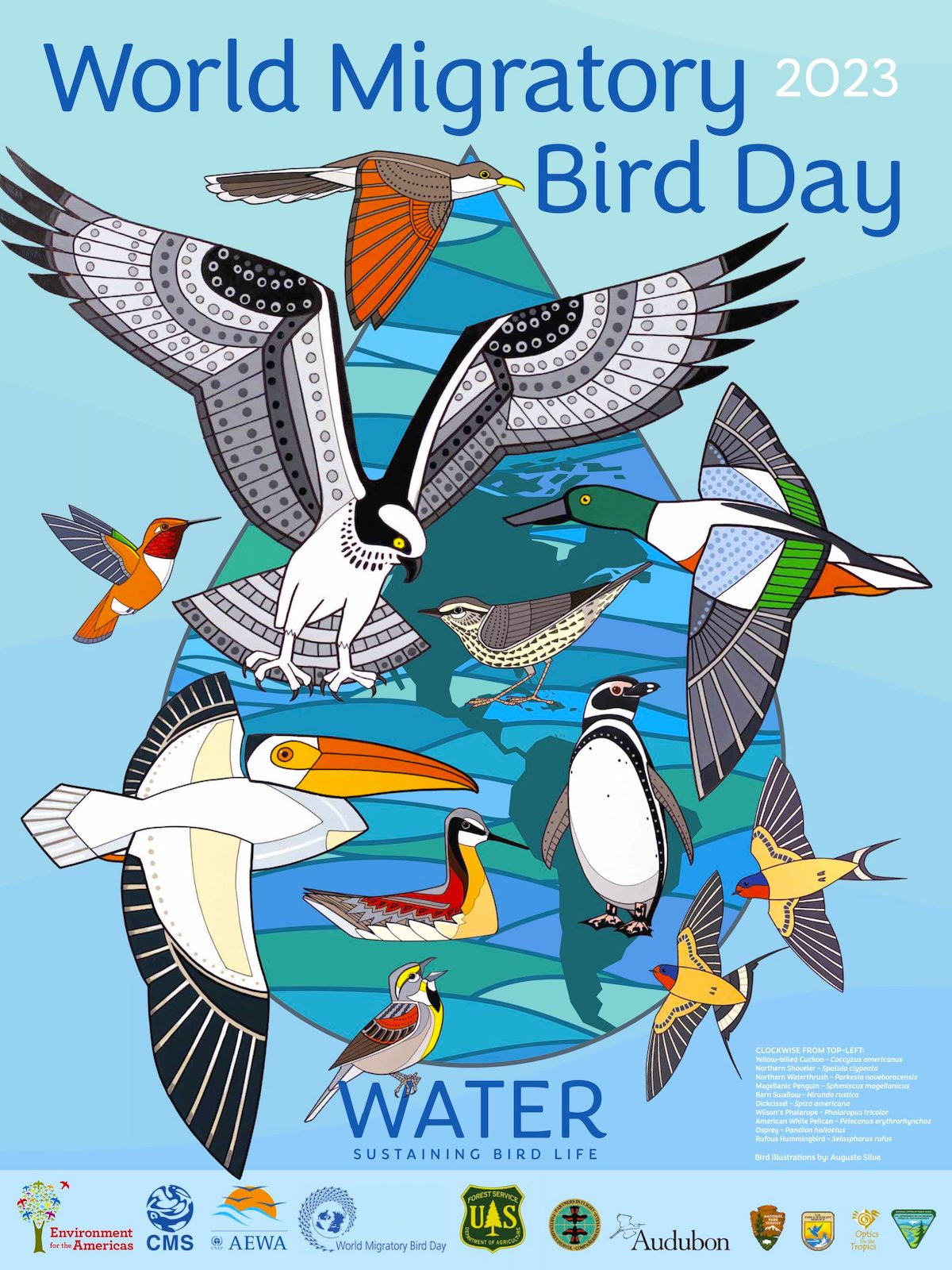
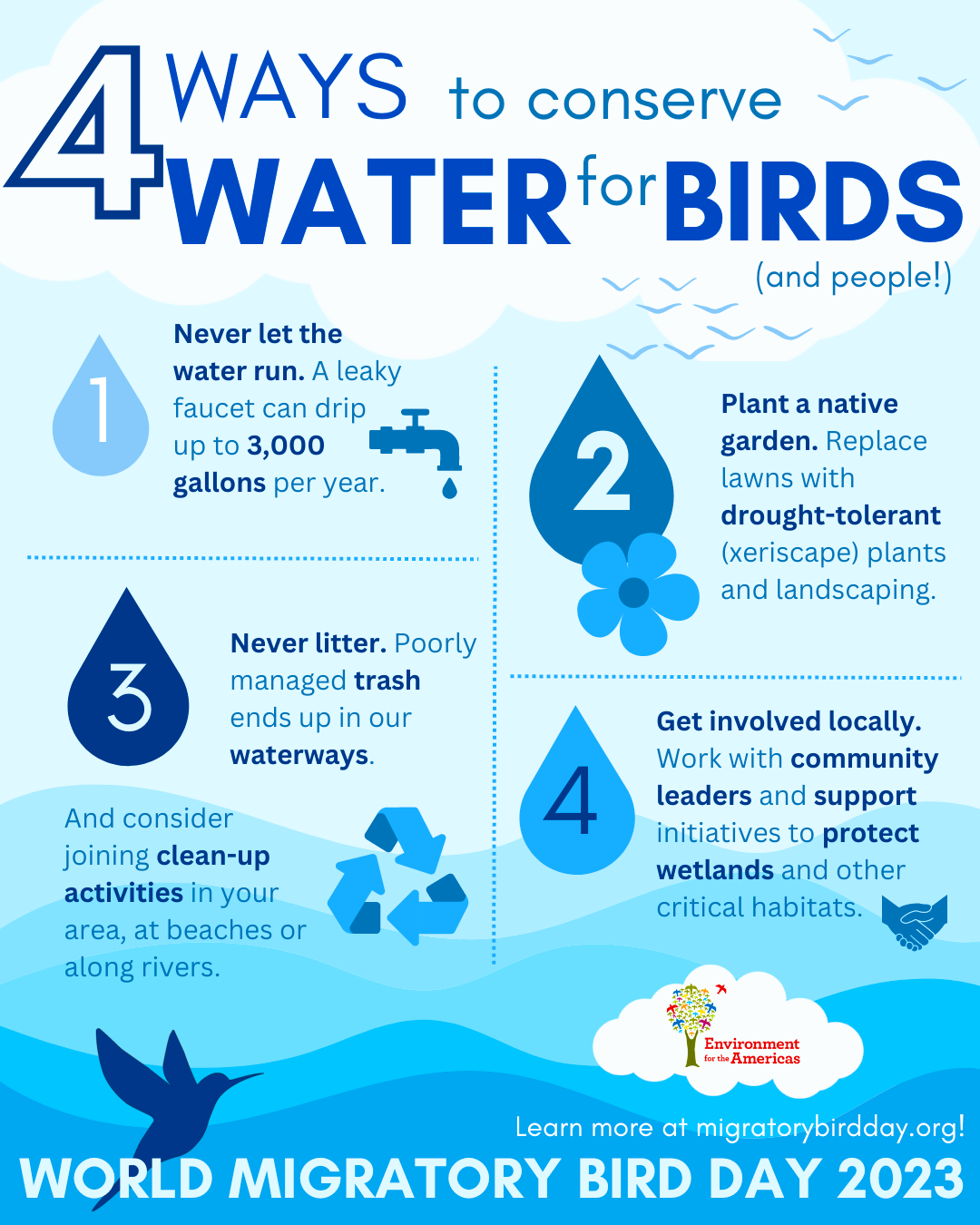
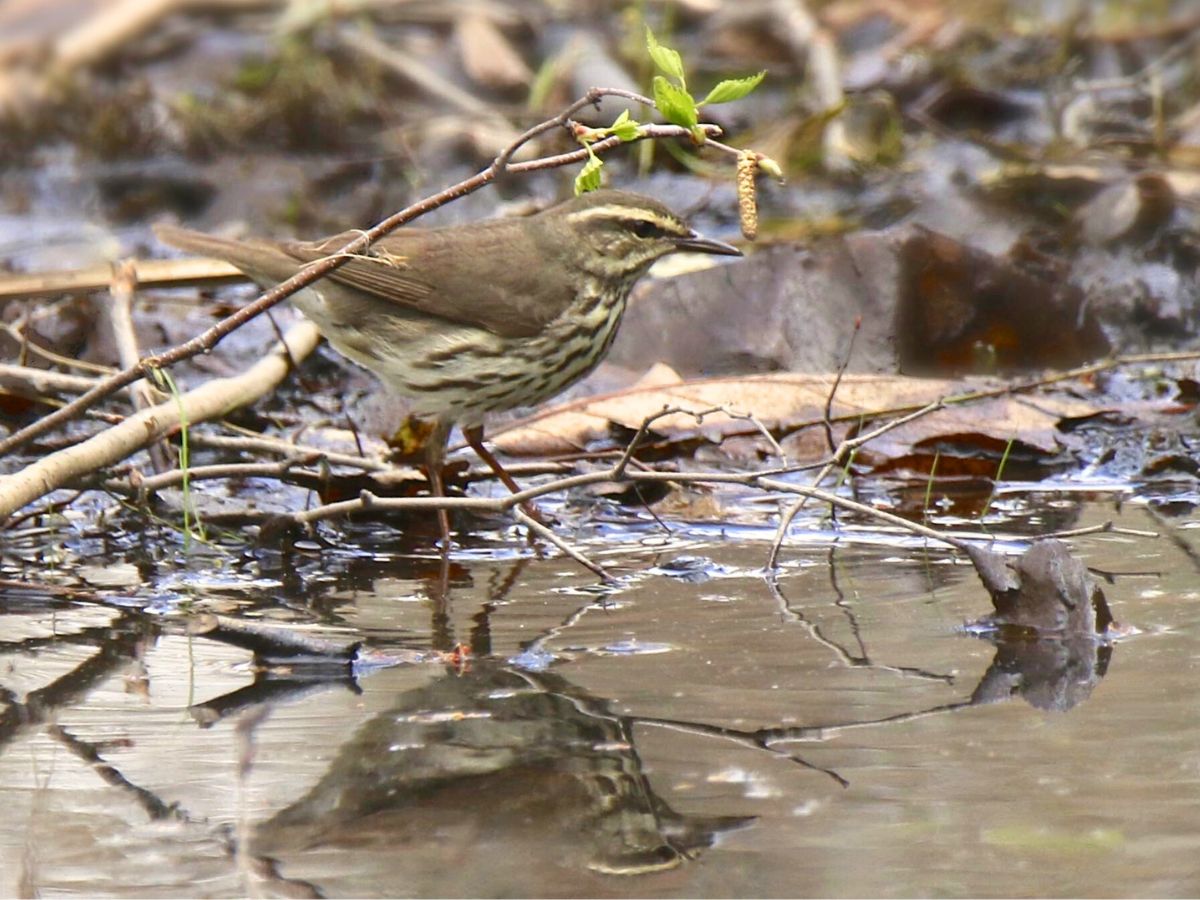
Celebrate World Migratory Bird Day (WMBD) with us in 2023! This year’s theme is “Water: Sustaining Bird Life”. Have fun learning about a new migratory bird every day. We have coloring pages, puzzles, activities, and more. Download for free and enjoy nature with your family at home.
Migratory Bird of the Day: Palm Warbler
Wood-warblers are challenging birds for most amateur birders to ID—they are small, fast-moving, and have plumage patterns that overlap across species, age and sex. However, if you are birding in open areas, and find a sparrow-sized bird, feeding on the ground, with distinctive and bright yellow undertail-coverts, wagging its tail feathers like it’s a matter of life or death—you have found a Palm Warbler!
There are two subspecies of Palm Warbler which are easily distinguished. Whilst both have grayish to olive brown upperparts, if you meet a Yellow Palm Warbler, you’ll notice that—besides their undertail coverts—their throat, breast and belly are also stunningly yellow. On the other hand, only the undertail-coverts, and sometimes the throat of the Western Palm Warbler, is vividly yellow—which contrasts with their pale breast and belly. You can also look out for faint brown streaking on the breast and flanks, and a chestnut cap in breeding plumage. Both sexes are similar, making them one of the few warbler species that are not sexually dimorphic.
Palm Warblers feed almost exclusively on the ground, searching for insects like grasshoppers, beetles, butterflies and mosquitoes during breeding season. Seeds, berries and nectar are added to their diet during the non-breeding season.
As a migratory bird, the name Palm Warbler reflects the fact that the species was first described from a specimen wintering in the Caribbean. The Palm Warbler’s non-breeding range also includes the southeast and Gulf Coast of the United States. Interestingly, this bird has a fondness for the bog and coniferous forests of Canada and the northern United States. This makes it one of the northernmost breeding species of all the New World warblers, surpassed only by its close relative, the Blackpoll Warbler.
Given its remote breeding habitat, and how difficult it is to find the nests of this bird, much remains unknown about this part of its life cycle. Peak nest building occurs around mid-May. Nests are usually constructed at the base of coniferous trees, between 5 to 30 cm above the ground. Females lay two to four eggs and take the lead in incubating the eggs and feeding nestlings, with some support provided by their mates.
Palm Warblers prefer relatively open habitats with scattered trees and dense shrubs of 1–2 m tall on both their breeding and wintering grounds. This charismatic warbler can also be found in a variety of woodland, second-growth, and thicket habitats; on the ground in savannas, open fields and lawns; and in mangroves.
Palm Warblers are not endangered, but like other nocturnal migrants, they face multiple threats from light pollution and building strikes. There is a lot we can do on a daily basis to protect this cute tail-wagging warbler: turn off the lights at night during fall and spring months, advocate for bird-friendly windows, keep your pets indoors, and provide and protect clean water sources along their migration paths. Learn more about this species, including its range, photos, and calls here.
Thanks to Daniela Ventura for the text and Christine Elder for the lovely illustration!
Color in the Palm Warbler
Download the Migratory Birds of the Day Coloring Page! Use the picture above and the photos on this page as your guide, or look up pictures of the bird online or in a bird field guide if you have one. Share your colored-in page with us by posting it online and tagging us @BirdsCaribbean #WMBD2023Carib
Listen to the calls of the Palm Warbler
Palm Warblers have a thin “seep” call, which can be heard during the non-breeding season.
Puzzles of the Day
Click on the images below to do the puzzle. You can make the puzzle as easy or as hard as you like—for example, 6, 8, or 12 pieces for young children, all the way up to 1,024 pieces for those that are up for a challenge!
During the non-breeding season, Palm Warblers will join mixed species flocks to forage—look out for them with sparrows, or other migratory warblers, such as the Yellow-rumped Warbler. (Photo by Ryan Sanderson Macaulay Library-ML445341491)
The Palm Warbler was named based on a specimen collected on Hispaniola, but this warbler is far from being a year-round ‘tropical’ bird. They are one of the northernmost breeding of all warblers—only the Blackpoll Warbler breeds farther north. (Photo by Ryan Schain Macaulay Library- ML223997711)
Activity of the Day
FOR KIDS: We hope that you have been enjoying learning all about migratory birds in the Caribbean! Don’t forget that this year our theme is “Water: Sustaining Bird Life”. Many of the birds we have featured this year are under pressure, often from human activities. This means that our special migratory birds, and many of the other beautiful birds that live in the Caribbean, need your help.
All birds need water to survive so you can help by carrying out the actions in our “Pledge to Conserve Water.” You can download and print our water pledge here. Sign your name and get started helping our birds by following some of the simple water-saving actions listed in the pledge. You can hang or pin it up somewhere at home to remind you to keep saving water and helping birds and wildlife. And don’t forget to share this pledge with your family and friends!
FOR KIDS AND ADULTS: Enjoy this video of a Palm Warbler in the wild on its wintering grounds in Cuba!
Get some helpful for hints on how to identify warblers in the Caribbean: Warblers are among the most beautiful and entertaining Caribbean birds, but they can also be some of the most challenging birds to identify. Luckily naturalist, educator, and artist, Christine Elder, has some really helpful tips on what to look for as well as some amazing resources for you to use. Check out this blog post to find out more. Christine also created the beautiful artwork for our 2023 “Migratory Birds of the Day”!
Celebrate World Migratory Bird Day (WMBD) with us in 2023! This year’s theme is “Water: Sustaining Bird Life”. Have fun learning about a new migratory bird every day. We have coloring pages, puzzles, activities, and more. Download for free and enjoy nature with your family at home.
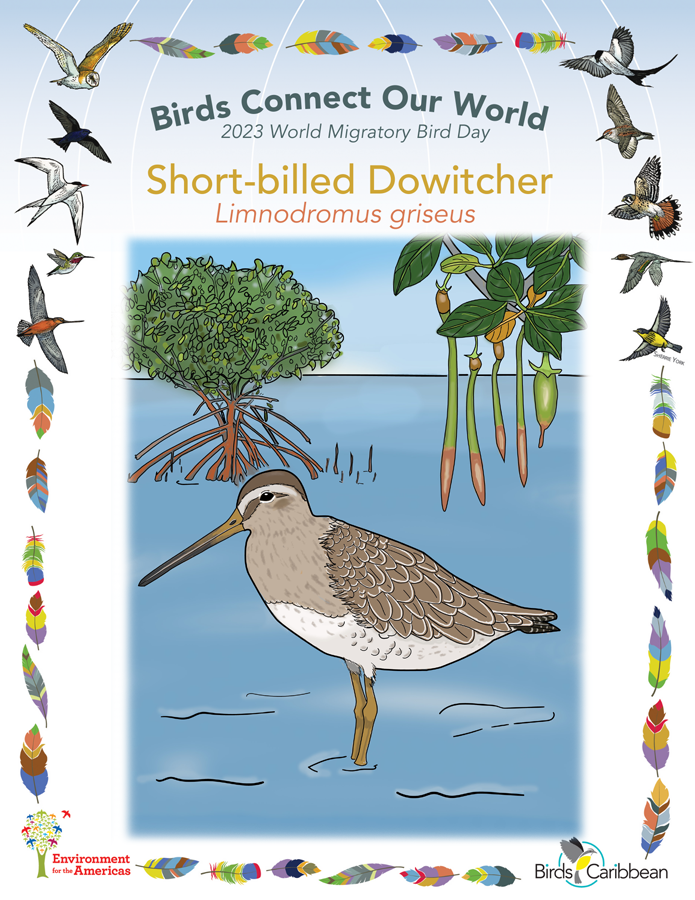
Migratory Bird of the Day: Short-billed Dowitcher
Sometimes bird names can be confusing—and in the case of the Short-billed Dowitcher, frankly, misleading! This medium size migratory shorebird most definitely has a LONG bill. So how did it get its odd name?
Dealing with the “Short-billed” part first, this bird has a closely related and very similar looking relative—the Long-billed Dowitcher. They have a very slightly longer bill than the Short-billed Dowitcher—a difference so subtle that it is hard to spot. Yet, these names were meant to distinguish between the two birds! In fact, the calls of these two cousins are actually the best way to tell them apart, especially when in non-breeding plumage. The Short-billed Dowitcher gives a soft “tu-tu-tu” call in contrast to the strident “keek” of the Long-billed. But it seems that the “Tu tu Dowitcher” wasn’t considered a suitable name.
Moving on to the “Dowitcher” part of the name, this is also a bit of a mystery—what does Dowitcher even mean? In the late 19th century, this bird was being hunted in North America. It seems as if Dutch and German immigrant hunters perhaps referred to them as “Deutscher” or “Duitsch” snipe (i.e. “German” or “Dutch” snipe). This may have then become “dowitcher” or “dowitch”.
Short-billed Dowitchers do have a snipe-like appearance with long straight bills, short-ish legs and a somewhat plump appearance. In breeding plumage they have mottled brown snipe-like plumage above, with pale cinnamon-brown below. In non-breeding plumage they are brownish-gray above, with a paler belly and greenish yellow legs.
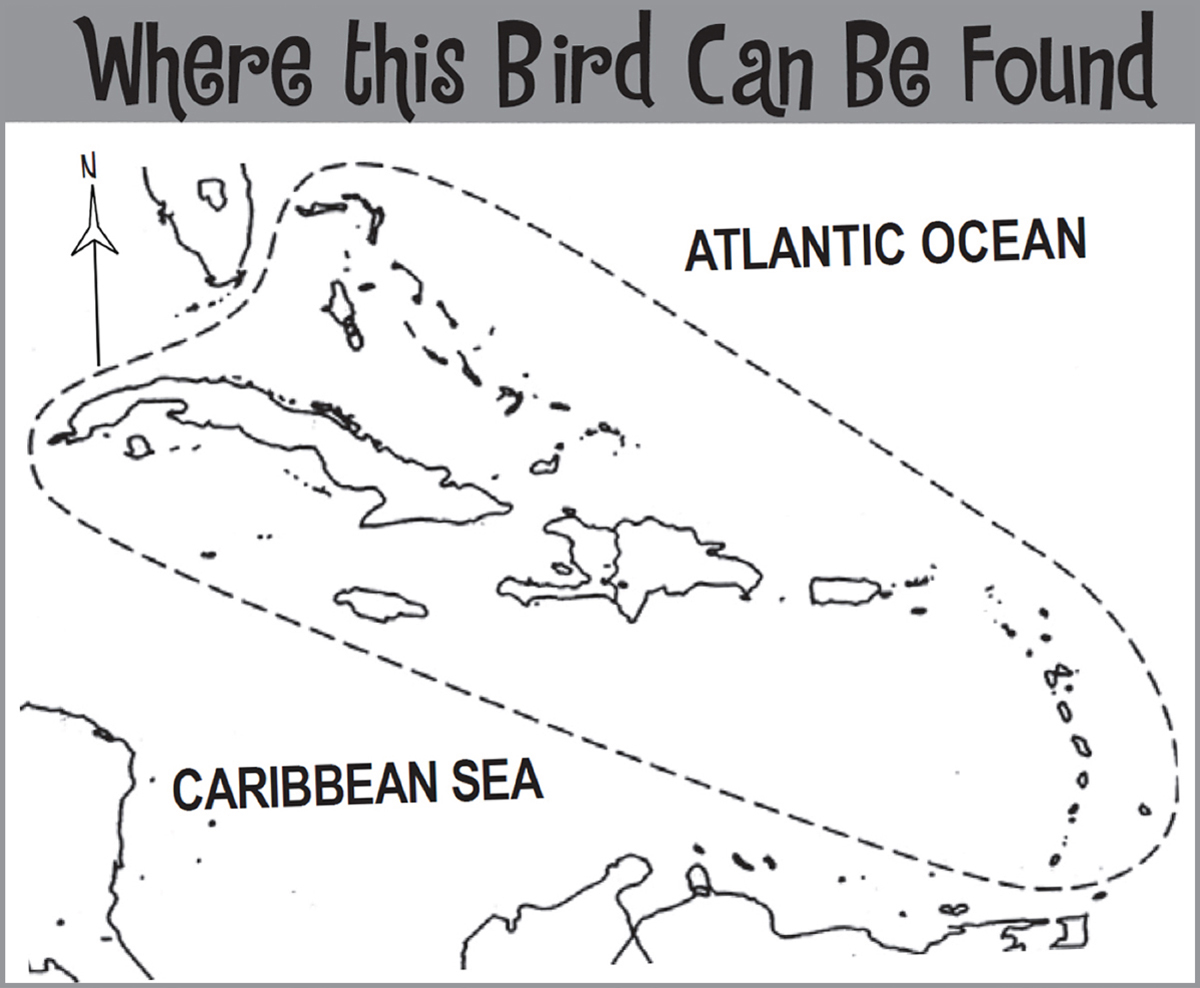
Short-billed Dowitchers breed in boggy areas at the margins of boreal forests in northern Canada. They travel thousands of kilometers in Fall, stopping along the way to molt and mainly sticking to the coastline as they head south. In the Caribbean, they can be spotted in a wide range of habitats from beaches, to tidal mudflats, to flooded agricultural areas. Look out for their distinctive “sewing-machine” feeding motion, as small groups of dowitchers with their heads down plunge their bills up and down into the water and mud looking for worms and mollusks.
Short-billed Dowitcher populations are declining and the species is on the USFWS list of “Birds of Conservation Concern”. Protecting our Caribbean wetland habitats and reducing the use of insecticides (which will reduce their food sources) can help us provide places for this oddly-named bird to thrive during its migration. Learn more about this species, including its range, photos, and calls here.
Thanks to Alex Sansom for the text and Christine Elder for the lovely illustration!
Color in the Short-billed Dowitcher
Download the Migratory Birds of the Day Coloring Page! Use the picture above and the photos on this page as your guide, or look up pictures of the bird online or in a bird field guide if you have one. Share your colored-in page with us by posting it online and tagging us @BirdsCaribbean #WMBD2023Carib
Listen to the calls of the Short-billed Dowitcher
Short-billed Dowitchers make a soft “tu-tu-tu” call, often as a contact call when flying together.
Puzzles of the Day
Click on the images below to do the puzzle. You can make the puzzle as easy or as hard as you like—for example, 6, 8, or 12 pieces for young children, all the way up to 1,024 pieces for those that are up for a challenge!
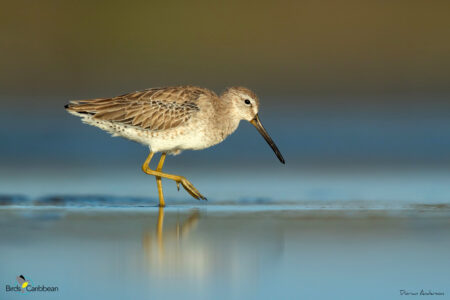
Even though dowitchers are a very common bird in North America , it was not until the 1930s that scientists began realize that there were two different species there! (Photo by Dorian Anderson Macaulay Library-ML187630851)
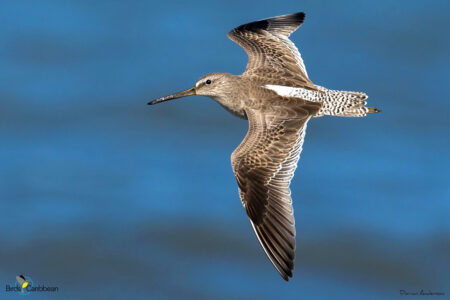
Unlike the Long-billed Dowitcher, Short-billed Dowitchers migrate in stages, first moving to intermediate areas to complete their molt, then moving on to their ultimate wintering areas. (Photo by Dorian Anderson Macaulay Library-ML116188411)
Activity of the Day
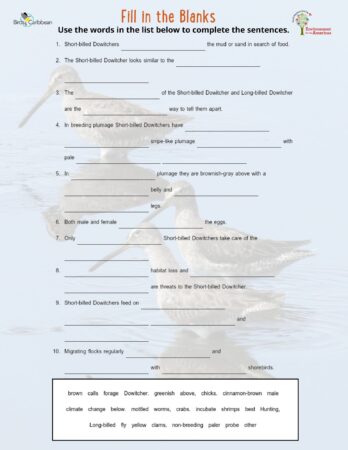
FOR KIDS: What facts can you remember about today’s migratory bird—the Short-billed Dowitcher? Test your knowledge by filling in the missing words in our Short-billed Dowitcher facts! We have given you all the correct words to use but can you put them into the right places in these fact-filled sentences?
You can re-read the information about this bird above, or search on the BirdsCaribbean webpages or online for more information about the Short-billed Dowitcher! You can also look at the photos, illustration and videos on this page to help you. When you have completed all the sentences, you can check your answers here.
FOR KIDS AND ADULTS: Enjoy these videos of Short-billed Dowitchers in the wild! The first video shows bird feeding with their typical “sewing machine” foraging action, plunging their bills into the mud for worms. In the second video, you can see a flock of Short-billed Dowitchers in flight.
Learn all about how to tell a Short-billed Dowitcher from a Willet: Shorebirds can be tricky to identify, especially as they migrate through the Caribbean in their non-breeding plumage (which is often less distinctive than their breeding plumage). Short-billed Dowitchers and Willets are both commonly seen in the Caribbean in Fall, and both are long-billed and gray-ish brown—so how can we tell them apart? Find out in this blog post from bird guide Allison Caton from Grenada, who got the low-down whilst attending a week-long BirdsCaribbean, Caribbean Birding Trail (CBT) Interpretive Guide Training Workshop on Union Island in St. Vincent & the Grenadines.
The deadline for the 2024 award applications is Friday, November 17, 2023, 11:59 pm EDT.
Review and announcements of awardees should be completed by December 17, 2023.
We have provided a brief summary of the grants available for each award here:
Questions or inquiries can be sent to: [email protected] (Grants Committee), copied to[email protected]. Please include the name of the fund you are inquiring about in the subject line.
Note that the same proposal cannot be submitted for more than one award in a given year.
BirdsCaribbean’s general Grant Application Guidelines are available here.
Learn more about the eligibility criteria of each program by visiting their respective websites.
Seeking Donors
BirdsCaribbean encourages others to consider endowments or other large awards to ensure that our grants programs continue indefinitely. You may also make a donation to support our work. BirdsCaribbean is a tax-deductible organization in the United States.
Celebrate World Migratory Bird Day (WMBD) with us in 2023! This year’s theme is “Water: Sustaining Bird Life”. Have fun learning about a new migratory bird every day. We have coloring pages, puzzles, activities, and more. Download for free and enjoy nature with your family at home.
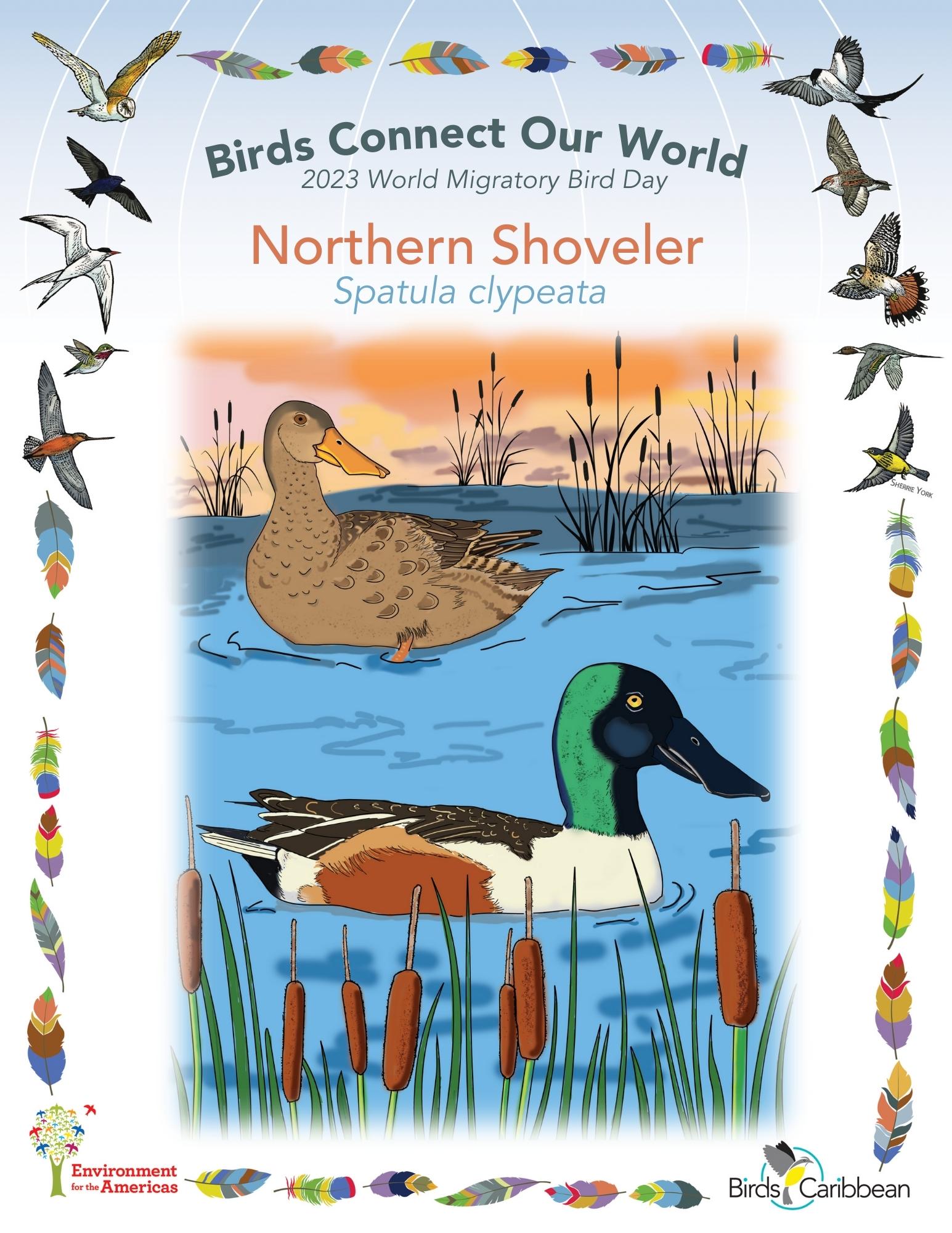
Migratory Bird of the Day: Northern Shoveler
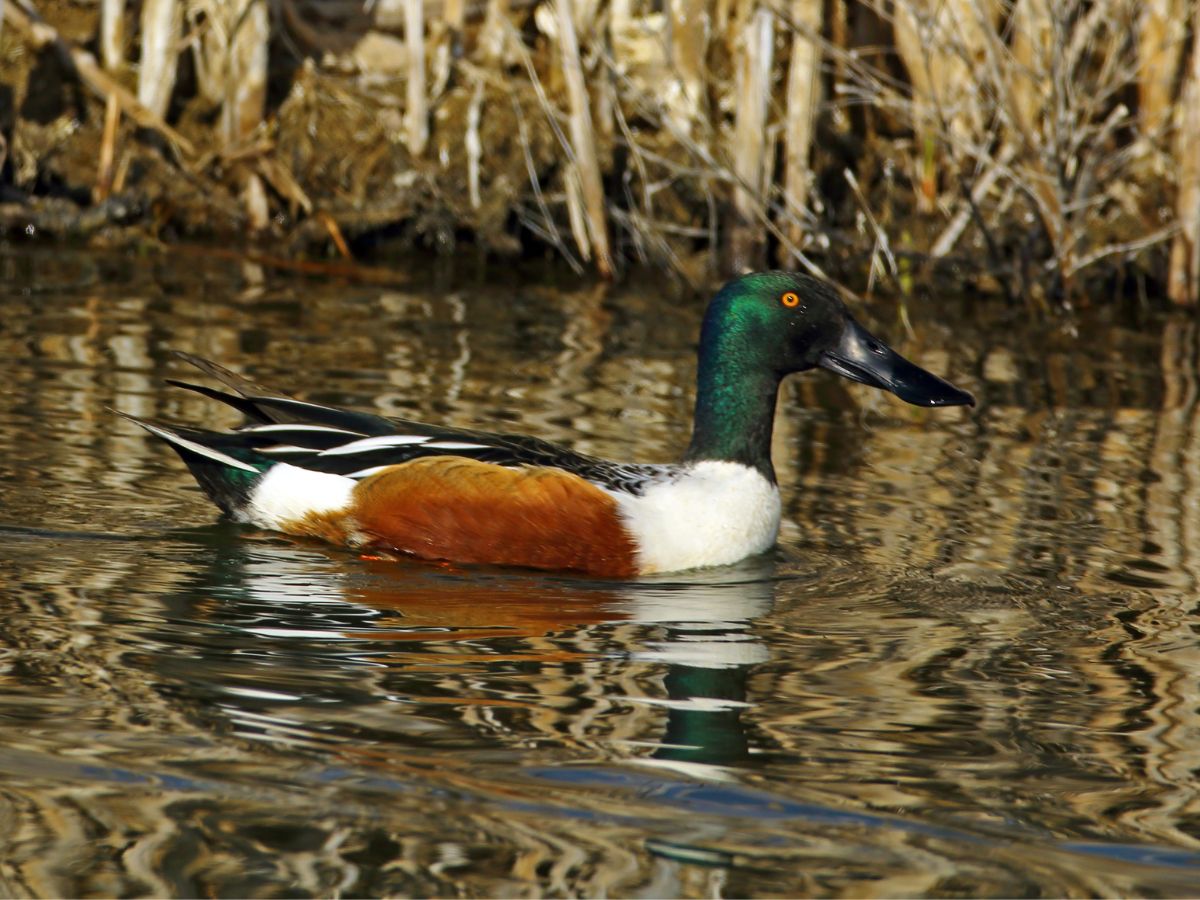
Spoony. Bootlips. Souplips. Hollywood Mallard. We could only be talking here about the magnificent Northern Shoveler! This dabbing duck has earned these nicknames due to its huge shovel-shaped bill, which, if you have a vivid imagination, looks like the bird is grinning.
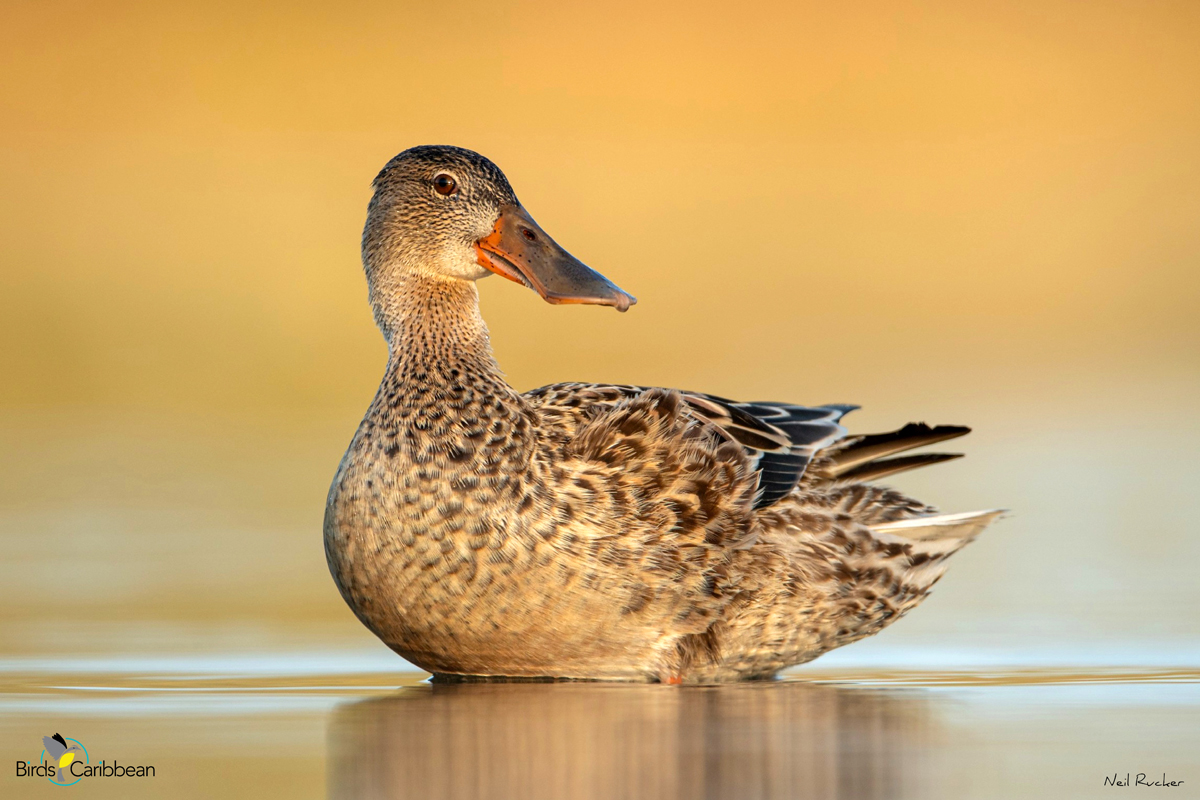
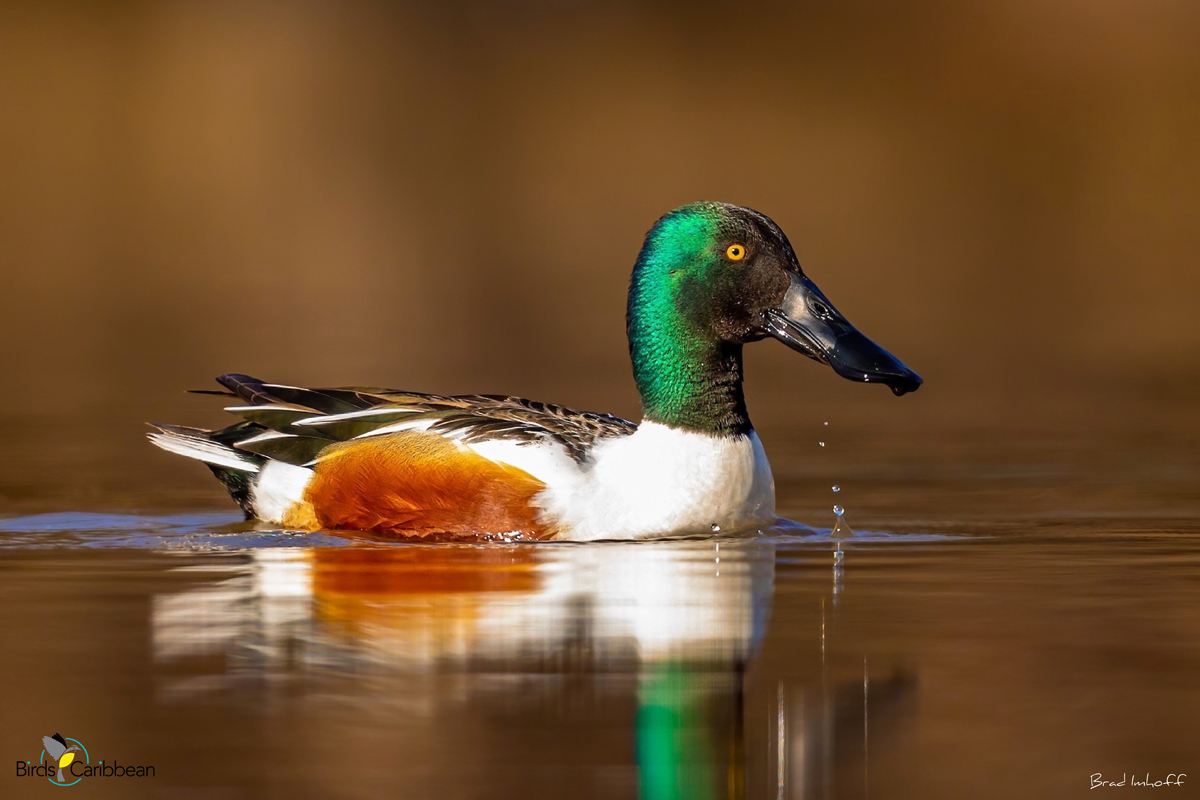
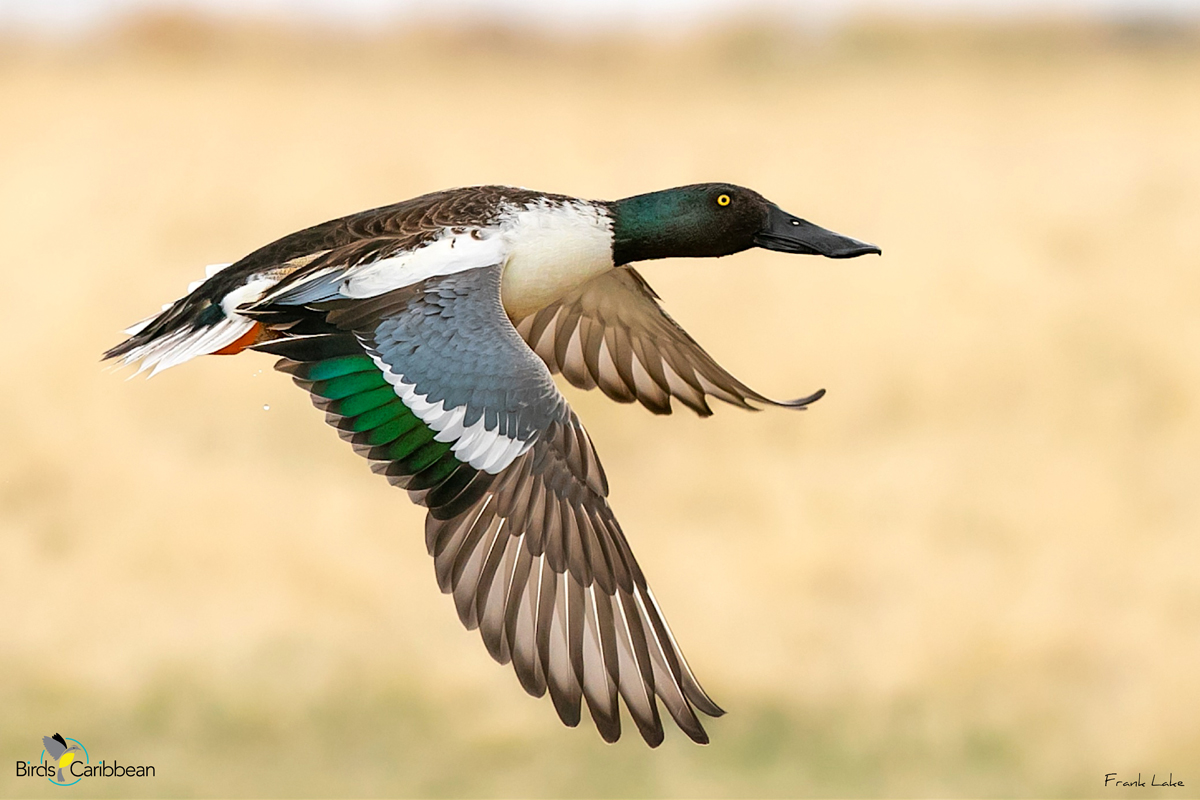
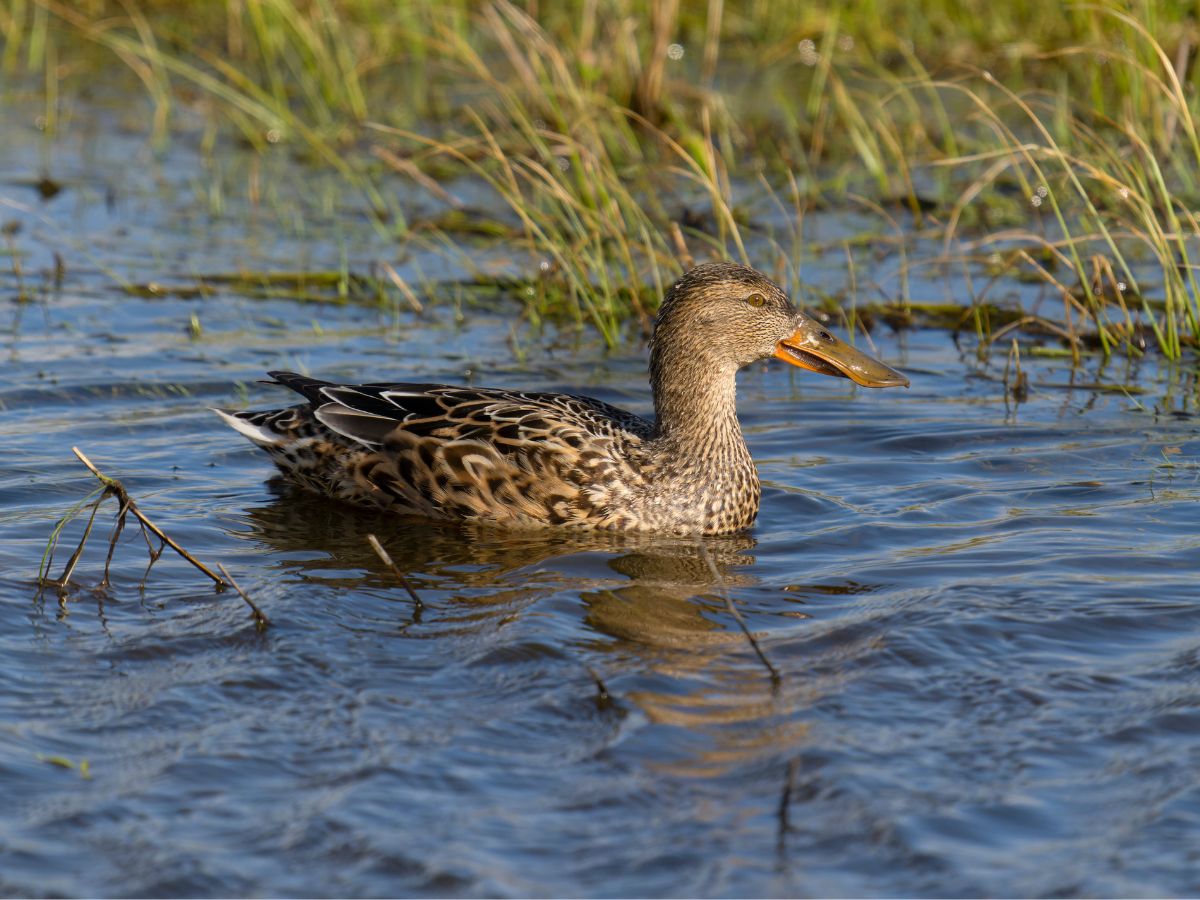
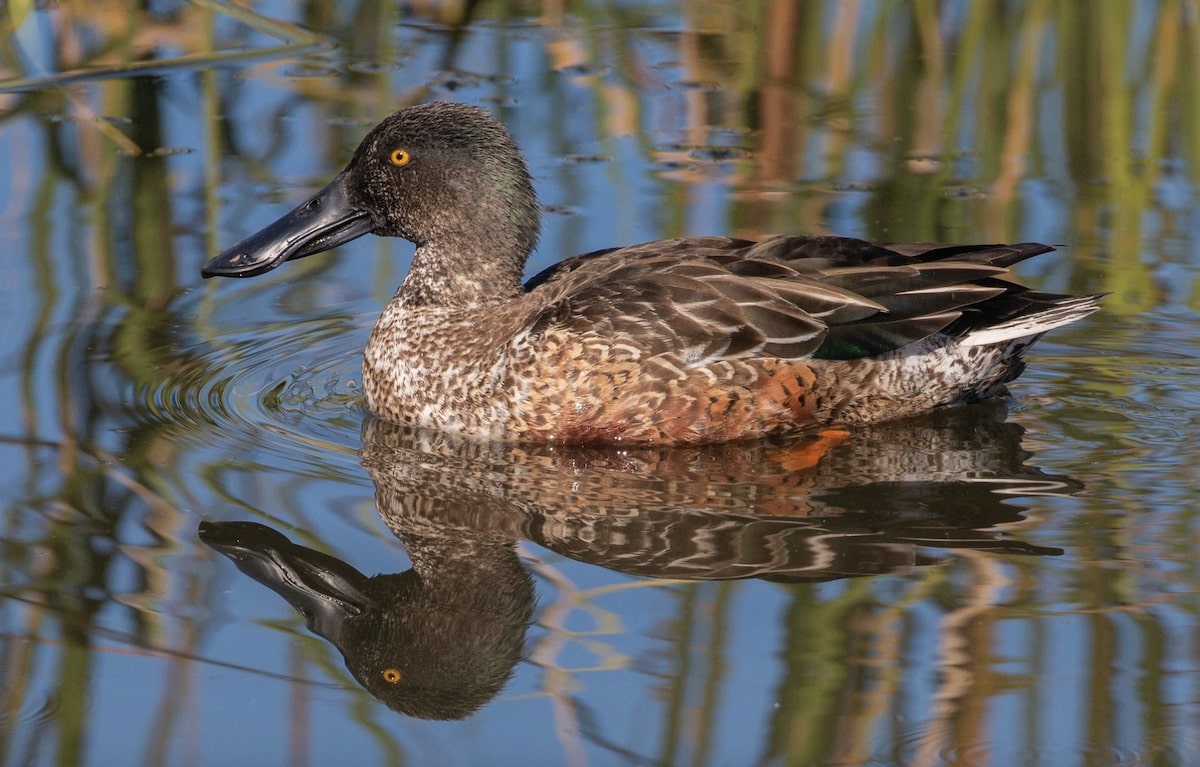
Breeding male Northern Shovelers have an iridescent green head and neck, bright white chest and breast, and rusty colored belly and sides. Their wings have a gray-blue shoulder patch, which is separated from a brilliant green speculum by a tapered white stripe. The bill is black, and the legs and feet are orange. Females have a light brownish head with a blackish crown and a mottled brown body. Their powdery-blue shoulder patch is sometimes visible at rest. The bill is orange and speckled with black dots.
In North America, they fly south to winter at lower altitudes. They fly from the iconic Rocky Mountains down to California and Mexico in late August or early September. Some will also fly east to winter along the Atlantic Coast, down to the Gulf Coast and the Caribbean. Look out for these dandy ducks on your island at wetlands, flooded fields, agricultural ponds, and wastewater treatment ponds.
Northern Shovelers feed by dabbling and sifting in shallow water. Their large bills have more than 100 lamellae (fine comb-like serrations) along the edges which allows them to filter out aquatic invertebrates, seeds and plants from pond water. They swim occasionally with their head under water, or tip-up, and sometimes even dive to feed underwater. Feeding groups and also lone birds will swim in tight rotating circles to stir up the water and bring food items to the surface.
Males give a wheezy “took-took” call during courtship, in flight, and when alarmed. Females on the other hand give a nasal-sounding quack during courtship and throughout the breeding season.
Females build their nest, which is a shallow depression on the ground, within 150 feet of water, and line it with downy feathers. Their clutch size is 8-12 greenish-gray eggs. If threatened by predators or disturbed by humans, females will poop on their eggs. Stinky? Yes, but also quite effective at making sure predators think twice about getting close to those eggs!
Habitat loss and degradation caused by development, climate change, and pollution are major threats to the Northern Shoveler, both on their breeding and wintering grounds. The good news is that whether you’re in the city or rural areas, you can adopt several behaviors that can have a positive impact on wetlands. This includes volunteering for wetland restoration projects, planting native plants, ditching the chemical pesticides, recycling your waste, checking your pipes and fittings regularly for any leakages, and harvesting rainwater. Learn more about this species, including its range, photos, and calls here.
Thanks to Aliya Hosein for the text and Christine Elder for the lovely illustration!
Color in the Northern Shoveler
Download the Migratory Birds of the Day Coloring Page! Use the picture above and the photos on this page as your guide, or look up pictures of the bird online or in a bird field guide if you have one. Share your colored-in page with us by posting it online and tagging us @BirdsCaribbean #WMBD2023Carib
Listen to the calls of the Northern Shoveler
Male Northern Shovelers make a “took-took” call during courtship, in-flight, and as an alarm call.
Puzzles of the Day
Click on the images below to do the puzzle. You can make the puzzle as easy or as hard as you like—for example, 6, 8, or 12 pieces for young children, all the way up to 1,024 pieces for those that are up for a challenge!
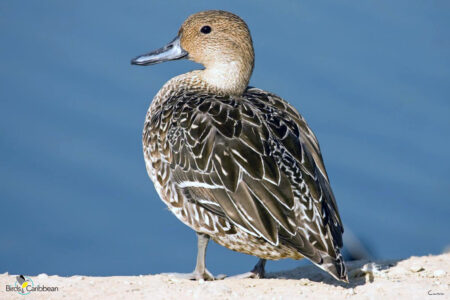
Female Northern Shoveler. Did you know that Northern Shovelers are monogamous? They form bonds on the wintering grounds and stay together during breeding until just before fall migration. (Photo by Neil Rucker, Macaulay Library-ML281986781)
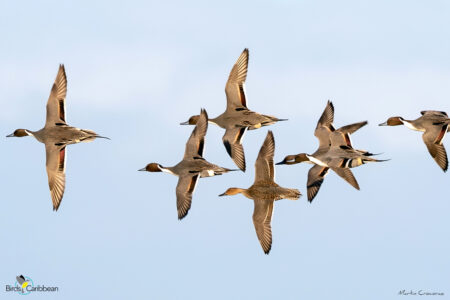
Male Northern Shoveler. The odd shaped bill that gives this duck its name has fine projections (called lamellae) along the edges that filter out tiny crustaceans, seeds, and aquatic invertebrates from the water when feeding. (Photo by Brad-Imhoff, Macaulay Library-ML217711091)Male Northern Shoveler in flight. These ducks don’t just occur in the Americas—they also breed across Europe, and spend the winter throughout Europe, Africa, and India. (Photo by Frank Lake, Macaulay Library-ML448025311)
Activity of the Day
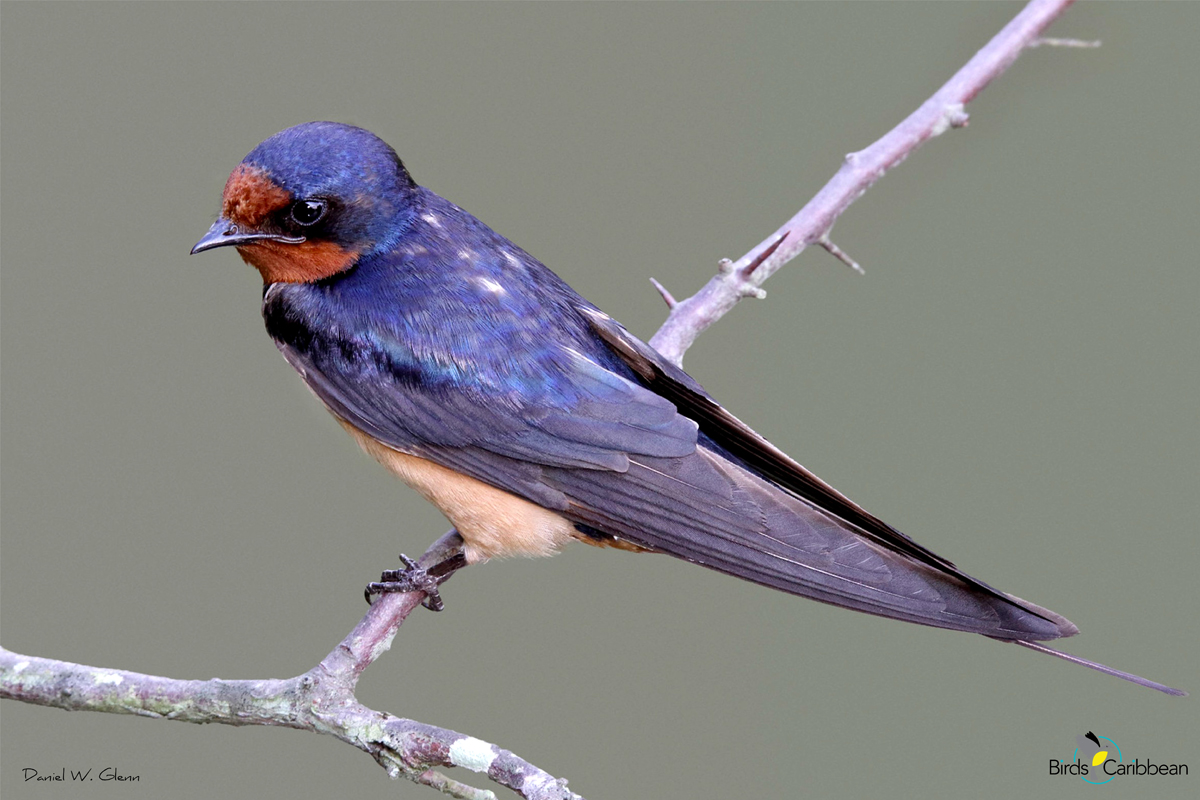
FOR KIDS: Every year Environment For The Americas (EFTA) selects several bird species to feature for World Migratory Bird Day. These species all migrate through or within the Americas. Several of these birds will pass through or spend the winter in the Caribbean. This year, the featured “Caribbean migratory birds” included the Osprey, Barn Swallow, Northern Waterthrush, Yellow-billed Cuckoo, Wilson’s Phalarope, American White Pelican and of course today’s featured bird, the Northern Shoveler (click to find out more about each bird!).
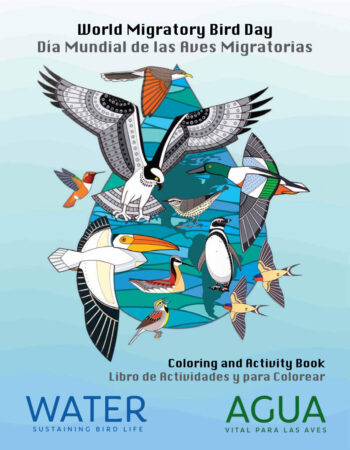
EFTA also made a fantastic and fun activity book for you to enjoy full of interesting facts about birds and water, coloring pages and many other water and migration related games and puzzles. You can find them all to download here. This activity book is in both English and Spanish, and features beautiful bird art by Augusto Silva—Enjoy!
FOR KIDS AND ADULTS: Enjoy this video of Northern Shovelers feeding in the wild!
Celebrate World Migratory Bird Day (WMBD) with us in 2023! This year’s theme is “Water: Sustaining Bird Life”. Have fun learning about a new migratory bird every day. We have coloring pages, puzzles, activities, and more. Download for free and enjoy nature with your family at home.
Migratory Bird of the Day: Swainson’s Thrush
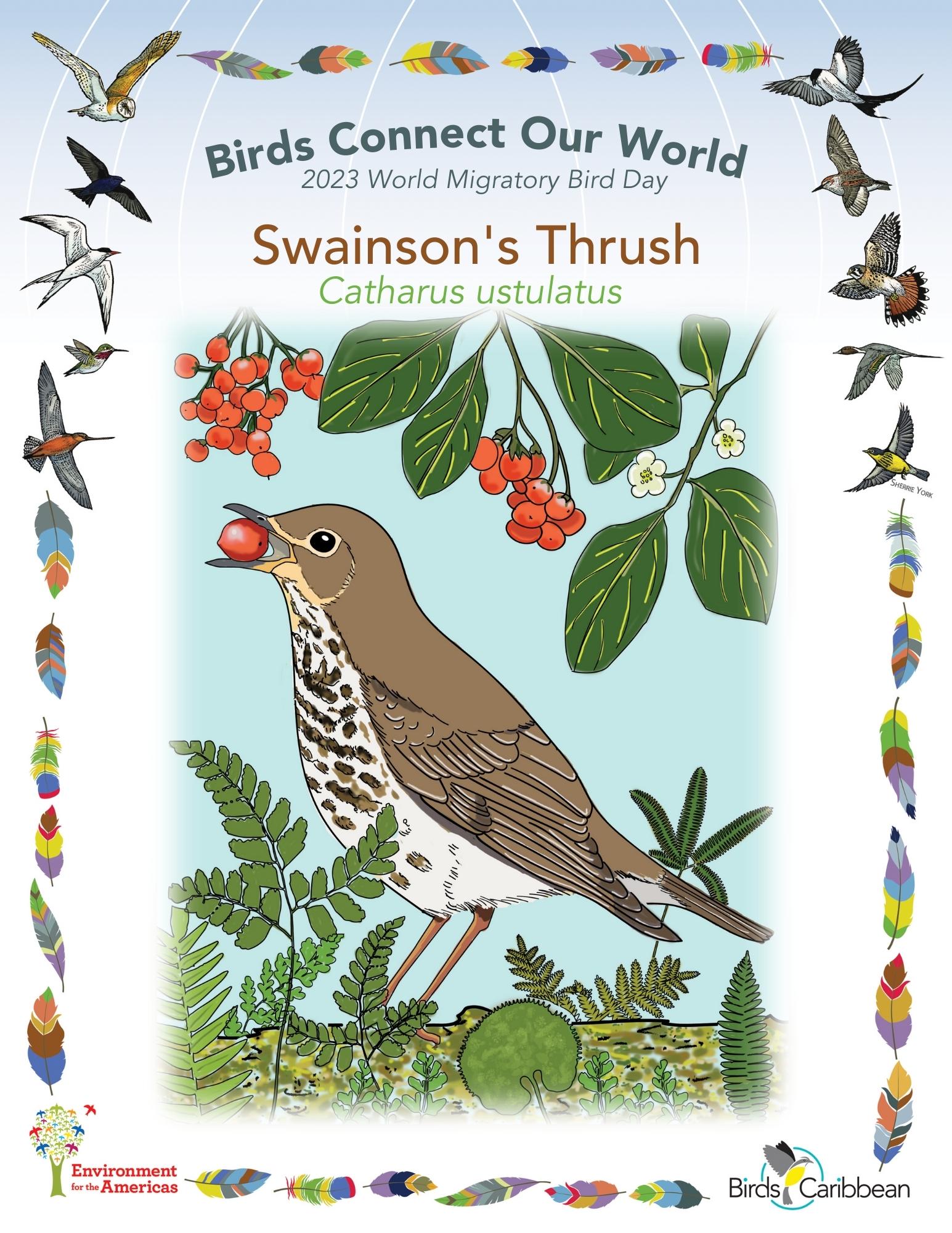
If you’re not looking carefully in the forest understory, you might miss the Swainson’s Thrush! These brown, spotted thrushes blend in well amongst forest foliage, but there is no mistaking their beautiful, flutelike, upward spiraling song.
Swainson’s Thrushes fall within a genus of birds known as Catharus thrushes. These thrushes are known for foraging low to the ground. They all have a spotted breast and a solid brown back of rust or olive, that varies in shade between species. Other thrushes within this genus include the Hermit Thrush, Veery, Gray-cheeked Thrush, and of course, our Caribbean overwintering Bicknell’s Thrush. Swainson’s Thrush can be distinguished from the others by their buffy colored eye rings and buffy coloration in the lores (between the eye and bill) which give these birds the appearance of wearing buffy spectacles!
Unlike their counterparts, Swainson’s Thrushes use more aerial fly catching techniques to obtain their insect prey—though they are quite fond of fruits during their migration. They also forage higher off the ground in comparison to other Catharus thrushes.
Did you know that there are actually eight different forms of Swainson’s Thrush all differing slightly in coloration? This has led to the recognition of different subspecies. Typically they all fall within the russet-backed and olive-backed forms. Interestingly enough, it’s hypothesized that these different subspecies might actually take different migratory routes and even overwinter in different locations! Russet-backed birds typically overwinter in Middle America while olive-backed birds continue to South America.
These birds can spend the winter anywhere from Southern Mexico to Northern Argentina! There is an international collaborative project currently underway which uses Motus technology to tag Swainson’s Thrush at different spots along their migration to better understand which routes different subspecies are taking. Banding data has shown us that Eastern and Western populations both take different routes and overwinter in different locales. The same populations might even take different routes in the spring and the fall! We’re excited to see what insights Motus technology can give us about these long distance migrants. Be sure to check out the Caribbean Motus Collaboration to learn more about how this technology is being used to understand migratory movements in the Caribbean.
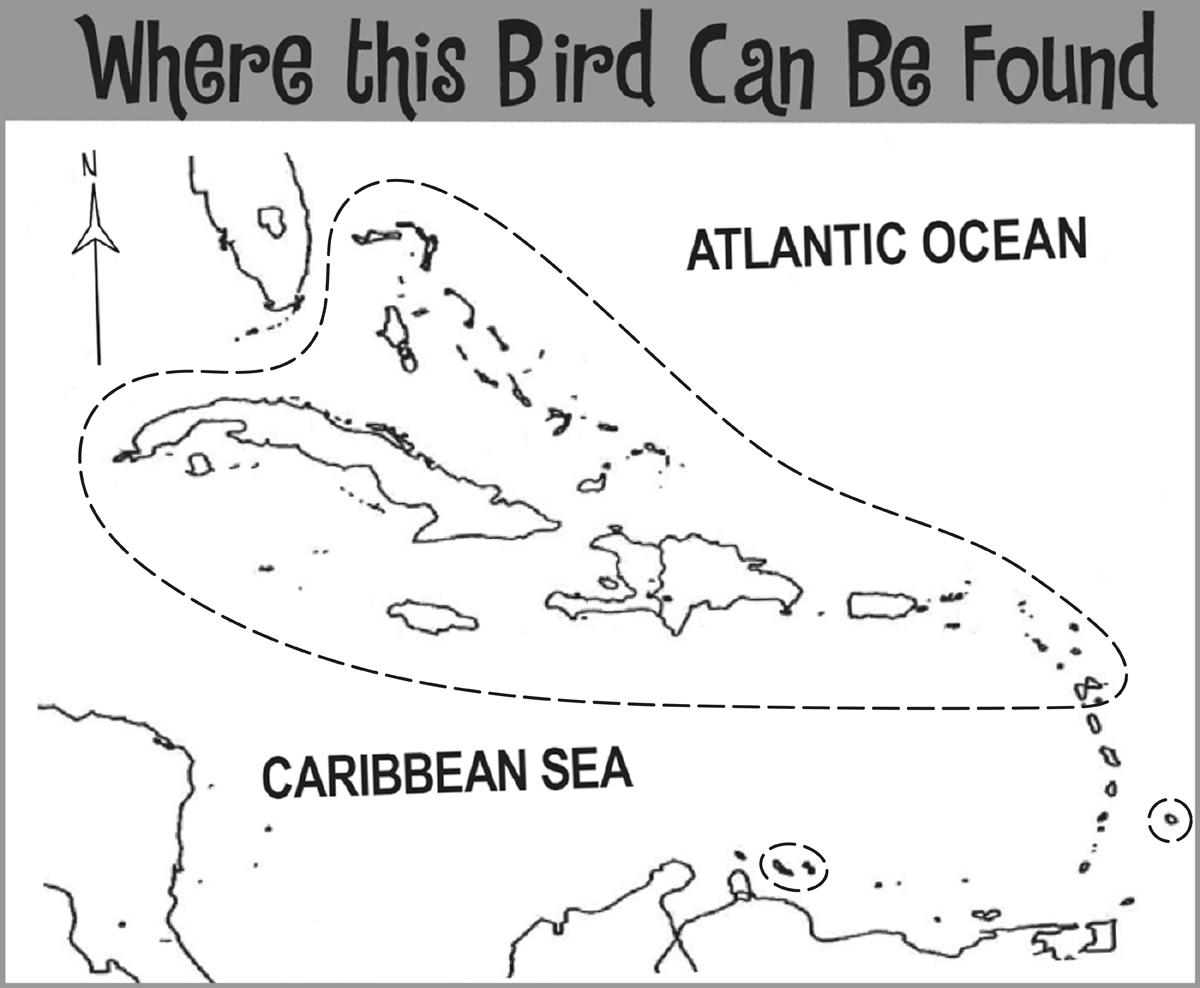
Within the Caribbean, we typically see Swainson’s Thrushes during their fall migration. The Eastern populations will sometimes pass through Western Cuba on their way south. They’re considered a rare transient to other areas in the Western Greater Antilles, Cayman Islands, and the Northern Bahamas.
After finishing their spring migration, Swainson’s Thrushes breed in northern spruce forests, and in California in riparian woodlands. Although still considered one of the most abundant birds of northern spruce forests, their populations have been steadily declining. The reasons for this are unclear, but could be attributed to high predation rates leading to low nest success. But it is likely that habitat changes, especially on their wintering grounds, could be a major factor.
Thanks to Holly Garrod for the text and Christine Elder for the lovely illustration!
Color in the Swainson’s Thrush
Download the Migratory Birds of the Day Coloring Page! Use the picture above and the photos on this page as your guide, or look up pictures of the bird online or in a bird field guide if you have one. Share your colored-in page with us by posting it online and tagging us @BirdsCaribbean #WMBD2023Carib
Listen to the calls of the Swainson’s Thrush
Swainson’s Thrush has a frog-like “peep” call. You might also hear its distinctive ascending, flute-like song.
Puzzles of the Day
Click on the images below to do the puzzle. You can make the puzzle as easy or as hard as you like—for example, 6, 8, or 12 pieces for young children, all the way up to 1,024 pieces for those that are up for a challenge!
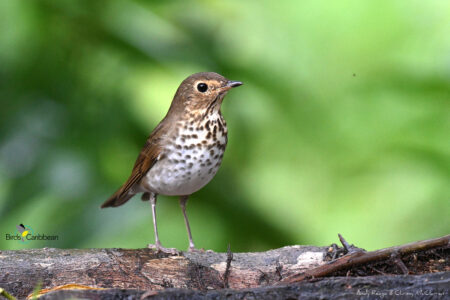
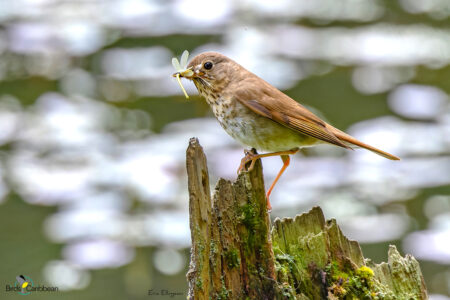
Male Swainson’s Thrushes have “sing-offs” during the breeding season, which can lead to chases and even occasionally to physical attacks. (Photo by Andy Reago & Chrissy McClarren)Swainson’s Thrushes have been called “mosquito thrushes” because of their habit of chasing after flying insect prey while feeding on their breeding grounds. (Photo by Eric Ellingson)
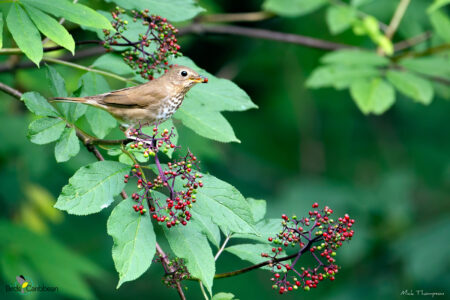
On their wintering grounds in particular, Swainson’s Thrushes will add fruits to their insect diet. They can also often be found attending army-ant swarms. (Photo by Mick Thompson)
Activity of the Day
FOR KIDS: The Swainson’s Thrush is quite a rare migrant bird in the Caribbean, which means that it is a bird that is hard to see here. But don’t worry, there are lots of beautiful migrant birds to look out for at this time of the year. From long-billed shorebirds flocking on the beaches, to the colorful gems of warblers flitting amongst the trees, there is so much to see!
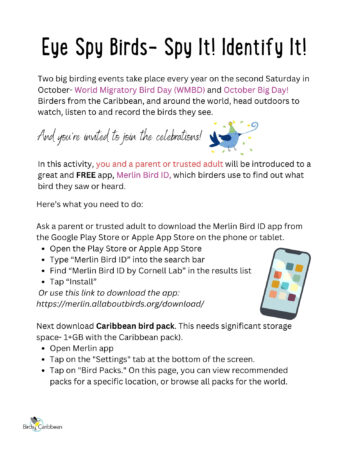
When it comes to knowing who is who when out looking for birds, field guides and webpages with colorful illustrations, helpful maps and detailed descriptions of each bird are really useful. But these are not the only tools available to you! Have you heard of the Merlin Bird ID app? When you see a bird, you just answer some simple questions about it, and the app helps you work out what bird you have spotted! Merlin Bird ID can also help you ID a bird from a photo you have taken or a recording of the birds song! Why not head out and look for some migratory birds and then use the Merlin Bird ID app to lend a helping hand? We have handy instructions what to look for and how to use the app here. So grab you phone, binocular and camera and see what you can find!
FOR KIDS AND ADULTS: Enjoy this video of Swainson’s Thrush taking a drink in the wild!
Birdwatching is a hobby that can be enjoyed by everyone. Being in nature with a group of like-minded people can be particularly rewarding. But access to these spaces and events are not equal, especially for people with disabilities and chronic illness. There is still a tendency to make the assumption that disability access and wheelchair access are one and the same.
Birdabilityis a non-profit organization founded by Virginia Rose, who fell off a horse at the age of 14 and has used a wheelchair since then. She began birding 17 years ago and wanted to share her passion and joy with others with disability challenges. Inspired by movements such as #BlackBirdersWeek, Virginia founded Birdability in 2020. Birdability’s vision is that birding is for everyone—including those with disabilities and other health concerns. It is supported by National Audubon in the U.S. and many other organizations and businesses.
The organization focuses on people with mobility challenges, blindness or low vision, chronic illness, intellectual or developmental disabilities, mental illness, and those who are neurodivergent, deaf or hard of hearing, or have other health concerns. Information and resources to help the birding community be more mindful and inclusive of these birders who may sometimes feel left out can be found on its website.
Founder and President of Birdability, Virginia Rose. (Photo credit: birdability.org)
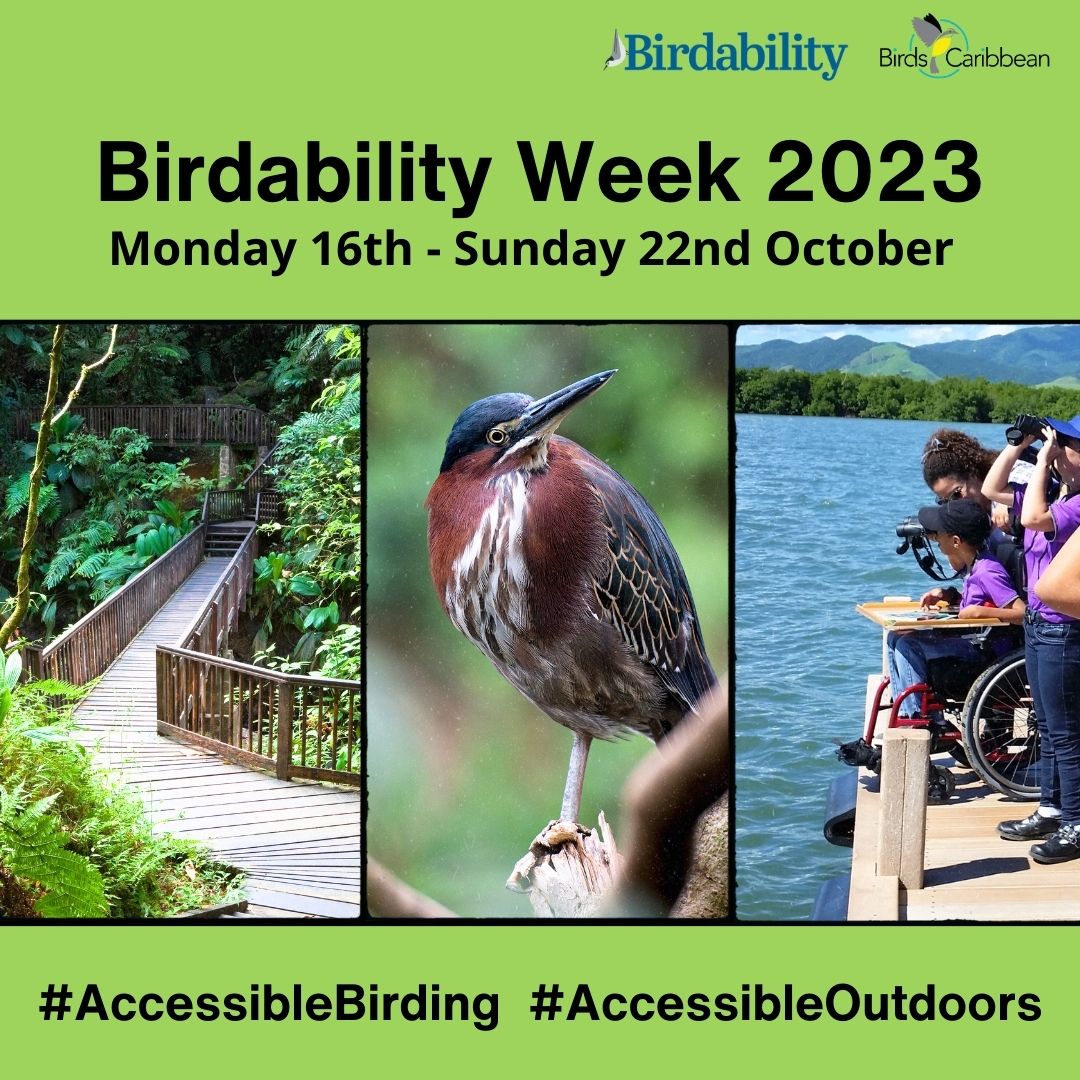
Birdability Week (16th-22nd October 2023) offers the opportunity for birding groups, non-governmental organizations, and groups of family and friends to host an accessible bird outing. With some thoughtful planning this event can be enjoyable for every body. In the past, our partners in Antigua and Barbuda and the Dominican Republic have held CEBF birding events for persons with disabilities. In Puerto Rico, local NGO SOPI’s (Sociedad Ornitólogica Puertorriqueña) birding event for blind youth allowed participants to “see” birds by handling carved wooden birds. We would love to see more of these events taking place throughout the region.
Watch the Birds or Follow the Birdsong—Birding is for ALL
Help Put Accessible Birding Locations in the Caribbean on the Map!
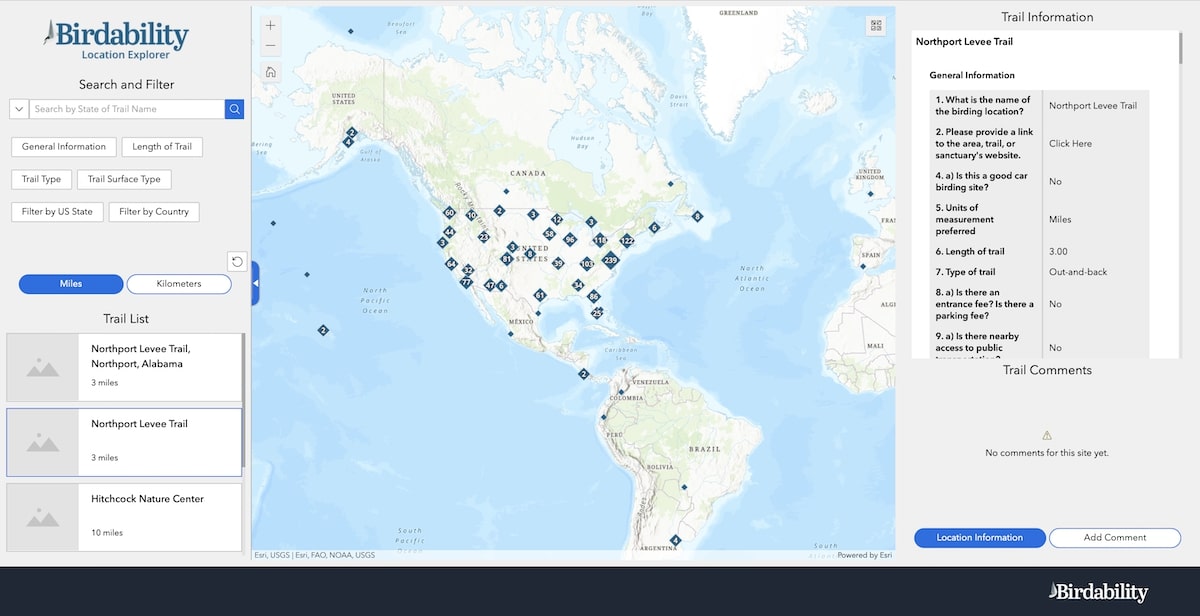
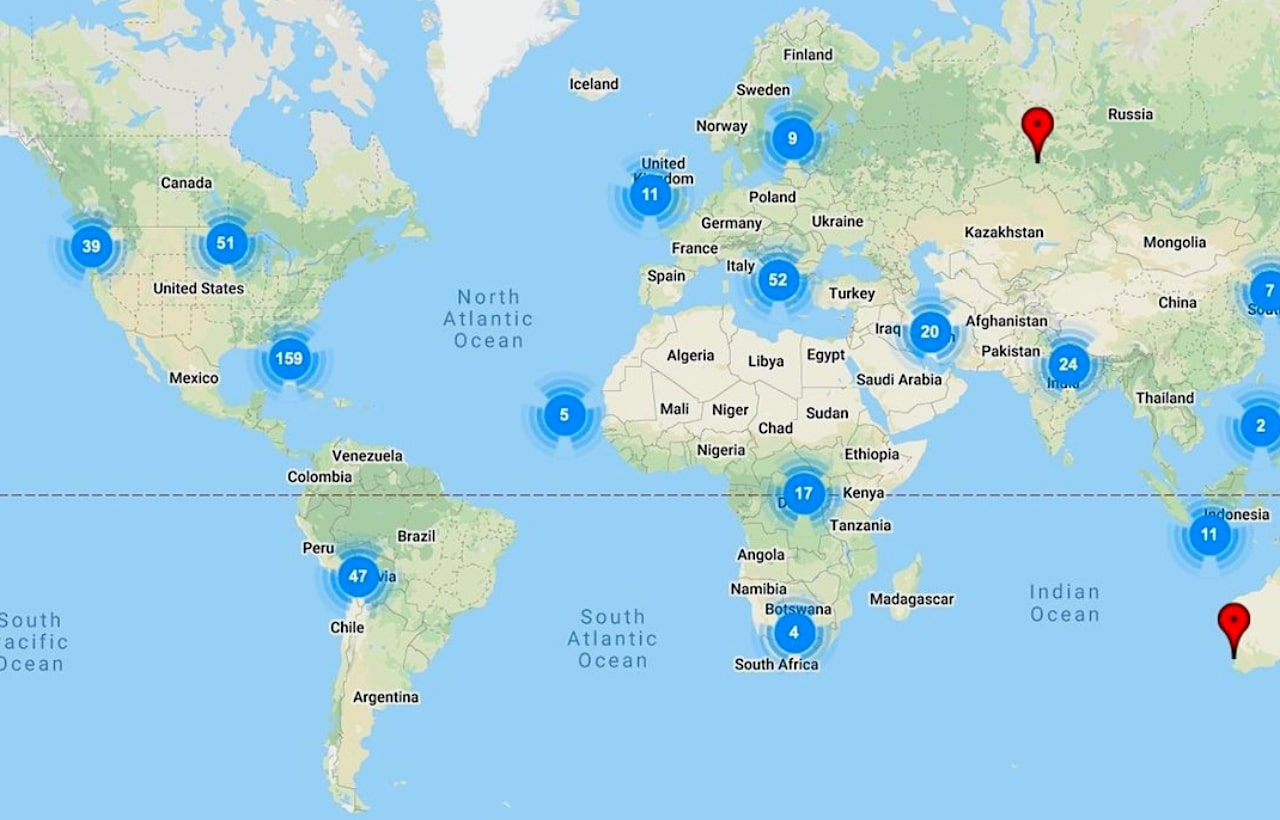
There is also a Birdability Site Map which allows you to search for accessible sites near you. The majority of the locations are in North America and a few have been identified in Central America and South America. If you know of accessible birding locations on your island we encourage you to complete on-site, in-person Birdability Site Reviews and add them to the Birdability Map.
Birdability Site Map showing locations of nature reserves and parks with varying degrees of accessibility.
Attend a Virtual Event and Connect with Differently Abled Birders
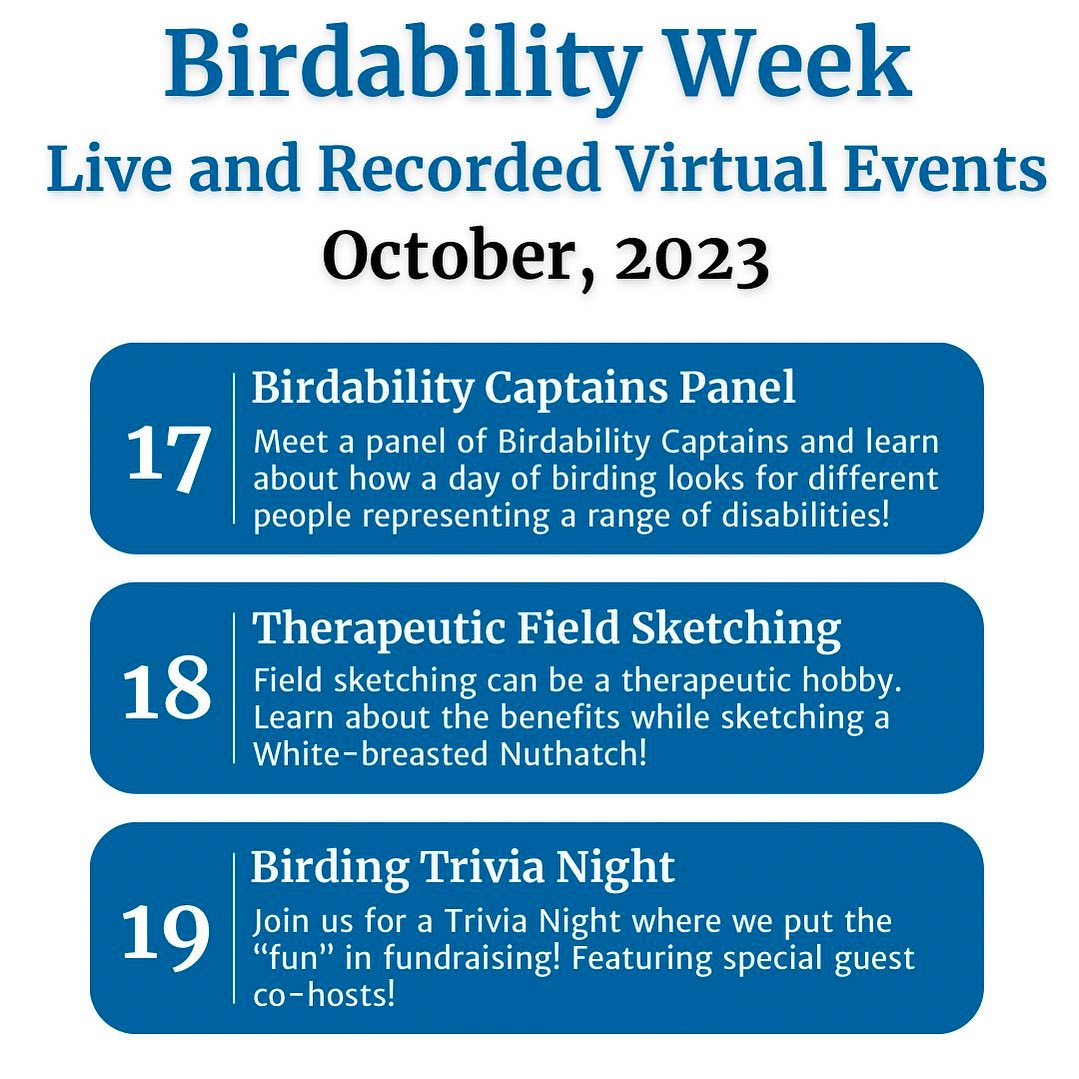
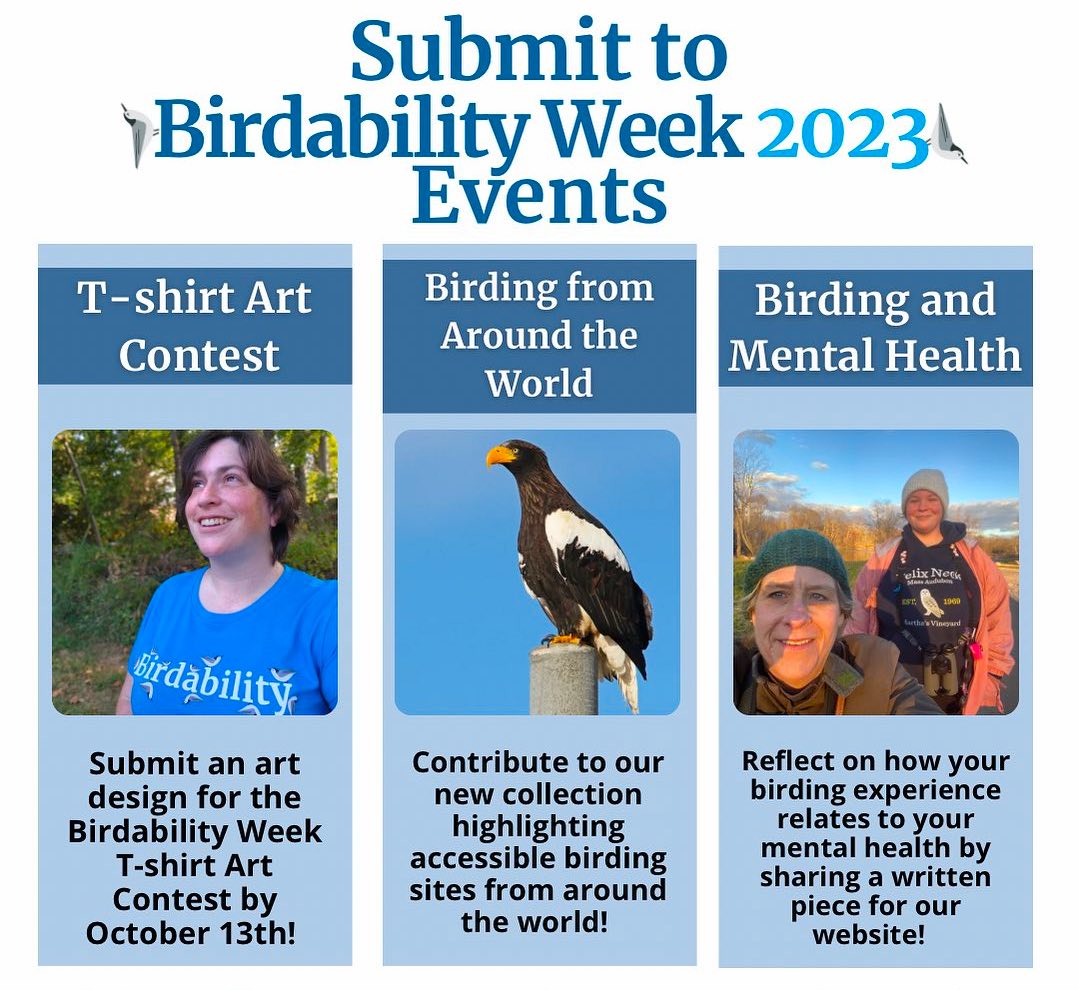
There are a number of in-person and virtual events already scheduled—from panel discussions about accessibility challenges to field sketching and bird trivia for Birdability Week. This year, the Birdability team is also launching a digital series to showcase accessible birding experiences from around the world! They are looking for birders like yourself to take a video or write about an accessible location outside of the U.S. to be featured on their YouTube channel and website.
Celebrate World Migratory Bird Day (WMBD) with us in 2023! This year’s theme is “Water: Sustaining Bird Life”. Have fun learning about a new migratory bird every day. We have coloring pages, puzzles, activities, and more. Download for free and enjoy nature with your family at home.
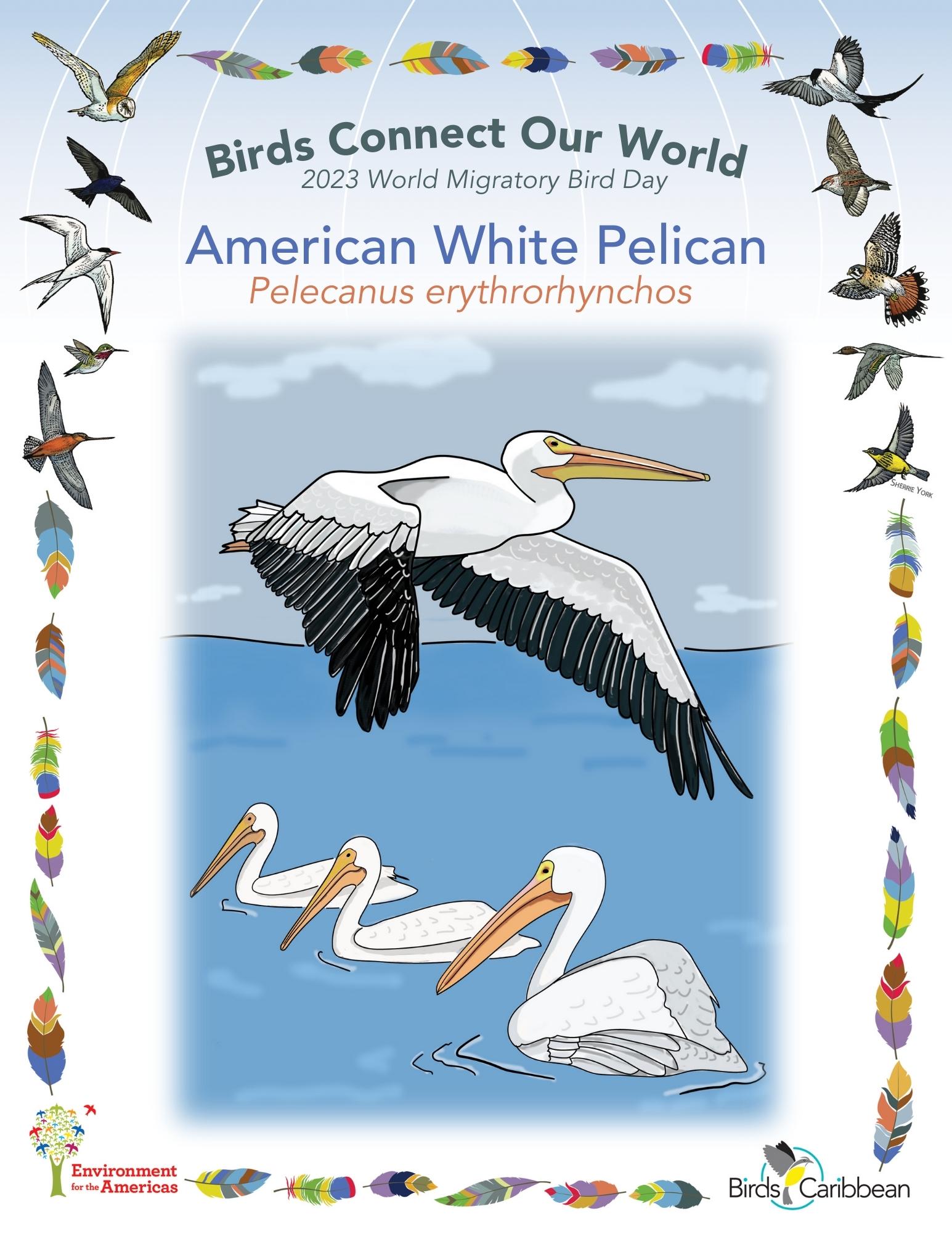
Migratory Bird of the Day: American White Pelican
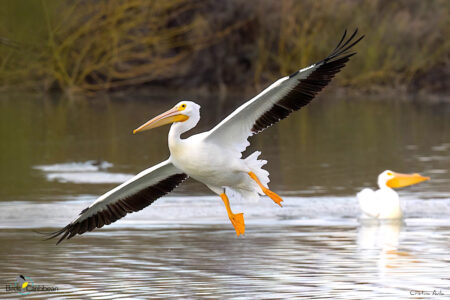
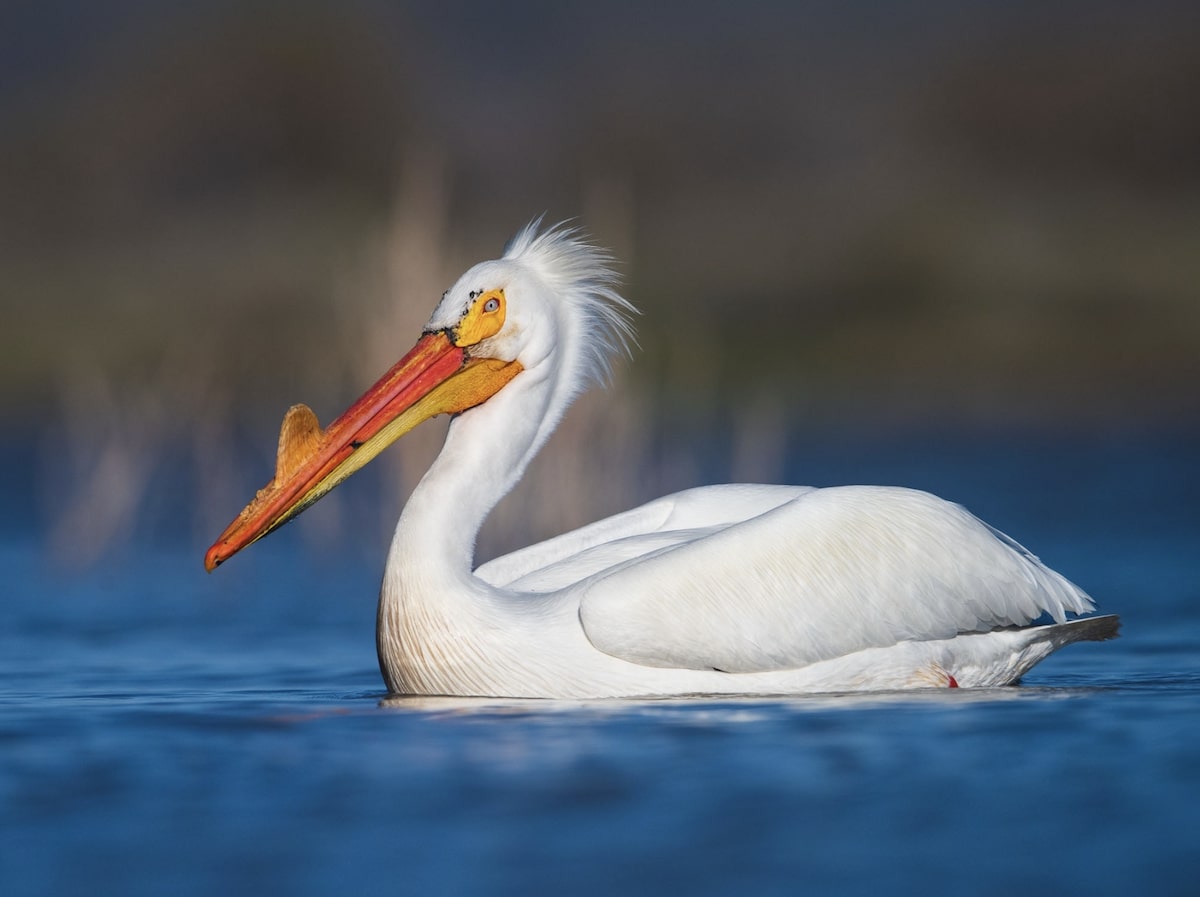
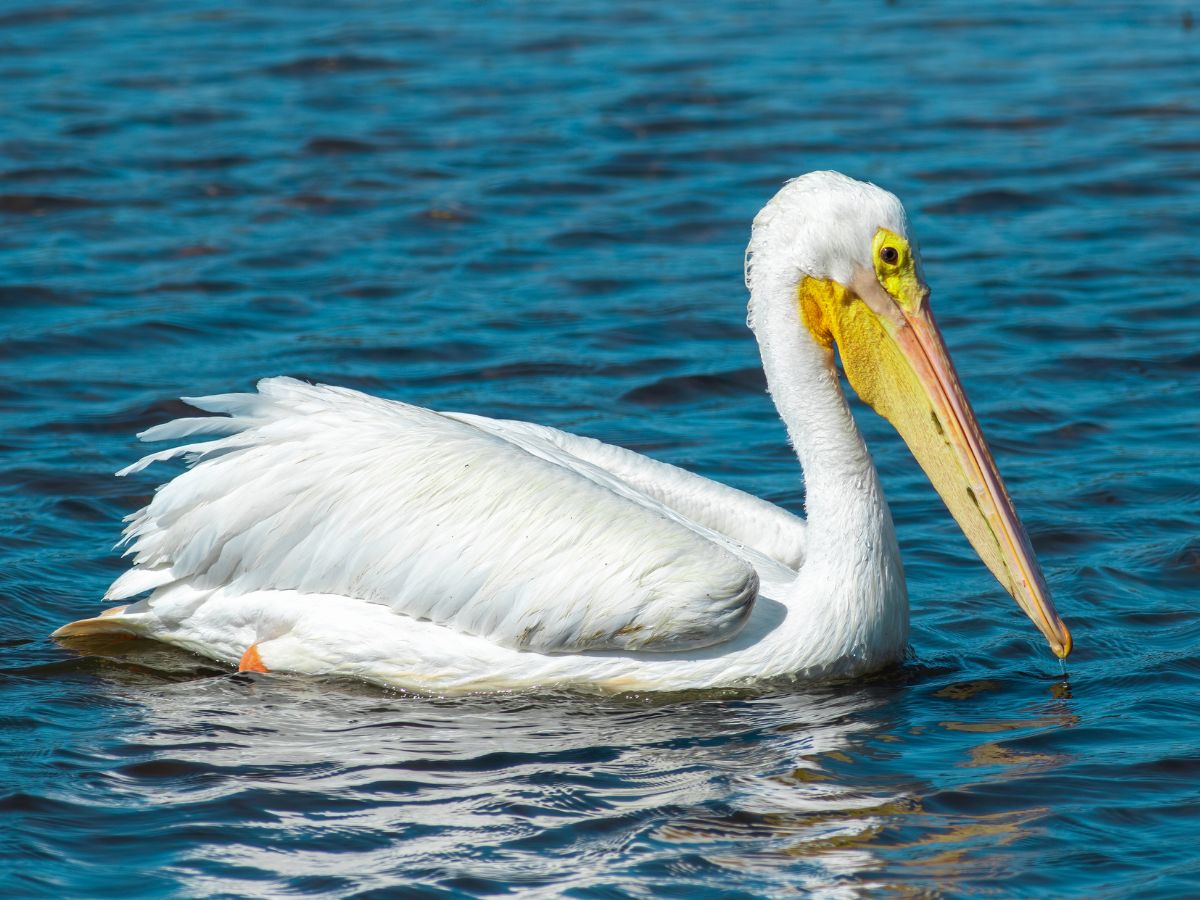
If you look to the sky and spot a flock of large, conspicuously white birds, with black flight feathers, yellow bills and legs, soaring gracefully on broad, stable wings—no doubt, you have found a flock of American White Pelicans! These beautiful birds are easy to identify with their huge size, large pinkish-yellow bill, and white coloration. If the bill is gray instead of yellow, then you have spotted an immature bird in its first year! You will never, however, confuse this bird with its cousin, the Brown Pelican. Whilst they share part of their geographic distribution, and may be found together in wetlands, the Brown Pelican is smaller, with a darker coloration and a completely different feeding behavior.
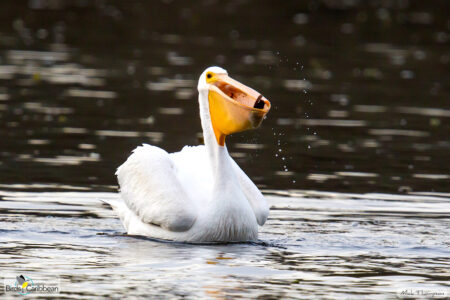
When feeding, American White Pelicans obtain their food by dipping their bills into the water and scooping up fish, their main prey. This is usually done in very shallow freshwaters, although they will also feed in saline waters. The Brown Pelican feeds on fish as well, however, they plunge-dive from high up in the air, using the force of impact to stun small fish before scooping them up.
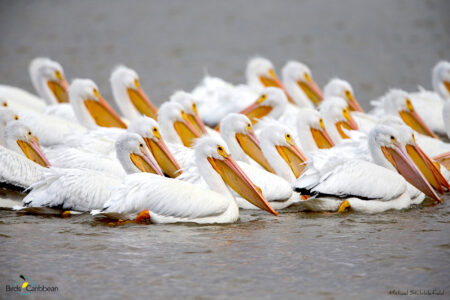
If you visit the shallow lagoons that pelicans prefer, you can observe each species feeding in their own way. Brown Pelicans look for food alone, each bird swooping down rapidly to catch their prey. White Pelicans forage cooperatively, using clever group strategies to capture fish. Coordinated flocks of swimming birds work together to encircle fish and herd them into the shallows where they become concentrated and can be more easily caught with synchronized bill dipping. Their enormous bills with elastic, expandable, pouches below then come into play—the pelicans scoop prey again and again into their pouch, an amazing spectacle when hundreds of these birds are feeding together!
This species breeds in western and central North America, laying two white eggs in a nest constructed in the soil. They are attentive caregivers to their young—from the moment the chicks hatch, both parents spend the day looking for fresh food to help them grow. By three weeks of age they are more mobile and parents begin to leave their nests unattended, coming back only to bring food. At this age, the young birds begin to form creches, for protection and warmth.
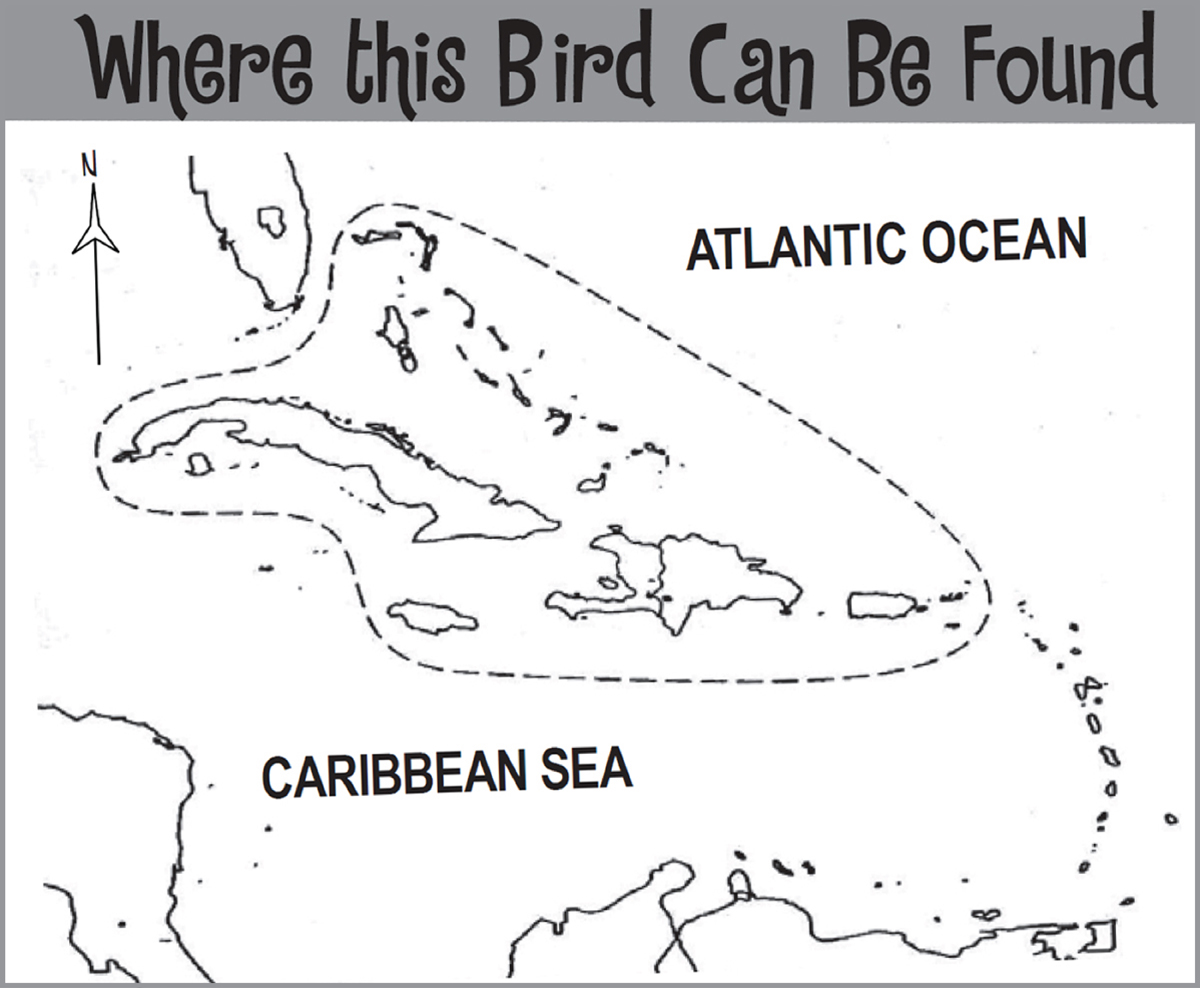
During autumn the species migrates south, spending the winter in southern California, the Gulf States, Mexico, and Central America. Most literature states that American White Pelicans are vagrant in the West Indies, with very few reports. Some researchers even say that they do not cross oceanic waters, but news flash: this information is no longer accurate! They do cross the Atlantic Ocean and the Gulf and they are now common birds in Cuba! In February 2021, citizen scientists in Cuba recorded 1,700 individuals in one aquaculture farm in the Pinar del Río Province in western Cuba. A resident population of about 300 lives year-round in the wetlands of Los Palacios in the same province, and during winter migration they are common in most Cuban coastal wetlands in the western part of the country, for example, Zapata Swamp. Visit eBird Caribbean to observe all these recent sightings.
Thanks to Lourdes Mugica for the text and Christine Elder for the lovely illustration!
Color in the American White Pelican
Download the Migratory Birds of the Day Coloring Page! Use the picture above and the photos on this page as your guide, or look up pictures of the bird online or in a bird field guide if you have one. Share your colored-in page with us by posting it online and tagging us @BirdsCaribbean #WMBD2023Carib
Listen to the calls of the American White Pelican
Adult American White Pelicans are usually silent, especially when not breeding. At breeding colonies you might hear them give frequent low, brief grunts.
Puzzles of the Day
Click on the images below to do the puzzle. You can make the puzzle as easy or as hard as you like—for example, 6, 8, or 12 pieces for young children, all the way up to 1,024 pieces for those that are up for a challenge!
American White Pelicans cooperate when feeding. Sometimes, large groups gather in wetlands. They coordinate their swimming to drive schooling fish toward the shallows. (Photo by Michael Stubblefield Macaulay Library- ML554648261)
When While Pelicans are on their wintering grounds they only search for food during the day, but in the breeding season, they commonly head out fishing at night. (Photo by Mick Thompson)
American White Pelican in flight. (Photo by Cristina Avila Macaulay Library- ML538260461)
Activity of the Day
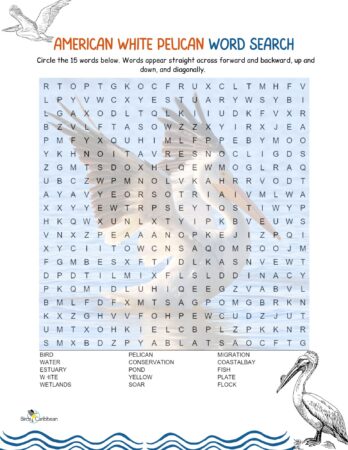
FOR KIDS: Can you find the words in our American White Pelican word search? Remind yourself of some of the interesting facts about this water-loving migratory bird as you look for all 15 hidden words!
Remember the words may appear forwards and backwards, as well as horizontal, vertical and diagonal! Need some help? Or want to check your answers? You can see where all the words were here.
FOR KIDS AND ADULTS: Enjoy these videos of American White Pelicans in the wild! In the first video, you can see what this bird looks like when it is flying.
In the second video, you can see a couple of birds in their winter plumage swimming.
Celebrate World Migratory Bird Day (WMBD) with us in 2023! This year’s theme is “Water: Sustaining Bird Life”. Have fun learning about a new migratory bird every day. We have coloring pages, puzzles, activities, and more. Download for free and enjoy nature with your family at home.
Migratory Bird of the Day: Wilson’s Warbler
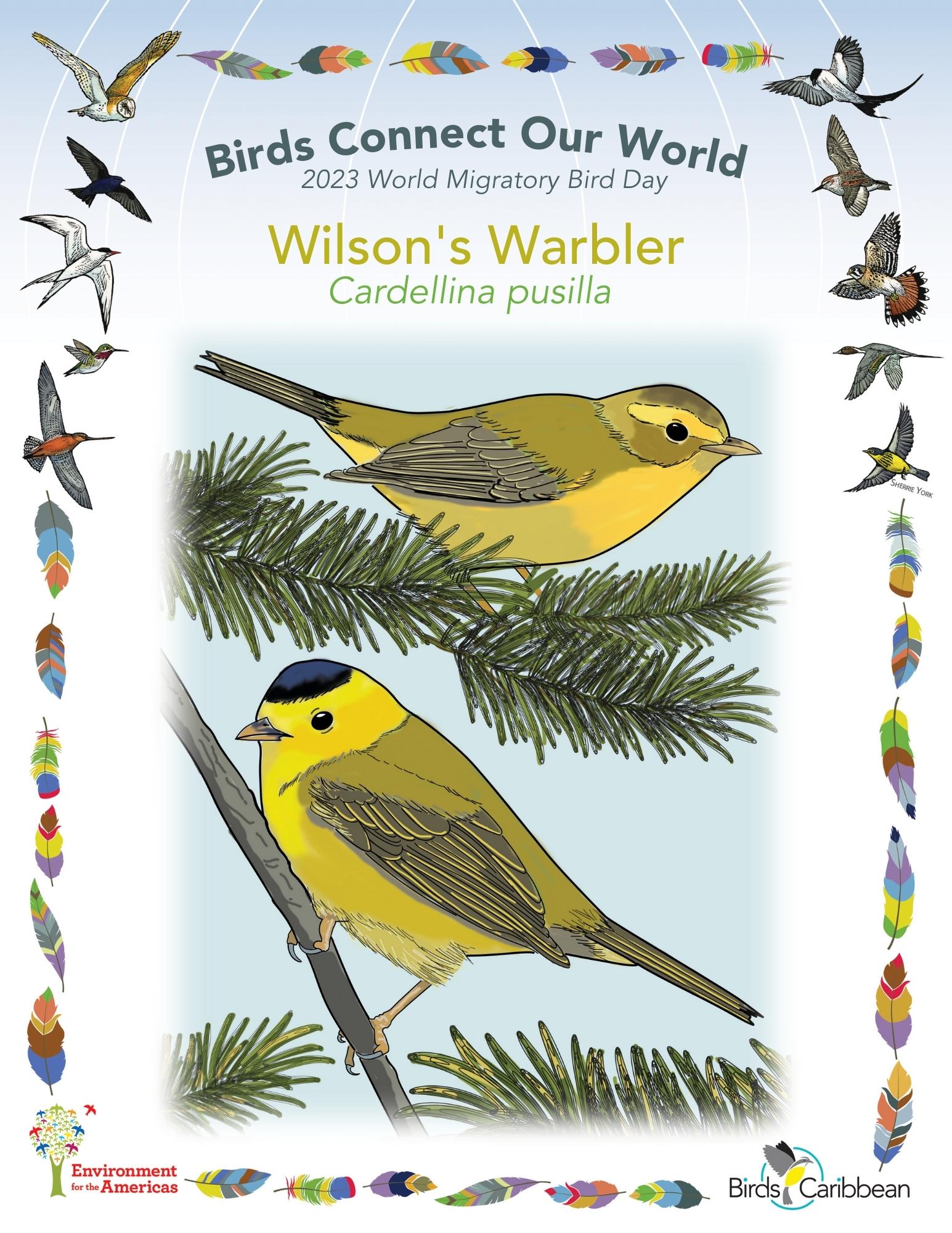
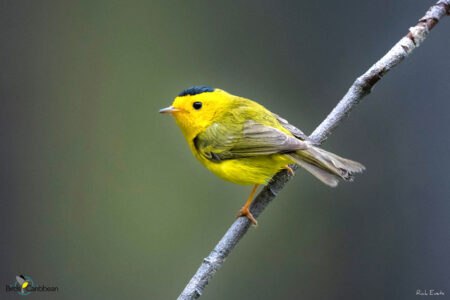
This spritely migratory bird with the bad toupée is the Wilson’s Warbler. It is one of the smallest warblers at around 10-12cm long and weighing 5-10g.
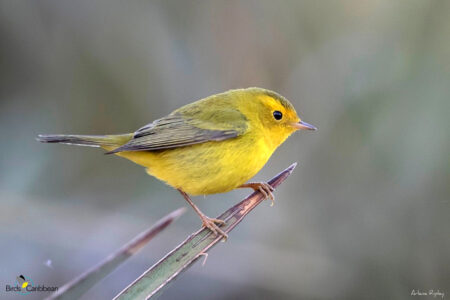
Its plumage is mainly yellowish-olive, with a golden yellow throat and belly. It has beady black eyes and a small, thin beak. Adult males have a glossy black cap on their heads; the cap on females and juvenile males is highly variable but usually duller and more olive colored. These little birds are insectivorous, feeding on various arthropods on tree leaves and branches. They often hover in front of leaves as they try to capture a tasty insect morsel!
Wilson’s Warblers breed in the western United States, across Canada, and also in Alaska. It is a ground-nesting species that loves scrubby habitats and thickets near streams. Their clutch size ranges from 2-7 eggs and they are capable of breeding twice in a season. Only females incubate the eggs and brood nestlings (chicks), but males help feed nestlings and fledglings (chicks that have grown feathers and are learning to fly).
By August they leave their breeding grounds and begin their fall migration to Central America and islands in the northern Caribbean—The Bahamas, Jamaica, Cuba, Puerto Rico and Dominican Republic. During migration they use many types of habitats, from lowland thickets near streams to high-elevation cloud forests. On their wintering grounds they supplement their diet of squirmy, slimy, crunchy insects with “honeydew”—a sugary liquid secreted by some insects as they feed on plant sap.
The Wilson’s Warbler is not threatened but is listed as a “Common bird in steep decline” by the Partners in Flight organization. This is because of habitat loss on both their breeding and wintering grounds, predation from invasive species like domesticated cats, and nest parasitism. Helping Wilson’s Warblers, and other birds, can be as simple as keeping pet cats indoors and using a leash and harness when outdoors; and supporting the efforts of bird advocacy groups and NGOs that are working to restore and protect habitats across the Wilson’s Warbler’s range.Learn more about this species, including its range, photos, and calls here.
The Wilson’s Warbler
‘I’m a tiny warbler,
With beady black eyes,
A black cap on my head,
And energetic for my size,
I breed in mountain meadows,
And thickets near streams,
I winter in Central America,
A vagrant in the West Indies,
Because of habitat loss,
My species is in decline,
Please protect my forest home,
Before I run out of time”
Thanks to Scott Johnson for the text and poem, and Christine Elder for the lovely illustration!
Color in the Wilson’s Warbler
Download the Migratory Birds of the Day Coloring Page! Use the picture above and the photos on this page as your guide, or look up pictures of the bird online or in a bird field guide if you have one. Share your colored-in page with us by posting it online and tagging us @BirdsCaribbean #WMBD2023Carib
Listen to the calls of the Wilson’s Warbler
The call of the Wilson’s Warbler is a husky chip. You may also hear the male as they start to sing on their wintering grounds. The song is a rapid string of similar notes, dropping in pitch toward the end.
Puzzles of the Day
Click on the images below to do the puzzle. You can make the puzzle as easy or as hard as you like—for example, 6, 8, or 12 pieces for young children, all the way up to 1,024 pieces for those that are up for a challenge!
Female Wilson’s Warbler. Look for this bird in tangles of vegetation along streams or ponds or even forested edges. (Photo by Arlene Ripley Macaulay Library-ML176994031)Male Wilson’s Warbler. Wilson’s Warblers tend to be brighter yellow in the West and paler yellow in the East. Pacific Coast populations have the brightest yellow, almost orange, foreheads and faces. (Photo by Rick Evets)
Activity of the Day
FOR KIDS: This year the theme for World Migratory Bird Day is “Water: Sustaining Bird Life.” We want to highlight the importance of water conservation to both humans and birds.
We often see birds flying, preening, bathing and feeding. You might not have ever seen a bird taking a drink of water but they do!
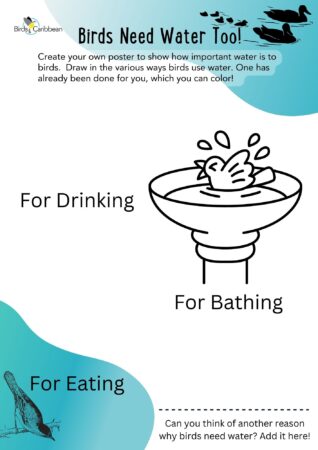
Birds need water just as much as we do. Drinking water helps them regulate bodily processes like digestion. Water also keeps birds clean and cool on hot days when they take a splish-splash in a puddle, gutter, or backyard bird bath. Many birds also rely on wetland habitats, such as our ponds, salinas, marshes, mangroves, rivers, and coastal waters.
In our activity you can create your own poster to show how important water is to birds. Draw in the various ways birds use water!
FOR KIDS AND ADULTS: Enjoy these videos of Wilson’s Warblers in the wild! In the first, you can see a lovely, brightly colored male. In the second, a Wilson’s Warbler takes a bath—one of the many things birds need water for as they migrate!
Read all about a bird banding adventure in Oregon! Caribbean biologist Zoya travelled all the way from Grenada to the US to learn more about studying birds using bird banding. Wilson’s Warbler was one of many bird species that Zoya was able to get up close to on her way to passing her NABC (North American Banding Council) exam and becoming a certified Bander. Find out all about her experiences in the blog below.
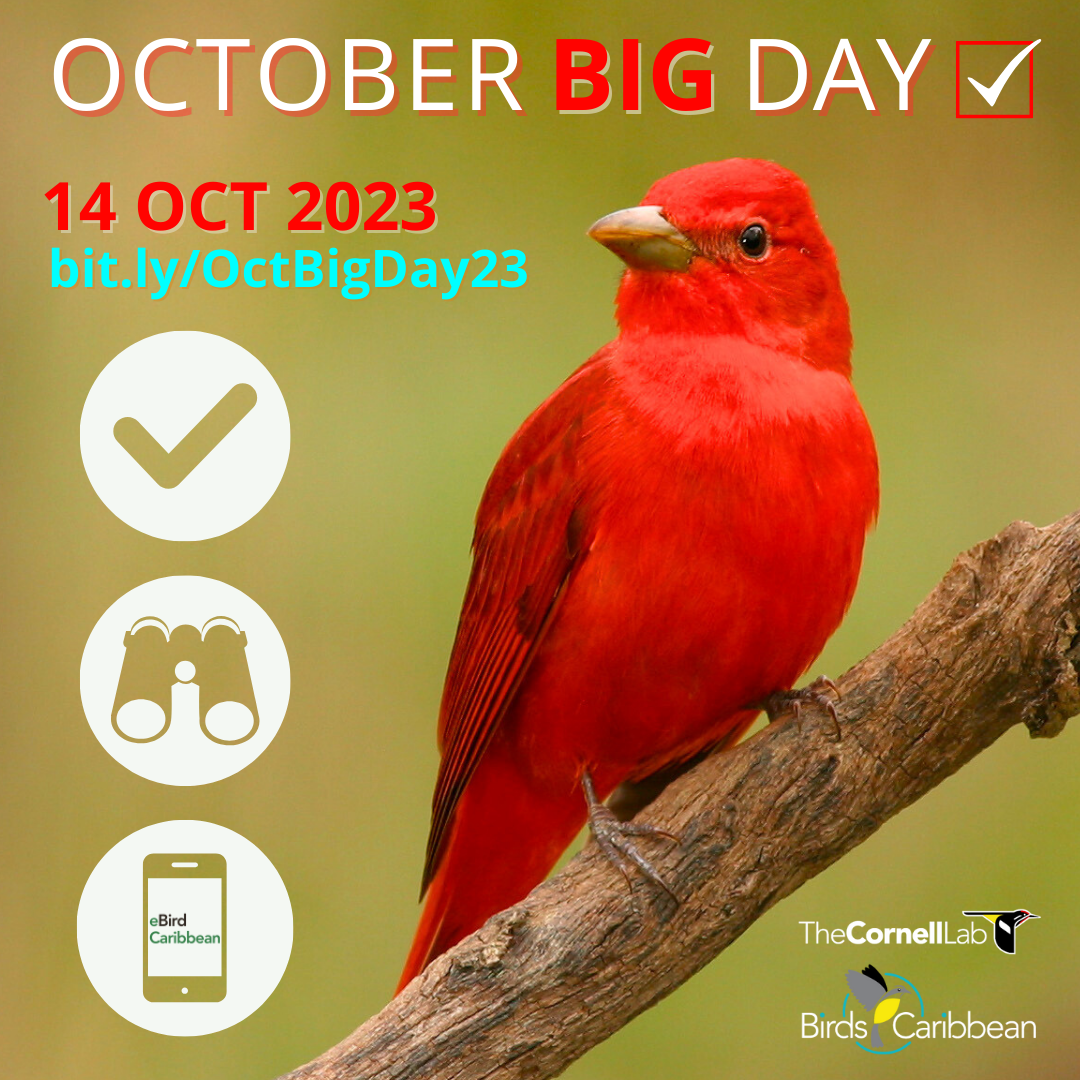
A Summer Tanager, a migrant to the Caribbean, is featured on our October Big Day 2023 promo graphic.
October Big Day comes just once a year!And it’s always about community, and our love of birds.
Here at BirdsCaribbean, we believe in October Big Day—which this year coincides with World Migratory Bird Day—WMBD (Saturday, October 14, 2023). It is an opportunity for birders across the region to focus, deploy those binoculars, cameras and scopes, and share information (especially on eBird Caribbean!)
Whether you are quietly observing from your verandah or balcony, on a family outing with the kids, or on an organized trip to a birding hotspot, we invite you to make the most of those 24 hours on October 14. But wait! Note that Global Bird Weekend is also happening over October 13, 14 and 15, which offers up even more possibilities. We are hoping that the world record created last October on Global Bird Weekend (and broken on May 13 this year for the Global Big Day) will be smashed once again. Let’s do it!
Where are the birds, and what are they doing?
Data collected on October Big Day will be used by birders and scientists to better understand and protect birds. This is also an opportunity for the individual birdwatcher to contemplate birds, their behavior, and the places where they may be found. For example, are there birds you are only likely to see in the late morning or early afternoon? And if so, are they at specific locations? Tanagers and bullfinches are often very active during the morning hours. As the day heats up, you may see raptors soaring above. Seagulls and shorebirds can be observed at almost any time of day. Migratory warblers generally show up in early morning or evening hours, feeding and bathing in suburban gardens and parks.
Make your birding count—submit & share your data!
Participating is easy with the essential tool, eBird, where you should record all the birds you see (and even hear) on Saturday 14th October via the eBird website or mobile app. If you’re in the Caribbean, be sure to use eBird Caribbean (and choose the eBird Caribbean portal in your eBird app settings on mobile). If you do not already have one, it’s easy to sign up for a free eBird account—here’s a quick guide on how to use eBird. Eager birders should spot as many birds as they can from midnight to midnight in their local time zone on October 14; or bird anytime during the weekend of Oct. 13-15 for the Global Bird Weekend. The handy mobile app allows you to keep and submit lists while you’re still out birding, perhaps exploring nearby Hotspots. It will even track how far you have walked while watching birds. Remember to submit eBird checklists before October 17, 2023 to be included in the initial results announcement!
Share your sightings with us, and join BirdsCaribbean!
We look forward to seeing your stories and photos on social media. You can find us on Facebook and on X (formerly Twitter) and Instagram @birdscaribbean. Be sure to tag us! If you’re not on social media, consider joining our discussion group where you’ll be able to share your October Big Day experience with over 850 members.
May we remind you that BirdsCaribbean membership has so many benefits; you will receive discounts on our products, workshops and conferences; meet and network with fellow birders, scientists, educators and conservationists across the region; and keep in touch with birding trends and news through our monthly newsletters (free sign-up here). Join us today and help us save our Caribbean birds and their important habitats!
See you on October Big Day 2023—and let’s see some birds!
Most importantly, have fun and don’t forget to tag BirdsCaribbean (@BirdsCaribbean) in your birding adventures! We can’t wait to see which of our migratory friends have arrived to the Caribbean!
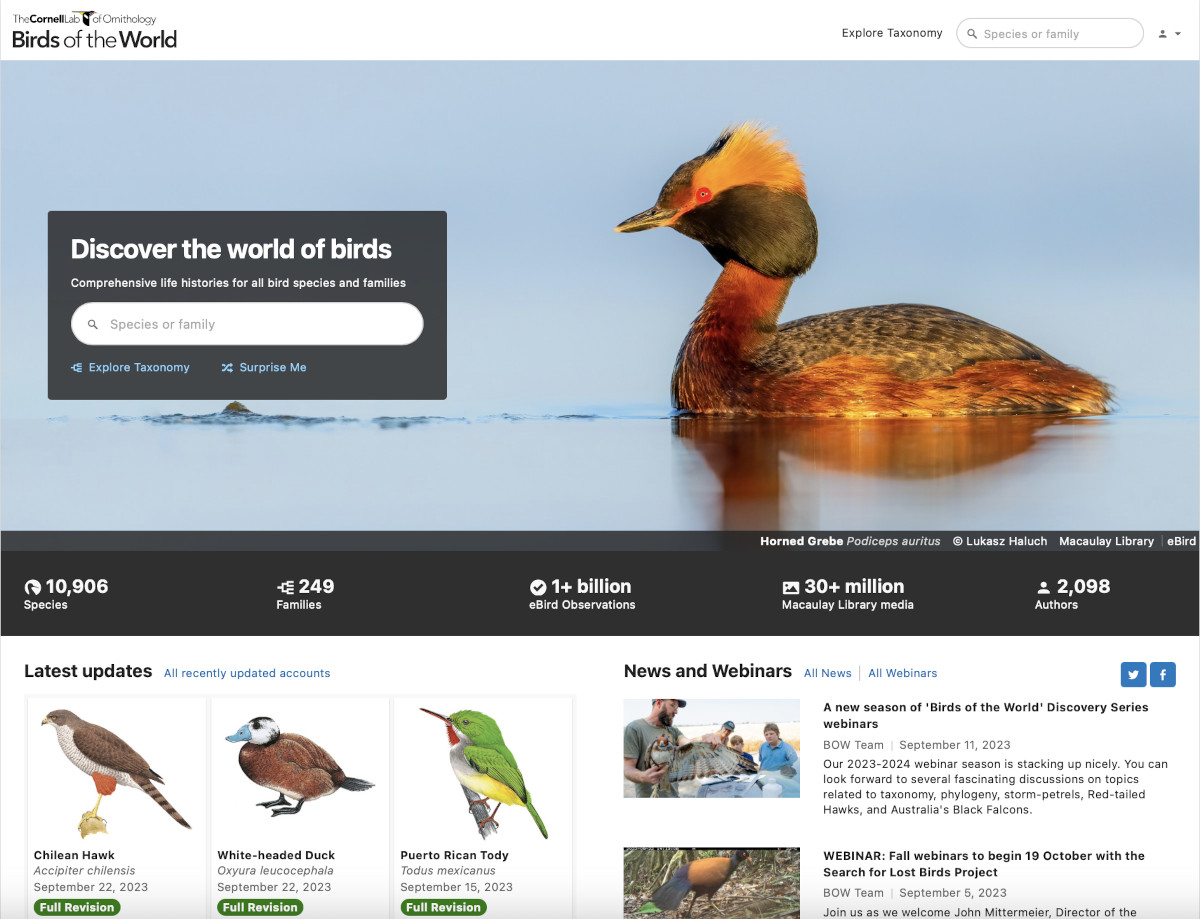
We are delighted to inform you that we have partnered with The Cornell Lab of Ornithology to provide free access to Birds of the World to anyone within the Caribbean islands!* Just login to your existing eBird/Cornell account, or create a new eBird/Cornell accountto access Birds of the World for free!
BirdsCaribbean members outside the Caribbean can receive a 25% discount on a personal subscription plan, using the coupon code BC25 (current paid-up BC members have free access through the end of 2023). The Cornell Lab of Ornithology also provides complimentary access to certain user groups under their Birds of the World Digital Access Scholarship. If you fit into any of the categories, be sure to reach out to them.
Every Bird has a Story
Birds of the World (BOW) is the largest online ornithology resource with comprehensive life history information on 10,906 species and 249 families of the world’s birds. BOW brings together scholarly content from four celebrated works of ornithology, including Birds of North America, Neotropical Birds,The Handbook of Birds of the World, Neotropical Birds, and the Internet Bird Collection (IBC), among others, to provide an in-depth scholarly account for every species. With the integration of millions of bird observations from eBird and stunning images from the Macaulay Library, BOW is the most powerful ornithological resource ever created. It’s a single platform where biologists, birders, and anyone with an interest in birds can explore comprehensive life history information on birds.
Content includes topics such as identification, plumages and molt, taxonomy, distribution, habitat, diet, behavior, breeding, movement, conservation and management, and more. All species accounts have range maps and a growing number have “intelligent maps”—science-based abundance maps and animated migration maps (created from eBird data). Magnificent colour plates from many of the world’s top illustrators are backed up by the massive Macaulay Library resource – a media asset of photographs, video and audio recording. Every species displays its IUCN conservation status and additional ornithological notes as appropriate. The common species names are even available in more than 50 languages!
And here’s a neat feature – because it is linked to eBird, when you are logged into Birds of the World each species account shows a blue badge indicating whether or not you’ve seen, photographed, or taken audio recordings of the bird. If you’re not yet an eBird user, now is a perfect time to sign up and start using this wonderful app to find birds, keep track of the birds, and contribute to science! And if you’re in the Caribbean be sure to use our special eBird Caribbean portal.
Since all of the information has been vetted and can be accessed from a single platform, you will save time spent on endlessly searching and comparing facts across different websites and other sources, reduce costs associated with research (citations are listed and linked to publications where available!), correctly identify birds and improve your birding skills, master bird taxonomy, or keep up with the latest bird news, webinars and research through the exciting science news blog.
One overriding feature of the resource is that it will be constantly revised by ornithologists to include the latest taxonomic revisions and latest information about each species.
Access in the Caribbean is enabled by the efforts of a large number of expert birdwatchers and ornithologists across the region who work with BirdsCaribbean to write, update, and curate Caribbean species accounts. The list of active accounts will continue to be updated as more articles are written, so make sure to check this space regularly for our Caribbean Birds!
In exchange for free access to all Caribbean birders, we have agreed to adopt and update a set of the Caribbean species each year. So would you like to contribute to Birds of the World? BOW is keen to use species experts to help author the species accounts. If you are interested in helping or would like to learn more, contact: Caroline Pott, BirdsCaribbean’s Birds of the World Coordinator, and Stefan Gleissberg, Managing Editor of the Journal of Caribbean Ornithology. Thanks to all for your contributions!
*Included locations are: Anguilla, Antigua and Barbuda, Aruba, Bahamas, Barbados, Bermuda, Caribbean Netherlands, Cayman Islands, Cuba, Curaçao, Dominica, Dominican Republic, Grenada, Guadeloupe, Haiti, Jamaica, Martinique, Montserrat, Puerto Rico, Saint Barthélemy, Saint Kitts and Nevis, Saint Lucia, Saint Martin (French part), Saint Vincent and the Grenadines, Sint Maarten, Trinidad and Tobago, Turks and Caicos Islands, British Virgin Islands, and U.S. Virgin Islands.
Anyone in this area currently subscribed to Birds of the World, who now wants free access, should actively cancel their subscription in order to avoid future charges. Go here to do this.
Join or renew your membership with BirdsCaribbean!
If you’re not a current member, we encourage you to join BirdsCaribbean or renew your membership today! Membership benefits include discounts on our meetings, programs, and materials; the opportunity to meet and network with scientists, birders, educators, and conservationists across the region; and the satisfaction of knowing that you are helping in our urgent fight to save habitats from destruction and birds from extinction. Your membership also supports the Journal of Caribbean Ornithology, an open access, peer-reviewed journal covering all aspects of ornithology within the Caribbean region. Any questions about your membership, contact Delores Kellman, Administrative Assistant, BirdsCaribbean.
Current paid-up BC members outside the Caribbean have free access through the end of 2023. New and renewing BirdsCaribbean members outside the Caribbean can receive a 25% discount on a personal subscription plan, using the coupon code BC25 (those within the Caribbean have free access).
Your membership helps our efforts to raise awareness, train and mentor conservation professionals, support research and monitoring, and engage people in citizen science and conservation actions. We look forward to welcoming new members as well as welcoming back lapsed members!
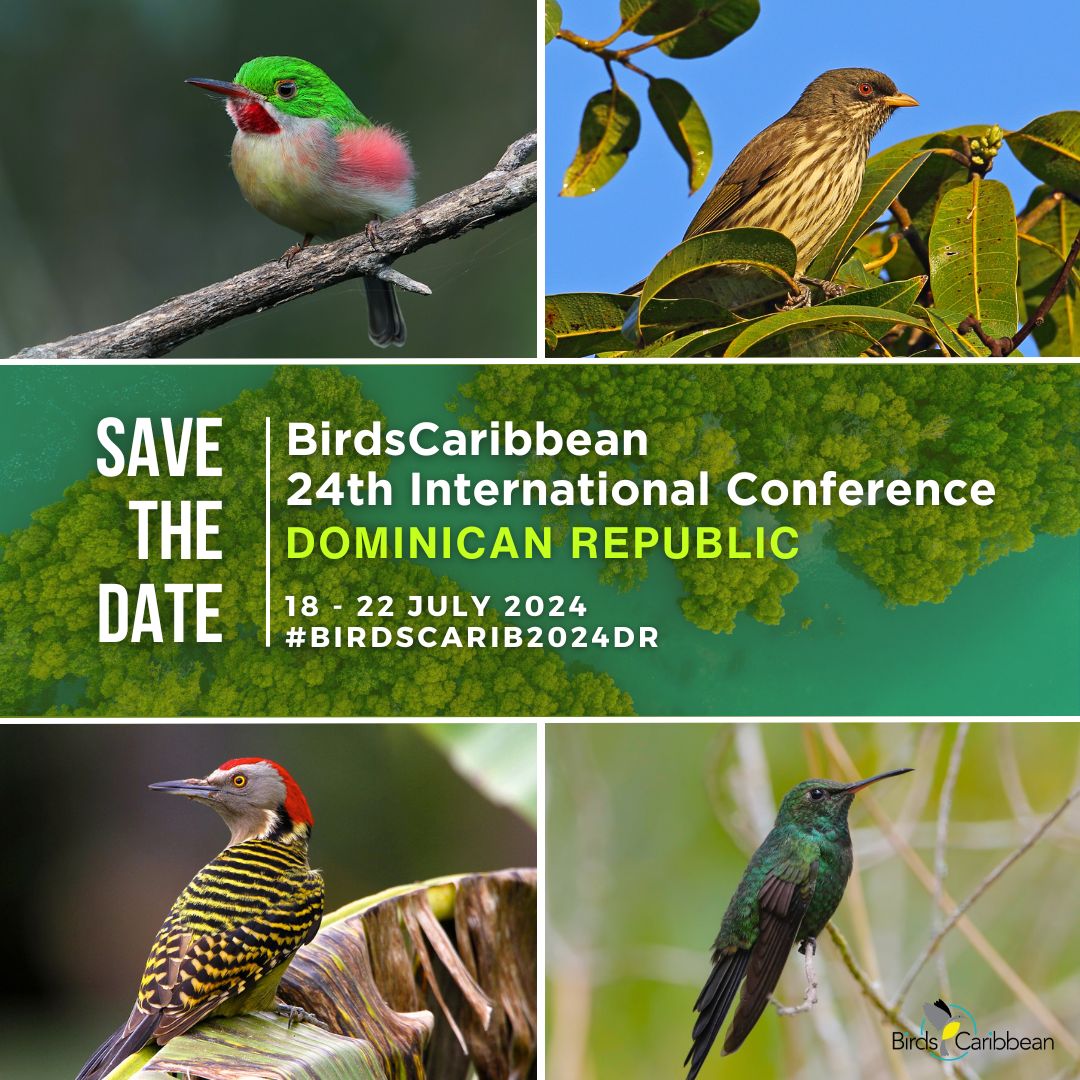
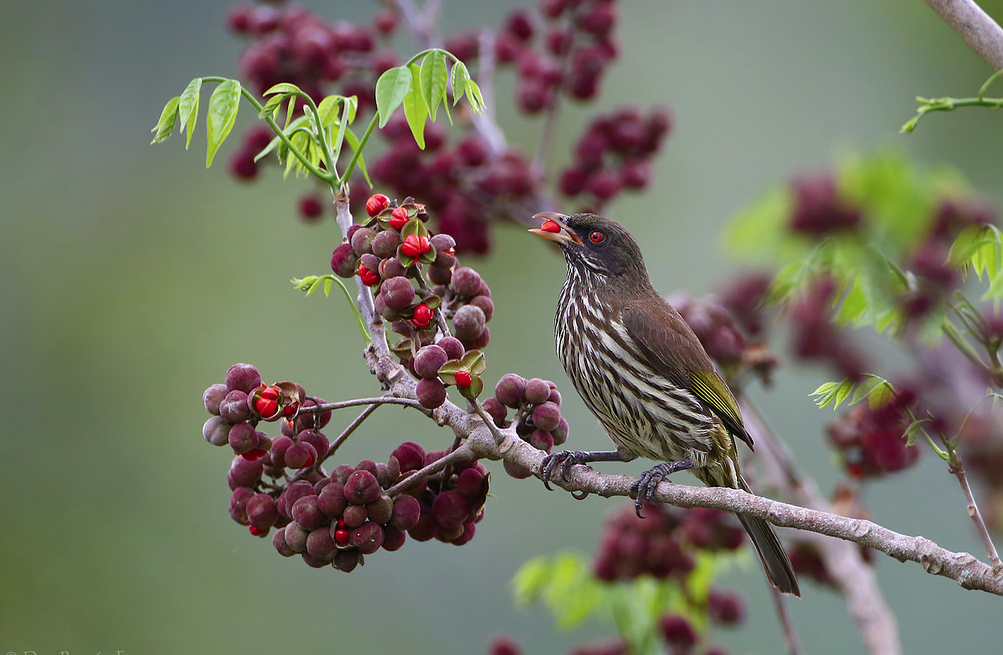
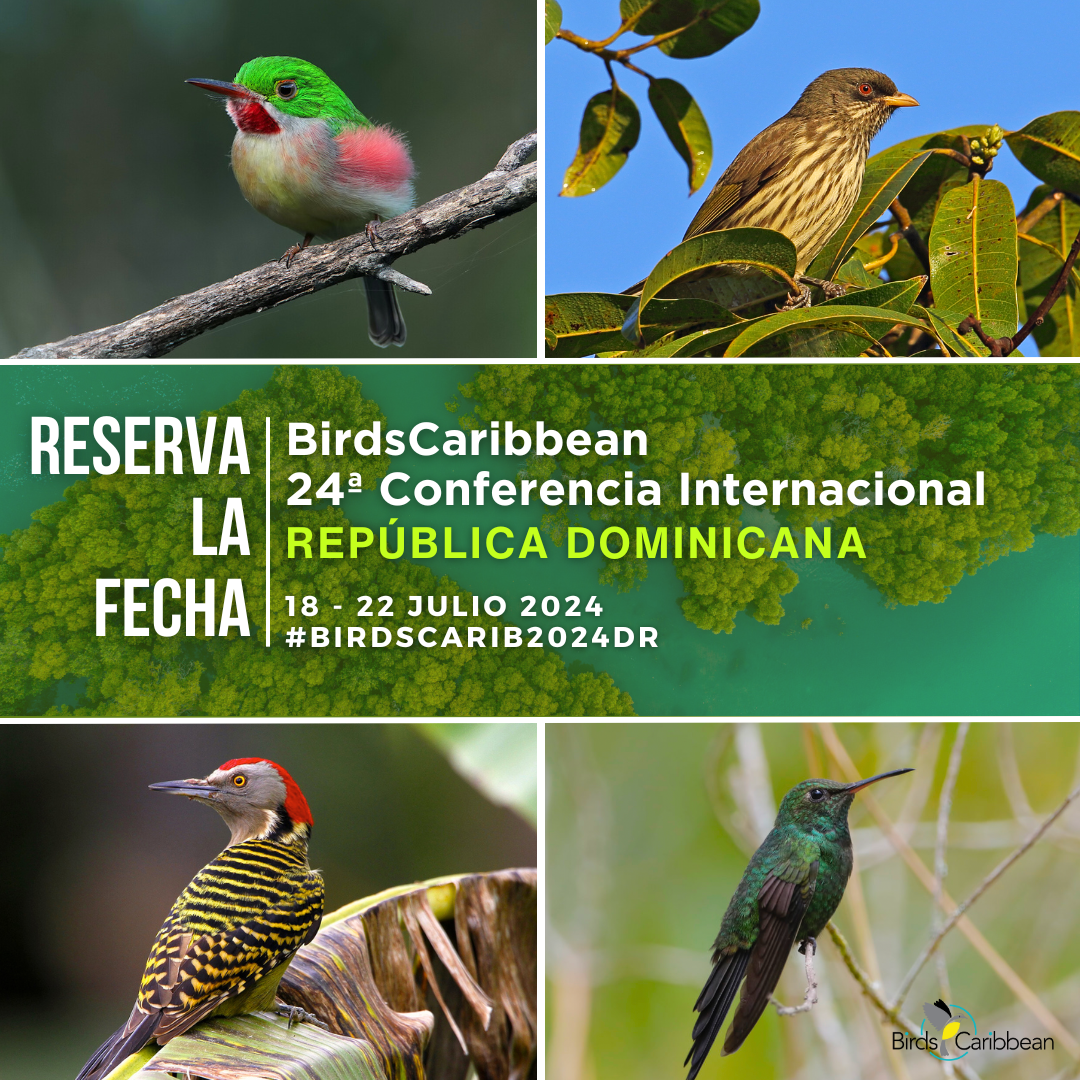
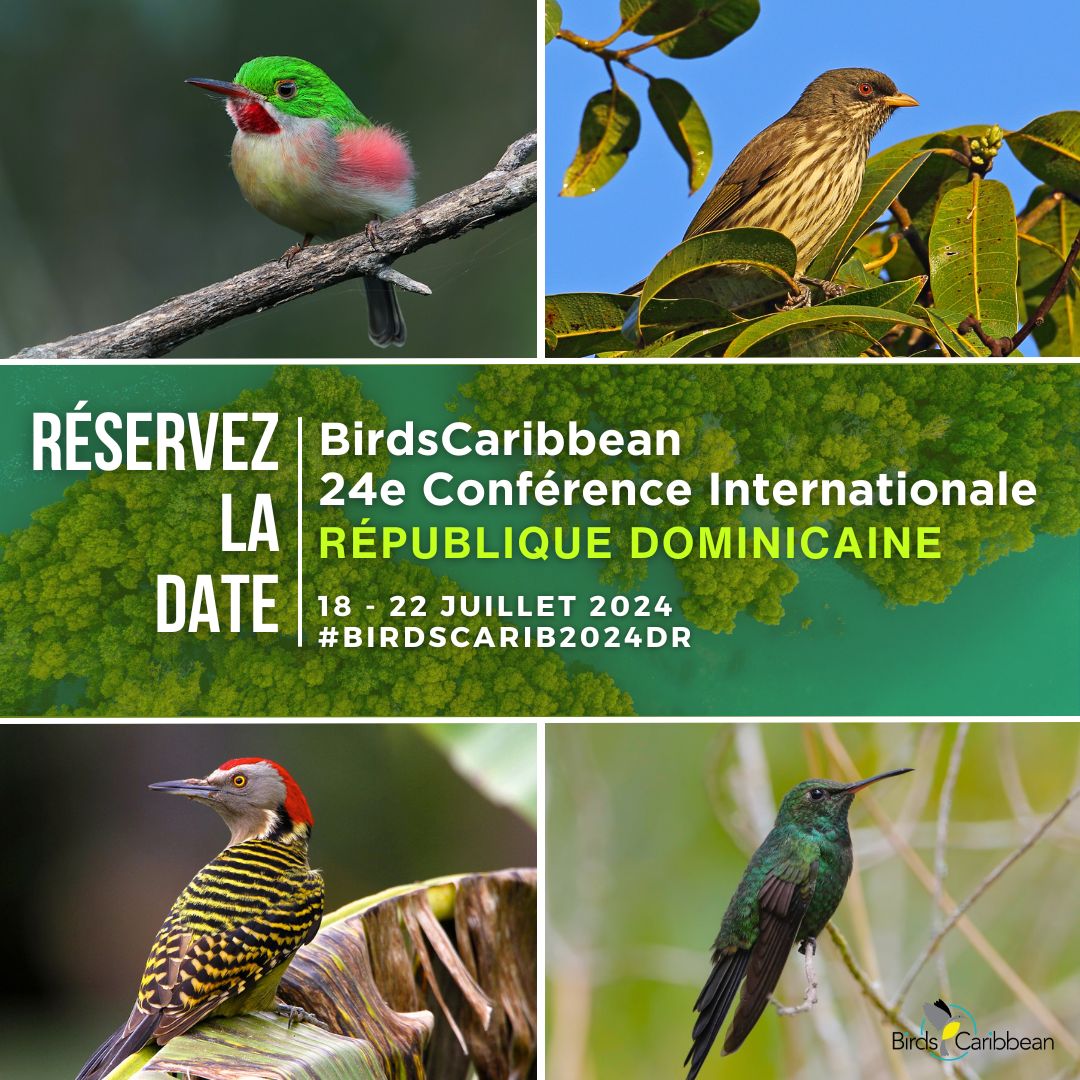
Mark Your Calendars and plan to attend! Featured birds: Broad-billed Tody by Dax Roman; Palmchat; Hispaniolan Woodpecker by Jose M Pantaleon; Hispaniolan Emerald by Dax Roman E.
BirdsCaribbean conferences bring together Caribbean and international wildlife professionals, ornithologists, educators, decision makers, the eco-tourism industry, community leaders, students, volunteers, and many others to network, share information, and learn about the latest research and innovative initiatives to conserve Caribbean birds and their habitats. ALL are welcome!
Our local host is Grupo Jaragua (GJ), a Dominican non-profit organization that is dedicated to the conservation of biodiversity in Hispaniola, using the best available science in collaboration with local communities. Working together with GJ and other local partners, we look forward to welcoming you to the DR in July 2024!
*Drumroll please* Unveiling our Theme!
The conference organizing committee has chosen the theme: From Mangroves to Mountains—Safeguarding our Avian Treasures. This theme celebrates the incredible variety of habitats and endemic birds found in Hispaniola (the second largest island in the Caribbean, which includes Dominican Republic and Haiti). Thirty-four species of birds are endemic to this island—that is, they are found nowhere else in the world. It is also home to an additional 17 regional endemics and provides critical stopover and wintering habitats for over 100 migratory species, like the threatened Bicknell’s Thrush.
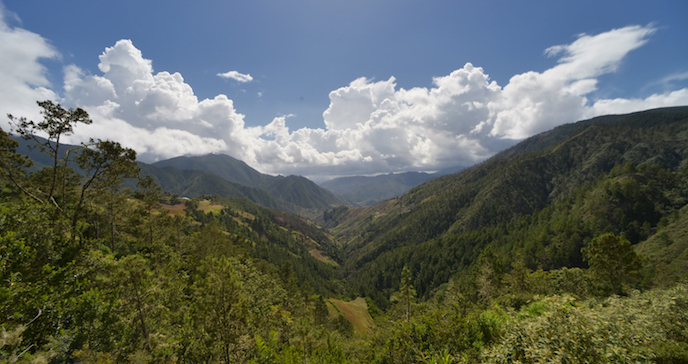
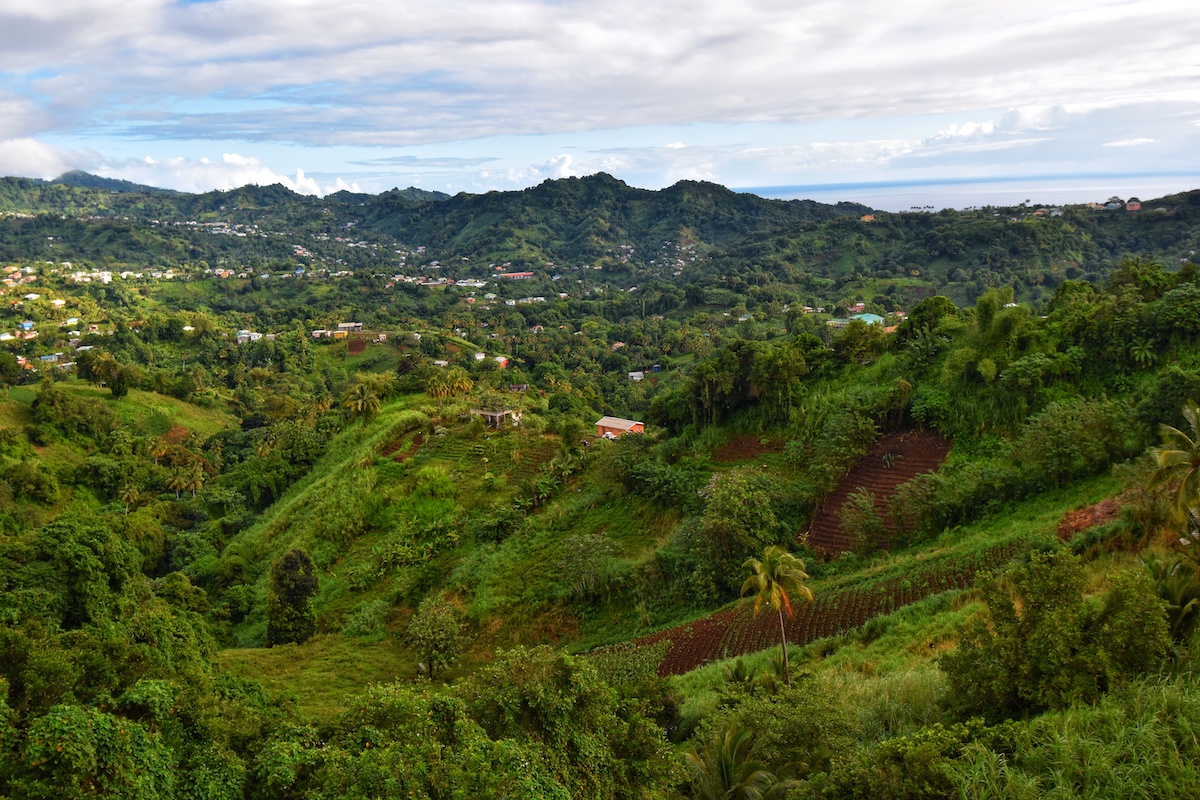
View along the way to Constanza, Dominican Republic. (Photo by Ted Lee Eubanks)
The theme calls attention to the diverse habitats in Hispaniola where these birds live—from the coastal mangroves and wetlands, across striking pine savannas to lush cloud forests in the mountains, where one may sleep comfortably under a down blanket in July! These habitats must be protected not only for birds, but also for people. They provide critical ecosystem services, such as protection from storms and floods, clean air and water, and food; as well as opportunities for recreation, education, and cultural enrichment.
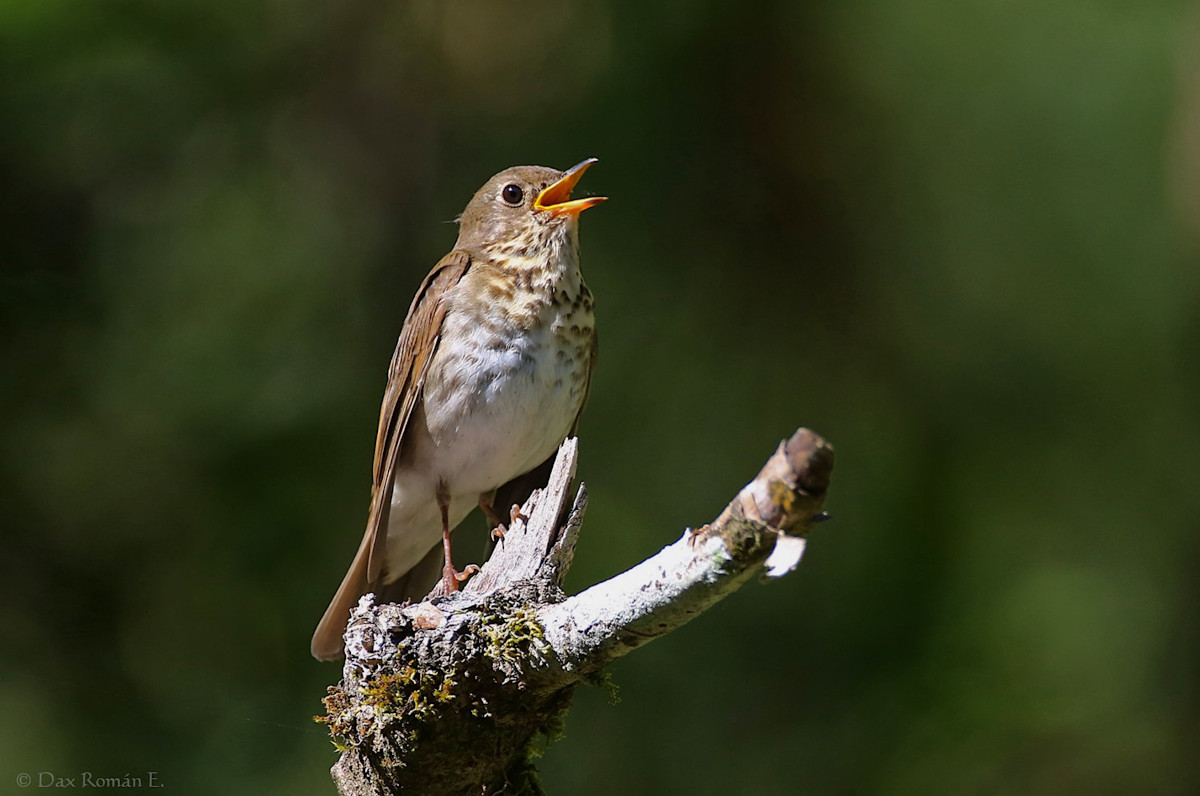
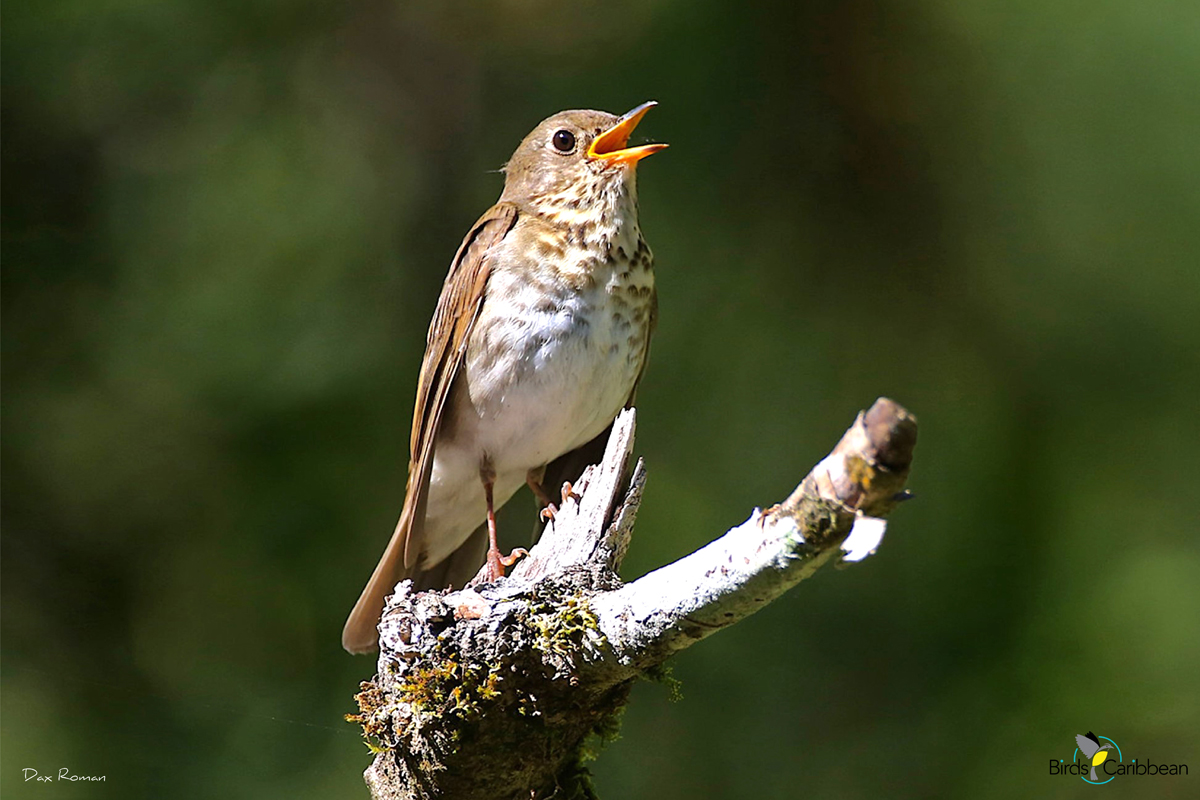
Bicknell’s Thrush. (Photo by Dax Roman)
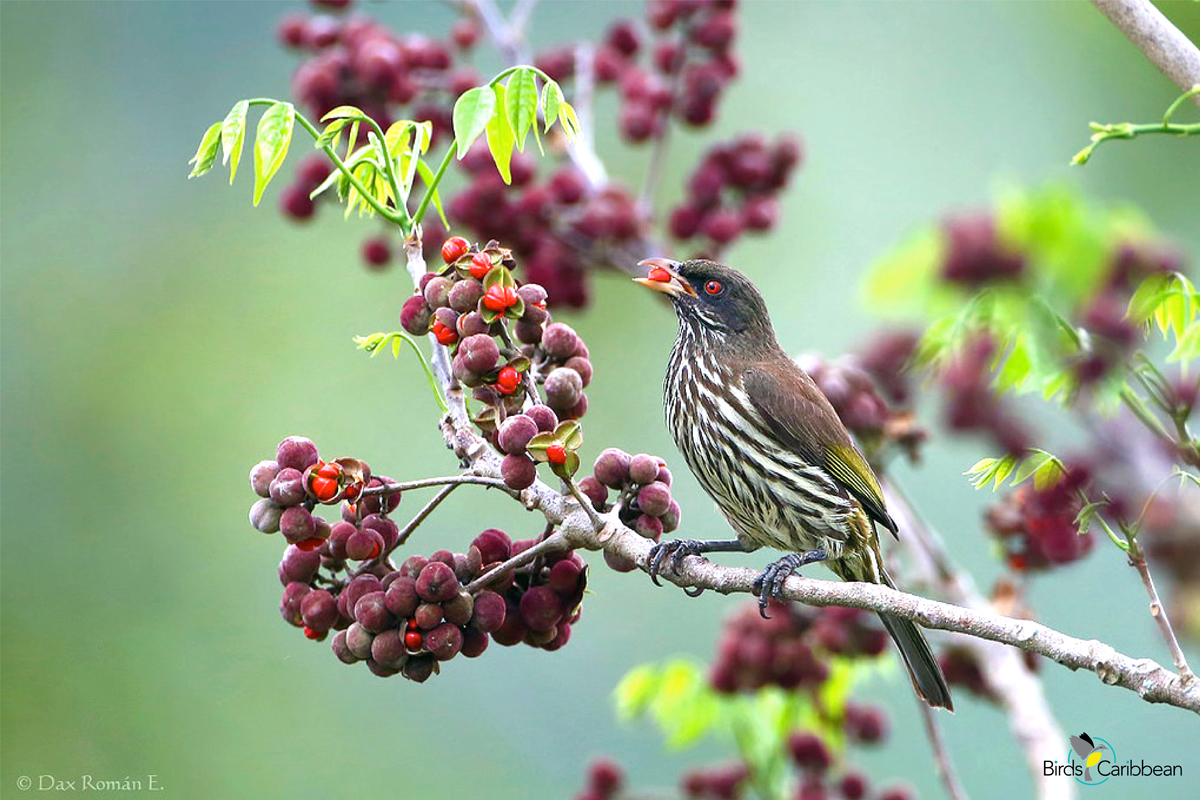
Palmchat. (Photo by Dax Roman)
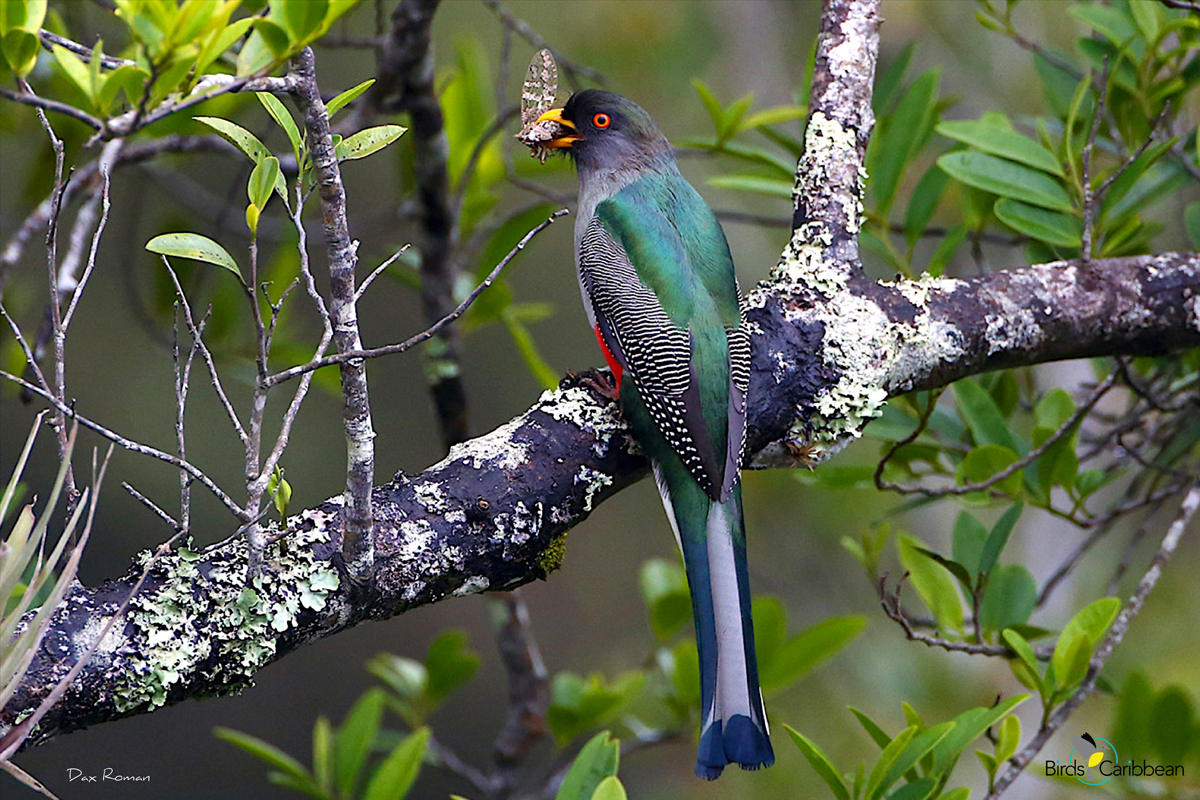
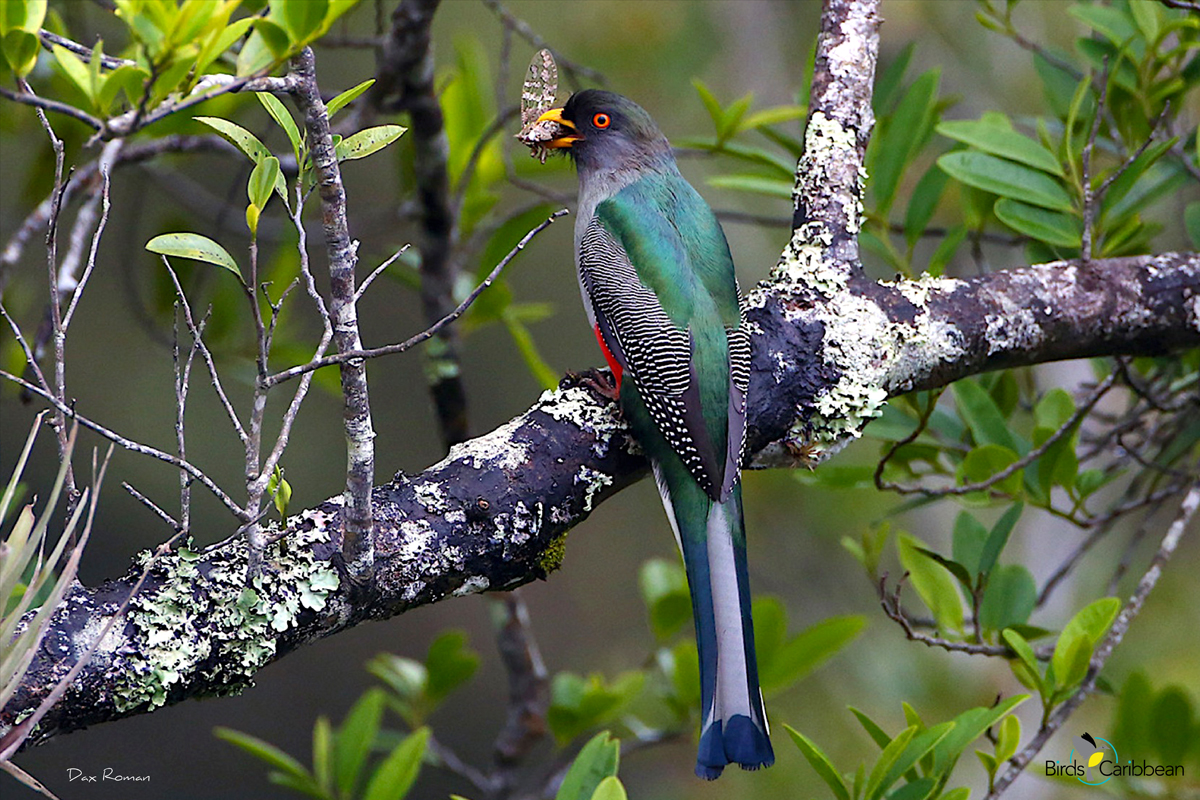
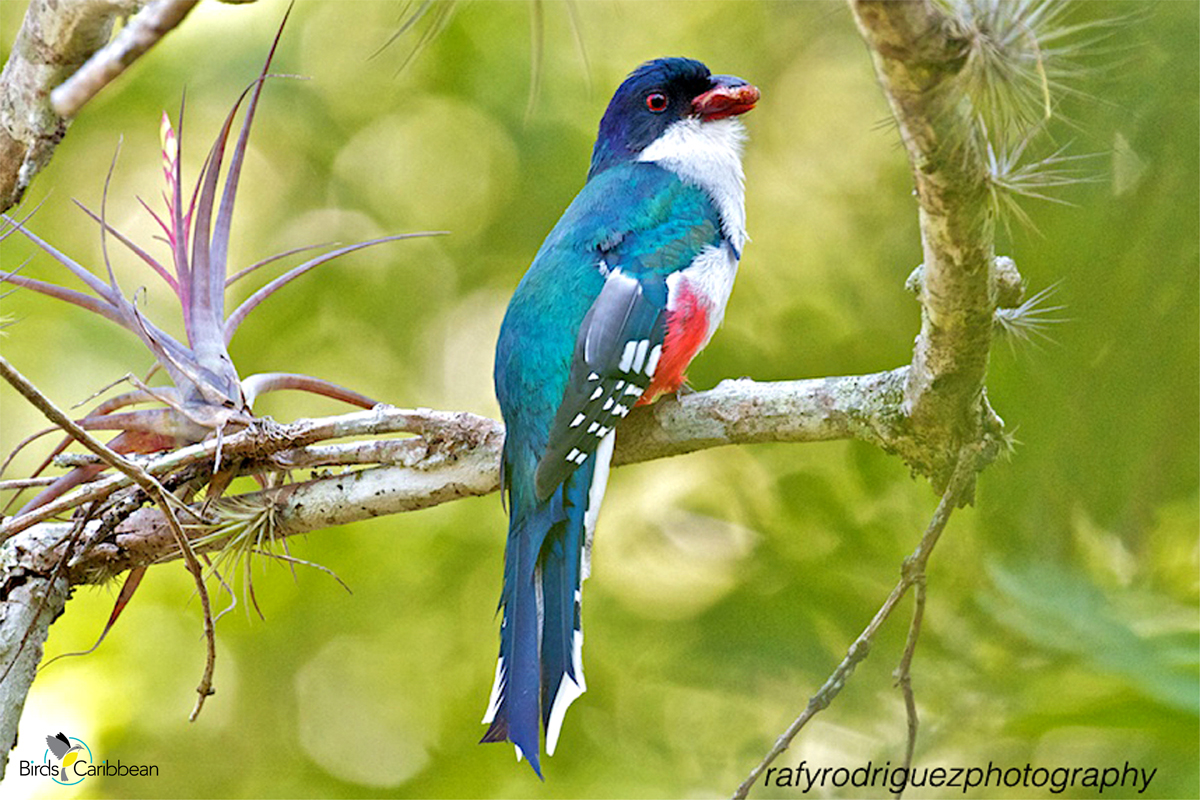
Hispaniolan Trogon. (Photo by Dax Roman)
With this theme, we hope to raise awareness throughout the island about the beauty and value of nature in Hispaniola, exemplified by its magnificent bird life. We must all be guardians and take care of our avian treasures. If we take care of nature, nature will take care of us.
Agenda Highlights: What to Expect
As usual, our five-day conference will offer a range of exciting symposia, technical paper sessions, workshops, keynote speakers, and round-table discussions. We will share the latest science, conservation, management techniques, education, and community engagement projects that help raise awareness, protect habitats, and conserve birds. We will also organize pre-, post-, and mid-conference field trips to visit the most spectacular birding hotspots all over the country—giving delegates the chance to enjoy Hispaniola’s incredible birds and breathtaking landscapes.
Of course, the conference will offer invaluable opportunities to network with and learn from colleagues working in a variety of fields across the Caribbean and beyond. As those who have attended our conferences in the past can attest, our biennial gatherings are “the best” and “not to be missed!” (in the video below, check out a few comments by delegates at our conference in Guadeloupe).
Planning for the conference is well underway. Our conference website can be found here, where details on the program, logistics, conference field trips, travel scholarships, accommodations, and registration will be added soon. Keep an eye out also for the Call for Keynote Speakers, and Call for Proposals for Workshops, Symposia, Round-table Discussions, and call for abstracts for oral and poster presentations. For now we want to encourage you to spread the word and block these dates off in your calendar.
By the way, if you haven’t done so already, please sign up for our BirdsCaribbean listserve – the best place to receive up-to-date news and information regarding the conference. We also also share all announcements on our social media so please follow us! (@BirdsCaribbean on Facebook, Instagram, Twitter, Linked In and YouTube). Finally, please sign up for our monthly newsletter. We’re looking forward to seeing you in the Dominican Republic!
#BirdsCarib2024DR
More about our local host, Grupo Jaragua:Since 1989, Grupo Jaragua has worked on the conservation of threatened species and ecosystems, advocacy, education, and promotion of sustainable livelihoods in Hispaniola. Key programs have focused on the conservation of the threatened Black-capped Petrel and Hispaniolan Parrot. Learn more here.
¡Reserva la fecha! 24ª Conferencia Internacional de BirdsCaribbean en la República Dominicana
¡Marque su calendario y haga planes para asistir! Aves destacadas: Broad-billed Tody por Dax Roman; Palmchat; Hispaniolan Woodpecker por Jose M Pantaleon; Hispaniolan Emerald por Dax Roman E.
Nuestro anfitrión será el Grupo Jaragua (GJ), una organización local sin fines de lucro que se dedica a la conservación de la biodiversidad de La Española, en colaboración con comunidades locales y apoyándose en la ciencia. ¡Trabajando juntos con GJ y otros socios locales, esperamos darles la bienvenida en la República Dominicana en julio 2024!
Las conferencias de BirdsCaribbean reúnen a profesionales de vida silvestre, ornitólogos, educadores, tomadores de decisiones, industria del ecoturismo, líderes comunitarios, estudiantes, voluntarios y muchos otros del Caribe e internacionales para establecer conexiones, compartir información y aprender sobre lo último en investigaciones e iniciativas innovadoras para la conservación de las aves del Caribe y sus hábitats. ¡TODOS son bienvenidos!
Redoble de tambores, por favor: Revelando el tema de la Conferencia
El comité al mando de la conferencia seleccionó el tema: Del Manglar a la Montaña: Protegiendo nuestras Preciadas Aves. Este tema celebra la increíble variedad de hábitats y aves endémicas de La Española (la segunda isla más grande del Caribe, la cual incluye a la República Dominicana y Haití). Treinta y cuatro especies de aves endémicas de esta isla – es decir, que no se encuentran en ninguna otra parte del mundo. También es hogar de 17 otras aves endémicas regionales, y proporciona hábitats y paradas de reposo para más de 100 especies de aves migratorias, como el amenazado Zorzal de Bicknell.
Vista a lo largo del camino a Constanza, República Dominicana. (Foto de Ted Lee Eubanks)
El tema llama a la atención de los diversos hábitats en La Española donde viven estas aves – desde los manglares costeros y humedales, hasta las magníficas sabanas de pinar que llevan a los bosques nublados de montaña, ¡donde hasta en julio se puede dormir cómodamente bajo una manta! Estos hábitats deben protegerse no solo para las aves, sino también para las personas. Estos proveen críticos servicios a los ecosistemas, tales como la protección contra tormentas e inundaciones, limpieza del aire y agua, alimento, oportunidades de recreación, educación, y enriquecimiento cultural.
Bicknell’s Thrush (Foto por Dax Roman)
Palmchat (Foto por Dax Roman)
Hispaniolan Trogon (Foto por Dax Roman)
Con este tema, esperamos crear conciencia sobre la belleza y el valor de la naturaleza de La Española, ejemplificada por su magnífica avifauna. Todos debemos ser guardianes y cuidar nuestras preciosas aves. Si cuidamos la naturaleza, la naturaleza cuidará de nosotros.
Agenda: Qué se Espera
Como de costumbre, nuestra conferencia de cinco días ofrecerá una gama de emocionantes simposios, sesiones de ponencias técnicas, talleres, expositores destacados y discusiones en mesas redondas. Compartiremos lo último en la ciencia, conservación, técnicas de manejo, educación, y proyectos de participación de la comunidad para crear conciencia, proteger los hábitats y conservar a las aves. También se organizarán viajes de campo pre, post y durante la conferencia para visitar los lugares de avistamiento de aves más espectaculares de todo el país – brindando la oportunidad a nuestros delegados de disfrutar de las increíbles aves y de los impresionantes paisajes de La Española.
Por supuesto, la conferencia ofrecerá invaluables oportunidades para establecer conexiones y aprender de colegas que trabajan en diversos campos de todo el Caribe y más allá. Aquellos que han asistido a nuestras pasadas conferencias, consideran que estas son “las mejores” y que “¡no se lo pueden perder!”.
La planificación de la conferencia ya está en marcha. El sitio web de la conferencia se encuentra aquí, donde pronto se ofrecerán detalles sobre el programa, la logística, las excursiones, las becas de viaje, el alojamiento y la inscripción. Esté atento también a la convocatoria de ponentes principales y de propuestas de talleres, simposios y mesas redondas, así como a la convocatoria de resúmenes para presentaciones orales y pósteres. De momento queremos animarle a que corra la voz y marque estas fechas en su calendario.
Más sobre nuestro anfitrión, Grupo Jaragua: Desde el 1989 Grupo Jaragua ha trabajado en la conservación de especies y ecosistemas en peligro, defensoría, educación y promoción de medios de vida sostenibles en La Española. Entre sus programas clave destacamos aquellos para la conservación de aves amenazadas como el diablotín y la cotorra de La Española. Para más información visita aqui.
Celebrate World Migratory Bird Day (WMBD) with us in 2023! This year’s theme is “Water: Sustaining Bird Life”. Have fun learning about a new migratory bird every day. We have coloring pages, puzzles, activities, and more. Download for free and enjoy nature with your family at home.
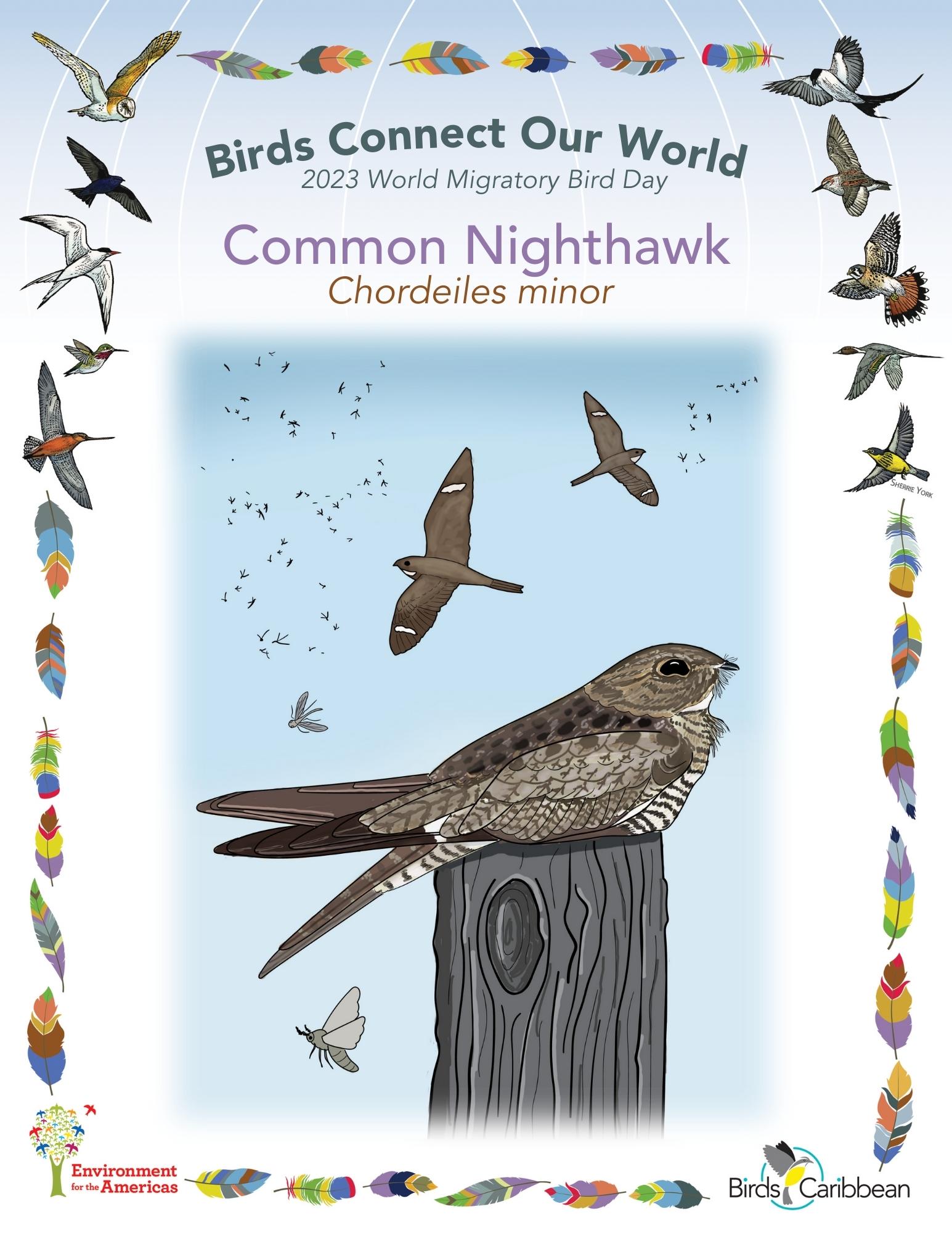
Migratory Bird of the Day: Common Nighthawk
Picture yourself on a hot and muggy summer evening, sitting out in the backyard hoping to catch a little breeze that might just keep you from drowning in your own sweat. While you’re sucking down the last drops of grandma’s ice-cold, hand-squeezed lemonade (grandma never disappoints), make an effort to look to the sky. These are the nights when you might get a look at a Common Nighthawk—or hundreds—soaring around above you as they pick off any insects that have drifted up too high.
Nighthawks, like swifts or swallows, are acrobatic flyers that can just as easily catch insects in flight as a baleen whale collects plankton in the ocean. But compared to many other aerial insectivores, nighthawks are large, which works in your favor when you’re looking to spot a few. And the other good news is that you can find them cruising the airways above cities, small towns, suburbia, and well into rural landscapes, so never skip an opportunity to look up and try your luck, wherever you are.
It’s easy to see why nighthawks have been long-standing members of the very exclusive Cool Birds Club. Let’s start with the male’s courtship “booming” behavior. When males are lookin’ for love, they fly up into the sky making a repeated “peent” noise. Then, all of a sudden, they go into a deep dive, accelerating rapidly towards the ground until they reach a point where they abruptly pull their wings forward, creating a “boom” or “whooshing” sound. Ever had your cap go flying off on a windless day? Now you know why.
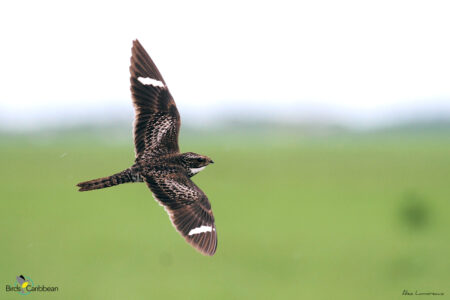
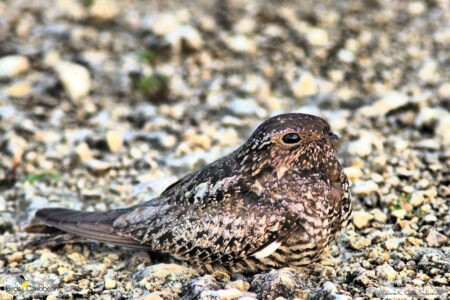
Another awesome attribute is this species’ camouflage. If they are perched or lying motionless in their nest, human eyes cannot see them. They sport a mottling of very earth-toned colors, including brown, tan, black, and gray, with specklings of white. In fact, these birds blend in so well that there’s probably one looking at you right now and you don’t even know it. However, when these birds are in flight, it’s a different story! They have large scythe-shaped wings, and their dark bodies contrast well with a lighter sky behind them. Look for a very obvious white patch on the underwing to confirm that you are indeed seeing a nighthawk.
It would certainly be nice if the Common Nighthawk was a little more…common. These birds are struggling a bit, and as always, there are some easy things we can collectively do to help these birds become more numerous on our landscapes again. The call to action is as follows:
Eliminate insecticides from your life, enough said.
Plant as many and as much diversity of native plants on your landscape as you can (native plants foster higher insect and thus prey abundance).
Reduce your driving speed—something we should all be doing already in order to protect other wildlife. The roadways out there are a slaughter. Of particular importance is reducing your speed in the evenings and at night, especially on gravel or dirt roads. Nighthawks have been known to roost (i.e. rest/sleep) on these roads at night.
Thanks to Justin Proctor for the text and Christine Elder for the lovely illustration!
Color in the Common Nighthawk
Download the Migratory Birds of the Day Coloring Page! Use the picture above and the photos on this page as your guide, or look up pictures of the bird online or in a bird field guide if you have one. Share your colored-in page with us by posting it online and tagging us @BirdsCaribbean #WMBD2023Carib
Listen to the calls of the Common Nighthawk
The call of the Common Nighthawk is a distinctive nasal “neet.” Note however that this bird does not call often when it is migrating.
Puzzles of the Day
Click on the images below to do the puzzle. You can make the puzzle as easy or as hard as you like—for example, 6, 8, or 12 pieces for young children, all the way up to 1,024 pieces for those that are up for a challenge!
Common Nighthawks have one of the longest migration routes of all the birds that breed in North America. (Photo by Alex Lamoreaux Macaulay Library- ML107295391)The name “nighthawk” is a bit misleading as this bird is not strictly nocturnal— it’s active at dawn and dusk—and it is also not closely related to hawks! (Photo by Kenneth Cole Schneider)
Activity of the Day
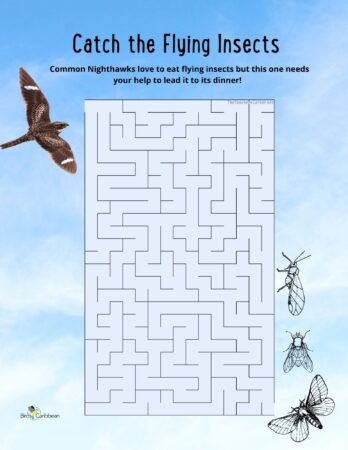
FOR KIDS: Common Nighthawks feed on insects like beetles, flies, moths, crickets, and grasshoppers. Almost all the insects they eat are flying insects and Common Nighthawks will swoop through the air to catch them on the wing!
Can you help this hungry Common Nighthawk find its way through our maze to to grab some tasty insect food? You can find the correct route here.
FOR KIDS AND ADULTS: Enjoy these videos of a Common Nighthawk in the Wild! Don’t forget to look up for these birds! Sometimes they will be resting in trees.
The second video shows what the Common Nighthawk looks like in flight.
Celebrate World Migratory Bird Day (WMBD) with us in 2023! This year’s theme is “Water: Sustaining Bird Life”. Have fun learning about a new migratory bird every day. We have coloring pages, puzzles, activities, and more. Download for free and enjoy nature with your family at home.
Migratory Bird of the Day: Wilson’s Phalarope
Each summer, west of the Mississippi, the Wilson’s Phalarope gathers in enormous flocks on the salt lakes of the western United States. Birders and conservationists are captivated by the species’ distinctive field marks, habitat preferences, feeding habits, and interesting natural history—including a departure from normal breeding habits!
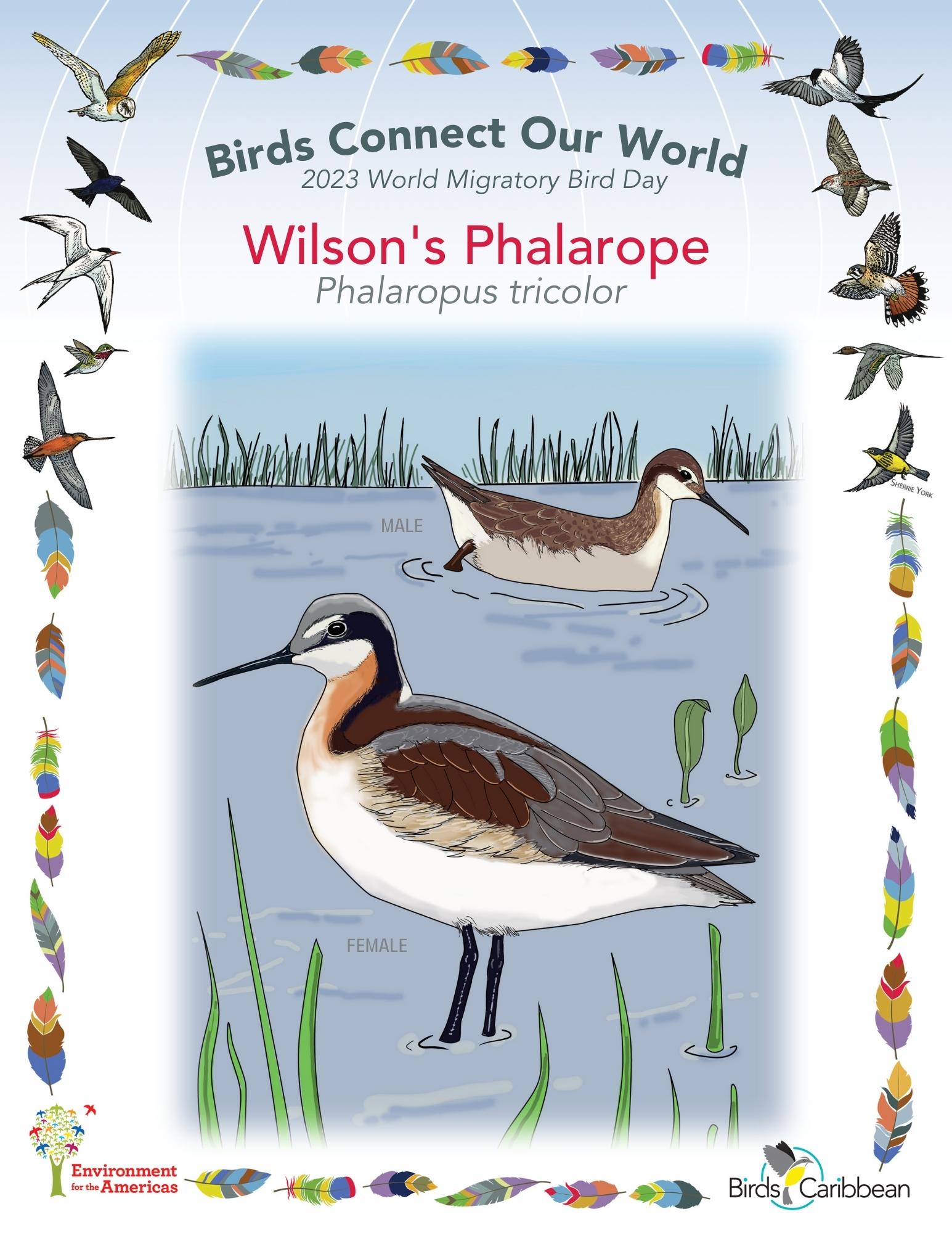
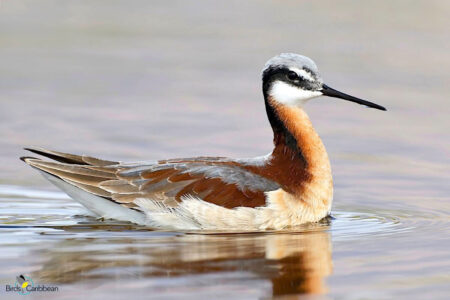
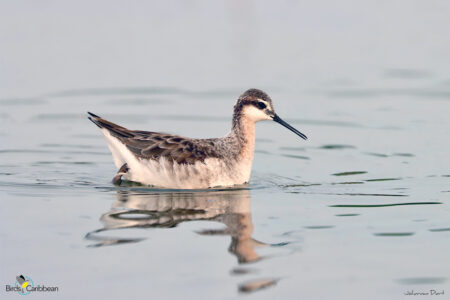
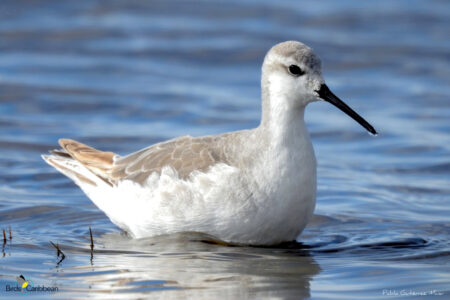
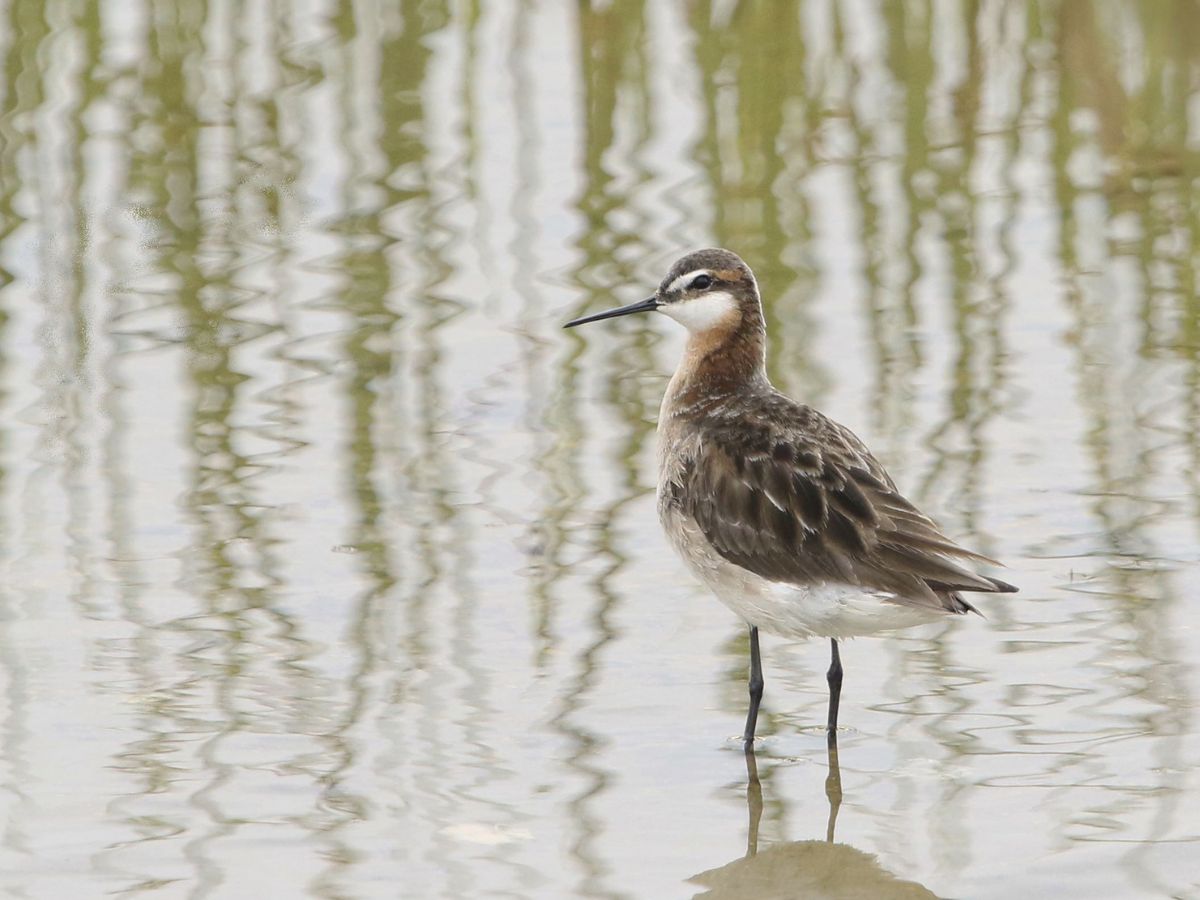
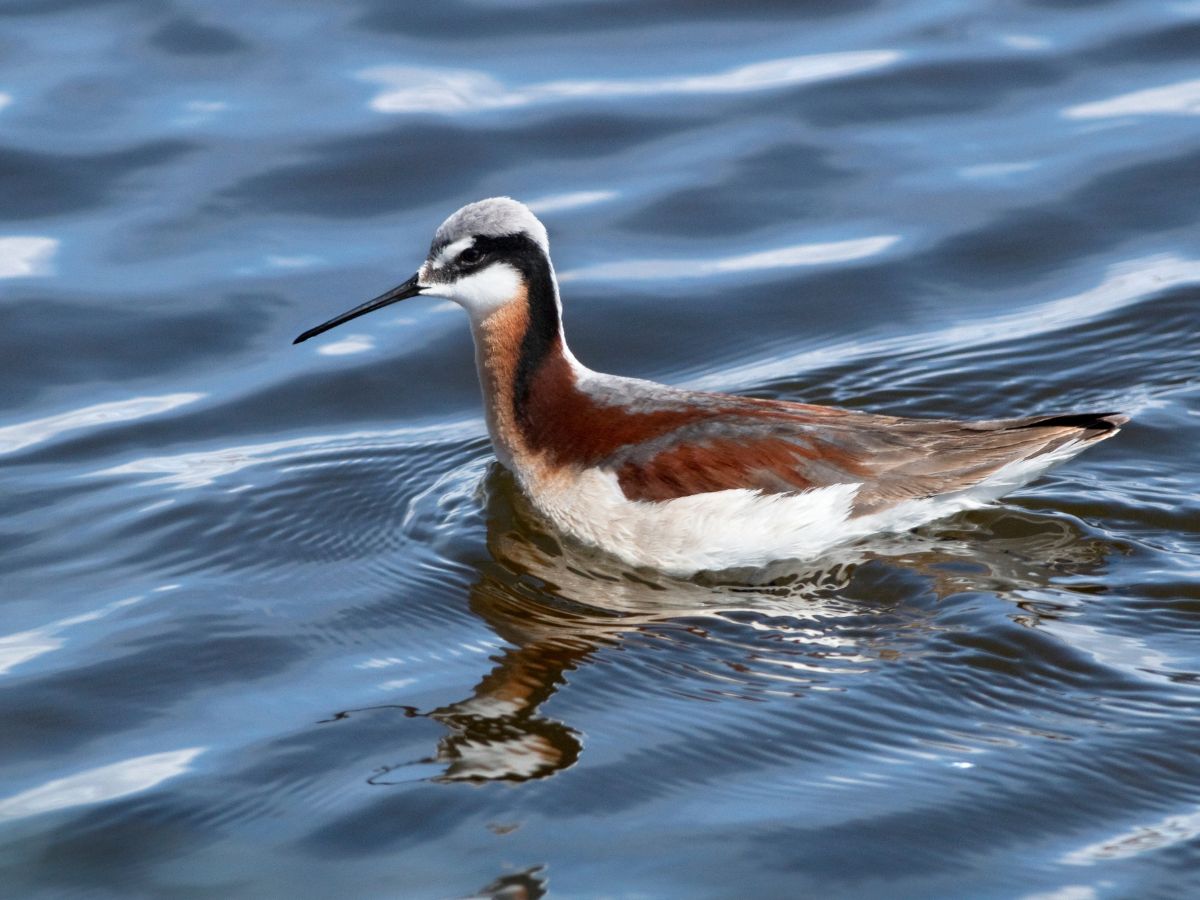
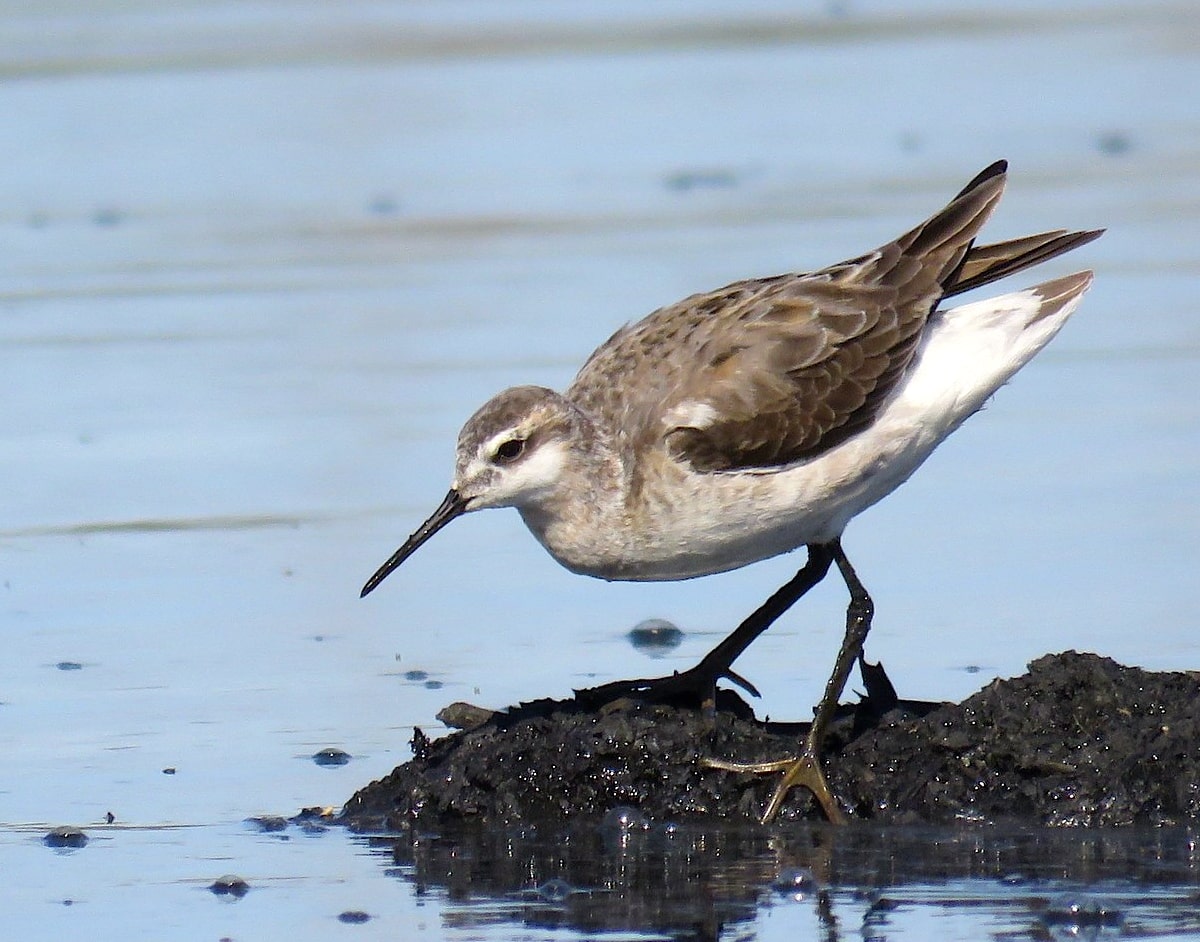
The Wilson’s Phalarope is a small (22–24 cm in length), aquatic shorebird, with a needle-like bill and a white rump and underparts. Wilson’s Phalaropes exhibit sexual dimorphism (where males and females look very different from each other). Interestingly, females are larger and much more colorful than their male counterparts. In breeding plumage, females display a beautiful reddish-brown neck and back, contrasting with a white belly. Males, on the other hand, are more subdued in appearance, featuring a drabber overall coloration. Regardless of sex, both genders boast a distinctive white stripe running down the center of their long necks and black eye masks. During the non-breeding season, both males and females sport a more subdued plumage, of pale gray above and white below.
The Wilson’s Phalarope has a diverse and widespread distribution; its breeding range spans from western Canada down to the western United States. They breed in a range of wetland habitats, including lakes, ponds, and marshes. After laying eggs, the female typically departs, leaving the male to incubate the eggs and care for the young. This unique reversal of traditional gender roles, called “polyandry,” is an intriguing aspect of their breeding biology.
During the non-breeding season, these remarkable birds undertake impressive migrations that lead them to coastal areas of South America, particularly along the western coast. As part of their migratory route, they may also travel through the Caribbean. Our islands thus provide essential stopover points where these birds can rest and feed before continuing their long migrations.
One of the most remarkable aspects of the Wilson’s Phalarope is its feeding behavior. They are adept at foraging in shallow waters, using their long, slender bills to peck at the surface. One can observe them swimming in small, rapid, circular motions. This unique swimming behavior creates a small vortex, or a whirlpool, that brings up aquatic invertebrates from the depths, providing a rich food source. Terrestrial invertebrates are also consumed.
Currently, Wilson’s Phalaropes are classified as a species of Least Concern on the IUCN Red List, indicating that they are not currently facing significant conservation threats. However, like many bird species, they are not immune to potential threats. Habitat loss due to urban development and agricultural expansion remains a concern. Additionally, disturbances to breeding and foraging areas, pollution of wetlands, and climate change induced shifts in their preferred habitats could potentially impact their populations.
You can help conserve Wilson’s Phalaropes and other wetland-dependent bird species by:
Supporting wetland protection and sustainable land use in your region.
Participating in citizen science by joining eBird! The more information that is available to researchers, the better they can help protect these precious birds.
Helping raise awareness and let people know about the importance of wetlands for birds and people!
Thanks to Susan Davis for the text and Christine Elder for the lovely illustration!
Color in the Wilson’s Phalarope
Download the Migratory Birds of the Day Coloring Page! Use the picture above and the photos on this page as your guide, or look up pictures of the bird online or in a bird field guide if you have one. Share your colored-in page with us by posting it online and tagging us @BirdsCaribbean #WMBD2023Carib
Listen to the calls of the Wilson’s Phalarope
Wilson’s Phalaropes make abrupt nasal-sounding calls to each other. These are made both as courtship and contact calls.
Puzzles of the Day
Click on the images below to do the puzzle. You can make the puzzle as easy or as hard as you like—for example, 6, 8, or 12 pieces for young children, and all the way up to 1,024 pieces for those that are up for a challenge!
The colorful female Wilson’s Phalarope in her breeding plumage.Male Wilson’s Phalarope in breeding plumage, he is less colorful than the female. ( Photo by John van Dort Macaulay Library-ML565008391)Wilson’s Phalarope in nonbreeding plumage. Wilson’s Phalaropes are one of only two species of shorebirds that stop to molt during migration rather than at their breeding grounds. (Photo by Gutierrez Maier Macaulay Library ML451123731)
Activity of the Day
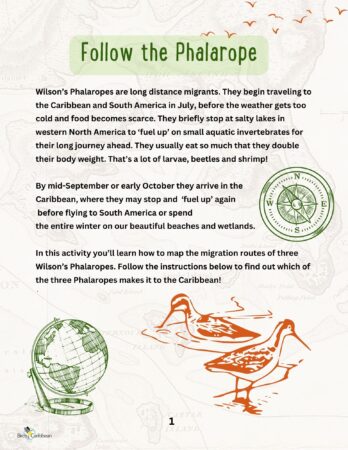
FOR KIDS: Wilson’s Phalaropes make epic journeys south every year on migration! They start heading towards the Caribbean and South America in July, before the weather gets too cold and food becomes hard to find. They don’t make this trip all in one go; they make some stops along the way to rest, molt out of their breeding plumage, and take on more food. They can eat so much on some of these stops that they double their body weight!
Why not ‘Follow the Phalarope’ in our fun activity? You will learn how to map the migration routes of three Wilson’s Phalaropes all the way from North America to islands in the Caribbean! You can find the instructions and worksheet here.
FOR KIDS AND ADULTS: Enjoy these videos, by Don DesJardin, of Wilson’s Phalaropes foraging in the Wild! In the first video you can see the different plumages of the brightly colored female and duller male. In the second can see the ‘spinning’ technique these birds often use when feeding.
Celebrate World Migratory Bird Day (WMBD) with us in 2023! This year’s theme is “Water: Sustaining Bird Life”. Have fun learning about a new migratory bird every day. We have coloring pages, puzzles, activities, and more. Download for free and enjoy nature with your family at home.
Migratory Bird of the Day: Least Tern
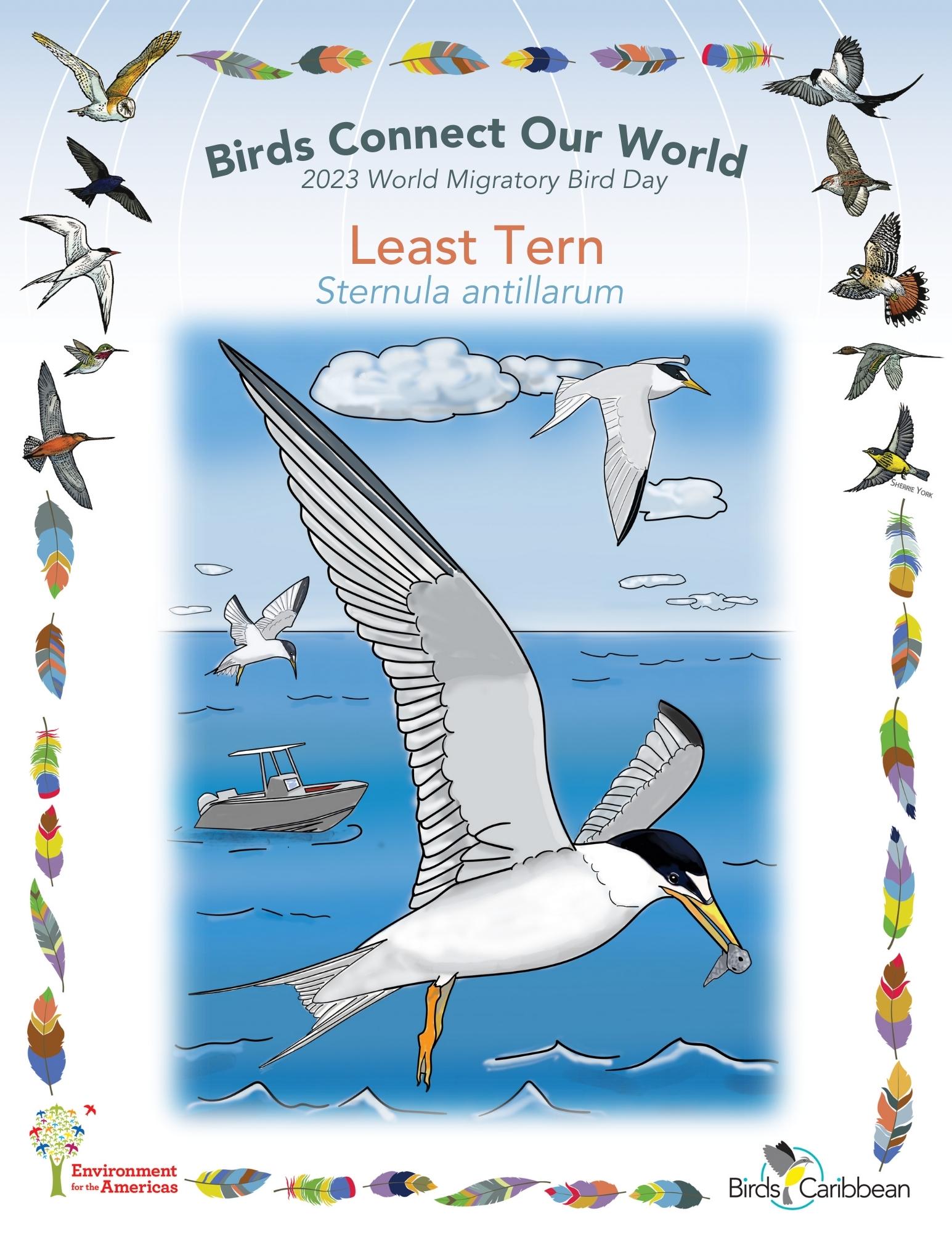
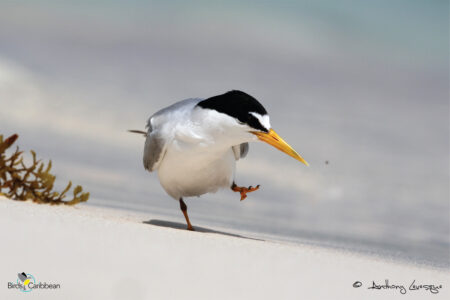
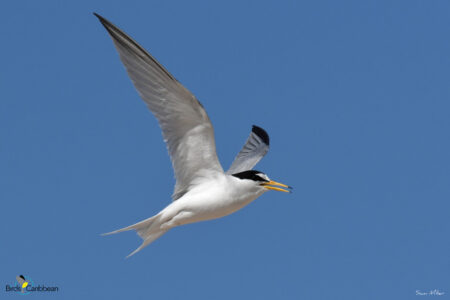
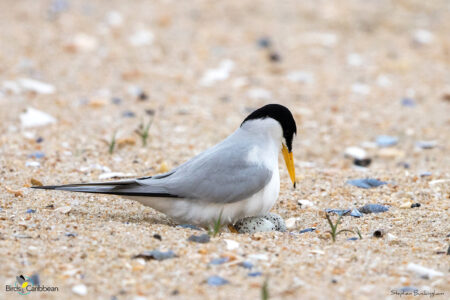
The tiny Least Tern is one dashing beach bum, from its brilliant yellow bill, to its crisp black-and-white head pattern, to its slender pointed wings, and forked tail. Other field marks to look for are a black cap, pale gray back, and white underparts. It is the smallest of terns in North America, reaching a length between 21cm and 23cm long (about the same size as a Northern or Tropical Mockingbird) with a wingspan of 53cm.
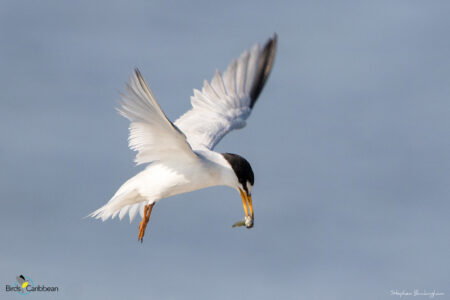
The Least Tern’s diet consists mainly of fish but it will also eat shrimp and other invertebrates. During the breeding season food becomes especially important to male terns. During courtship, the male will offer the female food in hopes of enticing her to choose him as a mate. Suave looks and cheesy lines won’t work on these practical females!
Once she accepts, they will begin building their nest in shallow depressions in the sand. Least Terns prefer bare or sparsely vegetated sand or dried mudflats along coasts or rivers, but they will also nest on sandy or shell islands and gravel and sand pits. Least Terns are colony nesters, meaning they nest in a group, which allows them to share information about food sources—and to spot and mob predators like dogs and cats!
Eggs are laid between the middle of April and early May. Incubation lasts for 21 days. Least Tern chicks are able to leave the nest just three to four days after hatching; but they are dependent on their parents to feed them for 6 weeks or more.
Unfortunately their favorite nesting habitat is also prime real estate for human recreation, residential development, and alteration by water diversion; all of which encroach upon the area available to nest and successfully raise chicks. Although this tern can readily adapt in response to sites that change within and among years, it appears to be most productive at colony sites that have endured for several years. Global climate change is also an ever-present threat to the Least Tern. Rising sea levels and catastrophic storms can damage or destroy its nests, as well as its habitat.
But you can help Least Terns and other beach-nesting birds—educate your friends and family about these birds and how to keep them, their eggs, and their chicks safe. Remind them that there’s a place for everyone at the beach, to pick up their garbage when they are leaving, to leash their pets, and to avoid getting too close—especially if birds are nesting.Learn more about this species, including its range, photos, and calls here.
Thanks to Aliya Hosein for the text and Christine Elder for the lovely illustration!
Color in the Least Tern
Download the Migratory Birds of the Day Coloring Page! Use the picture above and the photos on this page as your guide, or look up pictures of the bird online or in a bird field guide if you have one. Share your colored-in page with us by posting it online and tagging us @BirdsCaribbean #WMBD2023Carib
Listen to the calls of the Least Tern
The calls of the Least Tern include a “ki-dik” heard frequently from flying birds.
Puzzles of the Day
Click on the images below to do the puzzle. You can make the puzzle as easy or as hard as you like—for example, 6, 8, or 12 pieces for young children, all the way up to 1,024 pieces for those that are up for a challenge!
The Least Tern is the world’s smallest species of tern! (Photo by Anthony Levesque)Least Tern with a fish, Least Terns feed almost entirely on small fish. (Photo by Stephen Buckingham)Least Tern in flight. (Photo by Sam Miller Macaulay Library-ML161558471)A Least Tern on its nest. Least Terns typically nest in a shallow depression on beaches but on the island of Bonaire the resourceful Least Terns sometimes take over deserted American Flamingo nests! (Photo by Stephen Buckingham)
Activity of the Day
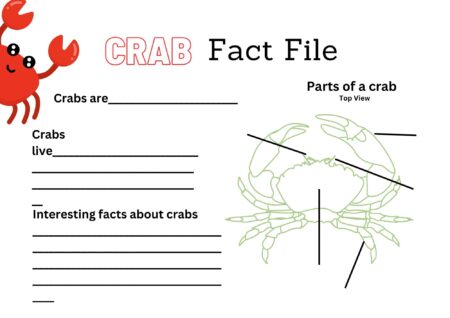
FOR KIDS: Nesting Least Terns share their beach home with many other creatures, including crustaceans like crabs. Whilst least Terns prefer to eat fish, many other beach and wetland-living birds love to feed on crustaceans! These fascinating animals have boneless bodies covered by hardened skin called an “exoskeleton.” Why not find out more? In today’s activity we would like you and a parent or friend to delve into the details about crabs, and write a fact file. Find out more and get a template for your fact file here. Have fun learning all about these crusty critters!
FOR KIDS AND ADULTS: Enjoy this video of a Least Tern in the Wild! Watch this adult feeding a fish to its chick.
Read all about conserving Bahamas beach-nesting birds and their habitats in the blogs below: Margo Zdravkovic shares her adventures from Conservian’s 2016 Bahamas Shorebird Conservation Expedition and Jennifer Wheeler shares her experiences from the expedition in 2018. Margo and her team of volunteers worked to protect beach-nesting birds, nests and young, including today’s featured bird, the Least Tern. This is important shorebird and seabird conservation and research work with a mission to provide on-the-ground protection and restoration measures at key shorebird and seabird sites in The Bahamas.
Celebrate World Migratory Bird Day (WMBD) with us in 2023! This year’s theme is “Water: Sustaining Bird Life”. Have fun learning about a new migratory bird every day. We have coloring pages, puzzles, activities, and more. Download for free and enjoy nature with your family at home.
Migratory Bird of the Day: Yellow-billed Cuckoo
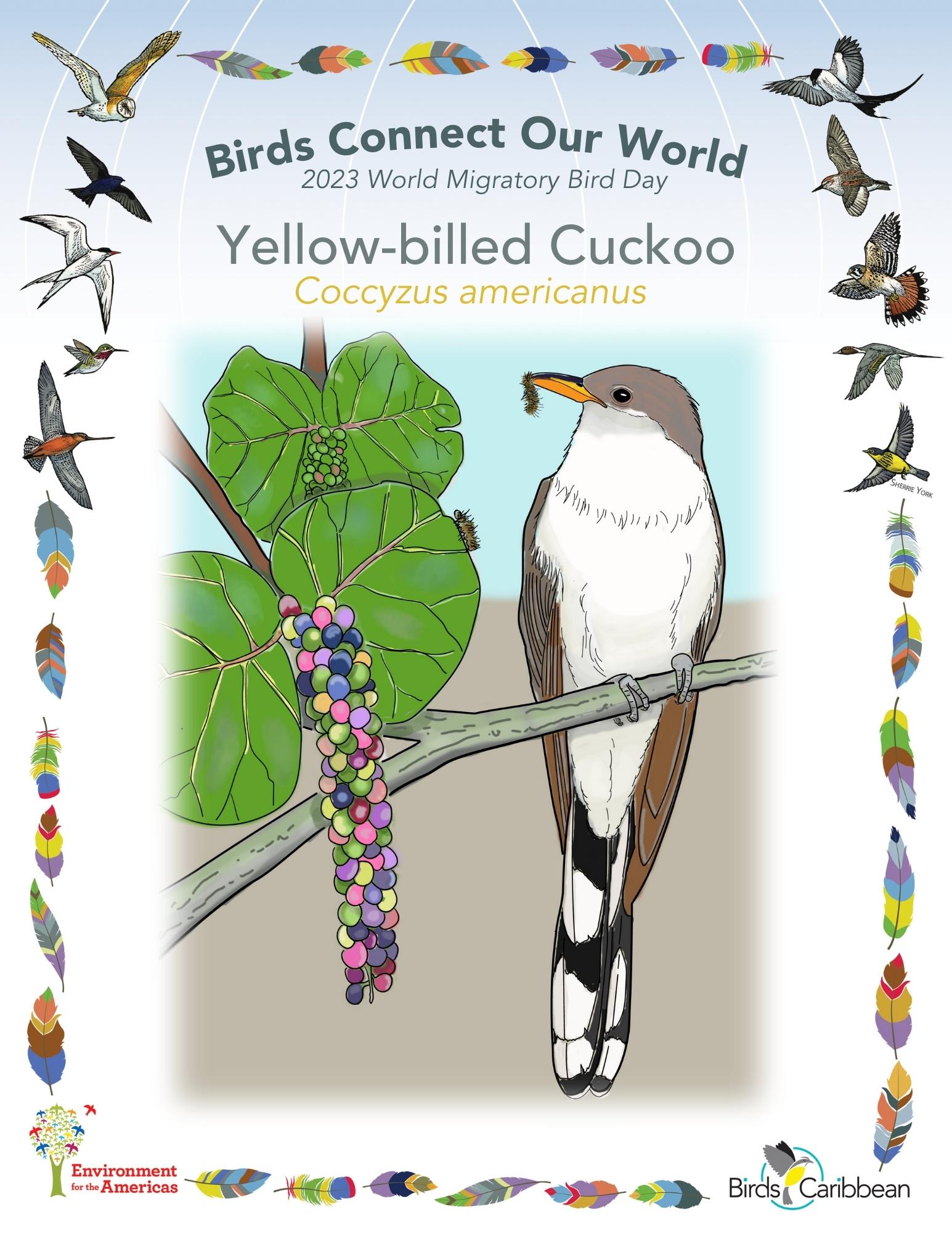
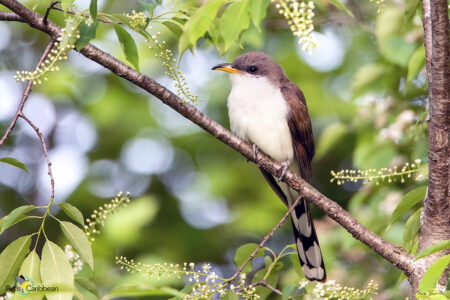
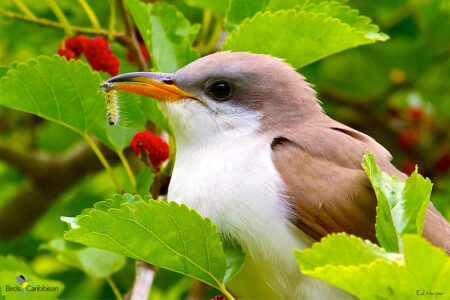
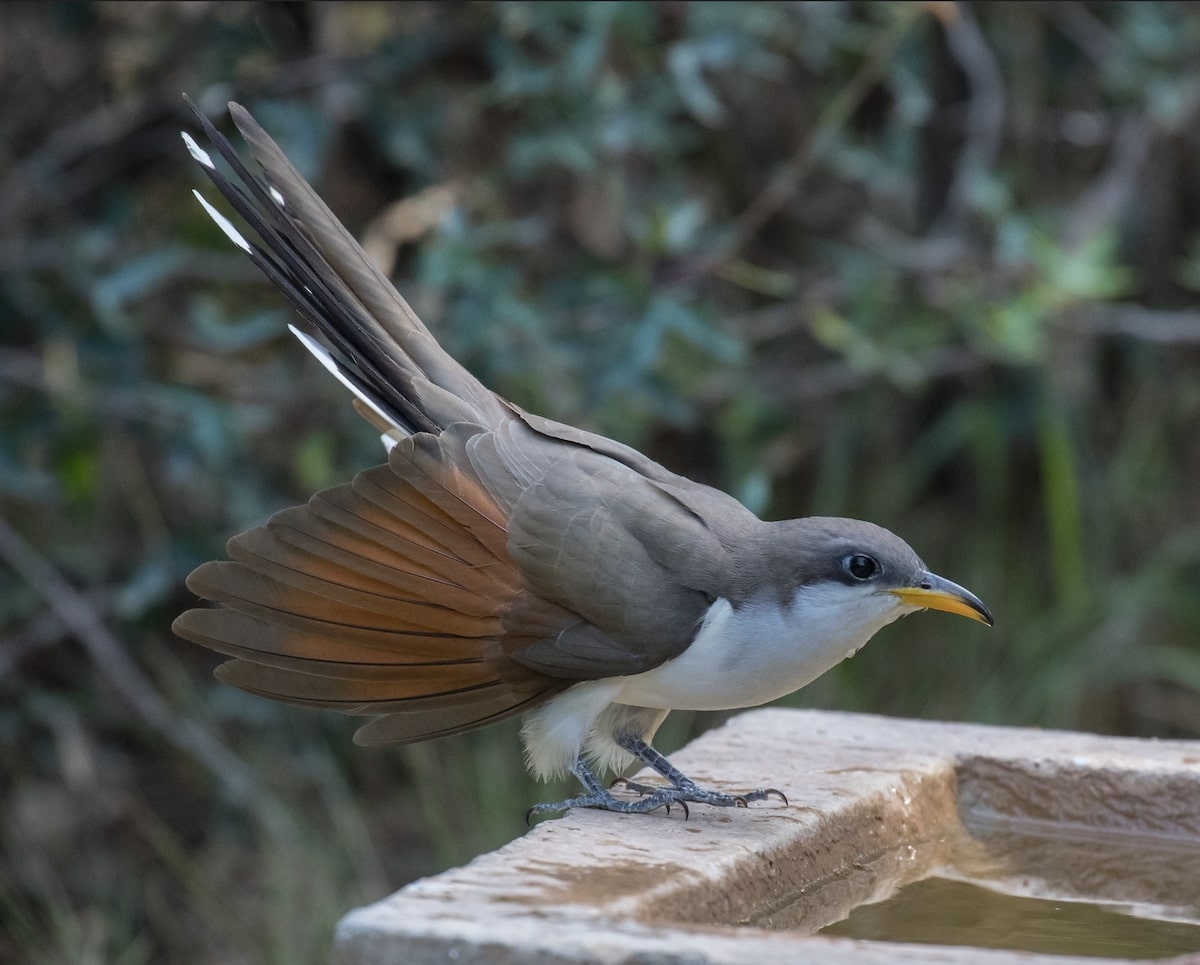
Hold onto your binoculars and get ready for the charming Yellow-billed Cuckoo! With its sleek brown body, white underparts, long black tail spotted white underneath, and striking down-curved yellow bill, this bird stands out in the crowd. This stealthy bird can be difficult to spot, however, as it often sits motionless for long periods of time. When disturbed, it holds its body low and moves quietly along branches, disappearing quickly into the foliage. In flight, its reddish-brown wing patches are diagnostic.
The Yellow-billed Cuckoo is quite the traveler! They breed in the eastern two/thirds of North America as well as in the Bahamas, Greater Antilles, and parts of Mexico and Central America. They winter almost entirely in South America, east of the Andes and can be seen in many Caribbean countries on migration, sometimes passing through in huge numbers.
They are caterpillar connoisseurs, chowing down on these wriggly treats like true bug busters. Their soft, hollow “cu-coo cu-coo cu-coo” calls might make you feel like you’re in the heart of the wilderness. It’s like a calming lullaby echoing through the trees. But they also have a distinct, louder and more guttural “ka-ka-ka-ka-ka-kow-kow-kowlp-kowlp-kowlp-kowlp” call. In North America it has earned the nickname ‘rain crow’ or ‘storm crow’ because it calls just before the rain and sometimes continues to call throughout the rainfall.
When love is in the air these cuckoos pair up and get straight down to business. The breeding cycle from egg laying to fledging takes only 17 days! Pairs construct flimsy nests in dense shrubs and the female usually lays 2-3 eggs.
Yellow-billed Cuckoos are well-known for their “parasitic” behavior—they sometimes lay additional eggs in other birds’ nests, both their own species and others, such as American Robin, Wood Thrush, Gray Catbird, and Red-winged Blackbird. This remarkable behavior, that is, “parasitizing” the parental care of other birds, is an adaptation for increasing their own reproductive success. Because it grows so quickly, a cuckoo chick is able to outcompete its nest mates for food. Cuckoo chicks beg vigorously and have even been observed standing on the backs of their nest mates to monopolize the parent’s feeding!
Now, let’s talk about serious stuff. The elusive Yellow-billed Cuckoo faces challenges just like other birds. Habitat loss from development is a major threat, especially on its wintering grounds. Climate change, invasive species, and pesticides (which kill and contaminate their insect prey) are also serious threats. So, what can you do? Support conservation efforts—donate to organizations that protect nature, get involved in citizen science projects, and spread the word about these incredible birds.
Thanks to Justin Saunders for the text and Christine Elder for the lovely illustration!
Color in the Yellow-billed Cuckoo
Download the Migratory Birds of the Day Coloring Page! Use the picture above and the photos on this page as your guide, or you can look up pictures of the bird online or in a bird field guide if you have one. Share your colored-in page with us by posting it online and tagging us @BirdsCaribbean #WMBD2023Carib
Listen to the calls of the Yellow-billed Cuckoo
The calls the male Yellow-billed Cuckoo are a distinctive series of hollow, wooden-sounding “ka-ka-ka-ka-ka-kow-kow-kowlp-kowlp-kowlp-kowlp” noises.
Puzzles of the Day
Click on the images below to do the puzzle. You can make the puzzle as easy or as hard as you like – for example, 6, 8, or 12 pieces for young children, all the way up to 1,024 pieces for those that are up for a challenge!
The tendency of Yellow-billed Cuckoos to call at the sound of thunder has led to their colloquial name, the “rain crow.” (Photo by Sue Barth Macaulay Library- ML102608081)Yellow-billed Cuckoo with a caterpillar. Did you know that Yellow-billed Cuckoos are among only a few bird species able to eat hairy caterpillars! (Photo by Ed Harper Macaulay Library- ML170865821)
Activity of the Day
FOR KIDS: Today’s bird, the Yellow-billed Cuckoo, loves to include insects in its meals! Why not explore outside and “meet the insects” in today’s activity! You will get up close to some of those mini-beasts that are crawling, flying and even munching on leaves in your own backyard. You can download all the instructions for this activity here, including instructions for how to make your own ‘mirror box’ for looking at the insects!
For this activity you’ll need:
an old light colored bed sheet or towel will work
a magnifying glass or mirror box (see page 3)
garden gloves (optional)
camera
sheet of paper and pencil
Note: You will need a parent or trusted adult to help you with this activity!
FOR KIDS AND ADULTS: Enjoy this video of a Yellow-billed Cuckoo in the wild!
Find our more about how we celebrate World Migratory Bird Day every year: Take a trip back in time and read our round-up of BirdsCaribbean’s celebration of World Migratory Bird Day in 2020. With a global pandemic going on this was the first year when we took our celebrations online and started our series “Birds Connect Our World” featuring a “migratory bird of the day.” Find out more here:
Celebrate World Migratory Bird Day (WMBD) with us in 2023! This year’s theme is “Water: Sustaining Bird Life”. Have fun learning about a new migratory bird every day. We have coloring pages, puzzles, activities, and more. Download for free and enjoy nature with your family at home.
Migratory Bird of the Day: Northern Pintail
Meet the Northern Pintail, a flier extraordinaire! They can spring straight up from the water’s surface, wheeling and darting through the air on their slender wings. They are one of the first ducks to migrate south in the fall, traveling during the night at speeds of ~48 miles per hour (77.2 km/h)! Their nickname, “greyhound of the air,” suits them well!
Northern Pintails are undoubtedly elegant with a long neck, slim body, and pointed tail. Breeding males are absolutely dapper with a gleaming white breast, a white line down their chocolate brown head and neck, gray upperparts, and prominent long and pointed tail. Females have a plain tan head and plumage is mottled in browns and whites with a scalloped effect. Nonbreeding males look similar to females but retain their upper-wing pattern and long gray shoulder feathers. Juveniles have a plain appearance with a darker, browner crown, less buffy upperparts and flanks, and more spotted below.
Northern Pintails leave their breeding grounds in Canada and the US in August and migrate along the Atlantic coast to the Caribbean and South America, arriving in late October. Look for these ducks at mangrove swamps, estuaries, salt ponds, reservoirs, and also flooded agricultural areas. You might spot them feeding tail-up in shallow water, as they pick snails and worms from the moist soil and water. In swamps and ponds, they also dabble for aquatic plant seeds, insects, and crustaceans at the water surface by filter feeding with their bill. On land they feed on grains (rice, wheat, corn, barley) and by digging out tubers (potatoes) out the ground using their bills.
When it comes to breeding, Northern Pintails, like all “dabbling ducks,” form pair bonds on the wintering grounds. To attract a female’s attention, males perform elaborate and ritualized courtship displays like “head-up-tail-up” and “grunt-whistle.” This latter display entails stretching their necks up and tipping their bills down while giving a whistle call. They also perform “turn-back-of-head” while swimming away to show off the gorgeous purplish iridescence on the back of their heads. Females show which courting male they have chosen by following him and performing the “inciting” display, which includes head-bobbing while making a grunting vocalization..
Northern Pintails are common but their population is decreasing. Loss of wetland habitat, cultivation of grasslands, and agricultural practices that destroy nests have all contributed to this decline. It is important that we work together to restore and maintain our tropical wetlands. Ditch the chemical fertilizers and pesticides that can leach into our wetlands. Keep trash out of wetlands by reusing and recycling to the best of your ability, and don’t be afraid to deep dive into the wonders of wetlands to educate yourself and others!Learn more about this species, including its range, photos, and calls here.
Color in the Northern Pintail
Download the Migratory Birds of the Day Coloring Page! Use the picture above and the photos on this page as your guide, or you can look up pictures of the bird online or in a bird field guide if you have one. Share your colored-in page with us by posting it online and tagging us @BirdsCaribbean #WMBD2023Carib
Listen to the calls of the Northern Pintail
The calls the male Northern Pintails are short bursts of wheezy sounding whistles.
Puzzles of the Day
Click on the images below to do the puzzle. You can make the puzzle as easy or as hard as you like – for example, 6, 8, or 12 pieces for young children, all the way up to 1,024 pieces for those that are up for a challenge!
Male Northern Pintail. In breeding plumage this dapper duck has a distinctive long black tail and white neck stripe. (Photo by Steve Buckingham)Female Northern Pintail. Northern Pintails nest on the ground in croplands, grasslands and wet meadows, often farther from water than other ducks.Northern Pintail flock in flight. Northern Pintails also occur in Europe, the Middle East, India, and Asia. (Photo by Martin Crocorax)
Activity of the Day
FOR KIDS: Learn more about the Northern Pintail—it’s fascinating biology and behavior, and then learn how to sketch it! Presented by Dr. Lisa Sorenson, BirdsCaribbean, and naturalist and artist, Christine Elder. This fun webinar is part of our Caribbean celebration of World Migratory Bird Day (WMBD). Have fun learning about other migratory birds with us in our “Birds Connect our World” pages! We have colouring pages, puzzles, activities, videos, fun facts, and more. Download for free and enjoy nature with your family at home.
FOR KIDS AND ADULTS: Enjoy these videos of Northern Pintails in the wild! In the first you can see a male and female searching for food in shallow water. In the second you can see a male in breeding plumage preening
Celebrate World Migratory Bird Day (WMBD) with us in 2023! This year’s theme is “Water: Sustaining Bird Life”. Have fun learning about a new migratory bird every day. We have coloring pages, puzzles, activities, and more. Download for free and enjoy nature with your family at home.
Migratory Bird of the Day: Lesser Yellowlegs
With their long bright-yellow legs, you might spot these elegant shorebirds at the water’s edge searching the shallows for food. Lesser Yellowlegs are mottled grayish-brown above, with pale underparts. These slender-looking, long-billed birds can be easy to pick out from the crowd with their distinctive leg color. However, take care as this shorebird has a ‘cousin’—the Greater Yellowlegs!
Greater Yellowlegs are much larger and more heavily built. If you spot the two together, you’ll be in no doubt as to who is who. But you can also pick out Lesser Yellowlegs from its relatively shorter bill-length compared to Greater Yellowlegs. Lesser Yellowlegs also have a distinctive whistled “tu-tu” call, typically one or two notes, while the Greater Yellowlegs call is a stronger “tu-tu-tu!” of 3 to 4 notes. You can find more ID tips in our video here.
Lesser Yellowlegs breed in the Boreal forests in the far north of North America. They head south after breeding, making amazing migratory journeys of thousands of kilometers. They can start to arrive in the Caribbean from July and August. Some Lesser Yellowlegs will continue on to South America, but others will spend the winter here. Lesser Yellowlegs can be found in wetlands, both freshwater and on the coast. They show up on mud flats, ponds, lagoons, and on mangrove edges. They will also use agricultural areas, with flocks of thousands of individuals sometimes using flooded rice fields.
Lesser Yellowlegs are one of the most common shorebirds using the Atlantic Flyway. They are currently listed as “Least Concern” by the IUCN. Sadly, however, Lesser Yellowlegs populations have declined by a shocking 63-70% since the 1970s! Loss of habitat, climate change, and unsustainable hunting and trapping at several non-breeding locations have all contributed to this decline. Conserving our Caribbean wetlands will help Lesser Yellowlegs and many other species. They provide food-rich havens for birds to refuel on migration or to spend the winter.Learn more about this species, including its range, photos, and calls here.
Color in the Lesser Yellowlegs
Download the Migratory Birds of the Day Coloring Page! Use the picture above and the photos on this page as your guide, or you can look up pictures of the bird online or in a bird field guide if you have one. Share your colored-in page with us by posting it online and tagging us @BirdsCaribbean #WMBD2023Carib
Listen to the calls of the Lesser Yellowlegs
The calls of the Lesser Yellowlegs are a whistled “tu-tu” with one or two notes, often repeated rapidly.
Puzzles of the Day
Click on the images below to do the puzzle. You can make the puzzle as easy or as hard as you like – for example, 6, 8, or 12 pieces for young children, all the way up to 1,024 pieces for those that are up for a challenge!
Lesser Yellowlegs. Did you know that despite their similar appearance, Greater and Lesser Yellowlegs are not each other’s closest relatives? The Lesser Yellowlegs is more closely related to the Willet! (Photo by Franz Delcroix)
Lesser Yellowlegs mainly feed on invertebrates including snails and flies, beetles, and dragonflies. (Photo by Hemant Kishan)
Activity of the Day
FOR KIDS: Birds, like the Lesser Yellowlegs, that are typically found at the shore and other coastal habitats like mudflats and lagoons are called shorebirds.
These birds come in different sizes and shapes. They are always on the move, checking the shoreline for food. They have special bills that help them poke into the mud or sand and in between rocks. Their bills and leg lengths are different depending on what they eat and where they find their food. All of this can help us to identify them!
Why not go Birding at the beach? Or at any other wetland! We have made some suggestions of who you can look out for whilst you’re there. You can also download and print out our handy guide to help you identify the different types of shorebirds we find in the Caribbean. You can find more helpful tips, activities and video on our Shorebird Resources page.
FOR KIDS AND ADULTS: Enjoy these videos of Lesser Yellowlegs
Read all about the fascinating work tracking Lesser Yellowlegs: Biologist Laura McDuffie has tracked the movements of these long distance migrants as they travelled to and from their breeding areas. Find out more about Laura’s work, the amazing journeys that Lesser Yellowlegs make each year and the threats they face along the way!
Calling all Caribbean bird lovers! Let’s be on the alert, and scan the skies for our migrating birds!
World Migratory Bird Day 2023 poster featuring artwork by Nicaraguan artist Augusto Silva.
October 14th, 2023 marks the official date for World Migratory Bird Day (WMBD) in the Caribbean and Central and South America; it’s celebrated in May in North America. It’s one of the most exciting times of year for birdwatchers and reflects the awesome nature of bird migration—the exact timing of which varies between the northern and southern hemispheres. It’s the time when migratory birds appear, as if by magic, in Caribbean gardens, forests, coastlines, and hillsides—returning to their favorite spots where food and shelter are plentiful.
While we welcome our wonderful warblers, shorebirds, landbirds, hawks and others back “home” to spend the winter months on our islands, we also recognise that WMBD is a global campaign. It is a platform for citizens worldwide to learn more about migratory birds, to realize their value—and, most importantly, to understand the need to conserve them.
This year’s WMBD theme highlights the impact of the growing water crisis on migratory birds. This theme resonates in the Caribbean, where islands have been enduring longer-lasting and more severe droughts. It is not only farmers and householders who are feeling the effects of lower than normal rainfall patterns. Birds are, too! This October, 2023, the Caribbean will be a part of the worldwide campaign—adopting the theme “Water: Sustaining Bird Life.”
Here is the WMBD 2023 theme in other regional languages:
Agua: vital para las aves
L’eau: Source de vie pour les oiseaux
As the saying goes, “Water is life.”
Water is essential for the survival of all living organisms on this “Blue Planet.” Migratory birds depend on watery places for resting, breeding and feeding. These include rivers and streams, swamps and wetlands, ponds and gullies; and of course, coastal waters.
The wetlands of Monte Cristi are a fantastic place for waterbirds, including many migratory shorebirds. (photo by Maria Paulino)
Zapata Swamp in Cuba is an incredibly important place for waterbirds and people. (photo by Garry Donaldson)
The world famous Bonaire salt ponds support large numbers of many species of migratory shorebirds, including the Semipalmated Sandpiper, Least Sandpiper, Stilt Sandpiper, Red Knot, Lesser Yellowlegs, Semipalmated Plover, and Sanderling.
The Layou River in St. Vincent is an important freshwater site. (Photo by Lisa Sorenson)
The Anasco River in Puerto Rico provides a home to species like the West Indian Whistling-Duck and it is a source of fresh water on the island. (photo by Adrienne Tossas)
Wetlands are wonderful places for birds, recreation and learning. View of the Twin Bridges, Ashton Lagoon, Union Island, St Vincent and the Grenadines. (Photo by Sustainable Grenadines, Inc.)
As Caribbean residents may have noticed during this intensely hot summer, birds have flocked to bird baths, drains, and water sources of all kinds to quench their thirst and preen their feathers, especially in more urban areas. However, the extreme heat and drought, fueled by climate change, are not the only challenges facing migratory birds. The quantity and quality of freshwater supplies are declining. Pollution (pesticides, chemicals, sewage, and plastic pollution) threatens many bird habitats. With ongoing tourism and housing developments, especially along the coast, the demand for freshwater for human use is growing.
A huge diversity of waterbirds and shorebirds call the Mt. Hartman wetlands in Grenada home, including both resident and migratory species. (photo by Lisa Sorenson)
We can all help our migratory birds
This WMBD join us in spreading the message that water conservation is important for all life on Earth, including birds! You can also help birds by planting native trees that require less watering and provide food and habitat, disposing of your garbage properly, lending a hand to clean up critical bird habitats, and making water conservation part of your daily routine by taking shorter showers, immediately fixing leaking faucets and pipes, and washing full loads only.
A homemade birdbath is another great way to provide birds with a reliable source of clean water. Every bird-friendly garden needs a spot for birds to drink from, clean themselves, or to just cool down on a hot day! These are so easy to put together and can be made from materials around your house and yard. This is also a great way to attract birds that don’t eat seeds or drink nectar to your garden—talk about a win-win!
Gray Catbird “Yo Bath needs refilling”. (Photo by Stuart Reeves)
Clear the runway because coming in for landing is..
Every year, Environment for the Americas focuses on ten “special” species to feature in promotions. For this year’s WMBD the ten focal species selected are:
Northern Shoveler*
Male Northern Shoveler in breeding plumage. Note the huge, spoon-shaped bill.
Female Northern Shoveler also has the distinctive spatulate bill but she is buffy-brown.
Male Northern Shoveler in nonbreeding plumage. (photo by Steve Metchis ML291848121)
American White Pelican*
American White Pelican in breeding plumage. A yellow plate forms on the upper bill of breeding adults. (photo by Gerrit Vyn ML192450401)
American White Pelican in nonbreeding plumage.
Wilson’s Phalarope*
Male Wilson’s Phalarope in breeding plumage. It lacks the neck stripe seen in the female.
Female Wilson’s Phalarope in breeding plumage. Note that she is more colorful than the male!
Wilson’s Phalarope in nonbreeding plumage. (photo by Josh Fecteau ML58365021
Northern Waterthrush*
Northern Waterthrush. Look for this migratory bird along the water’s edge.
Yellow-billed Cuckoo*
Yellow-billed Cuckoo having a drink at a bird bath. (photo by Edward Plumer ML103092191)
Barn Swallow*
Barn Swallow, male. (Photo by Daniel W. Glenn)
Rufous Hummingbird
Dickcissel*
Male Dickcissel in breeding plumage. Note the black V on the throat. (photo by Martina Nordstrand ML232134471)
The female Dickcissel has a pale yellow breast and eyebrow. (photo by Mike Cameron ML156064841)
Magellanic Penguin
Osprey*
Osprey with a fresh catch of fish in Bonaire. (photo by Gérard Cachon)
Some of these birds are quite familiar to us in the Caribbean; at least eight of them—those with an asterisk—occur on Caribbean islands, though they are not all common. The region is significant for these traveling birds who move to, from, across, and through the region.
WMBD celebrations would not be complete without some spectacular artwork!
This year’s artist, Augusto Silva of Nicaragua, is well known for his geometric and colorful style. In aquatic blues and greens, Augusto’s art perfectly captures the WMBD 2023 theme. His work is influenced by the traditional life of the Afro-Caribbean indigenous community and pre-Columbian petroglyphs—and inspired by Nature.
WMBD 2023 artist Augusto Silva.
Free WMBD resources for educators and conservationists
So, how can we continue to raise awareness on the importance of water (agua, l’eau) for our migrating birds? The good news is that you, our Caribbean educators, are helping to do just that. As you join the WMBD campaign, you may request WMBD educational materials by contacting Laura Baboolal, the WMBD Caribbean coordinator at [email protected].
EFTA provides posters, stickers, fact sheets, and art and craft materials and more to coordinators hosting WMBD events across Latin American and the Caribbean.
Track Your Migration Miles is a fun activity that helps both kids and adults to learn about wildlife migration. Click on the photo to download the activity.
If you are planning a WMBD event or two (and we hope you are!), you will find useful digital educational resources at: https://trello.com/b/mmiiYE3A/wmbd-2023
BirdsCaribbean will also be featuring WMBD bird species that occur in the Caribbean on our Migratory Bird of the Day webpages (Birds Connect Our World). Our drawings this fall are featuring the art of Christine Elder – naturalist, educator and biological illustrator extraordinaire! Be sure to check out her website and follower on social media!
As in past years, we will provide free downloadable resources, including coloring pages, natural history information, puzzles, photos, videos and activity sheets—we invite you to check it out!
We also encourage you to add your events to the interactive map, so we can see where WMBD activities are taking place throughout the Caribbean: https://www.worldmigratorybirdday.org/events-map
Add your event to the WMBD 2023 Events Map and let the world know how you will be celebrating in the Caribbean!
How you can celebrate and help migratory birds . . . & we want to see your bird baths!
Celebrate WMBD this fall!
Go birding with your family and friends and see how many migratory birds you can spot. If you’re at a wetland or beach, do a Caribbean Waterbird Census (CWC) Count. Don’t forget to upload your checklists to eBird or eBird Caribbean!
Learn more! Look for a WMBD event happening near you and try to attend. Enjoy and download the many free online resources about migratory birds – see above links. Share what you learn with your friends and family.
Thank about the ways that you can help conserve water – see the handy infographic above and do your part by taking shorter showers, fixing leaky faucets and running toilets, planting a drought-friendly native plant garden, supporting conservation of wetlands, and much more.
Finally, since this year’s theme is Water: Sustaining Bird Life we want to see the best bird baths in your backyards! We’re looking for pretty, funky, fun, and functional watery oases. Bird baths may be ready-made or DIY.
Snap a pic or record a short video and email it to Laura at [email protected] and/or tag us, @birdscaribbean and @environmentamericas, on social media.
Be sure to include your name, country, and a few sentences about your bird bath—for example, the household materials that were reused to make it, and the variety of birds that visit the bird bath!
All suitable submissions will be shared on the BirdsCaribbean and Environment For The Americas websites and social media accounts.
Hundreds of thousands of migratory shorebirds are already on the move, and we are getting ready to celebrate World Shorebirds Day 2023! Diverse habitats and food supply make the Caribbean an attractive destination for shorebirds and a veritable birders’ paradise, so why not take part in the Global Shorebird Count this year? BirdsCaribbean has everything you need to help you #ShowUpForShorebirds (and show out!) in the best possible way.
World Shorebirds Day is held every year on September 6. This day celebrates shorebirds, their magnificent migration journeys, and most importantly, raises awareness of the threats they face and actively promotes their monitoring and conservation. The key event associated with this day is the Global Shorebird Count (GSC), September 1-7.
Across the Caribbean (and the entire globe!), groups of birders will be out looking for and counting shorebirds and recording what they find on eBird Caribbean. Some birders will go out in ones and twos; others in small groups. Wherever you are, whoever you are with, or even if you are on your own—we welcome your participation and contribution to citizen science.
This year, we have a special mission for you: we are asking you to do more than one count if possible. Read on to find out why.
Why should you #ShowUpForShorebirds?
The answer is that our migratory shorebirds are more vulnerable than ever, threatened by human activities such as destruction of their habitats, pollution, disturbance, and climate change. Recent analyses show that shorebirds in North America are declining more than any other group of birds; in fact, more than half of 28 species studied were estimated to have lost more than 50% of their abundance in the last 30 years.
Least Sandpiper – a common migrant to the Caribbean; this one has stopped for a rest in St. Maarten (photo by Binkie van Es)
The Caribbean is an important region for migratory shorebirds. They rely on our mangroves, salt ponds, beaches, sand flats, and mud flats to rest and refuel as they continue on their long migrations, or they may spend the entire winter with us.
The Global Shorebird Count helps map the distribution of shorebirds during migration and record their numbers. This data is essential to help us identify and protect key stopover and/or wintering habitats that shorebirds use. Protecting these habitats benefits people too because healthy coastal areas provide vital ecosystem services such as clean water, food, sustainable livelihoods, protection from storm surge, and much more.
Thanks to the great work you all are doing in gathering data through the Caribbean Waterbird Census (CWC) and the Global Shorebird Count, the importance of this region for waterbirds and shorebirds is becoming better understood at a rapid rate. However, scientists are telling us that to further document numbers and long-term trends, more frequent monitoring data are needed, especially during migration. Thus, this year we invite you to visit your nearby shorebird sites and carry out 2 or 3 counts a month during migration season (August-October), ideally a week to 10 days apart. If you’re able to do this, bravo, and thank you! Your efforts will help us learn much more about shorebirds in the Caribbean—you’ll be doubling or tripling your impact for shorebirds.
We can’t do it alone
Individuals, groups and communities must come together to conserve shorebirds and the habitats we both depend upon. This is why we need you to join the GSC to help count shorebirds, invite others, and share how awesome shorebirds are. You may even discover new or rare birds on your islands! Feel free to use our cool graphics to promote World Shorebirds Day (see below), and invite your friends and family to count shorebirds too.
We’ll be here to help you every step of the way.
Grupo Acción Ecológica members counting shorebirds in the Dominican Republic. (Photo by Maria Paulino).
Fernando Simal surveying shorebirds. (Photo by Lisa Sorenson)
Proyecto Reverdece tu Comunidad-Working on bird ID during a bird count.
Orisha Joseph and her team counting waterbirds at Belmont Salt Pond, Union Island, St Vincent and the Grenadines.
Where to find shorebirds?
Where should you look for shorebirds? The simple answer is: anywhere there is water. This means that, as their name suggests, you can find them at the beach and on other types of shorelines. However, some shorebirds will be further inland, including in salt ponds and salinas, freshwater pools, agricultural fields, and at brackish marshes and ponds. Shorebirds will also gather on mud flats, in mangrove areas, and on tidal flats.
Wild Cow Run Beach, Middle Caicos, Turks and Caicos Islands (Photo by Craig Watson)
You may not be quite sure of the best places to look in your area. If so, why not take a look for ‘hotspots’ at your local wetlands on eBird. Just click on ‘Explore’ on the eBird Caribbean site, and find ‘Explore Hotspots.’ You can open hotspots on a map and then click on a hotspot to see what types of birds have been seen there recently.
A view across the newly created wetlands and coastline at Walkers Reserve in Barbados. (Photo by Shae Warren, WIRRED)
How to participate in the count
Have an eBird account
eBird Caribbean is a critical tool for tracking and understanding bird migration and population changes—never more so than for our shorebirds. If you do not have an account, it is easy to register—here’s a quick guide to enter eBird data online.Check out our helpful video here on how to use eBird and Merlin.There is even a free eBird Essentials course to get you fully oriented. Download the free mobile app for recording your data in the field. Recording your findings on eBird is not only satisfying and enjoyable, but you are directly contributing to the global knowledge base of birds—what, when, and wherever they are to be found.
If you need help with or have questions about eBird checklists or with setting up an eBird account, do contact Alex Sansom: [email protected]
Count shorebirds
Visit your local sites where shorebirds occur and do a count. Record all the species you see and/or hear (including other non-shorebird species; see below) and how many individuals of each species. We recommend spending a minimum of 6 to 10 minutes at each site (longer if there are a lot of birds) and scanning the entire area carefully with your binoculars to detect birds, which can easily blend into their surroundings (mud, water, vegetation, etc.). Be sure to record the start time and duration of your count if you’re using a notebook (the ebird mobile app will do this for you). Start a new checklist each time you change locations.
A mixed shorebird flock seen during Roots & Shoots CWC survey, Puerto Rico. (Photo by Miguel Angel Rivera)
Count shorebirds on as many different locations as you can during the Global Shorebird Count period (1-7 Sept). Then, if possible, repeat your counts at these same sites 2 or 3 times a month during fall migration (August through October). Repeated counts will greatly add to our knowledge of shorebird movements and migration patterns!
Note that shorebirds are a type of waterbird. So, any counts you do at wetlands, mangroves, mud flats, coastal areas or beaches at any time of year count as Caribbean Waterbird Census (CWC) counts. When you do your counts please choose one of the CWC protocols in the eBird app or when you submit or edit your data online. When you are using the mobile app make sure that you are using the eBird Caribbean Portal. To check or change the portal you are using, go into your settings on the app and look for “Portal” and select “eBird Caribbean.”
Each time you complete a checklist, be sure to share it with ebird username worldshorebirdsday. This will ensure that your checklists are included in data analyses for the Global Shorebird Count.
Coral Aviles listing birds on eBird, Blassina Canal Puerto Rico. (Photo by Eliezer Nieves)
Rinse and repeat
As mentioned above, we ask that, if possible, do 2 or 3 counts at your local site or sites per month during fall migration(7 to 10 days apart is ideal). Scientists are telling us that we need more data on shorebird migration through the Caribbean, including which species pass through, how many individuals, the timing of each species’ migration, how long they stopover, where they go next, etc. The best way to get this local and regional data is through repeated counts!
Shorebird ID and FREE resources for the field
We know that Shorebirds can be tricky to identify, and some are especially difficult to tell apart. BirdsCaribbean is here to help you with some useful tools! We have a Shorebird Poster and “Quick ID Guide” to get you started as well as handy Shorebird ID cards that you can download and print featuring common shorebirds of the Caribbean.
Shorebird identification can be tricky but with practice and our ‘Quick ID Guide’ it gets easier. (Photo by Kristy Shortte)
We also have a list of some best practice tips to help make your count go as smoothly as possible. You can download and share this infographic with your fellow birders. When you go out on your survey, a spotting scope or a camera with a good zoom lens, as well as binoculars, will make for very helpful tools. They will help you get a closer look to pick out the identifying features of the birds, without disturbing them. Photos can be looked at and shared later if you have any birds that were difficult for you to identify in the field. Birding colleagues and experts can explain further if they have visual evidence of the bird! (Did we say some are quite tricky to tell apart?)
Promotional graphic templates – feel free to modify for your counts
Promotional Graphics for World Shorebirds Day 2023 are available in English, Spanish and French. We also have ‘Global Shorebird Count Tips’ graphic formatted for Facebook or Instagram . You can add your own logos or event information. Click on each image in the gallery below to enlarge then right click on an enlarged image and ‘save image as’ to download. You can also use these links to Canva to use our promotional graphics as a template (each link contains graphics in all three languages):
While counting shorebirds you may see birds with colourful bands on their legs. Do your best to record the band colors and any numbers or letters paying special attention to the location of the band or bands on the bird’s legs. Binoculars or zoom photography may allow you to clearly see the band colors and the numbers engraved onto the band – if you get a photo you will be able to send it along with your sighting. Look out for bands especially on Piping Plovers, Red Knots, Semipalmated Sandpipers, Semipalmated Plovers, Ruddy Turnstones, and Sanderlings. You can report your sightings and send any photos you have to BandedBirds.org and the USGS Bird Banding Lab, which oversee all banding in the United States.
Keep a sharp eye out for Piping Plovers, including banded birds!
There are several different projects banding Piping Plovers and if you see a banded Piping Plover you can report it to the correct person using the information below. This also provides a guide to reading the bands and the information that will be useful to send when you report a banded bird. The tips in this guide are useful for any banded birds you see, not just Piping Plovers! You can find out more about reporting banded Piping Plovers from the U.S. Fish and Wildlife Service here. This 1-page guide is available to download as a pdf here. We also have 2-page version with more information for you to use and share here. And a square infographic that you could share on social media here.
Share your shorebird stories
A Cuban birder takes a selfie with his bike at the beach.
Tag us in your photos on social @birdscaribbean and let us know how your counts are going and what you’e finding!
Use the hashtags #ShowUpForShorebirds #WorldShorebirdsDay2023 #GlobalShorebirdCount2023 #CaribShorebirds #DoubleTheImpact
We love looking at photos of shorebirds, your local wetlands, and smiling faces. We will be excited to share your photos and findings on our Global Shorebird Day wrap-up blog! See our 2022 blog here.
If you’ve got little explorers, be sure to download the following activity* sheets and take them with you to the beach:
Beach Scavenger Hunt. This activity is suitable for children ages 4 to 7 years old. They are asked to find plants and animals at the beach.
Beach Bird Bingo. This activity is suitable for children ages 8 to 12 years old. They are asked to find items on the list four in a row, horizontally, vertically or diagonally. They do not need to touch or collect any of the items on the list.
Talk about this with your children before beginning any of the activities. They should not touch or collect items on the lists. When observing birds they should speak softly. They do not need to get close to the birds but if they need to, ask them to do so slowly and quietly. You can check off the items (with a pencil or pen), as they are located. When everyone has had a chance to look for the items listed, come back together to chat about what they were able to find or see. For example, why is the bird’s beak long and straight?
*These activities were not designed to teach a child how to name and identify shorebirds but rather to give them space to explore and feel connected to their natural environment. Parents and guardians, you will not need to worry about your own knowledge of birds or plants. All you need to do is accompany and participate with your child in these activities.
Don’t hesitate to contact us if you have any questions about counting shorebirds: Alex Sansom: [email protected]
We hope you have a great Global Shorebird Count 2023!
Portada y contraportada de Aves del Jardín Botánico Nacional de Cuba. El Carpintero Verde Cubano, en la portada, es el único representante de los géneros endémicos cubanos que viven en el jardín.
Con casi 500 hectáreas, el Jardín Botánico Nacional de Cuba ofrece un oasis verde a las aves, a otros animales salvajes y a las personas, en la capital, La Habana. Es conocido por su extensa colección de palmeras, sus muestras etnobotánicas, sus invernaderos y su sereno Jardín Japonés. De noviembre a febrero es un lugar ideal para observar aves migratorias, mientras que algunas de las aves endémicas y autóctonas más emblemáticas de Cuba pueden verse durante todo el año.
La nueva guía de campo “Aves del Jardín Botánico Nacional de Cuba” es la obra más completa, autorizada y actualizada de su género. Hablamos con sus autores, el Dr. Martín Acosta, la Dra. Lourdes Múgica y la MSc. Karen Aguilar, sobre la guía de campo. Nos hablan de la exhaustiva investigación que se llevó a cabo para su creación, de cómo el equipo perseveró a pesar de los numerosos contratiempos, de sus sorprendentes hallazgos y gratos recuerdos en el jardín, y de consejos para los aspirantes a autores de guías de campo.
¿Qué los inspiró a crear una guía de campo para las aves del Jardín Botánico Nacional?
Es una larga historia de amor entre nuestro grupo y las aves del Jardín Botánico Nacional. En 1982 el Dr. Martin Acosta comenzó a tutorear una tesis de licenciatura sobre las aves del jardín, desde entonces se dio cuenta que, con sus casi 500 hectáreas y variada vegetación, era un lugar privilegiado, a pesar de que en ese entonces se detectaron menos de 40 especies. A partir de ahí realizamos varios estudios sobre la ecología de las especies que habitaban las diferentes zonas que conforman el jardín.
Portada de la primera guía de campo de las Aves del Jardín Botánico Nacional de Cuba, publicada en 1990.
Más adelante en 1990 publicamos una pequeña y rústica guía para identificar las aves, contaba con 41 especies, como no teniamos cámara ni forma de obtener las ilustraciones, el Dr. Vicente Berovides, profesor de la Universidad de la Habana, dibujó a mano y con lápiz cada una de las aves, e increíblemente, se lograban identificar. Esa simple guía se vendió rapidamente, con lo cual pudimos constatar que que el público estaba ávido de ese tipo de información.
A partir del año 1990 llega a Cuba el conocido Periodo Especial, con una profunda crisis económica que no nos permitía investigar en las aves acuáticas de las arroceras y humedales naturales, donde centrabamos nuestras investigaciones. Ese hecho dio lugar a que toda nuestra energía y tiempo se enfocara en las aves del jardín, adonde viajábamos en bicicleta desde antes del amanecer para monitorear sus poblaciones y ensambles de aves, o hacer algun estudio de su historia natural y ecología o tutorear a nuestros estudiantes en sus tesis.
Con el tiempo nuestro conocimiento del lugar y compromiso de compartir los resultados fue cada vez mayor. Ambos, Martin y Lourdes pensábamos que nos ibamos a retirar sin cumplir ese sueño, pues no contábamos con fondos para garantizar escritura, edición, diseño e impresión de un libro. Aún sin los fondos, pero con todo el conocimiento acumulado de mas de 30 años, en 2019 logramos el impulso final, cuando la Dra. Banessa Falcón, Directora de Docencia e Investigación del Jardín Botánico Nacional, nos insiste en la importancia de lograr ese libro y la MSc Karen Aguilar se une a los autores para contribuir de forma voluntaria con el diseño, la fotografia y todo lo que hiciera falta.
De igual forma la Lic. Neyda Izquierdo, Premio Nacional de Edición en Cuba, realizó la edición de forma gratuita. Por otra parte la Dra. Banessa Falcón, nos apoyó a trabajar en el libro desde sus comienzos y fue nuestra editora científica por la parte botánica.
Karen y Lourdes viajaron en bicicleta al jardín casi todos los días hasta que el libro estuvo terminado.
De esta manera, logramos reunir un fantástico equipo, con el cual el trabajo se convirtió en un constante intercambio de ideas entre personas maravillosas que le dedicaron numerosas horas a garantizar la calidad de los textos en tiempos de pandemia. En fin, que es una obra colectiva, llena de amor, de compromiso y de ciencia.
Hoy día, con 55 años el jardín cuenta con un ensamble de aves que se ha triplicado en diversidad, como respuesta al desarrollo adquirido por la vegetación, hasta el momento 128 especies, (tres de ellas despues de publicar el libro) han sido registradas en él, por lo cual, este grupo de vertebrados se encuentra entre sus mayores atractivos.
Sin dudas, este era el gran momento para traer a la luz la obra que pareció ser una utopía durante mucho tiempo, la cual nos permite valorar la importancia que puede tener un sitio antrópico bien manejado sobre la conservación de las aves, además de generalizar los resultados obtenidos en numerosas investigaciones de campo, que pueden ser útiles para otros jardines botánicos en Cuba y en el mundo.
¿En qué se diferencia esta guía de guías de aves cubanas?
Se diferencia en varios aspectos:
Es la primera guía de aves cubanas elaborada totalmente con fotografías de aves, las guías que existen en la actualidad están basadas en ilustraciones.
La mayor diferencia está en que incluye los close ups de las cabezas de la mayoría de las especies de aves (85%), que permiten apreciar detalles importantes que no son visibles en fotos generales o dibujos.
En el capítulo cuatro de la guía de campo, cada familia tiene una imagen general con las principales características de la familia y, a continuación, se presentan todas las especies de la familia. Cada especie tiene entre dos y seis fotos; los iconos y el texto completan las descripciones.
Es la primera guía que dedica un capítulo a esclarecer la interdependencia entre el desarrollo de las comunidades vegetales y los ensambles de aves que las utilizan, además de dar a conocer diferentes aspectos de la ecología de algunas poblaciones notables . En otro capítulo se estimula la observación de aves en la sociedad cubana y se ofrecen informaciones para su mejor desarrollo.
En el capítulo tres, los autores promueven la observación de aves y dan consejos sobre cómo atraerlas a su jardín. En esta página se destacan varias estructuras vegetales por el impacto que pueden tener en las aves y los recursos que pueden ofrecer.
Es una guía basada en los resultados científicos originales obtenidos por los autores durante más de 30 años, no en una recopilación bibliográfica, e incluye un capítulo donde se expresan muchos de ellos.
En el capítulo dos se presentan los resultados ecológicos publicados y recopilados por los autores durante más de 30 años en el jardín.
La incorporacion de recuadros dentro del texto de los capítulos generales resulta también novedoso en Cuba y permitió profundizar en elementos científicos vinculados al tema tratado y obtenidos por los autores en este jardín botánico.
Se enfoca en una institución de conservación ex situ dedicada fundamentalmente a la conservación de las plantas, con lo cual se une a un pequeño grupo de jardines botánicos en el mundo que cuentan con una guía de aves.
En el capítulo de la Guía de Campo se lograron presentar las 125 especies con 473 fotos. Aunque los autores cubrieron 70 %, el resto se debió a la desinteresada colaboración de 52 fotógrafos cubanos y extranjeros, por lo que es un resultado de la solidaridad en bien de la conservación.
En sus primeros meses de publicación ha obtenido un premio nacional del Instituto Cubano del Libro (Primer Premio de la Crítica Científico Técnica 2022 y el Premio de la Universidad de la Habana al Mejor Libro Científico de Ciencias Naturales en el año. Es la primera guía de aves cubana que logra estos reconocimientos dentro del país.
Háblanos de los autores- ¿Como contribuyó cada uno?
Fotografiar sujetos en movimiento no es fácil, pero Karen perseveró.
Martin y Lourdes tuvieron la idea general de escribir una guía de aves desde 1990, cuando publicaron una primera versión, mucho más simple. Ambos contribuyeron con su larga experiencia, sus datos de campo, y los resultados de las publicaciones. Ellos hicieron la mayor parte del texto, el trabajo de campo y la revisión exaustiva de cada versión. Martín aportó numerosas fotografías, Lourdes muy pocas, creo que un par de ellas.
Karen diseño el libro, aportó la mayor parte de la fotografía, para lo cual le dedicó numerosas horas al trabajo de campo durante el proceso de elaboración del libro e hizo el procesamiento de las imágenes para el capítulo de la guía. Tambien escribío algunos recuadros generales.
Los tres autores mantuvieron una estrecha colaboración e intercambio durante los dos años y medio en que se trabajó intensamente en el libro. Además participaron activamente en la revisión final de los textos, de conjunto con la editora general y la editora científica.
¿Cuánta investigación ustedes necesitaron hacer para escribir esta guía de campo?
Esa es una buena pregunta, porque nunca trabajamos para hacer una guía de campo, trabajamos para contribuir al conocimiento de la historia natural de las aves que viven en el jardin, y mientras más aprendimos, más preguntas surgían. Así realizamos trabajos de reproducción, territorialidad, alimentación, dispersión de semillas, y composición y estructura del ensamble de aves asociado a algunos tipos de vegetación. Todos han sido de gran utilidad para escribir el libro.
Las aves utilizaban el agua del jardín para mantener sus plumas y satisfacer las demandas diarias, así como el comportamiento anual de muda en diferentes especies de aves.Tras una exhaustiva investigación, los autores descubrieron que el jardín puede satisfacer las diversas necesidades de las aves: alimento, refugio y seguridad.
Lo que si podemos decir es que no es suficiente saber la lista de aves que se han registrado en un sitio, se necesitan años de observaciones, numerosas horas de trabajo de campo y estudiar aspectos esenciales de la ecología de las especies de aves que alli habitan, para así contribuir a su conocimiento de forma más efectiva.
Martin cerrando una red de niebla en el jardín. La red de niebla es una herramienta esencial para el inventario de especies, proporciona índices útiles de abundancia relativa y puede utilizarse para seguir las tendencias temporales de abundancia.
¿Que parte de la creación de la guía de campo – escribir, fotografiar, diseñar o editar- fue más difícil de lograr y un mayor reto para completer el libro?
La fotografía y el diseño fueron los grandes desafíos de este libro. La fotografía, porque nos propusimos una guía basada totalmente en fotos, y completar las fotos de 125 especies, en la que muchas de ellas eran raras o difíciles de fotografiar por su comportamiento, como por ejemplo los insectívoros aéreos, era realmente un reto mayor.
Martin y Karen tomando fotos en el jardín.
El diseño porque fue el primer trabajo de diseño de Karen, por lo que asumir esa tarea implicó largas horas de estudio intenso. Ambos retos fueron vencidos exitosamente.
Martin y Karen hablan de modelos de cámaras y técnicas para conseguir las mejores fotos.
En general fue un reto que tanto la escritura como el diseño fueran atractivos para un público muy amplio que queríamos que incluyera a niños, jóvenes y adultos, observadores de aves y especialistas en el tema.
¿Que los ayudó a mantenerse enfocados en un Proyecto tan largo?
En primer lugar el amor a las aves y conocer la importancia de lograr un libro como este que puede tener un gran impacto en la población y una contribución importante a su conservación. Poco a poco nos dimos cuenta de que el jardin puede contribuir y mucho a que la población conozca nuestras aves, y aprecie no solo su belleza sino todos los servicios ecológicos que prestan.
No es fácil visitar nuestras áreas protegidas, porque se encuentran en zonas aisladas de dificil acceso y poca transportación, sin embargo, el Jardín Botánico Nacional es un sitio cercano a la Habana (solo unos 30 km o 18 millas) y es muy visitado por la población de la ciudad.
En segundo lugar el trabajo de equipo que fue fabuloso y estimulante y nos mantuvo unidos y trabajando duro de principio a fin. Cada foto lograda, cada capítulo terminado, cada especie completada, fue un logro que disfrutamos ampliamente y nos mantuvo entusiasmados para alcanzar la próxima meta.
¿Qué fue lo que más les sorprendió aprender durante la elaboración de esta guía de campo?
Aprendimos cosas importantes, relacionadas tanto con las aves, como con la perseverancia y la fuerza de lograr nuestras metas.
En cuanto a las aves nos impresionó la belleza y complejidad de la cabeza de las aves, los close ups pusieron en evidencia detalles que no se capturan con los binoculares, ni con la fotografía de cuerpo completo.
Otro cosa que nos sorprendió fue el importante papel que juega el algodonero rojo (Bombax ceiba) en los meses de pricipios de año, cuando muy pocas plantas florecen en el jardín. En enero y febrero este árbol se cubre de flores de color rojo intenso y con él se asocian numerosas aves, pero no sólo en busca de insectos, néctar y polen, lo más sorprendente es que las flores acumulan gran cantidad de agua y las aves las utilizan como fuentes naturales, para saciar la sed, en estos meses de seca intensa.
En la parte superior de la página de la izquierda se puede ver a un Herrerillo de cara amarilla buscando agua en la flor de un Algodonero de seda roja; en la parte inferior, en el mismo árbol, un Mirlo cubano busca agua o insectos en las flores.
Para Martin y Lourdes no fue difícil escribir el texto, conocían bien el lugar, las aves y ya habían pasado la experiencia de trabajar en otros libros. Pero para Karen el reto fue inmenso, no sabía de diseño, ni de fotografía ni era capaz de reconocer las aves. Estos coconocimientos eran indispensables para completar el libro.
Eso implicó numerosas horas de auto estudio para aprender a trabajar los programas CorelDraw, Photoshop, e inDesign, tomar cursos de fotografia, estudiar el contenido de las principales guías de aves que se han publicado en América, aprender el estilo particular de brindar la información en las guías de campo, y al mismo tiempo, realizar constantes visitas al campo para tomar fotografias, aprender a reconocer las aves, y trabajar en el libro. Todo en tiempos de pandemias con numerosas limitaciones económicas en el país.
¿Tienen alguna historia simpática que les haya ocurrido durante la elaboración del libro que puedan compartir ?
Hubo muchas historias. Al principio karen dijo que quería que la guía fuera con fotos, para que aportara algo diferente con respecto a otras guías cubanas. Cuando intentó tomar sus primeras fotos, a un sinsonte y un gorrión, después de mucho esfuerzo, no logró ni una foto con su lente, en ese momento se dio cuenta que el camino iba a ser largo, difícil y que le faltaba mucho por aprender.
Recuerdo cuando fuimos al zoológico a tirarle fotos a las garzas que permitieran obtener sus close ups. Las garzas querian dormir y bajaban la cabeza con los ojos cerrados, no había manera de que levantaran la cabeza para tirar las fotos, le gritábamos desaforadamente y en el momento que despertaban Karen tiraba la foto, las personas pasaban y nos miraban como si estuviéramos locas con aquellos gritos, realmente nos reimos mucho.
Otro día Karen se fue sola en moto para el jardín a tirar fotos, al entrar ve un grupo de perritos cruzando la cerca y para la moto para disfrutarlos, pues los perritos le cayeron atrás y pasó buen susto, tuvo que correr a toda velocidad para que no la mordieran.
¿Cuánto tiempo les tomó completar la guía de campo?
Comenzamos en junio de 2019, el libro estuvo listo para imprimir en enero de 2022. Pero durante la covid tuvimos una interrupción de unos 6 meses en que estuvimos totalmente aislados sin comunicación, porque no todos los celulares que teniamos los autores servian para usar el internet y sin poder salir, o sea dos años aproximadamente.
Cuando finalmente logramos comunicación entre todos establecimos un método de trabajo que permitió avanzar relativamente rápido. A la misma vez que se iba avanzando en el texto, se trabajaba en el diseño, realizábamos visitas constantes al jardín, y le dedicábamos tiempo a buscar fotografías donde se reflejara lo que explicábamos en el texto y con lo cual actualizábamos la información.
De hecho, hasta 2019 cuando comenzamos a trabajar en el libro, se habian registrado 105 especies de aves, en 2022 ya ese número habia subido a 125.
Una vez terminada la obra, comenzamos a buscar fondos para la impresión, que finalmente fueron aportados por un proyecto de PNUD, logramos tener los primeros 300 ejemplares en noviembre de ese mismo año.
¿Cómo celebró la finalización de la guía de campo?
Los cinco, los tres autores y los dos editores estábamos tan felices, no podiamos creer que lo habiamos logrado, cuando vimos las primeras pruebas de impresión la emoción fue inmensa, lo celebramos pasando tiempo juntos y compartiendo las vivencias de cada uno.
¿Cuántas aves endémicas viven en el jardín?
De las 27 especies endémicas vivientes que hay en Cuba 10 se han registrado en el jardín y 12 de las 20 reportadas para las Indias occidentales, lo que hace un total de 22 especies dentro de esta categoría.
En el libro aparecen 9 endémicas de Cuba, pero recientemente se registró por primera vez el Tocororo con lo que se suma uno más.
¿Cuales son los mejores recuerdos que ustedes tienen observando las aves del jardín?
Cada vez que visitamos el jardín lo disfrutamos tanto, encontramos algo nuevo, un comportamiento diferente, en fin es difícil de decir. Por ejemplo, ver la salida del sol y el despertar de los pájaros, ver por primera vez la Cartacuba, ave típica de nuestros bosques bien conservados nos pareció increible y recientemente, acabamos de observar el Tocororo.
El ave nacional de Cuba: el trogón cubano. (Foto de Rafy Rodríguez)
Recuerdo una ocasión en que empezó a llover, y tuvimos que tirar las fotos bajo la sombrilla para proteger la cámara, ese día registramos dos especies nuevas y logramos varias fotos de calidad para el libro, estábamos eufóricos!
Registrar una nueva especie siempre fue una fiesta para nosotros, lograr una foto que necesitábamos, con calidad y realizando una actividad que mencionábamos en el texto, ya era otra fiesta, puedo decir que los tres disfrutamos ampliamente cada visita, que en esos dos años fueron más de 60.
¿Donde se puede comprar esta guía en Cuba?
Hasta el momento no ha estado a la venta. La primera impresión ha sido muy corta con una alta demanda. Se ha usado para promocionar el libro y se ha utilizado como premio en concursos, festivales, se ha entregado a fotógrafos destacados de naturaleza, decisores, y algunas bibliotecas.
La segunda impresión que se realizará gracias al Betty Peterson Fund obtenido en el año actual debe dar la posibilidad de que se venda en el Jardín Botánico Nacional o en la Librería de la Universidad de la Habana, Alma Mater, en la Ciudad de la Habana.
¿Como se puede obtener una copia fuera de Cuba?
Esperamos poder vender el libro a través del sitio web de BirdsCaribbean.
¿Ustedes tienen en plan elaborar una versión de la guía en idioma Inglés?
Nos encantaría tener una version en Inglés y la idea es buscar fondos en el futuro para la traducción, diseño y revisión.
¿Qué le diría a un observador de aves que esté pensando en publicar su propia guía de campo?
Sigue adelante, no te detengas, trabaja duro, visita el sitio todas las veces que puedas, registra especies, comportamientos, fechas y lugares. Cuando recopiles suficiente información, busca un buen team y a estudiar y trabajar juntos. Una buena guía de campo es una obra colectiva, que puede ayudar a las aves y a las personas.
Nosotros hemos vivido siempre en un país pobre y bajo un fuerte bloqueo, con pocos recursos, poco transporte, problemas de comunicación y con elevada migración de personal joven. Si nosotros lo logramos, cualquiera que se lo proponga y le ponga empeño, constancia y amor lo va a lograr también.
Nuestros pequeños paises caribeños necesitan conocer su patrimonio natural, y estar conscientes primero de lo que tenemos, para que luego tomen conciencia de la responsabilidad de cada uno en cuidarlo y que todos podemos contribuir de alguna manera a su conservación. Libros como este son el primer paso a dar, el conocimiento conlleva apreciación, la apreciación es un paso importante para la conservación.
Puedes y debes.
Los tres autores del libro, de izquierda a derecha, Karen Aguilar Mugica, licenciada en Geografía, Martin Acosta Cruz PhD. y Lourdes Mugica Valdés PhD, ambos ornitólogos del Grupo de Ecología de Aves de la Universidad de La Habana. Karen es voluntaria del grupo desde hace varios años.
Los doctores Lourdes Mugica Valdés y Martín Acosta Cruz son profesores de la Facultad de Biología de la Universidad de La Habana (Cuba). Imparten tanto cursos formales de ecología como en los programas de investigación y educación ambiental de la facultad. Junto con Karen Aguilar Mugica, son miembros del galardonado Grupo de Ecología de las Aves (BEG) de la Universidad de La Habana. El BEG es ampliamente reconocido por su contribución al conocimiento de la ecología de las aves acuáticas cubanas. Además, son miembros y amigos de BirdsCaribbean desde hace mucho tiempo.
Front and back covers of Birds of the National Botanic Garden of Cuba. The Cuban Green Woodpecker, on the front cover, is the only representative of the Cuban endemic genera living in the garden.
At almost 500 hectares, the National Botanical Garden of Cuba offers a green oasis to birds, other wildlife, and people, in the capital city of Havana. It is well known for its extensive collection of palm trees, ethno-botanical displays, greenhouses, and serene Japanese Garden. From November to February it is an ideal place to see migratory birds, while some of Cuba’s iconic endemic and native birds can be seen year-round.
The new field guide “Birds of the National Botanical Garden of Cuba” (Aves del Jardín Botánico Nacional de Cuba) is the most comprehensive, authoritative, and up-to-date work of its kind. We speak with the dedicated authors Dr. Martin Acosta, Dr. Lourdes Mugica, and MSc. Karen Aguilar, about the field guide. They share the extensive research that went into its creation, how the team persevered through numerous setbacks, their surprising finds and fond memories at the garden, and advice for aspiring field guide authors.
What inspired you to create a field guide to Birds of the National Botanical Garden of Cuba?
It is a long love story between our group and the birds of the National Botanical Garden. In 1982, Dr. Martin Acosta began tutoring an undergraduate’s thesis on the garden’s birds. Since then, he realized that, with its almost 500 hectares and varied vegetation, it was a privileged place, despite the fact that at that time less than 40 species were detected. From there we carried out and published several studies on the ecology of the species that inhabited the different areas that make up the garden.
Cover of the first field guide to the Birds of the National Botanical Garden of Cuba, published in 1990.
Later, in 1990, we published a short rustic guide to identify the 41 birds we had recorded at the garden. As we had no camera or way to obtain the illustrations, Dr. Vicente Berovides, Professor at the University of Havana, drew each of the birds by hand with pencil. Incredibly, his drawings were good enough to identify the birds! That simple guide sold out quickly, so very early we could appreciate that the public was eager to get this kind of information.
From the year 1990, the well-known Special Period arrived in Cuba, with a deep economic crisis that did not allow us to travel to the field and investigate the waterfowl of the rice fields and natural wetlands that were the main focus of our research in that period. That fact resulted in all our energy and time being focused on the birds of the garden, where we traveled by bicycle from before dawn to monitor their bird populations and assemblages, to do several ecological studies, and to assist our students in their undergraduate theses.
Over time our knowledge of the place and commitment to sharing our results were increasing. Both Martin and Lourdes thought that we were going to retire without fulfilling the dream of having a book for the general public. At the time we did not have any funds to guarantee writing, editing, design, and printing. Even without the funds, but with all the accumulated knowledge of more than 30 years, in 2019 we got the final push when Dr. Banessa Falcón, Director of Teaching and Research of the National Botanical Garden, insisted on the importance of achieving this book. Karen joined the authors to contribute voluntarily with the design, photography, and anything else that was needed.
Similarly, Neyda Izquierdo, winner of the National Publishing Award in Cuba, edited the book free of charge. Additionally, Dr. Banessa Falcón, supported us in working on the book from its inception and was our scientific editor for the botanical topics.
Karen and Lourdes traveled by bike to the garden almost every day until the book was completed.
In this way, we managed to assemble a fantastic team, with whom the work became a constant exchange of ideas between wonderful people, who dedicated many hours to ensure the quality of the text in the pandemic times. In the end, it was a collective work, full of love, commitment, science, and fun!
Today, within 55 years, the garden has an assemblage of birds that has tripled in diversity in response to the vegetation development. So far 128 species, (three of them after publishing the book) have been registered, so this group of vertebrates is among its greatest attractions.
Undoubtedly, this was the great moment to bring to light the work that seemed to be just a dream for so long. Our research shows the importance that a well-managed anthropogenic (man-made) site can have for the conservation of birds. In addition, we hope that this field guide may be a useful model to other botanical gardens in Cuba and the world.
How is this field guide different from other Cuban bird guides?
It differs in several aspects:
It is the first Cuban bird guide made entirely with photographs of birds; the guides that currently exist in Cuba are based on illustrations.
The biggest difference is that it includes closeup images of the heads of most bird species (85%), which allow you to appreciate important details that are not visible in general photos or drawings.
In Chapter Four of the field guide, each family has a general picture with the main characteristics of the family and then, all the species within the family are presented. Each species has between two to six pictures; icons and text complete the descriptions.
It is the first guide that dedicates a chapter to the interdependence between the development of plant communities and the assemblages of birds that use them, in addition to revealing different aspects of the ecology of some notable populations. The guide also includes a chapter that encourages bird watching in Cuban society and offers strategies for its development.
In Chapter Three, the authors promote birdwatching and give advice on how to attract birds to your garden. In this page several vegetation structures are highlighted because of the impact they may have on birds and the resources they can offer.
It is a field guide based on the original scientific results obtained by the authors from more than 30 years of research, not on a bibliographic compilation, and it includes a chapter where many of these results are shared.
In Chapter Two, the published ecological results collected by the authors for over 30 years at the garden are presented.
The incorporation of informational boxes within the text of the general chapters is also new in Cuban bird guides. They offer a deeper understanding of the scientific elements, and were obtained by the authors in this botanical garden.
The book focuses on an ex situ conservation institution, dedicated primarily to the conservation of plants, which now joins a small group of botanical gardens around the world that have their own bird guide.
In the Field Guide chapter, 125 species are presented with 473 photos. Although the authors provided 70% of the pictures, the rest are from the selfless collaboration of 52 Cuban and foreign photographers, so this guide is a result of solidarity for the good of conservation.
Soon after the guide was published, we received a national award from the Cuban Book Institute (First Prize for Technical Scientific Criticism 2022) and the Prize for Best Scientific Book of Natural Sciences from the University of Havana. It is the first Cuban bird guide to achieve these recognitions within the country.
Tell us about your team of authors—how did each contribute?
Taking photos of moving subjects is not easy but Karen persevered.
Martin and Lourdes had the general idea of writing a bird guide since 1990, when we first published a much simpler version. Both of us contributed with our long experience, field data, and results from published studies. We wrote most of the text, and did the exhaustive revision of each version. Martin also contributed numerous photographs that are used in the field guide.
But it was Karen who designed the book and supplied most of the photos. She spent many hours doing fieldwork during the book’s development, and processed the images for the guide. She also wrote some informational boxes.
The three authors worked closely and intensively during the two and a half years it took to complete the book. We also actively participated in the final revision of the text, together with the general and scientific editors.
How much research did you need to do for this field guide?
That’s a good question, because we never worked to make a field guide, we worked to contribute to the knowledge of the natural history of the birds that live in the garden, and the more we learned, the more questions arose. So we carried out research on reproduction, territoriality, feeding, seed dispersal, and composition and structure of the assembly of birds associated with some types of vegetation. The findings have all been very useful in writing the book.
The birds used the water from the garden to maintain their feathers and meet daily demands, as well as the annual molting behavior in different bird species.
After extensive research, the authors found that the garden can meet the birds’ diverse needs: food, shelter and security.
What we can say is that it is not enough to know the list of birds that have been recorded in a site. It takes years of observations, and countless hours of fieldwork, to study essential aspects of the ecology of the species of birds that live there to contribute to their knowledge more effectively.
Martin closing a mist net at the garden. Mist netting is an essential tool for species inventory, provides useful indices of relative abundance, and can be used to track temporal trends in abundance.
What part of creating this field guide—writing, photographing, designing and editing—did you have the hardest time with or find most challenging?
Photography and design were the biggest challenges of this book. Photography, because we set out to create a guide based entirely on photos, and getting good-quality photos of 125 species, many of which are rare or difficult to photograph because of their behavior, such as aerial insectivores, was really a major challenge. At the end all species have photos and each species identification page has between 2 to 6 photos.
Martin and Karen taking photos in the garden.
Martin and Karen talk about camera models and techniques to get the best photos.
The design was challenging because it was Karen’s first design job, so taking on that task involved long hours of intense work. Both challenges were successfully overcome.
In general, it was challenging to achieve our goal that both the writing and the design were attractive to a very wide audience, including children, young people, adults, birdwatchers, and specialists in the subject.
What helped you to stay focused on such a large project?
First of all, the love of birds. Knowing that a book like this can have a great impact on Cubans and contribute to bird conservation also motivated us. Little by little, we realized that the garden can contribute a lot to local knowledge and the appreciation of birds, helping people to value not only their beauty, but also all the ecological services they provide.
Secondly, it is not easy to visit our protected areas because they are located in isolated areas that are difficult to access and transportation is scarce. However, the National Botanical Garden is situated close to Havana (only about 30 km or 18 miles) and can be easily visited by the population of the city.
Finally the teamwork, which was fabulous and exhilarating. It kept us together and working hard from start to finish. Every photo achieved, every chapter completed, every species completed, was an achievement we thoroughly enjoyed and it kept us excited to reach the next goal.
What was one of the most surprising things you learned while creating this field guide?
We learned important things related both to the birds, as well as to perseverance and the strength we have to achieve our goals.
As for the birds, we were impressed by the beauty and complexity of the birds’ heads—the close-up photos highlighted details that are not captured with binoculars or full-body photography.
Another thing that surprised us was the important role played by the Red Silk Cotton Tree (Bombax ceiba) in the early months of the year, when very few plants bloom in the garden. In January and February, this tree is covered with beautiful red flowers and numerous birds are attracted to them, but not only in search of insects, nectar and pollen. The most surprising thing is that the flowers accumulate a lot of water, and the birds use them as natural sources, to quench their thirst, in these months of intense dryness.
At the top of the left-hand page you can see a Yellow-faced Grassquit looking for water in a Red Silk Cotton tree flower; at the bottom, in the same tree, a Cuban Blackbird looks for water or insects in the flowers.
For Martin and Lourdes, it was not difficult to write the text, they knew the site and the birds well and already had the experience of working on other books. But for Karen the challenge was immense, she did not know about design, nor photography, nor was she able to recognize the bird species. All this knowledge was necessary to complete the book.
That involved numerous hours of self-study to learn how to work CorelDraw, Photoshop, and InDesign programs. So Karen took photography courses, studied the content of the main bird guides that have been published in America, and learned the particular style of providing the information in the field guides. At the same time, she made frequent visits to the field to take photographs, and learn to recognize the birds, and she kept working on the book every single day during those years.
Any fun stories to share during the process of writing, photographing, design, and editing?
There were many stories. At first Karen said she wanted the guide to be with photos, so that it would bring something different from other Cuban guides. When she tried to take her first photos, a mockingbird and a sparrow, after much effort, she did not achieve anything with her lens—at that moment she realized that the road was going to be long, difficult, and that she had a lot to learn.
I remember when we went to the zoo to take close-up pictures of the herons. They were asleep with their heads lowered and eyes closed. Yelling at them was the only way to wake them up. We shouted wildly and the moment they woke up Karen took the photo very fast. People passing by looked at us as we were screaming at the herons and by the looks on their faces, they thought we were crazy. We really laughed a lot.
Another day, Karen went alone on a motorcycle to the garden to take photos. When entering the garden, she saw a group of puppies crossing the fence and stopped the motorcycle to play with them. But the puppies ran after her which gave her a good scare. She had to run so they wouldn’t bite her.
How long did it take to complete the field guide?
We started in June 2019, the book was ready to print in January 2022. During Covid we had an interruption of about six months in which we were totally isolated without communication, (not all in the team had a good cellular phone to use the internet), and without the possibility to visit each other as we were not able to meet. So we would say that it took approximately two intense years to complete the book.
When the lockdown restrictions were lifted, we established a method of working that allowed us to advance relatively quickly, because at the same time that we were advancing in the text, we worked on the design. We made constant visits to the garden, looking for photographs that helped us explain the text, and with those visits we were constantly updating the information.
In fact, up to 2019, when we started working, 105 species had been registered; in 2022 that number had already risen to 125.
How did you celebrate when the field guide was completed?
The five of us, three authors and two editors, were so happy, we could not believe that we had finished the book. When we saw the first print proof the emotion was immense! We celebrated it by spending time together and sharing each of our experiences.
How many endemic birds live in the garden?
Of the 27 living endemic species in Cuba, 10 are found in the garden; and also 12 of the 20 species reported as endemic for the West Indies—making a total of 22 species in this category.
In the book we report on nine Cuban endemics, but recently the Cuban Trogon was recorded for the first time at the garden!
What is one of your fondest memories of birding in the Botanical Garden?
Every time we visit the garden we enjoy it so much and we learn something new about the behavior of the birds so it is difficult to say. For example, seeing the sunrise and the awakening of the birds, seeing for the first time the Cuban Tody, a typical bird of our well-preserved forests, seemed incredible to us, and recently, we just observed the Cuban Trogon for the first time!
The national bird of Cuba- the Cuban Trogon. (Photo by Rafy Rodriguez)
I remember one time when it started to rain, and we had to place the camera under the umbrella to take the photos. That day we registered two new species and got several quality photos for the book, it was unforgettable!
Recording a new species and getting a quality photo that we needed, of a bird doing an activity that we mentioned in the text, was always exciting to us. I can say that the three of us thoroughly enjoyed each visit, which in those last two years amounted to more than 60.
Where in Cuba can someone purchase this field guide?
Right now it is not for sale. We have a small first batch of just 300 printed books and very high demand. The first copies have been used to promote the book and they have been given as a prizes in competitions and festivals, as well as gifted to outstanding nature photographers, decision-makers, and some libraries.
The second printing will be made this year, thanks to a grant from the Betty Peterson Conservation Fund from BirdsCaribbean. We are thinking of selling copies from this second batch at the National Botanical Garden or in the Library of the University of Havana, Alma Mater, in the City of Havana.
How can someone outside of Cuba get their own copy?
We hope to eventually sell the book through BirdsCaribbean’s website.
Do you plan on providing an English translated version of this field guide?
We would love to have an English version and the idea is to seek funding in the future for translation, design, and proofreading.
What would you say to a birder who is thinking of publishing his own field guide?
Keep going, never stop, work hard, visit the site as many times as you can, and record species, behaviors, dates and places. When you gather enough information, find a good team and work together. A good field guide is a collective work, which can help birds and people.
We have always lived in a poor country under a strong blockade, with few resources, little transportation, lots of communication problems, and high migration of young personnel. If we could succeed, then anyone who proposes a project like this and puts in the effort, perseverance, and love will succeed too.
Our small Caribbean countries need to know their natural heritage, and be aware first of what we have, so that later they become aware of the responsibility of each one in taking care of it. We all can contribute in some way to conservation. Books like this are the first step to take—knowledge brings appreciation, appreciation is an important step for conservation.
You can, you should.
The three authors of the book, from left to right, Karen Aguilar Mugica, MSc in Geography, Martin Acosta Cruz PhD. and Lourdes Mugica Valdés PhD, both ornithologists from the Bird Ecology Group of the University of Havana. Karen has been a volunteer with the group for several years.
Drs. Lourdes Mugica Valdés and Martin Acosta Cruz are Professors at the University of Havana’s Faculty of Biology in Cuba. They teach both formal ecology courses and in the faculty’s research and environmental education programs. They, along with Karen Aguilar Mugica, are members of the University of Havana’s award-winning Bird Ecology Group (BEG). The BEG is widely recognised for its contribution to our knowledge of Cuban waterbird ecology. They are, moreover, long-standing members and friends of BirdsCaribbean.
If you like listening to birds then you’re going to love this new challenge created by the bird app extraordinaires at eBird.
You’re invited to participate in the first-ever eBird Sound Recording Challenge for Latin America and the Caribbean!
The Sound Recording Challenge is a great opportunity to upgrade your gear and is open to participants in the Caribbean and Latin America.
The challenge runs until August 31st, and here’s what you need to do:
Head outside
Listen to the birds around you
Use your cell phone or other recording gear to record the songs and/or calls of nearby birds*
Upload recordings of 20 or more bird species to eBird to have a chance to win a fantastic prize
*Note that it is not necessary that your recordings are during the challenge period—they can be recordings that you have previously made anywhere in Latin America or the Caribbean.
THE PRIZE:
A BRAND NEW SOUND RECORDING KIT!!!! The kit includes a Zoom F1 recorder and a Synco microphone. Our eardrums are tingling just thinking of the crisp audio quality you can get with this fantastic combo.
But you must follow these rules for your recordings to qualify:
Uncompressed files (WAV type)
Duration of more than 10 seconds
Add at least some metadata, like: age/sex, additional species heard, behaviors, equipment used to record, other sounds.
The former Antillean Euphonia has been split into three new Euphonia species! (Photo by Bobby Wilcox-ML532706381)
Get out your binoculars and plan a Caribbean birding adventure because we’ve got five new species of birds for you!
The American Ornithological Society has just announced their 64th Supplement to the Checklist of North American Birds. Every year, ornithologists and birders alike eagerly peruse their current bird lists and wait for the announcement of new bird species! Usually, these new species don’t arise from a remote jungle expedition, but by re-examining the differences and similarities within our current species lists.
Species can either be “lumped” or “split.” Lumps occur when two similar species are lumped back together and considered one species again. This is usually the case for very similar birds that have overlapping ranges. “Splits” are when one species is divided into two or more different species. These splits usually include birds that may look alike but evidence suggests have diverged sufficiently that their populations would no longer interbreed.
We are very excited to welcome these new bird species to the Caribbean—bringing us now to a total of 180 endemic bird species. Our Caribbean birding hotspot just got even hotter, giving you all the more reason to plan your next Caribbean birding adventure!
The joys of isolation…
Within the Caribbean, we have many species that occur across multiple islands, but don’t island hop–making these isolated populations. Over time, as these bird populations continue to breed in isolation from one another, they can develop differences, and even evolve into distinct species! By reviewing evidence, including genetics, morphology, plumage, vocalizations, and behaviors; ornithologists can determine if the populations are in fact distinct enough to be considered different species.
This year we are very excited to announce that we have five new species for the Caribbean! These species all fall under the category of splits (there were 4), meaning they were formerly considered one species and are now considered two or more! Let’s review the newest members of the flock.
*Drum roll*…welcoming five new Caribbean species!
Grand Cayman Bullfinch and Cuban Bullfinch
Let’s give a warm welcome to a new bullfinch species in the Caribbean, the Grand Cayman Bullfinch (Melopyrrha taylori)! This species was split from the Cuban Bullfinch(Melopyrrha nigra) due to vocal and morphological differences. The Cuban Bullfinch can now proudly boast that it is a true Cuban endemic, and the Grand Cayman islands have their second endemic bird species. Interestingly, the research supporting the split came from a birdwatcher’s observations of song differences between birds on Cuba and Grand Cayman! This show the value of citizen scientist birders being observant and uploading their information to apps like eBird (sightings, photos, and recordings of songs and calls).
Cuban Bullfinch, female. Females and juveniles are duller black and have a less prominent wing patch (Photo by Mario Olteanu)
Grand Cayman Bullfinch, female. Her color is dull slate-black tinged with olive. (Photo by Ray Robles)
The male Cuban Bullfinch is glossy black with white wing patches. It’s bill is a little smaller than the Grand Cayman Bullfinch. (Photo by Greg Lavaty)
The male Grand Cayman Bullfinch is black with a greenish gloss and has white wing patches on shoulders; its bill is slightly larger and heavier than the Cuban Bullfinch. (Photo by Aaron-Boone, ML151327701)
Hispaniolan Nightjar and Cuban Nightjar
Let’s give a warm welcome to two new species of nightjar! The bird formerly known as the Greater Antillean Nightjar (Antrostomus cubanensis) has now been split into the Hispaniolan Nightjar(Antrostomus ekmani) and Cuban Nightjar (Antrostomus cubanensis), based on convincing vocal differences between the two populations. The Hispaniolan Nightjar is found in the western third of the Dominican Republic and the western part of the Tiburon Peninsula of Haiti. The Cuban Nightjar is found throughout the island of Cuba.
Hispaniolan Nightjar. (Photo by Dax Román)
Cuban Nightjar. (Photo by Greg Griffith, ML204321841)
Listen to the difference in the songs of the Hispaniolan Nightjar and Cuban Nightjar!
From one to three new Euphonias! Puerto Rican, Hispaniolan, and Lesser Antillean
Let’s give a warm welcome to not two but three new Euphonia species! The former Antillean Euphonia (Chlorophonia musica) has now been differentiated as the Puerto Rican Euphonia (Chlorophonia sclateri), the Hispaniolan Euphonia (Chlorophonia musica), and the Lesser Antillean Euphonia (Chlorophonia flavifrons). This long awaited split is based on considerable plumage differences between the three new species.
Males of the Hispaniolan Euphonia and Puerto Rican Euphonia have a turquoise blue crown and nape, blackish-violet face, back and wings, a small band of tawny-yellow to orange on the forehead. However, the male Puerto Rican Euphonia boasts a sunny yellow throat, underside, and rump, while the male Hispaniolan Euphonia has a dark blue throat and orange underside and rump. The male Lesser Antillean Euphonia has an olive-green body, sky-blue crown and nape, and yellow forehead; his plumage is fairly similar to the females of all three species but he is a little brighter.
The females of all three species are lighter overall, with yellow-greenish body and wings, turquoise crown and nape, and the forehead nicely adorned with a spot of gold.
The male Puerto Rican Euphonia has a yellow throat, underside, and rump. (Photo by Alfred Irizarry)
The male Hispaniolan Euphonia has a dark blue throat and an orange underside and rump. (Photo by Joshua Covill, ML548852851)
Female Hispaniolan Euphonia; yellow-greenish body and wings, turqoise cfrown and nape and yellow-orange spot on the forehead. The plumage of females of all three Euphonia species is similar. (Photo by Hemant Kishan)
The male Lesser Antillean Euphonia has an olive-green body, blue head cap, and yellow forehead. (Photo by Anthony Levesque)
Hispaniolan Palm-Crow and Cuban Palm-Crow
Let’s give a warm welcome to two new species of palm crow! The bird formerly known as the Palm Crow (Corvus palmarum) is now recognized as the Hispaniolan Palm-Crow (Corvus palmarum) and the Cuban Palm-Crow (Corvus minutus). The vocalizations between the two are quite distinct, enough that ornithologists can tell the two apart, so it’s likely that the crows can too! They also show genetic and behavioral differences, including a curious tail-flicking behavior exhibited only by the Hispaniolan Palm-Crow!
A Cuban Palm-Crow. (Photo by Arturo Kirkconnell Jr.)
Hispaniolan Palm-Crow. (Photo by Jay McGowan, ML162378241)
Listen to the differences between the calls of the Hispaniolan Palm-Crow and Cuban Palm-Crow.
We are very excited to welcome these new bird species to the Caribbean—bringing us now to a total of 180 endemic bird species. Our Caribbean birding hotspot just got even hotter, giving you all the more reason to plan your next Caribbean birding adventure!
We’re curious: Did you get an “armchair lifer” or two? (i.e., a new bird on your life list without actually having seen a new bird due to splits like this) Which of these new species would you like to see the most? Comment below!
The endangered Whistling Warbler, an endemic bird to St. Vincent in need of more monitoring (Photo by Judd Patterson).
In April 2021, La Soufrière Volcano, on the Caribbean island of St. Vincent, erupted for the first time in 42 years. Explosive eruptions and heavy ash fall devastated ecosystems, leaving many species without homes and unable to forage in the wild. St. Vincent’s wildlife, especially endemic landbird species like the threatened St. Vincent Parrot and endangered Whistling Warbler, faced grave peril. The conservation community swiftly formed an emergency group, raising funds and providing much-needed assistance to the Forestry Department working on-the-ground in St. Vincent.
As St. Vincent’s forest regenerates, there is still work to be done to assess the impact of the volcanic eruptions on wildlife populations. A historic lack of research and funding means that there is limited baseline knowledge about the ecology and population status for most of the forest birds on the island. Thanks to funding from theCritical Ecosystems Partnership Fund (CEPF), the United Nations Development Programme (UNDP), and BirdsCaribbean members, partners and donors, we have launched a project to build capacity and provide the data needed for long-term landbird species protection. Read on for a second update on this vital work to study and conserve St. Vincent’s unique birds!
Human activities are a threat to the landbirds—and then came the volcano…
Landbirds, as their name implies, spend the majority of their lives on land, and include birds like hummingbirds, raptors, doves, flycatchers, and songbirds. They forage and breed in a variety of habitats in the Caribbean, from gardens, parks, open savannas, and cultivated areas, to scrub and many different types of forests at varying elevations. Many habitats have already been lost, and those remaining are constantly threatened by destruction and degradation from land-based development, cutting of trees for charcoal and timber, and also pollution, invasive species, and climate change. These factors mean that landbird populations, already at risk, experienced another blow to their survival with the eruption of La Soufriére in 2021.
Mesopotamia Valley, one of the most cultivated areas on St Vincent. (Photo by Nandani Bridglal)
How are the landbirds doing now? Enter the CLM Network!
Assessing the status and recovery of endangered wildlife populations is now an urgent priority. In collaboration with the St. Vincent Forestry Department and other partners, we launched the “Conservation of the Endangered Whistling Warbler Project” in April 2022 to monitor the Whistling Warbler and other forest birds, build local landbird monitoring capacity, prepare a Conservation Action Plan for the Whistling Warbler, and raise awareness for landbird species. In January 2023, we held a Caribbean Landbird Monitoring Training Workshop to 1) build local capacity to monitor forest birds using standardized protocols, and 2) establish a long-term monitoring program on St Vincent.
This project is held under the banner of the Caribbean Landbird Monitoring (CLM) Network, through which BirdsCaribbean has been building the capacity of Caribbean conservationists to identify and monitor landbirds. Using these data, we can expand our knowledge of how birds use different habitats in space and time, and enable researchers to assess the status and trends of their populations in relation to habitat, climate, and natural and anthropogenic activities and threats.
Post-eruption clean-up exercise in Hermitage, St. Vincent, on April 2, 2021. (Photo by the SVG Forestry Department)
The elusive and endangered Whistling Warbler. (Photo by Mike Akresh)
The Vulnerable St Vincent Parrot. (Photo by Mike Akresh)
Ash plume on April 9th at 4 PM, the first day of eruptions (photo by Richard Robertson, UWI Seismic Research Centre)
Valley on the Leeward side of St. Vincent showing severe damage to trees and vegetation. (photo by Richard Robertson, UWI Seismic Research Centre)
Under the Caribbean Landbird Monitoring (CLM) Network, BirdsCaribbean has been building the capacity of Caribbean conservationists to identify and monitor landbirds using standardized survey protocols. Using these data, we can expand our knowledge of how birds use different habitats in space and time, and enable researchers to assess the status and trends of their populations in relation to habitat and climate variables. The first CLM Training Workshop was held in the Dominican Republic in February 2022, followed by an introductory workshop in Puerto Rico in July 2022 in conjunction with the AOS-BC meeting. For this workshop, we head to another enchanting Caribbean island, this time in the Lesser Antilles.
Landbird Monitoring takes wing in the Lesser Antilles
St. Vincent (St. Vincent and the Grenadines) is brimming with bird life and is home to legendary species found nowhere else in the world like the St. Vincent Parrot, Whistling Warbler, and the Grenada Flycatcher (also endemic to Grenada). Other beautiful regional endemics include the Antillean Crested Hummingbird, Purple-throated Carib, Lesser Antillean Tanager, Lesser Antillean Euphonia, Brown Trembler, and Rufous-throated Solitaire.
The Grenada Flycatcher is a landbird that is endemic to both St Vincent and Grenada. These two were spotted at the Botanical Gardens of St Vincent and the Grenadines. (Mike Akresh)
The workshop’s content and sessions were facilitated by: Jeff Gerbracht and Ingrid Molina (both from the Cornell Lab of Ornithology), Lystra Culzac-Wilson (Science Initiative for Environmental Conservation and Education – SCIENCE), Glenroy Gaymes (Wildlife Unit, St. Vincent and the Grenadines Forestry Department), Dr. Mike Akresh (Antioch University), Dr. Maya Wilson (BirdsCaribbean), and Dr. Lisa Sorenson (BirdsCaribbean).
During the workshop, 24 Caribbean wildlife professionals representing NGOs and government agencies in St. Vincent and the Grenadines, St. Lucia, Montserrat, and Grenada learned how to use the Programa de América Latina para las Aves Silvestres (PROALAS) landbird monitoring protocols. These protocols were originally developed in Latin America to survey birds in tropical habitats. We have adopted the methodology (PROALAS Manual, Caribbean version) for our Caribbean Landbird Monitoring Program and are training our local partners in its use.
Group photo of workshop participants and facilitators at Montreal Gardens, St Vincent. (Photo by Timothy Vaughn)
Bountiful Birds at the Botanical Gardens
Curator’s House at the Botanical Gardens of St Vincent and the Grenadines.
The workshop was held in the Curator’s House at the Botanical Gardens, just outside the capital city of Kingstown. At over 250 years old, it is the oldest botanical garden in the Western Hemisphere, and an important conservation site. This is also the location of the Nicholas Wildlife Aviary Complex, which maintains a captive population of the vulnerable St. Vincent Parrot.
This location was perfect for learning, discovery, and practice. The Botanical Gardens and nearby Anglican Pastoral Centre’s small forest patch support a variety of bird species, allowing participants to quickly step out of the classroom to practice carrying out PROALAS point counts and transect surveys. The lessons entailed estimating distance using both stride lengths and range finders, marking survey areas, and recording count data in the eBird app (Caribbean pack). But perhaps the most intense and highly rewarding process for participants was learning to identify the birds around them.
Landbirds are often small busy birds that perch briefly, usually hidden by leaves, before darting off to another tree. Fortunately, participants were guided by local birding veterans Lystra Culzac (Director of local NGO SCIENCE) and Glenroy Gaymes (Chief Wildlife Officer, St Vincent Forestry Department) for these bird identification sessions. They reiterated the importance of using field marks, with help from the Merlin app and the Birds of the West Indies field guide, as well as songs and calls, to correctly identify the birds they spotted.
Ingrid Molina explaining monitoring methods to participants.
Kayroy Baptiste (Union Island Environmental Alliance) entering data into PROALAS survey sheet during transect survey behind Anglican-Pastoral Centre.
Dr Maya Wilson presenting on the importance of monitoring landbirds.
Forestry Officers (St Vincent and the Grenadines) conducting transect surveys behind Anglican Pastoral Centre.
Practice makes perfect
Following several preparatory sessions, including “Bird ID 101,” “Landbirds of St Vincent and the Grenadines,” and “How to Use Binoculars,” the participants headed out to the Botanical Gardens to practice identifying birds. The group’s concentration and determination were palpable! Those working in small groups whispered to each other about the nuances of colors, bill shapes, tail lengths, and other field marks. Others pointed out the different bird calls, another important means to ID forest birds. Some of the more experienced birders in the group even used the opportunity to take their bird knowledge and identification skills to the next level, mentoring less experienced birders and adding “lifer birds” to their personal lists!
Lystra Culzac-Wilson introduces participants to the landbirds found in St Vincent.
Dr Mike Akresh helping participants identify birds at the Botanical Gardens.
Jeff explaining binocular specs to participants.
Participants practicing using their Vortex binoculars. (Photo by Mike Akresh)
Lystra Culzac-Wilson highlighting the differences among species of doves found in St Vincent.
Lystra and participants practice identifying birds in the Botanical Gardens.
Conquering wild terrain and rough weather to master PROALAS in the field
Botanical gardens and reserves in urban landscapes provide refuge for birds and other wildlife. But realistically, most of our poorly studied and threatened species, including the Whistling Warbler, inhabit rugged forested areas. All of the participants are normally tasked in their jobs with traversing rivers and climbing steep hills—often in unpredictable weather. The workshop’s trajectory naturally shifted from practice to on-the-ground application.
Fieldwork over the next several days began with 5 am wake-up calls to catch the bus to the Vermont Nature Trail or Montreal (part of the Central Mountain Range Forest Reserve). Early risers were rewarded with “gram worthy” views of pristine moist forests and lush undulating ridges. At Vermont Nature Trail we were delighted to see and hear St. Vincent Parrots! Here, on narrow slippery trails with dense vegetation on either side, participants had to rely upon their knowledge of the PROALAS protocols and bird identification by sound to yield the best data for their surveys. Participants displayed sheer professionalism and dedication, working together to improve their skills while braving the less than ideal environmental conditions (yes, we had some downpours!). The team discussed survey methods, assigned tasks, and helped each other with bird identification and equipment use.
Stream along the Vermont Nature Trail. (Photo by Mike Akresh)
Amonie Holas (Gaea Conservation Network) using a rangefinder to calculate distance during the survey on Vermont Nature Trail.
Ansaki Roberts (SVD Forestry Department) marking a point count station with flagging tape on the Vermont Nature Trail.
Participants conducting a point count survey at Vermont Nature Trail. (Photo by Maya-Wilson)
View from the parrot observation deck at Vermont Nature Trail. (Photo by Lisa Sorenson)
Participants identifying and recording birds along the Vermont Nature Trail.
St Vincent Parrot quietly perched on a tree, Vermont Nature Trail. (Photo by Lisa Sorenson)
Briefing before start of surveys at Montreal Gardens.
Participants identifying birds with Lystra Culzac-Wilson at Montreal Gardens.
A Purple-throated Carib sitting in her nest was spotted by Lisa at Montreal Gardens. (Photo by Lisa Sorenson).
On the last day we headed to the dry forest on the leeward side of the island at Zion Hill. Along the way we stopped at Buccament and Layou to survey waterbirds for the annual, regional Caribbean Waterbird Census, which was ongoing at the time. Bird identification reached a crescendo when Jeff set up the spotting scope for everyone to get a closer look at the shorebirds. The most popular among the group was an American Oystercatcher! We were all jumping back in line to catch a second look at this snazzy bird with its carrot-like beak.
Buccament Bay, St Vincent.
Jeanette (St Lucia National Trust) and Aloysius (St Lucia Forestry Department) looking for waterbirds at Buccament Bay.
Identifying waterbirds for CWC2023, St-Vincent. (Photo by Maya Wilson)
The Layou River in St. Vincent is an important freshwater site. (Photo by Lisa Sorenson)
Caribbean Waterbird Survey at Layou Bay. (Photo by Maya Wilson)
American Oystercatcher using its unmistakeable red-orange beak to forage.
And the CLM Network grows
After a non-stop week of birding and learning, participants returned to their home countries to start the next phase—designing and implementing their own landbird monitoring programs, educating their communities about local landbirds, and contributing information to an accessible online Caribbean landbird monitoring database. This mass Caribbean capacity building is ultimately what these workshops are about. This type of training enables participants to develop sustainable and homegrown programs in their own countries, laying the groundwork for a future where our endemics can be known and protected through deeper appreciation, ongoing monitoring, comprehensive Conservation Action Plans and policy interventions.
In particular, we are excited to see the St. Vincent Forestry Department lead their own landbird monitoring programs to understand and conserve the St. Vincent Parrot, Whistling Warbler, and other forest birds. In addition, both Forestry and SCIENCE are raising awareness with children and communities about St Vincent’s special endemic birds and how important it is to protect their forest habitats. Stay tuned for further updates reporting on the results of our monitoring and education programs!
Forestry staff and workshop facilitators during a brainstorming session for a landbird monitoring plan for St Vincent, at Montreal Gardens.
Participants shared how their workshop experience would support their own conservation work:
“I am now able to organize a [landbird] monitoring program for my island and use the eBird app.”
“The workshop deepened my understanding of landbird ecology and how to efficiently monitor these birds.”
“I really appreciated being able to connect with other Caribbean conservationists and build my network.”
“The workshop gave us the tools, equipment and knowledge to collect data about landbirds.”
The workshop “provided me with the necessary skills to properly survey a [bird] population.”
“It has increased my understanding of what should and should not be done when monitoring landbirds.”
Acknowledgements: BirdsCaribbean is grateful to the Critical Ecosystems Partnership Fund (CEPF) and the United Nations Development Programme (UNDP) for funding this Caribbean Landbird Monitoring Training Workshop. We also want to express our deepest appreciation to Mr. Fitzgerald Providence and his staff at the St. Vincent Forestry Department for their help and support, and to Vortex Optics for assistance with binoculars for all participants. Special thanks to our workshop trainers and to all of the participants for an incredible workshop. Finally, we thank BirdsCaribbean members, partners, and donors for your support, which made this work possible.
Behind-the-scenes
BirdsCaribbean has years of experience organizing and executing workshops and each one comes with its own unique challenges and opportunities. Here are some of the behind-the-scenes preparations for this CLM Training Workshop.
Getting there
Even though in some cases islands are miles apart, inter-Caribbean travel is rough. Economy flights are expensive between islands because airlines have to pay high taxes at each airport and each airline has fixed flight schedules. This meant some participants had to overnight on another island before flying to St. Vincent or leave St. Vincent a day later. Maya had to be methodical in selecting flights so that everyone got to St. Vincent on time for the start of the workshop. We suggest that Maya add ‘travel agent’ to her CV.
Field Reconnaissance
Workshop facilitators also have to scout for suitable locations for the field sessions. This entails selecting the site, visiting the site, collecting sample data and vetting for safety. During the recon mission at the Anglican Pastoral Centre, our very own member of the Media Working Group, Aliya, slipped and fell down one especially steep part of the trail. Although Glenroy told us “what happens in the forest stays in the forest,” we think it’s too funny not to share. Aliya admits that she is prone to falling but that this event stood out to her because it was “not an abrupt fall I am used to. I slowly slid down the trail and it felt like I was never going to stop!” We hope that Aliya and her legs have since worked out their differences.
Workshop and outreach materials
Flights are expensive and so is shipping to the Caribbean! Every opportunity to meet in-person is an opportunity to share printed materials and equipment. It really would not be a gathering of Caribbean people if suitcases of goods other than clothes were not brought to the event! We used this opportunity to share field guides, binoculars (again, massive thanks to our donors), rolls of flagging tapes, stacks of waterproof notebooks, nest cameras, Endemic Birds of the West Indies coloring books, and stickers.
Rolls of stickers of birds endemic to the Lesser Antilles. Each roll contains 1000 stickers. (Photo by Lisa Sorenson)
Close-up of the Whistling Warbler sticker with the call to “Protect & Love Our Endemic Birds.”
The beautiful stickers were designed by Josmar Esteban Márquez featuring 11 Lesser Antillean gems; Green-throated Carib, Antillean Crested Hummingbird, Bananaquit, Rufous-throated Solitaire, Whistling Warbler, Scaly-breasted Thrasher, Lesser Antillean Tanager, Grenada Flycatcher, Mangrove Cuckoo, and St Vincent Parrot. They were custom-made for use by the various NGOs and government agencies partners during their conservation outreach and education activities at schools and thus bear the name of the bird with a call to “Protect & Love (heart symbol) our endemic birds.”
We underestimated the time it would take to divide and distribute stickers (1000 per roll per species). Since the workshop was coming to an end, we needed all hands-on-deck to cut and package the stickers for each of the NGOs and government agency representatives. Indeed, teamwork makes the dream work! But next time we’ll get a head start.
Workshop facilitators sorting, tearing and packaging stickers for our partners during the workshop.
Stephon and Antwone (Montserrat National Trust) receiving outreach materials from Lisa.
Kristy Shortte (Sustainable Grenadines) receiving outreach materials from Lisa.
Forestry staff receiving outreach materials from Lisa.
Aloysius Charles St. Lucia Forestry Department receiving outreach materials from Lisa.
Ajhermae White Montserrat Department of Environment receiving outreach materials from Lisa.
Kayroy Baptiste and Roxanne Froget (Union-Island Environmental Alliance) receive outreach materials from Lisa.
Earlier in April we announced that we were looking for a new Communications Manager to oversee BirdsCaribbean’s communications, marketing, and public relations efforts to raise awareness and support for our mission, projects, and programs. We received applications from some of the best communications professionals from the Caribbean making our task in selecting just one extremely difficult. But ultimately we decided that Christel Mohammed was the right fit for us.
Christel Mohammed is a multidisciplinary communications professional with a Master of Science in Marketing from Heriott-Watt University and Bachelor of Arts in Visual Arts from the University of the West Indies. She is a national of the twin-island country of Trinidad and Tobago. She has just under a decade of experience working in communications for environmental, sustainability and developmental projects with the government of Trinidad and Tobago, which is where she developed a passion for communications as a tool for development.
Before joining BirdsCaribbean she served as the Corporate Communications Officer in the Ministry of Planning and Development. In her role there, she promoted mangrove and seagrass conservation with the Institute of Marine Affairs; supported the Ministry in championing national development strategies; promoted information technology offshoring in Trinidad and Tobago as part of the Global Services Promotion Program; and led design for national and regional branding projects. She is a communications professional with a flair for the creative—her skills extend beyond communications strategy to video production and hosting; design and brand development; and creative direction. She especially loves applying those skills to science communication and public education projects!
Christel believes that the narratives we consume shape how we think, make decisions, and interface with the world—empowering people to make better informed decisions for themselves and the planet through communications is what drives her.
For this blog we decided to sit down with Christel to find out what life is like working in communications and what she does in her down time.
BC: What does a typical day as a communications manager involve?
Christel: It’s early yet to say what a typical day here is going to look like. Right now I’m getting oriented to the vast network of BirdsCaribbean, and appreciating all the ways in which BirdsCaribbean continues to conserve our islands’ biodiversity through regional capacity building, sponsoring citizen science programs, funding research, delivering educational campaigns for all ages, hosting vibrant festivals, and so much more! So far it’s been a whirlwind of meetings, research, content development, communications auditing and planning, and as always with comms—editing, editing, editing!
BC: Why is science communication important for NGOs?
Christel: Our natural heritage belongs to everyone, and we all have a role in protecting it, but that idea is only meaningful when information about the issues that threaten our environment is clear and accessible to everyone. Science communication is critical for NGOs, particularly those of us who work in conservation, because it’s the vehicle that allows this work to be inclusive and empowering. It enables people to understand and take ownership of the challenges we face, develop home-grown solutions, and advocate for better representation by our leaders. It’s also a vital tool that gives a voice to our species and helps us appreciate the threats that they face.
BC: What is the best part of your job?
Christel: I think about the question of how we make things—our environment, our societies, our lives—better, a lot. It really matters to me that what I do has value and contributes positively to our world. The best part of my job is simply that with BirdsCaribbean, I’m supporting meaningful and necessary work, and I’m deeply happy to be part of such a dynamic and impactful team.
BC: When you’re not busy developing high impact communications strategies what are you doing?
Christel: I love reading and creating; I’ve been an artist all my life and simply couldn’t exist without having some ongoing creative project. No surprise here, but I’m also a birder and would unreservedly recommend it to anyone—it is the absolute best way to cultivate awe, presence, and peace.
BC: Finally, we have to ask, what is your favorite bird?
Christel: Gosh it has to be the bird that got me into birding – the Red-billed Tropicbird! In 2015 I had the happy accident of wandering into birding in the most spectacular way. I signed up for a tour of Little Tobago largely for the experience of snorkeling in the beautiful reefs off of the island. The tour included a trail walk and as luck would have it, this was at the peak of the breeding season of the Red-Billed Tropicbird. We got to the lookout point at the top of the hill and that was the moment—I heard it before I saw it—two sheer cliff faces stretched out on either side of me with a mind-blowing mass of nesting tropicbirds dotting both cliffs. It sounds silly, but it was the most birds I had ever seen and the scale was wondrous to me. In front of me over the ocean the activity was also epic—Magnificent Frigatebirds wrestling the tropicbirds for their catches! Experiencing the pure awe of that moment and learning about the behaviors of the different birds kicked off a fascination that I haven’t lost since!
Let’s extend a hearty Caribbean welcome to Christel!
Children are natural explorers – some of whom are curious about birds. And why wouldn’t they be? Birds come in all colors, shapes and sizes. They sing sweet melodies, give funny chirps and whistles, and even make eerie sounds. But perhaps best of all, like superheroes and fairies, they can fly!
Birdwatching is a great way to nurture children’s innate scientific interests through the study of nature. This is what BirdLife Jamaica set out to achieve with their “Bring A Child Birding” event in May, which coincided with Jamaica’s observation of Child Month and the Caribbean Endemic Bird Festival. Emma Lewis, our Media Working Group Chair and member of BirdLife Jamaica, shared this lively retelling of the young birders’ first experience birdwatching at Hope Gardens, Jamaica.
One small girl found the binoculars weighed her down too much, so her father took them over.
Talking birds: Justin Saunders lends a listening ear to a young birder. (Photo by Stuart Reeves)
Another girl (pre-teen age) was convinced that there were woodpeckers in the clump of bamboo; in fact, bamboo often makes all kinds of knocking and rattling noises when the wind blows. But we did see a real endemic Jamaican Woodpecker, with his blazing red head, a little later.
Male Jamaican Woodpecker. (Photo by Tim Avery- Macaulay Library- ML87028941)
Several Common Moorhens tripped as fast as they could along the pond side to avoid the children’s cries–but were duly admired, anyway.
Hey! Are you taking a photo of us? Adults and children birdwatch by the pond. (Photo by Stuart Reeves)
Two boys, guided by their father (a brilliant bird photographer), were busy counting Greater Antillean Grackles, who were making their usual “cling cling clii-ing” racket in a bush.
Greater Antillean Grackle. (Photo by Rafy Rodriguez)
BirdLife Jamaica’s concept of staging a children’s birding session in Kingston’s beloved Hope Gardens was an absolute winner, straight out of the starting block. Since it was the first attempt, perhaps we could call it a “pilot project.”
The gardens themselves were remarkably busy, with what seemed to be a major picnic going on. Literally hundreds of children were spread across the grass, with the occasional lady and gentleman dressed up in wedding attire, for photo-ops. The noise level was terrific. I was disturbed to see how many cars were allowed in the gardens, however. There is quite a large parking lot. It should be a place to walk (or run).
We gathered in the shadiest spot we could find in the Chinese Garden, which was a little more sedate. We handed out binoculars and signed adults and children up. I think we had a total count of around fifty. The parents were protective, supportive and seemed to enjoy themselves. The children were kept so busy that only one or two had “meltdowns” towards the end of two hours or so of hard birding–quite understandable!
Binoculars are a birder’s best tool! (Photo by Stuart Reeves)
Splitting up into groups, each with an adult leader, we walked off in different directions, with our necks adjusted at different angles, to find birds. The children’s necks needed adjusting, too; it is not just about spotting a bird, but also training one’s binoculars in the right direction–the right tree, the right branch–to see it in spectacular detail. Also, one usually needs to fiddle with the binoculars so that it’s not all a blur, but actually matches your eyesight and fits your eyes comfortably.
Justin Saunders and Damany Calder help a participant identify a bird at Hope Gardens. (Photo by Stuart Reeves)
The children soon became adept at spotting the birds when they weren’t too busy interacting with each other in various ways. Spotting them wasn’t a problem. Several children shouted, pointed, and jumped up and down each time they saw a bird! The objects of their interest were not very impressed with this behavior, often flying away from the shouting, gesticulating young humans. We had to explain to them that when birding you have to speak quietly, step lightly, and refrain from sudden movements. This is something, of course, that children are not naturally prone to do. We had to remind them to use their binoculars, too. This brings the whole birding experience to life.
Frequently heard comments were:
“I see it!”
“Where?”
“Oh, it’s gone!”
“Give me your binoculars!”
“I don’t see it.”
“Look, look, look!” (crescendo)
“My binoculars aren’t working!”
And more.
Below are some more photos, courtesy of Stuart Reeves, Kahlil Francis, and myself. We did not photograph the birds this time since we were focused on the kids watching the birds! However, apart from the more common residents such as Greater Antillean Grackle, White-winged Dove, Smooth-billed Anis and Zenaida Dove (plus a whole host of Cattle Egrets, pecking away at some freshly watered grass), we did spot some endemic species that live nowhere else in the world but Jamaica–the children found this fact surprising. There was the aforementioned Jamaican Woodpecker, Jamaican Parakeet, Yellow-billed Parrots, Jamaican Oriole (endemic sub-species), and the Red-billed Streamertail. A pair of much less common Black-billed Parrots (conservation status: Vulnerable) posed for a while on a bare branch.
Birdwatching in the Chinese Garden at Hope Gardens. (Photo by Stuart Reeves)
Practicing the birding on one knee technique. (Photo by Stuart Reeves)
Some participants could not contain their excitement. (Photo by Keisha-Miller)
Pop quiz time with Keisha Miller. (Photo by Stuart Reeves)
Winding down in the warm late afternoon sun, we handed out posters of Jamaican endemic birds to each young participant. Copies of my personal little “Bible,” A Photographic Guide to the Birds of Jamaica, by Ann Haynes-Sutton, Audrey Downer, and Robert Downer, were on sale. All went home quite satisfied as there was just no time to be bored. I think we have “converted” a few children to birding (and perhaps one or two adults, too). Moreover, I believe that the children enjoyed themselves, being away from their tablets, iPads and phones and appreciating nature.
The poster entitled “The Endemic Birds of Jamaica – 31 More Reasons to be Proud of Jamaica.”
I think it’s safe to say that BirdLife Jamaica pulled off a coup (the non-violent kind, of course). Many congratulations to Justin, Michelle, Keisha, Damany, Treya, Kahlil, Stuart and all the others that got involved to make it a roaring success! With special, special thanks to Jamaica Environment Trust (JET) and the Caribbean Coastal Area Management Foundation (C-CAM) for their support.
Happy adults and children after a lovely evening spent watching birds. (Photo by Stuart Reeves)
BirdsCaribbean is proud to work alongside BirdLife Jamaica and we salute their efforts to protect the birds of Jamaica and their habitats. We were thrilled to learn of the positive experiences and hope that other NGOs in the region will also be inspired to make bird watching more accessible and enjoyable to the youth.
Hope Gardens, formally known as the Royal Botanical Gardens, comprises 200 acres of endemic and exotic botanical collections located in Kingston. It is the largest public green space in the capital and is often used for picnics, weddings, band concerts, poetry readings and birdwatching! The Gardens offer a variety of habitats for birds and other wildlife. Among the habitats are the Cassia Cassia siamea grove by the main entrance; a Palm Avenue, where sago palms are among the oldest living trees in the garden; a cacti garden with rare varieties; the annual gardens with numerous species of exotic flowers; a bougainvillea walk; an orchid house; a maze; a forest; the sunken gardens; and the lily pond.
Yaritza with Lola the Puerto Rican Parrot mascot. (Photo by Fundación Amigos De El Yunque)
BirdsCaribbean is proud to coordinate the annual Caribbean Endemic Bird Festival (CEBF) along with many environmental and community organizations across the region. Today we look back on all the fun events celebrating the Caribbean’s iconic birds, being in nature, meeting new friends, and making water conservation an important part of our daily lives!
The Caribbean Endemic Bird Festival (CEBF) 2023 emphasized the importance of water conservation by shedding light on the crucial role of waterways and their surrounding watersheds in supporting our region’s unique bird populations and providing us with clean water.
We often see birds flying, preening, and feeding, but rarely do we see them drinking water. This does not mean that water is not important to birds. In fact, birds need water just as much as we do. Drinking water helps them regulate body processes like digestion. Water also keeps birds clean and cool on hot days when they take a splish-splash in a puddle, gutter, or backyard bird bath. Many birds also rely on wetland habitats, such as our ponds, salinas, marshes, mangroves, rivers, and coastal waters. With growing human populations and relentless development, there are growing demands for water and continued destruction of our remaining wetlands.
The 2023 CEBF marked a significant milestone in bird conservation efforts. After a challenging period of virtual celebrations due to the COVID-19 pandemic, this spring we witnessed a massive return of in-person activities. Bird enthusiasts, nature lovers, conservation organizations, and local communities all came together to spread the urgent message that water conservation is vital for all life on earth, including birds, and to learn how to protect the habitats of the one-of-a-kind bird species that call the Caribbean home.
CEBF heads offline and into nature
Coordinators embraced the theme by focusing on water as an essential resource and raised awareness about conserving and sustainably managing water habitats. The interconnectedness of birds, water, and the broader ecosystem was celebrated and supported through birdwatching trips, habitat cleanups, bird fairs and many more activities.
“Water, a lifeblood of our birds, sustains not only their existence but also their habitats,” said Eduardo Llegus, co-regional coordinator of CEBF. “With over 700 bird species in the Caribbean relying on our water resources, it becomes clear that the preservation of these precious resources is essential for their survival. As we embrace theUN Decade (2021-2030) on Ecosystem Restoration, let us remember that protecting and reversing degradation of our water ecosystems is not just an obligation but a lifeline for our avian treasures and the biodiversity they represent, hence, a healthier ecosystem and a healthier people.”
A Key West Quail-Dove takes a drink. Bird baths are a great way to support birds and attract more species to your backyard!
CEBF events were highly interactive and captivated children, teens, and adults alike. Birdwatching allowed attendees to marvel at the beauty and diversity of endemic bird species in their natural habitats. These guided field trips also provided valuable insights into the ecological, economic and cultural importance of natural areas. Educational workshops and presentations deepened participants’ understanding of birds and their conservation needs. CEBF island coordinators educated participants about bird ecology and behavior, raised awareness of the multitude of threats they face, and inspired individuals to become advocates for bird conservation.
Celebrations across the region!
Jamaica
Birdlife Jamaica organized a “Bring a Child Birding” event in Kingston’s vibrant Hope Gardens. Approximately 50 participants, divided into smaller groups, enjoyed a thrilling two-hour tour spotting many birds, including exclusive Jamaican endemics. Despite the busyness of the garden, they all enjoyed the experience and we hope these budding birders continue to be encouraged to bird. More details from this event will be shared in an upcoming blog!
Birdlife Jamaica’s ‘Bring a Child Birding’ event flyer.
Justin Saunders of Birdlife Jamaica helps with bird identification at Hope Gardens. (Photo by Stuart Reeves)
Budding birders socializing and learning how to use binoculars. (Photo by Stuart Reeves)
Cuba
CEBF celebrations in Cuba were vast! An astounding 69 Cuban island coordinators executed a multitude of events across 12 (out of 15) provinces impacting over 5,000 people. This year we joyfully welcomed new Cuban birding clubs to the celebrations: Club Observadores de Aves de Artemisa, Club de Observadores de Aves de Granma, Proyecto comunitario Amiguitos de la Naturaleza, and Nativa Red de Microviveros. Cuban ornithologists Martín Acosta, Lourdes Mugica, and Karen Aguilar released a much-needed field guide, “Aves del Jardín Botánico Nacional” which documents the abundant bird life at Cuba’s National Botanic Garden. Children and teenagers were treated to bird puzzles, cartoons and other bird-centric games, and participated in habitat clean-ups and tree planting activities. Information about water conservation was shared through the local media.
Diorama of Parque Nacional San Felioe in Cuba. (Photo by Festival de las Aves Endémicas del Caribe)
The CEBF encourages sensory play through gardening too. A little boy plants a tree for birds at his school in Cuba. (Photo by Festival de las-Aves Endémicas del Caribe)
A participant with her beautiful flamingo sculpture. (Photo by Festival de las Aves Endémicas del Caribe)
Information about the festival and endemic birds of Cuba was shared via radio interviews.
Participants were also treated to a bird book display.
Felix Raul Figueroa, photographer and member of Grupo Ecología de Aves, looks on as students from Ciénaga de Zapata color the Cuban Parrot. (Photo by Grupo de Ecología de Aves)
Group photo of students and members of Club observadores de aves de Granma.
Two young girls plant trees in the Jardín Botánico Cupaynicú. (Photo by Club de observadores de aves de Granma)
Winners of the art competition pose with their prizes at the award ceremony in El Bongo Park. (Photo by Club observadores de aves de Granma)
Cuban CEBF Coordinators and members of Grupo de Ecología de Aves Universidad de La Habana.
Dominican Republic
Grupo Acción Ecológica, an environmental NGO in the Dominican Republic, hosted a tree planting event at the botanical garden to support birds and other wildlife. Students were also encouraged to tap into their creativity by painting bird masks and landscapes. The paintings gave students the opportunity to display their skills and also to voice their ideas of what healthy bird habitats should look like. One student explained, “I painted the sky and added a rainbow, the sun, clouds, water, trees, and birds, because birds need all these elements to live”.
Students help plant native trees for birds and other wildlife at the National Botanical Garden.
Grupo Acción Ecológica and students at the National Botanical Garden.
María Paulino of Grupo Acción Ecológica speaks to students about the endemic birds of the Dominican Republic.
María Paulino leads a birdwatching tour at the National Botanical Garden.
María Paulino hosts a group discussion with students at the National Botanical Garden.
Event coordinators included members of the Department of Environmental Education, the Seed Bank and Grupo Acción Ecológica.
Puerto Rico
In nearby Puerto Rico, Fundación Amigos del Yunque integrated birding and education to raise awareness among youth and local communities about the significance of the island’s endemic bird species and their interconnectedness with ecosystems, including the renowned El Yunque National Forest. Other Puerto Rican partners Coriecis, Conservation Opportunity, Fundación Luis Muñoz Marín, Sociedad Ornitológica Puertorriqueña Inc. (SOPI), SOPAS, and Organización Reverdece y Educa tu Comunidad, organized birdwatching, conferences, information booths, fairs, and coastal clean-ups. These events attracted the participation of teachers, students, parents and other volunteers.
Coriecis volunteers use their brand new Vortex binoculars during the bird census. (Photo by Coriecis)
A Conservation Opportunity member educates participants about the endemic birds of Puerto Rico. (Photo by Conservation Opportunity)
A Conservation Opportunity member sensitises participants about the threats posed by marine pollution. (Photo by Conservation Opportunity)
This newly installed sign encourages beach goers to keep their environment clean. (Photo by Conservation Opportunity)
How long are your ‘wings’? A member of Conservation Opportunity measures her arm length against a bird wingspan poster. (Photo by Conservation Opportunity)
The Conservation Opportunity cleanup crew. (Photo by Conservation Opportunity)
Eduardo Llegus talks about the effect of plastic pollution on human health. (Photo by Reverdece y Educa Tu Comunidad)
Youth making a sign at Colegio Ponceño.(Photo by Reverdece y Educa Tu Comunidad)
Birdwatching at Colegio Ponceño. (Photo by Reverdece y Educa Tu Comunidad)
Scaly-naped Pigeon-colored in by students. (Photo by Reverdece y Educa Tu Comunidad)
Members of Reverdece y Educa Tu Comunidad at the University of Puerto Rico Ponce Campus garden.
A young girl plays a bird game during the CEBF festivities as a member of the Luis-Munos Marin Foundation looks on. (Photo by Eliezer Nieves Rodriguez)
CEBF Coordinators from Luis-Munos Marin Foundation in Puerto Rico. (Photo by Eliezer Nieves Rodriguez)
Bird-centric scavenger hunt at El Yunque Forest. (Photo by Fundación Amigos De El Yunque)
Hilda Morales shows participants how to identify birds. (Photo by Fundación Amigos De El Yunque)
Votes cast for participants’ favourite Puerto Rican endemic bird activity. (Photo by Fundación Amigos De El Yunque)
Yaritza Bobonis, coordinator from Fundación Amigos de El Yunque, welcomes participants to the CEBF event.
Yaritza Bobonis with Lola the Puerto Rican Parrot mascot. (Photo by Fundación Amigos De El Yunque)
Bird nests on display at CEBF event at El Yunque Forest. (Photo by Fundación Amigos De El Yunque)
Antigua and Barbuda
Heading down to the Lesser Antilles, the Environmental Awareness Group (EAG) of Antigua and Barbuda hosted an immersive floating classroom field trip—a boat tour wound through critical mangrove and coral reef habitats, allowing participants to closely examine their structures and functions, before landing at Great Bird Island. There, participants equipped with binoculars identified the diverse range of land and seabirds that breed on the island, experiencing firsthand the importance of the offshore islands as wildlife havens. The objective was straightforward; reconnect participants with birds and nature, and hopefully, inspire them to make environmentally conscious decisions in their everyday lives.
Practice makes perfect! Students learn to use binoculars during the Floating Classroom field trip. (Photo by EAG)
Shanna Challenger-helps students spot and identify the birds of the Offshore Islands. (Photo by EAG)
Joshel Wilson speaks to students of St Anthony’s Secondary School about the Antiguan Racer on the Offshore Islands. (Photo by EAG)
St. Vincent and the Grenadines
Science Initiative for Environmental Conservation and Education (SCIENCE SVG) in St. Vincent and the Grenadines originally planned an outdoor community event at Sandy Bay with aid from a local organization. While unfavorable weather conditions forced celebrations indoors, SCIENCE SVG was triumphant with a joyful display and presentation at the Georgetown Secondary School.
Lystra Culzac features the Whistling Warbler, an endemic of St. Vincent found in the forested upper watersheds of the school community. (Photo by Dr Joanne Justo)
Dr Joanne Gaymes of SCIENCE SVG explains the competition rules for winning the prizes displayed at the table. (Photo by Lystra Culzac)
Student with her prizes for correctly answering quiz questions on birds at the activity table. (Photo by Lystra Culzac)
Also in St. Vincent and the Grenadines, the Forestry Department brought the beauty of endemic birds and the need for their conservation to local schools. These school visits were featured in the local news, undoubtedly reaching more Vincentians locally and abroad! Junior Forestry Officers were taken on a birding tour of Lingley Valley to practice their bird identification skills acquired during the BirdsCaribbean Caribbean Landbird Monitoring Training Workshop held in January this year.
Grenada
In Grenada, CEBF celebrations headed to the mangroves at L’anse Aux Epines! Gaea Conservation invited all birders—new, amateur and veteran, to join them for “Birding 101: Tips and Tricks on Bird Identification in Grenada.” They birded along the road before entering the mangroves where to everyone’s delight they saw the Grenada Flycatcher!
Birding 101 event flyer.
Birding along L’Anse Aux Epines road, Grenada. (Photo by Gaea Conservation Network)
Grenada Flycatcher. (Photo by Knut Hansen)
Beginner and experienced birders joined Gaea Conservation Network for their event.
Trinidad
And finally, at the end of the Caribbean archipelago on the island of Trinidad, CEBF was celebrated at the ARC Conservation Field Station in Brasso Seco, a small village nestled in the Northern Range. Attendees of the “Protect the Rivers, Save the Birds” event were introduced to bird banding, an important conservation tool, and treated to up-close views of some of the area’s common birds like the stunning Silver-beaked Tanager and delightful Bananaquit. Giselle, director of ARC Conservation and graduate of our Caribbean Bird Banding (CBB) workshop, allowed the younger children to release the banded birds under her careful supervision. Their delight was palpable and we hope that happy memories were created!
ARC Conservation Field Station at Brasso Seco.
Giselle shows the children how to correctly hold a Violaceous Euphonia.
Learning about water conservation for birds and humans at the event.
After the nets were closed, it was time to dive into some Birdsleuth Caribbean activities, a discussion on water conservation at home, and bird art. Masks were crafted by hand with designs representing the resident birds. A spectacular bird masquerade made for the perfect finale to a wonderful day of celebrations. There were no questions among the children about their favorite mask—the Trinidad Piping-Guan or ‘Pawi’ was the clear winner!
Children and ARC Conservation members wear their hand crafted masks.
Still the Best in the West (Indies)
The Endemic Birds of the West Indies Coloring Book was again a favorite among participants across the islands. Since its release, island coordinators have used the book as a tool to introduce youth to the fascinating world of birds. Both English and Spanish versions of the coloring book are available for free download from our Resources page! Contact [email protected] to find out how to receive printed copies of English or Spanish books.
We intend to share this valuable educational resource in French, but this can only be made possible with your help! Your support ensures that our resources, which help both adults and children learn about birds and how to protect them, remain free and accessible.
Feathery facts and free resources for classrooms and homes
Each day we featured a new Endemic Bird of the Day on our website and across BirdsCaribbean’s socials, sharing 26 new species in 2023. The species were carefully selected to include truly unique birds, like the Martinique Oriole and Gray-crowned Palm-Tanager; species which keep birders’ ID skills in check, like the Lesser Antillean Swift; those that challenge female stereotypes, like the Ashy-faced Owl; and endemic crooners, like the Rufous-throated Solitaire and Bahama Mockingbird. You can find the complete library of 131 endemic birds covered thus far here. (There are ~180 endemic birds total in the region with 5 “new” species added via species splits in July 2023!).
Each endemic bird profile was accompanied by a beautifully drawn image by Josmar Esteban Marquez of AveZona, stunning high quality photos and videos, online puzzles tailored for different levels (between six and 1,024 pieces), and bird calls. Fun, free and engaging activities were also provided for both kids and adults, including downloadable coloring pages, experiments, up-cycle crafts, and more.
CEBF 2024 loading…
This year’s CEBF is over – but don’t worry, we still have plenty of bird content for you to enjoy! Make sure you are following us on Facebook, Instagram, Twitter, and LinkedIn, and have joined the BirdsCaribbean mailing list, to ensure you are kept up to date with our latest news via our monthly newsletter.
The Caribbean Endemic Bird Festival will return next April 2024 – but we need help coming up with a theme! We would love to hear your ideas for next year’s theme, which should allow us to highlight a critical problem that affects birds throughout the region. Please email your theme and a brief explanation (1-3 sentences) on why it should be the 2024 CEBF theme to [email protected], [email protected] and [email protected]
And, we need help distributing educational materials to our partners in the Caribbean for next year’s CEBF.
In addition to high shipping costs, it can be difficult to get the materials to individual islands on-time and in good condition. If you, or a friend or relative, will be traveling between the US and the Caribbean during the months of December, January and February and have extra room in your suitcase, please get in touch with us at [email protected], [email protected] and [email protected]. Your support will help ensure that bird education remains accessible to all in the Caribbean.
Acknowledgements: A massive THANK YOU to the island coordinators for your enthusiasm and dedication to making this another memorable CEBF! Each year we see a growing number of participants committed to increasing their knowledge of Caribbean birds and actively working to protect their habitats. We also extend our gratitude to our donors and members who help us provide the coordinators with the support and resources they need to educate and inspire future generations of bird and nature loving communities.
The annual BirdsCaribbean Seabird Working Group (SWG) newsletter is now available! Catch up on the latest research, conservation, restoration, and education projects happening across the Caribbean – in English, Spanish, and French!
In this issue of the SWG newsletter learn about the ongoing Caribbean Seabird Census and how you can get involved. SWG members have created a suite of resources (webinars, bird ID cards, trendy field apparel, and much more!) to ensure you are well equipped for your seabird census. Visit the Seabird Working Group webpages and our Seabirds Resources page to access these resources.
Click on the images to view and download newsletters in English, Spanish and French.
The newsletter also provides updates on the spread of Avian Influenza in the Caribbean and recent and ongoing regional projects and publications, including a seabird conservation plan for the Cayman Islands, Brown Pelican monitoring project on Sint Maarten, GPS tracking of Red-footed Boobies in St Vincent and the Grenadines, and more.
Also in this issue’s “seabird spotlight” meet Cuban seabird researcher Antonio Garcia Quintas! He is using traditional, modern, and state-of-the-art methods to help us better understand the breeding behavior and requirements of nesting terns and gulls in Cuba.
Interested in connecting with the SWG and its members? Please take advantage of the many avenues for communication described in the newsletter, including their Facebook group, and if you have seabird news to share, let us know! We would love to feature your work in the next issue!
Lastly, the SWG expects that the group will continue to thrive with the support, dedication, and ideas of new members. The SWG welcomes everyone – from experienced researchers to citizen scientists and casual seabird spotters.If you have any questions or are interested in joining, do not hesitate to contact them!
The new collection of clothing and accessories from Bird Collective celebrates the work of BirdsCaribbean, our fabulous birds, beautiful habitats, and unique cultures. Buying from this collection means not only do you get wonderful Caribbean-inspired items, you also help to support BirdsCarbbean’s mission of conserving the region’s birds!
The new collection from Bird Collective draws inspiration from the Caribbean’s spectacular birds and challenges the stereotype that eco-friendly fashion lacks color, beauty, detailing, and desirability. Both the simplest and more complicated features have colored the designers’ canvas, from tropical mangroves to the delicate bejeweled plumes of endemic hummingbirds. The results are great pieces that exude the essence of Caribbean nature and culture, and stand to become a favorite among birdwatchers, nature lovers, and anyone who wants to look good while being socially and environmentally responsible.
The ‘Hummingbirds of the Caribbean’ t-shirt features some of the region’s most iconic species.
This beautiful hummingbird print was designed by Jeffrey Burke.
The hummingbird t-shirt is available in the color solar- citrus and sizes small to 4XL.
Each batch of tie dye is done by hand, producing a range of variations, which makes each T-shirt a one of a kind piece!
The ‘Mangrove’ T- shirt was designed by Trinidadian artist Sayada Ramdial, who managed to capture the flamboyant flair of the abundant bird life in our wetlands. The t-shirts are 100% cotton and printed using PVC-free inks.
The abundant bird life of our wetlands comes alive on this beautiful print, designed by Trinidadian artist Sayada Ramdial.
The ‘Mangrove’ T-shirt is stylish and sustainable- made from 100% cotton and printed using PVC-free ink. The colorful binocular strap and hat (below) will complete your look!
The collection also offers a Hummingbirds of the Caribbean water bottle to keep you hydrated while on your birding adventures or running everyday errands. A fabulous and funky all-over print Mangrove Bucket Hat invites you to join this growing fashion trend while protecting your face from harmful UV rays. Also available: a durable and lightweight binocular strap to give your best birding tool some Caribbean flair, and a lovely flamingo patch.
The funky and trendy ‘Mangrove’ bucket hat will keep the sun rays out of your eye while birdwatching or running errands.
BirdsCaribbean Executive Director, Dr. Lisa Sorenson, expressed gratitude and excitement to create a collection with Bird Collective. “We are so delighted to be invited by Bird Collective to offer this high-quality, unique, and fun birding merchandise in support of our mission. The artwork is truly beautiful. I hope to see many people wearing or using these items in the coming year. Thanks in advance for purchasing one or more items, for yourself and/or as gifts for your birding friends!”
Keep hydrated with this cool Hummingbirds of the Caribbean water bottle that are BPA/BPS and phthalate-free.
Bird Collective is a for profit business that regularly supports nonprofit organizations and charitable causes as part of its mission. They are deeply passionate about birds and committed to preserving their populations for future generations. Their one stop bird shop offers stylish and sustainable apparel and accessories designed for appreciates the beauty and understands the importance of birds and the natural world.
They work closely with conservation nonprofits to create collections that raise awareness and celebrate birds, their habitats, and the people who work tirelessly to protect them. Since being established in 2019, they have donated over $98,000 US to leading bird advocacy groups such as the American Bird Conservancy, HawkWatch International, the Grassland Bird Trust, the Yurok Tribe, Alabama Audubon, Delta Wind Birds, and the Center for Biological Diversity. You can learn more about their contributions here.
This lovely flamingo patch is also part of the collection.
For a region that boasts picturesque beaches, lush rainforests, and wondrous wetlands, it is unfortunate that so many of these invaluable habitats and their bird life are facing persistent threats. BirdsCaribbean and our network of partners throughout the region are committed to raising awareness and doing all we can to fight the destruction and degradation of irreplaceable natural areas from ill-advised developments, climate change, deforestation, pollution, and invasive species. We are hopeful that this collection will help spread the word about the urgent need to protect our rich bird diversity. Over 560 bird species—including 176 that are found nowhere else in the world, call the Caribbean home. It is also where over 150 migratory bird species seek refuge from the bitterly cold winter months.
Celebrate the Caribbean Endemic Bird Festival (CEBF) with us! Our theme in 2023 is “Water: Sustaining Bird Life” highlighting the importance of water conservation to both humans and birds. Have fun learning about a new endemic bird every day. We have colouring pages, puzzles, activities, and more. Download for free and enjoy nature with your family at home.
Endemic Bird of the Day: Red-shouldered Blackbird
It takes two! Duetting male and female Red-shouldered Blackbirds make beautiful music together. And it is quite impressive for this Cuban endemic because not all species of songbirds can sing duets with their mates.
Amazing duetting ability aside, you may be wondering if this endemic bird is not in fact the Red-winged Blackbird, one of the most abundant birds in marshes across North America. The two species are not the same but are each other’s closest relative! Differences in the two species’ songs and the coloration pattern of females helped confirm that they are different species.
Male Red-shouldered Blackbirds look very much like male Red-winged Blackbirds—all black with a slight bluish gloss and scarlet shoulder patch edged with yellow. The females, however, are different—not streaked with brown like female Red-wings but solidly black, like the male, but lacking the colorful epaulet. Juvenile males have a reddish-brown patch and are overall dull black.
The Red-shouldered Blackbird can be found in western and central Cuba, and the Isle of Pines in swamps and marshes with tall vegetation like cat-tails and bulrushes. It breeds from April to August. The female builds the cup-shaped nest in which she lays 2-3 bluish-white eggs with brown and pale purple spotting. Both parents feed the chicks and defend their nesting territory.
In the non-breeding season they also venture out of the marshes and into nearby uplands, pastures, and agricultural fields foraging for insects, small vertebrates, fruits, and seeds. Outside the breeding season, they usually form large mixed flocks with Cuban Blackbirds, Tawny-shouldered Blackbirds, and Greater Antillean Grackles.
Red-shouldered Blackbird can be difficult to tell apart from several other black birds in Cuba. Both sexes of Tawny-shouldered Blackbird have a yellow-orange shoulder, though the shoulder color is sometimes only visible in flight. It also has a forked tail and shorter bill and the song is different. The Shiny Cowbird lacks a shoulder patch, has a purplish gloss, and a shorter and stouter bill than Red-shouldered Blackbird. The Cuban Blackbird is larger and more robust, and without color patches on its wings.
The song is not musical, described as a repeated shrill screeching “o-wi-hiiii,” similar to that of the Red-winged Blackbird but higher-pitched and shorter. It is sung by both sexes, sometimes in duet. The call is a short “chuk” or “chek,” sometimes in short series. When singing, the male lifts the feathers on his back, drops his wings, exposing the brilliant red shoulder patch, and spreads his tail.
The Red-shouldered Blackbird is called “Chirriador” meaning “screecher” in Cuba and also “Mayito de Cienaga” which means “marsh blackbird.”
When foraging for the young, the males and females provide food at similar rates and the overall breeding system is monogamous. This contrasts with the polygynous breeding system (one male pairing with 2 or more females) of the Red-winged Blackbird.
The Red-shouldered Blackbird is not globally threatened but has a restricted and fragmented distribution in Cuba. Further fragmentation or loss of its habitat may have disastrous effects on the population. It is therefore important that we protect and maintain this endemic bird’s existing habitat on the island. Learn more about this species, including its range, photos, and calls here.
Thanks to Aliya Hosein for the text!
Colour in the Red-shouldered Blackbird
Download our West Indies Endemic Bird colouring page. Use the photos below as your guide, or you can look up pictures of the bird online or in a bird field guide if you have one. Share your coloured-in page with us by posting it online and tagging us @BirdsCaribbean #CEBFfromthenest
Listen to the song of Red-shouldered Blackbird
The song of the Red-shouldered Blackbird is a shrill “Shuh-reee-eee.”
Puzzle of the Day
Click on the image below to do the puzzle. You can make the puzzle as easy or as hard as you like – for example, 6, 8, or 12 pieces for young children, all the way up to 1,024 pieces for those that are up for a challenge!
Male Red-shouldered Blackbird with his red-yellow wing patches he looks very similar to the closely related Male Red-winged Blackbird. (Photo by Jan Hansen Macaulay Library-ML188770901)This female Red-shouldered Blackbird looks very different to the female Red-winged Blackbird. She is solidly black and not streaked with brown like her relative. (Arturo Kirkconnell Jr. Macaulay Library-ML90702281)
Activity of the Day
FOR KIDS AND ADULTS: In keeping with our theme “Water: Sustaining Bird Life” our activity today involves providing water for birds in your outdoor space! You can’t have a bird-friendly garden without a spot for the birds to drink from, bathe in or just cool themselves down on a hot day. Like humans, all birds need a reliable source of clean water. Follow our instructions and you can make your own bird bath using materials from around your house and yard. You will need:
an old garbage bin lid, flower pot drip tray or serving tray
rocks or pebbles
any size and color tomato cage
wire cutters
As this activity involves using wire cutters you will need to ask an adult to help you.
Once you have made your bird bath make sure that you follow our “Keeping your bird bath safe for the birds & you” tips. By frequently changing the water and keeping your bird bath clean you should be able to provide a place for the bird in your garden to enjoy and for you to enjoy the birds!
Enjoy this video of a Red-shouldered Blackbird in the wild!
Cuba—definitely on the bucket list of most birders and indeed world travelers! Read all about The Caribbean Birding Trail tour that took place in January 2016. The exciting trip took in many birding and cultural highlights including a trip to the The Zapata Peninsula, which many wonderful birds were seen including endemics such as the Cuban Black Hawk and today’s featured bird Red-shouldered Blackbird. Find out more here:

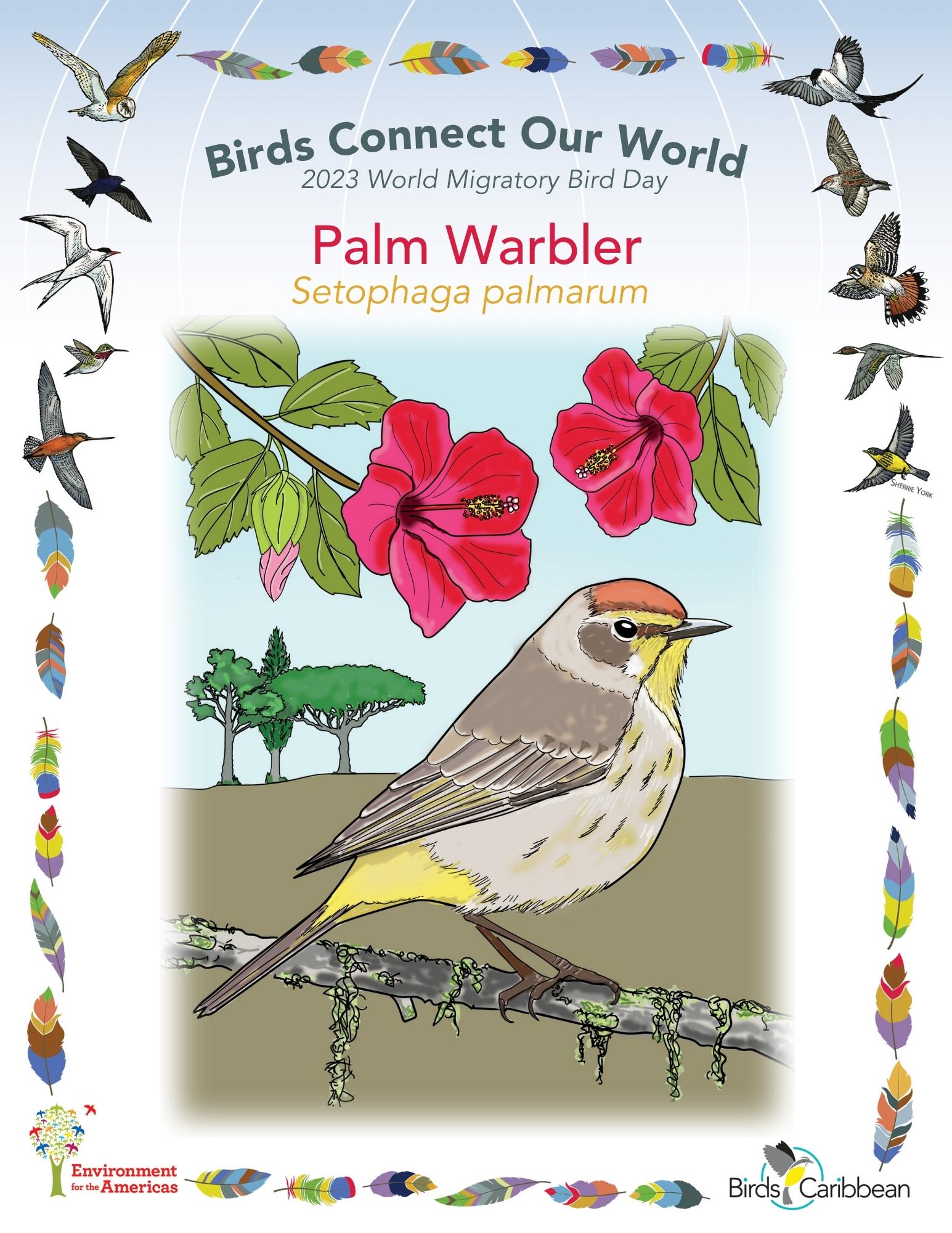
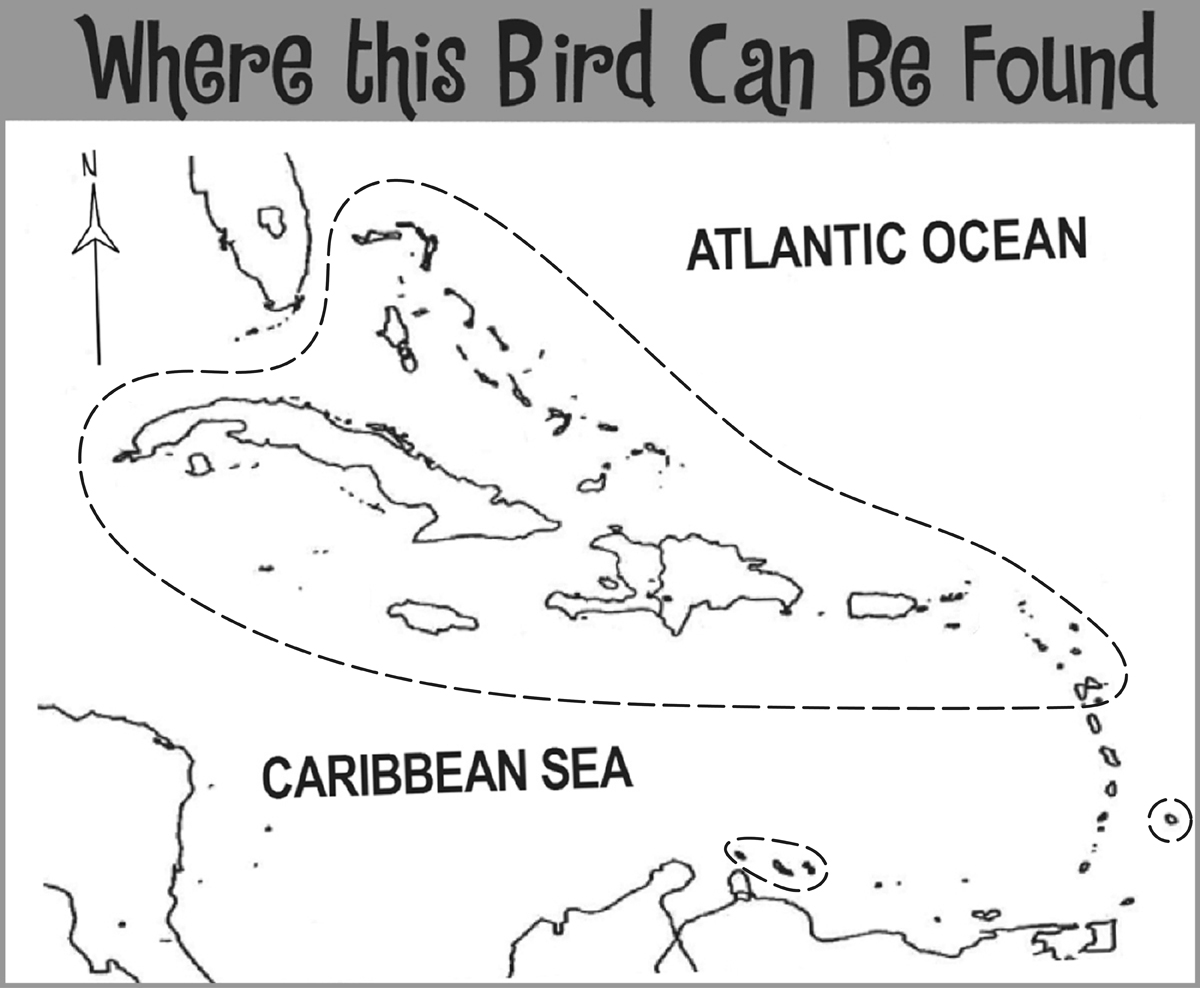
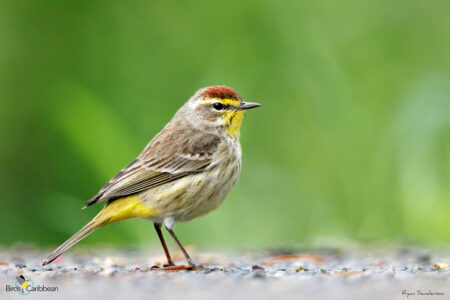
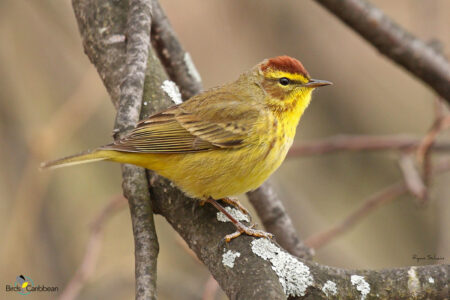
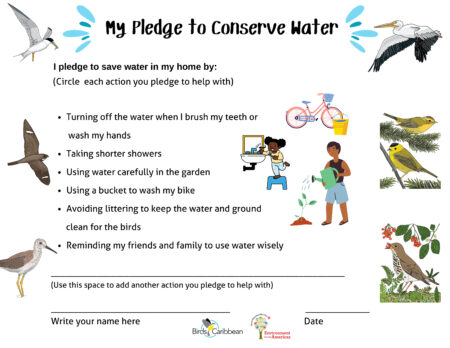 FOR KIDS: We hope that you have been enjoying learning all about migratory birds in the Caribbean! Don’t forget that this year our theme is “Water: Sustaining Bird Life”. Many of the birds we have featured this year are under pressure, often from human activities. This means that our special migratory birds, and many of the other beautiful birds that live in the Caribbean, need your help.