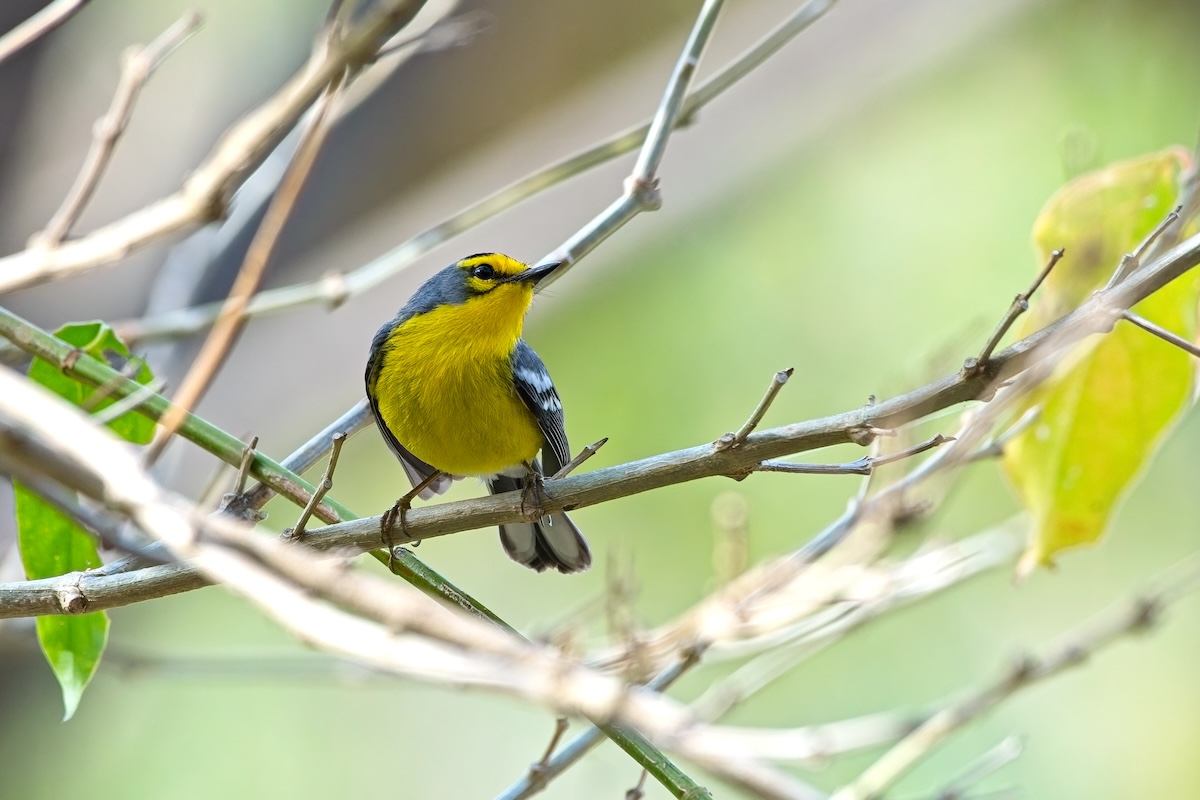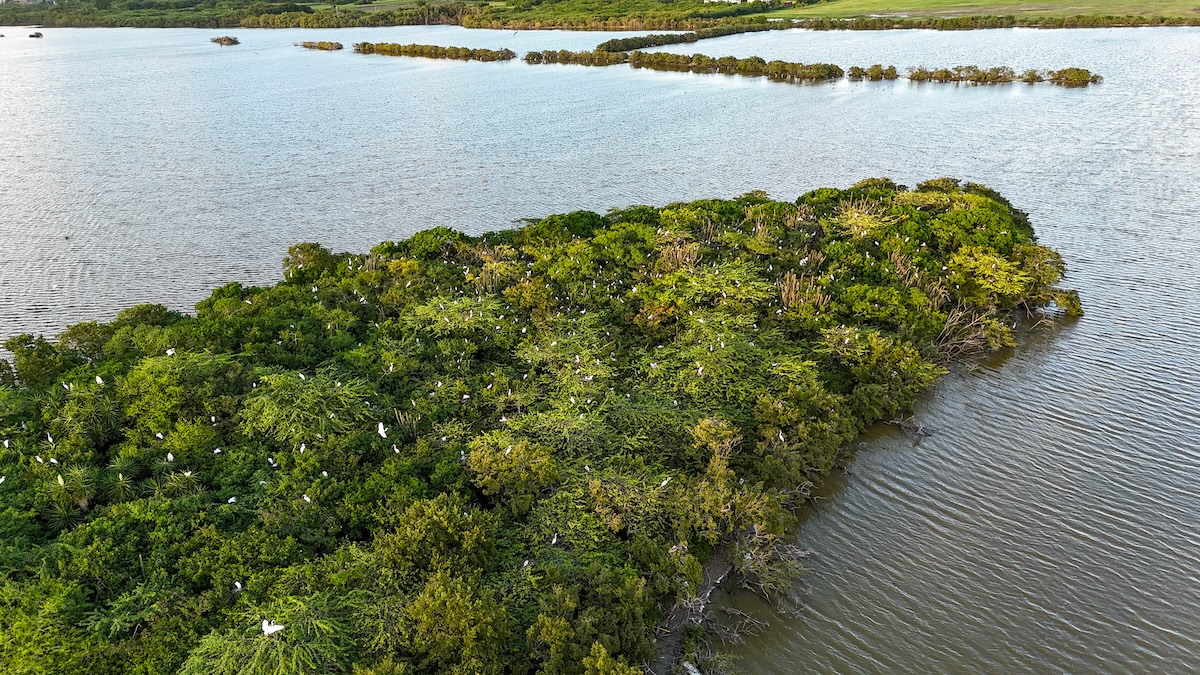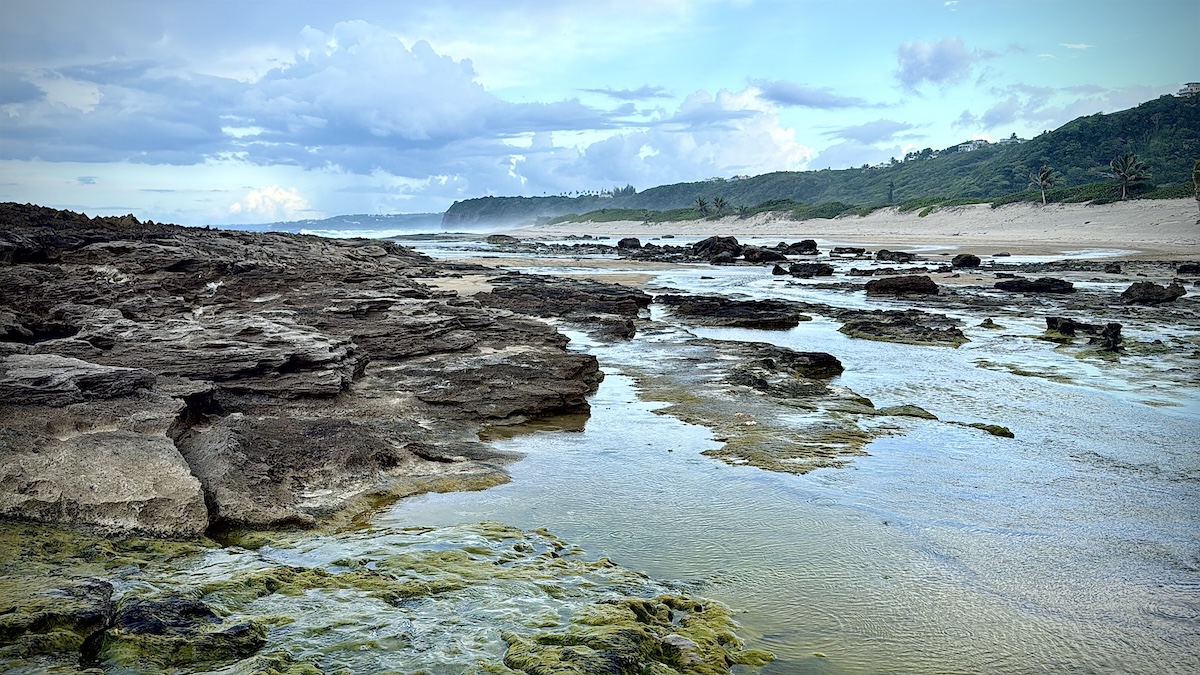
Stretching from the Virgin Islands south through the Lesser Antilles, the 17 island groups of the Eastern Caribbean are a hotbed for biodiversity, boasting an astonishing array of plants and animals found nowhere else on Earth. Whether you delight in dragonflies, bask in the beauty of birds, or even harbour a fascination for land crabs, the Eastern Caribbean offers endless discoveries for every kind of nature lover. Yet despite its extraordinary richness, there hasn’t been an individual field guide that brought together the region’s birds, mammals, amphibians, reptiles, land crabs, dragonflies, and butterflies in one accessible volume —until now!
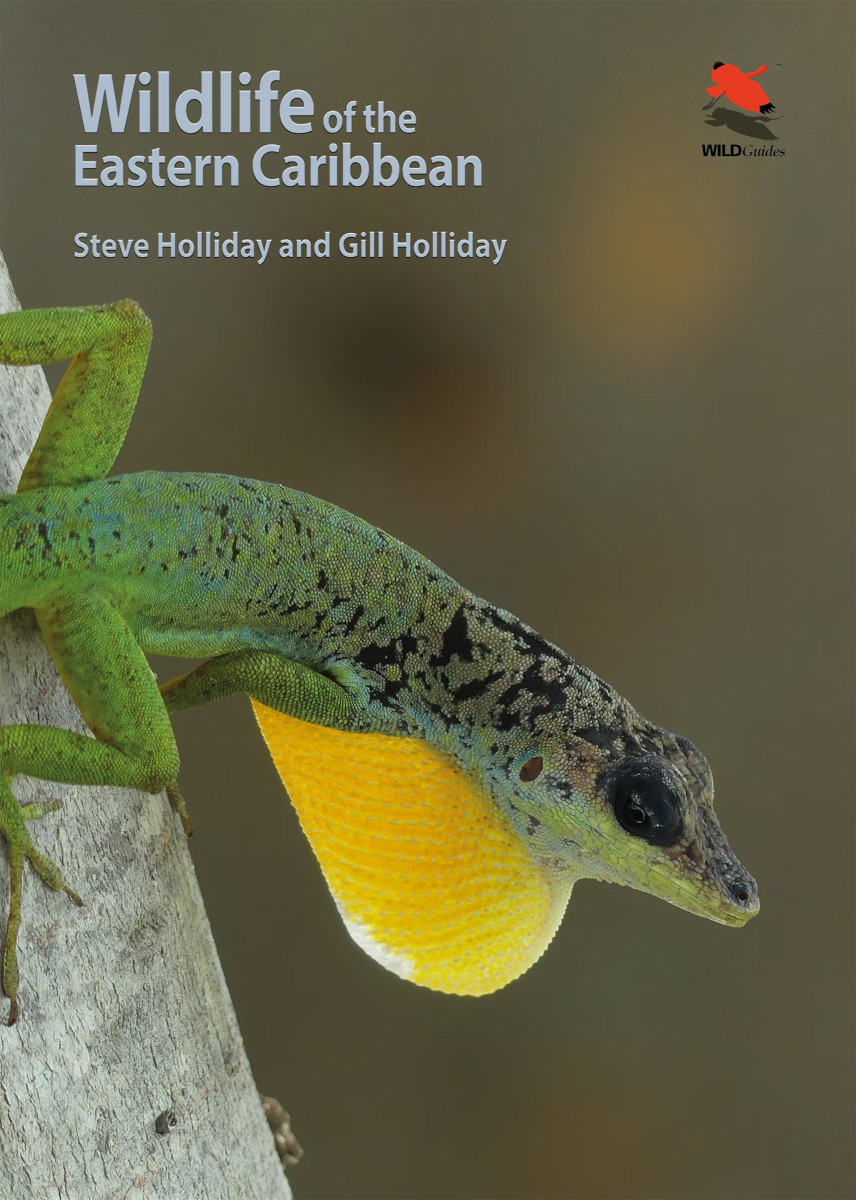
We are delighted to welcome Wildlife of the Eastern Caribbean—the first photographic field identification guide for the region. Conceptualized by husband-and-wife team Gill and Steve Holliday, after a 2000 visit to the region that sparked their curiosity, the guide grew from their search for exactly such a resource. When they couldn’t find one, they set out to create it themselves.
The result? A landmark book showcasing more than 420 species via 850+ stunning photographs. It highlights regional endemics, “don’t miss” wildlife for each island group, suggested sites to get the most out of your visit, and even practical notes on site accessibility. This indispensable guide is certain to become a must-have for travelers, naturalists, nature lovers, and residents alike.
In this interview, Gill and Steve share how their love affair with the Eastern Caribbean began, recount their most challenging photo expeditions, and reveal what it took to bring this monumental project to life.
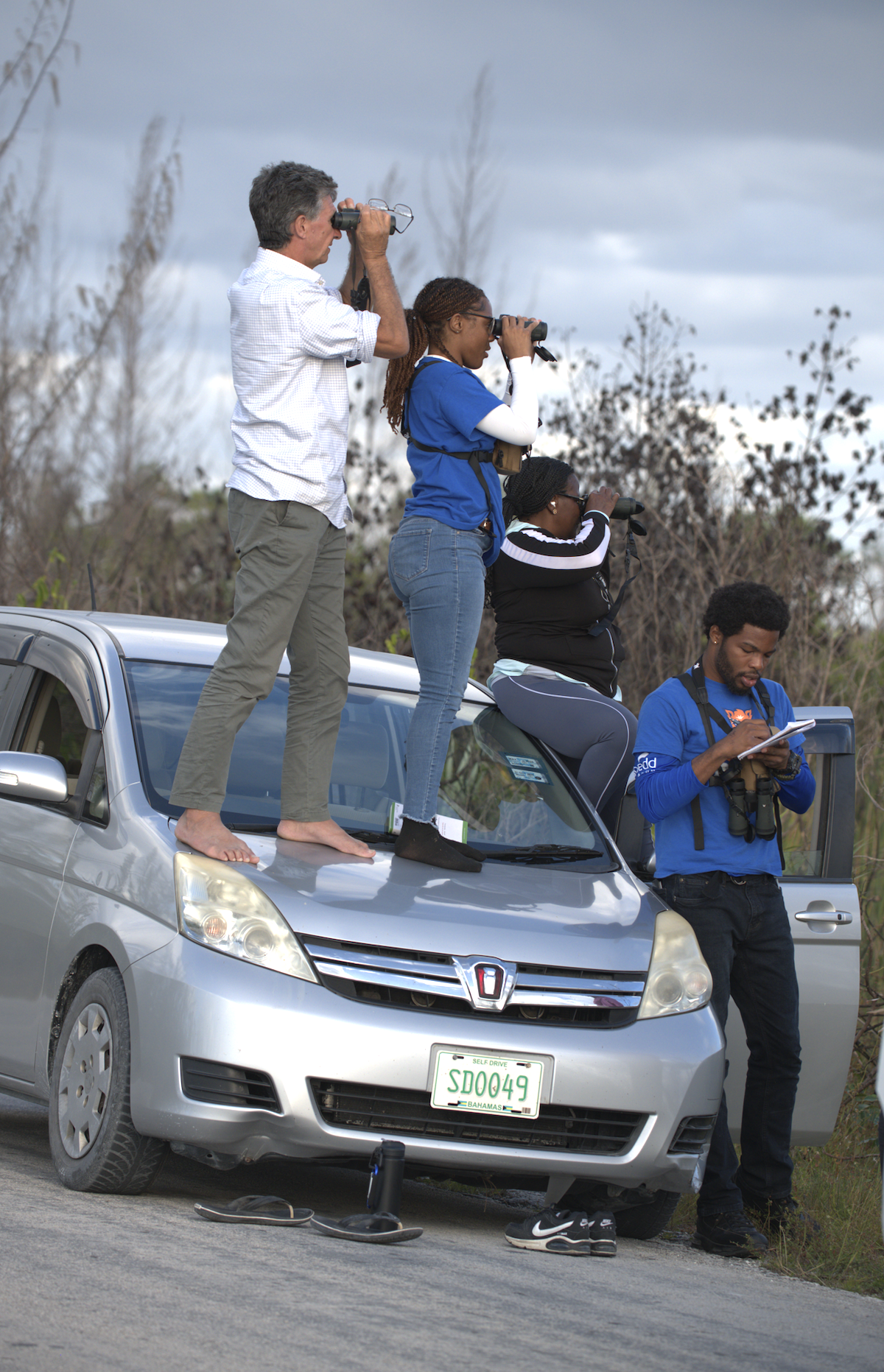
Gill searching for mangrove crabs, Tortola. (Photo by Steve Holliday)
Gill and Steve on the Mount Scenery Trail, Saba.
Guided walk, Scrub Island, Anguilla. (Photo by Steve Holliday)
About the Field Guide
What inspired you to create this field guide? We first visited the Eastern Caribbean in 2000 and wanted to know more about the fantastic range of wildlife we came across. There were excellent field guides to birds of the West Indies, but books on bats, amphibians, reptiles, butterflies and dragonflies were either out of print, limited in scope, or not available in a handy guide. We knew the type of identification guide we wanted, which ideally would cover the groups of land animals you could most expect to see on the islands. We waited many years for someone to write it, but when no-one did, we decided to have a go ourselves! We were then fortunate to find support from Princeton University Press whose Wildlife Explorer Series was the perfect format for the guide.
What makes the Eastern Caribbean a unique and important biodiversity hotspot? The islands are volcanic in origin and formed over millions of years along lines of past and current volcanic activity. Today they span 500 miles from the Virgin Islands through the Lesser Antilles to Grenada and while some islands joined to form island banks during periods of fluctuating sea levels, most have remained isolated. Any plants and animals that crossed the ocean and reached the islands, have had time to evolve in relative isolation. This has led to high levels of endemism, especially among amphibians and reptiles. Of 578 species referred to in the guide, 30% are endemic to the Eastern Caribbean, most only found on a single island or island bank.
How long did it take to complete this guide? We’ve used notes and photos from our visits to the region spanning 25 years, but the main research, writing, editing and image sourcing was completed on and off over the past five years or so. Even then, it has only been possible thanks to the contributions from so many people; experts in their field, staff in local forestry departments, national parks and conservation organisations, local guides and enthusiasts, and especially photographers. The sections on dragonflies and butterflies took longer to compile as they needed much more research in the field.
What was one of the most surprising things you learned about birds in the Eastern Caribbean while creating this field guide? Distribution both on-island and between islands. While many species of bird can be found across the eastern Caribbean, every island is subtly different; each one having its own endemic species, sub-species or what we’ve called ‘speciality species’. Here’s a few examples: the Snowy Plover is more common on the Virgin Islands and northern Lesser Antilles where it is a real specialty; the Purple-throated Carib is a Lesser Antillean endemic and widespread in rainforests but absent in the dry forests of lower-lying islands. It was also surprising to find how rare and restricted some species are: the entire world population of the critically endangered Grenada Dove is found in just a few fragments of forest on Grenada.
Besides birds, what was a fascinating discovery you made about another group of animals (e.g., reptiles, amphibians, insects, marine life) in the Eastern Caribbean during your research for the guide? There are some amazing land crabs! We just fell in love with them and found them fascinating to watch. From the tiny, but so aggressive fiddler crabs around mangrove-edged lagoons, to the outrageous petrol-blue of the male Blue Land Crab. The latter is the largest of the land crabs; its burrows and untidy piles of excavated mud can litter the floor of mangrove swamps. We also fondly remember watching the endemic Yellow Land Crab (only found from Guadeloupe to St Vincent) along a stream high in a rainforest on St Vincent when a Common Black Hawk flew into a perch above us; the hawk is a main predator of this crab on the island!
Observing Fiddler Crabs, Martinique. (Photo by Steve Holliday)
About the Process
Creating a field guide is a monumental undertaking. How did you keep up the motivation to complete this field guide? Did you have specific routines or personal inspiration to help keep you on track? You’re right—it was a monumental undertaking, and we quickly realised why it had never been done before! We lived by the spreadsheet and the page plan to keep us on track and then it was down to putting the hours in: we tried to work most mornings. We focused on one section at a time, reading and rewriting until we were satisfied with every word. For inspiration we really enjoyed the challenge of keeping the species text succinct and accessible without compromising on key identification features.
How did you gather photos for the guide? We have our own extensive library of images, but some species are notoriously difficult to even see, never mind photograph! Our aim, which we largely achieved, was for as many photos as possible to have been taken in the region; each had to be of sufficient quality for publication and demonstrate key identification features. We are forever grateful to the numerous people who provided their images for us, including BirdsCaribbean members Mark Yokoyama, Anthony Levesque and Frantz Delcroix.
What was the most unexpected challenge you encountered? And how did you overcome this challenge? Data—especially for dragonflies and butterflies! There’s been a lot of work across most of the groups covered in the guide, but dragonfly and butterfly data are limited on some islands. With dragonflies we are particularly indebted to Dennis Paulson and Francois Meurgey who were so helpful with ID. We spent a lot of time in the field to fill distribution gaps for both dragonflies and butterflies, and we had to develop field identification criteria for some species. It was also challenging to keep up to date with changes to common names and taxonomic updates. For example, as the book was with the copy editor and designer, several new endemic bird species were recognized (four wrens and two thrashers), which had to be added to what was supposedly the final text and design!
Were there any particularly challenging photo expeditions? Any photographic expedition into a rainforest presents challenges, as any photographer will know; poor and shaded light, humidity, difficult trails, and biting insects! And forest birds are notoriously elusive and hard to see when high in the canopy. For these reasons, it’s just incredibly difficult to get good photos of some forest species. For example, we have been unable to find a usable upperwing image of the Dominican Leafwing butterfly, a species found only on Dominica, Martinique, and St Lucia.
What was the most rewarding experience while writing this field guide? We got to know some amazing people, both in person and online; some are renowned experts in their field, some enthusiastic amateurs, but all shared a passion for the wildlife of the Eastern Caribbean. We can’t thank everyone enough for their support.
About the Authors
What do you love most about the Eastern Caribbean? The friendliness and generosity of people on all the islands, alongside spectacular landscapes, amazing wildlife, beautiful seas, and the sense of adventure which we still get every time we set off to explore a forest trail or a small offshore island.
What’s one non-essential gear item you always bring with you when you’re out in the field? Thermal coffee mugs!!! When we’re out before sunrise, fresh coffee keeps us going!
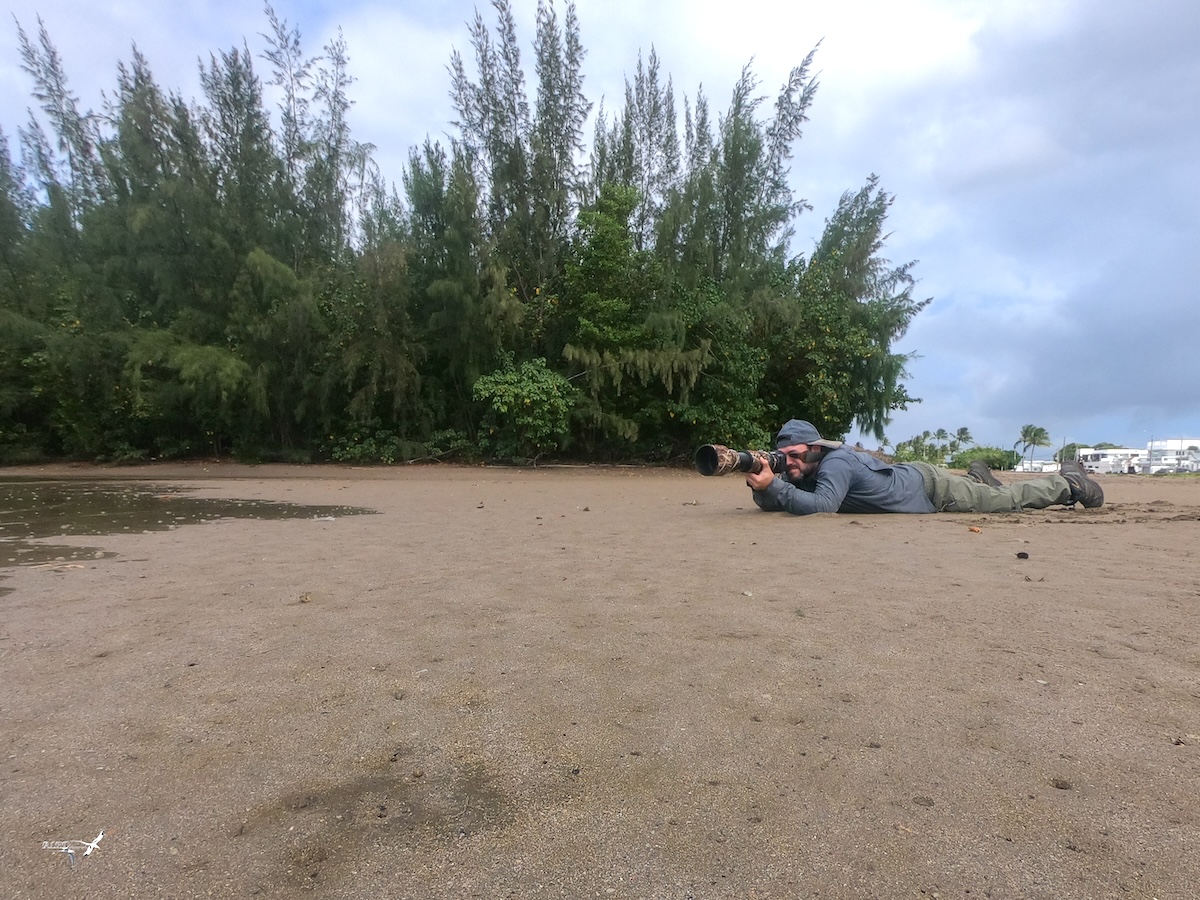
Steve getting to grips with shorebirds on Martinique (Photo by Gill Holliday)
On the trail in Montserrat. (Photo by Gill Holliday)
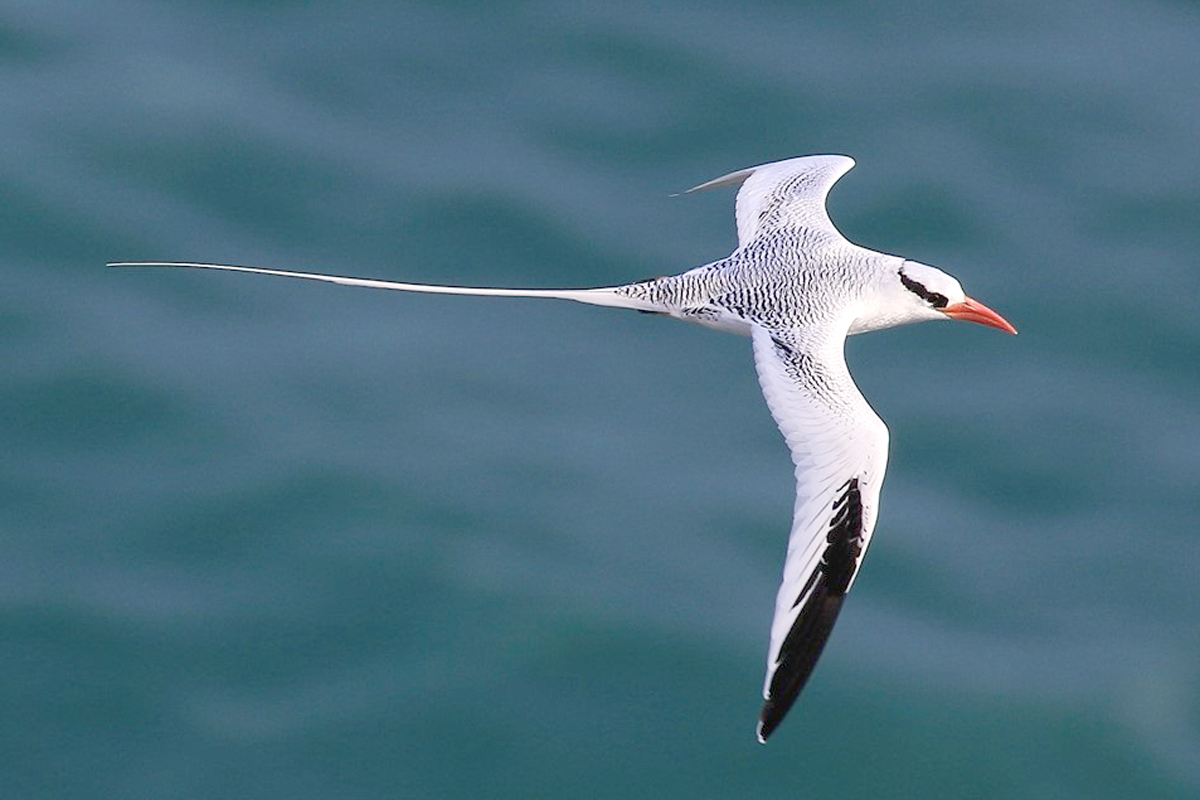
Gill photographing Red-billed Tropicbirds, Statia. (Photo by Steve Holliday)
What do you hope readers will gain from using this guide? We really hope this guide will encourage people to take more interest in the region’s wildlife and enjoy the challenge of identifying and being able to put names to what they are seeing. The guide covers 420+ species, so there’s plenty to go at! We also hope that people gain some understanding of the conservation challenges of the region, including the devastating impact of invasive species such as Small Indian Mongoose and Cane Toad. Over 100 of the species in the guide are on the IUCN Red List of globally threatened species; looking after the amazing habitats that they depend upon and ensuring space for nature is essential for these species to survive for future generations to enjoy.
Sample pages from ‘Wildlife of the Eastern Caribbean’:
Front cover of the Wildlife of the Eastern Caribbean field guide.
What’s next for you? Are there any plans for future editions, companion guides, or other projects related to Eastern Caribbean wildlife? We will of course continue to visit the region and keep up to date with what’s happening that affects species in the region such as the recently produced AviList, a new unified global checklist with up-to-date taxonomy. It has been an incredible experience researching and writing this guide and we’ve learned so much about the whole process of book design and production. Hopefully we can put this experience to good use, so we’ll have to wait and see what’s next for us!
With so many islands to explore, each with their own special sights and surprises, Wildlife of the Eastern Caribbean is the perfect traveling companion for new adventures, or for seeing your local patch with fresh eyes. You can get your own copy of this fantastic guide here.
Steve Holliday has had a long career in wildlife conservation and Gill Holliday has provided images for several wildlife publications. They have been supporting conservation projects for more than 20 years and are lead authors/photographers of bird and wildlife guides for Anguilla and Montserrat.
Birding at Cherry Tree Hill, Barbados. (Photo by Alex Sansom)
Imagine helping scientists make amazing discoveries, all from the comfort of your own home or backyard. That’s the power of citizen science! You don’t need a white lab coat to contribute to real research, just a curious mind and a willingness to observe the world around you. We’ve got all the details in this blog to help you take simple yet concrete actions to protect our planet.
Ever wanted to make a real difference in your community—no, make that in the world? With citizen science you actually can! Citizen science is all about scientists teaming up with everyday people who are curious, concerned, and motivated to tackle real-world problems. These people are called citizen scientists. Science needs more eyes, ears, and perspectives than any single scientist possesses to protect threatened species, safeguard natural resources, and prevent the spread of diseases. Think about it—thousands of citizen scientists, each doing a small amount of work, focused on a single goal, can collect more data in a shorter period and for less money than can any researcher or research group. Additionally, citizen scientists can collect data from places like backyards or schoolyards that may be difficult for researchers to access.
Many names with the same aim
“Community science,” “participatory science,” “crowdsourced science,” “volunteer monitoring,” and “public participation in scientific research” are common aliases for citizen science. But whatever it’s called in your neck of the woods, all citizen science projects share these four key characteristics:
Anyone can participate no matter occupation, age, background, gender, or location. Seriously, if you’re curious and willing to help, you’re in!
Everyone uses the same method. This ensures the data collected is top-notch.
Your data makes a difference. It can help scientists make amazing breakthroughs.
It’s a two-way street. Scientists and volunteers openly share data and results so everyone, including the public, can see what’s happening.
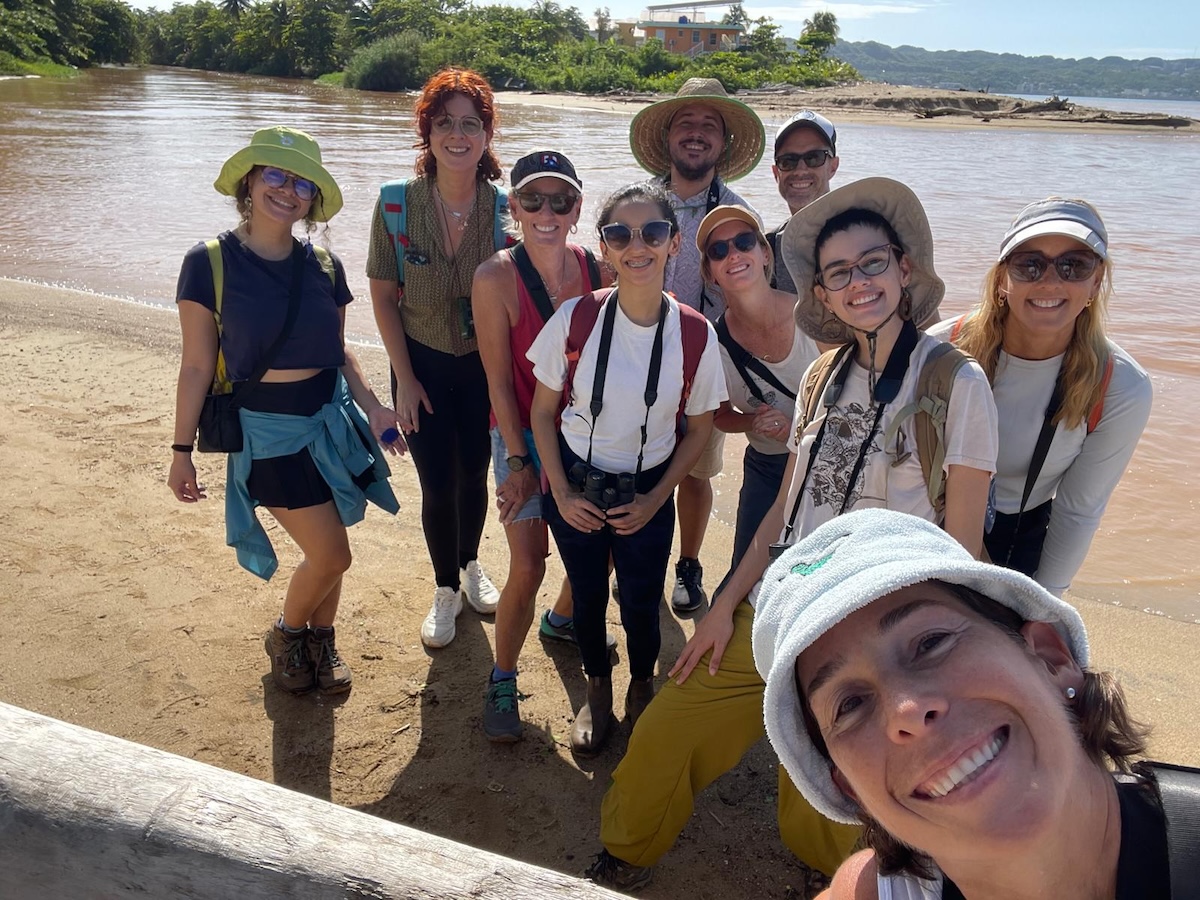
Surfrider Foundation Puerto Rico’s small but dedicated birding group at Playa Table Rock for the Caribbean Endemic Bird Festival (CEBF) and Global Big Day (GBD) 2024. (Photo by Surfrider Foundation Puerto Rico)
Citizen scientists commonly collect data. But they can also be involved in other phases of the scientific process like defining the research question, analysis, reporting, and sharing results. The work itself is also incredibly varied. Citizen scientists may be asked to watch and record birds, take photos of local streams and rivers, test water samples for pollutants, or survey marine debris on local beaches. Some projects are even as fun as playing online games to help advance health research. Whatever your interest, we’re certain there’s a project out there for you to make a difference!
The value of citizen science to YOU
Now, you’re probably wondering, “What’s in it for me?” Well, loads.
It’s a fantastic way to connect with a global community who shares your passions. Whether you’re tracking local wildlife with neighbors or collaborating on a global research project online, you’ll be part of a supportive community of volunteers and scientists. This shared purpose and teamwork can turn a solo activity into a meaningful and less daunting experience. Within this community, you’re encouraged to ask questions, share your unique viewpoint, and by doing so enrich a body of knowledge with your input.
BirdLife Jamaica members and guests take a bird walk at Source Farm. (Photo by Source Farm)
Becoming a citizen scientist also offers opportunities for hands-on learning. You’ll gain practical skills in data collection, observation, and critical thinking. You might learn how to identify different bird species, use scientific instruments to test water quality, or build your scientific literacy.
Painted Buntings, a gorgeous migrant to the Caribbean, feast at a backyard feeder in Grand Bahama, The Bahamas. (Photo by Erika Gates)
For example, you join a citizen science project like the Great Backyard Bird Count and notice a bird you’ve never seen before in your backyard. You snap a picture and share with your local birding group or through an online search or field guide to learn how to identify it. This bird now has a name! You’ve come this far, can’t stop now. You then learn what it eats, where it builds its nest, and that your backyard is providing it with food and shelter. Just like that, your backyard goes from being a small green patch to an important part of a local ecosystem—and now you’re actively participating in understanding and protecting it.
You’ve also unlocked the art of noticing your world deeply—increasing your sense of presence, and helping you be more connected to the everyday wonder that surrounds you.
Ultimately, citizen science is all about you. It’s a chance to put your curiosity to work on your own terms. You can choose a project that aligns with your interests, and set your own schedule—contributing as much or as little as you like, from your house, backyard, neighbourhood park, or nature reserve. This self-directed approach empowers you to be a part of something bigger while feeling a sense of ownership and pride in the work you do.
What a difference your data makes!
Entering data into eBird. (Photo by Holly Garrod)
It may sound implausible that simple actions like recording the birds you see or taking photos of rivers and streams can lead to big changes. But your data is a real-game changer in how we think about and conserve our natural resources.
When conservation efforts are steered by sound data, the results can be truly magnificent for birds, habitats and people!
Thanks to the collective power of citizen scientists—heading out, recording the birds they saw, then submitting those sightings to eBird—researchers were able to complete the first-ever Caribbean-wide assessment of shorebird use in the region, via the Caribbean Waterbird Census, now in its sixteenth year.
For ten years, volunteers continuously contributed more than 211,000 shorebird observations through more than 78,000 eBird checklists. This immense pool of data allowed the researchers to identify critical conservation hotspots that were previously unknown. This breakthrough is a huge deal, finally giving the Caribbean the recognition it deserves as a crucial region for North American shorebirds, so important given alarming declines in shorebirds in our region. The study highlighted that Humedal Sur de Pinar del Río in Cuba and Monte Cristi in the Dominican Republic should be priority areas for shorebird conservation. As these sites each support over 20,000 shorebirds annually like Short-billed Dowitchers, Black-bellied Plovers, Wilson’s Plovers, and Black-necked Stilts they are also candidates to be designated as WHSRN (Western Hemisphere Shorebird Reserve Network) sites of regional importance.
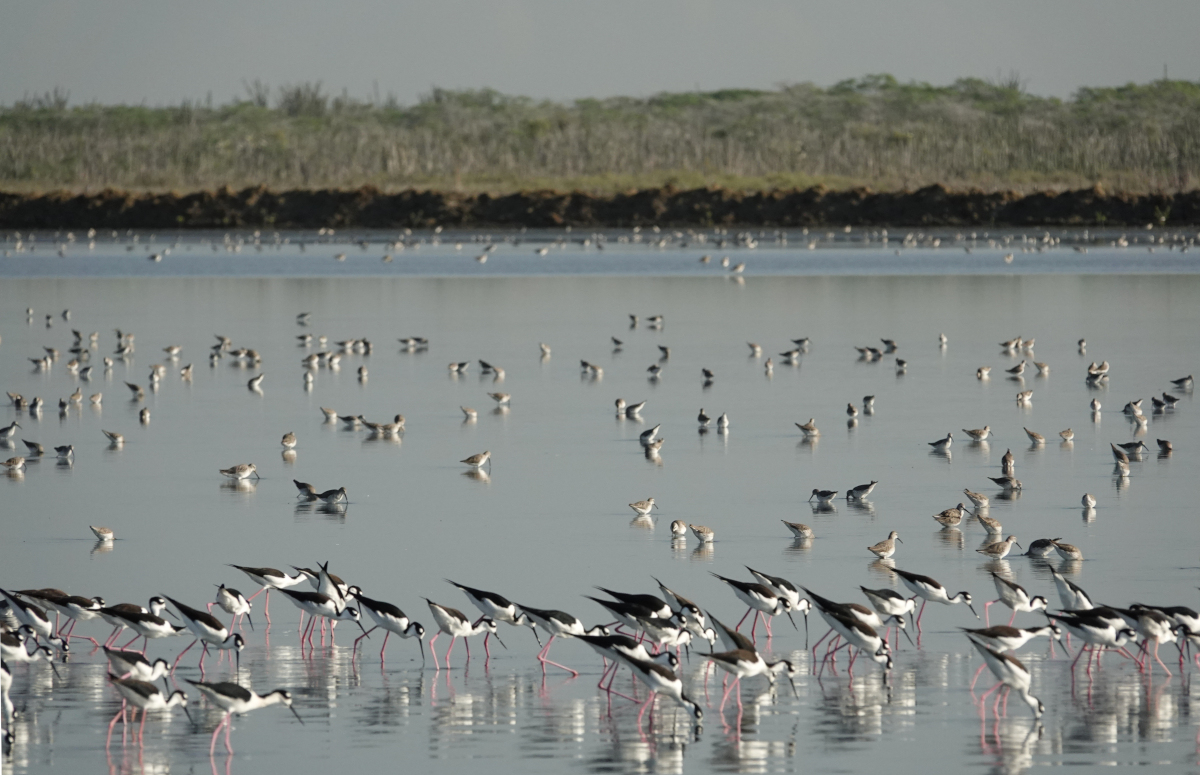
Over 20,000 shorebirds rely on the wetlands at Monte Cristi in the Dominican Republic during migration every year – making this a regionally important site and a critical lifeline for shorebirds. (Photo by GAE)
This study also pinpointed at least 15 additional sites that are crucial for shorebird populations and may now qualify for international designations. This massive effort by thousands of volunteers has provided the evidence needed to protect these habitats and ensure a safer future for migratory shorebirds. You can read the full article here!
With countless opportunities available, it’s easy to find and join a citizen science project. But before you begin your new adventure in science, here are some tips to get you started on the right foot.
Your first step should be to find a project that genuinely interests you. Do you love to hike? There are projects for tracking wildlife. Are you interested in birds? You can help monitor populations. Do you want to help your local community? You can help monitor water quality or noise pollution. It’s important to choose a project that aligns with your interests. This will make the experience more fun and rewarding.
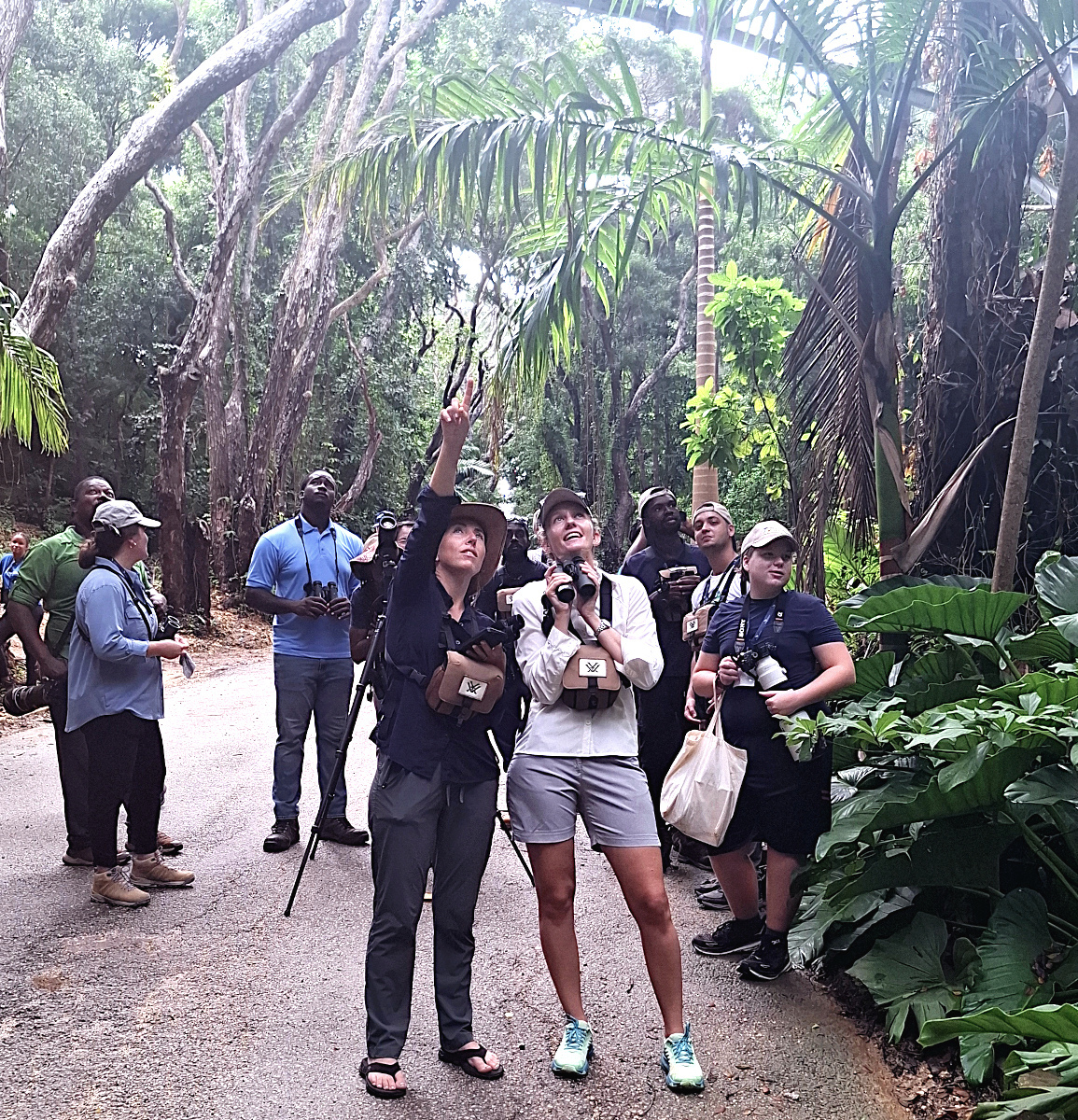
Participants at bird walk led by Miguel A Landestoy and Grupo Jaragua team at Las Salinas, DR. (Photo by Grupo Jaragua)
Once you’ve zoned in on the type of project you’d like to join, ‘google it!’ A quick search will connect you with platforms that host thousands of projects. If you’re a bird lover, eBird is our absolute favorite. eBird offers projects, courses and news to help you get started and stay up-to-date with everything citizen science. We’ve also got some great longstanding citizen science projects in the Caribbean too, more on this below.
After selecting a citizen science project you’ll typically have to download a free app or visit a website, sign up, and follow the simple instructions to collect and submit your data.
If you’re completely new to the citizen science scene, here are some additional tips:
Start small and local. The good news is that you don’t have to be an expert or commit a lot of time. Many projects can be done in as little as 15 minutes, and every single observation helps. (There’s no bad news!) Also, follow the instructions. Each project has a specific set of instructions to ensure the data is high-quality. Reading and carefully following the instructions will make your contribution even more valuable. And of course, when in doubt, ask questions! The community is here to support everyone, from beginners to experts.
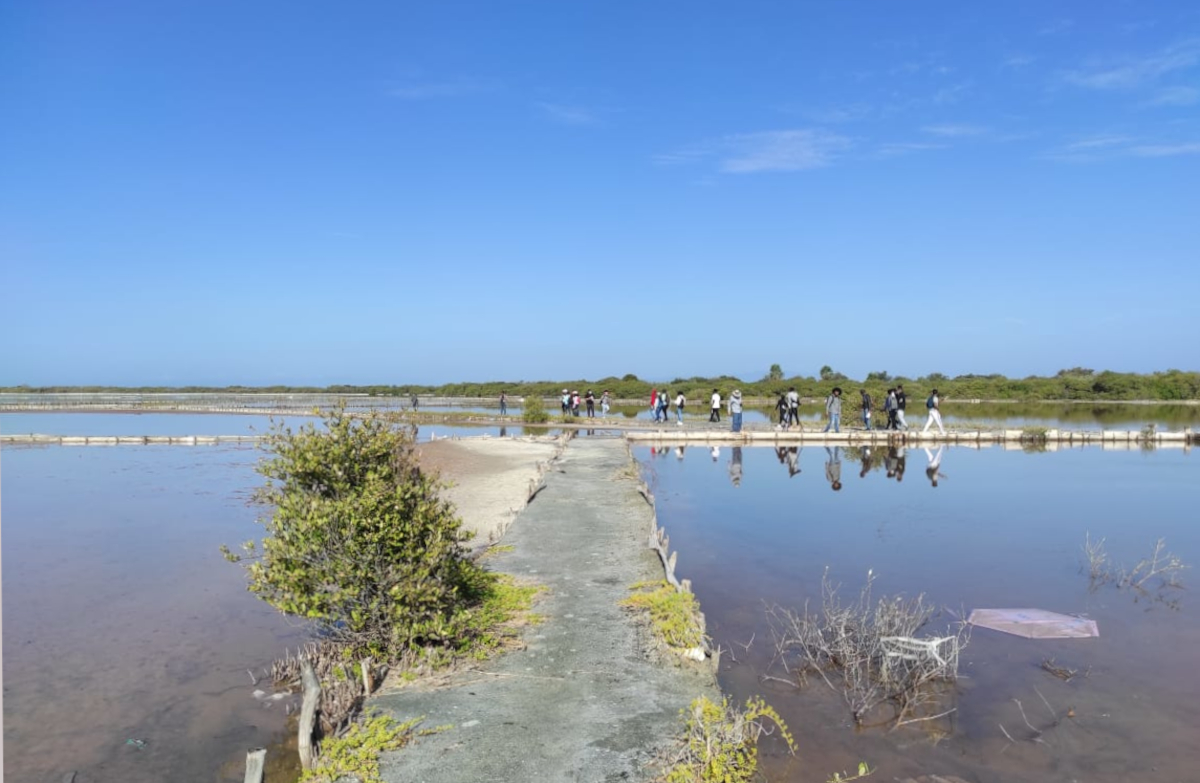
Looking for shorebirds for a CWC Count at Old Harbour mudflats, Jamaica. (Photo by BirdLife Jamaica)
Shanna explains bird ID at McKinnons Pond, Antigua, during the 2025 CWC Count. (Photo by Sherrel Charles)
Finally, and most importantly—have fun! You are helping to make ripples of impact while having an adventure of a lifetime so give yourself the space and time to enjoy the process of discovery, learning, and contributing.
Bonus tip: Citizen science is all about community. Invite a friend to be your fellow explorer!
A few members of Statia’s Golden Warblers in St. Eustatius, Global Big Day 2025. (Photo by Jethro van’t Hul)
Members of the team BirdersSKN birdwatching on Global Big Day.
Brendan Burns and Skyler Bol of Gavilán Guardians in Puerto Rico, Global Big Day 2025. (Photo by Brendan Burns)
Mirielle and Kathleen surveying birds at Anasco, Puerto Rico, 2025 Global Big Day. (Photo by Marisol Villanueva Mendez)
Ready to start your Citizen Science adventure with BirdsCaribbean?
If you’re ready to start your citizen science adventure, here are some great projects to join throughout the year:
Global Shorebird Count (September 2025): If you love plump adorable animals, then we think you’re going to love this project! Learn more about the Global Shorebird Count here and get the resources (for FREE) to help with your count here.
Shorebirds like the Short-billed Dowitcher and Stilt Sandpiper are long distance migrants that spend part of their year in the Caribbean. (Photo by Mark Yokoyama)
October Big Day (October 2025): A global event where you can join thousands of birders to find and report as many bird species as possible in a single day. And get this, you can watch birds right from the comfort of your backyard or balcony! However, if your feet are itching to cover more ground, birders also head to botanical gardens, wetlands, and nature reserves. Learn more here.
Caribbean Waterbird Census (January- February 2026): For over 16 years, BirdsCaribbean has been monitoring waterbird populations thanks to the efforts of a region-wide network of amazing birders and bird lovers! While the official count happens in January, you can submit waterbird observations throughout the year to this important program. Click here to learn more about this incredible citizen scientist project and access free resources like webinars, bird ID guides and more.
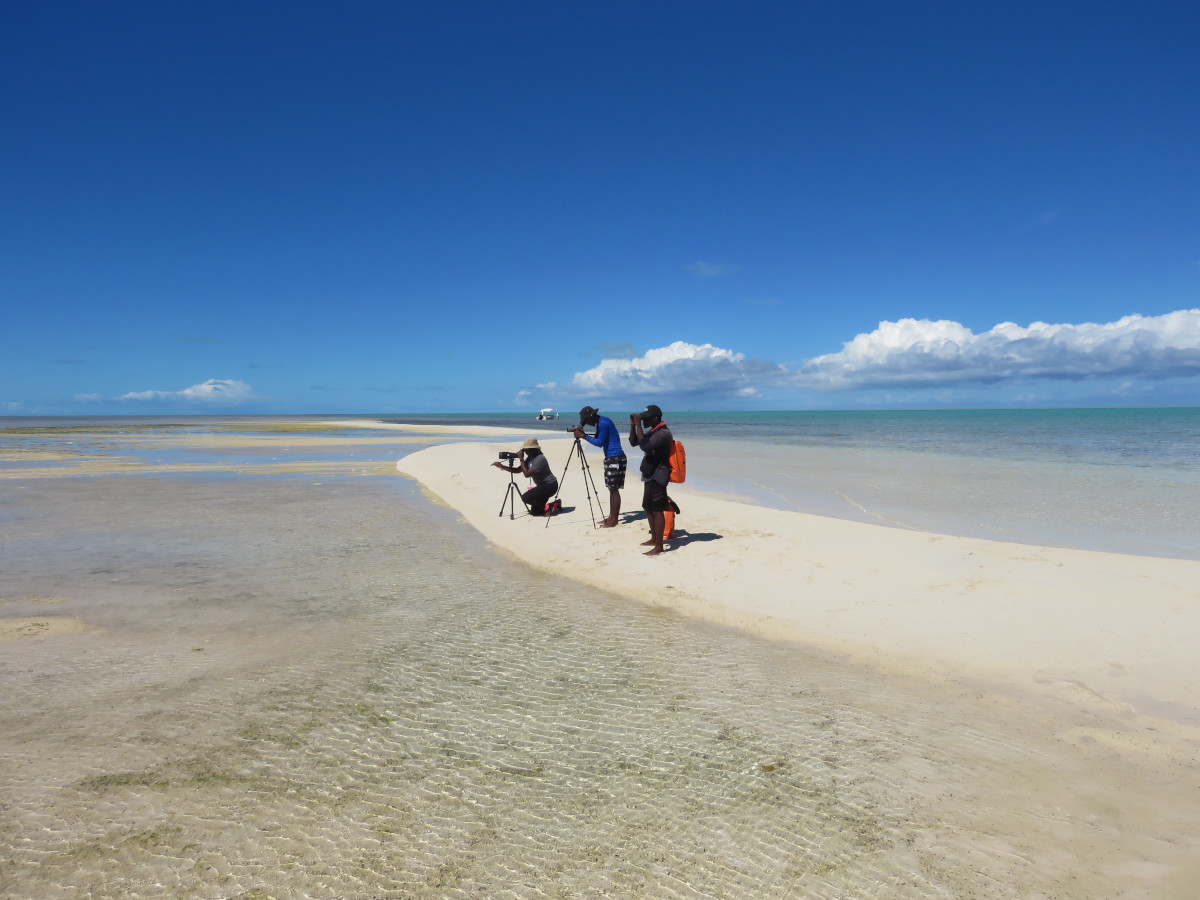
Counting shorebirds on Turks and Caicos. (Photo by Simon Busuttil)
Global Big Day (May 2026): Join birders from around the world to find and count birds on a single day in May. Be sure to check out this year’s recap of the event and get ready to participate, wave your country flag high, win fabulous prizes, show off your best shots and raise funds to protect Caribbean birds and build local conservation capacity, next year!
You’ve got the tools. You’ve got the drive. Now go make history! Your observations are the building blocks of a better world. The projects are waiting for you, and so are we. The only thing missing is you!
The White-necked Jacobin that was caught at a migratory bird banding station on Isla Contoy, Mexico. (Photo by Jonathon Nochebuena)
Colourful, vibrant, and so charismatic—birds are easy to love and fascinating to study. Amidst the ever-present threats of climate change, deforestation, invasive species, and more, our feathered friends are persevering, aided by targeted research, conservation actions, and habitat protection.
From hawks in Cuba, to hummingbirds in Mexico, and parrots in Costa Rica—this blog, by Zoya Buckmire, Lead Copy Editor for the Journal of Caribbean Ornithology (JCO), highlights some of the findings recently published in Volume 38 of the JCO, with the behind-the-scenes scoop from the authors themselves. All three studies were conducted in Spanish-speaking countries, and two were published in Spanish (the JCO is trilingual!), so this blog article is available in Spanish as well. [Click here if you would prefer to read it in Spanish.]
Observations of a nesting endemic hawk in Cuba
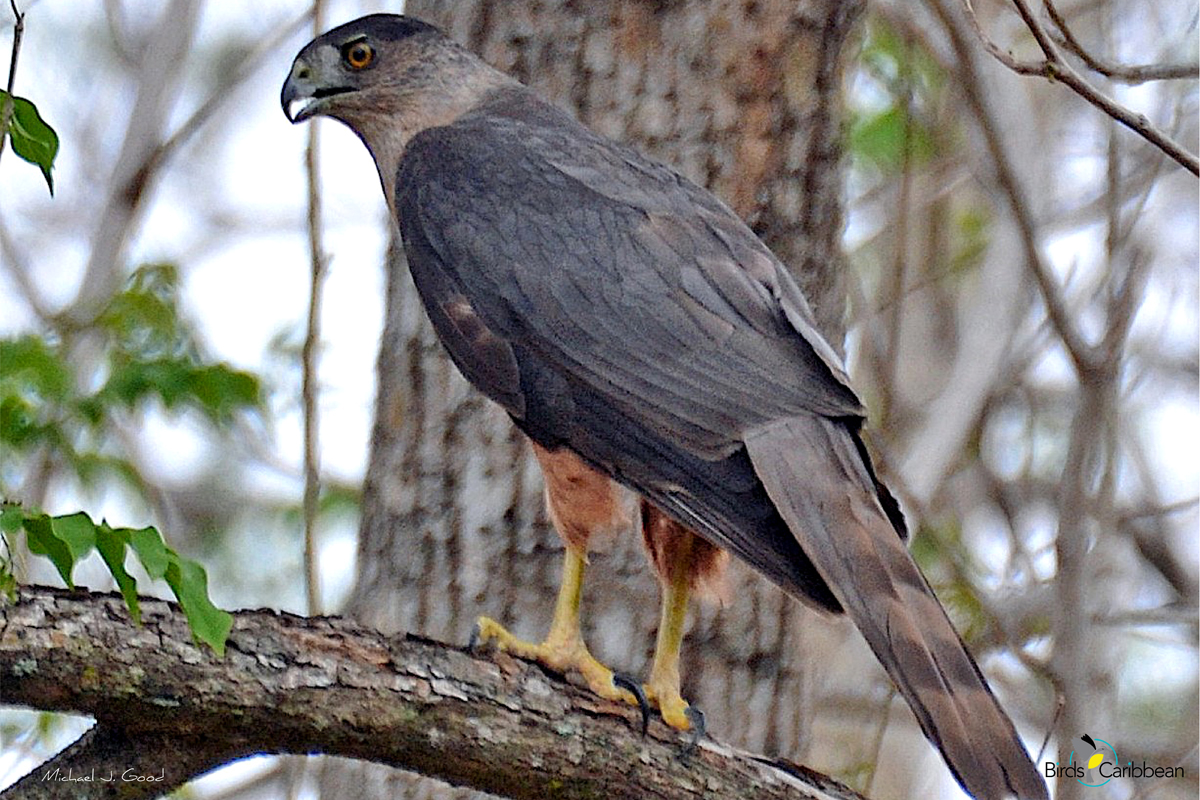
Cuba is the largest and most biodiverse Caribbean island. Adding to this biodiversity are almost 30 species of endemic birds, including the widespread but Endangered Gundlach’s Hawk (Astur gundlachi). For our understudied Caribbean endemics, any new life history information is a critical piece of the puzzle to figuring out how best to protect and conserve our species. A nest found within the National Botanical Gardens in Havana in 2022 is filling some of that knowledge gap. Randy Simón Vallejo and colleagues describe their findings of the nest in a research note, an important record showing the adaptability of the species and their ability to breed even in anthropogenic, semi-urban habitats.
Gundlach’s Hawk (Photo by Michael J. Good)
How did you first conceive of this study, and what motivated you to conduct this research?
What made us initiate this study is knowing about the pair of Gundlach Hawks at the National Botanical Garden and that we are already conducting literature reviews of the species.
Tell us about a memorable moment during field research or data analysis.
There was a day when it rained that we saw an unexpected behavior—the father spread his wings over the chicks to protect them while the mother was on the defense perch.
Tell us about a challenge you had to overcome.
It was really a job that we enjoyed very much. What was most difficult was that the mother was very aggressive all the time.
What are your hopes of what your research will lead to? Will this work impact your own research agenda going forward?
This work is a driving force for a master’s research project on this bird of prey in a protected area.
Gundlach’s Hawk is locally known as “Gavilán Colilargo” or “long-tailed hawk.” Adults are dark gray above and white-to-rufous below, while younger hawks are brown overall and streaked in their first year. An agile predator, Gundlach’s Hawk feeds almost exclusively on birds, including many local passerines, near-passerines, and fowl. The species is widespread but not common throughout Cuba, and habitat loss and disturbance are the main factors contributing to its Endangered status.
On a tiny island off the coast of Mexico, research is also ongoing—this time using bird banding as the method of choice. The migratory bird banding station is located on Isla Contoy within the Isla Contoy National Park, and operates using the MoSI protocol to study migrating and overwintering bird populations. During their second MoSI pulse in December 2022, Jonathan Nochebuena Jaramillo and colleagues caught a very unexpected White-necked Jacobin (Florisuga mellivora). These dazzling little gems are native to Central and South America—and Trinidad and Tobago—but had never been recorded that far north in Mexico.
Such records can occur for a variety of reasons: dispersal by young or inexperienced birds, natural range shifts potentially linked to climate change, navigational errors during migration, or severe weather blowing birds off course. Whatever the cause, this record is an exciting and important addition to our knowledge of the species and highlights the value of monitoring efforts at understudied sites like Isla Contoy.
White-necked Jacobin. (Photo by Rio Dante ML222384231)
How did you first conceive of this study, and what motivated you to conduct this research?
The banding station in Isla Contoy National Park was a personal initiative that arose from the need to help birds that cross the Mexican Caribbean. When I visited Isla Contoy for the first time I realized the large number of birds that cross the Caribbean so I said to myself, “There must be a station here that is dedicated to the conservation and protection of migratory birds.”
Tell us about the memorable moment when you captured the rare hummingbird.
Everything happened around 9:30 am when tourists arrived on the island—when they begin to arrive it is time to close the nets. We were working normally at the banding station when suddenly we heard a boat and said, “They’re tourists, runnn!”
We started to close the nets, when suddenly someone shouted “Look, a bird!” and we all ran! When we saw it we said to each other, “This isn’t normal—it is a very large hummingbird, keep it!” When we took it out of the bag, we exclaimed, “Wow, it’s beautiful!”
The team’s quick response was a matter of prioritizing the birds’ safety. As soon as tourists arrive, the area becomes a popular spot, and the increased activity could disturb the birds. By quickly closing the nets, the researchers ensure a stress-free environment for the birds.
What are your hopes of what your research will lead to? Will this work impact your own research agenda going forward?
Isla Contoy hides many mysteries as it is a buffer zone for many species, not just birds. We are sure that there are many birds that have not yet been recorded that use the island at some point in their lives. We are also confident that this information will greatly assist with the island’s conservation programs and the development of sound management plans in the future.
We are grateful to BirdsCaribbean for giving us the opportunity to share this great experience. We truly believed that we would never see this species in person, unless we traveled to South America where it is found.
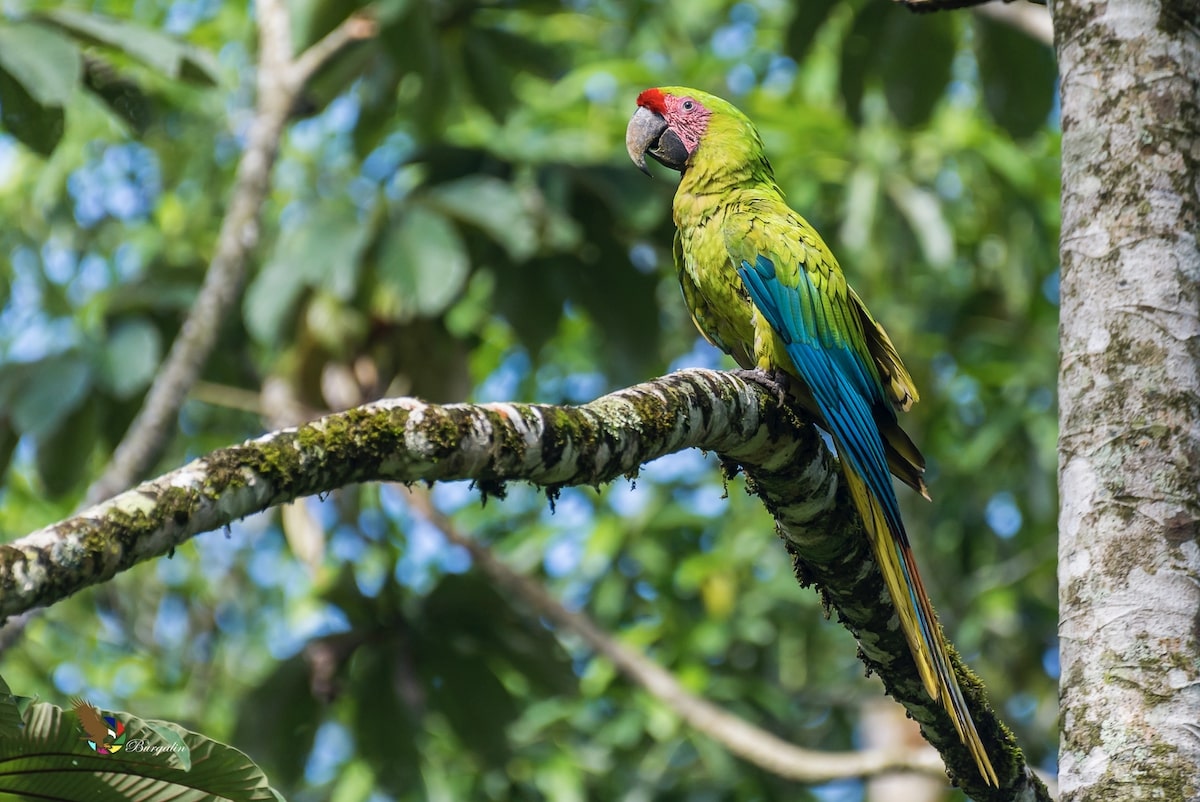
The Great Green Macaw (Ara ambiguus) and Scarlet Macaw (Ara macao) are two gorgeous psittacid species native to Costa Rica and whose populations are threatened by habitat loss throughout Central America. In fact, before 2014, they were considered rare and extirpated, respectively, in the Tortuguero area on Costa Rica’s Caribbean coast. Despite habitat protections in Costa Rica and Nicaragua, the status of the two macaw species was still unclear, especially as macaw populations are known to be highly mobile and seasonal based on food availability.
Scarlet Macaw in flight. (Photo by Jeff Haperman ML518746041)
A Scarlet Macaw feeding on a beach almond. (Photo by Blair Dudeck ML131074401)
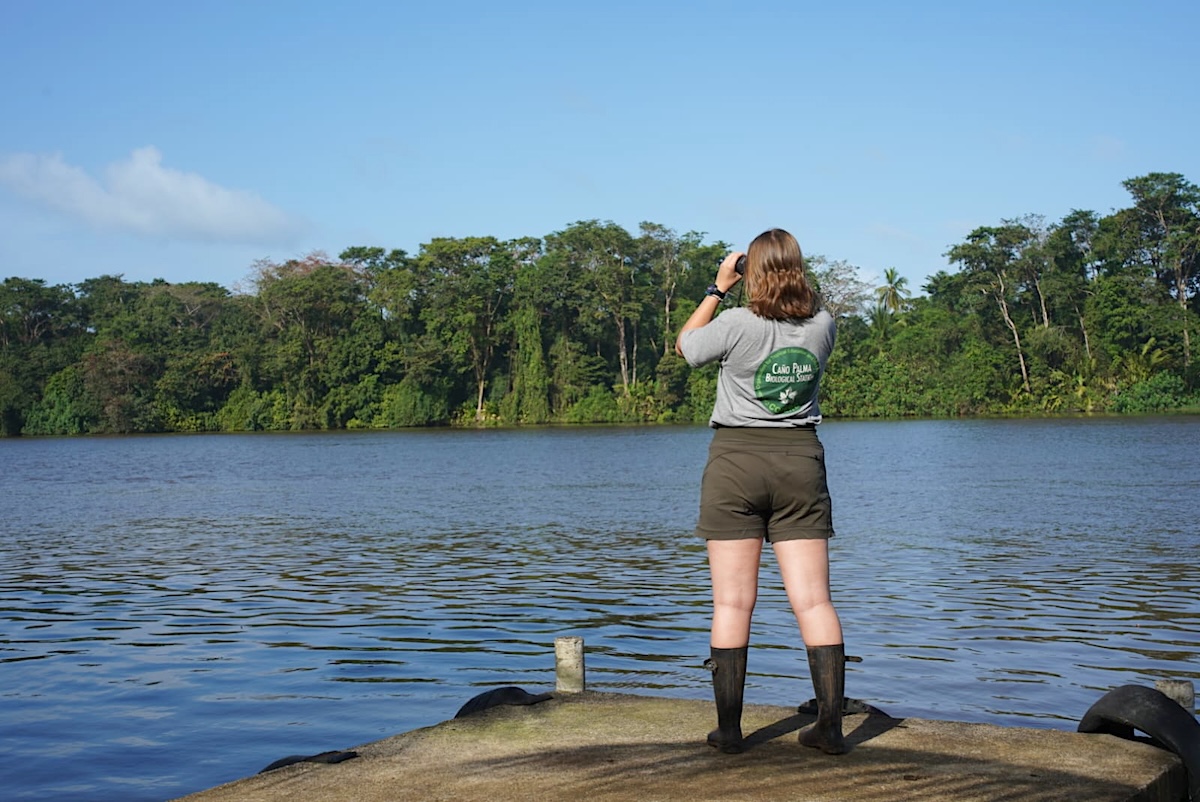
Enter the Caño Palma Biological Station, a small field research station established in the ‘90s to drive biological research and give budding scientists real experience. In 2017, Caño Palma began a targeted macaw survey program, doing point counts at lookouts throughout the Tortuguero Conservation Area every week for four and a half years. In their article, Emily Khazan and colleagues describe the trends from over 1,000 surveys of Great Green Macaw and Scarlet Macaw populations in Tortuguero.
Great Green Macaw. (Photo by Fernando Burgalin Sequeria ML135445121)
How did you first conceive of this study, and what motivated you to conduct this research?
We conduct a number of long-term monitoring programs and when we were in the field for other surveys, noticed an increase in the number of green macaws in the area. We also started to see a marked increase in the number of months we were observing them. Being aware of their fragile status, we wanted to better understand the importance of Tortuguero National Park to the health of the species.
Tell us about the memorable moment during field research or data analysis.
While we were waiting for our permits to come through, we saw a flock of 56 green macaws feeding in the village of San Francisco (at that time the biggest group we’d seen), and it was mind-blowing. It was frustrating as we hadn’t started surveys yet, but we went back every day to watch them, along with all of the kids from the local primary school, and it really energized us to move forward.
Emily conducting macaw surveys in Costa Rica. (Photo by Sebastian Putz)
Tell us about a challenge you had to overcome.
The greatest challenge is staying motivated during periods when very few macaws are present during surveys. We know that “no data” is still good data, and being surrounded by a wealth of bird diversity helps us to get through the 4-hour shifts.
What are your hopes of what your research will lead to? Will this work impact your own research agenda going forward?
We have broadened our research to look at the phenology of key local food sources (Dipteryx panamensis and Terminalia catappa) to understand the role they play in the macaw movements and to determine if there is sufficient food here during the nesting season to support a breeding population. Understanding the distribution of Dipteryx in particular, will help us to determine if local rumours about nesting are true, by enabling us to focus observations on areas with the greatest potential for suitable nest-site availability. If the area is being used for nesting, we’d be interested in exploring options to shift our focus from just monitoring, to active conservation, potentially teaming with others to explore the option of nest-boxes, to increase the availability of nesting sites. We have participated in national and international macaw counts and hope to continue communicating with interested groups across the Great Green Macaw’s range, to better understand and contribute to the conservation of this population.
Altogether these articles showcase the inspiring regional nature of BirdsCaribbean’s work and network. Across taxa and across borders—even across large bodies of water!—the similarities in our passions, our scientific interests, and our conservation actions shine through. We hope these findings inspire you to explore how you too can better help Caribbean birds. There is still so much we are still learning about our species’ habits, and there is always more to be done to strengthen habitat protections and improve our coexistence with birds. There is also always a need for additional funding, especially for small scale research and conservation efforts. In 2025, BirdsCaribbean is supporting several projects throughout the region, and in fact, the bird banding station in Isla Contoy, Mexico, by Nochebuena and colleagues was funded in part by our David S. Lee Fund for the Conservation of Caribbean Birds. Support the grants program and help fund future avian research and conservation work here.
Nuevas perspectivas ornitológicas desde Cuba y el Caribe: Publicaciones JCO, volumen 38
El colibrí de cuello blanco que fue capturado en una estación de anillamiento de aves migratorias en Isla Contoy, México. (Foto de Jonathon Nochebuena)
Coloridas, vibrantes y carismáticas: las aves son fáciles de amar y fascinantes de estudiar. En medio de las amenazas siempre presentes del cambio climático, la deforestación y las especies invasoras, entre muchas otras, nuestros amigos emplumados son perseverantes, ayudados por investigaciones específicas, acciones de conservación y protección del hábitat.
Desde halcones en Cuba hasta colibríes en México y guacamayos en Costa Rica. este blog destaca algunos de los hallazgos de los artículos publicados recientemente en el Volumen 38 de la JCO, con la primicia detrás de escena de los propios autores. Los tres estudios se realizaron en países hispanohablantes y dos se publicaron en español (¡la JCO es trilingüe!), por lo que este artículo de blog también está disponible en inglés.
Observaciones de un gavilán endémico anidando en Cuba
Cuba es la isla caribeña más grande y biodiversa. A esta biodiversidad se suman casi 30 especies de aves endémicas, incluido el Gavilán Colilargo (Astur gundlachi), muy extendido, pero en peligro de extinción. Para nuestras endémicas caribeñas poco estudiadas, cualquier nueva información sobre su historia natural es una pieza fundamental del rompecabezas para descubrir la mejor manera de proteger y conservar nuestras especies. Un nido encontrado en 2022 dentro del Jardín Botánico Nacional en La Habana rellena parte de ese vacío de conocimiento. Randy Simón Vallejo y sus colegas describen sus hallazgos del nido en una nota de investigación, un registro importante que muestra la adaptabilidad de la especie y su capacidad para reproducirse incluso en hábitats antropogénicos semiurbanos.
Gundlach’s Hawk (Foto de Michael J. Good)
¿Cómo concibió por primera vez este estudio y qué le motivó a llevarlo a cabo?
Lo que nos hizo iniciar este estudio fue conocer sobre una pareja de Gavilán Colilargo que había en el Jardín Botánico Nacional y que ya estábamos realizando una revisión bibliográfica de la especie.
Háblenos de un momento memorable durante la investigación de campo o el análisis de datos.
Hubo un día en el cual llovió que observamos un comportamiento inesperado para nosotros: que el padre extendió las alas sobre los pichones para protegerlos mientras la madre estaba en la percha de defensa.
Háblenos de un reto que haya tenido que superar.
Realmente, este fue un trabajo que disfrutamos mucho. La mayor dificultad estuvo en que la madre era bien agresiva todo el tiempo.
¿A dónde espera que conduzca su investigación? ¿Influirá este trabajo en su propia agenda de investigación en el futuro?
Este trabajo es motor de maestría de un proyecto de investigación de esta ave rapaz en un área protegida y también servirá como base para una tesis de maestría.
La especie es conocido localmente como “Gavilán Colilargo”, un nombre que se explica por sí mismo. Los adultos son de color gris oscuro en la parte superior y blanco a rojizo en la parte inferior, mientras que los jóvenes son marrones en general y tienen rayas en su primer año. Un depredador ágil, se alimenta casi exclusivamente de aves, incluyendo muchas especies locales, de paseriformes, casi paseriformes y aves de corral. Su distribución está muy extendida, pero no es común en toda Cuba, y la pérdida y alteración de su hábitat son los principales factores que contribuyen a su estado de peligro de extinción.
Captura inesperada de colibrí en el oriente de México
En una pequeña isla frente a México, también se están llevando a cabo investigaciones, esta vez utilizando el anillamiento de aves como método de elección. La estación de anillamiento de aves migratorias está ubicada en Isla Contoy, dentro del Parque Nacional Isla Contoy, y opera aplicando el protocolo MoSI para estudiar las poblaciones de aves migratorias e invernantes. Durante su segundo pulso de MoSI en diciembre de 2022, Jonathan Nochebuena Jaramillo y sus colegas capturaron un ejemplar muy inesperado: un Colibrí Capucha Azul (Florisuga mellivora). Esta pequeña joya deslumbrante es nativa de América Central y del Sur, y de Trinidad y Tobago, pero nunca antes se había documentado tan al norte de México.
Estos registros pueden ocurrir por diversas razones: dispersión por aves jóvenes o inexpertas, cambios en el rango natural posiblemente relacionados con el cambio climático, errores de navegación durante la migración o condiciones climáticas extremas que desvían a las aves de su ruta. Sea cual sea la causa, este registro constituye una aportación emocionante e importante a nuestro conocimiento de la especie y resalta la importancia de los esfuerzos de monitoreo en sitios poco estudiados como Isla Contoy.
White-necked Jacobin. (Foto de Rio Dante ML222384231)
¿Cómo concibió por primera vez este estudio y qué le motivó a llevarlo a cabo?
La estación de anillamiento en Parque Nacional Isla Contoy fue una iniciativa personal que surgió de la necesidad de ayudar a las aves que cruzan por el Caribe mexicano. Yo cuando visité por primera vez Isla Contoy me di cuenta de la gran cantidad de aves que cruza por el Caribe, así que dije: “Aquí debe existir una estación dedicada a la conservación y protección de las aves migratorias”.
Cuéntenos sobre el momento memorable en el que capturó al raro colibrí.
Todo giro alrededor de las 9:30 am cuando los turistas llegan a la isla y, por tanto, debíamos cerrar las redes. Estábamos trabajando normal en la estación de anillamiento cuando de repente escuchamos una lancha y dijimos: “Son turistas, ¡corraaan!”
Así que empezamos a cerrar las redes, cuando de pronto alguien gritó: “¡Cayó un ave!”, y todos corrimos. Al observarlo dijimos: “¡Esto no es normal, es un colibrí muy grande, guárdenlo!” Al sacarlo de la bolsa exclamamos: “¡Wow, está hermoso!”
¿A dónde espera que conduzca su investigación? ¿Influirá este trabajo en su propia agenda de investigación en el futuro?
Isla Contoy esconde muchos enigmas, ya que es una zona de amortiguamiento para muchas especies, no solo aves. Estamos seguros de que aún quedan muchas especies de aves que no han sido registradas y que usan la isla en algún momento de su vida. También estamos seguros de que esta información ayudará mucho en los programas de conservación de la isla y en la elaboración de buenos planes de manejo en el futuro.
Agradecemos a BirdsCaribbean por abrirnos la oportunidad de poderles compartir esta gran experiencia. Sinceramente, jamás creímos conocer a esta especie personalmente, a menos que viajáramos al sur de América, y miren en dónde la encontramos.
Recuperación de dos guacamayas en el noreste de Costa Rica
Ara ambiguus ambiguus (gran guacamaya verde) y Ara macao cyanopterus (guacamaya escarlata) son dos hermosas especies de psitácidos nativas de Costa Rica, cuyas poblaciones están amenazadas por la pérdida de hábitat en toda América Central. De hecho, antes de 2014, se consideraban rara y extirpada, respectivamente, en la zona de Tortuguero, en la costa caribeña de Costa Rica. A pesar de las medidas de protección del hábitat en Costa Rica y Nicaragua, el estado de las dos especies de guacamayas aún no estaba claro, especialmente porque se sabe que sus poblaciones son altamente móviles y estacionales según la disponibilidad de alimentos.
Scarlet Macaw in flight. (Photo by Jeff Haperman ML518746041)
A Scarlet Macaw feeding on a beach almond. (Photo by Blair Dudeck ML131074401)
Ingresé a la Estación Biológica Caño Palma, una pequeña estación de investigación de campo establecida en los años noventa, para impulsar la investigación biológica y brindar a los científicos en ciernes una experiencia real. En 2017, Caño Palma comenzó un programa específico para el estudio de guacamayas específicas, realizando conteos semanales de puntos en miradores en toda el Área de Conservación Tortuguero durante 4.5 años. En su artículo, Emily Khazan y colaboradores describen las tendencias de más de 1 000 monitoreos de las poblaciones de guacamayas verde y escarlata en Tortuguero.
Great Green Macaw. (Foto de Fernando Burgalin Sequeria ML135445121)
¿Cómo concibió por primera vez este estudio y qué le motivó a llevarlo a cabo?
Llevábamos a cabo una serie de programas de monitoreo a largo plazo y, cuando estábamos en el campo para otros monitoreos, notamos un aumento en el número de guacamayas verdes en el área. También empezamos a ver un marcado aumento en el número de meses en que los observábamos. Conscientes de su frágil estado, quisimos comprender mejor la importancia del Parque Nacional Tortuguero para la salud de la especie.
Háblenos de un momento memorable durante la investigación de campo o el análisis de datos.
Mientras esperábamos que nos dieran los permisos, vimos una bandada de 56 guacamayas verdes alimentándose en el pueblo de San Francisco (el grupo más grande que habíamos avistado hasta entonces), y fue alucinante. Aunque fue frustrante porque aún no habíamos comenzado los monitoreos, regresábamos todos los días para observarlos junto con los niños de la escuela primaria local, lo que realmente nos llenó de energía para seguir adelante.
Emily realizando estudios sobre guacamayos en Costa Rica. (Foto de Sebastian Putz)
Háblenos de un reto que haya tenido que superar.
El mayor desafío fue mantenernos motivados durante los períodos en que hay muy pocos guacamayos presentes durante los monitoreos. Sin embargo, sabemos que la ausencia de datos también aporta información, y estar rodeados de una gran diversidad de aves nos ayudó a superar los turnos de 4 horas.
¿A dónde espera que conduzca su investigación? ¿Influirá este trabajo en su propia agenda de investigación en el futuro?
Hemos ampliado nuestra investigación para analizar la fenología de las principales fuentes de alimento locales (Dipteryx panamensis y Terminalia catappa), con el fin de entender el papel que desempeñan en los movimientos de los guacamayos y determinar si existe alimento suficiente durante la temporada de anidación para mantener una población reproductora. En particular, comprender la distribución de Dipteryx nos ayudará a determinar si los rumores locales sobre la anidación son ciertos, al permitirnos centrar las observaciones en las áreas con el mayor potencial para la disponibilidad de sitios de anidación adecuados. Si confirmamos que el área está siendo utilizada para la anidación, nos interesaría explorar opciones para cambiar nuestro enfoque de sólo monitoreo a la conservación activa, potencialmente asociándonos con otros investigadores para instalar cajas nido y así aumentar la disponibilidad de sitios de anidación. Hemos participado en conteos nacionales e internacionales de guacamayas y esperamos continuar comunicándonos con grupos interesados en todo el rango de Ara ambiguus para comprenderla mejor y contribuir a su conservación.
En conjunto, estos artículos muestran el carácter inspirador y regional del trabajo y la red de BirdsCaribbean. Entre taxones y fronteras— ¡incluso a través de grandes masas de agua! — las similitudes en nuestras pasiones, nuestros intereses científicos y nuestras acciones de conservación brillan con luz propia. Esperamos que estos hallazgos le inspiren a explorar cómo usted también puede ayudar mejor a las aves del Caribe. Todavía nos queda mucho por aprender sobre los hábitos de nuestras especies, y siempre hay más por hacer para fortalecer la protección de los hábitats y mejorar nuestra coexistencia con las aves.
También siempre se necesitan fondos adicionales, especialmente para la investigación y los esfuerzos de conservación a pequeña escala. En 2025, BirdsCaribbean apoya varios proyectos en toda la región y, de hecho, la estación de anillamiento de aves en Isla Contoy, México, de Nochebuena y sus colegas, fue financiada en parte por nuestro Fondo David S. Lee para la Conservación de las Aves del Caribe. Apoye el programa de subvenciones y ayude a financiar futuras investigaciones y trabajos de conservación de aves aquí.
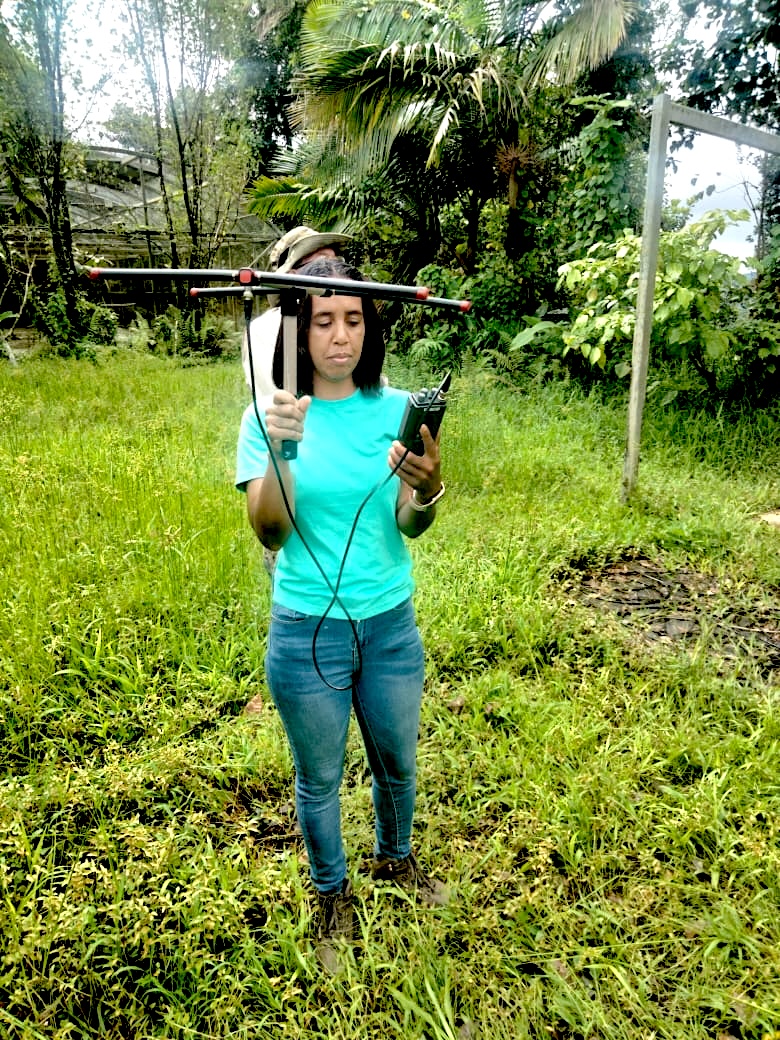
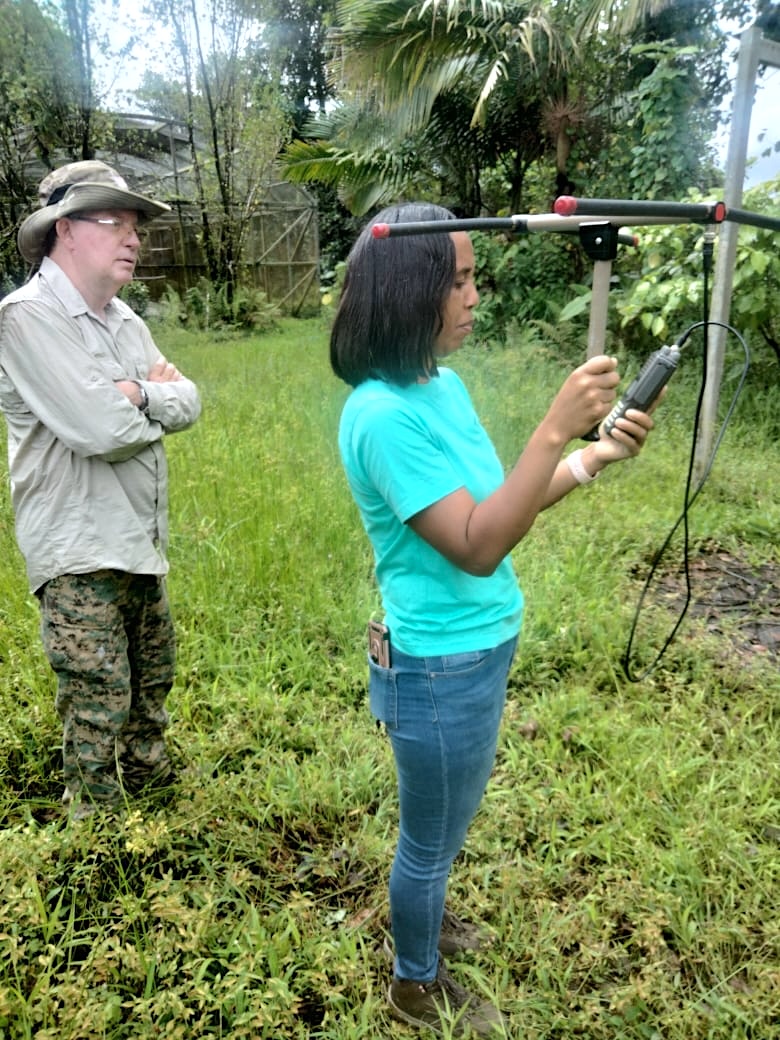
Ansaki uses a handheld antenna to track parrots fitted with radio transmitters.
It has been four years since La Soufrière Volcano roared to life on the island of St. Vincent, after being dormant for decades. Explosions and heavy ash falls blanketed wildlife habitats, further threatening endemic species like the Vulnerable St. Vincent Amazon (Amazona guildingii) and Endangered Whistling Warbler (Catharopeza bishopi). Since this disaster, BirdsCaribbean and partners have been working with the St. Vincent Forestry Department to strengthen conservation capacity through monitoring and research on forest birds and their habitats, as well as outreach and education.
In May 2025, a vital training opportunity arose.
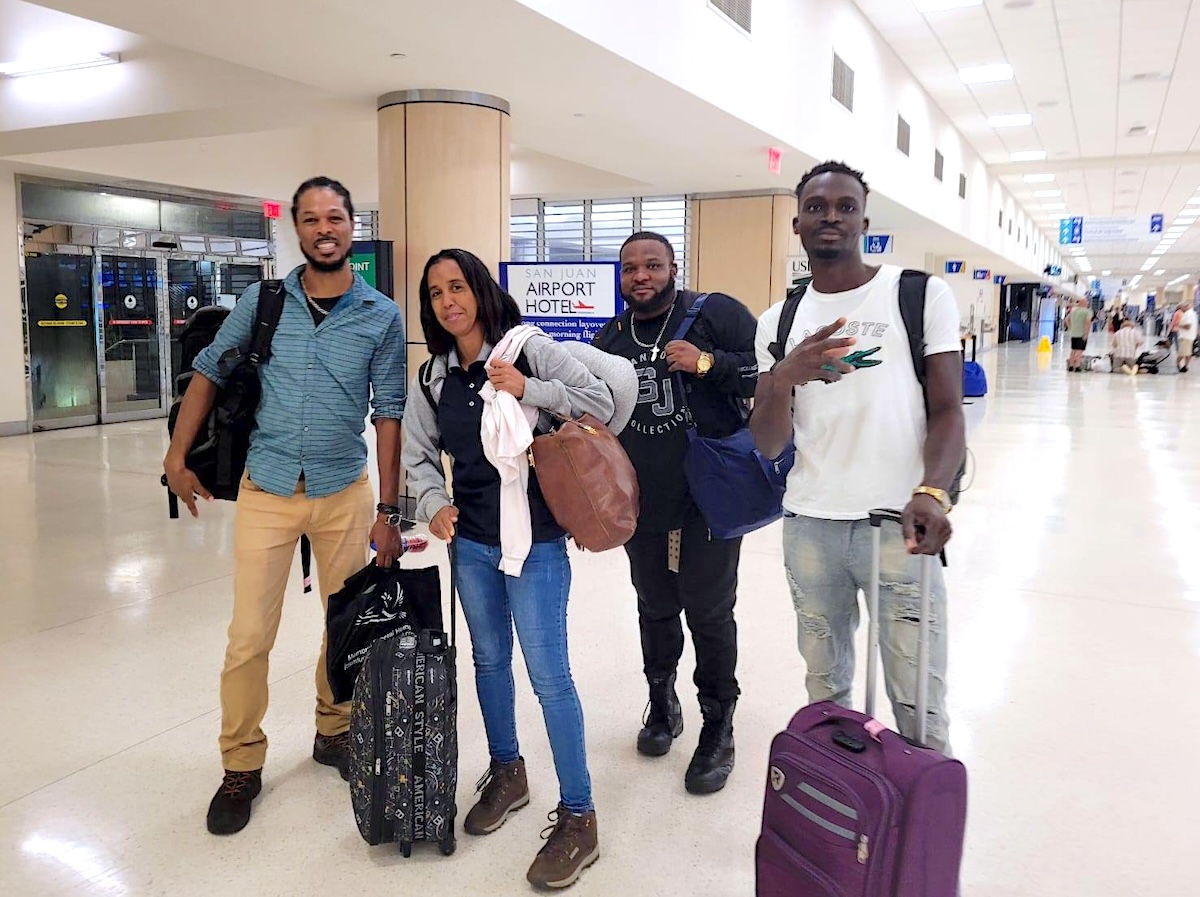
Five forestry officers traveled to Rio Grande, Puerto Rico. There they received technical training in the conservation and management of native Caribbean parrots. This exchange was with the U.S. Fish and Wildlife Service’s Puerto Rican Parrot Recovery Program and, supported by a grant from the United Nations Development Program (UNDP). Over five days spent at the captive rearing and release facility in El Yunque National Forest, the trainees learned how to operate captive breeding facilities, techniques involving the care, monitoring and release of captive and wild parrots, banding and attaching radio transmitters and, critical “parrot first-aid.”
The foresters intend to put to use the valuable lessons learned in current and future efforts to protect the St. Vincent Amazon, their National Bird. Please enjoy this lively account in the words of Leon Matthews (Forestry Officer 3), Ansaki Roberts (Technical Aide) and Felicia Baptiste (Forestry Officer 1), which they describe as “wonderful, nerve-racking, and informative.” They were accompanied by Technical Aides Quasim Roban and Fabian Young, who also added their comments. Enthusiasm was high!
Puerto Rican Amazon. (Photo by Dubi-Shapiro ML490544571)
St. Vincent Amazon. (Photo by Faraaz Abdool ML572563461)
Our Fun and Interesting Experiences on the Island of Enchantment
St Vincent and the Grenadines is home to the St. Vincent Amazon. Our National Bird’s habitat is the interior of the lush mountainous forest in the Jennings-Congo Valley, South Rivers, Vermont, Hermitage and Richmond. Apart from natural disasters like catastrophic hurricanes and volcanic eruptions, this endemic bird’s long-term survival has faced serious threats, including illegal trafficking and conflicts with farmers.
Coming to Puerto Rico
Ansaki: Anyone can dream all they want to visit America—however Caribbean nationals can’t enter without a nonimmigrant visa. A team of five were selected to take part in a training in Puerto Rico, but guess what? None of us had a visa! So on 9th April we traveled, with high hopes, to the U.S. Embassy in Barbados for an interview on the 10th. Thankfully we were all granted visas which meant we could continue with our plans to travel to Puerto Rico.
Leon: The Embassy was a bit intimidating with all the security, but our mission was complete.
Felicia: Our travel date was soon after—27th April. We packed our carry-ons and headed to Argyle International Airport, eager to get to the aviary at the El Yunque National Forest. The boys decided to walk around the airport to kill time and look for food. Ansaki, being the smart one, brought her own food. We sat there and waited for our turn to board the plane, and oh! Were we in for a long wait…
Ansaki: I got to the airport around 10 a.m., and was awaiting the arrival of my other colleagues—just to hear the flight was delayed. We finally boarded our flight at 4:15 p.m. instead of 1:15 p.m. During the flight delay, we appreciated the constant support of the excellent team via Whats App. “Welcome to the world of international air travel!” joked U.S. Fish and Wildlife Service (USFWS) Wildlife Biologist Dr. Thomas White (Tom), our host and Head of the Puerto Rican Parrot Recovery Program in Rio Grande, Puerto Rico.
Finally, we’re in Puerto Rico!
Felicia: We were finally on our way. Now you would think, “We are just going to one of our Caribbean islands, it shouldn’t take too long.” But we were wrong. The two flights took a total of nine hours! The first leg of the journey to JFK International Airport in New York City was five hours, and the second leg to San Juan was another four hours. By the time we arrived in New York, we were officially tired and hungry (time didn’t allow us to grab food at JFK)—and we weren’t even at our destination yet!
Navigating new shores
Ansaki: We arrived in Puerto Rico on 28th April at 3:02 a.m., and were kindly escorted by BirdsCaribbean Operations Officer, Alexia Morales, and her partner, Mario, (our saviours) safely to our Airbnb in Rio Grande. We quickly settled in and rested for a while.
Leon: As the senior officer, I had to take on the driving responsibility. It was an experience! Driving a left-hand drive vehicle for the first time, paired with the task of driving on the right side of the road was scary as I had to adapt immediately. Nerves got the better of me—but I had to do it for the team. I was so happy to get to the Airbnb. My fingers cramped from holding onto the steering wheel so tight like my life depended on it—and yes, it did!
Ansaki: Our team met up with Tom and his beautiful wife Arelis at “El Patio de Lola” for dinner later that evening. Then we headed to the supermarket to buy groceries, because we hadn’t had a good home-cooked meal since the day before. With its size and huge variety, Famcoop Supermarket became our favorite choice for shopping almost every evening.
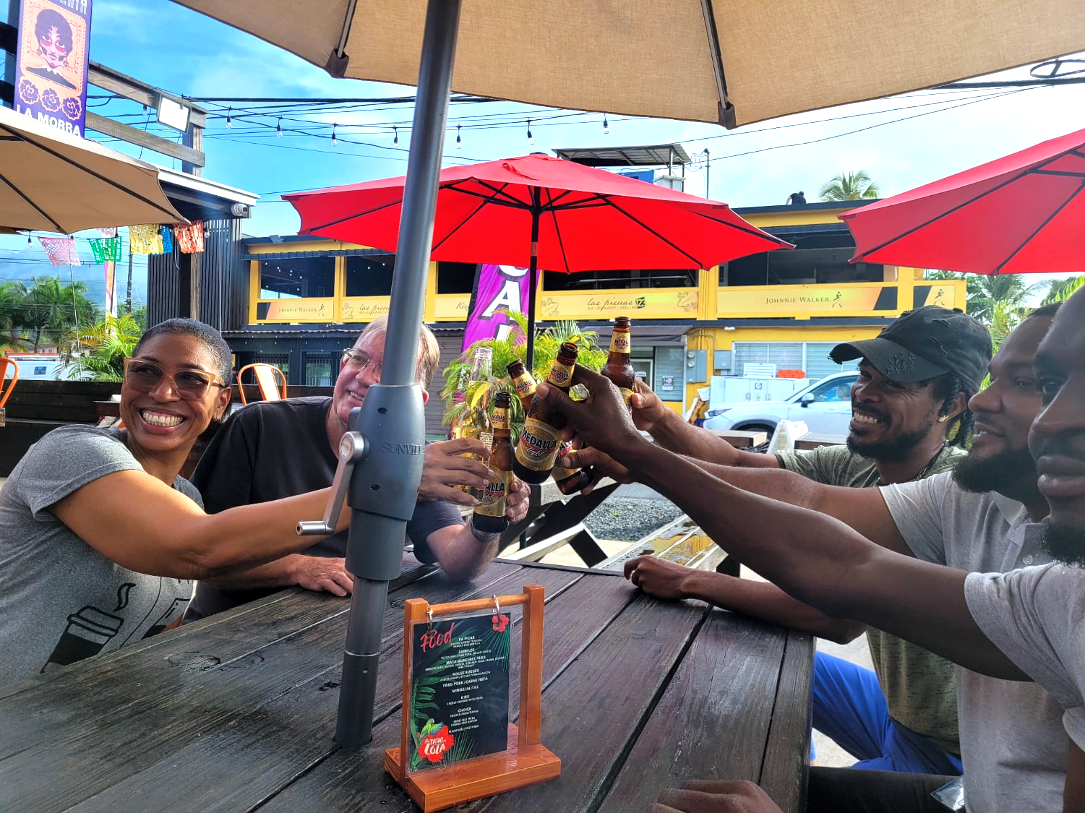
Cheers to an exciting week ahead! The team with Tom and Arelis at El Patio de Lola.
Felicia:Tom and Arelis were our guides to the supermarket. They led us to the parking lot and then waved “goodbye.” We were happy we found food to cook to our hearts’ content. We shopped, comparing prices back home (it’s a bit cheaper in PR), wandered around the supermarket, and proceeded to the parking lot. It was then we realized we had a small problem—we didn’t really know our way back to the Airbnb! Leon said, “We’ll figure it out—we will count the traffic lights.”
And so we started back home, counting traffic lights, until at the first traffic Ansaki shouted, “Turn left!”
The others insisted, “ No, keep straight, we’re not there yet.”
Fortunately Quasim remembered and guided, “Look out for the big restaurant sign at the next traffic light.”
Leon said, “Ansaki, stop talking, you’re giving wrong directions!”
In spite of everything we got back to the Airbnb safely, with the confidence that we could find our way to and from the supermarket when needed.
A home cooked meal in a foreign country.
The team shopping in their favorite PR supermarket.
Inside the aviary
Ansaki: The next day we packed our lunch and headed out with our ‘trusty’ driver Leon, who drove us to the USFWS compound in El Yunque. The drive took us through the forest. The main highway in St. Vincent is located along the coast of the island, so having a drivable road through a forest was interesting.
Leon: It was time for me to shine again and the nerves kicked in. I had to drive in a strange country, through three-lane highway traffic, heading to somewhere I didn’t know, and all I could think about was Tom’s statement, “It’s so easy to find, even a blind man from St. Vincent can find it.” He was correct! It took us just over 30 minutes to get to the USFWS compound.
Ansaki: We arrived at the El Yunque Parrot Recovery Aviary, where we were greeted and introduced to the Aviary staff. We received a brief history of the Puerto Rico Parrot Recovery Program from Tom. I accompanied Iris to take the baby chick to the foster parent cage. After, Felicia and I assisted Arelis with feeding the parrots. We also looked at live videos of parrot nests. In the evening, we visited the El Yunque National Forest Visitor Center and learned about forest management practices and their application to parrot conservation.
The team received a warm welcome from the USFWS Forestry Officer Laura at El Yunque National Forest Visitor Center. (Photo by Tom White)
3D model of El Yunque National Forest.
Dr Tom White inside the parrot aviary.
USFWS Forestry Officer Laura takes the team on a tour of the nursery.
Testing of egg to know when it is fertile
Ansaki:During our time in the incubator room Iris showed us how to check for fertile eggs. “Lights out,” said Iris. In the darkened room she turned on a flashlight and gently placed it under the large end of an egg taken from the incubator; we were able to see the live embryo within the egg shell. Eggs that are not fertile look glossy. An incubator is used to help with the hatching process, especially for parrots that are inexperienced. I didn’t know it was that easy to confirm when an egg is fertile.
Felicia: On day two we learned how to prepare food for the parrots. The bowls, knives, and cutting board were washed in warm water and sterilized. Fruits and vegetables were cut into small pieces, mixed with bird feed, nuts, calcium, and vitamins (given to parrots with chicks).
Leon and Felicia cut up veggies and fruits for the Puerto Rican and Hispaniolan Amazons. (Photo by Ansaki Roberts)
Meal prep for the parrots was truly a team effort!
Another exciting task lay ahead of us that day:
Practicing how to attach radio transmitters on the parrot
With assistance from Iris, Tom demonstrated how to attach the first radio transmitter on the parrot. He then guided each member of the team on how to do it. Firstly a parrot was selected to practice on with a dummy transmitter. Two people worked together as a team, with one holding the parrot in the correct way, while the other prepared to place a dummy radio transmitter on the parrot.
Many Amazona species favor dense tropical forest canopies. Radio telemetry allows researchers to obtain location and movement data of these birds that would otherwise be extremely difficult to obtain. This technique helps researchers track parrot movement and behaviour throughout the habitat over time which is valuable for the species management and conservation.
Ansaki cuts off the excess wire after she and Leon attached the radio transmitter to a Puerto Rican Parrot.
Iris helps Fabian attach a radio transmitter to a Puerto Rican Parrot.
Quasim and Felicia practice attaching a radio transmitter to a Puerto Rican Parrot.
The dummy transmitter is placed around the neck of the parrot, then secured, and tightening off is completed using an instrument to clamp both ends together. One finger space is left between the parrot neck and the radio transmitter, before cutting off the excess wire of the radio transmitter.
On day three, we practiced using telemetry equipment to locate the parrots in the wild that have been equipped with radio transmitters. We hiked along a narrow trail to identify wild parrot nests.
Ansaki learns how to use the handheld antenna to locate parrots in the forest, as Tom looks on.
Afterwards, we headed to the “parrot hospital” where Dr. Tony, the veterinarian, imparted a wealth of knowledge on how to care for sick parrots before the vet can arrive. The consistency of the meal prepared and the instrument used to feed the sick parrot was an eye-opener for me.
Felicia was intrigued with every aspect of the experience in the hospital.
Felicia: On day three, we met Dr. Tony again, who took us through various tools and procedures in caring for sick birds. One of the first procedures was inserting a nasogastric (NG) tube to feed a sick bird. Dr. Tony showed us how to properly position the tube and the parrot for tube placement. This part of the demonstration had to be handled with care as the membrane in the parrot’s throat can easily tear or be damaged. When placing the tube, Tony showed us how to feel and separate the trachea from the esophagus so as to not accidentally push the tube into the parrot’s lungs. Each person was given a chance to practice the placement.
The second procedure took place in the nursery’s hospital. Dr. Tony anesthetized a parrot and demonstrated how to locate and stop bleeding from a blood feather. He explained that feathers, like human hair and nails, are keratinized, and have no blood supply or nerve endings once fully developed.However, growing feathers—called pin feathers—contain a blood supply that nourishes their development. If a pin feather is broken prematurely, it becomes a “blood feather” and can bleed heavily. If not treated quickly, this bleeding can be fatal. This demonstration emphasized just how critical proper handling and monitoring are for the health and safety of the birds.
Dr. Tony also reminded us that as foresters we are the first responders for the parrots. According to Doc, “If you call the vet and he takes more than 30 minutes to get there and your bird is still alive when re arrives, it was never an emergency.” The demonstrations were done on the Hispaniolan Amazon.
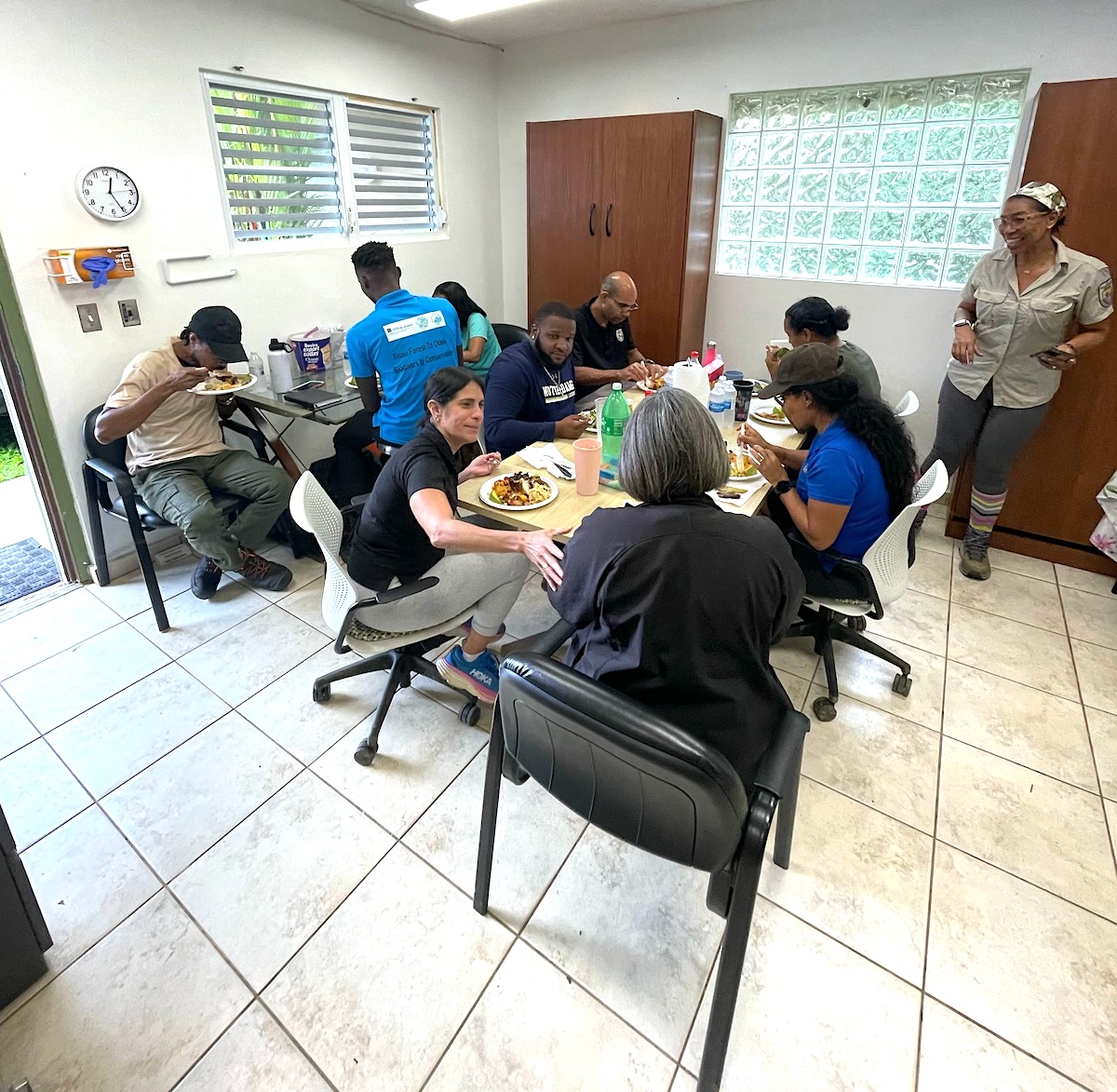
Leon: My main interest was the veterinary component of the workshop, mainly because we lack an avian/wildlife specialist on our island. The training was well received by the team and concluded with some nicely cooked and delicious lunches prepared by the members of the U.S. Fish and Wildlife Service. The cheesecake was savored in my mouth so much that I had to take some back home. Also, we got to sample a few of the locally made beers.
Lunch is served! (Photo by Felicia Baptiste)
Ansaki: On our final day at the pristine Puerto Rico Parrot Recovery Aviary, we visited a wild parrot nest that had baby chicks. The very skilled climber, Sebastian, put on his climbing gear to retrieve the baby parrots from their nest in a tall tree. During the climb Sebastian removed the old messy nesting material and replaced it with fresh ones, to keep the parrots with baby chicks cozy and prevent the spread of bacteria. We learned how to band parrot chicks. I was given the privilege of holding a parrot chick. We ended our training with a big family lunch where Tom prepared his specialty of Tennessee hickory smoked chicken.
Arelis shows the team how to carefully and correctly band parrot chicks. (Photo by Felicia Baptiste)
Arelis shows Quasim how to attach a bird band to a parrot chick.
Banded Puerto Rican Parrot chicks. (Photo by Felicia Baptiste)
Note: Parrot chick banding was performed by trained and certified banders only. No SVG Forestry Staff participated in the actual banding; their involvement was for demonstration purposes.
Final comments from all participants:
Ansaki: My training experience at the Puerto Rico Parrot Recovery Program Aviary was fun and enriching. This is what stood out for me: testing to know when an egg is fertile, monitoring the parrot on live camera, caring for a sick parrot before the vet arrives—and the success story of how the forest bounced back after devastating Hurricanes Irma and Maria in 2017. And, most of all—the truly remarkable parrot recovery program. It rained every day, but nevertheless I looked forward to gaining new knowledge each day. We certainly look forward to more collaboration in the future.
I can attest that the training was well received by each participant. We will continue our public outreach and education program by raising awareness island-wide among our schools and communities, teaching about the importance of our National Bird, the St Vincent Parrot, and its habitat. SVG Forestry Services could benefit from this experience, developing and enhancing our own captive breeding program, increasing the captive population with the aid of an incubator, and also monitoring nesting boxes via live camera. We will develop an action plan on how to manage and monitor the wild population with the use of radio transmitters; collaborate, and build partnerships with other international organizations; and seek training for an avian vet to care for our St Vincent Parrot.
Felicia: Having the opportunity to learn new things every day is always a wonderful experience. This trip allowed us to see what can happen when a wild population is decimated. Only because of the foresight and hard work of individuals was the survival of the species ensured.
We live on a tropical island where natural disasters are a norm. There exists a possibility that we could lose our wild population at any time. With a program like this, we can be ready if a catastrophe occurs in St Vincent, resulting in the loss of our Amazona guildingii.
My take-away points are as follows:
We have seen a better and more durable way to build our nesting boxes.
We learned what we can use to prevent our nesting materials from developing mold or fungus.
We learned how to set up food in flight cages.
We learned about administering first aid to ill birds.
We also learned how to tag and monitor released birds
The St. Vincent Forestry Services can adapt and tailor a program like this to fit our Amazona.
Quasim: It was the first time that I was exposed to tagging and feeding parrots/birds. This was very interesting, especially experiencing the strength of the birds. They may be on the smaller side but they are very strong. The telemetry device is great for keeping track of the birds, enabling you to know their movements. The man-made nests are very practical, with a great workable design. The vet section was quite satisfying—and we sure know how to save the life of a bird. The simplicity of the method used for testing eggs was surprising. It was a great experience and I’ve learned a lot. We had quite an experience and had lots of fun. Thanks to everyone who made the training possible. Special thanks to Tom and his crew. We highly appreciate everything.
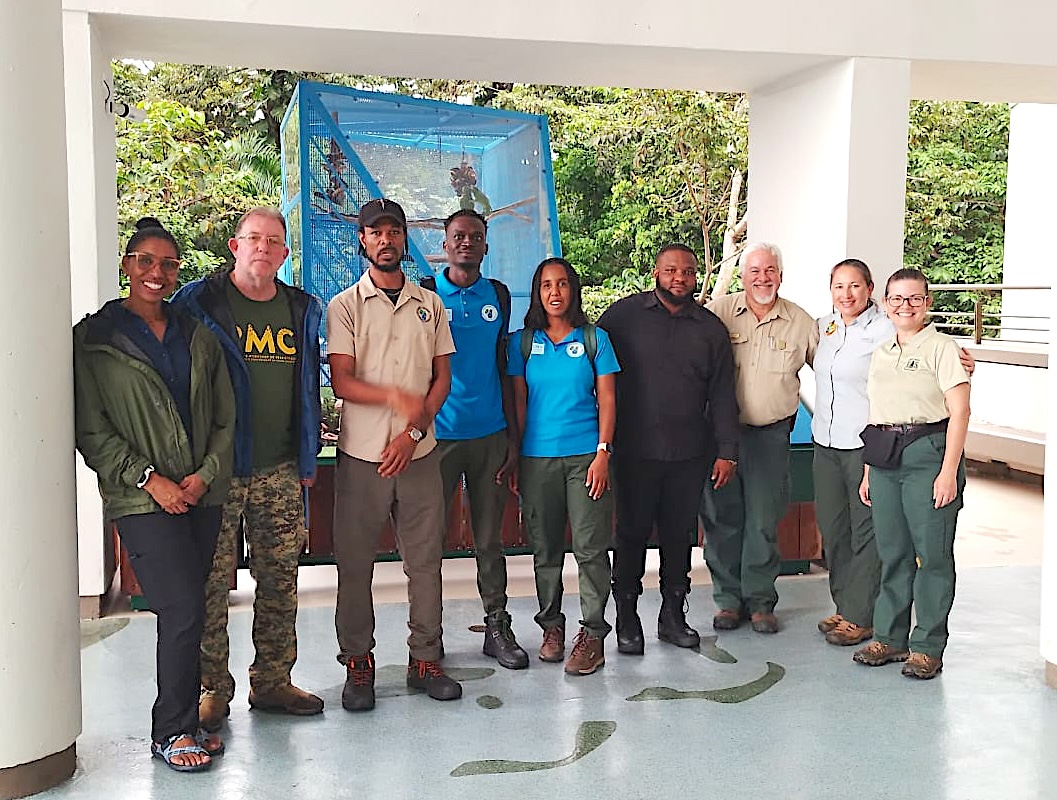
The faces behind a successful exchange! This program was a testament to collaboration, cultural understanding, and professional growth. (Photo by Felicia Baptiste)
Leon: The friendly and welcoming aura by everyone at the complex made our time comfortable. We blended as a loving family immediately after. We learned the success story of what had transpired some years ago with the Amazona of Puerto Rico up until now, and how everyone contributed to ensuring the existence of a continuously growing population.
Fabian: Our trip to the Luquillo Aviary in El Yunque National Forest was an incredible experience! The staff were absolutely fantastic, providing us with hands-on learning about everything from food preparation for the birds to the ingenious construction of their wild nest boxes. We even learned valuable first aid techniques for assisting sick birds.
The bird hospital was absolutely breath-taking! I was truly amazed to see such advanced equipment available to help these precious birds. But what made it even more special, I made a new friend there. A parrot was recovering from a broken leg, and I was so happy to be able to help him by holding him while Iris cleaned his cage.
After we left the hospital area, I thought it couldn’t get any better! Then, BAM! We were just about to enter the Incubator Lab, and I was completely blown away. I was thinking to myself, ‘This place is truly awesome!’ And to top it off, my colleagues and I were fascinated by the flashlight method used to check the eggs for fertility. Although my team and I at Nicholls Wildlife Complex are familiar with that practice, it was incredibly beneficial for my colleagues to experience it first-hand, especially since they spend so much time out in the wilderness.
I’ll never forget my first time attaching the dummy transmitter to the birds; that was simply unforgettable!.
You know it’s an excellent learning adventure, when even the bird expert gets a taste of the action! I got pecked and for a person who deals with birds on a daily basis—I was the one who got the surprise nibble! The laughter was non-stop, but honestly, it really showed just how much we enjoyed that trip to Puerto Rico. Talk about an endorsement!
It was a truly informative and rewarding trip—highly recommended!
A heartfelt thank you to all who made this trip possible and a success: St Vincent and the Grenadines Forestry Services, BirdsCaribbean, U.S Fish and Wildlife, and UNDP.
Think you know everything about birds? What if we told you that every year, there are birds (some small enough to fit in the palm of your hand!) that fly thousands of miles, just to reach our sunny Caribbean beaches? Sounds like a fantastic feat of endurance right? But what if we also told you that those same long-distance athletes, with their amazing survival skills, are actually in big trouble? Get ready to dive into the strange and surprising world of shorebirds—where there’s more to these sandy-toed travelers than meets the eye!
Despite their name, shorebirds are more than just beach bums! They’re a diverse group of over 220 species of birds—adorable sandpipers, stunning avocets, and dazzling oystercatchers are all shorebirds! These amazing birds live everywhere—from the beach, to mangroves, and even on farmland. Shorebirds come in a collection of shapes and sizes, sporting an array of different beaks and legs, each specially designed to capture their favorite prey like crabs, worms, and bugs.
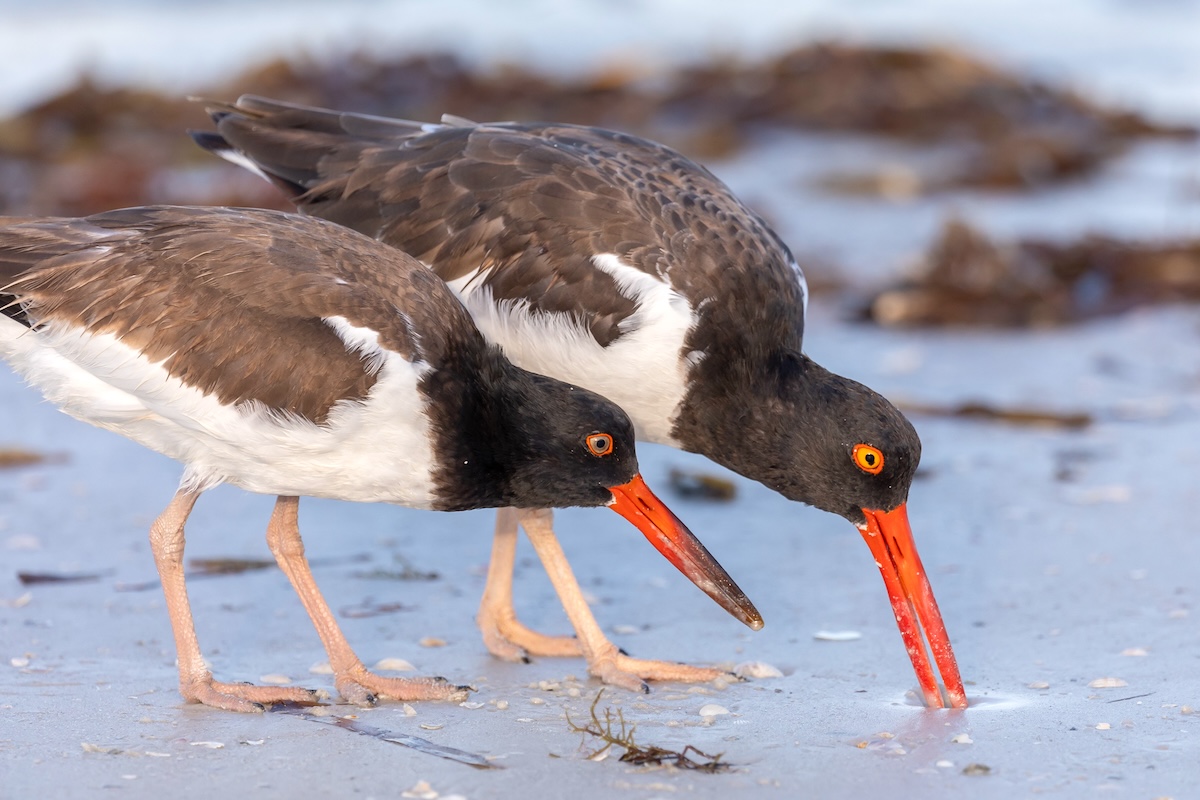
A vibrant splash of color on the shore: American Oystercatchers, with their unmistakable red-orange beaks, foraging for their next meal. (Photo by Matthew Paulson)
What’s even more intriguing? Many shorebirds make epic long-distance migrations, flying thousands of miles—sometimes through severe weather and cities—between their Arctic breeding grounds and South American wintering areas, every year! Heads up though: shorebirds and their habitats are under threat from habitat loss, hunting, pollution, and climate change, making it tough for them to find safe places where they can rest and refuel.
The good news: people just like you (more about this at the end of the blog) are working hard to protect shorebirds and their habitats! And learning about shorebirds is a great first step to helping them thrive.
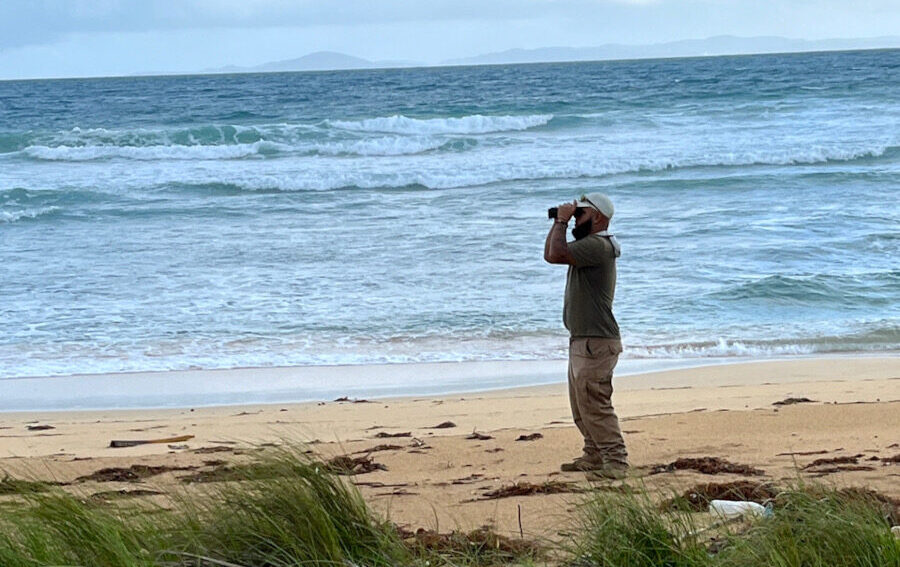
Looking for shorebirds, Campaña, Vieques (Photo by Daphne Gemmill)
We know school’s out and you need to have some fun—so let’s get to know these incredible birds via a brain-teaser: below are six statements about shorebirds—five are true (for at least one shorebird species), but one is a total lie! Be warned though—shorebirds do some pretty unexpected things—so statements that seem unlikely may actually be true!
Can you spot the imposter?!
Thankfully our gracious Waterbird Manager has decided to make it an “open book” quiz, so you can share this blog with friends to help you choose your answer before checking if you got it right.
Shorebirds ‘cough up’ pellets, just like owls.
Shorebirds nest in trees.
Shorebirds are important pollinators.
Shorebirds use their bills to find prey without actually touching it.
Shorebirds are found on every continent except Antarctica.
Shorebirds live on the open seas.
Got your final answer? There are no take-backsies beyond this point…Alright,scroll down to find out if you were right and to discover what’s fact—and what’s a sneaky lie!
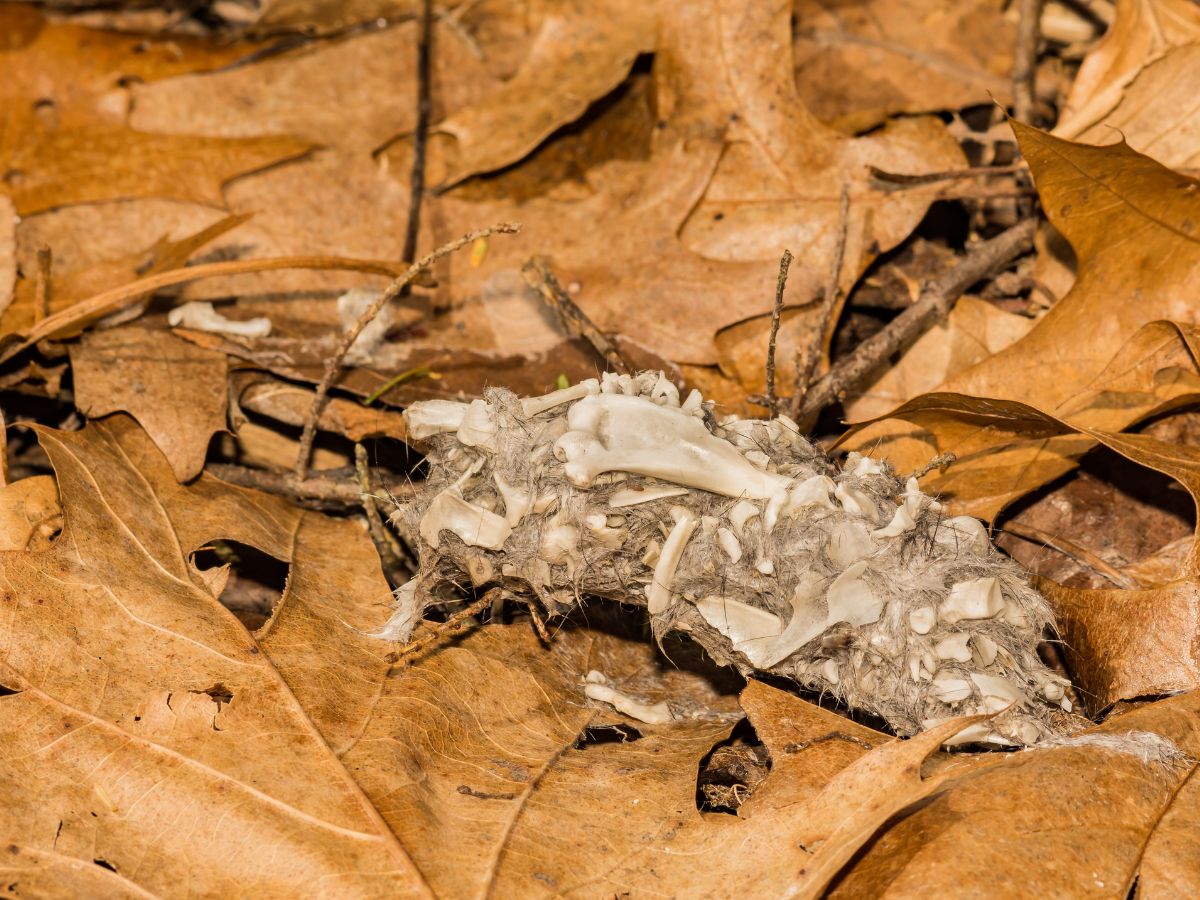
Bone and fur in the pellet of a Barred Owl. (Photo by Jason Ondreicka)
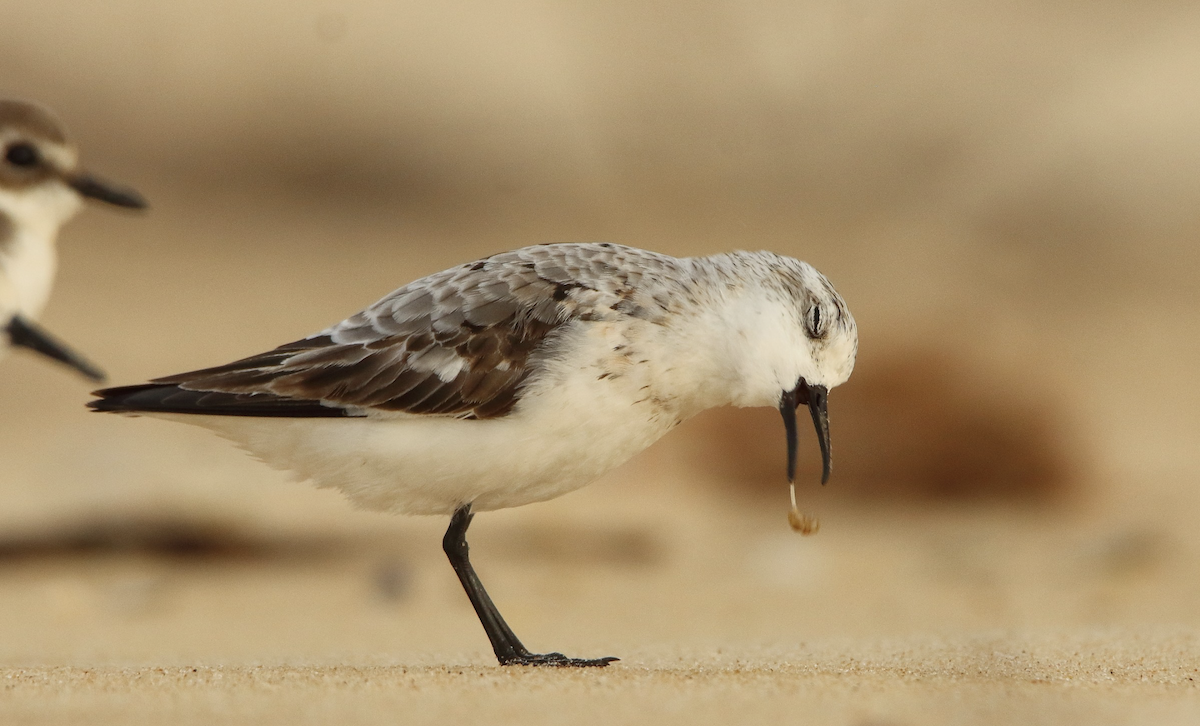
Shorebirds ‘cough up’ pellets, just like owls…. TRUE! Yes, that’s right—some shorebirds really do produce pellets. This behavior known as ‘pellet casting’ is actually done by lots of ‘non-raptor’ birds. When shorebirds eat prey, such as insects, crustaceans, and small fish, they compress the parts they cannot digest, like bones and shells, in their gizzard into a pellet. That pellet then travels back up the digestive tract and is expelled through the beak!
A Sanderling regurgitates a pellet. (Photo by Tejas K. Rao ML369149071)
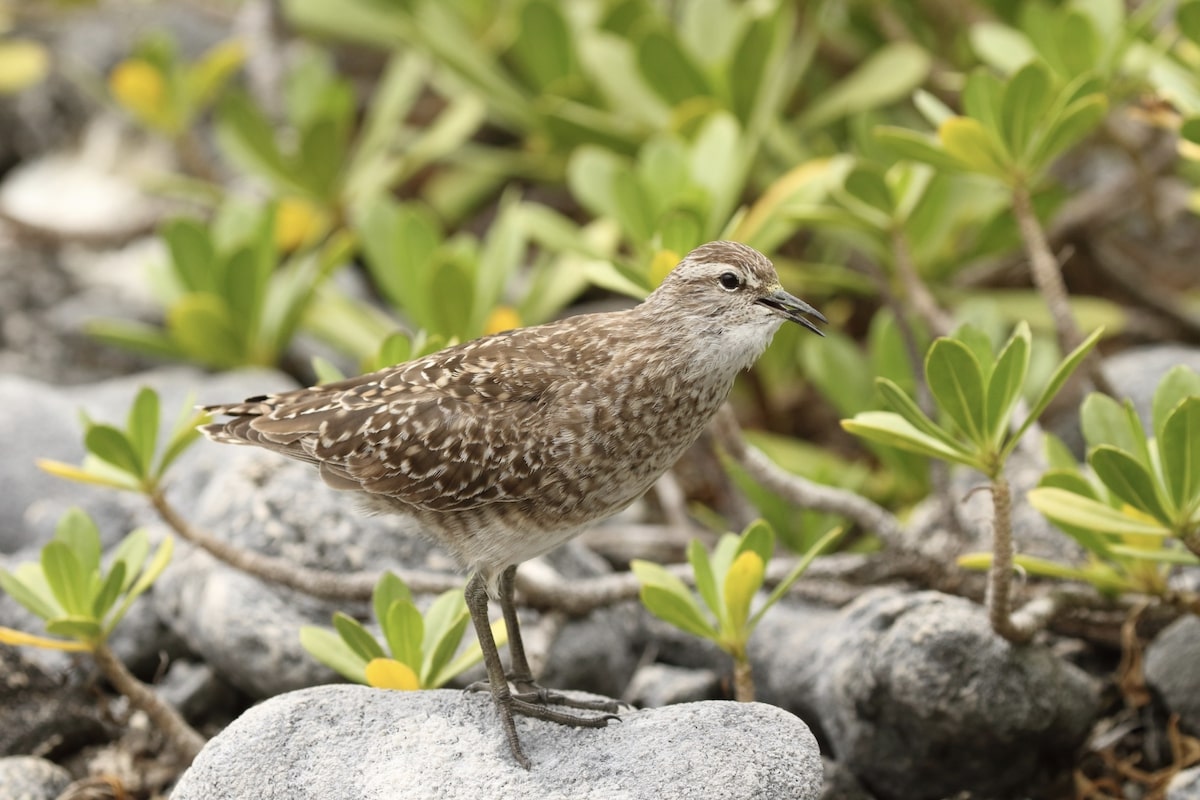
Shorebirds nest in trees….TRUE! Whilst you might be familiar with shorebirds as ground nesting birds (if you can call the small depression or ‘scrape’ they use a ‘nest’!); some shorebirds prefer to take to the trees during nesting season. For example, one Caribbean visitor, the Solitary Sandpiper, actually ‘re-cycles’ old songbird nests during breeding! For some shorebirds nesting off the ground might provide better protection from predators.
Solitary Sandpiper nest. (Photo by Réjean Deschênes ML136371501)
Solitary Sandpiper. (Photo by Robin Besançon ML271907411)
Tuamotu Sandpiper. (Photo by Brian Gibbons ML186378841)
Shorebirds use their bills to find prey without actually touching it…. TRUE! Yes, they can probe their bills into the sand and mud and detect where mollusks are without touching them! They have special sensory organs in their bills that give them a ‘clam super sense’! Read more about how they do this in this study on Red Knots.
Red Knot. (Photo by Dina Perry ML393980111)
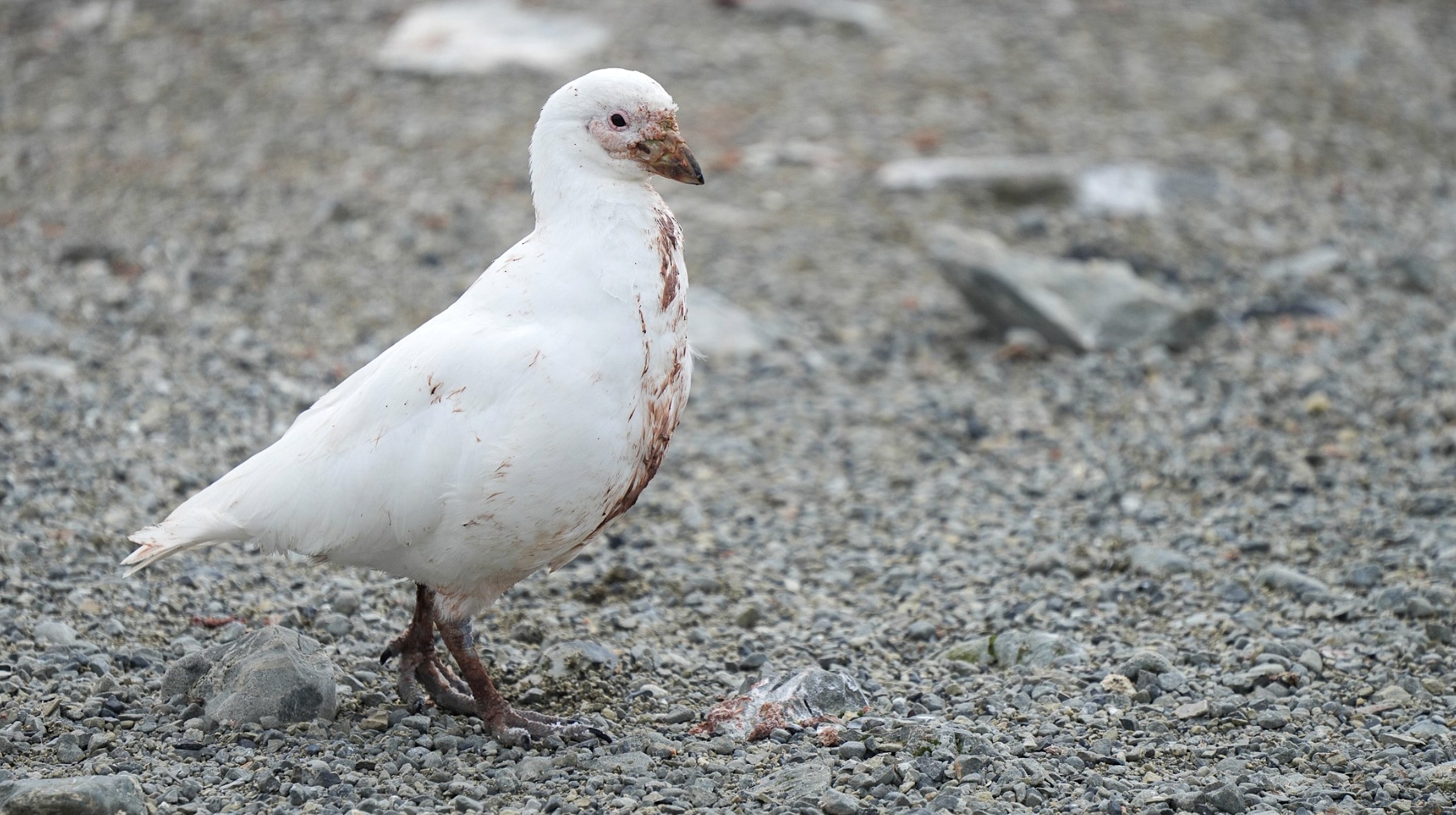
Shorebirds are found on every continent except Antarctica….FALSE!Of course this one is the lie—shorebirds are EVERYWHERE! (And we’re really happy about that!) Say hello to the Snowy Sheathbill—the shorebird that has made Antarctica its home. This bird might look like a strange white pigeon, but we promise it IS a shorebird. They also have some very interesting feeding habitats, including feasting on regurgitated krill, which they get by harassing penguin parents; scavenging on carcasses, and seal blood and feces—delicious. In such a harsh environment, being opportunistic and unfussy is a matter of survival!
Snowy Sheathbill. (Photo by Brendan Murtha ML613703268)
Female Red-necked Phalarope in breeding plumage. ( Photo by Dorian Anderson ML247070261)
Nonbreeding Red-necked Phalarope. (Photo by Eric Ellingson)
We’re dying to know, did you get it right? Drop us a comment below.
So, you learned some amazing facts about shorebirds and spotted a fib, but here’s the most important fact: even with their quirky charms, shorebirds are in trouble. Roughly half of all species are declining, and their habitats are vanishing fast. These amazing birds rely on Caribbean spots like mangroves, salt ponds, beaches, and mudflats for vital rest and refuel stops during their epic migrations, with some even wintering here!
Photographing birds during the Global Shorebird Count. (Photo by Daniela Ventura)
To ensure these rest stops are protected, and remain “open for business,” we need to know where shorebirds go and how many there are. You can help us do this by getting out and participating in the Global Shorebird Count! Taking part is simple, just head out, do Caribbean Waterbird Census (CWC) counts between 1-7 September, and share your lists with ‘worldshorebirdsday’. This is a fun and fantastic way to help scientists gather this data. Find out more about taking part here.
Want to make a bigger impact? You can contribute even more by counting shorebirds during the whole migration season (August to October). The best way to do this is to head to your local shorebird hotspots and carry out two, three, or even more counts at the same sites! Ideally counts should be repeatedevery week to 10 days, as these more frequent counts help us better understand important aspects of shorebird migration in our region! This citizen science data is key to identifying and safeguarding their essential habitats, which in turn provide clean water, food, and storm protection for us. It’s a win-win for birds and people!
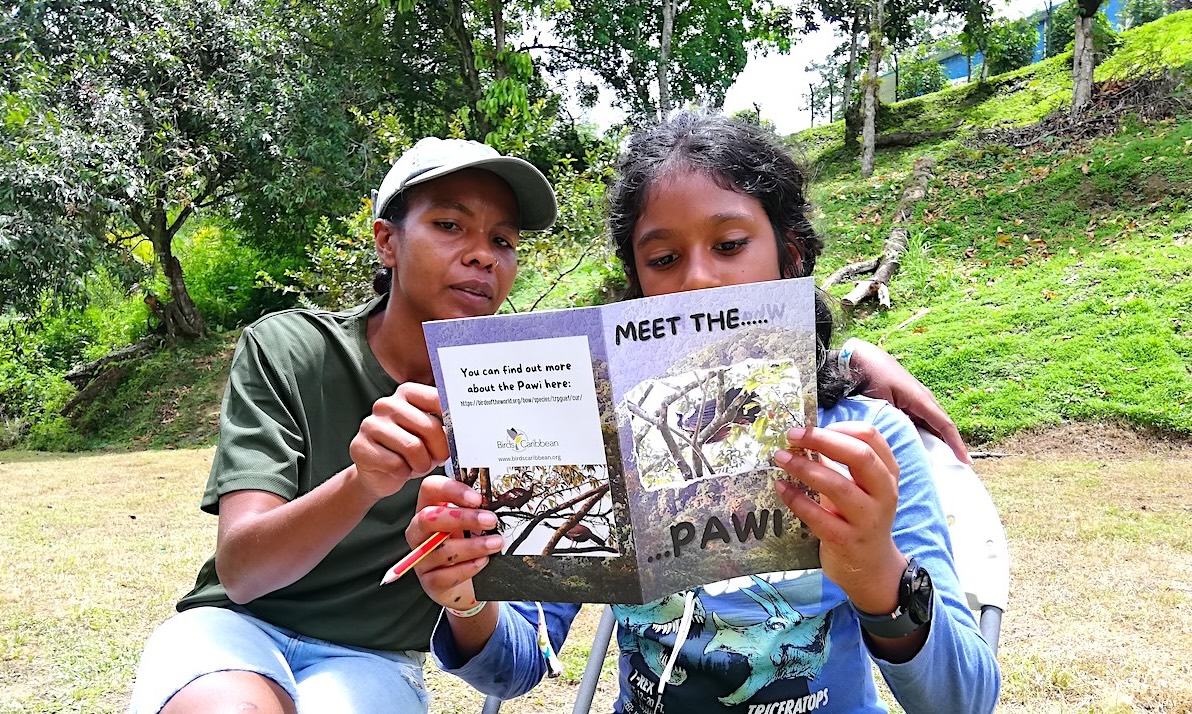
Giselle Ragoonanan, co-founder of the Trinidad and Tobago Bird Observatory and Research Centre, and Rafael Partap learn about the endemic Trinidad Piping-guan, locally called Pawi.
For one month, from April to May, environmental and community organizations across the Caribbean unite to celebrate the region’s 185 endemic birds and transform our islands into havens for them. Many of these unique birds are found on single islands! Relive the fantastic celebrations of our iconic Caribbean birds with us and learn how—through workshops, reforestation, habitat cleanups, field trips and even art—we’re actively building bird-friendly cities and communities throughout the Caribbean. From island to island, we’re creating shared spaces where both people and birds thrive!
This year, the Caribbean Endemic Bird Festival (CEBF) celebrated the theme “Shared Spaces: Creating Bird-Friendly Cities and Communities.” Rapid urbanization across the globe has changed natural landscapes and reduced the availability of food, water, and shelter for wildlife. The call to share spaces underscores the urgency of taking action to counteract these deleterious impacts and make urban areas more hospitable especially for birds.
Green spaces with healthy native plant populations—think well-planned community gardens and urban parks, and preserved woodlands—can provide birds with essential food. Similarly, clean blue spaces, like ponds, canals, and rivers, can attract birds seeking shelter or places to nest and raise their chicks. Both types of spaces also offer pleasant places for people to socialize, interact with birds and nature, and simply escape the hustle and bustle of daily life.
Bird-centered festivities took flight from April to May, with some organizations hosting multiple events throughout the entire month! Across the Caribbean, our dedicated CEBF coordinators rallied their communities, igniting pride for endemic birds and empowering people to take tangible action. From planting native trees to installing bird baths and so much more, communities embraced the call to make their local environments more welcoming to birds.
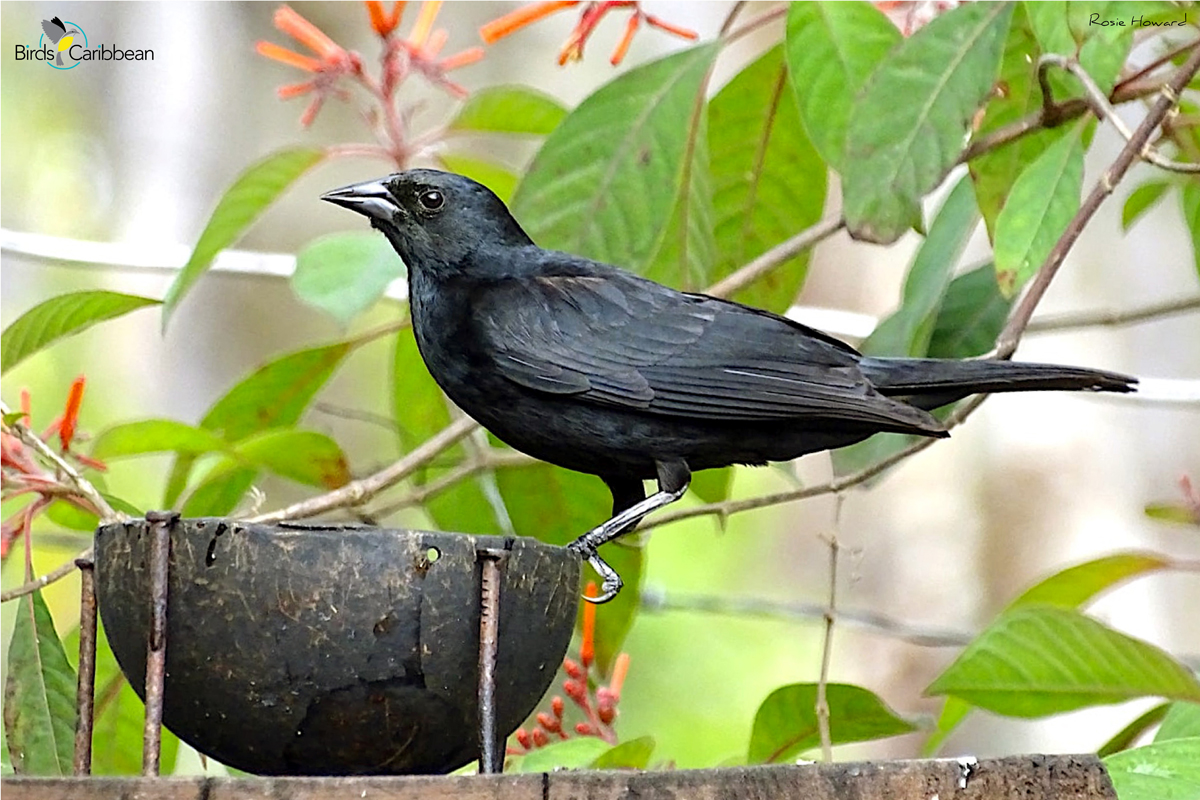
A Cuban Blackbird enjoys a feeder. (Photo by Rosie Howard, Macaulay Library-ML172657491)
This collective effort is exactly what BirdsCaribbean strives to cultivate with each CEBF, by strengthening capability to understand and value the interconnections within our environment and facilitating collaboration to create healthy, vibrant habitats for birds and people.
Honoring Simón Guerrero’s legacy
Last year our community mourned the loss of a Dominican conservation champion. Simón Guerrero was an outspoken and extraordinary environmental educator whose research on urban ecology focused on making cities more habitable for wildlife, including birds. He ensured that his bird conservation education and outreach always included the planting of native trees around schools he visited and the university he worked at. Simón explained, “I always plant some trees to be sure birds will know we are doing something real for them, not just talking.”
Students plant the Hamelia patens shrub, AKA ‘firebush’ in their school’s garden. (Photo by Simón Guerrero)
Firebush is a native plant that’s good for birds. These Dominican highschoolers, organized by Simón Guerrero, planted the shrub in their school garden.
The Academy in the Dominican Republic has also planted firebush as part of CEBF activities. This native is especially good for hummingbirds! (Photo courtesy of Simón Guerrero)
We wholeheartedly agree with this approach! In his honor, we made it a requirement for anyone wishing to join this year’s CEBF celebrations to do “something real for the birds.” Whether it was planting a native tree, installing a feeding platform or bird feeder, or adding a bird bath to school yards and backyards, these actions gave life to our theme of “Shared Spaces”. As always, our phenomenal crew of CEBF coordinators enthusiastically responded!
Making cities and communities bird-friendly across the region
Grenada
This year’s festival was especially significant for Grenadians, who celebrated the official recognition of a new endemic bird species—the Grenada Wren! Our partners at the Belmont Estate, Gaea Conservation Network, and the Grenada Fund for Conservation collaborated to host a suite of events for bird and nature lovers, students, families and members of the tourism community. Highlights included a live reading of the children’s story “Wrennie Takes Flight: A Grenadian House Bird on A Big Adventure” by the author Kimberley Wetten, an opportunity to meet and chat with local conservationists, and educational activities and games about the Grenada Wren.
3D models of four wren species, from left to right Grenada Wren, St. Vincent Wren, Southern House Wren, and Northern House Wren. (Photo by Grenada Fund for Conservation)
Primary School students learn about bird nests at Grenada’s Bird Festival. (Photo by Grenada Fund for Conservation)
Amonie Holas answers questions from Primary school students about the Grenada Wren. (Photo by Grenada Fund for Conservation)
Kingston is becoming more bird-friendly, thanks to the incredible efforts of the Natural History Museum of Jamaica (NHMJ). The NHMJ’s CEBF events aligned perfectly with our theme and brought bird conservation right into the heart of Jamaica’s bustling capital!
The museum came alive with the energy of 38 participants—students from Higholborn Street Basic and Kingston Technical High, members of the public, and Birdlife Jamaica representatives—all eager to learn how to be a better neighbour to the birds. Dr. Suzanne Davis of NHMJ kicked things off with a captivating presentation on bird feeders, covering everything from their importance and types, to care instructions and common challenges. The star of the agenda was a DIY bird feeder workshop, led by NHMJ’s Teona Rattigan. Twenty handcrafted seed and nectar feeders now hang in the museum garden, schools, and homes—ready to provide a scrumptious buffet for Kingston’s birds!
Ms. Michelle Roberts from Birdlife Jamaica then led an immersive bird tour through the museum’s newly renovated Exhibition Gallery. Participants explored dioramas of Jamaican environments while learning about the unique endemic and native birds that inhabit them.
The day ended with a bird-themed ‘Make & Take’ art session, led by NHMJ’s Eartha Cole, where 10 students and two teachers from Higholborn Street Basic School crafted delightful bird-shaped necklaces and decorated bird masks.
BirdLife Jamaica (BLJ) broadcasted the “Shared Spaces” call to action through a series of webinars. “An Introduction to CEBF” set the stage, diving into the history and theme of the Caribbean Endemic Bird Festival and highlighting the exciting lineup of upcoming activities, while the second webinar “Sip and Share—Connecting with Protected Areas” offered a unique opportunity to explore nature beyond backyards. Jamaican naturalists and photographers shared their personal, inspiring experiences from the Palisadoes Port Royal Protected Area deepening participants’ connection with this protected area by emphasizing its importance as a habitat for a variety of birds including beloved Vervain Hummingbird, Greater Antillean Grackle and Loggerhead Kingbird.
Loggerhead Kingbird. (Photo by Dave Curtis)
Returning for CEBF 2025 was BLJ’s popular “Bring-a-child birding” event, an outdoor event that connects city dwellers with nature. Kids and adults alike enjoyed an interactive bird walk, followed by a captivating reading session with local author Amina Blackwood-Meeks of “Don’t Hurt That Bird.” The day wrapped with a delightful arts-and-crafts session led by Michelle Roberts, where children transformed toilet paper rolls into their own quirky bird creations!
Kids birdwatching at Hope Gardens, Kingston. (Photo by Stuart Reeves)
Even toddlers are intrigued by Jamaica’s birds. (Photo by Stuart Reeves)
Amina Blackwood-Meeks reads her book ‘Don’t Hurt That Bird’ for kids and their parents at the Bring A Child Birding event. (Photo by Stuart Reeves)
Another successful Bring A Child Birding event! (Photo by Stuart Reeves)
Kids creating their own birds from toilet paper rolls. (Photo by Michelle Roberts)
Intent on making gardens prime real estate for birds, the BLJ team hosted a “Birdify Your Backyard” workshop for the general public. The workshop started with an eye-opening discussion on how built areas are also home to birds and how gardens and backyards can not only look beautiful—but also support the birds, insects, reptiles, and other wildlife that provide essential ecosystem services like pollination and pest control.
Participants then got their hands dirty in a practical plant propagation session where they learned to generate new plants from cuttings and safely separate compound plants with multiple shoots. They also received step-by-step instructions to safely transfer and repot plants—giving them the skills to start their own bird sanctuaries at home!
The Bahamas
Every bird-friendly area needs a good water source for birds to rehydrate, keep cool on hot days and, to keep their feathers clean and in top shape. In recognition of CEBF 2025, Grand Bahama Island Birders presented bird baths to two schools on the island: Walter Parker Primary School and Bishop Michael Eldon School.
Students and teachers of Bishop Michael Eldon School were thrilled to receive the bird bath. From l eft to right: (back row) Lucianna Gomez, Primary Eco-school Coordinator, Jill Cooper, Mrs Mira Lightbourne, Primary school Vice-principal, Delores Kellman, Sylvie Carey, Bridget Davis and Gail Woon. Front row: Laiyarose Jones, Mrs. Cheng Beee Selim-Dela Pena, High School Eco-school Coordinator, Adrianna Gabrielle Selim-Dela Pena and Mila Davies. (Photo by Grand Bahama Island Birders Club)
The bird bath is the latest bird-friendly addition to the Walker Parker Primary School. From left to right: (back row) Sylvie Carey, Jill Cooper, Delores Kellman, Principal, Mrs. Remelda Been, Eco Club Advisor, Mrs. Lashawnda Jones and Bridget Davis. Front and middle row: students of the Eco Club. (Photo by Grand Bahama Island Birders Club)
Just a quick pause before we continue with the CEBF highlights…
This year, we lost significant funding for our bird conservation education and outreach programs, which the CEBF falls under—and we need your support to help ensure that bird education remains accessible to all in the Caribbean.
Binkie van Es leads an eager BirdSleuth group in the classroom on St. Maarten.
Your donation will be an invaluable investment in the future of Caribbean bird conservation and will help us provide materials and access to capacity-building programs to early-career Caribbean conservationists. These passionate individuals are committed to advancing bird conservation on their islands through engaging outreach events, like those listed in this blog, that inspire communities to embrace bird-friendly practices. Your support will help amplify their efforts, fostering a deeper connection between people and the incredible wildlife that surrounds them.
Their dedication ensured these events were both unforgettable and made a real difference for birds across Cuba. From kids to adults, everyone got in on the action! Participants dove into birdwatching, games, art contests, discussions with Cuban ornithologists and conservationists, and of course rolled up their sleeves to make their communities more bird-friendly. There were habitat clean-ups, tree planting, and workshops dedicated to building bird feeders and water baths. A particular highlight was the sheer joy of discovering birds right in their own neighborhoods, schoolyards, and lush nature reserves. We absolutely enjoyed seeing all of the social media posts and joining the live events whenever we could. You can relive the excitement and see the incredible impact by searching for #FAEC2025 on Facebook and Instagram!
St. Martin
Every year Les Fruits de Mer hosts the Endemic Animal Festival and every year attendees show up despite the hot dry season weather which—let’s be honest—makes you want to stay sat in front of a fan! The festival drew over 80 people looking for challenging and fun scavenger hunts, bird bingo, art and craft activities, and free cool nature and wildlife books. These activity and coloring books, written and edited by the dynamic duo of Les Fruits de Mer—Mark and Jenn—feature the incredible plants, insects, mammals, fishes, reptiles, and birds of St. Martin. This year they added another brand new coloring and activity book, “St. Martin Unique Nature,” available for free download here from their growing library of publications.
Endemic Animal Festival announced in the local press.
Front cover of the bilingual coloring and activity book ‘St. Martin Unique Nature.’
Attendees were invited to decorate their own canvas pouches with endemic animal designs during the festival. (Photo by Mark Yokoyama)
Haiti
On the Les Cayemites Islands where Hispaniolan Parrot chicks are snatched from nests for the pet trade, the Critically Endangered Ridgway’s Hawk is persecuted as a pest, and birds in general are hunted for sport by adults and children; Anderson Jean of Action pour la Sauvegarde de l’Ecologie en Haiti leveraged the CEBF to educate communities about the devastating impact of these harmful practices.
The Ridgway’s Hawk is one of the most critically endangered raptors in the world and is endemic to Hispaniola. (Photo by Dax Román)
Anderson and his team introduced 200 primary school students to the wonderful world of birds through a riveting presentation. The team spoke about the importance of wild birds to the environment and people, and the endemic birds of Haiti—covering their calls, behaviours, habitat needs, and threats. They also took the opportunity to bust harmful myths about birds, such as the belief that a Ridgway’s Hawk nesting on a farm extends the dry season.
After the presentation, it was time to power up the students’ observation skills with a school yard birdwatching session—an absolute hit with the students!. Anderson shared that, “the students really enjoyed watching and trying to identify the birds…some even complained that the time spent birdwatching was too short!”
Trinidad and Tobago
The third annual Brasso Seco Bird Festival, organized by the Trinidad and Tobago Bird Observatory and Research Centre TTBO, was designed to teach children about their local environment. Through hands-on activities, art, and community involvement, the festival made nature exploration a multi-sensory experience for all in attendance! Children were grouped into three teams—each named after a native bird species and led by an adult team leader—team Bay-headed Tanager, the Turquoise Tanagers, and the Purple Honeycreepers. Each team then visited four educational stations: biodiversity exploration, poetry, habitat modeling and mask painting, and bird species identification.
At the biodiversity table children got hands-on, exploring local plants and animals using real items like feathers, nests, pods, and dried leaves. They were encouraged to ask questions, identify specimens, compare them, and think about how different species interact with each other. The poetry station built on this sensory exploration, giving children the space to write cinquain and haiku poems, incorporating what they saw and felt at the biodiversity table. The session ended with an open-mic spoken word activity, where they shared their experiences through guided poetic expression.
Dan Jaggernauth teaches children about the different plants birds feed upon in the forest at the biodiversity station. (Photo by TTBO)
A young boy proudly shares his bird poems after visiting the poetry station at the TTBO’s bird festival. (Photo by TTBO)
The habitat modeling station was buzzing with excitement as children worked together to create miniature bird-friendly habitats for a variety of endemic birds. They often yelled out what needed to be added to their habitats to help the birds survive, shouting things like, “clean water!” and “lots of flowers!” for the Bee Hummingbird, or “parrots eat fruits so we need to add fruits!” for the Imperial Amazon, and of course, “trees to sleep in!” One of the participants, Rafael, shared with the TTBO how he made his garden bird-friendly for the birds in central Trinidad. Check out his amazing garden in the video below!
The mask-making and bird ID station offered a fun and educational activity. Participants chose a native bird, then learned about its ecological role, habitat, and a unique fact using a guided worksheet. Finally, they painted a wearable mask of their chosen bird, connecting art with biology and identity.
Mask painting and bird identification station at the TTBO bird festival. (Photo by TTBO)
Children display their completed Bee Hummingbird habitat with flowers for the bird to feed on and a water source. (Photo by TTBO)
Dominican Republic
Grupo Jaragua, a local environmental powerhouse, shared valuable information via social media on native plants that can be planted to make Dominican backyards more welcoming for birds. The team handpicked species for their outstanding ability to provide food for birds.
Beyond plants, Grupo Jaragua also shared the story “El ladrón de cotorras” (The parrot thief) of a pet Hispaniolan Parrot as part of their “Mangrove Stories” social media series. The Hispaniolan Parrot is an endemic parrot to Hispaniola (Dominican Republic and Haiti) that is illegally captured and sold as a pet. The graphic story, with illustrations created by Cua Conservacion, explains how pet parrots are caught and why this is problematic, calling on Dominicans to leave parrots in the wild.
Margarita Island
The Laguna La Restinga National Park, a designated Ramsar site, holds a unique position on Isla Margarita. It sits squarely between the bustling eastern half and the relatively deserted Macanao Peninsula to the west. Despite its location and Ramsar designation, the park rangers initially had very little knowledge of just how important this area is to its many resident, endemic, and migratory birds.
That changed when Jemimah Rivera, founder of the local NGO Bio Zoe and CEBF Coordinator for Margarita Island, stepped in. She led two workshops designed to educate the rangers about the park’s incredible bird diversity. The training also provided them with basic field skills in birdwatching, bird identification, and locating nesting and feeding areas within the park.
Jemimah speaks to park rangers about birds and how to identify them during the workshop. (Photo by BioZoe)
Time to practice. Park rangers practice using binoculars to watch and identify birds in Laguna La Restinga National Park, Margarita Island. (Photo by BioZoe)
Birdwatching wasn’t just for the adults; Jemimah also headed to the fishing village of Tirano to educate and connect kids to nature. Local conservationists joined her, sharing insights about the island’s birdlife before taking the group on an exciting birdwatching trip. To further help, they also held a beach cleanup, making the area tidier for birds and other wildlife.
Children from El Tirano village in Margarita Island enjoy trying birdwatching. (Photo by BioZoe)
We’re incredibly proud to share that Jemimah made her CEBF events inclusive, welcoming differently abled children. She found it challenging but highly rewarding helping them learn about the fascinating lives of birds and working with them to complete various art and craft activities. Look out for an upcoming blog post where we’ll share more about this heartwarming event. If you’re interested, be sure to sign up for our newsletter here!
Jemimah with her birdwatching crew at Laguna de Raya, Margarita Island. (Photo by BioZoe)
Antigua and Barbuda
The Environmental Awareness Group EAG and agricultural science students at the Princess Margaret School proved that formal institutions, not just backyards and gardens, can be bird-friendly too! What’s more, they also proved that achieving this does not require oodles of money. Together they designed and built five bird feeders and five bird baths using materials they already had on hand like water bottles, wooden spoons, chicken coop wire, and shallow bowls.
Sometimes all you need is a little creativity. A simple bird feeder made using a plastic bottle and wooden spoons. (Photo by Sherrel Charles)
Shanna and students birdwatching at the Princess Margaret School. (Photo by Sherrel Charles)
The students then enjoyed a guided birdwatching trip across the school grounds, a skill that will undoubtedly come in handy when identifying visitors to their new bird baths and feeders. The event garnered media attention and was covered by the Antigua and Barbuda Broadcasting Services (ABS). It was featured in a special International Biological Diversity Day segment during their morning TV show. For this segment, Shanna Challenger of the EAG and CEBF coordinator for Antigua, along with our Caribbean Bird Banding Program Manager Holly Garrod, were in studio sharing the importance of bird conservation work on the island and wider region.
Shanna and Holly at the Antigua Broadcasting Services studio.
On Global Big Day, the EAG, Wadadli Warblers Bird Club, and Antigua and Barbuda Defence Force joined forces to observe and record as many bird species as possible in Christian Valley, an Important Bird Area. For many, it was their first time birdwatching, and they were absolutely thrilled! Check out their video below.
Bird conservation education and outreach continued throughout the month. Shanna and Sherrel Charles, the EAG’s Science Communications Officer, captivated members of the Antigua and Barbuda Ocean Trust and students at Jennings Primary School and Buckleys Primary School with their interactive presentations. These sessions weren’t just talks—they included brain-busting quizzes, fun games with fantastic prizes like CEBF-themed stickers and bookmarks up for grabs. To top it all off, every session wrapped up with a fun birdwatching adventure, sparking curiosity and fostering an appreciation for nature.
Puerto Rico
Alondra Norat of Pajareo Virtual took a small but dedicated group of undergraduates on a birdwatching trip across the University of Puerto Rico Río Piedras Campus. For several of the students, this was their first time being on a birding tour and using binoculars. Alondra is confident that the birds, clearer than ever before, sparked a thrill in them as they peered through the lenses. The group used their observations from this trip to put together an (unofficial) guide to the common plants and birds on the campus for other first-time student birdwatchers on campus! This practical resource was particularly valuable as it was their first foray into birdwatching and their initial experience with both the eBird app and field guides.
Birds are everywhere, even at your university campus — and certainly at the University of Puerto Rico Rio Piedras campus. (Photo by Alondra Norat)
Common birds and plants of Rio Piedras campus ID cards created by Alondra and Steve Maldonado Silvestrini. (Photo by Alondra Norat)
Roots and Shoots Puerto Rico, and our Operations Manager Alexia Morales, headed to Punta Cucharas Nature Reserve in Ponce for a bird count where they recorded 44 species, five of which were endemic birds!
Rainy weather couldn’t stop this enthusiastic birding crew at Punta Cucharas Nature Reserve.
Members of the Library Club at the Ramón Emeterio Betances School, Adult Education Program (Cayey), and Alfonso Díaz Lebron Middle School (Juncos) ditched the blackboards and desks and took the learning to a small forest near the school. Throughout the event, creativity and learning bloomed. Participants enjoyed reading the “Birds of Puerto Rico for Children” book, written by our President and founder of the CEBF Dr Adrianne Tossas, and other bird stories, sparking lively discussions filled with anecdotes, fables, songs, and local folklore about Puerto Rican birds.
Everyone got hands-on, coloring endemic birds from the “Endemic Birds of the West Indies” coloring book that are abundant in their own communities, and even delved into research using their phones. There were important group discussions about the significance of birds to the environment , and a local farmer from Finca Los Pellos shared fascinating insights into pollinator gardens and their role in agriculture. Two beautiful Flor de Maga trees (Puerto Rico’s national flower) were planted, generously donated by the Department of Natural and Environmental Resources and the area dubbed, “The Green Library.” Students took home cilantro, chili pepper, and lettuce plants to cultivate their own kitchen gardens!
It’s story time in The Green Library. (Photo by Rosalina Alvarado)
The Puerto Rican Parrot joins the endemic birds coloring session. (Photo by Rosalina Alvarado)
Thanks to the Department of Natural Resources staff for donating the Flor de Maga plants. (Photo by Rosalina Alvarado)
CEBF event coordinator Rosalina wearing her fabulous hand made bird crown.
Junta Innovadora Comunal Villa del Carmen, Inc. seamlessly blended personal well-being with the joy of celebrating birds and being in nature. Participants prioritized their health checks with services from the MedCentro mobile unit and NUC students, alongside various informative health booths. Some were also treated to a birdwatching and identification trip led by our Co-Regional CEBF Coordinator Eduardo Llegus, while others joined a beginner’s fishing workshop. Native tree plants were also given to participants to help them make their backyards and gardens more bird-friendly!
Eduardo Llegus leads a birdwatching trip with participants. (Photo by Junta Innovadora Comunal Villa del Carmen, Inc.)
Native tree saplings were given to participants to help them make their backyards and gardens more bird-friendly. (Photo by Junta Innovadora Comunal Villa del Carmen, Inc.)
Beach cleanup in Villa del Carmen, Puerto Rico. (Photo by Junta Innovadora Comunal Villa del Carmen, Inc.)
It’s time for a check-up! Nurses stationed at the MedCentro mobile clinic. (Photo by Junta Innovadora Comunal Villa del Carmen, Inc.)
For the 2025 CEBF, Guaynabo Elementary School came alive with a birdwatching adventure right on the school’s compound! Students also enjoyed story time with Lourmarie García who read “El Arbol Solitario Y El Pajaro Carpintero” by Milagros Keppis, while Ingrid Flores enlightened them about Puerto Rico’s endemic birds and the importance of protecting our shared green spaces.
Ingrid explaining to kindergarteners how gardens can be bird-friendly. (Photo by Escuela Nueva Elemental Urbana de Guaynabo – Montessori)
Our Endemic Birds of the West Indies Coloring Book is still a hit among children. (Photo by Escuela Nueva Elemental Urbana de Guaynabo – Montessori)
Story time with Miss Garcia. (Photo by Escuela Nueva Elemental Urbana de Guaynabo – Montessori)
Feathery facts and free resources for classrooms and homes
Each day, we featured a new Endemic Bird of the Day on our website and across BirdsCaribbean’s socials, sharing 15 new species in 2025. The species were carefully selected to showcase the vast breadth of the endemic wonders of the Caribbean—highlighting truly unique birds, like the Hispaniolan Nightjar; clever species like the Cuban Palm-Crow; and endemic crooners, like the St. Vincent Wren. You can find the complete library of 173 endemic birds covered thus far here.
Each endemic bird profile was accompanied by a beautifully drawn image by award-winning Cuban artist Arnaldo Toledo, stunning high quality photos and videos, online puzzles tailored for different levels (between six and 1,024 pieces), and bird calls. Fun, free and engaging activities were also provided for both kids and adults, including downloadable coloring pages, experiments, up-cycle crafts, and more.
This year’s CEBF is over—but don’t worry, we still have plenty of bird content for you to enjoy! Make sure you are following us on Facebook, Instagram, Twitter, and LinkedIn, and have joined the BirdsCaribbean mailing list, to ensure you are kept up to date with our latest news via our monthly newsletter.
Acknowledgements: A massive THANK YOU to the island coordinators for your enthusiasm and dedication to making this another memorable CEBF! Each year we see a growing number of participants committed to increasing their knowledge of Caribbean birds and actively working to protect their habitats. We also extend our gratitude to our donors and members who help us provide the coordinators with the support and resources they need to educate and inspire future generations of bird and nature loving communities.
One of the Burrowing Owls standing guard at the entrance to its nest at the Eight Mile Rock High School. (Photo by Delores Kellman)
What a surprising, pleasant and exciting discovery!! Not one, but two—Mr. & Mrs.—adorable Burrowing Owls on the Eight Mile Rock High School athletic field situated in West Grand Bahama, The Bahamas. Although a permanent resident in The Bahamas and throughout the Caribbean, this species is rare in Grand Bahama. eBird, a free, web-based tool for recording bird observations, reports seventeen sightings, the highest of which is two. Social Studies teacher, Deana Glinton-Williamson, recounts how these unexpected and delightful visitors captured hearts of students and teachers alike—and inspired the school’s Blue Jay community to take action for their charismatic guests!
It was early February 2024, during midday recess when three teenaged girls spotted what they described as “two funny-looking birds” in the northeast quadrant of the school’s field. The students came running to my class, excited because they had seen the same birds in the 2024 Birds of The Bahamas calendar on my desk.
“Mrs. Williamson! Your birds are on the field!!
“What birds?
“The ones in your calendar!”
They picked up the calendar, eagerly flipping through the pages and stopped at the Burrowing Owls—I was overjoyed! I grabbed my binoculars and hurried to the field with my students leading the way. There they were: two Burrowing Owls standing outside their burrow, basking in the midday sun. They had excavated their home in an abandoned Long Jump pit, now forgotten and surrounded by grass.
Ms. Williamson and the Burrowing Owls discoverers–Sharae Gaitor, Shantia Forbes, and Amanda Stubbs. (Photo by Damaso Gray, EMRHS Art Teacher)
Burrowing Owl. (Photo by Alex Marine ML624853709)
Burrowing Owl nest, Grand Bahama Island, The Bahamas. (Photo by Charmaine Francis)
To truly appreciate this unique situation, it helps to know a bit about the Burrowing Owl itself. lt stands out among owls with its long legs, bright yellow eyes, and preference for life underground. They actually dig their own burrows using those long legs. This unique lifestyle has led to an interesting adaptation: they’ve developed a higher tolerance for carbon dioxide, which can accumulate to higher levels underground! In the Caribbean (specifically The Bahamas, Cuba and Dominican Republic) these small, sandy-colored owls are active during the day. They hunt insects like grasshoppers and beetles and small vertebrates such as rodents, lizards, and even small birds. They are opportunistic feeders, often seen perching on mounds or fence posts before swooping or running after prey. Their vocalizations include a distinctive two-note “coo-cooo” call, often used by males for mating and territorial defense.
Pair of Burrowing Owls near their nest in the abandoned Long Jump pit. One is perched on the hurdle stand while the other is standing at the entrance. (Photo by Delores Kellman)
I reported our findings to the principal, Mr. Albert Jones, who visited the site, and immediately scheduled an all-school assembly. He informed staff and students of the rare birds on campus, emphasizing the importance of preserving our national environment and the rich biodiversity all around us. He reminded students to view the birds from a respectful distance, encouraging them to use their electronic devices to learn about our newly discovered guests.
Being a member of Grand Bahama Island Birders, I shared the news of our feathered visitors with the group, and on the morning of Saturday, February 10, 2024, nine eager birders trekked to the site. To the delight and excitement of all—we were not disappointed! One of the owls was present, “hanging out” in the grass close to the nest. We took a seat on the bleachers at a safe distance to observe and take photographs. For a few of us, the Burrowing Owl was a lifer; and for others, a Grand Bahama lifer!
A month later the owls had moved into the second Long Jump pit—very close to classrooms and students—and were guarding their new territory like hawks. It was as though they were sending us a message, “Stay away! This is our home now!” Principal Jones and the Physical Education department made provisions for their protection by installing stakes around the pit, using yellow caution tape to cordon the area.
I arranged for the local TV station to share our story on the nightly news. The owls definitely knew they had visitors,properly “hamming it up” for the camera. One of them was a short distance away and flew home to welcome the TV crew. Such hospitality!! After on-site interviews, Grand Bahama Island Birders president Delores Kellman and vice-president Rudy Sawyer presented an educational Burrowing Owl poster and a copy of Herb Raffaele’s Birds of the West Indies field guide to Principal Albert Jones for addition to the library’s catalog.
Staff of the Eight Mile Rock High School and members of Grand Bahama Island Birders Club being interviewed by a local TV station.
When school resumed in January 2025 and preparations began for the track and field season, the PE teachers discovered that the owls were constructing a third home in the active pit. “Oh NO, NO!! We NEED this pit!” was the first reaction. Following the advice of longtime conservationist and experienced birder Bruce Purdy to interrupt the construction in the active pit, the PE department and principal were guided to protect the owls by denying them their third home. As expected, they returned to their secure second home, and the PE department regained the use of the pit.
A concerted effort is underway to ensure that the owls remain a part of the Eight Mile Rock High School family. Plans are afoot to bring in fresh sand to be deposited at their original nesting site in hopes that they will return to their homestead. A second sand pit will also be created nearby to give the owls additional borrow options farther away from campus, fostering an environment that can support the establishment of a stable colony.
Burrowing Owls. (Photo by Carlos Sanchez ML171264441)
Since the initial discovery, Eight Mile Rock High School has had even more reasons to celebrate—three to be exact! On the evening of March 14th, Principal Jones discovered three healthy owlets, safe in the watchful care of their parents in the second pit. Grand Bahama Island Birders president Dolores Kellman estimates that they likely hatched about three weeks earlier. Staff and students were thrilled to receive news that their precious owl family is growing—it’s a heartwarming sign that the care and efforts made by the Eight Mile Rock school community is paying off—and that these wonderful visitors are truly making the school their home.
Here are some comments that encourage us to continue with our efforts:
Even though the owls are not Blue Jays, our school’s mascot, they might as well have been because they are now a part of our community—Blue Jay Country. It has been a wonderful, educational experience. I feel honored and privileged to have them choose our campus to call home. We will continue to protect them as long as they are here.
Mr. Albert Jones, Principal Eight Mile Rock High School Martin Town, Grand Bahama
The cute owls have become an important part of the Blue Jay family. Since learning of their rarity here in Grand Bahama, we feel it’s our duty to protect them. They are comfortable here and we are in the process of giving them two sand mounds at the rear of the field for them to burrow other tunnels if they so desire.
Ms. Daphne Neely, Head of Department Physical Education
It was our first time seeing an owl other than on TV and in Mrs. Williamson’s calendar so we notified her, she called it in to her birding group, and the rest is history! The experience of seeing the owls up close was nothing short of amazing.
Sharae Gaitor,Shantia Forbes, and Amanda Stubbs, Grade 8 students
It was truly a joy to be a part of this experience. I was impressed by the interest, enthusiasm and passion of the principal and members of his staff, who were committed to learning about the owls and doing whatever it took to protect them and improve and create new habitat. The classroom was taken to the natural environment. Congratulations to the Blue Jay family!
Delores Kellman, President Grand Bahama Island Birders
Deana Glinton-Williamson is a celebrated educator in The Bahamas public school system—recognized as a Teacher of the Year (2008–2010) and Longest-Serving with Excellence Awardee (2004). Her passion for birdwatching was sparked by Erika Gates’ 2007 birding course, and in 2010 she founded the Grand Bahama School District’s first Junior Birding Club at Freeport Primary School. Today, Deana teaches Social Studies and History at Eight Mile Rock High School, where she has integrated World Migratory Bird Day into her curriculum for the past two years. From primary through senior high, her students have been inspired by her deep love of birdwatching and conservation.
Capturing bird photos on Global Big Day. (Photo by Simon Shields)
Global Big Day (GBD) 2025 was a vibrant celebration of birds, Caribbean community, and spectacular photography!Thank you to everyone who participated in our GDB team competition, submitted stunning photographs, and helped make this year’s Global Big Day one to remember. We’re excited to unveil the winners of our GBD 2025 Photo Contest! These photos beautifully capture the essence of Caribbean birds and the power of collective action to protect our natural heritage.
If you missed the full Global Big Day 2025 report, click here to explore the highlights, team scores, and meet this year’s top birding team!
This day wouldn’t be possible without the infectious energy of our birding community, the dedication of our team leaders, and the generosity of our donors. Thank you for helping to keep our programs running, from youth education and conservation outreach, to research and habitat protection, especially this year as we face the loss of critical federal funding. If you’d like to #KeepBirdsCaribbeanSoaring, please consider making a donation at: https://givebutter.com/BCGBD2025
Photography Award Winners 2025
We especially congratulate this year’s First Place Best Bird Photo winner, Filippo Milani from Sint Maarten! One judge commented “I’m captivated by the lines and curves of the pelican’s body—the long wood-like beak, graceful curved neck. and the intricate patterns and textures across its body. The viewer is drawn to the bird’s clear, watchful blue eye, framed by delicate pinkish bare skin, and bordered by striking black and buffy yellow. Overall, I think the composition, detail, and color make this image truly outstanding.”
The Second Place Best Bird Photo goes to Gray Kingbird by Peter Rivera (Puerto Rico).
The Third Place Best Bird Photo goes to Green-throated Carib by Jerome Foster (St. Lucia).
The submissions we received were exceptional, and we couldn’t resist sharing even more stunning entries from the competition. In addition to our winning photo, the judges have chosen four standout images for honorable mention, featured below.
Great Egret, Great Salt Pond, Sint Maarten. (Photo by Filippo Milani)
Yellow Warbler, McKinnon’s Pond, Antigua. (Photo by Kendel Angol)
Red-crowned Amazon, Puerto Rico. (Photo by Eric Torres)
Green Heron, Puerto Rico. (Photo by Anel Sandoval)
Photographers from almost every team and corner of the world are recognized for their stunning photos in the following categories.
Best Endemic Bird
Best Endemic Bird Photo goes to the eye-catching and ever-busy St. Lucia Warbler, captured by Jerome Foster in Gros Islet, St. Lucia. It’s a striking reminder that the Caribbean is home to, dare we say, the world’s most spectacular birds.
St. Lucia Warbler. (Photo by Jerome Foster)
Best Landscape Photo
These photos showcase the essential natural places where birds feed, seek shelter and raise their families. These images highlight not only the skills of the photographers but also the need to protect the environments that provide such awe-inspiring moments.
Taking First Place for Best Landscape Photo is the stunning McKinnon’s Pond, Antigua,captured by Kendel Angol from the Wadadli Warblers Team!
Second Place Best Landscape Photo
Northwestern Puerto Rico. (Photo by Mirielle Villanueva)
Third Place Best Landscape Photo
Nelson Lake, Illinois. (Photo by Kim Brady)
We’d also like to extend an honorable mention to all the other talented photographers who submitted their breathtaking landscape entries. Your dedication to capturing the beauty of these natural bird habitats is truly commendable!
Waterfowl, Canada. (Photo by Nicole Gutierrez)
Morning vibes and the Great Egret. (Photo by Eric Torres)
Le Galion, St. Martin. (Photo by Filippo Milani)
Laguna Cartagena National Wildlife Refuge, Puerto Rico. (Photo by Peter Rivera)
Best BTS Photos
GBD is no doubt about the birds but there’s also so much excitement going on behind-the-birds. We’re glad our GBD-ers decided to give us a peek into the funny, scary, and delightful moments of birding during the big day.
Standing on top of the competition (and a car) is First Place Behind The Scenes (BTS) winner Bibo Jayne from the TCI Royal Terns team with ‘Birding by car etiquette.’
Second Place Behind the Scenes Photo goes to Edward Hernandez Lara Parque La who took this photo of his teammate gettin’ real low at Parque La Esperanza, Cataño in Puerto Rico. Hey, sometimes you have to get low to shoot high!
Third Place Behind the Scenes Photo goes to Manuel López Salcedo. We’re really glad he kept snapping instead of helping his teammate Manuel Aroche who was clearly losing the battle for his boots with the mud.
Sometimes the birds make it easy and come to us, just ask BirdsCaribbean’s past president Andrew Dobson who was joined by a European Robin for lunch on GBD!
That’s one lucky Gull
GBD is all about spotting and helping birds. That’s exactly what happened at Great Salt Pond in Philipsburg. Filippo Milani’s group was enjoying a day of birdwatching when they noticed a Laughing Gull lying motionless in the water at the edge of the pond. It was clear the bird was in distress, so one of the birders carefully picked it up without resistance from the bird, a sign that it was truly unwell! They decided to take it to a veterinary clinic for an immediate check-up.
The Laughing Gull before being taken to the veterinarian. (Photo by Filippo Milani)
Filippo shared, “At the clinic, the vet gave the gull an anti-inflammatory injection and advised us to keep it in a secure, enclosed space for a few days of monitoring. We brought it home and kept it in a crate, where it, thankfully, ate well. However, it showed little interest in flying, which was concerning.
After a few days, we took the gull back for a veterinary follow-up. With the additional support of vitamin drops and the invaluable assistance of the Nature Foundation, the Laughing Gull eventually recovered. We were thrilled to be finally release it back into a safe, wild area.”
When Watchers Become the Watched
Don’t feel too bad if your target species decide to skip lunch with you (we can’t all be as lucky as Andrew) chances are they’re busy human-watching like these curious onlookers.
Green Heron, Puerto Rico. (Photo by Marisol Villanueva Mendez)
Adelaide’s Warbler, Puerto Rico. (Photo by Edward Hernandez Lara)
Green Heron, Little Pond, Sint Maarten. (Photo by Filippo Milani)
Flyest GBD Team
The Wadadli Warblers understood the assignment. They absolutely showed up and showed out. Rocking their yellow tees and black pants (which, sidebar, is just their Defence Force uniform but we’re totally here for that accidental match with their endemic bird, the Barbuda Warbler). Peak birding season + peak fashion = peak birding energy.
Wadadli Warblers and the Antigua and Barbuda Defence Force birding in Christian Valley. (Photo by Kendel Angol)
Sending out a SOS
Before the end of the birding bonanza the Cuban team sounded the alarm to ‘Save Our Soles!’ We know with the terrain and weather our sneakers, slippers, boots can take a hit, but theirs really took a beating—just look at the photo below taken by Yaro Rodriguez!
Hardly Driving, Mostly Birding
Dead batteries, slippery falls, snacks left behind on the kitchen counter. These are fieldwork mishaps we bounce back from. But what if your only ride gets stuck or blows a tire? For the ‘BVI Birders’ and ‘Piping Pawis’ teams, that nightmare came true. Still, not even car trouble could stop their birding. Binoculars stayed out and checklists kept rolling. After all, GBD only comes once a year!
It’s So Fluffy!
Filippo Milani captured this adorable moment at Emilio Wilson Park in St. Maarten—a Green Heron chick, described by our Waterbird Program Manager (no surprise) as the “sweetest, fluffiest bird.”
Green Heron chick in nest, Sint Maarten. (Photo by Filippo Milani)
Flyest GBD Kit
José Guillermo de la Rosa came through with the flyest GBD fit, rocking the BCDR conference buff and t-shirt like a true style icon.
Shorebird Showstopper
Spotting these shorebirds might be easy, but getting great photos of them is a real challenge! However Karlos Ross from Cuba captured this Killdeer in flight almost effortlessly.
Killdeer in flight, Sierra de Bocas, Holguín, Cuba. (Photo by Karlos Ross)
The Ultimate GBD Companion
Here we have the always supportive, always down for a nice long walk and oh-so-stylish Daisy wearing that BC buff better than most of us! She definitely passed the vibe check with the ‘Piping Pawis’ team.
Daisy looking very stylish in her BC buff. (Photo by Alex Samson)
Youngest Global Big Day-er 2025
We love to see when young people connect with the incredible bird communities in their home countries and we hope to see more young naturalists participating in next year’s GBD!
Youngest GBD-er (peep the Puerto Rican Tody BC buff), on the Flying Pintails team in South Africa. (Photo by Claire Spottiswoode)
Birds on the Corner
These photos remind us that some birds aren’t visitors. They’re neighbors, sharing our fences and utility poles. It’s a reminder that our communities need clean, green spaces to keep ourselves, our birds, and other wildlife, thriving.
Black-faced Grassquit, St. Lucia. (Photo by Jerome Foster)
Shiny Cowbird, St. Kitts. (Photo by Azmon Thomas)
A Carib Grackle builds its nest on a electricity pole in St. Lucia. (Phote by Jerome Foster)
Best Selfie
Are selfies still a thing? Yes! And we love seeing them. To enjoy the photos full size, click on the first one, then click the right arrow to advance through the gallery.
Marisol, Mirielle and Kathleen birding in Rincon, Puerto Rico. (Photo by Marisol Villanueva)
Georgi, Wilbert and Brayan birding in the DR. (Photo by Georgi Sanchez)
Shadows at the Salt Creek in Fullersburg Woods, Illinois. (Photo by Steve Constantelos)
Flying Pintails leader, Lisa Sorenson birding with her husband in Massachusetts. (Photo by Lisa Sorenson)
Member of The Palmchatters.
Members of The Palmchatters stop to take a photo near the coast.
Members of the team BirdersSKN birdwatching on Global Big Day.
Members of The Palmchatters.
Selfie in El Seíbo, Dominican Republic. (Photo by José Guillermo de la Rosa)
Members of the Gundlach Team in Cuba. (Photo by Yaro Rodriguez)
Birder’s shadow, Puerto Rico. (Photo by Edward Hernandez Lara
A few members of Statia’s Golden Warblers in St. Eustatius, Global Big Day 2025. (Photo by Jethro van’t Hul)
Brendan Burns and Skyler Bol of Gavilán Guardians in Puerto Rico, Global Big Day 2025. (Photo by Brendan Burns)
Two members of the LGBT in Guadeloupe. (Photo by Anthony Levesque)
Bonus batch of GBD photos
Birds, people, and habitat photos from the Caribbean and across the globe! To enjoy the photos full size, click on the first one, then click the right arrow to advance through the gallery.
Yellow-crowned Night-Heron, Puerto Rico. (Photo by Mirielle Villanueva)
Mute Swan, Canada. (Photo by Nicole Gutierrez)
Marjel Morales Jr birdwatching at Guirabo, Holguin, Cuba.
You should look up! Wildfowl Trust, Trinidad. (Photo by Christel Mohammed)
Surfboards in northwestern Puerto Rico, can you spot the bird art? (Photo by Mirielle Villanueva)
Taking a much needed break from birding in Barbados. (Photo by Julian Moore)
White Ibis, Puerto Rico. (Photo by Eric Torres)
Mirielle and Kathleen surveying birds at Anasco, Puerto Rico, 2025 Global Big Day. (Photo by Marisol Villanueva Mendez)
Anton Sape River, Dominican Republic. (Photo by Georgi Sanchez)
Forest road, Puerto Rico. (Photo by Brendan Burns).
Ruddy Turnstone, Xanadu Beach, The Bahamas. (Photo by Charmaine Francis)
Members of the Warbling Warriors team at Cabo Rojo, Puerto Rico. (Photo by Peter Rivera)
Bananaquits, St. Lucia. (Photo by Jerome Foster)
Members of the Flying Pintails team (Illinois chapter). (Photo by Mary Loye)
Zenaida Dove, St. Lucia. (Photo by Jerome Foster)
Post GBD 2025 cool down in Barbados. (Photo by Julian Moore)
Team Wadadli Warblers birdwatchign at McKinnon’s Pond, Antigua. (Photo by Kendel Angol)
Fuel for a Bahamian birder. (Photo by Elijah Sands)
Ruddy Duck, Great salt Pond, Sint Maarten. (Photo by Filippo Milani)
Laguna Cartagena, Puerto Rico. (Photo by Eric Torres)
Western Cattle Egret snug in a nest, Puerto Rico. (Photo by Mirielle Villanueva)
Brown Pelicans, Potworks Dam, Antigua. (Photo by Kendel Angol)
Scaly-naped Pigeon, Puerto Rico. (Photo by Jerry Bauer)
Black-crowned Night-Heron in flight, Cuba. (Photo by Marjel Morales)
Gray Trembler, St. Lucia. (Photo by Jerome Foster)
Team Soualiga birdwatching at Emilio Wilson Park, Sint Maarten. (Photo by Filippo Milani)
Break time for the Gundlach Team. (Photo by Yaro Rodriguez)
Rand Nature Centre, The Bahamas. (Photo by Charmaine Francis)
Sunrise over Mayaguez, Puerto Rico. (Photo by Marisol Villanueva)
Black-necked Stilts with chicks, McKinnon’s Pond, Antigua. (Photo by Kendel Angol)
From dawn choruses to birding by the last cool sliver of moonlight—the BirdsCaribbean community took flight on Saturday, May 10, for an electric 24 hours of non-stop citizen science, friendly rivalry, and collective action for birds! Oh—and they only broke almost every Caribbean Global Big Day record along the way!
Twice a year, during peak migration (once in spring and once in fall) birders across the globe spring into action to record as many different bird species as they can in 24 hours. Every eBird checklist powers research—tracking habitat use, revealing global population trends, and ensuring that conservation efforts are directed where they’re needed most.
And what better way to strive to record every bird using the Caribbean’s lush forests, serene wetlands, city parks, and even backyards, than to unite—for some friendly competition of course! Every year, the BirdsCaribbean GBD Teams Competition pits island and multinational teams against each other—all vying to spot the most overall species and the most West Indian birds on Global Big Day! Teams get bragging rights, funds are raised to execute vital bird conservation work, and Caribbean biodiversity wins.
Our birding community gave it their all…and then some! The numbers don’t lie—we’ve got the stats to prove how epic #GlobalBigDayBirdsCarib 2025 was.
A staggering7,973 bird species were recorded by over 1.8 millionpeople worldwide. In just 24 hours, eBirders logged 180,780 checklists.
In the West Indies, we proudly broke our previous records for participation and sightings! Big Day birders saw 559 West Indian species, thanks to the amazing efforts of 895 eBird observers—a fantastic increase of 185 observers from 2024! There were more birds sighted, and more passionate, concerned, and awesome humans watching them in 2025 compared to previous years (Figure 1).
Figure 1: Global Big Day 2020-2025 comparisons showing changes in total number of eBird Observers in the West Indies, total species seen, and total number of eBird checklists submitted.
More birds, fun, and teams!
Our flock of eBirders continues to expand! Special mention goes to Grand Bahama Island Birders (The Bahamas), Statia’s Golden Warblers (St. Eustatius), and LGBT- La Gwada Birders (Guadeloupe) for rallying more birders in 2025.
Two members of the LGBT in Guadeloupe. (Photo by Anthony Levesque)
A few members of Statia’s Golden Warblers in St. Eustatius, Global Big Day 2025. (Photo by Jethro van’t Hul)
This year we were also thrilled to welcome more national (island) teams to the competition! We thank the phenomenal team leaders and members of the following teams for joining us and giving the “OG teams” a run for their checklists: Mangrove Mob (The Bahamas), FFMat Team (Cuba), Gavilán Guardians (Puerto Rico), BirdersSKN (St Kitts and Nevis)*, Montserrat Orioles (Montserrat), and Team AXA Tern-It-Up (Anguilla) and Lucian Amazons (St. Lucia)*.
*While these teams aren’t reflected in the final stats, we’re so glad they participated! They joined us later in the process and weren’t able to submit their trip reports in time but we hope to include them fully next year!
Members of the team BirdersSKN birdwatching on Global Big Day.
Brendan Burns and Skyler Bol of Gavilán Guardians in Puerto Rico, Global Big Day 2025. (Photo by Brendan Burns)
The Royal Terns deliver a World-ranking Performance!
We want to especially congratulate the TCI Royal Terns, who ranked 6th in the world for the largest increase in eBirders over 2024, with an impressive 38% jump! This increase reflects the powerful impact of the 2023 Caribbean Birding Trail Bird Guide Training Workshop, held in the Turks and Caicos Islands.
Boat Captains, Ecotour Guides, Educators, Journalists, Media Professionals, Government Officers, Policy Makers and more! Our Caribbean Birding Trail, Turks and Caicos Isands cohort featured a diverse group, all connected by their passion for meaningful, sustainable tourism and nature conservation in TCI. Participants and Facilitators pose for a shot at Wheeland Pond. (Photo by Christel Mohammed)
The workshop brought together members of the TCI tourism community for an exciting, hands-on experience focused on bird identification, guiding skills, eBird use, and sustainable nature tourism. By equipping participants with the tools and confidence to lead birding experiences and contribute to citizen science, the training helped spark a growing interest in birdwatching across TCI, and it shows! The Royal Terns’ success on Global Big Day is a testament to how local investment in capacity-building can elevate bird conservation and community engagement.
Epic bird counts and a new GBD champion soaring above
A huge round of applause to the President’s Perch for soaring to the top with an impressive 606 species recorded. Flying into second place, we have the Flying Pintails with 518 species, and close behind in third is Globe-trotting Todies, tallying 489 species. Looks like the fail-safe strategy for guaranteed GBD success is a global flock of birder friends!
Figure 2: Global Big Day results for ourBirdsCaribbean Teams. The numbers in red show which team had the highest number for each category.
And now, leading the way with the most West Indian species recorded once again is the Piping Pawis with 201 species. The Gundlach Team held on to their runner-up perch with 185 species, and The Palmchatters followed with 132 species.
The most commonly reported birds for 2025 were: Gray Kingbird (wow—recorded in 625 lists!), Northern Mockingbird, Common Ground Dove, Mourning Dove, and our BirdsCaribbean flagship bird, the Bananaquit!
A Gray Kingbird. (Photo by Dax Roman)
We are extremely grateful to all teams for your weeks of prep, commitment through bad weather and unexpected mishaps in the field, sharp eyes, and unwavering enthusiasm. Year after year, your contributions continue to elevate the profile of Caribbean birds and reinforce the importance of collaboration in conservation efforts. The 29 team trip reports shared with us are linked at the end of this blog.
But Wait—There’s More to the Story!
This year, we’re thrilled to debut a brand new GBD metric! While the total number of species seen by each team is always exciting—it’s often as much a reflection of the number of species available to be seen on a given island, as it is the team’s performance. This new measure levels the playing field by accounting for differences in each territory’s unique species pool. Thanks to Jeff Gerbracht of the eBird team crunching ten years of data to determine the average number of species you can spot in each territory in May—we can reveal deeper insights into our teams’ amazing counts. One team absolutely crushed it, earning the title of Highest % of Species Seen Caribbean champions!
Congratulations to Statia’s Golden Warblers who captured the title of ‘2026 Team to Beat’, spotting a jaw-dropping 78% of St. Eustatius birds! Hot on their trail was the ever-outstanding Gundlach Team, putting up an impressive showing with 72% of Cuba’s May species. But they’re got to watch their backs because both The Palmchatters and Wadadli Warblers are poised to deliver some stiff competition next year, with each team recording a respectable 66% of their expected species.
Figure 3: Percent of ‘Expected’ Species seen for our BirdsCaribbean Island Teams. The numbers in red show which team had the highest number for each category.
Small posse, Big-picture science
In the overall species count, large multinational teams like Flying Pintails and President’s Perch led the way. However, when looking at the number of species recorded per team member, our smaller teams truly shone. Gavilán Guardians, with just two participants, averaged an impressive 52 species each. BVI Birders may have been a team of one this year—but we’ve got to shout out Rondel Smith for delivering a champion performance—spotting 50 species. Mangrove Mob followed with 32 species per observer, while Imperial Seekers averaged 19.
It’s truly inspiring to see what these Global Big Day teams achieved in just 24 hours of birding!
Figure 4: The average number of species seen per person for our Global Big Day teams. Gavilán Guardians (Puerto Rico)saw the most birds per team member with an average of 52 species/person.
Hot on the trail of Caribbean icons
The BirdsCaribbean Global Big Day teams competition is the ultimate birding showdown in the region. Teams hit up local neighbourhood parks, botanical gardens, forests, mountaintops, wetlands, and coastal areas to observe and record as many birds as they possibly can. It’s no easy feat, but with the prize including sightings of your island’s endemic icons, pride and determination combine to ignite a powerful birding energy.
Montserrat Oriole. (Photo by Alistair Homer)
Barbados Bullfinch. (Photo by Lauren Tucker)
Teams such as Bajan Birders & Friends, Montserrat Orioles, Cayman Birding, and Gavilán Guardians (Puerto Rico) successfully found all their endemic birds on Big Day. The Gundlach Team (Cuba), The Palmchatters (Dominican Republic), and Warbling Warriors (Puerto Rico) each recorded over 90% of their endemic species.
Congratulations to all for their outstanding efforts!
Figure 5: Percent of endemics seen (by proportion) on Global Big Day, 2025.
Within the Caribbean, some birders went the extra mile to find the region’s endemic birds. So we want to give a special mention to the following birders who had 20 or more West Indies Endemics on their GBD checklist on May 10th:
Efrain Feliz – 31
Nicolás Díaz Pérez – 30
Rodolfo Castro Alvarez – 26
Juan Sangiovanni – 25
Timoteo Rafael – 25
Ricel Polan Hernandez – 25
Silvani Hernandez – 25
Franklin Zakhur Howley-Dumit Serulle – 25
Manuel López Salcedo – 25
Miguel A. Landestoy T. (Dominican Republic) – 24
Yusneyda Alarcón Jorge – 24
Manuel Aroche Domenech – 24
Yaro Rodriguez – 24
Skyler Bol – 23
Brendan Burns – 23
Wesley Torres – 21
Eric Torres-Rivera – 21
Georgi Sánchez – 21
Migue Leon – 20
Denier Ramon Figueredo Rio – 20
Biggest Big Day eBirders
There are teams…and then there are the amazing individual birders.
This year we had some seriously monumental individual efforts. Topping the top team birders list was Faraaz Abdool, who was birding in Trinidad and Tobago and recorded 144 species for the Piping Pawis!
Our top birders from the Caribbean and across the globe, respectively, on Big Day were:
Our top ten birders with the most species in the West Indies were:
FaraazAbdool – 144
Nicolás Díaz Pérez – 135
Rodolfo Castro Alvarez – 134
Josh Bajnath – 127
Ricel Polán Hernández – 118
Yaro Rodriguez – 109
Skyler Bol – 104
Brendan Burns – 104
Xavier Ragbir – 100
Wesley Torres – 99
Eric Torres-Rivera – 99
Our top five birders located anywhere (not necessarily in the Caribbean) on Big Day were:
David Ewert – 148
Faraaz Abdool – 144
Ken Rosenberg – 144
Nicolás Díaz Pérez – 135
Rodolfo Castro Alvarez – 134
Birding boss, we want YOU to lead a team for GBD 2026
Our ultimate goal is to have a team representing each island in the Caribbean. We know we have the best birds and birders who always bring BIG energy, dedication, and pride to conserving birds. Bermuda, St. Martin, Martinique, Bonaire, Aruba and Curacao, we’re looking at you.
It’s not too soon to start plotting for #GlobalBigDayBirdsCarib 2026 domination!
Together we are weathering the storm
This year, BirdsCaribbean faced a major setback: the loss of significant federal funding that has long supported our core programs. These funds have been used to train Caribbean nationals, advance research on our region’s most at-risk bird species, and engage communities and youth through educational festivals and outreach.
Thanks to the incredible efforts of our team members and generosity of our donors, as well as a matching grant offered by our generous Board, we’re thrilled to share that we have exceeded our US$60,000 fundraising goal. This remarkable effort was truly the work of our entire BirdsCaribbean community, including all our Global Big Day teams, and we are deeply grateful to everyone who donated, birded, and helped spread the word. Your support is empowering us to stand strong for birds and our partners across the Caribbean.
If you haven’t contributed, there’s still time to make a difference. Every donation helps us continue building local capacity, protecting birds and habitats, and sparking a lifelong love of nature.
Global Big Day may be behind us, but the birding fun doesn’t stop there! The Caribbean Waterbird Census runs all year long, so there’s always a chance to grab your binoculars and contribute to science. This fall, get ready for the Global Shorebird Count (September) and October Big Day (October). These programs offer more great reasons to get outside, connect with fellow bird lovers, and make your sightings count.
2025 BirdsCaribbean Global Big Day Teams
List of teams and links to trip report pages on eBird:
The annual BirdsCaribbean Seabird Working Group (SWG) newsletter is now available! Catch up on the latest research, conservation, restoration, and education projects happening across the Caribbean—in English, Spanish, and French!
In this issue of the SWG newsletter, learn about seabird monitoring in the Turks and Caicos Islands; plans to study the foraging movements and mercury contamination of terns in Cuba; how a sailboat expedition led to a new marine protected area in the Dominican Republic; how researchers in Puerto Rico are attracting nesting seabirds back to Desecheo Island; efforts to rally the community to monitor and conserve seabird colonies in the Grenadines, and more.
Dive into Seabird IBAs
The 2-part webinar series “Important Bird Areas/Key Biodiversity Areas for Caribbean Seabirds” was well attended and received lively engagement from our seabird-loving community. The SWG is extremely grateful to the knowledgeable and inspiring presenters. We look forward to collaborating on more informative webinars that help us grow our network of designated IBAs/KBAs for Caribbean seabird conservation.
These webinars can be viewed on the BirdsCaribbean YouTube channel:
Seabird Resilience Post-Beryl
On July 1, 2024, a Category 5 Hurricane Beryl tore through the Grenadines destroying homes, disrupting essential services, and erasing invaluable cultural heritage. Seabird Guardian, Vaughan Thomas, recounts his monitoring trips, months later, to the offshore islands that serve as important nesting sites for a variety of seabirds. The immediate impact was jarring; entire islands reduced to exposed rock and nearby coral reefs that serve as nurseries for fishes that seabirds feed on were wiped out. Zero nests. Zero chicks. But Vaughan kept returning, and what he discovered is a powerful testament to nature’s remarkable ability to renew itself. Check out the newsletter for photos and more on Vaughan’s story of seabird resilience in the face of disaster.
Seabird Poop Powers Mangrove and Coral Comebacks
And as seabirds return, so does something remarkable: their poop! Seabird droppings, also known as guano, are packed with nutrients that help fertilize coastal ecosystems. Recent research shows that this natural fertilizer boosts the health of mangroves and even helps revive climate-stressed coral reefs. Learn more about these processes in the ‘Highlighted Research’ section of the newsletter.
Summary figure illustrating the transfer of seabird-derived nutrients in mangrove forests. (Appoo et al. 2024)
Nesting Platforms for Imperiled Least Terns
With natural nesting grounds under pressure from development, predators, and rising seas, Least Terns are getting a helping hand from creative conservationists. From rooftop nests to floating rafts, conservationists in the Caribbean are stepping up with innovative solutions to protect Least Tern colonies. In this conservation spotlight, we learn how teams are testing out platforms and rafts to give Least Terns a safer place to raise their chicks. Spoiler alert! The results are hopeful. Check this issue of the SWG newsletter to learn how smart design is helping these seabirds thrive in a changing world.
A just installed Least Tern nesting raft, at Road Salt Pond, Anguilla. (Photo by Farah Mukhida)
A Least Terns chick uses a wooden shelter on the platform at Sandy Point National Wildlife Refuge, US Virgin Islands. (Photo by C. Lombard)
Interested in connecting with the SWG and its members? Visit the Seabird Working Group webpages and our Seabirds Resources page to access these resources. Please take advantage of the many avenues for communication described in the newsletter, including the SWG Facebook group. If you have seabird news to share, let us know! We would love to feature your work in the next issue!
Enjoy!
-Yvan, Rhiannon and Ann
Click on the Flipbooks below to read and/or download this newsletter along with past issues.
Click on the individual images below to download a PDF of the newsletter in your preferred language.
BirdsCaribbean brings you highlights from the Journal of Caribbean Ornithology in our feature “Just Published in JCO.” Here, Zoya Buckmire, the Lead Copy Editor for the Journal of Caribbean Ornithology, details the search for an elusive birdsong—and how these melodies are challenging long-standing biases in ornithological study.
A female Puerto Rican Euphonia. (Photo by Jack Rogers ML632454032)
The fact that male birds sing is common knowledge to many. But did you know that female birds can also sing? This behavior is more common in tropical species, and is underrepresented in the literature due to a temperate bias in scientific study. In Puerto Rico, the females of several species have been documented singing, including the now-endemic Puerto Rican Euphonia (Chlorophonia sclateri). In theirrecently published article, Miguel Costas Sabatier and Alejandro Ríos-Franceschi describe the intricacies of female song in this species, highlighting the importance of addressing biases in research and sound recording to get a fuller picture of avian communication. We asked the authors a few questions to get the behind-the-scenes scoop on their research.
But first, about the Puerto Rican Euphonia:
This dazzling endemic was formerly part of the Antillean Euphonia complex, which was recently split into three species: namely the Hispaniolan (C. musica), Puerto Rican (C. sclateri), and Lesser Antillean Euphonias (C. flavifrons). Euphonias are frugivores and uncommon residents fond of forested habitats. Each of these species has gorgeous blue-green and yellow-orange plumage and a captivating song. In2023, in recognition of their plumage, size, and sexual differences (or lack thereof), the three species were separated, adding two new endemics to the total of Caribbean avifauna. Some genetic and molecular work has been undertaken to clarify the relationship among these species, but much more remains to be done. Dr. Sheylda Diaz, another Puerto Rican biologist, has published thegenome of the species with the company Iridian Genomes using specimens in the Field Museum of Natural History, and more connections have been made to sequence the genome of the other Caribbean euphonias.
The male Hispaniolan Euphonia has a dark blue throat and an orange underside and rump. (Photo by Joshua Covill, ML548852851)
Male Lesser Antillea on Dominica. (Photo by David Hollie, Macaulay Library-ML595435561)
A male Puerto Rican Euphonia. (Photo by Jack Rogers ML632441868)
A colourful collaboration
Dr. Diaz’s work actually went hand in hand with Miguel and Alejandro’s research. In an office conversation between Dr. Alejandro Ríos-Franceschi and Dr. Diaz in 2022, they decided to work on collecting evidence for the reclassification of the species, with Alejandro focusing on the behavioural aspects, including song, and Sheylda tackling the molecular work. Their aim was to “analyze species vocalizations at each island to complete a description of the vocal repertoire to complement the molecular analysis” (A. Ríos-Franceschi); and indeed bioacoustics are a critical part of understanding species, especially our unique endemics. Miguel Costas, an undergraduate student at the time who was interested in research but had no prior experience, was taken under Alejandro’s wing (pun intended) to assist under a scholarship, the Puerto Rico Louis Stokes Alliance for Minority Participation (PRLSAMP). And so, this work began.
Searching for a song
However, as you can imagine with a relatively uncommon species like the euphonia, fieldwork was no easy feat. The team had difficulty finding birds to record in Puerto Rico, despite days spent searching the Guánica State Forest, and sample sizes were small. But good things come to those who wait! Alejandro praises Miguel’s patience, saying his student’s “perseverance in the field was rewarded with the female recordings, which to our knowledge had not been recorded or published.” The recordings were even doubted initially by colleagues who dismissed it under the common assumption that ‘only male birds sing’, but Miguel was determined that he had found something special and luckily—he had proof.
Miguel recording Puerto Rican Euphonia calls and songs in Guanica State Forest.
A sampling site in the Guanica State Forest, Puerto Rico.
Miguel recounts when he spotted the singing female: “The day [on] which I recorded the female really stands out to me, it was just as the field sampling was about to end that I noticed the pair. I quickly started recording them both as they gleaned from a tree and moved across the trail. As soon as the male left the area, I remember training my eyes on the female and then when she started singing left quite the impression on me. I remember calling Dr. Alejandro Ríos as soon as I left the forest to let him know what I [had just] seen.”
So it is confirmed: female birds can and do sing. The recording of our lady of the hour is available on Macaulay Library for all to admire (ML609987555), and the authors went a step further in analyzing and comparing her song to a male recorded a few days earlier at the same site.
Why does this all matter?
Research is, unfortunately, inherently biased. The temperate bias in researchers and funding means that tropical regions and species are understudied, making temperate behavior the default assumption applied to all species. Song production between the sexes differs among geographic regions, and tropical female birds are more likely to sing than their temperate counterparts. This temperate assumption then biases research towards male birds, perpetuating the lack of data on female song. The authors’ hope is that this record of the Puerto Rican Euphonia will help reduce these biases in future research. As Miguel said, “I hope that my research will mean more people recognize female song. I also hope that people pay more attention to the natural history of birds on the island.” This record is a step in the right direction.
Alejandro plans to keep the momentum going, and to keep inspiring students like Miguel, who has since become a graduate student at the University of Puerto Rico (UPR), to get involved in ecological research. “The lack of funding for doing ecological research is a major challenge, plus the budget cuts at the UPR System. That is why programs such as PRLSAMP, and organizations dedicated to conservation are important to incentivize students to do research.”
This article is a perfect example of the JCO’s mission to publish and promote natural and life history information of our understudied regional birds, especially when that research is done by emerging researchers. Filling knowledge gaps about our endemics and helping budding ornithologists get both experience and exposure? That’s what we’re all about. BirdsCaribbean also provides upfront support for researchers, both technical and financial, allowing even more conservation-driven data to be collected for our species. See our recent blog post announcing the 2025 awardees of BirdsCaribbean’s small grants.
Recently, significant amounts of federal funding—already committed through grants to federal partners—have been canceled or indefinitely paused. Without these resources, we face serious threats to continuing our vital work and the momentum we’ve built with our incredible partners. In the face of these unprecedented challenges, your contributions are more important than ever to keep these initiatives going throughout the region. Please consider donating today. The Journal of Caribbean Ornithology is a peer-reviewed journal covering all aspects of ornithology within the Caribbean region, publishing in English, Spanish, and French. We welcome manuscripts covering the biology, ecology, behavior, life history, and conservation of Caribbean birds and their habitats. The JCO also publishes conservation reports and mentors inexperienced authors to help them develop their manuscript for publication. The JCO relies on donations to keep all of our publications free and open-access. Support our non-profit mission and give a voice to Caribbean ornithologists and their work by becoming a supporter of JCO.
Global Big Day is almost here! Read our top tips to keep your birding bonanza from going off the rails.
Rondel Smith is ready for GBD – but are you? (Global Big Day 2024).
Global Big Day is the most anticipated birding event of the year. Birders around the globe head out into their backyards, neighborhoods, forests, and wetlands, to look at birds and submit their observations via eBird checklists. Sounds simple, right? Well, not always! Birds can be unpredictable, and surprises like sudden rain or a dead phone battery can throw you off your game.
But don’t worry! It doesn’t have to be stressful. If you’re feeling excited, but a little overwhelmed—you’ve come to the right place! Firstly, THANK YOU for stepping up as a citizen scientist. Every checklist you submit through eBird will help scientists track bird populations, understand migration patterns, and identify where conservation efforts are urgently needed so that key habitats can be protected before they’re lost. Your participation isn’t just fun—it’s powerful.
We’ve gathered top tips from seasoned BirdsCaribbean GBDers on what not to do, so you can avoid common pitfalls and focus on watching the birds.
Don’t just Wing it!
Puerto Rican Lizard Cuckoo in flight
Don’t just fly out the door with vague plans to ‘find some birds’! If you want a fun day full of great bird sightings, consider planning and even scouting out your route if it’s somewhere you haven’t been before. Think about where you want to go and what you want to see.
Aiming to maximize your species count? Then you definitely want to bird different habitats! eBird hotspots can tell you the best places to find specific birds. You’ll also need to think about environmental factors that affect what birds you might see—like time of day or height of the tide (for coastal areas). Check the weather forecast—rain predicted for early morning? Maybe there is still somewhere you can birdwatch where this will be less of a problem!
One big advantage of joining one of our BirdsCaribbean Global Big Day teams is that team leaders often coordinate group efforts, spreading birders across different habitats: forests, swamps, coastlines, and even urban areas to maximize the number of species spotted.
You can’t plan for everything! What if you hear about a rare bird on the eBird grapevine? You’re going to have to change your plans! Sudden rainstorm? Why not take a break to take shelter and refuel (even in your car—who knows you might spot something great through the rain-soaked windscreen!). Stay flexible!
eBird or bust
So, you’ve seen a lot of birds, and you’re basking in the glow of adding a ‘lifer’ to your Big Day list. But, remember—you need to get your bird sightings on eBird for them to count! Submitting your checklists to eBird is what turns your birding into real data that powers conservation. Make sure you’re eBird ready before the Big Day with these helpful resources:
Enter sightings with eBird Mobile—Install the app, adjust your preferences, and download your regional “Pack” for your island or state. (Packsare lists of birds you are likely to see in a given region of the world)
Coral Aviles listing the birds in the CWC list on eBird, Blassina Canal Puerto Rico. (Photo by Eliezer Nieves)
Also, check with your team leader to ensure your checklists are added to the official team Trip Report so every bird you log increases your team’s chances of spotting the most species!
There are two ways to make sure your checklists are included:
Join the Trip Report in advance. Ask your team leader to invite you. When you get the email, be sure to click JOIN Trip Report (top right corner of the page). That’s it—all your checklists will be added automatically, and you can watch your team’s progress in real time throughout the day. (Find your team’s Trip Report link in column D)
Share each checklist manually:Use your team’s username in column B to share each checklist. This also works—but your team leader has to manually accept each one, so results may not appear right away.
Not on one of our island or multinational teams yet? What are you waiting for? Join today on GiveButter!
Pro tip: Once you’ve joined your team trip report you could spend the whole day obsessively refreshing the page and checking your team’s species total, but we strongly recommend you spend some time birding!
One list does NOT rule them all
You’ve got the eBird app, you’re in your team trip report, you’ve made a plan, and you’re excited and ready to bird! BUT don’t just hit start on your checklist as the Big Day sunrises and then only hit stop as you roll exhausted into bed! The BEST way to eBird is to do multiple lists.
Changed locations or habitat type? Start a new list.
Stationary for more than an hour? New list.
Traveling for more than a mile? New list.
Changed the type of birding you’re doing (i.e., going from a stationary to traveling count or vice versa)? You guessed it—new list! (T-shirts coming soon.)
Birding in Arecibo, Puerto Rico. (Photo by Edward Hernandez Lara)
eBird explains it simply and best: the shorter the duration and distance of your checklist, the more valuable your data becomes. Long checklists that cover large areas make it hard to pinpoint exactly where and when birds were present. For more eBird best practices click here.
You can easily check your total species seen from the day across all your lists by looking at your contribution to your team’s eBird trip report!
Pro tip: Make sure your checklists are complete (i.e., report every species you were able to ID by sight or sound) for the best scientific value.
Gear up or go home
Kearah Ryan looking through the spotting scope at Carr’s Bay. (Photo by Ajhermae White)
Nothing kills a good birding moment like forgotten binoculars or a dead phone. Test your gear before you hit the trail. Charge everything. Know how it works. Thank us later.
We recommend packing light but packing smart. Your GBD survival kit should include:
phone (with eBird app)
field guide
binoculars or scope
camera (memory cards installed please!)
batteries (charged)
water (don’t forget to stay hydrated, champ!)
medicine
snacks
spare clothes, and
anything else you’ll need to stay comfortable and focused in the field
A little prep goes a long way toward making your day smooth and successful.
Pro tip: On GBD snacks aren’t just treats, they’re for morale! And trust us, you’ll need a lot of morale if you’re birding for long periods of time. So pack the trail mix AND the gummies.
Smart Birding is Safe Birding
Think like a Bananaquit and get plenty of water and sugar during GBD!
FOMO is real but please pace yourself. Injury or exhaustion isn’t going to help you see more birds. To keep you and your team safer check the weather (and tides if relevant) before heading out so you’re prepared for outdoor conditions. If flying solo, stick to places you know well to avoid unexpected challenges or getting lost.
Don’t forget to take regular breaks. Take this time to hydrate, chat with other birders, maximize your snack intake, and post about your #BirdsCaribGlobalBigDay experience to your socials. We insist that you tag us @birdscaribbean in your photos and videos so we can cheer you on.
Pro Tip: Laying down on the ground in the field is a great way to take a rest. Just point your binoculars skyward and tell people you are checking the treetops for birds (beware of ants when following this tip!).
Don’t Miss the Night Shift
Bare Shanked Screech Owl, spotted during Global Big Day. (Photo by Beny Wilson)
Who doesn’t love owls with their round, watchful eyes and silent flight?! Be sure to include some birding in the dark to add some fascinating nighttime species to your list!. Choose a place you know well by daylight and plan your route ahead of time. Exploring unfamiliar places at night is risky, so stick to familiar ground to stay safe and make the most of your nocturnal birding adventure.
Carry a flashlight—it will help you find your way and pick out wildlife in the dark (but don’t use it to disturb the birds or other animals!)
Use your ears—this is the best way to bird at night. Listen out for nocturnal calls and see if you can identify the birds you hear!
Bonus: Nighttime birding is eerie, magical, and wildly underrated.
What You Don’t Know CAN Hurt (Your Species Count)
You’ve checked and rechecked your field guide, but you are still not sure just what that small brown bird is. Don’t go it alone! You can try using the Merlin ID app to help you nail your species ID, or even better, share your photos or audio recordings with your big day team. Remember you’re all in it together to get the highest species total (and dethrone the Piping Pawis).
Pro Tip: On the ‘All About Birds’ pages from Cornell you can get some great side-by-side comparisons of similar species to help with ID.
Final Thoughts:Embrace the excitement! Not everything will go as planned, but that’s part of the fun. Global Big Day is all about adventure, unexpected moments, and, of course, incredible and wondrous birds. Keep your spirits high, enjoy the experience, and remember: every observation (that you submit to eBird) counts!
Go forth and bird boldly. We’re cheering for you!
Members of Gundlach Team in matching birding kit. (Photo by Yaro Rodriguez)
Bonaire is a birder’s paradise, with 250 species recorded on this small Caribbean island, which measures just 3 to 7 miles wide and approximately 24 miles long. To celebrate and share the island’s incredible avian diversity, a new set of interpretive signs has been installed at key birding sites across the island—thanks to a longstanding and inspiring partnership between BirdsCaribbean, WILDCONSCIENCE, and Cargill Salt, LLC. With input from local birders, tour guides, and conservation organizations, these beautiful signs invite residents and visitors alike to explore, learn about Bonaire’s birds, wetlands, and unique ecosystems and will help people to find some great places for bird watching on Bonaire!
The story of these new signs began in 2014, when Daniel DeAnda, General Manager at Cargill Salt, attended a BirdsCaribbean Wetlands Education Training Workshop hosted by local NGO STINAPA. The two-day workshop addressed the destruction and degradation of wetlands due to a widespread lack of awareness about their ecological value—and how education, especially through teachers, could help reverse this trend. The workshop emphasized wetlands as vital habitats for birds, and the powerful role that birds can play in connecting people to nature.
After the first day of the workshop, Daniel approached facilitators Lisa Sorenson, Executive Director of BirdsCaribbean, and Michele Kading, a wetlands educator, with an invitation: “I think you need to visit our salt ponds—you might like what you see there.” (That turned out to be a major understatement!) The team toured the salt ponds that evening and was astonished by the thousands of shorebirds present—an ecological treasure that, at the time, was largely unrecognized.
Cargill Salt Ponds, Bonaire.
Least Sandpiper and Western Sandpiper walking on salt crystals at Cargill Salt Ponds. (Photo by Jeff Gerbracht)
The Cargill Salt Ponds site also supports other habitat types, like these mangroves. (Photo by Lisa Sorenson)
Red Knots and Short-billed Dowitchers at the Cargill Salt Ponds. (Photo by Lisa Sorenson)
American Flamingos also utilize the Cargill ponds and there is a large breeding colony nearby! (photo by Lisa Sorenson
Whimbrels are a fairly common migratory shorebird in Bonaire. (photo by Susan Davis)
This visit marked the beginning of a long and productive partnership. Although hesitant at first, Cargill gave permission to BirdsCaribbean to conduct waterbird surveys of the salt ponds. Over the next three years, biologist Fernando Simal of WILDCONSCIENCE, led intensive surveys revealing that the ponds were a regionally important stopover site for tens of thousands of migratory shorebirds, including Near Threatened Red Knots and Vulnerable Short-billed Dowitchers.
Soon after, building on our growing partnership with STINAPA Bonaire and the Dutch Conservation Nature Alliance (DCNA), BirdsCaribbean launched the Caribbean Birding Trail (CBT) on the island with an Interpretive Guide Training Workshop in 2016. Since then, bird tourism has steadily grown, and awareness of Bonaire’s birdlife has flourished.
From Vision to Reality: Signs for Birds, People, and Place
To build on this momentum, the CBT team envisioned a network of interpretive signs at key birding locations across Bonaire. These are the kinds of signs you might see in a museum or nature reserve—designed to tell engaging stories about the place you’re visiting, fostering deeper connection, greater appreciation, and lasting impressions.
The goal?To engage visitors and locals alike in learning about the island’s amazing birdlife and its vital role as a stopover and wintering site for thousands of migratory shorebirds, as well as providing homes for many resident species.
Fernando Simal counting shorebirds with salt mountains looming in the distance. (photo by Lisa Sorenson)
With generous funding from Cargill Salt and support from BirdsCaribbean, Fernando assembled a working group of local bird guides, photographers, and conservation professionals. The Caribbean Birding Trail Bonaire (CBTB) group—20 enthusiastic participants—helped scout locations, review drafts, and even contributed photos for the signs.
A virtual meeting of some of the CBTB group at the start of the project
Some members of the CBTB group scouting for the best sign locations during the Covid pandemic.
Field trips were organized to select the best locations—sites where visitors could safely observe birds with minimal disturbance. These visits informed the development of content that is both impactful and informative, highlighting not only Bonaire’s birdlife, but also the island’s geology, wetland ecology, and conservation efforts. These elements are deeply connected, offering a holistic understanding of Bonaire’s unique ecosystems and their vital role in supporting both migratory and resident birds.
Beautiful Signs, Built to Last
Once the locations and content were finalized, local graphic designer, Juan C. Riveros, brought the signs to life. Guided by the CBTB group and working closely with BirdsCaribbean and WILDCONSCIENCE, Juan designed 15 vibrant interpretive signs to place at key birding sites. He also created a set of eye-catching “CBT Birding Site Marker” signs to point the way to upcoming birding locations. His striking layouts combine text, imagery, and color in a way that’s both visually engaging and highly informative.
A selection of Juan’s beautiful designs
In Bonaire’s harsh environment, we wanted the signs to not only look beautiful, but stay beautiful for as long as possible. To ensure durability, we used PVC panels with the designs printed on weather-treated vinyl. And to minimize environmental impact, the signs were sized to fit exactly within standard PVC panels, meaning there was zero material waste at the end!
The finished panels were mounted on beautiful custom hardwood frames, handcrafted by Juan and Fernando at the WILDCONSCIENCE workshop.
Juan and Fernando’s carpentry skills brought the signs to life—sturdy, beautiful, and built to last.
Fernando works on the wood frames
Making sure the signs are protected from rotting.
Installation: A Team Effort
As our Geology sign explains, one thing Bonaire is not known for is soft soil! So getting sign posts firmly into the ground across multiple locations in the island’s rocky limestone terrain was going to be tough work!
Enter BonBèrdè, a local reforestation and land management company that stepped in with heavy equipment to help drill into the tough limestone. It was great to see heavy machinery working for nature, not against it!
Thanks to the hard work of the BonBèrdè crew and the entire team on the ground, the signs are now securely in place. Seeing the final products installed—ready to educate and inspire visitors and locals alike about Bonaire’s incredible birdlife and natural heritage—was an incredibly satisfying moment at the end of a long and rewarding process.
Fernando and the Bon Bèrdè team with the final sign to be installed. (Photo by Sophie Zeegers)
Celebrating the Results
The signs are already making an impact—birders and tourists are stopping to read and explore. Susan Davis, a CBT-trained guide and founder of Bonaire Bird Tours, shared: “The signs are beautiful. They help people identify the local birds and understand the value of our wetlands—especially important on an island where development is accelerating.”
Susan also notes that many visiting birders are intrigued by the broader concept of the Caribbean Birding Trail, especially once they realize that Bonaire is just one stop along a network of birding destinations throughout the region. She’s delighted to see how engaged they are—stopping to read every sign and marveling at the colorful depictions of local species. “I want to find this bird!” some exclaim, excited to spot a potential new lifer.
What’s more, she has noticed even travelers drawn to Bonaire for its world-class diving, snorkeling, or windsurfing often pause to read the signs. This unexpected engagement helps introduce birding to a wider audience. Bonaire’s slogan, “It’s in our nature,” rings especially true—visitors come for the island’s natural beauty, and the new signs reveal yet another layer of its rich ecological appeal.
Some of the newly installed signs:
A CBT marker signs pointing out a birding spot. (Photo by Fernando Simal)
Sophie and Fernando with a new sign. (Photo by Sophie Zeegers)
A new sign highlights the importance of Bonaire for Shorebirds. (Photo by Fernando Simal)
Lisa Sorenson, Executive Director of BirdsCaribbean, reflected on the journey during a recent call with Daniel DeAnda: “From that first tour of the salt ponds in 2014 to WHSRN designation, guide training, and now these amazing signs—this has been a truly meaningful partnership. Conservation doesn’t happen overnight. It takes time, trust, and collaboration. These signs will inspire people to learn about, respect, and actively protect Bonaire’s natural heritage for years to come.”
Daniel added: “When I first met Lisa, I was a bit apprehensive about the whole ‘birding’ thing. But over time, I’ve come to see the importance of our wetlands and the birds that depend on them. With the signs now up, everything has come full circle. They help people recognize the value of these incredible migratory birds that rely on Bonaire’s wetlands to rest and refuel. I’m proud that Cargill has played a part in their conservation.”
Fernando shared: “From all the years of data collection and the science that created the knowledge, to the final products now shared with the people of Bonaire, it was a privilege—and a lot of fun—to be part of every single phase of this 10-year process.”
Juan stands with one of his signs. (Photo by Fernando Simal)
Next Steps for the Caribbean Birding Trail in Bonaire
The work doesn’t stop here! The next phase of the CBT in Bonaire includes building bird-viewing platforms with shade and benches to further enhance visitor experiences and encourage even more people to discover and enjoy the island’s spectacular birdlife. With its iconic flamingos, abundant waterbirds, and striking landbirds, Bonaire is quickly becoming a top destination for birders—bringing a welcome boost to the local economy and creating new livelihoods for trained guides.
Visit Bonaire—and Explore the Caribbean Birding Trail
Today, Bonaire’s birds and wetlands are not only celebrated by scientists and tour guides, but also by visitors, local residents, and young birders. These new interpretive signs are helping to establish Bonaire as a must-see stop on the Caribbean Birding Trail, while raising awareness of the vital role this island plays in regional and global conservation.
Come see for yourself—Bonaire’s birds are waiting to welcome you.
American Flamingos. (Photo by Susan Davis)
Brown Pelican. (Photo by Hans Smulders)
Brown-throated Parakeet. (Photo by Duncan Vesrteegh)
Carib Grackle. (Photo by Hans Smulders)
Crested Caracara. (Photo by Hans Smulders)
Pearly-eyed Thrasher. (Photo by Susan Davis)
Ruby Topaz hummingbird. (Photo by Duncan Versteegh)
Yellow Oriole builds a nest. (Photo by Susan Davis)
Yellow-shouldered Amazons. (Photo by Duncan Versteegh)
Thanks to all the members of the CBTB group who shared their beautiful bird photos with us for potential use on the signs.
You can find the signs in the locations marked on the map below!
CBT Interpretive Sign locations at various wetlands and salinas around Bonaire. Cargill Salt Ponds are located in the south of the island. (map by Alison DeGraff Ollivierre)
celebrating creating the new signs: watch the procss unfold
The CBT connects people to the region’s extraordinary birds, landscapes, and cultures through sustainable bird and nature tourism. Training local guides and developing low-impact infrastructure are central to the CBT’s mission—helping to foster authentic experiences that benefit local communities while encouraging the protection of birds and their habitats across the region.
Acknowledgements
We are deeply grateful to Cargill Salt LLC, and especially Daniel DeAnda, for their long-standing partnership and generous support in funding the development, design, printing, and installation of these beautiful interpretive signs.
Special thanks to our long-time collaborator, Fernando Simal of WILDCONSCIENCE, for his dedicated leadership on the ground and hands-on work installing the signs. We are also immensely grateful to Juan C. Riveros, whose stunning designs brought the vision to life—and who remained endlessly patient throughout many rounds of feedback and edits.
We sincerely thank the members of the Caribbean Birding Trail Bonaire (CBTB) group, whose thoughtful input guided the selection of sign locations and helped shape the content. Their local knowledge, enthusiasm, and generosity were key to the success of this project.
Finally, we thank Environment and Climate Change Canada for their generous funding support to assist with the planning and development of these signs.
Can’t make it to Bonaire? You can see all the new sign designs here:
For Global Big Day 2025, we will be raising funds to ensure the continuity of our critical conservation programs.
Global Big Day (GBD) is fast approaching, and bird lovers are gearing up for an exciting adventure in nature. Organized by the Cornell Lab of Ornithology, GBD takes place annually on the second Saturday of May—this year, it’s Saturday, May 10th, 2025. On this day, bird enthusiasts and nature lovers around the world head outdoors to document as many bird species as possible in just 24 hours. These observations help scientists monitor bird populations, track migration patterns, and identify habitats in need of conservation.
What makes GBD truly special is that it’s open to everyone—whether you’re an expert birder or just starting out, there’s a place for you in this global effort to understand and protect the incredible diversity of birdlife.
Compete for the Cause: Join Our Team Challenge!
We’re thrilled to bring back our popular teams competition, and we’d love for you to be a part of it! Both national (individual islands) and multinational teams are invited to join in the effort to make a lasting impact on the birds and ecosystems of the Caribbean. We’re especially eager to see a team representing each Caribbean island, so if you don’t see your island listed here, now’s your chance to step up and take the lead (more details below).
In addition to hosting what is (unofficially) the most exciting birding competition in the region, we’ll also be raising funds to support our programs. These initiatives focus on capacity building, research, education, and outreach. This year’s fundraising theme, Help BirdsCaribbean Keep Soaring, is a call to action that ensures the continued success of our important work.
Why We Really Need Your Support this Global Big Day
Recent federal funding cuts have significantly impacted key programs that are vital to both Caribbean bird conservation and the well-being of the communities that live alongside them. Initiatives like the Caribbean Waterbird Census, the Caribbean Landbird Monitoring, and the Caribbean Endemic Bird Festival, among others, are at risk of not achieving their goals—such as providing critical training and resources to hundreds of Caribbean conservationists, conducting year-round monitoring of threatened migratory and resident species, and informing conservation actions that benefit both wildlife and local communities.
EAG step up their CWC efforts with a training event. (Photo by Sherrel Charles)
Shorebirds like the Short-billed Dowitcher and Stilt Sandpiper are long distance migrants that spend part of their year in the Caribbean. (Photo by Mark Yokoyama)
Daniela and Elvin take a closer look at a bird’s wing while another participant John Holas looks on. (Photo by Josh Covill)
Grenada Dove at Mt. Hartman – Grenada’s National Bird and found only in Grenada at 2 locations. It is Critically Endangered and one of the rarest birds in the world. (Photo by Greg Homel)
Take Action: Help Us Make a Difference
We are calling on you to unite with local birders to help bring attention to your island’s irreplaceable and incredible diversity of birds as well as the BirdsCaribbean programs that enhance our understanding and drive the action needed to protect these iconic species.
By participating, you and your team will play an important role in advancing our understanding of Caribbean birds and their habitats, showing the world just how incredible your island is.
Let’s Make This Year the Best Yet!
Last year we had 29 teams compete with members spanning across 39 countries and raising over $25,000US for scholarships for Caribbean conservationists. This year let’s take it to the next level—more islands, more energy, more data—and show the world how passionate and serious we are about bird conservation!
24 Joyous Hours of Birding, Exploring, and Making Friends!
During peak migration time in the spring, birders around the world head out to their favorite birding spots, or venture into new areas, to see, hear and record as many bird species as they can in a 24-hr period of time. Global Big Day runs from midnight to midnight in your local time zone. The data is entered into eBird checklists (more about using eBird below).
Surfrider Foundation Puerto Rico’s small but dedicated birding group at Playa Table Rock for CEBF and GBD 2024. (Photo by Surfrider Foundation Puerto Rico)
No matter where you are—at home, a botanical garden, beach, river or nature reserve—you can contribute important data about the birds around you. You don’t need to be an expert birder or spend the entire day looking for birds. Just 10 minutes of birding in your backyard or from your balcony will count too. Imagine, while enjoying your morning coffee, you can also be contributing valuable data for bird conservation.
Get Social for GBD: Team Up and Bird Together!
If you’re looking to make your GBD experience more social, consider teaming up with a friend or group. Pairs or groups can carpool, help out with tricky bird IDs, share equipment like spotting scopes.. and possibly snacks! We are calling on our community to bird together in virtual teams during Global Big Day and engage in friendly competition to see which team can:
collectively see the most species of birds, and
raise the most funds.
Additional recognition will be given to
the team with the best outfit (we know you’ve got swag)!
the “country/island team” that sees the highest proportion of their birds on Global Big Day (to control for differences in the number of species on each island!)
the team with the best “find” of the day (unusual, rare, plumage aberration, etc.)
the team with the best bird photo of the day (must be posted on eBird along with your list)
Last year the Piping Pawis from Trinidad and Tobago and the Gundlach Team from Cuba swept the competition. Will your team be the one to dethrone these champs?
The Best Global Big Day Starts with the Right Prep!
Ready to make the most of Global Big Day? Joining our teams competition is easy—just follow these simple steps to prepare for a successful birding adventure!
Step 1: Get Set Up with eBird First things first, if you don’t already have one, download the eBird app and set up your account. You will need it to submit your checklist/s! It’s FREE and you can sign up here! Don’t forget to check out Getting Started with eBird to get familiar with the app.
Entering data into eBird. (Photo by Holly Garrod)
Step 2: Join Your Island Team By joining your island team, you’ll gain access to shared resources—if you don’t have binoculars or a field guide, other birders may be able to share.
If you wish to purchase a field guide, we recommend Birds of the West Indies, Second Edition field guide is available for purchase here. If you’re birding in the Lesser Antilles, this guide is highly recommended.
Chances are that your island already has an existing team! Team Up by heading over to our Givebutter BC GBD Teams page to find your team! Just click the ‘JOIN A TEAM’ button on the campaign page to get started.
Step 3: Choose Your Birding Location/s Choose your birding location carefully. Local parks, nature reserves, and wetlands offer a wide range of species. Team leaders will be your best resource for advice on where to go and the best times to visit.
A wetland in Puerto Rico. (Photo by Rafy Rodriguez)
Want to Create Your Own Team?
Not seeing a team for your island and want to create your own? We love your initiative! Just email Lisa.Sorenson@BirdsCaribbean.org to get set up. We’ll help you with the groundwork (including setting up your eBird trip report!) so that you and your crew can soar to GBD success! After setup, you’ll have full control to manage it, so be sure to really make it your own with a fun name, photos, and your own lingo.
All team leaders and members should then invite family, friends, colleagues, and members of your birding community to join your team and/or donate to your team. It helps to set your own personal fundraising goal to help your team reach its overall goal!
By inviting people to your team, you’ll be:
raising awareness for BirdsCaribbean and the critical bird research and conservation work we do in the region,
helping to raise funds to sustain our critical programs , and
promoting Global Big Day, citizen science, and the importance of conserving birds and their habitats.
If you can’t join the GBD team competition fun this year, you can still show support by making a donation.
We hope everyone, whether or not they join a team or fundraise, will commit to spending some time (or the entire day!) birding on Global Big Day (May 10), being sure to keep track of what you see and then entering that information into eBird.
Male Hispaniolan Crossbill (Photo by Dax Roman)
A gorgeous Yellow-throated Warbler, North Caicos. (Photo by Venecio Wilson)
Green-winged Teals in flight, their green wing-patches clearly visible. (Photo by Andrew Reding)
Red Knot in August molting from breeding plumage to plain winter plumage which is all gray. Red Knots have declined markedly in the last 25 years. Some Red Knots winter in the Caribbean; many use the islands as a refueling stop on their long journeys to South America. (photo by Hemant Kishan)
The Cuban Tody is one a five tody species- all endemic to the Caribbean. ( (photo by Wayne Fidler; Macauley Library ML 98811491)
Lesser Antillean Bullfinch in St Vincent. (Photo by Jeff Gerbracht)
Jamaican Mango, perched. (Photo by Clive Daelman)
A pair of Hudsonian Godwits in Barbados. (Photo by John Webster)
Your support helps us keep soaring through 2025 and beyond
The insular Caribbean is a critical region for birds. There are 185 species that occur here and nowhere else in the world! In addition, the islands provide a winter home for numerous migrants—many stay 6 months or longer while others rely on the islands as stopover sites to rest and refuel during their long journeys north and south.
Building a strong regional conservation community is essential for the sustainable preservation of island birds and their habitats. Our programs are designed not only to protect bird species but also to empower the communities that play a vital role in conservation. However, recent funding cuts have threatened the continuation of these vital programs. Without adequate support, research and monitoring, capacity-building initiatives and career development opportunities for local communities are at risk. We rely on your help to ensure these programs remain in place, strengthening local knowledge and skills to manage and protect the natural environments that sustain the unique avian biodiversity of the Caribbean.
How your gift will be Used
This year, we are fundraising to ensure the continuity of our critical conservation programs, bridge the funding gap caused by federal cuts, and empower even more conservationists, scientists, and communities to protect and restore the vital birdlife and habitats of the Caribbean.
As with everything in the Caribbean, we will be successful when our whole community pitches in, so let’s do this together! We need your help to do this!
The links for the field guides are “affiliate” links. If you purchase through these links, a portion of the sale supports BirdsCaribbean at NO additional cost to you. Thank you!
We have exciting news about how to participate in the Caribbean Waterbird Census (CWC) using eBird! Whether you’re a long-time contributor to the CWC, use CWC protocols in eBird, or are just getting started with waterbird surveys in the Caribbean, there’s now a better and easier way to ensure your data is added to this incredible long-term program!
The Cornell Lab of Ornithology has launched a powerful new feature, eBird Projects, that makes it easier than ever to take part in targeted data collection efforts like the CWC. If you’ve contributed to our amazing 16-year citizen science database using the CWC protocols in eBird in the past, the process has now changed slightly in eBird.
You no longer need to search the dropdown menu for CWC protocols in the “Other” options. Now, simply join the CWC project in eBird and select “Caribbean Waterbird Census” from your projects when starting a new checklist. This ensures your counts are properly tagged and included in the official CWC database. Read on for step-by-step instructions for both the eBird app and website. You can also learn more about eBird Projects here.
How to join the CWC Project
Great news—if you’ve ever submitted a checklist using a CWC protocol—you’ve likely been automatically added to the project! Check out the CWC project pages here to confirm you’ve joined, explore CWC stats, see the latest checklists, and meet our “Top CWC eBirders.” If for some reason you’ve not been joined, just go to the ‘about’ section on the project page, scroll down, and click “Join Project.”
New to CWC? No problem! Just visit the CWC Project Page and click“Learn how to join.” Review the info about the project, scroll to the end and then click “Join Project.” If you are not logged into eBird you will be prompted to “Login to Join Project.”
Anyone can join—we welcome new contributors!
Survey team in Cuba searching for Piping Plovers during CWC2023. (Photo by Daniela Ventura)
Never too young to start CWC! Counting waterbirds with the EAG at McKinnon’s Salt Pond, Antigua. (Photo by Sherrel Charles)
Make sure your checklists count as CWC!
Once you’ve joined the CWC project, it’s easy to add your CWC lists to our database on the eBird app or on the website. Here’s how:
CWC in the eBird Mobile App
IMPORTANT: Projects are only supported in version 3.1.3 or later of the eBird app. If you’ve joined a Project but are not seeing it on eBird Mobile, go to Settings>Check for updates in the app—you may need to update in the Google Play Store (android) or App Store (iPhone). Project options will not appear immediately after the update, you will need to wait for a few minutes before you see this.
Once updated:
Launch the app.
Tap “Choose projects” above the “Start checklist”’ button.
Select the CWC project, and, if you like, ask the app to remember this choice for future submissions. If you do this CWC will appear automatically above the “Start checklist” button next time you use App.
Tap “Continue” and do your count (it’s that simple!)
Next time you do a count at a Caribbean wetland, select “Caribbean Waterbird Census” above the “Start checklist” button.
CWC on the eBird Website:
Go to the Submit page.
Use the “Choose a Project” dropdown to check the box next to “Caribbean Waterbird Census.”
Then follow the steps below to add your list details as normal.
For your CWC lists, be sure to:
Do a complete checklist of all birds you were able to identify by sight or sound (to the best of your ability). Check out why this is important and best practices for ebird here.
Select the appropriate protocol (Traveling or Stationary) before submitting.
Now that you’ve joined the project, you can easily identify which of your eBird checklists are part of the CWC! Just view your checklists in eBird—those included in any eBird project will display a small green circular icon in the upper right corner.
Click on the list to see details, including which project it is associated with.
What happened to the CWC Area Search Protocol?
The CWC Area Search protocol was previously available for counts where it was possible to move through the habitat on a predetermined route to count all the birds in the area. Now that eBird allows you to enter the survey area size manually as part of a Traveling Count, this separate protocol is no longer needed. If you previously used Area Search, we recommend switching to the CWC Traveling Count—especially for sites with trails, boardwalks, or navigable waterways. Just be sure to enter the Surveyed Area (in hectares or acres) in your checklists!
Black-crowned Night Heron with nesting material. (Photo by Diana Robinson)
A Willet feeding. (Photo by Jesse Gordon)
Female Blue-winged Teal in flight (Ray Robles)
Where in the Caribbean does the CWC take place?
The CWC Project Region*includes:
Bermuda, The Bahamas, Greater and Lesser Antilles
Aruba, Bonaire, Curaçao, Trinidad and Tobago
Providencia, San Andrés, Swan islands
offshore islands and cays of Venezuela.
*Only checklists from within our region can be added to the CWC Project in eBird.
What habitats should be covered by CWC counts?
Any accessible wetland in the CWC region can be surveyed using CWC protocols, including:
Mangroves, salt ponds, freshwater swamps, marshes, lagoons
Carla Montalvo and Alexia Morales look for waterbirds at Natural Reserve Punta Cucharas, Puerto Rico. (Photo by De Pajareo Puerto Rico)
Flooded ricefields, like these ones in Trinidad, can be great places to look for waterbirds
Salt being produced at Belmont. (Photo by Radio Grenadines)
Hiding in the mangrove, Bahamas. (Photo by Martha Cartwright)
Zapata Swamp, Cuba. (Photo by Margaret Kinnaird)
Need help?
For general help with eBirds projects (joining/ leaving projects, editing checklists, etc.), visit the help page on eBird.
If you have questions specifically about joining the CWC project, using the CWC project pages, or the CWC program at large, reach out to our Waterbird Program Manager.
Why your participation matters
The Caribbean Waterbird Census is a long-term region-wide initiative to track birds using Caribbean wetlands, identify the threats they face, and raise awareness. Your data plays a critical role in shaping conservation actions and priorities across the Caribbean.
The CWC has compiled thousands of checklists—thanks to YOU! Visit our CWC eBird Project Page to explore the impressive stats and see the top contributors.
While the annual regional count takes place from January 14 to February 3—providing a valuable winter snapshot—CWC counts areimportant year-round, especially during fall and spring migration. Whether you’re monitoring resident or migratory species, every count matters.
If you’ve never done a CWC count before, now is the perfect time to start. Just remember to select the CWC Project in eBird every time you do a count at a Caribbean wetland.
With passionate fervor, the Caribbean Endemic Bird Festival is more than just an event—it’s a vibrant celebration of Caribbean birds and the communities that cherish them. This unique festival connects people to their cultural roots and natural heritage, offering much more than a gathering of experts. It’s a chance to behold the beauty of the region’s birdlife and be part of something that unites us all in the shared love of birds and country.
For over two decades, the Caribbean Endemic Bird Festival (CEBF) has brought together tens of thousands of people of all ages to celebrate the extraordinary birds that sing, swoop, and soar exclusively through our islands. The festival runs from April 22nd to May 22nd, offering a month-long celebration of our iconic birds, under the theme Shared Spaces: Building Bird-Friendly Cities and Communities. If you’re in the Caribbean, chances are there’s an event taking place on your island!
Each event offers fun activities that give you the chance to learn, share, and take action for a brighter future for Caribbean birds and your island. Whether you’re a seasoned birder, a curious nature lover, someone eager to flex your creative muscles, or looking for something fun to do, the CEBF welcomes you to join the celebration.
Presenting seven reasons (there are way more, but we don’t want to exhaust you) why you simply cannot miss this year’s CEBF!
1. The Stellar Lineup
Ever seen a bird tremble or scoop its meal mid-air? What about a bird with a crossed bill or looks like a perfect scoop of cookies n’ cream ice cream? The dazzling diversity of birdlife in the Caribbean can feel unreal! From the iridescent plumage of our hummingbirds to the mighty wingspan of raptors, and the enchanting songs of warblers, this festival is all about discovering and celebrating the icons of the Caribbean bird world.
Green-throated Carib – one of 3 endemic species of hummingbirds in Antigua and the Lesser Antilles. (Photo by Nick Hollands)
Male Hispaniolan Crossbill, one of our featured birds during CEBF2021. (Photo by Dax Roman)
Barbuda Warbler. (Photo by Jeff Gerbracht)
The Puerto Rican Tody, locally named San Pedrito, is one of the five tody species endemic to the Caribbean.
New to CEBF? Don’t worry—our experienced educators and coordinators will be with you every step of the way, ensuring you don’t miss a single moment of the action. Whether you’re spotting a bird for the first time or marveling at the antics of a local endemic, they’ll guide you and make sure you get the most out of the experience.
Key West Quail-Dove (Photo by Doug Greenberg)
St Lucia Parrot. (Photo by Horst Vogel)
Bahama Swallow swoops low to the ground. (Photo by Brendan Fogarty)
Juvenile Gundlach’s Hawk .(Photo by Maikel Cañizares)
2. Rekindle Your Sense of Wonder
CEBF events allow you to reignite the uninhibited curiosity and wonder you had as a child. You will learn fascinating facts about birds and their habitats, explore your country through birdwatching trips, and experience the thrill of discovery. Not the outdoorsy type? No problem! Our educators and coordinators know how to have fun off trails too! They offer insightful webinars and in-person presentations, quizzes, crafts, and bird-centric games.
It’s a reminder that conservation can be experimental, creative, accessible—and absolutely captivating!
3. Top-Tier Events, Hosted by Local Experts
Every CEBF event is an experience: meticulously curated by educators and coordinators who know the ins and outs of the local birdlife. These dedicated individuals volunteer their time and skills to ensure that each activity is entertaining, educational and enriching, with a focus on making memorable moments for attendees.
Dr. Lourdes Mugica and the Bird Ecology Group share educational materials on birds with the local community and children, Caribbean Endemic Bird Festival, Cuba.
They ensure every event is accessible and impactful. Whether it’s an outdoor birdwatching trip or an indoor workshop, the event location is often chosen for its accessibility and safety, ensuring that all participants, regardless of age, can join in. Activities are designed to cater to all levels of experience—from first-timers to seasoned birders—so everyone can enjoy and learn something new.
Talking birds: Justin Saunders (BirdLife Jamaica) lends a listening ear to a young birder. (Photo by Stuart Reeves)
One of the participants from SCIENCE’s 2024 bird festival at the Sandy Bay Primary School in St. Vincent and the Grenadines shared their feedback on their CEBF experience:
“I had sooo much fun at the event! The displays were super cool, and the activities were awesome. I really liked the quizzes and the coloring area where I could just chill and color bird pictures. I was excited about the chance to win prizes too! It was really cool to see all the stuff people use to watch and study birds. The PowerPoint was fun, and I liked hearing the bird sounds, especially the Whistling Warbler and the St. Vincent Parrot. It was such a fun and learning-filled day!”
Collaboration is key: our event organizers work closely with local schools, community groups, and other institutions to create events that feel inclusive and connected to the community. Sustainability is also at the heart of what we do—eco-friendly practices are embedded throughout, from the materials we use to the messaging we share on conservation.
While most events are free of charge, we encourage you to consider making a donation to support the host organization.
Need we say more? Check out the calendar of CEBF events below, head out to the festival happening in your country, learn about your unique birds, take photos, and, if you post them to Instagram, tag us @birdscaribbean!
Click on this image to download the CEBF 2025 calendar of events.
Note: This calendar will be updated regularly with more CEBF events throughout the Caribbean, so sign up for our mailing list to get the latest details about the fabulous and fun celebrations happening on your island!
4. The Feel-Good Vibes
There’s something magical about being surrounded by people who share a love for nature and a passion for uplifting one’s country. CEBF events bring together friendly, like-minded people who are committed to making a positive environmental impact and to elevating their local communities.
Iguaco (Puerto Rican Parrot mascot) from USFWS with Amigos de El Yunque. (Photo by Amigos de El Yunque)
Surfrider Foundation Puerto Rico’s small but dedicated birding group at Playa Table Rock for CEBF and GBD 2024. (Photo by Surfrider Foundation Puerto Rico)
Children and ARC Conservation members wear their hand crafted masks.
Beginner and experienced birders joined Gaea Conservation Network for their event.
These events offer spaces for connections to be made and collective action taken. Whether you’re bonding with fellow bird enthusiasts, learning something new, or just enjoying the beauty of the moment, you’ll leave each event with a deeper sense of belonging, feeling inspired, and empowered to make a positive difference.
You can protect birds through simple actions right at home like gardening with native plants, keeping your surroundings clean and your pet cats indoors, and even volunteering with local environmental organizations. Every small action contributes to creating a safer, more sustainable world for birds and people.
Learning about Caribbean endemic birds and why birds matter at the CEBF Bird Fair in Antigua.
5. More Green Time
Less screen time. The CEBF is held at the end of the dry season when nature is luxuriant and the weather is warm. Attending a CEBF event is the perfect excuse to step outside, stretch your legs, and forget about the traffic and work deadlines. Being in nature offers both mental and physical exercise—spotting birds sharpens your senses and boosts your focus, while a walk through a botanical garden, wetland or forest gets your heart pumping. Plus, spending time outdoors has been shown to reduce stress, improve mood, and enhance overall well-being.
Blue and John Crow Mountains (Photo by Jamaica Conservation and Development Trust)
A wetland in Puerto Rico. (Photo by Eric Torres Rivera)
Glenroy Gaymes birding with son Maeson in the St Vincent Botanical Gardens. (Photo by Joanne Gaymes)
Beautiful Dominica.
6. Where Art Meets Science
At the CEBF, birdwatching is just the start! It’s a celebration of how birds inspire creativity and culture. From photography and art exhibitions to storytelling and bird house building workshops, the festival showcases the beautiful ways art and science intersect.
7. Challenge What You Know About Nature
At the CEBF, you’ll have the opportunity to connect with experts and learn about bird identification, interesting physical and behavioural adaptations and how technology is being used to efficiently monitor and protect birds. Attending offers a chance to broaden your understanding of both nature and the community’s efforts to protect it. After attending the CEBF, you’ll walk away not only with new knowledge, but with a sense of excitement and purpose, and perhaps even with a few new ideas to explore further.
Mark your calendars and get ready for an unforgettable adventure! Here’s our CEBF 2025 events calendar with dates, events and locations. If you don’t see your island listed, use our CEBF Coordinators Directory to contact your local organizations to find out what’s happening on your island.
Don’t miss out—join the celebration, make new memories, and be a part of something amazing for birds and your island!
The Journal of Caribbean Ornithology (JCO) continues to publish peer-reviewed research that advances our understanding of Caribbean birds and ecosystems, providing critical insights for conservation. In this annual roundup, the JCO staff is proud to highlight the outstanding work of researchers across the Caribbean.
Volume 37 features a wide range of studies, including population dynamics, habitat use, bird behavior, and monitoring methods. Of the 13 articles, four focus on nocturnal or elusive species, providing valuable information for conservation planning. This issue also reflects JCO’s deep ties to the Caribbean bird science and conservation community, as reflected in two In Memoriam tributes to Virginia Sanz D’Angelo and Orlando Garrido, two esteemed ornithologists who passed away this year. Additionally, Steven Latta contributes another installment of “Recent Ornithological Literature” and three insightful book reviews.
We are deeply grateful to our dedicated team of editors, reviewers, copyeditors, translators, proofreaders, and production specialists, whose hard work ensures the continued excellence of our publications. We also extend our appreciation to the 77 authors who entrusted JCO to share their open-access research. With the support of our non-profit partner, BirdsCaribbean, JCO remains committed to fostering early-career researchers, publishing content in three languages, and maintaining an open-access archive dating back to our very first volume in 1988. Join us in sustaining this vital resource—become a JCO supporter today!
Christopher C. Rimmer, Nicasio Viña Davila, John D. Lloyd, Yves Aubry, Carmen Placencia León, Yasit Segovia Vega, Freddy Rodríguez Santana, Jose Ramon Fuentes, and Alejandro Llanes Sosa
The elusive Bicknell’s Thrush breeds in a narrow corridor along the eastern U.S. and Canada and overwinters exclusively in the Greater Antilles, primarily in Hispaniola. However, other islands, including Cuba, also play a key role in its wintering habitat mosaic. In this paper, Chris Rimmer and colleagues present findings from their long-term research on Bicknell’s Thrush in Cuba, which began in the late 1990s. Their study maps the species’ distribution and assesses its status in Cuba, providing valuable insights into how to protect this vulnerable migratory bird throughout its annual cycle.
Leanne A. Grieves, Quinlan M. Mann, Michael J. Morel, and James S. Quinn
National parks and wildlife refuges play a vital role in conserving native birds, especially endemic and endangered species. The Puerto Rican Nightjar, once believed to be extinct from the late 1800s to the mid-1900s, now thrives in a network of state forests in southern and southeastern Puerto Rico. In this research note, Grieves and colleagues describe the first records of the species within the Cabo Rojo National Wildlife Refuge. Their findings underscore the importance of protected areas for species recovery and highlight the need for further surveys to assess the nightjar’s population status and habitat use.
Some widespread species remain poorly studied, like the elusive Stygian Owl (Asio stygius siguapa). This owl has a fragmented distribution across Central and South America and the western Caribbean. The Cuban subspecies, A. s. siguapa, inhabits Isla de la Juventud, a special municipality south of mainland Cuba, but is rarely observed. In this research note, Amaro-Valdés shares new insights into the species, including descriptions of its nest and eggs, diet, and distribution on the island. These observations contribute valuable knowledge to the life history and ecology of this mysterious Neotropical owl.
Luis A. Ramos-Vázquez, Nahíra Arocho-Hernández, Cielo Figuerola-Hernández, José L. Herrera-Giraldo, Eduardo A. Ventosa-Febles, Ana M. Román, and Silmarie Padrón
Just off the west coast of Puerto Rico lies Desecheo Island, a small, uninhabited island managed as a National Wildlife Refuge. Home to several seabird species, the island also harbored invasive mammals that preyed on breeding birds. After an extensive eradication effort, Desecheo was declared free of invasive mammals in 2017, allowing seabird populations to recover. In this article, Ramos-Vázquez and his team report the first evidence of Audubon’s Shearwaters nesting on the island, marking a hopeful sign for the species’ future in the region.
Howard P. Nelson, David N. Ewert, Mark Hulme, Daniel J. Lebbin, Jennifer Mortensen, Holly Robertson, Bonnie Rusk, Lisa Sorenson, Ann M. Haynes-Sutton, Adrianne Tossas, Amy Upgren, George E. Wallace, Maya Wilson, and Eleanor S. Devenish-Nelson
Identifying priority conservation issues is a critical first step to conservation action, as threats to species and biodiversity are often too numerous and complicated to tackle all at once. This holds especially true for endemic and threatened birds in the Caribbean, where habitat loss and degradation, invasive species, and climate change (to name a few) all interact to drive species declines. In 2022, the Endemic and Threatened Species Working Group (ETSWG) conducted a survey to assess conservation priorities for Caribbean birds and evaluate the region’s capacity to address these challenges. In this conservation report, ETSWG members share key findings from the study and outline recommendations to strengthen avian conservation efforts in the Caribbean.
Thomas W. Sherry, José González Díaz, Felisa Collazo Torres, Raúl A. Pérez-Rivera, Justin Proctor, Herbert Raffaele and Adrianne Tossas
Endemic species are often a source of national pride, garnering love and support even from people with otherwise little connection to nature. The Puerto Rican Tody (Todus mexicanus)—an adorable and charismatic bird—belongs to the Todidae family, which is found only in the Caribbean. However, its scientific name is misleading and geographically inaccurate. How did this Puerto Rican endemic end up with a name referencing Mexico? And could this misnomer impact national pride and conservation efforts? In this Perspectives and Opinions piece, Sherry and colleagues unravel the history behind this taxonomic mix-up and discuss its potential implications, as well as possible solutions to set the record straight.
Historical misidentifications and taxonomic mysteries can persist for centuries, shaping our understanding of species past and present. One such enigma is Gosse’s Blue Partridge, a bird reportedly observed in Jamaica in the 1700s and later described by naturalist P.H. Gosse in the 1800s. With no confirmed sightings since, the species remains an open question—was it a now-extinct bird, or a misidentification of an existing species? In this Perspectives and Opinions piece, Levy and Koenig revisit this ornithological puzzle, examining 18th-century illustrations and historical records to shed new light on the identity of Jamaica’s mysterious “Blue Partridge.”
The JCO is proud to present a comprehensive volume of conference proceedings from BirdsCaribbean’s 2024 International Conference. Held in Santo Domingo and co-hosted by BirdsCaribbean and Grupo Jaragua, the conference united researchers, conservationists, and bird enthusiasts under the theme “From Mangroves to Mountains: Safeguarding Our Avian Treasures.”
From Mangroves to Mountains – Explore JCO Special Issue Vol. 37!
Over five days of engaging presentations—plus pre- and post-conference workshops and field trips—more than 300 delegates from 31 countries shared their research, exchanged ideas, and strengthened networks for Caribbean bird conservation. The conference proceedings, available as a Special Issue in Volume 37, serve as a lasting reference, featuring over 170 pages of contributions from keynotes, workshops, roundtables, symposia, and oral and poster presentations. Fully bilingual (English and Spanish), this issue highlights the latest advancements in ornithology and conservation across the region.
Book Authors: Martín Acosta, Lourdes Mugica, and Karen Aguilar
Book Review by: Steven C. Latta
Front and back covers of the book. The Cuban Green Woodpecker (Xiphidiopicus percussus), on the front cover, is the only representative of the Cuban endemic genus Xiphidiopicus.
Book Authors: Arne Witt, Mike Picker, and Kirsty Swinnerton
Book Review by: Steven C. Latta
Front cover of a Guide to the Alien and Invasive Animals of the Caribbean.
RECENT ORNITHOLOGICAL LITERATURE (ROL) FROM THE CARIBBEAN
This annual compilation, curated and annotated by Steve Latta, highlights the most important ornithological articles published in other journals. The Recent Ornithological Literature (ROL) section serves as a valuable resource for researchers, conservationists, and bird enthusiasts by summarizing key studies on Caribbean birdlife. This collection ensures that the latest scientific findings remain accessible to those working to protect and understand the region’s avian diversity.
Article by
Zoya Buckmire – Lead Copy Editor for the Journal of Caribbean Ornithology;
Stefan Gleissberg – Managing and Production Editor for the Journal of Caribbean Ornithology
The Journal of Caribbean Ornithology relies on donations to keep our publications free and open-access. Your support helps give a voice to Caribbean ornithologists and their critical research while ensuring that conservation knowledge is accessible to all. Join us in sustaining this vital resource—become a JCO supporter today!
The link to the field guide on Amazon is an “affiliate” link. If you purchase through this links, a portion of the sale supports BirdsCaribbean at NO additional cost to you. Thank you!
Antigua and Barbuda’s EAG step up their CWC efforts with a training event. (Photo by Sherrel Charles)
Cheers to our Sweet Sixteen! That’s how many years we’ve been tracking waterbird populations across the Caribbean with the Caribbean Waterbird Census (CWC)! Our 2025 regional count took place from January 14th to February 3rd, and as always, we were thrilled to see so many of our partners, friends, and colleagues jumping in to contribute to this invaluable long-term dataset by counting waterbirds in their local wetlands!
Keep reading for some exciting 2025 CWC highlights, from the wonderful birds seen to the dedicated survey teams who ventured out to their favorite Caribbean wetlands. Each and every survey contributes to a meaningful impact—thank you to everyone who helped make our 2025 CWC a success!
Training for success in Antigua
To kick off a successful CWC regional count, the team at the Environmental Awareness Group (EAG) began by recruiting andtraining new citizen scientists. They brought together a diverse group of participants—from complete beginners to seasoned birdwatchers—and equipped them with the skills to collect vital data at various wetland sites across Antigua! This inclusive approach ensured that all participants, regardless of their experience level, were empowered to gather accurate, valuable data that will support conservation efforts and guide effective management.
Shanna explains bird ID at McKinnons Pond, Antigua, during the 2025 CWC Count. (Photo by Sherrel Charles)
Yellow-crowed Night Heron. (Photo by Miquel Garcia)
Time for a group selfie at McKinnons Salt Pond. (Photo by Auriel Horsford Hunte)
Identifying waterbirds at CWC counts on Antigua. (Photo by Shanna Challenger)
Ruddy Turnstone. (Photo by Miquel Garcia)
It’s never to early to start learning waterbird ID. (Photo by Sherrel Charles)
The training began with a classroom session, on January 29th at the Antigua State College (ASC) Conference Room. New birders were introduced to the basics of bird identification while experienced members of the Wadadli Warblers Birding Club enjoyed a helpful refresher. Led by Offshore Islands Conservation Programme Coordinator Shanna Challenger, the session focused on key features for identifying common waterbirds and seabirds. This was followed by three days of outdoor birding sessions where participants learned to use binoculars and identify different shorebirds and seabirds at the McKinnon’s Salt Pond. Not only did this initiative strengthen the incredible Wadadli Warblers club, but it also contributed valuable data to the eBird database! Welcome to the CWC team!
Wide participation in Puerto Rico
From San Juan in the north to Jobos Bay in the south, participation in the regional count was stronger than ever in Puerto Rico! The amazing coverage and number of CWC lists we have gathered over the years is a testament to the power of citizen science! Don’t believe us? Check the hotspot map of Puerto Rico in eBird for wetland areas! Here are some highlights from Puerto Rico’s 2025 count:
San Juan Bay: In February, SOPI (Sociedad Ornitológica Puertorriqueña Inc.) collaborated with Comunidad Peninsula de Cantera to organize a CWC survey within the Estuary of the San Juan Bay, with logistical support from the San Jose Fisherman Cooperative. The count covered the easternmost mangrove forests of the San Jose Lagoon and Pinones Lagoon, with 10 participants, including SOPI members, taking part in the survey.
Surveying in San Juan estuary. (Photo by Emilio Font SOPI)
San Juan Bay. (Photo by Emilio Font SOPI)
The SOPI survey team. (Photo by Emilio Font SOPI)
It’s important to keep your strength up on waterbird counts. (Photo by Emilio Font SOPI)
Emilio Font, executive director or SOPI, shared that “even as these lagoons continue to experience the unregulated discharge of pollutants and the inadvertent presence of alligators from the pet trade, there was a significant presence of avian species now absent or reduced in other coastal areas in the island.” It’s good to hear that the birdlife of this area is still thriving, but these ongoing threats underscore the importance of continuing CWC monitoring to track these populations.
Jobos Bay: Heading south Carmen Maldonado and her sister Erika Enid volunteered with SOPI to carry our CWC counts at Cayo Caribe and Jobos Bay, in the towns of Guayama and Salinas. The counts were conducted by boat, allowing them to spot a wonderful variety of shorebirds, seabirds, waterbirds, and endemics; including Lesser Yellowlegs, Clapper Rails, several tern species, and both the Puerto Rican Woodpecker and Flycatcher.
Out in Jobos bay doing CWC surveys by boat. (Photo by Carmen Maldonado)
At Cayo Caribe. (Photo by Carmen Maldonado)
Vegetation around Jobos. (Photo by Carmen Maldonado)
Cabo Rojo: In the southwest, Cabo Rojo is a vital haven for shorebirds and is a designated site of regional importance within the Western Hemisphere Shorebird Reserve Network (WHSRN)! Luckily, Nahíra Arocho-Hernández and her team were on hand to carry out CWC counts at both Cabo Rojo and Laguna Cartagena National Wildlife Refuges (NWR). As Nahíra points out this monitoring is not just important for understanding the birds and their habitat use, but it also provides “a great opportunity for our volunteers to participate in the surveys and learn to identify the different species of waterbirds, shorebirds, and seabirds”.
Pelicans seen during surveys at Cabo Rojo. (Photo by Nahira Arocho Hernandez)
Counting shorebirds. (Photo by Nahira Arocho Hernandez)
The elusive Wilson’s Snipe. (Photo by Luis Ramos)
Alongside volunteers Eduardo Cardona and Luis Ramos from the Gulf Restoration Office, Nahíra recorded 26 species at Cabo Rojo, including migratory birds like Black-bellied Plover and Ruddy Turnstone, as well as nesting Brown Pelicans (23 adults and 10 juveniles). At Laguna Cartagena, exciting sightings included a Sora, Limpkin, and the elusive Wilson’s Snipe!
Looking for shorebirds, Campaña, Vieques (Photo by Daphne Gemmill)
Vieques: Covering the east, Daphne Gemmill of the Vieques Conservation and Historical Trust, shared news of the CWC surveys on Vieques. While CWC counts have been regularly conducted on Vieques, this was the first year observers in Vieques have actively participated in the regional count. They put in a phenomenal effort with 15 observers carrying out 30 water bird surveys!
In a fantastic showing, they counted an impressive 71 species, including 32 waterbirds. Overall, 1,800 birds were counted, with over 1,000 of them being shorebirds, underscoring Vieques’ importance for both migratory and resident shorebirds. Highlights included the uncommon Least Grebe with young, 63 Brown Pelicans in their breeding colony, rare Sora Rails, and five extremely rare White-tailed Tropicbirds.
Small but mighty in Statia
The story from St. Eustatius is another example of a small island making a big impact! Jethro van ‘t Hul shared that the STENAPA team conducted counts around the island at the 15 sites they established in 2024. CWC counts are regularly carried out at these sites year-round, reminding us that CWC monitoring extends beyond the regional count period from January to February! During this year’s regional count, they also took part in a boat tour around the entire island to see what seabirds were encountered and to survey nesting habitats for Red-billed Tropicbirds. They confirmed several roosting sites for Brown Pelicans, Brown Boobies, and Magnificent Frigatebirds. Additionally, the team spotted a Peregrine Falcon perched in a remote cave!
Nesting Red-billed Tropicbird. (Photo by Jethro van ‘t Hul)
A Brown Booby. (Photo by Jethro van ‘t Hul)
A vagrant who might be ready to settle down?
Northern Pintail spotted on Bonaire. (Photo by Susan Davis)
Down on Bonaire, Susan Davis shared some fascinating sightings from the regional count. She mentioned that Bonaire was home to a remarkable variety of ducks, many of which were overwintering rather than just passing through on their way to South America. Among the highlights, Susan spotted a rare Northern Pintail, marking the first sighting in over 20 years! She also observed large numbers of Lesser Scaups, Northern Shovelers, and Black-bellied Whistling Ducks. Interestingly, breeding White-cheeked Pintails were also spotted—an unusual occurrence for Bonaire, as they typically breed later in the year.
Greater Ani spotted by Susan with a twig in December last year. (Photo by Susan Davis)
But one bird, in particular, had Susan really intrigued. During her counts she caught sight of a Greater Ani. This odd looking member of the cuckoo family is a rare vagrant on Bonaire with only a handful of previous sightings. This wasn’t the first time Susan has seen a Greater Ani recently. Back in December she also saw this species. Could her ‘CWC’ bird be the same individual? Back then, the Ani was carrying a twig! Was it building a nest?
The Greater Ani has never been known to breed on Bonaire, but seeing one transporting nesting material to a prime location—deep foliage overhanging water—is a promising sign. Does this mean there are other Anis on Bonaire? Or is this individual simply optimistic about future arrivals? Ani’s breed cooperatively and share nests, so it might be a while before enough birds show up for them to become a breeding species on the island. But stay tuned to Susan’s blog, where she is sure to provide any updates on this out-of-towner!
A Greater Ani
Although not strictly a ‘waterbird’ we think this beautiful pale eyed, black bird with its blue-green sheen deserves to be an ‘honorary waterbird’ due to its preference for river, lake and mangrove areas. Find out more about this species here.
The Caribbean Waterbird Census is an ongoing, long-term survey effort that provides important data that helps us keep track of the birds using Caribbean wetlands, understand the threats they face, and raise awareness. We are incredibly grateful for every single CWC count completed during the annual three-week regional census in January and February. THANK YOU to all those who sent us highlights and all those who led or joined a CWC survey this year.
If you missed this year’s regional census don’t worry—you can conduct a CWC count at any time throughout the year! CWC counts at Caribbean wetlands are valuable year-round and add to our knowledge of the resident and migratory birds that use them. Just be sure to use a CWC protocol in eBird Caribbean when entering your data every time you do a count at a Caribbean wetland, and do your best to do a complete count, i.e., record all the birds you see and hear.If you need help with your shorebird and waterbird ID you can check our resources page and take a look at our short ID videos on YouTube!
Find out more about the CWC program HERE and stay tuned for exciting developments on how to take part in the CWC on eBird- coming soon!
WE enjoyed seeing your posts on social media! here are a few hightlights
Are you looking for a tropical escape to one of the world’s ‘birdiest’ countries? Would you like to travel with a top-tier guide and support Caribbean bird conservation at the same time? If so, you’re in luck! This September, you can join Ernesto Reyes, a Cuban bird guide and longtime member and supporter of BirdsCaribbean, on his 2025 trip to Colombia. The trip will take place from September 5th to 15th.
What can you expect on this South American birding adventure?
Green-and-black Fruiteater. (Photo by Ernesto Reyes)
Colombia is not only one of the most biodiverse countries in the world—it’s also the country with the largest species list—with a whopping 1,966 species, including 79 endemics and 135 near endemics!
Explore some of Colombia’s picturesque habitats including high elevation paramo, foothill cloud forests, low elevation dry forest, and habitats along the Pacific coast. Visit feeders and see some of South America’s renowned jewels from a diverse array of glittering hummingbirds to a spectacle of tropical tanagers. Not to mention, this trip includes opportunities to see both charismatic and secretive species like toucans, parrots, tinamous, antpittas, and a diverse array of wetland birds.
You’ll also learn about local conservation projects and meet members of the local communities facilitating these efforts. And, as those of you know from our Cuba tours, traveling with Ernesto is sheer joy—you will definitely enjoy your time birding with him at some of the most exciting birding hotspots in Colombia.
Travel with Ernesto and support Caribbean bird conservation
Lesser Violetear. (Photo by Ernesto Reyes)
Ernesto has been a long-time friend and supporter of BirdsCaribbean. He guides our Cuba birding tours and receives rave reviews for his excellent knowledge of birds, history, and culture, and for his kindness and good humor.
For every person who signs up for this trip after reading our blog, Ernesto will donate $100US to BirdsCaribbean. When you register, be sure to mention that you found out about the tour through BirdsCaribbean. Please copy our Operations Manager, Alexia Morales, on your email to Ernesto and/or take a screenshot of your registration and send to Alexia (Alexia.Morales@birdscaribbean.org), for tracking purposes.
Thank you, Ernesto, for your invaluable support in helping us achieve our Caribbean bird conservation goals!
This is a once-in-a-lifetime opportunity to increase your life list and see birds you’ve seen on National Geographic specials and dreamed of seeing yourself. Sign up today and don’t forget to mention that you’re signing up “in favor of BirdsCaribbean” on your registration form!
Colombia is a beautiful country because of its landscape, its people, and its BIRDS!
Scarlet-bellied Mountain-Tanager. (Photo by Carlos Roberto Chavarria)
A common open country bird of the Colombian and Ecuadorian Andes, The Scrub Tanager is most often encountered in solitary pairs, although it occasionally joins other species at fruiting trees.
A Columbian endemic, the Grayish Piculet can be found in humid forest, second growth scrub, and woodland of the northwestern region of the country. (Photo by Timo Mitzen, ML 548536411)
An arrestingly beautiful hummingbird, the Velvet-purple Coronet can appear all dark in low light, but its iridescent blue-purple body absolutely dazzles when seen well!
The striking Blue-necked Tanager sports a brilliant blue or violet hood, black back, broad black breast band, and greenish straw wing coverts.
The Orange-bellied Euphonia is usually found in pairs or small groups, and typically feeds relatively low above the ground.
White-bellied Woodstars hover with a slow, bumblebee-like flight, allowing them to discreetly sip nectar from territories claimed by other hummingbirds.
Three-striped Warbler is a target species for day two of the tour, a trip to Bosque de niebla, a natural reserve in the Valle del Cauca recognized for hosting a species not so easy to observe and photograph.
2025 Tour with Ernesto and E&T Tours
September 5 – 15, 2025 – just 5 spaces left, register now!
When you register, be sure to mention that you found out about the tour through BirdsCaribbean. Please copy our Operations Manager, Alexia Morales, on your email to Ernesto and/or take a screenshot of your registration and send to Alexia (Alexia.Morales@birdscaribbean.org), for tracking purposes. Thank you!
This April, as the Caribbean transitions from the golden warmth of the dry season to the lush green embrace of the wet season, the spirit of community rises to honor the incredible diversity of our iconic bird species. Join us for another unforgettable Caribbean Endemic Bird Festival (CEBF) where the wonder of birds meets the heart of island culture.
CEBF begins on April 22nd (Earth Day) and runs through May 22nd (International Biodiversity Day). This annual regional festival raises awareness of the amazing birds that live only in the Caribbean—their natural history, the threats to their survival, and how we can act to protect them and ensure that they thrive for generations to come. This year’s theme is “Shared Spaces: Creating Bird-Friendly Cities and Communities.”
What’s good for the birds will be good for humans
Creating bird-friendly cities and communities is crucial for addressing the decline in bird populations caused by threats like habitat loss, predation, and climate change. The small size of many Caribbean islands makes the preservation of green spaces even more critical, as urban areas are often closely linked to natural habitats like forests and wetlands.
The Grenada Flycatcher is a landbird that is endemic to both St Vincent and Grenada. These two were spotted at the Botanical Gardens of St Vincent and the Grenadines. (Mike Akresh)
The West Indian Woodpecker is another Caribbean endemic that can be spotted in botanical gardens in The Bahamas, Cuba, and Cayman Islands. (Photo by Roberto Jovel ML458058091)
The Yellow-billed Parrot, one of two endemic parrots in Jamaica, often spotted in Kingston at Hope Botanical Gardens. (Photo by Leo Douglas)
These shared spaces not only protect birdlife, but also offer significant benefits for people; improving mental health, providing recreational opportunities, and mitigating the impact of extreme heat. Imagine having a calm, cool refuge right in your community, a place to escape the sweltering Caribbean sun, or a serene space to simply be at peace and slow down your racing thoughts. By nurturing both our natural environments and human well-being, we ensure a more sustainable future for all.
“Although it can be challenging to inspire people to act for the planet as a whole, birds provide an opportunity to take concrete actions that truly make an impact,” shares Eduardo Llegus, Co-Regional Coordinator of the CEBF. This CEBF, we invite you to join us in creating bird-friendly cities and communities. You can help by planting native trees and plants, reducing the use of pesticides, installing birdhouses and feeders, and advocating for green spaces in your communities. By integrating these green spaces into our cities and communities, we can create interconnected corridors that provide birds with the shelter, food, and safe routes they need as they move between mountain peaks and mangroves. Every small step builds toward a greater movement for birds—get involved today!
Students plant a tree at St. Martin Primary School, Dominica.
Vibrant events across the Caribbean to connect with nature and community
If it’s one thing that’s true about Caribbean people: wherever we go we bring the vibes—and that’s exactly what our enthusiastic CEBF island coordinators and educators do with a vibrant mix of in-person and online events. These celebrations attract thousands from diverse backgrounds, eager to explore unique ecosystems, exchange knowledge about birds, and strengthen their connection to their natural heritage. From birdwatching trips and workshops to arts and crafts, bird fairs, habitat clean-ups, and birdscaping local spaces with native plants: there’s something for everyone to enjoy!
Yaritza Bobonis with Lola the Puerto Rican Parrot mascot. (Photo by Fundación Amigos De El Yunque)
Practice makes perfect! Students learn to use binoculars during the Floating Classroom field trip. (Photo by EAG)
Young girls learning about the endemic animals of St. Martin. (Photo by Mark Yokoyama)
A young member of the Piping Pawis team birdwatching in Brasso Seco, Trinidad for Global Big Day. (Photo by Giselle Ragoonanan)
Children flying their bird kites in Cuba (Photo by Kenia Mestril Cosme)
Enjoying Cuban endemic bird art for CEBF 2018 in Cuba.
How long is your wingspan? A young girl measures her arm length against a banner with various bird wing lengths printed on it. (Photo by University of Havana Bird Ecology Group)
Student bird poster on display at the Botanical Gardens, Dominican Republic. (Photo by Grupo Acción Ecológica)
A young girl plays a bird game during the CEBF festivities as a member of the Luis-Munos Marin Foundation looks on. (Photo by Eliezer Nieves Rodriguez)
Youth enjoying bird games offered by the University of Havana Bird Ecology Group. (Photo by University of Havana Bird Ecology Group)
Mark your calendars and plan to attend
Our coordinators and educators are currently planning exciting agendas, fun activities, and mapping the best endemic birding route. Events will be held throughout April and May, so be sure to use our CEBF Coordinators Directory to connect with local conservation organizations and find out what’s going on near you! If you’re part of an organization and would like to be added to the directory, reach out to us today.
While most events are free to attend, we kindly ask that you consider making a donation to support the host organization. Regardless, your presence is what matters most, and they will be happy to have you join the celebration.
Got a serious case of FOMOOTCEBF (fear of missing out on the CEBF)? Sign up for our mailing list HERE to ensure that you get the latest CEBF event calendar news, and find out first about the fantastic celebrations happening on your island.
Can’t make it out to an event? We’ve got you covered! We have lots of activities on our website and on our YouTube page: quizzes, ‘Draw and Color Caribbean Birds’ and origami tutorials, scavenger hunts, upcycled crafts, outdoor games, and many more that you can do in small or large groups.
Handmade and decorated birdhouses by secondary school students in Barbuda. (Photo by BarbudanGO)
Don’t forget to tag us in your photos and videos @birdscaribbean on social media with #CEBF #FromTheNest
Learn about Caribbean birds through art
The CEBF team has been busy preparing another stellar line-up for Endemic Birds of the Day! Our lips are sealed when it comes to this year’s selected species, but we are more than thrilled to share that Cuban ornithologist, photographer and scientific illustrator, Arnaldo Toledo, is currently busy sketching birds and mixing colors to create this year’s endemic bird coloring pages!
Artist Arnaldo Toledo at work.
Phase 1: Sketches of the Puerto Rican Tody begin the design by Arnaldo Toledo.
Phase 2: Painting begins with inspiration from the initial sketches.
Phase 3: Finishing touches are added to the bird and its surroundings.
Arnaldo skilfully captures the beauty of our natural world. His drawings bring a sense of wonder, joy, and appreciation for nature in children and adults. He shares, “it brings me joy to be able to share about the potential of this discipline in aiding conservation efforts and advancing knowledge of Caribbean birds.”
Alongside Arnaldo’s drawings, we will provide natural history information, range maps, puzzles, photos, videos, and activities, all designed to stimulate curiosity, creativity, and enjoyment for both adults and children.
Become a friend of the festival
The Caribbean Endemic Bird Festival is not just an event—it’s a celebration of nature, a chance to learn more about the incredible birds that call our region home, and an opportunity to connect with the environment in meaningful ways. By supporting this festival, you’re helping us keep vital resources available for both children and adults, ensuring that everyone has access to valuable information on how to protect our feathered friends and preserve their habitats.
https://youtu.be/BmmDESiVFBg
Your support makes a real difference in making these educational materials, workshops, and events free and accessible to all. Every contribution counts, and we are deeply grateful for your support. If you’d like to help make a lasting impact, you can make a secure and convenient donation today by clicking HERE.
Or donations can be made via mail. Please make checks payable to: BirdsCaribbean, 841 Worcester St. #130, Natick, MA 01760-2076
What does it take to update a guide to over 400 bird species on one of the Caribbean’s most biodiverse islands? Arturo Kirkconnell, co-author of the recently released Second Edition of Field Guide to the Birds of Cuba, shares his journey to update the island’s first field guide, the challenges he faced, and his most memorable birding moments in this exclusive BirdsCaribbean interview.
Cuba’s diverse ecosystems and unique geography make it a haven for birdlife, with over 400 recorded species—including 29 found nowhere else on Earth, and 21 classified as globally threatened. For birdwatchers, the island is a treasure trove of avian wonders, from the dazzling Cuban Tody to the flocks of migratory birds that winter here each year. As the island’s birdwatching community continues to grow, enthusiasts now have a vital new resource—the updated Field Guide to the Birds of Cuba.
The second edition, co-authored by Arturo Kirkconnell and the late Orlando Garrido, features a complete redesign with 95 color plates and over 700 images, showcasing birds in male, female, and juvenile plumages. Alongside detailed species accounts, range maps, and key identification features, the guide now includes crucial information on breeding and winter plumages, making it an indispensable tool for identifying both resident and migratory birds.
In this interview, Kirkconnell reflects on his early birding experiences, the complexities of updating the guide, and the advice he’d give his younger self—offering a behind-the-scenes look at the journey that brought this new edition to life!
Author of Second Edition Field Guide to Birds of Cuba, Arturo Kirkconnell.
Book and Process of Updating the Guide
What inspired you to update the Field Guide to the Birds of Cuba, and how is it different from the original edition?
The first edition was 25 years old and needed updating, especially the range maps, bird descriptions, taxonomic changes, and new records for Cuba. I felt that some aspects could be improved, so I saw this as an opportunity to create a more comprehensive and up-to-date version. Additionally, this edition pays tribute to Orlando Garrido, a legendary Cuban ornithologist whose groundbreaking work left a lasting impact on the scientific community.
Orlando Garrido was a tireless explorer of the Cuban archipelago. Garrido has to his credit the discovery of four mammalian taxa and the description of: 58 insects, 21 birds, 37 reptiles. 78 new records among birds, reptiles, and fish, and 23 taxa have been dedicated to him, and in total he has 298 publications. (Photo by Susan Jacobson)
West Indian Woodpecker (Melanerpes superciliaris). In his pioneering ornithological work, Orlando Garrido first described the subspecies M. s. florentinoi from Cayo Largo and M. s. sanfelipensis from Cayo Real in 1966. (Photo by Juan Carlos Sepúlveda-Peña ML56028321)
Can you share some of the challenges you faced while researching and compiling information for the guide?
The biggest challenge was improving the illustrations. I’m grateful for Herb Raffaele’s support and the help from new artists, whose contributions enhanced the guide with high-quality illustrations. These are crucial to a field guide’s success, but securing funding remains a major obstacle—it’s an expensive project. I hope to secure additional funding for doing even more new illustrations in the future, especially of the endemics; it’s a dream I’m working toward.
How long did it take you to finish updating the book and what challenges did you face?
It was a five-year journey of intense work. One particularly tough moment was when my computer crashed and I lost eight months of progress. It was disheartening, but I pushed through, knowing how important it was to complete the project.
Field guides require a balance between scientific accuracy and accessibility. How did you achieve this?
I aimed to use simple, clear language to ensure the text was understandable to a wide range of readers. Finding the right balance between scientific accuracy and readability was key, and I believe we achieved that. The guide also includes a glossary and detailed bird topography to help readers understand bird anatomy and key field marks. It took many hours of revisions, and the editors did an excellent job refining the content.
Are there any Cuban species that hold a special place for you, either for their rarity or their behavior?
All the birds hold a special place for me, that is a fact! I love them all, however, I do have a particular passion for Cuba’s endemic species. Whether rare or common, each one is unique, with fascinating behavior and beauty that captivates me.
Bee Hummingbird – the world’s smallest bird (photo by Aslam Ibrahim Castellan Maure)
Cuban Black Hawk calling. (Photo by David Ascanio)
Cuban Trogon. (Photo by Jose Pantaleon)
Where in Cuba can someone purchase this field guide?
Due to sales restrictions, this field guide isn’t available for purchase in Cuba. However, Cuban individuals and institutions can obtain copies through donations from friends and colleagues who purchase the book abroad and bring it into the country. I would love for every wildlife professional and nature enthusiast in Cuba to have a copy, and I have already provided some to colleagues and birders through donations.
The Field Guide to the Birds of Cuba (Second Edition) is available for purchase directly from Cornell University Press, andAmazon.
About the Author
What first sparked your passion for birds and birding? Do you have any funny or unexpected birdwatching stories to share?
I discovered birdwatching at the age of 24—a late start, but with great passion. My journey began with the support of my colleague Alejandro Llanes and the books provided by Orlando Garrido. It was the vibrant warblers from North America that first captured my fascination. I’d never seen them before, and their striking colors and behavior immediately drew me in. At that time, I hadn’t even seen any of Cuba’s endemic species!
One of my most unforgettable birding moments was my first encounter with a Stygian Owl. It was perched incredibly close—just three meters high and only five meters away. I was trembling with excitement, hardly able to believe I was seeing it in broad daylight! Although Stygian Owls are widely distributed, they are nocturnal hunters, making daytime sightings incredibly rare. It was an emotional moment and to this day, it remains my closest and most memorable sighting with this elusive bird.
A very lucky view of a Stygian Owl on the way to Las Salinas. (Photo by David Southall)
Do you think your connection with birds has influenced other aspects of your life?
My connection with birds has taught me to deeply love all nature, and brought more happiness to my life. It’s also provided me with a magical hobby that’s both entertaining and fulfilling. Can you imagine having a job that brings you great satisfaction and fun? Birds are truly unique creatures!
What was the last bird book (non- field guide!) you read?
The last bird book I read was The Genius of Birds by Jennifer Ackerman, and the last non-bird book was Me, Elton John’s official autobiography. Both are excellent reads.
If you could tell your younger birder self anything, what would it be?
Visiting Long Point Bird Observatory in 1989 was a spectacular experience. The bird banding training was invaluable, and the trip was unforgettable, especially seeing large waves of new species, including warblers, vireos, and thrushes, during fall migration. It was a turning point in my journey with birds. Looking back, I would tell my younger self to travel abroad more. There’s so much to learn from birding experiences in different parts of the world. It’s something I missed out on and really needed when I was younger.
As birding in Cuba continues to grow in popularity, the Field Guide to the Birds of Cuba (Second Edition) is an essential companion for anyone exploring the island’s avifauna. In 2026, BirdsCaribbean will once again offer bird tours to Cuba, making it the perfect opportunity to experience its incredible birdlife firsthand. Be sure to pack this updated guide for your next adventure.
Acknowledgements: BirdsCaribbean granted Arturo access to the bird plates (artwork) from Birds of the West Indies by Raffaele et al. to help complete the Second Edition of the Field Guide to the Birds of Cuba. We extend our thanks to Herb Raffaele and his colleagues for their generosity in granting this access.
About the author: Arturo Kirkconnell is the former Curator of Ornithology at the National Museum of Natural History of Cuba. With 77 scientific publications to his name, he has co-authored two books: A Field Guide to the Birds of Cuba and A Birdwatchers’ Guide to Cuba, Jamaica, Hispaniola, Puerto Rico, and the Caymans. Arturo has been guiding birding tours in Cuba since 1988, sharing his expertise and passion for the island’s rich birdlife.
BirdsCaribbean is excited to announce the 2025 cohort of grantees under two prestigious named awards, the David S. Lee Fund for the Conservation of Caribbean Birds, and the James A. Kushlan Research and Conservation Fund.
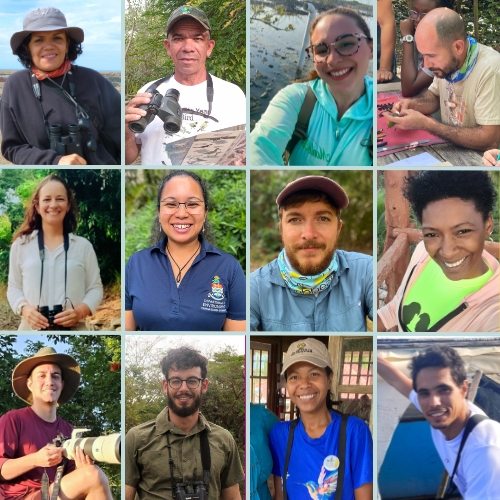
These eleven projects will advance the study and conservation of avifauna in six different Caribbean countries: Cuba, Puerto Rico, the Cayman Islands, Trinidad and Tobago, Mexico (offshore islands in the Caribbean Sea), and Venezuela (Caribbean coast).
Keep reading to discover what exciting plans have been proposed by each awardee, and stay tuned for results and accomplishments in future issues of the Journal of Caribbean Ornithology and blog articles.
Congratulations to these outstanding researchers and conservationists from our BirdsCaribbean community!
Trophic Ecology as a Tool to Understand Differences in the Reproductive Success of Two Species of Terns (Onychoprion fuscata and Onychoprion anaethetus) in the Mexican Caribbean
Adriana Vallarino Moncada, Escuela Nacional de Estudios Superiores Unidad Mérida, Universidad Nacional Autónoma de México
More than half of the world’s seabirds are declining, but there is so much still to learn about many of our seafaring species. Two of these are the Sooty Tern (O. fuscata) and the Bridled Tern (O. anaethetus), where population trends and ecology are poorly understood. This project aims to address this lack of knowledge by studying these two terns at Isla Mujeres. This is the only place these birds nest in the Mexican Caribbean! Building on work already done monitoring the nesting colony and banding chicks, Adriana is taking this applied research a step further by using GPS tracking, stable isotope analysis, and diet studies. This work will shed light on how climate, ocean conditions, and human activities impact the survival of these terns. The data collected will identify key feeding areas and potential threats, providing critical information to help keep these breeding colonies thriving. In addition, the project will expand community outreach programs in Isla Mujeres and Cancún, raising awareness and getting more local people involved in protecting these remarkable seabirds.
Discovering the Birds of the Monte Cabaiguán Wetland, Las Tunas, Cuba
Manuel López Salcedo, Provincial Enterprise for the Protection of Flora and Fauna, Las Tunas. Delta del Cauto Protected Area, Monte Cabaniguán Sector
Monte Cabaiguán is a wetland that plays a crucial role in protecting coastal areas from erosion and filtering pollutants. Home to thriving mangroves and bustling colonies of waterfowl, it supports a rich variety of wildlife. This unspoilt wetland is essential for the breeding and survival of many migratory and resident bird species. The goal of this project is to update the baseline data on the wetland’s birdlife, assess the health of its ecosystems, and develop strategies for sustainable conservation. This project has local communities at it’s heart, with plans for environmental education and the promotion of conservation; safeguarding this unique natural treasure for future generations!
Monitoring Breeding Colonies, Nesting Success and Productivity of White-tailed Tropicbirds (Phaeton lepturus catesbyi) in the North-west Coastal Cliffs Important Bird Area in Puerto Rico
Alcides L. Morales-Pérez, Independent Researcher
Northwestern Puerto Rico is home to the Acantilados del Noroeste (north-west cliffs) Important Bird Area (IBA). Amongst their rich biodiversity, these cliffs are home to an important nesting population of White-tail Tropicbirds, a bird at risk in the Caribbean. This one of the few White-tailed Tropicbird breeding colonies on the Puerto Rican mainland. To help protect and gain more knowledge about these beautiful seabirds Alcides will host a workshop to engage the local community, students, and other stakeholders in seabird conservation, focusing on White-tailed Tropicbirds. Participants will be trained to monitor nests and actively contribute to data collection. Through colony surveys, nest monitoring, and adult survival assessments the project aims to better understand how these birds are faring. It also aims to estimate the size and extent of the colonies on the cliffs, with local volunteers playing a key role.
Diversity, Abundance, Reproductive Colonies and Distribution of Waterbirds at Los Testigos Archipelago, Venezuela
Jemimah Rivera, INPARQUES, División de Investigación y Monitoreo Ambiental
The Los Testigos Archipelago in Venezuela is known for its incredible biodiversity. But the area has been largely overlooked by researchers due to its remote location, with only two bird expeditions in the last 50 years. While little is known about the area, it’s believed to be an important breeding ground for several seabird species. This project aims to assess the conservation status of the archipelago’s seabirds and landbirds. During the project Jemimah and her intrepid team will take on the challenge to explore the 16 islands of Los Testigos! They will study the birdlife of the islands including their seabird breeding colonies. The team will conduct surveys on foot and by boat, counting nests, eggs, and chicks. This research will be a major step in understanding the birds of the South Caribbean. With threats like invasive species, pollution, and overfishing, this study is crucial to help protect these birds for the future.
Establishing Year-Round Bird Banding stations to Monitor Resident and Migratory Species in Trinidad and Tobago
Giselle Ragoonanan, Trinidad and Tobago Bird Observatory and Research Centre
The Trinidad and Tobago Bird Observatory (TTBO) is setting up year-round bird banding stations to monitor both resident and migratory bird populations across the islands. These stations will collect crucial data on bird life cycles, migration, and population health, helping to identify trends and habitat needs. This data will guide conservation efforts, ensuring the protection of key areas for breeding and survival. The TTBO also plans to involve the local community through outreach programs, raising awareness and encouraging citizen participation in bird conservation. Additionally, the continuous monitoring will help track rare species and migration events, providing much needed insights into changing bird populations in the Caribbean.
Conservation Ecology of the Puerto Rican Oriole
Michael Ocasio, University of Maryland, Baltimore County
The Puerto Rican Oriole is a Caribbean endemic bird facing significant conservation challenges. One major threat is brood parasitism by Shiny Cowbirds, which lay their eggs in oriole nests. As a result, Puerto Rican Orioles often raise cowbird chicks instead of their own, leading to low reproductive success. This project will compare the oriole’s abundance, survival, and reproductive success in both lowland and highland habitats. Through surveys, banding, nest monitoring, and Motus tracking, the project will explore how habitat type affects their breeding and provide insights into their movements and territory use throughout the year. The findings will support conservation efforts in Puerto Rico and contribute to international programs like the IUCN Red List.
Study of the Reproductive and Trophic Ecology of Gundlach’s Hawk (Astur gundlachi), an Endemic and Threatened Bird of Cuba
Ernesto Vergara Llano, Faculty of Biology, University of Havana
Gundlach’s Hawk, a critically endangered raptor endemic to Cuba, is facing population declines and fragmented habitats, but much of its breeding and feeding behavior remains a mystery. This exciting project will dive into the secret life of this elusive hawk, focusing on two key areas in western Cuba: the National Botanical Garden and the Ecological Reserve of Los Petriles. Using camera traps to avoid disturbing the hawks, researchers will capture the hawks’ breeding behaviors, nest sites, and feeding habits. The results will provide crucial information to help protect this incredible species and improve habitat management efforts, giving the Gundlach Hawk a fighting chance for survival!
A Comparison of Avian Species Richness between Protected and Disturbed Areas in Grand Cayman, using Passive Avian Acoustic Monitoring
Matthew Southgate and Simone Williams
This exciting project will uncover the birdlife of Grand Cayman using passive acoustic recorders to capture birds’ calls and songs! With bird populations facing major threats from habitat loss due to development, it’s crucial to understand what helps them thrive. The goal is to assess the health of protected areas and guide decisions on conservation and development. The team will measure bird species richness in protected areas, compare it with nearby disturbed land, and identify the factors that influence it. Citizen scientists and student interns will be involved in monitoring, bird surveys, and community outreach. Plus, the project will contribute audio recordings to improve the Merlin Bird ID app, making it easier for this app to identify native species. By understanding bird populations, this project will help protect ecosystems, prevent environmental damage, guide future restoration efforts and promote bird-friendly development.
Action Plan for the Conservation of Psittacidae in the Pico Cristal National Park, Cuba
Inés Lourdes Fernández Rodríguez, Empresa Flora y la Fauna Santiago de Cuba
Pico Cristal National Park in Cuba is home to the island’s vibrant parrot (psittacidae) species, including the Near Threatened Cuban Amazon and the Vulnerable Cuban Parakeet, or “Catey”. These colorful birds are facing serious threats from habitat loss, hunting, and being captured for the pet trade. This project aims to create and carry out a comprehensive Action Plan to protect these endangered species. Building on past efforts like providing artificial nests to help with breeding, the project will monitor bird populations, identify important conservation areas, and study their ecological and nutritional needs. Students, researchers, and the local community will all be involved, with a focus on raising awareness and supporting bird conservation across Cuba.
Impact of Nest Temperatures on Mortality Rates of the Endangered Yellow-shouldered Blackbird (Agelaius xanthomus) in Southwestern Puerto Rico
Retsel Gonzalez, University of Puerto Rico
The Yellow-shouldered Blackbird, an endangered endemic found mainly in southwestern Puerto Rico. It faces ongoing challenges to its reproductive success, despite ongoing conservation efforts. A recent study suggested that the elevated temperatures inside artificial nests might be contributing to the high mortality rates among eggs and chicks. This project will compare survival rates and temperature levels in both artificial and natural nests to determine if temperature is a key factor impacting reproduction. The findings will help refine current conservation strategies, improve nest management, and hopefully boost recovery efforts for this iconic species.
Ecology of Bare-legged Owl (Margarobyas lawrencii) an endemic strigid in Cuba
Jean Michel De Jongh González, Botanical National Garden, Havana University.
The Bare-legged Owl is endemic to Cuba and the only member of its genus, Margarobyas. It relies on dense forests and natural cavities for nesting, but it faces serious risks from habitat loss, which has led to its recent listing on the IUCN Red List of Threatened Species. This study will take place in the Sierra del Rosario Biosphere Reserve in western Cuba and will focus on two main areas: understanding the owl’s behavior and diet, and studying its use of habitats and nesting sites. The project will also tap into local knowledge from nearby communities and Havana. Fieldwork will be done during both the breeding season and off-season to gain a deeper understanding of this unique and remarkable bird.
Are you working on or planning a research or conservation project with Caribbean birds?
Kayroy Baptiste (Union Island Environmental Alliance) entering data into PROALAS survey sheet during a line transect survey of birds behind Anglican Pastoral Centre in St. Vincent.
Our next call for proposals will be advertised in the fall of 2025. Members of BirdsCaribbean conducting research and conservation work are eligible to apply. Stay informed and don’t miss our announcements by subscribing to our monthly newsletter,joining our Listserv, and following us on social media (@BirdsCaribbean on Instagram, Facebook, Twitter, Youtube, and LinkedIn).
BirdsCaribbean thanks our generous donors for supporting these awards, and encourages others to donate to these programs, as well as to consider endowments or other large awards to ensure that our vital grants programs can continue indefinitely. You can help us to continue supporting these invaluable projects by making a donation here.
If you prefer to donate via check, please make this out to “BirdsCaribbean” and in the memo section, note the fund you are donating to. If you have questions, or would like to make other arrangements for donating, feel free to contact Alexia Morales, BirdsCaribbean Operations Manager (Alexia.Morales@birdscaribbean.org). Checks can be mailed to: BirdsCaribbean, 841 Worcester St. #130, Natick, MA 01760-2076
Seven spectacular species of egrets and herons in the Caribbean can have all-white plumage. You read that right—seven! With so many sleek, long-legged, long-necked, all-white waterbirds around, telling them apart can be tricky! But don’t worry—if you look closely, each species has distinctive features that set it apart. Our helpful tips and ID graphics will have you spotting those differences like a pro. Dive in to level up your egret and heron ID skills!
When identifying an all-white egret or heron, focus on a few key features:
Size – Compare it to nearby birds; some species are much larger than others.
Bill color – This varies among species, including yellow, black, and even bi-colored bills.
Leg and foot color – These can be helpful, but may be hard to see if the bird is standing in water.
Breeding plumage – Some species develop special plumes or color changes around the eyes (lores) in breeding season.
Plumage variations – Some birds are only white as juveniles, while others have both white and dark morphs.
1. Great Egret
We’re starting off easy! The Great Egret stands out due to its large size, yellow bill, dark legs, and long, S-curved neck. It favors large freshwater and saltwater swamps, grassy marshes with stagnant water, river banks, and turtle grass beds in shallows behind reefs.
The Great Egret is a common year-round resident in The Bahamas, Greater Antilles, Antigua and Guadeloupe; and an uncommon one in the Virgin Islands. It is a common non-breeding resident in the Cayman Islands, St. Barthelemy, and Barbados. While generally uncommon elsewhere in the Lesser Antilles, local numbers are augmented from September to April by migrants from North America.
Breeding season tip: Great Egrets breeding in the Caribbean develop bright green lores (the area of a bird’s face between its eye and bill), more orangey bills, and extravagant plumes (as shown in the photo above right).
2. Great Blue Heron: White Morph
The only other large bird amongst our seven contenders, the White morph of Great Blue Heron, is very rare. This very tall and large bird is considered by some to be a separate species—Great White Heron (Ardea occidentalis). It can be distinguished from the Great Egret by its larger size, heavier bill, and dull yellowish legs. The common blue morph of the Great Blue Heron (photo below right) looks completely different with blue-gray upper parts, short black plumes on the head, and black-and-chestnut shoulder pattern.
3. Western Cattle Egret
Another all-white waterbird with a yellow-orange bill, Cattle Egrets are much smaller and stockier than our previous two yellow-billed birds. You can find this species feeding in pastures or other open habitats away from water. It is a common year-round resident throughout the West Indies. In breeding plumage, Cattle Egrets no longer makes our list of ‘all-white’ birds, as they take on a tan wash on the crown, breast and upper back. Their legs, eyes, and bill also become reddish!
4 & 5. Snowy Egret & Little Egret
These two species are nearly identical—both have black bills, black legs, and yellow feet, and both prefer freshwater swamps and saltwater lagoons. They’re even roughly around the same size! So—how do you tell these two lookalikes apart?
The first clue is in the lores: look for the yellow lores of the Snowy Egret, in contrast to the greenish-gray lores of the Little Egret. But beware, in breeding plumage the Little Egret’s lores take on a yellowish tint! This however is when clue number two becomes apparent—in breeding birds, the Little Egret sports two long, thin head plumes, whereas the Snowy Egret has shaggy plumes.
Location tip: Snowy Egrets are common in much of the West Indies, while Little Egrets are rare and mostly found in the Lesser Antilles and Puerto Rico.
6. Reddish Egret: White Morph
The medium-sized Reddish Egret comes in two color morphs: one that is all-white, and a more common dark morph that is dark gray with a reddish neck. Both morphs have dark legs, shaggy head and neck feathers, and a distinctive bi-colored bill that is pink at the base and black at the tip. The lores become bright blue during the breeding season.
Behavior tip: Reddish Egrets are known for their unique feeding style: they stalk, run, dance, and leap in the air after their prey, often with their wings spread to create shade and reduce glare.
Juvenile white-morph Reddish Egrets are all also white but they have an all-black bill—this all-black bill and their dark legs set them apart from juvenile Littler Blue Herons which are also all white, but have paler, yellow-green legs and a bi-color bill that is blue-gray at the base and dark at the tip.
You may also mix up a juvenile white-morph Reddish Egret with an adult Snowy Egret because they share an all-black bill—but remember, Snowy Egrets have yellow feet and lores. Reddish Egrets are also larger, and have a heavier bill.
To tell the dark morph Reddish Egret from an adult Little Blue Heron: bill color, as well as the size difference and the leg color are your go-to field marks! For both color morphs, the larger size and shaggy plumage on the neck will distinguish Reddish Egrets from Little Blue herons.
7. Little Blue Heron: Juvenile
Juvenile Little Blue Herons are entirely white, making them easy to mistake for other species. Look for the bi-colored bill color, which is dark at the tip with a pale blue-gray base. This rules out Snowy Egrets (all-black bill) and Reddish Egrets (pink-based bill). As they molt into adult plumage, they become a mix of white and gray before turning completely darkgray with a reddish neck. Adult Little Blue Herons can be distinguished from dark-morph Reddish Egrets by their smaller size, purplish neck and bi-color bill (blue-gray a the base with dark tip), compared to the shaggy rusty-colored neck of the Reddish Egret and bi-colored bill that is pink at the base dark tip .
Little Blue Herons favor calm, shallow waters and and can be found throughout the West Indies year-round.
You can view all the graphics, plus a ‘bonus’ quiz in this pdf booklet:
We’ve created two versions of an ID card that you can download, print, and laminate for easy reference in the field. You can print is as a one-sided 11×17 sheet or a two-sided 8.5×11 page.
Each year, thousands of migratory birds embark on epic journeys south—some fly non-stop to Central and South America, while others stopover or even spend the winter along the Caribbean’s sunny coastlines, wetlands, and forests. Throughout fall 2024, we celebrated these incredible travelers for World Migratory Bird Day (WMBD), and explored the surprising link between their survival and the health of insect populations. Read on to discover the creative ways Caribbean conservation organizations joined the celebration and why protecting insects is vital for the survival of migratory birds!
Worm-eating Warbler with a caterpillar in its beak. (Photo by Bryan Calk ML54410741)
Welcoming Our Winged Travelers
WMBD in the Caribbean officially took place on October 12th, 2024, but migratory birds don’t all move at once. Some begin their journey south as early as August, leaving their nesting sites in Canada and the U.S. for wintering grounds in the Caribbean, Central, and South America. Every year, we eagerly await their arrival as they flock to our shores, wetlands, forests—and even our backyards! Across the Caribbean, celebrations often begin in September and extend through December.
This year’s theme, Protect Insects, Protect Birds, was especially timely, highlighting the urgent need to address the global decline in insect populations. In Spanish: Proteger a los insectos, proteger a las aves, and in French: Protégeons les insectes, protégeons les oiseaux.
Insects are an important protein source for growing birds too. A female Common Yellowthroat feeds its offspring. (Photo by Dawn Gunderson ML621947269)
Unfortunately, insects face numerous threats, including habitat loss, pesticides, climate change, and bright artificial lights at night. For instance, artificial lighting disrupts fireflies’ mating behavior and caterpillars’ feeding patterns, while swarming around outdoor lights leaves insects exhausted and vulnerable to predators. This is bad news for migratory birds—without enough insects to fuel their journeys, birds can struggle to migrate, reproduce, and survive.
One of the WMBD 2024 Insect Ambassadors– a Vivid Dancer (blue morph)– on a pitcher plant. (Photo by Judy Gallagher)
Simple Actions, Big Impact
The decline in insect populations is a significant threat to bird health, but the good news is we can all take simple steps to make a difference. Actions like planting native flowers, trees, and shrubs; supporting organic farming; preserving natural habitats; and leaving fallen leaves for insects can create healthier ecosystems for both bugs and birds.
Tree-planting Grupo Acción Ecológica for a past WMBD celebration in the Dominican Republic.
Caribbean Communities in Action
Communities across the Caribbean came together to raise awareness about the critical role insects play in the survival of migratory birds and to inspire actions that make their environments more insect-friendly. Here are some highlights from this year’s WMBD events held in The Bahamas, Jamaica, US Virgin Islands, Dominican Republic, Puerto Rico, and Antigua and Barbuda.
The Bahamas
To celebrate WMBD, several educational events were held on Grand Bahama Island throughout October and November, engaging students in hands-on learning about birds, their migratory patterns, and the importance of protecting insects to protect birds.
Deana Williamson, a Social Studies teacher at Eight Mile Rock High School, led her students in exploring the connection between insects and birds. Students participated in an interactive activity, matching migratory birds with the insects they typically feed on, while discussing the variety of insects found on the island.
The celebration continued with EARTHCARE’s Bird Educator, Bridget Davis, and members, Jill Cooper and Gail Woon, visiting Bishop Michael Eldon School. Students learned about migratory bird species in The Bahamas and practiced birdwatching techniques using binoculars. Fun prizes like bird-themed bracelets and masks boosted engagement.
Later, Davis and Woon joined Mrs. Rochelle Manchester’s class at Martin Town Primary School for a birdwatching excursion. The students identified 13 bird species, including two rare American Oystercatchers spotted along the shoreline! Reflecting on the experience, Mrs Manchester shared, “The lesson has been the catalyst for a few of them doing their own research on migratory birds. It has truly sparked an interest for the students. I’d love to teach this again next year.”
Two striking American-Oystercatchers, seen by the Martin Town Primary School students in The Bahamas. (Photo by EARTHCARE Bahamas)
Primary School students of the Bishop Michael Eldon School learning how to use binoculars for the first time. (Photo by EARTHCARE Bahamas)
Gail Woon handing out fun bird-themed WMBD materials to students. (Photo by EARTHCARE Bahamas)
Jamaica
BirdLife Jamaica marked WMBD with a muddy but exciting birdwatching event at the Old Harbour Mud Flats in St. Catherine—the third in a series focused on raising public awareness of shorebirds in Jamaica. The first two events were webinars on identifying shorebirds and where to find them, aptly titled ‘Shorebirds: The Beach Bums of the Bird World’ and ‘Birds of the Beach: A Beginner’s Guide to Shore Birding’, respectively.
Twenty enthusiastic birders braved the heat and muddy terrain to put their new shorebird ID skills to the test! The group recorded an impressive 37 species, with the Killdeer and Reddish Egret stealing the spotlight. The real surprise came with the sighting of a lone Black Swift—an uncommon find, as it prefers montane forested habitats, and a lifer for many of the newer birders!
Looking for shorebirds for a CWC Count at Old Harbour mudflats, Jamaica. (Photo by BirdLife Jamaica)
Reddish Egret, dark morph. (Photo by Alan D Wilson)
When in doubt always consult field guides, Old Harbour, Jamaica. (Photo by BirdLife Jamaica)
Black Swift. (Photo by Frank Lin ML459370211)
US Virgin Islands
On WMBD, the St. Croix Sea Turtle Project and Sandy Point National Wildlife Refuge team led a 2-hour, 2-mile birdwatching hike at the refuge, spotting long-distance migrants like Ruddy Turnstones and small wading birds like Wilson’s Plovers. Ellie Sherman, Education and Outreach Officer for the Sea Turtle Project, shared that the small but enthusiastic group enjoyed exploring Sandy Point’s rich ecology and spotting birds in the refuge’s bird blind and along the beach. Fun fact: Sandy Point is where the rare White Tern was spotted in August 2024!
The team after a fun two hour birdwatching tour at Sandy Point National Wildlife Refuge, St. Croix.
The Ruddy Turnstone travels amazing distances each year. (Photo by Anthony Levesque)
The White Tern following Jennifer along the southwest shore of St Croix at Sandy Point National Wildlife Refuge (Photo by Jennifer Valuilis)
Wilson’s Plover. (Photo by Andy Morffew)
Dominican Republic
Maria Paulino and her team from Grupo Acción Ecológica (GAE) celebrated WMBD with classroom lessons and outdoor activities. Preschoolers were excited to learn about the migratory birds that travel thousands of miles every year to spend the winter in the Dominican Republic. Bursting with new inspiration, students then got creative, making bird masks and coloring migratory birds from the Migratory Birds of the West Indies book (free download available!).
Preschoolers coloring migratory birds from the Migratory Birds of the West Indies coloring book. (Photo by Grupo Acción Ecológica)
Students birdwatching with Maria Paulino. (Photo by Grupo Acción Ecológica)
Older students ventured outdoors for an introduction to bird banding. Maria took them through the process of setting up mist nets, collecting data on bird size and weight, and explaining how this information adds to our growing knowledge of what birds require to thrive. The highlight? Using binoculars and field guides to identify local birds!
Students look on as Maria explains how a mist net works to safely trap birds. (Photo by Grupo Acción Ecológica)
Two students learn about the importance insects to healthy bird populations using the WMBD poster. (Photo by Grupo Acción Ecológica)
A winter migrant–an Ovenbird, on the hunt for insects. (Photo by Hemant Kishan)
Students identifying and recording birds seen with Maria. (Photo by Grupo Acción Ecológica)
Puerto Rico
The team at Centro Ambiental Santa Ana (CASA) embarked on an exciting adventure into Puerto Rico’s urban forest, joining students from the Universidad Interamericana – Recinto Metro for a hands-on research project: Exploring the Winged Diversity of Puerto Rico in an Urban Forest. This ongoing research aims to monitor both resident and migratory bird species through monthly counts, along with other activities in the vibrant Santa Ana Forest, located in the Julio Enrique Monagas National Park in Bayamón.
On WMBD, college students with no prior birding experience, but a strong passion for wildlife, kicked off their training to join the research team as bird monitors. After an introduction to the essentials of birdwatching led by Dayamiris Candelario, the group headed to the forest to hone their newly acquired skills . Among the species spotted, a thrilling moment came when they identified their first migratory bird—a male Northern Parula sporting the iconic chestnut “collar”.
Male Northern Parula. (Photo by Steve Buckingham)
The students continued their journey into the world of birding with training and fieldwork, beginning their official bird monitoring on October 24th and 26th. Their hard work paid off as they identified several fascinating species, including the Blackpoll Warbler and Black-and-white Warbler. They were delighted to spot more Northern Parulas foraging in the trees, perhaps hunting for their next bug meal.
A male Blackpoll Warbler in fall migration and winter plumage. Males in breeding plumage in spring look very different—they have a black cap and white cheek patch. (Photo by Anthony Levesque)
Male Black-and-White Warbler on Tree (Photo by Hemant Kishan)
“The project is just getting started, and with each field session, these budding birders are gaining valuable skills and contributing to the growing understanding of Puerto Rico’s dynamic bird population. We are incredibly grateful for the support and materials provided by Environment for the Americas and Departamento de Recursos Naturales y Ambientales (Department of Natural and Environmental Resources),” says Dayamiris.
Dayamiris Candelario and her group of budding researchers.
Antigua and Barbuda
The Environmental Awareness Group (EAG), led field trips to explore wetlands and welcome migratory birds settling in for the winter. EAG staff journeyed to Darkwood Mangrove with students from Jennings Secondary and St. Mary’s Secondary, Parham Mangrove with Sir Novelle Richards Academy and Pares Secondary, and McKinnon’s Salt Pond with Antigua Girls’ High School and Antigua Grammar School.
The thrill of spotting birds in the wild was heightened as participants learned to use binoculars for the first time, with the stunning wetland setting providing the perfect backdrop. A fun game of Bird Spy Bingo added a competitive edge as attendees raced to identify as many species as possible.
St. Mary’s Secondary School students receive their binoculars before heading into Darkwood Mangrove to spot migratory birds. (Photo by Sherrel Charles/EAG)
Jennings Secondary School students with Bird Spy Bingo card. (Photo by Sherrel Charles/EAG)
Shanna Challenger teaches the group how to use binoculars.(Photo by Andrew Bowen/EAG)
EAG also brought bird-themed lessons to the classrooms at Antigua State College and St. Nicholas Primary School, sparking curiosity about migratory birds and their conservation. Students learned how actions like using organic pesticides and reducing waste can help protect birds and their habitats for future generations.
Joshel Wilson presenting to students of Antigua State College. (Photo by Auriel Horseford Hunte/EAG)
WMBD presentation to St Nicholas Primary school students. (Photo by Sherrel Charles/EAG)
Bird stickers for everyone! (Photo by Sherrel Charles/EAG)
WMBD 2024’s Outstanding Educators
We applaud the tremendous efforts of all educators who plan and execute educational and fun activities to ensure an unforgettable WMBD and inspire a love for birds and birdwatching. For WMBD 2024, Environment for the Americas recognized the dedication of the following Caribbean educators: Justin Saunders (BirdLife Jamaica), Osmani Borrego Fernandez (Guanahacabibes National Park, Cuba), Jorge Brocca (SOH Conservacion, Dominican Republic), Achsah Mitchell (St. Eustatius National Park) and Devon Carter (Anguilla National Trust). We are also deeply grateful for the ambassadors, who selflessly deliver WMBD educational materials called ‘Happy Kits’ to Caribbean coordinators.
Environment for the Americas and BirdsCaribbean extend our greatest thanks to all of you and we look forward to seeing what you have planned for WMBD 2025!
Interested in supporting bird festivals across the Caribbean? Your contribution will help expand these invaluable efforts and inspire future generations of bird enthusiasts. Show your support here!
Birds Continue to Connect our world
BirdsCaribbean celebrated WMBD by showcasing new migratory birds in our virtual campaign– Birds Connect Our World. Each bird profile was accompanied by a beautifully drawn image by Arnaldo Toledo, along with stunning high-quality photos, engaging videos, online puzzles tailored for different levels (between six and 1,024 pieces), and bird calls. Fun, free and engaging activities were also provided for both kids and adults, including downloadable coloring pages, experiments, up-cycle crafts, and more.
Migratory Birds in Focus
We’re excited to announce the winning photo for the Caribbean region – Youth category in the 2024 World Migratory Bird Day Photo Contest! Captured by Mattéo Antoine, this striking image of a Semipalmated Sandpiper feeding on Ephydra flies at Pointe des Châteaux, Saint-François, Guadeloupe highlights the critical importance of healthy insect populations for migratory birds, especially those traveling thousands of miles nonstop.
Looking Ahead to 2025: Shared Spaces
The theme for WMBD 2025, Shared Spaces: Creating Bird-Friendly Cities and Communities, will focus on the importance of building urban environments that support both people and wildlife. As cities continue to grow, it’s crucial that we create spaces where birds can thrive—whether through green rooftops, bird-friendly architecture, or protected green areas. By incorporating bird-friendly practices into our daily lives and communities, we can help ensure that migratory birds have safe spaces to rest, feed, and thrive as they journey across the islands.
WMBD 2025 campaign poster, beautifully crafted by artist Annamaria Savrino, showcases the interconnectedness of humans and migratory birds.
If you are interested in celebrating WMBD in your country, or if you can deliver materials to a Caribbean country, we encourage you to visit the WMBD website for more information; or contact the Caribbean Regional Coordinator, Laura Baboolal, at lbaboolal@environmentamericas.org.
For birdwatchers in Cuba, October isn’t just a month; it’s a celebration of nature, science, and the unbeatable spirit of the birdwatching community. Despite the blackouts and shortages of essential items that come with life on the largest island in the Caribbean, birders across the country united for two magnificent birding extravaganzas—October Big Day and Garrido Biggest Week.
In 2023, Cuban conservationists Yaro Rodríguez and Nils Navarro received a Betty Petersen Conservation Fund grant to expand Cuba’s emerging birdwatching movement. The goal was to improve the understanding of Cuba’s birdlife through citizen science.
Their project provided community leaders with binoculars and training to identify and monitor local bird populations and report data through eBird Caribbean. These trained leaders then establish birdwatching clubs in their communities, raising awareness across Cuba about the importance of protecting birds and their habitats. Yaro and Nils’ project continues to grow, with birdwatching clubs across the country now actively engaging in ongoing bird monitoring and conservation efforts.
Yaro Rodríguez.
Nils Navarro.
In addition to several locally initiated birding celebrations throughout the year, birders across the island also participate in two major global citizen science programs: Global Big Day in May and October Big Day in October. Team Cuba is proudly known as the Gundlach Team, in honor of the German-Cuban naturalist and taxonomist Johannes Christoph Gundlach. Yaro details the how the Cuban birding community came together in October to celebrate and protect Cuba’s incredible birdlife.
Gundlach’s Hawk (Photo by Michael J. Good)
Passion and perseverance in Cuba’s birdwatching community
October saw the Gundlach Team remaining steadfast in their exemplary efforts. From dawn onward, birdwatchers from across Cuba ventured into the field, ready to discover and record the country’s rich avian diversity. Notable participants included Yanosky, Manuel Aroche, Ricardo Concepción, Nicolás Díaz, and Marleny Roque, who started their day at first light!
The national bird of Cuba – the Cuban Trogon. (Photo by Rafy Rodriguez)
What makes these events special is not only the number of birds recorded—but the personal stories behind each effort. For some, it was a day of surprises as they encountered new “lifers” to add to their personal lists, while for others, it was an opportunity to improve their standing in the Cuba Big Year 2024. Every list submitted to eBird helped to build a more comprehensive picture of the biodiversity on our island.
Omar Labrada, from Las Tunas, birdwatched with his daughters during October Big Day.
Yusneyda Alarcon and Manuel Lopez from Gramma crossing a mangrove channel during October Big Day.
The community’s dedication was particularly inspiring. Birdwatchers like Edwin Ruiz and Maite Cordoví, despite facing personal challenges, joined in from their windows, showing that a love for birds knows no bounds. Others, like Homar Labrada and his son Marcos, used the occasion to spend the day together, passing down a respect and fascination for birds to the next generation.
Against the odds: The Cuban reality
Birdwatching in Cuba presents unique challenges. One of the biggest challenge our birdwatching community faces is transportation, both to easily accessible areas and to new regions we want to explore. Compounded by fuel shortages, this significantly limits our ability to travel, making each trip a major logistical challenge. On top of that, we deal with frequent power outages and the ongoing stress of meeting our families’ basic needs. Despite these daily struggles and economic difficulties affecting everything from transportation to food, our birdwatching community remains determined, active, and enthusiastic.
Viñales Valley, Cuba.
Every activity we promote and every event in which birdwatchers participate is a meaningful achievement, reflecting the love and commitment we have for Cuban birds and future generations.
October Big Day in Cuba: An unmatched success
On October 12, 63 eBirders, across 15 provinces, with the exception of the Isle of Youth, recorded 186 bird species within just 24 hours. This resulted in 140 eBird checklists, enriched with 96 photos and 31 song recordings. These data not only strengthen the global knowledge base on birds but also underscore Cuba’s commitment to conservation and citizen science.
Among notable individual achievements, Manuel López Salcedo from Las Tunas led the count with 96 species observed across 11 lists. On the women’s side, Yuzaima Ortiz from Ciego de Ávila secured the title of top female lister with a total of 87 species observed.
Members of the formidable Gundlach Team.
This local success was part of a larger global achievement. Over 750,000 birdwatchers from 201 countries participated in this historic day of citizen science, documenting over 7,800 species in just 24 hours. This global initiative highlights the importance of birdwatching as a conservation tool. Each checklist, photo, and recording contributes essential data for science and biodiversity protection.
Garrido Biggest Week: A tribute to a legend
Despite the devastation caused by Hurricane Oscar and ongoing power outages, the Cuban birdwatching community honored Orlando H. Garrido, the country’s most influential ornithologist, who passed away in June 2024. In a fitting tribute to Cuba’s jewel of Caribbean ornithology, the first edition of Garrido’s Biggest Week was held from October 21 to 27. Created to honor Garrido’s legacy and encourage birdwatching during the autumn migration, the event coincided with the dates when Garrido himself would go into the field to record new species.
Orlando Garrido was a tireless explorer of the Cuban archipelago. Garrido has to his credit the discovery of four mammalian taxa and the description of: 58 insects, 21 birds, 37 reptiles. 78 new records among birds, reptiles, and fish, and 23 taxa have been dedicated to him, and in total he has 298 publications. (Photo by Susan Jacobson)
Orlando Garrido regales our group with stories of his Cuban adventures as a biologist and tennis pro! BirdsCaribean Cuba Bird Tour (Photo by Lisa Sorenson)
Orlando Garrido, Nils Navarro and Herb Raffaele at the 21st International Conference of BirdsCaribbean, in Topes de Collantes, Cuba, July, 2017. Orlando was awarded a BirdsCaribbean Lifetime Achievement Award.
Birdwatchers from all provinces participated enthusiastically, recording 183 species and capturing a total of 76 photographs. José Alberto Pérez Echavarría was the winner in this friendly competition, observing 108 species throughout the event.
This week featured some serendipitous sightings, among them was the first record in Cuba of a Lawrence’s Warbler, an important discovery for the island’s avifauna!
An adult male Lawrence’s Warbler. (Photo by Jeff Hapeman ML604876071)
Additionally, the first documented case of xanthochroism in a member of the Todidae family, the Cuban Tody, was observed—this rare phenomenon gives affected birds an unusual yellow coloration. Both discoveries will be part of an upcoming article, expanding on these unique observations in the region.
The Garrido Biggest Week will become an annual tradition. The community also organizes other thematic weeks to honor prominent figures in Cuban ornithology, such as Charles Ramsden Week in December, José H. Bauzá Week in April, and Juan Gundlach Week in August.
These activities are essential for keeping the birdwatching community active year-round, beyond major events like October Big Day and Global Big Day, while also enriching eBird during periods of lower tourist activity in the country. Through these efforts, the Cuban birdwatching community continues to advance the exploration and conservation of the island’s biodiversity, even in the face of adversity.
The power of citizen science
October Big Day and Garrido Biggest Week are also reminders of the value of our birds and the challenges they face. Cuban birdlife, like that around the world, faces constant pressures from habitat loss, climate change, and human activity. In addition, illegal trapping is a huge threat to endemic, resident and migratory birds in Cuba. Through citizen science and unwavering commitment, each Cuban birdwatcher has the opportunity to contribute to conservation and make a difference.
Cuban Parakeets in flight (Photo by Garry Donaldson)
Cuban voices from the field
To conclude, here are some stories that capture the passion and challenges of these unforgettable days:
“When I arrived, the battery pack I’d prepared for my camera failed, so I used my binoculars to do digiscoping and identify birds in tricky situations. Later, in the forest, as we returned to the reservoir embankment, Wency played a mix of bird calls, and we saw several warbler species. Surprise! Among them was a Worm-eating Warbler, a lifer for me. The excitement was indescribable; everyone pointed their cameras and managed to capture the moment.” – Freddy Ricardo, Holguín Birdwatching Club
“I had a lifer: White-eyed Vireo, though without a photo. But I managed to photograph an Osprey for the first time—81 shots as I got closer with digiscoping! I was thrilled to capture this species.” – Manuel Aroche, Granma Birdwatching Club
“A friend and I shared a lifer, a Philadelphia Vireo! The second record of this species in Ciego de Ávila, and during the week we honor Garrido! It couldn’t be better.” – Nicolás Díaz, Ciego de Ávila Birdwatching Club
“I want to dedicate my participation in the October Global Big Day to my dad, who recently passed away. I owe him my love and respect for nature.” – Ricardo Sánchez, Artemisa Birdwatching Club
These anecdotes reflect the dedication and love for birds that motivate our community to keep moving forward. In every field outing, every photo, and every checklist submitted, there lies a collective commitment to preserving Cuba’s rich biodiversity for future generations.
Special Thanks
We would like to extend our heartfelt gratitude to the Betty Petersen Conservation Fund, managed by BirdsCaribbean, for their generous support, and to the team at BirdsCaribbean, especially Lisa Sorenson and Adrianne Tossas, for their unwavering dedication to the birdwatching community in Cuba.
Yaroddys Rodríguez, known as Yaro, is a self-taught ornithologist dedicated to the study and conservation of Cuban birds. Mentored by experts like Orlando H. Garrido and James Wiley, he began publishing scientific articles at a young age. Yaro founded the Cuban Birdwatchers Facebook group, now with over 30,000 members, and promotes the use of eBird for citizen science. He is also a member of the Cuban Zoological Society, BirdsCaribbean, and the Ariguanabo Foundation.
Los Observadores de Aves Cubanos Vuelan alto en Octubre: Aves, Ciencia y el Espíritu de Comunidad
Para los observadores de aves en Cuba, octubre no es solo un mes, es una celebración de la naturaleza, la ciencia y el inquebrantable espíritu de la comunidad de observación de aves. A pesar de los apagones y la escasez de productos esenciales que acompañan la vida en la isla más grande del Caribe, los observadores de aves de todo el país se unieron para dos magníficas extravagancias ornitológicas: el Gran Día de Aves de Octubre y la Semana Más Grande de Garrido.
En 2023, los conservacionistas cubanos Yaro Rodríguez y Nils Navarro recibieron una beca del Fondo de Conservación Betty Petersen para expandir el emergente movimiento de observación de aves en Cuba. El objetivo era mejorar la comprensión de la fauna aviar cubana a través de la ciencia ciudadana.
Su proyecto proporcionó binoculares y capacitación a los líderes comunitarios para identificar y monitorear las poblaciones locales de aves, reportando los datos a través de eBird Caribe. Estos líderes capacitados establecieron clubes de observación de aves en sus comunidades, generando conciencia en toda Cuba sobre la importancia de proteger a las aves y sus hábitats. El proyecto de Yaro y Nils sigue creciendo, con clubes de observadores de aves en todo el país que participan activamente en esfuerzos de monitoreo y conservación de aves.
Yaro Rodríguez.
Nils Navarro.
Además de varias celebraciones locales de observación de aves a lo largo del año, los observadores de aves de la isla también se reúnen para participar en dos grandes programas globales de ciencia ciudadana: Global Big Day en mayo y Gran Día de Aves de Octubre en octubre. El equipo de Cuba es conocido con orgullo como el Equipo Gundlach, en honor al naturalista y taxónomo germano-cubano Johannes Christoph Gundlach. Yaro detalla cómo la comunidad de observadores de aves cubanos se unió en octubre para celebrar y proteger la increíble fauna aviar de Cuba.
Gundlach’s Hawk (Foto de Michael J. Good)
Pasión y perseverancia en la comunidad de observadores de aves de Cuba
En octubre, el Equipo Gundlach se mantuvo firme en sus esfuerzos ejemplares. Desde el amanecer, los observadores de aves de toda Cuba se aventuraron al campo, listos para descubrir y registrar la rica diversidad aviar del país. Entre los participantes más destacados se encontraban Yanosky, Manuel Aroche, Ricardo Concepción, Nicolás Díaz y Marleny Roque, ¡quienes comenzaron su jornada al primer rayo de luz!
El ave nacional de Cuba conocida localmente como ‘tocororo.’ (Foto de Rafy Rodriguez)
Lo que hace especiales estos eventos no es solo la cantidad de aves registradas, sino las historias personales detrás de cada esfuerzo. Para algunos, fue un día lleno de sorpresas al encontrar nuevas especies “lifers” para agregar a sus listas personales, mientras que para otros, fue una oportunidad para mejorar su posición en el Cuba Big Year 2024. Cada lista enviada a eBird ayudó a construir una imagen más completa de la biodiversidad en nuestra isla.
Omar Labrada de Las Tunas observando aves con sus hijas.
Yusneyda Alarcón y Manuel López, de Gramma, cruzando un canal de manglares durante el Big Day de octubre.
La dedicación de la comunidad fue particularmente inspiradora. Observadores de aves como Edwin Ruiz y Maite Cordoví, a pesar de enfrentar desafíos personales, se unieron desde sus ventanas, demostrando que el amor por las aves no tiene límites. Otros, como Homar Labrada y su hijo Marcos, aprovecharon la ocasión para pasar el día juntos, transmitiendo el respeto y la fascinación por las aves a la próxima generación.
Contra viento y marea: La realidad cubana
La observación de aves en Cuba presenta desafíos únicos, centrados principalmente en el transporte. El mayor reto que enfrenta nuestra comunidad de observadores de aves es el transporte, tanto hacia áreas de fácil acceso como hacia nuevas regiones que queremos explorar. Aumentado por la escasez de combustible, esto limita significativamente nuestra capacidad para viajar, haciendo de cada viaje un gran desafío logístico. Además, lidiamos con frecuentes apagones y el estrés constante de satisfacer las necesidades básicas de nuestras familias. A pesar de estas luchas diarias y dificultades económicas que afectan desde el transporte hasta la comida, nuestra comunidad de observadores de aves sigue siendo determinada, activa y entusiasta.
Viñales Valley, Cuba.
Cada actividad que promovemos y cada evento en el que los observadores de aves participan es un logro significativo, reflejando el amor y compromiso que tenemos por las aves cubanas y las generaciones futuras.
Gran Día de Aves de Octubre en Cuba: Un éxito inigualable
El 12 de octubre, 63 eBirders de 15 provincias, con excepción de la Isla de la Juventud, registraron 186 especies de aves en tan solo 24 horas. Esto resultó en 140 listas de eBird, enriquecidas con 96 fotos y 31 grabaciones de cantos. Estos datos no solo fortalecen la base de conocimiento global sobre las aves, sino que también subrayan el compromiso de Cuba con la conservación y la ciencia ciudadana.
Miembros del formidable Equipo Gundlach.
Entre los logros individuales más destacados, Manuel López Salcedo de Las Tunas lideró el conteo con 96 especies observadas en 11 listas. Por parte de las mujeres, Yuzaima Ortiz de Ciego de Ávila se coronó como la mejor observadora femenina con un total de 87 especies observadas.
Este éxito local fue parte de un logro global mayor. Más de 750,000 observadores de aves de 201 países participaron en este histórico día de ciencia ciudadana, documentando más de 7,800 especies en solo 24 horas. Esta iniciativa global resalta la importancia de la observación de aves como una herramienta de conservación. Cada lista, foto y grabación contribuye con datos esenciales para la ciencia y la protección de la biodiversidad.
Semana Más Grande de Garrido: Un tributo a una leyenda
A pesar de la devastación causada por el huracán Oscar y los continuos apagones, la comunidad de observadores de aves de Cuba rindió homenaje a Orlando H. Garrido, el ornitólogo más influyente del país, quien falleció en junio de 2024. En un merecido tributo a la joya de la ornitología caribeña de Cuba, se celebró la primera edición de la Semana Más Grande de Garrido del 21 al 27 de octubre. Creada para honrar el legado de Garrido y fomentar la observación de aves durante la migración de otoño, el evento coincidió con las fechas en las que Garrido mismo salía al campo a reportar nuevas especies.
Orlando Garrido fue un incansable explorador del archipiélago cubano. Garrido tiene en su haber el descubrimiento de cuatro taxones de mamíferos y la descripción de: 58 insectos, 21 aves, 37 reptiles. Se le han dedicado 78 nuevos registros entre aves, reptiles y peces, y 23 taxones, y en total tiene 298 publicaciones. (Foto de Susan Jacobson)
Orlando Garrido deleita a nuestro grupo con historias de sus aventuras cubanas como biólogo y tenista profesional. BirdsCaribean Cuba Bird Tour (Foto de Lisa Sorenson)
Orlando Garrido, Nils Navarro y Herb Raffaele en la 21 Conferencia Internacional de BirdsCaribbean, en Topes de Collantes, Cuba, julio, 2017. Orlando recibió el premio BirdsCaribbean Lifetime Achievement Award.
Los observadores de aves de todas las provincias participaron con entusiasmo, registrando 183 especies y capturando un total de 76 fotografías. José Alberto Pérez Echavarría fue el ganador de esta competencia amistosa, observando 108 especies a lo largo del evento.
Esta semana presentó algunas observaciones afortunadas, entre ellas el primer registro en Cuba de un Bijirita de Lawrence, ¡un descubrimiento importante para la avifauna de la isla!
Un macho adulto de Bijirita de Lawrence. (Foto de Jeff Hapeman ML604876071)
Además, se observó el primer caso documentado de xantocromismo en un miembro de la familia Todidae, el Cuban Tody (Cartacuba o Pedorrera), un fenómeno raro que da a los aves afectadas una coloración amarilla inusual. Ambos descubrimientos formarán parte de un artículo próximo, ampliando estas observaciones únicas en la región.
La Semana Más Grande de Garrido se convertirá en una tradición anual. La comunidad también organiza otras semanas temáticas para honrar figuras prominentes de la ornitología cubana, como la Semana Charles Ramsden en diciembre, la Semana José H. Bauzá en abril y la Semana Juan Gundlach en agosto.
Estas actividades son esenciales para mantener activa a la comunidad de observadores de aves durante todo el año, más allá de grandes eventos como el Gran Día de Aves de Octubre y el Global Big Day, mientras enriquecen a eBird durante períodos de menor actividad turística en el país. A través de estos esfuerzos, la comunidad de observadores de aves de Cuba sigue avanzando en la exploración y conservación de la biodiversidad de la isla, incluso ante la adversidad.
El poder de la ciencia ciudadana
El Gran Día de Aves de Octubre y la Semana Más Grande de Garrido también son recordatorios del valor de nuestras aves y los desafíos que enfrentan. La fauna aviar cubana, al igual que la del resto del mundo, enfrenta presiones constantes por la pérdida de hábitats, el cambio climático y la actividad humana. Además, la captura ilegal es una gran amenaza para las aves endémicas, residentes y migratorias en Cuba. A través de la ciencia ciudadana y un compromiso inquebrantable, cada observador de aves cubano tiene la oportunidad de contribuir a la conservación y marcar la diferencia.
Catey en vuelo. (Foto de Garry Donaldson)
Voces cubanas desde el campo
Para concluir, aquí hay algunas historias que capturan la pasión y los desafíos de estos días inolvidables:
“Cuando llegué, el pack de baterías que había preparado para mi cámara falló, así que usé mis binoculares para hacer digiscoping e identificar aves en situaciones difíciles. Más tarde, en el bosque, mientras regresábamos al dique del embalse, Wency puso una mezcla de cantos de aves y vimos varias especies de warblers. ¡Sorpresa! Entre ellas estaba un Worm-eating Warbler (Bijirita gusanera), un lifer para mí. ¡La emoción fue indescriptible! Todos apuntaron sus cámaras y lograron capturar el momento.” – Freddy Ricardo, Club de Observación de Aves Holguín
“Tuve un lifer: Vireo de ojos blancos, aunque sin foto. Pero logré fotografiar un Águila pescadora por primera vez—¡81 fotos mientras me acercaba con digiscoping! Estaba emocionado de capturar esta especie.” – Manuel Aroche, Club de Observación de Aves Granma
“Un amigo y yo compartimos un lifer, ¡un Vireo de Filadelfia! ¡El segundo registro de esta especie en Ciego de Ávila, y durante la semana que honramos a Garrido! ¡No podría ser mejor!” – Nicolás Díaz, Club de Observación de Aves Ciego de Ávila
“Quiero dedicar mi participación en el Global Big Day de Octubre a mi papá, quien falleció recientemente. Le debo mi amor y respeto por la naturaleza.” – Ricardo Sánchez, Club de Observación de Aves Artemisa
Estas anécdotas reflejan la dedicación y el amor por las aves que motiva a nuestra comunidad a seguir adelante. En cada salida al campo, cada foto y cada lista enviada, hay un compromiso colectivo para preservar la rica biodiversidad de Cuba para las futuras generaciones.
Agradecimientos especiales
Queremos extender nuestro más sincero agradecimiento al Fondo de Conservación Betty Petersen, gestionado por BirdsCaribbean, por su generoso apoyo, y al equipo de BirdsCaribbean, especialmente a Lisa Sorenson y Adrianne Tossas, por su dedicación incansable a la comunidad de observadores de aves en Cuba.
Yaroddys Rodríguez, conocido como Yaro, es un ornitólogo autodidacta dedicado al estudio y conservación de las aves cubanas. Mentoreado por expertos como Orlando H. Garrido y James Wiley, comenzó a publicar artículos científicos desde joven. Yaro fundó el grupo de Observadores de Aves de Cuba en Facebook, ahora con más de 30,000 miembros, y promueve el uso de eBird para la ciencia ciudadana. También es miembro de la Sociedad Zoológica de Cuba, BirdsCaribbean y la Fundación Ariguanabo.
What a year it’s been! 2024 was a whirlwind of excitement, challenges, and growth, and we’re thrilled to share some of the highlights with you. From record-breaking events to building new partnerships, we’ve had quite the ride—and we couldn’t have done it without the support of our amazing community. Here’s a round-up of our most unforgettable moments from the year. Thank you to all our volunteers, members, donors, and everyone who believes in the future of Caribbean birds!
Fantastic fifteen for the Caribbean Waterbird Census
2024 started with us celebrating an amazing 15 years of the Caribbean Waterbird Census. From January 14th to February 3rd, over 200 birders across 14 islands helped us document over 300 CWC checklists! Highlights from this year’s count included a Baird’s Sandpiper spotted in Guadeloupe—a very rare Caribbean visitor!
A volunteer uses a Shorebird ID card at a Caribbean Waterbird Census count. (Photo by Dayamiris Candelario OPAS)
A group of Lesser Scaups at East End Pond. (Photo by Jacqueline A Cestero)
Carrying out CWC surveys on St. Eustatius. (Photo by Jethro van’t Hul)
Sanderling – X19 stopped on another winter visit to Jamaica. (Photo by Damany Calder)
Baird’s Sandpiper (Photo by Caio Osoegawa ML628469580)
Big Day got even BIGGER!
On Global Big Day, May 11, birders around the world got out and about to join in the fun. In the West Indies, we shattered our records for both participation and bird sightings! Big Day birders in the region saw 551 West Indian species, thanks to the amazing efforts of 710 eBird observers—up from 511 last year! But wait there’s more: there were more species sighted (1,354 total, 208 more than last year) and a huge leap in the number of checklists submitted—2,755 total, nearly 1,000 more than last year—phenomenal!! We’re proud of this fantastic win for citizen science in the West Indies!
Dominica’s Imperial Seekers seeking out the magnificent Imperial Amazon for Global Big Day 2024. (Photo by Garry Auguiste)
Members of Wadadli Warblers in Antigua got in on the early birding action for GBD 2024. Photo by Shanna Challenger
A subgroup of the Gundlach Team in Cuba ready to dominate the competition on the morning of GBD 2024.
Big Day wasn’t just about ticking off the birds though, our fun ‘Teams competition’ and annual fundraising efforts were back—this time to enable Caribbean conservationists to come together and strategize to protect our birdlife. We raised over $25,000, an amazing effort that helped bring many deserving Caribbean nationals to our 24th International Conference in the DR! Speaking of which…
We made BirdsCaribbean history in the Dominican Republic!
A record-breaking 338 delegates from 32 countries and islands flocked to Santo Domingo, Dominican Republic, making our 24th International Conference our largest gathering ever! Conservationists from all walks of life came together, united by a shared mission: protecting the incredible birds that define our region. Centred on the theme: “From Mangroves to Mountains: Safeguarding our Avian Treasures,” the conference featured expert-led presentations, roundtable discussions, training sessions, networking opportunities, fundraising initiatives, and birding trips to observe Hispaniola’s diverse bird species, including its unique endemics. From mangrove conservation to Hispaniola’s endemics to habitat restoration—the conference was a hub of knowledge sharing, networking, collaboration, and inspiration.
Anne-Isabelle Bonifassi, Executive Director of Haiti National Trust, speaks about ecosystem restoration in Haiti, during the Hispaniola Day symposium.
Problem tree being analysed and turned into a results tree by participants.
First time BC Conference attendee Soraya proudly stands next to her poster.
Delegates birding at Ebano Verde.
Palmchat. (Photo by Dax Roman)
Traditional Dominican dancers at the opening reception.
In collaboration with researchers from Virginia Tech, BirdsCaribbean learned more about one of these threats—human disturbance. Early in 2024 we published a report based on a survey of those who do CWC counts, which showed that they perceive human disturbance to be the most significant threat to shorebirds in our region. The report highlighted the need for more social and biological research on human disturbance, and how to tackle this threat.
As we get ready for the 2025 CWC regional count we hope Caribbean birders head for the coast to observe and record shorebird sightings! If you would like to support shorebirds and their threatened habitats, please click here.
Birds and bugs: A perfect pairing for conservation!
Are you Team Insects or Team Birds — or both?! (Photo by TTBO)
Male Puerto Rican Mango. (Photo by Rafy Rodrguez)
Posters about insect types and functions, created by STENAPA staff. (Photo by STENAPA)
Youth enjoying bird games offered by the University of Havana Bird Ecology Group. (Photo by University of Havana Bird Ecology Group)
Completed birdhouses. (Photo by BarbudanGO)
Group birdwatching at Hope Botanical Gardens. (Photo by BirdLife Jamaica)
Six more reasons to celebrate Caribbean endemic birds
This year, we welcomed six newly-recognized Caribbean endemics, bringing the total to an impressive 185! Meet the latest members of our avian family: Grenada Wren, St. Vincent Wren, St. Lucia Wren, Kalinago Wren, Martinique Thrasher, and the St. Lucia Thrasher. More birds to celebrate, more species to protect!
The St Vincent Wren has a notably long wing chord. (Photo by David Hollie ML600921241)
The St Lucia Thrasher has dark brown plumage overall and white underparts. (Photo by Blake Matheson ML214222511)
New resources to keep you informed and inspired
We’ve been busy behind the scenes, launching new resources to keep you in the loop on all things bird conservation. Our first-ever Endemic and Threatened Species Working Group (ETSWG) newsletter debuted this month, packed with the latest research and happenings in the field. Click here for an insightful and enjoyable read! For the latest news and research about our birds farther from shore, dive into our Seabird Working Group newsletter. Both are available in English, Spanish, and French. As always, we welcome your feedback.
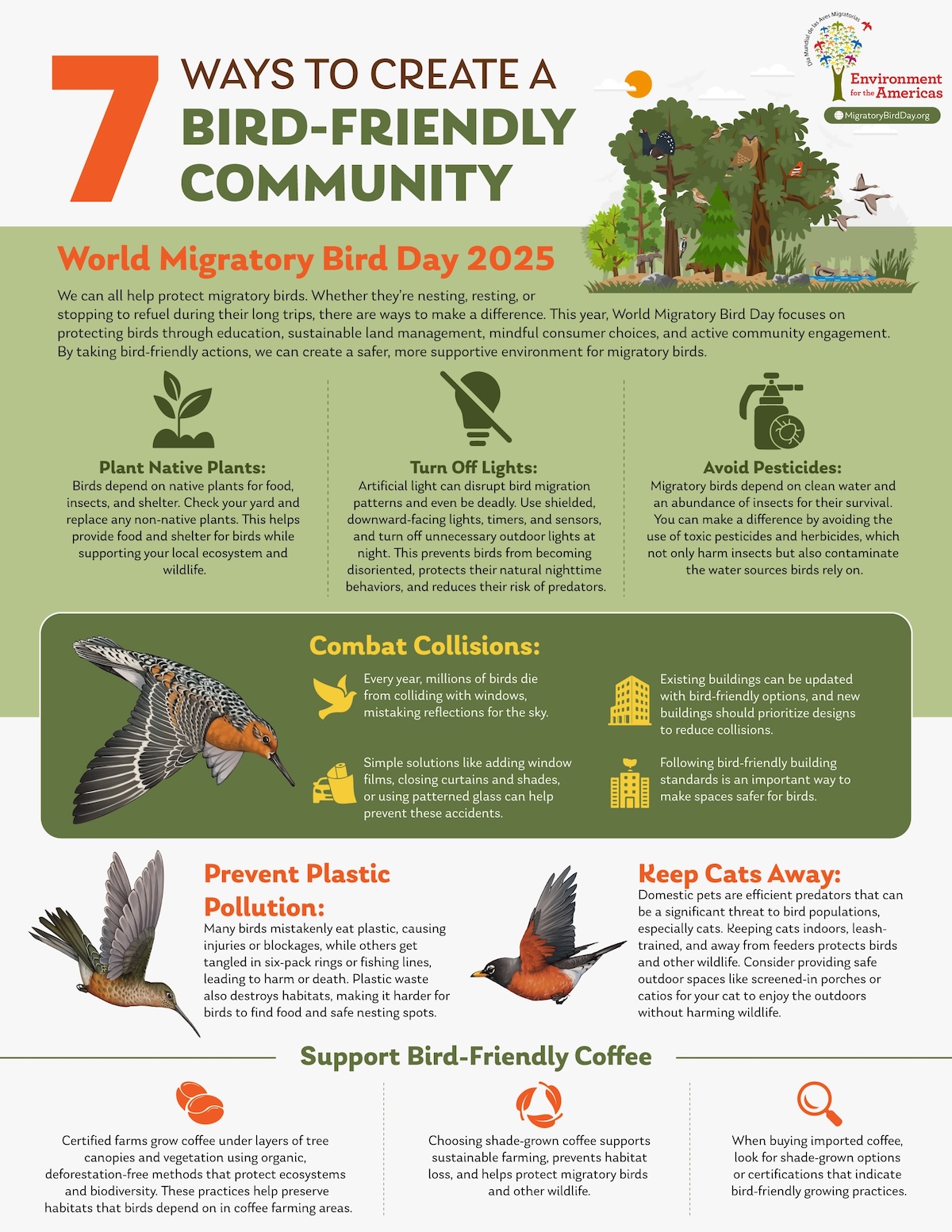
And by the way, have you checked out the latest edition (#37) of the Journal of Caribbean Ornithology? It includes research articles and notes, as well as conservation reports, book reviews, perspectives, and opinions. Even more exciting? Volume #37 is a JCO Special Issue!—featuring the contributions from the 24th International BirdsCaribbean Conference! Check out this amazing compendium to rediscover all the fantastic insights shared at the conference!
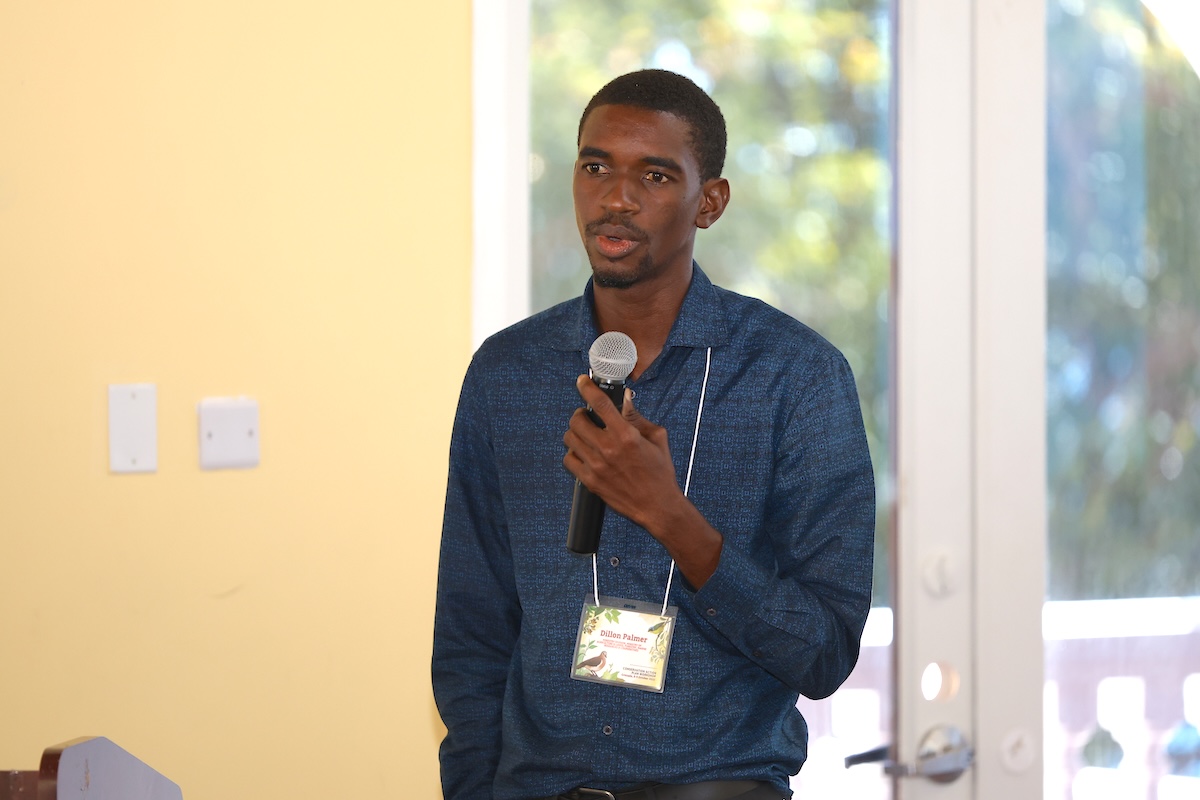
Always released in English, Spanish, and French, the annual Seabird Working Group is the perfect resource to stay up-to-date on the latest in Caribbean seabird conservation.
From Mangroves to Mountains – Explore JCO Special Issue Vol. 37!
It’s a first edition! Dive right into the newly launched Endemic and Threatened Species WG Newsletter – in English, Spanish, or French, of course!
Training champions for birds and conservation
In October, BirdsCaribbean collaborated with a local NGO, WIRRED (Walkers Institute for Regenerative Research and Design) to conduct a week-long Caribbean Birding Trail Guide Training Workshop on the island of Barbados. Home to the endemic Barbados Bullfinch, the island’s wetlands and coastline harbour critical stopover sites and wintering habitat for migratory species. The training covered not only bird identification and guiding techniques, but also how to tell stories and make connections to the island’s rich cultural, historical, and ecological heritage through the art of environmental interpretation. Congratulations to the 21 newly trained bird guides and conservation champions from Barbados, Antigua, Sint Eustatius, and Cuba!
BirdsCaribbean is pleased to present our Caribbean Birding Trail 2024 cohort! (Photo by WIRRED)
In the US Virgin Islands, 22 educators from three islands learned to engage students with nature and science through birds! Two BirdSleuth Caribbean workshops were held in June, in partnership with SEA (St Croix Environmental Association), the USVI Dept of Environment and Natural Resources, and Horsley Witten Sustainable Environmental Solutions. Over two days, each group explored the BirdSleuth Caribbean curriculum and discovered how to bring birds into the classroom. Birds are excellent for teaching scientific skills as well as gaining appreciation of the islands’ wonderful bird life.
Our Caribbean Landbird Monitoring Program continues to build regional conservation capacity!
This year our 3rd annual bird banding workshop (as part of the Caribbean Landbird Monitoring Program) migrated down to the Lesser Antilles in St. George, Grenada. From March 7 – 11 participants learned all about songbird banding at scenic locations like the Blue Horizons Resort (featuring views of the white sand Grand Anse Beach) and in the dry forests of Mount Hartman National Park (featuring views of the critically endangered Grenada Dove). With collaboration from Klamath Bird Observatory, participants received training from internationally recognized and North American Banding Council (NABC) certified trainers on all the banding basics from how to properly handle birds, how to extract birds from mist nets, and an introduction to the topic on every bander’s mind, molt. We welcomed 18 participants from 9 different islands and at the end celebrated the certification of two more Caribbean NABC trainers: Daniela Ventura of Cuba, and Zoya Buckmire of Grenada. Congratulations!!
Daniela Ventura instructing participants during the CBB workshop in Grenada. (Photo by Holly Garrod)
We returned to the scenic mountains of Jarabacoa, Dominican Republic for our third annual Landbird monitoring Workshop from 22-26 February, 2024. This year we were ecstatic to welcome 25 participants from 14 different islands. Participants learned the ins and outs of how to set up PROALAS landbird monitoring on their islands, how to enter data using eBird, and how to train people on basic bird identification, featuring some endemic birds of Hispaniola! No workshop would be complete without excursions into the field to practice these monitoring techniques, and participants got to wander the rolling hills around Jarabacoa, finishing with a field trip to the Scientific Reserve, Ebano Verde for chances at finding a Hispaniolan Trogon! Thanks to our Caribbean Landbird Monitoring Small Grant initiative, participants are already making an impact! Six new monitoring programs have launched in The Bahamas, Dominican Republic, Grenada, and Cuba, putting skills into action to protect Caribbean birds.
Weathering the Storm: Resilience in the Face of Climate Change
2024’s hurricane season started early, impacting several of our islands to varying degrees. Climate change fueled extreme weather is no doubt becoming the “order of the day.” Hurricane Beryl (the earliest hurricane ever to reach Category 5 intensity) arrived in early July, and wreaked havoc on Union Island, destroying the 13 year-long Ashton Lagoon project, where the office of Sustainable Grenadines (SusGren) is located. Fortunately there were no casualties, but the entire island was devastated. Now, SusGren’s Executive Director Orisha Joseph is determined to “build back better and stronger.” If you would like to contribute to the restoration of Ashton Lagoon, click here. Beryl also devastated the small sister islands of Carriacou and Petite Martinique, near Grenada, and went on to cause destruction and flooding in parts of Jamaica.
The charming SusGren office before it was destroyed by Hurricane Beryl. (Photo by Sustainable Grenadines Inc.)
Sustainable Grenadines office was completely destroyed when Hurricane Beryl passed through Union Island on July 1, 2024. (Photo by Orisha Joseph)
Ashton Lagoon mangrove littered with littered with chairs, desks, filing cabinets, papers. (Photo by Orisha Joseph)
We recognized and celebrated our committed conservation community!
The BirdsCaribbean Awards were celebrated with rousing applause on the final night of our conference in the Dominican Republic.
Winners of the prestigious Lifetime Achievement Award were Christopher Rimmer, Emeritus Executive Director of Vermont Center for Ecostudies (VCE)—the “Bicknell’s Thrush man”; and Dr. Steven C. Latta, Director of Conservation and Field Research at the National Aviary of the Dominican Republic.
Lifetime Achievement Award recipient Christopher Rimmer with BirdsCaribbean Executive Director Lisa Sorenson, BirdsCaribbean President Adrianne Tossas and Andrea Thomen.
Lifetime Achievement Award recipient Dr Steve Latta with BirdsCaribbean Executive Director Lisa Sorenson, BirdsCaribbean President Adrianne Tossas and Andrea Thomen.
President Dr. Adrianne Tossas handed out the coveted President’s Awards to four exemplary organisations on the island of Hispaniola: The Peregrine Fund Dominican Republic, Grupo Jaragua, Grupo Acción Ecológica and Action pour la Sauvegarde de l’Écologie en Haïti. Meet our full roster of awardees here! Congratulations to all—you inspire us to keep pushing harder everyday!
We proudly supported 12 projects through the David S. Lee Fund for Caribbean Birds and the James A. Kushlan Research and Conservation Fund. These projects advanced avian research and conservation in seven Caribbean countries: Cuba, Jamaica, Puerto Rico, the Dominican Republic, Mexico (offshore islands), St. Eustatius, and The Bahamas. Projects ranged from establishing bird diversity data in The Bahamas, to evaluating education campaigns for the Endangered Jamaican Blackbird, studying the role of urban parks for birds in Cuba, tracking Puerto Rican Orioles, and enhancing Red-billed Tropic Bird conservation in St. Eustatius. We are thrilled to support the dedicated researchers and conservationists in our BirdsCaribbean community.
Without a doubt, we are #StrongerTogether
Giving Tuesday was a huge success, exceeding our $15,000 target! With the theme “Stronger Together: Empowering People, Saving Birds” we are continuing our fundraising efforts with a new target of $60,000! Our team members have raised just over $51,000 so far—we’ve got 18% to go and it’s not too late to help us reach our goal! View our fundraising page here—where a generous match from the BirdsCaribbean board means that any help you give is doubled to continue our work with the people and birds of the Caribbean!
Farewell to some true bird conservation legends
This year we said sad farewells to beloved champions of Caribbean birds. They will be missed…
Wayne Burke at Woodbourne Shorebird Refuge. (Photo by Yves Aubrey)
Wayne “Doc” Burke of Barbados who passed away on November 19, tackled the issue of hunting shorebirds, establishing the Woodbourne Shorebird Refuge, a former shooting swamp that became a haven for shorebirds. His pioneering efforts spurred a change in attitudes and practices among Barbadian hunters, and led to the establishment of more shorebird refuges. Read more here.
John Fletcher walking along the beach during a visit to Yallahs Salt Ponds, a place where he was always very happy. (Photo by Emma Lewis)
London-born John Fletcher, who died at the age of 95 in Kingston and adopted Jamaica as his home at a young age, became a successful businessman, a coffee producer—and most of all an avid birder and a President of BirdLife Jamaica. He was a revered and loved “guru” for bird watchers of all ages, conducting countless bird tours across the island. Read more here.
Simón Guerrero was a founding member of the Society for the Conservation and Study of Caribbean Birds. An engaging teacher and speaker with a great sense of humor, he influenced many to become fans and defenders of nature over several decades.
We remember an extraordinary environmental educator, Simón Guerrero, who passed away earlier this year. His research on urban ecology focused on making cities more habitable for wildlife, including birds. Simón had a remarkable ability to bring the wonder of birds into classrooms, captivating both students and teachers. A passionate advocate for inclusivity, he founded a birding group for blind Dominicans and emphasized the importance of ensuring that birds “know” our actions are in their favor.
Orlando Garrido was a tireless explorer of the Cuban archipelago. Garrido has to his credit the discovery of four mammalian taxa and the description of: 58 insects, 21 birds, 37 reptiles. 78 new records among birds, reptiles, and fish, and 23 taxa have been dedicated to him, and in total he has 298 publications. (Photo by Susan Jacobson)
We also said goodbye to a giant in Cuban ornithology on June 24, Orlando Garrido—an exceptional scientist, naturalist, colleague, teacher, mentor, and friend to so many. Orlando was dedicated to his work until the very end, discussing ornithology and measuring birds for another publication the evening before his passing! We are grateful to have celebrated Orlando’s numerous accomplishments with a Lifetime Achievement Award at our International Conference in Cuba in 2017 and a wonderful article with many photos on the occasion of his 90th birthday.
Looking ahead: Big things are coming in 2025!
With our focus remaining on our threatened shorebirds, we are looking forward to the 16th annual Caribbean Waterbird Census regional count (January 14 to February 3, 2025), which includes the global World Wetlands Day (February 2, 2025). With a long-term database of over 27,000 CWC lists, your participation will add to a valuable resource for bird conservation across the region. Don’t forget that we have a wealth of handy bird ID materials on our YouTube channel to help you in your quest—and you can conduct waterbird censuses at any time of the year, of course.
Speaking of shorebirds, in 2025 we will be working to have Monte Cristi in the Dominican Republic designated as a key site in the Western Hemisphere Shorebird Reserve Network. Some 20,000 birds stop off at Monte Cristi annually during their migration.
Building our banding network will also be a 2025 priority, as we seek to equip conservationists with those important skills. Applications for our upcoming workshop in the DR are now closed but keep an eye out for future opportunities!
Aerial view of the Motus station installed at Walkers Reserve Barbados. (Photo by Shae Warren)
More Motus! We hope to install more Motus stations across the region, to track our precious migratory species.
We’re off to the bird haven that is the beautiful island of Cuba for what promises to be two amazing bird tours! (January 23 – 31 and March 19 – 30, 2025). Both tours are fully booked, but you can still browse the itineraries and join the waiting list for 2026 by clicking here.
Thank You for an Incredible Year!
2024 was a year to remember, and it was made possible by you—our dedicated members, partners, and supporters.
Stay up to date with us in 2025 with the latest news from the field, BirdsCaribbean programs and events, and opportunities to get involved—free to your inbox, by signing up for our monthly newsletter. Cheers to a fantastic 2025!
Georgie Thornton (right) and Kierra Clarke (left) from WIRRED. (Photo Lisa Sorenson)
Sun, sand, sea and….birds? Yes that’s right, birds! While Barbados is celebrated for its immaculate beaches, vibrant culture, and breathtaking landscapes, this Caribbean gem is also a haven for migratory birds and a great place for birdwatchers. From charismatic shorebirds to colorful warblers, Barbados offers a veritable treasure trove of avian wonder for those who know where to look. In October 2024, BirdsCaribbean teamed up with local NGO WIRRED to shine a spotlight on this hidden birding paradise by hosting a transformative week-long Caribbean Birding Trail Guide Training workshop. Together, we aim to change perceptions and unlock the island’s incredible birdlife for visitors and locals alike!
Although Barbados may not be known primarily as an ecotourism or bird watching hotspot, its wetlands and coastlines are critically important in supporting tens of thousands of migratory shorebirds each year—making them a goldmine for bird lovers! Barbados is also home to the Barbados Bullfinch, a unique and delightful species found nowhere else on earth. Positioned further east in the Atlantic than the rest of the Lesser Antilles, Barbados often welcomes unexpected feathered visitors, adding to its special charm! By cultivating a vibrant birding culture and tourism market, Barbados has the opportunity to raise awareness of the value wetlands and other habitats for birds, fostering sustainable livelihoods in local communities, and build momentum for long-term conservation efforts.
Participants practice identifying birds during the workshop. (Photo by WIRRED)
From October 21-25, participants dove into an immersive workshop designed to equip them with the essential skills for delivering exceptional birding experiences. The comprehensive curriculum covered bird identification, behaviour, ecology, habitat conservation, and environmental interpretation—the art of telling stories to connect visitors with the natural and cultural heritage of Barbados. Led by expert instructors from BirdsCaribbean, the training blended in-depth knowledge and hands-on field experiences, including visits to key birding sites around the island to hone bird identification and guiding techniques. Curious about the highlights? Keep reading as Georgie Thornton, Project Officer at WIRRED, and her colleagues share their insights!
The Wonderful Wetlands of Barbados
Georgie (left) takes part in a birding fieldtrip as part of the workshop. (Photo by Alex Sansom)
I have always been extremely proud of living in Barbados. We’ve got amazing people, gorgeous beaches, flamboyant gardens, and a generally positive atmosphere. But one thing that wasn’t on my ‘must see and do’ list for the island was birdwatching. After five incredible days immersed in the Caribbean Birding Trail Bird Guide Workshop, packed with thrilling tours to Barbados’s top birding spots, I’ve come to realize that no trip to Barbados is complete without exploring the island’s exceptional birdlife!
This tropical paradise serves as a vital stopover for countless migratory bird species, making it a haven for birdwatchers and nature enthusiasts alike. Over the last 10 years, Walkers Reserve has been creating or rehabilitating habitats that have attracted a wonderfully diverse variety of birds. Since I joined the team, I have started to recognise just how important birds are to the ecosystems throughout Barbados, and have developed a healthy respect for these feathered friends.
In 2022, we hosted BirdsCaribbean’s Wondrous Wetlands Workshop where I was able to dip my toes into the world of birding. Ever since, I have been waiting with great anticipation for the CBT Bird Guiding Workshop held this October. I was looking forward to deepening my appreciation for our resident and migratory birds and to sharing the experience with the 20 other local and regional participants!
Walkers Reserve is sanctuary for migratory birds, from colourful hummingbirds to soaring raptors. It is a birder’s paradise. (Photo by WIRRED)
Which Bird Sparked Your Passion?
Venicio ‘Beny’ Wilson broke the ice on the first day by asking everyone to name their ‘trigger bird’—the bird that first drew them into birding or made them start noticing birds. While some participants shared the same bird, everyone had their own wonderful and unique story. One participant mentioned a falcon seen at just 9 years old, shown to them by their grandparents on the south coast boardwalk. Another was completely captivated by the Osprey, which ignited their birding passion. My bird is the Bananaquit. It has always been a constant presence in my garden, gorging itself on the sugary nectar of the banana and bird of paradise flowers.
Osprey with fish. (Photo by Bernie Duhamel)
Dr. Amelia Rouse, Research Consultant at WIRRED, shared her experience of those first days of the workshop:
“I’ll be honest, before the workshop I wasn’t that interested in birds. I liked the typical Osprey and falcon—the big birds of prey with sharp claws. But the workshop helped me see differently. Suddenly all of the birds roaming around had names, features, field marks, bills, calls, and curious behaviours. Some just chill in the pond, some birds hover over the pond, and some birds even twerk by the pond. Who knew…”
Hear the Bird Call and Spread Your Wings
It was the start of a fantastic week of bonding over birds. It was awesome to see everyone spread their wings as they started to understand how to differentiate similar ‘sandpiper’ species, and to tell the call of the Lesser Yellowlegs from that of the Greater as they fly overhead. As the mini quizzes got harder, everyone stepped up to the challenge and soon, an uninitiated person dropping into the conversation wouldn’t have had a clue what we were all talking about!
Interactive classroom sessions came to life with learning activities and field trips to important birding locations on the island. These included visits to Walkers Reserve, Woodbourne Shorebird Sanctuary, Cherry Tree Hill, Harrison’s Point, and King George V Park.
Spotted — this pair of Black-bellied Whistling-Ducks and their brood of chicks thrilled participants and tested their ID skills! (Photo by Venecio Wilson)
Woodbourne was particularly special for me. Greeted by a stunning rainbow which brilliantly spanned the reaches of the swamp, we were shown around by Ian Alkins, Woodbourne’s dedicated caretaker. We spotted a fascinating variety of birds, including the Wilson’s Snipe, Solitary Sandpipers, and lots of Black-bellied Whistling-Ducks—and their very cute babies! We were fascinated as a kingfisher hovered 60 ft in the air before careening down to grab a fish he’d been eyeing so far above.
Give Deeper Meaning to Your Story
In addition to Bird Identification, instructor Rick Morales introduced participants to the art of Interpretation*. Through this session, we learned how to tell stories that could foster meaningful and inclusive experiences for our guests, deepening their understanding, broaden their perspectives, and inspire engagement with Barbados’ natural and cultural heritage The workshop helped us to drastically improve our guiding and presentation skills, culminating in a presentation on something we were passionate about on the last day of the course.
Dr. Amelia Rouse presenting her topic of children can be inspired through cartoons to conserve nature. (Photo by Lisa Sorenson)
Group watches as Amelia presents. (Photo by Alex Sansom)
Amelia highlights her experience below:
Georgie presents on the final day, about composing with worms. (Photo by Venicio Wilson)
“What I also found interesting about the workshop was how the different presenters engaged us with personal stories. One of the keys of the interpretation module was to add some of your own personality to your guiding and touring presentations. I kept this in mind when I prepared my final presentation at the end of the workshop and used personal stories about my childhood connection to nature and cartoons. The final message was that children can be inspired through cartoons to conserve nature. I’d like to thank the CBT, Birds Caribbean and WIRRED for organising a fun and engaging workshop.”
Other participants presented on native medicinal plants, archaeology, coral restoration, bees, tour guiding in Barbados and Antigua, worm compost, their native quail-doves, and even read moving poems they’d written about their experience throughout the week.
Now, for anyone who visits Barbados and specifically Walkers Reserve, I will always show off our splendid Bajan birds, ensuring they leave with an understanding of just how important these birds are to Barbados and a desire to experience them more. With 21 new birding champions on the island, we hope to foster the birding community here on island to ensure areas important to these birds are treasured.
Participants were thrilled with the experience!
Participants wholeheartedly described it as one of the most enriching experiences they’ve ever had. Amelia explained, “I joined the weeklong course to learn more about bird ID — but I learned so many more things! I learned about interpretive guiding, about the degradation of habitats for shorebirds, and I learned how to present better as a guide! I think it’s a really great course for anybody interested in birds and guiding.” Participant Chaka Audain agreed that the course delivered way more than he expected: “At first, when I started this course, I really thought it would just be specialized in increasing my knowledge about birds, but I realized that I was just scraping the surface of what the course offered. We dived into business strategy for tour guides, how to connect better with clients — and techniques to really relate to people! I gathered so much more than I originally thought I would in this workshop, and I’d recommend it — not just to bird enthusiasts, but anyone else in the tour guiding business, and anyone else dealing with tourists — it will help you multifold your ventures.”
BirdsCaribbean is pleased to present our Caribbean Birding Trail 2024 cohort! (Photo by WIRRED)
Next Steps—and a heartfelt Thank You to our Sponsors!
During the workshop, a “Birding in Barbados” WhatsApp group was formed where participants and more experienced birders in Barbados are sharing what birds they are seeing, finding out about the best birding spots on the island, and getting help with bird ID as needed. Some of the group have already been on birding field trips to continue practicing their bird identification skills—essential for becoming a knowledgeable guide. With all this enthusiasm and practice we have at least one participant, not previously a birder, who is already signed up to guide bird tours in Barbados!
The group out birding during the workshop (Photo by Alex Sansom)
Georgia Scarlett, Environmental Projects Manager at the Sandals Foundation, one of the main sponsors of the guide training, explained, “As a Foundation, we know that becoming stewards of your environment begins with education. With this, we continue to support capacity building sessions across the region.”
“This project not only strengthens capacity and fosters stewardship,” Scarlett continues, “but has the added benefit of livelihood development as birding is an exciting tourism opportunity. Globally, travellers are eager to participate in nature tourism activities and, with these sessions, trainees are able to provide this service.”
Georgie Thornton is a Bajan wildlife conservationist. She currently works at WIRRED as Project Officer, managing various habitat regeneration and monitoring programs.
Acknowledgements: The CBT Interpretive Guide Training was made possible through the generous support of our sponsors and local partners. These include the Sandals Foundation, WIRRED, the US Fish and Wildlife Service, US Forest Service International Programs, USAID, and Vortex Optics.
The Barbados CBT Interpretive Guide training is the eighth training to be carried out by BirdsCaribbean. Previous trainings have been held in Grenada, Jamaica, Dominican Republic, Bonaire, Cuba, St. Vincent and the Grenadines, and the Turks and Caicos Islands. These guide trainings are integral to advancing the vision of the CBT—connecting people to the extraordinary places, diverse cultures, and people of each island. Through the CBT, we promote natural and authentic experiences that benefit local people and encourage the protection of the Caribbean’s natural resources, including birds and their habitats.
*Interpretation is a purposeful approach to communication that facilitates meaningful, relevant, and inclusive experiences that deepen understanding, broaden perspectives, and inspire engagement with the world around us. (National Association of Interpretation).
The Lesser Yellowlegs, a medium-sized shorebird widespread in the Caribbean, has suffered a population decline of 30 to 49%. Its IUCN threat level has been raised from Least Concern to Vulnerable. (Photo by Hemant Kishan)
BirdsCaribbean is sounding the alarm over the significant declines in shorebird populations, highlighted in a recent update to the International Union for the Conservation of Nature (IUCN) Red List. The report, released during the COP16 UN Biodiversity Conference in November, reveals that 16 shorebird species have been moved to higher threat categories, with some populations plummeting by least 30% over the past three generations.
“This is a wake-up call,” said Lisa Sorenson, Executive Director of BirdsCaribbean. “The Caribbean is a lifeline for migratory shorebirds, providing critical stopover and wintering sites along the Atlantic Flyway. When these habitats are lost or degraded, or disappear, these birds face severe challenges.”
Many of the reclassified species are familiar visitors to the Caribbean, reflecting the region’s vital role in their life cycles. Among the newly listed species are the Lesser Yellowlegs, now classified as “Vulnerable,” and the Greater Yellowlegs, listed as “Near Threatened.” Other widespread species like the Ruddy Turnstone are also in decline, facing threats such as habitat loss, disturbance, and climate change-related impacts. The Short-billed Dowitcher has also experienced worrying population declines.
The Role of Coastal Habitats
Coastal wetlands, including mangroves, swamps, ponds, beaches, sand flats, and mud flats, are essential for shorebird survival, yet they are disappearing at an alarming rate. According to the Caribbean Biodiversity Fund (CBF), 12% of the world’s global mangroves are found in the Caribbean, but nearly 7,000 square kilometers were lost between 1980 and 2010. At this rate, the CBF surmises, “the Caribbean’s mangroves could disappear in the next 60 years.”
Over 20,000 shorebirds rely on the wetlands at Monte Cristi in the Dominican Republic during migration every year – making this a regionally important site and a critical lifeline for shorebirds. (Photo by GAE)
Shorebirds feeding at Cargill, which is designated as Western Hemisphere Shorebird Reserve Network (WHSRN) site of regional importance, and holds important number of shorebird species such a Red Knot and Short-billed Dowitcher. (Photo by Jeff Gerbracht)
Over 100 Piping Plovers, classified as Near Threatened by the IUCN, along with many other wintering shorebirds, were counted on Andros and nearby cays in The Bahamas during our 15th Caribbean Waterbird Census. (Photo by Chris Allieri)
Mangroves across the region are experiencing degradation from multiple pressures, including pollution, unsustainable development, and the effects of climate change. (Photo by Maria Paulino)
A Call to Action
“The destruction and degradation of Caribbean coastal habitats from increased tourism, housing and agricultural developments, pollution, and extreme weather events has devastating consequences,” Sorenson noted. “We must act now to protect these vital ecosystems and the shorebirds that depend on them.”
A volunteer uses a Shorebird ID card at a Caribbean Waterbird Census count. (Photo by Dayamiris Candelario OPAS)
Counting waterbirds at Las Salinas, Zapata Swamp.
A flock of Willets and Short-billed Dowitchers take flight in Las Salinas mangroves, Zapata Swamp, Cuba (photo by Ernesto Reyes)
BirdsCaribbean is urging governments and citizens alike to step up:
Governments can lead the way by prioritizing wetland conservation and enforcing policies that safeguard mangroves and coastal habitats from pollution and unsustainable development practices.
Citizens can contribute by supporting habitat protection and restoration efforts, joining cleanups, participating in bird monitoring programs like the Caribbean Waterbird Census—essential for tracking bird populations and habitat use—and reducing pesticide use to protect waterways from pollution.
Together, these actions can create a lasting impact, safeguarding our birds and the vital habitats they depend on.
The first annual BirdsCaribbean Endemic and Threatened Species Working Group (ETSWG) newsletter is now available, and it’s brimming with exciting updates and achievements! From celebrating conservation leaders to spotlighting critical challenges, read about all the latest research, conservation, and education activities taking place across the region—in English, Spanish, and French!
In the newsletter we celebrate some of the Caribbean’s emerging researchers and leaders advancing the study and protection of Caribbean endemic and threatened species. We also provide a roundup of the 24th BirdsCaribbean Conference in the Dominican Republic this past July—endemic and threatened species took center stage in sessions on habitat restoration, species monitoring, and the effects of climate change. We share the latest news about thrilling taxonomic changes that have increased the number of Caribbean endemic species, the Caribbean Endemic Bird Festival, and Caribbean Landbird Monitoring Programme, as well as research and conservation updates from across the islands. From celebrating conservation leaders to spotlighting critical challenges, this issue is packed with news that showcases the resilience and dedication of our community. Click here to view the newsletter in Spanish or French.
Across the Caribbean, exciting projects are underway. Conservation efforts for the critically endangered Grenada Dove include predator control and public education, while surveys for the Trinidad Piping-Guan are set to inform a new recovery plan. In Cuba, citizen science initiatives and artificial nest programs are enhancing protection for endemic species like the Cuban Parakeet.
Grenada Dove. With fewer than 190 individuals left in the wild, we must act NOW to secure its survival. (Photo by Greg Homel)
Trinidad Piping-Guan, locally known as “Pawi.” Acoustic surveys will reveal vital data about the Pawi’s abundance and habitat. (Photo by Josh Bajnath)
Cuban Parakeet. With support from a Betty Petersen Conservation Fund award, an Artificial Nest Program is being implemented. (Photo by Aslam Castellón Maure)
The Caribbean’s 2024 hurricane season was one of the most severe on record, with significant impacts on both human and avian communities. The newsletter explores the challenges posed by increasingly intense storms and highlights recovery efforts, like habitat restoration and emergency appeals.
Ashton Lagoon trail destroyed by Hurricane Beryl, the earliest hurricane to reach Category 5 intensity. (Photo by Orisha Joseph)
The Endangered Bahama Warbler is restricted to Grand Bahama and Abaco Islands, where it is resident. Hurricane Dorian decimated its population in 2019. In this issue, researchers explore the warbler’s habitat preferences. (Photo by Scott Johnson)
Recovering Caribbean Nature
This issue also rounds up recent publications on endemic and threatened Caribbean birds, and invites collaborators to join critical initiatives, including monitoring high-elevation endemic species and contributing to Birds of the World accounts. Check out opportunities to partner on projects that make a lasting impact.
Are you working on research on a high elevation species, like the La Selle Thrush, or a high elevation habitat? We’d love to partner with you! (Photo by Dax Román)
If you’re interested in getting involved with the Endemic and Threatened Species Working Group (we hope you are!) please get in touch with us by signing up to our listserv.
Finally, our newsletter highlights just some of the many amazing activities on endemics in the region—we’d love to hear from you if you’ve got news to contribute to next year’s newsletter!
– ETSWG co-chairs, Ellie and Howard
P.S. The WG is also looking for an additional co-chair so let us know if you’d be interested in joining us!
Click on the Flipbooks below to read and/or download this newsletter.
Click on the individual images below to download a PDF of the newsletter in your preferred language.
Get ready for the 16th annual Caribbean Waterbird Census (CWC) Region-Wide count! From January 14th to February 3rd 2025, you can make a direct impact on waterbird conservation in the Caribbean. Want to know more? Keep reading to find out everything you need to know about our CWC 2025 regional count.
The data collected from the past 15 years of the CWC has been invaluable in helping us conserve waterbirds in the region! Your survey efforts can help us identify and protect important places for waterbirds in the Caribbean. For instance the Cargill Salt Ponds in Bonaire were designated a Western Hemisphere Shorebird Reserve Network (WHSRN) site of Regional Importance as a direct result of survey efforts. CWC surveys are also critical in tracking waterbird populations and threats to waterbirds and their wetland homes.
Cargill Salt Ponds, Bonaire.
Least Sandpiper and Western Sandpiper walking on salt crystals at Cargill Salt Ponds. (Photo by Jeff Gerbracht)
Flamingo at the Cargill Salt Ponds, Bonaire.
Caribbean wetlands are home to over 185 species of waterbirds making them a treasure to explore and vital to protect. Our wetlands host endemic and globally threatened species, along with many migratory birds. The data you help us collect through this ongoing, standardized survey is crucial for understanding how to conserve these exceptional species and manage their habitats effectively.
Ready, set, count! Get out there and enjoy the waterbirds
Why not wade into the wonderful world of waterbirds? Everyone is welcome to join in with the CWC in 2025! You can do your waterbird counts solo, team up with friends, or even reach out to a local environmental NGO for support and guidance. It’s as easy as heading out to your nearest wetland, and recording all the birds you see.
A small flock of Little Blue Herons comes in to land. (Photo by Matthew Addicks Macaulay Library-ML189076771)
For the CWC, a wetland is any area where water is the primary factor controlling what lives there. This wide broad definition includes covers coastal wetlands like mangroves, mud flats, lagoons and beaches, as well as inland wetlands like lakes, ponds, swamps, areas around rivers and streams and even some types of agriculture (e.g. rice fields).
Of course, to participate in the Caribbean Waterbird Census, you need to be in the Caribbean when you do your counts! Check out our handy survey tips below to help you get started with your CWC surveys:
Coral Aviles listing the birds in the CWC list on eBird, Blassina Canal Puerto Rico. (Photo by Eliezer Nieves)
Want to be sure that your counts count? Then use eBird AND chose one of the CWC protocols. Data from the CWC is all stored on eBird Caribbean but to make sure your count is included in the CWC you must use one of the CWC protocols for your list.
Using one of these protocols in eBird is critical, without it we will not know that you have done a CWC count and your data will not be logged in our CWC database.
When you submit your sightings on Step 2, under “Observation Type” be sure to pick one of the CWC options. Simply making an eBird list during the regional count dates is not enough—selecting the appropriate protocol is required for it to be ‘counted’ as CWC data. If you are using the mobile eBird app to collect and submit your data, don’t forget that you need to use the eBird Caribbean portal to see the CWC protocol options (check in your settings). If you’re new to eBird, check out our helpful video here on how to use eBird and Merlin.
Finally, whilst you’ll be on the lookout for waterbirds (ducks, herons, egrets, shorebirds etc.) you should be sure to count all the birds that you see and hear during your survey visits. If you need help with eBird submissions, have questions about which CWC protocol to choose, or with setting up an eBird account, please contact Alex Sansom: waterbird.manager@birdscaribbean.org
We’re here to help!
New to the CWC survey or need a refresher? Don’t worry! We’ve put together amazing resources that will make your counts easy, enjoyable and successful. To help you get started or refresh your memory, watch our YouTube webinar that walks you through the CWC survey steps!
What’s that? You need a hand with your waterbird ID? You’ve come to the right place—brush up on your ID skills using our videos on YouTube!
Part I covers herons, egrets, ducks, marsh birds, and seabirds.
A volunteer uses a Shorebird ID card at a Caribbean Waterbird Census count. (Photo by Dayamiris Candelario OPAS)
Handy Caribbean shorebird ID card
Studying shorebird identification in the field with Lisa Sorenson. (Photo by Kristy Shortte)
If you need more help with those troublesome shorebirds you can also check out our series of short videos. Each of these deals with ID-ing some of the shorebirds that are more difficult separate, like Lesser and Greater Yellowlegs and Peeps!
Have fun out there!
We hope you have a great time exploring your country’s wetlands and counting birds during the regional CWC count. Remember every count completed helps protect waterbirds! Please stay safe and carry out your counts responsibly. This means taking care not to disturb the birds or damage their habitats. See how many of your local wetlands you can visit during this three-week period and make an even greater impact on waterbird conservation.
If you find yourself having a fab time with your CWC counts and want to spot more waterbirds, the fun doesn’t stop at the regional count! You can do a CWC survey at any time of the year—just head to a Caribbean wetland and count all the birds you see!
Counting flamingos, herons, egrets, and many other waterbirds at Las Salinas, Zapata Swamp.
Good luck! We look forward to hearing about your findings. If you need help with bird ID, or have photos and exciting observations to share, please post to our Waterbird Group Listserv (everyone is welcome to join) and/or on our BirdsCaribbean Facebook page. For sharing on social media, use hashtags: #CaribbeanWaterbirdCensus and #WaterbirdsCount AND please tag us: @BirdsCaribbean
Promotional Social Media Graphics – Please feel free to download these graphics and use these to promote your Caribbean Waterbird Census surveys (just open the graphic you want to use right click and choose ‘save image as’) .