Behind every thriving forest, protected wetland, and recovered bird population in the Caribbean is a network of passionate individuals working tirelessly to make it happen. Conservation in our archipelago is driven by people: field researchers spending grueling hours under the canopy, educators sparking awe and curiosity in classrooms, grassroots leaders rallying communities, and scientists shaping policies that safeguard birds and their habitats.
On the final evening of the 2026 BirdsCaribbean International Conference, we gathered at the Closing Gala to celebrate these incredible champions. The BirdsCaribbean Awards honor those whose extraordinary dedication, leadership, and innovation elevate Caribbean ornithology and habitat conservation.
Here are the remarkable recipients of the 2026 BirdsCaribbean Awards!
Lifetime Achievement Award
The BirdsCaribbean Lifetime Achievement Award is our most prestigious honor, conferred upon remarkable individuals in the BirdsCaribbean family whose decades of dedication have helped change the future for Caribbean birds, their habitats, and the people working to conserve them.
This year, we proudly honored three outstanding champions of Caribbean ornithology, whose pioneering research, mentorship, education, and commitment to conservation have profoundly advanced our understanding and protection of Caribbean birds.
Graham White, biologist, consultant ecologist, and lifelong naturalist from Trinidad and Tobago, was honored for more than four decades of dedication to ornithology, natural history, and conservation. Graham began birding in the 1980s under the mentorship of renowned ornithologist Richard ffrench and has since become a leading figure in Trinidad and Tobago’s birding and naturalist community. A founding member of the Trinidad and Tobago Rare Birds Committee (now the T&T Birds Status and Distribution Committee), he has served continuously since its establishment in 1995, helping document and strengthen knowledge of the country’s remarkable avifauna.
He has also served as Trinidad and Tobago’s eBird Reviewer since the platform launched locally in 2014, and his expertise has informed numerous environmental impact assessments for public and private projects. Graham joined the Board of the Asa Wright Nature Centre in 2012, serving as Chairman from 2015–2020 and continuing on the Board today, and is Assistant Editor of the Trinidad and Tobago Field Naturalists’ Club’s Living World journal. The author of more than 60 publications on ornithology, conservation, natural history, and related topics, Graham’s extraordinary record of scholarship, service, and quiet dedication has made a lasting contribution to the study and conservation of Trinidad and Tobago’s birds and natural heritage.
Dr. Frank Rivera-Milán, Research Wildlife Biologist with the U.S. Fish and Wildlife Service, was recognized for his pioneering contributions to Caribbean bird population ecology and monitoring. Frank was among the first avian ecologists working in the Caribbean to apply and adapt statistical methods that account for the fact that not every bird present during a survey is detected—making it possible to produce more accurate estimates of bird abundance and population trends.
Over more than three decades, his research has informed the conservation and management of threatened and endemic species, game birds, and invasive species throughout the region, from pigeons and parrots in Puerto Rico to Grenada Doves, Cuban Amazons (Bahamas), Yellow-shouldered Amazons, and many others. His long-term monitoring has also provided invaluable insights into how Caribbean bird populations withstand and recover from major hurricanes. Just as importantly, Frank has generously shared his expertise through collaborations, workshops, and training, helping generations of Caribbean biologists and managers build stronger monitoring programs and make better-informed conservation decisions.
Dr. Jaime Collazo, retired Professor of Wildlife Ecology at North Carolina State University and Assistant Unit Leader with the U.S. Geological Survey’s North Carolina Cooperative Fish and Wildlife Research Unit, was honored for a distinguished career as a scientist, teacher, mentor, and conservation biologist. A native of Puerto Rico, Jaime has authored more than 150 peer-reviewed publications and conducted influential research on birds throughout Puerto Rico and the Caribbean.
His studies of resident and migratory shorebirds contributed to the establishment of Cabo Rojo National Wildlife Refuge, while his research demonstrated the importance of shade-grown coffee plantations for bird conservation and helped spur programs supporting their restoration. His work on Puerto Rican and Hispaniolan Amazons has advanced successful captive-rearing and release techniques and provided important insights into how parrots respond to major hurricanes. Throughout his career, Jaime has been an exceptionally effective advocate for conservation and a dedicated mentor, training generations of Puerto Rican and other Caribbean students and young biologists and strengthening the region’s capacity to conserve its wildlife.
President’s Award
The President’s Award recognizes individuals and organizations that demonstrate exceptional leadership, resilience, and commitment to environmental service, often breaking new ground in regional conservation.
This year’s President’s Award was conferred upon:
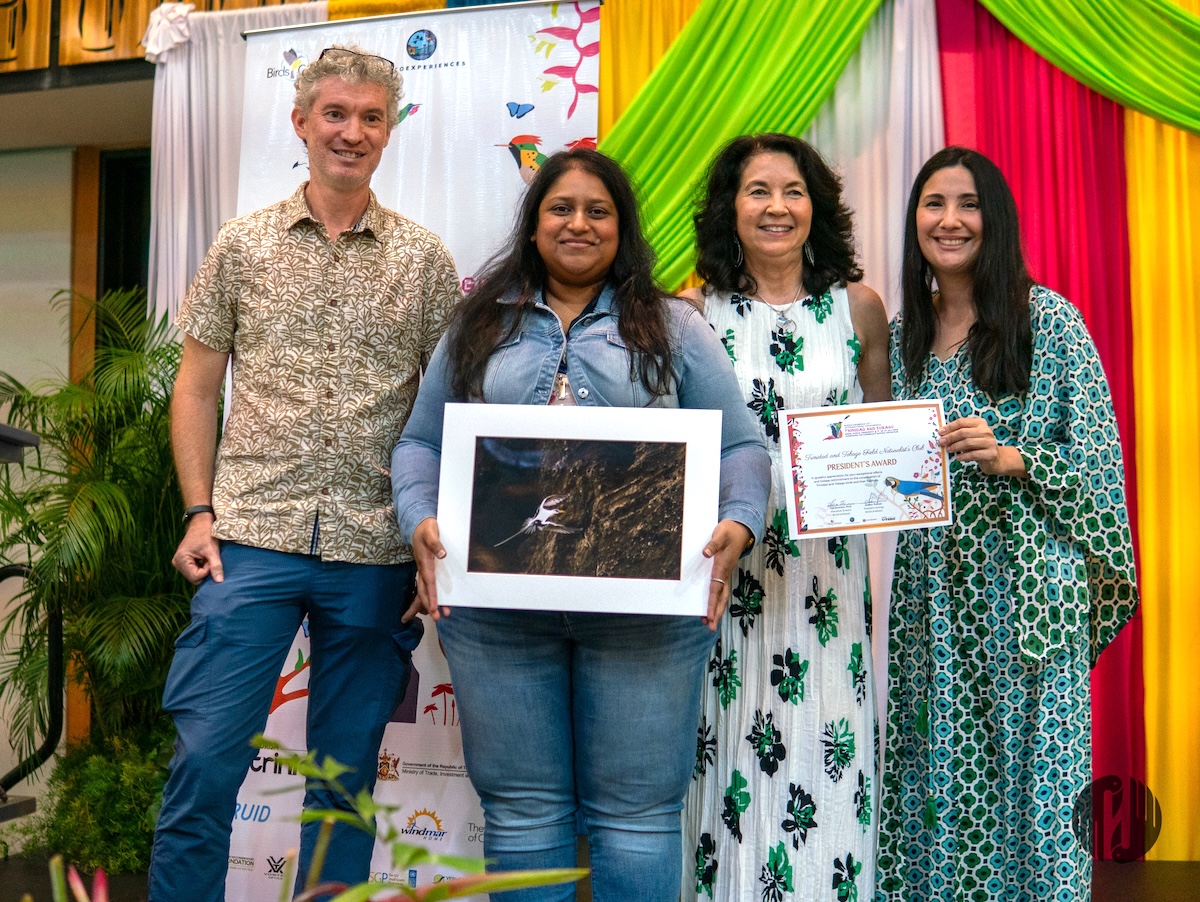
Trinidad and Tobago Field Naturalists’ Club (Accepted by Club President Elizabeth Seebaran) Founded on July 10, 1891, the Trinidad and Tobago Field Naturalists’ Club (TTFNC) is one of the oldest environmental non-governmental organizations in the Caribbean. Over its 135-year history, the Club has played a foundational role in the island’s environmental landscape. The Club established the Zoological Society of Trinidad and Tobago in 1947, giving rise to entities like the Caribbean Forest Conservation Association, and serving as a founding member of the Council for the Environment. Its advocacy has yielded critical conservation wins, including successful opposition to a monkey cull during a 1954 yellow fever outbreak and the protection of the fragile Caroni Swamp in the 1970s.
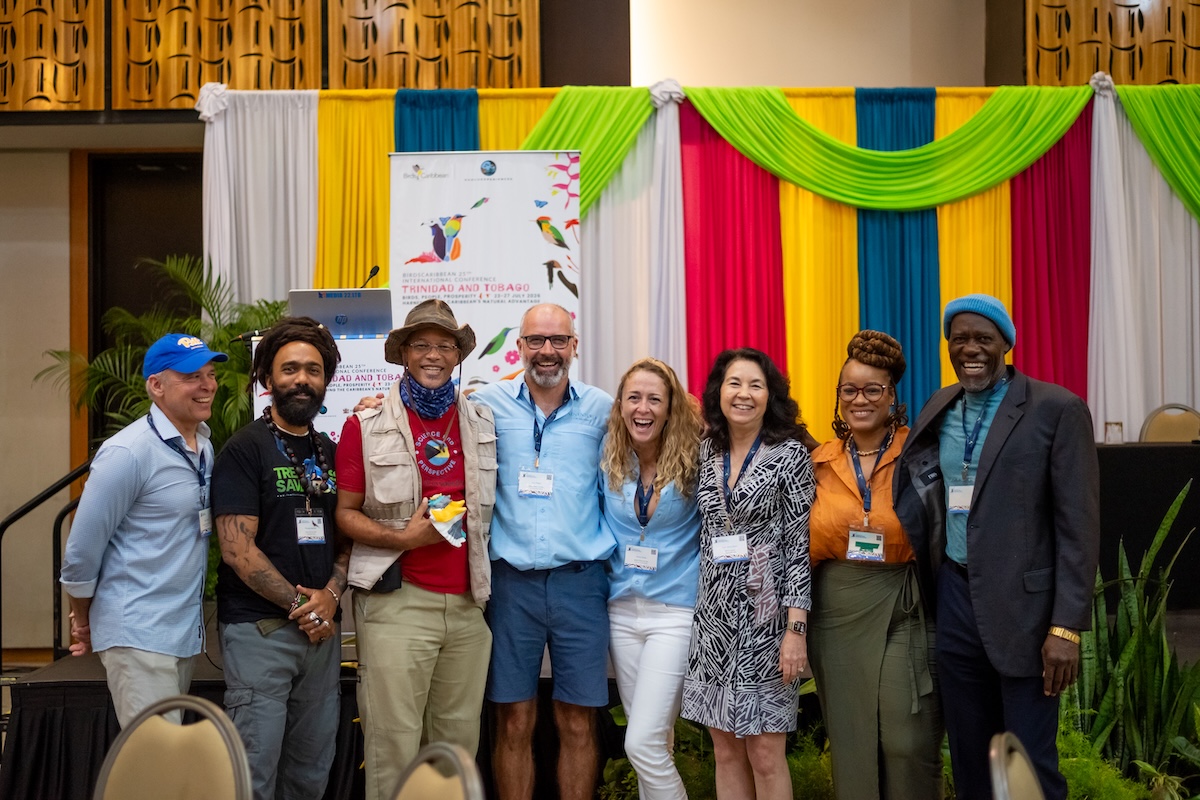
Honoring dedication, leadership, and passion. Congratulations to TTFNC President Elizabeth Seebaran on receiving the President’s Award! (Photo by Holly Garrod)
The TTFNC has also driven landmark scientific discoveries and wildlife protection initiatives across the country. Members provided early insights into local fauna, such as J.E. Tanner’s 1892 proof of leafcutter ant fungus farming and A.B. Carr’s discovery of bushmaster egg-laying, while 1960s sea turtle patrols at Matura Beach led directly to the nation’s Turtle Conservation Laws.
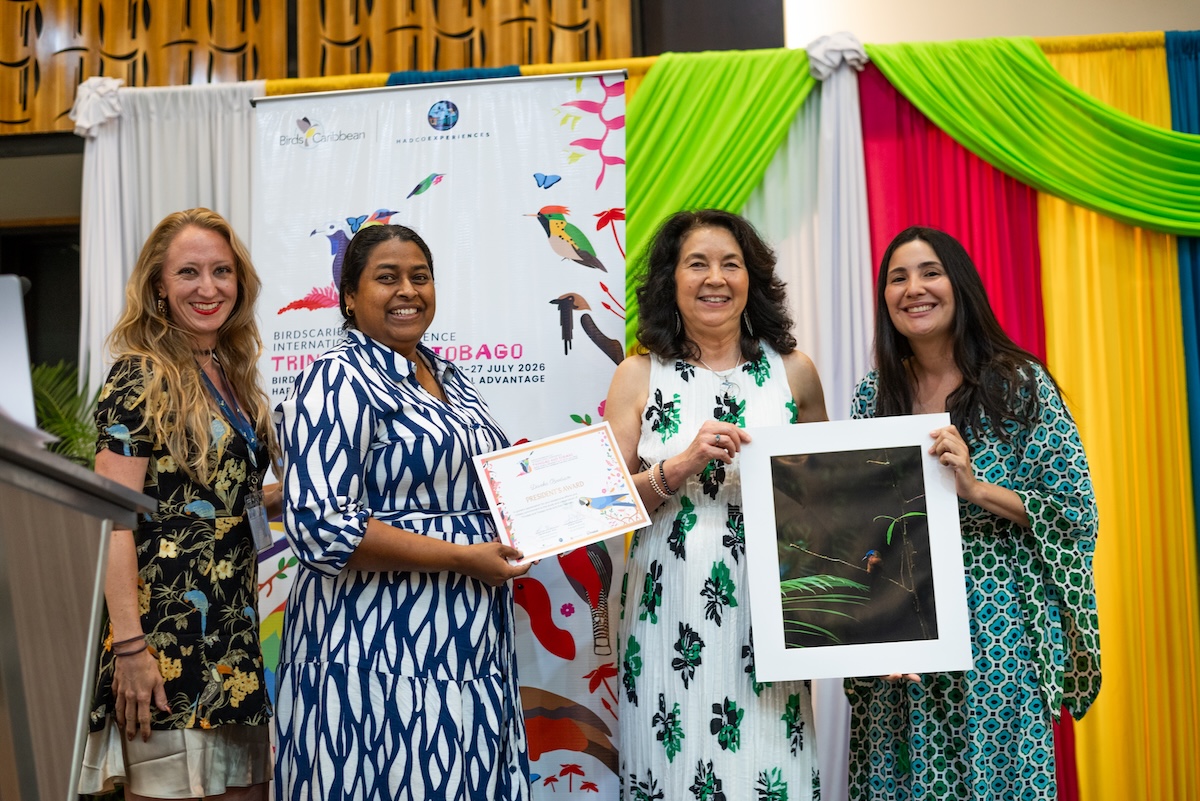
Daveka Boodram(Trinidad and Tobago Bird Observatory and Research Centre) Daveka Boodram learned how to bird bands in Oregon under the Klamath Bird Observatory internship program from 2002 – 2003. Daveka restarted her banding program in October 2023. Around this time she met with Giselle and Che Ragoonanan, and together they formed the Trinidad and Tobago Bird Observatory (TTBO), with the goal to continue building local capacity for bird monitoring projects and better understand many of the unique species residing on the islands.
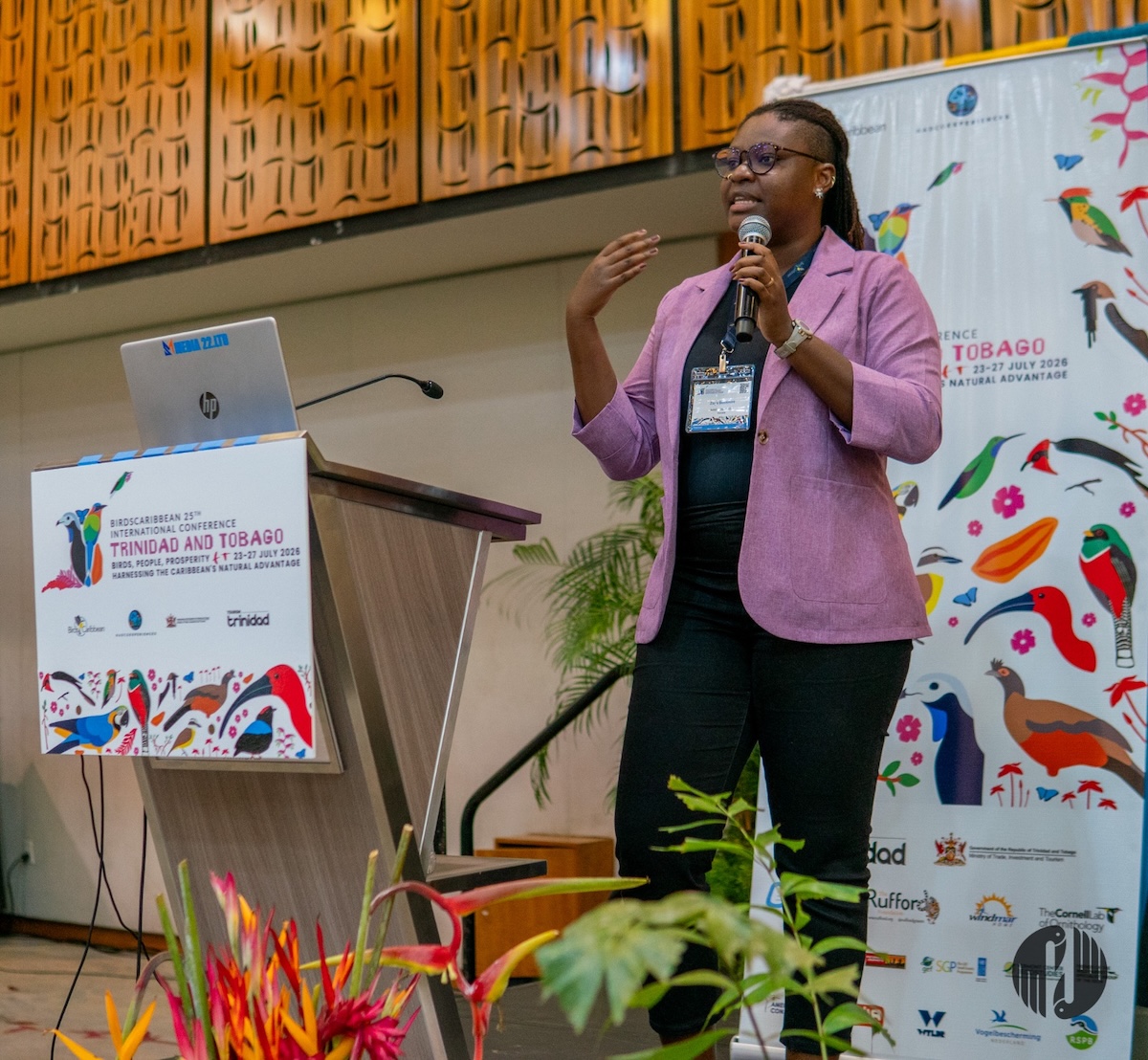
Celebrating excellence in conservation! Daveka Boodram accepts the President’s Award—a fitting tribute to her exceptional commitment to protecting birds. (Photo by Christel Mohammed)
For 20 years, Daveka used banding and point count data to assess the population and distribution of the White-tailed Sabrewing which she used to develop and implement a monitoring plan for this Near Threatened hummingbird. One of her primary objectives was to train a team of Tobagonian biologists to continue the work monitoring and studying the species. In October 2024, Daveka hosted a 5-day workshop, with Giselle and Che, to introduce banding and monitoring concepts to 21 participants. Since then, Daveka has been training a group of 12 Tobagonian biologists, many of which work for Tobago’s Forestry Department. Daveka has done much of banding and training in her free time, while still working full time as a teacher and a mom. She has been incredibly dedicated to getting these monitoring projects off the ground and ensuring Tobagonian biologists have the capacity they need to continue the monitoring work she started. She is one of the experts on the White-tailed Sabrewing, and one of the only people actively banding hummingbirds in the Caribbean.
Founders’ Award
Established in 2011, the Founders’ Award recognizes outstanding student researchers presenting exceptional science at the conference. Awardees are chosen for research whose findings directly inform the management and protection of Caribbean birds, their habitats, and ecosystems.
The Committee agreed that it was an overall fantastic group of student presentations this year! Here are the winners:
Oral Presentation
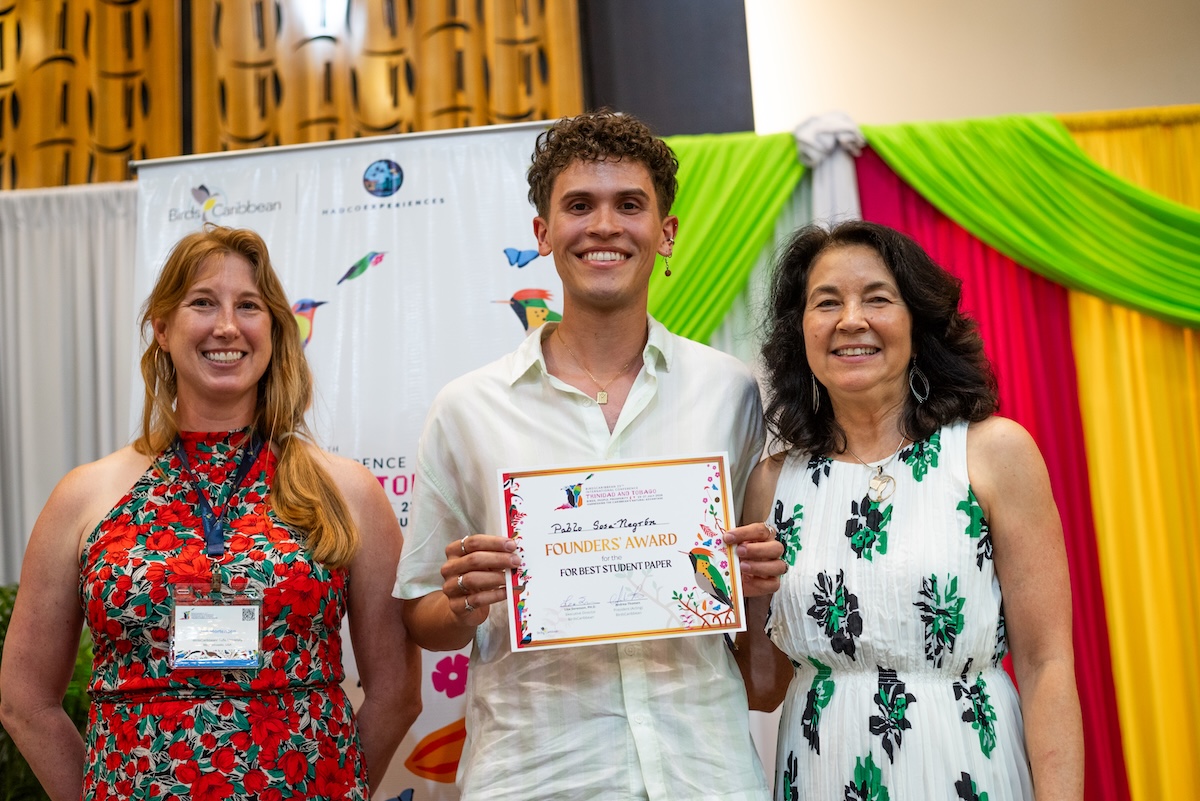
Founders’ Award for Best Student Paper: Pablo Sosa-Negrón (Masters Student- Universidade de Costa Rica) “Descending into the lowlands: microhabitat differentiation and range expansion in Puerto Rico’s sympatric Anthracothorax hummingbirds.”
Spotlighting outstanding student research! Huge congratulations to Pablo Sosa-Negrón (Universidade de Costa Rica) for winning the Founders’ Award for Best Student Paper.
Founders’ Award for Best Student Paper Honorable Mention: Michael Ocasio (PhD Candidate- University of Maryland) “Are Shiny Cowbirds Using Host Vocalizations to Find Nests?”
Founders’ Award for Best Student Paper Honorable Mention: Demonica Brown (Graduate Student- Florida International University) “Multi-scale analysis of environmental drivers of nest site selection by underground nesting Bahama Parrots (Amazona leucocephala bahamensis).”
Founders’ Award for Best Student Paper Honorable Mention: Andrew Eppedio (Undergraduate Student- Cornell University) “Foraging Niche Structure in a Caribbean Dry Forest Bird Community.”
Founders’ Award for Best Student Paper Honorable Mention: Laura Arañaburo Acosta (Undergraduate Student- University of Havana) “Composition and dynamics of bird assemblages in two phytogeographic zones of Cuba’s National Botanical Garden.”
Michael Ocasio. (Photo by Christel Mohammed)
Demonica Brown. (Photo by Christel Mohammed)
Andrew Eppedio. (Photo by Christel Mohammed)
Laura Acosta. (Photo by Christel Mohammed)
Poster presentation
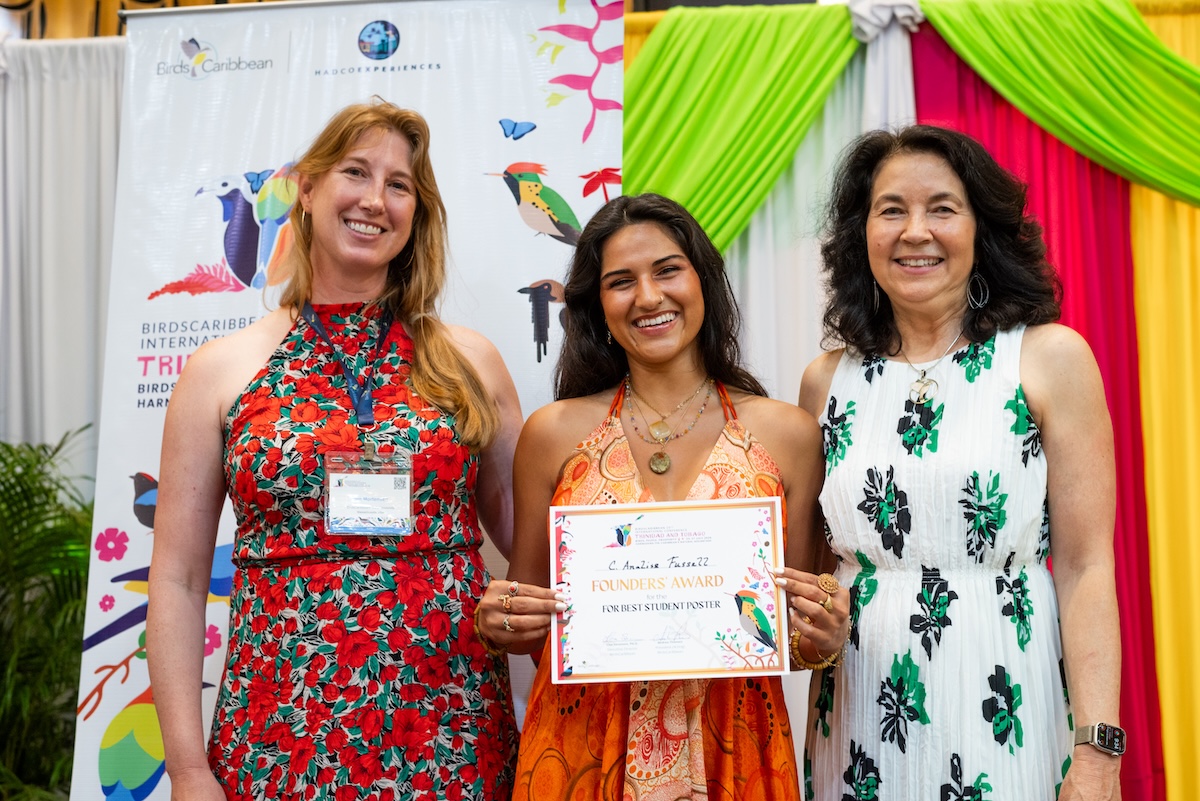
Founders’ Award for Best Student Poster: Cynthia Analise Fussell Persaud (Masters Student- University of Florida) “Assessing the potential of eBird data to track changes in abundance of wading birds in south Florida: Implications for Caribbean monitoring.”
Big congratulations to our Founders’ Award for Best Student Poster winner Cynthia Analise Fussell Persaud! (Photo by Christel Mohammed)
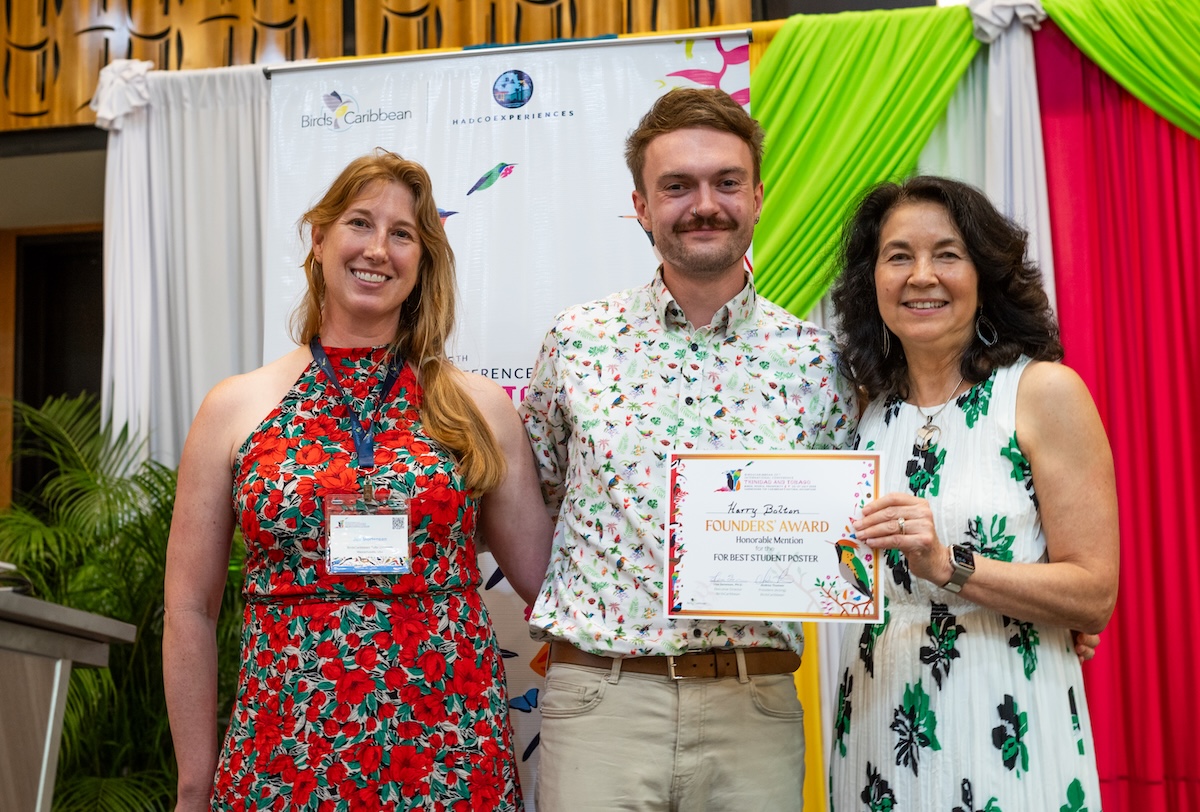
Founders’ Award for Best Student Poster Honorable Mention: Harry Bolton (PhD Student- University College London) “Energy and the origin and maintenance of island avian biodiversity.”
Harry Bolton receives his certificate. (Photo by Christel Moahmmed)
Educator’s Award
Education is the heartbeat of conservation. The Educator’s Award recognizes leaders who go above and beyond to inspire local communities, empower youth, and foster a deep, lifelong appreciation for wild birds and nature across the Caribbean.
Educator’s Award 2026 recipient Adrian Yanes Dominguez (Cuba). (Photo by Christel Mohammed)
Educator’s Award 2026 recipient Eliezer Nieves (Puerto Rico). (Photo by Hector Andujar)
Educator’s Award 2026 recipient Jethro van’t Hul (St. Eustatius). (Photo by Christel Mohammed)
This year, we celebrated three remarkable educators: Jethro van’t Hul(St. Eustatius National Parks Foundation – STENAPA),Adrian Yanes Dominguez(Empresa para la Conservation de la Ciénaga de Zapata / Flora y Fauna Matanzas, Cuba) and Eliezer Nieves Rodríguez(San Juan Bay Estuary Partnership – Estuario, Puerto Rico)
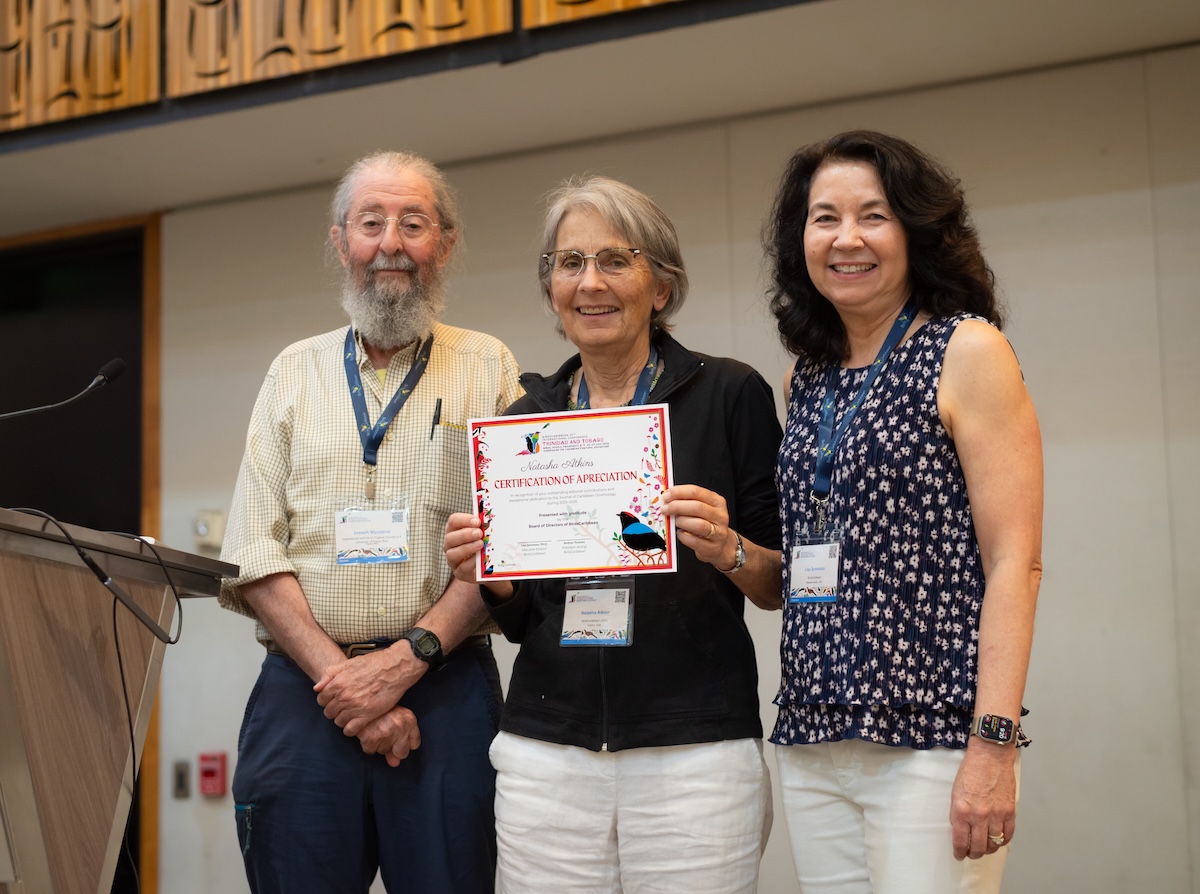
Certificates of Appreciation from BirdsCaribbean Board of Directors were awarded to persons below, in recognition of outstanding performance and editorial contributions and exceptional contributions to the Journal of Caribbean Ornithology during 2025-2026.
Dr. Jennifer Mortensen (Lead Review Editor)
Zoya Buckmire (Lead Copy Editor)
Natasha Atkins (Development Editor)
Congratulations to all of our 2026 awardees, honorable mentions, and nominees! Your passion, perseverance, and vision remind us of what is possible when a region unites for nature. Thank you for inspiring us all to keep pushing boundaries for Caribbean bird conservation.
En abril, recibí el tan esperado correo electrónico anunciando la inscripción para la 25.ª Conferencia Internacional de BirdsCaribbean. Visité el sitio web para consultar el programa previsto para los participantes y la gran variedad de excursiones —organizadas por HADCO Experiences—diseñadas para explorar la biodiversidad de estas hermosas islas. Afortunadamente, gracias a generosos donantes, pude cumplir mi sueño de participar en este importante evento para la conservación y protección de las aves y sus ecosistemas.
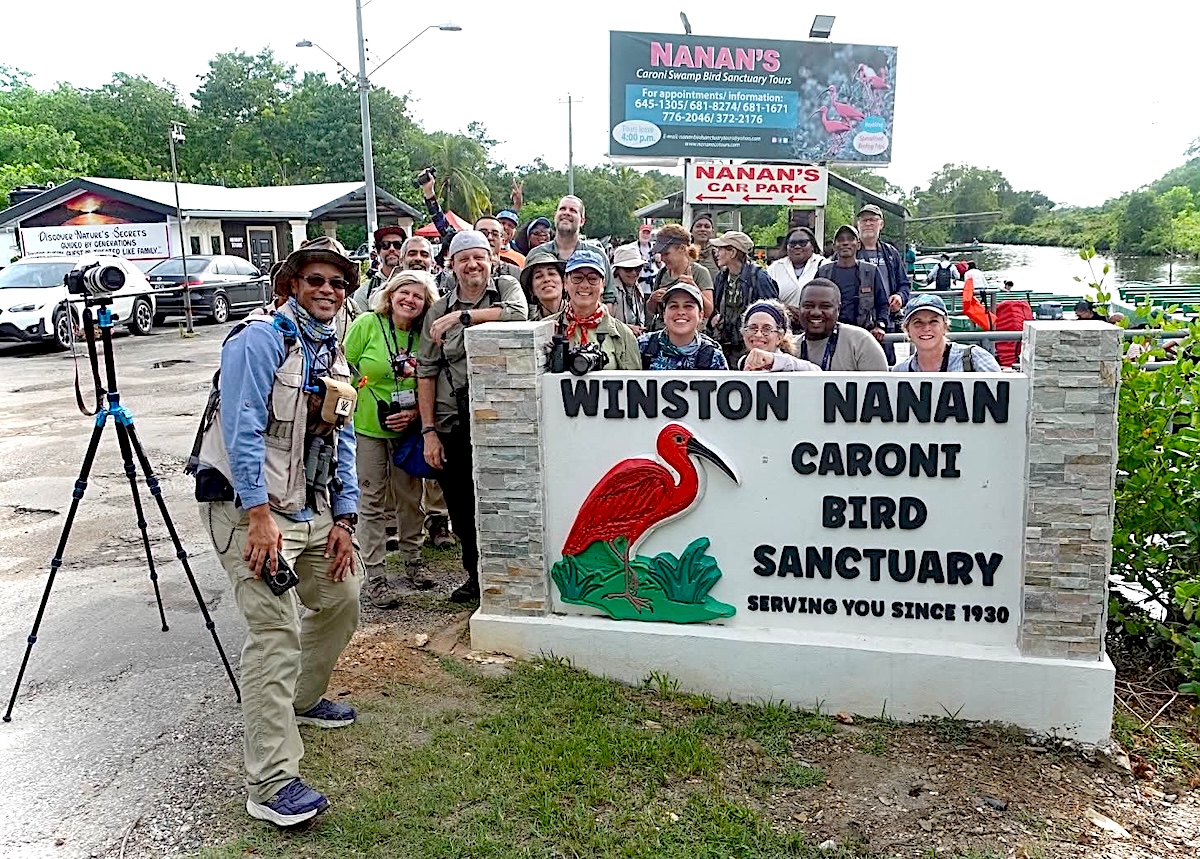
La gente de BirdsCaribbean listos para la excursión por el Caroni Bird Sanctuary. (Foto por Eliezer Nieves Rodríguez)
El programa ofrecía un día para una excursión. Tras estudiar los puntos de interés, las listas y las fotos de los cientos de especies que habitan y visitan Trinidad y Tobago, elegí la excursión que me llevaría a explorar los humedales de la costa oeste de Trinidad, culminando al atardecer en el Santuario de Aves de Caroni, reconocido a nivel mundial
Primera parada: Un templo en el mar
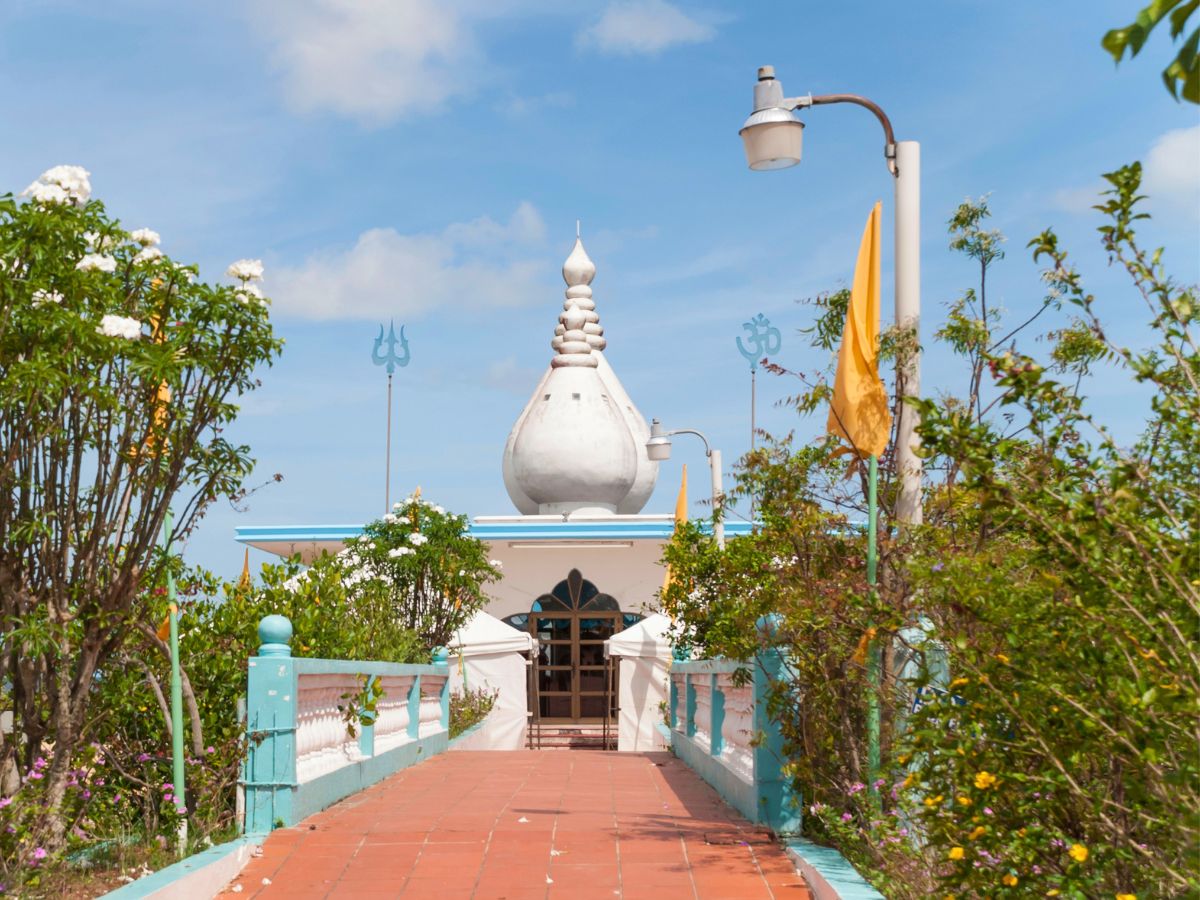
Nuestros guías, Dalini y Mukesh, llegaron al hotel puntualmente. La primera parada fue en el Templo en el Mar, un templo hindú octagonal construido en el mar después de que a su diseñador, Siewdas Sadhu, se le negara un terreno para edificarlo y trasladara su proyecto mar adentro. Allí caminamos por la arboleda que bordea la costa en busca del esquivo Vireón Cejirrufo.
Entrada al Temple in the Sea.
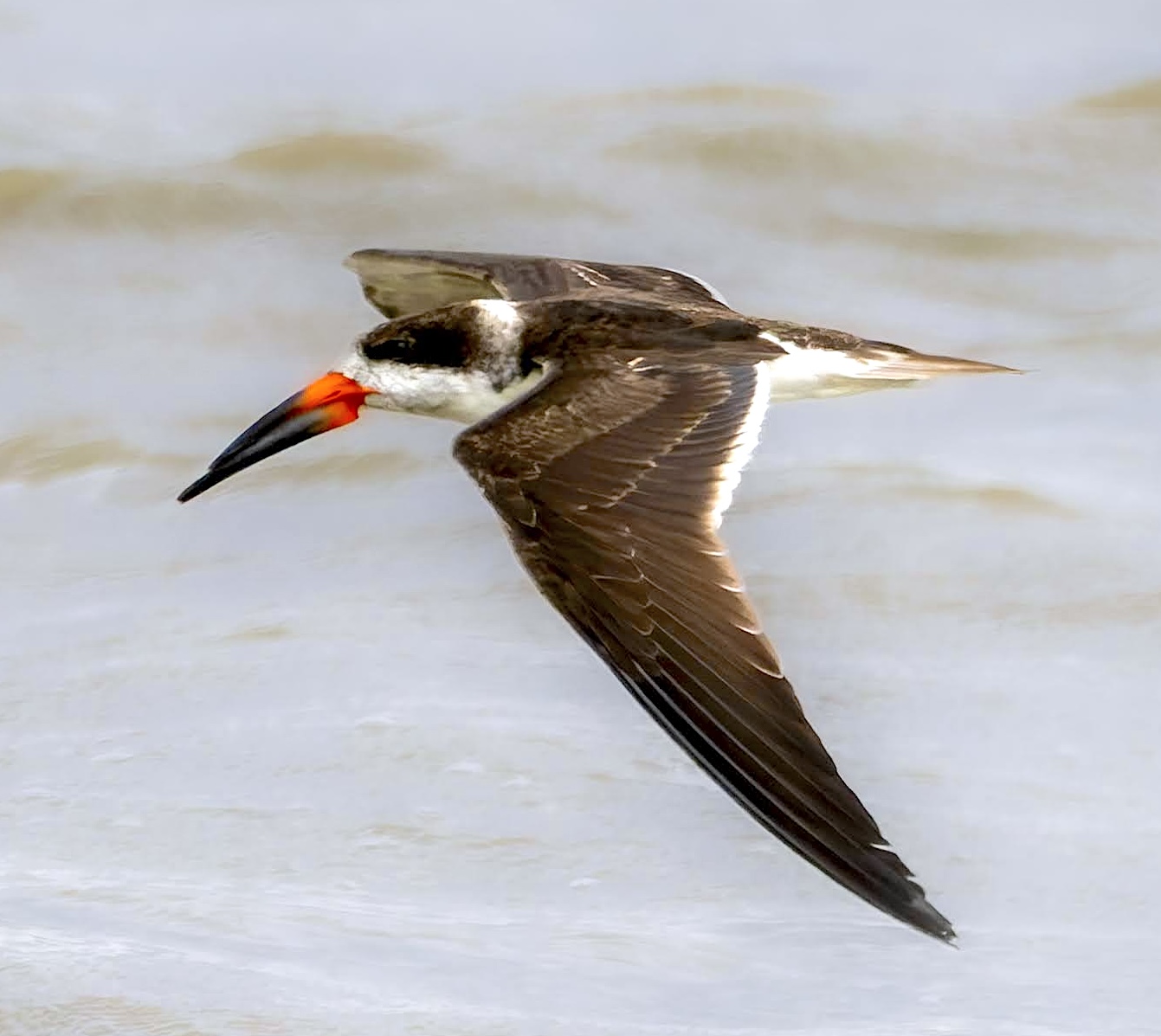
De repente, oí que alguien gritaba que se veían bandadas de Ibis Escarlata en el horizonte. Ya se alejaban, pero desde ahí divisé al Rayador Americano, una de las aves que quería ver en el viaje. Fue un espectáculo majestuoso verlo rozar el agua con su enorme pico bicolor en busca de alimento. ¡El día prometía!
Rayador americano (Rynchops niger). (Foto por Marta Torres Quiñones)
¡Ventana abajo, binoculares arriba!
Desde allí, partimos hacia Sumaria Trace, parada obligatoria para cualquier observador de aves en Trinidad: un camino rural flanqueado por humedales de gran biodiversidad. El conductor redujo la velocidad, bajamos las ventanas y me sentí como en un safari. Un solitario Flamenco Americano y unos Tordos Capuchiamarillos anunciaron su presencia y las Jacanas Sudamericanas nos mostraron sus hermosas alas amarillas en pleno vuelo.
Jacanas Sudamericanas (Jacana jacana).
Un macho de Tordos Capuchiamarillos (Chrysomus icterocephalus).
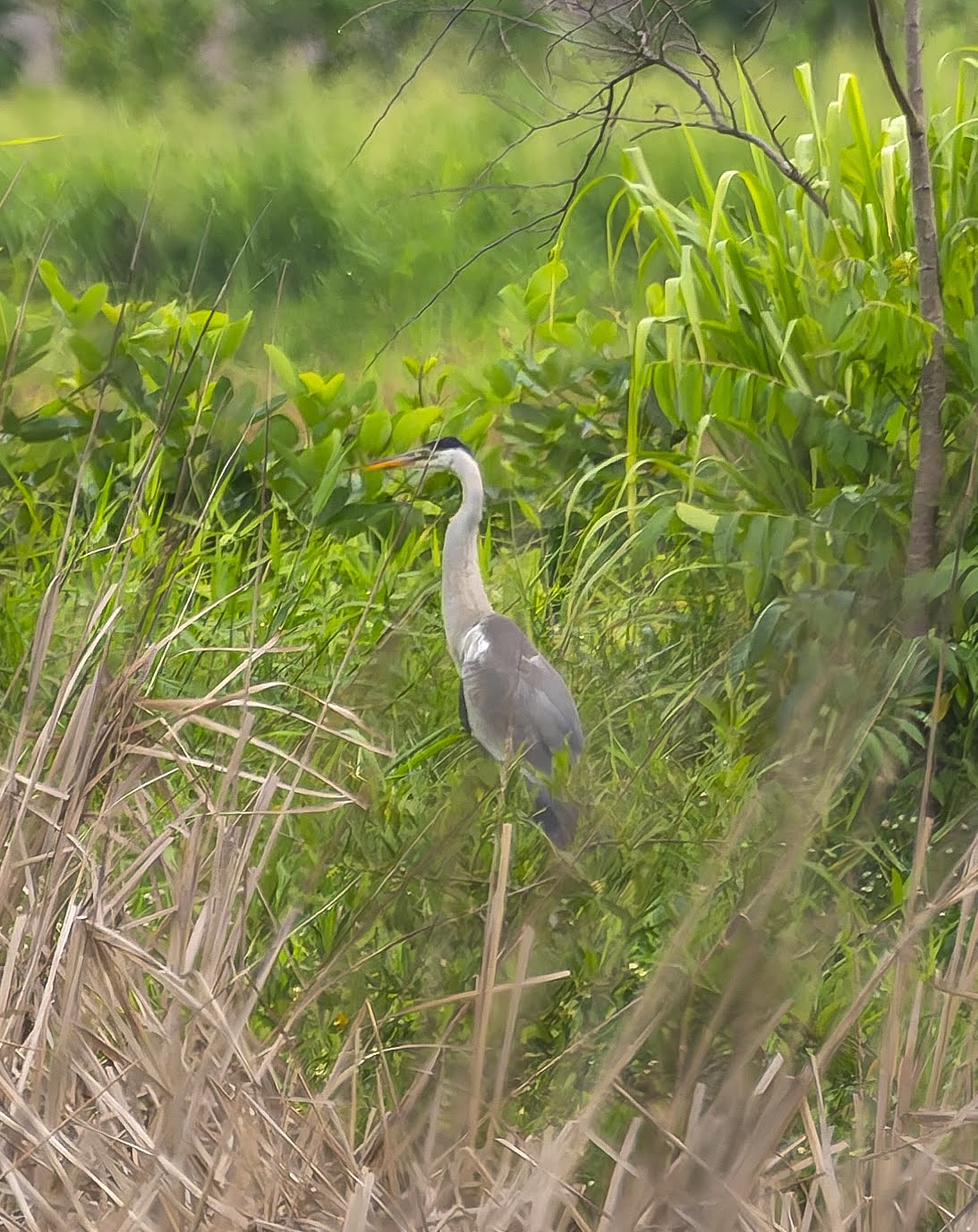
Garzón cocoi intentando jugar a las escondidas. (Foto por Marta Torres Quiñones)
Mukesh nos condujo hasta un punto en el camino donde colocó su telescopio y desde allí pudimos divisar un Garzón Cocoi camuflajeado entre la hierba alta. El grupo se dispersó para buscar e identificar aves a lo largo del camino; cada uno con su propia lista de aves que quería ver. De fondo, podía oír el clic de las cámaras y los nombres de las especies que mis compañeros de excursión estaban avistando: Aninga, Monjita Tricolor, Curutié Colorado, Garza Pechiblanca, Vencejillo Tijereta y Estrilda Común.
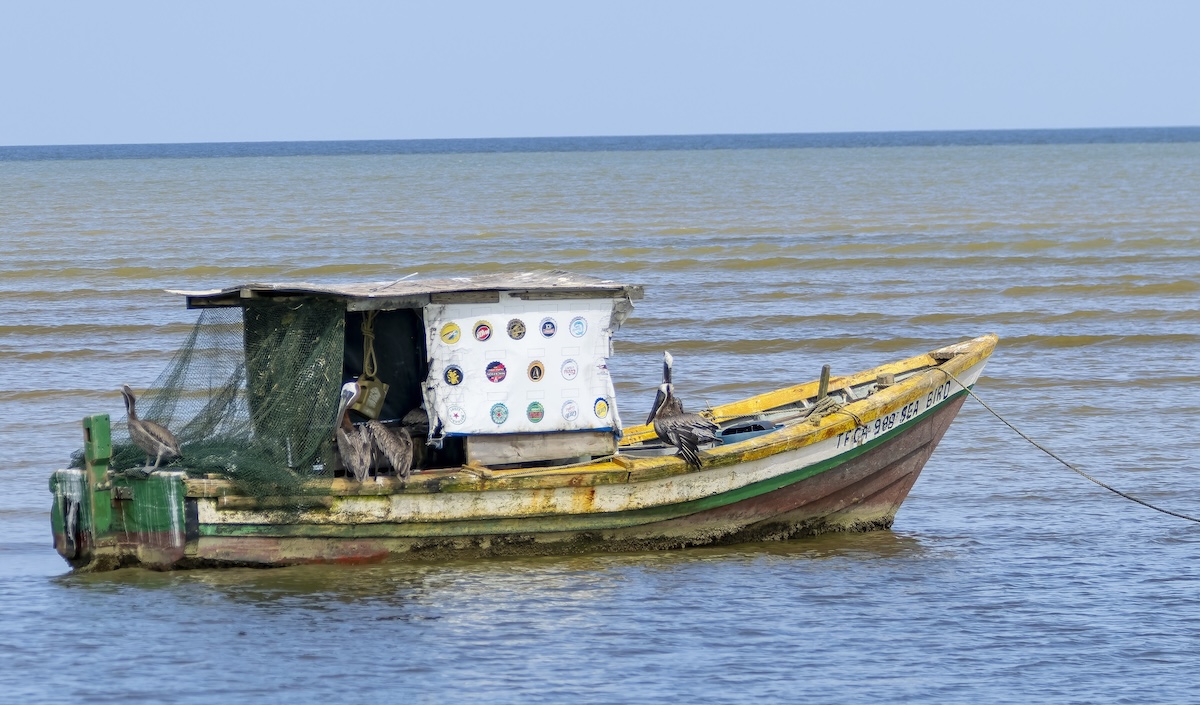
El sol quemaba y la humedad se sentía. Nuestros guías nos llamaron de vuelta al autobús para dirigirnos a Orange Valley y al Waterloo Fish Depot. La mayoría de los pescadores ya regresaban a la costa. A lo lejos grandes barcos compartían las aguas con Pelícanos Pardos y Tijeretas que sobrevolaban la zona en busca de presa fácil.
Las aves playeras son de mis favoritas y aquí pudimos observar Playeros Picocorvo Americano, Aliblancos, Agujetas Piquicortas, además de diversas garzas y otras aves acuáticas. De repente escuché una sirena… ¿de dónde provenía ese sonido? ¡Era un búho, el Mochuelo Caburé! Un grupo ya estaba intentando avistarlo, pero todos sus intentos fueron en vano.
Pelícanos pardos descansando en un bote. (Foto: Marta Torres Quiñones)
Pájaros, roti y un poco de lluvia
El cielo comenzó a nublarse y recibí una notificación de que se acercaba la lluvia. Era la señal perfecta para almorzar, así que nos dirigimos al famoso Highway Roti Shop para esperar a que pasara la lluvia. La conversación fluía entre los participantes de la excursión mientras saboreábamos un delicioso plato tradicional.
Si planifican visitar Trinidad y Tobago recomiendo se detengan en un puesto callejero para probar los deliciosos Aloo Pies (masa frita rellena de papas sazonadas), Saheenas (buñuelos hechos con una masa de guisantes partidos y hojas de taro sazonadas) y Doubles (garbanzos al curry entre dos bara fritos). ¡Para chuparse los dedos!
La magia de Caroni
Finalmente llegamos al Santuario de Aves Caroni de Winston Nanan, donde disfrutamos de un paseo en bote por el manglar y humedal más grande de Trinidad. Hermosos canales, lagunas y marismas que albergan cientos de especies de vida silvestre. Durante el recorrido avistamos murciélagos narigudos, serpientes, un pequeño oso hormiguero sedoso durmiendo y una cantidad impresionante de aves.
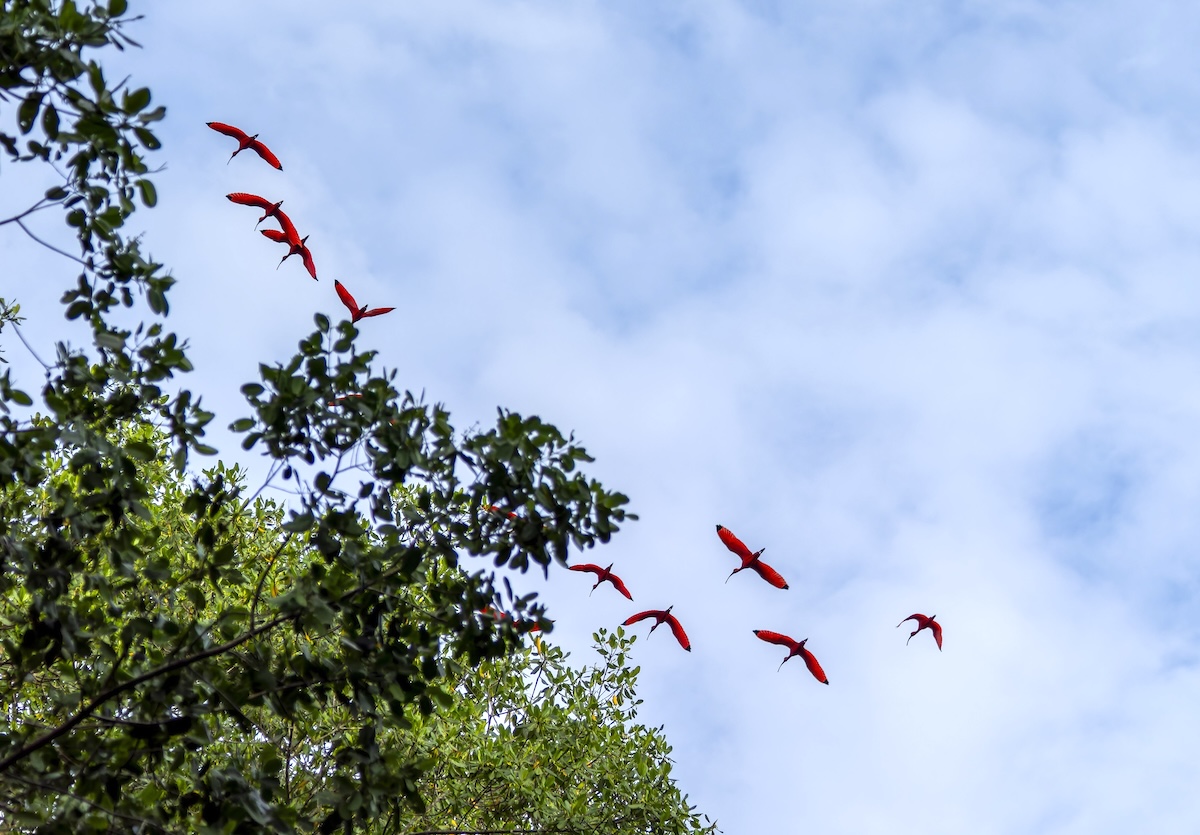
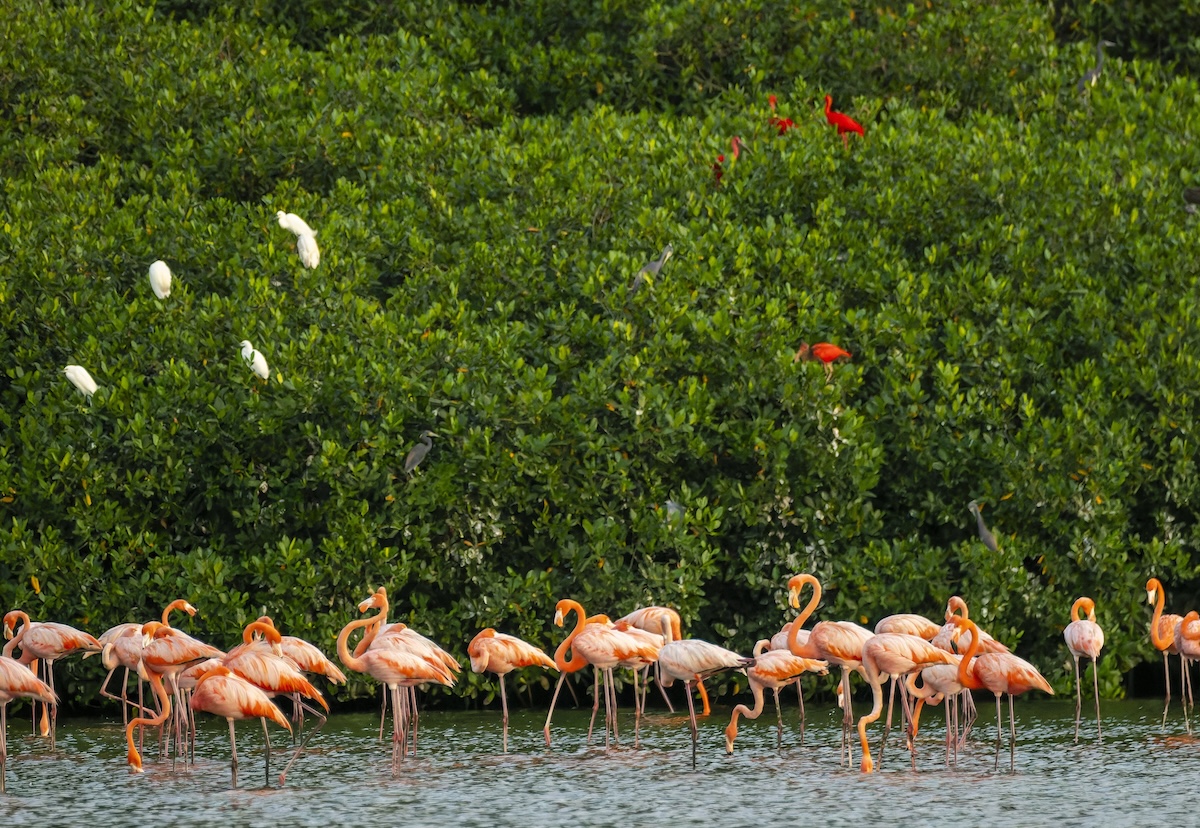
El Ibis Escarlata, ave nacional de Trinidad y Tobago, hizo su entrada volando sobre nuestras cabezas hacia su zona de anidaje. Un Martín Pescador Enano nos deleitó con un espectáculo, al volar varias veces alrededor de la embarcación, mientras los flamencos se alimentaban y se bañaban en la laguna, y los cormoranes y las garzas se preparaban para terminar su día.
Una pequeña bandada de Ibis escarlata vuela sobre el pantano. (Foto: Marta Torres Quiñones)
El tiempo se detuvo al atardecer y agradecimos la experiencia vivida. Fuimos afortunados de contar con Allister Nanan como guía en esta parte de la excursión. Él ha continuado el legado familiar de conservación y protección de este idílico ecosistema mediante acuerdos con el gobierno y la participación y educación de los miembros de la comunidad. Es un vivo ejemplo de lo que se podría emular en otras islas del Caribe al enfocarse en iniciativas que combinen el ecoturismo, la conservación y la protección de estos lugares tan especiales.
Flamencos en el Caroni Swamp. (Foto: Marta Torres Quiñones)
Mirielle Villanueva.
Mirielle Villanueva es una apasionada observadora de aves, científica ciudadana y voluntaria de diversas organizaciones sin fines de lucro, como Surfrider Puerto Rico, Para La Naturaleza, BirdsCaribbean y Tortugueros del Oeste. Durante el último año, ha liderado censos de aves en su área, incluyendo el Censo de Aves Acuáticas del Caribe (CWC), a la vez que educaba a los participantes sobre cómo las aves pueden servir como indicadores de la salud del ecosistema. Su objetivo es crear conciencia sobre la importancia del monitoreo de aves e inspirar a otros a salir a la naturaleza, reportar sus observaciones y participar en la protección y conservación de los hábitats de las aves. Mirielle también fue una participante entusiasta en nuestro reciente evento.Taller de capacitación de CWC en la Reserva Estuarina Nacional de Jobos Bay en Puerto Rico.
My Experience of Trinidad’s Wetlands with My BirdsCaribbean Peeps
In April, I received the long-awaited email announcing registration for the 25th BirdsCaribbean International Conference. I visited the website to see the planned agenda for participants and the wide variety of field trips—organized by HADCO Experiences—designed to explore the biodiversity of these beautiful islands. Fortunately, thanks to generous donors, I was able to fulfill my dream of participating in this important event for the conservation and protection of birds and their ecosystems.
The BirdsCaribbean peeps ready to tour the Caroni Bird Sanctuary. (Photo by Eliezer Nieves Rodríguez)
The program offered one day for an excursion. After studying the hotspots, lists, and photos of the hundreds of species that inhabit and visit Trinidad and Tobago, I chose the excursion that would take me to explore the wetlands on Trinidad’s west coast, culminating at sunset at the world-famous Caroni Swamp Bird Sanctuary.
First Stop: A Temple in the Sea
Our guides, Dalini and Mukesh, arrived at the hotel right on time. The first stop was at the Temple in the Sea, an octagonal-shaped Hindu temple that was built in the sea after its designer, Siewdas Sadhu, was refused land to build his temple and took his efforts offshore. Here, we walked through the grove of trees lining the coast in search of an elusive Rufous-browed Peppershrike.
Entrance to the Temple in the Sea.
Suddenly, I heard someone call out that flocks of Scarlet Ibis were visible on the horizon. They were too far away to appreciate , but from that vantage point I spotted the Black Skimmer, one of the birds on my bucket list for the trip. It was a majestic sight to see it skimming the water with its enormous two-toned beak in search of food. The day was off to a great start!
Black Skimmer (Rynchops niger) sighting at Temple in the Sea. (Photo by Marta Torres Quiñones)
Window Down, Binoculars Up!
From there, we set off for Sumaria Trace—a must-visit site on every birdwatcher’s list in Trinidad—a rural road flanked by wetlands rich in biodiversity. The driver slowed down, we rolled down the windows, and I felt like I was on a safari. A solitary American Flamingo and Yellow-hooded Blackbirds announced their presence, and Wattled Jacanas showed us their beautiful yellow wings in flight.
Wattled Jacana.
A male Yellow-hooded Blackbird.
A Cocoi Heron trying to play Hide and Seek. (Photo by Marta Torres Quiñones)
Mukesh led us to a spot along the road where he set up his scope, and from there we were able to spot a Cocoi Heron camouflaged among the tall grasses. The group spread out to search for and identify birds along the way, each of us with our own short list of “must-see” birds. In the background, I could hear the clicking of cameras and the names of species my fellow birders were spotting: Anhinga, Tricolored Munia, Yellow-chinned Spinetail, Tricolored Heron, Fork-tailed Palm Swift, and Common Waxbill.
The sun was beating down, and we could feel the high humidity. Our guides called us back to the bus so we could head to Orange Valley and the Waterloo Fish Depot. Most of the fishermen were already on their way back to shore. In the distance, large boats shared the water with Brown Pelicans, and Magnificent Frigatebirds were flying overhead in search of easy prey.
Shorebirds are among my favorites and here, we were able to observe Hudsonian Whimbrels, Willets, and Short-billed Dowitchers, along with a variety of herons and other waterbirds. Suddenly, I heard a siren… where was that sound coming from? It was a Ferruginous Pygmy-Owl! A group was already trying to spot it, but all their attempts were in vain.
Brown Pelicans resting on a boat. (Photo by Marta Torres Quiñones)
Birds, Roti, and a Little Rain
The sky began to cloud over, and I received a notification that rain was on the way. It was the perfect cue for lunch, so we headed to the famous Highway Roti Shop to wait out the rainy weather. Conversation flowed among the tour participants as we savored a delicious traditional dish.
If you’re planning to visit Trinidad and Tobago, I recommend stopping at a roadside stand to try the delicious Aloo Pies (fried dough stuffed with seasoned potatoes), Saheenas (fritters made of seasoned split-pea and dasheen leaves batter), and Doubles (curried chickpeas sandwiched between two fried bara, flatbreads). They’re finger-licking good!
The Magic of Caroni
Finally, we arrived at the Winston Nanan Caroni Bird Sanctuary, where we enjoyed a boat tour through Trinidad’s largest mangrove forest and wetland. Beautiful canals, lagoons, and marshes provide a home to hundreds of species of wildlife. During the trip, we spotted Proboscis Bats, snakes, a tiny Silky Anteater taking a nap, and a remarkable number of birds.
The Scarlet Ibis, Trinidad and Tobago’s national bird, made its entrance, flying overhead toward its nesting area. An American Pygmy Kingfisher put on a show for us, flying around the boat several times, while flamingos fed and bathed in the lagoon and cormorants and herons prepared to end their day.
A small flock of Scarlet Ibis flies over the swamp. (Photo by Marta Torres Quiñones)
Time stood still as the sun began to set, and we were thankful for the experience we’d just had. We were fortunate to have Allister Nanan as our guide for this part of the excursion. He has carried on his family’s legacy of conserving and protecting this idyllic ecosystem through agreements with the government and by involving and educating community members. It is a living example of what is possible—and an approach that could be emulated on other Caribbean islands with initiatives that bring together ecotourism, conservation, and the protection of these special places.
Flamingos at Caroni Swamp. (Photo by Marta Torres Quiñones)
Mirielle Villanueva.
Mirielle Villanueva is a passionate birder, citizen scientist, and volunteer for various non-profit organizations, such as Surfrider Puerto Rico, Para La Naturaleza, BirdsCaribbean, and Tortugueros del Oeste. For the past year she has been leading bird surveys in her area, including for the Caribbean Waterbird Census (CWC), while educating participants about how birds can serve as indicators of ecosystem health. Her goal is to raise awareness about the importance of bird monitoring and inspire others to get out into nature, report their observations, and become involved in protecting and conserving bird habitats. Mirielle was also an enthusiastic participant at our recent CWC Training Workshop at Jobos Bay National Estuarine Reserve in Puerto Rico.
Abel Luis Simeón, ornitólogo cubano y asistente por primera vez a la Conferencia Internacional de BirdsCaribbean.
Para Abel Luis Simeón, biólogo cubano de 25 años, su primera conferencia de BirdsCaribbean supuso un hito personal. Desde los tan esperados encuentros con las extraordinarias aves de Trinidad y Tobago, pasando por el contacto con conservacionistas apasionados que comparten su profundo compromiso con la biodiversidad caribeña, hasta el intercambio de su propio trabajo en la protección de dos palomas endémicas de Cuba, Abel regresó a casa con nuevas ideas, valiosos contactos y un propósito renovado. Sigue leyendo para conocer las reflexiones de Abel sobre una experiencia transformadora en la conferencia.
Hay momentos que marcan el comienzo de un nuevo capítulo. Para mí, asistir a la 25.ª Conferencia Internacional de BirdsCaribbean en Trinidad y Tobago fue uno de ellos. Como joven biólogo y ornitólogo cubano, llevaba mucho tiempo soñando con participar en un encuentro en el que pudiera compartir experiencias con personas que, como yo, dedican su vida a la conservación de las aves del Caribe.
Aves que había soñado con ver
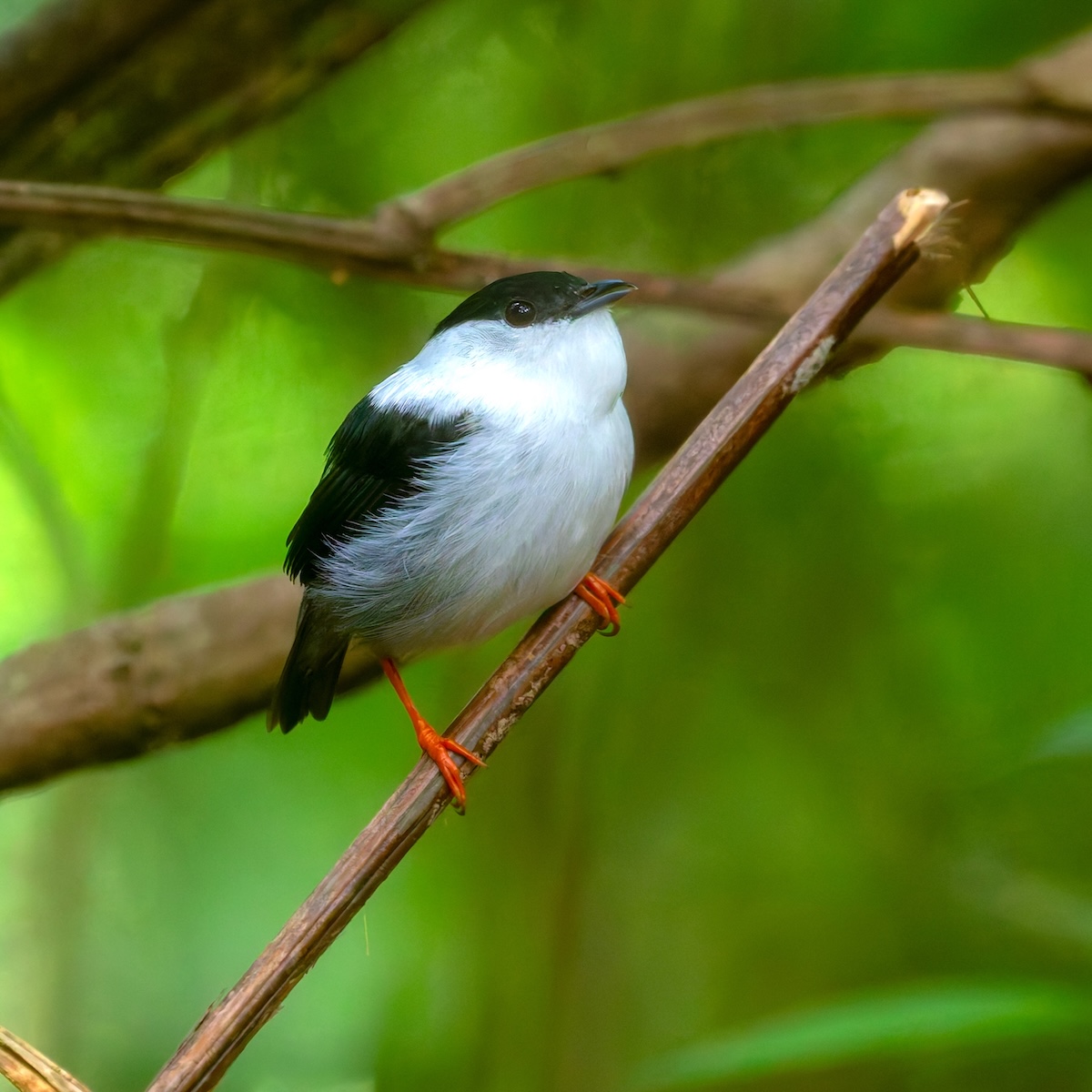
White-beared Manakin (Manacus manacus). (Photo by Abel Simeon)
Antes de viajar, una de las cosas que más ilusión me hacía era conocer Trinidad y Tobago. Siempre había oído hablar de su extraordinaria diversidad de aves y ecosistemas, y poder observarlos en persona superó mis expectativas. Uno de los recuerdos más especiales de la conferencia tuvo lugar durante la visita al Centro Natural Asa Wright. Escuchar por primera vez el canto potente y resonante de los pájaros campana barbudos fue realmente impresionante. Pero si hubo un momento que llevaba años imaginándome, fue presenciar los famosos leks de los manakins de barba blanca (Manacus manacus). Ver a los machos reunidos, realizando sus rápidos movimientos y exhibiciones mientras emitían sus característicos cantos, fue una experiencia que nunca olvidaré. Son estos momentos los que nos recuerdan por qué decidimos dedicar nuestras vidas al estudio y la conservación de las aves.
Sin embargo, lo más valioso de la experiencia fue la gente. Durante la conferencia, tuve la oportunidad de hablar con investigadores, estudiantes, conservacionistas y profesionales de todo el Caribe y más allá, todos unidos por una pasión compartida: proteger nuestras aves y los hábitats de los que dependen.
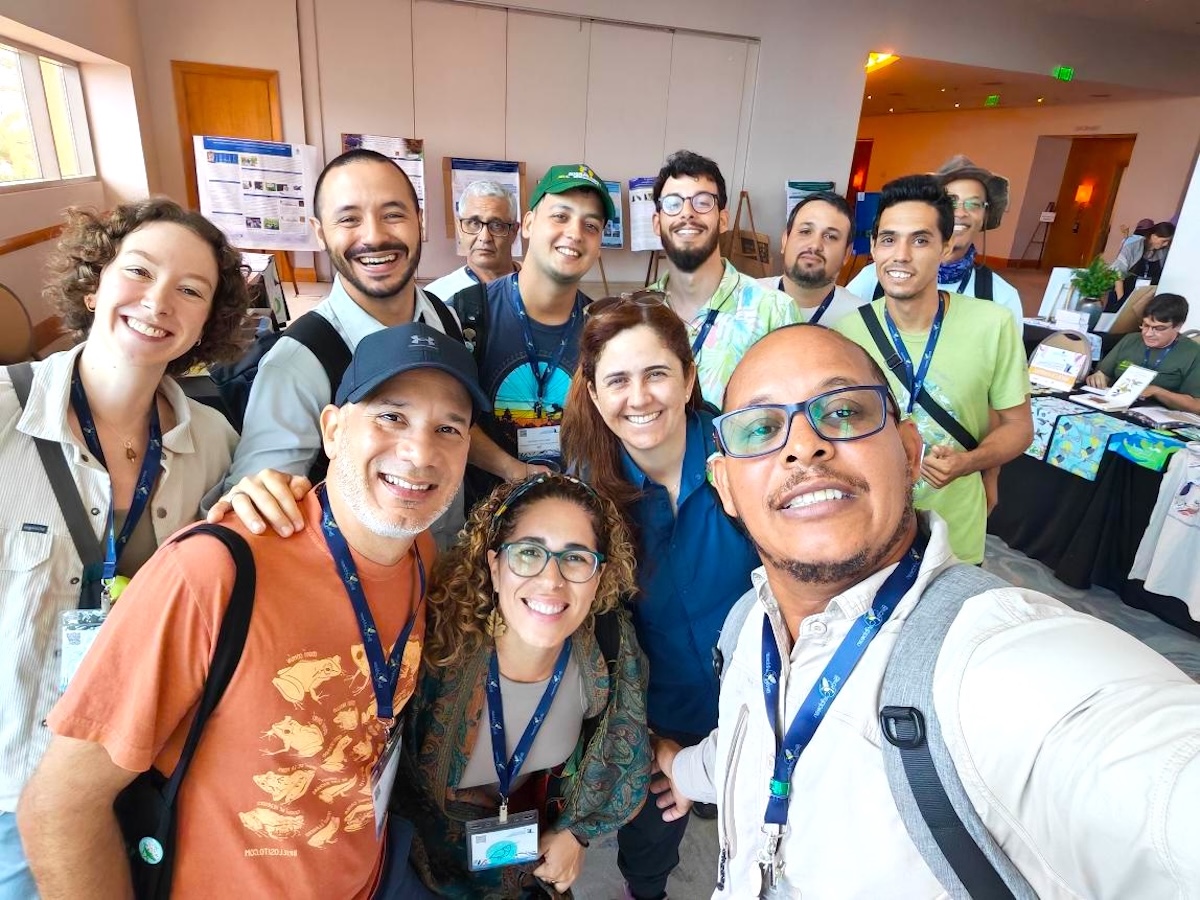
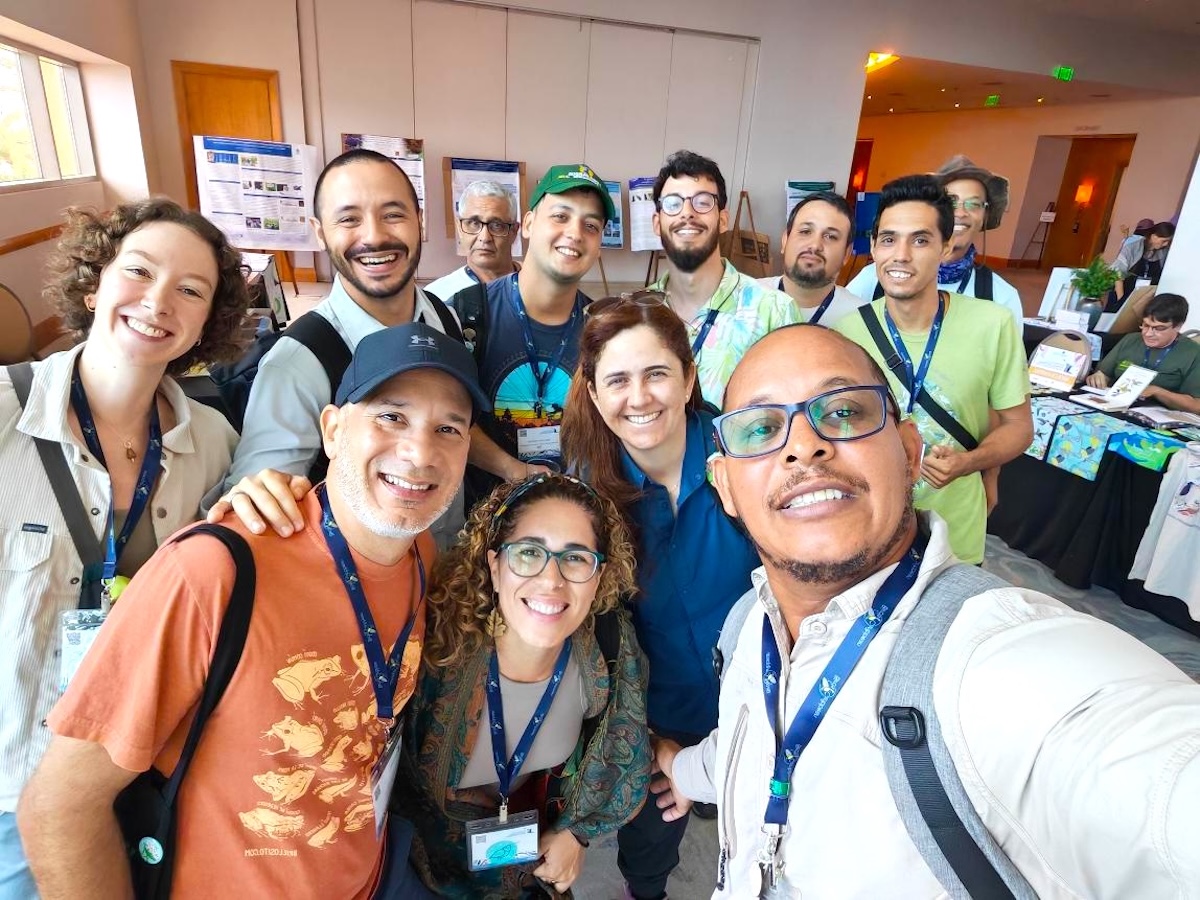
Abel (con gorra verde) junto a otros delegados de República Dominicana, Puerto Rico, Las Bahamas y Cuba. (Foto por Héctor Andújar)
Compartir mi investigación
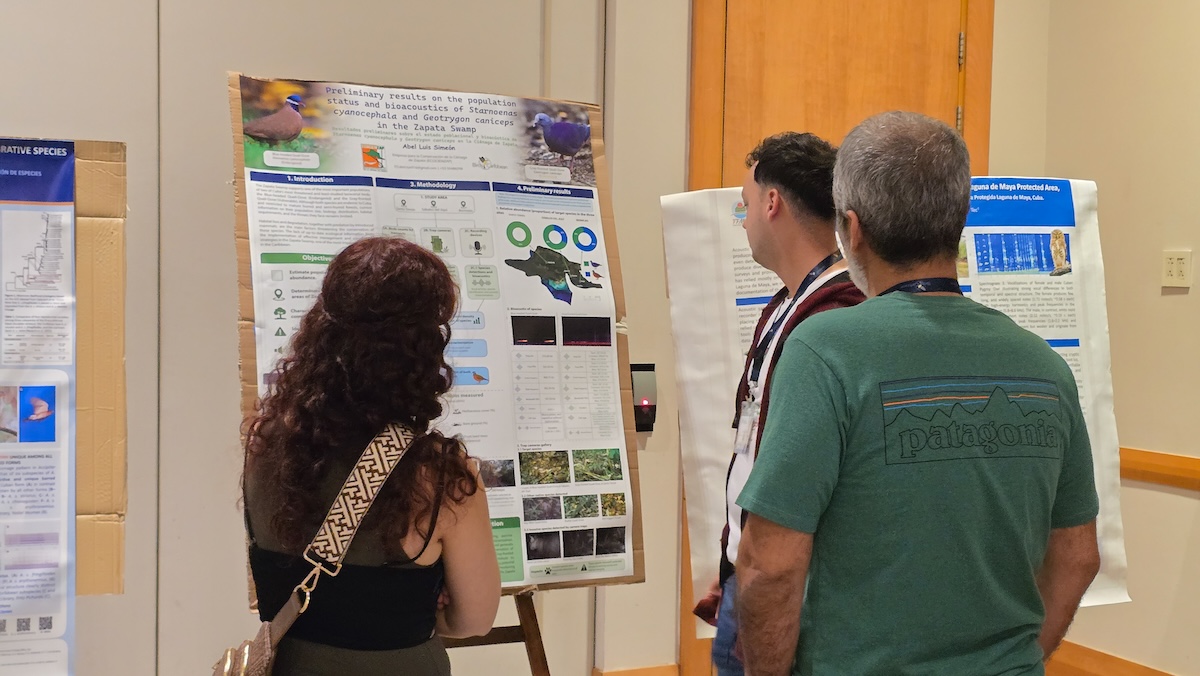
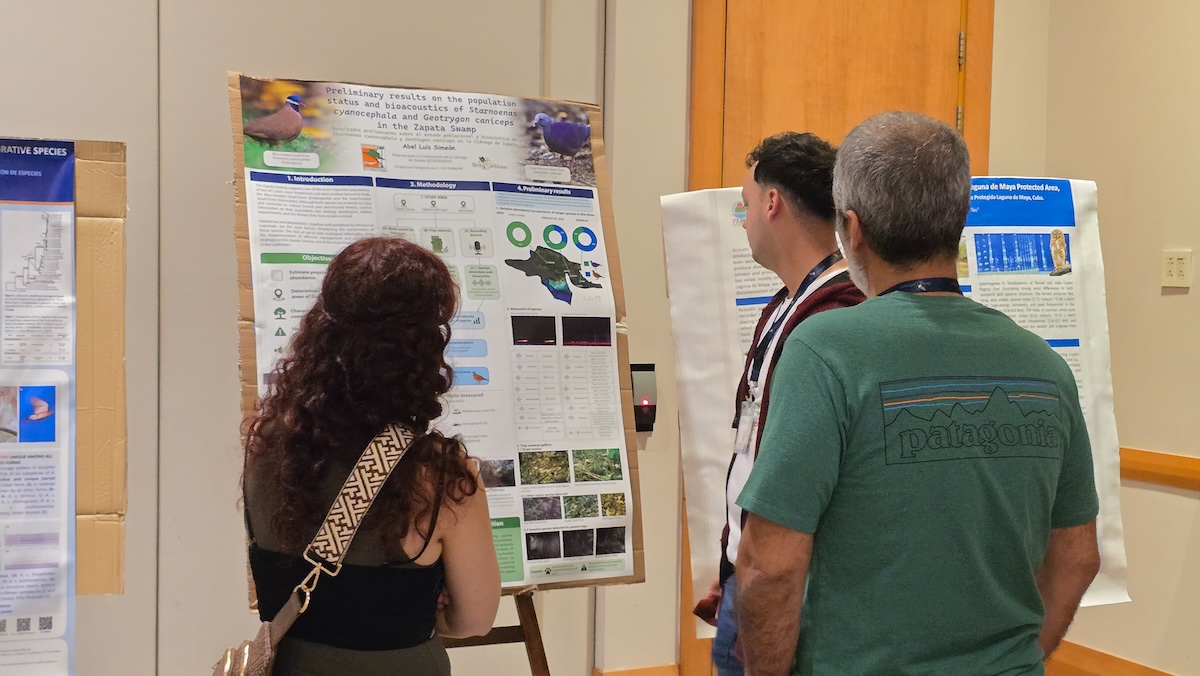
Uno de los momentos más importantes para mí fue presentar un póster sobre los resultados preliminares del proyecto que estoy desarrollando actualmente, gracias a una beca del Fondo David S. Lee para la Conservación de las Aves del Caribe. Mi investigación se centra en la conservación de dos especies de palomas endémicas y amenazadas de Cuba: la paloma perdiz (Starnoenas cyanocephala) (En Peligro de extinción) y el Camao (Geotrygon caniceps) (Vulnerable).
Blue-headed Quail-Dove (Starnoenas cyanocephala). (Photo by Aslam Ibrahim)
Gray-fronted Quail-Dove (Geotrygon caniceps). (Photo by David Ascanio)
Un cuaderno lleno de nuevas ideas
Mi presentación me brindó la oportunidad de intercambiar ideas con otros investigadores, quienes compartieron valiosas recomendaciones sobre nuevos enfoques analíticos, diferentes formas de procesar datos y herramientas que podrían reforzar aún más mi investigación. Una recomendación especialmente valiosa fue explorar Arbimon, una plataforma que no había utilizado anteriormente. Como parte de mi proyecto, estoy llevando a cabo análisis acústicos de ambas especies objetivo y, hasta ahora, había utilizado principalmente BirdNET Analyzer para detectar sus cantos en grandes volúmenes de grabaciones. Arbimon ofrece nuevas posibilidades para desarrollar y perfeccionar mi propio clasificador acústico, lo que podría hacer que la detección y el seguimiento de mis especies objetivo a lo largo de muchos días de grabaciones resultaran aún más fiables.
Abel presentando los resultados de su investigación durante la Noche de Posters. (Foto por Christel Mohammed)
También recibí recomendaciones sobre el uso de modelos de ocupación en R para analizar los datos de mis estudios de transectos. Este enfoque resulta especialmente valioso para especies crípticas como la paloma perdiz y el camao, ya que los modelos de ocupación pueden ayudar a tener en cuenta la detección imperfecta —el hecho de que una especie pueda estar presente pero no sea detectada durante un estudio—. Esto puede proporcionar una comprensión más fiable de dónde se encuentran estas especies y cómo su distribución está relacionada con los hábitats que utilizan. Regresé con un cuaderno lleno de notas, nuevas perspectivas y muchas ideas que espero incorporar a las próximas fases del proyecto.
Regreso a casa inspirado
La conferencia también me permitió ampliar mi red de contactos y conocer a personas con las que espero colaborar en el futuro. Fue inspirador ver cómo, a pesar de los numerosos retos a los que se enfrentan nuestras islas, existe una comunidad comprometida que trabaja conjuntamente para conservar la biodiversidad del Caribe. Regresé a Cuba con nuevos conocimientos, nuevas amistades y una motivación aún mayor para seguir investigando y protegiendo nuestras aves.
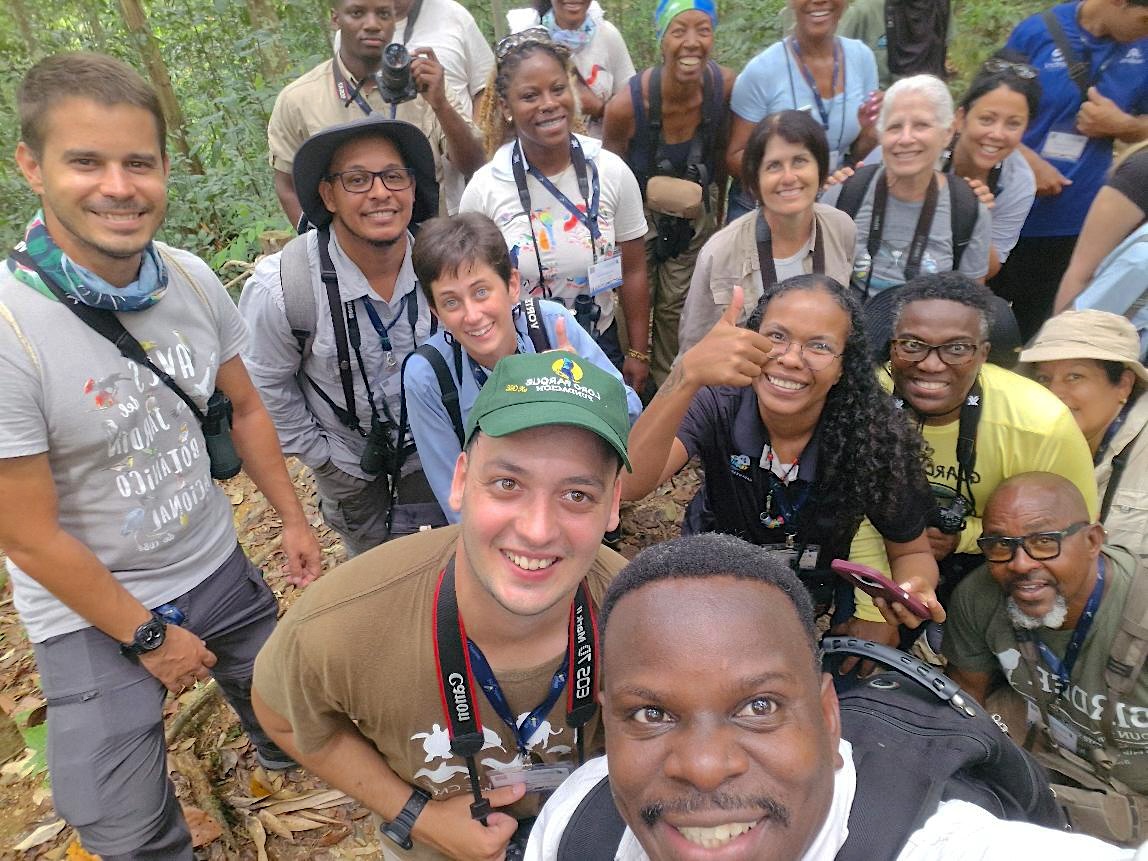
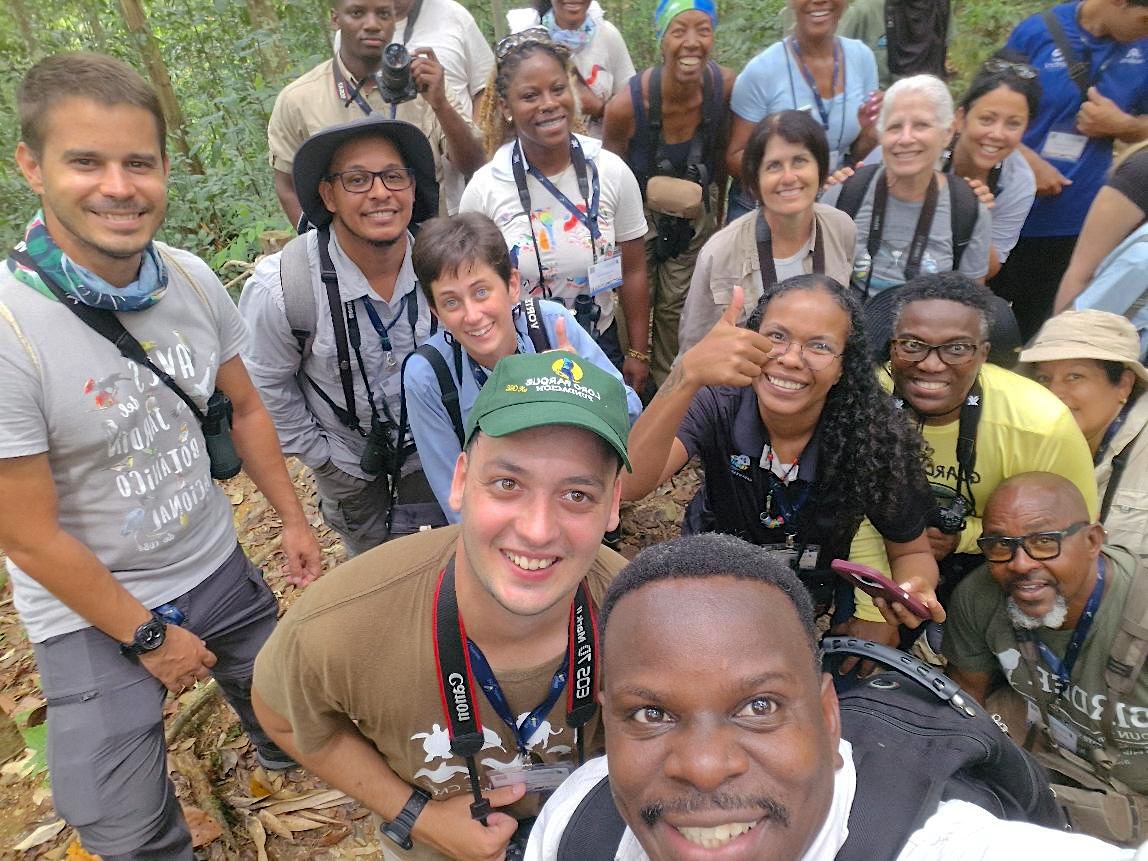
Abel (con gorra verde) observando aves junto a otros delegados en el sendero del Asa Wright Nature Centre. (Foto por Scott Johnson)
Nada de esto habría sido posible sin el apoyo de los donantes que hicieron posible mi participación. Su generosidad es una inversión en el crecimiento de los jóvenes conservacionistas y en proyectos que ayudarán a proteger la biodiversidad de nuestra región. Gracias a vosotros, pude representar a Cuba, compartir mi investigación y volver con herramientas, ideas y contactos que tendrán un impacto duradero en mi trabajo.
Esta ha sido mi primera Conferencia Internacional de BirdsCaribbean, pero espero que sea solo la primera de muchas. Me llevo recuerdos inolvidables, amistades que trascienden fronteras y la certeza de que la conservación es más fuerte cuando trabajamos juntos. ¡Gracias por creer en jóvenes investigadores como yo y por hacer posibles experiencias que inspiran y fortalecen el futuro de la conservación de las aves del Caribe!
Biografía: Abel Luis Simeón es un biólogo y ornitólogo cubano de 25 años. Su trabajo se centra en la investigación y la conservación de las aves endémicas y amenazadas de Cuba, con especial énfasis en la ecología y la conservación de la paloma codorniz de cabeza azul y la paloma codorniz de frente gris en el Parque Nacional de la Ciénaga de Zapata. Abel es uno de los galardonados de 2026 del Fondo David S. Lee para la Conservación de las Aves del Caribe.
Birds, Belonging, and New Beginnings: A Young Ornithologist’s First BirdsCaribbean Conference
Abel Luis Simeón, Cuban ornithologist and first-time attendee at the BirdsCaribbean International Conference.
For 25-year-old Cuban biologist Abel Luis Simeón, his first BirdsCaribbean conference represented a personal milestone. From long-anticipated encounters with Trinidad and Tobago’s extraordinary birds, to connecting with the passionate conservationists who share his deep commitment to Caribbean biodiversity, to sharing his own work protecting two of Cuba’s endemic doves, Abel returned home with new ideas, valuable connections, and renewed purpose. Read on for Abel’s reflections on a transformative conference experience.
There are moments that mark the beginning of a new chapter. For me, attending the 25th BirdsCaribbean International Conference in Trinidad and Tobago was one of them. As a young Cuban biologist and ornithologist, I had long dreamed of participating in a gathering where I could share experiences with people who, like me, dedicate their lives to the conservation of Caribbean birds.
Birds I had dreamed of seeing
White-beared Manakin. (Photo by Abel Simeón)
Before traveling, one of the things I was most excited about was getting to know Trinidad and Tobago. I had always heard about its extraordinary diversity of birds and ecosystems, and being able to observe them in person exceeded my expectations. One of the most special memories from the conference took place during the visit to the Asa Wright Nature Centre. Hearing the powerful, resonant song of the Bearded Bellbirds for the first time was truly impressive. But if there was one moment I’d been imagining for years, it was witnessing the famous leks of the White-bearded Manakins. Seeing the males gathered together, performing their rapid movements and displays while producing their characteristic calls, was an experience I’ll never forget. These are the moments that remind us why we chose to dedicate our lives to the study and conservation of birds.
The most valuable part of the experience, however, was the people. During the conference, I had the opportunity to talk with researchers, students, conservationists, and professionals from across the Caribbean and beyond, all united by a shared passion: protecting our birds and the habitats on which they depend.
Abel (wearing green cap) with fellow delegates from the Dominican Republic, Puerto Rico, The Bahamas and Cuba. (Photo by Hector Andujar)
Sharing my science
One of the most important moments for me was presenting a poster on the preliminary results of the project I’m currently developing, thanks to a grant from the David S. Lee Fund for the Conservation of Caribbean Birds. My research focuses on the conservation of two endemic and threatened dove species in Cuba: the Blue-headed Quail-Dove (Starnoenas cyanocephala) (Endangered) and the Gray-fronted Quail-Dove (Geotrygon caniceps) (Vulnerable).
Blue-headed Quail-Dove (Starnoenas cyanocephala). (Photo by Aslam Ibrahim)
Gray-fronted Quail-Dove (Geotrygon caniceps). (Photo by David Ascanio)
A notebook full of new ideas
Presenting my research provided an opportunity to exchange ideas with other researchers, who shared valuable recommendations on new analytical approaches, different ways to process data, and tools that could further strengthen my research. One particularly valuable recommendation was to explore Arbimon, a platform I had not previously used. As part of my project, I am conducting acoustic analyses of both target species, and until now I had primarily been using BirdNET Analyzer to help detect their calls in large volumes of recordings. Arbimon offers new possibilities for developing and refining my own acoustic classifier, which could make the detection and monitoring of my target species across many days of recordings even more robust.
Abel presenting his findings from his study during the Poster Night. (Photo by Christel Mohammed)
I also received recommendations on using occupancy models in R to analyze data from my transect surveys. This approach is especially valuable for cryptic species such as the Blue-headed and Gray-fronted Quail-Doves, because occupancy models can help account for imperfect detection i.e. when a species may be present but not detected during a survey. This can provide a more reliable understanding of where these species occur and how their distribution is related to the habitats they use. I returned with a notebook full of notes, new perspectives, and many ideas that I hope to incorporate into the next stages of the project.
Coming home inspired
The conference also allowed me to expand my network and meet people with whom I hope to collaborate in the future. It was inspiring to see how, despite the many challenges facing our islands, there is a committed community working together to conserve the Caribbean’s biodiversity. I returned to Cuba with new knowledge, new friendships, and even greater motivation to continue researching and protecting our birds.
Abel (wearing green cap) birdwatching with fellow delegates on the trail at the Asa Wright Nature Centre. (Photo by Scott Johnson)
None of this would have been possible without the support of the donors who made my participation possible. Their generosity is an investment in the growth of young conservationists and in projects that will help protect our region’s biodiversity. Thanks to you, I was able to represent Cuba, share my research, and return with tools, ideas, and connections that will have a lasting impact on my work.
This was my first BirdsCaribbean International Conference, but I hope it is only the first of many. I take with me unforgettable memories, friendships that transcend borders, and the certainty that conservation is stronger when we work together. Thank you for believing in young researchers like me and for making possible experiences that inspire and strengthen the future of Caribbean bird conservation!
Biography: Abel Luis Simeón is a 25-year-old Cuban biologist and ornithologist. His work focuses on the research and conservation of Cuba’s endemic and threatened birds, with a special emphasis on the ecology and conservation of the Blue-headed Quail-Dove and the Gray-fronted Quail-Dove in the Ciénaga de Zapata National Park. Abel is a 2026 Awardee of the David S. Lee Fund for the Conservation of Caribbean Birds.
Senior Science Officer at the Bahamas National Trust, Giselle Deane.
With 10 years as a Senior Science Officer at the Bahamas National Trust under her belt, a regional conference could easily feel like business as usual for Giselle Deane. Instead, this year’s BirdsCaribbean gathering in Trinidad felt like a warm family reunion—complete with new conservation partnerships, familiar friends, and a high-stakes birding quest to hit 500 species on her life list. Read on for Giselle’s firsthand account of the 2026 conference!
A Caribbean Homecoming
Going to Trinidad for the first time was a lot like coming home. Even the flavours of the food, which are very different from typical Bahamian cuisine, felt comforting and nostalgic to me. Growing up in a mixed Caribbean background, I often felt like I was different from everyone else. However, BirdsCaribbean constantly reminds me that we are united in both our differences and our commonalities.
As a mid-career conservationist, getting to present at and attend BirdsCaribbean Conferences feels like one of the pinnacles of my professional experience. As a Senior Science Officer at the Bahamas National Trust, where I recently celebrated 10 years, this was my third BirdsCaribbean conference. Getting paid to study and protect the birds I love? I feel like I’m working what could only be described as my dream job.
Old friends, new ideas—and a little sneaking away
The conference was nothing short of wonderful and magical. Arriving on Wednesday afternoon, I immediately hit it off with new friends and was greeted by others I hadn’t seen in years. It felt a lot like a family reunion and was something I had been looking forward to as a highlight of my year.
Living by my own personal rule of “not attending professional conferences unless I have something to present,” I spoke about my Caribbean Landbird Monitoring Small Grant Project, which explored the impacts of prescribed fire management on birds within the Abaco National Park. It was generally well received, although I personally thought I could have practiced a bit more before presenting!
Cuban Parrot, The Bahamas. (Photo by Elijah Sands)
The Bahama Swallow feeds mainly on flies and beetles. (Photo by Elijah Sands)
Bahama Warbler (Photo by Beth Hamel)
I was also invited to participate in the Sargasso Shearwater Road 2 Recovery (R2R) Workshop on Monday afternoon. This collaboration was great because it gave me ideas for future projects and potential local funding opportunities for the species. (Although I will admit, I did sneak out for a few minutes to watch the Sing-Like-a-Bird Competition — sorry Will and Jennifer!).
Aside from the professional business, I helped out at the merchandise table. It was a simple task, but a great way to meet a lot of people!
The quest for 500
Giselle photographing birds at Bajnath’s Estate Hummingbird Sanctuary. (Photo by Alvanna Johnson)
My favourite part of the conference, though, was the birds. Two days before I left, I realized I needed to see 73 new bird species to make it to 500 lifers. I thought, “Maybe that’s doable since I’m going on a few field trips.”
As it turns out,Trinidad’s unique geographic location on the edge of the Caribbean and South America made it incredibly easy! A week later, I found myself at 513 species, including 91 life birds — and I’m still missing a list or two!
Of course, I also intend to defend my title in the conference photography contest’s “Fun With Birds and People” category with my new camera lens, so stay tuned for that!
Birds connect people, too
Now that I am back home in The Bahamas, I feel rejuvenated (and a bit overwhelmed) by all of the good work going on in the region. I have been inspired to continue working not only professionally, but in a casual capacity too. I’ve made new friends and reconnected with others. Birds connect places, but I also think that people can be connected through birds.
This year, the Bahamian contingent was bigger than ever, with 19 of us representing the 242! Most of the group were newcomers, including four officers from the Bahamas Wildlife Enforcement Network (BahWEN) and four members of the Bird Club of New Providence.
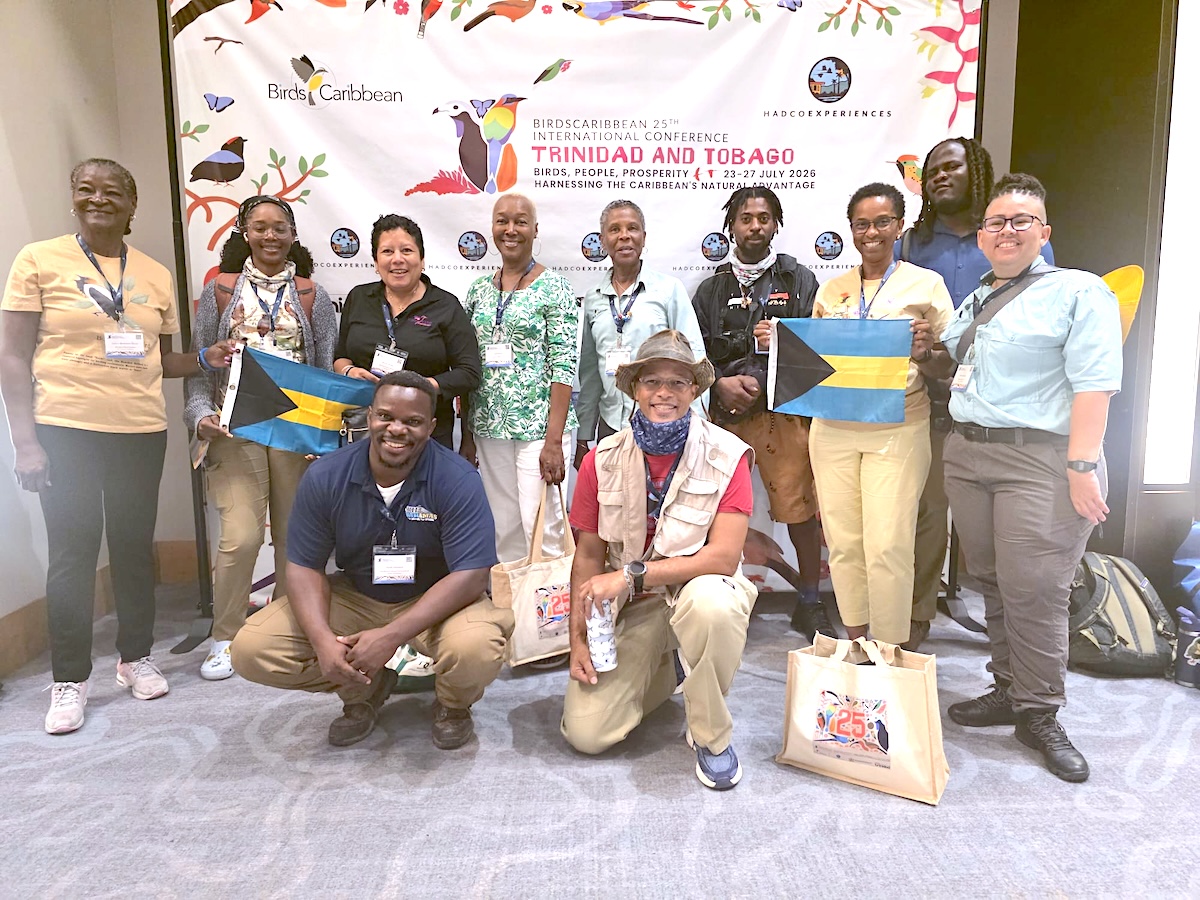
A subgroup of The Bahamian delegation at the 25th BirdsCaribbean International Conference.
The conference sparked discussions and planning for new collaborations back home, including starting an educational bird banding program to build local capacity and supplement our Motus network. Several of us also attended the Sargasso Shearwater R2R Workshop, which will hopefully result in visits to two of the more accessible breeding sites in the Exuma Cays. BahWEN has also requested a donation of native plants to attract more bird species to—and beautify—their base.
I am so hopeful about the future of collaborative bird conservation as we continue to realize just how important, accessible, and connected these creatures are.
Home again, inspired again
BirdsCaribbean Conferences are like going home to a new place, and this time felt more so than ever. Getting to see familiar faces again and meeting new ones is something both expected and exciting. Being united by birds is what connects the region, and I am excited to continue my conservation career after this wonderful experience.
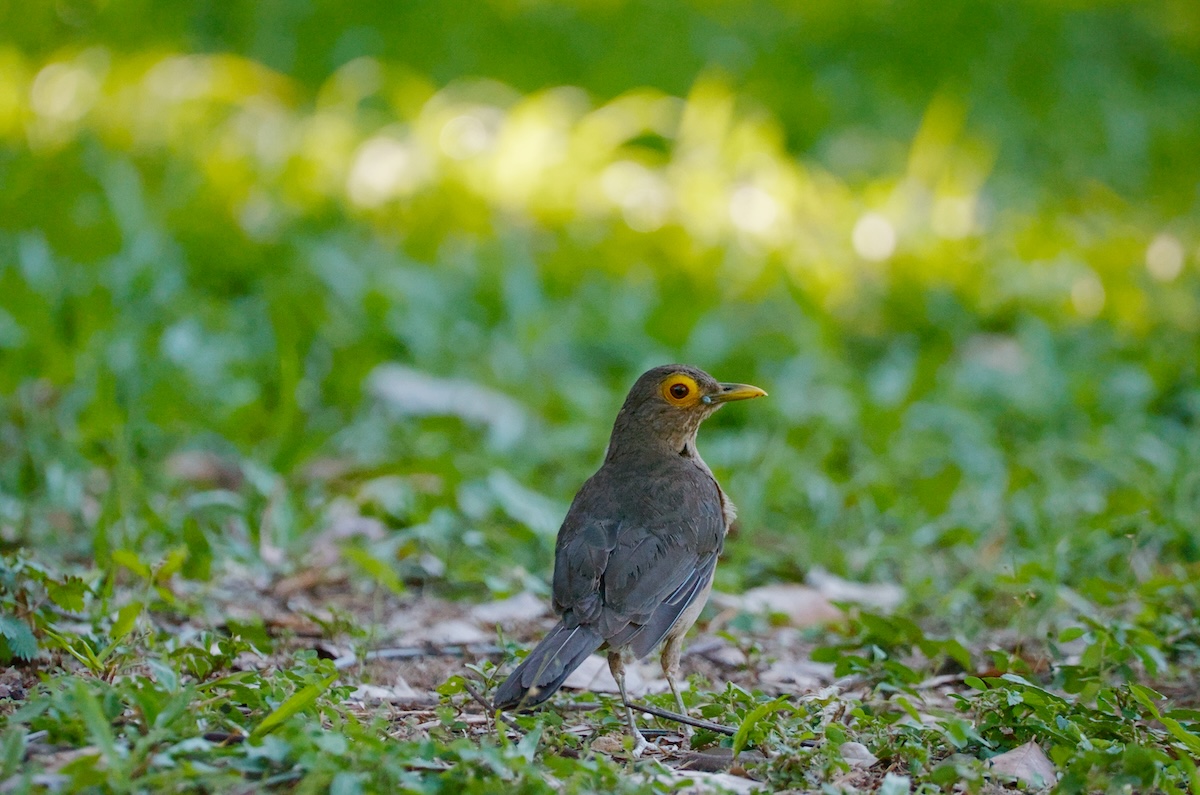
Spectacled Thrust (Turdus nudigenis). (Photo by Giselle Deane)
Giselle’s conference attendance was supported in part by the donors and supporters of our Global Big Day 2026 fundraiser. We extend our heartfelt thanks to everyone who made this experience—and the regional collaboration it inspired—possible!
Biography: Giselle Deane calls herself a tropical ecologist and currently works at the Bahamas National Trust as a Senior Science Officer, where she is responsible for terrestrial and bird projects across the country’s 33 national parks. Her professional interests include modern-day dinosaurs (birds and reptiles), geographic information science (maps and data), and conservation technology (drones, wildlife cameras, and audio recording units). Outside of work, she still likes birds—a lot—and is currently President of the Bird Club of New Providence. She also dabbles in fiber and craft arts and enjoys reading fiction. You can find her on Instagram @nesophlox, LinkedIn @giselle-deane and Facebook @giselle.deane.
There was something special in the air in Trinidad and Tobago—and it wasn’t just the hummingbirds! For five unforgettable days, more than 310 delegates from 30 countries filled the Hyatt Regency Trinidad with ideas, laughter, spirited discussions, new collaborations, old friendships, birding adventures, and plenty of excitement about the work ahead. Here are some of the moments—and outcomes—that made this milestone gathering so special.
Our Silver Anniversary Conference, held under the theme Birds, People, Prosperity: Harnessing the Caribbean’s Natural Advantage, was much more than a chance to share research. Scientists, conservation practitioners, educators, students, government agencies, community leaders, bird guides, tourism professionals, artists, photographers, and bird and nature lovers, to learn from one another, build skills, strengthen partnerships, and advance conservation across the region.
And the energy was extraordinary. Whether delegates were mapping conservation priorities, learning new sound recording techniques to monitor rare and elusive birds, planning the future of Caribbean parrot conservation, mentoring young scientists, exploring how bird tourism can strengthen local livelihoods, reconnecting over coffee, bidding wildly at the Silent Auction, or heading into the field before sunrise, there was a wonderful spirit of sharing and collaboration throughout the week.
As one delegate reflected:
“I thought this was one of the most collegial, collaborative, and joyful conference environments I have experienced.”
Of course, no single story could capture everything that happened over five action-packed days. More detailed reports from many conference sessions will follow in the Journal of Caribbean Ornithology. For now, here are a few highlights!
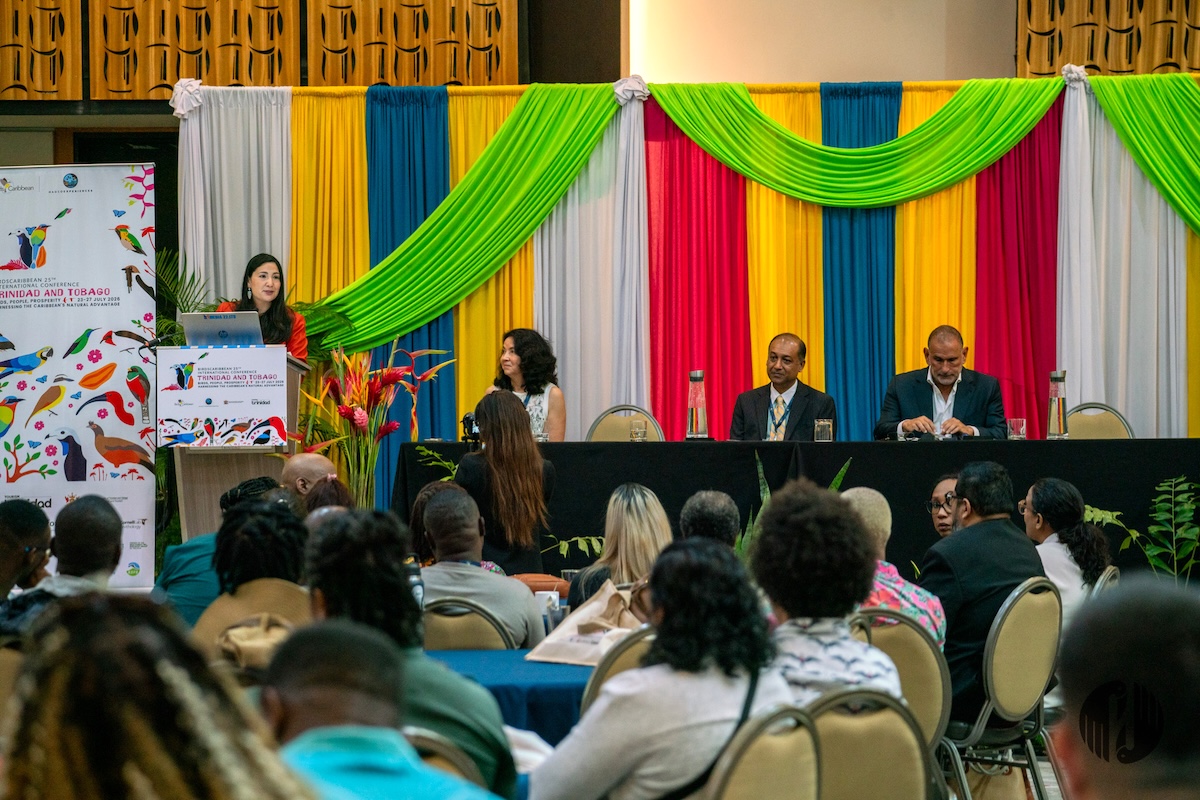
Opening remarks and head table panel at the 25th BirdsCaribbean International Conference opening ceremony. At the podium: Andrea Thomen, Acting President BirdsCaribbean. At the head table (left to right): Dr. Lisa Sorenson, Executive Director BirdsCaribbean; Mr. Cornell Buckradee, Tourism Trinidad’s Manager of Investment and Business Development; and Mr. John Hadad, Co- Chief Executive Officer, HADCO Limited. (Photo by Holly Garrod)
The Land of the Hummingbird Welcomes the Caribbean
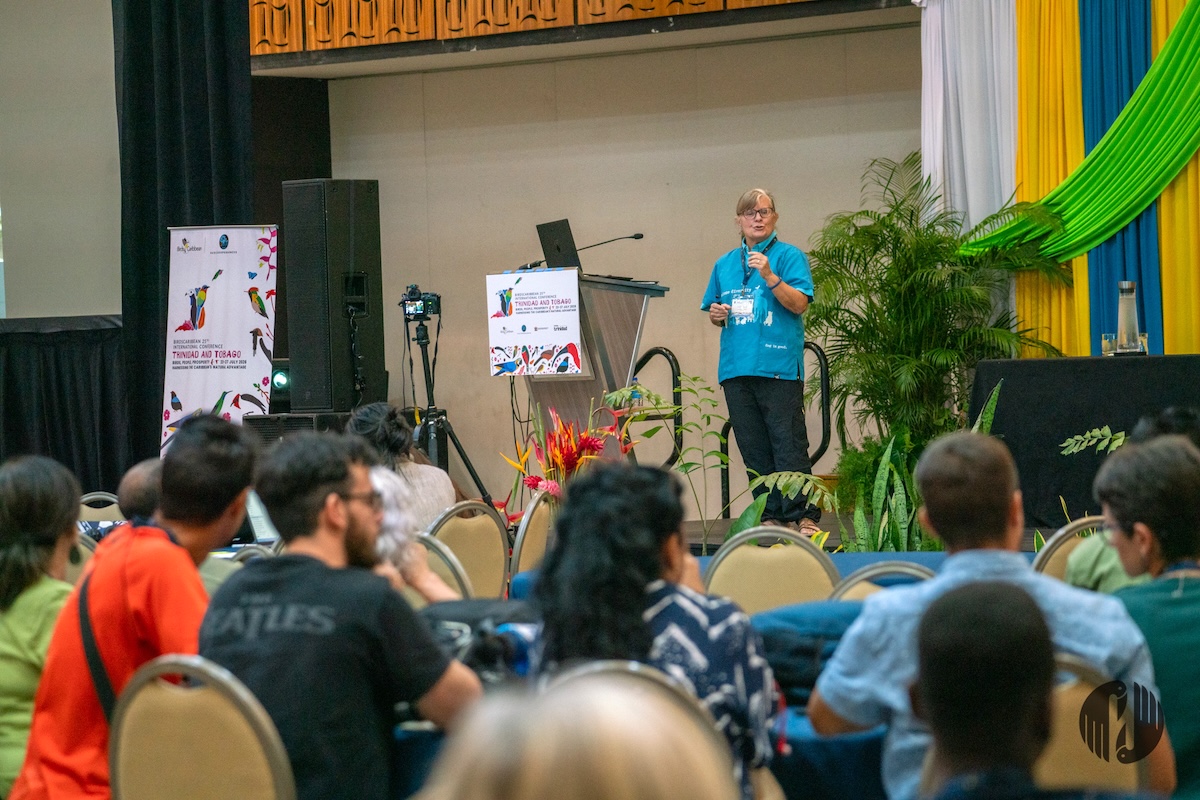
The conference kicked off with an energetic Opening Ceremony, followed by Trinidad and Tobago Day, our traditional showcase of the birds, projects, and people driving avian conservation in our host country.
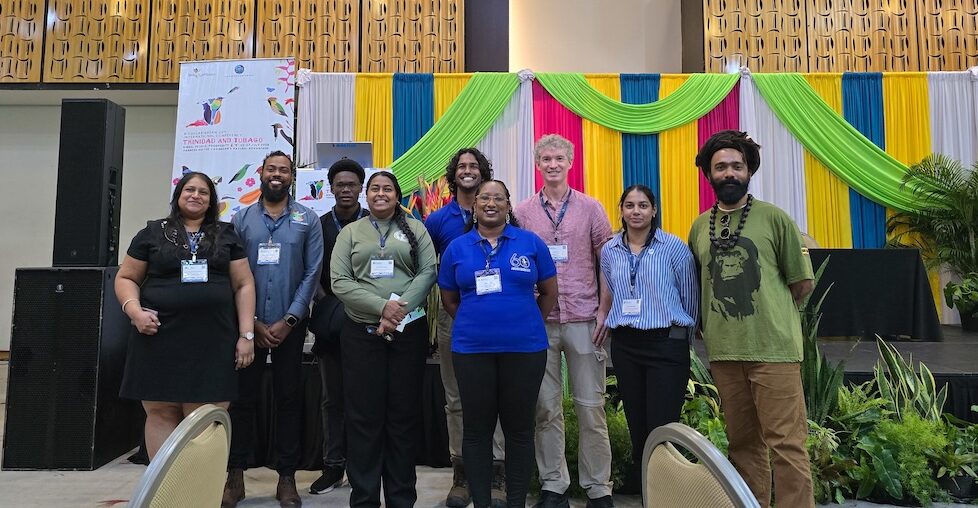
Trinidad and Tobago Day presenters (L to R: Elizabeth Seebaran, Josh Bajnath, Kelson Kirk, Daveka Boodram, Shaueel Persuadee, Jaleen West, Dr. Mark Hulme, Laura Baboolal and Faraaz Abdool). (Photo by Christel Mohammed)
Eight presentations demonstrated the breadth of bird research and conservation underway across the twin-island nation—from the recovery of the Trinidad Piping-Guan (Pawi) and conservation of the White-tailed Sabrewing, to the plight of native songbirds, restoration of critical wetlands, long-term bird banding, and hummingbird tourism, all while exploring the cultural and economic value of Trinidad and Tobago’s spectacular birdlife.
Elizabeth Seebaran of the Trinidad and Tobago Field Naturalists’ Club introduced delegates to T&T’s remarkable birdlife, highlighting its South American influences, sought-after species and birding sites, and key conservation priorities. Laura Baboolal of the Environmental Management Authority demonstrated how environmental legislation was used to strengthen legal protection for the Scarlet Ibis, recognizing its ecological, socio-economic, and cultural importance, and working with diverse stakeholders to study and sustainably manage the species and its habitats.
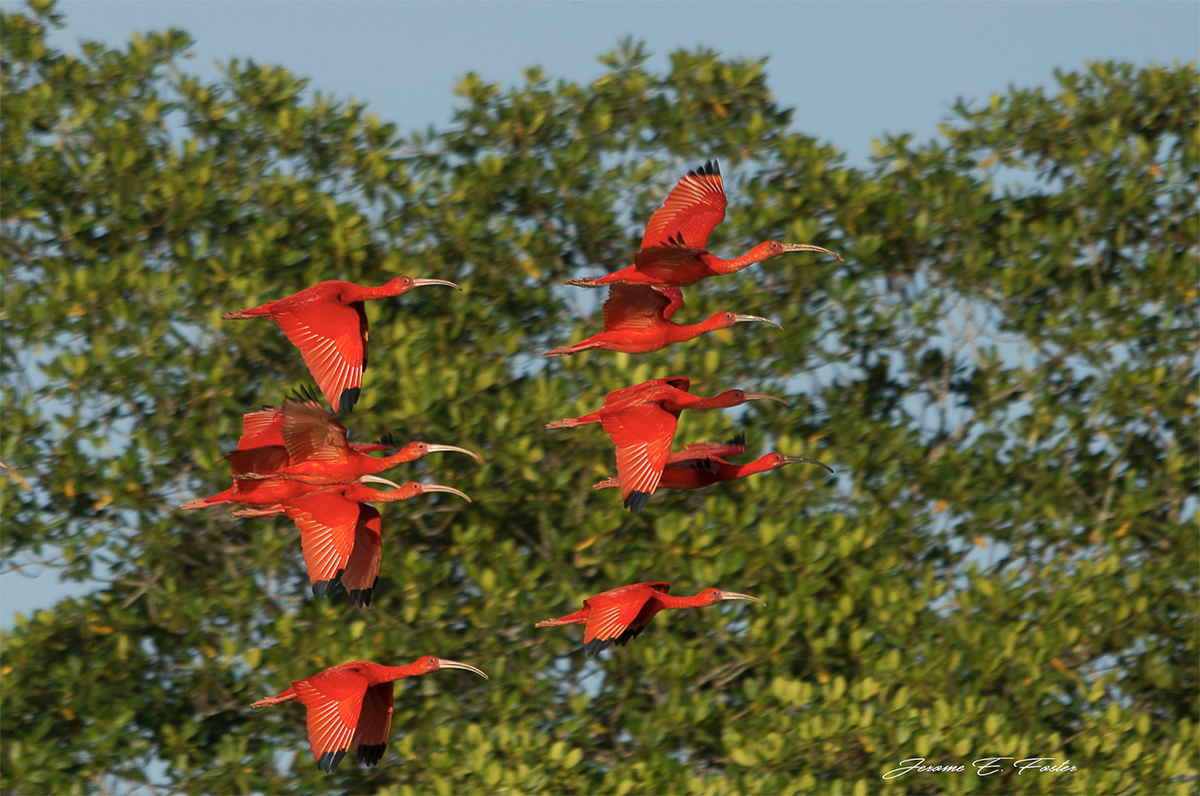
Scarlet Ibises fly in by the hundreds at the renowned Caroni Swamp. (Photo by Jerome Foster)
Dr. Mark Hulme shared encouraging evidence that the range of the critically endangered Pawi (Trinidad Piping-Guan) has expanded, suggesting the population has likely increased since the last survey 25 years ago—results now helping guide an updated recovery plan. Daveka Boodram highlighted the GEF-BIOREACH Project’s work to conserve Tobago’s White-tailed Sabrewing through habitat restoration, species monitoring, capacity building, and youth education, demonstrating the importance of combining science with community engagement.
White-tailed Sabrewing (Photo by Jerome Foster)
The large turkey-like Trinidad Piping-Guan is only found in Trinidad’s mountainous Northern Range. (Photo by Wendell SJ Reyes (ML66246621))
Other presentations showcased the diversity of approaches to bird conservation in T&T. Jaleen West and Shaueel Persuadee reflected on six decades of wetland and waterbird conservation at the Pointe-a-Pierre Wildfowl Trust, including a breeding and release program that has returned more than 15,000 native ducks to local wetlands. Kelson Kirk and Casianna McKenna highlighted long-term bird banding at the Trinidad and Tobago Bird Observatory in Tobago’s Main Ridge Forest Reserve, combined with training for local foresters and young people. And Josh Bajnath shared how habitat enhancement and a fascination with hummingbirds transformed his family’s estate into a thriving hummingbird sanctuary and popular bird photography destination.
The day also confronted difficult conservation challenges. Faraaz Abdool described the dramatic decline of Trinidad and Tobago’s native songbirds, particularly seedeaters, through decades of trapping, trafficking, and habitat loss. He emphasized the need for stronger enforcement, monitoring, changes in cultural practices, and potentially species reintroductions to help bring these birds back.
It was a wonderful introduction to the impressive conservation work underway in our host country—and to some extraordinary birds we would be seeing throughout the week.
Parrot People Unite!
One of the conference’s most exciting firsts was the inaugural Caribbean Parrot Conservation Summit, bringing together parrot conservationists from across the region for a full day devoted to the future of the Caribbean’s remarkable endemic parrots.
Participants shared hard-won experience from islands across the Caribbean, recognizing both the tremendous expertise already present within our region and the challenges so many parrots have in common—from habitat loss and illegal trade, to important gaps in our understanding of genetics and disease.
Acting President of BirdsCaribbean,Andrea Thomen, introduces the full-day Parrot Conservation Summit. (Photo by Christel Mohammed)
Karla Camila Del Río Salmon, Science Communication Officer at BIOECO Cuba speaks about Cuban Parrot conservation efforts following Hurricane Melissa. (Photo by Christel Mohammed)
Dr. Thomas White, Wildlife Biologist at the Puerto Rican Parrot Recovery Program. (Photo by Christel Mohammed)
Discussions highlighted the need for stronger island-to-island collaboration, shared research and training, regional behavior-change campaigns, and new approaches incorporating solidarity and the rights of nature into parrot conservation.
Group photo of presenters and delegates at the Parrot Conservation Summit. (Photo by Christel Mohammed)
The work will continue through the revitalized Caribbean Parrot Working Group, which over the coming months will begin developing coordinated regional conservation plans and identifying opportunities for collaboration.
Listen Up! New Skills for Caribbean Conservation
Learning by doing has always been central to BirdsCaribbean conferences, and our Silver Anniversary Conference offered an exceptional lineup of hands-on workshops.
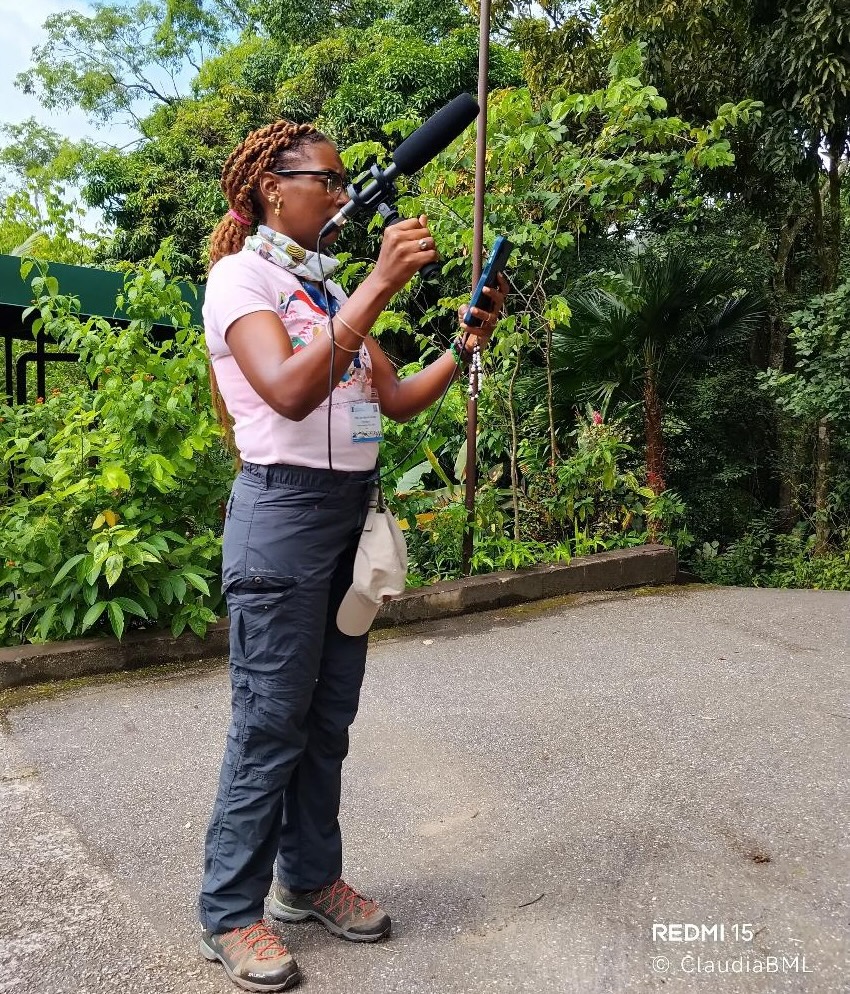
Inés Rodríguez practices recording bird sounds at AWNC. (Photo by Claudia Mantilla)
At the beautiful Asa Wright Nature Centre AWNC, participants in From Field to Archive: Recording, Editing, and Sharing Caribbean Bird Sounds, led by Cullen Hanks, Daniel Arias, and Jeff Gerbracht of the Cornell Lab of Ornithology, moved from classroom instruction straight into the rainforest.
Armed with smartphones and specialized recording equipment, they practiced capturing bird vocalizations in the field before returning to learn how to edit, evaluate, archive, and share their recordings through eBird and the Macaulay Library.
These vast libraries of volunteer recordings, contributed by nature enthusiasts and citizen scientists, power familiar tools like Merlin—and their effectiveness in the region depends on people adding new recordings. Daniel Arias reflected on the value of the workshop:
“These recordings not only help improve Merlin’s Sound ID model, but will also remain as a lasting record of Caribbean bioacoustics for the future.”
That afternoon, Rishi Deosaran, Dr. Mark Hulme, and Asif Khan introduced another group to Passive Acoustic Monitoring (PAM)—from deploying autonomous recorders in tropical forest to processing and analyzing the resulting data.
Farielle Mohammed attaches an autonomous recorder to a tree at the AWNC. (Photo by Ann Haynes Sutton)
Dr Mark Hulme with PAM workshop participants at AWNC. (Photo by Ann Haynes Sutton)
And these were just two of many workshops. Other practical workshops focussed on grant proposal writing, installing Motus stations, bird identification and monitoring, building a regional recovery strategy for the Sargasso Shearwater, conservation education and engagement, and much more. Learn more about the workshops offered at the conference here.
As one participant told us:
“What I enjoyed most was the number of hands-on activities…it wasn’t just theory.”
Participants left with practical skills they can now put to use at home. Some delegates are already planning new acoustic monitoring, bird-recording, banding, education, and other initiatives in their home countries.
Growing the Next Generation
One of the most gratifying moments of the week came during the Opening Ceremony, when Executive Director Lisa Sorenson asked everyone attending their first BirdsCaribbean conference to stand. Nearly half the room rose to their feet!
Our Silver Anniversary was a celebration of how far this community has come—but that moment reminded us to look forward, too. Students and early-career conservationists presented research, led discussions, participated in workshops, and connected with experienced scientists and practitioners. During a dedicated Mentorship Lunch, emerging professionals explored career pathways, publishing, skill-building, and the realities of building a life and career in conservation.
Highlights from our early-career conservationists and student presentations. (Photos by Holly Garrod and Christel Mohammed)
Ahjermae White (Montserrat) presents her research “From ashes to habitats: Colonisation of new volcanic landscapes by Least Terns (Sternula antillarum) in Montserrat.” (photo by Holly Garrod)
Adrian Dominguez (Cuba) shares his research “Results of seven years of monitoring of wintering migratory Passeriformes by the ringing method at the permanent station in Matanzas, Cuba.” (photo by Holly Garrod)
MIchelle Moyer presents her research on the Puerto Rican Oriole: Comparing elaborate signaling traits in tropical versus temperate songbirds. (photo by Holly Garrod)
Juleyska Vazquez-Cardona presents her research on vocal performance in agonistic encounters in Adelaide’s Warblers in Puerto Rico. (photo by Holly Garrod)
Jeanelle Brisbane (Dominica) presenting in the workshop: “Caribbean Conservation Movements.” (photo by Holly Garrod)
Dayamiris Candelario (Puerto Rico) presents in the workshop, “Flying Together: Environmental Interpretation for Bird and Ecosystem Conservation.” (photo by Holly Garrod)
Shanna Challenger (EAG Antigua) shares an update on conservation work in Antigua: “Building conservation from the ground up: engaging people in bird monitoring in Antigua and Barbuda.” (photo by Holly Garrod)
Dalila Lezcano (Cuba) shares her research: “Current status and dynamics of elements of marine coastal ornithological diversity in the Guanahacabibes Peninsula Biosphere Reserve.” (Photo by Holly Garrod)
Jodelia Simmons, Forestry Officer, St Vincent Dept of Forestry shared recent work to create a Conservation Action Plan for the Whistling Warbler, a threatened endemic in St Vincent and the Grenadines. (photo by Holly Garrod)
Harry Bolton, who presented on “Energy and the origin and maintenance of island avian biodiversity” (University College London (UCL), shares his research with Andrew Eppedio (Cornell Lab undergrad, studying foraging niche structure in birds in the DR), and Drew Sweet (Univ of AK studying the interactions between Caribbean birds and their parasites) during the first Poster Night. (photo by Christel Mohammed)
Analise Fussell shares her research assessing the potential of eBird data to track changes in abundance of wading birds in south Florida and its implications for Caribbean monitoring. (photo by Christel Mohammed)
One delegate was particularly inspired by the number of young people at the conference:
“How many younger people are doing amazing work with great passion in bird research and conservation—it was truly inspiring and gushed optimism and hope for the future!”
Thanks to the extraordinary generosity of our donors, sponsors, members, partners, and Global Big Day teams, BirdsCaribbean provided financial support for 90 sponsored delegates, including students, educators, researchers, conservation practitioners, and community leaders from across the region. Among them were 23 Cuban colleagues, who brought tremendous knowledge, energy, and enthusiasm to the gathering. For many, that support made participation possible—and gave them opportunities to learn, build skills, and connect with mentors and colleagues in ways that will continue well beyond the conference.
Finding your flock matters
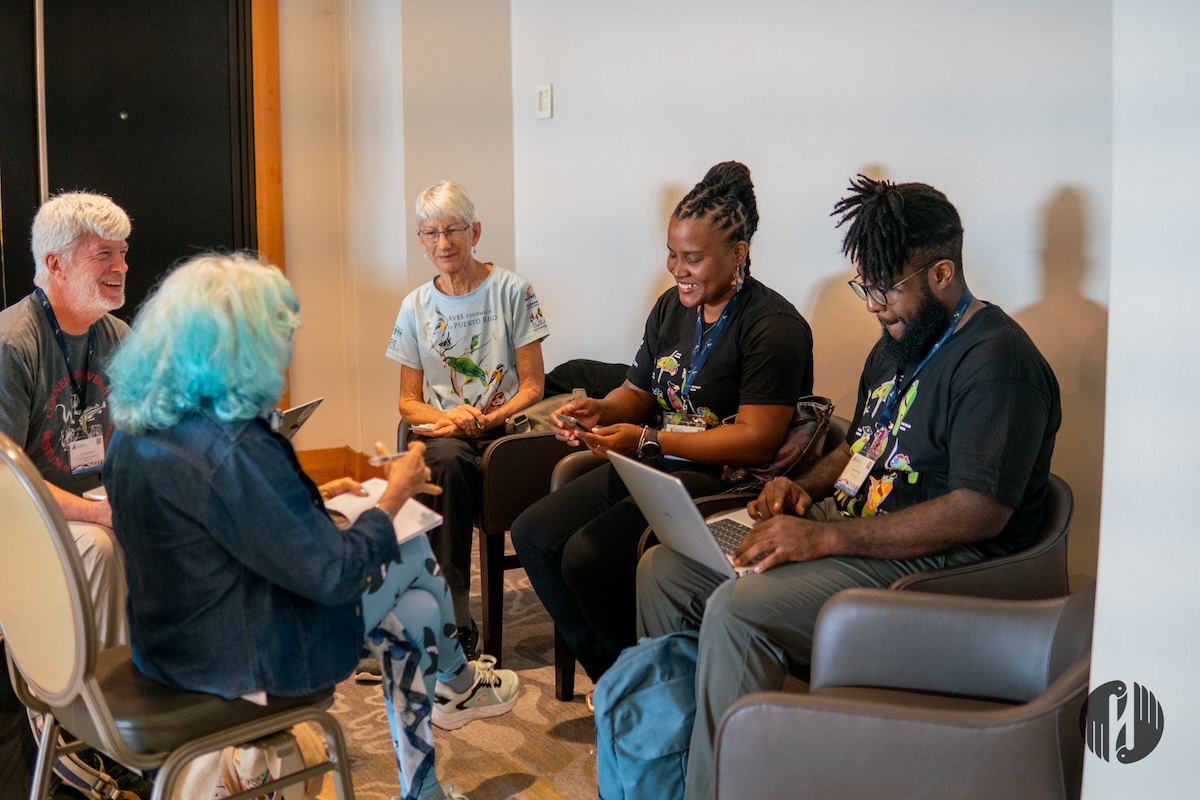
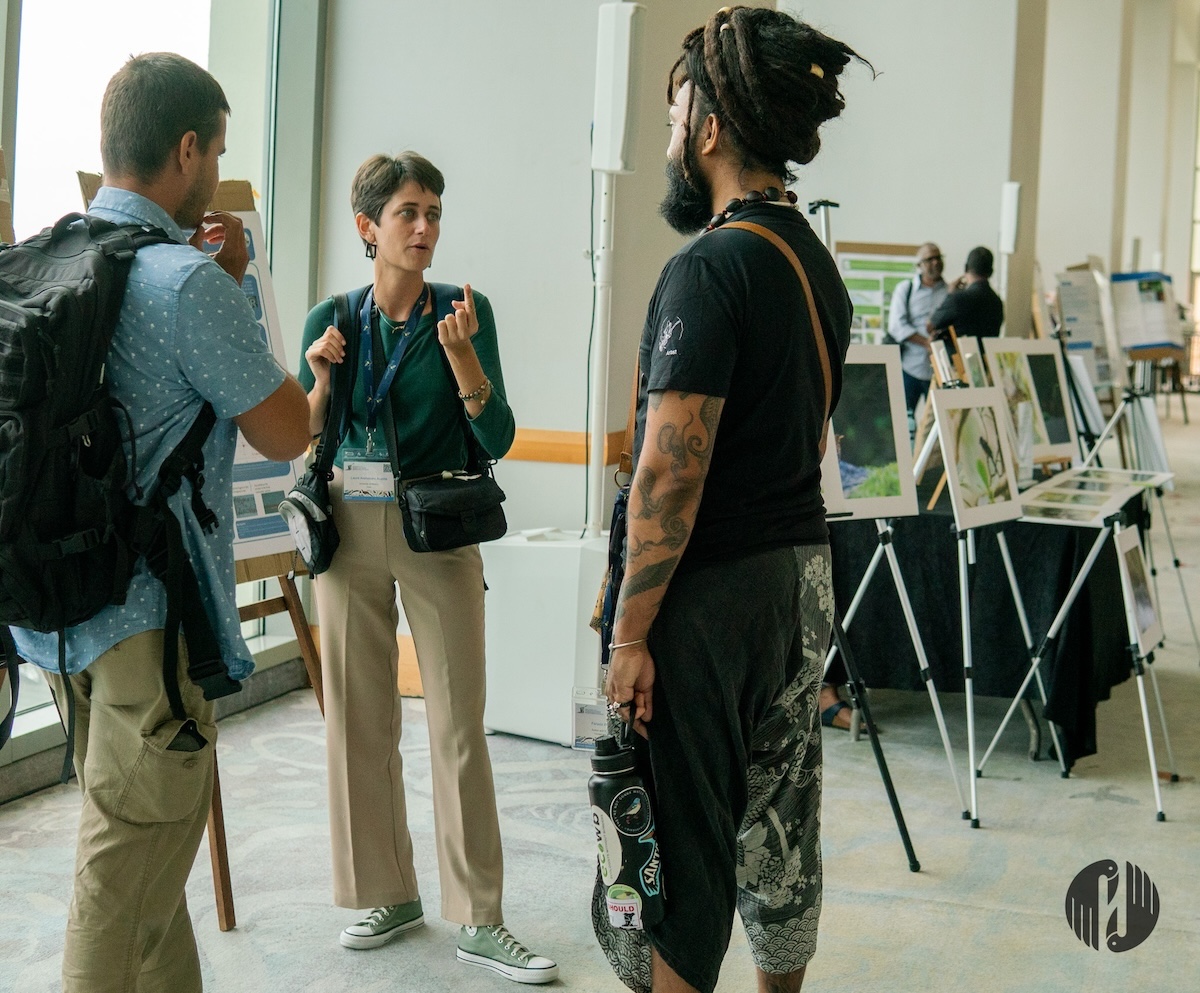
Some of the most valuable moments at a BirdsCaribbean conference happen outside the formal sessions—in hallways, over meals, during Working Group meetings, on buses to field trips, and in those spontaneous conversations that begin with: “You work on that too?”
Jeff Gerbracht (Cornell Lab of Ornithology) and Jamaican delegates: Dr. Ann Sutton, Wendy Lee, Michelle Roberts and Justin Saunders. (Photo by Holly Garrod)
In the post-conference evaluation, many delegates told us about new collaborations and project ideas that emerged during the week. Participants reported new connections involving Motus tracking, seabird research, parrot conservation, NestWatch, bird banding, passive acoustic monitoring, bioacoustics, invasive species, habitat restoration, environmental education, bird tourism, disease surveillance, and more. Researchers discovered colleagues with complementary expertise and data, organizations found potential partners, and people connected across islands and languages around shared conservation challenges.
Spontaneous exchanges between sessions where ideas turn into potential regional collaborations. (Photo by Holly Garrod)
One delegate summed it up simply:
“The networking connections that were made will be highly beneficial to our organization for years to come.”
Another shared something even more fundamental:
“Conservation does feel lonely at times, so I felt good to know I wasn’t alone in my fight.”
These connections are one of the most important reasons we gather. We may not see their full impact for years, but they will live on in the research projects, conservation programs, friendships, mentorships, and partnerships that began—or grew stronger—in Trinidad and Tobago. Browse the gallery below to see our delegates sharing ideas and “finding their flock” throughout the week.
Read more personal reflections and stories from two of our sponsored delegates from The Bahamas and Cuba:
Lucky to win a couple of Mark’s books in the Silent Auction!
Fun with selfies!
Winning the stunning Cuckoo painting!
Damaris and friends.
Most of the Cuban participants plus the Cuban ambassador in Trinidad.
Group selfie of Dominicans and more by Garry Auguiste.
Friends catching up!
Friends reconnecting!
Participants from from Puerto Rico and beyond.
Dominicans and Lisa at the press board for one more pic!
Shanna Challenger (Antigua and Barbuda) and Ajehrmae White (Montserrat).
St. Eustatius (Statia) gang!
Another selfie by Hector!
Big ideas for moving conservation forward
Throughout the conference, five inspiring keynote speakers challenged us to think bigger about what conservation can—and must—be.
Author, activist, and National Geographic Extraordinary Birder host Christian Cooper called on us to broaden the conservation community and ensure that more people see themselves as belonging in it. “If we want to protect the world’s diversity of birds,” he emphasized, “we need a diversity of people who care about the birds.“
Camila Gómez of SELVA showed how Motus technology—combined with training, data sharing, and international collaboration—is transforming our understanding of migratory birds across the hemisphere.
Christian Cooper keynote presentation. (Photo by Holly Garrod)
Camila Gómez keynote presentation. (Photo by Holly Garrod)
Rev. Dr. LoraKim Joyner made a powerful case for pairing rigorous science with solidarity, reminding us that species recovery ultimately depends on people working together.
Nicole Leotaud, Executive Director of CANARI, explored how the rights of people and nature, environmental justice, and emerging legal frameworks can strengthen Caribbean conservation and resilience.
And Trinidadian wildlife photographer, environmental advocate, author, and international guide Faraaz Abdool celebrated the raw power of birding itself—showing how experiencing birds can build empathy, deepen our relationship with place, and inspire people to become advocates for nature.
Nicole Leotaud. (Photo by Holly Garrod)
Faraaz Abdool. (Photo by Holly Garrod)
Together, the five talks offered very different but complementary perspectives on moving conservation forward—from science and technology to collaboration, inclusion, environmental rights, and the simple but powerful experience of connecting people with birds.
Birds, People, and Prosperity
Our conference theme asked a big question: How can conserving birds and nature also help Caribbean people and communities thrive? The conversation began with John Hadad, Group Co-CEO of HADCO Group, whose opening keynote, The Evolution of Value: HADCO, Regenerative Tourism, and the Future of Caribbean Enterprise, challenged businesses to move beyond simply reducing their environmental impacts toward actively restoring ecosystems, strengthening communities, and creating lasting value. Watch John’s keynote on our YouTube channel.
These ideas were explored further in our symposium on sustainable bird and nature tourism. From William Trim’s four decades of bird guiding in Tobago and José Alberto Pérez Hechavarría’s examples of bird tourism fueling citizen science in Cuba, to regenerative tourism at Castara Retreats, conservation of Asa Wright’s remarkable Oilbird colony, the emergence of South Caicos as a birding destination, and Ancilleno Davis’s practical framework for balancing the social, economic, and environmental dimensions of sustainability, speakers demonstrated that thoughtfully designed nature tourism can do far more than attract visitors. It can create livelihoods, strengthen local pride, support protected areas, turn former hunters into guides and conservation advocates, and give communities another powerful reason to keep birds and their habitats thriving.
Dr. Ancilleno Davis. (Photo by Holly Garrod)
George ‘Skip’ Glenn. (Photo by Holly Garrod)
Lisa Sorenson shared how the Caribbean Birding Trail puts this approach into practice through its “Know the Caribbean, Bird by Bird” philosophy, using guide training, storytelling, and authentic local experiences to strengthen bird tourism while supporting conservation and local livelihoods. Marketing professor George “Skip” Glenn added another perspective, encouraging tourism practitioners to create memorable and transformative experiences that can turn visitors into lifelong champions for Caribbean nature. The symposium concluded with an energetic discussion about practical ways to advance sustainable bird and nature tourism in Trinidad and Tobago and throughout the region.
For some delegates, the conference theme itself prompted a new way of thinking:
“I have always thought about birds and people, but the concept of prosperity gave this relationship a new meaning for me.”
Featured speakers and presenters at the ‘Birds, People, Prosperity’ symposium (L to R) George ‘Skip’ Glenn, Faraaz Abdool, Dr. Ancilleno Davis, Joe Plant, Anna Zuke Lisa Sorenson, Sheena des Vignes and William Trim. (Photo by Christel Mohammed)
It’s all about balance!
Some of the most memorable conference moments happen at our social events — over “doubles,” T&T’s famous vegetarian street food; in the hallways and around posters; on buses and boats; at our social events; and, of course, on the dance floor.
Our Opening Cocktail Reception offered an unforgettable taste of Trinidad and Tobago’s music, mas, culture, food, and warmth—and soon had delegates dancing.
Traditional Mas characters, Pierrot Grenade, dressed in patchwork costume, and Midnight Robber, dressed in wide-brimmed hat and cape, famous for delivering high-flown, threatening autobiographical speeches. (Photo by Holly Garrod)
An energetic performance by violinist Darion Dennis at the outdoor Welcome Reception. (Photo by Holly Garrod)
Traditional Mas character, Dame Lorraine, is a satirical, exaggerated portrayal of a wealthy 18th-century French plantation owner’s wife. (Photo by Holly Garrod)
Reconnecting with old colleagues and meeting new partners. (Photo by Holly Garrod)
Experiencing the energy and color of local Trinidadian culture during the Welcome Reception. (Photo by Holly Garrod)
A performer showcasing traditional Indian dance during the Welcome Reception. (Photo by Holly Garrod)
Smiling faces at the BirdsCaribbean Welcome Reception.(Photo by Holly Garrod)
Then came our famously (not-so) Silent Auction. Delegates once again arrived with wonderful treasures from their home countries, and friendly bidding rivalries helped raise approximately US$6,000 for Caribbean bird conservation!
Delegates taking a closer look at the clothing at the auction. (Photo by Christel Mohammed)
Justin Procter counting down to the close of one of the tables. (Photo by Christel Mohammed)
“Gotta get my bid in!” (Photo by Holly Garrod)
Delegates browsing items during the final hours of the auction. (Photo by Christel Mohammed)
Delegates keeping an eye on the bid sheets for their items. (Photo by Christel Mohammed)
The flamingo and hummingbird table at the auction. (Photo by Christel Mohammed)
Huge thanks go to Jennifer Wheeler, Linda Fuller, Natasha Atkins, John MacLennan, our energetic auctioneers Justin Proctor and Dr. Ancilleno Davis, and the many volunteers who made the evening such a success.
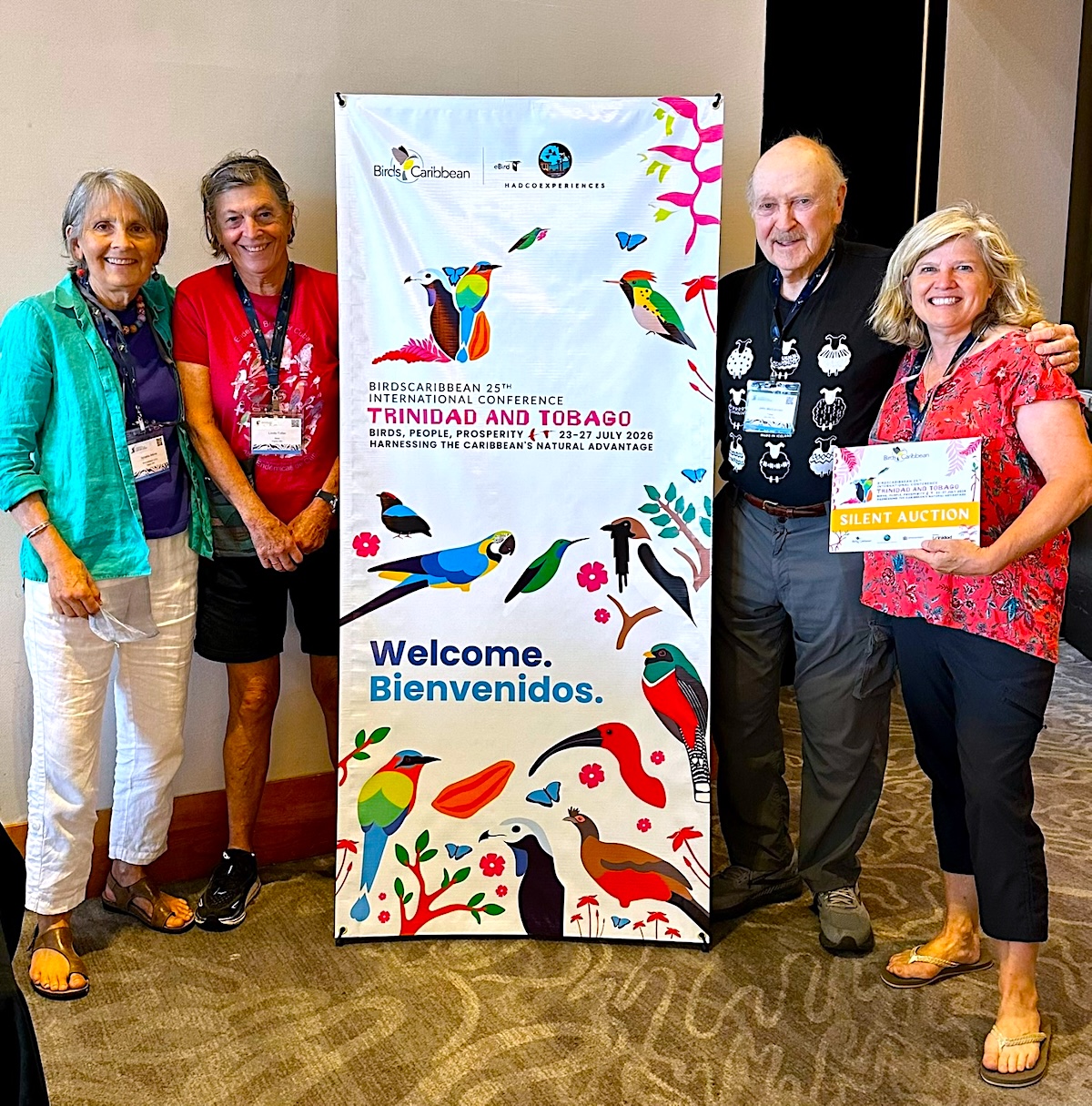
The BirdsCaribbean Silent Auction Team (L to R: Natasha Atkins, Linda Fuller, John MacLennan and Jennifer Wheeler)
And what would a BirdsCaribbean Conference be without our new fan-favorite Sing Like a Bird? Our brave contestants delivered their finest avian vocalizations, leaving both us—and Merlin Sound ID–-utterly amazed!
And of course…We had to go birding!
You cannot bring hundreds of Caribbean bird people to Trinidad and Tobago and expect them to stay inside a conference hotel all week. And they didn’t!
Before, during, and after the conference, delegates fanned out across the twin-island nation with expert local guides, exploring everything from coastal lagoons, mangroves, and savannas to rainforest peaks, offshore islands, hummingbird gardens, and even Oilbird caves.
They visited Tobago’s legendary Main Ridge Forest Reserve, Asa Wright Nature Centre, Aripo Savannas, Nariva Swamp and Bush Bush Island, the Northern Range, Brasso Seco, Caroni Bird Sanctuary, Bajnath’s Estate Hummingbird Sanctuary, Little Tobago, Bon Accord Lagoon, Grande Riviere, the Royal Botanic Gardens, and many more extraordinary places. Enjoy these fun field trip photos shared by our delegates!
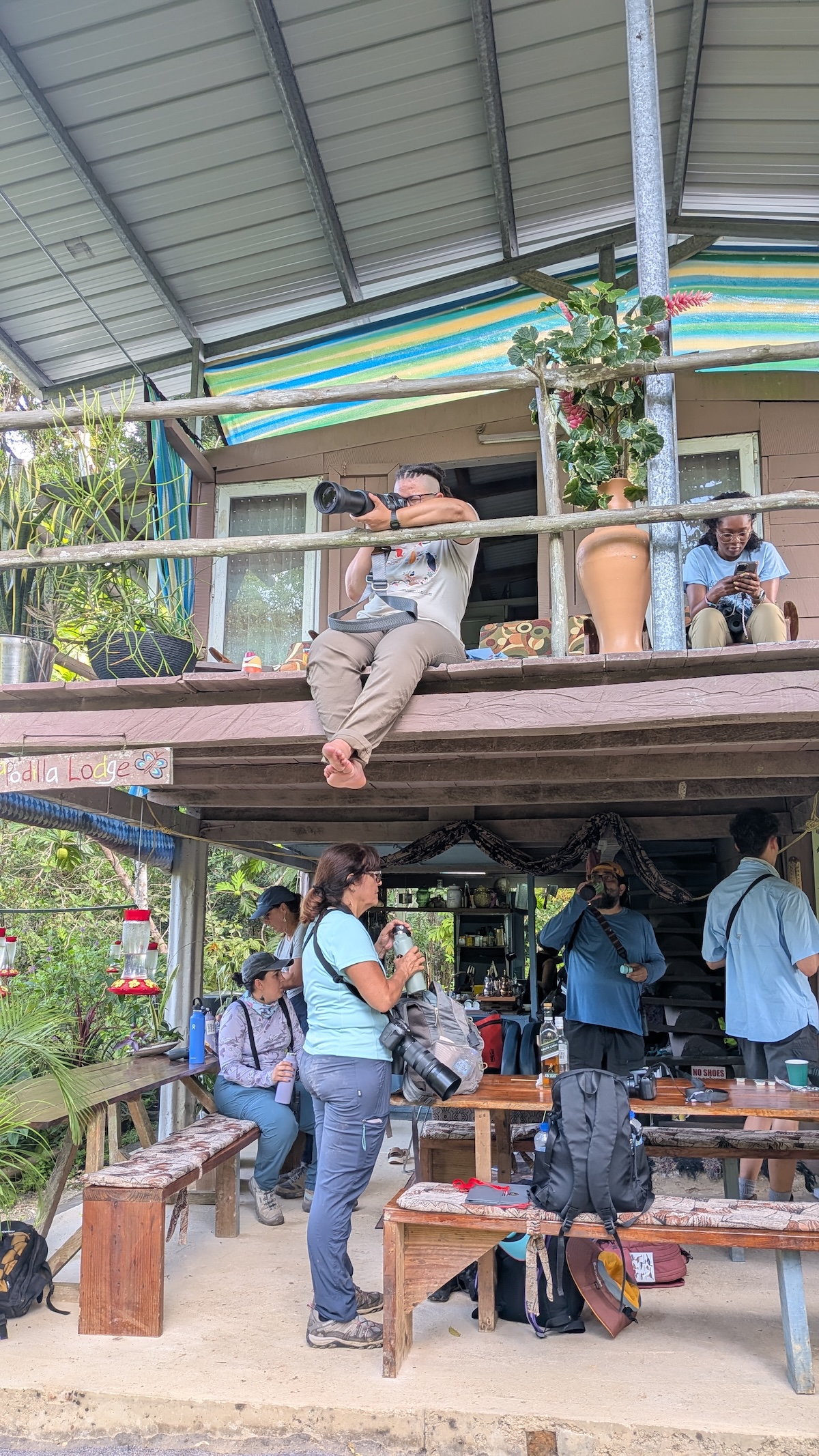
Delegates birding at Bajnath’s Estate. (Photo by Josh Bajnath)
The field trips weren’t only about birds. Delegates also tasted local cocoa, visited the extraordinary Pitch Lake, marveled at the Temple in the Sea, experienced Trinidad and Tobago’s cuisine and culture, and watched nesting Leatherback Turtles at Grande Riviere.
The reviews were glowing:
“The field trips were amazing.”
“WOW, what an adventure.”
And at Bajnath’s Estate, one delegate described the sheer number and diversity of hummingbirds as almost overwhelming—in the best possible way!
Trinidad and Tobago itself earned descriptions including “a paradise for birds,” “a birder’s haven,” and even “the birding Mecca of the Caribbean.”
A huge thank-you to our Co-Host, HADCO Experiences, for curating such a diverse lineup of field trips, and especially to the exceptional local guides whose knowledge, stories, enthusiasm, and sharp eyes brought these landscapes to life.
Five days went by far too quickly!
Eventually, even our packed program came to an end. Posters were taken down, the last field trips returned, and suitcases were packed. There were plenty of long hugs goodbye as more than 310 delegates scattered again across 30 countries.
But in many ways, we left with so much more than we came with. (And we’re not just talking about Silent Auction winnings!) Delegates left with new knowledge and practical skills, new colleagues and collaborators, research questions and project ideas, new friendships, and renewed determination. Judging from the conference evaluations, many also went home with something especially valuable: hope.
As one delegate reflected:
“The conference left me filled with hope, new plans and friends that hopefully will collaborate for a better future for our Caribbean.”
Another, Ailen Anido Escalona of Cuba, put into words something that captures the enduring spirit of our conferences:
“The conferences pass, but friendships, shared experiences, and the commitment to conservation remain.”
After 25 international conferences, one thing is very clear: no single person, organization, or island can secure the future of Caribbean birds alone. Bringing our community together—across islands, languages, cultures, disciplines, and generations—strengthens all of us and the work we do for Caribbean birds and people.
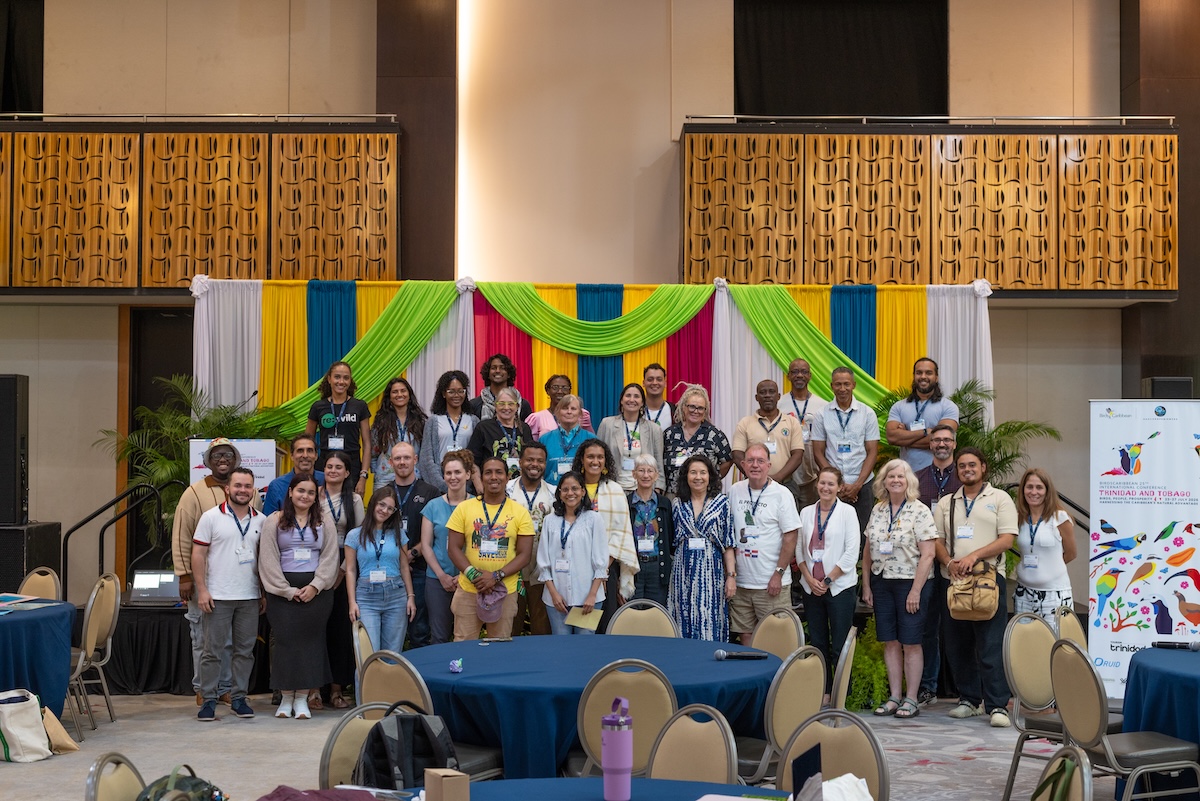
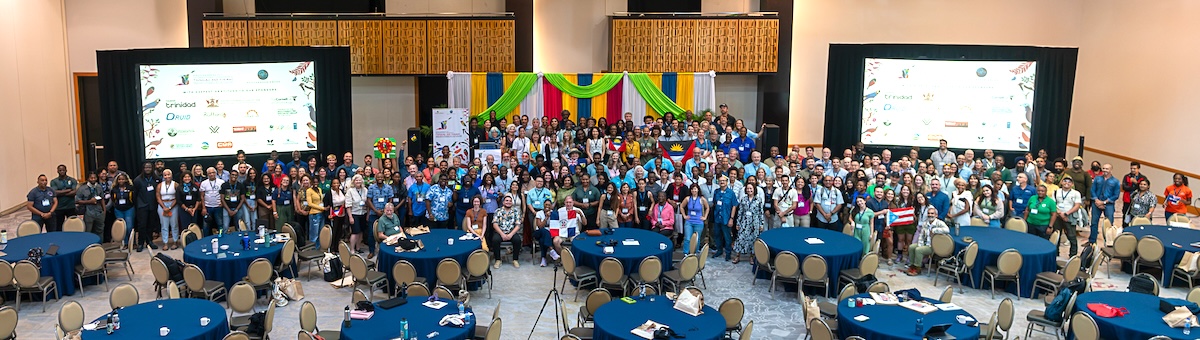
Bringing together researchers, educators, and conservation leaders from across the region—the official group photo of the 2026 BirdsCaribbean International Conference. (Photo by Cúa Conservation Agency)
Thank you, Trinidad and Tobago. And thank you to every person who taught, learned, presented, mentored, sponsored, volunteered, guided, organized, birded, danced, laughed, and continues to dream alongside us.
We are still riding the high—and can’t wait to see where this incredible community takes us next.
Stay tuned for upcoming working group updates, collaborative projects, and announcements for the 26th BirdsCaribbean International Conference!
More information on the conference, including the program, contests, and field trip itineraries, is available here.
BirdsCaribbean is very grateful to our Co-Host organization, HADCO Experiences, and Government and Partner Sponsors: Ministry of Trade, Investment and Tourism, and Tourism Trinidad, our Premier Trinidad Motmot Sponsor The Cornell Lab of Ornithology, and the Environmental Management Authority and the Trinidad & Tobago Field Naturalists’ Club for their tireless support and participation. We extend our gratitude to the organizations, agencies, and companies operating in Trinidad and Tobago that provided services and/or products to assist in hosting the conference.
We would also like to thank the many other funders and contributors from other parts of the Caribbean and the U.S. that provided support of this conference. This support enabled a number of Caribbean nationals to attend and participate, and also helped to cover the many costs of holding this conference.
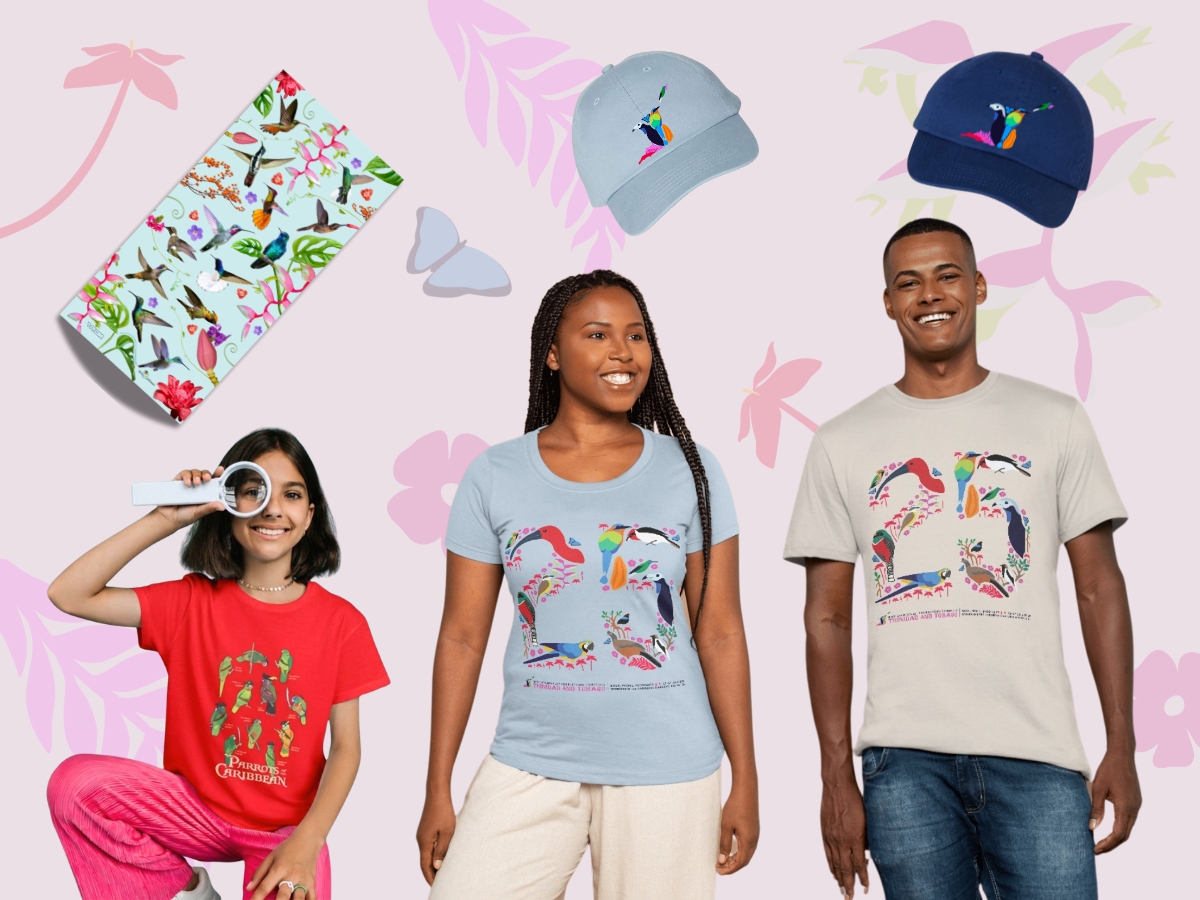
Our online Conference Merch Store for the upcoming BirdsCaribbean 25th International Conference is now OPEN! Order all your #BCTT26 merchandise online for pick-up in Port-of-Spain, Trinidad and Tobago, from 23 to 27 July 2026.
As we count down the days to gathering in sweet, sweet Trinidad and Tobago, it’s time to secure your exclusive conference merch! Trinbago culture is famous for its infectious energy, rich rhythm, and unparalleled flair, and our birds have just as much attitude and beauty! To celebrate our 25th anniversary, we’ve blended that creativity with our love for Caribbean birds to bring you a collection that is pure vibes. Whether you’re liming (hanging) with friends, heading to the next pump (social event), or out in the field, these pieces are designed to make a statement.
We’ve got a wonderful variety of items on sale to delight any fashionista, bird or nature lover, including conference t-shirts, hats, and buffs. These items double as souvenirs and keepsakes that will remind you of your amazing time in the Land of the Hummingbird for years to come. Plus, we have a new t-shirt design, “Parrots of the Caribbean” featuring all 11 endemic Caribbean parrots!
These items will make unique gifts for your family and friends. But the best part? Your order will directly support our work to help Caribbean birds and people thrive.Check out all the offerings at our e-shop https://bit.ly/BC-TT-Merch
Important Pick-up Notice: All merchandise items purchased on this site must be collected during the conference at the Hyatt Regency. We cannot ship items to anyone. If you can’t attend the conference, you can arrange with a friend or colleague attending the conference, or residing in Trinidad, to pick up your items for you.
The excitement doesn’t end online! Attendees can also stop by our merch table at the Hyatt Regency for a retail therapy break in between sessions to purchase something beautiful and fun that will help them remember the conference.
Our inventory is bound to be ram-cram with eager shoppers, and quantities are limited! So, as the local saying goes, “take front before front take you” – be sure to shop early to get your desired styles, sizes, and amounts.
Our conservation impact is stronger when we work together. We can’t wait to see you in Trinidad and Tobago!
Acknowledgments: A huge thank you to Andrea González del Rey and Ariel Contreras (Cúa Conservation Agency), Jessica Cañizares (BirdsCaribbean) and Eden Garrod (Eden Garrod Design) for the incredible designs, and to Josh Bajnath (Bajnath’s Estate) for providing us with hummingbird photos to create the buff.
The countdown is officially on for the Caribbean’s biggest gathering of bird conservationists, and we have an exciting milestone to celebrate. For the first time ever, the BirdsCaribbean International Conference will feature a Caribbean Parrot Conservation Summit dedicated entirely to the conservation of our remarkable endemic parrots. Read on to learn more about this must-attend event—and how you can reserve your spot!
From July 23–27, 2026, bird conservationists, researchers, educators, students, ecotourism professionals, and bird enthusiasts will gather in Port of Spain, Trinidad and Tobago, for BirdsCaribbean’s 25th International Conference. The program features inspiring keynote speakers, skills-building workshops, memorable field trips, and—the first-everCaribbean Parrot Conservation Summit: From Science to Solutions: Parrot Conservation under the Birds, People, Prosperity Framework.
Conservation leaders working to protect our Caribbean endemic parrots have been invited to participate in this inaugural Summit, creating an unprecedented opportunity to share knowledge, strengthen partnerships, and advance parrot conservation across the region.
The Caribbean is home to 11 endemic parrot species, each found nowhere else on Earth. From the St. Vincent Amazon and Imperial Amazon to the Cuban Amazon and Puerto Rican Amazon, these remarkable birds are among the Caribbean’s most treasured natural icons.
These charismatic ambassadors face mounting threats, including habitat loss, illegal trapping for the pet trade, climate change, and persecution when viewed as agricultural pests. As a result, all 11 species are on the IUCN Red List of threatened species, with most classified as Vulnerable or Endangered.
Despite these challenges, there is hope.
Across the Caribbean, local researchers and communities are already doing incredible work on their respective islands to protect their endemic parrots. With this foundation in place, the next logical step is to connect and upscale our efforts. Recognizing this need for regional unity, our partners at SoCal Parrot and Friends of the IUCN Wild Parrot Specialist Group stepped forward to support this inaugural Summit, helping bring our shared vision of a stronger Caribbean parrot conservation network to life.
Parrot people unite!
We are bringing together a diverse network of NGOs, government agencies, researchers, educators, conservation practitioners, and policymakers from The Bahamas, Cuba, Hispaniola (Dominican Republic and Haiti), Jamaica, Puerto Rico, Dominica, Saint Lucia, Saint Vincent and the Grenadines, the Cayman Islands, Trinidad and Tobago, and the United States.
Leading the Summit is BirdsCaribbean Acting President Andrea Thomen, a conservationist from the Dominican Republic who has dedicated many years to protecting the Hispaniolan Amazon and Hispaniolan Parakeet through research, education, and community engagement to combat the illegal pet trade.
Building a united front for parrots and people
Our goal is to create a dynamic space where conservationists can share experiences, strengthen collaborations, identify common barriers, and advance practical solutions. To make this happen, the Summit is divided into two interactive components: a symposium and a workshop.
During the symposium, we’ll highlight recent advances in research, population monitoring, education, community engagement, species recovery, habitat management, policy, and conservation action across the region.
Moving beyond presentations, the interactive workshop will provide participants with the time and structure to network, identify shared priorities, and develop opportunities for cross-island collaboration.
The St Vincent Amazon Problem Tree created by workshop participants. (Photo by Lisa Sorenson)
St. Vincent Amazon Solutions Tree created by participants.
The reality is, many Caribbean parrot conservationists work on small islands with limited staff, resources, and often have few opportunities to exchange ideas face-to-face with colleagues confronting similar challenges. While every island is unique, many of the threats and opportunities are intertwined.
Together, we are stronger than any one island can be alone. By sharing what has—and hasn’t—worked, we can scale up our successes.
Our goal is for each participant to leave with new ideas, stronger partnerships, practical tools they can apply at home, and a renewed sense of momentum for parrot conservation across the region.
Whether you work directly with parrots or simply care about the future of Caribbean biodiversity, this historic Summit offers a unique opportunity to learn from colleagues across the region, build lasting partnerships, and help shape the future of parrot conservation.
Every two years, a powerful gathering of scientists, educators, students, conservationists, tour guides, and artists from across the Caribbean and beyond come together at BirdsCaribbean’s International Conference. This year’s conference—our Silver Anniversary!—will take place in Trinidad and Tobago at the Hyatt Regency Trinidad from 23-27 July 2026. More than 300 international delegates are expected to convene in the twin-island nation to share the latest advances in Caribbean bird science, conservation and education.
The stunning Trinidad and Tobago endemic, the Trinidad Motmot, can be seen on both islands. (Photo by Vayun Tiwari)
The theme for the conference is:
“Birds, People, Prosperity: Harnessing the Caribbean’s Natural Advantage.”
The Caribbean’s environment is not a resource to be exploited and depleted — it is our competitive edge to be invested in and protected. This theme frames Caribbean biodiversity as investable capital, positioning conservation and ecotourism as engines of shared prosperity. We challenge the outdated “development vs. environment” narrative and call for a bold recognition of our region’s true strength: proudly owning, protecting, and advancing the natural assets that can power a sustainable future.
This theme highlights the power of birds and nature as drivers of resilient economic growth. By investing in conservation and nature-based tourism, Caribbean nations can transform their extraordinary biodiversity into opportunity — strengthening local economies, supporting communities, and safeguarding ecosystems. It’s a call to value our natural heritage not only as treasures to protect, but as a foundation for long-term prosperity.
“For too long, we’ve been told that economic growth must come at the expense of the environment,” said Executive Director Lisa Sorenson. “This conference challenges that narrative. By focusing on ‘Birds, People, and Prosperity,’ we are building a future, grounded in science and community leadership, where the Caribbean’s natural assets drive both resilience and regional wealth. Join us as we harness our natural advantage and build a future where nature and prosperity grow together.”
To learn more about the conference, submit an abstract, register, sign up for a field trip, and more, visit the conference website.
Scarlet Ibises fly in by the hundreds at the renowned Caroni Swamp. (Photo by Jerome Foster)
White-tailed Sabrewing (Photo by Jerome Foster)
Agenda highlights: What to expect
The 2026 program is designed to turn vision into action. From scaling the Caribbean Birding Trail and advancing landbird and seabird monitoring, to empowering communities to protect their iconic species, the agenda will feature dynamic symposia, hands-on workshops, and forward-looking discussions.
Just as important, this conference is a catalyst for professional growth. It’s where cross-island partnerships are formed, new collaborations begin, and the next generation of conservation leaders step forward. Whether you are a seasoned expert or emerging professional, this is where connections are made — and momentum builds.
We will also organize pre-, post-, and mid-conference field trips to some of Trinidad and Tobago’s most spectacular birding hotspots. Delegates will have opportunities to visit world-renowned sites, such as Asa Wright Nature Centre, Caroni Swamp, Nariva Swamp, Mt. Plaisir Estate Hotel (and the nearby Pawi Lodge!), and the oldest legally protected forest reserve in the Western Hemisphere — Tobago’s Main Ridge Forest Reserve —among many others. We’ll be offering a selection of unforgettable 1-,2-,3-day (and possibly even longer) trips over the 5 days before and after the conference — stay tuned, because you’ll want to book early!
The Tufted Coquette is a favorite sighting at HADCO Experiences at Asa Wright Nature Centre (Photo by Paul Tavares)
The Critically Endangered Trinidad Piping-Guan can be spotted the lush forest at Grand Riviere (Photo by Gareth Hughes)
Tobago’s Main Ridge Forest Reserve is the oldest legally protected forest reserve in the Western Hemisphere. (Photo by BBC Wildlife Magazine)
And what would a BirdsCaribbean conference be without our famous not-so-silent Silent Auction, the BirdsCaribbean Raffle (hello, brand-new spotting scope!), the Photo Contest (and new binoculars!), and the new crowd favorite: the Epic Caribbean Bird Song Showdown? Expect energy, laughter, and a whole lot of bird-loving fun.
Mark wins the bid! (Photo by Daniela Ventura)
David Lindo, The Urban Birder, inspired delegates with his keynote on connecting with nature in urban spaces. (Photo by Christel Mohammed)
It wouldn’t be a BirdsCaribbean Conference without dancing!
Daniela, Maya, Todd, and Saul at the poster session.
Planning is well underway. Our conference website (currently under construction) will soon feature details on the program, logistics, field trips, travel scholarships, and registration. We’ve also arranged preferred accommodation rates for our delegates and will be sharing those booking links soon!
The Call for Keynote and Plenary Speakers and Call for Proposals for Workshops, Symposia, Round-table Discussions is OPEN now – details here; deadline to submit is Friday, 27 March. The Call for Abstracts for oral and poster presentations will open by 30 March.
For now, spread the word and block the dates on your calendar.
If you haven’t already, sign up for the BirdsCaribbean listserv — the best place to receive conference updates and news about funding and training workshops. We also share all announcements on our social media so give us a follow (@BirdsCaribbean). Finally, subscribe to our monthly newsletter — we’ll send the latest news on exciting Caribbean bird research and conservation projects, as well as opportunities to get involved.
Sponsorship & Support
We’re thrilled to have HADCO Experiences — our Pawi-level sponsor and official Conference Co-Host — and the Ministry of Trade, Investment and Tourism, Government of the Rebublic of Trinidad and Tobago already on board. Their leadership and commitment to regenerative tourism and sustainable Caribbean development are helping make this landmark event possible, and we are deeply grateful for their partnership.
HADCO Experiences, who were recently awarded the prestigious Green Key certification for the Asa Wright Nature Centre and Mt Plaisir Estate Hotel, champions environmental stewardship at the core of all their operations. This partnership reflects our shared vision of a Caribbean where conservation and sustainable tourism thrive together — benefiting both people and wildlife.
To ensure the conference’s success, we need your support. For every conference, we offer travel and attendance scholarships to ensure that financial constraints do not prevent deserving delegates from attending, contributing, and benefiting from the conference proceedings. We want to ensure that BirdsCaribbean conferences always remain accessible and inclusive spaces that foster the next generation of Caribbean conservation leaders. Your contribution can help bring frontline conservationists, students, and educators from across the region to share knowledge, build skills, and strengthen our collective impact.
Interested in sponsoring a delegate or becoming a conference sponsor? Please contact: Alexia Morales — [email protected] Lisa Sorenson — [email protected]
We’re thrilled to share that BirdsCaribbean’s 25th International Conference—our Silver Anniversary!—will be held in Trinidad & Tobago, July 23–27, 2026.
Registration is OPEN.
Early Bird Registration Deadline: 15 May 2026 – Register here.
Book early to secure your spot on one or more of the many amazing pre-, mid-, and post-conference field trips we are offering, in partnership with HADCO Experiences.
The Call for Abstracts to give an oral or poster presentation is OPEN.
To stay up-to-date with the latest news and announcements about the conference, sign up for ourBirdsCaribbean listserve and follow us on social media (@BirdsCaribbean)
Prepare for a powerful gathering of the brightest minds in Caribbean ornithology. At BirdsCaribbean conferences, we don’t just talk about a future where birds and people thrive — we forge it together. Join us to explore cutting-edge conservation strategies, groundbreaking research, transformative education, and concrete actions that will protect the region’s extraordinary birdlife for generations to come. The conference website will be launching soon!
Powerful keynotes from regional and global conservation leaders
Hands-on workshops to level up skills in monitoring, education, tech, and management
Latest research & case studies on avian ecology, habitat protection, monitoring, ecotourism, education, policy, and community engagement programs
Invaluable networking to power your career and spark collaborations
Immersive cultural experiences across the twin-island nation
Unforgettable field trips to world-class birding sites, such as Asa Wright Nature Centre, Caroni Swamp, Nariva Swamp, the Main Ridge Forest Reserve (Tobago), and many more!
Plus the fan favorites: our famously not-so-silent Silent Auction, the BirdsCaribbean Raffle (hello, brand-new spotting scope!), the Photo Contest (hello, new binoculars!), and our new crowd hit: the epic Caribbean Bird Song Showdown—all set against the lush, bird-filled landscapes of Trinidad and Tobago.
This is your official heads-up to hold the dates. More details will be shared in the coming weeks on the venue, costs, registration, field trips, workshops, call for symposia and workshops, abstract submissions, and travel scholarships.
Sponsorship & Support:
We’re thrilled to have the Government of Trinidad and Tobago and HADCO Experiences—our Pawi-level sponsor and official Conference Co-Host—already on board. Their leadership and commitment to regenerative tourism and sustainable Caribbean development are helping make this landmark event possible. HADCO’s partnership reflects our shared vision for a Caribbean where conservation and sustainable tourism thrive together—benefiting both people and wildlife.
To ensure the conference’s success, we need your support too. Your contribution can help us bring frontline conservationists, students, and educators from across the Caribbean to share knowledge, build skills, and strengthen our regional network for bird and habitat conservation.
Interested in sponsoring a delegate or becoming a conference sponsor? Please contact:
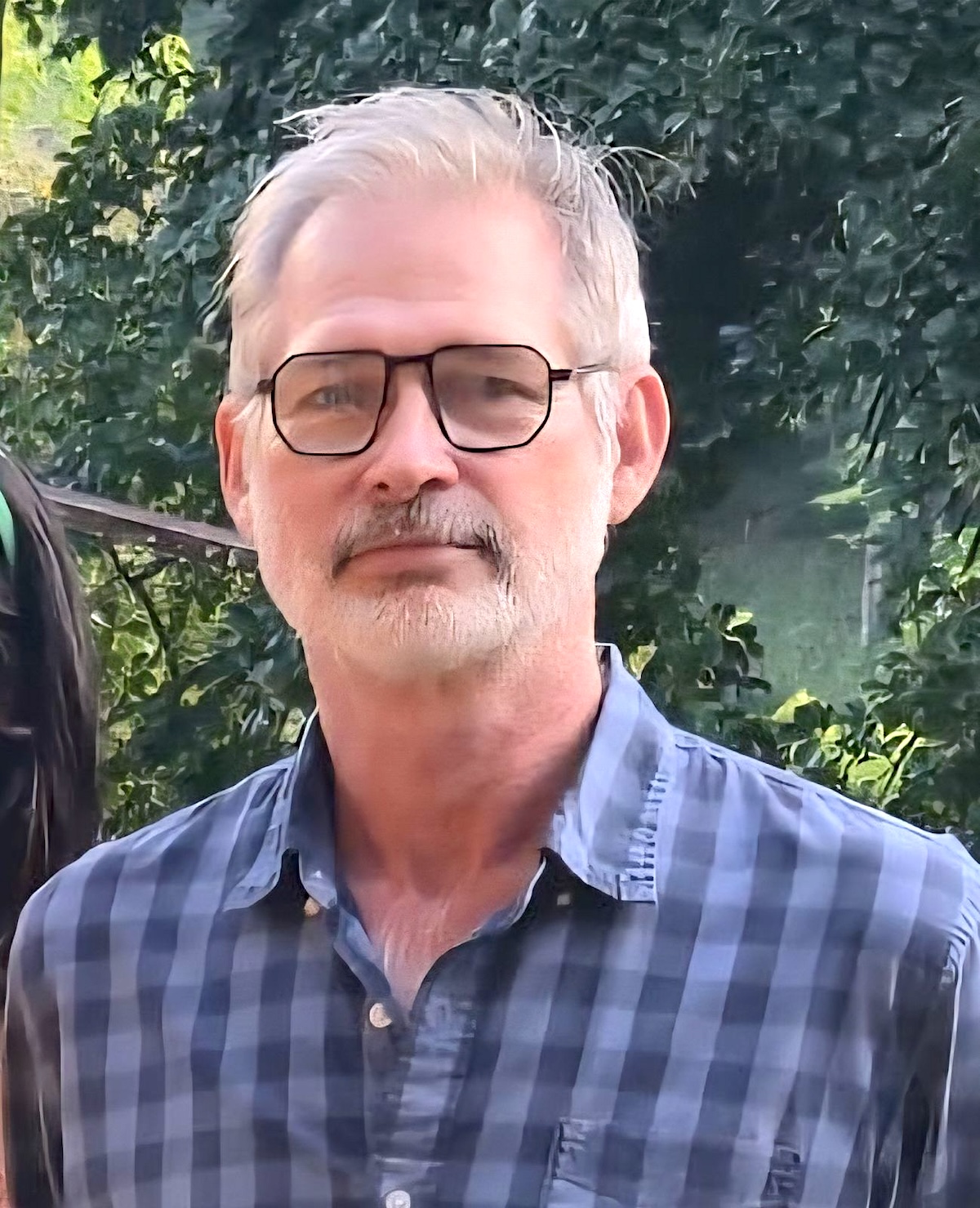 Graham White, biologist, consultant ecologist, and lifelong naturalist from Trinidad and Tobago, was honored for more than four decades of dedication to ornithology, natural history, and conservation. Graham began birding in the 1980s under the mentorship of renowned ornithologist Richard ffrench and has since become a leading figure in Trinidad and Tobago’s birding and naturalist community. A founding member of the Trinidad and Tobago Rare Birds Committee (now the T&T Birds Status and Distribution Committee), he has served continuously since its establishment in 1995, helping document and strengthen knowledge of the country’s remarkable avifauna.
 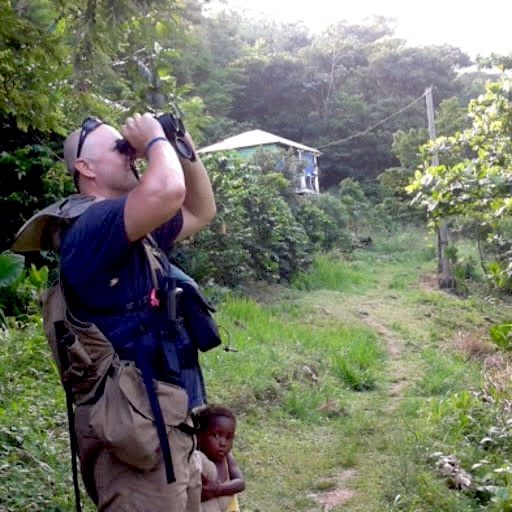 Dr. Frank Rivera-Milán, Research Wildlife Biologist with the U.S. Fish and Wildlife Service, was recognized for his pioneering contributions to Caribbean bird population ecology and monitoring. Frank was among the first avian ecologists working in the Caribbean to apply and adapt statistical methods that account for the fact that not every bird present during a survey is detected—making it possible to produce more accurate estimates of bird abundance and population trends.
  Dr. Jaime Collazo, retired Professor of Wildlife Ecology at North Carolina State University and Assistant Unit Leader with the U.S. Geological Survey’s North Carolina Cooperative Fish and Wildlife Research Unit, was honored for a distinguished career as a scientist, teacher, mentor, and conservation biologist. A native of Puerto Rico, Jaime has authored more than 150 peer-reviewed publications and conducted influential research on birds throughout Puerto Rico and the Caribbean.