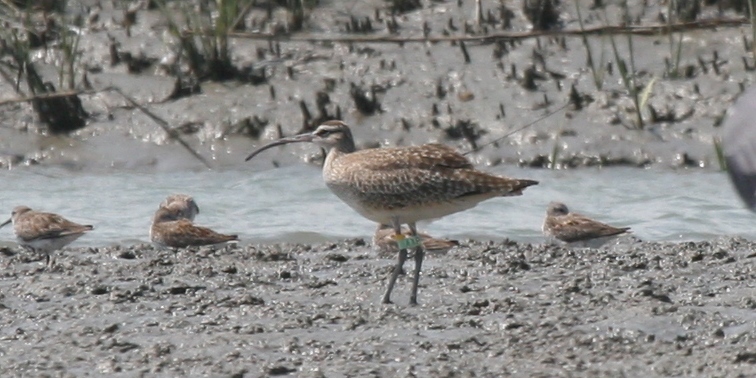
BirdsCaribbean is excited to finally announce all of our Global Big Day 2021 photography winners and share some of the many awesome photos that were taken on Global Big Day! We already reported on the team and individual stats and awards – click here if you missed the results from our record-breaking day!
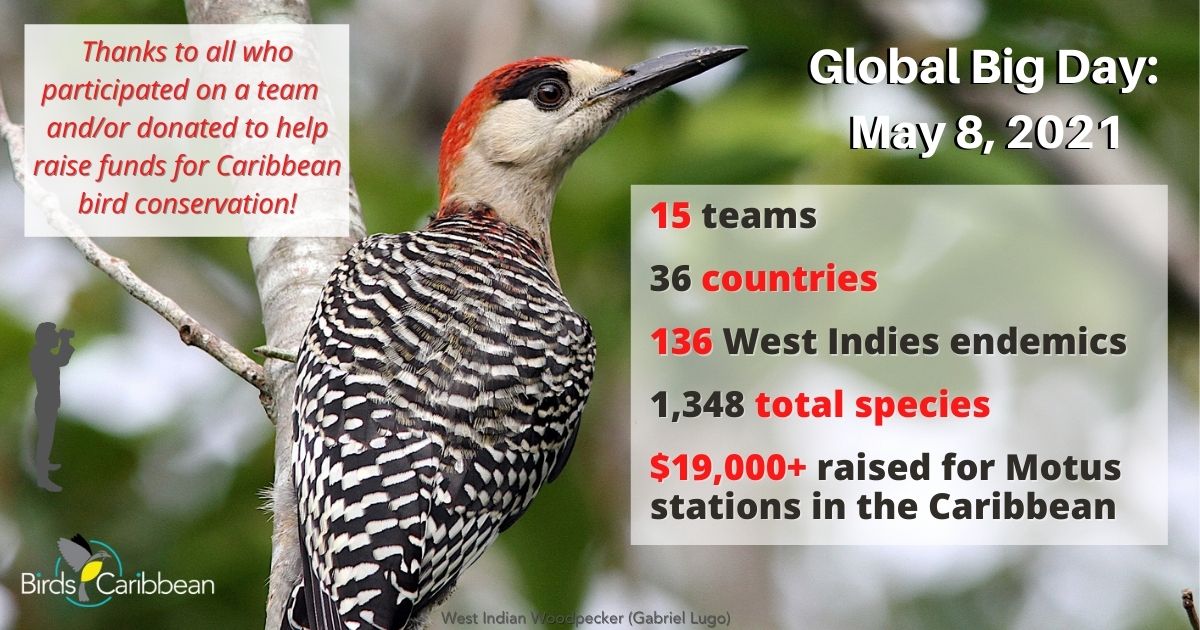
Thanks to everyone that participated, especially our team leaders and generous donors, Global Big Day 2021 was a huge success. We had a record number of teams participating (15). And thanks to a game-changing challenge grant from a member of the President’s Perch team, we were able to raised close to $20,000 for our new Caribean Motus Collaboration – so amazing! Congrats to all the winners – enjoy the photos and gallery below!!!
PHOTOGRAPHY AWARDS
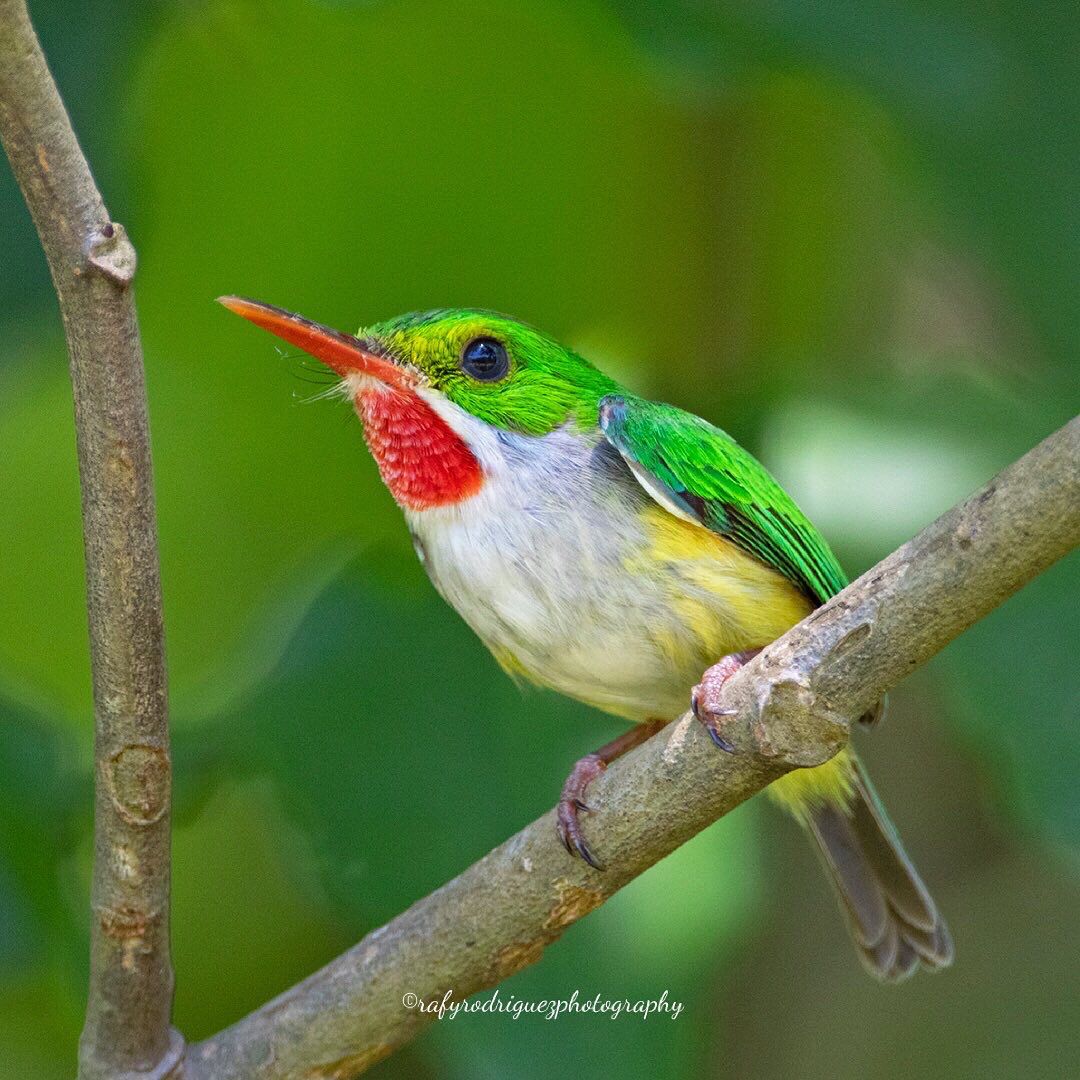
Best Bird Photo: Rafy Rodriguez – Puerto Rican Tody
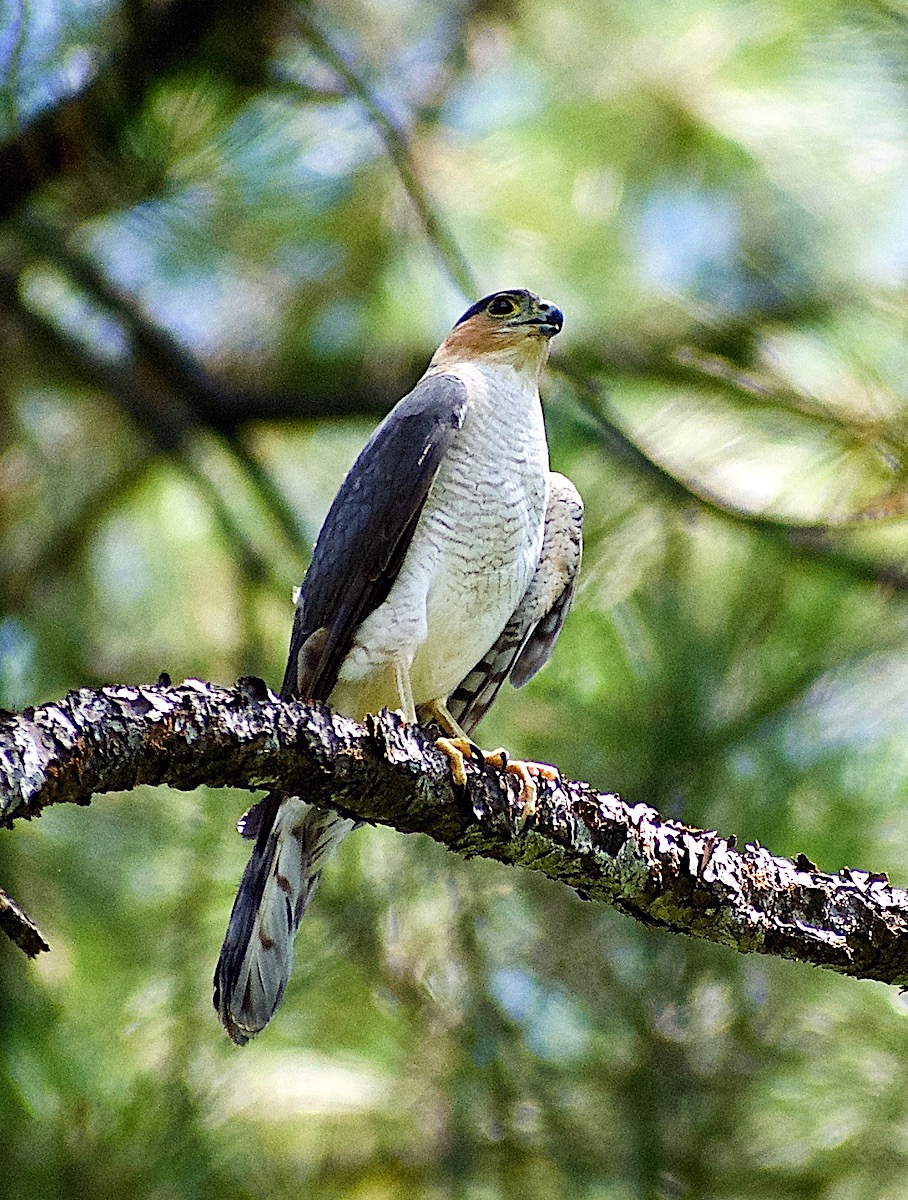
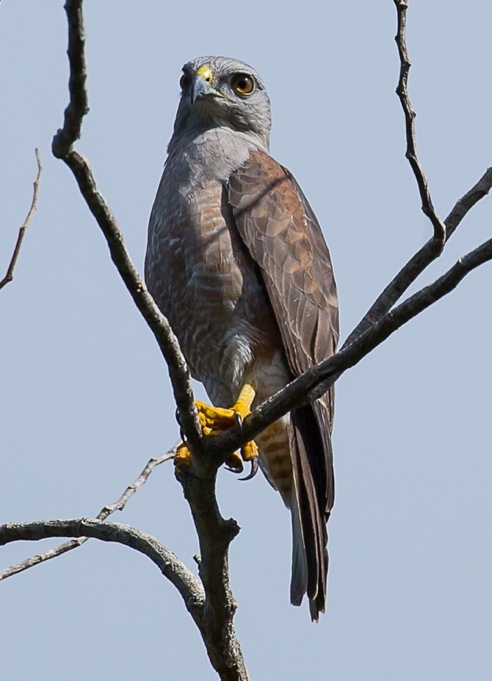
Second Best Bird Photo: Roberto Jovel — Cuban Sharp-shinned Hawk, Cuba
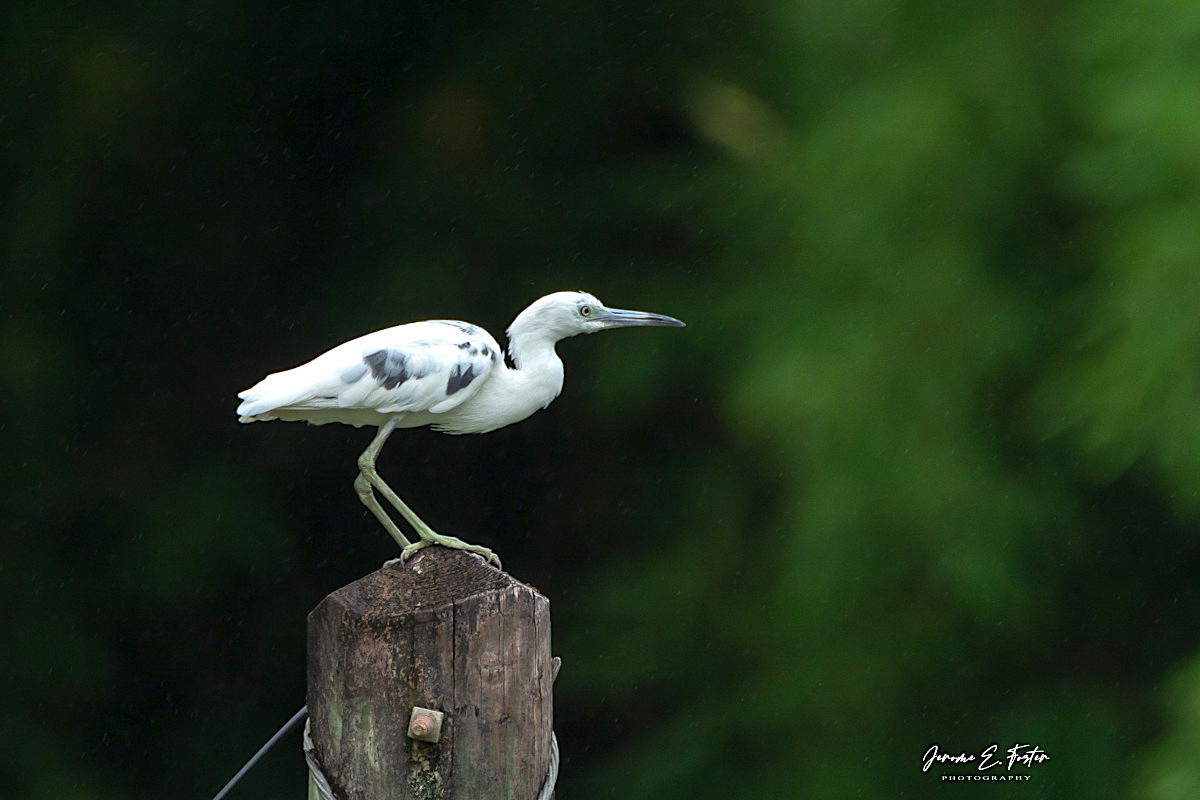
Third Best Bird Photo: Jerome Foster — Little Blue Heron, immature (molting), St. Lucia
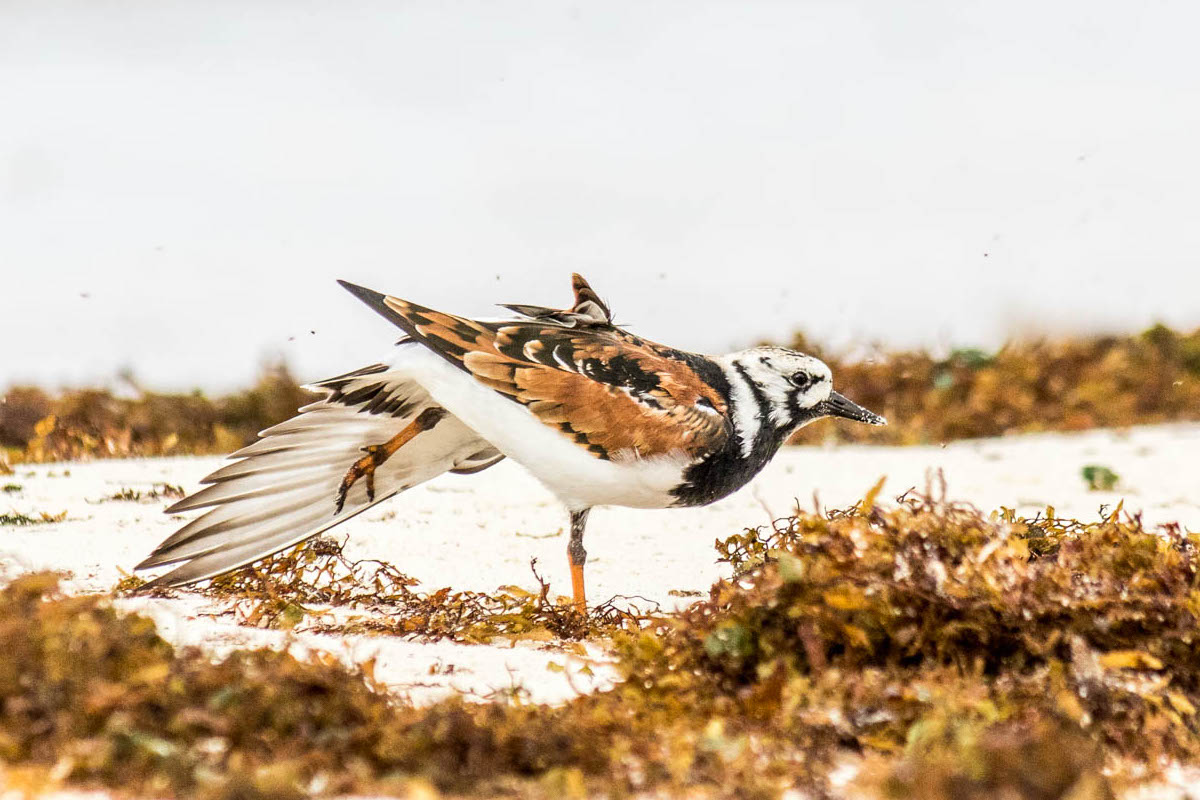
Best Shorebird: Julian Moore — Ruddy Turnstone, Barbados
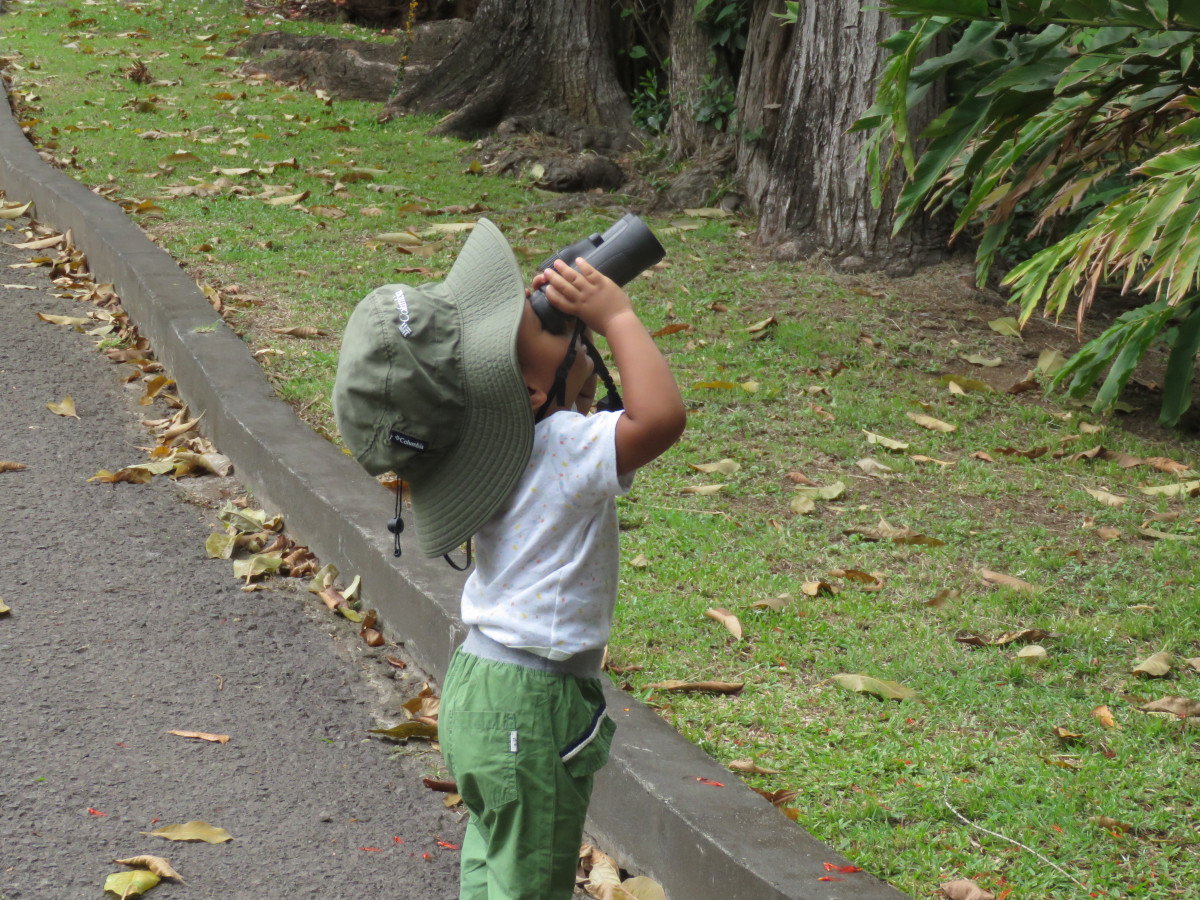
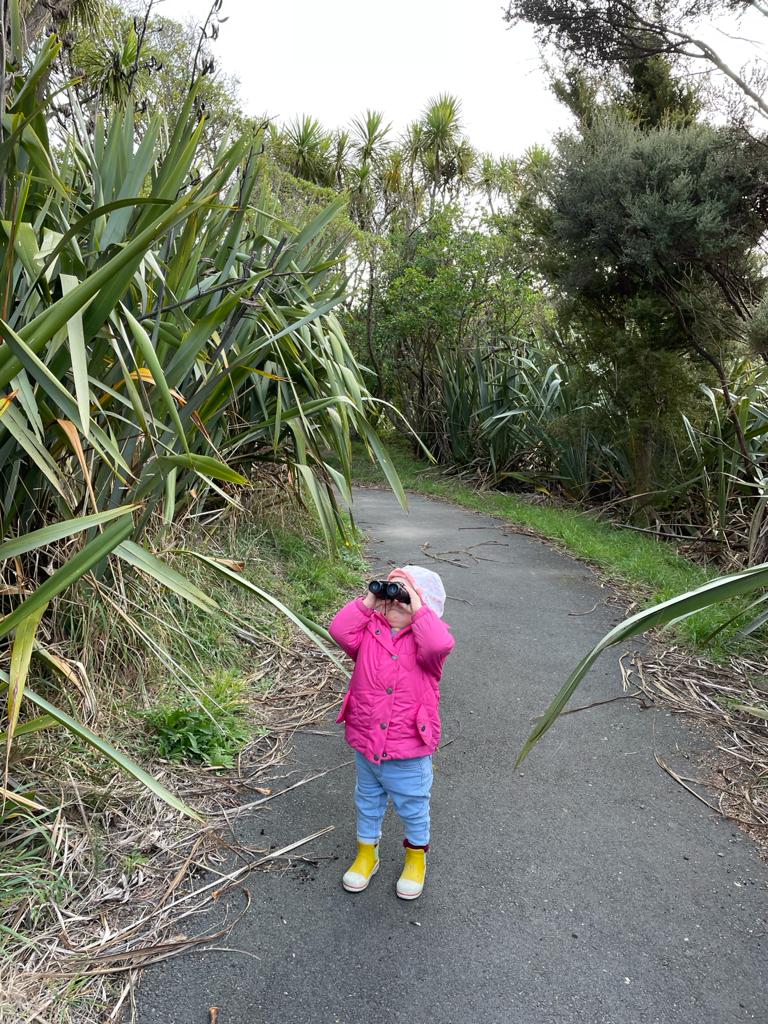
Youngest GBDer: (1) Joanne Gaymes – Maeson Gaymes in St. Vincent; (2) Anneke Mace – Holly Mace birding in New Zealand
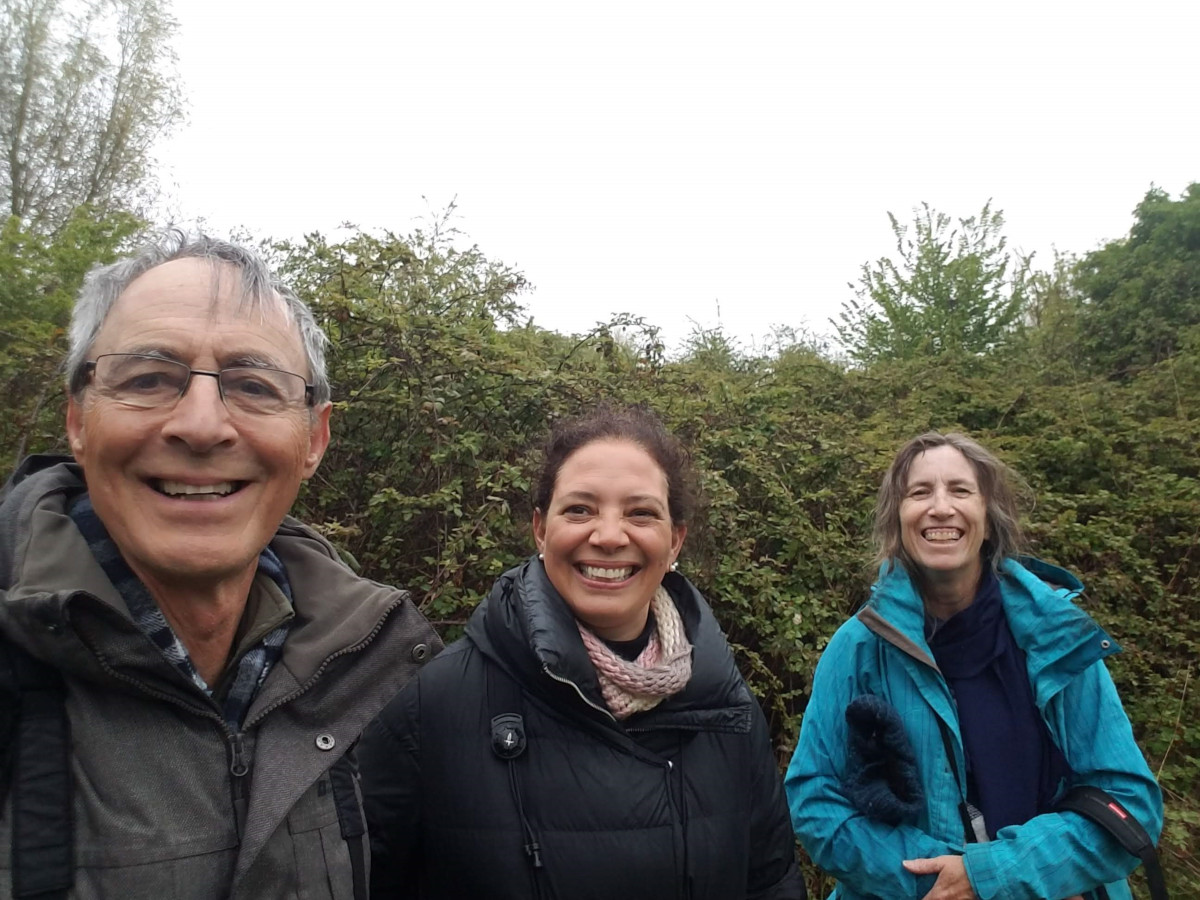
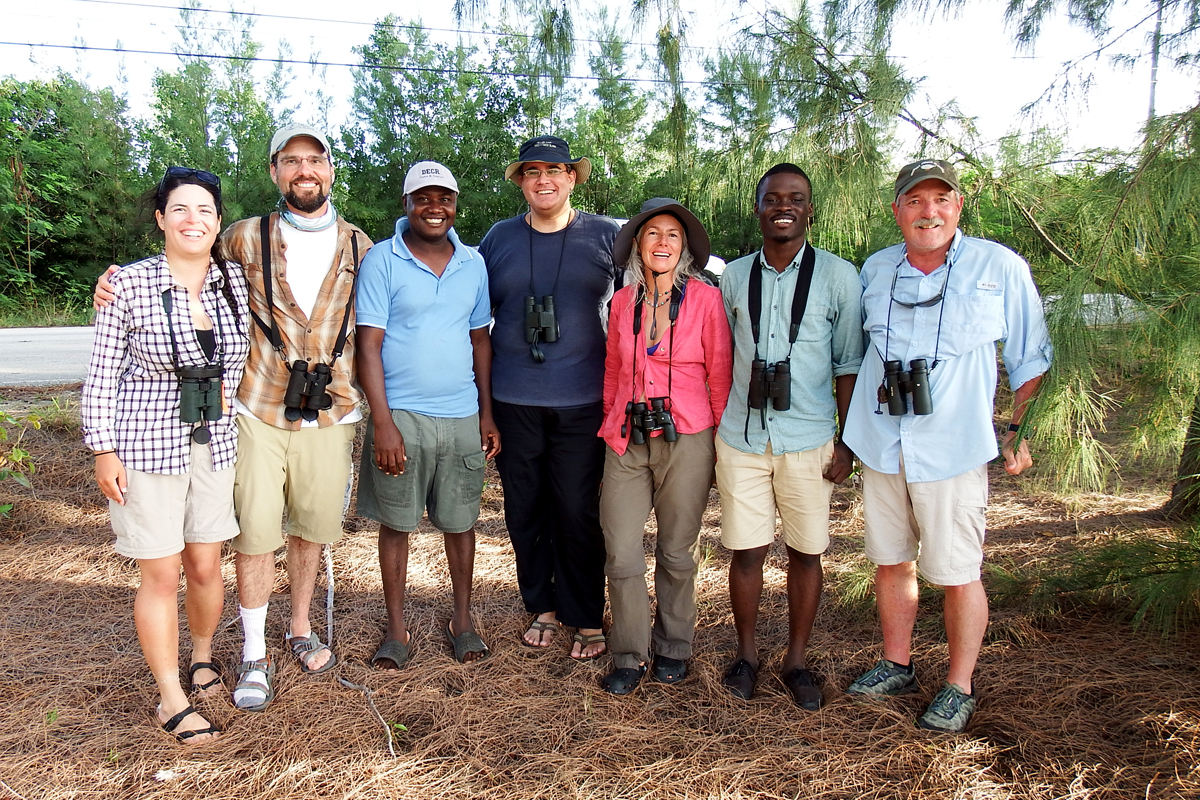
Best Smiles: Andrew Dobson and teammates Patricia Zurita and Katrina-Dobson – UK
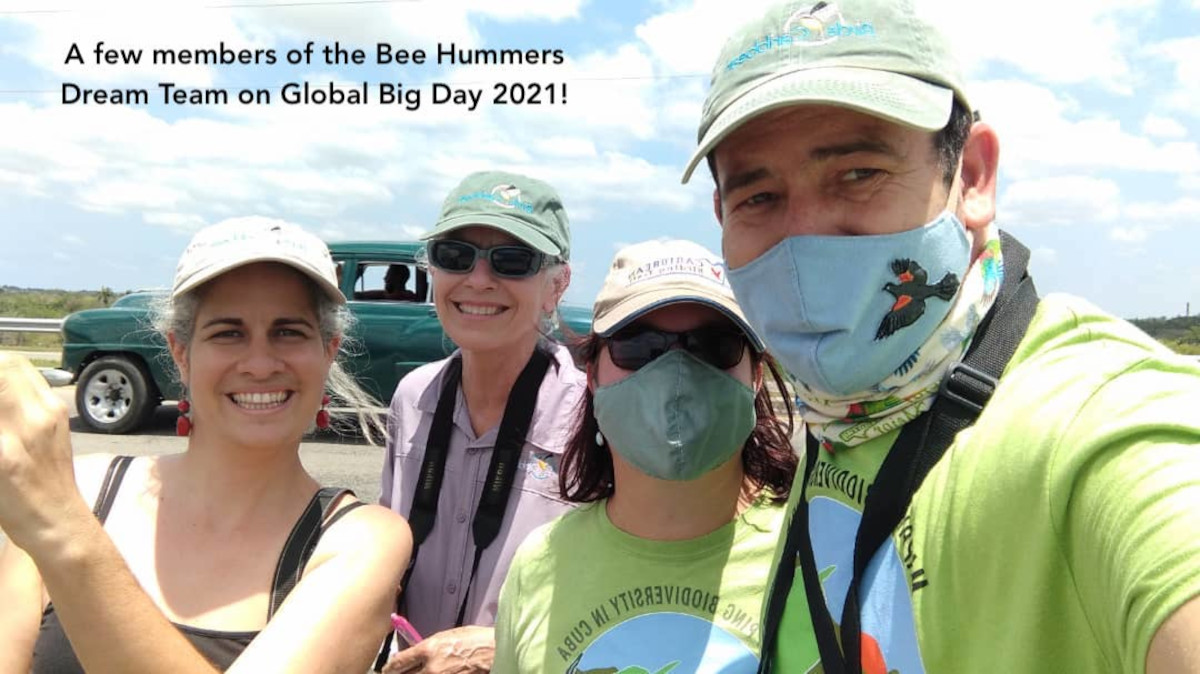
Best Selfie: Maikel Cañizares – The Bee Hummers Cuban Dream team, Cuba
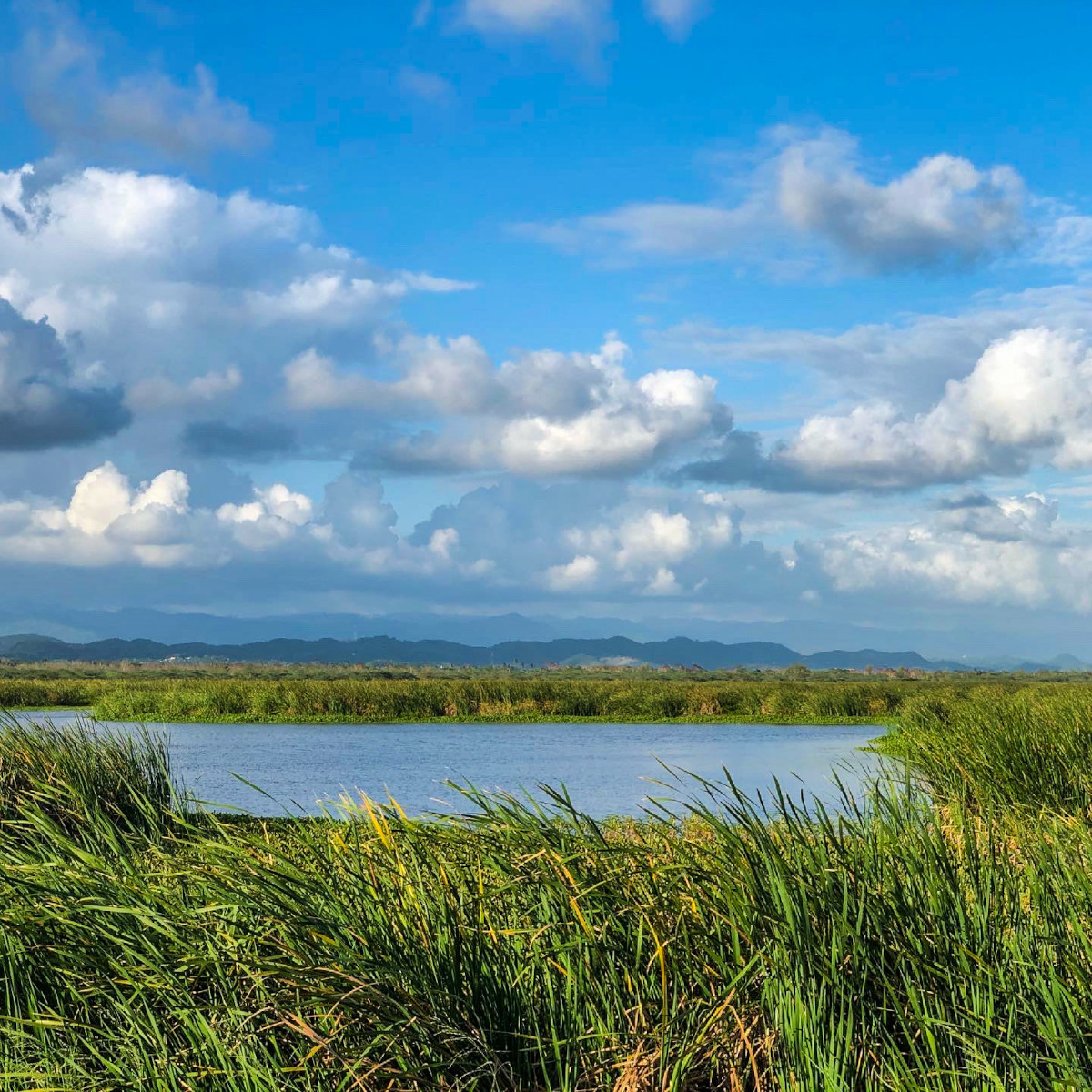
Most Beautiful Landscape: Rafy Rodriguez
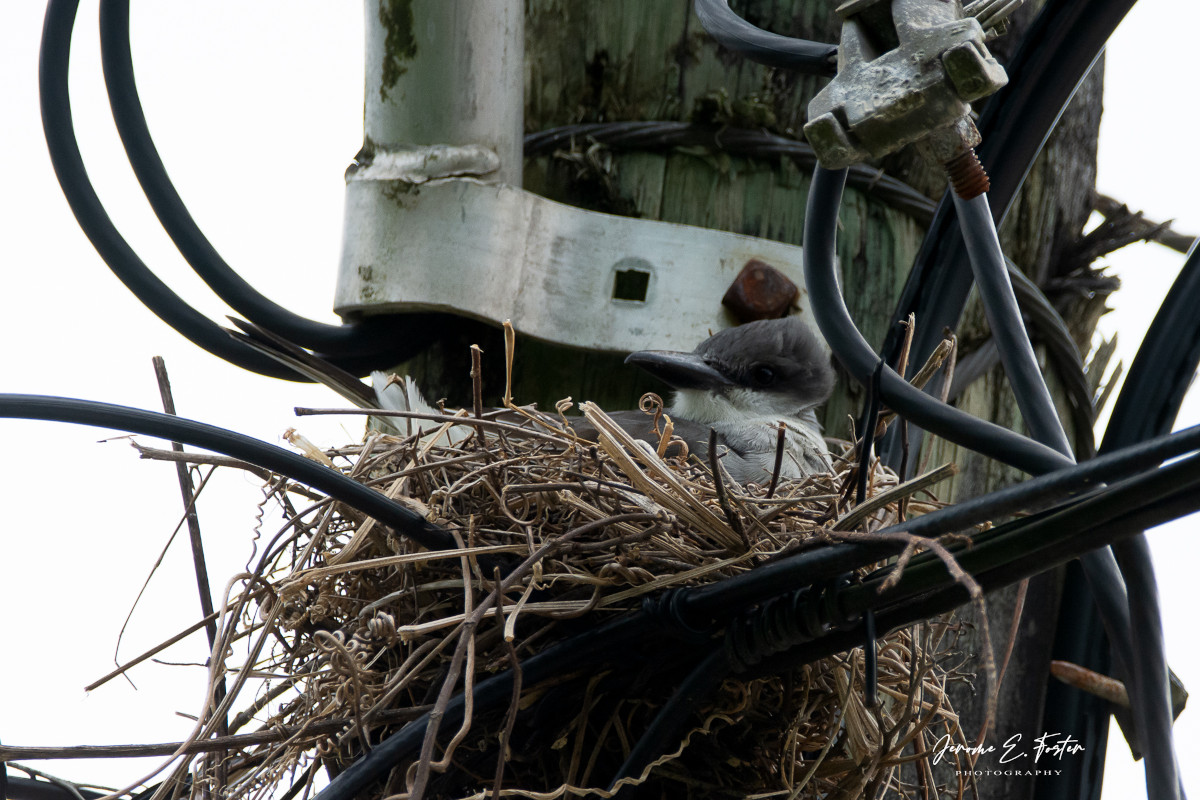
Urban Birds: Jerome Foster – Gray Kingbird on nest, St. Lucia
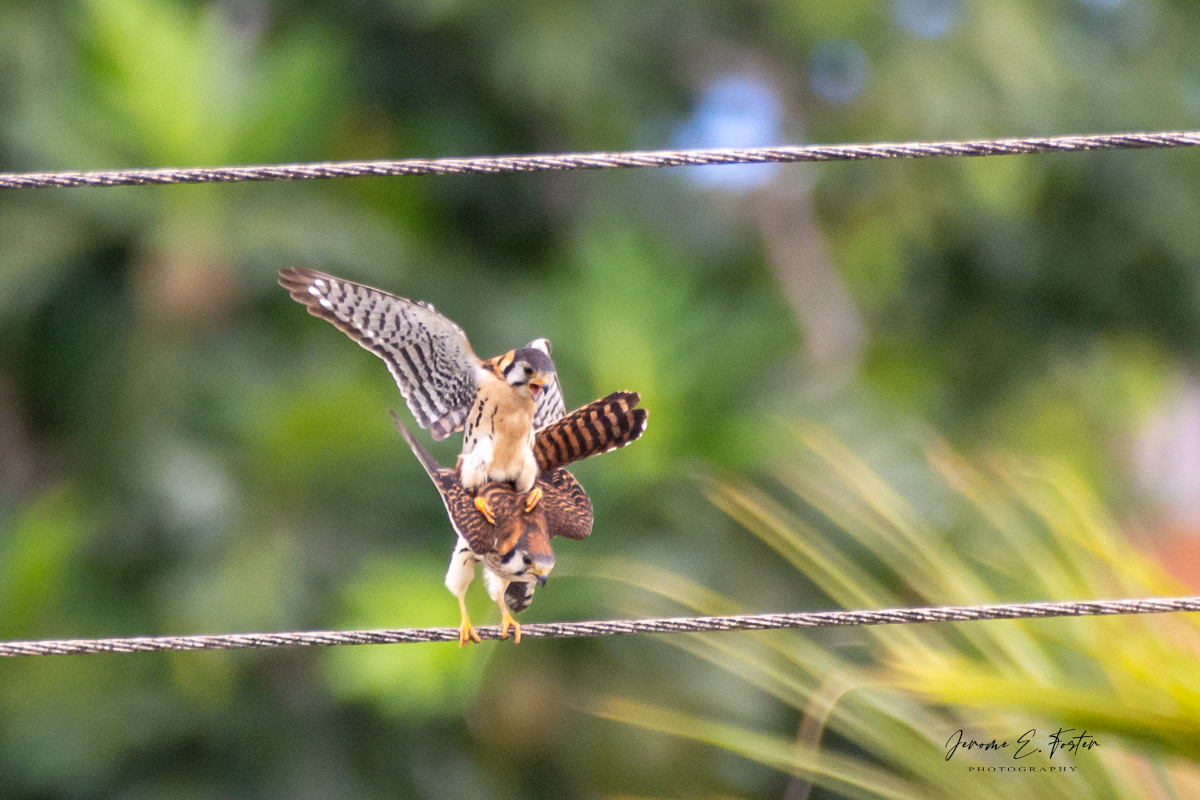
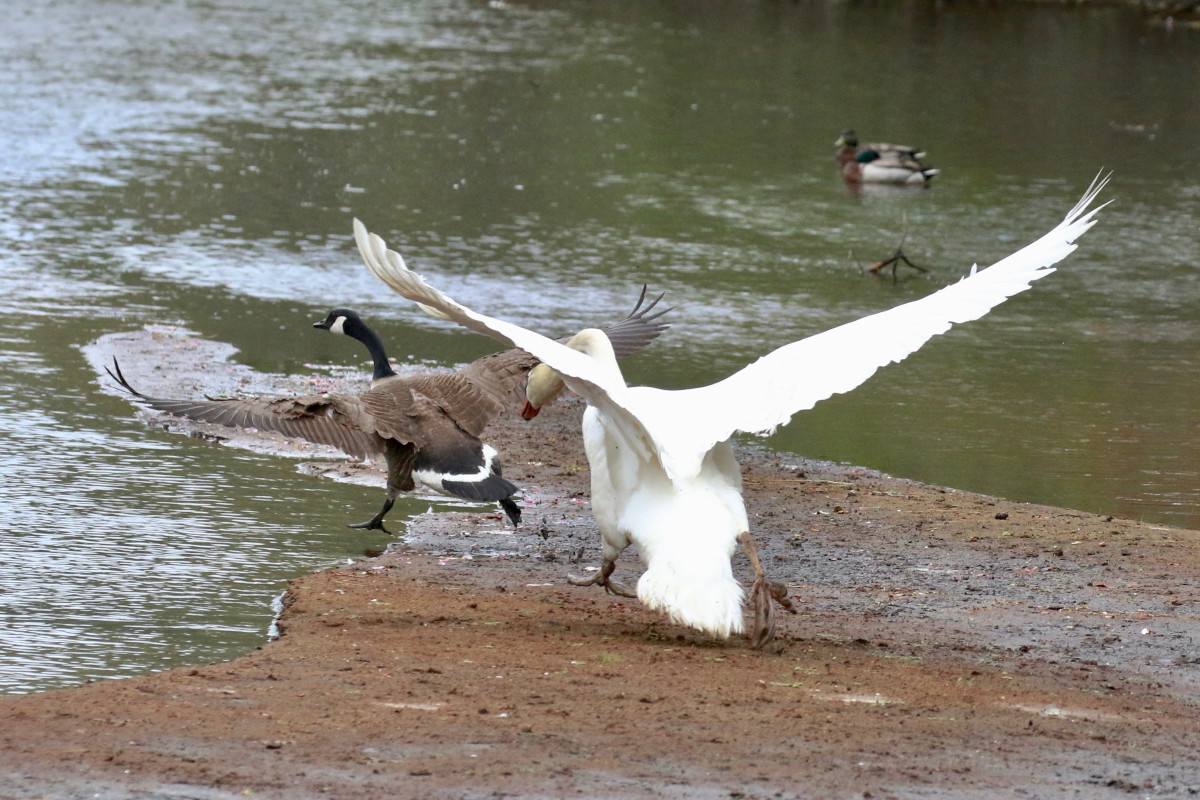
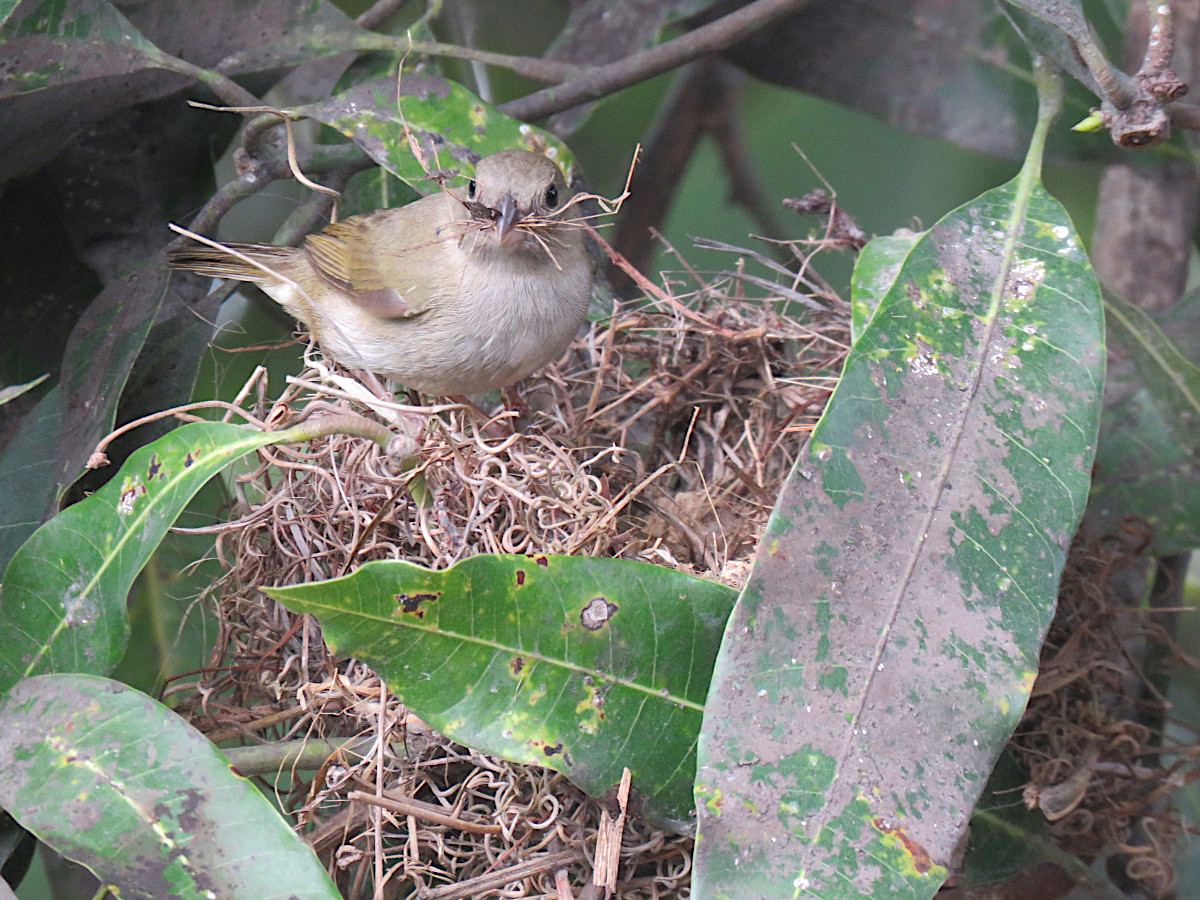
Life in the Wild: (1) Jerome Foster – American Kestrels mating, St. Lucia; (2) John Kricher – Mute Swan parent banishing Canada Goose; (3) Joanne Gaymes – Black-faced Grassquit female collecting nesting material, St. Vincent
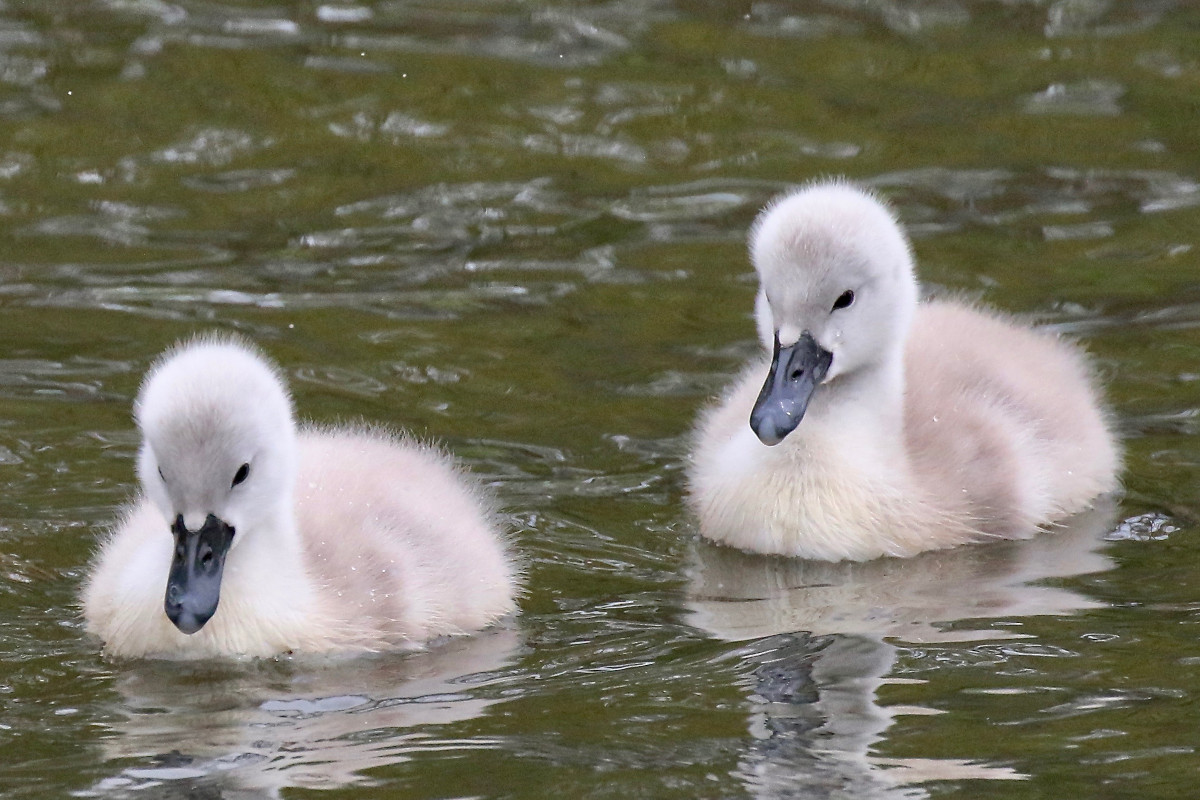
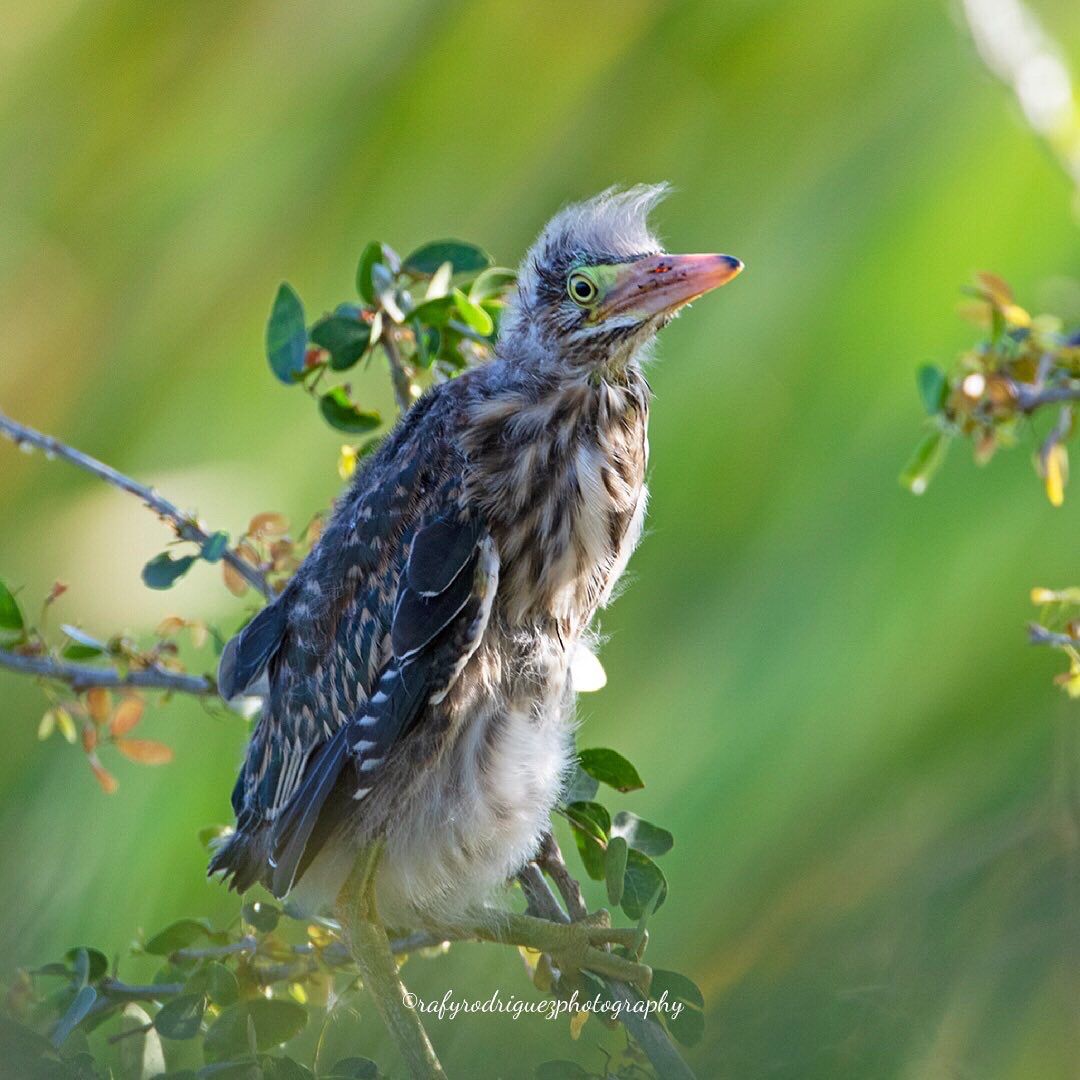
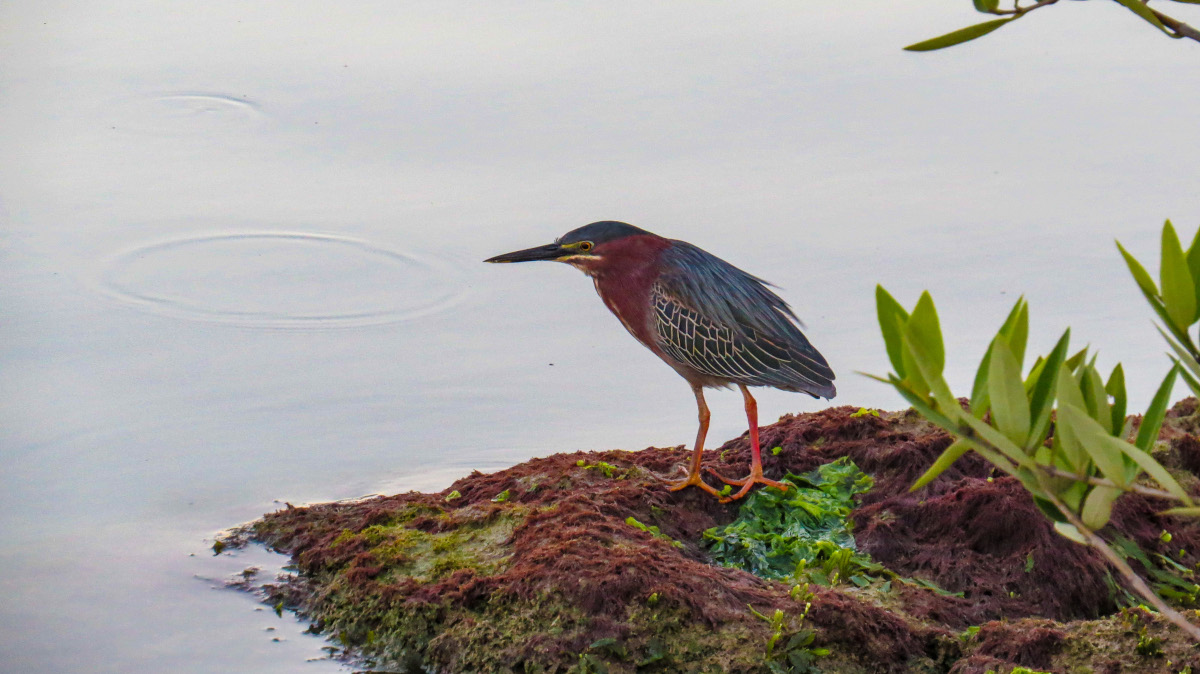
Sweetest Fluffiest Birds: (1) John Kricher – Mute Swan cygnets; (2) Rafy Rodriguez – Green Heron immature
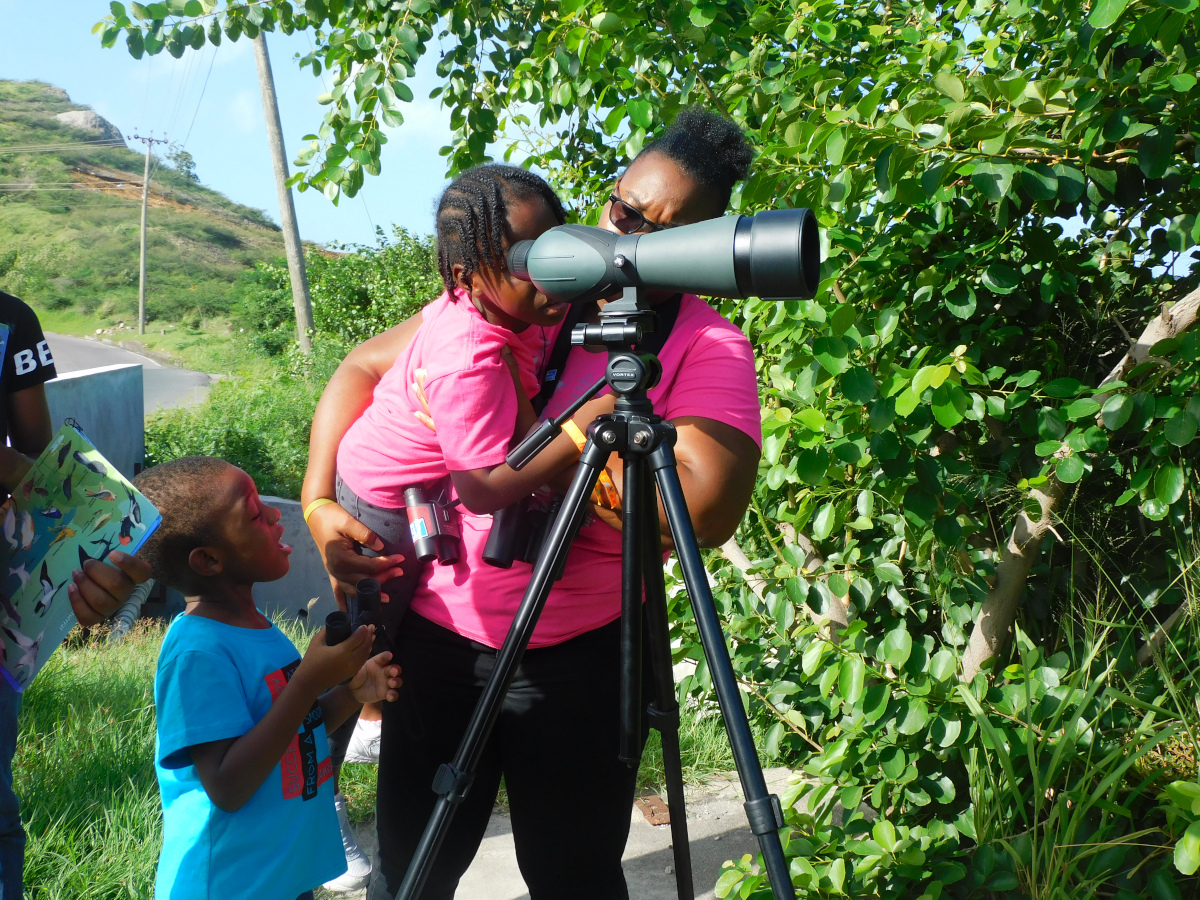
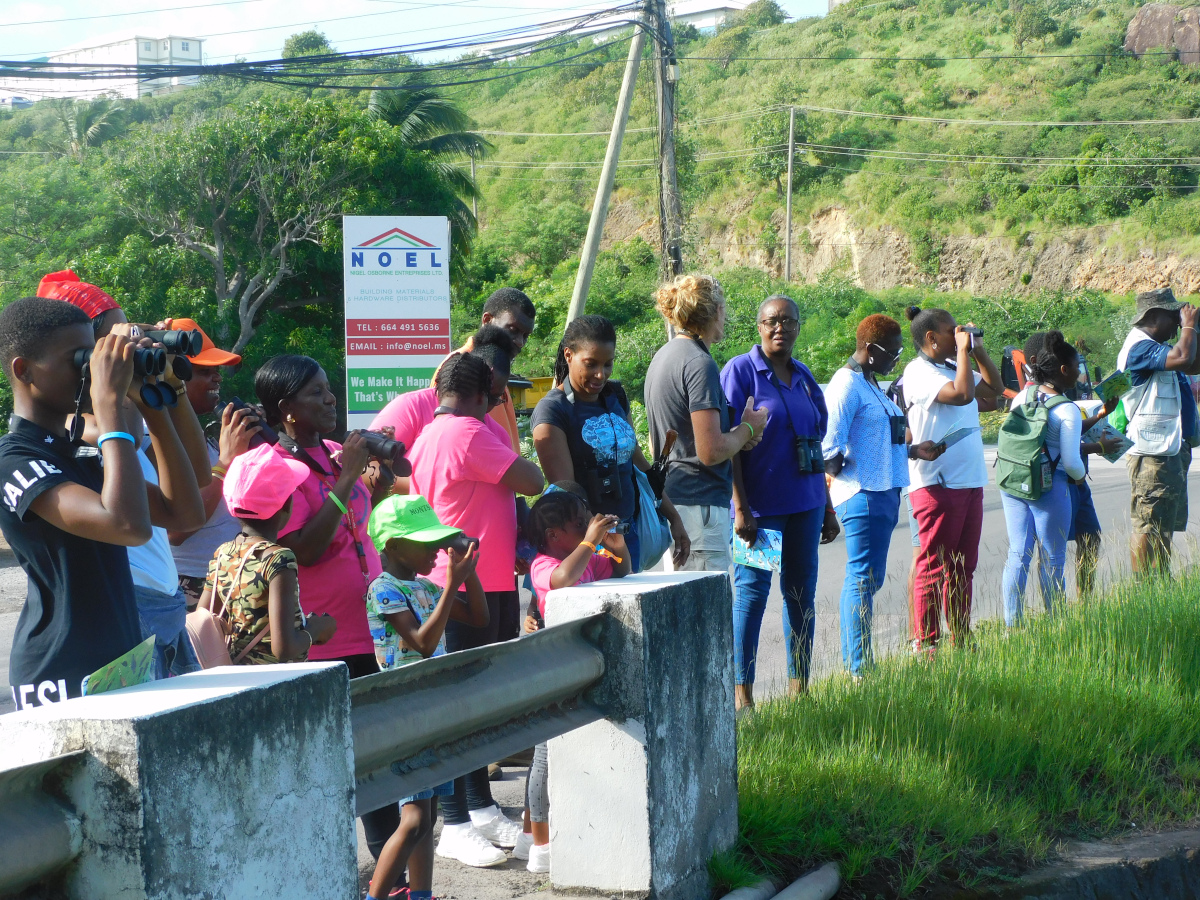
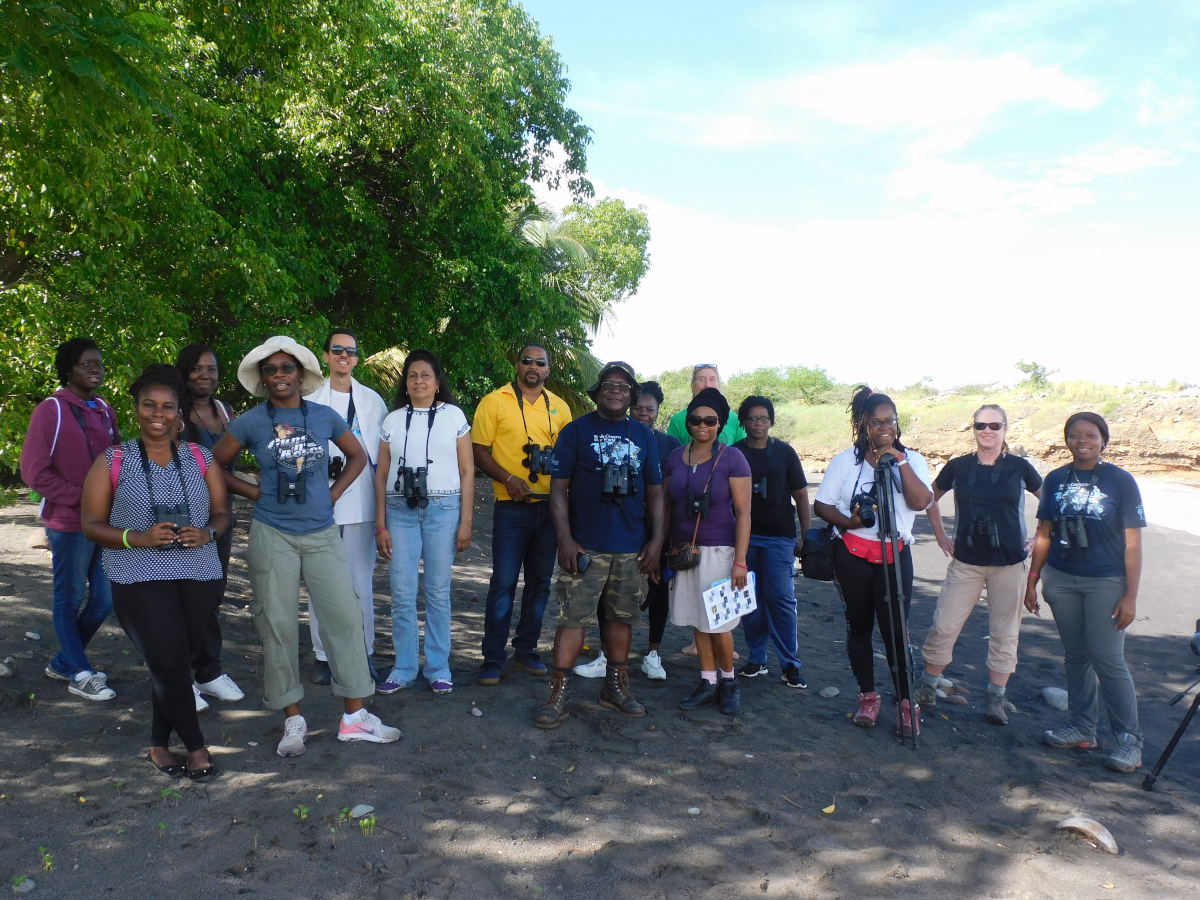
Enjoy this gallery of bird, people and scenery photos taken on Global Big Day by various team members in the Caribbean, US, UK, Costa Rica, Panama, Netherlands, and more!
On Saturday, May 8th, birders and BirdsCaribbean members around the world went outside birding to celebrate Global Big Day—the biggest birding day of the year which is timed to coincide with peak spring migration for many places in the USA. Approximately 53,000 participants joined in the fun—with 365 observers representing the West Indies and submitting 1,995 checklists—way to go!
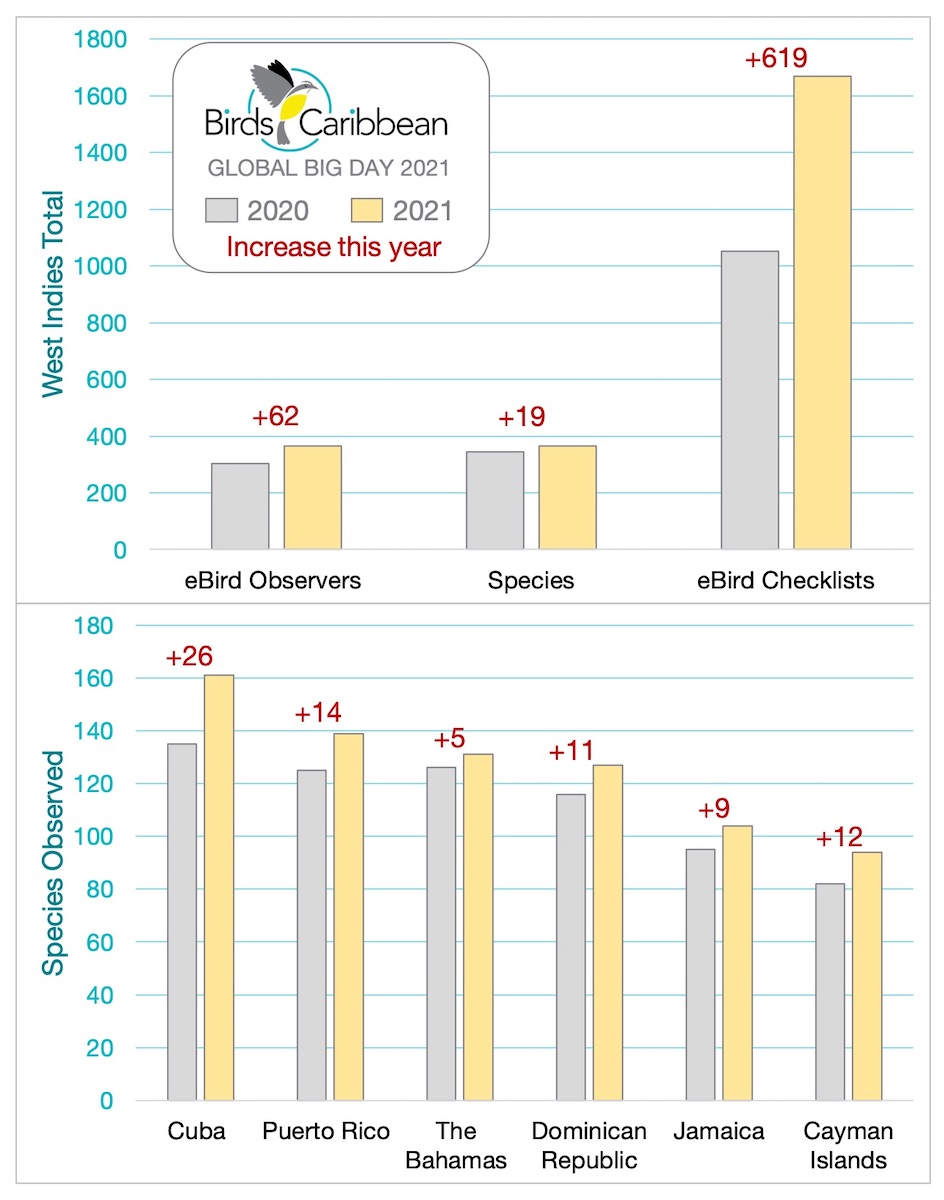
This year, observers found 364 species in the West Indies—beating last year’s record by a whopping 19 species! (see Figure 1). Cuba clinched the lead for most species seen—161, followed by Puerto Rico at 139 species, The Bahamas coming in hot at 131 species, Dominican Republic close behind at 127 species, Jamaica swinging in at a nice 104, and Cayman islands finishing with a solid tally of 94 species.
And more Caribbean “eBirders” too…
The number of eBird observers in the West Indies—365—increased by 62 persons from 2020, and the total number of checklists submitted—1,670—increased by a colossal 619! (see Figure 1). This jump in participation helped fuel the increased number of species seen in every country/ island.
Figure 1. The top graph shows that the total number of eBird Observers in the West Indies, total species seen, and total number of eBird checklists submitted increased from 2020 to 2021. The bottom graph shows the number of species observed on Global Big Day for the top 6 West Indies countries increased from 2020 to 2021.
Inspired by last year, many of us continued to bird together from afar on teams that raised funds for bird conservation. This year, those funds will target new Motus bird monitoring stations in the Caribbean. Our Global Big Day was hugely successful on all fronts, with 15 teams participating, including 10national teams!!! (up from 7 teams in 2020). And we raised $19,113 USD, very close to our goal of $20,000 USD—congrats and thank you to everyone for your participation and support! Read on for all the exciting details and final team stats…
The Bee Hummers Mighty Achievements – Congratulations to our Cuban Friends!
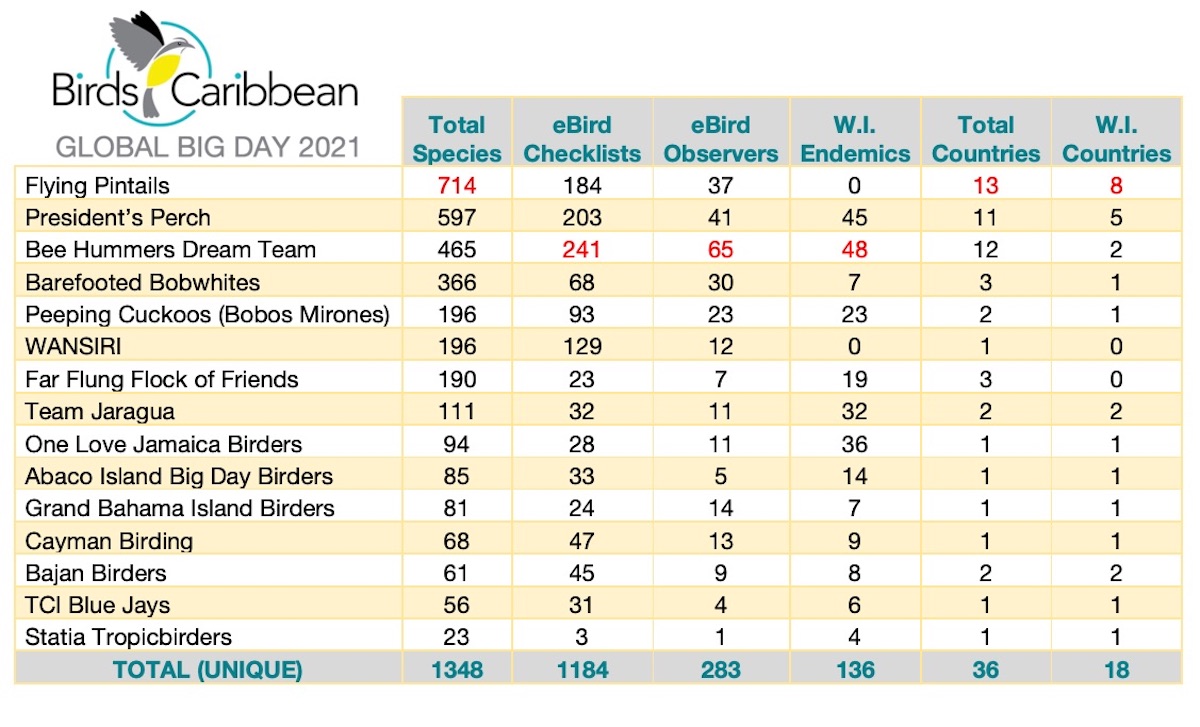
How did our BirdsCaribbean teams fare? Once again, the indomitable, multinational Flying Pintails, led by Executive Director Lisa Sorenson, claimed the title for the most species observed: 714 (see Figure 2). President’s Perch, led by Past President Andrew Dobson, and the Bee Hummers Dream Team, the Cuban national team led by BC board member Maikel Cañizares, came in second and third with 597 and 465 species seen, respectively. The Bee Hummers swept three other categories, however, with the most eBird checklists (241), most eBird observers (65), and most West Indies endemics (48). Congrats to the team named after the smallest bird in the world for all of these great achievements!!!
Figure 2. Global Big Day results for our 15 BirdsCaribbean teams, which included 10 national teams. The numbers in red show which team had the highest number for each category. A total of 1,348 species and 136 West Indies endemics were observed by all 15 teams combined. ( a total of 147 West Indies endemics were seen by all eBirders, i.e., including those not on a team).
Tracking the Endemics on our GBD Teams
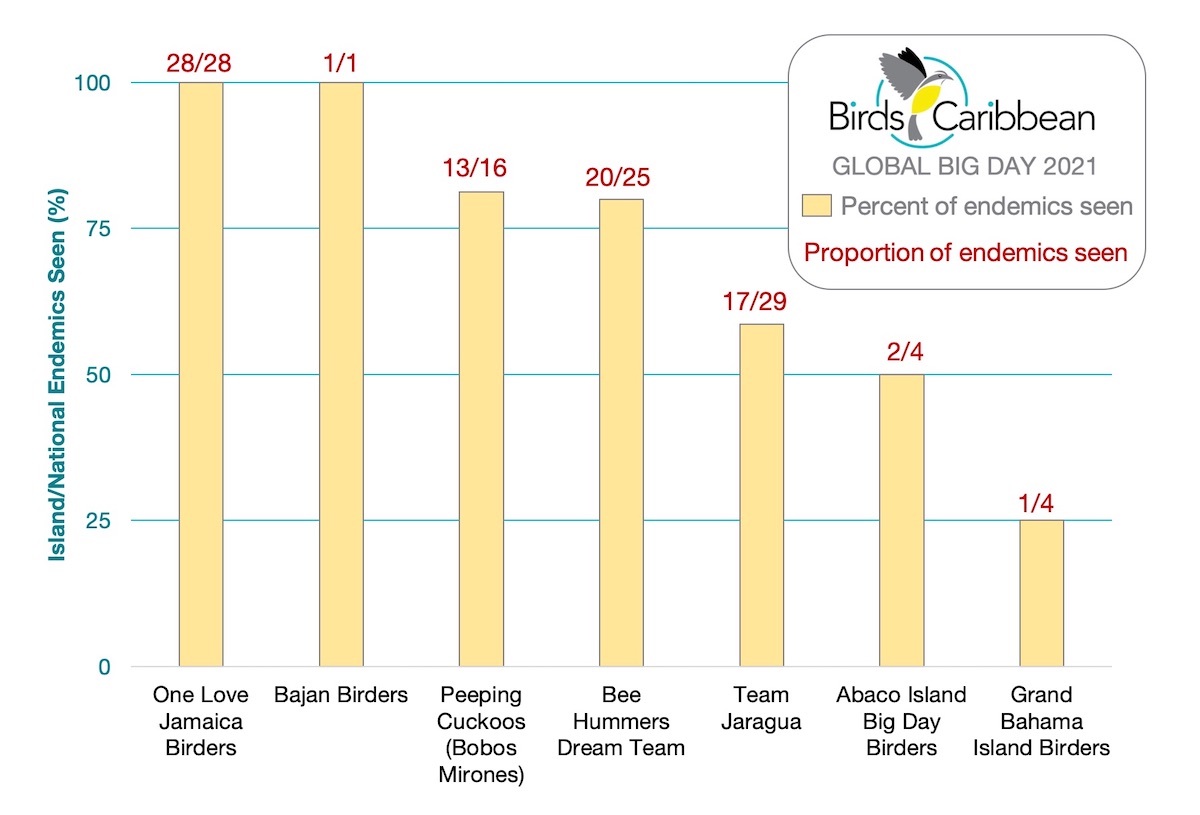
This year, with our 10 new national (Caribbean country or island) teams, we were excited to see which national team would see the highest proportion of their endemic birds on Global Big Day (a category created to control for differences in the number of endemic species on each island – see Figure 3). There were two winners for this title: the One Love Jamaica Birders, whose well-organized sub-teams and individuals fanned out over the entire island and managed to see all 28 Jamaican endemics, and the Bajan Birders who also worked hard and made sure to get their one endemic (Barbados Bullfinch) on their lists! 😉 The Peeping Cuckoos (Puerto Rico), Bee Hummers (Cuba), and Team Jaragua (Dominican Republic) also did well finding their island endemics.
Figure 3. The 7 teams who saw the highest proportion of their island endemics on Global Big Day 2021. The One Love Jamaica Birders managed to see all 28 of their endemics – congrats! And the Bajan Birders easily checked off their one endemic, the Barbados Bullfinch.
Small was Beautiful
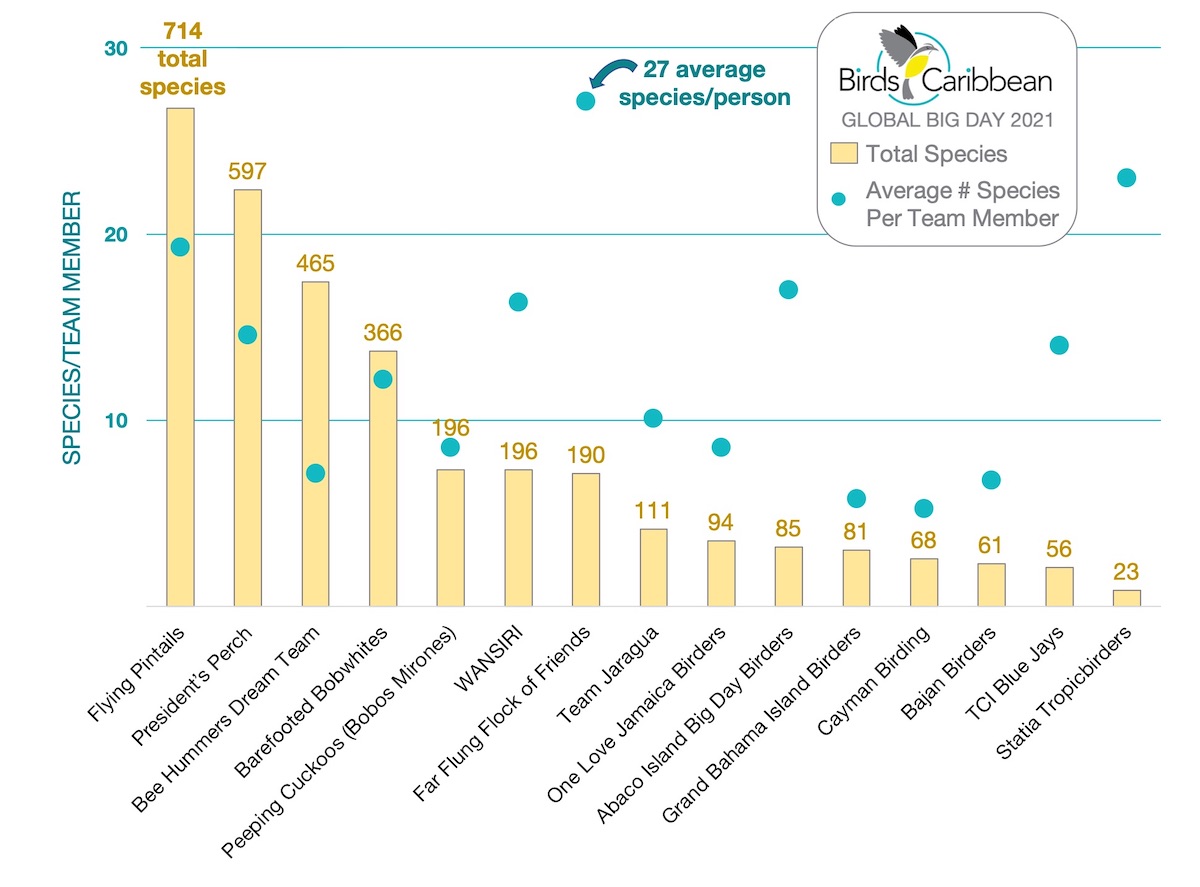
Smaller and more local teams also had their advantages. When the total number of species seen was divided by the number of people on the team, Far Flung Flock came in first, with an average of 27 species observed per person (see Figure 4). The Statia Tropicbirders were a close second with 23 species per person, followed by the Flying Pintails (19), Abaco Island Big Day Birders (17), WANSIRI (16), and Turks and Caicos Island Blue Jays (14). The accomplishment of the Abaco Island Big Day Birders is especially impressive, since this was a small team of 5 persons birding on a relatively small island that had been largely decimated by a hurricane less than 2 years ago!
Figure 4. The average number of species observed per person for each of the 15 Global Big Day teams. Far Flung Flock of Friends was the winner in this category with an average of 27 species per person. Statia Tropicbirders came in 2nd with 23, followed by the Flying Pintails (19), Abaco Island Big Day Birders (17), WANSIRI (16), and the TCI Blue Jays (14).
Congratulations and thank you to all the teams for your enthusiastic participation. We will be sharing more about our experiences, including photos and prizes, in a second Global Big Day 2021 blog article.
Handing out Bouquets to these eBirders
The most distinguished eBirders from our Global Big Day campaign were Holly Garrod and Josh Covill (birding together in Costa Rica) of the Flying Pintails, who over 16 hours recorded an incredible 208 species! Richard Korpi and Phil Lehman, both on the Barefoot Bobwhites team, came in 2nd and 3rd with 138 and 136 species, respectively. Holly and Josh both win a year’s membership in BirdsCaribbean and some awesome BC swag!
Special commendations go out to the following birders who had 20 or more West Indies Endemics on their GBD checklist on May 8th:
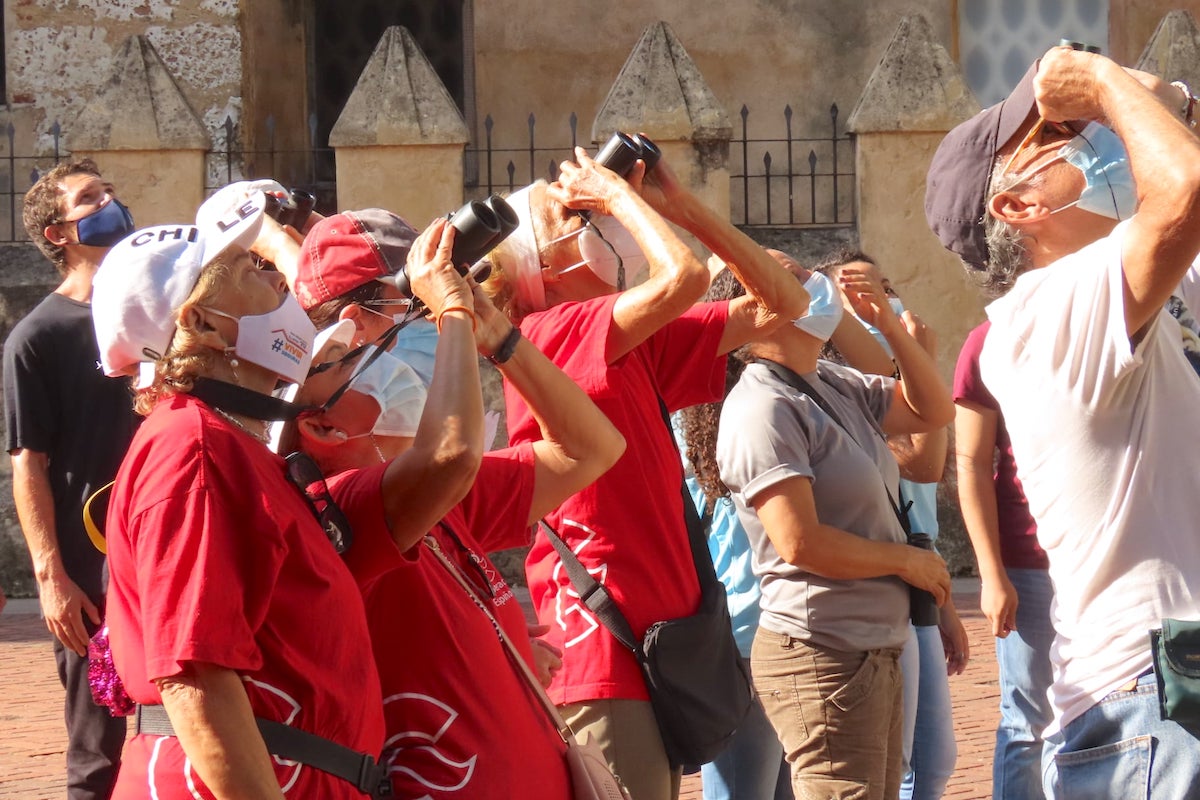
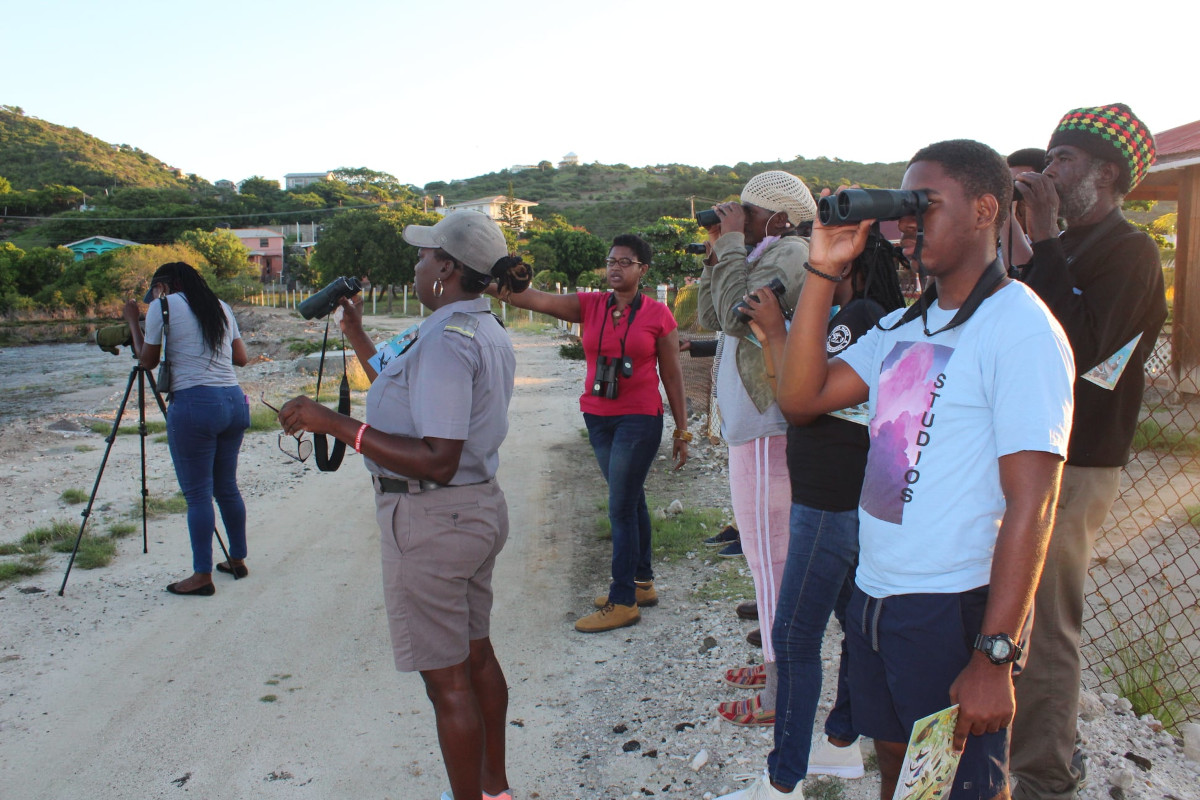
Maria Paulino (gray shirt) leading a group of urban birders in Santo Domingo, Dominican Republic on Global Big Day.
Maria Paulino (Dominican Republic) – 30
Lyndon Johnson (Jamaica) – 27
Wendy Lee (Jamaica) – 27
Adrian Cobas (Cuba) – 26
Ana M. Suárez (Cuba) – 25
Maikel Cañizares Morera (Cuba) – 24
Miguel Landestoy (Dominican Republic) – 23
Tania Piñeiro (Cuba) – 23
Alina Perez (Cuba) – 22
Wayne Arendt (Puerto Rico) – 22
Noelia Nieves (Puerto Rico) – 21
Robert Jovel (Cuba) – 21
Wisdenilde Navarro (Cuba) – 21
Alondra Medina Charriez (Cuba) – 21
Karlos Ross (Cuba) – 20
An Exciting Finish to our Fundraising, and Thank You!
After the success of last year’s fundraiser we have carried the tradition onward. This year’s donations will help fund our newly launched Caribbean Motus Collaboration, which is part of our Caribbean Landbird Monitoring network.
The final days of our fundraiser were incredible! We were still a ways out from our target goal of $20K when a most generous BirdsCaribbean member on the President’s Perch team stepped up and offered a $5K match. In other words, if the President’s Perch Team could raise $5K in 3 days, the donor would match it with a donation of $5K, giving us the opportunity to double the funds!
We quickly put out the call and many generous people answered it! With a few hours to spare before the deadline, we reached the $5K goal on President’s Perch team, which was then promptly doubled by our generous supporter! Thus, to date, thanks to your generous donations and support we have raised a total of $19,113, which will help to install at least 4 Motus stations in the islands!!! (note: it is not too late to donate if you want to help us reach our $20K goal).
2021 BirdsCaribbean Global Big Day Teams*
You can visit each birding team’s page profile on eBird to see maps of the team’s countries/ islands where birds were sighted and their checklists. You can also visit each team’s GoFundMe page and donate to specific teams to help them reach their fundraising goal, or donate to the general campaign.
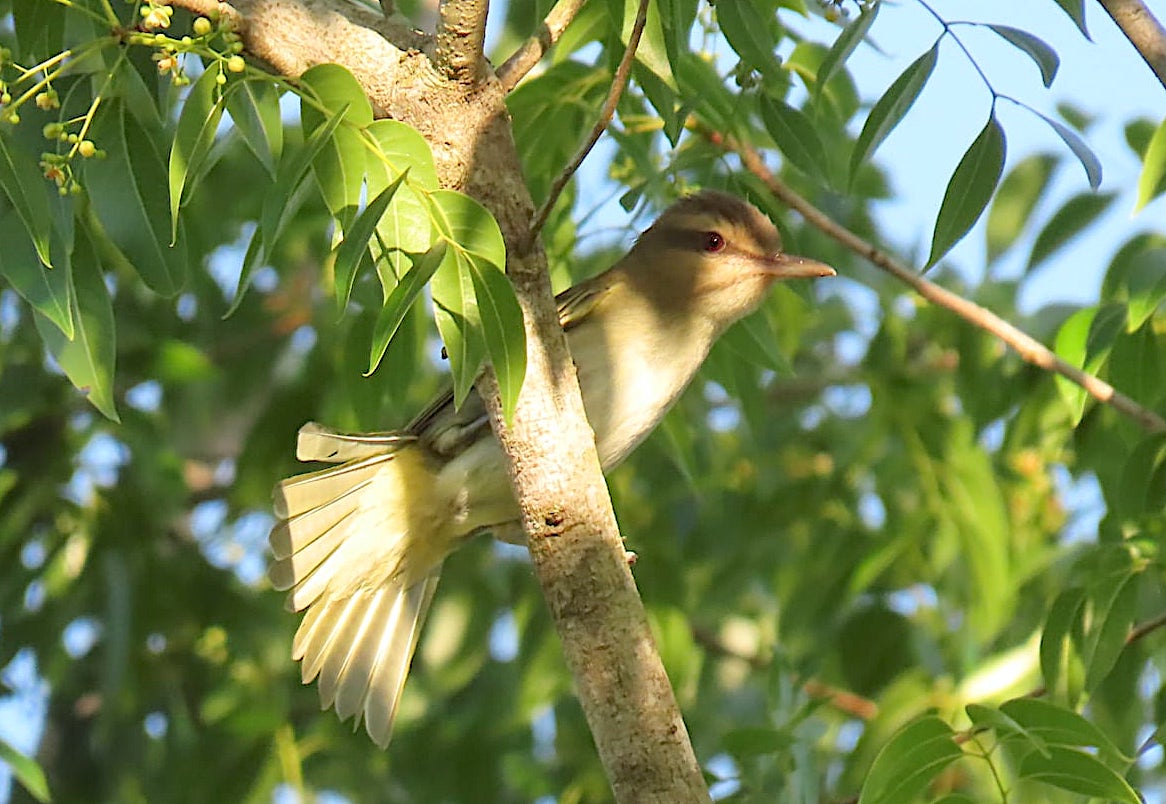
Black-whiskered-Vireo spotted on Global Big Day in the Dominican Republic. (photo by Maria-Paulino)
Kristy Shortte, a Program Officer at the NGO Sustainable Grenadines, Inc.
A local community that understands the value of natural habitats and the wildlife that lives there is key to successful long-term conservation. Find out how this happens from Kristy Shortte, a Program Officer at the NGO ‘Sustainable Grenadines,’ on Union Island in St. Vincent and the Grenadines. From building observation platforms at vital wetlands, to garbage clean-ups and installing information signs, to training locals to identify and help monitor birds, Kristy describes the amazing and inspiring range of work carried out by her organization, local partners – and of course, the local community!
At the trans-boundary NGO Sustainable Grenadines Inc (SusGren) we know that conserving the places where birds live is key to their survival. But how do we achieve this? So many of our habitats are under threat—from pollution and degradation by human activities, to outright destruction for development. When there are competing demands on the use of our natural resources, we need to make wise decisions. Sometimes we need to educate our local citizens about the immense value of these areas to people and wildlife, and to get them actively involved in their conservation. It’s a hands-on approach with community partners. Showing people the benefits of managing and protecting habitats is the best way to ensure the long-term health of bird populations and the habitats on which they depend.
Finding the best ways to protect birds and their habitats
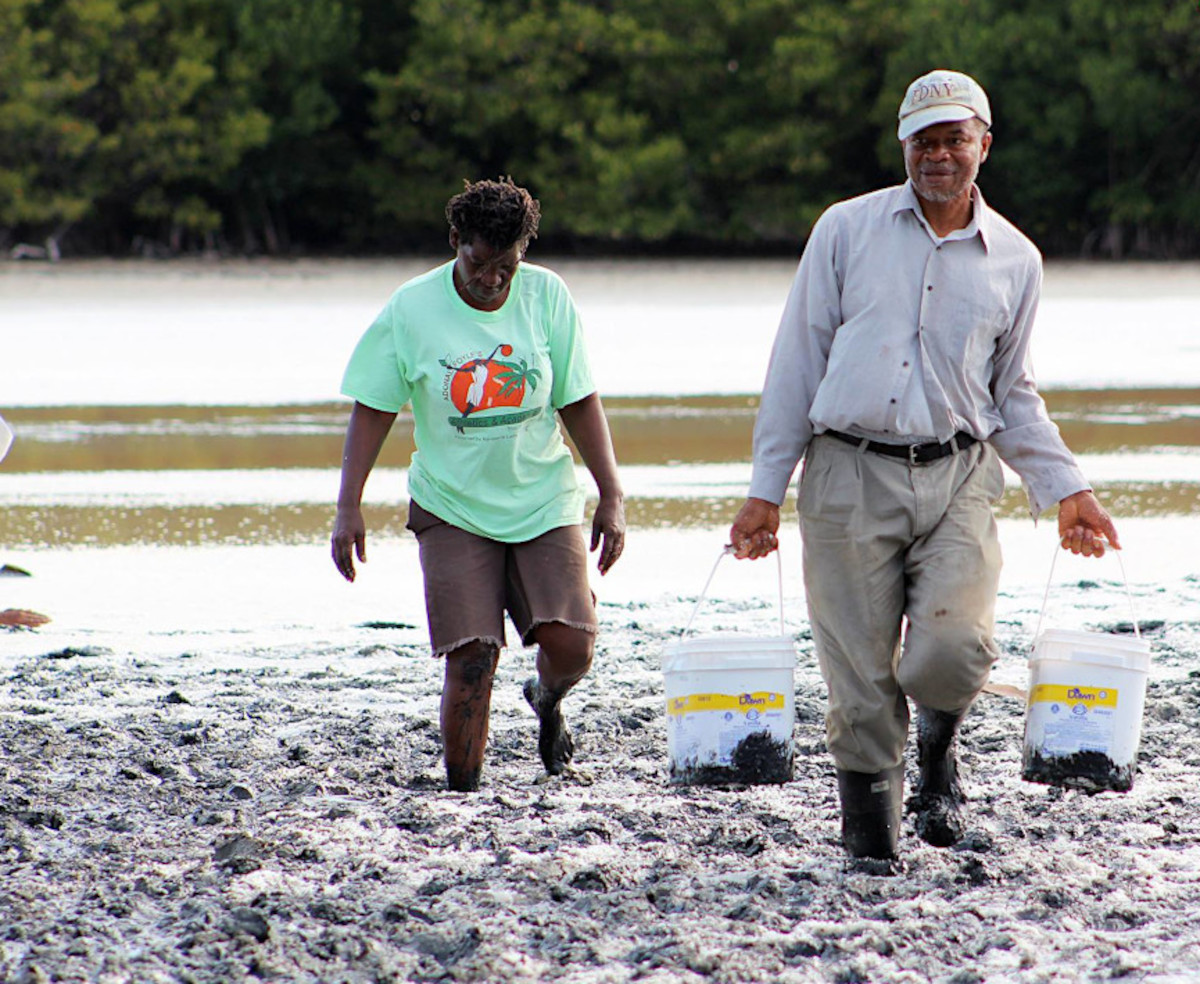
Residents of Union island, harvesting salt at Belmont Salt Pond. (Photo by Radio Grenadines).
Here at SusGren, we have taken the initiative to support birds and protect the places they live through two projects – both completed during the pandemic of 2020! SusGren believes that some areas are so special that they need to be protected – no ifs, ands, or buts!!!!
After many years of hard work to restore Ashton Lagoon and develop it as a bird and nature sanctuary for enjoyment by all, we turned our attention to Belmont Salt Pond. This is the second largest ecosystem on the island of Union and one of the last two remaining salt ponds in the entire St. Vincent and the Grenadines (he other salt pond is on Mayreau). Salt picking is still practiced at Belmont, providing economic benefits to locals.
So…what’s so special about Belmont Salt Pond?
The Belmont Salt Pond area is significant, in that it provides habitat to many species of resident and migratory birds. Here you can see Whimbrels, Willets, Blue-winged Teal, Greater and Lesser Yellowlegs, Mangrove Cuckoo, and even the American Flamingo on occasion. Migratory birds use Belmont as a place to rest and feed. This can be for a few days or weeks, before they continue with their migration, while others stay from fall to spring. For other birds, the Salt Pond is ‘home’ all year round.
Blue-winged Teal female spotted at Belmont Salt Pond. (Photo by Sustainable Grenadines Inc)
American Flamingo Spotted at Belmont Salt Pond. (Photo by Sustainable Grenadines Inc)
With this rich history and biodiversity and the salt pond threatened by human activities, SusGren decided to enhance the area for enjoyment by locals and visitors alike. This would help ensure the protection of the area’s biodiversity and would increase ecotourism opportunities in Union Island, following our successful restoration of nearby Ashton Lagoon 2 years ago. The platform would also help us to continue the long-term bird monitoring of our wetlands through participation in the Caribbean Waterbird Census.
Taking a community-based approach
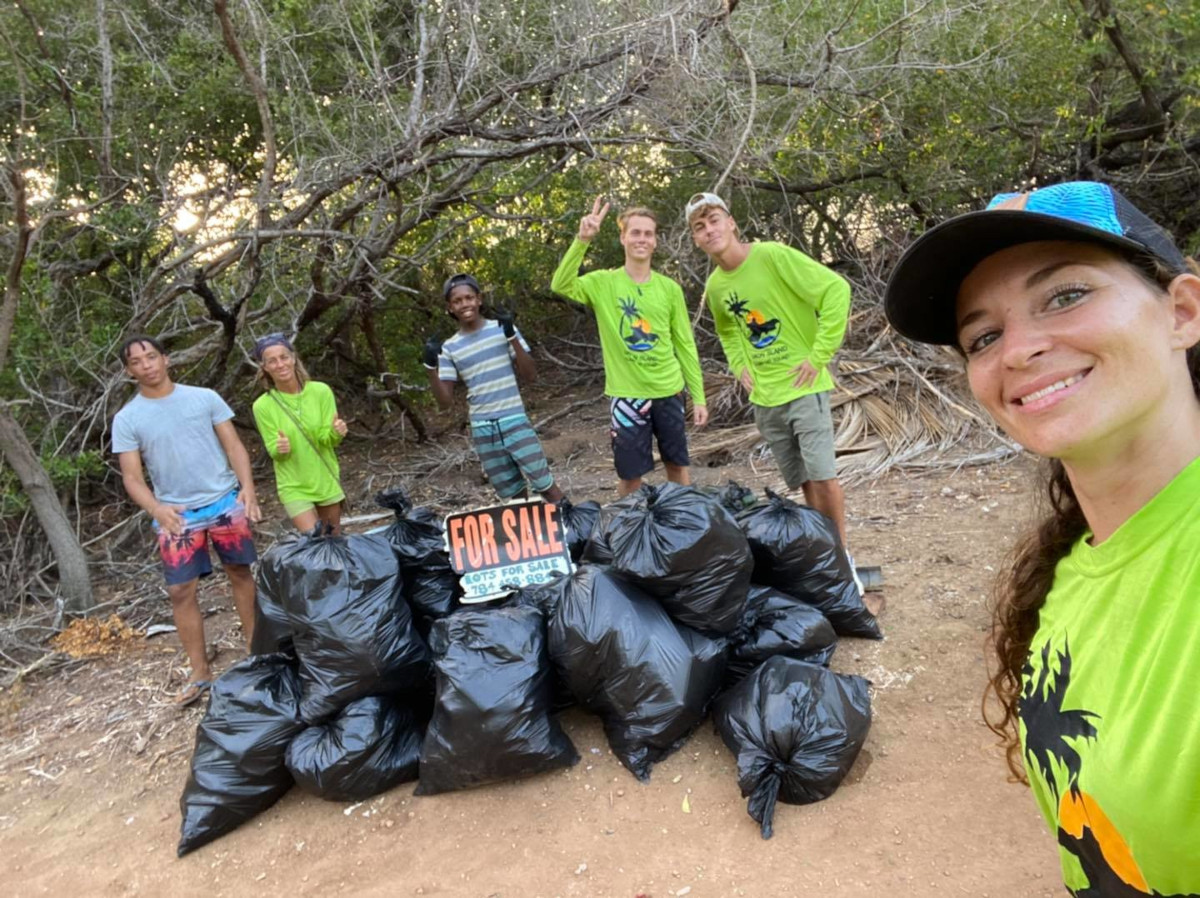
The ‘’Clean up Squad’’ at Belmont Salt Pond. (Photo by Zoe Jennett)
Due to a lack of community knowledge of the importance of the area, it was being used for the burning of charcoal and dumping garbage. We knew that over time these activities would damage Belmont Salt Pond and biodiversity would be negatively impacted. So at Susgren we decided to carry out a project in partnership with members of the community, to ensure that such behavior is reduced and eventually eliminated.
As part of this approach, SusGren contributed towards a cleanup organized by a local group of 10 people called “Union Island Cleanup Squad.” They held massive cleaning up sessions at the Belmont Salt Pond on May 7th and May 13th, 2020. A total of 30 bags of trash was collected during the first session, and 40 additional bags of trash were picked up at the second cleanup around the edges of the pond. It was great to see local community groups actively taking up the stewardship mantle of their island!
Follow the signs!
Interpretive sign at Belmont Salt Pond. (Photo by Sustainable Grenadines Inc)
Our project also involved the construction of viewing platforms at Belmont Salt Pond, designed to provide people with a fantastic overview of the wetland and the birds living there. At each of the Belmont Salt Pond platforms – and at the Ashton Lagoon Eco Trail – we installed interpretive signs displaying resident and migratory birds. We worked with BirdsCaribbean to design signs that included land birds, wetland birds, and shorebirds likely to be seen at each of the sites. At Ashton Lagoon, one sign also provides visitors with knowledge about the marine and terrestrial species of animals found in the area.
Our interpretive signs include features on bird identification. Thus, someone using the platforms at Belmont Salt Pond or our bird towers at Ashton Lagoon can receive a “self-crash-course” in basic bird identification. Moreover, there are now three 4 x 6 billboard signs installed at Belmont Salt Pond that explain the history of the area and its cultural and environmental importance. Two ‘rules’ signs also notify visitors about appropriate behavior in the area.
Keeping the trash at bay
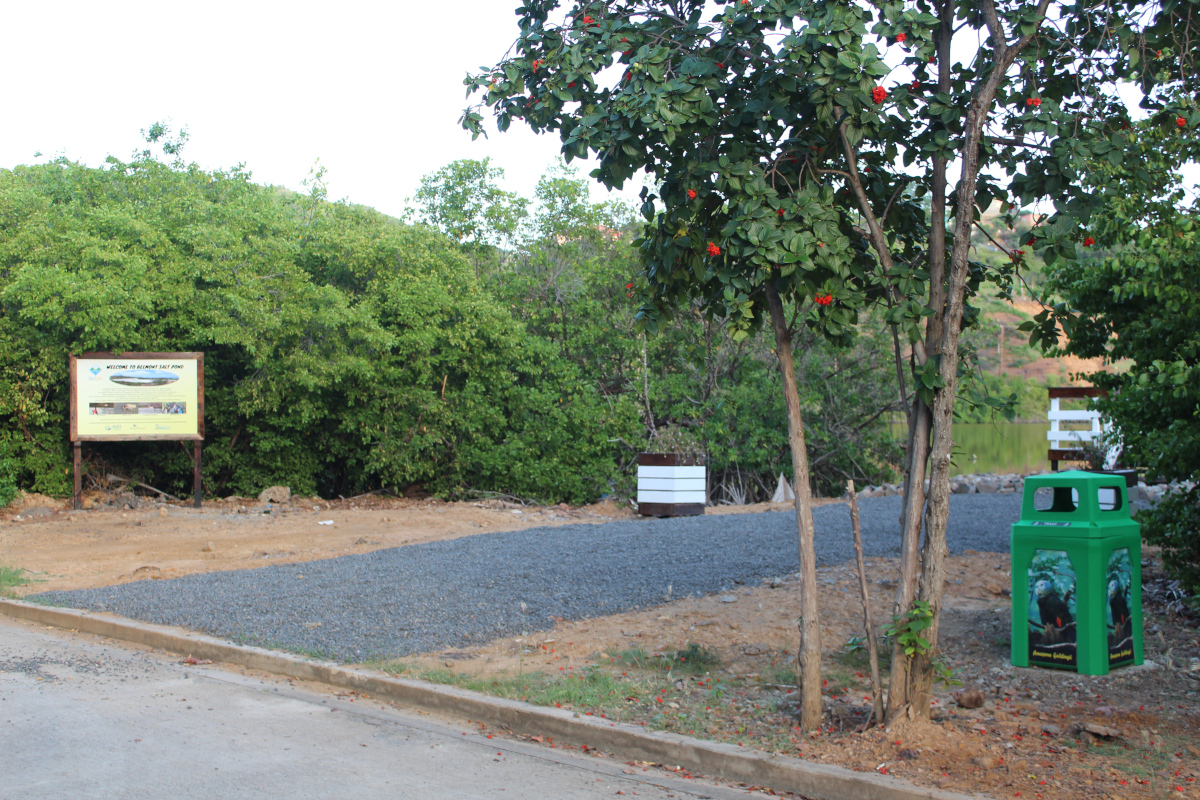
“Bird branded” garbage bins and signs at Belmont Salt Pond. (Photo by Sustainable Grenadines Inc)
To reduce the problem of litter, we installed attractive garbage receptacles at both Belmont Salt Pond and Ashton Lagoon. The bright green receptacles are adorned with images of the various birds one can see in the area. Our hope is that this will help build local pride and community ownership and encourage people to dispose of their garbage in a responsible way.
Since the installation of 4 bins at each location, we are gratified to see that people are using them. The local solid waste management company ‘’Uni Clean’ assists with the weekly disposal of trash from these areas.
Reaching out in different ways
We found different ways of reaching out to our stakeholders and the general public. Normally, we would have been hosting lots of in-person outreach and birding activities and events with the community and schools during the last year. But due to the pandemic and schools closing, we used radio and social media platforms to engage the community and key stakeholders. We made phone calls and delivered letters with updates on our projects. We also sent out a media blast with the local telecommunications company on the island, so that recipients could obtain a poster of the activities being undertaken at Belmont Salt Pond on their phones.
Finally, we had a hugely successful radio interview and webinar with the show, “Conversation Tree” on Radio Grenadines. SusGren’s Program Director, Orisha Joseph and I gave a presentation and discussed our activities with the radio host. This was seen by over 2,000 people and was very well-received.
World Shorebirds Day
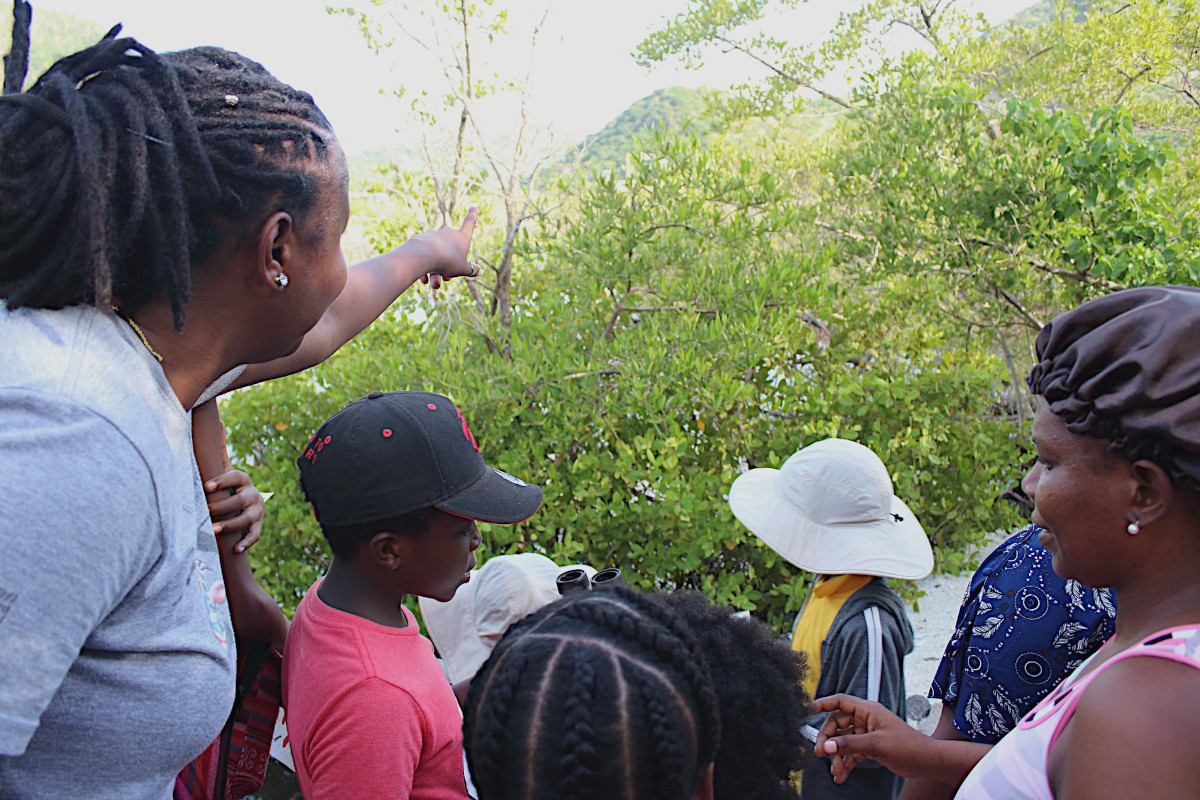
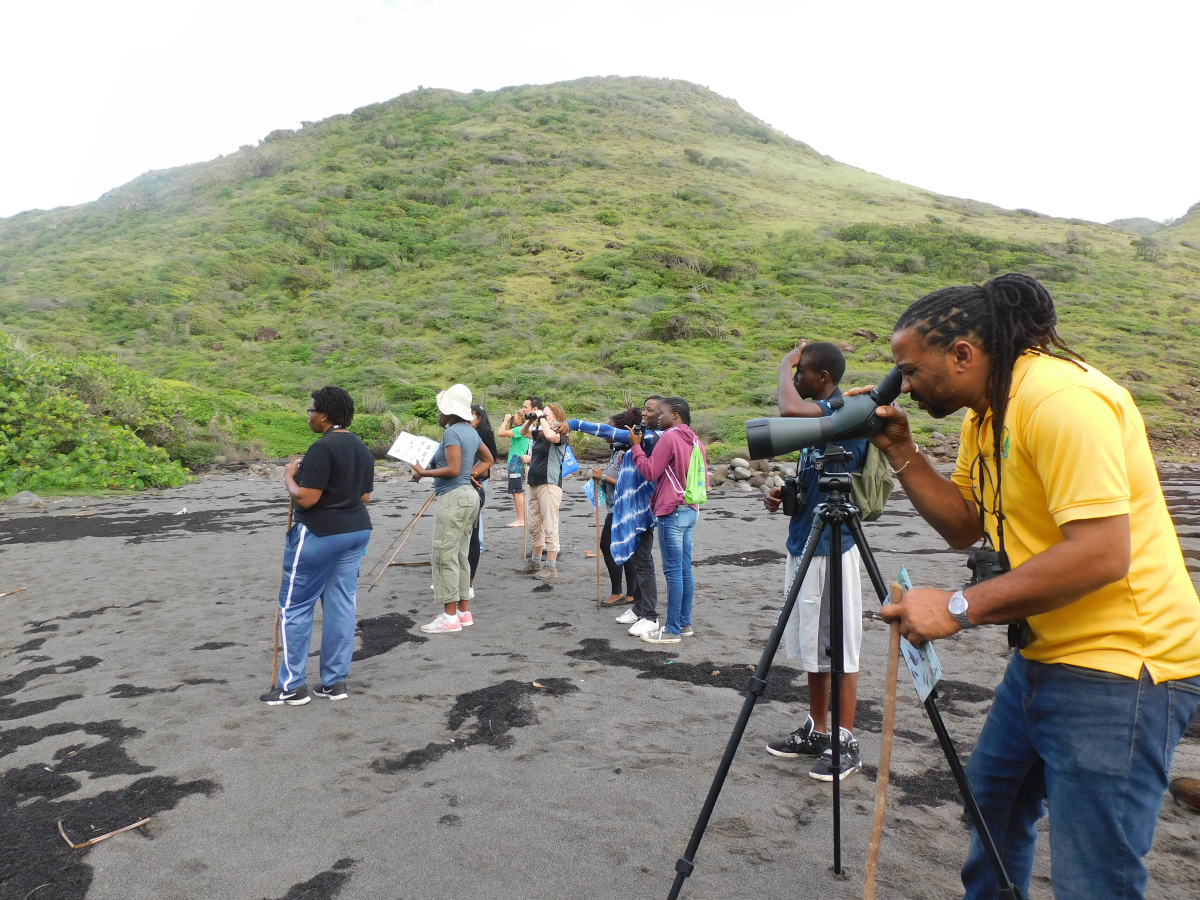
Kristy Shortte pointing out and identifying birds on a guided birding walk. (Photo by Sustainable Grenadines Inc).
To further community involvement in our work and help people develop a love for the environment and birds, we collaborated with Katrina Collins-Coy, Union Island Environmental Attackers, and celebrated World Shorebirds Day in September, 2020. Eleven students and two teachers from the Stephanie Browne Primary School participated.
The celebration involved a birding walk with Bird Bingo and a Bird Identification tour along the Ashton Lagoon Trail. The children also enjoyed activities in the classroom, such as learning about the Parts of a Bird, bird games, and bird arts and crafts. We were elated to see the enthusiastic students and teachers come out as early as 5:30 am to be a part of the session!
Birds of Belmont Salt Pond – A New Resource!
Through this project (with matched funding from the SVG Conservation Fund) we also developed a booklet entitled “Birds of Belmont Salt Pond.” The booklet includes notes from SusGren’s directors, information on the project’s team, a brief history of the Belmont Salt Pond, photographs of resident and migratory birds found there, and a full checklist and space for taking notes while bird watching and monitoring. Thirty copies were printed and distributed to key stakeholders in the community and other organizations in St. Vincent and the Grenadines. We hope this will be a great resource for visitors.
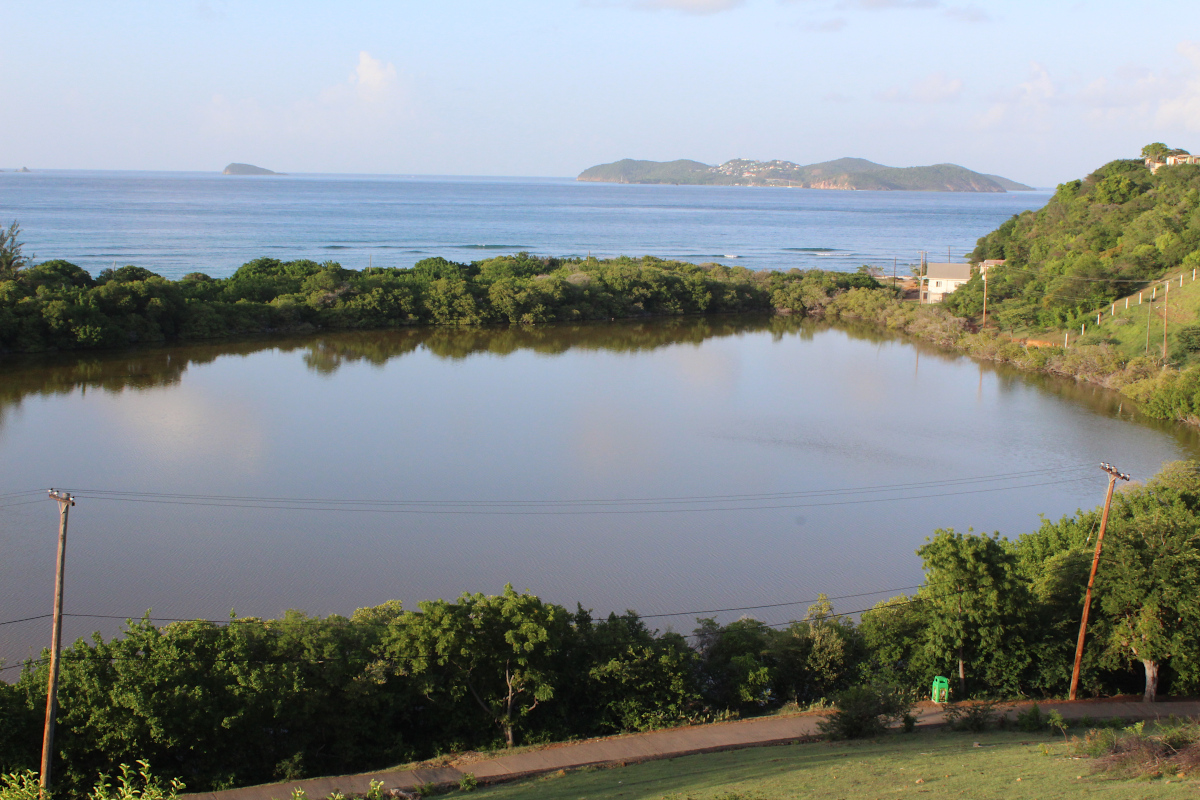
Belmont Salt Point. (Photo by Sustainable Grenadines Inc)
Bird Identification Training Workshop—“Conserving Caribbean Shorebirds and their Habitats”
Participants taking part in a Caribbean Waterbird Census (CWC) Basic Bird ID Training Workshop. (Photo by Sustainable Grenadines Inc)
We weren’t finished yet! We also held a five-day bird identification training workshop as part of the project, during October 2020. The workshop was facilitated by Lystra Culzac, who is the Founder and Manager of Science Initiative for Environmental Conservation and Education (SCIENCE) and graduate of our Conserving Caribbean Shorebirds and their Habitats Training Workshop in 2019 (as is Kristy!). Those taking part represented a wide range of professions, from Park Rangers, Tourism Division, Environmental Groups, and regular community members. As part of the training, a bird monitoring trip took place at the newly installed platforms, making good use of our new booklet “Birds of Belmont Salt Pond.”
We included training in seabird monitoring as part of the workshop and participants took a trip to Catholic Island and Tobago Cays Marine Park. Here they got the opportunity to learn firsthand how to identify a wider variety of the seabird species in their natural habitats. Following the bird watching trip in the Tobago Cays, SusGren, in partnership with SCIENCE, collaborated on a clean-up effort at Petit Bateau, one of the cays in the Marine Park and a known seabird habitat. A total of 6 bags of trash was collected.
Continued CWC Monitoring
At both Ashton Lagoon and Belmont Salt Pond we have been carrying out Caribbean Waterbird Census (CWC) surveys for many years. These surveys help us to keep track of which birds are using these sites, while keeping an eye out for any changes or threats to the habitats. During the project we carried out 9 CWC surveys across Ashton Lagoon and Belmont Salt Pond, making visits twice a month. Now that the project is over we plan to continue to monitor the birds at both sites using CWC surveys. With all our newly trained birders on Union island, equipped with binoculars and copies of the ‘Birds of Belmont Salt Point,’ we should have plenty of support to do this!
How did the community respond to our work?
During an Attitude and Perception survey interview done with residents on the island, persons expressed excitement and satisfaction with the new development. One noted interviewee was Benjamin Wilson, a Tobago Cays Park Ranger. Wilson said, “Before the enhancement, I would have passed the salt pond straight – but now I have to gaze at the work that was done.’’ SusGren believes that this project was the first step towards having a local community that value ‘their’ wetland. The wildlife viewing platform is now being regularly used by locals and tourists alike!
Mission accomplished? Yes, for that phase, which is a first step in the right direction towards bird and habitat conservation.
This project was made possible with funding and support from BirdsCaribbean via the US Fish and Wildlife Service NMBCA program and BirdsCaribbean members and donors, with matching funds from the SVG Conservation Fund.
Kristy Shortte has worked with Sustainable Grenadines Inc since 2013, starting out as an Administrative and Research Assistant. Since 2017 she has served as a Program Officer. Kristy has qualifications in Business Studies, and since working at Sustainable Grenadines, she has been dedicated to using her business knowledge and environmental training and experience to empower her community in the Grenadines to protect and develop their resources sustainably. She has grown to love and be inspired by nature and birds since working for SusGren. She comments, “A lot of times I would look at birds and observe how they are so fearless and free in the sky and by looking at these creatures you learn from them about how to create a beautiful life.”
Salt being produced at Belmont. (Photo by Radio Grenadines)
One of the new signs showing the bird of Belmont Salt Pond. (Photo by Sustainable Grenadines Inc)
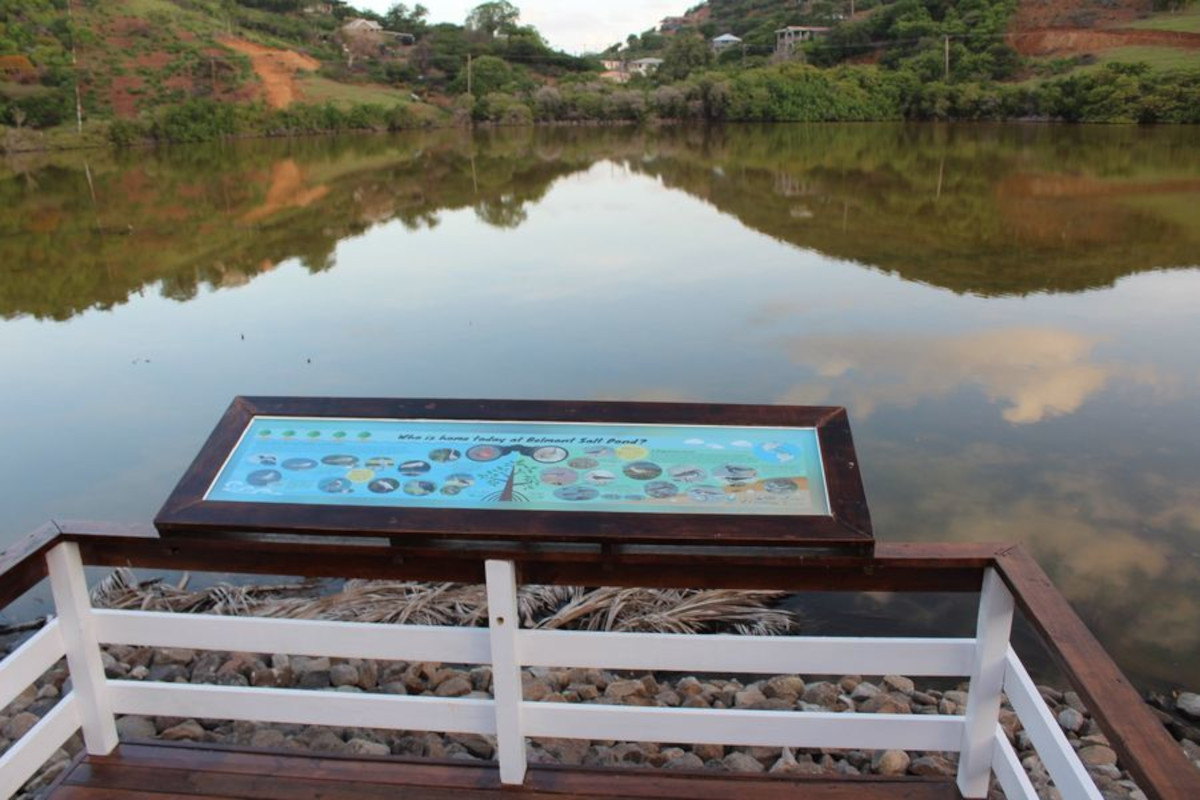
The new platform at Belmont Salt Pond. (Photo by Sustainable Grenadines Inc)
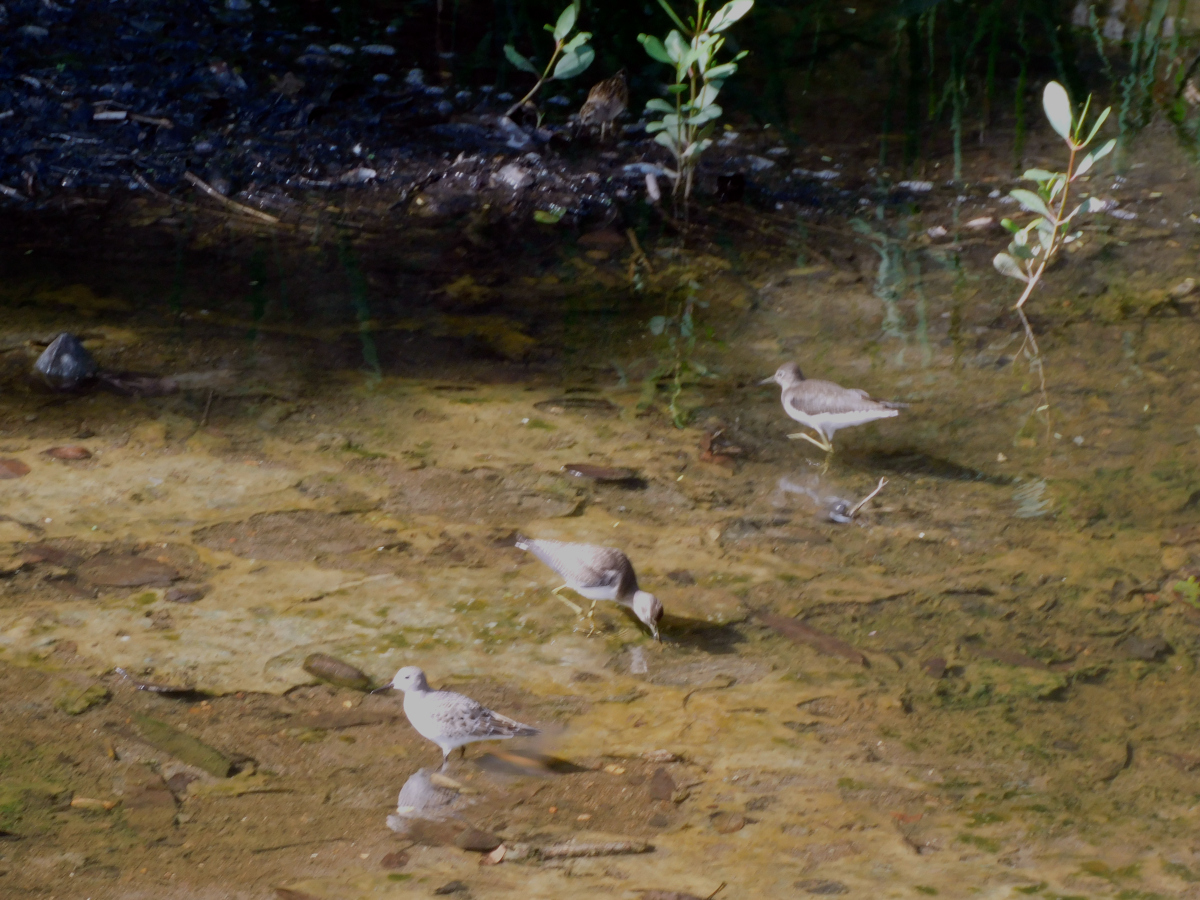
Lesser Yellowlegs at Belmont Salt Pond. (photo by Sustainable Grenadines Inc)
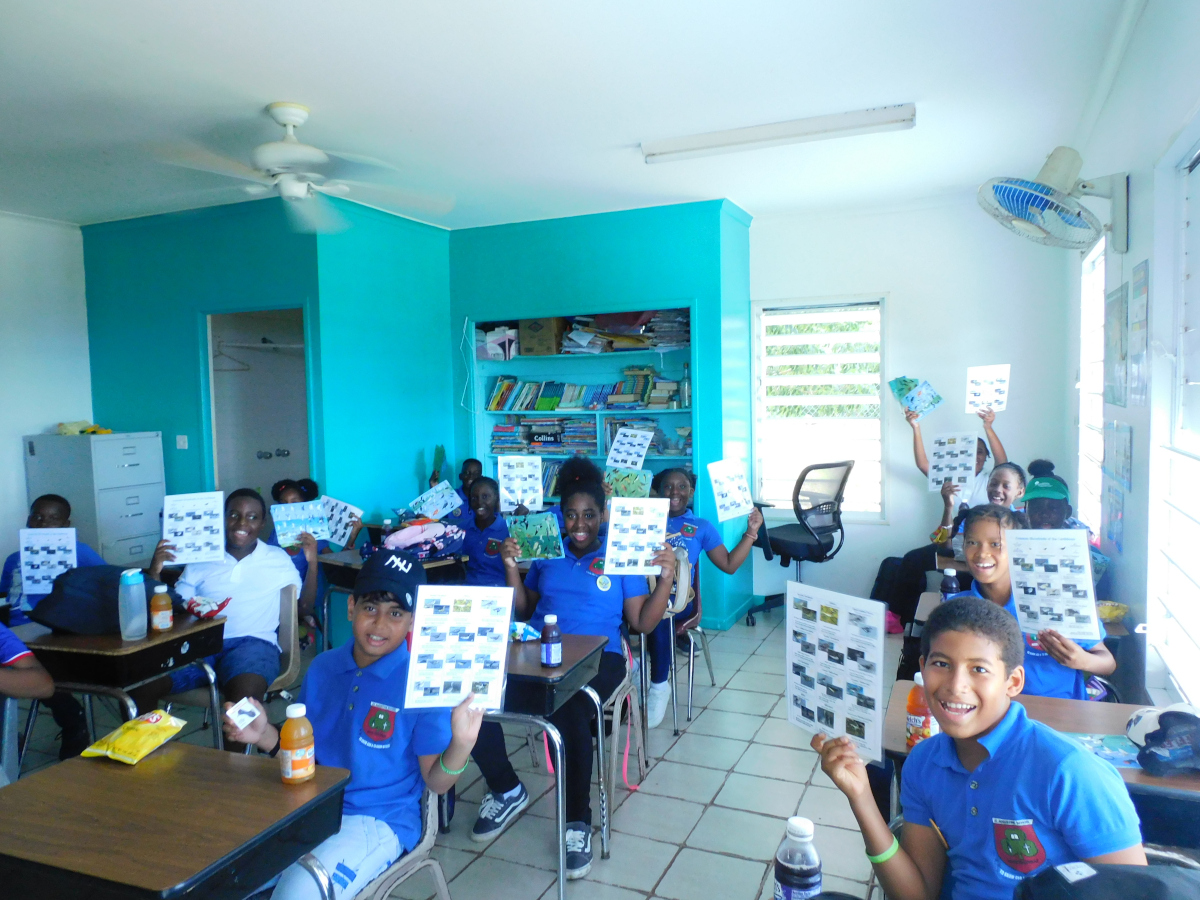
Kids with BirdSleuth Caribbean Bird Bingo-cards. (Photo by Sustainable Grenadines Inc)
Kids learning about birds with BirdSleuth Caribbean and World Migratory Bird Day materials. (Photo by Sustainable Grenadines Inc)
Belmont Salt Pond. (Photo by Sustainable Grenadines Inc)
Viewing Platform at Belmont Salt Pond. (Photo by Sustainable Grenadines Inc)
Viewing Platform at Belmont Salt Pond. (Photo by Sustainable Grenadines Inc)
American Flamingo Spotted at Belmont Salt Pond. (Photo by Sustainable Grenadines Inc)
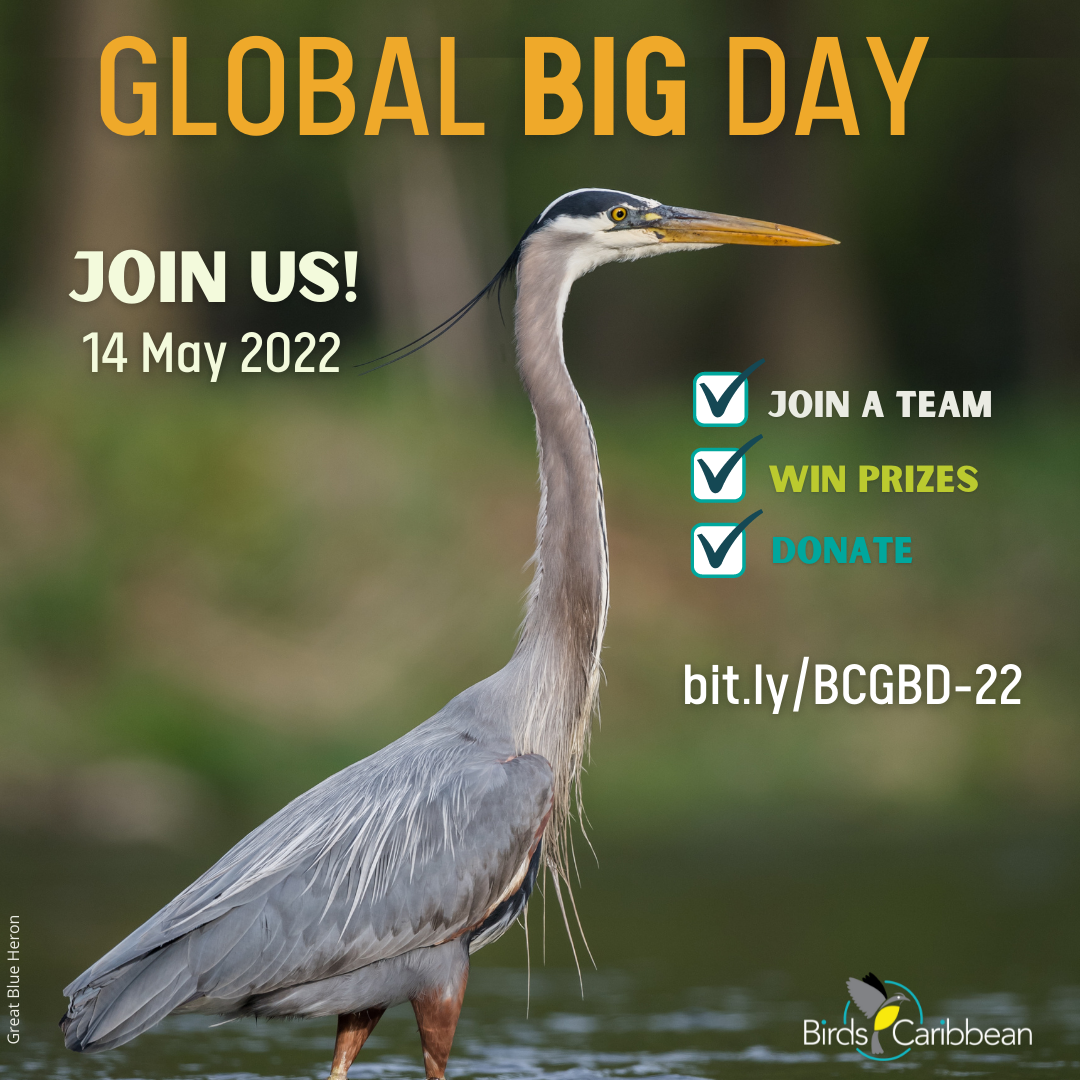
If you’re working today, you shouldn’t be. Tomorrow is Global Big Day for crying out loud. There is much to do.
And so, here’s your Friday Checklist:
Global Big Day – May 14, 2022Polish up your binos with one of those sweet microfiber cloths. Nobody knows what microfiber actually is; maybe spider silk, or the amazingly soft armpit hair of a baby goat, or dandelion seed fluffs sewn together. Scholars are mystified, so just be happy it works. Wipe away.
Begin carb-loading. Finding time to eat tomorrow will be challenging, so aim for consuming somewhere around four to five thousand calories today and you should be good to go. Pig out.
Play around on social media. Not just because it’s routine for you to do so at the top of every hour (isn’t working from home nice?!), but because you need to get the down-low on what other birders are up to. Some might already be tailgating in preparation for Global Big Day. Don’t let their cool personas get to you. Stay strong.
Take a nap from at least noon to 3pm. You’ve earned it. Plus, tomorrow is going to be an early one. Sunrise waits for no one, neither do those birds. Sleep easy.
It’s time to plan out the ground that you’re going to cover. Hour by hour planning is fun, but so is winging it. Keep some spontaneity on the docket. Remember that high vantage points can be really advantageous. Even though birds hate being looked down upon, it’s your best shot at seeing a lot of them at one time. Go high.
Refresh your knowledge of intricate molt patterns, especially with gulls. Rumor has it that some gull species have over 300 plumage variations, and that no mortal man or woman could possibly comprehend them all. Good luck.
Avoid people at all costs (unless you like people) because you might encounter other Global Big Day’ers out there. They may look friendly at first glance, but what they really want is information. Act naive, maybe even slightly disappointed, and ask them if they wouldn’t mind giving you advice on how to find whatever the most common species is in your area. They’ll leave you alone after that. Fly casual.
It’s gonna be a long day, so be sure to hydrate like crazy. Electrolytes are all the rage these days, and because they taste like hell by themselves you’ve got a great excuse to mix in a few cups of sugar. Nectar for the birds, and nectar for you. Pace yourself.
Reflect on which sock type to wear: tube socks or low-cuts? Don’t kid yourself, you’re a birder. That choice was made long ago. Tube up!
Tell a family member about Global Big Day. Not your second cousins on your mother’s side, they won’t care. But maybe your sweet aunt or the brother you’ve neglected for far too long. Convince them that birding is fun and that they should join you. Remember that family is obligated to love you and the things you do. Milk that.
Cue up your eBird account, make sure it still works, and take note of your GBD team’s username that you’ll be sharing your final list(s) with. Your role as a citizen scientist makes you awesome. And remind yourself that LBBs (Little Brown Birds) are not an acceptable species entry in eBird. That’s unfortunate.
With all this prep, your Global Big Day will surely be unforgettable. But your memory isn’t what it once was, so you might actually forget a lot of it. Best to document your exploits. While it’s highly likely that Uncle Sam is continuously taking beautiful photos of you from above, some good shots from ground-level of birds and people birdwatching will make you eligible for more prize giveaways—so be sure to pack a camera. Say cheese!
If you’re not having fun, then you’re not birding. And if you’re not birding, you’re definitely not having fun. Let’s make Global Big Day 2022 the best one yet!
p.s. It’s not too late to join one of our 17 awesome teams!!! Just click here to choose a team – or create one of your own! And here’s a link to our Global Big Day blog article with more information about how this fundraiser will benefit conservation of the Caribbean’s AMAZING birds!Any questions whatsoever about your birding mission tomorrow, don’t hesitate to email us! Lisa Sorenson – lisa.sorenson@birdscaribbean.org;Tahira Carter – tahira.carter@birdscaribbean.org; Justin Proctor – justin.proctor@birdscaribbean.org; and Jeff Gerbracht – jeffgerbracht@gmail.com.
St. Vincent’s iconic Parrot still faces challenges from the La Soufrière eruption, but work is being done to help the parrot and relief supplies are on the way (thanks to many generous donors who responded to our emergency appeal)! As the dramatic month of April draws to a close, it is still a mixed picture for the island of St. Vincent, its wonderful parrots and other wildlife, and its people. This level of uncertainty is likely to persist for the foreseeable future, according to scientists, who are monitoring La Soufrière on a daily basis. Their message is that the smoldering, steaming volcano, which is fairly quiet for now, is “still dangerous.” As we have learned, the situation can change rapidly.
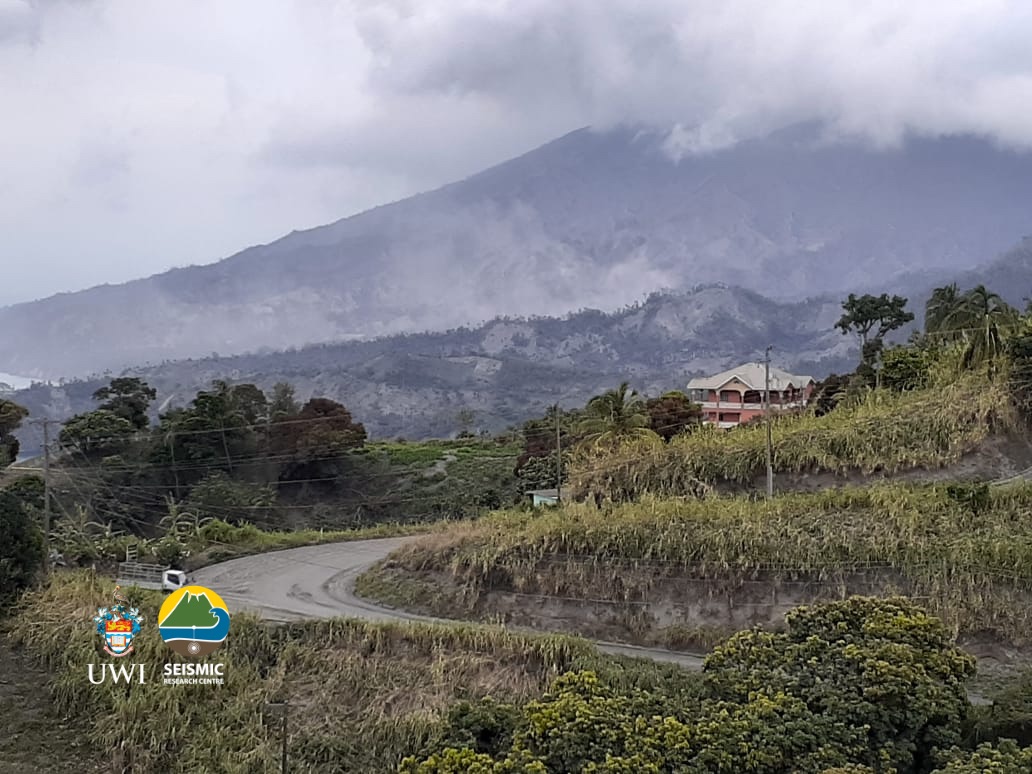
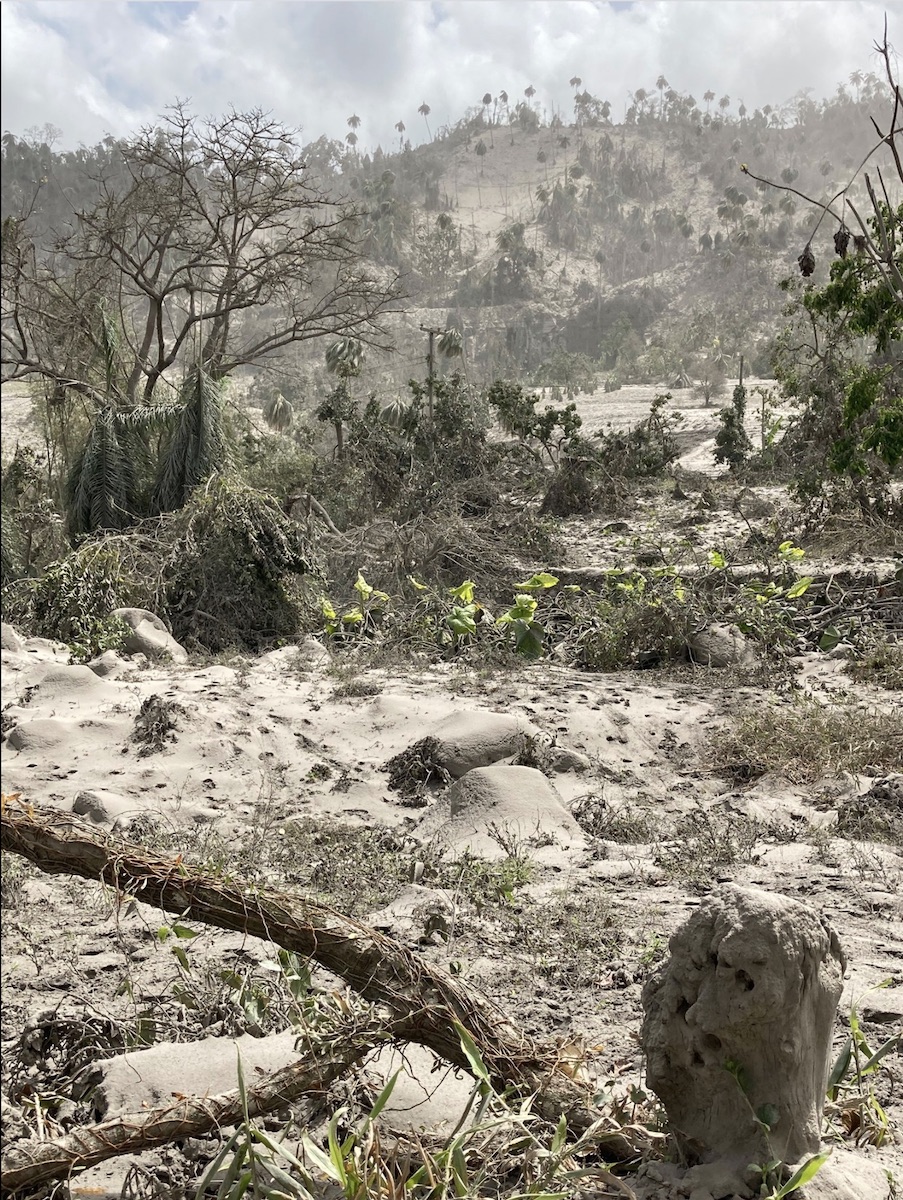
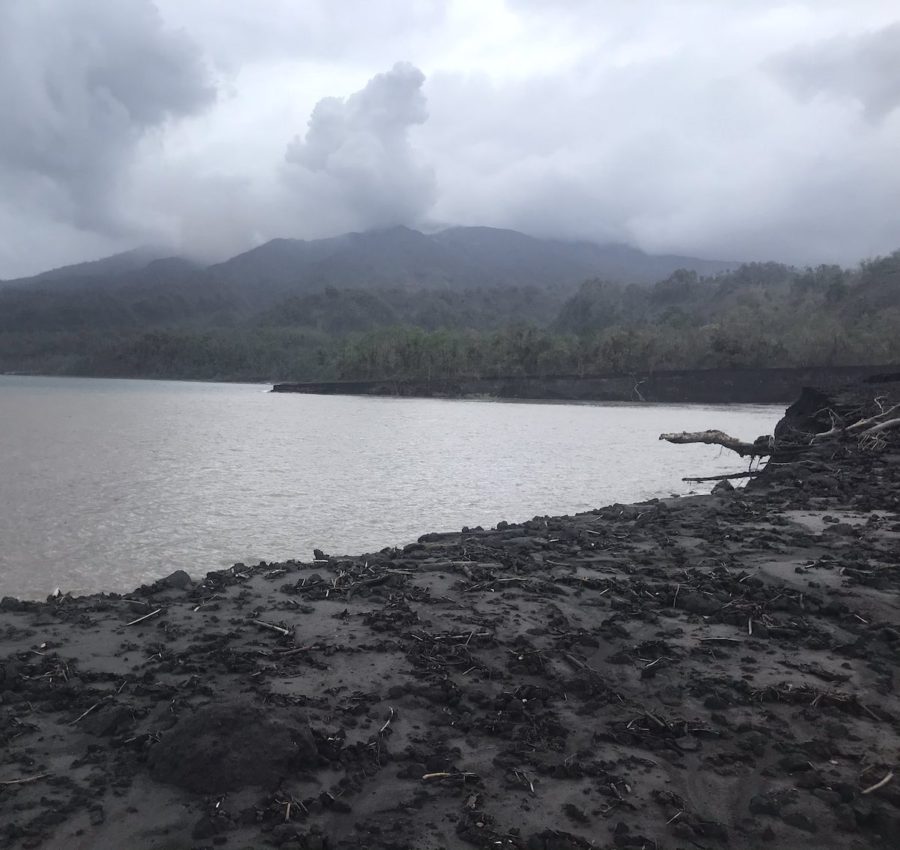
Remobilization of ash at surrounding areas of La Soufriere, St. Vincent (Photo by Ilias Papadopoulos, UWI-SRC)
La Soufrière’s destructive path
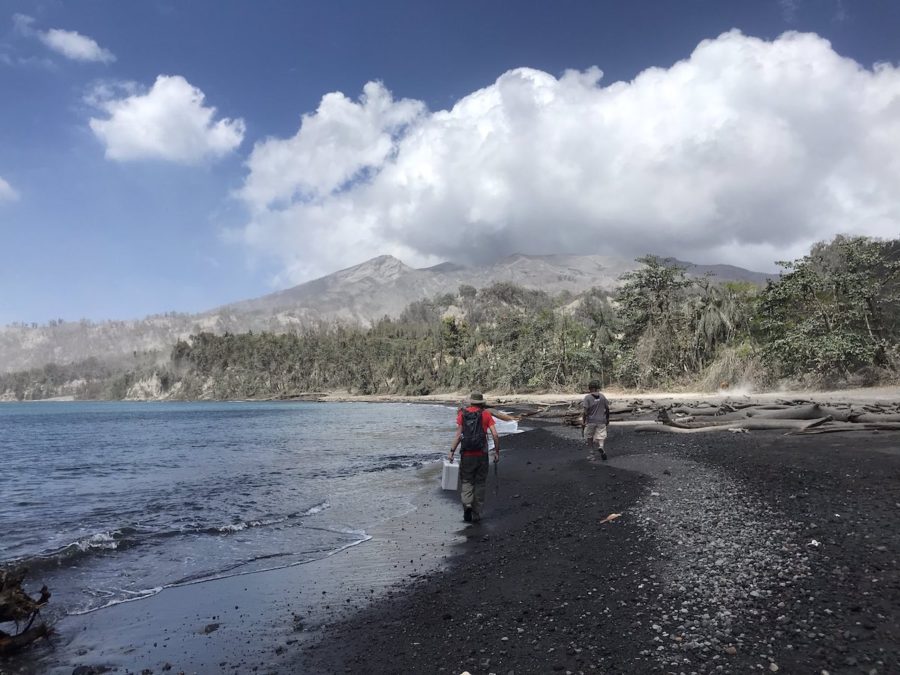
Since we wrote about the volcano’s first eruption on April 9th, the volcano erupted again on the morning of Earth Day (April 22), with the plume of ash reaching as high as eight kilometers. This created some pyroclastic flows – a mixture of extremely hot volcanic ash and rocks that burns everything in its path. Since then, there have been flows of lahars (these are very fast-moving, dense mudflows or debris flows consisting of pyroclastic material, rocky debris, ash and water) along river valleys and gullies. To make matters worse, torrential rains on April 28 and 29 have created floods and landslides in several parts of the island (including the capital, Kingstown) exacerbating the flow of lahars through valleys. Residents are being advised not to go near rivers or streams, especially in the dangerous Red Zone in the north.
Lahars observed in the Wallibou River (Red Zone, Leeward side of the island) on the morning of 29 April, 2021. The rainfall overnight generated lahars (mudflows) in the red and orange zones. (photo by Richard Robertson, UWI Seismic Research Centre)
Lahars are fast moving, dense mixture of rocks, ash and vegetation and water originating from a volcano. It has the consistency of wet concrete and can cause severe damage to rivers and valleys around the volcano. (photo by Richard Robertson, UWI Seismic Research Centre)
As of the evening of Thursday, April 29, the University of the West Indies (UWI) Seismic Centre reported that the volcano’s activity remained low. However, the lahars (some extremely hot) have caused considerable erosion and damage in all valleys that drain the volcano, bringing down many trees that have been carried into the ocean and are creating a hazard for shipping. In several parts of the island, damage to the forest has been quite extensive and rivers are filled with sediment. Earth tremors have been frequent. A recent survey noted many broken trees, weighed down by the heavy ash falls – even in the southern Green Zone where the danger is less. In some areas (for example, Jennings, Tiberoux, and Perseverance) trees have lost their tops and there was little sign of life in the forest. This is not good news for birds, including not only the St. Vincent Parrot but species such as the endangered Whistling Warbler and twelve other restricted-range endemic species, including the Grenada Flycatcher, Rufous-throated Solitaire, Purple-throated Carib, Brown Trembler, Lesser Antillean Tanager, Antillean Euphonia, and others.
Valley on the Leeward side of St. Vincent showing severe damage to trees and vegetation. (photo by Richard Robertson, UWI Seismic Research Centre)
Vincentians working hard for the birds
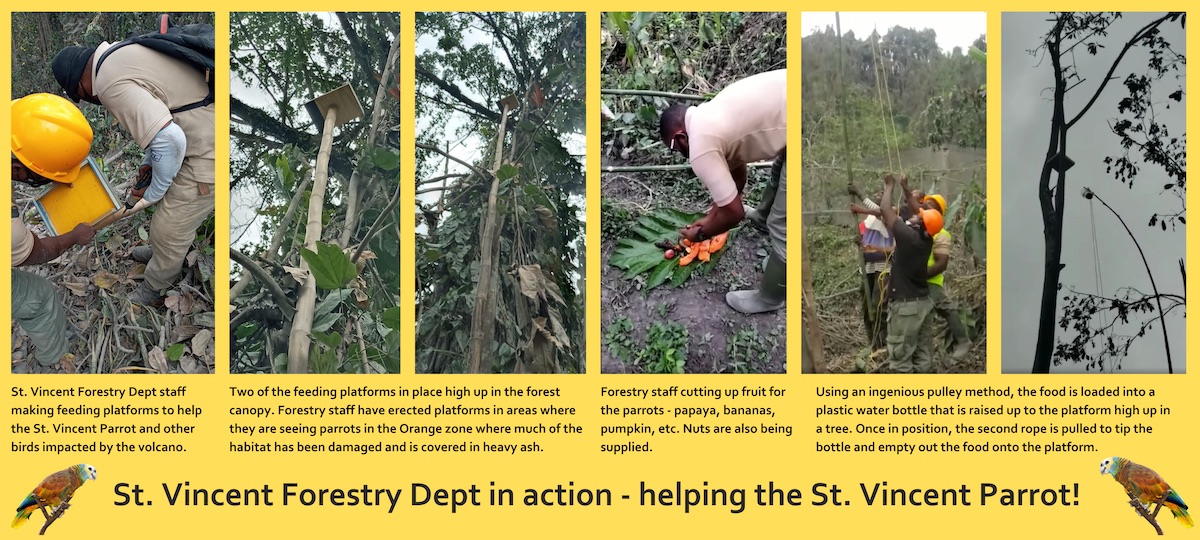
However, there is good news! Our partners on the ground at the Forestry Department of St. Vincent and the Grenadines are still seeing and hearing parrots. Local foresters are working hard for the birds; take a look at the photos and great videos below and on their Facebook page, where you will see them preparing and resupplying fresh fruit to the tall, spindly, but sturdy feeding platform stations that they constructed in the island’s Orange Zone (the central area where many of the parrots are located). Forestry staff have been clearing paths through the damaged forest, looking for stressed parrots and where they are concentrating, clearing waterways of fallen trees and branches in order to restore water supply in several areas, and at the same time doing humanitarian work – helping out their fellow Vincentians with supplies for shelters. Kudos to these brave and hard-working foresters!!! Forestry reports that they have a number of farmers that work with them and they are sympathetic to the plight of the parrots and putting our fresh fruit for them. Forestry is helping to supply this fruit. Members of the public are also calling in to Forestry to report that parrots, hummingbirds and other birds are showing up in areas where they do not normally occur. This shows that parrots are moving around searching for food – thank goodness they have wings! Hopefully, much of the population has been able to escape the eruptions and most damaged areas – time will tell as surveys continue in the coming weeks and months.
Help is on the way!
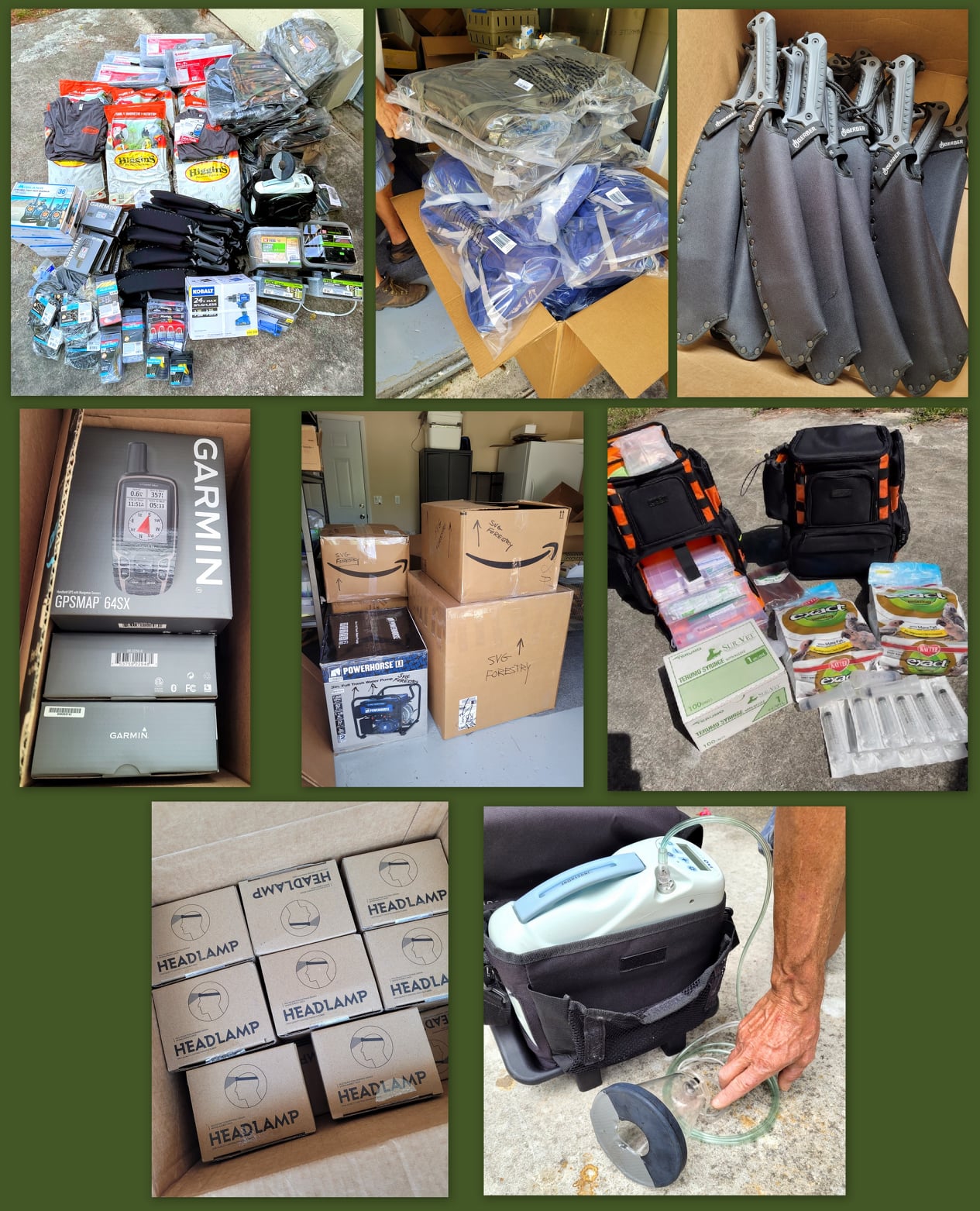
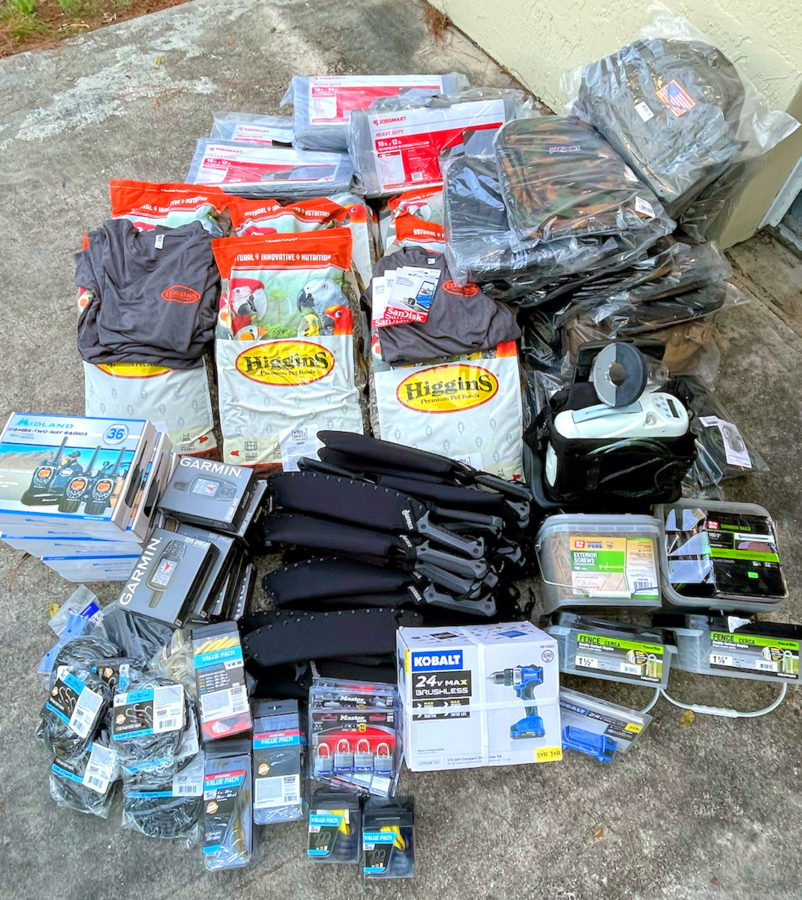
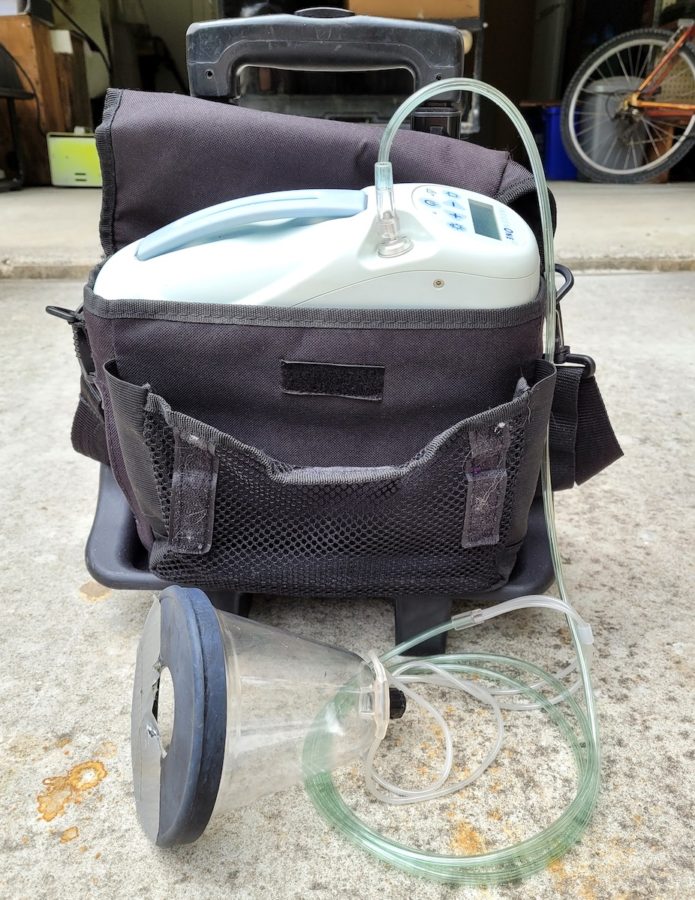
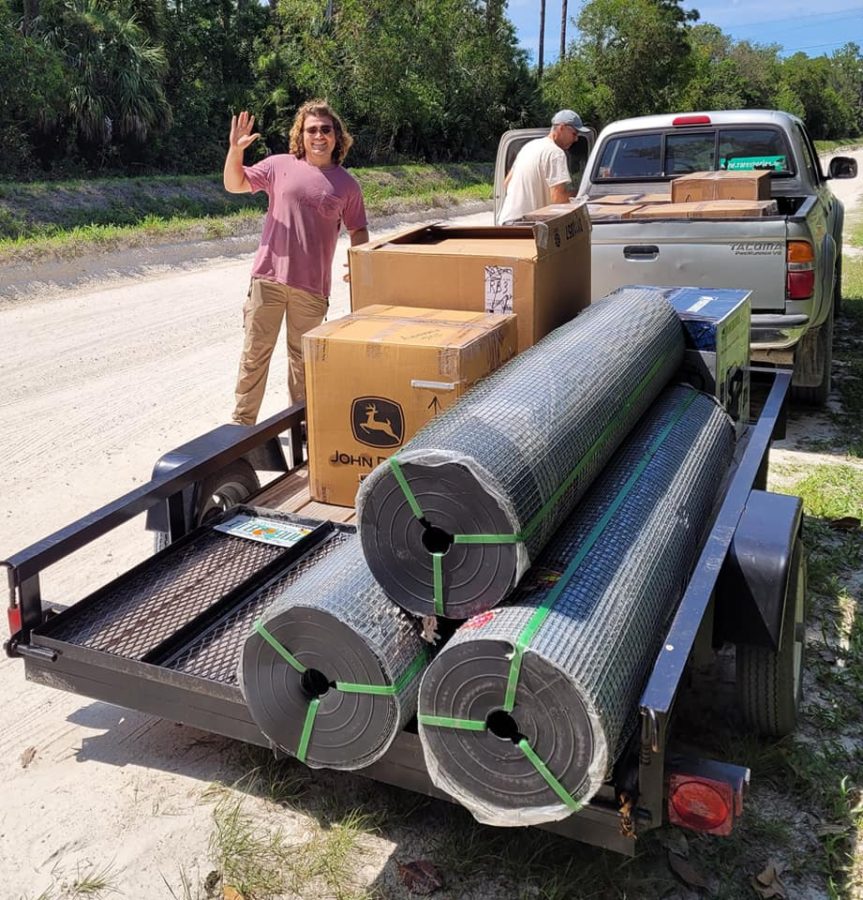
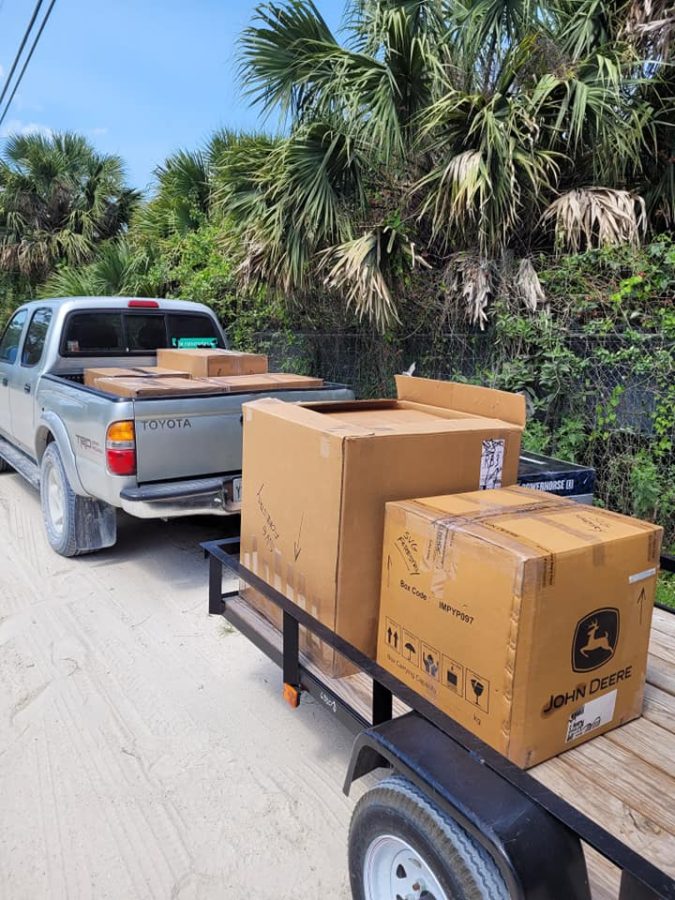
Thanks to the generous donations from friends and donors to the BirdsCaribbean fundraising effort, and the great support of international partners, we have shipped off supplies for the Forestry Department: a range of field equipment, including binoculars, respirators, backpacks, machetes, GPS units, walkie-talkies, cameras, and head-lamp flashlights; also tools and supplies such as hand drills, aviary wire, tarps, and hardware to repair and enhance the Forestry Department’s facilities for breeding captive parrots at the Botanical Gardens. The shipment also includes supplies to treat and care for rescued parrots—two veterinary “go-bags” (field kits containing all the critical care supplies needed to treat parrots in the field), Vita Seed Top Parrot Mix (300 pounds), hand-feeding formula and medicines to treat rescued parrots, and a portable oxygen generator and St Vincent Parrot-sized mask to help parrots in respiratory distress. The first shipment including all of the above items (1,625 pounds) is now en route to St. Vincent via Tropical Shipping sea freight – it will arrive on May 5th! Additional items still to be sent include nectar feeders for hummingbirds (many flowering plants have been badly damaged), seed feeders for other birds, and camping supplies to allow Forestry to spend the night in the field during parrot survey watches.
Recovery and relief supplies in the first shipment to St. Vincent include field equipment, supplies to care for rescued parrots, and hardware to repair and enhance the St. Vincent Parrot Aviary at the Botanical Gardens. (photos by Paul and Karen Reillo).
In these uncertain times, our caring local partners will continue to need our support. They are working hard in very challenging, often dangerous conditions to ensure that some of our most vulnerable Caribbean birds are assured of a safe and secure future. Later on, there will be a great deal of restoration work to do. At the moment, the volcano remains “in a state of unrest,” according to the UWI.
Jan 2022 Update
Our crowdfunding platform for this appeal, GoFundMe Charity, a separate arm of GoFundMe, unfortunately closed down this site, with a plan for all charities to operate fundraising pages on their main site, thus our crowdfunding page for this fundraiser is no longer available. However, you can donate here and designate your donation in the comments to help with the continued recovery of the St Vincent Parrot, Whistling Warbler, and other wildlife in St Vincent. We owe it to the gorgeous St. Vincent Parrots and their beautiful island home!
Thank you to all of the incredibly generous donors to our fundraising campaign for your support. This has been critical to allow us to purchase and ship relief supplies as well as send funds to our local partners in St. Vincent. A huge thank you also to our international partners who are supporting this relief effort, including Rare Species Conservatory Foundation, Caribaea Initiative, Fauna & Flora International, Vortex Optics, and the Farallon Islands Foundation. We thank our amazing local partners SCIENCE Initiative, the St. Vincent & the Grenadines Environment Fund, and the Forestry Dept for your support and hard work.
Some of the recovery and relief supplies sent to the St Vincent Forestry Dept in the first shipment (April 2021). (photo by Paul and Karen Reillo)
Portable oxygen generator with a mask adjusted to fit the St Vincent Parrot. (photo by Paul and Karen Reillo)
Aviary wire and other relief supplies loaded up and ready to take to the port in West Palm Beach. (photo by Karen Reillo)
Relief supplies (1,200 pounds) ready to go the port to get on Tropical Shipping’s next boat to St Vincent on 28 April. Huge thanks to Paul and Karen Reillo for assembling and repacking all of the supplies for shipping! (photo by Karen Reillo)
Scientists studying the impacts of the volcano in the Wallibou River area on 26 April before lahars hit the area on 29 April. (photo by Prof. Jenni Barclay)
The Wallibou River area on 29 April AFTER a lahars hit the area on 29 April. Never underestimate the power of a lahar! (photo by Prof. Jenni Barclay)
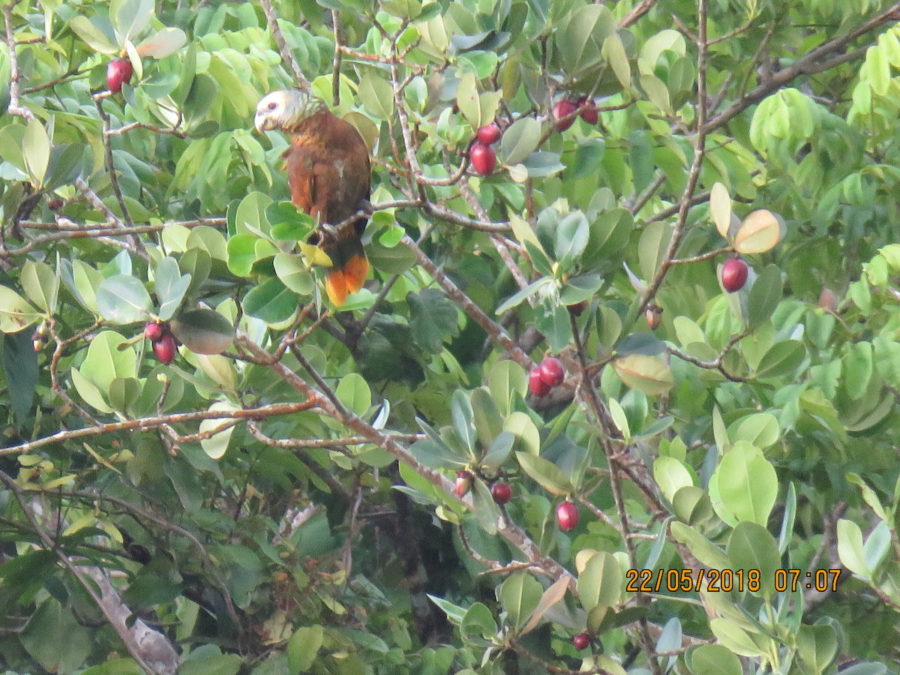
St Vincent Parrot in better times, eating monkey goblet fruit (Clusia major), May 2018. (photo by Glenroy Gaymes)
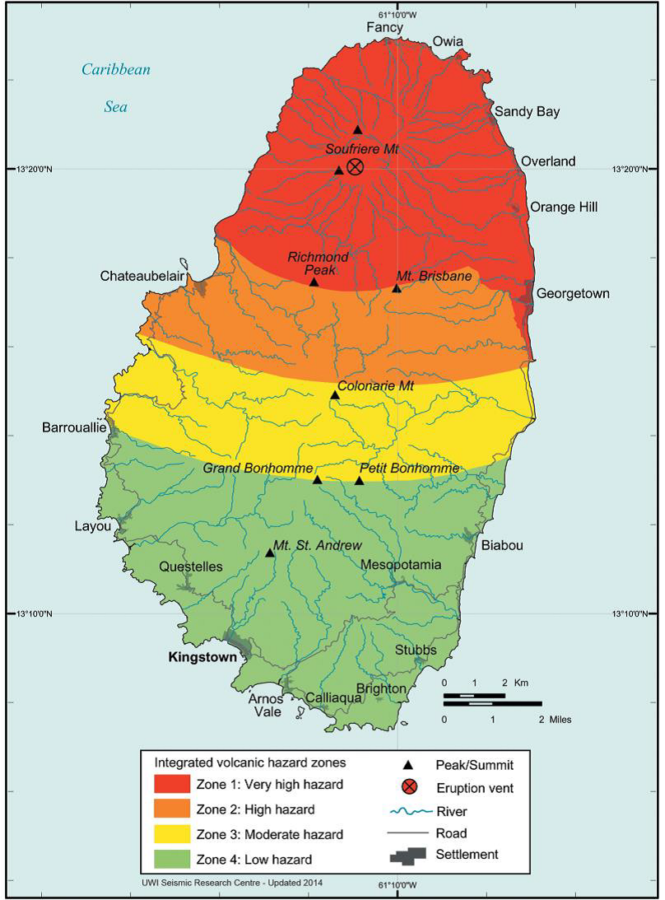
Map of La Soufrière danger zones in St. Vincent. The St Vincent Parrot’s main habitats are in the forests in the orange and yellow zones.
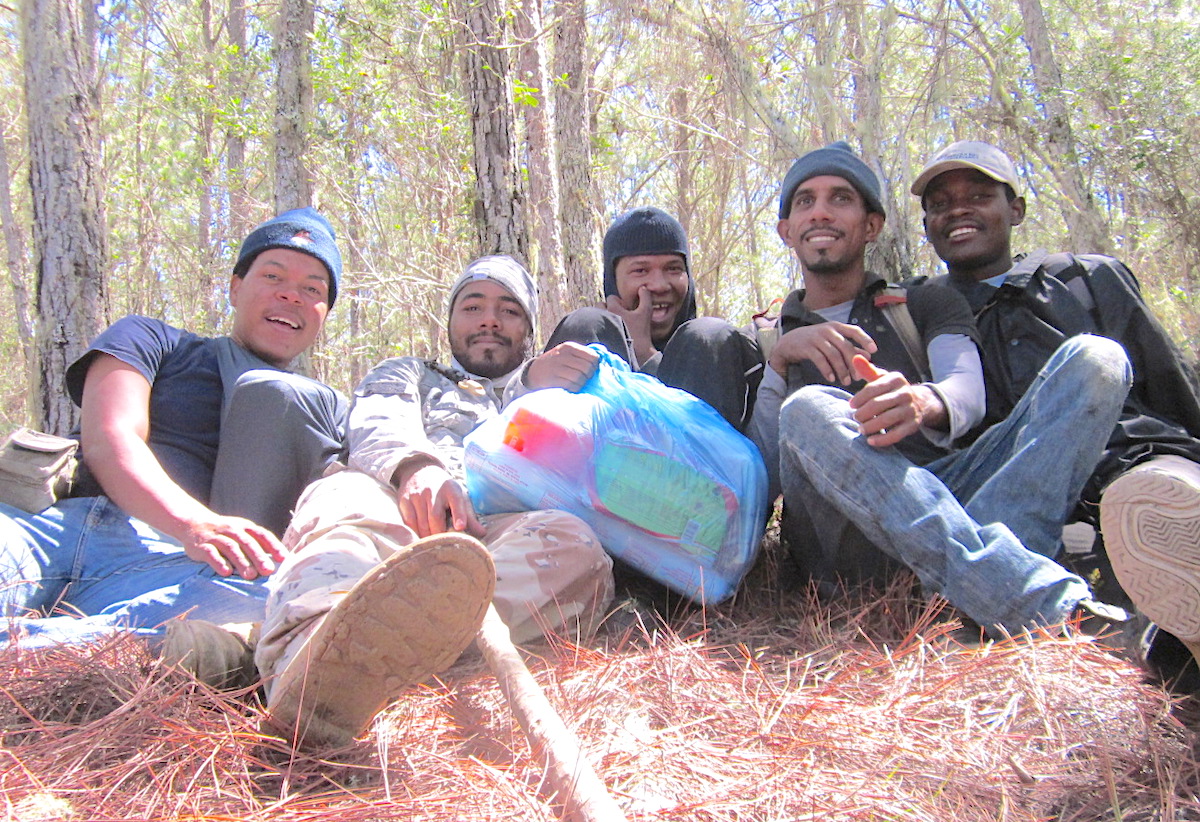
Field technicians at the Loma del Toro colony in happier times (Photo by Grupo Jaragua)
Jennifer Wheeler of the International Black-capped Petrel Conservation Group shares some shocking and sad news on the Black-capped Petrel in the Dominican Republic.
In mid-March 2021, researchers from the environmental organization Grupo Jaragua arrived at Loma del Toro, located in the Dominican Republic’s Sierra de Bahoruco National Park. The team’s mission was to check up on the Black-capped Petrel, an endangered seabird endemic to the Caribbean.
The trip to the field site was long and taxing, the final hours of bumpy travel up a steep, unpaved mountain road. Nevertheless, the team was in an upbeat mood, anticipating evidence of the first chicks to be hatched this year.
A shocking sight
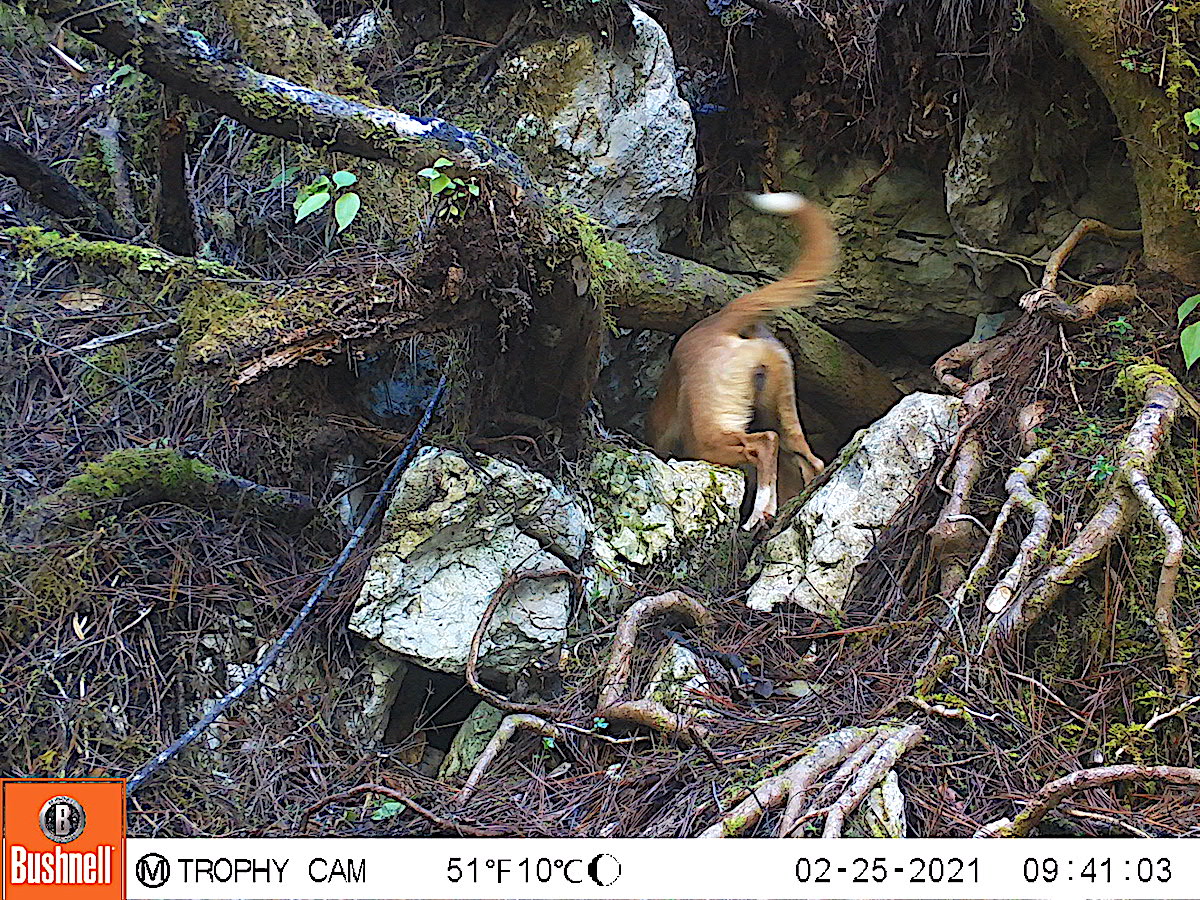
Sadly, the researchers’ hopes were soon to be crushed. In the early morning, the forest of Hispaniolan pines that is home to the Black-capped Petrel nesting sites would normally have been full of life, with a noisy dawn-chorus of migrant and resident birds. Instead, the woods seemed a bit quieter than usual. When they reached the nesting sites, the team was met with a scene of carnage. The colony’s burrows were torn up, petrel feathers scattered around, and the remains of eggs and adult petrels dotted the ground. Predators had decimated the colony.
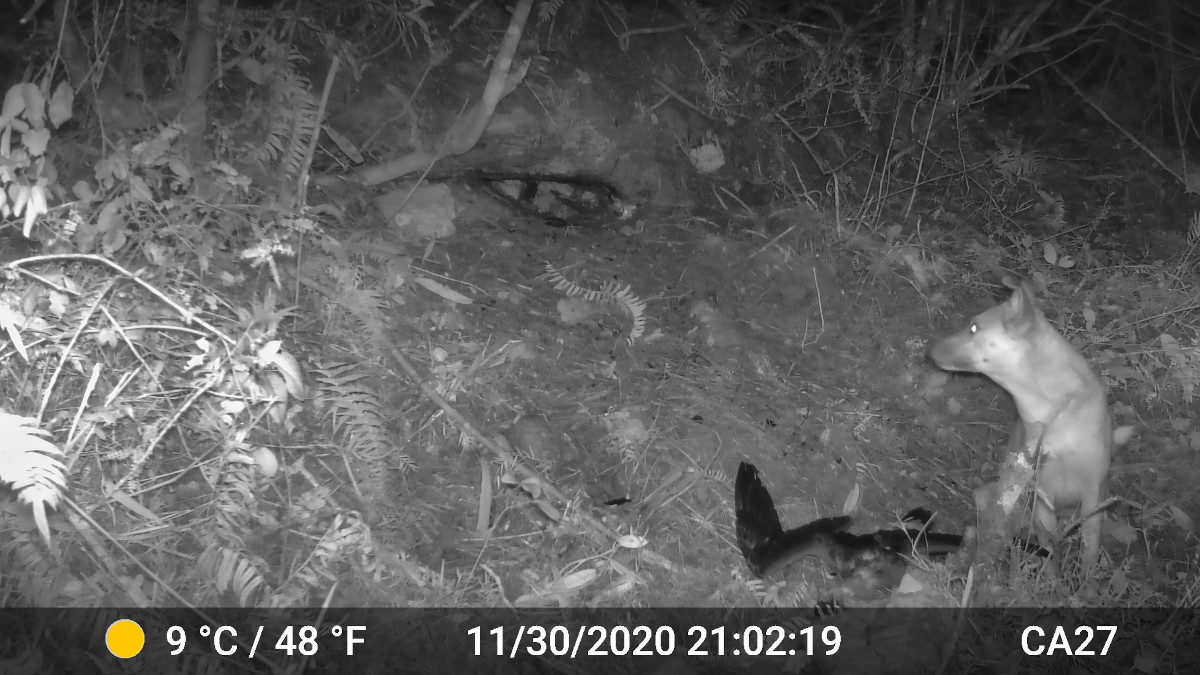
Analysis of camera traps at thirteen nests revealed that several dogs had been visiting the colony regularly since the end of November, and the depredations were the work of one particularly determined dog. This individual killed a minimum of seven adult petrels, likely more were attacked off camera.
Dog invading a Black-capped Petrel burrow at the Loma del Toro colony. An adult petrel was killed outside this burrow in early March. (Photo by Grupo Jaragua)
Rare and vulnerable nesting sites
Only about 100 nests of the Black-capped Petrel have ever been located, after years of searching. These are all in the mountains on Hispaniola (the island comprised of Haiti and the Dominican Republic). Loma del Toro, in the Dominican Republic just east of the Haitian border, hosted 28 of them. Of the 28 known burrows, at least 22 were invaded by the dogs (based on camera traps, visual inspection of nests, and observation of carcasses.) Field teams expect that there were additional yet-to-be-found burrows in the area; these may have been affected as well.
The site has been monitored regularly since 2011. Adults claim burrows in November and December, and usually a high proportion (~70%) of chicks fledge from Loma del Toro in the summer months. There have been disappointments and setbacks before. In 2018, the presence of a cat resulted in the failure of nine nests at Loma del Toro. The loss of breeding adults and destruction of burrows, however, made this year’s scene especially tragic.
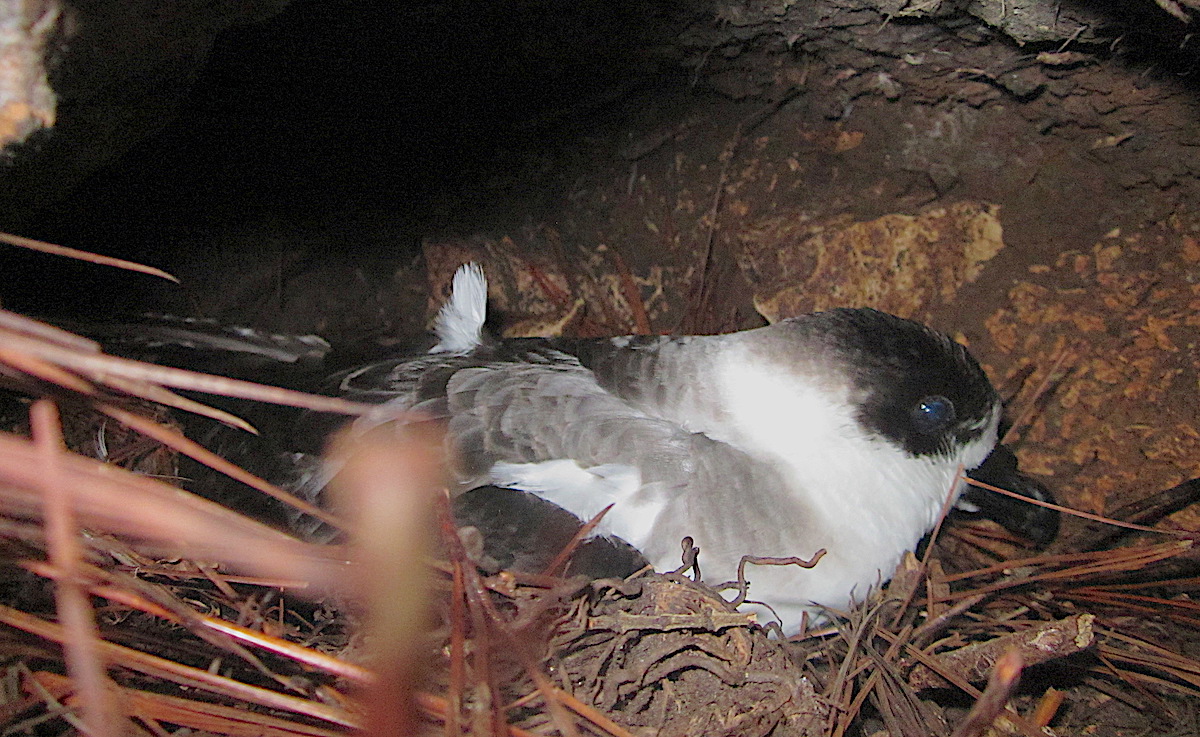
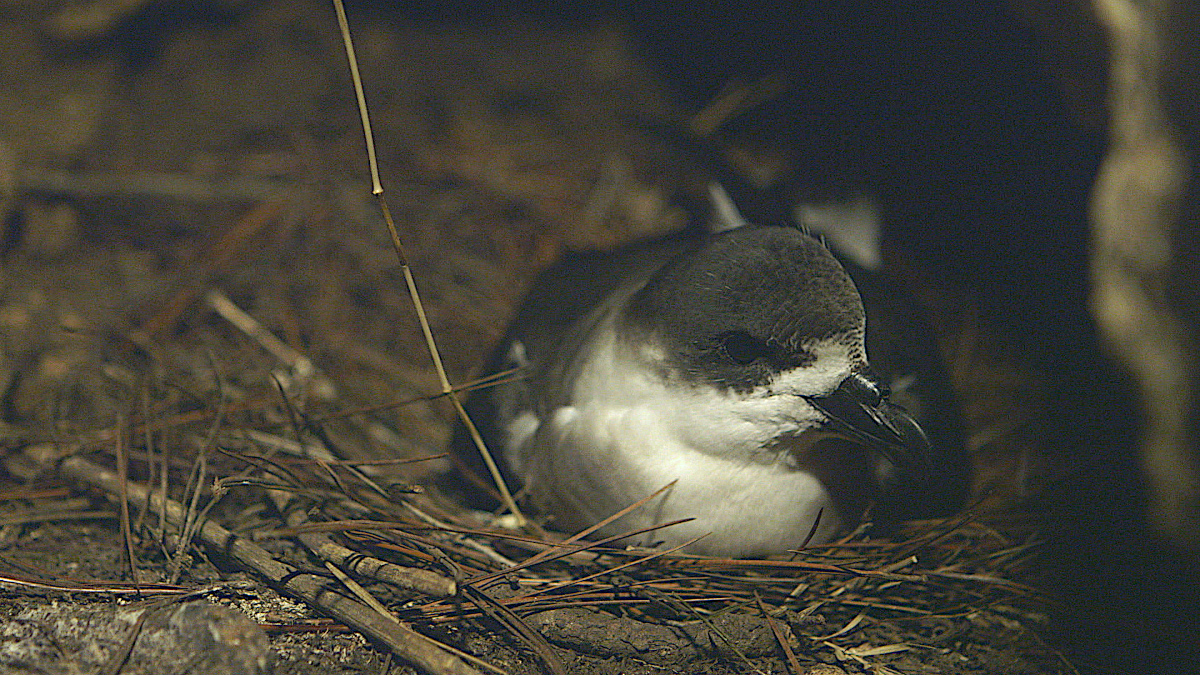
An adult Black-capped Petrel in a Loma del Toro burrow in early 2014. Black-capped Petrels nest in colonies in underground burrows located on forested slopes and cliff sides on Hispaniola, generally above 1500 m. They lay just one egg. (Photo by Grupo Jaragua).
Introduced mammals – a destructive threat
Worldwide, animals introduced by humans – rodents, mongoose, cats, dogs, pigs – have devastated native island bird populations. The seabirds that evolved on islands free of mammalian predators are ill-equipped to withstand the pressure of animals evolved to take prey.
Not that Black-capped Petrels and other seabirds are helpless – these are tough birds that spend their lives in the winds and waves of the marine environment. Camera footage shows them battling each other as well as rats. However, seabirds are typically clumsy and slow on land, and nests on or in the ground are easily accessed by predators.
In an endangered species such as the Black-capped Petrel, any death of an adult can have extreme consequences for the health of the entire population. For this reason, the Conservation Action Plan currently being updated by the International Black-capped Petrel Conservation Group (IBPCG) identifies predation by introduced mammals as a key threat, and reduction of predator pressure as a top strategy. In fact, Grupo Jaragua’s deployment of multiple camera traps was a step in understanding the specifics of the threat at known colonies.
Dog standing over dead Black-capped Petrel. Another petrel, presumably a mate, returned to this burrow in early January (Photo by Grupo Jaragua).
Tackling the challenges
What now? Of course, the park authorities in the Ministry of the Environment have been notified about the specific threat posed by the recently documented group of dogs. The International Black-capped Petrel Group (IBPCG) had already begun to pilot trapping activities for smaller predators such as rats and mongoose. It will also pursue the idea of restoring the Loma del Toro colony using buried nest structures (“artificial burrows”) to provide more secure nesting locations.
Reducing the predation pressure at Loma del Toro and other Black-capped Petrel colonies will be a challenge given the costs and logistics of operating in a remote, mountainous location. Accessing the Black-capped Petrel colonies can only be done by rough unpaved roads that take a heavy toll on the research teams’ trucks. Finally, the IBPCG must also combat the threats of fire, collisions, habitat loss and degradation from agricultural expansion, all while continuing to seek out and study the species in colonies elsewhere in the region.
The Working Group and partners fight on…
Yet, this group’s efforts have always been notable for the level of shared dedication and collaboration to benefit this special bird. The IBPCG has strategies in place to offset many of the conservation threats that the Black-capped Petrel faces annually; some have already shown positive outcomes for the species. The tragedy at Loma del Toro only strengthens the resolve of Grupo Jaragua and its IBPCG partners, which include BirdsCaribbean, the American Bird Conservancy, Environmental Protection in the Caribbean (EPIC) and others – to protect the species and allow it to thrive across its range.
…and need your support
The IBPCG continually strives to raise funds for its work. If you would like to contribute to keeping the Grupo Jaragua field team in the field and support the work to reduce predation pressure and other threats, please give directly to Grupo Jaragua at http://www.grupojaragua.org.do/apoyanos or you can route through a gift through BirdsCaribbean: http://bit.ly/GiftForCaribbeanBirds
More bad news! At press-time, a raging wildfire threatens the remaining birds and burrows of the Loma del Toro colony. We await more information…
BirdsCaribbean is very excited to announce that we are launching a new bird monitoring initiative — the Caribbean Motus Collaboration. And we need your help and involvement! Read on to learn more about this program and how you can help.
What is Motus?
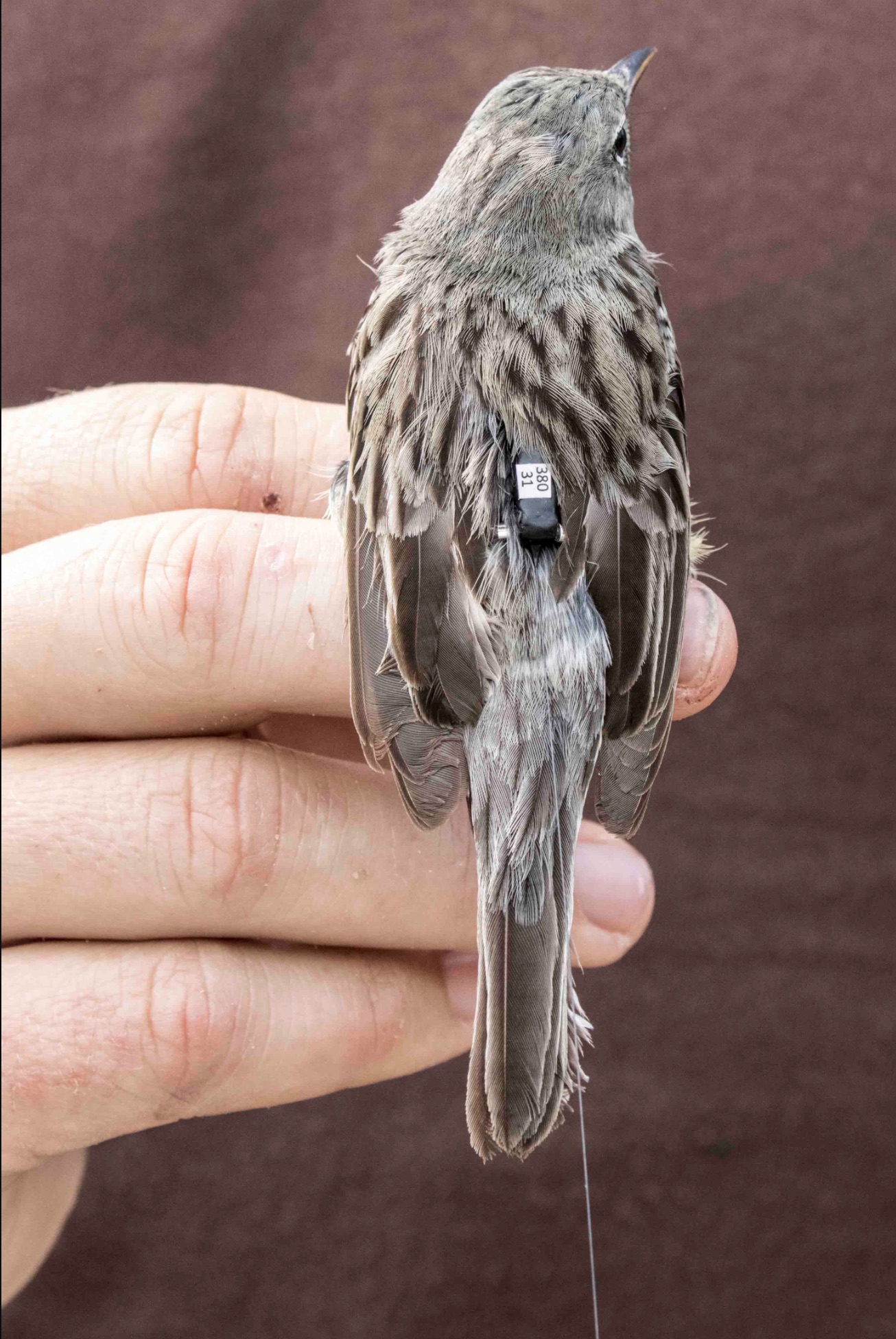
Kirtland’s Warbler fitted with a lightweight nano-tag. These tiny transmitters, which weigh as little as 0.2 g, allow researchers to track the movements of small animals with precision across thousands of miles. (photo by Scott Weidensaul)
The Motus Wildlife Tracking System is a powerful collaborative research network developed by Birds Canada. Named after the Latin word for movement, Motus uses automated radio telemetry arrays to study the movements and behavior of flying animals (birds, bats, and insects) that are nano-tagged and tracked by Motus receivers.
Motus’ main objective is to enable conservation and ecological research by tracking the movement of animals. The system consists of hundreds of receiver stations and thousands of deployed nanotags on 236+ species, mostly birds. Data from this network have already expanded our understanding of bird movements, including pinpointing migration routes and key stopover sites, as well as movements, habitat use, and behavior during breeding and non-breeding seasons. We are only just beginning to tap into the enormous potential of this new technology and growing network of partnerships and data sharing for conservation.
Motus technology is also a valuable educational tool that can advance conservation education both in and out of the classroom. Birds Canada and the Northeast Motus Collaboration have developed a curriculum that combines interactive classroom activities with Motus tracking tools that can be used to teach local children about birds, migration, and conservation.
Expanding the Motus Network in the Caribbean
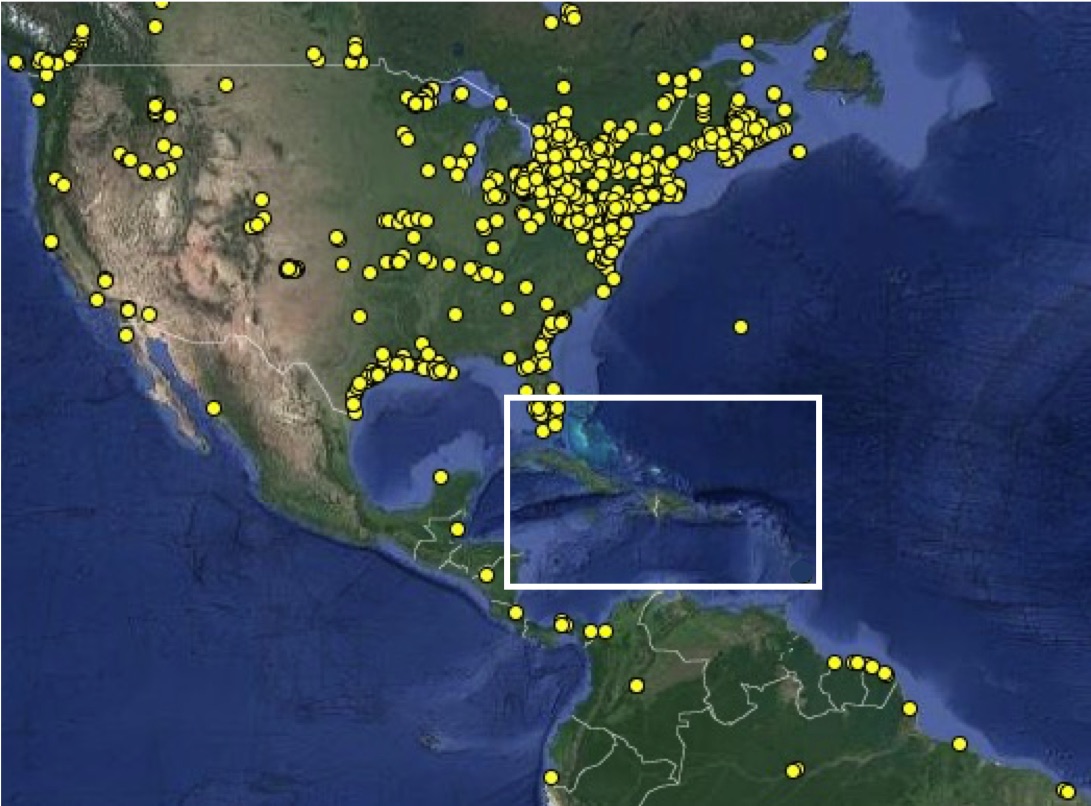
Motus is widely established in Canada and the US, and beginning to spread throughout Central and South America; however, there are currently no active receiver stations in the Caribbean. The more Motus stations we can put up, the more we can increase our understanding of where tagged birds are moving. In addition, many species of conservation concern that live in or migrate through/ to the region have not yet been tagged. We want to fill this critical geographical gap.
Yellow dots represent the active Motus receiver stations. The white box outlines the insular Caribbean. A few Motus stations that were put up in several islands have been damaged by storms and hurricanes, and need repair.
The Caribbean Motus Collaboration (CMC) is developing a multi-pronged strategy to expand the Motus network by installing and maintaining receiver stations in strategic locations throughout the islands, deploying nanotags on priority bird species, and implementing a specially adapted Caribbean educational curriculum.
Why is this Important?
Our birds are declining at alarming rates.
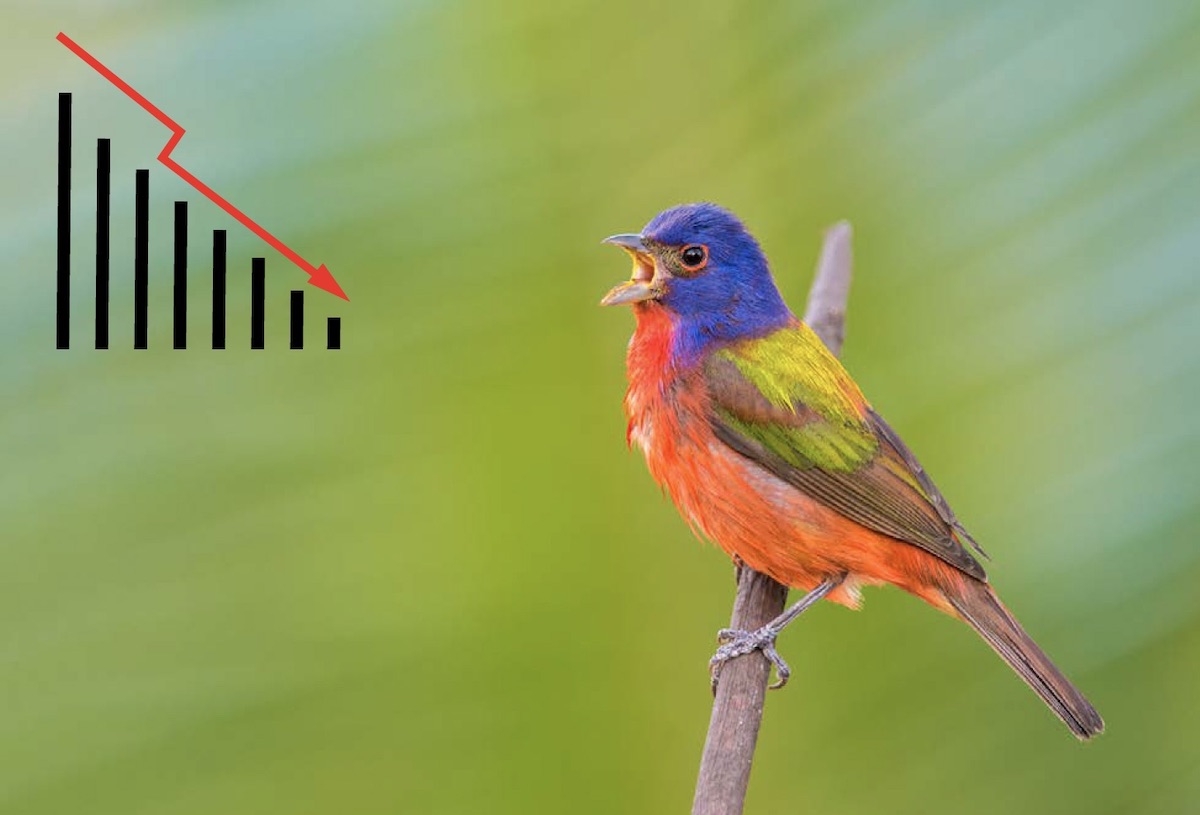
The Painted Bunting is a declining songbird that winters in FL, Cuba, the Bahamas, Mexico, and Central America. (photo by Ray Robles)
The insular Caribbean is a global biodiversity conservation “hotspot” that is home to over 700 species of birds. Roughly half of these bird species are residents in the Caribbean, including 171 that are endemic – meaning they are found nowhere else in the world! The other half are migratory, splitting their time between temperate and tropical habitats in the Americas, and shared among multiple countries along the way.
For some migratory birds, the Caribbean islands are the perfect winter retreat — they arrive in early fall and stay until spring. Others use one or more islands as stopover sites to rest and refuel as they fly between their breeding and wintering grounds further south. Whether they stay or move on, they are much-loved visitors, reflecting the seasons and inspiring our cultural expressions.
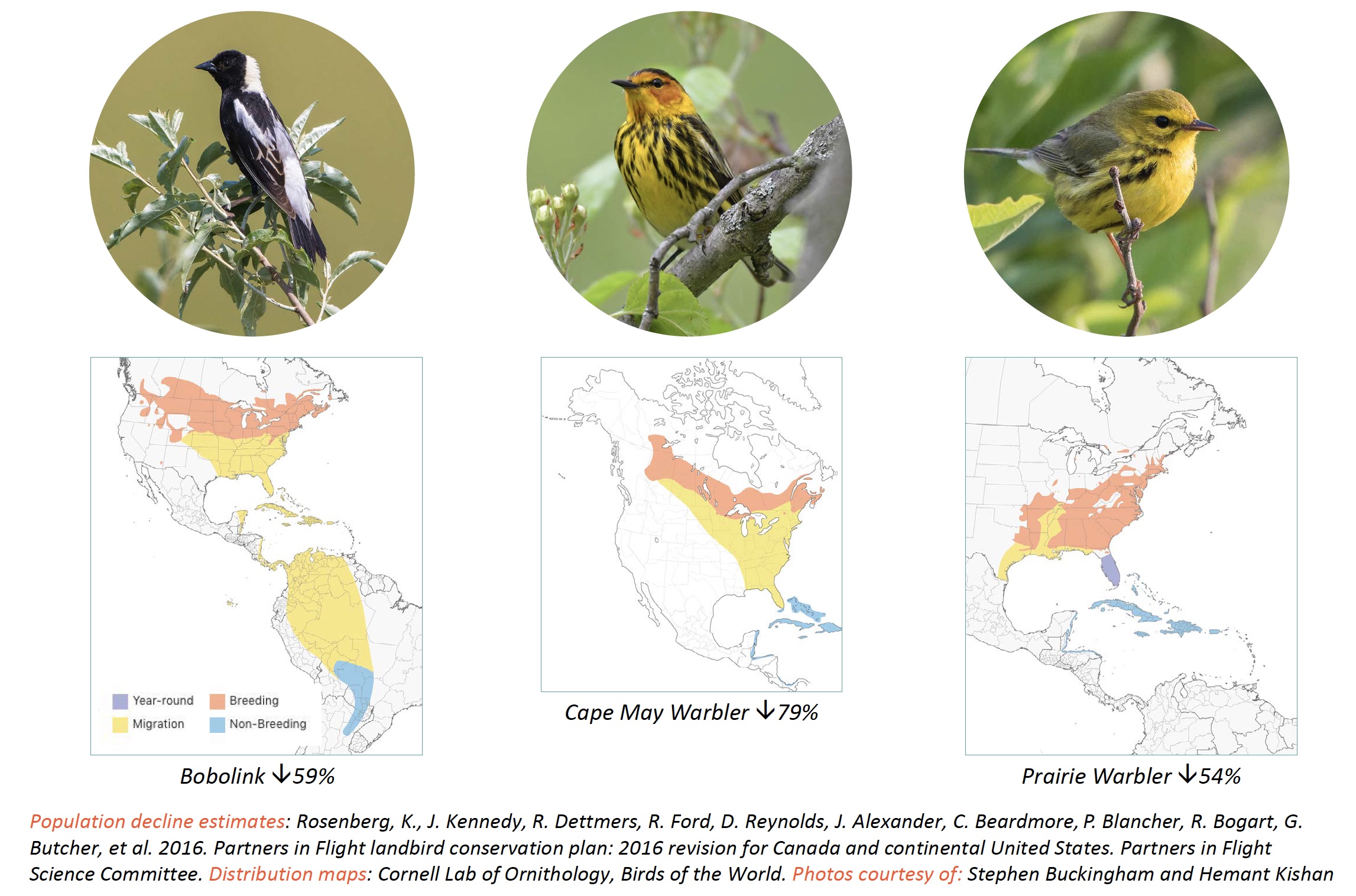
Unfortunately, bird populations are declining. Fifty-nine Caribbean species are at risk of extinction, listed as Vulnerable (30), Endangered (24), or Critically Endangered (5) by the International Union for Conservation of Nature. A recent study found that nearly 30% of the bird populations in North America since 1970 have been lost, and Caribbean species are among the many that are in trouble.
Birds in the Caribbean face an entire suite of threats, including habitat loss and fragmentation, pollution, and invasive species. In addition, climate change has become a constant danger to the region, not only to people, but also to wildlife. The Caribbean is experiencing increasingly intense hurricanes, long droughts, and dramatic changes to the marine environment. The threats are growing for our vulnerable birds, and we can’t afford to lose any more.
Needed now: An effective bird monitoring system in the Caribbean
Research on our birds has progressed considerably in recent decades, but we still lack basic information on many species. We need to understand them better if we are to save them.
We need to identify the most critical sites and habitats for our migratory, resident, and endemic birds, and we need to assess the threats they face. Importantly, we need to raise awareness about why all of this matters.
At BirdsCaribbean we partner with international, regional, and local partners to develop long-term monitoring programs, e.g. our Caribbean Waterbird Census program. We are using several strategic tools for doing so, and we are confident that the Motus Wildlife Tracking System will become an invaluable resource for strengthening our efforts.
Motus receiving stations function similar to automated toll booths on a highway – every time a bird passes over the station it’s recorded, just as automated toll booths record license plates. The stations have a range of about 9 miles or 15 km. (Ruddy Turnstone photo by Maikel Cañizares)
The Caribbean Motus Collaboration (CMC) can inform and promote bird conservation
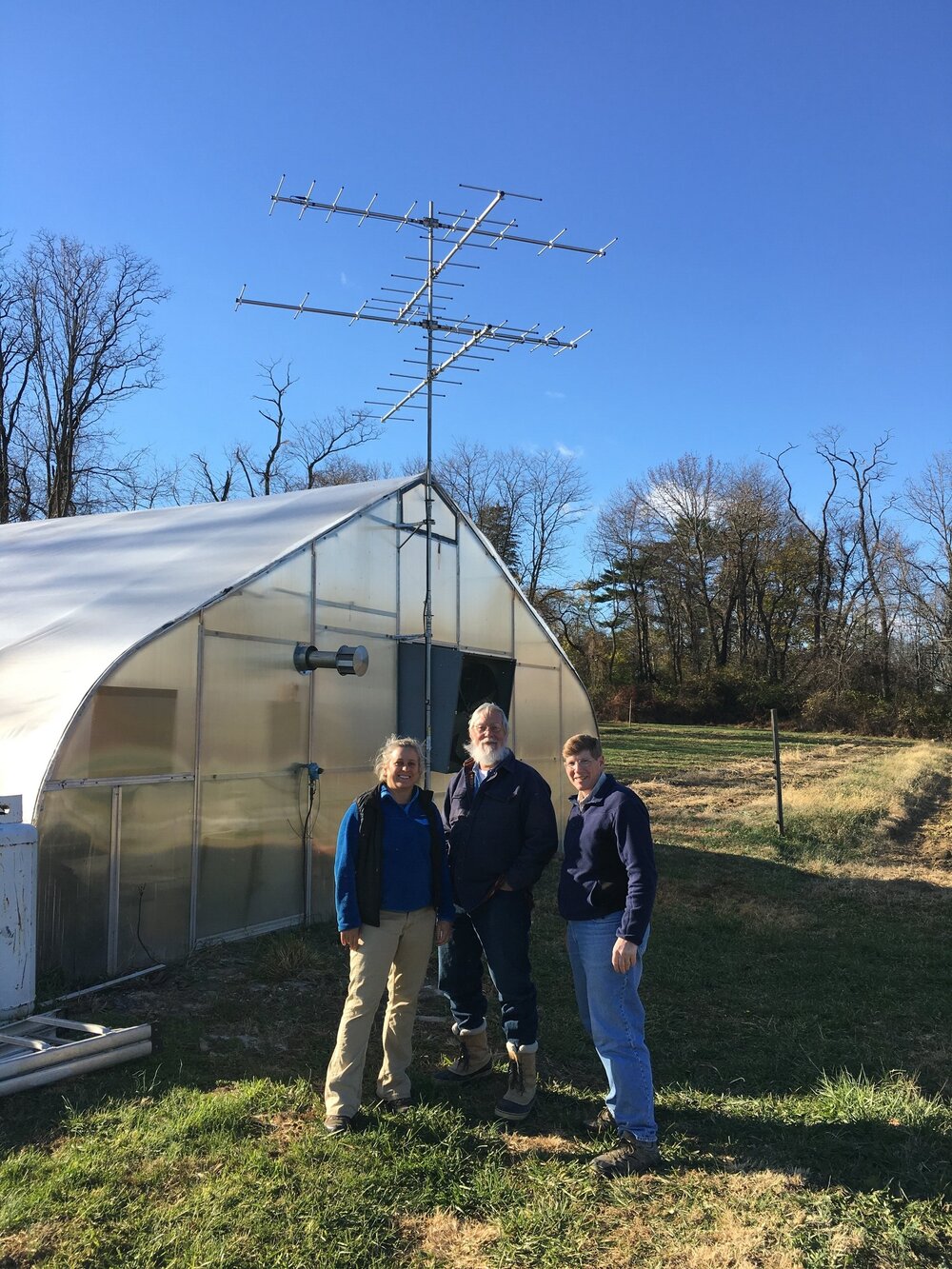
Colleagues from the Northeast Motus Collaboration stand by a newly installed Motus station in Pennsylvania. (photo credit: Northeast Motus Collaboration)
Our partners are eager to build the Motus network in the Caribbean. The initiative is gaining momentum quickly and the time to act is now! As a regional organization, BirdsCaribbean is keen to facilitate this effort and assist our partners.
Our collaboration will enhance the efforts of those working to grow the network in other regions of the Americas. And it will shed light on the movements and habitat use of bird species of conservation concern. This knowledge is essential to safeguarding birds throughout their full life cycles and reversing population declines.
Caribbean natural resource managers, including many of our partner organizations throughout the region, will be able to use information from the Motus network to identify the most important sites and habitats for our resident and migratory birds. Once identified, those in the Caribbean network and beyond will be able to focus our work on these most critical areas, alleviating threats and protecting these sites. By building the capacity to use this powerful tool, we will also be contributing to the development of local research and environmental education programs. The knowledge, skills, and appreciation for birds will multiply. It’s a “win-win” for the birds, and for those who work to conserve them in the region.
We Need Your Help!
To grow the CMC, we are seeking funding from granting agencies and private donors, and looking to establish partnerships with international and regional organizations, landowners, and businesses in the Caribbean.
Can you suggest a good site for a Motus receiver station? Stations should be located in secure areas that are optimal for detecting movements of birds (e.g., migration flyways, prime habitat for resident and migratory birds). Receivers can be installed as independent structures that are powered by solar panels. However, installing a station on existing structures (e.g., building roofs, fire towers, abandoned telephone towers, radio towers, etc.), especially those with access to electricity, can significantly reduce costs.
Would you or your organization be willing to maintain Motus receiver stations on your island? Motus stations should require minimal maintenance. However, depending on the station setup, data might need to be downloaded a few times each year. It is also important to regularly check that the stations are in working order, particularly following a storm or other disturbance.
Are you interested in sponsoring a Motus receiver station or nanotags, or know of an individual, organization, or business who would be? The components of receiver stations cost approximately ~$4,800, and the total cost of a station (including installation, maintenance, personnel, etc.) is ~$10k. Nanotags, which will be deployed on priority species to track their movements, cost ~$225 each. But any amount is helpful! This is a highly tangible way to get involved in the conservation of Caribbean species.
*NOTE: This year, our fundraiser for Global Big Day (May 8th, 2021) will raise funds for the Caribbean Motus Collaboration. We hope that you will participate – stay tuned!
If you are interested in contributing to the CMC in any capacity, we want to hear from you! Please fill out this short survey so that we can gather information and follow up with you.
Special thanks to the Northeast Motus Collaboration for their generous help, advice, and encouragement in developing this project!
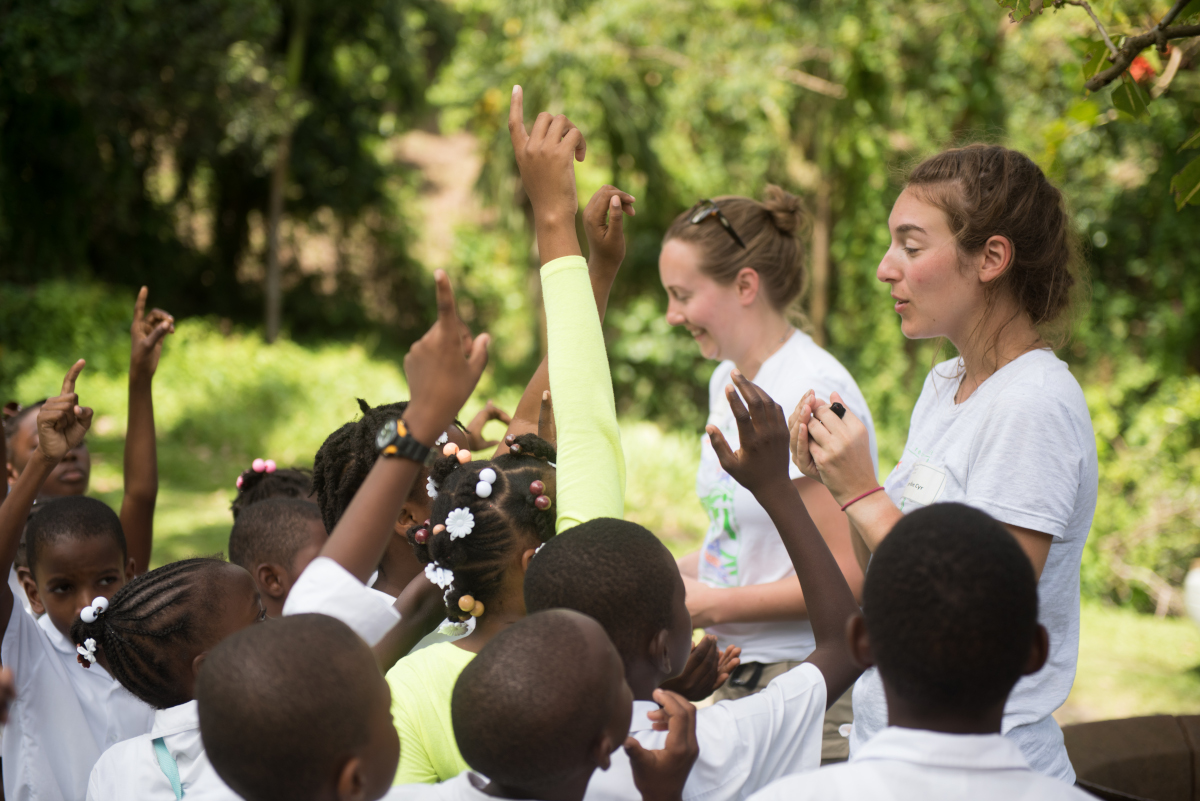
Hannah Carey (left) and Marie-Eve Cyr teach kids at the bird festival. (photo by Belmont Estate)
Do House Wrens on Grenada have different songs in different places? In 2017 Marie-Ève Cyr, a masters student from the University of Manitoba, visited Grenada to find out. Read all about her research and the celebration of Grenada’s birds that Marie-Ève and her lab-mates held whilst on the Island.
Back in 2017, I had the chance to visit the island of Grenada and the southern West Indies on a field course with other students from the University of Manitoba. As a group, we were there to learn about the natural history of the island, local socioeconomics, and sustainable tourism. As a researcher with the Koper lab at the University of Manitoba, I also planned to study resident House Wrens. During our stay we were helped and guided by a multitude of wonderful local organizations, including Belmont Estate, SPECTO, and Almost Paradise Cottages.
Learning from each other
Beyond academic goals, we wanted to give back to the community. As part of the field course, we created the 2017 edition of Celebration of Grenada’s Birds Festival, hosted by Belmont Estate, where we taught local children about Grenada’s avian fauna. The festival was a success and an amazing experience. But during the field course, I also collected recordings of Grenada House Wren songs, and in October 2020, my colleagues and I published a paper about these recordings in the journal Bioacoustics. So, during our stay in Grenada, we learned from the community and they learned from us.
Click on photos below to view larger and see captions.
Rojin Amani at teaching table festival. (photo by Belmont Estate).
Zoya Buckmire releasing Lesser Antillean Tanager. (photo by Belmont Estate)
Changing their tune in the city
This research on Grenada House Wrens started from discussions with other Canadian students who had visited Grenada before me. We were discussing how the Grenada House Wrens appeared to sing differently from those they usually hear in Canada; and that there were variations in their song across the island. However, we could not find any studies on House Wren songs in Grenada. My interest was piqued! Because my background is the study of the effect of noise and human activity on birds, those two ideas merged in my mind. I focused my attention on figuring out whether those differences in the House Wren songs that my colleagues had identified were associated with the human presence in their environment. As it turned out, my colleagues were right. House Wrens did sing differently in different parts of the island, and adjusted their song when living in urban habitats.
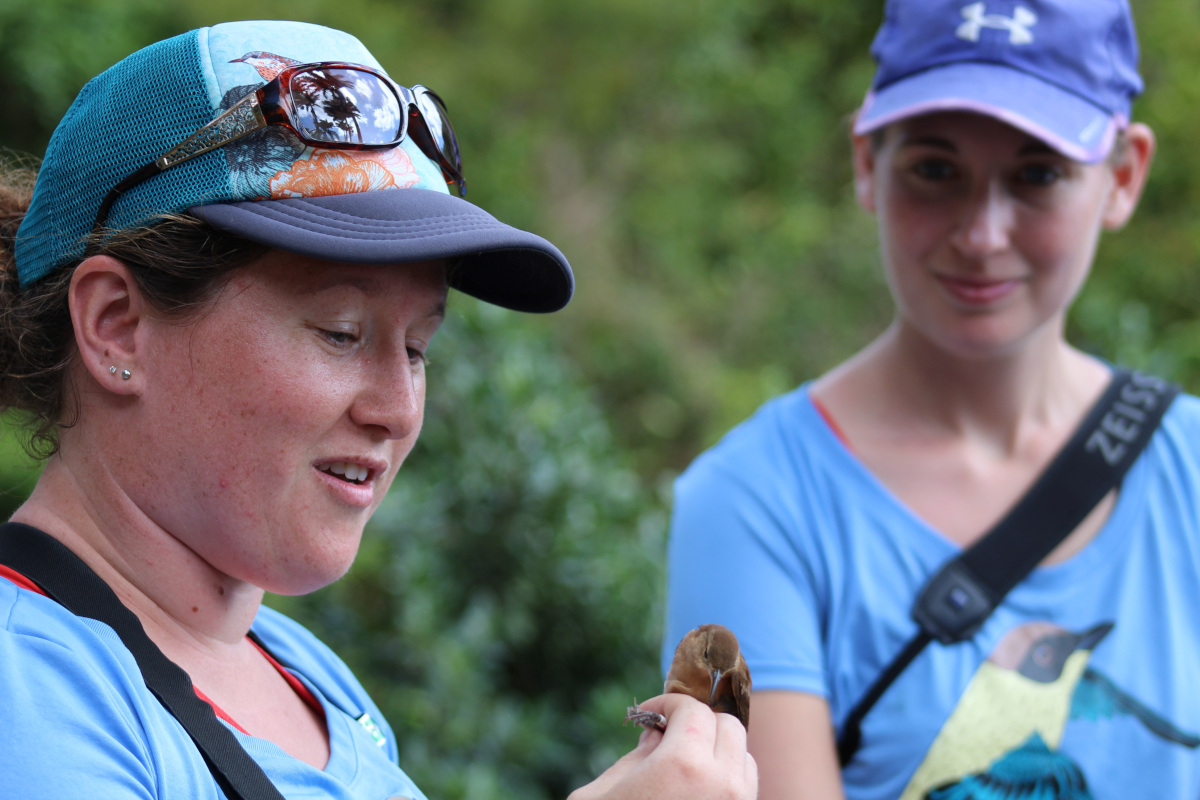
Kim Wetten and Lee Sutcliffe with a House Wren. (photo by Belmont Estate)
Singing in different spaces
House Wrens are found throughout North and South America. They are one of the most widely distributed species and their song is extremely variable. With a variety of life history traits throughout its range, there is some discussion about the status of the House Wren as a single species with over 30 recognized subspecies. Could one or more of these subspecies qualify as full species?
Accompanied by two colleagues, I recorded House Wrens in five urban areas and five rural areas in Grenada in 2016 and 2017. Grenada is a Small Island Developing State, where cities are characterized by buildings a few storeys tall. The capital of St. George’s has fewer than 40,000 inhabitants. This contrasts greatly with big cities in North America and makes this research all the more interesting. Since most of the literature regarding urbanization and its impact on birds was done in North American cities, it is hard to look at them within the context of Grenada. We felt that birds in Grenada, including House Wrens, might deal with the challenges of urban environments differently.
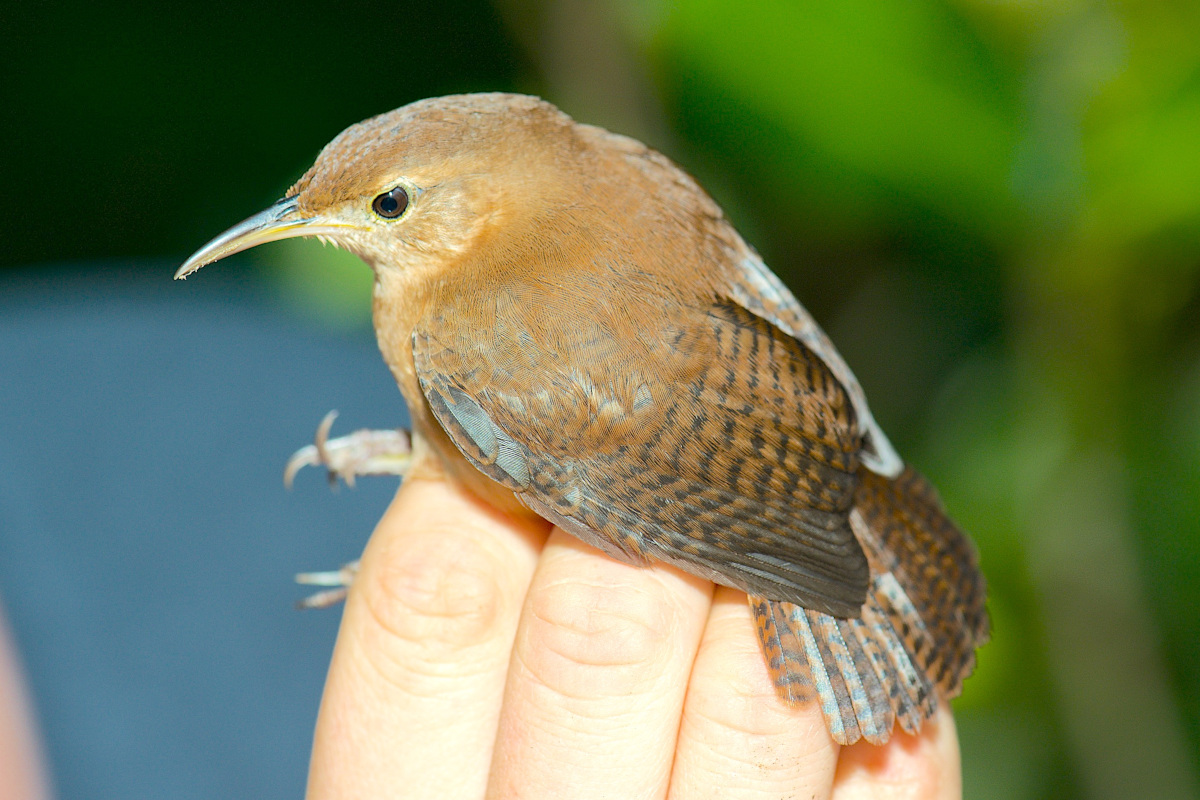
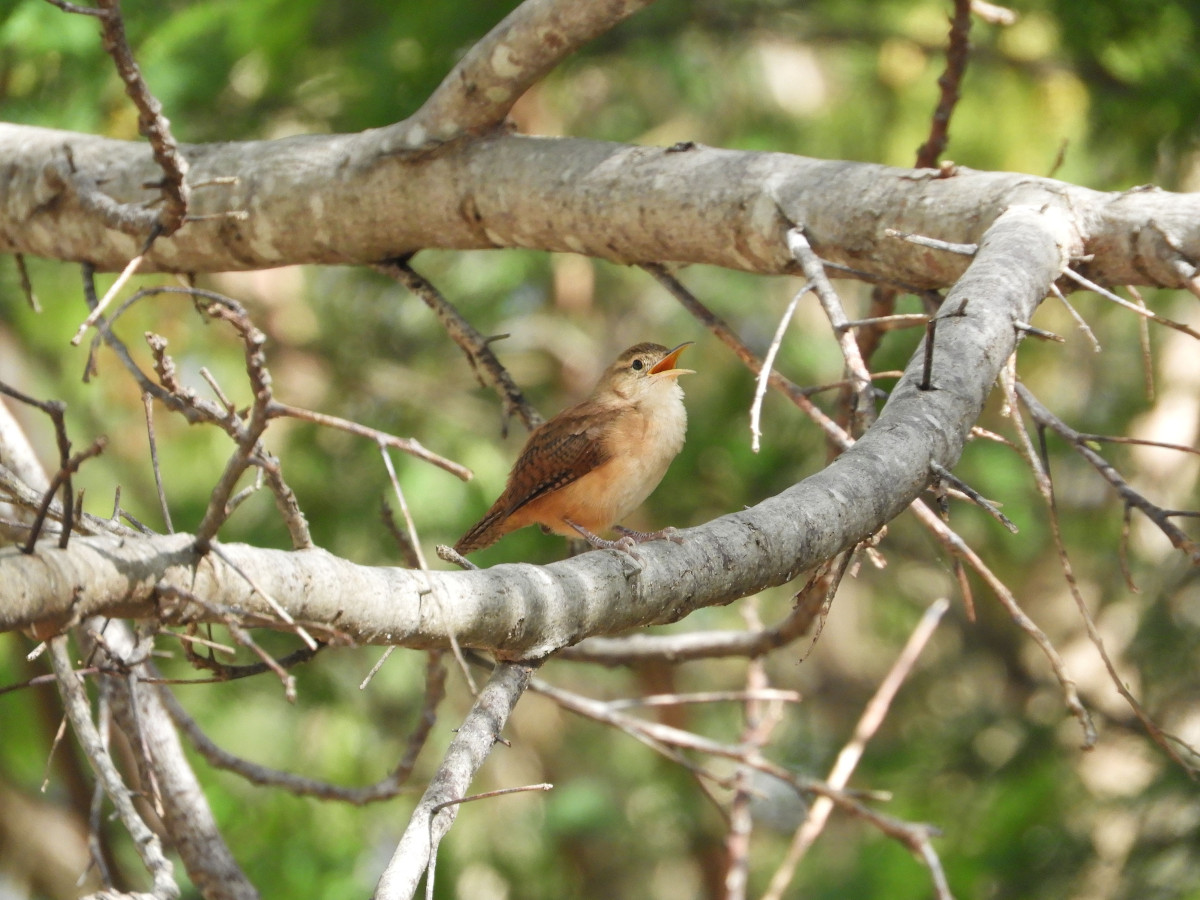
A lovely Grenada House Wren in the hand. House Wrens are widely distributed across North America, South America, Central America, Mexico, and the Caribbean. They are migratory in northern latitudes but are year-round breeding residents in the tropics and much of South America. House Wrens are resident in the Lesser Antilles islands of Dominica, St. Lucia, St. Vincent, Grenada, and Barbados.
Competing with the humans
We found that House Wrens did adjust their singing style in urban areas to improve their communication, using a mix of strategies. As is often observed in North American birds, they increased the lower frequency of part of their songs, specifically the introductory part. This reduces the masking of their song caused by the noise created by humans. However, unlike their North American counterparts, they sang faster trills in urban habitats. Fast trills can quickly disappear in closed habitats, but can also transmit further. This might explain why Grenadian House Wrens increase the number of trills as a compensatory mechanism in urban settings. It also suggests that birds in Grenada, and in other parts of the Caribbean, face different challenges compared to birds in larger North American cities. Why might this be?
Grenada House Wren singing. (photo by Kim Wetten)
Birds and buildings
The high number of large and tall buildings, such as skyscrapers, in North American cities create a closed environment. There are lots of opportunities for echoes and the reverberation of sounds from the walls of buildings. But in Grenada, the dense and tall surrounding forest might actually be more closed than urban surroundings. Buildings in Grenada’s towns are generally less than four storeys tall, are not very close together, and are separated by roads. This is a good reminder that socio-economic context is important to consider, and bioacoustics research should expand its scope outside North America. More research from the Koper lab is ongoing in Grenada—there is much more to learn, so stay tuned!
Marie-Ève Cyr is a graduate student working on her Master of Natural Resource Management in the lab of Professor Nicola Koper at the University of Manitoba. Her current focus is on bioacoustics research and conservation biology, studying bird species under anthropogenic pressures in the Canadian prairies and the Caribbean.
Dr. Nicola Koper is a Professor in the Natural Resources Institute of the University of Manitoba. She studies avian conservation biology in Canada and the Neotropics. Currently, she is focusing on effects of anthropogenic noise, oil and gas activity, and agroecology of birds.
Click on photos below to view larger and see captions.
Zoya Buckmire holding a Black-whiskered Vireo with Kim Wetten at Belmont. (photo by Belmont Estate)
Lesser Antillean Bullfinch. (photo by Paul Des Brisay)
Kim Wetten banding a Mangrove Cuckoo. (photo by Belmont Estate)
Common Ground Doves. Photo by Paul Des Brisay.
Chris de Ruyck teaching Wing String 2019. (photo by Belmont Estate)
Black morph of the Bananaquit in Grenada. (Photo by Paul Des Brisay)
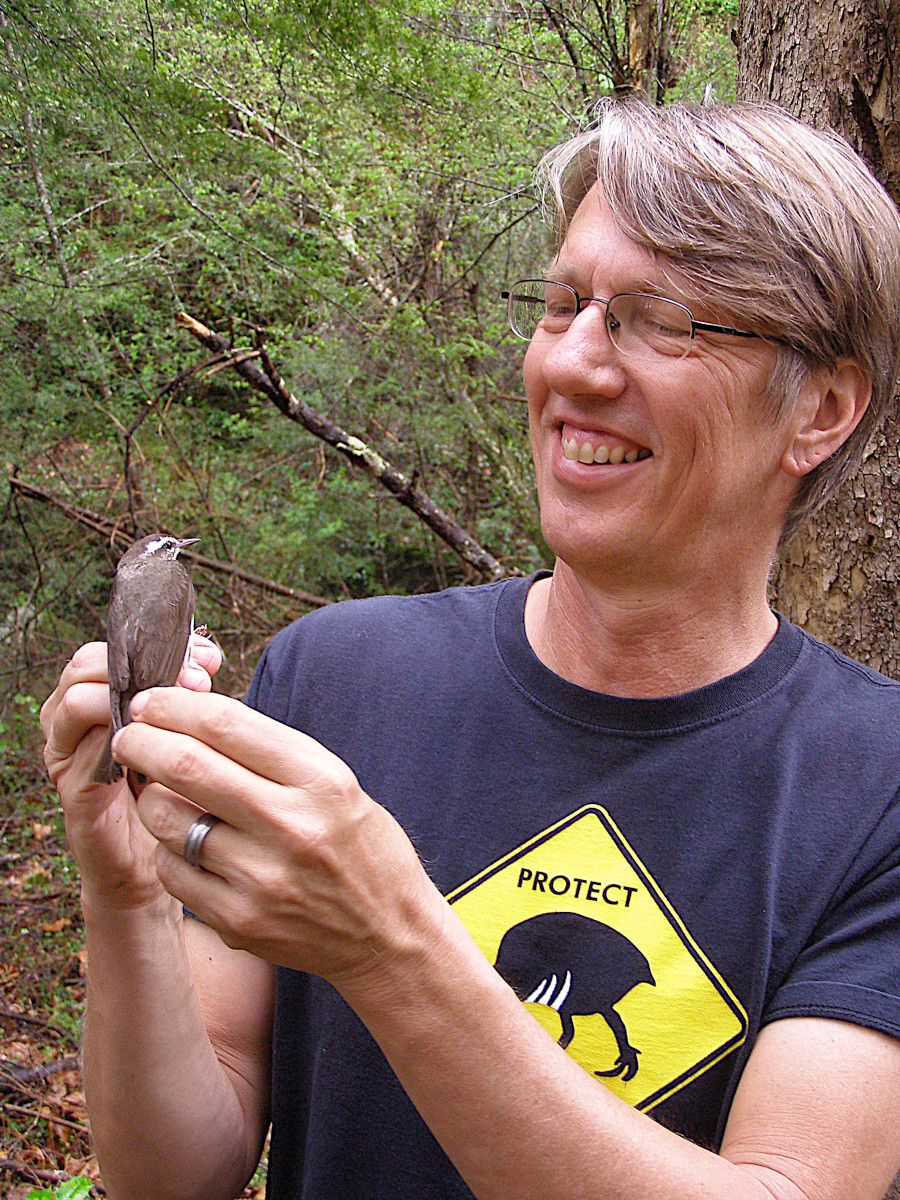
Steven Latta assessing the condition of a banded Louisiana Waterthrush. Photo by Bob Mulvihill.
The Louisiana Waterthrush is a neotropical migratory warbler that links North America, where it breeds, to the Caribbean, where is spends the winter. Steven Latta PhD has worked on this species for more than a decade. Here he shares some fascinating insights into how water quality impacts the health and survival of this small bird, and what this means for people as well as birds.
Clean water is something that is essential to each and every one of us. There is, however, a rising tide of water quality threats facing Neotropical migratory birds – both in their North American breeding grounds and their Caribbean wintering spots. Water pollution and water diversions can wreak havoc on the quality of the water that supports plant, animal and aquatic life. This also negatively impacts the health and welfare of humans who also depend on that water resource.
I have used a migratory songbird, the Louisiana Waterthrush, for more than a decade to monitor changes in water quality, and to understand the impacts of water quality on birds and other life that depend on riparian ecosystems – that is, rivers, streams and wetlands.
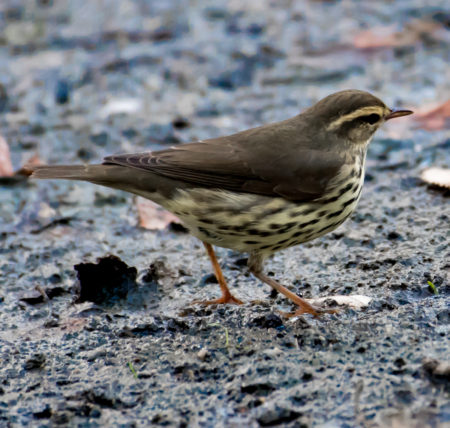
Although somewhat reminiscent of a thrush, the Louisiana Waterthrush is actually a large, mostly terrestrial warbler. It is uniformly dark olive-brown above and white below, with dark brown streaks on its breast and sides, and flanks washed buffy. Distinctive field marks include a white supercilium (eyebrow stripe) which flares and broadens behind the eye, and an unspotted white throat. In both its breeding and wintering grounds, the waterthrush inhabits freshwater streams and associated riparian vegetation in forested hills and mountains. The Louisiana Waterthrush is considered a Species of Conservation Concern in several Bird Conservation Regions. Its dependence on a specialized habitat, now threatened by a number of environmental stressors, makes the species more vulnerable.
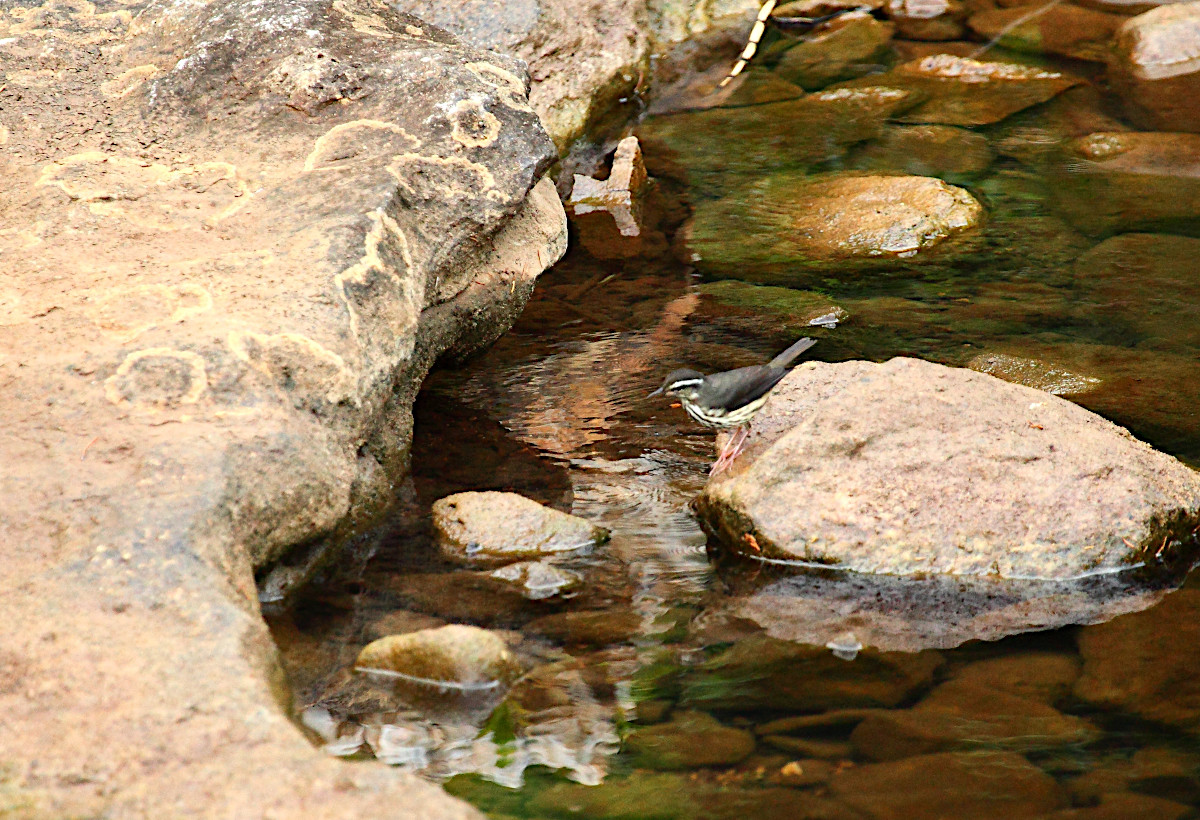
The Louisiana Waterthrush, Parkesia motacilla, a bioindicator of water quality and ecosystem integrity in forested headwater streams. Photo by Mike Doughtery.
Waterthrush Warnings
Long-term studies in Pennsylvania and the Dominican Republic have sought to understand the role of water quality and other factors in determining the population size of the Louisiana Waterthrush
In the Caribbean, Louisiana Waterthrush are solitary and territorial. They forage mostly on the ground by walking in a deliberate manner along the water’s edge, jumping over obstacles, characteristically bobbing and teetering, as they capture aquatic insects and similar prey.
I have worked closely with my colleagues, Danilo Mejía and Maria Paulino, from the Dominican environmental organization, Grupo Acción Ecológica, in a long-term study of this charismatic species. Every year, our work has taken us from studies in wintering areas in the Cordillera Septentrional of the Dominican Republic, to research in the breeding grounds in the Laurel Highlands of Pennsylvania.
At both ends of the annual cycle, we have shown how the waterthrush can serve as a warning sign, pointing to the deteriorating condition of waterways, and the presence of toxins and harmful chemicals. In areas where the bird breeds such as Pennsylvania, water quality is affected by acid precipitation, acid mine drainage from abandoned coal mines and agricultural run-off. Most recently. metals associated with hydraulic fracturing for natural gas deposits have impacted the condition of the fresh water. On the wintering grounds, the sites we visit suffer adverse effects from sedimentation and run-off from agriculture and human settlements.
Water Quality: A Critical But Deteriorating Factor
By tracking nesting, breeding success, and survival of individual birds, we have been able to quantify the impacts of reduced water quality. Contamination may directly impact the Louisiana Waterthrush. For example, we have shown that because of its position at the top of the food chain along rivers and streams, the waterthrush will accumulate within its body the metals associated with hydraulic fracturing of deep shale layers for natural gas. Studies with our collaborator, Mack Frantz, have further suggested that this shale gas development may even result in epigenetic effects on gene expression in waterthrush. This means there may be changes in the genetic structure itself that may affect long‐term population survival and fitness.
Dominican field crew sets out to survey and capture Louisiana Waterthrush returning to overwinter territories in the Cordillera Septentrional. Photo by Steve Latta.
But reduced water quality can also have more subtle effects on birds. For example, Louisiana Waterthrush that nest on acidified streams are fewer in number and hold larger territories, presumably because they need more space to find enough food. Notably, the birds in contaminated areas delay nesting, producing fewer, smaller chicks, and fewer of these nesting adults return to the same stream the following year. These results suggest that waterthrush suffer pronounced declines in populations as the result of poor water quality.
A similar situation exists on the Caribbean wintering grounds. Louisiana Waterthrush on lower quality streams require longer territories, and pass the winter in poorer body condition. Fewer birds from low quality territories return the following year as compared to high quality territories. This suggests that reduced water quality in wintering grounds also reduces the birds’ survival rates.
How Does Poor Water Quality Affect the Birds?
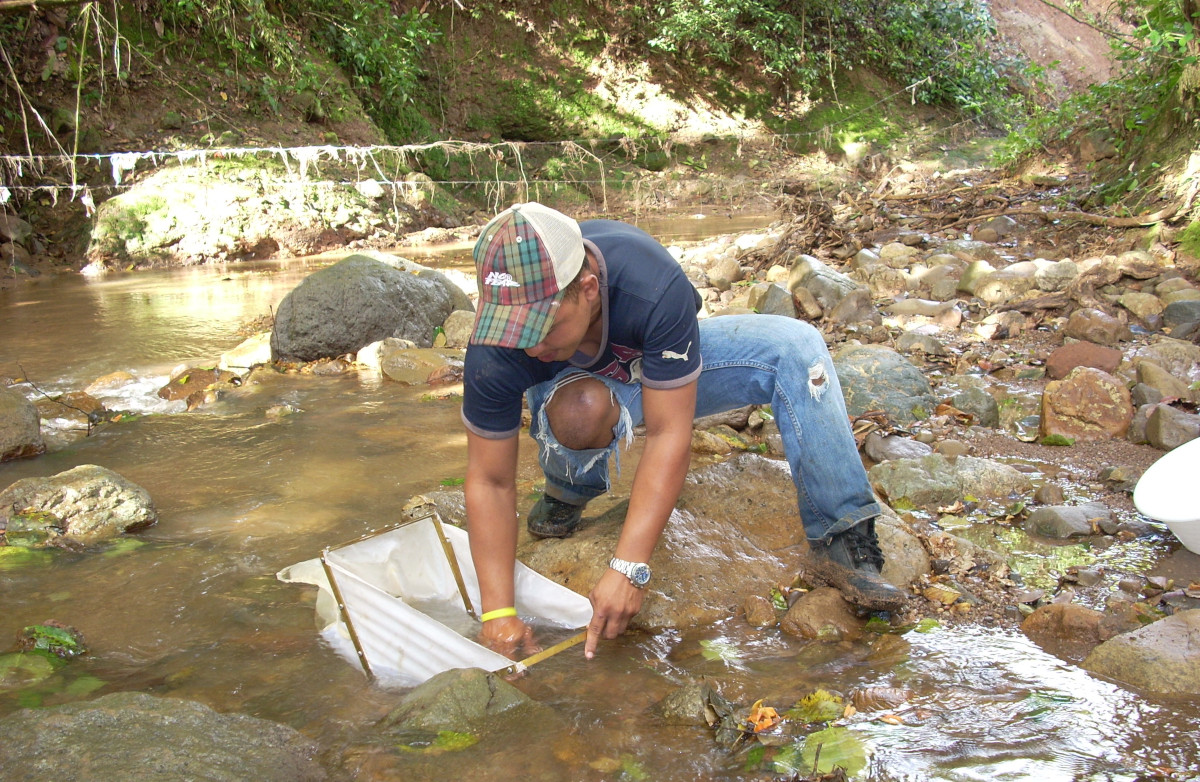
Collaborating with two graduate students, we have been able to show why water quality affects Louisiana Waterthrush so dramatically. Brian Trevelline and Brandon Hoenig have combined traditional habitat sampling with advanced molecular techniques such as DNA metabarcoding of feces to analyze diets. They have demonstrated that when water quality declines with increased acidity or other contamination, the availability of preferred aquatic insect prey, such as mayflies, declines. The waterthrush compensate for this by altering their typical aquatic foraging behavior and diet. They venture further away from the stream to consume more terrestrial prey such as crickets, moths and spiders.
While these findings suggest that migrants may be able to adapt to environmental degradation, such behavioral changes may carry additional costs. Alternative food sources may have less nutritive value, resulting in physiological impacts on nestlings or adults. The breeding season is one of the most energetically demanding periods for birds; flying further away from the nest in search of alternative food in unfamiliar places could incur physiological costs. Moreover, it makes the predation of eggs, nestlings, or even adult birds more likely.
Aquatic stream insects are collected in the Cordillera Septentrional of the Dominican Republic to assess availability of food resources. Photo by Steven Latta.
“You Are What You Eat:” The Waterthrush’s Evolving Diet
On the Dominican wintering grounds we also found shifts in diet among the streams that form the birds’ habitat. The diet of Louisiana Waterthrush in the Caribbean consists of fewer aquatic prey species and more terrestrial beetles, flies, and caterpillars. While the wintering waterthrush appears to feed on a wider range of species, these data suggest that on the wintering grounds, it is more of a dietary generalist. This highlights the importance of studying birds across their entire annual cycle to better understand their ecology and conservation needs.
These changes in the birds’ diet, which depend on the quality of habitat and the seasons, have vitally important consequences. On the breeding grounds, we have shown that nestlings from high quality streams that feed largely on mayflies grow faster and larger, and this has survival consequences. On the wintering grounds, variation in diet is also thought to impact survival. We showed that birds occupying higher quality territories with better food resources achieve a better body condition (i.e., they gain more muscle and fat) during the overwinter period. Body condition, in turn, was important in determining whether birds return the following winter, with the healthier birds returning at higher rates.
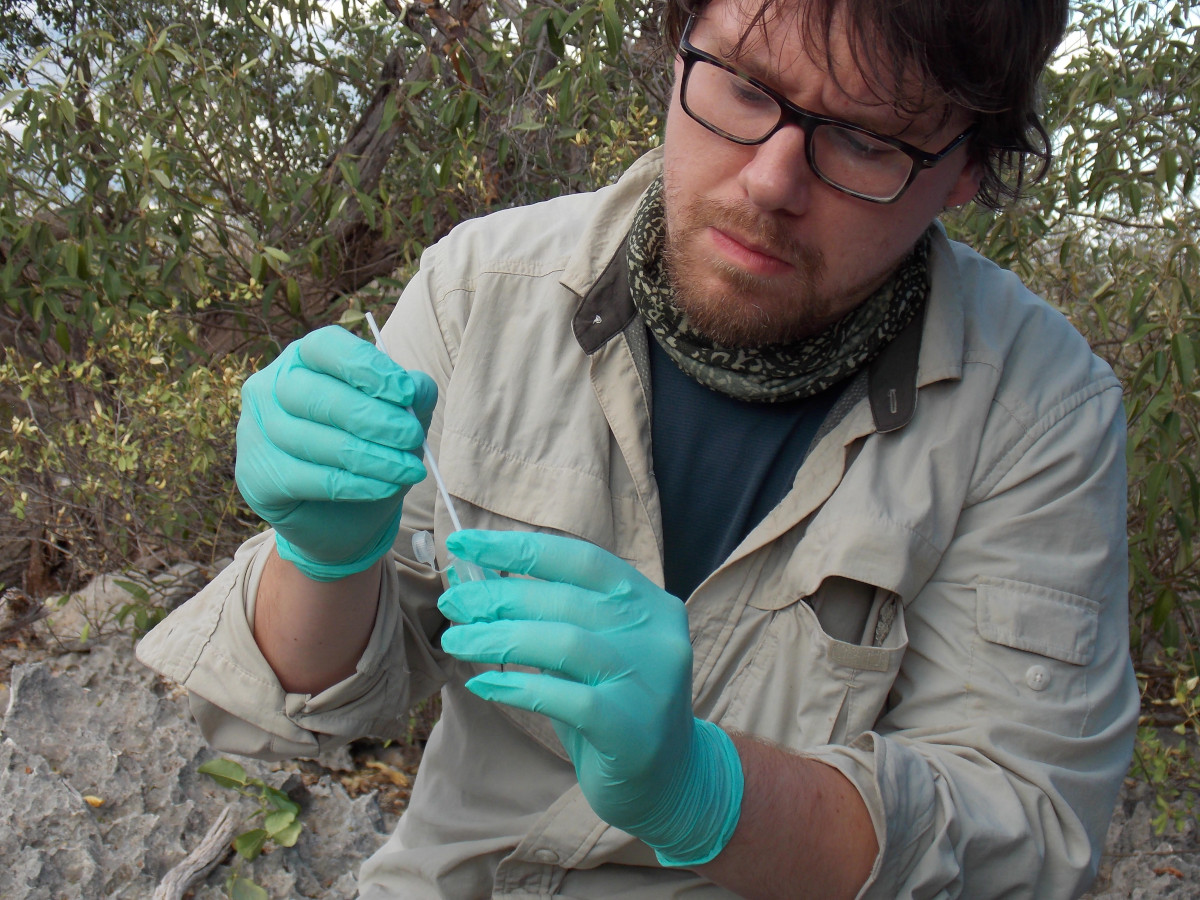
Brian Trevelline from Duquesne University collects Waterthrush fecal samples to analyze diet. Photo by Danilo Mejía
Good Quality Fresh Water: Important for the Birds, and Humans Too
This body of work links water quality to availability of preferred food resources. Our findings provide linkages among events during the breeding season and the overwintering period that affect the birds’ physiological condition, reproductive success, and annual survival. These studies show that changes in water quality from human activities, impacting the aquatic creatures that form the birds’ diet, can carry over across seasons. These changes accumulate over more than one life-history period, before manifesting themselves in a pattern of reduced survival.
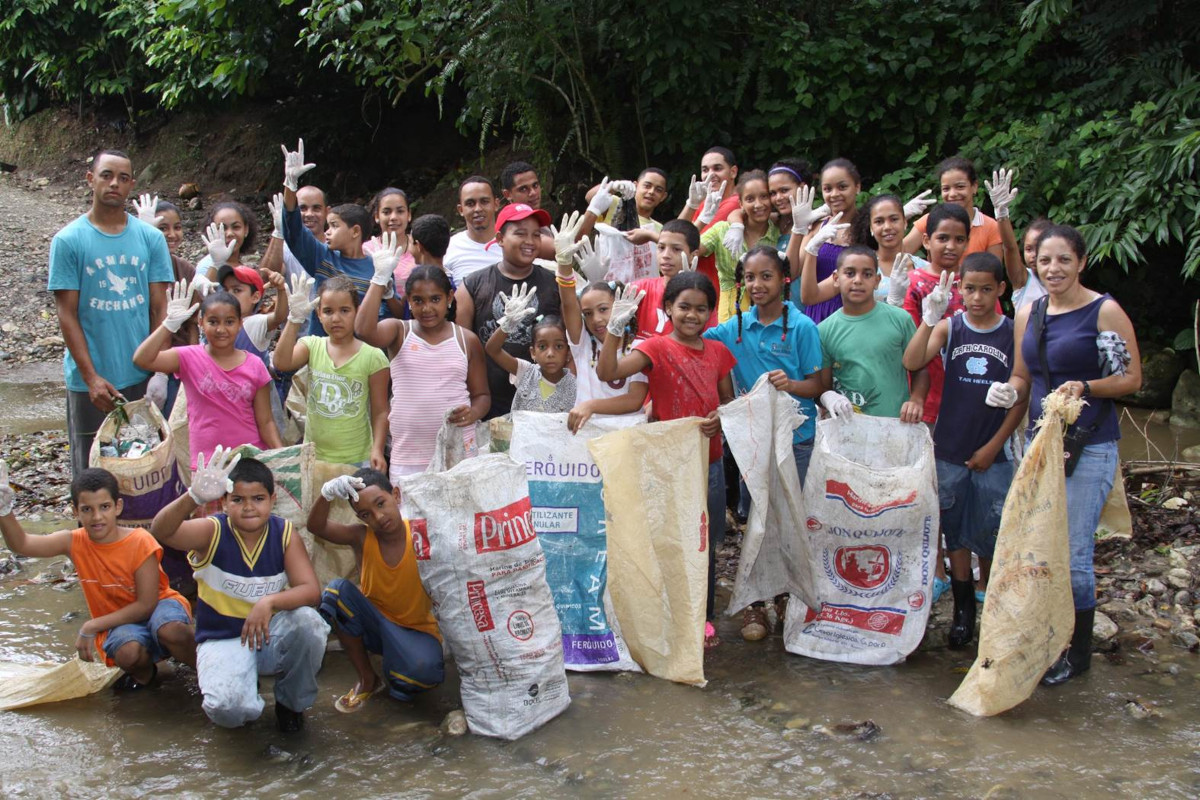
The community of La Joya comes together to clean up trash from streams near their homes. Photo by Danilo Mejía.
Taken together, these studies emphasize the critical importance of water quality as it affects aquatic insect prey and as a result, impacts Louisiana Waterthrush at both ends of its annual migratory cycle. However, water quality also affects human communities. This is a message we have communicated through annual summer fairs and other activities in rural communities near our Dominican stream sites. Clean water is something that is essential to each and every one of us; we are pleased to be using birds as a tool, helping to protect watersheds and water quality across the range of the Louisiana Waterthrush.
Dr. Steven C. Latta is the Director of Conservation and Field Research at the National Aviary in Pittsburgh. He obtained his Ph.D. in Avian Ecology from the University of Missouri-Columbia. He has worked in the Caribbean islands and Latin America for more than 25 years where his research has focused on the winter ecology of migratory birds, and understanding how migrant and resident species respond to natural and anthropogenic changes to their habitat. Dr. Latta has authored several books on the birds of Hispaniola, has published over 125 articles and book chapters, and is dedicated to training young biologists in developing countries in field research and monitoring techniques, and to educating the general public on the importance of conservation.
SELECTED PUBLICATIONS from Steven Latta:
Almonte-Espinosa, H. and S. C. Latta. 2011. Aspectos del comportamiento de forrajeo de la cigüita del río Parkesia motacilla (Aves: Passeriformes: Parulidae) en época no reproductiva. Novitates Caribaea 4:100-108.
Frantz, M. W., P. B. Wood, S. C. Latta, and A. Welsh. 2020. Epigenetic response of Louisiana Waterthrush (Parkesia motacilla) related to shale gas development. Ibis 162(4):1211-1224. https://doi.org/10.1111/ibi.12833
Latta, S. C. and R. S. Mulvihill. 2010. The Louisiana Waterthrush as an indicator of headwater stream quality in Pennsylvania. Pp. 246-258 in S. K. Majumdar, T. L. Master, M. C. Brittingham, R. M. Ross, R. S. Mulvihill, and J. E. Huffman (eds.), inAvian ecology and conservation: A Pennsylvania focus with national implications. The Pennsylvania Academy of Science, Easton, PA.
Latta, S. C., L. C. Marshall, M. W. Frantz, and J. D. Toms. 2015. Evidence from two shale regions that a riparian songbird accumulates metals associated with hydraulic fracturing. Ecosphere 6 (9):1-10. http://www.esajournals.org/doi/pdf/10.1890/ES14-00406.1
Latta, S. C., S. Cabezas, D. A. Mejia, M. M. Paulino, H. Almonte, C. Miller-Butterworth, and G. R. Bortolotti. 2016. Carry-over effects provide linkages across the annual cycle of a Neotropical migratory bird, the Louisiana Waterthrush. Ibis 158:395-406
Mattsson, B. J., S. C. Latta, R. J. Cooper, and R. J. Mulvihill. 2011. Latitudinal variation in reproductive strategies by the migratory Louisiana Waterthrush. Condor 113:412-418
Mulvihill, R. S., S. C. Latta, and F. L. Newell. 2009. Temporal constraints on the incidence of double brooding in the Louisiana Waterthrush (Seiurus motacilla). The Condor 111:341-348
Mulvihill, R. S., F. L. Newell, and S. C. Latta. 2008. Effects of acidification on the breeding ecology of a stream-dependent songbird, the Louisiana Waterthrush (Seiurus motacilla). Freshwater Biology 53: 2158-2169.
Trevelline, B., T. Nuttle, B. A. Porter, N. L. Brouwer, B. D. Hoenig, Z. D. Steffensmeier, and S. C. Latta. 2018a. Stream acidification and reduced aquatic prey availability are associated with dietary shifts in an obligate riparian Neotropical migratory songbird. PeerJ 6:e5141; DOI 10.7717/peerj.5141
Trevelline, B. K., T. Nuttle, B. D. Hoenig, N. L. Brouwer, B. A. Porter, and S. C. Latta. 2018b. DNA metabarcoding of nestling feces reveals provisioning of aquatic prey and resource partitioning among Neotropical migratory songbirds in a riparian habitat. Oecologia 187:85-98
Trevelline, B. K., S. C. Latta, L. C. Marshall, T. J. Nuttle, and B. A. Porter. 2016. Molecular analysis of nestling diet in a long-distance Neotropical migrant, the Louisiana Waterthrush (Parkesia motacilla). Auk 133:415-428.
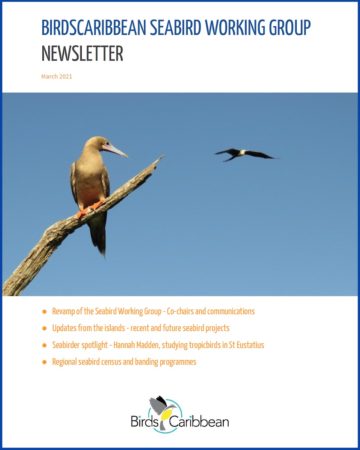
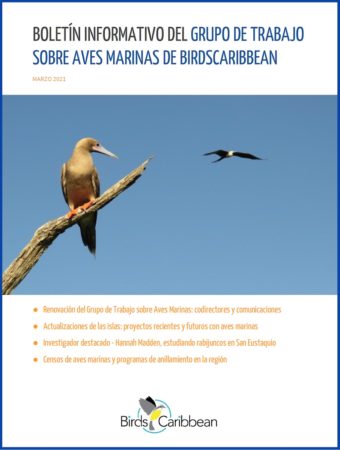
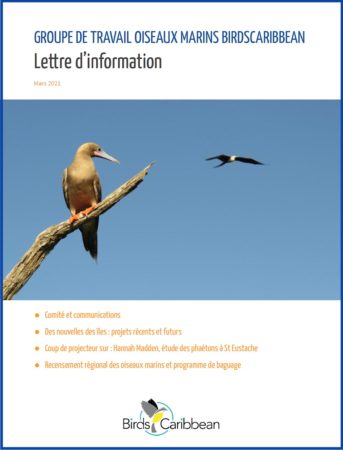
BirdsCaribbean Seabird Working Group Newsletter – click on the image to view and download a PDF, OR read on your device as a full-screen flipbook (click below). For Spanish and French versions, click on the images below.
EXTRA! EXTRA! Read all about it! We’re excited to announce that the BirdsCaribbean Seabird Working Group (WG) has launched a Seabird Newsletter! Available in English, Spanish, and French, it gives a picture of seabird-related activity across the Caribbean Basin. Anyone who works on or is interested in seabirds should take a look to catch up on the latest research, conservation, restoration, and education projects happening in the islands.
The newsletter starts with an inspiring Foreword by BirdsCaribbean’s new president, Dr. Adrianne, Tossas. You can also meet the Seabird Working Group’s new co-chairs, who are working hard to ramp up activities and communications by the WG. Find out the many ways that you can connect with the Seabird WG and its members, including a new Facebook group!
Do you remember the survey about seabird work that we sent around last year? The newsletter summarizes the responses from 78 participants and provides insights into mutual needs and possible collaborations. One collaboration that stands out is the possibility of a region-wide seabird survey effort in 2023 ….. interested?
The newsletter includes a list of recent publications, covering Roseate Terns, Lesser Black-backed Gulls and Red-billed Tropicbirds, among others. It also has island-by-island updates—find out what has been happening on your own island or explore further afield. There is also a “seabirder spotlight” feature—our first issue features Hannah Madden, who is studying tropicbirds in St. Eustatius. Finally, check out the discussion on the seabird regional census and BirdsCaribbean’s plans for a centralized bird banding network.
Of course, it’s possible we’ve left something out; if you have seabird news to share, please take advantage of the many avenues for communication described in the newsletter. And let us know if you would like your work to be featured in the next edition!
P.S. Don’t forget to visit the Seabird Working Group webpages and our Seabirds Resources page. If you would like to order copies of our beautiful Save Our Seabirds Posters (available in English and Spanish), and “Inventory of the Breeding Seabirds of the Caribbean” book, we would be glad to get these resources into your hands!
P.P.S. We are keen to hear from you if you enjoyed our newsletter, and to know how often you would like to receive these updates going forward (quarterly, biannually, yearly)? Please also let us know if you have any recommendations on how to improve future editions. We would love to hear from you if you would like your work to be featured in the next edition!
BirdsCaribbean Seabird Working Group Newsletter in Spanish – click on the image to view and download the PDF.BirdsCaribbean Seabird Working Group Newsletter in French – click on the image to view and download the PDF.
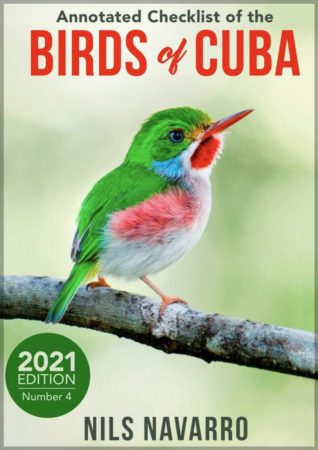
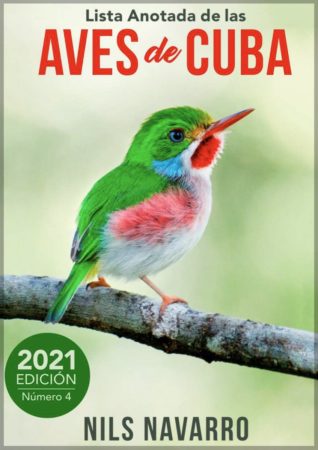
We are pleased to share with you the new edition of the Annotated Checklist of the Birds of Cuba, number 4, 2021, by Nils Navarro Pacheco.
The Annotated Checklist of the Birds of Cuba is an annual publication that constitutes the most complete and updated official list of Cuban avifauna. It is the result of a deep and thorough bibliographic review and updating from the field. It serves as a basis for generating regional and global listings and is standardized for use with eBird.
In this new issue Nils urges us to pay special attention to the final comments he always include, with the aim of clarifying important information, taxonomic status, as well as other information of interest.
This year the cover is rich with a beautiful photo of the Cuban Tody, aka Cartacuba, taken by Karlos Ross. The beautiful cover design by Scott Schiller. From 2021 on, each edition will be published in both Spanish and English, and available in PDF for free download from the BirdsCaribbean website (see below). The printed version is available on Amazon at a good price.
The 2021 edition includes details of the status of 398 recognized species on the main list, and for the first time, a list of the late Quaternary extinct birds of Cuba. It is not intended to be a field identification guide. It is a checklist, updated in accordance with the 60th supplement of AOS. Nils and the publisher, Ediciones Nuevos Mundos, hope this publication fulfills its role and is useful to all persons interested in Cuban birds and ornithology. Nils welcomes questions or suggestions about the checklist (Nils Navarro)
If you are looking for a Field Guide to the Birds of Cuba, you can purchase it here or on Amazon.Read about the first checklist published in 2017 here:
It’s that time of year when Caribbean waterbirds get a chance to shine! Between the 14th of January and the 3rd of February, despite the limitations of the COVID-19 pandemic, binoculars, cameras and scopes were turned in their direction as they pottered about along our coastlines. Yes, it was the 12th annual Caribbean Waterbird Census (CWC), an opportunity not only to count but also to learn and to raise awareness of these fascinating birds.
Learning the finer points of waterbird and shorebird ID on one of BirdsCaribbean waterbird ID webinars (image from Waterbirds ID Webinar Part II: Shorebirds; photo by Hemant Kishan)
This past year, it has been hard to meet in person and many events have ‘gone virtual.’ In keeping with this, BirdsCaribbean kicked off the 2021 CWC with a series of three online CWC webinars. The first focused on the importance of the Caribbean Waterbird Census, and explained how to participate. Our other two webinars concentrated on how to identify wetland birds, with a whole session dedicated to Shorebirds – a group that can tricky to identify, and are certainly a challenge when starting out! These webinars provided helpful reminders to those who have participated before and were an introduction to those new to the CWC. If you are looking for waterbird survey and ID tips, all three webinars are available to watch on BirdsCaribbean’s Youtube channel. In Puerto Rico, Sergio Colón and José Colón of Sociedad Ornitológica Puertorriqueña (SOPI) also presented a webinar on the common waterbird species in Puerto Rico to help people brush-up on their bird ID before doing CWC surveys.
Many of our partners took part in the 2021 CWC across our region. In Venezuela, with support from dedicated volunteers and BirdsCaribbean, Ave Zona carried out CWC surveys across an impressive number of different sites on several offshore islands and cays that are important to shorebirds and waterbirds, including some of the important wetland habitats on Margarita Island. They shared some of the species seen during their surveys on social media, including Laughing Gulls, Comb Duck, Great Blue Heron, Wilson’s Plover, and many other shorebird species. This is an amazing effort by Ave Zona given the logistical difficulties involved in travel in Venezuela.
Birders across our region took part in CWC 2021 (click to enlarge photos)
Birders from Ave Zona on on of their CWC surveys (Photo by Ave Zona)
Paula-Anne Porter and her birding group. Celebrating World Wetlands day with CWC surveys (Photo by Paula-Anne Porter)
BirdLife Jamaica celebrated Word Wetlands Day (2nd February) a few days early, with a weekend of wetland-themed activities including Caribbean Waterbird Census surveys in locations in and around Kingston Harbour. Sanderlings, Ruddy Turnstones, Belted Kingfishers, and a Louisiana Waterthrush were amongst the birds recorded. One of the surprises of the weekend, shared on Twitter by radio broadcaster and avid birder Paula-Anne Porter, was the sighting of a Brown Booby in the fishing village of Port Royal near the entrance to the harbour – “a rare sight in these parts” as it largely breeds on outlying cays. Additionally, several banded birds were spotted; one Sanderling, when reported, was recorded as having been banded in Saskatchewan, Canada, in 2019.
Piping Plover with a Snowy Plover spotted on Anguilla- can you tell which is which? (Photo by Nature Explorers Anguilla)
On Anguilla, Nature Explorers Anguilla wrapped up their CWC by identifying an impressive 53 species on their surveys! Their sightings included the Yellow-crowned Night-Heron, with a beautiful photograph of this bird shared on social media (see Gallery at end for this and other photos taken during CWC2021). Nature Explorers also shared an exciting and rare sighting, when a birding group spotted a Piping Plover hanging out with some Snowy Plovers, at Cove Pond Important Bird Area. The two species look similar but the Piping Plover can be picked out by its bright orange legs and short ‘stubby’ bill. Piping Plovers are not often seen on Anguilla, but this might be a favourite location for them, as one was seen in the same spot last year.
Garganey seen on Guadeloupe during CWC 2021 (Photo by Anthony Levesque )
Other rare waterbirds seen during this year’s CWC included a Garganey spotted on one of his CWC surveys by Anthony Levesque in Guadeloupe. This is only the second record of this species for the Island!
In Antigua the Environmental Awareness Group (EAG) and their ‘ Wadadli Warblers’ Birding Club split into teams and organised several CWC Level 2 counts at three different sites. During their census they managed to count a fantastic total of 42 bird species. The EAG used the need to wear face masks during COVID as an excuse to get creative. They challenged people to join in their bird ‘mask-erade’ by designing bird-themed face masks to celebrate the finale of their CWC. The results were some wonderful, fun, and colourful creations. The winning prize went to Auriel Hunte for her Snowy Egret-inspired Mask. Read more about the EAG’s CWC activities and check out some more of the bird masks in our blog post from Shanna Challenger and Britney Hay.
EAG’s Mask-erade Competition for the 2021 CWC – click to enlarge photos
Flyer for EAG’s Bird Mask-erade
Winning mask of the EAG’s Wadadli Warblers “Mask-erade,” designed by Auriel Hunte after the beautiful Snowy Egret
Over in Grenada, a wonderful flock of 92 Blue-winged Teal was spotted on La Sagesse Pond; and 3KC Birding Adventures recorded some nice footage of Black-bellied Whistling Ducks on Antoine Lake.
Challenges there were, but this year’s CWC yielded some interesting results. Most importantly, many of our partners did get out and about and enjoyed an array of species, while counting furiously!
A huge thank you from BirdsCaribbean to all those who took part in the Caribbean Waterbird Census this year- your survey results help us keep track of what is going on with waterbirds in our region and identify trends and important sites for waterbirds. Big thanks also to the US Fish and Wildlife Service, US Forest Service, Canadian Wildlife Service, and our members and donors for supporting our Caribbean Waterbird Census! Don’t forget you can do CWC surveys at your wetland all through the year, find out more about CWC and how to take part here and find fantastic resources to help you here.
More photos from our partners during CWC 2021 – ENJOY!
Flock of Laughing Gulls in flight in Venezuela (Photo by Ave Zona)
Yellow-crowned Night-Heron seen by Nature Explorers Anguilla during their CWC survey (Photo by Nature Explorers Anguilla)
Piping Plover, spotted on Anguilla- a rare sighting (Photo by Nature Explorers Anguilla)
Orange Valley Mudflat in Trinidad during CWC2021 (photo by Mark Hulme)
CWC survey on the West Coast Mudflats Trinidad (Photo by Mark Hulme)
Identifying shorebirds during a CWC survey on the West Coast Mudflats Trinidad (photo by Mark Hulme)
Shorebirds spotted by Ave Zone during one of their CWC surveys (Photo by Ave Zona)
One of the fun entries in EAG’s “maskerade” contest!
The Snowy Egret in its natural habitat, which Miss Hunte’s mask was designed after. (photo by Nick Hollands)
Lovely artwork on a mask from EAG’s “maskerade” competition for the CWC 2021.
Another clever mask from EAG’s competition – can you tell what species this is?
Shanna Challenger shows off her White-cheeked Pintail mask – we love it!
The #McKinnonsMallards conducting their bird surveys at the McKinnon’s Saltpond for the Caribbean Waterbird Census. (photo by Shanna Challenger)
The EAG Bird Club “Wadadli Warblers” celebrating the completion of another successful CWC count in Antigua.
This Brown Booby was spotted on Jamaica during CWC surveys.
A banded Ruddy Turnstone seen during CWC2021 on Jamaica
This Sanderling, seen in Jamaica was banded in Saskatchewan, Canada in 2019
Enjoy this video of the Black-bellied Whistling Ducks seen on Antoine Lake, Grenada
Some birders posted about their CWC surveys on instagram
This female Common Eider was spotted at Cooper’s Island, Bermuda during the 2016 annual Christmas Bird Count, and was the first record for the island. (Photo by Andrew Dobson)
For over 100 years, North American Birds and its predecessors have delivered regionalized summaries of bird populations — including the West Indies. These regional reports arenow being housed online which means they can be available much more quickly than the traditional printed copies. If you are already an eBirder*, you should be able to find your unusual records very easily.
For about three years, publication of reports unfortunately ceased altogether due to staffing and management issues at the journal. But with a new team on board, things are happening fast!
BirdsCaribbean members Robert Norton, Anthony Levesque, and Andrew Dobson have been compiling seasonal reports for the West Indies and Bermuda region for many years. We are keen to maintain these reports but can only do this with your help.
What records are required? — rare sightings, unusually high numbers, the effect of hurricanes on local bird populations, etc. We are especially keen to receive news of the ‘first record’ of a species or the ‘first breeding record’. There is the opportunity of show-casing more photos online than in the printed copy, and so if you have a great photo of a rarely seen bird please submit that, too.
We need your unusual records from 2018 onwards. Simply email us a list indicating:
A Spotted Crake was reported from Desirade Island, Guadeloupe in 2014. This species was only the second record for the Caribbean. (Photo by Anthony Levesque)
Any other comments (e.g. first record since 1995, first known wintering record, earliest spring arrival)
All contributors will be listed and credited with sightings.
Many thanks if you are able to help. To speed up the process, please feel free to copy all three regional co-editors listed below when you send the email.
Thank you,
Andrew Dobson (Past-President, BirdsCaribbean)
Andrew Dobson (Bermuda)
andrewdobs@gmail.com
Robert L. Norton (Greater Antilles, Bahamas)
corvus0486@aol.com
Anthony Levesque (Lesser Antilles)
anthony.levesque@wanadoo.fr
*For those of you that are new to eBird, it’s a fun and easy (and very powerful!) platform to record your bird sightings, find the best places to bird, and more. And your data helps scientists better understand and conserve birds. If you’re in the Caribbean, be sure to use our portal, eBird Caribbean, to enter your data which offers birding protocols (e.g., the Caribbean Waterbird Census) and news stories unique to the region. We encourage you to get started and create an account; follow the quick instructions here. The eBird mobile app, available for both IOS and Android, is also great for entering your data straight from the field. Be sure to choose “Caribbean” as your region in the eBird app settings (“Settings” –> “Portal”).
Ajhermae White helps students of the Grade 5 class of Look Out Primary School with shorebird ID during their field trip at Marguerita Bay. (Photo by Stephen Mendes)
Enthusiasm is a key ingredient when observing, teaching, and talking about birds. For Ajhermae White, organizing a shorebird education initiative funded by BirdsCaribbean on her native Montserrat was a learning experience for her as well as her audiences, and a deeply satisfying one all around. Here is Ahjermae’s account of her journey as a shorebird educator – with young children, frigatebirds, and Government officials thrown into the mix.
The ‘Education on Shorebirds in Montserrat’ project is an initiative carried out by the island’s Department of Environment and sponsored by BirdsCaribbean. The aim is to spread awareness of shorebirds and their habitats. Once island residents learn more about these birds and understand their significance, the likelihood of threats to shorebirds, such as habitat destruction and human disturbance, will be reduced. As the project leader, I was really excited about the possible outcomes of this initiative.
The journey of being a shorebird educator has been a fulfilling experience. It has been a real privilege for me as the project leader to be given the opportunity to educate the local populace, in schools and among the general population about this fascinating topic. This has afforded me personal growth in addition to the enormous pleasure of sharing my passion for birds and their habitats.
Cleaning Up the Beaches Where Shorebirds Hang Out
Young girls participating in the clean-up. (Photo by Stephen Mendes)
The first major activity of this project was hosting a beach clean-up, in August 2020. Together with my colleagues from the Department of Environment, we brought the local community together to clean a shorebird habitat ahead of the migratory season.
We chose Marguerita Bay, which is located on the eastern side of the island, for this clean-up. Debris is constantly deposited on this beach as a consequence with the tides of the Atlantic Ocean. Nonetheless, this beach has been a popular site for shorebirds on Montserrat during the migratory season.
It was a good turnout of volunteers of all ages, from various community groups. I found it quite surprising to see the various types of items that were collected from the beach. These included items such as fishnets, clothing items, shoes, and even a 20 pound propane bottle! This clean-up was a success. An amazing 1,300 pounds of trash was removed from the beach. As such, the beach was much cleaner for the 2020 fall migrants.
Click on photos to enlarge
Some of the participants of the beach clean-up. (Photo by Stephen Mendes)
Participants collecting trash at the beach clean-up. (Photo by Stephen Mendes)
Working in Schools and Communities
Ajhermae White giving a shorebird presentation to the Grade 6 students of the Brades Primary School. (Photo by Rianna Thomas)
During the month of October 2020, we were out in the schools and communities, conducting outreach sessions. We gave presentations and organized field trips. We conducted outreach sessions with The Rotaract Club; grade classes in three primary schools; two groups with members of the public; and last but not least, an After School Club of four to six-year-olds.
For most of the school engagements, we made presentations in the afternoons. The following morning, we took the students out on the field trip, as soon as the school day started.
The students listened intently and participated actively in all the presentations, which was impressive. We talked to them about “What is a shorebird?” and went on to discuss their habitats, feeding habits, and threats to their survival. We then described some common shorebirds on Montserrat.
Semipalmated Sandpiper at Marguerita Bay during the field trip with the Grade 6 students of the Brades Primary School.
We made sure that these presentations included many pictures and videos of shorebirds and their habitats. Some classes had interesting questions. I specifically recall that during one presentation a student asked whether the Killdeer was the adult version of the Semipalmated Plover. When the student asked this, I felt a sense of gratification. This not only demonstrated that they were paying attention but that they were engrossed sufficiently to spot the similarities and differences and between the different species.
After every presentation, we gave the students a short quiz with spot prizes. After the quiz, every student was given a token (badge, sticker, pamphlet, or bird band). Needless to say, they were very excited to be “little ambassadors” for migratory shorebirds with their stickers and other tokens.
Meanwhile, Out in the Field…Frigatebirds Were a “Hit”
Our first stop for every field trip was the recently-cleaned Marguerita Bay, where students were thrilled to see shorebirds like the Sanderling, Pectoral Sandpiper, and the Semipalmated Sandpiper. However, as the month of October progressed, there were fewer sightings, as the shorebirds were moving on.
During every field trip at Marguerita Bay, we could count on the Magnificent Frigatebirds to put on a show by flying very low and putting on acrobatic performances when swooping down to drink water from the pond. It was as if they enjoyed the attention from the young bird-watchers, who could observe the sexual dimorphism in this species.
Even if there weren’t many shorebirds to see at the beach at the time of the visit, the Frigatebirds captivated the students. The After School Club birders (4-6 year olds) were mesmerized by the Magnificent Frigatebirds. I recall that I wasn’t certain whether these little ones would understand terms like “female”, “male” and “juvenile,” so to simplify for these kindergartners, I told them which frigatebirds were “girls”, “boys” and “babies”. They kept shouting out “That one’s a baby bird!” They were so funny.
Some of the information about the shorebirds was in Spanish, so I made sure that any student who spoke Spanish as a first language was able to see the Spanish names as well for the various species. Those students also received a Spanish Shorebird poster.
All Went Well With the Student Birders!
Students from the After-School Club are excited to identify shorebirds with Scriber at Marguerita Bay, Montserrat (photo by Ajhermae White)
The second stop during the field trips was to Carr’s Bay. This area is near a busy road so we always took extra precautions when visiting this area. Students spotted species like the Sanderling, LesserYellowlegs, GreaterYellowlegs, SolitarySandpiper, and others wading in the water. There were also a few other wetland bird species that the students were able to identify, such as the Common Gallinule and the Snowy Egret.
When we returned to the classroom we distributed refreshments and provided additional tokens. I gave students a shorebird word search that I created online, to help them remember the names of the shorebirds of Montserrat.
Students of the Brades Primary School identifying shorebirds at Carr’s Bay. (Photo by Ajhermae White)
Although I always felt a little anxious before leading a field trip, I felt relieved afterwards, because they were successful and went ahead without mishaps. This was quite a responsibility for me, especially with the smallest bird enthusiasts. The students were able to see shorebirds and many other birds. Fortunately, there were no accidents during the field trips and even if it was a rainy day, the rain stopped long enough for the field trips to take place.
Engaging with the students was really gratifying. After the first few educational events, I started feeling more confident about putting myself out there to educate more students and the public. The enthusiasm that the students displayed showed me how much potential there is to impart knowledge to the younger generation, so that they can become more intensely aware of the avian biodiversity on Montserrat.
Students of the Grade 6 class of the St Augustine Primary School showing their shorebird identification cards after their field trip. (Photo by Thiffanie Williams)
Radio, a Powerful Medium for Reaching People
We used radio a great deal during this project. We recorded a few radio spots to inform the public about shorebirds, their habitats and migration, playing shorebird calls to grab the listeners’ attention. The spots also informed listeners about some of the threats that these birds face, such as habitat loss and pollution. A few of our outreach activities were scheduled around World Migratory Bird Day (WMBD) so this celebration got coverage on the local news and the public was informed about the activities planned.
The Department of Environment was featured on the Ministry of Agriculture’s radio program called “MALHE VIBES” in October. On this live program, James ‘Scriber’ Daley (Forest Ranger) and I spoke about shorebirds and their habitats, informed listeners about our activities throughout the month, and used the opportunity to invite people to a public shorebird educational event. (See the end of this post for links to all Ajhermae’s radio appearances during this project!).
Great Support for Public Events – and a Government Minister, Too
We hosted public events to educate people in the community about shorebirds and give them opportunities to see shorebirds in their habitat. We advertised these events on the radio and on Facebook. I was really grateful to my co-worker, Thiffanie Williams, who created digital flyers to advertise the public events of this project.
Digital flyer for the first public shorebird educational event. Created by Thiffanie Williams, Montserrat Dept of Environment.
For the public events Scriber and I conducted presentations, starting at 6:30 am. This presentation covered the same topics as the school presentations – but this time, people of all ages attended these sessions. We also gave a mini-quiz to participants, with the opportunity to win a BirdsCaribbean tote bag. After stocking up on refreshments and equipping them with binoculars, the participants boarded a bus at 7:00 am. Just like the school field trips, we took the participants to Marguerita Bay and then to Carr’s Bay. At Marguerita Bay we didn’t see as many shorebirds as we had hoped to see but some seabirds were present.
The Minister of Agriculture, Hon. Crenston Buffonge, looking at shorebirds in the spotting scope. (Photo by Ajhermae White)
The radio sessions had clearly paid off, as residents of all ages attended the public birding events. I was particularly grateful that the Minister of Agriculture, Lands Housing and the Environment (MALHE), Hon. Crenston Buffonge and the Parliamentary Secretary, the Hon. Veronica Dorsette-Hector, each attended one of our public outreach sessions. It made me really pleased that these members of Parliament took part in these educational events and publicly showed their support for the project. This gave me hope for the future of wetlands on Montserrat.
Shorebirds at Carr’s Bay during the first public field trip on October 17th 2020. (Photo by Ajhermae White)
Carr’s Bay never disappointed us! On the first public birding trip, we saw fifteen different bird species at this site, including various species of shorebirds, like the Spotted Sandpiper and the Least Sandpiper! The first public birding trip was quite fulfilling for me because I saw two bird species that I had never seen before: the Merlin, and one that had eluded me many times – the Belted Kingfisher. The Minister jokingly commented that perhaps he and the other participants brought the good luck that allowed me to see these species.
It was quite satisfying to see when someone got an ‘aha moment’ after learning something new or finding out the name of a bird that they’ve often seen. A young girl, Kearah Ryan, who joined the second public birding trip, wrote a lovely blog about her experience. During that trip, Scriber and I were interviewed live on the radio by phone, informing the listeners about shorebirds, their habitats, migration, and the importance of protecting these birds. To my further delight, this clip was featured on ZJB Radio on the local news the following Monday. This served to boost my confidence as a shorebird educator.
Kearah Ryan looking through the spotting scope at Carr’s Bay. Be sure to check out Kearah’s lovely blog and photos on her first shorebirding experience! (link above) (Photo by Ajhermae White)
An Impactful Project, a Great Personal Experience
Participants of the second bird watching trip. (Photo by Ajhermae White)
Overall, this project has been a resounding success! The Covid-19 pandemic had minimal impact on this educational project, as we have been fortunate in that Montserrat recorded no active cases between July 2020 and February 2021. With the use of the radio spots, the radio program, and the news, we effectively reached and educated many people locally about shorebirds and raised awareness about the threats that this group of birds face. So far we have directly engaged 145 persons, including two elected politicians. The feedback has been positive!
It is fair to say that I experienced personal growth while undertaking this project. It allowed me to sharpen my organizational skills, as quite a lot of planning and coordination was required to organize the clean-up and field trips. Additionally, with the wide coverage through the media and in-person presentations, my communication skills were also enhanced. As a direct consequence of this and the feedback I received, I am more confident to take on other projects in the future. I am therefore thankful to BirdsCaribbean for firstly, igniting my interest in birds, which allowed me to gain knowledge about avian species. Secondly, through their generous funding of this project I had the opportunity to educate Montserrat about this fascinating group of birds.
Ajhermae White and James ‘Scriber’ Daley with the participants of the first public shorebird outreach session. (Photo by Stephon Hixon)
Ajhermae White is an Environment Officer from the Department of Environment in Montserrat. She received a small grant from BirdsCaribbean to support her in this project to help educate people on Montserrat about shorebirds, their habitats and conservation. Thank you to the US Fish and Wildlife Service, US Forest Service, Canadian Wildlife Service, and Manomet for supporting our Caribbean Waterbird Census and Shorebird Monitoring and Conservation Projects!
Check out the awesome live interviews of Ajhermae White and James “Scriber” Daley (Montserrat Dept of Environment) for their shorebird education events:
On Thursday 22nd October 2020, the Department of Environment were the guests on the Ministry of Agriculture’s radio program “MALHE Vibes” where they spoke about out shorebirds and the activities that they had been conducting for the Shorebird Education project (start at 2:34):
While on the Public bird watching trip at Carr’s Bay, Ajhermae got a chance to go live on ZJB Radio to let everyone know about our birding trip. Here is a link to that snippet of the radio program:
One of the mini-birders on the public birding trip, Kearah Ryan, wrote a lovely blog post and shared photos about her shorebirding experience on Saturday. Here is a link to her blog:
BirdsCaribbean note: We are so proud of Ajhermae White, a young conservation leader in Montserrat! Ajhermae attended our Conservation Caribbean Shorebirds International Training Workshop in Cabo Rojo, Puerto Rico in February 2019. Thank you to the Dept of Environment and James Scriber Daley for their incredible support! Many thanks also to the US Fish and Wildlife Service, Neotropical Migratory Bird Conservation Act Fund, Vortex Optics, Optics for the Tropics, and to our generous members and donors for supporting this project.
One of the species found at all CWC sites, the bold Green Heron. (photo by Britney Hay)
This year marked the 12th anniversary of the Caribbean Waterbird Census (CWC). Shanna Challenger and Britney Hay from the Environmental Awareness Group (EAG) update us on the highlights of this years CWC activities on Antigua. Find out what the group saw during their citizen science surveys and who made the winning mask in their fun and creative ‘Bird Mask-erade’ !
We’ve all heard the age-old saying “birds of a feather flock together” – but when counting birds, we realize that birds not of a feather will still flock together, making counting an even more challenging experience, requiring a sharp eye, and close attention to detail.
The aptly named Lesser Yellowlegs, one of the many migratory bird species spotted at the Fitches Creek Mangrove during surveys conducted by the #FitchesCreekFalcons. (photo by Nick Hollands)
It’s a beautiful Sunday evening, and the sun is beginning to make its descent. You arrive at the mangrove, armed with your mask, binoculars, reusable water bottle, and most importantly, insect repellent. White feathery heads dot the lush mangrove, and you get into position, ready to count the mysterious colony of egrets or “garlings”. As you look through your spotting scope and begin your count, you take a closer look and realise that the seemingly monotonous flock of egrets also includes other species, such as Yellow-Crowned Night Herons, Brown Pelicans, and Little Blue Herons. As you excitedly record the numbers of birds seen, you look around for the final three minutes, and a majestic Osprey flies overhead just in time to be included in your count.
What’s described above is a typical experience of being a birder and participating in the annual Caribbean Waterbird Census (CWC). This year marked the 12th anniversary of this region-wide wetland bird and waterbird monitoring program, spearheaded by BirdsCaribbean. The CWC, which took place between January 14th and February 3rd across the region, aimed to raise awareness of wetland birds and their habitats by engaging different agencies and individuals in monitoring and conservation. Across the Caribbean, avid birders took to their favourite wetland bird sites to record the number and species of wetland birds in the spirit of conservation.
The #McKinnonsMallards conducting their bird surveys at the McKinnon’s Saltpond for the Caribbean Waterbird Census. (photo by Shanna Challenger)
Members of the EAG’s birding club, the Wadadli Warblers, and friends were sure to get involved in the CWC action this year. The 21 participants were split among three different wetland sites: the Fitches Creek Mangrove, McKinnon’s Salt Pond, and Nevis Street Mangrove. Except for the Nevis Street Mangrove, each of these sites are considered Important Bird and Biodiversity Areas (IBAs) because of the notable species and numbers of native and migratory birds that they regularly support.
At each site, CWC Level 2 counts were conducted by the respective teams, affectionately named the “Nevis Street Noddies”, the “McKinnons Mallards” and the “Fitches Creek Falcons”. During the census this year, a whopping 42 species of birds were seen between the three sites. Preliminary findings showed the evidence of nesting White-Cheeked Pintails, as ducklings were observed at McKinnons; and the surprising presence of Laughing Gulls, which are not usually seen until later in the year. Collecting this data is invaluable for monitoring the health of waterbird populations and their habitats in our Antiguan wetlands. It is beneficial to both birds and people, since we rely on the same habitats for our health and well-being.
The EAG Bird Club “Wadadli Warblers” celebrating the completion of another successful CWC count in Antigua.
Unfortunately, each of these sites were under pressure, threatening the bird species that lived there. Pollution through illegal dumping, noise, invasive species, and infrastructural developments were all examples of this.
This year’s census was the most robust CWC data collection effort to date and we applaud our teams for their contributions as citizen scientists. For the grand finale of the CWC activities, the EAG encouraged the Wadadli Warblers to participate in a Bird Mask-erade, where members were tasked with designing a face mask inspired by their favorite wetland bird. In addition to celebrating the CWC, the friendly competition sought to link our culture with our love of the environment, while providing a keepsake of our current times during the pandemic. The winner of the competition, Auriel Hunte, won a Birds of the West Indies field guide (new Second Edition!), written by renowned author Herb Raffaele, and a $50 food voucher for her feathery Snowy Egret-inspired mask.
Click on the photos below to view them larger.
Winning mask of the EAG’s Wadadli Warblers “Mask-erade,” designed by Auriel Hunte after the beautiful Snowy Egret
The Snowy Egret in its natural habitat, which Miss Hunte’s mask was designed after. (photo by Nick Hollands)
More fund photos from EAG’s ‘bird Mask-Erade’ (click on the photos below to see the them larger in a gallery).
Flyer for EAG’s Bird Mask-erade
One of the fun entries in EAG’s “maskerade” contest!
Shanna Challenger shows off her White-cheeked Pintail mask – we love it!
Lovely artwork on a mask from EAG’s “maskerade” competition for the CWC 2021.
Another clever mask from EAG’s competition – can you tell what species this is?
The Environmental Awareness Group (EAG) works to raise awareness about the importance of waterbirds and the need for conservation efforts to improve their habitat, especially in local Important Bird & Biodiversity Areas (IBAs) like the McKinnon’s Saltpond, and the Fitches Creek Mangrove. Our work is possible through support provided by BirdsCaribbean, and the U.S. Fish & Wildlife Service. BirdsCaribbean also thanks the US Fish and Wildlife Service, US Forest Service, Canadian Wildlife Service, Manomet, and our members and donors for supporting our Caribbean Waterbird Census and Shorebird Monitoring and Conservation Projects!
Find EAG on Facebook : https://www.facebook.com/EAGAntigua
Trinidad and Tobago has a rich abundance and diversity of shorebirds and provides vital habitats for them during migration and over winter.Martin Gebauer, the recipient of a small grant for work on shorebirds from BirdsCaribbean, gives us a historical perspective and an update on shorebird populations and their habitats on the island of Trinidad.Find out from Martin if using drones can help us to count and monitor shorebirds.
Trinidad has a rich diversity of Shorebirds. This mixed group, using Trinidad’s west coast during spring migration has six different shorebird species. Can you find and name them all? Scroll down to see the answers. (Photo by Jerome Foster)
TAKING A DEEPER LOOK AT MIGRATING SHOREBIRDS IN TRINIDAD AND TOBAGO
Arctic-nesting shorebird populations have shown serious declines on breeding grounds, and at staging and wintering areas across their range. The US Fish and Wildlife Service (USFWS), Canadian Wildlife Service (CWS), BirdsCaribbean (BC), and others have been looking into threats – including hunting – to shorebirds in the Caribbean through the Atlantic Flyway Shorebird Initiative (AFSI). It is clear, however, that more research is needed on the abundance, diversity, distribution, and habitat use of shorebirds migrating through or wintering in Trinidad and Tobago (TT), as well as the location of staging and wintering areas in the country. To support the AFSI, shorebird surveys (including the use of a drone) were conducted from 2018 to 2020. To determine the scale of shorebird declines, survey data were compared to data from aerial surveys on fixed wing aircraft conducted by Morrison and Ross (CWS) in 1982. The current work was supported by the USFWS and BirdsCaribbean.
Part of a group of Western and Semipalmated Sandpipers resting on Trinidad’s west coast during spring migration. (Photo by Jerome Foster)
THE RICH DIVERSITY OF TRINIDAD AND TOBAGO’S SHOREBIRDS
Shorebird diversity in Trinidad and Tobago is particularly rich. Of the 48 shorebird species recorded to date, some of which are European vagrants, 23 species were observed during the 2018 to 2020 surveys. Our surveys, and those by Morrison and Ross and others, found that the Semipalmated Sandpiper is by far the most common species, representing around 90% of shorebirds tallied in the country. Other common species are Western Sandpiper (see photo), Semipalmated Plover, Lesser Yellowlegs, Stilt Sandpiper, Whimbrel, and Willet. Historical accounts suggest a similar mixture of species
SADLY, SHOREBIRDS IN DECLINING NUMBERS
The February 1982 aerial survey of Trinidad by Morrison and Ross documented more than 13,600 Nearctic shorebirds. But there is worrying news. The maximum number of birds seen on the 2018 to 2020 surveys was 4,174 (September 2018). This disturbing decline, which is described in more detail below, matches up with the USFWS and CWS findings. Although an accurate estimate of the percent decline is difficult, current shorebird populations are likely only between 20 to 30% of 1982 levels.
WHERE WERE WE LOOKING FOR SHOREBIRDS?
Some of the most important habitats for shorebirds are on the west coast of Trinidad. In fact, the west coast mudflats are designated as an Important Bird Area (IBA) by Birdlife International. The area between the southern end of Caroni Swamp and south past the Couva River mouth to around Pointe-à-Pierre seems to be particularly good for shorebirds. Where the mudflats look greenish in color, there is a thick slurry of biofilm (i.e., diatoms, bacteria, organic detritus, and benthic invertebrates), a very important food source for Semipalmated and Western sandpipers. Morrison and Ross found that about 99% of all shorebirds observed on their aerial surveys were on the west coast mudflats, which aligns with the approximately 95% of shorebirds documented from 2018 to 2020. Very few shorebirds have been observed on the northern, eastern, or southern coasts.
Aerial image, taken from a drone, of the mudflats at Orange Valley, looking south towards Point Lisas. (Photo by Nicolaas Kersting)
Another important area for shorebirds is the Caroni Rice Fields. Regrettably, since 2003, rice farming has been abandoned in large portions of these fields and the overall habitat for shorebirds has declined. However, in some years – for example, in 2020 – large numbers of shorebirds can still be found here.
Active rice farming in Caroni Rice Fields provides habitat for shorebirds. (Photo by Martin Gebauer)
WHAT DID THE DRONE SURVEYS SHOW?
The drone surveys provided an excellent overview of habitats at each of the sites surveyed. Unfortunately, because the images were not sufficiently high resolution, a detailed analysis of shorebird use, whether manual or software-driven, was not possible. Another challenge was that birds were disturbed and often flew away, even when the drone was at a height of 100 m. We did find that drones may be suitable for surveying larger species such as gulls, skimmers and terns, as shown in the adjacent picture (Brickfield, 40m, 05 April 2020).
Still image from drone footage. The birds have been marked for counting. This image contains 878 Black Skimmers, 1001 Laughing Gulls and 19 Large-billed Terns. (Image by Nicolaas Kersting)
ARE SHOREBIRDS LOSING THEIR OLD HANGOUTS?
The area with the highest shorebird numbers during the 1982 Morrison and Ross surveys was the Point Lisas industrial development (see photo). However, currently this area is not accessible by foot or drone. Nevertheless, a review of recent aerial imagery suggests that habitats in this area have been dramatically altered through dredging and land reclamation activities.
Drone footage of Point Lisas on the west coast of Trinidad (Photo by Nicolaas Kersting)
Aerial image of Point Lisas
Apparently, this loss of the mudflats that provide so much food and foraging for small shorebirds (Semipalmated and Western Sandpipers) appears to be a cause of the considerable declines of these charming, once abundant little birds between the 1982 and the 2018-2020 surveys.
Following the construction of the Orange Valley fishing pier, there has been a dramatic decline in the surrounding mudflats, with a rapid expansion of mangroves in the area.
Aerial image of Orange Valley in 2004
Aerial image of Orange Valley in 2018
There are local factors that are contributing to the declining numbers of shorebirds in Trinidad. Previously rich areas where they foraged for food are disappearing. In some areas, an increase in mangrove growth has affected the mudflats that shorebirds love. We must also take into account the global picture; across the flyway shorebirds are declining. What lessons can we learn from other countries? One thing is clear: To ensure that these losses of habitats for the wintering shorebirds do not continue in Trinidad, protecting and restoring remaining mudflat areas on the west coast of Trinidad has to be a critical goal in shorebird management.
This downward spiral has to be slowed or better still, turned around.
Martin Gebauer is an ornithologist and president of Gebauer & Associates Ltd., an environmental consulting firm. He is currently working on his PhD at the University of Oxford. He carried out research on shorebird hunting in the Caribbean for his MSc from Oxford.
Here are the six species of shorebirds with labels to identify them. Good for you if you were able to name some or all of them correctly! (Photo by Jerome Foster)
To learn more about shorebird ID, check out this training webinar:
With this year’s Caribbean Waterbird Census (CWC) in full swing BirdsCaribbean recently held some webinars to help out those who want to get involved. One attendee, Emma Lewis, shares her thoughts with us on why counting birds matters so much, and the trials and tribulations (sometimes humorous) of learning to identify shorebirds and waterbirds.
The devil is in the details, they say, and as birders across the region gird themselves up and go out to muddy, sandy, wet places to spot birds, figuring out what is what is no joke. The birds are – what’s the word, indefinable? – at times.
As I may have mentioned before, it’s always important to find birds, but it’s also very important to count them. This helps scientists figure out populations – what, when, where, and how many – and to map them to see how these populations are moving around the planet. What has become apparent in recent years is that waterbirds, especially shorebirds, have been declining in numbers around the world for decades now. In the UK, for example, waterbird numbers have declined by 25 per cent in just the past ten years, according to one survey. There are many reasons for the global decline (some 40 per cent since the 1970s in our hemisphere), with climate change and coastal development high on the list in the Caribbean.
Population trends of different species groups since 1970. Shorebirds have declined by 40%. (Screen shot from BirdsCaribbean Shorebird ID webinar).
Bearing in mind that we need to understand more about our waterbirds, by observing and recording them, in order to conserve them, BirdsCaribbean has organized the Caribbean Waterbirds Census (CWC), now in its twelfth year (January 14 to February 3; including World Wetlands Day on February 2). This year, three webinars were organized to help confused birders identify those delightful birds, of all shapes and sizes, that potter around on our beaches, salt flats, marshes, mangroves, mudflats,and riversides at this time of year.
In descending order… Big, little and…smaller still, like the Least Sandpiper. Last, but not least. Full guide and other resources available here (Screenshot from BirdsCaribbean shorebird ID webinar)
Ducks a-dabbling. These are Blue-winged Teals, which are the most common migratory duck to visit us in the Caribbean. The male has a distinctive white crescent on his face & both sexes have a large blue-wing patch. (Photo by Sharon Cardin)
The thing is, you see, there are ~185 species of waterbirds around the Caribbean. These include dabbling ducks and diving ducks, tall stately herons and small crouching herons, egrets with various colored legs and bills, and a baffling (and disconcertingly large) group of sandpipers and plovers – breeding, non-breeding, and in between (sometimes they are molting in or out of their breeding plumage). Males, females, and immature ones. Most of them actually are super-migrants, breeding way up in the Arctic and making their way all the way down to the Caribbean in winter to just hang out, rest, feed, and prepare to migrate back again.
I took this photo in Portland Bight, Clarendon, in 2019. Could it be…? Is it…a Lesser Yellowlegs? **see end of post
I had some little chuckles to myself during the webinars. It was harder than the most difficult New York Times crossword at times – the Sunday one. We had regular quizzes throughout to “test our knowledge,” during which I felt increasingly desperate and took wild guesses. Is A or B a Semipalmated Sandpiper? Or could it be a Spotted Sandpiper? Is it “front heavy” (it could be a Western Sandpiper)? Is its back the color of wet sand, or dry sand? What is the difference between a Greater Yellowlegs and a Lesser Yellowlegs (if you saw just one of them)?
Look for clues, our presenters urged. Sometimes the differences can be “very subtle.” Indeed.
So, next weekend, all being well, I will be taking the “Waterbird Challenge.” Why don’t you try it too? If you need some inspiration, go to BirdsCaribbean’s YouTube page (see links below). The webinars were all streamed live on Facebook, so you can find them there, too. I would also recommend downloading the free Merlin bird ID app from the Cornell Lab on your phone! And of course, don’t forget to enter your birding checklists on eBird Caribbean (be sure to choose one of the Caribbean Waterbird Census protocols – see instructions here) – your data are invaluable to science and conservation.
Ultimately, as for so many things in life, the best advice is “practice makes perfect.” In other words, the more you get out there and tackle those waterbirds, the better. Spend hours with them!
And, as Jeff Gerbracht from the Cornell Lab of Ornithology, who gave us those finer points, reminded us: “Waterbirds need the Caribbean.”
We learned the finer points of waterbird and shorebird ID – many valuable tips were provided. Now I just need to study! (image from Waterbirds ID Webinar Part II: Shorebirds; photo by Ray Robles)
If you would like to become a member of BirdsCaribbean, you do not have to be an expert at all! What unites us is our love of birds. For students and Caribbean nationals, the membership is only US$25 annually. If you are a Caribbean institution, the membership is US$60. Your membership helps BirdsCaribbean’s efforts to raise awareness, train and mentor conservation professionals, support research and monitoring, advocate for birds and their habitats, and engage people in citizen science and conservation actions. One big plus is that as a member you get free access to Birds of the World, a fabulous online resource which costs more than your membership fee to subscribe to!
**This shorebird does have yellow legs but it is in fact a Spotted Sandpiper. It has shorter legs than a Lesser Yellowlegs and a heavier bill. Note the white “smudge” or wedge at the shoulder, another good field mark. It also shows the typical ’tilted forward’ posture of a Spotted Sandpiper and lacks the speckled plumage on the back, you would expect on a Lesser Yellowlegs.
Many thanks to Emma Lewis for this inspiring and fun article. Emma is a blogger, social and environmental activist, and avid birder based in Jamaica. She also recently joined the board of BirdsCaribbean. Thank you to the US Fish and Wildlife Service, US Forest Service, Canadian Wildlife Service, and our members and donors for supporting our Caribbean Waterbird Census and Waterbird-Shorebird Education, Monitoring and Conservation Projects!
Size of Award: Several grants up to $1,000 each Application Deadline: February 19th, 2021 at 5 p.m. EST. Address Questions and Send Application to: Will Mackin, BirdsCaribbean, willmackin@gmail.com with copy to info@birdscaribbean.orgAnnouncement of Awards: March 15th, 2021 Donations to the Fund: Tax-deductible (U.S.) at this link. ___________________________________________________________________________________________________________
Dave Lee holding a White-tailed Tropicbird in the Bahamas. (photo by Mary Kay Clark)
David S. Lee (1943-2014) was a pioneering naturalist and conservation biologist who helped get BirdsCaribbean started nearly 30 years ago. He inspired many naturalists with his work and his writing. He was a man of many interests, and with respect to the Caribbean, published numerous papers and articles in the popular press on seabirds, Bahamian fish, turtles, snakes, bats, and orchids.
Donations from Dave’s wife, Mary Kay Clark and his mother, June Bash, allowed the establishment of the David S. Lee Fund for the Conservation of Caribbean Birds that will award money to conservation projects in his honor. The money is being held in a trust and will be used to award annual grants for innovative projects that protect Caribbean birds and their habitats.
Goal of the Fund: The David S. Lee Fund for Conservation seeks to continue David’s passion for protecting wildlife. The fund will support direct, innovative conservation work in the Caribbean Region for birds and their habitats. The fund will be managed by BirdsCaribbean and used for annual small grants. Applicants should demonstrate how their project will work with conservation groups and local communities in the Caribbean.
Eligibility: Scientists/naturalists working in the Caribbean, in conservation organizations or academic programs, may apply. Applicants should be students or early career ornithologists, conservationists, or wildlife professionals (i.e., not established faculty or senior staff of a conservation organization, less than 10 years post-graduation). A student must be enrolled in accredited Masters or PhD program in ecology, biology, conservation, or related field to be eligible. Applicants must be paid or sponsored members of BirdsCaribbean at the time of application.
Use of Funds: The funds can cover travel to field sites, living expenses in the field, or costs for equipment and supplies to conduct conservation projects. Examples of equipment and supplies include traps, cameras, automated recording units, nest boxes, etc. Ineligible costs include salary or other wages, overhead fees, etc. Projects that foster collaboration between scientists/naturalists in different island groups of the Caribbean, such as joint projects to test conservation techniques for similar species, will be favored. Application Guidelines:
Proposals may be submitted in English, French, or Spanish. All should have an English version of the abstract.
Applications should be emailed as a Microsoft Word document.
The application should include a cover page, proposal (download guidelines below), and a curriculum vitae for the applicant.
Separately, by email, three individuals who can attest to your effectiveness in previous work should submit letters of recommendation. For students, this would include your academic advisor.
Evaluation:
A committee appointed by BirdsCaribbean will review the proposals and award the grants.
The awardee will be required to submit a report one year from the day of the award explaining how the award money was spent and the results of the project to that point. The awardee is also asked to write an article for BirdsCaribbean’s blog about their work (informal article for a lay audience).
Eligible applicants can download the application here. ___________________________________________________________________________________________________________
Help support the Dave Lee Fund by being a sponsor!
Reddish Egrets (dark morph). (photo by Tania Thomson, Shutterstock)
This fund will be for the conservation of any bird in the Caribbean as a reflection of Dave’s diverse interests. He was an important part of many projects, ranging from those of the Black-capped Petrel and Seabird Working Group to the scholarly debate leading to the elevation of the Bahama Yellow-throated Warbler to a full species. At the moment the fund contains $12,000. Our initial goal is to raise $25,000 so that we can award $1,000 every year to a worthy student or early career ornithologist, conservationist or wildlife professional. Not only will this fund encourage creative field work for projects that make a difference, but it will also help build the knowledge and skills of young conservationists that are urgently needed to make sure that the Caribbean birds and habitats that Dave treasured are still around for future generations to enjoy.
Cuban Parrot surveying his domain. (photo by Elliotte Rusty-Harold, Shutterstock)
At the 2015 BirdsCaribbean meeting in Kingston, Jamaica, a round of beers was purchased in Dave’s honor, since he always seemed to have a cooler full when people wanted one (and even when they didn’t). Think of this fund like a cooler full of refreshing beverages that Dave would have around if he were here. We owe it to Dave to stock that cooler—to vitalize naturalists and empower them in their work to help wildlife. Please give a tax deductible donation to the David S. Lee Fund. Give generously. The more we put into the fund, the more we can give out each year. Thanks to all those that have contributed to the fund!
If you prefer to donate with a check, please make the check out to “BirdsCaribbean” and in the memo section, note that it is for the David S. Lee Fund. If you have questions or to make other arrangements for donating, please feel free to contact Jennifer Wheeler, BirdsCaribbean Financial Officer (jennifer.wheeler@birdscaribbean.org) Checks can be mailed to: BirdsCaribbean, 841 Worcester St. #130, Natick, MA 01760-2076
Thank you for your participation and support!
Reports from Projects Supported with Dave Lee Fund Scholarships:
West Indian Whistling-Ducks swimming through duckweed at Negril Royal Palm Reserve in Jamaica. WIWDs are endemic to the West Indies. Their long-term survival is threatened by destruction and degradation of their wetland habitats from development, climate change, and pollution, as well as poaching and predation by invasive species. (photo by Ann Sutton)
We are pleased and proud to announce that Inauguration Day, 20th January 2021 was the start of a new and wonderful initiative. This big event happened far from Washington D.C., in a remote wetland near Negril, Jamaica. On this day, two West Indian Whistling-Ducks, nicknamed “Joe” and “Kamala”, became the first of their kind to bear GPS trackers. From now on, like their namesakes, these birds will be the focus of constant scrutiny and international attention. Their solar–powered backpack trackers will report their locations every hour. Read on as Dr. Ann Haynes-Sutton shares more with us about this exciting new initiative.
West Indian Whistling-Ducks (WIWD) are one of the rarest ducks in the Americas. We know very little about the behavior and movements of these secretive ducks, which are found only in the northern Caribbean (including the Bahamas, Turks and Caicos Islands, Cuba, Hispaniola, Jamaica, Cayman Islands, Puerto Rico, Antigua and Barbuda; extirpated, very rare, or vagrant elsewhere). WIWDs are classified by the International Union for Conservation of Nature (IUCN) as “Near Threatened.” Threats to these ducks include destruction of their wetland habitats, climate change (severe droughts, storms, and flooding), predation by invasive species (e.g., mongoose), poaching, and pollution from agriculture and other sources. BirdsCaribbean members have long reported declines in the population of Whistling-Ducks and their habitats throughout their range, which led to the creation of the WIWD and Wetlands Conservation Project. Jamaican populations are among the worst affected in recent years.
Three GPS trackers ready for application. (photo by Ann Sutton)
About 10 years ago, I regularly saw more than 150 in the Negril wetlands but over the years I heard reports that their numbers had declined catastrophically. The reports reached the Jamaican Government, who made the recovery of the WIWD the focus of part of their Global Environment Facility Project “Integrating Water, Land and Ecosystems Management in Caribbean Small Island States – Jamaica sub-project Biodiversity Mainstreaming in Coastal Landscapes within the Negril Environmental Protection Area of Jamaica.” The Government hired me as the lead expert for the West Indian Whistling-Duck component.
In order to plan for the ducks’ recovery, I needed detailed information, for example, how many there are, where they feed, nest, and roost, and the threats they face. I couldn’t find any such data, for Negril or any other part of Jamaica. I set out to survey the ducks from the ground, from roads, and by boat, using tapes, drones and cameras. All these approaches failed. Apart from one location, I could not find any ducks, although with the help of the Negril Environmental Protection Trust I received some reports from local community members.
Thus, I was more than delighted when BirdsCaribbean and Hope Zoo Preservation Foundation supported the purchase and importation of some GPS trackers from Cellular Tracking Technologies. These state-of-the-art trackers, used successfully on species like Peregrine Falcons and Greater Sage Grouse, will plot the positions of the ducks every hour to within a few metres.
BirdsCaribbean Executive Director, Lisa Sorenson commented, “We are thrilled with the launch of this exciting project. I expect it will lead to major improvements in our knowledge of the ducks’ movements and habitat use. If so, BirdsCaribbean will seek to do tracking in other parts of the Caribbean. WIWDs populations are small on every island where they occur (with the exception perhaps of Cuba) and they have been extirpated from several countries. We hope to ramp up our knowledge and conservation of this important regional endemic.”
Brandon Hay and Ricardo Miller taking measurements on one of the two WIWDs that were captured. (photo by Ann Sutton)
On 20th January 2021, our small team – composed of Ricardo Miller of the National Environment and Planning Agency, D. Brandon Hay of the Caribbean Coastal Area Management Foundation, and myself – captured two West Indian Whistling-Ducks in Negril and fitted them with transmitters. It was an amazing thrill to hold these beautiful birds in our hands and very carefully attach the devices. Gina Kent from the Avian Research and Conservation Institute in Florida and Lisa Sorenson of BirdsCaribbean were on hand remotely to provide us with technical advice and support.
With excitement and trepidation we set the ducks free. Now we are looking forward to see what we can learn from them. The information I gather will support my work with the local and international communities to develop and implement measures to preserve West Indian Whistling-Ducks in Negril. No doubt our findings will promote initiatives to assess and conserve the ducks in the rest of Jamaica, and throughout their range.
We decided to call the ducks “Joe” and “Kamala” in honour of the very auspicious date and our hope that they can help to save the species. Go for it Kamala and Joe – we wish you well!
Dr. Ann Haynes-Sutton is a Conservation Ecologist and Co-Chair of BirdsCaribbean’s Bird Monitoring Working Group and Seabird Working Group. She has been a long-time member of BirdsCaribbean’s WIWD Working Group and is also the senior author of Wondrous West Indian Wetlands: Teachers’ Resource Book, published by BirdsCaribbean and used in over 145 Wetlands Education Training Workshops since 2002.
Acknowledgements: We are thankful to BirdsCaribbean members and donors whose financial support made this project possible. We are also thankful to National Environment and Planning Agency, Caribbean Coastal Area Management Foundation, Avian Research and Conservation Institute, Hope Zoo Preservation Foundation, and Cellular Tracking Technologies for support and assistance with this exciting project.
If you would like to donate to support this project, please click here. Thank you in advance!
WIWD with GPS tracker attached using a backpack style harness. The tracker weighs about 20 g, which is about 2% of the species’ body weight. The batteries are solar powered. (photo by Ann Sutton)
WIWDs are a secretive duck, difficult to survey and study, as they typically roost in mangroves or other dense vegetation during the day. They become active at dusk, flying around to different wetlands to feed. (photo by Ann Sutton)
The team at work, taking measurements on one of the two ducks that were fitted with GPS transmitters.
First data coming in from “Kamala” showing her movements around the Negril Royal Palm Reserve in Jamaica.
Brandon Hay with Joe, one of the two WIWD. (photo by Ann Sutton)
Despite the challenges of the year 2020, JCO’s Volume 33 includes 16 publications, 3 book reviews, and a review of the recent ornithological literature from the Caribbean. The volume includes articles on a diversity of topics and taxa from 11 island territories and one Caribbean basin continental site. The content is a credit to all of the authors, reviewers, and JCO staff who overcame the pandemic challenges to contribute to the publication effort in a timely fashion. We thank all involved in this effort for their contributions, which have advanced our knowledge of Caribbean birds in 2020.
Please take some time to enjoy all of Volume 33. We should all take pride in this work and make the time to congratulate each other on all of these accomplishments, especially during this challenging year. If you enjoyed reading a publication, please send the authors a quick email letting them know. That is what makes Caribbean ornithology special—a sense of community and comradery unlike anywhere else.
— Joseph M. Wunderle, Jr., JCO Editor-in-Chief, and Justin Proctor, JCO Managing Editor
P.S. More good news: we have a lot of great manuscripts at various stages in the pipeline right now, which means that V34 is already off to a strong start!
Map depicting research locations of the studies published in Volume 33.
Cristina Sainz-Borgo, Jhonathan Miranda, and Miguel Lentino
In Henri Pittier National Park, Venezuela, the low-lying Portachuelo Pass provides essential habitat for both resident and migratory bird species. Despite this, information about the composition of the bird community is scarce. In this study, Sainz-Borgo et al. survey and describe the species inhabiting Portachuelo Pass, highlighting key characteristics of the avifauna in this important ecosystem.
On 13 October, 2016, Hurricane Nicole made landfall over Bermuda. Mejias and Meijas acted quickly, utilizing the hurricane as an opportunity to document a species fallout event. Here, they present the results of their post-hurricane songbird surveys, documenting a significant fallout of Blackpoll Warblers and underscoring the importance of remote oceanic island refuges for fallout migrants.
While historically, Bermuda was home to lush, native, evergreen forests, human colonization in 1612 led to progressive habitat fragmentation and introduction of exotic trees. In this study, Mejías and Nol explore the impact of woodland size and vegetation features on species richness and bird abundance, specifically emphasizing the effects on White-eyed Vireos. Critically, they show that larger, less-fragmented woodlands are essential for supporting abundant and diverse bird communities.
Early accounts from the Bermuda Islands suggest the presence of myriad nesting tern species on the islands; however, only the Common Tern survived into the 20th century. Here, Wingate and Nisbet review both the historic and recent records of terns on Bermuda, shedding light on the prospect of restoration and species recolonization using modern conservation techniques.
Louise M. Soanes, Judy Pierce, Daniel Nellis, Susan Zaluski, and Lewis G. Halsey
Due to a severe decline in the North Atlantic Roseate Tern populations in the 1900s, countries worldwide initiated conservation plans. However, few studies have focused on the Caribbean population of Roseate Terns. Using three decades of survey data, Soanes et al. detail the abundance and distribution of Roseate Terns in the Virgin Islands, identifying key breeding sites, reporting a gradual population decline, and calling for further conservation and research efforts.
Though the Antillean Nighthawk is a relatively common species in the Caribbean, its migration routes and non-breeding location remain a mystery. In an effort to identify these locations, Perlut and Levesque attach a geolocator to a female Antillean Nighthawk, tracking and documenting her movements throughout a one-year period.
Antonio García-Quintas, Laritza González Leiva, and Ariandy González González
The second breeding record of Audubon’s Shearwater (Puffinus lherminieri) and the fourth breeding record of Common Tern (Sterna hirundo), were detected in the Felipe de Sotavento and Barlovento cays of northern Ciego de Ávila, Cuba. These seabirds are uncommon in the country; so, new records of nests with eggs and chicks indicate the need for increased sampling in northern cays of the country. The studied cays are among the most important nesting sites for seabird colonies in Cuba in terms of number of species and breeding pairs.
An error was found in the García-Quintas et al. manuscript published earlier in this volume, in which the photographs of an egg and chick in Figure 2 represent Roseate Tern (Sterna dougallii), not Common Tern (S. hirundo).
Adrianne G. Tossas, Osvaldo Rullán, Robert J. Mayer, and Jean P. González
Throughout the 20th century, Finca Nolla, a wetland on the northwestern coast of Puerto Rico, was severely disturbed by agricultural and industrial practices. However, in 2011, the Puerto Rico Department of Natural and Environmental Resources purchased the land, designated it as a protected area, and began restoration activities. By thoroughly documenting the avifauna within Finca Nolla, Tossas et al. establish a baseline for future avian assessments and propose an upgrade of the conservation status to nature reserve.
Wayne A. Smart, Natalia Collier, and Virginie Rolland
Historically, overexploitation has contributed significantly to seabird population declines. Though protective laws have since been enacted, the extent of continued, illegal seabird harvest is unclear. Through their survey of the fishers and recreationists at the Fisheries Division office in Sauters, Grenada, Smart et al. shine a light on the persistence of seabird harvest in Grenada, highlight the sociodemographic factors that are associated with seabird harvest, and propose a possible community-based monitoring program. Photo
Fernando Simal, Adriana Vallarino, Elsmarie Beukenboom, Rutsel Paula, Henry Beaumont, George Zaragoza, Esther Wolfs, Patrick Holian, and Elisabeth Albers
After anecdotal reports suggested that the seabirds roosting on the northwestern coast of Bonaire had been reduced to less than 60 individuals, Simal et al. began to investigate. From 2008–2010, they conducted roost counts at seven sites in Washington-Slagbaai National Park. Here, they document substantially higher seabird counts than previously suggested, with a maximum of 240 Brown Boobies in July 2009.
Juliana Coffey, Natalia Collier, Vaughn Thomas, and Romould Compton
Though historically considered very rare in the West Indies, Lesser Black-backed Gulls have become fairly common non-breeding visitors to many Carribean islands, including most of the larger Lesser Antilles. Continuing this trend, here, Coffey et al. document the first records of Lesser Black-backed Gulls on both Saint Vincent and the Grenadines and Grenada.
Despite the rarity of Burrowing Owls on Abaco, The Bahamas, today, many Pleistocene Burrowing Owl fossils have been recovered from the island. Using skeletal measurements, Patel and Steadman compare these fossils to modern specimens from western North America, South America, and Florida. Their results shed light on possible morphological adaptations of the Abaco owls to the island’s biogeography.
Briana M. Yancy, Janine M. Antalffy, Michael G. Rowley, Cierra N. McKoy, Daniel C. Stonko, Lebron E. Rolle, Jennifer L. Christhilf, Scott B. Johnson, Shelley Cant-Woodside, and Kevin E. Omland
Building on the first documentation of Bahama Orioles nesting in pine forests on Abaco, The Bahamas, in this study, Yancy et al. further characterize these nest sites. By identifying specific habitat characteristics that are important for pine forest nests, this work not only enhances our understanding of Bahama Oriole nesting ecology, but also helps inform critical conservation efforts.
Ruby Bagwyn, Kylen Bao, Zuzana Burivalova, and David S. Wilcove
The widespread use of the citizen-science database eBird offers a unique opportunity to analyze trends in bird populations. Here, Bagwyn et al. use eight years of eBird sightings toidentify Bahamian bird populations that have recently gone unrecorded. Through this, they find 43 populations, representing 25 species, that are potentially declining or extinct, suggesting areas that should be of key conservation concern.
Qwahn D. Kent, Maia Edwards, Tim Wu, and André A. Dhondt
While other communal-nesting species show clear nest tree preferences, little is known about whether Palmchats prefer to nest in certain palm species over others. To investigate this gap, Kent et al. characterized Palmchat nest trees in Punta Cana, Dominican Republic. Overall, Palmchats nested more frequently in royal palms and Hispaniolan silver thatch palms compared with cana and coconut palms and in taller, thicker trees, regardless of tree species.
The author sets out to bring attention to an ongoing misidentification problem between Roseate Terns (Sterna dougallii) and Common Terns (S. hirundo) on their breeding grounds in the West Indies and Bahamas. Observers should pay special attention to: adult bill color and breeding plumage, clutch size, and characteristics of nestling down feathers as well as leg color.
Article by (1) Simon Campo – Editor for the Journal of Caribbean Ornithology and a Graduate Student at the University of California, Berkeley; Connect with Simon via LinkedIn or email; (2) Justin Proctor – Managing Editor for the Journal of Caribbean Ornithology; and (3) Joe Wunderle –Editor-in-Chief for the Journal of Caribbean Ornithology.
Journal of Caribbean Ornithology relies on donations to keep all of our publications free and open-access. If you’re interested in supporting our mission and the broader goal of giving a voice to Caribbean ornithologists and their work, please consider becoming a supporter of JCO. Thank you in advance!
The 12th annual Caribbean Waterbird Census (CWC) starts on Thursday January 14th and we need your help surveying all types of waterbirds on your island! Anyone can participate in the CWC. Grab your binoculars and your mask, head out to your nearest wetland or beach, and record the birds you see. Detailed information about how to conduct surveys can be found here.
Starting in 2010, dedicated bird enthusiasts have ventured into wetlands across the Caribbean to systematically survey all types of waterbirds (shorebirds, seabirds, wading birds, marshbirds, and waterfowl) each January 14th to February 3rd. The Caribbean is home to over 185 species of waterbirds, including a number of endemic and globally threatened species and many migrants. A structured, ongoing survey is essential for understanding how to best conserve this exceptional group of birds and manage their habitats.
Good luck, stay safe, and we look forward to hearing about your findings. If you have any exciting observations to report or photos to share, or need help with bird ID, please post to our Waterbird Group Listserve (everyone is welcome to join) and/or on our BirdsCaribbean Facebook page. For sharing on social media, use hashtags: #CaribbeanWaterbirdCensus and #WaterbirdsCount AND please tag us: @BirdsCaribbean
Count Birds & Stay Healthy
In these extraordinary times, many of our friends and partners are still trying to navigate their new normal and safely participate in outdoor activities. However, in many countries, we understand it is still not possible to do so. Participants of the Caribbean Waterbird Census should check their national guidelines to make sure their activities are in compliance with local health recommendations. Please take all the necessary precautions and stay safe, wherever you are!
The CWC Provides Critical Information about Wetlands & the Birds that Rely on Them
Wetlands are unique ecosystems that provide critical habitat to many specialist species. They are also one of the most threatened habitats in the world. Since 1900, 64% of the world’s wetlands have disappeared, and the Caribbean region is no exception to this crisis. In order to properly manage habitat for waterbirds in the Caribbean, we need to understand waterbird population trends. In addition, monitoring the health of waterbird populations and their habitats is beneficial to both birds and people, since we rely on the same habitats for our health and well-being.
Survey Team for North and Middle Caicos, Sarah Neima, Caleb Spiegel, Junel Blaise, B Naqqi Manco, Elise Elliott-Smith, Dodley Prosper, Craig Watson (Photo by Jen Rock)
Recent survey work in Turks and Caicos has revealed important sites for many shorebird species, including birds of conservation concern such as the Piping Plover and rufa Red Knot. In fact, teams surveying there recently documented record-breaking numbers of wintering Piping Plover in some areas and recording new Piping Plover sites altogether. This information is so important for conservation as just a few decades ago it was not well-understood where these endangered birds spent the winter. Now, we know the Caribbean plays a major role for the species and we are learning more with every survey effort.
Survey data can also be used as a tool to designate habitats that are essential for birds. For example, The Cargill Salt Ponds in Bonaire were designated a Western Hemisphere Shorebird Reserve Network (WHSRN) site of Regional Importance as a direct result of survey efforts. With the survey data we collected, our team was able to provide evidence that the site met the criteria for listing. Now, Cargill is dedicated to managing habitat for shorebirds on their property. It’s amazing what birding can achieve!
The CWC is also important for monitoring how hurricanes effect bird abundance and distribution. In 2017, Hurricanes Irma and Maria wreaked havoc in the Caribbean, damaging fragile wetland ecosystems. Results from the CWC in 2018 several months later were concerning, with our counters reporting dramatic declines in common bird species. The CWC in 2019 revealed encouraging numbers, especially for shorebird populations. It is important to continue monitoring the response of birds to hurricanes in the years that follow and we look forward to what the 2021 CWC will reveal.
Banded Birds
Be sure to be on the lookout for banded birds! Especially Piping Plovers, Red Knots, Semipalmated Sandpipers, Ruddy Turnstones, and Sanderlings. You may report your sightings to BandedBirds.org and the USGS Bird Banding Lab which oversee all banding in the United States.
Need Help?
Find a tricky shorebird in winter plumage that you can’t identify? Need help setting up an eBird account? Want to participate in the CWC but you’re not sure how to get started? Please contact BirdsCaribbean’s Executive Director Lisa Sorenson at lisa.sorenson@birdscaribbean.org.
Shorebird ID Resources
You can find all our free, downloadable shorebird resources by clicking “Resources” –> “Shorebird Resources” at the top of the page. You can download the pdf of our Quick ID Guide to Common Shorebirds of the Caribbeanhere. For use in the field, print on cardstock and laminate.
Also, check out our Common Shorebirds of the Caribbean poster, which is available in English, Spanish, and French. Download them from this page.
We also have available a two-page Common Shorebirds of the Caribbean ID Guide – you can download it here. All these ID resources work well in the entire Atlantic Flyway, not just the Caribbean islands.
Entering CWC Data in eBird
CWC data is stored on eBird Caribbean. If you participate in the CWC, it’s very important that you enter your data through this website using the correct CWC protocol, because this is where we collate all the data used for analyses. We don’t want to miss a single bird or site! Simply making an eBird list during these dates is not enough- the protocol is required for it to be CWC data.
If you are using the mobile eBird app to enter your data:
First, make sure the portal is set to eBird Caribbean (“Settings” –> “Portal”)
After you are done birding and press stop “Stop Track”
On the next page under the Date/Location and above Observers, click on “Incidental”
Select the appropriate CWC protocol under Observation Type
If you are using a desktopcomputer to enter your data:
Sign into your account on ebird.org/Caribbean
Enter location information
Select the appropriate CWC protocol under Observation Type
If you recorded your CWC data using the mobile eBird app and didn’t use the eBird Caribbean portal/input the correct CWC protocol :
After you have submitted your checklist on your smartphone:
Log into eBird on a desktop computer
Click on “My eBird” at the top of the screen
Click on “Manage My Checklists” on the right menu
For your CWC checklist, click on “View or Edit”
Click on “Edit Date and Effort”
For Observation Type, select “Other” and then choose the appropriate CWC protocol
Join Adam Brown as he takes us on a trip to Haiti, to the remote mountain village of Boukan Chat. This village and the people who live there are the focus of conservation efforts to save the elusive and endangered Black-capped Petrel. Find out more about village life and how sustainable agriculture has been helping both the people and the petrels.
The village of Boukan Chat, Haiti is a one-dirt road, dusty small village on the frontier of the Haitian border with the Dominican Republic. To get there from the capital city of Port au Prince is a 6-hour driving adventure that takes you from paved roads, to dirt roads, to riverbeds, and finally up a steep climb to the remote mountain outpost.
EPIC research team driving from Port au Prince to Boukan Chat, Haiti (Photo by SoulCraft)
Life in the Village of Boukan Chat
With an average income of around $5/day, the residents of Boukan Chat all live in small and simple houses, constructed of concrete blocks with sheet metal roofing that is weighted down on the structure with assorted rocks. There is no power in the village, however, there is a single solar powered streetlight, which is a popular hangout for people after dark.
Everybody in the village is a farmer, from the moms and dads, to the grandparents, to the kids, to the babies on their parents’ (or siblings!) back. The food the people of Boukan Chat eat, is the food they grow. Farm plots range from backyard gardens at residents’ houses in the village to expansive multi-acre farms up in the hills behind town. The local farmers market is on Tuesdays, and as you can imagine, the whole village turns out for the weekly event.
Farmers market day in Boukan Chat, Haiti (Photo by EPIC)
There is no running water in or around the village. During the rainy season, residents capture and store water in cisterns, but in the dry season, they must travel up to 10 miles by foot, horse, or motorbike to collect their water from a community pump.
Petrel team member Jose Luis, painting a Black-capped Petrel mural on a cistern in Boukan Chat, Haiti (Photo by EPIC)
There are schools in the village, all of which are private. Often, what this means is that a single teacher in a one-classroom building teaches a mixed-age class of youth, ranging from kindergarten to high school. The classes meet for a couple hours each day, except in the summer – unless the weather is too severe, or a large farm harvest is taking place.
The village is represented in the regional men’s soccer league by an incredibly competitive group of local young men. Games on the weekend are highlights for the whole village and hundreds of people show up to the soccer field, one of the only flat spots in the whole village, to cheer the local squad on.
Two members of the Boukan Chat soccer team (Photo by SoulCraft)
The Search for the Black-capped Petrel Begins
The Black-capped Petrel is an endangered seabird that nests in the Caribbean region. Its local name is Diablotín, which means ‘little devil’, a name likely arising from supernatural beliefs associated with the species’ habit of calling in the dark of night. Currently, the only known nesting colonies are on the island of Hispaniola, although recent evidence suggests that there might also be a small colony on the island of Dominica. With an estimated global population of between 1,000-2,000 nesting pairs, the species is endangered due to habitat loss, threats by introduced predators, and collision hazards along its flight pathways.
Adult Black-capped Petrel sitting on its nest near Boukan Chat, Haiti (Photo by SoulCraft)
In 2011, the team from EPIC’s partner foundation, Grupo Jaragua, led by Ernst Rupp and consisting of an intrepid group of young field assistants, crossed the border from the Dominican Republic into Haiti and began searching for nesting endangered Black-capped Petrels on the slopes just above Boukan Chat. The team knew little of the village of Boukan Chat but were driven to search these hills, known as Morne Vincent, as they contained some of the last forested areas in Haiti and therefore were likely home to nesting petrels. That year, on that first mission to this area, the team discovered the first known active Black-capped Petrel nests ever recorded.
Petrel team member Perrin using a camera to investigate a Black-capped Petrel nest near Boukan Chat, Haiti (Photo by SoulCraft)
The Forests and the Farmers
The nesting colony on the forested slopes of Morne Vincent are immediately adjacent to the farming areas of Boukan Chat. These forests and slopes serve as a natural water catchment for the agricultural areas. While surveying on Morne Vincent, the petrel team made introductions with the farmers in the village. Realizing that preserving the forests of this area was crucial to conserving petrel habitat, the team from Grupo Jaragua, along with its partners from EPIC, JACSEH, SoulCraft, and Plant with Purpose endeavored to work alongside these farmers to conserve petrel habitat through sustainable agriculture, increased youth environmental education programming, and improved community savings programs that increase economic resiliency in the face of natural disasters (or a global pandemic!)
The evolution of our Black-capped Petrel conservation initiatives in Boukan Chat and the immediate impact they made on preserving local populations of the petrel, have made it the flagship program of the overall effort to preserve the petrel. With the idea of conserving the petrel through poverty alleviation, our initiatives penetrated most aspects of the Boukan Chat community.
Sustainable Agriculture in Action in Boukan Chat
As part of our sustainable agriculture program in Boukan Chat, we supported the creation of 22 Village Savings Farm Groups, made up of 2,600 people from 409 family farms. Within this program, we do classroom lessons that explain the theory behind sustainable agriculture. Specifically, farmers learned how improved human land use and crop management leads to higher yields, less soil erosion, and increased family incomes. In the field with the farmers, we have together created 520 compost piles, controlled 1,200 linear meters of gullies, installed 6,750 linear meters of anti-erosive barriers, and replaced 96 gallons of chemical pesticides with natural pesticides. Annually, the farm groups together save about $56,280. What do all these numbers mean for the Black-capped Petrel? Less stress on the human communities and reduced encroachment into the last remaining forested nesting habitat of the petrel.
Farmers in Boukan Chat, Haiti working together to build a soil erosion barrier (Photo by Plant with Purpose)
As part of our youth environmental education program, we annually reach 3,600 students in Boukan Chat. Our programs focus on basic environmental themes such as soil and water conservation, the role of plants in the environment, and environmental stewardship in the community. With an eye towards the future, realizing that the youth of the community today will be the farmers of the community tomorrow, we are setting the foundation towards continued sustainable agricultural practices moving forward.
Petrel team members Jose Luis, Rene Jene, and Anderson Jean teaching a class on petrel biology to a school in Boukan Chat, Haiti (Photo by EPIC)
The Black-capped Petrel: A Village Icon
Along with the community, we celebrate the collaboration and commitment that we have made together to improve lives of both humans and petrels. We do this through sponsoring the local soccer team, who in turn wear a patch of the petrel on their soccer jerseys. We hire local artists to paint iconic images of the petrel on cisterns in the village. Annually, as part of the Black-capped Petrel Festival, we march together through the village, led by the Black-capped Petrel mascot and the local carnival band, and celebrate our successes together.
Black-capped Petrel mascot leading the parade for the Diablotin Festival in Boukan Chat, Haiti (Photo by EPIC)
The conservation of the imperiled Black-capped Petrel is about the long game. While we measure our success in short term impacts, true lasting success and firm conservation of the Black-capped Petrel will take decades to implement. Its about buy in with human communities that live among nesting petrels and supporting the improvement of those human lives so that those humans, in turn, are able to make the choice to both support their families at the same time as preserving the petrel. While we have had great success since the first nest was found in 2011, we look forward to the challenges that lay ahead.
This project is funded in part by the Betty Petersen Conservation Fund (BirdsCaribbean), the US Fish and Wildlife Service, the American Bird Conservancy, and numerous individual donors.
ADAM BROWN is a Senior Biologist with Environmental Protection in the Caribbean (EPIC). Adam oversees EPIC’s Black-capped Petrel Conservation Program and has been an active member of the International Black-capped Petrel Conservation Group since 2011. Adam has pioneered the use of radar to track Black-capped Petrels to their nesting colonies on Hispaniola, has led expeditions to locate petrels on islands throughout the Caribbean, and is a strong advocate of collaboration among petrel conservation organizations within the Caribbean region.
find out more about this project and the Black-capped petrel working group here & Here and in the wonderful Videos and articles below!
Local field team member preparing to climb into a Ridgway’s Hawk nest (Photo by Eladio Fernandez)
For almost everyone 2020 has been a year of challenges and unexpected changes. The onset of COVID-19 has required all of us to adapt in unforeseen ways. For those working on the Ridgway’s Hawk Conservation Project in Dominican Republic, it has been a year full of surprises, compromises and hope. Find out from Marta Curti what has happened with Ridgway’s Hawk and efforts to promote its conservation in the DR since COVID hit.
Over the past ten years, The Peregrine Fund has invested heavily in recruiting, hiring and training a local team of dedicated, hard-working and passionate parabiologists – local community members who assist conservationists working in the field. We believe our conservation projects can only be successful when they have the support, cooperation and involvement of local people. We believe in this so strongly that a major goal is to build sustainability by eventually having it managed entirely by locals. In a normal year we rely a great deal on our in-country staff, but 2020 put them to the test. They took up the challenge. Even though neither our project manager, Thomas Hayes, nor I were able to travel to Dominican Republic during 2020, our teams on the ground kept working despite the pandemic. Remarkably, they have achieved most of the project objectives to date.
The Most Successful Breeding Year
In 2009, we began a Ridgway’s Hawk reintroduction program in Punta Cana. Prior to that, hawks had not been documented in the area for decades. Thanks to this program, we observed the first successful breeding attempt in 2013, when a young male hatched and fledged from a wild nest. Each year thereafter, the population has been growing steadily. We are very happy to report that 2020 has been the most successful nesting season in Punta Cana to date! During this breeding season, our team monitored 18 pairs of Ridgway’s Hawks, 17 of which made nesting attempts. A whopping 21 nestlings successfully fledged, and our crew was able to band 18 of them. Placing bands on young birds is a way for us to monitor the survival of the fledglings and their dispersal patterns.
Some Hitches and Delays
While our field work continued quite smoothly, we had to postpone a few important activities due to COVID-19. First, we postponed releasing any additional young hawks at our second reintroduction site (Aniana Vargas National Park) until 2021. Despite this setback, our team continued to monitor the hawks we had released there in 2019. While it did not observe any successful breeding attempts this season, a few bonded pairs and some nest building activity were reported!
Adapting to the Pandemic with Online Education
Ridgway’s Hawk adult (photo by John Hannan)
Our education and community outreach programs were negatively affected by the COVID-19 pandemic. We were unable to conduct face-to-face education outreach for most of 2020, and we had to postpone our pilot education campaign which had been scheduled for June.
This is disappointing after such great success in 2019 where, in October alone, we had reached 1,600 adults and children through our environmental outreach program. We were also unable to build on 2019’s outreach momentum. We had distributed 10 chicken coops, held 3 workshops (reaching 34 people, 19 of which were teachers) and visited 18 communities and 4 schools. However, islanders and conservationists are always willing and able to adapt to adverse situations. Although we could not engage in any live Ridgway’s Hawk Day activities this year, we hosted an online presentation followed by a question and answer session with members of our field teams in Los Limones and Punta Cana. We had 17 participants for this event.
An Exciting New Education Guide Goes Bilingual
Children from Santo Domingo spent a morning learning about birds of prey and engaging in art activities related to the Critically Endangered Ridgway’s Hawk (Photo by ZOODOM)
We designed and printed new bilingual education materials (in Spanish and Haitian Creole). We provided some of these materials to our counterparts in Haiti for their community education activities. We continue to work on the text and design of our raptor-based environmental education guide, which we originally planned to distribute only in the Dominican Republic. The scope of the guide has now grown, and it will be made available to educators throughout the Caribbean, available in English, Haitian, and Creole Spanish.
Happily, last month, we were able to begin face-to-face educational programs on a limited basis. Partnering with the local platform ZOODOM, we worked with 12 children and 8 adults. They saw a live Red-tailed Hawk and Ashy-faced Owl and then received a short presentation on the Ridgway’s Hawk. Afterwards, the children colored a picture of the Ridgway’s Hawk.
The COVID Experience Has Taught Resilience
As we look to 2021, a great deal of uncertainty remains regarding travel and our ability to carry out face-to-face programs. Our main concern is the safety of our teams and the people in the communities where we work. However, what 2020 has taught us is that we are resilient and so is the Ridgway’s Hawk. Despite the pandemic, this year’s results and the efforts of our team truly give us hope that our project’s sustainability goals are achievable. The long-term protection of this Critically Endangered raptor is also making progress, before our very eyes. We want to thank the Betty Petersen Conservation Fund and all its supporters for making this work possible. Even in the midst of a global pandemic, please rest assured that we will carry on the work and the dream of community-based conservation.
Children from Santo Domingo spent a morning learning about birds of prey and engaging in art activities related to the Critically Endangered Ridgway’s Hawk (Photo by ZOODOM)
Gabriela Diaz, a biologist and environmental education with the The Peregrine Fund, works with children from Santo Domingo to teach them about birds of prey and the Critically Endangered Ridgway’s Hawk (Photo ZOODOM).
Coloring in a Ridgway’s Hawk (Photo by ZOODOM)
Find out more about the work of The Peregrine Fund to save this critically endangered raptor and read past updates from the project here:
The White-breasted Thrasher (Ramphocinclus brachyurus) is an Endangered songbird with an extremely small and increasingly fragmented range. Over 80% of the global population is found in Saint Lucia, most of it within the Mandelé range, which is considered the stronghold for the species at about 1,000 adults. (the remaining 20% is in Martinique). Bela Barata, Field Programme Officer with Durrell Wildlife Conservation Trust, takes us into the field to find and study this elusive bird.
A pair of White-breasted Thrashers in the wild (Photo by Robert Curry, 2007)
On a sunny February morning, beneath the canopy of dry scrub forest along the central East Coast of Saint Lucia, staff of Durrell Wildlife Conservation Trust, Saint Lucia National Trust and the Division of Forestry prepared to complete the day’s task: checking camera traps in White-breasted Thrasher territory. One factor that limits reproductive success of this bird is nest predation by native predators such as the Saint Lucia boa constrictor and non-native predators such as rats, cats, and mongoose. The team had recently installed a network of camera traps, which take photos when trigged by motion, across the Mandelé range to get an indication of potential predator abundance in the area. These cameras were being monitored on a regular basis by Durrell and our partners.
Saphira Prepares to Meet the Thrasher
This assignment would turn out to be a great occasion for Saphira Hunt, Conservation Assistant at the Saint Lucia National Trust and Durrell’s Project Officer. Saphira has been working to raise people’s awareness to conserve this endangered bird for a number of years. Surprisingly, she has never seen a thrasher in the bush. On that day, however, while checking the cameras, she would come across the Endangered White-breasted Thrasher for the very first time in her life.
Saphira was thrilled with the opportunity and she vividly recalls her excitement: ‘We were trekking into Fer de Lance (Saint Lucia pit viper) territory with two tasks at hand. One was to check on the camera traps placed in the thrashers’ nesting sites and the second task was to see a White-breasted Thrasher live in its habitat—a first for me. Adorned with knee high snake gators, rubber boots, machetes, and snake hooks, we set off on the first trail ever, vigilant for any Fer de Lance along the way. The first camera trap was 5 meters ahead. Guided by a GPS unit, we walked single file; I strategically placed myself between two Forestry Officers each wielding a machete. I figured this positioning would decrease my chances of encountering the venomous Fer de Lance. As much as I was excited to see the White-breasted Thrasher in the wild, it would also be my first time seeing the Fer de Lance in the wild.’
Saphira Hunt, Conservation Assistant at Saint Lucia National Trust and Durrell’s Project Officer, ready for work and moments before spotting a White-breasted Thrasher in the wild. (photo by Durrell Wildlife)
The Sound of Silence (and the Thrasher’s Call)
As we trotted on, we kept our ears and eyes peeled, looking to the ground in hope of seeing the bird thrashing in the leaf litter or calling out to a mate. The lead Forest Officer spotted the first camera trap, while our team got ready to check the SD card for photos of potential predators. The area was scanned for any presence of Fer de Lance. We checked the first camera, and then another one. While we were on the move, a member of our team spotted the thrasher. Everyone stopped to admire, and then silence ruled: we heard nothing but the thrasher’s call.
Saphira describes her first sighting: ‘Onward, forward we went, checking two more camera traps along the trail. Suddenly, we heard the distinctive call of the White-breasted Thrasher. Pius Haynes (Senior Wildlife Conservation Officer of the Forestry Division) moved slowly forward, trying to spot the pair. There they were, perched on a low hanging branch. Everyone moved aside to allow me to quietly walk up to meet Pius where he pointed out the White-breasted Thrasher to me. Oh, what a sight! With their dark topcoats and blinding white under bellies, they were a stunning pair. I stood there in total silence letting the sounds of the forest fill my senses as I watched in awe.’
Pius Haynes sets up a camera trap at the correct height to take photos of our target mammal species. The camera is triggered by motion and will take a photo when an animal passes by (Photo by Jennifer Mortensen)The team getting prepared to check camera traps in White-breasted Thrasher territory. (photo by Durrell Wildlife)
An Action Plan Took Shape in 2014
Saphira experienced a unique moment; the view of a rare and magnificent bird is something hard to forget. The White-breasted Thrasher was once more widespread in Saint Lucia, but the population is thought to be declining due to fragmentation of dry forest, the thrasher’s habitat, and increased depredation by non-native invasive species, such as rats, domestic cats, and mongoose. Our collaborator, Jennifer Mortensen from the University of Arkansas has been studying the ecology of the White-breasted Thrasher since 2006 and co-wrote the Species Action Plan (produced in 2014). Jennifer describes with great satisfaction how it feels to see a conservation plan being put forward for this species:
“I remember the day. It was 2014. A beautiful February afternoon. This was my 8th trip to Saint Lucia, but the first time visiting during the “winter.” Clear skies, slight breeze, low humidity, few mosquitos. Why had I always come during the “summer” rainy season? Well, for one, the mangoes. But more importantly, I suppose, the rainy season is the breeding season for the White-breasted Thrasher. And I love that bird. They are kings of the dry forest. They are spunky. Some say they have an understated elegance that is unrivalled across the Caribbean. And they are Endangered, which is why we met that afternoon in Dennery in February of 2014 to hash out the species’ first conservation plan. This plan, called the Gòj Blan Plan after the thrasher’s local Kwéyòl name, leads directly to the work we are doing now, six years later. To see those discussions and all that planning turning into conservation action is really exciting.”
Jennifer Mortensen, from the University of Arkansas, retrieving camera trap data with a team of conservationists from the Saint Lucia Forestry Department, including Stephen Lesmond, Therence Eugene, Jeannette Victor, and Jonathan Cornibert (from right to left). (photo by Durrell Wildlife)
Jennifer recently returned to Saint Lucia to support implementation of our White-breasted Thrasher project. She was a little nervous to return to Saint Lucia after six years away. She recalled, “While I’d kept in touch with friends and colleagues, and often thought about thrashers (still analysing field data), I didn’t know what to expect. However, seeing the Pitons as we approached the island, the colourful roofs of Vieux Fort, the faces of friends at airport arrivals, and then finally, being back in the bush with the thrashers—it felt, at once, like no time and all the time had passed. Birds we banded in 2012, now 8 years older, were still thrashing about in the leaf litter only 60m from where we last encountered them.”
Betty Petersen Grant Supports Predator Study
We are working with a wide range of collaborators, partners, and funders to save and protect this endangered bird. With the support of BirdsCaribbean’s Betty Petersen Conservation Fund, our current work is looking into nest predation and investigating the abundance and activities of invasive predators like the mongoose. Predation is considered the primary cause of White-breasted Thrasher nest failure. It is also suspected to be the most important cause of juvenile mortality. Data we collect on non-native predator abundance and locations via our camera trap network will serve as a baseline and will assist us in the design of a non-native predator control programme, which is the next step of the project.
Non-native mammal predators caught on our network of camera traps. Starting bottom left and moving clockwise: mongoose, opossum, rats, cat. (photo by Durrell Wildlife)
These activities are based on the Gòj Blan Species Action Plan and will help determine if directed non-native predator control is a viable management strategy to improve nesting success of the White-breasted Thrasher or whether efforts should be focused on other management strategies. We have a dedicated team comprised of wildlife officers, naturalists, and conservationists from the Saint Lucia Forestry Department, Saint Lucia National Trust, and Durrell Wildlife Conservation Trust. Together, and with BirdsCaribbean support, we are ready to promote the conservation of the White-breasted Thrasher in Saint Lucia. We look forward to reporting back after our next field season!
COVID-19 UPDATE
First case of Covid-19 in Saint Lucia was recorded in March 2020, followed by the government announcement of restricted rules to contain the spread of the virus: international flights were prohibited, a curfew was imposed, only essential shops remained opened, and schools were closed.
Our 2020 project goals of beginning the non-native predator control program and schools-based outreach activities could clearly not go on as planned. With schools closed, awareness activities will be postponed until the next academic year. Given the major disruption in international shipping, the equipment needed to implement the invasive species control program could not be delivered, causing us to shift this activity to next year as well. However, all was not put off… Ahead of us was the challenging task of completing another season of White-breasted Thrasher nest monitoring, initially proposed to start shortly after the predator control program in May 2020.
A Safe and Successful Nest Monitoring Season
Field activities were on-hold until July 2020, which is when the government granted permission to start reopening businesses and offices, following specific guidance and safety measures. Since outdoor activities such as fieldwork were considered safe, our team could proceed with nest monitoring. Bela Barata, Programme Officer for Durrell Wildlife Conservation Trust, said ‘of primary concern was the health and safety of our local staff, who are essential in delivering fieldwork and collecting all the data that underlie our efforts to save and protect the White-breasted Thrasher’.
In Saint Lucia, White-breasted Thrashers may breed between April and September, so we had to act quickly if we wanted to get a good sample of nests to monitor this year: ‘we had to adapt to the current scenario, make appropriate changes to deploy a reasonable survey effort and also ensure this could be done in the safest way possible’, said Bela. To safely deliver this activity, we reduced the field team to two people to ensure social distancing and used trail cameras to ‘watch’ nests. The cameras allowed us to reduce site visits to only once per week where we simply retrieved camera data, limiting contact between team members.
Camera traps were successfully installed in July 2020 and deployed for 1½ months. We recorded a total of 19 White-breasted Thrasher nests during this period, with nests occurring across each of our four field sites. Most importantly, by the end of the monitoring season, our team was well and healthy. We are now working to share the dataset, which contains thousands of photos. With this data our team will be able to calculate nest success, stages of nest failure, nest visitation by potential predators, and depredation events.
The success of this season survey under a global pandemic scenario was only made possible due to a well-coordinated response and the support of multiple partners. Saint Lucia National Trust and Durrell Project Officer, Saphira Hunt, was able to put together all equipment needed for field work in a noticeably short time. Saint Lucia Forestry Department staff was on stand-by, ready to install the cameras at any moment. Our White-Breasted Thrasher expert, Jennifer Mortensen from the University of Arkansas, worked quickly to provide a revised and updated monitoring protocol, setting a step-by-step guide that supported our field team without in-person supervision. From all lessons learnt, the delivery of the nest monitoring this year proved that we have a terrific in-country capacity, which is the bedrock of a relationship of trust and crucial for the long-term sustainability of this project. Together, we are working to achieve one shared goal: saving the White-breasted Thrasher from extinction.
By Bela Barata. Bela is Project Officer with Durrell Wildlife Conservation Trust. She coordinates this project, providing logistic support to the team in the field to deliver project activities, and she provides regular updates on the activity plan.
Close-up of the White-breasted Thrasher (Photo by Hank Tseng and Adams Toussaint)
Some warblers are resident in the Caribbean year-round, some spend the whole winter with us and others are brief visitors in Fall and Spring. These beautiful, active little birds can sometimes be a challenge to identify! Gail Karlsson tells us about her warbler encounters in the Virgin Islands and provides some helpful hints for warbler watching.
Migrating warblers generally arrive in the Virgin Islands without great fanfare. They are small and don’t travel in big groups. Then after they land, they hide in the treetops or underbrush. And although they are songbirds, they usually sing to attract mates during their breeding season up north and are pretty quiet when they are here.
I only recently began looking for migrating warblers. It takes a lot of patience, but if you look carefully, you can probably spot some of these tiny travelers.
Adelaide’s Warblers On The Move
The Yellow Warblers I do see near the mangroves are mostly permanent residents. At first, I thought those were the only ones living in the Virgin Islands year-round, but then I heard that some Adelaide’s Warblers had begun to move over to the Virgin Islands from Puerto Rico. I learned about them from Richard Veit, a professor from the College of Staten Island and the City University of New York Graduate Center, who for many years brought students to St. John for a Tropical Ecology course.
A resident male Yellow Warbler, with distinctive chestnut streaking on his chest. Females and young Yellow Warblers are less brightly colored and do not have this streaking. Listen out for its sweet song when breeding or its metallic ‘chipping’ calls (Photo Gail Karlsson).
The Adelaide’s Warblers were first reported on St. Thomas in 2012. Then in January 2015, Professor Veit and his colleagues counted five near Lameshur Bay, far out on the south shore of St. John. They identified at least three different males that were singing and appeared to have established breeding territories. When they counted again in January 2016, there were eight birds. Soon after that, I trekked out along the south shore trail with a visiting birder friend and we were thrilled to actually see, and hear, a pair of them – although only after we spent quite a long time searching and waiting.
Adelaide’s Warblers recently started living in the Virgin Islands. This bird has gray upperparts and is yellow below. It can be found in woodlands and scrub, actively gleaning insects from leaves and twigs. It sings with sweet rapidly accelerating notes (Photo Richard Veit).
After the Storms
Then in January 2019, I had an unexpected opportunity to go out warbler hunting in connection with a field study to assess the impacts of Hurricanes Irma and Maria, which hit the islands hard in September 2017. Many resident birds were lost during the storms and others went hungry because the trees and plants they relied on as food sources were destroyed. The warbler field study was done by Robert Askins, a researcher from Connecticut College, and his colleague David Ewert from Michigan, who had done previous studies of birds in the Virgin Islands National Park on St. John.
When I went along on one of the early morning bird hunts, I was surprised that the experts were not actually looking for the warblers – just listening.
The Elusive Warblers: Keeping Ears and Eyes Open
Although warblers don’t usually sing unless they are breeding, they do make small ‘chip’ sounds to communicate with each other. I learned that there are slight differences in the ‘chips’ produced by different birds, which experts can recognize. I couldn’t do that, so I was mostly looking around for movement in the trees, but I did get interested in spotting warblers.
I started paying more attention when I heard little ‘chip’ sounds in the trees and spent more time quietly waiting for the birds to show themselves. After a while I began to be able to identify some of them by how they moved around.
It also helps to learn more about which types of migrating warblers visit the Virgin Islands, and what they look like.
Black and White Warblers generally crawl along a tree’s trunk or branches, looking for bugs.
Black and White Warblers are distinctively black-and-white striped birds, with males and females looking similar. They have an extra-long hind claw to help them hold onto bark as they crawl along trunks and branches, picking insects from within moss and bark. (Photo Gail Karlsson)
American Redstarts flit around in the tops of trees, using their bright tails to scare up insects.
Female American Redstart. She is grey and olive colored, you can see the yellow patches on her sides and tail, she also has yellow on the wings. Males are black with orangey-red patches in the same places. These are very active little birds, constantly hopping about in canopy of trees. (Photo Gail Karlsson)
Northern Parulas often quietly chase moths and other bugs in upland trees.
Northern Parula, these are tiny colorful warblers with bluish upper-parts, yellow throat and breast, white belly, two white wing bars and white eye-arcs. Note that males have black and reddish chest bands when breeding. There might be some faint remains of this still visible during fall migration (Photo Gail Karlsson)
Occasionally I will see a bright, yellow Prairie Warbler near the mangroves, bobbing its tail as it hunts for insects.
Prairie Warbler, with its bright yellow face and belly. Despite its name, the Prairie Warbler does not in fact breed in the open prairies. It breeds in forests and scrubby areas in the southeastern US. The entire population of this species spends the winter either in the Caribbean or Florida (Photo Gail Karlsson)
Northern Waterthrushes creep around low down in the wetlands hunting for insects and small crustaceans. They are usually well-concealed but announce their presence by making really loud ‘chips’.
Northern Waterthrush, although its name and coloration suggest that this bird is a thrush, it is actually a warbler. These birds migrate from Canada and the Norther US to spend the winter in the Caribbean, Central America, and northern South America. When you hear them call look out for them along the water’s edge bobbing their tails (Photo Gail Karlsson)
The Blackpoll Warblers’ Exhausting Journey
Recently, I was also excited to spot a few Blackpoll Warblers. Warblers generally move north in the spring to take advantage of the seasonal burst of plants and insects to feed their young. The Blackpolls go really long distances – some flying up from South America and then across the northern United States and Canada, as far west as Alaska. In breeding season, the male Blackpolls have distinctive black caps, and black and white streaks on their bodies.
Male Blackpoll Warbler summer, he has a distinctive black cap and white face. He also has orange legs. These birds weigh less than 14g, but they make some epic journeys on migration. They can fly nonstop for up to 3 days! (Photo Gail Karlsson)
In the fall, the Blackpolls look totally different. The males have no caps, and they all have a dull olive-greenish color.
Blackpoll Warbler winter. Both the male and female become more uniformly olive. But the orange legs and wing bars help to identify them. They can be found in many places, such as mangroves, scrubby areas, and woodlands (Photo Gail Karlsson)
On their way back to South America in the fall, the Blackpolls gather along the northern part of the east coast (a 3000-mile trip for the ones in Alaska). They wait for a night when there is a favorable tailwind blowing out of the northwest, and then take off. They head away from the coast far out into the Atlantic Ocean, flapping their tiny wings about 20 times per second. After a few tiring days, they get far enough south to be pushed back eastward towards South America by the trade winds.
A few Blackpolls sometimes stop in the Virgin Islands during their fall migration, though they don’t usually stay long. What a thrill to see them on their journey.
The Importance of Native Trees
For people living in the Caribbean, one of the best ways to be able to see wintering warblers is to preserve native trees that support a variety of insects. Non-native plants are often unattractive to local insects, and so are not useful for bug-eating birds. Also, cutting down trees, and using pesticides can eliminate important food supplies for birds.
It can be frustrating to try to see the visiting warblers. But I like the way that looking for birds gets me out exploring – walking in the woods or along the shoreline, feeling connected to the great rhythms of nature, and forgetting about the day’s troubles and turmoil for a while.
________________________________________
Gail Karlsson is an environmental lawyer, writer and photographer – author of The Wild Life in an Island House, plus the guide book Learning About Trees and Plants – A Project of the Unitarian Universalist Fellowship of St. John. She writes frequently about connecting with nature, including for the St. John Source. See gvkarlsson.blogspot.com and uufstjohn.com/treeproject. Follow her on Instagram @gailkarlsson.
This story is adapted in part from a recent St. John Source article.
Martha Cartwright and her five birding companions visited the East End of Grand Bahama (GB) Island one month after Hurricane Dorian in 2019. They have returned one year later to look for signs of recovery and check on the bird populations after the devastating Category 5 Hurricane. Find out what they saw and how felt about the new, recovering landscapes in GB.
It was one year and one week after our first birding trip following Hurricane Dorian, on October 3, 2019. We were the very same group of six birders, revisiting the eastern area of Grand Bahama to see what changes had taken place in one year. The difference, however, was that this year we wore masks and traveled in three cars, rather than in one bus.
Same group of birders behind the masks, in the same location as last year. Left to right – Delores Kellman, recorder, (BirdsCaribbbean’s Administrative Assistant), Shelagh Paton-Ash, Bridget Davis, Gena Granger, and Erika Gates. As usual I’m behind the camera. Erika was busy looking and listening for a Pine Warbler; we spotted three.
The drive East along Grand Bahama Highway – Photo from 2019 on the left & 2020 on the right. Gena Granger commented: “I was encouraged by the greenery, remembering all the brown and black of last year…a tribute to life really, the new, the young, foraging through the existing devastation, making ready for the new generation!”
Owl Hole Road is typical of what we saw all day: The stark, dead pine trees keeping silent vigil over the vibrant undergrowth of bushes, thatch palms, grasses and vines.
The wetlands around Stat Oil were practically empty of wading birds and ducks; we saw a couple of Great Egrets and a few Blue-winged Teals in the wetlands to the east. Below are pictures from this year’s trip—you can see photos from the same locations one year ago here. The pictures speak for themselves.
The eBird locations call this area “Wetlands west of Stat Oil.” The company is now called Equinor (Statoil) South Riding Point. Small warblers were spotted along the track road into the area. I lamented the days of counting yellowlegs, ducks, herons, egrets, swallows, and hearing Red-winged Blackbirds calling over the habitat. What was once a lively, hidden Grand Bahama secret now sits forlorn and abandoned by the birds—at least it was abandoned on this day. When will the birds return? Has anyone tested the water? We need scientists to come and investigate.
A Changed Landscape, Sad Memories
That evening after a full day “out east” we shared our thoughts, and like the contrasts in the habitat, our feelings ran the gamut from positive and upbeat to depressed and sad. For me personally, despite new growth low to the ground, more species and more birds, the day was heartbreaking. I kept remembering years and years spent out east with my late husband, with birding friends. Sad to say, those days are gone. The places we visited then have been bowled over by Dorian’s tidal surge, and our remote beaches are no longer pristine.
Equinor area – Dead pines in the background are a fitting border to this wasteland.
Erika Gates, our Guru, wrote an email to the group that evening, and I think it summarizes the day perfectly.
Erika Gates’ Thoughts: The Loss of the Pine Forest
I am glad that most of you saw many positive things in the recovery of the environment! But I was deeply saddened by the appearance and total loss of our magnificent pine forest ecosystem along with our Bahamian endemic bird species, the Bahama Warbler and the Bahama Yellowthroat, the latter depending on the edge habitat of the pine forest. The Olive-capped Warbler which totally depends on the pine forest is probably also lost to Grand Bahama! We will most likely see another endemic bird, the Bahama Swallow, a secondary cavity nester, move to Andros or South Abaco, looking for non-fragmented pine nesting habitat where a resident Hairy Woodpecker will have provided the cavities!.”
Yes, it was like a miracle to see young pine trees sprouting out of the ashes and devastation we looked at a year ago; however, to attain the height and maturity of the former pine forest to offer new habitat for the above bird species will take 30 to 40 years! And where will they come from? Abaco? The pine forest and National Park in South Abaco fortunately survived Dorian and good numbers of the above bird species have been observed there during the recent BNT survey.
Erika points out the change from last year’s one inch of new growth at Owl Hole.
When I wrote my little book ‘Natives of the Bahamas—A Guide to Vegetation & Birds of Grand Bahama- in 1998, I wrote in my preface of a then recent conservation assessment of the terrestrial eco-regions of the Caribbean by the World Bank in association with the World Wildlife Fund. It stated that the unique Bahamian pine forest is one of the highly endangered ecosystems in the region facing threats from development! Who would have thought that after a two-day storm 22 years later, one of the largest Bahamian Pine forests (the largest being Andros, followed by Abaco and New Providence), where non-fragmented bird habitat covered approx. 250 square miles, would be no more!
Bend in the Road Beach – also known as Pelican Point Wetlands. A lone Semipalmated Plover was seen on our arrival. He did not stay long after we arrived.
Yes, we observed a variety of beautiful fall migratory Warblers on our “One Year After” trip that we began full of hope that morning! We were delighted to record several resident species like Western Spindalis, Thick-billed Vireo, Blue-gray Gnatcatcher at Lucayan National Park’s Blackland Coppice and also found a few shorebirds along the Pelican Point shoreline!
Bridget spotted ten Sanderlings on Bend in the Road Beach. They didn’t seem bothered by our enthusiastic intrusion. Birds! In the wetlands across the road we saw 10 Blue-winged Teals – the only ducks for the day.
We had travelled 6 miles from Casuarina Bridge to Owl Hole Road along a lifeless pine forest and my expectations to find any live pines further east were disappearing. The pine forest habitat we surveyed close-up was a portion of Owl Hole road and the only resident birds we encountered were 3 Pine Warblers, with one male belting out his familiar song! It was music to my ears and also the highlight of my day!
Leaving Owl Hole we were surprised to see a “new” small wetland habitat. Had it always been there, but we couldn’t see it from the road? One Great Egret didn’t have a problem finding it.In the same “new” wetlands we saw tiny mangrove plants taking root. I count seven in this picture.
The Birders’ Mixed Feelings—Some Hope, Recovery Will Take Time
Bridget Davis: I was encouraged by what I saw. We had a major hurricane and forest fires that hit East End hard. The humans have not all gotten their homes repaired and livable yet. I was happy to see the reconstruction and repair of homes. I think with the salt water and oil intrusion it will be some time for the shore birds to come back. I feel hopeful about the warblers we saw and the green palm trees and new pine trees along the way. Good day for me—until next time.
Lucayan NP- Although Bridget might have gotten to the beach this year, we didn’t try since we hadn’t visited the area in 2019 and our time was limited. That’s for another day.
The always enchanting Ovenbird responded to our scold tape.
Delores Kellman: It was somewhat depressing; especially seeing the death of the Caribbean pine forest. Don’t think I will be around when it comes back to life.
Along Owl Hole Road- Delores jumped out of the car, excited to point out more young pine trees—look closely and you’ll see them. She wrote, “It was somewhat depressing; especially seeing the death of the Caribbean pine forest. Don’t think I’ll be around when it comes back to life.”
Gena Granger: I was encouraged by the greenery, remembering all the brown and black of last year, also with the numbers and quantities of birds. Though discouraged by the devastation of the pine forest, it was encouraging to see pine seedlings. A tribute to life really, the new, the young, foraging through the existing devastation making ready for the new generation!
A pine seedling springs up out of the ashes. But how long will it take to grow to maturity? (Owl Hole Road)
Shelagh Paton-Ash: I’m with Bridget—I guess we were in the optimistic car! When you think about it, Dorian was a cataclysmic event, but one year later, most of the plants are back, some birds are thriving, and many houses are rebuilt or in the process. It takes time to recover from something as catastrophic as Dorian.
Erika’s final comment: I look forward to birding with this group again, appreciating every bird in all the beautiful habitats that we are still so blessed to enjoy on our beloved island.
Just like last year, the ocean can still be seen from the Visitor’s Centre in the Lucayan National Park.
Martha Cartwright birding: this is my happy birding picture, the day I saw an American Avocet on Grand Bahama, Lewis Yard Wetlands (Photo by Shelagh Paton-Ash)
Martha Cartwright has been an avid birder on GB since 2014. She is particularly fond of shorebirds and participated in BirdsCaribbean’s Conservation Caribbean Shorebirds Workshop in Puerto Rico March, 2019. Together with bird guru-in-chief, Erika Gates, and their close group of Grand Bahama Island Birders, they regularly carry out birding excursions and counts in many habitats on GB and also do a lot of habitat restoration, outreach, and education about birds and nature on the island.
BirdsCaribbean is extremely grateful to all who have donated to our Hurricane Dorian Recovery Fund; donations are providing bird seed, nectars and feeders, replacing equipment and infrastructure lost in the storm and helping to fund bird and habitat surveys and restoration in Grand Bahama and Abaco. We are working with the Bahamas National Trust and other partners on this recovery work. Please click here or here if you would like to help with this work.
Map of Grand Bahama showing sites visited (Map by Aly Ollivierre)
More photos from the 2020 revisit of the eastern area of Grand Bahama to see what changes had taken place in one year. (all photos in this article are by Martha Cartwright with the exception of the photo by Martha above)
Lucayan National Park—looking down into Burial Mound Cave. Divers discovered the human bones of an adult and child from the Lucayan Indian era in about six feet of water. Dives are no longer allowed in the cave. Erika once spotted two young Barn Owls along the ledge. I went back several times hoping to see them, but I never did.
Cuban Tree Frog—the largest native frog in the Bahamas. I read once that as it is in the middle of the food chain, a frog is a sign of a healthy habitat. (Lucayan National Park)
Equinor committed to cleaning up the oil spill after Dorian’s winds blew off the tops of some of their storage tanks. Pictures show the oil has been scraped off the topsoil. But I see no signs of growth in the damaged area. Can you spot any?
An article in The Freeport News in May said Equinor laid off 15 Bahamian workers due to COVID-19. At least the offices got a good clean-up.
Delores trying to see over and through the roadside bushes into the wetlands east of Statoil.
The wetlands seemed healthier on the east side of Stat Oil. We spotted four Great Egrets in the area.
Bend in The Road Beach one year later. The mounds of seaweed from last year are gone, but little remains of what I once considered my favorite beach on Grand Bahama. Lined with casuarina trees, this beach was a favorite camping spot for aging Boy Scouts playing dominoes and cooking boiled fish over small stoves, while I spent my days combing the pristine beach looking for shells. Would that I had been a bird watcher back then.
Bend in The Road Beach- Some heavy equipment had been working in the area; I am not sure for what purpose. Last year we spotted one Laughing Gull and Three Royal Terns. They were not around this year.
At Pelican Point- Bridget has no fallen casuarina tree to lean against this year. It must have been a Herculean job to clear that tree away.
One year later Pelican Point is coming back to life. I don’t know what work the community has done to restore the beach, but what a difference in a year! The rocks are gone, Railroad Vines grow along the sand, dead palm trees have been cleared away and new palm trees sway in the breeze. We enthusiastically waved and cheered at a Brown Pelican cruising down the shoreline.
Pelican Point Rebuilds- In the foreground on the left you can see the church being rebuilt. It was in ruin after Dorian. Bridget commented, “I was encouraged by what I saw. We had a major hurricane and forest fires that hit East End hard. The humans have not all gotten their homes repaired and live able yet. But I was happy to see the reconstruction and repair of homes.”
Pelican Point rebuilds- Loyal to the community, construction workers are busy at work on Saturday. They greeted us with smiles, and one kind man shared two bottles of cold water with this thirsty birder (me) who had run out. He offered a cold beer, but I was tired and had a long drive home. Bahamians are the nicest people in the world. I know we all look forward to getting our tourists back to the island.
Pelican Point beach west of town. This beach west of town hasn’t changed much since last year. A single Black-bellied Plover, four Semipalmated Plovers, and a lone Sanderling were spotted in the area.
High Rock. We didn’t stop in High Rock this year. This settlement has worked hard to clean out debris and rebuild their homes. Even from the “highway” you can see the difference.
This year the long ride home wasn’t through fires and smoke but rather through rains. These very rains that have nurtured the land, that have leached out the salt water, and that have watered the plants and pine seedlings as they take nature’s journey – with roots going down to the soil and leaves upwards to the sunlight. May we all be so grounded, so uplifted, and so resolute on our journeys.
Memorial at the Bridge. We took one last stop at the memorial erected by the Grand Bahama Port Authority to commemorate the loss of life from Dorian. It is located just before the new bridge leading to East End. No one knows the number of lives lost on Grand Bahama. Officially the count is 84, but many persons were never found or included in the count. Missing is all we know, swept away by one of the most powerful hurricanes recorded in the Atlantic Ocean. May they rest in peace.
Their entire population of Prairie Warblers spends the winter either in the Caribbean or Florida, making this a very important region for the species. During the winter Prairie Warblers like to live in coastal dry forests, mangroves, woodlands, orchards, and coffee farms; they may even show up in your garden!
BirdsCaribbean’s Bird Monitoring Group Working Group is developing an exciting new regional project to build capacity for more landbird monitoring in the Caribbean. It is essential to increase our knowledge about the status, trends, and habitat use of landbird populations as many species continue to decline. This includes our resident and endemic birds, as well as over 100 migratory species, many of them of conservation concern.
We plan to focus on developing a regional landbird monitoring program (modeled after our successful Caribbean Waterbird Census program). This will include training and resources to carry out:
Standardized Surveys – with different levels of monitoring available, depending on the questions and capacity of local partners,
Bird Banding – assisting partners ready for this step to establish banding stations to answer more detailed questions about movement patterns, habitat use and quality, abundance, survival, etc., and
Motus Tracking – expanding the network of Motus towers in the Caribbean to monitor migrant and resident birds. (the Motus Wildlife Tracking System is an exciting collaborative research network that uses coordinated automated radio telemetry arrays to study movements of small animals – learn more here)
Each of the three areas of monitoring have their strengths and weaknesses and are suited to answering different types of questions about our bird populations. To ensure that we are meeting the needs of local researchers, managers, and communities, we would like to gather information from those who are currently monitoring and/or banding landbirds in the Caribbean, that have done so in the past, or are interested in doing so in the future.
You can help us plan our work by letting us know who you are, what you do, where your activities take place, and how the Bird Monitoring Working group can help you. Just fill out our survey here:
Your input will help us to design our project with everyone’s background, expertise, and research needs incorporated into the project.The success of this project will depend on the involvement of our many partners across the region, including wildlife professionals, scientists, educators, students, and volunteers/ citizen scientists.
Thank you in advance for your time and help!!!
Note: We recognize that most landbird work will likely be affected by the Covid-19 pandemic, and we understand that your activities this year will be very different from any other year: when filling out the survey, just let us know what you would have done in a ‘normal’ year. Most importantly, we hope that everyone is safe.
Why Landbirds?
The beautiful White-crown Pigeon is an important bird in the Caribbean. It eats fruits of many hardwood trees and helps to regenerate forests by spreading seeds. (photo by Erika Gates)
Landbirds face many threats, including destruction and degradation of their habitats from human causes, such as inappropriate development, deforestation for agriculture, pollution, and invasive species. Severe hurricanes, droughts, and forest fires are also increasing, likely due to climate change. It is vital that we work together to monitor our landbird species so that we can identify the highest priority sites for conservation, restore habitats, and assess the impacts from threats and effectiveness of our conservation actions.
About the Bird Monitoring Working Group
The BirdsCaribbean Bird Monitoring Working Group is a committee that works to promote and support monitoring efforts throughout the Caribbean. The long-term vision of the group is to enable Caribbean stakeholders to build high-quality bird monitoring and training programs that have regional relevance and significance because of shared species and habitats. Within this context, the goals of the Working Group are to:
Foster inter-island cooperation and collaboration in the regional monitoring of shared species of birds (including neotropical migrants) and their associated habitats;
Work to significantly increase the number of skilled field biologists living in the region;
Build regional capacity to carry out standardized monitoring and training programs, including bird banding.
Machi being fitted with satellite transmitter in August, 2009. (Photo by Bart Paxton)
When “Machi”, a Whimbrel carrying a satellite transmitter, was shot and killed in Guadeloupe in September 2011, the international bird conservation community had a rude wake-up call about what was happening to migrating shorebirds in the French West Indies.
The fact was that tens of thousands of shorebirds representing several species were being shot by hunters each fall. Swift action by BirdsCaribbean (then the Society for the Conservation of Caribbean Birds – SCSCB) and its members and partners, including AMAZONA (the local bird conservation organization), has resulted in significant progress on the issue of shorebird hunting.
Whimbrels are amazing long distance migrants. Machi had been tracked for over 27,000 miles (44,000 km) back and forth between the breeding grounds in the Hudson Bay Lowlands of Canada to wintering grounds on the coast of Brazil. In 2011, we had learned from the satellite tracking study being conducted by the Center for Conservation Biology that Machi, after hunkering down in Montserrat during Tropical Storm Maria, flew to Guadeloupe where she met her end. Ongoing tracking studies have shown that Whimbrels like Machi and other shorebirds utilize the Caribbean islands to rest and refuel, take refuge from dangerous storms, or spend the winter. However, the journey ends for many that attempt to stop in Guadeloupe, Martinique, or Barbados, where sport hunting of shorebirds remains a popular tradition.
At the time when Machi and a second satellite-tagged Whimbrel named Goshen were killed, there were no daily bag limits in the French West Indies, and no protection for species of conservation concern, such as the Red Knot. Thankfully, due to proactive advocacy, there have been some positive changes in hunting regulations since Machi’s death.
Following the shooting of the two shorebirds and in light of the fact that populations of many shorebird species are declining in the Americas, BirdsCaribbean organized a letter writing campaign targeting decision makers in environmental departments of the French government as well as other key authorities and international organizations. Many BirdsCaribbean members and partners sent letters to these officials, urging them to take actions in support of a more sustainable and responsible harvest. They also wrote about the issue in their local newspapers, websites, and blogs.
Map showing the long-distance migration of Machi from 2009 to 2011, before being shot in Guadeloupe. Machi was tagged with a satellite transmitter. (map courtesy of Fletcher Smith)
As a result of this international campaign and months of dedicated work by the National Hunting and Wildlife Agency (ONCFS) in Guadeloupe, together with other departments and local hunters, there has been a change in policy which benefits migratory shorebirds that rely on these islands’ mangroves and wetlands as wintering and critical stopover sites during their long migrations.
The Ministère de l’Environnement and the Fédération Départementale des Chasseurs de la Guadeloupe and Fédération Départementale des Chasseurs de la Martinique have acted to place some restrictions on shorebird harvest: First, the Red Knot (beginning in 2012) and Solitary Sandpiper (2013) were closed to hunting on Guadeloupe and the Red Knot was closed to hunting on Martinique in 2013. The Ministère de l’Environnement in Paris is also considering long-term removal of the Red Knot from the list of hunted species. Second, a bag limit of 20 birds per day per hunter was instituted in Guadeloupe in 2013. This action of setting bag limits, initiated by an Overseas Department, is a rare action for the French hunting community and regulatory agency. Finally, a three-year moratorium on the shooting of Whimbrels and Hudsonian Godwits was put in place in Martinique in 2013.
The BirdsCaribbean community is encouraged by these outcomes. Lisa Sorenson, Executive Director of BirdsCaribbean commented, “Machi’s death drew attention to the fate that awaits hundreds of thousands of other shorebirds that pass through the Caribbean in the future, and provided an opportunity to encourage these governments to adopt more sustainable hunting regulations.There is still much work to be done, but we consider the change in hunting laws to be a very important and significant conservation outcome. Machi did not die in vain.”
Machi on a Caribbean mudflat. (photo by Barry Truitt)
Said Howard Nelson, President of BirdsCaribbean, “We applaud the French government’s and the Fédérations des Chasseurs of Guadeloupe and Martinique actions on this issue, and we want to thank our members and partners for their help in bringing about this positive change.” He added, “We all need to remain vigilant about issues like this throughout the region as we continue to work to conserve resident and migratory birds for future generations to enjoy.” Nelson remarked that BirdsCaribbean supports broader social and ecological values of shorebirds and that in the longer term, he was hopeful that this would support meaningful behavior change on the islands.
Sincere thanks to all of our members, partners, and donors who wrote letters and supported this campaign – we could not have done it without your help.
Links to Articles on the Shooting of Machi and Goshen