BirdsCaribbean is delighted to announce the publication of a new graphic novel, just in time for World Shorebirds Day (September 6, 2022). “Sami the Snowy Plover: Stories of Survival” focuses on the vulnerability of these charming little shorebirds, which overwinter and nest on sandy beaches and salt flats on some islands throughout the Caribbean. You can leaf through this beautifully illustrated book here below or online in English or Spanish.
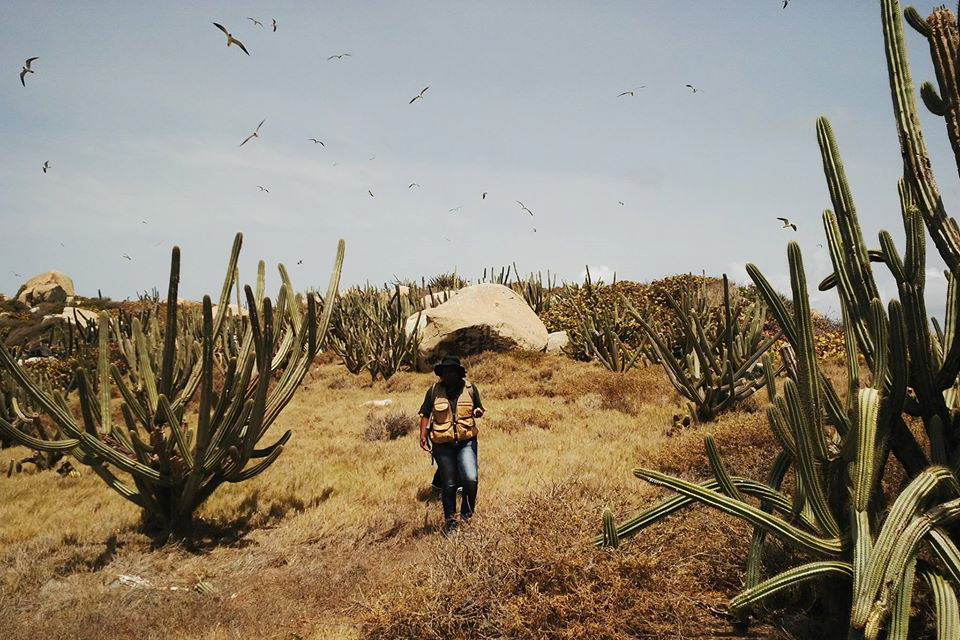
Josmar E. Márquez, the author and illustrator of the book, is passionate about these fragile shorebirds, whose IUCN status is Near Threatened. As he leads monitoring projects on Coche Island in his native Venezuela, his observations have made him come to love these round-bodied, pale brown plovers as they hurry across the sand. He also recognized the Snowy Plover’s susceptibility to human impacts and disturbances. He decided that he wanted to use his skills as an artist to tell stories that the reading public could empathize with, as he does. Hence little Sami’s story was born.
A naturalist and shorebird researcher and member of BirdsCaribbean and local NGO AveZona, Josmar is Coordinator of the Snowy Plover Monitoring Project in the offshore islands and cays of Venezuela. He explained that the idea of the novel grew in 2020 from a colouring book he created on the Snowy Plover. He worked with BirdsCaribbean’s Executive Director Lisa Sorenson and her team to make it a reality.
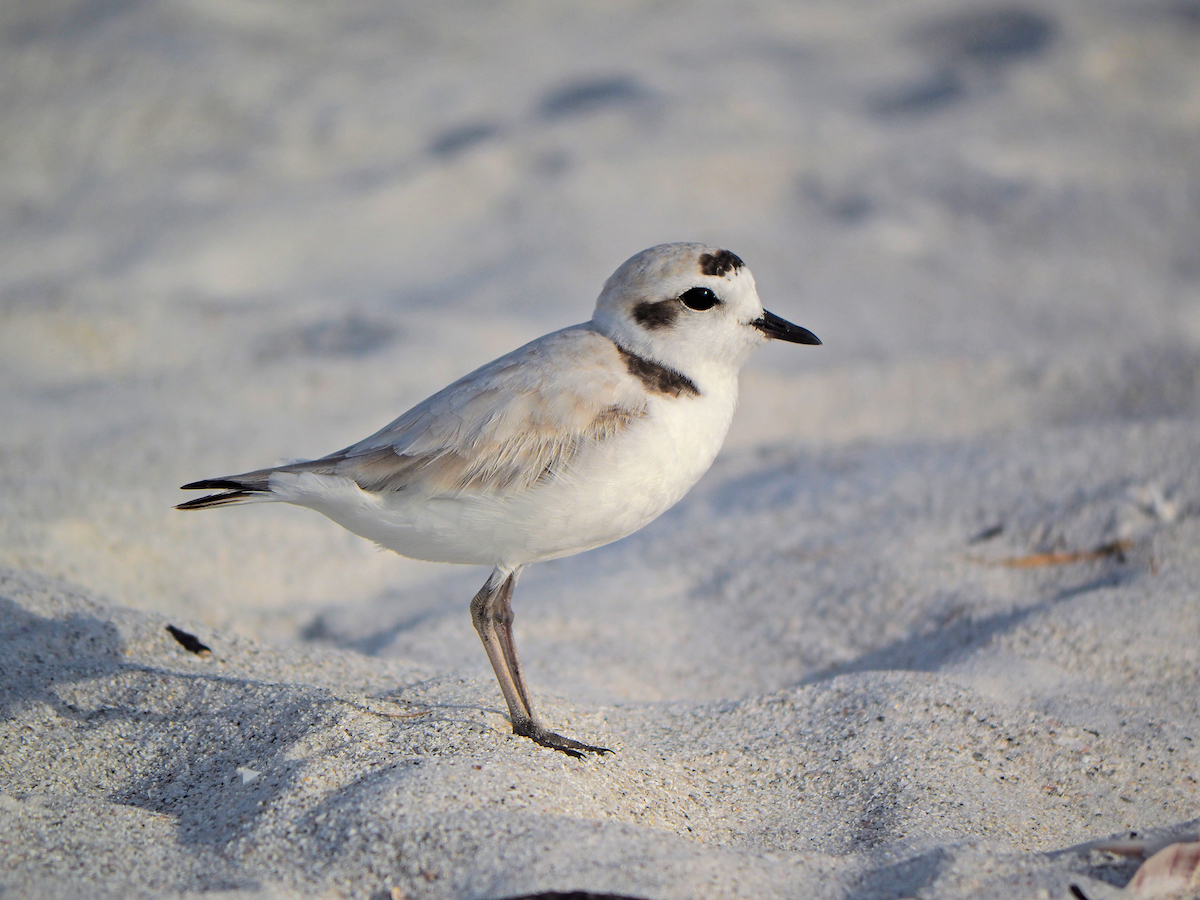
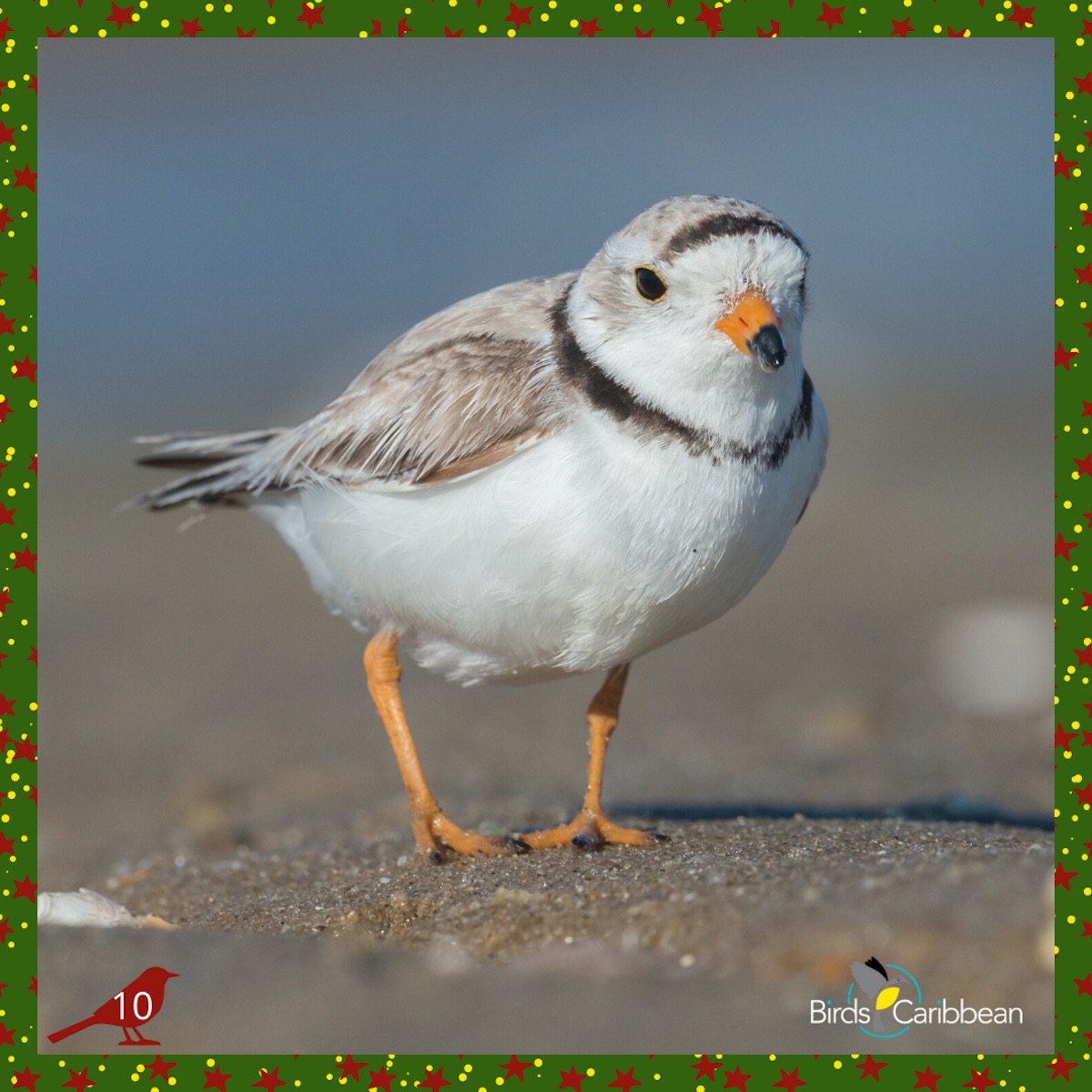
The Snowy Plover is a small, plump ground-nesting shorebird. In the Caribbean, they are primarily found in open, sandy areas near water like beaches, salt ponds, sand and mud flats, and barrier islands. (Photo by Hemant Kishan)
“Getting people to understand the risks faced by many shorebirds, especially Snowy Plover, is a personal goal. I have seen how Snowy Plovers are affected by human activity in their habitat,” says Márquez. To him, the book is “beautiful, tragic and hopeful.”
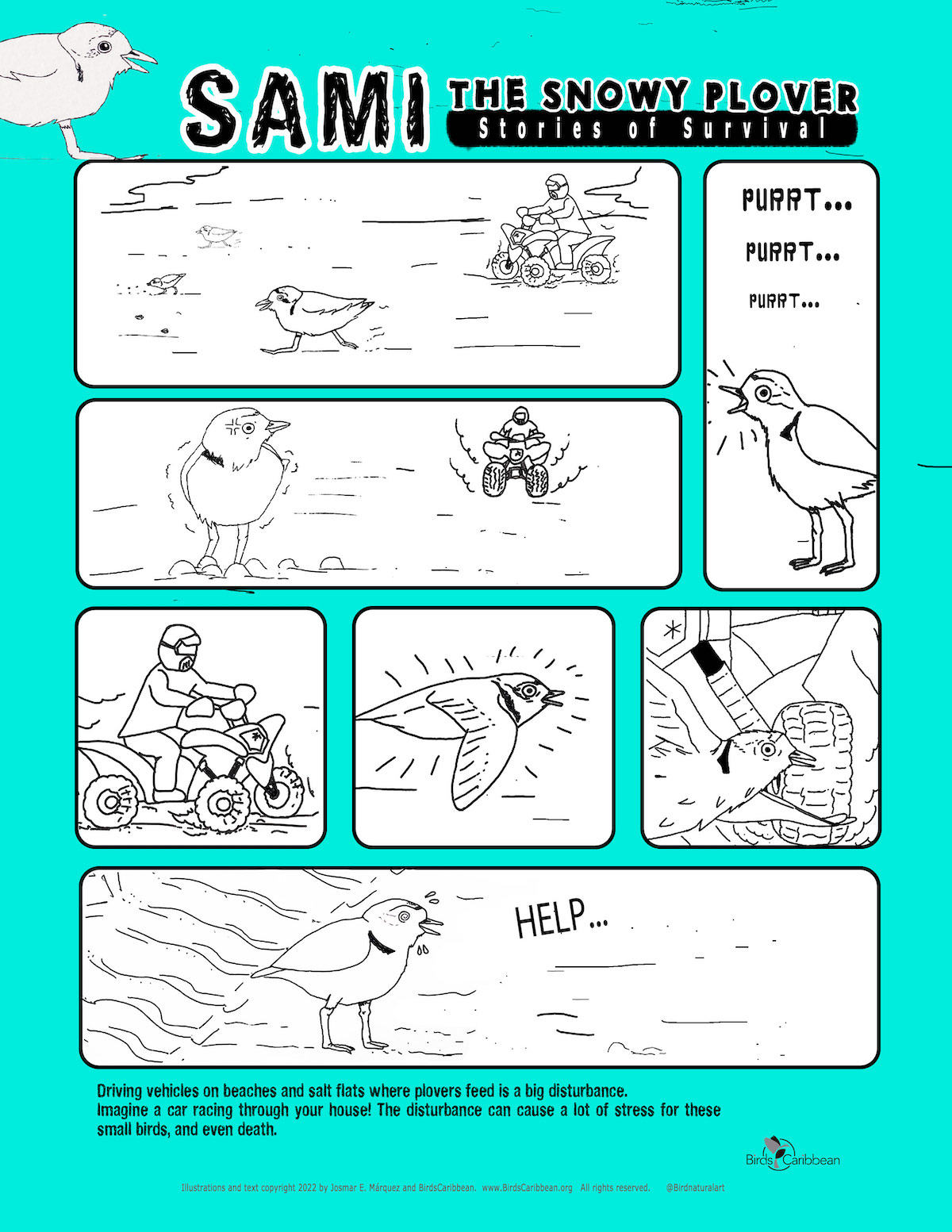
One of the pages from the book, highlighting the disturbance posed by driving vehicles on the beach causing stress and harm to the Snowy Plover and other ground-nesting shorebirds.
Please take a read through the poignant stories of little Sami, which also have a message for all of us to take to heart. We would also welcome your feedback!
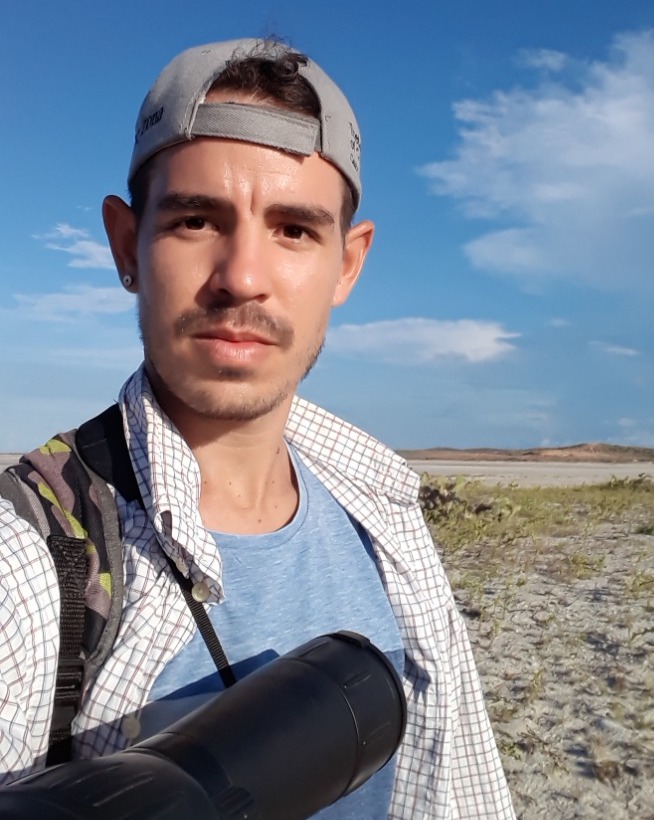
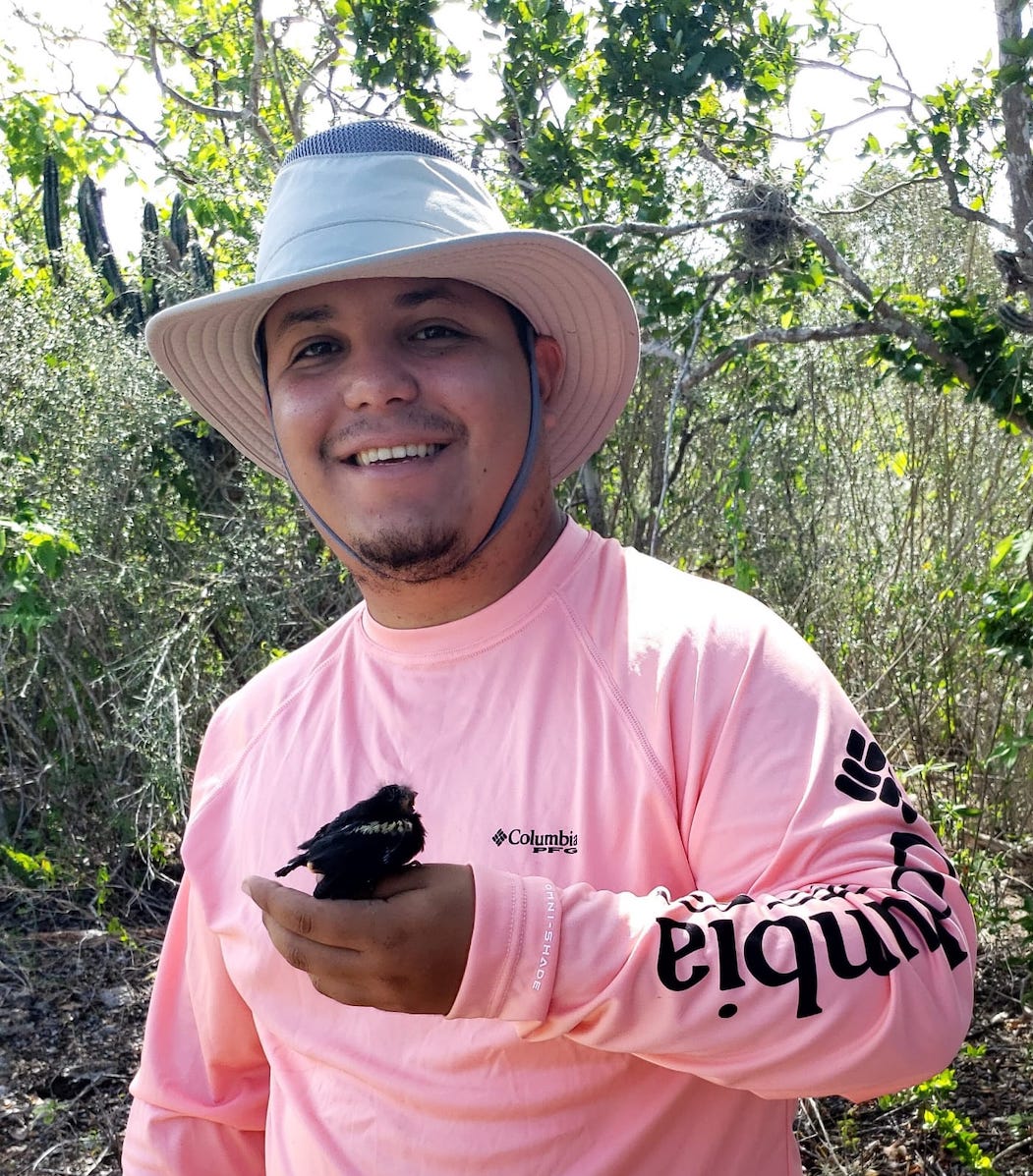
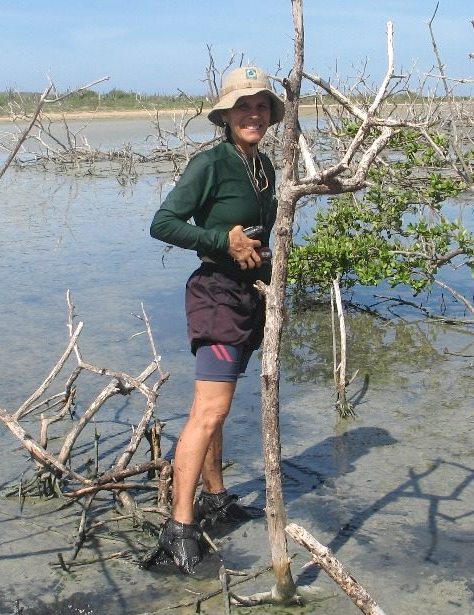
Josmar Esteban Marquez in the field.
You can read the graphic novel online in both English and Spanish on our Flipsnack account where it is also available for free download. Please share with your networks!
Thanks to Josmar for creating this heart-warming but impactful resource!
Josmar Marquez, from AveZona, has lead bird monitoring projects on Coche Island in Venezuela since 2018. In addition to data collection, his work involves mentoring young conservationists and promoting nature-friendly behavior changes in the local community of the island.
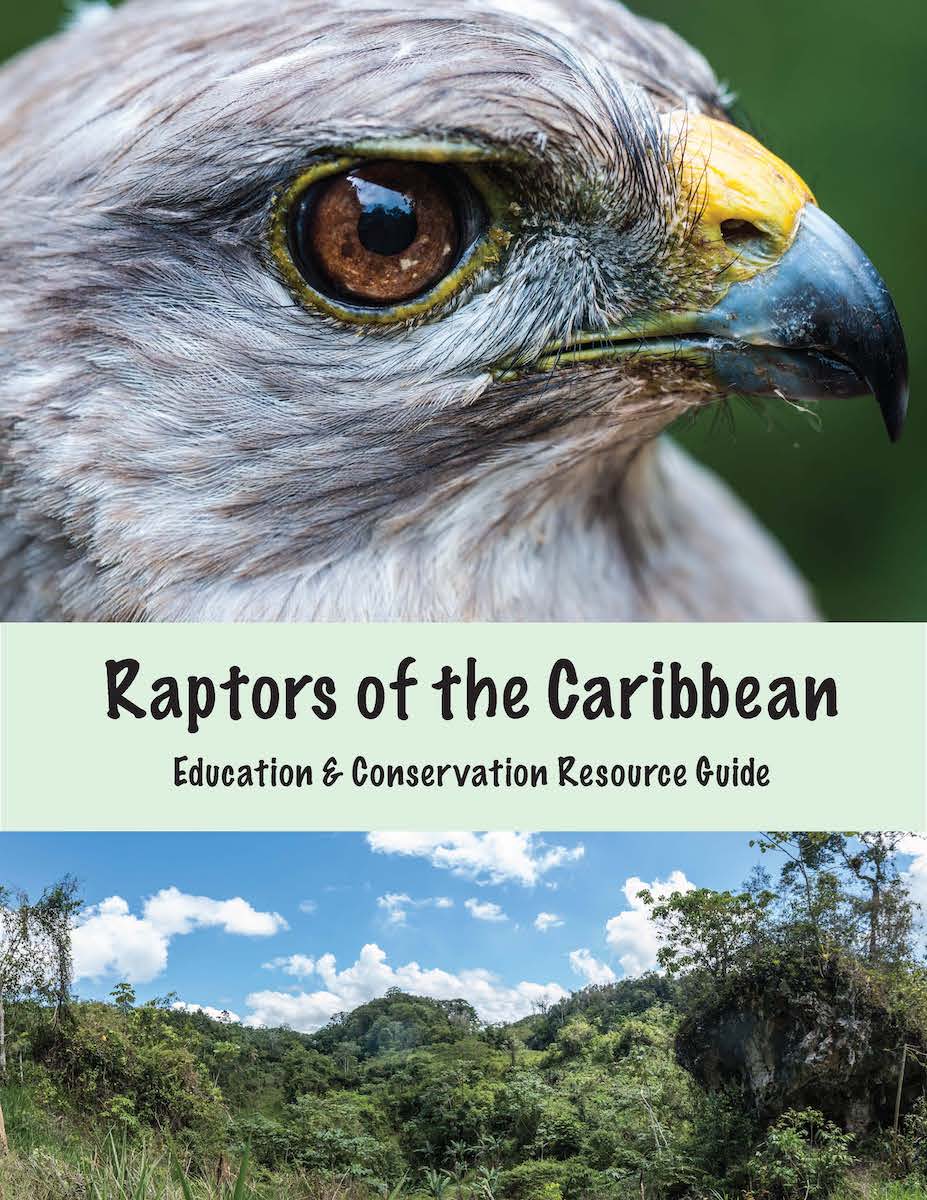
Cover of the new Raptors of the Caribbean Education & Conservation Resource Guide.
Marta Curti of the Peregrine Fund shares her thoughts on (and love for) our magnificent Caribbean raptors, including several threatened endemic species and subspecies; and introduces a brand new Resource Guide, which will help conservationists, educators, and community members understand raptors better.
I am just going to say it. Raptors are cool! Their laser-like eyesight, powerful hunting skills, acrobatic and graceful flight, coupled with their penetrating stare, have been a source of fascination for humans probably since the first time someone locked eyes with one of these spectacular birds. But they are so much more than attractive and awe-inspiring birds.
More and more research has shown the important roles raptors play in the ecosystems in which they live. They act as top predators, bio-indicators, and umbrella species. They provide important ecosystem services for humans, and many are keystone species. In short, their role in an ecosystem is large in comparison to their numbers and their removal from that system would cause a cascade of negative effects on numerous other organisms – including humans.
Despite this, raptors are one of the most threatened bird groups in the world. And raptors in the Caribbean are no different. Populations across the region are in decline and there are even several endemic species and subspecies that need our help. These include the Ridgway’s Hawk, Cuban Kite, Grenada Hook-billed Kite, and Puerto Rican Sharp-shinned Hawk. With this in mind, you would imagine that the study of raptors and conservation programs to protect them would be widespread. But sadly, despite the critical roles they play in our ecosystems, and the many threats they face, there are few research and environmental education programs focused on raptors across the Caribbean.
We set out to change all of that.
Together with support from BirdsCaribbean, we at The Peregrine Fund have written a 200-page training manual entitled “Raptors of the Caribbean: Education and Conservation Resource Guide.” The guide is divided into four chapters:
What are Birds of Prey,
Identification of Birds of Prey of the Caribbean,
Why Raptors Matter, and
How One Can Help Conserve Raptors.
Each chapter is followed by two learning activities and one evaluation activity, as well as additional learning materials. Though written in English, we are now in the process of translating it into Spanish and Haitian Creole (Kreyòl), so it will have greater impact throughout the Caribbean.
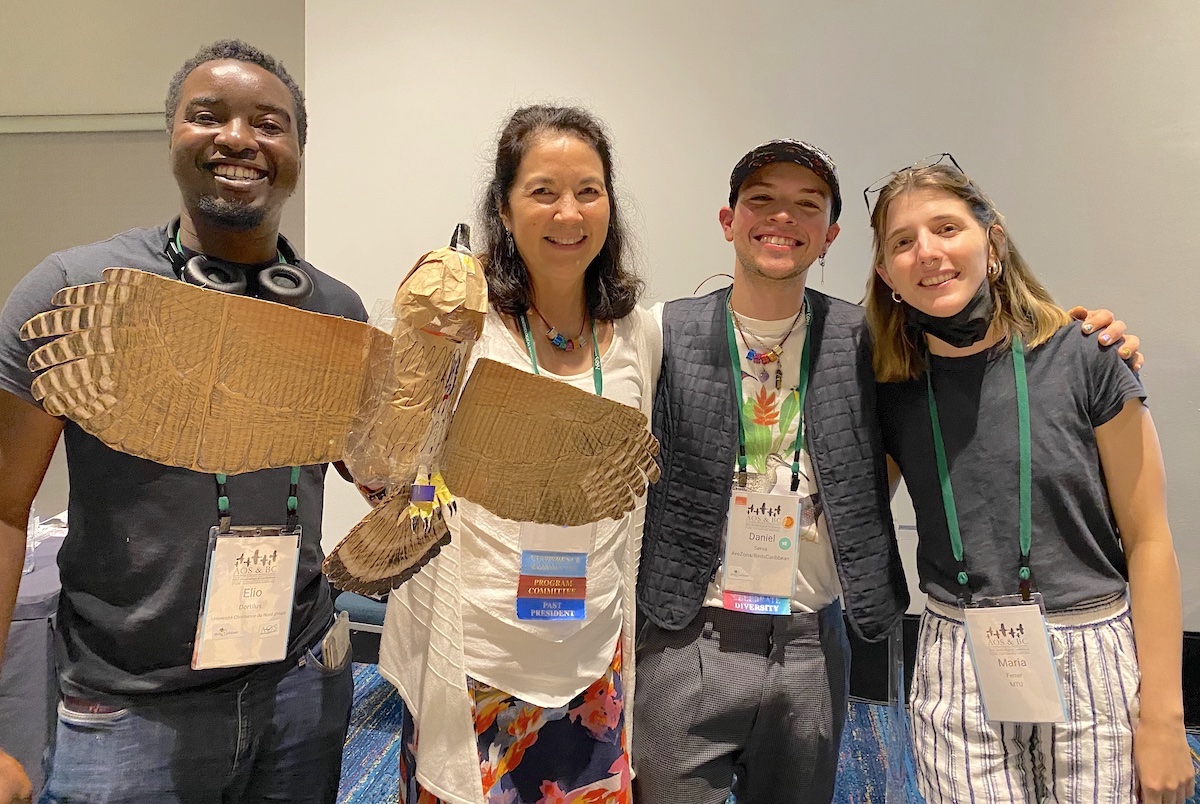
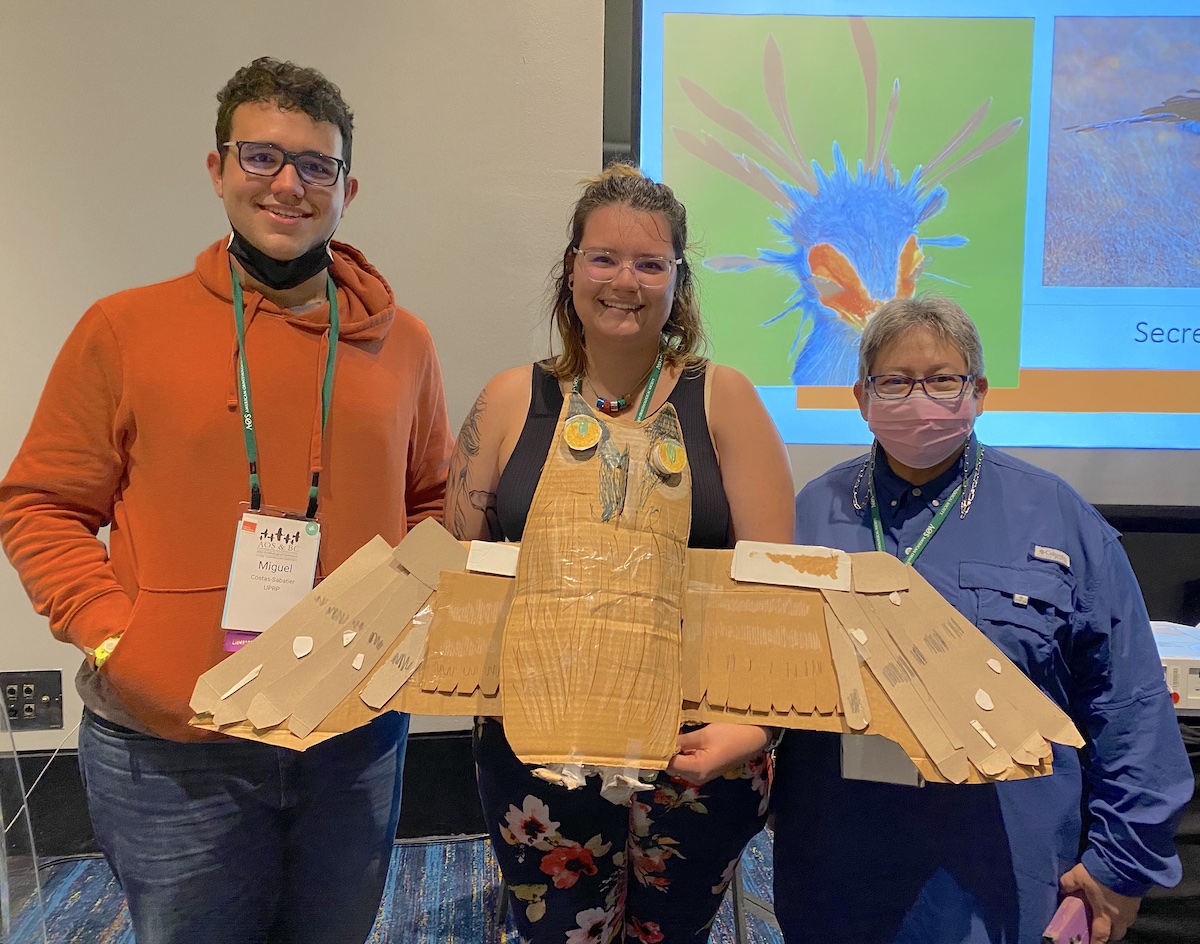
But the creation of the guide is just the first step. The next stage is to train conservationists, community leaders, and educators in its use. During the AOS-BirdsCaribbean Conference in Puerto Rico in June 2022, we held a condensed workshop for 12 participants. After a short presentation on birds of prey, the action started. We began by breaking into teams and building life-sized raptors out of recyclable materials. Participants created a Stygian Owl, a Ridgway’s Hawk, and even a massive Secretarybird out of nothing but cardboard, plastic bottles, newspaper, and some tape to hold them all together. Creativity took flight!
Group works together to construct their Stygian Owl. (photo by Gabriela Diaz)
Group shares their Stygian Owl masterpiece (photo by Lisa Sorenson)
One group plans the activity they will teach to the rest of the workshop participants. (Photo by Gabriela Diaz)
Team proudly shows off their completed life sized Secretarybird built out of recyclable materials plumes prey and all! (photo by Lisa-Sorenson)
One group is busy constructing a Secretarybird (photo by Gabriela Diaz)
Close-up view of Secretarybird constructed of recycleable materials. (photo by Gabriela Diaz)
For the next activity, groups reviewed the guide and chose an activity they were going to teach to the rest of us. We played games, wrote poems, and engaged in a “memory” challenge. One participant kept repeating “I am having so much fun!” A positive sign indeed!
We had carried out a pre- and post-evaluation and saw that in the four short hours of the mini-workshop, participants learned a lot about raptors that they hadn’t known before – such as what they eat, where they live, and the important functions they perform in their environment. It was an intense, hands-on learning experience.
Thanks to support from BirdsCaribbean and the Betty Petersen Conservation Fund, the manual is now completed. Our dream is to carry out extended workshops of two or more days in countries around the Caribbean. Participants will gain experience – including conservation-based lessons that use raptors to teach math, language, art, and even physical education in their programs.
One team proudly shows of their Ridgway’s Hawk, made of recyclable materials. (photo by Tahira Carter)
In these longer workshops, we aim to offer participants training in environmental education techniques and methods. These would include developing a guided nature walk; giving an impactful presentation; how to speak about sensitive issues one-on-one with community members; and utilizing whatever materials are available on-hand to create fun and dynamic learning experiences for participants’ target audiences. They would also learn about raptors in their countries, food chains, threats to wildlife, and possible conservation solutions.
Several participants from each country would then be trained to lead these workshops, so we can form a chain of raptor-based environmental education workshops throughout the Caribbean and help to promote interest in raptor research and conservation. From our understanding, this is the only raptor-based conservation-themed workshop in the region. We are excited to embark on these workshops and look forward to sharing our results!
We are currently raising funds to make these education workshops a reality. Ongoing training is so vital to ensure the long-term survival of these magnificent birds. If you would like to support this work, please click here.
The “Raptors of the Caribbean” Training Manual and Guide is currently undergoing a final review, and will be available for FREE download in late September, 2022. Stay tuned!
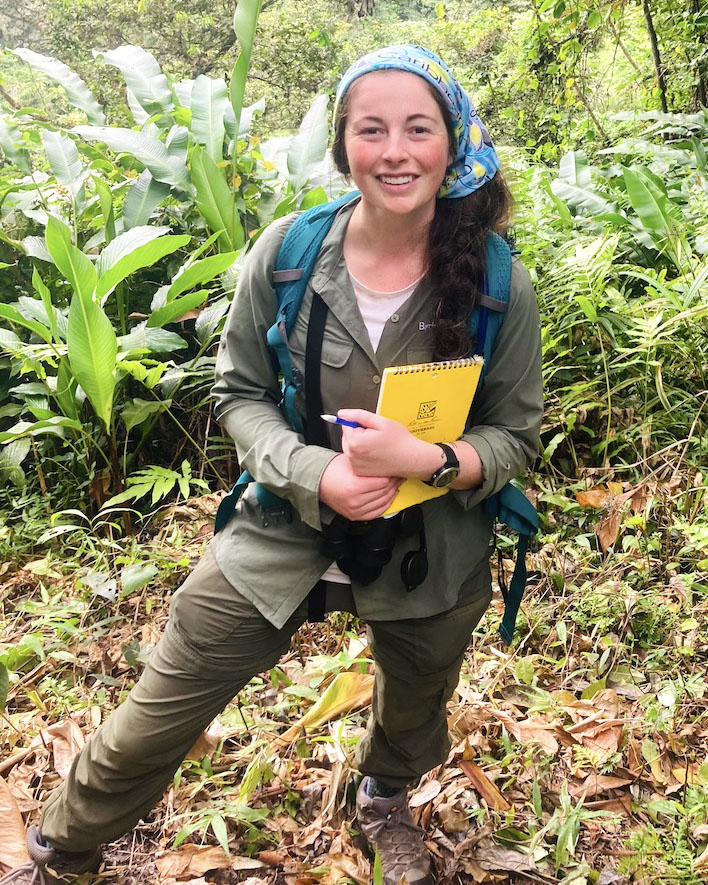
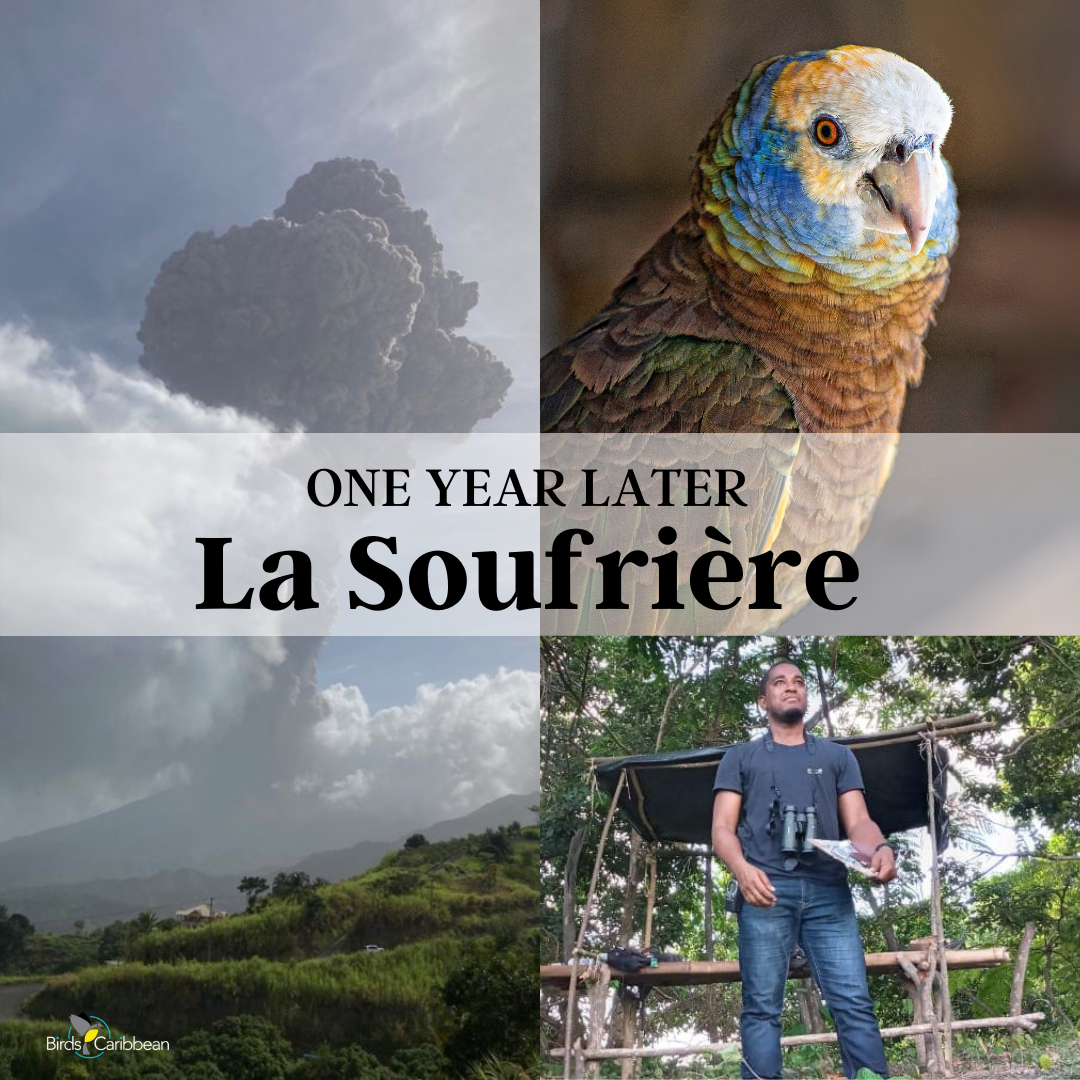
On April 9th, 2021, La Soufrière Volcano, on the Caribbean island of Saint Vincent, began to erupt for the first time in 42 years. These explosive eruptions left the conservation community gravely concerned about impacts to the island’s wildlife and vegetation. Using funds raised through our volcano recovery campaign, BirdsCaribbean, the Saint Vincent Department of Forestry, and Antioch University were able to begin assessing the effects. Here, we report on field work from our successful two-week pilot season surveying for the endemic Whistling Warbler and other forest species in May of 2022. Field Assistant Kaitlyn Okrusch shares her experiences—read on!
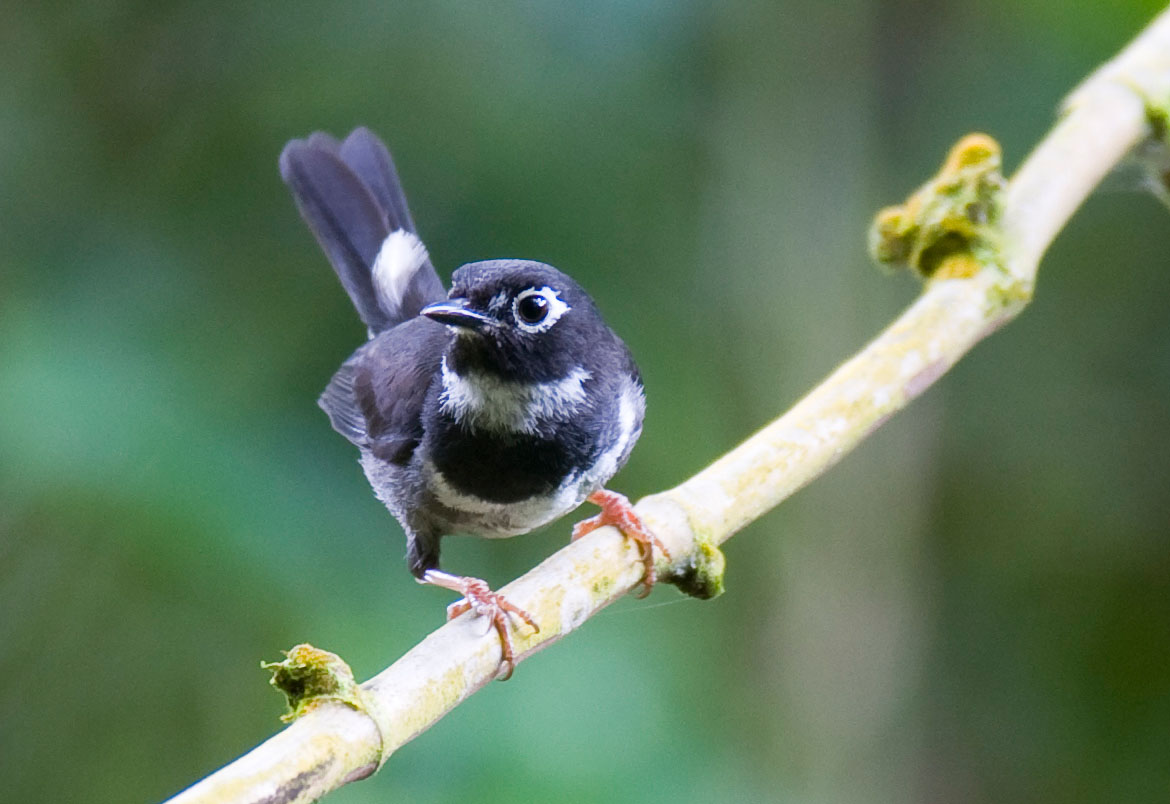
There is something indescribable about witnessing a creature that so few have laid eyes on. Not because it makes you lucky over others. Rather, this creature, this other living thing, has somehow managed to stay hidden from our pervasive (and distinctly) human nature. This thought crossed my mind several times as I glimpsed a view of the Whistling Warbler—a really rare bird found only on one island and restricted to mountainous forest habitat. As I gazed up at this endemic gem, I imagined its secretive life. With its stocky body, bold white eye-ring, cocked tail, and tilted head, it looked back down at me, just as curious.
When Mike Akresh, a conservation biology professor at Antioch University New England, asked if I wanted to assist a pilot study for the Whistling Warbler on the Caribbean island of Saint Vincent, I paused. “The Whistling Warbler?” I thought, “Saint Vincent?” I had never heard of the bird nor the island. Now, I don’t know how I could ever forget either.
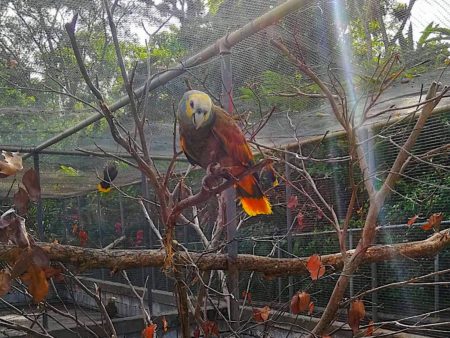
Saint Vincent is located in the southern Lesser Antilles, and has a kite tail of 32 smaller islands and cays (the Grenadines) dotting southward. Its indigenous name is ‘Hairouna,’ which translates to the Land of the Blessed. The people, the culture, and the biodiversity are truly remarkable—blessed indeed. In addition to the warbler, the islands are home to the national bird, the colorful and endemic Saint Vincent Parrot, and host to six other bird species that are found only in the Lesser Antilles.
The rumblings, then eruptions, that ignited our work
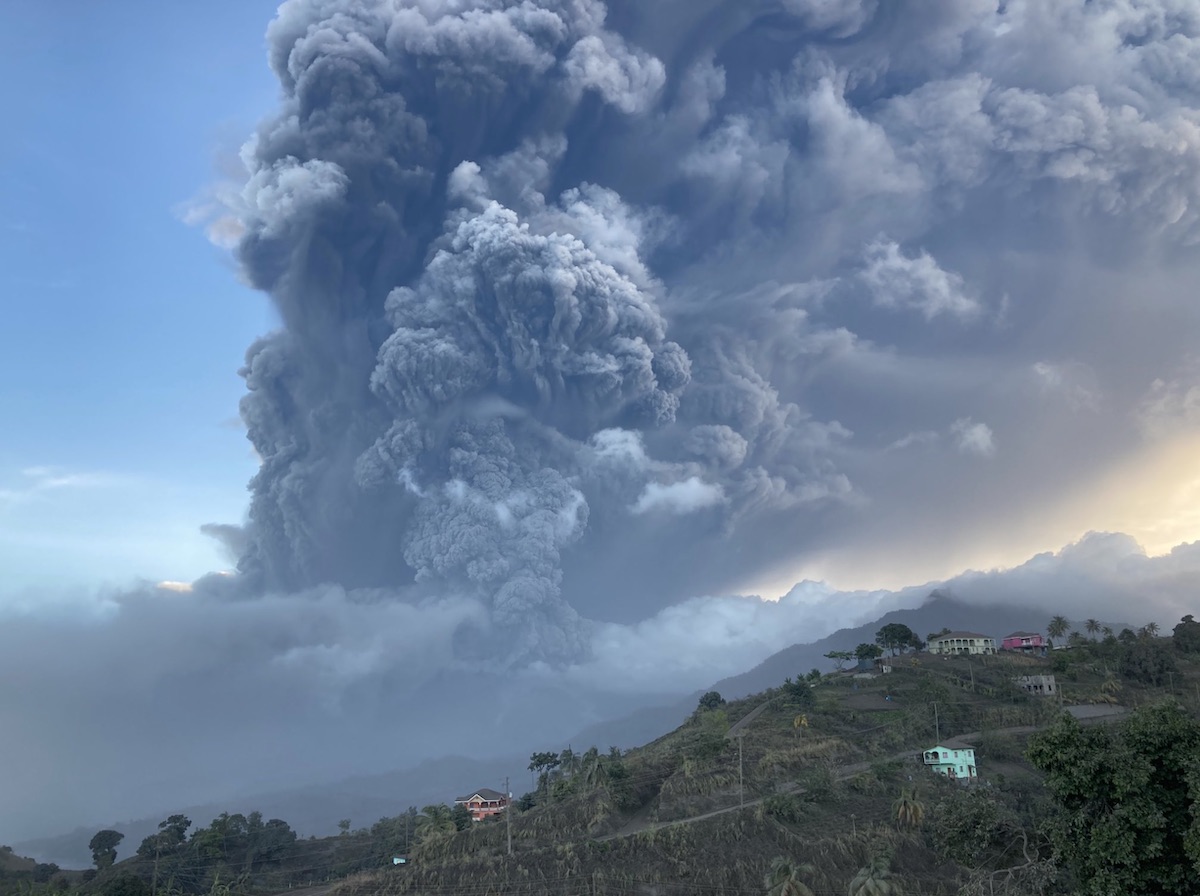
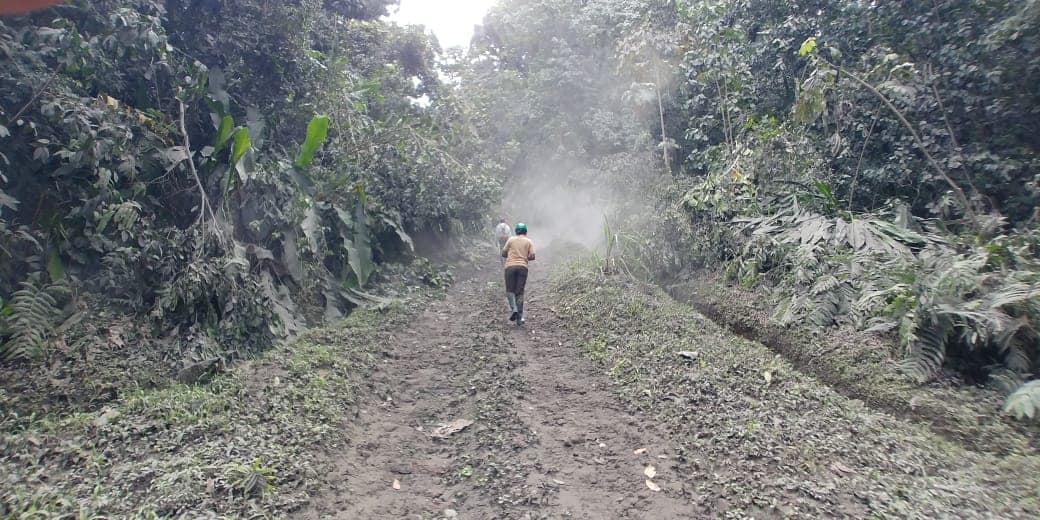
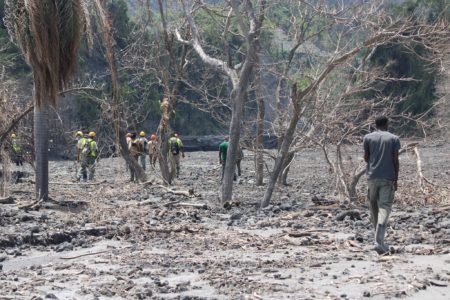
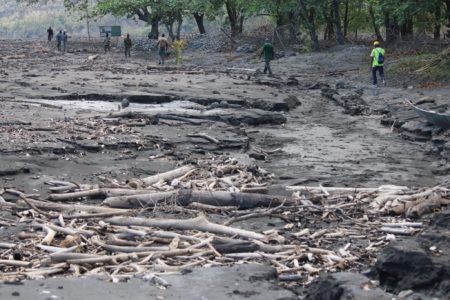
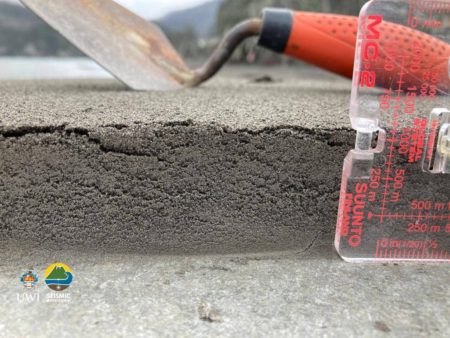
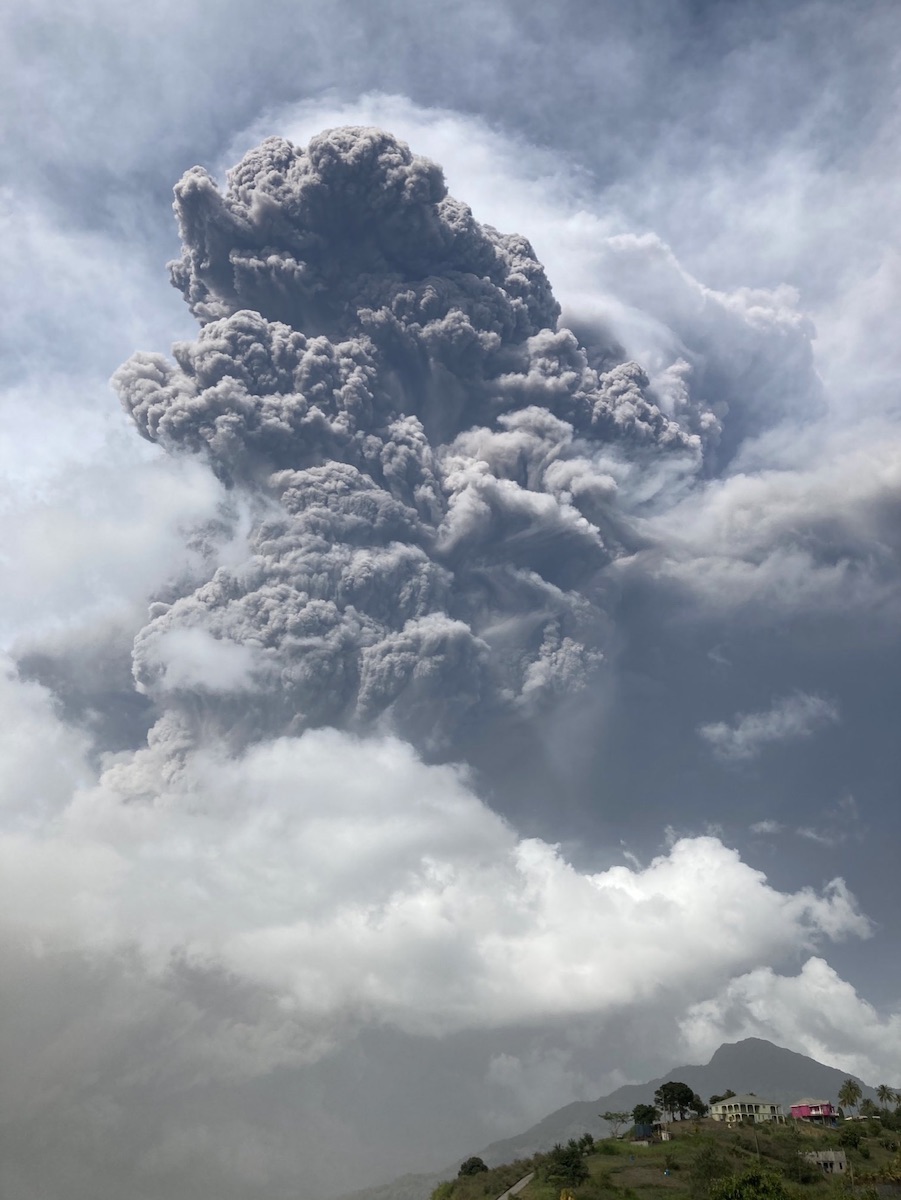
At the northernmost point of this island lives the active volcano, La Soufrière, which last erupted in 1979. In December of 2020, this powerful mountain showed signs of life with effusive eruptions and growth of the lava dome for several months. On April 9th 2021, explosive eruptions began that sent plumes of ash as high as 16 kilometers. In addition, pyroclastic flows and lahars (very fast-moving, dense mudflows or debris flows consisting of pyroclastic material, rocky debris, ash and water) caused considerable damage along river valleys and gullies.
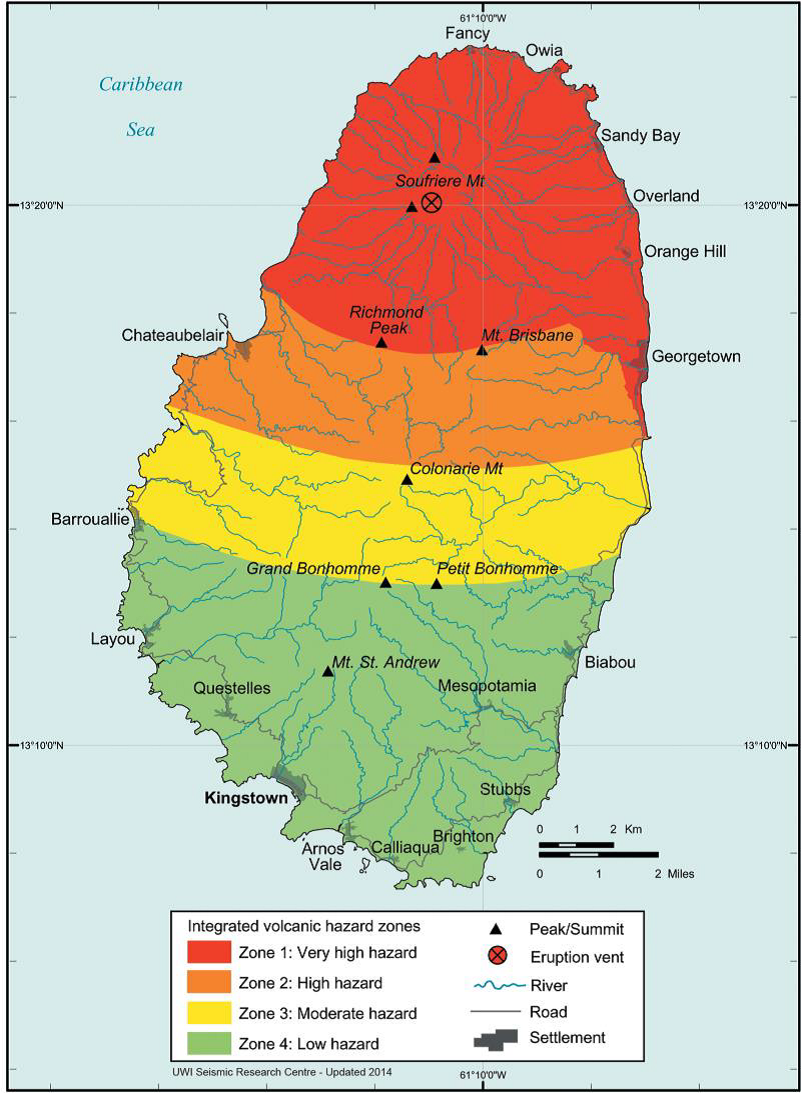
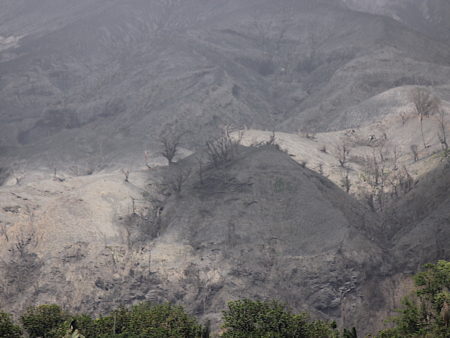
Multiple eruptions in April damaged trees and blanketed the forests and towns in thick layers of gray ash, leaving many parts of the island barren for months. Upwards of 20,000 people were evacuated in the Red and Orange Zones (northern half of the island), and, thanks to this decision, there was no loss of life. Remarkably, the 2021 eruption of La Soufriere is the largest to occur in the entire Caribbean of at least the last 250 years.
Massive ash cloud from La Soufriére volcano explosion on St. Vincent and the Grenadines, April 13, 2021. There were multiple powerful eruptions in April, starting on April 9th. (Photo by Dr. Richard Robertson, UWI).
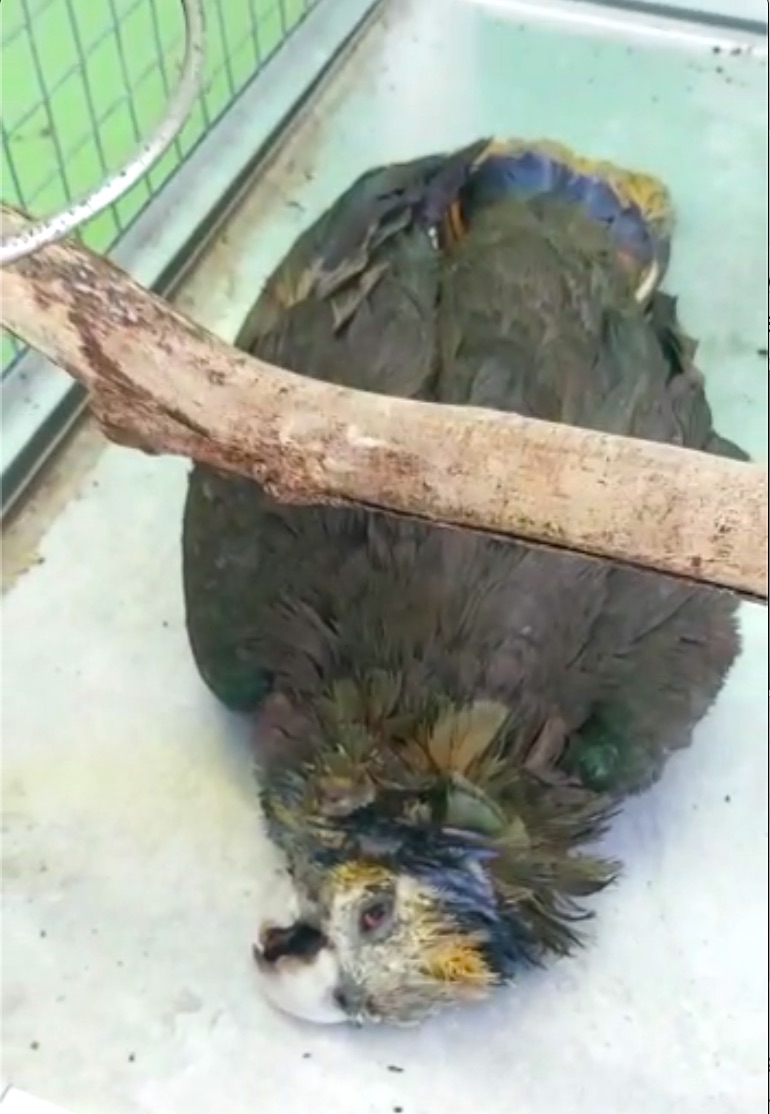
There was grave concern for the welfare of the Saint Vincent Parrot, Whistling Warbler, and other wildlife. BirdsCaribbean launched a fundraising campaign and our community stepped up to provide funding and supplies for volcano recovery efforts, both short and longer-term. This natural disaster was destructive for both the people and the land; the impacts are still being seen and felt today. But, out of this catastrophe arose an opportunity to assess the status of Saint Vincent’s iconic birds and to plan for their conservation moving forward.
The eruption of La Soufrière called attention to the urgent need for collaboration and research efforts regarding biodiversity conservation on Saint Vincent. With such limited baseline knowledge pertaining to most of the forest birds on the island, locals worried that some species (like the Whistling Warbler and the Saint Vincent Parrot) might disappear. No one was sure how these eruptions had impacted their populations.
This opened the door for concerted efforts between the Saint Vincent and the Grenadines Department of Forestry (SVGF), BirdsCaribbean, and Antioch University, to complete a pilot season surveying for the elusive and endangered Whistling Warbler and other endemic landbirds. SVGF and researchers from Florida International University (led by Dr. Cristina Gomes) were already in the process of specifically re-surveying the Saint Vincent Parrot population, so our surveys focused on other landbirds (stay tuned for a blog post on this work!).
La Soufriére Volcano Trail sign. (Photo by Lisa Sorenson)
Volcanic remnants near the northeast town of Georgetown. (Photo by Kaitlyn Okrusch)
Headquarters of the Saint Vincent and the Grenadines Department of Forestry, located in Campden Park near Kingstown. We met several times with Forestry staff during our visit to plan and discuss the field work. (Photo by Kaitlyn Okrusch)
Ash deposits on the coast at Wallibou, just north of the Wallibou River in the northwest, Glenroy is looking towards La Soufriére volcano. (Photo by Mike Akresh)
Trees on the La Soufriére trail—one year later you can still see the damage to the canopy from the April 2021 eruptions. (photo by Lisa-Sorenson)
Touching down for the “oreo” bird
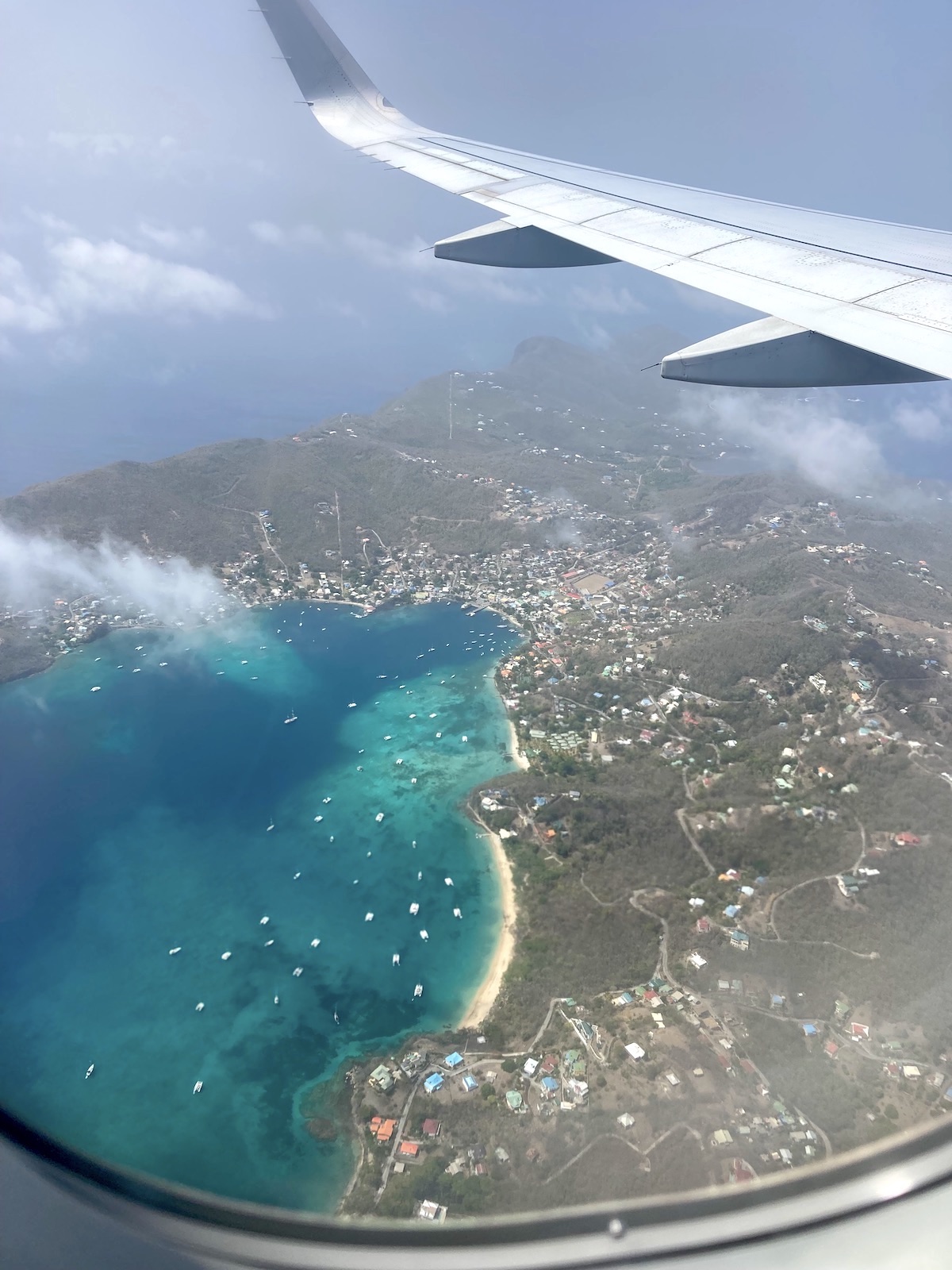
Flying into Saint Vincent. (Photo by Kaitlyn Okrusch)
My eyes grew wide as the plane touched down and I stepped out into the humid, salty air. Lisa Sorenson (the executive director of BirdsCaribbean) had been down here for the previous few days with her husband, Mike Sorenson, and colleagues Jeff Gerbracht (Cornell Lab of Ornithology and long time BirdsCaribbean member) and Mike Akresh. They had been scouting out potential locations for our surveys of the warbler using the PROALAS point count protocol with SVGF and specifically SVGF Wildlife Unit Head, Glenroy Gaymes.
Lisa and Mike A. picked me up from the Argyle International Airport in a silver Suzuki jeep—driver’s side on the right, drive on the left. I hopped in the car and we zipped off into the narrow (and steep!) hillside roads of Arnos Vale—a small community north of the capital of Kingstown. Lisa had been down here before. She drove us around like a local: confident and happy, despite the crazy traffic and winding roads! I rolled down the window and the sun brushed my face. Our first stop before our home base was a local fruit stand, well equipped with juicy mangoes, soursop, plantains, pineapple, and grapefruits. Island life and fresh fruits—nothing quite compares!
As Lisa and Mike picked out the various ripe fruits they wanted, Lisa didn’t miss an opportunity to ask the stand tenders if they had ever heard of or seen the Whistling Warbler. She took out her phone, pulled up the Merlin Bird ID app, and displayed some of the few captured sounds and photographs of this bird. She held it up for them to see. “Ahhhh, yes, we’ve heard that before!” the man said, after listening to the song. A smile crept onto his face. The unmistakable call of this bird, as I would come to observe, has been ingrained into the minds of many locals—without them even knowing who was making it. “We hear that many times when we are in the forest,” the woman said.
The song of the Whistling Warbler is a crescendo trill of loudly whistled notes.
Many locals (and non locals) are unaware that the Whistling Warbler is endemic to Saint Vincent. On the other hand, many are aware that the beautiful and iconic Saint Vincent Parrot is endemic. Endemic species are naturally more vulnerable to extinction due to their specific nature: their limited distribution leaves them particularly vulnerable to threats like habitat destruction, climate change, invasive predators, or overhunting. On top of those reasons—as noted above—their survival may be even more perilous after a devastating volcanic eruption. It is well known that often the large, flamboyantly colored birds captivate, motivate, and receive more funding when it comes to conservation. Sometimes the smaller, less colorful birds quite literally get lost in the shadows. Because of a lack of research and funding, there are large knowledge gaps pertaining to the Whistling Warbler’s ecology and population status.
Whistling Warbler perched on a branch. (Photo by the Saint Vincent Ministry of Tourism)
There are only two scientific papers out there (one unpublished) that contain what little we know about the Whistling Warbler. Consequently, you often see “no information” listed under the various tabs if you search for this species on the Birds of the World website. What is its breeding biology? Do we actually understand the plumage variations between sexes and ages? What about habitat preference and home range size? Diet? Perceived versus actual threats regarding its conservation?
Furthermore, this warbler is interesting because it is also monotypic. It’s in a genus all of its own, and there are no subspecies. This makes the warbler especially unique, and it may be susceptible to changes that we could be causing (and accelerating).
Unfortunately, as with many endemic birds throughout the Caribbean, the lack of capacity, funding, and previous interest has limited our ability to answer these research questions and better conserve these endemic species. Few have had the time (or the funding) to put into fielding these research questions. These are some of the motivations to try and research—to understand—this unique bird and its ecology. We hope to try and figure out the status of this endangered warbler and build local capacity to monitor the warbler and other birds.
Hiking, Birding, and Counting, Oh My!
Most birders acknowledge that in order to see a bird, you need to be a bird. This means getting up at unpleasantly early times, 4 am for example. But, more often than not, it is well-worth the short night of sleep, driving in the dark, and arduous hiking, to watch and hear the lush green forest wake up. On our first field morning, we headed to a trail called Montréal, a steep ascent up the mountain, that became Tiberoux trail, once you reached the saddle and hiked down the other side. This was an area that SVGF staff had both seen and heard our small, feathered friend before.
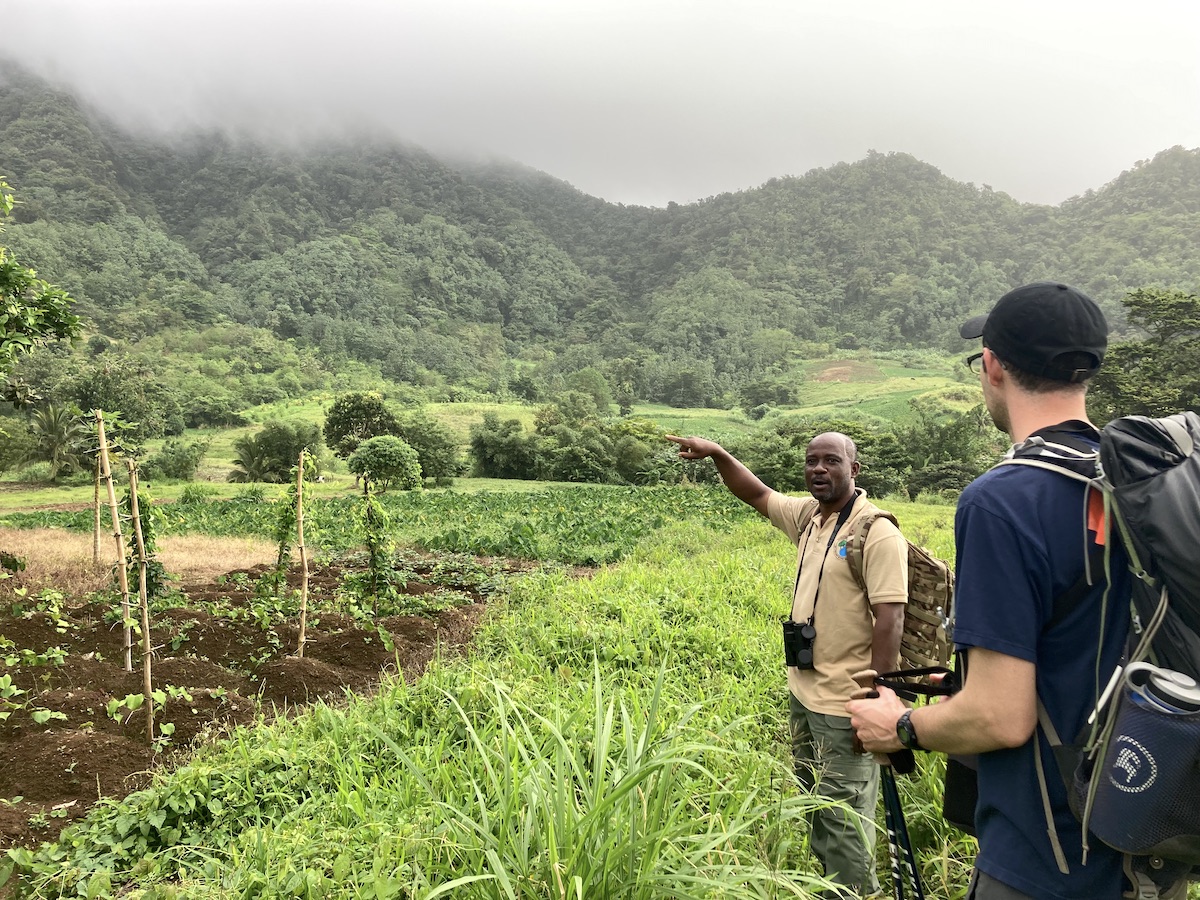
Montreal farm field with Glenroy Gaymes and Mike Akresh. Glenroy points the way to hike into the mountains on the Montréal trail to survey for the warbler. (Photo by Kaitlyn Okrusch)
Utilizing local and SVGF staff knowledge was a crucial aspect of our surveying strategy. Our team visited sites and hiking trails where the warbler was known to be seen or heard in the past. We then conducted point counts within these areas to collect data on the presence/absence of the warbler and other forest species. Glenroy (AKA “Pewee”) has a wealth of knowledge about Saint Vincent’s forests and wildlife. His deep connection with the land comes from inherent connection and diligent observation: being a part of and not apart from the land. He has been walking these trails for 30+ years, patiently learning. Now, he was going to try and teach us about one of his favorite birds.
At first glance, the Whistling Warbler seems nearly impossible to study, partly due to its elusive nature, and partly due to its apparent habitat preference. This bird is found in dense, mountainous forests on extreme slopes of ridges and slippery ravines. This, as you can imagine, makes it difficult to track the bird, let alone nest search. One wrong step, and you can be sent flying down the mountain.
Luckily, with Glenroy’s knowledge and our protocol incorporating a playback song of this species, we were given glimpses here and there as the warbler flitted through the dense, dark, mid-canopy. Digging our heels into the steep sides of the trail, we would all anxiously listen for and await our prized subject. You could feel the tension rising as each of us swiveled our heads back and forth, looking for any sign of movement. “I see it, I see it, right there!” one of us would whisper—the others getting our binoculars ready.
For this two week pilot season, we wanted to rely on local knowledge to understand where to place our PROALAS point counts. PROALAS is a protocol used throughout Central America, and is now beginning to be implemented with BirdsCaribbean’s new Caribbean Landbird Monitoring Project. The protocol includes a standardized set of survey methods for monitoring birds, specially designed for tropical habitats. For our study, we would stop and do a 10-minute point count, noting every single bird that we see and/or hear every 200 meters along a designated trail. This methodology is a quick and systematic way to get an understanding of the landbirds in an area.
Additionally, we collected vegetation and habitat data which can then be used to understand species-habitat relationships. In our case, since we were focusing on the Whistling Warbler, we also did an additional five-minute point count just for it. For the first two minutes, we would play a continuous variety of Whistling Warbler calls and songs and visually looked for the bird to come in. For the final three minutes, we would turn off the playback, and listen to see if the warbler called back. At several locations, we also set out Autonomous Recording Units (ARUs), which are small devices that record bird songs for days at a time without us being physically present at the site.
All of this data was entered into eBird, available to local stakeholders and forever stored in the global database (see our Trip report here: https://ebird.org/tripreport/58880). Needless to say, Lisa, Mike, Jeff, Mike Akresh, and myself all got a crash course in Saint Vincent bird ID in the field.
Jeff, Mike, and Kaitlyn hiking on Tiberoux trail. (Photo by Lisa Sorenson)
Mike Akresh setting up the AudioMoth acoustic monitoring device in the field. (Photo by Lisa Sorenson)
Winston “Rambo” Williams and Mike doing a point count on the Vermont Nature Trail. (Photo by Kaitlyn Okrusch)
Team on the Vermont Nature Trail. (Photo by Mike Akresh)
Warbler and Parrot teams on the Silver Spoon trail. (Photo by Lisa Sorenson)
Glenroy Gaymes walking through Mahorn Ridge. The orange flowering bush is Palicourea croceoides; common names Yellow Cedar and Caribbean Red Cappel Plant. (Photo by Kaitlyn Okrusch)
Audiomoth Automatic Recording Unit (ARU) set up on a tree to record songs and calls of forest birds. (photo by Lisa Sorenson).
So, how are the warblers doing?
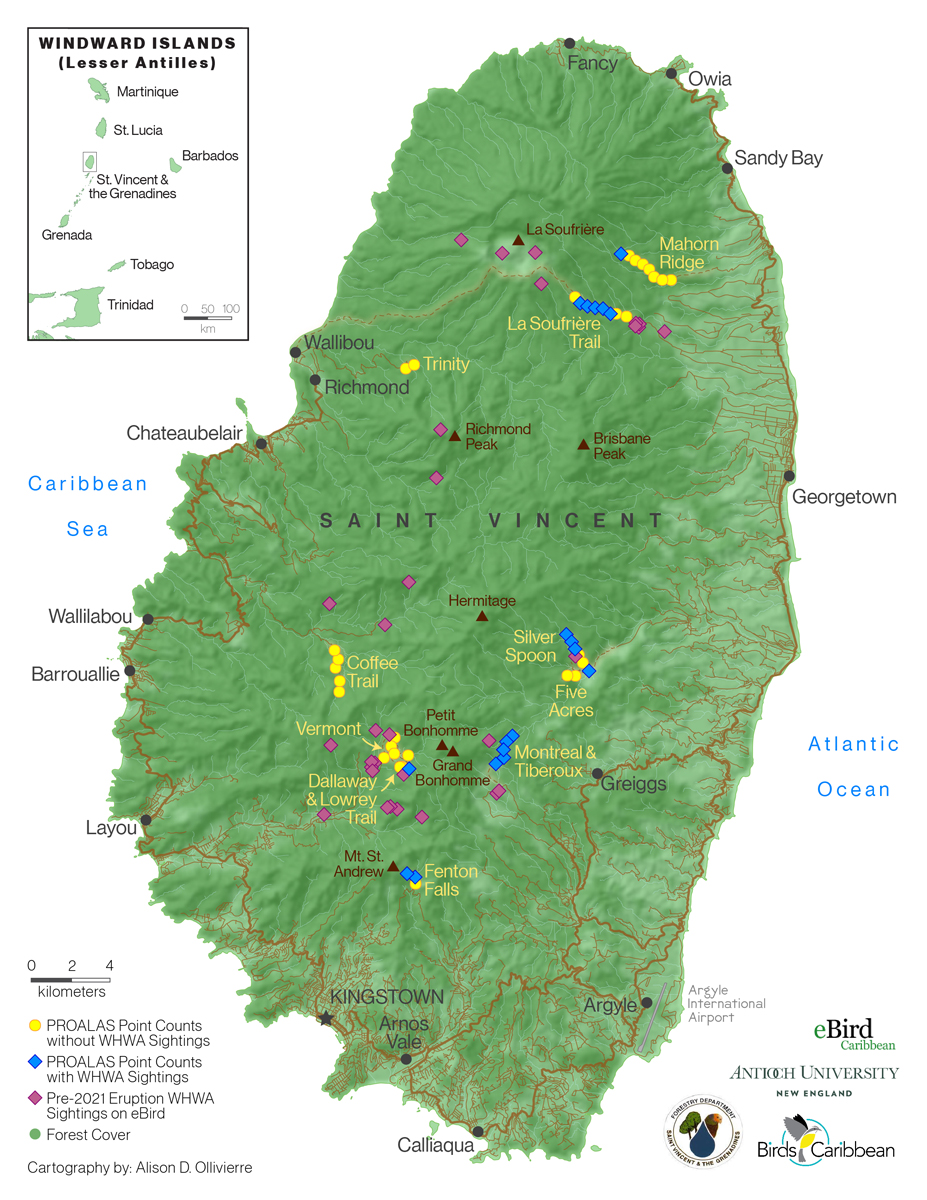
Figure 1. Map of St Vincent showing locations of our PROALAS Point Counts without Whistling Warbler (WHWA) sightings, with warbler sightings, and eBird Caribbean sightings prior to the April 2021 eruption of La Soufriére Volcano.
The good news is we found some warblers! After surveying 8 sites, 46 points, and conducting 100+ point counts, we detected the Whistling Warbler, by sight and/or sound, at around 35% of the point locations (see Figure 1). Warblers had higher abundance on the eastern (windward) side of the island compared to the western (leeward) side, and appeared to be present on steep, mountainous, wetter slopes with natural (non-planted) forest.
Interestingly, we detected a number of Whistling Warblers along the La Soufrière Trail, an area that was highly impacted by the volcano eruption, so the warbler seems to be doing ok despite the habitat destruction! However, the impacted northern areas were definitely quieter and a number of other forest birds seemed to be missing, like the Cocoa Thrush and Ruddy Quail-Dove. One hypothesis might be that the heavy ash deposits closer to the volcano affected insects living on the ground—the food resources needed by ground-foraging bird species.
We also noted that a few other bird species were especially rare on the island after the volcano eruption. For instance, we did not detect any Antillean Euphonias, and only briefly saw or heard the Rufous-throated Solitaire at two locations. The Green-throated Carib, Brown Trembler, and Scaly-breasted Thrasher also had fairly low numbers throughout the island. This may have been due to the habitat we focused on and/or the time of year of our surveys. Clearly, more surveys are needed to assess these other species.
Fenton Falls trail, where Whistling Warblers were detected. (Photo by Lisa Sorenson)
Mike Akresh, Jeff Gerbracht, and Mike Sorenson along the Fenton Falls trail. (Photo by Lisa Sorenson)
Possible non-active Whistling Warbler nest. (Photo by Lisa Sorenson)
Whistling Warbler looks out from a branch. (Photo by Mike Akresh)
Whistling Warbler (possible juvenile or female). (Photo by Kaitlyn Okrusch)
Nature is resilient!
After traversing much of this island in search of the warbler, it is hard to imagine that this devastating eruption happened only one year ago. We saw the remnants of the ash on the trails; trees drooping over from the sheer weight of the volcanic ash upon their branches, and huge swaths in the north part of the island mostly devoid of large canopy trees. Yet, there was also life flourishing around us, green and growing up towards the light.
Glenroy commented that after the April eruptions, the forests were so eerily quiet, he felt like he was in outer space. He told us that in some areas, there was not one creature to be seen or heard for months, not even the ever-present mosquitos. Despite this devastating natural disaster, here we were though, both hearing and seeing many of the forest birds coming back. This also often included hearing the unmistakable crescendo whistling song of the Whistling Warbler, much to our delight.
Spathoglottis plicata, Philippine Ground Orchid (invasive species) in bloom. (Photo by Lisa Sorenson)
White Peacock Butterfly (Anartia jatrophae) (Photo by Mike Akresh)
Glenroy Gaymes with a St Vincent Hairstreak butterfly (endemic to St Vincent). (Photo by Mike Akresh)
Jeff and Mike Sorenson at the Parrot Lookout on the Vermont Nature Trail. Yes, we saw parrots! (Photo by Lisa Sorenson)
“Life From Death” interpretive sign along the Vermont Nature Trail. (Photo by Lisa Sorenson)
Mike Sorenson looking for birds in dense forest habitat. (photo by Lisa Sorenson)
Optimistic for the future: Our next steps
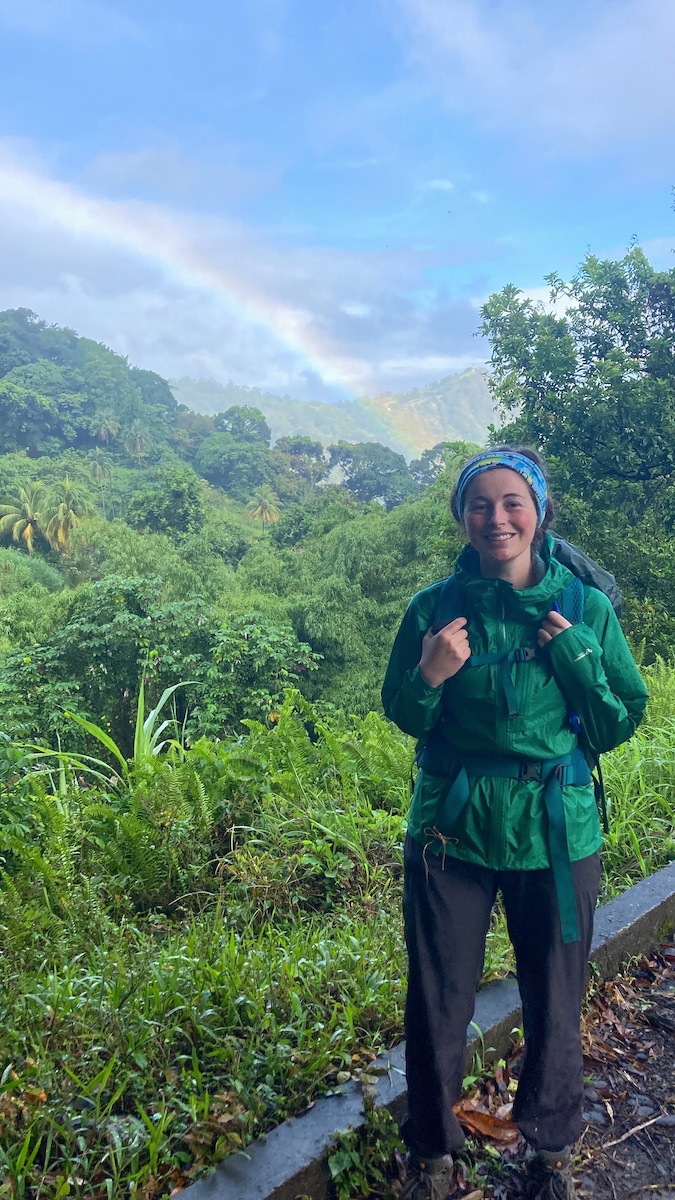
Kaitlyn Okrusch on the Coffee Trail with a rainbow in the background. (Photo by Glenroy Gaymes)
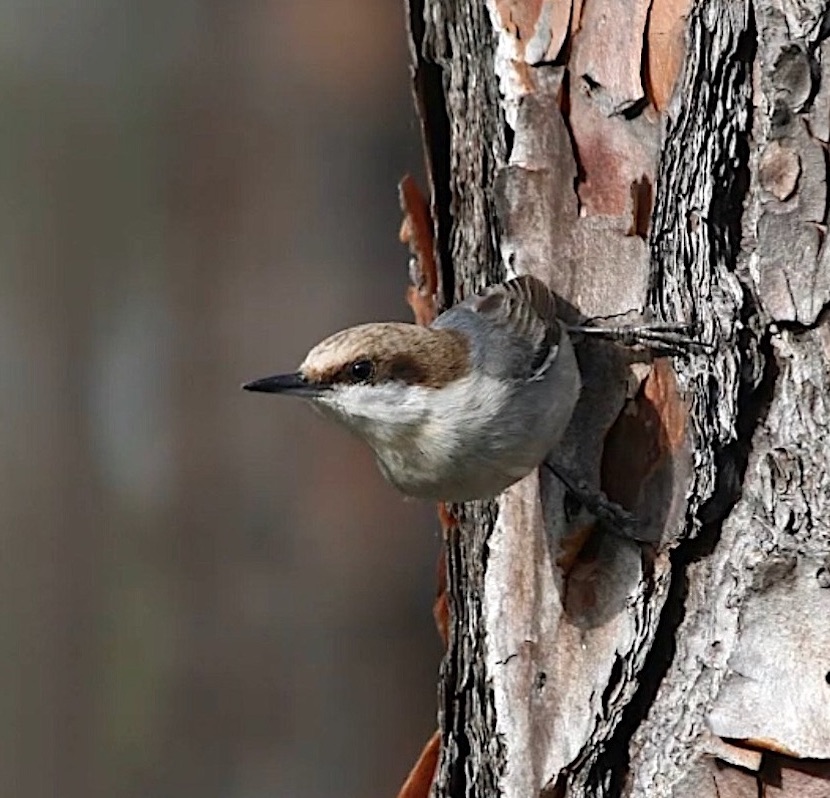
BirdsCaribbean, in partnership with Antioch University, SVGF, and others, are hoping to better understand how (and if) the Whistling Warbler and other species are recovering. Based on our knowledge of bird population resilience following catastrophic hurricanes, some species may quickly rebound to their former population sizes, while it may take years for other species to recover, and some may even become extinct. For instance, the Bahama Nuthatch, with a previously extremely small population, has not been seen since the devastating Hurricane Dorian passed through Grand Bahama island in 2019.
Next steps are to further examine the audio recordings we collected, carry out more surveys, and conduct a training workshop next winter to help build SVGF’s capacity to continue to monitor the warbler and other forest birds next year and in future years. We also plan to work together with SVGF to write a comprehensive Conservation Action Plan (CAP) which will help guide monitoring and conservation of the warbler for many years to come.
Finally, we will work with SVGF to elevate the status of the warbler in the eyes of locals—educate about this special little bird through school visits, field trips, and a media campaign. This endemic bird will hopefully become a source of pride, alongside the Saint Vincent Parrot, so that local people will join the fight to save it from extinction. It takes a village to work for the conservation of anything—especially birds—and we are excited to be partners on a fantastic project.
I keep returning to a quote from Senegalese conservationist, Baba Dioum: “In the end, we will conserve only what we love, we will love only what we understand, and we will understand only what we are taught.” Through collaboration with Vincentians and SVGF, I do believe we can better understand how this bird lives, and what this bird needs. It is, and will be, hard work. With help from Glenroy and other Forestry staff who have a wealth of knowledge and appreciation for the land and its wildlife, hopefully all Vincentians will come to know and love the Whistling Warbler as we have, and help us to conserve it and Saint Vincent’s other forest birds.
Lisa at the Silver Spoon Parrot watch lookout. (Photo by Jeff Gerbracht)
The team at work. L-R: Mike Akresh, Jeff Gerbracht, Lisa and Mike Sorenson. (Photo by Mike Sorenson)
Acknowledgments
We thank Glenroy Gaymes for working with us in the field nearly every day, generously sharing his vast knowledge of the birds, plants, and other wildlife of Saint Vincent’s forests. We are also grateful to Mr. Fitzgerald Providence, Director of Forestry, and other SVGF staff for supporting our work, including Winston “Rambo” Williams, Lenchford Nimblet, and Cornelius Lyttle. Thanks also to Lystra Culzac for sharing her knowledge about the Whistling Warbler and St Vincent’s forest birds and providing helpful advice and insights to our field work. Funding for this pilot study came from BirdsCaribbean’s Volcano Recovery Fund—thank you so much to everyone who donated to this fund and to the “emergency group” that came together to assist with funding support and recovery . We also thank Antioch University’s Institute for International Conservation for providing additional funding.
Blog by Kaitlyn Okrusch (with Lisa Sorenson, Mike Akresh, Jeff Gerbracht, & Glenroy Gaymes). Kaitlyn is a graduate student at Antioch University of New England. She is obtaining a M.S. in Environmental Studies as well as getting her 7-12 grade science teaching licensure. She has worked and volunteered for various bird organizations over the past six years – both conducting research (bird-banding, nest searching) as well as developing curriculum and educating. These most recently include University of Montana Bird Ecology Lab (UMBEL), Hawk Ridge Bird Observatory (HRBO), and Owl Research Institute (ORI). Her passion is fueled by connecting people with the wild spaces they call home – especially through birds.
Help us to continue this work!
Once again, we thank the many generous members of our community who donated to help with the recovery effort for birds in St Vincent impacted by the April 2021 explosive eruptions of La Soufrière Volcano. If you would like to donate to help with our continued work with the Forestry Department and local communities, please click here and designate “St Vincent Volcano Recovery” as the specific purpose for your donation. Thank you!
*The “emergency group” that came together to assist with funding support and recovery of the St Vincent Parrot, Whistling Warbler, and other wildlife consisted of the following organizations: BirdsCaribbean, Rare Species Conservatory Foundation, Fauna and Flora International, Caribaea Initiative, Houston Zoo, Grenada Dove Conservation Programme, UNDP Reef to Ridge Project, Houston Zoo, IWECo Project St. Vincent and the Grenadines, and the Farallon Islands Foundation. We thank our amazing local partners SCIENCE Initiative, the St. Vincent & the Grenadines Environment Fund, and the Forestry Department for your support and hard work.
Gallery
Antillean Crested Hummingbird. (Photo by Kaitlyn Okrusch)
Lobster Claw Heliconia (Heliconia bihai). (Photo by Lisa Sorenson)
Fenton Falls Trailhead. (Photo by Lisa Sorenson)
Cattle Egret coming in for a landing. (Photo by Kaitlyn Okrusch)
Jeff Gerbracht walking on Montreal Trail towards the mountains with a boom mic. (Photo by Lisa Sorenson)
La Soufriere in the clouds on the east side of the island. (Photo by Kaitlyn Okrusch)
Common Black Hawk in the Calabash mangroves. (Photo by Kaitlyn Okrusch)
Lisa and Mike at Fenton Falls. (Photo by Mike Akresh)
Purple-Throated Carib on the Silver Spoon Trail. (Photo by Kaitlyn Okrusch)
Two-year old Maeson Gaymes (incredible little hiker!) on the La Soufriere Trail for Global Big Day 2022 in St Vincent. (Photo by Lisa Sorenson)
Mangroves down by the ocean in Kingstown. (Photo by Kaitlyn Okrusch)
St Vincent Hairstreak (Pseudolycaena cybele), also called Marsyus Hairstreak, St Vincent endemic butterfly, rests on a flower. (Photo by Mike Akresh)
Freshly picked Guava on the coffee trail. (Photo by Kaitlyn Okrusch)
Old Trinity Road on the west side of the island, near the volcano. (Photo by Kaitlyn Okrusch)
Purple-Throated Carib nest found by Jeff, Lisa and Mike S. on Montreal. (Photo by Lisa Sorenson)
Scaly-breasted Thrasher sits on a branch. (Photo by Kaitlyn Okrusch)
Saint Vincent Bush Anole Anolis trinitatis). (Photo by Mike Akresh)
St. Vincent Whistling Frog (Pristimantis shrevei, IUCN endangered) in Glenroy Gaymes’ hands. (Photo by Mike Akresh)
Plumrose or Water Apple flowers found on the Coffee Trail. (Photo by Kaitlyn Okrusch)
White Peacock Butterfly (Anartia jatrophae) (Photo by Mike Akresh)
Lystra Culzac and Lisa Sorenson – mango sisters reunited! Lystra generously shared her knowledge about St Vincent’s forest birds and provided excellent advice for our field work. (photo by Mike Sorenson)
Lovely pastoral scene, nursing calf in Montreal. (photo by Lisa Sorenson)
Warbler and Parrot Crews at Silver Spoon Trail. (Photo by Glenroy Gaymes)
Acomat Boucan (Sloanea-caribaea) – Large tree with buttress roots in the forest. (photo by Lisa Sorenson)
Gommier (Dacryodes excelsa) dominant large tree in St Vincent. (photo by Lisa Sorenson)
When the world seemed to stop at the behest of the pandemic, forcing most of us to remain at home, our BirdsCaribbean community kept going — birding, monitoring, and sharing our stories from safe spaces in our neighborhoods, community parks, and backyards.
Nearly three years and countless virtual meetings later, the anticipation of an in-person reunion was palpable. In partnership with the American Ornithological Society (AOS), and with invaluable support from local partners Para La Naturaleza and Sociedad Ornitológica Puertorriqueña, Inc. (SOPI), we successfully hosted our biggest conference to date — AOS & BC 2022— welcoming over 800 wildlife professionals from 34 countries to the tropical shores of Puerto Rico from June 27-July 2, 2022.
The conference, held under the theme “On the Wings of Recovery: Resilience and Action”, was a true celebration of the perseverance of our community featuring 146 poster presentations, 143 oral presentations across 14 symposia, 280 contributed papers, 8 roundtable discussions, and 93 student presentations.
Keynote speakers Dr. Howard P. Nelson, professor and wildlife biologist from Trinidad and Tobago and professor of conservation leadership at Fauna & Flora International, and Dr. Herbert Raffaele, retired chief of the U.S. Fish and Wildlife Service’s Division of International Conservation, spoke to the importance of resilience and action as the Caribbean region faces the conservation challenges of the future. Speaking to packed auditoriums at the Convention Center in San Juan, Dr. Nelson addressed “Island Futures: Pathways to Resilient Conservation of Caribbean Birds,” and Dr. Raffaele outlined “Saving Our World’s Birds: A Plan for the Future.”
Plenary speaker, Dr. Kristen Camille Ruegg gave a fascinating talk on: “The Bird Genoscape Project — Unlocking the Secrets of Bird Migration Using DNA in the Tip of a Feather.” And Dr. Purnima Devi Barman received a standing ovation for her inspiring presentation to save the Greater Adjutant Stork, locally known as the Hargila: “The Rewilding Revolution: Using the Magic of Community Action to Save the Hargila,.
“Our international conferences are always special because they give members of our diverse community a chance to meet, network, and learn about cutting-edge research and conservation solutions,” commented Executive Director, Dr. Lisa Sorenson. “This year was exceptional because the pandemic added a new layer of complexity to our work and our plans for the future. Partnering with the AOS allowed us a unique opportunity to widen our network of enthusiastic conservationists. The high level of participation and engagement over these five days of learning in Puerto Rico augurs well for the future of the Caribbean region and the safeguarding of its natural resources, particularly its birds and their habitats.”
BirdsCaribbean Highlights at the Conference
Workshops
BirdSleuth Caribbean: Connecting Youth to Nature and Science through Birds
Birds are an engaging and fun way to get youth interested in nature, science, and inquiry-based learning. The BirdSleuth Caribbean Workshop sought to inspire participants to consider ways they, and their organizations, might support teachers and youth through educational programs in school as well as in camps and afterschool programs.Facilitated by Jennifer Fee, Cornell Lab of Ornithology, and Dr. Lisa Sorenson, BirdsCaribbean, the full-day workshop reviewed the innovative BirdSleuth Caribbean curriculum — a resource that engages kids in scientific study through fun activities, games, and real data collection through the eBird citizen-science project.
BirdSleuth Caribbean Workshop group photo.
Participants learn the basics of bird identification. (Photo by Lisa Sorenson)
BirdSleuth Workshop participants identify birds outdoors. (Photo by Lisa Sorenson)
Ingrid shows off her drawing. (Photo by Lisa Sorenson)
Participants sketch birds at the BirdSleuth workshop. (Photo by Lisa Sorenson)
Raptors of the Caribbean: Education and Conservation Resources
This highly-anticipated workshop focused on teaching participants about raptors, one of the most threatened bird groups in the world. Globally, we recognize there to be a basic lack of knowledge about raptors, as well as a lot of misinformation about birds of prey in general. Although raptors in the Caribbean are suffering population declines, they often remain excluded from environmental education guides and outreach programs.
Through the use of a brand new, hot-off-the-press resource, Environmental Education Guide: Raptors of the Caribbean, workshop facilitators Marta Curti and Gabriela Diaz from The Peregrine Fund engaged participants in dynamic, hands-on activities, and group work to better understand the importance raptors play in the ecosystems where they live. These activities helped participants gain practice and increase their confidence in teaching others about birds of prey using/adapting the materials and activities presented in the education guide.
Participants in the Raptors of the Caribbean Workshop show off their bird of prey, made from recycled materials.
The Power of Film and Video to Drive Conservation Impact
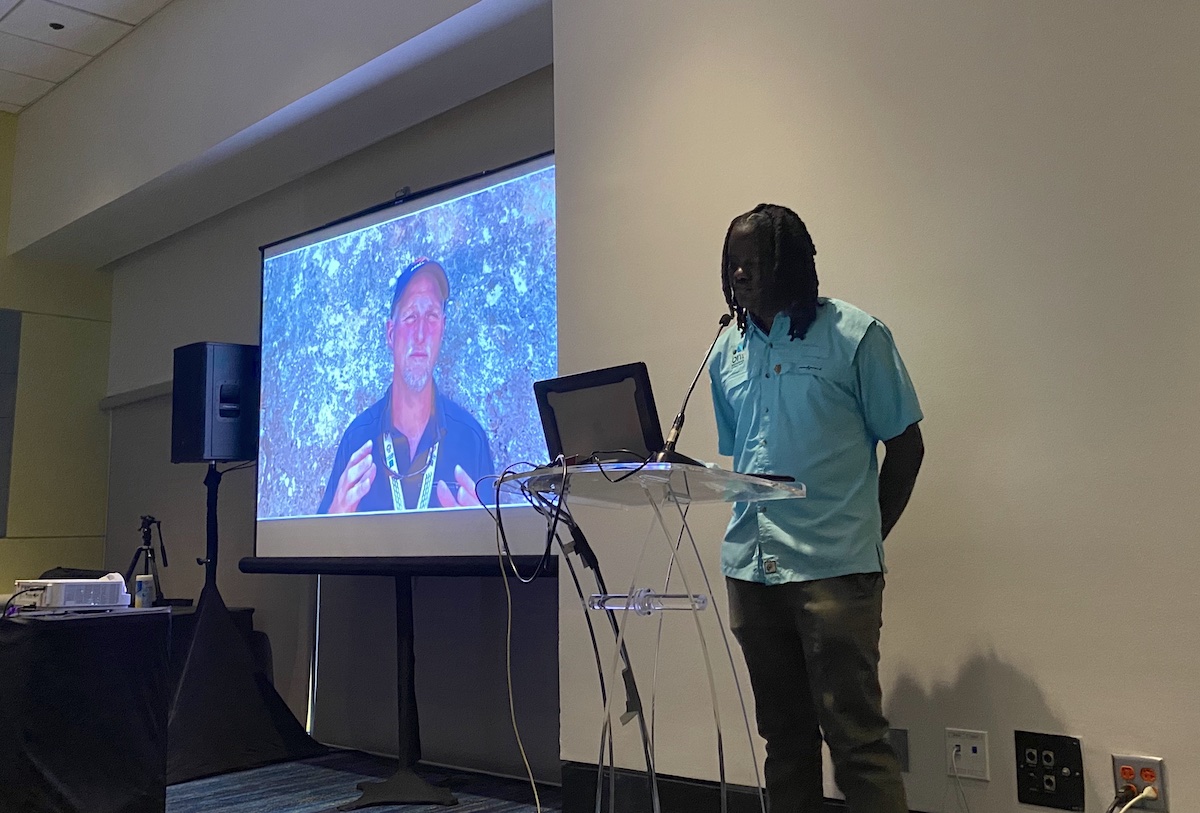
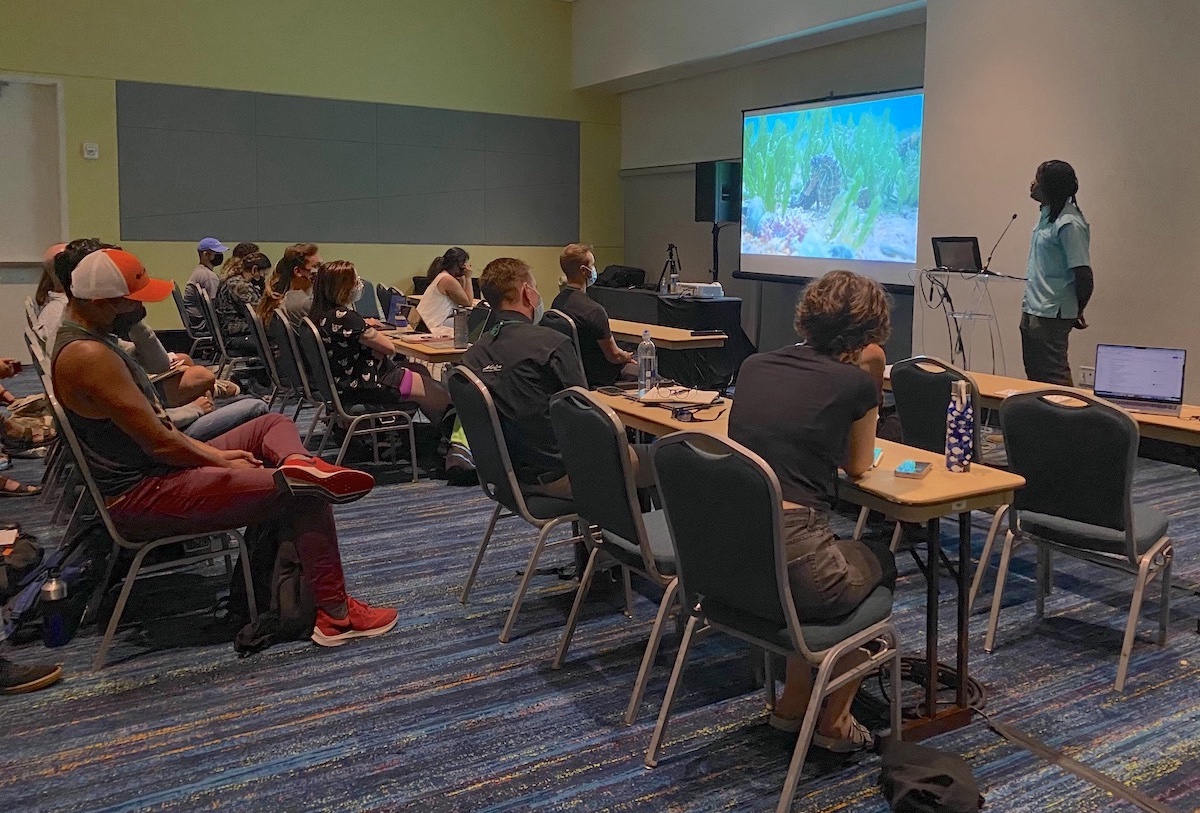
In the age of social media, and faced with the phenomenon of rapidly declining attention spans, the importance of video as a tool for storytelling cannot be underestimated. New research shows that 83% of people prefer watching videos as a means to learn vs. reading text. In this workshop, Elijah Sands, Senior Communications Officer at the Bahamas National Trust, with support from Tahira Carter, Communications Manager at BirdsCaribbean, engaged participants on the use of the most dynamic form of digital communication — video — to inspire change and drive impact.
Inspirational message recorded especially for the group by Paul Nicklen, acclaimed Canadian photographer, film-maker, author and marine biologist. (Photo by Tahira Carter)
Workshop Facilitator, Elijah Sands, from the Bahamas National Trust, uses videos from his portfolio to explain key concepts to the group. (Photo by Tahira Carter)
Caribbean Landbird Monitoring Training Workshop
This workshop was held as part of BirdsCaribbean’s Landbird Monitoring Project, which seeks to inspire and facilitate landbird monitoring and conservation efforts in the Caribbean — including raising public awareness, alleviating threats, and managing and restoring habitats. Through a blend of classroom and field-based activities, workshop facilitators Jeff Gerbracht (Cornell Lab of Ornithology), Maya Wilson (BirdsCaribbean), Ingrid Molina (Our Coffee Our Birds), Holly Garrod (BirdsCaribbean), Coral Aviles (San Juan Bay Estuary Program), and Alcides Morales and Omar Monzon (Para La Naturaleza) introduced participants to landbird identification, monitoring techniques, and eBird data entry. The group practiced bird ID and counting techniques at Hacienda La Esperanza Nature Reserve and Cambalache State Forest. Participants will join a regional network of people involved in standardized monitoring and conservation of landbirds in the Caribbean.
Participants in the Landbird Monitoring Workshop look for birds in the forest. (Photo by Holly Garrod)
Puerto Rican Emerald. (Photo by Holly Garrod)
Participants in the Landbird Monitoring Workshop engage in classroom sessions before going out into the field. (Photo by Holly Garrod)
Puerto Rican Woodpecker. (Photo by Holly Garrod)
Participants in the Landbird Monitoring Workshop engage in classroom sessions before going out into the field. (Photo by Holly Garrod)
Symposia
Puerto Rico Day: Bird Diversity and Conservation in the “Island of Enchantment”
As traditionally done by BirdsCaribbean, the first day of the conference launched with presentations of local ornithological work. This symposium consisted of two sessions with 11 presentations that included research, conservation, and education conducted by biologists representing different agencies and organizations. In the opening talk, Adrianne Tossas summarized the status and distribution of the avifauna throughout the island, emphasizing threats and current advances in habitat and species protection. Team efforts by the PR Department of Natural and Environmental Resources (PR DNER) and US Fish and Wildlife to save the charismatic and Endangered Puerto Rican Parrot were presented by Tanya Martínez and Thomas White, respectively. Also from PR DNER, Katsí Ramos spoke about the accomplishments of the Endangered Yellow-shouldered Blackbird Recovery Program, and Ingrid Flores focused on the agency’s numerous activities to increase local awareness on biodiversity conservation.
Joseph Wunderle from the USDA Forest Service, gave an overview of the increasing challenges bird populations face from climate change, as revealed from population responses to severe hurricanes across the region in recent years. University of Mississippi biologist, Francisco Vilella, summarized his contribution to the knowledge of the biology of the Puerto Rico Nightjar and raptor species. Marconi Campos, Rainforest Connection, shared recent collaborative work in bird conservation with technological advances that allow remote acoustic sampling of birds in over 600 sites in the island. Hana Weaver gave an update on The Peregrine Fund’s efforts to improve the reproductive rates of the Endangered Puerto Rican Sharp-shinned Hawk, while Laura Fidalgo talked about the contribution of members in bird monitoring programs of the Sociedad Ornitológica Puertorriqueña. Finally, Omar Monzón, from Para La Naturaleza, emphasized on the organization’s role in the protection of private lands and the engagement of volunteers in citizen science.
Francisco Vilella
Hana Weaver
Ingrid Flores
Joseph Wunderle
Katsí Ramos
Laura Fidalgo
Marconi Campos
Thomas White
Tanya Martínez
Omar Monzón
Shorebirds of the Atlantic Flyway:How Recent Work to Conserve Wetlands is Contributing to Species and Habitat Resilience in the Caribbean and Beyond
With 15 fantastic talks across three sessions this symposium moved from highlighting the importance of Caribbean and Atlantic Fly wetlands for migrating shorebirds, to the threats shorebirds and wetlands face, and on to the exciting outreach and restoration work. Presenters from 13 different countries shared their recent work and experiences. During the symposium, participants heard how the Caribbean Waterbird Census can highlight where the important places for shorebirds are and the threats they face; data from 12 years of the CWC were presented. We also learned about development that is having devastating impacts on Caribbean wetlands and mangroves, and ongoing battles to halt the destruction. But there were also inspiring stories of hope and community engagement, showing how outreach and education can inspire people to love shorebirds and value their wetlands. Even when all seems lost we learned that wetlands can be restored and created to provide havens for shorebirds, other wildlife and people to enjoy. It was clear that shorebird and wetland conservation in the Caribbean and throughout the Atlantic Flyway is full of challenges. However, working together with local communities we can help protect these beautiful birds and their valuable habitats.
Some of the presenters and organizers of the Shorebirds Symposia, from left to right: Benoit Laliberte, Juliana Almeida, Maxon Fildor, Alex Sansom, Elio Dortilus, Lisa Sorenson, Debra Baker, Ajhermae White, Elijah Sands, Devon Carter (photo by Chris Johnson)
Planning for Resiliency of Caribbean Island Endemics – Strategies for Post-2020 recovery
This symposium included two sessions with fantastic talks from 11 speakers covering the conservation perspectives on island endemics from across the Caribbean islands from The Bahamas, Puerto Rico, Hispaniola, the Cayman Islands, and Jamaica in the north to Saint Lucia and Trinidad in the south. The symposium provided an opportunity for conservation practitioners to reflect on the status of the endemics on their islands, share insights on recovery patterns after disturbance, and reflect on the implications of the current post-2020 discussions at the Convention on Biological Diversity for the conservation of birds on their islands. Clear themes from these two sessions included the need for realistic targets, much greater financial and technical support for species management interventions, and sustained efforts on practices that are having an impact.
Seabirds in Peril: How Recent Knowledge is Contributing to Conservation Priorities and Species Resilience in the Face of Environmental Change
Organized by BirdsCaribbean’s Seabird Working Group, the seabird symposium included 14 presentations spread out throughout the whole day. Speakers presented exciting studies from North America to Antarctica, by way of the Caribbean. The day started with a heartfelt call for active restoration of imperiled seabirds globally. Following speakers shared tools to better assess the health of seabird populations, from survey methods using drones (in Puerto Rico) to cutting-edge artificial intelligence to analyze drone and airplane imagery, and from tracking studies of Caribbean seabirds to studies of links between oceanographic features, forage fish and seabirds in the western North Atlantic. participants closely listened when speakers shared about the importance of long-term studies on land (in Jamaica and Antarctica) and at sea (in Gulf Stream waters off the U.S. coast) to assess changes in seabird populations. Finally, conservationists shared inspiring conservation projects, from assessing the presence of predators in the Grenadines to addressing issues of plastic pollution in the Gulf of Maine, and about restoration success stories in Anguilla and Puerto Rico.
The Caribbean Seabird Working Group (with members representing Puerto Rico, Jamaica, the Dominican Republic, the U.S. and British Virgin Islands, Anguilla, Montserrat, the Grenadines, Bonaire, and Curaçao) was able to use gaps in the schedule to discuss its push for a region-wide Seabird Census in 2023.
Working Group Meetings
Endemics and Threatened Species Working Group (ETSWG)
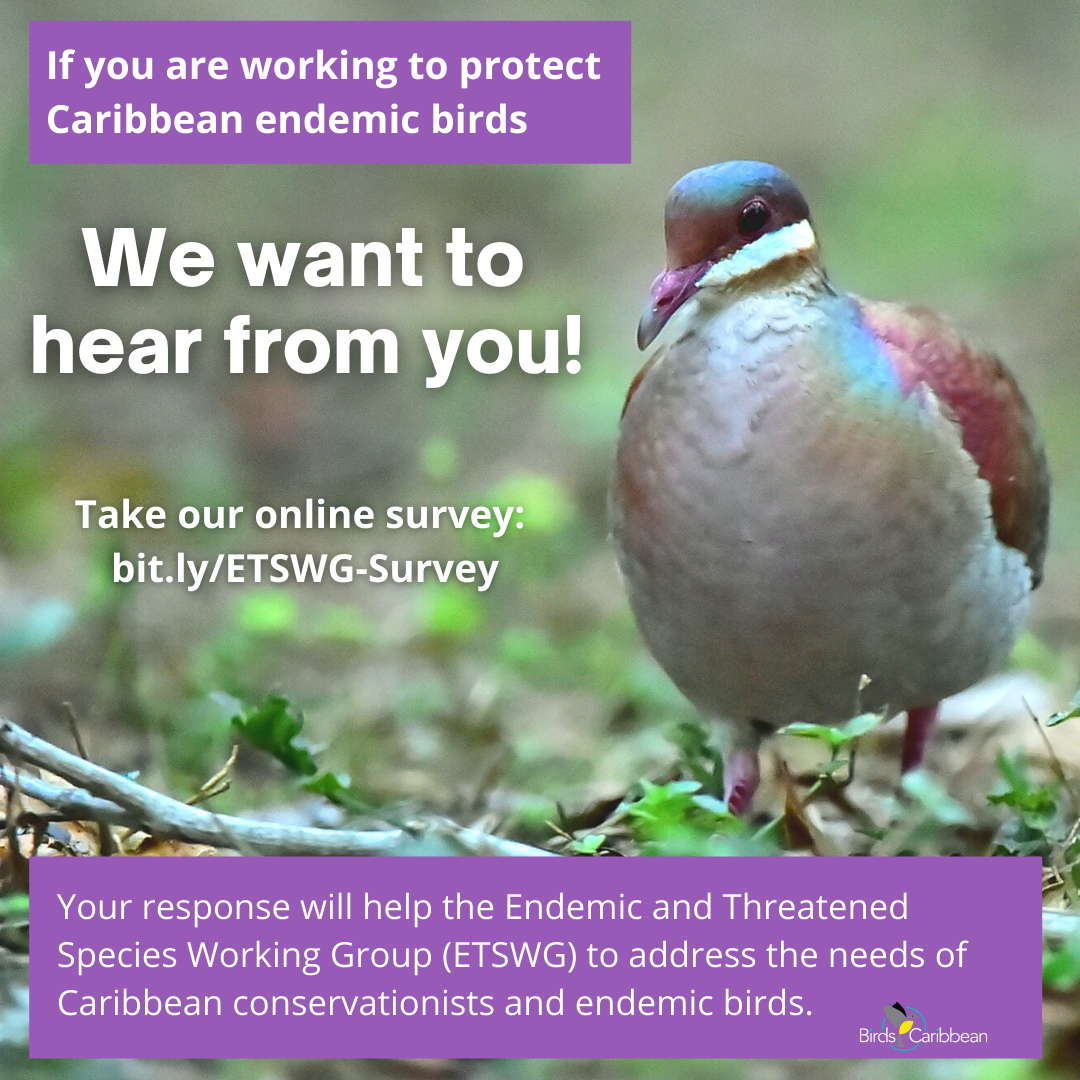
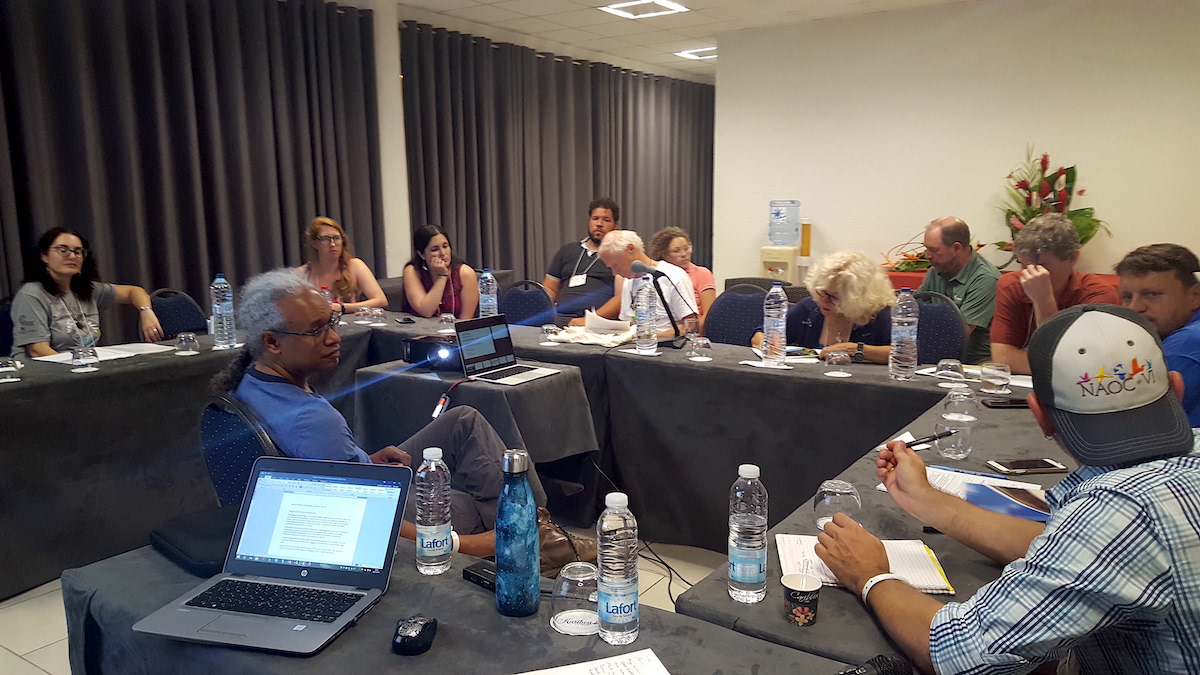
The BirdsCaribbean ETSWG meeting was attended by 15 members. The meeting reviewed the outcomes of the needs assessment survey prepared by the 2 co-chairs (Ellie Devenish-Nelson & Howard Nelson). Members were also briefed on the status of the Alliance for Zero Extinction by the participants from the American Bird Conservancy (Amy Upgren, Dan Lebbin, Dave Ewert). The participants also discussed key issues for the group including broadening participation across the islands in the working group, data management, funding, and key projects that the various members were working on including monitoring efforts on endemic and threatened species in their countries. The group reviewed the chairmanship and there was unanimity that the current co-chairs would continue to chair the group until the next BirdsCaribbean conference. The Chairs also discussed the development of group activities in the intervening year, and agreed to improve its presence on the BC website and the frequency of members contribution to a working group blog.
Bird Education & Festivals Working Group and Educators’ Awards
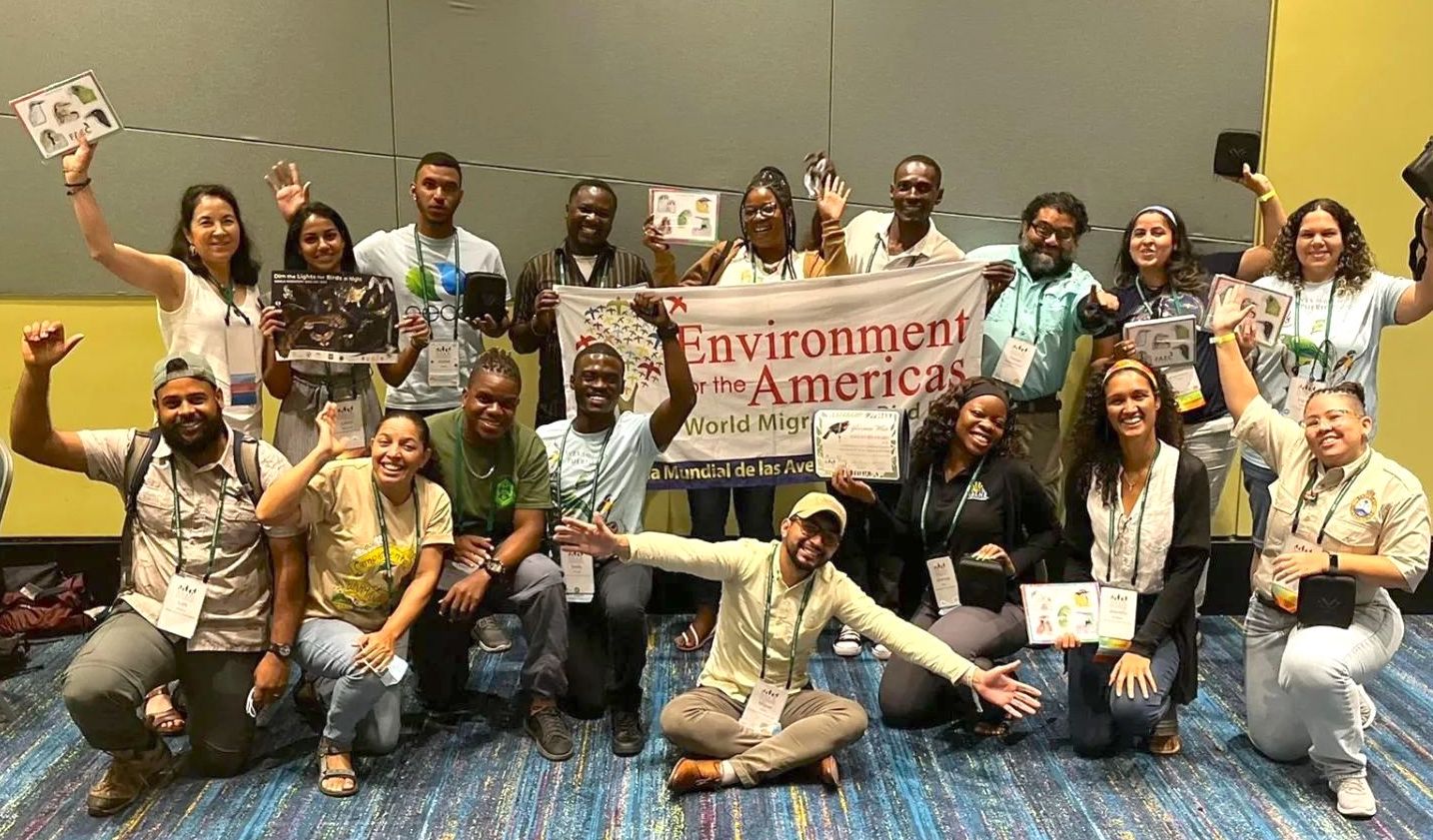
Caribbean Bird Educators reconnected and discussed the themes and activities for this year’s World Migratory Bird Day and Caribbean Endemic Bird Festival. WMBD Coordinators, Laura Baboolal and Miguel Matta, gave a brief overview and handed out Happy Kits to all educators—a wonderful set of materials to educate about this year’s theme—Dim the Lights for Birds at Night. Participants also received a fabulous set of nine different sticker sheets featuring the artwork of talented artist, Josmar Esteban Marquez. The stickers include a variety of Caribbean birds (endemics, residents, waterbirds, shorebirds, migrants, etc.) to use in the next Caribbean Endemic Bird Festival and other bird education activities. Thanks to Daniel Serva for his incredible efforts to carry two heavy suitcases on a long journey from Venezuela to Puerto Rico – he shared the incredible tale of his journey that included a harrowing 6 hour interrogation by US Customs when he arrived in San Juan, who were convinced that Daniel was transporting drugs on the stickers!
Educators group photo at the Bird Education-Bird Festivals Working Group Meeting at the conference.
A highlight of the meeting were the awards given to ten different educators who did a fantastic job celebrating WMBD and/or CEBF in the last two years, consistently organizing creative and fun activities for youth and local communities, and also sending in their reports and photos. All recipients received binoculars and a certificate of recognition. Educators’ Awards went to Shanna Challenger (Environmental Awareness Group, Antigua and Barbuda), Maria Paulino (Grupo Acción Ecológica, Dominican Republic), Josmar Esteban Márquez (AveZona) Inés Lourdes Fernández (La Empresa Flora y Fauna Santiago, Cuba), Ingrid Flores (DRNA, Puerto Rico), Carla Montalvo (Roots and Shoots, Puerto Rico), Ajhermae White (Dept of Environment, Montserrat), Monika Gomez (DR), Natalya Lawrence (Antigua and Barbuda), Shirley Droz (post-humous award, Puerto Rico), and Marisa Awai (Bahamas). Congratulations to all the winners!
Laura Baboolal and Lisa Sorenson presenting an Educators’ Award to Carla Montalvo (Puerto Rico). (photo by Daniel Serva)
Laura Baboolal presenting an Educators’ Award to Giselle Dean for Marisa Awai (Bahamas). (photo by Lisa Sorenson)
Laura Baboolal, Miguel Matta, Carla Montalvo, Sheylda Díaz-Méndez, and Lisa Sorenson. (photo by Daniel Serva)
Laura Baboolal and Lisa Sorenson presenting an Educators’ Award to Maria Paulino (Dominican Republic). (photo by Daniel Serva)
Laura Baboolal presenting a posthumous Educators’ Award to Carla for Shirley Droz(Puerto Rico). (photo by Lisa Sorenson)
Laura Baboolal presenting an Educators’ Award to Joshel Wilson for Natalya Lawrence (Antigua). (photo by Lisa Sorenson)
Daniel Serva telling the harrowing story of his journey bringing the stickers to Puerto Rico (photo by Lisa Sorenson)
Laura Baboolal and Lisa Sorenson presenting an Educators’ Award to Shanna Challenger (Antigua). (photo by Daniel Serva)
Laura Baboolal and Lisa Sorenson presenting an Educators’ Award to Daniel Serva for Josmar Esteban Marquez (Venezuela). (photo by Daniel Serva)
Laura Baboolal and Lisa Sorenson presenting an Educators’ Award to Ajhermae White (Montserrat). (photo by Daniel Serva)
Laura Baboolal and Lisa Sorenson presenting an Educators’ Award to Ingrid Flores (Puerto Rico). (photo by Daniel Serva)
Roundtables
Action Learning for Building Resiliency in Island Endemic Species Recovery
The roundtable on species recovery used an action learning approach to deliver on a specific need identified by the Endemics and Threatened Species Working Group’s needs assessment survey – more training on species recovery. The session consisted of two segments, the first enabled the 20 participants to learn from three guest speakers from The Bahamas, the Dominican Republic, and Antigua and Barbuda, who shared their experiences undertaking species recovery actions on their islands. The second part of the round-table permitted all participants to interact directly with the speakers and each other in small working groups, which enabled workshopping the challenges each participant was experiencing with species recovery on their respective islands. Feedback from the participants suggested that the workshop provided an excellent forum for learning from each other’s professional experiences as well as improving the informal networks between species recovery practitioners.
The Journal of Caribbean Ornithology (JCO) at 34—an Open Discussion on How our Regional Journal can Best Meet your Needs
The JCO editorial team at the conference. From left: Editor-in-Chief Joe Wunderle, Lead Copy Editor Zoya Buckmire, Managing Editor Stefan Gleissberg, Development Editor Natasha Atkins, Review Editor Jen Mortensen, and BC Vice President Justin Proctor.
The JCO–BirdsCaribbean’s peer reviewed scientific journal–welcomed fellow editors, authors, and other conference participants for a brainstorming session about the role of our journal in the Caribbean research and conservation communities. Managing Editor Dr. Stefan Gleissberg opened up the discussion with an overview, and Editor-in-Chief Dr. Joe Wunderle was available throughout to answer questions. JCO occupies a rather unique niche serving a biodiverse region which at the same time is also culturally and politically diverse. To limit access barriers to critical information on Caribbean birds, JCO publishes in three languages, provides immediate open access, keeps a comprehensive online archive, and has only modest publication charges. A vital point of the journal’s work is to assist early-career and first-time authors, and those who’s research is not conducted with the support system of an academic institution, in order to achieve the highest-possible impact of their work. Roundtable participants contributed valuable ideas. Conversation points included ethical and permit compliance, and how these vary widely among islands and territories. Following a request by a participant, JCO now explores how abstracts from the conference can be published in the journal, increasing visibility.
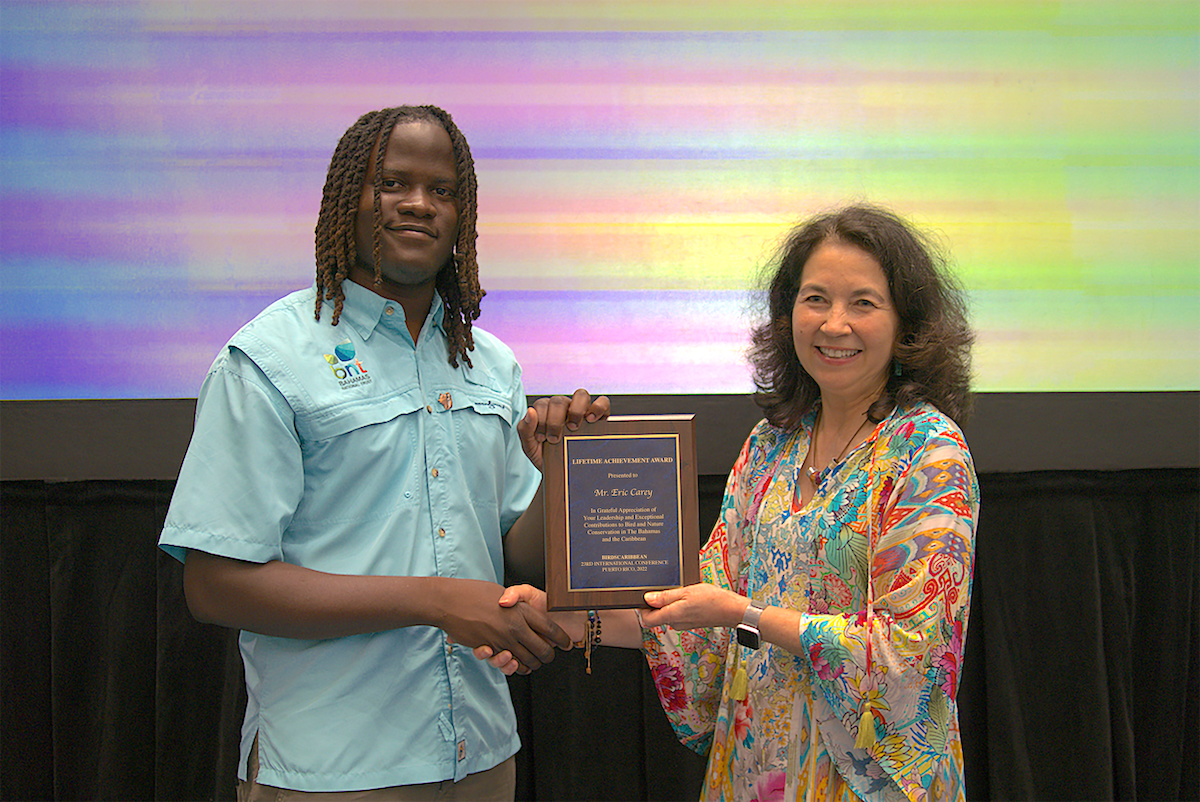
The most prestigious award — The Lifetime Achievement Award — went to two conservation stalwarts (1) Dr. John Faaborg, Emeritus Professor, University of Missouri and (2) Mr. Eric Carey, Executive Director, Bahamas National Trust and Past President of BirdsCaribbean. This award honors individuals who have helped change the future of Caribbean birds and their habitats for the better through a lifetime of work and dedication.
Elijah Sands accepts the BirdsCaribbean Lifetime Achievement Award on behalf of Mr. Eric Carey, Bahamas National Trust.
Eight individuals, representing three organizations – U.S. Fish and Wildlife Service’s Puerto Rican Parrot Recovery Program, Terrestrial Ecology Division,Puerto Rico’s Department of Natural and Environmental Resources; and Sociedad Ornitológica Puertorriqueña, Inc. (SOPI)– were hand selected by our President Dr Adrianne Tossas for the President’s Award. In choosing recipients several things are considered, particularly their ability to adapt in challenging times and master their skills ultimately raising the bar of service in conservation. This year’s Founders’ Award recipient was Julissa Irizarry from Puerto Rico, for her outstanding paper entitled Evaluating avian biodiversity in Puerto Rico’s urban neighborhoods: A test of the “luxury effect”. And finally Russell Campbell received the Video Workshop Award for showing the most initiative in the field following the training session at the conference. Read all the details and award citations here.
Recipients of the BirdsCaribbean President’s Award: Ricardo López-Ortiz, Katsí R. Ramos-Álvarez, and Roseanne Medina from the Terrestrial Ecology Division of Puerto Rico’s Department of Natural and Environmental Resources.
Elijah Sands accepts Lifetime Achievement Award from Executive Director Dr Lisa Sorenson on behalf of Emma Lewis.
Ex-President of the Sociedad Ornitológica Puertorriqueña, Inc. (SOPI), Gabriel Lugo, receives the BirdsCaribbean President’s Award on behalf of SOPI President, Laura Fidalgo, and Executive Director Emilio Font.
BirdsCaribbean President Dr Adrianne Tossas and Executive Director Dr Lisa Sorenson with BirdsCaribbean President’s Award recipient Tanya Martinez of the Terrestrial Ecology Division in Puerto Rico’s Department of Natural and Environmental Resources.
Recipients of the BirdsCaribbean President’s Award, 2022, for their work in the conservation of the Puerto Rican Parrot and the Yellow-shouldered Blackbird.
Silent Auction
The Silent Auction is an important fundraising activity and always a fun event at BirdsCaribbean conferences. Among the many items donated by our members for auction this year was the once-in-a-lifetime experience to zipline with BirdsCaribbean Executive Director Dr Lisa Sorenson! It is worth mentioning that Lisa wasn’t even aware this item was up for bid until too late, but seized the moment and fulfilled her ziplining duties in great form for the birds!A huge thank you to our members who donated a record-breaking 600 items for auction this year, helping us to raise US$6,000! All proceeds from the auction support our ongoing conservation efforts and provide much-needed travel scholarships to help Caribbean wildlife students and professionals attend our meetings.
Dr Howard Nelson and Ellie Nelson consider which books they’d like to bid on. (Photo by Holly Garrod)
Bidding at the Silent Auction. (Photo by Holly Garrod)
Silent Auction organizer, Jennifer Wheeler, announces the start of the event with the traditional blowing of the conch shell. (Photo by Tahira Carter)
The excitement builds as the bidding comes to a close. (Photo by Adrianne Tossas)
Lisa finds out that she is the feature of a surprise auction item – a zipline experience! (Photo by Tahira Carter)
Tody Trot
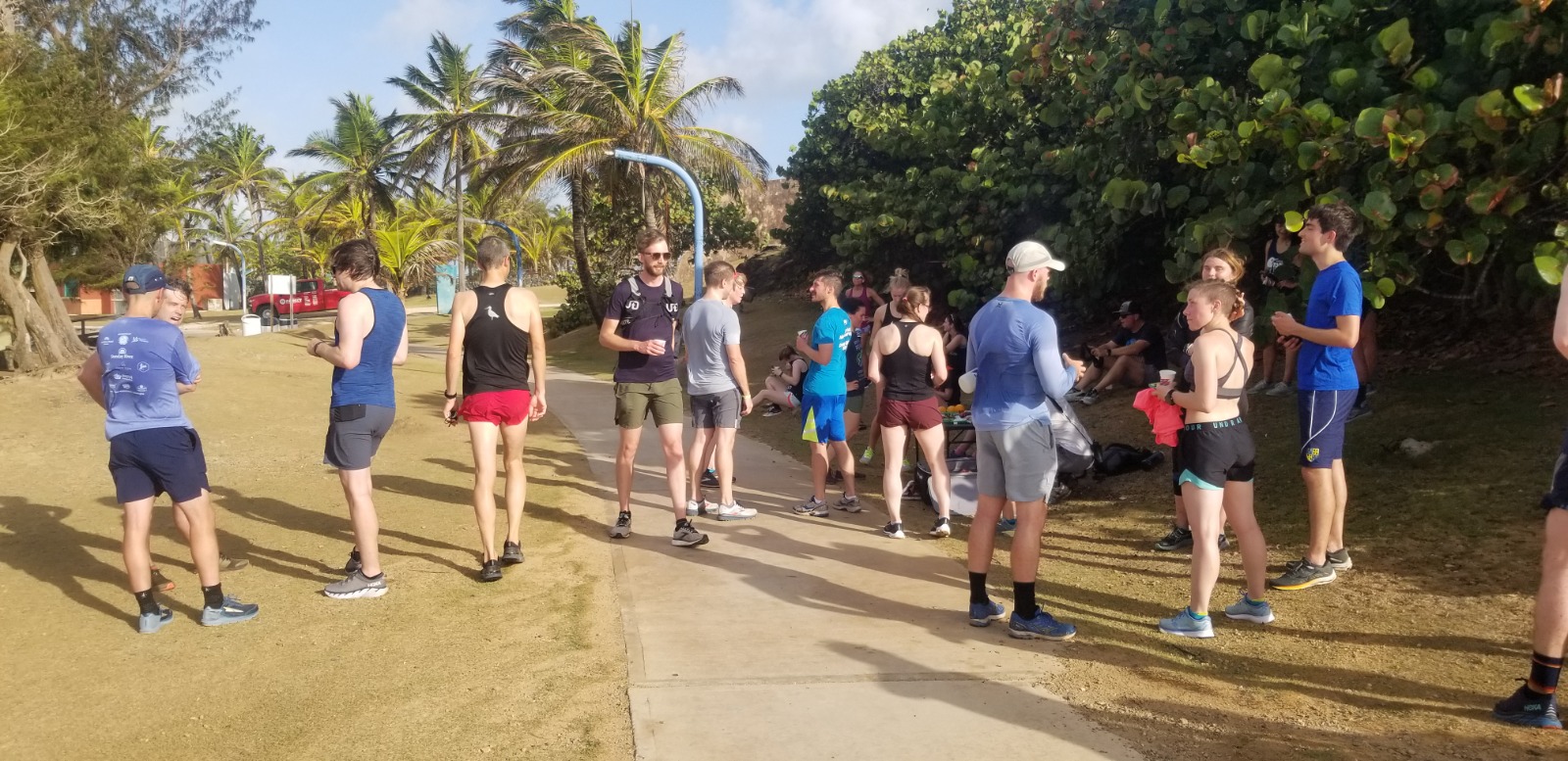
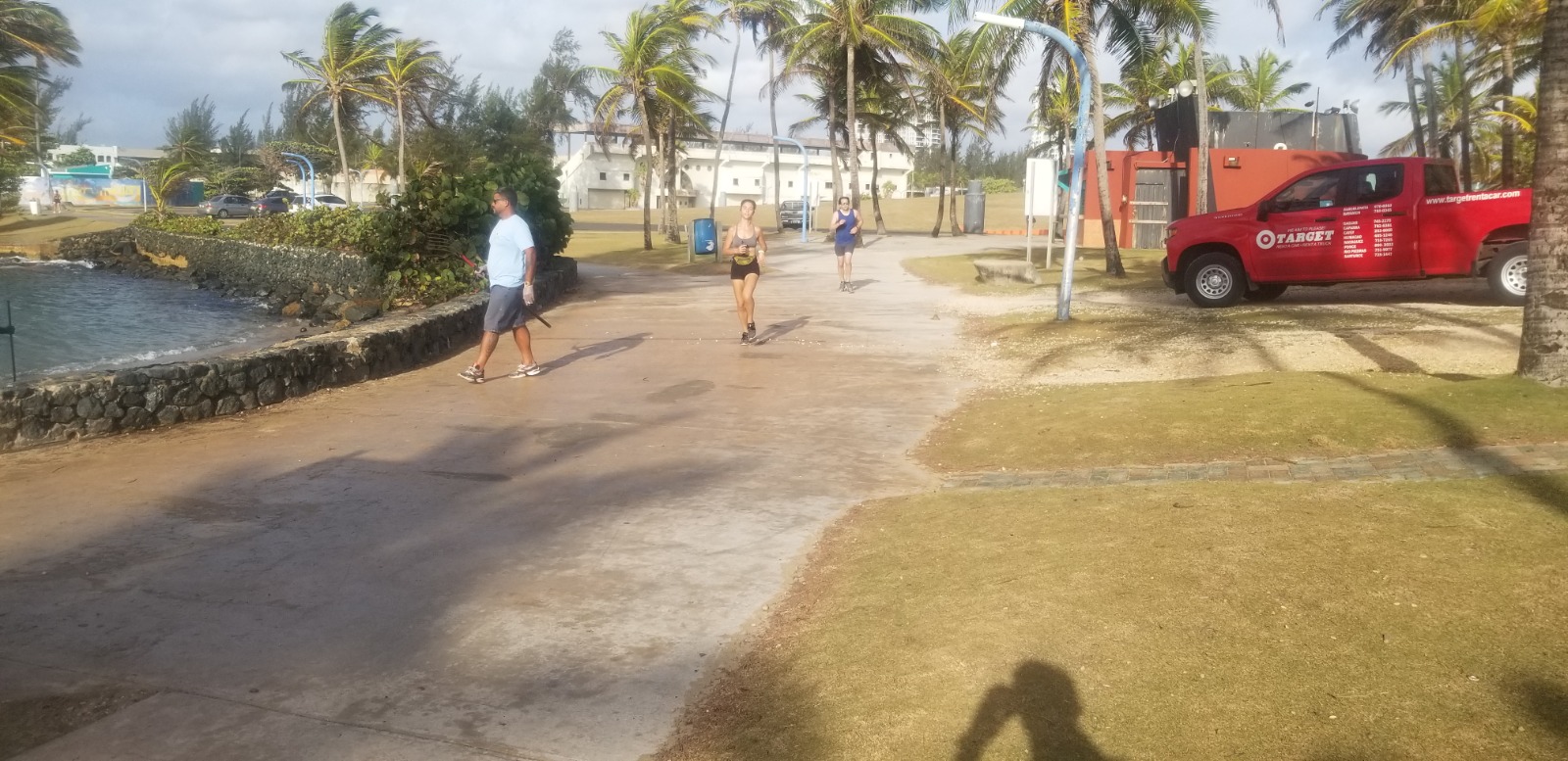
This year’s 5k Fun Run, the Tody Trot, was named in honor of one of Puerto Rico’s most fascinating endemic bird species, the Puerto Rican Tody. 5k organizers, Maggie MacPherson and Justin Proctor, were excited to welcome 75 runners and walkers to the starting line. The course took participants along sandy beaches, beautiful ocean views, and even a castle, finishing in style on a rocky peninsula with waves crashing all around.
Tody Trot participants socialize after the race.
Tody Trot participants on the course.
Merchandise
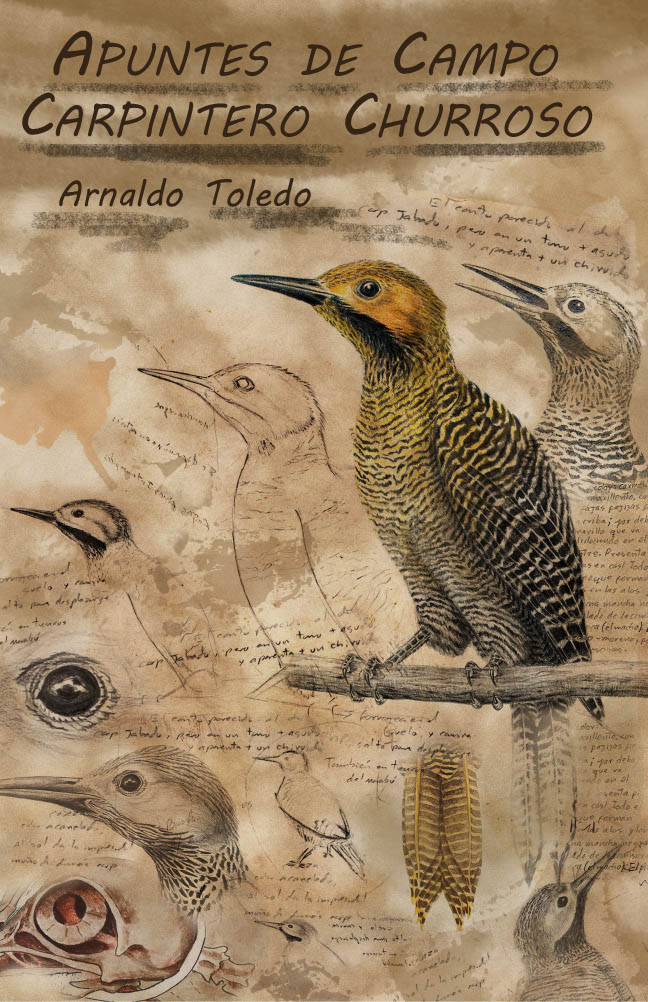
This year, we partnered with award-winning biological illustrator, Arnaldo Toledo, and past president of Sociedad Ornitológica Puertorriqueña Inc. and Tour Operator for Wildside Nature Tours, Gabriel Lugo, to create a series of eye-catching designs! Arnaldo and Gabriel combined art, birds, and fashion to bring attention to Puerto Rico’s iconic bird species and the threats they face. The AOS-BC Conference collection included t-shirts, hats, buffs, stickers, and a poster that all featured the gorgeous illustrations of talented Cuban artist Arnaldo Toledo. These items and many others, such as local bird-friendly coffee and field guides from Puerto Rico and the West Indies, make great souvenirs from the conference and unique gifts for family and friends! Limited merchandise items from the conference are still available for purchase in Puerto Rico, please contact the Sociedad Ornitológica Puertorriqueña Inc. for more information (Gabriel Lugo and Emilio Font)
Endemic Birds of Puerto Rico T-shirt, AOS-BC Conference Merchandise.
Endemic Birds of Puerto Rico Hats, AOS-BC Conference Merchandise.
Tody Buff, AOS-BC Conference Merchandise.
Endemic Birds of Puerto Rico Poster, AOS-BC Conference Merchandise
Field Guides & Books on Puerto Rico and the West Indies by Dr Herbert Raffaele and Mark Oberle.
Endemic Birds of Puerto Rico Stickers, AOS-BC Conference Merchandise
Raffle
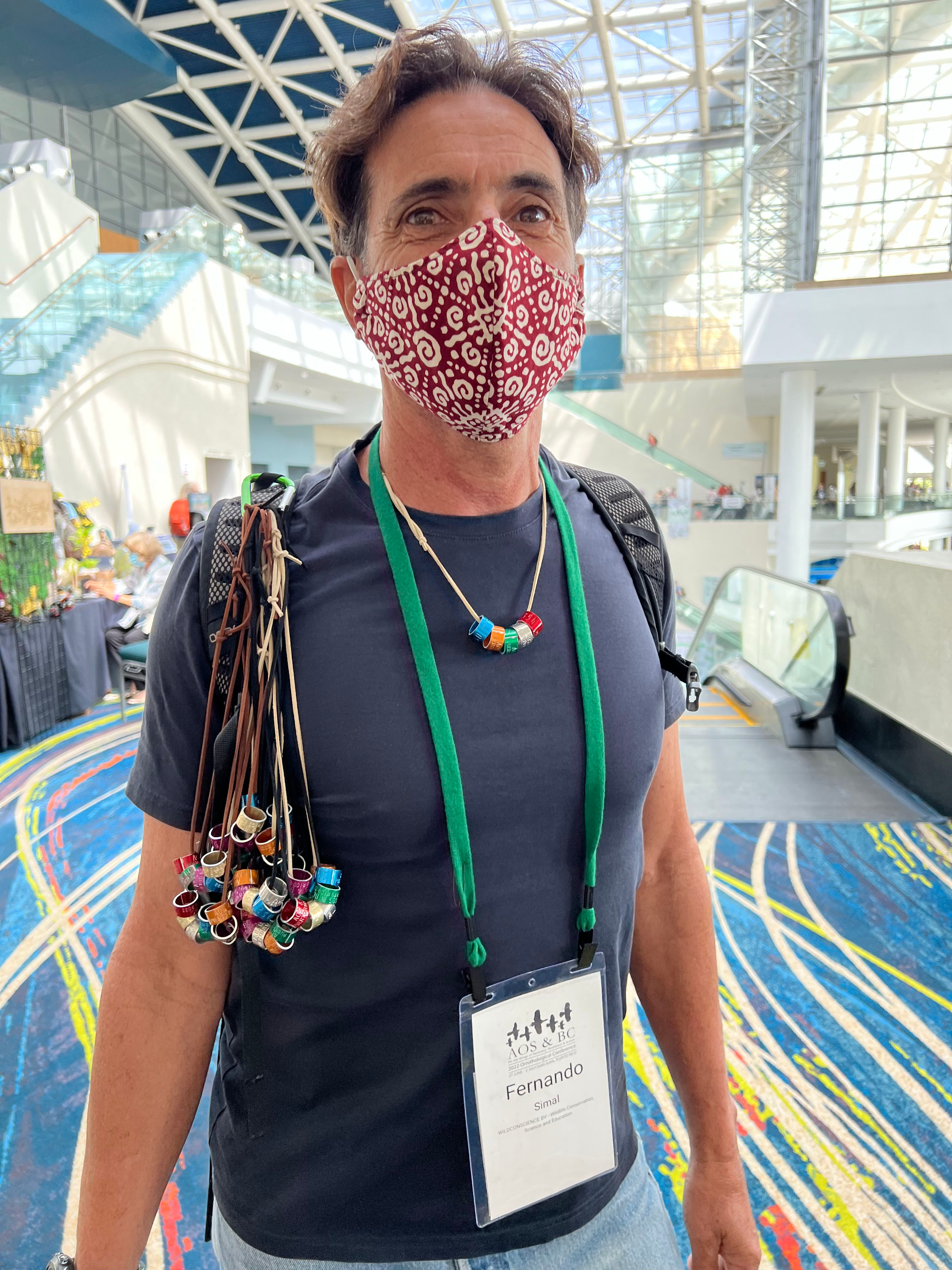
Fernando stylishly sells raffle tickets at the conference. (Photo by Lisa Sorenson)
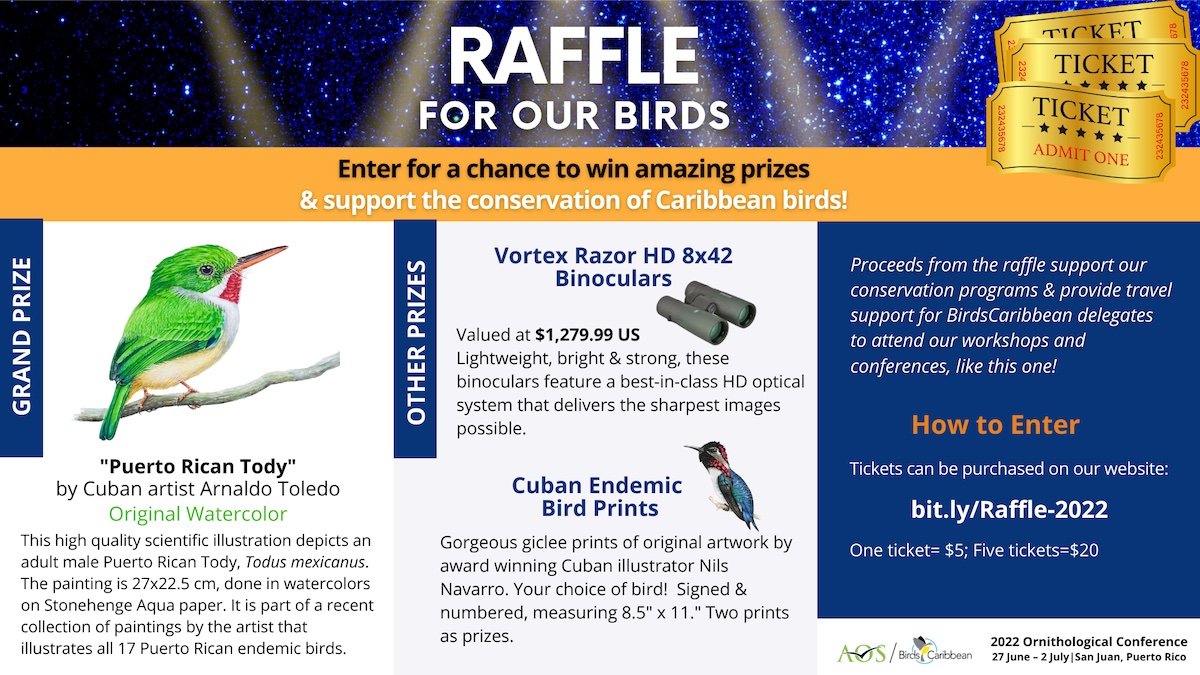
Thanks to our generous partners, we are hosting another amazing Raffle to support our ongoing conservation efforts. All proceeds directly impact scientific research and support programs and activities that build the capacity of Caribbean wildlife professionals — like our regional training workshops and conferences.The items offered this year are so good that we have two grand prizes — an original watercolor “Puerto Rican Tody” by award-winning Cuban Wildlife Artist and Illustrator, Arnaldo Toledo; and the Vortex Razor HD 8×42 Binocular, valued at US$1,279.99!
Other fabulous prizes include more stunning bird art — limited edition, high-quality giclee prints of Cuban endemic birds, signed and numbered by acclaimed Cuban artist and author, Nils Navarro.The grand prize drawing will take place on Saturday, 27 August 2022 so enter now for a chance to win! bit.ly/Raffle-2022 With each ticket purchase, you can help Caribbean nationals create better tomorrows for the birds and the communities that live alongside them.
Exploring Puerto Rico: Excursions and Endemics
We could not come to Puerto Rico, home to some of the region’s most stunning endemic birds, and not explore the beauty of our host island. Local hosts, Para La Naturaleza and SOPI ensured that conference attendees had the opportunity to discover as much of Puerto Rico’s rich flora and fauna as possible. Tours included visits to El Yunque National Forest in Río Grande, Medio Mundo y Daguao in Ceiba, the Cabezas de San Juan Nature Reserve in Fajardo, the Antiguo Acueducto del Río Piedras and the Parque Central de San Juan.
Acknowledgements
A huge thank you to everyone that helped make this conference a tremendous success! It was a pleasure to work with our co-host, the American Ornithological Society, and our local partners, Para la Naturaleza and Sociedad Ornitológica Puertorriqueña to organize the conference. We are very grateful to all the conference sponsors and donors, including the National Science Foundation, Dept of Natural Resources and Environment, Puerto Rico, the Cornell Lab of Ornithology, Windmar Home, Audubon, US Fish and Wildlife Service, Para la Naturaleza, Richard King Mellon Foundation, US Geological Survey, American Bird Conservancy, Vermont Center for Ecostudies, and the US Forest Service – we could not have held this conference without you! We are especially grateful to all those that provided funding and donated to help us provide travel scholarships to 40 Caribbean wildlife professionals and students, including those that participated and donated to our 2022 Global Big Day teams fundraising event in May. As you can see in the photos and videos, the conference provided an incredible opportunity for learning and networking. It also helped us to reconnect, recharge, and become newly inspired to continue our vital conservation work, after a long period of covid isolation. Thank you to all of you from the bottom of our hearts!!!
Gallery
Hover over each photo in the gallery to see the caption or click on a photo to view as a slide show.
Alex Sansom presenting author of a talk by Jessica Cañizares on the Caribbean Waterbird Census (CWC) – what we have learned from the last 12 years. (photo by Lisa Sorenson)
Ajhermae White poses for a photo in the conference photo frame. (Photo by Lisa Sorenson)
Laura Baboolal participates in the Tody Trot.
Lisa takes a photo with students after the closing ceremony. (Photo by Lisa Sorenson)
Silent Auction offer to zipline with Lisa Sorenson. (Photo by Tahira Carter)
Ingrid Flores Vallejo manages the DRNA & NOAA table. (Photo by Christine Schmidt)
Adrianne and Lisa take a group photo with students.
All eyes on that vintage Society of Caribbean Ornithology T-shirt. (Photo by Adrianne Tossas)
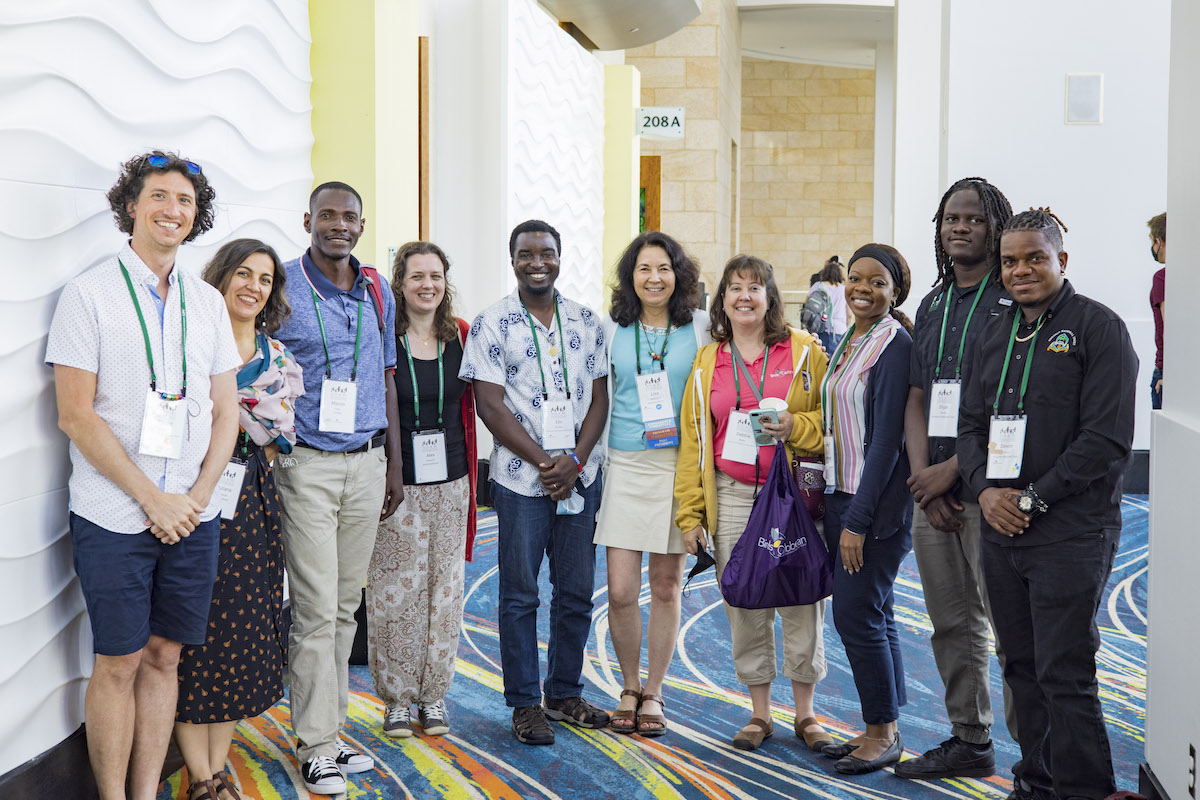
Group photo of Caribbean delegates at AOS-BC Conference 2022 in San Juan, Puerto Rico.
Lisa finds out about the surprise ziplining experience at the Silent Auction. (Photo by Tahira Carter)
Puerto Rican Emerald sits on a branch. (Photo by Holly Garrod)
Justin and Giselle show off the Puerto Rican Tody Buff. (Photo by Holly Garrod)
Handmade wooden and crochet birds, from Cuba and Venezuela respectively, are displayed at the merch table. (Photo by Holly Garrod)
Lisa Sorenson and team present their Ridgeway’s Hawk, “Enriquillo”. (Photo by Tahira Carter)
Keynote Speaker Dr Herbert Raffaele delivers address at AOS-BC Conference in Puerto Rico. (Photo by Christine Schmidt)
Lisa Sorenson, Herbert Raffaele, Ann Sutton, and Justin Proctor sending love to our Cuban colleagues.
Ingrid, Ivelisse and JC pose for the camera in our fun AOS-BC photo frame. (Photo by Lisa Sorenson)
Tyrone, Jordan, Zoya at their posters. (Photo by Lisa Sorenson)
Adrianne and Adolfo pose for a photo. (Photo by Adrianne Tossas)
Lisa Sorenson, Mike Webster, Bruce Lyon, and Andre Dondt.
Lisa and Dr Birdy at the airport. (Photo by Lisa Sorenson)
Adrianne, Ingrid and colleagues take a photo frame pic. (Photo by Adrianne Tossas)
Dr Adrianne Tossas delivers remarks at the AOS-BC Conference opening ceremony. (Photo by Tahira Carter)
Volunteers pause for a photo at the BirdsCaribbean merchandise table. (Photo by Adrianne Tossas)
Photo frame fun: Christine Schmidt and Lauren Gates.
Dr Herbert Raffaele delivers Keynote Address. (Photo by Holly Garrod)
Natasha helps a customer at the BirdsCaribbean merch table. (Photo by Christine Schmidt)
Field Guides on display at the BirdsCaribbean merchandise table. (Photo by Holly Garrod)
Dr Herbert Raffaele delivers Keynote Address. (Photo by Holly Garrod)
View of the Convention Center that shows the zipline. (Photo by Lisa Sorenson)
Group Photo of the Caribbean and US Delegation.
Shoppers browse items at the Para La Naturaleza table.
Delores, Josh, Justin, Adrianne and Lisa pause for a photo during conference prep. (Photo by Tahira Carter)
JC manages sales at the BirdsCaribbean Merchandise Table. (Photo by Tahira Carter)
Josh Pergola and Justin Proctor show off their new endemic birds of Puerto Rico t-shirt. (Photo by Lisa Sorenson)
Browsing books at the Silent Auction. (Photo by Holly Garrod)
Zoya Buckmire at her poster. (Photo by Lisa Sorenson)
Dr Howard Nelson delivers Keynote Address. (Photo by Holly Garrod)
Participants in the Landbird Monitoring Workshop pause to discuss what they’ve observed. (Photo by Holly Garrod)
Participant group photo. (Photo by Tahira Carter)
Adrianna, Purnima and Lisa.
Puerto Rican Woodpecker. (Photo by Holly Garrod)
Justin helps out with sales at the merchandise table. (Photo by Holly Garrod)
Shoppers make their final bids at the Silent Auction jewelry table. (Photo by Tahira Carter)
JC and Joshel help Chris select an endemic birds of Puerto Rico hat. (Photo by Lisa Sorenson)
Caribbean group jumping for joy! (Photo by Lisa Sorenson)
Puerto Rican Lizard-Cuckoo. (Photo by Holly Garrod)
Dr Herbert Raffaele delivers Keynote Address. (Photo by Holly Garrod)
Caribbean women group photo.
Reunion of Caribbean colleagues at the Opening Reception of our AOS-BC Conference in San Juan, Puerto Rico (27 June-1 July 2022).
Lisa and Jennifer send love to our Cuban colleagues (note the bracelet!). (Photo by Holly Garrod)
Safety first! Justin gets suited up for the zipline experience. (Photo by Lisa Sorenson)
Photo frame fun: Adrianne, Ingrid, and Lisa.
Environment of the Americas table. (Photo by Christine Schmidt)
Elijah Sands, from the Bahamas National Trust, reviews technical elements of video production at The Power of Video Workshop. (Photo by Holly Garrod)
Caribbean colleagues from our Endemic and Threatened Species Working Group discussion at AOS-BC 2022 in San Juan, Puerto Rico.
Lisa is suited up and ready for her first-ever zipline experience! (Photo by Justin Proctor)
Lisa introduces keynote speaker Dr Herbert Raffaele. (Photo by Christine Schmidt)
Adrianne and colleagues take a group photo. (Photo by Adrianne Tossas)
Meeting up with colleagues at the Opening Reception on the Terrace – Maya Wilson, Junel Blaise, Dodly Prosper, Howard Nelson (photo by Tahira Carter)
Recently constructed Motus Station. (Photo by Holly Garrod)
Lisa and Justin smile for a photo after their zipline experience. (Photo by Daniel Serva)
Dr Howard P. Nelson delivers Keynote Address. (Photo by Tahira Carter)
Participant gets ready to head into the field, with a new friend. (Photo by Holly Garrod)
Jordan, Tyrone, Zoya, and Lisa. (Photo by Tahira Carter)
Jose Colon stands next to his Silent Auction donation – a vintage Society of Caribbean Ornithology T-shirt. (Photo by Adrianne Tossas)
Howie, Yvan, Lisa, Christopher and Ellie at the Closing ceremony after party.
Dr Herbert Raffaele delivers Keynote Address. (Photo by Christine Schmidt)
Various items for sale at the BirdsCaribbean merchandise table. (Photo by Adrianne Tossas)
Lisa, Ivelisse, Farah, Shanna, and Ingrid at the Closing ceremony after party. (Photo by Lisa Sorenson)
Tahira and Jennifer manage sales at the merchandise table. (Photo by Holly Garrod)
Dr Howard Nelson delivers Keynote Address. (Photo by Holly Garrod)
Photo frame fun with Lisa, Adrianne, Delores, Tahira and Ann.
Participants in the Landbird Monitoring Workshop, Puerto Rico, look for birds in the forest. (Photo by Holly Garrod)
Photo frame fun: Adrianne, Shanna, and Lisa.
Holly helps customers at the merchandise table. (Photo by Lisa Sorenson)
Lisa and Justin spot a Puerto Rican Parrot on the way up. (Photo by Lisa Sorenson)
Caribbean men group photo.
Ellie Devenish-Nelson and Howie Nelson chat with Chris Mulvaney at the Merch table.
Carlos, Luis and JC take a selfie. (Photo by Juan Carlos Fernandez)
Participants in the Landbird Monitoring Workshop engage in classroom sessions before going out into the field. (Photo by Holly Garrod)
Keynote Speaker Dr Howard P. Nelson addresses a packed ballroom at the AOS-BC Conference opening ceremony. (Photo by Tahira Carter)
Yvan, Lisa and Christopher at the Closing ceremony after party.
Bird-friendly Coffee and a Puerto Rican Tody Mug – the perfect gift package! (Photo by Holly Garrod)
The Silent Auction jewelry table is busy with bidders! (Photo by Holly Garrod)
Lisa Sorenson, Maya Wilson, Lisa Kiziuk, and Holly Garrod.
Sociedad Ornitológica Puertorriqueña, Inc. (SOPI) table. (Photo by Christine Schmidt)
Lisa, Emilio, Omar and JC take a selfie at the Para La Naturaleza welcome ceremony. (Photo by Lisa Sorenson)
Tyrone, Ellie, Howie, Jordan, Lisa and Zoya. (Photo by Lisa Sorenson(
Adrianne and colleagues. (Photo by Adrianne Tossas)
Justin Ziplining across the Convention Center courtyard. (Photo by Edward Hernández-Lara)
Branded BirdsCaribbean shirts on sale. (Photo by Holly Garrod)
Lisa Ziplining across the Convention Center courtyard. (Photo by Edward Hernández-Lara)
Group photo with the AOS-BC Photo Frame. (Photo by Lisa Sorenson)
Justin zooms by on the zipline. (Photo by Edward Hernández-Lara)
Lisa Ziplining across the Convention Center courtyard. (Photo by Edward Hernández-Lara)
Lisa and Justin are ready to zip! (Photo by Lisa Sorenson)
Jose Colon assists with sales at the BIrdsCaribbean merchandise table.
Participants in the Raptors of the Caribbean Workshop show off their bird of prey, a Secretary Bird, made from recycled materials. (Photo by Tahira Carter)
Celebrate the Caribbean Endemic Bird Festival (CEBF) with us! Our theme in 2022 is “Loving Birds is Human Nature”. Have fun learning about a new endemic bird every day. We have colouring pages, puzzles, activities, and more. Download for free and enjoy nature with your family at home.
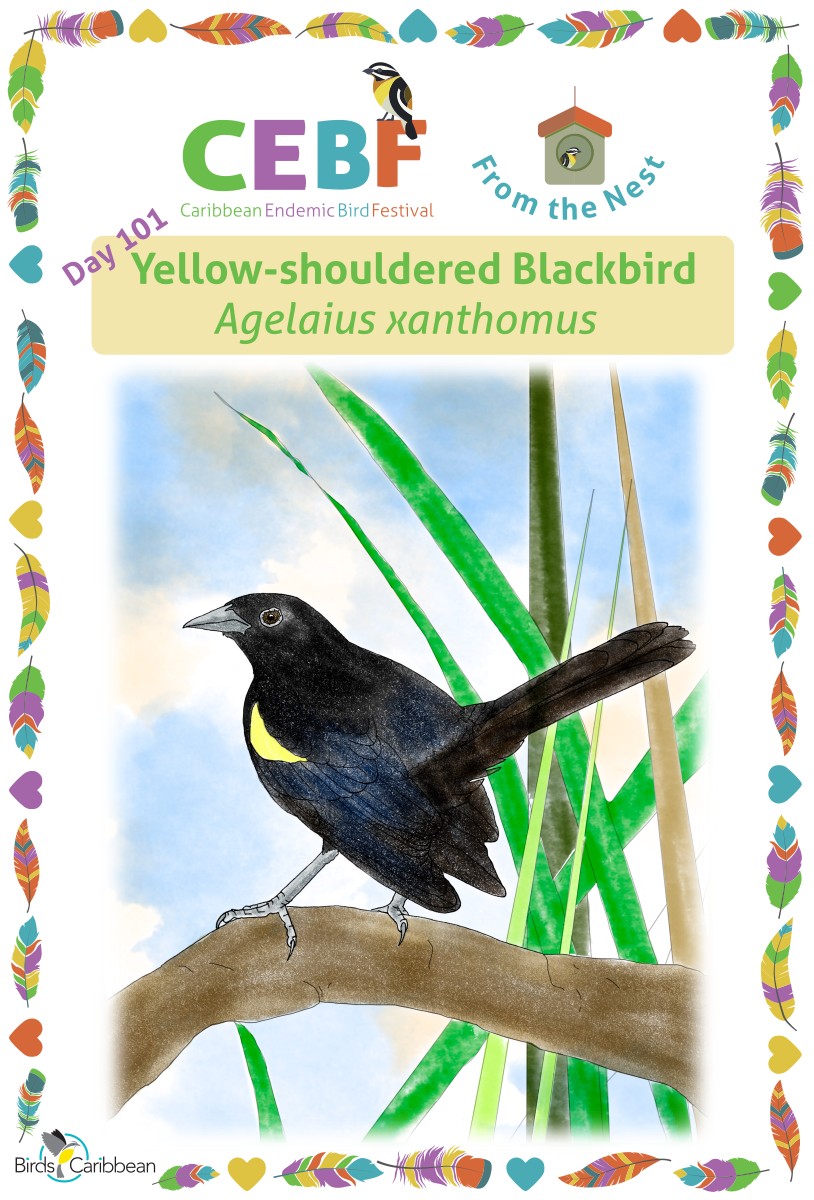
Endemic Bird of the Day: Yellow-shouldered Blackbird
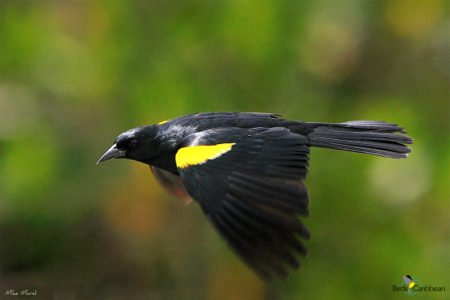
If you find yourself birding near the coasts of Puerto Rico, you may be lucky enough to witness the Yellow-shouldered Blackbird (Agelaius xanthomus) showing off its golden epaulets on the base of its wings. The yellow feathers that give it its name contrast beautifully with the shiny dark plumage that covers the rest of its body and boldly announces its rank as the “capitán” (Spanish for “captain” and one of its common names in Puerto Rico) of Puerto Rican birds.
Their size ranges from 20 to 23cm with males usually slightly larger than females. However, both sexes are identical when it comes to plumage. Their common call consists of a short “check” or nasal “chwip,” usually performed while perched on a branch and flicking their tail. Although considered by some as mostly insectivorous (feeding mainly on insects), Yellow-shouldered Blackbirds have a diverse diet that includes mollusks, fruits, seeds, nectar, animal feed, and processed food such as granulated sugar.
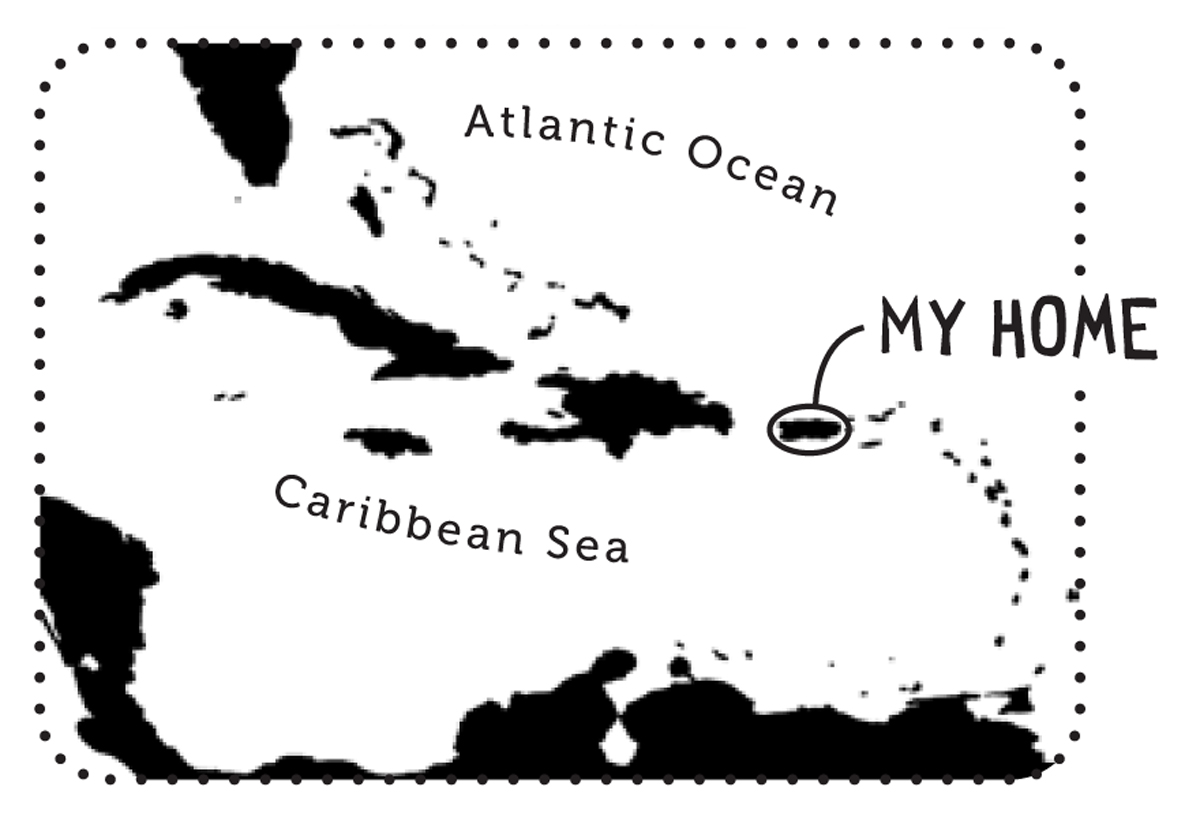
At the end of the 19th century, the Yellow-shouldered Blackbird was found throughout the entire archipelago of Puerto Rico. However, it is currently classified as Endangered, its decline due to loss of habitat and brood parasitism by the invasive Shiny Cowbird. Introduced predators like rats and the Indian Mongoose have also had a serious impact on the blackbird’s population size. Currently, due to all these threats, the Yellow-shouldered Blackbird can only be found on coastal habitats scattered throughout the main island of Puerto Rico and Mona Island. The largest population resides in southwestern Puerto Rico with approximately 500 individuals.
The Yellow-shouldered Blackbird’s breeding season typically occurs between the months of March and September but can stretch through November in rainy years. They make a nest in the form of a cup where the female lays between 2 to 5 speckled, light-blue eggs. Nests are commonly built on branches of mangroves or cavities of dead trees. However, they may also place their nests on palm leaves, coastal cliffs, and manmade structures. In southwestern Puerto Rico, to help conserve the species, biologists have been experimenting with providing Yellow-shouldered Blackbirds with PVC structures in which to place their nest. It was hoped that these structures would reduce the risk of predation by mammals and simplify the monitoring and control of brood parasitism. These have been highly successful at helping increase this species’ reproductive success. Nevertheless, multiple studies are being conducted to determine how these could be modified to further increase the reproductive success of this unique species.Learn more about this species, including its range, photos, and calls here.
Colour in the Yellow-shouldered Blackbird
Download our West Indies Endemic Bird colouring page. Use the photos below as your guide, or you can look up pictures of the bird online or in a bird field guide if you have one. Share your coloured-in page with us by posting it online and tagging us @BirdsCaribbean #CEBFfromthenest
Listen to the calls of the Yellow-shouldered Blackbird
The calls of the Yellow-shouldered Blackbird include a sharp “chulp” sound.
Puzzle of the Day
Click on the image below to do the puzzle. You can make the puzzle as easy or as hard as you like – for example, 6, 8, or 12 pieces for young children, all the way up to 1,024 pieces for those that are up for a challenge!
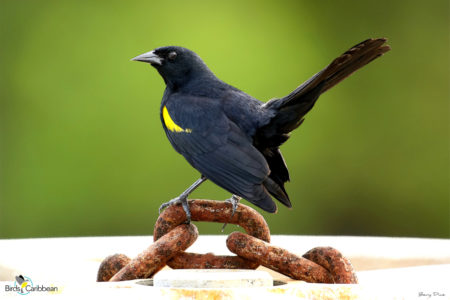
Yellow-shouldered Blackbird. These almost entirely black birds can look a bit like Shiny Cowbirds when their yellow wing-patches are hidden! Remember that Shiny Cowbirds have glossier plumage and shorter, thicker bills. (Photo by Beny Diaz)Yellow-shouldered Blackbird in flight where you can clearly see the distinctive yellow wing patches which give this bird its name. (Photo by Mike Morel)
Activity of the Day
FOR KIDS: Todays featured endemic bird, the Yellow-shouldered Blackbird, builds its nests in on branches of isolated mangroves, in crevices or hollows of dead trees, and sometimes in palm trees. The females build the nest using dried grass, twigs and leaves, making the perfect place in which to lay their eggs and raise their chicks. You could give the birds nesting near your house or in your garden a helping hand with making their perfect nest, with our nest-material activity.
With an adult helping you can gather twigs, grasses and other safe things birds like to use for their nests from around your home and garden. Put out these materials, and see who arrives to make use of them! You can download full instructions here.
Be sure to follow our suggestions for nest materials, these have been selected especially to be suitable for bird nests, some things might be dangerous for birds and their chicks if they put them in their nests. You can keep note of who visits and which things they choose to include in their nests – do some birds have a favourite type of nest material?
FOR KIDS AND ADULTS: Watch this report from Puerto Rico below about how using man-made nest boxes can help Yellow-shouldered Blackbirds!In this video you can find out about the PVC “drainpipe” like structure that biologists are providing for Yellow-shouldered Blackbirds to nest in. These nest boxes have be very successful in boosting the numbers of Yellow-shoulder Blackbird chicks that fledge! They also make it easier for biologists to monitor Blackbird nests and chicks. For example, via the David S. Lee Fund for the Conservation of Caribbean Birds, BirdsCaribbean are funding Jean Gonzalez Crespo track Blackbird chicks after they fledge from the nest and estimate their survival during this critical period. His work will help local and federal agencies determine whether survival rates before breeding are contributing to population declines, and identify the factors that influence survival.
You can also enjoy this video of a Yellow-shouldered Blackbird the wild!
Sustained harassment of nesting Brown Pelicans (Pelecanus occidentalis) in Le Gosier, Guadeloupe, in recent years, has resulted in the abandonment of the largest colony of this species in the French Caribbean islands. BirdsCaribbean is greatly concerned by this unfortunate development and urges French authorities to take action to stop any harassment and ensure the birds return to breed in this important colony. (en français ci-dessous)
Brown Pelicans in the Caribbean rarely nest in urban settings, and yet this colony is just a few steps away from both a library and primary school. BirdsCaribbean regrets that the pelican colony in Le Gosier did not receive adequate consideration and protection from the local authorities of the town that proudly takes its name from the Brown Pelican. This indeed is a missed opportunity for education where, with the right will and incentives, the name-sake of the town can turn a human-wildlife ‘neighborhood dispute’ into a source of pride for the small town of Le Gosier.
A pair of Brown Pelicans cares for its three young chicks in the Le Gosier colony, during the 2013-2014 nesting period (Photo by Association pour la Sauvegarde de la Faune des Antilles – Régis Gomès).
History of Brown Pelicans on Guadeloupe
Part of the pelican Le Gosier colony during the 2013-2014 breeding period (Photo: Association pour la Sauvegarde de la Faune des Antilles – Régis Gomès). Note numerous chicks (white plumage with brown wings) on nests – a sign of a healthy and fully functional colony.
Brown Pelicans were extirpated from Guadeloupe in the 19th century following hunting and persecution. Low numbers nested in the archipelago in 1984 and 1996 but the species only resumed breeding permanently in 2007. This is the same year that a few nests with chicks were rediscovered at the Le Gosier colony. From a handful of nests in 2010-2011, this colony increased in size to reach a maximum of 117 nests in 2016-2017, covering a large area on the spectacular sea cliffs of Boulevard Amédée Clara. This made it one of the largest nesting colonies of Brown Pelicans in the Lesser Antilles. It hosted as many breeding pairs as the other three colonies known to have re-established in Guadeloupe combined, and represented the largest colony of this species in the French Caribbean islands. In fact, the town of Le Gosier takes its name from “gwan gosyé”, the traditional Créole name for the Brown Pelican. This majestic bird is also the town’s emblem and, as such, appears on numerous buildings and monuments.
For the first time since 2007, Brown Pelicans did not nest at the Le Gosier colony in 2020-2021 and 2021-2022. This fact was brought to the attention of BirdsCaribbean in November, 2020 by the Association pour la Sauvegarde de la Faune des Antilles (ASFA). Visits by rangers of Parc National de la Guadeloupe in December 2020, and by Association AMAZONA in January 2021, confirmed the abandonment of this breeding site. Visits by ASFA in early 2022 confirmed that Brown Pelicans did not renest in 2021-2022.
“When, in 2007, we announced that we had discovered a Brown Pelican colony in Le Gosier, we thought it would stimulate decision-makers to make the return of the Brown Pelican in Guadeloupe a success. The loss of this colony is a resounding defeat for the recovery of this species.” — Association pour la Sauvegarde de la Faune des Antilles
As early as 2014, ASFA alerted relevant French authorities of the potential human-wildlife conflicts that could arise from the growth of the colony, but no action was taken by the administration. Indeed, intentional disturbances directed at the nesting Brown Pelicans accelerated. ASFA shared with BirdsCaribbean that, over the years, people were observed deliberately and regularly throwing rocks at nests from both the top and bottom of the cliffs; demolition works directly above the colony repeatedly disturbed pelicans during nest initiation; and vegetation that supported nests was cut or degraded before or during the breeding season. Although the Arrêté du 17 février 1989 makes it unlawful to hurt or kill pelicans and their chicks or eggs, it does not protect them against disturbance (whether accidental or intentional), nor does it protect their breeding and resting sites from intentional destruction.
Estimated sizes of the Brown Pelican population in Guadeloupe between 2011 and 2021. Counts of fledgelings, and resulting estimates of productivity, were only carried out until 2018. (Data from Association pour la Sauvegarde de la Faune des Antilles.)
The failure of France to curb these threats to a protected species partly results from the long-overdue revision of this arrêté, stuck in negotiations. BirdsCaribbean urges the French government to hasten the acceptance of the revision of Arrêté du 17 février 1989 to actually provide full protection to the Guadeloupean birds it seeks to protect. Furthermore, the Brown Pelican colony of Le Gosier did not receive the protection it needed from French authorities as pledged under the SPAW protocol, despite France being a signatory and ratifying country, and Guadeloupe hosting the offices of the Regional Activity Centre that oversees its implementation.
“The case of the Brown Pelican is a good example: France should make a priority of revising our weak national regulations. It could also easily compensate for the loss of breeding habitat for the Brown Pelican by protecting îlet Rousseau, a public land with strong potential not only for pelicans, but also for Magnificent Frigatebirds.” — Association pour la Sauvegarde de la Faune des Antilles
Brown Pelicans breeding at the Le Gosier colony during the 2013-2014 nesting period. In the upper left corner, note the three big chicks sharing a nest – a sign of a healthy and fully functional colony. (Photo by Association pour la Sauvegarde de la Faune des Antilles – Régis Gomès).
Next Steps
The Brown Pelican colony at Le Gosier was a jewel of Caribbean wildlife, one that was enjoyed by local people and visitors alike, but no longer – it only took only a few misplaced acts to destroy it.
BirdsCaribbean calls on the government and local administration to:
1) investigate and document what happened to the colony in 2020-2021;
2) put into place an action plan to avert a similar tragedy happening in 2022-2023 and the future;
3) monitor the areas where Brown Pelicans return and nest again, ensuring that they are not disturbed;
4) educate the local community to instill pride in the town’s name-sake, showing that it deserves our protection;
5) complete the revision of the Arrêté du 17 février 1989, and ensure that adequate legislation is in place to protect wildlife from disturbance and destruction.
En Francais
BirdsCaribbean est extrêmement préoccupée par l’abandon en 2020, 2021 et 2022 de la colonie de nidification de pélicans bruns du Gosier, en Guadeloupe, suite à des dérangements prolongés.
BirdsCaribbean est extrêmement préoccupée par les dérangements répétés de pélicans bruns (Pelecanus occidentalis) nicheurs ayant eu lieu au Gosier, en Guadeloupe, ces dernières années. Ces dérangements ont provoqué l’abandon de cette importante colonie de reproduction durant les saisons de reproduction 2020-2021 et 2021-2022. Les autorités responsables doivent agir pour arrêter et prévenir tout dérangement, et assurer le retour en nidification lors de la saison 2022-2023. Ceci aura des bénéfices économiques et pédagogiques pour la commune du Gosier. Dans les Caraïbes, les pélicans bruns nichent rarement dans des zones urbaines : malgré tout, la colonie ayant subi les dérangements n’est qu’à quelques pas de deux écoles et d’une médiathèque, dans une ville qui prend son nom de ces mêmes pélicans !
Photographie 1: Un couple de pélicans bruns s’occupe de ses trois jeunes poussins à la colonie du Gosier, pendant la saison de reproduction 2013-2014. (Association pour la Sauvegarde de la Faune des Antilles – Régis Gomès).
Histoire des pélicans bruns en Guadeloupe
Pour la première fois depuis 2007, les pélicans bruns n’ont pas niché à la colonie du Gosier en 2020-2021 et 2021-2022, une information que l’Association pour la Sauvegarde de la Faune des Antilles (ASFA) a partagé avec BirdsCaribbean dès novembre 2020. Des visites effectuées par des gardes du Parc National de la Guadeloupe en décembre 2020, et par l’Association AMAZONA en janvier 2021 ont confirmé l’abandon de ce site de nidification. Des visites de l’ASFA début 2022 ont montré que les pélicans n’avaient pas re-niché en 2021-2022.
Photographie 2: Une partie de la colonie de pélicans bruns du Gosier, pendant la saison de reproduction 2013-2014. (Photo: Association pour la Sauvegarde de la Faune des Antilles – Régis Gomès). Noter les nombreux poussins (plumage blanc et ailes brunes) sur les nids, signe en bonne santé écologique.
Le pélican brun a été éradiqué de Guadeloupe au cours du XIXième siècle par la chasse et la persécution. Des effectifs limités ont niché sur l’archipel en 1984 et 1996 mais l’espèce n’a recommencé à nicher de façon permanente qu’en 2007. Cette même année, des nids avec des poussins étaient découverts à la colonie du Gosier. De quelques nids en 2010-2011, cette colonie a ensuite gagné en taille pour atteindre, à son maximum, 117 nids en 2016-2017, utilisant alors une grande partie des falaises spectaculaires du Boulevard Amédée Clara. Ceci en faisait l’une des colonies de nidification les plus grandes des Petites Antilles. Elle abritait autant de couples nicheurs que les trois autres colonies recensées en Guadeloupe combinées, et était alors la plus grande colonie de cette espèce dans les Antilles françaises. La ville du Gosier prend justement son nom du “gwan gosyé”, le nom créole du pélican brun. Cet oiseau majestueux est aussi l’emblème de la ville et, en conséquent, il apparaît sur de nombreux bâtiments et monuments.
“En annonçant, en 2007, que nous avions découvert une colonie de pélicans bruns, qui plus est, dans la ville du Gosier, nous pensions susciter une mobilisation des décideurs pour que ce retour de l’espèce en tant que nicheuse sur l’Archipel guadeloupéen soit un succès. L’abandon de la colonie sonne le glas d’une pleine reconquête de l’espèce.” —Association pour la Sauvegarde de la Faune des Antilles
Menaces sur le pélican brun des Caraïbes
Malgré sa présence familière sur nos côtes, la population caribéenne du pélican brun est toujours considérée comme à risque dans la région. Elle est aussi listée comme strictement protégée au titre du protocole SPAW, protocole dont la France est signataire. En Guadeloupe, les pélicans bruns nicheurs sont listés comme Vulnérables sur la Liste Rouge des Espèces Menacées de France et sont protégés par l’Arrêté du 17 février 1989. En vertu de cet arrêté, toute forme de destruction, capture ou enlèvement de cet oiseau marin, de ses œufs ou de son nid est interdite.
Dès 2014, l’ASFA a alerté les autorités françaises compétentes des potentiels conflits qui pourraient découler de l’expansion de la colonie de nidification du Gosier, mais l’administration n’a pris aucune mesure. Au contraire, les dérangements intentionnels envers les pélicans bruns nicheurs se sont accélérés. L’ASFA a d’ailleurs informé BirdsCaribbean que, au fil des ans, des personnes ont été observées en train de jeter des pierres sur les nids, depuis le haut et le bas des falaises, de manière délibérée et régulière ; des travaux de démolition juste au-dessus de la colonie avaient dérangé les pélicans à plusieurs reprises au commencement de la nidification ; et la végétation sur laquelle les nids étaient construits avait été coupée ou dégradée avant ou pendant la saison de reproduction. L’Arrêté du 17 février 1989 rend illégal la destruction et la mutilation des pélicans, de leurs poussins et de leurs oeufs, mais il ne les protège pas des dérangements (accidentels ou intentionnels), et ne protège pas non plus leurs sites de reproduction et de repos de destructions intentionnelles.
Figure 1. Effectifs de population du pélican brun en Guadeloupe entre 2011 et 2021. Les comptages de jeunes à l’envol, et les estimations de productivité en découlant, n’ont pas pu être effectués après 2018. Données : Association pour la Sauvegarde de la Faune des Antilles.
L’incapacité de la France à limiter ces menaces à l’encontre d’une espèce protégée est en partie le résultat de son incapacité à réviser l’Arrêté du 17 février 1989. BirdsCaribbean exhorte donc les autorités françaises à finaliser la révision de l’Arrêté du 17 février 1989 afin de véritablement offrir l’entière protection de la loi aux oiseaux de la Guadeloupe que cet arrêté prétend protéger. Par ailleurs, la colonie de pélicans bruns du Gosier n’a pas reçu la protection des autorités françaises, en directe opposition avec le protocole SPAW qu’elles ont pourtant signé et ratifié, et malgré le fait que les bureaux du Centre Régional d’Activité qui supervise la mise en application dudit protocole se trouvent en Guadeloupe.
“Cet échec est un bon exemple : la révision de la réglementation nationale devrait être la priorité de la France. Il serait aussi facilement réalisable de compenser les pertes survenues sur la colonie du Gosier en protégeant l’îlet Rousseau, un terrain public à fort potentiel non seulement pour les pélicans mais aussi pour les Frégates.” — Association pour la Sauvegarde de la Faune des Antilles
Photographie 3: Des pélicans bruns en nidification à la colonie du Gosier, pendant la saison de reproduction 2013-2014. (Association pour la Sauvegarde de la Faune des Antilles – Régis Gomès). Dans le coin en haut à gauche, noter les trois grands poussins dans un même nid, un signe d’une colonie en bonne santé écologique.
BirdsCaribbean regrette que la colonie du Gosier, qui est située face à la médiathèque et aux écoles du Boulevard Amédée Clara, n’ait pas reçu une considération appropriée de la part des autorités locales d’une ville qui emprunte fièrement son nom au pélican brun. Nous regrettons, par ailleurs, que cette opportunité pédagogique et économique ait étée négligée : avec des bonnes intentions et des soutiens adaptés, l’espèce qui prête son nom à la ville aurait pu transformer un “conflit de voisinage” entre humains et faune sauvage en une source de fierté pour la petite ville du Gosier.
Prochaines étapes
La colonie de pélicans bruns du Gosier était un joyau de la faune des Caraïbes, autant appréciée par les locaux que par les visiteurs, mais elle n’existe plus : il n’a fallu que quelques actes déplacés pour la détruire. Par conséquent, BirdsCaribbean demande au gouvernement français et aux administrations locales de
1) enquêter et documenter ce qui est arrivé à la colonie de pélicans bruns du Gosier en 2020-2021 ;
2) de mettre en place un plan d’action pour éviter qu’une tragédie similaire ait lieu en 2022-2023et dans le futur ; 3) de suivre les zones où les pélicans bruns pourraient revenir et nicher, afin d’assurer leur protection ;
4) de développer des programmes pédagogiques à destination des communautés locales, afin d’inspirer de la fierté pour l’espèce qui prête son nom à la ville et de montrer qu’elle mérite notre protection ; et
5) de finaliser la révision de l’Arrêté du 17 février 1989 et de s’assurer qu’une législation appropriée soit en place pour protéger la faune sauvage des dérangements et des destructions.
En attendant de recevoir de vos nouvelles rapidement, je vous remercie pour votre assistance.
Celebrate the Caribbean Endemic Bird Festival (CEBF) with us! Our theme in 2022 is “Loving Birds is Human Nature”. Have fun learning about a new endemic bird every day. We have colouring pages, puzzles, activities, and more. Download for free and enjoy nature with your family at home.
Endemic Bird of the Day: Bahama Swallow
On the most northern islands of The Bahamas, this acrobatic bird can be seen flying low over the roads, fields, and other open habitats. Its ability to twist and turn at the last second is truly impressive – the fighter jets of the bird world. Is it just showing off? No, the Bahama Swallow (Tachycineta cyaneoviridis) is hunting, grabbing unlucky flying insects directly out of the air.
But if a Bahama Swallow will sit still long enough, the stunning beauty of this Bahamian endemic will blow you away. The deep metallic green on its crown and upper back fades into dark blue, and then into grayish-brown on its long wings and forked tail. These gorgeous colors contrast sharply with the purest of whites on the throat and belly, which continues under part of the wing. The white under the wing, along with a more deeply forked tail, can help distinguish it from its close relative, the Tree Swallow.
During the breeding season (March – July), this special bird can only be found on three islands in the Northern Bahamas – Grand Bahama, Andros, and Abaco. Along with New Providence, these islands are the only ones in the Bahamian archipelago that contain large areas of Caribbean pine. During the non-breeding season, a few birds may wander south to other islands in the Bahamas, to northern Cuba, and the Florida Keys. More study on the species’ movements are needed!
The swallow has a strong connection with this unique and magical pine forest habitat. The species is a secondary cavity-nester, meaning that it will only build a nest in a cavity (i.e., a hole of some kind), but it cannot create this cavity for itself. Luckily for the swallow, two woodpecker species — the Hairy Woodpecker and the West Indian Woodpecker — are very good at making nesting cavities in dead trees. After the woodpeckers are done with them, the swallow can jump in! But it is generally safer for swallows to use the cavities in the pine forest, usually made by the Hairy Woodpecker, where they are less exposed to competition and predation.
The Bahama Swallow is an Endangered species, and its survival depends on healthy pine forest and woodpeckers to continue to make nesting cavities. The largest threat to the swallow is habitat loss from development and natural disasters like hurricanes. For example, in 2019, Hurricane Dorian destroyed huge sections of pine forest habitat on Grand Bahama and northern Abaco, where swallow populations were already small. So protecting the pine forest on Abaco and Andros is more important than ever to conserve this special bird!Learn more about this species, including its range, photos, and calls here.
Colour in the Bahama Swallow
Download our West Indies Endemic Bird colouring page. Use the photos below as your guide, or you can look up pictures of the bird online or in a bird field guide if you have one. Share your coloured-in page with us by posting it online and tagging us @BirdsCaribbean #CEBFfromthenest
Listen to the song of the Bahama Swallow
The song of the Bahama Swallow is a jumble of liquid notes, they also have a “chet-chet” call which can be heard in this recording.
Puzzle of the Day
Click on the image below to do the puzzle. You can make the puzzle as easy or as hard as you like – for example, 6, 8, or 12 pieces for young children, all the way up to 1,024 pieces for those that are up for a challenge!
Bahama Swallow swoops low to the ground, they hunt on the wing feeding on small flying insects such as flies and beetles. (Photo by Brendan Fogarty)
A flock of Bahama Swallows take a rest in a pine tree. Bahama Swallows will make their nests in cavities in trees, using the needles of the Caribbean pine as nesting material. (Photo by Walker Golder)
Activity of the Day
FOR KIDS: Bahama Swallows feed on insects, swooping through the air to catch them on the wing! Can you help this hungry Bahama Swallow find its way through our maze to to grab some tasty insect food? You can find the correct route here.
FOR KIDS AND ADULTS: Want to find out more about the Bahama Swallow and what it is like to study these beautiful little birds? Read all about the work of ecologist and ornithologist Maya Wilson. Maya’s graduate research was focused on understanding more about the status and breeding biology of this endangered island endemic. In her blog post below you can share a day in the field with Maya as well as learning more about the fascinating research she carried out in the Bahamas.
This May, the core committee of the BirdsCaribbean Seabird Working Group (SWG) will begin a series of webinars to help conservation practitioners across the Caribbean prepare for engagement in a 2023 regional seabird census.
To accommodate varying levels of expertise, the series begins with the basics and will build in complexity as the weeks progress. The first webinar in the series is Caribbean Seabird Identification, scheduled to be held on May 31, from 4–5PM EDT. Noted seabird biologist and conservationist J. Christopher Haney will share stunning photos to help participants identify the 22 species of seabirds that nest on the Caribbean’s beaches, cliffs and mangroves.
“Even if you are a seasoned pro, we think you will find the webinar enjoyable,” shared Jennifer Wheeler, core member of the SWG. “Chris has many years of experience training seabird observers and presents in casual, conversational style. He will provide tips and tricks on ID, and there will also be time for Q&A segment at the end.”
Join us! Take advantage of this fun opportunity to gain, sharpen or test your identification skills and prepare for the upcoming Caribbean seabird census. Register here bit.ly/CaribSeabirdID
Caribbean Seabird Identification Webinar
The SWG webinars are designed to be interactive – with quizzes to test your new-found knowledge, and question and answer sessions at the end of each event. Participants will be able to meet renowned seabird specialists and learn from their knowledge and experience.
Topics for the webinars include design, preparation, logistics, and protocols of seabird surveys; data management; and other needed skills for monitoring seabirds. The SWG welcomes input on the topics you would like to be covered, let us know your ideas! Contact: Juliana Coffey ([email protected]) and Hannah Madden ([email protected]).
It’s coming soon! And we are excited, as the printing presses are whirring.
BirdsCaribbean partners and citizens of all ages from across the Spanish-speaking islands can look forward to enjoying the Spanish language version of our popular Endemic Birds of the West Indies Coloring Book, which will soon be ready for ordering. Translations of the English text by Mark Yokoyama are by Juan Carlos Fernández-Ordóñez and Maydiel Cañizares, with the appealing illustrations by Christine Elder waiting to be colored.
Back and Front Covers of the Endemic Birds of the West Indies Colouring Book in Spanish.
“The book is at the press now,” confirmed Executive Director of BirdsCaribbean, Lisa Sorensen. “We are very grateful to all those who have contributed and supported this publication, including the U.S. Fish and Wildlife Service, the U.S. Forest Service International Programs, the Cape Cod Bird Club, and of course our members and generous donors.”
The book contains all the same artistic and educational material as the English language one, with an additional section explaining the birds’ scientific names. It also gives reasons for and provides details of how and why different local names are often given to the same bird in Cuba, Puerto Rico, and the Dominican Republic. For example, in Cuba the West Indian Whistling Duck is called the Yaguasa. In Puerto Rico it is known as the Chiriría, and in the Dominican Republic people call it the Yaguaza. This can be confusing! In the book, the scientific name is written in italics after the common name of each bird.
“We will be shipping hard copies to Puerto Rico and the Dominican Republic (and sending copies via courier to Cuba) as soon as the book is printed, hot off the press,” said Lisa Sorensen. “We are happy that this lovely book will be reaching a much wider audience, and we look forward to the feedback from our Spanish-speaking friends.”
Note: The French version of the coloring books will also be available soon!
How to obtain copies of Birds of the West Indies Colouring Book in Spanish
You can download the colouring book for free on our Resources page.
If you are an educator working for an NGO or government in the Caribbean and would like to receive one or more boxes of the coloring book, please contact [email protected]. To save on shipping costs, we are aiming to limit the number of shipments per country. We ask for help with distribution by a local institution to NGOs and governmental ministries for use at bird and nature education events.
Help us get these books to children across the islands!
We need your help to ship this book to the islands, as well as funding support to print the French version. If you would like to help, please click here. No donation is too small!!
The Endemic and Threatened Species Working Group (ETSWG) is conducting a survey of conservation action on Caribbean endemics to better plan, support, and understand current conservation efforts to protect Caribbean endemic birds.
You don’t need to be a member of the ETSWG to take the survey! Anyone working on Caribbean endemics, in any capacity, is invited to complete the survey. Your valuable feedback will help the ETSWG better support conservation work on these amazing species!
The ETSWG includes academics, funders, practitioners, independent researchers, government agency and NGO staff, and amateur ornithologists, who all have an interest in conserving the Caribbean’s endemic and threatened bird species. The ETSWG meets online quarterly for members to update each other on their recent conservation and research activities, share information about opportunities such as funding, and support one another to address conservation challenges such as development activity. The Group also holds in-person meetings at the biannual BirdsCaribbean conferences – the last one was held in Guadeloupe in 2019 – and plans are underway to host another in-person meeting at the AOS-BC Conference in Puerto Rico this June!
ETSWG in-person meeting in Guadeloupe, 2019.
Why a survey?
We already know that human and resource capacity is a challenge for conservation across the region. We also know that while some Caribbean endemic species are getting excellent conservation and research focus, many others need more. To try to address these issues, the ETSWG is keen to develop activities that facilitate information sharing and support collaborations between researchers and practitioners. To help the Working Group develop future activities, the wider BirdsCaribbean community is asked to share what could be done to best address needs in Caribbean endemic bird conservation.
A local team member in the DR climbs a Ridgway’s Hawk nest tree in order to band nestlings before they fledge. (Photo by Nicholas Lormand)
Holly Garrod bands a Broad-billed Tody in the Dominican Republic for her M.Sc. thesis research.
The survey seeks to first get a sense of current conservation capacity within the region. Questions such as, “where are you located?” and “how much do you collaborate within the region?” aim to collect this information. The survey also asks about the threats to species, as this helps the group to understand the kinds of conservation needs across the region (e.g., training on policy engagement, invasive species management, etc.), as well as provides a horizon scan of emerging threats and which species may not be getting the conservation effort they need. In addition, the survey asks what activities you want to see the ETSWG provide to help your conservation efforts.
Share your ideas in the survey! Let us know what would help build your capacity – whether it’s training on species recovery planning or monitoring, hosting a database, mentoring, or more – and we’ll work on developing future activities to fit these needs.
BVI Conservation Department’s Atoya George in the field at Fallen Jerusalem. (Photo by Jost van Dyke Preservation Society)
Want to get involved?
Visit the ETSWG’s webpage to learn more about member activities and read summaries from previous meetings to get an idea of the issues monitored. The ETSWG listserv, a sub-group within the BirdsCaribbean listserv, shares announcements of meetings, funding opportunities, ideas and news about Caribbean endemics – sign up on the ETSWG webpage! The group also uses WhatsApp as an informal means to share information. Let us know if you’d like to be added to the group! Anyone on the BirdsCaribbean listserv with an interest in endemic and threatened bird species can request to join and new members are encouraged!
The Purple-throated Carib is endemic to a handful of islands in the Lesser Antilles. (Photo by Barbara and Frank Lilievre)
Hispaniola Woodpecker, endemic to the Dominican Republic was photographed by Michael Good in Puerto Plata, DR on his Global Big Day count.
West Indian Whistling Ducks are a threatened regional endemic, resident in the Portland Bight Protected Area in Jamaica. They have been declining in Jamaica due to loss of wetland habitat. (Photo by Lisa Sorenson)
The Barbuda Warbler is endemic to the island of Barbuda, which was heavily damaged by the recent storms. (Photo by Ted Eubanks)
Black-crowned Palm Tanager, endemic to Hispaniola. (Photo by Dax Román E.)
The Guadeloupe Woodpecker is endemic to Guadeloupe. (Photo by Frantz Delcroix)
Cuban Emerald, hummingbird endemic to The Bahamas and Cuba. (Photo by Garry Donaldson)
Cuban Black Hawk, endemic to Cuba. (Photo by Garry Donaldson)
Lesser Antillean Bullfinch, an endemic bird to the Lesser Antilles. (Photo by Ted Eubanks).
Cuban Bullfinch, another one of Cuba’s 27 endemic birds. (Photo by David Hill)
Blue-headed Hummingbird, endemic to Dominica and Martinique. (Photo by Paul Reillo)
The beautiful Scaly-breasted Thrasher is endemic to the Lesser Antilles. (Photo by Frantz Delcroix)
Red-billed Streamertail – endemic in Jamaica. (Photo by Claude Fletcher)
The endemic Bahama Warbler. (Photo by Martha Cartwright)
It was one year ago that volcanic ash began billowing out of the La Soufrière volcano on the main island of St. Vincent and the Grenadines—the first time in 42 years. Vincentians were alerted to increased activity within the volcano and knew the eruption was imminent, but there was little that could prepare the community for the first massive eruption on April 9th and weeks of continued eruptions and ash fall that would ensue.
Communities in the north were forced to evacuate, moving south towards safety and away from the intense ash fall. The wildlife in the area attempted a similar trajectory. Unable to forage in the wild as normal, however, and disoriented by the ash fall, many wildlife species – including the vulnerable St. Vincent Parrot, the National bird – were in danger.
BirdsCaribbean jumped into action, joining concerned wildlife conservation organizations to create an emergency group* that quickly raised funds and provided much-needed assistance to the Forestry Department working on-the-ground in St. Vincent. Key partner, the Rare Species Conservatory Foundation (RSCF), provided critical help in getting all the supplies purchased by BirdsCaribbean, their organization, and our group to St. Vincent. Items included boots for all Forestry staff, binoculars, cutlasses, knives, backpacks, two-way radios, GPS units, Go Pro and Canon cameras, respirators, camping gear, ponchos, veterinary supplies, parrot food, chain saws, aviary wire, and many other tools and hardware to repair and enhance the parrot aviary.
To mark one year since the devastating eruptions, we caught up with Bradford Latham, Program Officer for Wildlife and Law Compliance and Enforcement in the St. Vincent and the Grenadines Forestry Department, to learn how the island, its people, and the wildlife are recovering.
Post-eruption clean-up exercise in Hermitage, St. Vincent, on April 2, 2021. (Photo by the St. Vincent Forestry Department).
Post-eruption assessment in Richmond, St. Vincent, on May 4, 2021. (Photo by the St. Vincent Forestry Department).
Post-eruption assessment in Richmond, St. Vincent, on May 2, 2021. (Photo by the St. Vincent Forestry Department).
Take us back to the first few days of the eruptions. What was that like?
“The 9th of April was a Friday and I was busy making preparations. I am in charge of the Nicholls Wildlife Complex at the St Vincent Botanical Gardens, where we do captive breeding, so I was installing water tanks at the aviaries, trying to ensure that I had extra water storage in place for the care of the birds in case of an eruption – which we were expecting. I had just completed that task when I learned that La Soufrière had erupted.”
Bradford recalls that people in the community were nervous but admits that the severity of the event was not fully grasped because the effects could not yet be seen. It wasn’t until the following morning, however, that the gravity of the situation began to unfold.
“On Saturday morning everything was gray. Everything was gloomy, and there was ash everywhere. Then, the water authority had to turn off their systems to prevent clogging – so that essential service was affected.”
“Thankfully, I had already gotten some assistance from the Graeme Hall Nature Sanctuary in Barbados to prepare and secure the captive birds at the Nicholls Wildlife Complex. We needed plastic sheeting to try to secure the birds and we also needed dried foods, because getting fresh fruit would have been a challenge – and it was indeed. So, the dried nuts and fruit, and other food that we quickly received from our international partners was really useful.”
St. Vincent Parrot at Nicholls Wildlife Complex, Botanical Gardens, St. Vincent. (Photo by Aliya Hosein).
Measuring the thickness of the ash fall in St. Vincent. (Photo by UWI Seismic Research Centre).
How did you cope with the situation? What were some of the short to medium-term solutions that were implemented by the Forestry Department and partners?
Volcanic Hazard Map sectioned into zones. (Image by NEMO St. Vincent and the Grenadines).
“The plight of the birds in the forest was of major concern, given the heavy ash fall that would have affected food availability for these species. An emergency group was formed, which comprised BirdsCaribbean, Rare Species Conservatory Foundation, Flora and Fauna International (FFI), UNDP Reef to Ridge Project, Houston Zoo, IWECo Project St. Vincent and the Grenadines, SCIENCE, and the St. Vincent and the Grenadines Environmental Fund (SVGEF). This group provided invaluable support to on-the-ground efforts and helped to plan what would be done if food was unable to be collected from the countryside – which was really destroyed.
We considered ideas to be able to help wildlife species, especially the St. Vincent Parrots, and we came up with a plan of creating feeding stations. We made platforms and sourced daily fresh fruits for the stations. We cleaned the fruits, cut them up, and went out on mornings and evenings to replenish the platforms in some of the major parrot habitats—especially near La Soufrière, such as Cumberland, Congo Valley, and Jennings.
We prioritized the areas that were most impacted. We concentrated our efforts within the orange and yellow zones, just off the red zone area, to provide some assistance of water and food to these wildlife species.
We started in April, in the weeks following the first eruptions, and continued through the month of April, May and up to June. Once the rains began to fall in June and certain trees began fruiting, like the mango and the plum rose, we curtailed the feeding assistance because we knew that there were now available food sources for the parrots and other wildlife species.”
Tell me about the Parrot Surveys conducted in September, 2021. Did you see many birds? Did you get a sense that they are faring well?
Sadly, this rescued St. Vincent Parrot did not survive its injuries from the volcanic eruption, including eyes crusted over with ash and respiratory problems. (Photo by the St. Vincent Forestry Department).
“After the volcanic eruptions, we decided to do a rapid assessment to get a better understanding of what was happening to the parrots because we hadn’t had a census or a check for parrots since 2010—there was a long lapse. I recall one time that the team was out clearing rivers and they came across a bird that was suffering and later died, as a result of ash inhalation. So we were preparing ourselves for the worst impact on wildlife.
We completed the assessment in one week, for the first time. All five major sectors of 20 watch points were done in one week, from Tuesday 17th September to Friday 22nd September, 2021. The team of over 60 participants monitored the different sectors and also areas what we call gap watches, where we know a smaller numbers of birds exist. A very rough estimate suggests that parrot numbers are in the high hundreds, indicating the birds are resilient and many managed to survive the volcano and its aftermath. However, we note that updated methodology and analyses are needed to better assess parrot numbers.
We also noticed that many of the birds that were near the Red Zones, the La Soufrière areas, successfully moved to safer areas. That’s what we picked up. Prior to the eruption, we used to have a lot of cases of parrot predation on crops in the northern part of the island. This is something that we are still going to be looking out for as the parrots seem to be moving back into those areas. Crop predation is a concern. So, we will be looking at the food sources that are available in the forest to try to understand why the parrots are moving towards farmland areas.”
St. Vincent Parrots in flight. (Photo by the Ministry of Agriculture, St. Vincent and the Grenadines).
Group photo of Forestry staff. (Photo by the St. Vincent Forestry Department).
St. Vincent Parrot Watch Points for the 2021 survey.
Forestry staff using a radio to report a parrot sighting. (Photo by the St. Vincent Forestry Department).
Forestry Department training on how to count parrots. (Photo by the St. Vincent Forestry Department).
Forestry staff using a radio to communicate with other census teams. (Photo by the St. Vincent Forestry Department).
Bradford Latham speaks to staff during the parrot-census training, August, 2021. (Photo by the St. Vincent Forestry Department).
Forestry staff, Terrance Roberts, on the look out for St. Vincent Parrots. (Photo by the St. Vincent Forestry Department).
How quickly has the forest been recovering and trees flowering and fruiting again for the birds?
“The recovery is really excellent in the areas within the yellow and green zones and even the orange zones. The greatest impact on habitat is the northern section, on the slopes of La Soufrière. The foliage was really heavily damaged but now we can see that it’s coming back, there’s a lot of greenery. So, it’s recovering well. We have been getting a lot of rain, and there’s still some danger of lahars (mud slides) and flash flooding. We conducted some coastal assessments, going out on the boat and taking some photos. One of the follow-up things that we would really like to do is go back again to see how things have changed, in terms of the recovery and vegetative growth in those areas.”
St. Vincent and the Grenadines’ Forestry Director, Fitzgerald Providence, recently visited an area impacted from the volcanic eruptions. He shared photos of some of the vegetation now growing in the shade of the La Soufriere volcano and commented, “The process of regeneration is evident along the eastern slope of La Soufriere. What was described as destruction by some, shows evidence of how our island became a land so beautiful.” He noted, however, that the western slope was hardest hit with pyroclastic flows and that he planned to visit there soon.
Decimated landscape near La Soufrière in the aftermath of the volcanic eruptions. (Photo by Bradford Latham).
Begonia flowers blooming and other plants growing back on the bare volcanic soil on the eastern slope of La Soufrière. (Photo by Fitzgerald Providence).
New growth and plants recovering on the eastern slope of La Soufrière. (Photo by Fitzgerald Providence).
What do you think can be done currently to help the situation on the ground? What are some of the things that the Forestry Department needs right now, as far as support?
“One area that we need support in is research methodology. We’ve had some general training but it would be good to be able to develop something that is specific to a particular species. To know when might be the best time to go looking and where to be looking for this species, knowing the nest type, and the behavior. For example, there’s not much known about the Whistling Warbler, an Endangered songbird endemic to St. Vincent; it will be good for us to look at doing more research on this species. Also, we have other endemic species such as the endemic tree frog and the whistling frog that may have been impacted by the eruption. The uniqueness of endemic species is important to the country, so it would be good to know how well they are doing and learn about their populations. These are the areas that we would really like assistance in, training and capacity building, to better monitor and manage these endemic species that we have. We would also like assistance for our environmental education program – learning how to prepare a blog, for example, and taking better photos in the field.”
Are you optimistic that the on-island bird population will return to pre-eruption numbers in the near future?
“The parrots are resilient. We have seen areas where numbers were few – especially areas that we recorded as gap watches – and we have recorded higher numbers in those gaps. I believe that eventually the numbers will really recover.
The methodology that we’re using to monitor the parrots needs to improve, however. It is scientific, but there are gaps that we really need to improve in order to get a better estimate of the parrot’s population size and monitor this over time.
These are areas that we are hoping to build upon in the near future, so that we may not be reporting a higher number than what it actually is on the ground. Or vice versa, that we may be reporting numbers that are lower than what is actually represented in the wild. We have a young staff and the training and capacity building is something that is really needed.”
Youth learning how to count St. Vincent Parrots. (Photo by the Forestry Department).
Speaking at an outdoor field exercise in August 2021, organized by the Forestry Department to raise awareness about and provide training in parrot census activities, Minister of Agriculture, Forestry, Fisheries, Rural Transformation, Industry and Labor of Saint Vincent and the Grenadines, the Hon. Saboto Caesar, acknowledged and thanked Forestry workers and international conservation partners for their continued dedication to protecting the island’s national bird, especially in the wake of varied natural disasters in recent years that have adversely affected the birds and their habitat.
“The Amazona guildingii, the national bird of St. Vincent and the Grenadines, is very dear to us. Recently, we had 32 eruptions of La Soufriere and we are all aware of the negative impact this has had on the habitat of the national bird. We also had Hurricane Tomas on October 30, 2010, that destroyed a significant percentage of the habitat of the national bird. I want to thank all the international agencies and to thank the hard working staff of the Forestry Department for the excellent work that they continue to do. I also want to encourage all the farmers and all forest users to respect the laws of St. Vincent and the Grenadines.”
Continued Work to Conserve St Vincent’s Forest Birds
BirdsCaribbean Executive Director, Dr. Lisa Sorenson, RSCF, and other partners, continue to monitor updates and maintain contact with key members of the St. Vincent and the Grenadines Forestry Department with a view to providing continued assistance, where needed. Dr. Sorenson welcomed the reports of resilience outlined in the most recent parrot survey and will continue work with the team at the Forestry Department to ensure the St. Vincent Parrot, and other vulnerable endemics, such as the Whistling Warbler and Forest Thrush are able to be adequately monitored and supported in the wild.
Starting in May 2022, ornithologists from Florida International University will be working with the Forestry Department to establish improved standard methods of censusing St. Vincent Parrots and train the staff in these methods to enable long-term monitoring of the species. This will allow better assessment of the short and long-term impacts of natural events like volcanic eruptions and hurricanes on parrot population size and density, as well as monitor human-caused population changes from deforestation, poaching, and other threats to the parrot.
Also in May 2022, pending funding, a team of ornithologists from BirdsCaribbean and Antioch University will work with the Forestry Dept on a pilot study to establish population monitoring for the endangeredWhistling Warbler, using ARUs (Autonomous Recording Units) with the goal of creating a Conservation Action Plan. The project will also provide training in monitoring land birds to Forestry staff using methodology from our new Landbird Monitoring Program, as well as build capacity for outreach and education and community engagement in bird conservation in St Vincent.
Acknowledgements: Once again, we thank the many generous members of our community who donated to help with the recovery effort for birds in St Vincent impacted by the April 2021 explosive eruptions of La Soufrière Volcano. If you would like to donate to help with our continued work with the Forestry Department and local communities, please click here and designate “St Vincent Volcano Recovery” as the specific purpose for your donation. Thank you!
*The “emergency group” that came together to assist with funding support and recovery of the St Vincent Parrot and other wildlife consisted of the following organizations: BirdsCaribbean, Rare Species Conservatory Foundation, Fauna and Flora International, Caribaea Initiative, Houston Zoo, Grenada Dove Conservation Programme, UNDP Reef to Ridge Project, Houston Zoo, IWECo Project St. Vincent and the Grenadines, Vortex Optics, and the Farallon Islands Foundation. We thank our amazing local partners SCIENCE Initiative, the St. Vincent & the Grenadines Environment Fund, and the Forestry Department for your support and hard work.
“Conserving the Diablotin” informed by a decade of exploration and research
The Endangered “Diablotin” or Black-capped Petrel in flight. (Photo by Kate Sutherland)
The Endangered Black-capped Petrel is a seabird so secretive that ten years ago, only one active nest had ever been located and monitored.
Despite this tremendous gap in knowledge, the International Black-capped Petrel Conservation Group created an action plan in 2012 to guide the conservation of this rare seabird. Now, after a decade of searches, studies, and management actions, producing tremendous advancements in our understanding of this species, partners have released a new guide to empower petrel conservationists. The recently released “Conserving the Diablotin: Black-capped Petrel Conservation Update and Action Plan” lays out nine strategies to enable conservation and address threats to the species and its habitat.
The Black-capped Petrel is the rarest nesting seabird in the Caribbean, with only an estimated 2,000 breeding pairs remaining worldwide. Conservationists have now located more than 100 nests on the island of Hispaniola, and found evidence of smaller populations possibly breeding on Dominica, Guadeloupe, and Cuba. Once common in the Caribbean, the species’ population was decimated over the past two centuries by overhunting, the introduction of mammalian predators, and the destruction of its forested nesting habitat. Predation and habitat loss continue to threaten the species; just this past season, a number of petrels were killed and nests lost due to predators and habitat destruction.
In the new Conservation Update and Action Plan, the authors identified the strategies and actions most likely to combat the threats of predation and habitat loss. Community engagement, already begun at some petrel sites, is key to habitat preservation. Other strategies, including continued searches for the petrel, capacity building of local conservation organizations, restoration approaches, and advocacy for the species when at sea, are in place or in planning. Preventing petrel extinction requires that all of these strategies be complementary and employed together.
“This new road map to the recovery of the Black-capped Petrel calls for a multi-organizational approach to implementation. Fortunately, efforts on behalf of the species thus far have been notable for a high level of cooperation and communication. It’s been very gratifying,” stated Jennifer Wheeler, lead author of the document.
The core team that authored “Conserving the Diablotin” come from a varied group of organizations, including BirdsCaribbean, Clemson University, Cornell University, Environmental Protection in the Caribbean, Grupo Jaragua, and American Bird Conservancy. The authors drew on the expertise of a long list of collaborators from around the world and applied lessons learned from a number of successful projects with related species facing similar conservation problems.
The release of “Conserving the Diablotin” is a milestone for the group of individuals and organizations working to protect and study the Black-capped Petrel for so many years. This work was made possible by the financial support of many donors, chief among them the U.S. Fish and Wildlife Service.
For more information on the Black-capped Petrel, please visit the below links:
Our mission is to raise awareness, promote sound science, and empower local partners to build a region where people appreciate, conserve and benefit from thriving bird populations and ecosystems.
Contribuir a la conservación de la biodiversidad de la isla La Española y los servicios ambientales que se deriven de ella, con la participación de las comunidades locales y apoyándose en la ciencia.
Volume 34 of the Journal of Caribbean Ornithology (JCO) presents a wide spread of original contributions, from methodical surveys of seabirds and landbirds, to the documentation of rarely seen behaviors, that all add to the knowledge of the Caribbean avifauna. Despite ongoing challenges posed by the Covid-19 pandemic, our team of editors, reviewers, other JCO staff, and valued authors worked together to provide all these publications to the scientific and conservation communities around the Caribbean. Thank you all!Behind the scenes, Dr. Stefan Gleissberg has taken over the reins as JCO Managing Editor, learning the ropes from Justin Proctor, who continues to work on behalf of JCO as BirdsCaribbean’s Vice President. See below short summaries of the 12 regular articles reporting from 7 island territories. Free access to the journal’s entire content also includes 4 book reviews and the annual review of ornithological literature from the Caribbean by Dr. Steven Latta. Please take some time to enjoy all of Volume 34. If you enjoyed reading an article, please send the authors or the Managing Editor a quick email letting them know. — Joseph M. Wunderle, Jr., JCO Editor-in-Chief | [email protected]— Stefan Gleissberg, JCO Managing Editor | [email protected]
Map depicting research locations of the studies published in Volume 34.
Luis A. Ramos-Vázquez, Nahíra Arocho-Hernández, Cielo Figuerola-Hernández, José L. Herrera-Giraldo, and Jan P. Zegarra-VilaThe Cordillera Reef Nature Reserve, an island chain just off the northeast coast of Puerto Rico, provides critical breeding habitat for seabirds in the Caribbean; however, little is known about the seabird populations, and the threats they face, on these islands. To address this, Ramos-Vásquez et al. conducted seabird surveys and an invasive animal detection assessment across the nature reserve, providing updated information that highlights the importance of the reserve for seabird colonies and the need for effective, well-planned invasive species management.
Vivan M. Lee, Alejandra Pérez, Olive Onyekwelu, Jordan M. Chan, Dominic E. Cannady-Lindner, Alexander A. Levitskiy, María Teresa Reinoso-Pérez, and André A. DhondtAre Broad-billed Todies territorial during the non-breeding season? To answer this, Lee et al. conducted playback experiments in native scrub forest in the Dominican Republic to assess responses to three distinct Broad-billed Tody vocalizations. Todies responded more rapidly and intensely to song playbacks compared to other sounds, suggesting that they aggressively defend their habitats even during the non-breeding season.
Karina Velazco Pérez, Felix Noel Estrada Piñero, Hiram González Alonso, and Alina Pérez HernándezThe Ovenbird (Seiurus aurocapilla) is a common winter resident and one of the most abundant migratory species in the Cuban Archipelago; however, little is known about the species’ migration dynamics. In this study, Velazco Pérez et al. conducted mist-net surveys on the Guanahacabibes peninsula to establish a baseline for both the physiological and ecological characteristics of the Ovenbird’s autumnal arrival in Cuba.
Ted GillilandIt’s a bird-eat-bird world! Pearly-eyed Thrashers (Margarops fuscatus), known for their aggressive interspecific interactions, are suspected predators of other resident birds, including Bananaquits (Coereba flaveola). Northern Parulas (Setophaga americana) are neotropical migrants that regularly mob predators in defense and to gain information. In this research note, Gilliland documents a chance observation in Puerto Rico of Northern Parulas mobbing a Pearly-eyed Thrasher, a behavior with implications for social learning and future predator avoidance.
Pascal Villard, Alain Ferchal, Philippe Feldmann, Claudie Pavis, and Christophe BonenfantOrganochlorine insecticides can have lasting and devastating effects on bird populations, by altering bird behaviour and reproductive success. Almost three decades after the cessation of its use in Guadeloupe, the organochlorine “chlordecone” persists in the soils and waterways of the island. The Ringed Kingfisher (Megaceryle torquata) is one of the species likely affected by this persistent pollutant, and in this paper, Villard et al. explore the possible links between remnant chlordecone pollution and habitat selection by Ringed Kingfishers.
Alexandra Heathcote, Paulson Des Brisay, Christopher De Ruyck, Paula Grieef, and Nicola KoperHow are birds on small, species-poor islands like Grenada different from their neighboring conspecifics? Lower species diversity on islands can lead to more generalist behaviour in birds, where these island populations live in more varied habitats and eat a more varied diet than elsewhere. This phenomenon is called “ecological release”. In this paper, Heathcote et al. explore the morphological effects of ecological release on four common Grenada bird species, comparing them to their neighbors throughout the Caribbean Basin and providing evidence that these Grenadian birds are perhaps even more different than we thought.
Pedro M. Alarcón-Elbal, Holly M. Garrod, Spencer C. Schubert, and Alonso Santos MurgasLouse flies (Hippoboscidae) are obligate parasites that often live on birds. The louse fly Ornithoctona erythrocephala has been documented with avian hosts of all sizes throughout the Caribbean, though it is previously unreported on tanagers (Thraupidae). In this research note, Alarcón-Elbal et al. describe the first record of this fly parasitizing the Black-faced Grassquit (Melanospiza bicolor) and Green Heron (Butorides virescens) in the Dominican Republic, an observation with implications for avian health and the direction of ornithological and entomological research in the region.
Juliana Coffey and Natalia CollierThe Grenadine islands are one of the remaining hotspots for breeding seabird populations in the Caribbean. There, as elsewhere, introduced mammals threaten the survival of seabirds through predation and habitat degradation. In this paper, Coffey and Collier present the most thorough inventory ever compiled of invasive mammals throughout the Grenadines, a critical first step to conservation planning for mammal eradication and habitat restoration.
Jean P. González-Crespo and Alberto R. Puente-RolónBlackbirds (Icteridae) have been known to engage in some cutthroat nesting behaviours, such as brood parasitism (e.g., the infamous Shiny Cowbird [Molothrus bonariensis]) and nest piracy or usurpation. Nest usurpation involves stealing another individual’s nest for breeding, and the usurper will forcefully remove all obstacles in its way, including any unfledged nestlings. In this research note, González-Crespo and Puente-Rolón present the first record of nest usurpation by the Yellow-shouldered Blackbird (Agelaius xanthomus) in Puerto Rico, with implications for the reproductive success of this endemic and Endangered species.
Cielo E. Figuerola-Hernández, Rickard S. Toomey III, Patricia Kambesis, José L. Herrera-Giraldo, and Nick D. HolmesInvasive mammals pose a threat to seabird populations throughout the Caribbean, and Mona Island—off the coast of Puerto Rico—is no exception. The Audubon’s Shearwater (Puffinus lherminieri) and the Bridled Tern (Onychoprion anaethetus) are two cave-breeding seabirds whose habitat is limited by the presence of rats, cats, and other invasive mammals. In this research note, Figuerola-Hernández et al. present evidence of breeding of these two species in caves on Mona Island, the first documented nests in over eight decades.
Eleanor S. Devenish-Nelson and Howard P. NelsonResident landbirds are an ubiquitous yet unique part of the avifauna in the Caribbean, but they are relatively understudied. Several of these species are also endemic to the region, making the documentation and monitoring of their populations all the more important. On Grenada, there are approximately 36 resident landbird species, of which at least 25% are regionally endemic. In this paper, Devenish-Nelson and Nelson present abundance and density estimates for these species, from one of the first island-wide surveys since the 1980s.
Andrew le F. Dobson, Andrea Webb, Ingela Perrson, Richard Brewer, Luke Foster, and Miguel A. MejíasIn this research note from Bermuda, Dobson et al. document a vagrant Mountain Bluebird (Sialia currucoides), a western North American species discovered by local birders among Eastern Bluebirds (Sialia sialis). The observation represents the first record of the species outside the continent.
Steven LattaThe annual compilation of the most important articles that appeared elsewhere, annotated by Steve Latta. Article by:(1) Zoya Buckmire – Copy Editor for the Journal of Caribbean Ornithology; (2) Joe Wunderle –Editor-in-Chief for the Journal of Caribbean Ornithology(3) Justin Proctor –Vice President of BirdsCaribbean(4) Stefan Gleissberg – Managing and Production Editor for the Journal of Caribbean OrnithologyThe Journal of Caribbean Ornithology relies on donations to keep all of our publications free and open-access. Support our non-profit mission and give a voice to Caribbean ornithologists and their work by becoming a supporter of JCO.
It was an extraordinary year. But then, so was 2020! Despite the ongoing roller coaster ride that was the COVID-19 pandemic, BirdsCaribbean pressed on. While some activities were necessarily curtailed, with our ever-enthusiastic partners we “pivoted,” adapted to the changing circumstances, and overcame obstacles. We had some great successes. We also turned to highlighting some pressing issues impacting our Caribbean birds. Now, we are looking forward to an exciting 2022, full of potential and possibilities!
We are feeling very positive about this new year. The theme of our upcoming conference in Puerto Rico (June 27 to July 2), which we are co-hosting for the first time with the American Ornithological Society (AOS), is “On the Wings of Recovery: Resilience and Action.”
This theme reflects the focus of our activities in the past year, supporting our partners as they work on solutions to the many challenges facing the region’s birds. We are also looking forward to hosting workshops in the Dominican Republic and The Bahamas, on Landbird Monitoring and Bird Banding, respectively.
In case you missed it, here’s an overview of BirdsCaribbean happenings in 2021:
It was a “quiet” year, but…
Ash plume on April 9th at 4 PM, the first day of eruptions (photo by Richard Robertson, UWI Seismic Research Centre)
Thankfully for the islands, the hurricane season was not as devastating as in previous years, although climate change is still with us. Year after year, the region continues to suffer from droughts, coastal erosion, and floods after heavy rains, damaging habitats and creating havoc in communities. However, there was still some unexpected drama this year.
The explosive eruptions of La Soufrière, a volcano in St. Vincent, began on April 9th, 2021, and continued spewing volcanic ash and debris into the atmosphere for weeks – displacing thousands and blanketing forests and towns in many inches of volcanic ash. Although it has now quietened down (its eruptive phase was declared over at the end of November, 2021) there was considerable damage to trees and river valleys from pyroclastic material, rocky debris and mudflows.
In the wake of the destruction, concerns for the St. Vincent Parrot and several other endemic bird species rose and we were thankful for the valiant efforts of the St. Vincent and the Grenadines Forestry Department. With generous donations from friends and donors to the BirdsCaribbean fundraising site, we were able to ship a range of supplies to the Department, including field equipment, food, veterinary supplies, and much more. We also supported intensive surveys of the St. Vincent Parrot by Forestry staff in December, 2021 – more news on their status soon!
A Turkey Vulture costume, the biggest Big Day, and CWC was busy too
As usual, bird festivals were important days in our calendar. Island residents hosted at least scaled-down activities – whether virtual, in person, or a “hybrid” mixture, since COVID regulations varied from time to time.
Héctor Fidel Ravelo Romanguera wins first prize in the WMBD costume competition for his amazing Turkey Vulture costume. (Photo by Ines Lourdes Fernandez)
World Migratory Bird Day (WMBD) in Fall, when our beautiful “winter visitors” start to appear in gardens, fields and forests across the Caribbean, is always an opportunity for fun activities, especially with young people. This year’s theme, “Sing, Fly, Soar Like a Bird” inspired bird walks, field trips and an exciting Bird Costume Party, won by creative schoolchildren in Cuba. The winning Turkey Vulture costume was stunning! Many thanks to Environment for the Americas for assisting with educational materials.
Our Caribbean Endemic Bird Festival (CEBF), which we have hosted for the past twenty years, is always a delight. 2021 did not disappoint. After all, we have no less than 171 endemic species to choose from! The theme “Sing, Fly, Soar Like a Bird” provided ample opportunities for fun activities and important learning through webinars, birding field trips, and activities and online resources for families and youth to celebrate. Check out the exciting webinars here! Our partners shared what the theme meant to them in short inspiring videos – these can be viewed here.
The 12th annual Caribbean Waterbird Census (CWC) was another important activity, which was highly successful. From mid January to early February, birders fanned out across wetlands and beaches to record their sightings on eBird Caribbean. From the offshore islands of Venezuela to the wetlands of Kingston Harbour, Jamaica, there was a great turnout of birders. Anguillan partners were excited to spot Piping Plovers, while in Antigua, a young birding group participated in a “Mask-erade.”
We did mention successes, didn’t we? Global Big Day 2021 (Saturday, May 8) was – well, big! Close to 2,000 checklists were submitted from the Caribbean – a big jump in participation. 364 species were spotted, beating last year’s record. Cuba, Puerto Rico and the Bahamas were stars, and fifteen teams participated, raising funds for Motus bird monitoring stations. Some wonderful photos were taken of birds and people, enjoying the day; take a look here at the winners of our Photography Awards.
An exciting project is about to unfold…
Earlier this year, we announced our plans for a new bird monitoring initiative, the Caribbean Motus Collaboration, to set up a Motus Wildlife Trafficking System that will use nano-tags tracked by receivers to gain valuable data on the movement of birds across our region. We are grateful to Birds Canada and the Northeast Motus Collaboration for their support. For full details and if you are interested in contributing in any way, please complete a short survey or make a contribution here.
A wealth of online material – yes, we went virtual again
Cover of Arnaldo Toledo’s amazing Grand Prize winning bird Zine
To enhance these programs and special calendar events, and also to boost our advocacy for birds, we were very busy throughout the year designing and producing a whole range of online products. In 2021, we again broadcast virtually “From the Nest” with an Endemic Bird of the Day for the CEBF, accompanied by related puzzles, games and coloring pages. Our very first “Bird Zine” contest garnered some beautiful, artistic products from contestants in various age groups, with winners from Cuba, Puerto Rico, and Trinidad and Tobago. For the Caribbean Waterbird Census we started off with no less than three webinars, helping us to identify tricky species and with an additional webinar on Puerto Rican waterbird species.
For the 2021 Caribbean Waterbird Census, we gave webinars on how to participate in the CWC, including presentations on using eBird Caribbean and Merlin, how to do a CWC count, and how to identify waterbirds and shorebirds – always challenging! Check out our helpful webinars on our Youtube channel CWC playlist.
For World Migratory Bird Day, we produced a series of four videos highlighting our migratory shorebirds, many of which are endangered. One species, the Lesser Yellowlegs, is in particular trouble, with a drastic decline in numbers since the 1970s. At a free webinar on October 8, wildlife biologist for the U.S. Fish and Wildlife Service Migratory Bird Management Program Laura McDuffie explained the work she and colleagues are doing to track, monitor and gain more information on these vulnerable birds.
A major highlight of our year was the opportunity to present at the 2021 AOS Virtual Meeting, from August 9 – 13. BirdsCaribbean was thrilled to present a three-part symposium entitled “Resilient Caribbean Birds – Surviving and Thriving in a Challenging World,” in which we highlighted recent avian research and conservation projects in the region, on August 11 and 12. Our presentations were well attended and online networking and information sharingtook place.
And then, to business. Our General Business Meeting on October 28 had over 80 participants and lasted for over two hours (there was a lot to tell our members and supporters about!) providing a comprehensive update on BirdsCaribbean’s activities.
General Business Meeting 2021 Group Photo on Zoom 1
General Business Meeting 2021 Group Photo on Zoom 2
General Business Meeting 2021 Group Photo on Zoom 3
One memorable online event was the Seabird Fest on December 2, organized by our dynamic Seabird Working Group. The meeting provided a thorough update on the group’s impressive activities, from the Isla Contoy National Park (Island of Birds) off the Yucatan peninsula to Bermuda and the Cayman Islands – and all islands in between. There are 20 resident seabird species in the Caribbean, not all regularly monitored. The hope is to organize a big seabird monitoring effort in 2023. While it faces challenges, we applaud this group’s work. If you would like to know more, sign up for their recently launched newsletter!
Our advocacy for birds continues…
Our focus on shorebirds tied in with ongoing concerns among ornithologists and bird lovers regarding the hunting of these migratory gems on the islands of Guadeloupe, Martinique, and to a lesser extent Barbados. In a short video “Caribbean Shorebirds Under Fire” (available in English, French and Spanish here) that is at times distressing to watch we sought to explain this complex issue. We continued to support our partners’ efforts to have as many species as possible protected and to reduce this devastating harvest of endangered birds, through email petitions to the French authorities.
Images of wild bird trafficking in Cuba.
Many migratory species are also under threat on the island of Cuba, due to the illegal capture and sale of wild birds as they arrive on the island in the autumn months. Endemic and resident species are also targeted by trappers. BirdsCaribbean is extremely concerned at the dramatic increase in the trafficking of a range of species, both at home and extending overseas. We highlighted this growing concern recently in our investigative report, urging Cuban authorities to enforce wildlife protection laws. We are raising funds to help our colleagues combat this problem and we need your support! We will continue to shine the spotlight on these and other issues that are affecting our birds negatively.
We have had a frantically busy year, as you can see. Despite the difficulties of the pandemic, with the support of our wonderful donors and the boundless enthusiasm, dedication, and hard work of our partners on the ground, we feel a sense of achievement, and look forward to what 2022 will bring.
Wishing you all a happy, peaceful and prosperous New Year!
This festive season we introduced 12 fascinating Caribbean birds in our twist on the classic carol The Twelve Days of Christmas. This English Christmas carol was first published in 1780, and presented without accompanying music, in a children’s book of poems and stories Mirth Without Mischief.
It is believed that The Twelve Days of Christmas was intended to help young Catholics learn the tenets of their faith. However, this theory has been widely contested. The origins of the carol are unknown but perhaps it was written as a memory game.
We are certain, however, that no other Christmas carol features birds quite as prominently as The Twelve Days of Christmas. The lyrics are from old Europe with birds that are not found in the Caribbean. We thought it was time for an upbeat version so we put the spotlight on some magnificent migratory and endemic birds of the Caribbean!
If you follow us on social media (Facebook, Instagram, Twitter, LinkedIn), we shared a new bird every day or two for the last several weeks. (#12CaribBirdsOfChristmas) Here, we compile all the bird profiles into one blog in case you are not on social media, missed any, or would like to learn more about these amazing birds.
We really enjoyed curating posts for this series and had the pleasure of reading your lovely comments. Thank you for following along, bird after bird, with us. Let us know which bird was your favorite and why in the comments below .
And do sing along with us on our remix of this classic song! Any singers/ musicians out there—we would love to hear your recorded rendition of the song!!!
Photo credits: West Indian Whistling Duck by Ray Robles, Fernandina’s Flicker by Ken Pinnow, White-breasted Thrasher by Hank Tseng and Adams Toussaint, St Vincent Parrot by Nandani Bridglal , Golden Swallow by Francisco Alba, Jamaican Blackbird by Tom Johnson (ML890623210), Guadeloupe Woodpecker by Frantz Delcroix, Grenada Dove by Greg Homel, Bahama Oriole by Dan Stonko
Twelve Birds of Christmas – BirdsCaribbean Remix
An Oriole in a Pine Tree – Bahama Oriole
🎄On the first day of Christmas, my true love sent to me, A Partridge in a Pear Tree.🎶 But wait, that doesn’t seem quite right for the Caribbean 🤔, so let’s turn up the heat ☀️, amp up the vibrancy, migrate south 🌎, and what do we get…. An oriole in a pine tree 🌲 . That is, of course, the Bahama Oriole. This striking bird stands bright at the tree tops boasting shiny black ⚫️ plumage on its head, back and chest, and bright yellow 🟡 plumage on its shoulders, belly, and rump. It can only be found on Andros Island in the Bahamas 🇧🇸 , where it nests in native pine forests.
Unfortunately, this bird faces multiple threats, including brood parasitism from the Shiny Cowbird, depredation by free-ranging domestic cats 🐈 , and habitat loss due to logging and residential development 🏘. There’s also the looming threat of increasingly frequent and severe hurricanes that could easily wipe out the Bahama Oriole’s entire small population 📉.
However, all hope is not lost! ✨ Our partners at the Bahamas National Trust and University of Maryland, Baltimore Maryland are doing exciting research to learn more about this species 🤓 and educating local communities on Andros about the importance of its pine forests. Click here for more facts ℹ️, to listen to its song 🎵, and free Bahama Oriole themed activities 🧩 for adults and children!
Two Grenada Doves
🎄The second day of Christmas, my true love sent to me, Two Turtle Doves 🎶. Those turtle doves are adorable ☺️, but come on down to the southern Caribbean 🌎 and we can do you one better – two Grenada Doves!
As their name implies, these shy and elusive birds live only on the island of Grenada 🇬🇩. This somewhat plump dove has brown 🟤 upperparts, buffy cinnamon-colored chest and neck, and grayish forehead, face and crown, with bright pinkish-red 🔴 statement legs and feet. How can you tell you’re looking at the ultra-rare Grenada Dove and not another dove 🧐? Be sure to take a look at its belly where you’ll find a strip of white ⚪️ feathers that extends from its side up around the bend of the wing!
The Grenada Dove prefers the coastal dry forests of deciduous thorn-scrub thickets and some emergent trees 🌳. Watch your step 👣 as these doves are typically found on the ground, searching for food; small seeds, fruits 🫐 and insects 🪱. IBut if you aren’t lucky enough to see this dove, keep an ear 👂 out for its characteristic call 🎶 which is a single descending note hooooooo that is repeated every 7-8 seconds.
Two Protected Areas have been established for the conservation of the Grenada Dove, but habitat loss remains a major threat. Its coastal habitats are unfortunately prime areas for development by the tourism 🏝 and industry sectors 🏭. We have been working with our partners in Grenada to try and halt 🛑 these unsustainable developments as well as remove mongoose, invasive predators of the Grenada Dove. Click here to learn more about the Grenada Dove, listen to its song, and access free activities.
With your support 🙌🏽, we can continue to protect the Critically Endangered Grenada Dove as we work to reverse the trend of habitat loss for this beautiful species. ✨Please consider making a donation.
Three French Peckers – Guadeloupe Woodpecker
🎄On the third day of Christmas, my true love sent to me, Three French hens 🎶. To be honest, that’s not a bad gift 🎁 at all, especially if those hens are good layers 🥚. But domestic fowl 🐓 pale in comparison to some of the wild French birds you can find in the Caribbean 😎, including the Trois Toto bwa —un oiseau magnifique found only in Guadeloupe 🇬🇵! In local French Creole the Guadeloupe Woodpecker is called Toto bwa for the tapping noise it makes.
It appears to be an all black bird ⚫️ however its head and upperparts actually have a blue glossy sheen. Their underparts are a sooty black except for a reddish 🔴 hue on the chest and their tail feathers are brownish-black with blue-black legs. Females look like the male, but are smaller 📏. Interestingly, there are size differences within the island—woodpeckers found on the peaks of Basse-Terre are slightly bigger than those of Grande-Terre!
These fine French birds inhabit all different forest types, including swamp forests and mangroves, but they rely on dead coconut palm trees 🌴 for nesting. They are monogamous and pairs remain in their territory throughout the year. Young woodpeckers will take about a month 📆 to fledge and afterwards juveniles spend several months with their parents. They might even hang around until the next breeding season.
Although considered a Least Concern species, this handsome woodpecker is restricted to the island of Guadeloupe and is threatened by hurricanes 🌀, habitat conversion 🏘 and the removal of dead trees which they depend upon for nesting. Continued protection of this species and conservation of its habitats will help ensure that this beautiful species survives for future generations to enjoy! ✨
🎄The fourth day of Christmas, my true love sent to me, Four colly birds 🎶. But you had no idea what those were 💬. Did you say “colly birds” or “calling birds”? Our basic research 💻 suggests both phrases are correct, though “colly” is the Old English word for coal while “calling” refers to birds that “call out” in song, or songbirds. Either way, it’s an odd gift, so today we’re featuring a Jamaican endemic that fits both versions; the Jamaican Blackbird 🇯🇲.
High up in Cockpit Country and the Blue and John Crow Mountains ⛰ National Park lives the Jamaican Blackbird. It is Endangered, with the greatest threat to its populations stemming from Bauxite mining, agriculture 🌾 and human developments 🏘. This taxonomically and ecologically distinct bird is all black with a slight blue gloss, short bill, legs and tails. Unlike other blackbirds it is mostly found feeding high in the trees 🌳 in montane forest. It feeds by pecking, like a woodpecker, in bromeliads, lichens and mosses, but will also probe tree bark and cavities for beetles 🪲 and caterpillars 🐛 . This bird is more likely to be heard than seen. Its song is a wheezy whee-whee-oooo; common call is a squeaky wheet. 🎶
Learn more about this fascinating bird here. This species was also an inspiration for an amazing bird song album by our partner Shika Shika, undertaken to raise funds to protect endangered birds in Mexico, Central America and the Caribbean – check out the project and songs here.
✨Together with our on-the-ground partners we work to protect incredibly unique birds like the Jamaican Blackbird that are threatened by habitat loss. Please consider making a contribution and give the gift 🎁 of birds to future generations.
Five Golden Swallows
🎄The fifth day of Christmas, my true love sent to me…Five gold rings 🎶. But you’re not a materialistic person, nor can you tolerate the environmental impact that comes with the extraction of precious metals 💍, so you looked your lover 💞 in the eye and said “Honey, I’d rather see gold in its natural form – take me birding for Golden Swallows!”
The upperparts of male Golden Swallows often appear golden ✨ but are ever-changing as they fly around and catch the sunlight ☀️ at different angles. In a few seconds you might observe a blue-ish 🔵 sheen changing to a golden iridescence that then changes to an olive-green 🟢! Their underparts are white with dusky bronze-green wings and tail. The female on the other hand, is duller, with some gray-brown mottling on the chest.
One can spend hours ⏳ watching and being entertained by these amazing birds as they twist 🔀, turn ⤴️ , and dive ⤵️ through the air with incredible grace and precision. They feed on airborne insects like beetles 🪲 and wasps.
The Golden Swallow has disappeared from the island of Jamaica 🇯🇲 and is restricted to patches of montane pine forest🌲in Hispaniola. They have possibly disappeared from Jamaica due to lack of food. Insect populations have been steadily decreasing 📉 due to destruction of native habitats as well as the widespread use of chemicals to kill insects ☠️. The good news is that everyone can help by planting native plants 🌱 at home. Native plants attract native insects, and these insects provide lots of food for MANY different bird species 😃.
Learn more about the Golden Swallow and access free activities and resources here. Read about our VP 👨🏻💼 Justin Procter’s quest to find the Golden Swallow in Jamaica’s Ram Goat Cave.
Six Songbirds Singing – Summer Tanager
🎄The sixth day of Christmas, my true love sent to me, Six Geese-a-laying🎶. While we often think of egg-laying as a beautiful, miraculous event (and it is), have you given any thought to the size of those eggs and the mechanics involved🤔? Needless to say, six geese-a-laying won’t be a peaceful scene, but rather a headache of hissing and honking 📣. Let’s reduce holiday stress where we can and consider down-sizing to six songbirds singing 🎶 instead.
‘Songbirds’ are beautiful passerine birds with melodious songs, a great example is the Summer Tanager. This neotropical migrant has strawberry 🍓 coloured plumage and is quite vocal. Its call is described as pi-tuck or pi-ti-tuck or ki-ti-tuck while its song is similar to that of an American Robin with a series of warbling phrases.
The Summer Tanager is one of many songbirds illegally captured 📦 in Cuba for the pet trade. Although it has a beautiful song, this bird is mainly captured for its ornamental beauty. Sadly, many migratory songbirds like the Indigo Bunting and Rose-breasted Grosbeak, and resident/ endemic birds like the Cuban Bullfinch and Cuban Grassquit, are targeted by trappers for their singing abilities.
Songbird competitions are very popular in Cuba 🇨🇺, Trinidad 🇹🇹, and Venezuela 🇻🇪 , with betting and cash prizes 💰 for the best singer. These birds are inhumanely trapped using cages with lures, perches covered with glue, and nets. Many die from the process or soon after due to improper care. The surviving birds are readily offered for sale on social media 📲 platforms reaching more potential buyers. The songbird trade is rampant in the Caribbean and is emptying our forests of both song and life 😞.
ℹ️ For more information about the alarming numbers of birds illegally captured in Cuba and our proposed strategies to combat this unsustainable and cruel trade please read our investigative report.
This crisis can end with your support 🙌🏽! Please consider making a contribution here. Your gift will help us in our appeals to local governments to enforce the laws mandated to protect birds, help our partners develop a national media campaign, and create other livelihoods like eco-tourism 🏞.
Seven Parrots Squawking – St. Vincent Parrot
🎄The seventh day of Christmas, my true love sent to me Seven Swans a-Swimming🎶. Swans 🦢 are the universal symbol of grace and beauty🪞. But here in the Caribbean, Christmas is a time for noisy merriment and flocking together 🎊 so we present you with Seven Parrots Squawking!
The striking Saint Vincent Parrot 🦜 is the national bird of Saint Vincent and the Grenadines 🇻🇨 and is endemic to the island. If you look carefully, it has the yellow 🟡, blue 🔵 and green 🟢 colours of the national flag, making it extra special to Vincentians!
There are two colour morphs for this uniquely coloured parrot: yellow-brown (more common) and green. Both have pale heads and bronze-colored underparts, a blue, yellow and orange tail, and green-and-blue flight feathers.
The Saint Vincent Parrot can be found in mature rainforest 🏞 along western and eastern slopes of the island’s central mountain range and, occasionally, in nearby cultivated lands. They are loud birds with an impressive vocal repertoire, so listen for their call 🎶 in the early morning ☀️ or late afternoon when they are most active! Males and females look similar and are usually seen flying in pairs but have been observed in flocks foraging on fruits 🥭, seeds, flowers 🌺 and leaves.
Its small population of around 850 birds has been slowly increasing however, this vulnerable parrot suffered devastating habitat loss and food scarcity after the La Soufriere volcanic eruptions 🌋 earlier this year. With assistance from BirdsCaribbean donors and other partners, the St Vincent Forestry Dept has been working hard to assess the status of the parrot and restore habitat.You can help to save this iconic bird from extinction. ✨.
Click here for more facts, to listen to its call, and free Saint Vincent Parrot themed activities 🧩 for adults and children!
🎄The eighth day of Christmas, my true love sent to me, Eight Maids-a-Milking🎶. In 15th and 16th century England, the phrase “let’s go-a-milking” was a euphemism for “let’s get married.” 💍 We’re going to update this to the 21st century with a spunky yet elegant Caribbean bird and give you Eight Thrashers Thrashing! While you may not want these birds in your house at Christmas time, they certainly are dashing 🎩!
The White-breasted Thrasher, with a chocolate brown 🟤 back, striking white chest, and piercing red 🔴 eye, was described by James Bond as “one of the rarest birds in the West Indies.” Not surprisingly, Bond was onto something! Found only in Saint Lucia 🇱🇨 and Martinique 🇲🇶, where it is known as Gòj Blan and Moqueur Gorge Blanche, respectively, there are fewer than 2,000 thrashers left. White-breasted Thrashers also display a unique behavior called cooperative breeding, where they delay independent breeding, and instead help their parents in raising their siblings – how lucky for Mom and Dad 😊!
The White-breasted Thrasher population is thought to be declining 📉 due to increased predation by non-native invasive species, such as rats 🐀 , domestic cats 🐈 , and mongoose. Our incredible partners in Saint Lucia safely continued their critical work throughout the pandemic and recorded a total of 19 White-breasted Thrasher nests in 2020 🏆
✨Learn more about this unique and endangered species here.
For more information on the White-breasted Thrasher Species Recovery Plan and field work by our partners 📑, supported in part by BirdsCaribbean donors , click here.
Nine Flickers Flicking – Fernandina’s Flicker
🎄On the 9th day of Christmas, my true love sent to me, nine drummers drumming🎶. But of course no drum sticks or snare drums 🥁 showed up, because your true love has style 😎, and appreciates nature’s real drummers – the woodpeckers! So pop some aspirin 💊 and get ready for the ensuing explosive sound of nine Fernandina’s Flickers tearing apart your house’s 🏠 new cedar wood siding.
The island of Cuba 🇨🇺 is home to one of the world’s most threatened flickers – the Fernandina’s Flicker. The male has a buff-cinnamon head with fine black ⚫️ streaking. It has a distinct black malar stripe, sometimes with a red tinge. This mark is absent ❌ in the female. Chin and throat are heavily but finely streaked black. Its bill is black, long, pointed and curved. Its body and tail are largely barred mustard yellow 🟡 and black.
Interestingly you’re likely to see this woodpecker foraging on the ground, in open woodlands and savanna-palm 🌴 habitats, for insects 🕷 , seeds, and worms 🪱 . Pairs nest in both live and old hollowed-out palms and share these breeding trees with other secondary cavity nesting birds such as the American Kestrel, and fellow-endemics the Bare-legged Owl 🦉 and Cuban Parakeet 🦜. During the breeding season, however, the West Indian Woodpecker and Fernandina’s Flicker fight for nesting sites 😠, even though the nesting holes were most likely excavated by the West Indian Woodpecker! The West Indian Woodpecker is very territorial, they will even destroy eggs 🥚 and remove chicks 🐣 of other secondary nesting birds, including those of the Fernandina’s Flicker!
Its population is estimated at no more than 400 pairs with the largest occurring in the Zapata Swamp. It was once common across Cuba but habitat loss due to logging and conversion for agriculture 🌱 have resulted in its patchy distribution. Another major driver is loss of prime nesting sites when dead palms are cut down to illegally collect parrots and parakeets for the pet trade 😞. Learn more about this Cuban endemic here.
Ten Plovers Piping – Piping Plover
🎄On the tenth day of Christmas, my true love sent to me, Ten Pipers Piping🎶. But we’re still in a pandemic 😷 and, where you are, gatherings might be restricted 🚫. Instead we present you with 10 Plovers Piping 😀.
Small, chubby, and adorable ☺️, the Piping Plover is a sand-coloured shorebird with white underparts, a black ⚫️ neck band, orange 🟠 legs, and a short stubby beak. Most striking of all, its dark round eyes that give it that “I’m a good cuddler” look. They have a two-part piping whistle 🎵 that drops in pitch, pwee-doo.”
The Piping Plover breeds in North America but heads south for the winter 🌎. They do not go as far south as other shorebirds, instead they stop off in The Bahamas 🇧🇸 , Turks and Caicos Islands 🇹🇨 and Cuba 🇨🇺 . You are most likely to find them on open sandy beaches, wetlands, and mudflats feeding on small invertebrates. It is also a pretty clever feeder. On the beach 🏝 , after a wave 🌊 rolls up and leaves a glassy film, the Piping Plover will extend one foot slightly forward and vibrate it against water-saturated sand bringing invertebrates in the sand to the surface before pecking 🍽.
Developments on beaches 🏙 and lake shores mean Piping Plovers have lost some of their breeding habitats and are now far less common than they used to be 😔. Nesting areas on beaches are now often protected ⚠️ from disturbance to try to help the population grow.
Making sure they have safe places to feed and rest 💤 in the Caribbean during the winter is also important. Click here for some tips on how you can #ShareTheShore with these lovable little shorebirds. And learn more about the Piping Plover and access free activities and resources here.
Eleven egrets dancing – Reddish Egret
🎄The eleventh day of Christmas, my true love sent to me, eleven ladies dancing 💃🏻. Your true love 💗 may have been trying to pull a fast one, knowing all too well that the men usually dance to get the ladies’ attention in the animal kingdom! In the spirit of gender equality, you both get in on the dancing 💃🏻🕺🏻, showing off snazzy moves inspired by Eleven Egrets Dancing.
The Reddish Egret is a relatively large and elegant 🪞 bird known for its entertaining feeding behavior – often described as a ‘drunken dance’ 🍻 – running through shallow water with long strides, staggering sideways, leaping in the air ⬆️, raising one or both wings, and abruptly stabbing at fish 🐠 . Holding its wings over the water while hunting is thought to reduce glare and help the egret more accurately sight 👀 and spear its prey – or maybe it’s to regain its balance, we’re not sure! 🤔
During the 1800s this egret and others were hunted almost to extinction for their beautiful feathers 🪶, used to adorn ladies’ hats and other apparel! Thankfully, two women jump started a conservation movement which put an end to the slaughter. You can learn all about this fascinating history in our webinar: https://bit.ly/Killer-Fashion
Reddish Egrets come in two morphs: the dark morph, with shaggy reddish head 🔴 and neck and slate gray body (more common in the southern U.S. and Mexico); and the more rare white morph, with entirely white plumage ⚪️ (more common in the Bahamas 🇧🇸 and Greater Antilles). Breeding adults of both morphs have a two-toned bill, pinkish at the base and black at the tip.
The Reddish Egret is our rarest and least-studied Ardeid (Family of herons, egrets, and bitterns) – the total population is estimated at only 7,000 to 11,000 birds. It is a Species of Conservation Concern.
✨ Learn more about the Caribbean Waterbird Census (CWC) here and show your support for our citizen science programs like the annual CWC, which gathers critical data to conserve the Reddish Egret and many other threatened birds.
Twelve Whistlers Whistling – West Indian Whistling-Duck
🎄On the twelfth day of Christmas, my true love sent to me, twelve fiddlers fiddling🎶. A kind gesture, but you’d think that after all this time your true love would have recognized your greater appreciation for acapella-style whistling. It’s an acquired taste that only a refined individual like yourself 😎 could truly appreciate. So redirect those fiddlers to the neighbor’s house 🏡 , and head over to a nearby pond to enjoy a musical production 🎭 of Twelve Whistlers Whistling!
We thought it fitting to bring our 12 Birds of Christmas to a close with the grace of the West Indian Whistling-Duck 🦆 . You can only hear the hauntingly beautiful calls of this Caribbean bird at twilight 🌅, when the sun begins to dip toward the horizon. West Indian Whistling-Ducks often remain hidden during the day, roosting in mangrove trees 🌳 or other vegetation, and become active at sunset when they feed.
This gorgeous mostly-brown duck was once common, but populations are now very small 📉 and isolated on each island. Destruction of wetland habitats, illegal hunting, and invasive predators (like mongoose) have all contributed to the decline of this species.
The West Indian Whistling-Duck is our flagship species for the conservation of mangroves and wetlands throughout the West Indies! We have a fun curriculum, “Wondrous West Indian Wetlands—Teachers’ Resource Book,” 📖with many hands-on activities 🧩 to learn 🧠 about wetlands and birds, and other resources available on our website. 😉
You can also visit our webpage for more facts, to listen to its song, and free West Indian Whistling-Duck themed activities for adults and children! 😃
And now our 12 Caribbean Birds of Christmas Advent calendar is complete!
Un joven sonriente camina por el campo, cargando una docena de jaulas caseras en su espalda y en sus manos, cada una con aves silvestres. Una calurosa azotea urbana está repleta con unas cincuenta jaulas llenas de pájaros para la venta. Un niño sostiene una pequeña jaula con una nueva mascota, un Azulejo atrapado mientras migraba hacia el sur. Una página de Facebook con miles de suscriptores anuncia la venta de 39 degollados recién capturados. Estas son algunas de las imágenes del tráfico de aves silvestres en la isla de Cuba.
HAGA CLIC EN LAS IMÁGENES PARA AMPLIARLAS Y DESPLAZARSE POR LA GALERÍA
Un joven sonriente camina por el campo, cargando una docena de jaulas caseras en su espalda y en sus manos, cada una con aves silvestres
Una calurosa azotea urbana está repleta de unas cincuenta jaulas llenas de pájaros para la venta
Un niño sostiene una pequeña jaula con una nueva mascota, un Azulejo atrapado mientras migraba hacia el sur
Una página de Facebook con más de de 49 000 suscriptores anuncia la venta de 39 degollados recién capturados.
BirdsCaribbean está profundamente preocupada por la captura y el tráfico ilegal de aves silvestres en Cuba, actividades que han aumentado considerablemente en los últimos dos años. Hacemos un llamado al Gobierno Cubano para que haga mucho más para proteger su vida silvestre residente y migratoria, las cuales contituyen piezas vitales de su patrimonio natural y orgullo nacional. La comunidad conservacionista internacional puede ayudar con este trabajo vital, compartiendo métodos para detener la captura ilegal que han tenido éxito en otras partes del mundo.
Atrapar y tener aves silvestres enjauladas es una tradición común y extendida en Cuba que se remonta a la época colonial del dominio español. Las aves, incluidas las migratorias, las residentes y las endémicas, eran mantenidas como mascotas en hogares y comunidades. Sin embargo, en los últimos años, , con el surgimiento de las redes sociales en Cuba y especialmente a medida que las condiciones económicas se deterioraron debido a la pandemia de la COVID-19 y se fortaleció el bloqueo estadounidense contra Cuba (que provocó la peor crisis económica y humanitaria de la historia reciente), la captura de aves silvestres ha aumentado drásticamente. La captura y venta de aves ofrece una oportunidad para que los residentes aumenten sustancialmente sus ingresos, incluso entre los ciudadanos cubanos más jóvenes.
Una Mariposa (macho) capturada, en la mano y en una jaula. La Mariposa es una de las aves más populares para los cazadores en Cuba, está en la Lista de Aves de Preocupación para la Conservación 2021 del Servicio de Pesca y Vida Silvestre de los EE. UU.
Con el aumento de las redes sociales, las ventas online de aves silvestres se ha incrementado dramáticamente en línea (a través de Facebook y WhatsApp) y los cazadores pueden comercializar sus aves con una audiencia mucho más amplia. También ha dado un giro más siniestro convirtiéndose en parte del mortal, pero altamente rentable, comercio mundial de vida silvestre. En otras palabras, el comercio cubano de aves se ha internacionalizado. Existe una gran demanda de aves entre la comunidad cubana en la Florida (Estados Unidos) y varios cargamentos de Cuba han sido incautados en los aeropuertos de Miami y Cuba. En Miami, se pagan cifras altas (por ejemplo 500 dólares) por un Negrito (Melopyrrha nigra) o un Tomeguín del Pinar (Phonipara canora).
Según un informe de mayo de 2021 publicado por TRAFFIC, una organización no gubernamental que trabaja a nivel mundial contra el comercio de animales y plantas silvestres, los animales más comúnmente traficados en América Latina y el Caribe por vía aérea durante la última década fueron las aves, vinculando no menos de 53 países de todo el mundo. Los traficantes de aves internacionales no solo ejercen su comercio por vía aérea. En muchos casos, existen vínculos con redes de delincuencia organizada que organizan diferentes rutas y métodos de transporte para evitar a las fuerzas del orden. Al rastrear las incautaciones en las que elementos de la vida silvestre estaba oculta en el cuerpo del traficante o en sus efectos personales, al menos el 77% eran animales vivos. Las aves representaron el 92% de las incautaciones en esta categoría, aproximadamente un tercio de ellas fueron aves canoras.
Las redes sociales revelan impactantes cifras de aves capturadas
Asimismo, esta escalada del comercio ilegal se produce en un momento en el que el claro y presente peligro del cambio climático y los fenómenos meteorológicos extremos, así como la pérdida de hábitat y otros factores, están afectando la supervivencia de las aves caribeñas. La edición de noviembre de “The Cuban Birder” incluyó una lista de 36 grupos de Facebook que venden abiertamente aves silvestres y están compuesto desde unos pocos de cientos hasta más de 49.000 miembros. La revisión de estas páginas de Facebook muestra datos alarmantes: las aves a la venta a menudo se mantienen en condiciones precarias e inhumanas y es muy probable que los incidentes de captura de aves sumen decenas de miles de aves capturadas cada temporada.
BirdsCaribbean monitoreó uno de estos grupos de Facebook (con 46.000 miembros) durante el mes de octubre de 2021, registrando las capturas diarias publicadas por los cazadores de aves. Nuestros datos muestran que entre las publicaciones subidas, por 356 miembros, las aves atrapadas fueron las siguientes: 2.041 Azulejos o Azulillos Índigo (Passerina cyanea), 785 Mariposas o Azulillos Sietecolores (Passerina ciris), 235 Degollados o Picogruesos Pechirrosados (Pheucticus ludovicianus) y muchos otros, hasta un total de 3.270 aves de 28 especies diferentes.
Estos datos solo son de un mes y de uno de los 36 grupos de Facebook, e incluyen solo capturas que se publican en línea. Aunque creemos que este es el grupo de Facebook más grande, hay otros 35 grupos en diferentes regiones de Cuba. Sin lugar a dudas, la cantidad de aves atrapadas anualmente se puede estimar en decenas de miles y esa es probablemente una estimación conservadora. Además, las transacciones también se realizan a través de grupos de WhatsApp, que no son fáciles de rastrear. Cabe señalar que los grupos de Facebook pueden ser denunciados por sus actividades ilegales.
“Monitoreando un solo grupo de Facebook durante un mes, nuestros datos muestran que fueron atrapadas un total de 3.270 aves de 28 especies diferentes”
Una lista trágicamente larga de especies capturadas
Una hilera de jaulas que contienen Degollados o Picogruesos Pechirrosados. Estas son Aves de Preocupación para la Conservación del USFWS, lo que significa que sus poblaciones están disminuyendo y la especie podría considerarse En Peligro si no se toman medidas de conservación.
Irónicamente, los cazadores se refieren a sí mismos como “pajareros” y desconocen que estas aves migratorias también son cubanas, presumiendo de poder capturarlas por no ser cubanas. Algunas de estas aves pasan más tiempo en la isla que en el continente y juegan un papel importante en el equilibrio ecológico de la misma.
Los cazadores prefieren los pájaros machos, lo que provoca un desequilibrio en los sexos de las poblaciones reproductoras restantes. Las aves se capturan principalmente con redes de niebla, jaulas trampas y “lira.” Esta última consiste en un palo untado con la resina de un árbol (Ficus), muy pegajosa y similar a un pegamento, cuando el pájaro la toca queda adherido a ella. De las aves que se capturan, las aves migratorias suelen ser el objetivo. Las especies capturadas son mayormente migratorias, tenga en cuenta que las especies migratorias constituyen aproximadamente el 70% de la población total de aves de Cuba y pasan al menos la mitad de cada año en la isla. También se están atrapando aves endémicas y residentes, las cuales son emblemáticas de la isla y una parte invaluable de los magníficos paisajes y del patrimonio natural de Cuba.
Aquí se muestra una lista de las docenas de especies que son víctimas de tramperos o cazadores en la isla. Solo tres especies pueden cazarse legalmente: el Pato de la Florida o Cerceta Aliazul (Spatula discors), la Paloma Rabiche (Zenaida macroura) y la Becasina o Agachadiza de Wilson (Gallinago delicata). Muchas otras aves, como patos y palomas, son cazadas y atrapadas ilegalmente (por ejemplo, con grandes redes) para vender su carne. Las aves rapaces a veces son matadas por alimentarse de pollos que deambulan libremente, un problema común en muchos países.
Entre los más populares, para el comercio de aves, se encuentran los pájaros cantores migratorios como el Azulillo, un hermoso pajarito con un canto melodioso; la Mariposa, de colores brillantes, y el Degollado. El Negrito, una especie endémica que también canta dulcemente, se encuentra entre los más frecuentemente solicitados y capturados. Otras especies capturadas populares incluyen al Azulejón o Azulillo Grande (Passerina caerulea), al Turpial de Baltimore (Icterus galbula), al Cardenal Rojo o Piranga Roja (Piranga rubra), al Cardenal Alinegro o Piranga escarlata (Piranga olivacea), la Bijirita o Reinita Atigrada (Setophaga tigrina), la Bijirita o Reinita Protonotaria (Protonotaria citrea), la Bijirita o Reinita de Garganta Amarilla (Setophaga dominica), la Bijirita o Reinita Azul de Garganta Negra (Setophaga caerulescens), el Tomeguín del Pinar, el Tomeguín de la Tierra (Tiaris olivaceus) y el Sinsonte Norteño (Mimus polyglottos). La colorida Cotorra Cubana (Amazona leucocephala) y el Catey o Aratinga Cubana (Psittacara euops) también son aves popularmente enjauladas.
La lista es desgarradoramente larga. Muchas de estas aves han ido disminuyendo y algunos de las migratorias atrapadas figuran en la Lista de Aves de Preocupación para la Conservación 2021 del Servicio de Pesca y Vida Silvestre de EE. UU. (BCC 2021). La BCC 2021 designa las especies que tienen la máxima prioridad de conservación, es decir, especies que probablemente se convertirán en candidatas a ser incluidas en la lista de la Ley de Especies en Peligro de Extinción si no se toman rápidamente medidas de conservación.
Debido a los crueles métodos, en los meses de otoño, hay muchas víctimas
Los tramperos ilegales aprovechan los meses de la migración otoñal (septiembre, octubre y noviembre), con un pico de actividad a mediados de octubre, cuando grandes bandadas de aves migratorias del Neártico llegan a las costas de Cuba, cansadas y hambrientas. Algunas de estas aves serán residentes de invierno, mientras que otras pasarán por Cuba y solo repostarán antes de dirigirse más al sur. Desafortunadamente, todo esto crea una oportunidad para que estos cazadores atrapen a miles de ellas cada temporada. Los cazadores se esconden en un área donde las aves descansan en las primeras horas de la mañana cargados con jaulas, señuelos, pegamentos y redes de niebla (que pueden comprar en línea). La captura continúa durante todo el invierno y aumenta nuevamente en la primavera, para atrapar a los migrantes que regresan al norte para su temporada de reproducción.
Durante la captura, las aves pueden resultar gravemente heridas, este paseriforme (izquierda) ha resultado muerto y a la derecha se observa a un Judío (Crotophaga ani) sostenido en una mano. Nuestros colegas cubanos han notado que muchas de las especies de aves atrapadas están disminuyendo, incluso los propios cazadores dicen que ya no hay tantas aves como en el pasado, aunque algunos individuos aún atrapan docenas o más durante las grandes arribadas de migrantes.
Si bien la captura en sí misma elimina muchas aves vivas de la naturaleza, también hay una tasa de mortalidad considerable que ocurre durante el proceso. Por ejemplo, cuando se usa un pegamento fuerte y se extiende en una rama (es decir, una trampa con lira), muchos pájaros atrapados se rompen sus patas o pierden muchas plumas en su lucha por escapar y simplemente los dejan morir. Los que sobreviven atrapados siguen siendo vulnerables a otros riesgos. A algunas aves les inyectan testosterona para hacerlas mudar y cantar para los concursos de canto, que pueden ser letales. También se han documentado otras prácticas inhumanas, como sacarles los ojos para estresarlos y hacer que canten más.
Desafortunadamente, los rituales sagrados de la religión afrocubana, la santería, se han sumado al problema. En 2018, las autoridades publicaron un vídeo que mostraba 175 aves muertas, entre las que se incluían 37 especies, al menos 7 de las cuales eran endémicas (19 Tocororos o Trogones Cubanos muertos), confiscadas a alguien que las vendía para ser utilizadas en ceremonias de la santería.
Se hace necesaria una aplicación rigurosa de las leyes
El propio presidente cubano, Miguel Díaz-Canel Bermúdez, ha declarado en su cuenta de Twitter que erradicar el tráfico de vida silvestre es uno de sus objetivos ambientales. De hecho, perseguir este objetivo también ayudará a mejorar la reputación de la isla como un país que busca conservar su asombroso patrimonio natural, como ya lo hace con sus numerosos Parques Nacionales y Áreas Protegidas.
Y no todo es malo. Hay algunas nuevas leyes nacionales que merecen elogios, incluido el Decreto-Ley de Bienestar Animal recientemente aprobado. Además, se han incrementado las multas por tráfico de vida silvestre. Junto con varias otras leyes de años anteriores, esto debería proporcionar un buen marco regulatorio para la protección de aves y otros animales y es sin duda un paso en la dirección correcta. El gobierno local de La Habana Vieja también prohibió las aves enjauladas en negocios privados en septiembre de 2019.
Sin embargo, como se desprende de las fotos y publicaciones en docenas de grupos de redes sociales, las leyes que protegen a las aves silvestres no se están aplicando lo suficiente. Las actividades de captura son desenfrenadas. Los tramperos y compradores hacen negocios abiertamente con poco o ningún temor de ser atrapados o de enfrentar consecuencias o sanciones significativas (por ejemplo, arresto y enjuiciamiento). Como parte contratante de la Convención sobre el Comercio Internacional de Especies Amenazadas de Fauna y Flora Silvestres (CITES) desde 1990, también es importante que el Gobierno Cubano demuestre que sus organismos encargados de hacer cumplir la ley hacen cumplir las normativas internacionales que protegen a las aves del tráfico ilegal.
El potencial del ecoturismo como alternativa
Disfrutando de una gran vista para observar aves acuáticas en Las Salinas, Ciénaga de Zapata (Foto: Garry Donaldson)
En un movimiento positivo, Cuba volvió a abrir sus puertas al turismo el 15 de noviembre de 2021 y ahora tiene una tasa de vacunación entre su población de más del 84% (a 15 de diciembre). Los esfuerzos continuos y ampliados para aumentar la conciencia ambiental deben extenderse a los visitantes que llegan a la isla. Cuba tiene mucho de qué enorgullecerse en términos de su notable biodiversidad y variedad de hábitats naturales. Por lo tanto, varias formas de turismo comunitario, incluidos los recorridos para observar aves y naturaleza, podrían expandirse como medios de vida alternativos, atendiendo a un mercado turístico cada vez más consciente del medio ambiente y que está dispuesto a pagar por la experiencia única de la naturaleza y la cultura cubanas. La visión de traficantes pululando por las calles con jaulas y pájaros enjaulados en muchos hogares y negocios ha empañado (y seguirá dañando) la imagen de Cuba ante los ojos de los visitantes internacionales.
Deben continuar los esfuerzos para combatir el problema
Camisetas de la campaña educativa con ilustraciones de Arnaldo Toledo. Gracias a Optics for the Tropics, a todos los que ayudaron con esta iniciativa y a nuestros colegas cubanos por sus dedicados esfuerzos.
Nos gustaría reconocer, con gratitud, que un grupo de dedicados ornitólogos y conservacionistas cubanos han estado trabajando diligentemente con el tema de las aves enjauladas durante muchos años. Hace tiempo que se reconoce la necesidad de una campaña intensiva de educación ambiental, no solo en las escuelas, sino también en las comunidades y los medios de comunicación nacionales. Más recientemente, en la conferencia BirdsCaribbean 2017 en Cuba, se realizó un taller sobre el tema. Se discutieron estrategias y acciones para abordar los problemas y se formó un Grupo de Trabajo de Aves Enjauladas. Desde entonces, se han realizado algunas acciones positivas.
Se encargaron obras ilustraciones especiales, a un artista cubano, para apoyar una campaña de educación que incluyó la producción de cientos de camisetas para niños y miembros de las comunidades. Se imprimió y distribuyó un folleto y una serie de atractivos carteles que transmitían el mensaje de que la captura de aves silvestres es ilegal y se compartió en la televisión cubana el documental Aves de Cuba, que incluía información sobre la amenaza de las aves enjauladas. Los conservacionistas cubanos han escrito cartas y realizado llamadas telefónicas a las autoridades informando sobre actividades de captura y los funcionarios de aduanas han sido capacitados y se les ha proporcionado una guía de identificación Aves silvestres más capturadas ilegalmente en Cuba: Guía de identificación. Los ciudadanos cubanos también se han manifestado en contra de las trampas en las redes sociales, ayudando a promover el debate y crear conciencia.
HAGA CLIC EN LAS IMÁGENES PARA AMPLIARLAS Y DESPLAZARSE POR LA GALERÍA
Aunado a todo esto, nuestros colegas cubanos también participan cada año en el Festival de las Aves Endémicas del Caribe de BirdsCaribbean y en el Día Mundial de las Aves Migratorias, llevando a cabo su propio Festival de las Aves Endémicas del Caribe en Cuba. También participan en el evento mundial de observación de aves del Global Big Day y han producido vídeos para la televisión nacional y las redes sociales, todo para promover una cultura de conservación y fomentar el monitoreo de aves con ciencia ciudadana a través de eBird. Todo este trabajo, ya sea individual o colectivamente, debe continuar y la educación en las escuelas y los esfuerzos de concienciación pública deben ampliarse.
Entonces, ¿por qué esto no es suficiente?
La captura de aves silvestres se ha generalizado tanto, y la venta de aves silvestres se realiza tan abiertamente, que los esfuerzos de divulgación de nuestros colegas cubanos simplemente no son suficientes para detener o incluso frenar el problema. Las impactantes implicaciones de nuestra encuesta de Facebook que muestra la captura y venta de aves desenfrenadas subrayan la necesidad urgente de realizar esfuerzos más concertados para hacer cumplir las leyes y evitar que los cazadores continúen (y amplíen) sus actividades sin ninguna consecuencia. Por ejemplo, la policía local podría encargarse de detener a los cazadores (algo común en Cuba), liberar a las aves capturadas, destruir sus jaulas e imponer las multas correspondientes. (Haga clic en las imágenes para ampliarlas y desplazarse por la galería)
Dos jóvenes transportan jaulas apiladas con aves silvestres capturadas, en una motocicleta.
Una gran cantidad de Mariposas enjauladas. Esta especie está en la Lista de Aves de Preocupación para la Conservación 2021 del Servicio de Pesca y Vida Silvestre de EE. UU.
Muchachos con una mariposa juvenil en una pequeña caja. Cada vez hay más niños involucrados en la captura de aves.
Los esfuerzos de nuestros colegas para educar sobre el tema también deben expandirse en gran medida, a través de la educación ambiental en las escuelas y mediante campañas y programas de concienciación pública en las comunidades, y en la radio y la televisión. Estas actividades ayudarán a los ciudadanos a reconocer que las aves son esenciales para miles de servicios en los ecosistemas que son fundamentales para la salud de las comunidades y su calidad de vida. Los cubanos de todas las edades pueden conectarse mejor con el valor de su vida silvestre nativa a través de actividades como plantar patios amigables para las aves, ofrecer conectividad a las comunidades y escuelas con viajes locales de observación de aves y hacer comederos para pájaros para disfrutar de las aves mientras las mantiene libres.
Necesitamos invertir en capacitación para medios de vida alternativos y actividades que brinden incentivos para proteger a la vida silvestre en lugar de destruirla, como es el aumento del turismo comunitario que incluya guías de observación aves y naturaleza, y programas de monitoreo y anillamiento de aves. Se necesita con urgencia el apoyo de la comunidad conservacionista internacional y las agencias de recaudación de fondos para todo este trabajo.
¡Protejamos y disfrutemos de nuestras aves… #MásLibresMásBellas!
Ilustración de Arnaldo Toledo
Si bien a algunas personas les gusta admirar a las aves enjauladas, ellas son mucho más hermosas cuando se las ve volando en libertad por el bosque y en nuestros parques y jardines. Se necesitan mayores esfuerzos para protegerlas haciendo cumplir la legislación vigente.
No queremos que estas maravillosas aves lleguen al “punto sin retorno”. Hacemos un llamado urgente al Gobierno Cubano para que exprese su orgullo nacional por su biodiversidad haciendo más para hacer cumplir sus leyes ambientales. Pedimos a la comunidad conservacionista internacional que ayude a Cuba en sus esfuerzos para detener la caza y el tráfico ilegal de aves. También deben continuar los esfuerzos para elevar el nivel de educación y conciencia sobre las hermosas y únicas aves de Cuba, muchas de las cuales están disminuyendo gravemente en número.
BirdsCaribbean apoya los esfuerzos continuos de formación en conservación, educación y medios de vida alternativos en Cuba, y le gustaría seguir haciéndolo. Entre otras iniciativas, existe un plan para establecer clubes de observación de aves en cada provincia. También nuestro objetivo es proporcionar más binoculares y materiales educativos a nuestros socios, para ayudarlos a llegar a más comunidades y jóvenes, y recopilar más datos sobre el alcance y los impactos del trampeo. Si desea ayudarnos en este trabajo, haga una donación aquí.
¡Las increíbles aves endémicas de Cuba y nuestras migratorias compartidas se lo agradecerán!
HAGA CLIC EN LAS IMÁGENES PARA AMPLIARLAS Y DESPLAZARSE POR LA GALERÍA, Y VEA LOS VIDEOS A CONTINUACIÓN
Una Mariposa mantenida en una bolsa plástica, diciembre de 2021.
Joven trampero sosteniendo tres Mariposas juveniles.
Degollados a la venta.
Parula Norteña (macho), una reinita migratoria en la mano de un trampero.
Reunión de nueve hombres con sus aves enjauladas.
Mariposa (macho) en una jaula diminuta.
Tomeguín del Pinar al que se le han arrancado las plumas para aplicarle un producto químico y así activar su capacidad de lucha.
Imágenes de un producto hormonal que los cazadores inyectan a las aves para hacerlas cantar. Los cazadores lo venden en Facebook a otros cazadores.
Reinita Protonotaria en una jaula. Esta especie está en la Lista de Aves de Preocupación para la Conservación 2021 del USFWS.
Red de niebla comprada en línea por un trampero y mostrada en su Facebook (estas redes de nailon son dañinas para los pájaros cantores pequeños).
Polluelos de Cotorras Cubanas, robados de un nido en estado silvestre para venderlos en el mercado negro. Esta especie está clasificada como Casi Amenazada.
Jaulas caseras para pájaros, casi terminadas, como se muestra en Facebook.
Trampero sosteniendo a dos Reinitas Azules de Garganta Negra.
cinco Summer Tanagers (macho) capturadas ilegalmente
Muchas aves enjauladas para la venta, en Miami (Florida, Estados Unidos).
Candelita Migratoria (macho) en la mano de un trampero
Dos jóvenes en una motocicleta llevando muchas jaulas con aves.
La Reinita de Garganta Amarilla es un ave popular para los cazadores, vea el vídeo de más de 130 ejemplares en una jaula.
Mariposas hacinadas en una pequeña jaula casera.
Screenshot
Tres jóvenes tramperos sosteniendo tres Mariposas: dos machos y una hembra.
Dos Mariposas inmaduras en una jaula y un joven cazador sosteniendo un ave.
Machos de Mariposas y un Azulillo mantenidos en una jaula.
Catorce jaulas con aves silvestres atrapadas.
Reinita Atigrada (hembra o inmaduro). Esta especie está en la Lista de Aves de Preocupación para la Conservación 2021 del USFWS.
Reinita Hornera, un ave migratoria, en manos de un trampero.
El letrero dice: “¡No es una jaula vacía, es un pájaro libre!”
Niño sosteniendo un macho juvenil de Mariposa.
Un niño sostiene una pequeña jaula con una nueva mascota, un Azulejo atrapado mientras migraba hacia el sur
Reinita Hornera, un ave migratoria, en manos de un trampero.
Folleto educativo (página 2).
Una Mariposa, padeciendo alguna enfermedad, en cautiverio.
Hay más de 25 Mariposas en esta jaula en Cuba, en enero.
Summer Tanager (Hembra)
Padre e hijo con un Azulillo juvenil.
Jóvenes tramperos con Mariposas enjauladas.
A man walks carrying several cages with birds.
Muchacho acarreando muchas jaulas en su espalda.
Azulillos, Tomeguines del Pinar y Negritos para la venta a un comprador privado.
Esta persona anuncia la venta de jaulas, pájaros y comida para pájaros. Su propiedad es un negocio con todas las herramientas necesarias para fabricar jaulas en buenas cantidades. Muestra el proceso de fabricación de las jaulas.
Hay más de 50 Mariposas en esta jaula en Cuba, en enero.
Muchas aves enjauladas para la venta, en Miami (Florida, Estados Unidos).
Hilera de pequeñas jaulas con Degollados.
Cernícalo Americano en una pequeña jaula.
Una publicación en Facebook anunciando la venta de aves.
Un joven Gavilán Colilargo, endémico de Cuba y en peligro de extinción. Este ejemplar fue capturado por alguien que ilegalmente cortó el árbol y destruyó el nido. El polluelo se vendió a otra persona y lo mantiene en condiciones deplorables.
Publicación de aves a la venta en Facebook, febrero de 2020.
Degollados atrapados y mantenidos en cautiverio. Esta especie está en la Lista de Aves de Preocupación para la Conservación 2021 del USFWS.
Reinita Atigrada (macho) en la mano de un trampero. Esta especie está en la Lista de Aves de Preocupación para la Conservación 2021 del USFWS.
Cabrero, un endemismo del Caribe, en mano.
Joven con muchas jaulas.
“La colección completa de rapaces que tengo en este momento… 1 Gavilán Colilargo, 2 Sijú Cotunto, 3-4 Gavilanes de Monte o de Cola Roja…”
Un tuit sobre algunos cazadores de pájaros que fueron capturados, donde se muestran las jaulas que fueron destruidas por los agentes del orden.
A smiling young man walks through a field, carrying a dozen home-made cages on his back and in his hands, each packed with birds from the wild. A hot urban rooftop is crowded with some fifty cages filled with birds for sale. A child holds up a tiny cage holding a new pet, an Indigo Bunting trapped as it was migrating south. A Facebook page with thousands of subscribers advertises the sale of 39 freshly caught Rose-breasted Grosbeaks. These are some of the images of wild bird trafficking on the island of Cuba.
click on images to enlarge and scroll through the gallery
Young man walking in field carrying many cages, full of wild-trapped birds.
Many bird cages on a hot rooftop, holding birds trapped from the wild.
A young boy holding a Juvenile Painted bunting in a small cage
A Facebook page with thousands of subscribers announces the sale of 39 recently caught Rose-breasted Grosbeaks. Community birding groups are vigilant and report illegal trapping activities on social media to the authorities.
BirdsCaribbean is deeply concerned over the illegal capture and trafficking of wild birds in Cuba, which has greatly increased over the last two years. We are appealing to the Cuban Government to do much more to protect their resident and migratory wildlife, a vital piece of their natural heritage and national pride. The international conservation community can help with this vital work; sharing methods to stop illegal trapping that have been been successful in other parts of the world.
Catching and keeping wild birds in cages is a common and widespread tradition in Cuba that dates back to the colonial days of Spanish rule. The birds, including migrants, residents, and endemics, were kept as pets in families and communities. In recent years, however, with the advent of social media in Cuba and especially as economic conditions deteriorated due to the COVID-19 pandemic and the strengthening of the US blockade of Cuba (causing the worst economic and humanitarian crisis in recent history), the trapping of wild birds has increased dramatically. Trapping and selling birds offers an opportunity for residents to substantially boost their income, including among younger Cuban citizens.
A trapped Painted Bunting (male) in the hand and in a cage. The Painted Bunting, one of the most popular birds for trappers in Cuba, is on the US Fish and Wildlife Service Birds of Conservation Concern List 2021. This means that the species is seriously declining and could become Endangered if conservation actions are not taken soon.
With the rise in social media, the selling of wild birds has expanded dramatically online (via Facebook and WhatsApp), with trappers able to market their birds to a much larger audience. It has also taken a more sinister turn, becoming a part of the deadly but highly profitable global wildlife trade. In other words, Cuba’s trade in trapped birds has gone international. There is great demand for the birds among the Cuban-American community in Florida, and several shipments from Cuba have been seized at the airports in Miami and Cuba. In Miami, high figures (e.g. $500) are paid for a Cuban Bullfinch (Negrito) or a Cuban Grassquit (Tomeguín del Pinar).
According to a May 2021 report published by TRAFFIC, a non-governmental organization that works globally on wild animal and plant trade, the most commonly trafficked animals in Latin America and the Caribbean by air during the last decade were birds – linking no less than 53 countries globally. International bird smugglers not only ply their trade via air. In many cases there are links with organized crime networks that arrange different routes and methods of transportation to avoid law enforcement agencies. Tracking seizures where wildlife was hidden on the trafficker’s body or in their personal effects, at least 77% were live animals. Birds made up 92% of seizures in this category – approximately one third of them songbirds.
Shocking numbers of trapped birds revealed by social media
Moreover, this escalation of the illegal trade comes at a time when the clear and present danger presented by climate change and resulting extreme weather events, as well as habitat loss and other factors, is impacting Caribbean birds’ very survival. The November issue of The Cuban Birder included a list of 36 Facebook groups that are openly selling wild birds – each group composed of from a few hundred up to 49,000 members. Reviewing these Facebook pages shows alarming facts – the birds on sale are often kept in poor and inhumane conditions and the incidents of bird captures very likely adds up to tens of thousands of birds caught each season.
BirdsCaribbean monitored one of these Facebook groups (with 46,000 members) for the month of October 2021, recording the daily catches posted by bird trappers. Our data shows that among the posts uploaded by 356 members, the following birds were trapped: 2,041 Indigo Buntings, 785 Painted Buntings, 235 Rose-breasted Grosbeaks, and many others – totaling 3,270 birds from 28 different species. This data is from just one month and for one of 36 Facebook groups, and it includes only catches that are posted online. Although we think this is the largest Facebook group, there are 35 other groups across different regions of Cuba.
Undoubtedly, the number of birds trapped annually can be estimated in the tens of thousands – and that is most likely a conservative estimate. Moreover, transactions are also made via WhatsApp groups, which are not easy to track. It should be noted that Facebook groups can be reported for their illegal activities.
“Monitoring a single Facebook group for one month, our data shows that a total of 3,270 birds of 28 different species were trapped.”
A tragically long list of captured species
A line of cages containing Rose-breasted Grosbeaks. These are USFWS Birds of Conservation Concern, meaning populations are declining and the species could become Endangered if conservation actions are not taken.
Ironically, the trappers refer to themselves as “bird watchers” and they are unaware that these migratory birds are also Cuban; they boast of being able to capture them because they are not Cuban. Some of these birds spend more time in Cuba than on the mainland and play an important role in the ecological balance of the island. Other species use Cuba as an important stopover site to rest and refuel during their long migrations to countries in Central and South America. This makes the Cuban archipelago a critical area for the conservation of species, since the survival of each of these birds depends on it.
Trappers prefer the male birds, resulting in an imbalance in the sexes of remaining breeding populations. Birds are caught primarily in mist nets, cages, and lyres. The latter is a stick/ perch smeared with a sticky glue-like Ficus tree resin; when the bird lands it becomes trapped on the resin. Of the birds that are captured, migratory birds are often targeted. Note that migratory bird species make up approximately 70% of Cuba’s total bird population and spend at least half of each year on the island.
Endemic and resident birds are also being trapped; these are iconic species for the island, and an invaluable part of Cuba’s magnificent landscapes and natural heritage. Here is a list of the dozens of species that fall victim to trappers and hunters on the island. We also provide this list in a spreadsheet with more detailed information on the status of each species (residence, abundance, and breeding status in the West Indies from The Checklist of the Birds of the West Indies; conservation status according to the US Fish & Wildlife Service “Birds of Conservation Concern List 2021,” and conservation status according to the IUCN Red List). Data are from the 3 websites that are linked here.
Here is a list of the dozens of species that fall victim to trappers or hunters on the island. Only 3 species are legal to hunt; Blue-winged Teal, Mourning Dove and Wilson’s Snipe. Many birds, like ducks and pigeons, are hunted and trapped illegally (e.g., with big nets) to sell for their meat. Raptors are sometimes killed because they prey on free-roaming chickens, a common issue in many countries.
Among the most popular for the bird trade are migratory songbirds like the Indigo Bunting, a beautiful little bird with a melodious song; the brilliantly colored Painted Bunting, and the Rose-breasted Grosbeak. The Cuban Bullfinch, an endemic species that also sings sweetly is among those most in demand and frequently captured. Other popular captured species include the Blue Grosbeak, Baltimore Oriole, Summer Tanager, Scarlet Tanager, Summer Tanager, Cape May Warbler, Prothonotary Warbler, Yellow-throated Warbler, Black-throated Blue Warbler, Cuban Grassquit, Yellow-faced Grassquit, and Northern Mockingbird. The colorful Cuban Parrot and the Cuban Parakeet are also popular caged birds. The list is heartbreakingly long.
Many of these birds have been declining and some of the trapped migrants are on the US Fish and Wildlife Birds of Conservation Concern List 2021 (BCC 2021). The BCC 2021 designates species that are the highest conservation priority, i.e., species that are likely to become candidates for listing under the Endangered Species Act if conservation action is not taken quickly.
In the autumn months, many casualties fall due to cruel methods
Criminal trappers use the autumn migration months (September, October, and November), with peak activity in mid-October when large flocks of Nearctic migratory birds arrive on Cuba’s coasts, tired and hungry. Some of these birds will be winter residents while others are passing through Cuba and refueling before heading further south. Unfortunately, they all create an opportunity for these trappers to catch thousands of them each season. The trappers hide in area where the birds come to rest in the early hours of the morning loaded with cages, lures, lyres, and mist nets (which they are able to purchase online). Trapping continues throughout winter and increases again in the spring, to trap migrants returning north for the breeding season.
During trapping birds can get badly injured, this songbird (left) has died, on the right is a trapped Smoot-billed Ani in the hand. Our Cuban colleagues have noticed that many of the bird species that are trapped are declining; even the trappers say there are not as many birds as in the past, although individuals can still catch dozens or more during fallouts.
While the trapping itself removes many live birds from the wild, there is also a considerable fatality rate that occurs during the process. For example, when a strong glue is used and spread along a branch (i.e., lyre trap), many entrapped birds break or lose a leg or feathers in their struggle to escape and are left to die. Those that survive being trapped are still vulnerable to other risks. Testosterone is injected into birds to make them molt and sing for Singing Competitions, which can be lethal. Other inhumane practices have also been documented, including gouging out the eyes of birds to stress them into singing more.
Unfortunately, the sacred rituals of the Afro-Cuban religion, Santería, has added to the problem. In 2018 one authority posted a video showing 175 dead birds, which included 37 species, at least 7 of which were endemic (19 dead Cuban Trogons), confiscated from someone selling the birds to be used in Santería ceremonies.
Cuban President Miguel Díaz-Canel Bermúdez has himself stated on his twitter feed that eradicating wildlife trafficking is among his environmental goals. Indeed, pursuing this goal will also help to enhance the reputation of the island as a country that seeks to conserve its amazing natural heritage, as it already does with its many National Parks and Protected Areas.
And not all is bad. There are some new domestic laws to be praised, including the recently passed Animal Welfare Decree-Law. In addition, fines have been increased for wildlife trafficking. Along with several other pieces of legislation in earlier years, this should provide a good regulatory framework for the protection of birds and other animals and is certainly a step in the right direction. The local government in Old Havana also banned caged birds in private businesses in September 2019.
However, as is evident from the photos and posts on dozens of social media groups, the laws that protect wild birds are not being enforced nearly enough. Trapping activities are rampant. Trappers and buyers are openly doing business with little or no fear of being caught, or facing meaningful consequences or penalties (e.g, arrest and prosecution). As a contracting party to the Convention on International Trade in Endangered Species of Wild Fauna and Flora (CITES) since 1990, it is also important for the Cuban Government to show their law enforcement agencies are enforcing international laws protecting birds from trafficking.
The potential of eco-tourism as an alternative
Enjoying a great view of waterbirds at Las Salinas, Zapata Swamp, BirdsCaribbean Cuba Bird Tour, part of our Caribbean Birding Trail Program (photo by Garry Donaldson)
In a positive move, Cuba opened its doors to tourism again on 15 November 2021 and now has a vaccination rate among its population of >84% (as of December 15th). Ongoing and amplified efforts to raise environmental awareness should be extended to visitors arriving to Cuba. Cuba has so much to be proud of in terms of its remarkable biodiversity and variety of natural habitats. Thus, various forms of community-based tourism including bird and nature tours could be expanded as alternative livelihoods, catering to an increasingly environmentally conscious tourism market that is willing to pay for the unique Cuban nature and culture experience. The sight of traffickers swarming the streets with cages of wild birds and caged birds in many homes and businesses has tarnished the image of Cuba in the eyes of international visitors, and will continue to do harm to that image.
Efforts to combat the problem must continue
Education campaign T-Shirts with artwork by Arnaldo Toledo. Thanks to Optics for the Tropics and others for assisting with this initiative and our Cuban colleagues for their dedicated efforts.
We would like to recognize, with gratitude, that a group of dedicated Cuban ornithologists and conservationists have been working diligently on the caged bird issue for many years. The need for an intensive environmental education campaign, not only in schools but also in communities and national media has long been recognized.
More recently, at the BirdsCaribbean 2017 conference in Cuba, a workshop was held on the issue. Strategies and actions to address the problems were discussed and a Caged Bird Working Group was formed.
Since then, some positive actions have been taken. Special artwork by a Cuban artist was commissioned to support an education campaign that included the production of hundreds of t-shirts for children and community members. A brochure and series of attractive posters conveying the message that trapping of wild birds is illegal were printed and distributed and a documentary Aves de Cuba that included information on the caged bird threat was shared on Cuban television. Cuban conservationists have written letters and made phone calls to the authorities reporting trapping activities, and customs officers have been trained and supplied with an identification guide Aves Silvestres más capturadas ilegalmente en Cuba: Guía de identificación. Cuban citizens have also been speaking out against the trapping on social media, helping to promote discussion and raise awareness.
click on images to enlarge and scroll through the gallery
In addition, our Cuban colleagues also participate in BirdsCaribbean’s Caribbean Endemic Bird Festival and World Migratory Bird Day celebrations every year, carrying out their own Festival de las Aves Endemicas del Caribe en Cuba. They also participate in Global Big Day birding and have produced videos for national television and social media, all to promote a culture of bird conservation and encourage citizen science bird monitoring through eBird. All this work, whether by individuals or the group, must continue and education in schools and public awareness efforts must be expanded.
So, why is this not enough?
Trapping of wild birds has become so widespread, with the sale of wild birds taking place openly, that the outreach efforts by our Cuban colleagues are simply not enough to stop or even slow the problem. The shocking implications of our survey of Facebook showing rampant bird captures and sales underlines the urgent need for more concerted efforts to enforce the laws, and to prevent the trappers from continuing (and expanding) their activities without any consequences. For example, local police could be charged with stopping trappers (a common site in Cuba), releasing the birds they’ve caught, destroying their cages, and imposing the fine. (Click on images to enlarge and scroll through gallery)
Two young men on motorbike with lots of cages
A large number of Painted Buntings held in a cage. This species is on the U.S. Fish and Wildlife Service’s 2021 List of Birds of Conservation Concern.
Boys with a juvenile painted bunting in a small box. More and more children are involved in catching birds.
Our colleagues’s efforts to educate about the issue must also be greatly expanded, through environmental education in schools, and through campaigns and public awareness programs in communities, and on radio and television. These will help citizens recognize that birds are essential for myriad ecosystem services that are critical for the health of communities and their quality of life. Cubans of all ages can become better connected with the value of their native wildlife through activities such as planting bird-friendly yards, offering communities and schools connectivity with local birdwatching trips, and making bird feeders to enjoy birds while keeping them wild.
We need to invest in training for alternative livelihoods and activities that provide incentives for protecting wildlife instead of destroying it, such as more community-based tourism that includes bird and nature guides, and bird monitoring and banding programs. The support of the international conservation community and fundraising agencies are urgently needed for all this work.
Let’s protect and enjoy our birds…more free, more beautiful! #MásLibresMásBellas
Artwork by Arnaldo Toledo
While some people like to admire birds in cages, these birds are so much more beautiful when seen wild and free, flying through the forest and in our parks and gardens. Greater efforts are needed to protect them by enforcing the laws that are in place. We do not want these wonderful bird species to reach the “point of no return.” We are urgently appealing to the Cuban Government to express its national pride in its biodiversity by doing more to enforce its environmental laws.
We ask the international conservation community to help Cuba in its efforts to put a stop to bird trapping and trafficking. Efforts to raise the level of education and awareness of Cuba’s beautiful and unique bird species – many of which are seriously declining in numbers – must also continue.
BirdsCaribbean supports ongoing conservation, education and alternative livelihood training efforts in Cuba, and would like to continue doing so. Among other initiatives, there is a plan to establish birding clubs in each province. We also aim to provide more binoculars and educational materials to our partners, to assist them in reaching more communities and youth, and to gather more data on the extent and impacts of trapping. If you would like to help us in this work, please donate here.Cuba’s amazing endemic birds and our shared migrants will be grateful!
click on images to enlarge and scroll through the gallery and see videos below
Posting birds for sale on Facebook, February 2020.
Trapper holding two Black-throated Blue Warblers
Educational brochure – page 2
Young trapper holding three juvenile Painted Buntings
Two young men on a motorbike carrying mang cages with birds in
Five male Summer Tanagers illegally captured in Cuba.
Indigo Buntings, Cuban-Grassquits, Cuban-Bullfinches for sale to a private buyer.
Ovenbird, a migratory warbler, in the hands of a trapper.
Many birds in cages for sale in Miami, FL.
A man walks down a dirt road carrying several cages with birds
Trapped Rose-breasted Grosbeaks kept in captivity. This species is on the USFWS Birds of Conservation Concern List 2021.
Young man with lots of cages
A post on Facebook advertising birds for sale
Homemade bird cages, almost finished, shown on Facebook.
American Redstart (male) in the hand of a trapper.
Painted Buntings crammed into a tiny home-made cage
There are over 50 Painted Buntings in this cage in Cuba in January.
Rose-breasted Grosbeaks for sale
Line of small cages holding Rose-breasted Grosbeaks
A male Painted Bunting, suffering from some disease, in captivity.
Northern Parula (male), a migratory warbler in the hand of a trapper.
Father and son with a juvenile Indigo Bunting
Young boy holding a juvenile male Painted Bunting
There are over 50 Painted Buntings in this cage in Cuba in January.
Cuban Parrot chicks, stolen from a nest in the wild, to be sold on the black market. This species is classified as Near Threatened.
Group of nine men with their birds in cages
This person is advertising cages, birds and bird food for sale. His property is a business with all the tools needed to manufacture cages in good quantities. He shows the process of making the cages.
The sign reads: “It is not an empty cage, it is a free bird!!”
Three young bird trappers holding Painted Buntings- two males and one female
A Cuban Grassquit whose feathers have been plucked to apply a chemical product and make it fight.
Male Painted Buntings and Indigo Bunting being kept in a cage
Trapped Painted Buntings being kept in a cage, Spring 2021
A tweet about some bird hunters who were captured, showing the cages that were destroyed by law enforcement officers.
Cape May Warbler (male) in the hand of a trapper. This species is on the USFWS Birds of Conservation Concern List 2021.
An Ovenbird, a migratory warbler, in the hand.
The Cuban president shares a tweet about bird trapping
Caption: “It died when I took it in my hand taking it out of the aviary to throw it into a cage until it got wet and everything but nothing, what could have happened? Greetings and thank you.”
A young Gundlach’s Hawk, endemic to Cuba and Endangered. This bird was captured by someone who illegally cut down the tree and destroyed the nest. The hawk chick was sold to someone else and is being kept in terrible conditions.
Summer Tanager (female) illegally captured in Cuba.
Fourteen cages containing trapped wild birds.
Cape May Warbler (female or immature). This species is on the USFWS 2021 List of Birds of Conservation Concern.
Young boy carrying many bird cages on his back
A caged Painted Bunting
A Western Spindalis, a Caribbean endemic, in the hand.
Cuban Bullfinches for sale.
American Kestrel in a small cage.
A Prothonotary Warbler, trapped and held in captivity. This species is on the USFWS 2021 List of Birds of Conservation Concern.
Two immature Painted Buntings in a cage and a young trapper holding a bird
Mist-net purchased online by trapper, shown on his Facebook – these nylon mist-nets are harmful to small songbirds.
Young trappers with Painted Buntings in cages
A Painted Bunting being held in a plastic bag, December 2021
“The complete collection of birds of prey that I have at the moment …1 Gundlach’s hawk, 2 Bare-legged owls, 2-3 Red-tailed hawks…”
Images of a hormone product that trappers inject into birds to make them sing. Hunters sell it on Facebook to other hunters.
Educational brochure – page 1
The Yellow-throated Warbler is a popular bird for hunters, watch the video of more than 130 specimens in a cage.
BirdsCaribbean is excited to invite applications to participate in a 5-day training workshop focused on the monitoring and conservation of landbirds in the Caribbean. Through a blend of classroom and field-based activities, this comprehensive workshop will cover landbird identification, monitoring techniques, eBird data entry, basic data analysis, and more. The workshop will take place at Rancho Baiguate in Jarabacoa, Dominican Republic from February 16-20, 2022.
This training workshop is part of BirdsCaribbean’s new project that aims to build capacity to monitor and conserve landbirds in the Caribbean. The long-term goal of this project is to enhance full life cycle conservation of Caribbean landbirds. Working with our many partners, we will build regional networks to increase awareness and appreciation of our landbirds and enable on-the ground conservation actions, including protecting, managing, and restoring important habitats.
We know that this dream can become a reality. We have seen the impact of bird monitoring initiatives like the Caribbean Waterbird Census (CWC), which has provided novel information and helped designate and protect sites that are crucial to the survival of bird populations.
About the workshop
This “train the trainer” workshop is designed for Caribbean wildlife professionals and volunteers who are interested in expanding or establishing a landbird monitoring program.
The purpose of the workshop is to:
Share information on landbirds in the Caribbean and the threats that they face
Provide participants with the knowledge and skills to train a monitoring team and institute a sustainable, local landbird monitoring program.
Inspire and facilitate landbird monitoring and conservation efforts, including raising public awareness, alleviating threats, and managing and restoring habitats
Build a regional network of people involved in standardized monitoring and conservation of our shared landbirds
Workshop participants will learn about the Programa de América Latina para las Aves Silvestres (PROALAS) Manual bird survey protocols. Developed in Latin America to target tropical habitats, this manual includes detailed guidance on designing and implementing multi-level survey methods. The manual also incorporates the use of eBird as a user-friendly data entry and storage platform, and outlines occupancy-based analysis of monitoring data.
During daily field trips, we will practice landbird identification and survey techniques. After the workshop, participants will have the opportunity to apply for a small grant (~1k to $10k) to implement or amplify their own landbird monitoring and conservation projects.
The Cape May Warbler a declining landbird that winters in the Caribbean. (Photo by Hemant Kishan)
Dominican field crew surveying Louisiana Waterthrush. (Photo by Steve Latta)
Broad-billed Tody perched in a tree. (Photo by Holly Garrod)
Topics to be covered in the 5-day workshop include:
Overview of the PROALAS Manual survey protocols
Guidance on how to design and implement a monitoring program
Field training to identify and count landbirds
Threats to landbirds and their habitats, and strategies to conserve and manage them
Case studies for successful landbird monitoring and conservation
Data entry and use of e-bird as a data storage platform
Basic analysis of monitoring data
In an effort to decrease the amount of time spent in the classroom, some workshop sessions will be held virtually prior to the in-person workshop. These virtual sessions will also be made available to a wider audience. Stay tuned for more information!
Funding and logistics
We are aiming to include approximately 24 participants in this workshop. BirdsCaribbean has limited funding to cover the cost of travel, meals, accommodation, and workshop materials. Participants who are able to contribute all or part of their costs can help us enhance the workshop content and allow us to include additional participants/trainers. Participants should plan to arrive in the Dominican Republic on February 15th and depart on February 21st.
COVID-19 Policy: BirdsCaribbean is committed to the safety of all workshop participants, trainers, and local communities. Proof of full vaccination will be required to participate in this workshop. Additional guidelines (e.g., negative tests, masks) will be provided to participants prior to the start of the workshop based on the most updated information.
If you are interested in participating in this workshop, please fill out this form by 5 PM EST on December 10, 2021.
Rancho Baiguate is an eco-lodge in the Jarabacoa valley of the Cordillera Central of the Dominican Republic. At 500m elevation, Jarabacoa is known as the “city of eternal spring,” with warm sunny days and cool refreshing evenings. Rancho Baiguate is located on the Rio Baiguate, where participants can walk through restored riparian tropical forest and mixed edge habitat within sustainable agriculture. Birds abound in these varied habitats, and participants will easily see many of Hispaniola’s charismatic endemic bird species, including the two beloved todies (Broad-billed Tody and Narrow-billed Tody) and the national bird, the Palmchat. The town of Jarabacoa is an easy 5 minute drive from the lodge, and participants can visit any of the three stunning waterfalls nearby. Field trips may include visits to nearby reserves such as Ebano Verde. After the workshop, participants are welcome to extend their stay and try any of Rancho Baiguate’s adventurous activities including white water rafting, canyoning, or horse back riding. Come learn more about landbird monitoring with some of the Dominican Republic’s finest birds!
If you have any questions, please send an email to Project Manager Maya Wilson ([email protected]).
BirdsCaribbean would like to thank J.C. Fernández-Ordóñez for Spanish translation.
Our new video, “Caribbean Shorebirds Under Fire,” is the fourth in our series on the plight of our shorebirds, which are facing a drastic decline in numbers. This video highlights the need for well-regulated, sustainable hunting on several Caribbean islands where it is a traditional way of life. It can be disturbing, but we are looking for the way forward. We owe it to our beautiful shorebirds. We hope you will watch, share, and help us find solutions. Content Warning: Birds that have been shot.
Hunting has a strong tradition in the Caribbean, with shorebird hunting being especially prevalent on the islands of Guadeloupe, Martinique, and Barbados.
Map of the west Indies with Guadeloupe, Martinique and Barbados highlighted. These islands are important stopover and wintering sites for hundreds of thousands of migratory shorebirds, but many are killed by hunters during migration and winter. (map by Aly Ollivierre)
For example, the history of shorebirds harvest on Barbados dates back to the to the mid-seventeenth century, in the early colonial period when Barbados was settled. As shorebirds visit the region on their fall migration and during winter, they use Caribbean wetlands to rest and refuel, take refuge from adverse weather, and as a winter home.
Some hunters – for example in Barbados – provide such habitats, managing small wetlands (“shooting swamps”) to attract shorebirds. The habitat is vitally important for tired and hungry migrant shorebirds but its use comes at a cost to the birds, as many then become the targets of sport hunting. On the islands of Guadeloupe and Martinique, however, wetlands are more abundant and the opportunities for hunting shorebirds are much broader. Targeted species include Lesser Yellowlegs, Pectoral Sandpiper, Stilt Sandpiper, Short-billed Dowitcher, Greater Yellowlegs, Whimbrel, and American Golden-Plover. We know that these and other shorebird populations in the Atlantic Flyway and the entire planet have drastically declined in numbers (50-90%) over the past 3 decades.
The Sad Story of Machi and Goshen
Whimbrels using a wetland on Guadeloupe. (Photo by Anthony Levesque)
Machi and Goshen were two Whimbrels fitted with satellite tracking tags by scientists at the Center for Conservation Biology. We learned that these two sturdy birds took detours around the violent tropical storms of 2011 and made their way further south through the eastern Caribbean. Machi, in particular, had taken some extraordinary trips in his lifetime, clocking many thousands of miles since he was first tagged in 2009.
But in 2011 – just ten years ago now – a sad fate awaited them. News broke that Machi had been shot by hunters at a swamp in Guadeloupe. The news of Goshen’s death, in the same area, swiftly followed. They had weathered the storms, only to end their lives at the barrel of a gun.
A Flood of Letters, and a Change in Guadeloupe
A Hudsonian Godwit as part of a hunters bag on Guadeloupe. (Photo by Anthony Levesque)
At the time, hunting in Guadeloupe and nearby Martinique had few or no regulations on which species could be shot, how many could be shot, or the number of days hunting was allowed. With the spotlight on the issue of shorebird hunting, BirdsCaribbean (then the SCSCB – Society for the Conservation and Study of Caribbean Birds) and partners organized a letter writing campaign. Letters went out in the hundreds – to decision makers in the environmental departments of the French Government, as well as to other key institutions and international organizations. Please, make the harvest of shorebirds more sustainable, the letters urged.
After this campaign, some positive progress was made to Guadeloupe’s hunting regulations. In 2012 and 2013 Red Knot and Solitary Sandpipers were removed from the list of shorebirds that could be hunted. Daily bag limits (20 shorebirds per hunter per day) were introduced and regulations set specific days when hunting was not permitted, giving shorebirds some respite.
On Martinique Red Knots were also removed from the hunting list. However, no bag limits or ‘days off’ were set. It was also clear that on both islands, many declining and threatened shorebird species were still being shot by hunters in numbers that might not be sustainable.
We Must Celebrate the Successes!
So…let’s look at the positives.
Each year in Guadeloupe and Martinique hunting regulations are set by decree (separately for each island). In 2021, besides previous restrictions, shooting of Whimbrels on Guadeloupe was not permitted and the hunting of Hudsonian Godwits was set at two per day. On Martinique shorebird hunting was still allowed for 206 days of the year, with no ‘days off’ from hunting. Although some bag limits were set on Martinique, most were deemed by conservationists to be too high to be sustainable.
A Shooting Swamp on Martinique. (Photo by Yves Aubry)
In the fall of 2021, an alliance of nature protection groups* came together to oppose the 2021-22 decrees in both Guadeloupe and Martinique. They requested the suspension of hunting of the Hudsonian Godwit on Guadeloupe—a species of conservation concern and rare on Guadeloupe. On Martinique, they requested the suspension of hunting of 10 shorebirds and four songbirds, all with poor conservation status on the island. Many BirdsCaribbean members and partners sent in emails (over 1,000) opposing the hunting decree.
Ruling on these requests, a judge banned the hunting of five shorebirds on Martinique (Whimbrel, Hudsonian Godwit, Short-billed Dowitcher, American Golden Plover, and Black-bellied Plover). Martinique also set a bag limit of 20 Lesser Yellowlegs per day per hunter in 2020/21, the first time a restriction has been put in place for this species! On Guadeloupe the hunting of Hudsonian Godwits was also stopped.
It was not an easy task, but the efforts and passion of non-governmental organizations, their members and supporters deserves a huge pat on the back. This was a “win” for shorebirds!
Some Positive Changes to Hunting in Barbados
Hunting decoys, used to attract shorebirds, at a swamp in Barbados. (Photo by John Webster)
Barbados is a small, low-lying island on the far eastern edge of the Lesser Antilles. Because of its rather far-flung position, many shorebirds land on the island to avoid severe storms. Hunting in the early years when birds were abundant provided an opportunistic harvest of shorebirds for food and sport. Over time, opportunistic harvest transitioned to managing land to make it more attractive to shorebirds.
With few remaining natural wetlands, the shooting swamps developed by hunters on the island provide excellent habitats for shorebirds and many non-target waterbird species, both resident and migrants. They will likely rely on these managed wetlands even more in the future as severe storms and drought increase with climate change.
The good news is that shorebird hunting in Barbados has been in decline since the 1990s. A number of shooting swamps have closed, with only five active today. By the late 2000s harvesting had declined from roughly 20– 30,000 to approximately 10,000 annually. Why is this? Well, this is partly because younger people have lost interest in hunting and the cost of hunting is rising. Also, the Barbados Wildfowlers Association, representing a number of shooting swamp owners, decided to self-regulate. The Association recommended voluntary measures to reduce daily and total harvest using suggested daily and seasonal bag limits.
Refuge from the Storm for Shorebirds on Barbados?
On a small island, land and water are precious commodities. Abandoned swamps get used for other purposes, such as agriculture, reducing wetland habitats for birds. So, to maintain such habitats, shorebird refuges came into being. In 2008, the first shorebird refuge was created: Woodbourne Shorebird Refuge as a haven for shorebirds. The greater awareness and appreciation of the value of these wetlands by some members of the hunting community has also contributed to preserving some non-active shooting swamps for shorebirds. They may not be large, but they are some of the best places to observe a wonderful diversity of shorebirds and waterbirds on the island.
Woodbourne Shorebirds Refuge, Barbados. (Photo by John Webster)
Secondly, we believe that we can make a difference if conservationists and hunters work together to build a well-managed, sustainable hunting program. Historically, hunters have played an important role in conservation; for example, the nonprofit Ducks Unlimited has worked with landowners and federal and state agencies to conserve, restore, and manage millions of hectares of wetland habitats for ducks, other wildlife, and people. The dialogue among all stakeholders must continue. We all know that regulations and monitoring are essential, going forward, or the steady decline in shorebirds, most of which are migratory, will continue with disastrous results. So, enforcement of the laws that already exist, and development of future ones, is vital.
It is all doable!
Barbados Needs More Wetlands – Hunters Could Play a Role
As we have noted, Barbados does not have large natural wetlands. What they do have needs to be protected and maintained. Just as in Canada and the United States today, hunters can, and often do, play a vital role in conserving habitat. Now, will hunting become less popular as a pastime in Barbados? If so, the shooting swamps hunters created could become shorebird refuges. If a network of such wetland refuges, including former shooting swamps, could be gradually developed, how marvelous that would be for the shorebirds, for other wildlife – and for the people of Barbados. They could even be the basis for an expansion of eco-tourism, including birding trails for locals and visitors to enjoy.
Let’s Work Together
On Guadeloupe and Martinique, much work needs to be done to bring a sense of balance to the situation. Working together, conservation groups, the island governments and the hunting community can foster a less confrontational state of affairs. The work must continue, because we are all aware that this year’s ruling does not guarantee the same restrictions will apply to the 2022/23 shorebird hunting regulations.
A mixed flock of shorebirds, including Willets and Short-billed Dowitchers, enjoying a Caribbean wetland. (Photo by Ernesto Reyes)
Our shorebirds are under pressure like never before, and we must stop their precipitous decline. Shorebird hunting can be sustainable, with shorebirds thriving for everyone to enjoy. Please take a look at our latest video on shorebird hunting. We welcome your comments, suggestions and support, as we seek solutions. Please share and “like” our shorebird posts on social media.
We promise we will stay focused on this important issue for our precious shorebirds and will update you on any new developments as we go along.
It’s for the shorebirds of the Caribbean!
We thank Environment and Climate Change Canada, the US Fish and Wildlife Service, the Atlantic Flyways Shorebird Initiative, US Forest Service International Programs, film maker Esther Figueroa, talented photographers and videographers, and our partners, members, and donors for your generous support to create this video (fourth in a series!) and carry out Caribbean shorebird and waterbird conservation initiatives.
* Organizations asking for changes to hunting rules: AMAZONA, Association pour la Protection des Animaux Sauvages, Association pour l’Étude et la protection des Vertébrés et végétaux des petites Antilles, L’Association Francophone des Soigneurs Animaliers, Le Carouge, and Ligue pour la Protection des Oiseaux
To learn more about Caribbean shorebirds and our work to conserve them, check out the following articles and links therein:
Bridled Quail-dove (Geotrygon mystacea) in the Quill (photo by Hannah Madden)
The Bridled Quail-Dove is a quiet, retiring bird. It has reason to be nervous, because it is facing a doubtful future on the Dutch-speaking island of St. Eustatius (Statia). Hannah Madden, a Terrestrial Ecologist in St. Eustatius, gives us an important update on how this special bird is faring.
Two years ago we shared the worrying news that the Bridled Quail-Dove population had suffered a significant decline on Statia. This was as a direct result of the powerful and destructive Hurricanes Irma and Maria, which followed each other closely, in September 2017. Four years on, has the situation improved?
The Bridled Quail-Dove (Geotrygon mystacea) is a ground-dwelling species that is endemic to the Caribbean. It spends its day foraging in the forest understory for fruits, seeds and the occasional gecko. Quail-Doves prefer undisturbed forests with a closed canopy. They are very sensitive to changes in their natural habitat. And those changes are happening. Unfortunately the impacts of human-induced climate change mean more intense and more frequent hurricanes, which could spell trouble for this vulnerable species.
The Quill – Before and After
I began surveying Bridled Quail-Doves in the Quill National Park in 2016. The Quill is a dormant volcano that rises to 600 meters with a large, accessible crater. It is the dove’s only home on Statia. Pre-hurricane, Quail-Doves were relatively common and observant birders could almost certainly spot one or two while hiking along the trails. The species breeds in May, when its mournful and unmistakable ‘whooooos’ can be heard echoing through the forest.
Hover over each image to see the caption; click on each photo to see it larger and to view images as a gallery
Hannah Madden during fieldwork in May 2021. Some 100 meter transects took up to 20 minutes to complete due to the steep and challenging environment (photo by Oliver Jones)
Overgrazed understory in the Quill National Park, St. Eustatius (photo by Hannah Madden)
Then there are the goats!
In addition, we have a very serious goat problem in the park—one that has been pervasive for decades. These are non-native, free-ranging goats that graze excessively in areas that are already damaged. This results in a limited food supply and reduced understory cover for the Bridled Quail-Dove (as well as other species that depend on the forest). There is nowhere for the birds to find food and shelter. Feral chickens disturb ground cover and compete for the same food source. Invasive black rats and feral cats, both of which are present in the Quill prey on nests and take eggs and chicks. The Bridled Quail-Dove’s survival rate – and its chances of bringing up a family – are slim. There is no evidence that adult birds have come in from nearby islands. The Bridled Quail-Doves of Statia are physically and genetically isolated. We became concerned for the welfare of the Bridled Quail-Dove. We were grateful for the funds from many generous donors, including BirdsCaribbean, allowing us to conduct our surveys.
In search of the Quail-Dove
I conducted surveys of the Bridled Quail-Dove in the Quill National Park, walking previously established transects (walking routes) within the dove’s range (~150 to 600 m). We surveyed during peak breeding season (May), so that we could hear as well as see the birds. Once I saw or heard a Quail-Dove, I measured the distance to the bird. I also recorded how high up they were, and the height of the forest canopy. Once surveys were complete, I pooled all data from 2016 – 2021 to obtain abundance and density estimates per year.
Map of St. Eustatius showing transects (red lines) in the Quill National Park (440 ha).
Greater effort, disappointing results
As shown in the graph below, we increased the extent of our survey from 1,200 m of transects in 2016 to over 15,000 m in 2021. Our coverage increased 13-fold, and yet we were able to find only around one third of the number of doves that were counted in 2016, before the hurricanes. It was challenging work. As you can imagine, repeating so many surveys is physically demanding.
Number of detections (left axis; red line) and survey effort (right axis; blue line) between 2016 and 2021 (no surveys were conducted in 2020).
Unfortunately, estimates of the numbers of Bridled Quail-Dove on St. Eustatius have declined significantly since 2016. The current estimate is just 123 individuals (somewhere between a minimum of 72 and a maximum of 210). This is less than half of the 2019 estimate, and less than 5% of the 2016 estimate. So, numbers have continued to dwindle since the hurricanes.
After assessing the influence of covariates (factors that might influence the presence or absence of the dove, like weather, time of day, elevation, condition of the vegetation, etc.) on Bridled Quail-Dove presence, I found that doves were more likely to be found at higher elevations in habitats with a higher canopy (such as inside the crater, along the rim, and on the upper outer slopes of the Quill). It became clear also that in the years following hurricanes Irma and Maria, doves were less and less likely to be present in the survey area.
Abundance estimates of the Bridled Quail-Dove on St. Eustatius between 2016 (pre-hurricane) and 2021 (post-hurricane). No surveys were conducted in 2020.
Urgent action is needed to save the Bridled Quail-Dove on Statia!
We are extremely worried about the Bridled Quail-Dove on St. Eustatius. This lovely bird’s ongoing decline is caused by a combination of two factors: the destruction of the places it calls home, and the invasive species that prey on it. Its long-term survival is now uncertain unless urgent action is taken to save it. Even if the dove does keep going, such a small and isolated population faces additional risks, such as inbreeding.
Climate change is here to stay, and this means that hurricanes are likely to become more frequent and more powerful. This could be catastrophic for the Statia population, and others in the region. Recently the International Union for the Conservation of Nature (IUCN) proposed that the conservation status of the Bridled Quail-Dove be reassessed, based on our work on Statia. This means the classification could be changed from Least Concern to Near Threatened or Vulnerable. However, apart from Statia, data are still lacking from many islands. We encourage enthusiastic birders to conduct their own surveys so that local populations can be evaluated.
An Action Plan for a precious bird
We will be working with local conservation NGO St. Eustatius National Parks (STENAPA) to create an Action Plan for the Bridled Quail-Dove. To effectively protect the species locally, it is likely that we will have to take action on several fronts, Goats, cats and feral chickens will need to be removed from the park and rodent will need to be controlled. For this, we will need the support of the local government and the community.
Monitoring Bridled Quail-Doves on Statia is a tremendous effort. To make life easier, we are suggesting trying out passive acoustic monitoring (PAM) devices during the breeding season. How does this work? Recording units can be placed in the field for up to a month to record and interpret calls. Using these devices will allow us to collect data in less accessible areas, helping us to broaden our study.
The work will continue as we seek to find help for this iconic bird. Hopefully, by combining conservation efforts with field surveys and PAM, we will have better news in the coming years.
Thank you to BirdsCaribbean and all the generous donors who supported BirdsCaribbean’s Hurricane Relief Fund – my survey work on the Bridled Quail-Dove would not have been possible without your support!
Hannah Madden works with the Caribbean Netherlands Science Institute, based on St. Eustatius. She is also a member of the IUCN Pigeon and Dove Specialist Group. She also works as a bird and nature guide in her spare time, sharing the beauty and diversity of Statia with visitors. Hannah is an active member of BirdsCaribbean and has participated in several training workshops and conferences. She has published papers on different taxonomic groups, but especially enjoys working on birds.
On World Shorebirds Day, Benoit Laliberté, a Shorebird Biologist with the Canadian Wildlife Service, tells us about the connections between the shorebirds that breed in Canada and the Caribbean and shares his thoughts on the main conservation issues for shorebirds in the Caribbean.
Shorebirds are fascinating. Given their size, it can be hard to even try to imagine the incredible journeys they accomplish every year on migration. For example, Red Knots can fly more than 30,000 km annually! It is amazing that these birds weigh only 180g but can fly from the Canadian tundra to the tip of Tierra del Fuego, and back, within 10 months. Because these birds travel to (and stop over in) so many different countries, their conservation requires us to take a multi-national approach.
Enjoy our short video, created in honor of World Shorebirds Day 2021!
Conservation Across Borders
How do we address this cross-border challenge? To do this, the shorebird conservation community has developed flyway conservation initiatives. Flyways are major routes, like ‘migration highways,’ that shorebirds use to travel from breeding to wintering areas and back. Here in the Americas they are: the Atlantic, the Pacific and the Mid-continental Flyways. The Caribbean islands are located in the Atlantic Flyway
Migration routes of shorebirds on the Atlantic Flyway; many other migratory birds follow these same routes. (map courtesy of the Atlantic Flyway Shorebird Initiative)
The Atlantic Flyway Shorebird Initiative (AFSI) aims to conserve and protect the 30 or so species of shorebirds that use this route. These birds range from the small Plovers and Sandpipers to the large Whimbrels and Godwits. Unfortunately, the ongoing, ceaseless deterioration of our planet has led to large declines in shorebird populations. Across all shorebird species that occur in Canada – most of which also travel to the Caribbean – this decrease in numbers is estimated at -40% since 1970. However, the drop is much steeper for some species, like the Red Knot (-70% since 2000) or the Lesser Yellowlegs (-65% since 1970). In fact, many shorebirds are at the top of the list of ‘species of conservation concern’ worldwide.
Why are Shorebirds in Trouble?
Lesser Yellowlegs are a common migratory shorebird in the Caribbean; they are also one of the most hunted shorebirds in the Atlantic Flyway. (photo by Hemant Kishan)
The main threats to shorebirds in the Atlantic Flyway are hunting, predators, human disturbance, habitat loss and change, and climate change. Most of these occur in the Caribbean, but the threats of hunting, habitat loss, and climate change are the most relevant for the region.
We know that shorebirds are hunted on Barbados, Martinique and Guadeloupe. If we are able to address the threat of hunting, we in the conservation community can make rapid gains. This does not mean that hunting should be banned. In Canada and the United States, we have more than 100 years of experience working with hunters to develop sustainable hunting policies and working with the hunting community to conserve and restore bird habitats. We need to focus on raising awareness about this threat, measuring its impacts, and developing sustainable hunting policies that will allow birds to thrive and hunters to pursue their hobby – now, and in the future.
Habitat loss is more difficult for us to tackle. Shorebirds use a variety of habitats, whether it is beaches, intertidal sandflats and mudflats, mangroves, or salt, brackish, and freshwater ponds. This means that multiple types of developments and changes, for example those that alter the wetland’s hydrology, can threaten the shorebirds’ homes. Secondly, changes to habitat can ‘creep’ in slowly, with both human developments and the impacts of climate change gradually changing the places where shorebirds live – or removing those places altogether. Damaged habitats can take a long time to recover, so it is imperative to ensure that those that are still relatively intact are conserved for future generations.
What Can We Do the Help Shorebirds?
Red Knot in August molting from breeding plumage to plain winter plumage which is all gray. Red Knots have declined markedly in the last 25 years. Some Red Knots winter in the Caribbean; many use the islands as a refueling stop on their long journeys to South America. (photo by Hemant Kishan)
We need to make sure that key places for shorebirds are identified. To do this we need to carry out surveys such as the Caribbean Waterbird Census (CWC). Information from these surveys can help identify and increase protection for vital shorebird habitats. Local communities have a key role to play. Anyone can carry out CWC surveys! BirdsCaribbean has provided training for people across the region on Shorebird ID and how to carry out surveys, both online and in person.
Shorebirds need safe habitats with clean water and abundant invertebrate food, when they stop during migration. As climate change increases the frequency and severity of hurricanes, it is possible that the Caribbean will play a bigger role for migrating shorebirds. Shorebirds are migrating through the region during the peak hurricane season. The wetland habitats on Caribbean islands should serve as refuge for these birds. This means local initiatives to restore and clean-up habitats can help shorebirds. Recent projects to restore mangroves in Puerto Rico and increase awareness of shorebirds in Montserrat, through community initiatives like beach clean-ups, will help both shorebirds and people!
Curbing the decline of shorebird populations needs global cooperation. It might seem like an overwhelming task, but every little step helps. To ensure future generations are in a good position to continue the work we start today, we need to spread the word. As a child, I was fortunate to get involved in activities that got me interested in nature and birds, and this inspired me to pursue a career in conserving biodiversity. Outreach and education programs, such as BirdsCaribbean’s BirdSleuth Caribbean, Wondrous West Indian Wetlands, World Migratory Bird Day, and the Caribbean Endemic Bird Festival help to raise awareness and build a sense of responsibility in our communities. They do have long-term positive impacts, especially among our younger citizens.
As a final remark, I hope that as you read this post you have learned a little bit more about shorebird conservation and are reminded that small actions can make a difference. Learning is knowing. Knowing is loving. And loving is caring.
Ajhermae White helps students of the Grade 5 class of Look Out Primary School with shorebird ID during their field trip at Marguerita Bay. (Photo by Stephen Mendes)
Please enjoy and share our video!
Many thanks to Environment and Climate Change Canada, the US Fish and Wildlife Service, the Atlantic Flyways Shorebird Initiative, US Forest Service International Programs, film maker Esther Figueroa, talented photographers and videographers, and our partners, members, and donors for your generous support to create this video (second in a series!) and carry out Caribbean shorebird and waterbird conservation initiatives.
We hope that you will be able to visit many areas across your island and invite local birders and/or birding groups to get involved. Note that shorebirds are a type of waterbird; any tallies you do, whether it is at wetlands, mangroves, mud flats, coastal areas or beaches, are also considered as Caribbean Waterbird Census (CWC) counts. To increase the value of your count to science, be sure to count ALL birds at your site, including seabirds, herons and egrets, land birds, and so on.
Complete instructions on how to do a Global Shorebird Count/ Caribbean Waterbird Census count are available here and here; Shorebird ID resources are available here. Before you head out, it might well be helpful to watch our webinars on Waterbird ID and Shorebird ID to bone up on your ID skills!
Are you looking for a good birding read? We recommend that you log on to “The Cuban Birder,” a quarterly, digital, free magazine, published in English and Spanish. Richly illustrated and packed with information, it is a gem of a publication for birders in all walks of life, and the first of its kind in Cuba. An initiative of Birding Havana, its third issue was released in August 2021, and it is supported by BirdsCaribbean.
The magazine is more than just a substantial and fascinating read. The goal of the publication is simple: to get Cubans – especially the younger generations – excited about birds, so that they can take it up as a hobby. After all, Cuba has the highest number of recorded species in the insular Caribbean (397), of which around 262 are migratory. Once new devotees learn more and become engaged, this will lead to a deeper understanding of how the environment works, as well as a desire to protect and conserve the birds and the places where they live. In other words, it is hoped that the magazine will light a spark of awareness about Cuban birds and the serious, pressing challenges they face. The first issues have already received good readership.
The Cuban Birder has been a long-cherished dream of Birding Havana’s founding director Mr Vladimir Mirabal, former diplomat, lawyer, photographer and passionate birder. He says: “We have needed a magazine like this for a long time. There is great joy in birdwatching, and we want to express this through our publication. It is an educational tool that we hope will support our plans to rebuild a Cuban Birdwatchers Movement. Already, the Cuban Birders Club (Club de Observadores de Aves Cubanas) has experienced growth of over 3,000 new members in the past two months.” All who are seeking more information on Cuban birds and birding activities may join the Club’s Facebook page.
Helping to combat the caged bird threat
The magazine is especially timely as Cuba’s birds and nature face an uncertain future. The threats of climate change and habitat destruction loom large for Cuba, as they do for other Caribbean countries. Another significant threat is capturing and keeping wild birds to sell and keep as pets. Although illegal, this practice, long part of the culture, is growing among the Cuban population. Parrots, parakeets, grassquits, the Cuban Bullfinch, and many songbirds (residents, endemics, and migrants) are trapped, sold, and trained to compete in songbird competitions and kept as pets.
Fall migration is prime “hunting season” for the trappers and private Facebook groups in Cuba show off hundreds of migratory birds for sale, including Painted Buntings, Rose-breasted Grosbeaks, and dozens of warbler species. Even children are involved in the trapping. BirdsCaribbean will continue to assist with efforts to reduce these harmful behaviors by supplying birding gear and educational materials to help promote birding and develop Bird Clubs in each province. Bird watchers are a growing voice in Cuba. Vladimir commented, “With your support we will be able to reach out to a lot more people in our communities as part of our efforts to replace bird cages and traps with binoculars and field guides by increasing the appreciation for Cuban birds and supporting conservation efforts.” Many of our Cuban colleagues and partners have been working hard to educate and raise awareness about this issue for many years, but it remains a huge challenge. If you would like to donate to help us send binoculars and field guides to Cuba, please click here and select “Reducing bird trapping in Cuba” for your gift designation.
“The first bird of the season fell” – August 2021 Facebook post by a bird trapper in Cuba showing a migratory warbler, the Northern Parula.The caption reads “Ready for the hunt.” Painted Buntings in cages for sale – August 2021 Facebook post by a bird trapper in Cuba.Rose-breasted Grosbeaks, a migratory warbler in a cage in Cuba, for sale on a private Facebook group.Cuban boy trapping wild birds, posted on Cuban social media.Bird hunters in Cuba heading out with their traps, shared on social media.Painted Buntings in cages in Cuba – this colorful bird is a popular species for the caged bird trade.
The legacy of Juan Cristóbal Gundlach in Cuba
So what will you find, as you turn the digital pages of this third issue of The Cuban Birder? If you love science history, you will enjoy browsing through articles on the life and work of Juan Cristóbal Gundlach (1810 – 1896), who was born in Germany but left a rich legacy in Cuban scientific discovery. The author of the first major work on Cuban ornithology, among other studies, his name is included in the Latin names of no less than sixty animal species – among the birds he discovered, these included the Gundlach’s Hawk and the Cuban Vireo.
According to a 1915 account, the avid collector and descriptor of thousands of species did not drink and was a frugal eater, often departing in the morning with a biscuit and a sandwich in his pocket – which he forgot to eat during the day. He was tall and reportedly had a bit of a limp, but he was quiet and unassuming, traveling from one end of the island to the other. What a dedicated man! You will enjoy getting to know Juan Cristóbal Gundlach better in the pages of the Cuban Birder. This fascinating section of the magazine, about a significant figure in Cuban natural history is illustrated with photographs of some of the birds he discovered, accompanied by his own descriptions.
Don Juan, as he was known, was also the man who first discovered the smallest bird in the world – the Bee Hummingbird, which is the topic of another article in The Cuban Birder. Noting the tiny bird’s mating ritual, Gundlach noted, rather sweetly: “I have also seen the male when he is in love, go up perpendicularly with a non-progressive flight, sometimes singing, others not, stop, hover for a moment at the female, and then drop down.” Unfortunately, it is not as widely distributed as it was in Gundlach’s day, and is listed as Near Threatened on the IUCN Red List. You can read a detailed description of this exquisite but endangered bird in the magazine. On another page, there is a very useful fact sheet on Hummingbirds; there are some 343 species identified in the Americas, and they are surprisingly aggressive for their size!
This is just a taste of what you can find in the latest issue of The Cuban Birder. It is an absorbing read that also includes helpful advice on the art of birdwatching and the best cameras for wildlife photography; as well as a gorgeous photo feature on the Alexander Humboldt National Park. A section on identifying hotspots using the Cornell Lab of Ornithology’s eBird Caribbean includes how to determine the criteria for a hotspot, and how to navigate the website to suggest one. This section also emphasizes the importance of using the portal, which is specially designed for the Caribbean – especially on days when there are special “counts,” such as the eleven-year-old Caribbean Waterbird Census (CWC) established by BirdsCaribbean. Data on Cuban birds – and our island birds in general – is more important than ever!
Previous issues have featured interviews with well-known Caribbean scientists like the legendary Orlando Garrido, and artist and naturalist, Nils Navarro, author of Field Guide to the Endemic Birds of Cuba. The magazine is also packed with tips on how to photograph birds, how to identify them, and places to visit and stay to enjoy Cuba’s amazing bird life.
We warmly recommend this digital magazine to our BirdsCaribbean members, and to anyone who wants to learn about and protect Cuba’s birds. We congratulate the editorial team and all the contributors, and hope that readers will share the publication widely online – including, of course, on social media. We eagerly look forward to the next issue of The Cuban Birder!
Here are some readers’ reviews:
José Eugenio Martínez González:
I have been very excited about this idea. You have given us a nice surprise. As a birder, which I have practiced alone or in the company of my family, without equipment, but with a lot of desire, I take my hat off to this initiative.
Daniela Ventura del Puerto:
Excellent! I hope this magazine contributes to more people leaving the cages and changing them for cameras and binoculars. Success in that work!
Alejandro Padrón:
Excellent work for Cuban nature. Congratulations to all the members of this Club. I will follow you with attention.
Agustín Dimas López Guevara:
What good news! Graphic showcase and sample of the work of this great team that brings to light, with image, nature; fauna and flora, beauties to appreciate.
Lázaro Ramón Sosa Morell:
Great initiative, something very worthy of the culture of respect in our country and the effort that so many people have made for years to make it so! Congratulations!
To get on the mailing list for this quarterly magazine, write to: [email protected]
World Shorebirds Day, on Monday, September 6, is just around the bend. In honor of this annual global event, BirdsCaribbean created a new video to celebrate Caribbean shorebirds. From plump plovers to wave-catching Sanderlings to stately Stilt Sandpipers, shorebirds are delightful birds to get to know and love. Enjoy our short video and learn more about how you can help to conserve these treasures of our beaches and wetlands.
It is prime time to learn about and celebrate the diversity of shorebirds in the Caribbean. During late summer and early fall, our resident shorebirds, like the Killdeer and Wilson’s Plover, are joined by long-distance migrants, such as the Lesser Yellowlegs, Willet, Spotted Sandpiper, and many more. These migratory birds have just completed their breeding seasons, hopefully with much success, in the northern U.S. and Canada. Now, many are passing through the Caribbean, stopping to rest and feed as they travel to wintering areas further south. Other bird arrivals may stay with us for the entire winter.
Shorebirds are a diverse group of wading birds that live close to water—you can find them on our beaches, mangroves, marshes, salt ponds, and mudflats. Many can be easily identified by their long legs or unique bills, which are especially adapted to their diet and habitat. For example, the long, thin, probing bill of the Black-necked Stilt is ideal for plucking worms and crabs from sticky mud; while the Ruddy Turnstone, with his short, stubby bill, is adept at flipping over stones and shells to find tasty insects on the beach.
Hover over each image to see the caption; click on each photo to see it larger and to view images as a gallery
A Ruddy Turnstone in winter plumage. This shorebird is easy to identify from its short bright orange legs and stout ‘triangular’ bill. (Photo By Charles Sharp).
The Killdeer is one of our Caribbean residents, and can be found here year-round. (Photo By Lorie Shaull).
The striking Black-necked Stilt has long legs for wading into deep water to find food. (Photo by Dan Pancamo)
Migratory shorebirds make amazing journeys of thousands of kilometres! Beforehand, they need to store enough energy in the form of fat reserves to migrate. These small birds will eat until they are about double their normal weight. You may think that flying at their top weight would slow shorebirds down, but they are the marathon-winners of flight. Incredibly, this group of birds does not do any soaring, they are physically flapping the entire way!
Sadly, shorebird numbers have declined by roughly forty percent over the last 50 years, due to a number of threats. An increase in developments and various types of pollution have resulted in their habitats being degraded or even lost altogether. Human disturbance, hunting, and climate change…All these factors threaten shorebirds. Please join us this World Shorebirds Day to learn more about these fascinating birds and what you can do to help protect them.
Join the Global Shorebird Count, September 1 to 7 – every shorebird counts!
One of the main activities of World Shorebirds Day is the Global Shorebird Count. We encourage bird enthusiasts in the region to go out and count shorebirds from the 1st to 7th September 2021.
Spot the difference! A leucistic Willet seen in Zapata Swamp, Cuba. (Photo By Ernesto Reyes).
Your counts will help us to understand which species (and how many) are stopping to rest and feed in the Caribbean. This allows us to assess the health of populations and to determine whether they are increasing, decreasing, or stable. The data you collect will also help scientists to coordinate follow-up research and conservation actions, such as protecting important sites – or even taking immediate action to reduce threats to shorebirds and their environments, if necessary.
So, grab your binoculars, hat, waterboots, and field guide and head to your favorite muddy, sandy, or watery birding spot! Yes, it might get messy. You never know what new birds you might see, and there have been some remarkable discoveries over the years. Since the beginning of the Global Shorebird Count and the Caribbean Waterbird Census, new species have been recorded in the Caribbean. For example, in 2016 Ann Sutton spotted the first Piping Plover ever seen in Jamaica on Pedro Pond, and in 2018 a BirdsCaribbean birding tour in Cuba came across a leucistic (white) Willet in the Zapata Swamp. In addition, we have also greatly expanded our knowledge and conservation of the habitats and sites that shorebirds use across the region, thanks to our many citizen science shorebirders.
We hope that you will be able to visit many areas across your island and invite local birders and/or birding groups to get involved. Note that shorebirds are a type of waterbird; any tallies you do, whether it is at wetlands, mangroves, mud flats, coastal areas or beaches, are also considered as Caribbean Waterbird Census (CWC) counts. To increase the value of your count to science, be sure to count ALL birds at your site, including seabirds, herons and egrets, land birds, and so on.
Complete instructions on how to do a Global Shorebird Count/ Caribbean Waterbird Census count are available here and here; Shorebird ID resources are available here. Before you head out, it might well be helpful to watch our webinars on Waterbird ID and Shorebird ID to bone up on your ID skills!
Be sure to follow your country’s COVID-19 safety guidelines, have fun and definitely tag us, @birdscaribbean, in your photos on Facebook, Instagram and Twitter. We look forward to seeing your amazing photos and reading your stories!
Please enjoy and share our video!
Many thanks to Environment and Climate Change Canada, the US Fish and Wildlife Service, the Atlantic Flyways Shorebird Initiative, US Forest Service International Programs, film maker Esther Figueroa, talented photographers and videographers, and our partners, members, and donors for your generous support to create this video (first in a series!) and carry out Caribbean shorebird and waterbird conservation initiatives.
The poster entitled “The Endemic Birds of Jamaica – 31 More Reasons to be Proud of Jamaica” will be distributed island wide, free of cost to all public education institutions. National school distribution efforts will commence on September 1st. The artwork is from “A Guide to the Birds of the West Indies” by Herb Raffaele et al., illustrations by Tracy Pedersen and Kristin Williams.
It was October 2001, a few weeks after the 9/11 terrorist attacks, when BirdLife Jamaica launched the first ever poster to illustrate all of Jamaica’s endemic birds at the Public Affairs Auditorium of the United States Embassy in Kingston, Jamaica. The newly minted U.S. Ambassador to Jamaica, Sue McCourt Cobb, attended the launch.
Dr. Herbert A. Raffaele, then Chief of Division of International Conservation at U.S. Fish and Wildlife Service, was scheduled to be the keynote presenter at that event, but was unfortunately not able to attend. All senior-level U.S. federal government employees were on high alert and non-essential international travel had been banned. Despite the stress-filled and unusual atmosphere, the launch of Birdlife Jamaica’s poster and associated booklet, entitled “Birds of Jamaica — A Celebration,” to illustrate all of Jamaica’s endemic birds proceeded and was an immediate success. The 2001 poster, along with copies of the Teacher’s Guide to the Birds of Jamaica and the book “Birds of Jamaica” by Downer & Sutton – which provided full photographic coverage of every resident bird species in Jamaica – was distributed free of cost to almost 600 primary, all-age and secondary schools across the island.
Twenty years later, Dr. Raffaele was again guest speaker on July 25, 2021, when BirdLife Jamaica launched a new, updated poster to illustrate Jamaica’s endemic birds. This time he was able to attend the launch, albeit on Zoom, due to the pandemic. Raffaele applauded BirdLife Jamaica for the organization’s leadership in shedding light on the island’s commonly marginalized natural history. He emphasized that today there was more interest, and greater opportunities to bring Jamaicans face-to-face with the island’s biodiversity and to magnify the local eco-culture. Raffaele said, “This is what conservation is all about! Working with local people to develop respect and pride in THEIR biodiversity.”
He added, “Your success at this will ultimately be reflected in the extent to which future generations of Jamaicans will have prospering populations of local birds to enjoy. This poster can prove a valuable tool in such a process. I and the Cape Cod Bird Club congratulate you on this especially important accomplishment.”
This new poster features thirty one species of birds (download the PDF here). The 2001 edition featured 30 species. So why thirty-one? On the new poster, the Olive-throated Parakeet (Eupsittula nana) which has one subspecies in Jamaica (E.n. nana) and one in Central America (E.n. astec), is now considered by some taxonomists as two full species—the Jamaican Parakeet (Eupsittula nana) and Aztec Parakeet (Eupsittula astec). BirdLife Jamaica President Damany Calder explained:
“As with a number of other birds, whether the Jamaican Parakeet (or Olive-throated Parakeet) is considered an endemic species or not depends on which classification system is used.
During the launch webinar event, BirdLife Jamaica also unveiled their new logo. It pays homage to the original logo but has a new modern look to it.
“The American Ornithological Society, which publishes the AOS Checklist of North and Middle American Birds* does not consider the bird endemic at the species level. It is lumped together with the Central American bird. However, AOS did change the scientific names of a number of parakeets, including Jamaica’s. The Jamaican and Central American population are now Eupsittula nana and the Jamaican subspecies is E.n. nana. In the UK, however, they use a different taxonomy. By the closest of votes, the British Ornithologists’ Union adopted the International Ornithological Council’s World Bird List as its favored taxonomy. So that list too classifies the Jamaican parakeet as a subspecies. A third classification system is that of Birdlife International, which compiled the Handbook of Birds of the World. That is the system used in the recent “Birds of the West Indies” (Lynx and BirdLife International Field Guides) written by Kirwan et al. That system splits many more species, including the Jamaican Parakeet as a distinct species, using the same scientific name as above – that is, Eupsittula nana.
“So, it comes down to preferences. The two primary ornithological societies lump the Jamaican population with the Central American population; the UK’s top bird non-profit organization splits it. A paper in Zootaxa by Remsen et al. reviews the genetics of these birds and led to the change in the genus name. For us working in Jamaica, we are inclined to split the bird into a distinct species, because it can be justified by a solid source and it gives us another important selling point to push for the conservation of this widely persecuted Jamaican species, which is perceived as a pest.”
The first poster of the Endemic Birds of Jamaica, published in 2001.
The production of the first poster and informational booklet in 2001 received broad corporate sponsorship and support (from Shell Jamaica Ltd, The Caribbean Cement Company, The Hilton Hotel, and the Jamaica Gleaner Company, among others). The poster quickly became a fixture at major hotels across the island. On this occasion, BirdLife Jamaica took the position not to solicit sponsorship directly from corporations whose values and goals directly conflicted with the conservation of birds and their habitats. BirdLife Jamaica believes this to be a critical issue. Calder noted: “We felt it might be confusing and even counterproductive to add the names and logos of businesses whose existence depended on the continued degradation, pollution and marginalization of the natural world.”
This time around, the Cape Cod Bird Club in Massachusetts is a major sponsor of the new poster. BirdLife Jamaica provided a 100% match to the Cape Cod Bird Club grant through donations from its Board. The Club provides small grants of up to US$1,000 to the Caribbean for projects relating directly or indirectly to the well-being and protection of birds.
In launching this long-anticipated public educational resource, BirdLife Jamaica Calder described the poster as invaluable for school education programs. He believes it will help all Jamaicans learn about the island’s rich and globally significant natural heritage, encouraging Jamaicans to value nature and to acknowledge the public’s right to a clean, healthy environment.
BirdLife Jamaica is the only organization on the island specifically concerned with the conservation of birds and their habitats. Ten species of Jamaican birds are considered globally threatened by the International Union for the Conservation of Nature (IUCN), that is, at risk of becoming globally extinct, and at least two Jamaican species have become extinct since the 1800s. Field-based efforts are ongoing to determine whether the latter two species, namely the Jamaican Petrel and the Jamaican Pauraque, may yet survive in remnant populations within the most inaccessible areas of the island, such as the Cockpit Country and Blue & John Crow Mountains National Park.
The poster is perfect for schools, libraries, and anyone who loves birds. It will be officially available from September 1st, 2021 but you can pre-order yours using this form.
*The AOS Checklist is considered the official source on the taxonomy of birds in North and Middle America, including adjacent islands. It is the checklist used by Cornell Lab of Ornithology’s popular eBird program and Birds of the World – the new comprehensive website on all of the world’s birds, bringing together content from 4 different resources (a subscription to this website is included in BirdsCaribbean membership). Hence, if you are entering your sightings of the Jamaican Parakeet in eBird Caribbean you will not find Jamaican Parakeet, you need to search for Olive-throated Parakeet and enter it as such in your eBird checklists. If, in the future, the species is deemed to merit full species status by the AOS Checklist Committee, then your sightings will be updated to the new name, Jamaican Parakeet. Similarly, note that the Red-billed Streamertail and Black-billed Streamertail are no longer considered two distinct species by the AOS. They are now lumped into one species “Streamertail” (Trochilus polytmus) with two subspecies: Streamertail (Red-billed) – T.p. polytmus and Streamertail (Black-billed) – T.p. scitulus). In ebird you have the option to enter your sighting as Streamertail or Streamertail (Red-billed).
Enjoy the Gallery of Photos below showing presentations of the poster to different agencies and organizations in Jamaica and also a few screen shots from the July 25th poster launch event on zoom. Click on each photo to see it larger and to view as a slide show.
During the webinar launch on zoom, Ricardo Miller explained why the new poster has 31 species.
Poster presentation to Mrs. Helen Austin, Vice Principal of Charlie Smith High School, by Damion Whyte, BirdLife Jamaica.
Birding legend John Fletcher is interviewed by Damion Whyte about his life as a birder and how ornithology and birding has developed in Jamaica over the years.
Poster presentation to Mr. Ainsley Henry, CEO & Conservator of Forests at the Jamaican Forestry Dept, by Ricardo Miller, BirdLife Jamaica.
Poster presentation to Dr. Dwight Robinson, Head of the Dept of Life Sciences, University of the West Indies, by Ricardo Miller, BirdLife Jamaica & NEPA (National Environment and Planning Agency).
Poster presentation to Dr. Tracy Commock, The Director, Natural History Museum of Jamica, Institute of Jamaica by Ricardo Miller, BirdLife Jamaica
Damany Calder, BirdLife Jamaica President, welcomes viewers at launch webinar on Zoom.
Poster presentation to Heather Pinnock, Urban Development Corporation, by Damion Whyte, BirdLife Jamaica
Poster presentation to Ms. Shanique Hamilton, Senior Teacher at Denham Town High School, by Damion Whyte, BirdLife Jamaica.
Herb Raffaele, keynote speaker, at the poster launch event on Zoom.
Poster presentation to Gary Allen, RGR Gleaner Communications Group by Damion Whyte, BirdLife Jamaica.
Poster presentation to Dr. Theresa Rodriguez-Moodie, CEO, Jamaica Environment Trust by Damany Calder, BirdLife Jamaica President.
Flock together with us this August for the AOS 2021 Virtual Meeting! The meeting, August 9-13, features a fantastic line-up of keynote and plenary speakers, workshops, symposia, discussions, and social events. The meeting theme, Birds of Many Feathers Flock Together, aims to harness the power of all the individuals who study, conserve, and educate about birds. BirdsCaribbean is excited to be a part of the meeting through several events, including a symposium, and a meet and greet social hour. Mark your calendars, be sure to register, and read more about these events below!
BirdsCaribbean Symposium Will Showcase Caribbean Research and Conservation
On August 11th and 12th, BirdsCaribbean will host a three-part symposium entitled, “Resilient Caribbean Birds—Surviving and Thriving in a Challenging World.” This symposium will highlight lessons learned from recent avian research and conservation projects in the Caribbean that focus on the resilience of birds and people to cope with numerous threats, including storms and hurricanes, invasive species, habitat destruction, and more. Sixteen ornithologists and conservationists will share their work and there will be time for Q&A and discussion. See the full abstract below; the AOS Meeting program and abstracts are available for download here.
Get Social with Us!
BirdsCaribbean will host a Meet and Greet Social Hour on Tues Aug 10 from 4-5pm EDT. We all miss live events and getting to catch up in person. We’re hoping you’ll join us on Zoom, where we can all grab our favorite Caribbean cocktails and see your smiling faces! Our Meet and Greet is a fantastic opportunity for BirdsCaribbean members to reconnect and for new recruits to meet some friendly colleagues. Come mingle with our amazing community and hopefully get inspired to learn more during our three-part symposium over the following two days. We’ll be starting out with some ice breakers (think favorite Caribbean bird and Caribbean cocktail), followed by a fun bird trivia quiz to test how well you know your Caribbean birds (studying encouraged!).
BirdsCaribbean Symposium Abstract: Resilient Caribbean birds: Surviving and thriving in a challenging world
Organizers: Lisa G. Sorenson and Adrianne G. Tossas
The insular Caribbean is recognized as one of the top five global biodiversity conservation hotspots, yet this important region’s wildlife face numerous threats, from destruction of habitats for development to more frequent and extreme weather events exacerbated by climate change. The region is of exceptional importance to birds, hosting 171 endemic species. It also serves as a key migratory route for more than 100 migrants, whose journeys between the North and South American mainlands depend on quality habitat throughout the islands. BirdsCaribbean and its wide network of partners across the Caribbean have recognized that in order for birds and their habitats to survive and thrive during these times of rapid change, conservationists and communities must share resources, collaborate, and flock together to stem the tides of avian loss.
During our symposium, members of the BirdsCaribbean community—scientists, conservationists, students, and volunteers—will share their work and lessons learned on building resilience for the region’s resident and migratory bird species. The diversity of research and accomplishments showcased in this symposium is a testament to the region’s tenacious spirit, camaraderie, resourcefulness, and inherent passion for their natural world. It is also a testament to the resilience of birds, demonstrating that many species of birds can survive if we give them the chance to do so, by alleviating threats, protecting habitats, and engaging communities in conservation.
The Bahama Nuthatch is finally declared a full species. Sadly, due to recent hurricanes, it may now be extinct. (photo by Bill Hayes)
The Bahama Nuthatch (Sitta insularis), formerly considered a subspecies of the Brown-headed Nuthatch (Sitta pusilla), has finally been split from the Brown-headed Nuthatch. This elevates the Bahama Nuthatch to a full species, meaning we now have a new Caribbean and Bahamas endemic!
The Bahama Nuthatch was split from the Brown-headed Nuthatch due to research showing differences in vocalizations. The calls of the Bahama Nuthatch are strikingly different from those of the Brown-headed Nuthatch, including a unique, rapid, high “warble.” In addition, there is a weak response of each species to playback of vocalizations of the other species. In other words, each species does not recognize the other as members of the same species. Additionally, there are some physical differences that distinguish the Bahama Nuthatch such as a much darker brown facial stripe, much longer bill, and considerably shorter wings.
Bahamian Biologist, Scott Johnson commented, “After many years and a lot of research, the Bahama Nuthatch has been elevated to full species status (although many of us knew and recognized it as such for a while now). Sadly, we are not sure if it is still alive. Hurricane Dorian destroyed the only place on Grand Bahama where it was found. I will be keeping an eye and ear out for this species during my next trip to GB.”
More surveys are urgently needed. We hope we can still find this incredibly special bird and find a way to bring it back. In the meantime, conserving its pine forest habitat is paramount!
St. Kitts Bullfinch granted full species status
Since it was first described by George Lawrence in 1881, the St. Kitts Bullfinch was considered a sub-species of the Puerto Rican Bullfinch (Milopyrrha portorinsis). This bird, locally known as the St. Kitts Bullfinch (Melopyrrha portoricensis grandis), was living in St. Kitts with a restricted distribution on the upper slopes of Mt. Misery.
However, the AOS have formally amended the status of the St. Kitts bird from a subspecies to a distinct full species, now officially named the St. Kitts Bullfinch (Milopyrrha grandis). This gives St. Kitts its first and only endemic bird! The catch – this bird has been extinct for almost 100 years!
Thanks to a few specimens and a PhD study on this unique bullfinch, the St. Kitt’s Bullfinch was differentiated from the Puerto Rican Bullfinch by a larger size of about 25%, bigger and heavier beak, and differences in coloration. The St. Kitts Bullfinch has consistent black markings on the undertail coverts that the Puerto Rico birds do not have. In addition, the plumage of St. Kitts birds is more glossy black and the throat and upper breast patch is more extended and darker reddish-brown.
What caused the extinction of this species? It’s hypothesized that the St. Kitt’s Bullfinch likely existed with a very restricted range on Mt. Liamuiga. It was thought to be common in the 1890s but when two large hurricanes struck in 1899, the bullfinch disappeared. You can read more about the St. Kitt’s Bullfinch here and here.
Museum specimens showing the marked difference in size between a male St. Kitts Bullfinch (upper) and male Puerto Rican Bullfinch (lower). (photo by Douglas Wechsler)
Mounted specimen of a St. Kitts Bullfinch. (Naturalis Zoology andGeology catalogues)
Other Caribbean taxonomic updates
Additionally, there were a few interesting broader reclassifications published in the AOS Supplement. The Antillean Piculet (Nesoctites micromegas) is reclassified as no longer belonging to the Piculet subfamily. Recent genetic evidence shows that these unique Caribbean picids are more closely related to woodpeckers (subfamily Picinae) than to the smaller South American piculets. However, the Antillean Piculet still lacks some classic woodpecker features such as stiffened rectrices (tail feathers) and adaptations for drilling, making it unique among both piculets and woodpeckers.
Antillean Euphonia, Puerto Rican Subspecies (Photo by Aldredo Irizarry)
Another Caribbean classic, the Antillean Euphonia (Euphonia musica), has been reclassified with the genus name—Chlorophonia musica. Recent genetic analyses have distinguished Antillean Euphonia as well as its cousin, the Elegant Euphonia, as more closely related to the Chlorophonia finches than the Euphonias (all within Family Fringillidae).
Another generic change—Jamaican Owl has been moved from Pseudoscops grammicus to Asio grammicus.
Finally, Crested Caracara (Caracara cherway) and Southern Caracara (Caracara plancus) have been lumped into a single species Caracara plancus.
We are excited to welcome the two new species of endemics to the BirdsCaribbean family, and hope beyond hope that they somehow still survive. Caribbean birds remain understudied and we hope future research will help us solve some other taxonomic mysteries in the Caribbean.
BirdsCaribbean hosted its first Bird Zine (pronounced zeen) Contest during the Caribbean Endemic Bird Festival. Now, what is a Zine, you may ask?
A zine is a self-published booklet. Zines tend to be a collage of different images, text, and messages put together by writing, drawing, and/or cutting and gluing content into a booklet. In other words, it’s a hands-on creation utilizing various techniques that showcase informational content. We recognize the value of encouraging this form of expression and acknowledging the talent and knowledge of both novice and experienced birders.
The contest was presented as an opportunity for anyone with a love for birds to dig deep into one of the following topics that fascinates them: Bird Sounds; Bird Flight; Caribbean Endemic Bird Species Spotlight; and Why Caribbean Birds Matter.
We received 33 zines (22 in Spanish and 11 in English) from Barbados, Bonaire, Cuba, Jamaica, Puerto Rico, and Trinidad and Tobago. Some zines were handmade while others – like Allison Perkins’ zine about the Blue-headed Quail Dove and Alondra Del Mar Norat Pérez’s zine ‘Get to Know Me – the Puerto Rican Emerald’ – were beautifully made using free online design software.
All zines submitted are worthy of celebration! The unique quality of a zine is how its ability to share an idea/s will differ depending on the context and reader. We honour the work of all the zine creators. They were artistically unique and effective at expanding our knowledge of the bird and topic.
Grand Prize Winners
Adults (16 and older)
Arnaldo Toledo, Cuba, was the winner of our Grand Prize for adults (ages 16 and older). Arnaldo Toledo, Cuba- “Apuntes de campo Carpintero Churroso” (Field Notes Fernandina’s Flicker). Arnaldo’s zine explores the amazing adaptations of a Cuban endemic bird, the Fernandina’s Flicker. He beautifully combines art & science with his exquisite drawings and his deep knowledge of the species. One judge commented, “This zine is beautifully designed and packed with information. It reminds me of artwork I would find in The Naturalist’s Library by Sir Jardine Williams (published in the 19th Century).”
We asked Arnaldo what inspired him to create his zine. He replied, “Woodpeckers are among my favorite birds, they are so active and full of cool adaptations. The Fernandina’s Flicker is special for me, I have spent a lot of time observing it and studying its life. It is a Threatened species that needs all the help we can give it. I had a lot of fun creating the Zine. I was able to draw freely about a topic I love, mixing a lot of art techniques and ideas. My hope was to make anyone who opens my zine interested in our beautiful flicker.”
Children (15 and under)
Dayami Ravelo, Cuba, age 9, created a lovely zine on the topic of Why Caribbean Birds Matter. Dayami Ravelo, Cuba- “Por qué importan las aves del Caribe” (Why Caribbean Birds Matter). Dayami’s zine showcases many Cuban endemic birds and why they are important. It is inspirational to both children and adults. Dayami’s zine received great reviews from the judges. One judge commented, “It is visually appealing with the hand drawn photos of all the birds and landscapes. A lot of effort was put into creating this zine and I am curious to learn more about Cuba’s endemic birds.”
Prizes for Each Age Category
After much deliberation, the judges made their selections in the following age group categories:
Adults (ages 16+)
First Place:1st Beatriz Hernandez, Puerto Rico – “Why Caribbean Birds Matter” Beatriz’ lovely sketches and handwritten information on Todies makes this zine an absolute delight to read. Beatriz was delighted to hear that she was a winner and commented, “I was not only making something, I was learning along the way! Creating the zine was an incredible opportunity to think about how to combine art and words to talk about Why Caribbean Birds Matter. By using the iconic todies, endemic and well represented in the Caribbean, I hope to engage others to learn about the importance of birds in our region as well as ways to protect them and their habitats.”
Winner: 13 to 15 years old: Miguel Alejandro, 13, Cuba – “Por qué importan las aves del Caribe” (Why Caribbean Birds Matter)
Winner: 10 to 12 years old: Luis Yaniel, 10, Cuba – “Vuelos de aves” (Bird flight)
Winner: 7 to 9 years old: Iris Garrido, 9, Cuba – “Tesoro de mi país” (Treasure of My Country)
We would like to express our deepest thanks to everyone who entered their zine; and to the judges, who had the undoubtedly difficult task of reviewing all the zines and selecting the winners.
We invite you to visit our Caribbean Bird Zine Library at this link and below to explore and enjoy the amazing bird zines we received. We would love to see this collection of bird zines grow! Please contact [email protected] and [email protected] if you would like to contribute a zine – or two – to our library.
Red Knots are known for their extraordinary long-distance migrations. On the Atlantic Flyway they head north from their main wintering areas in South America to breed in the Arctic, traveling as far as 15,000 km each way! Here in the Caribbean, they winter in small numbers on various islands, and we see them also during Fall and Spring migration. Counts of birds on northward migration are way down from previous years, causing great concern. Did something different happen this year? Where are the missing Red Knots? We need your help to find out!
Target count dates are July 10-20, but counts at any time during July are welcome!
When Red Knots migrate north to their breeding grounds they will stop along the way to refuel, gathering in large flocks at key sites to rest and feed. These sites are vital for Red Knots and other shorebirds to re-build fat reserves before completing their long journeys north to breed. Counting birds at these sites can give us an indication of how the populations of these birds are faring.
You may have heard that this year, on spring migration, a very steep decline in Red Knot numbers was recorded at one such site. The count of Red Knots at Delaware Bay (New Jersey, and Delaware) where knots gather in huge numbers to gorge on the eggs of spawning Horseshoe Crabs, was just 6,800. This is an alarmingly low count compared to the 19,000 seen last year, and 30,000 seen in 2018 and 2019. In fact, this year’s count was the lowest recorded since the 1980s when the population was about 90,000.
Help Us Find Out What Happened: CWC count July 10-20
We are asking for your help in July to try to understand what happened. It is possible that some of the ‘missing’ Red Knots decided not to migrate north and spent the breeding season in their wintering areas or stopped their journeys before reaching this key stopover site. As part of an international coordinated effort, we would like you to carry out a Caribbean Waterbird Census (CWC) count at wetlands and beaches you know are good for shorebirds, from July 10 – 20. These are the key dates for the coordinated count, but if you cannot make it out during this period doing a CWC count atany time in July will also help.
Red Knots in Trouble
A Red Knot, in in September still showing some remnants of breeding plumage. (Photo by Hemant Kishan)
We already know that Red Knots are in trouble, like many other shorebirds. They are threatened by climate change, loss of habitat, reduction in food resources, human disturbance, and hunting. The birds using Delaware Bay as a stopover site are of the Rufa sub-species of Red Knots, listed as Threatened since 2014. This sub-species also migrates through the Caribbean on the Atlantic Flyway and winters in small numbers in the islands. The population of rufa Red Knots is estimated to have declined by 75% in recent years and the USFWS say threats to this sub-species put it “in danger of extinction in the next few decades.” So, it is vital that we try to understand what has happened to Red Knots this year!
Ornithologists report that although horseshoe crab eggs were abundant at Delaware Bay, numbers of some of the other migratory shorebirds that stop there, like Ruddy Turnstones, Semipalmated Sandpipers, and Sanderlings were also lower than expected this year. One factor that may have contributed to low numbers of knots was poor reproduction on the breeding grounds last year (there is some evidence for this). Or perhaps migration was delayed due to poor weather, or there was abundant food at another stopover site and so not as many birds used Delaware Bay.
It’s also possible that more birds than usual may have stayed in the Caribbean or other parts of their nonbreeding range instead of migrating north—some juvenile Red Knots do not reproduce in their first year and spend the breeding season in different places across the Americas. Or perhaps some unknown factor (e.g., disease, a storm, etc.), caused the demise of a large numbers of birds. We hope that this is not the case!
Red Knot ID Tips – Click on each photo below to view larger.
Red Knot in breeding plumage. (Photo by Rick Evets)
Red Knots molting from breeding to non-breeding plumage. (Photo by Stephen Buckingham)
Red Knot in winter plumage. (Photo by Beth Hamel)
Your CWC Count Data is needed!
We need our CWC monitors throughout the Caribbean to help this international effort to try and understand why numbers of Red Knots and other shorebirds are down this year. Please carry out as many counts as you can during the period July 10-20. When you do your CWC count, remember to keep an eye out for other shorebird species at the same time, and that you should count all the birds you see (of any species, including “landbirds”) on each count—doing a complete count greatly increases the value of your data to science and conservation.
Don’t forget to enter your data in eBird Caribbean using one of the CWC protocols on Step 2 of data entry. If using eBird mobile, set your portal to eBird Caribbean to access the CWC options for your checklists/ counts at wetlands and beaches). Thanks to you, we now have 11+ years of CWC data and counting, and are able to look at status and trends for many species at different sites and in the region overall. Remember that CWC counts can be done at any time of year—whenever you are conducting a count at a wetland, mangrove, salt pond, or beach, make it a CWC count.
Share this special CWC July Count, Red Knot edition, with your networks!
As mentioned above this is an international collaborative effort, thus, we would like people to carry out counts throughout the Caribbean and the Americas! We have prepared promotional graphics (portrait, landscape, square) in English, Spanish, and French for our partners in the Caribbean – you can download them here. If you would like to use and adapt these graphics for your country, you are welcome to do so! Contact [email protected].
Please, do remember to follow any COVID rules and precautions in your country when doing surveys.
Thank you for contributing to our knowledge base, as we try to solve the mystery of the missing Red Knots.
We are excited to announce that the David S. Lee Fund for the Conservation of Caribbean Birds will fund 9 projects in 2021! In the previous 4 years (2016-2020), the fund has provided assistance for 15 projects in 6 countries for work on dozens of species in the Caribbean.
This fund was created by generous donations from the family, friends, and collaborators of David S. Lee to continue his inspiring legacy of conservation in the Caribbean. You can help us to continue supporting these invaluable projects by making a donation here.
Congratulations to these exemplary researchers, and we look forward to hearing about your results in future blog articles and publications!
Investigating variation in cooperative breeding behavior between Puerto Rican Tody populations
Amber Wendler, Virginia Tech
Cooperative breeding occurs when some individuals, known as “helpers,” assist with raising their siblings, rather than reproducing themselves. This breeding strategy is used by many bird species, including the Puerto Rican Tody (Todus mexicanus). However, only some individuals of this species breed cooperatively, and differences are thought to be linked to habitat. Amber’s research will examine how the Tody’s cooperative breeding behavior differs in rainforest and dry forest habitats. By increasing our understanding of the Tody’s natural history, her work can help manage and conserve this endemic species.
Territory use of the Critically Endangered Bahama Oriole across the annual cycle
Michelle Moyer, University of Maryland Baltimore County (UMBC)
The Bahama Oriole (Icterus northropi) is a Critically Endangered species that is found only on Andros Island in The Bahamas. Thanks to recent work by the Bahama Oriole Project — a collaboration between UMBC and the Bahamas National Trust (BNT)— we have learned a lot about this species’ breeding habitat, including that it uses the native pine forest much more than previously thought. However, it is unknown how Orioles use the pine forest and other habitats outside of the breeding season. Using tiny, solar-powered transmitters (CTT Life Tags™ ), which will be attached to Orioles and detected by a central receiver (CTT Node), Michelle will track their movements throughout the full annual cycle. The results of her research will inform BNT’s conservation management strategies for the Oriole.
Caribbean psittacines as indirect controllers of ecosystem dynamics through commensal feeding associations and ecosystem engineering
Damion Whyte, University of the West Indies at Mona
Parrots and parakeets are notorious for not finishing the fruits that they open. As a result, they are often viewed as wasteful pests, and are feared by farmers. However, we do not have a great understanding of the impacts that this behavior can have on the local ecosystem, such as providing easier access to the fruit by other species and dispersing seeds. Damion’s research will quantify the ecosystem-wide effects of foraging by parrots and parakeets on the island of Curacao. Using observations and camera-traps, he will identify which species visit fruit that has been opened by, and how their behaviors vary. By providing insight into these species interactions, his work will support bird conservation and management in protected areas.
Pre-reproductive survival, movements, and habitat use of the Yellow-shouldered Blackbird (Agelaius xanthomus) in Southwestern Puerto Rico
Jean P. Gonzalez Crespo, University of Wisconsin
The Yellow-shouldered Blackbird (Agelaius xanthomus) is an Endangered species that is endemic to Puerto Rico. Although conservation measures such as artificial nesting structures increased the reproductive success of this species, populations have continued to decline. Using CTT Life Tag™ transmitters Jean will track Blackbirds after they fledge from the nest and estimate their survival during this critical period. His work will help local and federal agencies determine whether survival rates before breeding are contributing to population declines, and identify the factors that influence survival.
Establishing a long-term banding program for migratory birds in Isla Contoy National Park, Mexico
Jonathan Nochebuena Jaramillo, Estación de Anillamiento Parque Nacional Isla Contoy
Isla Contoy National Park (PNIC) is a small Caribbean island (238 hectares) near the Yucatan Peninsula in Mexico. The island is an important site for many migratory birds to rest and refuel on their long journeys between North, Central, and South America. In 2019, Jonathan personally initiated a banding program in PNIC. He will continue and expand this program to document and spread awareness of the importance of the island for a wide diversity of birds, and provide information to conserve birds and their habitats on the island.
Understanding nestling diet composition of Roseate Terns (Sterna dougallii) through fecal DNA Metabarcoding
Luis Ramos, University of Puerto Rico, Mayaguez
Environmental changes such as rising sea temperatures and ocean acidification pose many threats to seabirds and the marine food sources that they depend on. The Roseate Tern (Sterna dougallii ) is a species of conservation concern in the Caribbean, including in Puerto Rico. Yet we know little about foraging behavior, ecology, and population trends of this species. Luis’s research will use an advanced molecular method (DNA metabarcoding) to assess the diet composition of chicks in Tern populations on the southern and northern coasts of Puerto Rico. His work will identify the fish and other prey that are available to Terns in different colonies, and advance our understanding of DNA metabarcoding as an important biomonitoring tool.
Evaluating the effects of greening actions on avian diversity on tropical urban landscapes
Julissa Irizarry, Penn State University
Expansion of urban areas contributes to loss and fragmentation of habitats across the globe. These drastic landscape changes can negatively impact biodiversity, especially on islands. Large-scale tree planting efforts, such as those planned in Puerto Rico following Hurricane Maria, have the potential to increase the suitability of urban areas for native wildlife. Julissa’s project will investigate the benefits of urban reforestation for resident and migratory birds. Using an experimental approach, she will compare how birds use newly planted trees—“functional” tree species that are known to be important for foraging and “structural” plants that are traditionally used for landscaping. Her work will inform best practices for implementing urban greening projects in order to maximize conservation benefits.
Current status of the breeding colonies of Red-footed Booby, Brown Booby, and Masked Booby in Los Roques Archipelago, Venezuela
Los Roques Archipelago National Park is in the Caribbean Sea 130 km north of Venezuela. It has 42 islets and 200 sandbanks arranged around an internal lagoon. It is home to all the typical ecosystems of tropical maritime and coastal areas: sandy beaches, coral formations, salt and brackish water lagoons, seagrass meadows, and mangroves. This archipelago was declared a National Park in 1972, and its Use Regulation and Management Plan was finalized in 1990. Los Roques is home to a great diversity of seabirds and is a priority area for conservation. Conserving seabirds in the Caribbean is essential, as their numbers have been decreasing over time. Documenting their status and trends is needed to develop conservation plans. Two species of boobies have breeding colonies in Los Roques: Red-footed Booby and Brown Booby. Masked Booby’s presence has been documented, but their reproduction has not been confirmed. 20 years have passed since the last assessment of the population of seabirds in the Los Roques Archipelago. Since then there have been many political, economic and environmental changes in Venezuela—changes that may put the Los Roques Archipelago and the booby colonies at risk. We propose to survey and evaluate the reproductive colonies of boobies in 4 keys of the archipelago. We will also explore other cays to look for confirmation of breeding activity. We will integrate the local “Roqueños” communities in the censuses and outreach activities.
Population dynamics, conservation and management of the American Flamingo (Phoenicopterus ruber) on Margarita Island, Venezuela
Anahy Marcano , INPARQUES / AveZona / PAAVe
Venezuela has about 38% of the total population of American Flamingos, Phoenicopterus ruber. It is considered a resident species on the Isla de Margarita in Venezuela. Although its population has shown variations in size and distribution, historically, American Flamingos have been observed on the Isla de Margarita since the beginning of the last century. Recently, a new flamingo nesting area has been identified on Margarita Island in the Laguna de las Marites Natural Monument. However, its population status is unknown and currently there is no plan for its conservation and management. As the first stage of this project we will estimate the size of the breeding population, the reproductive success, and the demographic parameters in two of the nine areas occupied by the American Flamingos on Margarita Island, las Marites Lake Natural Monument and La Restinga National Park. Visual observations will be conducted from a safe distance so as not to disturb the breeding areas. After the breeding season, the area used for the nests will be evaluated. As part of this project, we will involve local communities in the censuses and an educational campaign will be established.
The David S. Lee Fund for Conservation seeks to continue David’s passion for protecting wildlife. The fund supports direct, innovative conservation work in the Caribbean Region for birds and their habitats. The fund is managed by BirdsCaribbean and used for annual small grants. We are grateful to all those who have supported the fund, and also to our David S. Lee Fund Review Committee who carefully reviews proposals each year and makes recommendations on funding.
You can you help us to continue to fund invaluable research to conserve Caribbean birds by making a gift to the fund.
If you prefer to donate with a check, please make the check out to “BirdsCaribbean” and in the memo section, note that it is for the David S. Lee Fund. If you have questions or to make other arrangements for donating, please feel free to contact Alexia Morales, BirdsCaribbean Operations Manager ([email protected]).
Checks can be mailed to: BirdsCaribbean, 841 Worcester St. #130, Natick, MA 01760-2076
Celebrate the Caribbean Endemic Bird Festival (CEBF) with us! Our theme in 2021 is “Sing, Fly, Soar—Like a Bird!” Have fun learning about a new endemic bird every day. We have colouring pages, puzzles, activities, and more. Download for free and enjoy nature with your family at home.
Endemic Bird of the Day: Bahama Warbler
Wandering through the pinelands of the northern Bahamas (specifically, the islands of Grand Bahama and Abaco), you might be lucky enough to come upon the charming Bahama Warbler (Setophaga flavescens). The male has a bright yellow throat, breast, and underparts with black stripes on his sides. His black face mask is broken up by a yellow lore (that’s the area between the eye and the upper base of his beak) and white stripes surround his eye. He also sports the longest bill of any wood-warbler species, which he uses to find tasty insects in the bark of pine trees. The grey on his crown and back are accented by two white wingbars. The female looks similar, but is not as bright.
How do you tell the Bahama Warbler apart from a Yellow-throated Warbler – which visits the Caribbean in winter? Well, it’s confusing. They are close relatives and look very much alike; however, the Yellow-throated Warbler’s breast and sides are white, and the forehead is blackish-grey.
These species also have different songs. From a perch in the canopy, the male Bahama Warbler sings sweetly: short, loud, and clear whistled notes that increase in pitch. The Yellow-throated Warbler, on the other hand, has a descending song.
This bright little warbler loves pine trees. Grand Bahama and Abaco include large areas of Caribbean pine forest – just perfect for the Bahama Warbler, which is often seen creeping up and down the tree trunks, feeding on insects. It also breeds in these forests in spring and summer, but its breeding behavior remains a mystery.
However, there is a sad story. The Bahama Warbler is now listed as Endangered. In 2019, Hurricane Dorian slammed into Abaco and Grand Bahama, causing massive destruction. Grand Bahama lost most of its pine forest habitat due to heavy winds, rain, and storm surges. No Bahama Warblers have been found there since then, despite intensive searches by researchers from the Bahamas National Trust and the American Bird Conservancy.
The island of Abaco is now perhaps the last refuge for this Bahamian endemic, and conservation is critical. Already hit by Hurricane Dorian, this lovely bird faces other threats, including habitat loss, predation by introduced feral cats and raccoons, and frequent fires. Let us hope this beautiful endemic survives these dangers, and thrives once again! Learn more about this species, including its range, photos, and calls here.
Colour in the Bahama Warbler
Download our West Indies Endemic Bird colouring page. Use the photos below as your guide, or you can look up pictures of the bird online or in a bird field guide if you have one. Share your coloured-in page with us by posting it online and tagging us @BirdsCaribbean #CEBFfromthenest
Listen to the song of the Bahama Warbler
The song of the Bahama Warbler is an ascending “chutty, chutty, chutty, swee, swee, tsoo, tsoo”
Puzzle of the Day
Click on the image below to do the puzzle. You can make the puzzle as easy or as hard as you like – for example, 6, 8, or 12 pieces for young children, all the way up to 1,024 pieces for those that are up for a challenge!
The Bahama Warbler has recently be listed as Endangered by the IUCN. In 2019, Hurricane Dorian caused massive destruction to this species’ pineland habitat. Sadly, Grand Bahama lost most of its pine forest and the Bahama Warbler has not be found since on Grand Bahama despite intense searches. (Photo by Larry Therrien)The Bahama Warbler is a habitat specialist, being found only in the pinelands. It is often seen creeping up and down the trunks of Caribbean pine trees, where it feeds on insects. (Photo by Beth Hamel)
Activity of the Day
FOR KIDS: What facts can you remember about todays endemic bird – the Bahama Warbler? Test your knowledge by filling in the missing words in each of our Bahama Warbler facts! We have given you the correct words but can you put them into the right fact? You can re-read the information all about this bird above, or search on the BirdsCaribbean webpages for lots more information about the Bahama Warbler! Then, when you have completed all the sentences, you can check your answers here.
FOR KIDS AND ADULTS: There are 37 warbler species recorded on the island of Abaco in the Bahamas. You can find about more about them here, especially the five species that are resident in Abaco (live there all year round), including today’s endemic bird, the Bahama Warbler!
Enjoy the video below of a Bahama Warbler in the wild! This bird was filmed on Grand Bahama (before Hurricane Dorian); you can see it creeping up the trunk of a Caribbean pine tree, probably searching for food.
Learn how to draw and colour a Yellow-throated Warbler! Draw along with artist Josmar Esteban Marquez- who created all the pictures for the birds featured in our 2021 Endemic Bird Festival! The Yellow-throated Warbler is also found on the Bahamas and looks at lot like a Bahama Warbler. But the Bahama warbler has a yellow throat and belly, and shorter wings. The adult male Bahama Warbler also has a less black forehead than the Yellow-throated Warbler and its wingbars are shorter and thinner.