
In the Caribbean we are blessed with more than 30 species of ducks, with resident species joined by migratory visitors in fall and winter — with the occasional (exciting) ‘rare’ bird showing up too! Male ducks in breeding plumage typically sport colorful features that make identification easier, even when species look similar.
But, what about females, immatures, and males out of breeding plumage (known as ‘eclipse males’)? Fear not — we’re here to help you identify the tricky ‘brown ones’. Read on for some great tips!
In this guide we’ll focus on females of five common migratory ducks that pass through or winter in the Caribbean, with ‘bonus’ tips on four additional, less common species. We will also touch on some of the rarer species that visit the Caribbean which can be easily mixed up with the common ones.
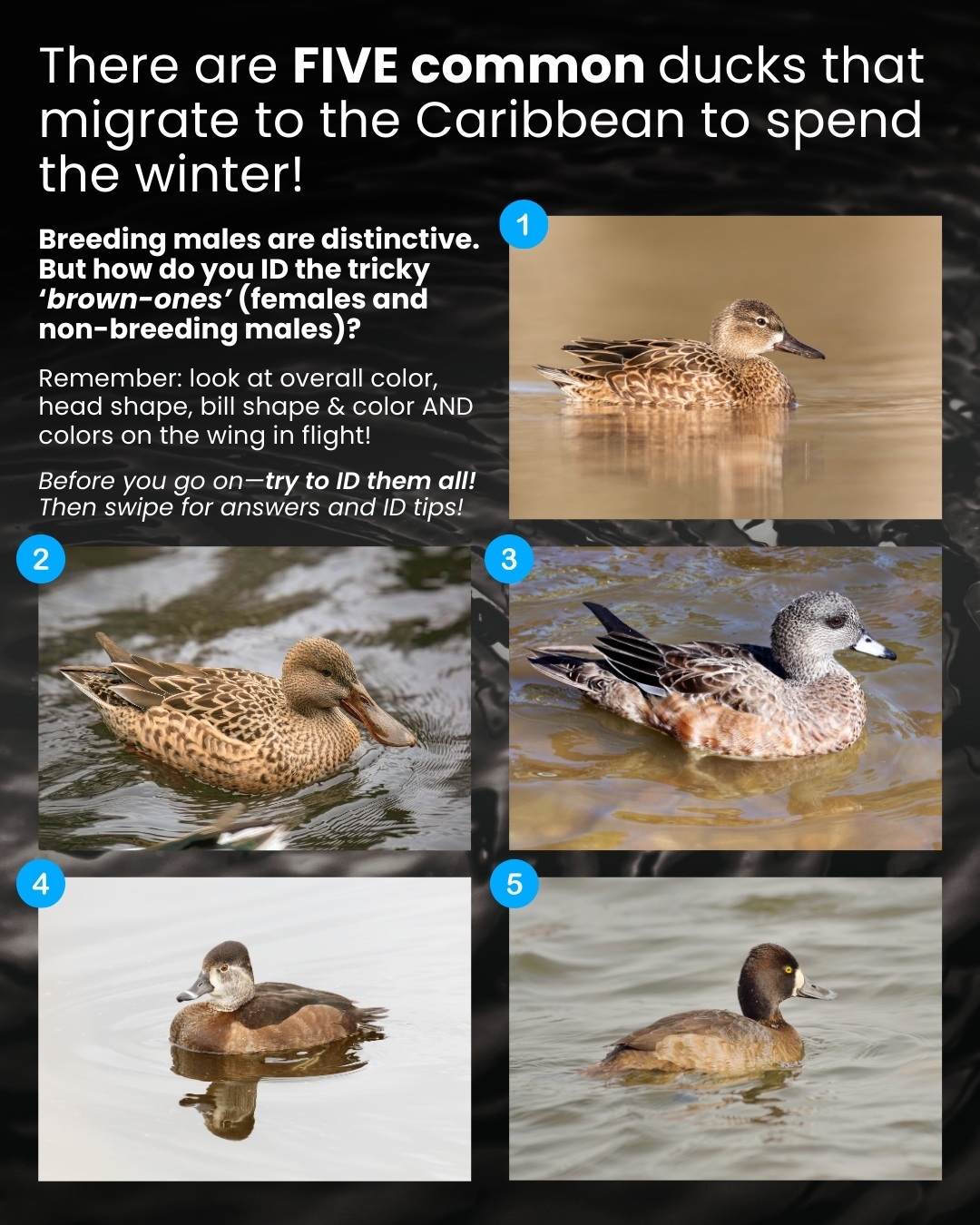
Before you dive in — take a look and see how many of our five species you can already identify!
Blue-winged Teal
These are one of the most common duck visitors to the Caribbean! Even females are often unmistakable in flight thanks to the powder-blue on the wing. This is shared by Northern Shoveler (see next), but the blue for the shoveler is less extensive and they also have bold white on the wing — which the teals lack.
When swimming look for the dark eye-line and black bill. Males in eclipse plumage may also show a faint ‘ghost’ of the white ‘crescent’ mark behind the bill, seen when they are in breeding plumage.


While similar, Green-winged Teal females (see below) are a warmer brown, and have a cream stripe at the rear. You may also spot some of the green on the wing, even when they are swimming.
Northern Shoveler
This duck might be known as the ‘Hollywood Mallard’ for the male’s flashy looks — but females are more demure. Like many female ducks, they show heavily marked brown-buff plumage — but their large spoon-shaped bill is a dead giveaway.
You can also look for a wash of powder blue on the leading edge of the wing in flight, combined with a white stripe.


American Wigeon
Breeding male American Wigeons bring glamour to the wetland! With a green eye patch and white crown, males are hard to mis-identify. Females and non-breeding males are more subtle, but you can recognize these short-billed ducks from the rusty, warm brown tones of their body plumage.
Females look plainer and less mottled than other female brown ducks, with a gray-brown head with that dark smudge around the eyes. Look also for the pale bill with a black tip.
The similar Eurasian Wigeon is a rare visitor to the Caribbean and can cause confusion. Breeding male American and Eurasian Wigeons look quite different. The American Wigeon shows a striking green stripe behind the eye, has a gray brown head and white cap. In contrast Eurasian males have a chestnut head and buff cap. However, females can be hard to separate. Look for the grayer, ‘colder’ colored head in the American Wigeon — and in flight, American Wigeons show white under the wing, whilst Eurasians are silvery gray.


A Quick Feeding Tip!
The way ducks feed can also help narrow down your ID. The ducks above are all ‘dabbling ducks’ — you’re likely to see them in shallow water, tipping head down, tail up in the air.
The next two species are ‘diving ducks’ — they dive head-first underwater when feeding, completely disappearing beneath the surface.
Ring-necked Duck
Despite the name, the male’s chestnut collar across its black neck is hard to see in the field—so don’t rely on it! Females have a brown-gray body, and pale white feathers around the base of the bill. Their heads feature a brown cap that contrasts with its gray face and white eye-ring.


Their bills are also helpful: look for the distinctive white a white band across it near the tip. Males in eclipse plumage display a brown plumage with brown-black head, breast, and back. They can be distinguished from females by their bright yellow eyes and lack of an eye-ring.
Lesser Scaup
Female Less Scaups are a warm chocolate brown. Unlike the Ring-necked Duck, their head and face is almost entirely brown, with a white patch that varies in size just behind the bill, and yellow eyes.
Males have black heads with purple/green iridescence, a black neck and breast, white sides, and greyish marbled looking backs. Both sexes have a white wing-stripe, which runs half-way along the trailing edge of the upper wing, and is visible in flight.


This species is very similar to the far rarer Greater Scaup. The best way to tell them apart is by head shape — the Lesser Scaup’s head is narrower and egg-shaped with a peak near the back of the head, while the head of the Greater Scaup is more rounded. In addition, the sides and back of the Greater Scaup are lighter.
And the rest…
We’ve covered the five most common species of migratory ducks found in the Caribbean — let’s now consider a few less common but noteworthy species.
The Mallard is what most people think of when they picture a duck. Males have a distinctive glossy green head, yellow bill, and bright orange legs and feet. Females and young males are mottled brown, with a dark bill. They may resemble female shovelers but lack the massive bill! In flight, look for the blue wing-patch bordered with white.
Gadwalls are subtly patterned and can look dull at first glance. Females can resemble female mallards, but have a thinner, darker bill and no blue-wing patch. In flight, look for small, white wing patches that are a distinctive feature of this species .


Male Green-winged Teals have a green stripe behind the eye, similar to American Wigeons, but lack the white ‘forehead’ and are MUCH smaller. Females can look like female blue-winged Teals, but again are smaller (see above). Remember, you can look for the cream stripe at the rear of Green-winged Teals — and in flight, as the name suggests, they have green wing patches.
Finally, let’s consider the Northern Pintail. This duck has a distinctive elegant silhouette that sets both the males and females apart. They are long necked and long tailed. Even though the female is brown, her silhouette distinguishes her from other ‘brown ducks’. Whilst she does not have the VERY long tail of the male, she still appears longer in the tail than other ducks. She also has a chestnut-coloured face that is less patterned and plainer looking than other female ducks.
We hope this guide has set you on the path of duck ID enlightenment! There are of course several other species of duck that are found in the region, either as year-round residents or rarer visitors. We highly recommend using your field guide, taking photos when possible, and exploring resources like Birds of the World, which is free to access in the Caribbean thanks to our partnership with the Cornell Lab of Ornithology. For trickier, rarer migrants, be sure to check out the All About Birds pages from Cornell, where you can compare similar species side-by-side.
Good luck and happy duck spotting!
You can view all the graphics, plus a ‘bonus’ quiz in this pdf booklet:
We’ve made an ID card that you can download, print as a two-sided 8.5×11 page, and laminate for easy reference in the field.
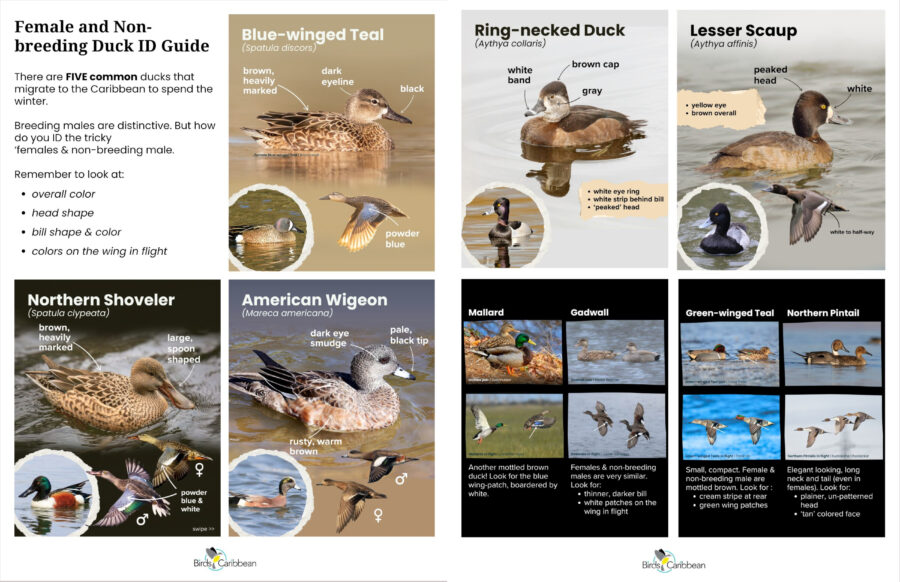
Just click the image to download the pdf file.
For more waterbird ID tips and tricks, check out: