Note that the same proposal cannot be submitted for more than one award in a given year.
BirdsCaribbean’s general Grant Application Guidelines are available here.
Learn more about the eligibility criteria of each program by visiting their respective websites.
Seeking Donors
BirdsCaribbean encourages others to consider endowments or other large awards to ensure that our grants programs continue indefinitely. Or make a donation to support our work. BirdsCaribbean is a tax-deductible organization in the United States.
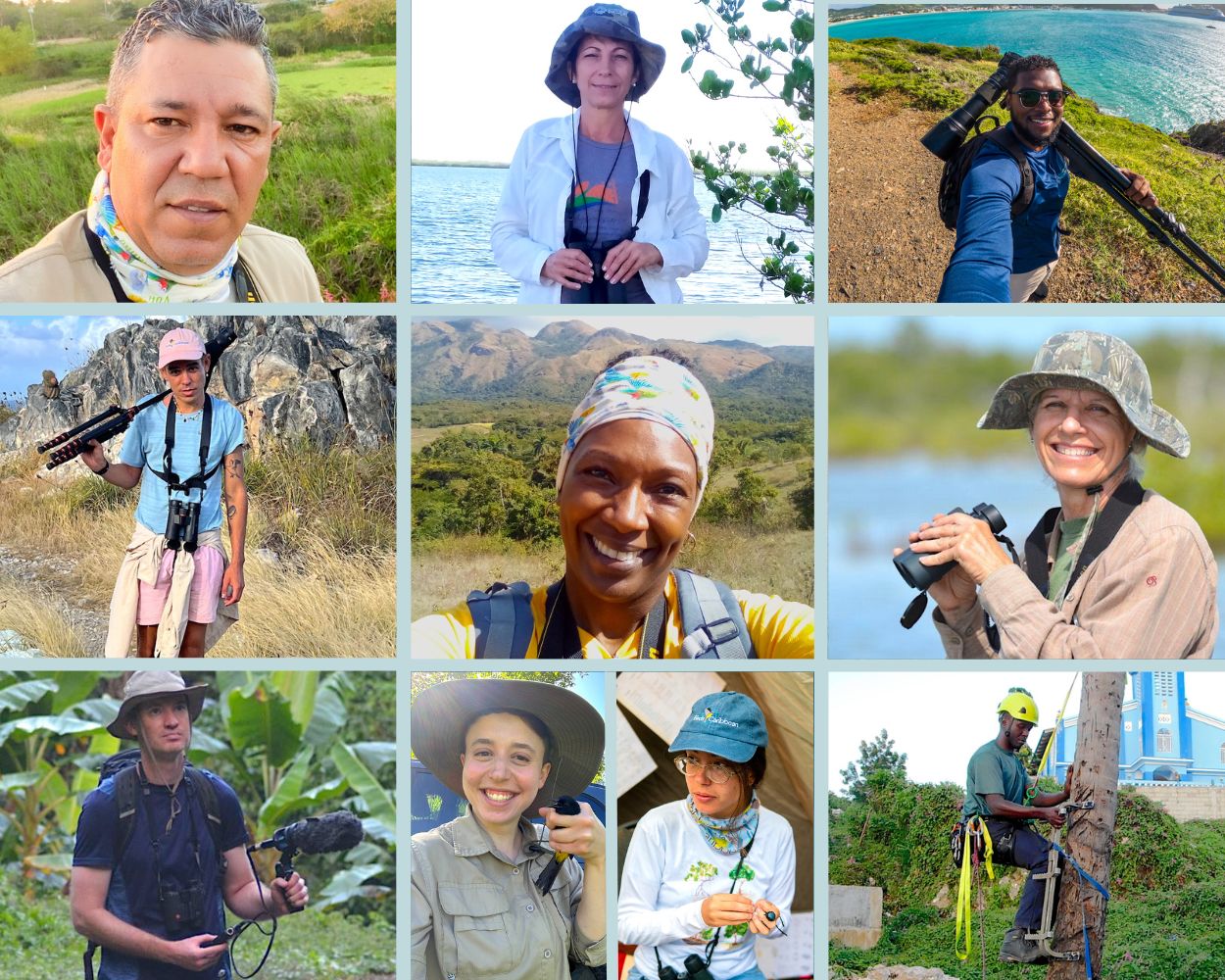
BirdsCaribbean is excited to announce the 2025 cohort of grantees under two prestigious named awards, the David S. Lee Fund for the Conservation of Caribbean Birds, and the James A. Kushlan Research and Conservation Fund.
These eleven projects will advance the study and conservation of avifauna in six different Caribbean countries: Cuba, Puerto Rico, the Cayman Islands, Trinidad and Tobago, Mexico (offshore islands in the Caribbean Sea), and Venezuela (Caribbean coast).
Keep reading to discover what exciting plans have been proposed by each awardee, and stay tuned for results and accomplishments in future issues of the Journal of Caribbean Ornithology and blog articles.
Congratulations to these outstanding researchers and conservationists from our BirdsCaribbean community!
Trophic Ecology as a Tool to Understand Differences in the Reproductive Success of Two Species of Terns (Onychoprion fuscata and Onychoprion anaethetus) in the Mexican Caribbean
Adriana Vallarino Moncada, Escuela Nacional de Estudios Superiores Unidad Mérida, Universidad Nacional Autónoma de México
More than half of the world’s seabirds are declining, but there is so much still to learn about many of our seafaring species. Two of these are the Sooty Tern (O. fuscata) and the Bridled Tern (O. anaethetus), where population trends and ecology are poorly understood. This project aims to address this lack of knowledge by studying these two terns at Isla Mujeres. This is the only place these birds nest in the Mexican Caribbean! Building on work already done monitoring the nesting colony and banding chicks, Adriana is taking this applied research a step further by using GPS tracking, stable isotope analysis, and diet studies. This work will shed light on how climate, ocean conditions, and human activities impact the survival of these terns. The data collected will identify key feeding areas and potential threats, providing critical information to help keep these breeding colonies thriving. In addition, the project will expand community outreach programs in Isla Mujeres and Cancún, raising awareness and getting more local people involved in protecting these remarkable seabirds.
Discovering the Birds of the Monte Cabaiguán Wetland, Las Tunas, Cuba
Manuel López Salcedo, Provincial Enterprise for the Protection of Flora and Fauna, Las Tunas. Delta del Cauto Protected Area, Monte Cabaniguán Sector
Monte Cabaiguán is a wetland that plays a crucial role in protecting coastal areas from erosion and filtering pollutants. Home to thriving mangroves and bustling colonies of waterfowl, it supports a rich variety of wildlife. This unspoilt wetland is essential for the breeding and survival of many migratory and resident bird species. The goal of this project is to update the baseline data on the wetland’s birdlife, assess the health of its ecosystems, and develop strategies for sustainable conservation. This project has local communities at it’s heart, with plans for environmental education and the promotion of conservation; safeguarding this unique natural treasure for future generations!
Monitoring Breeding Colonies, Nesting Success and Productivity of White-tailed Tropicbirds (Phaeton lepturus catesbyi) in the North-west Coastal Cliffs Important Bird Area in Puerto Rico
Alcides L. Morales-Pérez, Independent Researcher
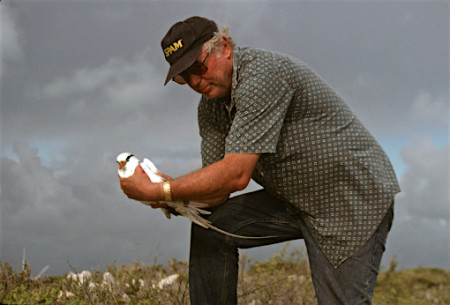
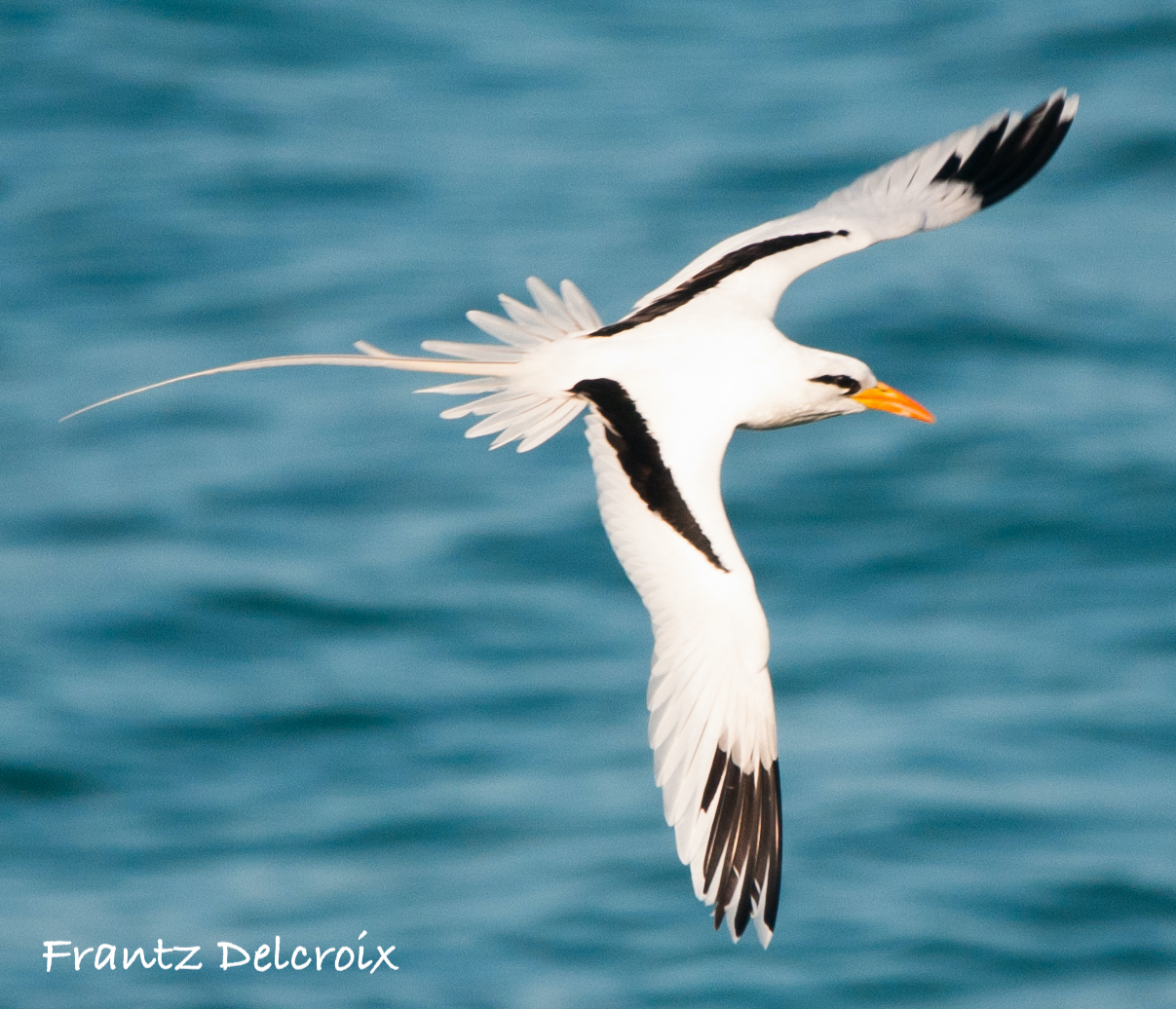
Northwestern Puerto Rico is home to the Acantilados del Noroeste (north-west cliffs) Important Bird Area (IBA). Amongst their rich biodiversity, these cliffs are home to an important nesting population of White-tail Tropicbirds, a bird at risk in the Caribbean. This one of the few White-tailed Tropicbird breeding colonies on the Puerto Rican mainland. To help protect and gain more knowledge about these beautiful seabirds Alcides will host a workshop to engage the local community, students, and other stakeholders in seabird conservation, focusing on White-tailed Tropicbirds. Participants will be trained to monitor nests and actively contribute to data collection. Through colony surveys, nest monitoring, and adult survival assessments the project aims to better understand how these birds are faring. It also aims to estimate the size and extent of the colonies on the cliffs, with local volunteers playing a key role.
Diversity, Abundance, Reproductive Colonies and Distribution of Waterbirds at Los Testigos Archipelago, Venezuela
Jemimah Rivera, INPARQUES, División de Investigación y Monitoreo Ambiental
The Los Testigos Archipelago in Venezuela is known for its incredible biodiversity. But the area has been largely overlooked by researchers due to its remote location, with only two bird expeditions in the last 50 years. While little is known about the area, it’s believed to be an important breeding ground for several seabird species. This project aims to assess the conservation status of the archipelago’s seabirds and landbirds. During the project Jemimah and her intrepid team will take on the challenge to explore the 16 islands of Los Testigos! They will study the birdlife of the islands including their seabird breeding colonies. The team will conduct surveys on foot and by boat, counting nests, eggs, and chicks. This research will be a major step in understanding the birds of the South Caribbean. With threats like invasive species, pollution, and overfishing, this study is crucial to help protect these birds for the future.
Establishing Year-Round Bird Banding stations to Monitor Resident and Migratory Species in Trinidad and Tobago
Giselle Ragoonanan, Trinidad and Tobago Bird Observatory and Research Centre
The Trinidad and Tobago Bird Observatory (TTBO) is setting up year-round bird banding stations to monitor both resident and migratory bird populations across the islands. These stations will collect crucial data on bird life cycles, migration, and population health, helping to identify trends and habitat needs. This data will guide conservation efforts, ensuring the protection of key areas for breeding and survival. The TTBO also plans to involve the local community through outreach programs, raising awareness and encouraging citizen participation in bird conservation. Additionally, the continuous monitoring will help track rare species and migration events, providing much needed insights into changing bird populations in the Caribbean.
Conservation Ecology of the Puerto Rican Oriole
Michael Ocasio, University of Maryland, Baltimore County
The Puerto Rican Oriole is a Caribbean endemic bird facing significant conservation challenges. One major threat is brood parasitism by Shiny Cowbirds, which lay their eggs in oriole nests. As a result, Puerto Rican Orioles often raise cowbird chicks instead of their own, leading to low reproductive success. This project will compare the oriole’s abundance, survival, and reproductive success in both lowland and highland habitats. Through surveys, banding, nest monitoring, and Motus tracking, the project will explore how habitat type affects their breeding and provide insights into their movements and territory use throughout the year. The findings will support conservation efforts in Puerto Rico and contribute to international programs like the IUCN Red List.
Study of the Reproductive and Trophic Ecology of Gundlach’s Hawk (Astur gundlachi), an Endemic and Threatened Bird of Cuba
Ernesto Vergara Llano, Faculty of Biology, University of Havana
Gundlach’s Hawk, a critically endangered raptor endemic to Cuba, is facing population declines and fragmented habitats, but much of its breeding and feeding behavior remains a mystery. This exciting project will dive into the secret life of this elusive hawk, focusing on two key areas in western Cuba: the National Botanical Garden and the Ecological Reserve of Los Petriles. Using camera traps to avoid disturbing the hawks, researchers will capture the hawks’ breeding behaviors, nest sites, and feeding habits. The results will provide crucial information to help protect this incredible species and improve habitat management efforts, giving the Gundlach Hawk a fighting chance for survival!
A Comparison of Avian Species Richness between Protected and Disturbed Areas in Grand Cayman, using Passive Avian Acoustic Monitoring
Matthew Southgate and Simone Williams
This exciting project will uncover the birdlife of Grand Cayman using passive acoustic recorders to capture birds’ calls and songs! With bird populations facing major threats from habitat loss due to development, it’s crucial to understand what helps them thrive. The goal is to assess the health of protected areas and guide decisions on conservation and development. The team will measure bird species richness in protected areas, compare it with nearby disturbed land, and identify the factors that influence it. Citizen scientists and student interns will be involved in monitoring, bird surveys, and community outreach. Plus, the project will contribute audio recordings to improve the Merlin Bird ID app, making it easier for this app to identify native species. By understanding bird populations, this project will help protect ecosystems, prevent environmental damage, guide future restoration efforts and promote bird-friendly development.
Action Plan for the Conservation of Psittacidae in the Pico Cristal National Park, Cuba
Inés Lourdes Fernández Rodríguez, Empresa Flora y la Fauna Santiago de Cuba
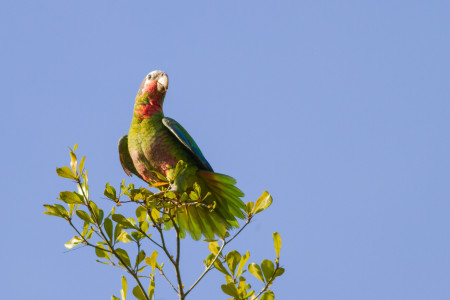
Pico Cristal National Park in Cuba is home to the island’s vibrant parrot (psittacidae) species, including the Near Threatened Cuban Amazon and the Vulnerable Cuban Parakeet, or “Catey”. These colorful birds are facing serious threats from habitat loss, hunting, and being captured for the pet trade. This project aims to create and carry out a comprehensive Action Plan to protect these endangered species. Building on past efforts like providing artificial nests to help with breeding, the project will monitor bird populations, identify important conservation areas, and study their ecological and nutritional needs. Students, researchers, and the local community will all be involved, with a focus on raising awareness and supporting bird conservation across Cuba.
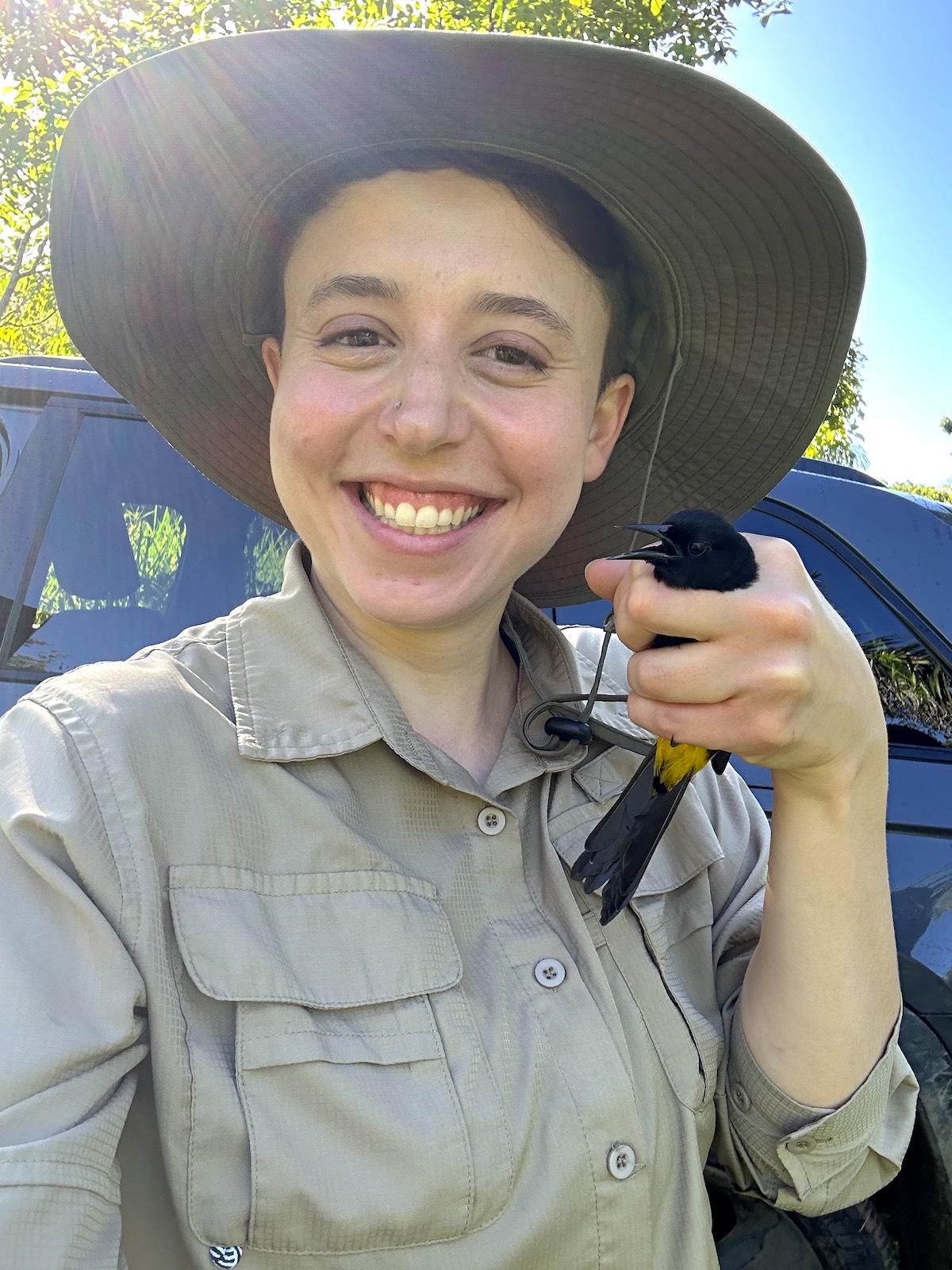
Impact of Nest Temperatures on Mortality Rates of the Endangered Yellow-shouldered Blackbird (Agelaius xanthomus) in Southwestern Puerto Rico
Retsel Gonzalez, University of Puerto Rico
The Yellow-shouldered Blackbird, an endangered endemic found mainly in southwestern Puerto Rico. It faces ongoing challenges to its reproductive success, despite ongoing conservation efforts. A recent study suggested that the elevated temperatures inside artificial nests might be contributing to the high mortality rates among eggs and chicks. This project will compare survival rates and temperature levels in both artificial and natural nests to determine if temperature is a key factor impacting reproduction. The findings will help refine current conservation strategies, improve nest management, and hopefully boost recovery efforts for this iconic species.
Ecology of Bare-legged Owl (Margarobyas lawrencii) an endemic strigid in Cuba
Jean Michel De Jongh González, Botanical National Garden, Havana University.
The Bare-legged Owl is endemic to Cuba and the only member of its genus, Margarobyas. It relies on dense forests and natural cavities for nesting, but it faces serious risks from habitat loss, which has led to its recent listing on the IUCN Red List of Threatened Species. This study will take place in the Sierra del Rosario Biosphere Reserve in western Cuba and will focus on two main areas: understanding the owl’s behavior and diet, and studying its use of habitats and nesting sites. The project will also tap into local knowledge from nearby communities and Havana. Fieldwork will be done during both the breeding season and off-season to gain a deeper understanding of this unique and remarkable bird.
Are you working on or planning a research or conservation project with Caribbean birds?
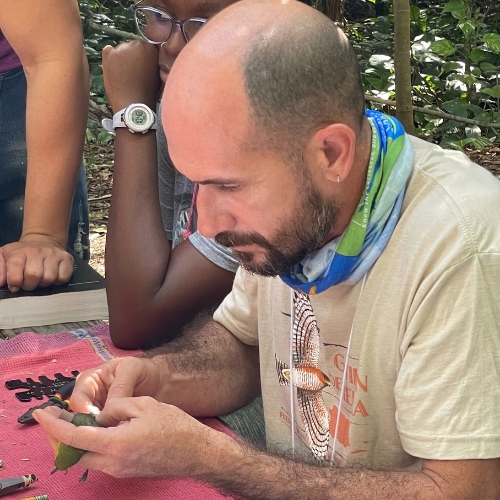
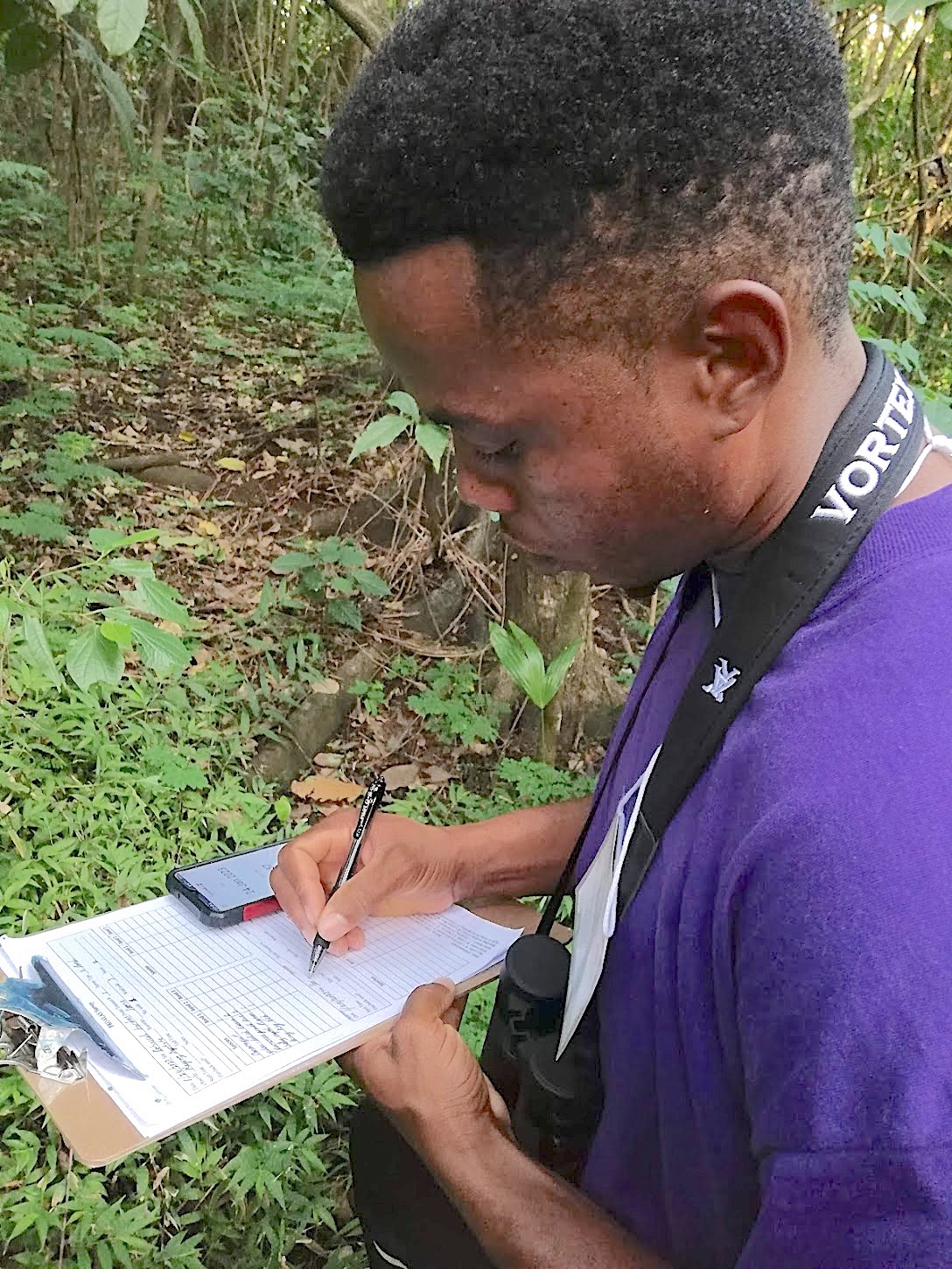
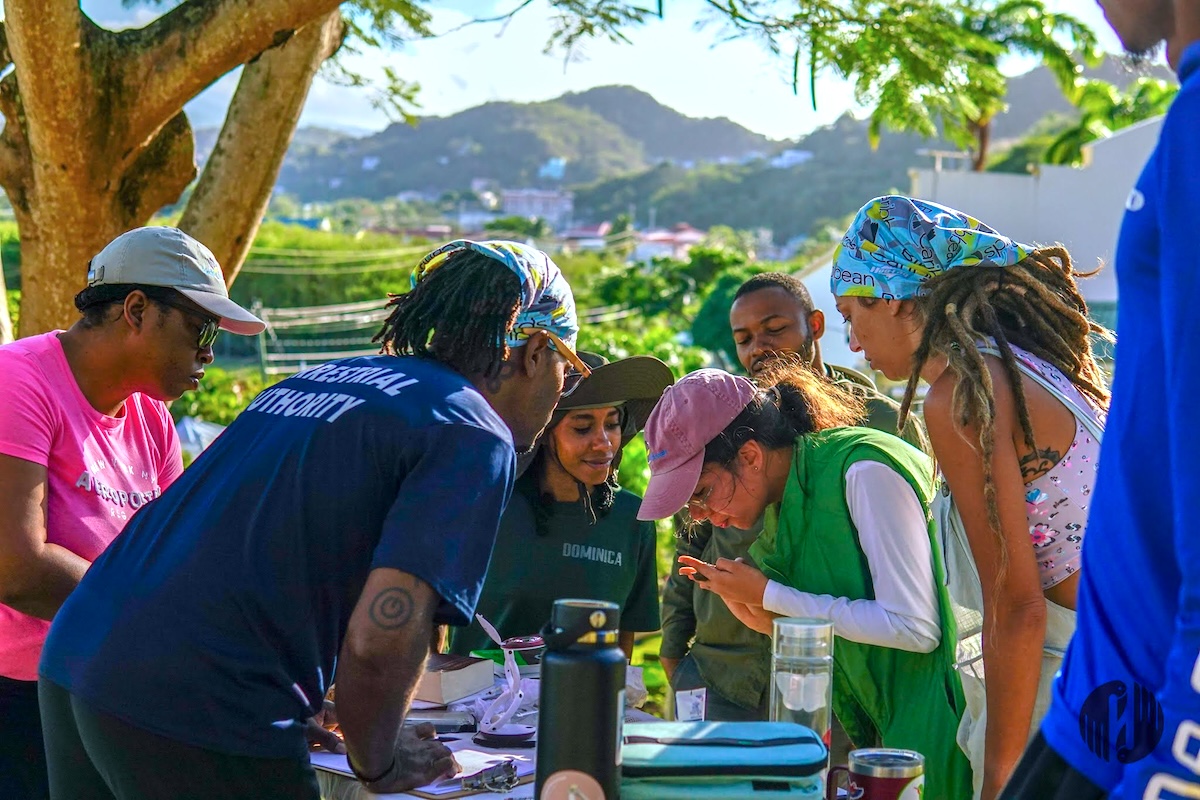
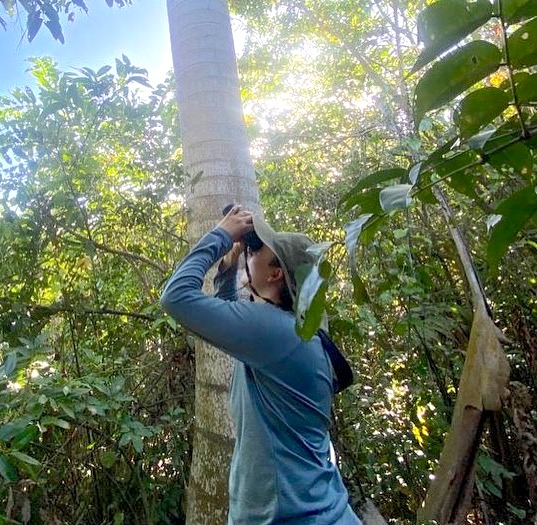
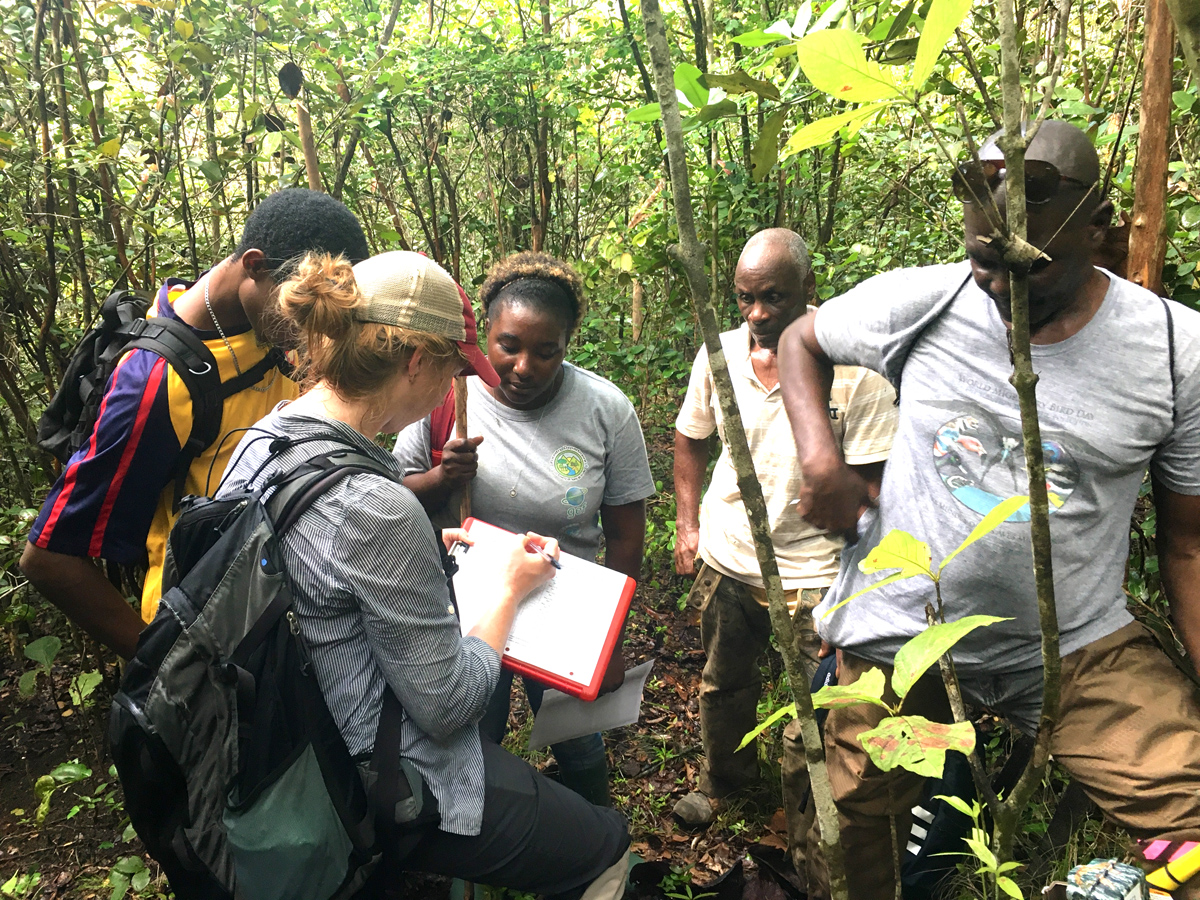
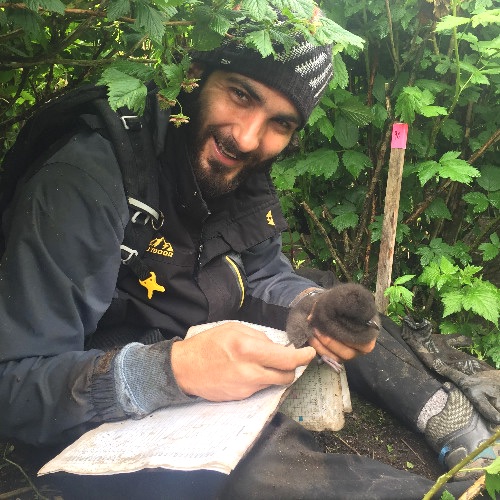
Kayroy Baptiste (Union Island Environmental Alliance) entering data into PROALAS survey sheet during a line transect survey of birds behind Anglican Pastoral Centre in St. Vincent.
Our next call for proposals will be advertised in the fall of 2025. Members of BirdsCaribbean conducting research and conservation work are eligible to apply. Stay informed and don’t miss our announcements by subscribing to our monthly newsletter,joining our Listserv, and following us on social media (@BirdsCaribbean on Instagram, Facebook, Twitter, Youtube, and LinkedIn).
BirdsCaribbean thanks our generous donors for supporting these awards, and encourages others to donate to these programs, as well as to consider endowments or other large awards to ensure that our vital grants programs can continue indefinitely. You can help us to continue supporting these invaluable projects by making a donation here.
If you prefer to donate via check, please make this out to “BirdsCaribbean” and in the memo section, note the fund you are donating to. If you have questions, or would like to make other arrangements for donating, feel free to contact Alexia Morales, BirdsCaribbean Operations Manager (Alexia.Morales@birdscaribbean.org). Checks can be mailed to: BirdsCaribbean, 841 Worcester St. #130, Natick, MA 01760-2076
What a year it’s been! 2024 was a whirlwind of excitement, challenges, and growth, and we’re thrilled to share some of the highlights with you. From record-breaking events to building new partnerships, we’ve had quite the ride—and we couldn’t have done it without the support of our amazing community. Here’s a round-up of our most unforgettable moments from the year. Thank you to all our volunteers, members, donors, and everyone who believes in the future of Caribbean birds!
Fantastic fifteen for the Caribbean Waterbird Census
2024 started with us celebrating an amazing 15 years of the Caribbean Waterbird Census. From January 14th to February 3rd, over 200 birders across 14 islands helped us document over 300 CWC checklists! Highlights from this year’s count included a Baird’s Sandpiper spotted in Guadeloupe—a very rare Caribbean visitor!
A volunteer uses a Shorebird ID card at a Caribbean Waterbird Census count. (Photo by Dayamiris Candelario OPAS)
A group of Lesser Scaups at East End Pond. (Photo by Jacqueline A Cestero)
Carrying out CWC surveys on St. Eustatius. (Photo by Jethro van’t Hul)
Sanderling – X19 stopped on another winter visit to Jamaica. (Photo by Damany Calder)
Baird’s Sandpiper (Photo by Caio Osoegawa ML628469580)
Big Day got even BIGGER!
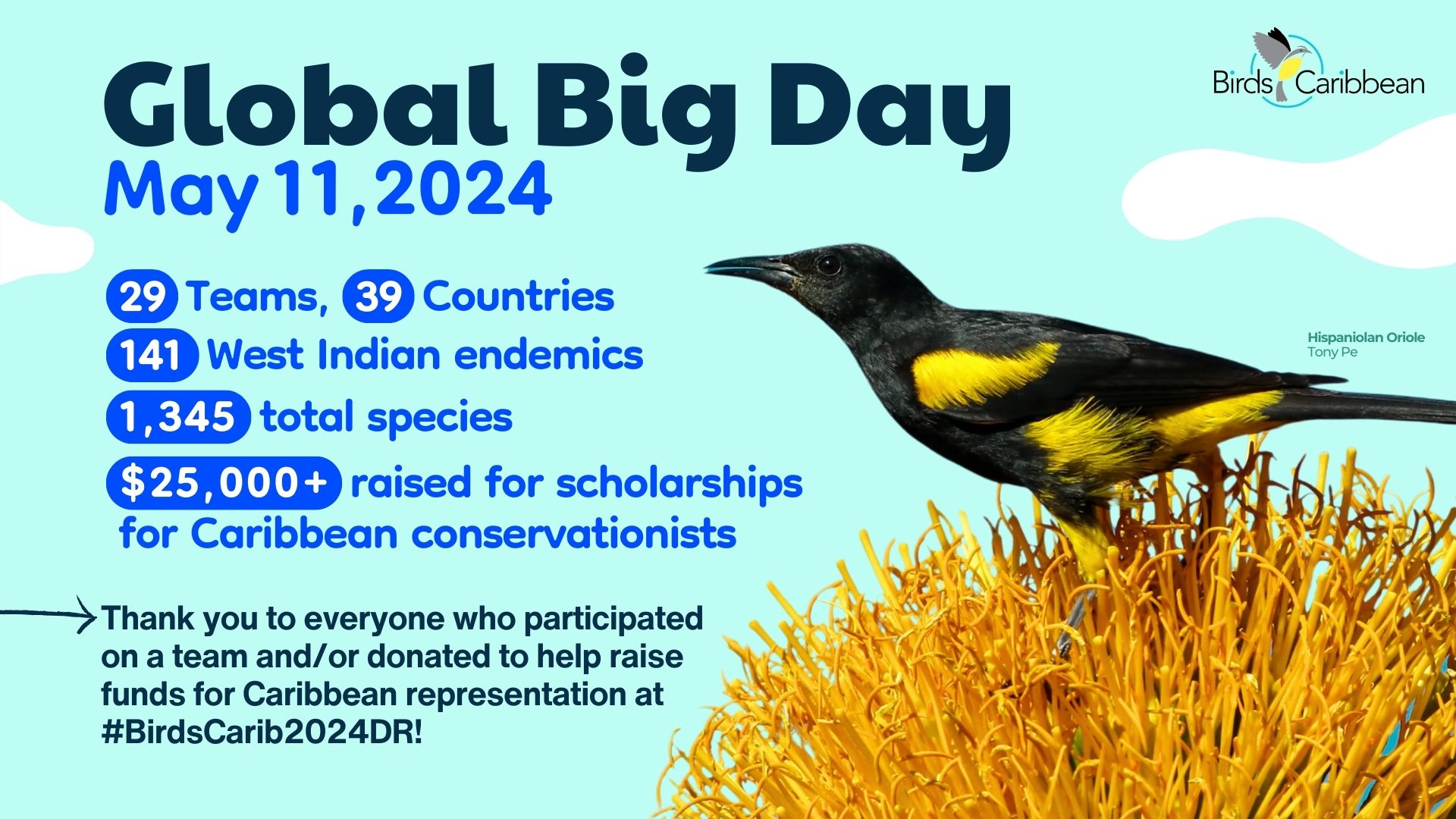
On Global Big Day, May 11, birders around the world got out and about to join in the fun. In the West Indies, we shattered our records for both participation and bird sightings! Big Day birders in the region saw 551 West Indian species, thanks to the amazing efforts of 710 eBird observers—up from 511 last year! But wait there’s more: there were more species sighted (1,354 total, 208 more than last year) and a huge leap in the number of checklists submitted—2,755 total, nearly 1,000 more than last year—phenomenal!! We’re proud of this fantastic win for citizen science in the West Indies!
Dominica’s Imperial Seekers seeking out the magnificent Imperial Parrot for GBD 2024. (Photo by Garry Auguiste)
Members of Wadadli Warblers in Antigua got in on the early birding action for GBD 2024. Photo by Shanna Challenger
A subgroup of the Gundlach Team in Cuba ready to dominate the competition on the morning of GBD 2024.
Big Day wasn’t just about ticking off the birds though, our fun ‘Teams competition’ and annual fundraising efforts were back—this time to enable Caribbean conservationists to come together and strategize to protect our birdlife. We raised over $25,000, an amazing effort that helped bring many deserving Caribbean nationals to our 24th International Conference in the DR! Speaking of which…
We made BirdsCaribbean history in the Dominican Republic!
A record-breaking 338 delegates from 32 countries and islands flocked to Santo Domingo, Dominican Republic, making our 24th International Conference our largest gathering ever! Conservationists from all walks of life came together, united by a shared mission: protecting the incredible birds that define our region. Centred on the theme: “From Mangroves to Mountains: Safeguarding our Avian Treasures,” the conference featured expert-led presentations, roundtable discussions, training sessions, networking opportunities, fundraising initiatives, and birding trips to observe Hispaniola’s diverse bird species, including its unique endemics. From mangrove conservation to Hispaniola’s endemics to habitat restoration—the conference was a hub of knowledge sharing, networking, collaboration, and inspiration.
Anne-Isabelle Bonifassi, Executive Director of Haiti National Trust, speaks about ecosystem restoration in Haiti, during the Hispaniola Day symposium.
Problem tree being analysed and turned into a results tree by participants.
First time BC Conference attendee Soraya proudly stands next to her poster.
Delegates birding at Ebano Verde.
Palmchat. (Photo by Dax Roman)
Traditional Dominican dancers at the opening reception.
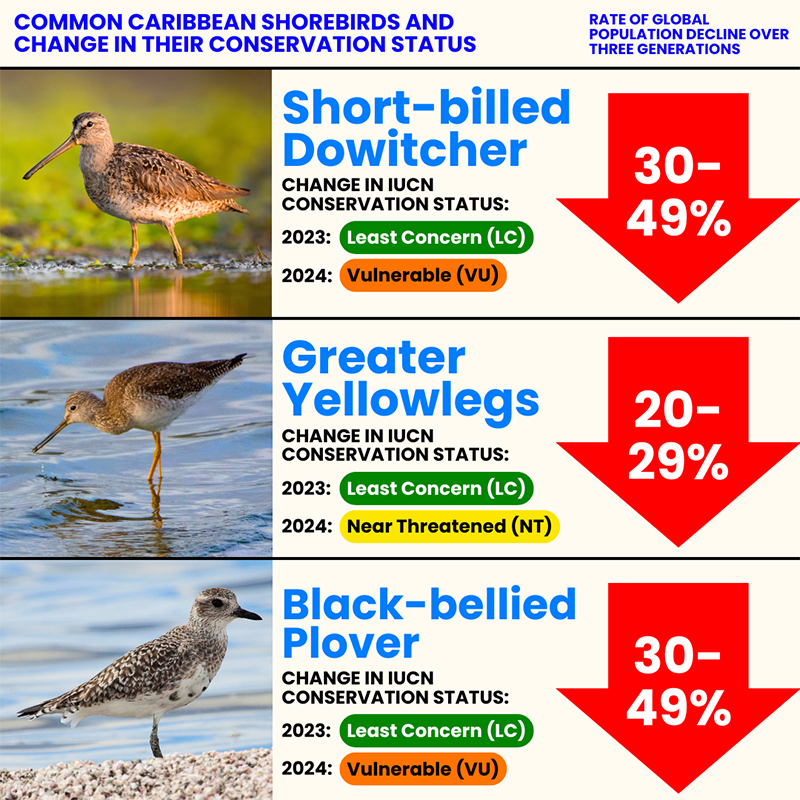
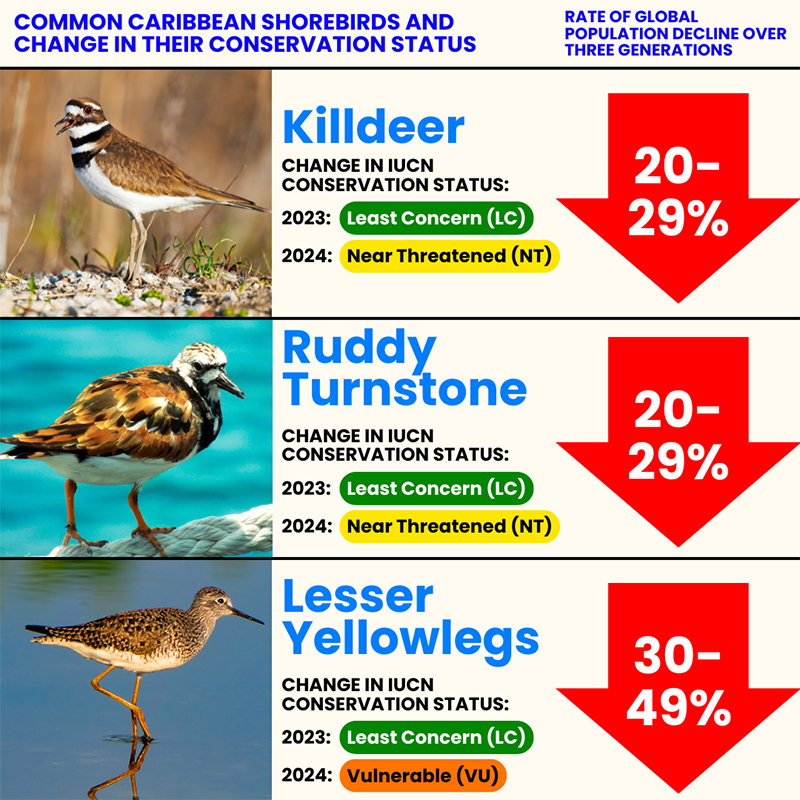
In collaboration with researchers from Virginia Tech, BirdsCaribbean learned more about one of these threats—human disturbance. Early in 2024 we published a report based on a survey of those who do CWC counts, which showed that they perceive human disturbance to be the most significant threat to shorebirds in our region. The report highlighted the need for more social and biological research on human disturbance, and how to tackle this threat.
As we get ready for the 2025 CWC regional count we hope Caribbean birders head for the coast to observe and record shorebird sightings! If you would like to support shorebirds and their threatened habitats, please click here.
Birds and bugs: A perfect pairing for conservation!
Are you Team Insects or Team Birds — or both?! (Photo by TTBO)
Male Puerto Rican Mango. (Photo by Rafy Rodrguez)
Posters about insect types and functions, created by STENAPA staff. (Photo by STENAPA)
Youth enjoying bird games offered by the University of Havana Bird Ecology Group. (Photo by University of Havana Bird Ecology Group)
Completed birdhouses. (Photo by BarbudanGO)
Group birdwatching at Hope Botanical Gardens. (Photo by BirdLife Jamaica)
Six more reasons to celebrate Caribbean endemic birds
This year, we welcomed six newly-recognized Caribbean endemics, bringing the total to an impressive 185! Meet the latest members of our avian family: Grenada Wren, St. Vincent Wren, St. Lucia Wren, Kalinago Wren, Martinique Thrasher, and the St. Lucia Thrasher. More birds to celebrate, more species to protect!
The St Vincent Wren has a notably long wing chord. (Photo by David Hollie ML600921241)
The St Lucia Thrasher has dark brown plumage overall and white underparts. (Photo by Blake Matheson ML214222511)
New resources to keep you informed and inspired
We’ve been busy behind the scenes, launching new resources to keep you in the loop on all things bird conservation. Our first-ever Endemic and Threatened Species Working Group (ETSWG) newsletter debuted this month, packed with the latest research and happenings in the field. Click here for an insightful and enjoyable read! For the latest news and research about our birds farther from shore, dive into our Seabird Working Group newsletter. Both are available in English, Spanish, and French. As always, we welcome your feedback.
And by the way, have you checked out the latest edition (#37) of the Journal of Caribbean Ornithology? It includes research articles and notes, as well as conservation reports, book reviews, perspectives, and opinions. Even more exciting? Volume #37 is a JCO Special Issue!—featuring the contributions from the 24th International BirdsCaribbean Conference! Check out this amazing compendium to rediscover all the fantastic insights shared at the conference!
Always released in English, Spanish, and French, the annual Seabird Working Group is the perfect resource to stay up-to-date on the latest in Caribbean seabird conservation.
From Mangroves to Mountains – Explore JCO Special Issue Vol. 37!
It’s a first edition! Dive right into the newly launched Endemic and Threatened Species WG Newsletter – in English, Spanish, or French, of course!
Training champions for birds and conservation
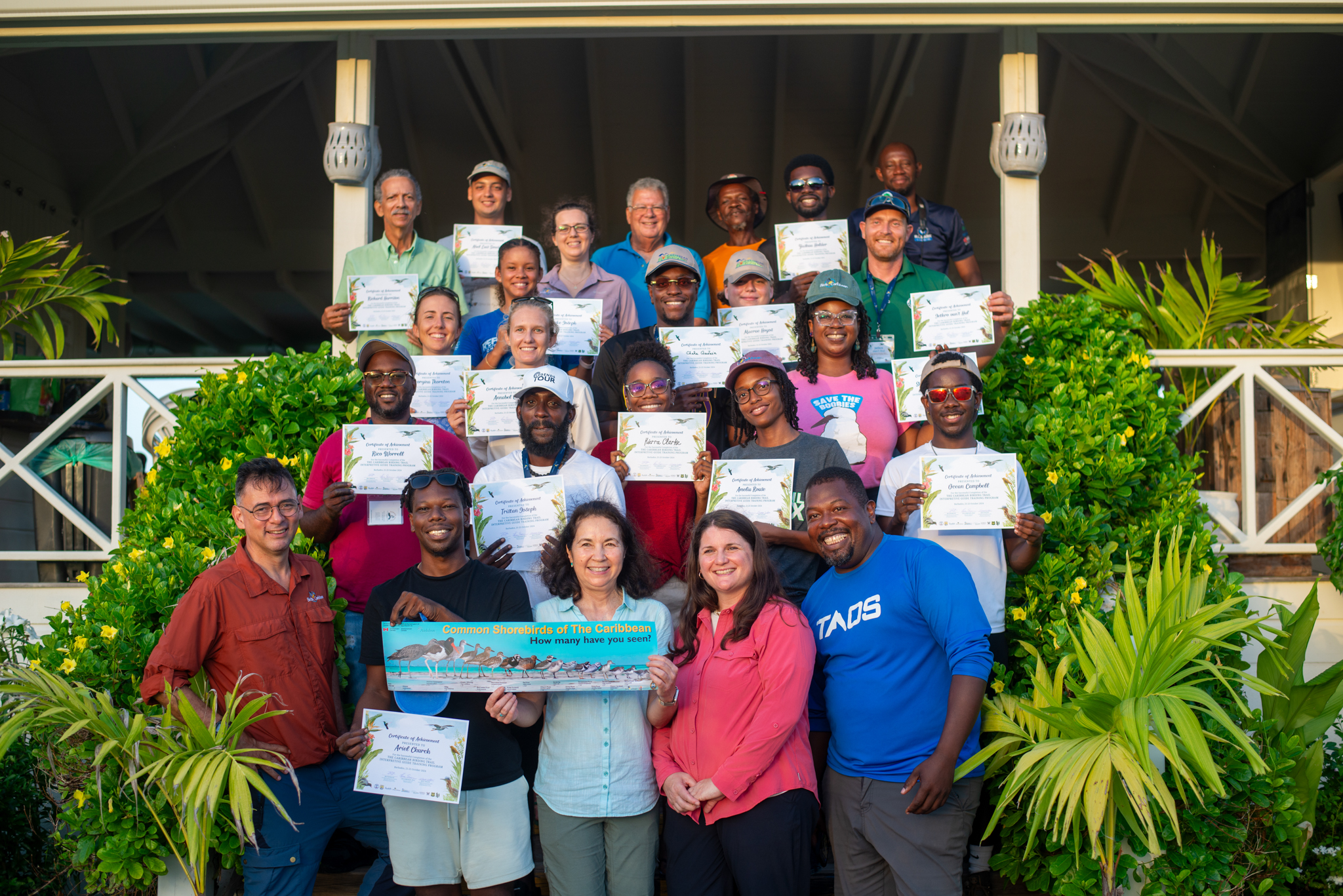
In October, BirdsCaribbean collaborated with a local NGO, WIRRED (Walkers Institute for Regenerative Research and Design) to conduct a week-long Caribbean Birding Trail Guide Training Workshop on the island of Barbados. Home to the endemic Barbados Bullfinch, the island’s wetlands and coastline harbour critical stopover sites and wintering habitat for migratory species. The training covered not only bird identification and guiding techniques, but also how to tell stories and make connections to the island’s rich cultural, historical, and ecological heritage through the art of environmental interpretation. Congratulations to the 21 newly trained bird guides and conservation champions from Barbados, Antigua, Sint Eustatius, and Cuba!
BirdsCaribbean is pleased to present our Caribbean Birding Trail 2024 cohort! (Photo by WIRRED)
In the US Virgin Islands, 22 educators from three islands learned to engage students with nature and science through birds! Two BirdSleuth Caribbean workshops were held in June, in partnership with SEA (St Croix Environmental Association), the USVI Dept of Environment and Natural Resources, and Horsley Witten Sustainable Environmental Solutions. Over two days, each group explored the BirdSleuth Caribbean curriculum and discovered how to bring birds into the classroom. Birds are excellent for teaching scientific skills as well as gaining appreciation of the islands’ wonderful bird life.
Our Caribbean Landbird Monitoring Program continues to build regional conservation capacity!
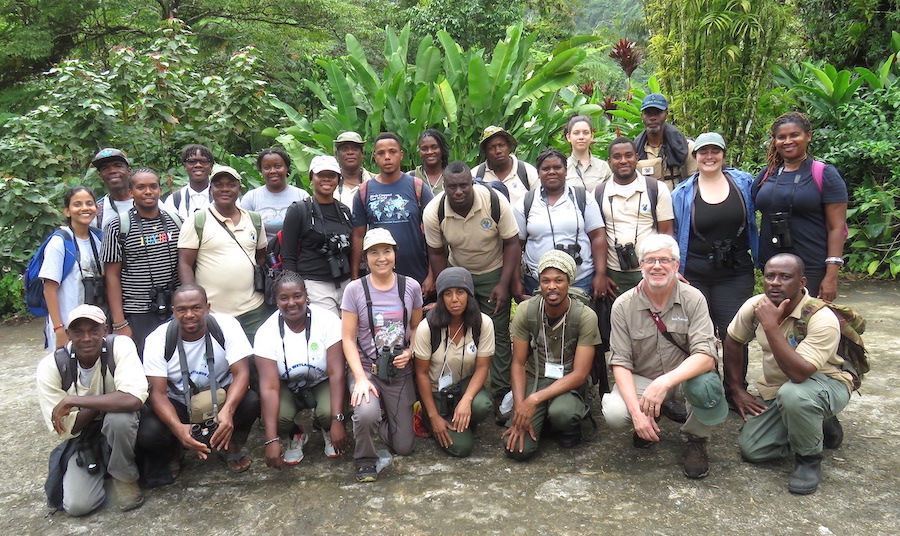
This year our 3rd annual bird banding workshop (as part of the Caribbean Landbird Monitoring Program) migrated down to the Lesser Antilles in St. George, Grenada. From March 7 – 11 participants learned all about songbird banding at scenic locations like the Blue Horizons Resort (featuring views of the white sand Grand Anse Beach) and in the dry forests of Mount Hartman National Park (featuring views of the critically endangered Grenada Dove). With collaboration from Klamath Bird Observatory, participants received training from internationally recognized and North American Banding Council (NABC) certified trainers on all the banding basics from how to properly handle birds, how to extract birds from mist nets, and an introduction to the topic on every bander’s mind, molt. We welcomed 18 participants from 9 different islands and at the end celebrated the certification of two more Caribbean NABC trainers: Daniela Ventura of Cuba, and Zoya Buckmire of Grenada. Congratulations!!
Daniela Ventura instructing participants during the CBB workshop in Grenada. (Photo by Holly Garrod)
We returned to the scenic mountains of Jarabacoa, Dominican Republic for our third annual Landbird monitoring Workshop from 22-26 February, 2024. This year we were ecstatic to welcome 25 participants from 14 different islands. Participants learned the ins and outs of how to set up PROALAS landbird monitoring on their islands, how to enter data using eBird, and how to train people on basic bird identification, featuring some endemic birds of Hispaniola! No workshop would be complete without excursions into the field to practice these monitoring techniques, and participants got to wander the rolling hills around Jarabacoa, finishing with a field trip to the Scientific Reserve, Ebano Verde for chances at finding a Hispaniolan Trogon! Thanks to our Caribbean Landbird Monitoring Small Grant initiative, participants are already making an impact! Six new monitoring programs have launched in The Bahamas, Dominican Republic, Grenada, and Cuba, putting skills into action to protect Caribbean birds.
Weathering the Storm: Resilience in the Face of Climate Change
2024’s hurricane season started early, impacting several of our islands to varying degrees. Climate change fueled extreme weather is no doubt becoming the “order of the day.” Hurricane Beryl (the earliest hurricane ever to reach Category 5 intensity) arrived in early July, and wreaked havoc on Union Island, destroying the 13 year-long Ashton Lagoon project, where the office of Sustainable Grenadines (SusGren) is located. Fortunately there were no casualties, but the entire island was devastated. Now, SusGren’s Executive Director Orisha Joseph is determined to “build back better and stronger.” If you would like to contribute to the restoration of Ashton Lagoon, click here. Beryl also devastated the small sister islands of Carriacou and Petite Martinique, near Grenada, and went on to cause destruction and flooding in parts of Jamaica.
The charming SusGren office before it was destroyed by Hurricane Beryl. (Photo by Sustainable Grenadines Inc.)
Sustainable Grenadines office was completely destroyed when Hurricane Beryl passed through Union Island on July 1, 2024. (Photo by Orisha Joseph)
Ashton Lagoon mangrove littered with littered with chairs, desks, filing cabinets, papers. (Photo by Orisha Joseph)
We recognized and celebrated our committed conservation community!
The BirdsCaribbean Awards were celebrated with rousing applause on the final night of our conference in the Dominican Republic.
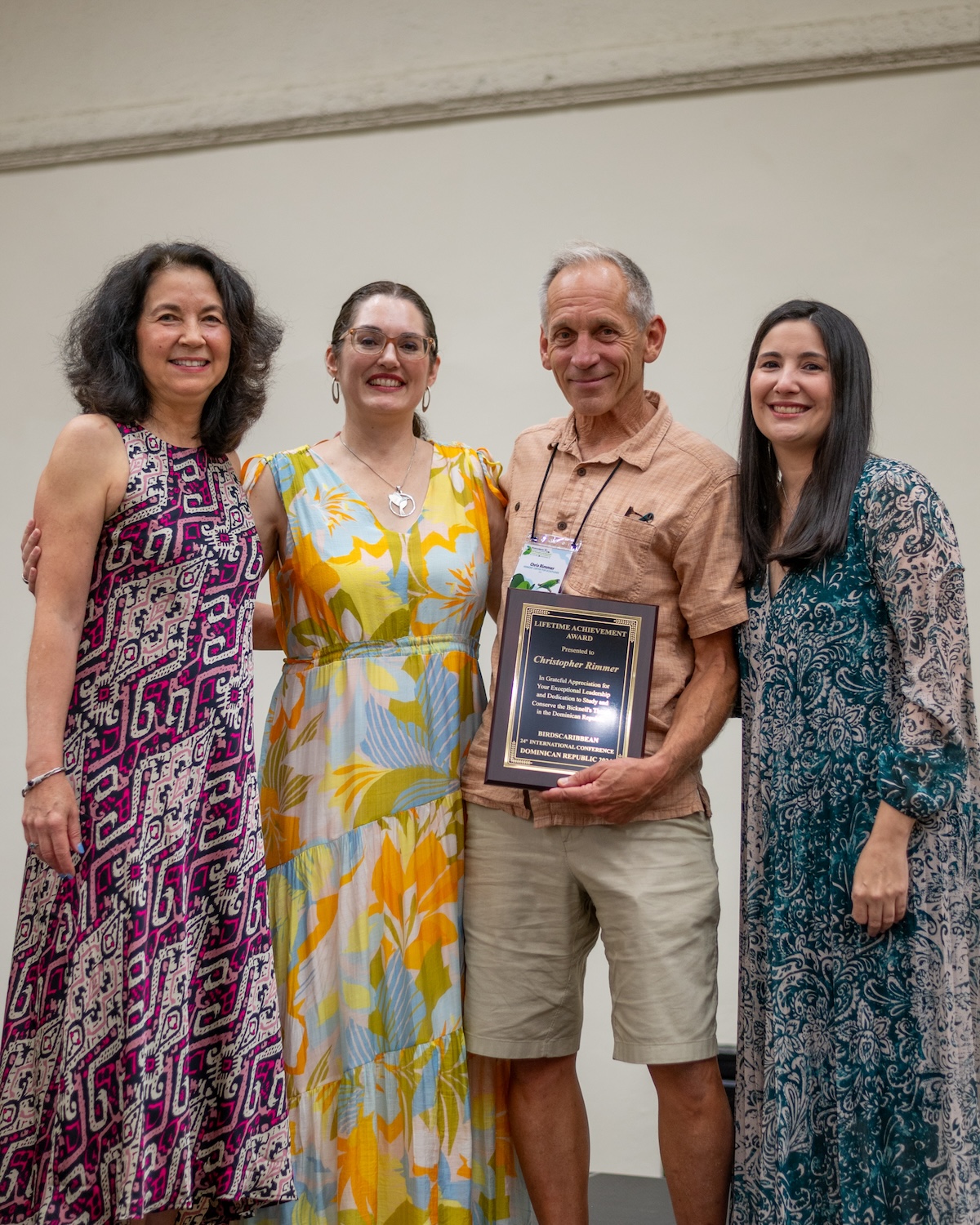
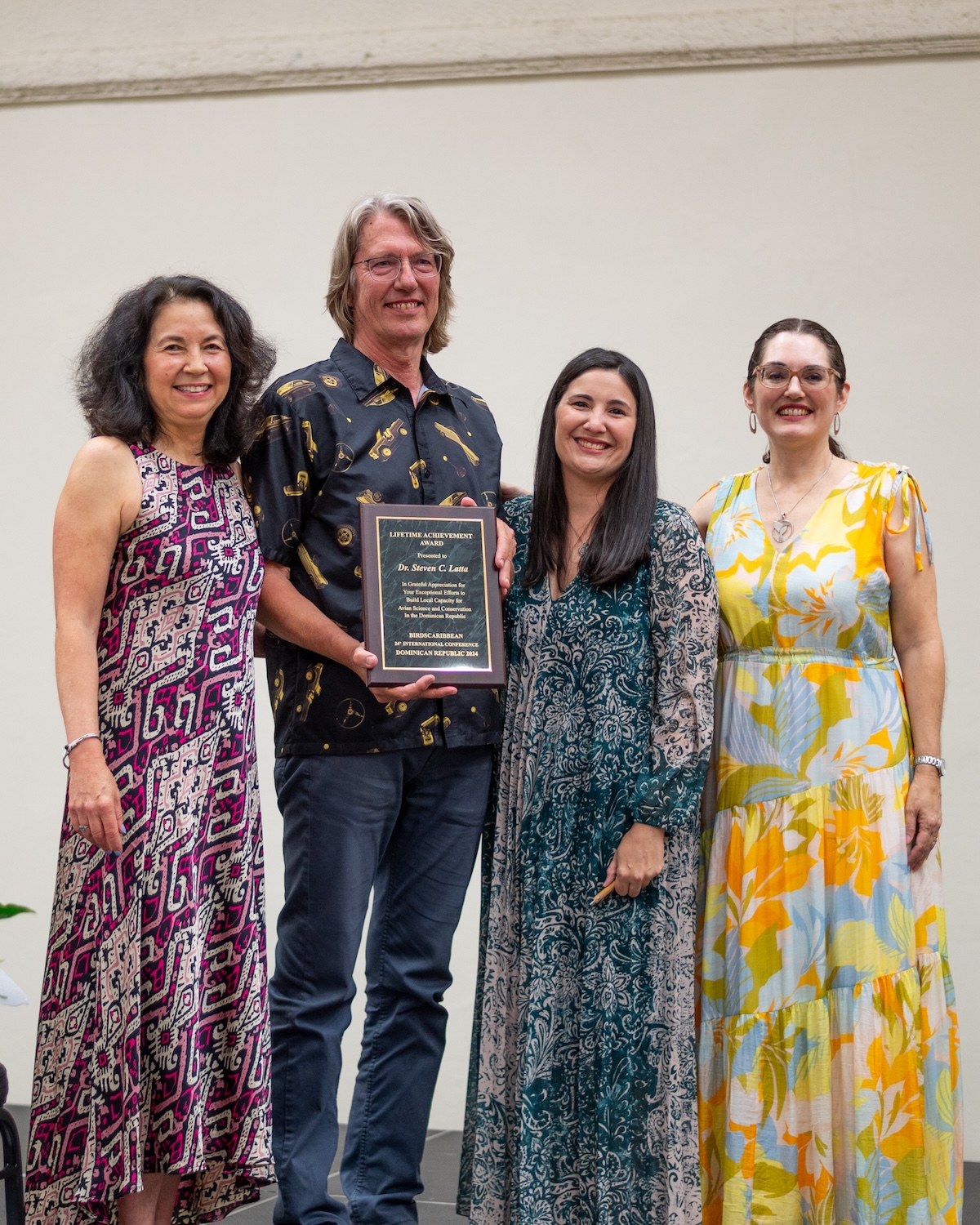
Winners of the prestigious Lifetime Achievement Award were Christopher Rimmer, Emeritus Executive Director of Vermont Center for Ecostudies (VCE)—the “Bicknell’s Thrush man”; and Dr. Steven C. Latta, Director of Conservation and Field Research at the National Aviary of the Dominican Republic.
Lifetime Achievement Award recipient Christopher Rimmer with BirdsCaribbean Executive Director Lisa Sorenson, BirdsCaribbean President Adrianne Tossas and Andrea Thomen.
Lifetime Achievement Award recipient Dr Steve Latta with BirdsCaribbean Executive Director Lisa Sorenson, BirdsCaribbean President Adrianne Tossas and Andrea Thomen.
President Dr. Adrianne Tossas handed out the coveted President’s Awards to four exemplary organisations on the island of Hispaniola: The Peregrine Fund Dominican Republic, Grupo Jaragua, Grupo Acción Ecológica and Action pour la Sauvegarde de l’Écologie en Haïti. Meet our full roster of awardees here! Congratulations to all—you inspire us to keep pushing harder everyday!
We proudly supported 12 projects through the David S. Lee Fund for Caribbean Birds and the James A. Kushlan Research and Conservation Fund. These projects advanced avian research and conservation in seven Caribbean countries: Cuba, Jamaica, Puerto Rico, the Dominican Republic, Mexico (offshore islands), St. Eustatius, and The Bahamas. Projects ranged from establishing bird diversity data in The Bahamas, to evaluating education campaigns for the Endangered Jamaican Blackbird, studying the role of urban parks for birds in Cuba, tracking Puerto Rican Orioles, and enhancing Red-billed Tropic Bird conservation in St. Eustatius. We are thrilled to support the dedicated researchers and conservationists in our BirdsCaribbean community.
Without a doubt, we are #StrongerTogether
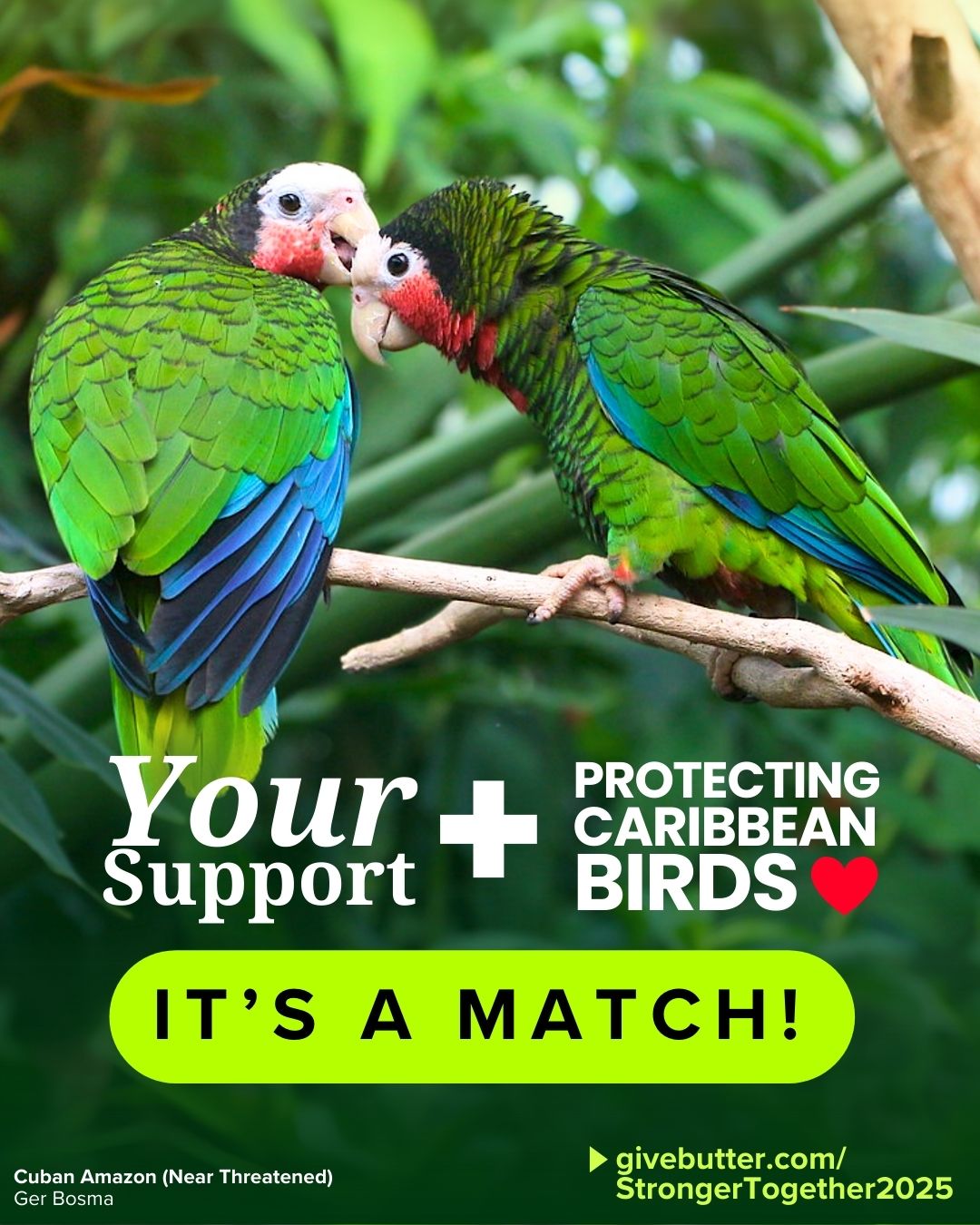
Giving Tuesday was a huge success, exceeding our $15,000 target! With the theme “Stronger Together: Empowering People, Saving Birds” we are continuing our fundraising efforts with a new target of $60,000! Our team members have raised just over $51,000 so far—we’ve got 18% to go and it’s not too late to help us reach our goal! View our fundraising page here—where a generous match from the BirdsCaribbean board means that any help you give is doubled to continue our work with the people and birds of the Caribbean!
Farewell to some true bird conservation legends
This year we said sad farewells to beloved champions of Caribbean birds. They will be missed…
Wayne Burke at Woodbourne Shorebird Refuge. (Photo by Yves Aubrey)
Wayne “Doc” Burke of Barbados who passed away on November 19, tackled the issue of hunting shorebirds, establishing the Woodbourne Shorebird Refuge, a former shooting swamp that became a haven for shorebirds. His pioneering efforts spurred a change in attitudes and practices among Barbadian hunters, and led to the establishment of more shorebird refuges. Read more here.
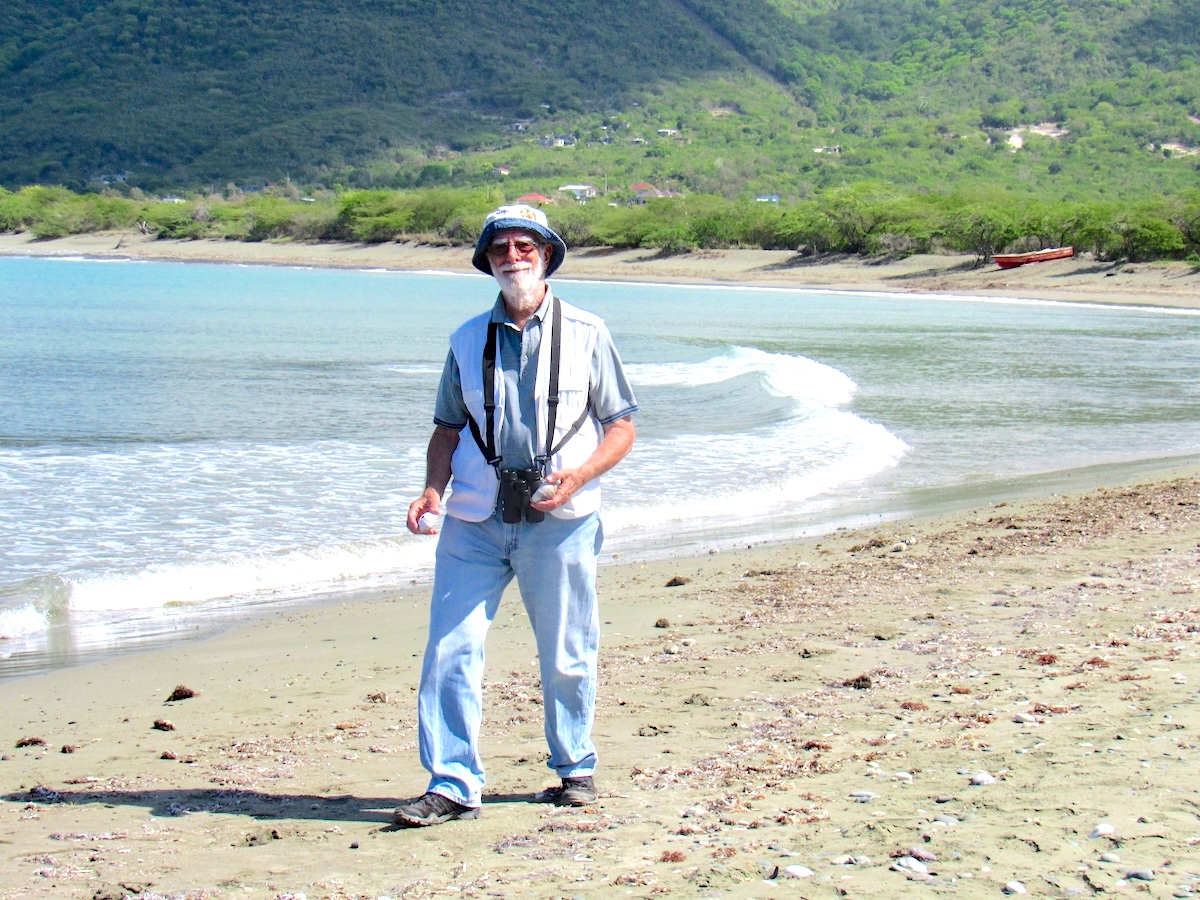
John Fletcher walking along the beach during a visit to Yallahs Salt Ponds, a place where he was always very happy. (Photo by Emma Lewis)
London-born John Fletcher, who died at the age of 95 in Kingston and adopted Jamaica as his home at a young age, became a successful businessman, a coffee producer—and most of all an avid birder and a President of BirdLife Jamaica. He was a revered and loved “guru” for bird watchers of all ages, conducting countless bird tours across the island. Read more here.
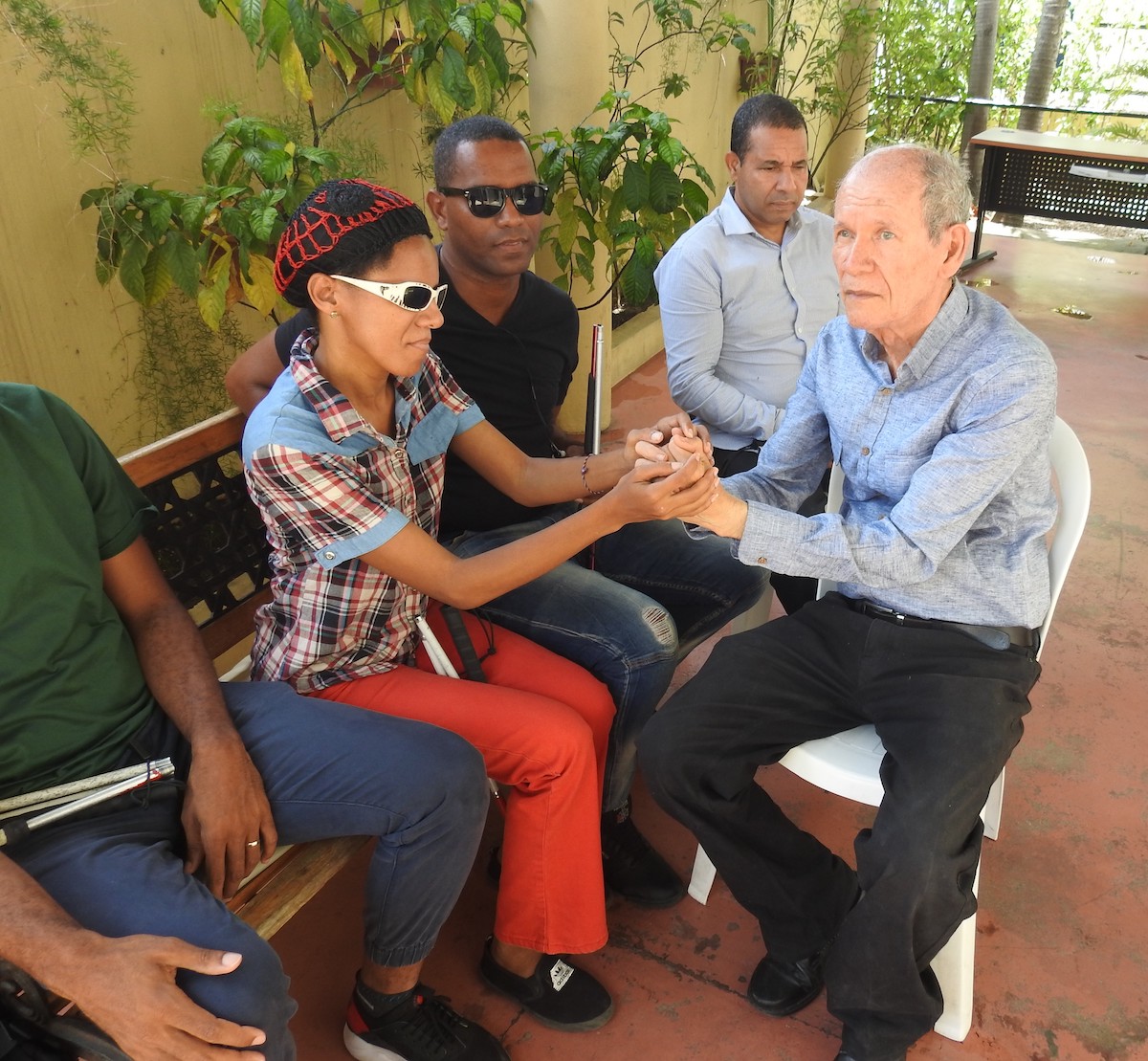
Simón Guerrero was a founding member of the Society for the Conservation and Study of Caribbean Birds. An engaging teacher and speaker with a great sense of humor, he influenced many to become fans and defenders of nature over several decades.
We remember an extraordinary environmental educator, Simón Guerrero, who passed away earlier this year. His research on urban ecology focused on making cities more habitable for wildlife, including birds. Simón had a remarkable ability to bring the wonder of birds into classrooms, captivating both students and teachers. A passionate advocate for inclusivity, he founded a birding group for blind Dominicans and emphasized the importance of ensuring that birds “know” our actions are in their favor.
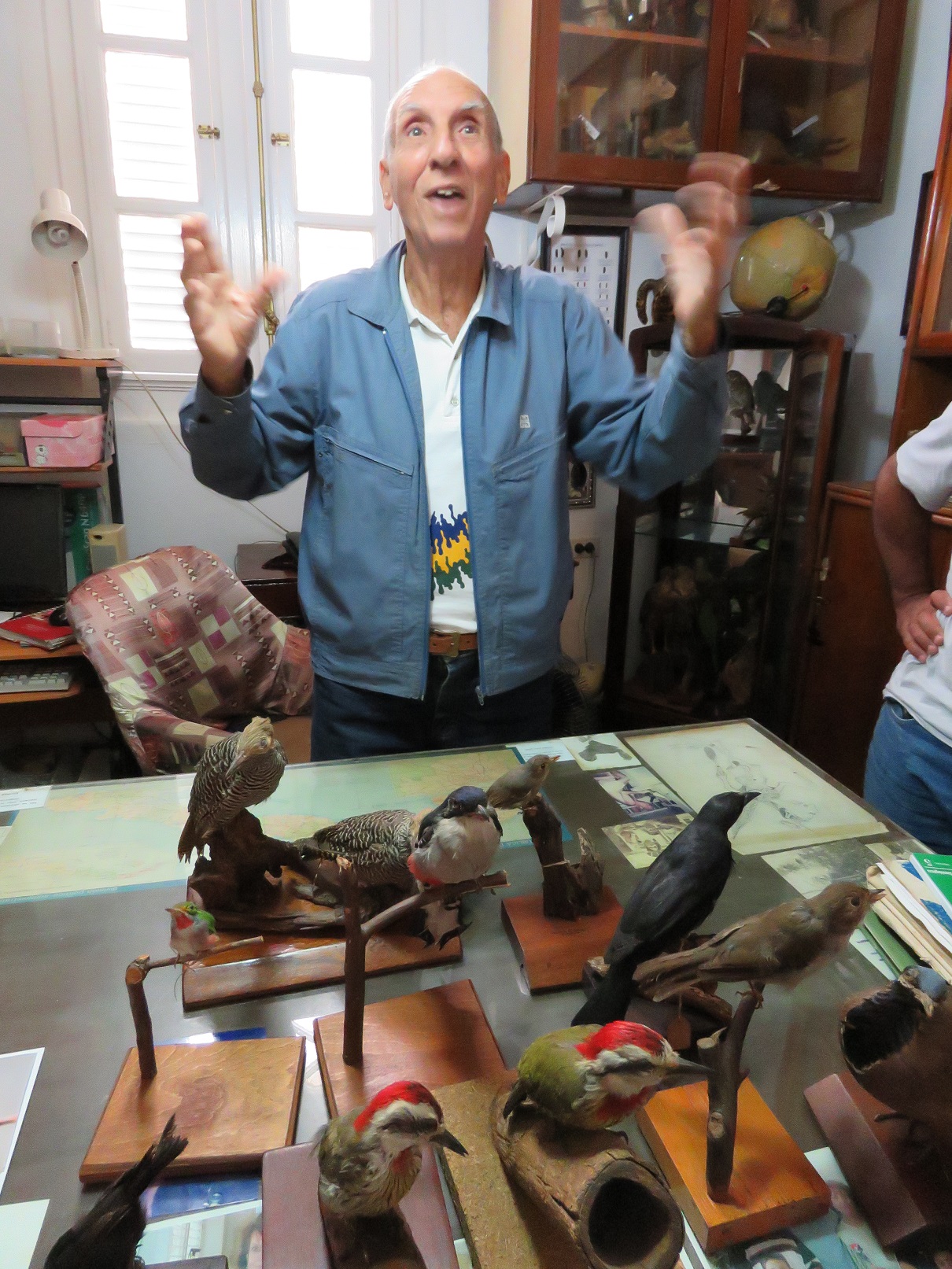
Orlando Garrido was a tireless explorer of the Cuban archipelago. Garrido has to his credit the discovery of four mammalian taxa and the description of: 58 insects, 21 birds, 37 reptiles. 78 new records among birds, reptiles, and fish, and 23 taxa have been dedicated to him, and in total he has 298 publications. (Photo by Susan Jacobson)
We also said goodbye to a giant in Cuban ornithology on June 24, Orlando Garrido—an exceptional scientist, naturalist, colleague, teacher, mentor, and friend to so many. Orlando was dedicated to his work until the very end, discussing ornithology and measuring birds for another publication the evening before his passing! We are grateful to have celebrated Orlando’s numerous accomplishments with a Lifetime Achievement Award at our International Conference in Cuba in 2017 and a wonderful article with many photos on the occasion of his 90th birthday.
Looking ahead: Big things are coming in 2025!
With our focus remaining on our threatened shorebirds, we are looking forward to the 16th annual Caribbean Waterbird Census regional count (January 14 to February 3, 2025), which includes the global World Wetlands Day (February 2, 2025). With a long-term database of over 27,000 CWC lists, your participation will add to a valuable resource for bird conservation across the region. Don’t forget that we have a wealth of handy bird ID materials on our YouTube channel to help you in your quest—and you can conduct waterbird censuses at any time of the year, of course.
Speaking of shorebirds, in 2025 we will be working to have Monte Cristi in the Dominican Republic designated as a key site in the Western Hemisphere Shorebird Reserve Network. Some 20,000 birds stop off at Monte Cristi annually during their migration.
Building our banding network will also be a 2025 priority, as we seek to equip conservationists with those important skills. Applications for our upcoming workshop in the DR are now closed but keep an eye out for future opportunities!
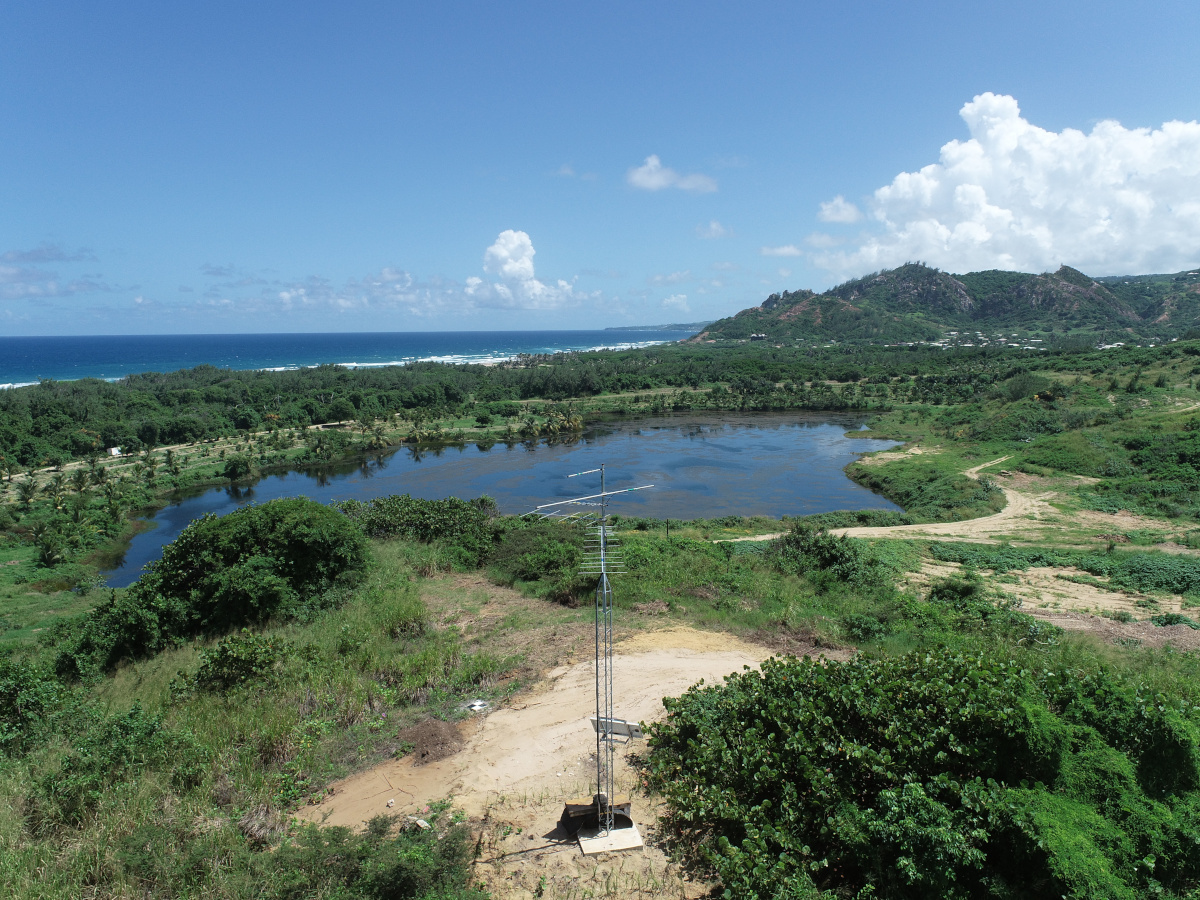
Aerial view of the Motus station installed at Walkers Reserve Barbados. (Photo by Shae Warren)
More Motus! We hope to install more Motus stations across the region, to track our precious migratory species.
We’re off to the bird haven that is the beautiful island of Cuba for what promises to be two amazing bird tours! (January 23 – 31 and March 19 – 30, 2025). Both tours are fully booked, but you can still browse the itineraries and join the waiting list for 2026 by clicking here.
Thank You for an Incredible Year!
2024 was a year to remember, and it was made possible by you—our dedicated members, partners, and supporters.
Stay up to date with us in 2025 with the latest news from the field, BirdsCaribbean programs and events, and opportunities to get involved—free to your inbox, by signing up for our monthly newsletter. Cheers to a fantastic 2025!
Note that the same proposal cannot be submitted for more than one award in a given year.
BirdsCaribbean’s general Grant Application Guidelines are available here.
Learn more about the eligibility criteria of each program by visiting their respective websites.
Seeking Donors
BirdsCaribbean encourages others to consider endowments or other large awards to ensure that our grants programs continue indefinitely. You may also make a donation to support our work. BirdsCaribbean is a tax-deductible organization in the United States.
BirdsCaribbean is pleased to announce the 2024 cohort of grantees under two prestigious named awards, the David S. Lee Fund for the Conservation of Caribbean Birds, and the James A. Kushlan Research and Conservation Fund.
These twelve projects aim to advance the study and conservation of avifauna in seven different Caribbean countries: Cuba, Jamaica, Puerto Rico, Dominican Republic, Mexico (offshore islands in the Caribbean Sea), St. Eustatius, and The Bahamas.
In this article you can read about the exciting plans proposed by each awardee. Stay tuned for results and accomplishments featured in future issues of the Journal of Caribbean Ornithology, blog articles, and presentations at our upcoming 24th BirdsCaribbean International Conference in Dominican Republic this summer.
Congratulations to these outstanding researchers and conservationists from our BirdsCaribbean community!
Establishing baselines in research, data and science for birds (BiRDS for birds) in The Bahamas
Dr Ancilleno Davis, Science and Perspective & University of The Bahamas
Baselines in Research, Data, and Science for birds (BiRDS for birds) is a program to establish baseline data for bird diversity, population estimates, and research or scientific standards that can be applied to research and conservation activities throughout The Bahamas. The program will provide training in the use of bird monitoring protocols and access to optical equipment to local students along with opportunities to participate in wildlife assessments. It is expected that this project will improve local biodiversity knowledge, and ultimately, will help trainees to have better opportunities for obtaining jobs in conservation in The Bahamas and insular Caribbean.
Distribution shifts of the Oriente Warbler: species assessment in Villa Clara province, Cuba
Claudia Mantilla, Center for Environmental Studies and Services of Villa Clara, Cuba
The Oriente Warbler (Teretistris fornsi) is endemic to central-eastern Cuba. In recent years, occasional sightings have been recorded in provinces outside its known range, such as south of Cienfuegos and north of Villa Clara. In this project, Claudia will conduct population surveys and bird banding to understand the species’ distribution in the westernmost part of the central region of the country (Matanzas, Cienfuegos, and Villa Clara), where it also overlaps with the congeneric Yellow-headed Warbler (T. fernandinae). The goal of this study is to determine the ecological requirements of the Oriente Warbler in order to promote the conservation of its habitat, since only 16% of its distribution is within protected areas.
Understanding the importance of a small urban park for conserving migratory and resident bird species in Havana
Daniela Ventura, University of Havana, Cuba
Havana is home for 47% of the bird species of Cuba, and is an important stopover and wintering site for migratory birds. Research efforts have been conducted in green spaces located in the less densely populated municipalities of the capital. Thus, to obtain a better understanding of urban bird communities within Havana, Daniela plans to expand a banding scheme initiated as part of BirdsCaribbean’s Caribbean Bird Banding Network to the Quinta de Los Molinos Park. Specifically, she intends to evaluate the migration phenology of Neotropical migratory birds that use the site as a stopover or wintering area, and determine the survival and overall physical conditions of migrant and resident bird species. The project will provide an indirect measure of the importance of urban forest fragments for supporting biodiversity, and will increase the awareness of park visitors about the need to protect wild birds.
Raising awareness and education on the endangered Jamaican Blackbird in a National Park
Justin Saunders, BirdLife Jamaica
In this project, Justin and a team of collaborators from BirdLife Jamaica, aim to create an innovative public education campaign to raise awareness about the endangered Jamaican Blackbird (Nesopsar nigerrimus) and its habitat in the Blue and John Crow Mountains National Park. The project includes the development of educational signs within the park and the creation of a basic virtual tour to engage a broader audience. The educational outcomes will be evaluated at educational events at the park. The plan will be implemented in partnership with the Jamaica Conservation Development Trust, Jamaica Environment Trust, and the National Environment Planning Agency.
Conservation ecology of the Puerto Rican Oriole
Michael Ocasio, University of Maryland, Baltimore County
Conserving Caribbean island endemics, like the Puerto Rican Oriole (Icterus portoricensis), requires an increased and specific understanding of the threats faced by these species. Notably, the Puerto Rican Oriole has shown worrying signs of reproductive challenges, including high rates of brood parasitism and low reproductive success. In this project, Michael aims to assess the oriole’s population dynamics through point counts, banding, radio tracking, and nest monitoring across different habitats and elevations. His results on the species abundance, survival, and reproductive success will contribute to the Puerto Rico State Wildlife Action Plan, the USGS list of Species of Greatest Conservation Need, and the IUCN Red List of Threatened Species, while also fostering collaborative and effective conservation efforts in the Caribbean.
Investigating male and female vocalizations of an understudied endemic Caribbean songbird in Puerto Rico
Michelle Moyer, University of Maryland, Baltimore County
The Puerto Rican Oriole (Icterus portoricensis), one of 18 endemic species on the island of Puerto Rico, remains significantly understudied. Improving our understanding of how the orioles use sex-specific songs is necessary to develop effective conservation management plans. Preliminary work in 2023 indicated that male and female orioles may sing different songs, but at similar rates. Increasing the sample size by recording additional individuals is crucial for gaining an accurate understanding of the singing behavior of this species. Through this project, Michelle will engage undergraduate students from the University of Puerto Rico in point counts and mist-netting, and intends to co-develop management strategies in collaboration with Para La Naturaleza.
Understanding the social and spatial organization of the Palmchat in the Dominican Republic
Qwahn Kent, Princeton University
In this project, Qwahn aims to investigate the social and spatial organization of the Palmchat (Dulus dominicus), a communally breeding bird endemic to Hispaniola. The Palmchat plays a crucial role in the ecosystem—it disperses seeds and provides nesting sites for several species, including the critically endangered Ridgway’s Hawk, which nests on top of Palmchat nests. Qwahn will band individual Palmchats and will use a social network analysis to understand their complex organizations. Morphological features of nesting trees will be measured, and a machine learning algorithm will be developed to predict Palmchat nest locations. This research has conservation implications, since the spatial organization of Palmchat nests and their movement patterns influence both patterns of seed dispersal, as well as nest site availability for the hawks.
Help the Bridled Tern return to Isla Contoy National Park, Quintana Roo, Mexico
Jonathan Nochebuena, Mexican Association for the Conservation of Birds and their Habitats (AMCAH)
The Bridled Tern (Onychoprion anaethetus) breeds on Isla Contoy, a small Island off the Caribbean coast of Yucatan, Mexico, which is considered a site of international importance for the conservation of seabirds. In 2019, AMCAH started a project to protect the terns’ nesting areas, with the support of park managers and the local group Friends of Isla Contoy. This new project intends to continue the monitoring and banding efforts with community participation, and to develop measures to help increase the species’ population. This initiative will also help raise community awareness about threats to seabirds in general.
Avifauna of Las Balsas wetland, Gibara, Holguín, Cuba
Ailen Anido, Museo de Historia Natural Joaquín Fernández de la Vara, Gibara
The wetland Balsas de Gibara in Holguin consists of a large area of mangroves, coastal lagoons, mudflats, and salt marshes located between two rivers that flow into Gibara Bay. High concentrations of waterfowl have been reported in this site, including new bird species for Cuba. Ailen and her team will carry out an inventory of the birdlife of this important site using BirdsCaribbean’s Caribbean Waterbird Census protocols. They will train local residents in bird identification and survey techniques to engage them in the field work throughout the year. She also intends to increase awareness of the high ecological value of this protected area by promoting sustainable practices, such as the creation of a birdwatching club and bolstering bird and nature tourism.
Update of the status and trends of American Flamingos in Cuba
Susana Aguilar, University of Havana
The Cuban population of the American Flamingo (Phoenicopterus ruber), the only flamingo distributed through the Caribbean, is one of the most important in the region. The species depends on estuaries and saline lagoons, making it vulnerable to climate change. In this project, Susana seeks to update the information about the status of the American Flamingo in the island by assessing its current distribution, and estimating its abundance and number of nests in the breeding sites. She and her team will carry out field expeditions to verify new potential nesting sites in remote coastal wetlands of central Cuba, using drones in their surveys. Results are expected to contribute to the improvement of management decisions for the species in Cuba.
Characterization of the community of aquatic birds associated with the wetland of the San Miguel de Parada Fauna Refuge
Yanelis Sánchez, Empresa Flora y Fauna, Santiago de Cuba
Cuban wetlands are important stopover and wintering areas for numerous species of migratory waterbirds. However, they are increasingly being polluted by industrial discharge of solid and liquid waste, like the case of San Miguel de Parada Wildlife Refuge in the province of Santiago, Cuba. Yanelis will be conducting monthly surveys in this wetland throughout the year to determine the composition and structure of the waterfowl community. Moreover, she intends to identify and monitor nesting colonies from May to June, describe their habitat characteristics, and assess the breeding success for different species. As part of the project, she also wants to promote the recovery and conservation of the Santiago de Cuba Bay by implementing effective management actions and educational campaigns.
Enhancing conservation initiatives for Red-billed Tropicbirds in Boven National Park, St. Eustatius
Jethro van’t Hul, St. Eustatius National Parks (STENAPA)
The Red-Billed Tropicbird (Phaethon aethereus), an iconic seabird species with striking red bills and long tail streamers, faces imminent threats to its population on the Caribbean island of St. Eustatius. Previous research estimated only 300-500 breeding pairs. Through this study, Jethro aims to reassess the population on Pilot Hill, and compare counts with a second study site on the cliffside area of Boven National Park where no data has been collected previously. Monthly surveys will be conducted in both locations, and video recordings will be taken to estimate the number of potential nesting pairs in a section of the Boven cliffs. His goal is to obtain a more accurate population estimate of nesting pairs to support further conservation efforts in Boven National Park.
Are you working on, or planning a research or conservation project with Caribbean birds?
Jennifer Mortensen, from the University of Arkansas, retrieving camera trap data with a team of conservationists from the Saint Lucia Forestry Department, including Stephen Lesmond, Therence Eugene, Jeannette Victor, and Jonathan Cornibert (from right to left).
Our next call for proposals will be advertised in the fall of 2024. Members of BirdsCaribbean conducting research and conservation work are eligible to apply. Stay informed and don’t miss our announcements by subscribing to our monthly newsletter,joining our Listserv, and following us on social media (@BirdsCaribbean on Instagram, Facebook, Twitter, Youtube, and Linked In).
BirdsCaribbean thanks our generous donors for supporting these awards, and encourages others to donate to these programs, as well as to consider endowments or other large awards to ensure that our vital grants programs can continue indefinitely. You can help us to continue supporting these invaluable projects by making a donation here.
If you prefer to donate via check, please make this out to “BirdsCaribbean” and in the memo section, note the fund you are donating to. If you have questions, or would like to make other arrangements for donating, feel free to contact Jennifer Wheeler, BirdsCaribbean Financial Officer (jennifer.wheeler@birdscaribbean.org). Checks can be mailed to: BirdsCaribbean, 841 Worcester St. #130, Natick, MA 01760-2076
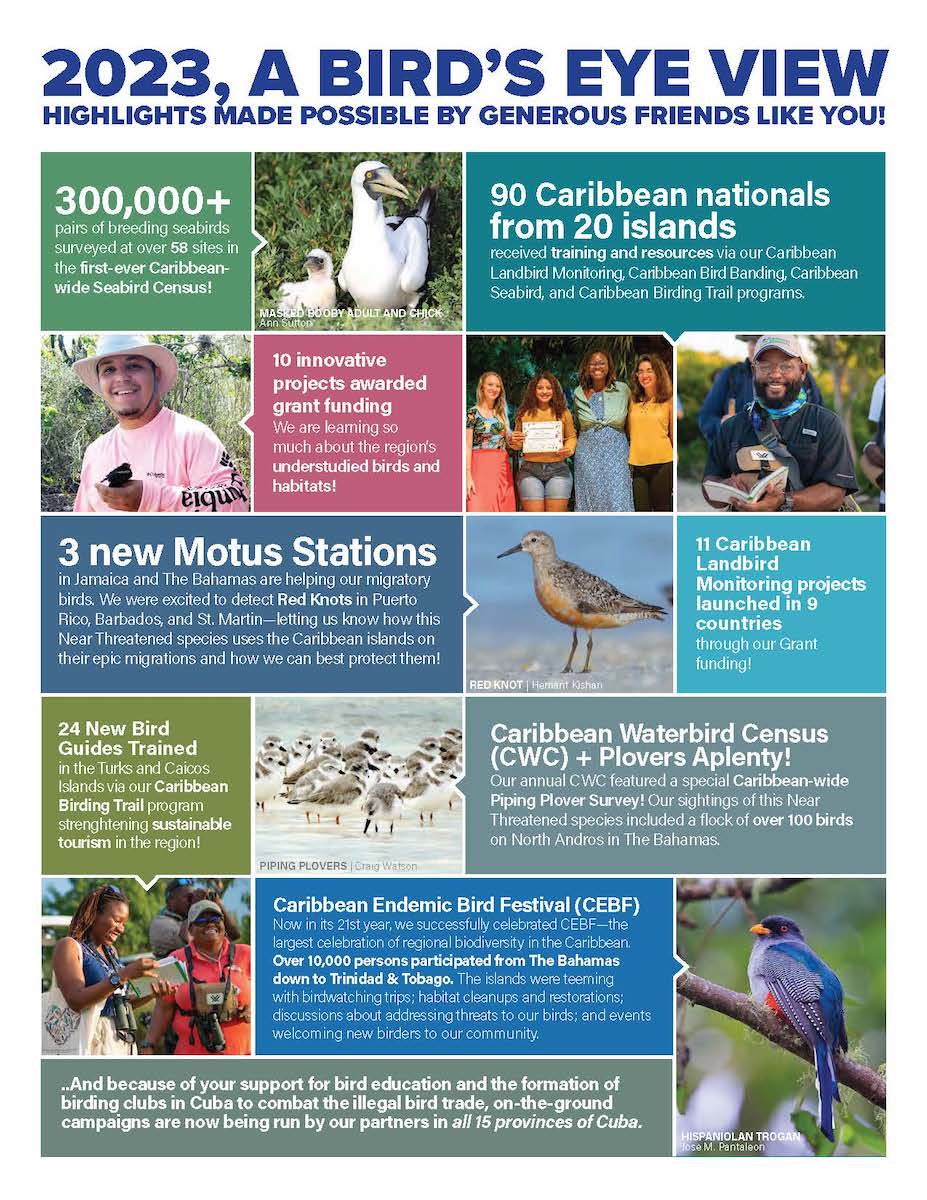
BirdsCaribbean switched into top gear for 2023. With a lot of ground to cover, we were quickly up and running! Here are some of the highlights of the year…
Focus on one adorable but elusive waterbird…
Our Caribbean Waterbird Census (CWC) region-wide count, from January 14 to February 3 2023, included an ‘added’ Caribbean-wide Piping Plover survey. This species is listed as “Near Threatened” by the IUCN with an estimated global breeding population of just 8,400 birds. The search was enhanced by beautiful graphics and merchandise by Josmar Esteban Marquez. Sightings were tracked live and plotted on a map. During the survey, these attractive but vulnerable birds were spotted in The Bahamas (a great success!), the British Virgin Islands, and Puerto Rico. Word of our search spread far and wide and we also received sightings from the Caribbean coast of Mexico! Please continue to keep a sharp eye open for these small, round birds, which are often seen in small flocks on sand flats and might also be found in mangroves, mudflats, and other shoreline areas.
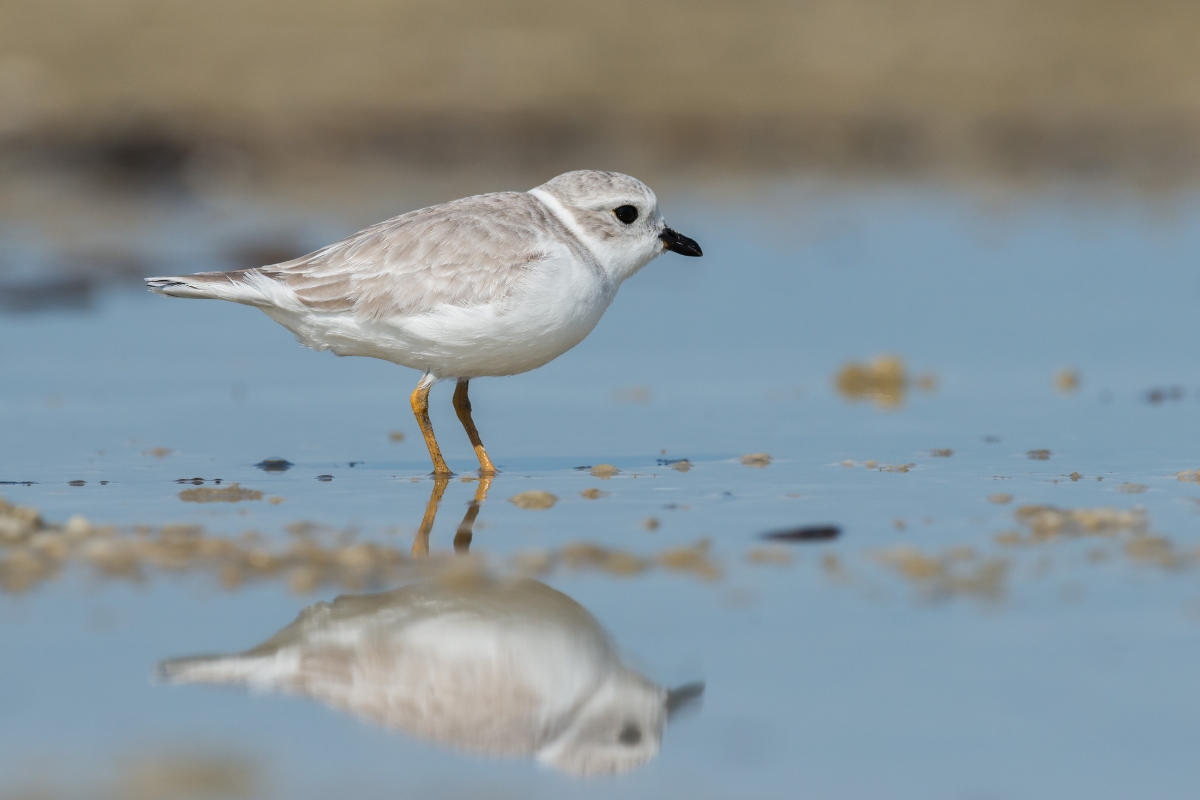
A Piping Plover in winter plumage with an all-black bill.
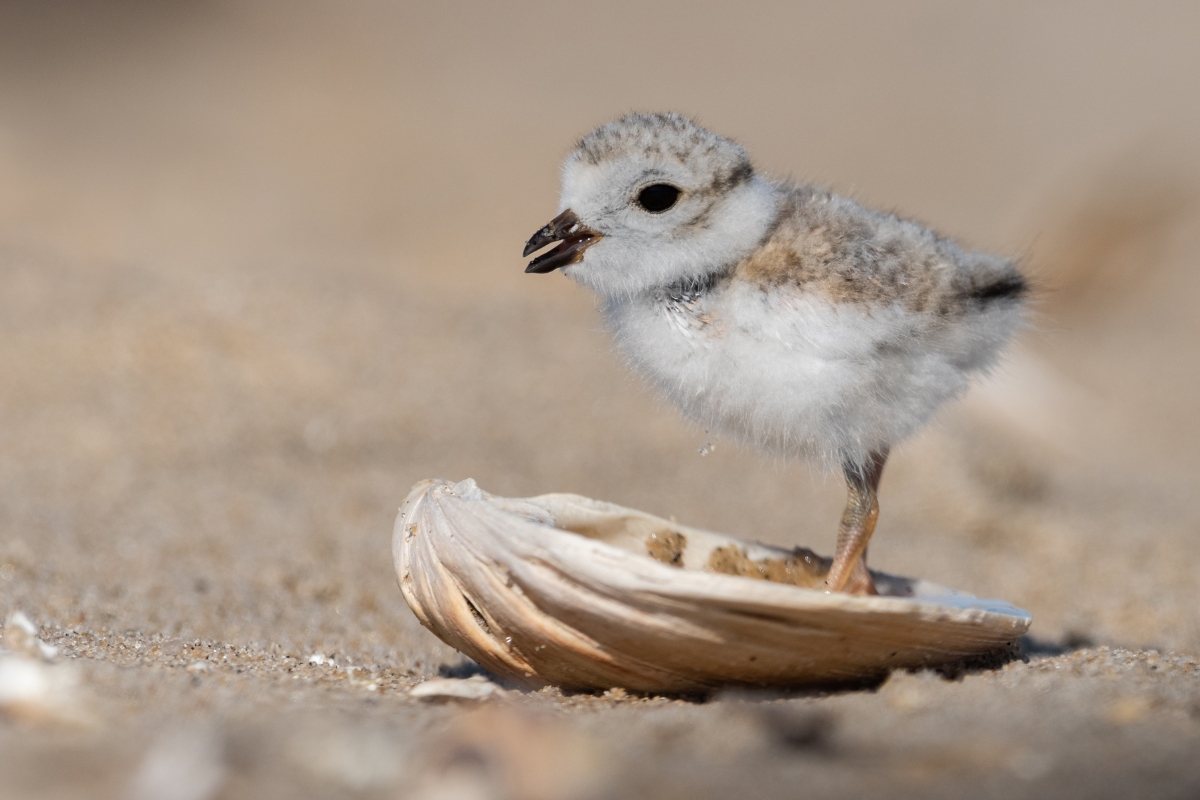
A Piping Plover chick. Piping Plovers breed in restricted areas of North America.
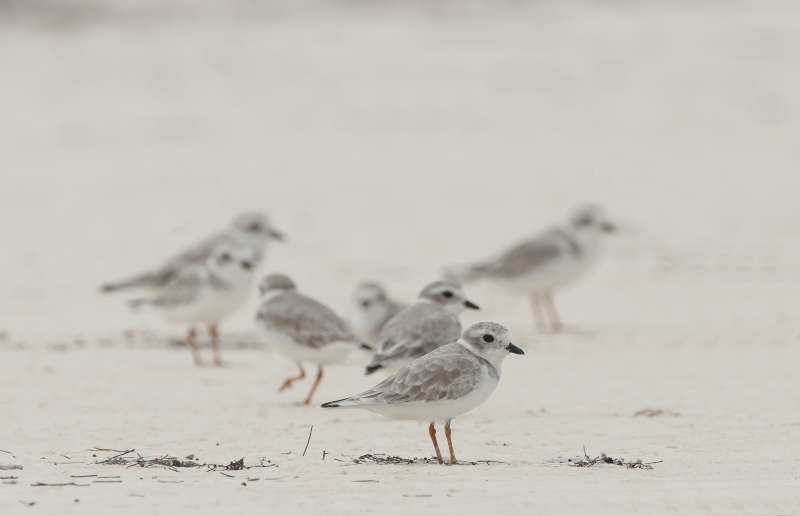
A small flock of Piping Plovers in winter plumage. (Photo by Walker Golden)
click to download as a pdf
During CWC 2023, an abundance of waterbirds were spotted across the region by diligent birders, young and old, as they kept their eyes peeled for the elusive Plover! Some of the wonderful waterbirds seen on our 2023 census included a white-morph Great Blue Heron on Bonaire (a rare sight outside Florida and Cuba); a diverse gathering of shorebirds on Cuba (including Dunlins, Sanderlings, Short-billed Dowitchers, Least and Western Sandpipers, Semipalmated and Wilson’s Plovers and many others); and and some ducks enjoying some winter sun on Jamaica (including Green-winged Teals, Ring-necked Ducks, and Lesser Scaups).
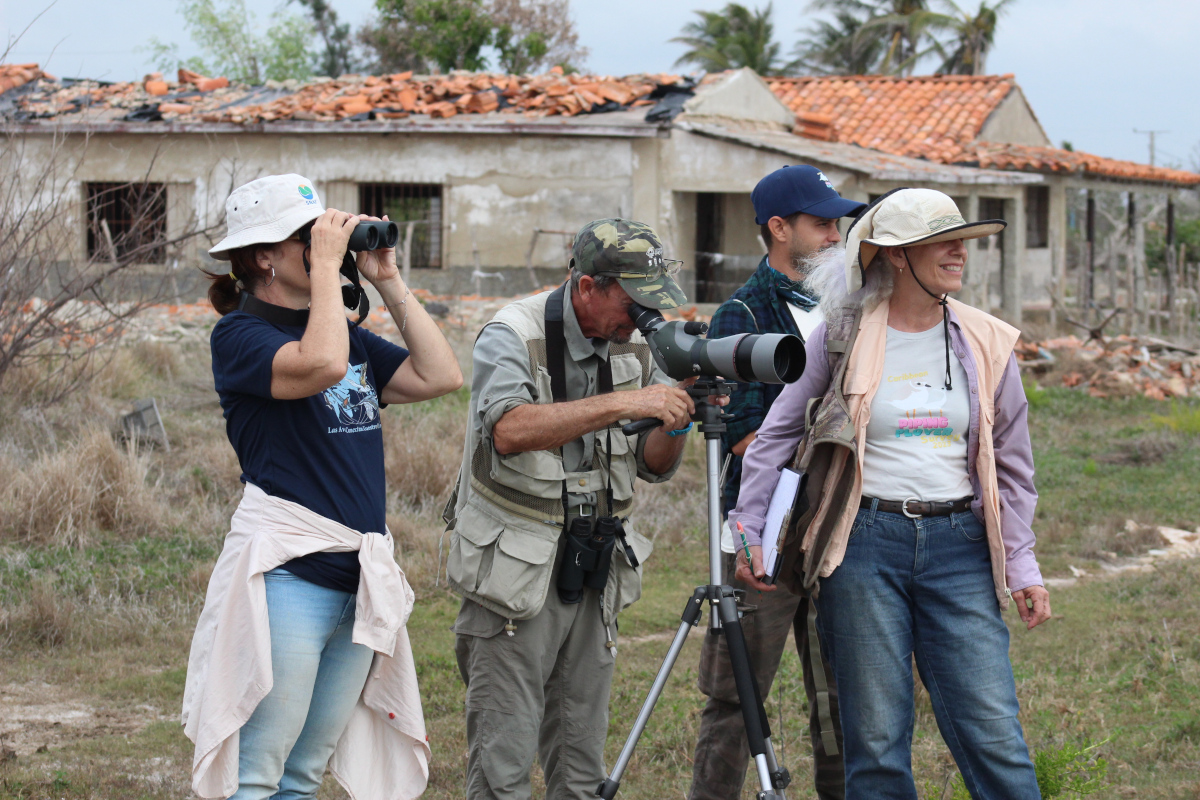
Survey team in Cuba searching for Piping Plovers during CWC2023. (Photo by Daniela Ventura)
Looking for landbirds…
After the volcanic eruption of April, 2021, St. Vincent’s landbirds, especially two vulnerable endemic species, the threatened St. Vincent Parrot, and endangered Whistling Warbler, faced new dangers—both in the short and long term. We thought it fitting to continue building the capacity of Caribbean conservationists to identify and monitor landbirds using standardized survey protocols.
Thanks to funding from theCritical Ecosystems Partnership Fund (CEPF), the United Nations Development Programme (UNDP), and BirdsCaribbean members, partners and donors, we organized a Landbird Monitoring Workshop on St. Vincent with 24 participants, including from neighboring islands(Grenada, St. Lucia, and Montserrat).
Participants and facilitators of the Caribbean Landbird Monitoring Workshop at Montreal Gardens, St Vincent.
Demonica Brown and Maya Wilson assemble the Motus antenna. (photo by Lisa Sorenson)
Grand Bahama Motus Installation team: Lisa Sorenson, Todd Alleger, Bradley Pinder, Cesar Montero, Maya Wilson, Demonica Brown and, David Cooper. (photo by Lisa Sorenson)
Cesar and Todd attaching the antenna to the Motus tower at the Lucayan National Park. (Photo by Maya Wilson)
Demonica and Bob Davies digging the hole for the base of the tower at the Lucayan National Park. (Photo by Maya Wilson)
Maya and Todd checking cables. (Photo by Lisa Sorenson)
Bob and Maya constructing the base frame. (Photo by Demonica Brown)
We were out and about again! Celebrating our beautiful endemics
Did you know we now have 180 endemic birds in the Caribbean region? And we celebrated these one-of-a-kind birds during our Caribbean Endemic Bird Festival (CEBF) from April 22 to May 22, 2023—with a special emphasis on water conservation. What would our birds (and we humans) do without water? With the increased heat (it was a very hot summer) we may have seen our birds drinking at bird baths—they get thirsty like we do! With the climate change crisis pressing on us, this was a very important theme to emphasize, and our partners across the region took it on enthusiastically.
Birding along L’Anse Aux Epines road, Grenada. (Photo by Gaea Conservation Network)
Yaritza Bobonis with Lola the Puerto Rican Parrot mascot. (Photo by Fundación Amigos De El Yunque)
Information about the festival and endemic birds of Cuba was shared via radio interviews.
Students help plant native trees for birds and other wildlife at the National Botanical Garden.
Felix Raul Figueroa, photographer and member of Grupo Ecología de Aves, looks on as students from Ciénaga de Zapata color the Cuban Parrot. (Photo by Grupo de Ecología de Aves)
A Conservation Opportunity member sensitises participants about the threats posed by marine pollution. (Photo by Conservation Opportunity)
A young girl plays a bird game during the CEBF festivities as a member of the Luis-Munos Marin Foundation looks on. (Photo by Eliezer Nieves Rodriguez)
Children and ARC Conservation members wear their hand crafted masks.
Jamaican Mango, perched. (Photo by Clive Daelman)
Ashy-faced Owl, Dominican Republic. (Photo by Jay McGowan- Macaulay Library-ML162362421)
In 2023, the CEBF once again hosted in-person events and the response was tremendous—over 10,000 persons participated from The Bahamas down to Trinidad and Tobago! Our citizen scientists of all ages were out in numbers, with mangrove explorations, BirdSleuth Caribbean’s learning activities, school visits, habitat cleanups, art workshops, a birding for kids excursion, and even a floating classroom field trip!
On the Caribbean Birding Trail in Turks and Caicos
As the year-end drew closer, discovery, learning, and empowerment were words that came to mind during the Caribbean Birding Trail (CBT) Interpretive Guide Training Workshop in Turks and Caicos Islands, which took place from October 23 to 27, 2023. Twenty-four participants were trained in the Islands’ beautifully unique environment during an intensive five-day workshop. The trail now includes 138 birding sites and ten hotels and eco-lodges in 24 countries—all combining amazing birding experiences with learning and information on ecosystems, cultural and natural heritage, and more.
Beny leads the group along the Bird Rock Point Trail. Several field trips throughout the week allowed participants to get acquainted with TCI’s best birding sites! (Photo by Christel Mohammed)
Tangles of red mangrove prop roots at Wheeland Pond. This extensive wetland is a haven for birdlife and a true shorebirder’s delight!
Flamingo Pond is a must-visit spot for American Flamingo lovers! Depending on the time of the year, flocks at this wetland on North Caicos can number in the thousands!
Class is in session! 24 participants from a range of backgrounds formed our CBT TCI cohort.
Ecotour guide and participant Geneile Robinson thumbs through her Birds of the West Indies field guide while distinguishing between waterbirds!
Lisa gives the class one of the toughest pop quizzes of all! How many different species of shorebirds are in the picture?
Participant and Biology teacher Amanda Brittain consults her Seabirds of the Caribbean card for gull ID support.
Rick’s demonstration of an interpretive talk where he played the role of a hammock salesman was so transportive that the class was convinced that he really was trying to hawk them hammocks for a while!
This was our seventh CBT training. We are deeply thankful to our Turks and Caicos sponsors—the Sandals Foundation, the Turks and Caicos National Trust, Darwin Plus Initiative, the Turks and Caicos Department of Environment and Coastal Resources, the Royal Society for the Protection of Birds, Marshall Reynolds Foundation, Shika Shika, and Vortex Optics.
Bonding over Bird Banding! Workshop #2 in the Dominican Republic
Bird banding is an essential component of birding science worldwide. It is a complex and technical issue that requires longer training sessions. We returned to the Dominican Republic again in March of last year (the location of this year’s International Conference), continuing our work of nurturing a committed community of trained banders. The response from our highly intelligent group of trainees was enthusiastic.
Participants learned to set up and close mist nets during the workshop. (Photo by Josh Covill)
Participants at the banding workshop, earlier this year, in the Dominican Republic. (Photo by Joshua Covill)
Daniela Ventura del Puerto (Cuba) provides instruction on bird molt to workshop participants Giselle Raganoonan (Trinidad) and Elvin Manual Vargas Estevez (Dominican Republic).
Caribbean bird banders have gone abroad!
We sent some of our bird banders off to the United States and Brazil for immersive banding experiences. The interns reported back to us (Grenadian Zoya Buckmire at Klamath Bird Observatory in Oregon, Puerto Rican Dayamiris Candelario at Willistown Conservation Trust in Pennsylvania) on their exploration of new landscapes, new ecosystems—and, of course, new birds! We would like to thank all our partner organizations and generous donors who supported these internships. Once again, we were happy to add new dimensions to our young trainees’ experiences, so they may return to their countries to establish new programs and projects. Empowerment is key!
Seabirds under pressure
Despite a range of challenges, our dynamic Seabird Working Group has been addressing the critical state of Caribbean seabirds for some time now. The first-ever Caribbean-wide Seabird Census is ongoing, for 2023 and 2024. Over 300,000 pairs of breeding seabirds have already been counted at over 58 sites! Caribbean seabirds, like those in other areas of the world, are threatened by human activities—including pollution (especially plastics), climate change, invasive species, and unsustainable fishing practices. The Census continues! Please contribute your thoughts and findings, watch the webinar updates, and follow the admirable work of our Seabird Working Group this year!
Map 1: Countries participating in the Caribbean Seabird Census. Note that for large countries, the whole country is colored even though only a few localized sites may be censused.
Juliana Coffey identifying seabirds with seabird patrol volunteers, Union Island. (Alison DeGraff Ollivierre)
Grenadines Guardians seabird survey. (Photo by Juliana Coffey)
Magnificent Frigatebird nesting colony. (Photo: Jeff Gerbracht)
Masked Booby adult and chick. (Photo by Ann Sutton)
More direct funding for research and conservation work!
From combating the illegal bird trade in Cuba, to surveys of our most endangered endemic Caribbean hawk in Haiti, thanks to our grant awards, 10 innovative new projects are helping us to protect and learn more about the region’s understudied birds and habitats! Stay tuned for our upcoming blogs sharing exciting project results and accomplishments.
The 2023 cohort of grantees under our three named awards, the David S. Lee Fund for the Conservation of Caribbean Birds, the Betty Petersen Conservation Fund, and the new James A. Kushlan Research and Conservation Fund.
Have we forgotten something? Oh, yes…
Last but by no means least, Global Big Day 2023 was another huge success, with increased numbers of Caribbean birders participating. Our region saw more birds (a total of 515 species) and more humans (511 posting on eBird) than on any other Global Big Day. Once again, competition among our teams was heated—and once again, our Executive Director Lisa Sorenson’s multinational “Flying Pintails” dominated! Hmmm…
NOTE: Please remember to record ALL your bird sightings, whether in your backyard or out on a birding excursion, on eBird Caribbeanvia their website or phone app. Your bird notes make a difference in helping scientists identify the “what, when, how many, and where” of our region’s birds!
Networking is key…
As you can see, building and strengthening networks across the region has always been a significant part of our work, and it was the same in 2023. Our network of scientists (including citizen scientists), students, educators, non-governmental and community organizations, as well as nature-friendly companies and government entities, continues to grow.
Talking birds: Justin Saunders lends a listening ear to a young birder. (Photo by Stuart Reeves)
Daniela and Elvin take a closer look at a bird’s wing while another participant John Holas looks on. (Photo by Josh Covill)
Yvan Satge discusses birds at sea with fishermen. (Photo by Jacob Gonzalez-Solis)
María Paulino hosts a group discussion with students at the National Botanical Garden.
Levardo, Estefania, and Junel discuss the finer points of binocular adjustment.
In addition to the Caribbean Bird Banding Network, the Caribbean Motus Collaboration, and the Caribbean Landbird Monitoring Network, we are also building a vibrant group of trained interpretive guides through the Caribbean Birding Trail. This person-to-person aspect of our work is important for knowledge-sharing, interaction, and “comparing notes” with each other. A great deal of teamwork goes into all these endeavors, as you can see from our reports. All of this creates a positive and nurturing environment. We have great faith in our newly-trained Caribbean citizens, who are both enthusiastic and action-oriented. They want to see progress and improvements for our wonderful birds and their habitats.
We look forward to keeping in touch with you all! Here’s to 2024!
A huge thank you to all of our members, partners, and donors. This work would not be possible without your dedication, passion, hard work, and financial support.
Note that the same proposal cannot be submitted for more than one award in a given year.
BirdsCaribbean’s general Grant Application Guidelines are available here.
Learn more about the eligibility criteria of each program by visiting their respective websites.
Seeking Donors
BirdsCaribbean encourages others to consider endowments or other large awards to ensure that our grants programs continue indefinitely. You may also make a donation to support our work. BirdsCaribbean is a tax-deductible organization in the United States.
BirdsCaribbean is pleased to announce the 2023 cohort of grantees under our three named awards, the David S. Lee Fund for the Conservation of Caribbean Birds, the Betty Petersen Conservation Fund, and the new James A. Kushlan Research and Conservation Fund.
These are ten exciting projects that promote the study and conservation of avifauna in six different Caribbean countries. A total of $74,500 was awarded to these projects through the three funds. Learn here about each recipient’s proposed plans, and stay tuned for results and accomplishments featured in future Journal of Caribbean Ornithology and blog articles.
Congratulations to these outstanding researchers and conservationists from our BirdsCaribbean community, we wish you all the best and can’t wait to hear about your results!
Ridgway’s Hawk Conservation and Education Project in Haiti
Anderson Jean, Action pour la Sauvegarde de l’Ecologie en Haïti (ACSEH)
The Ridgway’s Hawk (Buteo ridgwayi), found only on the island of Hispaniola, is one of the most endangered raptors in the world. It is estimated that there are fewer than 400 individuals remaining. Only two populations were known from the Dominican Republic, until 2019 when Anderson and biologists from ACSEH discovered the hawks on Petite Cayemite Island, located off the coast of southwestern Haiti. Since then, they have found more individuals and breeding pairs. These funds will allow the extension of surveys to the larger island of Grand Cayemite. To address anthropogenic threats to this Critically Endangered species, the team will initiate an educational campaign directed at local communities, especially schoolchildren and farmers. Outreach materials will be distributed in the communities and a special curriculum will be presented in two local schools. The project will also organize, for the first time, a Ridgway’s Hawk Festival in May, in collaboration with the mayor and government officials of Les Cayemites.
Birdwatching movement in Cuba as a way to improve the knowledge of Cuban avifauna and promote conservation efforts based on citizen science
Yaro Rodríguez, Cuba Birders Club
Illegal trapping and trafficking of wild birds in Cuba have long been a serious problem in Cuba. However, due to the rise of social media and economic problems caused in part by the pandemic, it has recently reached a crisis point, with tens of thousands of residents and migratory birds captured every year. Yaro along with partner Nils Navarro plan to address this critical problem through growing a nascent bird watching movement in Cuba. These new birders will a) help to put pressure on the authorities to enforce laws protecting wild birds, and b) provide valuable citizen science data to eBird Caribbean, thereby increasing our knowledge of the status and trends of Cuban birds, including further identification of hotspots for endemism and migration stopover sites. The project will provide binoculars and training to community and group leaders that will engage in bird monitoring and share the data through eBird Caribbean. The teams will grow local birding clubs and raise awareness in communities throughout Cuba of the need to protect birds and their habitats through community education and social media. They also plan to increase the interest of participants in birdwatching by organizing a second Cuban Big Year for 2024.
Promoting conservation of birds and nature on St Maarten through education, birding, and bird guide training
Kevin Sammy, Nature Foundation St. Maarten (NFSM)
Many of the local population on St Maarten did not receive education in relation to local flora and fauna, and therefore feel little responsibility to protect the environment. Conservation and preservation efforts have proven to be challenging when community members are not in touch with the importance of a balanced ecosystem, and therefore don’t value local natural resources. Introducing and connecting others to and educating them on the beautiful bird populations on the island form the foundation on which to build preservation efforts. Nature Foundation Sint Maarten will recruit and train local people to become birdwatchers and bird guides with the goal of increasing awareness of the importance of protecting bird species and their habitats as well as supporting sustainable livelihoods. The trainees will participate in an intensive workshop, led by trainer, Binkie Van es, (graduate of our Caribbean Birding Trail Guide Training Program) to learn about the island’s flora and fauna. In addition, trainees will receive birding equipment and educational resources to help them in their work as guides and to conduct annual bird counts. Participants will be able to practice their skills in a new bird observation deck planned to be built this year. In addition, a public awareness and education campaign will be launched that includes talks and field trips with youth and communities.
Facilitating community involvement in Pawi (Trinidad Piping-Guan) research and conservation
Mark Hulme, University of the West Indies, St Augustine, Trinidad & Tobago
The Critically Endangered Trinidad Piping-Guan or Pawi, is Trinidad’s only endemic bird. Its population has been estimated at only 77 to 231 individuals, restricted to moist forested habitats. The main threats to the species are illegal hunting, disturbance, and habitat destruction through quarrying, logging, agriculture, and construction. Mark’s project aims to recruit members of communities in and close to the habitat to participate in the first species survey in 20 years, and foster enhanced awareness of the Pawi and involvement in its conservation. Community members will receive training in Passive (remote) Acoustic Monitoring, a technique that works well for sparse and cryptic arboreal birds. In addition, the recordings will provide them with a soundscape of all the wildlife in their landscape for other research projects, to develop a sense of pride, and for other uses, such as education and ecotourism.
Bird Conservation in the Botanical Garden: Publication of a new field guide
Lourdes Mugica, University of Havana, Cuba
Cuba’s National Botanical Garden is a crucial institution to promote bird conservation in Havana city since it receives 300,000 visitors annually. In surveys initiated in 1983, members of the Ecology Group of the University of Havana have reported 125 bird species in the garden’s diverse landscape that covers almost 500 ha. This funding will cover the printing costs of an exciting new field guide, Aves del Jardín Botánico Nacional de Cuba (The Birds of the National Botanic Garden of Cuba), and other educational materials, including a bird identification card, a checklist, and a map of the trails. With this project, Lourdes and her colleagues want visitors to experience birdwatching firsthand, learning about the many endemic, resident, and migratory birds that live in or visit the garden seasonally. Their ultimate goal is to increase awareness and appreciation of Cuba’s incredible avifauna, to help reduce local threats such as trapping and keeping wild birds in cages as pets.
Does Los Roques Archipelago continue to be a safe place for breeding colonies of seabirds of Brown Booby, Red-footed Booby, and Audubon’s Shearwater in the Caribbean?
Josmar Márquez, AveZona
Los Roques Archipelago, off the coast of Venezuela, is an important breeding site for seabirds, including the Brown Booby, Red-footed Booby, and Audubon’s Shearwater, with more than 12,000 nesting pairs reported overall. However, the sustainability of these breeding colonies is threatened by a growing tourism industry. Josmar, along with partners from AveZona and other Venezuelan NGOs, proposes to conduct intensive seabird surveys to determine the population sizes and reproductive success of these species, with the aid of camera traps in nests and drones to reach remote areas. Moreover, they will be engaging people from the local communities in the counts, by providing educational materials, training on seabird identification and conservation, and even reaching out to hotels and inns to provide birdwatching opportunities as an income source.
Reproductive management with artificial nests and its effect on the populations of Psittacidae in the Pico Cristal National Park. Cuba
Inés Fernández, Flora and Fauna Enterprise, Santiago de Cuba
The Cuban Parakeet and Cuban Parrot are two threatened endemic species confined to small remnant forest fragments mainly in protected areas in Cuba. However, they maintain their degree of threat, due to all the negative actions to which they are subjected. These include loss of their natural habitats, and illegal hunting and capture for the pet trade. Inés will work on the implementation of an Artificial Nests Program to collect information about the breeding biology of both species in Pico Cristal National Park in eastern Cuba. The project will include a strong educational component for the communities surrounding the park, including the preparation and dissemination of brochures, manuals, and posters, and the recruitment of local residents to be monitors and technicians that will oversee the protection of these ptsittacids. A national awareness campaign will extend through mass media, including TV, radio, and newspapers, to discourage the illegal capture of these birds.
Establishing a long-term bird banding station in the National Botanical Garden in Havana, Cuba
Daniela Ventura del Puerto, University of Havana
Neotropical migrants have shown steep population declines since the 1970s. These include a diversity of migratory passerines that spend the winter months in the Caribbean region. In addition, the current status of resident bird populations in Cuba is poorly known, and there are no reliable demographic estimates due to very few marking and monitoring methods and their integration into a system that allows large-scale analysis. This makes it difficult to assess impacts on bird populations from loss and damage to habitats, illegal hunting and trade, and many other threats. Daniela proposes to establishing a permanent bird banding station in the National Botanical Garden in Havana. Her objectives are to 1) evaluate the migration phenology of Neotropical bird species that stop over or winter at the gardens, 2) describe the molt strategies and assess the physical condition, survival, and demographic parameters of both migratory and resident birds, 3) describe the reproductive phenology and population dynamics of the resident and endemic birds, and 4) build capacity among undergraduate and graduate students and volunteers in Cuba through their participation in the bird banding and monitoring activities. Daniela recently completed BirdsCaribbean Monitoring Training and Bird Banding Training workshops and is an active member of BirdsCaribbean’s new Bird Banding Network. The banding and monitoring data will provide invaluable quantitative data to evaluate species population trends and fill gaps in our knowledge of natural history and migration and breeding ecology of many resident and migratory birds.
Investigating male and female vocalizations of an understudied endemic Caribbean songbird
Michelle Moyer, University of Maryland, Baltimore County
The Caribbean has eight endemic species of orioles, with half of them considered globally threatened. The Puerto Rican Oriole, is one of eight species of Icterids endemic to the Caribbean, but its behavior, ecology, and conservation status are understudied. In addition, this species and others are threatened by human-caused habitat loss and degradation, introduced invasive species, and climate change, including increasing severe hurricanes and drought. This study intends to compare the singing behavior of males vs females, to understand aspects of its breeding behavior, including pair-bond maintenance, and territoriality in Hacienda La Esperanza, northern Puerto Rico. Individuals from different territories will be identified with the aid of colored and aluminum leg bands, to allow a quantitative analysis of their songs using the software Raven Pro. Knowledge of song rates (both males and females) has the potential to vastly improve population estimates, since point counts are based largely on auditory detection of songs.
First Field Inventory of the Avifauna in Los Colorados ́s Archipelago, northwestern Cuba
Ivalut Ruiz, Managed Resources Protected Area, Cuba
Los Colorados, north of the province of Pinar del Río, is the least explored of the four Cuban archipelagos. Its 28,260 ha were designated as a protected area as recently as September 2021. Ivalut proposes to determine the bird species richness and distribution, and identify the most important nesting, roosting, and feeding areas. This pilot study will help design a long-term monitoring protocol emphasizing the breeding season of species that are particularly vulnerable to climate change, like the Least Tern (Sternula antillarum), whose nesting areas are determined by modifications to sandbars. The data will also allow the development of conservation strategies that can be used by the Protected Area Managed Resources agency and the selection of the best site for the establishment of a field station. The project will engage local residents, particularly by increasing their awareness of the need to protect bird species and their habitats, and how to generate income from nature tourism.
Are you working on or planning a research or conservation project with Caribbean birds? The next call for proposals will be advertised in the fall of 2023. Members of BirdsCaribbean conducting research and conservation work are eligible to apply. Stay informed and don’t miss our announcements by subscribing to our monthly newsletter, joining our listserve and following us on social media (@BirdsCaribbean on Instagram, Facebook, Twitter, Youtube and Linked In).
BirdsCaribbean thanks the scientists and conservationists that provided thoughtful and constructive review of the proposals. We are also indebted to our generous donors for making these awards possible. We are pleased and proud to be able to support a diversity of projects in the Caribbean that advance the development of young Caribbean wildlife professionals and contribute to the conservation of Caribbean birds.
If you would like to help us support future projects, please click here to donate. We also encourage you to consider endowments or other large awards to ensure that our grants programs can continue long into the future.
If you prefer to donate with a check, please make the check out to “BirdsCaribbean” and in the memo section, note the fund you are donating to. If you have questions or to make other arrangements for donating, please feel free to contact Jennifer Wheeler, BirdsCaribbean Financial Officer (jennifer.wheeler@birdscaribbean.org)
Checks can be mailed to: BirdsCaribbean, 841 Worcester St. #130, Natick, MA 01760-2076
Note that the same proposal cannot be submitted for more than one award in a given year.
BirdsCaribbean’s general Grant Application Guidelines are available here.
Learn more about the eligibility criteria of each program by visiting their respective websites.
Seeking Donors
BirdsCaribbean encourages others to consider endowments or other large awards to ensure that our grants programs continue indefinitely. Or make a donation to support our work. BirdsCaribbean is a tax-deductible organization in the United States.
BirdsCaribbean warmly congratulates Haitian environmental hero Anderson Jean on receiving Stanford University’s top environmental prize, the 2022 Bright Award, on its tenth anniversary!
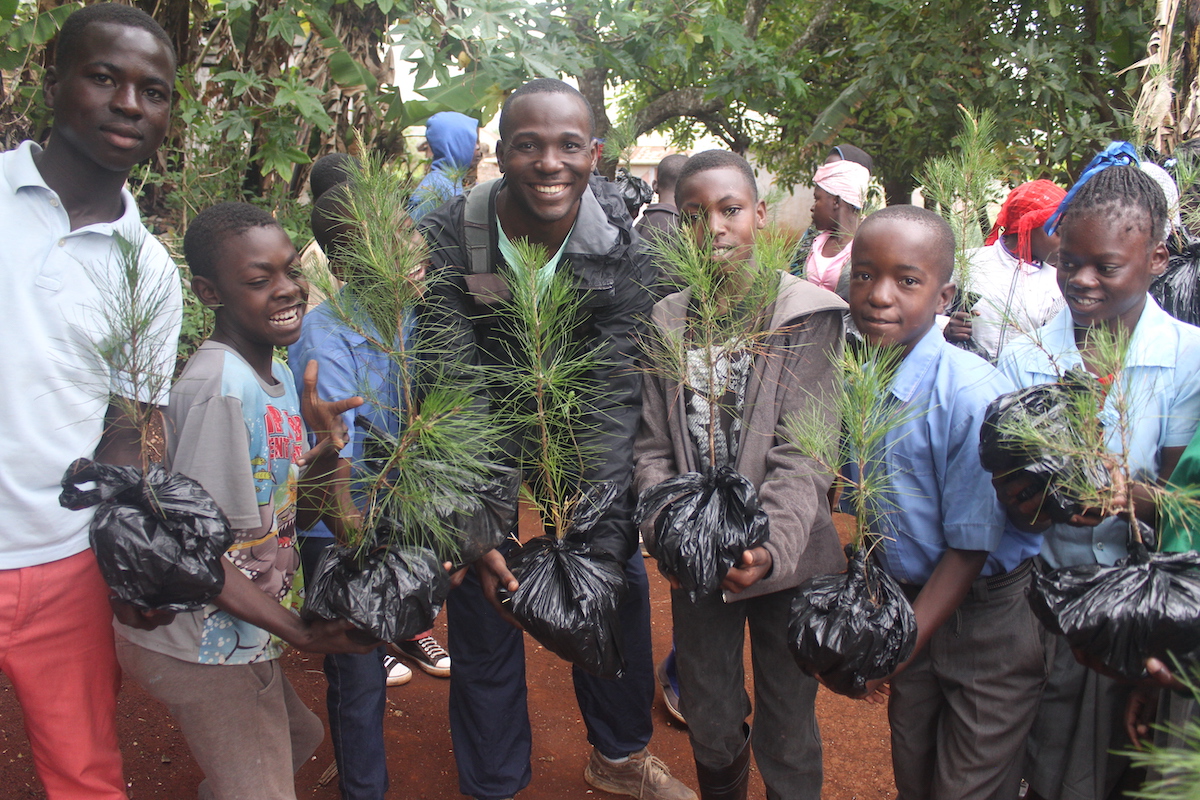
Anderson Jean (center) with Haitian schoolchildren planting trees for the Caribbean Endemic Bird Festival.
“Anderson’s determination and commitment to Haiti’s birds, despite a number of challenges, is truly inspiring to us all. His work is an expression of hope, seeking to instill a love of birds in future generations,” said Lisa Sorenson, Executive Director of BirdsCaribbean.
“Anderson’s optimistic spirit is a marvelous example to other conservationists working hard in the field. BirdsCaribbean has been proud to support his work on the critically endangered Black-capped Petrel – funded in part by the Betty Petersen Conservation Fund – creating awareness at the grassroots level. He has also been instrumental in the rediscovery of the endangered Ridgway’s Hawk in Haiti,” added Sorenson.
Trained in Agroforestry and Environmental Sciences, Jean is based in Les Cayes, Haiti. He began volunteering with U.S. researchers surveying the country’s biodiversity. After 13 years in search of the Ridgway’s Hawk, he and a colleague found the endangered raptor in August 2019 on Petite Cayemite Island – a tremendously exciting achievement for him personally, fueling hope for the future.
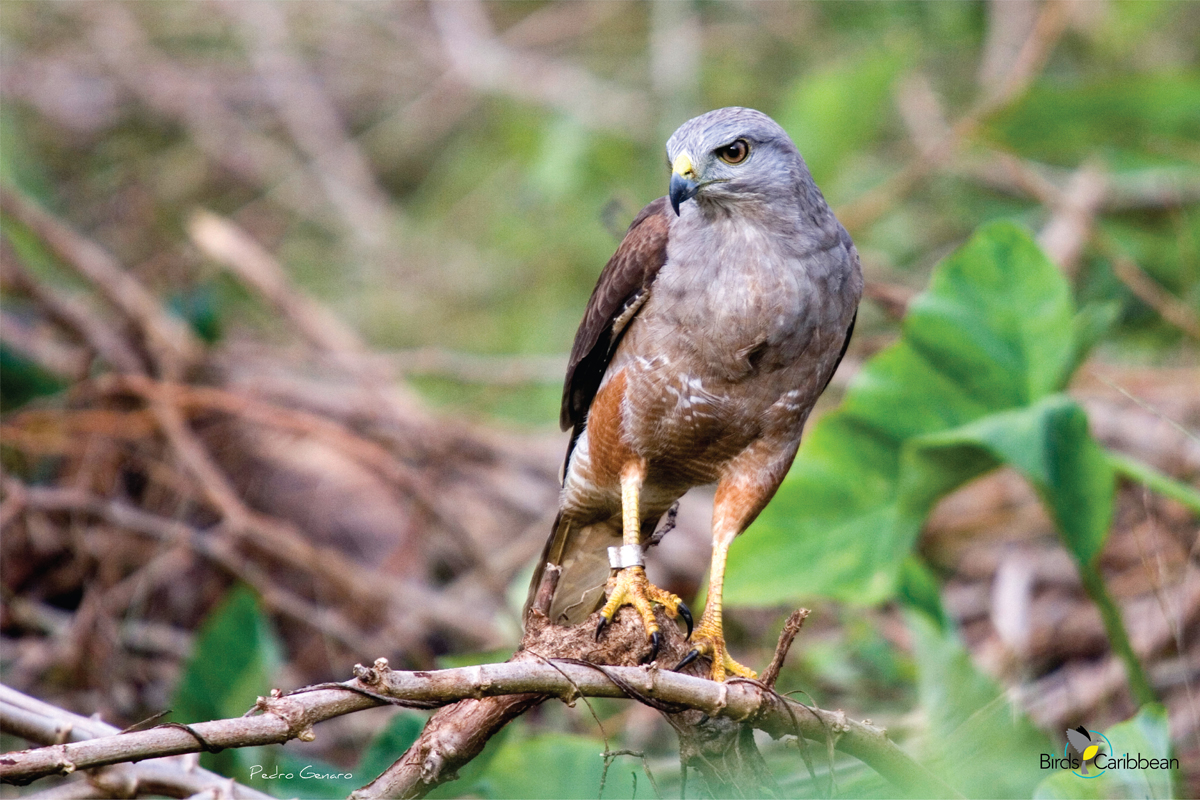
Adult Ridgway’s Hawk (Photo by Pedro Genaro)
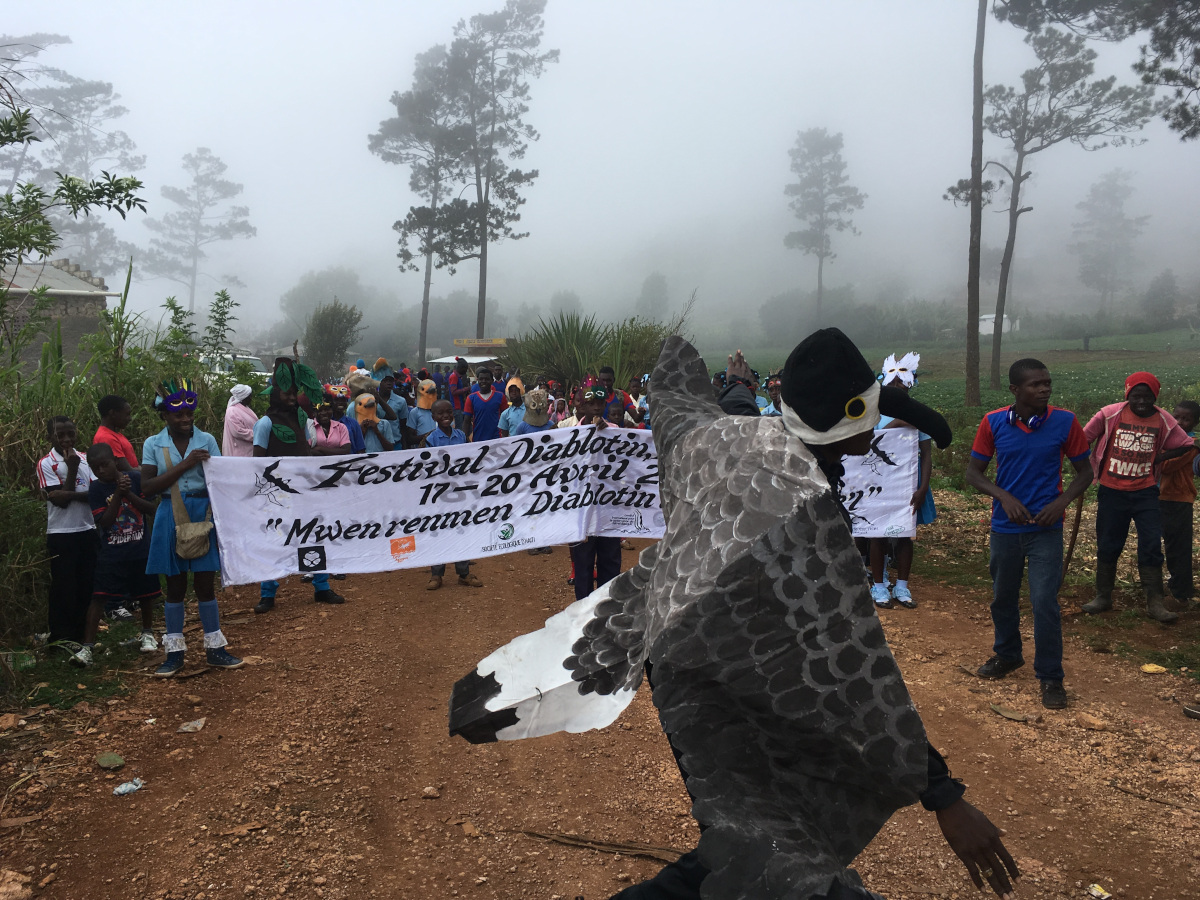
Jean also founded the annual festival celebrating the Black-capped Petrel (Diablotin), getting farmers, schoolchildren and entire communities involved in learning about and protecting this remarkable seabird. After training with the Cornell Lab of Ornithology and Vermont Centre for Ecostudies, Jean served for three years as field biological survey coordinator for Société Audubon Haïti.
Black-capped Petrel mascot leading the parade for the Diablotin Festival in Boukan Chat, Haiti (Photo by EPIC)
In 2017, he founded Action pour la Sauvegarde de l’Écologie en Haïti, which has quickly established itself as a leading advocate for the country’s environment. He currently works with our partner Environmental Protection in the Caribbean (EPIC).
Anderson is a long-time member of BirdsCaribbean and has attended a number of our training workshops and conferences. He received a David S. Lee Conservation Fund Award from BirdsCaribbean in 2019 to survey waterbirds at 5 wetlands in Haiti after attending our Shorebird Conservation Training Workshop in Cabo Rojo, Puerto Rico.
On his Facebook page, Jean expressed his appreciation: “Thank you to every single one of you who contributed to strengthen my capacity in conservation biology and make me win today the Stanford Bright Award 2022.”
Like BirdsCaribbean, Anderson Jean believes in engaging local residents, inspiring them with a love of birds as an integral part of their own culture. This ensures the sustainability of conservation projects. He is committed to his country, its birdlife – and its people.
Anderson Jean with colleagues from around the Caribbean at BirdsCaribbean’s Shorebird Monitoring and Conservation Workshop in Cabo Rojo, Puerto Rico, 2019. (photo by Lisa Sorenson)
Congratulations on your achievement, Anderson! We look forward to continued work with you and wish you all the best in your future research and collaborations. May you stay strong and become ever more successful in support of Haiti’s birds!
To understand more about Anderson Jean’s ground-breaking work, watch his beautiful video, “Haiti, My Love, My Home” – a moving tribute to his country and to the fragile Black-capped Petrel and a discussion on how people and birds can live together, on YouTube (see video below).
We are excited to announce that the David S. Lee Fund for the Conservation of Caribbean Birds will fund 9 projects in 2021! In the previous 4 years (2016-2020), the fund has provided assistance for 15 projects in 6 countries for work on dozens of species in the Caribbean.
This fund was created by generous donations from the family, friends, and collaborators of David S. Lee to continue his inspiring legacy of conservation in the Caribbean. You can help us to continue supporting these invaluable projects by making a donation here.
Congratulations to these exemplary researchers, and we look forward to hearing about your results in future blog articles and publications!
Investigating variation in cooperative breeding behavior between Puerto Rican Tody populations
Amber Wendler, Virginia Tech
Cooperative breeding occurs when some individuals, known as “helpers,” assist with raising their siblings, rather than reproducing themselves. This breeding strategy is used by many bird species, including the Puerto Rican Tody (Todus mexicanus). However, only some individuals of this species breed cooperatively, and differences are thought to be linked to habitat. Amber’s research will examine how the Tody’s cooperative breeding behavior differs in rainforest and dry forest habitats. By increasing our understanding of the Tody’s natural history, her work can help manage and conserve this endemic species.
Territory use of the Critically Endangered Bahama Oriole across the annual cycle
Michelle Moyer, University of Maryland Baltimore County (UMBC)
The Bahama Oriole (Icterus northropi) is a Critically Endangered species that is found only on Andros Island in The Bahamas. Thanks to recent work by the Bahama Oriole Project — a collaboration between UMBC and the Bahamas National Trust (BNT)— we have learned a lot about this species’ breeding habitat, including that it uses the native pine forest much more than previously thought. However, it is unknown how Orioles use the pine forest and other habitats outside of the breeding season. Using tiny, solar-powered transmitters (CTT Life Tags™ ), which will be attached to Orioles and detected by a central receiver (CTT Node), Michelle will track their movements throughout the full annual cycle. The results of her research will inform BNT’s conservation management strategies for the Oriole.
Caribbean psittacines as indirect controllers of ecosystem dynamics through commensal feeding associations and ecosystem engineering
Damion Whyte, University of the West Indies at Mona
Parrots and parakeets are notorious for not finishing the fruits that they open. As a result, they are often viewed as wasteful pests, and are feared by farmers. However, we do not have a great understanding of the impacts that this behavior can have on the local ecosystem, such as providing easier access to the fruit by other species and dispersing seeds. Damion’s research will quantify the ecosystem-wide effects of foraging by parrots and parakeets on the island of Curacao. Using observations and camera-traps, he will identify which species visit fruit that has been opened by, and how their behaviors vary. By providing insight into these species interactions, his work will support bird conservation and management in protected areas.
Pre-reproductive survival, movements, and habitat use of the Yellow-shouldered Blackbird (Agelaius xanthomus) in Southwestern Puerto Rico
Jean P. Gonzalez Crespo, University of Wisconsin
The Yellow-shouldered Blackbird (Agelaius xanthomus) is an Endangered species that is endemic to Puerto Rico. Although conservation measures such as artificial nesting structures increased the reproductive success of this species, populations have continued to decline. Using CTT Life Tag™ transmitters Jean will track Blackbirds after they fledge from the nest and estimate their survival during this critical period. His work will help local and federal agencies determine whether survival rates before breeding are contributing to population declines, and identify the factors that influence survival.
Establishing a long-term banding program for migratory birds in Isla Contoy National Park, Mexico
Jonathan Nochebuena Jaramillo, Estación de Anillamiento Parque Nacional Isla Contoy
Isla Contoy National Park (PNIC) is a small Caribbean island (238 hectares) near the Yucatan Peninsula in Mexico. The island is an important site for many migratory birds to rest and refuel on their long journeys between North, Central, and South America. In 2019, Jonathan personally initiated a banding program in PNIC. He will continue and expand this program to document and spread awareness of the importance of the island for a wide diversity of birds, and provide information to conserve birds and their habitats on the island.
Understanding nestling diet composition of Roseate Terns (Sterna dougallii) through fecal DNA Metabarcoding
Luis Ramos, University of Puerto Rico, Mayaguez
Environmental changes such as rising sea temperatures and ocean acidification pose many threats to seabirds and the marine food sources that they depend on. The Roseate Tern (Sterna dougallii ) is a species of conservation concern in the Caribbean, including in Puerto Rico. Yet we know little about foraging behavior, ecology, and population trends of this species. Luis’s research will use an advanced molecular method (DNA metabarcoding) to assess the diet composition of chicks in Tern populations on the southern and northern coasts of Puerto Rico. His work will identify the fish and other prey that are available to Terns in different colonies, and advance our understanding of DNA metabarcoding as an important biomonitoring tool.
Evaluating the effects of greening actions on avian diversity on tropical urban landscapes
Julissa Irizarry, Penn State University
Expansion of urban areas contributes to loss and fragmentation of habitats across the globe. These drastic landscape changes can negatively impact biodiversity, especially on islands. Large-scale tree planting efforts, such as those planned in Puerto Rico following Hurricane Maria, have the potential to increase the suitability of urban areas for native wildlife. Julissa’s project will investigate the benefits of urban reforestation for resident and migratory birds. Using an experimental approach, she will compare how birds use newly planted trees—“functional” tree species that are known to be important for foraging and “structural” plants that are traditionally used for landscaping. Her work will inform best practices for implementing urban greening projects in order to maximize conservation benefits.
Current status of the breeding colonies of Red-footed Booby, Brown Booby, and Masked Booby in Los Roques Archipelago, Venezuela
Los Roques Archipelago National Park is in the Caribbean Sea 130 km north of Venezuela. It has 42 islets and 200 sandbanks arranged around an internal lagoon. It is home to all the typical ecosystems of tropical maritime and coastal areas: sandy beaches, coral formations, salt and brackish water lagoons, seagrass meadows, and mangroves. This archipelago was declared a National Park in 1972, and its Use Regulation and Management Plan was finalized in 1990. Los Roques is home to a great diversity of seabirds and is a priority area for conservation. Conserving seabirds in the Caribbean is essential, as their numbers have been decreasing over time. Documenting their status and trends is needed to develop conservation plans. Two species of boobies have breeding colonies in Los Roques: Red-footed Booby and Brown Booby. Masked Booby’s presence has been documented, but their reproduction has not been confirmed. 20 years have passed since the last assessment of the population of seabirds in the Los Roques Archipelago. Since then there have been many political, economic and environmental changes in Venezuela—changes that may put the Los Roques Archipelago and the booby colonies at risk. We propose to survey and evaluate the reproductive colonies of boobies in 4 keys of the archipelago. We will also explore other cays to look for confirmation of breeding activity. We will integrate the local “Roqueños” communities in the censuses and outreach activities.
Population dynamics, conservation and management of the American Flamingo (Phoenicopterus ruber) on Margarita Island, Venezuela
Anahy Marcano , INPARQUES / AveZona / PAAVe
Venezuela has about 38% of the total population of American Flamingos, Phoenicopterus ruber. It is considered a resident species on the Isla de Margarita in Venezuela. Although its population has shown variations in size and distribution, historically, American Flamingos have been observed on the Isla de Margarita since the beginning of the last century. Recently, a new flamingo nesting area has been identified on Margarita Island in the Laguna de las Marites Natural Monument. However, its population status is unknown and currently there is no plan for its conservation and management. As the first stage of this project we will estimate the size of the breeding population, the reproductive success, and the demographic parameters in two of the nine areas occupied by the American Flamingos on Margarita Island, las Marites Lake Natural Monument and La Restinga National Park. Visual observations will be conducted from a safe distance so as not to disturb the breeding areas. After the breeding season, the area used for the nests will be evaluated. As part of this project, we will involve local communities in the censuses and an educational campaign will be established.
The David S. Lee Fund for Conservation seeks to continue David’s passion for protecting wildlife. The fund supports direct, innovative conservation work in the Caribbean Region for birds and their habitats. The fund is managed by BirdsCaribbean and used for annual small grants. We are grateful to all those who have supported the fund, and also to our David S. Lee Fund Review Committee who carefully reviews proposals each year and makes recommendations on funding.
You can you help us to continue to fund invaluable research to conserve Caribbean birds by making a gift to the fund.
If you prefer to donate with a check, please make the check out to “BirdsCaribbean” and in the memo section, note that it is for the David S. Lee Fund. If you have questions or to make other arrangements for donating, please feel free to contact Jennifer Wheeler, BirdsCaribbean Financial Officer (jennifer.wheeler@birdscaribbean.org)
Checks can be mailed to: BirdsCaribbean, 841 Worcester St. #130, Natick, MA 01760-2076
Size of Award: Several grants up to $1,000 each Application Deadline: February 19th, 2021 at 5 p.m. EST. Address Questions and Send Application to: Will Mackin, BirdsCaribbean, willmackin@gmail.com with copy to info@birdscaribbean.orgAnnouncement of Awards: March 15th, 2021 Donations to the Fund: Tax-deductible (U.S.) at this link. ___________________________________________________________________________________________________________
Dave Lee holding a White-tailed Tropicbird in the Bahamas. (photo by Mary Kay Clark)
David S. Lee (1943-2014) was a pioneering naturalist and conservation biologist who helped get BirdsCaribbean started nearly 30 years ago. He inspired many naturalists with his work and his writing. He was a man of many interests, and with respect to the Caribbean, published numerous papers and articles in the popular press on seabirds, Bahamian fish, turtles, snakes, bats, and orchids.
Donations from Dave’s wife, Mary Kay Clark and his mother, June Bash, allowed the establishment of the David S. Lee Fund for the Conservation of Caribbean Birds that will award money to conservation projects in his honor. The money is being held in a trust and will be used to award annual grants for innovative projects that protect Caribbean birds and their habitats.
Goal of the Fund: The David S. Lee Fund for Conservation seeks to continue David’s passion for protecting wildlife. The fund will support direct, innovative conservation work in the Caribbean Region for birds and their habitats. The fund will be managed by BirdsCaribbean and used for annual small grants. Applicants should demonstrate how their project will work with conservation groups and local communities in the Caribbean.
Eligibility: Scientists/naturalists working in the Caribbean, in conservation organizations or academic programs, may apply. Applicants should be students or early career ornithologists, conservationists, or wildlife professionals (i.e., not established faculty or senior staff of a conservation organization, less than 10 years post-graduation). A student must be enrolled in accredited Masters or PhD program in ecology, biology, conservation, or related field to be eligible. Applicants must be paid or sponsored members of BirdsCaribbean at the time of application.
Use of Funds: The funds can cover travel to field sites, living expenses in the field, or costs for equipment and supplies to conduct conservation projects. Examples of equipment and supplies include traps, cameras, automated recording units, nest boxes, etc. Ineligible costs include salary or other wages, overhead fees, etc. Projects that foster collaboration between scientists/naturalists in different island groups of the Caribbean, such as joint projects to test conservation techniques for similar species, will be favored. Application Guidelines:
Proposals may be submitted in English, French, or Spanish. All should have an English version of the abstract.
Applications should be emailed as a Microsoft Word document.
The application should include a cover page, proposal (download guidelines below), and a curriculum vitae for the applicant.
Separately, by email, three individuals who can attest to your effectiveness in previous work should submit letters of recommendation. For students, this would include your academic advisor.
Evaluation:
A committee appointed by BirdsCaribbean will review the proposals and award the grants.
The awardee will be required to submit a report one year from the day of the award explaining how the award money was spent and the results of the project to that point. The awardee is also asked to write an article for BirdsCaribbean’s blog about their work (informal article for a lay audience).
Eligible applicants can download the application here. ___________________________________________________________________________________________________________
Help support the Dave Lee Fund by being a sponsor!
Reddish Egrets (dark morph). (photo by Tania Thomson, Shutterstock)
This fund will be for the conservation of any bird in the Caribbean as a reflection of Dave’s diverse interests. He was an important part of many projects, ranging from those of the Black-capped Petrel and Seabird Working Group to the scholarly debate leading to the elevation of the Bahama Yellow-throated Warbler to a full species. At the moment the fund contains $12,000. Our initial goal is to raise $25,000 so that we can award $1,000 every year to a worthy student or early career ornithologist, conservationist or wildlife professional. Not only will this fund encourage creative field work for projects that make a difference, but it will also help build the knowledge and skills of young conservationists that are urgently needed to make sure that the Caribbean birds and habitats that Dave treasured are still around for future generations to enjoy.
Cuban Parrot surveying his domain. (photo by Elliotte Rusty-Harold, Shutterstock)
At the 2015 BirdsCaribbean meeting in Kingston, Jamaica, a round of beers was purchased in Dave’s honor, since he always seemed to have a cooler full when people wanted one (and even when they didn’t). Think of this fund like a cooler full of refreshing beverages that Dave would have around if he were here. We owe it to Dave to stock that cooler—to vitalize naturalists and empower them in their work to help wildlife. Please give a tax deductible donation to the David S. Lee Fund. Give generously. The more we put into the fund, the more we can give out each year. Thanks to all those that have contributed to the fund!
If you prefer to donate with a check, please make the check out to “BirdsCaribbean” and in the memo section, note that it is for the David S. Lee Fund. If you have questions or to make other arrangements for donating, please feel free to contact Jennifer Wheeler, BirdsCaribbean Financial Officer (jennifer.wheeler@birdscaribbean.org) Checks can be mailed to: BirdsCaribbean, 841 Worcester St. #130, Natick, MA 01760-2076
Thank you for your participation and support!
Reports from Projects Supported with Dave Lee Fund Scholarships:
The Red-legged Thrush is a key seed disperser in the forests of the Dominican Republic. (photo by Dax Roman)
Spencer Schubert’s adventures into the remote corners of the Dominican Republic Part continue, all in the name of science and conservation.
If you are reading this, I probably do not have to convince you that birds are great. The more interesting discussion to be had, of course, would be what makes them so great. We are all drawn to birds for different reasons. For some of us, the sights and sounds they provide to the ambience of our backyard or local natural area are enough to endear them to us. For many others it comes from their experience as pet owners. Even the tradition of hunting can inspire reverence for birds and a passion for their conservation. I have always liked birds, but I can hardly claim that they were any more interesting to me than lizards or turtles, for example. Indeed, on my grumpiest of days, I sometimes refer to myself as a failed herpetologist.
My gateway to birds has been a fascination with their role as seed dispersers. It may not be the first thing that you notice, but no matter where you go, as long as you’re standing on dry land and there is some green vegetation nearby, you would be hard pressed to find somewhere where there aren’t birds eating fruits and seeds. These feeding behaviors by birds are a key component to many terrestrial ecosystems. By swallowing fruits or otherwise carrying away seeds in their bill, potentially flying great distances, birds give plants a major boost in their potential to propagate in the environment.
Our restoration plots, constructed in 2017, are small pasture areas each about the size of a basketball court. By enclosing these areas with barbed wire fences, our objective was to eliminate the effects of cattle grazing, trampling, and landscaping efforts by farmers in order to observe the process of seed dispersal and plant growth. Perches with crossbars were installed to attract birds and collect droppings and seeds.
One of the major implications of seed dispersal in a world with ever diminishing forests is the prospects for degraded ecosystems to bounce back. About two years ago, I contributed an article to this blog on up-and-coming work in the small town Jarabacoa in the central mountains of the Dominican Republic. I was studying whether constructed perches could be used to attract birds to restoration sites on abandoned parcels of farmland, with the goal of promoting natural seed dispersal and forest recovery. It all began with a simple principle: If you build it, they will come.
To some extent this was true. We found that installing perches increased the number of birds visiting restoration plots. However, some key seed dispersers such as the Palmchat, Black-crowned Palm Tanager, and Red-legged Thrush – to name a few – showed little to no interest in our perches. So, I got to thinking, maybe we need a better sales pitch.
Have you ever walked down the streets of a popular street in town looking for a place to eat or hang out? Would you rather walk into an establishment that is silent with no sign of people inside or one that is bustling with music and laughter? Atmosphere is what you’re looking for. All else being equal, you’re much more likely to walk into a restaurant that sounds like there are a lot of people inside than one that is quiet and seemingly empty. We use these social cues to inform our judgments of the quality of different businesses all the time. As it turns out, birds are not so different.
Birders will already be familiar with the magic of playback. Many bird species are readily stimulated by hearing their own call and often rush in to investigate whether the sound is from a mate, new neighbor, or a potential intruder to the territory. This is often used to draw in shy birds for us to have a closer look at them or prompt them to reply for better identification (Note: Playback may cause unnecessary stress for some species, particularly during nesting season, and is prohibited in some parks and in many cases for threatened species). Similarly, birds may be drawn to the sounds of both their own kind and other species as a signal to flock up to find high quality habitat or food.
Black-crowned Palm Tanager (Phaenicophilus palmarum) feeding on Inga vera. (photo by Spencer Schubert)
Here is where my idea set in. One aspect of my studies over the past four years has been the community-level analysis at our sites in the central Dominican Republic in an attempt to fully document all feeding/dispersal relationships between all of the bird and plant species that occur here. Through thousands of hours of observation, we have uncovered enormous variation in the extent to which different bird species act as seed dispersers.
Some “generalist” species are responsible for dispersing the seeds of large numbers of plant species. For example, our research has revealed that the Palmchat eats fruits from 42 species. That’s nearly half of all trees and shrubs that are found, collectively, at the sites we have surveyed! Other “specialist” species, like the Antillean Euphonia, are only known to feed on fruits from just a few species. So, if you were any average Joe Bird in the mood for some tasty fruits, which of these species would you rather take a recommendation from?
Antillean Euphonia (Euphonia musica) feeding on a mistletoe (Phoradendron racemosa). (photo by Spencer Schubert)
This is, effectively, the question we asked with our latest experiment. By broadcasting sounds of fruit-eating generalists, specialists, and birds that do not eat fruits in separate trials, we sought to test how these sounds affect bird activity in our restoration plots. We expected, first of all, that the sounds of particular species would attract members of that same species. Additionally, we expected experimental trials with sounds from generalist birds to attract more birds in general than in trials with sounds from specialists, non-frugivores, and no sound. We used digital video cameras to record the activity of birds in the plots during these experiments. At this time, we are still reviewing the footage from this study. But we have already seen some fascinating results! Several species that we had never before recorded in the plots were confirmed as visitors responding to the sound of their own species during this experiment.
Here we see a family of Grey Kingbirds (Tyrannus dominicensis) frolicking among the perches in one of our restoration plots. Kingbirds are, nominally, insectivores. However, they supplement their diet heavily with a large variety of fruits. Their propensity to venture out into open spaces to hunt for insects makes them highly prolific seed dispersers in deforested landscapes. (Video by Spencer Schubert)
Our work demonstrates that sound and social cues are likely a key factor in birds exploring degraded landscapes. And this exploration and habitat use by birds has a direct relationship with seed dispersal. While our work is only a first glance into these relatively unexplored aspects of bird behavior, there is reason to believe that it could have key implications for environmental management and conservation. Beyond simply tricking birds into showing up to a particular site, taking various measures to promote the local abundance of birds through providing resources and habitat can extend well beyond improving the well-being of birds. Helping birds in this context has great potential for restoring the ecosystem services like seed dispersal that birds provide, which will be key in our future struggle to support biodiverse and resilient ecosystems.
As an extension of plant surveys and phenology monitoring, we used a make-shift space at our field station to germinate and rear seedlings of more than 30 species. At the end of the summer, Plan Yaque Inc. helped us transport these to a large scale nursery that supplies ongoing forest restoration projects for the Ministry of the Environment.
In the time since the inception of our project, we have taken steps to ensure that measures will be taken to improve management practices to make landscapes more supportive of bird populations. Our biggest push in this regard has been emphasizing the importance of planting native species both in restoration areas and in backyard landscaping projects to support native birds.
Over the past year, we have collected seed and grown seedlings of more than 30 species of native plants, all of which produce fruit resources for birds. In July of this year, we donated more than two hundred of these seedlings to Plan Yaque Inc. (a local NGO working to conserve natural resources in the Rio Yaqui del Norte watershed) and the Ministry of the Environment to incorporate into routine forest restoration projects, including the plots where we have done our experiments. We hope that this will be an important first step to reforming forest restoration practices so that they may become more sustainable and effective in promoting native biodiversity.
A Palmchat, endemic to the Dominican Republic and an important seed disperser, uses one of our artificial perches. (photo by Holly Garrod)
I owe gratitude to many individuals and organizations for their roles in supporting this project over the past several years. Chiefly among these were project technicians: Joaris Samuel Gonzalez and Juan Miguel Liberata. Field assistants: Alex Lascher-Posner, Paris Werner, Kim Shoback, Tyler Glaser, Alejandra Monsiváis, Juan Carlos Cárdenas, and Lara Grevstad. Dr. Eric Walters of Old Dominion University helped advise the project and has been instrumental in the progression of my ideas and my development as a scientist. Holly Garrod has closely partnered with this project as a collaborator during the course of MS thesis on todies of Hispaniola. Local organizations Plan Yaque and Rancho Baiguate have provided key logistic support, without which this work would not have been possible. Furthermore, numerous private land owners have generously received us on their farms to conduct our field studies. This research was funded jointly by the Rufford Foundation, the Sophie Danforth Conservation Award from Roger Williams Park Zoo, the Old Dominion University Kirk Wetland Research Award, and the David S. Lee Fund from BirdsCaribbean.
By Spencer Schubert. Spencer is Ph.D. student in the ecology program at Old Dominion whose thesis focuses on the contributions of avian seed dispersal to tropical forest recovery and plant-frugivore seed dispersal networks on farmland landscapes in the Dominican Republic. Spencer is a recipient of two BirdsCaribbean David S. Lee Fund Grants and is using his research as a platform to raise interest in the ecological importance of birds for restoration projects in the region around Jarabacoa.
Dave Lee holding a White-tailed Tropicbird in the Bahamas. (photo by Mary Kay Clark)
David S. Lee was a pioneering naturalist and conservation biologist who helped get BirdsCaribbean started nearly 30 years ago, and inspired many naturalists with his work and his writing. He was a man of many interests, and with respect to the Caribbean, published numerous papers and articles in the popular press on seabirds, Bahamian fish, turtles, snakes, bats, and orchids.
Donations from Dave’s wife, Mary Kay Clark and his mother, June Bash, allowed the establishment of the David S. Lee Fund for the Conservation of Caribbean Birds that will award money to conservation projects in his honor. The money is being held in a trust and will be used to award an annual grant for innovative projects that protect Caribbean birds and their habitats.
Goal of the Fund: The David S. Lee Fund for Conservation seeks to continue David’s passion for protecting wildlife. The fund will support direct, innovative conservation work in the Caribbean Region for birds and their habitats. The fund will be managed by BirdsCaribbean and used for annual small grants.
A striking male Magnolia Warbler perches momentarily on a branch while foraging for food during its spring migration. (photo by Gerald A. DeBoer, Shutterstock)
Eligibility: Scientists/naturalists working in the Caribbean, in conservation organizations or academic programs, may apply. Applicants should be students or early career ornithologists, conservationists, or wildlife professionals (i.e., not established faculty or senior staff of a conservation organization, less than 7 years post-graduation). A student must be enrolled in accredited Masters or PhD program in ecology, biology, conservation, or related field to be eligible. Applicants must be paid or sponsored members of BirdsCaribbean at the time of application.
Use of Funds: The funds can cover travel to field sites, living expenses in the field, or costs for equipment and supplies to conduct conservation projects. Examples of equipment and supplies include traps, cameras, automated recording units, nest boxes, etc. Ineligible costs include salary or other wages, overhead fees, etc. Projects that foster collaboration between scientists/naturalists in different island groups of the Caribbean, such as joint projects to test conservation techniques for similar species, will be favored.
Application Guidelines:
Proposals may be submitted in English, French, or Spanish. All should have an English version of the abstract
Applications should be emailed as a Microsoft Word document.
The application should include a cover page, proposal (download guidelines below), and a curriculum vitae for the applicant.
Separately, by email, three individuals who can attest to your effectiveness in previous work should submit letters of recommendation. For students, this would include your academic advisor.
Evaluation:
A committee appointed by BirdsCaribbean will review the proposals and award the grants.
The awardee will be required to submit a report one year from the day of the award explaining how the award money was spent and the results of the project to that point. The awardee is also asked to write an article for BirdsCaribbean’s blog about their work (informal article for a lay audience).
But wait! What if you are not eligible to apply for funds, you ask? You can still support this worthy cause by being a sponsor!
Reddish Egrets (dark morph). (photo by Tania Thomson, Shutterstock)
This fund will be for the conservation of any bird in the Caribbean as a reflection of Dave’s diverse interests. He was an important part of many projects, ranging from those of the Black-capped Petrel and Seabird Working Groups to the scholarly debate leading to the elevation of the Bahama Yellow-throated Warbler to a full species.
At the moment the fund contains $12,000. Our initial goal is to raise $25,000 so that we can award $1,000 every year to a worthy student or early career ornithologist, conservationist or wildlife professional. Not only will this fund encourage creative field work for projects that make a difference, but it will also help build the knowledge and skills of young conservationists that are urgently needed to make sure that the Caribbean birds and habitats that Dave treasured are still around for future generations to enjoy.
Cuban Parrot surveying his domain. (photo by Elliotte Rusty-Harold, Shutterstock)
At the 2015 BirdsCaribbean meeting in Kingston, Jamaica, a round of beers was purchased in Dave’s honor, since he always seemed to have a cooler full when people wanted one (and even when they didn’t). Think of this fund like a cooler full of refreshing beverages that Dave would have around if he were here. We owe it to Dave to stock that cooler—to vitalize naturalists and empower them in their work to help wildlife.
Please give a tax deductible donation to the David S. Lee Fund. Give generously. The more we put into the fund, the more we can give out each year. Thanks to all those that have contributed to the fund!
If you prefer to donate with a check, please make the check out to “BirdsCaribbean” and in the memo section, note that it is for the David S. Lee Fund. If you have questions or to make other arrangements for donating, please feel free to contact Jennifer Wheeler, BirdsCaribbean Financial Officer (jennifer.wheeler@birdscaribbean.org)
Checks can be mailed to: BirdsCaribbean, 841 Worcester St. #130, Natick, MA 01760-2076