Are you staying home right now? Sit back, relax and enjoy this vivid account of a trip around four islands, an adventure in search of the Amazona parrots. Ryan Chenery, the Barbados-based CEO of Birding the Islands will take you there. Ryan’s company is a proud partner of BirdsCaribbean’s Caribbean Birding Trail (CBT) and shares our philosophy of directly involving and benefiting local communities. Birding the Islands tours often using CBT-trained local guides—not only contribute to conservation efforts across the islands but also to support locally owned businesses. These tours are multi-faceted, but…“We always come back to the birds!” says Ryan.
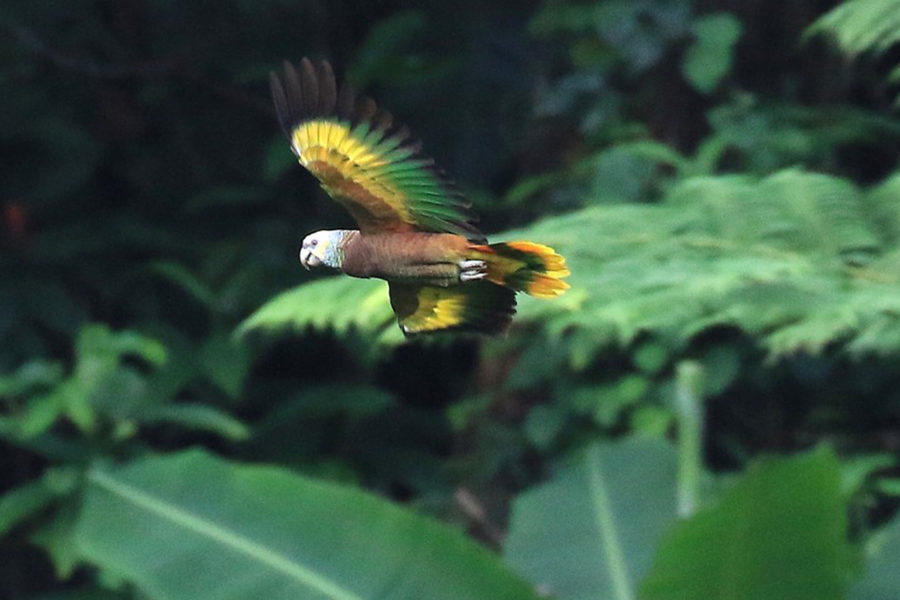
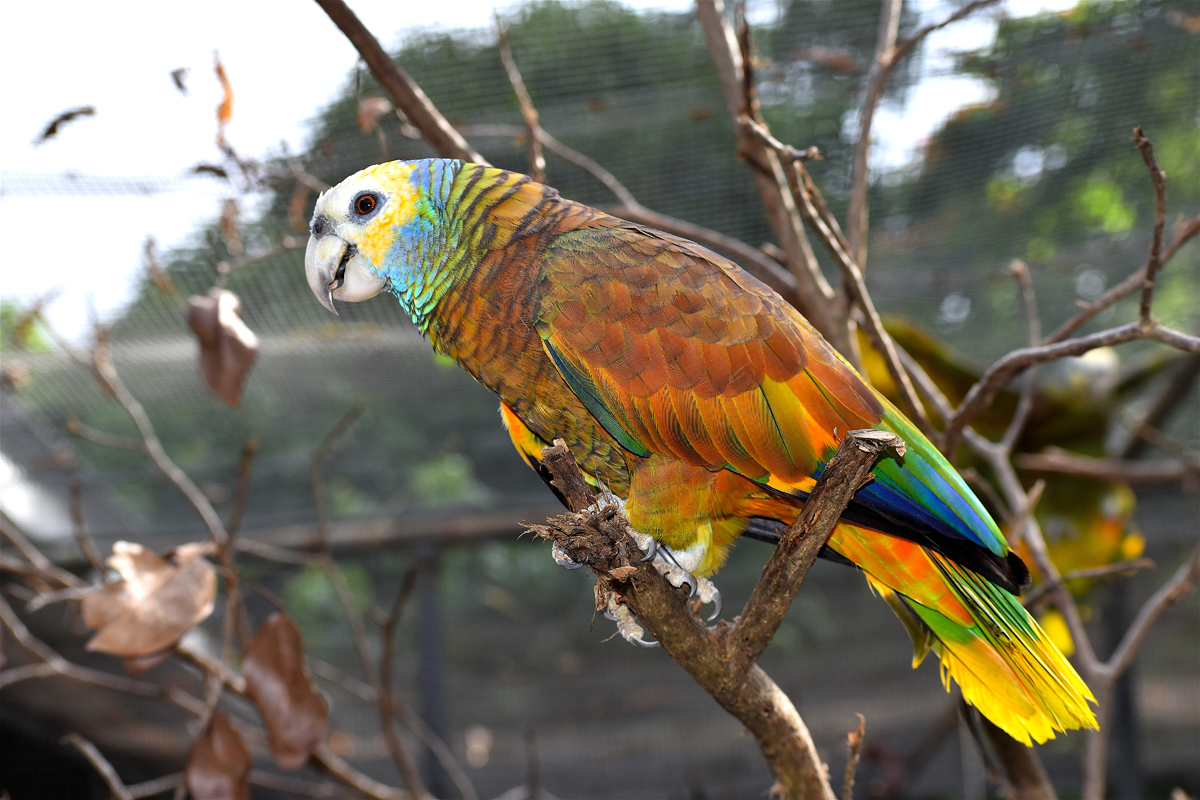
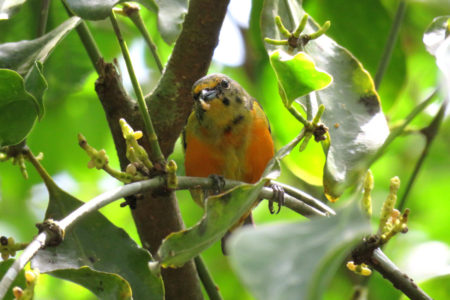
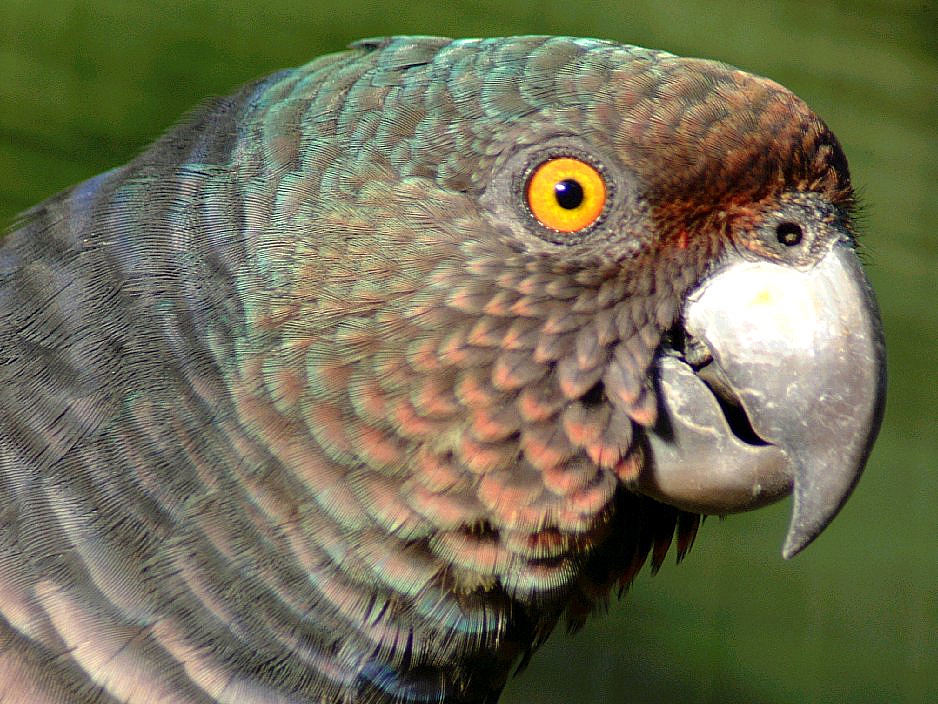
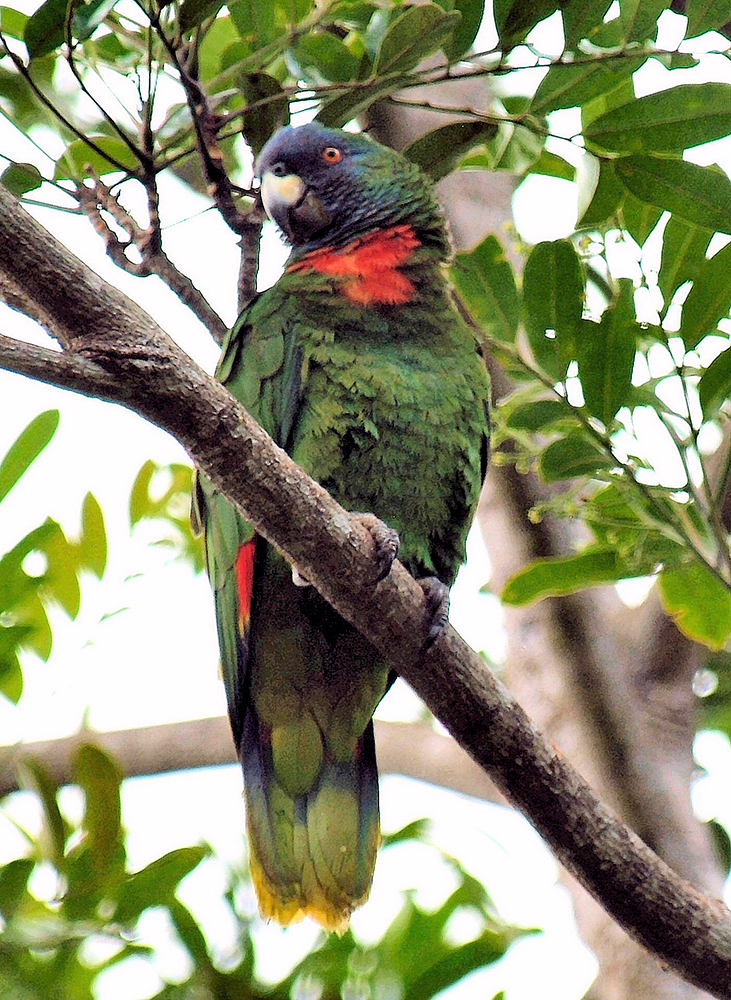
St. Vincent Parrot (Amazona guildingii) (Photo by Birding the Islands client Keith Clarkson)
Birding the Islands and BirdsCaribbean February 2020 trip to: St. Lucia, Dominica, St. Vincent, and Trinidad
Day 1: St. Lucia, Airports and Aupicon
We exit the plane at the vibrant Hewanorra International Airport and get straight into some productive airport birding. We easily spot the endemic subspecies of Carib Grackle and seemingly ever-present (yet fascinatingly split) near endemic subspecies of Bananaquit, flitting from one heavily laden calabash tree to another. A juvenile Merlin perched high atop a swaying Australian Pine is a surprising and welcome addition to our fledgling Lesser Antillean list. What a great start!
As we make for our first birding hotspot of the trip, the spectacular scenery of St. Lucia leaps out at us. This is a breathtakingly beautiful island – the perfect blend of towering forest-covered mountains and pristine white sand beaches lined by sparkling turquoise seas. It is no wonder that, centuries before, the French and British fought fiercely and passionately for the right to fly their flag atop its highest peak.
St. Lucia Parrot (Amazona versicolor) (Photo by Birding the Islands client John Dyson)
We plan our arrival at the sprawling Aupicon Wetlands to coincide with the return to their roosts of several species of heron and egret. After our vehicle winds its way through a corridor of towering Coconut Palms (their produce once the primary export crop of this lush tropical island), we catch our first sighting of migratory Blue-winged Teal and resident Common Gallinule – the brilliant blue wing coverts of the former and radiant red frontal shields of the latter gleaming in the last of the sun’s rays. Adding to the spectacle, large flocks of Snowy as well as Cattle Egrets now begin a near continuous approach to favoured roosting sites in the middle of the wetlands. The darting bills and dancing legs of Tricolored and Little Blue Herons contrast nicely with the bobbing of Pied-billed Grebes and American Coots (white-shielded Caribbean subspecies). A lone Osprey returning from the sea with a freshly caught fish is the cue for us to head to our accommodation for dinner.
Day 2: Endemic Overload!
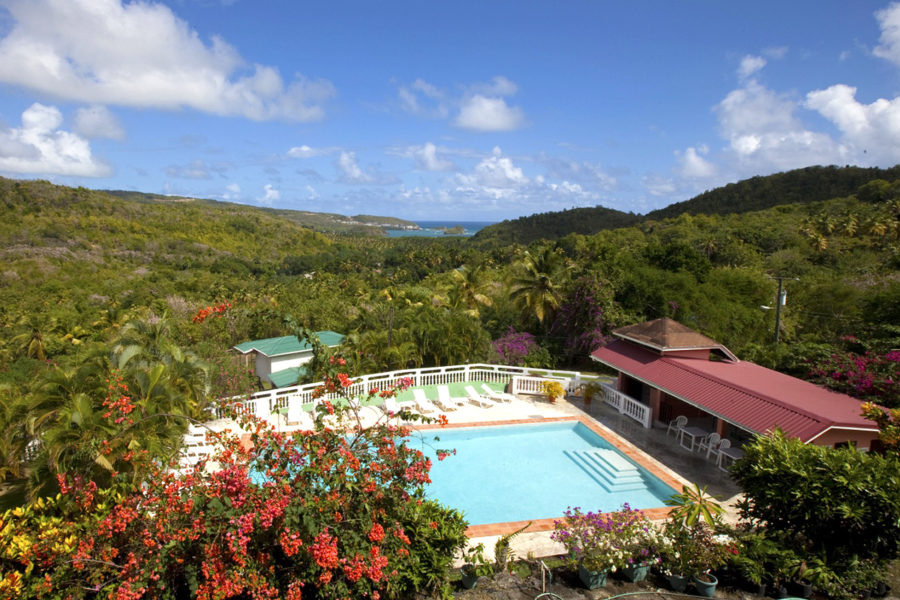
The morning begins at our peaceful Inn, tucked away in quiet Mon Repos, where we enjoy a delicious buffet breakfast (yes, more freshly picked pineapple is on its way Nick!) on the sweeping veranda overlooking the densely forested hillsides and glittering waters of Praslin Bay.
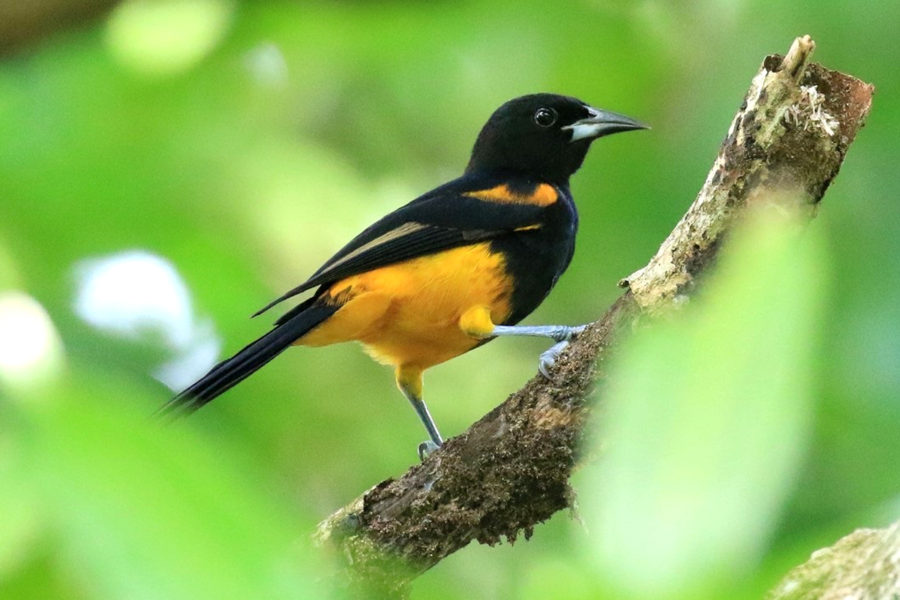
Mon Repos is ideally located in the vicinity of some of the last remaining Dry Atlantic Forest on the island, and we start the morning’s birding by entering this wilted, scrubby landscape… only to be treated to absolutely cracking views of an inquisitive Mangrove Cuckoo. This seemingly impoverished habitat also yields our first three endemic sightings of the trip. A charming pair of St.Lucia Black Finch forages amongst the leaf litter, their pink legs dancing amongst the crisp brown leaves. With every step closer the gleaming black of the male provides an ever more diagnostic contrast to the soft cinnamon brown of his mate. We also see a stunningly patterned St. Lucia Oriole; and a brilliant adult St. Lucia Warbler, its subtle patterns fully visible in the neutral morning light.
The strikingly patterned St. Lucia Oriole (Icterus laudabilis) (Photo by Birding the Islands client Keith Clarkson)
We continue northwest over the dominant mountainous spine of the island and down to the scenic west coast, gliding through the sleepy towns of Laborie and Choizeul. There is a striking difference between the rich fertile soils found here in the shadow of the cavernous Mt. Soufriere and the parched earth of our last birding site. While living beneath a volcano is not without its risks, the rewards can also be great – as evidenced by the wealth of produce in the form of yams, dasheen, sweet pototato, plantains and much more being sold here at small roadside stalls. The unparalleled fertility of this region also attracts large numbers of indigenous birds, drawn to the wondrous variety of fruiting citrus trees. We soon find ourselves surrounded by a host of other new and exciting regional specialties.
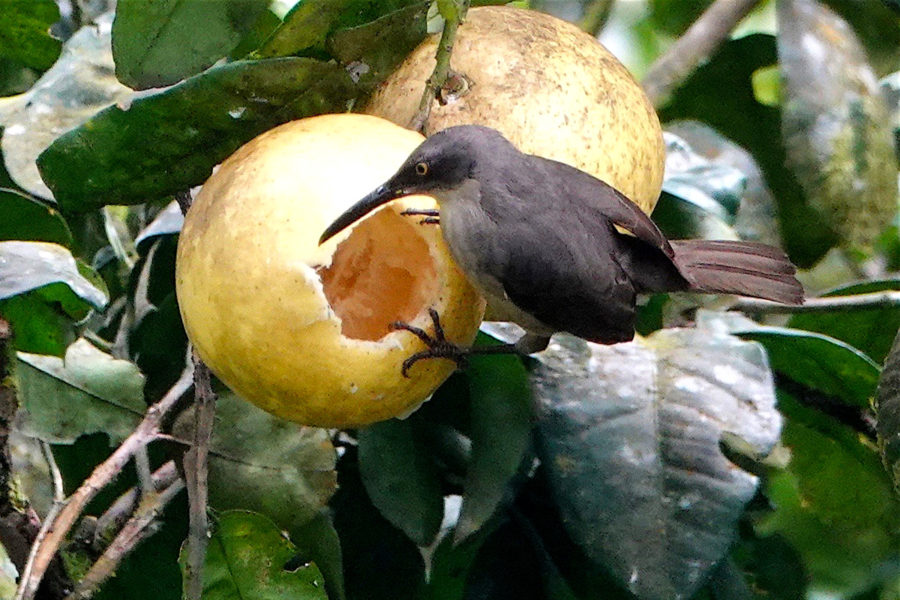
First to appear however is a curious and hitherto unknown species—“the rare St. Lucia Bum Bird”! Or at least that is what we call the odd rufous-feathered buttock sticking out of a large ripe grapefruit at the side of the trail. It is not until the head of the owner of said buttock emerges from the depths of the fruit cavity, that we are able to accurately identify it as a Lesser Antillean Bullfinch. No sooner had our group exchanged smiles and taken photos than a flurry of wings announced the arrival of a splendid Gray Trembler! As is so often the case with this fascinating near endemic (known only to the tiny islands of St. Lucia and Martinique), upon landing the bird immediately begins to convulse its entire body in a violent trembling motion – hence its name. The brief display over, the trembler proceeds to sink its impressive bill into the fleshy centre of the grapefruit, from which the bullfinch had been so unceremoniously usurped!
Gray Trembler (Cinclocerthia gutturalis) about to dig in! (Photo by Mark Greenfield)
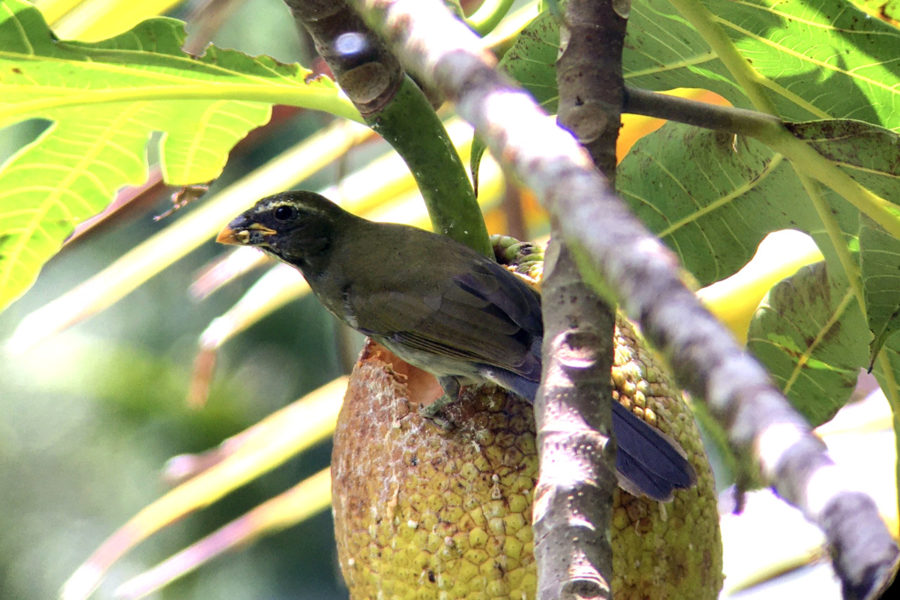
“Beak plunging” appears to be the order of the day. An obliging Lesser Antillean Saltator is the next to start tucking into a meal. This time, the weapon of choice is a gargantuan cone-shaped beak, and the victim—the soft flesh of the golden orbed breadfruit.
Lesser Antillean Saltator (Saltator albicollis) (Photo by John MacLennan)
The birding, already going well, suddenly and unexpectedly gets even better as out of the valley below a pair of St. Lucia Parrots wing their way up towards us and perch not 30 feet away. Perfect light and unimpaired views allow for an absolutely enthralling encounter with this large and stunningly patterned parrot—the first in our Search for the Amazonas!
We round off a terrific morning’s birding with a delicious buffet lunch of creole chicken, steamed mahi mahi, fried plantain, and yam pie… all washed down with freshly squeezed lemonade and enjoyed on the balcony of The Beacon—the restaurant with an unrivaled view of the magnificent twin-peaks of Les Pitons.
Back at our locally owned accommodation some of the group enjoy a relaxing late afternoon swim in the pool before dining on yet more delights prepared by the Paris-trained chef. Tonight’s specialty: lobster bisque, flank steak (or Creole mahi mahi) and crème caramel.
Not a bad place to return to and relax after a great day’s birding!
Day 3: A Breezy Farewell
Today sees us make for the pride of St. Lucia – the splendid Des Cartiers Rainforest. Upon arrival, we enjoy our pre-packed breakfasts before starting our way along the well-maintained trail. Here we are immediately transported into another world – one dominated by towering emergents, prehistoric tree ferns and dangling lianas.
When in St.Lucia, Birding the Islands works alongside local guide and BirdsCaribbean partner, Vision, who is a superb “birtanist” (birder and botanist rolled into one) and as we walk, Vision pauses to point out the many fascinating native tree species all around us (and explain their myriad uses). These make for fascinating topics of conversation between birding hotspots.By far the most dominant tree here is the mighty Lansan. It is known only to four Lesser Antillean islands. Its aromatic resin is a key ingredient of the slow-burning incense still used widely in St. Lucia homes to ward off evil spirits.
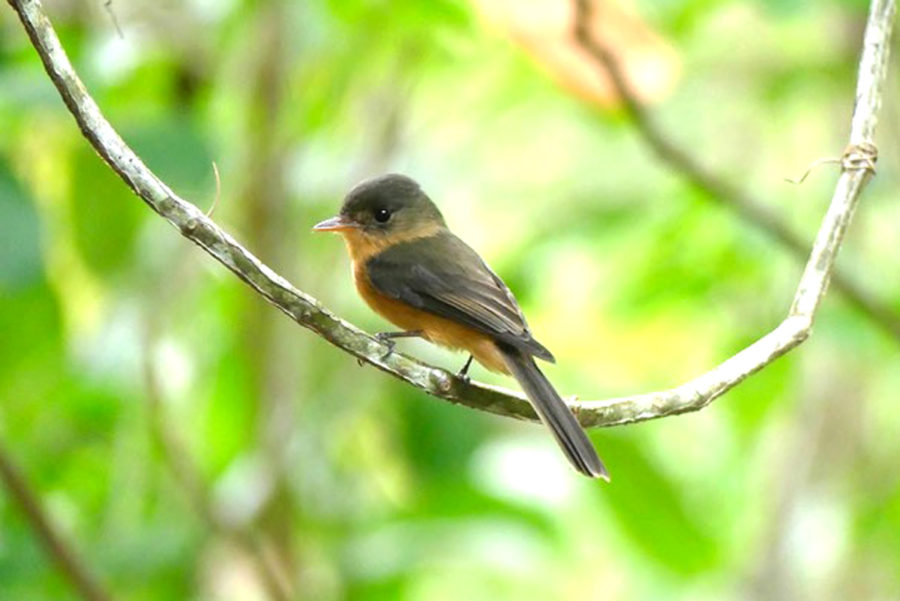
Our first bird experience in Des Cartiers is certainly one of the most memorable: a St. Lucia Parrot poked its head out of a nest cavity some 50 feet above us. But this ancient forest is to have many more surprises in store before we leave. At an observation area with breathtaking views of the riverine valley below, we enjoy incredibly close views of the Antillean Euphonia daintily hopping amongst strands of mistletoe. A pair of Lesser Antillean Flycatchers interrupt proceedings with a low fly-by. Other arrivals during our time at this site include a fabulous Green-throated Carib effortlessly gleaning insects from the underside of a leaf, a positively delicate St.Lucia Pewee seemingly freeze-framed on a looping vine, and an overly inquisitive Pearly-eyed Thrasher.
The delightful St. Lucia Pewee (Contopus latirostris) (Photo by Jane Hartline)
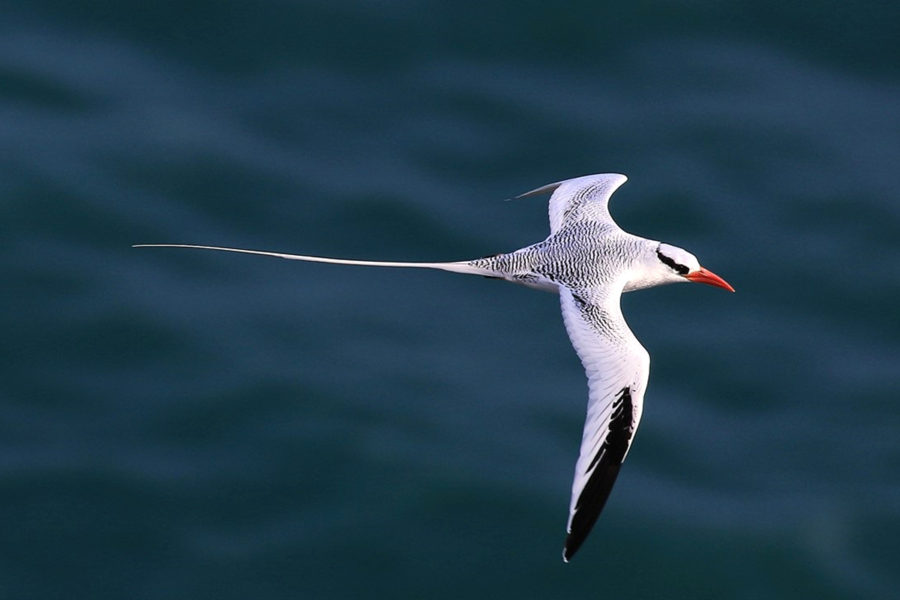
After a lunch enjoyed on the white sand shores of Cocodan, our final birding stop of the day is the towering peak of Moule a Chique, where we brave the blustery winds to look down upon Red-billed Tropicbirds hurtling beneath us – their brilliant pure white plumage contrasting perfectly with the deep blue waters of the Atlantic Ocean.
Red-billed Tropicbird (Phaethon aethereus) (Photo by Birding the Islands client Keith Clarkson)
Later that evening after a pre-dinner cocktail, we settle in to dine on Kingfish (delivered earlier from the traditional fishing village of Dennery, where the previous day we had the opportunity to witness an intense bartering culture in action). Experiencing the culture of the islands as well as supporting local communities, while illustrating the correlation between us visiting birders and the economic prosperity of many local businesses and citizens is extremely important for Birding the Islands Ltd and our partner BirdsCaribbean. We adopt this approach on every island we visit.
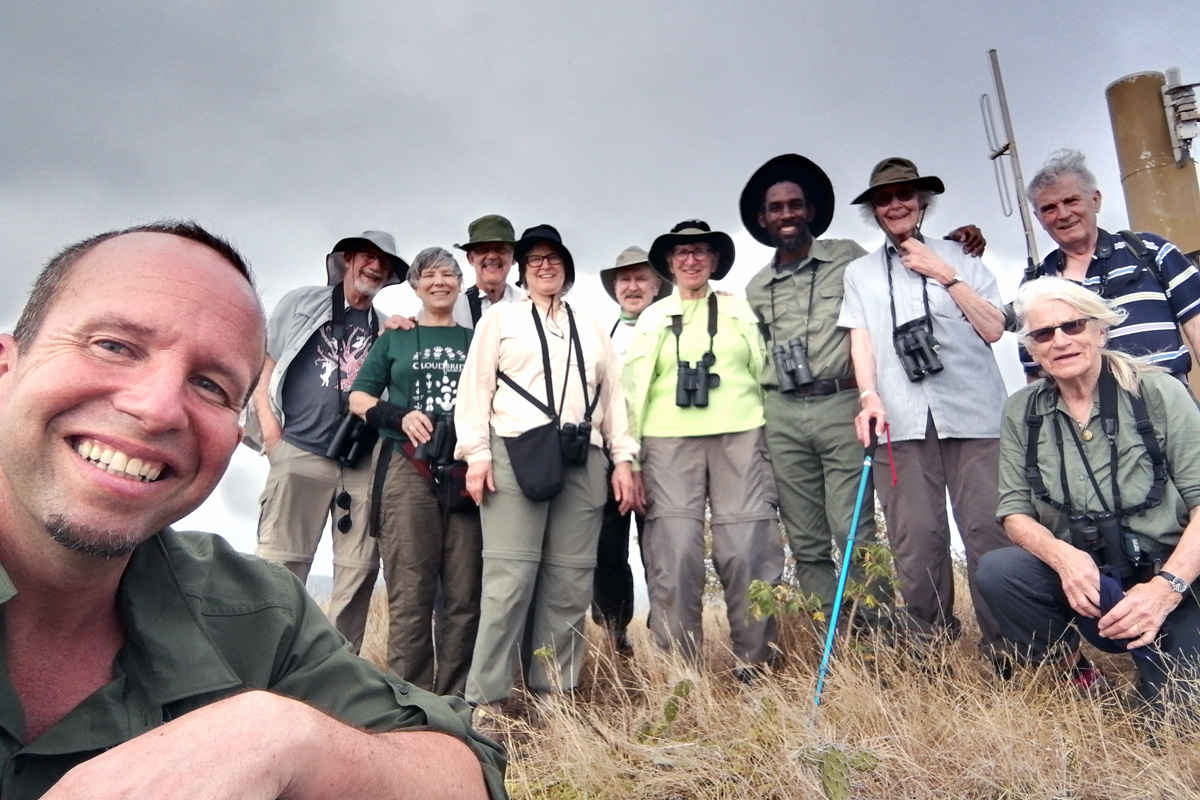
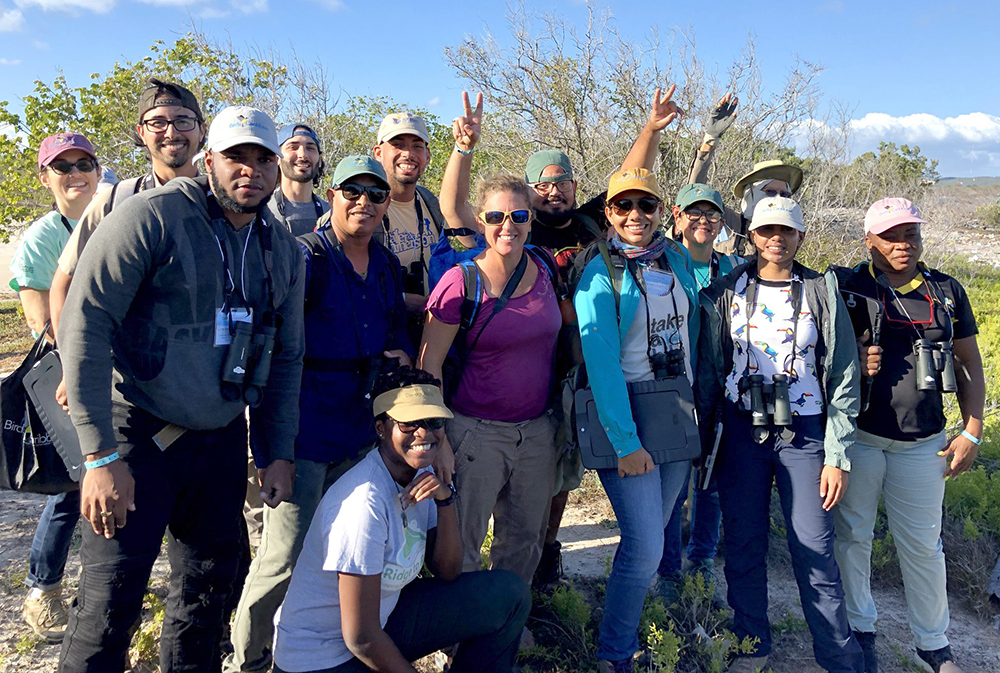
Hold onto your hats!!! Our group high atop Moule a Chique (pictured from Left to Right: the Bajan Birder-Ryan Chenery, Mark Greenfield, Valerie Brown, Ken Kuehn, Jane Hartline, John MacLennan, Bonnie Sample, St. Lucia Guide-Vision James, Jane Fenton, Nick Gibbons and Liz Tymour).
Day 4: Dominica, A Day of Close Encounters
The large boulders dotted throughout this islands’ lush landscape point to a violent volcanic past. However, as our vehicle makes its way around long winding corners and upwards along the coast, the sight of sparse tree canopies and fallen forest giants are glaring reminders of the after effects of a far more recent natural disaster (Hurricane Maria in 2017). This leaves us with a deep appreciation of the hardships endured by the inhabitants of this wild and stunningly beautiful land.
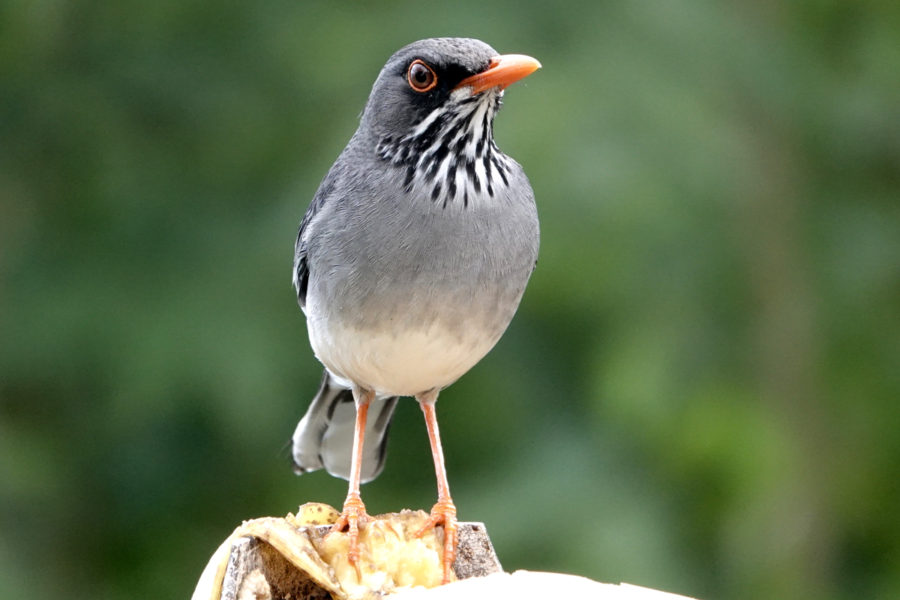
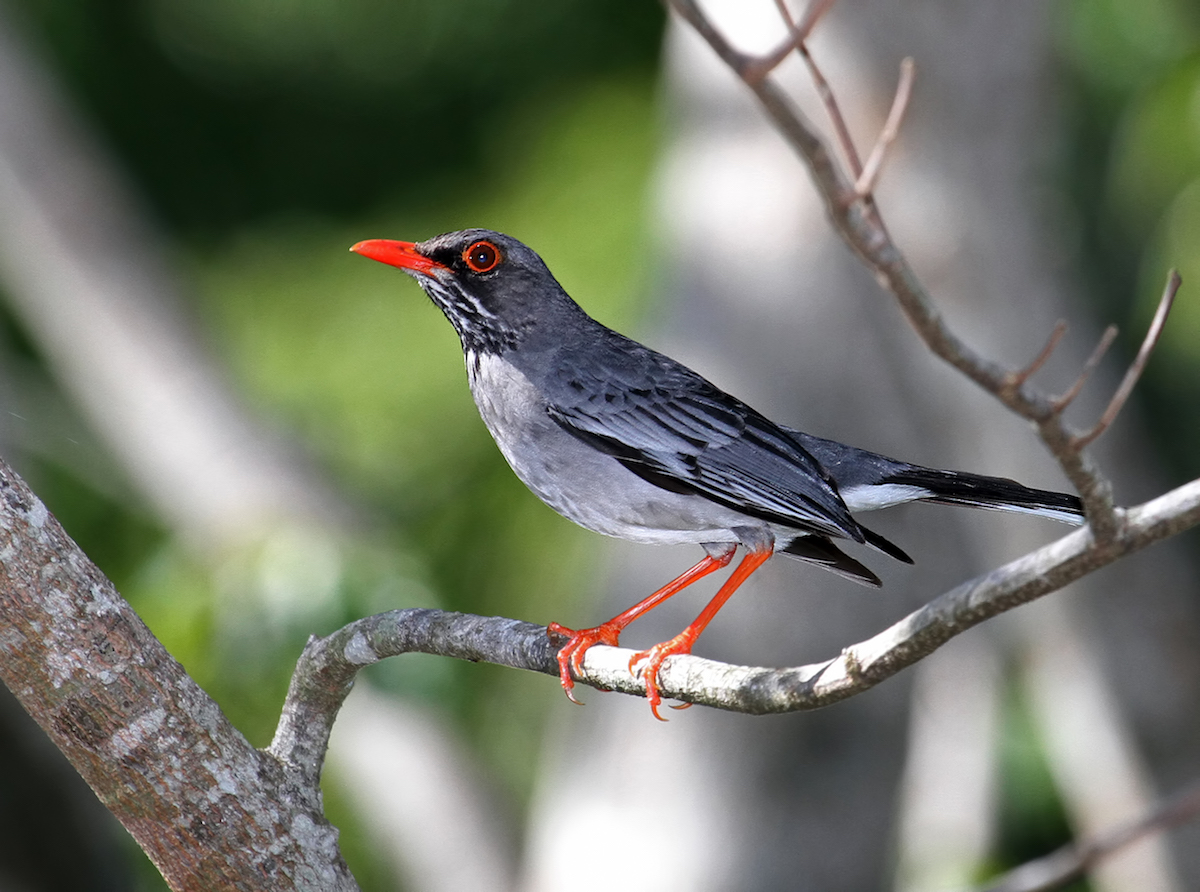
Red-legged Thrush (Turdus plumbeus) (Photo by Birding the Islands client Mark Greenfield)
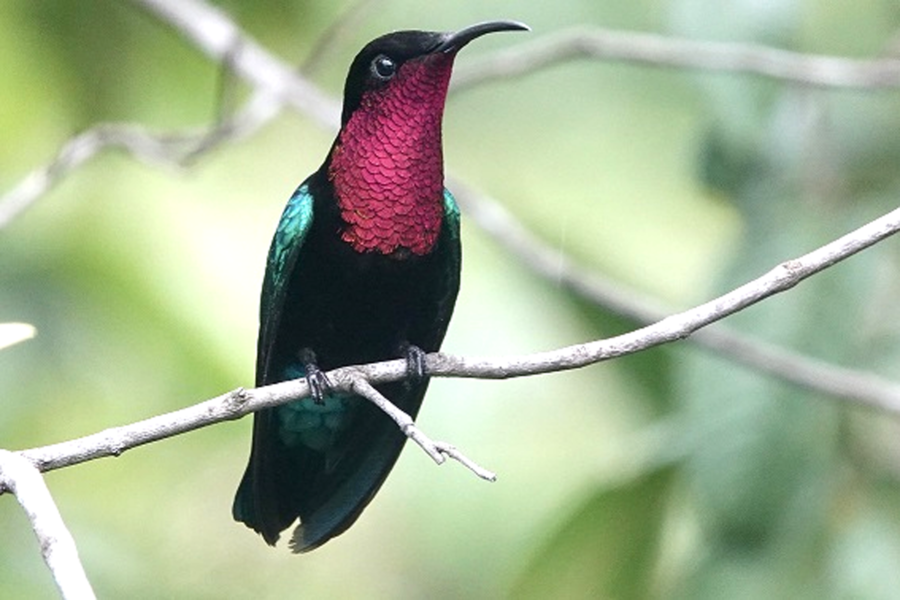
Arriving at our cliff-side hotel, we enjoy a hearty lunch of line-caught tuna, steamed plantain, and veggie rice, enjoyed throughout in the company of a Red-legged Thrush and an absolutely brilliant Purple-throated Carib—its dazzling throat glinting in the sun as it feeds.
This Purple-throated Carib (Eulampis jugularis) provided constant entertainment at meals (Photo by Birding the Islands client Mark Greenfield)
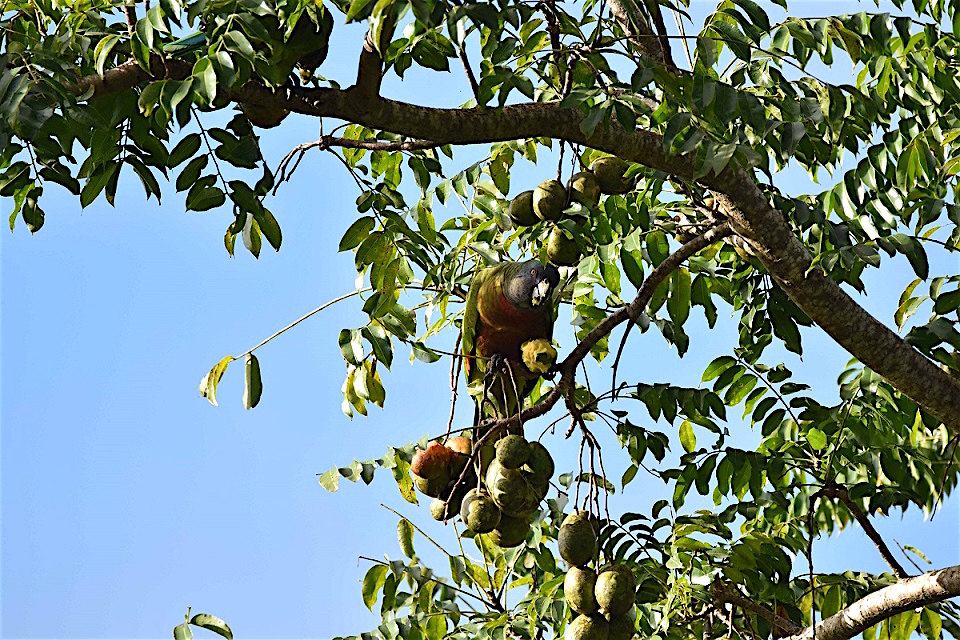
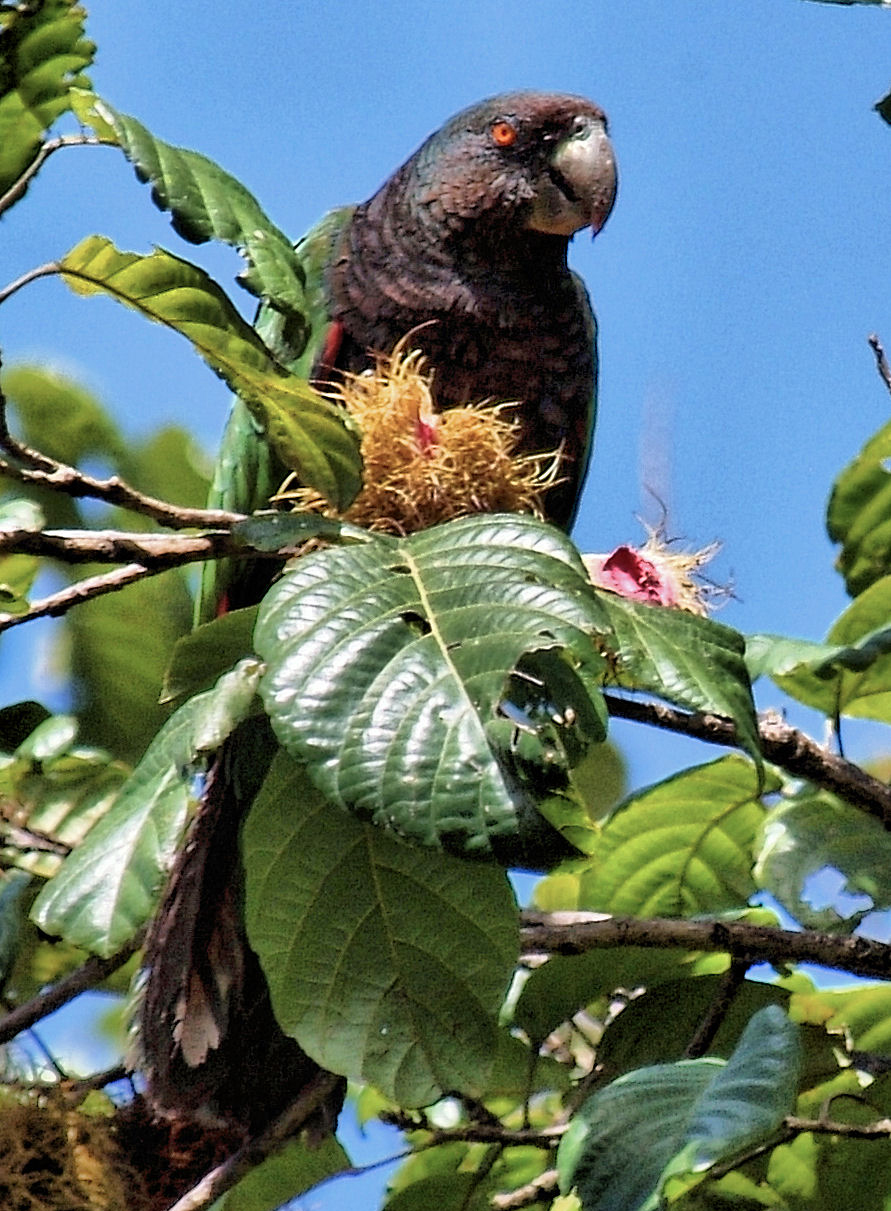
Later in the afternoon, a sudden downpour restricts any extensive foray into the sprawling Syndicate Estate. But before the rain falls, we are treated to what surely must be one of the closest ever encounters with a Red-necked Parrot (Jaco) in the wild! Having entered the Estate in the presence of Dr. Birdy (Bertrand Baptiste) himself—the most experienced bird guide on the island and long-time BirdsCaribbean partner, we soon find ourselves surrounded by the gleeful calls of several Jaco in the fruiting trees around us. However, one particularly close cry draws us towards a heavily laden guava tree. In the heart of the sparsely leafed tree one of these brightly coloured Amazonas delicately plucks a swollen guava from the tree with its beak, and flies to a low cecropia perfectly positioned over our path. Following an excited period of hastily focusing scopes and training binoculars on the bird, we soon realize that the parrot is so distracted by its food that we can slowly approach—until we are standing a mere 15 feet beneath it! A full half an hour elapses with us caught up in this magical moment with this beautiful bird. Finally, its meal finished, it flies off towards a more secluded area.
What an experience!
Tonight we soak up the tropical ambiance at a candlelit dinner in the outdoor restaurant of our hotel—the sounds of the rolling waves beating against the black volcanic shores below.
Day 5: To the Seas!
After a mid-morning arrival at the bustling port of Roseau, we board our vessel and jet across the waters off the southwest of the island, in search of the giants that call Dominica’s deep oceanic trenches home. A whale-watching trip can be rewarding for pelagics, but in addition to the usual suspects of Magnificent Frigatebirds, Brown Booby and Laughing Gulls, this trip surprisingly only reveals a Sooty Tern and a Red-footed Booby as new species for the trip. The whales however are far more cooperative. We do not have to wait more than twenty minutes before the captain bellows “BREEEECH”! He knows these waters well, and skillfully guides us towards a pod of mighty Sperm Whales in such a manner that the next surfacing is far closer than the last. We are so close we can even listen via hydrophone to the popcorn popping sounds emanating from the giants as they hone in on prey below us!
From the bow of the boat we are afforded superb views as some of majestic behemoths rest near the surface, before resuming their feeding. Sadly the excitement of the encounter apparently proves too much for the engine of our craft, resulting in an earlier than planned end to our whale-watching adventure.
Maintaining our maritime theme of the day, we enjoy sumptuous fish tacos for lunch (what on Earth is in that sauce?) before settling in to a quiet final night at our beach-side hotel on Dominica. The spectacular Brown Pelicans in the height of breeding plumage settle in to roost in nearby trees.
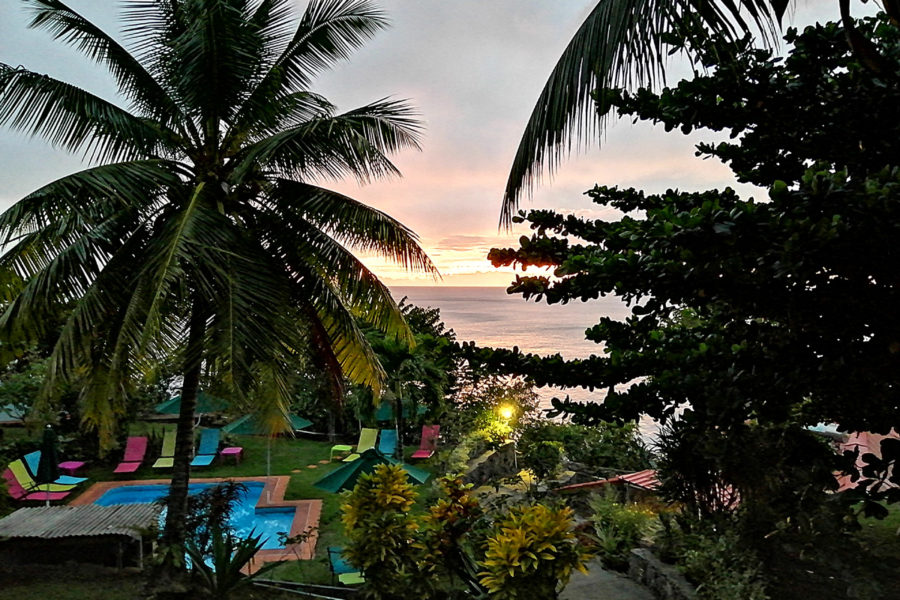
A stunning sunset seen from our hotel room balconies on our last night in Dominica (Photo by Bajan Birder)
Day 6: A Day of Wonder
On our final day in Dominica we wake at dawn to travel into the montane forest for which this island is so renowned. As the skies clear, the birds begin to steadily appear. The methodical notes of Black-whiskered Vireo, a startlingly pugnacious Antillean-crested Hummingbird, and an inquisitive andscratchy-throated Plumbeous Warbler all provide us with excellent views. An obliging male Blue-headed Hummingbird steals the show by feeding at a flowering ginger growing conveniently close to our trail.
The fluid musical notes of a House Wren (Antillean) later lead us to a copse of flowering coffee, and an audience with this endemic subspecies. Increasing research on these islands is leading to many new species splits and the identification of a plethora of endemic subspecies throughout these closely neighbouring islands. That this wren (and many other subspecies in the Lesser Antilles) may well attain full species status in years to come is very possible indeed.
Antillean Crested Hummingbird (Orthorhyncus cristatus) (Photo by Birding the Islands client Keith Clarkson)
The awesome power and force of the hurricane season of two years ago has transformed this forest. A large number of trees have been either felled or their canopies have been blown off. This has resulted in a huge increase in the amount of sunlight reaching the forest floor, which has in turn provided young saplings with the impetus needed in their never ending quest for the heavens. Out of devastation comes new life, and here in this magical setting, new life is all around us. Right on cue, Liz spots a young Red-rumped Agouti scurrying out of a path in front of the group.
Back at the hotel we enjoy our now customary three-course meal before setting off for the airport. An afternoon flight to St. Vincent awaits!
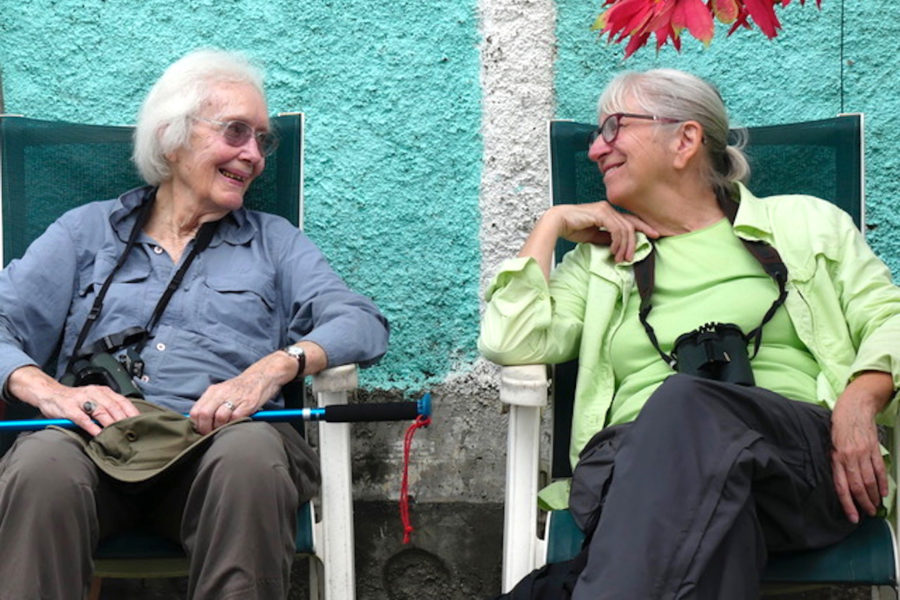
Bonnie and Jane enjoying a chat before heading to the next island on our itinerary – St. Vincent (Photo by Jane Hartline)
Day 7: St. Vincent, The Perfect Send-off
Serenaded by the calls of Yellow-bellied Elaenia and the gentle cooing of Scaly-naped Pigeons, we enjoy breakfast in the spacious open-air dining room of our beachfront hotel, located on the south west coast of spectacular St. Vincent. As we chat and await our meals, we briefly lower our cups of freshly brewed Vincentian to watch a school of flying fish—scales glistening in the early morning sunshine—leaping from the vast expanse of Caribbean Sea. Their gliding attracts the attention of a large number of Brown Boobies and Magnificent Frigatebirds, who immediately alter their flight course in pursuit. The boobies begin shallow exploratory dives, while the frigatebirds attempt to snatch the gliding fish from mid-air. A closer inspection with binoculars also reveals a boiling sea below the birds—perhaps an indication that this feeding frenzy was started by large predatory Dolphin or Crevalle targeting the flying fish from below.
What a start to the day.
Ahh—here come the omelettes!
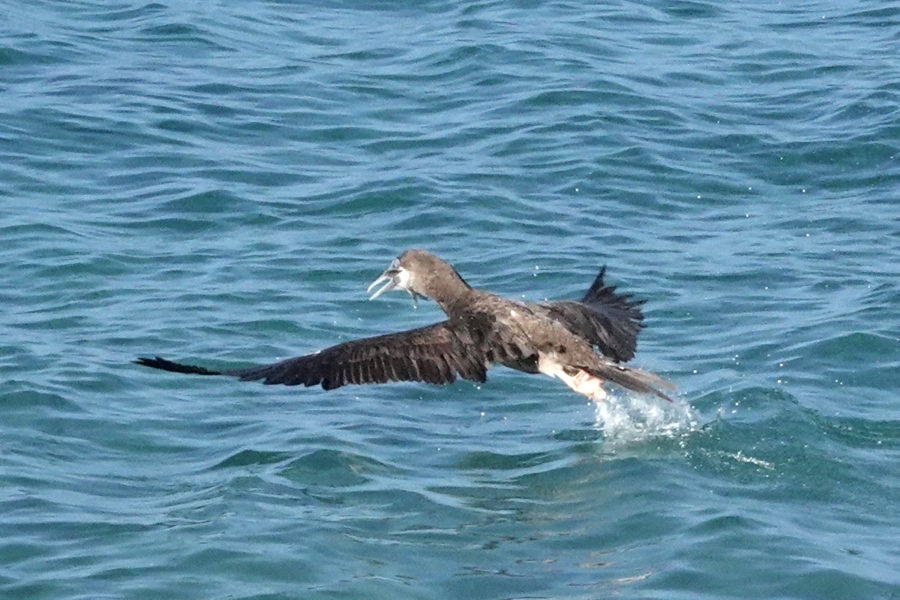
Brown Booby (Sula leucogaster) having just caught a fish (Photo by Mark Greenfield)
After breakfast, the wonderful and knowledgeable Lystra Culzac (Caribbean Birding Trail certified guide) arrives to guide us to the birding hotspots on the island (the best of which requires her having negotiated with landowners for access to private land). We journey along the wave-ravaged Atlantic coastline, through the coastal settlement of Georgetown, with her black sand beaches and wind lashed rooftops and onward north to the volcanic slopes of towering Mt. Soufriere.
Its entrance guarded by brilliantly sapphire-headed St. Vincent Anoles, the well-maintained Soufriere Trail is lined with two species of endemic begonia. The raging Atlantic is clearly visible to the east, and expansive montane forest lines the volcanic slopes to the west. This is a forest in which the weird and wonderful come alive before your eyes. First, we spot the unique dark morph of Coereba flaveola attrata (endemic subspecies of Bananaquit) and St. Vincent Tanagers gorging themselves high in a fruiting fig. The eerily ethereal call of the Rufous-throated Solitaire, deep low notes of Ruddy Quail Dove and positively hyperactive vocalisations of Scaly-breasted Thrashers and Brown Tremblers (an entire genus restricted to the Lesser Antilles) all lead us deep within this ancient primary forest.
Rufous-throated Solitaire (Myadestes genibarbis) (Photo by Birding the Islands client Keith Clarkson)
However the star of the show is so far remaining elusive…and quiet.
The song of the Whistling Warbler can travel for miles. We reach a now dry river bed, which for millennia slowly carved its way through the dark volcanic bedrock beneath our feet – and we hear THE CALL.
Cautious spisshing lures the tiny vocalist ever closer, until in a flash there he is—flitting ever so briefly out of the dense undergrowth, before once again retiring to a dark tangle of mistletoe and epiphyte-laden trunks. This is a Critically Endangered species and we are fortunate to have had even a glimpse.
Some treasures are meant to remain secret.
St. Vincent is a largely quiet and laid back island. We pass several rural communities tucked into the pocketed hillsides of a mountainous interior, on our way to the largest remaining roost of St. Vincent Parrotson the planet.
The tracks leading up to this secret location are narrow and heavily potholed, so we abandon our van and climb aboard a 4wd SUV—the only vehicle capable of making this ascent.
Crossing streams home where Green-throated Caribs bathe, lined with a multitude of tropical butterflies, we soon arrive at a quiet small holding perfectly framed by a scenic ridge.
As we arrive at the summit of the ridge, that quintessential call of parrots the world over begins to echo out of the east.
They are coming…
The birds first arrive in pairs (their constant calls seeming to reassure their respective life partners of their presence in the now steadily fading light), but slowly their numbers build, to the point where dozens of this once critically endangered parrot are winging their way over our heads.
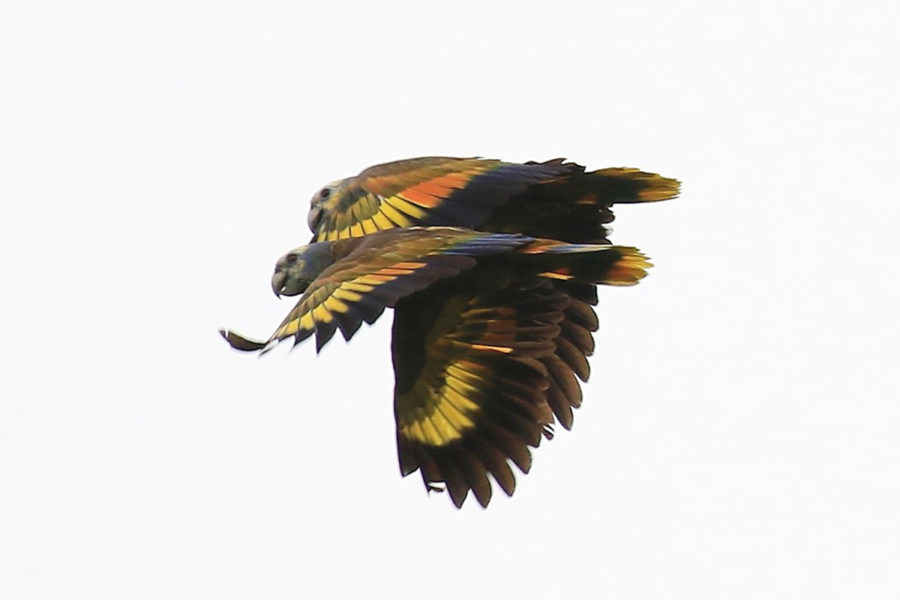
A pair of St. Vincent Amazons (Amazona guildingii) winging their way in to roost (Photo by Birding the Islands client Keith Clarkson)
The thrill of being directly beneath them is exhilarating. However, we are only able to get a clear view of the truly spectacular deep blues and vibrant greens and oranges of their flight feathers when the parrots begin to tack hard and low down towards their favoured roosting trees, against a backdrop of the lush, verdant, forested valley below. These are stunningly beautiful birds. As they settle in to land, there are audible gasps of delight from our group.
We spend a full hour in the presence of St. Vincent’s national bird, enjoying every rhythmic twist and turn of their approach. This is one of the undoubted highlights of the trip.
A celebratory Dinner that night is a selection of creole fish dishes, washed down by the local Hairoun beer!
Day 8: Trinidad, The Spectacle
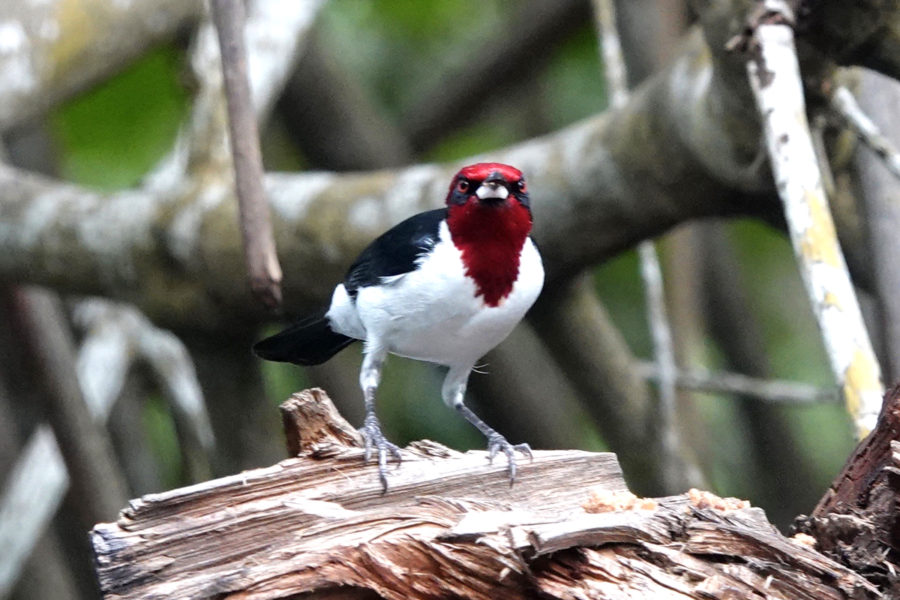
Masked Cardinal (Paroaria nigrogenis) in Caroni Swamp (photo by Mark Greenfield)
Several of us wake early to enjoy another dip in the calm waters typical of this Caribbean coastline. Then we settle into a delicious breakfast of pancakes and french toast, or for those of us feeling adventurous—salt fish buljol with all the local fixins!
The short 15-minute drive to the airport is filled with fond reminiscing of the variety of unique Lesser Antillean species seen… but we also talk about the many South American wonders that await.
We touch down in Sweet Sweet T&T (as the popular soca song so fondly refers to the Republic of Trinidad and Tobago) and are met by beaming Lester Nanan (our terrific local guide and grandson of the renowned conservationist Winston Nanan). We board a large comfortable bus and as we have arrived at midday, it is not long before a cooler is produced and we begin tucking into pre-ordered(and gigantic) chicken rotis (done the traditional Trinidad way—bone and all) as well as veggie rotis brimming with large chunks of mango, papaya, eggplant and more.
Trinidad is such a contrast to the small quiet islands of the Lesser Antilles that we have spent the last week travelling between. The area around the airport especially has the feel of a large metropolis. But (delicious rotis in hand) we are soon leaving all this behind and making for one of the treasures of the Caribbean—the Caroni Swamp.
En route we stop to bird productive grasslands, sheltering such vibrant secrets as Red-breasted Blackbird and Saffron Finch. We visit sheltered ponds and canals home to a plethora of water—loving species—from blazingly neon-crowned Yellow-hooded Blackbirds and nesting White-headed Marsh Tyrants to Southern Lapwing and Pied Water Tyrants.
The birding is thick and fast, but as 3pm arrives, we gather back at the bus in fervent anticipation of our next destination.
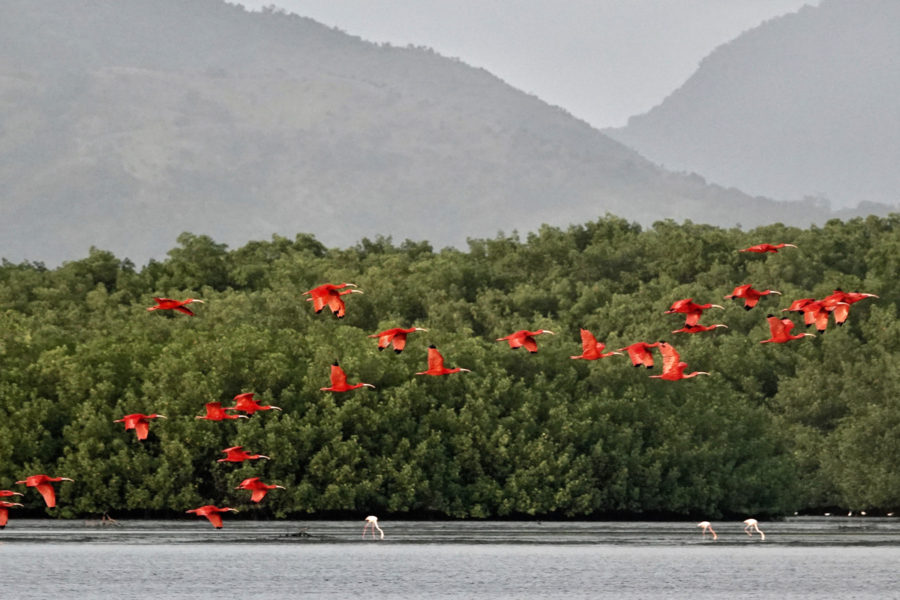
There are several wetlands in the Western Hemisphere that get birders’ hearts racing, and the Caroni Swamp is one of them. This sprawling 12,000-acre wetland is home to one of the greatest spectacles in the animal kingdom—the return to roost every evening of over 3,000 Scarlet Ibis!
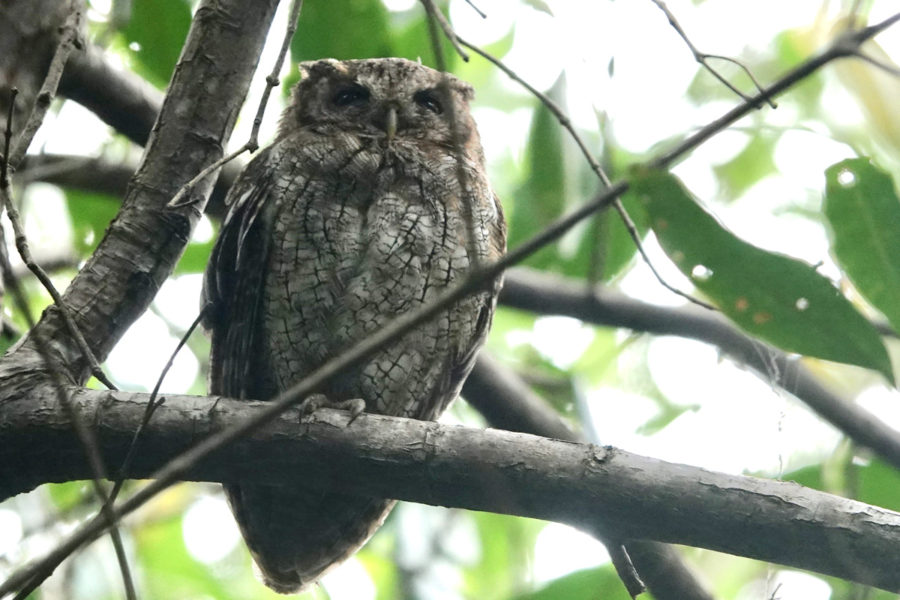
Tropical Screech Owl (Megascops choliba) perched directly above us (Photo by Mark Greenfield)
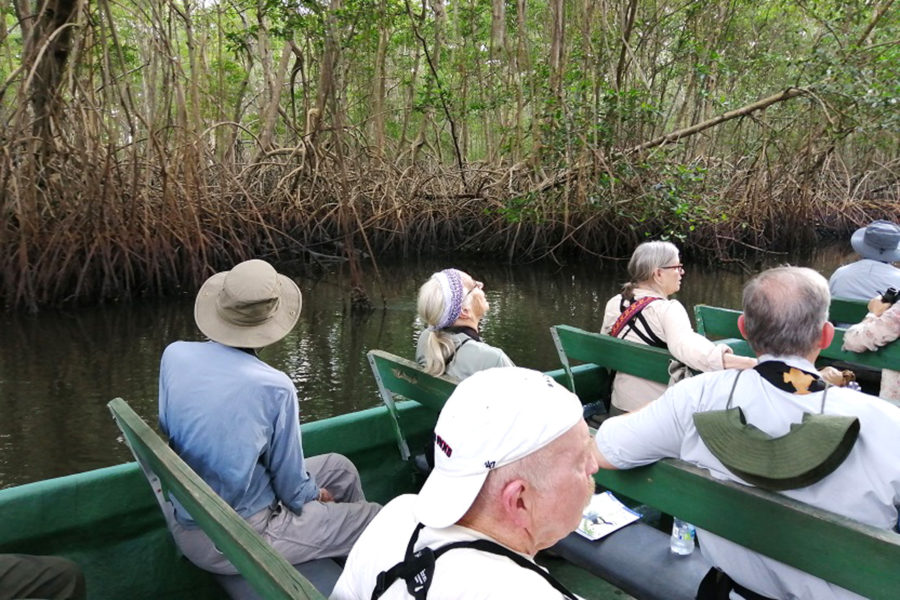
Although this is the main event, the warm up acts are none too shabby, as evidenced by the pair of roosting Tropical Screech Owls, their intricately patterned breast feathers perfectly mirroring the marbled bark of the White Mangroves in which they roost. We have good views of the superb stock-still Boat-billed Herons from our flat-bottomed boat, as it negotiates its way through the mangroves.
Cruising through the mangroves in our comfortable flat-bottomed boat
As we edge deeper into the swamp, the long tendril-like roots of Red Mangroves seem to reach ever further into the water, providing prime perching positions for an unbelievable array of species. The roots are festooned with oysters, barnacles and home to a plethora of Mangrove Crabs…and occasionally Mangrove Boa. A magnificently coiffured Masked Cardinal and dainty Bicolored Conebill, along with both Green and Pygmy Kingfishers, all give us cause to pause and admire. We are even treated to a vociferous exchange between warring factions of Grey-necked Wood Rails!
After almost an hour of delightful travel we approach the famous roost site, a welcome low tide ensuring an added bonus encounter with 30 American Flamingos.
As we tether the boat, and start to share out the locally brewed rum punch and freshly baked pastries, wave upon wave of 50, 100, 200 ibis at a time begin continuously streaking by. Before long the dark green of the mangrove island upon which they roost is unrecognisable. It has been transformed into a rhythmic and convulsing mass of colour. The brilliant reds of the breeding adults contrast perfectly with the soft subtle pinks of non-breeders—all set against the wondrous backdrop of Trinidad’s stunning Northern Range.
An unforgettable experience.
Scarlet Ibises (Eudocimus ruber) coming in to roost (Photo by Mark Greenfield)
Later that evening we arrive at the world-renowned Asa Wright lodge where a delicious buffet dinner awaits us. We duly indulge, before strolling to our cottages located in the heart of the densely forested Arima Valley.
Day 9: Dawning of the Light
At daybreak we make our way to the veranda of the main lodge where, coffee in hand (locally harvested from trees on the Asa Wright estate), we settle in and prepare for what is surely one of the most incredible birding experiences in the region.
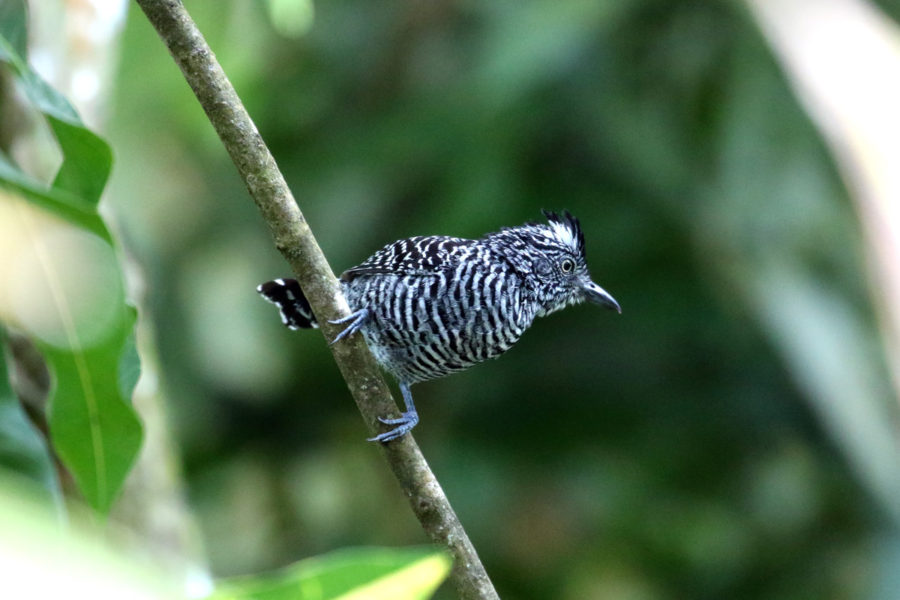
Below us, the waking sun is proving the catalyst for the inhabitants of this vast rainforest to begin to stir. The sprightly melody of a Cocoa Thrush, the rapid-fire staccato of a White-flanked Antwren and cat-like call of the Spectacled Thrush, mixed in with the somewhat demonic laughter of the Barred Antshrike combine and build to a feverish crescendo.
Barred Antshrike (Thamnophilus doliatus) (Photo by Biridng the Islands client Beatrice Henricot)
As more light steadily filters down through the canopy, the last of the nocturnal brigade (in the form of Pallas’s Long Tongued Bats) begin to surrender their positions at the feeders to a veritable onslaught of colour.
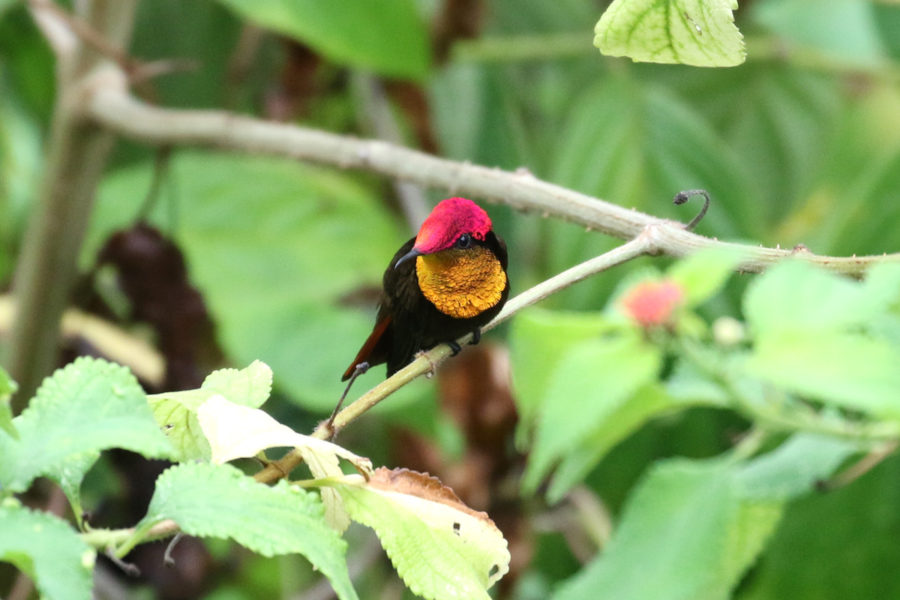
A sudden white flit across the feeders—the breast of a White-chested Emerald; a sprinkle of neon pink – the stunning crown of a male Ruby Topaz; brilliant orange ear tufts and a gently bobbing tail diagnostic of the bedazzling Tufted Coquette.
The dazzling Ruby Topaz (Chrysolampis mosquitus) (Photo by Birding the Islands client Beatrice Henricot)
And still they come.
There are the dazzling rich blues and emerald greens of Blue-chinned Sapphires and glistening Copper-rumped Hummingbirds—so close you can see the minuscule fluffy white garters on their legs.Purple as well as Green Honeycreepers, White-bearded Manakins, and Violaceous Euphonias all join the fray. In the distance, away from this hive of activity, a pair of Green-backed Trogons are taking turns to diligently and carefully excavate a cavity in a termite nest affixed to a gargantuan trunk. A dozen feet below them, a lone Golden Olive Woodpecker silently begins its measured investigation of the same tree.
With all of this birding brilliance, we almost miss breakfast…almost.
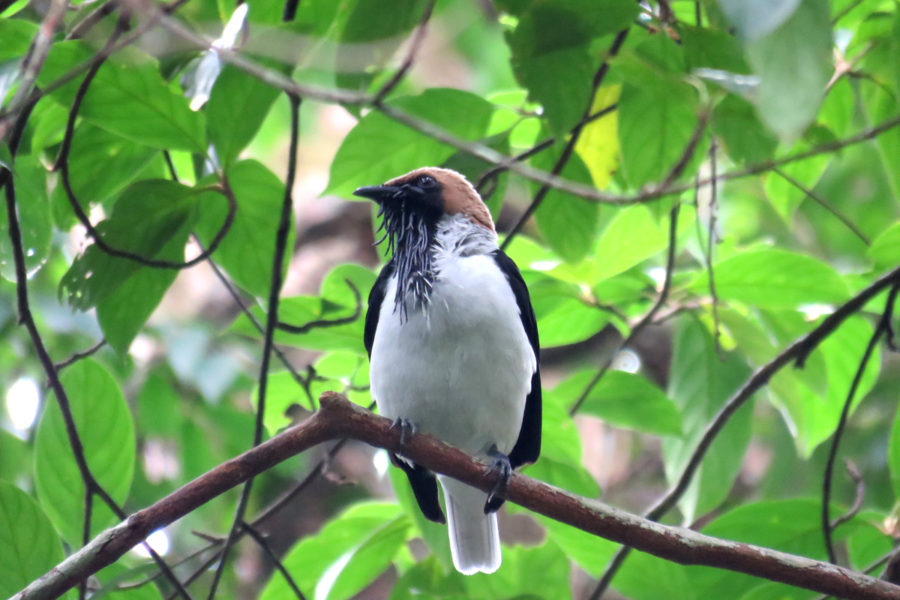
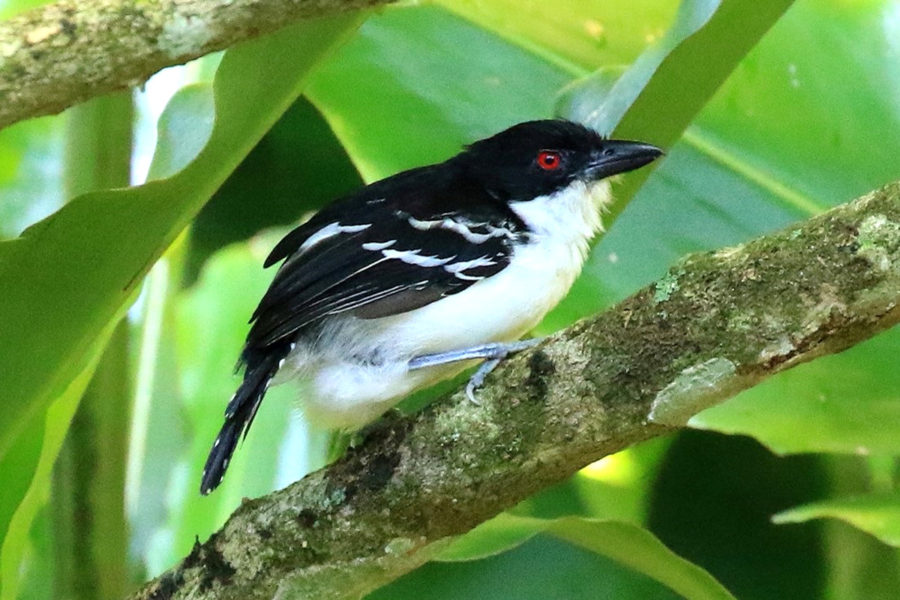
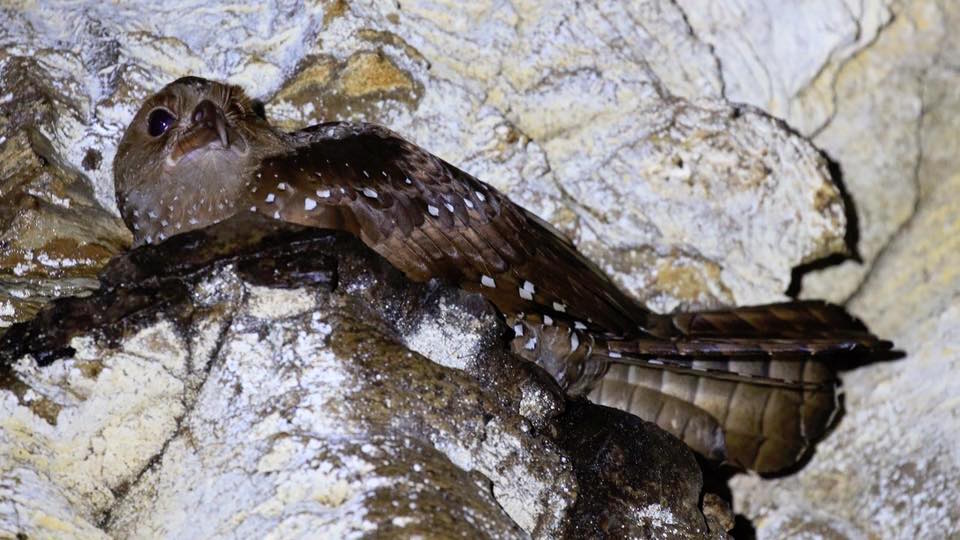
The entire day is ours to walk the myriad trails coursing through the private forests of Asa Wright, and after breakfast we begin by heading down Jacaranda Trail for an encounter with Oilbirds. Isolated from the rest of the bird world in a family of their own, living in caves and using echolocation to negotiate their nocturnal feeding forays, this is easily one of the strangest birds we connect with on the trip. The cave at Asa Wright is one of the most accessible sites to see them in the world and we are rewarded with sensational views! On our way back, and after passing under a spectacular Bee Orchid, we soon enter the realm of the Bearded Bellbird—its otherworldly metallic call boldly proclaiming this land to be his. Once we have tracked the call down to a favoured perch, the bird is brilliantly visible, its superb wattled neck flickering in the shafts of sunlight with every resounding CLANK of its call.
Bearded Bellbird (Procnias averano) (Photo by Birding the Islands client Steven Kornfeld)
After this excitement we retire in the heat of the day to the veranda, where we continue to watch the birding entertainment on show. Some of us round off the afternoon with a dip in the cool fresh water pools found throughout the Centre grounds.
After dinner, our night walk provides a fascinating insight into the lives of some of the nocturnal residents of these forests. Huge Trinidad Chevron Tarantulas cling to bamboo stalks; minuscule but “swerve-worthy” scorpions, velvet worms and land crabs line the banks of the roadside; and bats flutter almost constantly overhead.
Day 10: Desserts and Delightful Birding
The Asa Wright Centre grounds are superb, but to get a true sense of the variety of inhabitants of the highest peaks in the Northern Range, one must take to the Blanchisseuse Road. We do so on our final full day in Trinidad.
Birding is slow and steady at first, with initial stops revealing sightings of Tropical Parula and a magnificent pair of Collared Trogons. Later the ground appears alive with army ants, allowing for a close (but not too close) examination of the intricate relationship that Cocoa and Plain Brown Woodcreepers as well as Great Antshrikes have with these tiny marauders of the forest floor.
Great Antshrike (Taraba major) (Photo by Birding the Islands client Keith Clarkson)
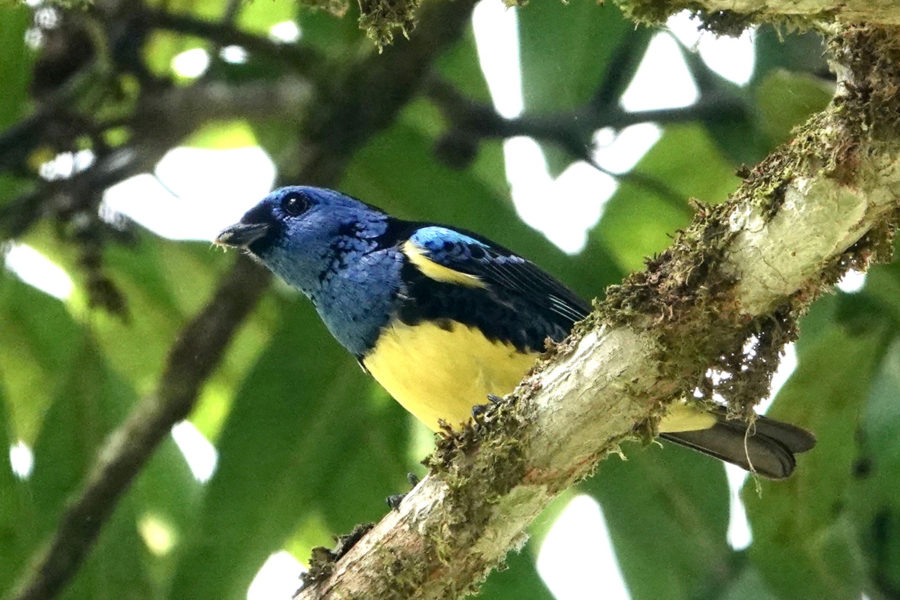
We enjoy lunch at a local chocolatier’s farm, where the proprietor explains that his return to the land and harvesting of cacao has had a positive effect on many local communities in and around Arima, with an upturn in financial independence. The birding is good here too, for Rufous-breasted Hermit, Turquoise Tanagers, a Lineated Woodpecker, and hordes of Yellow-rumped Caciques all appear as we are wrapping up our chicken pelau and treating ourselves to a dessert of his delicious chocolates!
Turquoise Tanager (Tangara mexicana) (photo by Mark Greenfield)
At our final stop, the scale of diversity and sheer beauty of the birds of the Northern Range is truly revealed. Rufous-tailed Jacamars swoop from favoured perches to pluck swallowtail butterflies effortlessly from the air. A pair of Scaled Pigeons select the highest possible perch and turn purposefully to catch the last of the afternoon light on their brilliantly chevroned breasts. A young Forest Elaenia pleads with her parent, which ever so delicately plucks and then proffers a berry to its offspring to take a bite. Later a flock of seven spectacular Blue-headed Parrots silently wing their way in to a nearby cecropia and are joined at the canopy by a stunning Channel-billed Toucan. We cap off our frenetic and highly rewarding birding of the highlands with a young Yellow-headed Caracara flying directly over our bus. A pair of Tropical Kingbirds is hot in pursuit.
Day 11: A Ferruginous Farewell
On our final day of the trip, and after our now customary morning visit to the veranda, we take a leisurely stroll along the driveway that winds its way into the Asa Wright Centre. The forest that has yielded so many of its treasures to us has one more surprise in store: a superb sighting of a Ferruginous Pygmy Owl, which staunchly resists the urge to flee from incessant harassment by a large mixed flock of tanagers and flycatchers.
Life in the rainforest is never dull…for any of us!
At the airport, before boarding our flight, we pay a visit to the best Doubles hut on the island and positively chow down on these uniquely Trinidadian delicacies. There’s no way we were going to come to Trinidad and not have Doubles. The fusion of chickpeas, sweet tamarind sauce, pickled cucumber and hot sauce lights up the taste buds, and is a perfect send off to our tour—a tour which has given us a true flavour for the spectacular birding that the Lesser Antilles and Trinidad has to offer.
Thanks to our Caribbean Birding Trail partner, Ryan Chenery and his company Birding the Islands, for this positively wonderful and enticing trip report! To learn how you can join Ryan and BirdsCaribbean on our next In Search of the Amazonas tour (Nov. 21st to Dec. 1st, 2021) please contact Ryan at thebajanbirder@gmail.com. To learn more about the Caribbean Birding Trail, birding sites, tours, and guides throughout the islands, click here.
An absolutely stunning look at Oilbirds, one of the strangest birds we connected with on our February 2020 trip. Isolated from the rest of the bird world in a family of their own, Oilbirds live in caves and use echolocation to negotiate their nocturnal feeding forays. The cave at Asa Wright is one of the most accessible sites to see this species in the world and we were rewarded with sensational views!
Aliya Hosein shares about her recent trip to Saint Vincent to learn more about the endemic St. Vincent Parrot, one of the most beautiful and colorful parrots in the region!
St Vincent Parrot (Photo by Nandani Bridglal)
I recently enjoyed an exciting trip to St. Vincent and the Grenadines. I spent nine days on this wonderful, mountainous island; and I can certainly say that St. Vincent Parrots (Amazona guildingii), flying over the lush ridges at Jennings Valley, was the most memorable sight of all.
I spent months preparing for this trip. I carefully planned lodging and flights and made endless calls to my friend Cathlene Trumpet, who is a Forestry Officer with over fifteen years of service to the St. Vincent and the Grenadines Forestry Department. Among the questions I asked her were “Who sells the best burgers and donuts on the island?” and “Where should I go to see the parrots?” Then it was time to leave Trinidad and fly towards my adventure.
Cathlene and I met through the Conservation Leadership in the Caribbean (CLiC) Fellowship Program. For 18 months we worked on an intense, sometimes hilarious, and occasionally scary project on the illegal trade in Blue and Gold Macaws in Trinidad. I remember being in awe as Cathlene related stories about the national campaign to build pride among Vincentians for their endemic parrot. Later, I flipped through my “Parrots of the World” book to find a picture of it.
In the past the St. Vincent Parrot, locally called the Vincie Parrot, was targeted for the local and international pet bird trade because of its beauty and rarity. Although St. Vincent and the Grenadines is made up of over 32 major islands, the St. Vincent Parrot is found only on the mainland of St. Vincent. Poaching and hurricanes, from colonial times to the present day, are still significant threats to the parrot’s habitat. These pressures have resulted in it being listed as Vulnerableon the International Union for Conservation of Nature (IUCN) Red List, and in Appendix I by the Convention on International Trade in Endangered Species (CITES). It is estimated that there are only 850 St. Vincent Parrots in the wild.\
How Gorgeous is the St. Vincent Parrot!
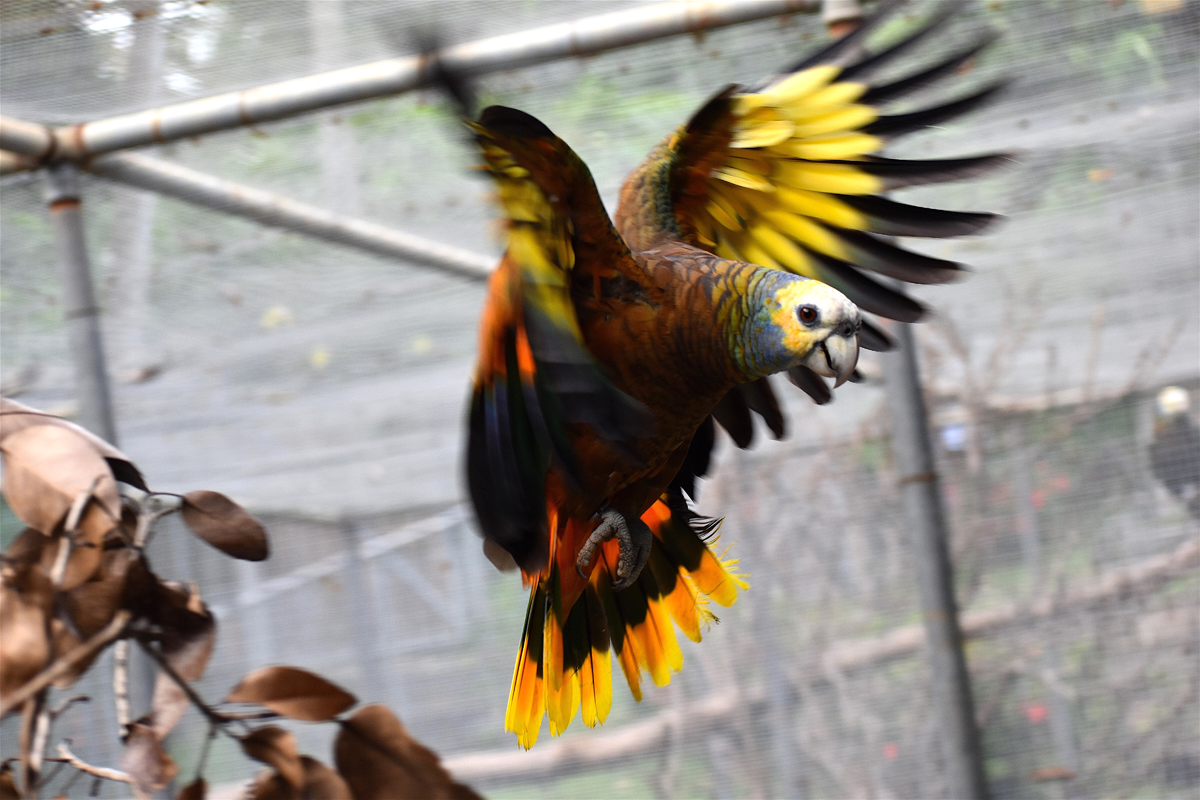
Saint Vincent Amazon in flight (Photo by Nandani Bridglal)
This parrot lives mainly in the upper west and east ridges of the central mountain range, just south of Mount Soufriére and the La soufriére volcano at elevations between 125 to 1,000m. It is a large parrot, certainly larger than the Orange-winged Amazon (Amazona amazonica) I am used to seeing in Trinidad. About 40 cm long, it is mostly bronze-brown, multi-colored with yellowish white, blue and green head, greenish-bronze upperparts. It has grey feet, reddish eye, and violet blue-green wings. Its tail feathers are centrally banded violet-blue with broad yellow tips. Two morphs exist: a yellow-brown morph and a less common green morph. Male and female birds are similar. The parrot feeds on the flowers, nuts, fruits and seeds of many plants such as Ficus, Clusia and Cecropia.
There Is More to Be Learned
At the breeding facility at the Botanic Garden (Photo by Cathlene Trumpet)
Before making the trek up into the moist montane forest to see the parrots, I had the pleasure of meeting the Director of the Forestry Department, Mr. Fitzgerald Providence. Initially I was intimidated by his title and stacks of reports on his desk. But once we settled down in his office, I was relieved to find out that he was delightfully welcoming and eager to tell me about St. Vincent.
We chatted about the island’s biodiversity; about flora and fauna both known and waiting to be discovered. He had noticed that the feeding habits of the parrots were changing. The parrots are now visiting agricultural areas on the island. He attributed this change to the influence of climate change on fruiting patterns of the parrot’s natural food plants. In general, however, he felt that much was still to be known about the St. Vincent Amazon. This parrot was proving to be quite mysterious. I was hooked and more than ever wanted to see them in the wild.
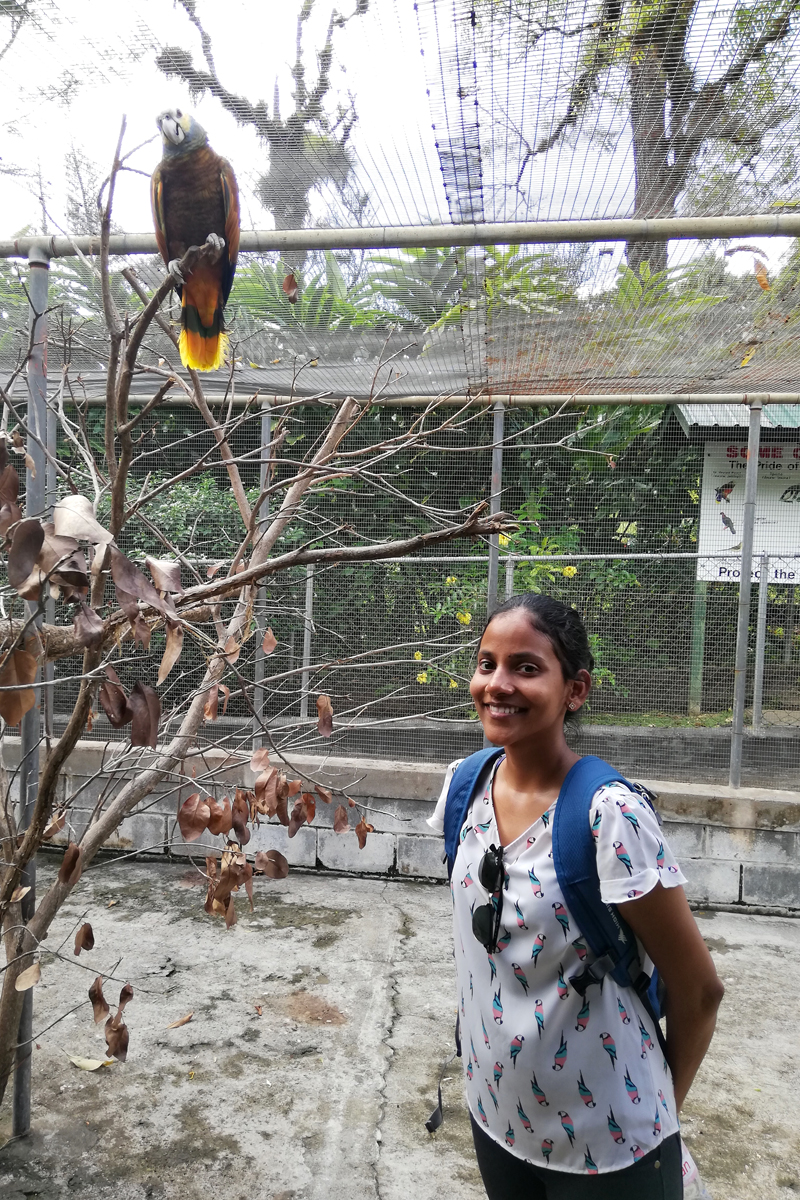
Afterwards we visited the Botanical Garden of Saint Vincent where there is a breeding facility for the parrots. The breeding program was established to provide a safety net for the parrots should there be a sudden decline in the wild parrot population following, for example, a hurricane.
An Early Morning Start
The next morning, Cathlene, Ray – her fellow Forestry Officer – my friend Nandani and I headed to Georgetown in a 4-wheel drive along the winding highway. It was five in the morning and people were already up and moving. The radio was airing an announcement to farmers and a reminder of the soon-to-be closed hunting season. We stopped to pick up Ian, another Forestry Officer, before continuing along the highway.
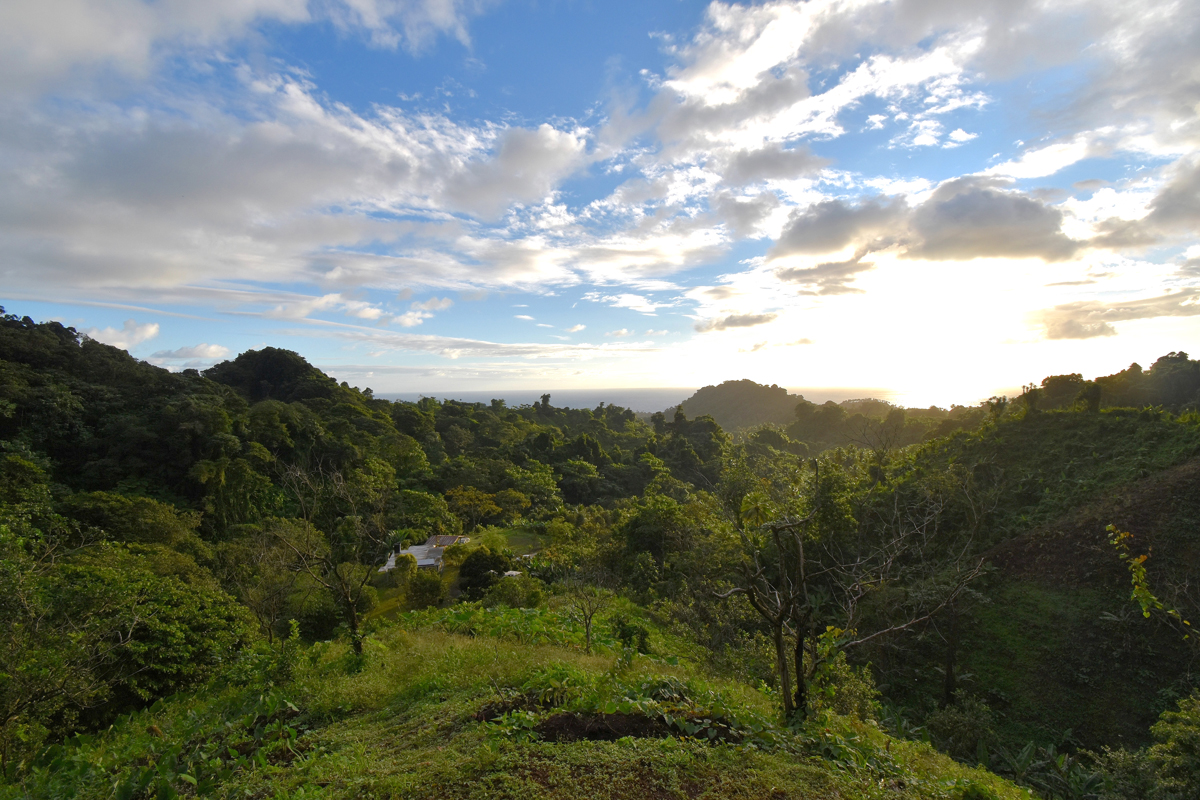
Sunrise over Jennings Valley (Photo by Nandani Bridglal)
After about 20 minutes we ventured off into a narrow rugged road leading to Jennings Valley. We arrived at a farmed property with a small cottage. The sun was now beginning to rise and I really did not expect to see or hear any parrots. About 10 minutes into our uphill walk to the look-out point we heard their loud squawks “quaw….quaw…quaw” followed by shrieking “scree-ree- lee.” It was enough to stop us in our tracks. Pairs of parrots were emerging from the ridges north of us. It was still too dark and all we saw were their silhouettes.
As the sun began to rise more parrots began flying out, sometimes directly above us. I was mesmerized by the many colours of the St. Vincent Parrot in the sunlight, against an all-green backdrop. At times it seemed as though the pairs were touching each others’ wings while flying. The largest flock we saw was a group of twelve. They were all squawking, possibly deciding where to go to have breakfast. By now we had reached the look-out; a plateau with mountain views on the northern, western and southern sides and the deep blue Atlantic Ocean on the eastern side.
The Group, Gosfield Charles, Cathlene Trumpet Wyllie, Aliya Hosein, lan Christopher, and Ray Charles, at Jennings Valley (Photo by Nandani Bridglal)
For about an hour or so we continued to see parrots flying over. Only one pair flew down into a golden apple (Spondias dulcis) tree near the cottage. I could not see what they were doing from my vantage point, but my guess is that they were feeding, because they were very quiet. A flock of three flew over us. Ian suggested it was a family in which the parents, with their stocky bodies and short tails, were leading the way, with their offspring straggling behind. After this sighting there was a lull in activity. The parrots either rested at the top of the trees or disappeared into the trees along the mountain ridges. We waited for about an hour again before leaving.
It really was a remarkable experience seeing the St. Vincent Parrots flying free, with people who truly appreciated their beauty. Nevertheless there is still a lot to learn about these birds’ ecology and their role in the island’s montane forests. Not much is known beyond its population estimate and description of nesting sites. An understanding of its habitat requirements and reproductive biology are critical components of well-developed protective measures to ensure the long-term survival of this incredible bird on the island.
Article by Aliya Hosein, member of BirdsCaribbean’s Media Working Group. Aliya works as the Leader of the Welfare and Wildlife Program at the Centre for the Rescue of Endangered Species of Trinidad and Tobago. She is a biologist and avid conservationist, especially fond of parrots and hummingbirds.
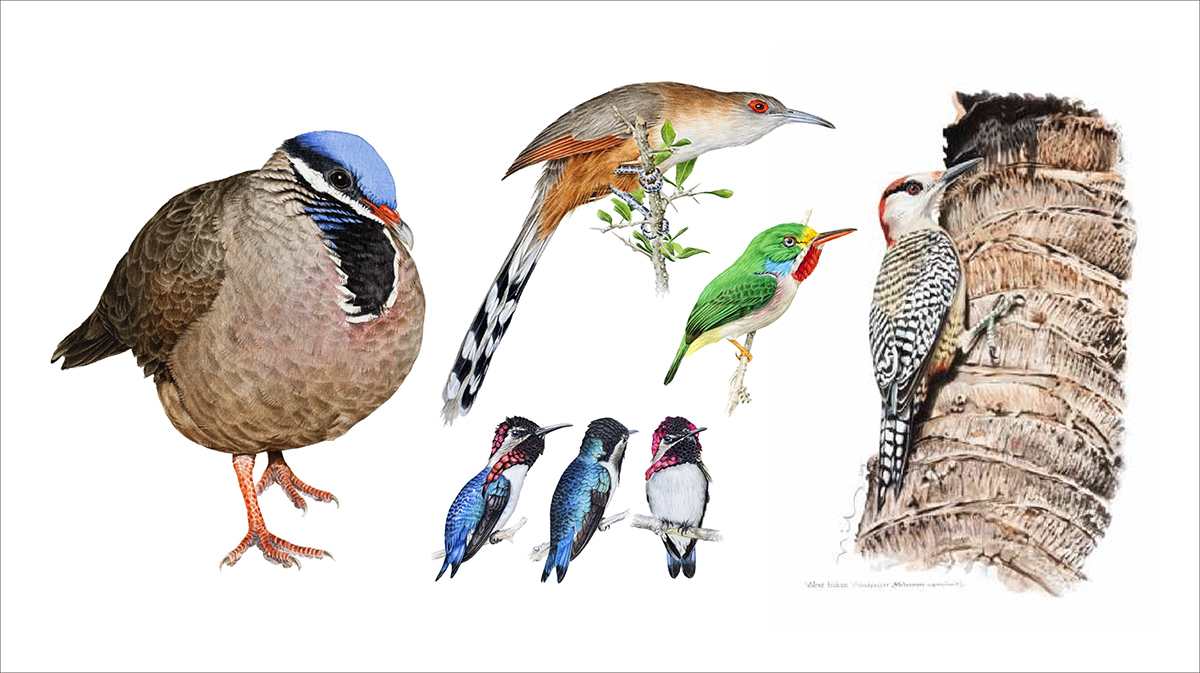
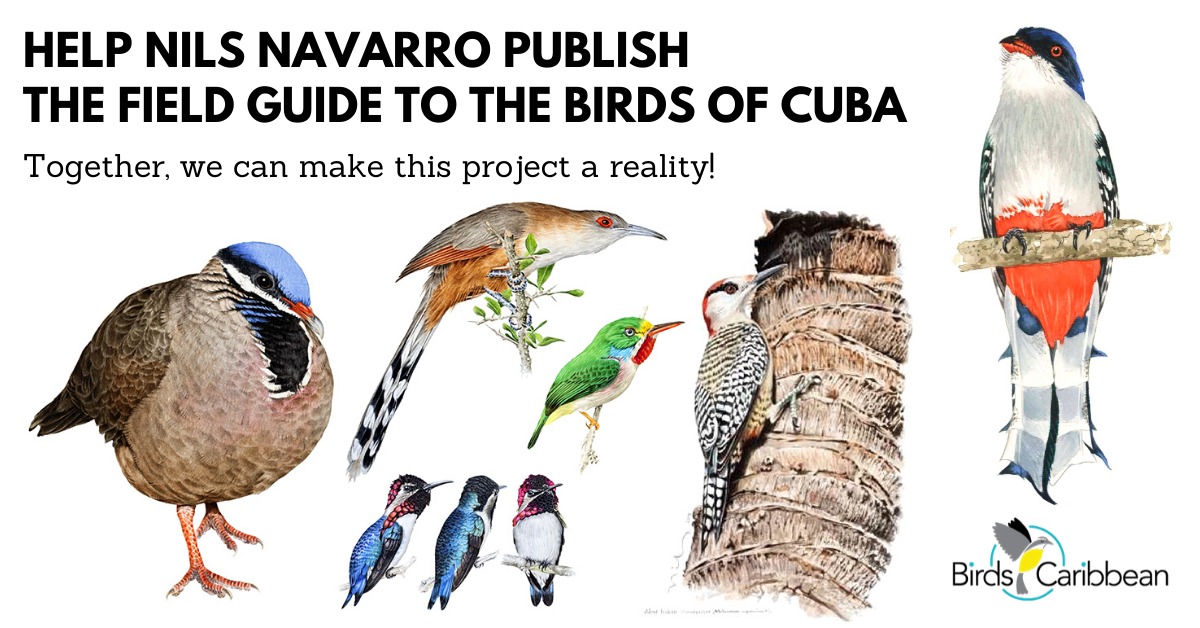
BirdsCaribbean is excited to support Nils Navarro’s newest project: an updated, comprehensive Field Guide to the Birds of Cuba. This is an ambitious and exciting venture, and we need your help to make it a reality!
Illustrations by Nils Navarro.
Nils Navarro is Co-Chair of the Caribbean Wildlife Art Working Group of BirdsCaribbean. He has dedicated his life to the study and conservation of the biodiversity of his native Cuba as well as other areas of the West Indies and Latin America. He holds a degree in Fine Arts with a specialization in painting. An extraordinarily versatile and internationally recognized wildlife artist and illustrator, Nils’ work is characterized by a refined technique combined with a profound understanding of the biodiversity of the Caribbean region. He is an avid conservationist and has pioneered the promotion and formation of young wildlife illustrators and artists in the Caribbean and Latin America. He co-authored the ground-breaking Annotated Checklist of the Birds of Cuba in 2017 and has published a new edition each year since.
Nils began work on the field guide over a year and a half ago. The new guide will contain the largest number of illustrations by species published by any guidebook on Caribbean birds. Nils will be accomplishing this over five years by drawing upon a thorough review of the literature, museum collections, and field work, as well as Nils’ personal experience, and his role as an eBird reviewer for the island. The field guide will cover the different species, subspecies and plumages, dimorphism, and much more, through a new and practical structure never before used for such a guide.
There has never been a better time to produce a guidebook like this. For the first time in the history of the country, there is a local community movement of birdwatchers who are making significant contributions to the knowledge of Cuban birds. This is accomplished through platforms based on citizen science (eBird Caribbean) and sharing knowledge (via Facebook), and the local community requires an updated comprehensive field guide for identification. Many of these people use a field guide as the main tool for their work. In addition, many people from all over the world visit Cuba to birdwatch. They will appreciate having a a new comprehensive guide that covers all of Cuba’s birds.
If you’re interested to purchase Endemic Birds of Cuba: A comprehensive Field Guide by Nils Navarro, click here. This book covers the endemic birds of Cuba as well as the regional endemics.
Join Jennifer Wheeler as she shares real-life stories from the field about the challenges of saving the endangered Black-capped Petrel, aka Diablotin, from extinction. You might laugh, you might cry, you might want to join the project. Hopefully you’ll feel as inspired as we are about the future of this species, thanks to the hard work of many organizations and people.
Only a very small number of people on the planet can say they have had close contact with a Black-capped Petrel. This mid-sized seabird comes to land only to breed, only at night under cover of darkness, and often heads quickly out of sight into underground burrows. This covert behavior as well as the species’ eerie, wailing vocalizations in the night sky, earned it the name Diablotin (“little devil”) from early European and African arrivals to the Caribbean. It was the birds that should have been afraid: human settlement of the Caribbean, accompanied by the introduction of invasive mammals, reduced the Diablotin from abundant on many Caribbean islands to widely considered extinct by the early 1900s.
The Black-capped Petrel nests in burrows or crevices located at typically hard-to-reach, high-elevation spots in both the Haitian and Dominican Republic portions of Hispaniola. Petrel burrows have yet to be found on any other island (Photo by Jim Goetz)
I’ve been cheerleading and coordinating conservation of the Diablotin for a decade, working with numerous partners in the International Black-capped Petrel Conservation Group. The species turns out not to be extinct but very rare. It is listed as Endangered on the IUCN Red List of Threatened Species and the total world population is estimated at no more than 1,000 breeding pairs. Only about a hundred Diablotin burrows have been located to date, all on the island of Hispaniola (Haiti and the Dominican Republic). It’s actually much easier to see a Diablotin out at sea than find one inland.
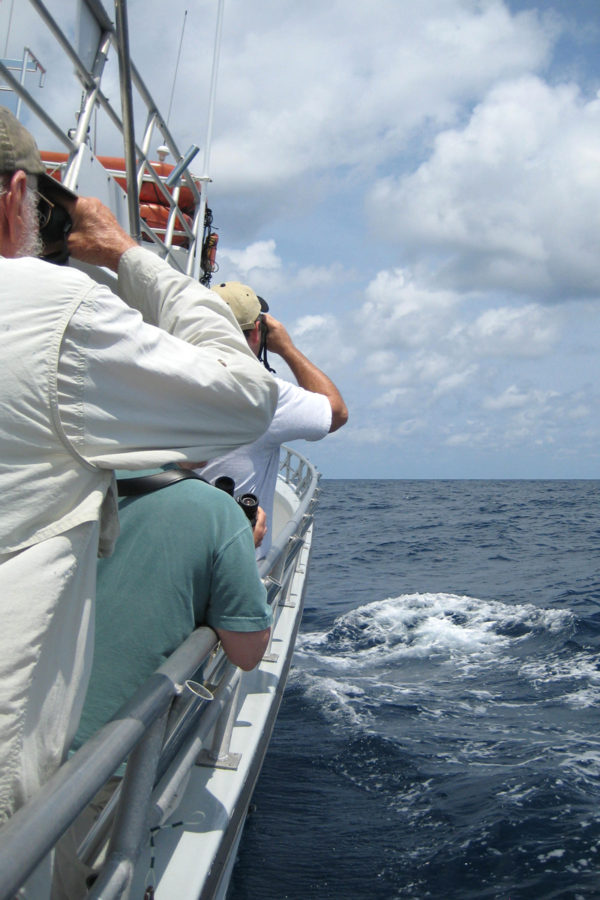
My first encounter with the species was in 2009. I saw them zipping by at a distance over the open ocean from the Stormy Petrel, a seabirding tour boat operating out of Cape Hatteras, North Carolina. Though the Diablotin’s breeding range is limited to the Caribbean, it turns out that they concentrate in a foraging area off the southeast U.S. To observe them at sea, one needs to be out over deep marine waters near or in the Florida Current and Gulf Stream, and that is most easily done where the Outer Banks protrude into the Atlantic. In the subsequent years, I got no closer, and I certainly wasn’t one of the group of people that could say they had touched a Diablotin, seen one up close, or even smelled their fishy body odor. Last year, I decided it was time to change that.
The small number of people who have seen a Black-capped Petrel have usually seen them at a distance from a boat well out at sea in deep marine waters (Photo by Jennifer Wheeler)
Hoping for Haiti
In April 2019 I planned on experiencing the Diablotin first-hand on a trip to Haiti. This is the country where most of those one hundred burrows are known to occur. In fact, it was in Haiti that they were re-discovered on a mountain ridge in 1961, after being lost to science for decades. This is miraculous considering that Haiti is one of the most deforested nations in the world, with some estimates that Haiti has retained less than 1% of its primary forest. Almost all of Haiti has been converted to agriculture or grazing, and secondary forest is degraded by wood-cutting and forest product collection. Petrels don’t need trees for nesting but trees and shrubs provide cover and root structure needed for burrow construction. Additionally, socioeconomic conditions in Haiti are so dire that people encountering these species are quite likely to consume them, which of course, is what introduced rats, cats and mongoose would like to do.
The Black-capped Petrel’s exact nesting locations in Haiti have not been easy to find. Even with the knowledge that they persisted on Haiti, it took until 2002 to locate an active burrow and until 2011 to see a living chick. Finding that little fluffball took an incredible number of hours crawling along cliffs and the forest floor, aided by information collected by radar and automated sound recording devices.
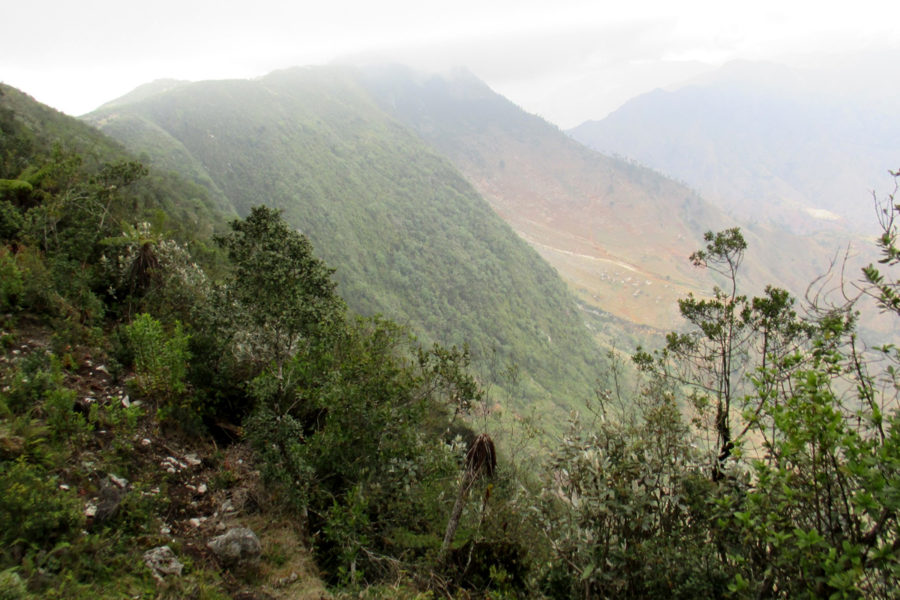
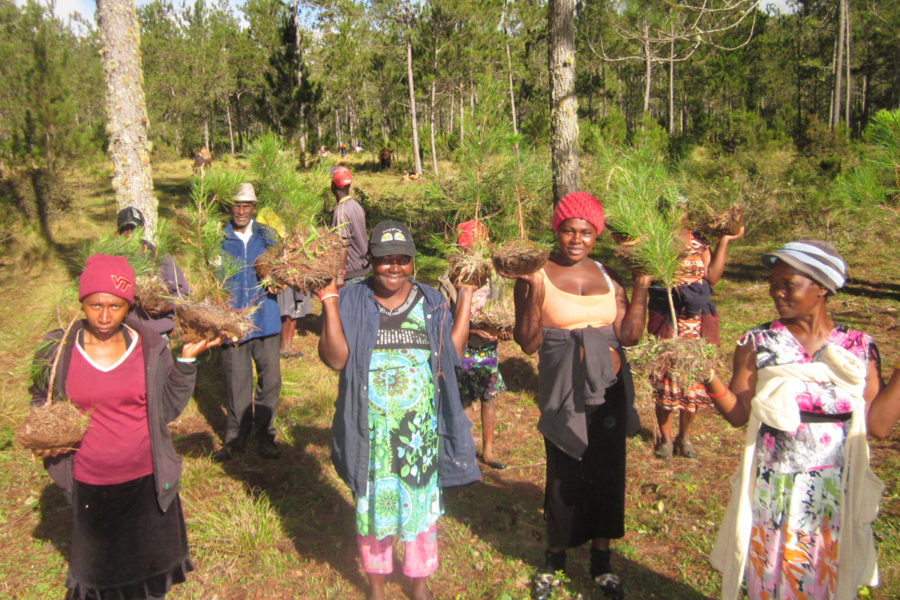
There is a small but significant nesting population of Diablotin in southwest Haiti, in a small patch of primary forest near the village of Boukan Chat. Since the discovery of the Diablotin in this area, local and international conservationists have been building relationships with the citizens of the village. Beginning with humanitarian projects, conservationists now pursue a strategy of improving farming practices and empowering local farmers to convert to more sustainable crops. More productivity on existing farmland reduces the likelihood of encroachment into the forest. Winning the hearts and minds of the local people also involves outreach, education and celebration. Foremost among these is the now annual Festival Diablotin Boukan Chat, which I had hoped to personally experience.
The conservation of the Diablotin relies on the actions and support of the local people. In the Haitian village of Boukan Chat, farmers are encouraged to switch to sustainable tree crops in buffer areas around the remaining patch of forest harboring petrels (Photo by Ernst Rupp)
Unfortunately, 2019 was not a good year for Haiti and its people. Anti-government protests turned violent last February, with accompanying increases in crime. The U.S. State Department and other authorities advised against travel to Haiti. Environmental Protection in the Caribbean (EPIC) is the organization spearheading much of the education and outreach in Boukan Chat. Adam Brown, project leader, made the disappointing but prudent decision to cancel attendance by international festival team members, including myself.
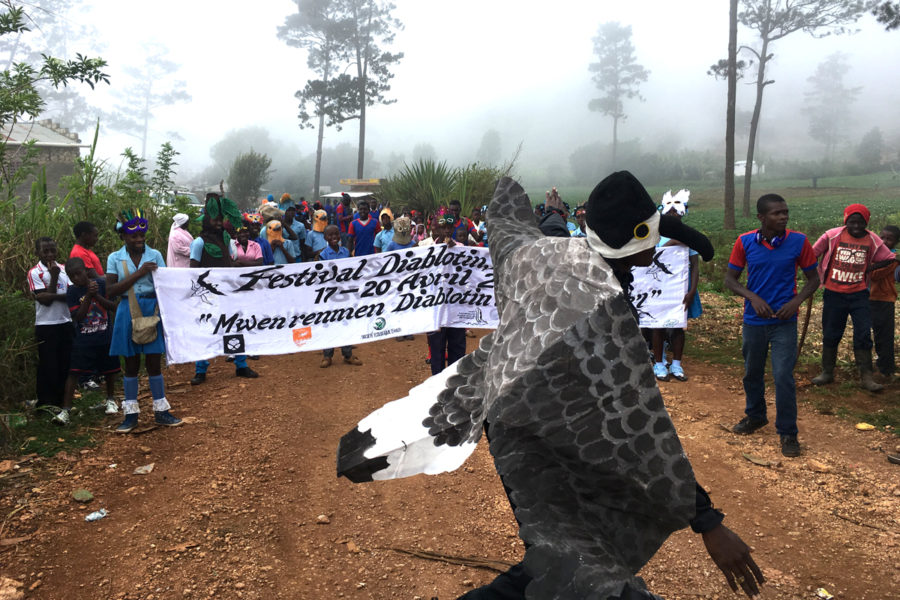
And yet, civil unrest did not deter the local members from carrying on with the festival! Boukan Chat held a Black-capped Petrel parade with musicians, pupils, farmers, and community members from the village to the soccer pitch. The celebrations ended with a soccer match between two soccer teams, including the appropriately logo’ed Boukan Chat team, ‘The Diablotins.’ There was a nighttime screening of the short film, Haiti, My Love, My Home which tells how the villagers, conservationists and humanitarians, have come together to protect the Diablotin. EPIC just released another amazing film The Diablotin Festival, which portrays the festival and just about makes me cry every time I watch it. I sincerely hope I can attend the Diablotin Festival in-person in the future, and more importantly, that peace returns to Haiti.
A young man in a Black-capped Petrel costume leads the parade during the Festival Diablotin held in Boukan Chat, Haiti. The festival also includes a soccer game and film screening, and is designed to instill interest and pride in the rare bird nesting in nearby forest (Photo by Anderson Jean)
Lost (it) At Sea
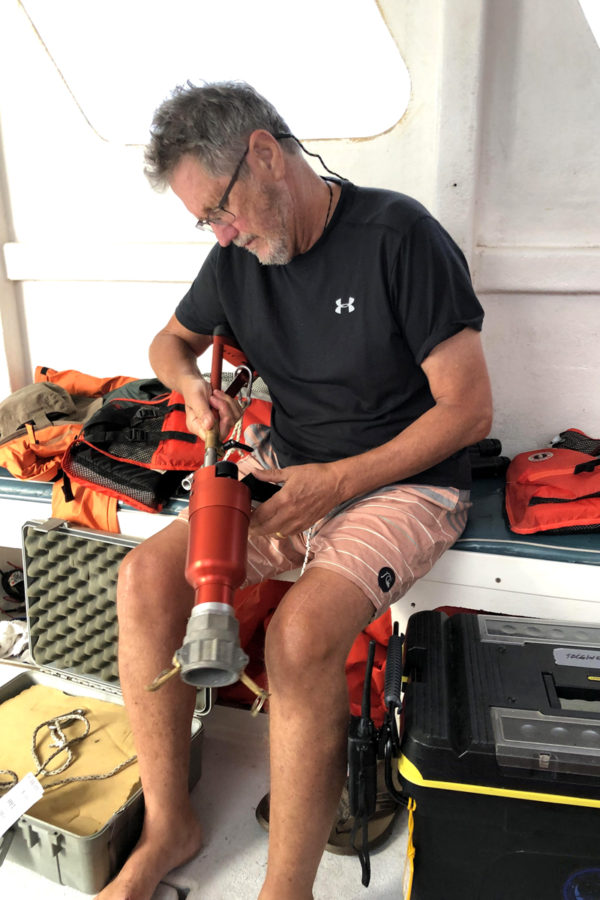
May 2019 brought a new opportunity to encounter petrels. This involved another trip on the Stormy Petrel in North Carolina, but with a twist. A team would be attempting to capture petrels at sea in order to fit them with tracking devices. The goal was to learn more about Diablotin movements, and if the transmitters lasted until breeding season the following winter, track them to possibly new and unknown nesting locations. The American Bird Conservancy (ABC) invited Chris Gaskin from New Zealand and his super nifty, specially designed hand-held net launcher for the job.
New Zealander Chris Gaskin prepares the air compressor used to launch a spreading net into the air. The net was specially designed to capture flying Black-capped Petrels at sea, in order to fit the birds with tracking devices (Photo by Jennifer Wheeler)
Even with this, I confess, I was a doubter. There was no way this was going to work. Petrels are fast flyers and don’t come all that near to boats. What I didn’t realize was that Chris would be shooting from a small, inflatable Zodiac, which apparently doesn’t spook petrels, especially those fixated on the smelly fish oil put out to attract them. On May 8, as I prepared to drive down to North Carolina from Virginia to join in the expedition, I received a text with an image of a flying net enfolding a Black-capped Petrel!
Turns out that the team was fantastic at catching petrels. Brian Patteson, captain of the Stormy Petrel knew where to find the birds. Brad Keitt with ABC and Pat Jodice with the U.S. Geological Survey South Carolina Coop unit at Clemson University took turns piloting the Zodiac and Chris into position. Chris never missed after his first shot. Yvan Satgé, also with Clemson, deftly fit each bird with a small solar-powered tracking device and took measurements and photos. Arriving in North Carolina, I helped celebrate the first six Diablotin ever captured at sea and I couldn’t wait to observe and assist.
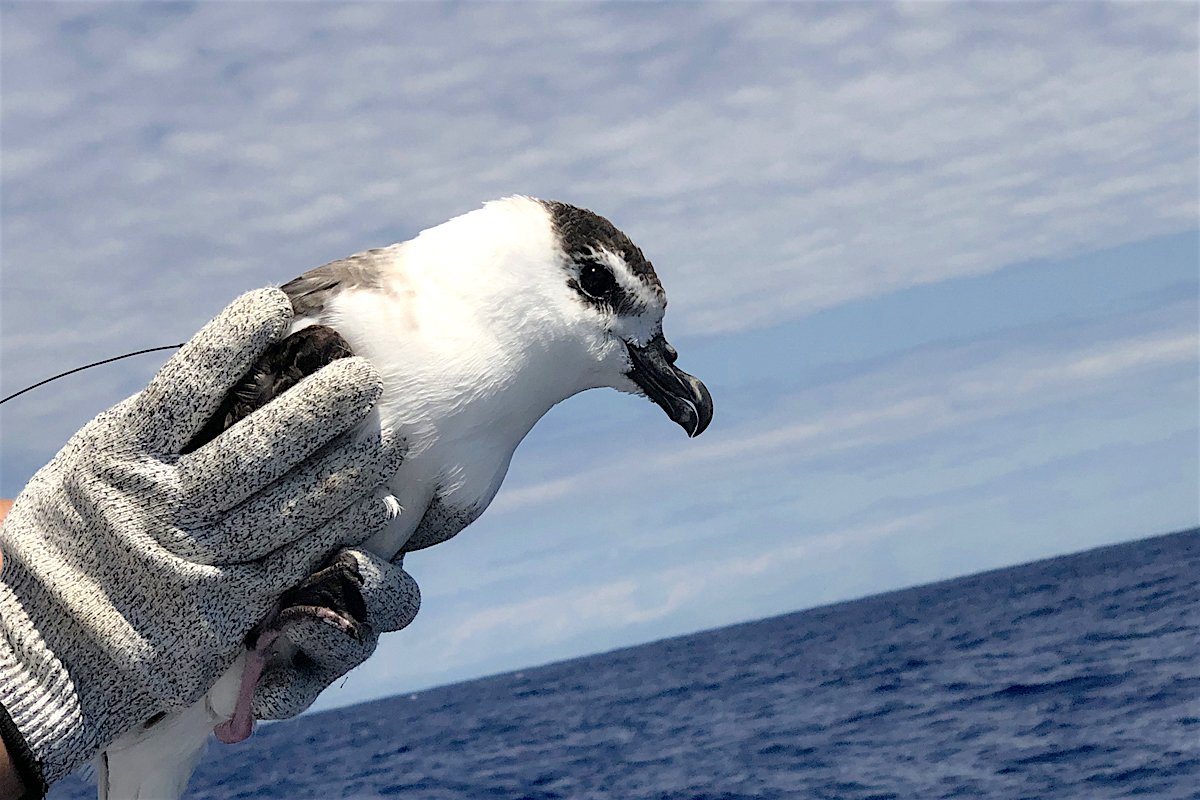
The weather did not cooperate. The first day after I arrived the seas were too rough to be safe. The next day the seas were too calm; open ocean seabirds like wind. The third day was too rough again. I was out of time and actually began driving home. What was I thinking!?! An hour out I came to my senses and turned back to Hatteras to wait for good seas. Finally, on May 14, conditions looked very promising. And they were! It was so exciting to see a bird netted by Chris and watch the Zodiac speeding back to the boat to hand it over to me. And then, the dream came true: I held a living Diablotin in my hands!
One of the first Black-capped Petrels ever to be caught at sea and fit with a satellite tracking device awaits release. In total, 10 birds were tagged in May of 2019, tracking petrel movements to as late as January 2020 (Photo by Jennifer Wheeler)
Not for long. I rushed to disentangle the net, then thrust the bird into someone else’s hands so I could rush to the side of the boat and throw up my breakfast. My big chance to handle a live Diablotin and I nearly foul its feathers with vomitus. Sigh. I was seasick for the rest of the day, providing only comic relief while the rest of the team successfully captured and fitted four more birds with satellite transmitters. Over the months to come, the birds’ movements were followed via satellite. Amazingly, the bird I almost upchucked upon was still transmitting 8 months later, longer than any other. Maybe it felt the love.
Determined in Dominica
As noted, one of the hopes of the satellite tracking was to see if any of the birds traveled to new nesting locations. Diablotin burrows have been found only on Hispaniola, but hope and evidence exists that they also persist on other islands: notably Dominica, where evidence is very strong. In 2015, radar surveys performed by EPIC picked up 900+ petrel-like targets heading in and out of the mountains of that island. Additionally, individual birds were observed through night-vision scopes during those surveys. And over many years, a handful of grounded birds have been found well inland. Following the radar surveys, technical exchanges were arranged to train and assist in ground searching. In April 2016, a team from the Dominican Republic visited Dominica; another exchange in the opposite direction took place in April 2017. Unfortunately, bad weather limited search time and no burrows were located on Dominica. Then, petrel work and just about everything else on that island was derailed when Hurricane Maria blasted Dominica in September 2017, the strongest storm in that island’s recorded history.
Jennifer Wheeler takes a break on a newly opened trail in Trois Pitons National Park, Dominica, during a January 2020 expedition to look for evidence of Black-capped Petrels on that island. (photo by Stephan Brown)
Last month, I invited myself to assist EPIC’s trip to Dominica to repeat radar surveys after five years and to help resume ground searches. Overcoming the challenges of arriving in Dominica late and alone, needing to navigate across the island’s high mountains in the dark, and driving on the “wrong” side of the road, I began to feel quite confident and helpful. I met with staff from the Division of Forestry; attended to the logistics of rental car, rental house, and groceries and obtained the heavy marine batteries needed to power the radar. My greatest success was finding a supply of small desiccant packs (those little bags of silica used to absorb moisture). I visited a dozen shops dealing with computers, appliances, and clothing, affirming that yes, I did mean those little packets that say Do Not Eat, and finally, met success at a shoe store! I was so proud. But pride goeth before the fall.
Did I mention that Dominica has really narrow roads? And it was hard to see my front left side while driving with a right side steering wheel? Fortunately, the burly body-builder was very nice about the big dent I put in his car. Repairing the suspension from shoving his car into a culvert was going to be costly though. The good news was that the damage to the rental truck was minor! You can be sure that I was relieved to turn over the driving to Adam Brown when he arrived on the ferry from Guadeloupe after two weeks of radar surveys there. And I must report that Adam often turned over the driving the really winding roads to local team members Machel Sulton and Stephen Durand. Things went smoothly after that.
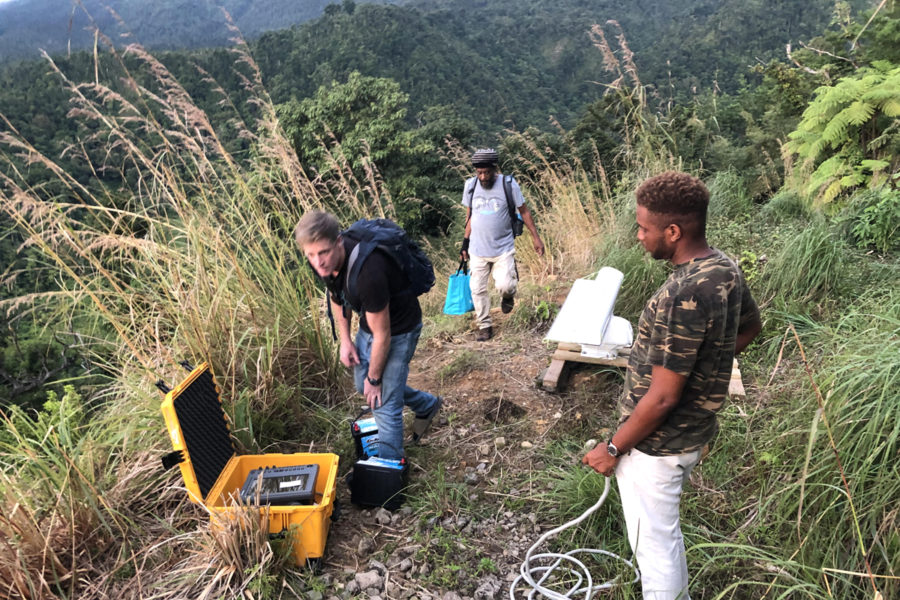
We assembled the marine radar equipment and headed into the hills. Sure, setting up takes some work, but this field activity was really pleasant. We positioned ourselves on a hilltop and watched the sun set, enjoyed the cool breezes, and looked and listened for night flying creatures. Petrels appear as a distinctive pattern of blips on the radar screen. Adam would note them coming and call out for us to attempt a sighting with the night vision or thermal image scope. As was the case in 2015, the surveys detected a number of petrels at a number of locations, flying rapidly in and out of the mountains. The peak of activity commenced about 45 minutes after sunset and tapered off at about three hours. At 9 p.m. we were packing up and headed to dinner, excited about our findings but a little concerned about the drop in petrel target numbers since 2015.
Adam Brown, Stephan Durand and Machel Sulton set up for an evening of radar surveillance in Dominica in January 2020. Five years earlier, the first radar surveys conducted on the island revealed hundreds of petrel-like targets flying in or away from several of Dominica’s mountains (Photo by Jennifer Wheeler)
Daytime work to place soundmeters required more exertion. Radar surveys only point the way to the peaks where petrels might be nesting. Placing automated recording devices in these areas to collect any vocalizations helps narrow down the sites and seasons to search. As noted, work on Dominica to find petrels discontinued in late 2017, and the trails to the peaks selected for soundmeter placement had yet to be cleared of trees felled by hurricane and two years of new growth. Division of Forestry foresters are really very good breaking trail with machetes; regardless, it was a slow, hot hike up to the first of the selected peaks. It was certainly not unpleasant, given the varied foliage, numerous orchids and occasional songbird; but I wish we had packed more food! Once we reached higher elevations, there was the chance of finding petrel burrows so off trail into the thick, prickly underbrush we went. Crawling through the dirt, peering under roots and sniffing at holes, I fantasized about finding a burrow entrance. I’m a finder by nature—I’m happy to spend hours looking for beach glass, fossils, antiques—and I just KNEW at any moment, I would see a hole with a tell-tale plop of guano or catch a fishy whiff of petrel. What a find it would be! Alas…I did not nor did anyone else. There is still no documented nesting in Dominica since 1862.
Persistence
Now it’s February, and petrel conservationists are gearing up for field work and community-based conservation on Hispaniola. I’ve heard that the biologists in Cuba are planning an expedition into the Sierra Maestra. There will be detailed reports coming out on the surveys in Guadeloupe and Dominica, with the findings from monitoring and recommendations for continued searches. Soundmeters are placed and listening. The members of the International Black-capped Petrel Conservation Group are strategizing for the long term and seeking funds. With the Diablotin, we must be persistent. Finding the petrel is difficult; contemplating the magnitude of its threats—human population growth, habitats invaded by introduced mammals, and climate change foremost among them—can be overwhelming. But as long as there are Diablotins, there is hope.
Here’s one more story to serve as a symbol of surviving against the odds. After placing a new soundmeter in Morne Trois Pitons National Park in Dominica, we went in search of one deployed in 2017 and actually found it. It was bleached, scratched, and breached by rainwater. The tree to which it was strapped was broken and battered by the 160 mph winds of a Category 5 hurricane. It was difficult to open the unit. Yet the SD card inside survived, containing readable data. Miracles do happen.
Jennifer Wheeler is an avid adventurer and loves volunteering her time to help conservation causes. She was the coordinator of the Waterbird Council for 10 years and Board member and Treasurer of BirdsCaribbean for 8 years. She is currently co-chair of the International Black-capped Petrel Conservation Group and Financial Officer for BirdsCaribbean.
The activities noted in this article were largely supported by Seabirding/Stormy Petrel, Environmental Protection in the Caribbean, Plant with Purpose, Jeune En Action Pour La Sauvegarde De l’Ecologie En Haiti, Soulcraft All-stars, Grupo Jaragua, BirdsCaribbean (and the Betty Petersen Conservation Fund of BirdsCaribbean), American Bird Conservancy, U.S. Geological Survey South Carolina Coop unit at Clemson University, Dominica Division of Forestry, U.S. Fish and Wildlife Service, and the Disney Conservation Fund.
Please Donate!
To help save the Black-capped Petrel from extinction while also working with the people of Haiti to farm more sustainably, please donate here or here.
To view larger images in the gallery, click on each photo; they may also be viewed as a slide show.
Conservation actions in Boukan Chat, Haiti include educational programs for both adults and children. The long-term goal of these programs is to provide local people with knowledge and appreciation for sustainable agriculture and other livelihoods that increase standard of living and protect natural resources into the future. (photo by Anderson Jean)
Adam Brown takes a GPS measurement on a ridge overlooking a valley where radar detected petrel movements in and out of the nearby peaks (Photo by Jennifer Wheeler)
Stephen Durand takes in the view overlooking a Dominica valley where radar detected petrel movements in and out of the nearby peaks. (photo by Jennifer Wheeler)
A soundmeter placed in early 2017 in Dominica’s Morne Trois Pitons National Park was recovered in 2020. Though the data are yet to be analyzed, the unit’s sound card was intact inside the unit, despite the devastation wrought by Category 5 Hurricane Maria (Photo by Stephen Durand)
Members of the team aboard the Stormy Petrel are all smiles after a successful expedition to catch Black-capped Petrels at sea. Can you tell who was seasick most of the trip? Back row, left to right: Yvan Satge, Chris Gaskin. Front row: Captain Brian Patteson, Jennifer Wheeler, Kate Sutherland, Brad Keith.
Jennifer releases a Black-capped Petrel fitted with a satellite tag.
The Cayman Islands Government is urging residents who are keeping Cayman Parrots as pets to have their birds registered with the Department of Environment (DoE) before February 29th, 2020. This amnesty is part of the Government’s efforts to reduce poaching and prevent further decline in the wild parrot populations on Grand Cayman and Cayman Brac.
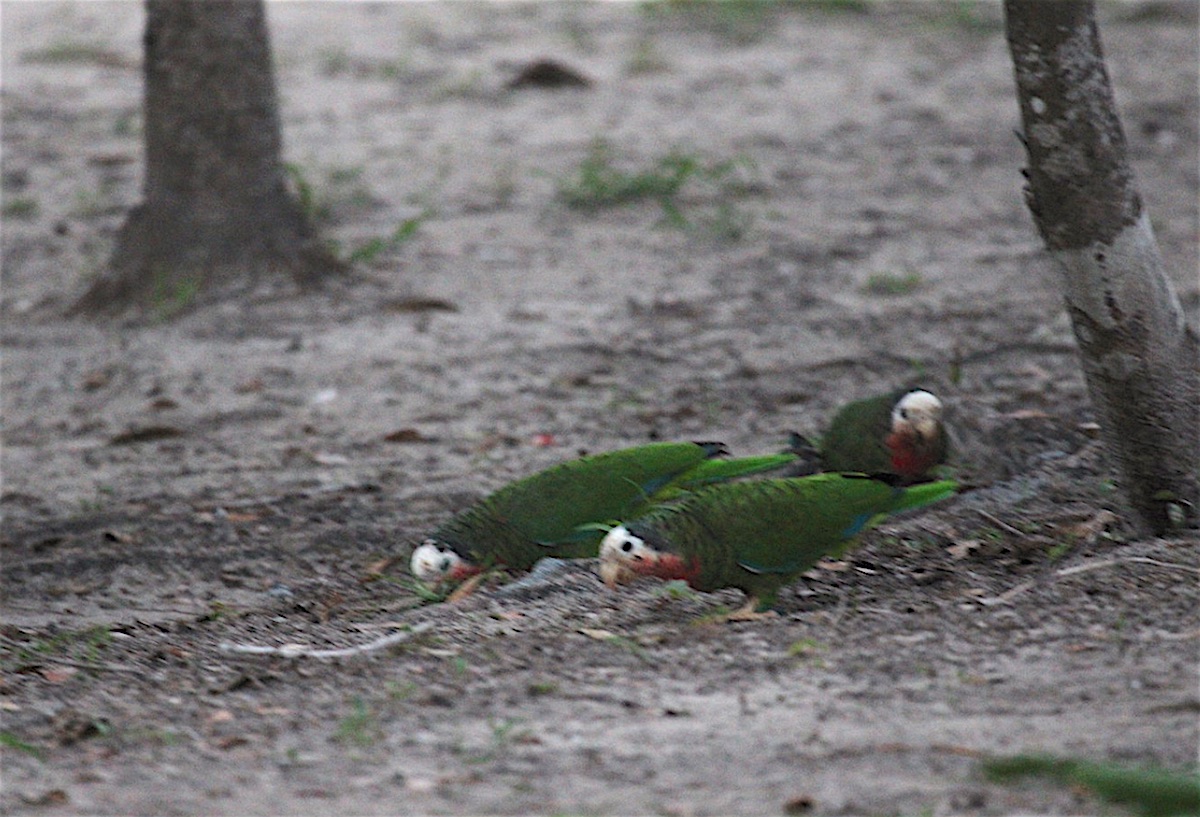
The Grand Cayman Parrot (Amazona leucocephala caymanensis) and the Cayman Brac Parrot (A.l. hesterna), both represent the national bird of the Cayman Islands. The local name is “Cayman Parrot” but these parrots are a subspecies of the Cuban Parrot, which occurs in Cuba, the Bahamas and the Cayman Islands and was formerly called the Rose-throated Parrot (read more on eBird Caribbean).
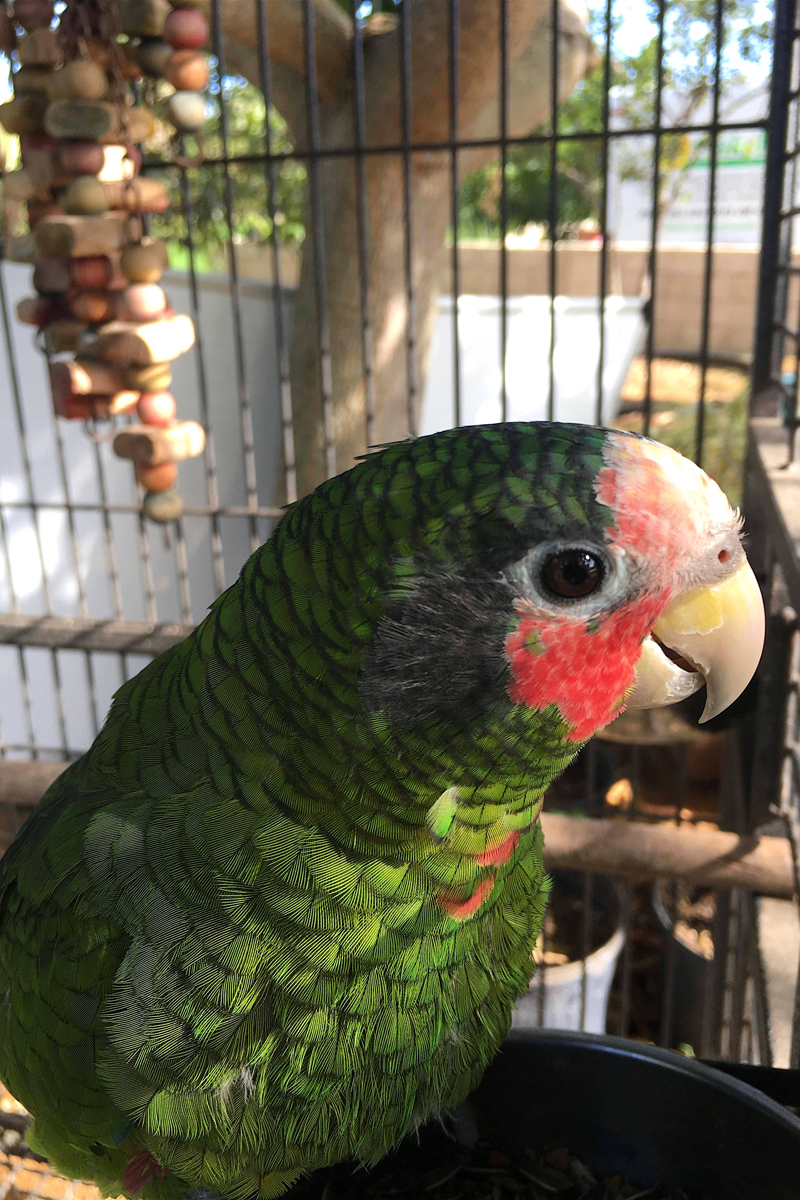
The Grand Cayman Parrot is generally green, with a white forecrown, white eye-rings, red cheeks (depending on whether male or female), black ear patches and blue wing feathers which are only seen in flight. Their tails are green with blue edges and red and yellowish-green underneath. The Cayman Brac Parrot is smaller in size and has a more pure white forehead with a large maroon area on its abdomen.
Cayman Parrot in the wild (Photo by Jane Håkonsson)
As is typical of parrots, they are active during the early morning, when they go out in search of fruits and berries. During the breeding season they look for food as well as tree cavities in which to raise their young. When resting quietly after their morning activities, they ‘comb’ and clean their feathers using their beaks. It is almost impossible to spot them at this time as they are perfectly camouflaged among the leaves of the trees. In the late afternoon they return to their roost.
The Cayman Brac Parrot previously inhabited Little Cayman but its prime nesting sites were destroyed in the Storm of 1932. It now has the smallest known range of any Amazon parrot in the world. Its survival depends entirely on the protection of remaining old-growth forest which can still be found on Cayman Brac.
Natural disasters such as hurricanes are a threat to the Cayman parrots’ survival—but not the only one. Habitat loss through development and trapping for the illegal pet trade also jeopardize the future of these birds.
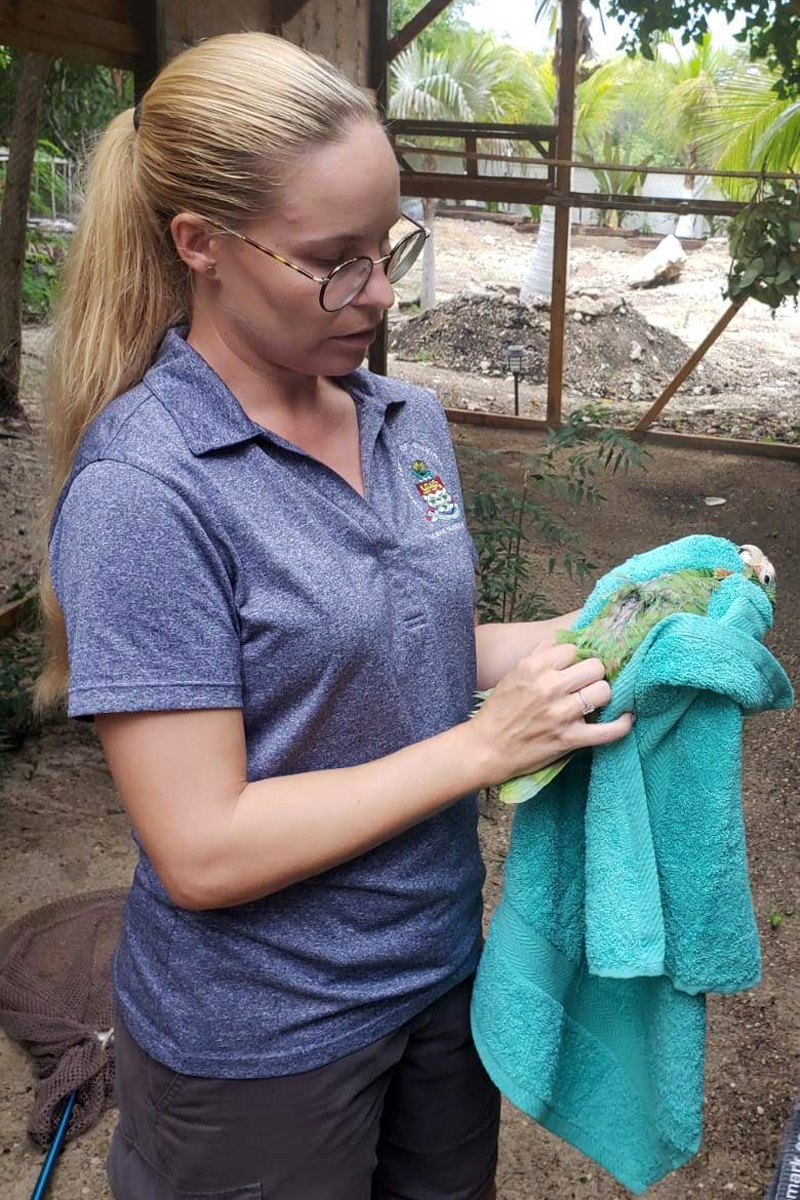
DoE Research Officer, Jane Håkonsson, inspecting a pet Cayman Parrot
These parrots have been highly sought “gifts” and pets, even though they are protected by law. It is illegal to trap, sell and keep the birds in captivity. Yet, many people still keep them as pets. In an effort to curb the illegal trade in the national bird, the DoE set up a six month amnesty program, running from September 1st 2019 to February 29th 2020. Pet parrot owners can now legally register their birds without the risk of their pets being taken away.
Each pet parrot will be checked by a veterinarian, given an identification number printed on a small band around the parrot’s leg and implanted with an identification chip, similar to the ID tags used to register dogs and cats, at no cost to the owner.
About a year ago, the DoE started a collaboration with a private member of the public to open a much-needed Parrot Sanctuary in East End. The Cayman Parrot Sanctuary boasts native plants and trees. Parrots that are not yet able to return to the wild are housed in secure, clean and spacious aviaries. The Sanctuary is managed by Australian-born Ron Hargrave, who is very much invested in the conservation and well-being of parrots and Cayman wildlife.
The Sanctuary takes in injured parrots and provides rehabilitative care, with the goal of releasing the birds back into the wild population. The birds have a much higher chance of survival in the wild following releases from the sanctuary. They are given thorough medical exams and their health is continuously monitored. Parrots are also taught how to be wild birds again. They have natural foods to eat and learn where to find them; they are also able to form social bonds with other parrots.
Cayman Parrot at the Parrot Sanctuary (Photo by Jane Håkonsson)
Following every release, the birds are provided with temporary supplemental feeding stations. Their behavior and movements are monitored in the wild. To date seven parrots have been released.
Not all parrots can be released back into the wild. Therefore, pet parrot owners are discouraged from releasing their pet birds themselves. They should instead contact the DoE. Also, if you are a Cayman Parrot owner but have not yet registered your bird, please call Jane Håkonsson on 925-1807 or 949-8469 or email doe@gov.ky.
Spread the word and help protect the Cayman Islands’ national bird for generations to enjoy!
Special thanks to Aliya Hosein (Leader of the Welfare and Wildlife Program at the Centre for the Rescue of Endangered Species of Trinidad and Tobago) and Jane Ebert Håkonsson (Cayman Islands’ Department of Environment Research Officer) for this blog article!
From all of us at JCO, thank you to all of the authors and reviewers that contributed to a very successful Volume 32!
Inside you’ll find a sizable number of publications, including 16 research articles, our first designated “Conservation Report,” 4 book reviews, Recent Ornithological Literature from the Caribbean, and a special In Memoriam for the late Dr. James. W. Wiley.
I want to give some much-earned recognition to the 2019–2020 JCO team. While they were undertaking the aforementioned load of manuscripts, they were working double-time to make some incredible improvements behind-the-scenes. Let me just say that it’s no easy task to create and adopt a new workflow while you simultaneously have a dozen manuscripts—each at different stages— moving through the old workflow. And this new workflow means better communication, a higher-caliber final product, and a more efficient pathway for a manuscript to proceed from submission to publication. All great things!
Please take some time to enjoy all of Volume 32. Inside you’ll find a suite of excellent work stemming from more than 17 countries across the Caribbean. We should all take pride in this work and make the time to congratulate each other on all of these accomplishments. If you enjoyed reading a publication, please send the authors a quick email letting them know. That is what makes Caribbean ornithology special—a sense of community and comradery unlike anywhere else.
Thank you for your support of JCO!
— Justin Proctor, JCO Managing Editor
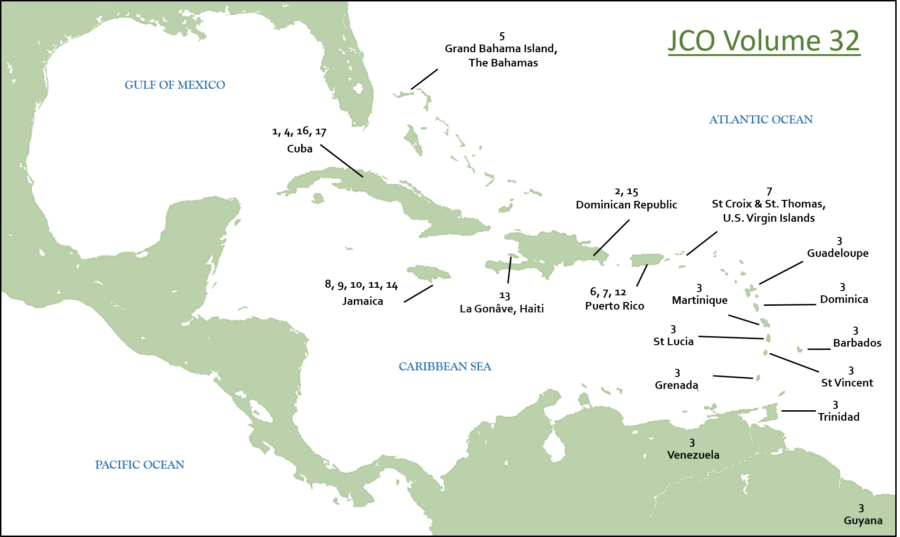
Map depicting research locations of the studies published in Volume 32.
On December 3rd, 2014, ornithologists spotted an American Pipet during an annual Cuba Bird Survey led by the Caribbean Conservation Trust. Previously undocumented in Cuba, this observation marks the first report of this species on the island, and underscores the importance of the Guanahacabibes region as an important stopover for fall migrants.
James F. Dwyer, Thomas I. Hayes, Russell Thorstrom, and Richard E. Harness
After a translocation program for the Critically Endangered Ridgway’s Hawk was stymied by electrocutions in the Dominican Republic, Dwyer et al. began to investigate. In this article, the authors identify the errors made while retrofitting power poles and discuss the necessity of properly mitigating electrocution risks for this project, and others throughout the Caribbean.
Meghann B. Humphries, Maribel A. Gonzalez, and Robert E. Ricklefs
Currently, there are eight subspecies of Carib Grackle distributed across the Lesser Antilles and northern South America. By sequencing mitochondrial genes of Carib Grackles across their range, Meghann et al. shed light on the phylogenetic and geographic history of the species, bringing into question the bases for the subspecies classifications.
In response to the dearth of current literature on the White-crowned Pigeon, Acosta and Mugica compiled the latest data on this Vulnerable species in Cuba. Here, they present their findings, focusing on the current distribution of the species as well as conservation measures that have contributed to the perseverance of the species.
Anthony Levesque, Antoine Chabrolle, Frantz Delcroix, and Eric Delcroix
While the Sedge Wren commonly winters in Florida, it has yet to be recorded in the Caribbean, until now. In this article, Levesque et al. recount their sighting of this species on Grand Bahama Island, providing descriptions and photographs of the bird’s diagnostic features and the habitat where it was located.
Christopher C. Rimmer, John D. Lloyd, and Jose A. Salguero-Faria
After Puerto Rico was identified as potential overwintering habitat for the globally Vulnerable Bicknell’s Thrush, Rimmer et al. conducted surveys to clarify the species’ winter distribution on the island. Here, they report that Bicknell’s Thrush is a rare and local species in Puerto Rico and highlight the importance of conservation efforts in Hispaniola, where the species is more abundant.
In 1796, Nicolas-Thomas Baudin captained an expedition to the caribbean, bringing back close to 300 specimens; however, there is controversy surrounding their procurement. After investigating the origin and spread of these specimens, Jansen and Fuchs document their findings and address the arguments of theft made by David K. Wetherbee (1985, 1986).
Currently, the six subspecies of Turkey Vulture are delineated by external measurements and subtle plumage variations, with the Antillean Turkey Vultures falling under Cathartes aura aura. However, through photographic documentation and eBird records, Graves calls attention to the similarity of facial caruncles on Turkey Vultures throughout the caribbean to those present on the eastern United States and Middle America populations. As facial caruncles are largely absent from South American populations, Graves’ work brings into question the diagnostic nature of these markings.
While there are no species of geese native to Jamaica, vagrant or introduced species have been recorded intermittently on the island. Here, Levy amalgamates the scattered history of three geese species in Jamaica and presents a new record of a Snow Goose, illustrated in 1758: the second Snow Goose ever recorded in Jamaica.
Though the comb forkedfern is native to the New World tropics, it is invasive to protected areas in the Dominican Republic and Jamaica. By comparing the bird diversity between invaded habitats and fern-free habitats in the Mason River Protected Area, Davis demonstrates that increased incidence of comb forkedfern decreases bird diversity, particularly native species. Through this, Davis urges the importance of controlling fern spread to protect native bird and plant species.
Richard R. Schaefer, Susan E. Koenig, Gary R. Graves, and D. Craig Rudolph
Though the Jamaican Crow and Jamaican Boa co-occur in certain habitats in Jamaica, there are no published reports of their interactions. By detailing four accounts of mobbing by crows on boas and one probable instance of depredation of a crow’s nest by a boa, Schaefer et al. are the first to document a presumably ongoing feud between these two native species.
With violently strong winds, hurricanes are known to displace birds and transport them to new and unusual habitats. That is why, when Hurricane Maria passed over Puerto Rico on September 20th, 2017, Pérez-Rivera was ready. Here, he documents several unusual bird sightings made by him and others in the wake of Hurricane Maria.
The island of La Gonâve, Haiti, boasts a diversity of bird habitats and has historically sustained a variety of both diurnal and nocturnal raptor species. However, due to rampant environmental degradation and habitat destruction, it is rarely visited by ornithologists or wildlife researchers. After conducting raptor surveys on La Gonâve in 2012, White et al. compared their findings with historical records of raptors on the island, noting that only a few generalist species have been able to sustain populations.
While the Shiny Cowbird is native to South America, over the past century, this brood parasite has spread across the caribbean archipelago and into North America – but how and when did this dispersal occur? In an effort to document the introduction and spread of this species in Jamaica, Levy compiles historical observations of Shiny Cowbirds and postulates a potential hurricane-mediated arrival on the island.
André Dhondt, Jeremy L. Collison, Matthew H. Lam, Matthew J. D’Ambrosio, and Taylor L. Crisologo
Palmchats are among the few passerine species that build complex, multi-chambered nests; however, there are no published studies of their nest-related behavior. After studying Palmchat nests in the Dominican Republic, here, Dhondt et al. report on their observations, noting differences in group size, nest size, twig-related activities, twig length and shape, and nest construction.
William E. Davis, Lisa G. Sorenson, and Ernesto Reyes Mouriño
On January 28th, 2018, birders on the BirdsCaribbean Cuba Bird Tour in Ciénaga de Zapata National Park, Cuba, spotted an almost entirely white Willet amongst a group of Short-billed Dowitchers and other Willets. In this article, Davis et al. present photographic evidence and a detailed description of this leucistic Willet and use phenotypic characteristics to classify it as a western subspecies.
Since its introduction to Cuba in 2003, the Caribbean Endemic Bird Festival has achieved paramount recognition for its talks, conferences, competitions, workshops, exhibitions, and other ornithological events. By uniting and strengthening the national network of environmentalists, this festival has expanded its scope of activities and built its capacity to prepare and distribute educational materials.
[this is our first publication under the header “Conservation Reports” – we invite more of these!]
Jason M. Townsend, Rafaela Aguilera Román, Felisa Collazo Torres, José González Díaz, Chandra Degia, Hiram González Alonso, Floyd E. Hayes, Lyndon John, Steven C. Latta, Lourdes Mugica Valdés, Nils Navarro Pacheco, Fernando Nuñez-García, Carlos Peña, Herbert Raffaele, Pedro Regalado, Ernesto Reyes Mouriño, Yaroddy Rodríguez, Bárbara Sánchez Oria, Helen Snyder, Joseph Wunderle
Summary: This In Memoriam of Dr. James W. Wiley not only celebrates his foundational research career, with four decades of published work, but also the profound personal connections he built through his mentorship and friendship. Twenty authors contributed to this piece, paying homage to Jim and painting a beautiful picture of the life he lived.
A special thank you to Dr. Steven C. Latta, Director of Conservation and Field Research at the National Aviary and longtime editor for JCO, for his continued efforts undertaking this important section of our journal that compiles recent publications from around the Caribbean. Steve has been contributing ROLs to JCO since Volume 22 in 2009.
“My idea then was to catch everything that was published after the publication of Jim Wiley’s “A Bibliography of Ornithology in the West Indies” which I always thought was a tremendous effort and a tremendous resource. I wanted to make it easier for people across the Caribbean to have ready access to the most recent literature by knowing what had been published and how to contact the researchers for copies of their papers. I also wanted to make the updating of the bibliography a whole lot easier.”
Steve has done an outstanding job and we encourage our readers to look back through his work over the past 10 JCO volumes, which can all be found in our free and open-access Archives.
Article by (1) Simon Campo – Editor for the Journal of Caribbean Ornithology and a Researcher at the Yale School of Medicine in New Haven, CT; Connect with Simon via LinkedIn or email; (2) Justin Proctor – Managing Editor for the Journal of Caribbean Ornithology; and (3) Aliya Hosein – Centre for the Rescue of Endangered Species of Trinidad and Tobago.
Journal of Caribbean Ornithology relies on donations to keep all of our publications free and open-access. If you would like to support our mission and the broader goal of giving a voice to Caribbean ornithologists and their work, please consider becoming a supporter of JCO.
The Red-legged Thrush is a key seed disperser in the forests of the Dominican Republic. (photo by Dax Roman)
Spencer Schubert’s adventures into the remote corners of the Dominican Republic Part continue, all in the name of science and conservation.
If you are reading this, I probably do not have to convince you that birds are great. The more interesting discussion to be had, of course, would be what makes them so great. We are all drawn to birds for different reasons. For some of us, the sights and sounds they provide to the ambience of our backyard or local natural area are enough to endear them to us. For many others it comes from their experience as pet owners. Even the tradition of hunting can inspire reverence for birds and a passion for their conservation. I have always liked birds, but I can hardly claim that they were any more interesting to me than lizards or turtles, for example. Indeed, on my grumpiest of days, I sometimes refer to myself as a failed herpetologist.
My gateway to birds has been a fascination with their role as seed dispersers. It may not be the first thing that you notice, but no matter where you go, as long as you’re standing on dry land and there is some green vegetation nearby, you would be hard pressed to find somewhere where there aren’t birds eating fruits and seeds. These feeding behaviors by birds are a key component to many terrestrial ecosystems. By swallowing fruits or otherwise carrying away seeds in their bill, potentially flying great distances, birds give plants a major boost in their potential to propagate in the environment.
Our restoration plots, constructed in 2017, are small pasture areas each about the size of a basketball court. By enclosing these areas with barbed wire fences, our objective was to eliminate the effects of cattle grazing, trampling, and landscaping efforts by farmers in order to observe the process of seed dispersal and plant growth. Perches with crossbars were installed to attract birds and collect droppings and seeds.
One of the major implications of seed dispersal in a world with ever diminishing forests is the prospects for degraded ecosystems to bounce back. About two years ago, I contributed an article to this blog on up-and-coming work in the small town Jarabacoa in the central mountains of the Dominican Republic. I was studying whether constructed perches could be used to attract birds to restoration sites on abandoned parcels of farmland, with the goal of promoting natural seed dispersal and forest recovery. It all began with a simple principle: If you build it, they will come.
To some extent this was true. We found that installing perches increased the number of birds visiting restoration plots. However, some key seed dispersers such as the Palmchat, Black-crowned Palm Tanager, and Red-legged Thrush – to name a few – showed little to no interest in our perches. So, I got to thinking, maybe we need a better sales pitch.
Have you ever walked down the streets of a popular street in town looking for a place to eat or hang out? Would you rather walk into an establishment that is silent with no sign of people inside or one that is bustling with music and laughter? Atmosphere is what you’re looking for. All else being equal, you’re much more likely to walk into a restaurant that sounds like there are a lot of people inside than one that is quiet and seemingly empty. We use these social cues to inform our judgments of the quality of different businesses all the time. As it turns out, birds are not so different.
Birders will already be familiar with the magic of playback. Many bird species are readily stimulated by hearing their own call and often rush in to investigate whether the sound is from a mate, new neighbor, or a potential intruder to the territory. This is often used to draw in shy birds for us to have a closer look at them or prompt them to reply for better identification (Note: Playback may cause unnecessary stress for some species, particularly during nesting season, and is prohibited in some parks and in many cases for threatened species). Similarly, birds may be drawn to the sounds of both their own kind and other species as a signal to flock up to find high quality habitat or food.
Black-crowned Palm Tanager (Phaenicophilus palmarum) feeding on Inga vera. (photo by Spencer Schubert)
Here is where my idea set in. One aspect of my studies over the past four years has been the community-level analysis at our sites in the central Dominican Republic in an attempt to fully document all feeding/dispersal relationships between all of the bird and plant species that occur here. Through thousands of hours of observation, we have uncovered enormous variation in the extent to which different bird species act as seed dispersers.
Some “generalist” species are responsible for dispersing the seeds of large numbers of plant species. For example, our research has revealed that the Palmchat eats fruits from 42 species. That’s nearly half of all trees and shrubs that are found, collectively, at the sites we have surveyed! Other “specialist” species, like the Antillean Euphonia, are only known to feed on fruits from just a few species. So, if you were any average Joe Bird in the mood for some tasty fruits, which of these species would you rather take a recommendation from?
Antillean Euphonia (Euphonia musica) feeding on a mistletoe (Phoradendron racemosa). (photo by Spencer Schubert)
This is, effectively, the question we asked with our latest experiment. By broadcasting sounds of fruit-eating generalists, specialists, and birds that do not eat fruits in separate trials, we sought to test how these sounds affect bird activity in our restoration plots. We expected, first of all, that the sounds of particular species would attract members of that same species. Additionally, we expected experimental trials with sounds from generalist birds to attract more birds in general than in trials with sounds from specialists, non-frugivores, and no sound. We used digital video cameras to record the activity of birds in the plots during these experiments. At this time, we are still reviewing the footage from this study. But we have already seen some fascinating results! Several species that we had never before recorded in the plots were confirmed as visitors responding to the sound of their own species during this experiment.
Here we see a family of Grey Kingbirds (Tyrannus dominicensis) frolicking among the perches in one of our restoration plots. Kingbirds are, nominally, insectivores. However, they supplement their diet heavily with a large variety of fruits. Their propensity to venture out into open spaces to hunt for insects makes them highly prolific seed dispersers in deforested landscapes. (Video by Spencer Schubert)
Our work demonstrates that sound and social cues are likely a key factor in birds exploring degraded landscapes. And this exploration and habitat use by birds has a direct relationship with seed dispersal. While our work is only a first glance into these relatively unexplored aspects of bird behavior, there is reason to believe that it could have key implications for environmental management and conservation. Beyond simply tricking birds into showing up to a particular site, taking various measures to promote the local abundance of birds through providing resources and habitat can extend well beyond improving the well-being of birds. Helping birds in this context has great potential for restoring the ecosystem services like seed dispersal that birds provide, which will be key in our future struggle to support biodiverse and resilient ecosystems.
As an extension of plant surveys and phenology monitoring, we used a make-shift space at our field station to germinate and rear seedlings of more than 30 species. At the end of the summer, Plan Yaque Inc. helped us transport these to a large scale nursery that supplies ongoing forest restoration projects for the Ministry of the Environment.
In the time since the inception of our project, we have taken steps to ensure that measures will be taken to improve management practices to make landscapes more supportive of bird populations. Our biggest push in this regard has been emphasizing the importance of planting native species both in restoration areas and in backyard landscaping projects to support native birds.
Over the past year, we have collected seed and grown seedlings of more than 30 species of native plants, all of which produce fruit resources for birds. In July of this year, we donated more than two hundred of these seedlings to Plan Yaque Inc. (a local NGO working to conserve natural resources in the Rio Yaqui del Norte watershed) and the Ministry of the Environment to incorporate into routine forest restoration projects, including the plots where we have done our experiments. We hope that this will be an important first step to reforming forest restoration practices so that they may become more sustainable and effective in promoting native biodiversity.
A Palmchat, endemic to the Dominican Republic and an important seed disperser, uses one of our artificial perches. (photo by Holly Garrod)
I owe gratitude to many individuals and organizations for their roles in supporting this project over the past several years. Chiefly among these were project technicians: Joaris Samuel Gonzalez and Juan Miguel Liberata. Field assistants: Alex Lascher-Posner, Paris Werner, Kim Shoback, Tyler Glaser, Alejandra Monsiváis, Juan Carlos Cárdenas, and Lara Grevstad. Dr. Eric Walters of Old Dominion University helped advise the project and has been instrumental in the progression of my ideas and my development as a scientist. Holly Garrod has closely partnered with this project as a collaborator during the course of MS thesis on todies of Hispaniola. Local organizations Plan Yaque and Rancho Baiguate have provided key logistic support, without which this work would not have been possible. Furthermore, numerous private land owners have generously received us on their farms to conduct our field studies. This research was funded jointly by the Rufford Foundation, the Sophie Danforth Conservation Award from Roger Williams Park Zoo, the Old Dominion University Kirk Wetland Research Award, and the David S. Lee Fund from BirdsCaribbean.
By Spencer Schubert. Spencer is Ph.D. student in the ecology program at Old Dominion whose thesis focuses on the contributions of avian seed dispersal to tropical forest recovery and plant-frugivore seed dispersal networks on farmland landscapes in the Dominican Republic. Spencer is a recipient of two BirdsCaribbean David S. Lee Fund Grants and is using his research as a platform to raise interest in the ecological importance of birds for restoration projects in the region around Jarabacoa.
Looking back on 2019, the year provided us with a range of experiences. There was excitement, success, tragedy, and hope. When we reflect on all that we have accomplished this year, in both the good times and the bad, there was one common theme: collaboration. Sometimes it took the form of official partnerships and other times grassroots community efforts. Even fundraising, which was critical for efforts like hurricane relief, is a collaborative process. Here, we review some of the most important moments of the past year and acknowledge and thank all those who collaborated with us to further our mission. We are also grateful to our many members, volunteers, and donors who generously support our work. We have an awesome community!
Celebrating Success & Partnerships
The Cuban contingent! A record 20 Cubans attended, thanks to our generous sponsors! (photo by Fred Sapotille)
Keeping Birds Aloft! This was the inspirational theme of our 22nd BirdsCaribbean International Conference held in July. Over 250 delegates from 34 countries grabbed French phrasebooks and headed to the Karibea Beach Hotel in Le Gosier, Guadeloupe. The lively, productive and thought-provoking meeting was organized with our major partners, the Parc National de la Guadeloupe. Keynote speakers, workshops and brainstorming sessions helped participants plan how to engage their communities, combat wildlife trafficking, and address the varied environmental threats facing the Caribbean and its birds. A mentorship program for younger members was launched. (Check out what a few of our sponsored delegates had to say about how they benefited from attending the conference). Despite the profound topics being discussed, participants were upbeat and as would be expected of any Caribbean event, there was dancing on the final night!
At the conference, we were humbled and proud to receive the 2018 Partners in Flight Award. Our Board President Andrew Dobson accepted the award, presented by the U.S. Forest Service, in recognition of BirdsCaribbean relief and recovery work in the wake of Hurricanes Irma and Maria in 2017.
Ceremony celebrating the the opening of the restored Ashton Lagoon.
BirdsCaribbean was thrilled to celebrate the official reopening of the restored Ashton Lagoon, which took place on May 31, 2019. After 13 years of truly challenging work, our partners in the island archipelago between St. Vincent and Grenada – called the Transboundary Grenadines – proudly welcomed supporters and generous donors to Union Island. After a misguided tourism project at the site lay in ruins for 25 years, the neglected wetlands finally have a chance to reawaken. Orisha Joseph and her team at Sustainable Grenadines, Inc. (SusGren) were the stars of the show. Next step: to have the Lagoon and its surroundings designated as a Marine Protected Area.
During the restoration work, BirdsCaribbean organized a highly successful Interpretive Bird Guide Training Workshop on Union Island, empowering citizens from the Grenadines and beyond. In August, the Caribbean Birding Trail’s spectacular new website – https://www.caribbeanbirdingtrail.org – covering more than 150 birding sites in 24 countries, was launched. If you have not already done so, we invite you to explore – both virtually and in person, with our enthusiastic trained guides!
Devastation from Hurricane Dorian
Six Grand Bahama Island Birders carried out the first bird survey of the Eastern End of Grand Bahama Island one month after Hurricane Dorian. Left to right – Shelagh Paton-Ash, Delores Kellman, Gena Granger, Bridget David (recorder) and Erika Gates. (photo by Martha Cartwright)
Just a few weeks after our conference, we watched with heavy hearts as tragedy of incredible proportions struck the islands of Abaco and Grand Bahama. The Category Five Hurricane Dorian, which lingered from September 1 to 3 over these islands, brought death and destruction to many communities, and devastated the landscape.
Immediately, BirdsCaribbean formed a response team to raise funds and deliver supplies. The first tentative forays by our Bahamian partners were subdued and sad, with moments of joy and relief when bird species such as the Bahama Parrot, thought to be badly impacted from the island by the storm, were discovered to be doing okay. As always, severe storms bring strong emotions in their wake – and for conservationists, deep anxiety over whether habitats and birds will eventually recover.
Our Hurricane Dorian Recovery Fund has raised US$29,000 to date, with less than one month to go. Thanks to our generous supporters, we shipped thousands of pounds of bird seed and hundreds of feeders. We also used funds to help replace equipment the Bahamas National Trust lost during the storm in addition to funding field surveys. Now the questions loom: Did the Bahama Nuthatch population survive? How quickly will the parrots recover? Will the waterbirds return? While there are encouraging signs, the future is still uncertain. There is much work to be done.
Supporting Conservation & Community
Participants of the shorebird conservation workshop on a field trip within Cabo Rojo National Wildlife Refuge. (Photo by Lisa Sorenson)
This year we also focused on our most vulnerable migratory species, shorebirds. We know these birds are in trouble; this is a global phenomenon. In February, we hosted the International Training WorkshopConserving Caribbean Shorebirds and Their Habitats in Cabo Rojo, Puerto Rico with 33 enthusiastic participants on “Conserving Caribbean Shorebirds and their Habitats.” Our partners were Manomet and local NGO Sociedad Ornitológica Puertorriqueña (SOPI).
Our Betty Petersen Conservation Fund provided support to finance direct conservation actions for three endangered Caribbean species: The Black-capped Petrel in Haiti, the Ridgway’s Hawk in the Dominican Republic, and the White-breasted Thrasher in St. Lucia. In all these projects, community involvement (especially youth) has been a key factor. In Haiti, entire farming communities that cultivate lands adjacent to the Petrel’s nesting colonies are pledging to protect these critical breeding areas while in the Dominican Republic, teenagers are volunteering to guard the hawks’ nests. This work would not be possible without the many generous donations to the Betty Fund.
Children in the Dominican Republic learn to celebrate their endemic raptor with the new Ridgeway’s Hawk brochure. (photo by Marta Curti)
Meanwhile, our dedicated citizen scientists have been hard at work again. Global Big Day was – well, really big. 846 checklists were posted on May 4 – over twenty percent more than in 2018. The Bahamas ran away with the top number of species this time – 138. Runners up were Puerto Rico and third-place Cuba were not far behind. In all, eighty percent of the Caribbean’s endemics were spotted in just one day. BirdsCaribbean is proud of its partnership with eBird through our portal eBird Caribbean. Have you downloaded the free mobile app? Every bird counts!
In 2019 we all learned how to protect birds by becoming the solution to plastic pollution. This was a hugely popular theme for the Caribbean region, which witnesses daily the scourge of plastic pollution and its harmful impacts on birds. Dozens of coordinators organized many events related to this theme for our annual Caribbean Endemic Bird Festival in spring and World Migratory Bird Day celebrations in fall, including beach and wetland clean-ups, raising awareness about the issue and how plastic pollution harms us and wildlife, and how to personally reduce your use of plastic. Many Caribbean countries are leading the way with this global problem by banning plastic bags, plastic straws, and styrofoam. And, we continue to train and empower local educators so that they can develop the next generation of bird conservationists and environmental stewards – watch this inspiring short story from one of our star educators, Natalya Lawrence.
Creative use of plastic waste to make bird feeders! St. Croix Environmental Association WMBD event. (photo by Jen Valiulis)
Finally, there were lessons learned (or re-learned) in 2019. In the face of climate change, Caribbean islands must build greater resilience, especially along their vulnerable coastlines. The restoration of wildlife habitat is critical. So is the sustained and determined protection of our most endangered bird species, including migratory birds, in the face of encroaching human development. But we cannot do it alone. We need the support and the active participation of the communities where birds live – and we need you!
Then, and only then, will Caribbean residents – humans, birds, and wildlife in general – truly thrive, and continue to thrive in the future.
Our sincere gratitude to all of our donors and funding agencies for your generous support in 2019, which allowed us to carry out the work highlighted above, and much more! And a big thanks to all of our awesome partners, members, and volunteers for your dedication and hard work. You all inspire us every day!!!
Bananaquit by Aslam I. Castellan Maure. This unique shot of our logo bird won an Honorable Mention in our 2019 Photography Contest.
On behalf of the entire Journal of Caribbean Ornithology staff, I am incredibly excited to announce that the JCO Archives are complete! And we are honored to dedicate these Archives to our deeply-valued and greatly-missed friend and colleague, the man who started this whole adventure: Dr. James W. Wiley.
THE BACKSTORY (some historians claim that we started with Messenger Pigeons)
Jim Wiley crossing the Mameyes River, in flood, en route to a Puerto Rican Parrot nesting area in 1978. (photo by Noel Snyder)
In 1988, Dr. James (Jim) W. Wiley conceived and published the first issue of El Pitirre, a newsletter for the Society for the Study of Caribbean Ornithology (now BirdsCaribbean). He went on to serve as Editor-in-Chief for the first 17 volumes—an incredible feat—and in the process, grew the newsletter into a peer-reviewed research journal well-respected across the Caribbean.
Volume 16 (2003) marked the end of the El Pitirre name and the birth of Journal of Caribbean Ornithology. 2004 would mark Wiley’s final year, wrapping up his tenure with Volume 17. Dr. Jerome (Jerry) A. Jackson tagged in as a co-Editor-in-Chief with Dr. Floyd Hayes for Volume 18 (2005), with Floyd taking the reins from there. In 2006, Martín Acosta Cruz came aboard as co-Editor-in-Chief, overseeing manuscripts coming out of Cuba. Two years later, Floyd recruited Douglas Weidemann, a biology student out of Pacific Union College, to serve as an Editorial Assistant. Doug has been with the journal ever since and is the only member of our current staff who was there to watch JCO transition from paper to the digital world in 2014. In his 11+ year tenure, Doug has been instrumental in keeping JCO moving forward as the leading ornithological publication in the Caribbean.
A photo of Doug Weidemann getting ready to mail out a new issue of JCO in 2010. Licking shut all 300+ envelopes is a memory that still wakes Doug up at night. (photo by Floyd Hayes)
Floyd and Martín would continue serving as Editors-in-Chief for the next eight volumes of JCO. In 2014 (Volume 27), Dr. Jason Townsend stepped into the Editor-in-Chief position, and shepherded JCO into a productive chapter that included transitioning the journal to open-access and onto an online academic publishing site, as well as growing the JCO team with new staff and new positions. When Jason created and advertised a Managing Editor position in 2016, I jumped at the opportunity to become involved, and have spent the last four years helping expand the journal’s publication capacity and improving timeliness of publication. We have worked hard at creating a bigger and more unified team, and that has made all the difference.
GETTING THE JOB DONE (if only you could claim blood, sweat, and tears as tax deductions)
More staff has ultimately afforded JCO more bandwidth to tackle some big, lingering side projects. One of those has been the ongoing project (3+ years) of completing the JCO Archives—a digitized, free, and open-access collection of every publication from every volume and issue dating back to Wiley’s Volume 1, Issue 1 in 1988.
The completion of the JCO Archives is owed to the hard work of MANY individuals, including Tristan Leisten, Zoya Buckmire, and Alex Sansom, to name a few. Thank you also to all of the great photographers who have allowed us to use their photographs for volume and issue covers:
Tanya Martinez, Zoya Buckmire, Charles D Peters, Eric Hynes, Juliana Coffey, Richard Briones, Amonie Holas, Gloria Achilla, Susan Jacobson, Jessie Pitt, Dave Irving, Rafy Rodriguez, Adam Toussaint, David Hollie, Pedro G. Rodriguez, Kenneth Butler, Jose M. Panteleon, Dax Roman, Aslam Ibrahim Castellon, Anthony Levesque, Claude Fletcher, Aaron Budgor, Pericles Brea, Adam Stinton. Ray Robles, Raphael Kopan, George Armistead, Wilfred Marissen, Ernesto Burgos, Gary Graves, Engie, Jonathan Liddell, Leticia Soares, Eladio Fernandez, Justin Proctor, Bruce Hallett, Carel P. de Haseth, Miguel A. Landestoy, Andre/Keila Dhondt, Kim Novino, Rafy Rodriguez, Rafael Arvelo, M. R. Paice, David Jones, Jamie Adams, Hubert Askanas, Pascal Villard, Matthew Johnson, Wolde Kristos, Sean Rune, Greg Homel, D. Belasco, and Michael J. Good.
So with open arms and big smiles on our faces, all of us at JCO welcome you to come and take a look through the new Archives. I may be a bit biased, but I think they look pretty darn good!
DIGGING INTO THE ARCHIVES (sit back, relax, and stay awhile!)
Readers be advised—you’ll notice that there are some differences between our cataloging of newer versus older volumes. Although we tried to keep the presentation of articles and their metadata consistent across all 32 volumes, as we worked our way back in time, older publications introduced new challenges. Early volumes of El Pitirre were organized much differently and contained different types of content. Parsing out each bulletin or announcement was essentially impossible, and so in those cases we have “lumped” some entries together into one downloadable PDF. But we still wanted you to be able to clearly see every major entry within a volume, and so we have conveniently displayed all titles and authors at the top of the page. We’ve also included downloadable PDFs for each of the El Pitirre volumes and issues so that you can have them in their entirety should you wish.
We hope you’ll enjoy strolling down memory lane as much as we have. Please take your time and enjoy reading back through 31 years of priceless contributions to Caribbean ornithology. And don’t forget to swing by the Archives whenever you’re working on a new manuscript. They contain decades of great science that might help shape your own!
Sincerely,
Justin Proctor
JCO Managing Editor
P.S. We’ve done our best to ensure accuracy across everything you’ll find in the Archives, but there is always the possibility that we missed something. If you find an error that needs correcting, please reach out and let me know (justin.proctor@birdscaribbean.org). However, there’s one thing that we definitely didn’t miss, and that’s the “winking” Gray Kingbird in the logo of El Pitirre’s third issue. Interestingly enough, it only winked for that one issue…
P.P.S. The JCO is proud to continue fulfilling our mission of commitment to giving a voice to Caribbean ornithologists and their hard work. Our journal has some great momentum underway right now, but we do need help to cover our operating costs as we grow our team, offer more development resources to our authors, keep the journal free and open-access, and continue to improve our submission to publication time. Please consider supporting Caribbean science and the dissemination of that knowledge through a donation to the Journal of Caribbean Ornithology. From all of us at JCO, we thank you for your support.
The Avalon is setting sail again this May for important shorebird and seabird conservation and research – join us! The mission is a continuation of on-the-ground protective and restorative measures to limit human-caused disturbance and control invasive Australian pine at key shorebird and seabird sites in The Bahamas with support from Conservian, BirdsCaribbean, Bahamas National Trust, and partners.
Volunteers Needed!
Our days will be filled with much adventure aboard the 75ft schooner “Avalon”. (Photo by Margo Zdravkovic)
We need your help to protect beach-nesting birds, nests and young. Conservian is seeking a weekly crew of 10 enthusiastic volunteers for our Bahamas shorebird habitat conservation project in May 2020 aboard our 75ft research schooner. Crews fly to the Bahamas each week to designated airports for shuttle transport to schooner. All trips include bunk, onboard meals, water, & ground transportation associated with project. Trip cost is is $1,750 per person/per week. Please see website for more information at Coastalbird.org A valid passport is required. Airfare & insurance are not included.
This is a wonderful opportunity to gain field experience and shorebird ID skills or simply a once in a lifetime experience! In 2018, BirdsCaribbean’s own Jennifer Wheeler joined the trip. Read all about her amazing adventures here. And check out an article by Margo about one of the past expeditions.
May 2020 Expedition Dates & Locations:
Please note our ports of call were not impacted by Hurricane Dorian. All islands on the 2020 itinerary were unaffected.
American Oystercatcher with young (Photo by J. Gray)
Choose one week or more! Each week includes 7 nights aboard the schooner
Week 1: May 3-10 – Ambergris Cay, Joulter Cays & S. Andros (Nassau Int Apt)
Week 2: May 10-17 – Exumas & Great Exuma (Nassau Int Apt/Exuma Int. Apt)
Week 3: May 17-24 – Cat Island, Little San Salvador, Eleuthera (Exuma Int. Apt/Nassau Int. Apt)
Project Crew Activities:
Protect, post & sign shorebird & seabird sites
Collect new data on nesting shorebirds, seabirds & habitat
Locate & protect shorebird & seabird nests & downy young
Control invasive Australian pine on beach habitats (select trips)
Work with local volunteers to accomplish the above goals
Snorkel reefs in gin clear waters
Learn sailing crew skills
Fish for dinner-catch of the day!
To join our conservation pirate crew please contact Margo Zdravkovic at MargoZ@Coastalbird.org Go to Coastalbird.org for more information on our 2020 expedition and Conservian’s coastal bird conservation work.
Aerial photo of prime shorebird habitat on Andros.
IMPORTANT: Applicants must be responsible, adventurous, in good physical condition, enjoy working in teams, and be capable of walking several miles during warm weather on Bahamas beaches. Applicants must be comfortable living communally onboard a schooner for a week and riding in small boats to access survey sites.
Bahama Parrots trying to find fruit to eat in a Gumbo Limbo tree stripped bare from Hurricane Dorian, Abaco Beach Club. (photo by Ancilleno Davis)
It is almost two months since a Category Five Hurricane named Dorian completely devastated the islands of Grand Bahama and Abaco from September 1 to 3. Here is what has been happening since BirdsCaribbean sent out an online appeal for emergency funding to help birds and restore habitats on these islands. If you have not already done so, please consider donating even a small amount. There is much work still to be done, and Bahamian birds and nature will be grateful!
Still a Long Way to Go
Media reports have made it clear: life has by no means returned to normal on the islands. Many lives have been lost. Many residents have lost everything and are homeless. A large number have left the islands to seek a new life elsewhere.
Meanwhile, what needs to be taken into consideration, as rebuilding starts? This is up for debate. At BirdsCaribbean, when the time comes we hope that reconstruction will take place on an equitable basis, taking into account the need for coastal resiliency and habitat restoration. In other words, the environment takes priority.
What We Have Done So Far
Nectar feeders (400) and nectar concentrate have reached Grand Bahama and are being distributed to help birds during this post-hurricane food shortage period.
Thanks to the generosity of our supporters, we are pleased to report that contributions are going directly to restoration and long-term planning efforts across both islands. As we reported in our first update, 2,000 pounds of bird seed, 300 tube seed feeders, 400 nectar feeders, and nectar concentrate (enough to make 1,900 gallons) are currently being distributed in Grand Bahama (items are also been sent to Abaco). We will be sharing an update on which communities received supplies and the results of the feeding effort shortly. See a photo essay report on the first bird survey conducted on the East End of Grand Bahama on October 3rd, one month after Hurricane Dorian lingered over the area for 3 full days.
We also reached out to our valued partners at Bahamas National Trust (BNT) with essential new equipment. These include cameras, binoculars, a drone, iPad, GPS equipment, rangefinders, compasses, backpacks and other equipment vital for field survey work.
Our Partners Have Been Out in the Field
Thanks to generous donors, we were able to supply Bahamas National Trust with field equipment needed to carry out post-Hurricane Dorian field surveys. (photo by Scott Johnson)
Armed with the equipment they received from BirdsCaribbean, our colleagues at BNT did not waste any time. They went straight out into the field to assess the impacts of the storm on wildlife. Your support is helping to cover the cost of Rapid Assessment Field studies. A team from BNT and Audubon Florida just completed an initial 5-day survey of Abaco focused on the Bahama Parrot (also known as the Abaco Parrot) and its habitat.
Our partners found that conditions on the island of Abaco varied widely. In southern Abaco, both humans and birds appeared to be recovering and spirits were positive. Life was going on, homes were in relatively good condition, stores and bars were open and a fuel station at Sandy Point was open for business. Common bird species such as House Sparrows and Cuban Pewees appeared unaffected by the storm’s impact.
The northern part of the island painted a very different picture – a very sad picture. Many trees and buildings were destroyed. Older trees had lost their leaves or were severely damaged, losing limbs and bark. They were just beginning to sprout small leaves and shoots.
Getting Down to Work
Abaco Field Survey Team (left to right): Caroline Stahala, Bradley Watson, Giselle Dean, and Ancilleno Davis
The team got organized. They divided up tasks, in order to get as much done as possible in a short space of time.
Abaco Parrot researcher Caroline Stahala Walker (Audubon) and Bradley Watson (BNT Science Officer) worked on vegetation surveys. Occasionally, they were joined by David Knowles (BNT, Chief Park Warden, Abaco National Park), who had lost his own home in the hurricane, but is still continuing to work; along with Marcus Davis, the BNT Deputy Park Warden, whose home further south remained intact.
Giselle Deane (BNT Assistant Science Officer) and Ancilleno Davis (Blue Lagoon Island and BirdsCaribbean Board member) collected the bird survey data using the binoculars and rangefinders BirdsCaribbean was able to provide, thanks to the emergency funds raised. Visual records are vitally important. Bradley Watson used his new camera provided by BirdsCaribbean to take plenty of photograph of birds, plants, and habitats throughout.
Will Abaco’s Parrots Recover?
Bahama Parrots foraging on the ground; normally they feed only in the trees but their fruit trees have been stripped bare of food. Feeding on the ground has made the parrots vulnerable to predation by cats (seen hunting nearby). The team set up feeding stations to help the parrots survive during this critical period of food shortages. (photo by Ancilleno Davis)
It was disturbing to see the birds foraging in the dirt for fallen fruit at a resort development in central Abaco, while a cat prowled around nearby. The parrots’ usual habit is to only eat the freshest fruit directly from the trees, dropping small portions on the ground. Abaco’s population of the Bahama Parrot is also especially vulnerable since they nest in rock cavities on the ground.
But all is not lost. The team found small flocks of Bahama Parrots flying in Abaco. They are making themselves heard again across the island. The team put out supplemental food stations, to help the parrots survive during this critical period of food shortages.
It’s not clear, however, whether prospects for the parrots are encouraging in the long term. This is because the destruction of large parts of the birds’ habitat in central and northern Abaco means that food will remain in short supply. While the researchers remain cautiously optimistic, it is clear that a much wider effort to restore foraging habitat will be needed to help sustain the parrot population year-round and outside of the breeding season, which is May/June.
A Mixed Picture
The survey team will soon be releasing a full report on their findings on Abaco. There is much more work to be done, and the post-hurricane period is critical for the welfare of the birds and indeed all wildlife on these devastated islands.
Meanwhile, human residents are still picking up the pieces – in some cases literally – and many challenges remain.
PHOTO GALLERY – Hover over each photo to see the caption, to see a slide show click on the first photo.
Sincere thanks to all who have donated so generously to our Hurricane Dorian Recovery Fund! We will continue provide updates on our work to help restore birds and habitats and help local partners like the Bahamas National Trust with recovery work on Abaco and Grand Bahama.
Giselle Dean, BNT Science Officer, ready for field work with her new equipment. (photo by Bradley Watson)
Scott Johnson’s Facebook post, expressing his gratitude for receipt of new field equipment from BirdsCaribbean – thanks to all the donors who made this possible! (photo by Scott Johnson)
Bahama Parrot foraging on the ground in Abaco, unusual behavior for this species. Parrots were forced to search for food on the ground due to lack of fruit on trees stripped of vegetation by Hurricane Dorian. (photo by Bradley Watson)
2,000 pounds of special Island Relief Wild Bird Seed Mix are being distributed in Grand Bahama to help birds survive a period of food shortage. Thanks to Lizzie Mae Bird Seed for this donation!
Scott Johnson with his new binoculars, GPS and backpack. (photo by Bradley Watson)
Thanks to generous donors, we were able to supply Bahamas National Trust with field equipment needed to carry out post-Hurricane Dorian field surveys. (photo by Scott Johnson)
Giselle Dean practices using her new compass. (photo by Bradley Watson)
Cat hunting near ground-foraging Bahama Parrots on Abaco after Hurricane Dorian, October 13 2019. Cats are known predators of Bahama Parrots. (photo by Ancilleno Davis)
Bird seed on pallet ready to be shipped to Grand Bahama. It is being distributed to residents, along with tube feeders, nectar feeders and nectar concentrate.
Bradley Watson (BNT) made good use of his new camera on Abaco, documenting birds, plant specimens and habitats on the recent post-Dorian Abaco survey trip. (photo by Ancilleno Davis)
Field survey team on Abaco (left to right): Ancilleno Davis, Giselle Dean, Bradley Watson and Caroline Stahala (photo by Ancilleno Davis)
Dave Lee holding a White-tailed Tropicbird in the Bahamas. (photo by Mary Kay Clark)
David S. Lee was a pioneering naturalist and conservation biologist who helped get BirdsCaribbean started nearly 30 years ago, and inspired many naturalists with his work and his writing. He was a man of many interests, and with respect to the Caribbean, published numerous papers and articles in the popular press on seabirds, Bahamian fish, turtles, snakes, bats, and orchids.
Donations from Dave’s wife, Mary Kay Clark and his mother, June Bash, allowed the establishment of the David S. Lee Fund for the Conservation of Caribbean Birds that will award money to conservation projects in his honor. The money is being held in a trust and will be used to award an annual grant for innovative projects that protect Caribbean birds and their habitats.
Goal of the Fund: The David S. Lee Fund for Conservation seeks to continue David’s passion for protecting wildlife. The fund will support direct, innovative conservation work in the Caribbean Region for birds and their habitats. The fund will be managed by BirdsCaribbean and used for annual small grants.
A striking male Magnolia Warbler perches momentarily on a branch while foraging for food during its spring migration. (photo by Gerald A. DeBoer, Shutterstock)
Eligibility: Scientists/naturalists working in the Caribbean, in conservation organizations or academic programs, may apply. Applicants should be students or early career ornithologists, conservationists, or wildlife professionals (i.e., not established faculty or senior staff of a conservation organization, less than 7 years post-graduation). A student must be enrolled in accredited Masters or PhD program in ecology, biology, conservation, or related field to be eligible. Applicants must be paid or sponsored members of BirdsCaribbean at the time of application.
Use of Funds: The funds can cover travel to field sites, living expenses in the field, or costs for equipment and supplies to conduct conservation projects. Examples of equipment and supplies include traps, cameras, automated recording units, nest boxes, etc. Ineligible costs include salary or other wages, overhead fees, etc. Projects that foster collaboration between scientists/naturalists in different island groups of the Caribbean, such as joint projects to test conservation techniques for similar species, will be favored.
Application Guidelines:
Proposals may be submitted in English, French, or Spanish. All should have an English version of the abstract
Applications should be emailed as a Microsoft Word document.
The application should include a cover page, proposal (download guidelines below), and a curriculum vitae for the applicant.
Separately, by email, three individuals who can attest to your effectiveness in previous work should submit letters of recommendation. For students, this would include your academic advisor.
Evaluation:
A committee appointed by BirdsCaribbean will review the proposals and award the grants.
The awardee will be required to submit a report one year from the day of the award explaining how the award money was spent and the results of the project to that point. The awardee is also asked to write an article for BirdsCaribbean’s blog about their work (informal article for a lay audience).
But wait! What if you are not eligible to apply for funds, you ask? You can still support this worthy cause by being a sponsor!
Reddish Egrets (dark morph). (photo by Tania Thomson, Shutterstock)
This fund will be for the conservation of any bird in the Caribbean as a reflection of Dave’s diverse interests. He was an important part of many projects, ranging from those of the Black-capped Petrel and Seabird Working Groups to the scholarly debate leading to the elevation of the Bahama Yellow-throated Warbler to a full species.
At the moment the fund contains $12,000. Our initial goal is to raise $25,000 so that we can award $1,000 every year to a worthy student or early career ornithologist, conservationist or wildlife professional. Not only will this fund encourage creative field work for projects that make a difference, but it will also help build the knowledge and skills of young conservationists that are urgently needed to make sure that the Caribbean birds and habitats that Dave treasured are still around for future generations to enjoy.
Cuban Parrot surveying his domain. (photo by Elliotte Rusty-Harold, Shutterstock)
At the 2015 BirdsCaribbean meeting in Kingston, Jamaica, a round of beers was purchased in Dave’s honor, since he always seemed to have a cooler full when people wanted one (and even when they didn’t). Think of this fund like a cooler full of refreshing beverages that Dave would have around if he were here. We owe it to Dave to stock that cooler—to vitalize naturalists and empower them in their work to help wildlife.
Please give a tax deductible donation to the David S. Lee Fund. Give generously. The more we put into the fund, the more we can give out each year. Thanks to all those that have contributed to the fund!
If you prefer to donate with a check, please make the check out to “BirdsCaribbean” and in the memo section, note that it is for the David S. Lee Fund. If you have questions or to make other arrangements for donating, please feel free to contact Jennifer Wheeler, BirdsCaribbean Financial Officer (jennifer.wheeler@birdscaribbean.org)
Checks can be mailed to: BirdsCaribbean, 841 Worcester St. #130, Natick, MA 01760-2076
BirdsCaribbean is excited to announce the release of The Complete Checklist of the Birds of the West Indies! Jeff Gerbracht and Anthony Levesque, in consultation with experts across the region, have compiled important details for all of the bird species observed in the West Indies, including abundance, seasonality, breeding status, endemism and establishment.
The goal of The Checklist is to provide consistent, accurate and up-to-date information for use by researchers, conservationists and policy makers. The taxonomy of species follows the current version of the Clements Checklist of birds of the world. The most recent version of the checklist can be downloaded here and consists of two different documents:
The first document includes the introduction and explanatory text, definitions used and a summarized version of the species list as a pdf.
The second is a more detailed checklist in an excel spreadsheet. Providing the checklist as a spreadsheet enables you to easily sort and summarize the checklist by the columns you are most interested in, such as ‘Endemic Region’ or ‘Abundance’.
The Caribbean is home to over 700 species of bird, including 171 species that are endemic to the region and found nowhere else in the world. You can use the checklist to explore the many birds that are endemic to the Greater Antilles (109 species), to learn about the migrants and visitors that rely on the Caribbean habitats (334 species), or to check just how rare it is to see a Common Ringed Plover (very rare).
The excel spreadsheet is an invaluable resource, allowing you to manipulate the checklist and extract important information for your research, grant proposals, or personal interest. For example, how many endangered bird species are there in the Dominican Republic? Using the sort functions in excel, we see that there are six, with five of them endemic to Hispaniola: Ridgway’s Hawk, White-fronted Quail-Dove, Bay-breasted Cuckoo, La Selle Thrush, Hispaniolan Crossbill, and Black-capped Petrel.
At the BirdsCaribbean 21st International Conference in Guadeloupe, Jeff and Anthony facilitated a West Indies Checklist Working Group meeting. During the meeting we announced the release of the first checklist and quickly reviewed the format and types of information contained in the checklist. There was great interest in this initial release and we had several lively discussions about the future direction and expansion of the checklist. Creating country and island versions of the checklist is our next step in expanding the checklist coverage and a number of representatives agreed to begin work on country lists. Additionally, there was strong interest in expanding the checklist to cover subspecies (the current version of the checklist covers birds at the species level only). Everyone agreed that this checklist fills a much-needed void in open access to information on birds in the region and the enthusiasm around moving it forward was exciting and bodes well for the future of this working group.
When you are birding, remember to record all your observations in eBird Caribbean as those records will be used to keep this checklist up to date.
“Horrific…. Unprecedented.…Complete and utter devastation…Human, environmental and economic ruin.“ These are the words people are using to describe to me the impact of Hurricane Dorian, the Category 5 storm that pounded the northern Bahamas for 2 straight days.
McLean’s Town on the eastern end of Grand Bahama Island. (photo by Meredith Kohut)
Last night I spoke with Erika Gates, a recent BirdsCaribbean Board member and resident and owner of eco-tourism businesses in Grand Bahama. She told me that the area around the Lucayan National Park is still in search and rescue/recovery mode. Rescue teams have not even reached the farthest east community of McClean’s Town yet!
In the community of High Rock, only 12 out of about 100 homes are still standing. One resident (and member of our Birdscaribbean community) is cooking for 100 people a day when supplies are brought in! The non-profit World Central Kitchen (Chef José Andrés) is cooking 6,000 meals a day on location to feed those that have lost everything.
We have also received reports that Dorian left the oil facility in High Rock in shambles. Sam Teacher, founder of the Freeport-based non-governmental organization Coral Vita, saw the damage firsthand. He said that the tanks’ white domes and sides were stained black and six of the domes that top the tanks were gone. Oil was soaking into the soil, lying across the highway, and covering a now-flightless bird.
The Need for Clean, Fresh Water
The oil tanks at the Equinor South Riding Point oil facility in High Rock, Grand Bahama, were severely damaged, causing a large spill. Eric Carey, Executive Director of the Bahamas National Trust, commented: “This can be a serious environmental disaster that we need to get on top off because this could be catastrophic.” (photo by Sam Teacher)
Petroleum is toxic and fresh water is limited on Grand Bahama. The population is almost entirely dependent on its aquifers for drinking water, and the water table on these islands is usually near the land surface. The spill could have an equally horrendous effect on marine life—which people depend on for both food and their economy. Sam worries the oil could further erode the coral and mangrove, already damaged by the hurricane, and destroy the natural sea wall that is supposed to protect the island from storms.
Our hearts go out to the people of these islands, many of whom are BirdsCaribbean members and friends. We are thankful that, as far we know, our friends and colleagues are safe and accounted for. We stand with our 30-year partner, the Bahamas National Trust (BNT), and pledge to do our best to help them with recovery of their birds, wildlife and national parks. To do this I need your help right now!
Our Experience With Major Hurricanes
Two years ago, we saw similar devastation when Hurricanes Irma and Maria cut a swathe of destruction across 18 different islands and leveled them. We know from experience that there are three tiers of action required to alleviate the situation:
Massive trees were felled and most were stripped of leaves and fruit, leaving little food for birds. (photo by Erika Gates)
Crisis management – simply addressing the most immediate needs of all survivors, both human and wildlife, to receive food and shelter;
Rapid assessment of restoration needs. For BirdsCaribbean that means assembling teams that can survey and evaluate the situation of species at risk and the habitat restoration needed to ensure their survival.
Formulating long-term policy changes that will make the communities and island’s habitats more resilient and better protected from the next terrible storm. That storm will inevitably appear on the horizon, now that climate change has made extreme hurricanes an annual event.
We know that the most immediate need will be supplemental food for starving birds. Most trees have been stripped of flowers, leaves, fruit and seeds. As we did for Hurricanes Irma and Maria, we are organizing delivery of nectar feeders and seed so that hungry birds will have help getting through a period of serious food shortage.
Delivering Hope
Students from Bagatelle Primary School, Dominica, with bird feeders and nectar after Hurricane Maria devastated this country and others in 2017.
Feeding the birds is beneficial not only to the birds, but also indirectly to people. Hundreds of people on multiple islands, who received supplies for the birds in 2017, told us they were happy to help the birds, even though they themselves were struggling to survive. The simple act of helping another living creature was truly uplifting in a situation where people felt helpless. As birds began to recover, people felt this was a tiny but important first step towards normal life. The birds lifted their spirits, reminding them that nature – and their own lives – can be rejuvenated and renewed.
Right now, there is a huge need to help with the ongoing humanitarian crisis. We are gratified to see the outpouring of assistance with food, water and shelter, as well as rescue and evacuation to other islands and the U.S. for the tens of thousands that lost their homes. BirdsCaribbean’s role is to focus on the birds and ecosystems we all depend upon.
Mobilizing for the Restoration
As soon as conditions on the islands are stabilized, we are ready to help with the surveys, restoration and recovery actions: clean-ups, planting trees, and repairing and replacing damaged equipment and infrastructure in national parks and birding hotspots. It is a massive amount of work and we need your help to make it happen.
Four threatened endemic species on Grand Bahama and Abaco (clockwise from upper left): Bahama Parrot, Bahama Swallow, Bahama Warbler, Bahama Nuthatch. (photos by Lynn Gape, Melanie Rose Wells, Erika Gates and Bruce Hallett)
With huge parts of both islands flooded and hammered by strong winds for two days, we are seriously concerned about how four threatened and endemic birds that live on these islands are doing after the hurricanes. These species will be the focus of the first surveys. They include the Bahama Parrot (ground nesting population in Abaco, also occurs in Inagua in the southern Bahamas), the Bahama Nuthatch (only occurs on Grand Bahama, Critically Endangered), Bahama Warbler (only occurs on these 2 islands) and the Bahama Swallow (GB and Abaco comprise 2 of its 3-island range). Intensive surveys of the Bahama Nuthatch in 2018 found just 5 birds; this species has declined by more than 95% since the 1960s and 70s.
Other country and island endemics like the Olive-capped Warbler, Bahama Woodstar, Cuban Emerald, Red-legged Thrush, and many migratory warblers (like Kirkland’s Warbler, Painted Bunting), waterbirds and shorebirds (Piping Plover, Reddish Egret), and others also call the diverse habitats on these islands home.
We know from experience that birds are resilient; many are able to survive severe storms and hurricanes by hunkering down on the ground or sheltering in low vegetation. The fact that Hurricane Dorian raged for 48 hours without a break is almost without precedent. We are fearful about how many birds were able to survive this onslaught. Undoubtedly, many were lost during the storm.
By restoring the incredibly diverse ecosystems of the Grand Bahama and Abaco Islands, we will greatly increase our birds’ chances of survival. In addition, the sooner the islands and parks recover, the sooner we can restore residents’ livelihoods that are dependent on these ecosystems.
The gorgeous Bahama Woodstar, endemic to the Bahamas, is one of the many species impacted by the devastation of Hurricane Dorian. (photo by Keith Salveson)
Although they will never be quite the same, we are optimistic and determined that these islands can be restored to their former glory once again, teeming with tropical vegetation and beautiful wildlife across the landscape. I need your help to make this happen, please give generously.
Thank you to all of you that have expressed concern and have already donated, and to those that are donating now!
Lisa Sorenson, Executive Director of BirdsCaribbean (Lisa.Sorenson@BirdsCaribbean.org)
If you prefer to donate with a check, please make the check out to “BirdsCaribbean” and in the memo section, note that it is for Hurricane Dorian Relief. If you have questions or wish to make other arrangements for donating, please feel free to contact Jennifer Wheeler, BirdsCaribbean Financial Officer (jennifer.wheeler@birdscaribbean.org) or Lisa Sorenson (Lisa.Sorenson@BirdsCaribbean.org).
Checks can be mailed to: BirdsCaribbean, 841 Worcester St. #130, Natick, MA 01760-2076
Field technicians check the the hawk chicks for Philornis pici fly larvae. These parasites will feed off the chick’s blood which can result in death. (Photo by Eladio Fernandez)
These are two names sometimes given to the elegant Ridgway’s Hawk, a Critically Endangered bird of prey which lives only on the island of Hispaniola. This hawk has an estimated population of just 450 individuals in the Dominican Republic, and is believed to be extirpated in Haiti. Since 2000, The Peregrine Fund – a non-profit organization working for the conservation of threatened and endangered birds of prey worldwide – has been in the Dominican Republic, fighting to save this species. The program consists of four major components: scientific research and monitoring, assisted dispersal, environmental education and community development.
I came on board this project in 2011 and have been amazed at the incredible strides our great team has made for the conservation of this species. As I write this, we are right in the middle of the busiest time of year – Ridgway’s Hawk nesting season! As many of our local field crew are busy nest monitoring, banding chicks and treating young for botfly infestations, I have had the privilege to spend some time at our new release site in Aniana Vargas National Park.
The Community is Key
A newly released Ridgway’s Hawk spending some time on the release tower. (Photo by Marta Curti)
Part of our long-term goals for the conservation of this species include creating 3 additional populations outside of Los Haitises National Park – the location of the last known population of this species. Last year, our team leader, Thomas Hayes, spent a lot of time searching for potential new release sites that would provide the hawks with sufficient prey and nesting habitat as well as relative protection from human threats. In fact, one of the main reasons we chose this park was because of the communities that surround it. Most of them make their living selling organic cacao and are already committed to environmental protection!
But before we could begin releases in this area, we had to do much more than pick a spot and set up a release site. We had to make sure we had the support from the local community members. After all, the success of the project and the survival of the hawks very much depends on the residents’ reactions to these efforts.
So, over the past several months our team has made many visits to Los Brazos, the nearest community to the release site. We held town meetings to discuss the possibility of releasing hawks in the area. We also brought a few individuals from the town of Los Limones (outside of Los Haitises National Park) where we have been working for close to two decades. The residents learned from them first-hand what benefits the project could bring to their own community. After receiving the go-ahead and full support of the people of Los Brazos, in March we constructed two towers to house the young hawks prior to release. We hired several community members to help with transporting materials through the forest to the site (about a 30-minute walk) and construction.
How Are the New Releases Doing?
Members of all ages from the surrounding community were able to enjoy the hawks. (Photo by Marta Curti)
As of the writing of this report, 14 Ridgway’s Hawks have been released into the park. They continue to do well. Nine more are currently in the hack boxes* and will be released within the next two weeks. We hope to bring at least two more hawks to the site, to be able to release a total of 25 individuals this year. All the hawks have been fitted with transmitters which help us locate them during this critical stage of their development.
In order to benefit the community as well as the hawks, we built and provided one free chicken coop to each household in Los Brazos. This will help prevent any conflicts between Ridgway’s Hawks, other raptors and domestic fowl. We also hired and are in the process of training three full-time, seasonal employees and three seasonal, paid volunteers. These young community members are responsible for monitoring and caring for the released hawks, under the supervision of Julio and Sete Gañan. Some have even taken the initiative to give presentations in nearby communities and schools. Our presence in Los Brazos also provides other sources of income for individuals as we pay for additional services such as cooking, laundry, house rental and transportation, among others. We have been overjoyed by the enthusiasm shown by the people of Los Brazos and surrounding communities in support of this project and the Ridgway’s Hawk.
Over the next few months, the released hawks will naturally develop their hunting and survival skills and in no time – they will become completely independent. When that happens, the young hawks will disperse to other areas within and outside the park.
Learning More About the Guaraguaíto
Los Brazos community members giving presentations on the Ridgway’s Hawk in local schools. (Photo by Marta Curti)
In order to keep the hawks as protected as possible once this happens, we have to make sure our education program reaches other surrounding communities before the hawks do. To that end, we expanded our education program to the region. To date we have visited 10 other communities that surround the park, going door-to-door, and giving presentations in local schools. We have also engaged local teachers to help us spread this important conservation message.
To date, we have conducted two workshops for a total of 38teachers working in schools around Aniana Vargas National Park. These two-day workshops are designed to provide teachers with the tools necessary to be able to talk about conservation issues one-on-one within their communities and in the classroom. The training also showed how to utilize whatever materials are on hand to create fun and dynamic learning experiences for their students. Our goal is for the educators to duplicate what they learned and help spread the word about the hawk and conservation far and wide.
Workshop activities include creating artistic sculptures of Ridgway’s Hawks out of recyclable materials; putting on a play – complete with actors, costumes and scenery; a bird watching excursion; playing a food-chain game; and participating in “Raptor Olympics.” During these exercises, the teachers are learning about the Ridgway’s Hawk’s biology, food chains, birds of prey, and conservation issues and actions. We have since received word from some participants, who are already putting what they learned into action. Some teachers have begun giving presentations at their schools about the hawks, and one hosted a mini-workshop with the other teachers at her school. We have also conducted art activities in several schools around the area, focused on birds of prey and the Ridgway’s Hawk.
The Future Looks Brighter, Thanks to Support!
Kids with our new Ridgeway’s Hawk brochure. (photo by Marta Curti)
Additionally, we have printed our first children’s brochure (in Spanish and Haitian Creole) and poster, and we are making progress on several other educational materials! We still have a lot of work to do in order to conserve this species and to reduce the human threat to its survival. However, we have made great strides and will continue to work hard for a better future for this beautiful raptor and for all wildlife and wild places, besides the human communities in Dominican Republic that live alongside them. I can’t wait!
We are grateful to our in-country partners Fundación Grupo Puntacana, Fundación Propagas, ZooDom, Cooperativa Vega Real, and Ministerio de Medio Ambiente y Recursos Naturales: and to our generous donors: BirdsCaribbean and the Betty Petersen Conservation Fund, and Premios Brugal Cree en Su Gente. And very importantly, we thank all of our local employees and volunteers, and all the community members for ensuring the success of this project. We could not do it without your support!
Hover over each photo to see the caption or click on the photo to see a slide show.
Art activity – learning to draw Ridgeway’s Hawk. (photo by Marta Curti)
Local volunteers and community members tracking the hawks using radio telemetry. (photo by Marta Curti)
Youth showing her Ridgeway’s Hawk artwork. (photo by Marta Curti)
Community members come to see the released hawks. (photo by Marta Curti)
Newly released Ridgeway’s Hawks spending time near the release tower. (photo by Marta Curti)
Art activity using new children’s brochure on the Ridgeway’s Hawk. (photo by Marta Curti)
Teacher Training Workshop: Playing a food chain race game to learn about the importance of food chains. (photo by Marta Curti)
Banding the chicks is important for identification and research. (Photo by Eladio Fernandez)
Learning to identify birds seen on our walk at a Teacher Training Workshop (photo by Marta Curti)
Hack box for the Ridgeway’s Hawk (photo by Marta Curti)
Bos Brazos community members giving a presentation on the Ridgeway’s Hawk in a local school. (photo by Marta Curti)
Morning meeting in the field. (Photo by Eladio Fernandez)
Locals monitoring the released hawks. (photo by Marta Curti)
By Marta Curti, The Peregrine Fund. Marta Curti began working as a field biologist with The Peregrine Fund (TPF) in 2000 when she worked as a hack site attendant on the Aplomado Falcon project in southern Texas. She has since worked as a biologist and environmental educator on several TPF projects from California Condors in Arizona to Harpy Eagles and Orange-breasted Falcons in Belize and Panama. She has been working with the Ridgway’s Hawk Project since 2011.
* A hack box is a specially designed aviary that serves as a temporary nest for young hawks awaiting release into a new area. The hawks are places in the hack box at a young age (before they are naturally able to fly). They remain in the hack box for about 7-10 days, until they are at the age of fledging. During their time in the hack box they are fed daily and become accustomed to their new home so that when the doors are open, they will naturally want to return to the site for food. Over time they will develop their hunting skills and once independent they will disperse naturally from the release area and no longer show up for the food we provision.
Barbuda Warbler, endemic to the tiny island of Barbuda. The world’s population of this bird is restricted to 62 square miles. (Photo by Jeff Gerbracht)
March 28th, 2019: A year and a half after Category 5 Hurricane Irma smashed into the beautiful island of Barbuda. A survey team is on the local ferry, returning to conduct follow-up population assessments of the endemic Barbuda Warbler and the Magnificent Frigatebird colony. The Barbuda Warbler was last evaluated by the IUCN in October, 2016 and was classified as Near Threatened; the Magnificent Frigatebird colony is the largest breeding colony in the western hemisphere. As an endemic, the Barbuda Warbler is completely restricted to the 62 square mile island and with its relatively small population, is at a higher risk from extreme weather events and habitat loss. The frigatebird colony as the largest breeding colony in the region is critical to the continued success of this species in the Atlantic. When Hurricane Irma swept over the island, we feared for the safety of both the Barbuda Warbler and the frigatebird breeding colony. An assessment team was quickly gathered and sent to assess both species in October 2017. We found that the Barbuda Warbler seemed to have survived the hurricane well and the Magnificent Frigatebirds were already started to return in numbers. But, we were returning to investigate: how were these populations both doing 18 months later?
Of Tents, Tarps, and Old Friends
Shanna and Junior observing while Fernando records the observations. (Photo by Jeff Gerbracht)
Immediately upon landing at the ferry docks, we were greeted by the faces of friends we had made on the previous visit. Kelly Burton, Codrington Lagoon National Park Manager (Dept of Environment), was there making sure that the arrangements for transportation, food and lodging were taken care of and that our sometimes ‘unusual’ needs were met. Once we settled into our lodgings, we had a quick look around the town of Codrington, which had been nearly destroyed by the hurricane. Many homes now have electricity and roofs, but many were still without the basic needs of a simple roof. Tents and tarps are still being used by many Barbudans. Before we even left Codrington for an initial training session on methods, we encountered several Barbuda Warblers and the local subspecies of Yellow Warbler. A good sign for the first day.
We then headed north towards Two Foot Bay, where Jeff Gerbracht and Fernando Simal from BirdsCaribbean oriented the rest of the team with the survey methodology and what to expect for the following week: early mornings, late evenings and lots of walking, counting birds and good company!! Natalya Lawrence (Environmental Awareness Group – EAG), Sophia Steele (Flora & Fauna International) and Joseph (Junior) Prosper (EAG) enthusiastically dove right into the methods, asking great questions about the survey forms and practicing the count protocol. Sophia was part of the field team just after Irma and her prior experience with the methods was an added bonus. Of the eight point counts made that first afternoon, only one didn’t include a Barbuda Warbler, again a great start to a great week.
Revisiting Old Haunts, Meeting the Barbudans, and Lobster Wraps for Lunch
Discussing the Barbuda Warbler with John Mussington, secondary school principal and science teacher. (Photo by Natalya Lawrence)
The next day started with sunrise, with two teams visiting the points we had sampled a year and a half earlier. Generally, each team was able to cover 8-15 points before the sun drove both us and the warblers into hiding. We looked forward to the lunch breaks with fantastic lobster wraps provided by Claudette and the occasional visits by her lovely granddaughter. After a relaxing lunch and brief rest, we were back in the field by 3pm, covering as many points as possible before sunset. Evenings were a group dinner, followed by a few Wadadlis (local beer!) and strategizing for the following day.
One of the biggest differences from my prior visit was the number of people that were back on the island. During our first visit, Codrington was almost deserted, and this time it was a vibrant community. This also meant we could meet with the community members, discuss what we were doing and why, and also begin to understand their lives and challenges post-Irma. We met with the principals of both schools, gave presentations on the Barbuda Warbler and the monitoring efforts to several of the classes, and had many enlightening discussions with Barbudans we would meet in and around town. Several times during the week we met children returning home from school, which often resulted in some impromptu birding classes.
The Frigatebird Revival
Most of the smaller groups of mangroves appeared to be dead though the frigatebirds are still using them for nesting. The larger sections of mangrove appear to be slowly recovering with much dead vegetation still in evidence. (Photo by Jeff Gerbracht)
Partway through the week, Natalya and Sophia had to return to Antigua and Shanna Challenger (Flora and Fauna International), also an alum from the first season, joined the field crew and quickly showed her talent for spotting hard to find birds. With the help of Shanna and Joseph (who walked more miles than any of us), we were able to complete the necessary point counts, which gave us some extra time to conduct a rapid count of the Magnificent Frigatebird colony in the Codrington Lagoon NP. An afternoon boat trip to the colony was spectacular. We were joined by additional EAG staff (Nathan Wilson) and we counted as much of the colony as possible. One person counted adults, a second counted downy chicks and a third counted the ‘white-headed’ birds (mostly birds hatched either last year or very early this year). We counted a whopping 7,451 frigatebirds. The mangroves appear to be recovering slowly but that didn’t seem to bother the frigatebirds too much.
Connecting with Barbudans of All Ages
One of the very important aspects of our trip, besides counting the birds of course, was interacting with the Barbudans. During the second half of the trip, a team from EAG traveled from Antigua to do just that. In addition to the visits that we had already made to both schools, Arica Hill, EAG’s Executive Director, led the charge to host Barbuda Warbler presentations at the elementary school, complete with Shanna dressed as a Barbuda Warbler! Arica and EAG Director, Tahambay Smith, also organized a town hall meeting that was held with Barbudans, to gauge their interest in establishing an arm of the EAG over there. And let’s not forget filming! Lawson Lewis captured moments in the field, in the schools and in the meeting. These will be made into a short documentary that should become available very soon.
A New Airport Raises Concerns
Survey point now in the middle of the new airport runway. (Photo by Joseph Prosper)
Back to the field work! During the first few days, we kicked up clouds of red dust as we walked from point to point to count the Barbuda Warbler. Then, there were a few unexpected challenges, some caused by the much-needed heavy rains we encountered (Antigua and Barbuda have been in a drought for several years). But folks were happy to pull us out of the resulting mud when we got stuck and we were able to complete our surveys despite several rain delays. The construction of the new airport meant that several points we had previously counted were now either on the runway or in the middle of the rock quarry supporting the new construction. Habitat loss and concerns about the impact the airport will have on the surrounding warblers are something that should be closely monitored into the future.
There was also good news. We observed warblers throughout the island in numbers roughly similar to the previous counts shortly after the hurricane. 71 of the 105 random points counted during the week included at least one Barbuda Warbler. Certainly, one of the reasons the Barbuda Warbler population is doing this well, following a direct hit by Irma, is simply the amount of habitat available on Barbuda. The small human population and communal land ownership laws on Barbuda have resulted in most of the island remaining in a wild state, providing the warbler and other life with ample habitat. This likely provides significant buffers to the impacts of natural disasters such as droughts and hurricanes. As that habitat decreases, however, with the developments that are sure to follow the opening of a new airport, the risks to the warbler and its long term survival will also increase.
While the warbler appears to be doing fairly well, the data are still being analyzed and any conjecture about the true population status at this time is based on our observations and not statistics. We will follow up this blog post with the population estimates once the numbers have been crunched (and we will also present our work at BirdsCaribbean’s 22nd International Conference in Guadeloupe). The data are now off to Dr. Frank Rivera-Milan (who led the team during the first visit) – he will be running the various models to produce a current population estimate.
All in all, it was a very busy week but we had a wonderful time. Counting birds, meeting new friends, and spending time on such a beautiful, mostly wild island is a special experience—I’m ready to go back !!!
Thank you to our Partners!
We thank our donors and supporters who made this trip a successful one. Firstly, many thanks are expressed to the U.S. Fish & Wildlife Service (Neotropical Migratory Bird Conservation Act Fund), Global Wildlife Conservation, and Mr. Lamont Brown for providing funding for these important surveys and also for the educational outreach in Barbuda. Sincere thanks to the Environmental Awareness Group (EAG) for assisting with the logistics, especially Ms. Arica Hill and Mr. Kelly Burton (Dept of Environment). Thanks to Fernando Simal (WILDCONSCIENCE), Joseph (Junior) Prosper, Natalya Lawrence, Shanna Challenger, and Sophie Punnett-Steele for tireless help with the field work. Thank you to Mr. John Mussington and Ms. Charlene Harris, principals at both the secondary and elementary schools in Barbuda, for affording us the opportunity to visit and speak with the students. Finally, we wish to thank the Barbuda Council and the Barbudan people who provided us with their assistance and support.
By Jeff Gerbracht, Lead Application Developer, eBird, Cornell Lab of Ornithology. For many years, Jeff has served as a volunteer facilitator at our BirdsCaribbean training workshops and assisted with a number of field survey and monitoring efforts.
Hover over each photo to see the caption or click on the first photo to see a slide show.
Counting Magnificent Frigatebirds, white-headed immatures and downy chicks in abundance. (Photo by Jeff Gerbracht)
Lesser Antillean Bullfinch in St Vincent. (Photo by Jeff Gerbracht)
Impromptu bird monitoring class. Fernando showing some school children how to use binoculars. (Photo by Jeff Gerbracht)
The quarry, which is the source for the new airport foundation. (Photo by Jeff Gerbracht)
Natalya and Jeff in the field. (Photo by Jeff Gerbracht)
Roofs yet to be repaired and some businesses still aren’t open. (Photo by Jeff Gerbracht)
Sunset at the Codrington wharf. (Photo by Jeff Gerbracht)
Magnificent Frigatebird chicks. (Photo by Jeff Gerbracht)
Jeff showing Barbudan child how to use binoculars and catch a glimpse of local birds. (Photo by Joseph Prosper)
Natalya Lawrence recording birds and vegetation cover. (Photo by Jeff Gerbracht)
Clearing surrounding new runaway and road to quarry. (Photo by Jeff Gerbracht)
Jefff and Fernando planning logistics with Kelly Burton. (Photo by Natalya Lawrence)
Over five days, 33 enthusiastic participants learned about shorebird identification, monitoring techniques and conservation strategies. They shared ideas, compared experiences, and trekked around watery habitats practicing new field skills. “We were thrilled to work with this enthusiastic group of conservationists this week,” said Lisa Sorenson, Executive Director of BirdsCaribbean. “They have all have pledged to use what they learned to help study and protect threatened shorebirds in their home countries.”
Why Shorebirds?
Shorebirds, like sandpipers and plovers, are among the most threatened groups of birds in the world. Most of them migrate incredible distances every year from high in the Arctic where they breed down to southern South America and back again. Some species, like the Red Knot, will fly over 9,300 miles (15,000 km) — and that’s just one way. Many migratory shorebird species, like Black-bellied Plovers, Greater Yellowlegs, and Semipalmated Sandpipers, rely on Caribbean wetlands to stop and refuel during their long journeys. Some even spend the entire winter! However, shorebird species have been in steady decline since the 1970s. This is due to several factors, all connected with human activities such as loss of habitat from development, disturbance on beaches, and hunting.
Black-bellied Plover (in winter plumage) at Combate Beach, Puerto Rico. This shorebird, and many other species rely on Caribbean beaches and wetlands for a safe haven during migration and overwintering. (Photo by Brad Winn)
The group of eager Caribbean conservationists at the workshop learned more about these threats, not only direct threats to shorebirds and waterbirds, but also to their habitats: beaches, mudflats, mangroves, and some agricultural areas. They also discussed best practices in monitoring the birds and conducting conservation activities. Importantly, they learned how to take part in two critical monitoring programs, the Caribbean Waterbird Census (CWC) and the International Shorebird Survey (ISS). All of this led to a deeper understanding of the birds’ ecology and conservation.
Another major threat to Caribbean shorebirds is plastic pollution, and the theme of World Migratory Bird Day 2019 reflects this: “Protect Birds: Be the Solution to Plastic Pollution.” With a growing awareness of the harmful impact of plastic across the region on public health and the environment, the group was soon busy with a cleanup at one of the field trip sites, collecting 50 pounds of trash. The exercise was led by Sheylda Diaz Mendez of Environment for the Americas (EFTA) and representatives from the Scuba Dogs Society. This was an excellent hands-on exercise for participants on the management and organization of a cleanup (which is not as easy as it sounds). Plus, the participants had fun, and were delighted to receive cleanup equipment to take back home, thanks to EFTA.
Sharing Experiences Reveals Common Themes
Group photo on the last day wearing our 2019 World Migratory Bird Day shirts—33 participants from 14 island nations. (photo by Ana Roman)
While the first three days focused on basic shorebird and waterbird identification, life history, threats to birds and habitats, and collecting and exploring data, the final two days turned to conservation solutions. After sharing the challenges they face in their countries, it was evident that many islands were experiencing similar issues. Facilitators and trainees then shared ideas and strategies for reducing threats.
In the coming days, participants will have the opportunity to apply for funding from BirdsCaribbean to carry out conservation activities on their islands. The group discussions and brainstorming sessions during the workshop were fantastic opportunities for participants to begin to develop project ideas for this funding. Depending on the threats and priorities at a given site, these projects might include activities such as shorebird and waterbird monitoring, public outreach and education, or a wetland cleanup.
Having people with the same interests and passions from across the region also had other benefits — reminding each other that we are all conserving birds together! “It’s really cool to see how many of us are actually doing this kind of work. Because when you’re on these islands, it’s just you, and you’re like, “The world is on my shoulders! These birds, I’m all they have!” said Shanna Challenger of the Environmental Awareness Group on Antigua. “And it’s really cool to see how many people we have working on the same thing.”
The group of students, wildlife managers and educators from both the government and the non-profit sectors represented 14 island nations: Antigua, the Bahamas, Dominica, Dominican Republic, Grenada, Haiti, Jamaica, Montserrat, Puerto Rico, Saint Lucia, Saint Vincent and the Grenadines, Sint Maarten, Trinidad and Tobago, and the US Virgin Islands.
BirdsCaribbean also benefited from sharing experiences during the week with our partners and co-facilitators for the workshop, Manomet, Inc. Experts in shorebird identification, life history and habitat management, the Manomet team provided enthusiasm and invaluable insights in the classroom and in the field. Their Habitats for Shorebirds Project aligned with the goals of the workshop and BirdsCaribbean is very grateful for all of their help and expertise.
Practice Makes Perfect In the Field
Field trip within Cabo Rojo National Wildlife Refuge. (Photo by Lisa Sorenson)
In addition to 30 hours of classroom learning, the group went on six field trips to local wetlands throughout the week. The field trips around Cabo Rojo offered students the opportunity to identify birds in the field and to practice count methods. “The workshop was amazing!” said Zoya Buckmire of the Grenada Fund for Conservation. “We went to a variety of wetland habitats from salt ponds to lakes to beaches. We got to see many different birds and learned some fantastic techniques for identifying and counting them.”
Shorebirds in their non-breeding, or wintering, plumage are notoriously difficult to identify. Sometimes only subtle details harbor the clues. Are the legs black? Are the wingtips longer than the tail? Does the bill droop slightly at the tip?? By the end of the week, the group was becoming more confident in the field marks for tricky birds. The Least Sandpipers at Cabo Rojo Salt Flats were a welcome new species for the group, though many were not convinced of the “yellow” in their yellow-green legs! However, with a week of field trips, it became clear to all that the more you practice, the better you are at field identification.
The workshop ended on a high, with two final field trips to Laguna Cartagena and Salina Fortuna. These were excellent places to practice flock estimation and point counts. While several species of herons and egrets and hundreds of Black-necked Stilts and Glossy Ibis were observed, taking a good look at more secretive species like the Clapper Rail and Sora were a perfect way to end the week. All participants received new Vortex binoculars and ten organizations received a new Vortex spotting scope and tripod – “must-have” equipment for monitoring programs and ensuring proper identification. The group also received field guides and other resources for bird identification and data collection.
Participant Perspectives
A group enthusiastic to clean up shorebird habitat! (Photo by Monica Iglecia)
The participants came away with plans to share their newfound knowledge with colleagues. “Thank you so much for always providing opportunities for conservationists in the Caribbean like myself,” wrote Laura Baboolal from Trinidad. She aims to start a shorebird monitoring program for Trinidadian wetlands, and adds: “We hope this can evolve into something greater…Hoping to have some exciting news soon!”
Most Caribbean people live on or near the coast, but have not appreciated or learned much about the birds that inhabit their seashores and wetlands. One of these was participant Reneive Rhoden, from Jamaica’s National Environment and Planning Agency. “I’ve learned so much about shorebirds!” said Reneive. “I grew up on the seaside and I didn’t know anything about shorebirds – and now I know a lot! I can now teach my kids, children in school, and Jamaicans that I work with in my job.”
We are very grateful to the following generous sponsors and partners for contributing to this workshop: Manomet, Inc.; Western Hemisphere Shorebird Reserve Network; Sociedad Ornitológica Puertorriqueña; US Fish and Wildlife Service (Neotropical Migratory Bird Conservation Act Fund); US Forest Service International Programs; Environment Canada; The Cornell Lab of Ornithology; Cabo Rojo National Wildlife Refuge, Para La Naturaleza; Optics for the Tropics, Inc.; Environment for the Americas; Puerto Rico Department of Natural and Environmental Resources, and Vortex Optics.
We invite you to enjoy the gallery of photos below. Hover over each photo to see the caption or click on the first photo to see a slide show.
Setting the scope high. (Photo by Monica Iglecia)
Perfect waterbird habitat at Laguna Cartagena National Wildlife Refuge. (Photo by Lisa Sorenson)
Getting a closer look always helps with ID. (Photo by Jessica Cañizares)
Participants presenting their group discussions about shorebird conservation. (Photo by Monica Iglecia)
In the classroom at Cabo Rojo National Wildlife Refuge. (Photo by Lisa Sorenson)
Brad Winn reveals shorebird food using a sieve. (Photo by Monica Iglecia)
Taking a closer look at shorebird food resources. (Photo by Lisa Sorenson)
Cataloging trash collection. (Photo by Jessica Cañizares)
Lisa Sorenson discusses threats to birds and their habitats with a group. (Photo by Monica Iglecia)
Reneive Rhoden helps clean up the refuge. (Photo by Jessica Cañizares)
Early morning birding at Combate Beach. (Photo by Jessica Cañizares)
Birding at Combate Beach (L to R): Jeanette Victor, St. Lucia; Lisa Sorenson, BirdsCaribbean; Kristy Shortte, St. Vincent and the Grenadines; Reneive Rhoden, Jamaica. (Photo by Jessica Cañizares)
Looking at a Spotted Sandpiper on the beach. (Photo by Monica Iglecia)
Birding in Laguna Cartagena National Wildlife Refuge. (Photo by Lisa Sorenson)
Group photo after the beach cleanup. (Photo by Monica Iglecia)
Anderson Jean and Francoise Benjamin practicing plover ID with Brad Winn. (Photo by Jessica Cañizares)
Workshop participants and facilitators group photo at Cabo Rojo National Wildlife Refuge, Puerto Rico. Everyone is wearing their World Migratory Bird Day t-shirts: Be the solution to plastic pollution. (photo by Ana Roman)
The Imperial Parrot, locally known as the Sisserou, is the National Bird of Dominica. (Photo by Paul Reillo)
In April 2018, we published an article about the controversial export of threatened parrots from Dominica to Germany. After the 2017 hurricane season, the Association for the Conservation of Threatened Parrots (ACTP) exported two Sisserou (Imperial Parrots; Amazona imperialis) and ten Jaco (Red-necked Parrots; Amazona arausiaca) in March 2018. ACTP claimed that establishing a captive breeding population at their facility in Germany was an “emergency measure.”
A new report by Lisa Cox in The Guardian has uncovered just how dishonest ACTP has been in its dealings with captive birds. It also reveals the criminal history of its director, Martin Guth. This new information amplifies our initial outrage and serious concern for the exported birds from Dominica. Before we highlight the report’s findings, here is a brief history of events:
Timeline
17 Mar 2018:
2 Imperial Parrots and 10 Red-necked Parrots are secretly removed from Dominica’s Parrot Conservation and Research Centre. They are exported via private charter plane to ACTP’s facility in Germany.
3 Apr 2018:
BirdsCaribbean publishes their first blog post about the incident, describing the legal, scientific and ethical problems with this export.
5 April 2018:
Thirteen organizations, including BirdsCaribbean, prepared and signed a letter to the Executive Director of the United Nations Environment Programme (UNEP) expressing outrage over the transfer. The letter was also sent to representatives within CITES, the government of Dominica, the US Fish and Wildlife Service, and the European Union, .
April 2018:
ATCP publishes a statement in responses to the letter arguing that an external facility is the best option to protect these birds from natural disasters.
1 May 2018:
Forty international researchers, veterinarians and conservation leaders, including BirdsCaribbean, continued to express concern. They recommended the repatriation of the parrots and a full investigation into ACTP’s activities. This letter was sent to Dominica’s Director of the Environmental Coordinating Unit and Director of Forestry, Wildlife and Parks in addition to Germany’s Federal Agency for Conservation of Nature.
10 Dec 2018:
The Guardian publishes two articles by Lisa Cox about ACTP. The first is an exposé into how ACTP has acquired one of the world’s largest collections of endangered parrots. The second details Australia’s own dealings with ACTP, despite concerns.
What did the investigative report reveal?
Red-necked Parrots, also known as Jacos, are endemic to Dominica. (Photo by Paul Reillo)
Dominica has not been the only country to have questionable dealings with the ACTP. Since 2015, ACTP has removed 232 parrots from Australia (80% of all live native bird exports) including endangered birds like the Carnaby’s Black-Cockatoo. In Brazil, the Spix’s Macaw is extinct in the wild; ACTP has 90 per cent of the existing global population (142 of the 159 birds left). The organization has also acquired endemic parrots from St. Lucia and St. Vincent.
The article reports that the ACTP has a license to operate as a zoo in Germany. Exports to zoos are typically granted under the assumption that the birds will be on exhibit. But the site is not easily accessible by public transport, there is no car park, and no clear indication that the facility is open to the public. There are no signs that offer information about opening hours or admission prices. Also, ACTP is not registered with any major international zoological association.
So what happens to the birds? That remains unclear as ACTP does not publish inventories, animal transactions, or financial reports. The article does note, however, that the German federal conservation agency is aware of private social media messages that show Australian birds apparently imported by ACTP offered for sale for hundreds of thousands of dollars.
The Guardian reporters describe Martin Guth as a convicted criminal, former nightclub manager, and “unofficial debt collector.” He served a five-year jail sentence for kidnapping and extortion in 1996 and a 20-month term for extortion in 2009. The reports also allege that “at least one individual who works with ACTP has a conviction for involvement with illegal bird trading.” German authorities reportedly deny any knowledge of Guth’s criminal background.
Yet, when ACTP applied to the Environment Department in Australia to be recognized as a zoo, it was asked: “If the zoo is privately owned, has the owner ever been convicted of a criminal offence or declared bankrupt?” ACTP responded that it was not privately owned. Its response in relation to criminal offences was marked “n/a”.
The Guardian reports have sparked strong reactions among conservationists on social media. Stephen Durand from Dominica’s Forestry Department said they confirm his worst fears: “When Martin Guth visited Dominica in January 2018…his first declaration was that he had absolutely no interest whatsoever to conduct any breeding programme for Dominica’s Parrots. And so here it is. History to confirm that Dominica’s Parrots were traded to a fraudulent zoo in the name of conservation, owned by a convicted criminal businessman.”
The Sisserou is endangered and endemic to Dominica. (Photo by Paul Reillo)
BirdsCaribbean and our fellow conservation organizations will continue to put pressure on authorities and individuals responsible for the controversial export of Dominica’s wildlife to ACTP. We stand by our recommendation to repatriate the 12 parrots. First, transfer the birds to a credentialed, experienced zoological facility to check for diseases. If deemed healthy and disease-free, return the birds to the Parrot Conservation and Research Centre in Roseau, Dominica. We also recommend a full investigation of all parrot imports by ACTP into Germany as well as ACTP’s activities with CITES I species (including inventory history). Finally, we support a ban on all future transfers of Caribbean parrots to the ACTP.
Dr. Paul R. Reillo, President of the Rare Species Conservatory Foundation and co-Director of the Tropical Conservation Institute at Florida International University, points out: “Dominica’s parrots have survived hurricanes for millennia, and wild populations have rebounded thanks to broad-based, on-island conservation measures.” Dr. Reillo, who has worked in Dominica for over 20 years, also believes the parrots should be returned as soon as possible.
The lush habitat for which Dominica is famous, and the birds that live in it, were dealt a bitter blow by Hurricane Maria. However, like its people, the island is resilient – and so are its birds. The island’s biodiversity should be allowed to recover at its own pace – and within its own borders, as Dr. Reillo notes.
Parrot habitat in Morne Diablotin National Park in Dominica – The forest is recovering after the passage of Hurricane Maria in September 2017. Photo taken in late 2018 by Stephen Durand.
A juvenile Red Knot in Barbados (by John Webster). This species has one of the longest migrations of any bird, traveling more than 9,000 mi (14,000 km) from the Arctic to the southern tip of South America each year. Some individuals use Caribbean wetlands as stopover sites on migration.
One bird, two bird, three bird, four! Since 2010, hundreds of dedicated volunteers have been spreading out across the Caribbean’s vast wetlands, large and small, and counting birds for the Caribbean Waterbird Census (CWC). The goal is to learn more about the status of migratory and resident waterbirds and strengthen their conservation.
Waterbirds in the Caribbean, and the wetlands they depend on, are challenging to monitor. The Caribbean region is spread across 7,000 islands, islets, and cays and many wetlands are difficult to access. But our intrepid counters have braved gooey mud, marauding mosquitos, and sweltering heat to help us gather data of great importance to conservation.
Waterbirds are species that depend on aquatic habitats, like mangroves, salt ponds, tidal flats, lagoons, beaches, and freshwater marshes, to complete portions of their life cycle. Unfortunately, many species are in severe decline, particularly shorebirds. Semipalmated Sandpiper that once numbered over two million on Caribbean and South American wintering grounds have dropped by 80%. Another long-distance migrant shorebird, the Red Knot, is now listed as Threatened under the Endangered Species Act, having declined by 80% as well. The Zapata Rail, endemic to sawgrass habitat in the Zapata Swamp in southern Cuba, has not been seen with certainty in nearly 20 years.
Wetlands are important for birds and for our well being too. Not only do they provide a home for wildlife, they also provide people with clean water, protection from floods and erosion, and opportunities for recreation and wildlife viewing.
Reddish Egret (dark morph) in Cuba by Antonio Rodriguez. This medium sized heron has 2 color morphs, light and dark. It inhabits coastal wetlands in the Bahamas and Greater Antilles islands. It is known for its energetic feeding behavior, running, jumping, flying and open wing dancing in pursuit of small fish in shallow water.
For years wetlands have been destroyed for development, damaged by pollution, or threatened by tourism, agriculture, cattle, industry, or sea level rise. Because wetlands are vital to birds and people, it’s important to know where they are, what birds are living in them, and what times of year they are being used.
BirdsCaribbean is answering these questions through the CWC, a program that aims to increase support for waterbird and wetland conservation by training a cadre of people to observe and record birds in wetlands across the Caribbean. Natural resource agency staff and citizen scientist volunteers help answer important questions while gaining an understanding and appreciation of migratory birds and the wetlands that they live in.
Since the beginning of the program in 2010, over 200 people from 21 countries have surveyed more than 700 areas! Each year, more and more people take part in the CWC. We have learned a lot of cool stuff over the last six years!
For example, several places stand out for their high numbers of birds. Sur de Los Palacios, Cuba is important to Wilson’s Plover throughout the fall, winter, and spring. This medium-sized bird is on the 2014 State of the Birds Watchlist, which lists species most in danger of extinction without significant conservation action. Knowing where they spend much of their time can lead to increased conservation for these sites in Cuba. Monte Cristi in northwestern Dominican Republic has been discovered as an incredibly important site for many shorebird species throughout the migration and winter season. Counts in the fall are especially high for Greater Yellowlegs (870 individuals), Lesser Yellowlegs (3,250 individuals) and Semipalmated Sandpiper (3,150 individuals), all being the highest overall counts for the species throughout the Caribbean!
White-cheeked Pintails in flight by Ernesto Reyes. Wetlands in the Caribbean are very important to migratory ducks like Blue-winged Teal and Lesser Scaup, and resident ducks, such as the White-cheeked Pintails, shown here.
Shorebirds like these only weigh a couple ounces; the Semipalmated Sandpiper weighs in at just a smidge more than a quarter, and flies thousands of miles from it’s breeding grounds in the Arctic to it’s wintering grounds in South America. Knowing where this bird stops along the way is important so conservationists can protect the places it needs to rest and feed for their long journey.
Another indicator of importance is the diversity—or how many different kinds of birds—are observed. Two locations in Guadeloupe (Pointe des Chateaux and Petite-Terre) and one in Cuba (Sur de Los Palacios) had over ten different shorebirds counted and seven other sites, located in Guadeloupe, Grenada, DR, Bahamas, Cuba, and Grenada recorded 9, 8 or 7 shorebird species. Some sites in the Caribbean like Sur de Los Palacios in Cuba and Monte Cristi in the Dominican Republic stand out for high numbers of all waterbirds, not just shorebirds. Of the 241 sites monitored in 2014 a total of 293 species were recorded!
What do all these numbers really mean? Knowing which birds are using what areas helps conservationists identify the most important sites to protect. Raising awareness, and showing the value of wetlands to local communities can lead to better care and protection of the wildlife using them. They become places to promote environmental education and bird and nature tourism. Enhancing key sites by installing boardwalks, viewing towers, and signs makes them attractive to visitors, which in turn increases their value for local people, livelihoods, and the economy.
During winter, some birds migrate, but many travel only short distances. Wilson’s Plover (female) at Mt Hartman wetland in Grenada by Greg Homel. This handsome shorebird is found in coastal areas, including sandy beaches, mudflats and mangroves. It is resident and breeds on many Caribbean islands. During winter, some birds migrate, but many travel only short distances.
While participation in the CWC has increased every year and we have already learned a great deal from the counts, there is still much work to be done! With over 7,000 islands and islets in the Caribbean, many important sites have not yet been surveyed. In addition, it’s important to continue surveying the same sites over the long term in order to document changes in waterbird numbers in relation to changing environmental conditions, for example, under climate change. Finally, we must continue to raise awareness about the importance and value of these sites to birds and people and promote protection and good management. Doing so will ensure that these critical wetlands are not lost forever; and birds and people will have a place to thrive.
To find out how to participate in the CWC, click here.
The Grenada Dove, one of the world’s rarest birds. (Photo by Greg Homel)
Listening along the hillsides of the Mt. Hartman Estate, you can hear the mournful call of the Grenada Dove, one of the world’s most critically endangered birds. It is a shy and elusive bird, staying well within the forested hills and valleys of the estate, and very rarely seen outside of the forest canopy. The Mt. Hartman Estate, one of only two locations in the world where this bird lives, has been transformed over the last few years into one of the region’s premiere education and outreach centers, focused on the Grenada Dove.
The Grenada Dove is brown with a white belly, a light pinkish brown upper chest and neck, and a grayish forehead that extends up from the bill. Its legs, feet and bare skin around the eyes are a bright crimson red. The adults show a white belly, no markings on wings, outer tail feathers tipped with white, and a strip of white feathers that extends from its side up around the bend of the wing.
Though rarely seen, male Grenada Doves call for long periods during the breeding season with a single, descending note about a second in duration that is repeated every seven to eight seconds and can be heard up to 100 metres away. Because of the topography of the Grenada Dove’s habitat, calling males from the hillsides can be heard in valleys outside of dove habitat.
A viewing tower was erected in the park.
Habitat loss and predation by introduced invasive species such as mongoose, rats and cats are the primary threats facing the dove. Not having evolved with these introduced ground predators and sensitive to direct disturbance, a dove flushed from a perch will fly to the ground and attempt to run away, making them easy prey. Like most doves, the Grenada Dove spends most of its time scouring the ground for seeds. Although nests are located in trees, these are easily preyed on by rats. Nestlings shift to the ground at about 14 days old, making them as well as adults easy prey on the ground.
These habits continue to place the dove at risk. With funding from American Bird Conservancy and the Mohamed bin Zayed Species Conservation Fund, the Grenada Dove Conservation Programme and the Forestry and National Parks Department began to implement predator control programs at both the Mt. Hartman National Park and Perseverance Protected Area and Dove Sanctuary in 2013. Very high numbers of predators were caught at both sites—more mongoose at Mt. Hartman than Perseverance, but more rats at Perseverance—and it is well understood that continued predator control is urgently needed. Due to limited funding, control has been limited to key breeding areas. A predator-proof fence would provide the best protection, but financing for this endeavor has not yet been secured.
The visitor center is now a popular attraction for school groups.
Starting late in 2013, the Grenada Dove Conservation Programme and the Forestry and National Parks Department have been working to make it easier to hear, see, learn about, and appreciate Grenada’s unique endemic National Bird and its habitat, the dry coastal forests of Grenada and the Mt. Hartman National Park. Through a generous grant from the Sandals Foundation, and with additional help from BirdsCaribbean, the Critical Ecosystem Partnership Fund and the US Fish and Wildlife Service, they have created new interpretative displays at the Mt. Hartman National Park and Visitor Center, developed outreach materials targeting the broader public, and carried out a school programme for elementary students in the Parish of St. George’s about Grenada’s unique species, the Mt. Hartman National park.
Billboards were placed at parish boundaries. (Billboard design by Madeleine Smith, photo by Greg Homel/Natural Encounters)
Initial activities in this project began with the pro-bono assistance of wildlife photographer, Greg Homel. He captured gorgeous photos of the dove that enabled us to include enlarged images on our outreach materials, including billboards at all parish boundaries island-wide. Though easily heard with a distinct call, the Grenada Dove is difficult to see in the forest. The idea was to bring the dove to Grenadians, residents and visitors alike on their daily commutes.
After Hurricane Ivan in 2004, funds allocated for interpretation at the Mt. Hartman Visitor Center from the GEF/World Bank funded Grenada Dry Forest Biodiversity Conservation Programme needed to be reallocated for the complete rebuilding of the Visitor Center at Mt. Hartman. The activities carried out by the Grenada Dove Conservation Programme, with the Forestry and National Parks Department, enabled us to supplement existing interpretation at the site, including building a 20ft viewing tower surrounded by dry forests, at the edge of Grenada Dove habitat. Being still and with patience, one may see this elusive bird! The tower’s location enabled visitors to hear calling doves, and experience the dry forest and its wildlife, including anoles, birds and lizards. At the entrance to the short trail leading to the tower, an outdoor bird identification display featuring Grenada’s bird species has been erected that identifies endemic, resident and migratory birds. BirdsCaribbean provided the template.
Interpretive signage in the visitor center showcases the dove and its dry forest habitat.
Multiple 8-foot tall indoor wall displays in the Mt. Hartman Visitor Center tell the Grenada Dove story in a larger than life fashion. With numerous descriptive photos and information, both youth and adults are targeted. These displays cover the dry forests, the dove itself, its habitat and threats. At child height, the 8 sq. ft. tabletop 3D relief map shows visitors the hills and peninsula that make up the Mt. Hartman National Park.
Posters, stickers and a brochure full of pictures on the Mt. Hartman National Park and its wildlife were designed and printed, both for display island-wide in government buildings, schools and tourist establishments as well as for distribution to students in our school outreach programme. Having developed an elementary school presentation, Forestry and National Department staff visited over 20 schools, and are continually getting called to present to more grades and schools island-wide.
The Project’s goal is to bring more students and visitors to the Mt. Hartman National Park to experience Grenada’s forests and unique biodiversity first hand.
Vistitors can learn about many of the area’s native birds.
The Grenada Dove, IUCN listed as Critically Endangered, is found only on the island of Grenada. With a total population of around 160 individuals*, it is one of the rarest birds in the world. Found only on 2 locations on Grenada, its population is declining primarily due to loss and degradation of its specialized habitat and predation by invasive predators such as mongoose and rats. The Grenada Dove Conservation Programme, in collaboration with the Forestry and National Parks and international collaborators for the last 20 years, is working to keep this unique species from extinction through habitat protection, research, species management, stakeholder participation, and education.
By Bonnie Rusk, Founding Director, Senior Biologist at Grenada Dove Conservation Programme
Visit this page to learn more about the Grenada Dove and download free educational resources:
Machi being fitted with satellite transmitter in August, 2009. (Photo by Bart Paxton)
When “Machi”, a Whimbrel carrying a satellite transmitter, was shot and killed in Guadeloupe in September 2011, the international bird conservation community had a rude wake-up call about what was happening to migrating shorebirds in the French West Indies.
The fact was that tens of thousands of shorebirds representing several species were being shot by hunters each fall. Swift action by BirdsCaribbean (then the Society for the Conservation of Caribbean Birds – SCSCB) and its members and partners, including AMAZONA (the local bird conservation organization), has resulted in significant progress on the issue of shorebird hunting.
Whimbrels are amazing long distance migrants. Machi had been tracked for over 27,000 miles (44,000 km) back and forth between the breeding grounds in the Hudson Bay Lowlands of Canada to wintering grounds on the coast of Brazil. In 2011, we had learned from the satellite tracking study being conducted by the Center for Conservation Biology that Machi, after hunkering down in Montserrat during Tropical Storm Maria, flew to Guadeloupe where she met her end. Ongoing tracking studies have shown that Whimbrels like Machi and other shorebirds utilize the Caribbean islands to rest and refuel, take refuge from dangerous storms, or spend the winter. However, the journey ends for many that attempt to stop in Guadeloupe, Martinique, or Barbados, where sport hunting of shorebirds remains a popular tradition.
At the time when Machi and a second satellite-tagged Whimbrel named Goshen were killed, there were no daily bag limits in the French West Indies, and no protection for species of conservation concern, such as the Red Knot. Thankfully, due to proactive advocacy, there have been some positive changes in hunting regulations since Machi’s death.
Following the shooting of the two shorebirds and in light of the fact that populations of many shorebird species are declining in the Americas, BirdsCaribbean organized a letter writing campaign targeting decision makers in environmental departments of the French government as well as other key authorities and international organizations. Many BirdsCaribbean members and partners sent letters to these officials, urging them to take actions in support of a more sustainable and responsible harvest. They also wrote about the issue in their local newspapers, websites, and blogs.
Map showing the long-distance migration of Machi from 2009 to 2011, before being shot in Guadeloupe. Machi was tagged with a satellite transmitter. (map courtesy of Fletcher Smith)
As a result of this international campaign and months of dedicated work by the National Hunting and Wildlife Agency (ONCFS) in Guadeloupe, together with other departments and local hunters, there has been a change in policy which benefits migratory shorebirds that rely on these islands’ mangroves and wetlands as wintering and critical stopover sites during their long migrations.
The Ministère de l’Environnement and the Fédération Départementale des Chasseurs de la Guadeloupe and Fédération Départementale des Chasseurs de la Martinique have acted to place some restrictions on shorebird harvest: First, the Red Knot (beginning in 2012) and Solitary Sandpiper (2013) were closed to hunting on Guadeloupe and the Red Knot was closed to hunting on Martinique in 2013. The Ministère de l’Environnement in Paris is also considering long-term removal of the Red Knot from the list of hunted species. Second, a bag limit of 20 birds per day per hunter was instituted in Guadeloupe in 2013. This action of setting bag limits, initiated by an Overseas Department, is a rare action for the French hunting community and regulatory agency. Finally, a three-year moratorium on the shooting of Whimbrels and Hudsonian Godwits was put in place in Martinique in 2013.
The BirdsCaribbean community is encouraged by these outcomes. Lisa Sorenson, Executive Director of BirdsCaribbean commented, “Machi’s death drew attention to the fate that awaits hundreds of thousands of other shorebirds that pass through the Caribbean in the future, and provided an opportunity to encourage these governments to adopt more sustainable hunting regulations.There is still much work to be done, but we consider the change in hunting laws to be a very important and significant conservation outcome. Machi did not die in vain.”
Machi on a Caribbean mudflat. (photo by Barry Truitt)
Said Howard Nelson, President of BirdsCaribbean, “We applaud the French government’s and the Fédérations des Chasseurs of Guadeloupe and Martinique actions on this issue, and we want to thank our members and partners for their help in bringing about this positive change.” He added, “We all need to remain vigilant about issues like this throughout the region as we continue to work to conserve resident and migratory birds for future generations to enjoy.” Nelson remarked that BirdsCaribbean supports broader social and ecological values of shorebirds and that in the longer term, he was hopeful that this would support meaningful behavior change on the islands.
Sincere thanks to all of our members, partners, and donors who wrote letters and supported this campaign – we could not have done it without your help.
Links to Articles on the Shooting of Machi and Goshen