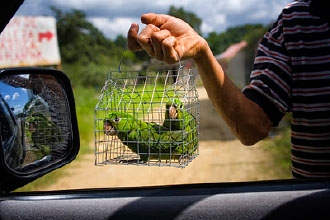
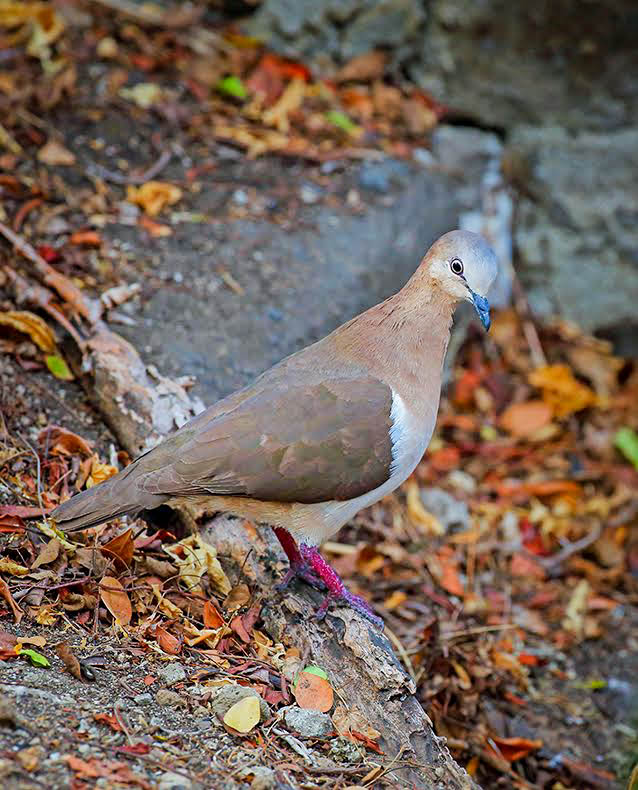
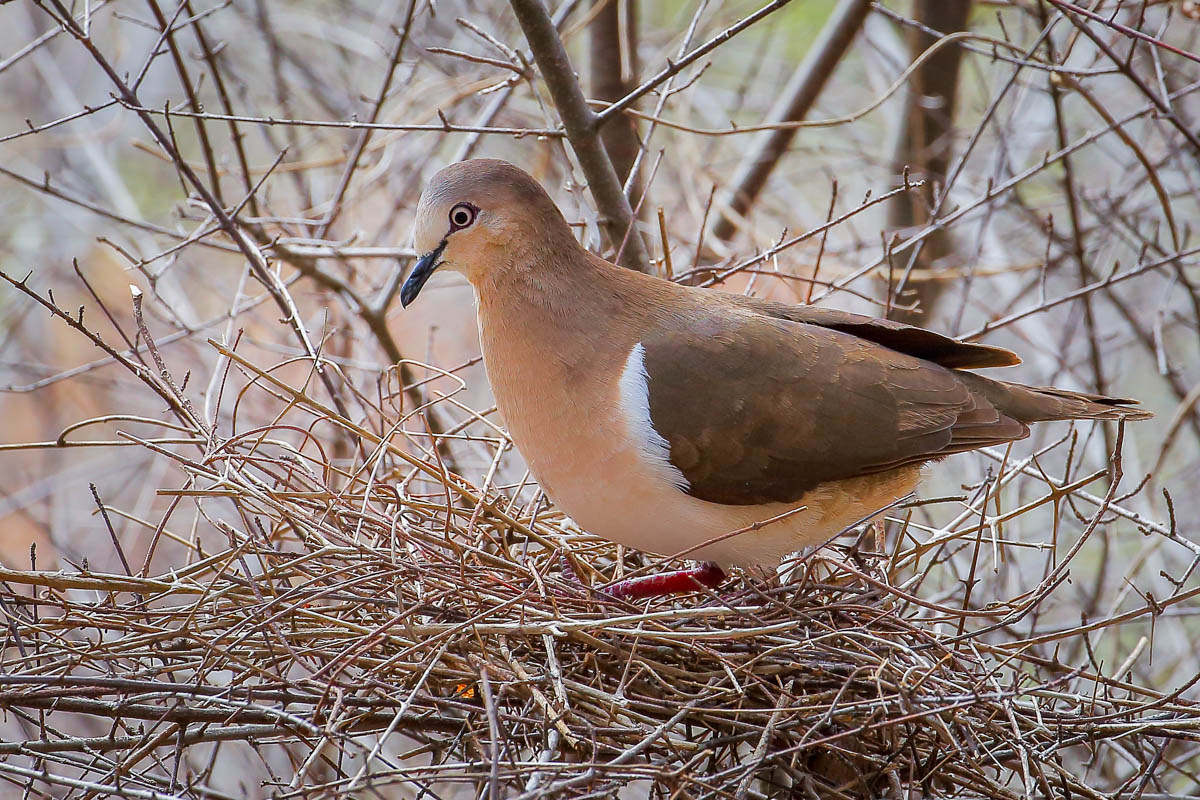
Hispaniolan Parakeets, native to Hispaniola, are illegally captured and sold for pets or smuggled out of the country for the pet trade.
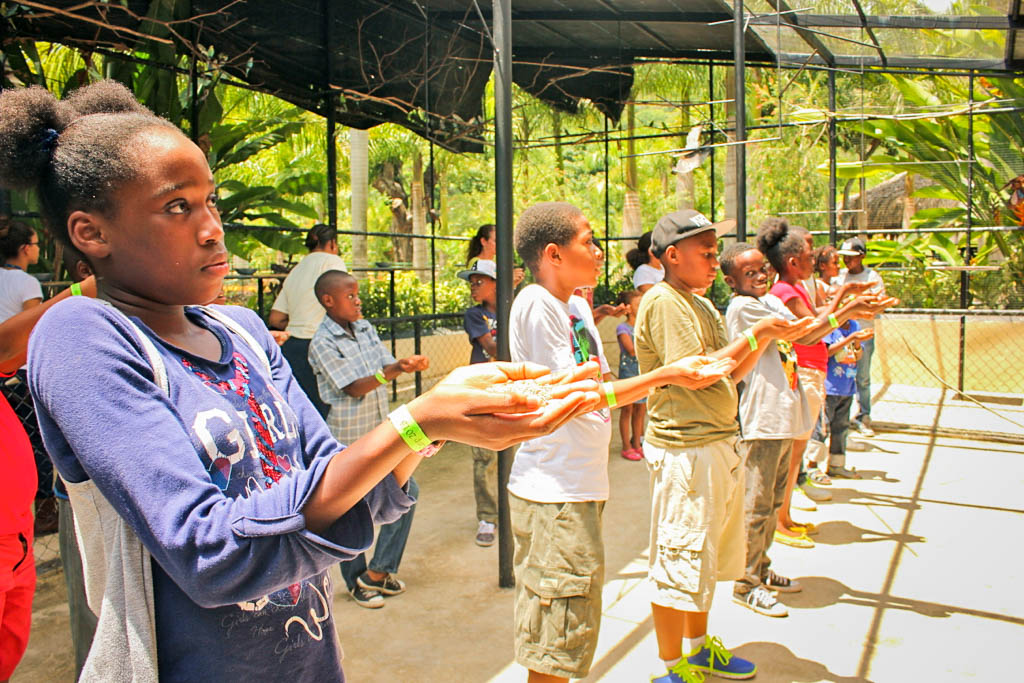
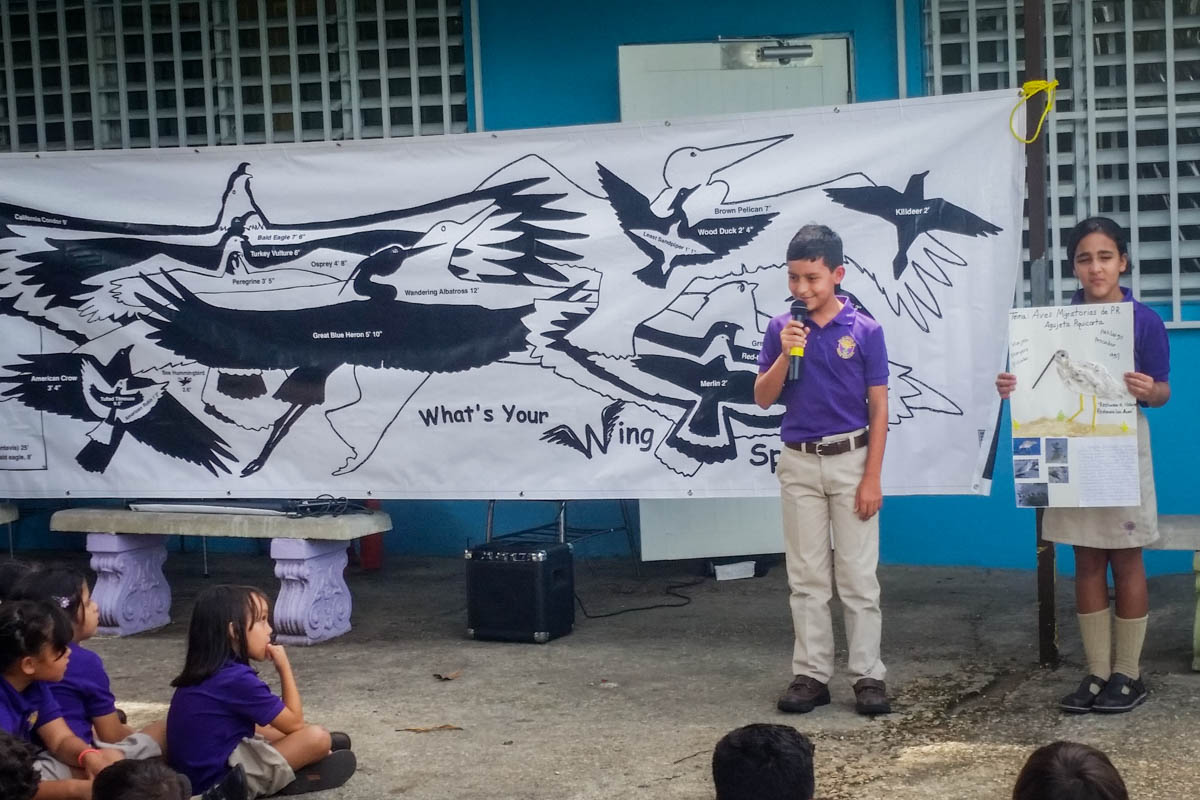
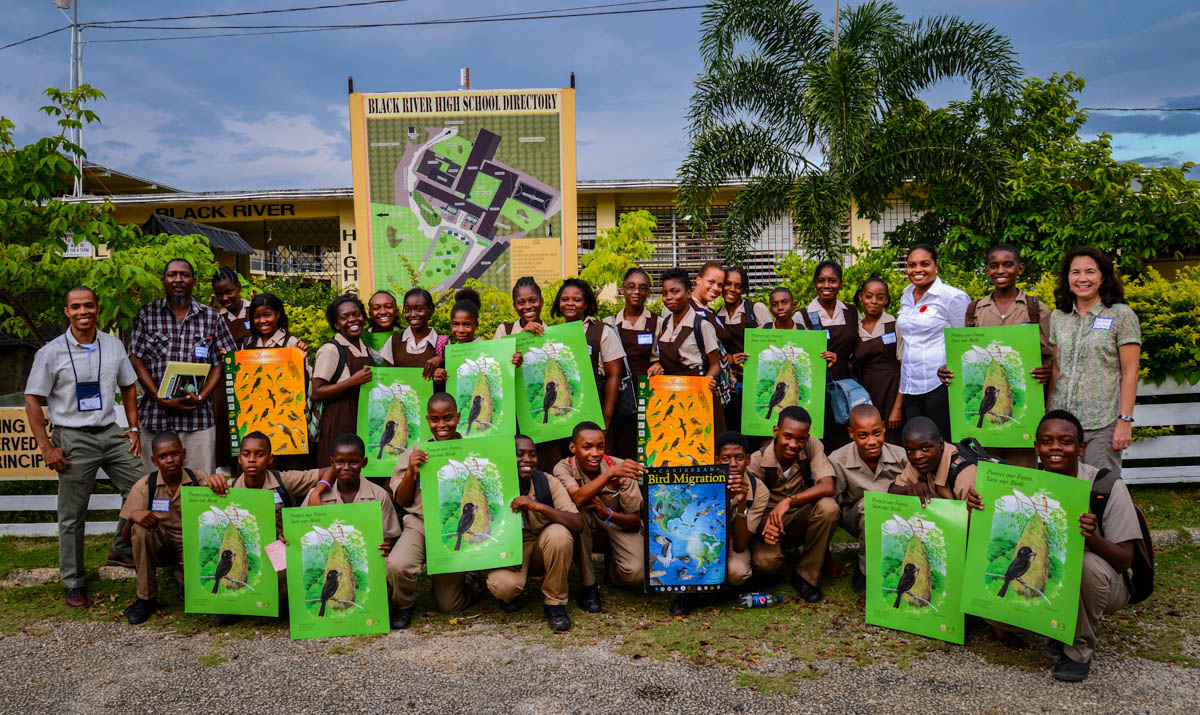
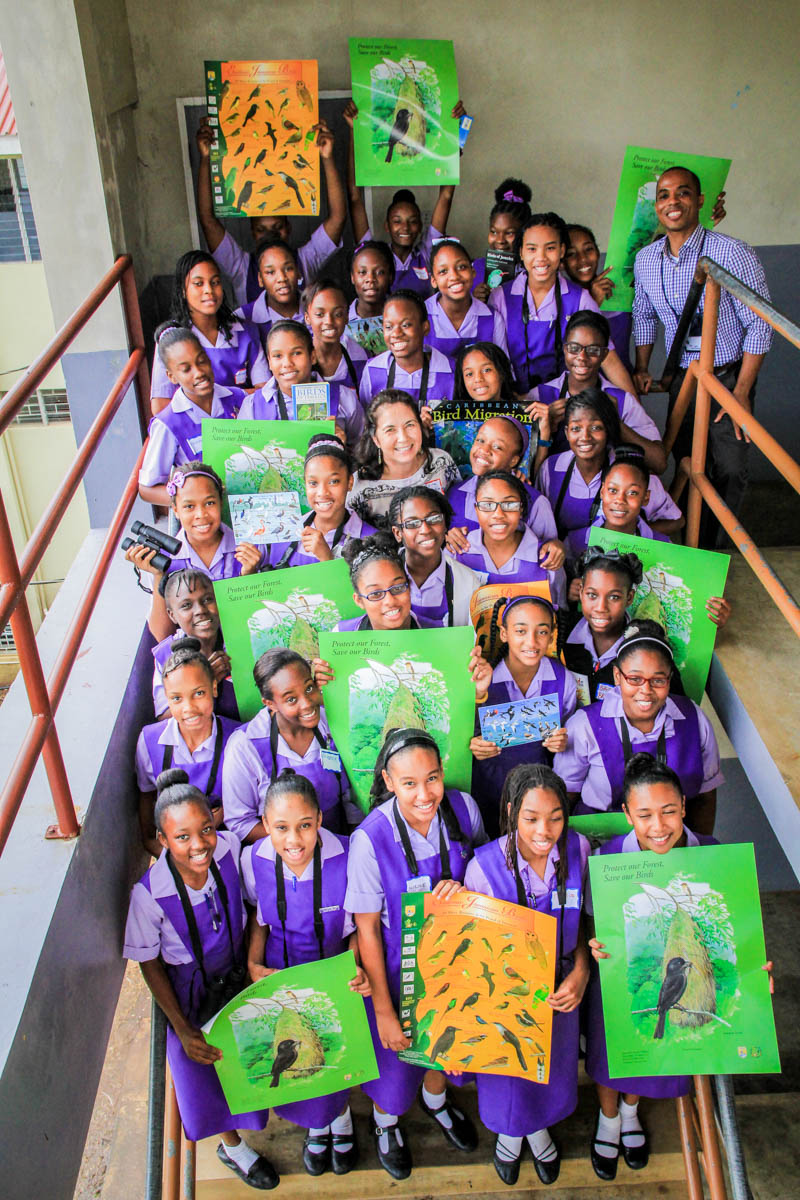
“Spread Your Wings for Bird Conservation” is the theme for this year’s celebration of the Caribbean Endemic Bird Festival. At dozens of events throughout the region, participants of all ages will learn about the different laws and programs that protect our unique birds and how everyone can participate in activities that help safeguard their long-term survival.
The festival, now in its 15th year, is led by BirdsCaribbean, the largest organization devoted to wildlife conservation in the Caribbean. The month-long festival includes Caribbean-wide activities beginning today – Earth Day (April 22), through to International Biodiversity Day (May 22), in more than twenty countries. The event celebrates the 173 bird species that are found only in the Caribbean, known as endemics. The highly successful program attracts over 80,000 participants and volunteers each year.
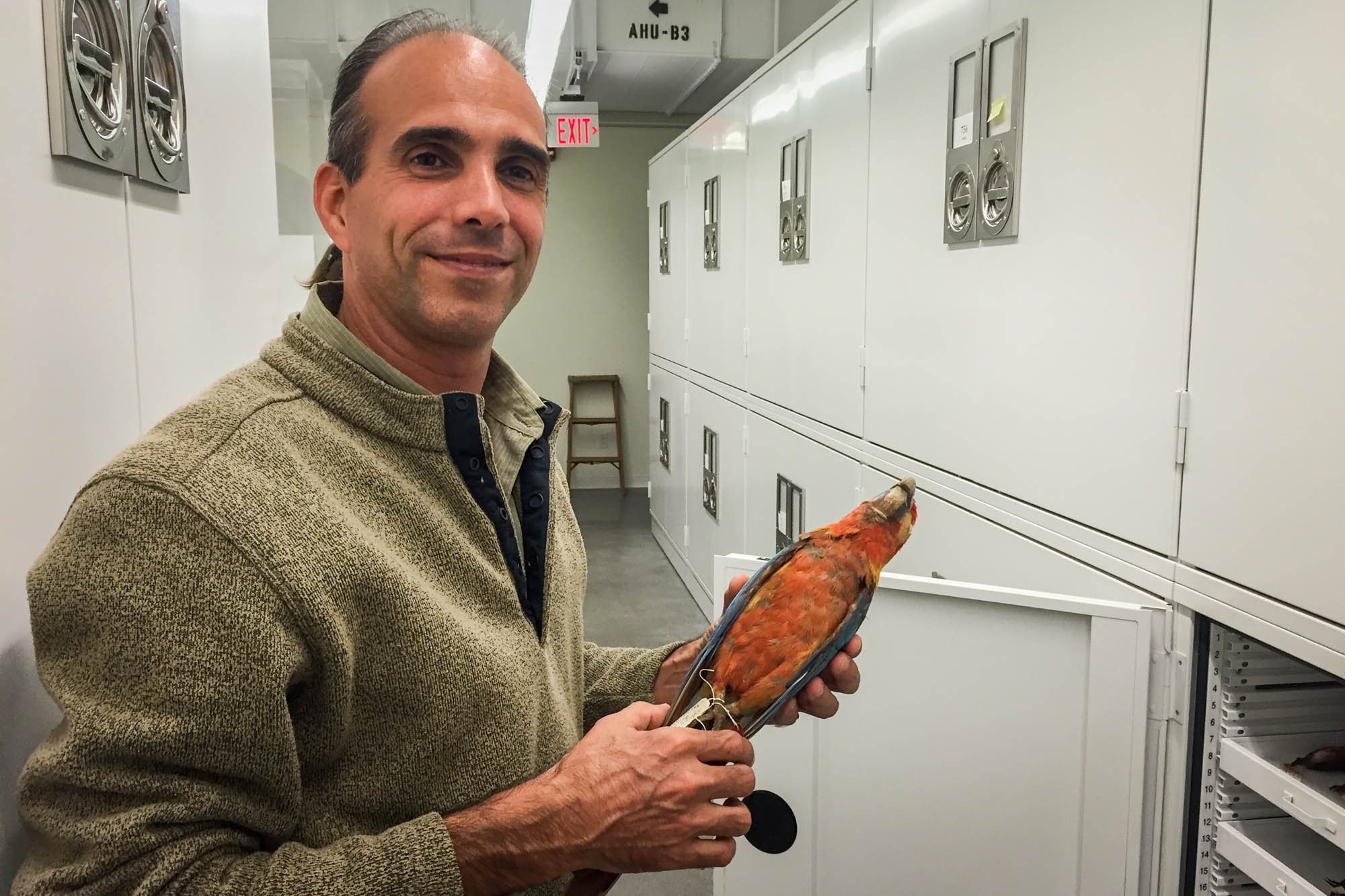
“Thanks to environmental laws, programs, and treaties set up to protect wild birds, there is a very good chance that our children and grandchildren will get to enjoy the same birds in their backyards, forests and wetlands that we do,” said Dr. Lisa Sorenson, Executive Director of BirdsCaribbean. “This has not always been the case and the result can be tragic.” A notable example is the extinction of the Cuban Macaw in the late 1800s due to hunting and capture for the pet trade.
Fortunately, far-sighted leaders came together to formulate international conventions and treaties that protect wildlife. For example, CITES – the Convention on International Trade in Endangered Species of Wild Fauna and Flora – was established in the 1960s to ensure that species threatened with extinction are not traded internationally. Another global agreement, the Convention on Biological Diversity, was set up in 1988 to increase biodiversity conservation.
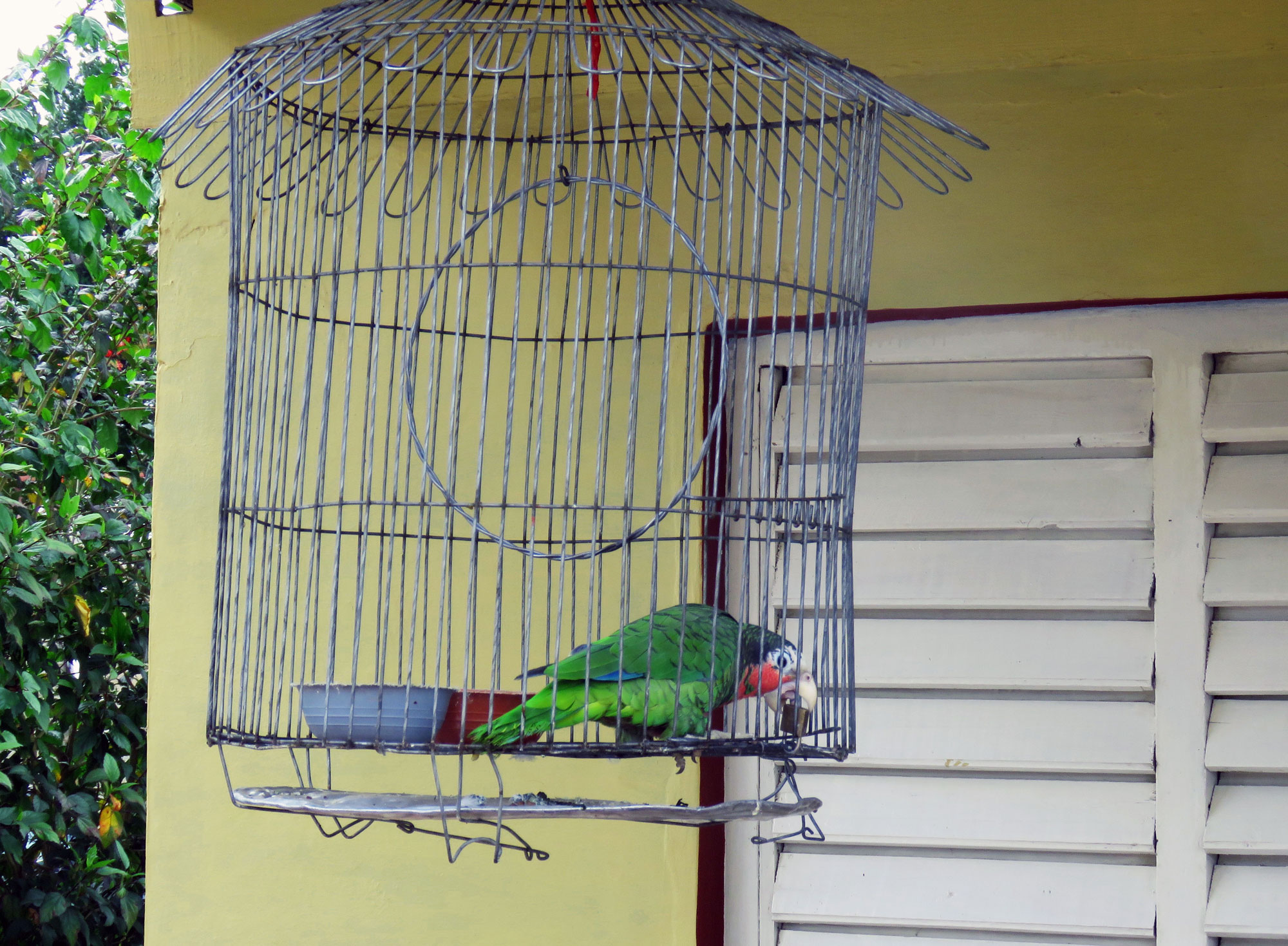
Here in the Caribbean most countries have signed onto these and other conventions and treaties but it is up to each individual country to take action to protect their wildlife, for example, through Wild Bird Protection Acts and setting up parks and protected areas. Many have done so with great success but challenges remain. Illegal hunting and capture, sale and trade of wild birds is still a significant problem in some countries. Endemic parrots and parakeets are particularly vulnerable, as are migratory and resident or endemic songbirds such as bullfinches, orioles, buntings and warblers.
Cuban Parrots, native to the Bahamas, Cuba and the Cayman Islands are illegally captured and sold as pets or smuggled out of the country for the pet trade.
“Keeping wild birds as pets in cages is engrained in some Caribbean cultures,” commented Leo Douglas, President of BirdsCaribbean. “Through education campaigns carried out as part of our festival, we want to make sure people know that these activities are illegal and could cause a species to decline and eventually become extinct. It’s up to all of us to be good stewards of our environment so that our invaluable natural heritage is preserved for all Caribbean people to enjoy.”
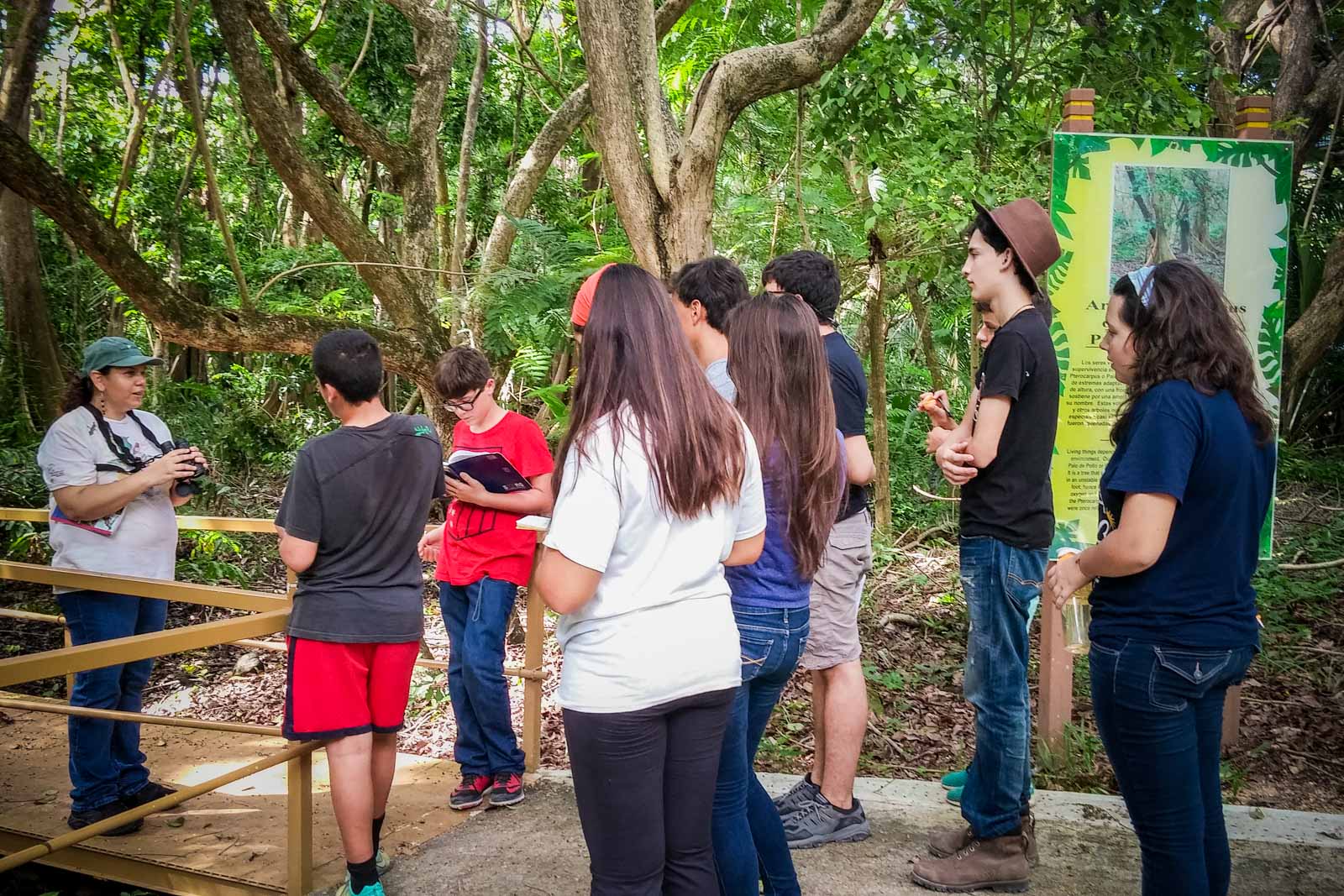
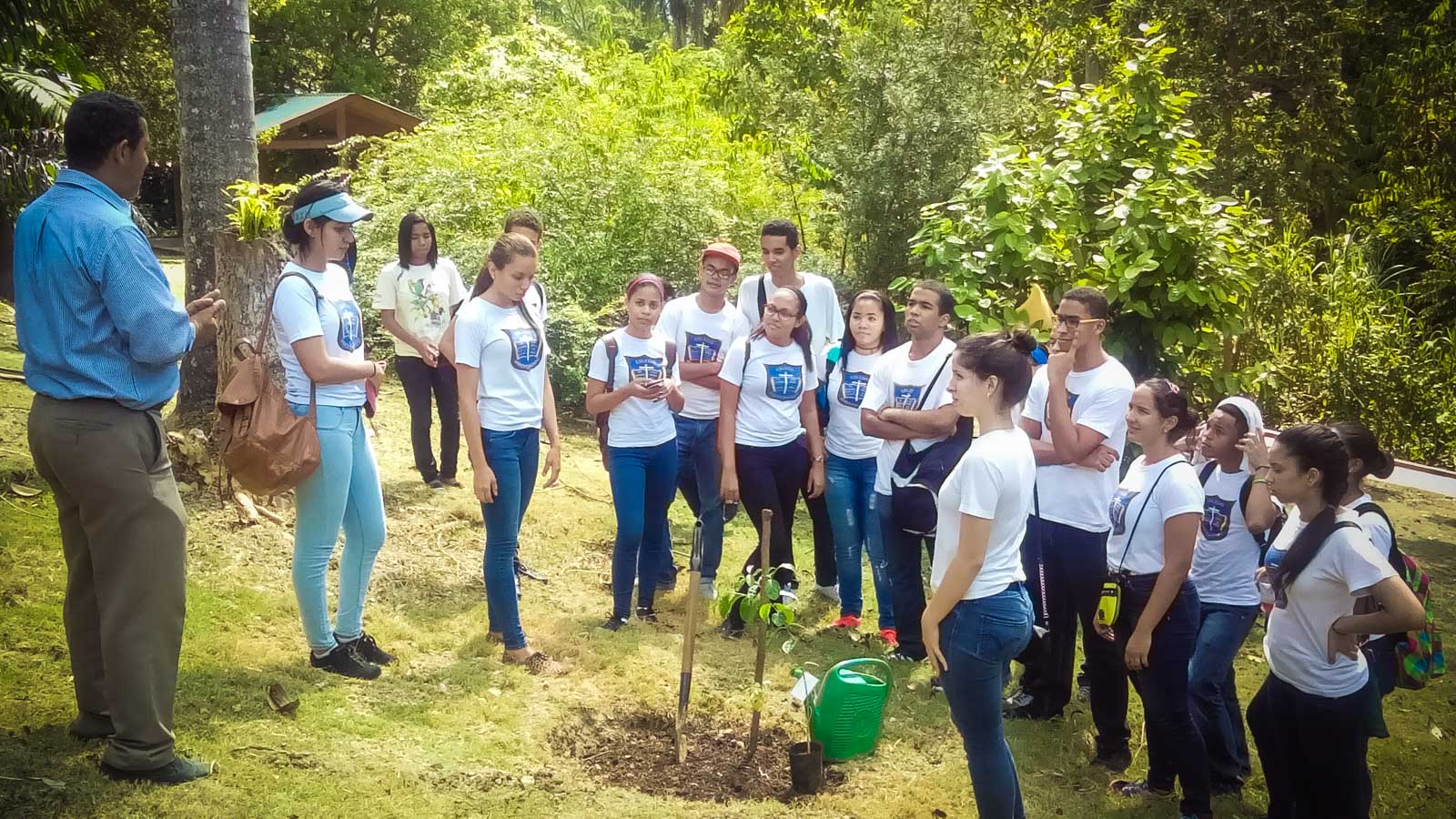
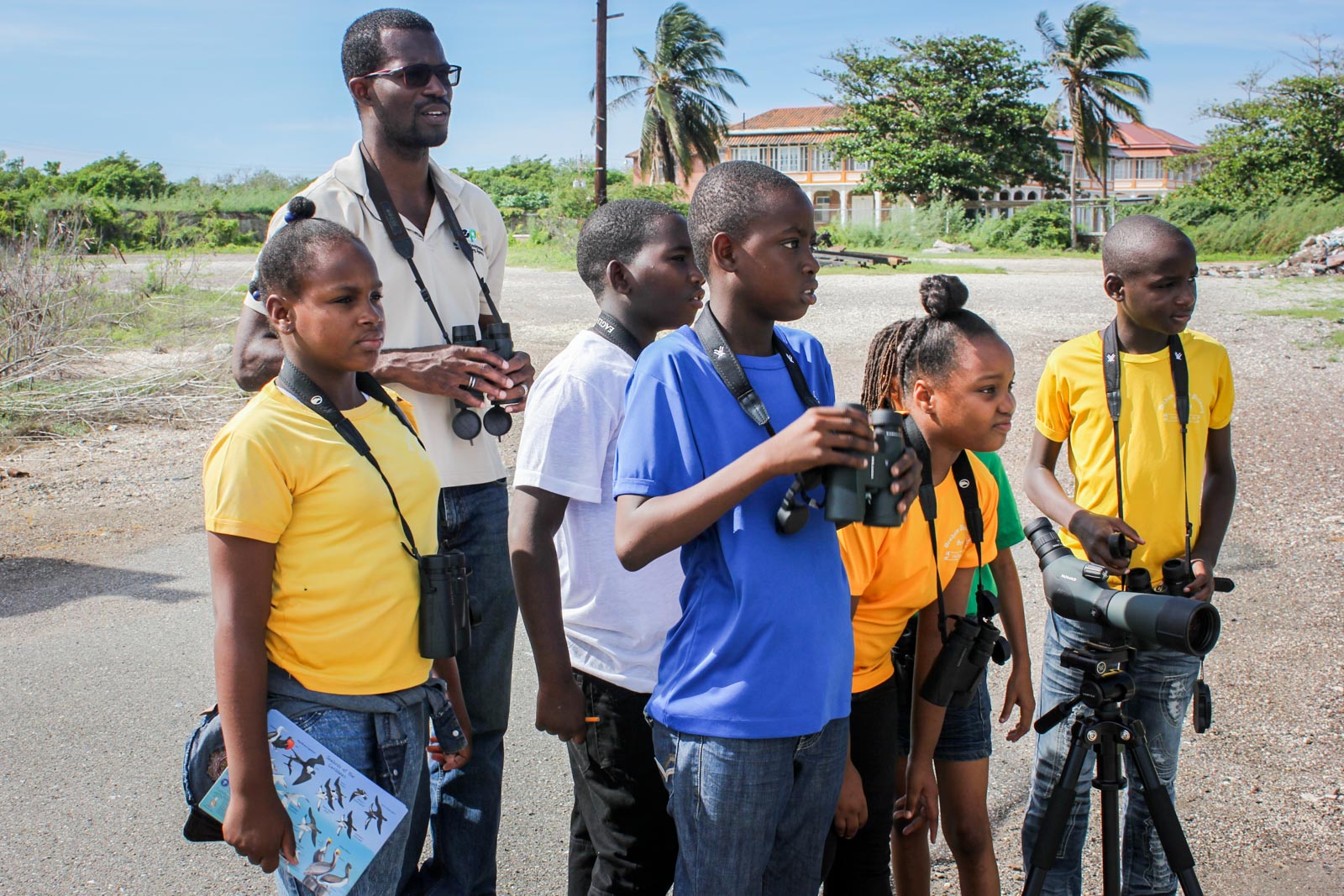
The goal of the month-long Festival over its 15-year history has always been to increase public awareness of the region’s exceptionally rich and threatened bird life, using the Caribbean’s celebrated endemic birds as flagships of conservation. Festival activities include a diverse array of public events including bird-watching excursions, lectures, seminars, photographic exhibitions, school-based art and costume competitions, church services, media campaigns, and theatrical productions all in recognition of the region’s rich bird life, natural heritage, and interconnectedness of regional habitats to global events.
This year, festival participants will learn about actions that they can take to help conserve birds. Never buying wild-caught birds and reporting the capture and sale of wild birds to the authorities is very important. Educating your fellow citizens and asking your government to prioritize bird and habitat conservation is another great way to contribute to the cause—our birds are worth much more alive in nature than in a cage in another country! Finally, planting native trees for birds and supporting local environmental groups that work to conserve nature can provide a big boost to birds.
To view reports and photos of past Caribbean Endemic Bird Festivals, for downloadable Festival resources, and for updates on ongoing and planned activities in your area, visit the Celebrate Birds page at www.birdscaribbean.org
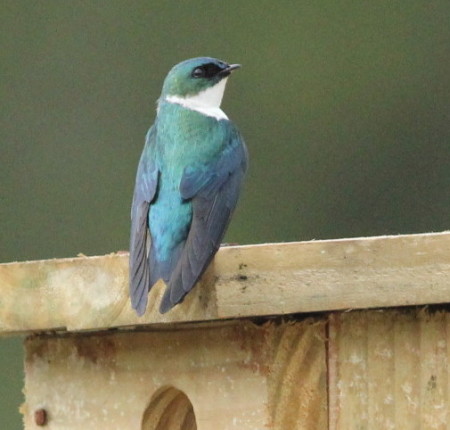
Male Hispaniolan Golden Swallow perched over-top an artificial nest-box in Parque Valle Nuevo, Dominican Republic; July 2014. (photo by Justin Proctor)
With a title like that, I’m hoping that many of you instinctively hucked your laptops across the room, sprinted out to the barn and started hitching your pride-and-joy appaloosa to the covered wagon your grandpappy gave to you as a belated wedding gift back in the summer of ‘69. Just don’t forget the “caulk the wagon and float” option if you’re coming from the mainland.
If you decide to make the journey, I suggest making landfall on the beautiful island of Hispaniola (gold deposits have all but dried up in Jamaica – but more on that later). Trade in your bikini and flip-flops for some long pants and hiking boots, because what you came for can only be reliably found high up in the mountains. Not that I like to give away too much insider advice, but if I were you, I’d keep heading up until you’ve reached the Hispaniolan pine forests – the highest altitude forest type you’ll find on the island. Find a grassy clearing, sit down, and wait, because at this point, the gold is going to come to you! With mighty wings (~11cm long each), fearsome talons (actually you’d have to strain to even notice the legs on this bird), and a relentless hunger for meat (prey doesn’t get much bigger than an 8mm march fly), watch out as the infamous Golden Swallow comes tearing over the nearest hillside radiating its majestic golden sheen across the lands…wait…wait…I can’t do this anymore. It’s a tiny bird that can’t peck to save its life, and unless the light of a passing-by solar flare manages to reflect off the swallow’s dorsal plumage at a perfect 47.86o angle, the bird is green!
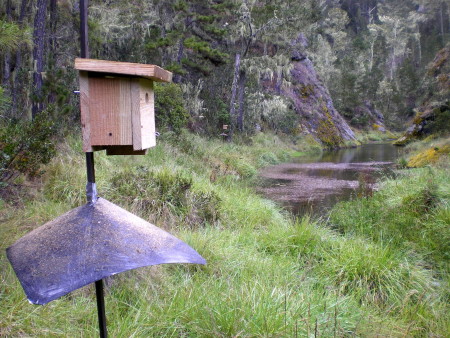
Artificial nest-box mounted to a pole with a cone-shaped predator guard attached beneath, Parque Valle Nuevo, Dominican Republic; June 2014. (photo by Justin Proctor)
In 2010, in collaboration with the Golondrinas de Las Américas (Swallows of the Americas) project at Cornell University, researcher Jim Goetz and Dominican biologists Esteban Garrido and Jesus Almonthe erected nearly one hundred artificial nest-boxes across a national park known as Parque Valle Nuevo (Parque Nacional Juan Bautista Pérez Rancier) located in the Dominican Republic’s Cordillera Central. Their hope was to attract a sizeable, returning population of breeding Hispaniolan Golden Swallows (Tachycineta euchrysea sclateri) to those nest-boxes so that a formal study of the species could be carried out. By 2012 the plan had worked, and word spread back to Cornell that the time was ripe to find someone to undertake the research. Upon hearing about the opportunity – and conveniently in the very beginning planning stages of my master’s thesis – I decided to give it a go. I was fresh off two years of back-to-back-to-back field seasons working with Tachycineta swallows up and down the Western Hemisphere, and I was ready to find out where else this genus of acrobatic aerial insectivores could take me.
The Hispaniolan Golden Swallow, it turned out, was considered endemic to the island, threatened, and in steady decline. Furthermore, there was so very little known about it. Some work had been done with a very small breeding population that was nesting in crevices within the walls of abandoned bauxite mines located in the Aceitillar region of the Sierra de Bahoruco, but that was really about it. As I came to realize both the extent of what we didn’t know as well as the current plight of the species, I decided that a focused study of the swallow’s breeding biology would simply not be enough. The project would have to be more holistic. The work I decided to do would have to be chosen for its relevance and thus its ability to produce information that helped develop both short and long-term conservation management plans for the species. The project could only truly be successful if its every facet was geared towards having a broader impact on the future of the Golden Swallow. So, I had three years (roughly speaking – this is academia we’re talking about) to make some magic happen, and with the laundry list of ideas and goals growing daily, I knew I was going to need some help. Much to my good fortune, I found smiling faces and willing bodies around absolutely every bend in the road. [All of those people, groups, and foundations deserve their own article – and I plan to write it – but in the meantime let me just say that I’m hoping we all set some kind of record for the 400 word acknowledgment section within our Hispaniolan Golden Swallow monograph that’s currently under review for publication by the JCO.]
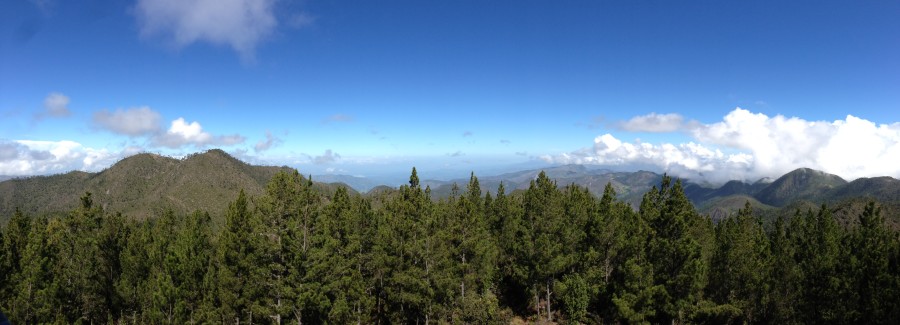
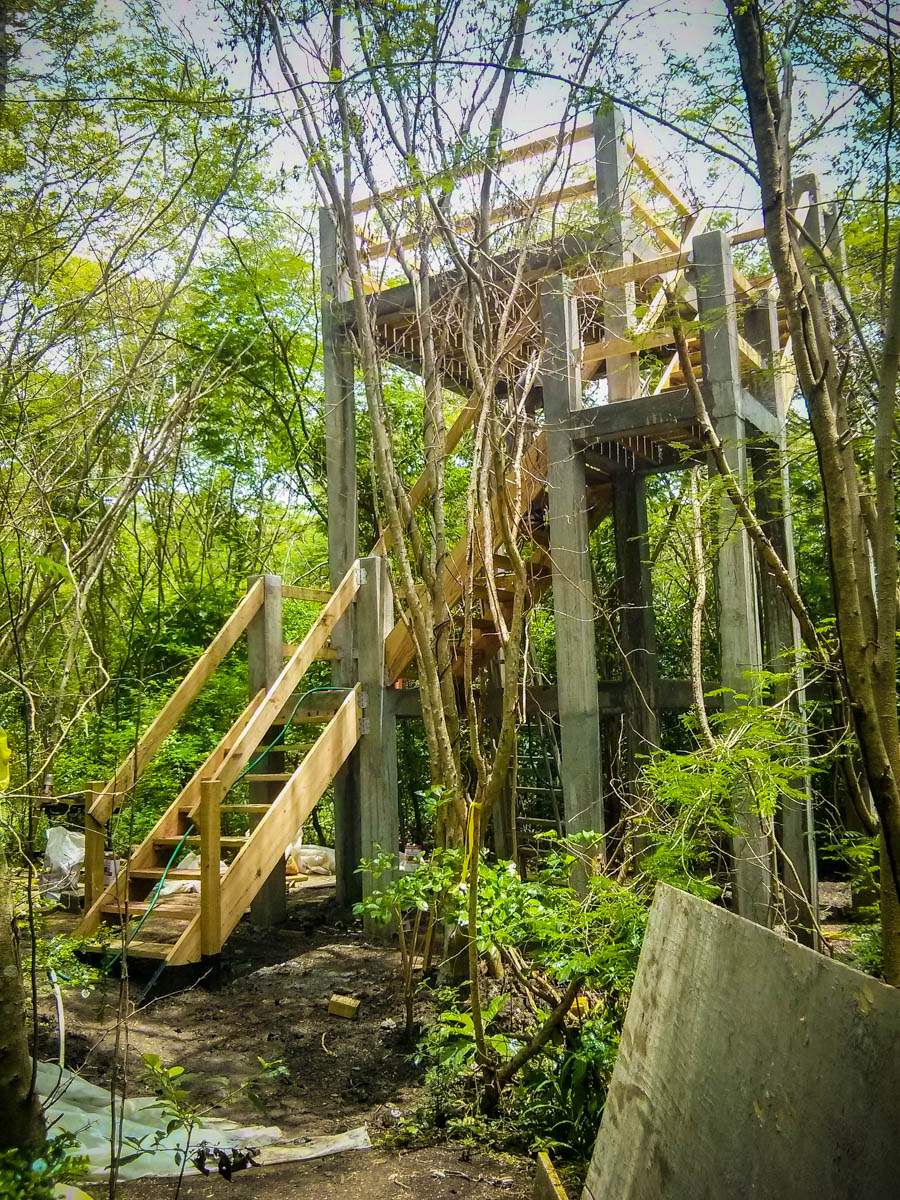
View of Parque Valle Nuevo from the top of the Pajon Blanco Fire Tower; Dominican Republic. (photo by Justin Proctor)
And so we set out on an adventure of a lifetime with the underlying goal of studying a bird and using what we learned to help save that bird, while simultaneously nourishing an already burgeoning sense of local stewardship over Hispaniola’s feathered friends and the habitats they so deeply depend upon. We set the bar high from the beginning, and I can be honest in saying that I feel good about what we accomplished and where the project stands today.
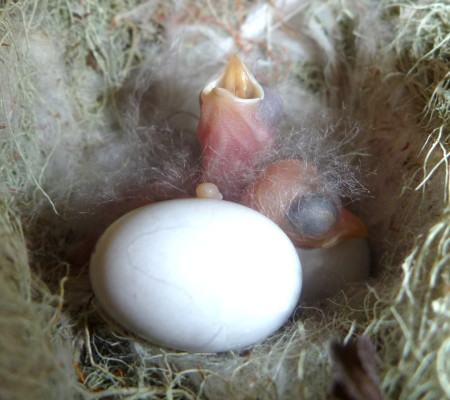
Two Golden Swallow chicks have just hatched. One begs for food, one contemplates life, and one refuses to come out; Parque Valle Nuevo, Dominican Republic, 2014. (photo by Justin Proctor)
However, as opposed to trying to tackle an impossible play-by-play of what transpired over those next three years (thankfully all of that information is in my master’s thesis and can be yours for just three easy payments of $29.99), I’m going to take a slightly different approach. I’m going to share with descriptions of images (and feelings) that go through my head when somebody kindly asks me, “So how’d that Golden Swallow Project go?” Little does that person know how much weight a question like that can have, or how it causes me to temporary black-out as my mind boards a high-speed emotional (and perhaps somewhat spiritual) roller-coaster from which there is little hope for return for at least the ensuing two minutes. So let’s go for a ride.
My wife, Marisol, and I are inside of a rental jeep that hasn’t had a tune-up since Elvis left the planet. It’s 10pm (pitch dark), and there is a rather large gathering of people around us. Some are cheering, others look nervous. We are momentarily stopped, looking out in front of us at a raging river flowing out of a stormy valley. The road, of course, stops at one side of the river and continues again on the other side. That “other side” is our only way home, back up into the mountains after having endured a long day of re-provisioning our food supplies down in town. It’s been an intense first field season so far. There have been high highs and some low lows. We really want to get back up to the cabin where we’ve been living, because field work awaits us again at 6am the next morning. Against my better judgment, we begin moving forward and into the river. Despite the water starting to come in through the driver’s side window, the four-wheel drive seems to be working well, and a grin starts creeping onto my face. That grin disappears quickly when all four tires stop making contact with the gravelly bottom of the river and the current begins carrying us downstream.
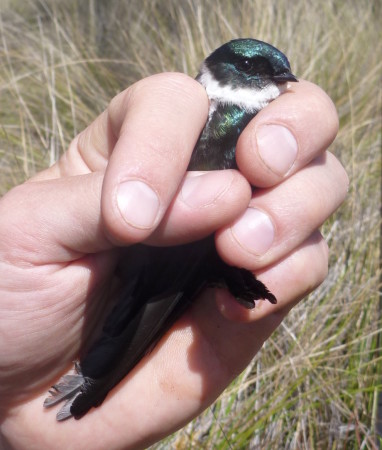
I successfully trap and get my first close-up look at a Golden Swallow. It’s a female, and she’s rather calm
Adult female Golden Swallow in the hand that will soon be measured, banded and then released; Parque Valle Nuevo, Dominican Republic. (photo by Justin Proctor)
in the hand. My rule is to keep her no longer than two minutes, during which time I’ll need to take at least four different biometric measurements, describe her plumage, and place an aluminum band on her leg. That doesn’t leave much time to just admire. But a few seconds turns out to be just enough.
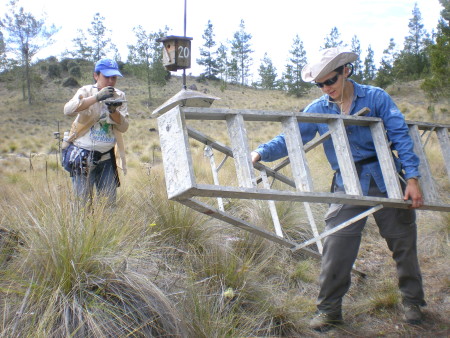
I look at one of our 200 artificial nest-boxes (we expanded considerably our first year) and realize how simple it is. Yet, at the same time, it’s the solution to everything. First, the box provides a nesting cavity for swallows in a habitat where otherwise very few natural cavities exist, which results in more nesting attempts by more pairs of swallows. Second, with the boxes attached to free-standing poles, a predator guard in the form of a metallic cone can be fashioned below the box to thwart attacks from invasive rats and mongoose (not to mention those damn feral cats!). This results in higher rates of brood survival in the face of unnatural – and overwhelming – rates of predation and subsequent nest failure. Third, the boxes are built to be temporarily opened from the side by researchers studying the breeding life history of the swallows. This provides us access to a nearly limitless wealth of data. Fourth, the boxes are tangible, visible, and accessible. These are perhaps the most important features. The box itself becomes a curiosity, a talking point, and ultimately an icon for our collective efforts to protect and care for nature. Although maybe not the long-term answer, the nest-box is invaluable for now.
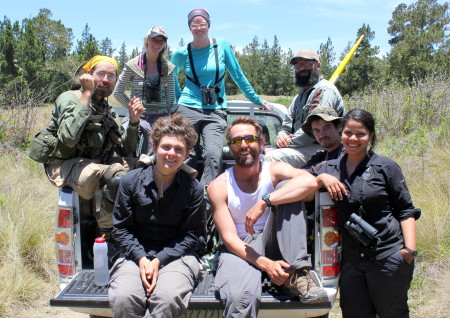
My field crew today consists of two Dominicans, one Haitian, two Argentinians, one Cuban, and one Venezuelan. It wasn’t necessarily easy, but we got them all here. Cross-culture-pollination is the bread and butter of great science and conservation work. Amazing how quickly good solutions come in an environment like this.
The Hispaniolan Woodpecker field team (led by Josh LaPergola, Cornell University) and the Hispaniolan Golden Swallow field team combine forces; Parque Valle Nuevo, Dominican Republic, 2014. (photo by Marisol Mata)
Josh LaPergola – the legend that studies Hispaniolan Woodpeckers in Jarabacoa – has come to visit me up in Valle Nuevo. He’s brought his entire field crew along with him in an attempt to help me piece together the riddle of why there are so few woodpeckers (and thus cavities that my swallows can use to nest in) in the high-altitude pine forests where I am working. We spent the last two days hard at work, so this evening I’m treating the group to a dip in the upper pool of Aguas Blancas, one of the best waterfalls on the island. Anyhow, Josh does a mean cannonball off the nearby rock face (perfect execution by the way), surfaces a few seconds later, and casually admits that he forgot to take his glasses off before he jumped in. Though the story only goes downhill from there, our admiration for Josh grew stronger that day as we saw in him an inhuman level of determination as he nearly went hypothermic (yes, that water is unforgivingly cold) by repeatedly diving down into the zero-visibility abyss trying desperately to save the fate of his summer. [A big shout-out to Josh, who just unfortunately suffered a serious accident during his 2016 field season, but is currently managing to push through a difficult recovery with nothing but a smile on his face. All our best buddy, we’re thinking of you!].
My field assistants and I sit down in front of an evening fire with the local park guards in Valle Nuevo. They
Field assistants Ianela García Lau (Habana, Cuba) and Milagros Jefferies (Mendoza, Argentina) busy checking all 185 nest-boxes for signs of nesting; Parque Valle Nuevo, Dominican Republic, 2014 (photo by Justin Proctor)
are bursting with energy, interrupting each other to tell me stories about the Golden Swallows they saw while making their rounds that day. One man says that he’ll give his life for those birds. I laugh, but make sure to grow a little more serious when I tell him that that’s not totally necessary…just in case. At the end of the night, I walk back to the cabin realizing that really well-done outreach takes your passion and makes it contagious.
I’m sitting at my office in Ithaca, NY in August, post field-season, and receiving a flurry of emails that Parque Valle Nuevo is burning. A forest fire spreads rampantly across the national park, directly through the areas where all of our nest-boxes are located. Everything is lost.
Not much later, I’m sent a flurry of photos that indicate otherwise. Because the nest-boxes are all mounted on metal posts in meadows away from the forest edge, the fires in those areas have burned low to the ground, passing quickly underneath them. The nest-boxes, in many areas, are the only things left standing. Though a few were lost, word soon comes back to me that they have been replaced. The project carries itself without me – a major success for everyone and a solid indication that many more good things are to come!
As my vision begins to clear, I know all-too-well what I’ll hear next…
“Whoa, sounds like an adventure! So, tell me, what are your plans for a PhD?”
[My vision goes dark again…]
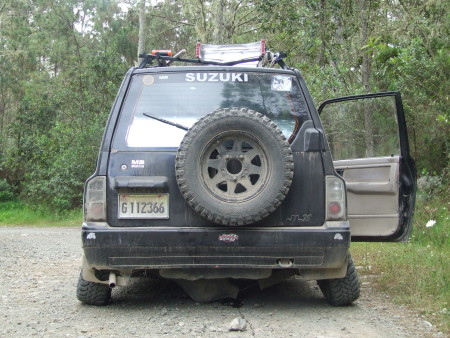
Our (un)faithful jeep breaks down again. This time the rear axle snaps in half. Not good. Parque Valle Nuevo, Dominican Republic, 2012. (photo by Justin Proctor)
In 2014, I conducted my last full field season in the Dominican Republic (in other words, I had burnt up all of my NSF funding and the winds of change were blowing my wife and me from Ithaca down to Raleigh). That being said, I was (and still am) extremely passionate about Golden Swallows, and more and more so about aerial insectivores throughout the Caribbean (swifts and swallows of course; those flycatchers and nightjars will have to find other sponsors). I did, however, have the pleasure of sneaking in one more (big) Golden Swallow adventure before my master’s defense came around. I was asked by Gary Graves, the Curator of Birds at the Smithsonian National Museum of Natural History, to finish the long-running census work he had been carrying out in Jamaica in search of the critically endangered Jamaican Golden Swallow (T. e. euchrysea) – the only other known race of Golden Swallow and one that hadn’t been reliably seen since the 1980’s. Gary had scoured the island except for two places the Cockpit Country in the northwest and the Blue Mountains in the southeast.
I had never been to Jamaica before, and judging by its miniscule size relative to Hispaniola on a map, I figured I could probably walk across that island in a day. Easy. Well, Proctor men have been wrong before, which means it was bound to happen again. It turns out that remote census work in Jamaica was more physically demanding (by far) than anything else I’d ever done in my life. Luckily, with unwavering field assistants at my side (Seth only collapsed vomiting from the stress twice, mind you, and John only plunged off a cliff once), we hacked our way across as many miles of that terrain as we possibly could in two months’ time. Remember earlier on when I mentioned “gold” being scarce in Jamaica. Unfortunately, that’s the truth. By the end of our work, and in light of compounding evidence in favor, we made a formal declaration that the Jamaican Golden Swallow was indeed extinct (look to Volume 29 of the JCO!). Despite not finding our search target, we were able to document many other interesting behaviors exhibited by the swift and swallow species that still inhabit the island. Furthermore, the extinction of the Jamaican Golden Swallow race brings considerable perspective to the importance of the conservation efforts surrounding the remaining race in Hispaniola.
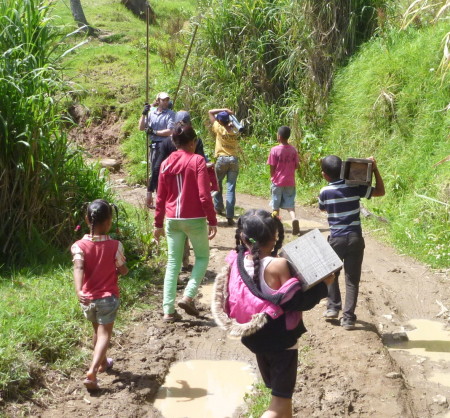
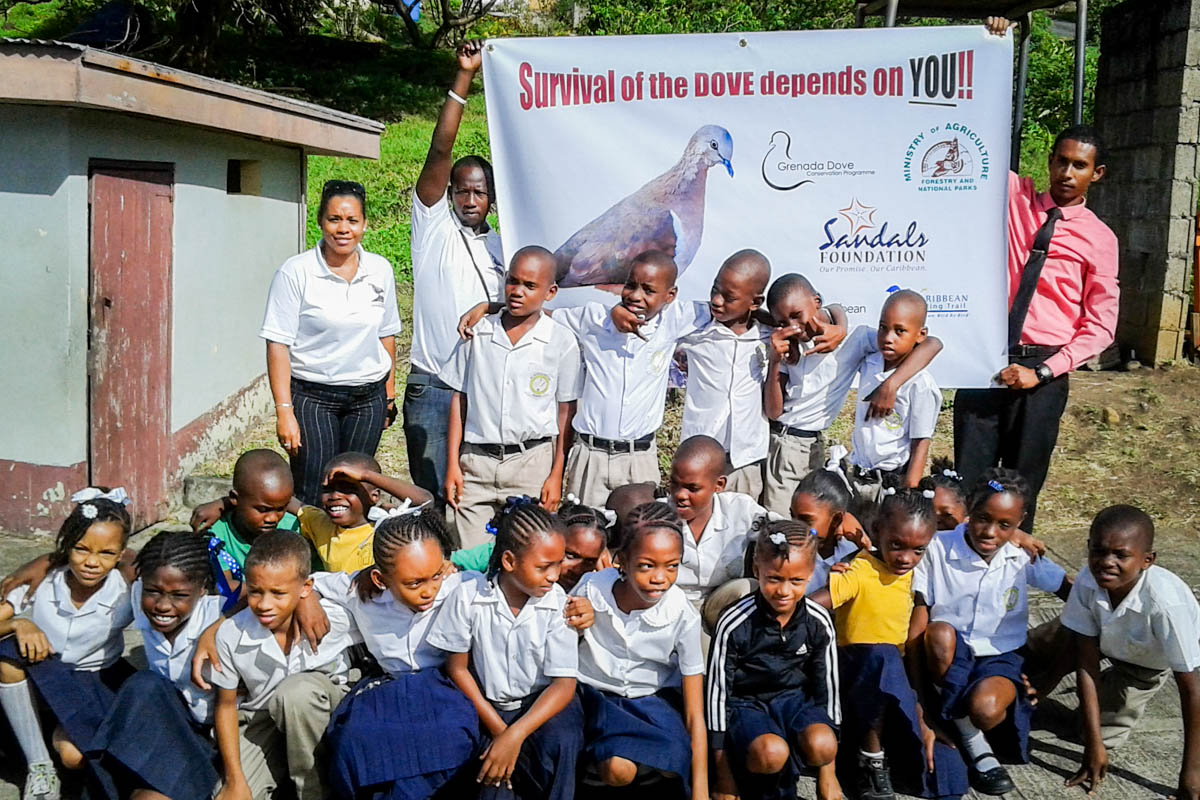
School children from the town of El Castillo spend the day helping researchers erect new nest-boxes; La Vega, Dominican Republic, 2013. (photo by Jose Delio Guzman)
I think that there is a slow, but powerful momentum growing behind the idea of conservation in Hispaniola, and I’m hopeful that the work that so many of us have put into the Golden Swallow Project will continue to help that movement grow. So I encourage all of you to put the mountains of Hispaniola on your bucket list – they won’t disappoint. Maybe there will be a little bit of gold waiting there for you when you arrive.
Your Caribbean Gold Digger,
Justin Proctor
PS. An afterthought – I want to encourage birders and ornithologists (especially those that have somehow made their way through the entirety of this blog post) to pay a little extra attention to aerial insectivores during your future outings, and to document what you see by entering your observations in eBirdCaribbean. We are going to need all the information we can muster in order to grow our information banks strong enough to better diagnose – and do something about – the causes behind the growing, widespread trend of aerial insectivore decline in North America. For many of these species, a little bit of information goes a long way. Thank you!
You can see a compilation video of our work in Jamaica with clips of birds and scenery from sunrise to sunset here.
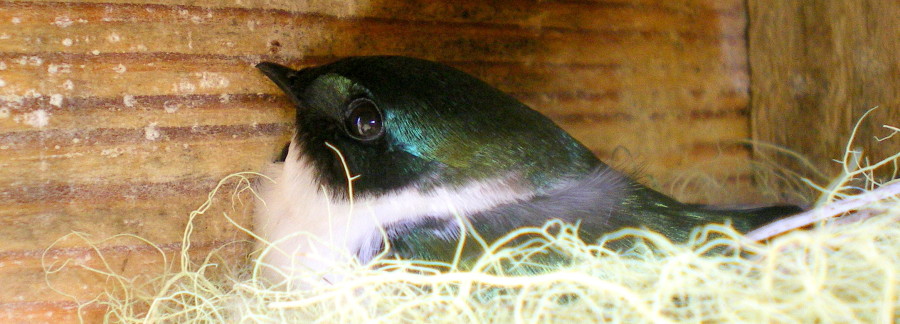
Adult female Golden Swallow incubating her clutch; Parque Valle Nuevo, Dominican Republic, 2013. (photo by Justin Proctor)
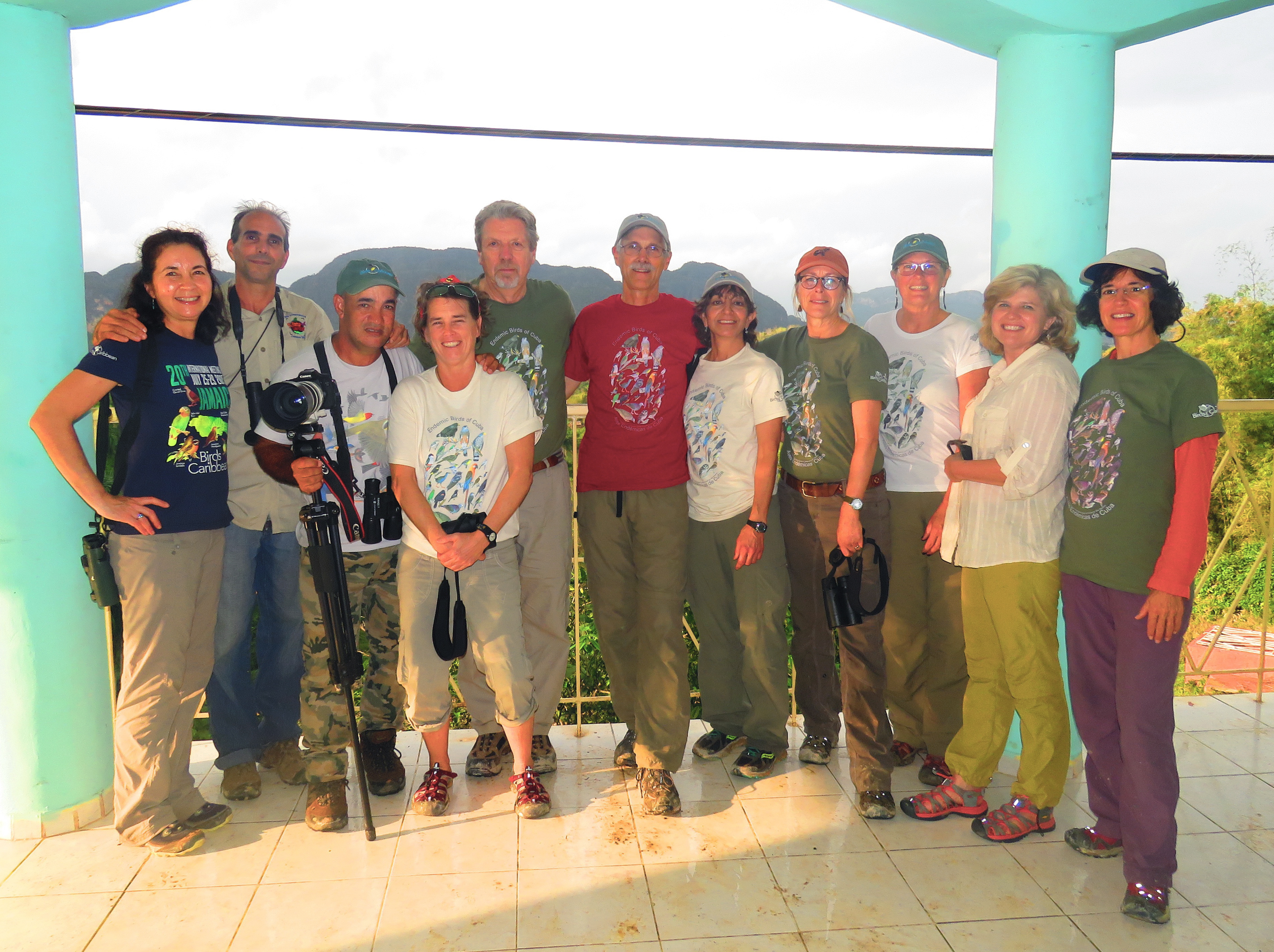
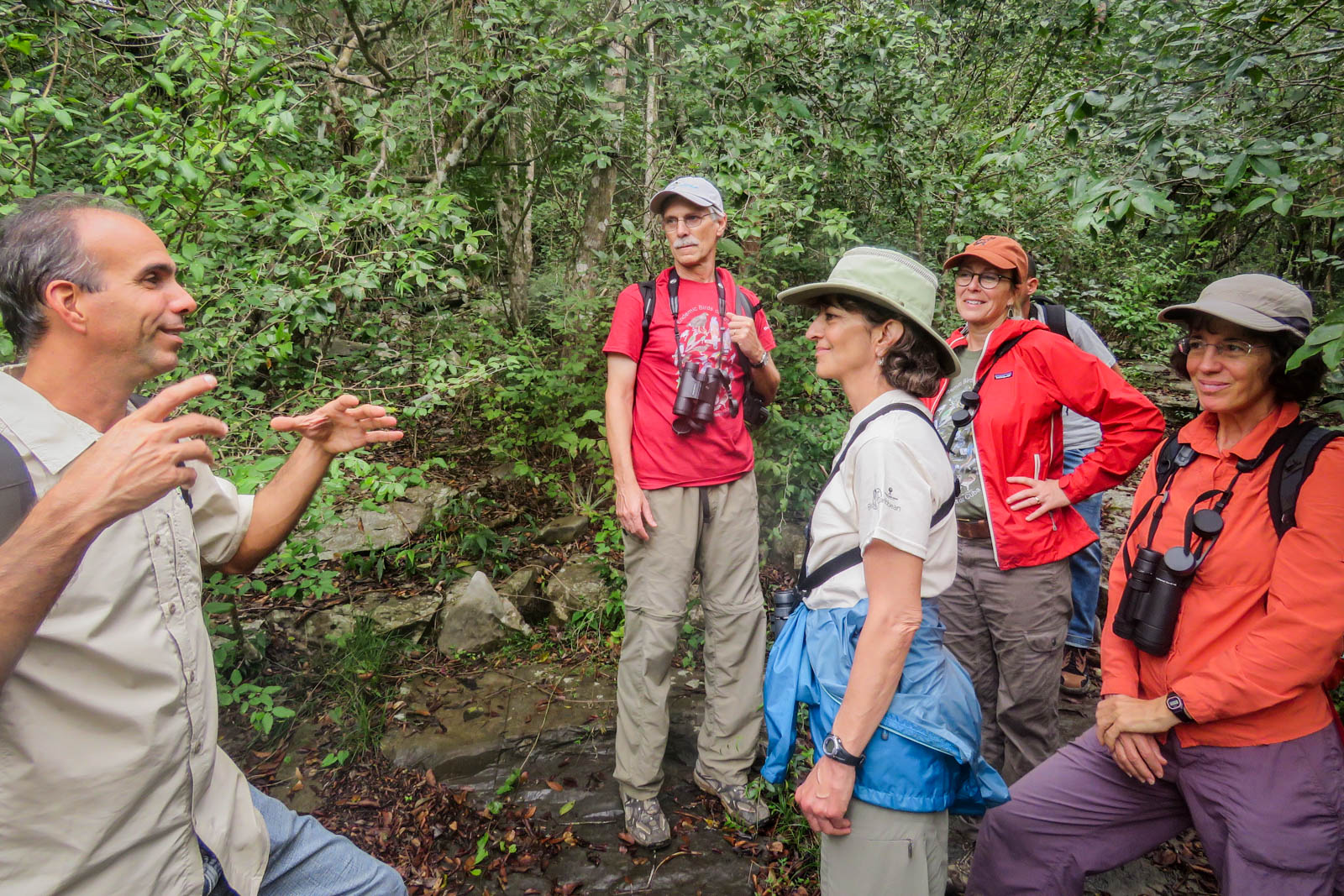
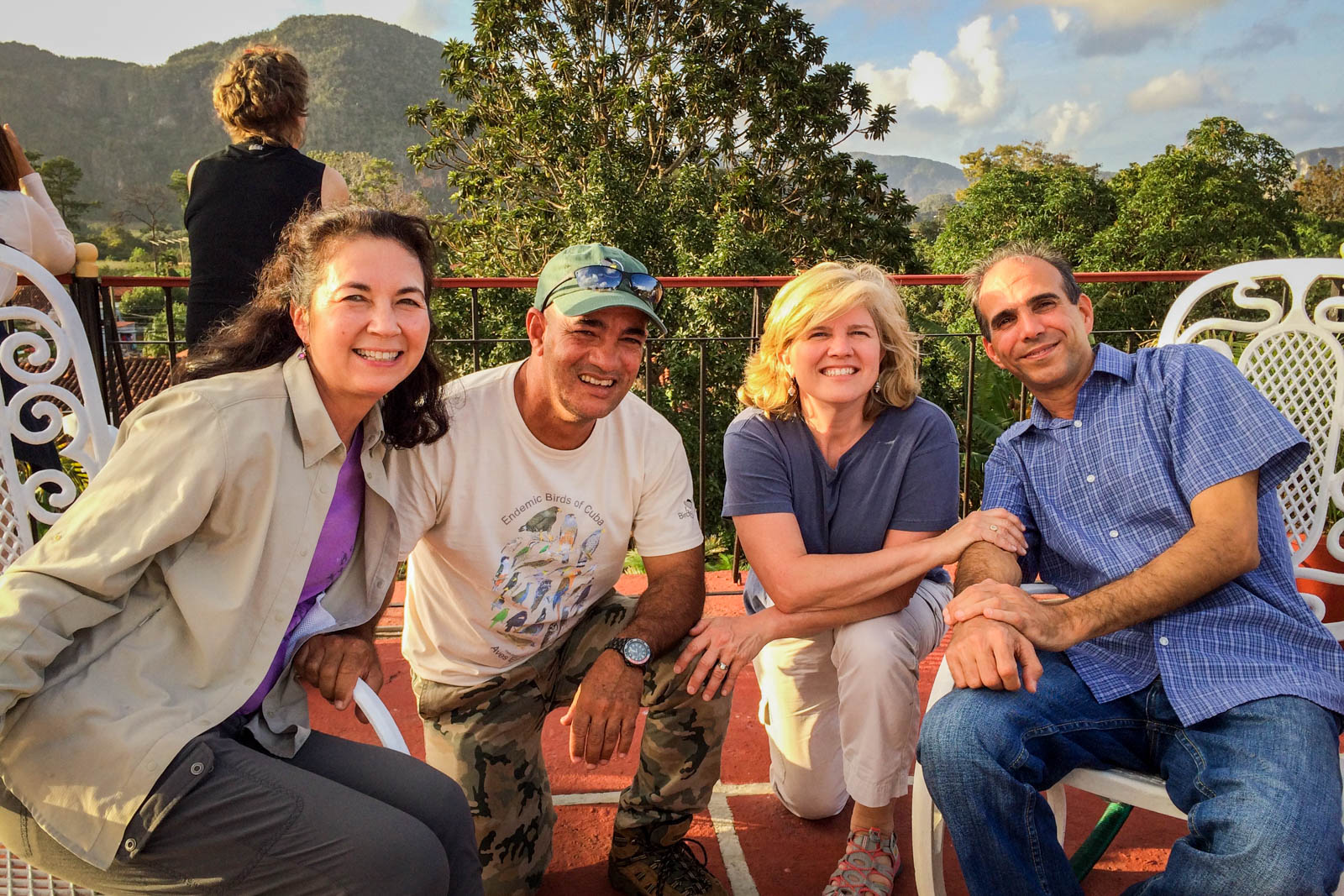
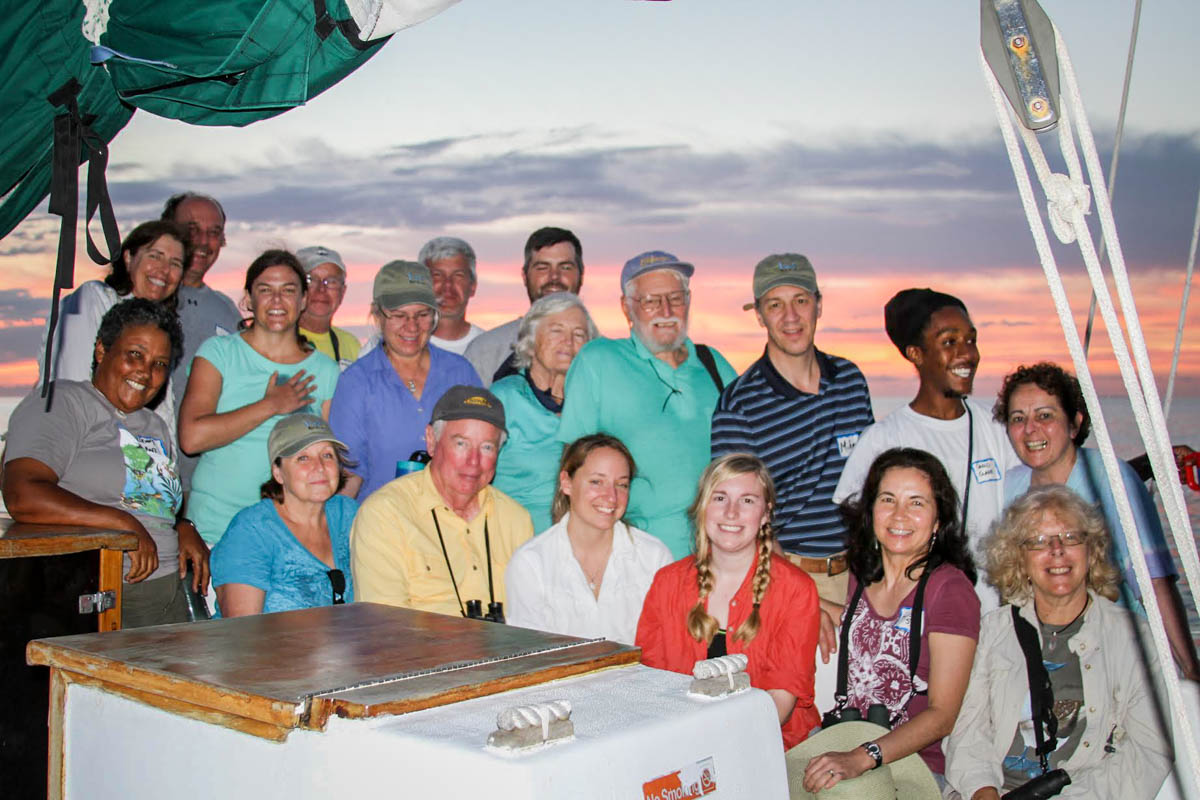
BirdsCaribbean bird tour group at Viñales Valley, Cuba with our local bird guide Ernesto Reyes and Nils Navarro, author of “Field Guide to the Endemic Birds of Cuba.” From L to R: Lisa, Nils, Ernesto, Ann, David, Jeff, Vicki, Margaret, Joni, Jennifer and Susan.
Cuba—definitely on the bucket list of most birders and indeed world travelers, but not the easiest country in the world to travel to for Americans. “I’ve waited 57 years to take this trip,” declared David Hill. “The door slammed shut on me in 1959, but now, finally, I have the chance to visit.” David, a retired airline captain and founder of RARE, was one of nine persons that traveled to Cuba for a birding expedition organized by BirdsCaribbean, January 22-30.
The Caribbean Birding Trail tour, which included time in Havana, the Zapata Peninsula and Viñales Valley, was designed to not only see as many endemic birds (27!) as possible but also to experience Cuba’s vibrant culture, beautiful landscapes, and warm and friendly people.
The co-leaders of the trip were Lisa Sorenson and Jennifer Wheeler from BirdsCaribbean and Joni Ellis from Optics for the Tropics. We were well taken care of by our guide, Ernesto Reyes, Cuban bird guide extraordinaire and long-time BirdsCaribbean friend and colleague. Our group consisted of nine Americans, most traveling to Cuba for the first time with the exception of Lisa and Joni. All brought great enthusiasm for experiencing Cuba’s birds and culture, as well as much personal experience in the field of wildlife conservation. Everyone had a lot of interesting information and stories to share that added to the enjoyment and learning of the trip. The excitement of introductions and anticipation for a fantastic week made waiting in multiple lines at Tampa International Airport for document review, baggage check, security and boarding go quickly!
¡Havana!
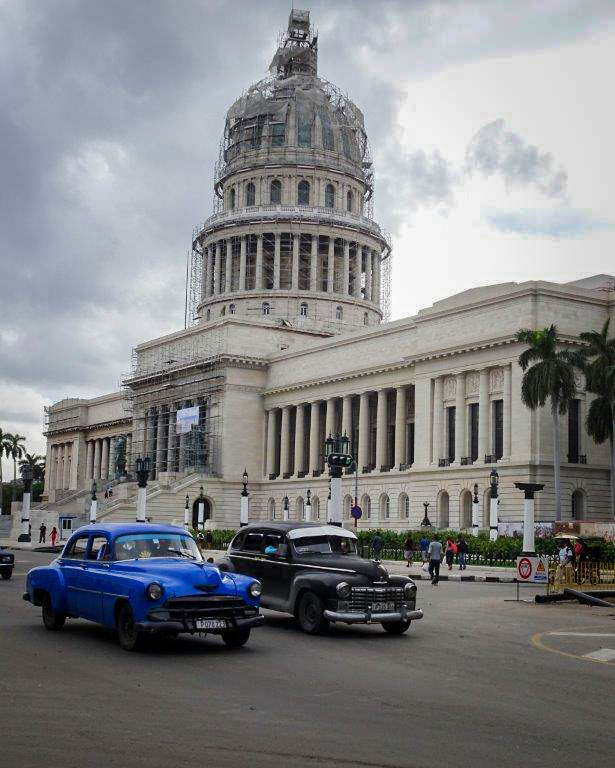
Capital and old cars in Havana. (Photo by Margaret Kinnaird)
Havana airport was surprisingly small, and will certainly need to grow as tourism booms on the island. A large crowd of eager family members awaited arriving loved ones, but our guide, Ernesto, was able to pick out the first few of our group that ventured out – it is true that birders have a certain look about them!
We met our driver, the “other Ernesto,” nicknamed Soby, boarded our mini-bus and headed into the bustle of La Havana Vieja (Old Havana). It was everything the guidebooks described and more. Antique cars, bicycle-taxis, and the occasional horse cart traversed on cobblestone streets beneath stately buildings of colonial-era Andalusian-inspired and Baroque architecture, interrupted by the occasional Soviet-style high-rise. We were all completely captivated by the sites and sounds of this colorful and chaotic city, full of such rich history and seemingly frozen in time.
We spent the first evening and all the following day enjoying Havana. We were distributed for lodging in casas particulares (private bed-and-breakfasts) in the heart of the old city, and gathered to explore the streets and squares together. We saw waves crashing on the famous Malecón (shorefront promenade); Ernesto and his daughter Mariana guided us by the most historic buildings and plazas; we drank Mojitos on the roof of the hotel Ambos Mundos (where Hemingway wrote For Whom the Bell Tolls); and dined and drank at charming restaurants and bars.
Of course, we took advantage of the myriad photo opportunities with antique Oldsmobiles, Fairlanes, and Chevrolets, which were everywhere, and several of us visited the fabulous Museo Nacional de Bellas Artes – Arte Cubano, which houses artwork purely by Cuban artists. A few in the group also enjoyed wonderful Cuban music late into the night by the talented Cuban group Hearts of Fire at the Paris Club. There are not many birds to see in Havana, though it was noted that several of the stunning artworks in the Museo Nacional Palacio del Bellas Artes featured bird imagery of some kind!
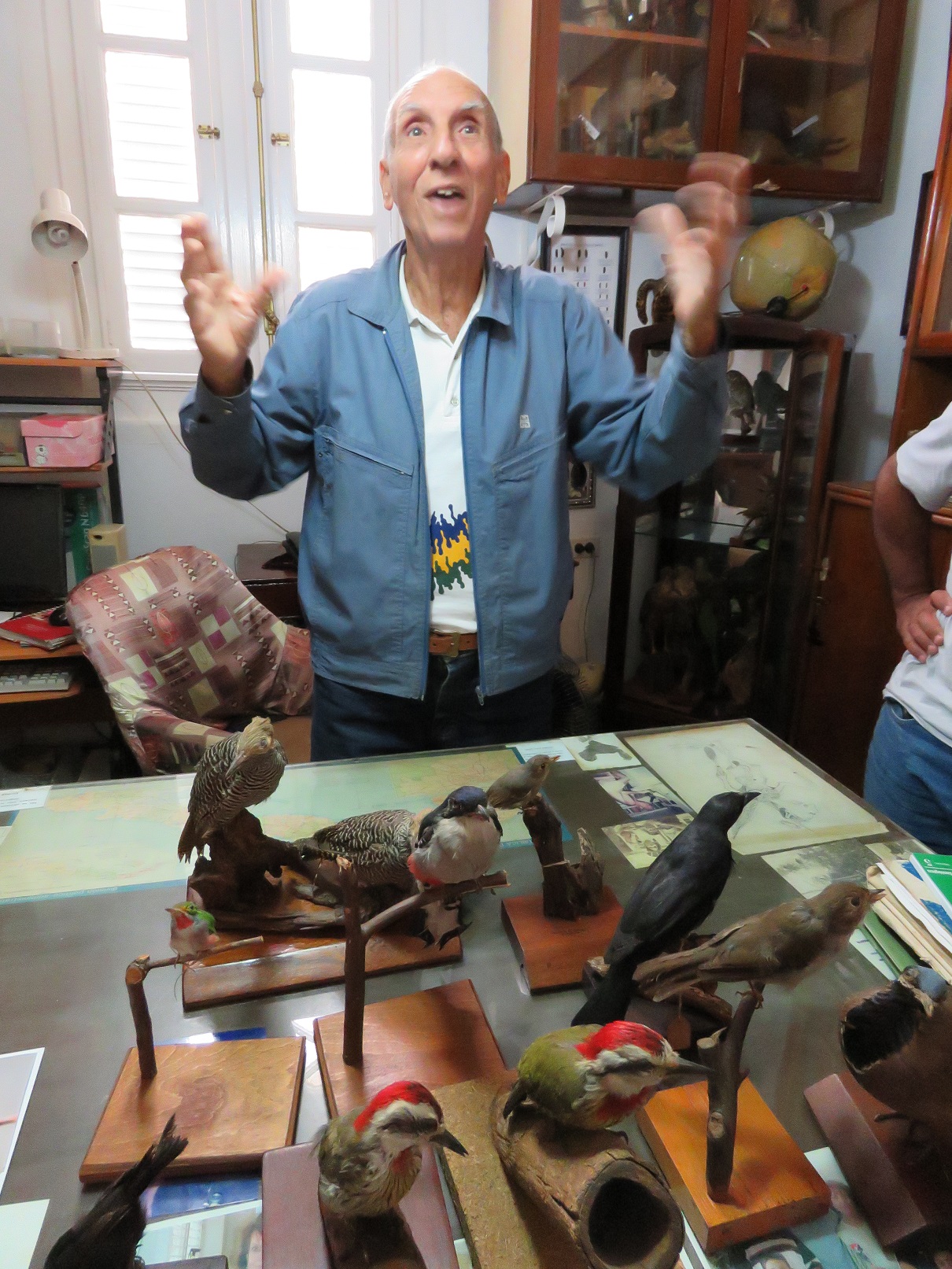
Emeritus ornithologist and living legend, Orlando Garrido, sharing stories from the field while showing us his endemic bird collection (Photo by Susan Jacobson)
At our Havana evening meals, we were joined by our Cuban colleagues and dear friends; biologist Lourdes Mugica (Universidad de la Habana) who dined with us at La California, and Maikel Canizares (Instituto de Ecología y Sistemática) at El Canoñazo. Both work in bird conservation and are long-time BirdsCaribbean members and partners on BirdsCaribbean programs such as the Caribbean Endemic Bird Festival, Caribbean Waterbird Census, BirdSleuth Caribbean, and White-crowned Pigeon research. They are also serving on the Local Organizing Committee for the next BirdsCaribbean International Conference in Cuba in July 2017.
Another special visit in Havana was with emeritus ornithologist, the tireless and charming Orlando H. Garrido. Many of our party had his landmark book, Birds of Cuba (co-authored with Arturo Kirkconnell, 2000). Orlando, a living legend, regaled us with stories of his involvement in forming the bird collection for Cuba’s Museo Nacional de Historia Natural decades ago, and in debating the finer points of taxonomic lineages in current literature. Also, he gave us a close-up look at his collection of mounted Cuban endemic birds.
The Zapata Peninsula
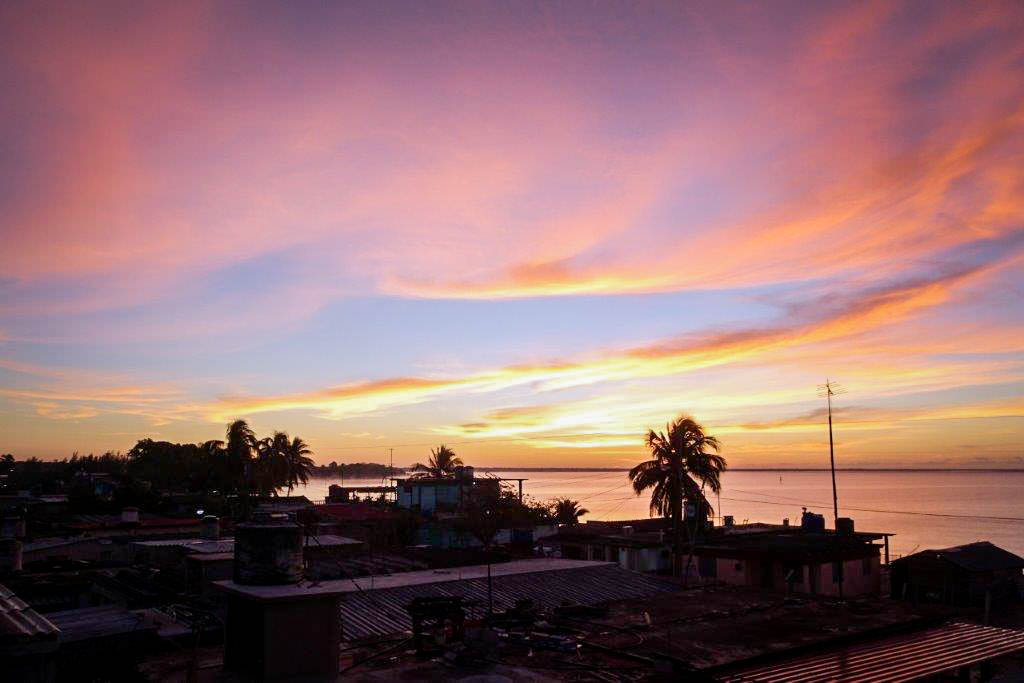
Early morning light on Bay of Pigs, Zapata Peninsula. (Photo by Margaret Kinnaird)
On Day 3, we were up early and off to the Península de Zapata on the southern side of the island, considered to be the most important region in Cuba for birding. A bus ride on wide, well-maintained, but largely empty highways took us to the Playa Larga area, found on the llanura (plain) of Zapata between the east and west ciénagas (swamps) of Zapata. Traversing wetland areas, we started seeing waterbirds right away, including Limpkin, egrets, herons, and ticking off endemics such as the Cuban Black Hawk and Red-shouldered Blackbird. Playa Larga is found directly on the northern reach of Bahía de Cochinos (Bay of Pigs). Obviously this is a site of historic significance and the area was marked by individual monuments to those 161 Cubans who lost their lives defending the island during the US-backed 1961 invasion.
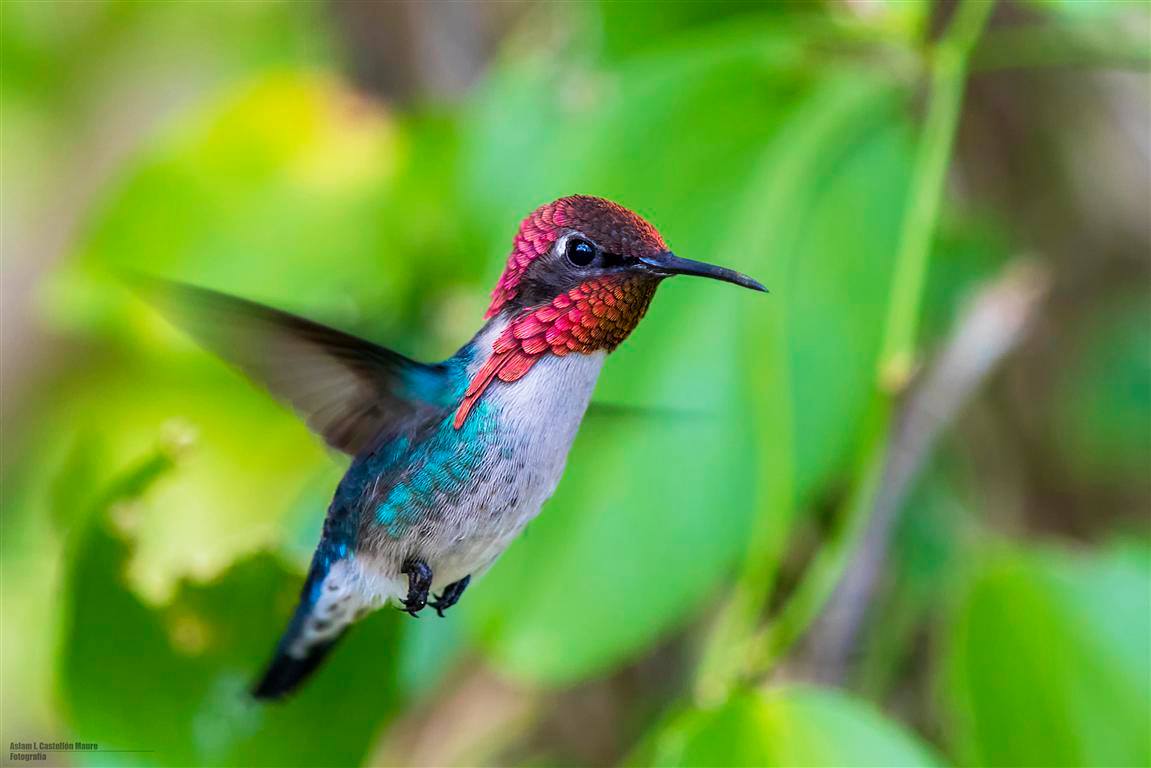
Bee Hummingbird – the world’s smallest bird (photo by Aslam Ibrahim Castellan Maure)
We stayed in casas in the small village of Caleton, a pretty little town with a beach, mangroves and just two little roads (one paved, one not) but experiencing a building boom associated with tourism. One of our first destinations was a nearby village neighborhood where endemic Bee Hummingbirds, the world’s smallest bird species! — are known to hang out. Indeed we had a great view of a pair from a rustic backyard – a male demonstrating his courtship flight (flying way up in a straight line, then zipping out to the side) to a seemingly less-than-attentive female (probably distracted by the flowering trees, as were several Cuban Emerald hummingbirds and migrant warblers).
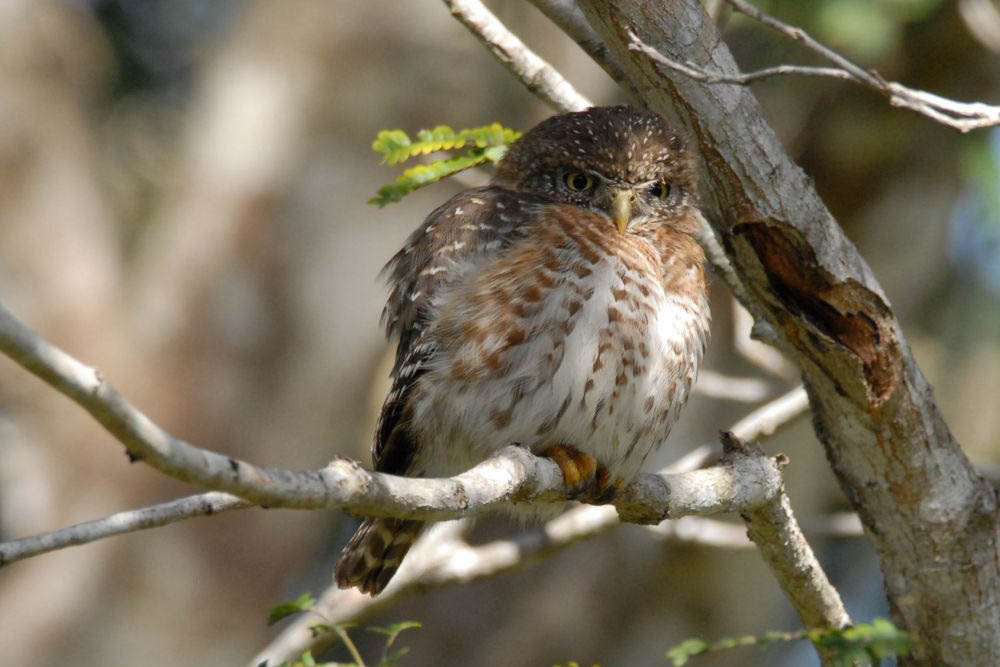
Cuban Pygmy Owl (Photo by David Hill)
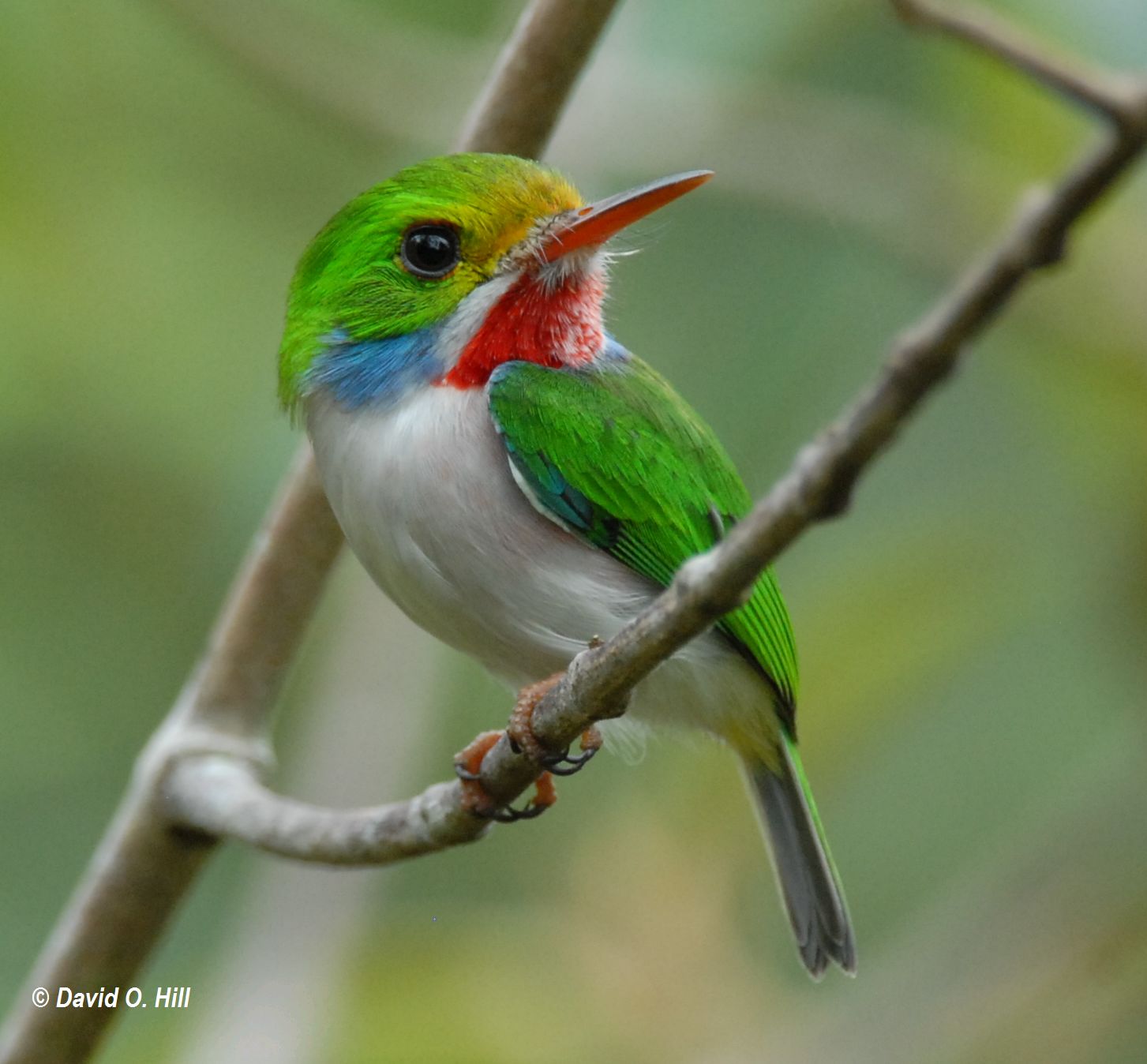
During our time on the Zapata Peninsula (Days 3, 4, 5), we visited a variety of diverse habitats. The Bermejas Reserve (Refugio de Fauna Bermeja), a forested area with nice trails, yielded such highlights as the beautiful Cuban Trogon (Cuba’s national bird), Cuban Crow, Bare-legged Owl,Cuban Parakeet, Great Lizard Cuckoo, Tawny-shouldered Blackbird, Cuban Vireo, and the adorable Cuban Tody, a favorite of everyone. We had great looks at more Bee Hummingbirds and a variety of migrants warblers were also seen including Yellow-headed Warbler, Worm-eating Warbler, Swainson’s Warbler, and Black-throated Green Warbler, among others.
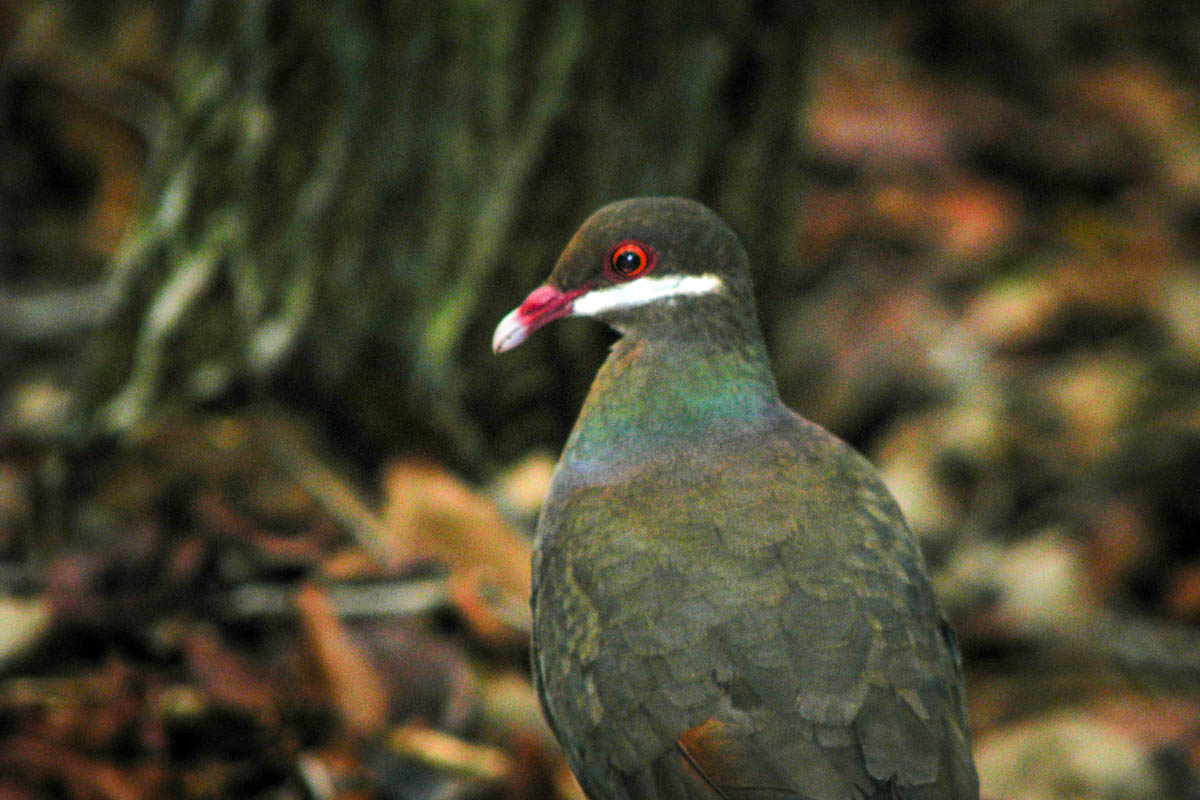
At Cueva de los Peces, we had fantastic views of 4 Blue-headed Quail Dove casually strutting around, including a male courting a female. La Cuchilla was the place to see Fernandina’s Flicker, busily working on excavating a nesting hole in a dead palm tree. A Crested Caracara and Cuban Pygmy Owl were spotted nearby.
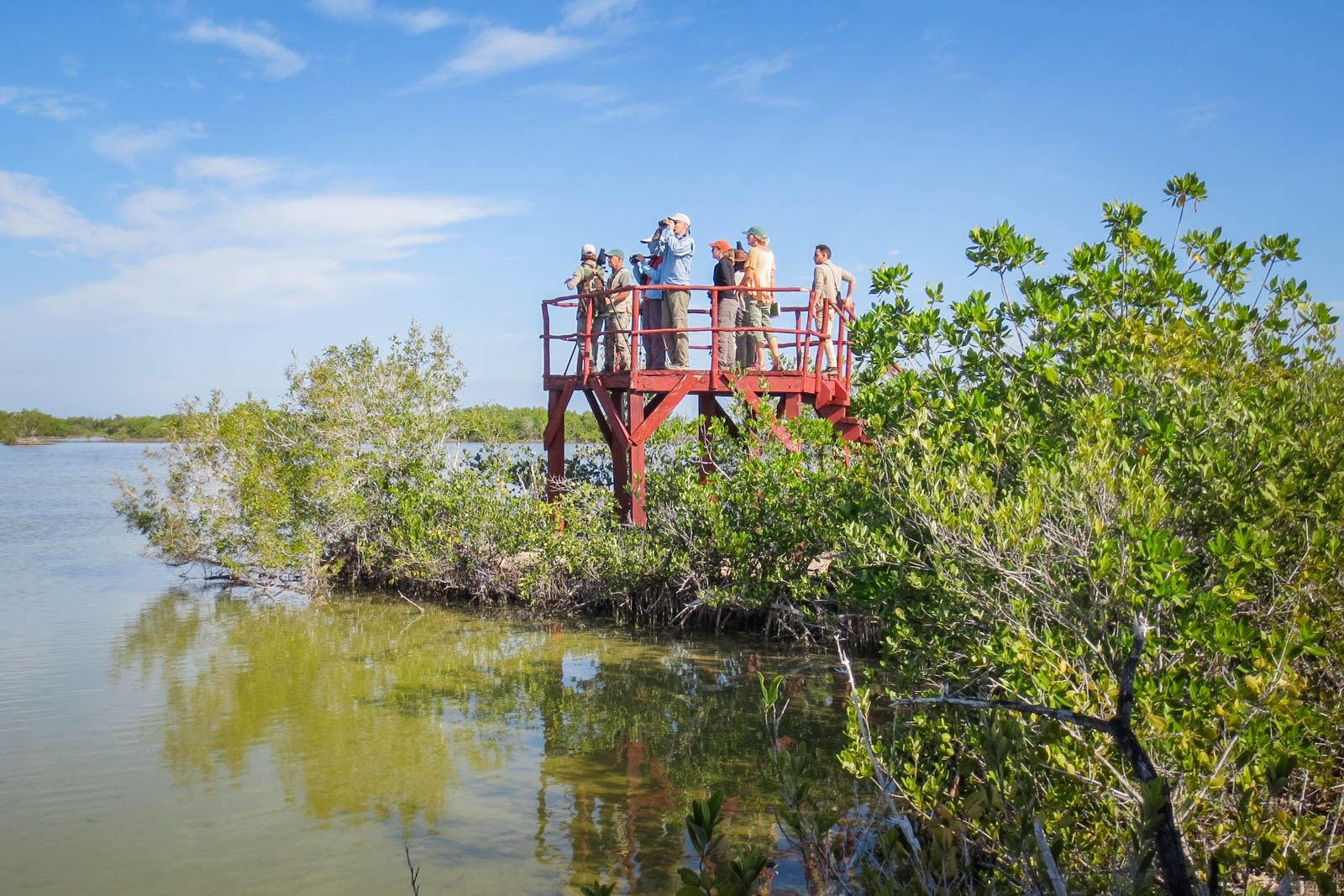
Counting flamingos, herons, egrets and many other waterbirds at Las Salinas, Zapata Swamp. (Photo by Jennifer Wheeler)
Las Salinas, an area of shallow tidal flats, wetlands, and mangrove-islets, showcased many hundreds of American Flamingos and a wide variety of herons, egrets, ibis, seabirds and shorebirds, including American White Pelicans, Brown Pelicans, Roseate Spoonbills, Neotropic Cormorants, Wood Stork, White Ibis, Black Skimmer, Clapper Rail, Royal Tern, Caspian Tern, Black-bellied Plover, and Short-billed Dowitcher.
At Boca de Guamá a wooded tourist spot around a lake we had excellent looks at the Cuban Oriole and West-Indian Woodpecker. Our target birds at La Turba, a grassy vegetated track between tree-lined canals, were the Zapata Sparrow and Zapata Wren. With a little help from playback, we were rewarded with four active sparrows at very close range! Unfortunately, the Zapata Wren was not so cooperative in the windy weather. Finally, one evening, we walked around the small eco-village of Los Hondones, a quiet in-holding in the National Park. Ernesto is building a house there and envisions a tranquil oasis where guests would be surrounded by a woodland of native trees and active birds. Before dark we had a long look at an industrious Cuban Green Woodpecker, Cuban Pewee, Cuban Parrot, and La Sagra’s Flycatcher, and after dark, a Greater Antillean Nightjar (Cuban) attracted to the insects under a streetlamp.
The adorable Cuban Tody – a unique beauty and huge favorite of everyone. (Photo by David Hill)
Back in Caleton, we enjoyed festive group meals with such treats as fresh coconut water from just-hacked-open coconuts and fresh fish pulled from nearby waters. We ate dinners at the casas, and were treated both nights by a very talented group of musicians, Son X Siempre, who provided excellent, authentic Cuban music, great for dancing.
We were also hosted to rum-and-honey shots and a presentation by Rosendo Martinez, the founder of Cuba’s Protected Areas Program (Centro Nacional de Areas Protegidas) and an advisor in Sustainable Tourism and Interpretation. Rosendo conducts workshops for casa owners and tour agencies, and is a great contact for BirdsCaribbean’s Caribbean Birding Trail program. Later, after dark, we went to take a look at the town’s Stygian Owl, perched and hunting for bats to provide its evening meal.
Viñales Valley, with stops in Las Terrazas
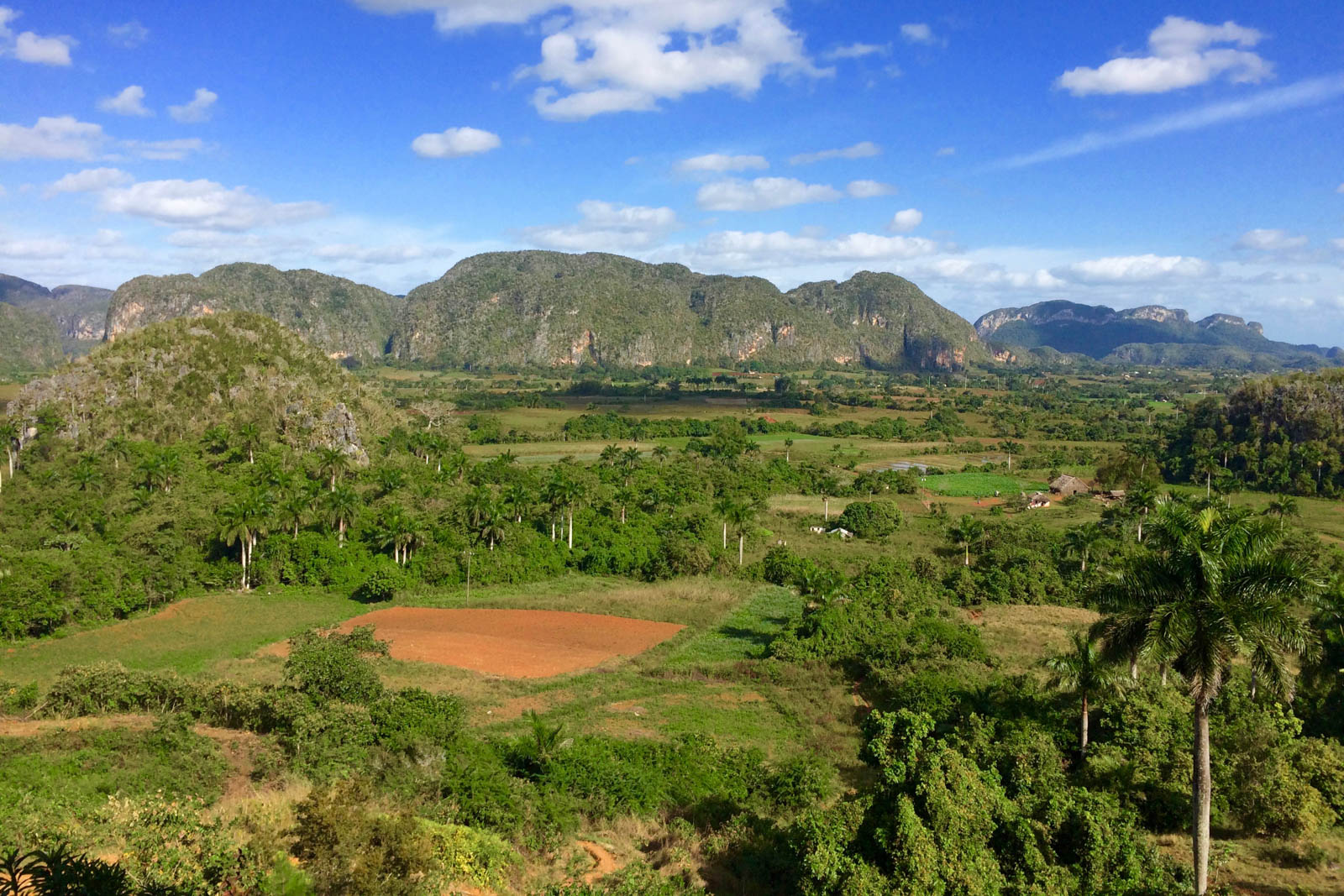
The Viñales Valley. (Photo by Lisa Sorenson)
On Day 6, we made our way to the West, to the Pinar del Río province. On the way, we made several stops to look for birds, of course. At the Niña Bonita Reservoir just west of Havana, we dodged raindrops to conduct a Caribbean Waterbird Census count, and tallied hundreds of Lesser Scaup along with a scattering of Ring-necked Ducks, Northern Shovelers, Blue-winged Teal, Ruddy Ducks and Brown Pelicans. In the Sierra del Rosario hills, we stopped at the eco-resort of Las Terrazas for lunch and were treated to a demonstration of the local chanting campesino music, while fighting off very aggressive chickens and peacocks mooching our lunches.
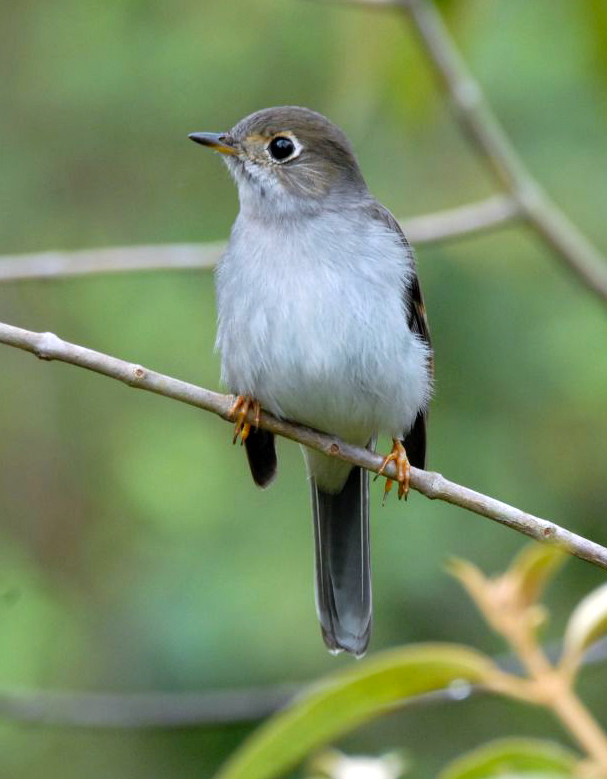
The Cuban Solitaire has a hauntingly beautiful song. (Photo by David Hill)
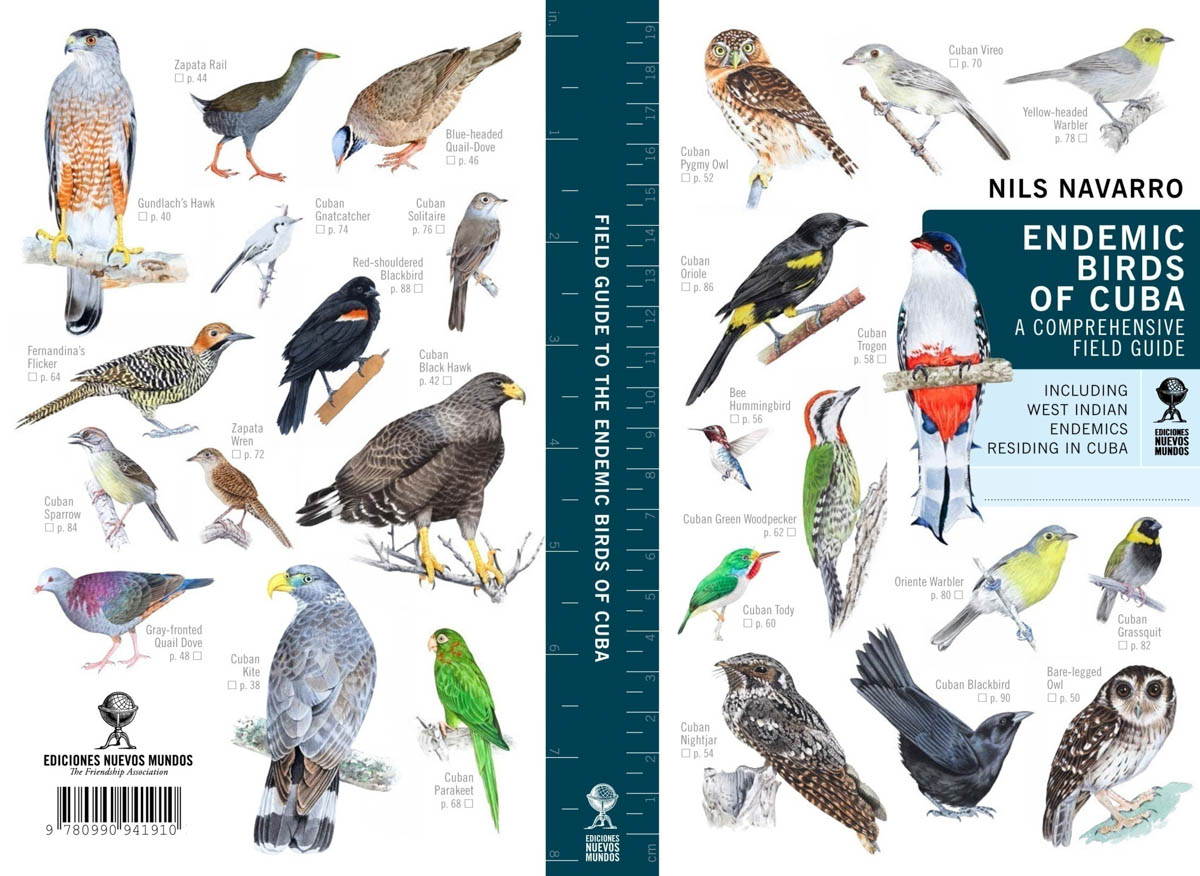
In January, the New York Times listed Viñales as a top destination to visit this year. We could see why. It is lush and beautiful valley punctuated with huge, flat-topped, limestone mountains called mogotes (which means “haystacks”). In between the mogotes are found rich, red-soiled fields renowned for their crops of tobacco. The developed and undeveloped areas are protected as the Parque Nacional de Viñales, and are rich in birdlife. Our first birding effort, however took place on the delightful terrace above the home of Nils Navarro, artist, naturalist, and author of the new book, Field Guide to the Endemic Birds of Cuba. In between sips of Cuba Libres (rum and Coke, with lime juice), and sighs of admiration at the pink skies of approaching sunset, we enjoyed watching hunting Merlins through the scope.
Day 7 was rainy, but we headed out to Maravillas de Viñales, a public use zone of the national park, where
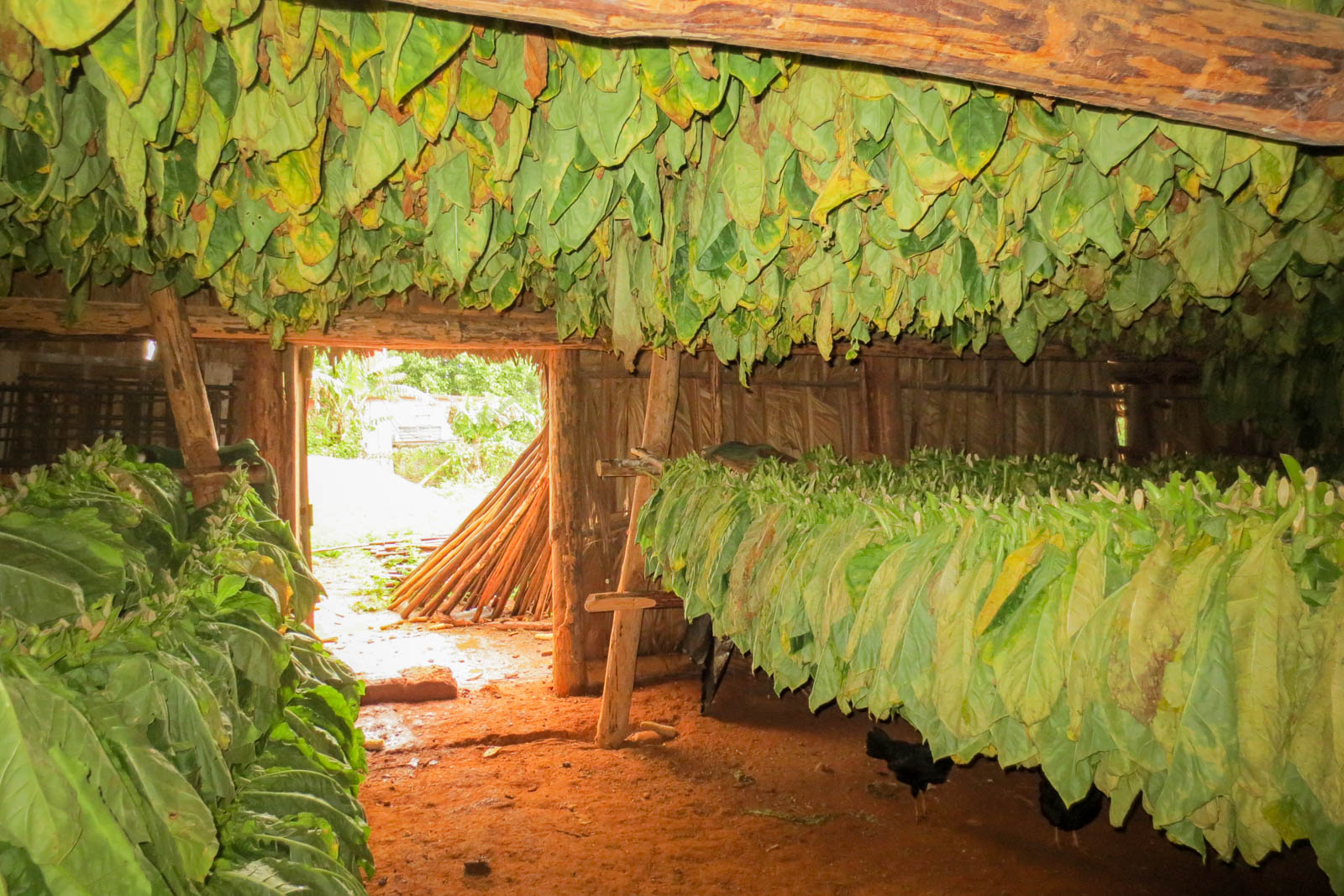
Tobacco drying, Viñales Valley. (Photo by Jennifer Wheeler)
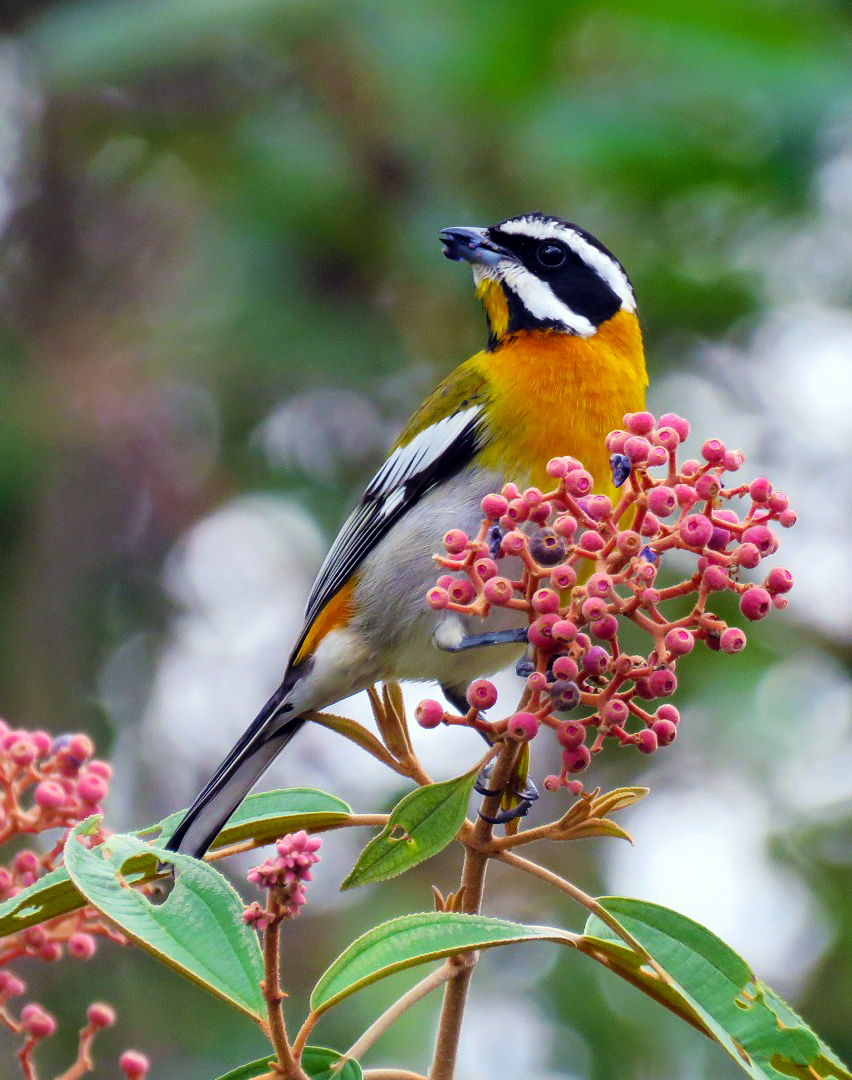
Ernesto and Nils sought to find the Cuban Solitaire for us. We heard it’s melodious song and soon spotted it near the observation platform. We also enjoyed many other birds in the area including the Western Spindalis, Cuban Bullfinch, Cuban Pewee, Red-legged Thrush, Cuban Crow, Yellow-headed Warbler, Cuban Tody, Cuban Trogon, Cuban Blackbird, and Red-legged Honeycreeper before rain drove us back to the village for lunch. That afternoon, we had a lesson in tobacco cultivation and harvest (all by hand, or with the help of oxen) and cigar rolling in a local tobacco drying barn, and had a chance to puff on a fine cigar constructed skillfully and rapidly before our eyes. We also enjoyed coffee at a little, local finca run by Nils’ in-laws, after touring their efforts at sustainable subsistence farming (raising vegetables, coffee, fruit, rabbits and other livestock).
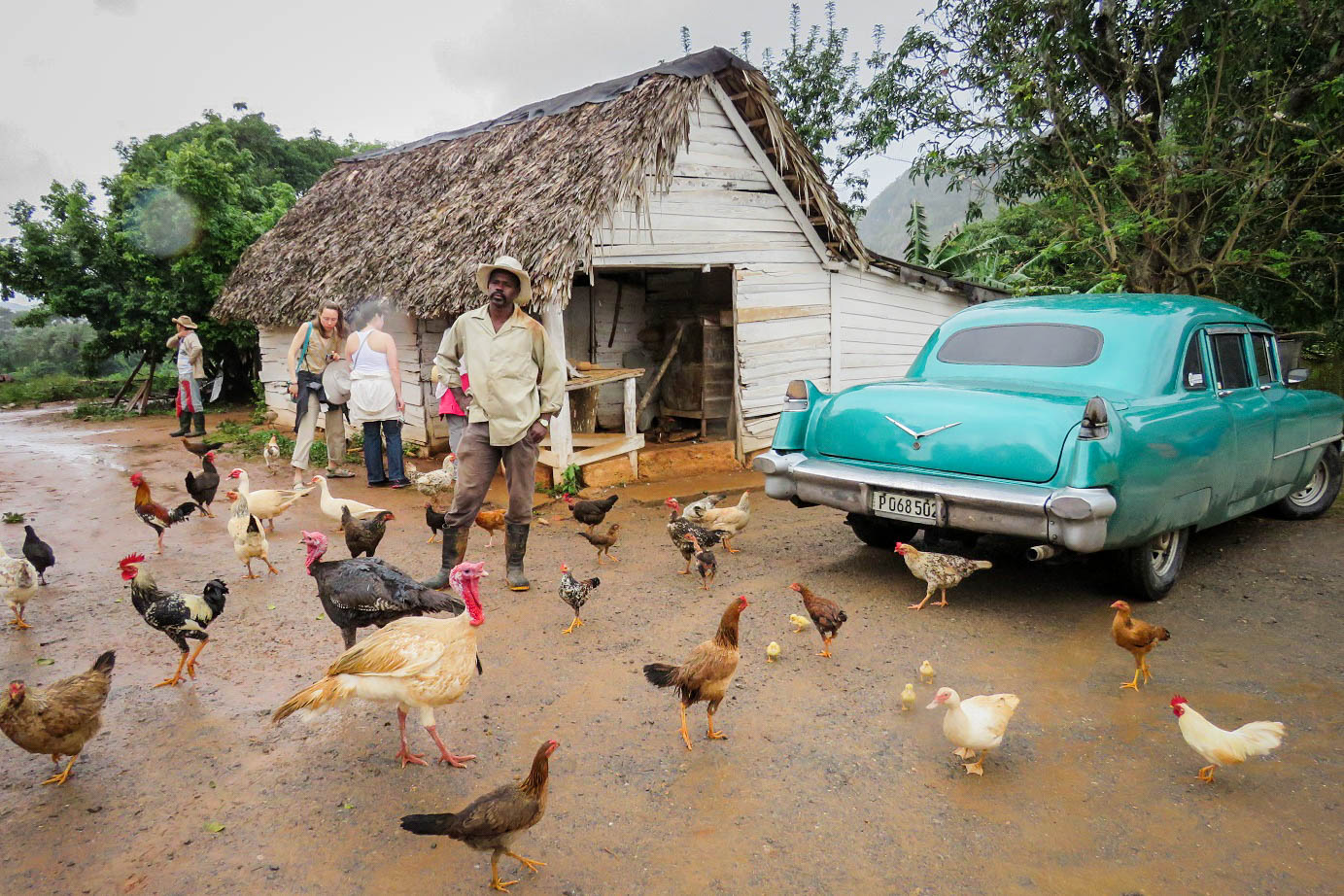
Man with fowl at tobacco farm in Viñales. (Photo by Susan Jacobson)
This was meaningful as we later learned that Cuba imports the vast majority of its food supply, with typically 80% of household income going to the purchase of food. Much more on-island production of food is needed to correct this trade imbalance. A highlight of late afternoon birding along the road to the El Albino Reservoir was the Olive-capped Warbler, found only in Cuba and two islands in the Bahamas, as well as Antillean Palm Swift, numerous migrants and waterbirds.
Dinner was in our individual casas. Here is a good place to explain that the business of renting out rooms to tourists is one of the few individual businesses allowed by the Cuban government.
Nils sharing information with the group about the flora and fauna of Viñales. (Photo by Lisa Sorenson)
Homeowners have embraced this opportunity, and casas particulares form the most successful micro-enterprise in the country. Currently about 4,000 rooms are rented out to tourists in private homes, more rooms than are managed by all but one of the government tour agencies, which own the rooms in hotels and resorts. Casa particulares are registered with the government, and taxation is extremely heavy, but the income far exceeds formal salaries. Casa owners also provide meals and beverages to supplement the income. We found almost all casas to be rented at a similar low price, though quality was extremely varied!
On Day 8, we did a bit more birding in the hills behind Viñales, then headed east towards Havana. We stopped at a small fruit and coffee farm in Las Terrazas to check off the Cuban Grassquit (we got lovely close-up views of a group in the grass while the farmer provided us with sweet bananas) and also stopped along the highway to see the Cuban Kite and Eastern Meadowlark (Cuban race).
Hasta La Vista, Cuba
Western Spindales (Photo by Susan Jacobson)
Day 8, we spent our final afternoon and evening enjoying Havana again. Several of us sought out souvenirs – rum, cigars, jewelry, chocolate, bongo drums, and art were favorite choices. We checked out shops along Calle Obispo and street vendors along the Prado, and after supporting the Cuban economy, received a presentation on the topic from José Atonio Moreno (aka Pepe), a retired economist and professor. He provided an explanation for much of what we had experienced during our trip – a country with an economy that has languished for decades but is now committed to economic and political reforms that have already seen significant results as they are embraced by the innovative and resilient Cuban people.
We enjoyed a final, celebratory meal at the charming Café de Artes, decorated with vintage instruments and portraits of famous Cuban musicians. One last mojito! Then on Day 9, we were thanking Ernesto and Soby with hugs all around, back in airport lines, declaring to customs, and making plans to stay
Lisa, Ernesto, Jennifer and Nils at the end of a wonderful day in Viñales Valley.
in touch and share our photos. Already there is an intense yearning to go back to see and experience much more of this amazing country before it changes too much, but the wonderful memories of this magical trip will linger for a long time. David, affectionately nicknamed “el Capitan” by Ernesto, commented, “It was the trip of a lifetime, well worth the wait!”
By Lisa Sorenson and Jennifer Wheeler
Stay tuned for the trip report from our March 6-16, 2016 Cuba bird tour. BirdsCaribbean will lead two bird tours to Cuba again in 2017 (January 23-30 and March 3-13) – click here for information. Email us: [email protected].
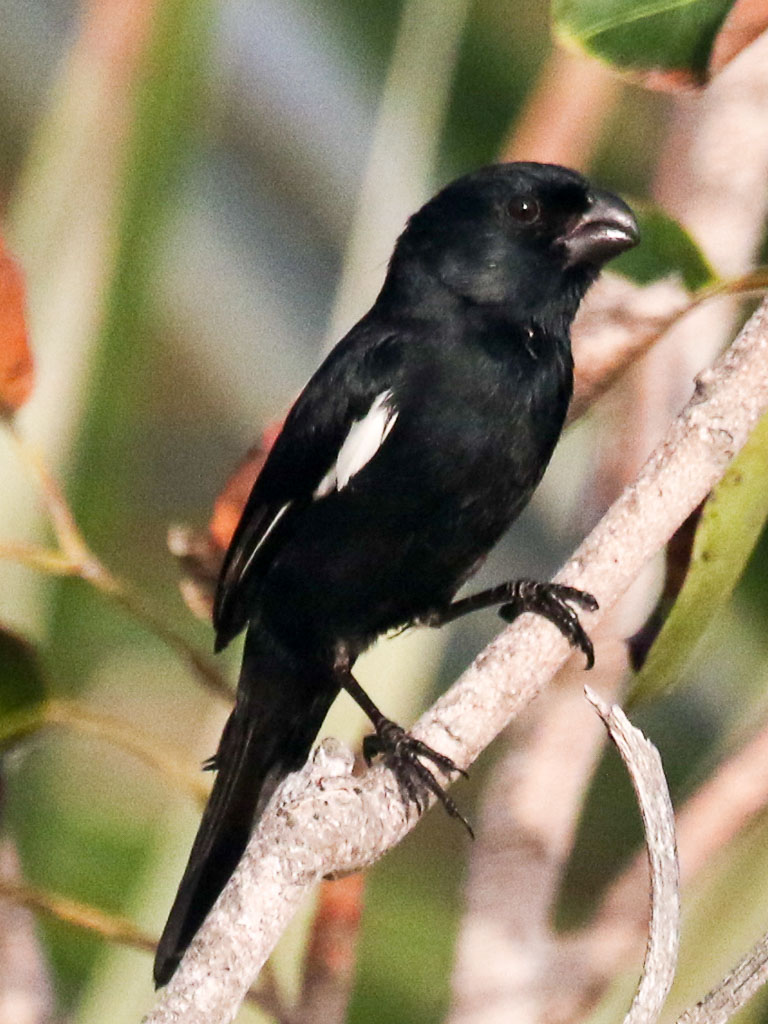
Cuban Bullfinch, another one of Cuba’s 27 endemic birds. (Photo by David Hill)
The Caribbean Birding Trail is being developed to raise global awareness of the unique birds and biodiversity of the Caribbean and to create a sustainable economy around these rare species, in an effort to protect them. This new project is an initiative of BirdsCaribbean. We have partnered with and/or trained local tour companies and guides, have first-hand knowledge of the best birding and heritage sites to visit, and know the communities and NGOs that are working to conserve Caribbean birds and nature. Our tours are well-suited for birdwatchers, nature lovers, wildlife photographers, and anyone looking for authentic, unique, and revelatory experiences. Travel with us and know that your tourism dollars will bring benefits to the organizations, communities and people that will put them to the best use. Learn more at www.CaribbeanBirdingTrail.org.
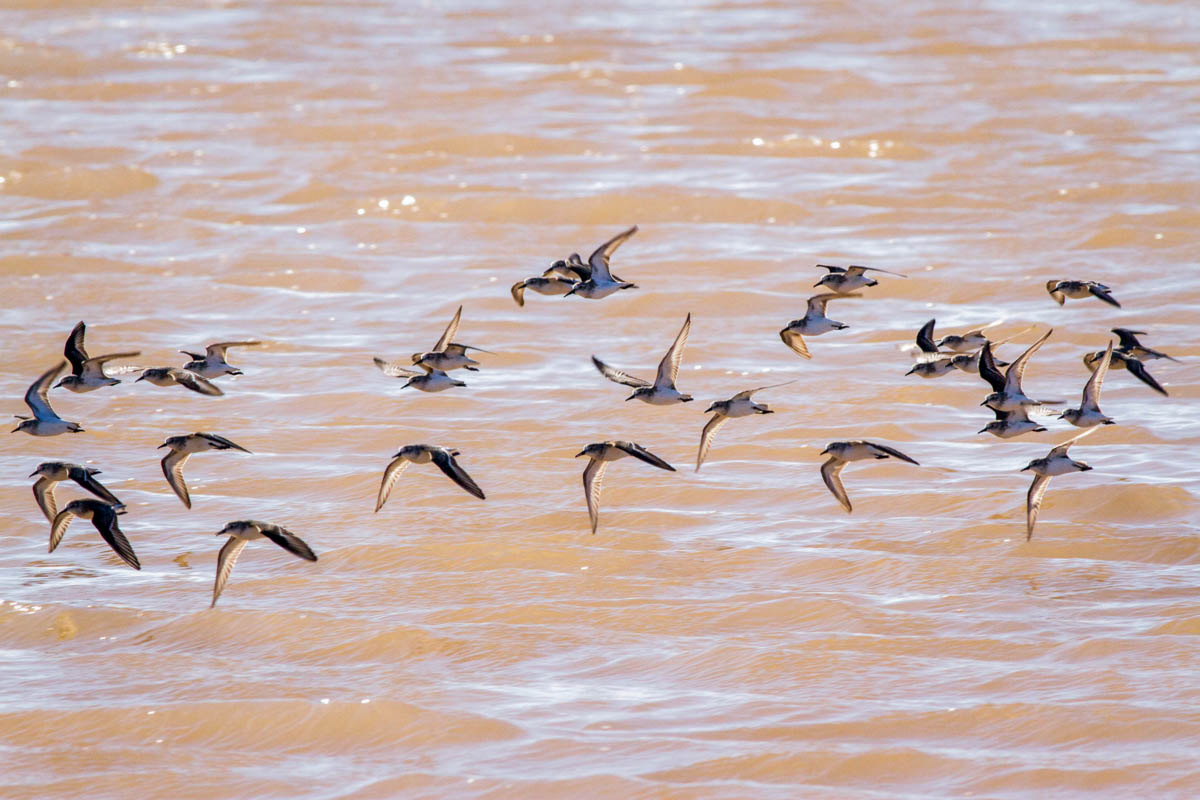
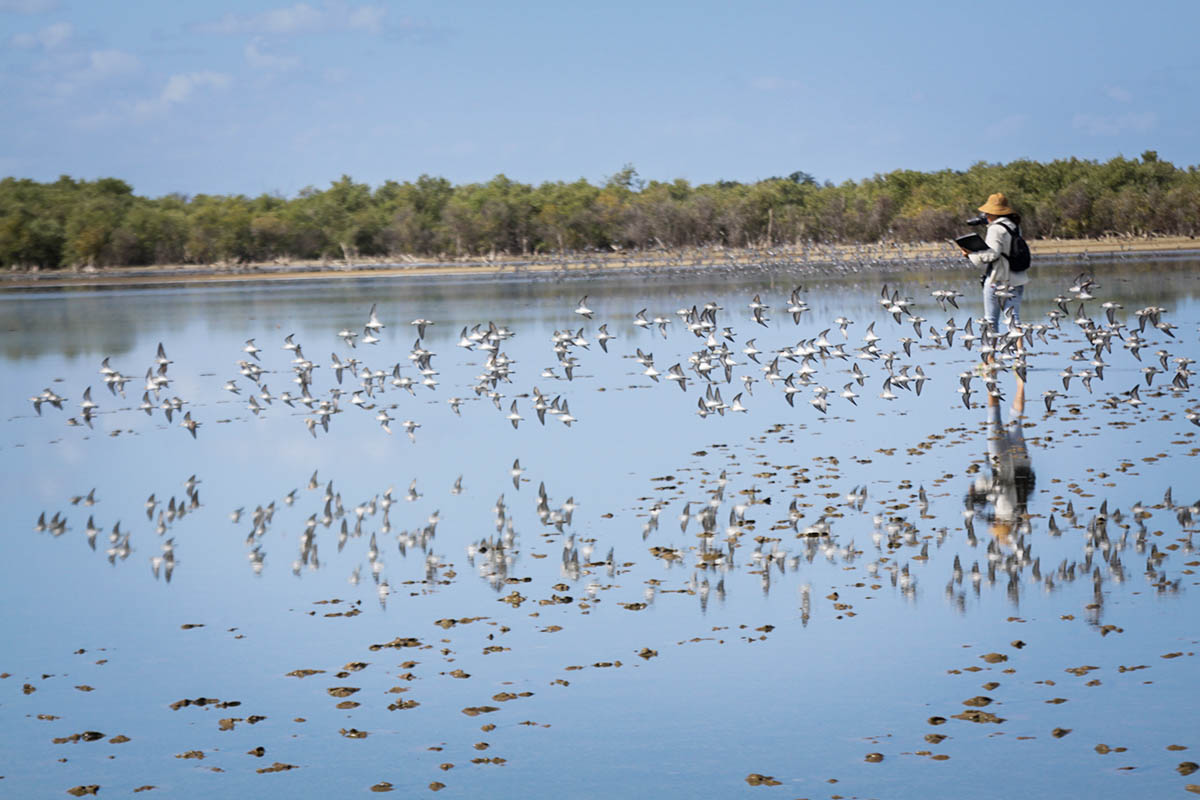
Semipalmated Sandpipers in flight. (Photo by Jeff Gerbracht)
The sandpiper flocks fly up in waves, blurred wings beating and gliding as one, they circle around after being flushed and land again in unison on the dike road ahead of us while another flock lands just behind us. “Ok, start counting!” I say to my colleague, Fernando Simal. Easier said than done! The little brown birds dart about constantly on land and at the water’s edge, deftly snapping brine flies off the ground. We do our best to count the number of birds of each species using tally counters and record the numbers on our data sheet. This particular flock was composed mostly of Least Sandpipers and Semipalmated Sandpipers with a few Sanderlings thrown in.
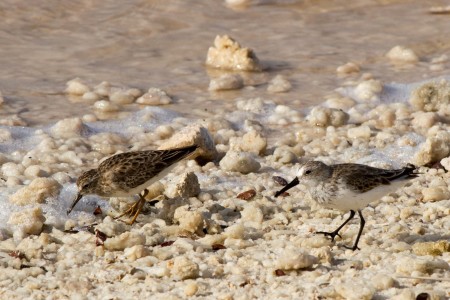
Least Sandpiper and Western Sandpiper foraging among the salt crystals at Cargill Salt Ponds. (Photo by Jeff Gerbracht)
Fernando and I are at our one of our “high density” points (counting stations) on the Cargill Salt Production Facility in southern Bonaire. We are driving the dike roads stopping every 400m to carry out a 6-minute count, recording all the birds in a 200m radius around our point. A second team, Jeff Gerbracht (Cornell Lab of Ornithology) and Binkie van Es (St. Maarten Nature Foundation) are covering another part of the facility. The conditions can only be described as harsh—non-stop winds of 25-30 knots, blazing sun and salt foam blowing at us constantly. But the shorebirds love it, and so do we—there are not very many places where you can see such large concentrations and diversity of shorebirds so close.
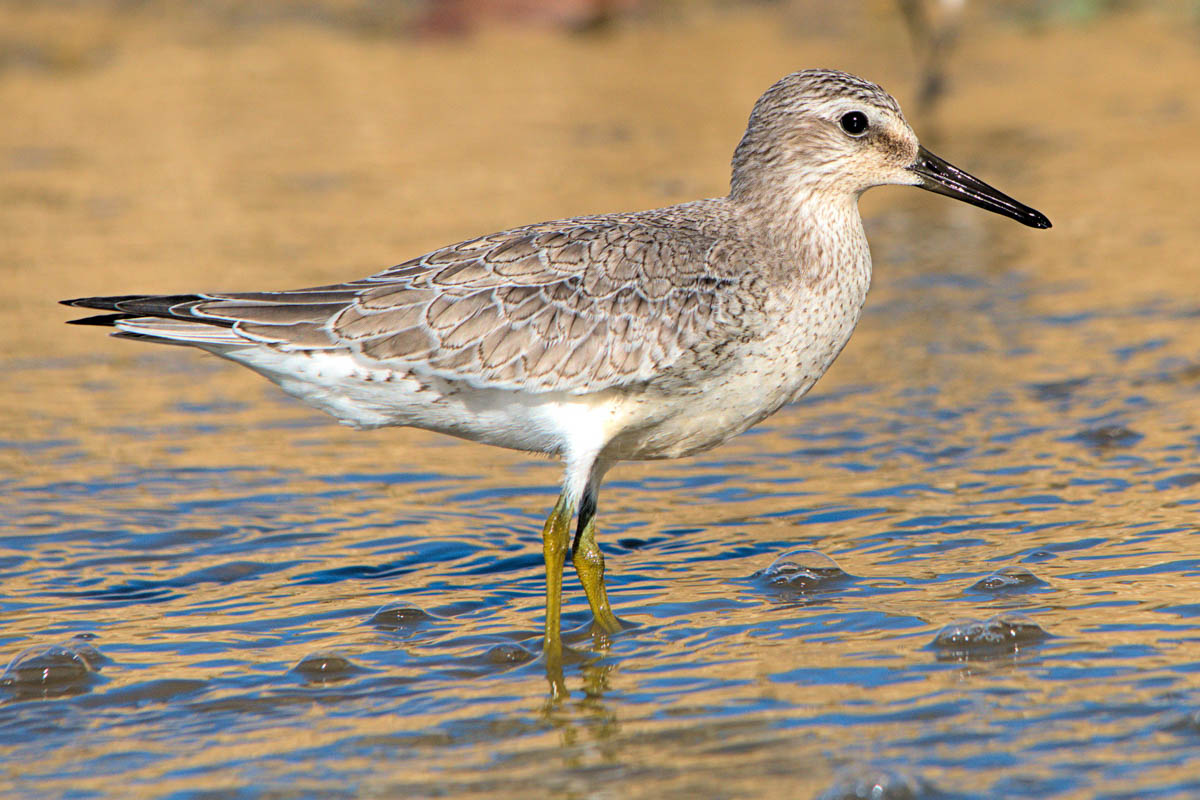
We have so far encountered over 20 species of shorebirds and waterbirds using the Cargill ponds, including American Flamingo, Great Blue Heron, Tricolored Heron, Reddish Egret, Black-bellied Plover, Snowy Plover, Greater yellowlegs, Lesser Yellowlegs, Ruddy Turnstone, Stilt Sandpiper, Least Sandpiper, Semipalmated Sandpiper, Western Sandpiper, Short-billed Dowitcher, Red Knot and more. Depending on where the point is in the Cargill Facility, we might encounter zero birds in areas of deeper water, or mixed flocks numbering in the hundreds or even thousands in areas with shallow water or exposed flats.
Fernando Simal braves harsh conditions at the Cargill salt ponds in Bonaire. (Photo by Lisa Sorenson)
The prime attraction to this habitat is food—some of the ponds team with brine shrimp or brine fly larvae and the dike roads separating crystallizer ponds are often covered with hordes of brine flies. These small organisms, adapted to thrive in extremely salty conditions, serve as an essential food resource for these wintering and migratory shorebirds.
This is the second year of intensive surveys conducted at Cargill in an effort to learn more about the species and numbers of birds using this site. Shorebirds have received much attention in recent years due to evidence of alarming hemispheric-wide declines in numbers. Loss of wetland habitats is one of the main threats, but other factors also play a role, such as hunting, human disturbance, impacts from climate change such as sea level rise, and predation from invasive species.
In the case of the Red Knot, a threatened shorebird, numbers plunged from 90,000 to 15,000 from overharvesting of Horseshoe Crabs in the Delaware Bay in the early 2000s. The Bay is a critical migration staging area in spring where as much as 90% of the Red Knot population congregates to feast on horseshoe crab eggs. These birds rely on the eggs as a vital food source at their final stopover to build up enough fat and energy to make it back to their breeding grounds in the Arctic. They arrive in Delaware Bay in mid-May weighing about 120 grams, and depart 2 weeks later weighing 180 grams or more, with one particularly large individual weighing in at 244 grams at departure!
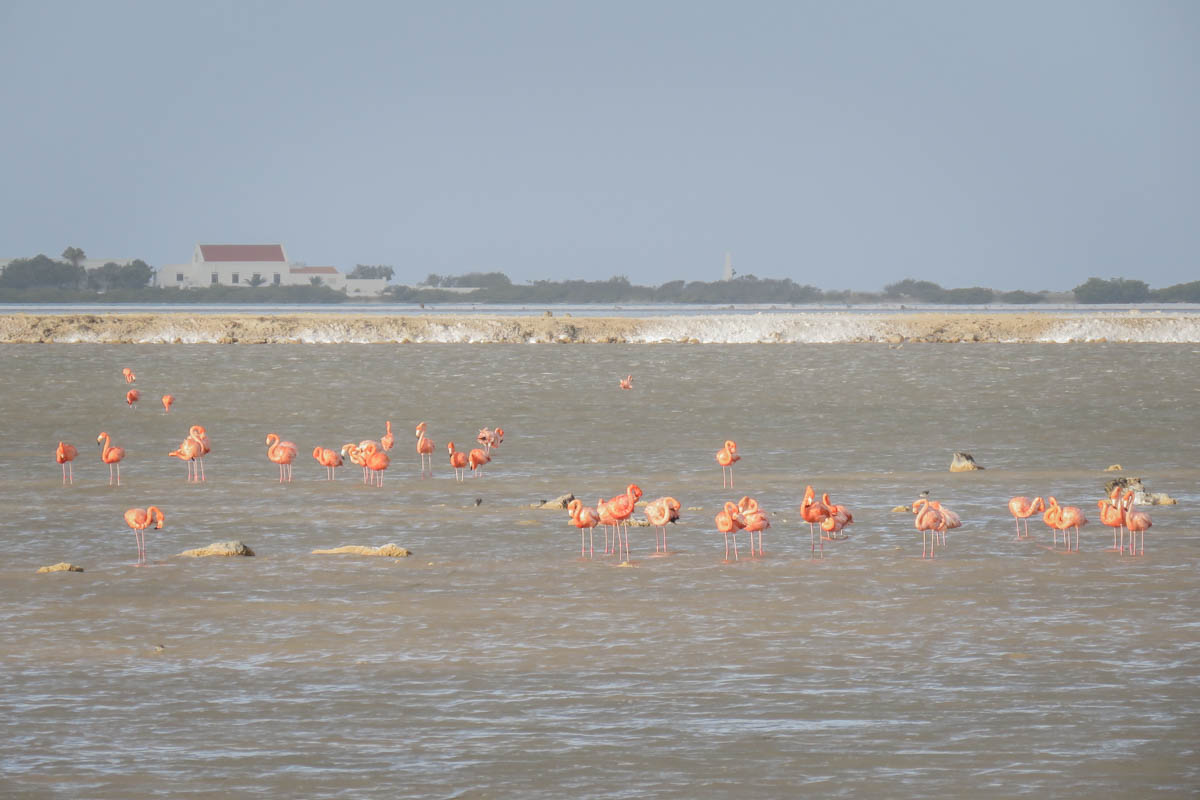
Stunningly beautiful American Flamingos dot the stark landscape like pink flowers. (Photo by Lisa Sorenson)
How and why did these surveys get started? Two years ago, I had the chance to visit and tour the Cargill Salt Production Facility for the first time, thanks to Daniel Deanda (Production Manager), who attended our Wetlands Education Training Workshop in May 2014, hosted by STINAPA Bonaire. I was amazed at the number of migratory shorebirds and waterbirds on the property, including the stunningly beautiful American Flamingos which dot the stark landscape like pink flowers. I recognized that this small island and even smaller site was probably hugely important to migrant and wintering shorebirds, perhaps even qualifying as a Western Hemisphere Shorebird Reserve Network (WHSRN) site, a program set up by Manomet 30 years ago to protect the most important breeding, stopover, and wintering habitats for shorebirds throughout the Americas.
Thanks to funding support from Environment Canada, the blessing of Cargill managers, and partnerships with local organizations STINAPA Bonaire, WILDCONSCIENCE, and the Dutch Conservation Nature Alliance, our surveys are providing estimates of population numbers of target species at the site. Although we are still refining our population estimates, there is no doubt that this site provides a winter home for thousands of shorebirds, enough to nominate it for a WHSRN site. It could also be a critical stopover area during spring and fall migration for shorebirds that are spending the winter further south. Additional counts planned for spring and fall of 2016 will help answer that question.
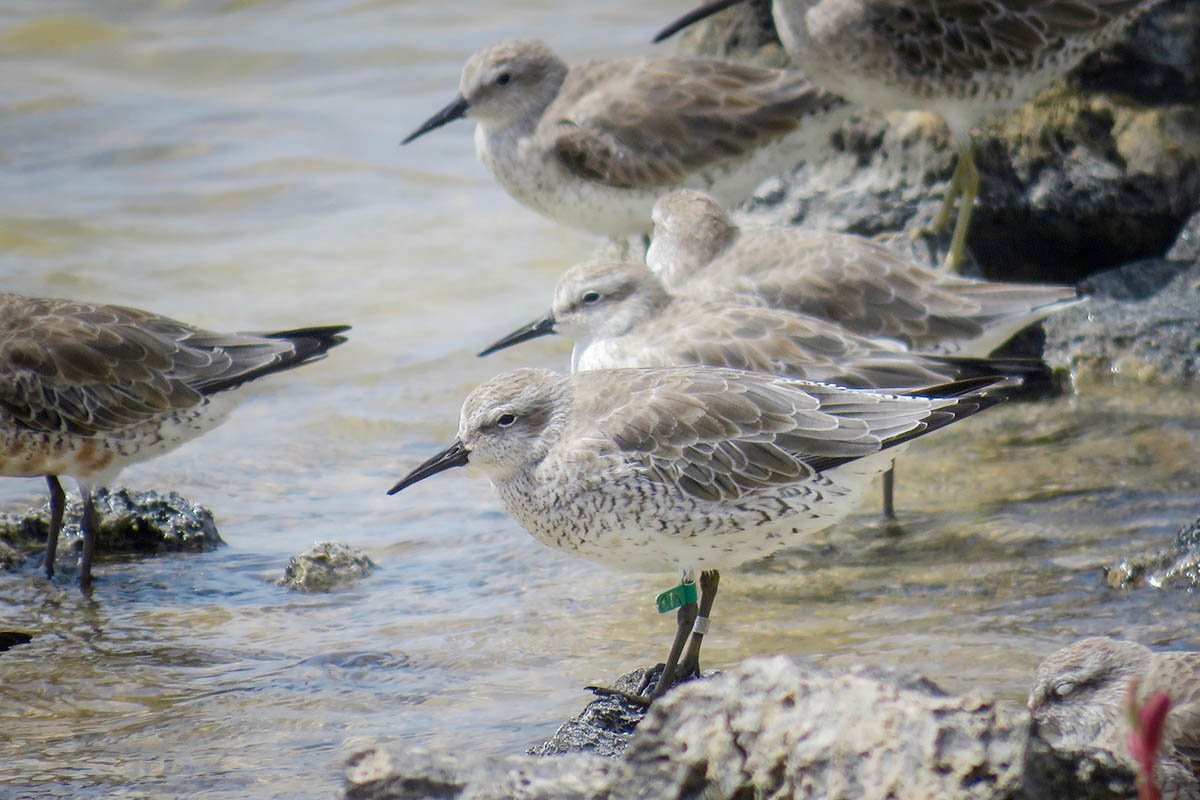
The Red Knot breeds in the Tundra of the central Canadian Arctic from northern Hudson Bay to the southern Queen Elizabeth Islands. It winters as far south as Tierra del Fuego at the tip of South America, undergoing a migration of 9,300 miles each fall and spring, making it one of the world’s longest-distance migrants. (Photo by Fernando Simal)
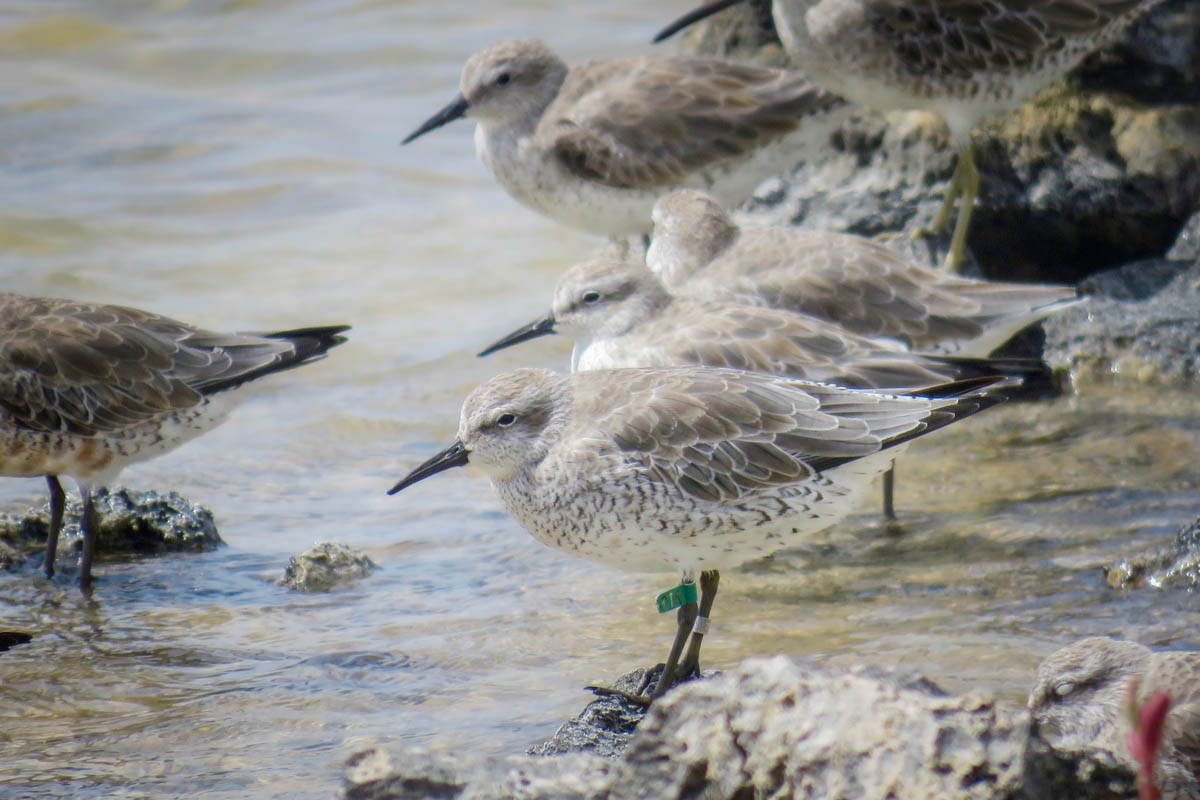
One of the most exciting finds from our 2016 February surveys were fairly large flocks of Red Knots. We noticed a leg band (green flag) on one of the birds and were able to read the flag—CTK. After entering the banding data into BandedBirds.org and corresponding further with the ornithologist that had banded the bird, Dr. Larry Niles, I learned that this bird was first captured and banded in 2004, making it a very old bird, at least 12 years of age. It was recaptured again in 2008 and May of 2015 in Delaware Bay. Larry commented: “On May 30 which is the end of this stopover period, the bird weighed only 154 g which is 26 grams short of the 180 g threshold necessary for a successful flight to the Arctic. Nevertheless this bird survived and still breeds.”
We think it is really cool that the salt ponds of Bonaire are providing a home for this Red Knot for the winter of 2015-2016, and perhaps other years as well! WHSRN site designation will help to raise awareness about the importance of “this little island” and the Cargill Salt Facility as a haven for migratory shorebirds.
by Lisa Sorenson, Ph.D. Executive Director, BirdsCaribbean
Herb Raffaele in the field on a post-workshop excursion. (Photo by Lisa Sorenson)
We continue our series of BirdsCaribbean member profiles with Herb Raffaele, former chief of the US Fish and Wildlife Service’s Division of International Conservation, and author of Birds of the West Indies and other books related to birds and conservation in the region. He received a lifetime achievement award from BirdsCaribbean and is currently a Director-at-Large for the organization. We interviewed him via email.
What is your job (currently and in the recent past if different from your current position)?
I retired two years ago from my position as Chief of the Division of International Conservation of the U.S. Fish and Wildlife Service. As division chief I managed a budget of over $20 million per year and hundreds of conservation projects around the world. Projects ranged from focusing on flagship species such as elephants, tigers, rhinos and the like, to regional and even global programs such as the Convention on Wetlands of International Importance. Prior to my 17 years as division chief I managed the Service’s conservation programs in Latin America and the Caribbean. In the 1970’s I served as a wildlife biologist for the Puerto Rican government and, for a number of years on the island, as the chief of wildlife planning for the island’s Department of Natural Resources.
How did you get interested in birds?
When I was a youth in the Boy Scouts, at the age of about 14, I needed a nature merit badge to become an Eagle Scout. I began to observe birds in order to obtain the badge, got hooked on watching them, and have done so ever since.
How did you get involved with BirdsCaribbean?
During the years that I served as the U.S. Fish and Wildlife Service’s regional program coordinator for Latin America and the Caribbean I was contacted by Jorge Moreno of Puerto Rico about facilitating a meeting of Caribbean islanders interested in bird conservation. The concept was highly appealing and so our program funded not only the first meeting of the various predecessor organizations to BirdsCaribbean, but virtually every meeting for close to three decades. Besides supporting meetings, we placed a major focus on supporting educational and outreach programs as well as very practical and effective projects such as the West Indian Whistling-Duck and Wetlands Conservation Project.
How has the organization influenced you?
The organization has enabled me to help promote bird conservation in the Caribbean and meet many outstanding people throughout the region with the same interests.
What does being a member of the board mean for you?
I see it as an important opportunity to help BirdsCaribbean become a more effective and fiscally sound organization so that its impact on conservation in the region will be significant and long-standing.
What do you think is the biggest challenge facing Caribbean bird conservation?
I believe that undoubtedly the biggest challenge to bird conservation is that birds and nature in general are not important components of the cultural values of the region. If local values, attitudes and beliefs are not positive towards nature, then it is inevitable that negative actions and behaviors will follow. Unfortunately, many conservation programs focus on the symptoms and not this underlying problem. Until this changes, conservation cannot succeed. And while I am on this subject, the solution is not simply education — the distribution of informational materials — it is more complicated than that. I am pleased that BirdsCaribbean has highlighted this critical point in its mission and has accomplished a great deal on this front through teacher training workshops, working with youth in communities to get them out in nature to appreciate birds through programs like BirdSleuth Caribbean, articles in the media, creation of the Caribbean Endemic Bird Festival and implementation of International Migratory Bird Day, among other activities.
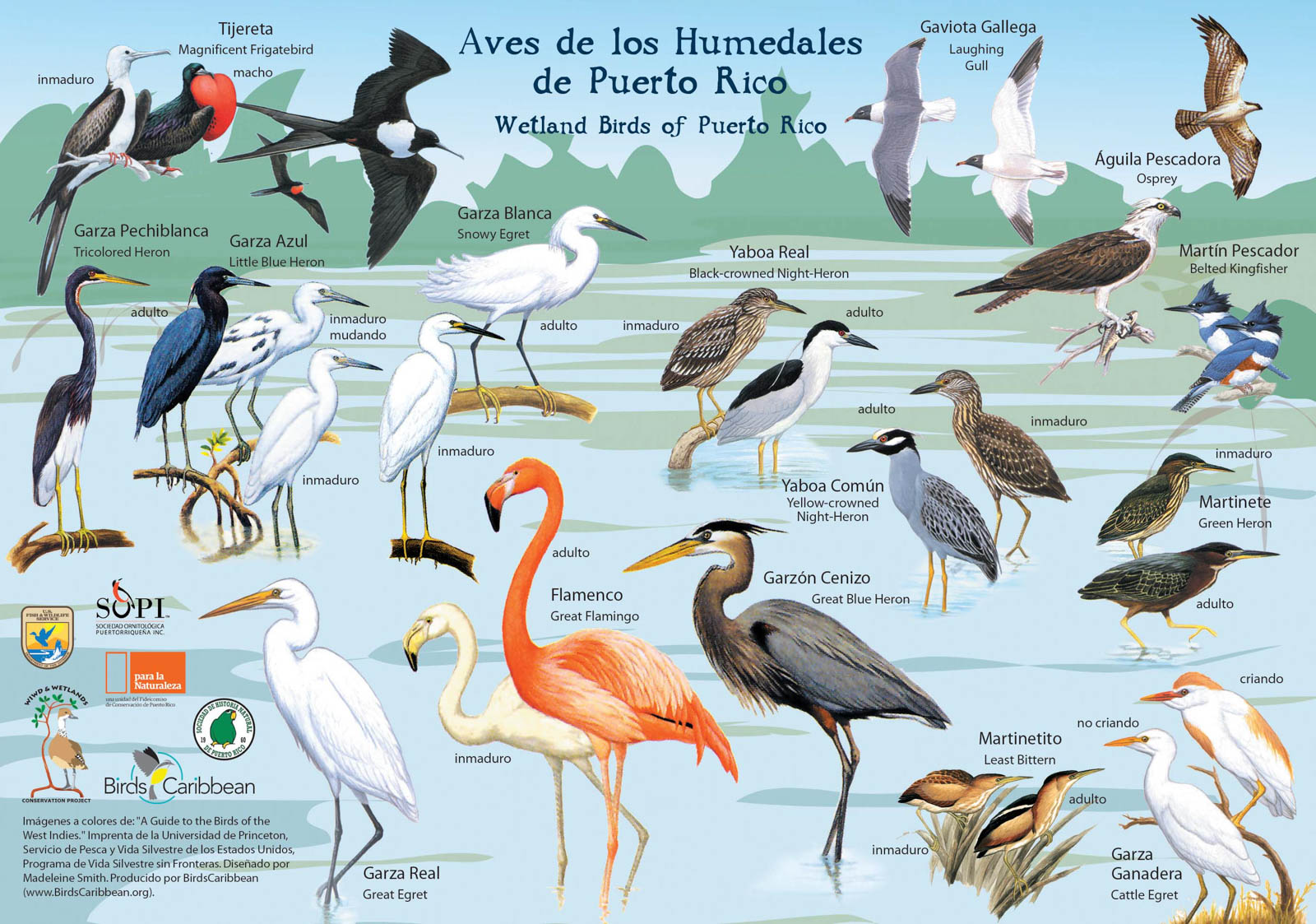
Illustrations from Raffaele’s book have been used to create many bird education resources, such as this bird identification card.
What do you think are BirdsCaribbean’s best programs and why?
BirdsCaribbean has a number of excellent programs but those which excite me the most are the ones that get to the root of conserving birds – people’s values and the behaviors which derive from them. To that end, I think the Caribbean Endemic Bird Festival is particularly special. The islands of the Caribbean are extraordinary in that all the major ones have birds unique to them – birds which are found nowhere else in the world. At the same time, I expect that all too few island residents are aware of this special aspect of their heritage. The Endemic Bird Festival creates this awareness and builds pride – a key underpinning of true conservation. I am also very fond of the West Indian Whistling-Duck and Wetlands Project, an initiative primarily aimed at training teachers to incorporate wetlands conservation into their curricula for young children. This focus on reaching youth and providing them positive outdoor experiences in local wetlands is essential if they are to be concerned as adults for the environment around them.
If you could encourage people to do one thing for birds, what would it be?
Get others to appreciate birds and then take actions to conserve them so as to make their conservation a societal norm—actions which are accepted and respected by everyone.
What was your most rewarding education/conservation/research success?
I have had a lot, but undoubtedly my most rewarding conservation success relating to the Caribbean was publishing of A Guide to the Birds of West Indies. It took about 9 years of work in my spare time, but publication of this book, and its sequel, has facilitated countless people in the region being able to better learn about and enjoy their unique birdlife. There is nothing more satisfying than seeing a copy of the book that has been frazzled from years of use in the field since this shows how important the book has been to someone. Publication of the book has also enabled, through free use of the illustrations, many dozens of other bird conservation initiatives throughout the region including posters, bird identification cards, interpretive signs, and the creation of local island bird guides. This too has been a very gratifying development.
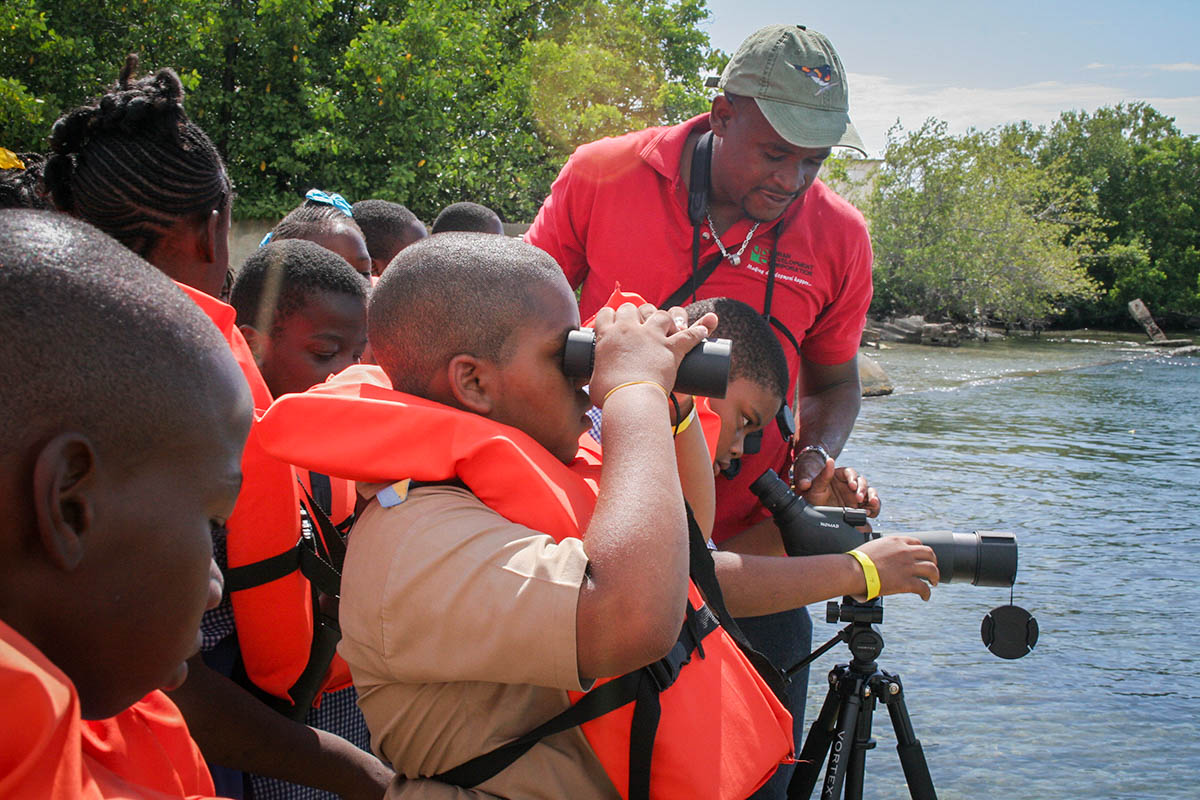
“Do you see the Pelican?” Damian Whyte, environmental officer of the Urban Development Corporation, Jamaica, seems to be asking students of Swallowfield Primary School as he demonstrates how to use the telescope as a part of the Caribbean Waterbird Census 2016 in Palisadoes Port Royal Protected Area. The equipment was donated to NEPA and Jamaica Environment Trust by BirdsCaribbean (photo courtesy of Ava Tomlinson).
The first internationally coordinated waterbird count was organized in January 1967 by Wetlands International. Now entering its 50th year, the International Waterbird Census has become a vital source of information for the conservation and management of wetlands and waterbirds around the world. Seven years ago, the Caribbean Islands, under the auspices of BirdsCaribbean, formally began to contribute to the International Waterbird Census; and thus the Caribbean Waterbird Census, or CWC, was born. Every year since 2010, wetlands across the region have been visited by enthusiastic, adventure-seeking volunteers eager to observe and count waterbird populations. The CWC takes place over three weeks in January and February, and 2016 was another fantastic year.
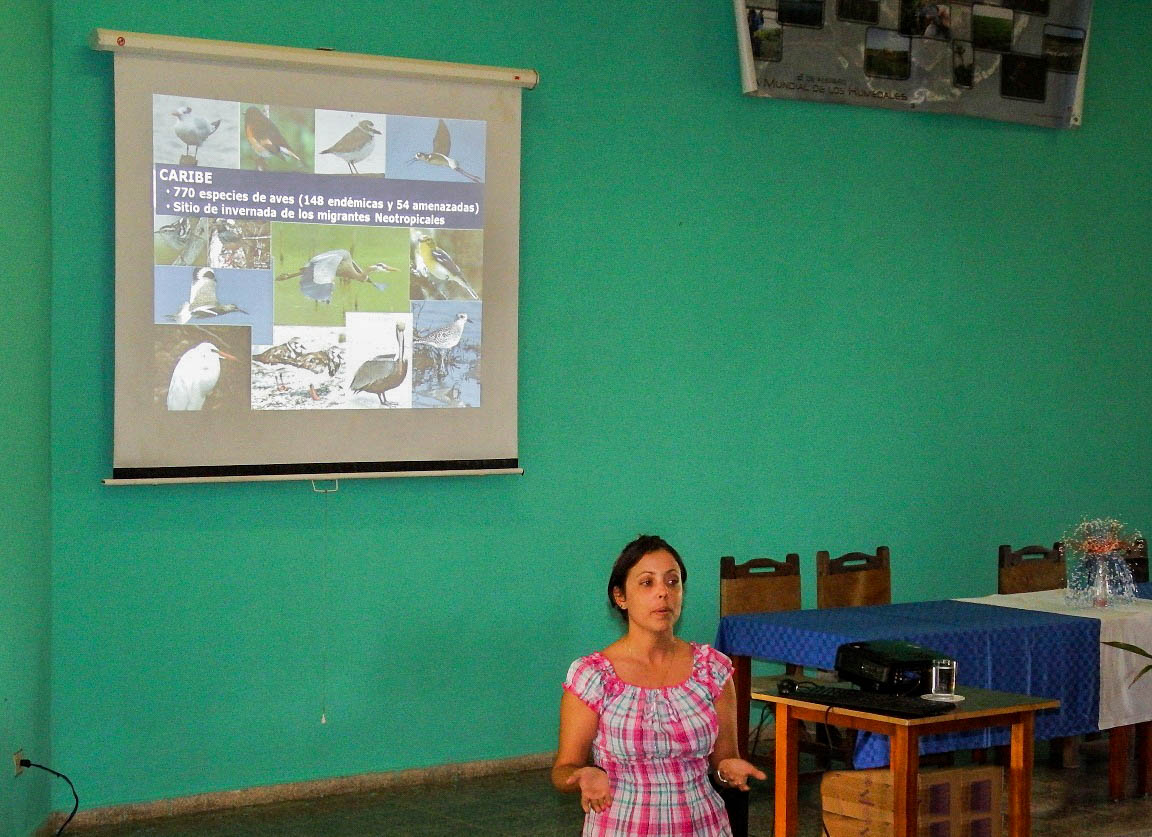
The Caribbean is home to over 500 species of birds, 170 of which are endemic, and the region provides an important site for Neotropical migrants. Wetlands are critical for numerous waterbird species, providing a variety of habitats from swamps and lagoons to mudflats and lakes. Waterbirds depend on wetlands as a source of food or as nesting habitat. For example, one of the biggest wetlands in the Caribbean, Trinidad’s Nariva Swamp provides a vital nesting site for the magnificent Scarlet Ibis. Many species depend on wetlands for refueling and resting, especially during their long winter/summer migrations.
Braving the elements to count wetland birds in the Dominican Republic (photo by Maria Paulino).
For some, going out into the blistering heat, getting your shoes covered in mud, and being bitten by sandflies and mosquitoes does not sound like the most appealing activity. Yet for hundreds of birders across the region, the Caribbean Waterbird Census is the perfect excuse to take out their spotting scope, camera and binoculars, grab a pen and paper, and visit their nearest wetland in search of waterbirds.
We are pleased to announce that 13 countries across the Caribbean participated in this year’s CWC, and in the cases of Anguilla, Bonaire and Jamaica more than one count was conducted by different organizations and citizen scientists. A total of 321 checklists were submitted, and despite the ongoing drought across the region, a total of 191 species and 30,406 birds were observed in 152 locations! The US Virgin Islands submitted a record 78 checklists.
The most numerous species observed were the American Flamingo (6,265), Glossy Ibis (1,372), Short-billed Dowitcher (1,320), Cattle Egret (1,121), and the Blue-winger Teal (1,107). The most frequently reported species (i.e. on the most surveys) were the Yellow Warbler (142), Bananaquit (104), Gray Kingbird (98), Great Egret (85), Lesser Yellowlegs (83), and the Spotted Sandpiper (72).
Cuba used the CWC as an opportunity to conduct a workshop on wetland biodiversity for a local community in Los Palacios, Pinar del Río (photo courtesy of Alieny Gonzalez).
The CWC is critical in understanding the distribution, status and abundance of waterbirds on a local, regional and global level, thus helping BirdsCaribbean and local governments make informed decisions on their conservation and management. The CWC also helps determine which sites are important for supporting huge populations of waterbirds, as well as the key wintering and migration stopover sites for threatened and declining species such as the Red Knot, Whimbrel, Reddish Egret, American Oystercatcher, and Semipalmated Sandpiper.
Over 240 sites are currently monitored by volunteer counters in BirdsCaribbean’s network. However, with over 7,000 islands and islets in the Caribbean, many important sites have not yet been included. The CWC and other censuses are a great way to involve local communities in citizen science and get young people more connected with the region’s unique and often threatened birds.
Banded Red Knot “CTK” spotted at Cargill Salt Ponds, Bonaire (photo by Fernando Simal). This bird was first captured and banded in 2004, making it at least 12 years of age. The salt ponds of Bonaire are providing a home for this and other migratory birds during the winter of 2015-2016. Western Hemisphere Shorebird Reserve Network site designation will help raise awareness about the importance of Bonaire and the Cargill Salt Facility as a haven for migratory shorebirds.
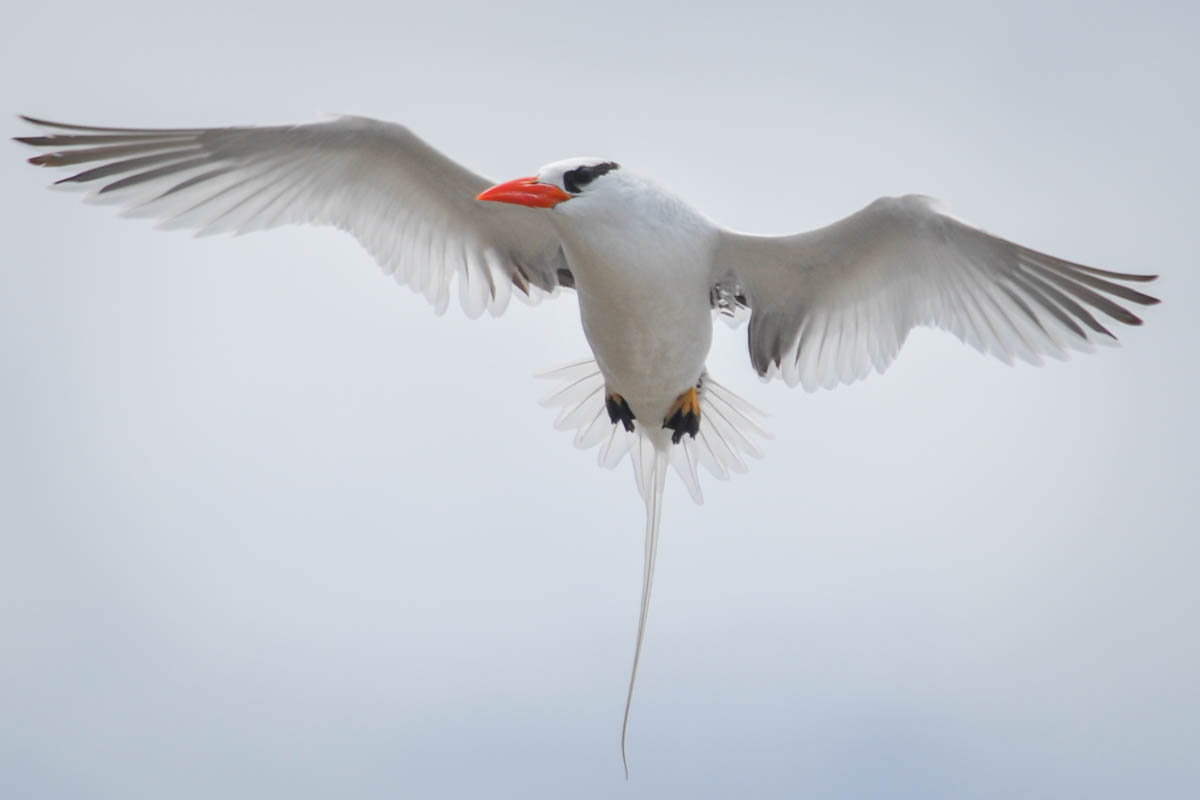
For seabird lovers, Statia is the best place in the Caribbean to see Red-billed Tropicbirds up close. (Photo by Hannah Madden)
One of the Caribbean’s best kept secrets is St. Eustatius, a special municipality of the Netherlands that measures just 11 square miles. You might think there is little to see there, but nothing could be further from the truth. Affectionately known as Statia, the landmass has been spared the destructive development that plagues so many other islands in their search for economic sustainability through mass tourism. Bird-watching is a particularly rewarding pastime on Statia, which offers accessible birding across the island. In fact, a recently published paper in the Journal of Caribbean Ornithology lists a total of 75 recorded species!
Statia supports a number of species that may be of particular interest to ornithologists, such as the restricted-range Antillean Crested Hummingbird, Green- and Purple-throated Carib, Lesser Antillean Bullfinch, Caribbean Elaenia, Scaly-breasted Thrasher, and the Bridled Quail-dove. It is also an important stopover or nesting ground for migratory birds like the Short-billed Dowitcher and Red-billed Tropicbird.
A hike up the dormant Quill volcano will bring enthusiasts in close range of the Bridled Quail-dove. (Photo by Hannah Madden)
Visitors to Statia are always pleasantly surprised by the birding opportunities the island offers, and efforts are being made to develop and strengthen birding tourism, especially through the Caribbean Birding Trail and other collaborations with BirdsCaribbean. Director of the St. Eustatius Tourism Development Foundation, Mr. Charles Lindo, states: “Statia is known for its peace and tranquility, and with the new information of having 75 different bird species on our island only strengthens the fact that we need to maintain the avian fauna of our island by preserving their natural habitat.”
Two of Statia’s main selling points for bird-lovers are the Bridled Quail-dove and Red-billed Tropicbird. A hike up the dormant Quill volcano will bring enthusiasts in close range of the Bridled Quail-dove, which wanders the outer slopes of the dry forest at elevations of over 200 meters and inside the lush, liana-filled crater. According to Raffaele et al. (A Guide to the Birds of the West Indies), this bird is generally ‘uncommon to rare’ in the Lesser Antilles and is a declining species across its range. Nevertheless, sightings on Statia are common and thanks to the protected status of the Quill National Park, it is hoped that this bird’s habitat will remain untouched in the coming years.
A walk along Zeelandia beach offers visitors the opportunity to literally walk up to a Red-billed Tropicbird nesting in the sandstone cliff face. (Photo by Hannah Madden)
For seabird lovers, Statia is the best place in the Caribbean to see Red-billed Tropicbirds up close. A walk along Zeelandia Beach offers visitors the opportunity to literally walk up to a Red-billed Tropicbird nesting in the sandstone cliff face. Nesting season is from October to May, with peak activity from January to March. Statia and its sister island Saba, some 20 miles away, support one of the largest breeding populations of Red-billed Tropicbirds in the region. This may be due to a lack of coastal development on our small islands, which offer a safe nesting haven for a pelagic species with high site fidelity.
The special logo for the 50th Anniversary of the IWC. Everyone is invited to use the logo for any purpose, such as articles, websites, newsletters and t-shirts. Everyone participating in the count is encouraged to share photos and stories on social media using the hashtags #IWC50 and #WaterbirdsCount
In 1967, while the Vietnam War was being fought, Gilbraltar was deciding if it should remain a British Territory or change over to Spanish ownership, and the first edition of Rolling Stone magazine was published in the U.S. Another history-making event also took place that year—the first International Waterbird Census (IWC). The first count took place in the UK in January of 1967 and included just waterfowl (ducks, geese and swans). Since then the count has grown to include 143 countries across the globe with counters recording numbers of all waterbirds at thousands of sites. This year we celebrate the 50th Anniversary of the IWC, with the theme, “Let’s Make it Count!”
Wetlands International, the coordinator of the IWC has launched a year-long campaign in partnership with governments, non-profit organizations and citizen scientist volunteers to celebrate the 50th Anniversary. They aim to make 2016 the biggest count ever, increasing the number of important wetlands sites covered by the count, to ensure the latest and most up-to-date information about waterbirds is available to support conservation action for waterbirds and wetlands worldwide.
International Waterbird Census – Its Far-reaching Effects
Because of the work of the IWC, over 5 million km2 of critical areas for waterbirds were identified, including Ramsar Sites, World Heritage Sites and network sites in all flyways, and Important Bird Areas. Countries have also come to understand the importance of wetlands, their resources and wildlife. Take for example the case of the Senegal Delta. The wetlands found there are an important home for waterbirds and provide a “rest-stop” for migrants. These wetlands were significantly altered from the construction of dams and the expansion of the agricultural sector. Because of local monitoring of waterbirds, however, more attention was placed on proper management of the wetlands, including re-wetting drained ones, to benefit both wildlife and humans.
In addition to conserving sites and raising awareness, other noble strides and contributions from the IWC include enhanced understanding of relations between wild birds and avian viruses, providing updated information to assist with periodic updates of the IUCN Red List of Threatened Species around the world, and promote informed management of wetlands and waterbirds.
Rt to Left: Orisha Joseph (Sustainable Grenadines Inc staff) and her team, including local businessman Martin Jennett, local bird expert Katrina Collins, and SusGren intern Sonia Jind count waterbirds at Belmont Salt Pond in Union Island, St. Vincent and the Grenadines.
A Closer Look at Home – The Caribbean Waterbird Census (CWC)
Seven years ago, the Caribbean islands, under the auspices of BirdsCaribbean, formally began to contribute to the IWC; and the Caribbean Waterbird Census, or CWC, was born. Every year since 2010, wetlands across the Caribbean region have been visited by enthusiastic, adventure-seeking volunteers eager to observe and count waterbird populations, despite the drawbacks of muddy shoes and encounters with hungry sandflies and mosquitoes. The regional CWC is a three-week count that begins on 14th January and ends on 3rd February. Partners are encouraged to carry out counts at all times of the year, however, especially during the spring and fall migration periods.
For the past two years, the Caribbean has suffered from a cataclysmic drought, which has obviously affected many of our wetlands. Notwithstanding, for this seventh consecutive year, the teams across the region have gone out and done their counts. On Union Island, St. Vincent and the Grenadines, Orisha Joseph and her team of 10 have made sure that populations of waterbirds at Ashton Lagoon and Belmont Salt Pond have been accounted for. In Antigua, top counting spots, though surveyed, yielded little results as in the case of Potworks Dam and Bethesda Dam, which have been bone dry for months. However, Andrea Otto and her team have gotten promising numbers having covered Christian Cove, Pelican Island Pond, Valley Church Pond, Jabberwock Swamp and McKinnon’s Pond.
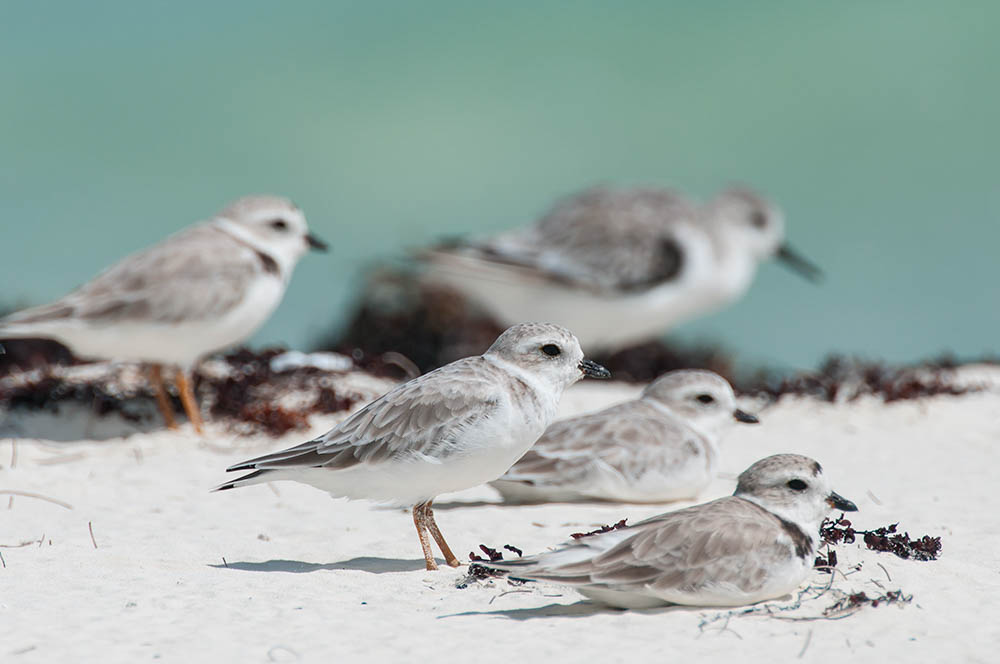
This year, the International Piping Plover Census, conducted every 5 years, was done simultaneously with the CWC. The Caribbean provides important wintering grounds for these daring flyers among other shorebirds including Ruddy Turnstones, Black-necked Stilts, Greater and Lesser Yellowlegs, and Willets. Thanks to the CWC, we are able to understand if their populations are in decline, stable or are increasing.
Stilt Sandpiper and Short-billed Dowitcher are 2 migratory shorebirds that depend on Caribbean wetlands to feed and rest during migration and winter. (photo by Lisa Sorenson)
If you are in the Caribbean and interested in participating in the CWC, learn how to do so here. Also, don’t forget to upload your sightings to eBirdCaribbean. Keep counting, keep recording, and keep taking photos! The CWC helps us understand the distribution, status and abundance of waterbirds on a local, regional and global level, thus helping us, like the IWC, to make informed decisions on their conservation and management. From the CWC, we are learning which sites are important for supporting huge populations of waterbirds, as well as the key wintering and migration stopover sites for threatened and declining species such as the Red Knot, Whimbrel, Reddish Egret, American Oystercatcher, and Semipalmated Sandpiper.
Over 240 sites are currently monitored by volunteer counters in our network. However, with over 7,000 islands and islets in the Caribbean, many important sites have not yet been included. We invite you to be a part of the biggest count ever. Remember, we have 11 more months to plan and execute a great count for the CWC and IWC!
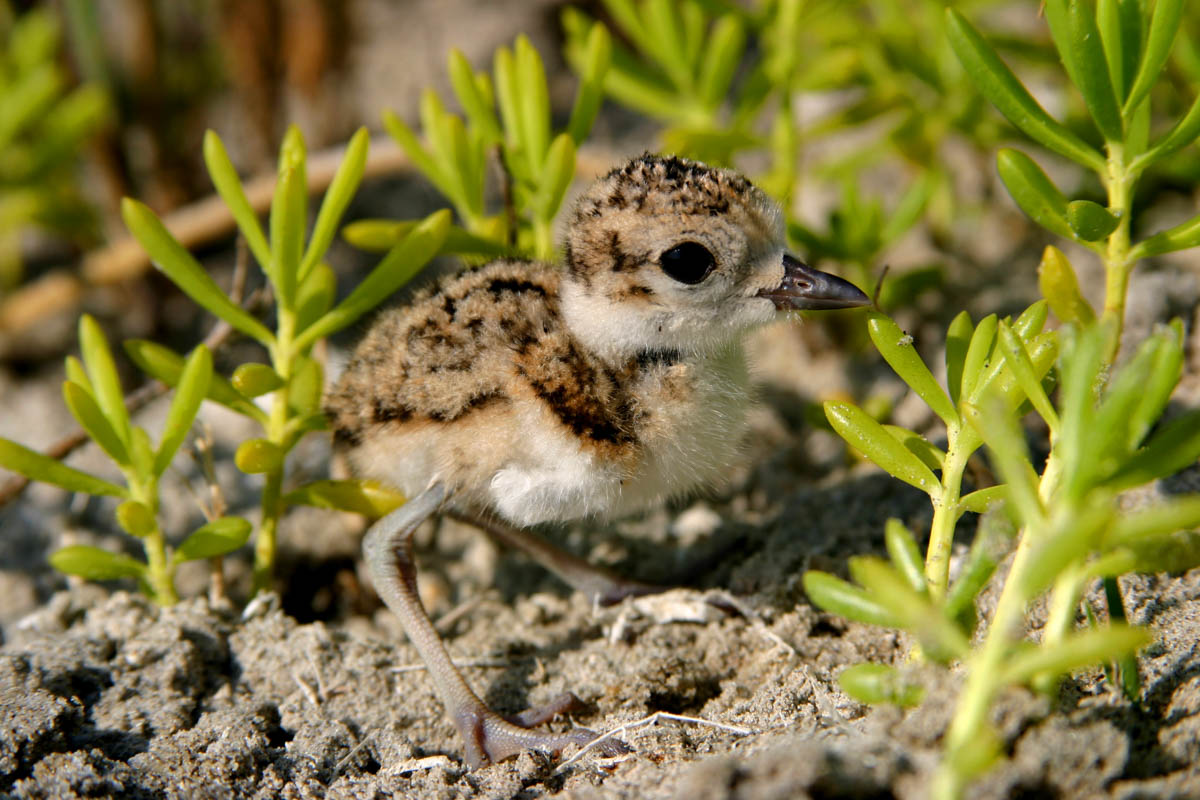
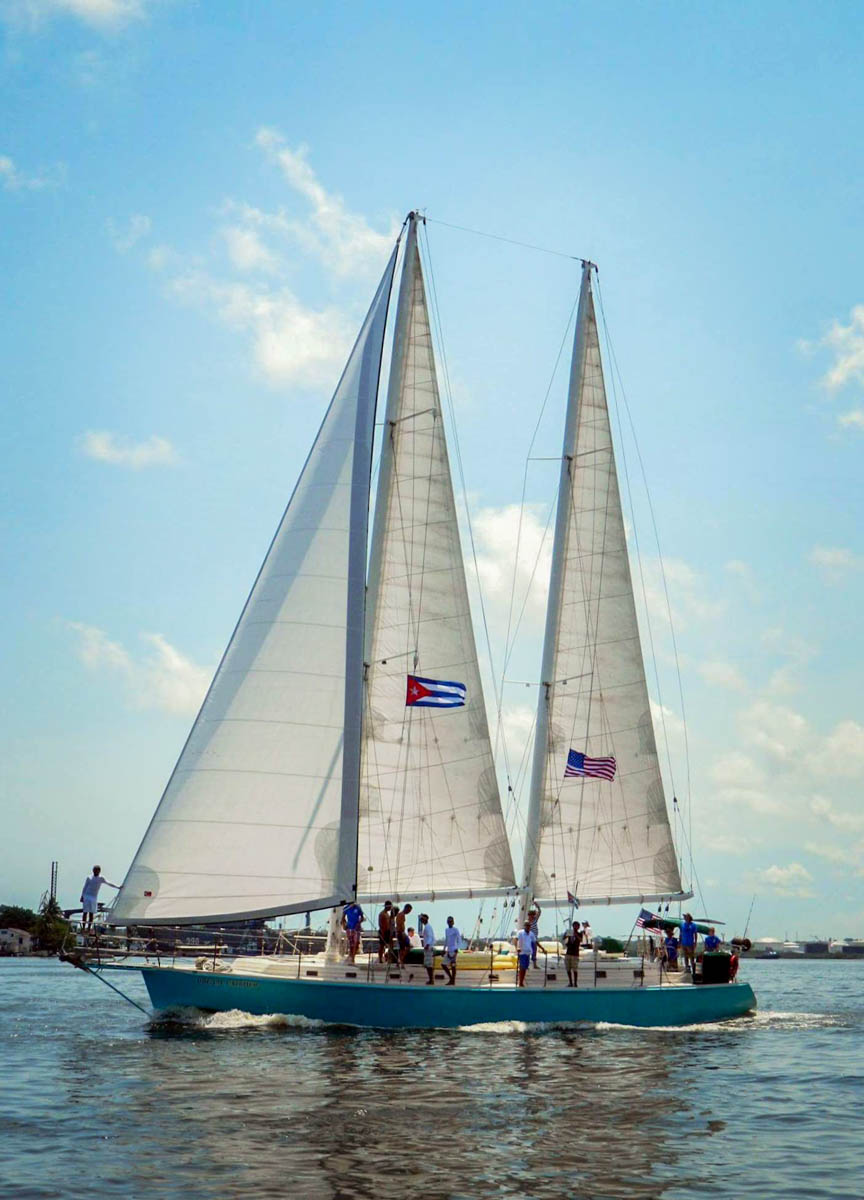
This is an excellent opportunity to gain multi-species shorebird ID and monitoring experience.Conservian is beginning a new shorebird and habitat conservation program in the Bahamas. Come join them for the adventure of a lifetime! Conservian is seeking a weekly crew of 6 to 8 enthusiastic individuals for our Bahamas shorebird habitat conservation project in May 2016 aboard the 75ft schooner “Dream Catcher”. Cost for the week is $1,150. Includes your bunk, onboard meals, water, and ground transportation associated with project. Crews will fly to the Bahamas each week to designated airports for shuttle transport to schooner. A valid passport is required. Airfare and insurance are not included.
Our days will be filled with much adventure. We will work in both populated and remote areas, sail blue Caribbean waters, visit white sandy beaches, boat to little islands, conduct ground surveys for beach-nesting birds, nests, and downy chicks, and meet new people. We will work with local volunteers to post and sign shorebird sites and control invasive Australian pine. Crews will assist with shipboard duties; sailing, cooking and cleaning. We will rotate duties so that everyone will have some time off to visit island towns, fish, snorkel, or dive.
Our days will be filled with much adventure aboard the 75ft schooner “Dream Catcher”.Conservian and partners will begin the first program in the Bahamas to implement on-the-ground protective and restorative measures to limit human-caused disturbance, and control invasive Australian pine at key Piping Plover, shorebird, and seabird sites. Crews will also participate in collecting new data on shorebirds and seabirds of the Bahamas. Selected Island sites include Globally Important and locally Important Bird Areas and national parks of the Bahamas, such as the North Atlantic Abaco Cays National Park IBA, Lucaya National Park IBA, Peterson Cay National Park IBA, Joulters Cay National Park IBA, and Berry Islands, as well as additional key shorebird sites on Grand Bahama Island and Great Abaco. Project partners include: BirdsCaribbean, Bahamas National Trust, Dream Catcher Coastal Sailing Adventures, International Conservation Fund of Canada, LightHawk, Grand Bahama Nature Tours, Grand Bahama Port Authority, Grand Bahama Island Power, Abaco Friends of the Environment.
Lyndon John, Vice President of BirdsCaribbean.In sharing the stories of the people behind BirdsCaribbean, we could find no better place to start than with Lyndon John, Vice President. We interviewed him via email.
What is your job (currently and in the recent past if different from you current position)?
I am the Caribbean Invasive Alien Species Project Coordinator with Royal Society for the Protection of Birds (RSPB) responsible for management of the EC funded BEST project entitled “Conserving Species and Sites of International Importance by the Eradication of Invasive Alien Species in the Caribbean UK Overseas Territories.”
I have enjoyed a career spanning some 30 years much of it as a conservation biologist and a forester with the Saint Lucia Department of Forestry. I started off as a tour guide with subsequent appointments as a research officer, wildlife officer and eventually to Assistant Chief with acting appointments as Deputy Chief Forest Officer and Chief Forest Officer.
How did you get interested in birds?
While I am a native of Saint Lucia, much of my early childhood was in urban Jamaica where I did not get to see much more than commonly seen garden birds or sometimes waders along the canals of the Portmore area. However, natural history television programmes (e.g. Jacques Cousteau) and reading (e.g. Gerald Durrell) sparked my early curiosity for the subject of wildlife in general. Upon my return to Saint Lucia as a teenager in high school, I became a member of the then St. Lucia Naturalists Society and participated in field trips covering various aspects of St. Lucia’s fauna and flora during which I gained a greater appreciation for native and migrant birds.
Lyndon John’s passion for birds and other wildlife began at an early age.How did you get involved with BC?
In 1986, I was recruited as a tour guide with the Saint Lucia Department of Forestry. Due to my enthusiasm specifically for the wildlife component of the Department’s programme, I was invited to attend the 1990 meeting of the then Society of Caribbean Ornithology (SCO) in Jamaica by Mr. Paul Butler and then Chief Forest Officer Gabriel Charles. I accompanied both gentlemen to the meeting which was held at the UWI, Mona Campus. This was my first international wildlife meeting of what has since been a lifetime of professional related travel.
How has the organization influenced you?
I thoroughly enjoyed the international meetings of then SCO, (currently BC) because although I was a novice in the field , I met fellow members from all over the region who were also just getting started in their careers. Some would eventually serve at the highest levels of the organization and also in offices from their respective countries. It served as an excellent basis for networking and fostering our keen interest as budding conservation scientists. It also introduced me to mentors such as Dr. James Wiley, who would become my professor during my undergraduate studies in Biology (Wildlife) at Grambling State University, Louisiana, USA. Herb Raffaelle, Joe Wunderle, Ernesto Garcia are among the many who encouraged and influenced my career.
Additionally, I became the first Forest Officer in my Department to be awarded a grant directly. The cash grant of US$1500.00 US in 1992 enabled me to conduct research on the White breasted Thrasher, a critically endangered St. Lucian species. The project entitled “Conservation of the White breasted Thrasher (Ramphocinclus brachyurus sanctae luciae). also enabled me to purchase field gear for the wildlife unit of the Department. The grant was provided by BirdLife International and U.S. Fish and Wildlife Service through SCO (BirdsCaribbean).
What does being a member of the board mean for you?
Being a board member of BC allows me to give something back to an organization that influenced my youth and career as a conservation biologist.
Involvement in BirdsCaribbean has been an opportunity to give back to an organization that influenced him.What do you think is the biggest challenge facing Caribbean bird conservation?
The Caribbean consists mainly of a youthful population, with struggling vulnerable economies and a political emphasis on traditional outmoded model of development based largely on conversion of natural landscapes. The biggest challenge to Conservation is that it needs to answer the demands of the region’s societies for sustainable development, while making every effort to showcase the immense, irreplaceable social and biological value of our birds and their habitats as part of the solution in our drive for development.
If you could encourage people to do one thing for birds, what would it be?
Value them and their habitats! To value them, one must come learn about them. You cannot value what you are not aware of, nor do not understand. In so doing, I hope this would reveal the tremendous value, actual and potential contribution of birds to the Caribbean.
What was your most rewarding education/conservation/research success?
During my 1992 research on the project entitled “Conservation of the White breasted Thrasher (Ramphocinclus brachyurus sanctae luciae). I discovered that the chicks were precocial in behavior and that they left the nest before they could fly. I got video footage of this behavior which had never been described for the species before this study. Additionally, I’d say getting Saint Lucia to ratify the Ramsar Convention on Wetlands in 2001 and adding the Mankote Mangrove and Savannes Bay Mangrove to the list of Internationally protected wetlands, thereby protecting valuable habitat for native and migratory birds.
Ornithologist Nils Navarro with a study skin of the extinct Cuban Macaw (Ara tricolor) at the Harvard Museum of Comparative Zoology, Cambridge, Massachusetts, October 2015. Nils was visiting the U.S. for a book tour of his newly-published Endemic Birds of Cuba Field Guide.
BirdsCaribbean warmly welcomes the news that the Governments of the United States of America and Cuba on November 24, 2015 signed a Joint Statement on Environmental Protection that creates a framework for cooperation on a number of pressing issues, including the protection of endangered species and their habitats, the prevention of wildlife trafficking and the protection of migratory bird species. The U.S. Department of State will be encouraging agencies such as the U.S. U.S. Fish and Wildlife Service (USFWS) to work with its Cuban counterparts at the Ministerio de Ciencia Tecnologia y Medio Ambiente (CITMA) on this new arrangement, which is a reflection of the new openness and diplomatic ties between the two nations.
Judith G. Garber, Acting Assistant Secretary at the U.S. Department of State’s Bureau of Oceans and International Environmental and Scientific Affairs, responded positively to a letter from BirdsCaribbean’s Executive Director Dr. Lisa Sorenson, urging deeper cooperation to protect Cuba’s bird life and biodiversity. Coincidentally, the cooperation agreement was signed on the same day that Ms. Garber received Dr. Sorenson’s letter, which notes that the organization’s 21st International Meeting will take place in Cuba in July 2017.
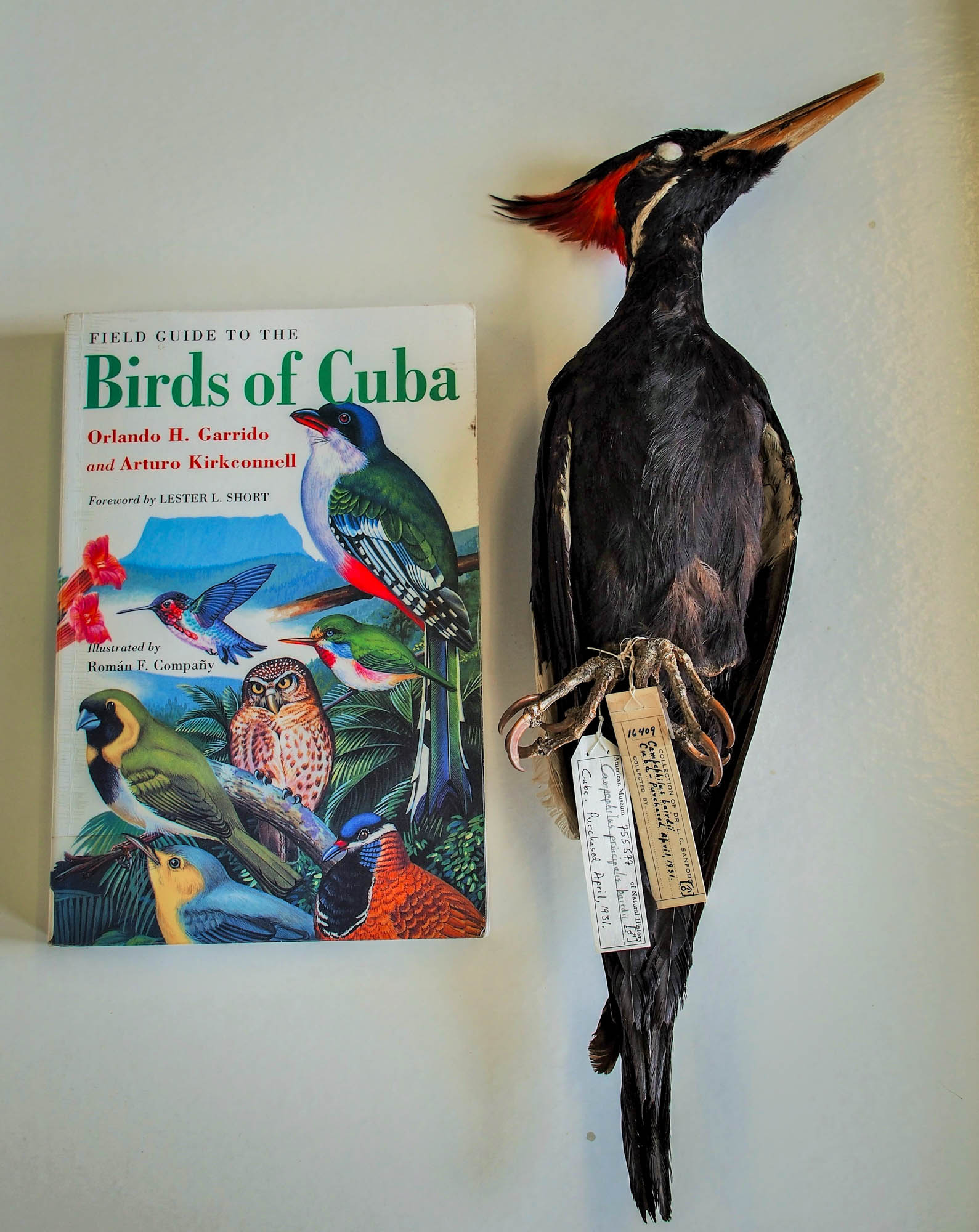
The Cuban Ivory-billed Woodpecker (Campephilus principalis bairdii) is believed to be extinct as no specimens have been seen since 1987. Cuban Ivory-bills were among the largest woodpeckers in the world. Most of Cuba’s lowland deciduous forests had been cleared by the early twentieth century and habitat is believed in large part the source of its demise.
BirdsCaribbean has been working with and supporting research and conservation activities in Cuba for a number of years, to the limited extent allowed, including collaborations with professors and students at the University of Havana. In her letter, Dr. Sorenson points out that both Cuba and the U.S. are signatories to several important international agreements on environmental protection, including the Ramsar Convention on Wetlands of International Importance, the Convention on International Trade in Endangered Species of Flora and Fauna (CITES) and others. There are many shared interests and concerns, and strengthened ties can only benefit both countries’ efforts to protect their environments in the face of many common challenges, including climate change.
Cuba is a treasure trove of biodiversity, including its birds. Three hundred seventy one bird species have been recorded in Cuba, 26 of these are endemic to the island and 30 are considered globally threatened. Cuba is also a crucial stopover point for over 180 Neotropical migratory bird species that fly to and from the U.S. every year, resting and refueling or spending up to nine months wintering in Cuba. BirdsCaribbean regards the trade in caged birds and the loss of habitat from development as two major threats to migratory bird populations and a critical area of conservation focus on the island.
Cuban scientists made a number of presentations at BirdsCaribbean’s 20th International Meeting in Kingston, Jamaica in July 2015, when artist and conservationist Nils Navarro launched his ground-breaking publication, Endemic Birds of Cuba: A Comprehensive Field Guide. The U.S.-Cuba agreement will be beneficial to many academics and institutions in the country, opening up a new era in communication and cooperation for the conservation of migratory and threatened endemic birds.
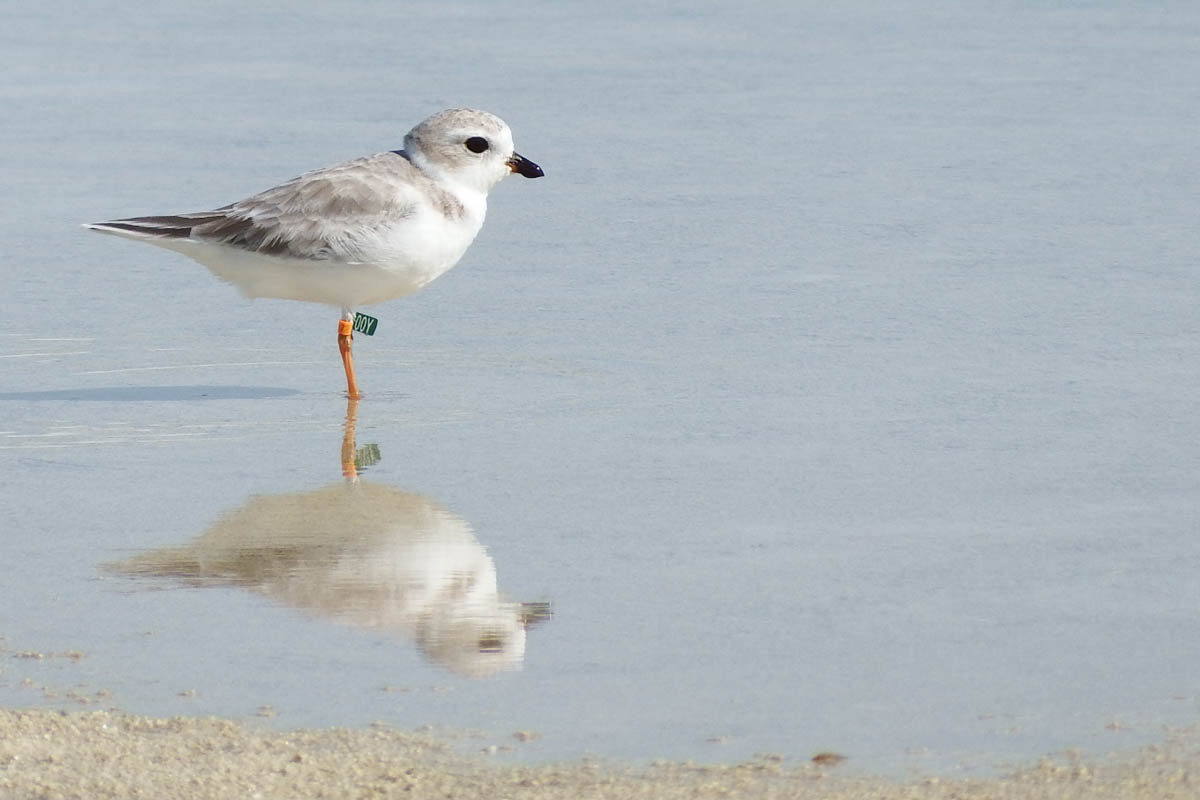
We are just beginning to understand how important the Caribbean is to the Piping Plover. (Photo by Matt Jeffery)How important is the Caribbean to global populations of Piping Plover? You can help us find out! Listed as threatened and endangered in the United States and Canada where it breeds, the Piping Plover (Charadrius melodus) spends a large portion of the year on wintering areas—including many in the Caribbean—and it is critical that we identify and conserve these habitats.
Right now, the 2016 Piping Plover Census is happening and you can join in. You don’t need to be a professional to help—citizen scientists with a spotting scope or binoculars and some familiarity with shorebirds are welcome to participate. You can also conduct Piping Plover counts while you are participating in this year’s Caribbean Waterbird Census. Get all the details, instructions and census tools at eBird Caribbean.
A juvenile Red Knot in Barbados (by John Webster). This species has one of the longest migrations of any bird, traveling more than 9,000 mi (14,000 km) from the Arctic to the southern tip of South America each year. Some individuals use Caribbean wetlands as stopover sites on migration.
One bird, two bird, three bird, four! Since 2010, hundreds of dedicated volunteers have been spreading out across the Caribbean’s vast wetlands, large and small, and counting birds for the Caribbean Waterbird Census (CWC). The goal is to learn more about the status of migratory and resident waterbirds and strengthen their conservation.
Waterbirds in the Caribbean, and the wetlands they depend on, are challenging to monitor. The Caribbean region is spread across 7,000 islands, islets, and cays and many wetlands are difficult to access. But our intrepid counters have braved gooey mud, marauding mosquitos, and sweltering heat to help us gather data of great importance to conservation.
Waterbirds are species that depend on aquatic habitats, like mangroves, salt ponds, tidal flats, lagoons, beaches, and freshwater marshes, to complete portions of their life cycle. Unfortunately, many species are in severe decline, particularly shorebirds. Semipalmated Sandpiper that once numbered over two million on Caribbean and South American wintering grounds have dropped by 80%. Another long-distance migrant shorebird, the Red Knot, is now listed as Threatened under the Endangered Species Act, having declined by 80% as well. The Zapata Rail, endemic to sawgrass habitat in the Zapata Swamp in southern Cuba, has not been seen with certainty in nearly 20 years.
Wetlands are important for birds and for our well being too. Not only do they provide a home for wildlife, they also provide people with clean water, protection from floods and erosion, and opportunities for recreation and wildlife viewing.
Reddish Egret (dark morph) in Cuba by Antonio Rodriguez. This medium sized heron has 2 color morphs, light and dark. It inhabits coastal wetlands in the Bahamas and Greater Antilles islands. It is known for its energetic feeding behavior, running, jumping, flying and open wing dancing in pursuit of small fish in shallow water.
For years wetlands have been destroyed for development, damaged by pollution, or threatened by tourism, agriculture, cattle, industry, or sea level rise. Because wetlands are vital to birds and people, it’s important to know where they are, what birds are living in them, and what times of year they are being used.
BirdsCaribbean is answering these questions through the CWC, a program that aims to increase support for waterbird and wetland conservation by training a cadre of people to observe and record birds in wetlands across the Caribbean. Natural resource agency staff and citizen scientist volunteers help answer important questions while gaining an understanding and appreciation of migratory birds and the wetlands that they live in.
Since the beginning of the program in 2010, over 200 people from 21 countries have surveyed more than 700 areas! Each year, more and more people take part in the CWC. We have learned a lot of cool stuff over the last six years!
For example, several places stand out for their high numbers of birds. Sur de Los Palacios, Cuba is important to Wilson’s Plover throughout the fall, winter, and spring. This medium-sized bird is on the 2014 State of the Birds Watchlist, which lists species most in danger of extinction without significant conservation action. Knowing where they spend much of their time can lead to increased conservation for these sites in Cuba. Monte Cristi in northwestern Dominican Republic has been discovered as an incredibly important site for many shorebird species throughout the migration and winter season. Counts in the fall are especially high for Greater Yellowlegs (870 individuals), Lesser Yellowlegs (3,250 individuals) and Semipalmated Sandpiper (3,150 individuals), all being the highest overall counts for the species throughout the Caribbean!
White-cheeked Pintails in flight by Ernesto Reyes. Wetlands in the Caribbean are very important to migratory ducks like Blue-winged Teal and Lesser Scaup, and resident ducks, such as the White-cheeked Pintails, shown here.
Shorebirds like these only weigh a couple ounces; the Semipalmated Sandpiper weighs in at just a smidge more than a quarter, and flies thousands of miles from it’s breeding grounds in the Arctic to it’s wintering grounds in South America. Knowing where this bird stops along the way is important so conservationists can protect the places it needs to rest and feed for their long journey.
Another indicator of importance is the diversity—or how many different kinds of birds—are observed. Two locations in Guadeloupe (Pointe des Chateaux and Petite-Terre) and one in Cuba (Sur de Los Palacios) had over ten different shorebirds counted and seven other sites, located in Guadeloupe, Grenada, DR, Bahamas, Cuba, and Grenada recorded 9, 8 or 7 shorebird species. Some sites in the Caribbean like Sur de Los Palacios in Cuba and Monte Cristi in the Dominican Republic stand out for high numbers of all waterbirds, not just shorebirds. Of the 241 sites monitored in 2014 a total of 293 species were recorded!
What do all these numbers really mean? Knowing which birds are using what areas helps conservationists identify the most important sites to protect. Raising awareness, and showing the value of wetlands to local communities can lead to better care and protection of the wildlife using them. They become places to promote environmental education and bird and nature tourism. Enhancing key sites by installing boardwalks, viewing towers, and signs makes them attractive to visitors, which in turn increases their value for local people, livelihoods, and the economy.
During winter, some birds migrate, but many travel only short distances. Wilson’s Plover (female) at Mt Hartman wetland in Grenada by Greg Homel. This handsome shorebird is found in coastal areas, including sandy beaches, mudflats and mangroves. It is resident and breeds on many Caribbean islands. During winter, some birds migrate, but many travel only short distances.
While participation in the CWC has increased every year and we have already learned a great deal from the counts, there is still much work to be done! With over 7,000 islands and islets in the Caribbean, many important sites have not yet been surveyed. In addition, it’s important to continue surveying the same sites over the long term in order to document changes in waterbird numbers in relation to changing environmental conditions, for example, under climate change. Finally, we must continue to raise awareness about the importance and value of these sites to birds and people and promote protection and good management. Doing so will ensure that these critical wetlands are not lost forever; and birds and people will have a place to thrive.
To find out how to participate in the CWC, click here.
Welcome to the BirdsCaribbean website, where you will learn about our work on Caribbean birds, and will be inspired to join our diverse community of people working for a sustainable future for the region through preservation of birds and their habitats.
Since 1988, BirdsCaribbean has been supporting the conservation of some of the most endangered species not only of the region, but of the entire Western Hemisphere. We support innovative conservation programs for island endemics (such as globally-threatened parrots and petrels and the Grenada Dove) and for over-wintering migratory species such as Piping Plovers. Additionally, we expose stakeholders in the Caribbean and the rest of the world to science and to the beauty and value of our birds like never before – and we use all the available new media.
We have made great strides to make training about birds and their conservation accessible to local NGOs and community groups that could otherwise not afford to access formal conservation education from our region’s institutions of higher learning. Because of BirdsCaribbean, thousands more people have greater awareness about birds and their conservation and have learned about the cultural and economic benefits of resident and migratory species. Indeed, we provide more training in wildlife conservation than any other Caribbean NGO. The enthusiastic support of our board, funders, volunteers, and supporters makes these initiatives possible. Without all of you what we do would be impossible!
Yet, much more needs to be done to secure the future of native birds and their habitats. In the next 50 years climate change will become the most important threat to birds in the region, compounding existing threats from increasing human populations, inappropriate development, over-exploitation and invasive species. Important year-round, over-wintering and stop-over habitats for birds will be lost. This will affect Caribbean endemics as well as migratory birds such as American Redstarts and wetland-restricted regionally endemic West Indian Whistling-Ducks.
Faced with these threats we cannot afford to be complacent in the least. Together, we must continue to implement programs, effectively advocate for conservation locally, nationally and regionally, and build the region’s capacity to use sound science, in support of politically and culturally persuasive approaches to promote effective conservation.
As a membership organization that has devoted itself for nearly 30 years to protecting the Caribbean’s wild birds and places, we are proud to represent you and have your support. Whoever you are—whether a student, scientist, member of an environmental, religious or community group or a concerned citizen—birds and nature conservation needs your support and participation. Everyone has something to contribute.
With your input, our work to build a future where the Caribbean’s unique natural heritage can flourish and form the basis for a future rooted in sustainable relationships between people and the environment. I encourage you to become a member of BirdsCaribbean today. If you are already a member, please consider donating your time, efforts and support to our cause, contact us about volunteer opportunities, come to one of our meetings or training sessions, go on one of our trips, participate in one of our programmes, and encourage others to join in our efforts. I promise you will find it one of the most rewarding experiences in your life.
The Grenada Dove, one of the world’s rarest birds. (Photo by Greg Homel)
Listening along the hillsides of the Mt. Hartman Estate, you can hear the mournful call of the Grenada Dove, one of the world’s most critically endangered birds. It is a shy and elusive bird, staying well within the forested hills and valleys of the estate, and very rarely seen outside of the forest canopy. The Mt. Hartman Estate, one of only two locations in the world where this bird lives, has been transformed over the last few years into one of the region’s premiere education and outreach centers, focused on the Grenada Dove.
The Grenada Dove is brown with a white belly, a light pinkish brown upper chest and neck, and a grayish forehead that extends up from the bill. Its legs, feet and bare skin around the eyes are a bright crimson red. The adults show a white belly, no markings on wings, outer tail feathers tipped with white, and a strip of white feathers that extends from its side up around the bend of the wing.
Though rarely seen, male Grenada Doves call for long periods during the breeding season with a single, descending note about a second in duration that is repeated every seven to eight seconds and can be heard up to 100 metres away. Because of the topography of the Grenada Dove’s habitat, calling males from the hillsides can be heard in valleys outside of dove habitat.
A viewing tower was erected in the park.
Habitat loss and predation by introduced invasive species such as mongoose, rats and cats are the primary threats facing the dove. Not having evolved with these introduced ground predators and sensitive to direct disturbance, a dove flushed from a perch will fly to the ground and attempt to run away, making them easy prey. Like most doves, the Grenada Dove spends most of its time scouring the ground for seeds. Although nests are located in trees, these are easily preyed on by rats. Nestlings shift to the ground at about 14 days old, making them as well as adults easy prey on the ground.
These habits continue to place the dove at risk. With funding from American Bird Conservancy and the Mohamed bin Zayed Species Conservation Fund, the Grenada Dove Conservation Programme and the Forestry and National Parks Department began to implement predator control programs at both the Mt. Hartman National Park and Perseverance Protected Area and Dove Sanctuary in 2013. Very high numbers of predators were caught at both sites—more mongoose at Mt. Hartman than Perseverance, but more rats at Perseverance—and it is well understood that continued predator control is urgently needed. Due to limited funding, control has been limited to key breeding areas. A predator-proof fence would provide the best protection, but financing for this endeavor has not yet been secured.
The visitor center is now a popular attraction for school groups.
Starting late in 2013, the Grenada Dove Conservation Programme and the Forestry and National Parks Department have been working to make it easier to hear, see, learn about, and appreciate Grenada’s unique endemic National Bird and its habitat, the dry coastal forests of Grenada and the Mt. Hartman National Park. Through a generous grant from the Sandals Foundation, and with additional help from BirdsCaribbean, the Critical Ecosystem Partnership Fund and the US Fish and Wildlife Service, they have created new interpretative displays at the Mt. Hartman National Park and Visitor Center, developed outreach materials targeting the broader public, and carried out a school programme for elementary students in the Parish of St. George’s about Grenada’s unique species, the Mt. Hartman National park.
Billboards were placed at parish boundaries. (Billboard design by Madeleine Smith, photo by Greg Homel/Natural Encounters)
Initial activities in this project began with the pro-bono assistance of wildlife photographer, Greg Homel. He captured gorgeous photos of the dove that enabled us to include enlarged images on our outreach materials, including billboards at all parish boundaries island-wide. Though easily heard with a distinct call, the Grenada Dove is difficult to see in the forest. The idea was to bring the dove to Grenadians, residents and visitors alike on their daily commutes.
After Hurricane Ivan in 2004, funds allocated for interpretation at the Mt. Hartman Visitor Center from the GEF/World Bank funded Grenada Dry Forest Biodiversity Conservation Programme needed to be reallocated for the complete rebuilding of the Visitor Center at Mt. Hartman. The activities carried out by the Grenada Dove Conservation Programme, with the Forestry and National Parks Department, enabled us to supplement existing interpretation at the site, including building a 20ft viewing tower surrounded by dry forests, at the edge of Grenada Dove habitat. Being still and with patience, one may see this elusive bird! The tower’s location enabled visitors to hear calling doves, and experience the dry forest and its wildlife, including anoles, birds and lizards. At the entrance to the short trail leading to the tower, an outdoor bird identification display featuring Grenada’s bird species has been erected that identifies endemic, resident and migratory birds. BirdsCaribbean provided the template.
Interpretive signage in the visitor center showcases the dove and its dry forest habitat.
Multiple 8-foot tall indoor wall displays in the Mt. Hartman Visitor Center tell the Grenada Dove story in a larger than life fashion. With numerous descriptive photos and information, both youth and adults are targeted. These displays cover the dry forests, the dove itself, its habitat and threats. At child height, the 8 sq. ft. tabletop 3D relief map shows visitors the hills and peninsula that make up the Mt. Hartman National Park.
Posters, stickers and a brochure full of pictures on the Mt. Hartman National Park and its wildlife were designed and printed, both for display island-wide in government buildings, schools and tourist establishments as well as for distribution to students in our school outreach programme. Having developed an elementary school presentation, Forestry and National Department staff visited over 20 schools, and are continually getting called to present to more grades and schools island-wide.
The Project’s goal is to bring more students and visitors to the Mt. Hartman National Park to experience Grenada’s forests and unique biodiversity first hand.
Vistitors can learn about many of the area’s native birds.
The Grenada Dove, IUCN listed as Critically Endangered, is found only on the island of Grenada. With a total population of around 160 individuals*, it is one of the rarest birds in the world. Found only on 2 locations on Grenada, its population is declining primarily due to loss and degradation of its specialized habitat and predation by invasive predators such as mongoose and rats. The Grenada Dove Conservation Programme, in collaboration with the Forestry and National Parks and international collaborators for the last 20 years, is working to keep this unique species from extinction through habitat protection, research, species management, stakeholder participation, and education.
By Bonnie Rusk, Founding Director, Senior Biologist at Grenada Dove Conservation Programme
Visit this page to learn more about the Grenada Dove and download free educational resources:
The Cay Sal Bank remains remote and difficult to access. (Photo by Will Mackin)
From April 20 to July 15, 2010, the Deepwater Horizon tragedy spewed millions of barrels of oil and coated hundreds of thousands of square miles of the Gulf of Mexico with toxins. Naturalists and scientists who work in the Bahamas began preparing for the possibility that oil would round the tip of Florida and enter Bahamian waters. The Cay Sal Bank, one of the most remote and wild places in the Caribbean Region, was in harm’s way. This 5,000 square kilometer atoll is north of Cuba, Southeast of Florida, and Southwest of Andros, The Bahamas. It is a day-cruise from everywhere, lacks safe harbors, is exposed to rolling seas from all sides. We had very little data about the status of the birds, fisheries, coral reefs, seagrass beds, and small islands. It was known to hold thousands of breeding seabirds, but the most recent scientific visits were in 2000, and no one had ever actually surveyed the colonies. If the oil did coat the Bank, we would not even know what we had lost.
The team found thousands of nesting seabirds on the islands. (Photo by Mike Sorenson)
The Bahamas National Trust, The Nature Conservancy, The Royal Bahamian Defence Force, and numerous volunteers quickly organized three trips in May, June, and July of 2010 to document the wildlife on the bank and to determine whether oil was reaching the islands. As a volunteer on the first and third trips, I was astounded by the wilderness that we found. There were hundreds of uninhabited islands with little sign of humans except the occasional grave marker, ruined buildings from abandoned outposts, and plastic and aluminum flotsam from the Anthropocene. These islands are still dominated by birds, sea turtles, and anoles. A quick survey at Elbow Cay showed it was the largest Audubon’s Shearwater colony in the world, and a career’s worth of islands remained to explore and describe for posterity.
Thankfully, unusually strong easterly winds kept the oil in the Gulf of Mexico that year until the well was finally shut off. While tens of thousands of seabirds died from the effects of the spill, likely including individuals that commuted to the spill site from Cay Sal Bank, the oil never reached the Bank in amounts that we detected. We had dodged a bullet, but we don’t want to be caught without data again.
Brown Noddy, one of the seabird species nesting in high densities on the Cay Sal Bank. (Photo by Mike Sorenson)
In 2012, we mounted an expedition just to study the birds of Cay Sal Bank. With support and funding from Biodiversity Research Institute (BRI), Defenders of Wildlife, the South Carolina Cooperative Fish and Wildlife Research Unit, BirdsCaribbean, and the National Fish and Wildlife Foundation, we explored the bank again from May 25-31, 2012. Bruce Purdy, expert birder and owner of Blackbeard’s Cruises, captained Sea Explorer, a 65’ sailboat. We recruited an all-star team of nineteen naturalists and seabird experts to spend a full week studying seabirds. Six ecotourists helped fund the trip by purchasing berths on the ship. Our team included well-known Caribbean Ornithologists Ann Haynes-Sutton, Lisa Sorenson, David Wingate, Sonny Bass, and David Lee. In addition, we had the developer of eBird software and knowledgeable birder, Jeff Gerbracht, Boston University Professor and Ornithologist Mike Sorenson and the fantastic mammologist Mary Kay Clark. Deb McKew, a marketing specialist from BRI helped promote and document the trip. Bahamian naturalists Predensa Moore and David Clare of the Bahamas National Trust rounded out our team of volunteer scientists. The ecotourists included Samantha Plencer, Caitlin Howard, Helge Wingate, Kathy Carpenter, David Pais, and Kathryn Sieving, a professor and fantastic ornithologist at the University of Florida in Gainesville who heard about the trip from our advertisement, called up, and signed up on the spot. Lisa Ferguson and myself, Will Mackin, organized the trip and lead the analysis of the data.
What we found was astounding. Every sandy beach on the bank was covered with crawls from nesting sea turtles. Tens of thousands of seabirds nested on Elbow Cay but thousands of others use the small cays we have yet to land on. The four biggest islands on the Bank have introduced rats and fewer seabirds, but we documented about 80 nesting pairs of Roseate Terns at Cotton Cay on the Southeast Corner of the Bank. And the waters of the bank team with life. Perhaps the most spectacular sight was a feeding frenzy including several thousand Brown Noddies and hundreds of Roseate Terns that stretched from the South End of the Elbow Cay to the eastern horizon. They were feeding on larval fish in shallow water with multiple species of jacks pushing bait to the surface.
The whole team on board the Sea Explorer. (Photo by Deb McKew)
On the second night of the trip, Lisa Ferguson, David Clare, Samantha Plencer, and I encountered a snake on the surface of Anguilla Cay, an 8-km long, thin island that hosts hundreds of Audubon’s Shearwaters and Bridled Terns. I had never seen a similar snake, so we brought it back to the boat. It turned out to be a Cuban Racer (Cubophis cantherigerus cantherigerus), the first specimen ever caught outside of Cuba. You can read the scientific highlights of the trip in our paper, including a full survey of the birds at Elbow Cay and explorations of wildlife at the other 4 large islands. A paper describing the results of these trips has just been published in the December issue of Waterbirds, the academic journal of the Waterbirds Society. Some people have argued that there is no such thing as wilderness anymore. Those people have never been to the Cay Sal Bank. It is true that no place on earth is untouched by man, but truly wild places do exist where humans are only visitors and wildlife runs the show. When we find one, something inside compels us to work to make sure it stays that way.
By Will Mackin, Conservation Biologist,Seabird Working Group Co-chair, BirdsCaribbean
BirdsCaribbean dedicates this post to our dear friend and colleague, seabird biologist, David Lee, who passed away in 2014.
The Red-billed Streamertail, endemic to Jamaica. (Photo by Steven Shunk)
The mission of BirdsCaribbean—the region’s largest conservation organization—is to advance the conservation of over 560 species of birds and their habitats in the Caribbean. It’s a huge responsibility for the organization’s 300+ members and partners, and includes a wide variety of activities, from groundbreaking research to engaging education. At the heart of all of these efforts is the fundamental task of connecting communities and conservation.
The two flagship bird festivals coordinated by BirdsCaribbean each year are one of the organization’s most powerful tools to connect communities and conservation. The Caribbean Endemic Bird Festival and International Migratory Bird Day activities reach over 100,000 people each year at events across the Caribbean. To showcase this year’s theme, Restore Habitat, Restore Birds, BirdsCaribbean developed a free ebook, Heritage Plants, that showcased native, bird-friendly plants that beautify backyards and neighborhoods while creating habitat and food for birds.
Jamaican schoolchildren getting an up-close look at a Caribbean Dove. (Photo by Lisa Sorenson)
Youth are often the best gateway to reach a community. For a twelve-year-old child, there is nothing like holding a wild bird gently in your hand, then releasing it into the wild. This year, BirdsCaribbean President Dr. Leo Douglas moved his research project in thirteen rural high schools in his native Jamaica forward, into Year Two. Funded and supported by the Smithsonian Migratory Bird Center, the University of the West Indies and BirdsCaribbean, the project is the first long-term study in the Western Hemisphere of the knowledge, attitudes and behaviors of youth towards bird conservation and how that that can be changed through bird education. After only a year the students rejected the idea of the capture, killing and trade in native birds, considering birds to be “very important” for Jamaica and Jamaicans. Many of them indeed experienced an “awakening” to birds and nature, check out what the students had to say in this video.
BirdSleuth Caribbean summer camp for kids in Jamaica. (Photo by Emma Lewis)
Young people were again the focus at BirdsCaribbean’s first-ever Bird Camp for children at Kingston’s Hope Zoo in July, using the BirdSleuth Caribbean curriculum and with local support from the Sandals Foundation. Thirty youngsters – many from disadvantaged urban communities – were at first shy and lacking in confidence, but transformed within a day or two into eager, enthusiastic kids on a fast learning curve. Their first excursions with a pair of binoculars in their hands, their participation in art workshops, quizzes and even bird yoga, were all “eye-openers” for the children. They were reluctant to leave the lush, green environment, but eager to share what they had learned with friends and neighbors. It is hoped that, funding permitting, this could be a regular summer event and replicated elsewhere in the region.
BirdsCaribbean’s 20th International Meeting, held in Kingston in July, carried the theme Birds – Connecting Communities and Conservation. The meeting was abuzz and bursting at the seams with over 220 participants, themselves a community connected by both birds and BirdsCaribbean. The meeting showcased the latest in Caribbean bird research, education and conservation. Artist and naturalist Nils Navarro launched his groundbreaking Endemic Birds of Cuba field guide. It was announced that, on the island of Dominica, a breeding population of Black-capped Petrels was confirmed for the first time in over 150 years. Members of the public were invited to a special “Jamaica Day” program that featured exciting guest speakers, an introduction to Jamaica’s 29 endemic birds and a history of Jamaican ornithology.
International Migratory Bird Day activities in Puerto Rico. (Photo by Leslie Ann Pizarro Muriel)
The Caribbean Birding Trail, a program promoting birding tourism in the Caribbean made great strides in 2016. Guide training sessions were held in Jamaica and the Dominican Republic. By promoting birding, showcasing the best birding sites and training guides, the program aims to integrate birds and birding into the Caribbean tourism portfolio, creating jobs and an incentive to preserve habitats. What a great way to connect communities, local culture and conservation!
How we connect communities and conservation in the Caribbean is more important than ever. These islands, like the birds that live on them, are beautiful and unique, but also vulnerable. Birds and their habitat are the heritage of the Caribbean people, and a resource that has the potential to bring sustainable growth and prosperity. Although threats are abundant, by sharing the wonder of Caribbean birds and teaching their value, BirdsCaribbean is creating and nurturing the connection to conservation, one community at a time.
“Awakening With Birds” Video from Dr. Leo Douglas’ study on the impact of a Bird-Science Experience on Jamaican Youth
A group of high school students at Black River who participated in the 2-day bird-science education program, with Drs. Leo Douglas and Lisa Sorenson. (Photo by Chris Colyard)
Last week 430 high school students from the parishes of Manchester, St. Elizabeth and Westmoreland participated in the second year of the first ever long-term study of knowledge, attitudes, and behaviors towards birds, and indeed the natural environment in the Western Hemisphere on the island of Jamaica.
A majority of these students had spent two days with four of the leading Ph.Ds. specializing in Caribbean bird and environmental conservation one year before, including Leo Douglas, Herlitz Davis, Luke Powell and Lisa Sorenson. These 2014 activities included both workshops and field-based programs using BirdSleuth Caribbean curriculum. Field activities focused on the Font Hill Nature Reserve (St. Elizabeth) an area threatened because of natural gas/peat fuel development and exploitation. On the field day students experienced first-hand scientists catching and studying migratory and native wild Jamaican birds with specially manufactured “mist-nets.” Students also witnessed forest destruction and marine turtle nests ravaged by invasive mongoose, and discussed the visible evidence of the rapid coastal-beach erosion within the context of climate change in the Caribbean.
Students from Natalia and Bishop Gibson High School. (Photo by Chris Colyard)
This BirdsCaribbean project is funded and supported by the Smithsonian Migratory Bird Center, University of the West Indies and the Government of Jamaica to work in 13 randomly selected rural high schools. The multi-year program has been collecting data on the mechanisms through which Caribbean youth learn about the natural world, their beliefs about the positives or negatives of wildlife conservation, and how such beliefs might be improved through culturally-sensitive engaging programs and first-hand nature experiences.
The lead organization, BirdsCaribbean, is the largest single organization devoted to wildlife conservation in the Caribbean now in its 27th year of operation to promote Caribbean nature conservation. The Caribbean is ranked among the top five areas on the planet for biodiversity conservation – primarily because of the region’s unique native plants and birds and the many threats they face. Thirty-one birds are found on the island of Jamaica and nowhere else on the planet – a significant number more than any other of the region’s islands. A central part of the intervention will document knowledge and attitudes towards native Jamaican wild birds.
Dr. Leo Douglas, President of BirdsCaribbean and researcher in the Department of Geography/Geology at the University of the West Indies, Mona, describes the initiative as ground-breaking in its purpose and findings. Douglas said that while students were relatively well informed about the threat of rodent diseases, such as Leptospirosis, they were almost entirely unaware of the uniqueness or value of native plants and animals. “Almost all students entering the program had no idea that there were birds found only on Jamaica, or that birds were able to fly across the sea to get to Jamaica to spend the winter.” Douglas noted that he was pleased to learn that after one year many participating students had taken the initiative to bird-watch, conduct projects, or speak with family and friends about birds and their conservation, all on their own initiative.
DeCarteret College Students release a bird. (Photo by Lisa Sorenson)
Participating students described the program’s experiences as nothing but life altering in what they now knew and understood about the uniqueness, threats to, and values of plants and animals that were around them, especially birds.
One student from DeCarterate College described her experience this way:
“Hearing about what was happening to the birds and their habitats made me upset. Things like illegal trafficking – it reminded me of slavery; deforestation – imagine how beautiful it used to look; pollution – terrible! I hate it! In general I never knew much about birds. I can’t help thinking of all I have learnt and will learn.”
Post intervention in-depth interviews revealed that students generally bemoaned the lack of awareness about wildlife and nature conservation within the broader society and lauded the fact that they had been privileged to learn through the BirdsCaribbean bird-science experience program.
Douglas will follow the students for another two years to determine whether the observed changes in knowledge and attitudes are longer-term and what effects they may have on their personal and school-education choices, if any.
DeCarteret College Students learn about birds. (Photo by Leo Douglas)
The study builds on the observance of a month-long region-wide festival focussed on endemic birds called the Caribbean Endemic Bird Festival (CEBF), celebrated for one month in spring by volunteer coordinators throughout the Caribbean. The theme for 2014 was “Why Birds Matter.” The purpose of the month-long festival is to increase public awareness of the region’s exceptionally rich and threatened bird life. After humble beginnings, the festival has grown consistently over the last 13 years and now attracts almost 100,000 Caribbean participants annually from 20+ island-nations. The CEBF has been described as an unprecedented initiative of regional unification about biodiversity, bird conservation and awareness by leading international conservation organizations, such as the United States Fish and Wildlife Service (USFWS).
The Journal of Caribbean Ornithology is a free, peer-reviewed journal produced by BirdsCaribbean.2015 has been a busy year for BirdsCaribbean’s peer-reviewed journal, the Journal of Caribbean Ornithology. The team put out the gorgeous special issue Birds of Vieques Island, Puerto Rico, and are busy creating a complete digital archive of the journal which will be available for free on the journal’s web site. Even with all that, the JCO still found time to publish two additional research notes and a research article in 2015.
Three new species for Aruba, with notes on other significant sightings by Steven Mlodinow was the first research note, and includes the first documented sightings of the Least Bittern (Ixobrychus exilis), Swainson’s Flycatcher (Myiarchus swainsoni), and Veery (Catharus fuscescens), as well as sightings of seven other birds with fewer than five records for Aruba. This type of research underscores the value of observing and documenting bird life in the Caribbean, where our knowledge is increasing every year.
Reproductive biology of Polioptila lembeyei (Aves: Polioptilidae) in the Siboney-Juticí Ecological Reserve, Santiago de Cuba, Cuba is a research article about the Cuban Gnatcatcher, a species endemic to the island of Cuba. The team studied nests for two years to record data like the incubation and nestling periods, the number of eggs in each nest and the success rate. Although data like this has been known for many years for common species in North America and Europe, basic life history information for Caribbean endemics is often still unknown. The text of the article is in Spanish, but an abstract is available in English.
History of the Spotted Rail (Pardirallus maculatus) in Jamaica with first photographic documentation of breeding is another research note, this one following the history of a single species. After a sighting in the 19th century, the trail ran cold until the late 1970s, when a run of intermittent sightings began in a single area. Photographic documentation of breeding was finally obtained last year, while the size of the population and its relationship to other mainland and island populations of this species are still unknown.
All of these articles, and back issues to 2011 are currently available for free download at the Journal of Caribbean Ornithology, with more archives on their way in the coming months.
Participants practicing how to use spotting scopes to identify distant birds. (Photo by Beny Wilson)
Say “Dominican Republic” and almost instantly the image that appears in one’s head is that of a long, straight and blinding white-sand beach on which an infinite stream of foamy crests come to end their journey across the blue-green Caribbean canvas. This mental picture has been implanted in our brains by thousands of magazine articles and television ads, and though beautiful, there is nothing particularly unique about it.
The setting of the most recent Caribbean Birding Trail Interpretive Guide Training in the Dominican Republic was the virtual opposite of this cookie cutter image of a sandy beach. This time the training was high up in the mountains—a scene like no other on the planet—in a valley surrounded by high ridges everywhere, and all around a tapestry of produce fields that extend as far as the eye can see. Rows of carrots, lettuce, potatoes, and strawberries carefully divide the land into small and big parcels. The air is chilled by the mountain breeze, enough to make us don our jackets and blow warm air into our cold hands. This, too, is the Dominican Republic, or La Española as the first Spaniards named it the last days of the 15th Century when they first arrived in these realms:
The land there is elevated, with many mountains and peaks incomparably higher than in the center isle. They are most beautiful, of a thousand varied forms, accessible, and full of trees of endless varieties, so high that they seem to touch the sky, and I have been told that they never lose their foliage. I saw them as green and lovely as trees are in Spain in the month of May. Some of them were covered with blossoms, some with fruit, and some in other conditions, according to their kind. The nightingale and other small birds of a thousand kinds were singing in the month of November when I was there.
After reading this paragraph from a letter sent by Christopher Columbus to Luis De Santangel in which he announced the discovery of new land, we are convinced that Columbus did in fact visit the area of Constanza and Valle Nuevo, or at least he visited a very similar mountain area not far from here, because this is exactly the feeling we had when we arrived for the third Caribbean Birding Trail Interpretive Guide Training program.
Endemics, like the Jamaican Oriole, abound in the Blue Mountains. (Photo by Steve Shunk)
Anyone who attended BirdsCaribbean’s 20th International Meeting in Jamaica will surely recognize Steven Shunk, one of the keynote speakers at the event and owner of Paradise Birding. We have partnered together to offer a special discount of $500 off on the upcoming Paradise Birding tour of Jamaica for any BirdsCaribbean members. Plus, Paradise Birding will also support our conservation work by making a $100 donation to BirdsCaribbean for each member who signs up.
What’s in it for you? The best possible birding tour of Jamaica, highlighting the 29 endemic bird species that are found only on Jamaica. The tour is February 8-15, 2016 and you can get all the info on the Paradise Birding website: Caribbean Endemics of Jamaica Birding Tour. The lead guide will be Steve Shunk, fresh from his visit this summer, and the full itinerary includes the Blue Mountains, Port Antonio, Ecclesdown Road and more. Former President of BirdLife Jamaica, and perhaps the best birding guide on the island, Ricardo Miller of Arrowhead Birding, will be our local guide in Jamaica.
The iconic Red-billed Streamertail is one of Jamaica’s most famous endemics. (Photo by Steve Shunk)Birding tourism has the potential to transform bird conservation in the Caribbean, by creating a market for birds and their habitats. BirdsCaribbean is working with our partners to tap into this potential through our Caribbean Birding Trail project and by working with birding tour operators in the region and beyond to showcase our unique bird diversity and create unforgettable experiences like the Paradise Birding Jamaica tour.
Head to Martinique in the latest edition of Caribbean BirdWatch.In every issue of ZiNG, LIAT’s in-flight magazine, Caribbean BirdWatch takes readers on a trip to a different Caribbean island to learn more about birds and the best spots to see them. In the Fall 2015 issue, our destination is Martinique, where we learn about the White-breasted Thrasher, which is found only on Martinique and St. Lucia. We also explore the top three birding sites on the island and relive the best birding moment for David Belfan, President of Association Carouge, which works to preserve the flora and fauna of Martinique.
We are just beginning to understand how important the Caribbean is to the Piping Plover. (Photo by Matt Jeffery)Every five years, hundreds of volunteers fan out over miles of coastal habitat to survey one of the most endangered shorebirds in the Western Hemisphere, the Piping Plover. We need your help to look for them and count them in the Caribbean!
The first International Census was conducted in 1991 but in the early years the winter census was focused in the southern U.S. and we were missing a lot of birds. It was a mystery whether birds were just harder to count in the winter, or migrating to sites not being surveyed. However, during the 2011 Census we discovered over 1,000 birds wintering in the Bahamas which likely represents about one-third of the Atlantic Coast breeding population.
We are just beginning to understand how important the Caribbean is to the Piping Plover and we hope to learn a lot more during the 2016 census. Fortuitously, the Piping Plover census coincides with the Caribbean Waterbird Census (CWC) region-wide count period in winter (January 14th to February 3rd). By surveying coastal habitats that are favored by this species—including beaches, tidal flats, mangroves and mud flats—you can contribute to our understanding of the distribution and abundance of this species in the Caribbean.
Time to brush up on your plover identification skills! (Photo by Walker Golder)The official Piping Plover Census dates are January 18th to February 1st but we welcome surveys a week before or after the official window. In some cases a boat may be required to access habitat but surveys generally involve a simple walking transect, like the basic area search method for the Caribbean Waterbird Census. In addition to Piping Plovers we are also very interested in counting Snowy and Wilson’s Plovers. Piping Plovers are not typically found in vegetated wetlands and are not common in Salinas. Rather, they seem to prefer sand flats and are often found in association with bonefishing habitat. Hence, for some sites there may be tidal considerations in optimally timing your survey.
Please mark your calendars, think about potential habitat in your area, and brush up on your plover identification skills.
Instructions for submitting data online will be provided closer to the survey dates. However, if you would like to participate in the International Piping Plover Census or have any questions about the census please contact Elise Elliott-Smith ([email protected]).
The Grenada Dove is just one of the endangered Caribbean species that depends on tropical dry forest habitat.You are invited to a free webinar on Climate Change Adaptation Strategies for Tropical Dry Forests in the Caribbean and Grenada. The webinar takes place on Friday, November 13th from 9-11am EST.
With future climate change potentially threatening Tropical Dry Forests (TDFs) in Grenada and throughout the Caribbean with increased storm intensity, changes in rainfall patterns, increased drought intensity and fire risk, this CEPF-supported project is helping to improve planning and policy frameworks for managing TDFs in Grenada. The project seeks to develop policy and planning guidelines for adaptation to climate change’s impacts on Grenada’s TDFs. To identify the key policy challenges associated with management of these forests in the face of global climate change, the project team has developed computer simulations of TDF response to different climate change scenarios, and considered the implications in the context of current and management practices. The goal is to develop policy recommendations under different climate change scenarios, which local stakeholders can consider as they plan for the future of these dry forests in Grenada.
The webinar will be hosted by the University of Chester in collaboration with the Grenada Dove Conservation Programme and the Grenada Forestry and National Parks Department with technical assistance from a research team led by Dr. Howard P. Nelson of University of Chester. Although Grenada is the primary focus of the webinar, the subject matter is equally applicable to dry forests throughout the region.
Ingrid Flores, Regional Coordinator of IMBD Caribbean, takes students birding in a recently restored wetland habitat at the Pterocarpus Forest at Palmas del Mar.Tree plantings, seedling giveaways, and a free ebook about native Caribbean plants—none of these things sound like ways to celebrate migratory birds. But this year they are. Across the Caribbean and throughout the Western Hemisphere, International Migratory Bird Day (IMBD) events have added habitat restoration activities to their programs, attracting new participants and taking action on this year’s theme: Restore Habitat, Restore Birds.
BirdsCaribbean, the regional coordinator of International Migratory Bird Day activities for the Caribbean, kicked of the season by providing habitat restoration resources. A free ebook, Heritage Plants, featured dozens of native Caribbean plants that are of particular value to local birds as well as techniques for creating a great backyard bird habitat. A free webinar, Native Plants for a Bird-Friendly Backyard, featured Caribbean bird, plant and habitat restoration experts.
Tree-planting was part of the program for Grupo Acción Ecológica in the Dominican Republic.At dozens of Caribbean events throughout the region the habitat restoration theme was explored in a variety of ways. In the Dominican Republic, Grupo Acción Ecológica collaborated with a botanical garden to host an event that combined a bird walk with bird-friendly tree plantings. On St. Martin, non-profit association Les Fruits de Mer distributed dozens of seedlings of an endangered, native tree called Lignum Vitae or Gaïac. The Trinidad and Tobago Field Naturalists’ Club created an interactive bird display at a local green market that featured materials from the BirdsCaribbean webinar. In Jamaica, students were taken on a birding excursion and then given a presentation about how to protect and restore habitat.
In Puerto Rico, students had the chance to see the results of habitat restoration firsthand at the Pterocarpus Forest at Palmas del Mar, a rare example of freshwater swamp forest. Abandoned and overgrown with invasive plants, this 50-acre habitat has been rehabilitated over the last four years into a nature preserve with a three-quarter mile elevated boardwalk and 40 foot bird observation platform. Ingrid Flores, Regional Coordinator of IMBD Caribbean explained that “the students learned how habitat restoration helps migratory birds, and how it creates valuable public space for recreation and education.”
What kind of bird is that? Students of Denham Town Primary with a little help from resident bird expert at National Environment & Planning Agency, Ricardo Miller (second left) were able to identify 5 species of birds at the Old Coal Wharf in the Palisadoes Port Royal Protected Area as part of a bird count held recently in celebration of International Migratory Bird Day, October 9.“BirdsCaribbean has always used birds as a way to connect people to nature, and this year we’ve found that native plants and trees can also play the same role,” explained BirdsCaribbean Executive Director Lisa Sorenson. “By incorporating habitat restoration into our activities this year we’ve reached a whole new group of people who connect to nature primarily through plants. We’ve shared a lot about birds and learned a lot about plants in the process.”
BirdsCaribbean has been the regional coordinator for International Migratory Bird Day activities for eight years. Centered around the month of October—peak season for migratory birds in the Caribbean—approximately 40,000 people participate in these events each year. Learn more, download the Heritage Plants ebook and watch the native plants webinar, right here at birdscaribbean.org. IMBD activities across the Western Hemisphere are coordinated by Environment for the Americas (EFTA).
Ashton Lagoon will be the site of a massive restoration project. (Photo by Gregg Moore)
A long-awaited moment of renewed hope came for the people of Union Island, St. Vincent and the Grenadines last month with the launch of the Ashton Lagoon Restoration Project. The largest bay in the Grenadines, Ashton Lagoon included the largest mangrove habitat on the island and had long been a popular fishing and recreational area for local families. Seriously damaged by a failed marina development 20 years ago, on-the-ground work has now begun to restore the lagoon.
The launch event, organized by the Sustainable Grenadines Inc. (SusGren), a local non-profit conservation organization, in collaboration with the Ministry of Agriculture, Rural Transformation, Forestry, Fisheries and Industry saw more than 100 people in attendance representing various sectors of the island community and government departments and ministries.
The launch ceremony featured brief remarks from supporting agencies and a large billboard showing the vision for the restored Ashton area. The road to this new beginning was rocky and challenging, but amidst the many obstacles encountered along the way SusGren remained optimistic. They have been the driving force behind this initiative with support from BirdsCaribbean, championing the cause for restoration efforts for over 10 years.
An aerial view of Ashton Lagoon in 2004 shows how the failed marina disrupted the natural water flow. (Photo by Michele Kading)
“The process, which involved lobbying with government for permission to proceed and holding talks with various government agencies and donors, was long but we never gave up, and we are happy to have received permission from Cabinet earlier this year,” said Mr. Martin Barriteau, Special Advisor to SusGren.
The Ashton Lagoon Restoration Project was initiated as a result of the negative environmental impacts caused by a failed marina development in 1994. The Marina Project proposed to join Frigate Rock to Union Island, construct a 300-berth marina, a golf course in the mangrove area, and large condominiums, but was abandoned in 1995. Not all local people were in favor of the project, which destroyed pristine marine habitats, vital to the livelihoods of local fishers and enjoyed by tourists and locals alike.
Ashton Lagoon, located on the south coast of Union Island in the Grenadines, is the largest bay in the Grenadines and was unique in that it contained all the primary components of a mangrove/seagrass/coral reef ecosystem, including a long stretch of outer reefs, a shallow protected inner lagoon, abundant seagrass beds within the lagoon, tidal mud flats, salt ponds, and the largest continuous mangrove habitat in the region. Because of its rich biological diversity and ecological importance for the entire coast of Union Island, the lagoon was designated a Marine Conservation Area and protected under The Fisheries Act of 1986. The area was also designated an Important Birding Area (IBA), supporting a large variety of resident and migratory herons, egrets, shorebirds, seabirds and landbirds.
Mr. Martin Baritteau addresses the crowd at the launch ceremony in Union Island.
Despite its protected status, a foreign developer was given permission to proceed with the project. An environmental assessment pointed out that the development would cut off water circulation to the bay, causing catastrophic damage to reefs, seagrasses and fisheries. Nevertheless the project proceeded, with exactly the predicted results. After dredging the lagoon and building the causeways and marina berths, the developer went bankrupt and disappeared, leaving behind the damaged bay.
Impacts from the failed development included stagnant polluted water in the lagoon and marked declines in marine life and the health of the mangrove. It was not just the news of a failed marina that troubled the islanders but the glaring sight of, “the worst environmental disaster in all of St.Vincent and the Grenadines” said Director of Grenadines Affairs, Mr. Edwin Snagg.
The once fishing haven was no more, the family fun areas for picnicking and swimming were gone also, the passage way to ease fishers journey to their fishing grounds was cut off, and the calm turquoise waters of the lagoon where coconut and gum boats once sailed were now murky and stagnant.
The revolutionary new field guide, Endemic Birds of Cuba – A Comprehensive Field Guide, was over ten years in the making.
A revolutionary new field guide, Endemic Birds of Cuba – A Comprehensive Field Guide is now available for purchase. This ground-breaking guide, authored by Nils Navarro, extraordinarily talented wildlife artist, illustrator and scientist, was over ten years in the making. It promises to set a new standard for field guides.
This is the first field guide focused on Cuban endemic birds. The book is worth owning for the artwork alone. The first thing to note are the large, stunningly beautiful illustrations. Each bird comes to life on the page, thanks to Nils’ intimate knowledge of each species from countless hours of careful observation in the field. The author also photographed and studied museum specimens to ensure that all details were accurately captured.
BirdsCaribbean was honored to launch this one-of-a-kind field guide in July 2015 at their 20th International Conference in Jamaica with a keynote address by Nils. Copies sold out immediately with rave reviews by members, avid bird watchers, ornithologists, and conservationists. The guide is praised not only for its gorgeous artwork and comprehensive information, but also for its innovative concept. Unlike other guides, this one combines the best of both the British birding style of writing detailed notes while in the field together with the North American preference of using a field guide and checklists while birding. Read more
The photo essay Shadow of a Drought is available as a free download in both English and French.Each year our member and partner organizations throughout the Caribbean find new and exciting ways to engage the public as we celebrate International Migratory Bird Day. This year, BirdsCaribbean member organization Les Fruits de Mer created a unique photo essay highlighting the recent drought that has beset most of the region and its impact on migratory bird habitats. The 2015 theme of International Migratory Bird Day is Restore Habitat, Restore Birds.
Released as part of the Migratory Bird Festival that the group has hosted on St. Martin for the past three years, the photo essay, Shadow of a Drought, is available online and can be downloaded as a free ebook from their website. Selections from the photo essay were also exhibited at the event. Although all the pictures were taken on St. Martin, the images resonate with islanders throughout the region who have seen so many of the same scenes.
According to the photographer, Mark Yokoyama, the photo essay was a multi-purpose endeavor: “We wanted to create something that was timely and topical, but also something worth revisiting even after the current drought is over. It was an opportunity to explore seasonal and cyclical weather patterns, the impact of human activity on different scales, and the resilience of natural systems. This year’s habitat restoration theme, and the fact that wetlands are both an important migratory bird habitat and profoundly impacted by drought, made this a great tool for both promoting and enhancing our Migratory Bird Festival.”
Fun with Hummingbirds at Rocklands by Wendy Lee.BirdsCaribbean’s first ever photography competition, “hatched” at our 20th International Meeting in Jamaica, has proven to be a great success. The three judges had considerable enjoyment looking through 126 photos submitted on BirdsCaribbean’s Flickr group (look for tag “BCPhotoContest2015”) by many fine photographers.
This year’s contest featured three distinct categories as well as an overall Grand Prize Winner. The Endemics category showcased the bird species found only on Jamaica. Fun with Birds and People highlighted both human-bird interaction and the International Meeting itself. Birds and Nature explored birds as well as their habitats and the other animals and plants that make up island ecosystems.
There was much to consider in the birds photographed including composition, focus, colour and overall interest. The judges were unanimous in their decisions for the following prize winners.
Grand Prize Winner Red-billed Streamertail by Rafy Rodriguez.
Thanks also to our three wonderful judges, Andrew Dobson, Claude Fletcher and Stokely Saddler, for their time, expertise, and careful consideration of all the photos.
Finally, thanks to all the photographers who participated in the contest! Many excellent shots were submitted, making the decision on the winning photos a real challenge for the judges. To see the entries in each category, follow these links: Endemics, Fun with Birds and People, and Birds and Nature.
Patrimonio Vegetal is part of BirdsCaribbean’s effort to provide resources in multiple languages.The BirdsCaribbean-produced guide to bird-friendly gardening with native plants has been translated into Spanish and is available now on the Resources page of the BirdsCaribbean website. The book—called Heritage Plants in its English edition—was produced collaboratively by members of BirdsCaribbean and translated into Spanish by Juan Carlos Fernández Ordóñez. It was produced to accompany the 2015 International Migratory Bird Day theme: Restore Habitats, Restore Birds.
The book emphasizes the importance of native plants to Caribbean birds and other animals. While many islands are heavily developed, bird-friendly gardening and native tree plantings in neighborhoods can help people and wildlife co-exist. The trees and plants featured in the book were selected specifically for their value to birds. The book also includes general advice about creating bird-friendly backyards and habitat renewal as well as links to resources with additional information.