Celebrate World Migratory Bird Day (WMBD) with us in 2025! This year’s theme is “Shared Spaces: Creating Bird-friendly Cities and Communities”. Have fun learning about a new migratory bird every day. We have coloring pages, interesting facts, activities, and more. Download for free and enjoy nature with your family at home.

Migratory Bird of the Day: American Kestrel
North America’s smallest falcon is also one of the most widespread raptors in the Western Hemisphere—found from Alaska and Canada all the way south to Tierra del Fuego, Argentina. Roughly the size of a Mourning Dove, this tiny falcon is strikingly colorful. Males have warm rusty backs and tails contrasting with slate-blue wings, while females are reddish-brown above with dark barring. Both sexes have pale underparts with brownish spotting, distinctive black vertical slashes on the sides of their faces—a “mustache” and a “sideburn”— and two black spots or “false eyes” on the back of the head, thought to deter potential attackers from the rear! Males sport a single black tail band, while females show multiple bars.
Small but mighty, kestrels feed mainly on insects (grasshoppers, cicadas, beetles, dragonflies, butterflies) and arachnids (spiders, scorpions), along with small rodents (mice, rats, voles, shrews, bats). These opportunistic hunters also eat lizards, reptiles, and even small songbirds. Their preferred hunting style is “sit-and-wait”— perching on wires or posts to watch for unsuspecting prey to pounce on. They’re also skilled at hover-hunting—hanging in mid-air as they scan below for savory grasshoppers, a favorite snack.
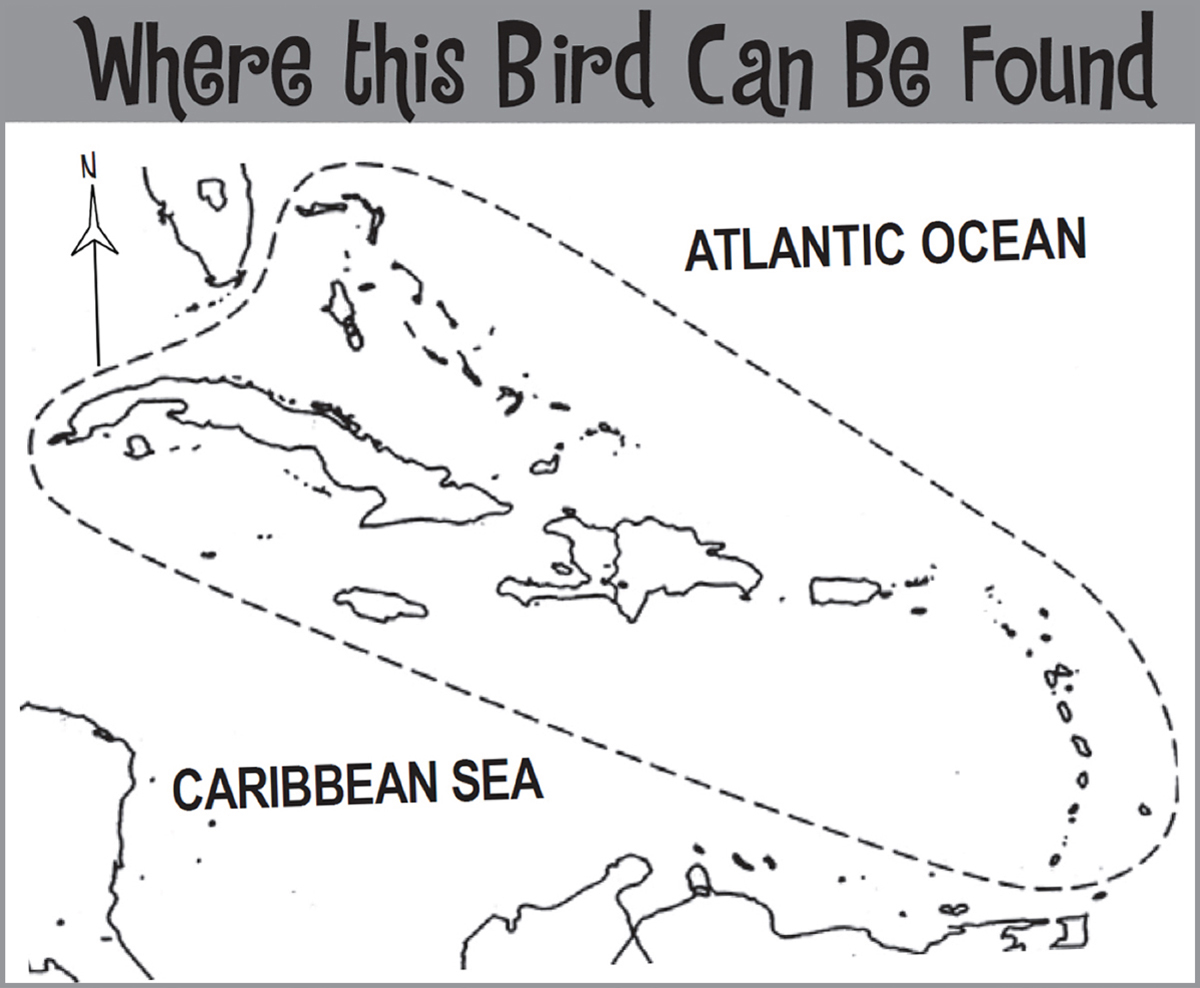
There are three unique subspecies in the Caribbean that look slightly different from each other: one found only on Hispaniola, an Eastern Caribbean race (Puerto Rico, Virgin Islands, and Lesser Antilles to Grenada), and a Cuban race (Bahamas, Cuba, and Jamaica). These resident island forms are joined on some islands by migrants of the northern subspecies escaping the cold winter.
American Kestrels rely on cavities for nesting—using old woodpecker holes, natural tree hollows, rock crevices, and human structures, including nest boxes. If nest sites are scarce, kestrels will fight off or evict other animals like birds and squirrels to secure their spot. The male finds potential nesting sites and presents them to the female, who makes the final selection. She typically lays four or five eggs, which are cream to yellowish or light reddish-brown, and beautifully mottled with violet-magenta, gray, or brown.
Though widespread, American Kestrel populations are declining in parts of their range. Habitat loss from land clearing, removal of dead trees, and pesticide use threaten both their nesting sites and food supply. “Clean” farming practices, i.e., eliminating hedgerows and brush, also reduce their prey and nesting sites.
To help conserve American Kestrels and their insect prey, protect their natural habitats, preserve old trees, install nest boxes, and support sustainable farming practices that preserve hedgerows and natural spaces. Every action counts in ensuring a brighter future for these charismatic falcons and the ecosystems they rely on! Learn more about this species, including its range, photos, and calls here. Great news! If you’re in the Caribbean, thanks to BirdsCaribbean, you have free access to Birds of the World and you can find out even more in the full species account of this bird!
Thanks to Holly Garrod and Aliya Hosein for the text and Arnaldo Toledo for the lovely illustration!
Color in the American Kestrel
Download the Migratory Birds of the Day Coloring Page! Use the picture above and the photos on this page as your guide, or look up pictures of the bird online or in a bird field guide if you have one. Share your colored-in page with us by posting it online and tagging us @BirdsCaribbean #WMBD2025Carib
Listen to the calls of the American Kestrel
The American Kestrel makes a series of high-pitched “killi-killi-killi” calls.
Enjoy these photos of American Kestrels


Activity of the Day
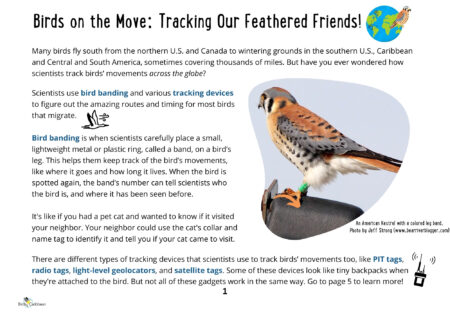 FOR KIDS: Many of the migratory birds we see in the Caribbean are flying south from the northern U.S. and Canada to wintering grounds either here on our islands or further South into South America. Sometimes they will cover thousands of miles on these trips, often stopping along the way. But have you ever wondered how scientists track birds’ movements across the globe?
In today’s activity you will learn more about how birds are tracked and find out about how radio telemetry can be used to understand bird movements. Radio telemetry is one type of technology that helps scientists find out where birds and other animals are located, using radio signals. It works by using three main pieces of equipment 1. A radio tag (which goes onto the bird to sends out a signal) 2. An antenna, which is either fixed in place at a station or carried by a scientist. This will detect the signal sent by the tagged animal 3. A receiver to log the data. You can download all the information, instructions and worksheet here.
FOR KIDS AND ADULTS: Enjoy this video of an American Kestrel feeding in the wild!