
Nearly two decades ago, Haitian conservation biologist Anderson Jean made a promise to himself: one day, he would stand before the BirdsCaribbean community and share his country’s conservation story. Thanks to the support of our generous donors, Anderson arrived in Trinidad and Tobago for our 2026 conference ready to share, learn, and ensure that Haiti’s voice was heard. Read on for his story of a long-held dream finally realized.
A promise takes root
Seated among hundreds of Caribbean conservationists at the BirdsCaribbean Conference in Trinidad, I felt immense pride and deep gratitude. It was because that moment represented for me—Anderson Jean, Haitian field biologist and conservationist—the fulfillment of a dream born many years earlier.
I first participated in a BirdsCaribbean conference in 2007 in Puerto Rico. I noticed then that no presentation focused on the situation of birds in Haiti. That absence left a deep impression on me and inspired a personal promise: one day, I would stand before my peers and share the progress being made by my country to conserve our threatened species.
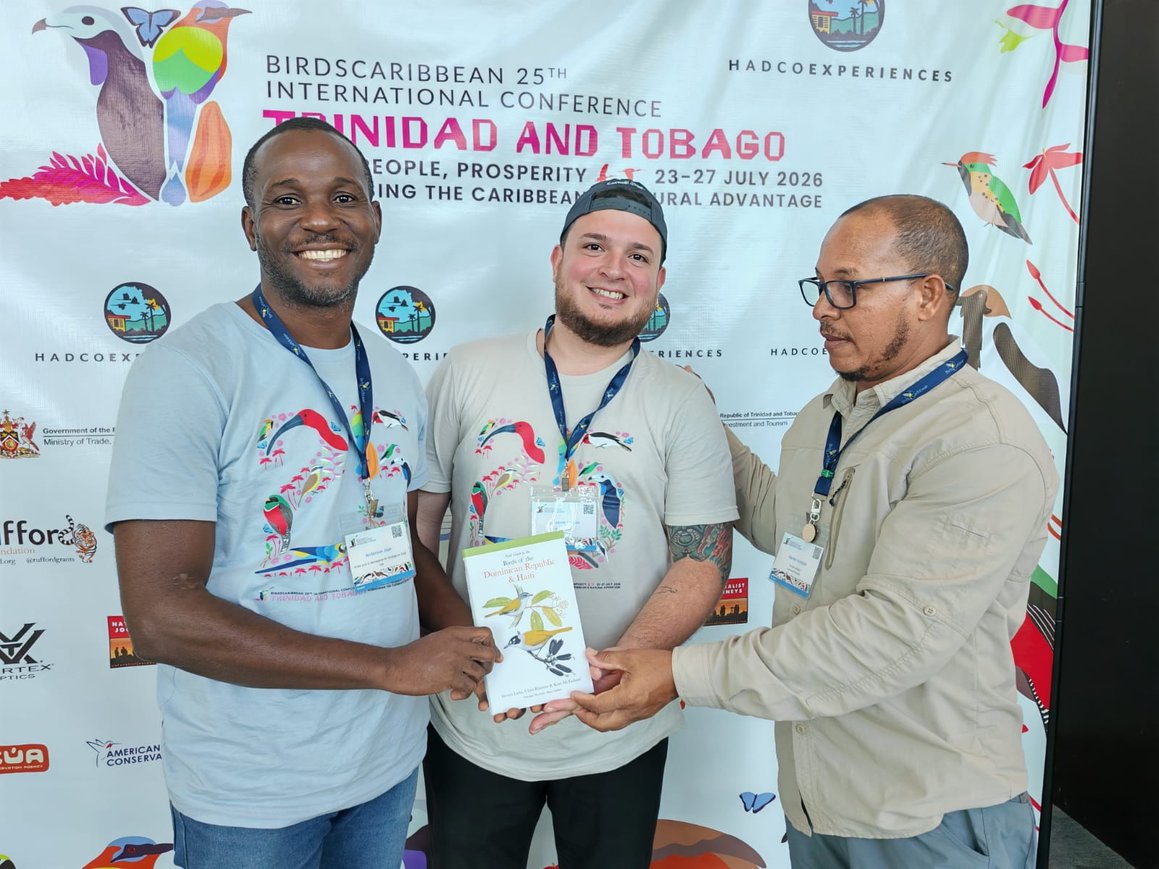
…And the long road to get there
A few years later, I took an important step toward that goal when I presented work on the conservation of the Black-capped Petrel at the BirdsCaribbean conference in Guadeloupe. But I still hoped to return with a fuller account of Haiti’s conservation challenges and progress.
In August 2019, a major rediscovery of the Ridgway’s Hawk occurred in Haiti. Believed to be extirpated in Haiti, the hawk was spotted for the first time since 1962! I was determined to bring this critical breakthrough to the BirdsCaribbean stage, but political constraints in Haiti and the COVID-19 pandemic prevented me from attending. In 2026, thanks to the donors who supported my participation in the Trinidad and Tobago conference, I finally had that opportunity.


More than a seat in the room
The conference offered opportunities not only to share my work, but also to strengthen it. One of the workshops I attended focused on developing effective grant applications and research proposals using the Conservation Standards framework which provided me with practical tools for drafting and submitting conservation projects. This was a turning point as I often struggled to know where to begin when structuring a project.
Another pivotal moment came when Andrea Thomen recognized how my experience in species monitoring could contribute to conservation efforts for the Hispaniolan Amazon and encouraged me to submit a presentation. With her guidance, I collaborated on an abstract and joined the lineup of presenters for the Caribbean Parrot Conservation Summit.
Attending the Summit was eye-opening. It showed me how severely threatened the region’s parrots are—and how urgently coordinated action is needed.


A dream realized
Standing before my peers to present our Ridgway’s Hawk research fulfilled the promise I had made nearly two decades earlier. The warm reception and encouraging feedback from colleagues across the region made that moment even more meaningful.
Between sessions, reconnecting with old friends from past shorebird monitoring workshops reminded me of the strength of this network. Our conversations rekindled my passion for field science and inspired several new project ideas tailored for Haiti.
I was particularly excited to learn about Motus tracking technology that could revolutionize how we study post-fledging dispersal in young Ridgway’s Hawks and help us protect them at their most vulnerable life stage.


Carrying it home
Reflecting on my journey, the impact of this conference cannot be overstated. Every experience with BirdsCaribbean fuels my determination to work harder for Haiti’s ecosystems.
Delivering two presentations and immersing myself in three specialized workshops gave me invaluable insights into managing threatened species. I returned home with more knowledge and with an energized vision: to empower local communities, strengthen our conservation programs, and ensure Haiti’s voice remains strong on the international stage.
Anderson’s participation at the 2026 BirdsCaribbean International Conference was made possible through the support of the generous donors and supporters who contributed to our Global Big Day 2026 fundraiser. Thank you for investing in regional conservation leaders and helping ensure that Haiti’s voice and conservation efforts remain strong and are represented on the international stage!
Biography: Anderson Jean is an agroforestry engineer and conservation biologist who graduated in 2007 with a degree in Agroforestry and Environmental Sciences from the American University of the Caribbean in Les Cayes, Haiti. Trained by international institutions such as the Cornell Lab of Ornithology, the Vermont Center for Ecostudies, and the Durrell Wildlife Conservation Trust, he has coordinated several biodiversity inventory and conservation projects in Haiti. As Head of the Research and Conservation Department at ACSEH, he works to protect the Black-capped Petrel and Ridgway’s Hawk. In 2022, he received Stanford University’s Bright Award for his contributions to biodiversity conservation.