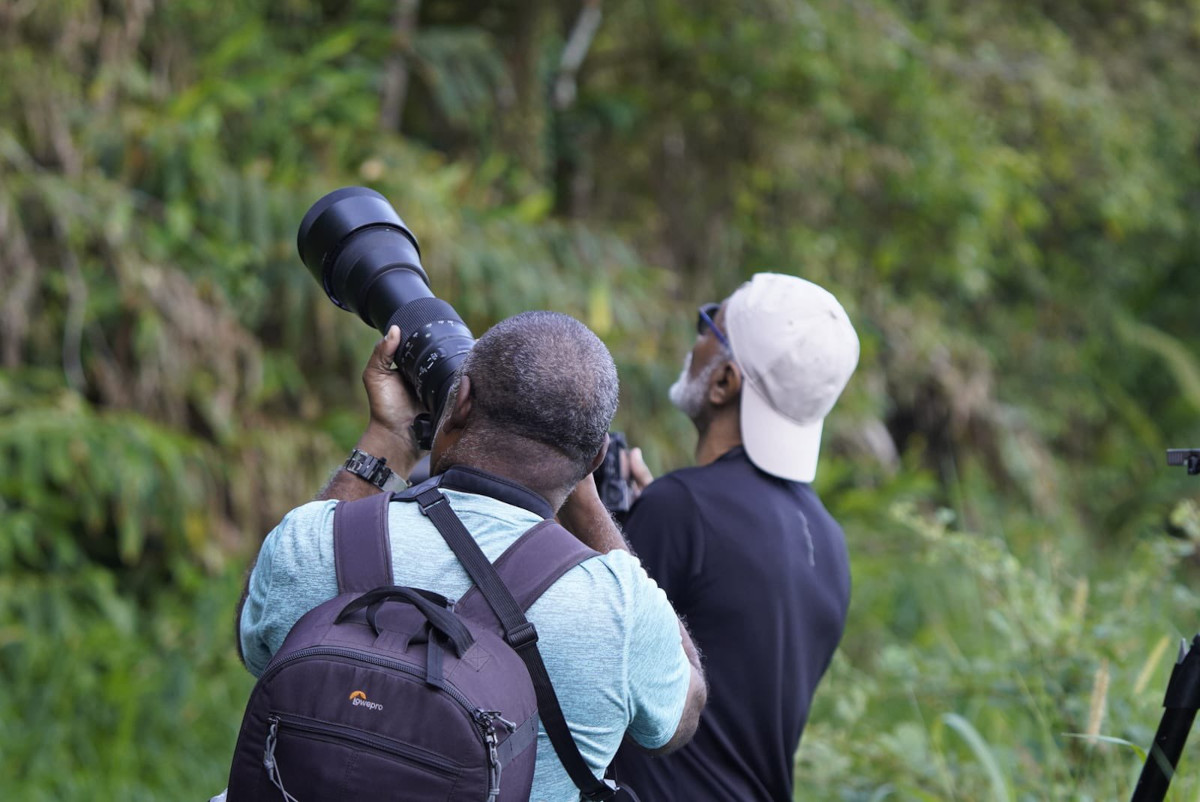
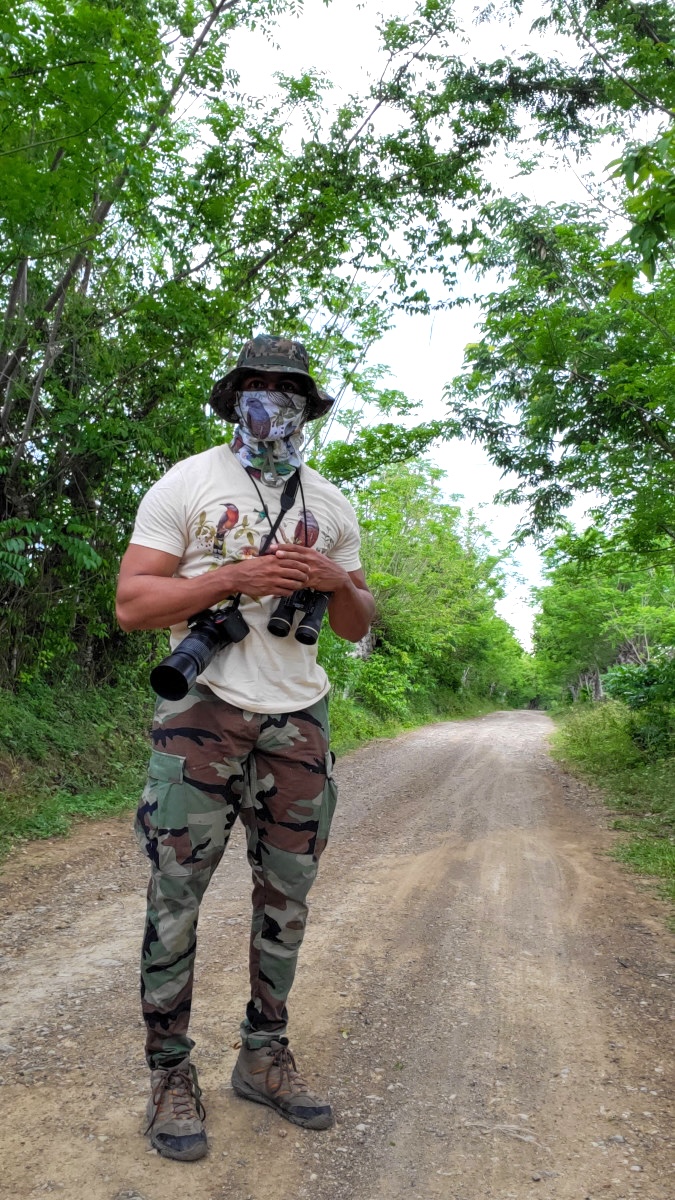
Capturing bird photos on Global Big Day. (Photo by Simon Shields)
Global Big Day (GBD) 2025 was a vibrant celebration of birds, Caribbean community, and spectacular photography!Thank you to everyone who participated in our GDB team competition, submitted stunning photographs, and helped make this year’s Global Big Day one to remember. We’re excited to unveil the winners of our GBD 2025 Photo Contest! These photos beautifully capture the essence of Caribbean birds and the power of collective action to protect our natural heritage.
If you missed the full Global Big Day 2025 report, click here to explore the highlights, team scores, and meet this year’s top birding team!
This day wouldn’t be possible without the infectious energy of our birding community, the dedication of our team leaders, and the generosity of our donors. Thank you for helping to keep our programs running, from youth education and conservation outreach, to research and habitat protection, especially this year as we face the loss of critical federal funding. If you’d like to #KeepBirdsCaribbeanSoaring, please consider making a donation at: https://givebutter.com/BCGBD2025
Photography Award Winners 2025
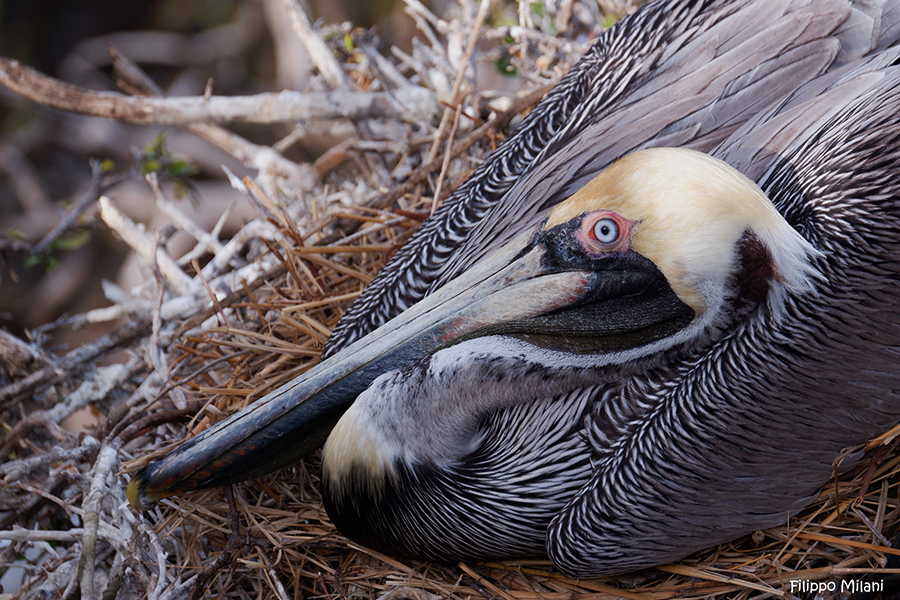
We especially congratulate this year’s First Place Best Bird Photo winner, Filippo Milani from Sint Maarten! One judge commented “I’m captivated by the lines and curves of the pelican’s body—the long wood-like beak, graceful curved neck. and the intricate patterns and textures across its body. The viewer is drawn to the bird’s clear, watchful blue eye, framed by delicate pinkish bare skin, and bordered by striking black and buffy yellow. Overall, I think the composition, detail, and color make this image truly outstanding.”
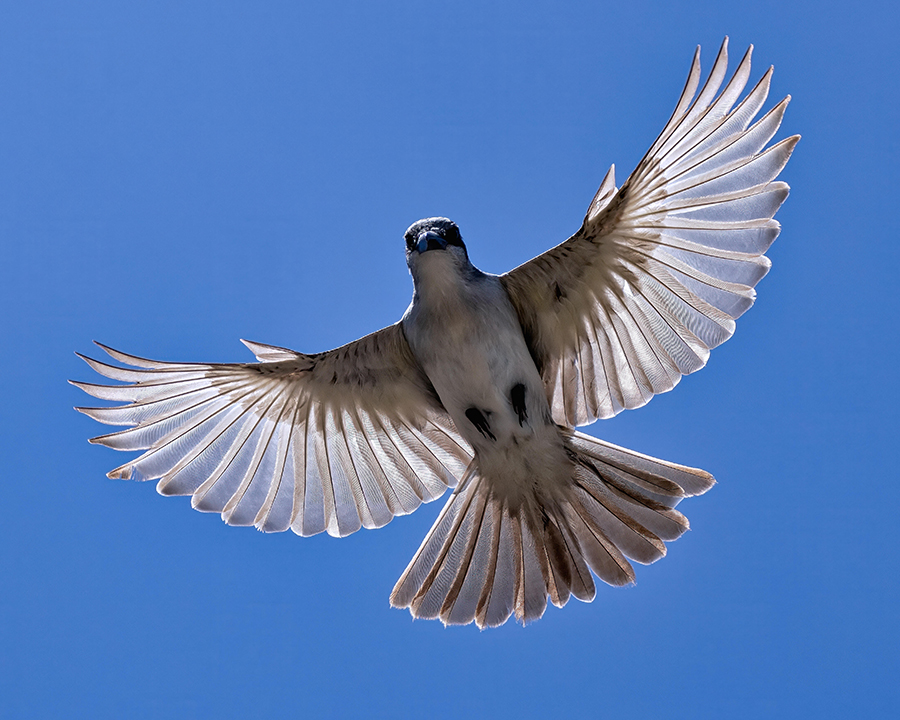
The Second Place Best Bird Photo goes to Gray Kingbird by Peter Rivera (Puerto Rico).
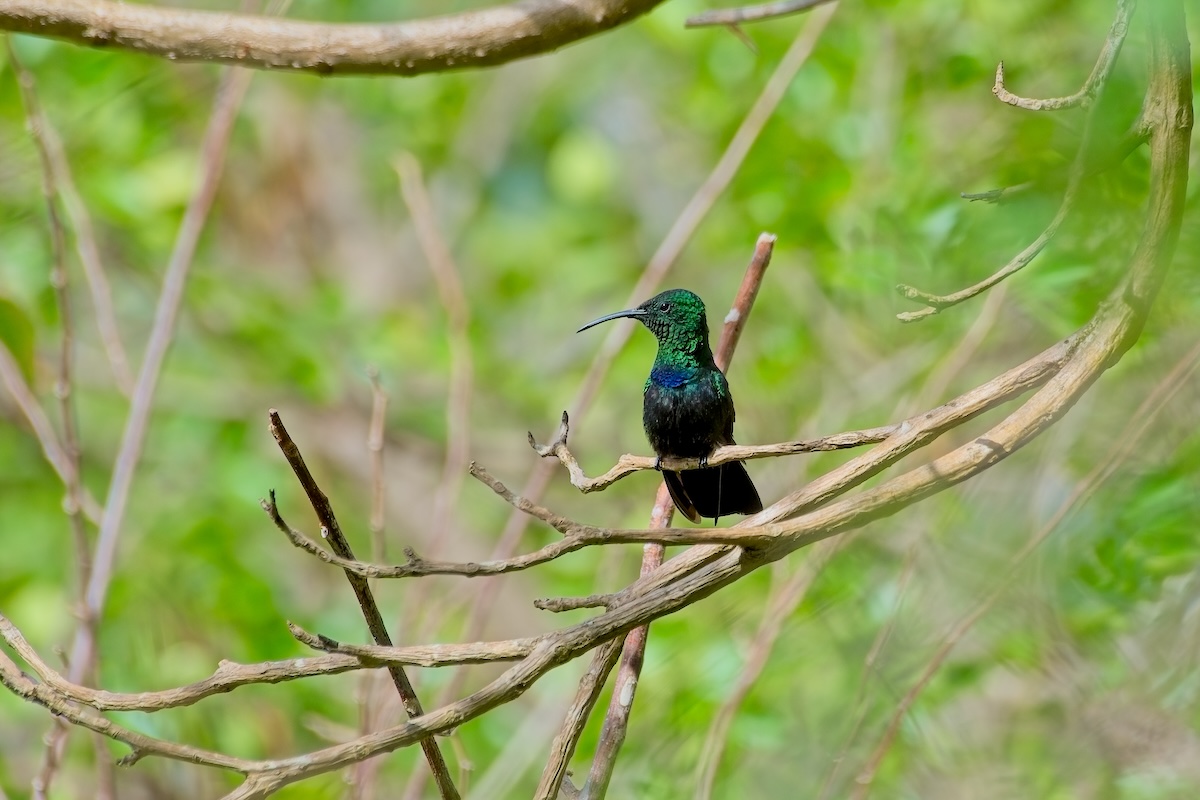
The Third Place Best Bird Photo goes to Green-throated Carib by Jerome Foster (St. Lucia).
The submissions we received were exceptional, and we couldn’t resist sharing even more stunning entries from the competition. In addition to our winning photo, the judges have chosen four standout images for honorable mention, featured below.
Great Egret, Great Salt Pond, Sint Maarten. (Photo by Filippo Milani)
Yellow Warbler, McKinnon’s Pond, Antigua. (Photo by Kendel Angol)
Red-crowned Amazon, Puerto Rico. (Photo by Eric Torres)
Green Heron, Puerto Rico. (Photo by Anel Sandoval)
Photographers from almost every team and corner of the world are recognized for their stunning photos in the following categories.
Best Endemic Bird
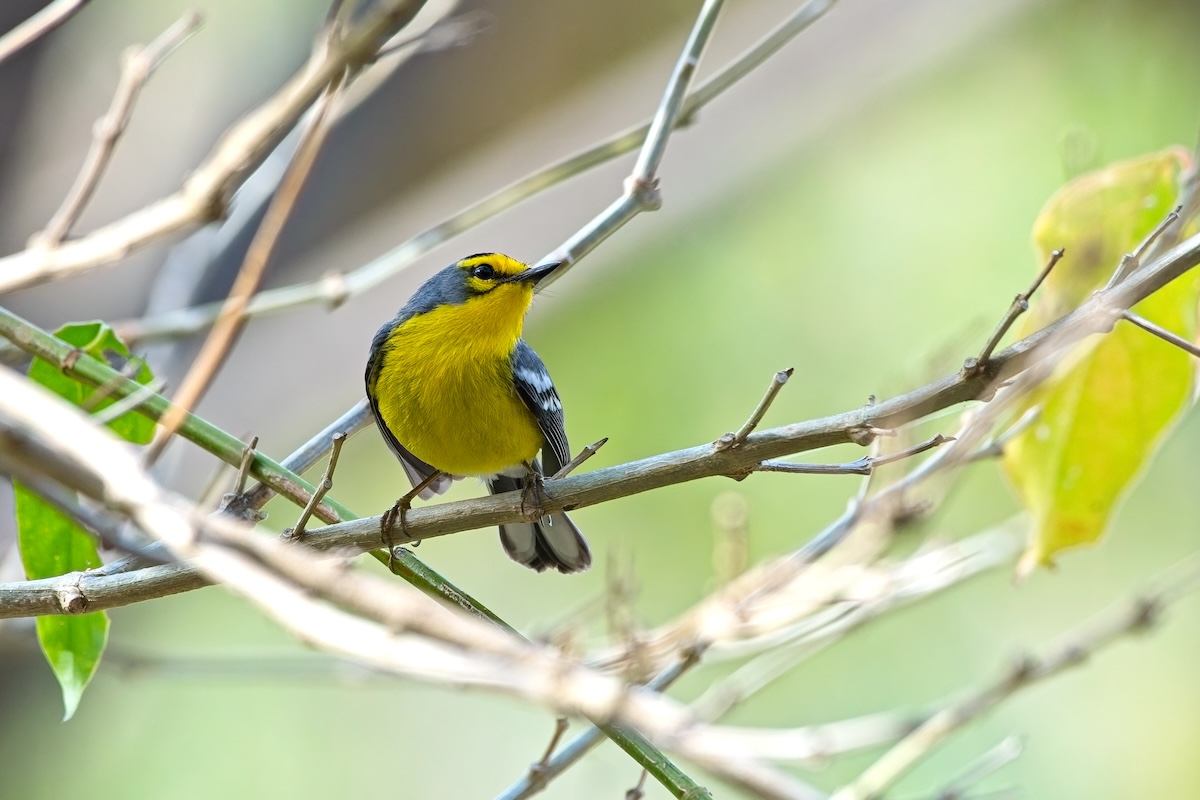
Best Endemic Bird Photo goes to the eye-catching and ever-busy St. Lucia Warbler, captured by Jerome Foster in Gros Islet, St. Lucia. It’s a striking reminder that the Caribbean is home to, dare we say, the world’s most spectacular birds.
St. Lucia Warbler. (Photo by Jerome Foster)
Best Landscape Photo
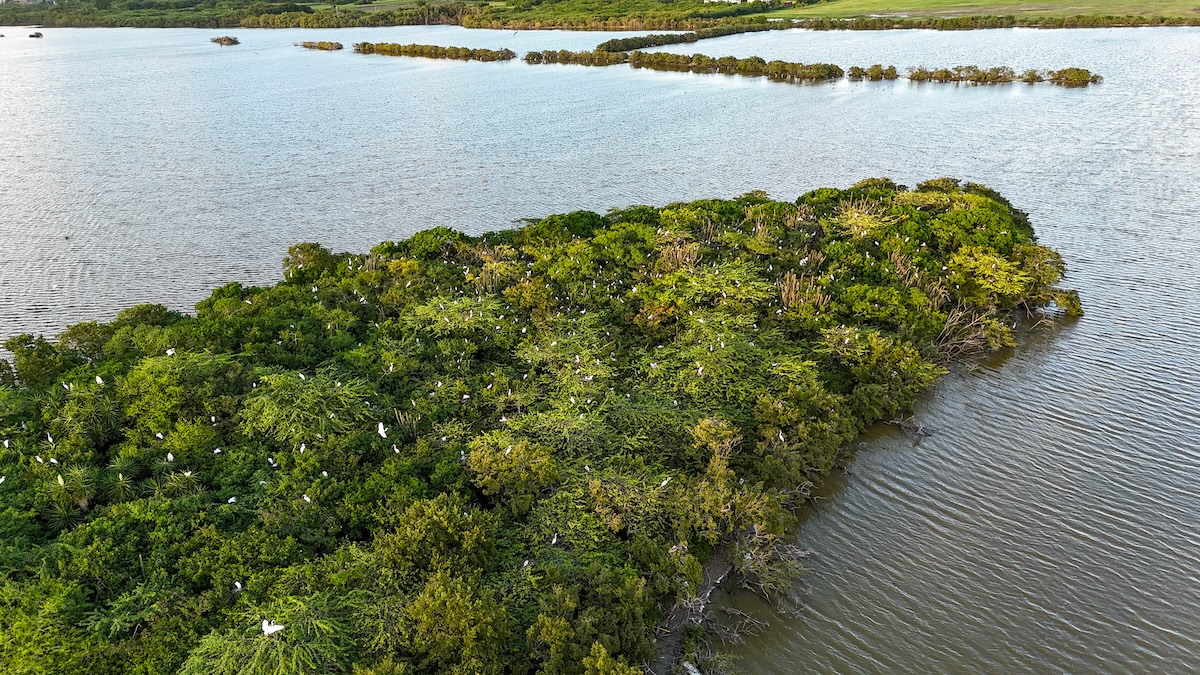
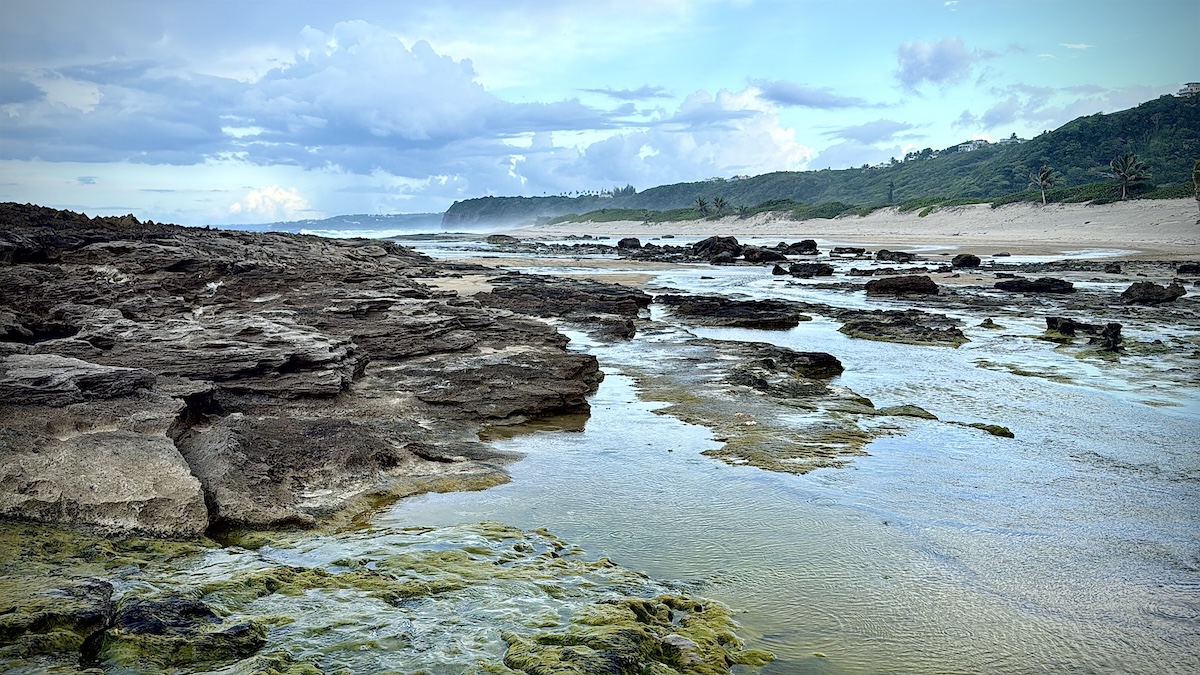
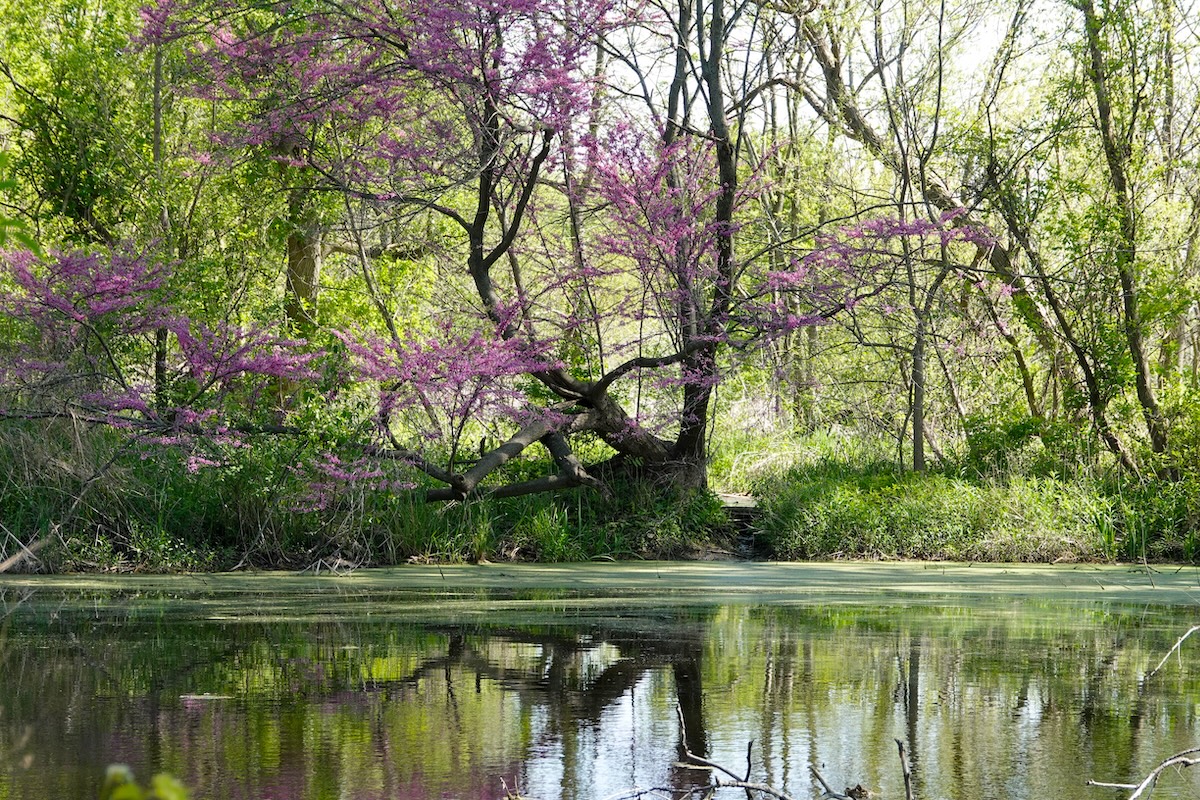
These photos showcase the essential natural places where birds feed, seek shelter and raise their families. These images highlight not only the skills of the photographers but also the need to protect the environments that provide such awe-inspiring moments.
Taking First Place for Best Landscape Photo is the stunning McKinnon’s Pond, Antigua,captured by Kendel Angol from the Wadadli Warblers Team!
Second Place Best Landscape Photo
Northwestern Puerto Rico. (Photo by Mirielle Villanueva)
Third Place Best Landscape Photo
Nelson Lake, Illinois. (Photo by Kim Brady)
We’d also like to extend an honorable mention to all the other talented photographers who submitted their breathtaking landscape entries. Your dedication to capturing the beauty of these natural bird habitats is truly commendable!
Waterfowl, Canada. (Photo by Nicole Gutierrez)
Morning vibes and the Great Egret. (Photo by Eric Torres)
Le Galion, St. Martin. (Photo by Filippo Milani)
Laguna Cartagena National Wildlife Refuge, Puerto Rico. (Photo by Peter Rivera)
Best BTS Photos
GBD is no doubt about the birds but there’s also so much excitement going on behind-the-birds. We’re glad our GBD-ers decided to give us a peek into the funny, scary, and delightful moments of birding during the big day.
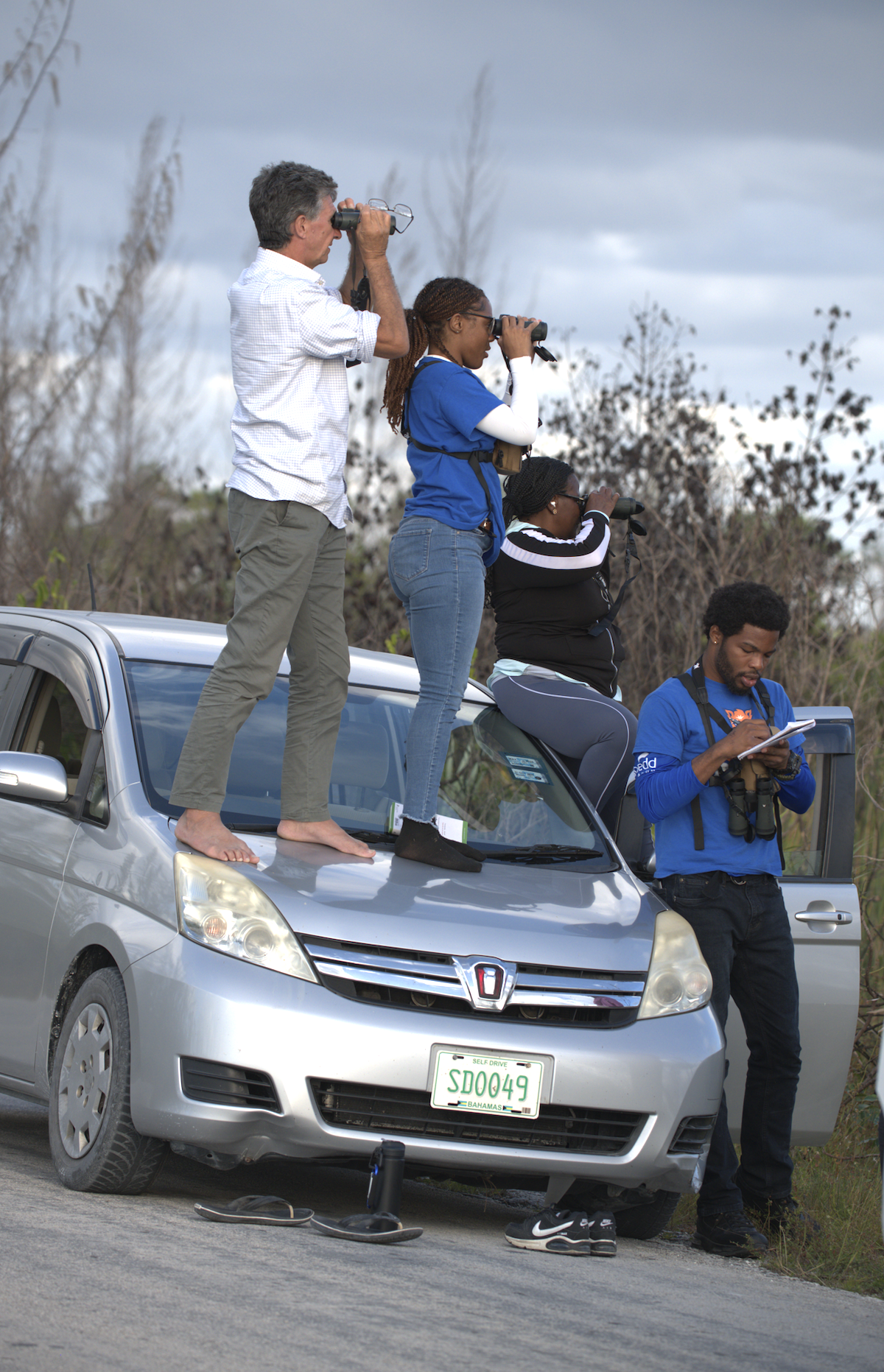
Standing on top of the competition (and a car) is First Place Behind The Scenes (BTS) winner Bibo Jayne from the TCI Royal Terns team with ‘Birding by car etiquette.’
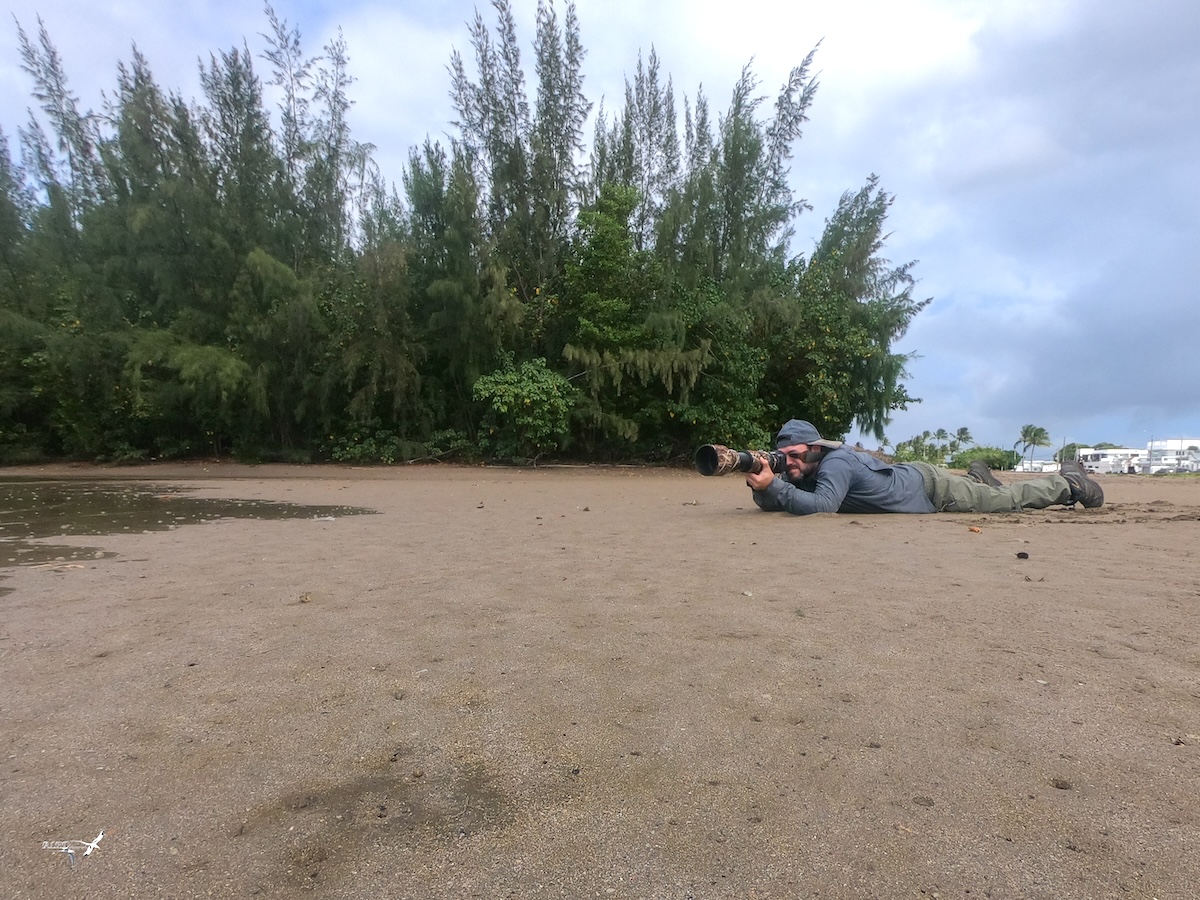
Second Place Behind the Scenes Photo goes to Edward Hernandez Lara Parque La who took this photo of his teammate gettin’ real low at Parque La Esperanza, Cataño in Puerto Rico. Hey, sometimes you have to get low to shoot high!
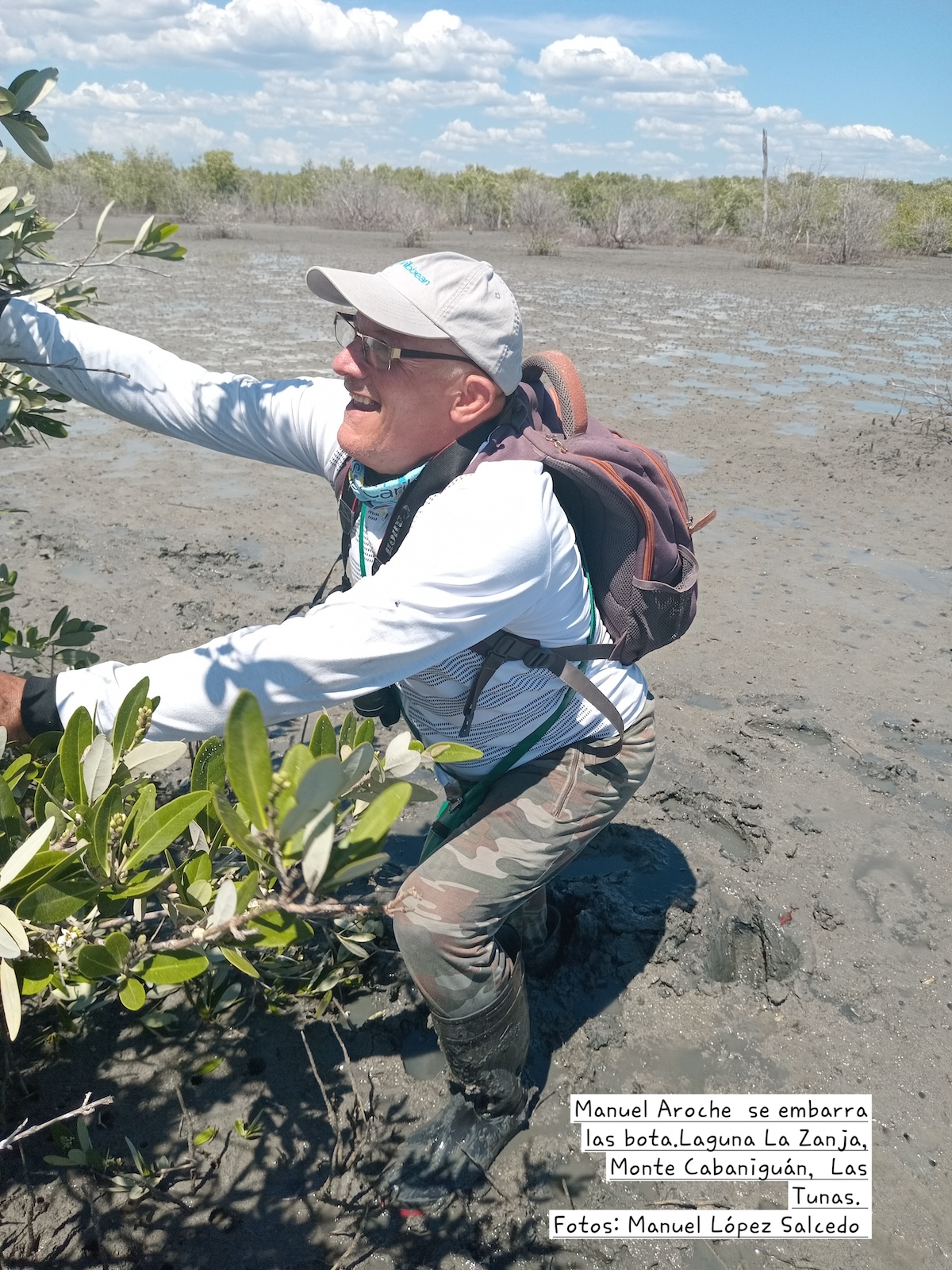
Third Place Behind the Scenes Photo goes to Manuel López Salcedo. We’re really glad he kept snapping instead of helping his teammate Manuel Aroche who was clearly losing the battle for his boots with the mud.
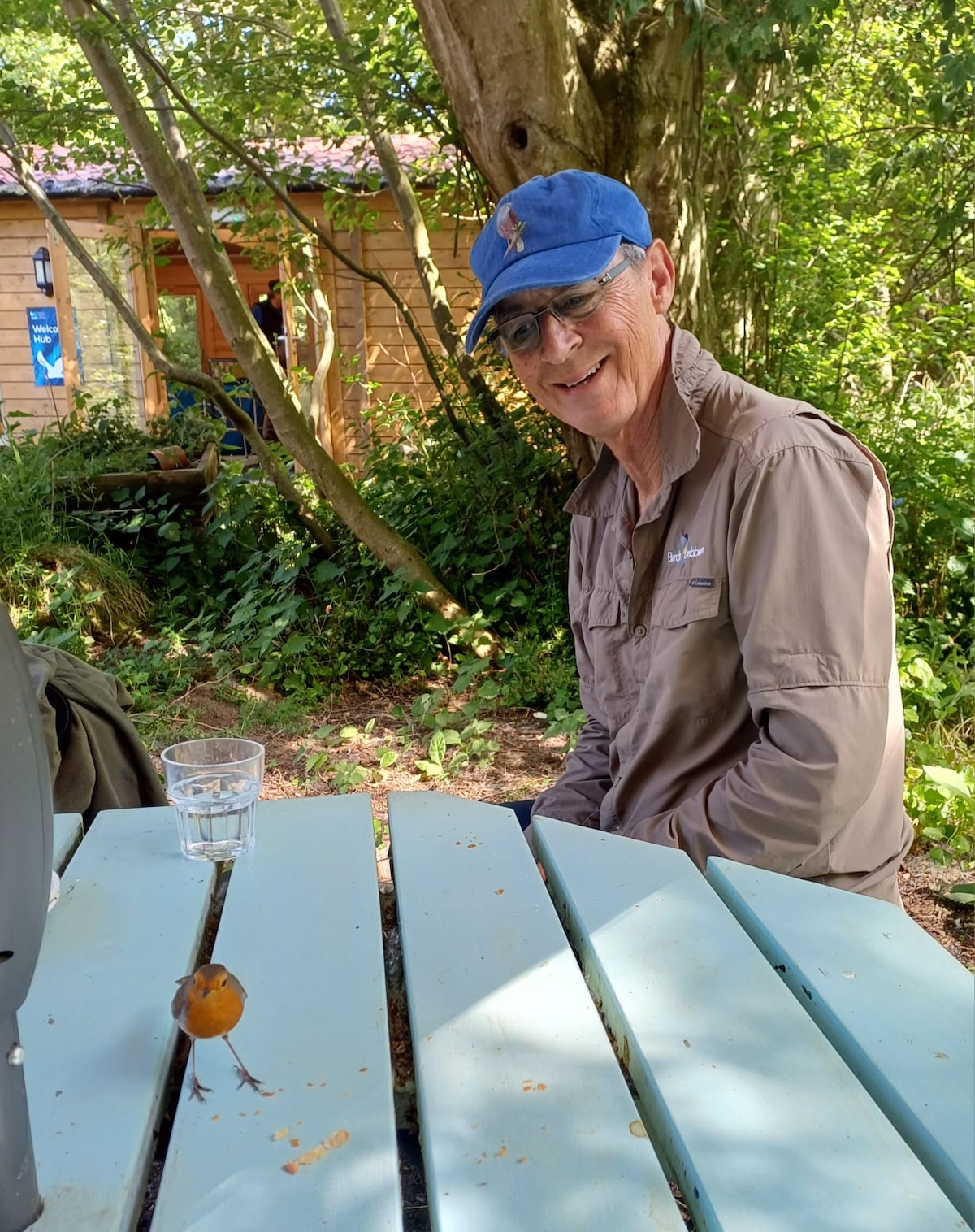
Sometimes the birds make it easy and come to us, just ask BirdsCaribbean’s past president Andrew Dobson who was joined by a European Robin for lunch on GBD!
That’s one lucky Gull
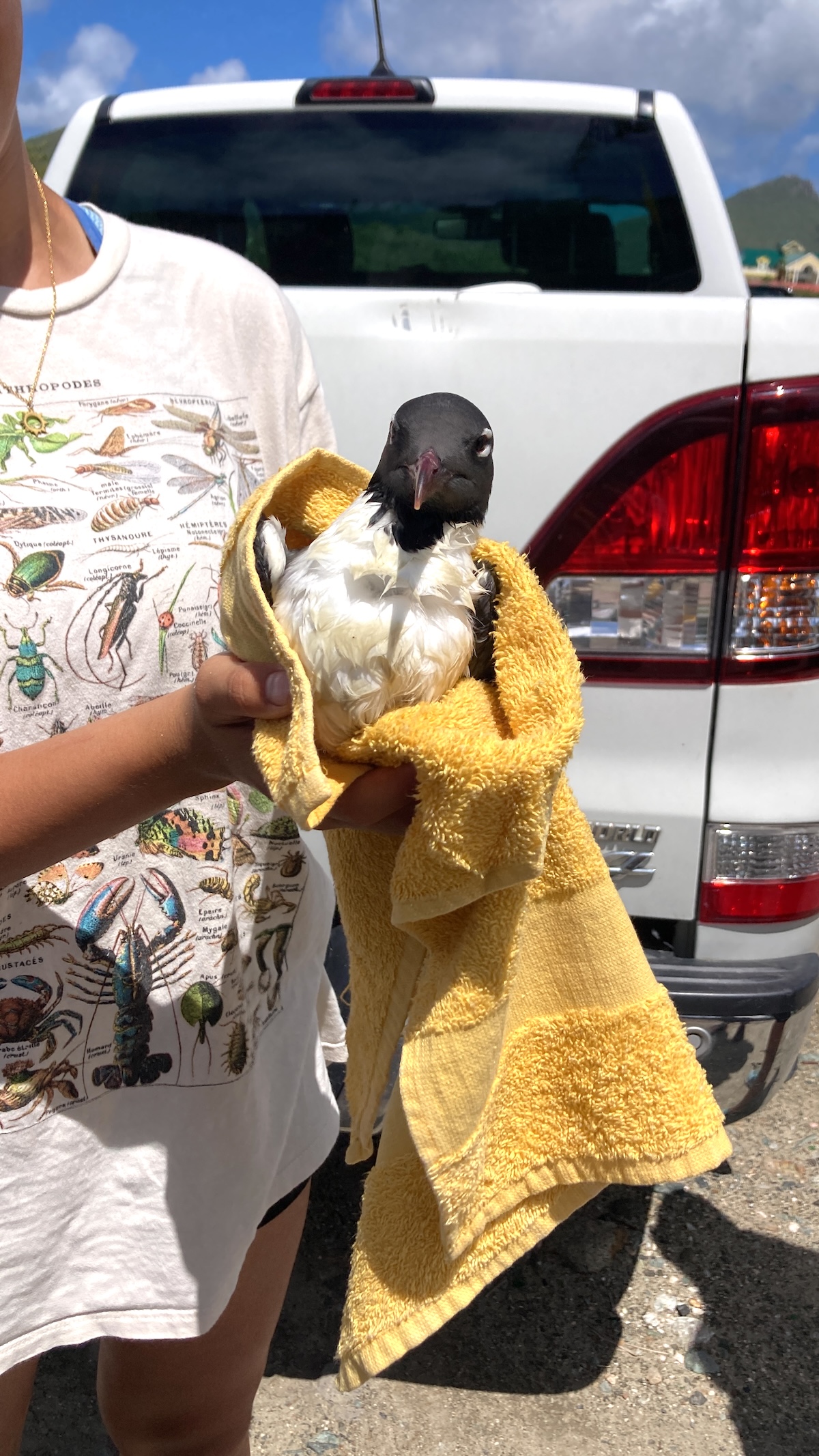
GBD is all about spotting and helping birds. That’s exactly what happened at Great Salt Pond in Philipsburg. Filippo Milani’s group was enjoying a day of birdwatching when they noticed a Laughing Gull lying motionless in the water at the edge of the pond. It was clear the bird was in distress, so one of the birders carefully picked it up without resistance from the bird, a sign that it was truly unwell! They decided to take it to a veterinary clinic for an immediate check-up.
The Laughing Gull before being taken to the veterinarian. (Photo by Filippo Milani)
Filippo shared, “At the clinic, the vet gave the gull an anti-inflammatory injection and advised us to keep it in a secure, enclosed space for a few days of monitoring. We brought it home and kept it in a crate, where it, thankfully, ate well. However, it showed little interest in flying, which was concerning.
After a few days, we took the gull back for a veterinary follow-up. With the additional support of vitamin drops and the invaluable assistance of the Nature Foundation, the Laughing Gull eventually recovered. We were thrilled to be finally release it back into a safe, wild area.”
When Watchers Become the Watched
Don’t feel too bad if your target species decide to skip lunch with you (we can’t all be as lucky as Andrew) chances are they’re busy human-watching like these curious onlookers.
Green Heron, Puerto Rico. (Photo by Marisol Villanueva Mendez)
Adelaide’s Warbler, Puerto Rico. (Photo by Edward Hernandez Lara)
Green Heron, Little Pond, Sint Maarten. (Photo by Filippo Milani)
Flyest GBD Team
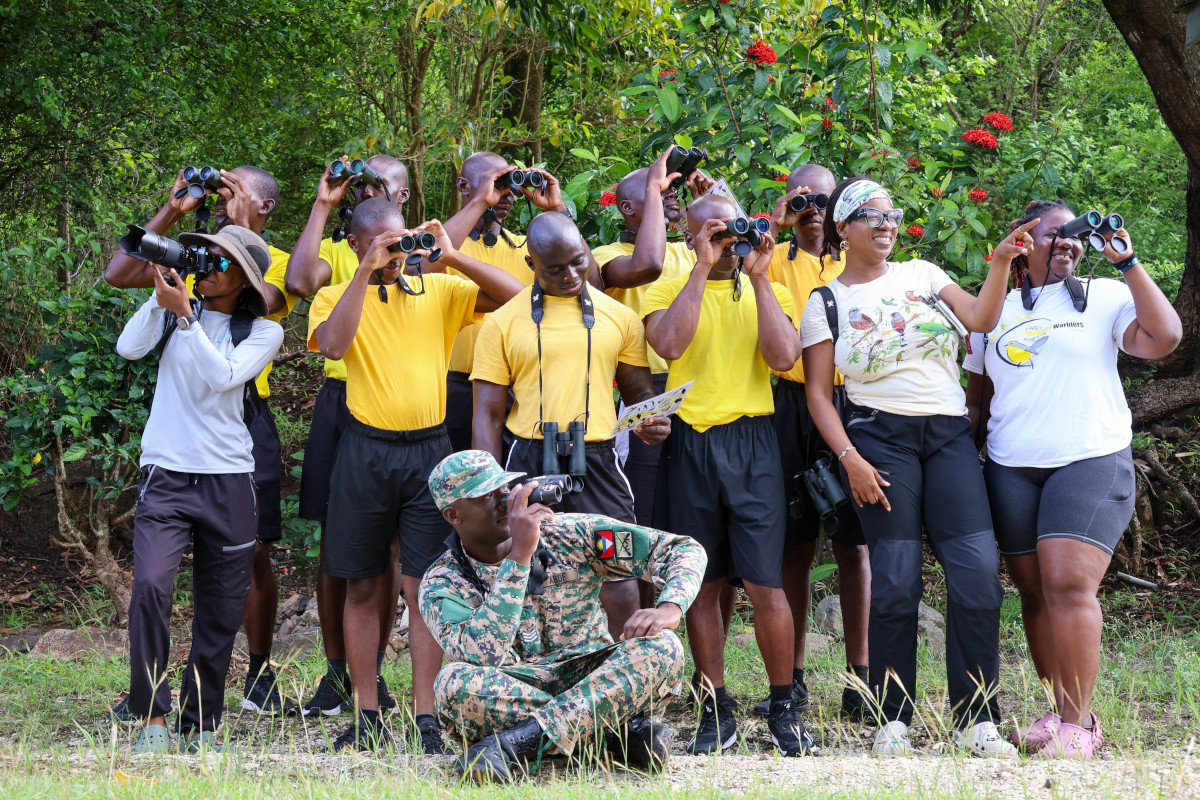
The Wadadli Warblers understood the assignment. They absolutely showed up and showed out. Rocking their yellow tees and black pants (which, sidebar, is just their Defence Force uniform but we’re totally here for that accidental match with their endemic bird, the Barbuda Warbler). Peak birding season + peak fashion = peak birding energy.
Wadadli Warblers and the Antigua and Barbuda Defence Force birding in Christian Valley. (Photo by Kendel Angol)
Sending out a SOS
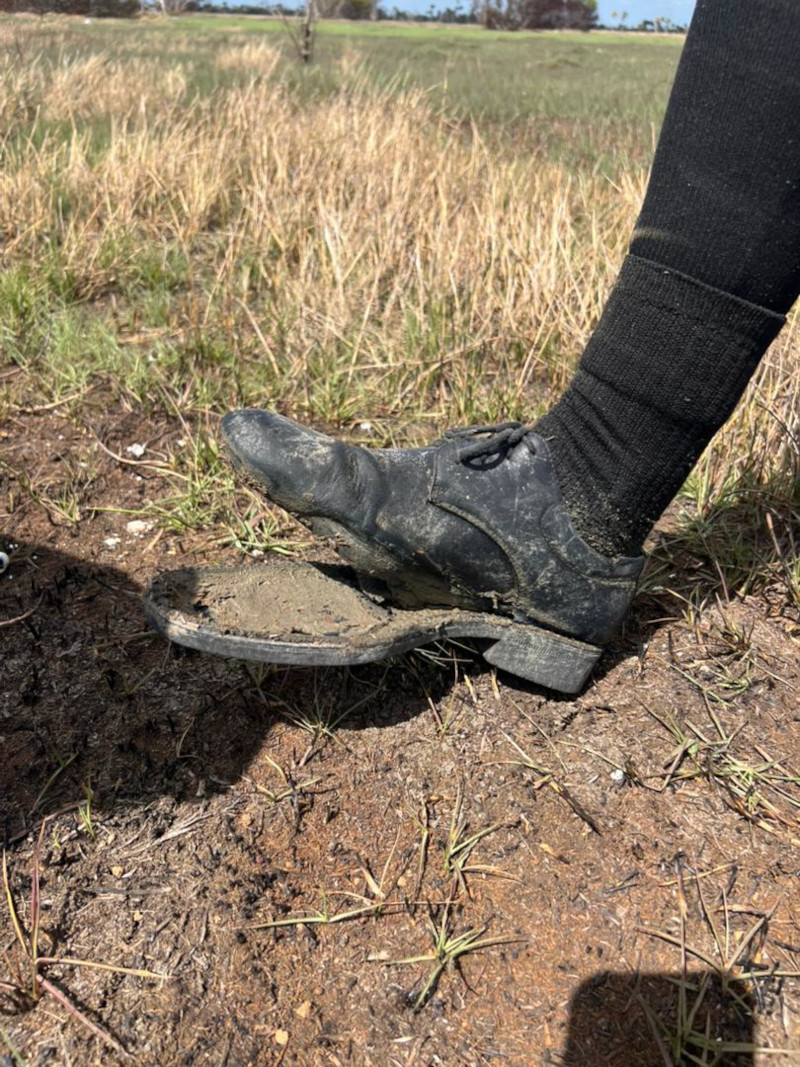
Before the end of the birding bonanza the Cuban team sounded the alarm to ‘Save Our Soles!’ We know with the terrain and weather our sneakers, slippers, boots can take a hit, but theirs really took a beating—just look at the photo below taken by Yaro Rodriguez!
Hardly Driving, Mostly Birding
Dead batteries, slippery falls, snacks left behind on the kitchen counter. These are fieldwork mishaps we bounce back from. But what if your only ride gets stuck or blows a tire? For the ‘BVI Birders’ and ‘Piping Pawis’ teams, that nightmare came true. Still, not even car trouble could stop their birding. Binoculars stayed out and checklists kept rolling. After all, GBD only comes once a year!
It’s So Fluffy!
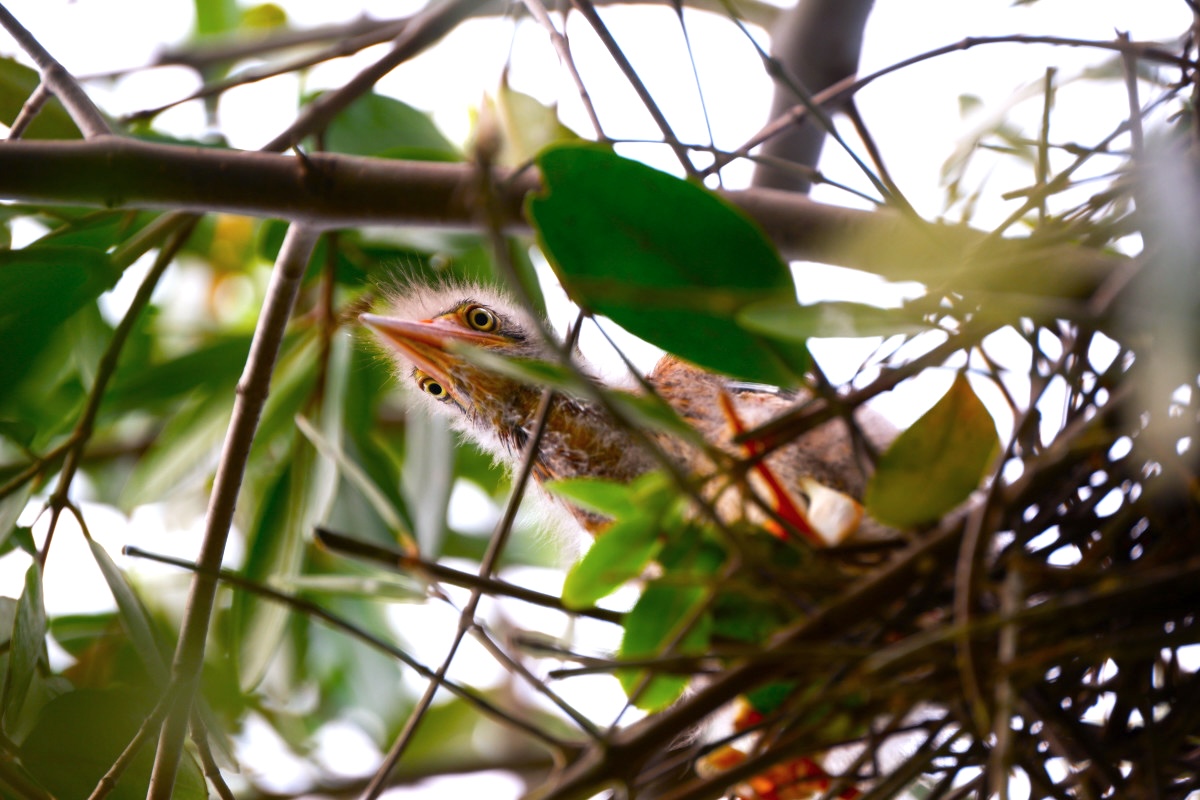
Filippo Milani captured this adorable moment at Emilio Wilson Park in St. Maarten—a Green Heron chick, described by our Waterbird Program Manager (no surprise) as the “sweetest, fluffiest bird.”
Green Heron chick in nest, Sint Maarten. (Photo by Filippo Milani)
Flyest GBD Kit
José Guillermo de la Rosa came through with the flyest GBD fit, rocking the BCDR conference buff and t-shirt like a true style icon.
Shorebird Showstopper
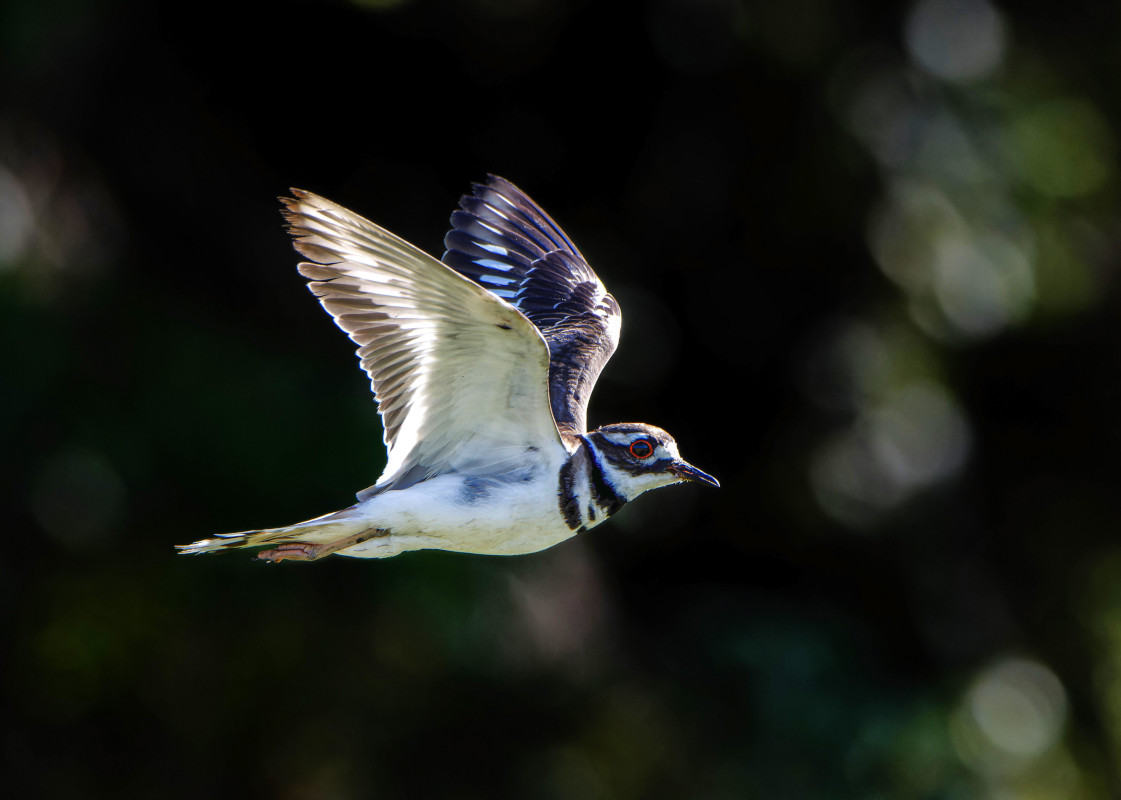
Spotting these shorebirds might be easy, but getting great photos of them is a real challenge! However Karlos Ross from Cuba captured this Killdeer in flight almost effortlessly.
Killdeer in flight, Sierra de Bocas, Holguín, Cuba. (Photo by Karlos Ross)
The Ultimate GBD Companion
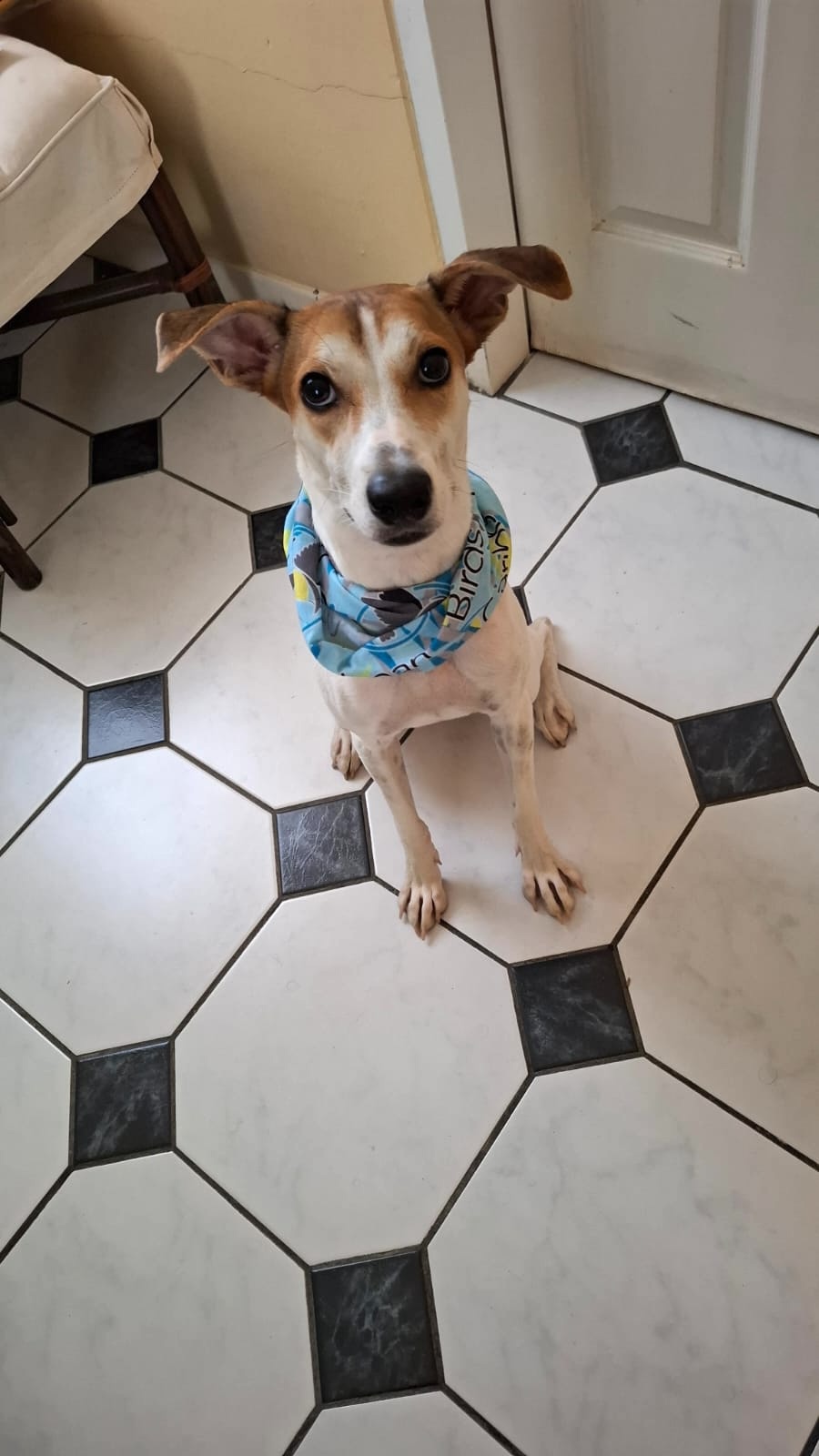
Here we have the always supportive, always down for a nice long walk and oh-so-stylish Daisy wearing that BC buff better than most of us! She definitely passed the vibe check with the ‘Piping Pawis’ team.
Daisy looking very stylish in her BC buff. (Photo by Alex Samson)
Youngest Global Big Day-er 2025
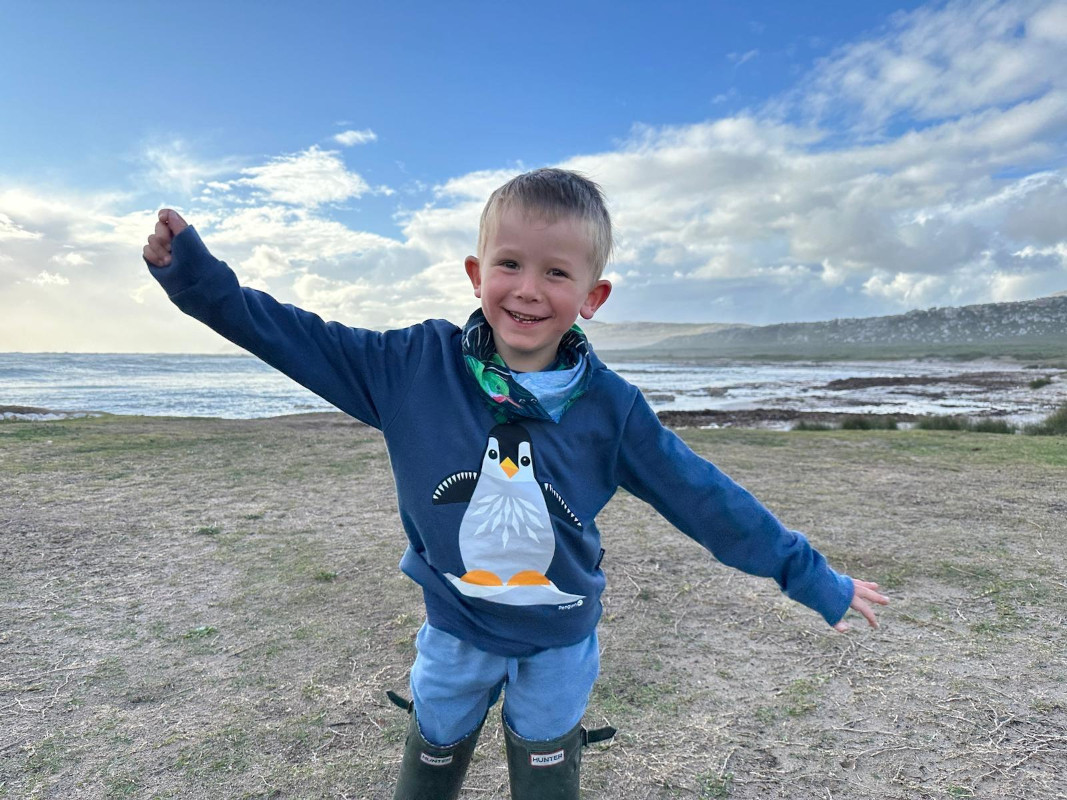
We love to see when young people connect with the incredible bird communities in their home countries and we hope to see more young naturalists participating in next year’s GBD!
Youngest GBD-er (peep the Puerto Rican Tody BC buff), on the Flying Pintails team in South Africa. (Photo by Claire Spottiswoode)
Birds on the Corner
These photos remind us that some birds aren’t visitors. They’re neighbors, sharing our fences and utility poles. It’s a reminder that our communities need clean, green spaces to keep ourselves, our birds, and other wildlife, thriving.
Black-faced Grassquit, St. Lucia. (Photo by Jerome Foster)
Shiny Cowbird, St. Kitts. (Photo by Azmon Thomas)
A Carib Grackle builds its nest on a electricity pole in St. Lucia. (Phote by Jerome Foster)
Best Selfie
Are selfies still a thing? Yes! And we love seeing them. To enjoy the photos full size, click on the first one, then click the right arrow to advance through the gallery.
Marisol, Mirielle and Kathleen birding in Rincon, Puerto Rico. (Photo by Marisol Villanueva)
Georgi, Wilbert and Brayan birding in the DR. (Photo by Georgi Sanchez)
Shadows at the Salt Creek in Fullersburg Woods, Illinois. (Photo by Steve Constantelos)
Flying Pintails leader, Lisa Sorenson birding with her husband in Massachusetts. (Photo by Lisa Sorenson)
Member of The Palmchatters.
Members of The Palmchatters stop to take a photo near the coast.
Members of BirdersSKN birdwatching on Global Big Day.
Members of The Palmchatters.
Selfie in El Seíbo, Dominican Republic. (Photo by José Guillermo de la Rosa)
Members of the Gundlach Team in Cuba. (Photo by Yaro Rodriguez)
Birder’s shadow, Puerto Rico. (Photo by Edward Hernandez Lara
A few members of Statia’s Golden Warblers in St. Eustatius, Global Big Day 2025. (Photo by Jethro van’t Hul)
Brendan Burns and Skyler Bol of Gavilán Guardians in Puerto Rico, Global Big Day 2025. (Photo by Brendan Burns)
Two members of the LGBT in Guadeloupe. (Photo by Anthony Levesque)
Bonus batch of GBD photos
Birds, people, and habitat photos from the Caribbean and across the globe! To enjoy the photos full size, click on the first one, then click the right arrow to advance through the gallery.
Team Wadadli Warblers birdwatchign at McKinnon’s Pond, Antigua. (Photo by Kendel Angol)
Break time for the Gundlach Team. (Photo by Yaro Rodriguez)
Rand Nature Centre, The Bahamas. (Photo by Charmaine Francis)
Marjel Morales Jr birdwatching at Guirabo, Holguin, Cuba.
Team Soualiga birdwatching at Emilio Wilson Park, Sint Maarten. (Photo by Filippo Milani)
Black-crowned Night-Heron in flight, Cuba. (Photo by Marjel Morales)
Post GBD 2025 cool down in Barbados. (Photo by Julian Moore)
Surfboards in northwestern Puerto Rico, can you spot the bird art? (Photo by Mirielle Villanueva)
Zenaida Dove, St. Lucia. (Photo by Jerome Foster)
Brown Pelicans, Potworks Dam, Antigua. (Photo by Kendel Angol)
Scaly-naped Pigeon, Puerto Rico. (Photo by Jerry Bauer)
Ruddy Duck, Great salt Pond, Sint Maarten. (Photo by Filippo Milani)
Mirielle and Kathleen surveying birds at Anasco, Puerto Rico, 2025 Global Big Day. (Photo by Marisol Villanueva Mendez)
Yellow-crowned Night-Heron, Puerto Rico. (Photo by Mirielle Villanueva)
White Ibis, Puerto Rico. (Photo by Eric Torres)
Black-necked Stilts with chicks, McKinnon’s Pond, Antigua. (Photo by Kendel Angol)
Members of the Flying Pintails team (Illinois chapter). (Photo by Mary Loye)
Bananaquits, St. Lucia. (Photo by Jerome Foster)
Western Cattle Egret snug in a nest, Puerto Rico. (Photo by Mirielle Villanueva)
Gray Trembler, St. Lucia. (Photo by Jerome Foster)
Mute Swan, Canada. (Photo by Nicole Gutierrez)
Laguna Cartagena, Puerto Rico. (Photo by Eric Torres)
Ruddy Turnstone, Xanadu Beach, The Bahamas. (Photo by Charmaine Francis)
Members of the Warbling Warriors team at Cabo Rojo, Puerto Rico. (Photo by Peter Rivera)
Anton Sape River, Dominican Republic. (Photo by Georgi Sanchez)
Taking a much needed break from birding in Barbados. (Photo by Julian Moore)
Sunrise over Mayaguez, Puerto Rico. (Photo by Marisol Villanueva)
Fuel for a Bahamian birder. (Photo by Elijah Sands)
Forest road, Puerto Rico. (Photo by Brendan Burns).
You should look up! Wildfowl Trust, Trinidad. (Photo by Christel Mohammed)
Conservation is not an easy calling. Biodiversity protection is a complex undertaking that requires a myriad of interventions: sometimes education and awareness raising, sometimes capacity building, sometimes difficult and tiring fieldwork for us to learn more about how to protect species, sometimes navigating complex networks of stakeholders and laws — always, it requires a special kind of dogged persistence. Work often demands long hours, exhausting days in the field, and battling against entrenched systems and beliefs. Despite the challenging nature of this work, our community consistently goes above and beyond in service of a stronger, beautifully biodiverse Caribbean.
On the final night of every BirdsCaribbean conference, we set aside the evening to recognize and celebrate those in our community who truly embody the tenets of dedication and tireless passion in pursuit of the conservation of Caribbean birds and their habitats. The Awards Ceremony is not only a ritual, but an important moment to show support for our amazing colleagues. We are proud to honor our phenomenal community members who not only advance conservation in our region, but who inspire us to keep pushing harder every day.
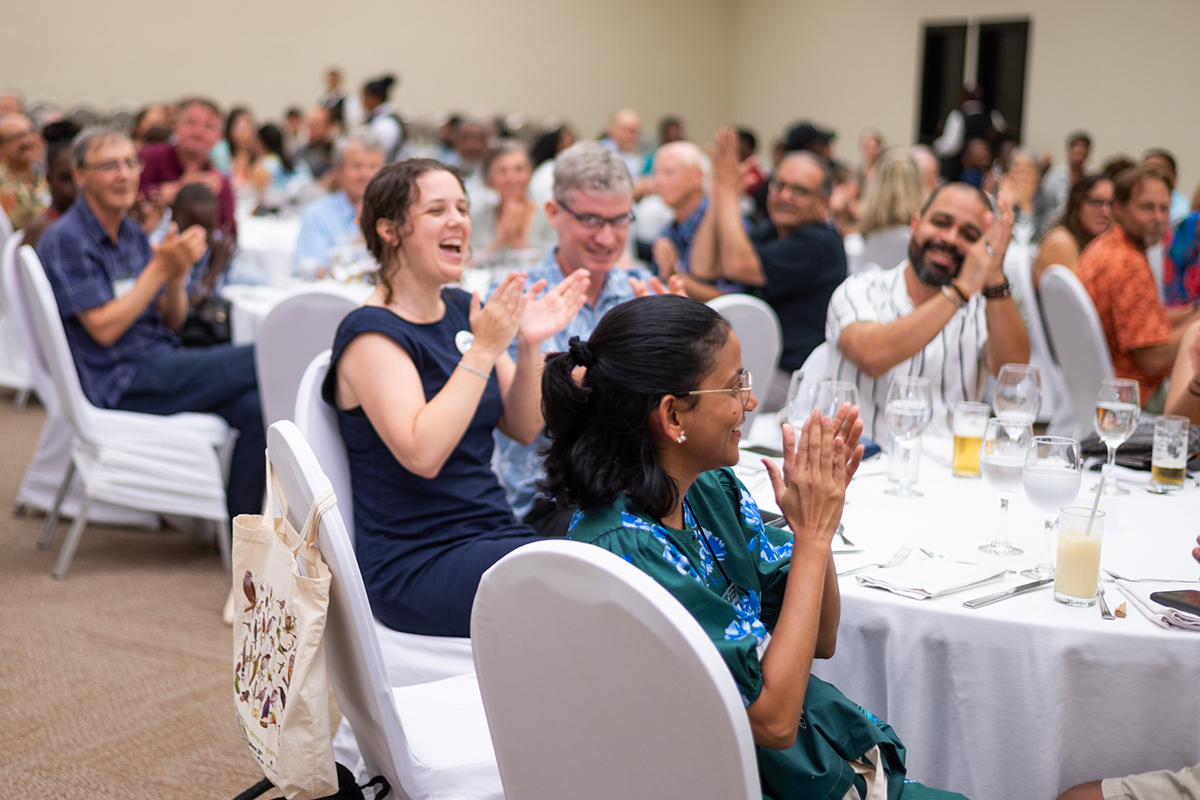
On the last evening of the BirdsCaribbean 24th International Conference, we gathered for a special Closing Gala, recognizing the tremendous efforts of our hardworking community.
And the award goes to…!!!
LIFETIME ACHIEVEMENT AWARD
The BirdsCaribbean Lifetime Achievement Awards is our most prestigious award, conferred upon those remarkable individuals in our BirdsCaribbean family who have helped change the future for Caribbean birds and their habitats for the better through a lifetime of work and dedication.
We honored two individuals with the Lifetime Achievement Award for their tireless commitment to the study and protection of Caribbean birds and their habitats.
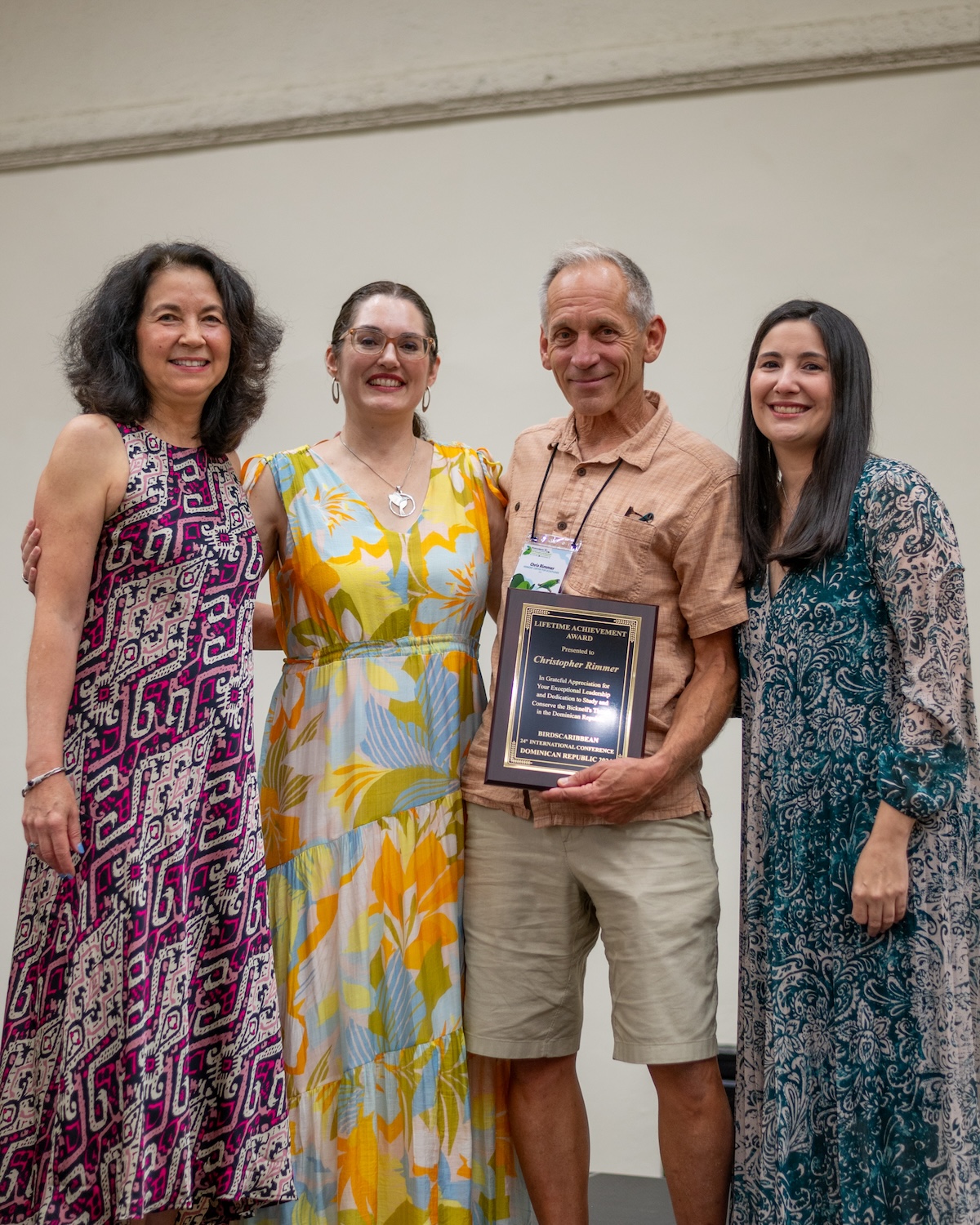
(1) Christopher Rimmer, Emeritus Executive Director of Vermont Center for Ecostudies (VCE), was recognized for his unwavering dedication to the Bicknell’s Thrush, a bird that “connects two worlds”, and for fostering conservation capacity throughout the Caribbean. As a co-founder of VCE, Chris has championed wildlife conservation over the past 3+ decades, blending ecological research with community engagement. Much of his career has been focused on studying the Bicknell’s Thrush across its full life cycle, from the breeding sites in New York and New England to the cloud forests of Hispaniola and Cuba. In 2007, Chris co-founded the International Bicknell’s Thrush Conservation Group (IBTCG), which completed the first-ever Bicknell’s Thrush conservation action plan, a collaborative effort of all six countries across the species’ full annual cycle. Beyond his fieldwork, Chris has also been a dedicated mentor to dozens of young biologists, many of whom have gone on to careers in ornithology and conservation — a testament to his belief that conservation is as much about people as it is ecology. Among his many contributions, we especially honor Chris for his continued support to science, local-based conservation, and capacity building, particularly in the Dominican Republic.
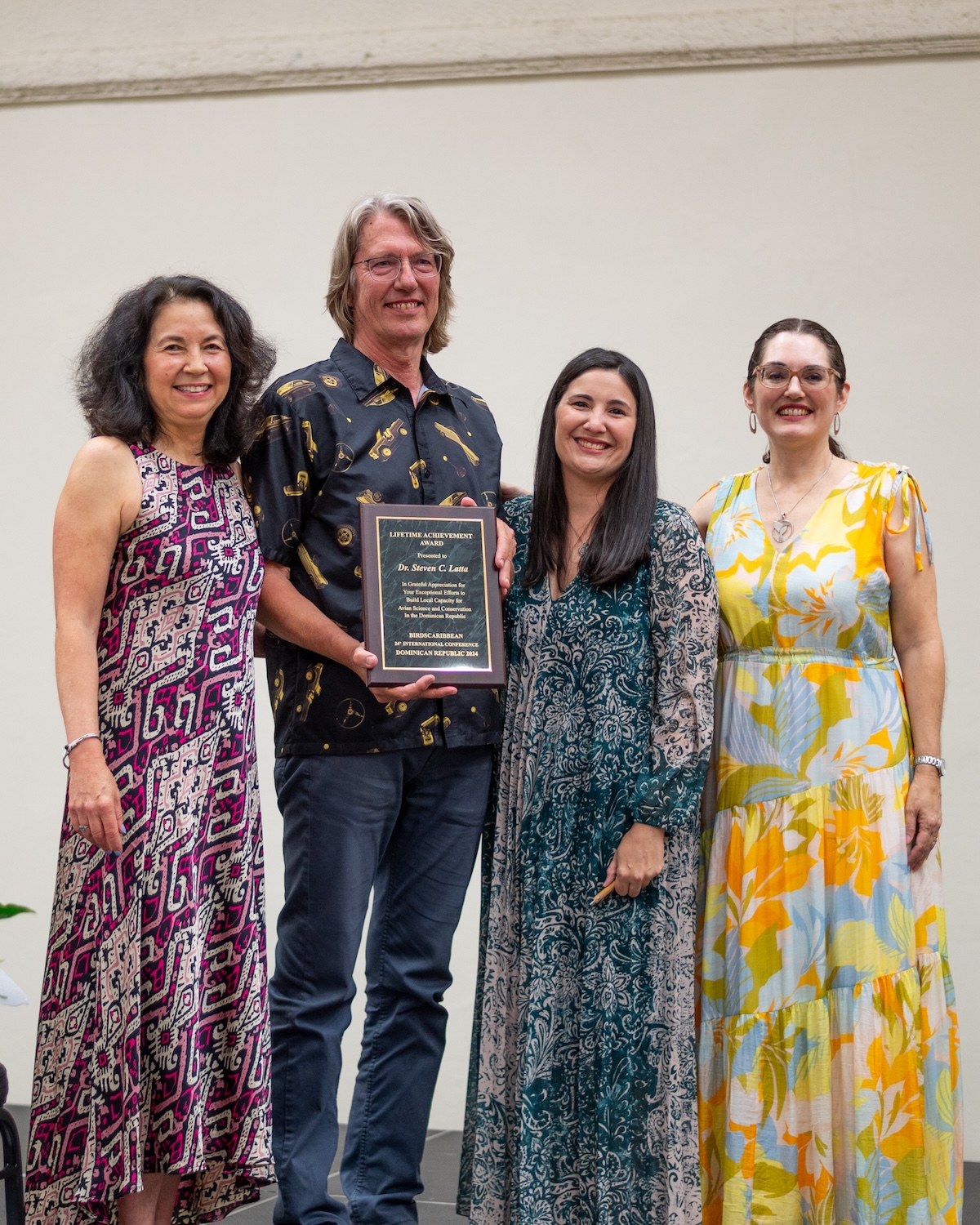
(2)Dr. Steven C. Latta, Director of Conservation and Field Research at the National Aviary, was celebrated for his extensive contributions to Caribbean and Latin American ornithology over the past 25 years. His research has explored the winter ecology of migratory birds, examining how species adapt to both natural and human-induced changes in their habitats. Using the Louisiana Waterthrush as a focal species, he has studied population dynamics and the effects of water quality on bird health. Steve has coordinated some of the longest bird monitoring programs in Latin America, and co-founded the Ruta Barrancolí, the first national birding trail in the region. His work is distinguished by strong local collaboration, partnering with Dominican biologists and naturalists as collaborators in field efforts, and by innovative efforts with locally-based educators to build a culture of bird conservation among children and adults across the island. He has authored multiple books on Hispaniola’s avifauna, published over 175 research articles, and continues to dedicate himself to mentoring the next generation of conservationists in field research and avian monitoring techniques.
Lifetime Achievement Award recipient Christopher Rimmer with BirdsCaribbean Executive Director Lisa Sorenson, BirdsCaribbean President Adrianne Tossas and Andrea Thomen.
Lifetime Achievement Award recipient Dr Steve Latta with BirdsCaribbean Executive Director Lisa Sorenson, BirdsCaribbean President Adrianne Tossas and Andrea Thomen.
PRESIDENT’S AWARD
President’s Awards recipients are hand selected by by our President Dr Adrianne Tossas, who takes into account multiple factors, such as their capacity to adapt in difficult circumstances and excel in their abilities, ultimately raising the level of service in conservation. This year, four organizations were honored with the President’s Award:The Peregrine Fund Dominican Republic, Grupo Jaragua, Grupo Acción Ecológica and Action pour la Sauvegarde de l’Écologie en Haïti.
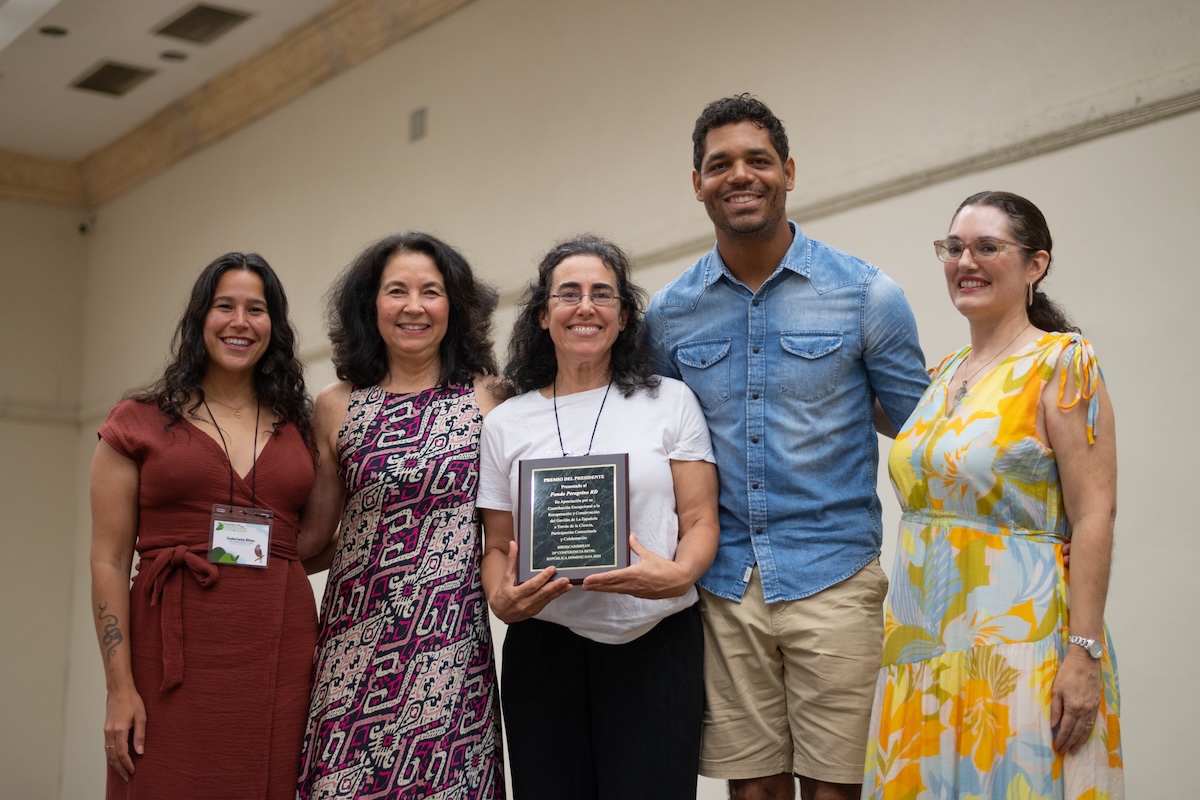
(1)The Peregrine Fund Dominican Republic, led by Carlos Suarez and Marta Curti, along with former members Christine and Thomas Hayes, and many other technicians and active community members such as Juan Gavilán and many more, were celebrated for their devotion to the conservation of Ridgeway’s Hawk through effective community engagement and fostering partnerships with the private and public sector. The Peregrine Fund’s Ridgway’s Hawk conservation project, launched in 2002, and has made significant strides in protecting this critically endangered species. A key achievement is their advances in preventing botfly infestations in nestlings, a major threat that could otherwise cause over 70% mortality. The Peregrine Fund has also successes with their Assisted Dispersal Program, which releases young hawks from Los Haitises National Park to the Ojos Indígenas Reserve, establishing new breeding pairs and fledging young in the wild. Partnerships with private organizations have helped retrofit hazardous power lines, reducing the risk of electrocution for Ridgway’s Hawks and other bird species. The Peregrine Fund’s wholistic approach to conservation goes beyond wildlife protection, incorporating community development and environmental education that benefits local people through training, educational programs, and employment opportunities, all while improving the hawk’s conservation outlook.
(2) Grupo Jaragua, led by Sixto J. Inchaustegui, Yvonne Arias, and Yolanda León, along with many other staff and members, were honored for their dedication to advocacy for threatened species and ecosystems, and for their work towards ensuring the conservation of the Dominican Republic’s protected areas. Grupo Jaragua is a leading force in conserving the biodiversity and natural resources of Hispaniola, working across the Dominican Republic and Haiti through initiatives that combine scientific research, community involvement, and sustainable development. Their programs have achieved tangible conservation outcomes for endangered species such as the Ricord’s Rock Iguana, Hawksbill Turtle, and many other wildlife. Their efforts extend beyond fieldwork, playing a pivotal role in shaping environmental policy in the Dominican Republic, including advising the Ministry of Environment and Natural Resources of the Dominican Republic on the expansion of protected areas, the UNESCO nomination of the Jaragua–Bahoruco–Enriquillo Biosphere Reserve, and the establishment of Ramsar wetlands and specially protected areas under the Cartagena Convention. In the field, they partner with local communities, building skills and empowering residents as key contributors to conservation. Many community members have become experts in techniques such as GPS navigation and camera trapping, enhancing the impact of their work, and ensuring that conservation knowledge is deeply rooted in the region.
Members of The Peregrine Fund (Dominican Republic) with BirdsCaribbean Executive Director Lisa Sorenson, BirdsCaribbean President Adrianne Tossas and Andrea Thomen.
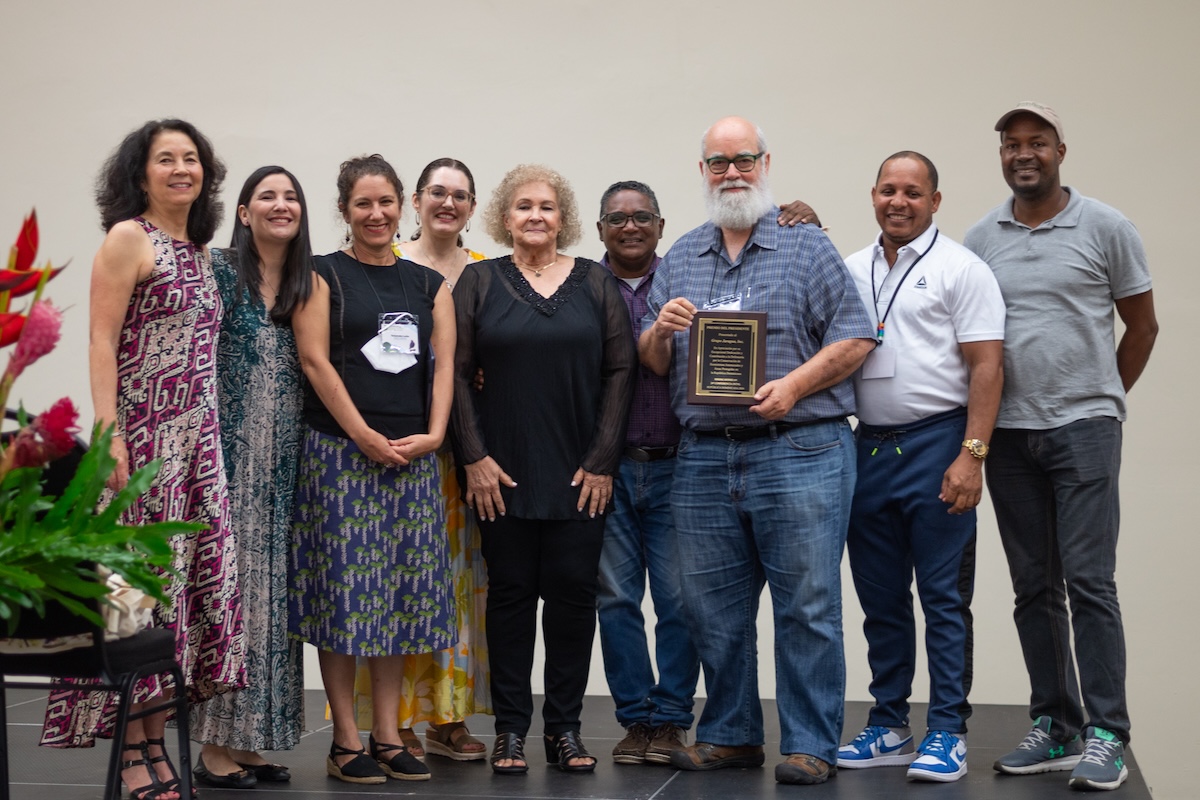
Members of Grupo Jaragua with BirdsCaribbean Executive Director Lisa Sorenson, BirdsCaribbean President Adrianne Tossas and Andrea Thomen.
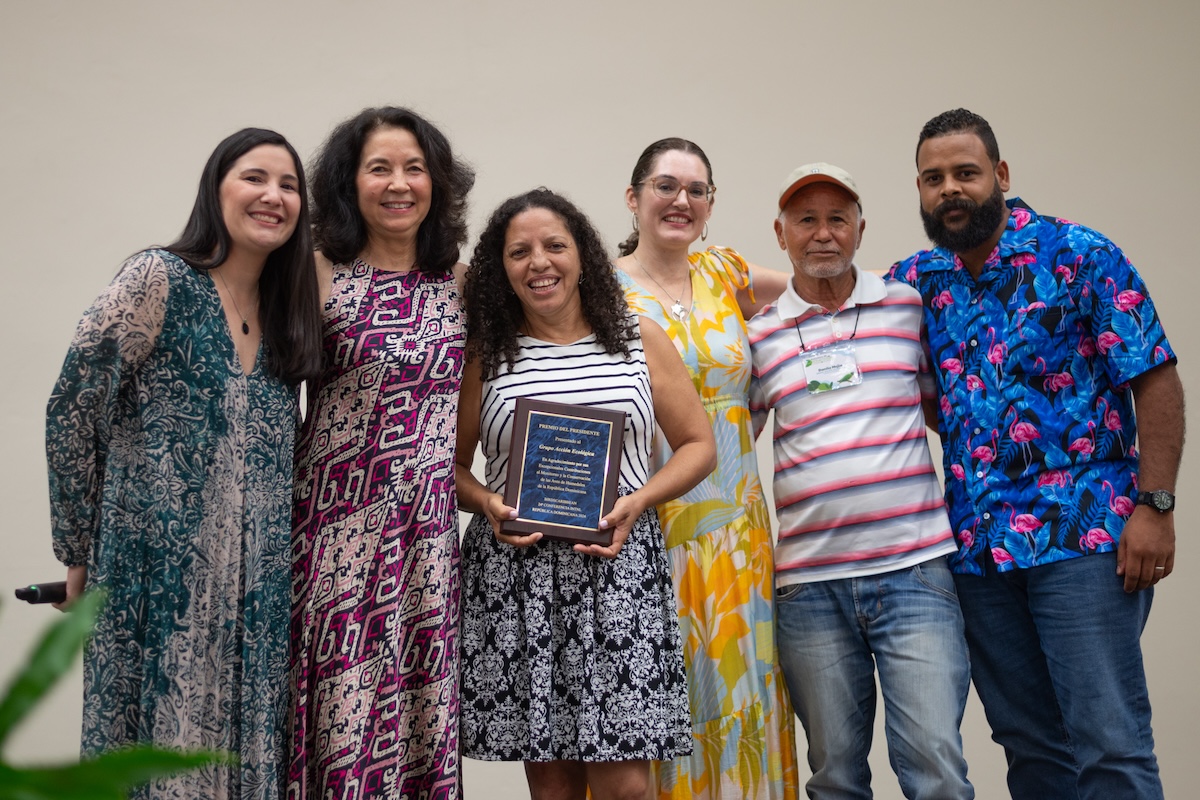
(3) Grupo Acción Ecológica (GAE), led by Maria Paulino, along with Danilo Mejia and Luis Paulino, were recognized for their efforts to monitor and conserve wetland birds and raise awareness about their threats. GAE, a Dominican nonprofit founded in 2009, is dedicated to protecting biodiversity through field research and community education, operating under the inspiring motto, “For the birds, the environment, and you.” Partnering with the National Aviary in Pittsburgh, GAE has contributed to groundbreaking discoveries about the Louisiana Waterthrush’s annual cycle, highlighting the crucial link between water quality, biodiversity, and human health. As a leader in the Caribbean Waterbird Census (CWC), GAE has played a vital role in surveying key wetlands across the DR, including the Monte Cristi wetlands, now recognized as a migration hotspot for shorebirds. GAE has also been instrumental in fostering a love for birds and nature, hosting the long-running “Campamento Barrancolí” children’s camp in Duarte Province and spearheading celebrations for the Caribbean Endemic Bird Festival and Migratory Bird Day at the National Zoo in Santo Domingo. These initiatives have reached thousands of children and families, making a lasting impact. More recently, GAE has become a key force behind the government’s “Rescate Rosado” initiative, focusing on the rescue, rehabilitation, and monitoring of the American Flamingo. Thanks to GAE’s efforts, hundreds of flamingo traps have been removed, and their data collection is directly influencing conservation strategies and decisions.
(4) Action pour la Sauvegarde de l’Écologie en Haïti (ACSEH), founded by conservation leader Anderson Jean was recognized for their exemplary efforts in building capacity for avian monitoring, conservation, and education in Haiti. This grassroots organization, founded in 2017, has established itself as a leading advocate for the country’s environment, and works towards “taking action to save Haitian ecology.” ACSEH works along with international partners such as Environmental Protection in the Caribbean (EPIC) and the Grupo Jaragua DR Petrel Monitoring Team to advance the conservation of the Endangered Black-capped Petrel (Diablotin) in several localities in Haiti. This group has pioneered innovative education initiatives, such as the annual Diablotin Festival, celebrated amongst schoolchildren and farmers in Boukan Chat and surrounding areas. In 2019, ACSEH discovered a small population of the Critically Endangered Ridgway’s Hawk on Petite Cayemite Island and is presently working to gather key data to understand the status of this species in a new locality.
Members of Grupo Accion Ecologia with BirdsCaribbean Executive Director Lisa Sorenson, BirdsCaribbean President Adrianne Tossas and Andrea Thomen.
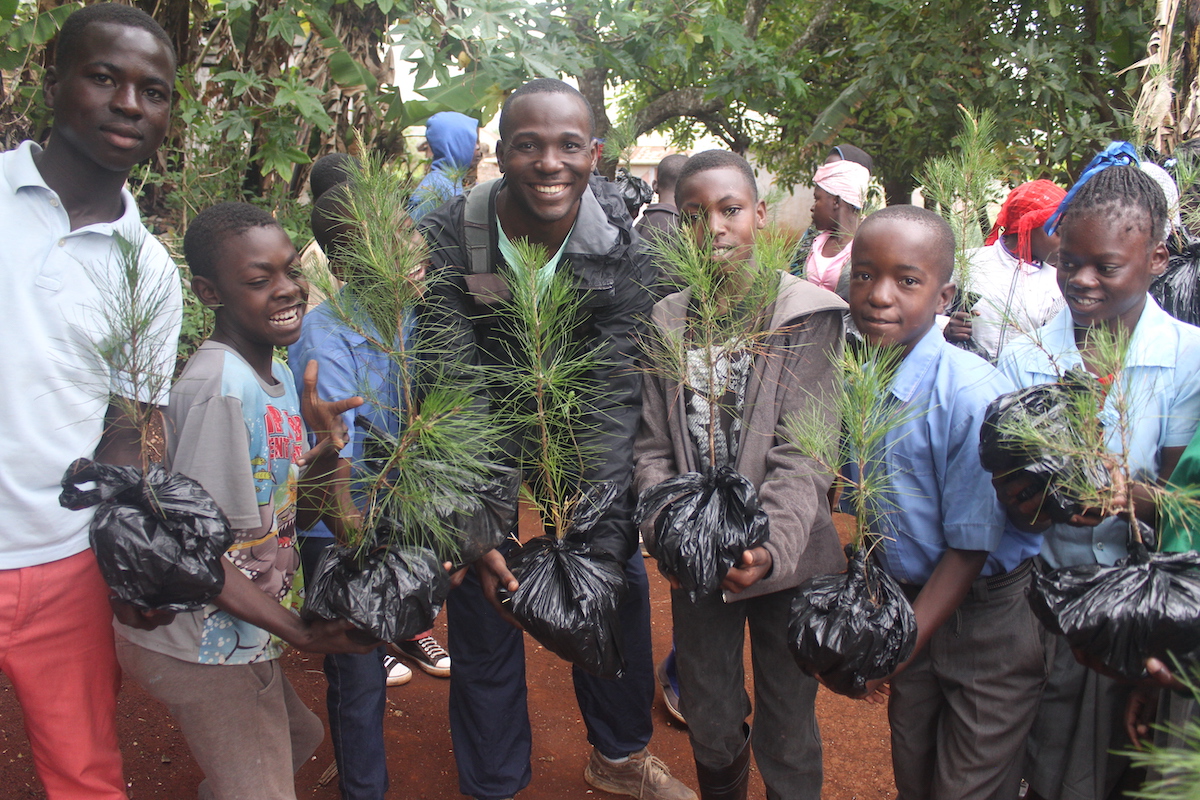
Anderson Jean (center) with Haitian schoolchildren planting trees for the Caribbean Endemic Bird Festival. While the ACSEH team was not able to attend this year’s conference, their contributions were recognized at the ceremony, and the President’s Award collected on their behalf.
FOUNDERS’ AWARD
Established in 2011 at our conference in Freeport, Grand Bahama, the Founders’ Award is given to the student who presents the best paper in conservation research or management research at our conference. The paper must present a scientific research project, the results from which directly apply to management of bird populations, their habitats, or related critical natural resources in the Caribbean Region.
This year, we were proud to present the Founder’s Award to Andrea Thomen for her paper “Endemic Parrot Trade in Dominican Republic: Implications for Conservation and Management.” Her groundbreaking research into the domestic parrot trade revealed the extent and geographical spread of parrot ownership in the Dominican Republic through a nationwide survey.
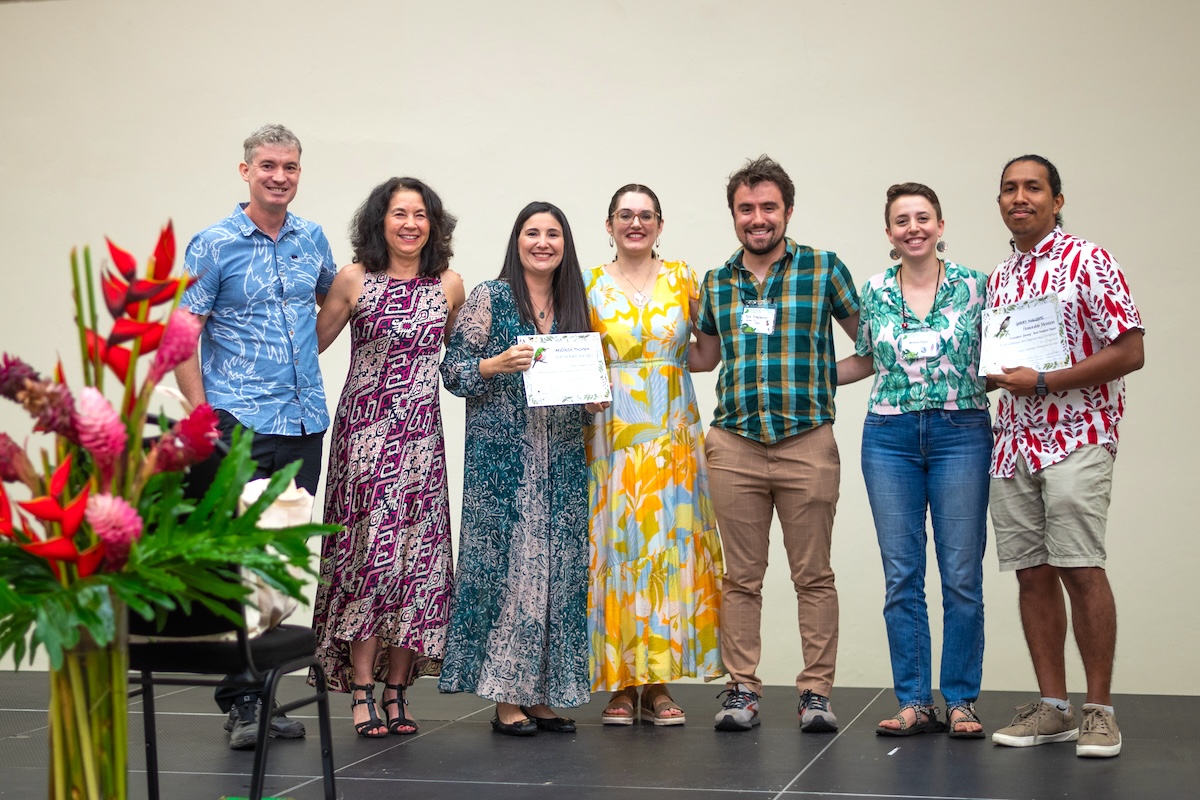
Founder’s Award recipient Andrea Thomen with Dr Mark Hulme, BirdsCaribbean Executive Director Lisa Sorenson, BirdsCaribbean President Adrianne Tossas, and Kyle Kittelberger, Michelle Moyer, and Garry Auguiste.
Other delegates were commended for their exceptional aptitude for research and oral presentations too. Honorable mention goes to Garry Auguiste (Dominica) for his paper “Quantifying the Population Density and Distribution of Amazona Parrots of the island of Dominica, Post-Hurricane Maria”, Michelle Moyer (USA) for her paper “Investigating Male and Female Vocalizations of an Understudied Caribbean Endemic Bird”, and Kyle Kittelberger for his paper “Evaluating Extinction Risk Among Resident Bird Species on Islands.”
EDUCATOR AWARDS
With a powerful mix of passion, innovative approaches, and a flair for the creative, educators drive awareness and nurture change in their communities by introducing birders of all ages to the world of avian conservation. Our Educator Awards are given jointly with our partner, Environment for the Americas, to organizations and individuals that have truly excelled as educators in their communities. With great enthusiasm and energy, these persons have consistently organized fun and exciting community activities for both the Caribbean Endemic Bird Festival and World Migratory Bird Day.
Educator Awards were given to BirdLife Jamaica, SCIENCE (St Vincent and the Grenadines), Les Fruits de Mer (St Martin), Yaritza Bobonis (Fundación Amigos de El Yunque, Puerto Rico), Giselle Ragoonanan (Trinidad and Tobago Bird Observatory and Research Centre, Trinidad and Tobago), Daniela Ventura del Puerto (University of Havana, Cuba) and Simón Guerrero (posthumous award, Universidad Autónoma de Santo Domingo, Dominican Republic). Congratulations to all the winners!
Educator’s Award recipients Mark Yokoyama and Jennifer Yerkes of Les Fruits de Mer with Aliya, Lisa, and Eduardo.
Justin Saunders, president of Birdlife Jamaica, expresses his gratitude before being presented with the Educator’s Award by Lisa.
Members of SCIENCE proudly display their Educator’s Award.
Miguel presenting Daniela with the Educator’s Award and binoculars from Environment For The Americas. (Photo by Martin Rodriguez)
Sixto accepting the Educator’s Award and binoculars for Simón Guerrero, from Miguel. (Photo by Susan Bonfield)
Educator’s Award recipient Yaritza Bobonis of Fundacion Amigos de El Yunque with Aliya, Lisa, and Eduardo.
Miguel presenting Giselle with the Educator’s Award and binoculars from Environment For The Americas. (Photo by Susan Bonfield)
INTERNATIONAL BLACK-CAPPED PETREL CONSERVATION GROUP AWARDS
The only confirmed breeding location of the Endangered Black-capped Petrel, or Diablotin, is the island of Hispaniola, which made it especially fitting for us to use the occasion of our conference to honor the dedicated Dominican and Haitian field teams who have been working tirelessly to advance our understanding of this elusive seabird. Black-capped Petrel nests are notoriously difficult to locate, and even when they are found, navigating the unforgiving highland terrain they nest in is challenging. Our understanding of the status of the petrel in recent years has largely been driven by these resolute field teams from the Dominican Republic and Haiti who boldly undertake this daunting work.
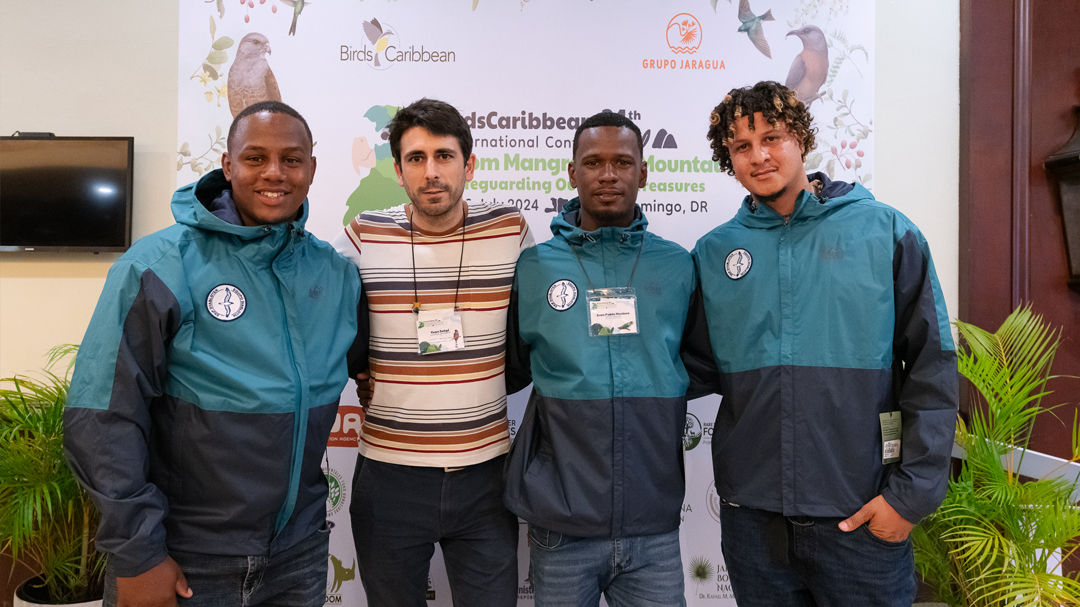
To recognize these exemplary teams, the audience were given insight into the logistical, physical and emotional challenges of their field work. All field team members were then awarded Certificates of Achievement and rain-jackets specially designed to make future field expeditions just a bit more comfortable. The names of all members – Haitian and Dominican – were read aloud to honor their remarkable level of stamina and determination in the face of challenging logistics, difficult terrains and adverse weather. It is with the deepest respect and admiration that we acknowledge the magnitude of these teams’ contribution to the world’s scientific understanding and conservation of the Black-capped Petrel.
We are proud to recognize the Haitian Black-capped Petrel field team: Anderson Jean, René Jeune, Samuel Nossirel, Tinio Louis, Renozier Victome, Maxon Fildor, Jephtanie François, Lionel Raymond, Brazil Jonel, Julcene Raymond, and Wilson Aubourg; and the Dominican Republic (Grupo Jaragua) Black-capped Petrel field team: Ernst Rupp, Gerson Feliz, Geny Marcelo Feliz, Juan Pérez Vidal, Juan Pablo Montero, Jairo Issa Matos, Jose Luis Castillo, and Esteban Garrido.
Geny Marcelo Feliz, Juan Pablo Montero, and Juan Pérez Vidal of the Domincan Republic Black-capped Petrel field team trying on their new rain-jackets and posing for a shot with Yvan Satgé (second from left) (Photo by Ariel Contreras)
(L to R) Anderson Jean, Wilson Aubourg, Maxon Fildor, Jonel Bazil, and Julcene Raymond of the Haitian Black-capped Petrel field team on site in Haiti.
PARTNERS IN FLIGHT AWARD
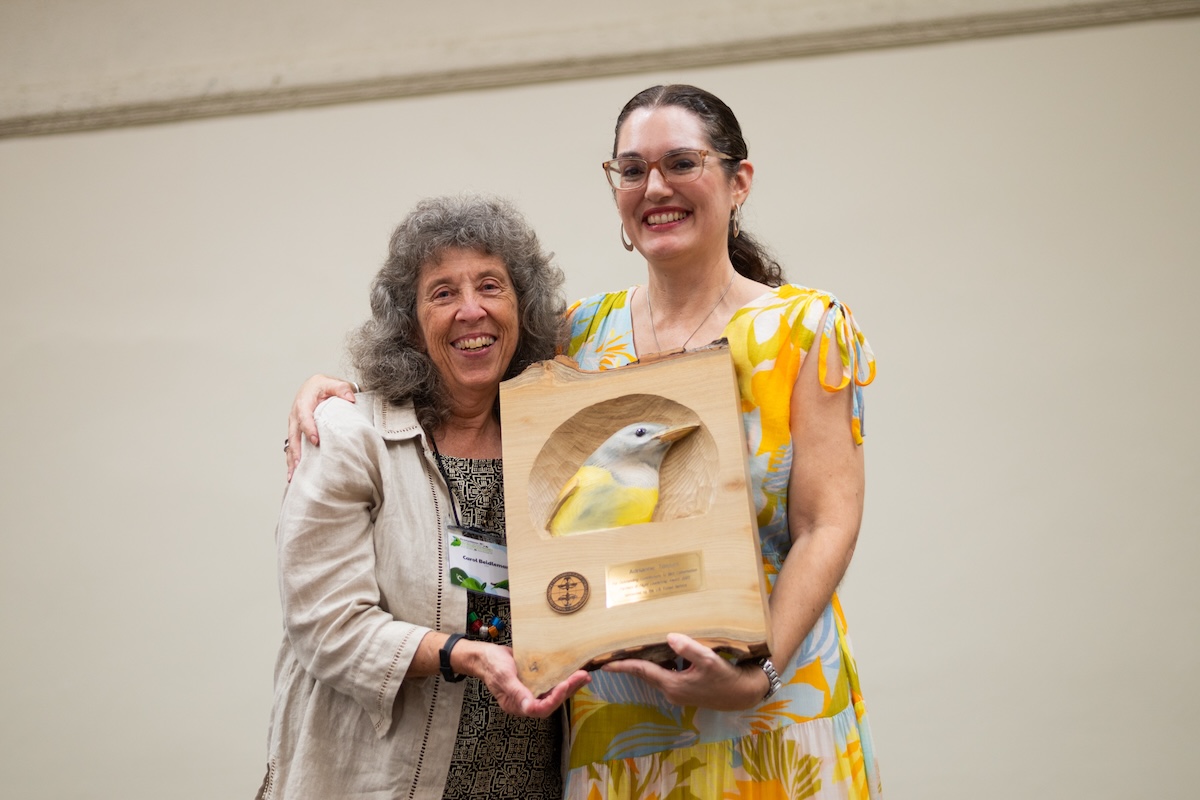
The Partners in Flight Leadership Award recognizes outstanding individuals and groups across the Americas for their exceptional contributions to the field of landbird conservation. We are delighted to share that our President,Dr Adrianne Tossas, was honored by Partners in Flight for her almost three decades of promoting conservation of bird species in Puerto Rico and throughout the Caribbean region through research, education, and advocacy. Adrianne’s journey has exemplified resilience and adaptability while building an impressive legacy of leadership in conservation. As a founding member of the Puerto Rican Ornithological Society, she initiated and coordinated the Important Bird Areas program in Puerto Rico. A published author, she wrote “Aves de Puerto Rico Para Niños,” making bird conservation accessible to younger audiences. Since becoming an active member of BirdsCaribbean in 1999, Adrianne has served as Director-at-Large, where she initiated the Caribbean Endemic Bird Festival, which is now in its 22nd year. Today, she proudly leads as the President of BirdsCaribbean. Adrianne is also a Professor of Biology at the University of Puerto Rico.
Carol Beidleman presenting BirdsCaribbean President Adrianne Tossas with the Partners in Flight Leadership Award.
Posthumous AWARDs
This year, we were deeply saddened by the passing of two pillars of our community. Simón Guerrero, and Orlando Garrido continue to stand out as giants among us in their influence and impact, and the contributions that they have each made will advance Caribbean conservation for decades to come. We honored their immense legacies with with Posthumous Awards, and continue to celebrate their memory.
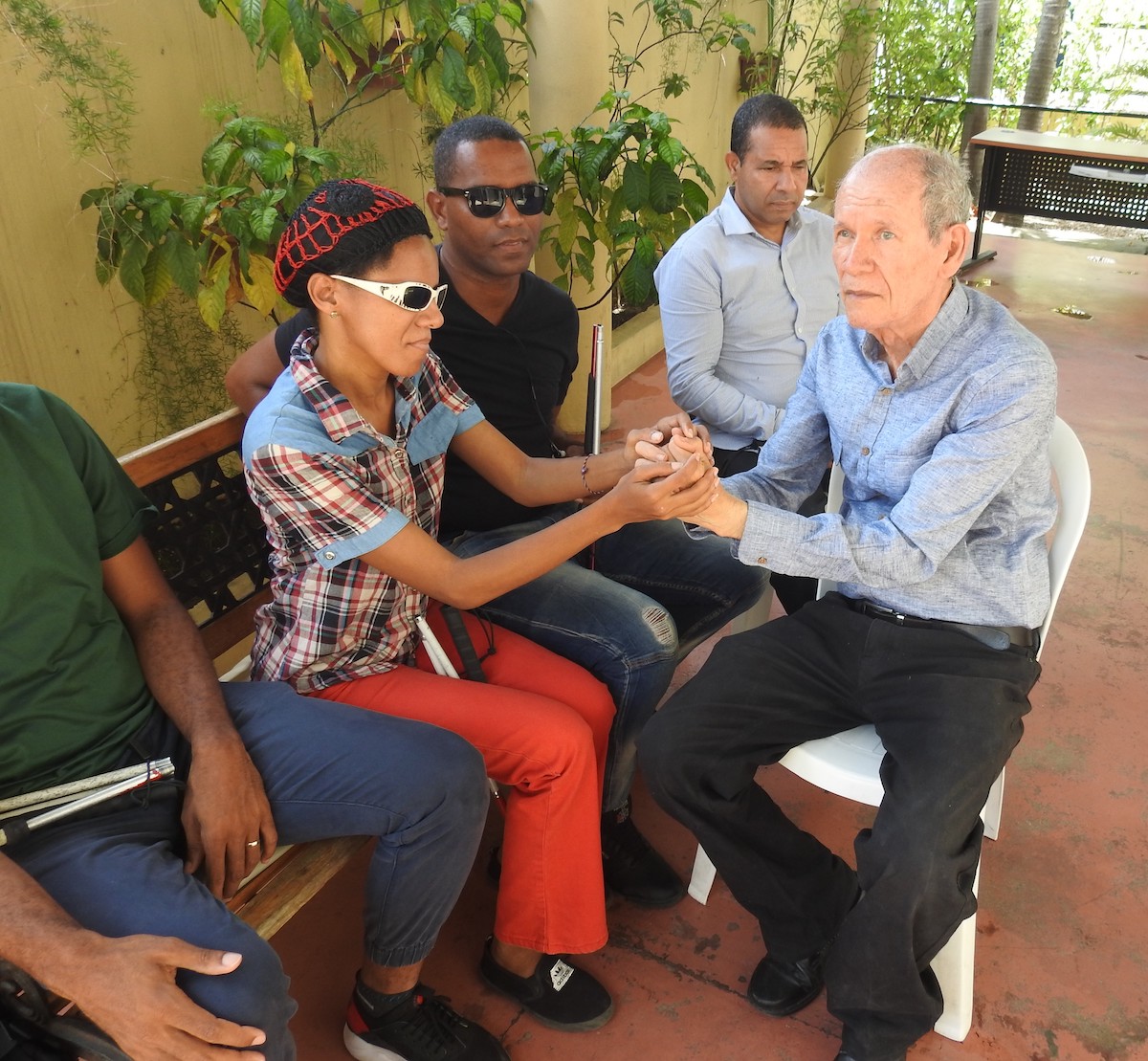
Simón Guerrero, a revered Dominican psychologist, naturalist, and bird behavior expert, left an indelible mark on the conservation community. Serving as a professor for over 40 years at the Autonomous University of Santo Domingo (UASD), he also directed the Experimental Behaviour Lab, inspiring countless students with his engaging teaching style and profound love for nature. Simón’s career extended to the National Natural History Museum in Santo Domingo and the National Zoo-Smithsonian Institute, Washington, D.C. As a founding member of the Society for the Conservation and Study of Caribbean Birds, Simón holds a treasured place in our history; he was a beloved presence at every biennial conference for 30 years, and his absence was deeply felt at this year’s gathering. Simón was a passionate advocate for environmental education, contributing over 300 press articles that promoted conservation in the Dominican Republic. His love for nature went beyond birds to include native flora, encouraging the planting of bird-friendly plants across the country. Known for his quick wit, captivating anecdotes, and heartfelt compassion for animals, he inspired many to become defenders of the natural world. His innovative contributions, such as designing artificial nests for bird species, remain a testament to his ingenuity and dedication. As we honor Simón’s memory, we are guided by the question he often posed: “Does the species know?” His legacy continues to challenge and inspire us to ensure that every conservation effort is felt by the creatures it aims to protect.
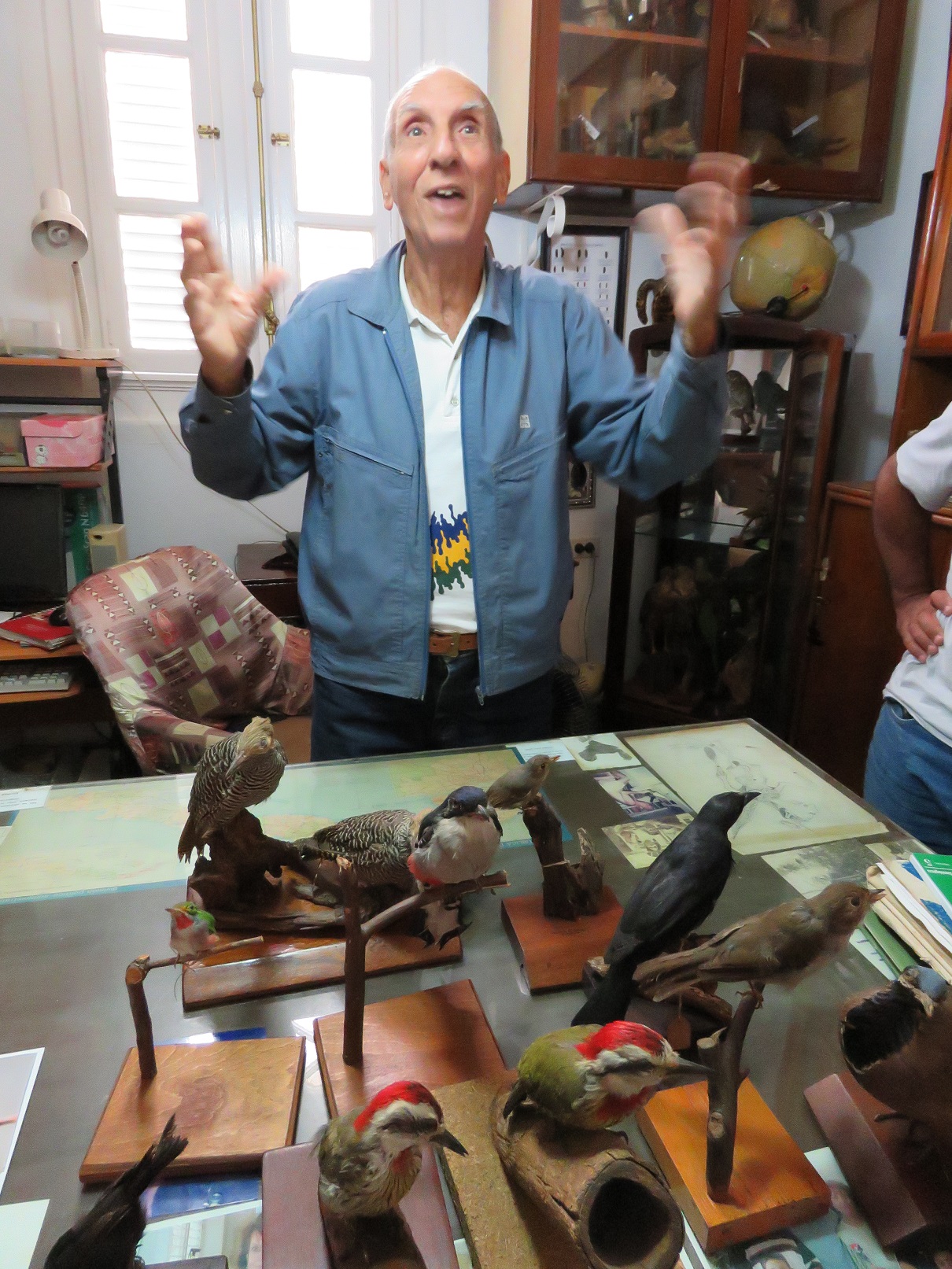
Orlando Garrido, celebrated biologist and ornithologist, is remembered as one of Cuban natural sciences most illustrious sons, and as an inspiration to generations of Caribbean naturalists. His legacy includes the discovery of four mammalian taxa and the description of 58 insects, 21 birds, and 37 reptiles. His name is immortalized in the 78 new records among birds, reptiles, and fish, and 23 taxa that have been dedicated to him, and his prolific career produced 298 scientific publications. His spirit of discovery is remembered with respect and awe, oftentimes going out into the field almost “blindly,” armed only with a backpack full of the passion, at a time when there were not yet the field guides of today. He is remembered not only for his scientific achievements but also for his generosity in sharing knowledge, his sharp insights, and his irreverent sense of humor. Orlando’s legend extends beyond science; he was also an internationally recognized tennis player, competing at Wimbledon six times and representing Cuba on the global stage. From dropping out of Biology at university, to becoming the pride of Cuban science, Orlando Garrido’s story is one of remarkable transformation. His life’s work continues to inspire, and we celebrate his memory with deep respect and admiration.
Orlando Garrido was a tireless explorer of the Cuban archipelago. Garrido has to his credit the discovery of four mammalian taxa and the description of: 58 insects, 21 birds, 37 reptiles. 78 new records among birds, reptiles, and fish, and 23 taxa have been dedicated to him, and in total he has 298 publications. (Photo by Susan Jacobson)
Simón Guerrero was a founding member of the Society for the Conservation and Study of Caribbean Birds. An engaging teacher and speaker with a great sense of humor, he influenced many to become fans and defenders of nature for many decades.