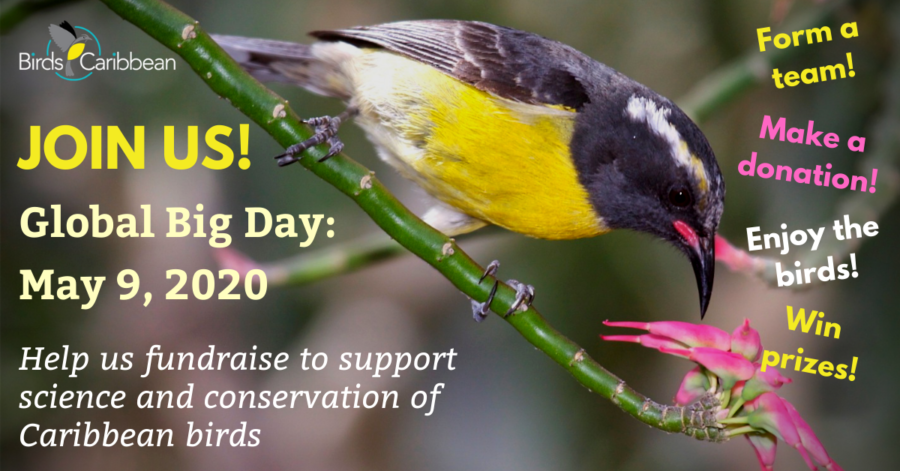
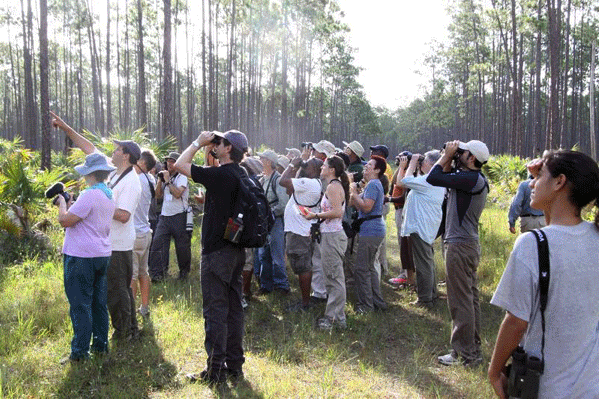
BirdsCaribbean is excited to be hosting a fundraiser that focuses on the energy, excitement, and comradery that’s associated with Global Big Day!
Global Big Day is an annual event in which birders, often in teams, travel around an area trying to observe as many bird species as they can in a 24-hr period of time. Global Big Day is happening on May 9th this year!
Because of safety concerns with COVID-19, Global Big Day will have a different feel to it this year. Many of us will be birding individually, and from a safe place*.
In an effort to keep the event exciting, and give us all an opportunity to celebrate safe birding, BirdsCaribbean has created a fundraiser that brings us all “together” on virtual teams that can engage in friendly competition to (1) raise the most funds, and (2) collectively see the most species of birds on Global Big Day.
Once on a team, help personalize your team page with fun photos and your own lingo, and then invite family, friends, colleagues, or members of your birding community to join your team and/or donate to your team.
By inviting people to your team, you are (1) raising awareness for BirdsCaribbean and the Journal of Caribbean Ornithology, (2) encouraging more fundraising to keep the Journal going, and (3) promoting Global Big Day and the importance of conserving birds and their habitats.
and/or . . .
Simply making a donation to one of the birding and fundraising teams.
By doing so, you will have (1) helped support the Journal, and (2) encouraged that team to bird as hard as they can on Global Big Day.
and/or . . .
Committing to spending some time (or the entire day!) birding on Global Big Day (May 9), being sure to keep track of what you see and then entering that information into eBird. We hope everyone will do this, whether or not they join a team or fundraise.
This will be a fun event to fundraise for and get excited about! Be ready to set yourself up in a safe place* and go birdwatching for as much of the day as possible, knowing that all of your teammates, friends, and BirdsCaribbean community members are doing the same!
Everyone should plan to submit their observations to eBird (or eBird Caribbean). Then we’ll tally them up and see how we all did! We will send out more information about this as the event draws closer.
WHY THIS IS IMPORTANT
We are living in unprecedented times. The important role that science is playing in understanding COVID-19 and finding solutions is more clear than ever. What science does to inform and improve public health, it also does for conservation of wildlife and nature.
BirdsCaribbean’s mission is to conserve birds and habitats throughout the Caribbean islands. This depends in large part on science—investigating causes of species decline that can then inform management and conservation actions.
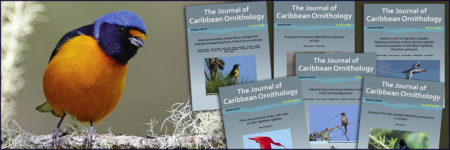
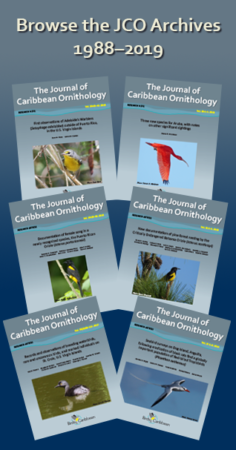
To share that science, our community of researchers depends on theJournal of Caribbean Ornithology (JCO). This in-house, peer-reviewed publication has served our community for 32 years and counting. But the JCO needs help to keep its publications free and open-access to the world. Explore the JCO here.
HOW YOUR GIFT WILL BE USED
This fundraiser will benefit the Journal of Caribbean Ornithology.
We are proud of our Journal and want to keep it free and open access to everyone. To do this, we need help fundraising to cover the Journal’s modest operating costs.
JCO has recently experienced remarkable growth, including adding many new and talented staff members, creating a highly efficient workflow, building a new website, completing fully-accessible Archives dating back to Volume 1, Issue 1 in 1988, and so much more.
JCO is an invaluable resource to thousands of Caribbean students, researchers, and conservationists, providing an unparalleled body of ornithological knowledge for the Caribbean region through its free, fully searchable website. This is why we are asking for your help in fundraising for JCO.
No matter what, we hope everyone will participate. You can bird by yourself, create a team or join a team, and then fundraise! Or you can simply make a donation, investing in science to help Caribbean birds. No gift is too large or too small.
As with everything in the Caribbean we will be successful when our whole community pitches in, so let’s do this together. We know we can count on you to help!
ABOUT GLOBAL BIG DAY
Global Big Day is organized by the Cornell Lab of Ornithology. Last year, people in more than 175 countries participated, setting a record for the most birds seen in one day all over the globe. Learn more here about this important citizen scientist initiative.
PRIZES WILL BE AWARDED TO:
(1) the team that raises the most funds
(2) the team with the most creative name and stylish fundraising page
(3) the team that sees the most bird species on Global Big Day
(4) the team that sees the most endemic species on Global Big Day
(5) the team with the best “find” of the day (unusual, rare, plumage aberration, etc.)
(6) the team with the best bird photo of the day (must be posted on eBird along with your list)
There will also be “Hidden Prizes”; the categories for these will be announced just prior to Global Big Day AND throughout the day on Global Big Day.
SAFETY
*Given the safety concerns the COVID-19 virus presents for doing Global Big Day counts, we recommend that you bird in your backyard. If it is safe to go out on May 9th be sure to choose birding locations that (1) comply with your municipality’s COVID-19 safety guidelines (i.e. social distancing and travel guidelines), and (2) comply with your personal safety preferences. And so whether you we will be birding at a local park, within your own backyards, or from your bedroom windows, we will all be enjoying the opportunity to distract ourselves with some safe, fun birdwatching. Additionally, we will all be birdwatching “together” for a great cause that unites us!
Thanks in advance for participating and supporting our fundraiser, however you can! We hope to see lots of teams forming throughout the Caribbean, US, Canada and beyond! We will keep you updated with more news and details about our Global Big Day, such as how to keep a count of your birds and enter your data on line – stay tuned!
Soaring above the tree tops of Los Haitises National Park is the mighty Ridgway’s Hawk. Conflicts with humans and changes in its forest habitat have made it hard for this species to survive. Marta Curti gives us an update on the exciting work of The Peregrine Fund to save this Critically Endangered raptor.
Since 2000, when we began our project to conserve the Critically Endangered Ridgway’s Hawk in the Dominican Republic (DR), we began to hire and train local crew members to help carry out the field work. In 2011, we increased our recruitment and training efforts greatly. One of our main goals is to make the project sustainable in the long-term, which means giving locals the opportunity and the means to support their families while working directly for conservation.
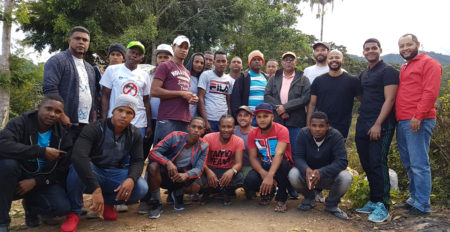
We currently have over 20 Dominicans employed on our project. Most were born and raised in the very communities where we work, right in the heart of Ridgway’s Hawk territory. These residents range in age from late teens to over 60. They are trained in nest searching, monitoring, data collection, data entry, tree climbing, banding, treating nests to prevent nest fly infestations, and environmental education techniques. They spend long hours in the field, hiking over rough terrain, sometimes in oppressive heat and humidity or torrential downpours, to monitor and protect the hawks. While we are always so grateful for the work they do, this year, more than ever, their commitment to this project has proved invaluable.
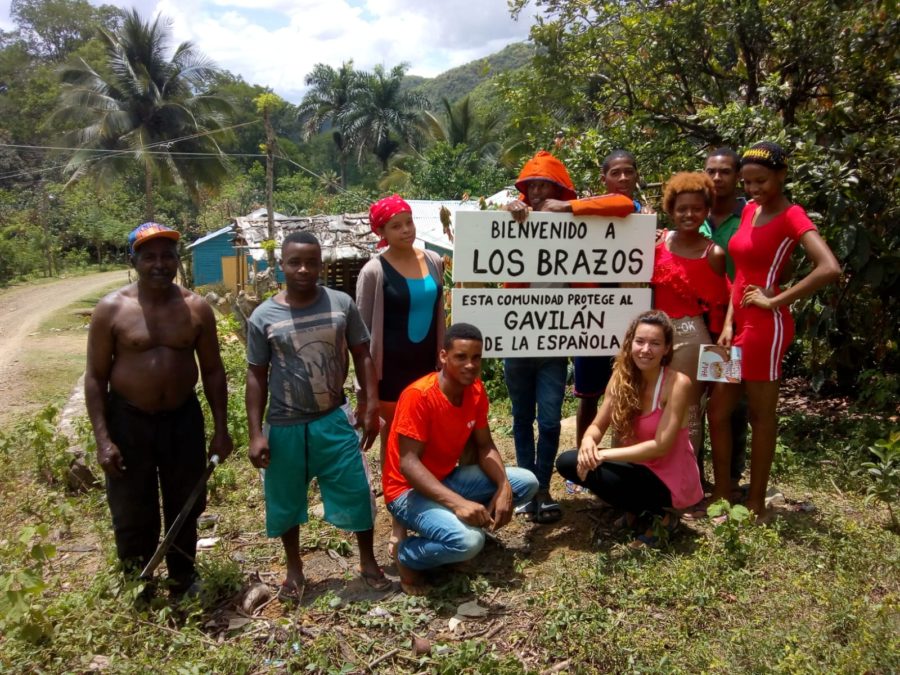
Members of the community of Los Brazos create a home-made sign that reads “Welcome to Los Brazos. This community protects the Ridgway’s Hawk” to show their support of the conservation project
Communities Take Up the Reins During COVID-19
Due to the COVID-19 outbreak, Thomas Hayes (Ridgway’s Hawk Project Director) and Marta Curti (Ridgway’s Hawk Project Environmental Education Specialist), will not be able to travel to the DR for the next several months, if not longer. If this were a “normal” year, we would both be planning a trip now, as the next few months are critical to our project’s success. Ridgway’s Hawk breeding season is in full swing and it is important to continue monitoring, banding, and treating nests. Thanks to our local crew, this work is being accomplished without a hitch!
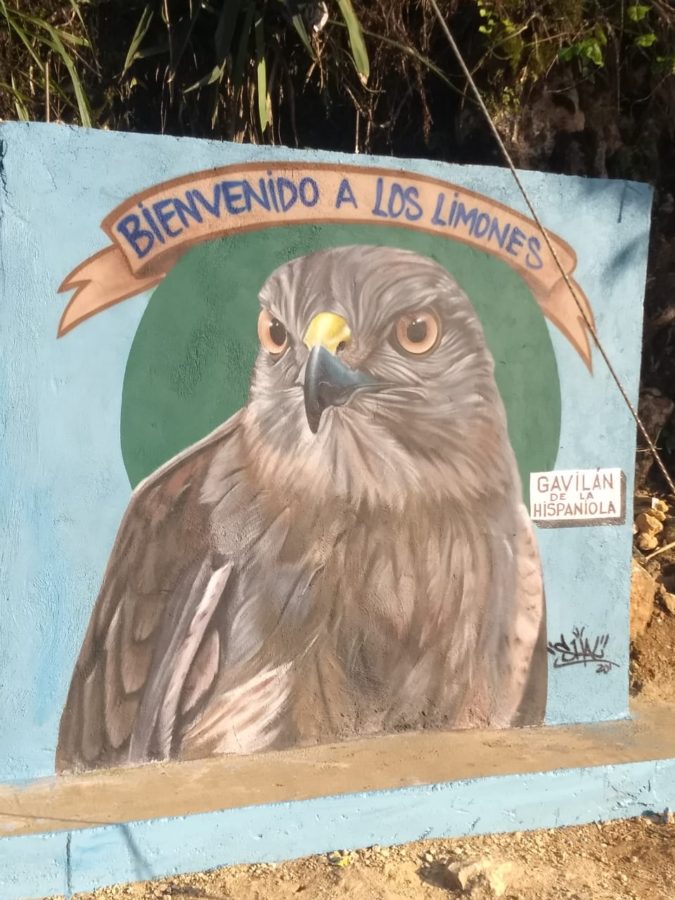
At our first reintroduction site, the Punta Cana Resort and Club, our team is monitoring 17 pairs. Six of these pairs have hatched 13 young so far this year, while 9 have eggs waiting to hatch! This is an incredible achievement, considering that Ridgway’s Hawks hadn’t been documented in this area since the 1970s and breeding pairs didn’t start to form there until 2013! Though our environmental education efforts have been postponed in order to maintain social distancing, we were still able to reach 1,594 individuals at the beginning of the year. Our crew in Los Limones had a beautiful mural painted at the entrance to the town.
Our field crew in Los Limones organized the painting of a beautiful mural at the entrance to the community to highlight the importance of conserving Ridgway’s Hawk in the area (Photo by The Peregrine Fund)
Los Brazos: An Eco-Friendly Release Site for Ridgway’s Hawks
While our seasoned crews are doing an amazing job in Punta Cana and Los Haitises National Park, we are particularly grateful for the newest additions to our team – our crew from the town of Los Brazos, located within the Aniana Vargas National Park in Dominican Republic. The small town of approximately 100 people relies heavily on the production of shade-grown certified organic cacao. Young and old, men and women, work daily to harvest, dry, process, and sell the crop.
The town itself consists of one dirt road with houses scattered on either side. In and around the town are cacao plantations interspersed with tall trees, wildflowers and wildlife. To maintain the organic certification, they must heed certain rules: no use of pesticides, no killing of wildlife, no cutting of forests. This, and the fact that this area was designated as Aniana Vargas National Park in 2009, was the main reason we chose this area as the newest site for Ridgway’s Hawk releases. Though every area has its unique challenges when it comes to releasing birds of prey, we knew we would be ahead by leaps and bounds releasing birds here. Thanks to support from the Betty Petersen Conservation Fund, we were able to release 25 young hawks in this area in 2019.
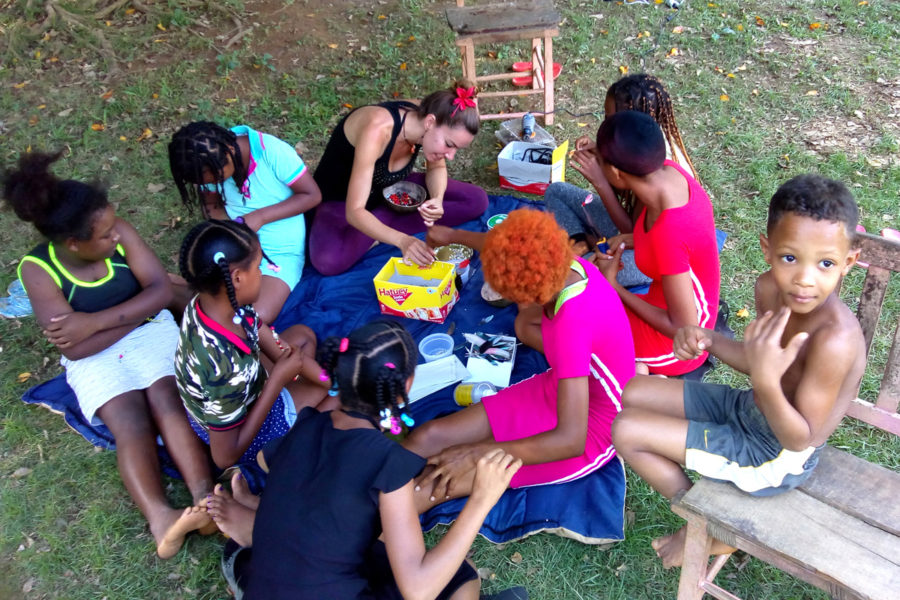
Peregrine Fund seasonal biologist, Sete Gañan, leads a jewelry-making workshop in the community of Los Brazos, the site of our newest release site for Ridgeway’s Hawk (Photo by Nicholas Lormand/The Peregrine Fund)
Exciting News to Report
Though we had planned to release another group of hawks this coming field season, we have decided to postpone this year’s releases due to the COVID-19 pandemic. However, thanks to our local crew, we have some amazing news to report. Our team has documented a pair of hawks building a nest in the area. This is the first pair formed from the previous year’s cohort of released birds, and a huge step in developing an additional hawk population in this region.
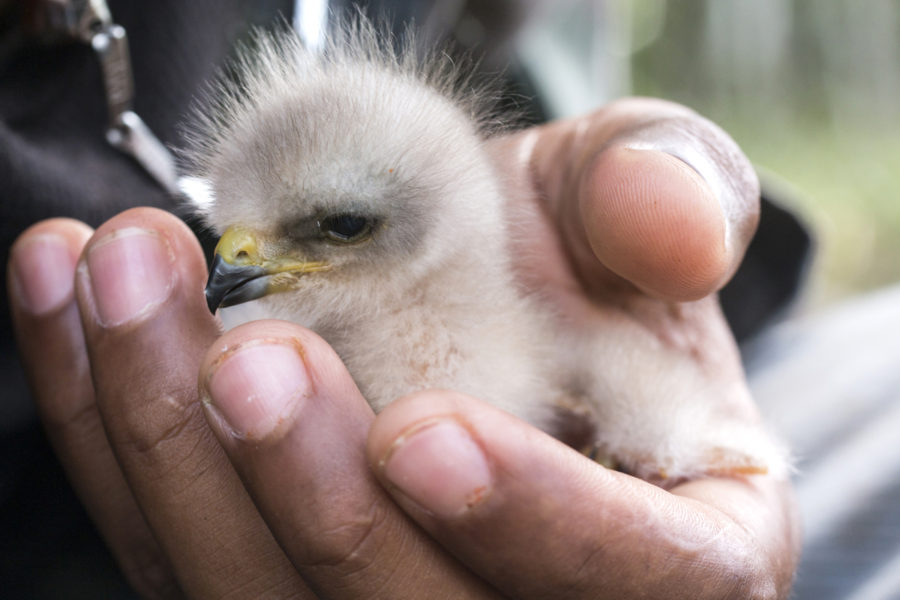
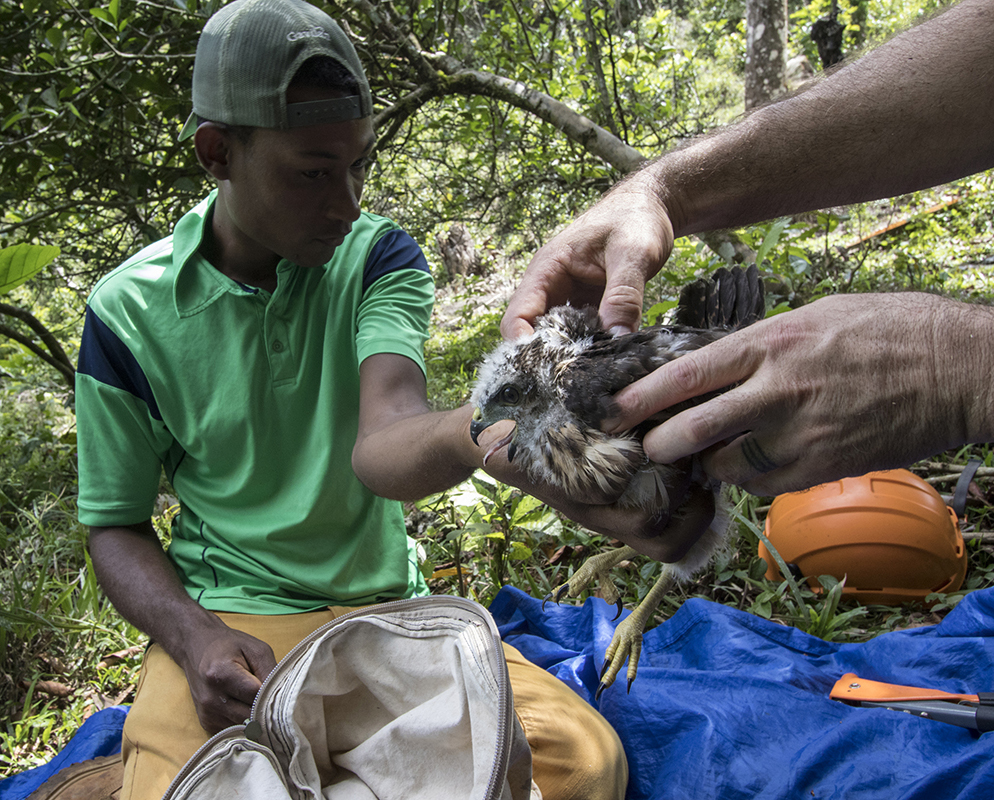
A nestling Ridgway’s Hawk is in good hands with our local biologists (Photo by Nicholas Lormand/The Peregrine Fund)
While there is so much uncertainty in the world at this time, it is an opportunity to focus on the things we are grateful for. I, for one, deeply appreciate the work of our amazing team and their unending dedication to protect this hawk. And I am grateful to the Betty Petersen Conservation Fund and BirdsCaribbean for continuing to support our work.
By Marta Curti, The Peregrine Fund. Marta began working as a field biologist with The Peregrine Fund (TPF) in 2000 when she worked as a hack site attendant on the Aplomado Falcon project in southern Texas. She has since worked as a biologist and environmental educator on several TPF projects from California Condors in Arizona to Harpy Eagles and Orange-breasted Falcons in Belize and Panama. She has been working with the Ridgway’s Hawk Project since 2011. This project is funded in part by BirdsCaribbean’s Betty Petersen Conservation Fund. Please donate to help this save the Ridgeway’s Hawk!
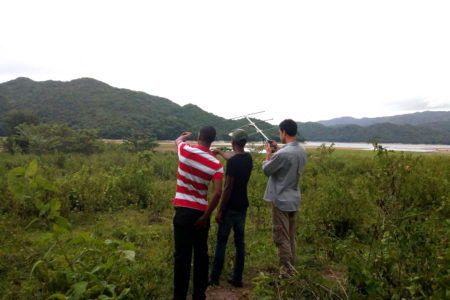
Our local field crew tracking reintroduced hawks using radio telemetry. Each young hawk was fitted with a transmitter – paid through support from the Betty Petersen Fund – so we could monitor them after release. This is a key part of the program as it helps us keep track of the young birds during the first critical weeks after release (Photo by Nicholas Lormand/The Peregrine Fund)
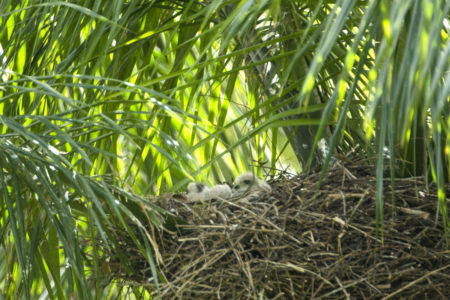
A Ridgway’s Hawk nest with young (Photo by Nicholas Lormand/The Peregrine Fund)
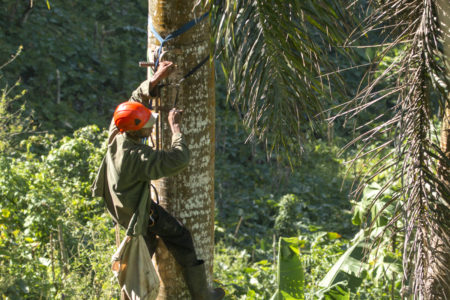
A local team member climbs a Ridgway’s Hawk nest tree in order to band nestlings before they fledge. Banding young is an important part of our project as it helps us monitor dispersion patterns and survivability of young hawks through band re-sightings (Photo by Nicholas Lormand/The Peregrine Fund)
Our local field crews participate in First Aid training to help keep them safe in the field. This is just one of several training programs we provide (Photo by Nicholas Lormand/The Peregrine Fund)
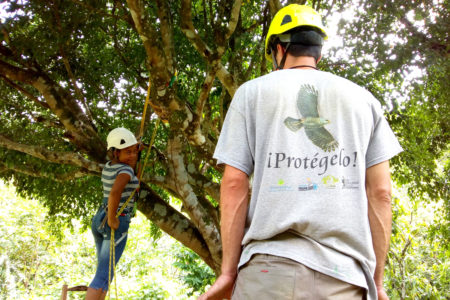
Peregrine Fund seasonal biologist, Julio Gañan, trains one of our local volunteers, Fredelina Espino Campo, in tree climbing techniques (Photo by Nicholas Lormand/The Peregrine Fund)
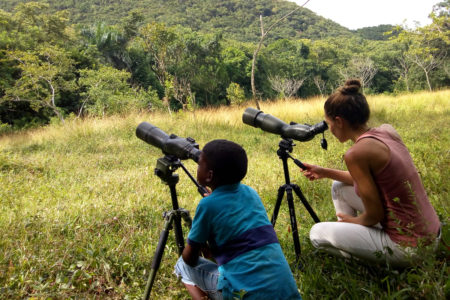
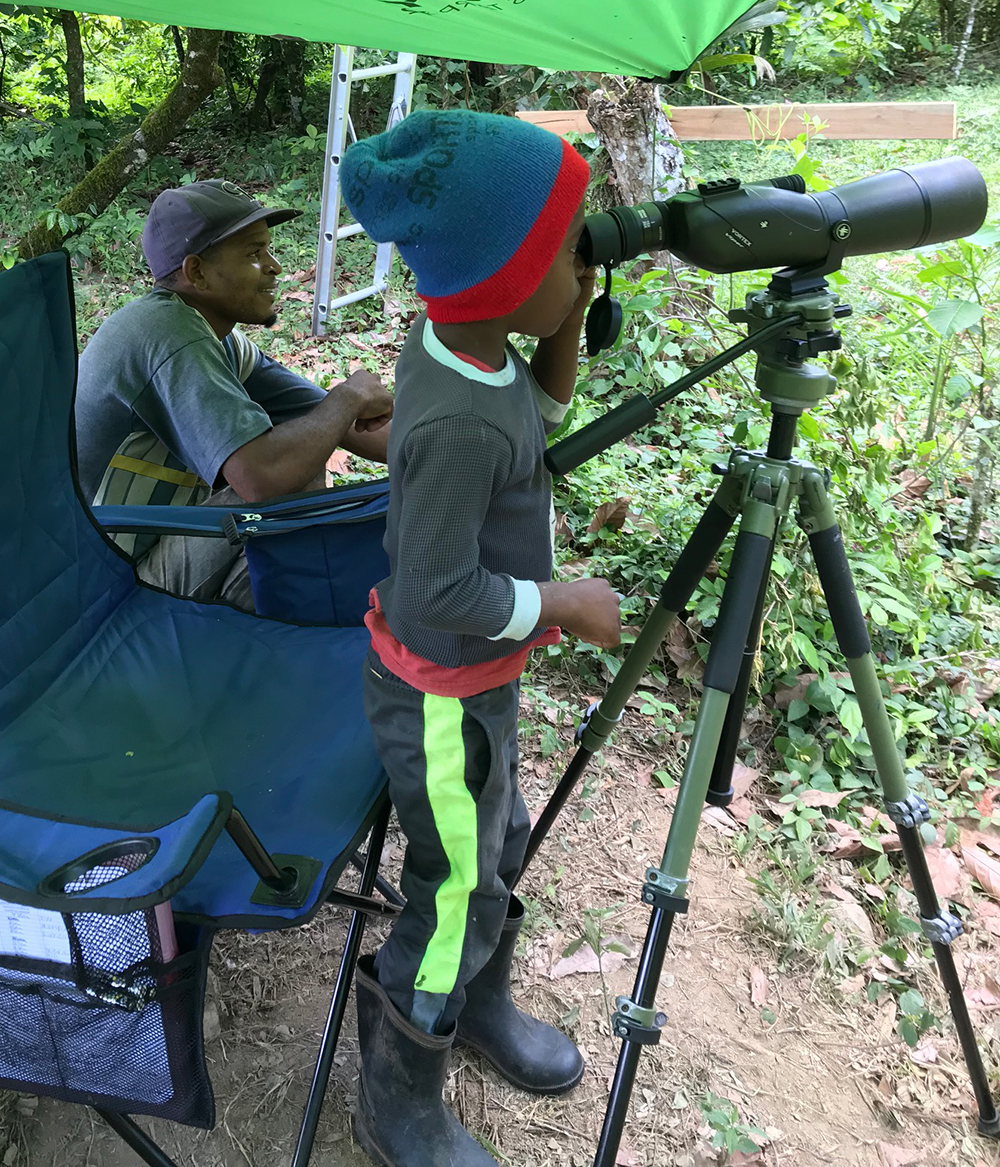
Peregrine Fund seasonal biologist, Sete Gañan, observes released Ridgway’s Hawks along with a young community member from Los Brazos. Everyone in the community showed a great interest in the project, and we had visitors both young and old almost every day during the releases (Photo by Nicholas Lormand/The Peregrine Fund)
Josmar Marquez, from AveZona, has lead bird monitoring projects on Coche Island in Venezuela since 2018. In addition to data collection, his work involves mentoring young conservationists and promoting nature-friendly behavior changes in the local community of the island. Here, Josmar describes his most recent Snowy Plover monitoring season and some exciting firsts for shorebird monitoring in Venezuela. (More photo and Español debajo)
In Venezuela, thanks to the support of the BirdsCaribbean David S. Lee Fund, AveZona and the ARA MACAO Scientific Foundation have carried out population surveys of Snowy Plovers (Charadrius nivosus tenuirostris) on Coche Island. A large number of the birds have been recorded in the “Salina de San Pedro de Coche.” This has lead to an appreciation and increased value of the island as this species is threatened in the Caribbean region.
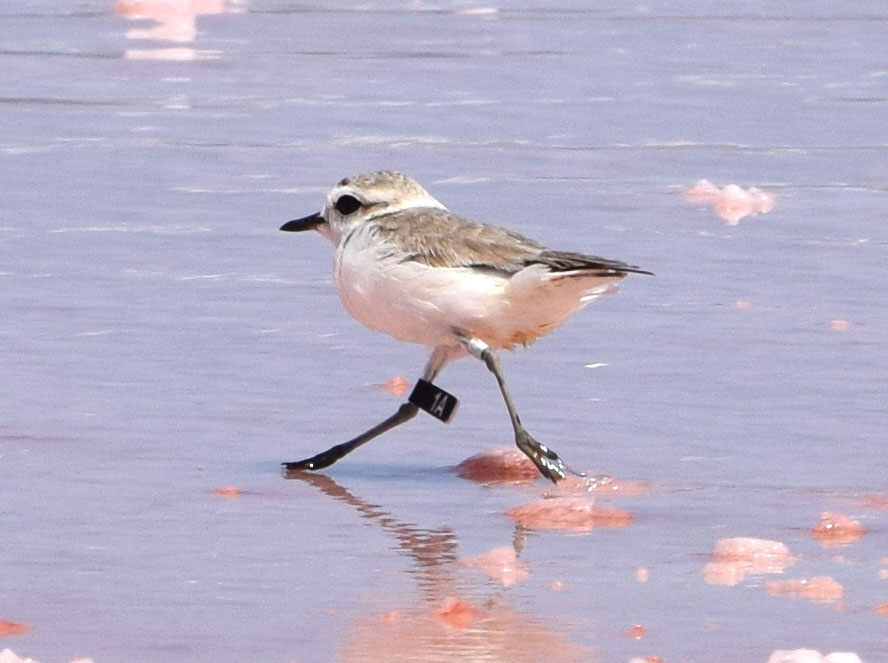
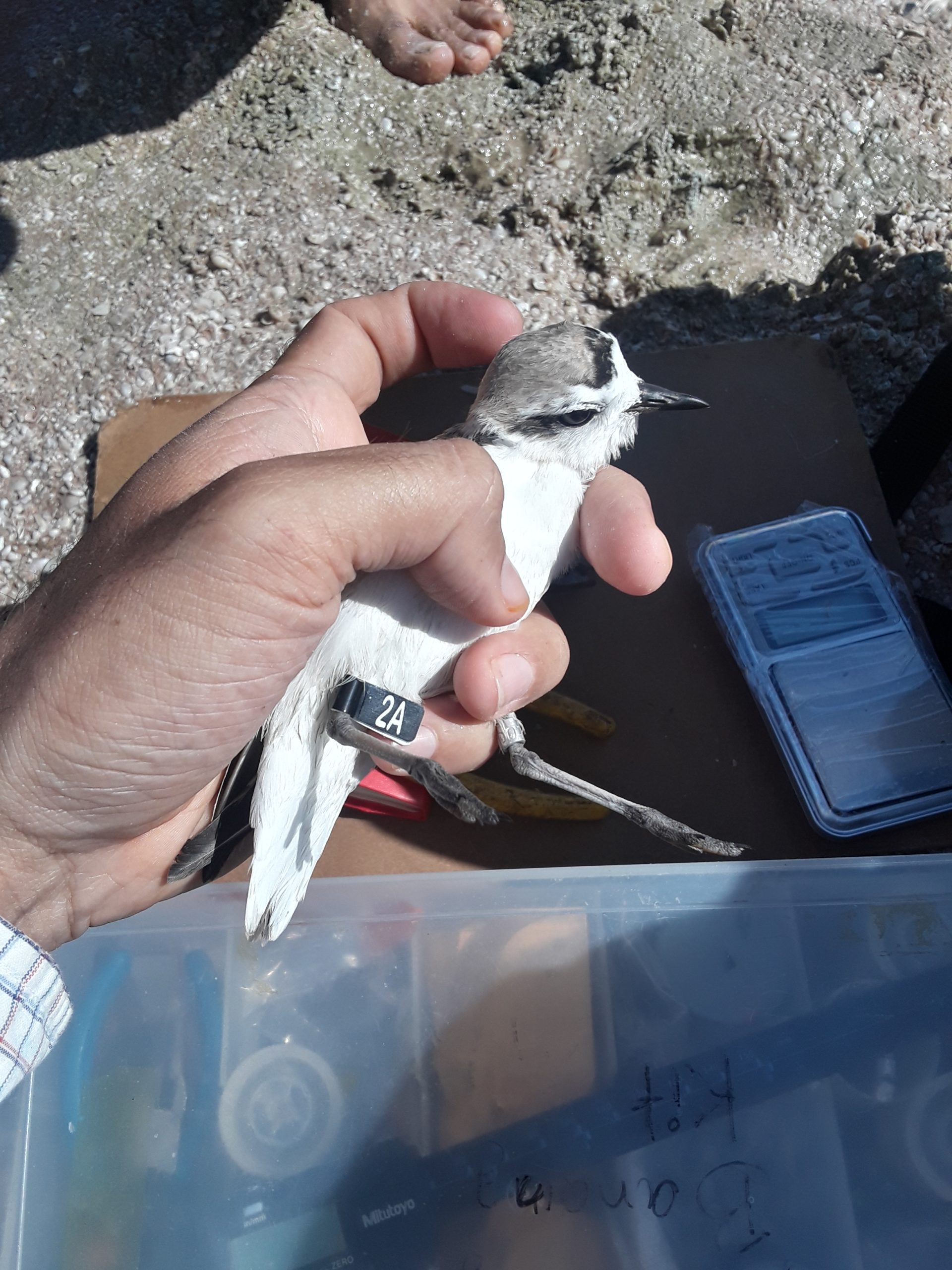
A newly marked Snowy Plover. (Photo by Antonio Ros)
Our project formally began in 2019, and since then we have conducted monitoring visits monthly to the San Pedro de Coche salt pans. Before we stepped foot in the field, the first step was to receive permission from the Ministry of Ecosocialism (MINEC) for the relevant permits to be able to move forward with the project. Thankfully, we were successful.
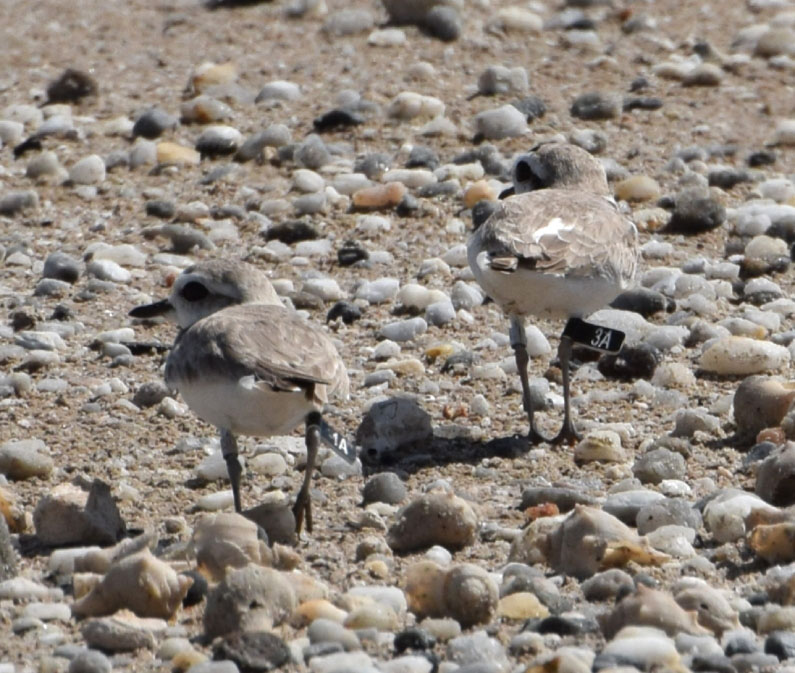
During our monitoring visits, we record the following information: number and location of Snowy Plovers, their age (adults or juvenile), sex, and any reproductive activity. In addition to monitoring, we also have indivudally marked some of the birds. Our team marked the first Snowy Plover in Venezuela in September 2019. It may seem like a small feat but it represents a lot of work! The birds are marked with black flags and white codes (right leg) and metal rings (left leg). Marking the plovers will help us better understand the behavior of each individual and to determine their site fidelity. In addition, we can learn if there is any migratory movement across the Caribbean for our local population of Snowy Plovers. To date, we have tagged seven individuals.
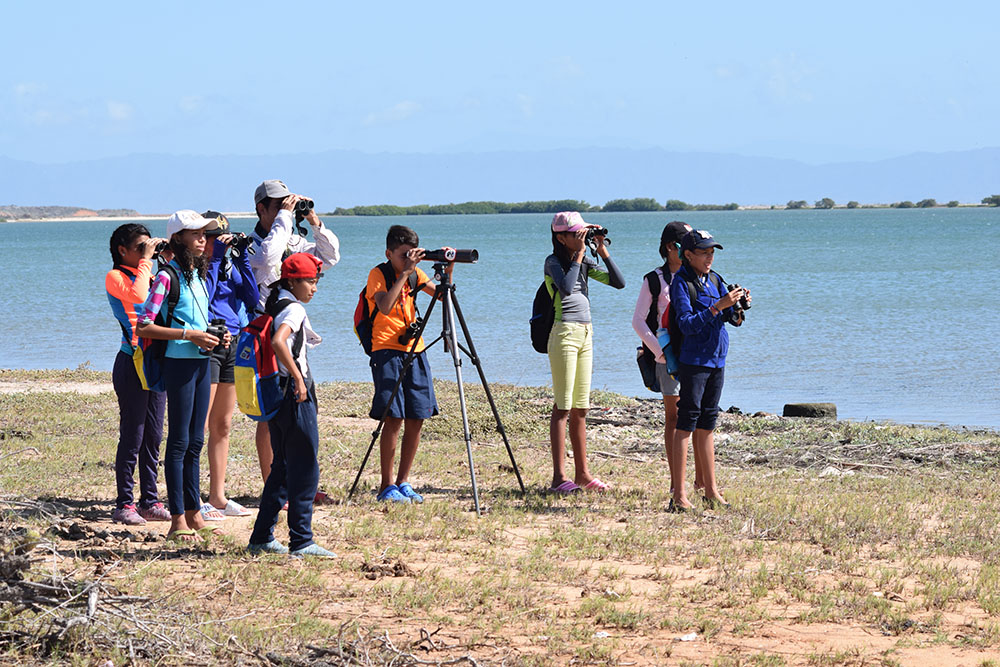
In February and March, 2019, we were fortunate to count Snowy Plover nests and chicks in the San Pedro salina. Joining us for this activity were students from the local community at Napoleón Narváez Bolivarian High School. It was rewarding to share information about these precious birds with young people and they were amazed to learn that the salina is so important to the Snowy Plover and other bird species (for example, Least Terns also nest there).
How many plovers are there?
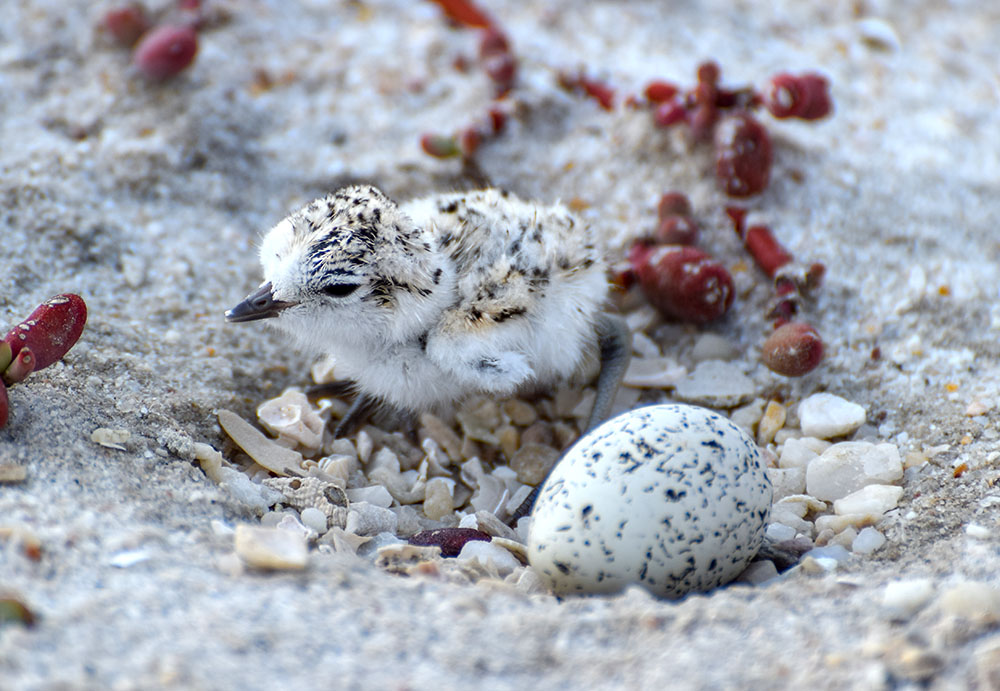
A young Snowy Plover chick and egg on the beach of Coche Island. (Photo by Antonio Ros)
Currently, we are partnering with with Adrián Naveda-Rodríguez from the Department of Wildlife, Fisheries and Aquaculture at Mississippi State University, United States. Together, we are working on the detectability and abundance of the Snowy Plover in eastern Venezuela. The preliminary analyses are using samples from the non-reproductive season, from counts made at 12 points in the San Pedro de Coche salina.
We modeled the relationship between detection probability and air temperature, time of the day, and distance to salt. We included covariates for the number of feral dogs, horses and salt miners when modeling abundance. Detection probability was negatively affected by the distance to salt piles (0.49, 95% CI=0.49-0.5). Abundance was not associated with the presence or abundance of domestic animals nor salt mining activities. We estimated there were 96 (95% CI: 46-201) and 116 (95% CI=61-220) Snowy Plovers in February and December, respectively. We hope to present this information in more detail at the next NAOC and subsequently we plan to publish our results in a scientific journal.
Our group participated in the 22nd International BirdsCaribbean Conference in Guadeloupe in July 2019 and in the Western Hemisphere Shorebird Group Meeting in October 2019 in Panama. We were so excited to present the latest results from our research and the ways in which we involve the community in our projects.
A community effort
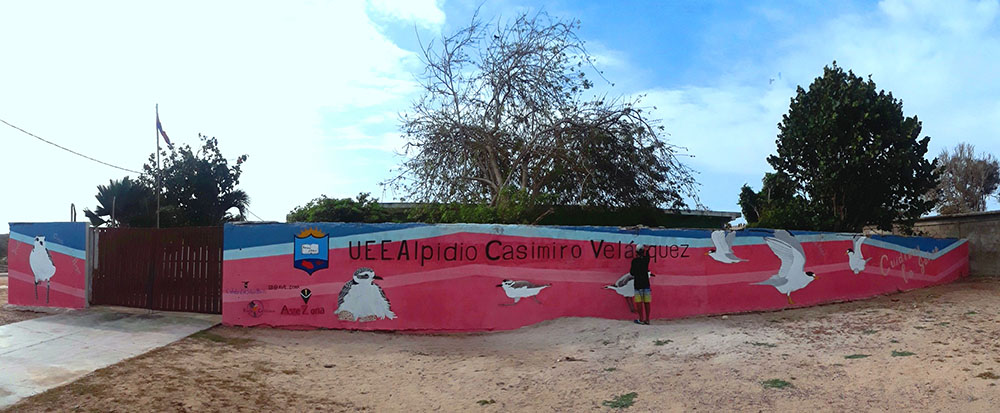
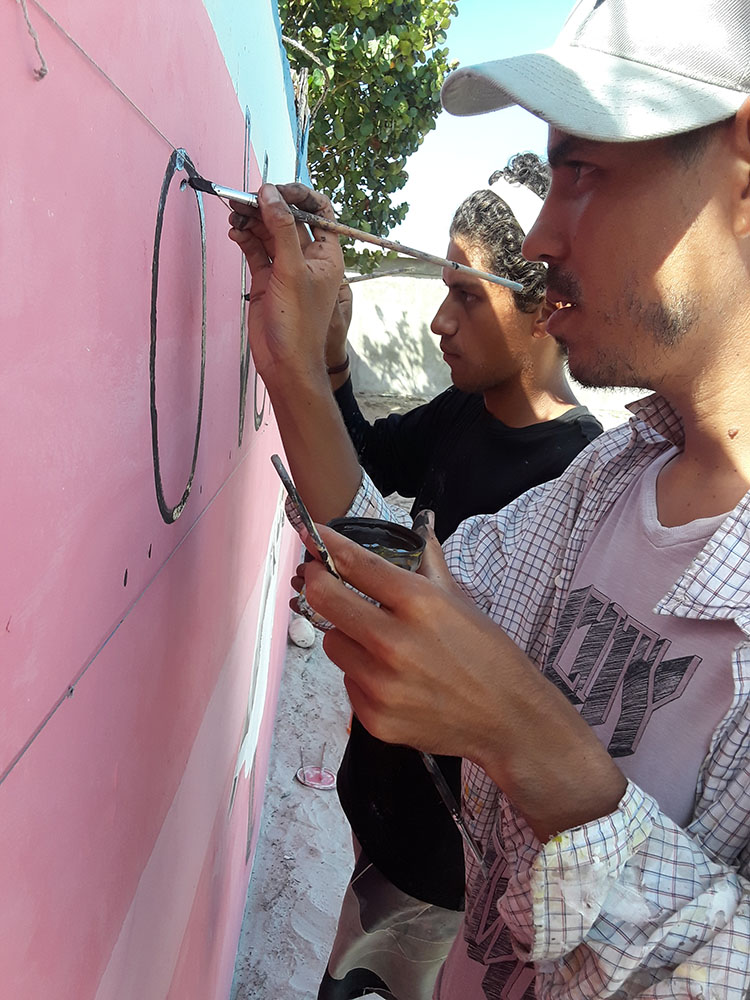
Our partnership with the community has continued beyond school field trips. Recently, we created a unique bird-inspired mural in the school of “La Uva” community which, of course, included depictions of the Snowy Plover and the Least Tern. It is truly a beautiful work!
The new mural featuring Snowy Plovers and Least Terns. (Photo by Josmar Marquez)
One of the reasons for working in this region is to promote the integration of communities that have historically been marginalized from science and conservation. In search of improving this situation, we are carrying out activities within this project that integrate and dignify the local community, and also give recognition to the worldview of the inhabitants of the biological diversity of their island.
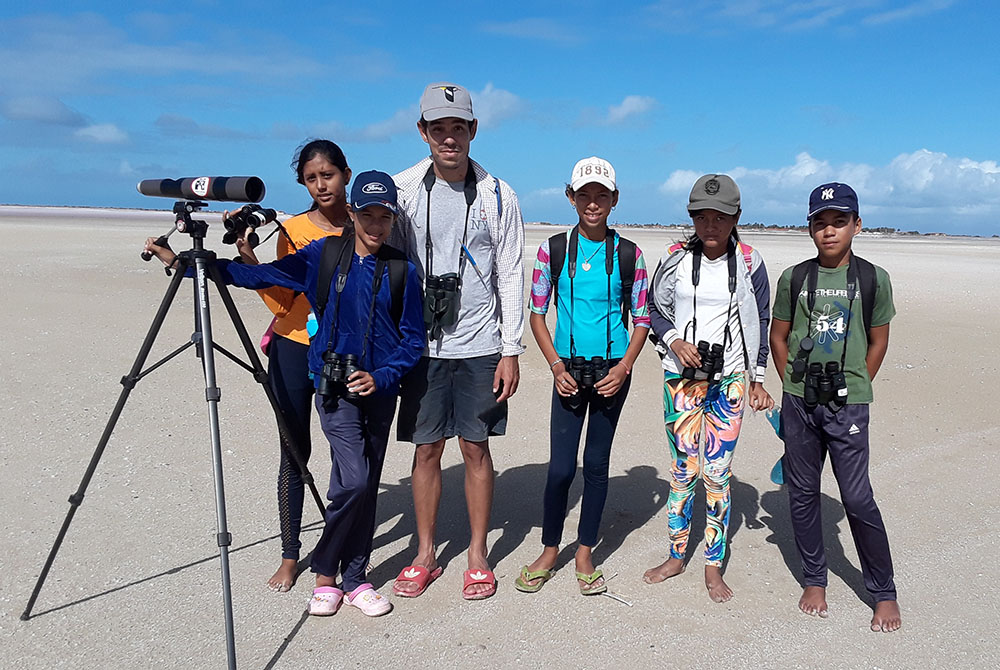
Josmar and students in the field observing Snowy Plovers. (Photo by Josmar Marquez)
Since the beginning of this project, we understood that in order to protect the salina and other places on the island, it is necessary to work hand in hand with the locals. We are very grateful for the school district of Coche Island, which has allowed us to work with educational institutions. Also, we are especially fond of the Napoleon Narváez Lyceum High School 9th Grade class, and teachers from various educational institutions for their receptivity and commitment. There are many locals that have opened their doors and hearts to this project and our team: Antonio Ros, Daniel Serva, Oscar Riera, Jose Gonzalez, Jesus Escalona, JC Fernández Ordoñez.
Many obstacles can arise when executing a project of this magnitude in Venezuela, but thanks to the constant support of BirdsCaribbean (including the David S. Lee Fund for Conservation) we are achieving our objectives. It’s very important to carry out this project that will help us to better understand the population of the Snowy Plover in the islands of the Venezuelan Caribbean. For me, it is a beautiful, very peculiar bird with very interesting habits. Luckily, in Venezuela it still can be observed very frequently in some places. Being able to say that there is a reproductive colony on Coche Island, and that it remains to this day, is a light of hope in the face of the global ecological crisis.
Please enjoy these short videos showing our work with the community from our Ave Zona Facebook page!
Josmar marquez, de AveZona, ha liderado proyectos de monitoreo de aves en Isla Coche, Venezuela, desde el 2018. Además de la colecta de datos, Su trabajo consiste en asesorar a jóvenes conservacionistas y la promoción de cambios conductuales ambientalmente amigables en la comunidad local de la isla. Aquí, Josmar describe su más reciente temporada de monitoreo del Chorlito Nevado.
Una pareja de chorlitos / A pair of plovers. (Photo by Antonio Ros)
En Venezuela gracias al apoyo de la beca David Lee, de BirdsCaribean, AveZona y la Fundación Científica ARA MACAO realizan el proyecto de evaluación poblacional del Chorlito Nevado (Charadrius nivosus tenuirostris) en la isla de Coche. En “Salina de San Pedro de Coche” se ha registrado un alto número de aves, lo que ha llevado a un aumento en la apreciación del valor de la isla para la especie, que se encuentra amenazada en la región del Caribe.
El proyecto comenzó formalmente en 2019, y se están realizado salidas mensuales a la salina de San Pedro de Coche. Antes de dirigirnos al área, el primer paso fue recibir el permiso del Ministerio de Ecosocialismo (MINEC) para el estudio de campo. Afortunadamente, tuvimos éxito.
Durante las visitas de monitoreo, anotamos la siguiente información: cantidad de individuos y localidad, edad (adultos o juveniles), sexo, y actividad reproductiva del Chorlito Nevado. Además del monitoreo, también hemos marcado algunos individuos. Nuestro equipo marcó el primer Chorlito Nevado de Venezuela en septiembre de 2019. ¡Toda una hazaña! Se usaron banderas negras con códigos blancos (pata derecha) y anillos metálicos (pata izquierda). Marcar los individuos nos ayudará a entender mejor su comportamiento y determinar su fidelidad al sitio. Además, podríamos llegar a saber si existe algún movimiento migratorio entre esta población y el resto del Caribe. Hasta la fecha se han logrado marcar 7 ejemplares de Chorlito Nevado.
Durante los meses de Febrero y Marzo de 2019 logramos contar nidos y pichones de Failecito en la Salina de San Pedro. A esta actividad asistieron jóvenes del Liceo Bolivariano Napoleón Narváez. Fue muy gratificante compartir información sobre estas preciosas aves con los jóvenes y se sorprendieron al saber que la salina es tan importante para el Chorlito Nevado y otras especies de aves (por ejemplo, el Charrán Menor también anida allí).
¿Cuántos Chorlito Nevados Hay?
Marcando uno de los siete chorlitos/ Marking one of the seven plovers. (Photo by Josmar Marquez)
Actualmente, nos estamos asociando con Adrián Naveda-Rodríguez del Departamento de Vida Silvestre, Pesca y Acuicultura de la Universidad Estatal de Mississippi, Estados Unidos. Juntos, estamos trabajando en la detectabilidad y abundancia del chorlito nevado en el este de Venezuela. Los análisis preliminares están utilizando muestras de la temporada no reproductiva, de conteos realizados en 12 puntos en la salina de San Pedro de Coche.
Modelamos la relación entre la probabilidad de detección y la temperatura del aire, tiempo del día y la distancia a las pilas de sal. Incluimos covariables para la cantidad de perros salvajes, caballos y mineros de sal al modelar la abundancia. La probabilidad de detección se vio afectada negativamente por la distancia a las pilas de sal (0.49, IC 95% = 0.49-0.5). La abundancia no se asoció con la presencia o abundancia de animales domésticos ni actividades de extracción de sal. Estimamos que había 96 (95% IC: 46-201) y 116 (IC 95% = 61-220) Chorlito Nevados en febrero y diciembre, respectivamente. Esperamos poder presentar esta información en la próxima reunión del NAOC y publicarla posteriormente en alguna revista científica.
En agosto de 2019, nuestro grupo participó en la conferencia internacional de BirdsCaribbean en la isla de la Guadeloupe, y en noviembre de 2019 en la Reunión del Grupo de Aves Playeras del Hemisferio Occidental, en Panamá. Allí presentamos los avances de nuestra investigación, y las maneras en que involucramos a las comunidades en este proyecto.
Un Esfuerzo Comunitario
Obteniendo todos los detalles perfectos en el mural/Getting all the details perfect on the mural. (Photo by Josmar Marquez)
Nuestra asociación con la comunidad ha continuado más allá de las excursiones de la escuela. Recientemente, creamos un mural único inspirado en las aves en la escuela de la comunidad “La Uva” que, por supuesto, incluía representaciones del Chorlito Nevado y el Charrán Menor. ¡Es realmente un trabajo hermoso!
Una de las razones para trabajar en esta región es promover la integración de comunidades que históricamente han sido apartadas de la ciencia y la conservación. En busca de mejorar esta situación, estamos llevando a cabo actividades dentro de este proyecto que integran y dignifican a la comunidad local, y también reconocen la cosmovisión de los habitantes sobre la diversidad biológica de su isla.
Desde el comienzo de este proyecto, entendimos que para proteger la salina y otros lugares de la isla, es necesario trabajar de la mano con los lugareños. Estamos muy agradecidos con la dirección del municipio escolar Obteniendo todos los detalles perfectos en el mural.de Isla de Coche, que nos ha permitido trabajar con las instituciones educativas; así como con el Liceo Napoleón Narváez y los jóvenes de 9no grado, y docentes de varias instituciones educativas por su receptividad y compromiso. Hay muchos miembros de la comunidad que han abierto sus puertas y corazón a este proyecto y a nuestro equipo: Antonio Ros, Daniel Serva, Oscar Riera, Jose Gonzalez, Jesus Escalona, JC Fernández Ordoñez.
Observando los chorlitos/ Observing the plovers (Photo by Antonio Ros)
Pueden surgir muchos obstáculos al ejecutar un proyecto de esta magnitud en Venezuela, pero gracias al apoyo constante de BirdsCaribbean estamos logrando nuestros objetivos. Es muy importante llevar a cabo este proyecto que nos ayudará a comprender mejor la población del chorlito nevado en las islas del Caribe venezolano. Para mí, es un pájaro hermoso, muy peculiar con hábitos muy interesantes. Afortunadamente, en Venezuela todavía se puede observar con mucha frecuencia en algunos lugares. Poder decir que hay una colonia reproductiva en la Isla de Coche y que permanece hasta el día de hoy es una luz de esperanza frente a la crisis ecológica mundial.
BirdsCaribbean is proud to be a sponsoring organization for the upcoming 7th North American Ornithological Congress (NAOC) held in San Juan, Puerto Rico August 10-15, 2020. The conference is held every four years and is one of the largest of ornithological meetings, with over 1,500 expected attendees. This is the first time the conference has ever been hosted in the Caribbean and BirdsCaribbean is excited to showcase the important and exciting work our partners have accomplished!
We are thrilled to have several BirdsCaribbean affiliates representing our community on various planning committees.
Steering Committee: Dr. Lisa Sorenson and Dr. Joe Wunderle
Local Planning Committee: José A. Salguero-Faría and Dr. Joe Wunderle
Scientific Program Committee: Dr. Adrianne Tossas
Diversity and Inclusion Committee: Sheylda Díaz-Méndez and Jessica Cañizares
Early Professional Committee: Dr. Ancilleno Davis
Student Travel & Presentations Awards Committee: Andrew Dobson
Pre- and Post-Conference Field Trips – Gabriel Lugo
In addition, BirdsCaribbean will be hosting a full-day symposium “Island Treasures: Lessons learned from 30 years of avian research, education and conservation.” We are excited to share the great work and success stories of our partners, students, and researchers across the Caribbean. We hope to see you there!
Register for the Conference (Abstracts due March 9th)
Visit the registration page to learn more about pricing for students, those from particular countries that receive reduced registration costs, early professionals, and more! The deadline for abstracts and Student & Postdoc Travel and Presentation Awards has been extended to March 9th. Be sure to submit by this date in order to secure a place to share your work.
Join Jennifer Wheeler as she shares real-life stories from the field about the challenges of saving the endangered Black-capped Petrel, aka Diablotin, from extinction. You might laugh, you might cry, you might want to join the project. Hopefully you’ll feel as inspired as we are about the future of this species, thanks to the hard work of many organizations and people.
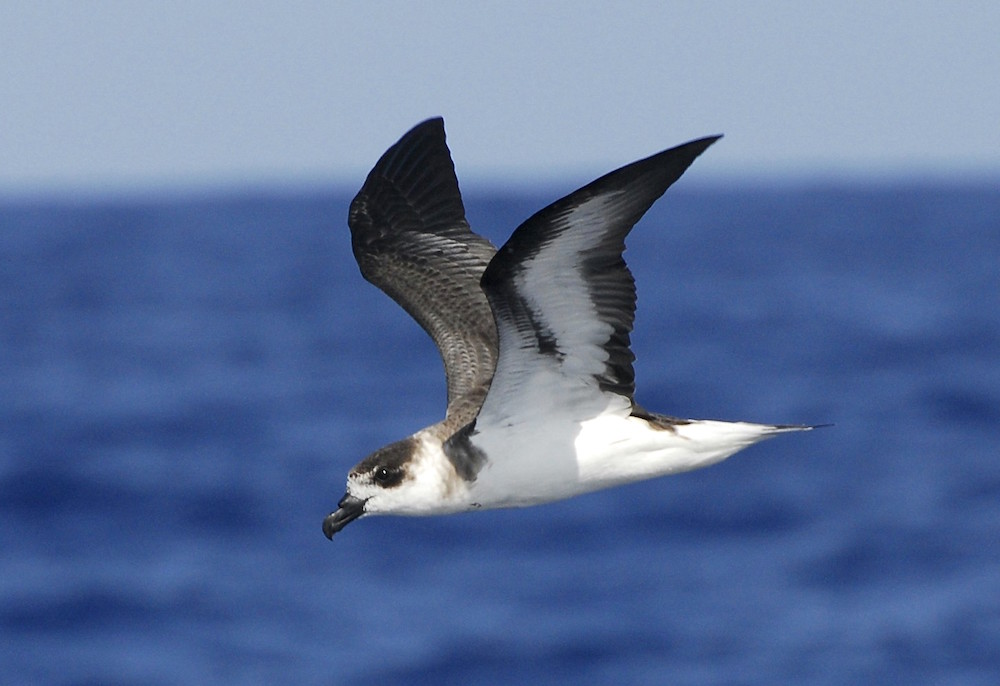
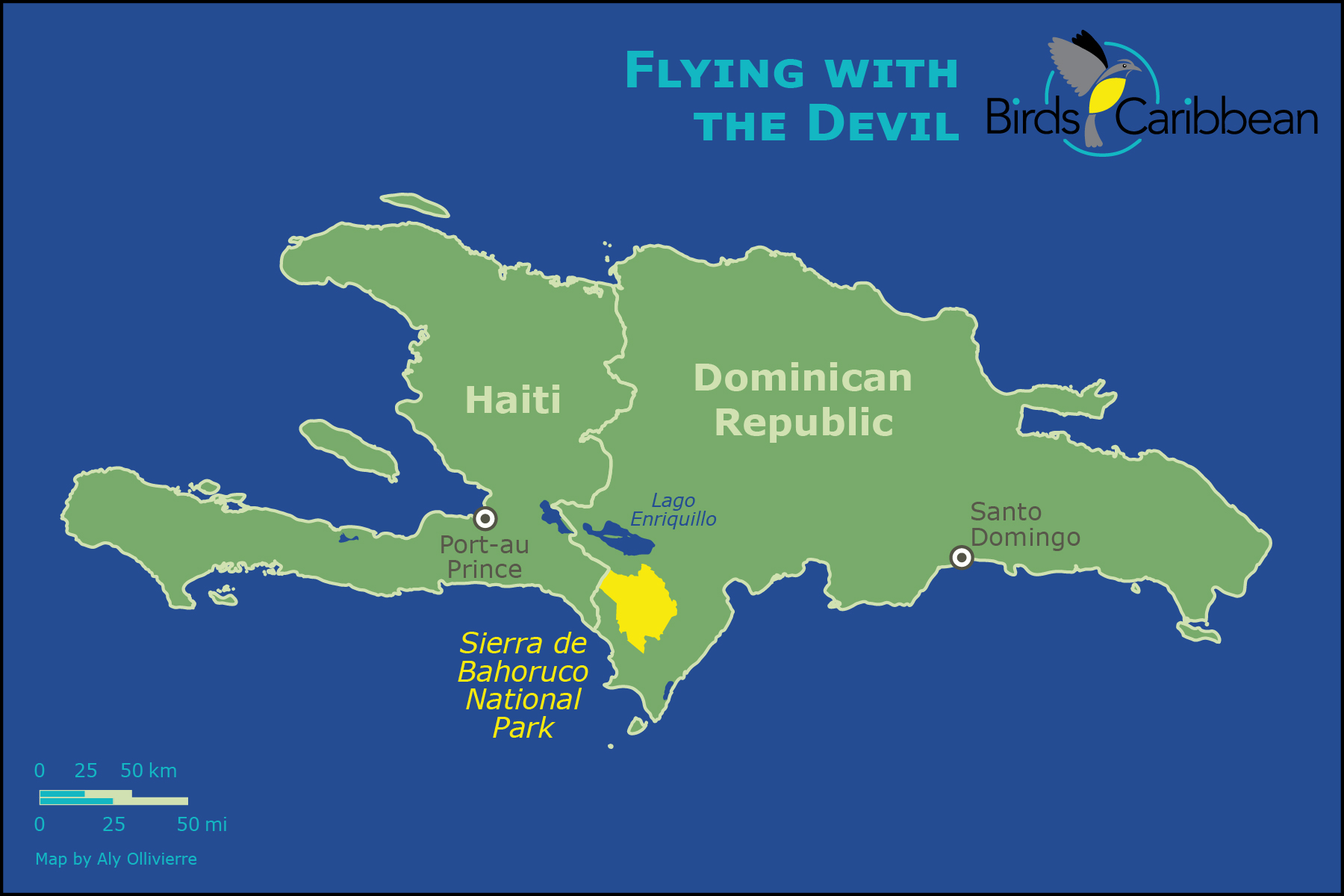
Only a very small number of people on the planet can say they have had close contact with a Black-capped Petrel. This mid-sized seabird comes to land only to breed, only at night under cover of darkness, and often heads quickly out of sight into underground burrows. This covert behavior as well as the species’ eerie, wailing vocalizations in the night sky, earned it the name Diablotin (“little devil”) from early European and African arrivals to the Caribbean. It was the birds that should have been afraid: human settlement of the Caribbean, accompanied by the introduction of invasive mammals, reduced the Diablotin from abundant on many Caribbean islands to widely considered extinct by the early 1900s.
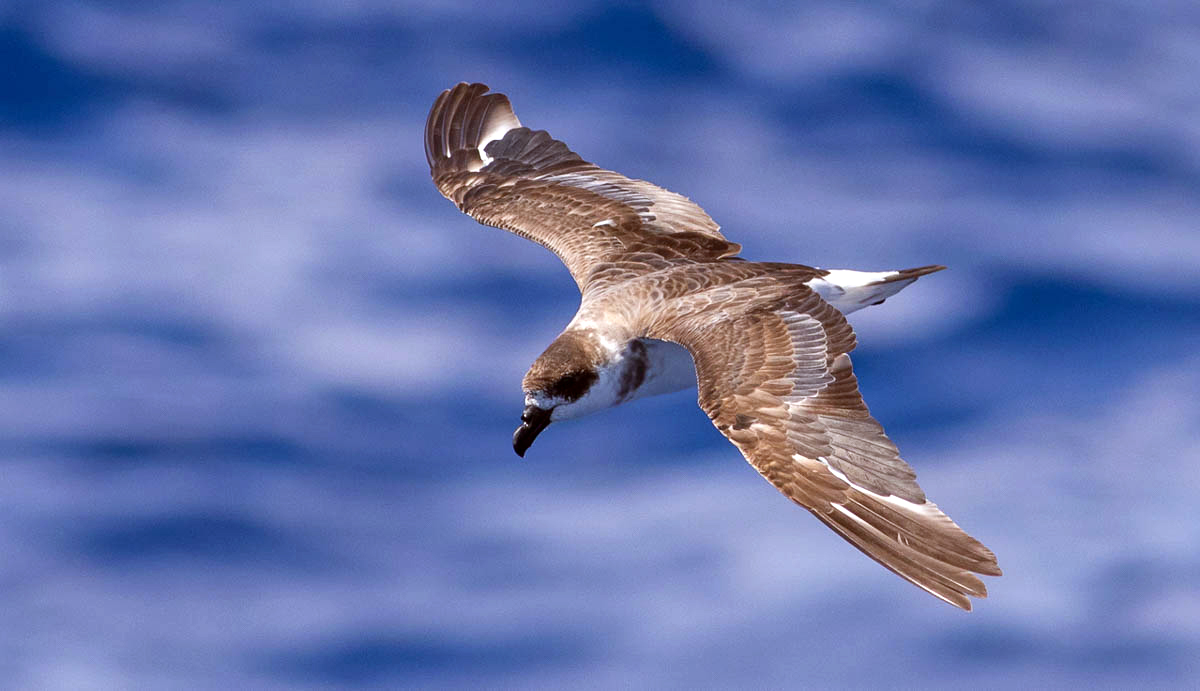
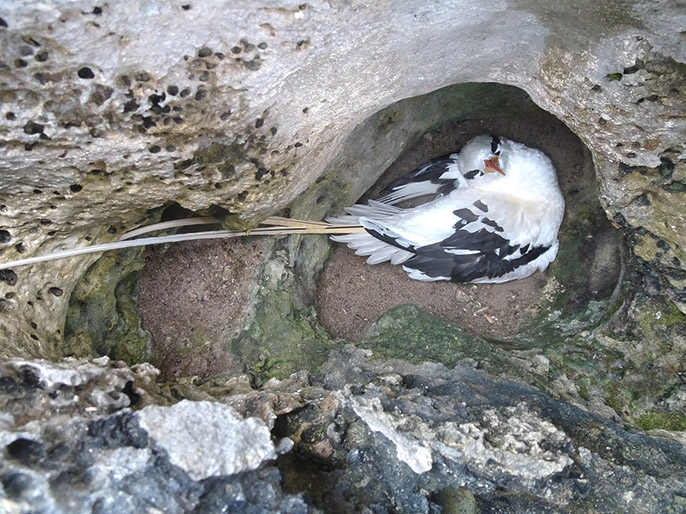
The Black-capped Petrel nests in burrows or crevices located at typically hard-to-reach, high-elevation spots in both the Haitian and Dominican Republic portions of Hispaniola. Petrel burrows have yet to be found on any other island (Photo by Jim Goetz)
I’ve been cheerleading and coordinating conservation of the Diablotin for a decade, working with numerous partners in the International Black-capped Petrel Conservation Group. The species turns out not to be extinct but very rare. It is listed as Endangered on the IUCN Red List of Threatened Species and the total world population is estimated at no more than 1,000 breeding pairs. Only about a hundred Diablotin burrows have been located to date, all on the island of Hispaniola (Haiti and the Dominican Republic). It’s actually much easier to see a Diablotin out at sea than find one inland.
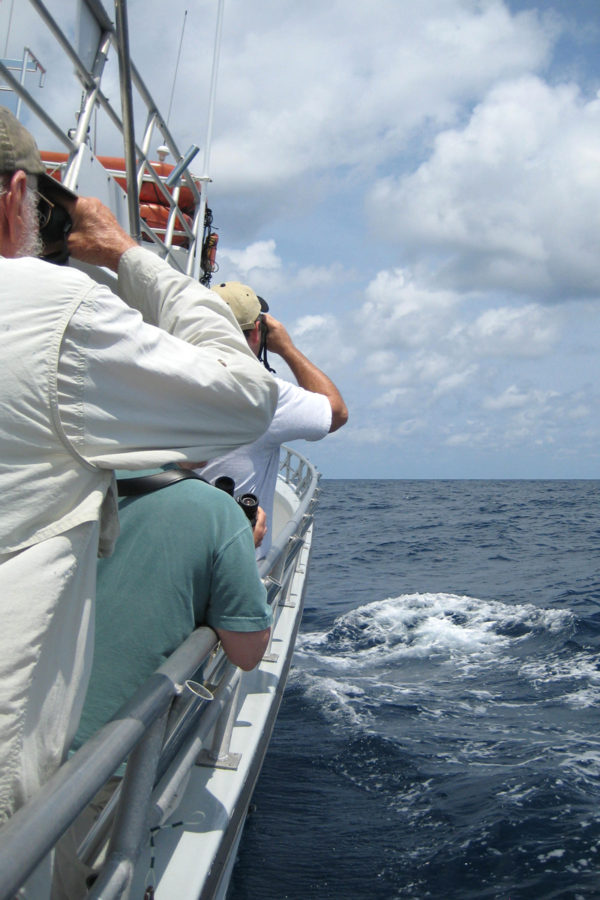
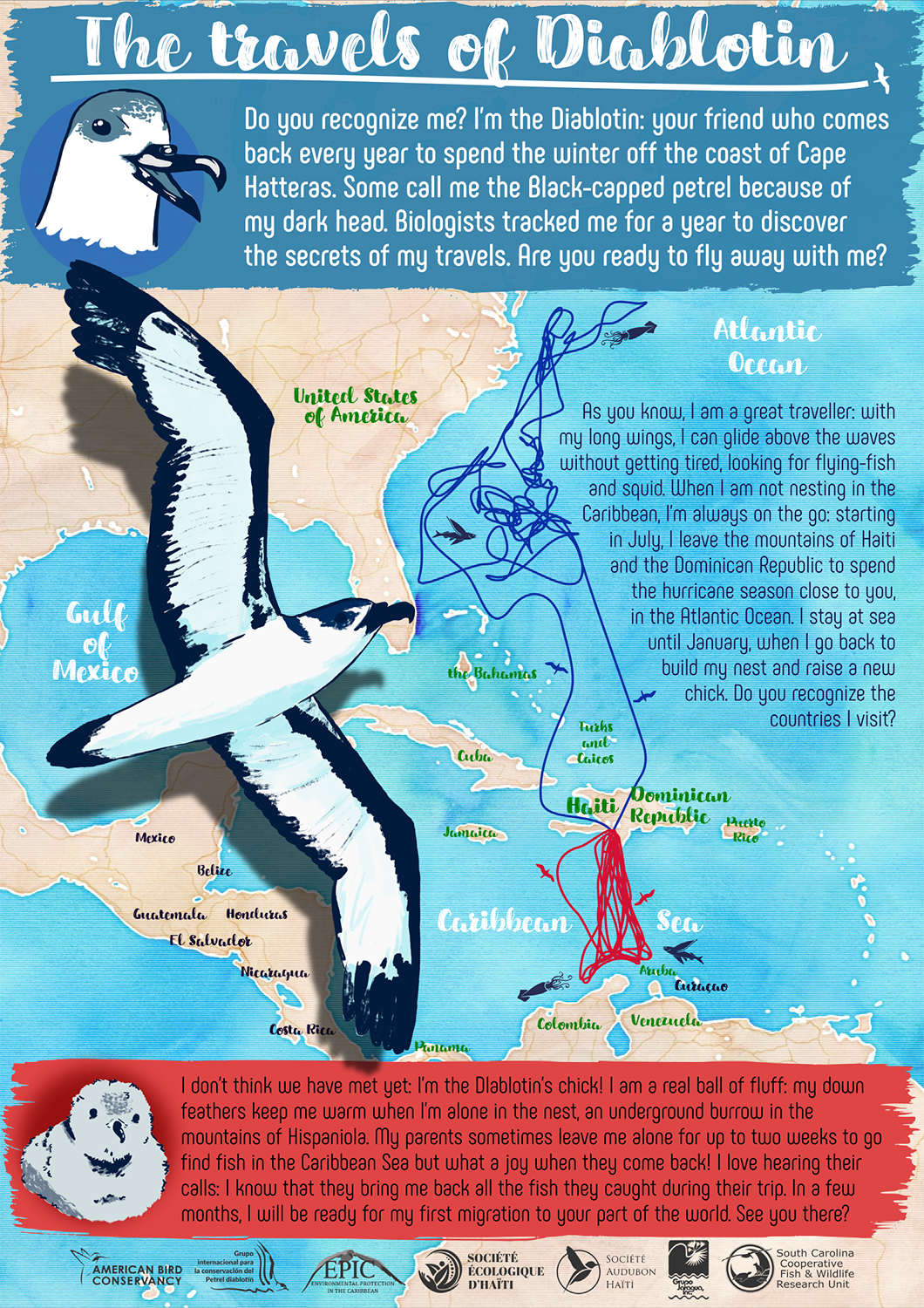
My first encounter with the species was in 2009. I saw them zipping by at a distance over the open ocean from the Stormy Petrel, a seabirding tour boat operating out of Cape Hatteras, North Carolina. Though the Diablotin’s breeding range is limited to the Caribbean, it turns out that they concentrate in a foraging area off the southeast U.S. To observe them at sea, one needs to be out over deep marine waters near or in the Florida Current and Gulf Stream, and that is most easily done where the Outer Banks protrude into the Atlantic. In the subsequent years, I got no closer, and I certainly wasn’t one of the group of people that could say they had touched a Diablotin, seen one up close, or even smelled their fishy body odor. Last year, I decided it was time to change that.
The small number of people who have seen a Black-capped Petrel have usually seen them at a distance from a boat well out at sea in deep marine waters (Photo by Jennifer Wheeler)
Hoping for Haiti
In April 2019 I planned on experiencing the Diablotin first-hand on a trip to Haiti. This is the country where most of those one hundred burrows are known to occur. In fact, it was in Haiti that they were re-discovered on a mountain ridge in 1961, after being lost to science for decades. This is miraculous considering that Haiti is one of the most deforested nations in the world, with some estimates that Haiti has retained less than 1% of its primary forest. Almost all of Haiti has been converted to agriculture or grazing, and secondary forest is degraded by wood-cutting and forest product collection. Petrels don’t need trees for nesting but trees and shrubs provide cover and root structure needed for burrow construction. Additionally, socioeconomic conditions in Haiti are so dire that people encountering these species are quite likely to consume them, which of course, is what introduced rats, cats and mongoose would like to do.
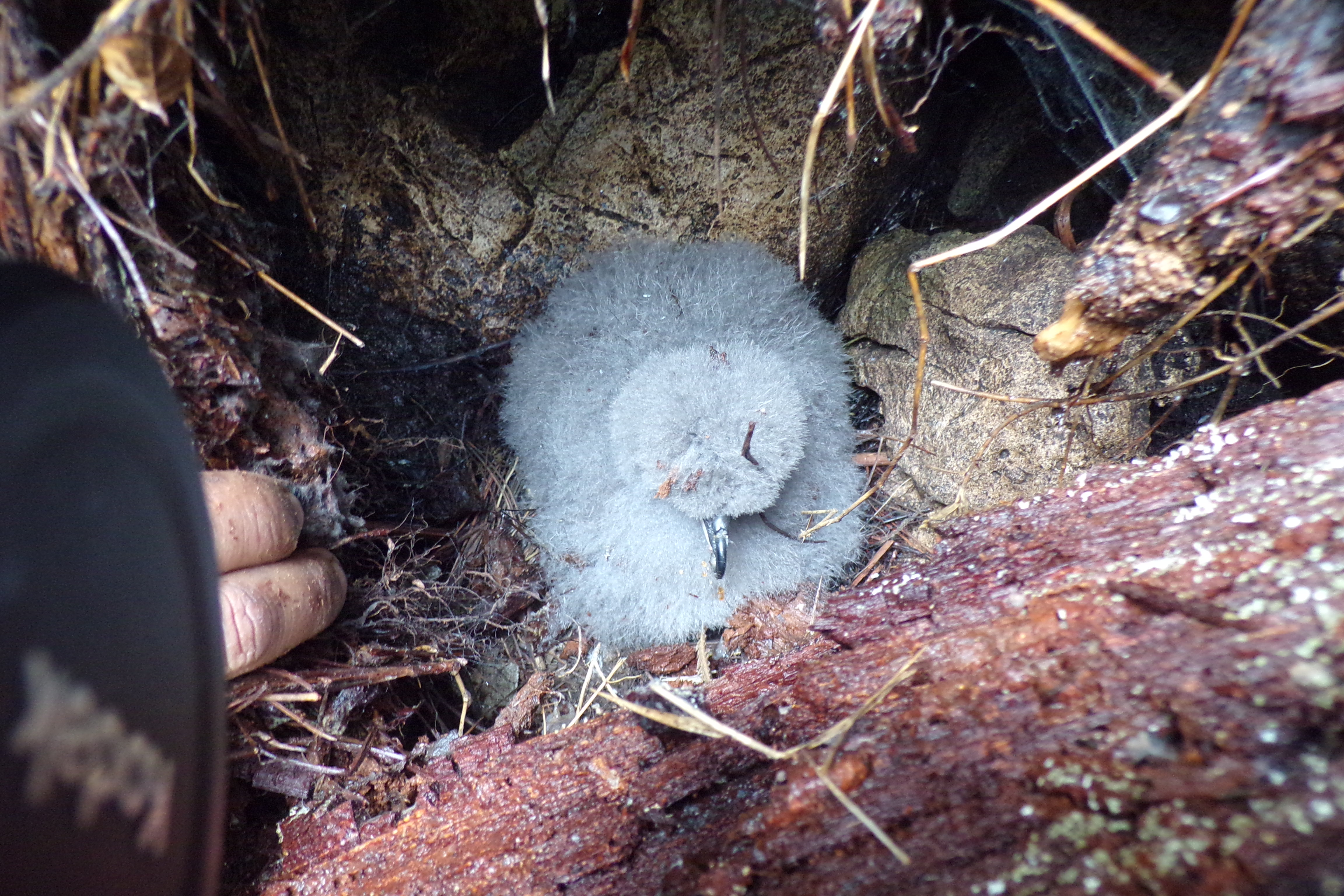
The Black-capped Petrel’s exact nesting locations in Haiti have not been easy to find. Even with the knowledge that they persisted on Haiti, it took until 2002 to locate an active burrow and until 2011 to see a living chick. Finding that little fluffball took an incredible number of hours crawling along cliffs and the forest floor, aided by information collected by radar and automated sound recording devices.
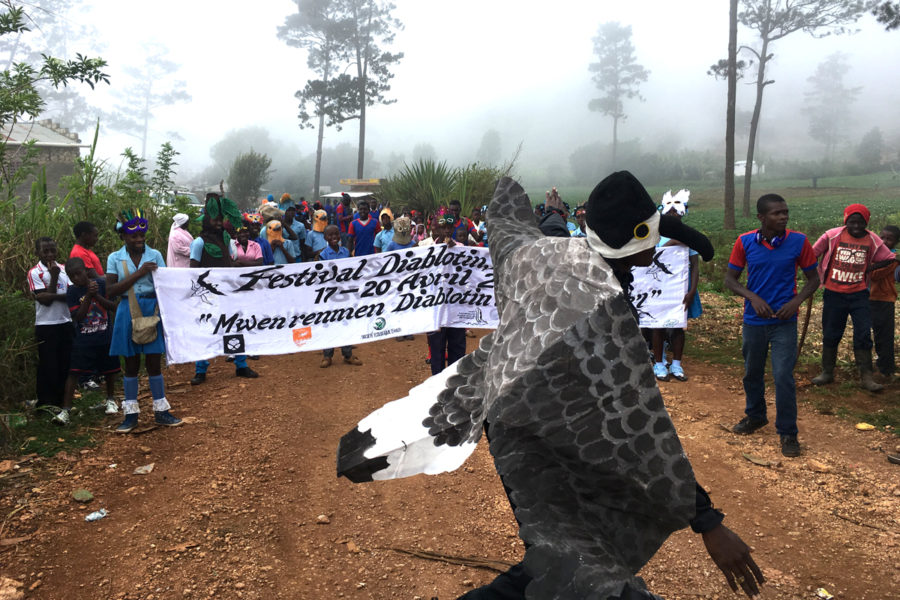
There is a small but significant nesting population of Diablotin in southwest Haiti, in a small patch of primary forest near the village of Boukan Chat. Since the discovery of the Diablotin in this area, local and international conservationists have been building relationships with the citizens of the village. Beginning with humanitarian projects, conservationists now pursue a strategy of improving farming practices and empowering local farmers to convert to more sustainable crops. More productivity on existing farmland reduces the likelihood of encroachment into the forest. Winning the hearts and minds of the local people also involves outreach, education and celebration. Foremost among these is the now annual Festival Diablotin Boukan Chat, which I had hoped to personally experience.
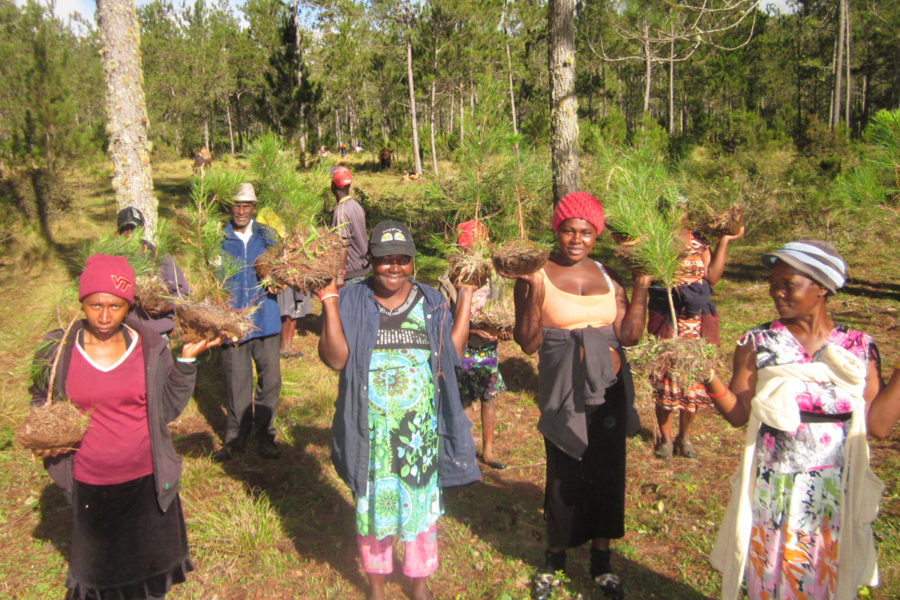
The conservation of the Diablotin relies on the actions and support of the local people. In the Haitian village of Boukan Chat, farmers are encouraged to switch to sustainable tree crops in buffer areas around the remaining patch of forest harboring petrels (Photo by Ernst Rupp)
Unfortunately, 2019 was not a good year for Haiti and its people. Anti-government protests turned violent last February, with accompanying increases in crime. The U.S. State Department and other authorities advised against travel to Haiti. Environmental Protection in the Caribbean (EPIC) is the organization spearheading much of the education and outreach in Boukan Chat. Adam Brown, project leader, made the disappointing but prudent decision to cancel attendance by international festival team members, including myself.
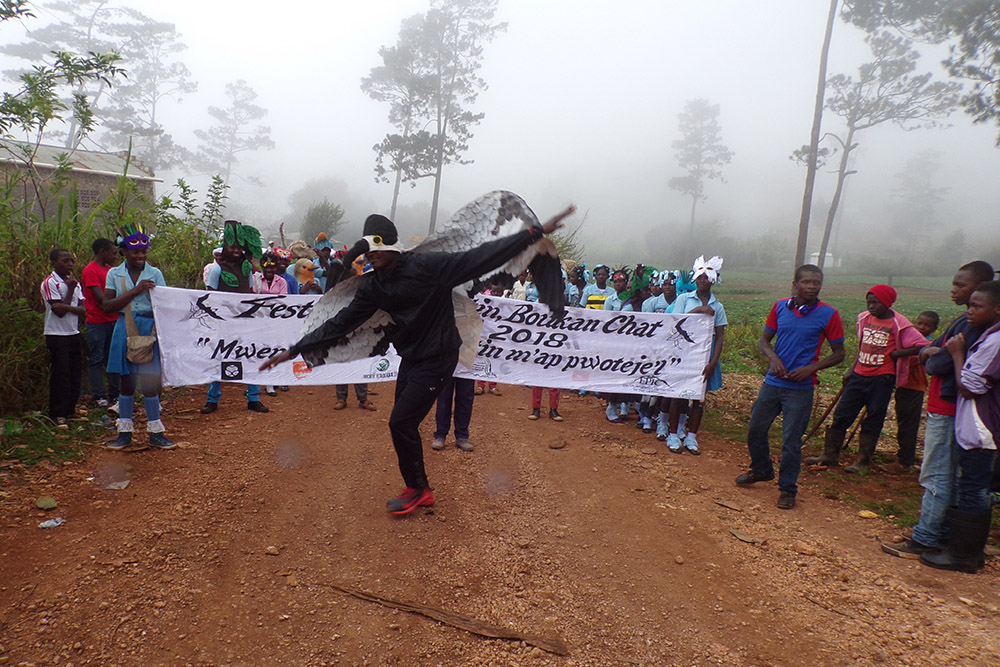
And yet, civil unrest did not deter the local members from carrying on with the festival! Boukan Chat held a Black-capped Petrel parade with musicians, pupils, farmers, and community members from the village to the soccer pitch. The celebrations ended with a soccer match between two soccer teams, including the appropriately logo’ed Boukan Chat team, ‘The Diablotins.’ There was a nighttime screening of the short film, Haiti, My Love, My Home which tells how the villagers, conservationists and humanitarians, have come together to protect the Diablotin. EPIC just released another amazing film The Diablotin Festival, which portrays the festival and just about makes me cry every time I watch it. I sincerely hope I can attend the Diablotin Festival in-person in the future, and more importantly, that peace returns to Haiti.
A young man in a Black-capped Petrel costume leads the parade during the Festival Diablotin held in Boukan Chat, Haiti. The festival also includes a soccer game and film screening, and is designed to instill interest and pride in the rare bird nesting in nearby forest (Photo by Anderson Jean)
Lost (it) At Sea
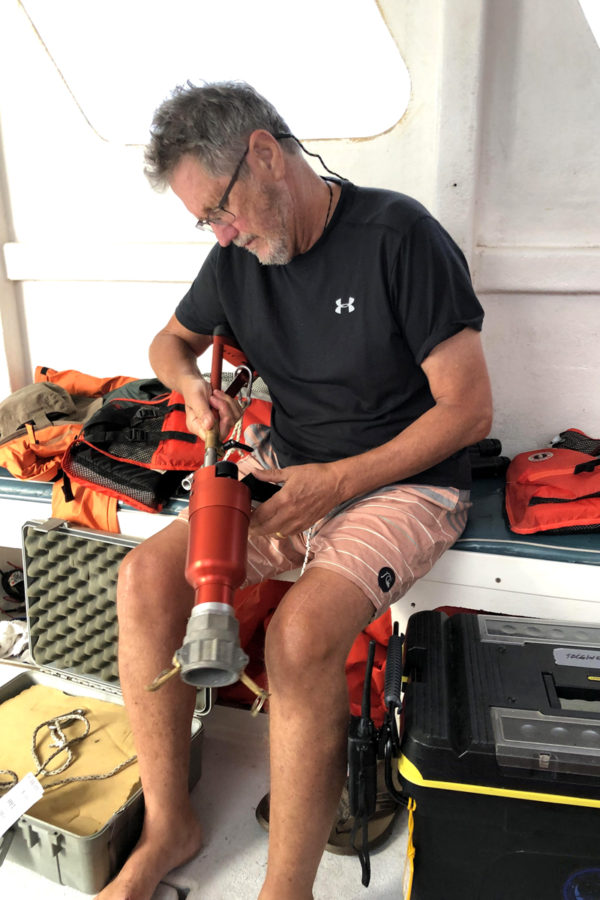
May 2019 brought a new opportunity to encounter petrels. This involved another trip on the Stormy Petrel in North Carolina, but with a twist. A team would be attempting to capture petrels at sea in order to fit them with tracking devices. The goal was to learn more about Diablotin movements, and if the transmitters lasted until breeding season the following winter, track them to possibly new and unknown nesting locations. The American Bird Conservancy (ABC) invited Chris Gaskin from New Zealand and his super nifty, specially designed hand-held net launcher for the job.
New Zealander Chris Gaskin prepares the air compressor used to launch a spreading net into the air. The net was specially designed to capture flying Black-capped Petrels at sea, in order to fit the birds with tracking devices (Photo by Jennifer Wheeler)
Even with this, I confess, I was a doubter. There was no way this was going to work. Petrels are fast flyers and don’t come all that near to boats. What I didn’t realize was that Chris would be shooting from a small, inflatable Zodiac, which apparently doesn’t spook petrels, especially those fixated on the smelly fish oil put out to attract them. On May 8, as I prepared to drive down to North Carolina from Virginia to join in the expedition, I received a text with an image of a flying net enfolding a Black-capped Petrel!
Turns out that the team was fantastic at catching petrels. Brian Patteson, captain of the Stormy Petrel knew where to find the birds. Brad Keitt with ABC and Pat Jodice with the U.S. Geological Survey South Carolina Coop unit at Clemson University took turns piloting the Zodiac and Chris into position. Chris never missed after his first shot. Yvan Satgé, also with Clemson, deftly fit each bird with a small solar-powered tracking device and took measurements and photos. Arriving in North Carolina, I helped celebrate the first six Diablotin ever captured at sea and I couldn’t wait to observe and assist.
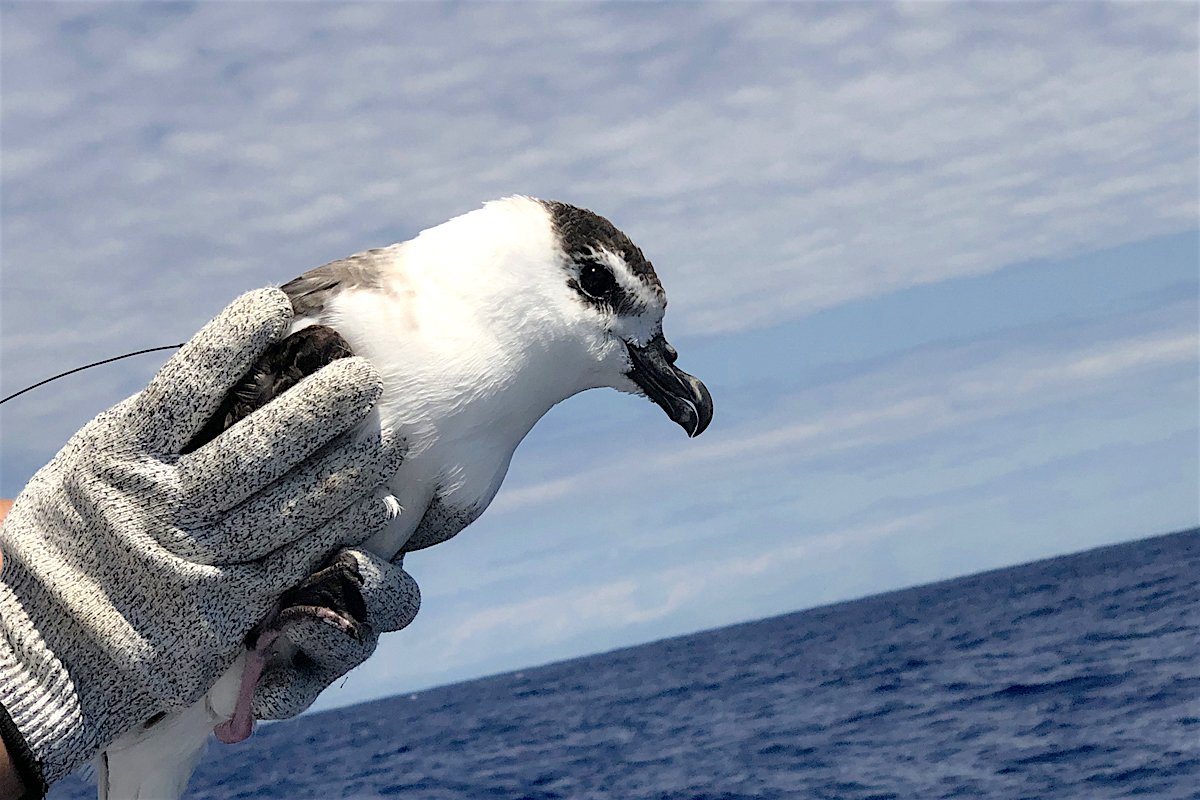
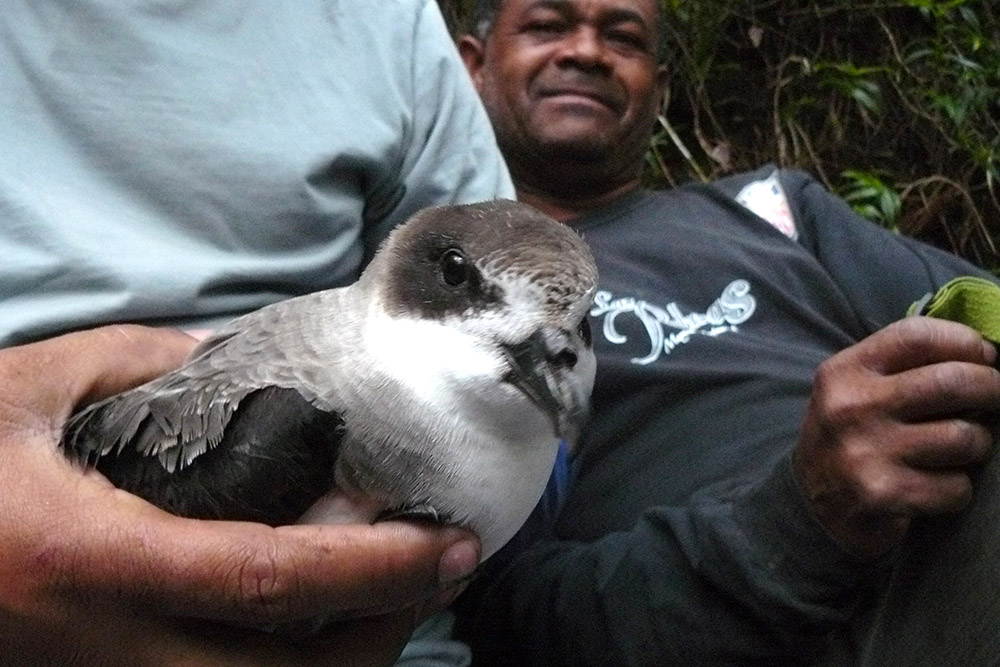
The weather did not cooperate. The first day after I arrived the seas were too rough to be safe. The next day the seas were too calm; open ocean seabirds like wind. The third day was too rough again. I was out of time and actually began driving home. What was I thinking!?! An hour out I came to my senses and turned back to Hatteras to wait for good seas. Finally, on May 14, conditions looked very promising. And they were! It was so exciting to see a bird netted by Chris and watch the Zodiac speeding back to the boat to hand it over to me. And then, the dream came true: I held a living Diablotin in my hands!
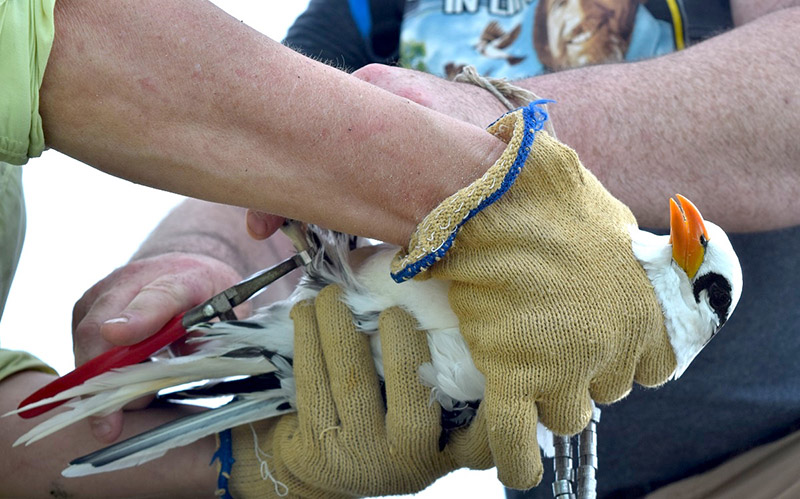
One of the first Black-capped Petrels ever to be caught at sea and fit with a satellite tracking device awaits release. In total, 10 birds were tagged in May of 2019, tracking petrel movements to as late as January 2020 (Photo by Jennifer Wheeler)
Not for long. I rushed to disentangle the net, then thrust the bird into someone else’s hands so I could rush to the side of the boat and throw up my breakfast. My big chance to handle a live Diablotin and I nearly foul its feathers with vomitus. Sigh. I was seasick for the rest of the day, providing only comic relief while the rest of the team successfully captured and fitted four more birds with satellite transmitters. Over the months to come, the birds’ movements were followed via satellite. Amazingly, the bird I almost upchucked upon was still transmitting 8 months later, longer than any other. Maybe it felt the love.
Determined in Dominica
As noted, one of the hopes of the satellite tracking was to see if any of the birds traveled to new nesting locations. Diablotin burrows have been found only on Hispaniola, but hope and evidence exists that they also persist on other islands: notably Dominica, where evidence is very strong. In 2015, radar surveys performed by EPIC picked up 900+ petrel-like targets heading in and out of the mountains of that island. Additionally, individual birds were observed through night-vision scopes during those surveys. And over many years, a handful of grounded birds have been found well inland. Following the radar surveys, technical exchanges were arranged to train and assist in ground searching. In April 2016, a team from the Dominican Republic visited Dominica; another exchange in the opposite direction took place in April 2017. Unfortunately, bad weather limited search time and no burrows were located on Dominica. Then, petrel work and just about everything else on that island was derailed when Hurricane Maria blasted Dominica in September 2017, the strongest storm in that island’s recorded history.
Jennifer Wheeler takes a break on a newly opened trail in Trois Pitons National Park, Dominica, during a January 2020 expedition to look for evidence of Black-capped Petrels on that island. (photo by Stephan Brown)
Last month, I invited myself to assist EPIC’s trip to Dominica to repeat radar surveys after five years and to help resume ground searches. Overcoming the challenges of arriving in Dominica late and alone, needing to navigate across the island’s high mountains in the dark, and driving on the “wrong” side of the road, I began to feel quite confident and helpful. I met with staff from the Division of Forestry; attended to the logistics of rental car, rental house, and groceries and obtained the heavy marine batteries needed to power the radar. My greatest success was finding a supply of small desiccant packs (those little bags of silica used to absorb moisture). I visited a dozen shops dealing with computers, appliances, and clothing, affirming that yes, I did mean those little packets that say Do Not Eat, and finally, met success at a shoe store! I was so proud. But pride goeth before the fall.
Did I mention that Dominica has really narrow roads? And it was hard to see my front left side while driving with a right side steering wheel? Fortunately, the burly body-builder was very nice about the big dent I put in his car. Repairing the suspension from shoving his car into a culvert was going to be costly though. The good news was that the damage to the rental truck was minor! You can be sure that I was relieved to turn over the driving to Adam Brown when he arrived on the ferry from Guadeloupe after two weeks of radar surveys there. And I must report that Adam often turned over the driving the really winding roads to local team members Machel Sulton and Stephen Durand. Things went smoothly after that.
We assembled the marine radar equipment and headed into the hills. Sure, setting up takes some work, but this field activity was really pleasant. We positioned ourselves on a hilltop and watched the sun set, enjoyed the cool breezes, and looked and listened for night flying creatures. Petrels appear as a distinctive pattern of blips on the radar screen. Adam would note them coming and call out for us to attempt a sighting with the night vision or thermal image scope. As was the case in 2015, the surveys detected a number of petrels at a number of locations, flying rapidly in and out of the mountains. The peak of activity commenced about 45 minutes after sunset and tapered off at about three hours. At 9 p.m. we were packing up and headed to dinner, excited about our findings but a little concerned about the drop in petrel target numbers since 2015.
Adam Brown, Stephan Durand and Machel Sulton set up for an evening of radar surveillance in Dominica in January 2020. Five years earlier, the first radar surveys conducted on the island revealed hundreds of petrel-like targets flying in or away from several of Dominica’s mountains (Photo by Jennifer Wheeler)
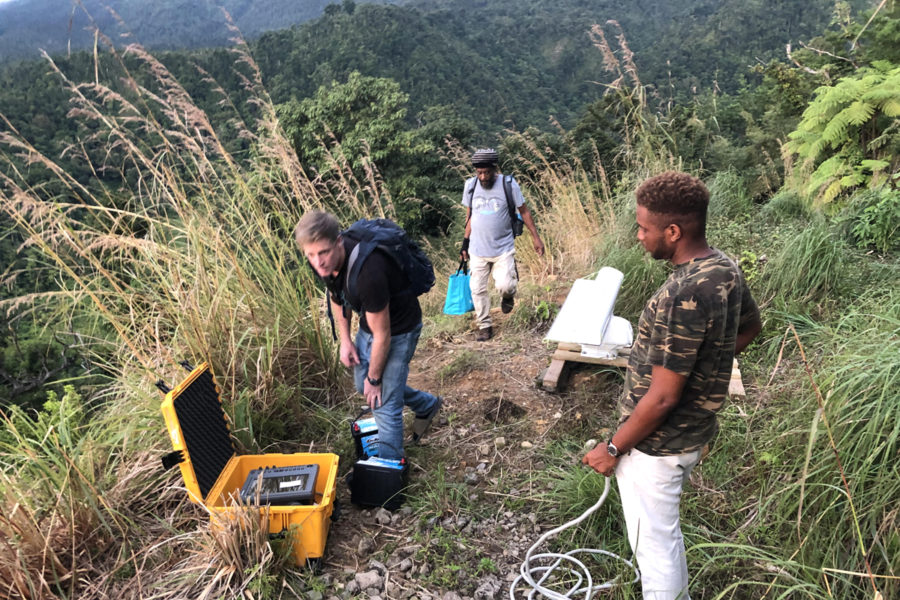
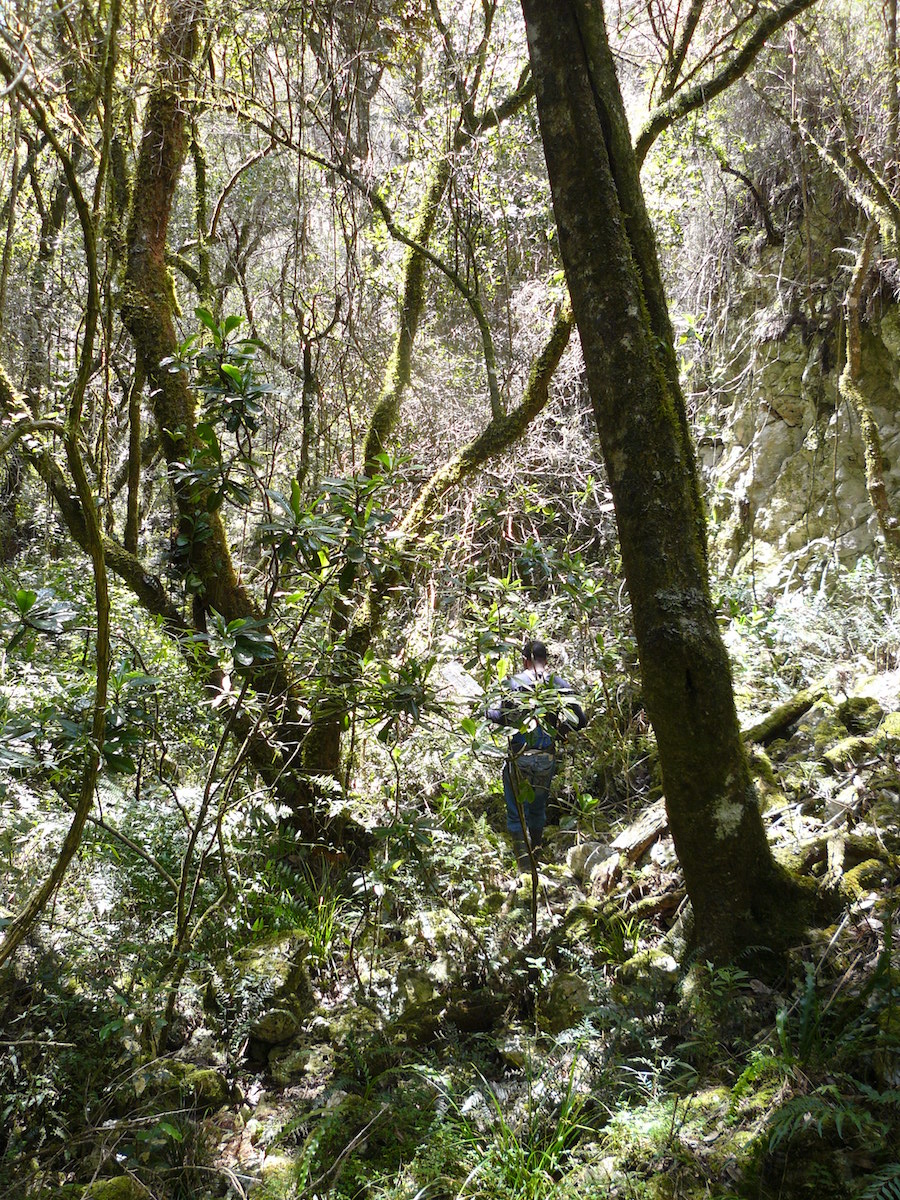
Daytime work to place soundmeters required more exertion. Radar surveys only point the way to the peaks where petrels might be nesting. Placing automated recording devices in these areas to collect any vocalizations helps narrow down the sites and seasons to search. As noted, work on Dominica to find petrels discontinued in late 2017, and the trails to the peaks selected for soundmeter placement had yet to be cleared of trees felled by hurricane and two years of new growth. Division of Forestry foresters are really very good breaking trail with machetes; regardless, it was a slow, hot hike up to the first of the selected peaks. It was certainly not unpleasant, given the varied foliage, numerous orchids and occasional songbird; but I wish we had packed more food! Once we reached higher elevations, there was the chance of finding petrel burrows so off trail into the thick, prickly underbrush we went. Crawling through the dirt, peering under roots and sniffing at holes, I fantasized about finding a burrow entrance. I’m a finder by nature—I’m happy to spend hours looking for beach glass, fossils, antiques—and I just KNEW at any moment, I would see a hole with a tell-tale plop of guano or catch a fishy whiff of petrel. What a find it would be! Alas…I did not nor did anyone else. There is still no documented nesting in Dominica since 1862.
Persistence
Now it’s February, and petrel conservationists are gearing up for field work and community-based conservation on Hispaniola. I’ve heard that the biologists in Cuba are planning an expedition into the Sierra Maestra. There will be detailed reports coming out on the surveys in Guadeloupe and Dominica, with the findings from monitoring and recommendations for continued searches. Soundmeters are placed and listening. The members of the International Black-capped Petrel Conservation Group are strategizing for the long term and seeking funds. With the Diablotin, we must be persistent. Finding the petrel is difficult; contemplating the magnitude of its threats—human population growth, habitats invaded by introduced mammals, and climate change foremost among them—can be overwhelming. But as long as there are Diablotins, there is hope.
Here’s one more story to serve as a symbol of surviving against the odds. After placing a new soundmeter in Morne Trois Pitons National Park in Dominica, we went in search of one deployed in 2017 and actually found it. It was bleached, scratched, and breached by rainwater. The tree to which it was strapped was broken and battered by the 160 mph winds of a Category 5 hurricane. It was difficult to open the unit. Yet the SD card inside survived, containing readable data. Miracles do happen.
Jennifer Wheeler is an avid adventurer and loves volunteering her time to help conservation causes. She was the coordinator of the Waterbird Council for 10 years and Board member and Treasurer of BirdsCaribbean for 8 years. She is currently co-chair of the International Black-capped Petrel Conservation Group and Financial Officer for BirdsCaribbean.
The activities noted in this article were largely supported by Seabirding/Stormy Petrel, Environmental Protection in the Caribbean, Plant with Purpose, Jeune En Action Pour La Sauvegarde De l’Ecologie En Haiti, Soulcraft All-stars, Grupo Jaragua, BirdsCaribbean (and the Betty Petersen Conservation Fund of BirdsCaribbean), American Bird Conservancy, U.S. Geological Survey South Carolina Coop unit at Clemson University, Dominica Division of Forestry, U.S. Fish and Wildlife Service, and the Disney Conservation Fund.
Please Donate!
To help save the Black-capped Petrel from extinction while also working with the people of Haiti to farm more sustainably, please donate here or here.
To view larger images in the gallery, click on each photo; they may also be viewed as a slide show.
Conservation actions in Boukan Chat, Haiti include educational programs for both adults and children. The long-term goal of these programs is to provide local people with knowledge and appreciation for sustainable agriculture and other livelihoods that increase standard of living and protect natural resources into the future. (photo by Anderson Jean)
Adam Brown takes a GPS measurement on a ridge overlooking a valley where radar detected petrel movements in and out of the nearby peaks (Photo by Jennifer Wheeler)
Stephen Durand takes in the view overlooking a Dominica valley where radar detected petrel movements in and out of the nearby peaks. (photo by Jennifer Wheeler)
A soundmeter placed in early 2017 in Dominica’s Morne Trois Pitons National Park was recovered in 2020. Though the data are yet to be analyzed, the unit’s sound card was intact inside the unit, despite the devastation wrought by Category 5 Hurricane Maria (Photo by Stephen Durand)
Members of the team aboard the Stormy Petrel are all smiles after a successful expedition to catch Black-capped Petrels at sea. Can you tell who was seasick most of the trip? Back row, left to right: Yvan Satge, Chris Gaskin. Front row: Captain Brian Patteson, Jennifer Wheeler, Kate Sutherland, Brad Keith.
Jennifer releases a Black-capped Petrel fitted with a satellite tag.
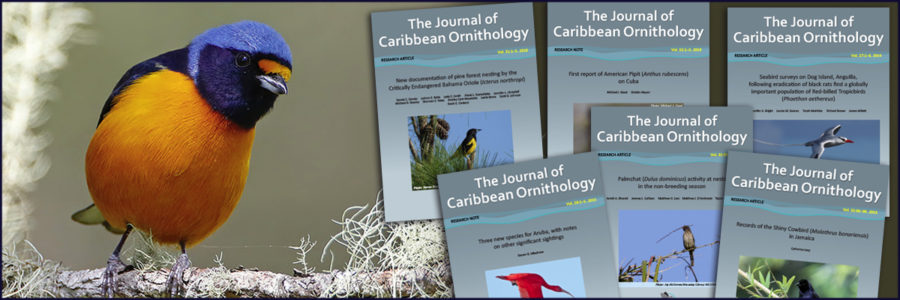
From all of us at JCO, thank you to all of the authors and reviewers that contributed to a very successful Volume 32!
Inside you’ll find a sizable number of publications, including 16 research articles, our first designated “Conservation Report,” 4 book reviews, Recent Ornithological Literature from the Caribbean, and a special In Memoriam for the late Dr. James. W. Wiley.
I want to give some much-earned recognition to the 2019–2020 JCO team. While they were undertaking the aforementioned load of manuscripts, they were working double-time to make some incredible improvements behind-the-scenes. Let me just say that it’s no easy task to create and adopt a new workflow while you simultaneously have a dozen manuscripts—each at different stages— moving through the old workflow. And this new workflow means better communication, a higher-caliber final product, and a more efficient pathway for a manuscript to proceed from submission to publication. All great things!
Please take some time to enjoy all of Volume 32. Inside you’ll find a suite of excellent work stemming from more than 17 countries across the Caribbean. We should all take pride in this work and make the time to congratulate each other on all of these accomplishments. If you enjoyed reading a publication, please send the authors a quick email letting them know. That is what makes Caribbean ornithology special—a sense of community and comradery unlike anywhere else.
Thank you for your support of JCO!
— Justin Proctor, JCO Managing Editor
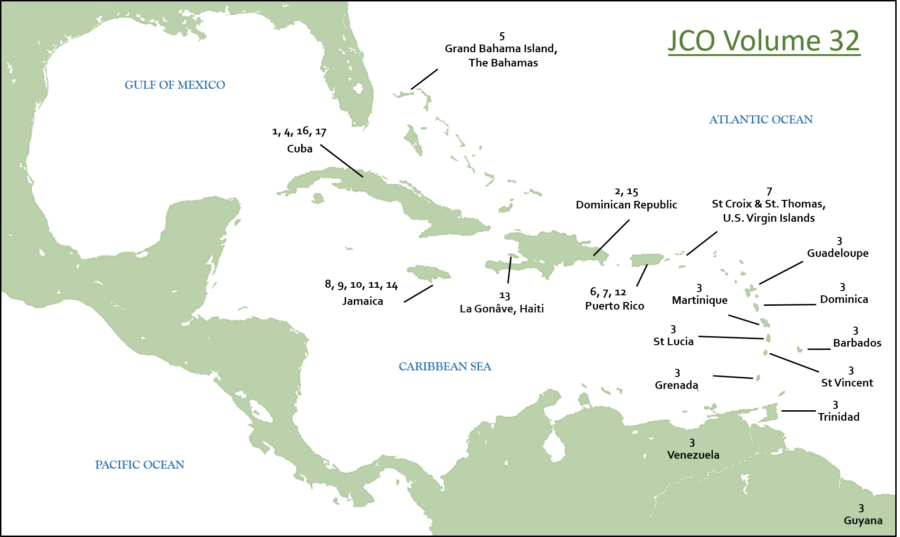
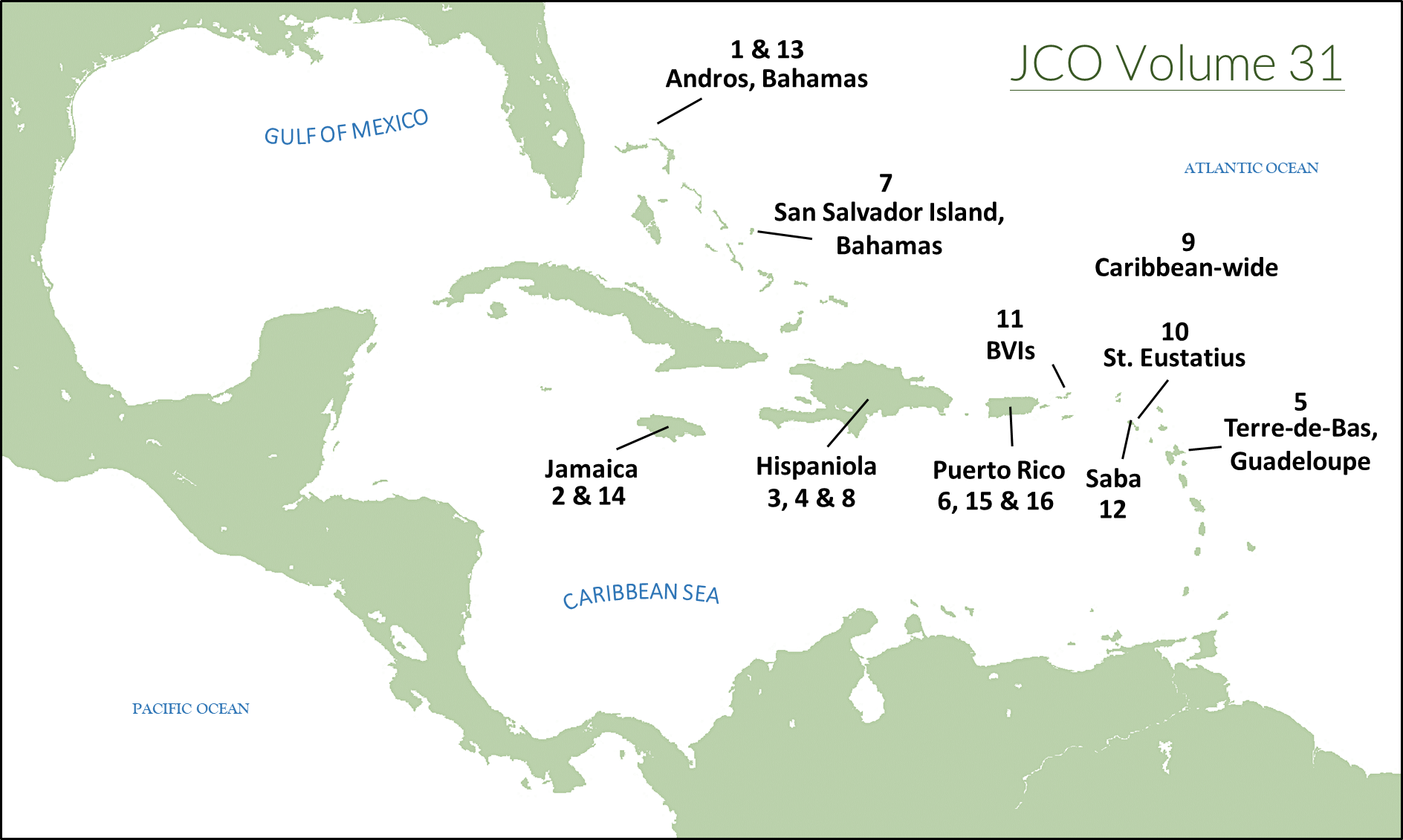
Map depicting research locations of the studies published in Volume 32.
On December 3rd, 2014, ornithologists spotted an American Pipet during an annual Cuba Bird Survey led by the Caribbean Conservation Trust. Previously undocumented in Cuba, this observation marks the first report of this species on the island, and underscores the importance of the Guanahacabibes region as an important stopover for fall migrants.
James F. Dwyer, Thomas I. Hayes, Russell Thorstrom, and Richard E. Harness
After a translocation program for the Critically Endangered Ridgway’s Hawk was stymied by electrocutions in the Dominican Republic, Dwyer et al. began to investigate. In this article, the authors identify the errors made while retrofitting power poles and discuss the necessity of properly mitigating electrocution risks for this project, and others throughout the Caribbean.
Meghann B. Humphries, Maribel A. Gonzalez, and Robert E. Ricklefs
Currently, there are eight subspecies of Carib Grackle distributed across the Lesser Antilles and northern South America. By sequencing mitochondrial genes of Carib Grackles across their range, Meghann et al. shed light on the phylogenetic and geographic history of the species, bringing into question the bases for the subspecies classifications.
In response to the dearth of current literature on the White-crowned Pigeon, Acosta and Mugica compiled the latest data on this Vulnerable species in Cuba. Here, they present their findings, focusing on the current distribution of the species as well as conservation measures that have contributed to the perseverance of the species.
Anthony Levesque, Antoine Chabrolle, Frantz Delcroix, and Eric Delcroix
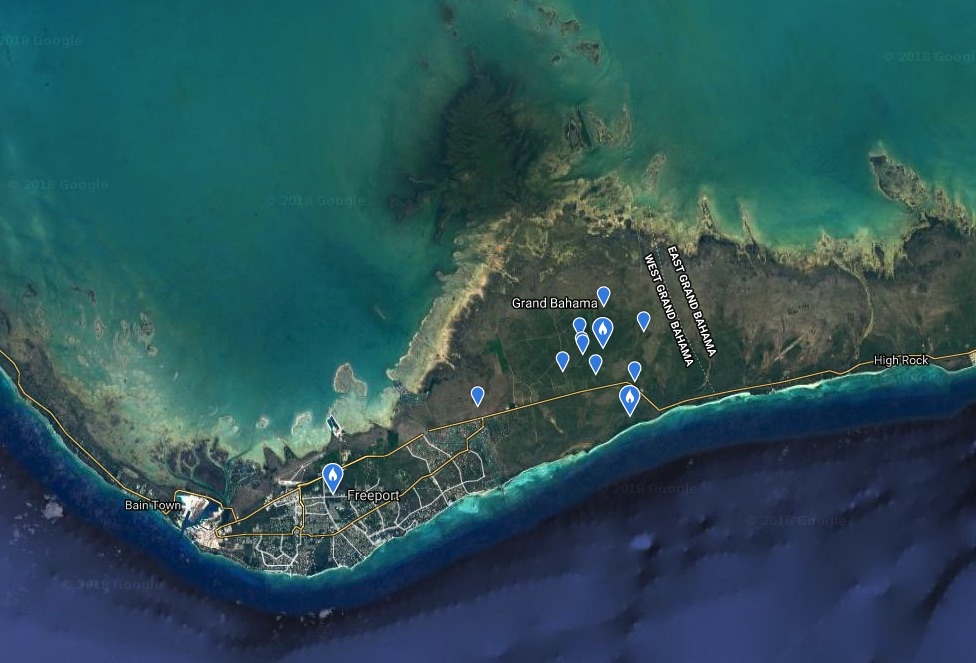
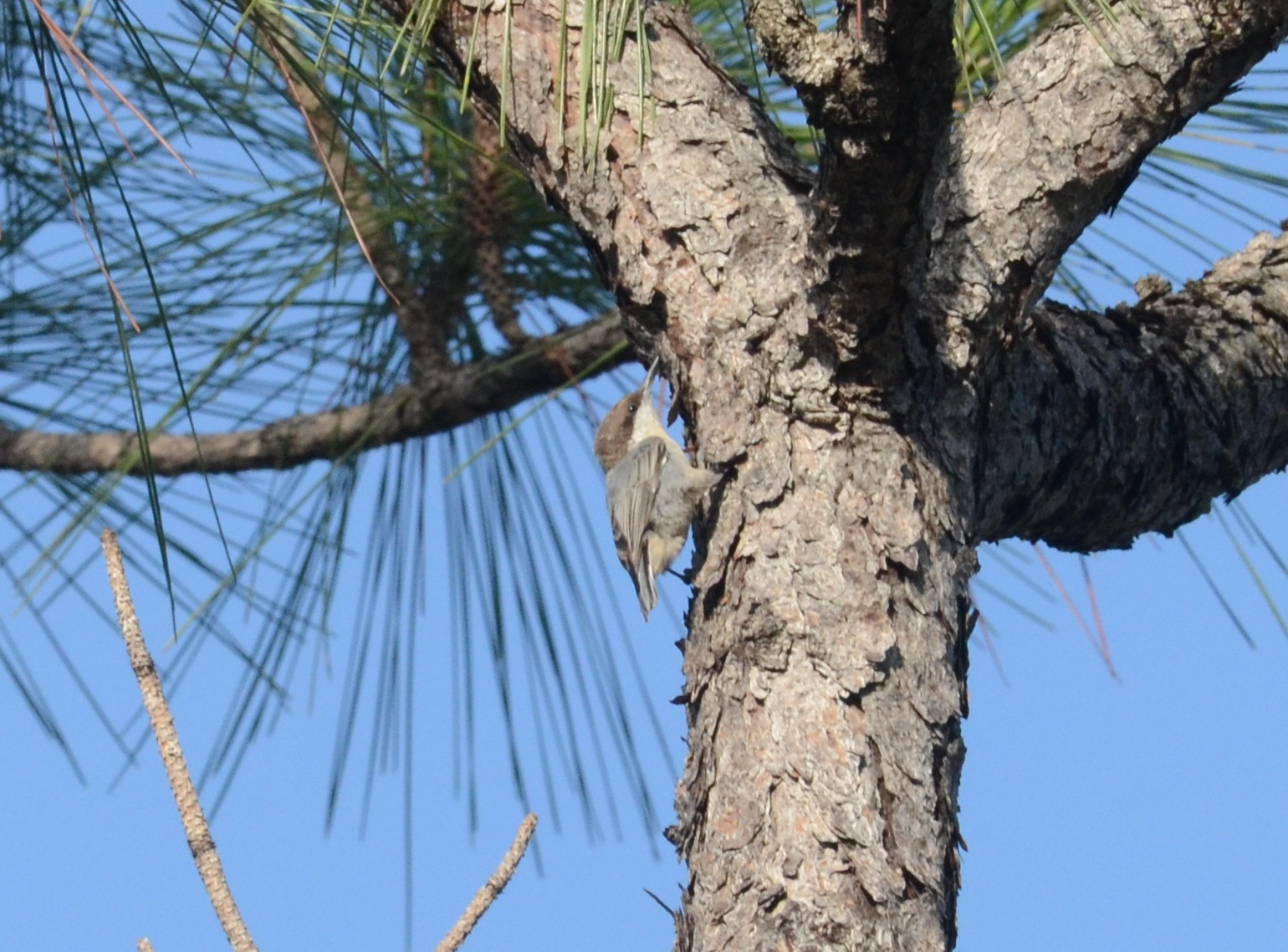
While the Sedge Wren commonly winters in Florida, it has yet to be recorded in the Caribbean, until now. In this article, Levesque et al. recount their sighting of this species on Grand Bahama Island, providing descriptions and photographs of the bird’s diagnostic features and the habitat where it was located.
Christopher C. Rimmer, John D. Lloyd, and Jose A. Salguero-Faria
After Puerto Rico was identified as potential overwintering habitat for the globally Vulnerable Bicknell’s Thrush, Rimmer et al. conducted surveys to clarify the species’ winter distribution on the island. Here, they report that Bicknell’s Thrush is a rare and local species in Puerto Rico and highlight the importance of conservation efforts in Hispaniola, where the species is more abundant.
In 1796, Nicolas-Thomas Baudin captained an expedition to the caribbean, bringing back close to 300 specimens; however, there is controversy surrounding their procurement. After investigating the origin and spread of these specimens, Jansen and Fuchs document their findings and address the arguments of theft made by David K. Wetherbee (1985, 1986).
Currently, the six subspecies of Turkey Vulture are delineated by external measurements and subtle plumage variations, with the Antillean Turkey Vultures falling under Cathartes aura aura. However, through photographic documentation and eBird records, Graves calls attention to the similarity of facial caruncles on Turkey Vultures throughout the caribbean to those present on the eastern United States and Middle America populations. As facial caruncles are largely absent from South American populations, Graves’ work brings into question the diagnostic nature of these markings.
While there are no species of geese native to Jamaica, vagrant or introduced species have been recorded intermittently on the island. Here, Levy amalgamates the scattered history of three geese species in Jamaica and presents a new record of a Snow Goose, illustrated in 1758: the second Snow Goose ever recorded in Jamaica.
Though the comb forkedfern is native to the New World tropics, it is invasive to protected areas in the Dominican Republic and Jamaica. By comparing the bird diversity between invaded habitats and fern-free habitats in the Mason River Protected Area, Davis demonstrates that increased incidence of comb forkedfern decreases bird diversity, particularly native species. Through this, Davis urges the importance of controlling fern spread to protect native bird and plant species.
Richard R. Schaefer, Susan E. Koenig, Gary R. Graves, and D. Craig Rudolph
Though the Jamaican Crow and Jamaican Boa co-occur in certain habitats in Jamaica, there are no published reports of their interactions. By detailing four accounts of mobbing by crows on boas and one probable instance of depredation of a crow’s nest by a boa, Schaefer et al. are the first to document a presumably ongoing feud between these two native species.
With violently strong winds, hurricanes are known to displace birds and transport them to new and unusual habitats. That is why, when Hurricane Maria passed over Puerto Rico on September 20th, 2017, Pérez-Rivera was ready. Here, he documents several unusual bird sightings made by him and others in the wake of Hurricane Maria.
The island of La Gonâve, Haiti, boasts a diversity of bird habitats and has historically sustained a variety of both diurnal and nocturnal raptor species. However, due to rampant environmental degradation and habitat destruction, it is rarely visited by ornithologists or wildlife researchers. After conducting raptor surveys on La Gonâve in 2012, White et al. compared their findings with historical records of raptors on the island, noting that only a few generalist species have been able to sustain populations.
While the Shiny Cowbird is native to South America, over the past century, this brood parasite has spread across the caribbean archipelago and into North America – but how and when did this dispersal occur? In an effort to document the introduction and spread of this species in Jamaica, Levy compiles historical observations of Shiny Cowbirds and postulates a potential hurricane-mediated arrival on the island.
André Dhondt, Jeremy L. Collison, Matthew H. Lam, Matthew J. D’Ambrosio, and Taylor L. Crisologo
Palmchats are among the few passerine species that build complex, multi-chambered nests; however, there are no published studies of their nest-related behavior. After studying Palmchat nests in the Dominican Republic, here, Dhondt et al. report on their observations, noting differences in group size, nest size, twig-related activities, twig length and shape, and nest construction.
William E. Davis, Lisa G. Sorenson, and Ernesto Reyes Mouriño
On January 28th, 2018, birders on the BirdsCaribbean Cuba Bird Tour in Ciénaga de Zapata National Park, Cuba, spotted an almost entirely white Willet amongst a group of Short-billed Dowitchers and other Willets. In this article, Davis et al. present photographic evidence and a detailed description of this leucistic Willet and use phenotypic characteristics to classify it as a western subspecies.
Since its introduction to Cuba in 2003, the Caribbean Endemic Bird Festival has achieved paramount recognition for its talks, conferences, competitions, workshops, exhibitions, and other ornithological events. By uniting and strengthening the national network of environmentalists, this festival has expanded its scope of activities and built its capacity to prepare and distribute educational materials.
[this is our first publication under the header “Conservation Reports” – we invite more of these!]
Jason M. Townsend, Rafaela Aguilera Román, Felisa Collazo Torres, José González Díaz, Chandra Degia, Hiram González Alonso, Floyd E. Hayes, Lyndon John, Steven C. Latta, Lourdes Mugica Valdés, Nils Navarro Pacheco, Fernando Nuñez-García, Carlos Peña, Herbert Raffaele, Pedro Regalado, Ernesto Reyes Mouriño, Yaroddy Rodríguez, Bárbara Sánchez Oria, Helen Snyder, Joseph Wunderle
Summary: This In Memoriam of Dr. James W. Wiley not only celebrates his foundational research career, with four decades of published work, but also the profound personal connections he built through his mentorship and friendship. Twenty authors contributed to this piece, paying homage to Jim and painting a beautiful picture of the life he lived.
A special thank you to Dr. Steven C. Latta, Director of Conservation and Field Research at the National Aviary and longtime editor for JCO, for his continued efforts undertaking this important section of our journal that compiles recent publications from around the Caribbean. Steve has been contributing ROLs to JCO since Volume 22 in 2009.
“My idea then was to catch everything that was published after the publication of Jim Wiley’s “A Bibliography of Ornithology in the West Indies” which I always thought was a tremendous effort and a tremendous resource. I wanted to make it easier for people across the Caribbean to have ready access to the most recent literature by knowing what had been published and how to contact the researchers for copies of their papers. I also wanted to make the updating of the bibliography a whole lot easier.”
Steve has done an outstanding job and we encourage our readers to look back through his work over the past 10 JCO volumes, which can all be found in our free and open-access Archives.
Article by (1) Simon Campo – Editor for the Journal of Caribbean Ornithology and a Researcher at the Yale School of Medicine in New Haven, CT; Connect with Simon via LinkedIn or email; (2) Justin Proctor – Managing Editor for the Journal of Caribbean Ornithology; and (3) Aliya Hosein – Centre for the Rescue of Endangered Species of Trinidad and Tobago.
Journal of Caribbean Ornithology relies on donations to keep all of our publications free and open-access. If you would like to support our mission and the broader goal of giving a voice to Caribbean ornithologists and their work, please consider becoming a supporter of JCO.
Join Chris Johnson as he recounts his experience conducting the Christmas Bird Count on Abaco just two months after Hurricane Dorian devastated the region. While the survey was a somber reminder of the destructive forces of nature and how much recovery is still needed, Chris and his team found hope and encouragement in the birds they encountered. #AbacoStrong
Abaco – my beloved island
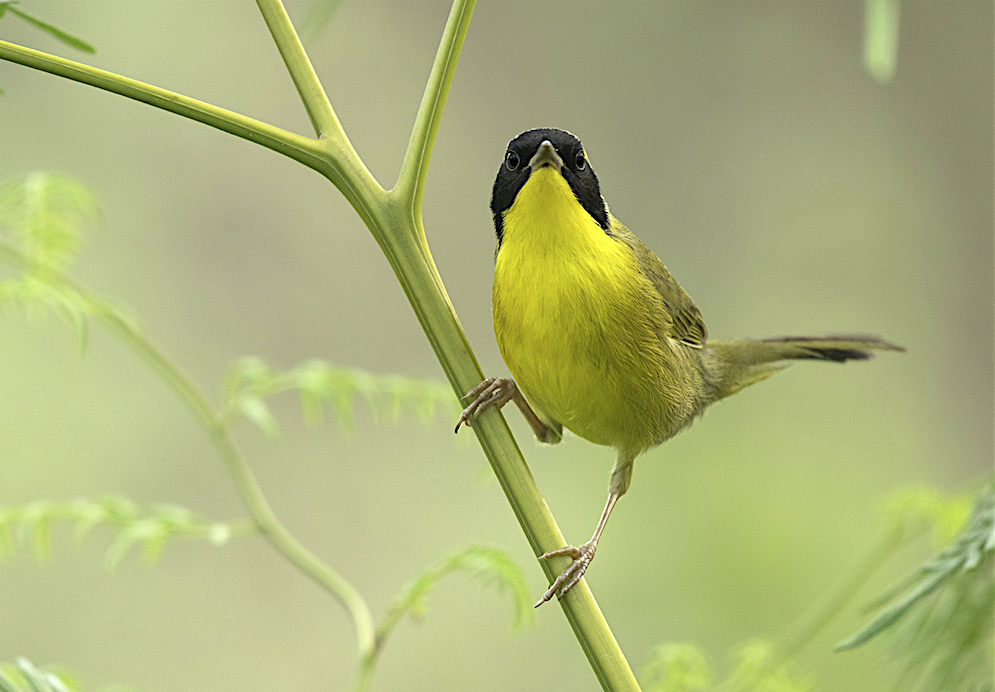
The Bahama Yellowthroat (endemic to the Bahamas) is one of many species of birds directly affected by Hurricane Dorian. (Photo by Chris Johnson)
I have been bird-watching in Abaco, an island in the northern Bahamas, for a little over eleven years. Actually, Abaco is where I started birding at the age 7. Needless to say, Abaco is very near and dear to my heart. When Hurricane Dorian hit the island that I have so much love for, I was heartbroken. I could not begin to fathom how my favorite island would be changed forever.
The hurricane occurred in September 2019, and shortly after, I made a trip back to assist some family members. The destruction I saw was catastrophic and the numbers of bird species had declined dramatically. On December 7th, 2019 , I learned that there would be no annual Christmas Bird Count (CBC) for North and South Abaco. I asked fellow birder and mentor Dr. Elwood Bracey if there were any plans to conduct the CBCs on Abaco. I was distraught to learn that the two annual leaders – Dr. Bracey and Reg Patterson – would not be able to attend and assist in the conducting of these surveys. The Abaco CBCs are a yearly tradition for the past ten years; I was very disheartened. I thought it over and said to myself, “If there’s nobody else who can lead it… You have to do it!” I contacted my Abaco emailing list and began to “round up the troops” for the 2020 Abaco CBCs.
After I touched down in Marsh Harbour for the second time post-Dorian, I realized immense reconstruction had begun. Roofs were being replaced, trash was being hauled back and forth to the dumps, the roads had been cleared of debris, and the well-known Abaco food store, Maxwell’s, had reopened. Sadly, however, the resident bird life in Marsh Harbour was still immensely affected. During three hours in Marsh Harbour the only resident birds that were seen or heard were four Great Egrets; five Eurasian Collared-Doves (invasive species, now resident); and a Turkey Vulture.
The aftermath of Hurricane Dorian during one of the author’s visits showing the destruction of St. Francis De Sales Catholic School and defoliated trees. (Video by Chris Johnson)
At the end of the first day in Abaco, a gorgeous sunset peered through the pulverized pine barrens. It was a beautiful ending to the day; the South Abaco CBC would follow the very next day.
South Abaco Christmas Bird Count
I woke up on the morning of South Abaco CBC anxious for the day to come. I brewed my two cups of coffee and sat on the porch as I felt the 20 mile per hour winds roll through Cherokee Sound. My Uncle, Keith Kemp arrived at my grandfather’s house at around 6:30 a.m. so we could begin our journey south to “The Y” (a popular landmark in South Abaco) at the Abaco National Park. Along the way we collected fellow birder and leader for the South Count, Niles Primrose. Along the 28-mile drive from Cherokee Sound down to The Y, we discussed the team grouping and the leaders for each team. We all agreed that my uncle would lead the team going North of the Abaco National Park, Niles would lead the Sandy Point team and I would lead the Abaco National Park (Forest) team. We arrived at the meet-up spot for 7:30 promptly. At the Y we met our additional birding peers: Janene Roessler and Lavonda Smith. After catching up for a short time we were met by Bahamas National Trust (BNT) park warden Marcus Davis. As we discussed the plans for the day a resident Red-Tailed Hawk flew over the group. A great first bird for the Forest Team! With everyone assembled we split into our respective groups and went our separate ways.
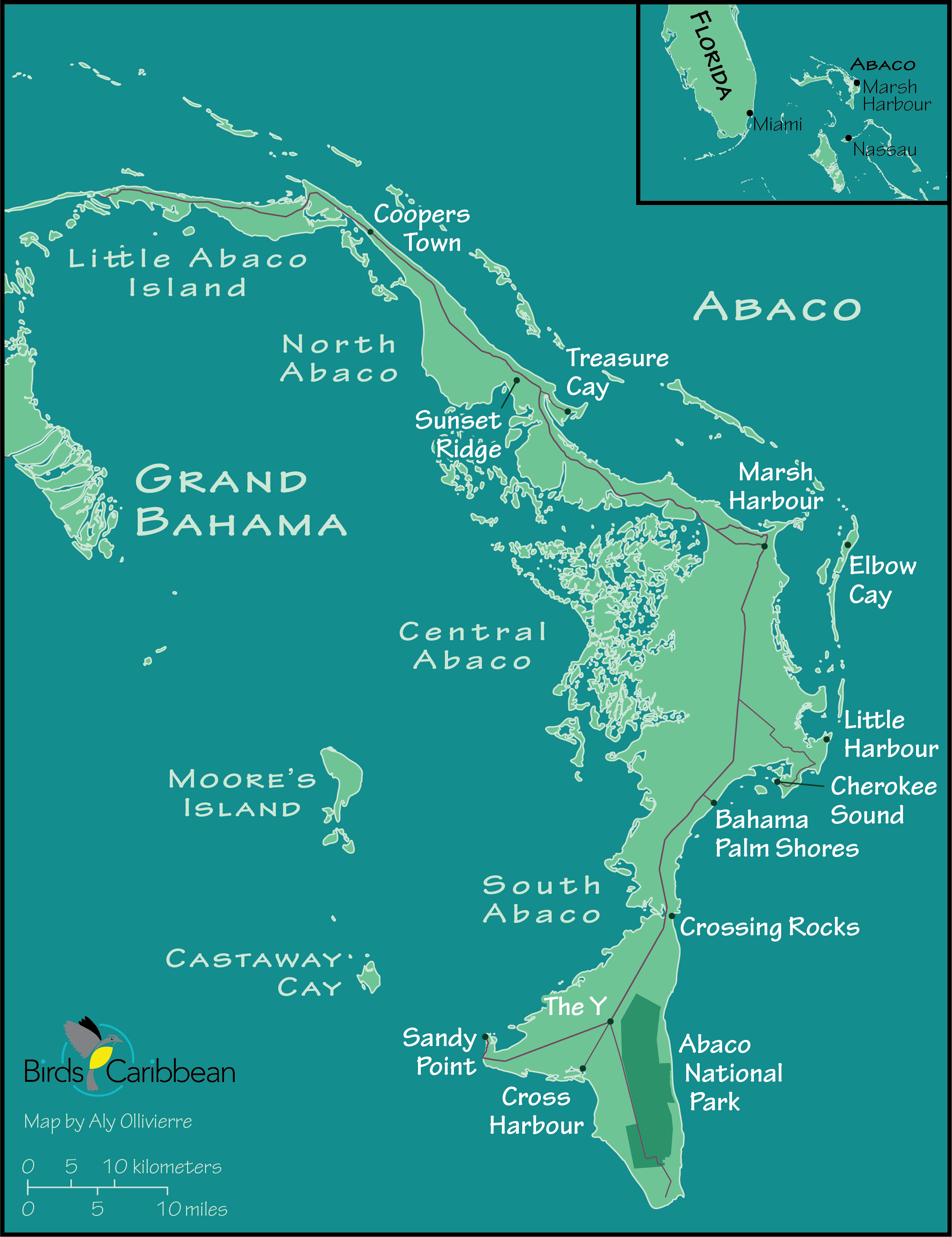
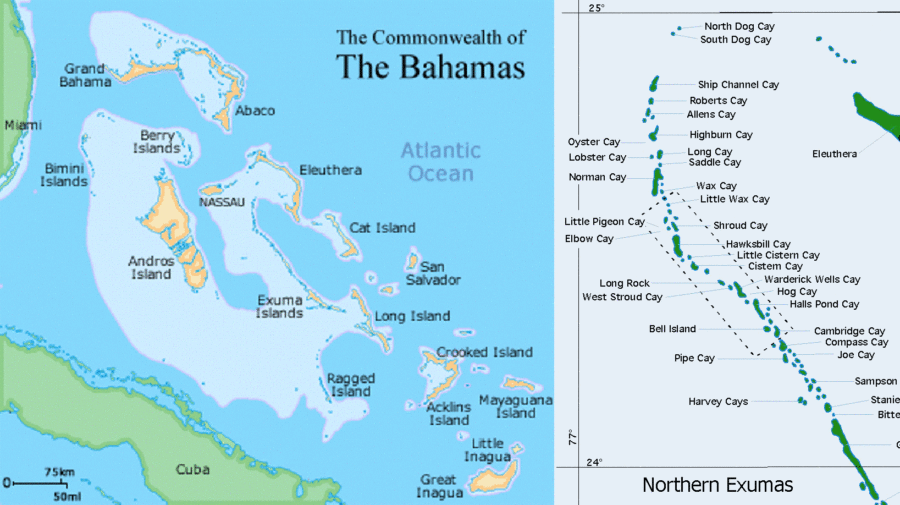
Abaco is located in the northern Bahamas. (Map by Aly Ollivierre)
The forest team, consisting of Marcus Davis and myself, travelled into the forest armed with our binoculars, field guides and one oversized camera to count all the bird species that we could possibly find. The first species that we saw was a male Cuban Emerald, fluttering around some morning glory flowers. He was eventually chased away from his routine pollination job by another Cuban Emerald, who also wanted a taste of the nectar. As we continued traversing the forest, we were listening closely for some Bahamian specialties such as the Bahama Warbler and Olive-capped Warbler. The next bird of interest was a Yellow-bellied Sapsucker hard at work on drilling into a Caribbean Pine Tree.
The sapsucker, who was reaping rewards from his task of drilling into the dense pine tree, became “antsy” very quickly. Before our eyes the bird was under attack from another species of the raptor family. A Merlin had seemingly dropped out of the sky to attempt to catch the apsucker for a meal. However, the plot had failed and the Merlin decided to sit on a long pine branch. After a great photo-op, the small falcon decided that enough was enough and he was back on the hunt. He began coasting along the track road that appeared unaffected by Dorian, awaiting another opportunity for prey to present itself.
A Resilient Abaco National Park
As we journeyed deeper into the National Park, Marcus began to explain how lucky South Abaco was. It was minimally affected by Hurricane Dorian. And the numbers, even within the pine forest, were proving this statement. As we continued our conversation, a vivacious song filled the forest. Not one, not two, but three Pine Warblers flew into the pine right in front of our vehicle. The bright yellow warblers flew onto the bark of the pines, flitting about and dropping into the understory. After these warblers, we saw an Abaco and Grand Bahama specialty bird. The tiny and long-tailed Olive-capped Warblers maneuvered through the large pine tree tops, singing and chirping. The show continued for another ten minutes as we watched the tiny warblers ramble about the pine forest.
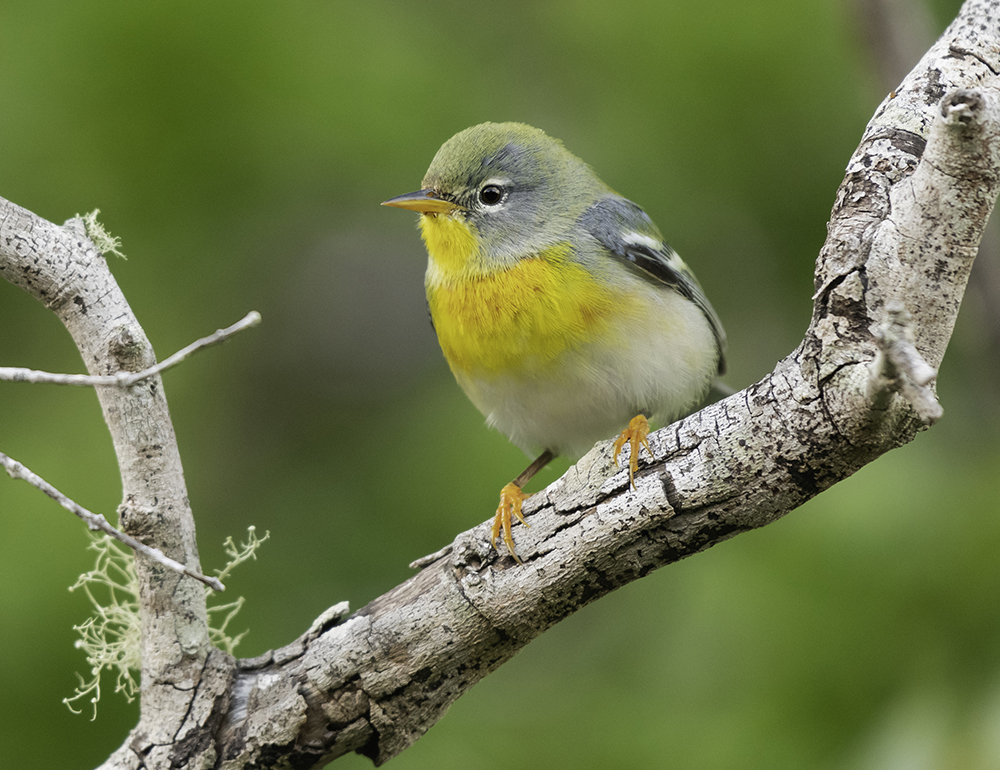
Northern Parula posing in Abaco National Park. (Photo by Chris Johnson)
Forty minutes in and we were already up to 17 species. However, we were still missing a few species. The Bahama Warbler, a relative of the North American Yellow-throated Warbler was finally seen for the first time of the day clinging onto the bark of the large pine trees and moving transversely. I decided to use a playback of a Bahama Warbler in an attempt to coax the fascinating warbler out. The explosive song from the pint-sized warbler began to ring out from within the forest. 1..2..3..4..5..6..7… seven Bahama Warblers flew into the pines directly in front of Marcus and me. What a sight to see! All of these warblers congregated together even after Hurricane Dorian.
After many more encounters with the Bahamian specialties, we began to spot and note many more migrant and winter resident species. Some of these species’ behavior and feeding habits had definitely changed thanks to Hurricane Dorian. For example, I noted a group of Indigo Buntings hopping about and feeding along the quarry road, something I had not seen in my ten-plus years of birding. Many birds were also grouped together, something quite abnormal for the time of year. One by one winter residents began to appear: Black-and-white Warblers, Northern Parulas, Yellow-throated Warblers, American Redstarts, Common Yellowthroats and an abundance of Palm Warblers.
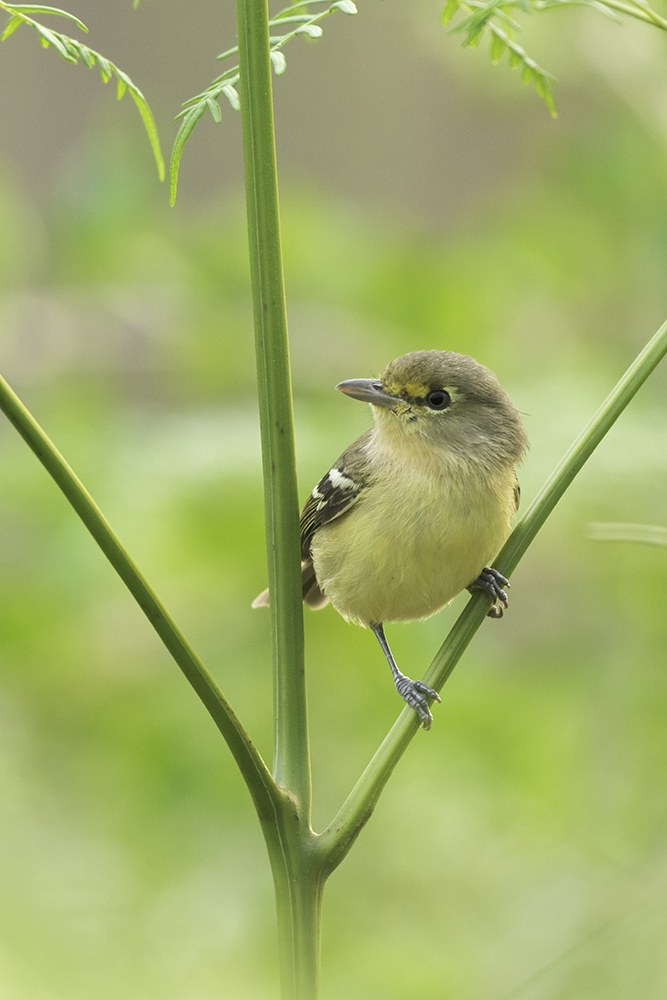
A Thick-billed Vireo spotted during the count. (Photo by Chris Johnson)
We eventually arrived at Cross Harbour to begin counting some water birds and shorebirds. Upon arrival at Cross Harbour, we were greeted by two new species. Sticking to each other very closely were a Yellow-rumped Warbler of the Myrtle variety and a Cuban Pewee. Both concentrated on catching insects for a quick meal. With all of the wind on the shorefront, catching bugs would prove to be a difficult task.
As Marcus and I traversed the seemingly endless beach and shore we also spotted new species! Three new herons and egrets had positioned themselves on the beach to begin fishing for their food. The species included a Yellow-crowned Night-Heron, Reddish Egret and a Great Egret. The tiny “tail-bobbing” Spotted Sandpiper decided to make an appearance for the day as it foraged on the shorefront for any small crustaceans that it could fit its beak around.
Along the trail which would eventually lead back to “The Y”, I noticed that we had not seen any species of dove for the day. The Common Ground Doves and Zenaida Doves, which were usually plentiful on the track roads, were now few and far between.
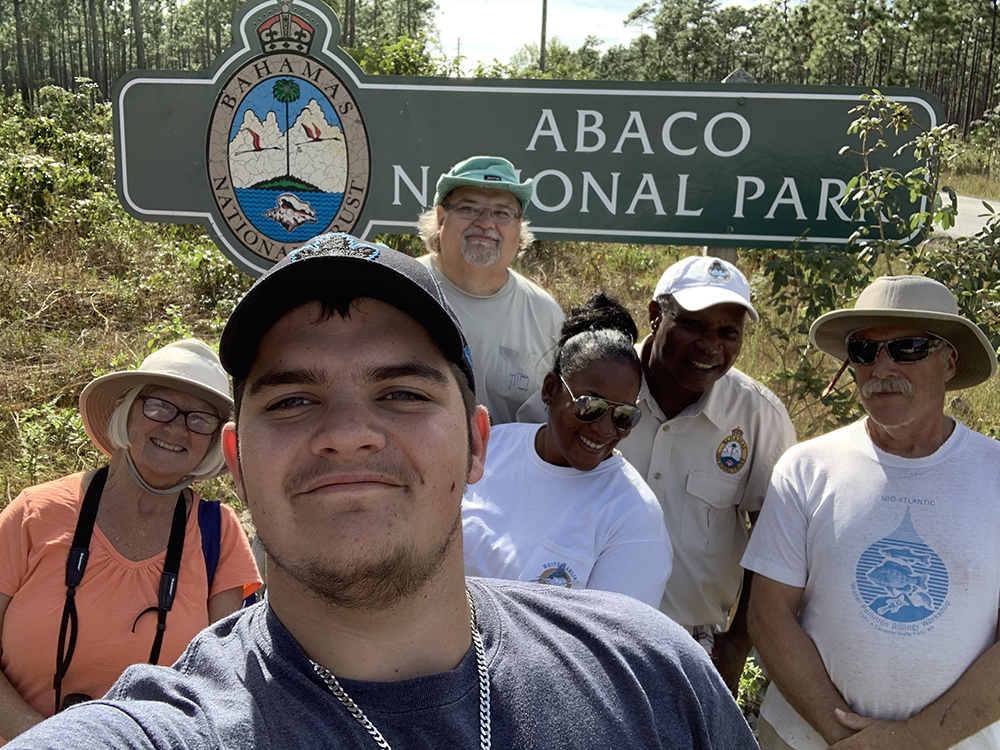
We eventually arrived back at “The Y” and arranged with the other teams to count all the bird species – as well as make time for a group picture in front of the Bahamas National Trust’s Abaco National Park sign! By the time everything was said and done the South count had totaled 62 species on the day of CBC and 67 species after count week. *Count week is the period of time before and after the day of CBC*. The numbers for the South were great post-Dorian as in past years the total number of birds were sometimes over 70.
POST CBC TRIP TO Bahama Palm Shores
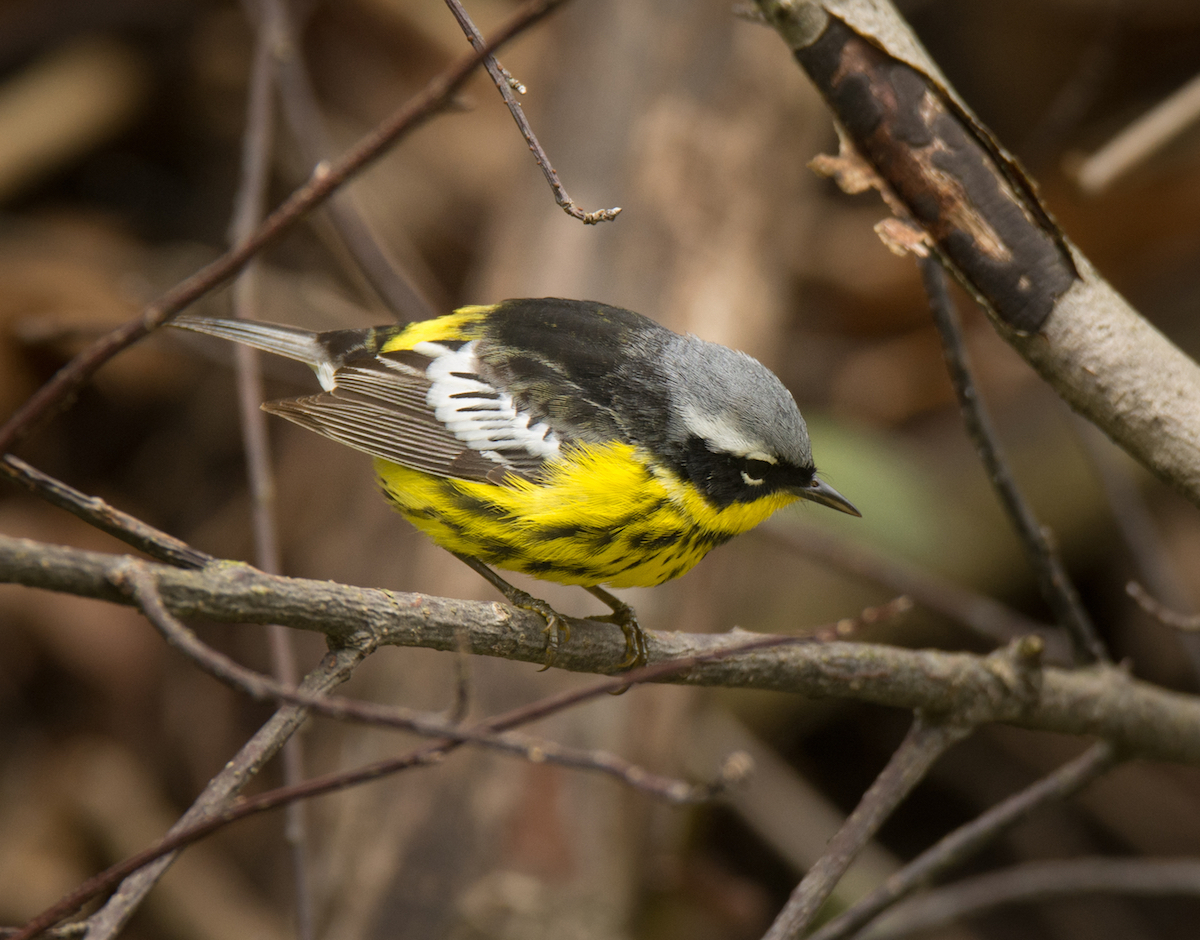
After the CBC information was gathered and shared amongst ourselves, we all parted ways and returned back to our homes. I had decided that I just did not get enough birding during the CBC and decided to head to Bahama Palm Shores (BPS). I started off the checklist by stopping near a large patch of coppice. There was a dead tree trunk with dead branches still attached. Upon “pishing” for a few minutes, four Magnolia Warblers appeared. They put on a show by approaching me and got within three feet! The other species that made themselves known were Greater Antillean Bullfinches, Red-legged Thrushes, Blue-gray Gnatcatchers and an abundance of Northern Parulas.
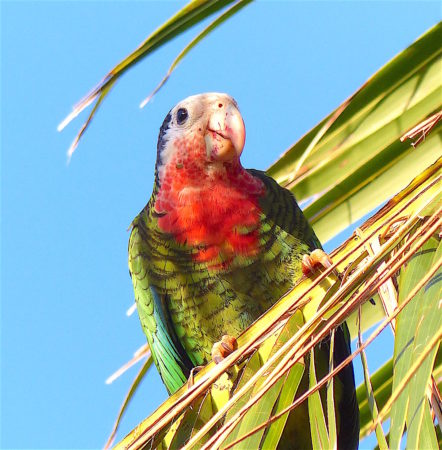
As I was just about to wrap up, I heard a vociferous chatter and calling near the easternmost street within Bahama Palm. I knew the chatter well; it was the species that got me started on bird-watching. The Bahama / Cuban Amazon Parrot had established a small population within BPS. I counted a total of more than 45 parrots in that particular area. This was abnormal, as I had never seen a group of more than thirty parrots in Bahama Palm Shores. They all appeared healthy and were actively feeding on Gum Elemi berries. Within the hour and four minutes I had spent at Bahama Palm Shores I had a total of 26 species and 114 individuals sighted (see the full eBird checklist here).
North Abaco Christmas Bird Count
The South Abaco Team. From left to right: Janene Roessler, Chris Johnson, Keith Kemp, Lavonda Smith, Marcus Davis & Niles Primrose. (Photo by Chris Johnson)
The morning of the North Abaco CBC started much like the previous morning. I started brewing my coffee and sat on the porch. This morning was much cooler than the morning of the South Abaco CBC. My Uncle Keith Kemp arrived at the house packed and ready for the day. We jumped in the truck and proceeded to the road that connects Cherokee to the Great Abaco Highway. There at the “turnoff” (the road where the Cherokee and Great Abaco Highway meet) we collected birding buddy Janene Roessler, who would be our scribe for the day.
As we began to inch closer towards Treasure Cay on the S.C. Bootle Highway, we witnessed a bizarre number of Great Egrets grouped in the ruinous wetland. There was a total of 14 Great Egrets in this one area and that was it. No Common Gallinule, Coots, Grebes, or any herons in sight. It was heartbreaking to see the damage to the North; it was undoubtedly worse than the catastrophe that struck Marsh Harbour in Central Abaco.
We arrived at the original meeting point for all the previous North counts. “Spanky’s Parking Lot” was located within Treasure Cay. It was almost unrecognizable, if not for the large liquor store, which was still standing but had lost all of its windows during the storm. The damage at “Spanky’s” would be minuscule compared to the damage within Treasure Cay.
A Cuban Pewee seemingly undaunted by a human with a large camera approaching. (Photo by Chris Johnson)
The first location would be to stop at the waterfront gas station to assess the damage the storm had done to the pylons and small rocky shorefront. After some substantial searching with our binoculars assisted by my 200-500mm camera lens we were able to pick up the first birds for the North Abaco CBC. We found: one Ring-billed Gull, one Black-bellied Plover, one Short-billed Dowitcher, and two Royal Terns.
We meandered our way through the debris-covered roads and paths for the next half hour with our destination in mind. My uncle had always spoken about a sandbank at the eastern end of Treasure Cay that always had birds. On our way out to the beach we were shocked to see Indigo Buntings perched low to the ground in dead shrubs foraging for food. The sandbank tragically held nothing for the count and we continued within the easternmost point. The damage at this end of the settlement was extraordinary. We saw entire “seawalls” washed out by the storm, houses seemingly torn in half, and cars flipped upside down.
Months after the hurricane, forests (like this one near Treasure Cay) have only begun to recover, and it will be years before they are able to support the same biodiversity as before the storm. (Video by Chris Johnson)
The next location was the Treasure Cay Golf Course Ponds. Many species had been counted on these small ponds in previous years. This area was by far our most active for the day. Our most notable species in this area were: White-cheeked Pintails, Least Grebes, Cattle Egrets, Merlin, White-eyed Vireo and the prize bird of the day… a Hooded Merganser! We noted quite a few new species for the count – but the storm-ravaged ponds and golf course were quite distressing to see.
The last few locations that we would check proved extremely disappointing. Sunset Ridge was a famed birding spot within Treasure Cay. Species ranging from Roseate Spoonbills to American White Pelicans, to the extremely rare Bald Eagle sighted by Dr. Bracey for many years had been recorded there. However, hope began to dwindle for the Dorian-devastated wetland. With the assistance of my camera we came to add a few more species to the “slowly-but-surely” growing list. One Belted Kingfisher, two Reddish Egrets, three Little Blue Herons, – and peculiarly enough, another large group of Great Egrets: a total of 26 individuals!
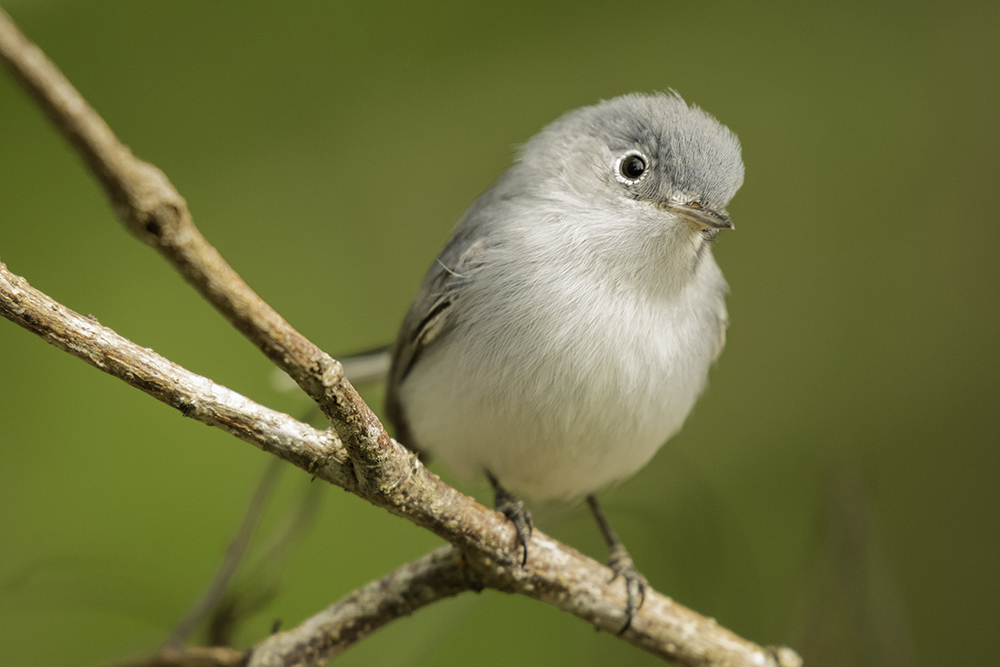
A resident Blue-gray Gnatcatcher was a welcome and familiar sight during the CBC. (Photo by Chris Johnson)
We then decided it would be in our best interest to make our way to Cooper’s Town foreshore to count some gulls and cormorants. Our trip to the foreshore allowed us to add numerous species to the list. It included: 25 Double-crested Cormorants, 18 Laughing Gulls, 11 Ring-billed Gulls, 4 Herring Gulls, 7 Lesser Black-backed Gulls and 1 Great Black-backed Gull!
At the end of the count, we had a total of 43 species for the North. This 2019 total was frightening as in previous years we would sometimes have totals of over 90 species. The number of species was effectively cut by fifty percent.
Final Thoughts
We all know that Dorian has done irreversible damage to Abaco. I would have never thought that such damage could be done to my second home. The catastrophic damage on this island is heartbreaking. The population counts are proving that we have not only lost many birds in the storm, but that birds in Abaco are still struggling to find food and shelter post-Dorian. There are many ways we can assist this Bahamian island in the rebuilding and replenishing of habitat for these avian species that make their home there. BirdsCaribbean and the Bahamas National Trust have done, and continue to do fantastic work in supporting research and replenishment of both Abaco and Grand Bahama. If you would like to assist these organizations in their efforts, please donate to the BirdsCaribbean Hurricane relief fund or The Bahamas National Trust.
Abaco and Grand Bahama will come back in time, and hopefully the birds with them. #AbacoStrong
Hover each photo to see the caption; click on a photo to see a slide show.
This Merlin was hunting along the track road in the forest. (photo by Chris Johnson)
We were thrilled to have 8 Bahama Warblers (endemic to the Bahamas) fly right in front of us in the forest. (photo by Chris Johnson)
This Bahama Parrot was attempting to blend into the treetop and allowed for great shots as he remained absolutely still. (photo by Chris Johnson)
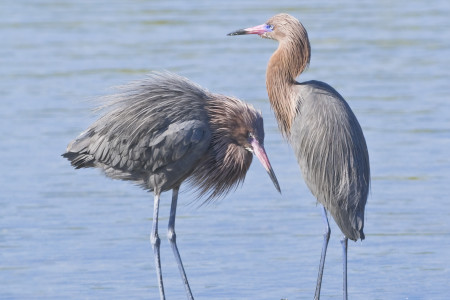
Reddish Egret spotted at Crossing Harbour. (photo by Chris Johson)
Chris Johnson is an avid 18-year-old birder and photographer. He has been birding for over 10 years and has gotten opportunities to further his birding skills namely the Cornell Lab of Ornithology’s Young Birder Event. He enjoys spending his time on many Bahamian family islands and photographing the fauna around him. You can find him on Instagram @cmjphotography242 to see more photos from this young photographer and birder.
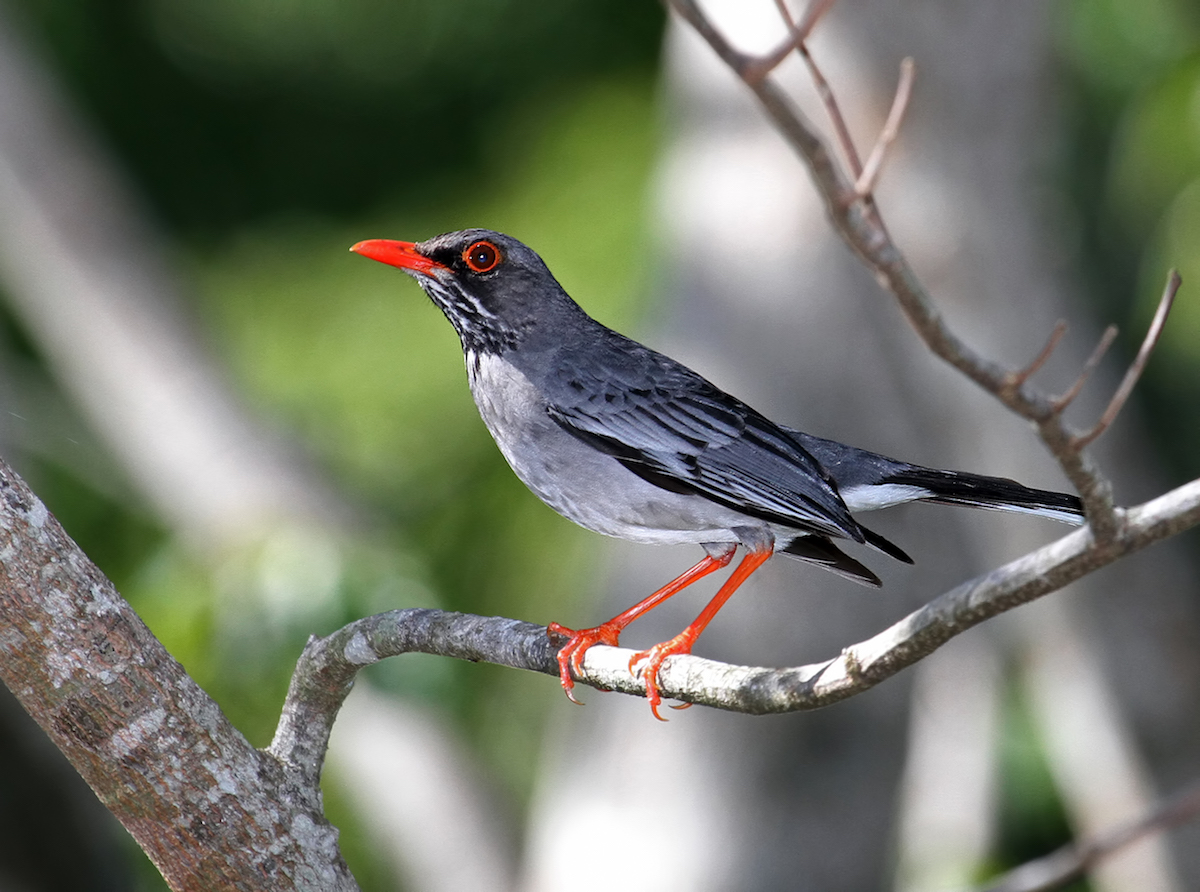
The Red-legged Thrush is a key seed disperser in the forests of the Dominican Republic. (photo by Dax Roman)
Spencer Schubert’s adventures into the remote corners of the Dominican Republic Part continue, all in the name of science and conservation.
If you are reading this, I probably do not have to convince you that birds are great. The more interesting discussion to be had, of course, would be what makes them so great. We are all drawn to birds for different reasons. For some of us, the sights and sounds they provide to the ambience of our backyard or local natural area are enough to endear them to us. For many others it comes from their experience as pet owners. Even the tradition of hunting can inspire reverence for birds and a passion for their conservation. I have always liked birds, but I can hardly claim that they were any more interesting to me than lizards or turtles, for example. Indeed, on my grumpiest of days, I sometimes refer to myself as a failed herpetologist.
My gateway to birds has been a fascination with their role as seed dispersers. It may not be the first thing that you notice, but no matter where you go, as long as you’re standing on dry land and there is some green vegetation nearby, you would be hard pressed to find somewhere where there aren’t birds eating fruits and seeds. These feeding behaviors by birds are a key component to many terrestrial ecosystems. By swallowing fruits or otherwise carrying away seeds in their bill, potentially flying great distances, birds give plants a major boost in their potential to propagate in the environment.
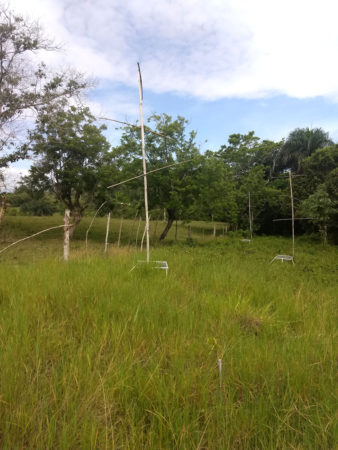
Our restoration plots, constructed in 2017, are small pasture areas each about the size of a basketball court. By enclosing these areas with barbed wire fences, our objective was to eliminate the effects of cattle grazing, trampling, and landscaping efforts by farmers in order to observe the process of seed dispersal and plant growth. Perches with crossbars were installed to attract birds and collect droppings and seeds.
One of the major implications of seed dispersal in a world with ever diminishing forests is the prospects for degraded ecosystems to bounce back. About two years ago, I contributed an article to this blog on up-and-coming work in the small town Jarabacoa in the central mountains of the Dominican Republic. I was studying whether constructed perches could be used to attract birds to restoration sites on abandoned parcels of farmland, with the goal of promoting natural seed dispersal and forest recovery. It all began with a simple principle: If you build it, they will come.
To some extent this was true. We found that installing perches increased the number of birds visiting restoration plots. However, some key seed dispersers such as the Palmchat, Black-crowned Palm Tanager, and Red-legged Thrush – to name a few – showed little to no interest in our perches. So, I got to thinking, maybe we need a better sales pitch.
Have you ever walked down the streets of a popular street in town looking for a place to eat or hang out? Would you rather walk into an establishment that is silent with no sign of people inside or one that is bustling with music and laughter? Atmosphere is what you’re looking for. All else being equal, you’re much more likely to walk into a restaurant that sounds like there are a lot of people inside than one that is quiet and seemingly empty. We use these social cues to inform our judgments of the quality of different businesses all the time. As it turns out, birds are not so different.
Birders will already be familiar with the magic of playback. Many bird species are readily stimulated by hearing their own call and often rush in to investigate whether the sound is from a mate, new neighbor, or a potential intruder to the territory. This is often used to draw in shy birds for us to have a closer look at them or prompt them to reply for better identification (Note: Playback may cause unnecessary stress for some species, particularly during nesting season, and is prohibited in some parks and in many cases for threatened species). Similarly, birds may be drawn to the sounds of both their own kind and other species as a signal to flock up to find high quality habitat or food.
Black-crowned Palm Tanager (Phaenicophilus palmarum) feeding on Inga vera. (photo by Spencer Schubert)
Here is where my idea set in. One aspect of my studies over the past four years has been the community-level analysis at our sites in the central Dominican Republic in an attempt to fully document all feeding/dispersal relationships between all of the bird and plant species that occur here. Through thousands of hours of observation, we have uncovered enormous variation in the extent to which different bird species act as seed dispersers.
Some “generalist” species are responsible for dispersing the seeds of large numbers of plant species. For example, our research has revealed that the Palmchat eats fruits from 42 species. That’s nearly half of all trees and shrubs that are found, collectively, at the sites we have surveyed! Other “specialist” species, like the Antillean Euphonia, are only known to feed on fruits from just a few species. So, if you were any average Joe Bird in the mood for some tasty fruits, which of these species would you rather take a recommendation from?
Antillean Euphonia (Euphonia musica) feeding on a mistletoe (Phoradendron racemosa). (photo by Spencer Schubert)
This is, effectively, the question we asked with our latest experiment. By broadcasting sounds of fruit-eating generalists, specialists, and birds that do not eat fruits in separate trials, we sought to test how these sounds affect bird activity in our restoration plots. We expected, first of all, that the sounds of particular species would attract members of that same species. Additionally, we expected experimental trials with sounds from generalist birds to attract more birds in general than in trials with sounds from specialists, non-frugivores, and no sound. We used digital video cameras to record the activity of birds in the plots during these experiments. At this time, we are still reviewing the footage from this study. But we have already seen some fascinating results! Several species that we had never before recorded in the plots were confirmed as visitors responding to the sound of their own species during this experiment.
Here we see a family of Grey Kingbirds (Tyrannus dominicensis) frolicking among the perches in one of our restoration plots. Kingbirds are, nominally, insectivores. However, they supplement their diet heavily with a large variety of fruits. Their propensity to venture out into open spaces to hunt for insects makes them highly prolific seed dispersers in deforested landscapes. (Video by Spencer Schubert)
Our work demonstrates that sound and social cues are likely a key factor in birds exploring degraded landscapes. And this exploration and habitat use by birds has a direct relationship with seed dispersal. While our work is only a first glance into these relatively unexplored aspects of bird behavior, there is reason to believe that it could have key implications for environmental management and conservation. Beyond simply tricking birds into showing up to a particular site, taking various measures to promote the local abundance of birds through providing resources and habitat can extend well beyond improving the well-being of birds. Helping birds in this context has great potential for restoring the ecosystem services like seed dispersal that birds provide, which will be key in our future struggle to support biodiverse and resilient ecosystems.
As an extension of plant surveys and phenology monitoring, we used a make-shift space at our field station to germinate and rear seedlings of more than 30 species. At the end of the summer, Plan Yaque Inc. helped us transport these to a large scale nursery that supplies ongoing forest restoration projects for the Ministry of the Environment.
In the time since the inception of our project, we have taken steps to ensure that measures will be taken to improve management practices to make landscapes more supportive of bird populations. Our biggest push in this regard has been emphasizing the importance of planting native species both in restoration areas and in backyard landscaping projects to support native birds.
Over the past year, we have collected seed and grown seedlings of more than 30 species of native plants, all of which produce fruit resources for birds. In July of this year, we donated more than two hundred of these seedlings to Plan Yaque Inc. (a local NGO working to conserve natural resources in the Rio Yaqui del Norte watershed) and the Ministry of the Environment to incorporate into routine forest restoration projects, including the plots where we have done our experiments. We hope that this will be an important first step to reforming forest restoration practices so that they may become more sustainable and effective in promoting native biodiversity.
A Palmchat, endemic to the Dominican Republic and an important seed disperser, uses one of our artificial perches. (photo by Holly Garrod)
I owe gratitude to many individuals and organizations for their roles in supporting this project over the past several years. Chiefly among these were project technicians: Joaris Samuel Gonzalez and Juan Miguel Liberata. Field assistants: Alex Lascher-Posner, Paris Werner, Kim Shoback, Tyler Glaser, Alejandra Monsiváis, Juan Carlos Cárdenas, and Lara Grevstad. Dr. Eric Walters of Old Dominion University helped advise the project and has been instrumental in the progression of my ideas and my development as a scientist. Holly Garrod has closely partnered with this project as a collaborator during the course of MS thesis on todies of Hispaniola. Local organizations Plan Yaque and Rancho Baiguate have provided key logistic support, without which this work would not have been possible. Furthermore, numerous private land owners have generously received us on their farms to conduct our field studies. This research was funded jointly by the Rufford Foundation, the Sophie Danforth Conservation Award from Roger Williams Park Zoo, the Old Dominion University Kirk Wetland Research Award, and the David S. Lee Fund from BirdsCaribbean.
By Spencer Schubert. Spencer is Ph.D. student in the ecology program at Old Dominion whose thesis focuses on the contributions of avian seed dispersal to tropical forest recovery and plant-frugivore seed dispersal networks on farmland landscapes in the Dominican Republic. Spencer is a recipient of two BirdsCaribbean David S. Lee Fund Grants and is using his research as a platform to raise interest in the ecological importance of birds for restoration projects in the region around Jarabacoa.
On behalf of the entire Journal of Caribbean Ornithology staff, I am incredibly excited to announce that the JCO Archives are complete! And we are honored to dedicate these Archives to our deeply-valued and greatly-missed friend and colleague, the man who started this whole adventure: Dr. James W. Wiley.
THE BACKSTORY (some historians claim that we started with Messenger Pigeons)
Jim Wiley crossing the Mameyes River, in flood, en route to a Puerto Rican Parrot nesting area in 1978. (photo by Noel Snyder)
In 1988, Dr. James (Jim) W. Wiley conceived and published the first issue of El Pitirre, a newsletter for the Society for the Study of Caribbean Ornithology (now BirdsCaribbean). He went on to serve as Editor-in-Chief for the first 17 volumes—an incredible feat—and in the process, grew the newsletter into a peer-reviewed research journal well-respected across the Caribbean.
Volume 16 (2003) marked the end of the El Pitirre name and the birth of Journal of Caribbean Ornithology. 2004 would mark Wiley’s final year, wrapping up his tenure with Volume 17. Dr. Jerome (Jerry) A. Jackson tagged in as a co-Editor-in-Chief with Dr. Floyd Hayes for Volume 18 (2005), with Floyd taking the reins from there. In 2006, Martín Acosta Cruz came aboard as co-Editor-in-Chief, overseeing manuscripts coming out of Cuba. Two years later, Floyd recruited Douglas Weidemann, a biology student out of Pacific Union College, to serve as an Editorial Assistant. Doug has been with the journal ever since and is the only member of our current staff who was there to watch JCO transition from paper to the digital world in 2014. In his 11+ year tenure, Doug has been instrumental in keeping JCO moving forward as the leading ornithological publication in the Caribbean.
A photo of Doug Weidemann getting ready to mail out a new issue of JCO in 2010. Licking shut all 300+ envelopes is a memory that still wakes Doug up at night. (photo by Floyd Hayes)
Floyd and Martín would continue serving as Editors-in-Chief for the next eight volumes of JCO. In 2014 (Volume 27), Dr. Jason Townsend stepped into the Editor-in-Chief position, and shepherded JCO into a productive chapter that included transitioning the journal to open-access and onto an online academic publishing site, as well as growing the JCO team with new staff and new positions. When Jason created and advertised a Managing Editor position in 2016, I jumped at the opportunity to become involved, and have spent the last four years helping expand the journal’s publication capacity and improving timeliness of publication. We have worked hard at creating a bigger and more unified team, and that has made all the difference.
GETTING THE JOB DONE (if only you could claim blood, sweat, and tears as tax deductions)
More staff has ultimately afforded JCO more bandwidth to tackle some big, lingering side projects. One of those has been the ongoing project (3+ years) of completing the JCO Archives—a digitized, free, and open-access collection of every publication from every volume and issue dating back to Wiley’s Volume 1, Issue 1 in 1988.
The completion of the JCO Archives is owed to the hard work of MANY individuals, including Tristan Leisten, Zoya Buckmire, and Alex Sansom, to name a few. Thank you also to all of the great photographers who have allowed us to use their photographs for volume and issue covers:
Tanya Martinez, Zoya Buckmire, Charles D Peters, Eric Hynes, Juliana Coffey, Richard Briones, Amonie Holas, Gloria Achilla, Susan Jacobson, Jessie Pitt, Dave Irving, Rafy Rodriguez, Adam Toussaint, David Hollie, Pedro G. Rodriguez, Kenneth Butler, Jose M. Panteleon, Dax Roman, Aslam Ibrahim Castellon, Anthony Levesque, Claude Fletcher, Aaron Budgor, Pericles Brea, Adam Stinton. Ray Robles, Raphael Kopan, George Armistead, Wilfred Marissen, Ernesto Burgos, Gary Graves, Engie, Jonathan Liddell, Leticia Soares, Eladio Fernandez, Justin Proctor, Bruce Hallett, Carel P. de Haseth, Miguel A. Landestoy, Andre/Keila Dhondt, Kim Novino, Rafy Rodriguez, Rafael Arvelo, M. R. Paice, David Jones, Jamie Adams, Hubert Askanas, Pascal Villard, Matthew Johnson, Wolde Kristos, Sean Rune, Greg Homel, D. Belasco, and Michael J. Good.
So with open arms and big smiles on our faces, all of us at JCO welcome you to come and take a look through the new Archives. I may be a bit biased, but I think they look pretty darn good!
DIGGING INTO THE ARCHIVES (sit back, relax, and stay awhile!)
Readers be advised—you’ll notice that there are some differences between our cataloging of newer versus older volumes. Although we tried to keep the presentation of articles and their metadata consistent across all 32 volumes, as we worked our way back in time, older publications introduced new challenges. Early volumes of El Pitirre were organized much differently and contained different types of content. Parsing out each bulletin or announcement was essentially impossible, and so in those cases we have “lumped” some entries together into one downloadable PDF. But we still wanted you to be able to clearly see every major entry within a volume, and so we have conveniently displayed all titles and authors at the top of the page. We’ve also included downloadable PDFs for each of the El Pitirre volumes and issues so that you can have them in their entirety should you wish.
We hope you’ll enjoy strolling down memory lane as much as we have. Please take your time and enjoy reading back through 31 years of priceless contributions to Caribbean ornithology. And don’t forget to swing by the Archives whenever you’re working on a new manuscript. They contain decades of great science that might help shape your own!
Sincerely,
Justin Proctor
JCO Managing Editor
P.S. We’ve done our best to ensure accuracy across everything you’ll find in the Archives, but there is always the possibility that we missed something. If you find an error that needs correcting, please reach out and let me know (justin.proctor@birdscaribbean.org). However, there’s one thing that we definitely didn’t miss, and that’s the “winking” Gray Kingbird in the logo of El Pitirre’s third issue. Interestingly enough, it only winked for that one issue…
P.P.S. The JCO is proud to continue fulfilling our mission of commitment to giving a voice to Caribbean ornithologists and their hard work. Our journal has some great momentum underway right now, but we do need help to cover our operating costs as we grow our team, offer more development resources to our authors, keep the journal free and open-access, and continue to improve our submission to publication time. Please consider supporting Caribbean science and the dissemination of that knowledge through a donation to the Journal of Caribbean Ornithology. From all of us at JCO, we thank you for your support.
The Avalon is setting sail again this May for important shorebird and seabird conservation and research – join us! The mission is a continuation of on-the-ground protective and restorative measures to limit human-caused disturbance and control invasive Australian pine at key shorebird and seabird sites in The Bahamas with support from Conservian, BirdsCaribbean, Bahamas National Trust, and partners.
Volunteers Needed!
Our days will be filled with much adventure aboard the 75ft schooner “Avalon”. (Photo by Margo Zdravkovic)
We need your help to protect beach-nesting birds, nests and young. Conservian is seeking a weekly crew of 10 enthusiastic volunteers for our Bahamas shorebird habitat conservation project in May 2020 aboard our 75ft research schooner. Crews fly to the Bahamas each week to designated airports for shuttle transport to schooner. All trips include bunk, onboard meals, water, & ground transportation associated with project. Trip cost is is $1,750 per person/per week. Please see website for more information at Coastalbird.org A valid passport is required. Airfare & insurance are not included.
This is a wonderful opportunity to gain field experience and shorebird ID skills or simply a once in a lifetime experience! In 2018, BirdsCaribbean’s own Jennifer Wheeler joined the trip. Read all about her amazing adventures here. And check out an article by Margo about one of the past expeditions.
May 2020 Expedition Dates & Locations:
Please note our ports of call were not impacted by Hurricane Dorian. All islands on the 2020 itinerary were unaffected.
American Oystercatcher with young (Photo by J. Gray)
Choose one week or more! Each week includes 7 nights aboard the schooner
Week 1: May 3-10 – Ambergris Cay, Joulter Cays & S. Andros (Nassau Int Apt)
Week 2: May 10-17 – Exumas & Great Exuma (Nassau Int Apt/Exuma Int. Apt)
Week 3: May 17-24 – Cat Island, Little San Salvador, Eleuthera (Exuma Int. Apt/Nassau Int. Apt)
Project Crew Activities:
Protect, post & sign shorebird & seabird sites
Collect new data on nesting shorebirds, seabirds & habitat
Locate & protect shorebird & seabird nests & downy young
Control invasive Australian pine on beach habitats (select trips)
Work with local volunteers to accomplish the above goals
Snorkel reefs in gin clear waters
Learn sailing crew skills
Fish for dinner-catch of the day!
To join our conservation pirate crew please contact Margo Zdravkovic at MargoZ@Coastalbird.org Go to Coastalbird.org for more information on our 2020 expedition and Conservian’s coastal bird conservation work.
Aerial photo of prime shorebird habitat on Andros.
IMPORTANT: Applicants must be responsible, adventurous, in good physical condition, enjoy working in teams, and be capable of walking several miles during warm weather on Bahamas beaches. Applicants must be comfortable living communally onboard a schooner for a week and riding in small boats to access survey sites.
Dave Lee holding a White-tailed Tropicbird in the Bahamas. (photo by Mary Kay Clark)
David S. Lee was a pioneering naturalist and conservation biologist who helped get BirdsCaribbean started nearly 30 years ago, and inspired many naturalists with his work and his writing. He was a man of many interests, and with respect to the Caribbean, published numerous papers and articles in the popular press on seabirds, Bahamian fish, turtles, snakes, bats, and orchids.
Donations from Dave’s wife, Mary Kay Clark and his mother, June Bash, allowed the establishment of the David S. Lee Fund for the Conservation of Caribbean Birds that will award money to conservation projects in his honor. The money is being held in a trust and will be used to award an annual grant for innovative projects that protect Caribbean birds and their habitats.
Goal of the Fund: The David S. Lee Fund for Conservation seeks to continue David’s passion for protecting wildlife. The fund will support direct, innovative conservation work in the Caribbean Region for birds and their habitats. The fund will be managed by BirdsCaribbean and used for annual small grants.
A striking male Magnolia Warbler perches momentarily on a branch while foraging for food during its spring migration. (photo by Gerald A. DeBoer, Shutterstock)
Eligibility: Scientists/naturalists working in the Caribbean, in conservation organizations or academic programs, may apply. Applicants should be students or early career ornithologists, conservationists, or wildlife professionals (i.e., not established faculty or senior staff of a conservation organization, less than 7 years post-graduation). A student must be enrolled in accredited Masters or PhD program in ecology, biology, conservation, or related field to be eligible. Applicants must be paid or sponsored members of BirdsCaribbean at the time of application.
Use of Funds: The funds can cover travel to field sites, living expenses in the field, or costs for equipment and supplies to conduct conservation projects. Examples of equipment and supplies include traps, cameras, automated recording units, nest boxes, etc. Ineligible costs include salary or other wages, overhead fees, etc. Projects that foster collaboration between scientists/naturalists in different island groups of the Caribbean, such as joint projects to test conservation techniques for similar species, will be favored.
Application Guidelines:
Proposals may be submitted in English, French, or Spanish. All should have an English version of the abstract
Applications should be emailed as a Microsoft Word document.
The application should include a cover page, proposal (download guidelines below), and a curriculum vitae for the applicant.
Separately, by email, three individuals who can attest to your effectiveness in previous work should submit letters of recommendation. For students, this would include your academic advisor.
Evaluation:
A committee appointed by BirdsCaribbean will review the proposals and award the grants.
The awardee will be required to submit a report one year from the day of the award explaining how the award money was spent and the results of the project to that point. The awardee is also asked to write an article for BirdsCaribbean’s blog about their work (informal article for a lay audience).
But wait! What if you are not eligible to apply for funds, you ask? You can still support this worthy cause by being a sponsor!
Reddish Egrets (dark morph). (photo by Tania Thomson, Shutterstock)
This fund will be for the conservation of any bird in the Caribbean as a reflection of Dave’s diverse interests. He was an important part of many projects, ranging from those of the Black-capped Petrel and Seabird Working Groups to the scholarly debate leading to the elevation of the Bahama Yellow-throated Warbler to a full species.
At the moment the fund contains $12,000. Our initial goal is to raise $25,000 so that we can award $1,000 every year to a worthy student or early career ornithologist, conservationist or wildlife professional. Not only will this fund encourage creative field work for projects that make a difference, but it will also help build the knowledge and skills of young conservationists that are urgently needed to make sure that the Caribbean birds and habitats that Dave treasured are still around for future generations to enjoy.
Cuban Parrot surveying his domain. (photo by Elliotte Rusty-Harold, Shutterstock)
At the 2015 BirdsCaribbean meeting in Kingston, Jamaica, a round of beers was purchased in Dave’s honor, since he always seemed to have a cooler full when people wanted one (and even when they didn’t). Think of this fund like a cooler full of refreshing beverages that Dave would have around if he were here. We owe it to Dave to stock that cooler—to vitalize naturalists and empower them in their work to help wildlife.
Please give a tax deductible donation to the David S. Lee Fund. Give generously. The more we put into the fund, the more we can give out each year. Thanks to all those that have contributed to the fund!
If you prefer to donate with a check, please make the check out to “BirdsCaribbean” and in the memo section, note that it is for the David S. Lee Fund. If you have questions or to make other arrangements for donating, please feel free to contact Jennifer Wheeler, BirdsCaribbean Financial Officer (jennifer.wheeler@birdscaribbean.org)
Checks can be mailed to: BirdsCaribbean, 841 Worcester St. #130, Natick, MA 01760-2076
BirdsCaribbean is excited to announce the release of The Complete Checklist of the Birds of the West Indies! Jeff Gerbracht and Anthony Levesque, in consultation with experts across the region, have compiled important details for all of the bird species observed in the West Indies, including abundance, seasonality, breeding status, endemism and establishment.
The goal of The Checklist is to provide consistent, accurate and up-to-date information for use by researchers, conservationists and policy makers. The taxonomy of species follows the current version of the Clements Checklist of birds of the world. The most recent version of the checklist can be downloaded here and consists of two different documents:
The first document includes the introduction and explanatory text, definitions used and a summarized version of the species list as a pdf.
The second is a more detailed checklist in an excel spreadsheet. Providing the checklist as a spreadsheet enables you to easily sort and summarize the checklist by the columns you are most interested in, such as ‘Endemic Region’ or ‘Abundance’.
The Caribbean is home to over 700 species of bird, including 171 species that are endemic to the region and found nowhere else in the world. You can use the checklist to explore the many birds that are endemic to the Greater Antilles (109 species), to learn about the migrants and visitors that rely on the Caribbean habitats (334 species), or to check just how rare it is to see a Common Ringed Plover (very rare).
The excel spreadsheet is an invaluable resource, allowing you to manipulate the checklist and extract important information for your research, grant proposals, or personal interest. For example, how many endangered bird species are there in the Dominican Republic? Using the sort functions in excel, we see that there are six, with five of them endemic to Hispaniola: Ridgway’s Hawk, White-fronted Quail-Dove, Bay-breasted Cuckoo, La Selle Thrush, Hispaniolan Crossbill, and Black-capped Petrel.
At the BirdsCaribbean 21st International Conference in Guadeloupe, Jeff and Anthony facilitated a West Indies Checklist Working Group meeting. During the meeting we announced the release of the first checklist and quickly reviewed the format and types of information contained in the checklist. There was great interest in this initial release and we had several lively discussions about the future direction and expansion of the checklist. Creating country and island versions of the checklist is our next step in expanding the checklist coverage and a number of representatives agreed to begin work on country lists. Additionally, there was strong interest in expanding the checklist to cover subspecies (the current version of the checklist covers birds at the species level only). Everyone agreed that this checklist fills a much-needed void in open access to information on birds in the region and the enthusiasm around moving it forward was exciting and bodes well for the future of this working group.
When you are birding, remember to record all your observations in eBird Caribbean as those records will be used to keep this checklist up to date.
“There’s really no way to gauge how valuable this experience was for me…As I sat with my new mentor at lunch, the lessons that he was passing on to me had been gained over forty, maybe fifty years of a career. So now it’s my responsibility to take the baton and carry it forward.”
Bradley Watson (BNT Science Officer) and Dr. Herb Raffaele (retired Chief of USFWS International Affairs Program) get to know each other at the Mentorship Workshop in Guadeloupe, July 2019.
Bradley Watson, a new staff member at the Bahamas National Trust who is working on the Kirtland’s Warbler, was speaking enthusiastically from the recent BirdsCaribbean Conference in Guadeloupe. At the conference in July, a new Mentorship Program was launched. Bradley’s mentor is Dr. Herbert Raffaele, former chief of the US Fish and Wildlife Service’s Division of International Conservation, and author of Birds of the West Indies, among other books.
BirdsCaribbean Directors-at-Large Dr. Adrianne Tossas and Dr. Ancilleno Davis had developed the concept of a mentorship program, which they were able to debut at a workshop in Guadeloupe. Its purpose is to further BirdsCaribbean’s goal of building competence in education, conservation, and research in the region. Mentorship is one way of deliberately engaging and supporting the career development of young conservationists and professionals who were born, live, and work in the region. The exchange of information and guidance provided by mentors also helps to spur regional leadership in conservation and avian science.
A few weeks before the conference, delegates were offered a survey to participate in the new program, with 75 responding favorably. Due to the differing backgrounds of respondents, it was challenging to organize them into mentor-mentee pairs, but four main areas were determined to be most useful, based on the responses: conservation management, research, outreach and education, and ecotourism.
Mentors and mentees chat over dinner about careers in conservation – (left to right): Jeanette Victor (St. Lucia), Adrianne Tossas (Puerto Rico), Francoise Benjamin (Haiti), Jen Valiulis (US Virgin Islands), Lisa Sorenson (USA).
A Mentorship Workshop was held on the second day of the Conference to introduce and explain the purpose of the program. Participants spoke up about the needs of mentees in general, and considered ways in which mentoring would be most effective and beneficial. Afterwards, newly-paired mentees and mentors had dinner together. It was a lively meal where they got to know each other and shared information that was of value for both sides of the relationship. What was most exciting to watch was how so many of the pairs remained talking after dinner, late into the night, excited about their new friendships and eager to take advantage of the time they had together in person.
Josmar Marquez, a younger conservationist who works with the group AveZona in Venezuela, was paired with Simon Guerrero, a well-known professor and researcher from the Dominican Republic. “This program has been very enriching for me because it allowed me to discuss my work, specifically my research methodology, with an ornithologist with a different background than mine.” Josmar goes on to highlight how this mentorship program is fitting for a BirdsCaribbean conference; “I was given great advice not only by my mentor, but by so many other Caribbean colleagues surrounding me throughout the week we shared together. Now, together, we will be trying to implement and achieve results by the time we all see each other again at the next BirdsCaribbean conference!”
“It is really exciting that BirdsCaribbean has started a mentorship program,” exclaimed Cartographer and Caribbean Birding Trail Project Coordinator, Aly DeGraff Ollivierre. “It’s such a great way to share our collective knowledge and experiences with each other, and an excellent opportunity to form deeper relationships with our colleagues.””
Leno Davis and Adrianne Tossas get the Mentorship Workshop started at BirdsCaribbean’s International Conference in Guadeloupe, 25-29 July 2019. (photo by Mark Yokoyama)
Jane Håkonsson, a young ornithologist from the Cayman Islands, commented: “BC’s mentorship programme has provided me with a type of personal and professional support I would have otherwise not had access to. The programme has helped me narrow my focus and identify and prioritize developmental steps.”
BirdsCaribbean is extremely grateful to the group of 41 mentors who generously came forward to serve as role models for the new, younger members—offering their time, their valuable insights, and experience. We also thank the 34 mentees that took the initiative to reach out and get involved. These individuals are eager to learn and grow in their role as the new generation of science and conservation professionals.
Bradley Watson says being a mentee has given him a sense of purpose and direction. “I feel a bit of a responsibility,” he emphasizes. “When I look at what everybody else has done [for conservation, as reported at this conference], I know what I need to do, and how important it is.”
In these new-found partnerships, mentors and mentees will be moving forward together with the important mission of Keeping Caribbean birds aloft!
*If you would like to be a mentor or want to be connected with one, don’t hesitate to reach out to us! Email Mentorship Program leaders Adrianne Tossas (agtossas@gmail.com) and Ancilleno Davis (ancillenodavis@gmail.com).
Mentor-Mentee pairs meet up at the workshop and immediately begin talking and sharing. Pictured from left to right: Ezra Campbell (Grenada), Hana Weaver (USA), Louis Mandela Wens Skendly H. (Haiti), Jose Salguero (Puerto Rico), Adam Kent (USA, Anne Campbell (Grenada). (photo by Mark Yokoyama)
Video of Bradley Watson by Ancilleno Davis.
Special thanks for the conference are due to our major sponsor, Parc National de la Guadeloupe, as well as the Karibea Beach Hotel, Environment Canada, the U.S. Forest Service International Programs, the Royal Society for the Protection of Birds (RSPB), Para la Naturaleza, The David Webster Charitable Trust, Benjamin Olewine IV, American Bird Conservancy, Caribaea Initiative, Rare Species Conservatory Foundation, the U.S. Fish & Wildlife Service, Wildside Nature Tours, Optics for the Tropics, Inc., Holbrook Travel, Environment for the Americas, NuStar, the Bermuda Audubon Society, Vermont Center for Ecostudies, Vortex Optics, Carefree Birding, the International Fund for Animal Welfare (IFAW), Levesque Birding Enterprise, Amazona, The Friendship Association, Hideaways of Ti Heights, and many private donors and supporters.
Field technicians check the the hawk chicks for Philornis pici fly larvae. These parasites will feed off the chick’s blood which can result in death. (Photo by Eladio Fernandez)
These are two names sometimes given to the elegant Ridgway’s Hawk, a Critically Endangered bird of prey which lives only on the island of Hispaniola. This hawk has an estimated population of just 450 individuals in the Dominican Republic, and is believed to be extirpated in Haiti. Since 2000, The Peregrine Fund – a non-profit organization working for the conservation of threatened and endangered birds of prey worldwide – has been in the Dominican Republic, fighting to save this species. The program consists of four major components: scientific research and monitoring, assisted dispersal, environmental education and community development.
I came on board this project in 2011 and have been amazed at the incredible strides our great team has made for the conservation of this species. As I write this, we are right in the middle of the busiest time of year – Ridgway’s Hawk nesting season! As many of our local field crew are busy nest monitoring, banding chicks and treating young for botfly infestations, I have had the privilege to spend some time at our new release site in Aniana Vargas National Park.
The Community is Key
A newly released Ridgway’s Hawk spending some time on the release tower. (Photo by Marta Curti)
Part of our long-term goals for the conservation of this species include creating 3 additional populations outside of Los Haitises National Park – the location of the last known population of this species. Last year, our team leader, Thomas Hayes, spent a lot of time searching for potential new release sites that would provide the hawks with sufficient prey and nesting habitat as well as relative protection from human threats. In fact, one of the main reasons we chose this park was because of the communities that surround it. Most of them make their living selling organic cacao and are already committed to environmental protection!
But before we could begin releases in this area, we had to do much more than pick a spot and set up a release site. We had to make sure we had the support from the local community members. After all, the success of the project and the survival of the hawks very much depends on the residents’ reactions to these efforts.
So, over the past several months our team has made many visits to Los Brazos, the nearest community to the release site. We held town meetings to discuss the possibility of releasing hawks in the area. We also brought a few individuals from the town of Los Limones (outside of Los Haitises National Park) where we have been working for close to two decades. The residents learned from them first-hand what benefits the project could bring to their own community. After receiving the go-ahead and full support of the people of Los Brazos, in March we constructed two towers to house the young hawks prior to release. We hired several community members to help with transporting materials through the forest to the site (about a 30-minute walk) and construction.
How Are the New Releases Doing?
Members of all ages from the surrounding community were able to enjoy the hawks. (Photo by Marta Curti)
As of the writing of this report, 14 Ridgway’s Hawks have been released into the park. They continue to do well. Nine more are currently in the hack boxes* and will be released within the next two weeks. We hope to bring at least two more hawks to the site, to be able to release a total of 25 individuals this year. All the hawks have been fitted with transmitters which help us locate them during this critical stage of their development.
In order to benefit the community as well as the hawks, we built and provided one free chicken coop to each household in Los Brazos. This will help prevent any conflicts between Ridgway’s Hawks, other raptors and domestic fowl. We also hired and are in the process of training three full-time, seasonal employees and three seasonal, paid volunteers. These young community members are responsible for monitoring and caring for the released hawks, under the supervision of Julio and Sete Gañan. Some have even taken the initiative to give presentations in nearby communities and schools. Our presence in Los Brazos also provides other sources of income for individuals as we pay for additional services such as cooking, laundry, house rental and transportation, among others. We have been overjoyed by the enthusiasm shown by the people of Los Brazos and surrounding communities in support of this project and the Ridgway’s Hawk.
Over the next few months, the released hawks will naturally develop their hunting and survival skills and in no time – they will become completely independent. When that happens, the young hawks will disperse to other areas within and outside the park.
Learning More About the Guaraguaíto
Los Brazos community members giving presentations on the Ridgway’s Hawk in local schools. (Photo by Marta Curti)
In order to keep the hawks as protected as possible once this happens, we have to make sure our education program reaches other surrounding communities before the hawks do. To that end, we expanded our education program to the region. To date we have visited 10 other communities that surround the park, going door-to-door, and giving presentations in local schools. We have also engaged local teachers to help us spread this important conservation message.
To date, we have conducted two workshops for a total of 38teachers working in schools around Aniana Vargas National Park. These two-day workshops are designed to provide teachers with the tools necessary to be able to talk about conservation issues one-on-one within their communities and in the classroom. The training also showed how to utilize whatever materials are on hand to create fun and dynamic learning experiences for their students. Our goal is for the educators to duplicate what they learned and help spread the word about the hawk and conservation far and wide.
Workshop activities include creating artistic sculptures of Ridgway’s Hawks out of recyclable materials; putting on a play – complete with actors, costumes and scenery; a bird watching excursion; playing a food-chain game; and participating in “Raptor Olympics.” During these exercises, the teachers are learning about the Ridgway’s Hawk’s biology, food chains, birds of prey, and conservation issues and actions. We have since received word from some participants, who are already putting what they learned into action. Some teachers have begun giving presentations at their schools about the hawks, and one hosted a mini-workshop with the other teachers at her school. We have also conducted art activities in several schools around the area, focused on birds of prey and the Ridgway’s Hawk.
The Future Looks Brighter, Thanks to Support!
Kids with our new Ridgeway’s Hawk brochure. (photo by Marta Curti)
Additionally, we have printed our first children’s brochure (in Spanish and Haitian Creole) and poster, and we are making progress on several other educational materials! We still have a lot of work to do in order to conserve this species and to reduce the human threat to its survival. However, we have made great strides and will continue to work hard for a better future for this beautiful raptor and for all wildlife and wild places, besides the human communities in Dominican Republic that live alongside them. I can’t wait!
We are grateful to our in-country partners Fundación Grupo Puntacana, Fundación Propagas, ZooDom, Cooperativa Vega Real, and Ministerio de Medio Ambiente y Recursos Naturales: and to our generous donors: BirdsCaribbean and the Betty Petersen Conservation Fund, and Premios Brugal Cree en Su Gente. And very importantly, we thank all of our local employees and volunteers, and all the community members for ensuring the success of this project. We could not do it without your support!
Hover over each photo to see the caption or click on the photo to see a slide show.
Locals monitoring the released hawks. (photo by Marta Curti)
Morning meeting in the field. (Photo by Eladio Fernandez)
Newly released Ridgeway’s Hawks spending time near the release tower. (photo by Marta Curti)
Art activity – learning to draw Ridgeway’s Hawk. (photo by Marta Curti)
Hack box for the Ridgeway’s Hawk (photo by Marta Curti)
Art activity using new children’s brochure on the Ridgeway’s Hawk. (photo by Marta Curti)
Community members come to see the released hawks. (photo by Marta Curti)
Local volunteers and community members tracking the hawks using radio telemetry. (photo by Marta Curti)
Teacher Training Workshop: Playing a food chain race game to learn about the importance of food chains. (photo by Marta Curti)
Learning to identify birds seen on our walk at a Teacher Training Workshop (photo by Marta Curti)
Banding the chicks is important for identification and research. (Photo by Eladio Fernandez)
Bos Brazos community members giving a presentation on the Ridgeway’s Hawk in a local school. (photo by Marta Curti)
Youth showing her Ridgeway’s Hawk artwork. (photo by Marta Curti)
By Marta Curti, The Peregrine Fund. Marta Curti began working as a field biologist with The Peregrine Fund (TPF) in 2000 when she worked as a hack site attendant on the Aplomado Falcon project in southern Texas. She has since worked as a biologist and environmental educator on several TPF projects from California Condors in Arizona to Harpy Eagles and Orange-breasted Falcons in Belize and Panama. She has been working with the Ridgway’s Hawk Project since 2011.
* A hack box is a specially designed aviary that serves as a temporary nest for young hawks awaiting release into a new area. The hawks are places in the hack box at a young age (before they are naturally able to fly). They remain in the hack box for about 7-10 days, until they are at the age of fledging. During their time in the hack box they are fed daily and become accustomed to their new home so that when the doors are open, they will naturally want to return to the site for food. Over time they will develop their hunting skills and once independent they will disperse naturally from the release area and no longer show up for the food we provision.
Barbuda Warbler, endemic to the tiny island of Barbuda. The world’s population of this bird is restricted to 62 square miles. (Photo by Jeff Gerbracht)
March 28th, 2019: A year and a half after Category 5 Hurricane Irma smashed into the beautiful island of Barbuda. A survey team is on the local ferry, returning to conduct follow-up population assessments of the endemic Barbuda Warbler and the Magnificent Frigatebird colony. The Barbuda Warbler was last evaluated by the IUCN in October, 2016 and was classified as Near Threatened; the Magnificent Frigatebird colony is the largest breeding colony in the western hemisphere. As an endemic, the Barbuda Warbler is completely restricted to the 62 square mile island and with its relatively small population, is at a higher risk from extreme weather events and habitat loss. The frigatebird colony as the largest breeding colony in the region is critical to the continued success of this species in the Atlantic. When Hurricane Irma swept over the island, we feared for the safety of both the Barbuda Warbler and the frigatebird breeding colony. An assessment team was quickly gathered and sent to assess both species in October 2017. We found that the Barbuda Warbler seemed to have survived the hurricane well and the Magnificent Frigatebirds were already started to return in numbers. But, we were returning to investigate: how were these populations both doing 18 months later?
Of Tents, Tarps, and Old Friends
Shanna and Junior observing while Fernando records the observations. (Photo by Jeff Gerbracht)
Immediately upon landing at the ferry docks, we were greeted by the faces of friends we had made on the previous visit. Kelly Burton, Codrington Lagoon National Park Manager (Dept of Environment), was there making sure that the arrangements for transportation, food and lodging were taken care of and that our sometimes ‘unusual’ needs were met. Once we settled into our lodgings, we had a quick look around the town of Codrington, which had been nearly destroyed by the hurricane. Many homes now have electricity and roofs, but many were still without the basic needs of a simple roof. Tents and tarps are still being used by many Barbudans. Before we even left Codrington for an initial training session on methods, we encountered several Barbuda Warblers and the local subspecies of Yellow Warbler. A good sign for the first day.
We then headed north towards Two Foot Bay, where Jeff Gerbracht and Fernando Simal from BirdsCaribbean oriented the rest of the team with the survey methodology and what to expect for the following week: early mornings, late evenings and lots of walking, counting birds and good company!! Natalya Lawrence (Environmental Awareness Group – EAG), Sophia Steele (Flora & Fauna International) and Joseph (Junior) Prosper (EAG) enthusiastically dove right into the methods, asking great questions about the survey forms and practicing the count protocol. Sophia was part of the field team just after Irma and her prior experience with the methods was an added bonus. Of the eight point counts made that first afternoon, only one didn’t include a Barbuda Warbler, again a great start to a great week.
Revisiting Old Haunts, Meeting the Barbudans, and Lobster Wraps for Lunch
Discussing the Barbuda Warbler with John Mussington, secondary school principal and science teacher. (Photo by Natalya Lawrence)
The next day started with sunrise, with two teams visiting the points we had sampled a year and a half earlier. Generally, each team was able to cover 8-15 points before the sun drove both us and the warblers into hiding. We looked forward to the lunch breaks with fantastic lobster wraps provided by Claudette and the occasional visits by her lovely granddaughter. After a relaxing lunch and brief rest, we were back in the field by 3pm, covering as many points as possible before sunset. Evenings were a group dinner, followed by a few Wadadlis (local beer!) and strategizing for the following day.
One of the biggest differences from my prior visit was the number of people that were back on the island. During our first visit, Codrington was almost deserted, and this time it was a vibrant community. This also meant we could meet with the community members, discuss what we were doing and why, and also begin to understand their lives and challenges post-Irma. We met with the principals of both schools, gave presentations on the Barbuda Warbler and the monitoring efforts to several of the classes, and had many enlightening discussions with Barbudans we would meet in and around town. Several times during the week we met children returning home from school, which often resulted in some impromptu birding classes.
The Frigatebird Revival
Most of the smaller groups of mangroves appeared to be dead though the frigatebirds are still using them for nesting. The larger sections of mangrove appear to be slowly recovering with much dead vegetation still in evidence. (Photo by Jeff Gerbracht)
Partway through the week, Natalya and Sophia had to return to Antigua and Shanna Challenger (Flora and Fauna International), also an alum from the first season, joined the field crew and quickly showed her talent for spotting hard to find birds. With the help of Shanna and Joseph (who walked more miles than any of us), we were able to complete the necessary point counts, which gave us some extra time to conduct a rapid count of the Magnificent Frigatebird colony in the Codrington Lagoon NP. An afternoon boat trip to the colony was spectacular. We were joined by additional EAG staff (Nathan Wilson) and we counted as much of the colony as possible. One person counted adults, a second counted downy chicks and a third counted the ‘white-headed’ birds (mostly birds hatched either last year or very early this year). We counted a whopping 7,451 frigatebirds. The mangroves appear to be recovering slowly but that didn’t seem to bother the frigatebirds too much.
Connecting with Barbudans of All Ages
One of the very important aspects of our trip, besides counting the birds of course, was interacting with the Barbudans. During the second half of the trip, a team from EAG traveled from Antigua to do just that. In addition to the visits that we had already made to both schools, Arica Hill, EAG’s Executive Director, led the charge to host Barbuda Warbler presentations at the elementary school, complete with Shanna dressed as a Barbuda Warbler! Arica and EAG Director, Tahambay Smith, also organized a town hall meeting that was held with Barbudans, to gauge their interest in establishing an arm of the EAG over there. And let’s not forget filming! Lawson Lewis captured moments in the field, in the schools and in the meeting. These will be made into a short documentary that should become available very soon.
A New Airport Raises Concerns
Survey point now in the middle of the new airport runway. (Photo by Joseph Prosper)
Back to the field work! During the first few days, we kicked up clouds of red dust as we walked from point to point to count the Barbuda Warbler. Then, there were a few unexpected challenges, some caused by the much-needed heavy rains we encountered (Antigua and Barbuda have been in a drought for several years). But folks were happy to pull us out of the resulting mud when we got stuck and we were able to complete our surveys despite several rain delays. The construction of the new airport meant that several points we had previously counted were now either on the runway or in the middle of the rock quarry supporting the new construction. Habitat loss and concerns about the impact the airport will have on the surrounding warblers are something that should be closely monitored into the future.
There was also good news. We observed warblers throughout the island in numbers roughly similar to the previous counts shortly after the hurricane. 71 of the 105 random points counted during the week included at least one Barbuda Warbler. Certainly, one of the reasons the Barbuda Warbler population is doing this well, following a direct hit by Irma, is simply the amount of habitat available on Barbuda. The small human population and communal land ownership laws on Barbuda have resulted in most of the island remaining in a wild state, providing the warbler and other life with ample habitat. This likely provides significant buffers to the impacts of natural disasters such as droughts and hurricanes. As that habitat decreases, however, with the developments that are sure to follow the opening of a new airport, the risks to the warbler and its long term survival will also increase.
While the warbler appears to be doing fairly well, the data are still being analyzed and any conjecture about the true population status at this time is based on our observations and not statistics. We will follow up this blog post with the population estimates once the numbers have been crunched (and we will also present our work at BirdsCaribbean’s 22nd International Conference in Guadeloupe). The data are now off to Dr. Frank Rivera-Milan (who led the team during the first visit) – he will be running the various models to produce a current population estimate.
All in all, it was a very busy week but we had a wonderful time. Counting birds, meeting new friends, and spending time on such a beautiful, mostly wild island is a special experience—I’m ready to go back !!!
Thank you to our Partners!
We thank our donors and supporters who made this trip a successful one. Firstly, many thanks are expressed to the U.S. Fish & Wildlife Service (Neotropical Migratory Bird Conservation Act Fund), Global Wildlife Conservation, and Mr. Lamont Brown for providing funding for these important surveys and also for the educational outreach in Barbuda. Sincere thanks to the Environmental Awareness Group (EAG) for assisting with the logistics, especially Ms. Arica Hill and Mr. Kelly Burton (Dept of Environment). Thanks to Fernando Simal (WILDCONSCIENCE), Joseph (Junior) Prosper, Natalya Lawrence, Shanna Challenger, and Sophie Punnett-Steele for tireless help with the field work. Thank you to Mr. John Mussington and Ms. Charlene Harris, principals at both the secondary and elementary schools in Barbuda, for affording us the opportunity to visit and speak with the students. Finally, we wish to thank the Barbuda Council and the Barbudan people who provided us with their assistance and support.
By Jeff Gerbracht, Lead Application Developer, eBird, Cornell Lab of Ornithology. For many years, Jeff has served as a volunteer facilitator at our BirdsCaribbean training workshops and assisted with a number of field survey and monitoring efforts.
Hover over each photo to see the caption or click on the first photo to see a slide show.
Clearing surrounding new runaway and road to quarry. (Photo by Jeff Gerbracht)
Magnificent Frigatebird chicks. (Photo by Jeff Gerbracht)
Natalya and Jeff in the field. (Photo by Jeff Gerbracht)
Roofs yet to be repaired and some businesses still aren’t open. (Photo by Jeff Gerbracht)
Jefff and Fernando planning logistics with Kelly Burton. (Photo by Natalya Lawrence)
Counting Magnificent Frigatebirds, white-headed immatures and downy chicks in abundance. (Photo by Jeff Gerbracht)
Sunset at the Codrington wharf. (Photo by Jeff Gerbracht)
Lesser Antillean Bullfinch in St Vincent. (Photo by Jeff Gerbracht)
Jeff showing Barbudan child how to use binoculars and catch a glimpse of local birds. (Photo by Joseph Prosper)
Impromptu bird monitoring class. Fernando showing some school children how to use binoculars. (Photo by Jeff Gerbracht)
Natalya Lawrence recording birds and vegetation cover. (Photo by Jeff Gerbracht)
The quarry, which is the source for the new airport foundation. (Photo by Jeff Gerbracht)
With the recent completion of The Journal of Caribbean Ornithology’s 31st volume, I would like to recognize the outstanding new team that has come together at the journal. Managing Editor Justin Proctor has done a tremendous job organizing a copy editing team that has helped us move manuscripts much more quickly and efficiently into production than ever before. This team includes Simon Campo, Holly Garrod, Dr. Alfredo Huerta, and Seth Inman. Their dedicated work made a major contribution to the diversity of articles published in Volume 31 and will ensure an increasingly timely publication model for JCO as we look forward to 2019’s Volume 32. Thanks to all!
On the production end, Doug Weidemann continues to do a painstaking job ensuring that all errors and formatting glitches are corrected before publication. Assisting Doug are two new Assistant Production Editors, Kyle Burnham and Jenifer Morgan-Davie. Special thanks to Doug for taking the time to work with Kyle and Jenifer as they learn the JCO production system! We also had the wonderful production assistance of Alice McBride on Volume 31. Although Alice is moving on to new career responsibilities that will not leave time for JCO work, we wanted to recognize all the hard work she put in to Volume 31, and wish her all the best! Please enjoy the Roundup of articles that follows, and know that this new team of JCO editors is looking forward to growing the journal, increasing our publication efficiency, and continuing to provide this valuable resource to the greater Caribbean community.
– Jason Townsend, Editor-in-Chief, Journal of Caribbean Ornithology
Daniel C. Stonko, Lehron E. Rolle, Latia S. Smith, Alexis L. Scarselletta, Jennifer L. Christhilf, Michael G. Rowley, Shanna S. Yates, Shelley Cant-Woodside, Leslie Brace, Scott B. Johnson, Kevin E. Omland
Currently restricted to just Andros, the Bahama Oriole (Icterus northropi) is of critical conservation concern. In this article, Stonko et al. present evidence that Bahama Orioles breed in and use pine forest extensively, altering the current approach to population estimates and conservation strategies.
Utilizing surveys of a man-made freshwater habitat, Bräger assesses the environmental factors influencing waterbird species abundance and composition in Jamaica. Additionally, he draws on four decades worth of observations to identify long-term trends in the waterbird population.
Neil A. Gilbert, Michelle R.A. Eshleman, Amy E. Janik, Kiera L. Kauffman, Joshua B. LaPergola
With little known about the breeding status of White-collared Swifts (Streptoprocne zonaris) on Hispaniola, Gilbert et al. describe breeding behavior at a previously undocumented nesting site. Moreover, they urge the discovery and monitoring of additional nesting sites on the island to better understand behavior and population trends.
Marta Curti, Christine D. Hayes, Thomas I. Hayes, Misael Calcaño Silven
Little is known about the life history of the Ashy-faced Owl (Tyto glaucops), a Hispaniolan endemic. In this article, Curti et al. provide the first detailed description of an Ashy-faced Owl nest, providing vital information about the biology of this secretive species.
Black-capped Petrel (Pterodroma hasitata) populations have experienced drastic decline and are currently considered endangered, though a small breeding population has been identified on Dominica. In this article, Levesque and Yésou present evidence of this population utilizing waters off the coast of Guadeloupe and call attention to the importance of these waters in conserving marine biodiversity.
Nickolas S. Goodman, Jack C. Eitniear, James T. Anderson
Though West Indian Whistling Ducks (Dendrocygna arborea) have been declining in recent decades, Goodman et al. present promising survey data suggesting that the population size on Puerto Rico is larger than previously estimated.
San Salvador Island is home to a small population of West Indian Woodpeckers (Melanerpes superciliaris nyeanus), however little is known about this population. In this paper, Miller et al. confirm the presence of a single population of West Indian Woodpeckers and describe in detail their distribution, population estimate, nesting phenology, and habitat use.
As resources for bird-watching in Hispaniola have expanded, many new and vagrant species have been recorded. Here, Latta and Rodriguez provide detailed, formal observations of four previously unrecorded species and six vagrant species on Hispaniola and associated islands.
Jacob R. Drucker, Ruth E. Bennett, Lila K. Fried, Mona L. Kazour, Darin J. McNeil
Color variation in Green Herons (Burorides virescens) has been poorly documented in the recent literature. Drucker et al. begin to fill this void by describing a melanistic morph and by discussing spatial color variation and polymorphism among erythristic individuals.
In this article, Shepherdson analyzes observations of Antillean Crested Hummingbirds (Orthorhyncus cristatus) in three locations on St. Eustatius. Drawing on these observations, Shepherdson characterizes territoriality in the species and speculates on behavior differences between the sexes.
Susan Zaluski, Atoya George, Clive Petrivic, Judy Pierce, Nancy Woodfield-Pascoe, Louise Soanes
Zaluski et al. use survey data of Magnificent Frigatebirds (Fregata magnificens) and Roseate Terns (Sterna dougallii) in the British Virgin Islands to assess current breeding populations. As a result of their data, they call attention to the importance of these surveys as well as conservation management practices for these species.
With the last comprehensive species records for the island of Saba published in 1983, Boeken documents 31 new species on the island. Additionally, he provides updated breeding statuses of many avifaunal species.
Scott Johnson, Pamela Loring, David Jones, Shannan Yates
Though Piping Plovers (Charadrius melodus) typically forage and roost in sand and mud flats, Johnson et al. document these shorebirds foraging amongst mangroves. As Piping Plovers are either Threatened or Endangered in the United States, this work sheds light on the importance of wetland habitats in conserving this species.
After conducting point-count surveys in the John Crow and Blue Mountains, Judy presents population density and abundance estimates for the Black-billed Streamertail. Her data suggests reassuring news about the current population trends, but encourages further monitoring to better understand the species’ status.
In this article, Schubert thoroughly describes the reproductive biology of the Puerto Rican Emerald (Chlorostilbon maugaeus) after monitoring a nest for 29 days. Interestingly, he provides photographic evidence of botfly (Philornis sp.) parasitism of Puerto Rican Emerald nestlings, highlighting the threat of ectoparasitism to Caribbean birds.
Here, Latta reviews the Bird Checklist Guánica Biosphere Reserve Puerto Rico, evaluating the utility and layout of the checklist as well as praising the rich biodiversity of the Guánica Biosphere Reserve.
Article by Simon Campo – Editor for the Journal of Caribbean Ornithology and a Researcher at the Yale School of Medicine in New Haven, CT. Connect with Simon via LinkedIn or email.
Fela and Pepe, inseparable, on the search for Puerto Rican Todies.
Join Justin Proctor on his adventure to Puerto Rico where he was invited to help launch an exciting new book on one of the Caribbean’s most unique birds.
Everybody in Puerto Rico knows José (Pepe) González Díaz and Felisa (Fela) Collazo Torres in the same way: as a husband-wife team just as inseparable from each other as they are from their island’s natural landscapes. They wake up every day just as in love as when they met decades ago, and just as ready as they were the day before (and the day before that) to go out amidst their mountains, valleys, and rivers to discover something new…together. I’ve never met another couple like them. They are, like Puerto Rico, something beautifully special.
It is no hyperbole when I make the claim that Pepe and Fela have collectively spent tens of thousands of hours researching, photographing, filming, and producing educational materials about their island’s flora and fauna. It isn’t difficult to find their Aves Puerto Rico FelPe (Fela + Pepe) insignia on dozens of full length documentaries covering everything from endemic butterflies to birds. Their extensive YouTube channel is a good place to start your way down the rabbit hole. Keep in mind as you look through their material how much “behind the scenes” time and effort it takes to capture some of the high-quality, rare footage of many of the species that are featured. A 20-second shot of never before seen behaviors was likely the product of days, if not weeks, of time spent waiting and watching from within a cramped little blind.
Pepe and Fela’s trademark logo, involving a blend of both their names
A sampling of the multimedia filmed, edited, and produced by Pepe and Fela.
But beyond these invaluable pieces of work, Pepe and Fela are probably even better known for something else.
Todies.
For more than 15 years, they have consumed themselves with unravelling the story of the Todidae family. And the more they dug, the more they found. The Todidae family is unique for so many reasons, but perhaps the most obvious is that it is a small family of only five species, all of which are collectively endemic to the Greater Antilles. You’ll find one species in Cuba, one in Jamaica, two in Hispaniola, and one in Puerto Rico.
The Puerto Rican Tody, locally named San Pedrito, is one of the five tody species endemic to the Caribbean.
That’s it. They belong to the Caribbean and nowhere else.
Todies are also unlike any other birds that you’ll ever see, guaranteed, which makes them a major attraction for birders and photographers from all over the world. But don’t just take my word on it. Pick up a copy of Pepe and Fela’s coauthored book, La Raíz de las Antillas: La Historia de la Familia Todidae, which has certainly proven itself to be the most comprehensive historical account of these birds ever published. The book is now available on Amazon, and should find its way into the hands of any birder that has ever had the pleasure of spending (or longed to spend) a few moments with a tody.
The book does an excellent job of navigating readers through the last three-hundred years of documentation of the todies, and how so many people struggled to describe these birds for what they really were. Consistently confused with hummingbirds and oftentimes inaccurately illustrated, the todies weaved their way in and out of ornithological accounts as different birds almost every time. And so readers will quickly come to appreciate the detective work that Pepe and Fela have undertaken so as to guide us efficiently and accurately through the convoluted timeline of the todies. The late James W. Wiley summarized it well:
“The book is an important contribution to our knowledge of the family Todidae as well as a major contribution to Antillean ornithology in general. The authors’ exhaustive investigation and compelling presentation are an exceptional model for others to follow.”
Readers will also be quick to notice that the authors have interlaced an important message throughout their book: that their island’s tody species—the Puerto Rican Tody, or locally the San Pedrito—rightfully deserves a change of its scientific name, Todus mexicanus. Through their historical account of the species, Pepe and Fela make a clear case for changing T. mexicanus to T. portoricensis or T. borinquensis (the latter derived from “Borinquén”, the original Taíno name for Puerto Rico). Geographically speaking, this makes sense, because the Puerto Rican Tody has never touched foot in Mexico. And the reason for the misleading mexicanus species name has likely stemmed from just a quick moment of confusion that occurred in the late 1830s, when two tody specimens collected at two different localities were later misidentified and subsequently documented incorrectly.
However, the process of procuring a formal scientific name change through the International Commission on Zoological Nomenclature (ICZN) can be a challenging one. Unfortunately, current taxonomy is rife with species that have geographically-misleading scientific names, and the ICZN does not usually address these cases. However, Pepe and Fela’s case has additional ground to stand on (read the book to find out!), and so they are continuing to push forward. For them, the name is important; the San Pedrito is as unique and beautiful as the island of Puerto Rico itself, and because of that, has limitless potential to grow into an icon of pride and stewardship for Puerto Ricans over their island’s rich biological diversity. But the tody and what it can signify loses power and influence when its name does not match the people that should care about it the most.
Pepe and Fela are on a mission to establish the San Pedrito’s taxanomic name as Todus portoricensis
Over the last couple of years, La Raíz de las Antillas (for short) has been enhanced and amplified through a series of revisions and new editions. It was in early 2018 that Pepe and Fela reached out to BirdsCaribbean, and ultimately our Journal of Caribbean Ornithology (JCO) editorial team, to see if we’d be willing to help proofread and copy-edit the first full-length English edition, appropriately titled, The Root of the Antilles: A History of the Todidae Family. One of the JCO’s best editors, Alice McBride, decided to take it on. She did such an outstanding job of cleaning the grammar that Pepe was compelled to go back to the original Spanish edition and make some changes. As the Managing Editor of the JCO, I was excited to see us involved with the future of the book, while equally interested in seeing how the collaboration could grow over time. A few months later, the opportunity came in the form of an invite from Pepe and Fela for us to attend the much-awaited, public release of their book scheduled for the 8th of December in Adjuntas, Puerto Rico.
One of the perks of being employed by a non-profit are the (sometimes) flexible hours. With the rest of the BirdsCaribbean and JCO crew tied up with “work,” I was thrilled to be offered the opportunity to fly down and represent us. It was a chance to see Puerto Rico for the first time, be hosted personally by Pepe and Fela, and see my fifth and final tody species. Done deal, sign me up! The hospitality I received and the fun I had over just a short five days on the island is worthy of its own full-length account. But in short, it was spectacular, and one of those trips where the puzzle pieces all just come together perfectly, over and over again. From spending afternoons with the Puerto Rican Parrots in El Yunque and the shorebirds in Cabo Rojo, to sipping a fresh cup of mountain coffee while seeing my first San Pedrito at La Mocha, to squeezing in a grand-finale sunset from the Arecibo Observatory (eat your hearts out James Bond fans), I had no choice but to fall in love with Puerto Rico (it would have been easy despite).
Casa Pueblo in Adjuntas, PR made for the perfect venue to celebrate Pepe and Fela’s coauthored book, The Root of the Antilles_A History of the Todidae Family
Through all of that, it was the day of Pepe and Fela’s book release that took me most by surprise. Looking back, I’m not sure what I originally expected to unfold, but it was definitely second-rate to the magnitude of what greeted me. The event was hosted by Casa Pueblo. My best attempt at describing this organization is by saying that they’re engaged with absolutely every initiative that a community needs and wants, and they’re doing it right. An hour before the ceremony was going to take place, the venue’s auditorium that could comfortably seat 75 people was overflowing into every open space available. Among the crowd were members of the Sociedad Ornitológica Puertorriqueña (SOPI), passionate birders, wildlife photographers, professors, school groups, and a myriad of community members. Everyone was excited about Pepe, Fela, the todies, and the great success story surrounding all three. Bands played, beautiful presentations and speeches were made, handmade gifts were given, and food and drink were shared—it was a true celebration, filled with friendship and pride.
The invitation we all received was for a book release, but anyone attending would agree that what actually transpired was an opportunity for Puerto Rico to show its gratitude to Pepe and Fela for all they had done, and continue to do, for the people and wildlife of the island they love. I consider myself lucky and fortunate to have been a part of that truly special day.
The story of the Puerto Rican Tody can no longer be told without the addition of Pepe and Fela, nor can their personal story be told without the tody. I hope that everyone reading this gets a chance to meet all three of them. In the meantime, while the winter days are short and cold, brush up on your tody history by picking up a copy of The Root of the Antilles: A History of the Todidae Family. And by doing so, you’ll be supporting all of the great work and forward progress that it stands for.
Pepe and Justin sit beneath a painting of the San Pedrito done by Pepe himself.
BirdsCaribbean is excited to announce the first recipients of grants from the Betty Petersen Conservation Fund. Three excellent projects focusing on endangered birds endemic to the Caribbean were selected among many deserving proposals. Projects in Haiti, the Dominican Republic, and St. Lucia were granted over $132,000 through the fund, with commitments of an additional $114,000 for the second year of these projects.
The organizations to receive 2019 Betty Petersen Conservation Fund grants from BirdsCaribbean are:
Environmental Protection in the Caribbean (EPIC) for “Black-capped Petrel Conservation Through Poverty Alleviation in a Haitian Community”
Durrell Wildlife Conservation Trust for “Engaging Local Communities in Reversing the Decline of the Endangered White-breasted Thrasher by Restoring Key Nesting Sites and Reducing the Impacts of Invasive Species”
The Peregrine Fund for “A Holistic Approach to the Conservation of Critically Endangered Ridgway’s Hawk in Dominican Republic”
The “Betty Fund” was created to support conservation projects in the Caribbean that engage and empower communities and stakeholders to both protect and sustainably benefit from their birds. This approach was used successfully by the woman in whose memory the Betty Fund is named.
Difficult decisions after a tremendous response to call for proposals
Ridgway’s Hawks are critically endangered and found only in Los Haitises National Park in the Dominican Republic. (Photo by the Peregrine Fund)
“We received 24 pre-proposals representing extremely important conservation work in 16 island nations. We invited full proposals from six organizations, and while virtually all of these were deserving, we had to narrow these down to three projects,” said Andrew Dobson, Chair of BirdsCaribbean’s board and a member of the Betty Fund’s review committee. “It was a very difficult choice.”
BirdsCaribbean commends all the other applicants on their proposals and encourages re-application to the Betty Fund in the future as well as continued engagement in the BirdsCaribbean network as an aid to finding other sources of funding.
The 2019 Betty Fund projects all exemplify the principle that conservation is a social undertaking, and in each human empowerment and benefits are explicitly addressed. Project approaches include establishing tree nurseries with local schools in St. Lucia to help the White-breasted Thrasher, training in sustainable agricultural practices and sponsoring a soccer team in Haiti with the local name, Diablotin, of the Black-capped Petrel in Haiti, and providing hawk-proof chicken coops to farmers in the Dominican Republic to reduce shooting of the Ridgway’s Hawk.
Additionally, all three of the selected projects focus on an Endangered or Critically Endangered species endemic to the Caribbean. “Species endemism is not a requirement for support from the Betty Fund” explained Dr. Lisa Sorenson, Executive Director of BirdsCaribbean, “but it’s gratifying to be able to direct these inaugural funds towards birds that are uniquely Caribbean.”
2019 Betty Fund Grant Recipients
Black-capped Petrel Conservation Through Poverty Alleviation in a Haitian Community Environmental Protection in the Caribbean (EPIC)
The stories of the petrel and the people of Haiti run parallel – stories of hanging on in the face of hardship and a tenuous future in the face of great challenge; but stories also of resilience and hope based on local and international commitment to improving the environment and lives of people. The short film, “Haiti, Our Love, Our Home” portrays these stories. With dedicated funding for two years, EPIC will be able to continue and enhance activities to alleviate poverty and increase the ecological sustainability of agricultural practices, increase awareness, and foster stewardship of the Black-capped Petrel through education and outreach events. To assess the connections between their conservation efforts and local petrel populations they will map and monitor local petrel breeding habitat as well as track petrel breeding success in petrel nesting colonies adjacent to the project site.
Engaging Local Communities in Reversing the Decline of the Endangered White-breasted Thrasher by Restoring Key Nesting Sites and Reducing the Impacts of Invasive Species Durrell Wildlife Conservation Trust
The White-breasted Thrasher is endemic to St. Lucia and Critically Endangered. New funding from the Betty Fund will help restore the species’ habitat and engage the local community in conservation. (photo by Steffen Oppel)
The goal of this project is to reverse the decline of the endangered White-breasted Thrasher found in Saint Lucia. Degradation of the thrasher’s dry-forest habitat, caused by unsustainable land use by local communities, and predation from invasive species are having negative impacts on the reproductive success of this small population. The team aims to increase the area of suitable habitat by working with local communities and land owners to develop a cooperative land management system promoting the protection of key nesting sites and sustainable land use practices as well as restoring the habitat through a program of planting. To reduce the impacts of invasive species, a control program will be designed and implemented across key nesting sites and the effects on nesting success will be monitored using a network of camera traps. They will also engage local school children to aid with the analysis of the camera trap footage through a local outreach campaign.
A Holistic Approach to the Conservation of Critically Endangered Ridgway’s Hawk in Dominican Republic The Peregrine Fund
Ridgway’s Hawk is a critically endangered island endemic limited to one small, isolated population in the Dominican Republic, making it particularly vulnerable to extinction if human and natural pressures continue. The main threats are human persecution, infestation of botflies (Philornis pici) in nestlings, and habitat loss. Though the situation is dire, it is also hopeful. The Peregrine Fund has proven that most anthropogenic threats can be mitigated through environmental education and community engagement. They have developed an effective treatment protocol for Philornis infestations which has increased nestling survival by over 170%. Additionally, they have had great success with reintroductions in Punta Cana, where they released young hawks to create an additional population, which now numbers 18 pairs. The current goal is to create 1-2 more populations in Dominican Republic. Future successes will be measured by the number of hawks in each population, reduction of human-caused hawk mortality, and the advancement of local biologists to take on higher responsibilities.
About Betty Petersen and The Betty Fund
Betty Petersen helped many aspiring conservationists; we honor her legacy with this conservation fund. (photo by Jeffrey Gordon)
Betty Petersen (1943-2013), a lifelong resident of Massachusetts, was for many years director of a program called Birders Exchange (run by the American Birding Association), enabling birders in the US and Canada to provide resources to Latin American and Caribbean groups and individuals. In doing so, she created a network of friends and partners across all of the Americas, who loved and admired her deeply, as is evidenced by their generosity in supporting this project in her memory. The Betty Petersen Conservation Fund has been established, under BirdsCaribbean’s administration, by friends and family to keep her vision and dreams alive.
The Betty Fund was officially launched in 2018 from the generous donations of individuals who knew Betty Petersen personally or were inspired by her work. “I knew Betty for almost 30 years,” said BirdsCaribbean Board member, Charles Duncan. “She was, in her own way, a wizard. With nothing more than donated birding equipment, books, and a bit of cash, She turned local communities and school kids into committed conservationists, struggling NGOs into recognized players on the inter-American scene, and “paper parks” into real protected areas. And in the process she reminded us how rewarding it is to lend a hand when none is expected.”
Betty’s husband, Wayne Petersen, spoke on behalf of the family stating, ““Betty was neither a trained scientist nor an ornithologist. However she was a deeply caring, kind, and gentle soul who understood people, their needs, and their feelings. It was these attributes that made her sustained efforts on behalf of bird conservation in Latin America and the Caribbean so successful and what eventually made her a beloved, admired, and respected figure. I know that Betty would have been modestly overwhelmed by the way BirdsCaribbean is carrying forward her legacy – a legacy of which I am deeply proud.”
The Black-capped Petrel is a mysterious seabird locally known as Diablotin. It spends it life at sea returning to the mountains of the Caribbean to breed. Only recently was nesting by this species discovered in Haiti. (Photo by David Hollie)
BirdsCaribbean will continue to fundraise for the Betty Fund, especially given the commitment for year two funding for the three inaugural projects. Dr. Sorenson said, “The recipients have committed to raise almost $275,000 in matching funds for their projects so, in just the first two years of its existence, the Betty Petersen Fund will have enabled more than a half-million dollars for conservation of endemic birds in the Caribbean. We are off to a great start, and we can’t wait to see what other projects we can fund in the ensuing years.”
“What wonderful news!” commented Adam Brown of EPIC, a recipient of funding for his work on the endangered Black-capped Petrel in Haiti. “Thank you to you and the Committee for allowing us this opportunity. We look forward to promoting petrel conservation the way Betty would have been happy to support.”
For information on how to contribute to the Betty Fund and/or how to apply for funding please visit our page here. Thank you to all the generous donors for making this work possible!
The Avalon is setting sail again this May for important shorebird and seabird conservation and research. The mission is a continuation of on-the-ground protective and restorative measures to limit human-caused disturbance and control invasive Australian pine at key shorebird and seabird sites in The Bahamas with support from Conservian, BirdsCaribbean, Bahamas National Trust, and partners.
Volunteers Needed!
Our days will be filled with much adventure aboard the 75ft schooner “Avalon”. (Photo by Margo Zdravkovic)
We need your help to protect beach-nesting birds, nests & young. Conservian is seeking a weekly crew of 10 enthusiastic volunteers for our Bahamas shorebird habitat conservation project in May 2019 aboard our 75ft research schooner. Crews fly to the Bahamas each week to designated airports for shuttle transport to schooner. All trips include bunk, onboard meals, water, & ground transportation associated with project. Cost for week 1 or 2 trips is $1,750 per week. Week 3 patron trip cost includes “student sponsorship” and additional itinerary of cultural and historic site visits on Great Exuma. Please see website for more information at Coastalbird.org A valid passport is required. Airfare & insurance are not included.
This is a wonderful opportunity to gain field experience and shorebird ID skills or simply a once in a lifetime experience! Last year, BirdsCaribbean’s own Jennifer Wheeler joined the trip. Read all about her amazing adventures here.
May 2019 Expedition Dates & Locations:
American Oystercatcher with chick. (Photo by J. Gray)
Choose one week or more! Each week includes 7 nights aboard the schooner
Week 1: Joulter Cays & S. Andros- May 5-12 (Nassau Int Apt)
Week 2: Northern Exumas – May 12-19 (Nassau Int Apt/Exuma Int. Apt)
Week 3: All Exumas (including Great Exuma) – May 19-26 (Exuma Int. Apt/Nassau Int. Apt)
Project Crew Activities:
Protect, post & sign shorebird & seabird sites
Collect new data on nesting shorebirds, seabirds & habitat
Locate & protect shorebird & seabird nests & downy young
Control invasive Australian pine on beach habitats (select trips)
Work with local volunteers to accomplish the above goals
Snorkel reefs in gin clear waters
Learn sailing crew skills
Fish for dinner-catch of the day!
To join our conservation pirate crew please contact Margo Zdravkovic at MargoZ@Coastalbird.org Go to Coastalbird.org for more information on our 2019 expedition and Conservian’s coastal bird conservation work.
Aerial photo of prime shorebird habitat on Andros.
IMPORTANT: Applicants must be responsible, adventurous, in good physical condition, enjoy working in teams & be capable of walking several miles during warm weather on Bahamas beaches. Applicants must be comfortable living communally onboard a schooner for a week & riding in small boats to access survey sites.
The last time we met them, Yvan Satgé and his colleagues from Grupo Jaragua and USGS – South Carolina Cooperative Fish & Wildlife Research Unit were hiking up and down the high slopes of Loma del Toro, in the Dominican Republic. They were in search of active Black-capped Petrel burrows in which to set traps for adults returning to feed their chick. Read Part I of the story here.
“Hay uno!” – There is one!
The endangered Black-capped Petrel or “Diablotin” only breeds in the mountains of a few Caribbean nations. (Photo by David Hollie)
Excited by the prospect of capturing Black-capped Petrels for the first time, I am awake well before sunrise. Even the local rooster is surprised by the beam of my headlamp emerging from the tent. I knock on the door of the caseta where the rest of the team sleeps and, within a few minutes, our group heads into the forest, a flock of LED lights floating in the night mist. When we reach the ridge that marks the edge of the petrel colony, there is just enough light to sense the tall presence of Hispaniolan pines, their bark beaded with water droplets caught in lichen and moss. We catch our breath while listening to the muted sounds of dawn: a few birds warming up in the distance, insects starting to chirp in the bushes, and Pirrín…who never stops talking.
To avoid unnecessary disturbance, we decide that only Ivan, the youngest and fittest of the group, will check on the traps. If he finds a trapped petrel, he will call us by radio to join him. Ivan scrambles down the slope of loose soil and rocks and disappears into the dense understory vegetation. Up on the ridge, as we solemnly listen to the radio, even Pirrín is quiet. In the momentary silence, I review the steps in the tagging process myself: record the time; remove the bird from the trap; check it over for condition or injury; place it in the cloth bag; weigh it; attach a metal band to its right leg. If the petrel is heavy enough, glue the GPS tracker to the base of the tail feathers with epoxy, and secure it with strips of waterproof cloth tape and a small zip-tie. Take measurements: tarsus, wing cord, bill (culmen) length and depth; take a picture of the bird’s profile; place it back in the nest; record the time. Collect any poop samples. Breathe.
The radio screeches: “Hay uno!” – There is one. My heart races as we enter the ravine, single-file. Despite our excitement, we need to move slowly through the branches and vines that block our path at knee and chest height. In front of the burrow, we review the procedure once again and assign roles. Ivan removes the trap from the tunnel’s entrance, revealing a small but handsome black and white bird with a black mask over its eyes and a shiny thick black beak: Diablotín, the Black-capped Petrel. Patrick places the petrel into the cloth bag and weighs it as José Luis takes notes. Meanwhile I begin to prepare the GPS tracking equipment, but Patrick stops me halfway through: “370g: it’s a light bird…” I won’t need the tracking equipment this morning after all.
The Seabird Biologist Receives Two Gifts from the Diablotin
José Luis Castillo holds a Black-capped Petrel ready to be equipped with a GPS tracker, while Pirrín Matos watches the procedure. (Photo by Yvan Satgé)
An implicit standard in the tracking of birds’ movements is to keep the mass of the tracking equipment below 3% of the mass of the bird to avoid undue burden. Counting the waterproofing, epoxy, tape and zip-tie, the mass of our GPS loggers adds up to a bit less than 9g, meaning we could equip petrels weighing as little as 300g. The night before, however, we had decided to raise the weight limit in case the stress of tagging a smaller petrel might cause it to abandon its chick. As important as our research can be for the conservation of Black-capped Petrels, we do not want to jeopardize the health or reproductive success of the already-endangered birds we study. It is tempting to bend our own rule in our excitement – but it’s always best, in any expedition, to follow decisions made with a clear head.
The petrel rewards us with a gift of sorts: a fresh fecal sample for my diet study lands on my legs. Will this poop contain DNA from squid, or from some unknown prey? We hope to find out soon. Now, we band the petrel and, after quick measurements and a photo, it’s time to place it back in its burrow. Too happy to release my first Black-capped petrel, I am not careful enough of its beak and receive the mark of the seabird biologist: a bleeding gash into the flesh of my finger.
Over the next ten days, we capture eleven more Black-capped petrels, nine of which we equip with a GPS tracker. We also set up three “base-stations” near their burrows: powered by solar panels, the base-stations will download the data stored in a tracker whenever a petrel comes back to feed its chick. Ernst and his team will retrieve the base-stations and data when they come back in June for their monthly check of the colony.
A Patient Ball of Fluff
Gerson Feliz inspects the chamber of a newly found Black-capped Petrel nest, revealed by a fallen tree: Gerson will protect the 2-week old chick with an improvised roof of branches, rocks and soil. (Photo by Yvan Satgé)
During our discussions, while, bathing in the sun after afternoon rains, huddled around the cooking fire, or preparing GPS trackers in the caseta at night, I have realized that spending so much time at Loma del Toro is challenging for the team. My companions have families and other responsibilities in town (Ivan will leave early to take tests for his high school certificate – we all thought he was finished with school for the year!). Although cellphones and WhatsApp make it easier for José Luis to chat with his wife and young kids or for Ernst to keep working on a multitude of other projects, their monthly monitoring visits to the colony usually last only a few days. Hence, we use these two weeks on the mountain as fully as possible.
One afternoon, Patrick, an expert rock-climber, refreshes the team’s climbing skills with two duffel bags full of safety equipment donated by Ted Simons, the leader of a 2001 expedition to locate Black-capped Petrel nests in this area. We use the ropes, harnesses and helmets to practice rappelling down petrel escarpments and climbing up trees where Hispaniola Amazons, a vulnerable endemic parrot also monitored by Grupo Jaragua, build their nests.
On other days, we search for petrel burrows. After many hours of bushwhacking in dense underbrush, we find two new burrows near the monitoring area. One of them houses a grey ball of down feathers: a 2-week old Black-capped Petrel chick patiently waiting for its parents to bring it food. The other nest contains only a cold egg. This is the fifth abandoned egg that we have found in the area; in the 8 years that Grupo Jaragua has been monitoring the species, Ernst has only found a few such cases. The reason for these abandonments is difficult to pinpoint, but may include the presence of feral cats (which can kill or disturb incubating adult petrels) or the lack of available prey in the petrels’ foraging areas (which means the parents must spend more time searching for food and less time incubating their egg). We hope that our research will help us better understand how these threats affect the petrel population. I collect the egg for the Dominican Museum of Natural History while Gerson builds a new roof of branches, rocks and soil to protect the petrel chick.
The First Annual Diablotin Festival Takes Off In the Rain
With the help of Noah Jodice, Patrick’s son and a talented illustrator, I designed a poster of the Black-capped petrel’s travels that I had planned on giving to the village school. Unfortunately, the poster got lost during the trip from the US. (The poster is now also available online, in Spanish, French and Creole translations: just contact us).
When doing fieldwork, it is easy to lose track of the “normal” world and to forget which day it is. During this expedition, though, there is an important date on our calendar: April 19th, the day of the first annual Diablotin Festival organized by our colleagues Anderson Jean (Société Ecologique d’Haïti) and Adam Brown (Environmental Protection in the Caribbean). That day, we put on our best field clothes, clean our muddy shoes, pack some supplies for the hike and for our friends, and head down the mountain into Haiti.
We enter the village of Boucan Chat, where students from two local schools line both sides of the road, wearing bird masks or tree costumes over their school uniforms. The students have spent weeks learning about Black-capped Petrels and the importance of protecting their habitat in the surrounding mountains. Protecting habitats benefits not only the birds but also the whole forest. Preserved from illegal logging, forests can store more water during the rainy season, preventing farmed fields from flooding and keeping natural springs flowing during the dry season.
The buzz of a drone raises a few heads amongst the children but most of them seem accustomed to its presence. After three years of on-and-off filming in the area, the “Save the Devil” filming crew has almost finished its documentary on Black-capped Petrel conservation in Boucan Chat. The next day, they will screen a short version of the film in front of the Boucan Chat villagers, who will ask to see the film three times in a row!
A band arrives on a convoy of motorcycles, and the parade begins. Villagers hurry to the roadside to watch and the puzzled looks quickly give way to smiles. The parade doubles in size before reaching the football pitch in the center of the village, surrounded by vegetable fields and a few majestic Hispaniola pine trees, a reminder of the forests that once covered these foothills. The local Diablotins team, sponsored by Black-capped Petrel conservation work as a way to raise awareness and pride for the species, wear new uniforms emblazoned with an image of the petrel. A female team is now also supported to provide gender balance.
René Jeune, Haitian Black-capped petrel field biologist and at times human-size Diablotin, leads the parade of school children during the first annual Diablotin Festival in Boucan Chat, Haiti. (Photo by Ernst Rupp)
The dark clouds that have enveloped the mountains in mist since morning soon burst into torrential downpour. The audience runs for shelter under crowded house awnings while the dedicated players run and slide in the mud, keeping their eyes on the ball despite the violent rain. The game ends amid shouts of joy, with a victory for the Diablotins: the spirit of the tough little seabird may have given them an advantage. After soaked, shivering goodbyes and an hour-long hike in the rain, we are delighted to find that the heater of our pickup truck is working. While we drive back to the top of the mountain, however, we can’t help thinking of the football players who, after a passionate game in torrential rain, returned to cold, damp houses with only the pride in their communities to keep them warm.
Back at the caseta, we huddle around the cooking fire to enjoy the pot of soup that Ivan has prepared. The clouds have lifted and we can see the first stars between the crowns of the Hispaniolan pines. Soon, a Black-capped Petrel wearing a small GPS will swoop down into the forest and hurry into its burrow. When it comes out again and flies away for another fishing trip, invisible radio waves will have transported the secrets of its travels to our base-stations, patiently waiting for Ernst and his team to return to the mountain.
Next time, in Yvan’s last blog post, we will learn about the travels of the GPS-tagged Black-capped Petrels and of the fish they catch, from Colombia to the United States.
Yvan Satgé is a Research Associate in the Lab of Dr. Pat Jodice, at the South Carolina Cooperative Fish & Wildlife Research Unit, Clemson University (Email: ysatge@clemson.edu). He has been studying various aspects of seabird ecology for the last few years.
Dave Lee holding a White-tailed Tropicbird in the Bahamas. (photo by Mary Kay Clark)
David S. Lee was a pioneering naturalist and conservation biologist who helped get BirdsCaribbean started nearly 30 years ago, and inspired many naturalists with his work and his writing. He was a man of many interests, and with respect to the Caribbean, published numerous papers and articles in the popular press on seabirds, Bahamian fish, turtles, snakes, bats, and orchids.
Donations from Dave’s wife, Mary Kay Clark and his mother, June Bash, allowed the establishment of the David S. Lee Fund for the Conservation of Caribbean Birds that will award money to conservation projects in his honor. The money is being held in a trust and will be used to award an annual grant for innovative projects that protect Caribbean birds and their habitats.
Goal of the Fund: The David S. Lee Fund for Conservation seeks to continue David’s passion for protecting wildlife. The fund will support direct, innovative conservation work in the Caribbean Region for birds and their habitats. The fund will be managed by BirdsCaribbean and used for annual small grants.
A striking male Magnolia Warbler perches momentarily on a branch while foraging for food during its spring migration. (photo by Gerald A. DeBoer, Shutterstock)
Eligibility: Scientists/naturalists working in the Caribbean, in conservation organizations or academic programs, may apply. Applicants should be students or early career ornithologists, conservationists, or wildlife professionals (i.e., not established faculty or senior staff of a conservation organization, less than 7 years post-graduation). A student must be enrolled in accredited Masters or PhD program in ecology, biology, conservation, or related field to be eligible. Applicants must be paid or sponsored members of BirdsCaribbean at the time of application.
Use of Funds: The funds can cover travel to field sites, living expenses in the field, or costs for equipment and supplies to conduct conservation projects. Examples of equipment and supplies include traps, cameras, automated recording units, nest boxes, etc. Ineligible costs include salary or other wages, overhead fees, etc. Projects that foster collaboration between scientists/naturalists in different island groups of the Caribbean, such as joint projects to test conservation techniques for similar species, will be favored.
Application Guidelines:
Proposals may be submitted in English, French, or Spanish. All should have an English version of the abstract
Applications should be emailed as a Microsoft Word document.
The application should include a cover page, proposal (download guidelines below), and a curriculum vitae for the applicant.
Separately, by email, three individuals who can attest to your effectiveness in previous work should submit letters of recommendation. For students, this would include your academic advisor.
Evaluation:
A committee appointed by BirdsCaribbean will review the proposals and award the grants.
The awardee will be required to submit a report one year from the day of the award explaining how the award money was spent and the results of the project to that point. The awardee is also asked to write an article for BirdsCaribbean’s blog about their work (informal article for a lay audience).
But wait! What if you are not eligible to apply for funds, you ask? You can still support this worthy cause by being a sponsor!
Reddish Egrets (dark morph). (photo by Tania Thomson, Shutterstock)
This fund will be for the conservation of any bird in the Caribbean as a reflection of Dave’s diverse interests. He was an important part of many projects, ranging from those of the Black-capped Petrel and Seabird Working Groups to the scholarly debate leading to the elevation of the Bahama Yellow-throated Warbler to a full species.
At the moment the fund contains $12,000. Our initial goal is to raise $25,000 so that we can award $1,000 every year to a worthy student or early career ornithologist, conservationist or wildlife professional. Not only will this fund encourage creative field work for projects that make a difference, but it will also help build the knowledge and skills of young conservationists that are urgently needed to make sure that the Caribbean birds and habitats that Dave treasured are still around for future generations to enjoy.
Cuban Parrot surveying his domain. (photo by Elliotte Rusty-Harold, Shutterstock)
At the 2015 BirdsCaribbean meeting in Kingston, Jamaica, a round of beers was purchased in Dave’s honor, since he always seemed to have a cooler full when people wanted one (and even when they didn’t). Think of this fund like a cooler full of refreshing beverages that Dave would have around if he were here. We owe it to Dave to stock that cooler—to vitalize naturalists and empower them in their work to help wildlife.
Please give a tax deductible donation to the David S. Lee Fund. Give generously. The more we put into the fund, the more we can give out each year. Thanks to all those that have contributed to the fund!
If you prefer to donate with a check, please make the check out to “BirdsCaribbean” and in the memo section, note that it is for the David S. Lee Fund. If you have questions or to make other arrangements for donating, please feel free to contact Jennifer Wheeler, BirdsCaribbean Treasurer (jennifer.wheeler@birdscaribbean.org)
Checks can be mailed to: BirdsCaribbean, 841 Worcester St. #130, Natick, MA 01760-2076
Cover of Caribbean Seabirds Monitoring Manual by BirdsCaribbean Seabird Working Group members (Sutton et al) – revised and updated, October 2018
BirdsCaribbean’s Seabird Monitoring Manual, released in English in 2015, has undergone final copy-editing and has been translated to Spanish and French. All three versions, now dated 2018, are downloadable in PDF format [EnglishSpanishFrench].
Yvan Satgé of the South Carolina Cooperative Unit of the USGS and Clemson translated the manual to French with help from Régis Gomès (Association pour la Sauvegarde et la réhabilitation de la Faune des Antilles), coordinated the translation to Spanish by J.C. Fernandez-Ordonez (Fundación Científica ARA MACAO), and laid out the final productions. The manual covers the underpinnings of a seabird monitoring program, provides protocols of varying levels of sophistication to survey seabirds at breeding sites, and provides life history information for the region’s seabirds. The manual serves as a training and planning tool for staff and volunteers and is meant to encourage an increase in knowledge of seabirds and their conservation needs across the region. The creation of the manuals was spearheaded by Ann Sutton, the co-chair of the Seabird Working Group of BirdsCaribbean.
Brown Noddy nesting in Bay Marigold, San Salvador, Bahamas (photo by Lisa Sorenson)
A reminder that BirdsCaribbean now holds the inventory of Bradley and Norton’s (2009) An Inventory of Breeding Seabirds in the Caribbean, currently out-of-print. This book provides a comprehensive look at the Caribbean region’s seabird populations, and is a resource that every seabird enthusiast should have in their library. The book is available for purchaseat a bargain price, with proceeds of the sale going to BirdsCaribbean. An excellent companion book is the Seabird Breeding Atlas of the Lesser Antilles (2012), available through its publisher, Environmental Protection in the Caribbean (EPIC).
With the manual now widely available, and the years passing since the seabird inventories noted above, the Seabird Working Group is faced with the challenge of undertaking surveys to update our state of knowledge. Let’s keep that conversation going, especially at the upcoming International Conference in Guadeloupe, July 2019.
A vibrant new look, a larger-than-ever staff, and a blast from the past in our growing Archives collection – we’re excited to let our community know that good things are happening all around the Journal of Caribbean Ornithology!
New Website
First and foremost, we have been moving forward with much-needed software upgrades that will allow us to create and better manipulate a new website interface. Our goals include a much more user-friendly interface, where reviewers, authors, and readers can more easily find the information they need, submit manuscripts, and receive communications from us. And so we are excited to show you our new website. While we are still working out a few small kinks and improving some aesthetics, we’re proud of the new look and feel, and hope you enjoy it as well!
Archives
We are also excited to announce that 15 years (Volume 16 in 2003 to Volume 30 in 2017) of publications from the Journal of Caribbean Ornithology have been archived as free, downloadable pdfs with accompanying metadata on our Archives Page. Some of our more “seasoned” readers and authors might remember that prior to 2003, the journal was known as El Pitirre, which officially began with Volume 1 in 1988. We are now setting out to archive Volumes 1 through 15.
Archiving entire volumes of publications requires considerable time and patience, and none of this archival work could have been possible without a steady stream of people volunteering their time to bring this to fruition. Thank you for all that you’ve done!
More Staff
Next, in an effort to accelerate our publication pace, we have hired four additional staff members split between our Copy Editing and Production teams. Authors and reviewers should now expect quicker turn-around time, better communication from our end, and an even higher quality final product. Thank you to everyone for your patience of late as we train our new staff and continue to build greater momentum.
Page charges: While we continue to offer free, open access to all of our publications, we are pushing hard to take the JCO to the next level, but doing so requires a greater cost on our end that we hope to mediate with reasonable, low-cost page charges. As of January 1st, 2019, we will be instituting these charges. Please note that if you do not have the funds to pay, you will be given the opportunity to waive the fee during the manuscript submission process. We do not want fees to prevent the publication of worthy work.
With new staff and systems in place, we are anticipating a considerable number of completed publications to be added to our current Volume 31 between now and the New Year. Please check back often to read all of the great work coming out of the Caribbean!
Hannah Madden, an ecologist with the Caribbean Netherlands Science Institute, provides an update on the status of the Bridled Quail-Dove one year after the tiny island of St. Eustatius was ravaged by Hurricanes Irma and Maria. Surveys just after the storms indicated the population was smaller, but similar to pre-hurricane levels. However, the extensive vegetation loss combined with an upcoming dry season and invasive predators meant that the battle for survival for this West Indian endemic had just begun.
Bridled Quail-Doves are named for the thick white stripe on their face, which resembles a bridle. (Photo by Hannah Madden)
Eight months after hurricanes Irma and Maria passed through the Caribbean, many aspects of daily life have returned to normal or have reached a new balance. While the dramatic effects of the storms are no longer international news, in some cases their consequences remain just as severe or are only just now revealing their impact. The population trend of the Bridled Quail-Dove on St. Eustatius (also knows as “Statia”) is one example of the latent and long-lasting effects of major climatic events.
Our team conducted population assessments for this shy ground-dwelling species before the hurricanes in May 2017 and two months after in November 2017. At that time, there was no reason to be alarmed. Our most recent assessment this year in May 2018, eight months after the storms devastated the island, yielded extremely low population estimates. The results were disheartening.
Bridled Quail-Dove Biology
The Bridled Quail-Dove (Geotrygon mystacea) is a regionally endemic species in the family Columbidae. On Statia, they only found in upper elevations (above ~150m) of the Quill, a dormant volcano, and inside the crater. It is easily distinguished from other dove species by the turquoise patch on its neck and white stripe (bridle) under the eye. Observant hikers are likely to spot this bird wandering the forest floor during daylight hours in search of food (seeds, fruits and the occasional gecko or snail).
This species is extremely sensitive to weather conditions. Activity and breeding are very much dependent on rainfall, and the dove is vulnerable to hurricanes and extended periods of drought. Similar to other Columbids, the Bridled Quail-Dove lays clutches of two eggs in a flimsy nest made of twigs up to six meters above the forest floor. They do not fare well in areas of human activity. Numbers have declined across the species’ range, presumably due to habitat loss. Hunting and predation by invasive mammals such as the black rat (Rattus rattus) are also perennial problems.
Statia’s Forests Hard Hit by Hurricanes
The inner slope of the Quill National Park before and after Hurricane Irma. (Photo by Hannah Madden)
Irma and Maria were the first recorded category five hurricanes to hit the Windward Islands. While Statia was spared extensive infrastructural damage in urban areas, its forest ecosystems did not fare so well. A recent publication by Eppinga and Pucko (2018) notes that an average of 93% of tree stems on Statia and Saba lost their leaves; 83% lost primary/secondary branches; 36% suffered substantial structural stem damage; and an average of 18% of trees died (mortality was almost twice as high on Statia than on the nearby island of Saba).
Our pre-hurricane assessment in May 2017 was encouraging. We found an estimated 1,030 (min. 561- max. 1,621) quail-doves across their local habitat, possibly the highest known density in the region. We were pleased and felt safe in the knowledge that the doves enjoyed some level of protection in the Quill National Park, which is also a designated Important Bird Area.
Changes in the estimated population size of the Bridled Quail-Dove on St. Eustatius over 3 different survey periods (+/- standard error). May 2017 (black) was pre-hurricanes Irma and Maria. Post-hurricane surveys were done at 2 months (November 2017, green) and eight months (May 2018, purple) after the storms.
Following the hurricanes in November, however, we repeated the surveys and recorded a decrease in the population of around 22% to 803 (min. 451 – max. 1,229). Moreover, we were worried about a continuing decline in the population, as a direct result of the hurricanes. Also, since rat populations are known to spike dramatically following hurricanes, we feared that this problem might worsen.
We conducted surveys again in May 2018, hoping to coincide with the quail-dove’s peak breeding season. However, instead of the usual ~70 transects, we had to walk an exhausting 255 transects in order to find enough doves for analysis. No doves were heard calling, most likely as a result of delayed breeding, and only 32 were detected during 2018 surveys compared with ~92 in previous years. Our fears were realized when we ran the analysis: in May 2018, the Bridled Quail-Dove population had declined by 76% compared with the previous year. It is currently very small at around 253 individuals (min. 83 – max.486).
Will the Bridled Quail-Dove Disappear from Statia?
The Bridled Quail-Dove is found in higher elevation forests on St. Eustatius and other islands in the West Indies. (Photo by Hannah Madden)
With such a small population, there is a very real risk that Bridled Quail-Doves could become extirpated on St. Eustatius. Conservation efforts are now urgently required. We do not know a great deal about the Bridled Quail-dove’s survival and reproduction rates. However, black rats live in all vegetation types within the dove’s entire range. It is critical that we control these invasive mammalian predators, as a first step towards boosting the species’ breeding levels and survival rates, in order to bring back the population of this highly vulnerable species to pre-hurricane levels.
Thanks to funding by the Dutch Ministry of Economic Affairs under their Nature Fund initiative, a rodent control project, facilitated through the Caribbean Netherlands Science Institute (CNSI), is running on St. Eustatius. The authors are grateful to St. Eustatius National Parks Foundation for granting permission to conduct surveys in the Quill National Park. We also wish to thank the many generous donors who contributed to BirdsCaribbean’s post-hurricane fundraising appeal, which covered Dr. Frank Rivera’s costs to conduct surveys in November 2017.
By Hannah Madden (CNSI), Frank Rivera-Milan (USFWS) and Kevin Verdel (Utrecht University). Hannah is a Terrestrial Ecologist in St. Eustatius with the Caribbean Netherlands Science Institute. She also works as a bird and nature guide in her spare time, sharing the beauty and diversity of Statia with visitors. Hannah is an active member of BirdsCaribbean and has participated in several training workshops and conferences. She has published papers on different taxonomic groups, but especially enjoys working on birds.
It is unclear how many nuthatches may be left. Observations of two birds together and other single birds (including a juvenile) scattered across miles of forest indicate that five or more birds could survive.
The Bahama Nuthatch is an Endangered species, only known from native pine forest on Grand Bahama Island, which lies approximately 100 miles off Palm Beach, Florida. Closely related to the Brown-headed Nuthatch of the southeastern United States, the Bahama Nuthatch is considered by some authorities to be a distinct species (Sitta insularis) while others regard it as a subspecies (Sitta pusilla insularis) of the Brown-headed Nuthatch (Sitta pusilla).
Locations of Brown-headed (Bahama) Nuthatch sightings on Grand Bahama in ebird. Most sightings are in the Lucaya Estates Pine Forest. The sighting in Freeport is at the Rand Nature Center in November 1978.
Common on Grand Bahama in the 1960s, the species declined drastically. Extensive population surveys in the mid-2000s by Hayes et al (2004) and Lloyd and Slater (2009) confirmed that the birds had become very rare; it was estimated that 1,000 to 2,000 individuals remained, all within the “Lucaya Estates” area. It had not been seen since Hurricane Matthew hit Grand Bahama in October 2016.
Two search teams worked in coordination with Bahamas National Trust (BNT) to rediscover the bird during the breeding season, starting in April of this year. One team was led by Zeko McKenzie and his students at the University of The Bahamas-North, supported by American Bird Conservancy, and another by University of East Anglia (UEA) masters students Matthew Gardner and David Pereira, in conjunction with BirdLife International.
Both teams first observed nuthatches in May 2018, documenting their observations with photographs. McKenzie’s team observed five birds in all, starting with a sighting of two individual Bahama Nuthatches together on May 1. The next sighting was on May 23, over a mile from the first observation, and included a juvenile bird accompanying a Bahama Warbler. The juvenile was distinguished from adults by the lack of distinctive brown plumage on the crown of the bird’s head. A video recording of this juvenile Bahama Nuthatch by McKenzie was the earliest documentation of the species’ continued survival in 2018, and was followed by additional photographs of adult birds by both research teams later in May and in subsequent months.
The Bahama Nuthatch exhibits several highly unusual and endearing behaviors: It is one of the very few bird species that conducts co-operative breeding, in which young males assist with nest construction, nest sanitation as well as feeding of the female sitting on the eggs, nestlings and fledglings. It is also one of the few birds known to utilize a tool. On occasion, it uses a bark chip, held in its bill, to pry off bark portions during foraging for insects and grub. (photo by Carrol Henderson)
Dr. Diana Bell, from UEA’s School of Biological Sciences, said, “The Bahama Nuthatch is a critically endangered species, threatened by habitat destruction and degradation, invasive species, tourist developments, fires and hurricane damage.”
Regarding the moment when he saw the Bahama Nuthatch, Matthew Gardner recalled, “We had been scouring the forest for about six weeks, and had almost lost hope. At that point we’d walked about 400km (250 miles). Then, I suddenly heard its distinctive call and saw the unmistakable shape of a nuthatch descending towards me. I shouted with joy, I was ecstatic!”
“The photographs clearly show this distinctive species and cannot be anything else,” said Michael Parr, President of American Bird Conservancy. “Fortunately this is not a hard bird to identify, but it was certainly a hard bird to find.”
Parr continued, “Despite the critical situation for this species, other birds—such as the New Zealand Black Robin—have recovered from tiny populations. We are optimistic that conservation can also save the Bahama Nuthatch.”
All of the Bahama Nuthatches was observed within the Lucaya Estates, an area previously logged during the mid-1900s and since developed with many miles of roads for residential development.
Bahama Nuthatch photographed in July 2018. (photo by Erika Gates)
A last sighting and photographs of a pair of Bahama Nuthatches was made by Erika Gates, well-known Grand Bahama birder and guide and BirdsCaribbean Director, on June 28, 2016, prior to Hurricane Matthew on October 6, 2016. She is elated at the recent sightings of the bird. “This will hopefully generate sufficient excitement in the scientific community to begin aggressive research and map a much needed conservation strategy,” she commented.
Bahamian researcher Zeko McKenzie said, “Although the Bahama Nuthatch has declined precipitously, we are encouraged by the engagement of conservation scientists who are now looking for ways to save the species.” Zero had previously set up nest boxes for the Bahama Nuthatch, but they were not used.
“The Bahamas National Trust feels that research on endangered species, such as the Bahama Nuthatch, is really important,” said Shelley Cant-Woodside, Director of Science and Policy of the Bahamas National Trust, “especially in the face of a changing climate.”
“These recent observations confirm that the Bahama Nuthatch is not extinct; it is critical that we raise awareness about the precarious status of this unique species and do all we can to make sure it survives,” declared Lisa Sorenson, Executive Director, BirdsCaribbean.
Participants at BirdsCaribbean’s 18th International Conference in Grand Bahama in July 2011 were fortunate to observe this rare species on one of the mid-conference field trips to the pine forest. (photo by Erika Gates)
Its local name is “Little Devil.” But not much is known about this elusive bird, either on land or at sea. An intrepid group of conservationists go on an expedition in the mountains of the Dominican Republic to find out more about the Black-capped Petrel.
A Seabird in the Mountains
Map of study site in the Sierra de Bahoruco National Park, Dominican Republic (Map by Aly Ollivierre)
We park the pickup trucks at the park ranger’s hut and unload our gear and supplies. I climb the flimsy wooden stairs of the nearby fire tower, hoping to catch a glimpse of the sunset. We have arrived on the ridge of the Sierra de Bahoruco, the Dominican Republic’s southernmost relief and the eastern end of the De la Selle mountain range. This is the backbone of Hispaniola’s southern peninsula. Below me, the forest of Occidental pines unfurls in a deep green velvet. To the north, I can see the dark plains surrounding Lago Enriquillo, already in the shadow of the mountains. To the southwest, the glistening waters of the Caribbean Sea. Further to the west, below the setting sun, Haiti is already disappearing in the fog that has started to accumulate against the escarpment. From atop the fire tower, I try to imagine what might happen in a few hours. Not far from our camp, a small silhouette will pierce the night clouds, crashing through the trees before rushing to its burrow. It’s a Black-capped Petrel – the region’s only endemic seabird and one of the most endangered seabird species in the Atlantic Basin. The petrel is returning to feed its single chick after a week at sea.
For the next two weeks, we will stay in the mountains of the Sierra de Bahoruco National Park to try and gather more information about how this elusive bird behaves at sea. Our team consists of Ernst Rupp, senior researcher and project manager at Grupo Jaragua, the Dominican conservation NGO monitoring the petrel’s nesting sites in the country; Pirrín Jairo Matos, Gerson Feliz, José Luis Castillo and Ivan Terrero, indispensable field technicians with Grupo Jaragua; Patrick Jodice, lead scientist at USGS – South Carolina Cooperative Fish & Wildlife Research Unit (SC CRU); and myself, Yvan Satgé, early career biologist at the SC CRU – Clemson University. As the temperatures drop with dusk and the wind picks up, I join my colleagues huddled around the cooking fire. At 2,000m above sea level, even a mid-April evening in the Caribbean can get cold.
The team, still fresh and clean on the first day of fieldwork. Left to right: Pirrín Matos, Ivan Terrero, Yvan Satgé, Patrick Jodice, and José Luis Castillo – not pictured: Ernst Rupp and Gerson Feliz (Photo by Ernst Rupp)
The Mysterious “Little Devil” – What We Know
The Critically Endangered “Diablotin” or Black-capped Petrel in flight. (Photo by Doug-Gochfeld)
Black-capped Petrels (Pterodroma hasitata), like most gadfly petrels of the Pterodroma genus, are famously hard to study on land. As pelagic seabirds, they spend most of their lives at sea, only coming to land to nest from mid-January to mid-June. They were once more common in the Greater Antilles. They are locally known as Diablotin, the little devil. They are night birds and their eerie calls during the mating season give them their name. The bird’s breeding sites have been especially hard to find. They were only re-discovered in the 1960s in Haiti, and the 1980s in the Dominican Republic. As recently as last year, Ernst and his team found a new nesting area in the central mountain range of the Dominican Republic. There is hope that Black-capped Petrels might also be nesting in the Sierra Madre of Cuba (where they are known as brujas, the witches) and Dominica, but none have yet been found there.
Although better-studied than breeding sites, the marine habits of Black-capped Petrels also remain vague. Until recently, they were thought to fish the waters off the southeastern United States year-round. However, our 2014 satellite tracking study of three adults showed that they might in fact forage off the coasts of Colombia and Venezuela while raising chicks. During this expedition, we plan to track a dozen nesting petrels with lightweight GPS loggers and to study their diet. Once we know where they go and what they eat, we will better understand the secrets of their travels and the threats they face at sea.
“Como una aguja en un pajar” – The Proverbial Needle in a Haystack
Grupo Jaragua field technician Pirrín Matos walks among prime Black-capped Petrel nesting habitat in Loma Quemada, Sierra de Bahoruco, Dominican Republic. (Photo by Yvan Satgé)
Before we can study the petrels though, we need to catch them. This is where the knowledge of Grupo Jaragua’s field technicians comes into play. The expression “a needle in a haystack” translates well in Spanish, and applies particularly well to their mission. In a haystack of dense mountainous vegetation, they are experts in finding the petrels’ burrows—underground “needles” hidden among rocky screes or under thick layers of leaf litter. Pirrín’s skill is in locating the nest entrances among the rocks and vegetation. He confirms his findings with the presence of a fly that seems to favor active nest sites: “Pirrín’s fly”. José Luis is in charge of the borescope. Maneuvering the thick cable of optical fibers as far as 2 meters underground, he inspects every corner of the burrow for signs of recent activity: a well-defined nest cup, an adult incubating the pair’s single egg, or a sleeping chick. Gerson, the team’s memory, can remember every burrow Grupo Jaragua has ever monitored. Knowing how to use rock-climbing equipment, he is also the group’s de facto safety officer, were the terrain to become too abrupt and exposed. Ivan is still a trainee; but if he learns as fast as he walks through the thick vegetation or climbs up and down the steep ravines, he will be finding new nesting sites very soon.
Small but Helpful Gems Found in a Burrow
José Luis Castillo uses the borescope to look for signs of activity in a nest previously located by Pirrín Matos (right). (Photo by Yvan Satgé)
At each active burrow, I collect as many samples as I can. The first nest brings me beginner’s luck: just in front of the entrance a petrel dropping awaits. It is shiny and fresh from the previous night. My colleagues joke as I collect the dark part of the poop as if it were a golden nugget (the white part, urea, is useless for our testing). As insignificant as it looks, this little sample can tell us a lot. Thanks to my fellowship with the Dave Lee Fund, I will use DNA found in the sample and others like it to identify the species of prey eaten by Black-capped Petrels. Dave Lee himself had studied the petrel’s diet off the coast of North Carolina and showed that they favored squid. The technique available at the time, however, tended to put heavier focus on prey species that took a long time to digest (such as squid, whose beak fragments tend to build up in the digestive tract). With the molecular analysis of fecal DNA, I’m hoping to refine our knowledge of the diet of Black-capped petrels. This will help us better understand their life at sea.
José Luis hands me a few breast feathers left behind by adult petrels when they enter or exit the tunnel. Feathers can tell us about the broad diet of the bird through an analysis of stable isotopes. We can also use them to measure the bird’s exposure to mercury, which Black-capped Petrels are prone to bio-accumulate. Finally, if we are lucky, DNA left in the quill will inform us on the genetics of the local population. We are also interested in collecting remnants of eggs. If the egg has hatched, the remaining shell can be tested for contaminants. It can also provide clues to the diet of the female when she produced the egg. If the egg proved infertile, we will collect it with great care to bring it back to the Dominican National Museum of Natural History for their specimen collection.
More Finds for the Test Tube
Typical entrance of a Black-capped Petrel burrow in Loma del Toro, Sierra de Bahoruco, Dominican Republic. Note the chicken-wire of a trap shining inside the tunnel. (Photo by Patrick Jodice)
In an active burrow, I find an insect that seems to use the discarded feathers to make its cocoon, a black tube with protruding white barbs of the petrel’s feather. Could it be Pirrín’s fly? I plop the fly into a test tube; each sample joins our growing collection in a freezer, until we have enough funding to analyze them. Then Ivan comes back to me with good news. The team found a group of four nearby nests, with a chick in each burrow. To limit disturbance, we will be using GPS loggers that remotely send their tracking data to a base-station. Due to the dense vegetation and the steep surroundings, the range of the base-station is limited to a radius of about 300m. It is therefore crucial that we choose nest sites close to each other. Under Pirrín’s supervision, we set chicken-wire traps at the entrance of each tunnel to capture the adults as they return at night. After carefully concealing the traps’ openings under the rocks, sod, or pine needles surrounding the burrow, we take a deep breath and hike up to the nearest ridge. We are hoping for success when we come back at sunrise.
By Yvan Satge. Yvan is a Research Associate in the Lab of Dr. Pat Jodice, at the South Carolina Cooperative Fish & Wildlife Research Unit, Clemson University. He has been studying various aspects of seabird ecology for the last few years.
An Inventory of Breeding Seabirds of the Caribbean. Hardcover book edited by Patricia Bradley and Robert Norton, is recommended for anyone with an interest in Caribbean seabird ecology, conservation and management.
The most recent, comprehensive look at Caribbean breeding seabirds is now available at an extremely reduced cost!
This island-by-island inventory of Caribbean seabirds includes colony locations and estimates of the numbers of breeding pairs, the severe threats that seabirds face, and proposals for research and conservation measures.
In the past two decades, global populations of seabirds have declined faster than any other group of birds, yet few conservation resources are expended to counteract this trend, especially among tropical seabirds. This volume includes twenty-five national accounts, written by professional and amateur ornithologists, and illustrated by maps specially prepared by William Mackin and The Nature Conservancy. This inventory brings together the best and most complete set of data on breeding seabirds that nest on the islands throughout the Caribbean, making it invaluable for anyone interested in sustaining seabird populations.
“Represents a major undertaking that is indeed original, significant, and an important contribution toward better understanding and ultimately conserving this extraordinary resource”. – Herbert A. Raffaele, U.S. Fish and Wildlife Service
“The Caribbean is biologically rich and varied. This book on seabirds ably demonstrates that the Caribbean is much more than just a holiday destination of sun, sea, and sand. I highly recommend it.” – John Chardine, Canadian Wildlife Service”
Originally distributed by University Press of Florida (for US$75), this book is now out of print. BirdsCaribbean has purchased remaining inventory, and is making this valuable book available for US$24.95 (members), $US29.95 (non-members) plus shipping ($4.00 US, $35.00 International).
Patricia E. Bradley, author of Birds of the Cayman Islands, The British Ornithologists’ Union Checklist and contributor to Birdlife’s Caribbean Important Birds Areas, is involved in bird conservation in the Cayman Islands.
Robert L. Norton, a contributor to Ecology and Conservation of Neotropical Migrant Landbirds, and The Birds of North America No. 649, has written about and studied seabirds in the U.S. and British Virgin Islands for the past 35 years.
Jennifer Wheeler shares “postcards” from her recent volunteer vacation in the Bahamas, where she sailed the ocean blue with a crew of dedicated conservationists. She shares stories from a week spent in the beautiful northern Exumas, surveying and banding shorebirds and seabirds, and removing invasive plants.
Dear folks,
I’m recently back from my “volunteer vacation” in the Bahamas. I’m a bit burned, battered and bruised, but that’s the nature of the work we were doing to find and protect some special birds! Similar to last year, Conservian, a non-profit in Florida, invited BirdsCaribbean to share in the chartering of a sleep-aboard sailboat to take us from island to island. This photo was taken on a sunny afternoon, but much of the trip was overcast … too bad clouds don’t keep you from getting sunburned! (Photo by Dawn Rasmussen)
As you know, the Bahamas is made up of a lot of islands (about 700!) and during my week on the boat, the route focused on the Exuma Cays, which begin about 35 miles east-southeast of Nassau and stretch southeast in a gently curving arc for about 90 miles. Over a week, we visited the stretch between Allen Cay and Warderick Wells cay, which includes the Exuma Cays Land and Sea Park.
So what were we looking for? Our primary targets were breeding populations of Wilson’s Plover, White-tailed Tropicbird and Audubon’s Shearwater. We deployed in teams to various cays to search the beaches and cliffs, walking many hours during the day (and sometimes night). We took note of other birds, as well, including American Oystercatchers, Laughing Gulls, and Least Terns. (Photo by Dawn Rasmussen)
Wilson’s Plover is a medium size (about 8” tall) shorebird that forages on the sand and wrack; pairs of plovers set up breeding territories widely separated along beach habitats. To find Wilson’s Plover, teams visited cays with suitable habitat and carefully walked the beach looking for adult birds to call out in warning. One or two adults chirping and/or pretending injury was a good sign that a nest was nearby. (Photo Bella Rooney)
Actually finding the plovers’ simple nest is not easy. The spotted eggs blend perfectly into their surroundings. Careful where you walk! (Photo by Dawn Rasmussen)
The White-tailed Tropicbird is a striking white bird, 14-16” long, not counting its long streaming tail feathers. To find these birds, one must do a lot of stooping and peering, as these beautiful birds nest in the holes and crevices formed in the wind and wave-carved limestone made of ancient corals (very, very sharp, by the way). We found most tropicbirds on a single egg or new chick; the males and females take turns in the burrow, waiting on average nine days until their turn to fly far out to sea to forage for squid, flying fish, and other prey. (Photo by Dawn Rasmussen)
In all, we found about 150 tropicbird nests on three different islands in the Exuma Cays Land and Sea Park. We banded 60 new birds and recaptured more than 10 that were banded in previous years. Though graceful in the air, in the hand these birds are fighters. The White-tailed Tropicbirds were none too pleased to be pulled from their nest holes and each came out screaming and biting. We took care to minimize the stress on the birds when handling and worked quickly to band them. (Photo by Lisa Ferguson)
Audubon’s Shearwater is another bird of the open ocean, which returns to land only in darkness and nests in natural cavities, under rocks, or in burrows it creates; it is a stocky, black and white bird, 12” from bill to tail. Surveying for shearwaters requires working at night. Being smaller, drabber, and more deeply tucked in than tropicbirds, shearwaters usually can’t be seen from the surface. Instead, a recording of courtship calls (or rather, screeches- listen below!) is played to prompt the birds to call out, sometimes from right beneath your feet. (Photo by Lisa Ferguson)
With a sleeping mat to cushion against sharp rock and vegetation, one can reach in to pull out struggling shearwaters, which fortunately are not able to bite nearly as hard as tropicbirds. We banded several, but it seemed as if shearwaters were taking a year off from breeding, something that is not uncommon when spring weather is bad (as it was this year). The good news is that the rodent traps that we set out for a week on Allen Cay yielded no mice! It would appear that the mouse eradication conducted in 2012 was successful. Mice did not directly harm the Audubon’s Shearwaters there, but their presence encouraged Barn Owls to settle on the island, which indiscriminately killed shearwaters. Also, a careful survey in daylight hours revealed very few fresh bird corpses – yay! (Photo by Jennifer Wheeler)
Keeping an eye on bird populations is important to conservation, but our project also involved taking action to help the birds. Caribbean bird populations today are just a remnant of the masses that once called the region home – historically reduced by human harvest, introduction of predators, and development and conversion of habitat to human uses. The small, uninhabitable cays and those in the Park are protected from development, but still threatened by alien species, and some cays are inhabited. In addition to bird sightings, teams recorded the state of the habitat and signs of threats, such as tire prints and footprints indicating human disturbance or predators. (Photo by Dawn Rasmussen)
Introduced mammals are a big problem for island birds. The Warderick Wells tropicbird colony is still recovering from its decimation by dogs several years ago. On this trip, we encountered dogs on Shroud Cay. They were very friendly, and you know I love dogs, but it was definitely not good to see them there! Dogs running free pose a threat to the birds, not to mention iguanas, hutias (native rodents), and other native species. (Photo by Dawn Rasmussen)
Introduced plants can also be a big problem. A prime example is Casuarina, or Australian Pine (Casuarina equisetifolia). The plant was originally brought to the region for landscaping and is now a scourge. Its fast growth and prolific seeding has distributed it to almost every island in the Bahamas, where its thick litter smothers native vegetation and increases beach erosion. We spent a full day killing casuarina on Shroud Cay, using axes to hack girdles and spraying an herbicide into the cuts. The “hack and squirt” method is quite effective, but hundreds of trees in, gets very tiring. Plus, the necessary gloves, glasses, long sleeves and pants makes for very hot work! (Photo by Lisa Ferguson)
All and all a great trip for me – the birds were awesome, my team members were great, the sailboat crew superb, the weather decent and no sea-sickness! It felt good to contribute to our knowledge of Bahamas birdlife and conservation efforts. I’m grateful to Margo Zdravkovic, Director of Conservian, for organizing the trip, Will Mackin, Co-chair of BirdsCaribbean’s Seabird Working Group, for leading the seabird monitoring work, the many volunteers who assisted with the work, and the fantastic captain and crew of the sailboat Avalon (charter them at Lost Island Voyages)! (Photo by Lisa Ferguson)
Love,
Jennifer
Jennifer Wheeler is an avid adventurer and loves volunteering her time to help conservation causes. She was the coordinator of the Waterbird Council for 10 years and is currently a member of the Board and Treasurer of BirdsCaribbean.
This trip was supported by BirdsCaribbean, Conservian, and many partners and donors. For more information about multi-week excursions that Conservian organizes to the Bahamas and the trip sponsors and partners, see the full trip description and visit Conservian’s Facebook page
The beautiful Bahama Parrot, one of three subspecies of the Cuban Parrot .(photo by Lynn Gape)
Scott Johnson shares with us his recent experience conducting surveys of Bahama Parrots in the wilds of Great Abaco with Dr. Frank Rivera-Milan— read on to find out more about the challenges these birds face and the results of their work.
The chilly 52 degree breeze stung my face as I headed to our champagne coloured SUV. As the vehicle started and warmed up, I waited patiently for Frank to leave our residence and jump into the jeep. We were staying at the Research Center of Friends of the Environment, a non-governmental organization in Marsh Harbour on the island of Great Abaco, The Bahamas. Once Frank got settled in the vehicle, we began our hour-long drive south to the home of the Bahama Parrots.
The Bahamas National Trust (BNT) is a non-governmental organization that manages the national park system of The Bahamas. It currently protects over 2 million acres of marine and terrestrial ecosystems in its 32 national parks across the Bahamian Archipelago. Great Abaco is the second largest island in The Bahamas, with no less than six national parks. Abaco National Park is the southernmost, consisting of a 22,500 acre terrestrial park and including the habitat of the second largest population of Bahama Parrots.
The Bahama Parrot, which is currently listed as a sub-species of the Cuban Parrot, has three populations on three islands in The Bahamas: Great Abaco, Great Inagua and New Providence. Population monitoring and assessments are important for the management and conservation of these charismatic birds.
Irma’s Impact
Classic pine forest habitat in Abaco—prime habitat for the Bahama Parrot.(photo by Frank Rivera)
In the destructive fall of 2017, Hurricane Irma passed over the southern Bahamas. devastating the Ragged Island chain. Irma also severely impacted the island of Great Inagua, home of the largest population of Bahama Parrots. After Irma had passed, there was great concern for both the parrot and the American Flamingo populations. How were they doing, and how had they been affected? The BNT decided to conduct post-hurricane assessments. Based on information from BNT park wardens on Great Inagua, most of the flamingos flew to other islands prior to the storm. The status of the parrots remained unknown. Because of logistical challenges, the BNT had to postpone the Bahama Parrot surveys on Great Inagua to late summer. They were anxious, however, to determine the status of the Great Abaco parrots, last surveyed in 2016. The BNT enlisted the help of population ecologist Frank Rivera-Milán, who helped me with the search for these lively birds. With financial support from Birds Caribbean and BNT, we travelled to Abaco on March 23rdand spent 10 days surveying the parrot population in the central and southern parts of the island.
Parrots Disturbing the Peace
The dynamic duo in the field – Dr. Frank Rivera-Milan (aka “Crazy Frank”) and Scott Johnson. (photo by Scott Johnson)
As we approached Abaco National Park, the cool, calm morning was interrupted by the vociferous squawking of dozens of parrots conversing with each other in the pine trees. I was super excited to see them, particularly because I had never seen Bahama Parrots on Abaco, let alone in the pinelands. As my mind began drift away from reality due to the sheer joy of hearing the birds, the survey point was just 200 meters away.
We stopped and parked the car at the point. We quickly got out, binoculars, range finders, and datasheets in hand (and around our necks) and listened and observed attentively. We were conducting point count surveys. Once a parrot was seen or heard, the information (such as the number of birds heard and seen, the distance from the point, food availability and habitat type) was recorded in our datasheet. We counted parrots at each point for 6 minutes.
Parrots – in Holes?
As we were continued counting, a pair of parrots flew into our survey area. “This pair is looking for a nest site,” Frank said. “The female is on the ground inspecting holes and the male keeps watch.” We watched as the female disappeared in the scrubby understory vegetation as the male remained perched on a pine branch just a few feet above her. Bahama Parrots are devoted couples; they tend to mate for life.
There is something very special about the Bahama Parrots on Abaco. They are the only parrots that habitually nest in solution holes underground – that is, holes or crevices created by rainwater dissolving limestone rock. This is an adaptation to the fire-dependent pineland ecosystem. In their holes, the birds can avoid the heat. No other New World parrot engages in such behaviour. Bahama Parrots feed on a variety of plants, such as West Indian Mahogany, Lignum Vitae, Cinnecord, White Torch, Gum-elemi aka Gumbo Limbo, and False-Mastic.
Dangers Lurk
Fire is one of several threats that Bahama Parrots face; too many fires (often set by humans) in the pine forest damage the habitat for parrots and other wildlife. (photo by Frank Rivera)
As we were driving to a survey point, we saw some rustling in the vegetation on the side of the road. It was a feral cat. These creatures are the biggest threats to parrots. Hurricanes are seasonal and of course, do not always hit Abaco. Cats present a different kind of danger – an everyday threat. They kill both chicks and incubating females. During the survey, we saw seven cats – three in areas where Bahama Parrots were known to nest. These cats gone wild have been a major conservation problem for the Bahama Parrot on Abaco. However, BNT Park Warden Marcus Davis and colleagues have been making tremendous efforts to remove this invasive species from the park. As a result, the numbers of parrots have increased from an estimated average of about 5,100 in 2008 to about 8,800 in 2016 – an impressive gain of nearly 60% .
Another regular threat is fire. One morning, as we were driving south to our study site, we noticed smoke in the distance, near the area where we had survey points. As we continued driving, the smoke increased and we saw fire in the pinelands and near the road. This fire had just been lit that morning. People often light fires to clear the understory so that they can hunt wild hogs, another invasive animal found in the pinelands.
Although fire plays its part in rejuvenating the pinelands, too many fires can cause great harm to the pine forest ecosystem. Frequent blazes can kill young pine trees and change the composition of the understory vegetation. Often, after pine fires, invasive bracken ferns move into the newly vacant space, blanketing the entire area. These invasive plants can quickly turn a once diverse understory, teeming with fruit-bearing shrubs that the parrots love, into a monoculture of ferns. Bahama Parrots will avoid these fern-dominated areas, which means that there is less suitable breeding and foraging habitat for them. For the Bahama Parrots, this is not good news.
A Healthy Population
Bahama Parrot feeding in a favorite tree – the Gumbo Limbo tree. (photo by Frank Rivera)
One evening, as we were driving along an old logging road in the pinelands, a flock of parrots flew into view and settled in the canopy of pine trees. Being the “somewhat” impulsive person that I am, I quickly jumped out of the vehicle and ran to the location where I saw the parrots. There they were, dozens of them squawking, their green plumage blending perfectly with the green vegetation, their white faces betraying their presence. The parrots then flew off in unison and headed to what appeared to be their roosting site. As I was observing and thoroughly enjoying the sight of these spectacular birds flying by in a huge flock, the ever-astute Frank was diligently counting. Ninety-three parrots!
After eight days of surveys, we analysed the data, using the program DISTANCE and other statistical software. Based on the survey data collected, we estimated that approximately 8,832 parrots dwell in central and southern Abaco. This suggests that the population appears to be stable and doing well – thanks to the management efforts of BNT’s park wardens. I take my hat off to them!
Conservation Partnerships Are Key
Upside down parrots! Bahama Parrots are partners for life. (photo by Scott Johnson)
The Bahamas National Trust, BirdsCaribbean and the United States Fish and Wildlife Service continue their partnership to accomplish the mission of managing and conserving wildlife and ecosystems in The Bahamian Archipelago and the Caribbean region. The Caribbean is home to a variety of important species, from endangered Rock Iguanas to American Flamingos. Wildlife management and conservation can be very challenging. It is not just about the animals and birds. It involves people, policy and laws, and the search for the right balance between the needs of humans and the needs of wildlife. As wildlife conservationists, we understand that our work illustrates the importance of biodiversity. We recognize that weare the active voices speaking up for the native and endemic plants and animals that may go extinct if no conservation action is taken.
It is always a joy to see our beautiful parrots flying wild and free. Let’s continue to work together to ensure that our future includes the amazing creatures that also call the Caribbean…home.
By Scott Johnson (Bahamas National Trust) and Frank F. Rivera-Milán (United States Fish and Wildlife Service). Scott is a Science Officer with the BNT; his work focuses on terrestrial fauna in the national parks and he loves Bahamian birds and reptiles. Frank is a Population Ecologist with US Fish and Wildlife Service. He frequently conducts field studies of doves and pigeons. He especially enjoys studying parrots.
Click on the photos below to see a larger version and slide show.
Devoted couple – Bahama Parrots pair up for life. (photo by Frank Rivera)
Lookout! Only in Abaco do you find a parrot crossing sign! (photo by Scott Johnson)
Bahama Parrot surveying his domain. (photo by Scott Johnson)
93 is the count for a huge flock of parrots that flew by. (photo by Frank Rivera)
Scott Johnson getting ready for the next count. (photo by Frank Rivera)
Bahama Parrots perched on a bare tree. (photo by Frank Rivera)
Pine Forest habitat with bracken form understory following fire passing through the area. (photo by Frank Rivera)
Pink water and salt pyramids create a surreal landscape at the Cargill Salt Ponds. (Photo by Peter Nijenhuis)
Imagine a vast expanse of rectangular saline ponds in surreal colors – pinks, turquoises, greens – that reach out towards the horizon, flanked by a collection of enormous, immaculately white pyramids of salt. It’s an extraordinary landscape, with an eerie beauty.
Now, there is something even more remarkable about Bonaire’s Cargill Salt Ponds. BirdsCaribbean is excited to share the fantastic news that this important stopover and wintering site for migratory birds has been designated a Western Hemisphere Shorebird Reserve Network (WHSRN) site of Regional Importance. This is the second WHSRN site in the Caribbean, joining the Cabo Rojo Salt Flats in southwestern Puerto Rico. This designation will ensure the protection and management of the site for shorebirds. It’s excellent news for the Red Knot, in particular. In addition to this threatened migratory bird, more than 20,000 shorebirds, representing 17 species, have been recorded at the location.
What is the Western Hemisphere Shorebird Reserve Network?
The Western Hemisphere Shorebird Reserve Network is dedicated to protecting key habitats throughout the Americas, helping sustain healthy populations of shorebirds. With the addition of Cargill Salt Ponds Bonaire, there are now 103 WHSRN sites covering nearly 15 million hectares (38 million acres) in 17 countries. Sites are categorized as having Regional, International or Hemispheric Importance based on the total number of shorebirds they support annually; or if the sites support a substantial percentage of the population of a single species. The new site, the first for the Dutch Caribbean, also lies within BirdLife International’s Important Bird Area (IBA) Pekelmeer Saltworks, Bonaire. This area includes the 400-hectare Pekelmeer Ramsar site (a designation given to Wetlands of International Importance.
The Big Attraction for Shorebirds at Cargill Salt Ponds
A banded Red Knot at Cargill Salt Ponds. (Photo by Fernando Simal)
Why do shorebirds thrive at the Salt Ponds? What on Earth could possibly survive in this alien landscape? The answer: brine shrimp and brine flies. These small invertebrates lay the foundation that support thousands of shorebirds annually. Most of them are hungry migrants, taking a much-needed break before continuing on their journey, or spending the winter at this food-rich site. A privately-owned salt production facility at the southern end of Bonaire, owned by Cargill Salt Bonaire B.V., the site comprises 3,700 hectares: 2,700 hectares are artificial wetlands – primarily solar evaporation ponds for salt extraction. Brine shrimp fill the ponds. The dike roads running between the ponds are covered with brine flies. For shorebirds, the shrimp and flies are a delicious food source, right amongst the mountains of salt.
Many are familiar with the extraordinary migratory cycle of the Red Knot: every year, this shorebird flies a roundtrip of close to 19,000 miles, from the Arctic to southern Chile and Argentina. If that wasn’t impressive enough, this bird’s journey includes multi-day stretches (even up to one week!) of continuous flight between stopover sites. These sites that allow the birds to rest and refuel are critically important to the success of the Red Knot’s migration. Without them, this fascinating shorebird would not survive.
Cargill’s Invaluable Support for Shorebird Surveys
Shorebirds feeding at Cargill Salt Ponds. (Photo by Jeff Gerbracht)
Daniel DeAnda Jr., Cargill’s Production Manager, collaborated with Lisa Sorenson, Executive Director of BirdsCaribbean, on the nomination of the salt ponds for WHSRN status. With Cargill’s support, BirdsCaribbean led surveys, beginning in 2015, to learn more about the species and numbers of birds using the site. Survey results revealed that more than 20,000 shorebirds visit the wetlands annually, qualifying it as a WHSRN site at the “Regional” level of importance. This large concentration of shorebirds includes at least 1% of the biogeographic population of the threatened rufa (American) subspecies of Red Knot (Calidris canutus rufa) and Short-billed Dowitcher.
Unfortunately, shorebird numbers are declining. Some species have seen dramatic and worrying decreases in numbers. The rufa subspecies of the Red Knot has declined 80% over the last 20 years. The population of Semipalmated Sandpiper, which winters on the northern coast of South America, has shown similar declines over 30 years. This is a global problem: The Spoon-billed Sandpiper, which breeds in Russia and winters in Southeast Asia, may have just 100 breeding pairs left. The greatest threats to shorebirds are habitat loss, predators, hunting, and climate change. Areas such as WHSRN sites, which are preserved and protected for shorebirds, are crucial for successful breeding and migration.
BirdsCaribbean and partners recorded 15 other species during the salt pond surveys, including: Semipalmated Sandpiper, Least Sandpiper, Stilt Sandpiper, Semipalmated Plover, and Sanderling. Significant numbers of Snowy Plovers are also found regularly at the location. These are probably a combination of migrants (nominate Charadriusnivosus) and resident birds belonging to the Caribbean breeding subspecies (C. n. tenuirostris). The area is the only known nesting area on Bonaire for the Royal Tern. It also supports one of the most important American Flamingo nesting colonies in the Caribbean.
The Power of Partnerships
Fernando Simal surveying shorebirds. (Photo by Lisa Sorenson)
BirdsCaribbean was very fortunate to have motivated and passionate international and local partners, who were essential during the survey periods. The partnership included staff and volunteers from STINAPA Bonaire, WILDSCONSCIENCE, US Fish and Wildlife Service, Cornell Lab of Ornithology, and Dutch Caribbean Nature Alliance. Survey teams led by Fernando Simal (WILDCONSCIENCE) counted birds at 110 points, over five counting periods. Their findings informed the site’s WHSRN designation.
Lisa Sorenson, Executive Director of BirdsCaribbean commented, “We are very grateful for the support we received from Cargill and our partners and volunteers, who enabled us to complete this work. We are especially thankful to Environment and Climate Change Canada for its principal funding support for the surveys, as well as the contribution of the U.S. Forest Service’s Department of International Programs. We also deeply appreciate the encouragement and support we received from Manomet for our nomination.” BirdsCaribbean looks forward to continuing to work together with Cargill and all the partners to monitor and manage the site for shorebirds.
What can we do to help our shorebirds?
A Greater Yellowlegs surveys the salt ponds. (Photo by Jeff Gerbracht)
What can we do to help our shorebirds and their habitats? The Caribbean is a key link on the Atlantic Flyway. Its beaches, lagoons, marshes, swamps, rice fields, and other wetlands support enormous numbers of shorebirds annually. In order to ensure shorebird survival and mitigate against ongoing population declines, it is critical to identify and protect important sites in the region. One way you can help is by taking part in the Caribbean Waterbird Census, when professionals as well as citizen scientists count waterbirds during a 3-week period from January 14th to February 3rd as well as other times of year. Read more about shorebirds and the efforts to conserve them through the Atlantic Flyway Shorebird Initiative.
Acknowledgments
BirdsCaribbean thanks Fernando Simal (WILDCONSCIENCE), Jeff Gerbracht (Cornell Lab of Ornithology), Frank Rivera-Milan (US Fish and Wildlife Service) and Lisa Sorenson (BirdsCaribbean) for many hours in the field to survey shorebirds. We also thank the following individuals for field assistance: Paulo Bertoul, Caren Eckrich, Herman Sieben, Elise Lara Galitzki, Diana Sint Jago and Luigi Eybrecht from STINAPA Bonaire, Elly Albers from Bonaire Wild Bird Rehabilitation Center, and Jilly Sarpong (Biology student at HAS University of Applied Sciences in The Netherlands). Dr. Frank Rivera-Milan carried out the data analysis needed to support our nomination of Cargill Salt Ponds as a WHSRN site. Funding support was provided by Environment and Climate Change Canada with additional assistance from the US Forest Service and in-kind support from STINAPA Bonaire, Cargill Salt, STINAPA and Dutch Caribbean Nature Alliance.
Red Knots foraging. (Photo by Jeff Gerbacht)
Fernando Simal taking part in the shorebird survey. (Photo by Lisa Sorenson)
Our first visit to the Cargill Salt Ponds in 2015 with Daniel Deanda, when we discovered the wealth of shorebirds using the site. L to R: Fernando Simal, Michele Kading and Daniel Deanda (Cargill Production Manager). (photo by Lisa Sorenson)
Lisa Sorenson counting shorebirds in the salt ponds. (Photo by Fernando Simal)
Shorebirds on a dike at Cargill Salt Ponds.
Lesser Yellowlegs and a Semipalmated Sandpiper feeding in the salt ponds. (Photo by Jeff Gerbracht)
Fernando Simal counting shorebirds with salt mountains looming in the distance. (photo by Lisa Sorenson)
American Flamingos are a common sight on the salt ponds. (photo by Lisa Sorenson)
More than just shorebirds use the Cargill Salt Ponds- flamingos also feed on brine shrimp. (Photo by Lisa Sorenson)
Red Knots and Short-billed Dowitchers at the Cargill Salt Ponds. (Photo by Lisa Sorenson)
Least Tern nest with 3 eggs at Cargill Salt Ponds. (photo by Lisa Sorenson)
Snowy Plover standing on rock salt at Cargill Salt Ponds, Bonaire. (photo by Lisa Sorenson)
Shorebirds in flight over the water at Cargill Salt Ponds. (Photo by Jeff Gerbracht)
On the hunt for invertebrates: Semipalmated and Western Sandpipers wading through the salt ponds. (Photo by Jeff Gerbracht)
A Snowy Plover with its chick. (Photo by Lisa Sorenson)
Two Red Knots at the salt ponds. (Photo by Jeff Gerbracht)