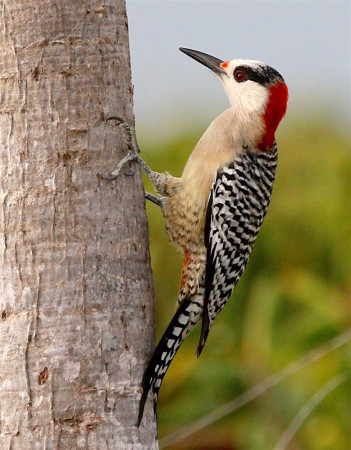
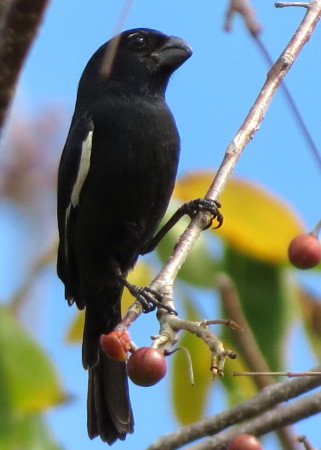
The West Indian Woodpecker, endemic to the Bahamas, Cuba and the Cayman Islands, is one of the 172 Caribbean endemics we hope will be counted on Global Big Day. (Photo by Bill Hebner)
How many birds can a world of birders find in one day? Hopefully, you will join us to find out on May 13th — Global Big Day. This is the single biggest day for eBird and we’re inviting everyone to spend some time counting and enjoying Caribbean birds to help support global conservation efforts (and to have some fun in the process). Last year was a huge success that broke records around the world and across the Caribbean. The question is: Can we do it again?
More than one hundred Caribbean birders participated in last year’s Global Big Day, setting a new Global Big Day record for the Caribbean itself- 428 species! Thank you for making this possible. Your contributions to the past two Global Big Days have set back-to-back world records for the most bird species seen in a single day. Last year’s Global Big Day featured more than 60% of the world’s bird species in a single day (6,299!), with sightings coming in from more than 17,500 eBirders spread across 154 countries.
Want to be a part of the fun this year? If you need an excuse to go enjoy birds on a lovely weekend day in May, we’ve got you covered. The West Indies, with it’s 175 endemic bird species, along with it’s near endemics and endemic subspecies, will be key in gathering a snapshot of bird distribution around the globe.
If you’re looking to get started preparing for this year’s Global Big Day, here are four quick ways to have the most fun:
“Scout” your birding spots for May 13. Finding where the birds are ahead of time makes the big day birding more fun, and also gives you more chances to be out enjoying birds. Perfect. Learn how to use eBird to find birds.
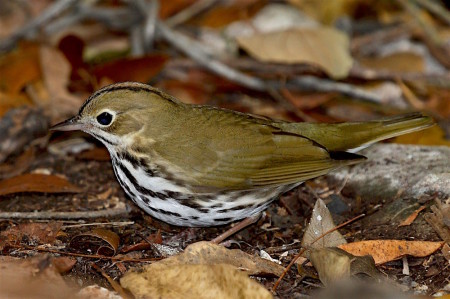
Hopefully, a few migrants, like this Ovenbird, are still lingering in the islands and will be included in some checklists! (photo by Bill Hebner)
Use eBird Mobile. This free data-entry app makes it so you don’t have to enter your sightings at the end of the day, and tools like Quick Entry mean you have less time with your face in a notebook. Get eBird Mobile here.
Get a friend involved. Perhaps this is a good birding buddy, or someone who has never been birding before. Make it a friendly competition, or join forces as a Global Big Day team, and put your marker on the global participation map. Share on social media using #eBird_GBD. Check out the Facebook event.
Participating in Global Big Day is a great way to celebrate the Caribbean Endemic Bird Festival, ongoing now! Make this a part of your celebration and organize a birding outing with family, friends or your community.
No matter what you do—have a great time, enjoy the birds around you, and let us know what you find! We’re excited to see what we can achieve together on Global Big Day.
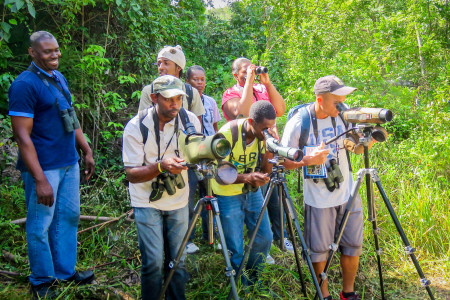
Identifying and counting birds in Cockpit Country, Jamaica. (Photo by Lisa Sorenson)
And don’t forget to enter your Caribbean bird counts into eBird Caribbean – our own portal. All the data goes to the same place but we have some of our own protocols (Step 2 of data submission), for example, counts conducted at wetlands, ponds, mud flats and beaches can be entered as Caribbean Waterbird Census counts.
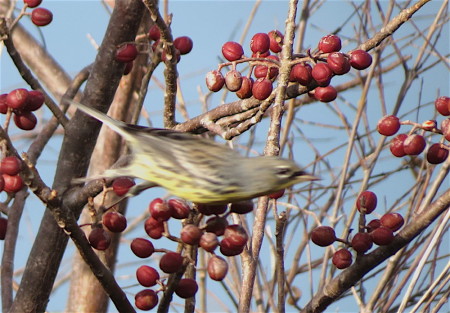
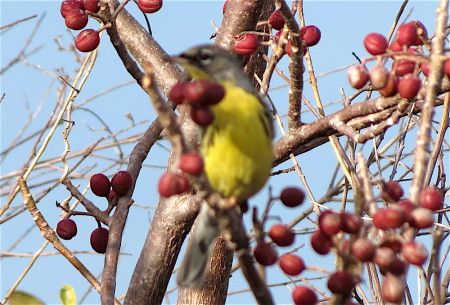
Kirtland’s Warbler spotted on Cayo Guillermo Cay off the northern coast of Cuba. The bird (male) is identified by its yellow underparts with black streaks on flanks, white undertail coverts, blue-gray upperparts with black streaks, and conspicuous white eye-crescents that contrast with black lores and forehead. This appears to be a first winter male as the bird shows some brown on its upperparts and face. (photo by Anne Goulden)
Anne Goulden, from Sarnia, Ontario, spotted and photographed a Kirtland’s Warbler (Setophaga kirtlandii) on a recent birding trip to Cuba, making this the first “official” sighting of the bird on Cuba.
Anne Goulden has been an avid birder for ten years. “Birding has been a hobby—make that an obsession—since 2007,” she says. Anne had just finished a 9-day birding tour in Cuba with Eagle Eye Tours and had arranged to stay on an extra three nights at their last stop, the Cayo Coco Cays located along the northern coast of Cuba. She wanted to bird at a leisurely pace on her own before returning home. The group was staying at the Iberostar Playa Pilar Hotel in Cayo Guillermo, one of the Cayo Coco Cays, known as a birding hot spot because of the Cuban and regional Caribbean endemics that live in the area.
On February 22nd Anne’s tour group birded for about 1 km along the road between their hotel and the Playa Pilar Beach looking for a Bahama Mockingbird, a species found only in a few locales in Cuba, Jamaica, and in the Bahamas and Turks and Caicos Islands. “We were out for about an hour and were lucky enough to find a few Bahama Mockingbirds in addition to warblers and a few local birds,” Ann commented. The bus returned to the hotel to send everyone off to the airport to return home.
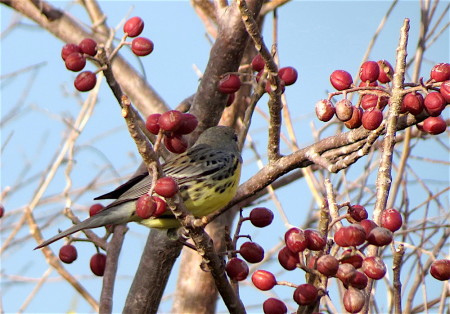
This photo shows the yellow throat, breast and belly, white undertail coverts and black lores of the Kirtland’s Warbler. The broken white eye ring is also clearly visible. Female Kirtland’s are similar to males but have no black on the face and their upperparts and face are more brown. (photo by Anne Goulden)
The next morning, February 23rd, Ann set out at on her own at about 7am along the same road to see what else she could find. She spotted an unfamiliar bird in a tree with red berries about an hour into her walk. “I wish I could say I knew what it was, but I didn’t,” said Anne. “I knew it was a warbler, but that was about it. I managed to get a few poor photos before it flew off.”
After Anne returned home she looked through her pictures, but still couldn’t place the bird. Ann was disappointed that her photos were not in sharp focus, but she knew that they were clear enough for an ID. She sent the pictures to two local birders who both suggested Kirtland’s Warbler, but it wasn’t even in Anne’s book so she did not include it in her e-bird checklist until the bird was also positively identified as a Kirtland’s by her two tour leaders, Hector Gomez de Silva and Colin Jones (the ID was also confirmed by eBird Caribbean reviewers). The individual appears to be a juvenile male (first winter).
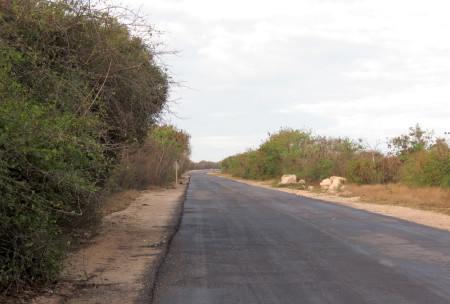
The road where the Kirtland’s Warbler was spotted on Cayo Guillermo, one of the Cayo Coco Cays on the northern coast of Cuba. The road leads to Playa Pilar beach and beyond that to a new hotel under construction. (photo by Anne Goulden)
“I was very excited to have this bird confirmed as a Kirtland’s Warbler,” exclaimed Anne. “I live in Ontario so know about the Kirtland’s and what a rare bird it is, but I never expected to see one in Cuba. I have only had a fleeting look at this bird once before, in Ontario in 2014.”
One of the rarest songbirds in North America, the Kirtland’s Warbler is listed as “Endangered” under the Endangered Species Act of 1973. Its current status is Near Threatened on the IUCN “Red list of Threatened Species,” upgraded from Vulnerable in 2005, thanks to successful recovery efforts.
The Kirtland’s Warbler winters primarily in the Bahamas Archipelago, which includes The Commonwealth of The Bahamas and the Turks and Caicos Islands. It inhabits early successional broadleaf scrub or shrubby habitats, where it feeds on fruits, insects and spiders. Recent surveys indicate that the warblers most commonly winter in the central islands of The Bahamas including Eleuthera, Cat Island, San Salvador, and Long Island.
The Kirtland’s Warbler was spotted feeding on berries of the Gumbo Limbo tree (Bursera simaruba), a very important food source for many birds, including migratory warblers fattening up in their Caribbean wintering grounds for their long journey north to their breeding grounds in spring. (photo by Anne Goulden)
Kirtland’s Warblers are known to overwinter outside of the archipelago, however, as documented by a photograph of an individual during a Christmas bird count on Bermuda in 2004, and a bird photographed in Key West, Florida this past winter. In addition, there have been sight records of wintering Kirtland’s Warblers from northern Mexico, Dominican Republic, and Cuba. Unfortunately sight records alone are insufficient for “official” documentation, which requires either a good photo or a specimen of the bird. Thus, the fact that Ms. Goulden photographed a Kirtland’s Warbler (with typical field marks visible) verifies for the first time the “official” presence of the warbler in Cuba.
The habitat where the bird was found and the photo of the warbler feeding on the fruit of Gumbo Limbo or Gum Elemi (Bursera simaruba) are all typical of the habitat and behavior of the wintering Kirtland’s Warblers observed in The Bahamas. In addition, the first Cuban sight record of the warbler in 2006 was also from the Cayo Coco cays. The cays located off Cuba’s north coast have typical scrub vegetation including Black Torch (Erithalis fruticosa), Wild Sage (Lantana involucrata), and Snowberry (Chiococca spp.) which also produce the fruits favored by the warbler. The cays also host specialties such as the Bahama Mockingbird and Thick-billed Vireo, both of which are typical birds of the Bahamian bush.
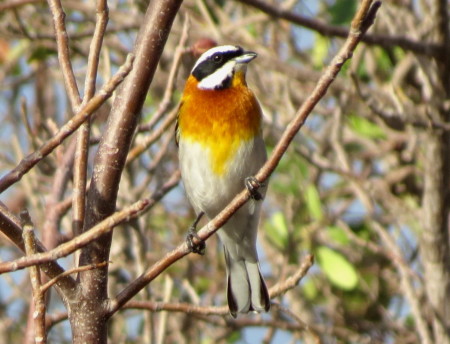
A beautiful Western Spindalis spotted on Cayo Guillermo; this bird is endemic to Cuba, the Bahamas, Cayman Islands and Cozumel. (photo by Anne Goulden)
In recent years, more and more observations of the Kirtland’s Warblers have been made during the winter months. Some of the increase in observations might be attributable to more birders in the field in the warbler’s habitat. The more likely explanation, however, is that increased wintering grounds observations are attributable to the increase in the size of the Kirtland’s Warbler population at least since the 1970s and 1980s. This increase in the population of the warblers is directly attributable to the success of the intensive recovery effort focused on the warbler’s breeding grounds in Michigan.
Kirtland’s Warbler breeds in early successional Jack Pine (Pinus banksiana) habitat primarily in Michigan with recent breeding now established in similar habitat in southern Ontario and Wisconsin. Habitat loss and degradation coupled with nest parasitism by Brown-headed Cowbirds were the primary factors contributing to the species decline to record low populations of the 1970s and 80s. In that period, counts of approximately 200 singing males on the breeding grounds were typical, whereas today, thanks to habitat management and cowbird control, the recent breeding ground censuses of singing males is approximately 2,350 singing males. [The biologists are not being sexist, its just that females are difficult to detect and count in contrast to the males which are obvious as they sing on their territories in early spring; the sex ratio is assumed to be 50:50]. Thus the abundance of recent winter observations of the Kirtland’s Warbler is a testament of the success of the conservation program directed at the recovery of this endangered species.
Cuban Bullfinch on Cayo Guillermo, endemic to Cuba and the Cayman Islands. (photo by Anne Goulden)
A recently published article by Dr. Nathan Cooper and his colleagues from the Smithsonian Institution suggests the possibility of some Kirtland’s Warblers occurring in Cuba. The research, based on use of light-sensitive geolocators to track the warbler suggests the occurrence of Kirtland’s Warblers wintering in Cuba; the photo obtained by Ms. Goulden establishes the fact. Congratulations to Ms. Goulden!
“I don’t live far from Michigan and hope in the next year or two to make a trip to the Kirtland’s Warbler’s famed breeding grounds,” said Anne. “Seeing this rare bird on its wintering grounds is, however, probably the most exciting thing that is likely to ever happen to me as a birder! I’m thrilled I was in the right place at the right time and managed to get a photo of the bird. It’s certainly rewarding for ordinary citizens like myself to contribute to science through our birding activities and use of eBird Caribbean!”
By Lisa Sorenson and Joe Wunderle
Anne Goulden’s checklist from 23 February, 2017 with the Kirtland’s Warbler can be viewed at this link.
Andrew Dobson’s checklist from 19 December, 2004 with the Kirtlands Warbler can be viewed at this link.
Congratulations to Anne Goulden for her first official sighting of the Kirkland’s Warbler in Cuba. “Seeing this rare bird on its wintering grounds is probably the most exciting thing that is likely to ever happen to me as a birder! ” she exclaimed.
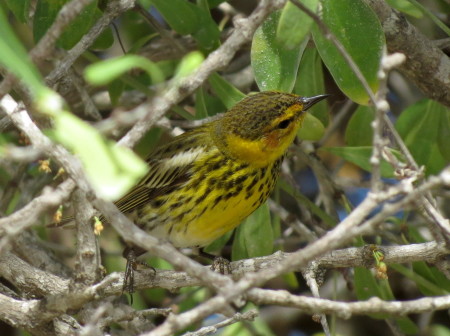
Cape May Warbler, a common wintering warbler in Cuba and throughout the entire Caribbean region, was also seen in the Cayo Coco Cays. (photo by Anne Goulden)
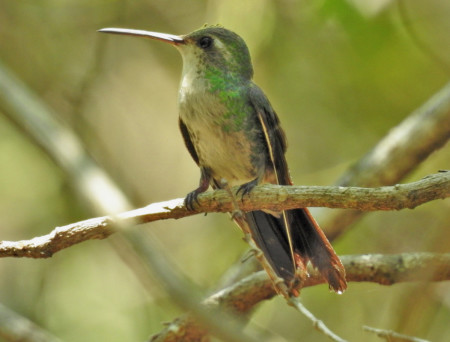
A lovely Cuban Emerald hummingbird (female), one of the species spotted by Erika Gates and her team on Global Big Day, Crabbing Bay, East Grand Bahama. (Photo by Erika Gates)
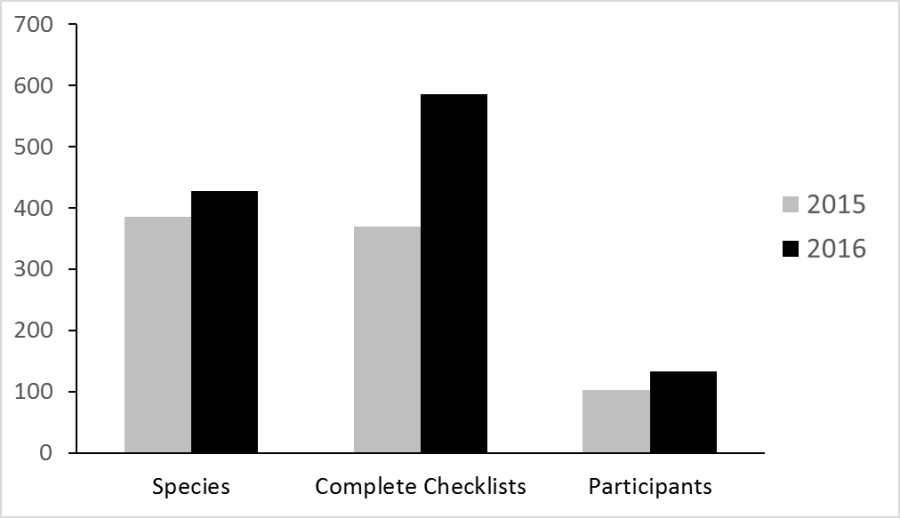
More than one hundred Caribbean birders participated in this year’s Global Big Day, helping to set a new world record of 6,299 species, as well as set a new Global Big Day record for the Caribbean itself! In order to break the old record, birders all over the world spent the 24 hours of May 14 observing and counting as many species as possible—jointly recording over 60% of all living birds in only one day and passing the old record by 141 species! In the eBird Caribbean region*, the 428 species seen (278 in the West Indies) was 42 more than last year. By joining the Global Big Day, participants enjoyed an exciting day of birding, but also showed their support for bird conservation and citizen science in the Caribbean and around the world.
Below are some statistics and a few of the many highlights from Global Big Day in the Caribbean. You can further explore Global Big Day results and statistics for the Caribbean and the rest of the world at the Global Big Day Headquarters, while a global summary and highlights can be found here.
Highlights from the Caribbean
In the West Indies sub-region, the Big Day total of 278 species was 41% of the species on the eBird West Indies species list. A major accomplishment, considering that many wintering species had already left the Caribbean while others are rare species which are not present every year. Complete Global Big Day lists for specific countries can be found by typing the name of the country in the “Explore a Region” box on the Global Big Day page, while a West Indies-only regional list can be found at this link. If you saw a species on May 14 that is missing from the list, you can still enter sightings and have them count!Click here to enter your sightings in eBird Caribbean.
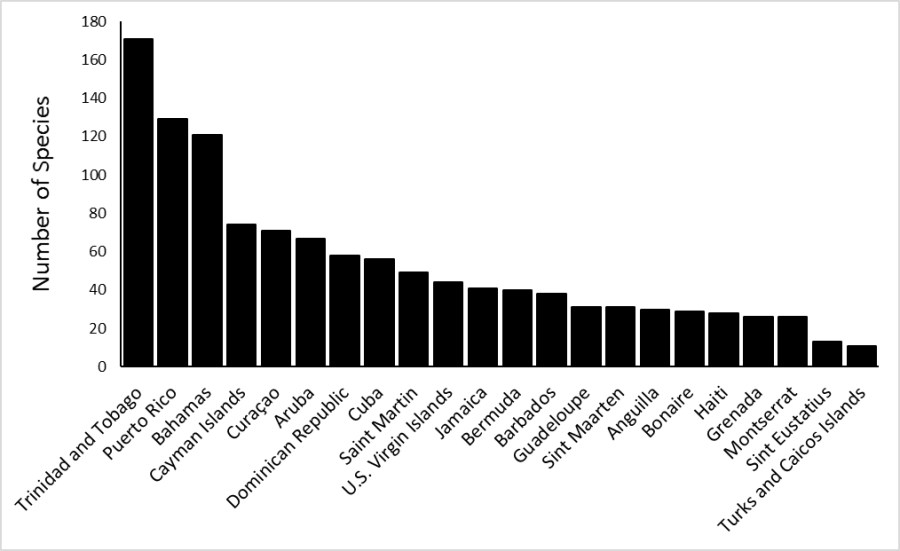
Of the 21 Caribbean countries that participated in the Global Big Day, Trinidad and Tobago again reported the most species (171). However, this was way more than the 112 species seen in Trinidad and Tobago last year, and good for 40th place worldwide! Puerto Rico was next with 129 species, then Bahamas (121), Cayman Islands (74), and Curaçao (71) for the rest of the top five. You can find the worldwide list of country rankings here.
Number of species seen in each country in the Caribbean during the 2016 Global Big Day. See how your country or island compares with the rest of the Caribbean.
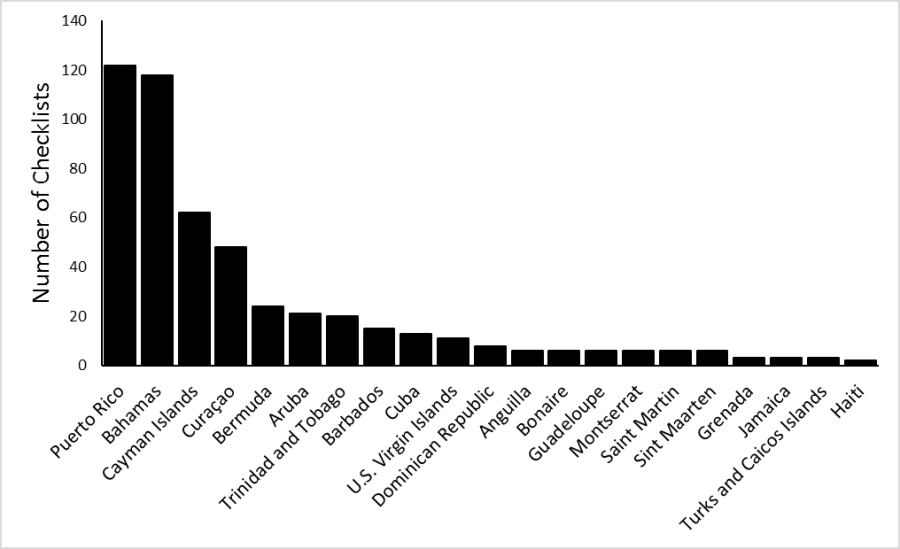
This year 60% more checklists (586) were entered in eBird Caribbean from 133 eBirders, representing a large improvement in participation over last year. Puerto Rico (122 checklists) and the Bahamas (118) showed especially large increases in the number of checklists, with twice as many for Puerto Rico and four times as many for the Bahamas. This allowed these two countries to lead the Caribbean for numbers of checklists this year and also to rank in the global top 25! Other countries with strong participation included the Cayman Islands (62 checklists) and Curaçao (48).
Number of checklists from each country in the Caribbean during the 2016 Global Big Day. Puerto Rico submitted the most checklists: 122 in just one day!Caribbean eBirders were very successful in this year’s Global Big Day, finding more species, submitting more checklists, and getting more participants involved than last year.
The most species seen by one person was 122 by Julio Salgado, John Garrett, and Gerardo Toledo on Puerto Rico. John Garrett and Julio Salgado also tied the Curaçao Footprint Foundation in submitting the most complete checklists with 17. You can find out how your personal Global Big Day totals compared to other Caribbean birders here (West Indies only).
107 out of 172 possible West Indies endemics were found by Caribbean birders this year, making an important contribution to breaking the Global Big Day world record.
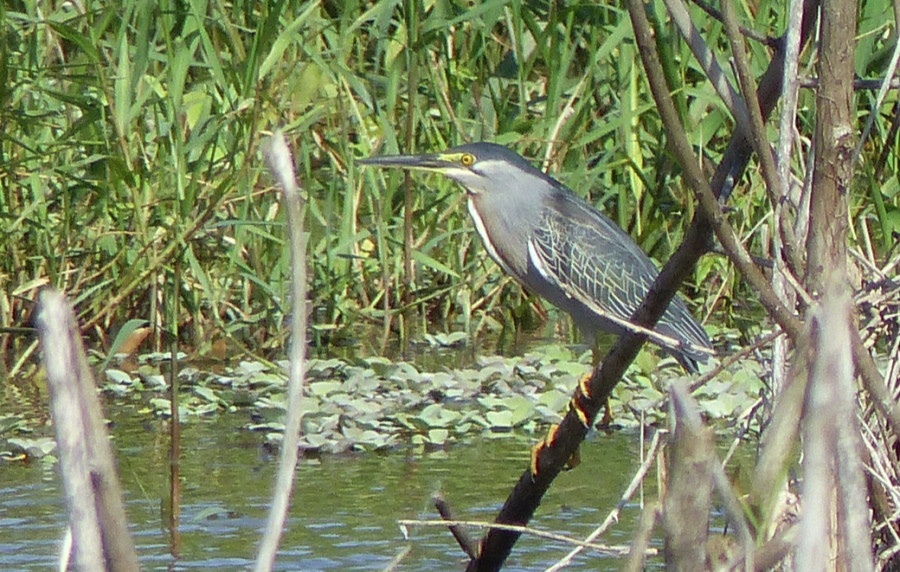
Birds were not only counted but also photographed: photographs of 129 species were added to Global Big Day checklists. We’ve linked to a very small sample of them here, including nicely illustrated checklists from Erika Gates in the Bahamas (here and here), Michael Good in the Dominican Republic (here), and Henriette de Vries on Curaçao (here), and a rare Striated Heron (Butorides striata) photographed by John Garrett on Puerto Rico.
Thank you to everyone who participated and made this Global Big Day successful. We hope you had a great time and will continue to participate in eBird Caribbean and future Global Big Days. Of course, eBird Caribbean doesn’t only exist on one day of the year. Global Big Day is just one of 365 opportunities/year to be a part of a global network of birdwatchers, researchers, and conservationists working together with a shared passion for birds. Any bird that you see, anywhere, at any time, can become a part of this global resource—helping your fellow birdwatchers as well as the birds that we all care about. So take a look at eBird Mobile, or how to find birds near you. Go out, explore, have fun, and let all of us know what you saw. Your sightings can help change the world. We’ll see you out there.
Team eBird and Doug Weidemann
*The countries comprising the eBird Caribbean portal consist of the West Indies plus Trinidad and Tobago, Aruba, Bonaire, Curaçao, and Bermuda.
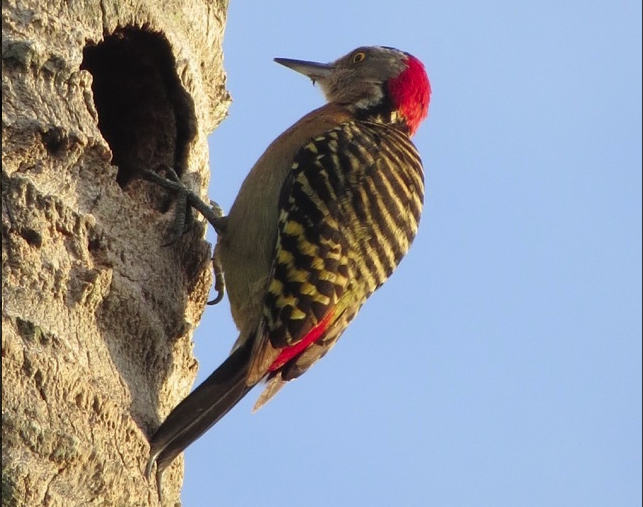
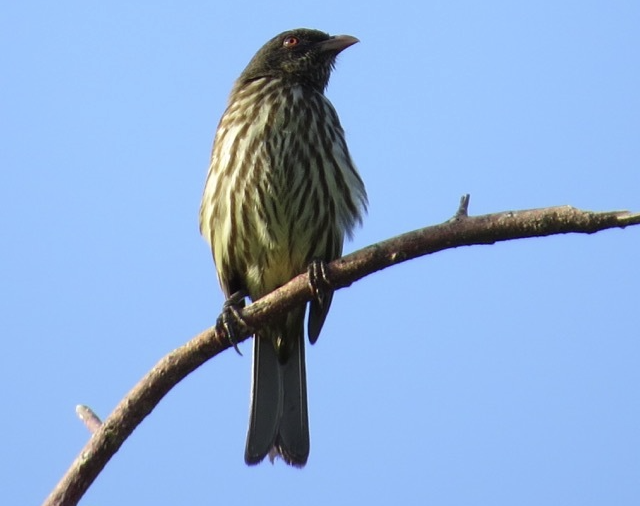
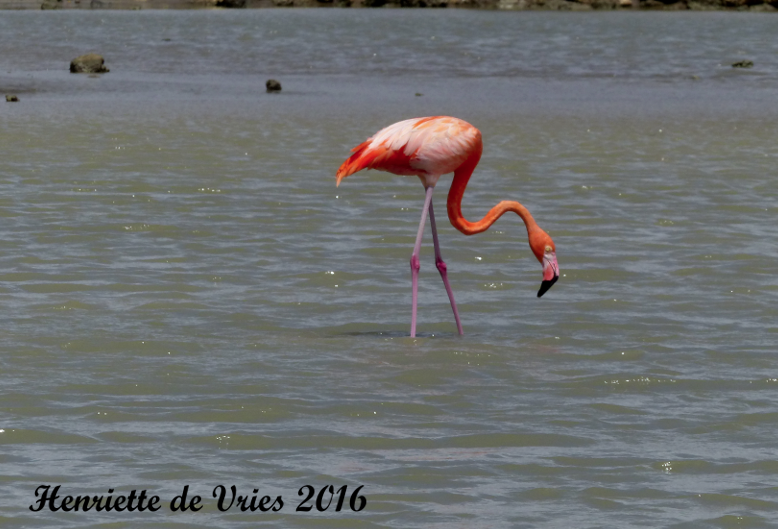
A rare Striated Heron seen by John Garrett and his team on Global Bird Day in Puerto Rico (Valle de Lajas, Lajas, PR). (Photo by John Garrett)Hispaniola Woodpecker, endemic to the Dominican Republic was photographed by Michael Good in Puerto Plata, DR on his Global Big Day count.Palmchat perched on a branch, another DR endemic spotted on Global Big Day. (photo by Michael Good)American Flamingo in Curacao, counted and photographed on Global Big Day, was part of Henriette de Vries count. (photo by Henriette de Vries)
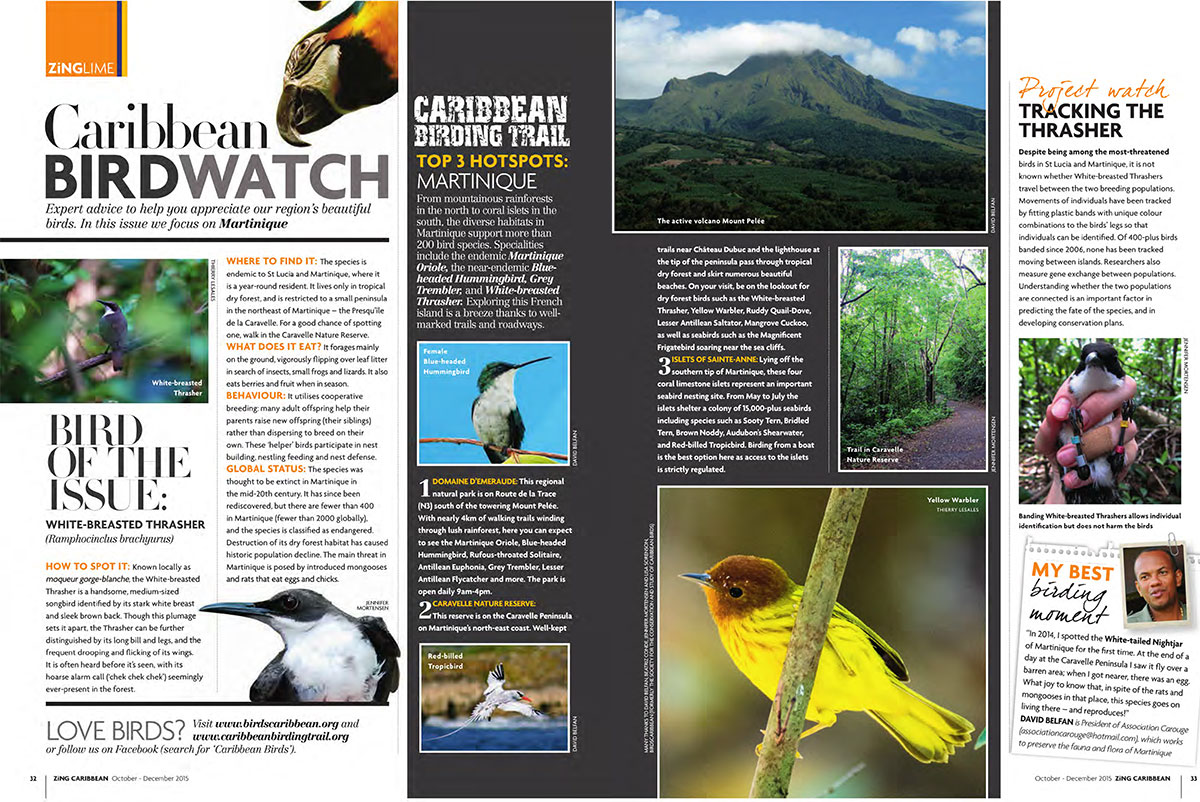
Head to Martinique in the latest edition of Caribbean BirdWatch.In every issue of ZiNG, LIAT’s in-flight magazine, Caribbean BirdWatch takes readers on a trip to a different Caribbean island to learn more about birds and the best spots to see them. In the Fall 2015 issue, our destination is Martinique, where we learn about the White-breasted Thrasher, which is found only on Martinique and St. Lucia. We also explore the top three birding sites on the island and relive the best birding moment for David Belfan, President of Association Carouge, which works to preserve the flora and fauna of Martinique.
Learn about the birds of St. Vincent and the Grenadines.The latest issue of Caribbean BirdWatch takes us down to St. Vincent and the Grenadines for a look at their endemic Whistling Warbler, a tour of the top birding sites on the island and an inside look at an upcoming book about the birds of these islands. Download the PDF.
ZiNG is the complementary magazine from LIAT, the Caribbean Airline.
Caribbean Birdwatch is featured in every issue of Zing magazine.
Our latest Caribbean BirdWatch page in ZiNG magazine – Spring 2014 issue. Read about the fascinating and elusive Masked Duck and birds and birding in beautiful Barbados! Download the PDF.
ZiNG is the complementary magazine from LIAT, the Caribbean Airline.