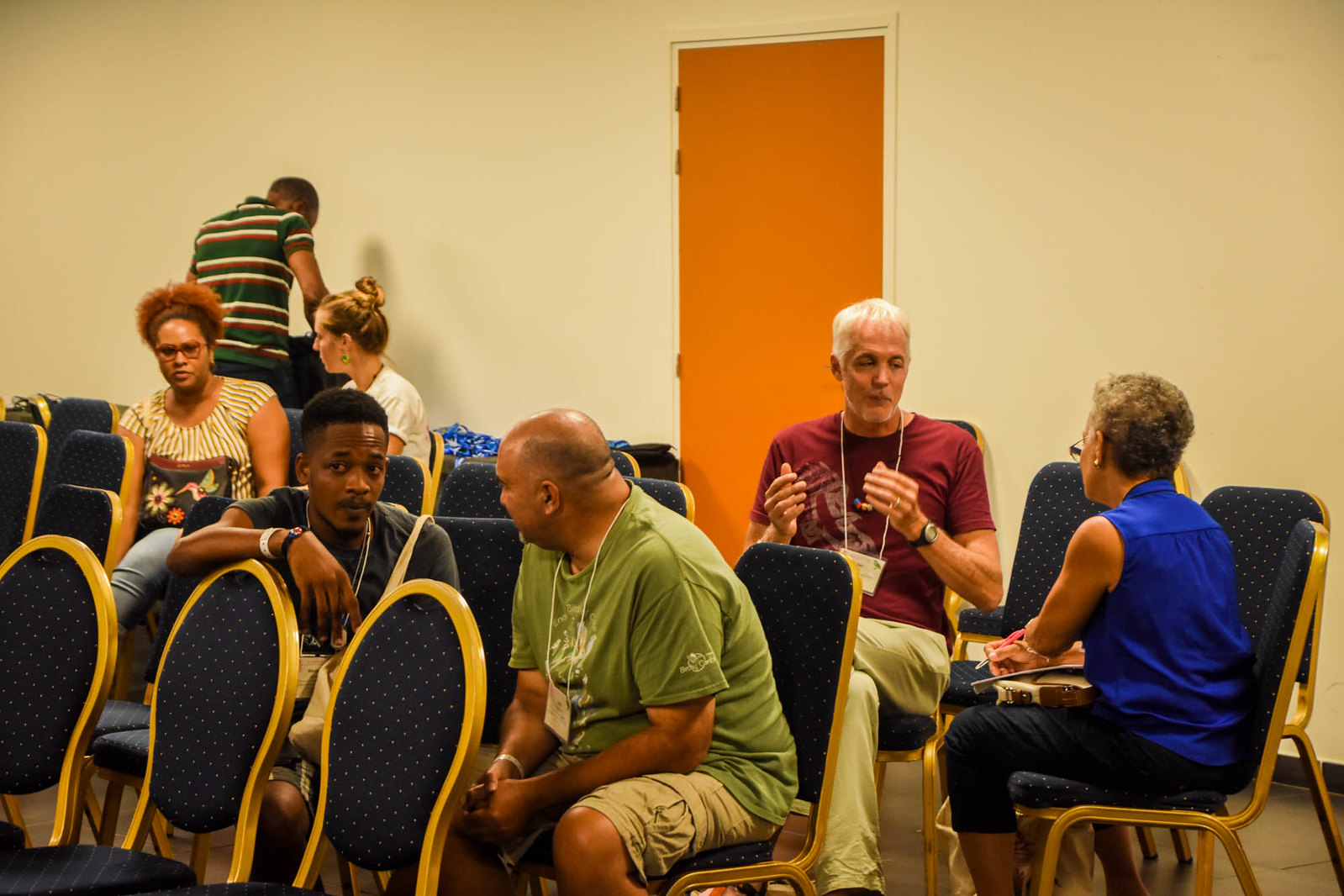
It goes without saying that every member of the BirdsCaribbean community deserves recognition for the amount of hard work and dedication they put into their professions—all of which are rooted in the effort to conserve Caribbean birds and their habitats. This is a family that knows long hours, hot days in the field, and perseverance in the face of work that is often unpredictable. It is a family of strong and passionate people.
But at every BirdsCaribbean conference we set aside a special block of time to acknowledge those of us that have managed to go even more above and beyond in a variety of distinguished ways. In the evening of the final day of the conference, all of our conference delegates gather in the largest presentation room. Although everyone is itching to hit the dance floor to celebrate the closing of another successful conference, they know that the Awards Ceremony is not only a ritual, but an important moment to show support for some of their amazing colleagues. We were pleased and proud to honor 12 special persons at our recent conference in Guadeloupe (July 2019) with an award.
On the final night of the Guadeloupe Conference, delegates gather in good spirits in anticipation of the Awards Ceremony.
Here’s a recap and another shoutout to all of our 2019 Award Winners:
Founders’ Award: This award is presented to the student who presents the best paper in conservation or management research at the biennial conference. All student presentations are judged by members of a Founders’ Award Committee, consisting of ~10 conference delegates and led by Joe Wunderle.
This year’s Founders’ Award went to Christopher Cambrone from Guadeloupe, for his outstanding presentation entitled, “Population genetic structures of two closely-related, Caribbean-endemic Columbid species, the Scaly-naped Pigeon, Patagioenas squamosa, and the White-crowned Pigeon, P. leucocephala.”
Christopher Cambrone takes home the Founders’ Award for best student presentation, recognition that earns him a Lifetime Membership to BirdsCaribbean. (photo by Mark Yokoyama)
This is the fourth year that this award has been presented, but the first time an Honorable Mentions category was instituted (no doubt as a response to there being so many great student presentations, year after year). The two Honorable Mentions include (1) Spencer Schubert and his presentation, “Artificial perches as a technique for enhancing tropical forest restoration: a case study from the central Dominican Republic, and (2) Laura Fidalgo and her presentation, “Characteristics of Elfin-woods Warbler (Setophaga angelae) post-hurricane habitat structure.” More information on these presentations and past winners of the Founders’ Award can be found here.
President’s Awards: There were three particularly special community members that received the President’s Award, hand chosen by BC’s current President, Andrew Dobson. These individuals stand out for services and work they have done that are simply extraordinary, raising the bar to new heights. The winners of the 2019 President’s Awards went to (1) Jennifer Wheeler for all of the blood, sweat, and tears that she relentlessly gives to the BirdsCaribbean organization, (2) Doug Weidemann for 10+ years of devoted service to the Journal of Caribbean Ornithology, and (3) Anthony Levesque for being a leader for birds and bird tourism on his home island of Guadeloupe.
Anthony Levesque (right) looks up in surprise to see that he has won the President’s Award for his nonstop work with birds and bird tourism on Guadeloupe. (photo by Mark Yokoyama)
Educators Awards: These awards are given jointly by BirdsCaribbean and their partner, Environment for the Americas, to those that have excelled as educators in their communities. With great enthusiasm and energy, these persons have consistently organized fun and creative communities activities for both the Caribbean Endemic Bird Festival and World Migratory Bird Day. Educators Awards were presented to (1) Andrea Thomen and (2) Hector Andujar, both affiliated with Grupo Jaragua in the Dominican Republic, (3) Ava Tomlinson who works with the National Environment and Planning Agency (NEPA) in Jamaica, and (4) Kate Wallace (stay tuned for much more on her).
Hector Andujar accepts the Educators’ Award for Grupo Jaragua. (photo by Mark Yokoyama)
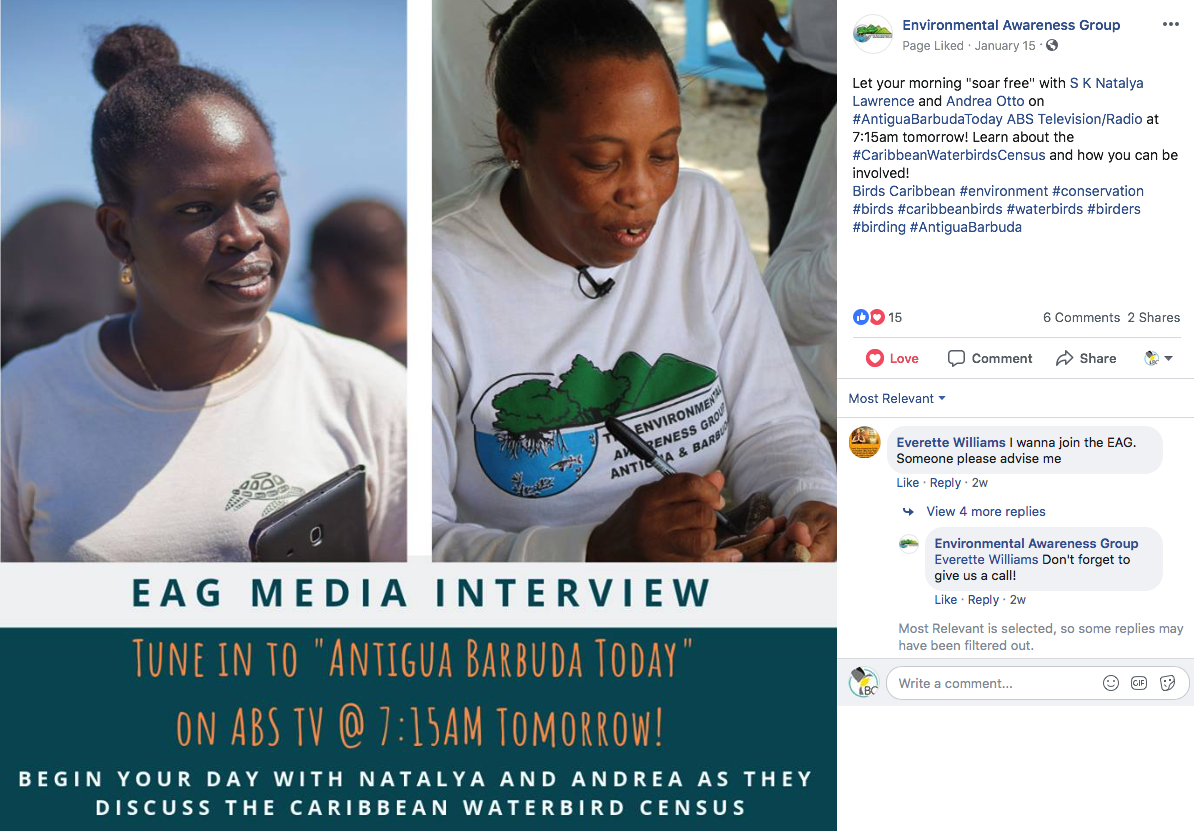
Three organizations were recognized for doing wonderful events and faithfully turning in reports with a gift of 3 pairs of binoculars to their organizations, thanks to the generosity of Joni Ellis and Optics for the Tropics. These were the Environmental Awareness Group of Antigua and Barbuda (Natalya Lawrence and her son Jordan accepting), Les Fruits de Mer of St. Martin (Mark Yokoyama and Jenn Yerkes), and Adrianne Tossas (who leads the Avian Ecology and Conservation Project at the University of Puerto Rico, Aguadillas).
Les Fruits de Mer (Jenn Yerkes and Mark Yokoyama on right) receiving recognition and binoculars for turning in reports of their World Migratory Bird Day activities.
Site Fidelity Award: Have you ever noticed one particular bird that stays year-round on your property, despite all of its flock leaving for periods of time? It’s always there, it’s always singing, and somehow it gets by and is content no matter the season and no matter the weather. Over the years, you come to depend on that bird to be there to brighten your day, and to be your friend. And that bird always does; it never disappoints. There is a special someone in our community that fills that same niche. The Site Fidelity Award is a special award designed to be given only once, in recognition of an individual that has been loyal to and supportive of the BirdsCaribbean family since the very beginning of the society’s existence…since 1988. That amazing person is Joe Wunderle, and we are extremely lucky to have him in this family.
Joe Wunderle (second from left) receives the one and only Site Fidelity Award for being the longest running BirdsCaribbean member that has not missed a single conference in 30 years! (photo by Mark Yokoyama)
Lifetime Achievement Awards: These are the most prestigious awards, presented to the people in the BirdsCaribbean family that everyone knows and respects for the lifetime amount of work and dedication they have shown to our cause. It goes without saying, that these are remarkable individuals that have helped change the future for Caribbean birds and their habitats for the better. The 2019 Lifetime Achievement Awards went to (1) Kate Wallace, a woman that has served the Caribbean in so many capacities, including Peace Corps volunteer, researcher, naturalist, author, bird guide, educator, and community leader, and (2) Maurice Anselme, Director and longtime leading force behind the many environmental successes of the Parc National de la Guadeloupe.
Kate Wallace (far right), who earlier this year celebrated her 80th Birthday, is overwhelmed to have received a Lifetime Achievement Award (not to mention and Educators Award as well!)
Although these awards to Kate and Maurice do not include the extensive retirement packages they both deserve, they should each know that across the islands there are hundreds of doors open to them, with loving friends and colleagues waiting inside to welcome them.
So, congratulations again Christopher, Spencer, Laura, Jennifer, Doug, Anthony, Joe, Andrea, Hector, Ava, Kate, and Maurice. . .
You have, without a doubt, earned the recognition!
Photo gallery: Hover over each photo in the gallery to see the caption or click on a photo to view as a slide show.
Doug Weidemann (second from right) accepts a President’s Award for more than a decade of work he has invested into the Journal of Caribbean of Ornithology. (photo by Mark Yokoyama)
Jennifer Wheeler (right) has been a powerhouse for BirdsCaribbean. She fully deserves this President’s Award (and a night off)! (photo by Mark Yokoyama)
The Environmental Awareness Group, represented by Natalya Lawrence, receives recognition and a token of gratitude for organizing wonderful WMBD events and reporting back. (photo by Mark Yokoyama)
Spencer Schubert (center)) is proud to have received an Honorable Mention Founders’ Award for his graduate work in the Dominican Republic. (photo by Mark Yokoyama)
The Avian Ecology and Conservation Project, led by Adrianne Tossas, receives recognition and a token of gratitude for organizing wonderful WMBD events and reporting back. (photo by Mark Yokoyama)
Ava Tomlinson, Senior Public Education Community Outreach Officer with the National Environment and Planning Agency (Jamaica) received an Educators Award for the many wonderful events she organizes in different communities in Jamaica (accepted by Ann Sutton). (photo by Mark Yokoyama)
Hector Andujar and Andrea Thomen, both with Grupo Jaragua in the Dominican Republic show off their awards after the ceremony. (photo by Yolanda Leon)
The Dominican Republic swept the awards this year! Andrea Thomen, Hector Andujar and Kate Wallace of Grupo Jaragua (photo by Yolanda Leon)
Laura Fidalgo (center) accepts an Honorable Mention Founders’ Award for her work with the Elfin-woods Warbler in Puerto Rico. (photo by Mark Yokoyama)
Andrea Thomen (center) receives the Educators Award for the strong impact she has made with youth and communities in the Dominican Republic. (photo by Mark Yokoyama)
Maurice Anselme (with plaque), the Director of the Parc National de la Guadeloupe, dedicates his Lifetime Achievement Award to all the staff of his national park. (photo by Mark Yokoyama)
Birds of the Transboundary Grenadines is an innovative new avian field guide by co-authors Juliana Coffey and Alison (Aly) Ollivierre for the Grenadine archipelago shared between the countries of Saint Vincent and the Grenadines and Grenada in the Eastern Caribbean. This is the first guide to specifically cover these transboundary islands, which are geologically, ecologically, historically, and culturally more similar to one another than to their respective mainland islands (Saint Vincent and Grenada). The book contains:
140+ pages of high-quality photographs of the birds and natural areas of the Grenadines
117 bird profiles with details on identification, diet, habitat, local knowledge, and sightings
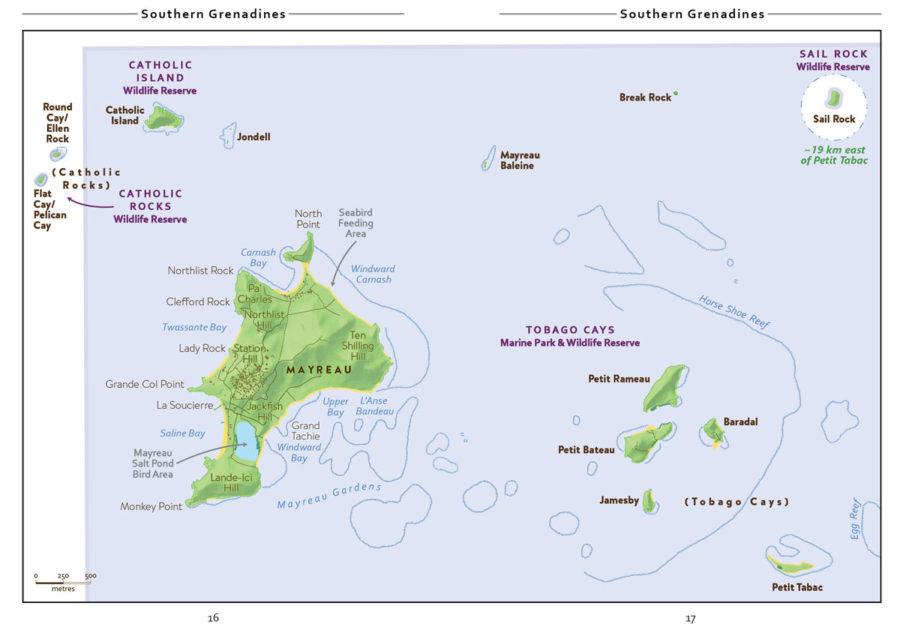
14 detailed maps illustrating conservation areas and local toponyms on more than 50 islands and cays
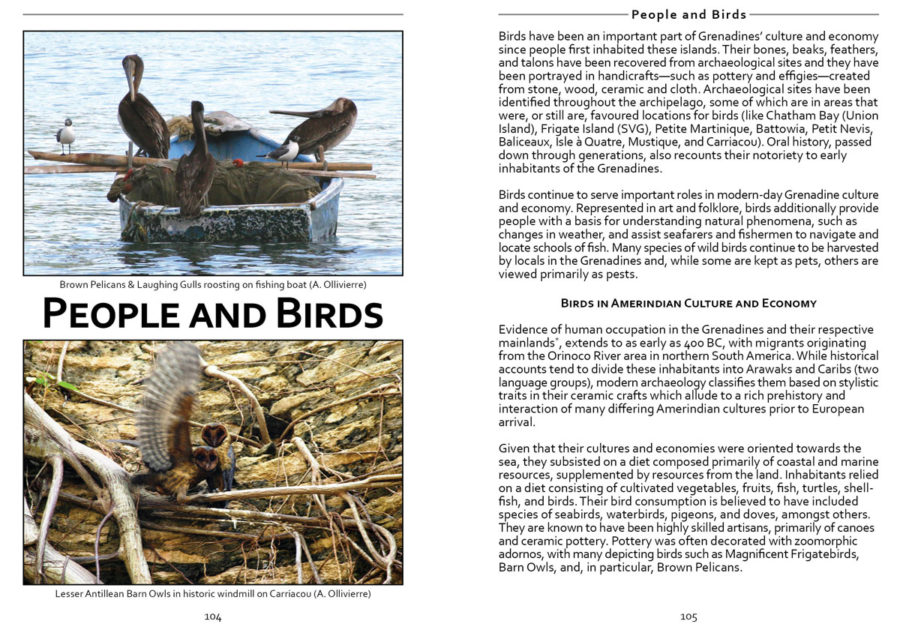
Full chapter of previously undocumented local ecological knowledge, folklore, and prehistoric-to-modern-day human values of birds
To purchase via credit card (more buying options are listed below):
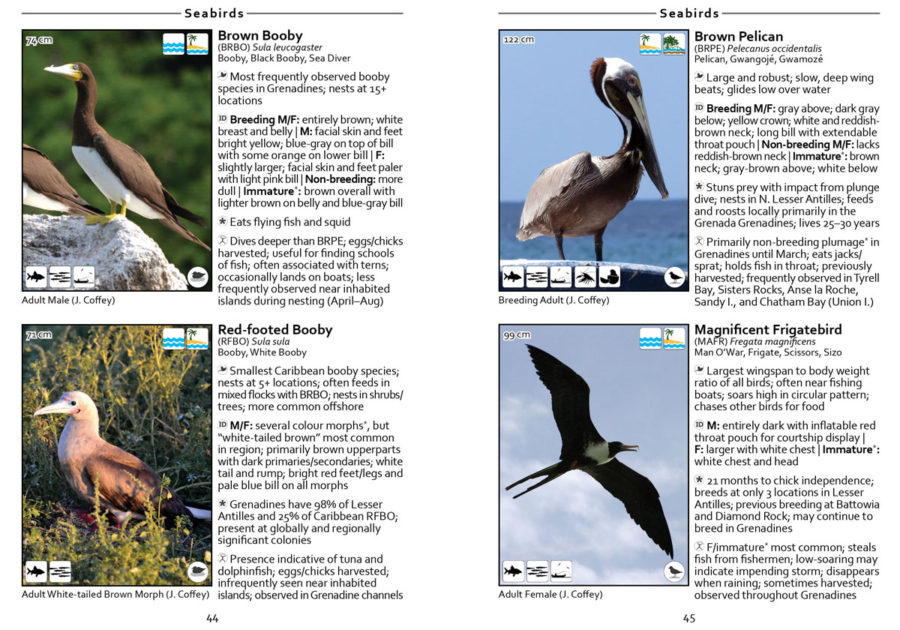
A page of seabird profiles in “Birds of the Transboundary Grenadines” with text detailing a description of each species, including identification, interesting facts, local knowledge, and symbols depicting habitat, diet, and migratory statusOne of the 14 detailed maps, featuring Mayreau and the Tobago Cays, in “Birds of the Transboundary Grenadines”First page of the “People and Birds” chapter of “Birds of the Transboundary Grenadines”
On one fateful rainy day in July 2011, Juliana and Aly met at the airport on Union Island where they had both just moved for work in their respective fields. Not only did they become neighbors, but they quickly became great friends. Early on in their friendship, they saw an opportunity to collaborate on their professional interests and passion for ornithology, cartography and participatory strategies for conservation and management. Both authors have a strong background in community-focused research with Juliana working in co-management and documenting local ecological knowledge amongst indigenous and fisherfolk communities in Canada, Saint Lucia and throughout the Grenadines, and Aly facilitating participatory mapping programs in the transboundary Grenadines and conducting research on participatory mapping in the Caribbean as a whole. Together their shared perspectives on the value of combining scientific with local ecological knowledge made for a perfect partnership.
Juliana and Aly have been living and working throughout the islands intermittently ever since, although not always at the same time or on the same island. Their continued commitment to completing this project allowed the book to be written and designed in all corners of the world—including at sea and remote field camps—as they regularly pursued other opportunities in their careers. They have conducted extensive literature and field research to ensure that this guide is regionally representative of the natural, cultural, and historical contexts of the islands. Local bird names, knowledge, and lore are highlighted throughout the book: compiled through consultation with over 100 stakeholders throughout the Grenadines.
The seven years the authors spent researching and writing Birds of the Transboundary Grenadines is evident in the book—the attention to detail and user-friendly design make the guide a valuable companion for any type of outing in the transboundary Grenadines! Juliana and Aly created this book with the following goals in mind:
serve as a valuable resource for local bird monitors to learn species identification and carry out surveys,
enhance the overall conservation and management of Grenadine resources,
educate the general public, and
be useful to both locals and foreigners with an interest in the avifauna of the region.
They’ve already received great feedback from local environmentalists, casual tourists, bird biologists, government officials and most importantly—the local fisherfolk and resource users who now take pride in seeing their knowledge represented in this publication. If you’re planning a trip to the Grenadines, this book is a must-have.
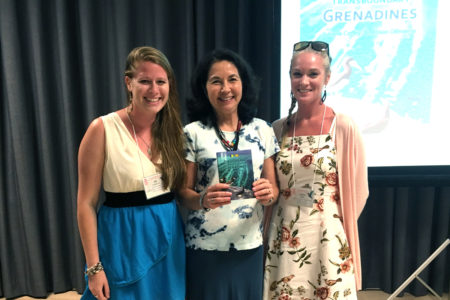
Alison Ollivierre (author), Lisa Sorenson (BirdsCaribbean Executive Director), and Juliana Coffey (author) at the book launch (Photo by Justin Proctor)
BirdsCaribbean was honored to officially launch this new and exciting avian field guide in July 2019 at their 22nd International Conference in Guadeloupe. Juliana gave a presentation on the local ecological knowledge research that went into the guide which provided additional information to the one Aly had given at the BirdsCaribbean 20th International Conference in Jamaica in 2017. After waiting four years since many of the BirdsCaribbean delegates had first learned about the upcoming book, everyone was excited to share in the celebration of this launch. The guide was especially praised for its skillful combination of scientific and local knowledge as well as its final chapter which focuses on interactions between people and birds in the Grenadines spanning from first occupation by Amerindians to the modern day.
The authors would like to thank everyone who assisted them throughout the duration of this project, including the more than 100 residents and visitors to the Grenadines who took the time to provide local knowledge and lore, and to all of the people that contributed to the crowdfunding and review of the book which made the publication possible. A complete list of acknowledgments is available in the book!
Buy the Book:
Birds of the Transboundary Grenadines can be purchased from BirdsCaribbean with a credit card below, or with a US check or postal money order made payable to BirdsCaribbean and mailed to 841 Worcester Street #130, Natick, MA 01760, USA.
Birds of the Transboundary Grenadines By Juliana Coffey and Alison Ollivierre 142 pages, section sewn softcover (7” x 5”), full color photographs and maps ISBN 978-1-9994585-0-8 Price: US$25 US shipping – $6.95 Canada shipping – $24.95
To purchase via credit card:
Please reach out to Alison Ollivierre if you’re interested in international shipping elsewhere and we can provide a shipping quote.
Books can be purchased within Saint Vincent and the Grenadines and Grenada at local businesses, for more information visit: www.grenadinesbirds.com/avian-field-guide
Please also consider helping Juliana and Aly fulfill their goal of getting copies of the books into the hands of all of the schools and relevant community organizations in the transboundary Grenadines! So far, more than one third of the books that have left their hands have been donated. Help them keep up this momentum with any donations that you can.
Interview with the Authors:
How did you first become interested in birds and birding?
Juliana: I first became interested in wildlife in general at a very young age, and at just five years old (even though I couldn’t spell the word “biologist”) I told my family that’s what I wanted to grow up to become. This was likely due to the plethora of stray animals that my parents let me take home and care for, always stating “no more pets!”, but always having room for just one more. When I was sixteen, I officially began my career with birds during a summer internship with a world renowned ornithologist, Dr. Bill Montevecchi, at Memorial University of Newfoundland, and was exposed to both the field research aspect and community outreach.
Aly: I first got excited about birds at an Audubon Youth Camp in rural Vermont in the 1990s when I had the opportunity to mist net and band birds with an ornithologist. I saved up for months for the first edition Sibley field guide, went birding with anyone who would go with me, earned the Girl Scout birding badge, and even competed on a youth team in the World Series of Birding in 2002.
Where did you go from there, did you decide to become ornithologists?
Juliana: I was very fortunate after my internship, that Dr. Montevecchi recognized my passion for wildlife, and decided to keep me involved in his work throughout my undergraduate degree. When I was 18 years old, he sent me to Labrador, Canada, to work in the field with indigenous seabird harvesters. Although I initially expressed that I did not want to work with hunters, his statement that “sometimes hunters are the best conservationists” changed my perspective entirely. After I saw first-hand how skilled and knowledgeable these hunters were, I very quickly became an advocate for traditional ecological knowledge and resource harvesting issues in marginalized communities, and that branched my career in a completely different direction. Since that time, I have always advocated for the consultation of local communities and the documentation of such knowledge that is threatened to be lost in future generations. I focus on seabirds, and as such, I have spent a considerable amount of time at sea and in remote seabird colonies ranging from the Arctic to the Southern Ocean, and working with fisherfolk.
Aly: By the time I got to university I had a hard time choosing between my interests in the hard sciences (environmental science, biology) and social sciences (history, sociology, international studies, political science). When I took my first geography class, I knew that was the perfect field to combine all my passions (think: environmental geography, historical geography, political geography). My career specialties are in participatory mapping and cartography, and while I didn’t become the ornithologist I thought I might be as a kid, I’ve found a really great balance doing conservation work with a geospatial focus.
How did you first end up in the Grenadines?
Juliana: I had been working as a fisheries biologist for a co-management board in an Inuit territory (Nunatsiavut) in northern Labrador and elsewhere in the Arctic. Prior to that I had completed my Masters degree research in Saint Lucia. After departing my job in the north, I wanted to continue in the same field, but gain additional international experience. I applied for a placement through the Canadian International Development Agency (CIDA) and was matched with the Sustainable Grenadines, Inc. (SusGren)—a transboundary NGO—in the Grenadines, and worked on implementing multiple grants ranging from research to community outreach.
Aly: After graduating from undergrad and completing an internship at National Geographic, I received a really amazing research fellowship through the Compton Foundation which funded my facilitation of a participatory mapping project I designed to map the important historical, cultural, and ecological heritage sites throughout the transboundary Grenadines to strengthen the countries’ joint application for designation as a mixed (natural and cultural) marine transboundary UNESCO World Heritage site. Through this, I also had the opportunity to work with The Nature Conservancy and SusGren on the marine multi-use zoning plan for the Grenadines. After I finished up my fellowship year, I knew I had to find a way to come back and work in the islands again!
What made you decide to create this field guide?
Juliana: During my career with birds, I always collected and relied on avian field identification guides, that enabled me to effectively do my work. During my bird surveys on Union Island, however, I quickly became aware that there was no field guide for Saint Vincent and the Grenadines, nor Grenada, and not even a complete bird list. So, in essence, I needed a bird book for the Grenadines! Through my previous experience in collecting traditional knowledge I also noticed that there was an opportunity to document unwritten information to promote awareness and valuation of birds amongst residents of the Grenadines. I told myself it would be complete in a year. Seven years later, and through my partnership with Aly, it exceeds what I originally envisioned it could be. I could not have completed such an extensive project alone, without Aly’s complementary expertise and commitment. She has had a remarkable patience with me throughout this project since I regularly tell her, “I’m going to sea for a month with no phone or internet – I’ll work on that when I get back”. At times, I was living in a tent and using a generator to charge my computer, so I could have an update to send Aly when I returned from remote field camps.
Aly: This book was Juliana’s brainchild, but I loved the idea and went with her to that first bird meeting she organized back in 2011 when she first floated the idea of a bird book specific to just Union Island! In early 2013 Juliana was still talking about how much she wanted to write this book and I offered to come on board and partner with her to help make it a reality. Given my work with participatory mapping in the Grenadines, I had a lot of knowledge and contacts across all the islands and knew that if we combined our extensive expertise, we could only succeed in making an even better book together!
What was your favorite part about the 7 years you spent working on the book?
Local Ecological Knowledge Interview with Christopher Bartholomew and authors Juliana Coffey and Alison Ollivierre on Carriacou in 2014 (Photo by Vendol Ollivierre)
Juliana: There have been many wonderful times throughout this project. While sometimes it felt like we may never complete the book, I can say what an honest relief it was to finally send it to the printers, and to personally pick them up at a jetty in Saint Vincent. I am also so honored now to be back in the Grenadines to be able to officially donate copies to fisherfolk, local NGOs, schools and others who either helped us along the way or who have an interest in preserving the birds of the Grenadines. We met a lot of great people along the way, and despite rarely seeing each other, Aly and I have remained best friends and continue to work with each other on other projects.
Aly: My favorite part was definitely when Juliana and I were able to do our local ecological knowledge interviews in 2014. It was really important to us to ensure that we had accurately collected as much local knowledge as we could from each of the Grenadine islands and it was also just a lot of fun to travel around and talk to people about birds with my best friend and our local liaison (aka my now-husband, Vendol Ollivierre).
What work are you still involved with in the Grenadines?
Juliana: Currently I am working as a consultant for Environmental Protection in the Caribbean (EPIC) on the “Conservation of Key Offshore Island Reserves” in the Grenadines. After 20 years of working with seabirds around the world, and 8 years of coming to the Grenadines, I can say that this is a dream project for me. The seabirds in the Grenadines are present in globally significant numbers, yet are located in remote and inaccessible areas and afforded little attention or protection. I work to bring awareness to the plight of seabirds in this region, train local seabird monitors, promote awareness at all levels of society and, of course, get out to see the birds!
Aly: While I am currently based in the USA and working full-time making maps for National Geographic, I am still actively involved with projects in the Grenadines. I serve on the Board of Directors for We Are Mayreau, Inc., which manages the Mayreau Community Centre; I am an Associate with Environmental Protection in the Caribbean (EPIC) and assist with the Protecting Seabirds in the Transboundary Grenadines project; and I work for BirdsCaribbean as the Cartographer and the Caribbean Birding Trail (CBT) Project Coordinator. I also freelance as Tombolo Maps & Design and am currently working on a series of wall maps for the transboundary Grenadines!
“There’s really no way to gauge how valuable this experience was for me…As I sat with my new mentor at lunch, the lessons that he was passing on to me had been gained over forty, maybe fifty years of a career. So now it’s my responsibility to take the baton and carry it forward.”
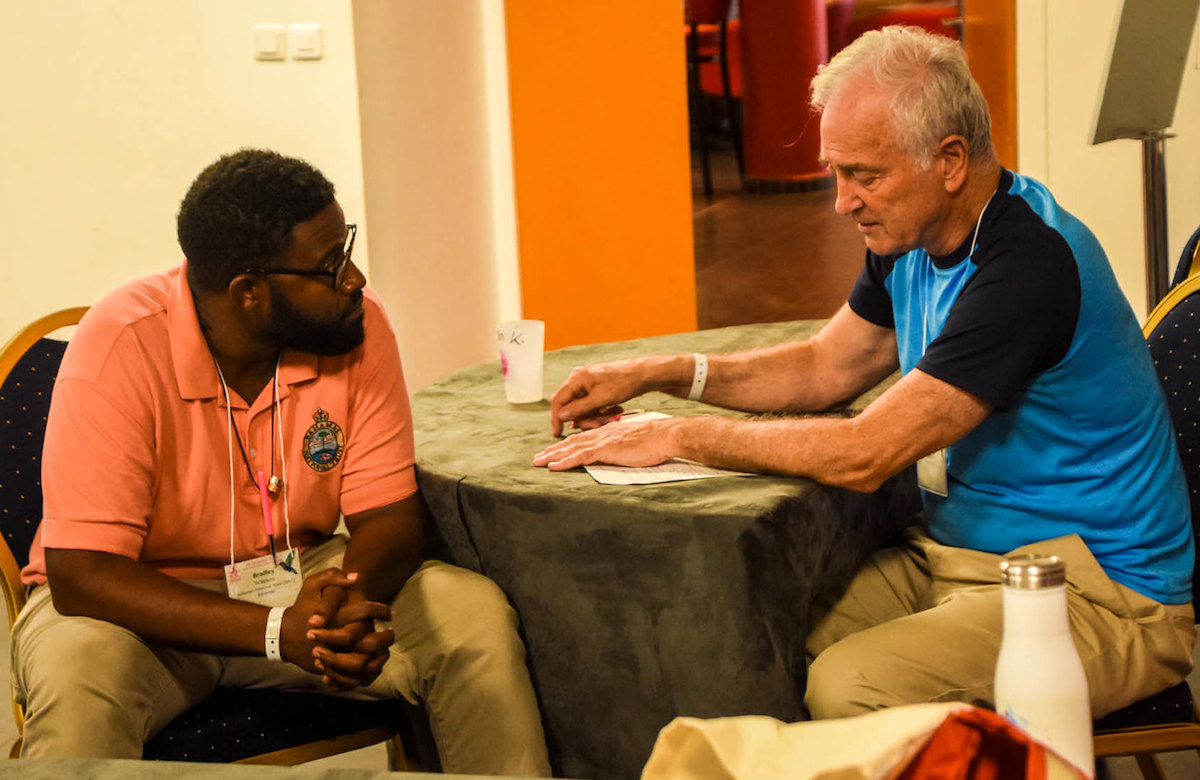
Bradley Watson (BNT Science Officer) and Dr. Herb Raffaele (retired Chief of USFWS International Affairs Program) get to know each other at the Mentorship Workshop in Guadeloupe, July 2019.
Bradley Watson, a new staff member at the Bahamas National Trust who is working on the Kirtland’s Warbler, was speaking enthusiastically from the recent BirdsCaribbean Conference in Guadeloupe. At the conference in July, a new Mentorship Program was launched. Bradley’s mentor is Dr. Herbert Raffaele, former chief of the US Fish and Wildlife Service’s Division of International Conservation, and author of Birds of the West Indies, among other books.
BirdsCaribbean Directors-at-Large Dr. Adrianne Tossas and Dr. Ancilleno Davis had developed the concept of a mentorship program, which they were able to debut at a workshop in Guadeloupe. Its purpose is to further BirdsCaribbean’s goal of building competence in education, conservation, and research in the region. Mentorship is one way of deliberately engaging and supporting the career development of young conservationists and professionals who were born, live, and work in the region. The exchange of information and guidance provided by mentors also helps to spur regional leadership in conservation and avian science.
A few weeks before the conference, delegates were offered a survey to participate in the new program, with 75 responding favorably. Due to the differing backgrounds of respondents, it was challenging to organize them into mentor-mentee pairs, but four main areas were determined to be most useful, based on the responses: conservation management, research, outreach and education, and ecotourism.
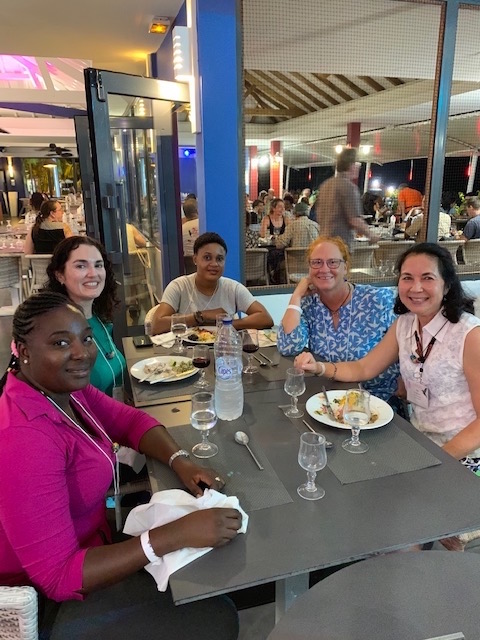
Mentors and mentees chat over dinner about careers in conservation – (left to right): Jeanette Victor (St. Lucia), Adrianne Tossas (Puerto Rico), Francoise Benjamin (Haiti), Jen Valiulis (US Virgin Islands), Lisa Sorenson (USA).
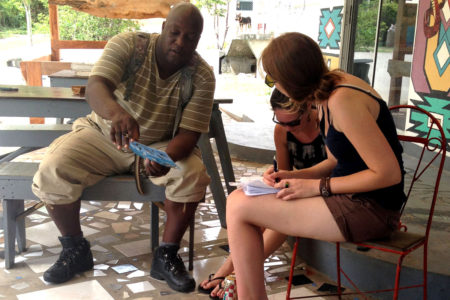
A Mentorship Workshop was held on the second day of the Conference to introduce and explain the purpose of the program. Participants spoke up about the needs of mentees in general, and considered ways in which mentoring would be most effective and beneficial. Afterwards, newly-paired mentees and mentors had dinner together. It was a lively meal where they got to know each other and shared information that was of value for both sides of the relationship. What was most exciting to watch was how so many of the pairs remained talking after dinner, late into the night, excited about their new friendships and eager to take advantage of the time they had together in person.
Josmar Marquez, a younger conservationist who works with the group AveZona in Venezuela, was paired with Simon Guerrero, a well-known professor and researcher from the Dominican Republic. “This program has been very enriching for me because it allowed me to discuss my work, specifically my research methodology, with an ornithologist with a different background than mine.” Josmar goes on to highlight how this mentorship program is fitting for a BirdsCaribbean conference; “I was given great advice not only by my mentor, but by so many other Caribbean colleagues surrounding me throughout the week we shared together. Now, together, we will be trying to implement and achieve results by the time we all see each other again at the next BirdsCaribbean conference!”
“It is really exciting that BirdsCaribbean has started a mentorship program,” exclaimed Cartographer and Caribbean Birding Trail Project Coordinator, Aly DeGraff Ollivierre. “It’s such a great way to share our collective knowledge and experiences with each other, and an excellent opportunity to form deeper relationships with our colleagues.””
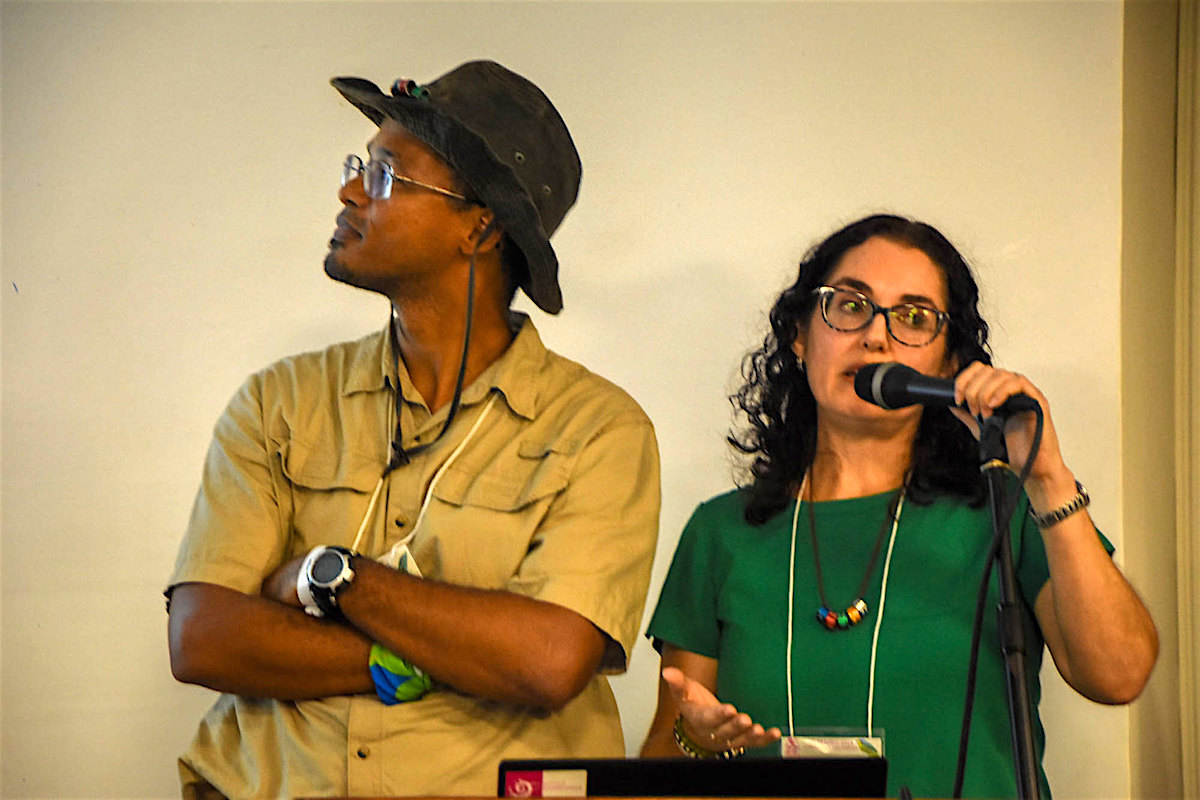
Leno Davis and Adrianne Tossas get the Mentorship Workshop started at BirdsCaribbean’s International Conference in Guadeloupe, 25-29 July 2019. (photo by Mark Yokoyama)
Jane Håkonsson, a young ornithologist from the Cayman Islands, commented: “BC’s mentorship programme has provided me with a type of personal and professional support I would have otherwise not had access to. The programme has helped me narrow my focus and identify and prioritize developmental steps.”
BirdsCaribbean is extremely grateful to the group of 41 mentors who generously came forward to serve as role models for the new, younger members—offering their time, their valuable insights, and experience. We also thank the 34 mentees that took the initiative to reach out and get involved. These individuals are eager to learn and grow in their role as the new generation of science and conservation professionals.
Bradley Watson says being a mentee has given him a sense of purpose and direction. “I feel a bit of a responsibility,” he emphasizes. “When I look at what everybody else has done [for conservation, as reported at this conference], I know what I need to do, and how important it is.”
In these new-found partnerships, mentors and mentees will be moving forward together with the important mission of Keeping Caribbean birds aloft!
*If you would like to be a mentor or want to be connected with one, don’t hesitate to reach out to us! Email Mentorship Program leaders Adrianne Tossas ([email protected]) and Ancilleno Davis ([email protected]).
Mentor-Mentee pairs meet up at the workshop and immediately begin talking and sharing. Pictured from left to right: Ezra Campbell (Grenada), Hana Weaver (USA), Louis Mandela Wens Skendly H. (Haiti), Jose Salguero (Puerto Rico), Adam Kent (USA, Anne Campbell (Grenada). (photo by Mark Yokoyama)
Video of Bradley Watson by Ancilleno Davis.
Special thanks for the conference are due to our major sponsor, Parc National de la Guadeloupe, as well as the Karibea Beach Hotel, Environment Canada, the U.S. Forest Service International Programs, the Royal Society for the Protection of Birds (RSPB), Para la Naturaleza, The David Webster Charitable Trust, Benjamin Olewine IV, American Bird Conservancy, Caribaea Initiative, Rare Species Conservatory Foundation, the U.S. Fish & Wildlife Service, Wildside Nature Tours, Optics for the Tropics, Inc., Holbrook Travel, Environment for the Americas, NuStar, the Bermuda Audubon Society, Vermont Center for Ecostudies, Vortex Optics, Carefree Birding, the International Fund for Animal Welfare (IFAW), Levesque Birding Enterprise, Amazona, The Friendship Association, Hideaways of Ti Heights, and many private donors and supporters.
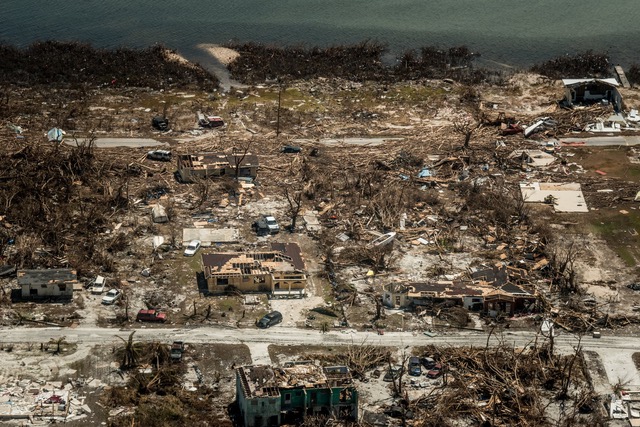
“Horrific…. Unprecedented.…Complete and utter devastation…Human, environmental and economic ruin.“ These are the words people are using to describe to me the impact of Hurricane Dorian, the Category 5 storm that pounded the northern Bahamas for 2 straight days.
McLean’s Town on the eastern end of Grand Bahama Island. (photo by Meredith Kohut)
Last night I spoke with Erika Gates, a recent BirdsCaribbean Board member and resident and owner of eco-tourism businesses in Grand Bahama. She told me that the area around the Lucayan National Park is still in search and rescue/recovery mode. Rescue teams have not even reached the farthest east community of McClean’s Town yet!
In the community of High Rock, only 12 out of about 100 homes are still standing. One resident (and member of our Birdscaribbean community) is cooking for 100 people a day when supplies are brought in! The non-profit World Central Kitchen (Chef José Andrés) is cooking 6,000 meals a day on location to feed those that have lost everything.
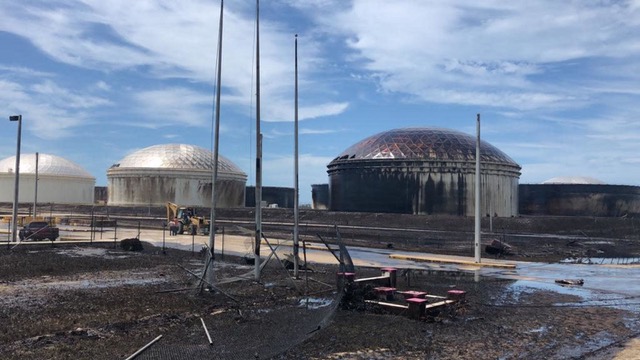
We have also received reports that Dorian left the oil facility in High Rock in shambles. Sam Teacher, founder of the Freeport-based non-governmental organization Coral Vita, saw the damage firsthand. He said that the tanks’ white domes and sides were stained black and six of the domes that top the tanks were gone. Oil was soaking into the soil, lying across the highway, and covering a now-flightless bird.
The Need for Clean, Fresh Water
The oil tanks at the Equinor South Riding Point oil facility in High Rock, Grand Bahama, were severely damaged, causing a large spill. Eric Carey, Executive Director of the Bahamas National Trust, commented: “This can be a serious environmental disaster that we need to get on top off because this could be catastrophic.” (photo by Sam Teacher)
Petroleum is toxic and fresh water is limited on Grand Bahama. The population is almost entirely dependent on its aquifers for drinking water, and the water table on these islands is usually near the land surface. The spill could have an equally horrendous effect on marine life—which people depend on for both food and their economy. Sam worries the oil could further erode the coral and mangrove, already damaged by the hurricane, and destroy the natural sea wall that is supposed to protect the island from storms.
Our hearts go out to the people of these islands, many of whom are BirdsCaribbean members and friends. We are thankful that, as far we know, our friends and colleagues are safe and accounted for. We stand with our 30-year partner, the Bahamas National Trust (BNT), and pledge to do our best to help them with recovery of their birds, wildlife and national parks. To do this I need your help right now!
Our Experience With Major Hurricanes
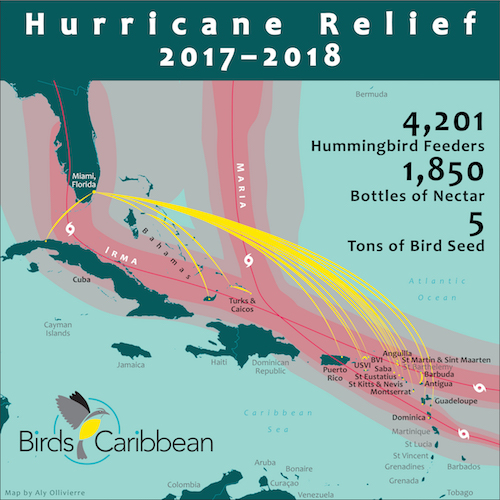
Two years ago, we saw similar devastation when Hurricanes Irma and Maria cut a swathe of destruction across 18 different islands and leveled them. We know from experience that there are three tiers of action required to alleviate the situation:
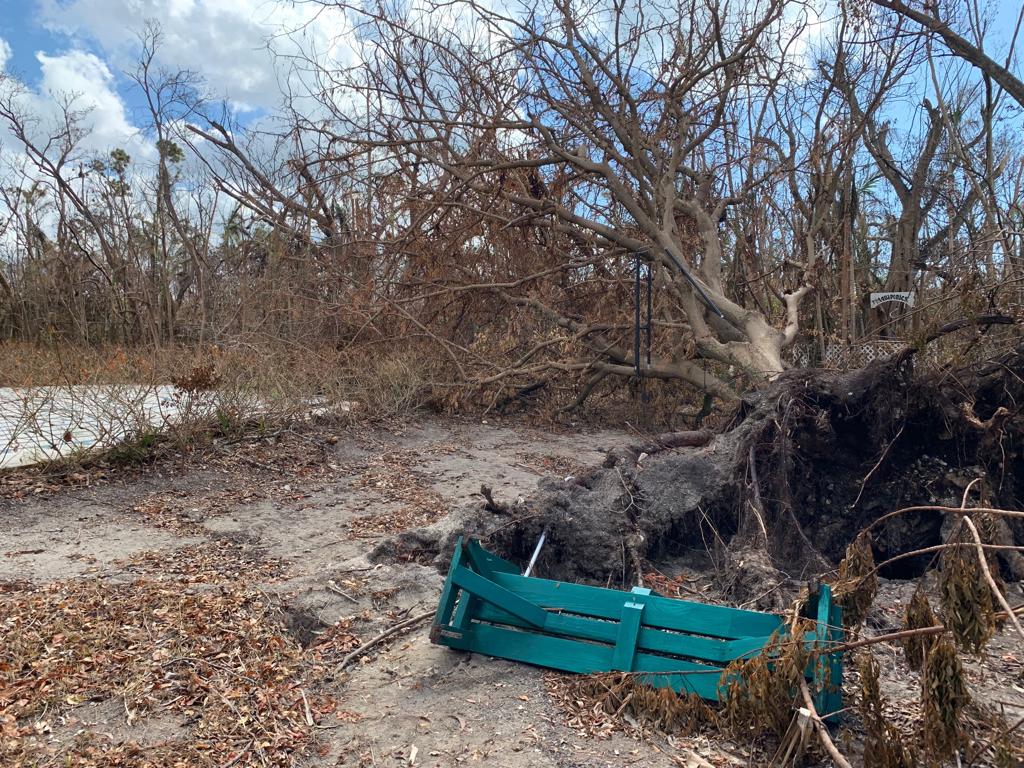
Massive trees were felled and most were stripped of leaves and fruit, leaving little food for birds. (photo by Erika Gates)
Crisis management – simply addressing the most immediate needs of all survivors, both human and wildlife, to receive food and shelter;
Rapid assessment of restoration needs. For BirdsCaribbean that means assembling teams that can survey and evaluate the situation of species at risk and the habitat restoration needed to ensure their survival.
Formulating long-term policy changes that will make the communities and island’s habitats more resilient and better protected from the next terrible storm. That storm will inevitably appear on the horizon, now that climate change has made extreme hurricanes an annual event.
We know that the most immediate need will be supplemental food for starving birds. Most trees have been stripped of flowers, leaves, fruit and seeds. As we did for Hurricanes Irma and Maria, we are organizing delivery of nectar feeders and seed so that hungry birds will have help getting through a period of serious food shortage.
Delivering Hope
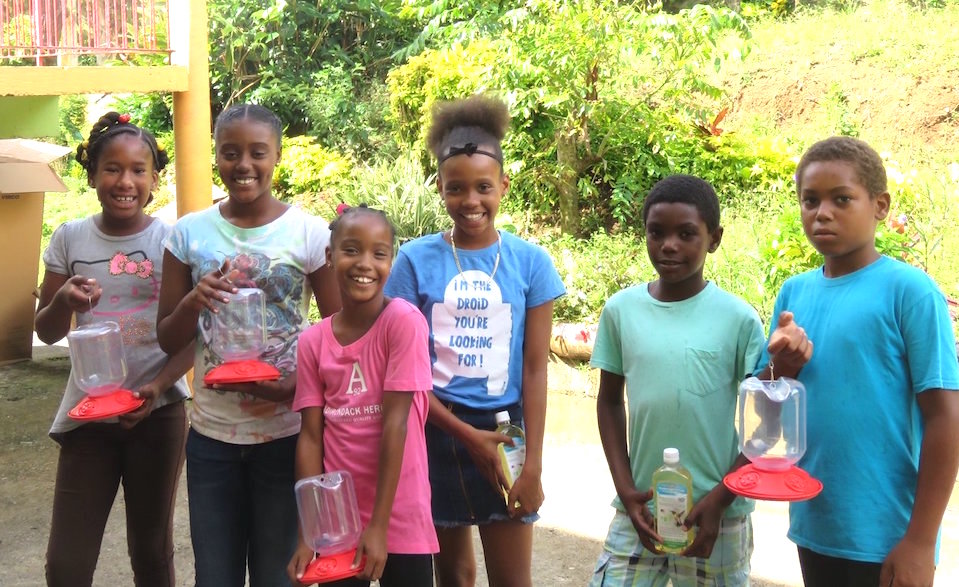
Students from Bagatelle Primary School, Dominica, with bird feeders and nectar after Hurricane Maria devastated this country and others in 2017.
Feeding the birds is beneficial not only to the birds, but also indirectly to people. Hundreds of people on multiple islands, who received supplies for the birds in 2017, told us they were happy to help the birds, even though they themselves were struggling to survive. The simple act of helping another living creature was truly uplifting in a situation where people felt helpless. As birds began to recover, people felt this was a tiny but important first step towards normal life. The birds lifted their spirits, reminding them that nature – and their own lives – can be rejuvenated and renewed.
Right now, there is a huge need to help with the ongoing humanitarian crisis. We are gratified to see the outpouring of assistance with food, water and shelter, as well as rescue and evacuation to other islands and the U.S. for the tens of thousands that lost their homes. BirdsCaribbean’s role is to focus on the birds and ecosystems we all depend upon.
Mobilizing for the Restoration
As soon as conditions on the islands are stabilized, we are ready to help with the surveys, restoration and recovery actions: clean-ups, planting trees, and repairing and replacing damaged equipment and infrastructure in national parks and birding hotspots. It is a massive amount of work and we need your help to make it happen.
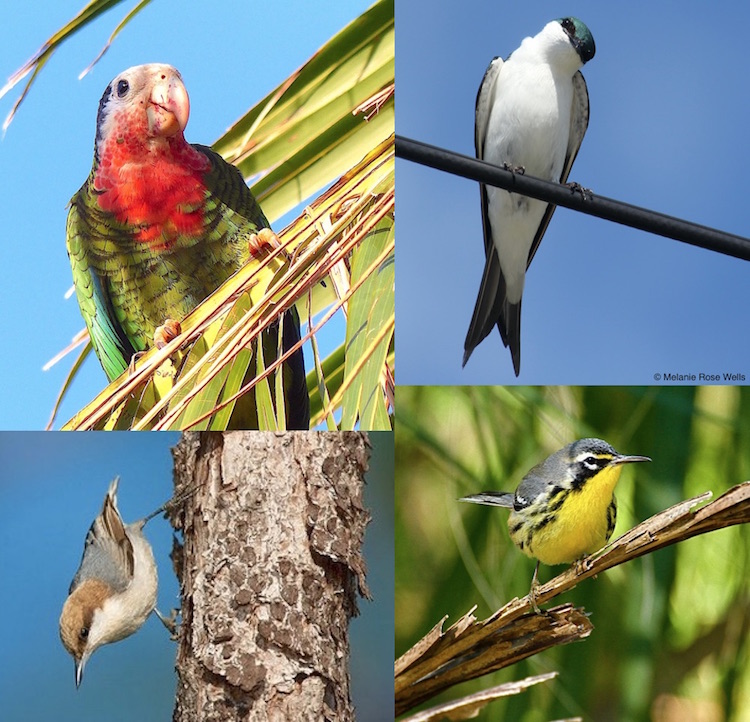
Four threatened endemic species on Grand Bahama and Abaco (clockwise from upper left): Bahama Parrot, Bahama Swallow, Bahama Warbler, Bahama Nuthatch. (photos by Lynn Gape, Melanie Rose Wells, Erika Gates and Bruce Hallett)
With huge parts of both islands flooded and hammered by strong winds for two days, we are seriously concerned about how four threatened and endemic birds that live on these islands are doing after the hurricanes. These species will be the focus of the first surveys. They include the Bahama Parrot (ground nesting population in Abaco, also occurs in Inagua in the southern Bahamas), the Bahama Nuthatch (only occurs on Grand Bahama, Critically Endangered), Bahama Warbler (only occurs on these 2 islands) and the Bahama Swallow (GB and Abaco comprise 2 of its 3-island range). Intensive surveys of the Bahama Nuthatch in 2018 found just 5 birds; this species has declined by more than 95% since the 1960s and 70s.
Other country and island endemics like the Olive-capped Warbler, Bahama Woodstar, Cuban Emerald, Red-legged Thrush, and many migratory warblers (like Kirkland’s Warbler, Painted Bunting), waterbirds and shorebirds (Piping Plover, Reddish Egret), and others also call the diverse habitats on these islands home.
We know from experience that birds are resilient; many are able to survive severe storms and hurricanes by hunkering down on the ground or sheltering in low vegetation. The fact that Hurricane Dorian raged for 48 hours without a break is almost without precedent. We are fearful about how many birds were able to survive this onslaught. Undoubtedly, many were lost during the storm.
By restoring the incredibly diverse ecosystems of the Grand Bahama and Abaco Islands, we will greatly increase our birds’ chances of survival. In addition, the sooner the islands and parks recover, the sooner we can restore residents’ livelihoods that are dependent on these ecosystems.
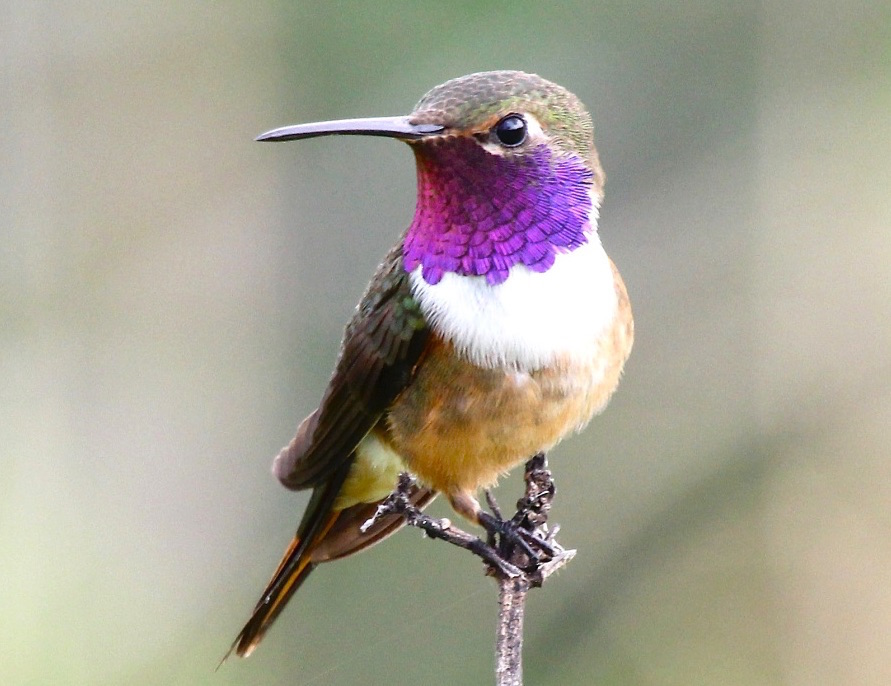
The gorgeous Bahama Woodstar, endemic to the Bahamas, is one of the many species impacted by the devastation of Hurricane Dorian. (photo by Keith Salveson)
Although they will never be quite the same, we are optimistic and determined that these islands can be restored to their former glory once again, teeming with tropical vegetation and beautiful wildlife across the landscape. I need your help to make this happen, please give generously.
Thank you to all of you that have expressed concern and have already donated, and to those that are donating now!
Lisa Sorenson, Executive Director of BirdsCaribbean ([email protected])
If you prefer to donate with a check, please make the check out to “BirdsCaribbean” and in the memo section, note that it is for Hurricane Dorian Relief. If you have questions or wish to make other arrangements for donating, please feel free to contact Jennifer Wheeler, BirdsCaribbean Financial Officer ([email protected]) or Lisa Sorenson ([email protected]).
Checks can be mailed to: BirdsCaribbean, 841 Worcester St. #130, Natick, MA 01760-2076
“Mango Delight” by Daniel Gabriel Angelo Jean-Baptiste.
Silk painting artist Daniel Gabriel Angelo Jean-Baptiste of Saint Lucia uses tropical nature as his inspiration and silk as his canvas. His creations reflect on a life of growing up in the beautiful tropical paradise of the Caribbean.
“Mango Delight” is a commissioned one-of-a-kind. It is hand painted using Sumi sheep hair brushes to apply a water-based liquid pigment silk paint onto 10mm, 100% Habotai silk. This magnificent image measures 40″high x 30″wide. The piece is unframed and is shipped as a rolled textile. The painting is valued at $6,000.
Daniel’s works are in the private art collections of golf champion Arnold Palmer, heavyweight boxing champion George Foreman, singer/songwriter Paul Simon, U.S. President Bill Clinton, U.S. President George W. Bush, South African President Nelson Mandela, and CEO of Sandals Resorts Gordon “Butch” Stewart.
Daniel states, “My life is one which is so close to nature that I feel a part of all her splendor and mystery. When I paint, I become my subject, from the tree frog in the mist of Fond St. Jacques rainforest to the sea turtle gliding in the deep blue waters of Anse Chastanet Bay… I do not just want to paint, but I want you to create so that you too can feel the intense joy that I experience in being here.”
Other Amazing Prizes
Vortex VIPER HD 8X42 ROOF PRISM BINOCULAR. This premium-quality, award winning binocular is packed with everything you need and nothing you don’t. It is rugged, waterproof, compact and lightweight (one of the lightest full-size binoculars on the market)! In addition, the binoculars come with Vortex’s incredible unlimited, unconditional life-time VIP Warranty!
GICLEE PRINTS BY ACCLAIMED CUBAN WILDLIFE ARTIST NILS NAVARRO. Celebrate the endemic birds of Cuba with prints of the gorgeous original artwork: the Bee Hummingbird (the world’s smallest bird) and the Cuban Trogon (national bird of Cuba). The giclee prints are signed and numbered, measuring ~8.5″ by 11″.
The drawing for the Raffle is on Saturday, October 5th, 2019. Now is the time to purchase tickets!Proceeds from the raffle support our conservation programs and provide travel support for BirdsCaribbean delegates to attend our workshops and conferences.
Tickets are $5 each or five for $20. You can purchase tickets online, or send a check made out to “BirdsCaribbean” and mail to: BirdsCaribbean, 841 Worcester St. #130, Natick, MA 01760. Any questions, contact Lisa Sorenson. Remember to get your tickets before October 5th, and good luck!
It only takes one to win, but you can’t win without one!
Sincere thanks to our generous donors for providing awesome prizes for the Raffle: Daniel Gabriel Angelo Jean-Baptiste, Vortex Optics, and Nils Navarro.
Plunging Brown Pelicans put on a show each day next to our dining terrace at Karibea Beach Hotel, Le Gosier, Guadeloupe. (photo by Holly Garrod)
Plunging pelicans, soaring terns and majestic frigatebirds put on a dazzling show outside the dining terrace, as we ate delicious French cuisine. Impromptu discussions sprang up over coffee and drinks. Bright T-shirts, bird paintings and merchandise were on sale; members’ posters sparked intense learning sessions; and brilliant keynote speakers kept us on the edge of our seats.
It happens every two years, and it just keeps getting better. This year, BirdsCaribbean held its 22nd International conference in Le Gosier, on the French West Indies island of Guadeloupe. 250 delegates from 34 countries gathered for discussions, lectures, workshops – and perhaps most importantly, to connect with each other – under the theme, Keeping Caribbean Birds Aloft.
The conference took place at the lovely seaside Karibea Hotel from July 25 – 29, 2019. BirdsCaribbean partnered with the Parc National de la Guadeloupe for an exciting week of learning, sharing, and discovery.
While #BirdsCarib2019 is now behind us, the memories and friendships made will keep us aloft as we collectively continue to move our science and conservation work forwards. For those who were not able to attend this year and for delegates feeling wistful for woodpeckers and croissant, here is a recap of some of the highlights and activities that made this event so special.
All About Birds – and People
250 delegates from 34 countries gathered for out 22nd International Conference in Guadeloupe. (photo by Fred Sapotille)
The first day of the conference started with some rock n’ roll, literally, as our delegates were shaken awake by a 4.7 earthquake! On arrival, registration buzzed with the laughter and excitement of a family reunion – was it really 2 years ago that we saw each other last?
Our delegates quickly got to work birding across the island. Who was the first to see the endemic Guadeloupe Woodpecker? An incredible 422 checklists were entered into eBird Caribbean by our delegates and more than 95 bird species were detected. We couldn’t have done this without the help of our local guides. BirdsCaribbean conferences are great opportunities for local guides to showcase their islands, their natural beauty, and best spots for seeing wildlife.
And once again, the Guadeloupe conference highlighted the Caribbean’s amazing diversity—its birdlife, peoples, and cultures. A critical discussion during the conference was the need to expand and develop bird tourism in the region through BirdsCaribbean’s Caribbean Birding Trail (CBT). Everyone was excited that the CBT Project recently launched a new and much improved website.
Featured speaker, Anthony Levesque, shared his excitement and many accomplishments about his work with birds on Guadeloupe. (photo by Fred Sapotille)
Always a highlight of our conferences, delegates packed the main room each morning to hear our passionate keynote speakers celebrate the diversity of thought, culture, knowledge and work within our community. On the first day, dedicated BirdsCaribbean member, Anthony Levesque, opened our traditional session to celebrate our host country – Guadeloupe Day – and shared his personal journey of how Guadeloupe, its nature, and its birds have shaped his life. His excitement was infectious as we applauded his own phenomenal efforts and felt his hope about the future for his island’s capacity for science and conservation.
We also welcomed Ambassador Dessima Williams to the island, an Elected Partner of the Caribbean Natural Resources Institute and former Ambassador to the United Nations, who inspired us to engage with the UN’s sustainable development goals to enable bird conservation. Other keynote presentations on each morning of the conference inspired delegates on topics as diverse as the evolution of beauty, relationships between birds and plants, landscape management, avian olfaction, and restoration of a damaged wetland.
Challenges, Solutions, Optimism
The Guadeloupe conference saw the launch of an exciting new Mentorship program* where younger BirdsCaribbean members paired with mentors that have more experience in their specific areas of interest, including scientific writing, data analysis, research techniques, conservation strategies, education, bird guiding, career development, and more. The launch culminated in an energizing mentee-mentor dinner, with pairs spilling out across the venue long into the evening, to share knowledge, inspire, support and learn from each other.
Conference workshops offered practical opportunities to learn new skills and share important knowledge, including grappling with data analysis in R, being the solution to plastic pollution, addressing shorebird harvesting, and becoming a media maestro.
Ancilleno Davis had the audience dancing to his dubstep remix of inspired by eBirders! (photo by Fred Sapotille)
Other topics addressed included the challenges to the survival of the region’s birds and habitats, including illegal wildlife trafficking, invasive species, and the threat of development. Several speakers and sessions emphasized the need for stronger advocacy, involving communities, and education to fight the greed that is the root cause of many of our environmental problems.
We heard inspiring stories about engaging young people through education and diverse audiences via social media, and explored visual art and dubstep music as conservation tools. We heard about valuable contributions to our scientific understanding of avian ecology, and learned how to address the challenges of hurricane recovery, caged birds and illegal wildlife trade. And we took the time to acknowledge and celebrate our successes, including invasive species eradication, endangered species recovery, and successful restorations of habitats believed too-far gone to ever be brought back.
The passion continues to flow
The heart of BirdsCaribbean and our conferences is the passion of our members to support conservation of regional endemic and endangered birds as well as migratory species that visit our islands. Most importantly, our conferences give us an opportunity to share and celebrate the new and continued work of our members. Much of what made this conference special is symbolic of all biennial BirdsCaribbean conferences and we encourage you all to look out for details about our next conference in 2021!
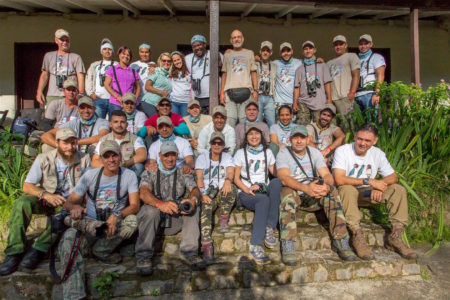
Delegates from Grenada and St. Vincent and the Grenadines gather for a group pic. (photo by Fred Sapotille)
The momentum continues amidst the growing comradery and passion that the conference helped fuel. We will be sharing a series of posts over the next few weeks that highlight the work our partners have done, and provide more details on some of the presentations and conference content. If you have a suggestion for an article, please email us at [email protected]. Thank you for reading, and please subscribe and consider donating to help us “Keep Caribbean Birds Aloft”.
Special thanks are due to our major sponsor, Parc National de la Guadeloupe, as well as the Karibea Beach Hotel, Environment Canada, the U.S. Forest Service International Programs, the Royal Society for the Protection of Birds (RSPB), Para la Naturaleza, The David Webster Charitable Trust, Benjamin Olewine IV, American Bird Conservancy, Caribaea Initiative, Rare Species Conservatory Foundation, the U.S. Fish & Wildlife Service, Wildside Nature Tours, Optics for the Tropics, Inc., Holbrook Travel, Environment for the Americas, NuStar, the Bermuda Audubon Society, Vermont Center for Ecostudies, Vortex Optics, Carefree Birding, the International Fund for Animal Welfare (IFAW), Levesque Birding Enterprise, Amazona, The Friendship Association, and Hideaways of Ti Heights.
*If you would like to be a mentor or want to be connected with one, don’t hesitate to reach out to us! Email Mentorship Program leaders Adrianne Tossas ([email protected]) and Ancilleno Davis ([email protected]).
Old friends reunited: Leo Douglas and Maurice Anselme. (photo by Lisa Sorenson)
250 delegates from 34 countries gathered for our 22nd International Conference in Guadeloupe. (photo by Fred Sapotille)
The Founders Award for Best Student Paper went to Christopher Cambrone.(Photo by Fred Sapotille)
Plunging Brown Pelicans put on a show each day next to our dining terrace at Karibea Beach Hotel, Le Gosier, Guadeloupe. (photo by Holly Garrod)
Jennifer Wheeler sounding the conch to signal the start of a session. (Photo by Fred Sapotille)
Keynote Speaker, Gabrielle Nevitt, shared her exciting research an avian olfaction and the ability of seabirds to smell plastic! (photo by Fred Sapotille)
Anthony Levesque (Guadeloupe) won a President’s Award for his bird research, education and conservation work in Guadeloupe. (Photo by Fred Sapotille)
Important conference notice about dancing with Herb at the party on the last night.
St. Martin delegates, Jenn Yerkes, William Allanic,and Mark Yokoyama, in Les Fruit de Mer uniforms.(Photo by Fred Sapotille)
Bird Hide at Grand Etang on Waterfalls Field Trip.(Photo by Anais Abatan)
Much learning took place at the evening poster sessions. (photo by Mark Yokoyama)
Delegates from Grenada and St. Vincent and the Grenadines gather for a group pic. (photo by Fred Sapotille)
Guadeloupe conference souvenir bird bands. (Photo by Fred Sapotille)
Featured speaker, Beny Wilson, did a mini-training on bird guiding and the bird tourism market during the Caribbean Birding Trail session. (photo by Fred Sapotille).
Smiling volunteers help with conference check-in, left to right, Jen Mortenson, Alieny Gonzalez, Natasha Atkins, Arnaldo Toledo. (photo by Lisa Sorenson)
“Keeping Caribbean Birds Aloft” was the theme of BirdsCaribbean’s 22nd International Conference in July in Guadeloupe.
Keynote speaker, Tomas Carlo, gave an exciting talk on bird-plant interactions and their consequences for habitat restoration. (photo by Fred Sapotille)
Group selfie attempts. (Photo by Fred Sapotille)
We thank Director of the Parc National de la Guadeloupe (PNG), Maurice Anselme, and his fabulous crew for outstanding help with organizing the conference! (photo by Fred Sapotille)
Keynote Speaker, Orisha Joseph (Sustainable Grenadines Inc) told us about the incredible restoration of Ashton Lagoon in Union Island. (photo by Fred Sapotille)
Dominicans and Lisa Sorenson. (photo by Fred Sapotille)
Main conference room at Karibea beach Hotel. (photo by Fred Sapotille)
Herb Raffaele supporting new Grenadines bird guide with authors Aly Ollivierre and Juliana Coffey. (Photo by Mark Yokoyama)
Kate Wallace (Dominican Republic) won a Life-time Achievement Award for her 20 years of tireless bird education and outreach work. (Photo by Fred Sapotille)
Our fearless translators provided English-French-Spanish translation throughout the entire 5-day conference! (Photo by Fred Sapotille)
Andrea Thomen (Dominican Republic) shares her work with Leo Douglas (Jamaica / USA). (photo by Mark Yokoyama)
Dessima Williams, wowed us with her inspiring and poetic keynote talk. (photo by Lisa Sorenson)
Leno Davis talks about engaging diverse audiences through creative avenues, like music and art (photo by Mark Yokoyama)
The Cuban contingent! A record 20 Cubans attended, thanks to our generous sponsors! (photo by Fred Sapotille)
Two of our fearless leaders, Justin Proctor (Birdscaribbean Vice President) and Lisa Sorenson (BirdsCaribbean Executive Director) on the first morning of the conference. (Photo by Fred Sapotille)
Prepping conference bags with the Cubans (Photo by Justin Proctor)
Featured speaker, Anthony Levesque, shared his excitement and many accomplishments about his work with birds on Guadeloupe Day. (photo by Fred Sapotille)
Conference organizer-in-chief, Justin Proctor with Guadeloupe organizers, Maitena Jean, Catherine Chicate-Moibert and Anais Abatan. (photo by Fred Sapotille)
New friends (Photo by Fred Sapotille)
Keynote speaker, Dr. Howard Nelson, called for more collaboration across the Caribbean to save birds and their habitats. (photo by Fred Sapotille)
The right person, Stephen Durand, got this one-of-a-kind binocular harness with Imperial Parrot artwork by Jessica Canizares (photo by Lisa Sorenson)
Dancing with the local performers on the last evening of the conference. (Photo by Fred Sapotille)
Maurice Anselme, General Director of the Parc National de la Guadeloupe (PNG) and Mylene Musquet, Executive Director of PNG, on the last evening of the conference. (photo by Fred Sapotille)
Keynote speaker, Richard Prum, dazzled the audience with his fascinating talk on The Evolution of Beauty and bird mating tactics. (Photo by Fred Sapotille)
Ancilleno Davis had the audience dancing to his dubstep remix inspired by eBirders, say what?! (photo by Fred Sapotille)
Arnaldo Toledo and Maikel Canizares show the beautiful t-shirt artwork created to fight the Caged Bird problem in Cuba, Caged Bird Working Group meeting (photo by Lisa Sorenson)
Conference t-shirts for sale on Day 1 of the conference (photo by Mark Yokayama)
Busy and not-so-silent Silent Auction (Photo by Mark Yokoyama)
Visit the newly-redesigned website for information on the best sites, guides and tours in the region!
More visually appealing. Easier to navigate. A LOT more information about birding hotspots in the Caribbean, how to get there, and which guides and operators can offer the best birdwatching experience on the ground.
Those were our objectives when we embarked on redesigning the Caribbean Birding Trail (CBT) website. Now, we are finally ready to launch the CBT’s new online home and to share it with you, and the world! Click here to access the new website.
The CBT was launched in 2011 by BirdsCaribbean in order to promote authentic experiences that benefit local people and encourage the protection of the Caribbean’s natural resources, including birds and their habitats. The website has always been a key part of making this happen.
Overhauling the website and building a customized directory (and beautiful maps!) of the birding gems of the Caribbean was no small task. To do the project justice, we knew we would need to learn as much as possible about every birding nook and cranny there is on each island. And we are here to tell you…there are many!
What’s Special about the New CBT Website
Map of the West Indies from the CBT website showing locations of Birding Sites, History/Culture Sites, and bird-friendly Accommodations. You can also toggle on and off eBird Hotspots on this map. Note that this is a work in progress: we need YOUR help to add many more sites!
As you scroll through the pages, you will find information about 138 birding sites in 24 countries. We are also proud to be promoting more than 50 guides and tour operators. These are people and enterprises who are from the Caribbean, or who now call the region home. We also aim to include a listing of every field guide and book that our partners have published for their islands. We also provide links to as many additional resources as we possibly can, giving you as full a picture as possible of the wealth of birds, habitats, and local customs and folklore.
Through the website, we also strive to tell the story of the Caribbean and its incredible natural heritage through pictures. There are nearly 700 species of birds known from the Caribbean, including 171 species that are endemic to the region and found nowhere else in the world. Furthermore, there are thousands of endemic plants, snails, lizards, frogs, mammals, and insects; and the beautiful landscapes and geological treasures that the birder will discover along the way. We have collected almost 1,000 photos thus far, and hope for many, many more.
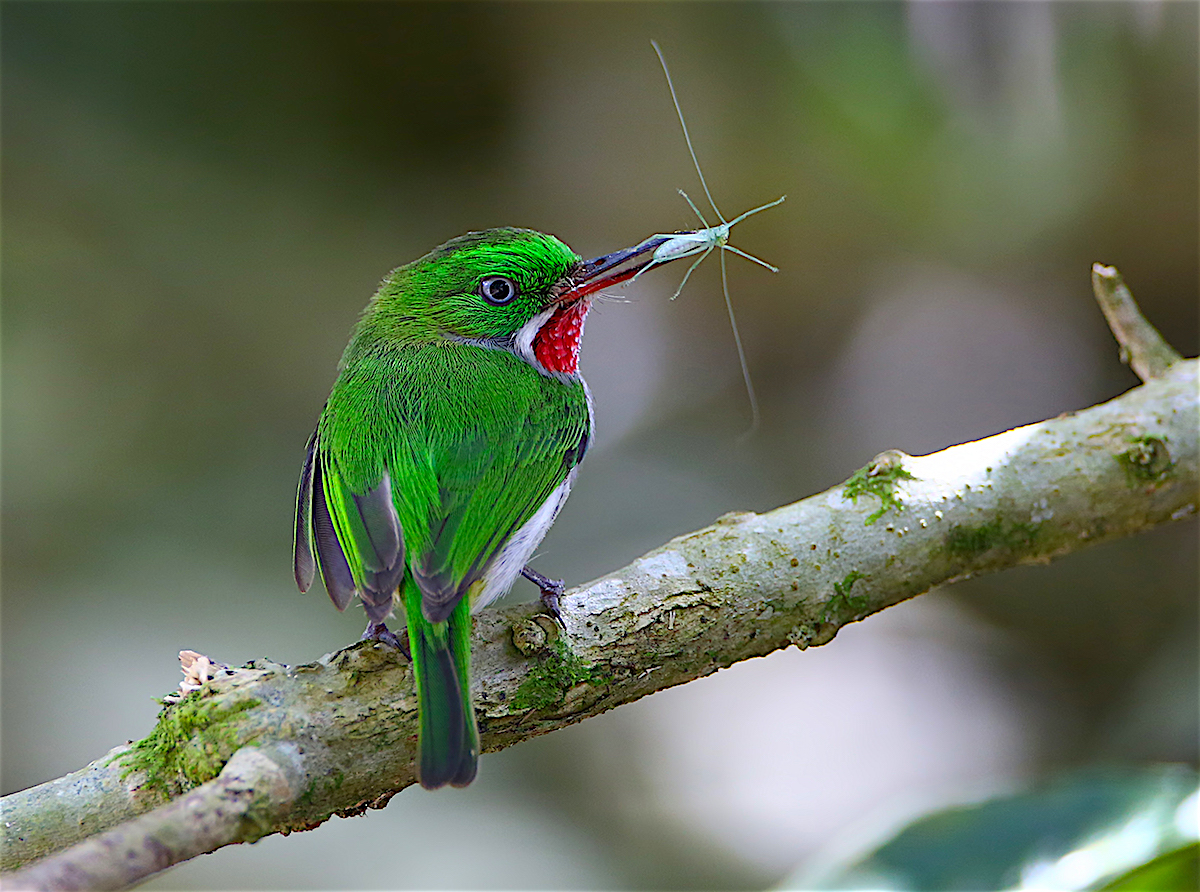
Narrow-billed Tody by Dax Roman
It’s a Work in Progress, and We Love Our Partners!
If you are one of the dozens of individuals who supplied us with photos and/or information about people and places, we thank you! And we ask that you keep the information coming. We are not planning to stop adding to the website. In fact, our goal is for the CBT’s new site to become the number one resource in the world for planning a trip to the Caribbean to see birds, or simply to enjoy the nature and culture of the islands. We are going to build it into the “go-to” site for Caribbean birding.
We consider this website a work in progress. We will always accept suggestions for additional sites, guides, and accommodations to add; or edits and corrections to existing pages. We also greatly appreciate high quality photos, especially of birds.
Our online presence has already helped spur fruitful discussions with tour operators, and as a result BirdsCaribbean has partnered with three different companies (Wildside Nature Tours, Birding the Islands, and Carefree Birding). These companies are committed to giving back to the islands, and they donate a portion of their profits from Caribbean tours to BirdsCaribbean to invest in conservation.
The CBT…More than Site Promotion
CBT Guide Training in Cuba.
The CBT project is not just about places to go. Through the CBT we are also helping create authentic experiences, and building capacity where needed in the Caribbean to do so. Essential to this is the Caribbean Birding Trail Interpretive Guide Training program, a five-day intensive course where participants not only learn to identify the local bird species and their connection to the environment, but also discover how to use interpretation techniques that will bring this knowledge to life for their birding guests.
The training helps guides to uncover unusual pieces of local science and cultural context that will spark the imagination of the birders and have them fully engaged during their tours. Professional bird and nature guides, certified through the National Association of Interpretation in the U.S., conduct this exciting, hands-on training program.
The reason we thought this important is for the same reason we think the Caribbean Birding Trail itself is important. It is because birds are windows to nature. And in the Caribbean, they are also portals for getting away from the tourism hubs and into the beating heart of the islands. They facilitate discovery, having an authentic experience, and bird by bird, getting to know the real Caribbean.
Our new video is now available on the CBT website and on our YouTube channel. The four-minute long video gives the viewer an enticing glimpse into the birds they will see, and a taste of the culture they can get immersed in when they go looking for those birds.
With Deep Gratitude
Thank you again to everybody who contributed to the original CBT website and this much-improved 2.0 version.
Special thanks to our CBT cartographer, Aly DeGraff Ollivierre for creating the awesome maps and helping solicit, organize, and upload content to the website. Also to Holly Robertson, the CBT Project Manager, for her role as webmaster and digging deep into the world of WordPress.
We would be nowhere without the patience and fortitude of our web designer, Kathleen McGee of BTN Designs, and the vision of Ted Eubanks and Fermata, Inc in originally charting the course of the Caribbean Birding Trail and establishing the first iteration of the website.
With deep gratitude we also thank the donors who financially supported the development of this website over the years: the Critical Ecosystems Partnership Fund, the Marshall-Reynolds Foundation, and the U.S. Fish and Wildlife Service Neotropical Migratory Bird Conservation Act Program.
Links to articles about our Caribbean Birding Trail Guide Training workshops:
“Keeping Caribbean Birds Aloft” is the theme of BirdsCaribbean’s 22nd International Conference in July in Guadeloupe. Parc national de la Guadeloupe is our local host. (artwork by Guillaume Zbinden)
Every two years, BirdsCaribbean holds its international conference. The meeting is the largest of its kind, attracting hundreds of guests from the region and beyond. This year, it will be held on the island of Guadeloupe from July 25-29, partnering with local host, Parc national de la Guadeloupe.
BirdsCaribbean is the largest conservation group in the region. Its members come from nonprofits, forestry departments and universities all over the region. They do research, save wild spaces and share the magic of birds and nature all over the Caribbean. At the conference, over 200 members will gather in one place to share the latest in research and more.
The conference is important because it is the one time when people working all over the Caribbean come together to learn and share. Training workshops teach skills like how to do a bird survey. New research and techniques for helping birds are shared. This know-how is brought back to dozens of islands where it can be used to save rare birds or protect valuable habitats.
This year’s conference is “Keeping Caribbean Birds Aloft” (or “An nou poté mannèv pou zozio karayib volé” in Créole). In keeping with the theme, the conference will feature many ways to help birds in the Caribbean.
“Our birds face many challenges, and we want to address them,” noted Lisa Sorensen, the Executive Director of BirdsCaribbean. “We will work on how to protect birds from threats like plastic pollution or habitat destruction. We are also working to promote birds for their value as a tourism attraction and the benefits they provide to people.”
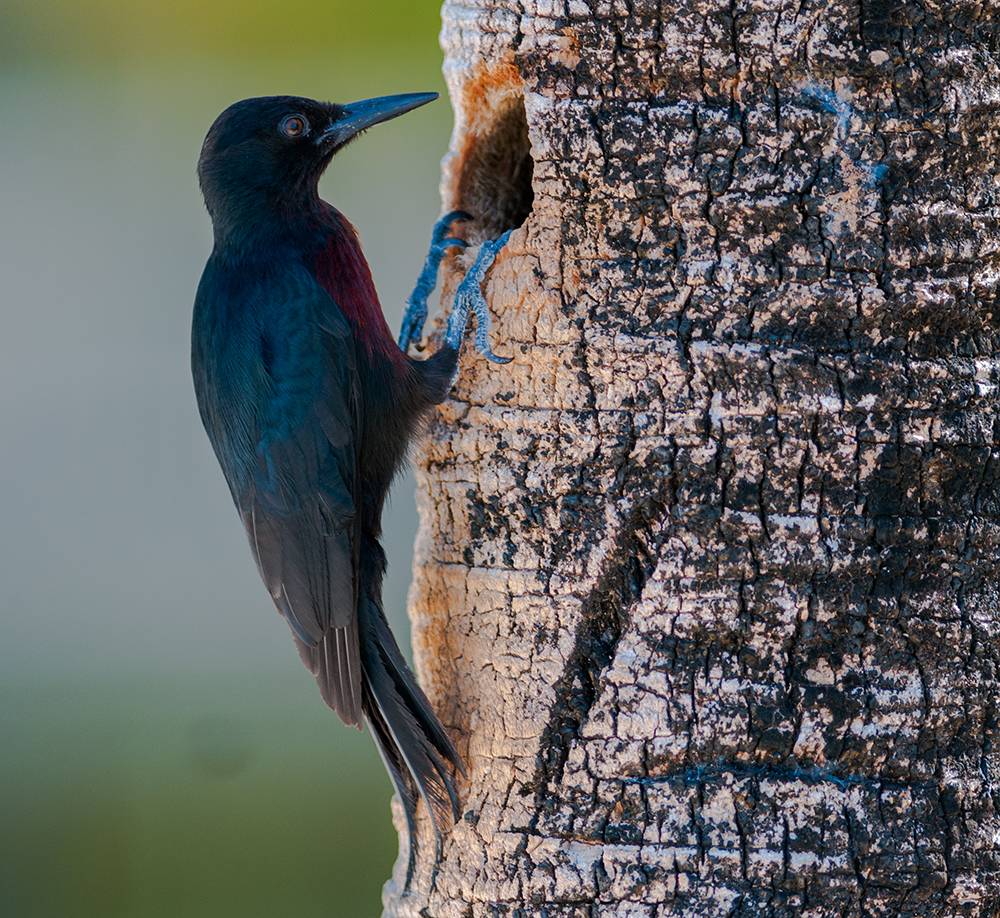
The Guadeloupe Woodpecker is found only on the island of Guadeloupe; conference delegates will have a chance to see this bird on conference field trips. (photo by Frantz Delcroix)
You can learn more about the conference here, including keynote speakers, workshop themes and field field trips. Registration is open – it is not too late to join us! BirdsCaribbean is also still seeking sponsors to help delegates attend that would not be able to otherwise. Click here to help sponsor a delegate – any donations are gratefully received! Sponsorship donations are tax-deductible for US donors.
BirdsCaribbean is very grateful for the help and financial support of many companies and organizations to make this conference a success, including Parc national de la Guadeloupe, Karibea Beach Hotel, Environment Canada, US Forest Service International Programs, Royal Society for the Protection of Birds, para la Naturaleza, Benjamin Olewine IV, American Bird Conservancy, Rare Species Conservatory Foundation, US Fish and Wildlife Service, Caribbean Initiative, Wildside Nature Tours, Carefree Birding, Optics for the Tropics, NuStar, Vermont Center for Ecostudies, Bermuda Audubon Society, Holbrook Travel, Levesque Birding Enterprise, AMAZONA, and The Friendship Association.
A Puerto Rican Flycatcher sings at first light on Global Big Day. (Photo by Hector Ortiz)
Congratulations to all our citizen scientists out there! The biggest day in birding was even bigger for the Caribbean this year. May 4, Global Big Day 2019, saw 846 checklists posted on the eBird Caribbean site, topping last year’s 698. This is quite a big jump in one year!
Whether it was by the sea, in the hills or in backyards, over 200 Caribbean birdwatchers, ornithologists, photographers and nature enthusiasts grabbed binoculars and cameras on May 4. They recorded 330 species in total, including 140 endemics. This means that no less than 80% of the Caribbean’s special birds, found nowhere else in the world, were seen in one single day. This is a very encouraging development. You can see all of the Global Big Day data from the West Indies on eBird.
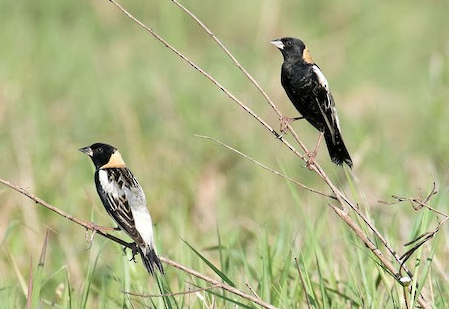
A pair of Bobolinks were spotted on the Cayman Islands. (Photo by Denny Swaby)
This year, 21 islands played a part in Global Big Day. In recent years, an annual (friendly) competition in the West Indies has been warming up between the Bahamas and Puerto Rico. This year the race to the top was again close, but the Bahamas emerged as winners, spotting 138 species. Puerto Rico came in just six species behind and Cuba came in third with 125. Who will the winner be next year? Trinidad and Tobago, grouped with South America in Global Big Day counts, spotted 194 species.
Globally, a record 33,459 enthusiasts went out birdwatching in 171 countries, finding 6,842 species. Two thirds of the world’s bird species were spotted in a single day. The Western Hemisphere dominated the global results; Colombia came out on top for the third consecutive year with the stunning total of 1,591 species, followed by Peru.
A Wilson’s Plover in Anguilla. (Jacqueline A. Cestero)
BirdsCaribbean and eBird Caribbean thank all who went out on Global Big Day, even if only for a short time. The main point is that you participated, making an invaluable contribution to science and conservation. As the world’s largest biodiversity-related citizen science project, eBird had 1.85 million observations on Global Big Day. eBird is managed by the Cornell Lab of Ornithology, in collaboration with partner groups such as BirdsCaribbean – and hundreds of thousands of eBirders. For more information, go to the Caribbean portal: https://ebird.org/caribbean/home. You may also download the free mobile app, which makes tallying those numbers even easier. Enjoy!
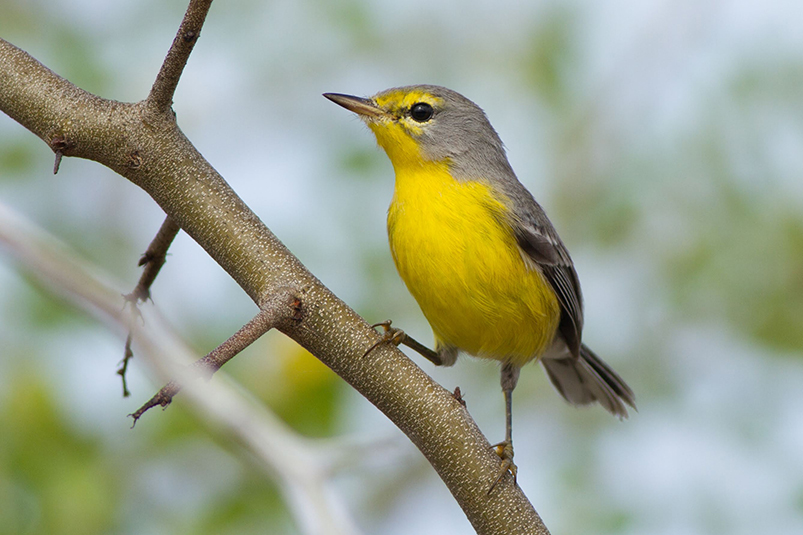
Barbuda Warbler, endemic to the tiny island of Barbuda. The world’s population of this bird is restricted to 62 square miles. (Photo by Jeff Gerbracht)
March 28th, 2019: A year and a half after Category 5 Hurricane Irma smashed into the beautiful island of Barbuda. A survey team is on the local ferry, returning to conduct follow-up population assessments of the endemic Barbuda Warbler and the Magnificent Frigatebird colony. The Barbuda Warbler was last evaluated by the IUCN in October, 2016 and was classified as Near Threatened; the Magnificent Frigatebird colony is the largest breeding colony in the western hemisphere. As an endemic, the Barbuda Warbler is completely restricted to the 62 square mile island and with its relatively small population, is at a higher risk from extreme weather events and habitat loss. The frigatebird colony as the largest breeding colony in the region is critical to the continued success of this species in the Atlantic. When Hurricane Irma swept over the island, we feared for the safety of both the Barbuda Warbler and the frigatebird breeding colony. An assessment team was quickly gathered and sent to assess both species in October 2017. We found that the Barbuda Warbler seemed to have survived the hurricane well and the Magnificent Frigatebirds were already started to return in numbers. But, we were returning to investigate: how were these populations both doing 18 months later?
Of Tents, Tarps, and Old Friends
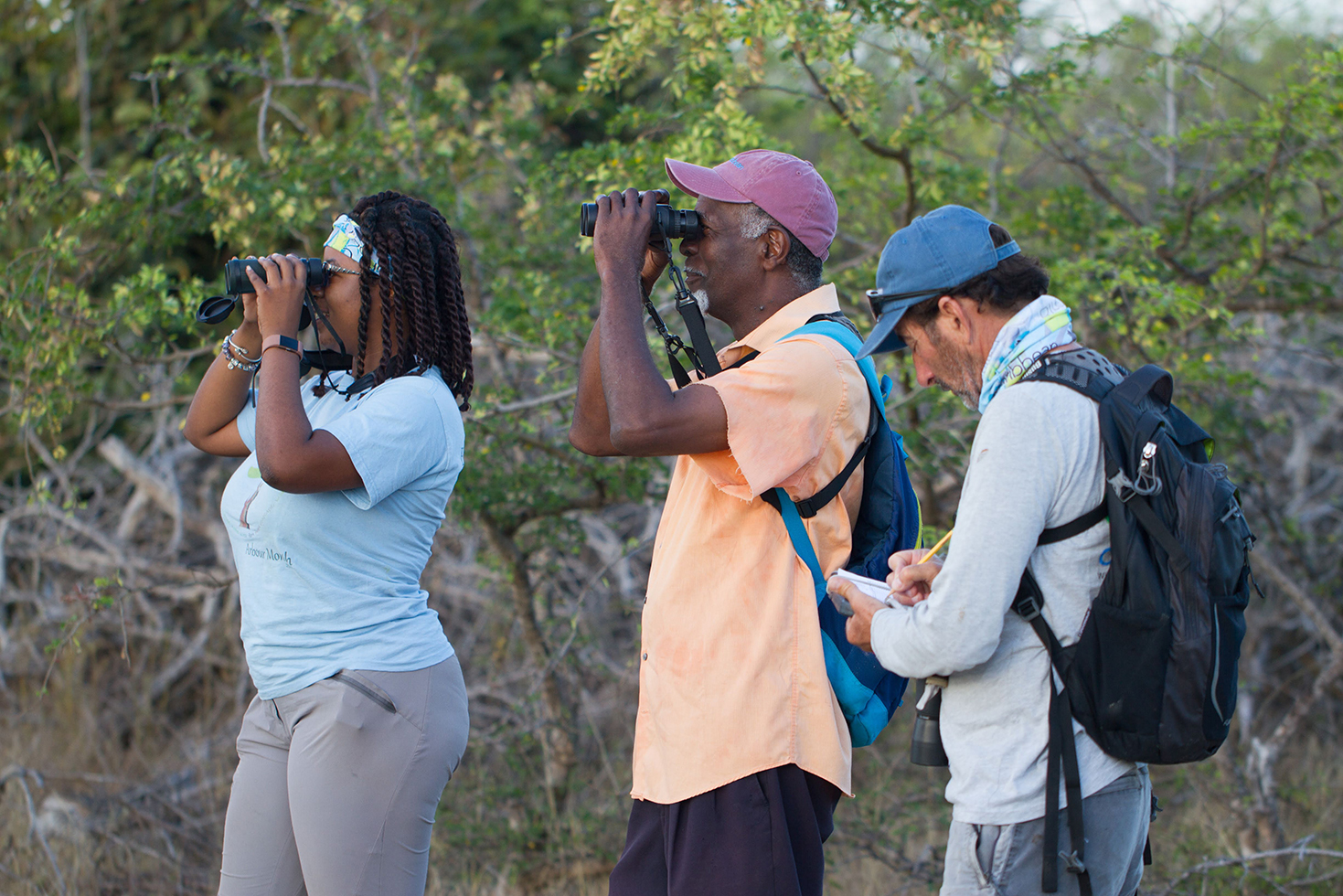
Shanna and Junior observing while Fernando records the observations. (Photo by Jeff Gerbracht)
Immediately upon landing at the ferry docks, we were greeted by the faces of friends we had made on the previous visit. Kelly Burton, Codrington Lagoon National Park Manager (Dept of Environment), was there making sure that the arrangements for transportation, food and lodging were taken care of and that our sometimes ‘unusual’ needs were met. Once we settled into our lodgings, we had a quick look around the town of Codrington, which had been nearly destroyed by the hurricane. Many homes now have electricity and roofs, but many were still without the basic needs of a simple roof. Tents and tarps are still being used by many Barbudans. Before we even left Codrington for an initial training session on methods, we encountered several Barbuda Warblers and the local subspecies of Yellow Warbler. A good sign for the first day.
We then headed north towards Two Foot Bay, where Jeff Gerbracht and Fernando Simal from BirdsCaribbean oriented the rest of the team with the survey methodology and what to expect for the following week: early mornings, late evenings and lots of walking, counting birds and good company!! Natalya Lawrence (Environmental Awareness Group – EAG), Sophia Steele (Flora & Fauna International) and Joseph (Junior) Prosper (EAG) enthusiastically dove right into the methods, asking great questions about the survey forms and practicing the count protocol. Sophia was part of the field team just after Irma and her prior experience with the methods was an added bonus. Of the eight point counts made that first afternoon, only one didn’t include a Barbuda Warbler, again a great start to a great week.
Revisiting Old Haunts, Meeting the Barbudans, and Lobster Wraps for Lunch
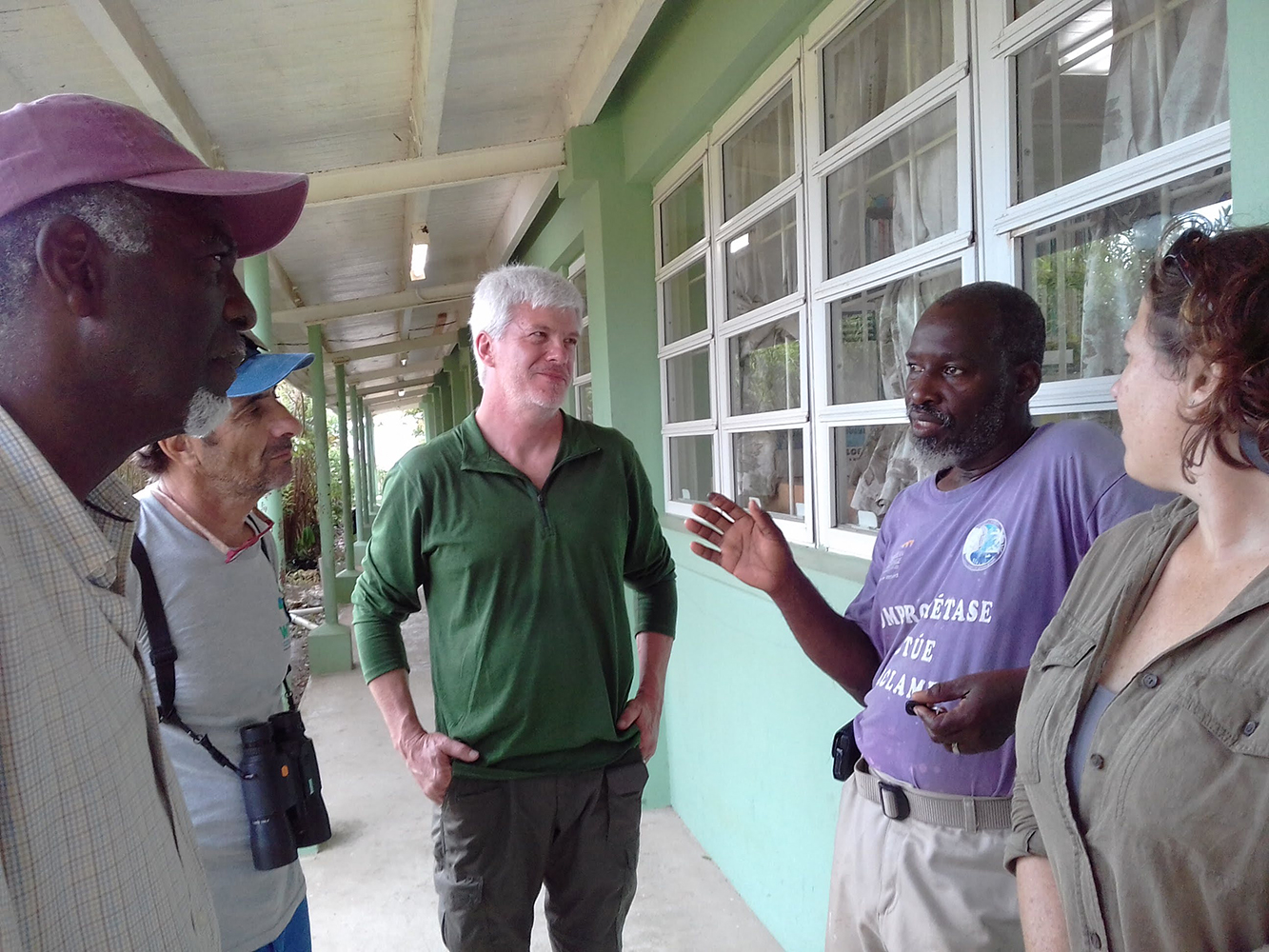
Discussing the Barbuda Warbler with John Mussington, secondary school principal and science teacher. (Photo by Natalya Lawrence)
The next day started with sunrise, with two teams visiting the points we had sampled a year and a half earlier. Generally, each team was able to cover 8-15 points before the sun drove both us and the warblers into hiding. We looked forward to the lunch breaks with fantastic lobster wraps provided by Claudette and the occasional visits by her lovely granddaughter. After a relaxing lunch and brief rest, we were back in the field by 3pm, covering as many points as possible before sunset. Evenings were a group dinner, followed by a few Wadadlis (local beer!) and strategizing for the following day.
One of the biggest differences from my prior visit was the number of people that were back on the island. During our first visit, Codrington was almost deserted, and this time it was a vibrant community. This also meant we could meet with the community members, discuss what we were doing and why, and also begin to understand their lives and challenges post-Irma. We met with the principals of both schools, gave presentations on the Barbuda Warbler and the monitoring efforts to several of the classes, and had many enlightening discussions with Barbudans we would meet in and around town. Several times during the week we met children returning home from school, which often resulted in some impromptu birding classes.
The Frigatebird Revival
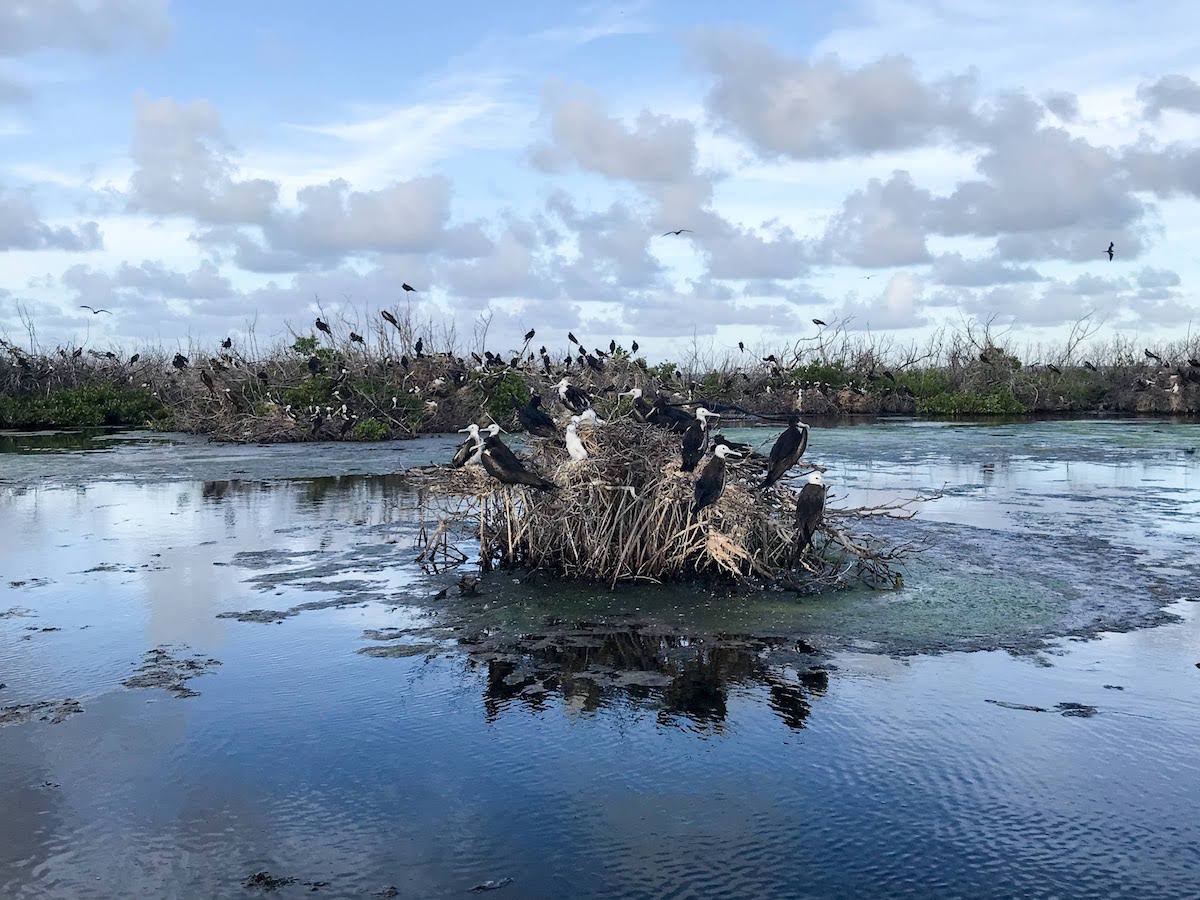
Most of the smaller groups of mangroves appeared to be dead though the frigatebirds are still using them for nesting. The larger sections of mangrove appear to be slowly recovering with much dead vegetation still in evidence. (Photo by Jeff Gerbracht)
Partway through the week, Natalya and Sophia had to return to Antigua and Shanna Challenger (Flora and Fauna International), also an alum from the first season, joined the field crew and quickly showed her talent for spotting hard to find birds. With the help of Shanna and Joseph (who walked more miles than any of us), we were able to complete the necessary point counts, which gave us some extra time to conduct a rapid count of the Magnificent Frigatebird colony in the Codrington Lagoon NP. An afternoon boat trip to the colony was spectacular. We were joined by additional EAG staff (Nathan Wilson) and we counted as much of the colony as possible. One person counted adults, a second counted downy chicks and a third counted the ‘white-headed’ birds (mostly birds hatched either last year or very early this year). We counted a whopping 7,451 frigatebirds. The mangroves appear to be recovering slowly but that didn’t seem to bother the frigatebirds too much.
Connecting with Barbudans of All Ages
One of the very important aspects of our trip, besides counting the birds of course, was interacting with the Barbudans. During the second half of the trip, a team from EAG traveled from Antigua to do just that. In addition to the visits that we had already made to both schools, Arica Hill, EAG’s Executive Director, led the charge to host Barbuda Warbler presentations at the elementary school, complete with Shanna dressed as a Barbuda Warbler! Arica and EAG Director, Tahambay Smith, also organized a town hall meeting that was held with Barbudans, to gauge their interest in establishing an arm of the EAG over there. And let’s not forget filming! Lawson Lewis captured moments in the field, in the schools and in the meeting. These will be made into a short documentary that should become available very soon.
A New Airport Raises Concerns
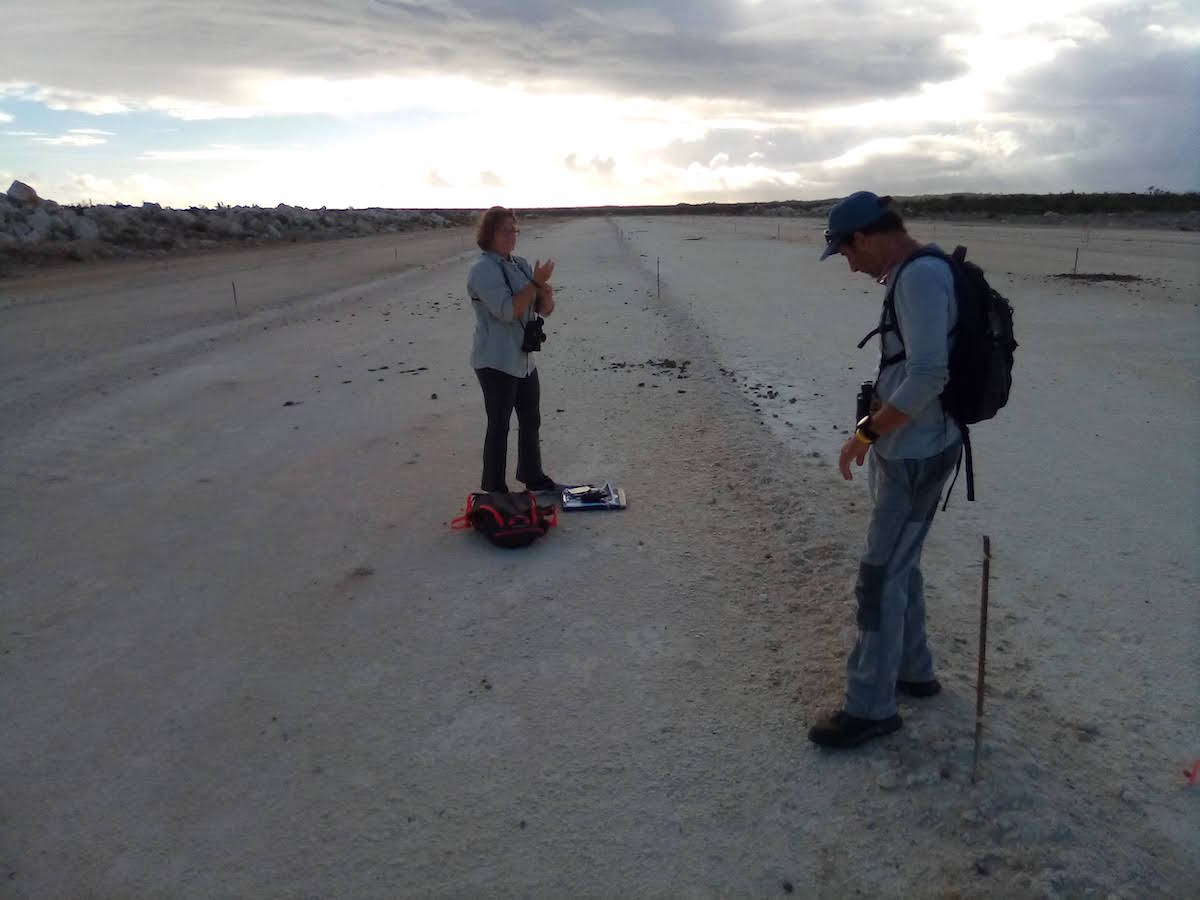
Survey point now in the middle of the new airport runway. (Photo by Joseph Prosper)
Back to the field work! During the first few days, we kicked up clouds of red dust as we walked from point to point to count the Barbuda Warbler. Then, there were a few unexpected challenges, some caused by the much-needed heavy rains we encountered (Antigua and Barbuda have been in a drought for several years). But folks were happy to pull us out of the resulting mud when we got stuck and we were able to complete our surveys despite several rain delays. The construction of the new airport meant that several points we had previously counted were now either on the runway or in the middle of the rock quarry supporting the new construction. Habitat loss and concerns about the impact the airport will have on the surrounding warblers are something that should be closely monitored into the future.
There was also good news. We observed warblers throughout the island in numbers roughly similar to the previous counts shortly after the hurricane. 71 of the 105 random points counted during the week included at least one Barbuda Warbler. Certainly, one of the reasons the Barbuda Warbler population is doing this well, following a direct hit by Irma, is simply the amount of habitat available on Barbuda. The small human population and communal land ownership laws on Barbuda have resulted in most of the island remaining in a wild state, providing the warbler and other life with ample habitat. This likely provides significant buffers to the impacts of natural disasters such as droughts and hurricanes. As that habitat decreases, however, with the developments that are sure to follow the opening of a new airport, the risks to the warbler and its long term survival will also increase.
While the warbler appears to be doing fairly well, the data are still being analyzed and any conjecture about the true population status at this time is based on our observations and not statistics. We will follow up this blog post with the population estimates once the numbers have been crunched (and we will also present our work at BirdsCaribbean’s 22nd International Conference in Guadeloupe). The data are now off to Dr. Frank Rivera-Milan (who led the team during the first visit) – he will be running the various models to produce a current population estimate.
All in all, it was a very busy week but we had a wonderful time. Counting birds, meeting new friends, and spending time on such a beautiful, mostly wild island is a special experience—I’m ready to go back !!!
Thank you to our Partners!
We thank our donors and supporters who made this trip a successful one. Firstly, many thanks are expressed to the U.S. Fish & Wildlife Service (Neotropical Migratory Bird Conservation Act Fund), Global Wildlife Conservation, and Mr. Lamont Brown for providing funding for these important surveys and also for the educational outreach in Barbuda. Sincere thanks to the Environmental Awareness Group (EAG) for assisting with the logistics, especially Ms. Arica Hill and Mr. Kelly Burton (Dept of Environment). Thanks to Fernando Simal (WILDCONSCIENCE), Joseph (Junior) Prosper, Natalya Lawrence, Shanna Challenger, and Sophie Punnett-Steele for tireless help with the field work. Thank you to Mr. John Mussington and Ms. Charlene Harris, principals at both the secondary and elementary schools in Barbuda, for affording us the opportunity to visit and speak with the students. Finally, we wish to thank the Barbuda Council and the Barbudan people who provided us with their assistance and support.
By Jeff Gerbracht, Lead Application Developer, eBird, Cornell Lab of Ornithology. For many years, Jeff has served as a volunteer facilitator at our BirdsCaribbean training workshops and assisted with a number of field survey and monitoring efforts.
Hover over each photo to see the caption or click on the first photo to see a slide show.
Jeff showing Barbudan child how to use binoculars and catch a glimpse of local birds. (Photo by Joseph Prosper)
Lesser Antillean Bullfinch in St Vincent. (Photo by Jeff Gerbracht)
Natalya Lawrence recording birds and vegetation cover. (Photo by Jeff Gerbracht)
Sunset at the Codrington wharf. (Photo by Jeff Gerbracht)
Counting Magnificent Frigatebirds, white-headed immatures and downy chicks in abundance. (Photo by Jeff Gerbracht)
Magnificent Frigatebird chicks. (Photo by Jeff Gerbracht)
Roofs yet to be repaired and some businesses still aren’t open. (Photo by Jeff Gerbracht)
Clearing surrounding new runaway and road to quarry. (Photo by Jeff Gerbracht)
Jefff and Fernando planning logistics with Kelly Burton. (Photo by Natalya Lawrence)
Natalya and Jeff in the field. (Photo by Jeff Gerbracht)
Impromptu bird monitoring class. Fernando showing some school children how to use binoculars. (Photo by Jeff Gerbracht)
The quarry, which is the source for the new airport foundation. (Photo by Jeff Gerbracht)
And it’s a FACT that our Guadeloupe Conference in July will be a damn good time…
Because your BirdsCaribbean family—along with great birds, stunning landscapes, and a warm French culture—all anxiously await you!
Dearest delegates and potential delegates far and wide,
We are now less than 3 months from conference time, and I’m happy to report to you that everything is lookin’ good!
Our Conference Organizing Committee has been working around the clock for the last 5 months to ensure that your time in Guadeloupe is going to be the best it can be! And we have no intentions of dialing it back until we’ve made sure that all of you are at the Karibea Beach Hotel with a smile on your face, an ocean breeze in your hair, and a cold drink in your hands.
I can confidently say that we’ve created what promises to be an unforgettable adventure for you. Don’t miss out! If you haven’t yet acted on any of the other deadline reminders we’ve sent out, please take this one seriously – May 7th (less than 10 days from NOW!) is the deadline for a GREAT MANY THINGS!
In order to claim a spot, you MUST pay a DEPOSIT here, absolutely immediately.
Please reach out to me personally if you have any questions and need some help: [email protected].
Ok, with the paperwork behind us, let’s give you a glimpse of what we’ve been putting together!
First, the Karibea Beach Hotel is going to be our venue, and it won’t disappoint. The presentation and meeting rooms are comfortable and sized just right; the socializing space where we’ll be having our coffee breaks is set up perfectly to mingle with old friends and meet new ones; the backdrop is a beach looking out over the ocean towards the western half of the island, where Le Soufriere dominates the landscape; and the personal rooms are close-by, comfortable, and come with quite the view!
We’ve got 6 exciting Keynote Speakers lined up. Be sure to make time to meet with as many of them as you can during a coffee break or over a meal!
The field trip options before, during, and after the conference are abundant and diverse. We’re throwing as many opportunities to explore the island at you as we possibly can! Climb a volcano, snorkel the mangroves, island hop down to Dominica and Martinique, watch the Caribbean Martins come in to roost in downtown Pointe a Pitre, explore the Deshaies Mountains, or experience Guadeloupe’s famous waterfalls – staying active won’t be a problem!
The Program itself is filling up quickly. We’ve already had dozens of excellent presentation and posters abstracts submitted, which means that our symposia from shorebirds to hurricanes to technology will be rich with new and exciting talks and information. Likewise, we are overflowing with interesting workshops and engaging training sessions. We’ll be sure to get the full digital version of the conference PROGRAM out to you before you head to Guadeloupe, so you can start making some decisions on what you’d like to attend!
Don’t forget, there are several PRE-CONFERENCE workshops ready for you to attend. Please make sure to adjust your travel accordingly and also let us know that you’ll be attending!
Restoring Habitat through World Migratory Bird Day Cleanups
Open Standards for the Practice of Conservation
Atlantic Flyway Shorebird Harvest Workshop
And if you’re coming to Guadeloupe to see some awesome birds, the island will not disappoint.
284 bird species have been observed in Guadeloupe, including 81 nesting species reported since the year 2000.
Guadeloupe hosts 8 bird species that are endemic to the Lesser Antilles, 5 species that are endemic to the Lesser Antilles + Puerto Rico, and 1 species entirely endemic to Guadeloupe – the Guadeloupe Woodpecker.
A huge thank you to Frantz Delcroix and Anthony Levesque for allowing us to showcase some of their stunning photographs:
Lastly, and perhaps most importantly, our conferences wouldn’t be teaming with a diverse crowd of scientists, conservationists, and students if it wasn’t for the generous support of donors that help sponsor delegates to attend. PLEASE CONSIDER helping sponsor a delegate – our conferences can be life changers for our community members that don’t normally have the financial means to travel, personally network with leaders in their field, and attend workshops and symposia that can help them better their work. Help shape the future of the Caribbean you love, and please considering sponsoring a delegate.
It’s that time of year again – spring migration! Migratory birds have started making their way to the temperate areas of the globe for breeding, Some of these birds have spent the entire winter in the Caribbean and others are passing through as part of a longer journey. In both cases, the Caribbean provides essential habitat that supports these fearless travelers. Safe, clean places to rest and refuel are critical to their survival.
A round trip migration for the Pectoral Sandpipers can reach over 18,000 miles (30,000 km). (Photo by Nick Dorian)
Some of the longest trips made this spring will be completed by the arctic-breeding shorebirds. If you catch a glimpse of a Red Knot in the next few weeks, you are seeing it on just a small part of its 9,300 mile (15,00 km) journey! Shorebirds are both incredible athletes and world travelers: they can travel hundreds of miles a day without rest and pass over continents in weeks.
Capturing data of birds during migration is vital to understanding their status, distribution, and how they are using sites in the Caribbean throughout their life cycle. While you are out birding don’t forget to log your observations in eBird Caribbean. If you are visiting a wetland, please do a Caribbean Waterbird Census (CWC) count! The regional count occurs in January and February, but CWC data is collected year-round! When entering your data on eBird, on Step 2 “Date and Effort” page, be sure to choose either the “CWC Point Count” “CWC Traveling Count” or “CWC Area Search” observation type. (you can also choose one of these options if you are using the EBird Mobile app – adjust your settings – choose eBird Caribbean as your portal and the options will show up!)
Is that a Least Sandpiper or a Western?
Earlier this year, we redesigned an existing poster of common shorebirds in the Caribbean which features many of the sandpipers, plovers and larger shorebirds that you may see while birding. This poster is a great resource because: 1) it shows the relative size of the shorebirds to each other and 2) all the birds are in their winter plumage. In their non-breeding plumage shorebirds – especially peeps – can be challenging to identify. We hope that this resource is a helpful guide for those learning their shorebird identification.
The poster is also available in Spanish and French. Below the English common name and scientific name, the common name of the bird appears in Spanish for Cuba, the Dominican Republic, and Puerto Rico. For example, the Red Knot has three Spanish common names: Zarapico Raro (Cuba), Playero Gordo (Dominican Republic), and Playero Pechirrojo (Puerto Rico). If only two Spanish common names appear, this indicates that two of these three countries have the same common name for the bird.
Do you have access to a large format printer and want to have a hard copy of this beautiful resource? The poster is the perfect addition to wildlife offices, public education spaces, or to have on hand for events like presentations and bird festivals! Larger versions of the posters can be downloaded here: French, English and Spanish.
We very much appreciate the National Audubon Society and the Bahamas National Trust allowing us to redesign their original poster and for Manomet’s input during the process. We thank the Canadian Wildlife Service for supporting poster printing costs in 2019. Participants at the Conserving Caribbean Shorebirds and Their Habitats Workshop were treated to small versions of the poster thanks to a generous donation from the Puerto Rico Department of Natural and Environmental Resources.
We are impressed. We are excited. We are hopeful. Yes, CWC 2019 has sparked some emotions among us all!
First and foremost, we at BirdsCaribbean wish to thank you – our partners, who joined in the 2019 Caribbean Waterbird Census (CWC). The Census is now in its tenth year of data collection by energetic birders across the region. Over the three-week count period ending on February 3rd, we received a total of 321 checklists from 19 countries, with 212 different species observed. We are deeply impressed by the work you have all put in!
This year’s CWC was unusual in some ways. We were not sure what to expect. In 2017, Hurricanes Irma and Maria cut a swathe of chaos and destruction across parts of the region. Our birds suffered and struggled to survive, and conservationists struggled to recover along with them. Results from the CWC in 2018 a few months later were worrying. Our counters reported dramatic declines in the diversity and numbers, even of some of our most common bird species. We might have expected this as the hurricanes damaged fragile wetland habitats – which had already been threatened in recent years by human activities. Even though the storms occurred in 2017, those ecosystems still have a long road to recovery.
The results from this year were heartening, compared to the post-hurricane CWC results in 2018. There were quite a few surprises and records during the counts.
Locations of the sites surveyed during the 2019 Caribbean Waterbird Census (Map by Aly Ollivierre)
Encouraging Numbers
It’s early days yet. We won’t have a complete picture of how birds are recovering until we analyze all of the data. However, there have been promising reports from the field. In the Turks and Caicos Islands, the Canadian Wildlife Service led Piping Plover surveys with a team of partners and volunteers. The team counted 134Piping Plovers this year at six sites – compared to 62 plovers at three sites in 2018. Among these birds, the surveyors spotted 15 marked with unique leg codes (including ten from their own study!).
A group of Piping Plovers foraging in Cayo Paredon Grande, Cuba. (Photo by Martin Acosta)
The teams visited a variety of good shorebird sites including foraging sand and mud flats, salinas, and ponds. Black Rock, an area of islets and sandbar on the south side of Middle Caicos, came out top in terms of the range of species and numbers counted. Almost 1,500 shorebirds were spotted, including 180Red Knot (five of which were banded with unique codes). In the past, this location has yielded many bird sightings, but in the post-hurricane count last year numbers were lower (around 500 birds). This may have been due to the redistribution of sand from Hurricane Irma which limited good foraging habitat. The abundance of birds has since tripled – which is exciting news.
In Cuba, Professor Lourdes Mugica and her team from the University of Havana counted 41Piping Plovers in Cayo Paredon Grande on the north coast of the island. Lourdes reports that they observed more Piping Plovers in other areas. However, interestingly this is the largest flock her team has ever encountered in four years of CWC monitoring. Five of the birds were banded – these were read and reported in their eBird entry.
Is it too early to suggest that this lovable, endlessly fascinating bird is making a comeback?
Exciting Discoveries
Does this plover look suspicious to you? It’s a Common Ringed Plover, which should be overwintering in Africa. Seen in Guadeloupe, this is the third record for the Caribbean. (Photo by Anthony Levesque)
On to Antigua, where Andrea Otto and her team from the Environmental Awareness Group (EAG) spotted a Wattled Jacana! Not only is this a new island record, but it is a first sighting for the West Indies. This range map from eBird Caribbean clearly shows that this is a South American species. In addition to the jacana, the group also saw an American White Pelican – a new record for the island. Both are incredible sightings – check out the eBird report here!
Andrea and Natalya Lawrence shared the news of the Wattled Jacana sighting, explaining the importance of the CWC and Antigua’s waterbirds in a lively television interview on the “Antigua Barbuda Today” morning show. To see the interview, complete with photos, advance to 2:05:15 here). Our partners at EAG really helped to put their island’s waterbirds on the map!
Nature Explorers Anguilla also had an unexpected American White Pelican during their CWC count at Meads Bay Pond in Anguilla. According to the literature available and eBird records, it would appear to be a first record for the island. Way to go team! Their eBird list is available here.
Anthony Levesque in Guadeloupe spotted a Common Ringed Plover. This is only the 2nd Guadeloupe and 3rd Caribbean record of this species! Common Ringed Plovers usually overwinter in Africa (see the eBird range map). They are quite a challenge to identify in the field, especially when they are supposed to be on the other side of the world! Read Anthony’s descriptive notes on his eBird list here.
In Saint Vincent and the Grenadines, Lystra Culzac spotted a single male American Wigeon. This is also a rare, and possibly first, sighting for the island.
Future CWC Surveyors in the Making
Students practice their waterbird identification in Jamaica during the CWC. (Photo by Ava Tomlinson)
In Jamaica, the National Environment and Planning Agency (NEPA) hosted 65 students to participate in the CWC in the Palisadoes, Port Royal Protected Area. Students learned about the importance of the area, which is a RAMSAR site close to the capital city of Kingston, and the species they might encounter. In addition, they learned about the impact of pollution on this fragile environment.
The students used materials from BirdsCaribbean, including “Wetland Birds of the Caribbean” and “Seabirds of the Caribbean,” identification cards, binoculars, and data sheets, and set out to record their observations. They worked in groups of four, validating the type of birds seen under the guidance of NEPA staff. The students were excited to see the Belted Kingfisher, Magnificent Frigatebird, Royal Tern, Ruddy Turnstone, and Sandwich Tern.
On World Wetlands Day, a group from BirdLife Jamaica counted in the same area, which is slated for tourism development – including a retractable pier for cruise ships that is already on the island. How will this affect the wetland habitat and the birds that shelter there? Time will tell. Among the species counted there was a “party boat” full of Laughing Gulls.
Disturbing Events
Grupo Acción Ecológica (Dominican Republic) discovered and removed over 300 traps for waterbirds during their CWC counts. Here, an American Flamingo is freed. (Photo by Maria Paulino)
Wetlands were the focus for Maria Paulino and her team from Grupo Acción Ecológica in the Dominican Republic. However, there were some unhappy discoveries. At one of the country’s important wetland sites, Monte Cristi on the north coast, the team found large traps designed to catch American Flamingos. Tragically, other species were casualties – including a dead Snowy Egret, a dead Reddish Egret – and two days later, a similar trap was found with three dead Tricolored Herons. The team freed one trapped flamingo from a trap.
Altogether, the team removed over 300 traps! This terrible situation was reported to the Environmental Department in Santo Domingo and (hopefully) this will pressure the government into taking some action. It is not clear what the fate of the flamingos would be when caught, but Maria Paulino has heard that they are sold to resorts and hotels.
What is the CWC?
The Caribbean Waterbird Census (CWC) is a multi-partner, region-wide waterbird and wetland monitoring program led by BirdsCaribbean. The goal of this program is to learn more about the distribution, status, and abundance of waterbirds in the Caribbean in order to better conserve and manage these beautiful birds and their habitats.
Environmental Awareness Group in Antigua discussed the CWC and their record findings in a television interview.
The program also aims to increase awareness, build capacity (for example through training workshops), and engage communities and volunteers in wetland monitoring and conservation. Ultimately, we want to identify and ensure that as many important wetland sites as possible are protected, thus nurturing the many fascinating bird species that live in them.
Since the program began in 2010, dedicated bird enthusiasts have ventured into wetlands across the Caribbean to systematically survey all types of waterbirds (shorebirds, seabirds, wading birds, marshbirds, and waterfowl). The three-week regional counting period begins on January 14th and ends on February 3rd each year – just including World Wetlands Day (February 2nd).
However, this is not a “once per year” event – you certainly don’t have to wait until January of 2020 to join the CWC. We collect data all year-round! To learn more about migration routes and important stopover sites, everyone is asked to count waterbirds as often as possible throughout the year, especially during migration periods in fall (August-November) and spring (March-May).
The CWC forms part of the International Waterbird Census (IWC) – the largest volunteer waterbird count in the world, organized by Wetlands International and now in its 53rd year. We are still relatively “new kids on the block,” but after ten years we are making valuable contributions to the knowledge base for these critical but often overlooked species.
The collected data is recorded on the newly designed eBird Caribbean online platform.
Any time you are counting birds in Caribbean wetlands, you can enter your data on eBird as a CWC Point Count or Traveling Count. Make sure to choose one of these protocols on “Observation Type” if using the eBird Mobile app (be sure to choose eBird Caribbean portal in your Settings), or on Step 2 of data entry on your laptop.
A rare American Wigeon (male) spotted by Lystra Culzac and Glenroy Games in St. Vincent. (photo by Lystra Culzac)2019 CWC Survey team in the Dominican Republic – Kate Wallace, Maria Paulino and Daniel Mejia.
The Guadeloupe Woodpecker is endemic to Guadeloupe. (Photo by Frantz Delcroix)
Join us for the BirdsCaribbean 22nd International Conference, registration is now open! Please visit the conference website to register and to find information about field trips, travel support, accommodations and much more. The Call for Papers and opportunity to apply for Travel Support is also open (see below).
BirdsCaribbean and Parc National de la Guadeloupe have been working hard to put together a diverse, interesting, and relevant scientific program for the 2019 conference. And of course there is plenty of room for adventure and bird-watching in our pre, mid and post conference field trips. Hike a volcano or head to the waterfalls with chances to see Caribbean endemics like the Guadeloupe Woodpecker, Brown Trembler and Purple-throated Carib.
The conference theme is “Keeping Caribbean Birds Aloft.” “Keeping” implies that we, as a Caribbean community, are: 1) actively involved in the effort, and 2) working on ways to build resilience in the face of many challenges that Caribbean birds are facing. “Aloft” is an encouraging choice of words that reminds us what we’re all in this for – to see our Caribbean birds 1) in flight, 2) alive and well, 3) in their natural place, and 4) thriving.
To learn more about the amazing island that is hosting us this year, BirdsCaribbean Vice President Justin Proctor detailed his scouting trip to Guadeloupe here.
Brown Trembler photo by Anthony Levesque
Call for Papers & Travel Support
The Call for Papers is also open with a deadline for submission on April 15th. Thinking about submitting a talk or poster? Check out the themes/sessions at this year’s conference.
If you are in need of Travel Support to attend the conference, please visit this page and fill out the application form as soon as possible!
Travel to Guadeloupe is a bit challenging – we are encouraging everyone to register and sort out their flights as soon as possible – procrastination is not advised! We offer lots of great information and support for finding a flight on our Travel Logistics page.
Remember to check the conference website over time as information will continue to be added and updated. This includes plenary speakers, workshops, symposia, round-tables, and more.
See you in Guadeloupe! #BirdsCarib2019
Spectacular natural features of Guadeloupe await. (Photo by Fabien Salles)
Will you see this shy Forest Thrush in Guadeloupe this year? (Photo by Frantz Delcroix)
The Brown Trembler is endemic to the Lesser Antilles. (Photo by Frantz Delcroix)
The beautiful Scaly-breasted Thrasher is endemic to the Lesser Antilles. (Photo by Frantz Delcroix)
The Purple-throated Carib is a spectacular Caribbean endemic. (Photo by Anthony Levesque)
Over five days, 33 enthusiastic participants learned about shorebird identification, monitoring techniques and conservation strategies. They shared ideas, compared experiences, and trekked around watery habitats practicing new field skills. “We were thrilled to work with this enthusiastic group of conservationists this week,” said Lisa Sorenson, Executive Director of BirdsCaribbean. “They have all have pledged to use what they learned to help study and protect threatened shorebirds in their home countries.”
Why Shorebirds?
Shorebirds, like sandpipers and plovers, are among the most threatened groups of birds in the world. Most of them migrate incredible distances every year from high in the Arctic where they breed down to southern South America and back again. Some species, like the Red Knot, will fly over 9,300 miles (15,000 km) — and that’s just one way. Many migratory shorebird species, like Black-bellied Plovers, Greater Yellowlegs, and Semipalmated Sandpipers, rely on Caribbean wetlands to stop and refuel during their long journeys. Some even spend the entire winter! However, shorebird species have been in steady decline since the 1970s. This is due to several factors, all connected with human activities such as loss of habitat from development, disturbance on beaches, and hunting.
Black-bellied Plover (in winter plumage) at Combate Beach, Puerto Rico. This shorebird, and many other species rely on Caribbean beaches and wetlands for a safe haven during migration and overwintering. (Photo by Brad Winn)
The group of eager Caribbean conservationists at the workshop learned more about these threats, not only direct threats to shorebirds and waterbirds, but also to their habitats: beaches, mudflats, mangroves, and some agricultural areas. They also discussed best practices in monitoring the birds and conducting conservation activities. Importantly, they learned how to take part in two critical monitoring programs, the Caribbean Waterbird Census (CWC) and the International Shorebird Survey (ISS). All of this led to a deeper understanding of the birds’ ecology and conservation.
Another major threat to Caribbean shorebirds is plastic pollution, and the theme of World Migratory Bird Day 2019 reflects this: “Protect Birds: Be the Solution to Plastic Pollution.” With a growing awareness of the harmful impact of plastic across the region on public health and the environment, the group was soon busy with a cleanup at one of the field trip sites, collecting 50 pounds of trash. The exercise was led by Sheylda Diaz Mendez of Environment for the Americas (EFTA) and representatives from the Scuba Dogs Society. This was an excellent hands-on exercise for participants on the management and organization of a cleanup (which is not as easy as it sounds). Plus, the participants had fun, and were delighted to receive cleanup equipment to take back home, thanks to EFTA.
Sharing Experiences Reveals Common Themes
Group photo on the last day wearing our 2019 World Migratory Bird Day shirts—33 participants from 14 island nations. (photo by Ana Roman)
While the first three days focused on basic shorebird and waterbird identification, life history, threats to birds and habitats, and collecting and exploring data, the final two days turned to conservation solutions. After sharing the challenges they face in their countries, it was evident that many islands were experiencing similar issues. Facilitators and trainees then shared ideas and strategies for reducing threats.
In the coming days, participants will have the opportunity to apply for funding from BirdsCaribbean to carry out conservation activities on their islands. The group discussions and brainstorming sessions during the workshop were fantastic opportunities for participants to begin to develop project ideas for this funding. Depending on the threats and priorities at a given site, these projects might include activities such as shorebird and waterbird monitoring, public outreach and education, or a wetland cleanup.
Having people with the same interests and passions from across the region also had other benefits — reminding each other that we are all conserving birds together! “It’s really cool to see how many of us are actually doing this kind of work. Because when you’re on these islands, it’s just you, and you’re like, “The world is on my shoulders! These birds, I’m all they have!” said Shanna Challenger of the Environmental Awareness Group on Antigua. “And it’s really cool to see how many people we have working on the same thing.”
The group of students, wildlife managers and educators from both the government and the non-profit sectors represented 14 island nations: Antigua, the Bahamas, Dominica, Dominican Republic, Grenada, Haiti, Jamaica, Montserrat, Puerto Rico, Saint Lucia, Saint Vincent and the Grenadines, Sint Maarten, Trinidad and Tobago, and the US Virgin Islands.
BirdsCaribbean also benefited from sharing experiences during the week with our partners and co-facilitators for the workshop, Manomet, Inc. Experts in shorebird identification, life history and habitat management, the Manomet team provided enthusiasm and invaluable insights in the classroom and in the field. Their Habitats for Shorebirds Project aligned with the goals of the workshop and BirdsCaribbean is very grateful for all of their help and expertise.
Practice Makes Perfect In the Field
Field trip within Cabo Rojo National Wildlife Refuge. (Photo by Lisa Sorenson)
In addition to 30 hours of classroom learning, the group went on six field trips to local wetlands throughout the week. The field trips around Cabo Rojo offered students the opportunity to identify birds in the field and to practice count methods. “The workshop was amazing!” said Zoya Buckmire of the Grenada Fund for Conservation. “We went to a variety of wetland habitats from salt ponds to lakes to beaches. We got to see many different birds and learned some fantastic techniques for identifying and counting them.”
Shorebirds in their non-breeding, or wintering, plumage are notoriously difficult to identify. Sometimes only subtle details harbor the clues. Are the legs black? Are the wingtips longer than the tail? Does the bill droop slightly at the tip?? By the end of the week, the group was becoming more confident in the field marks for tricky birds. The Least Sandpipers at Cabo Rojo Salt Flats were a welcome new species for the group, though many were not convinced of the “yellow” in their yellow-green legs! However, with a week of field trips, it became clear to all that the more you practice, the better you are at field identification.
The workshop ended on a high, with two final field trips to Laguna Cartagena and Salina Fortuna. These were excellent places to practice flock estimation and point counts. While several species of herons and egrets and hundreds of Black-necked Stilts and Glossy Ibis were observed, taking a good look at more secretive species like the Clapper Rail and Sora were a perfect way to end the week. All participants received new Vortex binoculars and ten organizations received a new Vortex spotting scope and tripod – “must-have” equipment for monitoring programs and ensuring proper identification. The group also received field guides and other resources for bird identification and data collection.
Participant Perspectives
A group enthusiastic to clean up shorebird habitat! (Photo by Monica Iglecia)
The participants came away with plans to share their newfound knowledge with colleagues. “Thank you so much for always providing opportunities for conservationists in the Caribbean like myself,” wrote Laura Baboolal from Trinidad. She aims to start a shorebird monitoring program for Trinidadian wetlands, and adds: “We hope this can evolve into something greater…Hoping to have some exciting news soon!”
Most Caribbean people live on or near the coast, but have not appreciated or learned much about the birds that inhabit their seashores and wetlands. One of these was participant Reneive Rhoden, from Jamaica’s National Environment and Planning Agency. “I’ve learned so much about shorebirds!” said Reneive. “I grew up on the seaside and I didn’t know anything about shorebirds – and now I know a lot! I can now teach my kids, children in school, and Jamaicans that I work with in my job.”
We are very grateful to the following generous sponsors and partners for contributing to this workshop: Manomet, Inc.; Western Hemisphere Shorebird Reserve Network; Sociedad Ornitológica Puertorriqueña; US Fish and Wildlife Service (Neotropical Migratory Bird Conservation Act Fund); US Forest Service International Programs; Environment Canada; The Cornell Lab of Ornithology; Cabo Rojo National Wildlife Refuge, Para La Naturaleza; Optics for the Tropics, Inc.; Environment for the Americas; Puerto Rico Department of Natural and Environmental Resources, and Vortex Optics.
We invite you to enjoy the gallery of photos below. Hover over each photo to see the caption or click on the first photo to see a slide show.
Cataloging trash collection. (Photo by Jessica Cañizares)
Perfect waterbird habitat at Laguna Cartagena National Wildlife Refuge. (Photo by Lisa Sorenson)
Birding at Combate Beach (L to R): Jeanette Victor, St. Lucia; Lisa Sorenson, BirdsCaribbean; Kristy Shortte, St. Vincent and the Grenadines; Reneive Rhoden, Jamaica. (Photo by Jessica Cañizares)
Early morning birding at Combate Beach. (Photo by Jessica Cañizares)
Looking at a Spotted Sandpiper on the beach. (Photo by Monica Iglecia)
Brad Winn reveals shorebird food using a sieve. (Photo by Monica Iglecia)
Anderson Jean and Francoise Benjamin practicing plover ID with Brad Winn. (Photo by Jessica Cañizares)
Setting the scope high. (Photo by Monica Iglecia)
Birding in Laguna Cartagena National Wildlife Refuge. (Photo by Lisa Sorenson)
Reneive Rhoden helps clean up the refuge. (Photo by Jessica Cañizares)
Taking a closer look at shorebird food resources. (Photo by Lisa Sorenson)
Getting a closer look always helps with ID. (Photo by Jessica Cañizares)
Group photo after the beach cleanup. (Photo by Monica Iglecia)
Lisa Sorenson discusses threats to birds and their habitats with a group. (Photo by Monica Iglecia)
In the classroom at Cabo Rojo National Wildlife Refuge. (Photo by Lisa Sorenson)
Participants presenting their group discussions about shorebird conservation. (Photo by Monica Iglecia)
Workshop participants and facilitators group photo at Cabo Rojo National Wildlife Refuge, Puerto Rico. Everyone is wearing their World Migratory Bird Day t-shirts: Be the solution to plastic pollution. (photo by Ana Roman)
Fela and Pepe, inseparable, on the search for Puerto Rican Todies.
Join Justin Proctor on his adventure to Puerto Rico where he was invited to help launch an exciting new book on one of the Caribbean’s most unique birds.
Everybody in Puerto Rico knows José (Pepe) González Díaz and Felisa (Fela) Collazo Torres in the same way: as a husband-wife team just as inseparable from each other as they are from their island’s natural landscapes. They wake up every day just as in love as when they met decades ago, and just as ready as they were the day before (and the day before that) to go out amidst their mountains, valleys, and rivers to discover something new…together. I’ve never met another couple like them. They are, like Puerto Rico, something beautifully special.
It is no hyperbole when I make the claim that Pepe and Fela have collectively spent tens of thousands of hours researching, photographing, filming, and producing educational materials about their island’s flora and fauna. It isn’t difficult to find their Aves Puerto Rico FelPe (Fela + Pepe) insignia on dozens of full length documentaries covering everything from endemic butterflies to birds. Their extensive YouTube channel is a good place to start your way down the rabbit hole. Keep in mind as you look through their material how much “behind the scenes” time and effort it takes to capture some of the high-quality, rare footage of many of the species that are featured. A 20-second shot of never before seen behaviors was likely the product of days, if not weeks, of time spent waiting and watching from within a cramped little blind.
Pepe and Fela’s trademark logo, involving a blend of both their names
A sampling of the multimedia filmed, edited, and produced by Pepe and Fela.
But beyond these invaluable pieces of work, Pepe and Fela are probably even better known for something else.
Todies.
For more than 15 years, they have consumed themselves with unravelling the story of the Todidae family. And the more they dug, the more they found. The Todidae family is unique for so many reasons, but perhaps the most obvious is that it is a small family of only five species, all of which are collectively endemic to the Greater Antilles. You’ll find one species in Cuba, one in Jamaica, two in Hispaniola, and one in Puerto Rico.
The Puerto Rican Tody, locally named San Pedrito, is one of the five tody species endemic to the Caribbean.
That’s it. They belong to the Caribbean and nowhere else.
Todies are also unlike any other birds that you’ll ever see, guaranteed, which makes them a major attraction for birders and photographers from all over the world. But don’t just take my word on it. Pick up a copy of Pepe and Fela’s coauthored book, La Raíz de las Antillas: La Historia de la Familia Todidae, which has certainly proven itself to be the most comprehensive historical account of these birds ever published. The book is now available on Amazon, and should find its way into the hands of any birder that has ever had the pleasure of spending (or longed to spend) a few moments with a tody.
The book does an excellent job of navigating readers through the last three-hundred years of documentation of the todies, and how so many people struggled to describe these birds for what they really were. Consistently confused with hummingbirds and oftentimes inaccurately illustrated, the todies weaved their way in and out of ornithological accounts as different birds almost every time. And so readers will quickly come to appreciate the detective work that Pepe and Fela have undertaken so as to guide us efficiently and accurately through the convoluted timeline of the todies. The late James W. Wiley summarized it well:
“The book is an important contribution to our knowledge of the family Todidae as well as a major contribution to Antillean ornithology in general. The authors’ exhaustive investigation and compelling presentation are an exceptional model for others to follow.”
Readers will also be quick to notice that the authors have interlaced an important message throughout their book: that their island’s tody species—the Puerto Rican Tody, or locally the San Pedrito—rightfully deserves a change of its scientific name, Todus mexicanus. Through their historical account of the species, Pepe and Fela make a clear case for changing T. mexicanus to T. portoricensis or T. borinquensis (the latter derived from “Borinquén”, the original Taíno name for Puerto Rico). Geographically speaking, this makes sense, because the Puerto Rican Tody has never touched foot in Mexico. And the reason for the misleading mexicanus species name has likely stemmed from just a quick moment of confusion that occurred in the late 1830s, when two tody specimens collected at two different localities were later misidentified and subsequently documented incorrectly.
However, the process of procuring a formal scientific name change through the International Commission on Zoological Nomenclature (ICZN) can be a challenging one. Unfortunately, current taxonomy is rife with species that have geographically-misleading scientific names, and the ICZN does not usually address these cases. However, Pepe and Fela’s case has additional ground to stand on (read the book to find out!), and so they are continuing to push forward. For them, the name is important; the San Pedrito is as unique and beautiful as the island of Puerto Rico itself, and because of that, has limitless potential to grow into an icon of pride and stewardship for Puerto Ricans over their island’s rich biological diversity. But the tody and what it can signify loses power and influence when its name does not match the people that should care about it the most.
Pepe and Fela are on a mission to establish the San Pedrito’s taxanomic name as Todus portoricensis
Over the last couple of years, La Raíz de las Antillas (for short) has been enhanced and amplified through a series of revisions and new editions. It was in early 2018 that Pepe and Fela reached out to BirdsCaribbean, and ultimately our Journal of Caribbean Ornithology (JCO) editorial team, to see if we’d be willing to help proofread and copy-edit the first full-length English edition, appropriately titled, The Root of the Antilles: A History of the Todidae Family. One of the JCO’s best editors, Alice McBride, decided to take it on. She did such an outstanding job of cleaning the grammar that Pepe was compelled to go back to the original Spanish edition and make some changes. As the Managing Editor of the JCO, I was excited to see us involved with the future of the book, while equally interested in seeing how the collaboration could grow over time. A few months later, the opportunity came in the form of an invite from Pepe and Fela for us to attend the much-awaited, public release of their book scheduled for the 8th of December in Adjuntas, Puerto Rico.
One of the perks of being employed by a non-profit are the (sometimes) flexible hours. With the rest of the BirdsCaribbean and JCO crew tied up with “work,” I was thrilled to be offered the opportunity to fly down and represent us. It was a chance to see Puerto Rico for the first time, be hosted personally by Pepe and Fela, and see my fifth and final tody species. Done deal, sign me up! The hospitality I received and the fun I had over just a short five days on the island is worthy of its own full-length account. But in short, it was spectacular, and one of those trips where the puzzle pieces all just come together perfectly, over and over again. From spending afternoons with the Puerto Rican Parrots in El Yunque and the shorebirds in Cabo Rojo, to sipping a fresh cup of mountain coffee while seeing my first San Pedrito at La Mocha, to squeezing in a grand-finale sunset from the Arecibo Observatory (eat your hearts out James Bond fans), I had no choice but to fall in love with Puerto Rico (it would have been easy despite).
Casa Pueblo in Adjuntas, PR made for the perfect venue to celebrate Pepe and Fela’s coauthored book, The Root of the Antilles_A History of the Todidae Family
Through all of that, it was the day of Pepe and Fela’s book release that took me most by surprise. Looking back, I’m not sure what I originally expected to unfold, but it was definitely second-rate to the magnitude of what greeted me. The event was hosted by Casa Pueblo. My best attempt at describing this organization is by saying that they’re engaged with absolutely every initiative that a community needs and wants, and they’re doing it right. An hour before the ceremony was going to take place, the venue’s auditorium that could comfortably seat 75 people was overflowing into every open space available. Among the crowd were members of the Sociedad Ornitológica Puertorriqueña (SOPI), passionate birders, wildlife photographers, professors, school groups, and a myriad of community members. Everyone was excited about Pepe, Fela, the todies, and the great success story surrounding all three. Bands played, beautiful presentations and speeches were made, handmade gifts were given, and food and drink were shared—it was a true celebration, filled with friendship and pride.
The invitation we all received was for a book release, but anyone attending would agree that what actually transpired was an opportunity for Puerto Rico to show its gratitude to Pepe and Fela for all they had done, and continue to do, for the people and wildlife of the island they love. I consider myself lucky and fortunate to have been a part of that truly special day.
The story of the Puerto Rican Tody can no longer be told without the addition of Pepe and Fela, nor can their personal story be told without the tody. I hope that everyone reading this gets a chance to meet all three of them. In the meantime, while the winter days are short and cold, brush up on your tody history by picking up a copy of The Root of the Antilles: A History of the Todidae Family. And by doing so, you’ll be supporting all of the great work and forward progress that it stands for.
Pepe and Justin sit beneath a painting of the San Pedrito done by Pepe himself.
We wrap up our series of our 30th Anniversary celebrations with this final video. In the Caribbean we celebrate not only the diversity of our birds (172 bird species found only in the region!), but also our members. For 30 years we have brought people together from dozens of countries to learn from each other, share ideas, and forge friendships and partnerships. Our members often tell us how much they value our network for the support and inspiration that it provides. It gives us the strength to keep going in the face of many challenges. And sometimes our members even fall in love.
First up is Jessica Rozek, graduate student at Tufts University. Jessica is studying sustainable use of wetlands in Trinidad and important stopover and wintering sites for shorebirds in the Caribbean. Jessica joined BirdsCaribbean in 2016 and has been an active member ever since. She is on the editorial board of the Journal of Caribbean Ornithology and a contributor to our blog. As our Waterbird Program Manager, Jessica is coordinating our upcoming Conserving Caribbean Shorebirds and their Habitats Workshop in Cabo Rojo, Puerto Rico and our Caribbean Waterbird Census Small Grants program.
Ingrid Flores worked for four years as Regional Coordinator of our Caribbean Endemic Bird and International Migratory Bird Festivals. The festivals introduce people to the joy and beauty oif local birds. They also help people understand how these birds are part of each island’s natural heritage and it is up to local communities to conserve them. Ingrid helped coordinators organize activities, shipped out materials, and managed social media around the festivals and bird education. She is passionate about Caribbean birds and encouraging people to become involved.
Glenroy Gaymes is the Chief Wildlife Officer in the Forestry Dept in St. Vincent and the Grenadines. He is well-known as a local expert on all aspects of the country’s flora and fauna, and is involved in many conservation initatives. Glenroy is also a founding member of SCIENCE, a local NGO. Together with member Lystra Culzac and other SCIENCE officers, Glenroy is active in teaching youth and local people about birds. His team carries out our BirdSleuth Caribbean program with school clubs and summer camps. He is also active as a local bird guide to residents and visitors alike.
Maydiel Canizares is a Cuban Biologist. For the past five years, he worked as a Biologist in the protected areas of Zapata Swamp Biosphere Reserve. Twenty three of the 28 endemic birds of Cuba can be seen here, in addition to ~300 resident and migratory birds. It’s a very important place for migration, featuring many types of diverse habitats. It’s also an Important Bird Area (IBA) and a Ramsar site. Two big conservation initiatives in Zapata Swamp that Maydiel worked on are: 1) encouraging locals to landscape with native plants (which will help endemics like the Bee Hummingbird), and 2) installing nest boxes for threatened psittacid species: the Cuban Parakeet and the Cuban Parrot. Maydiel is also an experienced bird guide and led several of BirdsCaribbean’s bird tours at our conference in Cuba in 2017.
Jen Mortenson is a Post Doctoral Fellow at the University of Arkansas . Through her PhD research Jen was able to provide key data and recommendations for the first conservation plan of the White-breasted Thrasher, an endangered bird found only on St Lucia and Martinique. You can read about Jen’s exciting research here. We are grateful to Jen for this important work and so happy to have her as an active member of BirdsCaribbean.
Lisa Sorenson (Executive Director) and Jennifer Wheeler (recently retired Treasurer) are well-known to the BirdsCaribbean community for their many years of service in developing programs, raising funds, helping partners, and keeping the organization running smoothly. They had fun wishing BirdsCaribbean a very happy 30th birthday.
Editor’s note: After many months of paperwork and a visit to the US Embassy in Guyana, Maydiel immigrated to the US this past October. He and Jessica married in November 2018, the second BirdsCaribbean couple that we know of – congratulations!!!
Sincere thanks to Esther Figueroa (Vagabond Media) for putting together this video and Ingrid Flores, JC Fernández-Ordóñez, and José Colón-López for Spanish translation. Thank you to José (Pepe) González Díaz and Felisa (Fela) Collazo Torres for the video footage of the Green Mango (hummingbird) in Puerto Rico feeding on one of our donated feeders after Hurricane Maria devastated the island. Golden Swallow photograph is by Dax Roman. Special thanks to our members, partners and supporters who make this work possible!!!
In case you missed them, view our other fun 30th Anniversary videos at links below:
The Imperial Parrot, locally known as the Sisserou, is the National Bird of Dominica. (Photo by Paul Reillo)
In April 2018, we published an article about the controversial export of threatened parrots from Dominica to Germany. After the 2017 hurricane season, the Association for the Conservation of Threatened Parrots (ACTP) exported two Sisserou (Imperial Parrots; Amazona imperialis) and ten Jaco (Red-necked Parrots; Amazona arausiaca) in March 2018. ACTP claimed that establishing a captive breeding population at their facility in Germany was an “emergency measure.”
A new report by Lisa Cox in The Guardian has uncovered just how dishonest ACTP has been in its dealings with captive birds. It also reveals the criminal history of its director, Martin Guth. This new information amplifies our initial outrage and serious concern for the exported birds from Dominica. Before we highlight the report’s findings, here is a brief history of events:
Timeline
17 Mar 2018:
2 Imperial Parrots and 10 Red-necked Parrots are secretly removed from Dominica’s Parrot Conservation and Research Centre. They are exported via private charter plane to ACTP’s facility in Germany.
3 Apr 2018:
BirdsCaribbean publishes their first blog post about the incident, describing the legal, scientific and ethical problems with this export.
5 April 2018:
Thirteen organizations, including BirdsCaribbean, prepared and signed a letter to the Executive Director of the United Nations Environment Programme (UNEP) expressing outrage over the transfer. The letter was also sent to representatives within CITES, the government of Dominica, the US Fish and Wildlife Service, and the European Union, .
April 2018:
ATCP publishes a statement in responses to the letter arguing that an external facility is the best option to protect these birds from natural disasters.
1 May 2018:
Forty international researchers, veterinarians and conservation leaders, including BirdsCaribbean, continued to express concern. They recommended the repatriation of the parrots and a full investigation into ACTP’s activities. This letter was sent to Dominica’s Director of the Environmental Coordinating Unit and Director of Forestry, Wildlife and Parks in addition to Germany’s Federal Agency for Conservation of Nature.
10 Dec 2018:
The Guardian publishes two articles by Lisa Cox about ACTP. The first is an exposé into how ACTP has acquired one of the world’s largest collections of endangered parrots. The second details Australia’s own dealings with ACTP, despite concerns.
What did the investigative report reveal?
Red-necked Parrots, also known as Jacos, are endemic to Dominica. (Photo by Paul Reillo)
Dominica has not been the only country to have questionable dealings with the ACTP. Since 2015, ACTP has removed 232 parrots from Australia (80% of all live native bird exports) including endangered birds like the Carnaby’s Black-Cockatoo. In Brazil, the Spix’s Macaw is extinct in the wild; ACTP has 90 per cent of the existing global population (142 of the 159 birds left). The organization has also acquired endemic parrots from St. Lucia and St. Vincent.
The article reports that the ACTP has a license to operate as a zoo in Germany. Exports to zoos are typically granted under the assumption that the birds will be on exhibit. But the site is not easily accessible by public transport, there is no car park, and no clear indication that the facility is open to the public. There are no signs that offer information about opening hours or admission prices. Also, ACTP is not registered with any major international zoological association.
So what happens to the birds? That remains unclear as ACTP does not publish inventories, animal transactions, or financial reports. The article does note, however, that the German federal conservation agency is aware of private social media messages that show Australian birds apparently imported by ACTP offered for sale for hundreds of thousands of dollars.
The Guardian reporters describe Martin Guth as a convicted criminal, former nightclub manager, and “unofficial debt collector.” He served a five-year jail sentence for kidnapping and extortion in 1996 and a 20-month term for extortion in 2009. The reports also allege that “at least one individual who works with ACTP has a conviction for involvement with illegal bird trading.” German authorities reportedly deny any knowledge of Guth’s criminal background.
Yet, when ACTP applied to the Environment Department in Australia to be recognized as a zoo, it was asked: “If the zoo is privately owned, has the owner ever been convicted of a criminal offence or declared bankrupt?” ACTP responded that it was not privately owned. Its response in relation to criminal offences was marked “n/a”.
The Guardian reports have sparked strong reactions among conservationists on social media. Stephen Durand from Dominica’s Forestry Department said they confirm his worst fears: “When Martin Guth visited Dominica in January 2018…his first declaration was that he had absolutely no interest whatsoever to conduct any breeding programme for Dominica’s Parrots. And so here it is. History to confirm that Dominica’s Parrots were traded to a fraudulent zoo in the name of conservation, owned by a convicted criminal businessman.”
The Sisserou is endangered and endemic to Dominica. (Photo by Paul Reillo)
BirdsCaribbean and our fellow conservation organizations will continue to put pressure on authorities and individuals responsible for the controversial export of Dominica’s wildlife to ACTP. We stand by our recommendation to repatriate the 12 parrots. First, transfer the birds to a credentialed, experienced zoological facility to check for diseases. If deemed healthy and disease-free, return the birds to the Parrot Conservation and Research Centre in Roseau, Dominica. We also recommend a full investigation of all parrot imports by ACTP into Germany as well as ACTP’s activities with CITES I species (including inventory history). Finally, we support a ban on all future transfers of Caribbean parrots to the ACTP.
Dr. Paul R. Reillo, President of the Rare Species Conservatory Foundation and co-Director of the Tropical Conservation Institute at Florida International University, points out: “Dominica’s parrots have survived hurricanes for millennia, and wild populations have rebounded thanks to broad-based, on-island conservation measures.” Dr. Reillo, who has worked in Dominica for over 20 years, also believes the parrots should be returned as soon as possible.
The lush habitat for which Dominica is famous, and the birds that live in it, were dealt a bitter blow by Hurricane Maria. However, like its people, the island is resilient – and so are its birds. The island’s biodiversity should be allowed to recover at its own pace – and within its own borders, as Dr. Reillo notes.
Parrot habitat in Morne Diablotin National Park in Dominica – The forest is recovering after the passage of Hurricane Maria in September 2017. Photo taken in late 2018 by Stephen Durand.
BirdsCaribbean is excited to announce the first recipients of grants from the Betty Petersen Conservation Fund. Three excellent projects focusing on endangered birds endemic to the Caribbean were selected among many deserving proposals. Projects in Haiti, the Dominican Republic, and St. Lucia were granted over $132,000 through the fund, with commitments of an additional $114,000 for the second year of these projects.
The organizations to receive 2019 Betty Petersen Conservation Fund grants from BirdsCaribbean are:
Environmental Protection in the Caribbean (EPIC) for “Black-capped Petrel Conservation Through Poverty Alleviation in a Haitian Community”
Durrell Wildlife Conservation Trust for “Engaging Local Communities in Reversing the Decline of the Endangered White-breasted Thrasher by Restoring Key Nesting Sites and Reducing the Impacts of Invasive Species”
The Peregrine Fund for “A Holistic Approach to the Conservation of Critically Endangered Ridgway’s Hawk in Dominican Republic”
The “Betty Fund” was created to support conservation projects in the Caribbean that engage and empower communities and stakeholders to both protect and sustainably benefit from their birds. This approach was used successfully by the woman in whose memory the Betty Fund is named.
Difficult decisions after a tremendous response to call for proposals
Ridgway’s Hawks are critically endangered and found only in Los Haitises National Park in the Dominican Republic. (Photo by the Peregrine Fund)
“We received 24 pre-proposals representing extremely important conservation work in 16 island nations. We invited full proposals from six organizations, and while virtually all of these were deserving, we had to narrow these down to three projects,” said Andrew Dobson, Chair of BirdsCaribbean’s board and a member of the Betty Fund’s review committee. “It was a very difficult choice.”
BirdsCaribbean commends all the other applicants on their proposals and encourages re-application to the Betty Fund in the future as well as continued engagement in the BirdsCaribbean network as an aid to finding other sources of funding.
The 2019 Betty Fund projects all exemplify the principle that conservation is a social undertaking, and in each human empowerment and benefits are explicitly addressed. Project approaches include establishing tree nurseries with local schools in St. Lucia to help the White-breasted Thrasher, training in sustainable agricultural practices and sponsoring a soccer team in Haiti with the local name, Diablotin, of the Black-capped Petrel in Haiti, and providing hawk-proof chicken coops to farmers in the Dominican Republic to reduce shooting of the Ridgway’s Hawk.
Additionally, all three of the selected projects focus on an Endangered or Critically Endangered species endemic to the Caribbean. “Species endemism is not a requirement for support from the Betty Fund” explained Dr. Lisa Sorenson, Executive Director of BirdsCaribbean, “but it’s gratifying to be able to direct these inaugural funds towards birds that are uniquely Caribbean.”
2019 Betty Fund Grant Recipients
Black-capped Petrel Conservation Through Poverty Alleviation in a Haitian Community Environmental Protection in the Caribbean (EPIC)
The stories of the petrel and the people of Haiti run parallel – stories of hanging on in the face of hardship and a tenuous future in the face of great challenge; but stories also of resilience and hope based on local and international commitment to improving the environment and lives of people. The short film, “Haiti, Our Love, Our Home” portrays these stories. With dedicated funding for two years, EPIC will be able to continue and enhance activities to alleviate poverty and increase the ecological sustainability of agricultural practices, increase awareness, and foster stewardship of the Black-capped Petrel through education and outreach events. To assess the connections between their conservation efforts and local petrel populations they will map and monitor local petrel breeding habitat as well as track petrel breeding success in petrel nesting colonies adjacent to the project site.
Engaging Local Communities in Reversing the Decline of the Endangered White-breasted Thrasher by Restoring Key Nesting Sites and Reducing the Impacts of Invasive Species Durrell Wildlife Conservation Trust
The White-breasted Thrasher is endemic to St. Lucia and Critically Endangered. New funding from the Betty Fund will help restore the species’ habitat and engage the local community in conservation. (photo by Steffen Oppel)
The goal of this project is to reverse the decline of the endangered White-breasted Thrasher found in Saint Lucia. Degradation of the thrasher’s dry-forest habitat, caused by unsustainable land use by local communities, and predation from invasive species are having negative impacts on the reproductive success of this small population. The team aims to increase the area of suitable habitat by working with local communities and land owners to develop a cooperative land management system promoting the protection of key nesting sites and sustainable land use practices as well as restoring the habitat through a program of planting. To reduce the impacts of invasive species, a control program will be designed and implemented across key nesting sites and the effects on nesting success will be monitored using a network of camera traps. They will also engage local school children to aid with the analysis of the camera trap footage through a local outreach campaign.
A Holistic Approach to the Conservation of Critically Endangered Ridgway’s Hawk in Dominican Republic The Peregrine Fund
Ridgway’s Hawk is a critically endangered island endemic limited to one small, isolated population in the Dominican Republic, making it particularly vulnerable to extinction if human and natural pressures continue. The main threats are human persecution, infestation of botflies (Philornis pici) in nestlings, and habitat loss. Though the situation is dire, it is also hopeful. The Peregrine Fund has proven that most anthropogenic threats can be mitigated through environmental education and community engagement. They have developed an effective treatment protocol for Philornis infestations which has increased nestling survival by over 170%. Additionally, they have had great success with reintroductions in Punta Cana, where they released young hawks to create an additional population, which now numbers 18 pairs. The current goal is to create 1-2 more populations in Dominican Republic. Future successes will be measured by the number of hawks in each population, reduction of human-caused hawk mortality, and the advancement of local biologists to take on higher responsibilities.
About Betty Petersen and The Betty Fund
Betty Petersen helped many aspiring conservationists; we honor her legacy with this conservation fund. (photo by Jeffrey Gordon)
Betty Petersen (1943-2013), a lifelong resident of Massachusetts, was for many years director of a program called Birders Exchange (run by the American Birding Association), enabling birders in the US and Canada to provide resources to Latin American and Caribbean groups and individuals. In doing so, she created a network of friends and partners across all of the Americas, who loved and admired her deeply, as is evidenced by their generosity in supporting this project in her memory. The Betty Petersen Conservation Fund has been established, under BirdsCaribbean’s administration, by friends and family to keep her vision and dreams alive.
The Betty Fund was officially launched in 2018 from the generous donations of individuals who knew Betty Petersen personally or were inspired by her work. “I knew Betty for almost 30 years,” said BirdsCaribbean Board member, Charles Duncan. “She was, in her own way, a wizard. With nothing more than donated birding equipment, books, and a bit of cash, She turned local communities and school kids into committed conservationists, struggling NGOs into recognized players on the inter-American scene, and “paper parks” into real protected areas. And in the process she reminded us how rewarding it is to lend a hand when none is expected.”
Betty’s husband, Wayne Petersen, spoke on behalf of the family stating, ““Betty was neither a trained scientist nor an ornithologist. However she was a deeply caring, kind, and gentle soul who understood people, their needs, and their feelings. It was these attributes that made her sustained efforts on behalf of bird conservation in Latin America and the Caribbean so successful and what eventually made her a beloved, admired, and respected figure. I know that Betty would have been modestly overwhelmed by the way BirdsCaribbean is carrying forward her legacy – a legacy of which I am deeply proud.”
The Black-capped Petrel is a mysterious seabird locally known as Diablotin. It spends it life at sea returning to the mountains of the Caribbean to breed. Only recently was nesting by this species discovered in Haiti. (Photo by David Hollie)
BirdsCaribbean will continue to fundraise for the Betty Fund, especially given the commitment for year two funding for the three inaugural projects. Dr. Sorenson said, “The recipients have committed to raise almost $275,000 in matching funds for their projects so, in just the first two years of its existence, the Betty Petersen Fund will have enabled more than a half-million dollars for conservation of endemic birds in the Caribbean. We are off to a great start, and we can’t wait to see what other projects we can fund in the ensuing years.”
“What wonderful news!” commented Adam Brown of EPIC, a recipient of funding for his work on the endangered Black-capped Petrel in Haiti. “Thank you to you and the Committee for allowing us this opportunity. We look forward to promoting petrel conservation the way Betty would have been happy to support.”
For information on how to contribute to the Betty Fund and/or how to apply for funding please visit our page here. Thank you to all the generous donors for making this work possible!
Another short entertaining video in our series celebrating our 30th Anniversary! Thanks to our members and partners for sharing your thoughts with us in creative and entertaining ways!
First up is our partner, Sustainable Grenadines Inc. (SusGren), based in Union Island, St. Vincent and the Grenadines. Drone footage shows recent progress on the restoration of Ashton Lagoon, which is underway now! After more than 12 years of hard work and perseverance, this -mangrove-salt pond-coral reef ecosystem damaged by a failed marina development is being restored to its former glory. BirdsCaribbean has been a partner on this project from the very beginning! Our initial Wetlands Education Training Workshop way back in 2004 was the catalyst for this work and we have assisted with fundraising and project planning. Congrats to SusGren Team and we look forward to further updates!
Next up is Hannah Madden, a biologist working with the Caribbean Netherlands Science Institute based in St. Eustatius. She has been studying the nesting ecology of Red-billed Tropicbirds on St. Eustatius since 2012 but also conducts research and monitoring on other avifauna, such as the Bridled Quail-dove. Hannah is Secretary of the Board of Directors of BirdsCaribbean starting Jan 2018. She is an active member, attending our various workshops and conferences, carrying out waterbird monitoring through the Caribbean Waterbird Census. and leading local education events for World Migratory Bird Day and the Caribbean Endemic Bird Festival. She has published a number of papers on different taxonomic groups, but always tends to gravitate towards birds.
Jeff Gerbracht is the Lead Application Developer for eBird at the Cornell Lab or Ornithology. Jeff has been a long-time member and key partner of BirdsCaribbean. He has provided critical help to us in developing our bird monitoring programs as well as our own eBird Caribbean online portal. Jeff is a facilitator at many of our training workshops and conferences. His enthusiasm, knowledge, and love of birds is inspiring. Thanks to Jeff for donating so much time to us to help us advance conservation of Caribbean Birds!
Anthony Levesque has discovered over 40 species never before recorded in Guadeloupe and banded more than 10,000 birds. He is currently carrying out research to advance our knowledge of the impacts of hunting on shorebirds in Guadeloupe. When he is not shaving ;-), he is also the Guadeloupian coordinator of the World Migratory Bird Day (WMBD) since its inception in 2006 and served as Regional Coordinator for many years. Anthony is co-chair of our Checklists Working Group. He is a founding member of AMAZONA – a local bird NGO, active in Guadeloupe with over 300 members. His enthusiasm and sense of humor are always a delight!
We first met Binkie van Es in 2014 when he attended our BirdSleuth Caribbean International Training Workshop, an innovative education program that reaches thousands of youth across 18 islands. Since then Binkie has been putting what he learned to excellent use in Sint Maarten/ St. Martin, educating hundreds of youth and community members about the beauty and value of our birds. Recently retired, Binkie is also a certified bird guide – he took our Caribbean Birding Trail Guide Training Workshop in 2016 and has been helping visitors and residents alike to find and enjoy birds on his home island. Binkie’s passion is infectious – we are lucky to have him as a partner for both education and bird tourism!!!
Ricardo Miller works as a biologist for the National Environment and Planning Agency (NEPA) in Jamaica. He is committed to doing all he can to ensure that Jamaica’s birds and wild places are conserved for future generations to enjoy. He does this through his work at NEPA and also tireless volunteer efforts educating youth in schools and taking Jamaicans out birding for our Caribbean Endemic Bird Festival and World Migratory Bird Day. Ricardo is also an outstanding bird guide and has own business, Arrowhead Birding. For 30 years BirdsCaribbean has provided conservationists across the Caribbean the ability to share information and strategies for studying and conserving birds and their habitats through training workshops, conferences, working groups and regional projects, as well as the academically acclaimed Journal of Caribbean Ornithology.
Sincere thanks to Esther Figueroa (Vagabond Media) for putting together this video and Ingrid Flores, JC Fernández-Ordóñez, and José Colón-López for Spanish translation. Thanks to SusGren for their awesome drone mini-video. Photographs are by Sipke Stapert (Brown Pelican) and Tadas Jucys (Purple-throated Carib, Shutterstock). Special thanks to our members, partners and supporters who make this work possible!!!
In case you missed them, view our other fun 30th Anniversary videos at links below:
A Green Mango visits a feeder in Puerto Rico—4,200 hummingbird feeders were distributed across 18 islands hit by hurricanes in 2017. (Photo by Manuel Torres)
We are 30 years old, and what a year 2018 – the Year of the Bird – has been!
The Caribbean has had another extraordinary year. It has been a “Tale of Two Cities” – or rather, two different groups of islands. On the one hand, it has been a story of restoration and a major push for recovery for islands devastated by the 2017 hurricanes. On the other hand, there were many encouraging developments on other islands; a number of conservation programs are under way that offer hope for our bird populations. Hispaniola researchers discovered new nesting sites of the critically endangered Black-capped Petrel. On St. Vincent and the Grenadines, BirdsCaribbean provided 24 people with sustainable economic livelihoods through our Interpretive Bird Guide Training Program.
BirdsCaribbean is deeply grateful for the generosity of donors and supporters throughout the year. This outpouring of support has helped us tackle the very tough work of identifying the post-hurricane needs of bird populations. This vital funding helped us provide our partners with the support they needed to get themselves, and the birds, back on their feet. Literally, at times – as many birds were shell-shocked!
There was much work to be done this year, but the Caribbean is well known for the resilience of its people. Our island-based partners rolled up their sleeves and got started. BirdsCaribbean helped communities rebuild and expand their conservation and education work, and launched new programs that focused on precious bird habitats – forests and coastal natural resources among them. It is always important to keep moving forward.
Over 60 species of birds were helped, including Bananaquits hummingbirds, pigeons, doves, parrots, thrashers, grassquits, and bullfinches-many found only on one or a few Caribbean islands. (map by Aly DeGraff Ollivierre)
However, some major challenges face us, and they are formidable. Some bird species – such as the Imperial Parrot in Dominica and the Bahama Nuthatch – now face extinction from the impacts of climate change, including storms. Island endemics are also threatened by a range of invasive species, and by poorly-planned human development projects. The situation is more critical and urgent than ever.
We do not want to lose these precious species – or the habitats they depend on.
Meanwhile, our vital education, science, and capacity-building programs across the Caribbean continue, in countries that did not make dramatic headlines. We launched the Betty Petersen Conservation Fund, raising more than $135,000 for groups that will engage and empower their communities to protect and sustainably benefit from their birds. We now have 15 years of archives from our Journal of Caribbean Ornithology, available for free download and we are working on getting the remaining 15 of our 30 years online. Our Seabird Monitoring Manual is now available in three languages. We supported many studies of species of concern, such as the Bridled Quail-Dove on St. Eustatius – a bird whose population has declined by 76% since Hurricanes Irma and Maria.
Students participating in the CEBF Bird Fair in Antigua.
BirdsCaribbean also continues to make connections. We bring Caribbean people together through birds in several ways. We provide materials and small grants for creative annual programs, such as our Caribbean Endemic Bird Festival (this year including Haiti for the first time) and World Migratory Bird Day activities. This year these community-based events reached over 100,000 people in 20 countries. Our specially designed BirdSleuth Caribbean educational program is in use in 22 countries through 40 teacher training workshops this year. Over 37,775 Caribbean children and 9,329 community members participated in the workshops – yes, we did the math! We continue to work with eco-tourism tour groups, expanding bird watching tours across the Caribbean. In 2018, we promoted trips to Cuba, Barbados, Dominican Republic, Jamaica and Puerto Rico.
Lastly, but importantly, we have continued our work to help restore critical bird habitats. In hurricane-hit St. Maarten, we helped purchase 300 mangrove seedlings as well as 500 other plants, beginning a long-term restoration project in Cay Bay and Sentry Hill. This was just one of ten restoration projects we undertook on four islands, all impacted by the 2017 storms: the restoration and replanting of Red Mangrove at Anguilla’s West End Pond, restoration and enhancement of nesting habitat for Red-Billed Tropicbirds at the IBAs of Dog Island and Prickly Pear cays, planting of native trees in the British Virgin Islands, and establishing a native tree nursery in St. Martin.
2019 will undoubtedly bring its own challenges. Looking towards the future, BirdsCaribbean is optimistic that it will continue to build a more secure, sustainable future for the islands and their birds, working with our amazing partners. We cannot afford to lose ground as we struggle with complex challenges. With the generosity of our donors, we will make further progress.We need your help as 2018 draws to a close.
We wish all our friends and supporters Happy Holidays and a successful New Year!
Help us protect Caribbean birds and restore habitats in 2019 – THANK YOU!!!One of our highlights from 2018 was our Caribbean Birding Trail Interpretive Guide Training Workshop in Union Island, St. Vincent and the Grenadines. Participant Lystra Culzac role plays in her presentation by spotting a St. Vincent Parrot with her “clients.” (Photo by Kristy Shortte)Banded Red Knot “CTK” spotted at Cargill Salt Ponds, Bonaire. This bird was first captured and banded in 2004, making it at least 12 years of age. The salt ponds of Bonaire are providing critical habitat for this and other migratory birds during migration and winter. The salt ponds were recently designated a Western Hemisphere Shorebird Reserve Network site which will help raise awareness about the importance of Bonaire and the Cargill Salt Facility as a haven for migratory shorebirds. (photo by Fernando Simal)
Our 30th Anniversary celebration of BirdsCaribbean continues! We’re delighted to share another short fun video of our members and partners describing the work they are doing with us to conserve birds and sending messages of congratulations. Thanks to you all for being part of our community, and enjoy!
Starting us off is Scott Johnson, Science Officer for the Bahamas National Trust (BNT). Scott shares his thoughts on how BirdsCaribbean changed his life, including his gratitude to the organization for introducing him to his wife, Janeczka Johnson, from Anguilla – they were married one year ago! Scott and Jan met at our BirdSleuth Caribbean International Training Workshop in Nassau. Scott’s work at BNT focuses on terrestrial fauna in the national parks. He loves Bahamian birds and reptiles and is a talented naturalist and skilled educator.
Jody Daniel-Simon is from Grenada and is working on her Ph.D. She has been working with colleagues at Gaea Conservation Network and Grenada Fund for Conservation to share our BirdSleuth Caribbean education program with teachers and hundreds of island children. This has helped secure a long sought-after Bird Sanctuary in the outstanding mangrove wetland of Petite Carenage. BirdsCaribbean has provided binoculars and BirdSleuth curriculum materials to increase the understanding and appreciation of birds across Grenada and Grenadines.
Akeisha Clarke is from Petite Martinique, part of Grenada – she attended her first BirdsCaribbean 21 International Conference last year. Over 250 participants from 30 islands and countries met in Cuba in 2017 at this conference. For many this is the only opportunity to collaborate on how birds are studied and protected. BirdsCaribbean funded the participation of 120 students and young professionals (including 60 Cubans). Akeisha left the conference excited to start a bird education program at home and she has been going strong since then!
Justin Proctor, our Vice President, shows off his questionable bird ID skills (;-) since becoming a member. For over 10 years BirdsCaribbean has supported science and conservation of the Black-capped Petrel and BC Board Treasurer, Jennifer Wheeler, is the Working Group’s Co-Chair. Justin is Associate Editor of our journal, The Journal of Caribbean Ornithology, and is Head of our Organizing Committee for our 22nd International Conference in Guadeloupe.
Bertrand Jno Baptiste, aka “Dr. Birdy,” worked for many years as a Forestry Officer in the Forestry, Wildlife & Parks Division in Dominica, and has been a long-time member and partner of BirdsCaribbean. Since his retirement from Forestry, Birdy enjoys sharing his passion for birds and nature in Dominica as a bird tour guide and is part of BirdsCaribbean’s Caribbean Birding Trail program. This program seeks to build sustainable incomes for conservation-minded communities. Since its inception it has conducted 6 training workshops for more than 150 people, giving local residents the skills and tools needed to take visitors out birding as well as well interpret the cultural and natural resources of their islands.
Adrianne Tossas is an Adjunct Professor at the University of Puerto Rico, Aguadilla. She attended her first BC meeting in 1998 when she was a graduate student. She considers BirdsCaribbean the backbone of her career and a very significant part of her life, thanks to the support, mentoring and inspiration received from this organization and its members. She is now paying it forward teaching a new generation of students in Puerto Rico about the ecology of birds and conservation.
We especially thank Adrianne for working as our first Caribbean Endemic Bird Festival Coordinator starting in 2002. Each year this celebration raises public awareness, knowledge and appreciation for the region’s many resident and migratory bird species, especially the high number of endemic birds in the region (172)—species that exist nowhere else in the world.
Cynthia Pekarik works as the Coordinator of Migratory Birds Conservation with the Canadian Wildlife Service, a key partner for BirdsCaribbean. Cynthia has helped with funding to develop our Caribbean Waterbird Census program. Her support was key in gathering the data to have Cargill Salt Ponds in Bonaire designated a Western Hemisphere Shorebird Reserve Network Site. David Mizrahi is a shorebird biologist with New Jersey Audubon and also collaborates with BC on shorebird conservation.
Sincere thanks to Esther Figueroa (Vagabond Media) for putting together this video and Ingrid Flores, JC Fernández-Ordóñez, and José Colón-López for Spanish translation. Thanks to Scott Johnson for his brilliant mini-video. Photographs are by Bruce Hallett (Bahama Yellowthroat) and Gregg Homel (Grenada Dove). Special thanks to our members, partners and supporters who make this work possible!!!
Dave Lee holding a White-tailed Tropicbird in the Bahamas. (photo by Mary Kay Clark)
David S. Lee was a pioneering naturalist and conservation biologist who helped get BirdsCaribbean started nearly 30 years ago, and inspired many naturalists with his work and his writing. He was a man of many interests, and with respect to the Caribbean, published numerous papers and articles in the popular press on seabirds, Bahamian fish, turtles, snakes, bats, and orchids.
Donations from Dave’s wife, Mary Kay Clark and his mother, June Bash, allowed the establishment of the David S. Lee Fund for the Conservation of Caribbean Birds that will award money to conservation projects in his honor. The money is being held in a trust and will be used to award an annual grant for innovative projects that protect Caribbean birds and their habitats.
Goal of the Fund: The David S. Lee Fund for Conservation seeks to continue David’s passion for protecting wildlife. The fund will support direct, innovative conservation work in the Caribbean Region for birds and their habitats. The fund will be managed by BirdsCaribbean and used for annual small grants.
A striking male Magnolia Warbler perches momentarily on a branch while foraging for food during its spring migration. (photo by Gerald A. DeBoer, Shutterstock)
Eligibility: Scientists/naturalists working in the Caribbean, in conservation organizations or academic programs, may apply. Applicants should be students or early career ornithologists, conservationists, or wildlife professionals (i.e., not established faculty or senior staff of a conservation organization, less than 7 years post-graduation). A student must be enrolled in accredited Masters or PhD program in ecology, biology, conservation, or related field to be eligible. Applicants must be paid or sponsored members of BirdsCaribbean at the time of application.
Use of Funds: The funds can cover travel to field sites, living expenses in the field, or costs for equipment and supplies to conduct conservation projects. Examples of equipment and supplies include traps, cameras, automated recording units, nest boxes, etc. Ineligible costs include salary or other wages, overhead fees, etc. Projects that foster collaboration between scientists/naturalists in different island groups of the Caribbean, such as joint projects to test conservation techniques for similar species, will be favored.
Application Guidelines:
Proposals may be submitted in English, French, or Spanish. All should have an English version of the abstract
Applications should be emailed as a Microsoft Word document.
The application should include a cover page, proposal (download guidelines below), and a curriculum vitae for the applicant.
Separately, by email, three individuals who can attest to your effectiveness in previous work should submit letters of recommendation. For students, this would include your academic advisor.
Evaluation:
A committee appointed by BirdsCaribbean will review the proposals and award the grants.
The awardee will be required to submit a report one year from the day of the award explaining how the award money was spent and the results of the project to that point. The awardee is also asked to write an article for BirdsCaribbean’s blog about their work (informal article for a lay audience).
But wait! What if you are not eligible to apply for funds, you ask? You can still support this worthy cause by being a sponsor!
Reddish Egrets (dark morph). (photo by Tania Thomson, Shutterstock)
This fund will be for the conservation of any bird in the Caribbean as a reflection of Dave’s diverse interests. He was an important part of many projects, ranging from those of the Black-capped Petrel and Seabird Working Groups to the scholarly debate leading to the elevation of the Bahama Yellow-throated Warbler to a full species.
At the moment the fund contains $12,000. Our initial goal is to raise $25,000 so that we can award $1,000 every year to a worthy student or early career ornithologist, conservationist or wildlife professional. Not only will this fund encourage creative field work for projects that make a difference, but it will also help build the knowledge and skills of young conservationists that are urgently needed to make sure that the Caribbean birds and habitats that Dave treasured are still around for future generations to enjoy.
Cuban Parrot surveying his domain. (photo by Elliotte Rusty-Harold, Shutterstock)
At the 2015 BirdsCaribbean meeting in Kingston, Jamaica, a round of beers was purchased in Dave’s honor, since he always seemed to have a cooler full when people wanted one (and even when they didn’t). Think of this fund like a cooler full of refreshing beverages that Dave would have around if he were here. We owe it to Dave to stock that cooler—to vitalize naturalists and empower them in their work to help wildlife.
Please give a tax deductible donation to the David S. Lee Fund. Give generously. The more we put into the fund, the more we can give out each year. Thanks to all those that have contributed to the fund!
If you prefer to donate with a check, please make the check out to “BirdsCaribbean” and in the memo section, note that it is for the David S. Lee Fund. If you have questions or to make other arrangements for donating, please feel free to contact Jennifer Wheeler, BirdsCaribbean Treasurer ([email protected])
Checks can be mailed to: BirdsCaribbean, 841 Worcester St. #130, Natick, MA 01760-2076
With so many recent tragic and conflicted events occurring in the world, BirdsCaribbean wants to share something uplifting. As part of our continuing 30th Anniversary celebration, we present you with a two-minute glimpse of what our Cuban, Puerto Rican, and Mexican colleagues are doing to conserve birds and their expressions of appreciation to BirdsCaribbean. Please take a moment to enjoy their inspiring words and images.
First we hear from Alieny González-Alfonso, graduate student at the University of Havana. Together with her fellow students and professors, Alieny has been a a powerhouse of positive actions for understanding and conserving Cuba’s resident and migratory birds. She is studying Reddish Egrets for her PhD and participates in Caribbean Waterbird Census monitoring every year. Alieny also organizes events to celebrate our Caribbean Endemic Bird Festival and World Migratory Bird Day each year and coordinates activities across the island. Alieny also conducts teacher training workshops and leads activities for our BirdSleuth Caribbean education program. Congrats and thanks to Alieny and her team for her amazing work!
Next we travel to Puerto Rico and hear from José Colón-López. José is a legend in his native Puerto Rico. As a volunteer with SOPI, he has been active in studying and conserving the endemic and migratory birds of Puerto Rico and their habitats for over 30 years. He generously donates his time to train and mentor others, sharing his passion and vast knowledge with a new generation of conservationists. José is also a founding member of BirdsCaribbean and has been to every single conference of ours since the first one in St. Croix 30 years ago!!! Cheers to Jose and thanks for inspiring us with your dedication and energy!
Adriana Vallarino, Ph.D., is a professor a the Institute of Marine Sciences and Limnology, Universidad Nacional Autónoma de México. She studies Masked Boobies and Least Terns in the Campeche Bank in the Gulf of Mexico and Caribbean Sea, vitally important nesting islands for many Caribbean seabirds. Adriana attended our International Seabird Training Workshop in San Salvador, Bahamas in 2012 and since then, has been carrying out innovative research and conservation work, including studying the impacts of micro plastics on seabirds. She also does a marvelous job organizing bird education events in Campeche, featuring birding walks, bird art and photography, mini workshops and more. We’re proud that Adriana is part of our network!
The videos highlight how our programs are engaging young and old in direct conservation, opening doors for scientific and educational exchange, and promoting sustainable livelihoods in ecotourism. Grab a cup of shade grown coffee, sit back and enjoy an inspirational moment.
Thank you to Esther Figueroa (Vagabond Media) for putting together this video and Ingrid Flores, JC Fernández-Ordóñez, and José Colón-López for Spanish translation. Photographs in the video are by Aslam Ibrahim Castellan Maure (Bee Hummingbird), Lisa Sorenson (American Flamingos), Wilfred Marissen (Reddish Egret), Aslam Ibrahim Castellan Maure (Blue-headed Quail-Dove), Jose Pantaleon (Cuban Trogon), Susan Jacobson (Western Spindalis), Lisa Sorenson (Viñales Valley, Cuba), Gary Donaldson (Trinidad, Cuba), Gary Donaldson (Zapata Swamp), AnnHaynes-Sutton (Masked Booby) and Arnaldo Toledo (Cuban Tody). Special thanks to our members, partners and supporters who make this work possible!!!
Cover of Caribbean Seabirds Monitoring Manual by BirdsCaribbean Seabird Working Group members (Sutton et al) – revised and updated, October 2018
BirdsCaribbean’s Seabird Monitoring Manual, released in English in 2015, has undergone final copy-editing and has been translated to Spanish and French. All three versions, now dated 2018, are downloadable in PDF format [EnglishSpanishFrench].
Yvan Satgé of the South Carolina Cooperative Unit of the USGS and Clemson translated the manual to French with help from Régis Gomès (Association pour la Sauvegarde et la réhabilitation de la Faune des Antilles), coordinated the translation to Spanish by J.C. Fernandez-Ordonez (Fundación Científica ARA MACAO), and laid out the final productions. The manual covers the underpinnings of a seabird monitoring program, provides protocols of varying levels of sophistication to survey seabirds at breeding sites, and provides life history information for the region’s seabirds. The manual serves as a training and planning tool for staff and volunteers and is meant to encourage an increase in knowledge of seabirds and their conservation needs across the region. The creation of the manuals was spearheaded by Ann Sutton, the co-chair of the Seabird Working Group of BirdsCaribbean.
Brown Noddy nesting in Bay Marigold, San Salvador, Bahamas (photo by Lisa Sorenson)
A reminder that BirdsCaribbean now holds the inventory of Bradley and Norton’s (2009) An Inventory of Breeding Seabirds in the Caribbean, currently out-of-print. This book provides a comprehensive look at the Caribbean region’s seabird populations, and is a resource that every seabird enthusiast should have in their library. The book is available for purchaseat a bargain price, with proceeds of the sale going to BirdsCaribbean. An excellent companion book is the Seabird Breeding Atlas of the Lesser Antilles (2012), available through its publisher, Environmental Protection in the Caribbean (EPIC).
With the manual now widely available, and the years passing since the seabird inventories noted above, the Seabird Working Group is faced with the challenge of undertaking surveys to update our state of knowledge. Let’s keep that conversation going, especially at the upcoming International Conference in Guadeloupe, July 2019.
Migratory shorebirds like Ruddy Turnstones and Sanderlings rely on Caribbean beaches and wetlands for a safe haven during migration and overwintering. (Photo by Max Schwenne.)
BirdsCaribbean and Manomet, working with their partners are pleased to invite interested persons to participate in a five-day international training workshop entitled, “Conserving Caribbean Shorebirds and their Habitats.” This comprehensive workshop will cover shorebird identification, monitoring techniques, and shorebird ecology and conservation issues. The workshop is classroom and field-based and will take place at Cabo Rojo National Wildlife Refuge in southwest Puerto Rico from February 11-15, 2019. The deadline to apply is December 14, 2018.
The Caribbean islands have a diversity of wetlands, which are known to be vitally important for migratory shorebirds (including most of the focal species in the Atlantic Flyway Shorebird Conservation Initiative). There are still large gaps in our knowledge of waterbirds at these sites, however. In addition, many of the region’s wetlands and inlets have been destroyed, while those remaining are threatened by development, pollution, invasive species, impacts from climate change, and more. Monitoring waterbird populations and their habitats and undertaking conservation actions to protect them is essential to not only birds, but also people.
About the workshop
Some of the participants of the Turks and Caicos Islands Piping Plover Census. (photo by Elise Craig)
The purpose of the workshop is to:
increase appreciation for a suite of bird species that represent limited and highly imperiled habitats of wetlands, coasts, and grasslands
share information on the ecology of waterbirds and the threats that they face
provide participants with the knowledge, skills, and tools needed to significantly contribute to our understanding of waterbirds through direct involvement in international monitoring programs
inspire and facilitate involvement in conservation actions, including raising public awareness, alleviating threats, and restoring habitats that have been damaged
grow our regional network of people involved in the Caribbean Waterbird Census (CWC) and International Shorebird Survey (ISS), and stewardship of our shared waterbirds
The long-term goals of this workshop include the creation of a network of important sites in the insular Caribbean that will be protected and managed to ensure the long-term survival of migratory and resident waterbird species, and to work with partners at priority sites to improve habitats that support healthier waterbird populations.
Participants will learn about Caribbean Waterbird Census (CWC) and the International Shorebird Survey (ISS). There will be opportunities to practice shorebird-waterbird identification and field methods during daily field trips to Puerto Rico’s wetlands. Participants will also identify threats to their wetlands, learn about management techniques for alleviating those threats, and how to approach management challenges. After the workshop, participants will have the opportunity to apply for a small grant (~$1K to $5K) to carry out their own shorebird projects.
Topics to be covered in the 5-day workshop include:
Overview of the Caribbean Waterbird Census and the International Shorebird Survey and how to design and implement a monitoring program
Field training in identifying and counting waterbirds and monitoring wetland habitats
Shorebird life history—migration strategies, stopover ecology, reproduction
Threats to shorebirds and wetland habitats and conservation and management strategies
Developing a strategy for the use of citizen scientists (volunteers) in bird monitoring and conservation
Case studies for successful monitoring and conservation
Building sustainability for long-term monitoring
Data entry and use of e-bird as a data storage platform for bird observation data
Data analysis, writing reports, and sharing information with decision makers and the public.
Who should attend the workshop?
Practice counts of wetlands birds at a training workshop in New Providence, Bahamas.
Anyone who is interested in learning more about waterbird monitoring techniques and/or would like to initiate/participate in a waterbird and wetland monitoring program and carry out conservation actions at a local site or sites (including potential trainers and participants). Preference will be given to persons who are: a) working in protected areas, on wetland conservation, or monitoring with government agencies or NGOs in Caribbean countries with globally important wetlands such as Ramsar sites, Western Hemisphere Shorebird Reserve Network sites, and/or Important Bird Areas (IBAs), and b) interested in getting involved with the CWC and ISS as national coordinators or site coordinators.
Funding and Logistics
Travel and subsistence funding will be provided for selected participants. Participants who can contribute all or part of their costs will also be welcome. A limited amount of funding from is available to cover the cost of meals, accommodation (if required), workshops materials (e.g., all participants will receive binoculars, bird field guides, etc.) and field trip transportation. Participants should plan to arrive in Puerto Rico on February 10th and depart on February 16th.
Applications
If you are interested in participating, please fill out an application form, attach a brief CV and send them by email to Jessica Rozek ([email protected]) and copy [email protected] by Dec. 14th, 2018. Please download and share the summary flyer found here.
About Cabo Rojo, Puerto Rico
American Oystercatcher grabbing a crab breakfast on the beach in Puerto Rico. (photo by Rafy Rodriguez)
The Cabo Rojo National Wildlife Refuge was established in 1974 and lies along the southwest coast of Puerto Rico. It is one of the nine refuges managed by the Caribbean Islands National Wildlife Refuge Complex. The salt flats of Cabo Rojo are managed under a special use permit with a private operator, who continues to manage water levels as part of a commercial salt-harvesting operation. Water levels on the salt flats are also managed with the needs of shorebirds in mind. This area is considered the most important stop over for migratory birds and shorebirds in the Eastern Caribbean. The migratory birds use the refuge during the cooler months, while resident species are present year-round. Because of the importance of salt flats to shorebirds, especially to Snowy Plover and Wilson’s Plover, the area was designated a WHSRN site of Regional Importance. To date, 245 plant species and 145 bird species have been identified on Cabo Rojo National Wildlife Refuge.
About the CWC
BirdsCaribbean has been working to build capacity for waterbird and wetland conservation in the region. The Caribbean Waterbird Census (CWC) Program—a partnership of Caribbean organization, communities, and individuals that monitor waterbirds—was established to help us study, monitor and conserve migratory and resident waterbirds and the habitat they need to survive. We have had great success in growing the program in recent years, however, there are still large gaps in our knowledge and coverage of important wetlands.
The objectives of the CWC are to:
Promote inventories, surveys and censuses of waterbirds and their habitats in all Caribbean countries
Encourage broad-based participation in waterbird counts including NGOs, governmental agencies, institutions, communities and volunteers
Ensure that as many internationally and nationally important sites as possible are conserved and monitored
Increase awareness of conservation issues related to wetlands and waterbirds and what can be done to address these issues.
The CWC is part of Wetland International’s global waterbird census programme called the International Waterbird Census (IWC); different regions of the world all take part in this census (e.g., Neotropical Waterbird Census, African Waterbird Census, etc.) which can be adapted to any country’s objectives and capacity.
The International Shorebird Survey (ISS) is a large citizen science project, first established in 1974, now with contributors throughout the western hemisphere generating shorebird counts that are used widely to understand shorebird population trends and identify sites of regional and international importance.
BirdsCaribbean would like to thank the US Fish and Wildlife Service, Manomet, Inc., Sociedad Ornitológica Puertorriqueña, and the Canadian Wildlife Service for funding and support for this workshop.
A vibrant new look, a larger-than-ever staff, and a blast from the past in our growing Archives collection – we’re excited to let our community know that good things are happening all around the Journal of Caribbean Ornithology!
New Website
First and foremost, we have been moving forward with much-needed software upgrades that will allow us to create and better manipulate a new website interface. Our goals include a much more user-friendly interface, where reviewers, authors, and readers can more easily find the information they need, submit manuscripts, and receive communications from us. And so we are excited to show you our new website. While we are still working out a few small kinks and improving some aesthetics, we’re proud of the new look and feel, and hope you enjoy it as well!
Archives
We are also excited to announce that 15 years (Volume 16 in 2003 to Volume 30 in 2017) of publications from the Journal of Caribbean Ornithology have been archived as free, downloadable pdfs with accompanying metadata on our Archives Page. Some of our more “seasoned” readers and authors might remember that prior to 2003, the journal was known as El Pitirre, which officially began with Volume 1 in 1988. We are now setting out to archive Volumes 1 through 15.
Archiving entire volumes of publications requires considerable time and patience, and none of this archival work could have been possible without a steady stream of people volunteering their time to bring this to fruition. Thank you for all that you’ve done!
More Staff
Next, in an effort to accelerate our publication pace, we have hired four additional staff members split between our Copy Editing and Production teams. Authors and reviewers should now expect quicker turn-around time, better communication from our end, and an even higher quality final product. Thank you to everyone for your patience of late as we train our new staff and continue to build greater momentum.
Page charges: While we continue to offer free, open access to all of our publications, we are pushing hard to take the JCO to the next level, but doing so requires a greater cost on our end that we hope to mediate with reasonable, low-cost page charges. As of January 1st, 2019, we will be instituting these charges. Please note that if you do not have the funds to pay, you will be given the opportunity to waive the fee during the manuscript submission process. We do not want fees to prevent the publication of worthy work.
With new staff and systems in place, we are anticipating a considerable number of completed publications to be added to our current Volume 31 between now and the New Year. Please check back often to read all of the great work coming out of the Caribbean!
BirdsCaribbean (BC) is celebrating our 30th Anniversary and we are getting messages from across the Caribbean thanking us for our work. Please enjoy this two-minute glimpse of our exciting work with founding members and some of our youngest and most enthusiastic bird conservationist from the islands of St Vincent and the Grenadines.
First up are Joe Wunderle, PhD, an icon of Caribbean ornithology and conservation, and Kate Wallace, educator extraordinaire, from the Dominican Republic (DR). Joe is a founding member of BirdsCaribbean and wildlife biologist at the International Institute of Tropical Forestry, US Forest Service, in Puerto Rico. Joe has studied the ecology of many birds in Puerto Rico and the region, including the Bananaquit, Kirtland’s Warbler and Puerto Rican Parrot. He has contributed to their conservation through his research findings and mentoring of countless students and BC members.
Kate joined the flock right after Joe. She has lived in the DR for 24 years, working first with the Peace Corps and then as a volunteer with BirdsCaribbean, Sociedad Ornitologica de la Hispaniola, Grupo Jaragua, and Grupo Acción Ecologica. Kate has been involved in our programs since the beginning, giving countless West Indian Whistling-Duck and Wetlands Workshops, coordinating Caribbean Waterbird Census counts, and organizing events for our Caribbean Endemic Bird Festival and World Migratory Bird Day each year. Oh, and did I mention Kate also promotes sustainable bird tourism and leads tours? She helped with Caribbean Birding Trail Guide Training Workshop in the DR and co-authored (with Steve Latta), Ruta Barrancoli: A Bird-finding Guide to the Dominican Republic.
Next take a virtual flight with us to St Vincent and the Grenadines (SVG) to meet Lystra Culzac and her students. Lystra is founder and director of SCIENCE (Science Initiative for Environmental Conservation and the Heritage Museum and Science Centre of SVG. Through BirdSleuth Caribbean and other bird education programs delivered by Lystra and her dedicated team, the children of St. Vincent are fast becoming expert bird watchers, knowledgable about science, and budding conservationists.
Then, hear from US Geological Survey biologist, Elise Elliot-Smith, how BirdsCaribbean has helped her connect with researchers and conservationist across the islands as, together, they work to protect endangered Piping Plovers and other shorebirds of conservation concern throughout their wintering range. We are grateful to Elise and all involved in these efforts!
Through BirdsCaribbean, and its in-country partners, our programs are engaging young and old in direct conservation, opening doors for scientific and educational exchange, and promoting sustainable livelihoods in ecotourism. By the end of the two minutes I am sure you will agree with life-long BirdsCaribbean supporter, Nick Sorenson that BirdsCaribbean is “the greatest organization on the planet.” 😊 So what are you waiting for, grab a cup of shade-grown coffee, sit back and enjoy an inspirational moment. You deserve it – we would not be here without your support!
Lystra Culzac (Director of SCIENCE) and children in St. Vincent and the Grenadines say thanks to BirdsCaribbean.
Thank you to Esther Figueroa (Vagabond Media) for putting together this video for us, Ingrid Flores for Spanish translation, and Jerry Bauer for videography. Photographs in the video are by Dax Román E. (Hispaniolan Trogon), Walker Golder (Piping Plover), Aslam Ibrahim Castellón Maure (American Flamingo), Steve Estvanik (Whimbrel), Wilfred Marissen (Ruddy Turnstone), Kevin Le (Painted Bunting), Dax Román E. (Black-crowned Palm Tanager), Jose Miguel Pantaleon (Hispaniolan Woodpecker), Frantz Delcroix (Barbuda Warbler), and St. Vincent Tourism Authority (St. Vincent Parrot).
BirdsCaribbean has “come of age,” and is saying goodbye to its youthful twenties. It is thirty years old this year! While taking a glance behind us, to see how far we have come, we are also looking forward to the opportunities and challenges that lie ahead.
A Short History of Us
Our special 30 Year Anniversary logo!
So how did BirdsCaribbean come into being? Well, the first official meeting of the Society of Caribbean Ornithology (SCO) took place in St. Croix, U.S. Virgin Islands back in May, 1988. However, its roots go further back, when first President Jorge Moreno, then head of terrestrial ecology in Puerto Rico’s Department of Natural Resources, met up with Dr. Herb Raffaele, who was then the U.S. Fish and Wildlife Service’s (USFWS) Project Officer for Latin America and the Caribbean. These were two of the “Founding Fathers.” Moreno and Raffaele joined forces and invited “estudiantes de las aves” (students of birds) from around the Caribbean to a meeting in Puerto Rico, funded by USFWS. The following year there was another meeting. After these successes it was clear that they were onto something. They decided to create a new entity, and in 1988 the SCO was formed.
The First Meeting: Bedsheets for Blinds
Who were these “students of birds,” and what was the very first meeting like? Founding Fathers ornithologists Dr. Joe Wunderle and Dr. Herb Raffaele and José Colón described the first meeting as attracting a group of biologists, scientists and conservationists. They saw the study of birds as an avenue to advance their research, management and conservation goals. The meeting in St. Croix took place on an old sugar estate – and was not without its challenges. The building had no air conditioning and the windows had no shades or blinds, so some participants removed the sheets from their beds and covered the windows, to darken the room for presentations. However, it was very windy and this didn’t work so well. No one had been designated as the projectionist, so Wunderle’s wife, Dr. Jean Lodge, volunteered to run the slide projector.
Participants at the 1st Society of Caribbean Ornithology Meeting in St. Croix in 1988 (click on the image to see a larger version)
Bear in mind there was no PowerPoint in those days! Nor Internet, nor any of the luxuries and conveniences of technology that we now enjoy at our meetings. There were also no simultaneous translations, so volunteers provided short translations after each presentation. Besides, the programs for each annual meeting were fluid, to say the least. Some speakers were “no shows,” others turned up unexpectedly. And scheduling of Cuban participants was especially challenging given uncertainty as to who would actually receive permission to attend. Needless to say, participants in the early days learned to expect the unexpected. Fortunately everyone was adaptable.
Rosemarie Gnam (former Treasurer) shared one fond memory of this first meeting: After going out to dinner one night in St. Croix, participants found themselves locked out of the small hotel where most of them were staying. Jorge and others scaled the tall fence to gain access – and eventually they got a good night’s sleep.
Herb Raffaele shared another fun memory from the early days of the society: “Our earliest Caribbean bird conservation meetings, begun in the late 1980’s, were relatively simple affairs. All of the planning and organizing was done by Jorge Moreno of the Puerto Rico Department of Natural Resources and all the funding for delegates from throughout the Caribbean was provided by the Latin America and Caribbean program of the U.S. Fish and Wildlife Service. Everything was done on a shoestring budget, something in the order of $20,000, so corners were minimized at every opportunity. At one such meeting in Puerto Rico I remember driving up to the meeting site only to find this ratty old facility, completely rundown, surrounded by a towering cyclone fence that had to be scaled because no one had a key to its locked gate. When I queried Jorge about this choice of locations he reminded me with great satisfaction how this facility was such a bargain – it scarcely cost more than two dollars per night per person! However, after some attendees later heard gun shots, I suggested to Jorge that future budgets should allow more for accommodations. We have never met in such an inhospitable place again.”
Launching our 30thAnniversary on Video
Along the way, the largest conservation non-profit organization in the Caribbean has changed its name twice. It was incorporated as a non-profit organization in the U.S. in 2003 as the Society for the Conservation and Study of Caribbean Birds (SCSCB). Then, in 2013, following deliberations at the International Conference in St. Georges, Grenada, it was reborn as BirdsCaribbean.
While looking back nostalgically at the early days, Joe Wunderle observes: “Now the Society has grown tremendously and has active outreach and education programs, training programs, including training of field biologists, bird guides, and more…We have got young people who are coming to our meetings and taking leadership roles in the society.” We hope that Joe would not call himself an “old fossil,” however. We would prefer to describe him and his colleagues from the 1980s as “pioneers.”
We are delighted to launch our 30thAnniversary celebrations – starting with the accompanying video from Joe Wunderle himself, talking about how BirdsCaribbean has evolved over the past three decades. More memories, stories and videos will follow!
Share your Memories!
If you have fun memories or old photos to share, please send them to: [email protected].
Many thanks to Joe Wunderle, Herb Raffaele, Rosemarie Gnam, Jose Colon and Emma Lewis for help with this article! Thanks also to Esther Figueroa (Vagabond Media in Jamaica) for putting together this video for us and to Jerry Bauer for videography. Photographs in the video are by Frantz Delcroix (Magnificent Frigatebird) and Rafael Arvelo (Hispaniolan Parakeets). Our cartographer, Aly DeGraff Ollivierre created our 30th Anniversary logo.
Participants at the 1st Society of Caribbean Ornithology meeting in St. Croix 1988. (click on the image to see a larger version). Let us know if you can identify unknown persons in these photos!
Black-Throated Blue Warbler visiting a feeder in Jamaica last week (photo by Ahhh…Ras Natango Garden and Gallery in Camrose Montego Bay)
The month of October always heralds a change in the seasons – even in the Caribbean. As the days grow a little shorter and the fierce heat of the sun lessens, it is also the season for hurricanes. For World Migratory Bird Day (WMBD) 2018, Caribbean island residents are looking back at the terrible storms one year ago. But they are also celebrating the steady recovery of residents – and birds.
About 130 birds, a third ofthe 500 regularly seen species of birds in our region are summer or winter visitors. More than 30 events on 16 Caribbean islands are already lined up to celebrate these amazing birds. WMBD is officially celebrated on October 13 in the Caribbean, but can be celebrated any time in the fall when migratory birds are present. More than 80,000 Caribbean residents, friends and visitors will join in the activities, led by Environment for the Americas and BirdsCaribbean.
Children on a birding walk in Union Island, St. Vincent and the Grenadines (photo by Sustainable Grenadines Inc.)
“Last year, for obvious reasons, we did not have a large celebration of WMBD,” says Executive Director of BirdsCaribbean Lisa Sorenson. “Hurricanes Irma and Maria had just hit numerous islands with terrifying force, and many of our partners were dealing with the damage. But now we are moving forward with great hope, as thousands of migratory birds return to our shores. We encourage our partners to celebrate progress made.”
The 2018 theme for WMBD in the Caribbean is “Year of the Bird.” This celebrates birds 365 days of the year, with a special theme each month. It also commemorates a full century – 100 years of the Migratory Bird Treaty Act, the most powerful and significant bird protection law ever passed. Visit this page for inspiring articles, messages and activity ideas.
The “Year of the Bird” is also an opportunity to look at critical issues affecting our birds – including those embarking on the challenging migration journey – that were addressed throughout this special year. These topics can become impactful WMBD action projects. For example, September’s Year of the Bird theme highlighted dangers for migrating birds – light pollution and glass windows. How can we make our homes more “bird-safe”?
Least Sandpiper – a common migrant to the Caribbean; this one has stopped for a rest in St. Maarten (photo by Binkie van Es)
Local coordinators on each island will raise awareness about simple actions that people can take to help birds each and every day. “Planting trees for native birds, encouraging people to keep their cats indoors and informing people how to create a bird-friendly yard, are just a few of the actions people can take,” said Regional Coordinator, Sheylda Díaz-Méndez. On the WMBD website for the Americas, partners can download activities, coloring pages, presentations, event flyers, banners, posters, social media materials and more for events and programs. Visit migratorybirdday.org for ideas on how to celebrate, an event map and updates throughout the month of October. Get the young people involved!
For WMBD in the Caribbean, learning about our migratory birds takes place in a diverse, harmonious setting. As in previous years, birding walks, tree plantings, clean-ups, church services, media interviews, street parades, fairs, information booths, games, drama and art competitions will form part of the WMBD celebrations. Innovative and creative ideas are always welcome.
October’s Year of the Bird action is to participate in Global Big Day on Saturday, October 6th. Just like Global Big Day in May, the folks at Cornell are organizing a worldwide Big Day in the Fall for the first time to celebrate and learn more about fall migration. Get all the information you need to participate at this link.
We look forward to hearing about your activities and the birds that you’re seeing – please share them with us on Facebook, twitter and instagram.
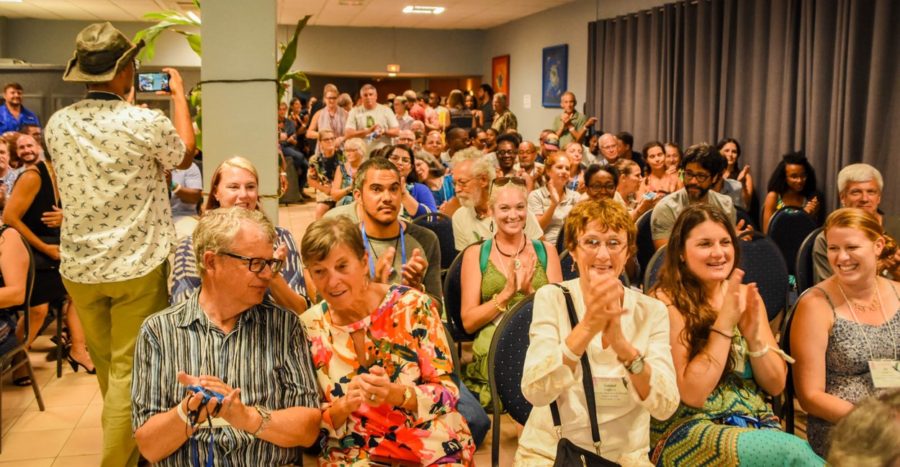
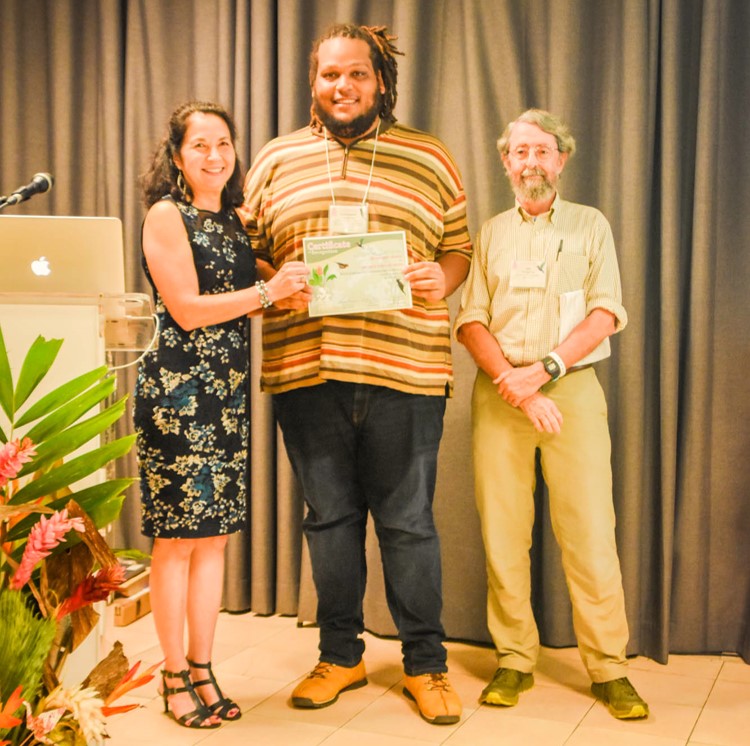
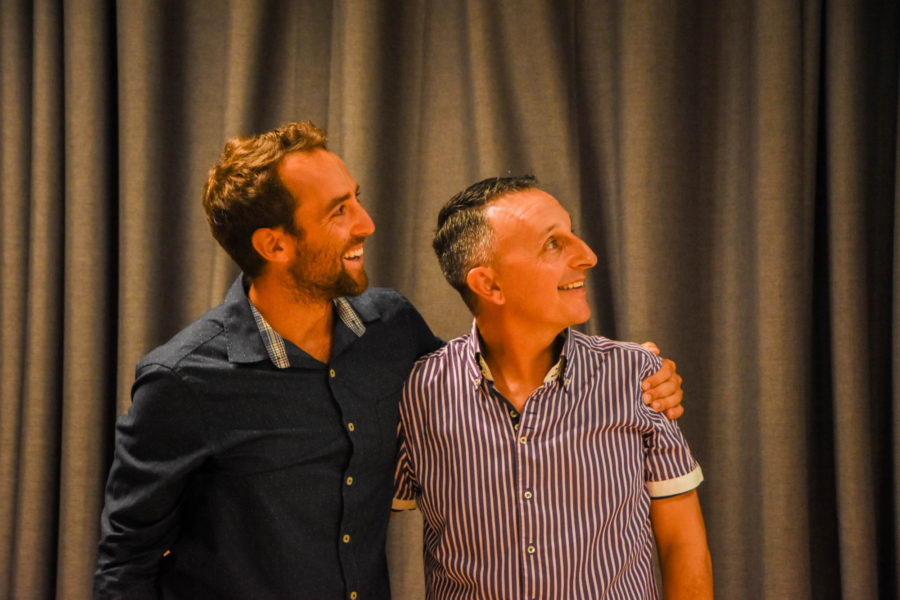
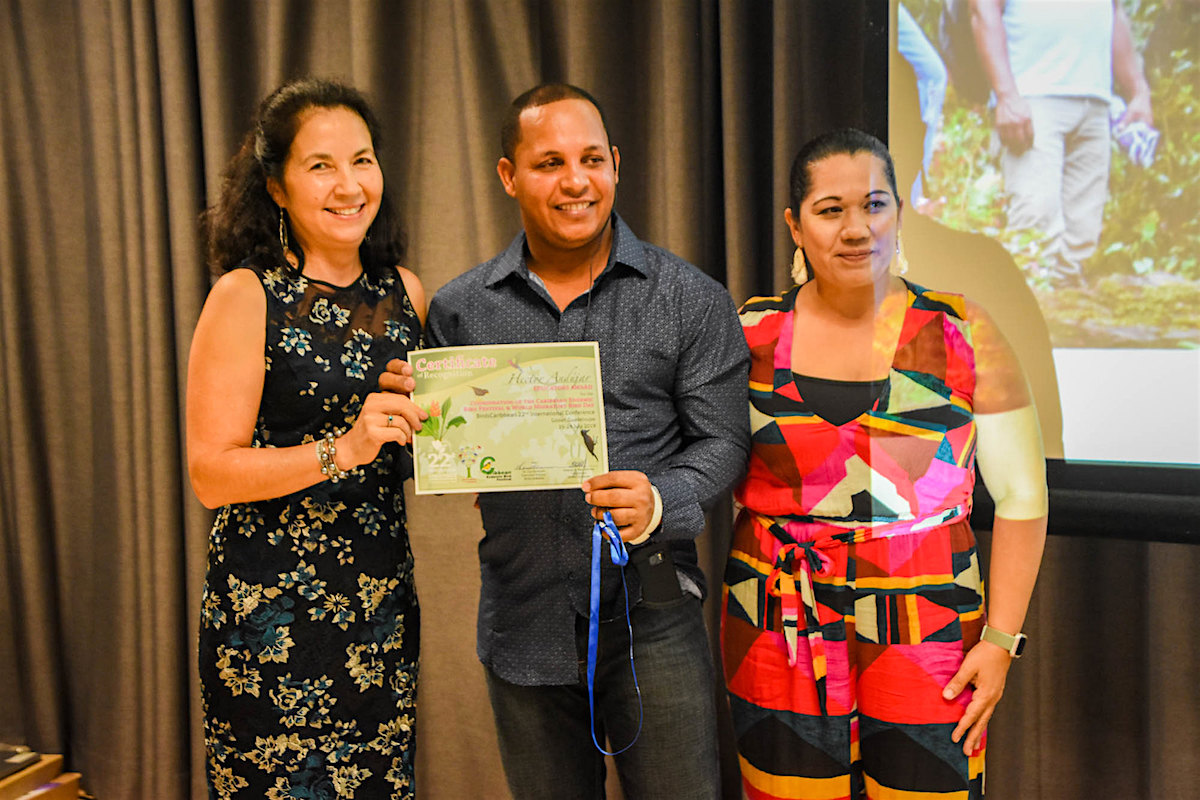
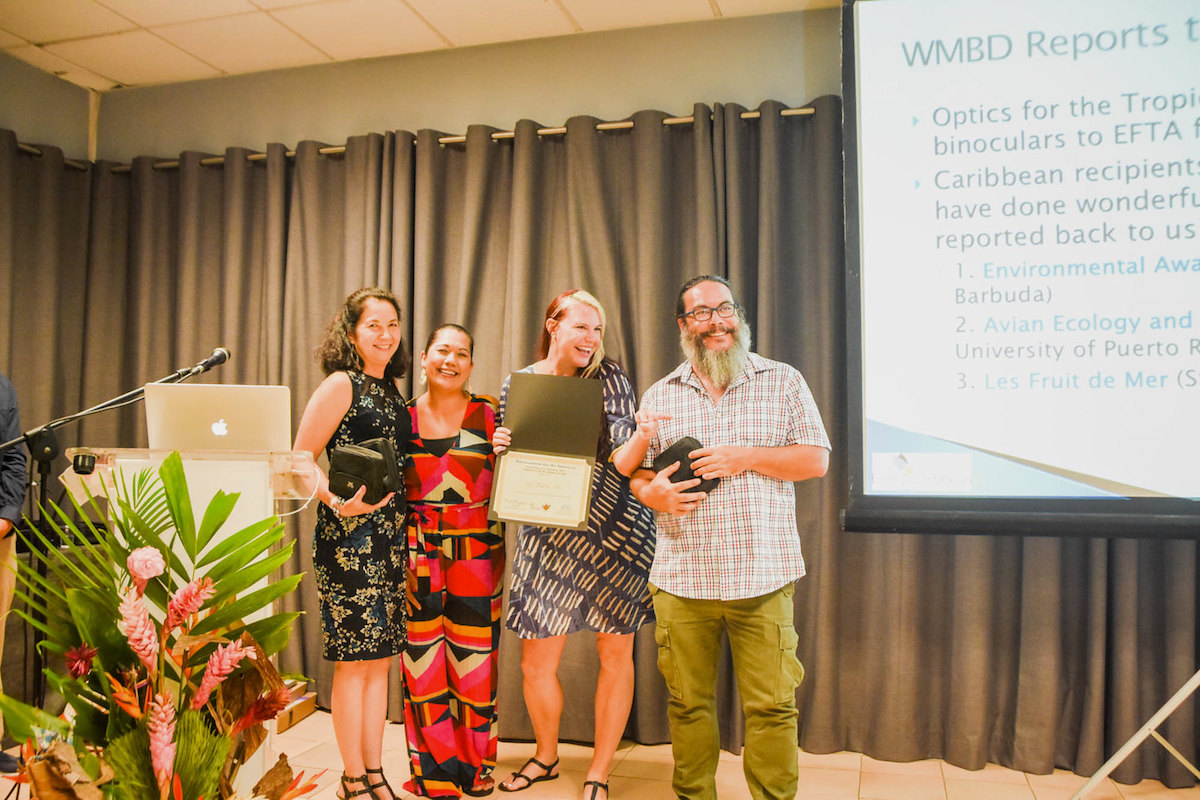
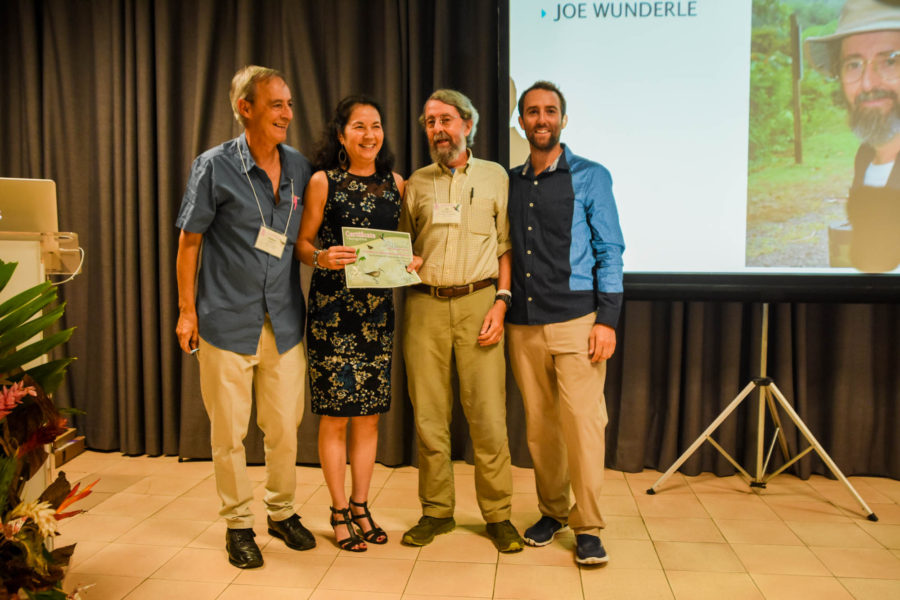
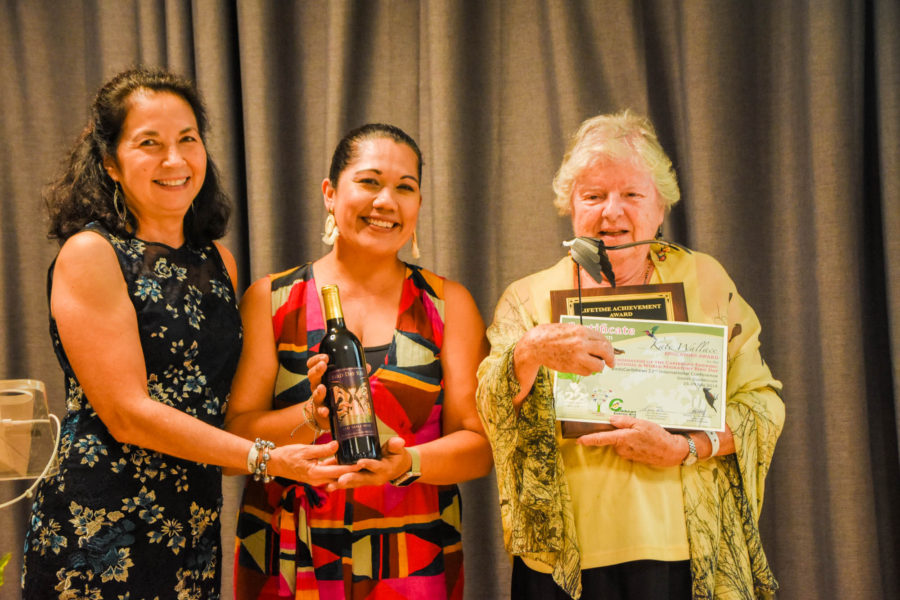


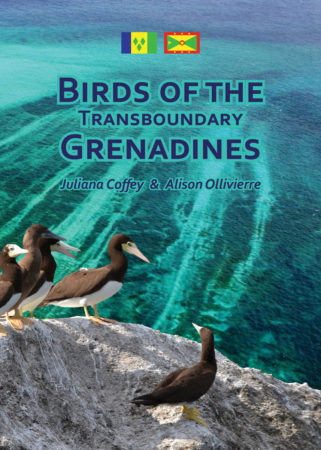 Birds of the Transboundary Grenadines