

What a surprising, pleasant and exciting discovery!! Not one, but two—Mr. & Mrs.—adorable Burrowing Owls on the Eight Mile Rock High School athletic field situated in West Grand Bahama, The Bahamas. Although a permanent resident in The Bahamas and throughout the Caribbean, this species is rare in Grand Bahama. eBird, a free, web-based tool for recording bird observations, reports seventeen sightings, the highest of which is two. Social Studies teacher, Deana Glinton-Williamson, recounts how these unexpected and delightful visitors captured hearts of students and teachers alike—and inspired the school’s Blue Jay community to take action for their charismatic guests!
It was early February 2024, during midday recess when three teenaged girls spotted what they described as “two funny-looking birds” in the northeast quadrant of the school’s field. The students came running to my class, excited because they had seen the same birds in the 2024 Birds of The Bahamas calendar on my desk.
“Mrs. Williamson! Your birds are on the field!!
“What birds?
“The ones in your calendar!”
They picked up the calendar, eagerly flipping through the pages and stopped at the Burrowing Owls—I was overjoyed! I grabbed my binoculars and hurried to the field with my students leading the way. There they were: two Burrowing Owls standing outside their burrow, basking in the midday sun. They had excavated their home in an abandoned Long Jump pit, now forgotten and surrounded by grass.


To truly appreciate this unique situation, it helps to know a bit about the Burrowing Owl itself. lt stands out among owls with its long legs, bright yellow eyes, and preference for life underground. They actually dig their own burrows using those long legs. This unique lifestyle has led to an interesting adaptation: they’ve developed a higher tolerance for carbon dioxide, which can accumulate to higher levels underground! In the Caribbean (specifically The Bahamas, Cuba and Dominican Republic) these small, sandy-colored owls are active during the day. They hunt insects like grasshoppers and beetles and small vertebrates such as rodents, lizards, and even small birds. They are opportunistic feeders, often seen perching on mounds or fence posts before swooping or running after prey. Their vocalizations include a distinctive two-note “coo-cooo” call, often used by males for mating and territorial defense.
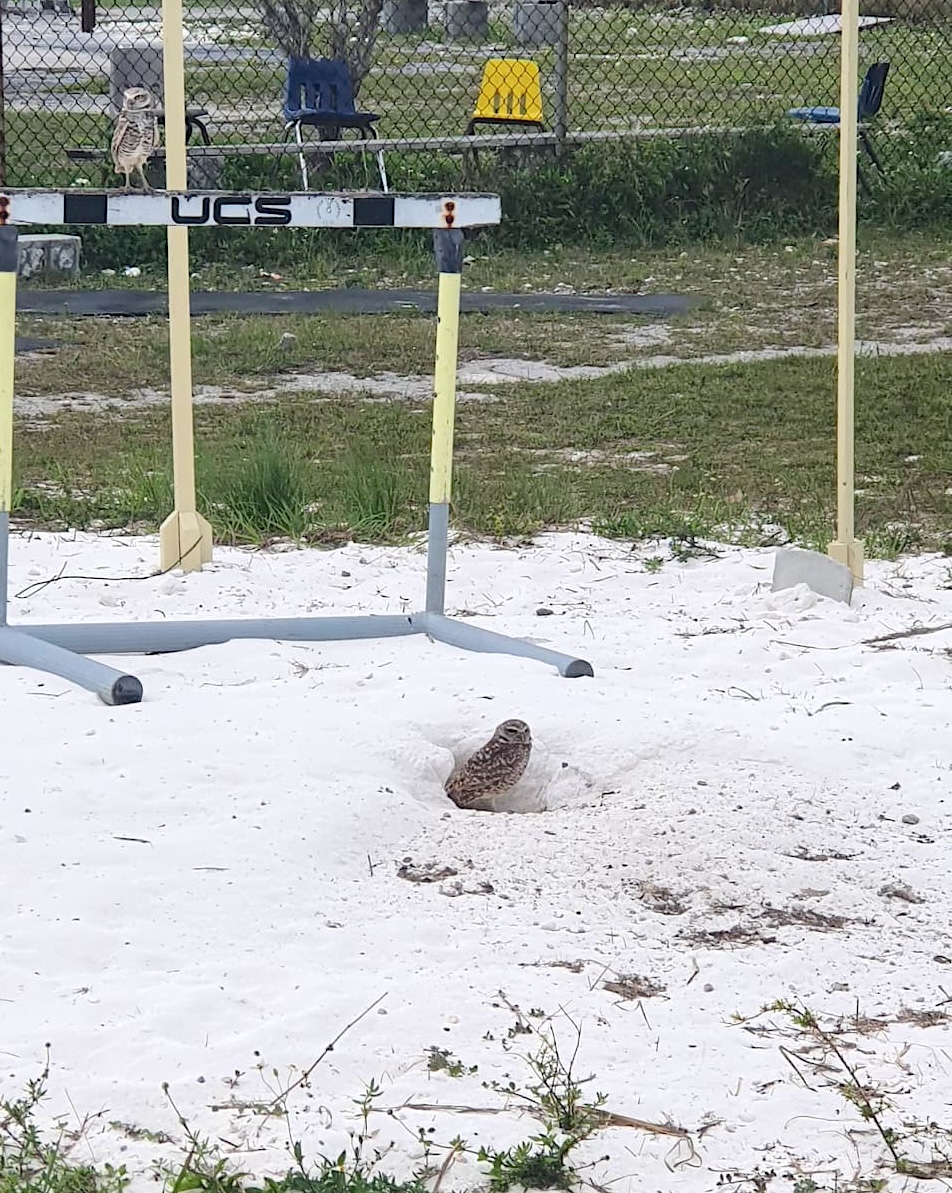
I reported our findings to the principal, Mr. Albert Jones, who visited the site, and immediately scheduled an all-school assembly. He informed staff and students of the rare birds on campus, emphasizing the importance of preserving our national environment and the rich biodiversity all around us. He reminded students to view the birds from a respectful distance, encouraging them to use their electronic devices to learn about our newly discovered guests.
Being a member of Grand Bahama Island Birders, I shared the news of our feathered visitors with the group, and on the morning of Saturday, February 10, 2024, nine eager birders trekked to the site. To the delight and excitement of all—we were not disappointed! One of the owls was present, “hanging out” in the grass close to the nest. We took a seat on the bleachers at a safe distance to observe and take photographs. For a few of us, the Burrowing Owl was a lifer; and for others, a Grand Bahama lifer!
A month later the owls had moved into the second Long Jump pit—very close to classrooms and students—and were guarding their new territory like hawks. It was as though they were sending us a message, “Stay away! This is our home now!” Principal Jones and the Physical Education department made provisions for their protection by installing stakes around the pit, using yellow caution tape to cordon the area.
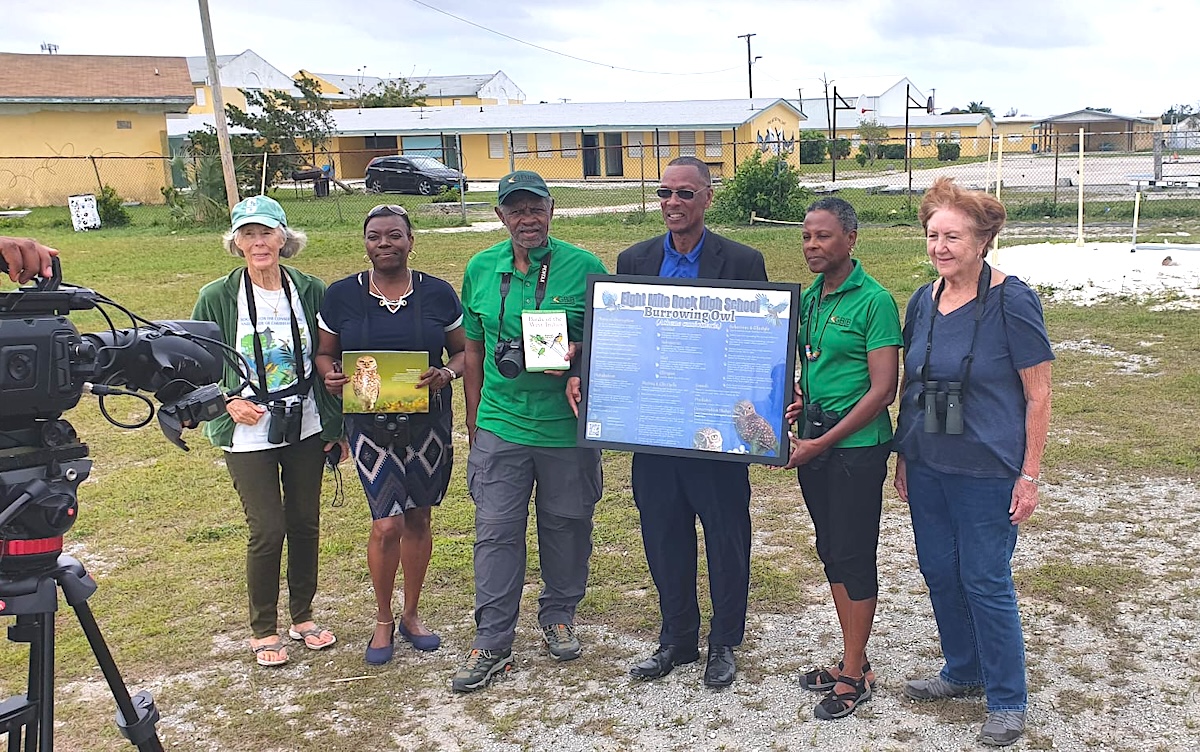
I arranged for the local TV station to share our story on the nightly news. The owls definitely knew they had visitors,properly “hamming it up” for the camera. One of them was a short distance away and flew home to welcome the TV crew. Such hospitality!! After on-site interviews, Grand Bahama Island Birders president Delores Kellman and vice-president Rudy Sawyer presented an educational Burrowing Owl poster and a copy of Herb Raffaele’s Birds of the West Indies field guide to Principal Albert Jones for addition to the library’s catalog.
When school resumed in January 2025 and preparations began for the track and field season, the PE teachers discovered that the owls were constructing a third home in the active pit. “Oh NO, NO!! We NEED this pit!” was the first reaction. Following the advice of longtime conservationist and experienced birder Bruce Purdy to interrupt the construction in the active pit, the PE department and principal were guided to protect the owls by denying them their third home. As expected, they returned to their secure second home, and the PE department regained the use of the pit.
A concerted effort is underway to ensure that the owls remain a part of the Eight Mile Rock High School family. Plans are afoot to bring in fresh sand to be deposited at their original nesting site in hopes that they will return to their homestead. A second sand pit will also be created nearby to give the owls additional borrow options farther away from campus, fostering an environment that can support the establishment of a stable colony.
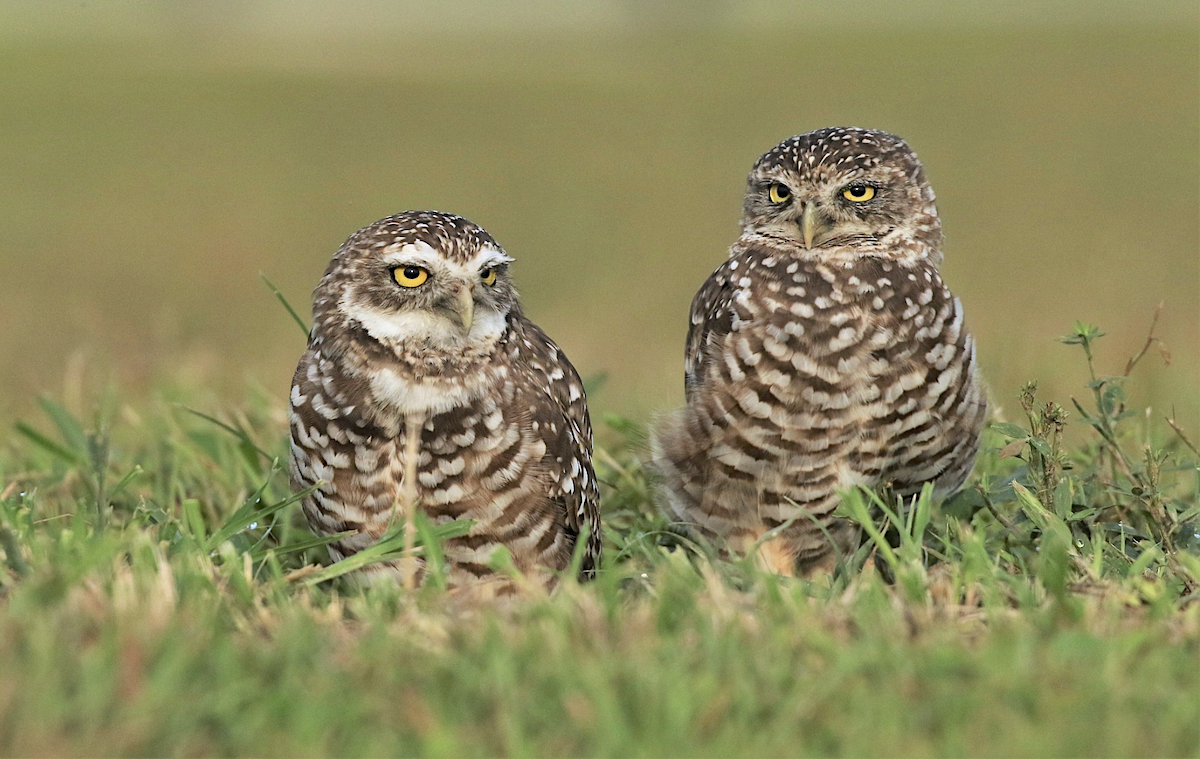
Since the initial discovery, Eight Mile Rock High School has had even more reasons to celebrate—three to be exact! On the evening of March 14th, Principal Jones discovered three healthy owlets, safe in the watchful care of their parents in the second pit. Grand Bahama Island Birders president Dolores Kellman estimates that they likely hatched about three weeks earlier. Staff and students were thrilled to receive news that their precious owl family is growing—it’s a heartwarming sign that the care and efforts made by the Eight Mile Rock school community is paying off—and that these wonderful visitors are truly making the school their home.
Here are some comments that encourage us to continue with our efforts:
Even though the owls are not Blue Jays, our school’s mascot, they might as well have been because they are now a part of our community—Blue Jay Country. It has been a wonderful, educational experience. I feel honored and privileged to have them choose our campus to call home. We will continue to protect them as long as they are here.
Mr. Albert Jones, Principal Eight Mile Rock High School Martin Town, Grand Bahama
The cute owls have become an important part of the Blue Jay family. Since learning of their rarity here in Grand Bahama, we feel it’s our duty to protect them. They are comfortable here and we are in the process of giving them two sand mounds at the rear of the field for them to burrow other tunnels if they so desire.
Ms. Daphne Neely, Head of Department Physical Education
It was our first time seeing an owl other than on TV and in Mrs. Williamson’s calendar so we notified her, she called it in to her birding group, and the rest is history! The experience of seeing the owls up close was nothing short of amazing.
Sharae Gaitor, Shantia Forbes, and Amanda Stubbs, Grade 8 students
It was truly a joy to be a part of this experience. I was impressed by the interest, enthusiasm and passion of the principal and members of his staff, who were committed to learning about the owls and doing whatever it took to protect them and improve and create new habitat. The classroom was taken to the natural environment. Congratulations to the Blue Jay family!
Delores Kellman, President Grand Bahama Island Birders
Deana Glinton-Williamson is a celebrated educator in The Bahamas public school system—recognized as a Teacher of the Year (2008–2010) and Longest-Serving with Excellence Awardee (2004). Her passion for birdwatching was sparked by Erika Gates’ 2007 birding course, and in 2010 she founded the Grand Bahama School District’s first Junior Birding Club at Freeport Primary School. Today, Deana teaches Social Studies and History at Eight Mile Rock High School, where she has integrated World Migratory Bird Day into her curriculum for the past two years. From primary through senior high, her students have been inspired by her deep love of birdwatching and conservation.