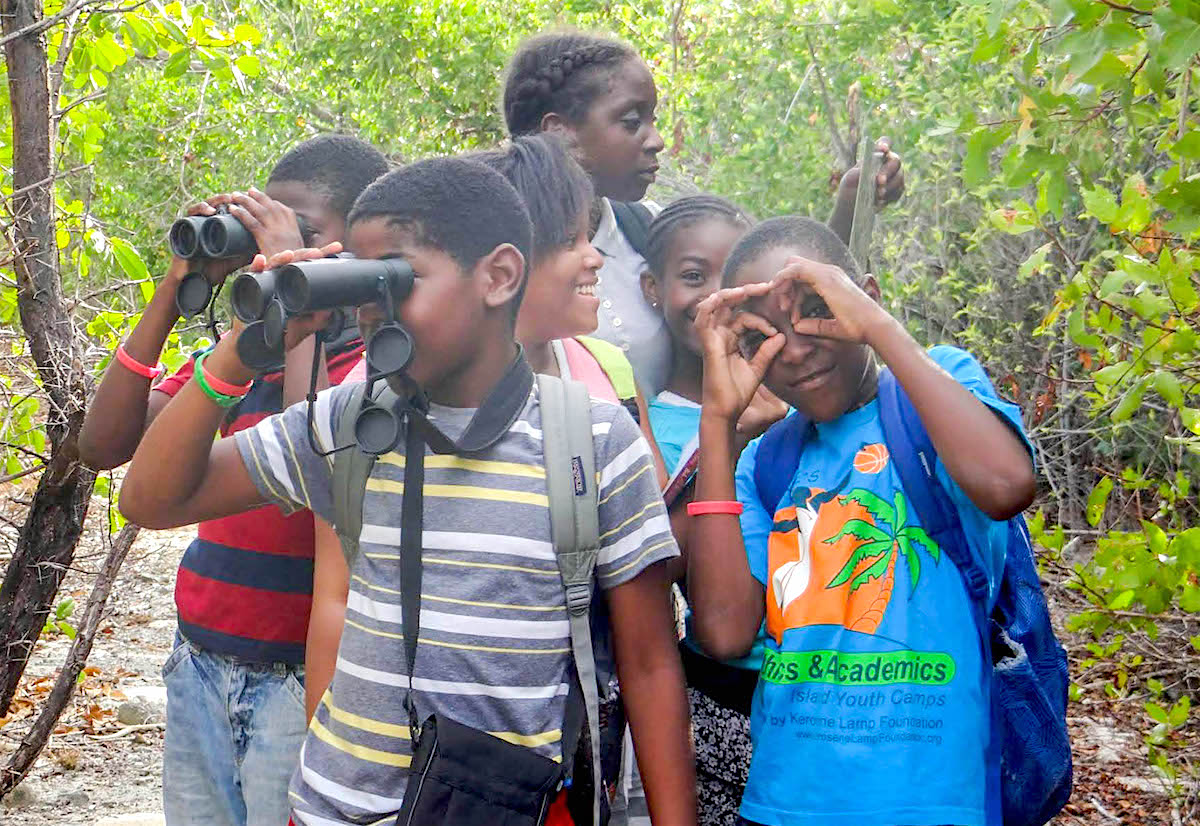
Celebrate World Migratory Bird Day (WMBD) with us in our virtual “Birds Connect Our World” edition! Have fun learning about a new migratory bird every day. We have colouring pages, puzzles, activities, and more. Download for free and enjoy nature with your family at home. This week we are also celebrating World Shorebirds Day and Global Shorebird Count (3 to 9 September).
Migratory Bird of the Day: Ruddy Turnstone
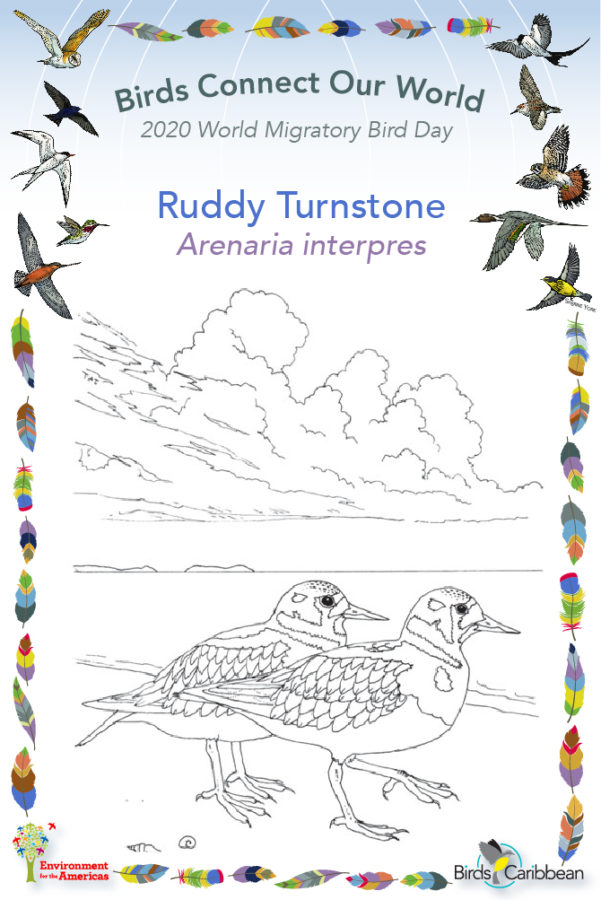
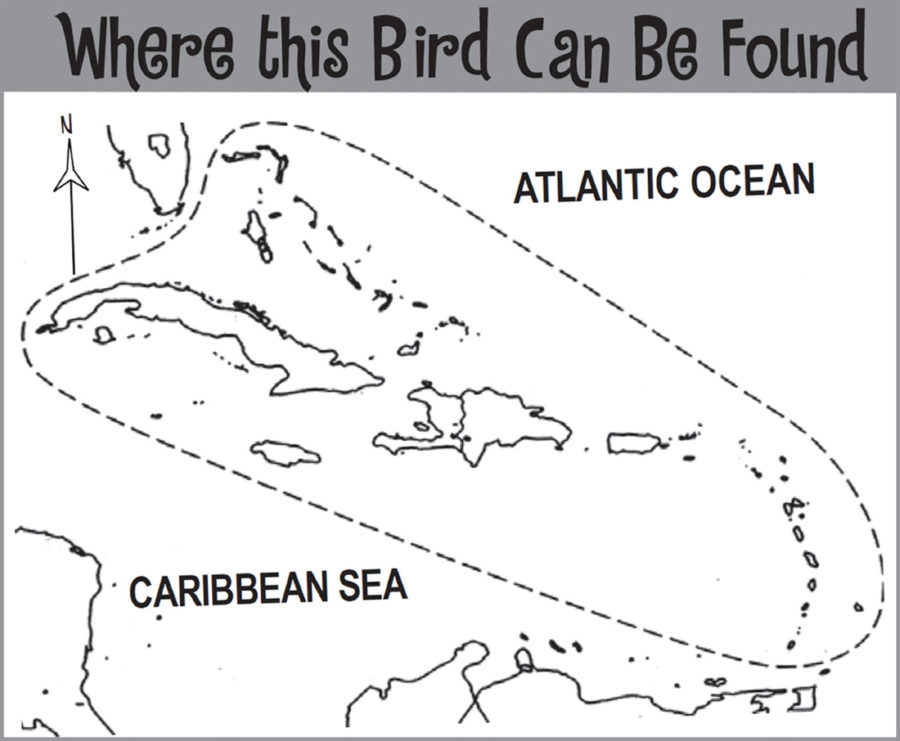
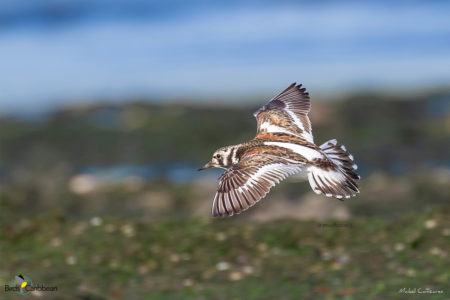
It is easy to see how this shorebird got its name, with its rufous-brown feathers and a habit of turning rocks and stones over with its beak to find food. These charismatic birds can be found feeding in groups in rocky areas of shoreline, mudflats and on beaches. Turnstones are quite striking. In addition to those rufous feathers, they have black or brown patches on their chest and head, a short pointed black beak and rather short bright orange legs. In winter the ‘ruddy’ feathers become duller brown. When Turnstones take flight you can see their brown and white stripey backs. You might also hear their cackling ‘katakak’ call as they take off. Ruddy Turnstones breed mainly in the arctic and fly south for the winter. Like many other shorebirds, they can fly thousands of miles in only a few days when on migration. They normally turn up in the Caribbean in August and can stay until May. During this time, they can be found throughout the Caribbean. As well as beaches they are sometimes found on man-made structures like jetties and piers. Some Turnstones will travel through the Caribbean and go even further, to spend the winter as far south as Argentina. Turnstones feed mainly on snails, crustaceans and insects, but they are not fussy and are even known to sometimes eat fallen fruit. Learn more about this species, including its range, photos, and calls here.
Colour in the Ruddy Turnstone!
Download the page from Endemic Birds of the West Indies Colouring Book. Use the photos below as your guide, or you can look up pictures of the bird online or in a bird field guide if you have one. Share your coloured-in page with us by posting it online and tagging us @BirdsCaribbean @WorldShorebirdsDay #WMBD2020Carib #WorldShoreBirdsDay
Listen to the call of the Ruddy Turnstone
The Ruddy Turnstone’s call is a cackling “katakak” often given as they take flight.
Puzzle of the Day
Click on the images below to do the puzzles. You can make the puzzle as easy or as hard as you like – for example, 6, 8, or 12 pieces for young children, all the way up to 1,024 pieces for those that are up for a challenge!
Ruddy Turnstone in winter plumage (Photo by Gary McHale)Ruddy Turnstone in flight, showing the stripes on its back (Photo by Maikel Cañizares)
Visit a pond, wetland or nearby beach and see how many different shorebirds and waterbirds you can find and identify. Use a bird field guide or the FREE Merlin bird ID app to help you identify the birds you are seeing.
Enjoy the videos below of Ruddy Turnstones! The birds in the first video are in their winter plumage, looking for food amongst the seaweed on a beach in Cuba, in January. The second video shows the feeding method that these birds use and for which they are named—turning over stones, shells, and other items on the beach in search of invertebrate foods in the sand.
Visit MigratoryBirdDay.org for many more free activities and resources to learn about migratory birds, their threats, and conservation actions you can take.
Celebrate World Migratory Bird Day (WMBD) with us in our virtual “Birds Connect Our World” edition! Have fun learning about a new migratory bird every day. We have colouring pages, puzzles, activities, and more. Download for free and enjoy nature with your family at home. This week we are also celebrating World Shorebirds Day and Global Shorebird Count (3 to 9 September).
Migratory Bird of the Day: Black-bellied Plover
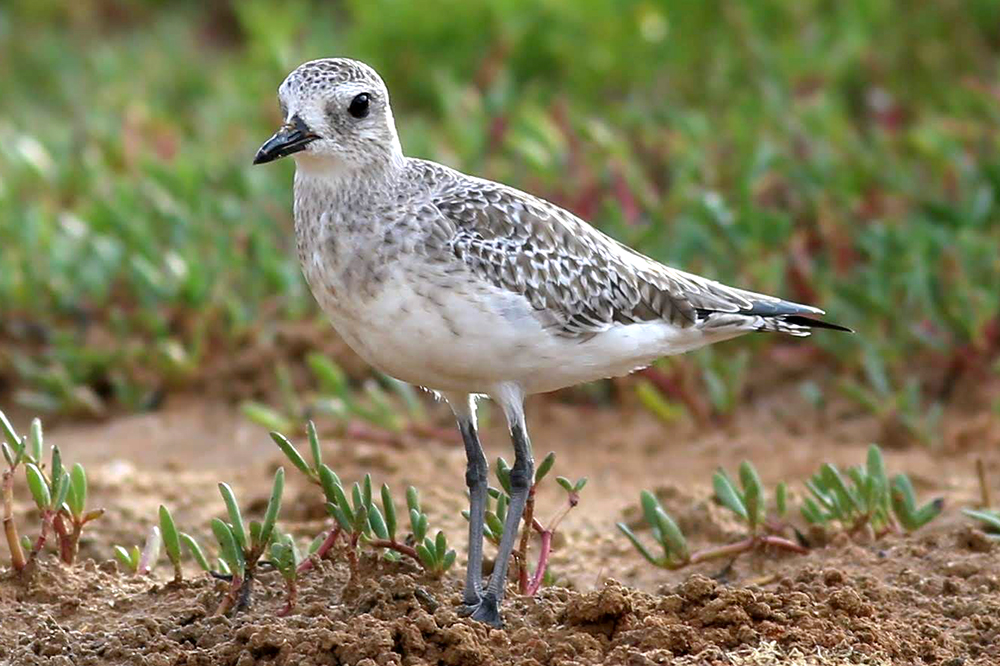
This stocky looking shorebird gets its name from its breeding plumage, when it has a striking black chest, face and belly. When we see it on its journey south there might still be traces of this black, but by winter it has all gone, and birds look a bit plain and grey. In fact, in some parts of its wide range this species is called a ‘Grey Plover’, but look out for their black ‘wingpits’ when they fly – this will help you clinch the ID.Black-bellied Plovers breed mainly in the Arctic but come south for the winter. They pass through the Caribbean on their way to their wintering areas even further south, although some stay for the winter on our beaches. Scientists have tracked their migration south, and found plovers can fly incredibly long distances over water. One bird made its way all the way from Newfoundland, Canada to the coast of Brazil in a single flight!As birds make their way south in autumn they can mainly be found on mudflats and beaches. Black-bellied Plovers tend to feed ‘alone’ and not in a flock with other Black-bellied Plovers. They feed by sight and can be seen making short runs across the mud, then stopping to pick up a tasty worm, snail, or perhaps a crustacean. Listen for their loud mournful sounding whistling calls. Learn more about this species, including its range, photos, and calls here.
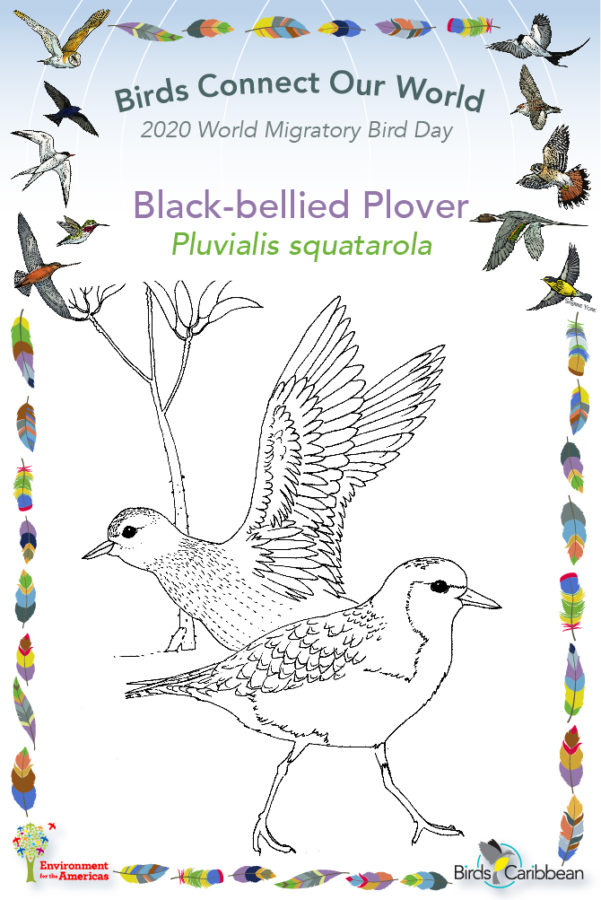
Colour in the Black-bellied Plover!
Download the page from Migratory Birds of the West Indies Colouring Book. Use the photos below as your guide, or you can look up pictures of the bird online or in a bird field guide if you have one. Share your coloured-in page with us by posting it online and tagging us @BirdsCaribbean @WorldShorebirdsDay #WMBD2020Carib #WorldShoreBirdsDay
Listen to the call of the Black-bellied Plover
The Black-bellied Plover’s call is a single plaintive klee and also a klee-a-lee.
Puzzle of the Day
Click on the images below to do the puzzles. You can make the puzzle as easy or as hard as you like – for example, 6, 8, or 12 pieces for young children, all the way up to 1,024 pieces for those that are up for a challenge!
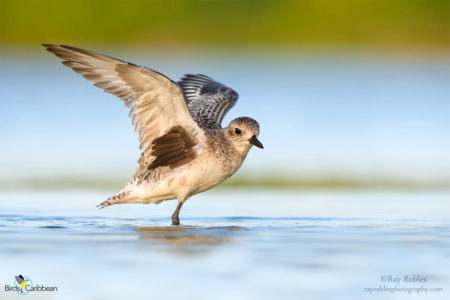
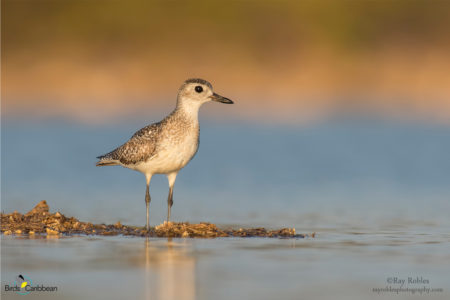
Black-bellied Plover with its wings raised showing black ‘wingpits’. This bird is in winter plumage, it has lost the black belly and chest which give it its name and will remain plain grey until spring. When they fly or raise their wings these black patches can help you to identify this species. (Photo by Ray Robles)Black-bellied Plovers make amazing long-distance journeys on migration. The non-stop flight some plovers make of 3200km, from Nova Scotia to the Caribbean, is equivalent to a human of running 4-min miles for 80 hours! (Photo by Ray Robles)
Visit a pond, wetland or nearby beach and see how many different shorebirds and waterbirds you can find and identify. Use a bird field guide or the FREE Merlin bird ID app to help you identify the birds you are seeing.
Enjoy the two videos below of a Black-bellied Plover in the wild! In the first video, the bird is in its grey winter plumage, feeding on some mud and finding a juicy worm to eat. The second video shows a Black-bellied Plover in the autumn, showing some patches of the black which give it its name. This bird is moulting into winter plumage, when it will become completely pale on its chest and belly by winter.
Visit MigratoryBirdDay.org for many more free activities and resources to learn about migratory birds, their threats and conservation actions you can take.
“Protect birds: Be the Solution to Plastic Pollution.”
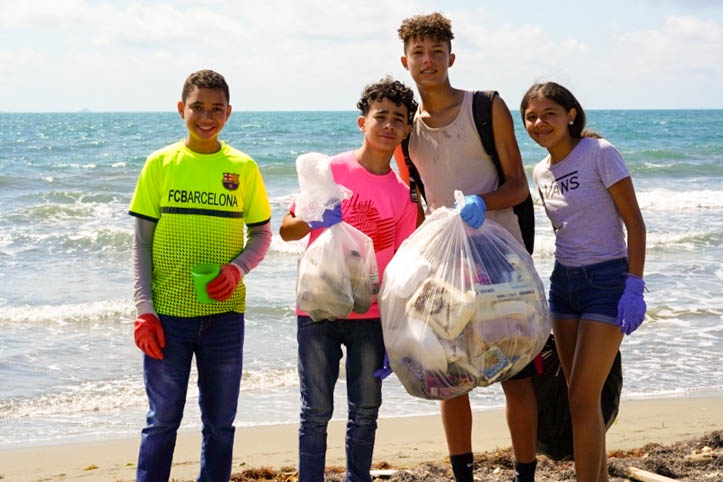
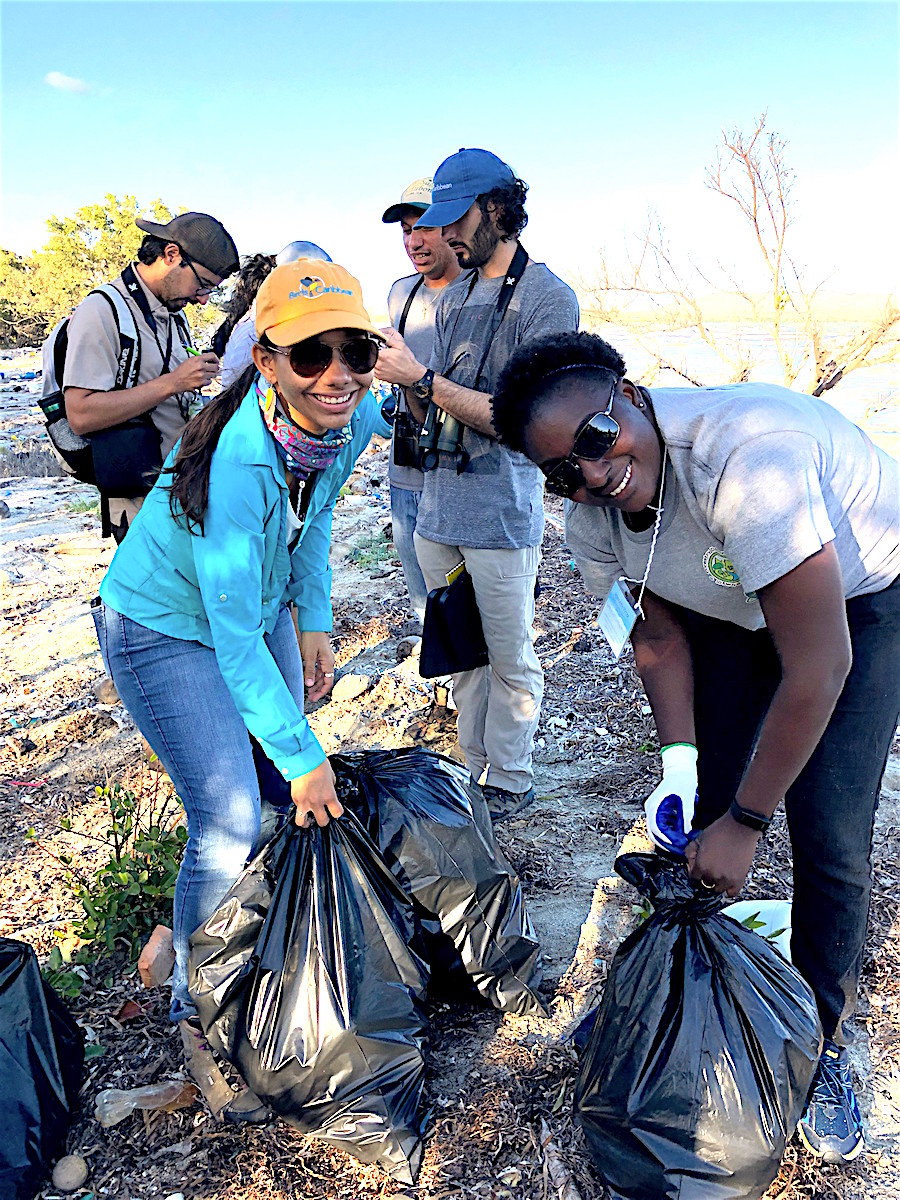
A beach clean-up at Punta Cucharas Nature Reserve, Ponce, Puerto Rico. (Photo by Eduardo Llegus)
Islands across the Caribbean turned the focus on the devastating impact of plastic pollution on rivers, wetlands and seas with the theme for World Migratory Bird Day 2019 (WMBD 2019). Grassroots organizations, government ministries and agencies and non-governmental organizations collaborated on a range of activities focused on the fascinating species that appear on the islands later in the year, and stay until spring.
Since 2017, a number of Caribbean countries have started initiatives to fight single-use plastics. – including Antigua and Barbuda, the Bahamas, Bermuda, Dominica, Haiti, Jamaica, St. Vincent and the Grenadines and Turks and Caicos Islands. Others are starting to look at measures to ban Styrofoam manufacture and imports. More plastic and Styrofoam bans are set to take effect in 2020. While much more work is needed on the ground and in partnership with governments, there is growing awareness on the islands that plastic pollution is harmful to both land and marine environments. Whether these are wetlands or coastal regions, many areas affected provide habitats for migratory birds.
Mangroves, Masks and Migratory Birds
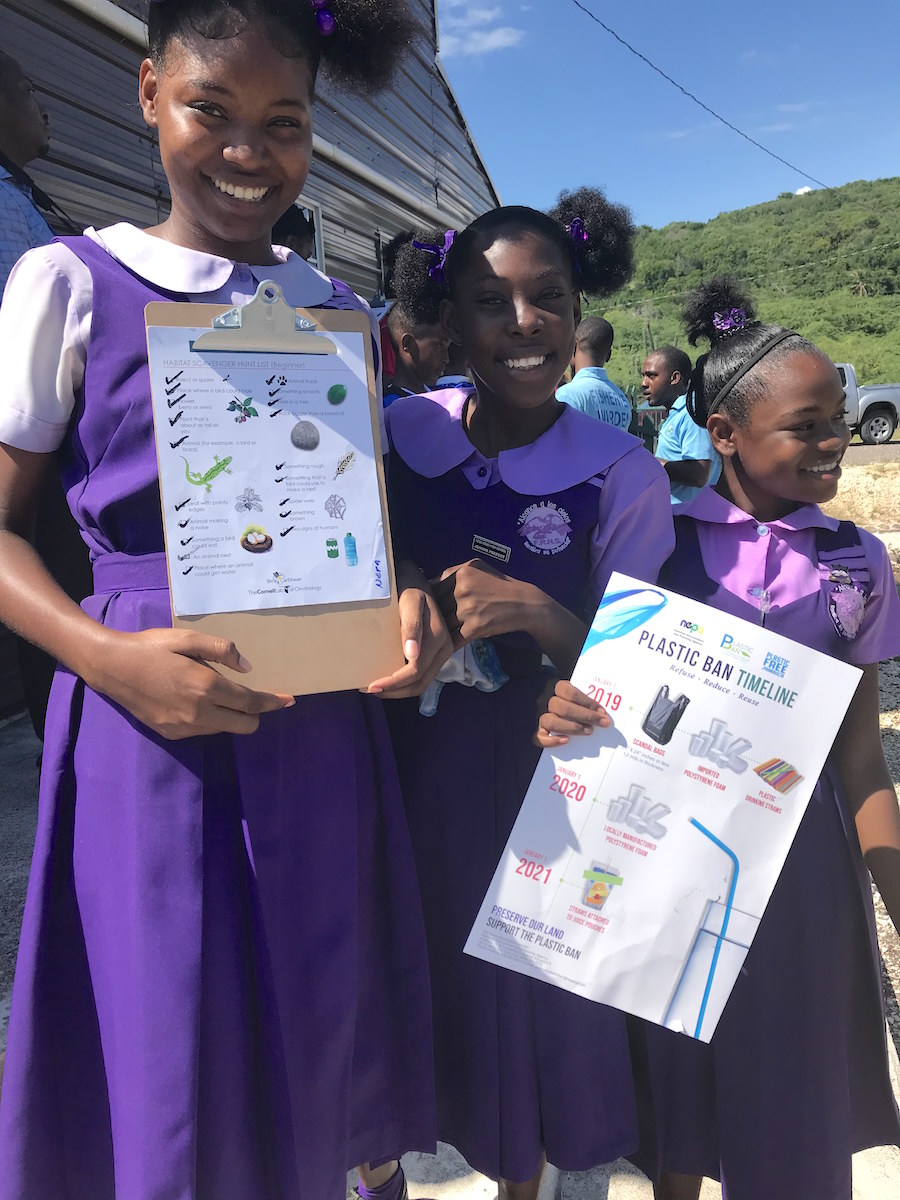
We did it! Students display the results of their BirdSleuth Caribbean Scavenger Hunt in Salt River, Jamaica. (photo by Emma Lewis)
In Jamaica, the Portland Bight Discovery Centre in Salt River, Clarendon hosted World Migratory Bird Day with teachers and students from nearby schools. Science Officer at the Caribbean Coastal Area Management Foundation (C-CAM) D. Brandon Hay gave an illustrated talk, outlining how ingesting plastic affects bird life, and which species suffer. After a lively Q and A session, the students took a guided walking tour of a nearby wetland area, using BirdSleuth Caribbean’s Scavenger Hunt materials. The students also created and displayed colorful birdfeeders, and performed original educational pieces, including dub poetry and song – all reflecting the theme! After a guided boat ride through the mangroves, their day ended tallying points earned from these activities. The first prize winner was the Mitchell Town Primary and Infant School!
Education Officer in Dominica Ameka Cognet reported highlights of the day’s activities. Primary school students enjoyed making colourful migratory bird masks. They then went on a birdwatching tour of the Botanical Gardens in the island’s capital, Roseau. The children learned a great deal about the migratory species that visit the island annually. They also gained a much deeper understanding of how plastic pollutes the environment, choking land and sea and harming birds and other wildlife.
A First for St. Croix and Record Numbers for St. Martin’s Seventh Celebration
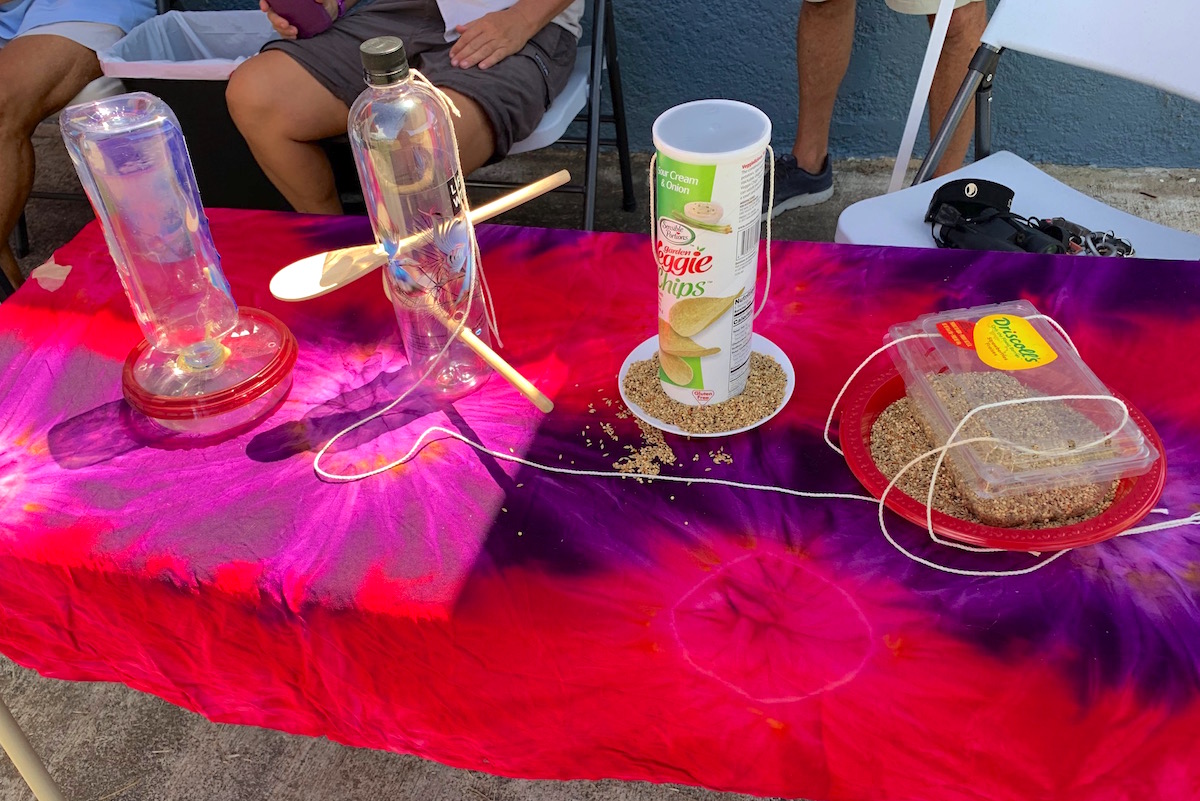
Creative use of plastic waste to make bird feeders! St. Croix Environmental Association WMBD event. (photo by Jen Valulius)
The St. Croix Environmental Association in the U.S. Virgin Islands (the site of BirdsCaribbean’s very first international meeting in 1988) celebrated WMBD for the first time – and they did it in style. They organized two events in October at the Sandy Point National Wildlife Refuge. Arts and crafts, bird walks, bird banding, and storytelling activities were on the agenda. A bird rescue expert gave a talk, and informational displays were presented. The activities included a coastal clean-up, where participants saw for themselves how much plastic is in the environment. “Every activity had a meaningful impact on each participant,” said Jennifer Valiulis, local coordinator. Clean-up materials provided by Environment from the Americas were also distributed to participants.
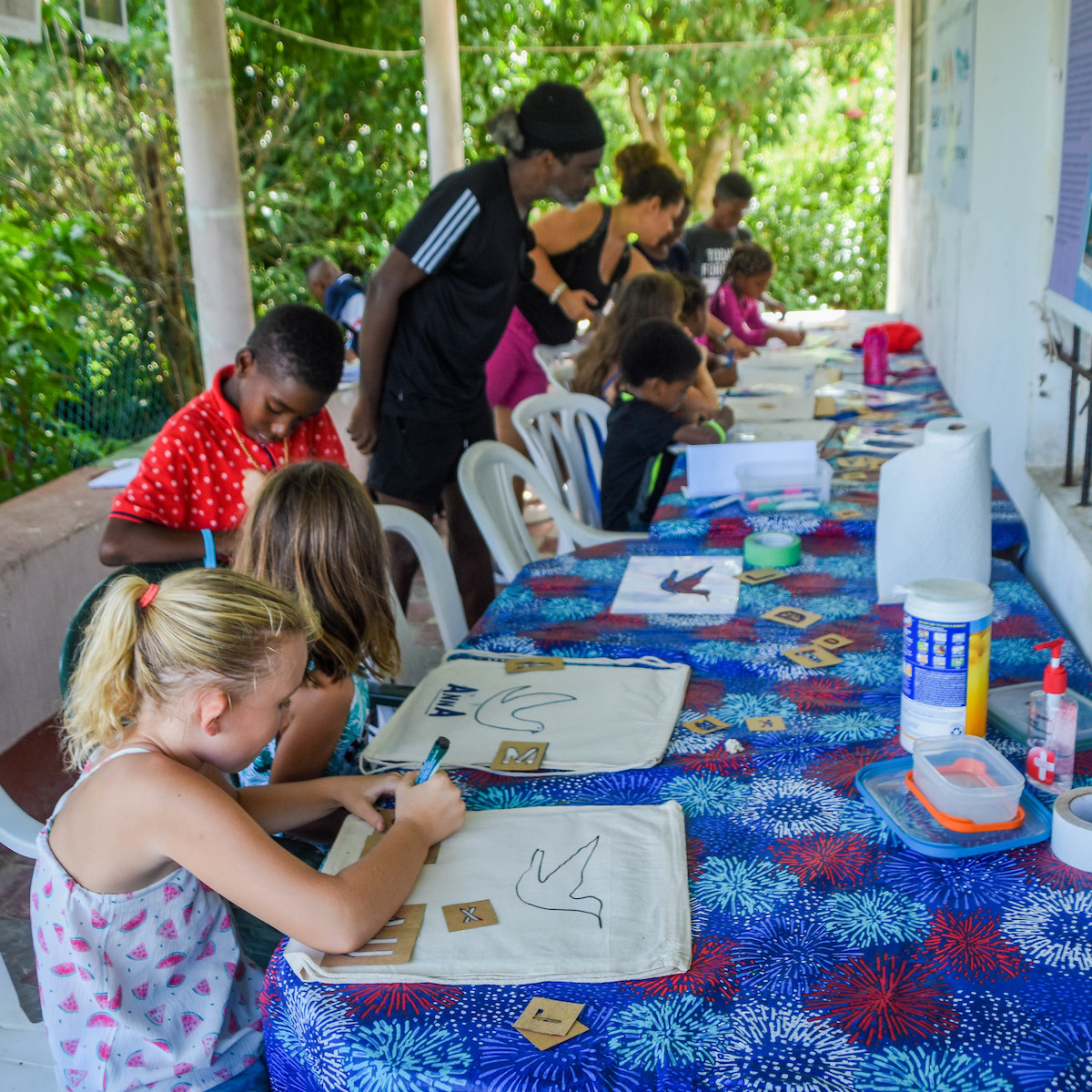
No less than 250 residents, young and old, enthusiastically joined WMBD celebrations spearheaded by the non-governmental organization Les Fruits de Mer in St. Martin. “We were able to reach more youth than ever, and it is all thanks to our sponsors,” said event organizer Jenn Yerkes. St. Martin’s seventh annual Migratory Bird Festival at Amuseum Naturalis was a great success, with students using BirdSleuth Caribbean materials for several activities. Crafts are always popular, and the children decorated canvas backpacks to take home with them. Technology was also an exciting feature this year; the mobile media and learning hub IdeasBox shared videos and e-books.
Education is Key! And Thanks to All the Sponsors
Young artists at work on bird-themed bags at Les Fruits de Mer’s Migratory Bird Festival in St. Martin. (photo by Mark Yokoyama).
World Migratory Bird Day offers another opportunity for our partners across the region to educate residents on the importance of conserving habitats and ensuring that our visiting species continue to thrive when they visit our islands. This year, the message was about how plastic pollution affects not only our birds, but our own quality of life also. There are solutions, but we must take action for our own health as well as that of the vulnerable birds that we enjoy every day.
We would like to thank all the sponsors – local, national, and international – who provide funding for these important activities. Special thanks to Environment for the Americas for providing awesome materials. If your organization participated in an event and if you would like to share your experience, please send us a message to sdiaz-mendez@environementamericas.org. It’s about the birds, the habitat and the people.
A Few Lines of Poetry to End With
Caribbean people love poetry as a form of expression. We end with these few lines from Greta, a University of the Virgin Islands student and presenter of World Migratory Bird Day at Southgate Coastal Reserve, who offers this advice:
Be a solution To plastic pollution. Always walk with a garbage bag and pick up your trash. Do not throw it where the birds hatch.
Let’s spread the word and fight plastic pollution in the Caribbean!
Enjoy the gallery of photos from WMBD events in 2019; hover over each photo to see the caption or click on a photo to see a slide show.
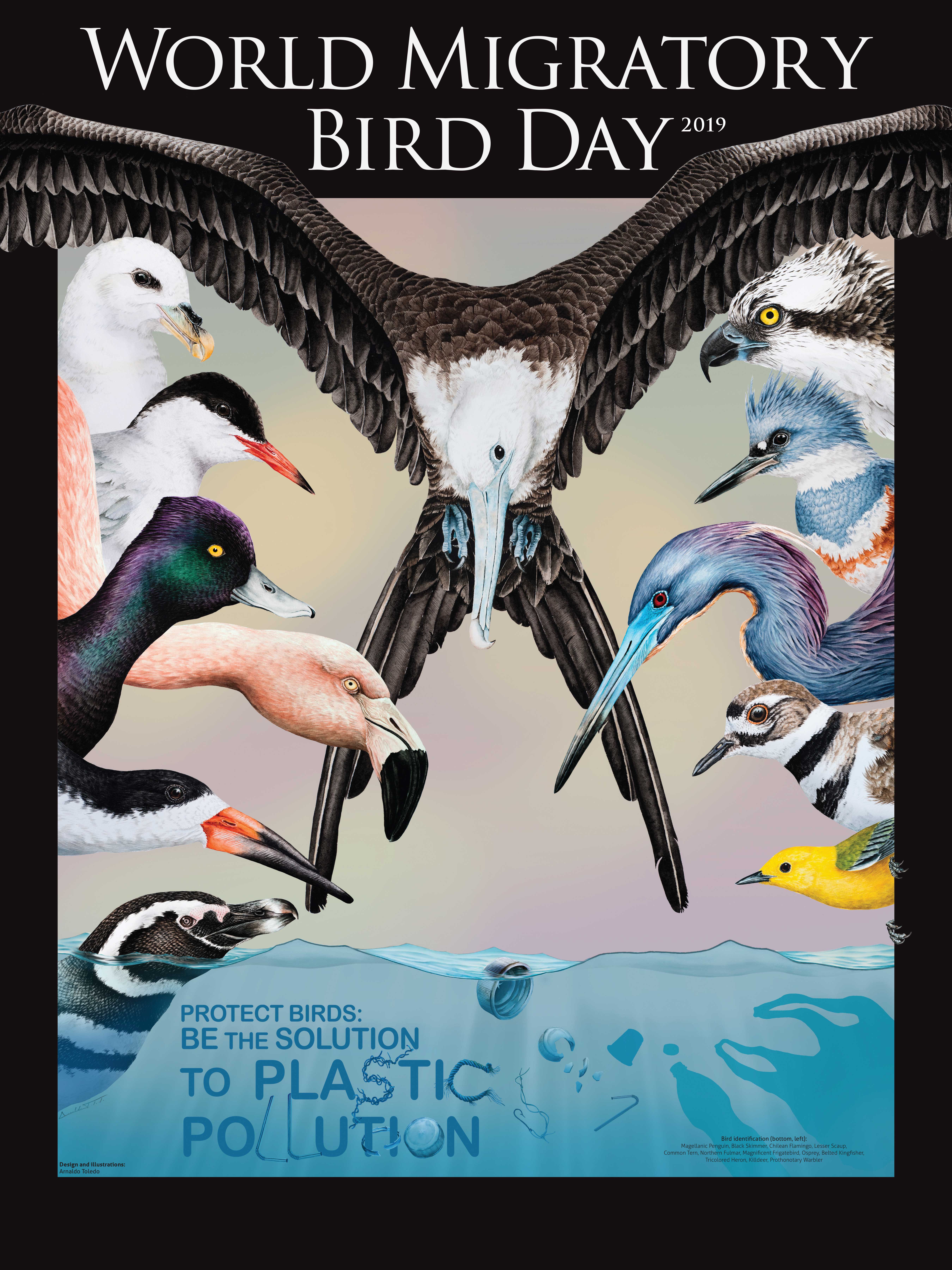
World Migratory Bird Day Poster showing different groups of birds that are affected by plastic pollution. (Artwork by BirdsCaribbean member, Arnaldo Toledo, from Cuba)
Painting hand-made bird feeders. (photo by Jen Valiulis)
Youth work hard at beach clean-up in Guanabo, Cuba.
This is my wingspan! A student at the WMBD event in St. Martin spreads her “wings.” (photo by Mark Yokoyama)
How big is your wing span? WMBD event in St. Croix, US Virgin islands.
The beach is much cleaner now!
Least Sandpipers at the Portland Bight Discovery Centre, Jamaica. (photo by Emma Lewis)
We did it! Students display the results of their BirdSleuth Caribbean Scavenger Hunt in Salt River, Jamaica. (photo by Emma Lewis)
Students from Rose Hall Primary School in Jamaica do a little research. (photo by Emma Lewis)
A young girl is happy with her migratory warbler tattoo at a WMBD Community Festival in Quinta de Los Molinas, Cuba.
Dominos are very popular in Cuba, especially this version made with birds!
Dominos are very popular in Cuba, especially this version made with birds!
The sad impacts of plastic pollution on birds- this cormorant will not survive long with this plastic ring stuck on its bill and neck.
Students in Dominica proudly show off their bird masks.
Creative use of plastic waste to make bird feeders! St. Croix Environmental Association WMBD event. (photo by Jen Valiulis)
On the scavenger hunt on the Portland Bight Discovery Centre’s boardwalk through the mangroves, Jamaica. (photo by Emma Lewis)
Working out bird puzzles at the WMBD Community Festival in Quinta de Los Molinas, Cuba.
Brandon Hay, Science Officer at the Caribbean Coastal Area Management Foundation (C-CAM) gives a talk to students and teachers on the impact of plastic pollution on our birds. (photo by Emma Lewis)
Beach clean-up in Guanabo, Cuba.
A young Brown Booby caught on a fishing lure. Many kinds of plastic are dangerous to Caribbean birds. (Photo by Michiel Oversteegen)
Educational materials on display at the WMBD Community Festival in Quinta de Los Molinas, Cuba.
Young artists at work on bird-themed bags at Les Fruits de Mer’s Migratory Bird Festival in St. Martin. (photo by Mark Yokoyama).
Learning all about the impacts of plastic pollution on birds in Cuba.
Alieny Gonzalez, WMBD Coordinador in Cuba counts shorebirds for WMBD.
Beach clean-up in Guanabo, Cuba.
A beach clean-up at Punta Cucharas Nature Reserve, Ponce, Puerto Rico. (Photo by Eduardo Llegus)
A timeline of Jamaica’s bans on single-use plastic. (photo by Emma Lewis)
Story time in St. Croix, all about the amazing long distance migration of the Whimbrel. (photo by Jen Valiulis)
Beach clean-up for WMBD in St. Martin/ Sint Maarten, organized by EPIC (Environmental Protection in the Caribbean).
Learning all about raptors at St. Croix Environmental Association’s WMBD event. (photo by Jen Valiulis)
Beach clean-up in Guanabo, Cuba.
Highlight of this year’s celebrations in Dominica were a migratory bird mask-making activity with primary schools, followed by a birdwatching tour at the Botanical Gardens in the Roseau Area.
Working together to clean up a beach in Cuba overloaded with plastic trash. (photo by Alieny Gonzalez)
Some little ones are taking their bird art seriously, but others have time for a toothy smile – at the Amuseum Naturalis in St. Martin. (photo by Mark Yokoyama)
World Migratory Bird Day Poster showing different groups of birds that are affected by plastic pollution. (Artwork by Arnaldo Toledo)
The month of October heralds a change in the seasons — even in the Caribbean. The days grow shorter and the fierce heat of the sun lessens. Countless birds journey to their winter homes in the Caribbean. For World Migratory Bird Day (WMBD), Caribbean people celebrate the birds that come here every year.
In the Caribbean, about a third of the 500 often seen species of birds are summer or winter visitors. More than 50 events on 18Caribbean islands are already lined up to celebrate these amazing birds. More than 80,000 residents and visitors will join in the activities this fall, led by BirdsCaribbean and Environment for the America partners.
The 2019 theme for WMBD in the Caribbean is “Protect birds: Be the solution to plastic pollution.” Plastic pollution has become a worldwide epidemic and a great threat to birds around the world. It is estimated that since the 1950s, we have made 8.3 billion metric tons of plastic. Over 90% of plastic is not recycled and ends up in our landfills and the natural spaces.
Plastic can hurt birds in many ways. Birds can mistake floating plastics like bags, drinking straws and bottles, covered in algae, for food. Parent birds feed plastic to their chicks. Swallowing sharp plastic can kill birds by piercing organs. Birds can starve with stomaches full of plastic, and birds can die after being trapped in plastic waste or fishing line.
To celebrate, local coordinators on each island will raise awareness about simple actions that people can take to keep birds safe from plastic pollution. For example, practice the three R’s: reduce, reuse and recycle plastic and other trash. Some events will include clean-up activities and, by supporting local and global action against plastics. Festival events will include birding walks, tree plantings, church services, media interviews, street parades, fairs, information booths, games, and drama and art competitions.
World Migratory Bird Day is officially the second Saturday of October in the Caribbean and Latin America (October 12th in 2019), but you may celebrate at any time of the year that is convenient to you. Fall migration in September, October, November tends to be the best period as this is when a lot of migrants arrive to the islands or are passing through.
Visit migratorybirdday.organd birdscaribbean.org for ideas on how to celebrate and many free resources. Find us on Facebook, Twitter and Instagram for more information about the WMBD, to find events in your area, and see an event map on worldmigratorybirday.org and updates throughout the month.
What can we do about plastic?
BirdsCaribbean workshop participants clean up plastic trash in Cabo Rojo, Puerto Rico. (Photo by Lisa Sorenson)
We know that all the plastic ever manufactured since the 1950s is still with us, in some form or another. Globally, only around 9% of plastic is recycled. According to the Ocean Conservancy, which sponsors International Coastal Cleanups in the Caribbean and around the world, 8 million metric tons of plastic enter our seas annually – adding to the 150 million tons that is already floating around!
Like other parts of the world, the Caribbean has become increasingly aware of the scourge of plastic pollution. Several islands have already moved to ban various forms of plastic as well as Styrofoam, including Antigua & Barbuda, Dominica, Grenada, Jamaica, Saint Lucia and the French-speaking islands—kudos to these countries! Others have plans in place to reduce the use of single-use plastic in the next year or two. Meanwhile, private and government-led plastic recycling programmes have started up. But much more needs to be done.
Plastic pollution ruins our beautiful beaches and coastlines, and blocks drains and gullies. It impacts our own health and lifestyle and hampers economic growth, especially in the tourism sector. What is more, it is harming all kinds of marine life, including endangered Caribbean turtles.
During recent beach cleanups around the Caribbean, non-biodegradable, indigestible plastic has been by far the most common type of trash to be collected from our shorelines, rivers and gullies by local volunteers. Plastic bottles, especially for soda and water, are the most common plastics that end up in our waters and on our beaches, as well as small items such as bottle caps, single-use plastic cutlery and straws and toothbrushes. Electronics (e-waste) of various types is increasingly washing up on our shoreline. Plastic shopping bags are also a great danger to our marine life, including birds.
Killer Trash
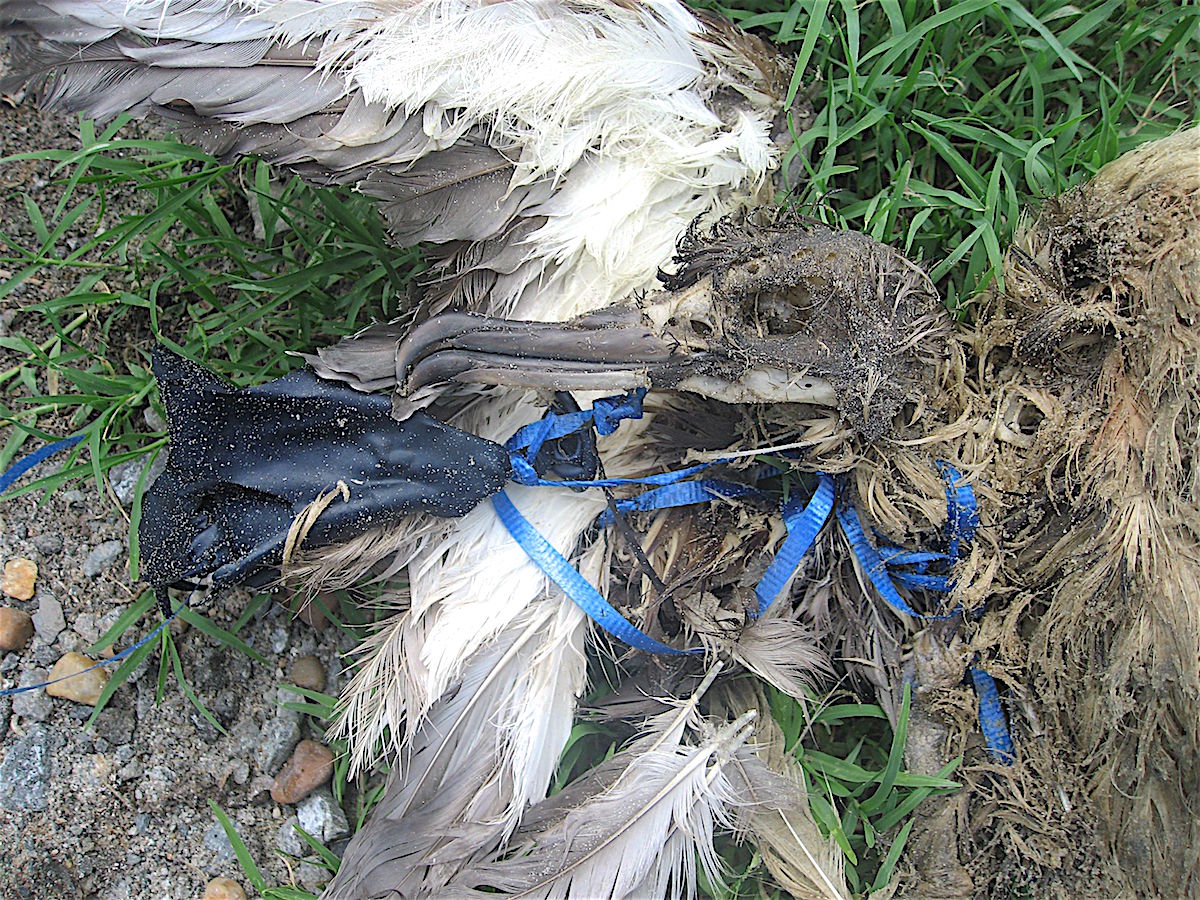
A dead seabird tangled in a balloon string.
Have we thought about how plastic affects our birds? It is estimated that 80% of seabirds and waterbirds have ingested plastic.
“Plastic pollution is a global issue. Here in the Caribbean it is having a major impact, not only on our important tourism product, but also on our fragile environment,” explained festival coordinator Sheylda Diaz Mendez. “Our islands are home to over 170 endemic birds – found nowhere else in the world. Just like our human visitors, the birds that live year-round on our islands need to feel welcome and comfortable in a clean, healthy environment. Solid waste, mostly consisting of plastics, is upsetting the balance of our ecosystems, for birds and for ourselves.”
“The number of seabirds dying as a result of plastic may be as high as one million annually,” said BirdsCaribbean Executive Director Lisa Sorenson. “Many Caribbean birds are eating plastic daily. The pileup of plastic can also hamper nesting, breeding and feeding on land and prevents important habitats such as mangroves and wetlands from flourishing. This year, our volunteer CEBF coordinators will be organizing this spring, to raise awareness about plastics pollution, how you can reduce your use of single use plastic, doing clean-ups and other activities.”
World Migratory Bird Day Poster showing different groups of birds that are affected by plastic pollution. (Artwork by Arnaldo Toledo)
Plastic breaks down into tiny fragments (microplastics), which can be ingested and lead to disease and suffering in birds – as well as in smaller members of the food chain that birds may eat. It can gradually kill a bird, filling its stomach and essentially starving it to death. Plastic bags can choke and smother birds and animals. In the Caribbean, birds often become entangled in plastic fishing nets, lines, and other equipment, causing serious injury or death.
Which birds are particularly impacted by plastic pollution? The twelve bird species selected for the beautiful WMBD poster produced by Environment for the Americas this year have each been negatively affected by plastic, even though their feeding habits and the places where they live are very different. They are the Magellanic Penguin; the Black Skimmer, which feeds by flying low over the waves; the Lesser Scaup, a diving duck; the Chilean Flamingo; the Common Tern; the Northern Fulmar; the Magnificent Frigatebird (which you may see soaring around our coastlines), the splendid Osprey, a fish hawk; the lively Belted Kingfisher; the stately Tricolored Heron; the Killdeer, a shorebird; and the lovely yellow Prothonotary Warbler.
By the way, the gorgeous artwork on this poster is by Arnaldo Toledo Sotolongo, from Santa Clara, Cuba, a BirdsCaribbean member, who works as a scientific illustrator, photographer and designer and volunteers in conservation projects in his free time.
Be the Solution
Plastic is a worldwide epidemic. We need to work together to be the solution, for the sake of our birds and ourselves!
What YOU Can Do to Beat Plastic Pollution:
Use reusable metal bottles for your drinking water.
Travel with your own metal cutlery and use glass or metal storage containers.
Take cloth shopping bags with you to the grocery store.
Try reusable bamboo or metal straws.
Refuse plastic straws or containers in restaurants and stores.
Avoid plastic packaging in food stores as much as possible, including clamshell containers.
Take your plastics to the nearest recycling centre.
Reuse plastic items as much as possible in and around the home.
Host a beach or community cleanup day. Get local companies on board as sponsors. Share your photos.
Get involved! Join a local environmental or community group. Get your neighbours involved, too!
Design art competitions highlighting the problem of plastic trash.
Contact your local environmental group to find out about events on your island, or contact WMBD Coordinator in the Caribbean, Sheylda Diaz-Mendez, to organize an event of your own.
World Migratory Bird Day (WMBD) is a celebration of the thousands of birds that make their way to and fro across the Americas and the Caribbean each year. It was created in 1993 as International Migratory Bird Day, by visionaries at the Smithsonian Migratory Bird Center and the Cornell Laboratory of Ornithology. In 2007, WMBD found its “forever home” at Environment for the Americas (EFTA), a non-profit organization that connects people to bird conservation through education. Each year a single conservation theme is chosen to help highlight one topic that is important to migratory bird conservation. These educational campaigns have been integrated into numerous programs and events, focusing on topics including the habitats birds need to survive, birds and the ecosystem services they provide, the impacts of climate change on birds, and the laws, acts, and conventions that protect birds, such as the Migratory Bird Treaty Act, the Endangered Species Act, and the Convention on Biodiversity. Click here to learn more.
To raise awareness about the need for bird conservation, volunteer coordinators organize events in the Caribbean in April and May for the Caribbean Endemic Bird Festival (CEBF) in the spring and WMBD the fall. For much more information about CEBF, WMBD and the 2019 plastics theme, visit www.BirdsCaribbean.org and www.migratorybirdday.org/
It goes without saying that every member of the BirdsCaribbean community deserves recognition for the amount of hard work and dedication they put into their professions—all of which are rooted in the effort to conserve Caribbean birds and their habitats. This is a family that knows long hours, hot days in the field, and perseverance in the face of work that is often unpredictable. It is a family of strong and passionate people.
But at every BirdsCaribbean conference we set aside a special block of time to acknowledge those of us that have managed to go even more above and beyond in a variety of distinguished ways. In the evening of the final day of the conference, all of our conference delegates gather in the largest presentation room. Although everyone is itching to hit the dance floor to celebrate the closing of another successful conference, they know that the Awards Ceremony is not only a ritual, but an important moment to show support for some of their amazing colleagues. We were pleased and proud to honor 12 special persons at our recent conference in Guadeloupe (July 2019) with an award.
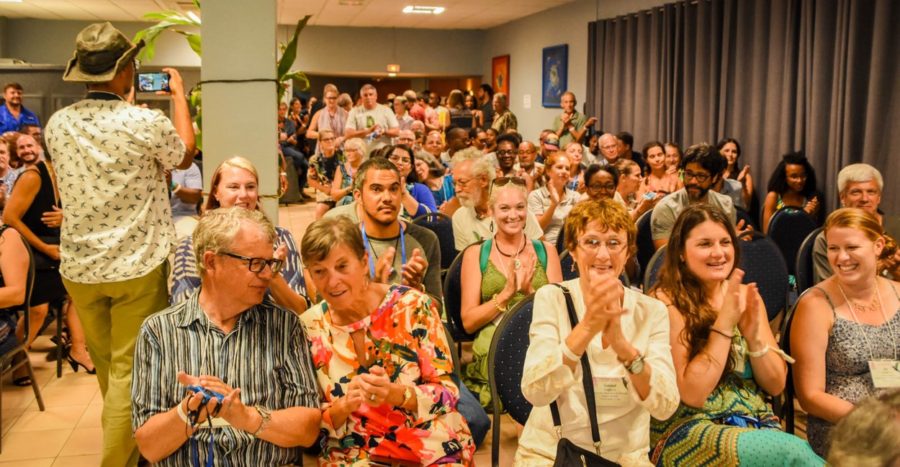
On the final night of the Guadeloupe Conference, delegates gather in good spirits in anticipation of the Awards Ceremony.
Here’s a recap and another shoutout to all of our 2019 Award Winners:
Founders’ Award: This award is presented to the student who presents the best paper in conservation or management research at the biennial conference. All student presentations are judged by members of a Founders’ Award Committee, consisting of ~10 conference delegates and led by Joe Wunderle.
This year’s Founders’ Award went to Christopher Cambrone from Guadeloupe, for his outstanding presentation entitled, “Population genetic structures of two closely-related, Caribbean-endemic Columbid species, the Scaly-naped Pigeon, Patagioenas squamosa, and the White-crowned Pigeon, P. leucocephala.”
Christopher Cambrone takes home the Founders’ Award for best student presentation, recognition that earns him a Lifetime Membership to BirdsCaribbean. (photo by Mark Yokoyama)
This is the fourth year that this award has been presented, but the first time an Honorable Mentions category was instituted (no doubt as a response to there being so many great student presentations, year after year). The two Honorable Mentions include (1) Spencer Schubert and his presentation, “Artificial perches as a technique for enhancing tropical forest restoration: a case study from the central Dominican Republic, and (2) Laura Fidalgo and her presentation, “Characteristics of Elfin-woods Warbler (Setophaga angelae) post-hurricane habitat structure.” More information on these presentations and past winners of the Founders’ Award can be found here.
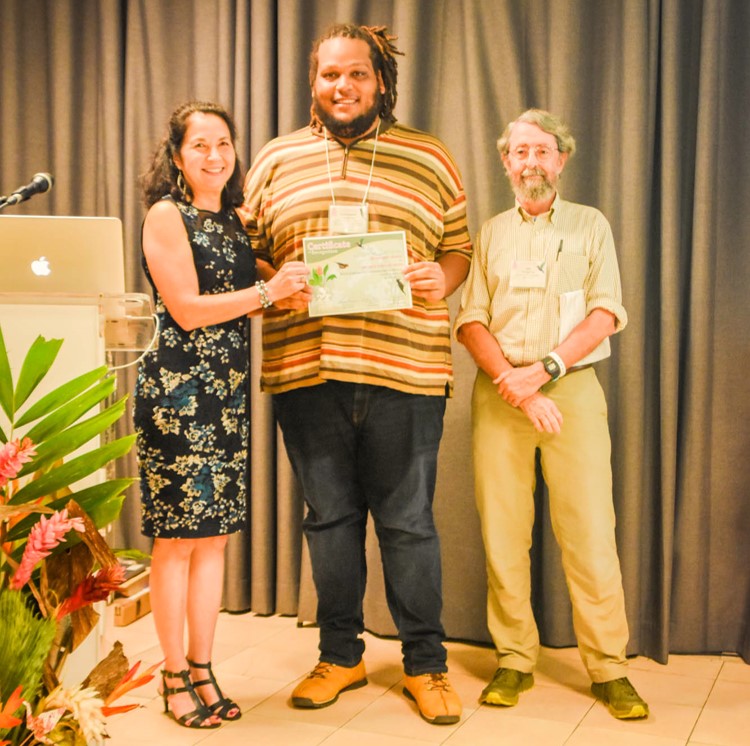
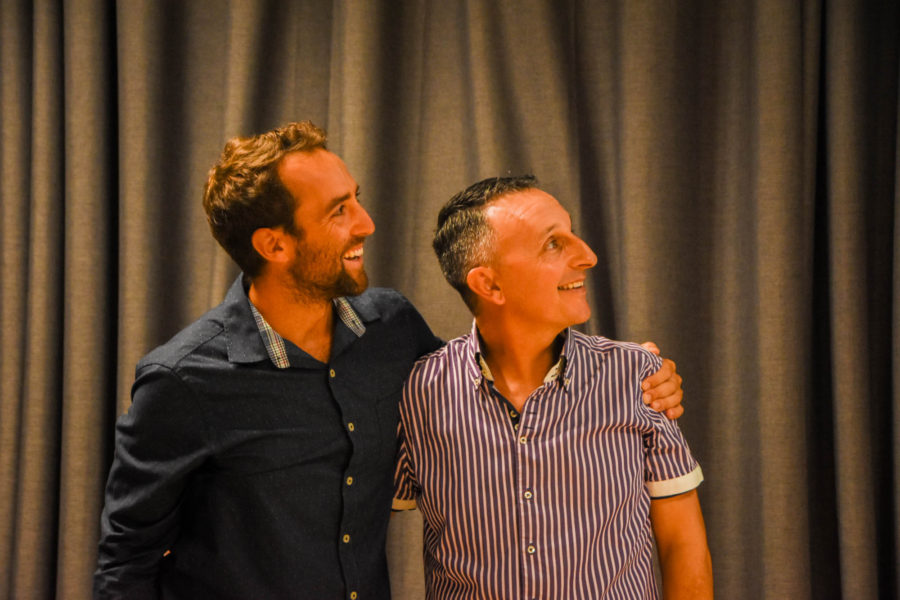
President’s Awards: There were three particularly special community members that received the President’s Award, hand chosen by BC’s current President, Andrew Dobson. These individuals stand out for services and work they have done that are simply extraordinary, raising the bar to new heights. The winners of the 2019 President’s Awards went to (1) Jennifer Wheeler for all of the blood, sweat, and tears that she relentlessly gives to the BirdsCaribbean organization, (2) Doug Weidemann for 10+ years of devoted service to the Journal of Caribbean Ornithology, and (3) Anthony Levesque for being a leader for birds and bird tourism on his home island of Guadeloupe.
Anthony Levesque (right) looks up in surprise to see that he has won the President’s Award for his nonstop work with birds and bird tourism on Guadeloupe. (photo by Mark Yokoyama)
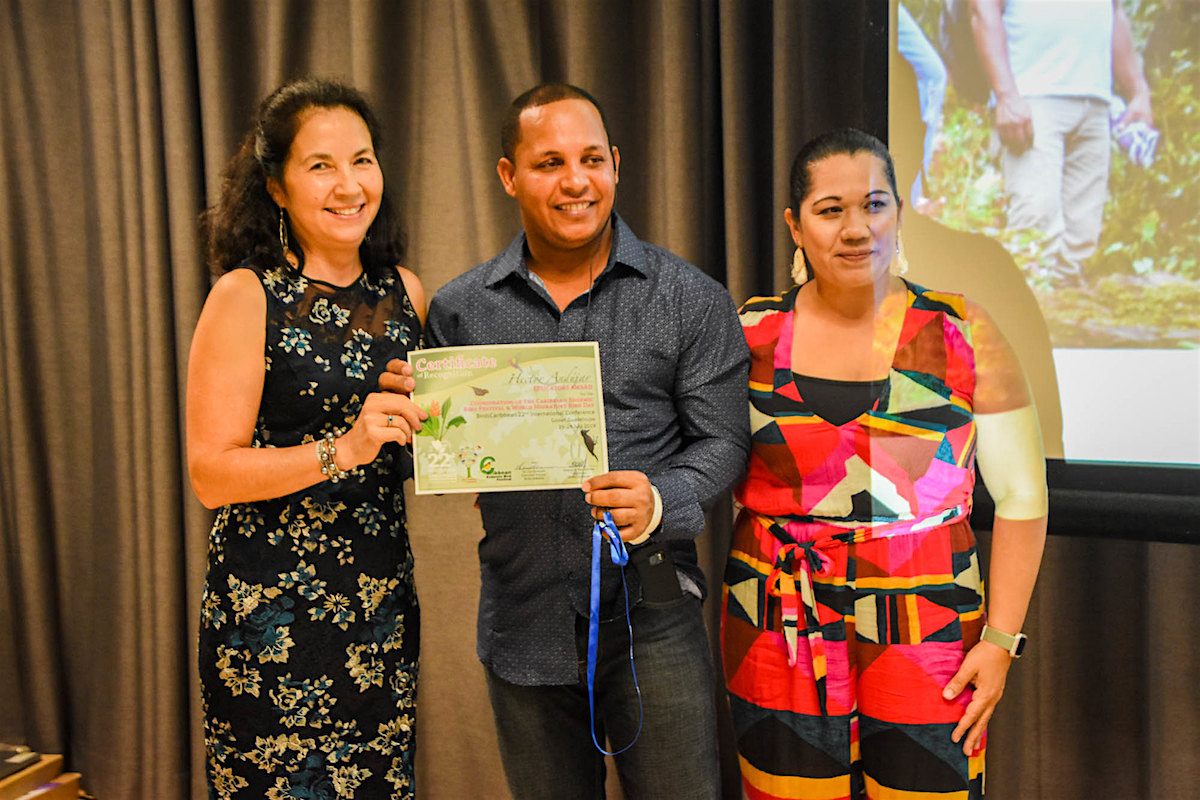
Educators Awards: These awards are given jointly by BirdsCaribbean and their partner, Environment for the Americas, to those that have excelled as educators in their communities. With great enthusiasm and energy, these persons have consistently organized fun and creative communities activities for both the Caribbean Endemic Bird Festival and World Migratory Bird Day. Educators Awards were presented to (1) Andrea Thomen and (2) Hector Andujar, both affiliated with Grupo Jaragua in the Dominican Republic, (3) Ava Tomlinson who works with the National Environment and Planning Agency (NEPA) in Jamaica, and (4) Kate Wallace (stay tuned for much more on her).
Hector Andujar accepts the Educators’ Award for Grupo Jaragua. (photo by Mark Yokoyama)
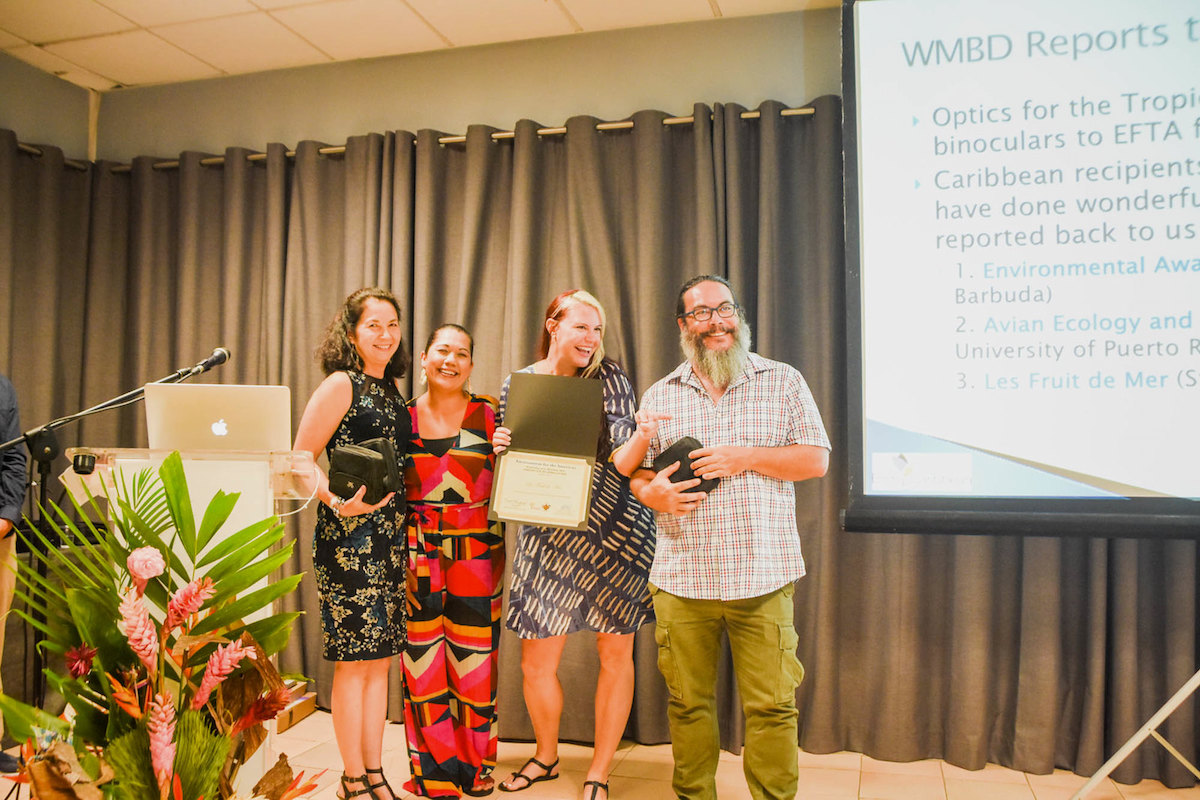
Three organizations were recognized for doing wonderful events and faithfully turning in reports with a gift of 3 pairs of binoculars to their organizations, thanks to the generosity of Joni Ellis and Optics for the Tropics. These were the Environmental Awareness Group of Antigua and Barbuda (Natalya Lawrence and her son Jordan accepting), Les Fruits de Mer of St. Martin (Mark Yokoyama and Jenn Yerkes), and Adrianne Tossas (who leads the Avian Ecology and Conservation Project at the University of Puerto Rico, Aguadillas).
Les Fruits de Mer (Jenn Yerkes and Mark Yokoyama on right) receiving recognition and binoculars for turning in reports of their World Migratory Bird Day activities.
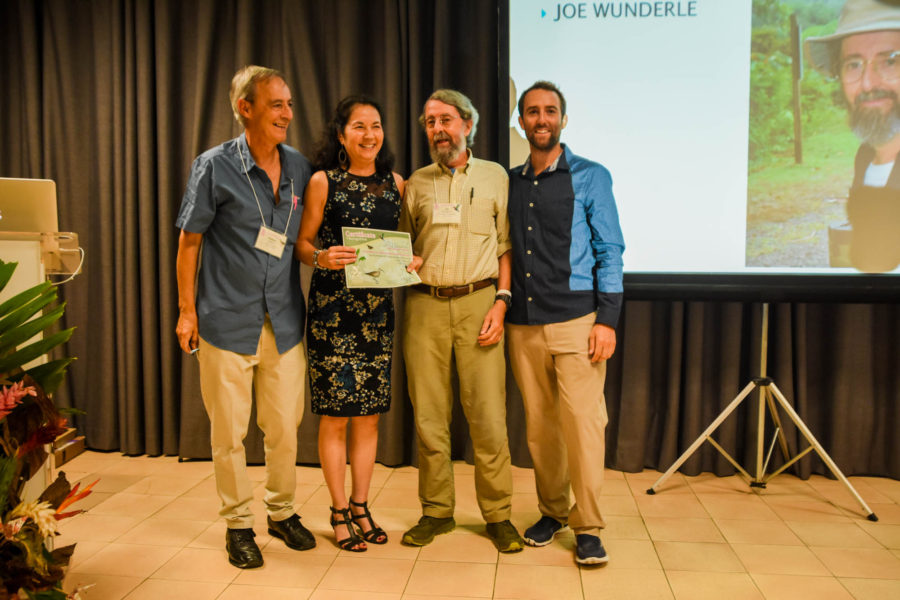
Site Fidelity Award: Have you ever noticed one particular bird that stays year-round on your property, despite all of its flock leaving for periods of time? It’s always there, it’s always singing, and somehow it gets by and is content no matter the season and no matter the weather. Over the years, you come to depend on that bird to be there to brighten your day, and to be your friend. And that bird always does; it never disappoints. There is a special someone in our community that fills that same niche. The Site Fidelity Award is a special award designed to be given only once, in recognition of an individual that has been loyal to and supportive of the BirdsCaribbean family since the very beginning of the society’s existence…since 1988. That amazing person is Joe Wunderle, and we are extremely lucky to have him in this family.
Joe Wunderle (second from left) receives the one and only Site Fidelity Award for being the longest running BirdsCaribbean member that has not missed a single conference in 30 years! (photo by Mark Yokoyama)
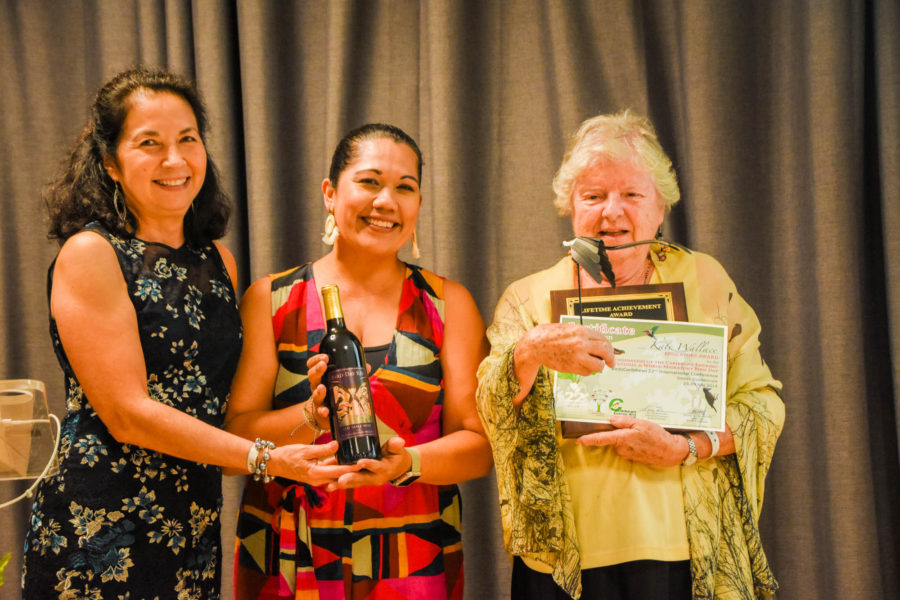
Lifetime Achievement Awards: These are the most prestigious awards, presented to the people in the BirdsCaribbean family that everyone knows and respects for the lifetime amount of work and dedication they have shown to our cause. It goes without saying, that these are remarkable individuals that have helped change the future for Caribbean birds and their habitats for the better. The 2019 Lifetime Achievement Awards went to (1) Kate Wallace, a woman that has served the Caribbean in so many capacities, including Peace Corps volunteer, researcher, naturalist, author, bird guide, educator, and community leader, and (2) Maurice Anselme, Director and longtime leading force behind the many environmental successes of the Parc National de la Guadeloupe.
Kate Wallace (far right), who earlier this year celebrated her 80th Birthday, is overwhelmed to have received a Lifetime Achievement Award (not to mention and Educators Award as well!)
Although these awards to Kate and Maurice do not include the extensive retirement packages they both deserve, they should each know that across the islands there are hundreds of doors open to them, with loving friends and colleagues waiting inside to welcome them.
So, congratulations again Christopher, Spencer, Laura, Jennifer, Doug, Anthony, Joe, Andrea, Hector, Ava, Kate, and Maurice. . .
You have, without a doubt, earned the recognition!
Photo gallery: Hover over each photo in the gallery to see the caption or click on a photo to view as a slide show.
Andrea Thomen (center) receives the Educators Award for the strong impact she has made with youth and communities in the Dominican Republic. (photo by Mark Yokoyama)
Hector Andujar and Andrea Thomen, both with Grupo Jaragua in the Dominican Republic show off their awards after the ceremony. (photo by Yolanda Leon)
Doug Weidemann (second from right) accepts a President’s Award for more than a decade of work he has invested into the Journal of Caribbean of Ornithology. (photo by Mark Yokoyama)
The Environmental Awareness Group, represented by Natalya Lawrence, receives recognition and a token of gratitude for organizing wonderful WMBD events and reporting back. (photo by Mark Yokoyama)
Laura Fidalgo (center) accepts an Honorable Mention Founders’ Award for her work with the Elfin-woods Warbler in Puerto Rico. (photo by Mark Yokoyama)
Jennifer Wheeler (right) has been a powerhouse for BirdsCaribbean. She fully deserves this President’s Award (and a night off)! (photo by Mark Yokoyama)
Maurice Anselme (with plaque), the Director of the Parc National de la Guadeloupe, dedicates his Lifetime Achievement Award to all the staff of his national park. (photo by Mark Yokoyama)
The Dominican Republic swept the awards this year! Andrea Thomen, Hector Andujar and Kate Wallace of Grupo Jaragua (photo by Yolanda Leon)
The Avian Ecology and Conservation Project, led by Adrianne Tossas, receives recognition and a token of gratitude for organizing wonderful WMBD events and reporting back. (photo by Mark Yokoyama)
Spencer Schubert (center)) is proud to have received an Honorable Mention Founders’ Award for his graduate work in the Dominican Republic. (photo by Mark Yokoyama)
Ava Tomlinson, Senior Public Education Community Outreach Officer with the National Environment and Planning Agency (Jamaica) received an Educators Award for the many wonderful events she organizes in different communities in Jamaica (accepted by Ann Sutton). (photo by Mark Yokoyama)
It’s that time of year again – spring migration! Migratory birds have started making their way to the temperate areas of the globe for breeding, Some of these birds have spent the entire winter in the Caribbean and others are passing through as part of a longer journey. In both cases, the Caribbean provides essential habitat that supports these fearless travelers. Safe, clean places to rest and refuel are critical to their survival.
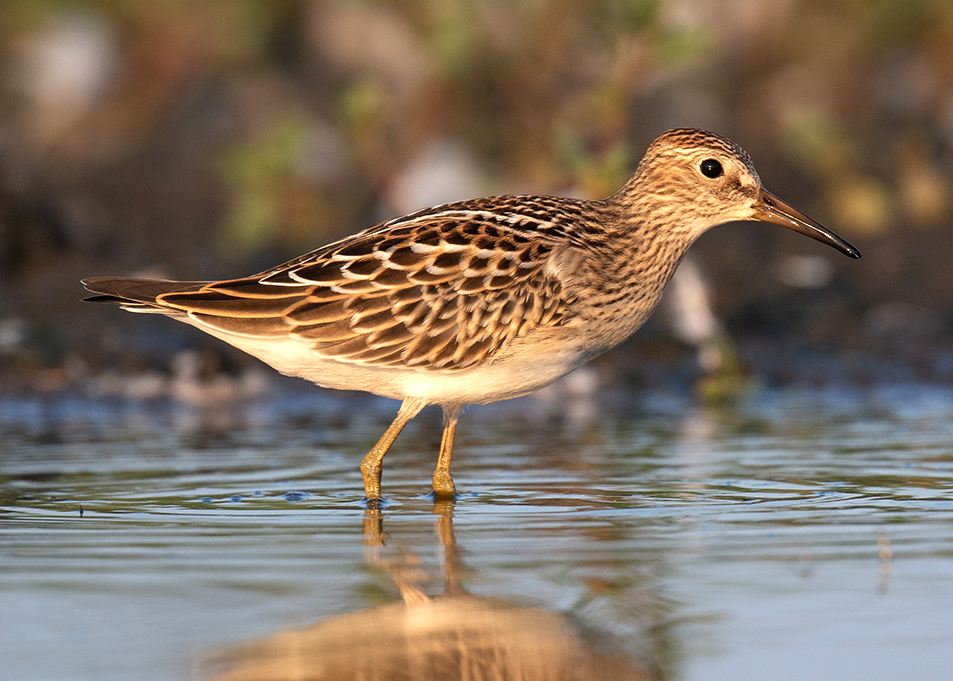
A round trip migration for the Pectoral Sandpipers can reach over 18,000 miles (30,000 km). (Photo by Nick Dorian)
Some of the longest trips made this spring will be completed by the arctic-breeding shorebirds. If you catch a glimpse of a Red Knot in the next few weeks, you are seeing it on just a small part of its 9,300 mile (15,00 km) journey! Shorebirds are both incredible athletes and world travelers: they can travel hundreds of miles a day without rest and pass over continents in weeks.
Capturing data of birds during migration is vital to understanding their status, distribution, and how they are using sites in the Caribbean throughout their life cycle. While you are out birding don’t forget to log your observations in eBird Caribbean. If you are visiting a wetland, please do a Caribbean Waterbird Census (CWC) count! The regional count occurs in January and February, but CWC data is collected year-round! When entering your data on eBird, on Step 2 “Date and Effort” page, be sure to choose either the “CWC Point Count” “CWC Traveling Count” or “CWC Area Search” observation type. (you can also choose one of these options if you are using the EBird Mobile app – adjust your settings – choose eBird Caribbean as your portal and the options will show up!)
Is that a Least Sandpiper or a Western?
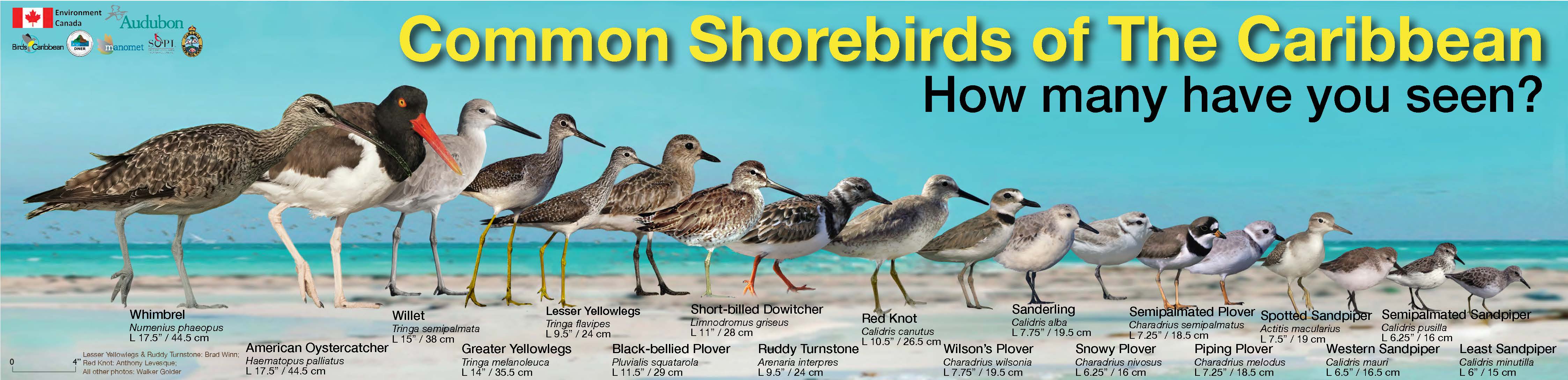
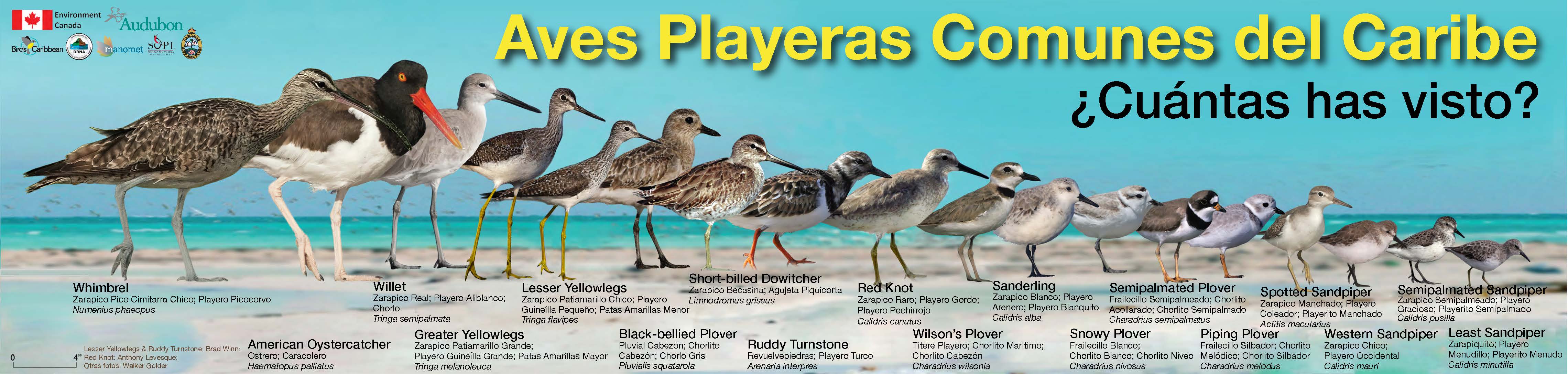
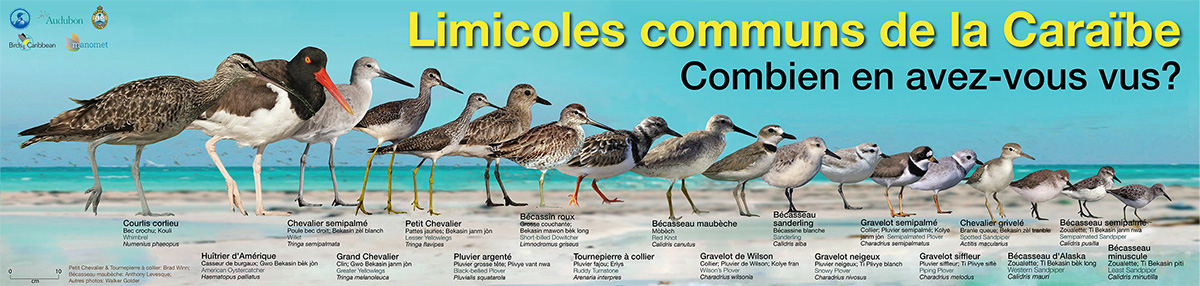
Earlier this year, we redesigned an existing poster of common shorebirds in the Caribbean which features many of the sandpipers, plovers and larger shorebirds that you may see while birding. This poster is a great resource because: 1) it shows the relative size of the shorebirds to each other and 2) all the birds are in their winter plumage. In their non-breeding plumage shorebirds – especially peeps – can be challenging to identify. We hope that this resource is a helpful guide for those learning their shorebird identification.
The poster is also available in Spanish and French. Below the English common name and scientific name, the common name of the bird appears in Spanish for Cuba, the Dominican Republic, and Puerto Rico. For example, the Red Knot has three Spanish common names: Zarapico Raro (Cuba), Playero Gordo (Dominican Republic), and Playero Pechirrojo (Puerto Rico). If only two Spanish common names appear, this indicates that two of these three countries have the same common name for the bird.
Do you have access to a large format printer and want to have a hard copy of this beautiful resource? The poster is the perfect addition to wildlife offices, public education spaces, or to have on hand for events like presentations and bird festivals! Larger versions of the posters can be downloaded here: French, English and Spanish.
We very much appreciate the National Audubon Society and the Bahamas National Trust allowing us to redesign their original poster and for Manomet’s input during the process. We thank the Canadian Wildlife Service for supporting poster printing costs in 2019. Participants at the Conserving Caribbean Shorebirds and Their Habitats Workshop were treated to small versions of the poster thanks to a generous donation from the Puerto Rico Department of Natural and Environmental Resources.
Over five days, 33 enthusiastic participants learned about shorebird identification, monitoring techniques and conservation strategies. They shared ideas, compared experiences, and trekked around watery habitats practicing new field skills. “We were thrilled to work with this enthusiastic group of conservationists this week,” said Lisa Sorenson, Executive Director of BirdsCaribbean. “They have all have pledged to use what they learned to help study and protect threatened shorebirds in their home countries.”
Why Shorebirds?
Shorebirds, like sandpipers and plovers, are among the most threatened groups of birds in the world. Most of them migrate incredible distances every year from high in the Arctic where they breed down to southern South America and back again. Some species, like the Red Knot, will fly over 9,300 miles (15,000 km) — and that’s just one way. Many migratory shorebird species, like Black-bellied Plovers, Greater Yellowlegs, and Semipalmated Sandpipers, rely on Caribbean wetlands to stop and refuel during their long journeys. Some even spend the entire winter! However, shorebird species have been in steady decline since the 1970s. This is due to several factors, all connected with human activities such as loss of habitat from development, disturbance on beaches, and hunting.
Black-bellied Plover (in winter plumage) at Combate Beach, Puerto Rico. This shorebird, and many other species rely on Caribbean beaches and wetlands for a safe haven during migration and overwintering. (Photo by Brad Winn)
The group of eager Caribbean conservationists at the workshop learned more about these threats, not only direct threats to shorebirds and waterbirds, but also to their habitats: beaches, mudflats, mangroves, and some agricultural areas. They also discussed best practices in monitoring the birds and conducting conservation activities. Importantly, they learned how to take part in two critical monitoring programs, the Caribbean Waterbird Census (CWC) and the International Shorebird Survey (ISS). All of this led to a deeper understanding of the birds’ ecology and conservation.
Another major threat to Caribbean shorebirds is plastic pollution, and the theme of World Migratory Bird Day 2019 reflects this: “Protect Birds: Be the Solution to Plastic Pollution.” With a growing awareness of the harmful impact of plastic across the region on public health and the environment, the group was soon busy with a cleanup at one of the field trip sites, collecting 50 pounds of trash. The exercise was led by Sheylda Diaz Mendez of Environment for the Americas (EFTA) and representatives from the Scuba Dogs Society. This was an excellent hands-on exercise for participants on the management and organization of a cleanup (which is not as easy as it sounds). Plus, the participants had fun, and were delighted to receive cleanup equipment to take back home, thanks to EFTA.
Sharing Experiences Reveals Common Themes
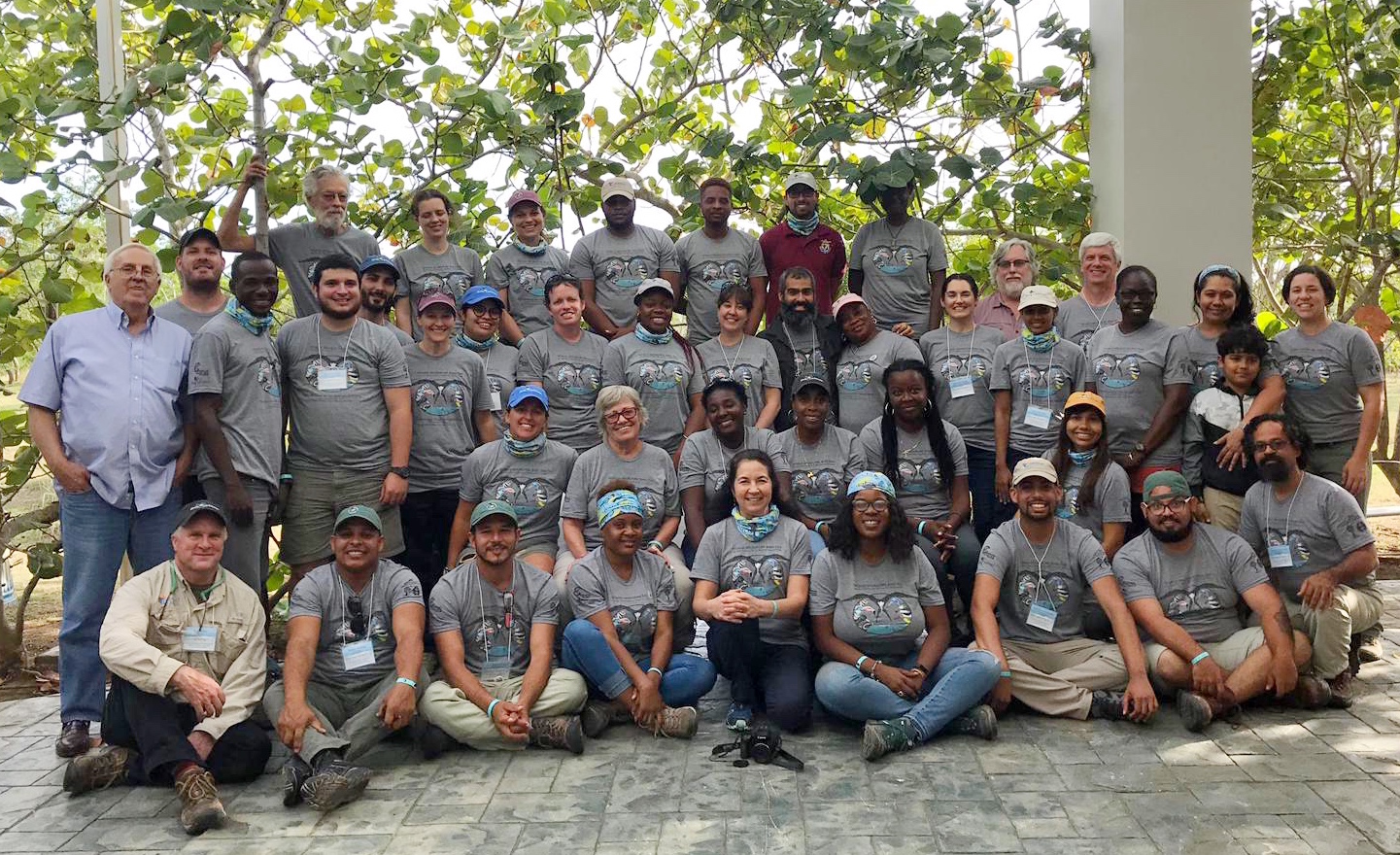
Group photo on the last day wearing our 2019 World Migratory Bird Day shirts—33 participants from 14 island nations. (photo by Ana Roman)
While the first three days focused on basic shorebird and waterbird identification, life history, threats to birds and habitats, and collecting and exploring data, the final two days turned to conservation solutions. After sharing the challenges they face in their countries, it was evident that many islands were experiencing similar issues. Facilitators and trainees then shared ideas and strategies for reducing threats.
In the coming days, participants will have the opportunity to apply for funding from BirdsCaribbean to carry out conservation activities on their islands. The group discussions and brainstorming sessions during the workshop were fantastic opportunities for participants to begin to develop project ideas for this funding. Depending on the threats and priorities at a given site, these projects might include activities such as shorebird and waterbird monitoring, public outreach and education, or a wetland cleanup.
Having people with the same interests and passions from across the region also had other benefits — reminding each other that we are all conserving birds together! “It’s really cool to see how many of us are actually doing this kind of work. Because when you’re on these islands, it’s just you, and you’re like, “The world is on my shoulders! These birds, I’m all they have!” said Shanna Challenger of the Environmental Awareness Group on Antigua. “And it’s really cool to see how many people we have working on the same thing.”
The group of students, wildlife managers and educators from both the government and the non-profit sectors represented 14 island nations: Antigua, the Bahamas, Dominica, Dominican Republic, Grenada, Haiti, Jamaica, Montserrat, Puerto Rico, Saint Lucia, Saint Vincent and the Grenadines, Sint Maarten, Trinidad and Tobago, and the US Virgin Islands.
BirdsCaribbean also benefited from sharing experiences during the week with our partners and co-facilitators for the workshop, Manomet, Inc. Experts in shorebird identification, life history and habitat management, the Manomet team provided enthusiasm and invaluable insights in the classroom and in the field. Their Habitats for Shorebirds Project aligned with the goals of the workshop and BirdsCaribbean is very grateful for all of their help and expertise.
Practice Makes Perfect In the Field
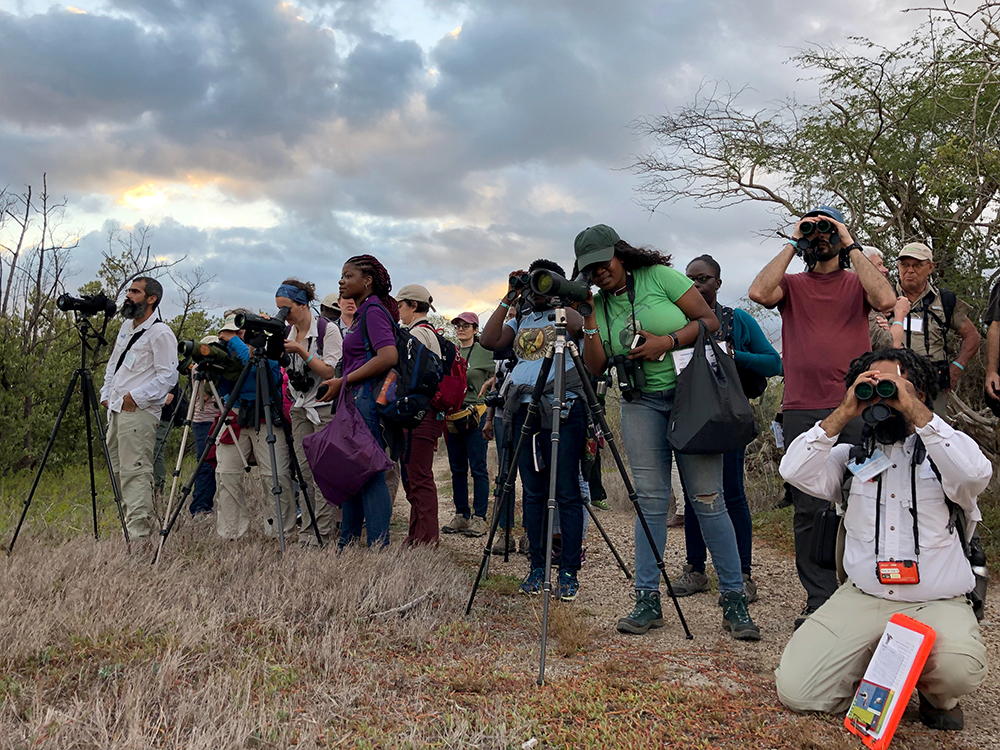
Field trip within Cabo Rojo National Wildlife Refuge. (Photo by Lisa Sorenson)
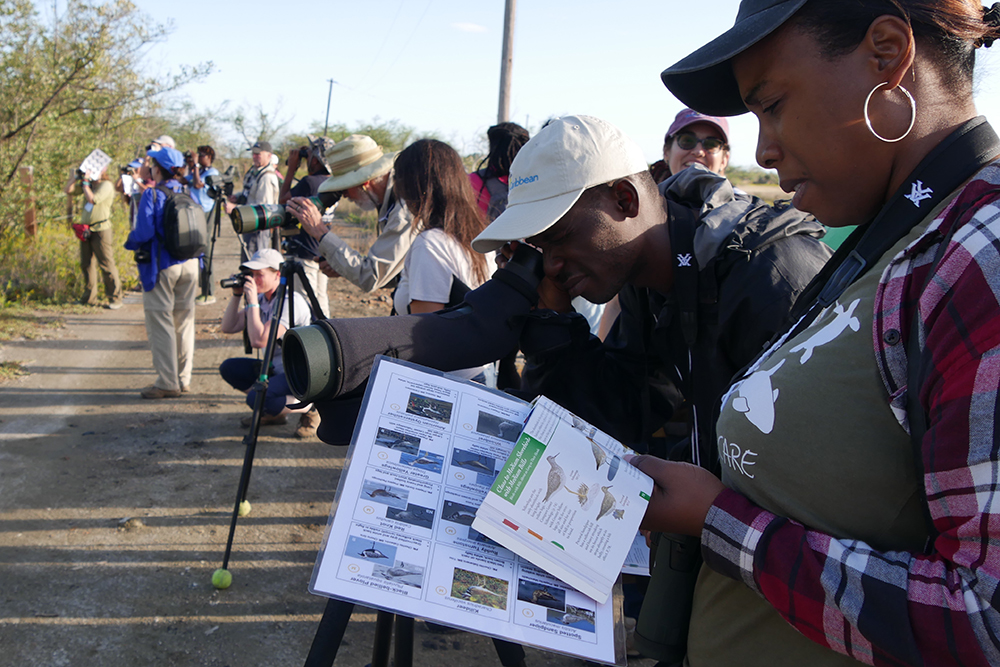
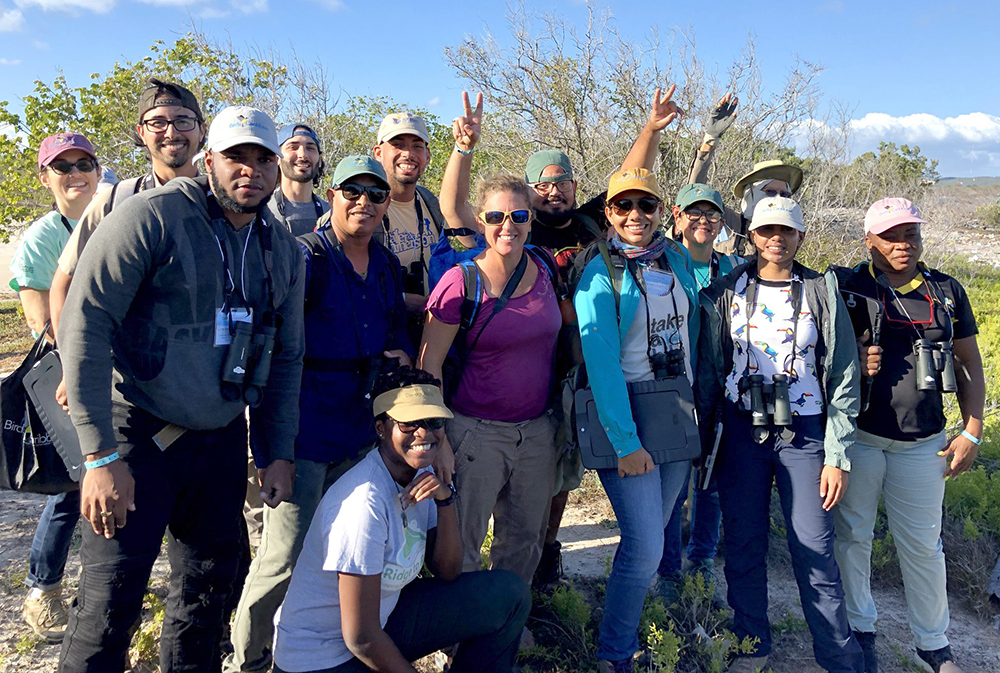
In addition to 30 hours of classroom learning, the group went on six field trips to local wetlands throughout the week. The field trips around Cabo Rojo offered students the opportunity to identify birds in the field and to practice count methods. “The workshop was amazing!” said Zoya Buckmire of the Grenada Fund for Conservation. “We went to a variety of wetland habitats from salt ponds to lakes to beaches. We got to see many different birds and learned some fantastic techniques for identifying and counting them.”
Shorebirds in their non-breeding, or wintering, plumage are notoriously difficult to identify. Sometimes only subtle details harbor the clues. Are the legs black? Are the wingtips longer than the tail? Does the bill droop slightly at the tip?? By the end of the week, the group was becoming more confident in the field marks for tricky birds. The Least Sandpipers at Cabo Rojo Salt Flats were a welcome new species for the group, though many were not convinced of the “yellow” in their yellow-green legs! However, with a week of field trips, it became clear to all that the more you practice, the better you are at field identification.
The workshop ended on a high, with two final field trips to Laguna Cartagena and Salina Fortuna. These were excellent places to practice flock estimation and point counts. While several species of herons and egrets and hundreds of Black-necked Stilts and Glossy Ibis were observed, taking a good look at more secretive species like the Clapper Rail and Sora were a perfect way to end the week. All participants received new Vortex binoculars and ten organizations received a new Vortex spotting scope and tripod – “must-have” equipment for monitoring programs and ensuring proper identification. The group also received field guides and other resources for bird identification and data collection.
Participant Perspectives
A group enthusiastic to clean up shorebird habitat! (Photo by Monica Iglecia)
The participants came away with plans to share their newfound knowledge with colleagues. “Thank you so much for always providing opportunities for conservationists in the Caribbean like myself,” wrote Laura Baboolal from Trinidad. She aims to start a shorebird monitoring program for Trinidadian wetlands, and adds: “We hope this can evolve into something greater…Hoping to have some exciting news soon!”
Most Caribbean people live on or near the coast, but have not appreciated or learned much about the birds that inhabit their seashores and wetlands. One of these was participant Reneive Rhoden, from Jamaica’s National Environment and Planning Agency. “I’ve learned so much about shorebirds!” said Reneive. “I grew up on the seaside and I didn’t know anything about shorebirds – and now I know a lot! I can now teach my kids, children in school, and Jamaicans that I work with in my job.”
We are very grateful to the following generous sponsors and partners for contributing to this workshop: Manomet, Inc.; Western Hemisphere Shorebird Reserve Network; Sociedad Ornitológica Puertorriqueña; US Fish and Wildlife Service (Neotropical Migratory Bird Conservation Act Fund); US Forest Service International Programs; Environment Canada; The Cornell Lab of Ornithology; Cabo Rojo National Wildlife Refuge, Para La Naturaleza; Optics for the Tropics, Inc.; Environment for the Americas; Puerto Rico Department of Natural and Environmental Resources, and Vortex Optics.
We invite you to enjoy the gallery of photos below. Hover over each photo to see the caption or click on the first photo to see a slide show.
Cataloging trash collection. (Photo by Jessica Cañizares)
Reneive Rhoden helps clean up the refuge. (Photo by Jessica Cañizares)
Taking a closer look at shorebird food resources. (Photo by Lisa Sorenson)
Lisa Sorenson discusses threats to birds and their habitats with a group. (Photo by Monica Iglecia)
In the classroom at Cabo Rojo National Wildlife Refuge. (Photo by Lisa Sorenson)
Brad Winn reveals shorebird food using a sieve. (Photo by Monica Iglecia)
Early morning birding at Combate Beach. (Photo by Jessica Cañizares)
Perfect waterbird habitat at Laguna Cartagena National Wildlife Refuge. (Photo by Lisa Sorenson)
Birding in Laguna Cartagena National Wildlife Refuge. (Photo by Lisa Sorenson)
Anderson Jean and Francoise Benjamin practicing plover ID with Brad Winn. (Photo by Jessica Cañizares)
Birding at Combate Beach (L to R): Jeanette Victor, St. Lucia; Lisa Sorenson, BirdsCaribbean; Kristy Shortte, St. Vincent and the Grenadines; Reneive Rhoden, Jamaica. (Photo by Jessica Cañizares)
Setting the scope high. (Photo by Monica Iglecia)
Group photo after the beach cleanup. (Photo by Monica Iglecia)
Looking at a Spotted Sandpiper on the beach. (Photo by Monica Iglecia)
Participants presenting their group discussions about shorebird conservation. (Photo by Monica Iglecia)
Getting a closer look always helps with ID. (Photo by Jessica Cañizares)
Workshop participants and facilitators group photo at Cabo Rojo National Wildlife Refuge, Puerto Rico. Everyone is wearing their World Migratory Bird Day t-shirts: Be the solution to plastic pollution. (photo by Ana Roman)
Another short entertaining video in our series celebrating our 30th Anniversary! Thanks to our members and partners for sharing your thoughts with us in creative and entertaining ways!
First up is our partner, Sustainable Grenadines Inc. (SusGren), based in Union Island, St. Vincent and the Grenadines. Drone footage shows recent progress on the restoration of Ashton Lagoon, which is underway now! After more than 12 years of hard work and perseverance, this -mangrove-salt pond-coral reef ecosystem damaged by a failed marina development is being restored to its former glory. BirdsCaribbean has been a partner on this project from the very beginning! Our initial Wetlands Education Training Workshop way back in 2004 was the catalyst for this work and we have assisted with fundraising and project planning. Congrats to SusGren Team and we look forward to further updates!
Next up is Hannah Madden, a biologist working with the Caribbean Netherlands Science Institute based in St. Eustatius. She has been studying the nesting ecology of Red-billed Tropicbirds on St. Eustatius since 2012 but also conducts research and monitoring on other avifauna, such as the Bridled Quail-dove. Hannah is Secretary of the Board of Directors of BirdsCaribbean starting Jan 2018. She is an active member, attending our various workshops and conferences, carrying out waterbird monitoring through the Caribbean Waterbird Census. and leading local education events for World Migratory Bird Day and the Caribbean Endemic Bird Festival. She has published a number of papers on different taxonomic groups, but always tends to gravitate towards birds.
Jeff Gerbracht is the Lead Application Developer for eBird at the Cornell Lab or Ornithology. Jeff has been a long-time member and key partner of BirdsCaribbean. He has provided critical help to us in developing our bird monitoring programs as well as our own eBird Caribbean online portal. Jeff is a facilitator at many of our training workshops and conferences. His enthusiasm, knowledge, and love of birds is inspiring. Thanks to Jeff for donating so much time to us to help us advance conservation of Caribbean Birds!
Anthony Levesque has discovered over 40 species never before recorded in Guadeloupe and banded more than 10,000 birds. He is currently carrying out research to advance our knowledge of the impacts of hunting on shorebirds in Guadeloupe. When he is not shaving ;-), he is also the Guadeloupian coordinator of the World Migratory Bird Day (WMBD) since its inception in 2006 and served as Regional Coordinator for many years. Anthony is co-chair of our Checklists Working Group. He is a founding member of AMAZONA – a local bird NGO, active in Guadeloupe with over 300 members. His enthusiasm and sense of humor are always a delight!
We first met Binkie van Es in 2014 when he attended our BirdSleuth Caribbean International Training Workshop, an innovative education program that reaches thousands of youth across 18 islands. Since then Binkie has been putting what he learned to excellent use in Sint Maarten/ St. Martin, educating hundreds of youth and community members about the beauty and value of our birds. Recently retired, Binkie is also a certified bird guide – he took our Caribbean Birding Trail Guide Training Workshop in 2016 and has been helping visitors and residents alike to find and enjoy birds on his home island. Binkie’s passion is infectious – we are lucky to have him as a partner for both education and bird tourism!!!
Ricardo Miller works as a biologist for the National Environment and Planning Agency (NEPA) in Jamaica. He is committed to doing all he can to ensure that Jamaica’s birds and wild places are conserved for future generations to enjoy. He does this through his work at NEPA and also tireless volunteer efforts educating youth in schools and taking Jamaicans out birding for our Caribbean Endemic Bird Festival and World Migratory Bird Day. Ricardo is also an outstanding bird guide and has own business, Arrowhead Birding. For 30 years BirdsCaribbean has provided conservationists across the Caribbean the ability to share information and strategies for studying and conserving birds and their habitats through training workshops, conferences, working groups and regional projects, as well as the academically acclaimed Journal of Caribbean Ornithology.
Sincere thanks to Esther Figueroa (Vagabond Media) for putting together this video and Ingrid Flores, JC Fernández-Ordóñez, and José Colón-López for Spanish translation. Thanks to SusGren for their awesome drone mini-video. Photographs are by Sipke Stapert (Brown Pelican) and Tadas Jucys (Purple-throated Carib, Shutterstock). Special thanks to our members, partners and supporters who make this work possible!!!
In case you missed them, view our other fun 30th Anniversary videos at links below:
With so many recent tragic and conflicted events occurring in the world, BirdsCaribbean wants to share something uplifting. As part of our continuing 30th Anniversary celebration, we present you with a two-minute glimpse of what our Cuban, Puerto Rican, and Mexican colleagues are doing to conserve birds and their expressions of appreciation to BirdsCaribbean. Please take a moment to enjoy their inspiring words and images.
First we hear from Alieny González-Alfonso, graduate student at the University of Havana. Together with her fellow students and professors, Alieny has been a a powerhouse of positive actions for understanding and conserving Cuba’s resident and migratory birds. She is studying Reddish Egrets for her PhD and participates in Caribbean Waterbird Census monitoring every year. Alieny also organizes events to celebrate our Caribbean Endemic Bird Festival and World Migratory Bird Day each year and coordinates activities across the island. Alieny also conducts teacher training workshops and leads activities for our BirdSleuth Caribbean education program. Congrats and thanks to Alieny and her team for her amazing work!
Next we travel to Puerto Rico and hear from José Colón-López. José is a legend in his native Puerto Rico. As a volunteer with SOPI, he has been active in studying and conserving the endemic and migratory birds of Puerto Rico and their habitats for over 30 years. He generously donates his time to train and mentor others, sharing his passion and vast knowledge with a new generation of conservationists. José is also a founding member of BirdsCaribbean and has been to every single conference of ours since the first one in St. Croix 30 years ago!!! Cheers to Jose and thanks for inspiring us with your dedication and energy!
Adriana Vallarino, Ph.D., is a professor a the Institute of Marine Sciences and Limnology, Universidad Nacional Autónoma de México. She studies Masked Boobies and Least Terns in the Campeche Bank in the Gulf of Mexico and Caribbean Sea, vitally important nesting islands for many Caribbean seabirds. Adriana attended our International Seabird Training Workshop in San Salvador, Bahamas in 2012 and since then, has been carrying out innovative research and conservation work, including studying the impacts of micro plastics on seabirds. She also does a marvelous job organizing bird education events in Campeche, featuring birding walks, bird art and photography, mini workshops and more. We’re proud that Adriana is part of our network!
The videos highlight how our programs are engaging young and old in direct conservation, opening doors for scientific and educational exchange, and promoting sustainable livelihoods in ecotourism. Grab a cup of shade grown coffee, sit back and enjoy an inspirational moment.
Thank you to Esther Figueroa (Vagabond Media) for putting together this video and Ingrid Flores, JC Fernández-Ordóñez, and José Colón-López for Spanish translation. Photographs in the video are by Aslam Ibrahim Castellan Maure (Bee Hummingbird), Lisa Sorenson (American Flamingos), Wilfred Marissen (Reddish Egret), Aslam Ibrahim Castellan Maure (Blue-headed Quail-Dove), Jose Pantaleon (Cuban Trogon), Susan Jacobson (Western Spindalis), Lisa Sorenson (Viñales Valley, Cuba), Gary Donaldson (Trinidad, Cuba), Gary Donaldson (Zapata Swamp), AnnHaynes-Sutton (Masked Booby) and Arnaldo Toledo (Cuban Tody). Special thanks to our members, partners and supporters who make this work possible!!!
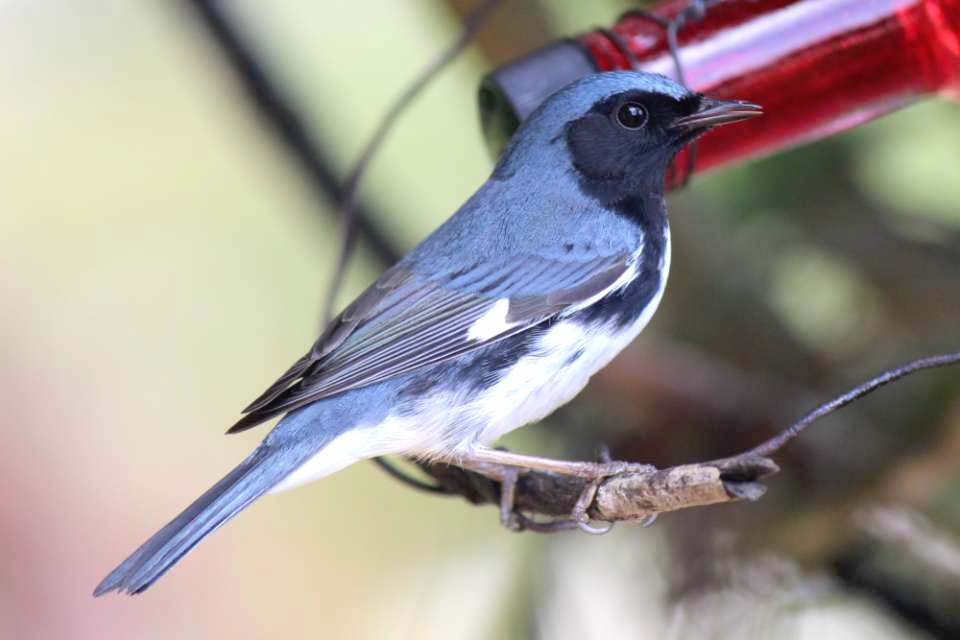
Black-Throated Blue Warbler visiting a feeder in Jamaica last week (photo by Ahhh…Ras Natango Garden and Gallery in Camrose Montego Bay)
The month of October always heralds a change in the seasons – even in the Caribbean. As the days grow a little shorter and the fierce heat of the sun lessens, it is also the season for hurricanes. For World Migratory Bird Day (WMBD) 2018, Caribbean island residents are looking back at the terrible storms one year ago. But they are also celebrating the steady recovery of residents – and birds.
About 130 birds, a third ofthe 500 regularly seen species of birds in our region are summer or winter visitors. More than 30 events on 16 Caribbean islands are already lined up to celebrate these amazing birds. WMBD is officially celebrated on October 13 in the Caribbean, but can be celebrated any time in the fall when migratory birds are present. More than 80,000 Caribbean residents, friends and visitors will join in the activities, led by Environment for the Americas and BirdsCaribbean.
Children on a birding walk in Union Island, St. Vincent and the Grenadines (photo by Sustainable Grenadines Inc.)
“Last year, for obvious reasons, we did not have a large celebration of WMBD,” says Executive Director of BirdsCaribbean Lisa Sorenson. “Hurricanes Irma and Maria had just hit numerous islands with terrifying force, and many of our partners were dealing with the damage. But now we are moving forward with great hope, as thousands of migratory birds return to our shores. We encourage our partners to celebrate progress made.”
The 2018 theme for WMBD in the Caribbean is “Year of the Bird.” This celebrates birds 365 days of the year, with a special theme each month. It also commemorates a full century – 100 years of the Migratory Bird Treaty Act, the most powerful and significant bird protection law ever passed. Visit this page for inspiring articles, messages and activity ideas.
The “Year of the Bird” is also an opportunity to look at critical issues affecting our birds – including those embarking on the challenging migration journey – that were addressed throughout this special year. These topics can become impactful WMBD action projects. For example, September’s Year of the Bird theme highlighted dangers for migrating birds – light pollution and glass windows. How can we make our homes more “bird-safe”?
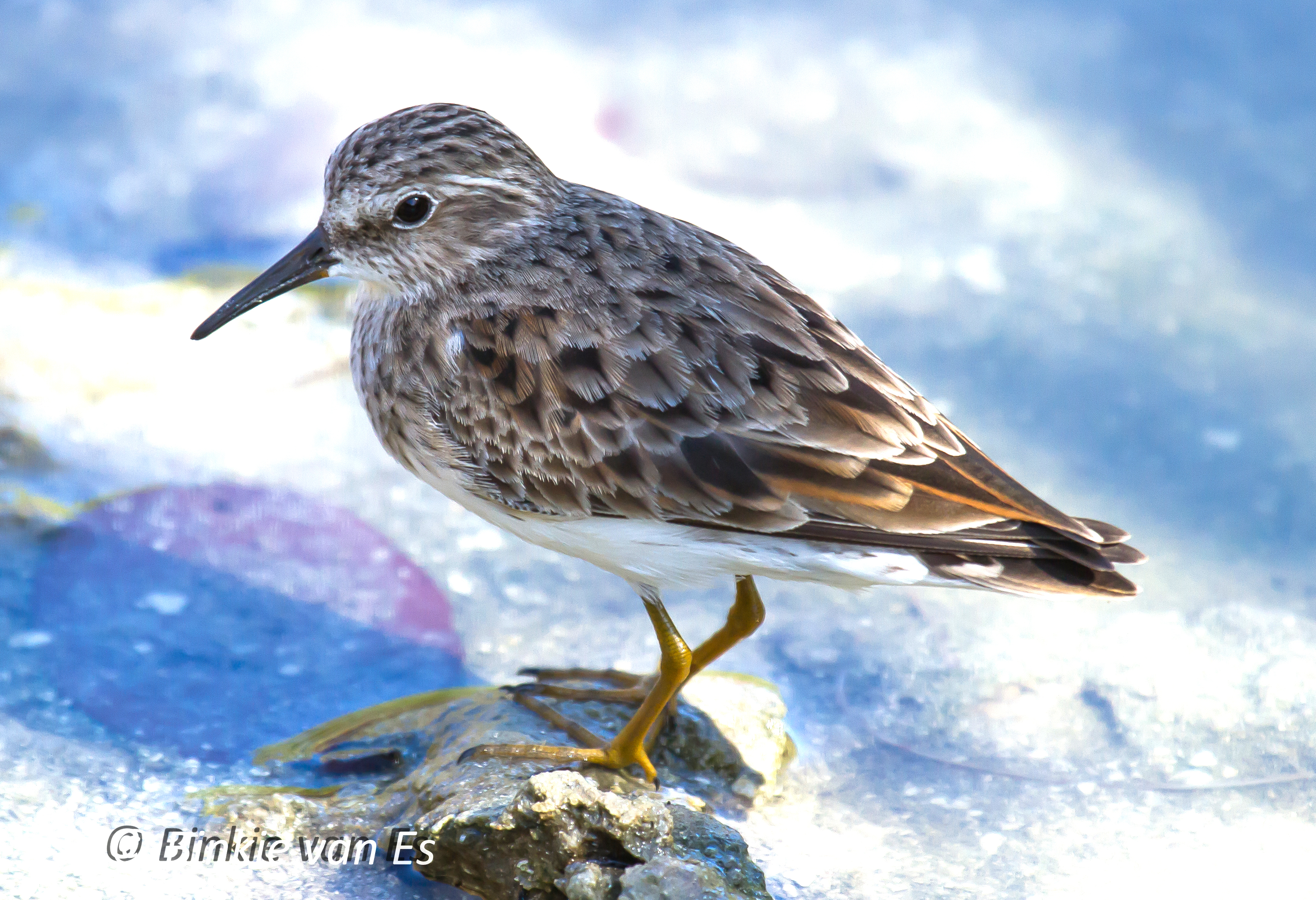
Least Sandpiper – a common migrant to the Caribbean; this one has stopped for a rest in St. Maarten (photo by Binkie van Es)
Local coordinators on each island will raise awareness about simple actions that people can take to help birds each and every day. “Planting trees for native birds, encouraging people to keep their cats indoors and informing people how to create a bird-friendly yard, are just a few of the actions people can take,” said Regional Coordinator, Sheylda Díaz-Méndez. On the WMBD website for the Americas, partners can download activities, coloring pages, presentations, event flyers, banners, posters, social media materials and more for events and programs. Visit migratorybirdday.org for ideas on how to celebrate, an event map and updates throughout the month of October. Get the young people involved!
For WMBD in the Caribbean, learning about our migratory birds takes place in a diverse, harmonious setting. As in previous years, birding walks, tree plantings, clean-ups, church services, media interviews, street parades, fairs, information booths, games, drama and art competitions will form part of the WMBD celebrations. Innovative and creative ideas are always welcome.
October’s Year of the Bird action is to participate in Global Big Day on Saturday, October 6th. Just like Global Big Day in May, the folks at Cornell are organizing a worldwide Big Day in the Fall for the first time to celebrate and learn more about fall migration. Get all the information you need to participate at this link.
We look forward to hearing about your activities and the birds that you’re seeing – please share them with us on Facebook, twitter and instagram.

 It is easy to see how this shorebird got its name, with its rufous-brown feathers and a habit of turning rocks and stones over with its beak to find food. These charismatic birds can be found feeding in groups in rocky areas of shoreline, mudflats and on beaches. Turnstones are quite striking. In addition to those rufous feathers, they have black or brown patches on their chest and head, a short pointed black beak and rather short bright orange legs. In winter the ‘ruddy’ feathers become duller brown. When Turnstones take flight you can see their brown and white stripey backs. You might also hear their cackling ‘katakak’ call as they take off. Ruddy Turnstones breed mainly in the arctic and fly south for the winter. Like many other shorebirds, they can fly thousands of miles in only a few days when on migration. They normally turn up in the Caribbean in August and can stay until May. During this time, they can be found throughout the Caribbean. As well as beaches they are sometimes found on man-made structures like jetties and piers. Some Turnstones will travel through the Caribbean and go even further, to spend the winter as far south as Argentina. Turnstones feed mainly on snails, crustaceans and insects, but they are not fussy and are even known to sometimes eat fallen fruit. Learn more about this species, including its range, photos, and calls here.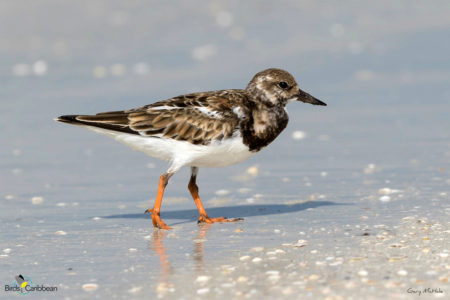
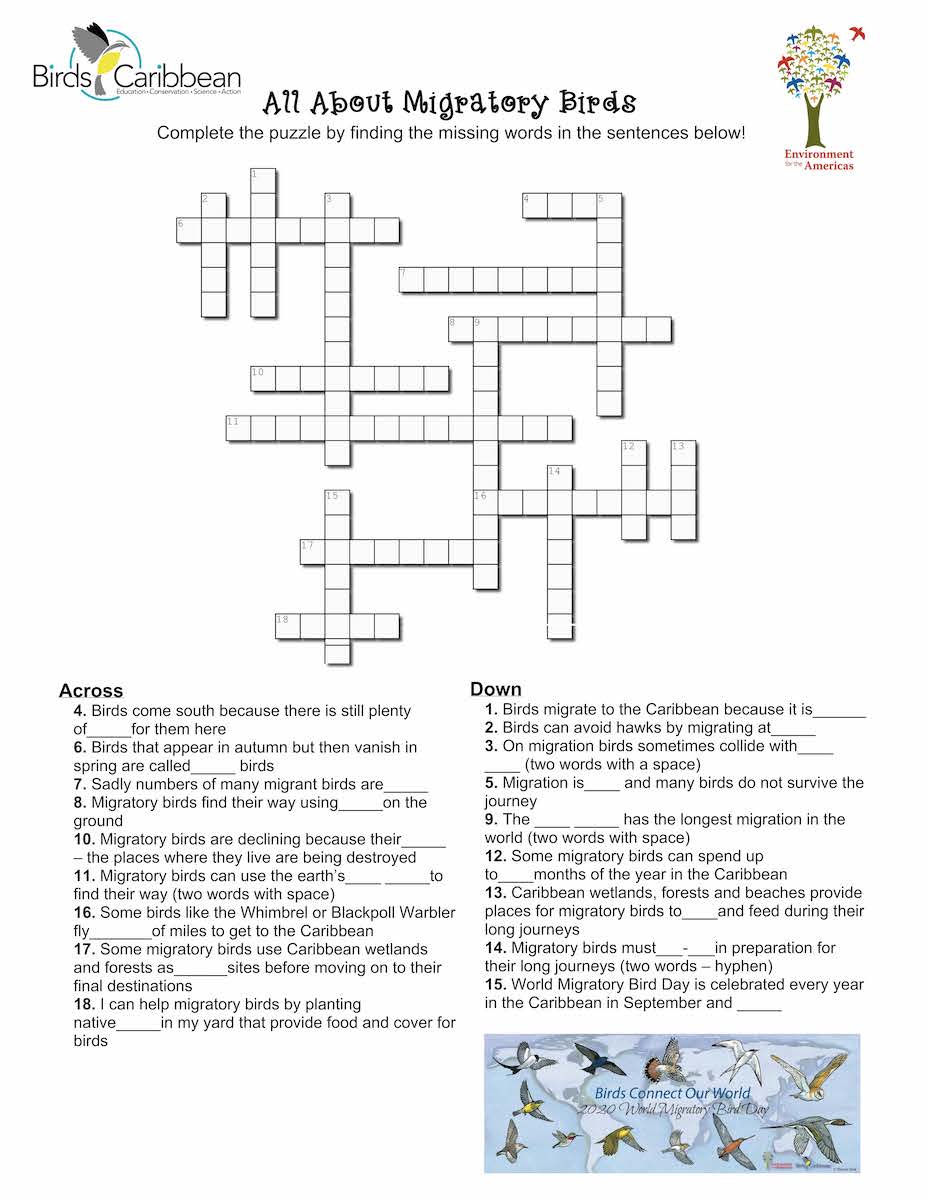 FOR KIDS: Complete our Crossword Puzzle: All about Migratory Birds! How many words can you fill in? Be sure to read the introduction pages from our Migratory Birds of the West Indies colouring book, to help find the clues to the puzzle. And here is a the Answer Key to the puzzle. FOR KIDS & ADULTS: