
A fun look at secure, anxious, avoidant, and disorganized attachment styles — explained through Caribbean birds.
Are you a ‘green flag’ parakeet or a ‘broken-winged’ performer? We’ve enlisted the help of our feathered friends to decode the complicated human heart. After all, understanding the ‘why’ behind our behaviors is the first step toward breaking patterns that can hurt our relationships.
In the wild, survival depends on how an animal navigates its environment. Some birds thrive through constant connection, while others rely on stillness, deception, or independence to survive the day. Human relationships follow a remarkably similar blueprint—one defined by Attachment Theory, a psychological framework that examines how we connect with others.
With the rise of therapy-speak, you’ve probably heard about attachment styles. In case you haven’t, they are internal maps for how we seek — or avoid — intimacy. By drawing parallels between survival strategies in the bird world and human intimacy, we’ll break down the four attachment styles: Secure, Anxious, Avoidant, and Disorganized, using the unique behaviors of birds that mirror them.
Just a quick heads-up: this bird-to-human comparison is our own creative interpretation.
Secure—The Cuban Parakeet (looking for a lifelong flock mate)
People with a Secure Attachment style are the ultimate green (winged) flags of the human world. They should consider themselves the Cuban Parakeets of dating — they’re exceptionally social, quite the chatter-boxes (think their loud crick-crick-crick in flight), and in it for the long haul.
These parakeets, like many other Caribbean parrots, form lifelong pair bonds that keep their large flocks cohesive. Together they travel in search of seeds, juicy fruits, and sometimes flowers, leaves, or nectar. But they also understand that independence is healthy, opting not to clip their partner’s wings or panic when the other flies off to another tree while foraging. At sunset, each member of the flock returns to the same hollow tree trunk (a cavity) to roost together.
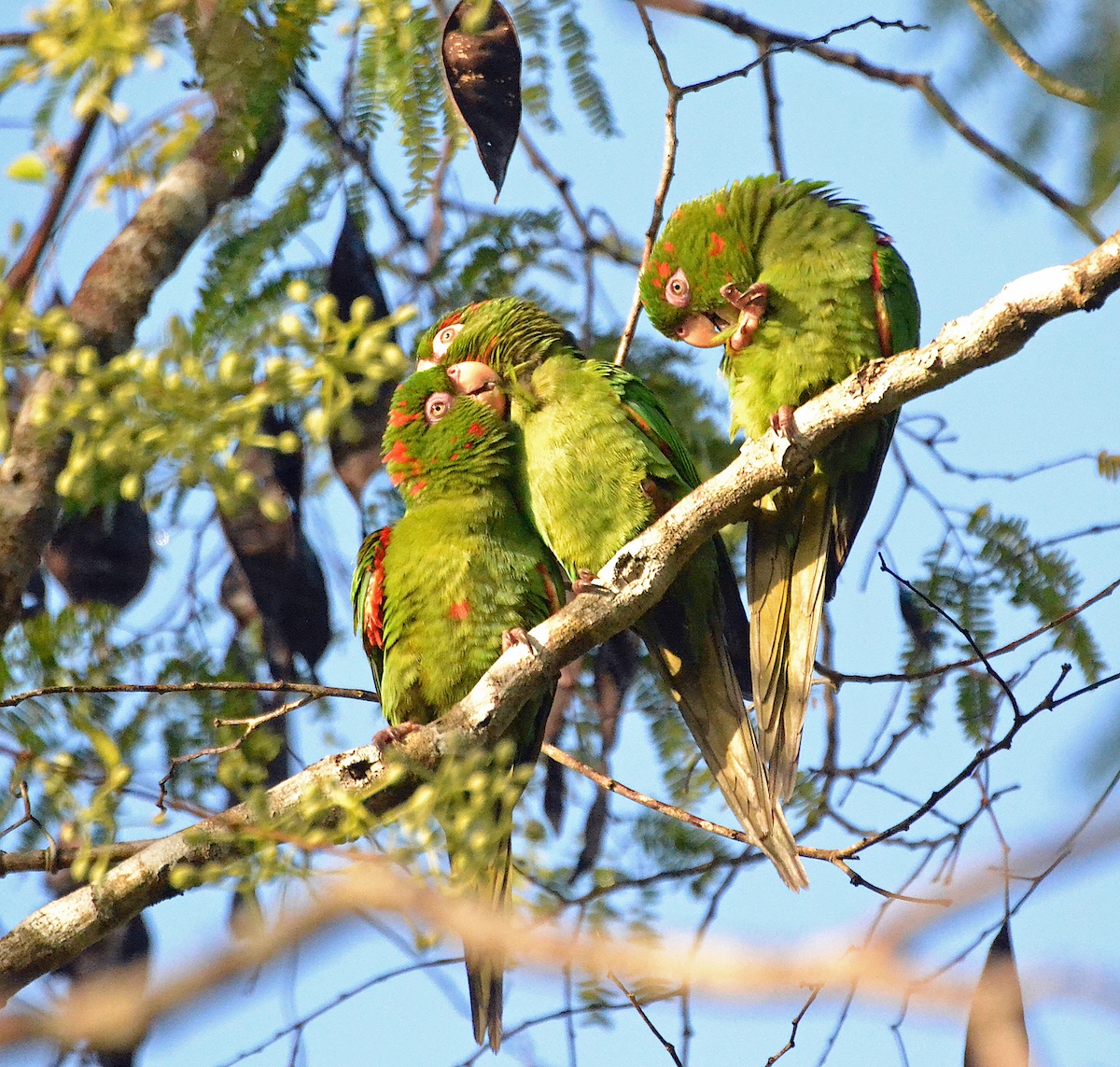
This instinct to stick together is rooted in survival. As prey animals living in flocks — parrots can’t forage and watch for predators simultaneously. Usually, a few members act as guard while the others forage, and then they trade places.
Similarly, secure partners invest heavily in the health of the relationship. Just like a pair of Cuban Parakeets grooming each other in the canopy (known as allopreening), secure individuals prioritize fulfilling their partners’ emotional needs. This simple act of fixing feathers may seem small, but it’s rich in communication. It’s a non-verbal dialogue that says, “You’re a mess, let me fix that,” or “I’ve got your back while you rest.” It’s the avian equivalent of checking in after a hard day or offering a reassuring hug.
They build their relationships on a foundation of trust and clear communication. Thankfully, human communication usually involves fewer high-pitched squawks — but the principle is the same: staying connected is the best way to get through any challenge.
Anxious—The Yellow-crowned Night Heron (the master of observation)
If the Secure types are the Cuban Parakeets, those with an Anxious (or Preoccupied) Attachment style are the Yellow-crowned Night Herons of the dating scene. These individuals crave deep intimacy but often live in a state of “high alert,” scanning the horizon for any sign that their partner might be looking to fly the coop.
Just as a Night Heron stands perfectly still at the water’s edge, eyes locked on the slightest ripple, the Anxious person focuses on relationship cues. Why did they take longer than usual to text back? Why did they seem distracted?
The Yellow-crowned Night Heron is known for its distinctive hunched statuesque posture that says, “I’m paying very close attention.” By staying low and motionless, the heron can accurately judge the depth and position of crabs or crayfish without its prey realizing it’s being watched. To a crab looking up, the hunched heron looks more like a stump than a hungry predator.
For the Anxious type, this vigilance stems from a constant need for reassurance. Because the fear of abandonment feels like a predator lurking in the reeds, they might become “demanding” of their partner’s time or attention. It’s not that they want to be difficult; they’re simply trying to secure the bond — much like a heron trying to secure its catch.
Learn more about the Yellow-crowned Night Heron here:
Avoidant—The Shiny Cowbird (the nomad nester)
Representing the Avoidant Attachment style is the Shiny Cowbird. The male with its sleek, velvety-purple feathers looks polished and self-reliant while the females are an understated grayish-brown, closely resembling the Brown-headed Cowbird. The hallmark of the Shiny Cowbird is its brood parasitism. Rather than committing to the labor of building a nest, incubating eggs, and raising offspring, they drop their eggs in the nests of others and make a swift exit.
In this case, the brood parasite has essentially hacked the breeding system. She bypasses the grueling labor of parenthood entirely while ensuring her lineage continues. To pull this off, she acts as a surveillance expert, scouting host birds that are about to lay eggs. Once she identifies a target, she waits for the host to leave before sneaking in to deposit her own. If the host bird has already laid eggs, the cowbird sometimes punctures them before laying her own. If the parasitic egg isn’t rejected by the host parents, it hatches 2-4 days earlier than the host eggs,giving the Shiny Cowbird chick a head start in being fed and cared for.


Depending on the species, host parents deal with a cowbird’s intrusion in different ways. Many accept the foreign egg (including our endemic Jamaican, Puerto Rican, and Saint Lucia Orioles), leading to their own low reproductive success. Others take a more active stand: puncturing or tossing the egg out, or burying the entire clutch under a fresh layer of nesting material to start over. Others evict the cowbird chick after it hatches.
In the world of dating, Avoidant types often follow a similar script. They may enjoy the initial connection, but when things get “heavy” — like their partner requiring an answer to “What are we?” — they suppress their emotions and distance themselves, even appearing aloof or detached. This isn’t because they don’t have feelings, but because they’ve learned that vulnerability is risky business. After all, you can’t get kicked out of a nest if you never really moved in.
Disorganized—The Killdeer (the fearful performer)
If the cowbird flies away and the heron watches from a distance; the Killdeer screams: “If you get too close, I will break!”
Representing the Disorganized (Fearful-Avoidant) Attachment Style, these individuals are defined by a painful paradox: they want the warmth of the “nest,” yet they view the nest as a place of potential danger.
The Killdeer would probably win Best Actor if there were Oscars in the bird world. When a predator approaches its ground-level nest — a simple scrape lined with small pebbles — the bird performs an elaborate broken-wing display. It fans its tail, drags a wing as if it’s been shattered, and lets out a frantic cry. It’s a high-stakes gamble: the Killdeer deliberately makes itself look vulnerable and “broken” to lure the predator away from its eggs or chicks. Once the intruder is far enough from the nest, the Killdeer miraculously “heals” and flies away, leaving the predator confused and with a grumbling stomach.


Note: While this display is fascinating, approaching to “see the show” forces the bird to waste vital energy and leaves its eggs dangerously exposed to the sun and real predators. Please keep your distance from all nesting shorebirds. More tips on sharing the shore with shorebirds can be found here.
In relationships, the Disorganized style mirrors this inconsistent performance. When a partner gets close, a Fearful-Avoidant person may “act out” to distract from the real issue. It’s a defensive performance designed to lead the perceived threat (their partner’s intimacy) away from their heart. Just like the Killdeer, their system tells them that showing “brokenness” is the only way to keep their most precious cargo safe.
Nature doesn’t judge the Killdeer for its theatrics or the Heron for its vigilance; these are simply survival strategies shaped by the environment. Our attachment styles are similar — they help us to navigate relationships.
Whether you find yourself performing a distraction display like the Killdeer or checking in with the steady crick-crick-crick of the Cuban Parakeet, awareness of your style is powerful! Once you recognize your patterns, you can begin working (if needed) toward shifting the ones that no longer serve you. With flexibility, thoughtfulness, and a willingness to give yourself grace as you grow, you can adjust your own behaviors to better cultivate the healthy dynamics you desire.
My girlfriend is something of a Cuban Parakeet herself.
I wish I had a bird. It lonely out here inno. Even a lil night heron self.
Lovely to hear this, Noor-ud-din, thanks for sharing!
aahhh, we feel you, Elend. We hope you get a chance to enjoy some birds outside today and maybe you’ll meet another vigilant heron!
Gorgeous, thanks for this and beautifully explained, poignant and also a little smile making.
We’re so glad you enjoyed the article, Kriss. Thanks for your kind words – they mean a lot! Wishing you a beautiful day.
This was soooo good jajaja great writing!