
Celebrate the Caribbean Endemic Bird Festival (CEBF) with us! Our theme in 2026 is “Every Bird Counts – Your Observations Matter” — shining the spotlight on the power of citizen science, reminding us that you don’t need a lab coat or a PhD to contribute to science; you just need curiosity and a genuine love for nature and community. Have fun learning about a new endemic bird every day. We have colouring pages, puzzles, activities, and more. Download for free and enjoy learning about and celebrating nature!
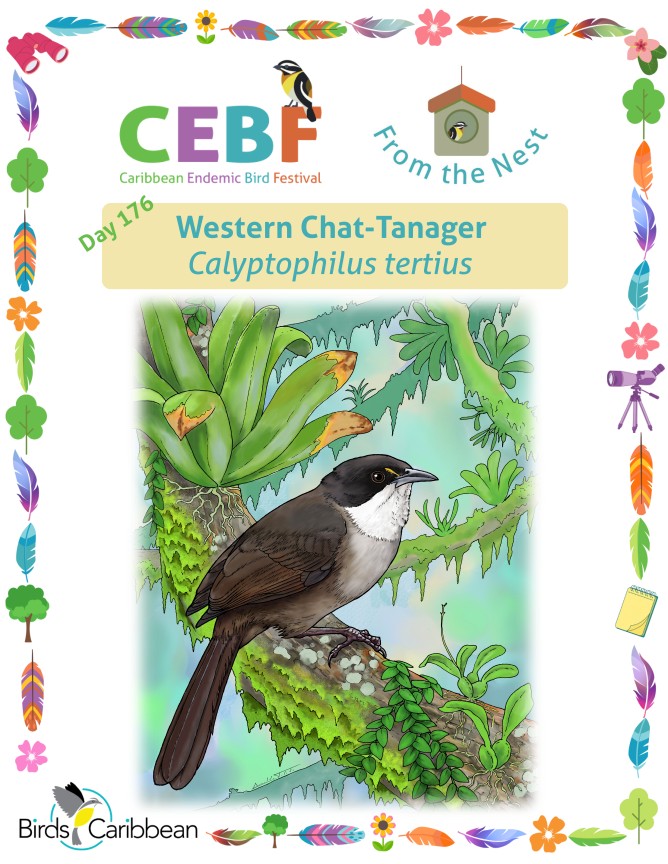
Endemic Bird of the Day: Western Chat-Tanager
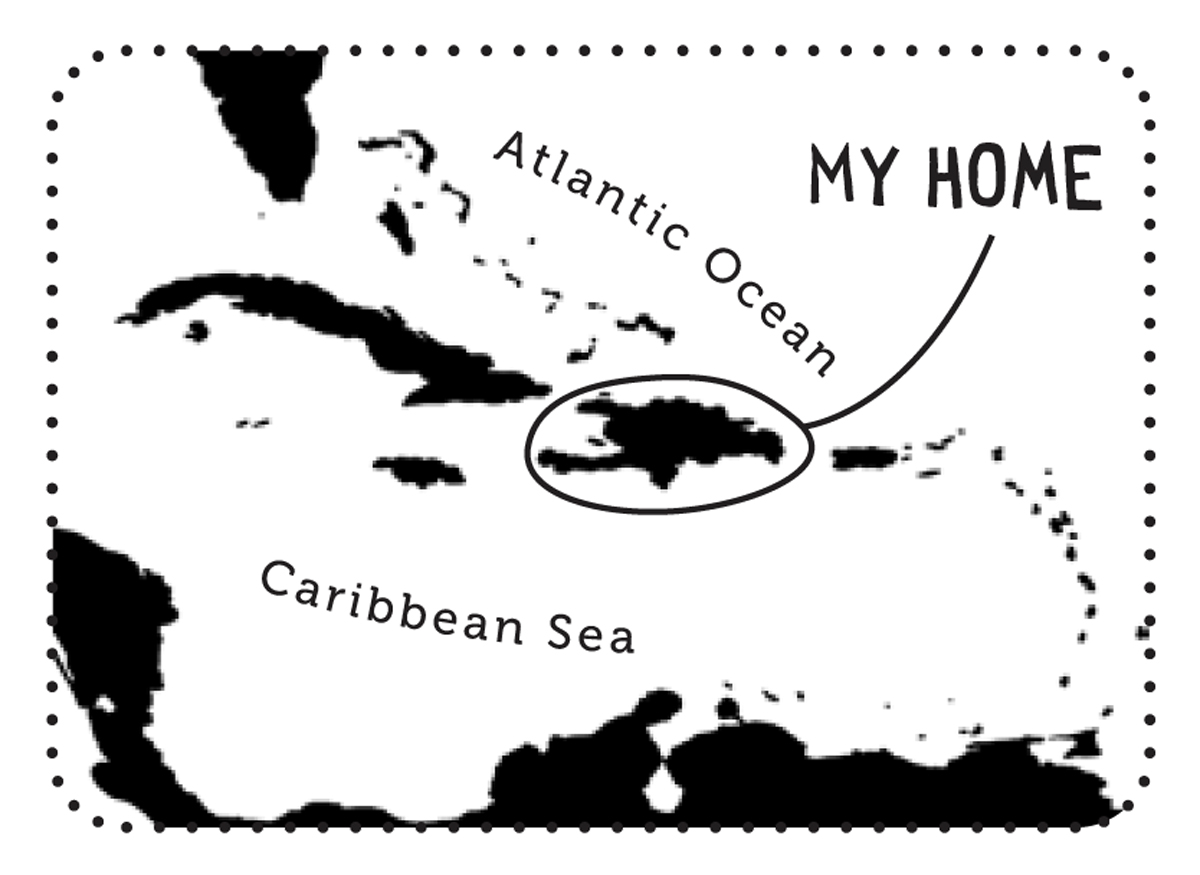
Way up in the misty mountains of Hispaniola lives a bird called the Western Chat-Tanager. Imagine a bird kind of like a Mockingbird, just a bit smaller and more mysterious! This shy little bird is part of the Caribbean endemic bird family, Calyptophilidae, from the Greek word Calyptophilus which means “loves to hide.” And do they take that seriously!
They live in broadleaf forests and dense thickets which no doubt helps them to stay hidden. Even scientists have a tough time finding them in these habitats! Our tip is to keep your eyesight low. Western Chat-Tanagers usually hang out in pairs, poking through fallen leaves looking for their next meal. They make a “chip-chip” sound while foraging. Their favorite foods are insects, small invertebrates and a little bit of fruit now and then.
How will you know you’re looking at the elusive Western Chat-Tanager and not the Eastern Chat-Tanager?! One big clue is that it has no white eyering, but it does have a small yellow patch between its eye and beak. The upperparts of the Western Chat-Tanager are dark brown. The breast and throat are white shading into the grey-brown belly and flanks. Its tail is long, rounded, and has a chestnut tint. On the other hand, the Eastern Chat-Tanager has dark brown upperparts and a white eye ring but no yellow face patch. Its tail is shorter and more squared off.
During the breeding season, May to July, they build a large and unusual cup-shaped nest with an overhanging dome and a front entrance. They use small woody stems, vines, moss, and lichens for the outer part and line the inside with stems and pieces of leaves. Clutch size is 2 pale blue eggs with brown spots.
Both parents help feed their chicks. The dad doesn’t bring food very often, but the mom shows up with food every 15 to 20 minutes when she’s not keeping the chicks warm. The mom also cleans up after the chicks by carrying away their faecal pellets (poop). Meanwhile, the dad watches nearby and sings often, usually from a perch within 10 meters of the nest.
The conservation status of the Western Chat-Tanager is considered to be Vulnerable by the IUCN, due to widespread clearing of forests particularly in Haiti. The Dominican Republic has several protected areas. One of these places is the Sierra de Bahoruco, a big mountain range where the Western Chat-Tanager can be found. That’s why it’s so important to support environmental groups that work hard to protect these wild places from pollution and deforestation so amazing birds like the Western Chat-Tanager can have a safe home to live and hide. Learn more about this species, including its range, photos, and calls here. Great news! If you’re in the Caribbean, thanks to BirdsCaribbean, you have free access to Birds of the World and you can find out even more in the full species account of this bird!
Thanks to Aliya Hosein and Holly Garrod for the text and Arnaldo Toledo for the lovely illustration.
Colour in the Western Chat-Tanager
Download our West Indies Endemic Bird colouring page. Use the photos below as your guide, or you can look up pictures of the bird online or in a bird field guide if you have one. Share your coloured-in page with us by posting it online and tagging us @BirdsCaribbean #CEBFfromthenest
Listen to the song of the Western Chat-Tanager
The song of the Western Chat-Tanager is a loud, whistled “tsew, tsee-ew, tsee-ew, tsu, tsu, tsu.”
Enjoy these photos of the Western Chat-Tanager
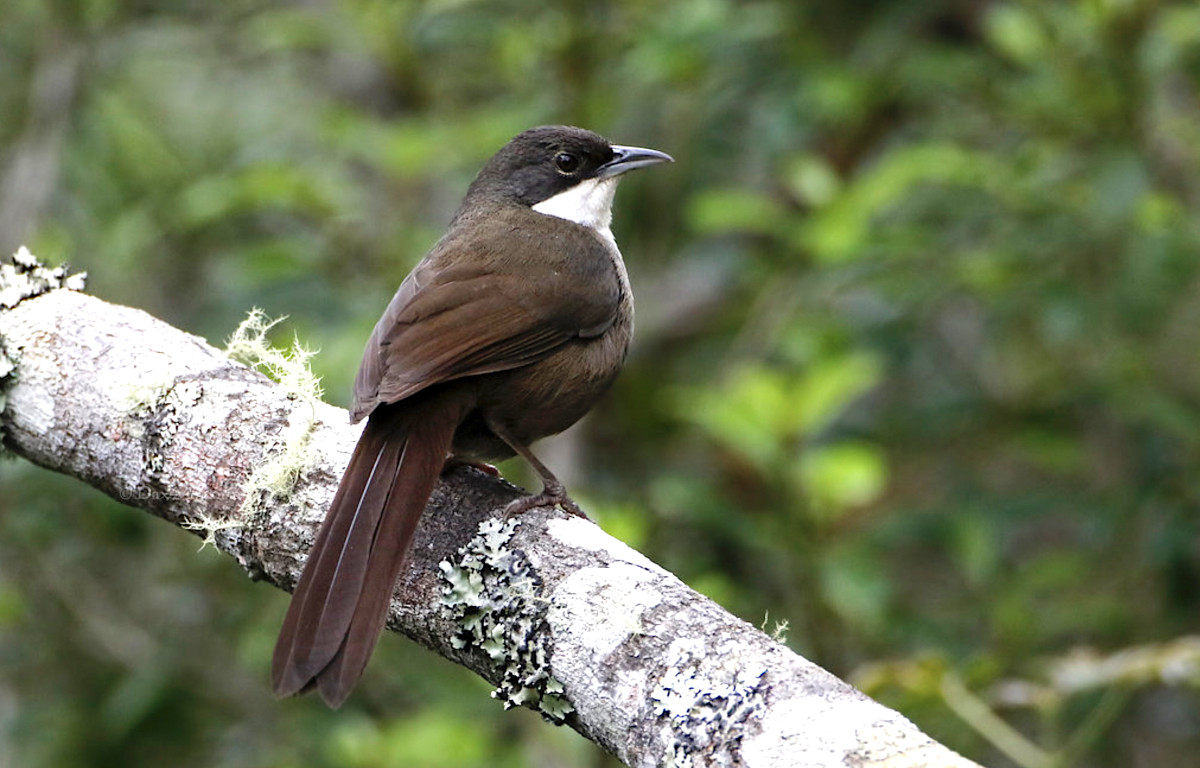
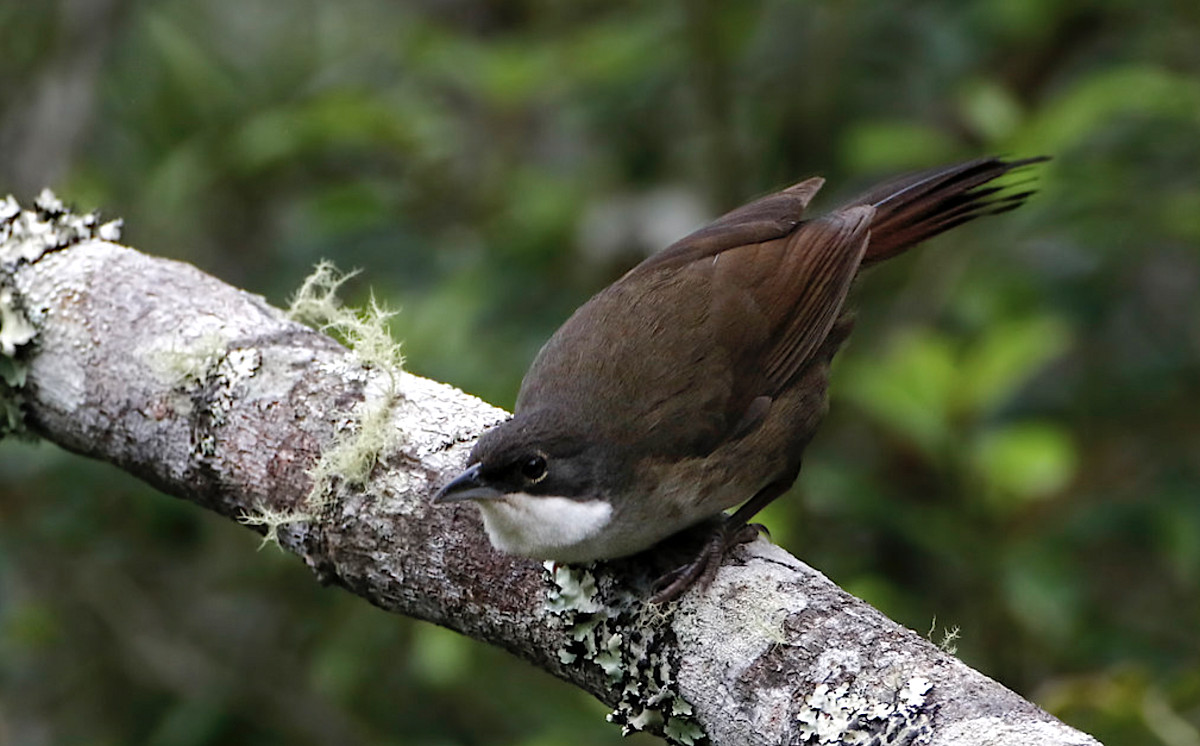
Activity of the Day
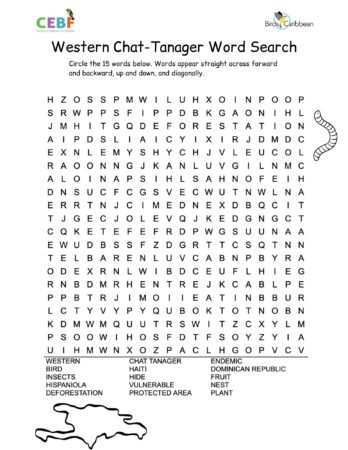 FOR KIDS AND ADULTS: Can you find the words in our Western Chat-Tanager word search? Read the text above all about this endemic bird to remind yourself of some of the interesting facts and information, as you look for all 15 hidden words!
Remember the words appear forwards and backwards, as are horizontal, vertical and diagonal! Need some help? Or want to check your answers? You can see where all the words were here.
Enjoy this video of a Western Chat-Tanager in the wild!